SOUTHERN CZECH TOWNS
Třeboň • Telč • Třebíč • Slavonice • Moravský Krumlov
Southern Czech Towns at a Glance
Sights and Activities near Slavonice
Orientation to Moravský Krumlov
Sleeping and Eating in Moravský Krumlov
Many travelers to the southern part of the country visit only Český Krumlov. While that’s a delightful destination, several nearby towns—straddling the regions of Bohemia and Moravia—are more authentic and, for many, equally worthwhile. Escape the crowds of Prague and Český Krumlov and immerse yourself in a bucolic countryside of rolling hills, workaday townscapes, vibrantly colorful main squares and village greens, convivial beer gardens, and a well-deserved local pride. The economy boomed here in the 1500s, but the Industrial Revolution largely bypassed this sleepy region. Sandwiched between the large centers of Pilsen, Prague, and Brno to the north and the Danube Valley to the south, this part of the Czech Republic boasts the lowest population density in Central Europe. A popular local slogan runs: “South Bohemia: God-forgotten country, thank God.”
The following towns are the most worthy of consideration. Třeboň is an inviting medieval burg famous for its peat spas, network of man-made lakes, and fish specialties. Tiny Telč has the Czech Republic’s most impressive main square. Busy Třebíč is home to the country’s most intact historic Jewish quarter. Slavonice is a sleepy Renaissance gem with a genuine artistic community. Near the Austrian border, it feels like it’s perched at the end of the world.
Finally, Moravský Krumlov, while nothing special as a town, hosts Alphonse Mucha’s powerful set of paintings called the Slav Epic, which connects 1,500 years of Slavic history to universal human themes.
GETTING AROUND
By Car: This region is a delight by car—each of these towns is within an hour’s drive from the next through scenic countryside. For pointers, see “Route Tips for Drivers” in the Český Krumlov chapter (here).
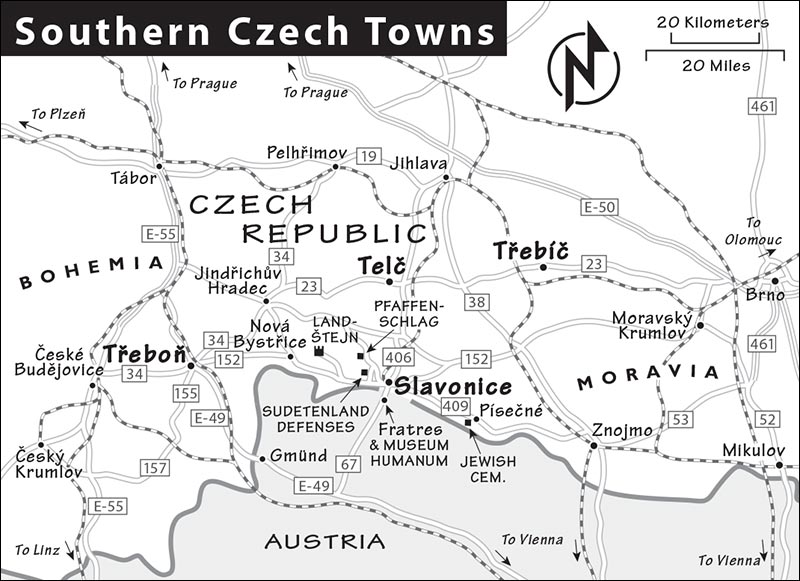
By Public Transportation: If you were to draw a line between České Budějovice (the capital of South Bohemia) and Brno (the capital of Moravia), you’d go right through the “Three Ts”: Třeboň, Telč, and Třebíč. A bus follows this route, stopping in all three (3/day Mon-Fri, 2/day Sat-Sun; České Budějovice to Třeboň—30 minutes, to Telč—2.5 hours, to Třebíč—3.5 hours, to Brno—4.5 hours). You can reach České Budějovice by direct train from Prague (almost hourly, 2.5 hours) or from Český Krumlov (6/day, 45 minutes). In České Budějovice, the bus and train stations are next to each other. Direct buses also connect Třeboň, Telč, and Třebíč to Prague and other destinations; see “Connections” for each destination.
To reach Slavonice, change in Telč to catch the train (6/day, 1 hour). A few buses and trains run between Třebíč and Moravský Krumlov with one transfer (several options daily, 1.5-2 hours). For bus and train schedules, see https://idos.idnes.cz and www.cd.cz.
PLANNING YOUR TIME
This area makes a good stopover on the way from Český Krumlov to points farther east (Olomouc, the Mikulov wine region, or even Vienna, Bratislava, or Poland). Driving gives you the most flexibility. Because the towns are fairly close to one another, it’s possible to string together a few of them in a long day. Depart Český Krumlov early and stop at your choice of towns before returning to Český Krumlov for the night. If taking public transit, bus departures will dictate the amount of time you spend in each town—on weekdays you could reasonably leave Český Krumlov early in the morning, visit Třeboň and Telč, and arrive in Třebíč by evening.
With more time, consider sleeping in one of the towns. For village relaxation and hiking, spend the evening in Telč. For a bigger, more city-like feel, consider Třebíč. Slavonice, a bit out of the way and not as eye-catching as Telč, is worthwhile as a slow-paced art-, nature-, and history-packed base for those seeking to escape not only their usual surroundings but time altogether. Moravský Krumlov is an easy stop on the way to the Mikulov wine region.
Třeboň (Wittingau)
Třeboň (TREH-bohn, pop. 18,000, Wittingau in German) is a well-preserved medieval spa town centered on an inviting Renaissance square. This is a charming place to experience good living and to explore a unique biosphere of artificial lakes that date back to the 14th century.
Over the centuries, people have transformed what was a flooding marshland into a clever and delightful combination of lakes, oak-lined dikes, wild meadows, Baroque villages, peat bogs, and pine woods. Rather than unprofitable wet fields, the nobles wanted ponds that swarmed with fish—and today Třeboň remains the fish-raising capital of the Czech Republic. Landscape architects in the 16th century managed to strike a remarkable balance between civilization and nature, creating what is today a protected ecosystem (about 15 percent covered by water) with the biggest diversity of bird species in Central Europe. Nature enthusiasts come here to bird-watch, bike along dikes held together by the roots of centuries-old oaks, and devour the best fish specialties in the country.
While Třeboň enjoys plenty of tourism, most visitors are Czech vacationers who come for a week every year—meaning local establishments work hard to please. These demanding native customers and a booming fish industry make Třeboň’s relative affluence feel less touristy than other popular towns. Its peat spas have attracted patients from all over the world for decades, but since the facilities are small, Třeboň is never as overrun as some more famous, pretentious spa towns. Třeboň feels workaday and real—it’s a thriving community that just happens to spread out in a beautiful, tourism-worthy main square. It’s the kind of place where an artsy cinema and a theater presenting plays and concerts neighbor the Town Hall.
Třeboň makes a good home base for those looking to experience Český Krumlov sans crowds: Stay here, then drive down to Český Krumlov in the evening for a magical, floodlit nighttime tour when the tourists are asleep and the spirits awake (see previous chapter).
PLANNING YOUR TIME
Don’t be in a rush here—unlike Telč or Třebíč (which can each essentially be seen in two hours), Třeboň rewards those who take time for a stroll (or, better yet, a bike ride) outside its walls. Get oriented on the main square, climb the Town Hall tower, duck through the castle (and consider visiting the House of Nature), and walk the canals and greenbelt that surround the Old Town. (The castle itself and the brewery are less interesting.) Try fish soup, catfish, or pike. Rent a bike and follow the educational trail along the ancient dikes. If it’s hot, bring a bathing suit.
Soaking at a peat spa is unforgettable; unfortunately, it may be difficult to get a spot (for booking details, see “Activities,” later). If you get in, build your day around it.
If you’re here in October or November, lend a hand in the fascinating ritual of clearing the fishponds, warming yourself with shots of potato rum as you wade through the mud.
Note that the town—including the TI and most sights—basically closes down for a lunch break (generally around noon).
Orientation to Třeboň
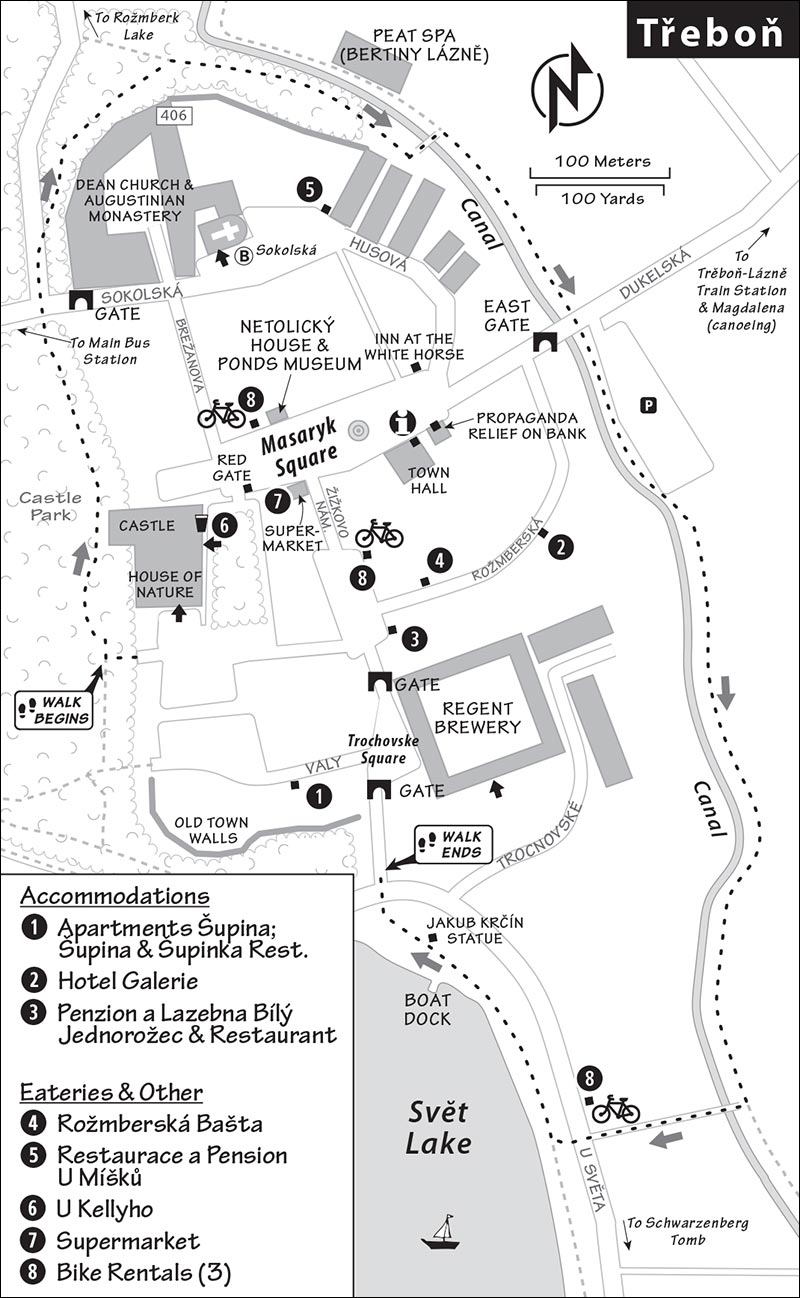
The Old Town—separated from newer construction by the sparse remains of city walls, Renaissance gates, a water channel, and a castle garden—encircles Masaryk Square (Masarykovo Náměstí). The parallel Husova street—with Dean Church—cuts through the north end, while the huge Regent Brewery anchors the southern part of town. Sights, hotels, restaurants, and ATMs are all on or within a couple blocks of Masaryk Square. From the train station or parking lot, you’ll enter the square through the east gate.
TOURIST INFORMATION
The TI, next to the Town Hall on Masaryk Square, gives out a handy brochure called The Region of Třeboň. With several days’ notice, they can reserve an English-speaking local guide (TI open daily July-Aug 9:00-18:00, May-June and Sept until 17:00, shorter hours off-season, +420 384-721-169, www.itrebon.cz).
ARRIVAL IN TŘEBOŇ
By Car: Approaching town, follow blue P/Centrum signs. You’ll drive through a gate into the Old Town, zip past the Dean Church, cut across the bottom of the main square, then exit through another gate. A handy pay parking lot is along the canal just outside, on your right.
By Train: Get off at the Třeboň-Lázně station—not the Třeboň-Město station. From Třeboň-Lázně, walk along the road directly in front of the station, and you’ll reach Masaryk Square in five minutes.
By Bus: The bus from Prague leaves you at the main bus station, a 20-minute walk (or 100 Kč taxi ride, +420 602 272 427) west of the Old Town. Most buses arriving from České Budějovice continue from the main station to the Sokolská stop, which is a short walk through the castle park to Masaryk Square.
HELPFUL HINTS
Bike Rental: You’ll see lots of bikes around town. If you want to join in the fun, you can rent decent bikes near the main square: at the bowling alley in Hotel Zlatá Hvězda (accessible from Žižkovo Náměstí—from the main square it’s a few yards past the Pramen supermarket, +420 720 537 438) and the newsstand directly across the square from the Pramen supermarket at #85 (look for tabák sign; +420 602 151 756). Higher-quality bikes and e-bikes are available at the Třeboň Centrum sports shop—walk through the three gates past the bowling alley, turn left, and continue another 200 yards (+420 777 998 560, www.trebon-centrum.cz).
Local Guide: Hana will take you on a town walk that may include the castle and the Neo-Gothic Schwarzenberg family tomb (600 Kč/hour, +420 724 309 987, hana.pechova@gmail.com).
Sights in Třeboň
▲▲Masaryk Square (Masarykovo Náměstí)
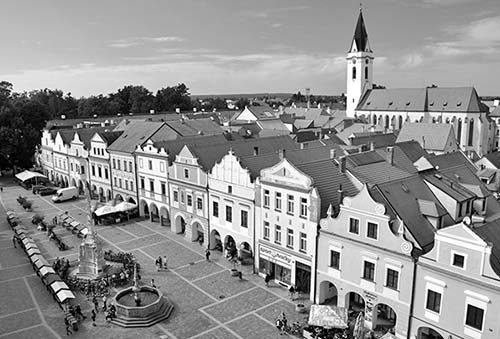
Třeboň’s fine main square is typical of squares in the region: lined with colorful facades artfully blending both Renaissance and Baroque building styles. It was built by the town’s 17th-century burghers, whose wealth came from the booming fish industry. The rectangular market plaza—with a humble plague column and fountain in the middle—feels just right. Grab a seat at one of the outdoor cafés, and watch local life circulate with the serenity of ducks on a lake.
While the tranquility comes naturally today, until 1989 it was a government requirement. At the square’s lower end, above the bank door (yellow spořitelna building), a propaganda relief in the Social Realist style of the Soviet Union extols the virtue of working hard and stowing your money here for the common good (and shows how much the avant-garde of the time embraced a radical-left ideology, with its accompanying aesthetic). Higher up, a happy fisherman cradles a big fish, the reason for his wealth—and, since the 15th century, the wealth of Třeboň.
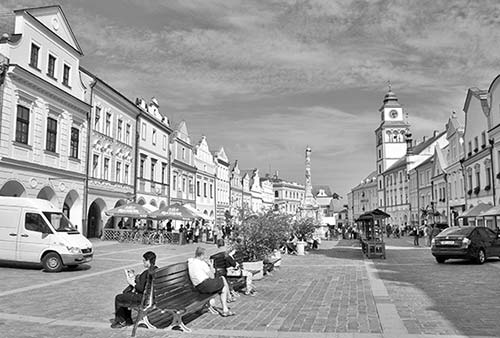
The nearby Town Hall tower, whose moderate height of 100 feet just fits with the size of the square, is well worth the climb (exactly 100 steps). Surveying the view from its top, you feel as if you can reach out and touch the circular Old Town. Beyond that, the lakes glimmer against the green backdrop of stately oaks (30 Kč, pay and borrow key at TI—typically available at the top of each hour, same hours as TI).
Across from the Town Hall, the impossible-to-miss, rampart-like white gable marks the 16th-century Inn at the White Horse (U Bílého Koníčka—look for the small horse on the facade). A few houses to the left is the state-of-the-art Štěpánek Netolický House and Pond-Building Heritage Museum, with an exhibit on the region’s innovative, centuries-old system of dikes, lakes, and canals (described later).
At the other end of the square, notice the only modern building here, a Pramen supermarket. Some 30 years ago, when the square was veiled in the shabby gray of communism, the regime decided to give it a facelift with a modern building that fit the medieval space like a UFO. After 1989, locals carefully added a facade and a new gabled roof to the concrete box, effectively blending the former eyesore into the Old World townscape.
Get oriented to this tiny town: Stand in the middle of the square and face west (with the station and gate at your back). The street to the left, just before the Pramen supermarket, leads to the brewery, the recommended Šupina & Šupinka and Bílý Jednorožec restaurants, and Svět Lake. Now walk a few steps forward (away from the gate), to the top end of the square. The street to your right leads to Husova (which parallels this square) and the pointy spire of the Dean Church. The ornamental red gateway to your left opens up into the castle courtyard; cut through there and emerge at the park to find the House of Nature (with the recommended Man and the Landscape exhibit). All of these sights are described below.
Štěpánek Netolický House and Pond-Building Heritage Museum
Set in a Renaissance townhouse on the main square—and lavishly renovated with generous European Union funding—this museum gives you a chance to appreciate the typical floor plan of the time. The downstairs exhibit (including a running-water model on the patio) illustrates how the nearby pond system is ingeniously tied to a 16th-century canal called the Golden Channel, designed by fishpond builder and architect Josef Štěpánek Netolický (see sidebar on the lakes of Třeboň). The upper level functions as a gracious gallery space that showcases temporary exhibits by top Czech contemporary artists.
Cost and Hours: 80 Kč, 110 Kč combo-ticket with House of Nature; May-Sept Mon-Sat 10:00-17:00, closed Sun; April and Oct Wed-Sun 10:00-16:00, closed Mon-Tue; closed off-season; +420 380 130 004, www.dumstepankanetolickeho.cz.
Dean Church and Augustine Monastery (Děkanský Kostel a Augustiánský Klášter)
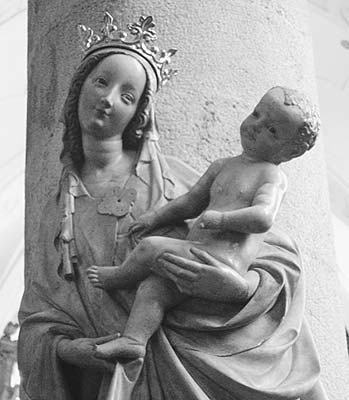
This Gothic church, with its unusual double nave (and obtrusive columns down the middle), is worth a look if open. (If it’s closed, peer through the gate at the back of the church; you can also look through the door around the right side.) A highlight is its delicately curved statue of the Madonna and Child (c. 1390, painted limestone, at the bottom of the third pillar in from the back). Its Ivory Soap sweetness and slinky S-shaped body are typical of late “beautiful style” Gothic. The artist, though anonymous, is known as the “Master of the Třeboň Madonna.” The church once showcased more marvelous Gothic sculptures and altars, but these were deemed too valuable, so they were zipped off to the Museum of Medieval Art in Prague’s St. Agnes Convent. Frescoes in the adjoining cloister, badly neglected until after 1989, show scenes from the life of St. Augustine. While the monastery library is long gone, Augustinians were some of the most ardent medieval copyists in the time before Gutenberg’s movable type revolutionized printing. Through the efforts of monks in this monastery, Třeboň became a center of medieval learning for Czechs and Austrians alike.
Cost and Hours: Donation requested; July-Aug daily 9:00-11:30 & 13:30-17:00, or pop in just before the nearly nightly 18:30 Mass, shorter hours off-season; if closed, ring the parish home next door; Husova 142, rectory +420 384 722 390.
Třeboň Castle (Zámek)
In a land of great castles, Třeboň’s is unusually dull. Perhaps what makes the castle unique is how it blends with the rest of the town as if the local aristocrat were just another burgher. From the main square, step through the red gateway into the courtyard, which is covered with rectangular sgraffiti—a characteristic faux-stone-block decoration of the late 1500s (made by etching a design in plaster, revealing a different color underneath). As with other South Bohemian towns, all this sgraffiti is a reminder that the 16th century was Třeboň’s heyday.
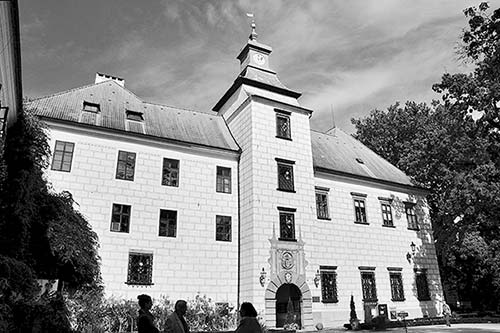
Třeboň belonged to the Český Krumlov-based Rožmberk family. In 1600, Petr Vok—the last of the Rožmberks—moved here permanently after selling Český Krumlov to the emperor. He brought along his archive, still considered the most valuable collection of medieval documents in this part of Europe. It was here that the historian František Palacký—pictured on the 1,000 Kč bill—did much of the research for his history of the Czech nation (including details on reformer Jan Hus) that came to define modern Czech identity; his “History of the Czech Nation in Bohemia and Moravia” (1836-1867) remains an authoritative work on the subject.
The castle can only be visited with an escorted tour (likely in Czech, with an English flier). Your best basic castle visit is Route A, which includes Petr Vok’s Renaissance rooms. Route B covers the 19th-century apartments, kitchens, and stables of the later, equally distinguished Schwarzenbergs.
Cost and Hours: 140 Kč and 180 Kč tours in Czech, English-language flier provided, buy at “cash box” ticket desk, English tours cost more and must be reserved a week ahead by emailing zamek.trebon@seznam.cz; tours go at least hourly Tue-Sun 9:00-11:45 & 12:45-17:00, shorter hours likely in spring and fall, closed Nov-March and Mon year-round, +420 384 721 193, www.zamek-trebon.cz.
Nearby: To reach the House of Nature, listed next, go through the little gate at the far end of the castle’s big courtyard. You’ll emerge into the big park; to find the museum, look right.
▲House of Nature (Dům Přírody)
Located inside the castle, this is the best sight in town. Its Man and the Landscape exhibit is surprisingly modern, thoughtfully described in English, and further illuminated by excellent little video-on-demand terminals. It covers the things that make this town distinct: lake-making, the fish industry, the peat spa treatment, and the natural environment. A highlight is the theater (just after the stuffed animals), where you can watch a 13-minute video that takes you fishing early in the morning, and a 20-minute video that speeds you through a year with nature in Třeboň. An hour here is time well invested.
Cost and Hours: 80 Kč, 110 Kč combo-ticket with Štěpánek Netolický House; May-Sept Mon-Sat 10:00-17:00, closed Sun; April and Oct Wed-Sun 10:00-12:00 & 13:00-17:00, closed Mon-Tue; Nov-Dec Wed and Sat only; enter from garden just outside castle and city wall, +420 384 724 912, www.dumprirody.cz.
Nearby: After touring the museum, head out into the park, and consider circling the town (described next).
ACTIVITIES
▲▲Walking the City Park and Canals
Given how closely tied Třeboň is to its landscape, limiting your visit to the main square and castle area misses the big picture. Take a 20-minute circular walk around the Old Town, seeing fragments of the city wall and the canals and lakes that define the local identity. While you could begin and end your stroll anywhere, I’ve described the route clockwise, starting at the city park just outside the castle and House of Nature. To trace your route, see the town map, earlier.
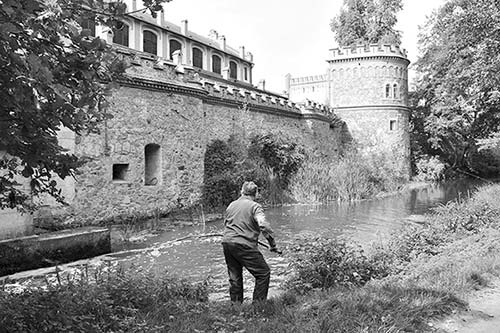
First, linger in the broad, lush park, popular with the town’s inhabitants. Bear right, working your way around to the gateway into town (it’s easy to imagine how the entirety of Třeboň was once encircled by a protective wall—even if today you mostly see only the backs of houses). Cross the street and find the canal on the other side; follow it, bearing right when the canal forks. Here you’ll enjoy a lush canalside garden scene, with a handy bike path and the wimpy, sgraffito-etched, crenellated remains of the city wall as a backdrop. As you stroll the delightful canal, notice the modern building on your left—Třeboň’s famous peat spa (described later).
Soon you’ll emerge from the park at the town’s east gate, facing the parking lot and train station—handy if you’re in a hurry to head out. Better yet, keep going straight, following the canal into a more rugged park with tall trees. As you stroll, you’ll see the yellow-with-brick-trim Regent Brewery, a few more impressive chunks of the city wall overlooking the moat-like canal, and—very likely—a few old-timers throwing a line into the canal or trying to pull fish up with a net from the bottom of a sluice.
Keep going along the canal, passing (across the water) an industrial zone, then a welcoming park. Cross the next footbridge, walk up the lane to cross the busy road, then angle up to the top of the dike and turn right. You’re circling Svět, the second largest of Třeboň’s lakes. Just ahead, near the statue of Jakub Krčín, who built this lake (badly—see sidebar), you’ll find a dock for boat trips (100 Kč/30 minutes, 150 Kč/45 minutes, departs hourly, daily 10:00-19:00).
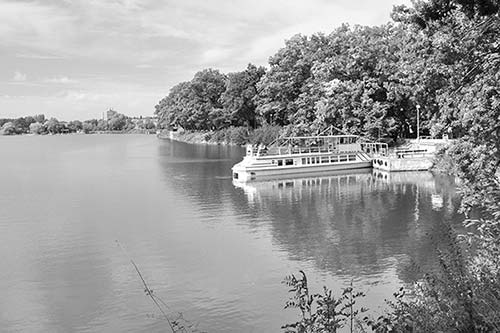
From here, you have a few options: You can continue along the dike (the nearest sandy beach is a 10-minute walk past the boat dock). Or, to head back into town, cross the street behind Jakub Krčín, go up the lane (noticing that the castle park is just to your left), and go through the gate. If you’re ready for a meal or a drink, the recommended Bílý Jednorožec restaurant is immediately on your right, and the Šupina & Šupinka restaurants are to your left, under the arch. Otherwise, head straight, through the tall white gate, and in a long block you’ll be back on Masaryk Square.
Biking
The area is flat, so biking is a fun and convenient way to get around. A bike trip along the dirt trails on the ancient dikes is a great way to experience the land and water. Buy a cycling map from the TI, then follow the marked trails that snake along channels and through traditional villages. For bike-rental options, see “Helpful Hints,” earlier.
Hiking, Bird-Watching, and Fishing
Head north or south of town to find outdoor activities around the Golden Channel system, Rožmberk Lake, and original peat bogs and marshes such as Červené Blato. Trails are clearly indicated by markers on trees. Serious bird-watchers or fishers should get in touch ahead of time with Petr Muller at the recommended Šupina restaurant (muller@supina.cz), who can set you up with a guide to lead you on an outing.
▲▲Boating
The Lužnice River, which feeds the system of ponds in Třeboň, is just as popular with Czech boaters as the Vltava River around Český Krumlov. To gain a full appreciation for this wild landscape of pine woods, meadows, peat marshes, bogs, bugs, and authentic riverside beer stalls, consider canoeing the meandering, 7.5-mile stretch of the Lužnice River from the small town of Suchdol nad Lužnicí to the village of Majdalena. (You can also go by raft, but because the Lužnice River is slow-flowing, I prefer to canoe rather than float on a raft.)
You can either drive or bike the six miles to Majdalena where Martin Dunaj’s boat-rental company is based; or, for 400 Kč extra, Dunaj and his team will pick you up and drop you back off at your hotel in Třeboň. When you get to the weir, you’ll either need to carry the canoe over or be ready to get wet (canoe rental includes transport from Majdalena to Suchdol, allow 3-4 hours, also offers raft rentals, buy bug repellent at the Pramen supermarket in Třeboň, +420 724 919 143, www.pujcovnalodidunaj.cz).
Regent Brewery Tour
The Regent Brewery is proudly locally owned rather than part of a multinational corporation. While the recently spiffed-up, tour-group-oriented beer hall is a safe miss, the brewery tour itself is worthwhile. Run in Czech by area youngsters who will hand you an English leaflet at the start (English tour on request), the tour takes you through some of the oldest brewery operations in the country.
Cost and Hours: 150 Kč, 170 Kč for porch-lit night tour, daily 10:00-17:00 on the hour, night tour Fri-Sat in July-Aug at 21:00, +420 606 610 875 or +420 777 357 076, www.pivovar-regent.cz.
Peat Spa (Bertiny Lázně)
Patients from all over the world come to Třeboň’s peat spa for weeklong stays to get naked and buried in the black, smelly sludge that’s thought to cure aching joints and spines. Well...I guess it doesn’t hurt to try. The complete peat bath (slatinná koupel celková) is combined with a full-body massage (don’t ever try to sneak away before the nurse is finished with you). It’s worth it to have the opportunity to fully judge the power of peat and experience the surreal One Flew Over the Cuckoo’s Nest atmosphere of Czech medical institutions.
It’s smart to book a spa treatment several months ahead (you’ll receive a prompt confirmation and a reminder one month before your appointment). If you didn’t make a reservation, you may be able to snare a last-minute spot if there’s a cancellation. Call the spa or, better yet, ask your hotelier to inquire—locals can pull strings for you (+420 800 611 009, www.laznetrebon.cz). To get to the spa, go through the east gate of the city walls; the spa is just off to your left.
Sleeping in Třeboň
Although there are many pensions in Třeboň, several are managed in conjunction with the spa and only take guests for a week or more. The places listed here welcome guests for short stays.
$$ Apartments Šupina, with four gorgeously renovated rooms and suites in the former home of the town’s chief pond supervisor, is a stylish treat. The back windows face a private garden, former moat, and the oak-lined dam of Svět Lake. Petr, who runs the inn and the recommended restaurant next door with his family, can link you up with his bird-watching and fishing buddies, and may be able to help with last-minute spa reservations. The paintings of nearby landscapes that decorate the rooms were done by Petr’s grandfather—you can buy one if you like (Valy 155, +420 720 993 825, www.supina.cz, office@supina.cz). This place is located next to and operated by the same family as the recommended Šupina & Šupinka restaurants, listed later.
$$ Hotel Galerie, with 12 simple rooms and an artistically decorated breakfast area, may have space even last minute. Notice the slightly buried storage room by the reception hall that now serves as a semi-open wine cellar—since Třeboň is built on floating sands, no house in town has a basement. The manager may be able to set up a spa appointment on short notice (Rožmberská 35, +420 724 093 876, www.hotel-trebon.cz, galerie@hoteltrebon.cz).
$$ Penzion a Lazebna Bílý Jednorožec (“White Unicorn”) is a modern, tastefully opulent place with 12 rooms and an in-house spa and wellness center. Linda, the manager, keeps up high standards on all fronts and is a wealth of information (Žižkovo Náměstí 46, +420 724 065 785, www.bilyjednorozec.cz, recepce@bilyjednorozes.cz).
Eating in Třeboň
Since the 1200s, Třeboň has lived on a steady diet of fish. The abundant variety of fish raised here is amazing...as are the chefs who cook that abundance. Austrians and Czechs alike drive for hours just to dine here. While you can find trout and carp throughout the country, the catfish, pike, and pike perch (also called “tender”) from these lakes are unique. Pike perch is nicknamed “royal” fish due to its delicate meat (for some, it’s overly tender). Catfish (sumec) is hardier and somewhat fattier, with no bones. Pike is the only widely available predator fish. Carp, imported to Bohemia some thousand years ago from Turkey, is prepared in the most imaginative ways. Pike and pike perch may be stored frozen even during the season—check with your server to find out if your fish is fresh. Eel and salmon are not locally produced.
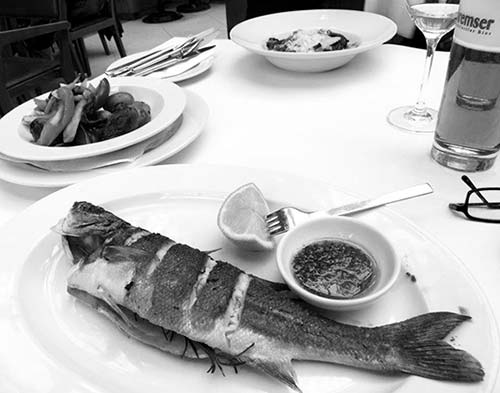
$$$ Šupina & Šupinka (“Scale” and “Little Scale”), set in modern interiors across the street from each other (and with an airy, quiet terrace), are top-notch places run by a committed local staff. Started as a beer-and-hot-dog window by the Muller family in 1990, the business has evolved into the classiest restaurant in town. It’s now run by proud second-generation brothers Petr and Pavel, who blend professional dedication with a personal approach. Everything is just right. Dig into the rare and refined appetizers, which include fried carp sperm. While it’s expensive by local standards, you’ll feel like royalty as you dine for half the price of a similar meal in Prague (daily, accommodations upstairs—see listing earlier, Valy 155, +420 384 721 149).
$$ Bílý Jednorožec (“White Unicorn”), just before the first gate, is a sleek, modern, one-room place with an imaginative chef who will not touch any ingredient that’s not entirely fresh. Rather than stick with a permanent wide-ranging fish menu, the restaurant serves whatever fresh ingredients the chef chooses to cook that night. Fish is complemented by game and meat from local small farms. Gourmet yet relatively inexpensive, this is the best value in town (long hours daily, +420 777 696 833).
$$ Rožmberská Bašta (“Fisherman’s Bastion”) is a cozy wood-paneled family eatery with nets hanging overhead and stuffed fish of all sorts staring from the walls. Ask Vlasta, the owner, to tell you which is which (in Czech), then use the menu to decipher and assess the English equivalents; the biggest, fiercest-looking specimen is sumec (catfish). Outside the main season, confirm which fish is fresh (daily; on Rožmberská, the street that runs parallel to the main square behind the Town Hall tower; +420 777 218 077).
At $$ Restaurace a Pension U Míšků, an antique-filled family establishment, they pride themselves on fish caught every morning in their own pond. They also have a long non-fish menu that includes pasta. The richly decorated interior is more refined than rustic. They also rent five classy rooms (daily, near the Dean Church at Husova 11—look for the prettiest facade on the street, +420 384 721 698).
To grab a quick beer in a student-packed den, head to $ U Kellyho (daily 12:00-sunrise) in the castle basement off the passageway from the main square to the castle park.
Třeboň Connections
While buses between Třeboň and Prague are about as fast as the train (2.5 hours), bus departures are less frequent, and the bus station is far from the center of Třeboň. For bus and train schedules, see https://idos.idnes.cz and www.cd.cz.
From Třeboň by Train to: Prague (7/day, 2.5 hours, transfer at Veselí nad Lužnicí). If going from Prague to Třeboň, get off at Třeboň-Lázně, not Třeboň-Město.
From Třeboň by Bus to: Prague (2/day, 2.5 hours), Český Krumlov (10/day to České Budějovice, 30 minutes; then transfer to Český Krumlov), Telč (3/day Mon-Fri, 2/day Sat-Sun, 2 hours), Třebíč (3/day Mon-Fri, 2/day Sat-Sun, 3 hours), Brno (3/day Mon-Fri, 2/day Sat-Sun, 4 hours).
Telč
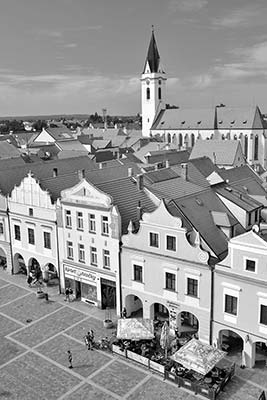
Telč (pronounced “telch,” pop. 6,000) is famous for its glorious square, considered by many to be the country’s best. The Old Town—just a fat square with a thin layer of buildings—is surrounded by a sophisticated system of protective ponds and defensive walls. The general lay of the land has changed little since the 1300s. After 1800, all new construction took place outside the core. Today, Telč remains an unspoiled, sleepy Czech town where neighbors chat in pastry shops, Vietnamese traders in medieval arcade stalls sell dirt-cheap textiles to country folks, and the smell of goat dung from a pasture across the lake permeates the town after nightfall.
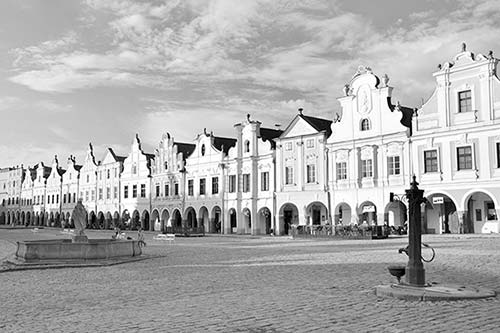
With few attractions aside from the square and the castle, Telč is made-to-order as a lunch stop on the way to or from Slavonice, Třeboň, and Třebíč, or on the longer haul between Prague and Vienna. An overnight stay here can be a relaxing village experience.
Orientation to Telč
Everything you’ll need—including ATMs, shops, hotels, and restaurants—is on the main square (Náměstí Zachariáše z Hradce).
TOURIST INFORMATION
The TI, located in the Town Hall, has information on area activities, hands out train and bus schedules, and offers a free town audioguide for a 500 Kč deposit (July-Aug Mon-Fri 8:00-18:00, Sat-Sun from 10:00, shorter hours off-season, +420 567 112 407, www.telc.eu). They can help you find a room in one of the pensions on the square (see “Sleeping in Telč,” later).
ARRIVAL IN TELČ
The main square is easily reachable on foot from the bus station. If arriving by car, don’t park right on the square (spaces there are reserved for residents). Instead, use the P1 lot along the main road just north of town (an easy 5-minute walk through the park to the castle), or the P2/P3 lots at the east end of town, near the top of the square.
HELPFUL HINTS
Festivals: Young musicians pour into Telč from all over Europe the first two weeks of July for the French-Czech Music Academy, which hosts workshops on classical-music interpretation. The young virtuosos show off their skills in a number of concerts and recitals (www.akademietelc.cz). The Telč Vacations (Prázdniny v Telči) festival, held the first two weeks of August, makes the squares, gardens, and castle chambers come alive with folk music, open-air theater, and exhibitions (www.prazdninyvtelci.cz/eng).
Bike Rental: Locals and visitors enjoy biking to the forests and castle ruin of Roštejn and back (15 miles round-trip). You can rent bikes at the train station or at Panský Dvůr, just northwest of the square (also rents e-bikes, +420 564 403 780, info@panskydvurtelc.cz).
Taxi: For a taxi, call +420 603 255 048; English spoken.
Boat Rental: During the summer, you can rent a boat for a lazy lake cruise. To get to the rental boats, walk through the gate between the castle and the square, then turn right on the path along the lake (July-Aug daily 10:00-18:00, closed Sept-June).
Telč Main Square Walk
Telč’s spacious square (Náměstí Zachariáše z Hradce) is lined by fairy-tale gables resting on the characteristic vaulted arcades that cover local stores, bakeries, and tasteful gift shops. It’s the most impressive square in the Czech Republic and worth ▲▲. The uniqueness of the square lies in its enormous size, unexpected proportions in such a small town, and the purity of its style—of the 40 houses lining the square, there isn’t a single one younger than 300 years. A fire devastated the town in 1553, and it was rebuilt of stone. A plague that ravaged the region in 1780 skipped Telč, so the plague column was built on the square to thank God.
Begin this self-guided walk at the narrow bottom end, near the castle complex (described later), and stroll slowly up the square. The tallest, turreted facade, with the little onion dome (on the right, at #10), is the Town Hall, home to the TI. Farther along on the same side is the dramatic green building at #15—the only one with a turret on the corner. Like many Telč buildings, it’s covered in sgraffito designs (etched into wet plaster); the bottom half has the standard “envelope” sgraffito, while the upper half boasts dramatic scenes. The narrow lane alongside this house (with more sgraffito scenes on the upper story) leads to a little footbridge that offers fine views of the church and castle. This gives a sense of the fortifications that protected Telč—which is ringed with fishponds (rybník) that both provide food and are a strategic barrier to would-be invaders.
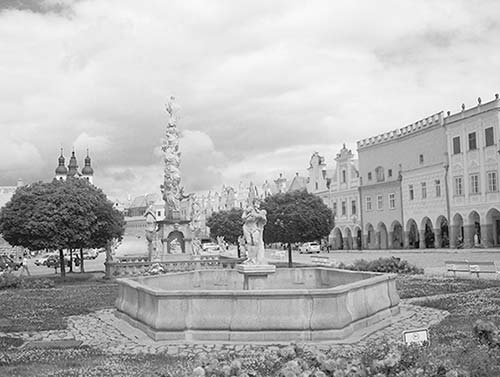
Directly across the square from the green house are several of the finest facades around. At #61, the black-and-white designs (including Old Testament figures) and Venetian-inspired flare gable were commissioned in 1555 by a local bigwig determined to impress. Two doors up, the coral-colored #59 brings some bubbly Baroque curves to the square (which, until this point, had been more rigidly Renaissance); #57, two houses up, followed suit and upped the ante, planting chubby cherubs on the crests of the gables.
A bit farther up, #54 and #55 are joined with a crenellated top and resemble a fantasy fortress. Notice the gaps in the gables partway up, where the actual roof ends; this makes it easier to clear snow off the rooftops.
By this point, you’ve worked your way up to the charming little park that surrounds the plague column. Grab the handle on the well just below the park and give it a few pumps—it still works. At the corner of the park, notice the clever little “Retro-culcar” sound box. Spin the crank a few times, press the button, and you’ve powered a few minutes of English commentary about the square.
Farther up, the houses that stretch to the left are some of the square’s prettiest—especially #51, with its rich burgundy color. Near the top corner, look for #47, with a rectangular facade. The two top windows on the sides are obviously fake—added to the facade to create the illusion of symmetry. Poking up over the right end of the square is the pointy spire of a church on the next street over, which marks two recommended restaurants.
While there’s not much else to see in this little town, it’s worth strolling through the castle complex or heading out to the lakes that flank the town for a different view on Telč.
Sights in Telč
Telč Castle
The castle is located at the end of the main square—you can’t miss it. In its early years, this castle belonged to the clan of the Five Roses (symbolized by a golden rose on a blue field; see the “Parting of the Roses” sidebar on here). In the 1500s, the nobleman Zachariáš z Hradce (for whom the grand main square is named) imported a team of Italian artists, who turned the earlier Gothic palace into a lavish Renaissance residence. (Their work also influenced most of the burgher houses in the square.)
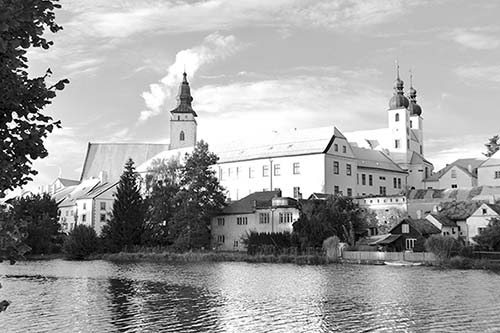
If the castle is open, step inside and explore its fine courtyards. Placards posted throughout the grounds identify movies that were filmed in this very atmospheric space (most of them Czech). Don’t miss the garden just to the right as you enter (it’s the walled area that you see from outside, on the square). Savor this tranquil space, surrounded on two sides by a perfectly harmonious Renaissance arcade. The little museum along one part of the arcade displays special exhibits.
Cost and Hours: 10 Kč to enter courtyards and garden, interior by paid tour only; open Tue-Sun 9:00-17:00, July-Aug until 18:00, April and Oct 10:00-16:00, closed Nov-March and Mon year-round, last tour one hour before closing, www.zamek-telc.eu.
Interior Tours: The interior can be visited only with an escort. The best basic option is Tour A, which takes you through stately Renaissance chambers (two English tours daily, morning and afternoon-300 Kč, 50 minutes; Czech tour-120 Kč, 50 minutes). If you miss the English-tour departure, enter with a Czech group and request an English description to read as you go.
Highlands Museum (Muzeum Vysočiny)
While humble, this five-room exhibit upstairs in the castle—a branch of a much bigger collection in the town of Jihlava—gives you an interesting insight into the town (check out the 1895 town model and the WWI and WWII photos). Everything is well explained in the English pamphlet you can borrow as you enter.
Cost and Hours: 30 Kč, similar hours to castle.
Sleeping in Telč
Many families living on or near the main square have turned parts of their homes into pleasant pensions. At a pension, you get nicer rooms (often with kitchenette) and more personal service for about half the price of a hotel.
$$ Hotel Telč, under the church tower across the square from the castle, has 10 spacious apartments above a delightful café that also serves as the reception (Na Mustku 37, +420 733 141 300, www.hoteltelc.cz, hoteltelc@gmail.com).
$$ Hotel Celerin has 12 rooms, half of which face the main square (slightly more expensive). Some rooms have traditional burgher furniture (+420 730 519 443, www.hotel-celerin.cz, office@hotel-celerin.cz; if you cannot reach the reception on arrival, ask at the café next door to let you in).
$$ Pension Telč #20 occupies a meticulously restored 15th-century house and offers superb views of the square (at #20 on the main square, +420 774 999 183, www.hotel-pension-telc.cz, rezervace@hotel-pension-telc.cz).
$ Penzion Steidler has tastefully furnished rooms and a narrow, blooming garden that stretches all the way to the lake (breakfast extra, pay parking, look for house #52 on the main square, +420 721 316 390, https://telc-accommodation.eu, steidler@volny.cz).
$ Pension Kamenné Slunce consists of seven rooms just off the square under the Romanesque tower and boasts a gorgeous secluded garden on the city walls (Palackého 27, +420 732 193 510, www.kamenne-slunce.cz, pension@kamenne-slunce.cz).
Eating in Telč
Good restaurants and cafés cluster at the far end of the square from the castle, where the plaza splits into two parallel squares.
$$ Hotel u Černého Orla serves game, steaks, and traditional Czech dishes, plus breakfast. Choose fresh-air seating on the square rather than the stuffy interior (daily, +420 731 907 222).
$$ Restaurant Zach serves variations on Czech classics as well as more cosmopolitan fare, cooked using local ingredients, in a renovated, modern interior. They also have a large terrace on the square (at #33, daily, +420 567 243 672).
$$ Amigo Mexican Restaurant serves pizzas, tortillas, salads, steaks, and homemade burgers in a modern, bar-like interior (at #22, local microbrew Trojan on tap, daily, +420 722 406 402). Delivery and takeout are available—consider using this place as a supply base for a lakeside picnic.
$$ Bistro Café Friends is at the far end of the square (as it veers right), under a tower. It serves trendy breakfast, coffees, wines, and handy lunch specials in a tasteful modern setting (daily until 16:00, Palackého 25, +420 605 015 630).
$ Pizzerie Marečková, popular with locals, sits right on the corner where the square splits (daily, at #32, +420 567 223 246).
$$ Wine Bar Telč, right under the Romanesque tower on Palackého, is family run and serves Moravian and international wines (daily until 17:00, +420 739 329 977).
Telč Connections
From Telč to: Třeboň (3 buses/day Mon-Fri, 2/day Sat-Sun, 2 hours), Třebíč (3 buses/day Mon-Fri, 2/day Sat-Sun, 1 hour), Brno (3 buses/day Mon-Fri, 2/day Sat-Sun, 2 hours), Slavonice (5 trains/day, 1 hour), Prague (3 trains/day, 4-5 hours, requires 2 changes—bus is better; 5 buses/day Mon-Fri, 3/day Sat-Sun, 2-3 hours; more with a transfer in Jihlava—3 hours total). Note that some buses to Prague may arrive at Prague’s Roztyly station (on the red Metro line) rather than the main bus station, Florenc. For bus and train schedules, see https://idos.idnes.cz and www.cd.cz.
Třebíč
A few miles east of Telč is the busy town of Třebíč (TREH-beech, pop. 40,000), with another wonderful main square, the largest Romanesque basilica in the Czech Republic, and, just over its river, the country’s largest intact Jewish ghetto. Třebíč had a long history of peaceful coexistence between Christians and Jews—who were spared evictions and resettlement until World War II—and markets itself as a place of intercultural dialogue. While Prague’s Jewish Quarter is packed with tourists, in Třebíč you’ll have the authentic remains of an entire Jewish town, including a haunting cemetery, to yourself. Today, only one Jewish family, descended from a woman who survived the war (hidden by a local family), lives here, and the ghetto has been transformed into an artists’ district.
Orientation to Třebíč
Three hours in Třebíč is sufficient—everything’s close by. The main square affords a fun slice-of-local-life look at a humble yet vibrant community, while the near-ghost town across the river was once the Jewish ghetto. The two main streets that run parallel to the river (which separates the ghetto from the Christian town) are connected by a maze of narrow passages, courtyards, and tunnels. Make sure to check out the little winding staircases rising from the ghetto and the views they offer.
TOURIST INFORMATION
The TI has two helpful branches: one on the main square and one in the ghetto’s Rear Synagogue (both open daily 10:00-12:00 & 13:00-17:00, rental bikes at main-square location, +420 568 823 005, www.mkstrebic.cz).
ARRIVAL IN TŘEBÍČ
Drivers will find several pay parking lots ringing the center. If you arrive by train, from the station (with safe 24-hour luggage storage), cross the street behind the large waiting hall and walk to the main square. To continue on to the ghetto, cross the river, following Židovské Město signs, marked with Stars of David. The cemetery is uphill.
Sights in Třebíč
▲Charles Square (Karlovo Náměstí)
Třebíč’s main square is the third biggest in the Czech Republic. A market square since the 13th century, it’s still busy with a modest farmers market every morning. Třebíč was historically a mix of Christians and Jews, all living on the easy-to-defend bit of land between the river and the hill. As you’ll see, that area is pretty tiny—and eventually the Christian community packed up and moved across the river for more space, establishing this square as the town’s nucleus. In the middle of the square, find the statue of two Macedonian brothers—the saints Cyril and Methodius—who brought Christianity to Moravia and the Slavs. Circle the square, surveying today’s Moravian scene. The small gallery in the four delightful vaulted rooms of the Painted House on the upper corner of the square is worth checking out to feel the artistic pulse of Moravia (next to the TI, displays temporary exhibits).
Opposite the bell tower, at #11, a lane leads across the river into the Jewish quarter, taking you directly to the Rear Synagogue (with a TI and small museum). Enjoy grand views of the ghetto from the bridge.
▲Jewish Ghetto (Židovské Město)
The population of Třebíč’s ghetto peaked in the 19th century at about 1,500. Only 10 Třebíč Jews survived the Holocaust. In the 1970s, the ghetto was slated for destruction, to be replaced by another ugly communist high-rise housing complex. But because the land proved unable to support a huge building project, the neighborhood survived. Today, it’s protected by the United Nations as the largest preserved Jewish quarter in Europe.
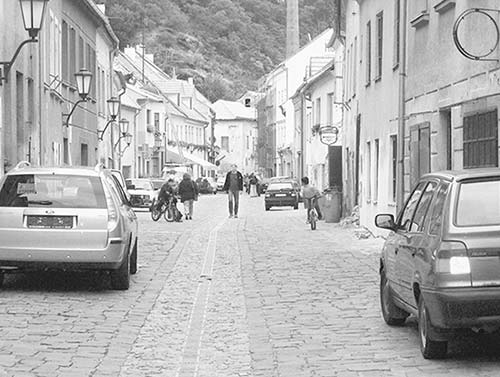
Coming here, you enter a place where time has stopped: The houses are essentially as the Jews left them 80 years ago. Many were resettled by Roma (see sidebar, here), who have done little to change the look and feel of the place. Over the past 15 years, the ghetto has gradually found its new identity, as artisans ranging from blacksmiths to chocolatiers have moved their workshops here. Pause at a few of these, like Lukáš, to get a feel for the local talent (Blahoslavova 22, http://kovarstvi-lukas.freepage.cz). While the general ambience of the ghetto streets is what makes this place special, make sure to stop at the green building at Leopolda Pokorného 53/25 to take in the once-opulent Empire-style architecture. A few houses down, on the opposite side of the street, check out the little house passageway between #16, #18, and #19.
The Rear Synagogue (Zadní Synagoga, a.k.a. New Synagogue) doubles as the visitors center, with a branch of the TI, plus displays of artifacts and a model of the once-thriving local Jewish community. Tours depart here on the hour and take you through the renovated synagogue and the neighboring Seligmann Bauer House. An American foundation donated $20 million to refurbish this home to look as it would have in the 1930s. It features a kosher butcher room, a wine press, and a display by locally born Czech American artist Margit Subak Elson (synagogue-50 Kč, daily 9:00-18:00; house by tour only-140 Kč, on the hour daily 9:00-17:00, shorter hours off-season, +420 568 610 023).
The Neo-Gothic Front Synagogue (Přední Synagoga, a.k.a. Old Synagogue) was repaired after serious WWII damage and has since functioned as a Hussite Church prayer room. Inside, only the seven-armed chandelier is a reminder of the space’s former function (accessible only on Sundays during service).
Jewish Cemetery (Židovský Hřbitov)
A 20-minute walk above the ghetto, this evocative memorial park is covered with spreading ivy, wild strawberries, and a commotion of 9,000 gravestones (the oldest dating to 1631). Notice how the tombstones follow the assimilation of the Jews, from simple markers to fancy 19th-century headstones that look exactly like those of the rich burghers in Christian cemeteries.
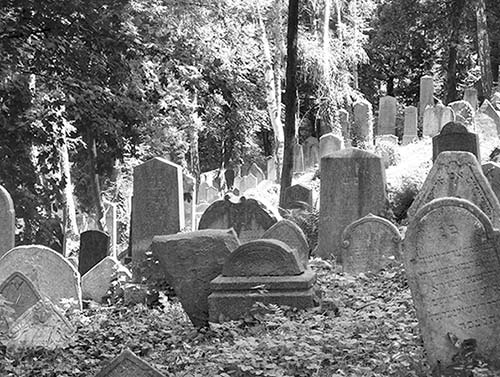
Cost and Hours: Free, daily 9:00-18:00, shorter hours in winter.
St. Procopius Basilica (Bazilika sv. Prokopa)
This enormous granite church looms over the town on a hill a five-minute walk above the main square and the ghetto. In a region of sandstone Gothic and plaster Baroque churches, this rich fusion of late-Romanesque and early-Gothic styles made from locally mined granite is a striking contrast. Though the church’s delicate northern portal (Porta Paradisi, celebrating God’s creation) is impressive enough from the outside, it’s worth joining a tour for a full sense of the place. Inside, notice the vaulting, a characteristic unsupported third arch, and Romanesque double windows. Based on signs engraved in stones, it’s believed that 600 different masons worked on the construction of this basilica. You’ll also descend into the gorgeous Romanesque crypt (which once doubled as a beer cellar) and visit the abbot’s chapel, laden with precious frescoes.
Cost and Hours: 80 Kč; 30-minute tours depart on the hour Mon-Fri 9:00-16:00, Sat 13:00-17:00; fewer tours Sun but the church is accessible during Mass, +420 568 610 022.
Sleeping in Třebíč
$$ Hotel Kocour occupies a meticulously restored 16th-century house at the entrance of the Jewish ghetto. Each of the 12 sleek rooms is unique and has its own particular layout. Consider requesting #11 or #13, which both have original Renaissance vaulted ceilings (Žerotínovo Náměstí 19, +420 728 542 243, www.hotelkocour.cz, info@hotelkocour.cz).
$ Hotel Joseph 1699, on a street just above the ghetto, has standard clean, comfortable rooms (Skalní 8, +420 602 721 776, https://joseph1699.cz, recepce@joseph1699.cz).
$ Apartmány u Synagogy provides four fully furnished apartments at the western end of the ghetto (Pokorného 6, + 420 724 600 060, www.apartmanyusynagogy.cz, martin@manasek.eu).
¢ Penzion u Synagogy, with seven rooms next to the Rear Synagogue, is as close as you can get to living in a Jewish ghetto, and includes free entry to the exhibits at the synagogue (breakfast extra—at the cute café/bakery across the street, Subakova 43, check in at Rear Synagogue TI until 17:00, +420 775 707 506, penzionsynagoga@mkstrebic.cz).
Eating in Třebíč
All of my recommendations are in the Jewish ghetto—the best area in town for a fun Czech meal.
$$ Restaurant Kocour, in the cute 16th-century courtyard of the hotel recommended earlier, combines tradition and modernity. Weekday lunch specials here are a particularly good value (daily, +420 703 389 289). For a sweet afterbite, check out the Lana chocolate shop next door (daily until 17:00).
$$ Lucky’s Vege Bistro, around the corner in the back of the same building, is an imaginative eatery that caters to a hip local crowd (daily for lunch, cash only, Tiché Náměstí 5, +420 774 141 481).
$ Kavárna Vrátka, across the street from the Rear Synagogue, bakes its own breads and pastries and provides employment to people with disabilities. Try the distinctive double-filled Moravian koláče, along with their fine roasted coffee (Mon-Fri 9:00-17:00, Sat until 11:00, closed Sun, +420 607 380 458).
$ Café Art, on the upper street of the ghetto, serves coffee and tea both outside and in the intimate interior, with local artists’ work hanging for sale on the walls (daily 13:00-21:00, cash only, Blahoslavova 19, +420 608 451 010).
Třebíč Connections
From Třebíč to: Telč (3 buses/day Mon-Fri, 2/day Sat-Sun, 1 hour), Třeboň (3 buses/day Mon-Fri, 2/day Sat-Sun, 3 hours), Moravský Krumlov (2-3 buses or trains/day, 1.5-2 hours), Brno (3 buses/day Mon-Fri, 2/day Sat-Sun, 1 hour; also 10 trains/day, 1.5 hours), Prague (nearly hourly trains, 4-5 hours, transfer in Brno—bus is better; 7 buses/day, 2.5 hours). Note that some buses to Prague may arrive at Prague’s Roztyly station (on the red Metro line), not the main bus station, Florenc. For bus and train schedules, see https://idos.idnes.cz and www.cd.cz.
Slavonice (Zlabings)
The rail tracks end. Time has stopped. You may think you have arrived in a ghost town in the middle of the Arizona desert, except that the buildings huddling in the shadow of the dark church tower are all stone, their gables Renaissance. Slavonice (SLAH-voh-neet-seh), a humble artistic town of 2,700 a stone’s throw from the Austrian border, can be underwhelming on a passing visit. But with more time, it makes a perfect base for exploring the thought-provoking surrounding landscape, particularly if you are a fan of village tours.
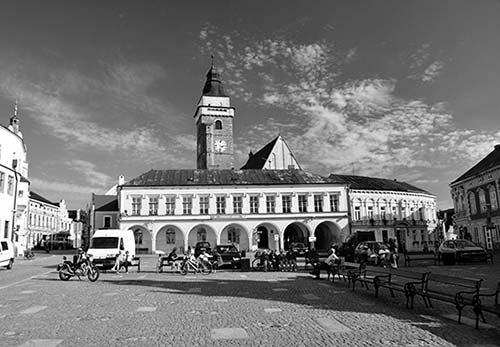
The town centers on two once-elegant Renaissance squares separated by a Gothic church and the Town Hall. In the surrounding countryside—a region marketed as “Czech Canada” since the 1920s—hulking castle ruins top forested hills, and deep woods surround run-down Gothic churches, Jewish cemeteries, and abandoned villages. WWII bunkers covered with sprawling blueberry bushes evoke the harsh realities of being a border town.
Centuries ago, this thinly populated borderland between Bohemia, Moravia, and Austria was filled with thieves and thugs—and was, therefore, nearly impossible to tax. Founded in the 1200s, the town was originally named Zlabings by the German settlers invited to colonize and civilize the region. During the 14th century, when the main trade route between Prague and Vienna passed through here, Zlabings boomed. Most of the town’s finest buildings date from this period. After the Thirty Years’ War (1618-1648) the town declined—particularly after 1730, when the Prague-to-Vienna road was rerouted to bypass the town—and few new buildings broke the medieval architectural harmony. In the late 19th century, a rail line connected the town north to Brno and south to Vienna.
Following World War II, German residents of Zlabings and the surrounding villages—90 percent of the population—were forced out (see the sidebar on here). The Czech “visitors” who took over the deserted homes were evicted 10 years later with the creation of a buffer zone bordering Austria. Curtains of barbed wire sealed the town off on three sides.
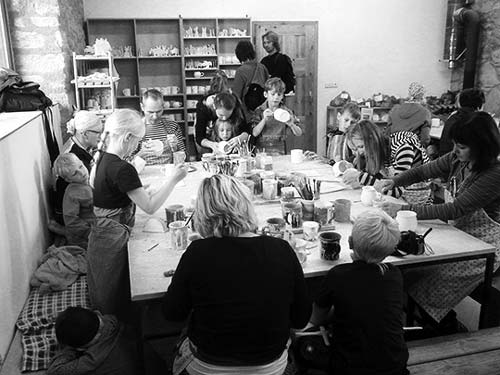
Starting in 1988, free-spirited artists began coming to Slavonice to retreat from the fast pace of Prague city life. Most came for short visits, but quite a few stayed, imbuing the sleepy town with a creative soul. Roaming the town’s back streets, you’re bound to chance upon a hidden workshop. Among the artists who stayed on was Kryštof Trubáček, a designer of colorful pottery who founded the now-legendary workshop and informal school in the nearby village of Maříž. You’ll see his trademark ceramics all around town.
After a tumultuous history, the only battle waging today across Slavonice’s square is between rival shops promoting “uniquely Czech ice cream” and “genuine Adriatic gelato.” An hour’s drive from the closest mall, locally owned stores still line the streets. The formerly cultured countryside west of town is now engulfed by wilderness.
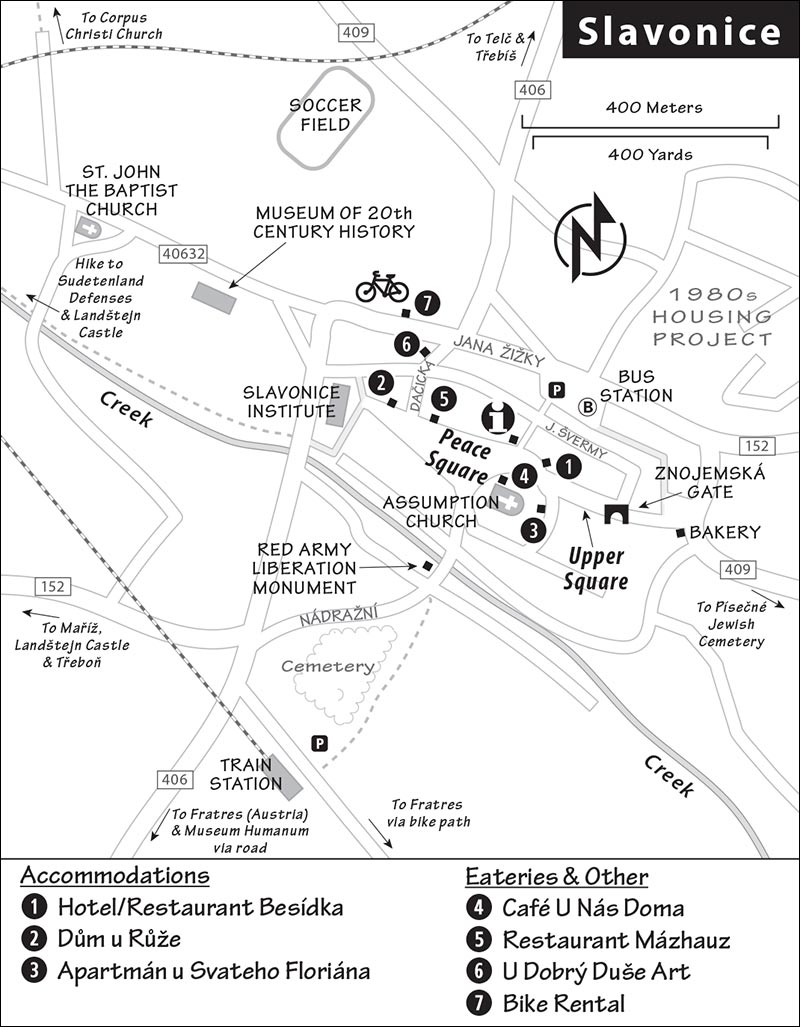
Orientation to Slavonice
The fancy burgher houses on Slavonice’s two main squares, Peace Square (Náměstí Míru) and Upper Square (Horní Náměstí), are ringed by another layer of centuries-old single-story houses with tiny gardens. A more contemporary residential district stretches west along Jana Žižky street, past the Museum of 20th Century History and John the Baptist Church. A linden-lined path leads up to the Corpus Christi pilgrimage site, which offers the town’s best views. On the other side of town above the bus station, a low-key 1980s communist housing project surrounds a school and a health center, adding some grit to all the wistful Renaissance fancifulness.
TOURIST INFORMATION
The TI and its helpful staff, on the main square, offer free maps of the Slavonicko region, an English audioguide, and walking-tour brochures (for 80 Kč you can take a city tour in English with one of their guides). They also sell the detailed Česká Kanada hiking map (daily June-Aug 9:00-18:00, Sept 8:00-17:00; shorter hours off-season and closed Sat-Sun; Peace Square, +420 720 280 183, www.i.slavonice-mesto.cz).
ARRIVAL IN SLAVONICE
Drivers can park for free in the lot just north of the main square (near the bus station) or pay to park on the square itself. The train and bus stations are each within a few minutes’ walk of the center. Head straight for the church tower, which overlooks the square, and get a little introduction to Slavonice by following the routes next.
By Train: As you exit the train station, look down the tracks that continue toward Austria, lined with mountain ash trees gradually disappearing under a carpet of elder and blackberry bushes, and medicinal herbs like mullein and St. John’s wort. On the other side of the border, the track has been converted into a bike path. Next to the station, young spruce logs pile around a 1960s sawmill. Follow the narrow dirt path that starts across the street from the repaired (but closed-up) Austro-Hungarian station building. On the left, peek through the fence into the cemetery, where old, unkempt German tombstones contrast with a few flower-decorated Czech graves. As you enter the open space in front of the cemetery, notice the small, two-part Liberation monument (a stone with hammer and sickle), and a statue of a Red Army soldier carrying a little girl. The archaic-sounding caption reads: “You we thank and You we love.” From here the town’s main square is just up the street.
By Bus: Exiting the bus station, walk down a little staircase and then along a path through two tunnel-like passages to reach the town center. In the first passage, you can peek into a classic local “refreshment” station consisting of a single room where aged locals down their bottled beers during prime working hours.
HELPFUL HINTS
Bike Rental: U Čápů rents road and mountain bikes (July-Aug Mon-Sat 9:00-18:00, Sept-June until noon on Sat, closed Sun year-round; Jana Žižky 51, from the square follow Dačická street and turn left at the intersection at Hotel U Růže, +420 728 828 837, www.cyklosportucapu.cz).
Pharmacy: A medical complex is above the bus station (Mon-Fri 7:30-12:30 & 13:30-15:00, longer hours Tue and Wed, Brněnská 214, +420 384 493 140).
Local Guide: Tomáš Heczko, who lives in nearby Mutěnice and works at the American-owned Slavonice Institute, is the perfect person to give a firsthand account of recent history. Tomáš also has the keys to several otherwise off-limits locations. For an even more fascinating exchange that includes some friendly heated argument, ask Tomáš (a few days ahead) to bring along his Austrian friend and colleague Alexander Stipsits (800 Kč/hour, 2,000 Kč for a back-and-forth session with Alexander, +420 775 030 186, tom@centreforthefuture.cz).
Sights in Slavonice
The houses on the Upper Square boast rich figural sgrafitti. On Peace Square (Náměstí Míru), the city tower and the simple town museum are nothing special (both open daily June-Aug, weekends only May and Sept, closed Oct-April). Some of the houses have worthy interiors, such as the Lutheran prayer room at #517 (100 Kč; tours daily at 11:00, 14:00, and 16:00; +420 605 068 546) and the Fresco House at #480 (daily 10:00-16:00).
Other than these, consider the following attractions.
Underground Passages
The medieval cellars under the town, connected by an intricate network of underground passages, once played an important role in the defensive system of Slavonice. Today, this town-under-a-town is a hit with children and thin, short people. Starting from the entrance (on the main square, next to the TI), you can slip on boots and an overcoat and follow your guide’s flashlight, squeezing through a subterranean tour of the town. While you’ll see little more than dirty bricks, it’s certainly a unique experience.
Cost and Hours: To join an existing tour, it’s 80 Kč/20-minute tour or 100 Kč/45-minute tour. If you visit when a tour isn’t already scheduled, you’ll pay 400 Kč (daily July-Aug 9:00-17:00, call +420 777 038 978 or write to podzemi@shslavonice.cz to arrange a visit).
Museum of 20th Century History
A proud grandson of one of the designers of the border defense system, WWII buff Jiří Duchoň first reconstructed a complex of bunkers outside town (see “Sudetenland Defenses,” later) and then eventually moved to Slavonice along with his wife Nataša to open this museum. Set in a repurposed farm building, it faithfully re-creates both the pre- and postwar atmosphere (55 Kč; July-Aug daily 10:00-17:00, May-June and Sept Sat-Sun only, Oct-April prearranged tours possible on weekends; descriptions in Czech—ask for the simple English flier, +420 606 124 829).
Pilgrimage Route to Corpus Christi Church
For a meditative spot with beautiful views, follow Žižkova street from the center of town, peek inside the Gothic John the Baptist Church, then turn right, cross the rail tracks, and walk the linden-lined Stations of the Cross up the hill. According to legend, thieves who robbed the main church dropped the consecrated altar bread on this spot during their flight. Despite attempts to transport it back to the main church, the Eucharist kept reappearing here until a pilgrimage church dedicated to the cult of the body of Christ (rare in this region) was built on the spot. Note the colorful mosaic of St. Christopher added to the church exterior in 1933. (To see the interior, prearrange a tour by calling +420 723 871 181.)
1980s Slavonice
To see a slice of more contemporary life, leave the Upper Square (Horní Náměstí) through the Znojemská Gate. Stop in the cute little bakery on the right, then cross the main street to a modern marketplace that caters exclusively to locals. Then walk up the hill to survey a 1980s housing project that includes a central-heating plant, school, and medical center. Notice how most of the buildings have added color, while a few others have remained the old shabby gray.
Shopping
This town filled with ceramics and art studios is designed for thoughtful shopping. Consider in particular U Dobrý Duše on Dačická street (50 yards from the main square down the street next to the U Růže Hotel), where local artist Jana Dušková sells a wide array of her decorative creations. Jana is also the best person to connect you to other members of the local artistic community (open July-Aug daily 10:00-18:00, off-season ring the bell—the owners live upstairs, +420 384 493 515, dobraduse.jana@seznam.cz).
Ceramics
Several different establishments around the main square give you a chance to paint your own cups (bake overnight, pick up next day) or buy locally produced wares. While the places on the square are just fine to get a basic sense for the craft, to fully appreciate the story behind the famous local ceramics, bike or drive to nearby Maříž, where there are two workshops. I prefer the smaller one in the starkly modern bronze-roofed shack on the bank of the pond (open July-Aug daily 9:00-18:00, May-June and Sept weekends only). The other, larger studio has a good restaurant.
Sights and Activities near Slavonice
Hiking
For a pleasant five-mile, three-hour hike, consider the following (get a detailed map at the TI): From the bottom end of the square (by the Slavonice Institute), turn left, walk 50 yards along a footpath to a stream, cross the road, and then walk upstream along a birch-lined path. Once you clear a railway underpass, turn right up the hill, following the red-and-white markers (a red line between two white lines).
As you walk up the forest, note the rare place where a patch of young beech trees has been planted to replace the ubiquitous spruce, a nonnative industrial crop that is suffering all across Central Europe as a result of global heating. (If you were to cross the border into Austria, you would find a similar single-minded adherence to spruce monoculture forestry that dates back to the 19th century.) Atop the hill, less than a mile out of town, you enter the Museum of Fortifications complex (described later).
From here, follow the green-and-white trail markers (diagonal green line in a white square) for a mile-long walk along the bunkers. At the end, up above the third fishing pond, pick up the red-and-white-marked trail again. After a mile’s walk through the forest, you will reach a trail intersection. From here you can either continue along the red-and-white trail to Landštejn Castle (see later), or you can turn right on a green-and-white trail.
If you turn right, in a couple hundred yards you’ll reach a magic spot: a briar-covered meadow with views of the medieval village of Pfaffenschlag. Discovered by archaeologists in the 1960s, the village was excavated in the following decade by a Slavonice teacher with help from his eighth- and ninth-grade students. The clean, reed-fringed pond down below the meadow is easily accessible for swimming from the stone steps.
Continue along the green-and-white trail and cross a paved road. Then turn right on the next paved forest road you reach. Now follow markers composed of a yellow spiral in a white circle. After about a mile, the trail markers will divert you on a path to the left, take you past a few more forest fishing ponds, and deliver you back to the Corpus Christi church on the hill overlooking Slavonice.
▲Sudetenland Defenses
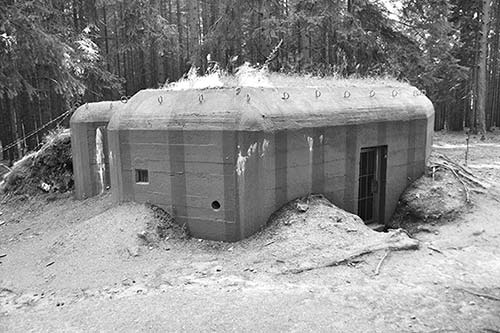
Hidden in a thick pine forest near Slavonice is a network of armadillo-like concrete pillboxes and gun emplacements built by the Czechs in the 1930s, in anticipation of the Nazi takeover (see sidebar). Exploring the area is interesting to anyone, but worth ▲▲ to WWII buffs with good imaginations. It’s free to walk through the woods and see the bunkers from the outside, but there’s a small fee to go inside the bunkers.
Cost and Hours: Site is free and always open; one bunker interior—40 Kč, both interiors—60 Kč, cash only; bunkers open July-Aug daily 10:00-17:00; May-June and Sept Sat-Sun 10:00-17:00, closed Mon-Fri and off-season; call to arrange a visit outside of these times, +420 606 124 829, https://slavonicebunkry.eu.
Getting There: By foot, hike from Slavonice (1.25 miles) along the red-marked trail in the direction of Landštejn (see “Suggested Day Hike,” later). Or you can drive west of town on the Slavonice-Nová Bystřice road, and keep a careful eye out (on the right) for the turnoff with the green Pevnostní Areál Slavonice 300 m sign, and the brown Bejčkův mlýn sign. Just a few hundred feet down this road, watch for the low-profile pullout on the left and hike five minutes into the lonely woods as if you were a 20th-century invader.
Visiting the Bunkers: The small area contains 11 mothballed bunkers—strategically staggered on a slight slope toward a pond, which was also part of the defensive network. While information plaques are scattered around, there’s very little in English, making it difficult to get details—but the eerie ambience of the place transcends language. As you walk around the camouflaged mini-forts, barbed wire, and toy-like tank barriers, you’ll ponder the fine line between heroism and folly.
Two of the bunkers have been refurbished with original equipment and are now the Museum of Fortifications. When open, they offer an intimate look at 1930s periscopes and machine guns. Imagine being a Czech soldier cowering in this bunker, terrified but determined to defend your homeland from a lunatic dictator across the border.
Landštejn Castle (Hrad Landštejn)
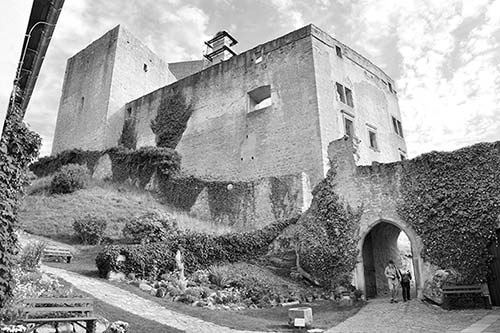
This region of thick forests and softly rolling hills is overseen by dramatic, reconstructed ruins of the Gothic castle that once guarded the border—an evocative reminder that the conflicts along here date to well before World War II. You can hike to the top of the complex for a view over the entire region. While it may seem like there’s little to see other than forests, you’re actually peering into three distinct lands: Bohemia (west), Moravia (east), and Austria (south)—illustrating this fort’s strategic importance. On summer weekends, the castle serves as a venue for open-air folk and rock concerts.
Cost and Hours: 120 Kč; Tue-Sun 9:00-15:30, June-Aug until 16:30, closed Mon; April and Oct Sat-Sun only, closed Nov-March; www.hrad-landstejn.cz.
Getting There: Landštejn Castle is seven miles west of Slavonice, on the road to Nová Bystřice. Hikers can reach the castle on foot (follow red-marked trail, see earlier and “Suggested Day Hike,” later) or by bike (follow the road or get map at TI to go through the countryside). You can also reach it by bus (Slavonice-Nová Bystřice line, 3/day, weekdays only, 15 minutes, ask to be let off at Landštejn) or car (drive toward Nová Bystřice).
Eating: The best dining option for miles around, the $$ Landštejnský Dvůr restaurant is set in a dark-wood mountain lodge that once served as a school. Try their tender venison in lingonberry sauce, tart soft duck leg with cabbage and dumplings, Hungarian-style spicy fish soup, or any of the fish choices delivered daily from Třeboň (long hours daily, fresh fish only on weekends during off-season, +420 777 111 767).
Suggested Day Hike: Follow the red-marked trail from Slavonice to Landštejn via the Museum of Fortifications (described earlier), visit the castle (have lunch here), then descend along the yellow-marked trail to Stálkov (with an American-buffalo farm and an excellent restaurant). Then continue to Velký Troubný Lake, and from there, return to Slavonice along the trail marked with a yellow spiral inside a white circle.
▲Museum Humanum and Cultural Bridge Fratres
Just across the Austrian border, the tiny village of Fratres, with its handful of Baroque-front houses, feels even more remote than Slavonice. That is perhaps why Austrian writer Peter Coreth chose to follow feng shui here and rebuild an ancient farmstead into a monastery-like exhibition space for his unique art collection. More than 200 art objects from Asia, the Americas, Africa—and, yes, Europe—are displayed in a dense formation that encourages visitors to discover new connections and make fresh comparisons. Ignoring time and place of origin, Peter places his treasures in a provocative anthropological/evolutionary framework, highlighting themes of survival, myth, power, and self-reflection.
Peter, a soft-spoken philosopher of life, is happy to share his ideas and give context for the exhibit. Or you can quietly pass from piece to piece, meditating over the magnificent highlights of the collection, such as the frightening Tibetan protective deity Kalacakra. To complement the permanent collection, on summer weekends Peter invites unusual speakers for inspiring lectures and discussions on timely topics. With space also allotted to rotating exhibits, Museum Humanum is sure to surprise no matter what expectations you bring.
Cost and Hours: €5; Tue-Sun 10:00-18:00, closed Mon and Nov-April; Fratres 11, A-3844 Waldkirchen/Thaya, Austria; Austrian tel. +43 664 150 8282, www.museumhumanum.com.
Getting There: Fratres is in Austria, about 2 miles south of Slavonice. Either drive along the southbound (signposted) road that passes the railway station, or hike/bike down the new bike path that starts at the train station and follows the former railway track. After the border, turn left on a single-track paved road that takes you some 200 yards straight to Fratres.
Eating: On Friday evenings and on weekends, $$$ Casa Angelina Restaurant, two houses to the left of the museum, serves excellent Italian home cooking of the South Tyrolean region with a nonexclusive focus on vegetarian fare (July-Sept Fri 17:00-23:00, Sat-Sun from 11:00, closed Mon-Thu and off-season, Austrian tel. +43 664 7301 2532).
As Adolf Hitler came to power in Germany, Czechoslovakia grew nervous about invasion. Starting in 1935, it began to systematically build up its army and to construct borderline defenses such as steel-reinforced concrete bunkers that could resist the German guns. Unfortunately, these fortifications were not shored up with successful diplomacy: Czechoslovakia never managed to repair its relations with Poland, with which it had fought a war in 1919 over a disputed area, and by 1937 it had lost its principal local allies Romania and Yugoslavia, which signed ill-advised neutrality pacts with Hitler. Inside Czechoslovakia, the country’s German and Slovak populations were losing interest in the fate of the Czech-dominated democracy. The creator of Czechoslovakia’s interwar foreign policy, Edvard Beneš, bet his nation’s future on France, determined to ignore the increasing French and British lean toward popular “appeasement” policy.
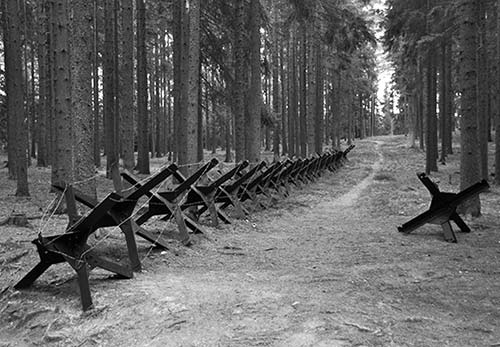
By September 1938, when Hitler and Mussolini met with the French and British in Munich to claim the Sudetenland, these still-unfinished fortifications were filled with 1.5 million mobilized Czechs and Slovaks. Morale was high, and few doubted that the French and British would honor treaties with Czechoslovakia. But instead, British prime minister Chamberlain proclaimed to the British public, “Why should we care about the fate of a quarreling people about whom we know nothing?”—and, along with French prime minister Daladier and without Czech input, signed off on the Munich Agreement, ceding the ethnic-German-populated areas of Czechoslovakia to Hitler. Alone, the Czechoslovak army—outnumbered by the Germans three to one—stood little chance. The frustrated soldiers were ordered home, and Czechs were forced out of the Sudetenland. Within six months, Hitler occupied the rest of the territory. Beneš and most Czechslovaks saw themselves as victims, a passive stance that would prevail in the national consciousness for much of the 20th century.
Today, the never-used bunkers and anti-tank obstacles in the countryside near Slavonice stand witness, not only to the futility of appeasement policies and to the Czechs’ bitter sense of betrayal, but also to the fact that a small democracy cannot survive without a collective security arrangement. Ironically, the Munich Agreement probably saved Czechoslovakia from Poland’s fate (it was reduced to rubble during the war). For many young Czechs today, these almost mythical fortresses are a symbol of determination to defend freedom at all costs.
Biking
With the surrounding rolling hills filled with unusual attractions connected by paved back roads, the region on both sides of the border is a cyclist’s heaven. Many specially marked bike trails follow various themes (such as disappeared villages, the local robber Grassel, border defenses, and pond building). Buy a good map at the TI (the best is the 1:50,000 Česká Kanada a Slavonicko by Klub Českých Turistů). In the spring, one of the highlights is the Jewish cemetery at Písečné, which blooms with lily of the valley and liverwort.
Sleeping in Slavonice
All three recommended hotels are on the main square.
$$ Hotel Besídka, between the two parts of the square separated by the church, hides 19 rooms (eight in the Old Town house itself, four in an adjacent, fascinating postmodern annex, and seven more in a neighboring house) behind a magnificent Renaissance facade. The hotel won a Czech Architects’ Society award for “adding extra value to a historic house where history complements the present, and the present complements the past.” Every room is uniquely designed by a different architect, striking a perfect balance of ancient and modern. The combination of cutting-edge art and wistful decadence is quintessential Slavonice and attracts a well-to-do Bohemian crowd (Horní Náměstí 522, +420 384 493 293, mobile +420 606 212 070, www.besidka.cz, besidka@besidka.cz). The hotel also runs a recommended restaurant downstairs.
$$ Dům u Růže has 12 modern, tasteful rooms in a restored late 19th-century house on the square, and three apartments in an annex next door. An art exhibition enlivens the breakfast room. Each room has its own kitchenette. Access to the sauna and pool is 100 Kč/person extra (Náměstí Míru 452, +420 384 493 004, mobile +420 605 572 916, https://hoteluruze.cz, rezervace@hoteluruze.cz).
$ Apartmán u Svateho Floriána consists of three rooms in a Gothic house renovated by a local piano teacher. The classy Janáček apartment has its own bath and kitchen; the economic Smetana and Dvořák doubles share kitchen and bath amenities. There are plenty of private rooms being rented around town, but these are the most atmospheric (no breakfast, Horní Náměstí 531, +420 603 838 014, www.apartman-u-sv-floriana-slavonice.com, jan.palenicek@gmail.com).
Eating in Slavonice
$$ Restaurant Besídka is the unofficial cultural center of town—the vaulted, artsy interior always pulses with life. They bake air-thin-crust pizzas and croissants, and offer daily specials. The adjacent ceramics-painting workshop is run with an individualistic flair (daily, +420 384 493 293).
$ Café U Nás Doma (“At Our Home”), in a courtyard by the church, is run by the youngest generation of an old Slavonice family. The café serves breakfast pastries made fresh by the grandmothers and aunts, and fragrant coffee made from beans flown in from Colombia (July-Aug daily until 19:00, June and Sept closed Mon-Thu, closed Oct-May, +420 606 933 587).
$$ Restaurant Mázhauz, on the square, serves straightforward steaks and other meats in a medieval-themed interior (Mon-Fri until 17:00, closed Sat-Sun, +420 606 831 886).
Slavonice Connections
The easiest way in and out of Slavonice is by train via Telč (5/day, 1 hour; see “Telč Connections” on here). Most buses require a transfer in Dačice. For train and bus schedules, see https://idos.idnes.cz.
Moravský Krumlov
There’s only one reason to visit the shabby industrial town of Moravský Krumlov: discovering the masterpiece of the Czech Republic’s greatest painter, Alphonse Mucha, tucked away in the town’s decaying castle. The Slav Epic, a collection of 20 massive canvases depicting momentous events in Slavic history, is one of the most powerful artistic experiences in Europe. It’s easily worth ▲▲▲—if you are driving through southern Moravia, don’t miss it. Getting here can be a bit of a challenge on public transportation, but it’s worth the effort. Laying eyes on Mucha’s grand Slav Epic in this improbable setting gives you the feeling of having discovered a true “back door.”
GETTING TO MORAVSKÝ KRUMLOV
By Car: Figure about 45 minutes from Třebíč or Mikulov, and over an hour from Telč or Slavonice. From Prague, it’s about a 2.5-hour drive. On arrival, follow signs for the city center—the castle will be on your left. Parking is available along Palackého street right by the castle, or in the parking lot on the main square (T. G. Masaryka), a five-minute walk away.
By Public Transportation: About eight trains per day run from Prague’s main train station to Moravský Krumlov; the trip takes about four hours total, with a change in Brno. It’s a short 45-minute train ride from Brno, and since Brno is right on the Prague–Vienna and Prague–Bratislava–Budapest train lines, Moravský Krumlov can be a handy stop in the middle of a long travel day. From Mikulov, two afternoon trains complete the trip in about 1.5 hours.
In Moravský Krumlov, the bus station is on the main square, five minutes from the castle. The train station is a dreary half-hour walk from the castle, so I’d recommend taking a bus (#440, #441, #442, or #443) to the main square or calling a taxi (+420 775 111 232).
PLANNING YOUR TIME
With easy connections in and out, only one hotel worth recommending, and no excuse to spend more time in Moravský Krumlov than it takes to see Mucha’s masterpiece, I’d sleep elsewhere. Allow up to two hours to see the paintings. Note that the exhibit is closed on Mondays.
Orientation to Moravský Krumlov
Don’t mistake Moravský Krumlov (MOH-rahv-skee KROOM-lohv) for its enchanting Bohemian counterpart, Český Krumlov. A “bend in the river” (the literal meaning of “Krumlov”) is the only thing these two towns have in common.
There’s not much to see here other than the Slav Epic, housed in a tired Baroque castle a short walk from the main square. The castle information desk doubles as a TI, with the same open hours (https://mkrumlov.cz). Moravský Krumlov has only two restaurants, and every store is closed by 17:00. In the evening, steam from the nearby nuclear-power plant envelops the setting sun. The clumsy ugliness of the circa-1950s main square (rebuilt after the town was bombed by Russians in 1945) can feel strangely exotic after the picture-perfect southern Czech villages you likely passed through on your way here.
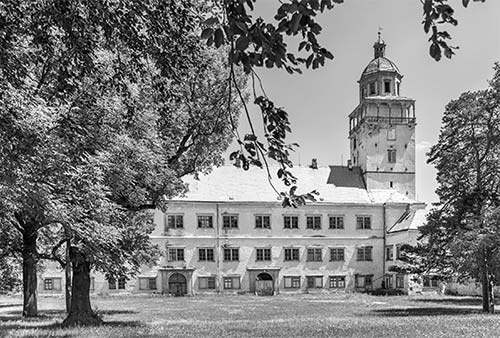
Alphonse Mucha’s Slav Epic
In this series of 20 thrilling, movie-screen-sized canvases, artist Alphonse Mucha traces the idealized 1,500-year history of the Slavic people, from their humble beginnings on the Eurasian Steppes to the optimism of the post-WWI era, when Slavic nations created their own modern states (such as Czechoslovakia).
The panels are roughly chronological, but Mucha isn’t above veering from the facts to emphasize the people’s spiritual journey. Mucha intended the themes illustrated to be universal, evoking not just Slavic but all human experience. The canvases are mind-bogglingly big—some are 25 by 20 feet, and together they total 6,800 square feet, slightly more than Michelangelo’s Sistine ceiling.
Mucha’s magnum opus has been scorned by many Czech intellectuals for its style and overt patriotism. But the work goes beyond the style of the time, beyond Art Nouveau, and beyond Slavic nationalism.
The Slav Epic will be displayed in Moravský Krumlov’s castle until at least 2027, at which point it is scheduled to move into a specially designed exhibition space in Prague’s Savarin Palace, just off Wenceslas Square. (Mucha donated the finished work to the city of Prague, but finding a suitable location there has proved to be a challenge.)
ORIENTATION TO THE SLAV EPIC
Cost and Hours: 250 Kč; June-Aug Tue-Sun 9:00–17:00, Sept–May Tue-Sun until 16:00, closed Mon year-round; +420 770 132 566, www.mucha-epopej.cz.
Information: An excellent 50 Kč English guide to the Slav Epic is available at the entrance.
Length of This Tour: At least one hour (or up to two, for those who want to linger over the many details).
Eating: The welcoming $ Kavárna na Zámecké serves coffee and cake just across the street from the castle entrance (Tue-Sun until 18:00, closed Mon, +420 602 783 134).
Starring: A stunning artistic achievement, and a powerful history lesson about a major—and often overlooked—European culture.
BACKGROUND
Alphonse Mucha (1860-1939) was born nearby in the small town of Ivančice. He studied in Vienna and Munich, worked for a while in Moravia, and then—like most artists of his generation—he went to Paris to seek his fortune. After suffering as a starving artist, he was hired to design a poster for a play starring the well-known French actress Sarah Bernhardt. Overnight, Mucha was famous. He forged an instantly recognizable style: willowy maidens with flowing hair amid flowery designs and backed with a halo-like circle. His pastel pretties appeared on magazine covers, wallpaper, carpets, and ad campaigns hawking everything from biscuits to beer. Mucha’s florid style helped define what became known as Art Nouveau.
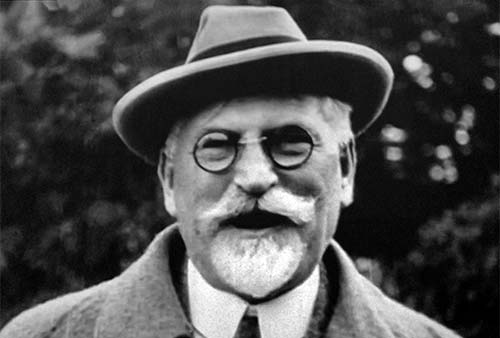
But even as he pursued a lucrative commercial career in Paris and the US, Mucha was thinking about his native land. While preparing the Bosnian Pavilion for the Paris Exposition of 1900, he traveled widely through Slavic lands, soaking up the culture, history, and proud traditions. Inspired to immortalize great moments in Slavic history on a grand, epic scale, Mucha convinced the Chicago industrialist Charles Crane to bankroll what would become his lifework.
At age 50—after years of living abroad—Mucha returned to his homeland and started work. For his studio, he rented a château in Zbiroh that was big enough to accommodate both his ego and the huge canvases. For the next 16-plus years, he cranked out these enormous works. He traveled far and wide throughout the Slavic world to do research and gain understanding—Warsaw, Moscow, Dalmatia (near Dubrovnik), Macedonia...this truly was a pan-Slavic undertaking. At the same time, Mucha was juggling fatherhood and the worries of World War I. The year 1918 brought a watershed in Czech history, as the war ended and the modern self-governing nation of Czechoslovakia was created. Mucha was tapped by the new government to design the nation’s currency and stamps.
In 1928, on the 10th anniversary of modern Czechoslovakia, Mucha’s masterpiece—the Slav Epic—was finally unveiled and donated to the city of Prague. The response was (and remains) lukewarm. Politically, the Czech people were focused on developing a modern national character, and Mucha’s seemingly musty historicism was out of step with the times. Artistically, in the experimental age of Dalí and Picasso, Mucha’s representational style was out of fashion. It was also unusual for an artist of Mucha’s stature to go 20 years without the slightest change in style. It was as if Mucha froze—or perhaps sacrificed—his evolving artistic genius to complete his vision.
With the rise of fascism in the 1930s, Mucha’s overt Slavic nationalism came under attack. In 1939, German tanks rumbled into Czechoslovakia. The Nazis considered Slavs an inferior race. They arrested the patriot Mucha—now 79 years old—and he was interrogated by the Gestapo. He died a few weeks later.
Hidden away and damaged during World War II, Mucha’s canvases underwent years of restoration before finally going on display in 1963 here in Moravský Krumlov. Years of controversy followed, with some calling for the paintings to be returned to the city of Prague, which they finally were, in 2011. After three years on exhibit there, the paintings were sent to Japan, where they became the most visited temporary exhibit of the year. The Japanese affinity for Mucha is no coincidence: His characteristic style was inspired by 19th-century Japanese woodblock prints.
After the paintings’ return from Japan, the city of Prague, under renewed attack for its perceived highbrow attitude toward Moravský Krumlov, reluctantly agreed to loan the works to the castle here while a permanent space is prepared in Prague’s Savarin Palace. But that location—finally agreed on in 2022, more than 90 years since Mucha’s original donation—still has its critics, so the canvases may remain “temporarily” in Moravský Krumlov well beyond 2027.
 SELF-GUIDED TOUR
• Enter the spacious Epic hall. The paintings are gathered in five groups, which are (very loosely) united thematically.
First Group
This cycle of four paintings focuses on the origins of the Slavic people and their enduring faith—both pagan and (later) Christian.
1. The Slavs in Their Original Homeland (1912): It’s AD 500. Nomadic tribes are sweeping across the European landscape—Huns from the East and Barbarians (Germanic tribes) from the West. The flames of a burning village consume the left horizon. Caught in the crossfire is a small population of peasants in today’s Ukraine—the Slavs. They share a common language, culture, and DNA, but have no country to call their own. Wedged between the Christian West and the Muslim East, the Slavs have seen more than their share of invaders from both sides.
Two desperate refugees (at bottom) huddle for safety as their homeland is ravaged by invading armies (in the distance). The sickle here suggests that the Slavs are peace-loving farmers rather than warlike conquerors.
But from these humble beginnings, the Slavic people will someday rise to greatness—as symbolized by the vision of a pagan Slavic priest (upper right), acting as a sort of oracle for the journey to come. This figure hints at the mysticism that underlies the Slavic faith (particularly Orthodox Christianity). His arms are outstretched in a Christ-like pose (which you’ll see repeated throughout the Epic).
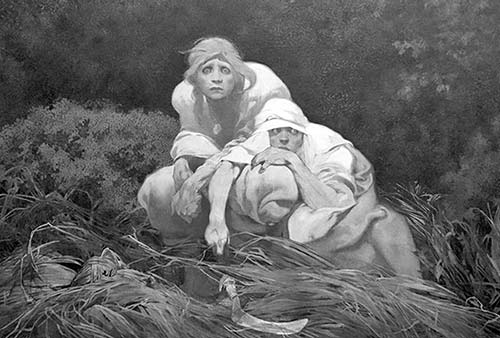
Mucha begins his 20-canvas story with this Slavic Adam and Eve driven from paradise. Over the centuries, the Slavs would roam from their Ukrainian epicenter, searching for a homeland in places as far away as (today’s) Russia, Poland, the Balkans, and—on the western perimeter—Prague.
Mucha (an avid photographer) uses a double-exposure technique to show two realities: the historical/earthly events (the terrified couple and army) and the mythic otherworld (the priest flanked by symbols of “war” and “peace”). Also notice how Mucha highlights crucial details (like the couple’s terrified faces) by using sharp-focus oil paints on top of the foggy—almost glittery—base of egg tempera.
2. The Celebration of Svantovít (1912): In this swirling mass of white-robed figures, the Slavs gather to celebrate the harvest before the fertility god Svantovít (holding a drinking horn). While this theme captures the specific rituals of the Baltic Slavs, it evokes the deeply rooted traditions of pagan Slav-land. Blissed-out dancers sway in a trance, swinging linden branches. Hovering above, their gods join them. The Slavs are sacrificing bulls to Svantovít. But their peace is about to be shattered, in the form of Thor (upper left), who arrives with wolves. It’s the Slavs’ eternal enemy—the Germanic tribes.
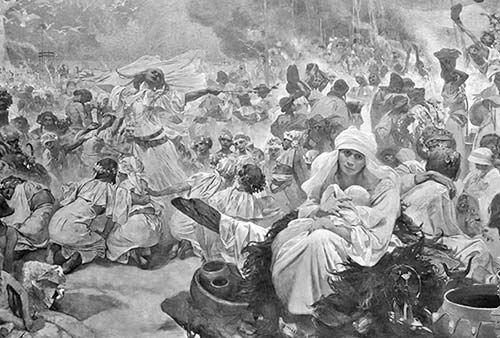
When you gaze into the eyes of the forlorn-looking young mother (at bottom center, echoing the woman in the first painting), it seems that the Slavs are forever destined to be refugees.
3. Introduction of the Slavonic Liturgy (1912): A boy with a ring introduces us to the next step in the Slavs’ evolution—conversion to Christianity, thanks to St. Methodius (standing just left of center, with long white beard) and St. Cyril (in the background at left, leading a parade of men). Cyril and Methodius are unifying figures throughout the Slavic world—you’ll see them celebrated from Warsaw to Vladivostok, and from Dubrovnik to St. Petersburg (not to mention in Mucha’s stained-glass window at St. Vitus Cathedral in Prague). These Greek missionary brothers translated the Bible for their new converts, and even jump-started Slavic literacy by creating an alphabet to capture the tongue-twisting Slavic languages. A variation on that alphabet—Cyrillic, named for the saint who invented it—is still widely used.
Floating above the earthly scene, the Catholic pope and the Orthodox patriarch—representing the two strains of Slavic Christianity—embrace. But in the top left, in a menacingly dark scene, a pope and a Holy Roman Emperor preside over a forced baptism—a reminder that the Slavs didn’t always accept Christ by choice. At the top right, flattened like Orthodox icons, are two ruler-couples (one Russian and the other Bulgarian) who welcomed the new religion of Christianity.
Second Group
This series focuses on strong medieval rulers who advanced the Slavic cause through education, law, and cooperation with neighboring states. These rulers—and others like them—established kingdoms with sophisticated art and literature across Central and Eastern Europe.
4. Tsar Simeon I of Bulgaria (1923): The enlightened Slavic ruler sits on his throne, dictating the Christian message to a scribe, who scrambles to write it all down. Other scholars in the foreground are busy studying and translating Byzantine classics into the Slavic tongue. The wisdom seems to emanate from the center of this essentially circular composition—a series of radiating arches.
5. King Přemysl Ottokar II of Bohemia (1924): In an elaborate tent set up for an outdoor wedding, King Ottokar (in shining gold, with a red cap) shakes hands to welcome royal guests from around Europe. By sealing political alliances with this marriage, Ottokar (c. 1233-1278) ushers in the golden age of Bohemia (i.e., the Czech lands). He married his niece to a Hungarian prince, merging two great dynasties and extending the Czech cultural reach throughout Central Europe. (Thought up relatively late to replace another theme, this rather static depiction is typically considered the Epic’s weakest link.)
While this canvas shows a high-water mark of cooperation between the Slavs and the non-Slav Hungarians, Mucha glosses over the love-hate relationship these neighbors have had throughout history. At times, the Slavs and Hungarians have unified against common enemies (Tatars, Ottomans, Habsburgs, communists)...but at other times, they’ve leapt at the opportunity to subjugate each other.
6. Coronation of the Serbian Tsar Stefan Dušan as East Roman Emperor (1923): A parade of happy Slavs leaves a church in Skopje (in today’s Macedonia) after watching Stefan Dušan crowned as ruler of Serbia. Dušan (c. 1308-1355, just right of center, in the golden crown) was a strong—even ruthless—leader. He introduced a code of law borrowed from Byzantium to govern his unruly subjects. While Mucha seems to view this as a positive—a kind of Slavic Magna Carta for basic rights throughout Central and Eastern Europe—the code’s punishments were extremely cruel, including every sort of crippling short of castration.
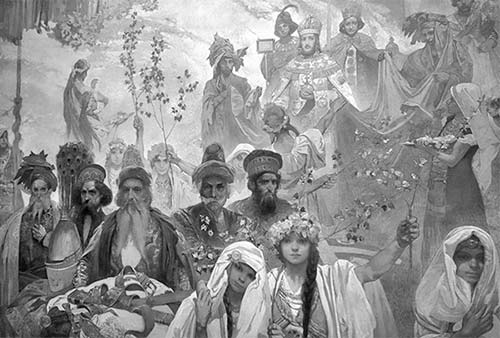
As it happened, the golden days of Slavic self-rule were numbered. By the 14th century, Slavic lands were increasingly dominated by Germanic colonizers and by the Roman Catholic Church. Who could stand up to them?
Third Group
This section focuses on warfare, most of it fueled by religion—especially the Catholics-versus-Protestants wars that wracked the Czech lands. (The painting numbers below aren’t chronological, but try to view the canvases in this out-of-order sequence.)
8. After the Battle of Grunwald (1924): This canvas shows another moment of cooperation between Slavs (Poles) and their fellow-underdog neighbors (Lithuanians). Just like every American knows July 4, 1776, every Polish person knows the date of the Battle of Grunwald: July 15, 1410. A pan-Slavic and Lithuanian army squared off against the fearsome Teutonic Knights (Germanic former Crusaders trying to take over the Baltic Coast). The Slavs held out. The battlefield is littered with the blood-stained tunics (white with black crosses) of the Teutonic Knights. And yet, notice how Mucha doesn’t show the winners reveling in victory; instead, their faces express sorrow over the destruction and loss of life.
Standing victorious at the top of the canvas is King Władysław Jagiełło, a Lithuanian whose marriage to the queen of Poland strengthened the political union between the northern Slavs. For more than 150 years, his Jagiellonian dynasty would rule over a mighty Polish-Lithuanian state, which at its peak stretched from the Baltic to the Black Sea.
The Magic of Words Triptych (1916): This three-paneled work—the kind normally seen as a church altarpiece—is dedicated to the life and influence of the great Czech reformer who spoke truth to power, Jan Hus.
7. Jan Milíč of Kroměříž (left panel) depicts one of Hus’ charismatic predecessors as a people’s preacher, who inspired repentance even among society’s downtrodden. Here, a notorious brothel in Prague’s Old Town has been dismantled and is now being replaced with a convent for reformed prostitutes. The singing women shed their jewelry for white cloaks just because of Milíč’s persuasive words.
In 9. Master Jan Hus Preaching at Bethlehem Chapel (central panel), the scene is Bethlehem Chapel, 1414. Hus preaches from the pulpit (left), leaning out to make his point. He’s been excommunicated by the pope for his heretical views. But here in Prague he’s a rock star. Among the rapt listeners are other major figures in the drama: The queen, listening intently, sits at far right (under a canopy, wearing a white dress and red crown). On the far left, standing against a wall, is General Jan Žižka (with a long mustache and an eye patch), the future military leader of the Hussites. But there’s a weasel in their midst—directly in front of the queen, a lady-in-waiting directs a quizzical look toward a caped figure (at the far right), furiously taking notes. With the damning “evidence” of this spying priest, in a few short weeks, Hus would be arrested, imprisoned, and eventually burned at the stake. But his legacy lived on.
Finally, in 10. The Meeting at Křížky (right panel), Hus’ followers gather on a remote hill outside Prague as they prepare to defend their beliefs. The Hussite Wars are coming. The sky darkens.
11. After the Battle of Vítkov Hill (1923): War comes to Prague. In this battle (1420), on a hill east of Prague’s Old Town, the Hussites drove off the pope’s forces. Now a priest holds a monstrance and says Mass—a service that will include both the bread and the wine, affirming the fundamental right the Hussites were fighting for. Amid the gloom, a glimmer of heavenly light shows through and illuminates General Jan Žižka, who thanks God for the victory.
12. Petr Chelčický (1918): Refugees from the wars—in this case, victims of Hussite atrocities—flee their village. One angry man (near the center) turns and vows revenge, but he’s restrained by peace-loving Petr (in hat and scarf and clutching a Bible), whose pacifist ideas would later inspire Comenius and the Unity of the Brethren (see #15 and #16, below), Tolstoy, and Mucha himself. Although historically specific, this painting captures the universality of the refugee experience.
Fourth Group
This cycle of canvases features the benchmarks and growing pains of the Slavs in modern times.
13. The Hussite King Jiří z Poděbrad (1923): At war’s end, the pope and the Hussites signed a peace treaty allowing the Czechs to choose their own king. But this scene—set in Prague’s Old Town Hall, framed by a stained-glass window—makes it clear that the long fight for Slavic autonomy isn’t over. The pope’s ambassador (in red, framed by the window) tries to weasel out of the deal. The proud Czech king (far right) stands up and defies the pope by kicking over the ambassador’s chair. The king is so mighty that he bows to no one, not even the pope’s representative. The young boy in the front is one of Mucha’s self-portraits.
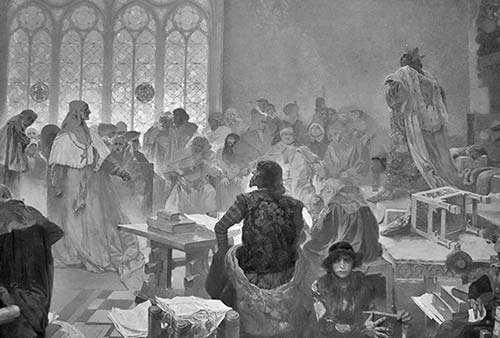
14. The Defense of Szigetvár by Nikola Zrinski (1914): This fiery red canvas shows how the Slavs also had to defend their lands against Muslim Ottomans. As the Ottomans encroached on European territory—at one point even knocking on Vienna’s city gates—all of Europe looked to the Slavs and Hungarians as the last line of defense. Szigetvár—a small town in southern Hungary—was a Central European Alamo. Outnumbered 50 to 1, the defenders vowed to go up in flames for their cause. They did. A column of black smoke rises ominously in the foreground. In the upper right, a Czech noblewoman prepares to light the fuse on this tower of gunpowder.
Here again, Mucha appropriates a bit of Hungarian history to tell the Slav narrative. The Croatian nobleman who led the charge, Nikola Zrinski, is equally celebrated as a national hero by the Hungarians (who call him Miklós Zrínyi).
15. The Brethren School in Ivančice (1914): After so much bloodshed, this scene is refreshingly positive and optimistic. We’re in a garden outside the city wall of Ivančice, Mucha’s hometown (near Brno, 150 miles southeast of Prague). The teenager at lower right (in white shirt, carrying a sheaf of papers) is Mucha himself.
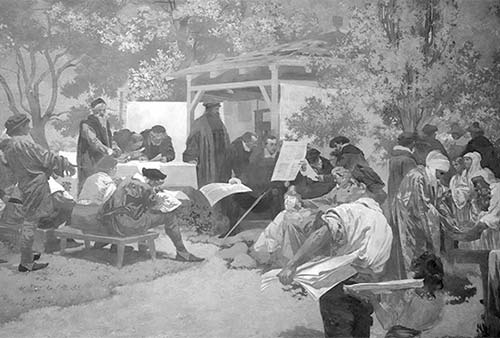
Ivančice was home to a band of pacifists called the Unity of the Brethren, who put into practice the ideas of Petr Chelčický (see #12, above). They helped bring literacy to the Slavic lands by translating the Latin Bible into what would become (for the next couple of centuries) the standard written language of the Czech lands and Slovakia. Their actions helped keep the Czech language alive (remember that for hundreds of years, this territory was part of the Habsburg Empire, ruled in German from Vienna).
The wooden lean-to on the right is the Bible print shop. Mucha is bringing in fresh paper to help spread the good word. Rich and poor alike intermingle, showing the leveling effect of education.
16. Jan Amos Komenský (1918): On a lonely seashore sits a solitary figure. It’s the famous Czech teacher John Amos Comenius (Jan Amos Komenský in Czech, 1592-1670), the man who virtually invented textbooks and modern education. (For more on Comenius, see here.) Now at the end of his days—having lived as an exile for his beliefs—he faces death alone. His followers huddle nearby. Will they ever regain their homeland? The tiny lantern holds out “A Flicker of Hope” (Mucha’s subtitle for the work).
Fifth Group
The final set of paintings provides a stirring climax. After focusing on specific historical events, Mucha—now in his 60s and nearing completion of the cycle—circles back to themes of Slavic identity. In these canvases, notice the return of the “double-exposure” mysticism of early works. That mysticism is a key component of Slavic faith—particularly Eastern Orthodox Christianity.
17. The Holy Mount Athos (1926): The scene is an Orthodox church, lit by shafts of light. Pilgrims fill the church below while holy presences inhabit the sunlit atmosphere above. Orthodox worship is designed to create a transformative—or even hallucinatory—state: Worshippers stand through the service, inhale heavy incense, and focus all their attention on glittering icons.
Before making this piece, Mucha visited the Orthodox monastery of Mount Athos, in Greece—a pilgrimage center for Orthodox Slavs. Though very much a worldly, modern man, Mucha was fascinated by occult forms of Christianity. He saw Christianity as a unifying and enlightening element for the Slavic people.
18. The Oath of the Youth Under the Slavic Linden Tree (1926):
But Mucha never neglected the Slavs’ pagan origins. Here, young people join hands to sing “Kumbaya.” They are paying homage to the goddess of their people, Slávia, who sits in the boughs of a linden tree (an important symbol to Slavic people—see here).
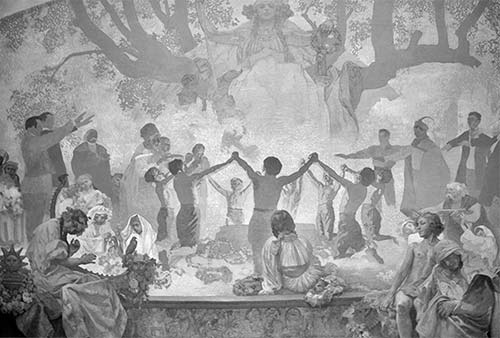
Men in 19th-century clothes join in. They’re part of the national revival movement in the 1800s to celebrate Slavic language and culture and create a homeland. Starting in the mid-1800s, after centuries of living under mighty empires, the various Slavic groups (and other underdog nationalities) began to band together and celebrate the things that made each group unique.
The work remains unfinished—many faces are only sketches, and there’s a mysterious cloud in the center. Though the faces are left anonymous, they could easily be men like Antonín Dvořák and Bedřich Smetana, who composed symphonies from folk songs to remind the Slavic peoples of their common heritage. The two allegorical figures sitting on the wall are Mucha’s son and daughter.
19. The Abolition of Serfdom in Russia (1914): In Moscow’s Red Square, the Russian proclamation that freed the serfs has just been issued (1861). Stunned by the news that their slaves are now free, the populace wanders dumbfounded across a snowy field. The symbols of Russian oppression—the Kremlin and St. Basil’s Cathedral—loom behind. Emancipation is a first step for a few Slavs, but true freedom for all remains a dream.
To research this canvas, Mucha traveled to Russia on the heels of the Bolshevik Revolution. The rise of communism and the ouster of the czar came about—ironically—thanks to this very event: Freeing the serfs led to massive unemployment, at a time when a swiftly industrializing Russia was desperate for cheap labor. Exploited workers latched on to the ideas of Marx and Engels, and charismatic leaders harnessed their frustration into a coup that created the world’s first communist state. In a sense, this canvas unwittingly prophesizes the next, grim chapter in the history of the Slavs: the takeover of the entire Slavic world by the Soviet Union following World War II.
20. Apotheosis “Slavs for Humanity!” (1926): An “apotheosis” is the elevation of someone or something to divine status, and in this case, it’s the Slavs. In this final panel, Mucha tries to sum up the entire 1,500-year journey of the Slavic people and predict where they’re headed. Take a deep breath and dive in.
Start in the lower right. In blue, we see the huddled, oppressed people of the sixth century longing for a peaceful homeland. In the upper left (the band of red), it’s the Middle Ages, and the Slavs rise to prominence under a series of strong kings (like the man on his throne to the right).
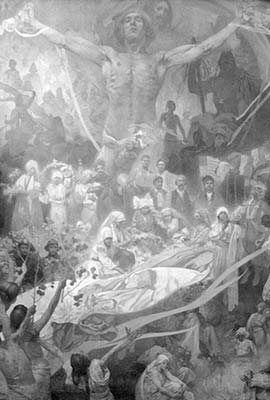
In the center (joyous yellow), it’s 1918. World War I has ended, and gaily clad Slavs rejoice, waving flags of the victorious nations (including the Stars and Stripes) and olive branches to salute the troops. Emerging from the war is a new Slavic nation—Czechoslovakia—symbolized by the (Christ-like) torso of a strong young man who rises from the chaos, clutching the wreaths of freedom and Slavic unity. Behind him, the actual Christ blesses the new nation, and a rainbow signals a new era of peace.
Today, the Slavic community is almost 400 million strong. They inhabit the Czech Republic, Slovakia, Poland, much of the Balkans, Ukraine, Belarus, Russia, and beyond—including 18 million Slavic Americans. Some are Catholic, some Orthodox; some write in Cyrillic script, some Latin. But they share a common heritage, which Mucha has celebrated in the audacious artistic endeavor known as the Slav Epic.
Sleeping and Eating in Moravský Krumlov
There is just one suitable accommodation in Moravský Krumlov, and the only restaurant on the main square leaves much to be desired. The main square is about 200 yards up from the castle, and apart from a handy grocery store, it also has the $ Restaurant U Matěje, a small modern place with a TV screen and Mucha reproductions that don’t quite manage to get the atmosphere right (Mon-Fri 9:00-16:00, Sat 10:00-14:00, classic Czech dishes overshadowed by international fare, +420 704 735 485).
Drivers can consider the $ Rokiten Hotel and Restaurant, a renovated and modernized former factory about two miles south of the castle at Znojemská 393 (100 yards to the left of the main road, restaurant open daily, Sun-Mon lunch only, +420 605 248 935, www.rokiten.cz, info@rokiten.cz). The rooms are spotless and the restaurant serves daily specials, local microbrews, and Mucha’s favorite plum dumplings with poppy seed.
Moravský Krumlov Connections
From Moravský Krumlov to: Mikulov (2 trains per afternoon, 1.5 hrs, transfer in Hrušovany), Prague (8 trains/day, 4 hours, change in Brno), Brno (10 trains/day, 45 minutes; bus connections mainly on weekdays), Třebíč (one bus in the afternoon leaving the main square requires a transfer in Rouchovany, 75 minutes; train requires a transfer in Střelice, 2 hours). For bus and train schedules, see https://idos.idnes.cz and www.cd.cz.