DAY TRIPS FROM PRAGUE
Kutná Hora • Terezín Memorial • Konopiště • Karlštejn • Křivoklát • Karlovy Vary (Carlsbad)
Day Trips from Prague at a Glance
Sleeping and Eating in Kutná Hora
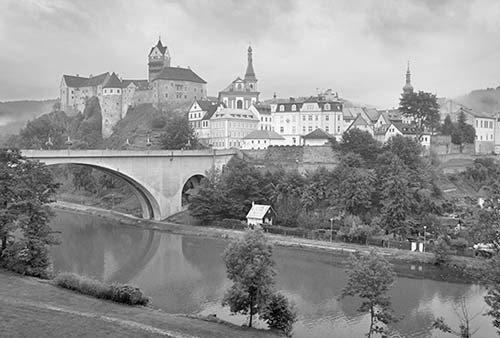
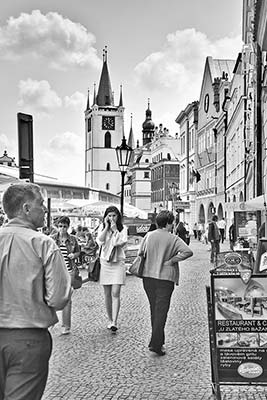
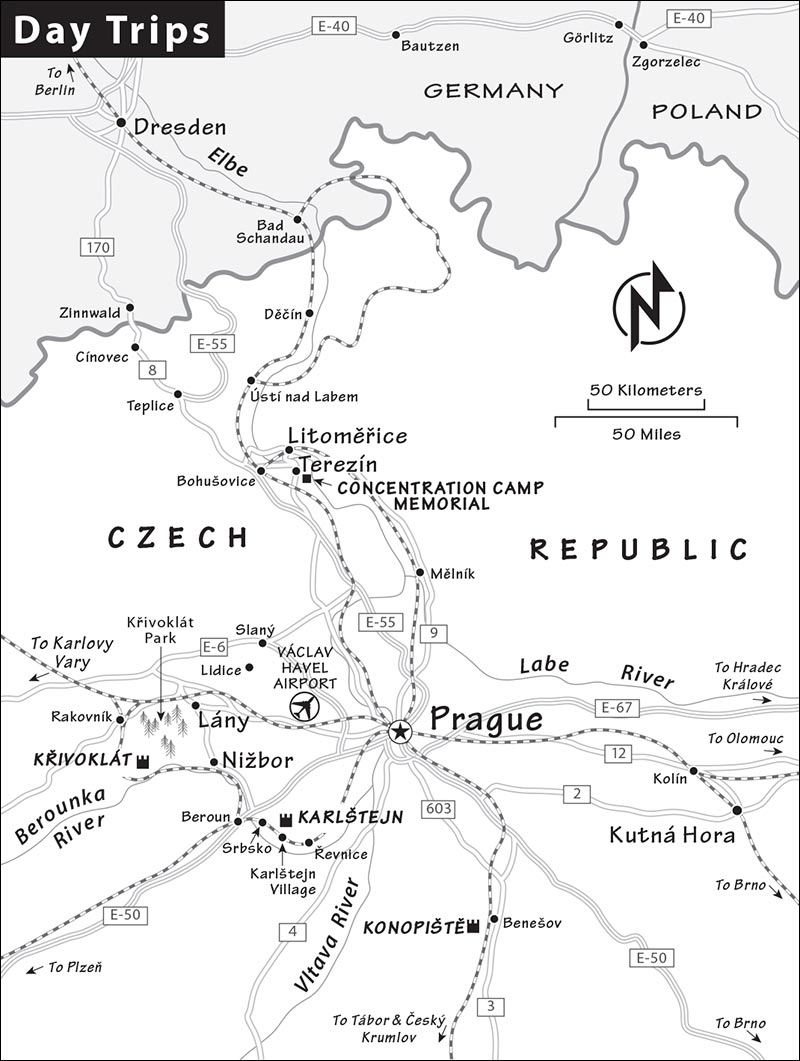
Prague has plenty to keep a traveler busy, but don’t overlook the interesting day trips in the nearby Bohemian countryside. Within a short bus or train ride of Prague (in different directions), you’ll find a rich medieval town, a sobering concentration-camp memorial, three grand castles, a swanky spa resort, and a variety of other stopovers.
Kutná Hora
Kutná Hora (KOOT-nah HO-rah) is a refreshingly authentic yet unmistakably gorgeous town that sits on top of what was once Europe’s largest silver mine. In its heyday, the mine was so productive that Kutná Hora was Bohemia’s “second city” after Prague. Much of Europe’s standard coinage was minted here, and the king got a 12 percent cut of every penny. In addition to financing much of Prague’s grand architecture, these precious deposits also paid for Kutná Hora’s particularly fine cathedral. But by about 1700, the mining and minting petered out, and the city slumbered.
Once rich, then ignored, Kutná Hora is now appreciated by tourists looking for a handy side trip from Prague. While most visitors come here primarily for the famous, offbeat Sedlec Bone Church, the delightful town itself trumps it—with one of the finest Czech churches outside of Prague (St. Barbara’s Cathedral), a breathtaking promenade overlooking the valley, a fascinating silver mine, and a cute, cobbled town center with pretty pastel houses.
All in all, underrated Kutná Hora makes a strong case for the title of “best Czech stop outside of Prague.” Unlike dolled-up Český Krumlov, Kutná Hora is a typical Czech town. The shops on the main square cater to locals, and the factory between the Sedlec Bone Church and the train station—since the 1930s, the biggest tobacco processor in the country—is now Philip Morris’ headquarters for Central Europe. Kutná Hora is about as close to quintessential Czech life as you can get. Small, untouristy original handicraft shops and many delightful cafés are worthwhile stops on a walk through town.
GETTING TO KUTNÁ HORA
The town is 45 miles east of Prague. Direct trains from Prague stop at Kutná Hora’s main train station, two miles from the town center (hourly, 1 hour; some require a transfer in Kolín). From the main station, a local train shuttles visitors in just a few minutes to Sedlec station (near the Sedlec Bone Church), then to the central Město station (near the rest of the sights). After getting off at the main station, follow the passage beneath the tracks to the cute little yellow local train. For train schedules, see https://idos.idnes.cz.
From Prague, make sure to buy a round-trip ticket to “Kutná Hora Město” rather than “Kutná Hora hl. n.” (the main station)—the price is nearly the same, and this gives you the flexibility to get off and on at any of the three Kutná Hora stations.
PLANNING YOUR TIME
For the most efficient visit, head to the Sedlec Bone Church first, then explore the town center. Kutná Hora is quiet on Sundays, when most shops are closed.
Here’s my suggested plan: At Kutná Hora’s main train station, transfer to the local train. Get off at its first stop (Kutná Hora Sedlec) and walk five minutes to the Bone Church, stopping at St. Mary’s Basilica along the way. After your visit, head to St. Barbara’s Cathedral in the town center via public bus or taxi. After touring the cathedral, follow my self-guided walk to the Czech Museum of Silver and take an English-language mine tour (book ahead online or by phone; if you arrive without a reservation, drop by in advance to sign up). At the end of the day, walk to Město station (about 15 minutes) to catch the train back to Kutná Hora’s main train station, where you’ll transfer to a train back to Prague.
Orientation to Kutná Hora
For a relatively small town (about 20,000 people), Kutná Hora is tricky to navigate: It’s long and skinny, with a spaghetti of lanes that stretch from the main train station, past the Bone Church, to the historical center, which sits on the summit of a promontory.
TOURIST INFORMATION
The main TI is on Kollárova Street just a few steps from Palacký Square (daily 9:00-18:00, shorter hours off-season; +420 327 512 378, www.kutnahora.cz). It also rents bicycles.
Smaller TIs are located near the Bone Church (+420 326 551 049), and in front of the cathedral (handy WCs, +420 775 363 938).
ARRIVAL IN KUTNÁ HORA
The Kutná Hora Sedlec station is a short walk from the Bone Church. From the station, head one block down the street perpendicular to the tracks heading toward the large St. Mary’s Basilica. Cross the main street. Immediately to your left is the TI and the ticket office. Buy your ticket here, then find the Bone Church in the middle of the cemetery directly ahead.
If you’re skipping the Bone Church (or not visiting it first), stay on the train to the Kutná Hora Město station in the valley. From there, hike up to St. Barbara’s Cathedral (about 20 minutes) to find the start of my self-guided Kutná Hora walk.
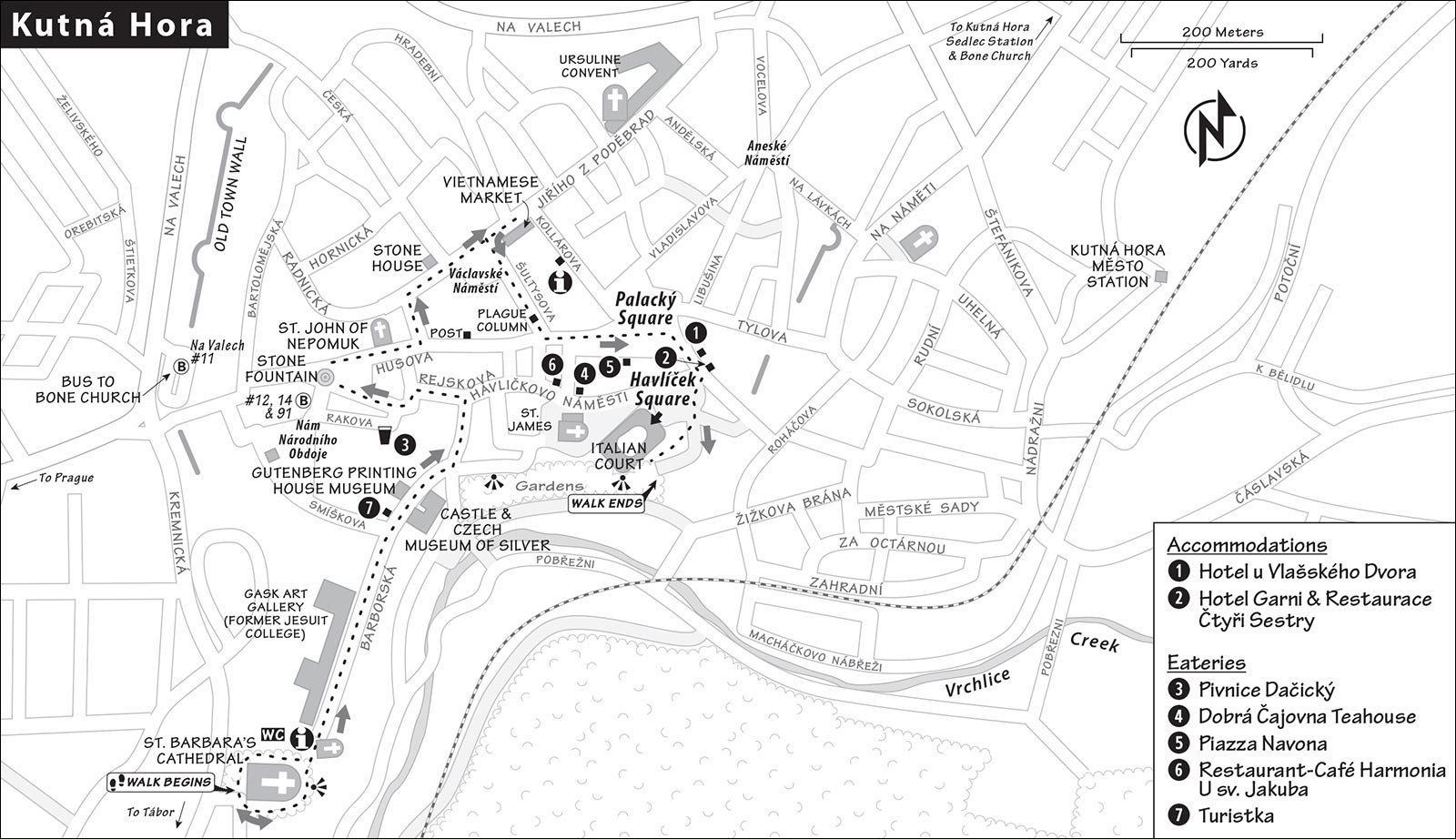
Kutná Hora Walk
Kutná Hora’s most famous sight—the Bone Church—is on the outskirts of town (in Sedlec), and listed on here. This self-guided walk connects the rest of the sights you’ll want to see in a near-loop of the historical center. Before you get too far into the walk, call or drop by the Czech Museum of Silver to book a spot on the mine tour (if you have not already done so on their website). No stop on this walk is more than 10 minutes from the museum, so you can bail out and head for your tour at any point and easily resume the walk later.
• Begin in the inviting park surrounding the cathedral.
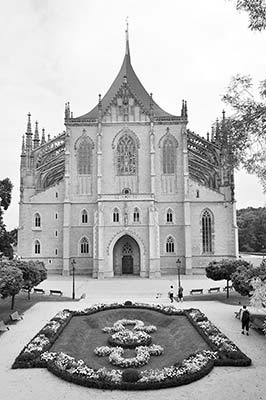
St. Barbara’s Cathedral and Park: Rising like three pointy tents from a forest of buttresses, St. Barbara’s strikes an exquisite Gothic profile. This culmination of Czech Gothic architecture was funded with a “spare no expense” attitude by a town riding the crest of a wave of mining wealth. Be sure to tour the cathedral’s interior (see listing, later)—but also take the time to do a slow lap around the pristine park that surrounds it.
Behind the church’s apse, belly up to the viewpoint for an orientation to the city. From left to right, visually trace the historical center that perches along the promontory’s crest: The long former Jesuit College now houses a modern-art museum. The big, gray building that plunges down the cliff is the town’s “little castle” (Hrádek), with the Czech Museum of Silver. And the spire to the right of that bookends this walk. Surveying this scene, think about the history of a town made very, very rich by the glittering deposits it sits upon. Wealthy as it was, this was still an industrial town: The river below was so polluted they called it “Stink” in Czech. Notice the vineyards draping the hill.
• After circling the church, walk along the grand...
Terrace: Just before you head along the panoramic promenade, notice the handy TI in the little house on the left. Then stroll regally along the stately white building, which now houses the modern and contemporary GASK art collection (see listing, later). The statues of saints that line the terrace are a reminder of the building’s Jesuit past. The Jesuits arrived here in 1626 with a mission: to make the Protestant population Catholic again. These chubby sandstone figures, just like those on the Charles Bridge in Prague, were initially commissioned as Counter-Reformation propaganda pieces.
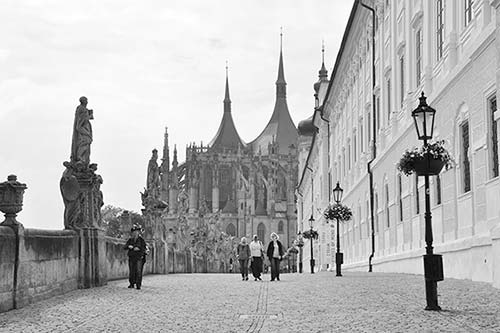
Near the end of the terrace, continue following the broad cobbled footpath downhill...and keep an eye out for an army of white-jacketed, white-helmeted miners trudging up the hill for their daily shift. Or maybe they’re tourists, about to explore the former silver mine at the Czech Museum of Silver, which occupies the big building on your right. Across the street is the Gutenberg Printing House Museum, with an intriguing exhibit on 19th-century printing presses. For details on visiting either museum, see their listings, later.
• At the little park in front of the Czech Museum of Silver, take the left (level) fork, following Stone Fountain signs. When you hit the bigger street (with lots of parked cars), turn left (uphill, on Rejskova) and bear left around the big drab building. You’ll emerge into a little square (Rejskovo Náměstí) with a big and impressive...
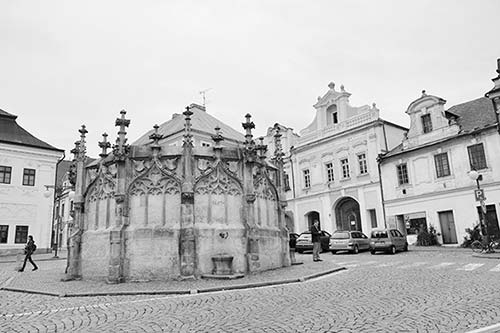
Stone Fountain (Kamenná Kašna): The intensive mining under Kutná Hora released arsenic and other toxins, poisoning the water supply. The city struggled with obtaining clean drinking water, which had to be brought to town by a sophisticated system of pipes, then stored in large tanks. At the end of the 15th century, the architect Rejsek built a 12-sided, richly decorated Gothic structure over one of these tanks. Although no longer functioning, the fountain survives unchanged—the only structure like it in Bohemia.
• Facing the fountain, hook right around the corner and head down Husova street. On the left, you’ll pass the stately town library (Městská Knihovna), then the gorgeous late-Baroque/Rococo Church of St. John of Nepomuk (named for the ever-popular Czech patron saint). Turn left up the street after this church (Lierova). At the top of the street, turn right on Václavské Náměstí (Kutná Hora’s own Wenceslas Square). On your left, you’ll spot the frilly decorations on the...
Stone House (Kamenný Dům): Notice the meticulous detail in the grape leaves, branches, and animals on this house’s facade and up in its gable. Talented Polish craftsmen delicately carved the brittle stone into what was considered a marvel of its time. Inside is a moderately interesting museum dedicated to local life from the 17th to 19th century, with a vaulted cellar displaying Gothic masonry (100 Kč, Tue-Sun 9:00-18:00, shorter hours off-season, closed Mon and Dec-March).
• Continue past the house as the street opens into a leafy and inviting square. For a slice of “authentic Czech” life, continue straight when the street narrows again; a half-block down on your right, under the tržnice sign, is the town’s humble...
Vietnamese Market: This double row of stalls selling knock-off Nikes and cheap jeans is as much a part of Czech urban life today as farmers markets (Mon-Fri 7:30-16:45, shorter hours Sat, closed Sun). The stalls are run by Vietnamese immigrants, the Czech Republic’s third-largest minority (after Slovaks and Ukrainians). Many came here in the 1970s as part of a communist solidarity program that sent Vietnamese workers to Czech textile factories. They learned the language, adapted to the environment, and, after 1989, set off on a road to entrepreneurial success that allowed them to bring over friends and relatives.
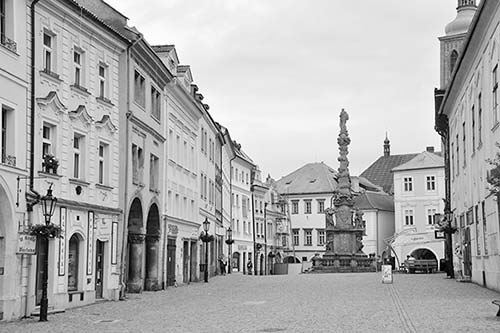
• Backtrack a few steps uphill, then turn left to walk down through the postcard-perfect Šultysova street, with a towering plague column at its center. Turn left at the street past the column, enjoying the pretty, colorful arcades. You’ll emerge into the lively main square.
Palacký Square (Palackého Náměstí): Beautiful but still somehow local, this square enjoys colorful facades, tempting al fresco restaurant tables, and generous public benches.
• Exit the square at the far-right corner, following the traffic-free street (in the gap between buildings, toward the green house). You’ll enter...
Havlíček Square (Havlíčkovo Náměstí): The monuments on this leafy, parklike square are a Who’s Who of important Czech patriots.
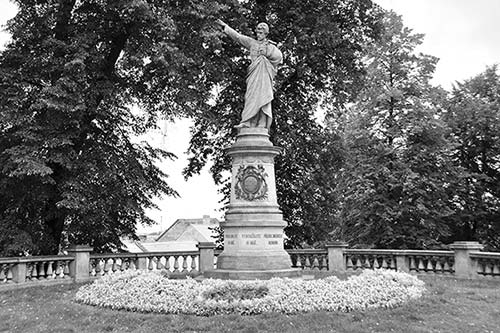
Straight ahead, the stone statue with his arm outstretched is Karel Havlíček (1821-1856), the founder of Czech political journalism (and the square’s namesake). From Kutná Hora, Havlíček ran an influential magazine highly critical of the Habsburg government. In 1851, he was forced into exile and detained for five years in the Tirolean Alps under police surveillance. His integrity is reflected by the quote inscribed on the statue: “You can try to bribe me with favors, you can threaten me, you can torture me, yet I will never turn a traitor.” His motto became an inspiration for generations of Czech intellectuals, most of whom faced a similar combination of threats and temptations. Havlíček (whose name means “little Havel”) was much revered in the 1970s and 1980s, when the other Havel (Václav) was similarly imprisoned for his dissent.
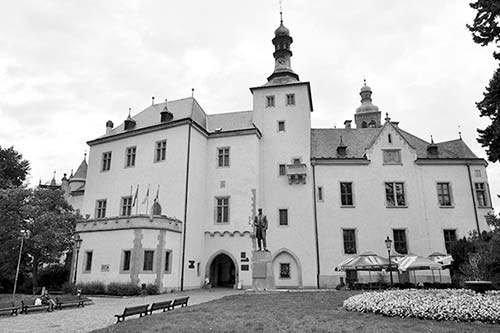
Below and to the right, the bronze, stoutly bearded statue in front of the big building honors the founder of Czechoslovakia, Tomáš Garrigue Masaryk (see sidebar on here). Circle around behind the pedestal to see the brief inscription tracing the statue’s up-and-down history, which parallels the country’s troubled 20th-century history: erected by Kutná Hora townspeople on October 27, 1938 (the eve of Czechoslovakia’s 20th birthday); torn down in 1942 (by occupying Nazis, who disliked Masaryk as a symbol of Czech independence); erected again on October 27, 1948 (by freedom-loving locals, a few months after the communist coup); torn down again in 1957 (by the communists, who considered Masaryk an enemy of the working class); and erected once again on October 27, 1991. Notice that the Czechs, ever practical, have left a blank space below the last entry.
Masaryk stands in front of the building known as the Italian Court (Vlašský Dvůr). Step inside its fine courtyard. This palace, located on the site where Czech currency was once made, became Europe’s most important mint and the main residence of Czech kings in the 1400s. It’s named for the Italian minters who came to Kutná Hora to teach the locals their trade. Most of the present-day building is a 19th-century reconstruction. Today, it hosts a moderately interesting museum that includes the Art Nouveau-decorated St. Wenceslas Chapel and displays on minting and local history in an original Gothic hall (120 Kč, daily 9:00-18:00, shorter hours Oct-March, ticket office on second floor inside courtyard).
Exiting the courtyard of the Italian Court, turn right and watch on the wall to your right for a small bronze tablet showing a hand flashing a peace sign, covered with barbed wire. This is an unassuming little memorial to the victims of the communist regime’s misrule and torture.
Continue straight down the steps into a little park and then turn right to reach a great viewpoint. It overlooks the distinctive roof of the cathedral and the scenic valley below.
• Your walk is finished. If you’re headed for the Czech Museum of Silver, take this scenic route: Walk back up to Havlíček Square, circle around the Italian Court, curl along the downhill side of St. James’ Church, and enjoy the views. Eventually the view terrace dead-ends at a little lane that bends right and uphill, depositing you at the museum.
If you’re headed back to Prague, it takes about 15 minutes to walk to the Kutná Hora Město train station from Havlíček Square. Head downhill past the park, which funnels you between two buildings. Take the first left on Roháčova, then the first right on Sokolská. When you reach the wide cross street (Nádražní), turn left and follow the train tracks to the little pink station.
Sights in Kutná Hora
For sightseeing efficiency, start with the Bone Church on the outskirts, then continue to the center of town (with the cathedral, silver mine/museum, and self-guided walk). For details on the Gutenberg Printing House Museum, Stone House, and Italian Court, see the walk.
ON THE OUTSKIRTS
▲▲Sedlec Bone Church (Kostnice v Sedlci)
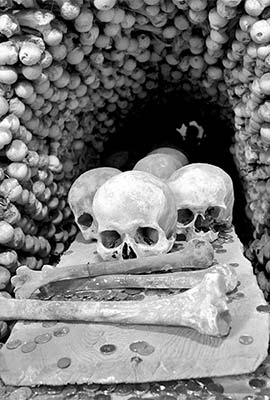
Located about 1.5 miles from the town’s historical center, the Sedlec Bone Church sits in a serene graveyard and looks unassuming from the outside. But inside, it’s filled with the bones of 40,000 people—stacked into neat, 20-foot-tall pyramids decorating the walls and ceilings. The 14th-century plagues and 15th-century wars provided all the raw material necessary for the monks who made these designs.
Cost and Hours: 160 Kč ticket covers the Bone Church and St. Mary’s Basilica, 320 Kč combo-ticket adds St. Barbara’s Cathedral; daily 8:00-18:00, March and Oct 9:00-17:00, Nov-Feb 9:00-16:00; good 20 Kč audioguide adds 15 minutes of commentary to make it more meaningful, +420 327 561 143, www.sedlec.info.
Visiting the Church: Stand outside the church. This is a place of reflection. The cemetery here was “seeded” with holy earth brought from Jerusalem, which made this sacred ground. Demand was high, and corpses that could no longer pay the rent (i.e., those who lacked surviving relatives with enough disposable income for postmortem real estate) were “evicted.” What to do with the bones? Recycle them as church decorations with a message.
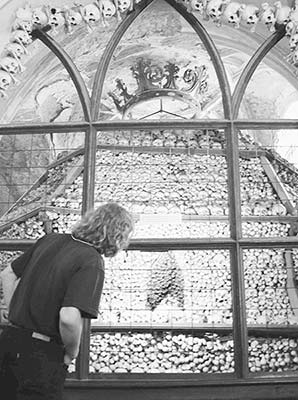
The monks, who first placed these bones 400 years ago, were guided by the belief that in order to live well, one must constantly remember death (memento mori—“what we are now, someday you shall be”). They also wanted to remind viewers that the earthly church was a community of both the living and the dead, a countless multitude that would one day stand before God. Later bone stackers were more interested in design than theology...as evidenced by the many show-off flourishes you’ll see around the church.
Approach the church. Ignore the dull upper chapel and head down below (look for the kostinec sign). Flanking the stairwell are two giant chalices made of bones (a symbol of Jan Hus’ egalitarian approach to worship).
Downstairs, on both sides are giant stacks of bones, reaching the top of the Gothic vaults (there are six such bone-pyramids in this small chapel). The skulls are neatly arranged on top, in the belief that this closeness to God would serve them well when Jesus returns to judge the living and the dead. Straight ahead dangles a chandelier, which supposedly includes at least one of every bone in the human body. In the glass case on the right (by the pillar), see the skulls with gnarly holes and other wounds. These belonged to soldiers who died fighting in the Hussite Wars—a boom time for this cemetery.
Finally, head into the left wing of the church, where you’ll find a giant coat of arms of the aristocratic Schwarzenberg family—decorated with the skull of an Ottoman invader (a fearsome foe of the time), whose “eye” is being pecked out by a raven made of human bones.
Your visit is over. Go outside and head into town, thankful all of your limbs are intact.
Nearby: You’ll pass the magnificent Sedlec St. Mary’s Basilica as you walk from the train station to the Bone Church. Originally predating both the silver mine and the town of Kutna Hora, St. Mary’s was burned down by the Hussites in 1421 and resurrected in the late 1600s by the great Baroque architect Santini. While the interior is not as impressive as St. Barbara’s, the stunning golden monstrance holder from the 1300s—in one of the chapels on the left—is worth a peek (160 Kč with Bone Church, 320 Kč combo-ticket with Bone Church and St. Barbara’s Cathedral; Mon-Sat 9:00-18:00, Sun from 11:00, shorter hours off-season; +420 326 551 049, www.sedlec.info/en/cathedral).
Getting from the Bone Church to Town: The helpful TI between the Bone Church and St. Mary’s can call you a taxi (about 150 Kč to St. Barbara’s Cathedral—the start of my self-guided walk, taxi +420 777 239 909 or +420 800 100 512, arrives within 10 minutes). It’s also possible by public bus (details at TI) but you’ll save time and effort with a quick taxi ride.
IN THE CENTER
▲▲St. Barbara’s Cathedral (Chrám Sv. Barbory)
The cathedral was founded in 1388 by miners who dedicated it to their patron saint. The dazzling interior celebrates the town’s sources of wealth, with frescoes featuring mining and minting. This church was a stunning feat of architecture by three of Prague’s Gothic geniuses: Johann Parler, Matyáš Rejsek, and Benedict Ried. And, like Prague’s cathedral, it sat unfinished and sealed off for centuries, until it was finally completed in the early 20th century.
Cost and Hours: 180 Kč, 320 Kč combo-ticket with Bone Church and St. Mary’s Basilica; daily 9:00-18:00, shorter hours Nov-March; audioguide-20 Kč, +420 327 515 796, www.khfarnost.cz [URL inactive].
Visiting the Cathedral: While this tour covers the highlights, you’ll receive a more detailed flyer at the ticket desk, or you can rent the more in-depth audioguide.
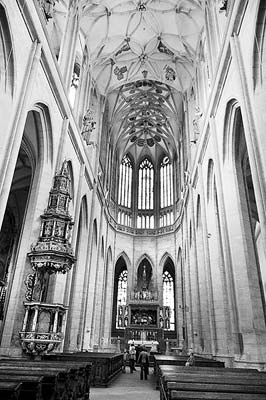
Head inside, walk to the middle of the main nave, and just take it all in. Intricate, lacy vaulting decorates an impossibly high ceiling that’s also decorated with the coats of arms of local guilds. This is the epitome of Gothic: a mind-bogglingly tall nave supported by flying buttresses that create space for not one but two levels of big windows, pointed arches where the columns converge, and an overall sense of verticality and light.
The gorgeous high altar’s Last Supper scene of carved and painted wood is a neo-Gothic copy of the original. The wings of the altar depict different saints, including Barbara on the right and Wenceslas on the left. Circle clockwise around the apse, past Baroque altars. In the first chapel (the St. Catherine chapel) stands a Gothic Madonna from 1380, the oldest and most precious statue in the cathedral. As you walk, appreciate the fine stained-glass windows throughout the church. These are by František Urban, a somewhat less talented contemporary of Alphonse Mucha, who nevertheless employed a similarly eye-pleasing Art Nouveau flair to illustrate scenes from church history. (A tiny version of this church’s distinctive triple-pointed roofline appears in the background of several windows.)
Continue around the apse. In the third-to-last chapel, find a fine Gothic fresco of St. Christopher. The second-to-last chapel, called the Smíšek Chapel, is an artistic highlight. The late-Gothic frescoes—The Arrival of the Queen of Sheba, The Trial of Trajan, and especially the fresco under the chapel’s window depicting two men with candles—are the only remaining works of a Dutch-trained master in Gothic Bohemia. The final chapel, called the Miners’ Chapel, has frescoes under the windows showing miners going about their daily labor. Most miners were healthy, unattached men in their 20s. An average of five miners died each day—from cave-ins, collapsing scaffolding, built-up poisonous gases, fires, and so on.
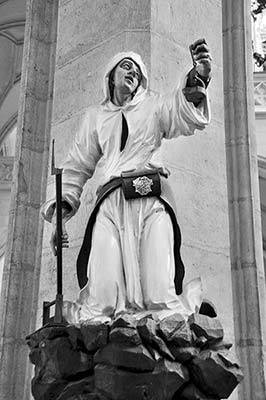
Continue up the side nave. Midway along, look for a wooden miner statue on a pillar on your right (pictured). He’s wearing a typical white miner’s coat. White fabric was the cheapest option (as it required no dyes) and was easier to see in the dark. The leather mat wrapped around his waist made it easier for him to slide down chutes inside the mine. His pick-like tool identifies him as the mining foreman, who was referred to as the Steiger.
At the back wall of the long chapel on your left, notice the precious frescoes from 1463 showing two people minting coins.
Loop around the back of the church, coming back up the left nave. You’ll pass finely carved wooden choir benches that blend, in perfect Gothic harmony, with the church’s architecture.
Art Gallery of the Central Bohemian Region (GASK)
The huge, former Baroque Jesuit college—which stretches from the cathedral all the way to the castle—is now an art museum. It boasts the second-largest exhibition space in the country (after the National Gallery in Prague) and fills it with both permanent and ever-changing temporary exhibits of 20th- and 21st-century art. The permanent exhibit, titled States of Mind Behind Painting, combines techniques of modern painting with literary citations.
Cost and Hours: Permanent and temporary exhibits—200 Kč, permanent exhibit only—100 Kč; Tue-Sun 10:00-18:00, closed Mon year-round and Jan-Feb; Barborská 51, www.gask.cz.
▲Hrádek Castle and the Czech Museum of Silver (České Muzeum Stříbra)
Located in Kutná Hora’s 15th-century Hrádek (“little castle”), the Czech Museum of Silver offers a fascinating look at the primary source of local wealth and pride. Over the centuries, this mine produced some 2,500 tons of silver, copper, and zinc. Today you can visit the facility on a 1.5-hour tour, which lets you spelunk in the former miners’ passages that run beneath the entire town center. Note that the tour involves some tight squeezes and may be uncomfortable if you’re claustrophobic. Bring warm clothing—mines are cold.
Cost and Tours: The English-language tour (Route II) costs 160 Kč—book ahead (see below). If an English tour is unavailable, book the Czech version; English flyers are provided. Route I, which includes only the aboveground museum, is pointless.
Hours: Tue-Sun 10:00-18:00, April and Oct until 17:00, Nov-Jan until 16:00, closed Mon year-round and Feb-March, last tour 1.5 hours before closing.
Information: +420 327 512 159 or mobile +420 733 420 366, www.cms-kh.cz.
Reservations Recommended: Book a tour slot online two or more days in advance; flag icons indicate which tours are offered in English. It’s also possible to call the day before or the morning of your visit (wait through the Czech recording to speak to someone in English). Without reservations, drop by the museum soon after you arrive in Kutná Hora to reserve.
Visiting the Museum and Mine: First, your guide takes you to see an intriguing horse-powered winch that once hoisted 2,000 pounds of rock at a time out of the mine. You’ll learn the two methods miners used to extract the precious ore: either by hammering with a chisel or pick, or by setting a fire next to a rock—heating it until it naturally cracked.
Then you’ll don a miner’s coat and helmet, grab a bulky communist-era flashlight, and walk like the Seven Dwarfs through the town center to a secret doorway. It’s time to climb deep into the mine for a wet, dark, and claustrophobic tour of the medieval shafts that honeycomb the rock beneath the town—walking down 167 steps, traversing 900 feet of underground passages (but it feels even longer), then walking back up 35 steps.
Along the way, you’ll see white limestone deposits in the form of mini stalagmites and stalactites, and peer down into a 26-foot-deep pool of crystal-clear water. Squeezing through very tight passages, you’ll feel like (fill in your own childbirth joke here). The mine holds a steady, year-round temperature of 54 degrees Fahrenheit while fat drops of condensation fall continually from the ceiling thanks to the nearly 100 percent humidity. Prepare for the moment when all the lights go out, plunging you into a darkness as total as you’ll ever experience. You’ll understand why miners relied on their other senses. For instance, when silver was struck, it made a telltale sound and smelled faintly like garlic.
Finally, ascending to ground level, your guide will explain safety mechanisms at the surface, and walk you through the smelting and minting processes that turned those raw deposits into coins for an entire continent.
Gutenberg Printing House Museum (Knihtiskárna Muzeum)
Run by a family of local printers going back four generations, this two-room museum re-creates a 19th-century printing house (when an important Czech journal was published in Kutná Hora). You’ll see original printing and book-setting machines, including a working hand-printing press from 1840, a complete typesetter’s workplace, a large wheeled manual paper cutter, and bookbinding tools. Photographs and a video in the first room underscore the old-timey atmosphere. You can even print your own postcard of St. Barbara on a century-old press.
Cost and Hours: 120 Kč, Thu-Mon 10:00-17:00, Sat until 19:00, closed Tue-Wed, Barborská 30, +420 734 157 880, www.knihtiskarna.cz.
Sleeping and Eating in Kutná Hora
Sleeping: Although one day is enough for Kutná Hora, staying overnight saves you money (hotels are much cheaper here than in Prague) and allows you to better savor the atmosphere of a small Czech town.
$ Hotel u Vlašského Dvora and Hotel Garni are two renovated townhouses run by the same management. Furnished in a mix of 1930s and modern style, the hotels come with access to a fitness center and sauna. Hotel Garni is slightly nicer (a few steps off main square at Havlíčkovo Náměstí 513, +420 771 226 021, www.hotelykh.cz).
Eating: $$ Pivnice Dačický has made a theme of its namesake, a popular 17th-century author who once lived here. Solid wooden tables rest under perky illustrations of medieval town life, and a once-local brew, also named after Dačický, flows from the tap. They serve standard Czech fare, as well as excellent game and fish. While regulars still come here for the cheap lunch specials, during tourist season the crowd is mostly international. Service can be slow when a group arrives (daily, Rakova 8, +420 327 512 248, mobile +420 603 434 367).
$$ Dobrá Čajovna Teahouse offers the chance to escape—not to medieval times, but to an Orient-themed paradise. Filled with tea cases, water pipes, and character, this place is an ideal spot to dawdle away the time that this ageless town has reclaimed for you. They serve Indian vegetarian plates and filled pita breads (daily 14:00-22:00, Havlíčkovo Náměstí 84, +420 777 028 481).
$ Restaurace Čtyři Sestry (“At the Four Sisters”) is a family restaurant with a changing rotation of Czech classics, chef’s specials, and vegan fare attracting largely a local crowd. Sit in the modern interior or in the shady courtyard behind the restaurant (long hours Mon-Sat, until 16:00 on Sun, on Havlíčkovo Náměstí, right above Hotel Garni, +420 327 512 749).
$$ Piazza Navona, which obnoxiously advertises itself as “the only true Italian restaurant in town,” draws loyal customers thanks to its decent food and superb outside seating on the main square (daily, Palackého Náměstí 90, +420 327 512 588).
$$ Restaurant-Café Harmonia U sv. Jakuba fills the need if you are open to a European rendition of Mexican food. Sit in the bright red-and-green interior or on the pleasant outdoor patio (daily, Husova 9, +420 327 512 275).
$ Turistka is a charming café that bakes its own goodies and serves an excellent breakfast (Tue-Sun 9:00-18:00, closed Mon, between St. Barbara’s Cathedral and the silver mine at Barborská 29).
Kutná Hora Connections
To return to Prague, hop on a local train from Kutná Hora Město station, near the historical center (or Kutná Hora Sedlec station if you end your day at the Bone Church), and take it to the Kutná Hora main station for your train transfer to Prague. From the main station, trains to Prague run hourly; some require a quick and easy transfer in Kolín. For train schedules, see https://idos.idnes.cz.
Terezín Memorial
Terezín (TEH-reh-zeen), an hour by bus from Prague, was originally a fortified town named after Habsburg empress Maria Theresa (it’s called “Theresienstadt” in German). It was built in the 1780s with state-of-the-art, star-shaped walls designed to keep out the Prussians. Ironically, the town’s medieval walls, originally meant to keep Germans out, were later used by Germans to keep the Jews in.
In 1941, the Nazis removed the town’s 7,000 inhabitants and brought in 58,000 Jews, creating a horribly overcrowded ghetto. As the Nazis’ model “Jewish town” for deceiving Red Cross inspectors, Terezín fostered the illusion that its Jewish inmates lived relatively normal lives—making the sinister truth all the more cruel.
Compared to other such sights (such as Auschwitz or Mauthausen), Terezín (worth ▲▲) feels different: First, the memorial focuses less on the Nazis’ ruthless and calculated methods, and instead celebrates the arts and culture that thrived here despite the conditions—imbuing the place with a tragic humanity. Second, the various museums, memorials, and points of interest are spread over a large area in two distinct parts: a drab grid of a town and the original fortress (across the river, a short walk away). This means you’re largely on your own to connect the dots and flesh out the story (use my self-guided tour to help).
To lift your spirits after a sobering visit, consider a side trip to the vibrant town of Litoměřice, three miles away (see here).
GETTING THERE
The camp is about 40 miles northwest of Prague. It’s most convenient to visit Terezín by bus (described next) or tour bus (see here).
Buses to Terezín leave from Prague’s Holešovice train station (Nádraží Holešovice, on Metro line C). When you get off the Metro (coming from the city center), head toward the front of the train, go upstairs, turn right, and walk to the end of the corridor. You’ll see bus stands directly ahead, outside the station. The Terezín bus departs from platform 7 (direction: Litoměřice; direct buses Mon-Fri at 9:00, 10:10, and 11:00; Sat at 9:30 and 10:30; Sun at 10:30; 1 hour, pay driver). You’ll arrive in Terezín at the public bus stop on the main square, around the corner from the Museum of the Ghetto. Some buses also stop earlier, by the Small Fortress. The driver and fellow passengers may tell you to get off there, but my self-guided tour works best if you begin at the stop in town (after the bus passes a field of crosses on your right and travels across the river).
For schedules see https://idos.idnes.cz—you want “Terezín Litoměřice” (be sure to check the return schedule, too; for details on getting back to Prague, see “Terezín Connections,” later).
PLANNING YOUR TIME
Because the sights are scattered, plan on lots of walking, and give yourself plenty of time: Three hours is enough for a minimal visit; allow four hours to see everything, and more like five to really delve in. Your understanding of Terezín becomes immeasurably deeper with the help of a local guide (for a list of Prague-based guides, see here).
With more time, stop in the nearby attractive town of Litoměřice (described later) for lunch before returning to Prague.
ORIENTATION TO TEREZÍN
Cost: The 280 Kč combo-ticket includes all parts of the camp.
Hours: Most sights, including the Museum of the Ghetto, Magdeburg Barracks, and Hidden Synagogue, are open daily 9:00-18:00, Nov-March until 17:30. The Columbarium and Crematorium are closed Sat. The Crematorium is open Sun-Fri 10:00-18:00, Nov-March until 16:00; the Small Fortress is open daily 8:00-18:00, Nov-March until 16:30.
Information: +420 416 724 535, mobile +420 604 241 179, www.pamatnik-terezin.cz.
Visitor Information: In Terezín town, the TI is located at the exit from town toward Litoměřice. It has handy information (such as the Prague bus schedule and directions to town landmarks) and helpful staff who speak English (daily 9:00-17:00, Dukelských hrdinů 43, +420 775 711 881, www.terezin.cz).
Tours: Use the form at www.pamatnik-terezin.cz to reserve a guided tour in English (included in entry).
Eating: Avoid the stale sandwiches in the Museum of the Ghetto’s dingy basement cafeteria. The Small Fortress has a $ cafeteria. In Terezín town, $ Atypik Restaurant offers Czech canteen classics popular with students and museum employees, served on an airy terrace or in the cramped interior with a peek into the kitchen (Mon-Fri 9:30-21:00, Sat-Sun 11:00-18:00, Máchova 91, +420 607 554 945). For more recommendations, see “Eating in Litoměřice” on here.
BACKGROUND
Terezín was the Nazis’ model “Jewish town,” a concentration camp dolled up for propaganda purposes. Here, in a supposedly “self-governed Jewish resettlement area,” Jewish culture seemed to thrive, as “citizens” put on plays and concerts, published a magazine, and raised their families. But it was all a carefully planned deception, intended to convince Red Cross inspectors that Jews were being treated well. The Nazis even coached prisoners on how to answer the inspectors’ anticipated questions.
The Nazi authorities also used Terezín as a place to relocate elderly and disabled Jews from throughout the Third Reich—so the ghetto was filled with prisoners not only from the Czech lands, but from all over Europe.
In the fall of 1944, the Nazis began transporting Jews from Terezín to even more severe death camps (especially Auschwitz) in large numbers. Virtually all Terezín’s Jews (155,000 over the course of the war) ultimately ended up dying—either here (35,000) or in extermination camps farther east.
One of the notable individuals held at Terezín was Viennese artist Friedl Dicker-Brandeis. This daring woman, a leader in the Bauhaus art movement, found her life’s calling in teaching children freedom of expression. She taught the kids in the camp to distinguish between the central things—trees, flowers, lines—and peripheral things, such as the conditions of the camp. In 1944, Dicker-Brandeis volunteered to be sent to Auschwitz after her husband was transported there; she was killed a month later.
Of the 15,000 children who passed through Terezín from 1942 to 1944, fewer than 100 survived. The artwork they created at Terezín is a striking testimony to the cruel horror of the Holocaust. In 1994, Hana Volavková, a Terezín survivor and the director of the Jewish Museum in Prague, collected the children’s artwork and poems in the book I Never Saw Another Butterfly. Selections of the Terezín drawings are also displayed and well described in English in Prague’s Pinkas Synagogue (described on here).
Of the cultural activities that took place at Terezín, the best known was the children’s opera Brundibár. Written just before the war, the antifascist opera premiered secretly in Prague at a time when Jewish activities were no longer permitted. From 1943 to 1944, the play, performed in Czech, ran 55 times in the camp. After the war it was staged internationally, and was rewritten and published in the US in 2003 as a children’s book by Tony Kushner and Maurice Sendak (whose version later appeared on Broadway).
 SELF-GUIDED TOUR
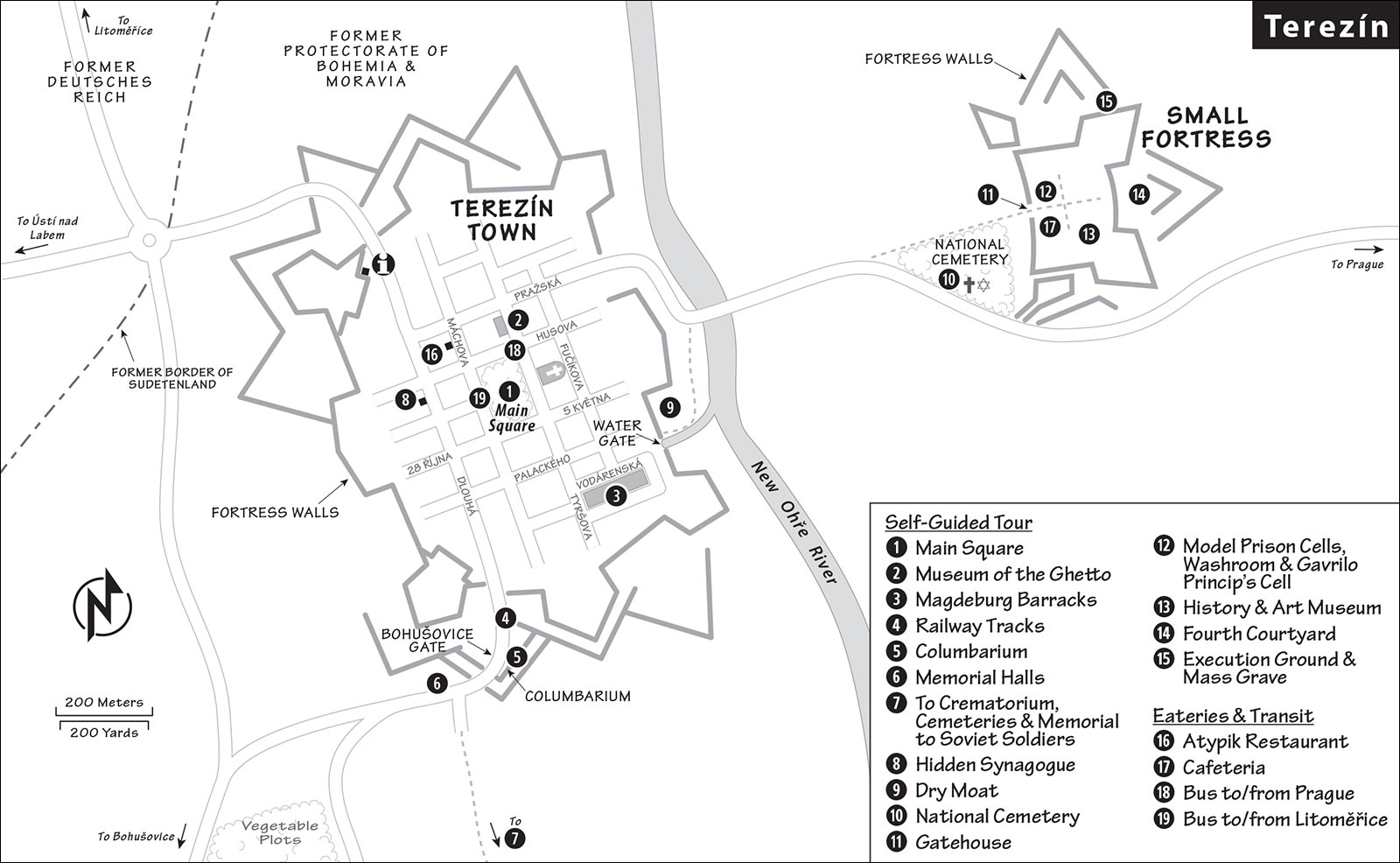
The Terezín experience consists of two parts: the walled town of Terezín, which became a Jewish ghetto under Hitler; and (a half-mile walk east, across the river) the Small Fortress, which was a Gestapo prison camp for mostly political prisoners of all stripes (including non-Jewish Czechs). The complete tour involves about four miles of walking (including the walk from the town to the Small Fortress, then back again to catch your return bus to Prague). Pace yourself. If you want to cut it short, I’ve suggested sections that you could skip.
Terezín Town
• The bus from Prague drops you off at Terezín town’s spacious...
1 Main Square (Náměstí Československé Armády): Today Terezín feels like a workaday, if unusually tidy, Czech town, with a tight grid plan hemmed in by its stout walls. And for much of its history, that’s exactly what it was. But when Hitler annexed Czechoslovakia, he evicted the residents to create a ghetto for Jews forcibly transplanted here from Prague and elsewhere. Because it started out as a pretty town, rather than a gloomy prison or custom-built concentration camp, the Nazi authorities cultivated Terezín as a “model” to illustrate to the outside world how good the Jews had it here.
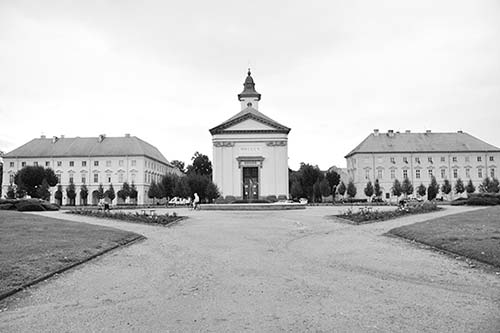
Begin your tour by mentally filling the (now mostly empty) square with thousands of Jewish inmates, all wearing their yellow Juden Star of David patches. Picture the giant circus tent and barbed-wire fence that stood on this square for two years during the war. Inside, Jewish workers boxed special motors for German vehicles being used on the frigid Soviet front. As part of yearlong preparations for the famous Red Cross visit (which lasted all of six hours on June 23, 1944), the tent and fence were replaced by flower beds (which you still see on the square today) and a pavilion for outdoor music performances.
• Just around the corner from the bus stop, in the yellow former schoolhouse that faces the adjacent square, is the...
2 Museum of the Ghetto: This modern, concise, well-presented museum, with artifacts and insightful English descriptions, sets the stage for your Terezín visit. You can buy the Terezín combo-ticket here (and ask about the day’s film schedule—explained later). You’ll find two floors of exhibits about the development of the Nazis’ “Final Solution” and Terezín’s role within it. The ground floor includes some evocative memorials (such as a stack of seized suitcases and a list of Terezín’s victims). The exhibit upstairs illuminates life in the ghetto with historical documents (including underground publications and letters—inmates were allowed to mail one per month), items belonging to inmates, and video footage of survivors’ testimonies. In the stairwell are large illustrations of ghetto life, drawn by people who lived here.
In the basement is a theater showing four excellent films. One film documents the history of the ghetto (31 minutes), offering a helpful, if dry, overview of the sights you’ll see. Two others (14 and 20 minutes) focus on children’s art in the camp, and the last is a 10-minute montage of clips from Der Führer schenkt den Juden eine Stadt (The Führer Gives a City to the Jews), by Kurt Gerron. Gerron, a Berlin Jew, was a 1920s movie star who appeared with Marlene Dietrich in Blue Angel. Deported to Terezín, Gerron in 1944 was asked by the Nazis to produce a propaganda film. The resulting film depicts healthy (i.e., recently arrived) “Jewish settlers” in Terezín happily viewing concerts, playing soccer, and sewing in their rooms—yet an unmistakable, deadly desperation radiates from their pallid faces. The only moment of genuine emotion comes toward the end, when a packed room of children applauds the final lines of the popular anti-Nazi opera Brundibár: “We did not let ourselves down, we chased the nasty Brundibár away. With a happy song, we won it all.” Even the Nazis were not fooled: Gerron and his wife were shipped to Auschwitz, and the film was never shown in public.
• To learn more about living conditions in the camp, return to the main square and continue straight past it, along Tyršova street. A few blocks down, just before the wall, on the left you’ll find the...
3 Magdeburg Barracks: Peek inside the large courtyard, then continue upstairs and follow the one-way, counterclockwise loop. First you’ll see a meticulously restored dormitory, complete with three-tiered beds, suitcases, eyeglasses, dolls, chessboards, sewing kits...and utterly no privacy. After Terezín’s residents were evicted and Jews were imported in huge numbers, every available space was converted from single-family apartments to outrageously cramped slumber mills like this. Jaunty music lures you around the corner to the first of several rooms celebrating the arts here at Terezín. You’ll see exhibits on composers, artists, and writers who expressed their creativity even in these horrifying conditions. These include profiles of individuals (such as young Petr Ginz—see sidebar) and a wide variety of stirring illustrations of life in the ghetto. Near the end is a room reproducing the camp cabaret stage, where inmates entertained each other.
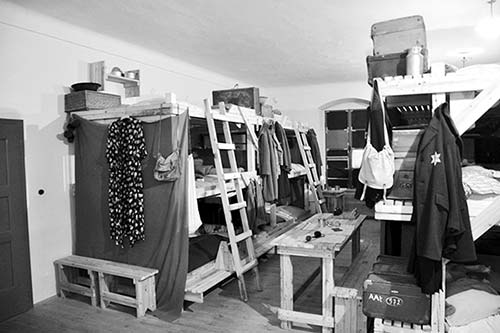
• With limited time or energy, consider skipping the next several stops, which take a long, if poignant, detour outside the walls. Jump ahead to the moat (see “Dry Moat,” later) by leaving the barracks, turning right, and walking 100 yards to a brick gate. (If you do decide to skip the following stops, you can easily fit in the Hidden Synagogue at the end, before hopping on your bus back to Prague, as it’s one block from the main square.)
To continue the full tour, exit the barracks, turn left, and walk until you dead-end at the city wall. Turn right and walk along the inside of the stout wall to the far corner. Slicing through the hole in the wall are the remnants of...
4 Railway Tracks: In the early years of the camp, Jews arrived at the train station in the nearby town of Bohušovice and then had to walk the remaining 1.5 miles to Terezín. This was too public a display for the Nazis, who didn’t want townspeople to observe the transports and become suspicious (or to try to interact with the inmates in any way). So the prisoners were forced to construct a railway line that led right to Terezín...and then back out again to Auschwitz.
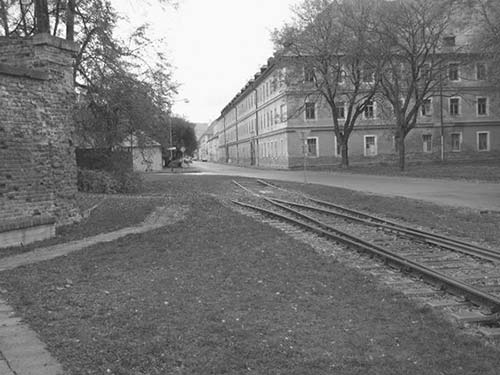
• Follow the tracks outside the wall.
5 Columbarium and 6 Memorial Halls: Exiting the wall, on the left is a Columbarium, where the Nazis deposited cardboard boxes containing the ashes of dead prisoners. The Germans originally promised that the remains would be properly buried after the war, but in 1945, to erase evidence, the ashes of Terezín victims were dumped into the Ohře River. Farther along, past the little pension/café and across the bridge, on the right you will find Jewish and Christian ceremonial halls and the main morgue.
• When the main road swings right, take the left turn (marked Krematorium) and walk past bucolic vegetable plots and fruit gardens, and along a driveway lined with pointy poplar trees, to reach the...
7 Crematorium and Cemeteries: The low-lying yellow building (to the left of the monumental menorah) is the crematorium, where Nazis burned the bodies of those who died here. Step inside to see a small exhibit on death and burial in the ghetto (explaining that, over time, single graves in coffins gave way to mass graves, then to simply burning bodies en masse and dumping the ashes in the river). Then head into the chilling main chamber, where four ovens were kept busy cremating bodies.
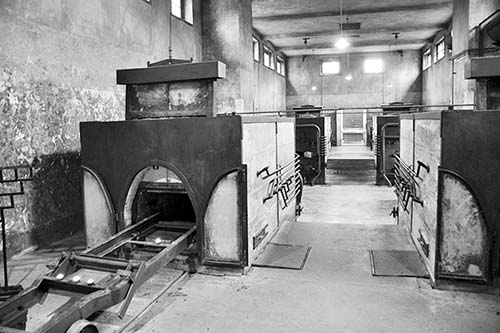
Outside, surrounding the crematorium is a Jewish cemetery with the bodies of those who had died before cremation became the norm. Farther to the right (as you face the crematorium) is a Russian cemetery and a Memorial to Soviet Soldiers. The Soviets liberated Terezín without a fight as the Nazis retreated, on May 8, 1945. But just days before, an epidemic of typhus had spread through the camp. In the weeks after the war ended, scores of Soviet soldiers and medical workers who tried to contain the epidemic died, along with hundreds of former prisoners.
• Retrace your steps back through the wall and continue straight ahead past the train tracks, up Dlouhá street. After three blocks, watch on the left for the low-profile green house at #17. Walk through the corridor to reach the fascinating...
8 Hidden Synagogue: Inside you’ll find a courtyard; the bakery that used to be here hid the synagogue behind it. This is the only one of the camp’s eight hidden synagogues that survived. The atmospheric space is still inscribed with two Hebrew captions, which are translated as “May my eyes behold, how You in compassion return to Sinai,” and “If I forget Jerusalem, may my tongue rot and my right arm fall off.” These words indicate that the prayer room belonged to a congregation of Zionists (advocates of a Jewish state), who, one would expect, were specifically targeted by the Nazis.
Upstairs, a few prisoners lived in a tight attic space. Even though the cramped rooms (reconstructed with period items) seem impossibly small, they were a far better accommodation than the mass housing in which most prisoners were interned. It’s thought that a group of craftsmen who labored in a nearby workshop were “lucky” enough to live here.
• Leaving the synagogue house, turn right, and at the corner, turn left to pop out at the main square. To proceed to the Small Fortress, head down Tyršova as if you’re going to the Magdeburg Barracks. Before you get there, turn left along the park, then continue one block up Palackého to the brick gate. You’ll cross a bridge over a...
9 Dry Moat: Imagine this moat filled with plots of vegetables, grown by starving Jews for well-fed SS officers. Turn left and walk along the moat. The top of the fortification walls on the other side were once equipped with benches and pathways.
• When you reach the main road, turn right across the New Ohře River (the original course of the river was diverted here when Terezín was built). After about five minutes, you’ll come to a blocked-off, tree-lined driveway and the prison camp.
Terezín Prison Camp
• On the right side of the driveway is the wedge-shaped...
10 National Cemetery: The remains of about 10,000 victims of Terezín (including 2,386 individual graves; the rest were moved here from mass graves elsewhere) fill this cemetery, which was created after the war’s end. The sea of headstones powerfully illustrates the scope of the crime that took place here. Notice that, in addition to the giant Star of David (closer to the fortress), a cross towers over the cemetery. This is a reminder that we’ve left the Jewish ghetto and are about to enter a very different part of the Terezín complex. From 1940 to 1945, this fortress functioned as a Gestapo prison, through which 32,000 inmates passed (of whom nearly 10 percent died here)—chiefly members of the Czech resistance and communists. While the majority of the camp’s victims weren’t Jewish, the 1,500 Jews interned here were treated with particular severity.
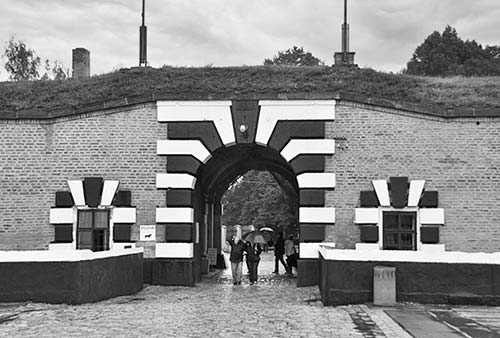
• Now head under the black-and-white-striped gate.
11 Gatehouse: Inside the gate, on the left, is a modest museum about the pre-WWII history of this fortress. If you need a break before continuing, you could pause at the handy cafeteria. The wood-and-metal chandeliers inside were produced by Jewish workers for the SS officers who once dined in these two rooms.
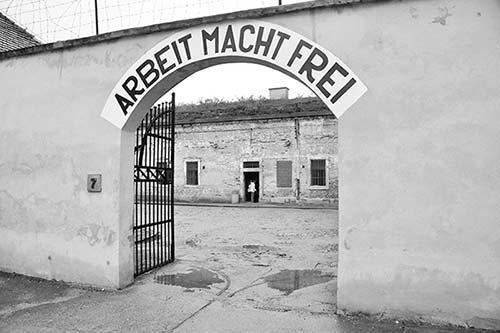
• Continuing into the central part of the fortress, watch on the left for a turnstile into a long, skinny side courtyard. Go in and head to the end of the courtyard, under the notorious Arbeit Macht Frei sign painted above an arched gate (a postwar replica of the viciously sarcastic “Work will set you free” sign that was displayed at all camps). Go under this gate to reach a courtyard ringed with...
12 Model Prison Cells: Step into some of the barracks on the right side of the courtyard to see tight, triple-decker bunks where prisoners were essentially stacked at bedtime. Halfway down the courtyard, under the Block-A sign, peek into the medical cell.
At the far end, the washroom in the right-hand corner (by #15) was built solely for the purpose of fooling Red Cross inspectors. Go ahead, turn the faucets: No pipes were ever installed to bring in water.
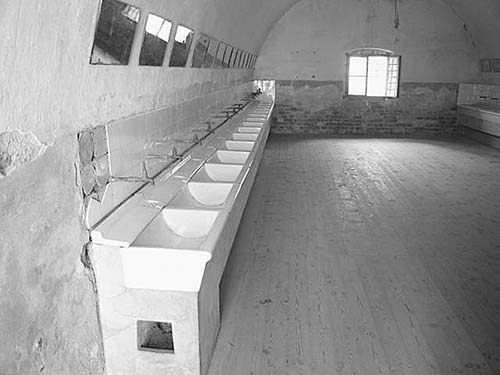
The shower room two doors to the left, on the other hand, was used to fool the Jews. Here they got used to the idea of communal bathing, so they wouldn’t be suspicious when they were later taken to similar-looking installations at Auschwitz. (There were no gas chambers at Terezín—most of the deaths here were caused by malnutrition, disease, and, to a lesser extent, execution.)
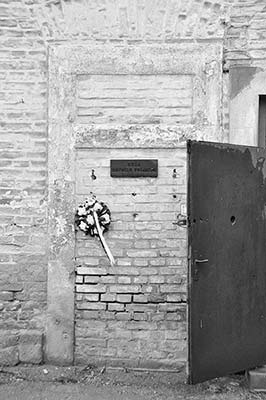
Before the Nazis, the Austrian monarchy used the Small Fortress as a prison. In the little side courtyard next to the shower room, look for a ghostly doorway with a plaque that recalls the most famous prisoner from that time, Bosnian Serb Gavrilo Princip, whose assassination of Archduke Franz Ferdinand and his wife Žofie in 1914 sparked World War I. (Princip died here in 1918 of tuberculosis; of the six Sarajevo conspirators imprisoned here, only two survived.)
• Return through the Arbeit Macht Frei gate, then back out into the fortress’ central yard. Turn left and continue deeper into the complex. The large building on your right is marked by Muzeum signs.
13 History and Art Museum: The ground floor of this building features an exhibit about the Nazi-era history of the Small Fortress. Photographs and brief descriptions identify many of the individuals who were imprisoned—and in many cases, executed. Upstairs is a gallery of paintings by prominent Czech artists, mostly focusing on themes of camp life (and a few about the Spanish Civil War).
• Back out in the main yard, continue straight ahead, through two gateways in a row. You’ll emerge into the wide, eerie...
14 Fourth Courtyard: Here you’ll have more opportunities to step into former prison cells that flank the yard; some of these house temporary exhibits. At the far end, you’ll find a plaque in the ground listing the 17 countries whose citizens perished at Terezín.
• Returning to the fortress’ main yard once more, turn right and follow the long buildings. Turn right to find the...
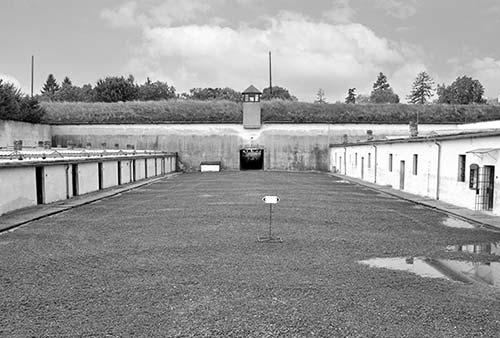
15 Execution Ground and Mass Grave: This is where firing squads executed somewhere between 200 and 300 of Hitler’s enemies. Many of Terezín’s victims were buried in mass graves along the fortress ramparts. After the war, these remains were moved to the National Cemetery we saw on the way into the fortress.
• Our tour ends here. As you ponder Terezín, remember the message of all such memorials: Never again.
TEREZÍN CONNECTIONS
The bus for Prague leaves from Terezín’s main square (direct buses Mon-Fri at 14:35, 15:05, 15:40, and 16:35; Sat at 13:05, 15:05, and 17:05; Sun at 14:35, 16:35, and 17:05, 1 hour; more options with transfer, pay driver). For bus and train schedules, see https://idos.idnes.cz.
NEAR TEREZÍN: LITOMĚŘICE
With a bustling, beautifully restored Renaissance square, Litoměřice (lee-TOH-myer-zheet-seh, pop. 26,000, known in German as Leitmeritz), located three miles north of Terezín, is a perfect lunch spot to lift your spirits after the bleakness of the camp. During the communist era, Litoměřice had the only seminary in the country. Today, there are still two huge Baroque churches here. Linger on the main square, Mírové Náměstí, and experience the pulse of this friendly, untouristy Czech town.
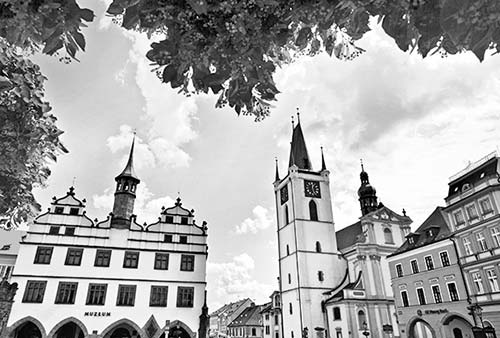
Buses from Prague to Terezín continue on to Litoměřice (buses returning to Prague stop first in Litoměřice, then Terezín). If arriving by bus from Terezín, get off at the first stop after the bridge; from here it’s a two-minute, slightly uphill walk to the main square. Easier yet, it’s a five-minute taxi trip between the Terezín Memorial and Litoměřice (about 200 Kč). The staff at Terezín’s Museum of the Ghetto ticket office will be happy to call a taxi for you, since English is likely not spoken (taxi based in Terezín: +420 606 833 480; taxi based in Litoměřice: +420 777 286 406).
Visiting Litoměřice: From the main square, several small streets filled with bakeries and convenience shops radiate outward. The onion-shaped tower is south, and the higher part of the square is due west. Stroll around and get lunch on the square. After lunch, climb up the onion-shaped tower of the Town Hall (the guide in the tower loves to talk).
On the square at #24, the Litoměřice Church Museum, part of the North Bohemian Art Gallery, is a tiny, beautiful temple of arts in two parts (50 Kč, daily 10:00-18:00, Oct-May shorter hours and closed Mon-Tue, a few doors to the right of Town Hall, +420 416 732 382). In four rooms that face the square, you’ll find the highlights of the bishop’s collection—800-year-old statues of the evangelists, a Lucas Cranach original, and Karel Škréta’s Baroque masterpiece St. Matthew with an Angel. The narrow Renaissance house in the back houses the only Art Brut/Naïve Art collection in the Czech Republic. The artists displayed here deliberately defy all trends, taking the perspective that art is first and foremost an expression of an authentic internal need that should not be governed by current tastes or commercial interests. Highlights include Jan Kutálek’s Tree of Life on the patio and Alois Kučera’s linden-wood relief Pub With Drinkers in the topmost attic room. Through a narrow window, you can also enjoy the best views of the river and the cathedral.
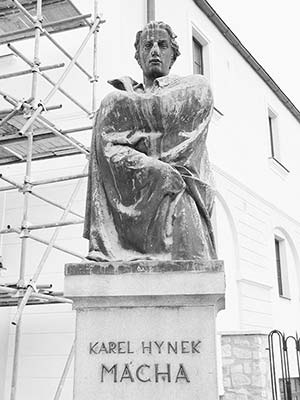
The short street next to the Town Hall leads onto the city walls, with good views. The statue at the viewpoint depicts the Romantic poet Karel Hynek Mácha (1810-1836), who wrote the most famous Czech poem, “Máj.” He died in Litoměřice. In the fall of 1938, as Litoměřice was ceded to Hitler as part of the Sudetenland, local Czech patriots exhumed and carried away Mácha’s body to prevent German nationalists from desecrating his grave. A year later, reburial of the remains at the Slavín cemetery atop Prague’s Vyšehrad hill inspired student-led anti-occupation protests that resulted in a German crackdown, including the closing of Czech universities. In November 1989, demonstrating students were headed for the grave of Mácha to mark the 50th anniversary of these events when they suddenly decided that they were tired of the communists...and started the Velvet Revolution.
Eating in Litoměřice: $$ Gurmánie Pasta & Grill & Café, at the top of the square, is a hip bistro with a wide selection of soups, salads, sandwiches, and cakes. They sauté pasta and vegetables with fresh red beet juice while you watch (daily, weekday specials, no English menu—ask the counter staff to translate, +420 416 536 131).
The vault-ceilinged, plastic-tabled $ U Draka eatery on the corner across from Gurmánie cooks up old Czech canteen classics for a 60+ crowd determined to live like the 1980s never ended (Mon-Fri 6:30-17:30, Sat 8:00-14:00, closed Sun, no English menu and no English spoken—just point at what you want).
$$ U Zlatého Bažanta (“At the Golden Pheasant”) is the best choice for a proper sit-down meal, particularly if the weather is good enough to sit at the square-side tables. Try some of their game or superbly executed Czech classics and wash it down with their namesake Slovak beer (daily, English menu doesn’t include daily specials—ask, next to Town Hall, mobile +420 732 517 090).
Litoměřice Connections: To reach Litoměřice’s bus station for the trip back to Prague (hourly, 1 hour), walk east on the main street (Dlouhá) down from the square to an intersection, cross it, and continue in the same direction along Na Kocandě street (an easy 10-minute walk). The train station is nearby (though buses to Prague are preferable, as the train requires a transfer). For bus and train schedules, see https://idos.idnes.cz.
Konopiště Castle
Konopiště (KOH-noh-peesh-tyeh) was the Neo-Gothic residence of the Archduke Franz Ferdinand d’Este—the heir to the Austro-Hungarian Empire, whose assassination sparked World War I. Located 30 miles south of Prague, it’s workable either as a day trip or on the way to Český Krumlov. While it’s the least visually arresting of the castles near Prague, its interior has some captivating stories to tell about its former inhabitants. Enjoyable for anyone, Konopiště is worth ▲ for most. But it’s a must for Habsburg aficionados—historians find it worth ▲▲▲.
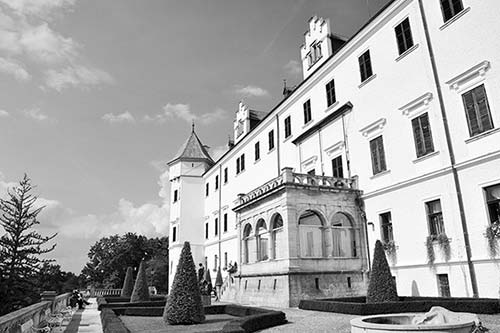
Construction of the castle began in the 14th century, but today’s exterior and furnishings date from about 1900, when Franz Ferdinand renovated his new home. As one of the first castles in Europe to have an elevator, a WC, and running water, Konopiště shows “modern” living at the turn of the 20th century.
Those who lived at Konopiště played a role in one of the most important moments in European history: Franz Ferdinand’s assassination in Sarajevo (chillingly illustrated by items displayed inside the castle). The shooting eventually meant the end of the age of hereditary, divine-right, multiethnic empires—and the dawn of a Europe of small, nationalistic, democratic nation-states. Historians get goose bumps at Konopiště, where if you listen closely, you can almost hear the last gasp of Europe’s absolute monarchs.
The castle interior is only viewable via a guided tour. There are several tour options, but the best is Route 3 (limited space, so book online or call ahead to reserve—see “Orientation to Konopiště,” later).
GETTING THERE
By Train: Trains from Prague’s main station drop you in Benešov (2/hour, 1 hour, https://idos.idnes.cz); a well-marked trail goes from the station to the castle (1.5 miles). To walk to the castle, as you exit the Benešov train station, turn left and walk along the street parallel to the railroad tracks. Turn left at the first bridge you see crossing over the tracks. Along the way you’ll see trail markers on trees, walls, and lampposts—one yellow stripe between two white stripes. Follow these markers. As you leave town, watch for a marker with an arrow pointing to a path in the woods. Take this path to bypass the castle’s enormous parking lot, which is clogged with souvenir shops and bus fumes.
By Car: Konopiště is about a 45-minute drive from Prague and a two-minute detour off of the main route to Český Krumlov (head east toward Brno on the D-1 expressway; take exit #21 toward Benešov/České Budějovice/Linz; after about 9 miles (15 kilometers) watch for the Konopiště turnoff on the right). Bypass the first, giant parking lot (ringed by restaurants); a bit farther along, on the left near the lake, is a smaller lot that’s closer to the castle. From either lot, hike uphill about 10-15 minutes to Konopiště.
ORIENTATION TO KONOPIŠTĚ
Cost and Tours: The recommended Route 3 is 370 Kč in English. Routes 1 and 2 are 270 Kč apiece. All tickets are 30 Kč cheaper if you join a Czech-speaking tour (but renting the English audioguide costs 50 Kč—effectively negating most of your savings).
Hours: May-Aug Tue-Sun 10:00-17:00; Sept 9:00-16:00; April and Oct-Nov until 15:00; closed Mon year-round and Dec-March.
Information: +420 317 721 366, www.zamek-konopiste.cz.
Reservations Recommended: Space on Route 3 is limited to eight people per hour: It’s smart (and worth the small extra charge) to reserve a spot in advance on their website, or by calling one day ahead or on the morning of your visit.
VISITING THE CASTLE
While there are three tour options, Route 3 is the most intimate and interesting. It takes you through the rooms where Franz Ferdinand, his Czech bride Žofie, and their three kids lived while waiting for Uncle Franz Josef to expire. When the communists took over, they simply threw drop cloths over the furniture and let the place sit, untouched, for decades. Now everything has been meticulously restored (with the help of 1907 photographs)—launching you right into a turn-of-the-20th-century time capsule.
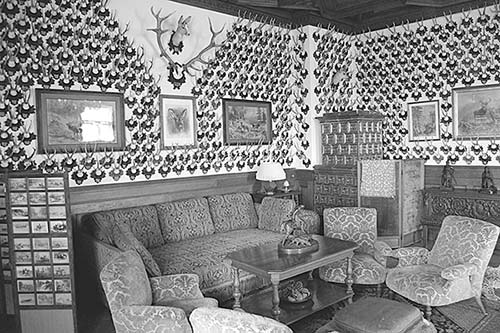
The tour takes you through halls upon halls of hunting trophies (each one marked with the place and date of the kill), paintings of royal relatives (including an entire wall of Italian kings—relations of Franz Ferdinand’s Neapolitan mother), and photographs of the many places they traveled and the three kids as they grew up. The tour includes Franz Ferdinand’s dressing room (with his actual uniform and his travel case all packed up and ready to go); his private study (which feels like he just stepped away from his desk for a cup of coffee); the living room (with 1,180 pairs of antlers on the walls); the private dining room (with the table set for an intimate family dinner for five); the master bedroom (with its huge bed); the children’s bedrooms, playrooms, and classroom (with their toys and books still on the shelves); three bathrooms with running water and flushing toilets; and—in the final room—a glass display case containing the dress Žofie was wearing that fateful day in Sarajevo (including her still-blood-stained corset). Down the hall are the royal couple’s death masks, Franz Ferdinand’s bloody suspenders, and the actual bullet that ended Žofie’s life.
Route 2—which covers the oldest wing of the castle—is also worth considering, and provides the most comprehensive look into the castle, its history, and celebrated collections. You’ll see the oversized elevator (with a couch to make the family comfortable on the 45-second ride upstairs), the library, and the staggeringly large armory collection. Route 1, covering some other rooms, the hunting hall, and the balcony, is the least interesting.
Other Sights at the Castle: Your tour ticket includes two quirky additional sights that are worth poking into. Franz Ferdinand’s Shooting Range, just off of the castle courtyard, offers a quick glimpse at the emperor-in-waiting’s elaborate system of moving targets; a video demonstrates how the various targets would move around to keep his skills sharp. The Museum of St. George, tucked beneath the long terrace (around the side of the palace), displays Franz Ferdinand’s collection of hundreds of sculptures and paintings of St. George slaying the dragon...taking a theme to an extreme.
Archduke Franz Ferdinand was born to the brother of the Habsburg emperor (Franz Josef) and a Neapolitan princess. After his cousin died under “mysterious circumstances,” Franz Ferdinand was thrust into the role of heir apparent to the throne of the Austro-Hungarian Empire—one of the biggest realms Europe has ever seen. But he had to be patient: His Uncle Franz Josef took the throne in 1848 and would hold onto it for nearly 70 years. In fact, he outlived his nephew.
While he waited, Franz Ferdinand kept himself busy by spending time at his bachelor pad in Konopiště. At a ball in Vienna, he met a gorgeous but low-ranking Czech countess, Žofie Chotková. The couple danced all night. After long years of secret courtship, Franz Ferdinand announced his intentions to marry Žofie. His uncle was displeased—Žofie was an aristocrat, not a princess as expected as the spouse for the heir apparent. Franz Josef insisted that Žofie could never be an empress and none of their children could inherit the throne. These family squabbles cemented Franz Ferdinand and Žofie’s preference for living at Konopiště.
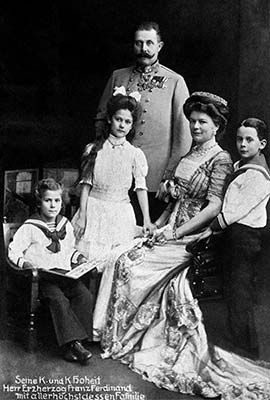
While waiting for a succession that would never arrive, Franz Ferdinand threw himself into his hobbies with zeal. He traveled around the world twice—partly for diplomatic reasons, but largely to pursue his passion for exotic hunting. Shooting anything in sight—deer, bears, tigers, elephants, and crocodiles—he killed about 300,000 animals, a few thousand of which stare morbidly at you from the walls at Konopiště. Franz Ferdinand and Žofie were also devoted parents, raising three children: Žofie, Max, and Ernesto.
In the Kaiser’s Pavilion on the grounds of Konopiště, Franz Ferdinand met with German Kaiser Wilhelm and tried to talk him out of plotting a war against Russia. Wilhelm argued that a war would benefit both Germany and Austria: Germans wanted colonies, and the Austro-Hungarian Empire could use a war to divert attention from its domestic problems. But Franz Ferdinand foresaw war as suicidal for Austria’s overstretched monarchy.
Soon after, Franz Ferdinand and Žofie went to Sarajevo, in the Habsburg-annexed territories of Bosnia and Herzegovina. There, Gavrilo Princip, a Bosnian Serb separatist, shot the Habsburg archduke who so loved shooting, and Žofie. Franz Ferdinand’s assassination ironically gave the Germans (and their allies in the Austro-Hungarian administration) the pretext to go to war against Serbia and its ally, Russia. World War I soon broke out. The event Franz Ferdinand had tried to prevent was, in fact, sparked by his death.
While the stretch between the parking lot and the castle entrance is overrun by tour groups, the gardens and the park are surprisingly empty. In the summer, the flowers and goldfish in the rose garden are a big hit with visitors. The peaceful 30-minute walk through the woods around the lake (wooden bridge at the far end) offers fine castle views.
Tucked away in the bushes behind the pond is a pavilion coated with tree bark, a perfect picnic spot. This simple structure, nicknamed the Kaiser’s Pavilion, was the site of a fateful meeting between the German Kaiser Wilhelm and the Archduke Franz Ferdinand (see the sidebar, earlier).
Eating at Konopiště Castle: $$ Zámecká Restaurace sits under the hill halfway between the parking lot and the lake. Known for its affordable game, this is an appropriate culinary tie-in after touring the hunting-obsessed archduke’s quarters (daily until 16:00, July-Aug until 18:00, +420 602 296 039). Or consider bringing picnic supplies from Prague (or buy them at the grocery store by the Benešov train station) and enjoy the peace and thought-provoking ambience of a picnic in the shaded Kaiser’s Pavilion. Or eat cheaply on Benešov’s main square (try $ U Zlaté Hvězdy—“The Golden Star”).
Karlštejn Castle
One of the Czech Republic’s most popular attractions, Karlštejn Castle (KARL-shtayn) perches high on a stony bluff overlooking its one-street town. From a distance, it’s a striking, fairy-tale castle—but there’s little to see inside.
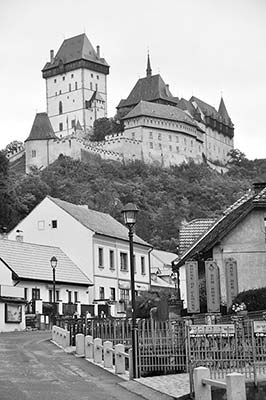
Frankly, a visit here can be more trouble than it’s worth: Whether you arrive by train or by car, you’ll face a half-mile, rather steep hike up to the castle, past an obnoxiously touristy gauntlet of crystal and souvenir shops. Like other Czech castles, you can see the interior only with a tour—but although the guides strain to make the place interesting, there’s not much to say.
For many visitors, the best option may be a quick photo-op, without going inside. It’s free to hike up to the courtyard, and you can even continue to the adjacent Well Tower for great views back on the main castle and over the town that fills the gully below. You can also hike in the forested hills surrounding the castle (described later).
GETTING THERE
By Train: The castle, 20 miles southwest of Prague, is accessible by train (2/hour, 40 minutes, then a 20- to 30-minute walk; depart from Prague’s main station in the direction of Beroun, https://idos.idnes.cz). When you leave the Karlštejn station, turn right, walk to the next road, turn left, and cross the bridge over the river. From here, follow the pedestrian-only street as it twists up, up, up to the castle.
By Car: Head west from Prague toward Plzeň and watch for the brown Karlštejn signs marking the turnoff. You’ll drive through the countryside to the castle, park in the pay lot across the street from the town’s main road, and then walk the rest of the way up.
ORIENTATION TO KARLŠTEJN
Cost and Tours: If you want to tour the castle, opt for Route II (560 Kč, Czech tours depart hourly, English tours less frequently, 16 people maximum, book ahead). The 1.5-hour tour is lengthy and expensive, but it’s the only way to reach the one thing inside worth seeing: the much-venerated, richly decorated Gothic Chapel of the Holy Cross (though you only get a few minutes in there). Route I is nowhere near as interesting (260 Kč, no reservation required, bigger groups, shorter tour).
Hours: May-Sept Tue-Sun 9:00-18:00, closed Mon except in July-Aug, when it’s open daily; March-April and Oct Tue-Sun until 17:00, closed Mon; Nov-Feb Fri-Sun 10:00-15:00, closed Mon-Thu.
Information: +420 311 681 617, www.hrad-karlstejn.cz/en.
Advance Reservations: It’s smart to book online in advance (small fee).
Eating at Karlštejn: On the way up to the castle are several restaurants and a good bakery (about halfway on the right coming from the train station; stock up on their koláče and cabbage rolls before scaling the castle).
To get a post-castle meal while avoiding tourists altogether, immediately after exiting the castle gate, turn left on a forest path marked by a red stripe between two white stripes. In 10 minutes, you gradually descend into a valley with a small road and a creek. Continue along the road for about 100 yards to $$ Restaurant Pod Dračí Skalou (“Under the Dragon’s Rock”), with an imaginative menu that includes game from the nearby woods. From mid-September until November 11 they serve the special “St. Martin” roasted goose, and from November 11 (St. Martin’s Day) until February, the year-round game selection is expanded into a “feast of game” (daily, Karlštejn 130, +420 723 845 844). To get back to the train station, just follow the road and the creek down to town.
BACKGROUND
Karlštejn (“Charles’ Castle”) was built in just 17 years by Charles IV around 1350 as a summer residence and to house the crown jewels of the Holy Roman Empire. The architecture is designed to reflect the journey of the human soul: from life (the lower castle), through purgatory (the shorter Marian Tower), and finally to paradise (the Chapel of the Holy Cross—which housed the crown jewels—at the top of the Great Tower). Later, during the Hussite Wars, Jan Hus’ followers encamped on the hills surrounding the fortress, planning to attack Karlštejn, steal the crown jewels, and name a Protestant king—but they failed. If Karlštejn looks “Transylvanian,” that’s because it was remodeled in a fanciful, Romantic style in the 19th century. The version you see today, while dramatic, is far from authentic. (They call it “pseudo-Gothic,” but I think of it as “pseudo-Epcot.”)
VISITING THE CASTLE
On the Route II tour, you’ll receive an introduction with some historical illustrations before hiking up and through the two towers. First is the squatter Marian Tower, featuring a queen’s bedroom-turned-chapel, with some valuable frescoes and a tiny chapel whose walls are lined with precious stones.
Next, you’ll cross a high wooden bridge to the Great Tower, where you’ll see a dull lapidarium (collection of historic stone fragments) before huffing up several flights of stairs to the Chapel of the Holy Cross, a genuinely evocative space in which you’ll have just a few minutes. Built to house the crown jewels, this smallish but exquisite chapel is decorated with 129 portraits of medieval European monarchs. (Habsburg empress Maria Theresa borrowed some, and apparently lost one—since she never returned it.) The ceiling, made of gilded stucco, glitters to represent the stars in the sky. And the lower walls are encased in precious sheets of deep-red jasper (representing the blood of Christ) and purple amethyst (symbolizing royalty).
Hiking Around Karlštejn: The castle sits in the middle of a national forest preserve with limestone formations. I’ve outlined two hiking options, both of which start at the well-marked trail that turns off to the left immediately after the castle gate (look for markers with one red stripe between two white stripes).
One option is to follow the trail five miles through woods and past a waterfall to the magically set Svatý Jan pod Skalou (“St. John Under the Rock”). This is a former monastery with a healing spring; the water bubbles from a spectacular rock with a cross on its top. Climb up the path by the monastery for great views, or try the excellent restaurant in the former school here (Hotel Obecná Škola, Sun-Thu until 18:00, Fri-Sat until 22:00; Oct-April Thu-Sun until 18:00, closed Mon-Wed; +420 603 916 114). From here, a direct bus takes you to Zličín station, the end of Prague’s Metro line B, in 30 minutes (check the schedule at https://idos.idnes.cz).
For a shorter, three-mile hike, walk along the same red-marked trail for about two miles, then turn left immediately after you cross a creek onto the yellow-marked trail (yellow stripe between two white stripes). After one mile you’ll reach the town of Srbsko (“Serbia”), where you’ll find two restaurants, a grocery store, and a train station (the same line as Beroun-Karlštejn-Prague).
Křivoklát Castle
Křivoklát (KREE-vohk-laht), an original 14th-century castle, is beautiful for its simplicity and setting, amid the hills and deep woods near the lovely Berounka River valley. Křivoklát (worth ▲) is a connoisseur’s castle—I think of it as a rustic, less trampled (if less striking) alternative to the overrun Karlštejn. It also has a particularly cozy setting, nestled deep in a primeval forest, overlooking a meandering river valley. While it’s less accessible to international tourists (most visitors are Czechs, and English speakers get little respect)...that’s the point. Come to this Back Door castle if you enjoy the journey—on a train line along a pastoral river valley—as much as the destination. Note that outside of the peak summer months (June-Aug), the castle can be pretty dead, especially on weekdays.
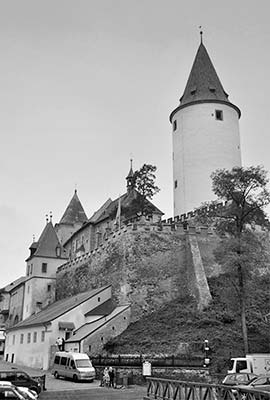
GETTING THERE
Trains leave Prague’s main station for Beroun, where you transfer to the cute little motor train that runs through the delightful Berounka River Valley to Křivoklát (dubbed by Czech hikers the “Berounka Pacific”; 1.5 hours). From Křivoklát’s train station, it’s a 10-minute walk uphill to the castle. At the train station, confirm the return schedule—in the afternoon, a local train leaves almost hourly. For train schedules, see https://idos.idnes.cz.
ORIENTATION TO KŘIVOKLÁT
Cost and Tours: The full tour costs 300 Kč, the basic tour is 240 Kč. English tours may be available in summer—check the website to see if any are scheduled, but come prepared to join a Czech tour and buy the printed English descriptions (30 Kč).
It’s 80 Kč to enter the main castle courtyard and to walk the castle walls on your own without a tour (this option offered daily June-Aug, Sat-Sun only off-season).
Hours: May-Sept Tue-Sun 9:00-17:00, closed Mon; April and Oct Tue-Sun 10:00-16:00, closed Mon; Nov-March Sat-Sun 12:00-14:00, closed Mon-Fri.
Information: +420 313 558 440, www.hrad-krivoklat.cz.
Sleeping and Eating at Křivoklát: Below the castle near the train station, ¢ Hotel and $ Restaurant Sýkora has been a favorite among Czech hikers since the 1930s. If you want to stay for an evening concert in the castle courtyard or for a hike in the nearby woods, sleep in one of the hotel’s 11 rooms. The restaurant’s food is excellent and a great value (+420 703 142 802, www.hotelsykora.cz, info@hotelsykora.cz, only Czech and German spoken).
¢ Křivoklát Castle offers stays either in a spartan castle room with an arched ceiling and adjacent kitchen or in the more comfortable former police station immediately outside the castle gate (no breakfast, reserve well in advance through castle office, +420 313 558 440, krivoklat@npu.cz).
BACKGROUND
Originally a hunting residence of Czech kings, Křivoklát was later transformed into a royal prison that “entertained” a number of distinguished guests, among them the most notorious alchemist of the 1500s, Englishman Edward Kelly. Later, the Habsburgs sold the castle to the Wallenstein family, and the property eventually passed down to the Fürstenbergs. It was lightly renovated by the 19th-century Romantics, but retains more of its original Gothic soul than Karlštejn. In 1929, just before the stock-market crash, the Czechoslovak state bought this former royal residence for a grand sum—it’s one of a few castles that the government purchased rather than seized.
VISITING THE CASTLE
To get inside, you have two tour options. The short tour, about 45 minutes, includes the Gothic chapel and the king’s audience hall, with delicately arched ceilings. In the chapel, check out the 12 monster-animals representing cardinal vices, which are minutely carved at the end of the prayer benches. The long tour, about 80 minutes, includes the 19th-century wing added by the Fürstenberg family.
In summer, Křivoklát comes alive with craftspeople—woodcarvers, blacksmiths, glassblowers, and basket weavers—who work as if it were the 15th century. The absence of tacky souvenir shops, the plain Gothic appearance, and the background noise of hammers and wood chisels give Křivoklát an engaging character (and makes this a good place to shop for a thoughtful gift).
Hiking Around Křivoklát: Several nature trails loop through the forests and hills near the castle. You’ll see examples of the castle’s namesake: rock-perched, spectacularly crooked pines (křivoklát means “warped log”—think Chinese landscape painting). Pick up a map or ask for directions in the forest rangers’ information office down on the main road near Hotel Sýkora (daily 9:00-16:00).
TOWNS NEAR KŘIVOKLÁT
Nižbor
This village, which straddles the valley of the Berounka River, lies between Beroun and Křivoklát (it’s the third stop on the little motor train after Beroun).
Visiting Nižbor: The main reason to stop in Nižbor is Rückl Glassworks, where you can witness the step-by-step production of traditional Czech crystal and even try your hand at glassblowing. As you get off the train, return to the first rail crossing—the entrance to the glassworks is just across the tracks (150 Kč; Mon-Fri 9:30-14:30, closed Sat-Sun; Oct-April Mon-Sat 9:30-12:00, closed Sun; if an English-speaking guide isn’t available, you’ll be asked to tag along with a tour-bus group; factory shop and café open same hours, +420 311 696 248, mobile +420 605 229 205, www.ruckl.cz). Tours last about 45 minutes and end in the gift shop, of course.
Castle and Celtic Sights: The small castle perched on the hill across the river houses a modest exhibit on Celtic archaeology. Nižbor was an important Celtic settlement just before the Christian era (50 Kč, daily 10:00-17:00, closed Nov-April, +420 311 693 100). The trailhead for a three-mile loop trail covering these Celtic sights (mainly in an open field) is immediately across the bridge in front of the Co-op supermarket.
Woodland Trail: To explore the diversity of the forests, follow the trail from the glassworks (marked by signs—with a blue stripe between two white stripes—on trees, fences, and lampposts; 4 miles round-trip). Coming out of the glassworks gate, walk straight past the Keltovna restaurant and along the railroad tracks. After 100 yards, follow the blue-and-white marks and turn left up the hill, through a row of family houses. In another 100 yards you’ll reach the edge of the forest. The trail then takes you over a small hill and down about a half-mile into a canyon with a creek, through a protected natural landscape (see “Křivoklát’s Diverse Forests” sidebar). As you gaze at the surrounding slopes, notice the variety of trees: verdant ashes and alders growing along the moist creek bed, leafy beeches on the lower slopes, and hardy oaks and pines clinging to the dry, rocky hilltops. It’s about two miles to the end of the canyon; walk as far as you’d like or retrace your steps along the same route back to Nižbor.
Eating in Nižbor: $$ Zastávka (“Old Railroad Pub”) is a meticulously designed, 19th-century, railroad-themed eatery where you can sit on an old loading ramp or inside what seems like a wooden compartment. On weekends the place is packed with Czech bikers; if it’s crowded, for quicker service order just soup and a drink (daily, +420 727 860 680). $ Restaurace Praha, just across the road from the glassworks, has more space and solid Czech food that’s served both inside and curbside (daily, +420 777 496 096).
Continuing to Křivoklát: If you purchased a train ticket through to Křivoklát, you can get back on the Beroun motor train without purchasing a new ticket (check schedule carefully, trains go every 1-2 hours).
Lány
The village of Lány, about 14 miles north from Křivoklát Castle, is close to patriotic Czech hearts. The castle in Lány (closed to the public) served as the Czech “Camp David” for Tomáš Garrigue Masaryk (the first president of Czechoslovakia, between the World Wars) and Václav Havel (the contemporary “father of the Czech Republic” and first post-communist president of the nation). Subsequent presidents have continued the tradition.
Masaryk and his family are buried in Lány’s simple village cemetery. Masaryk’s humble grave on a hill in the middle of the fields is a pilgrimage place for freedom-loving Czechs. The communists, wanting to erase Masaryk from the nation’s memory, destroyed all statues of him (such as the one in Kutná Hora—described on here) and barely mentioned his name in history textbooks. During the communist era, Czechs risked their careers by coming here on Czech Independence Day to put candles on Masaryk’s grave. Imagine: Every year, on October 28, the police sealed off all roads to the village of Lány, and anyone who wanted access had to show an ID card. When you arrived at work the next morning, the boss would be waiting at the door, asking, “Where were you yesterday—and why?”
After 1989, Václav Havel—the symbol of the new Czech freedom—strove to restore dignity to the presidency. He went back to the tradition of the first Czech president, making Lány his home away from home. Havel’s weekend sojourns here symbolized a return to Czech self-governance. (For more on Havel, see the sidebar on here.)
Getting to Lány: The bus leaves Prague’s Zličín Metro station for the Lány/Kladno district (direct bus at 9:50, 30 minutes, direction: Rakovník; otherwise 6/day with one transfer, one hour). The bus first stops at the village green, then at the cemetery. A good plan is to catch the direct bus, hike to Křivoklát, and return to Prague by train from Křivoklát. Check the bus schedule at https://idos.idnes.cz. There is no public transportation from Lány to Křivoklát Castle—it’s a gorgeous 14-mile hike (described later).
Sights in Lány: The T.G. Masaryk Museum (Muzeum T.G.M.), located in an old wooden barn, follows Masaryk’s life (1850-1937) in a re-created early-20th-century atmosphere. Before becoming the first president of Czechoslovakia (see sidebar on here), Masaryk was a sociology professor, a member of the Austrian parliament, and an advocate of Czechoslovak independence during World War I. Special focus is devoted to two events that defined his public persona: his defiant defense of Leopold Hilsner—a Jewish shoemaker accused of “ritual murder” of a Catholic girl in 1889, and his challenge to the validity of the nationalistic Czech epic poems Rukopisy Královedvorský a Zelenohorský (Manuscripts of Dvůr Králové and Zelená Hora), which supposedly dated from medieval times but have since been proven to be forgeries (50 Kč, Tue-Sun 9:00-17:00, Nov-March Tue-Sun 10:00-16:00, closed Mon year-round; captions in Czech only—pick up an English handout at the counter; located across from the castle entrance, www.muzeumtgm.cz).
Castle Park: Adjacent to the castle, you can walk in the footprints of Czech presidents, who have used this as a working retreat for a century. Stroll the pleasant English-style park and a part of a hunting preserve that brings to mind medieval kings (15 Kč, Sat-Sun 10:00-18:00, Wed-Thu from 14:00, closed Mon-Tue and Fri and Nov-Easter).
Eating in Lány: At the $$ Narpa Restaurant on the village green, servers in rustic attire offer three soups and five main courses on a rotating basis (daily, +420 731 732 899).
Hike to Křivoklát Castle: Consider making the 14-mile hike from Lány to Křivoklát Castle. From the cemetery, it’s a five-minute walk to the trailhead on the main square, around which you will also find two grocery stores for stocking up on supplies—there are no restaurants or stores until Křivoklát. With the help of a good map, follow the well-marked trail through woods and meadows (look for markers with one red stripe between two white stripes on trees, walls, and fences). This hike takes you through all the varieties of forests in Central Europe (beech, birch, poplar, oak, pine, spruce, fir), past a hidden 1950s dam, and to some stunning vistas. The Praha-Západ and Křivoklátsko hiking maps are excellent (sold in most Prague bookstores).
Karlovy Vary (Carlsbad)
Enough cutesy villages and fairy-tale castles: For a look at an upper-crust side of the Czech Republic, pay a visit to the famous spa town of Karlovy Vary (KAR-loh-vee VAH-ree)—better known by its English name, Carlsbad. Nestled in a wooded valley, where opulent neo-historical facades face a gurgling river and several springs bubble up hot and healing mineral water from deep underground, Karlovy Vary is a pristine and memorable spot. In the mostly traffic-free center, aging and aching spa pilgrims seek a cure for their pains by strolling from one thermal spring to another, filling little teapot-shaped cups with piping-hot mineral water, then sitting, sipping, and munching wafer cookies while watching the world go by, immersed in fanciful, over-the-top-elegant architecture. It’s a slightly surreal scene that seduces you to join in.
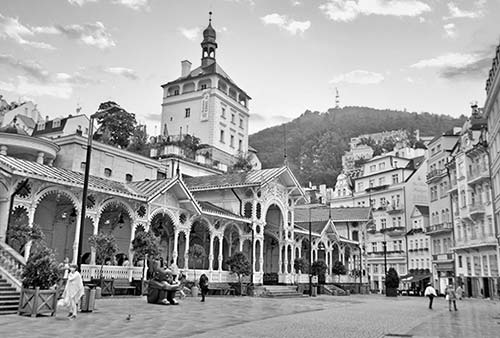
“Karlsbad” made its (German) name as a (German) spa town, and today it’s largely Russian-owned and crawling with tourists from anywhere but the Czech Republic. It’s a gorgeous but soulless husk of a town where the cops are so ritzy, they ride Segways. But others enjoy its dazzling setting, stellar architecture, relaxed tempo, and unique spa rituals.
PLANNING YOUR TIME
Karlovy Vary sits between Prague and the German border, and is two hours one-way from Prague by bus (1.5 hours by car, 3 hours by train). It’s a looooong day trip, and unless you’re serious about relaxing, it’s not worth an overnight. Ideally, visit en route to or from Germany.
You can get a good look at Karlovy Vary in just two hours. Stroll through town from one end to the other, climb up a path to the forested overlook, and join in the water-sipping ritual.
Orientation to Karlovy Vary
Karlovy Vary (pop. 50,000) fills the picturesque valley of the Teplá (“Warm”) River, which trickles from the hills down into the Ohře River. The forested hills are crisscrossed by paths and make for a wonderful overlook. The “upper” end of town—at the landmark Grandhotel Pupp—is to the south, while the train station and lower-lying modern town center lie to the north.
TOURIST INFORMATION
The town has two TIs (+420 355 321 176, www.karlovyvary.cz): One is very central, in the pedestrian zone near the Market Colonnade (Lázeňská 14), while the other is between the train station and the center, on the traffic-free Masarykova street (at #53).
ARRIVAL IN KARLOVY VARY
By Bus or Train: The bus terminal is right in front of the train station. From here, it’s an easy and scenic one-mile walk into the town center: Exit the station to the left, cross the busy street, then find the pedestrianized Masaryka street behind the red Becherovka headquarters. This passes the TI on the way into town.
Better yet, start at the top of Karlovy Vary and work your way back down. From the city bus terminal (a five-minute walk from the train station), take bus #2, which loops on the slopes above town, then stops at Lázně I (the Imperial Spa, just above Grandhotel Pupp) and at Divadelní Náměstí (near the Hot Spring Colonnade, in the center of town). The bus runs every 20 minutes. To reach the city bus terminal, follow the walking directions above to Masaryka, then take the first left down Zeyerova. It’s in front of the pretty, yellow former market hall.
By Car: Several pay parking lots and garages are well marked around town—though driving through the town center isn’t worth the hassle (lots of pedestrian-only lanes, so you’ll be routed to roads higher up in the hills). It’s simpler to park in the Tržnice pay-and-display lot near the city bus terminal/old market hall described earlier, at the lower entrance to town, then ride the bus to the top of town and saunter back down (if that lot’s full, another one is across the street, up the hill, and behind the trees, near a row of market stalls).
Sights in Karlovy Vary
I’ve divided the town into three zones: upper (near Grandhotel Pupp), middle (near the colonnades), and lower (between the town center and the train station). While I prefer starting at the top and working down, you can also do it vice versa—or, if time is short, just focus on the central area (bus #2 takes you to either place). Be sure to slow down and simply enjoy the grand architecture—lots of Neo-Baroque and Neo-Renaissance, and two pieces of both Art Nouveau and fascinatingly out-of-place 1970s Brutalist style. Keep an eye out for two main architectural features: the colonnades, where you’ll find the hot-water springs; and the grand old spa buildings (lázně), numbered 1 through 5.
▲Upper Area
Anchoring the top of town is the can’t-miss-it Grandhotel Pupp, an over-the-top confection. Appropriately, it was built by a German candy magnate and has been immortalized in several international films. Along with other locations around Karlovy Vary, the hotel stood in for “Montenegro” in the 2006 James Bond film Casino Royale, and it was where Queen Latifah blew through her life savings in 2006’s Last Holiday. Fittingly, the town hosts the prestigious Karlovy Vary International Film Festival each July. The building was designed by the Viennese architect duo Ferdinand Fellner and Hermann Helmer, who also did many of the town’s other landmarks. While slightly faded today, the Pupp still feels stately. If you keep a low profile, it’s generally fine to stroll through the lobby—enjoying the chandeliered elegance and giant black-and-white photos of illustrious guests. Their genteel café sells famously decadent cakes and not-too-outrageously-priced coffee (Mírové Náměstí 2, +420 353 109 111).
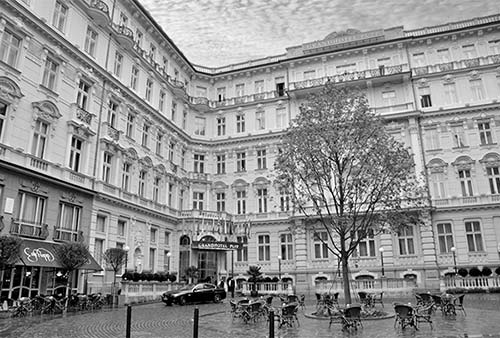
Just to the right of the hotel, at the end of the little uphill Marianská lane, a funicular departs every 15 minutes to ascend to the crest of the wooded hill. Here, an elevator takes you to the top of the Diana Tower, with views over the surrounding forested hills and some of the hotels that scamper up the steep slopes. You can also follow a footpath up; it’s just a 15-minute walk.
Before descending to the town center, consider a five-minute detour upriver to the Imperial Spa (Císařské Lázně, also known as “Spa 1”—labeled Lázně I). Sitting in a park facing a statue of Charles IV, this building was once the favored place for Habsburg emperor Franz Josef to take the waters. These days it’s awaiting a studs-out renovation, but if it’s still open, you can pay a modest fee to climb up to its exquisite former exercise room: a high-ceilinged riot of handsomely carved wood, which feels more like a ballroom.
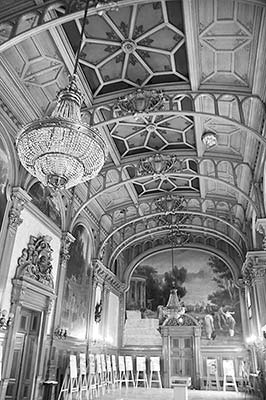
The streets between this area and the town center—especially the parallel embankment promenades, Stará (“Old”) Louka and Nová (“New”) Louka—are lined with big-ticket shops and more fine facades from a bygone era of opulence. From here, the central area described next is about a 10-minute downhill stroll. Along the way, you’ll pass the gorgeous town theater (Mestní Divadlo, with its Neo-Renaissance arches and swaying mansard roof).
▲▲Central Area
The most interesting spa action takes place in the central area just below the pretty, Baroque, pale-green Church of St. Mary Magdalene (Kostel Svaté Máří Magdalény; peek through the gate to see its interior).
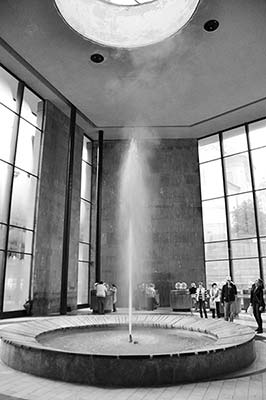
Built in the 1970s with a stern communist-concrete aesthetic, the Hot Spring Colonnade (Vřídelní Kolonáda) is nevertheless a good place to begin your visit to the springs of Karlovy Vary. Inside, vendor stands sell the two main items you need to fully experience the scene: a spa cup and some wafer cookies. Once equipped, head through the colonnade to find several taps continuously gurgling hot water from the first of Karlovy Vary’s springs. Don’t miss the glass atrium where a natural, steaming geyser spurts dramatically 20 feet into the air.
Across from the Hot Spring Colonnade is a pleasant pedestrian street called Tržiště, dominated by the delicate, frilly architecture of the Market Colonnade (Tržní Kolonáda), with four more springs to sample. Just above the Mill Colonnade, marked by a bold Gothic tower, is the entrance to the Castle Spa (Zámecké Lázně), the priciest and most upscale of Karlovy Vary’s public spas.
Farther along, Tržiště passes the TI; nearby, look for the entrance to a free elevator that zips you up to the Karl IV restaurant, where the adjacent public terrace provides a fine view over town.
Just downstream is one of Karlovy Vary’s most impressive architectural features, the Mill Colonnade (Mlýnská Kolonáda). The only one that feels like a true colonnade, this awe-inspiring forest of stout columns and rounded arches over a sleek marble floor is scattered with six more springs to sample. The architecture may remind you of Prague’s National Theater—it was designed by the same architect at roughly the same time. This colonnade and the riverfront terrace park in front of it are made for lingering. Just downriver is the splendid Neo-Moorish facade of Spa #3 (look for Lázně III).
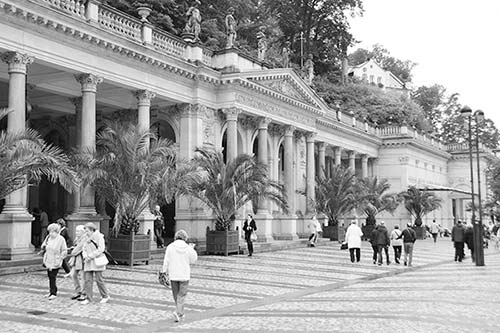
Karlovy Vary is famous for the 16 natural springs scattered around its town center. Thirteen of these dispense drinkable natural thermal water that’s between 107 and 164 degrees Fahrenheit. Sipping this salty, sulfurous stuff supposedly soothes arthritic and digestive pain. While some visitors come equipped with a systematic treatment plan, I enjoy just strolling aimlessly and taste-testing from a few different springs. But sip in moderation: Locals warn that first-timers who chug too much find that it can work all too well in moving along the digestive tract.
Traditionally, people taking the waters use a special cup called a becher, shaped like a miniature, flattened teapot. Fill your becher, then sip gingerly through the combined handle/spout (giving the steaming fluid a chance to cool off). While you could use an empty bottle, it’s fun to invest in a souvenir drinking cup to do it in style; the cheapest ones start at around 100 Kč and are guaranteed to break in your luggage.
To kill the powerful mineral aftertaste, munch on the delicious spa wafers (oplatky). Resembling salad-plate-sized communion wafers, these sweet cookies come in a variety of flavors and have a thin layer of filling inside. They’re cheap, tasty, and even better when heated up on a big press that looks like a waffle iron.
While most visitors are here to drink the waters, you can bathe in them, too (bring a swimsuit). Most of the town’s spas are inside hotels and open only to guests, but there are three public options: The fanciest is the Castle Spa, marked by the Gothic tower in the pedestrianized town center (across from the Hot Spring Colonnade and behind the Market Colonnade, www.zamecke-lazne.com). The Elisabeth Spa, in a grandly crumbling old building at the lower end of town, is more affordable (www.spa5.cz). And the ugly Hotel Thermal, dominating the lower part of town, has an outdoor swimming pool high on the adjacent bluff that’s partly fed by spring water. Though this one doesn’t offer other spa treatments, it is the most scenic option (www.thermal.cz).
In addition to the thermal springs, Karlovy Vary is near and dear to all Czech hearts for producing two of the country’s favorite drinks. Becherovka, the herbal digestif that’s second only to beer as the Czech national drink, is distilled here. And Mattoni mineral water—the country’s top-selling brand (and, according to aficionados, the best)—bubbles up from a spring in a nearby village. Some people call Becherovka and Mattoni “the 14th and 15th drinkable springs of Karlovy Vary.”
Lower Area
Between the town center and the train station, at the grand hotel adjoining the Dvořák Gardens (Dvořákovy Sady), don’t miss the dazzling wooden Orchard Colonnade (Sadová Kolonáda).
Farther downriver is the unfortunate Hotel Thermal—a heavy-handed, concrete-communist behemoth that’s totally (and intentionally) at odds with the spare-no-expense aesthetic of its surroundings. It does, however, run a public swimming pool with fine views over Karlovy Vary’s valley (on the hill just behind the hulking building).
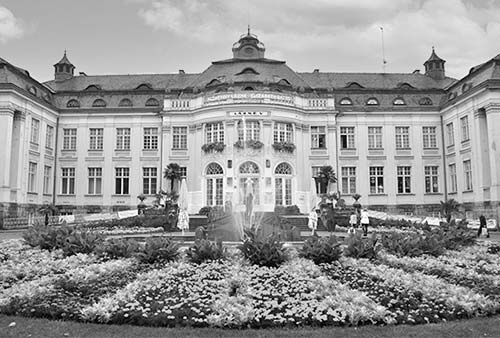
Nestled in the middle of the flower-filled Smetana Gardens (Smetanovy Sady) is the Elisabeth Spa (Alžbětiny Lázně)—also called Spa #5 (Lázně V). While the grand building that houses it has seen better days, the spa facilities have been modernized.
While most visitors end their walk here, I like to head to the right from the park, up a staircase across Bezručova to Ondříčkova, then walk for about 10 minutes through a pleasant villa district above the modern town to reach Filmcafé Drahomíra. While much of the spa town seems devoid of local color, this art cinema/popular bistro café (one of the screening places for the film festival) is testimony to Karlovy Vary’s identity as a vibrant regional cultural center. Drinks, soups, and small meals are served in a hip, orange-and-green setting, where the glitzy spa-and-tourist scene seems as far away as Prague (daily, Vítězná 50, +420 352 222 963).
In the other direction, connecting the Smetana Gardens to the train station is the delightfully pedestrianized Masaryka street, lined with both top-end and workaday shops. At the train-station end of the street, you’ll find the Jan Becher Museum, where a 40-minute guided tour explains the process for distilling the pungent, herbal Czech firewater called Becherovka (open daily, 1-3 tours/day in English—call ahead or check online for schedule, more frequent tours in Czech, www.becherovka.cz [URL inactive]). The adjoining Becherplatz restaurant is a warren of highly decorated, borderline-kitschy beer halls and cellars, and a handy place to grab a bite to eat (+420 353 599 999, www.becherplatz.cz).
NEAR KARLOVY VARY
If you have time to spare, consider these two stops.
Moser Glassworks
For those captivated by Czech crystal, a visit to this sleek, state-of-the-art facility on the outskirts of Karlovy Vary is a pilgrimage. In addition to perusing the stunning showroom, you can visit a museum celebrating the glassmaker’s finest works and take a 30-minute tour of the glassworks (300 Kč for museum and glassworks, open Mon-Sat 9:00-16:00, closed Sun, at Kapitana Jaroše 46/19 in the Dvory neighborhood just west of the town center, catch a taxi (about 150 Kč) from the town or drive—exit from highway toward Cheb; +420 353 416 132, www.moser.com/tours). For more on Czech crystal, see the Shopping in Prague chapter.
Loket
This charming and scenic village is a beautiful six-mile hike or an easy nine-mile drive west of Karlovy Vary (figure about 15 minutes, drive toward Cheb). While smaller and not as endearing as Český Krumlov, it has a similar and even more stunning setting—perched on a steep and bulbous spit of land, almost entirely surrounded by a nearly 180-degree bend in the Ohře River. (Loket means “elbow.”) The writer Johann Wolfgang von Goethe was a frequent visitor here, making it popular among German tourists. As you drive into town, circle around for the fine views, then head over the bridge and park on the main square. Lose yourself in the tidy pedestrianized lanes, or hike up to the rustic, lived-in-feeling castle for a modest town-history exhibit and nice views (walk around at your leisure with English descriptions, or pay more to join a guided tour, www.hradloket.cz). Hardy hikers can make their way from Karlovy Vary to Loket through the wooded hills, following a six-mile nature trail (get details and check return bus times at the Karlovy Vary TI).