PRAGUE CONNECTIONS
MAIN TRAIN STATION (HLAVNÍ NÁDRAŽÍ)
HOLEŠOVICE TRAIN STATION (NÁDRAŽÍ HOLEŠOVICE)
Prague is a logical gateway to Central Europe. It’s also the hub for trains and buses in the Czech Republic—from here, rail lines and expressways fan out like spokes on a wheel. This chapter covers arrivals and departures by train, bus, plane, and car. You’ll find handy Czech train and bus schedules at https://idos.idnes.cz (for English, click on the drop-down menu in the top-right corner). It’s also worth checking the Czech Railways (České Dráhy) website, www.cd.cz, for specific connections. For train schedules across Europe, use the German rail website Bahn.com.
By Train
Prague’s main train station (Hlavní Nádraží; “Praha hl. n.” on schedules) serves all international trains; most trains within the Czech Republic, including high-speed SC Pendolino trains; and buses to and from Nürnberg and Munich. Trains serving Berlin also stop at the secondary Holešovice station (Nádraží Holešovice, located north of the river). Both stations have ATMs (best rates) and exchange bureaus (rotten rates).
To get a better geographical picture, remember that the Czech Republic is a country of landlocked, would-be sailors (recall the greeting “ahoj”). Accordingly, the four main international rail lines connect Prague to the closest ports on the four seas: the North Sea Line to Hamburg (7 hours) via Dresden and Berlin, the Baltic Line to Gdańsk (11 hours) via Warsaw, the Black Sea Line to Varna (40 hours) via Budapest and Belgrade, and the Adriatic Line to Split (20 hours) via Vienna and Zagreb.
MAIN TRAIN STATION (HLAVNÍ NÁDRAŽÍ)
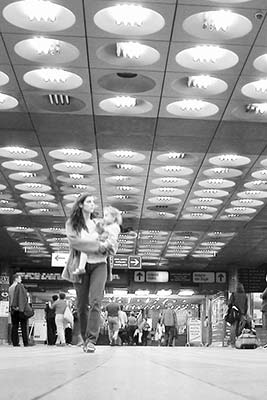
The station is a busy hive of shops and services; posted maps help you find your way. Three parallel tunnels connect the tracks to the arrival hall. Taking any of these, you’ll first reach a low-ceilinged corridor with several services: a variety of handy picnic-supply shops and the “official” taxi stands (avoid these rip-off cabbies—explained later).
Continuing straight down past this corridor, you’ll reach the main hall, with four Metro entrances in the center (two for each direction; see “Getting from the Main Station to Your Hotel,” later). The one good ATM (pink, Unicredit Bank) is under the stairs across from the main ticket office. Avoid the blue-and-yellow Euronet ATMs, which have bad rates. Lockers are in the corner under the stairs on the right, and a Billa supermarket is in the corner under the stairs to the left.
Buying Tickets: To get the best prices and to ensure you get on your preferred train (some can sell out), buy ahead online at https://idos.idnes.cz. Tickets for Czech Railways (České Dráhy) trains are also sold at www.cd.cz.
To purchase in person, for most trains head for the CD ticket office—marked ČD Centrum—in the middle of the main hall under the stairs. The regular ticket desks are faster if you already know your schedule and destination, but not all attendants speak good English. For more in-depth questions, look for the tiny ČD Travel office, on the left as you enter the main office, which sells both domestic and international tickets, and is more likely to provide help in English (Mon-Fri 9:00-18:00, Sat until 14:00, closed Sun, shorter hours in winter, +420 972 241 861, www.cd.cz).
The RegioJet travel office, with desks at both sides of the main ticket office, sells international train tickets from the DB (Deutsche Bahn—German railways) system and offers various DB deals and discounts. RegioJet also runs its own trains to Olomouc and Košice, Slovakia, and sells a variety of domestic (e.g., to Český Krumlov) and international (Vienna) bus tickets without a commission (daily until 19:45, +420 539 000 511, www.regiojet.cz). Despite its name, RegioJet does not sell plane tickets.
The Leo Express ticket office, across the hall from the ČD Centrum, sells tickets for its trains to Olomouc and Košice (www.le.cz).
Bus Stops: To reach the bus stops for the AE bus to the airport and the DB buses to Nürnberg and Munich, head upstairs to the Art Nouveau Hall (explained later) and head outside.
Deciphering Schedules: Platforms are listed by number and—confusingly—sometimes also by letter. S (sever) means “north”—the corridor to the left as you face the tracks; J (jih) means “south”—the corridor to the right. But in practice, you can take any corridor and walk along the platform to your train. B1 means the bus platform (upstairs and out front), while 1B—used by Leo Express trains—is the shorter track at the far-left end of platform 1.
A Bit of History: If you have time to kill waiting for a train, go exploring. First named for Emperor Franz Josef, the station was later renamed for President Woodrow Wilson (see the commemorative plaque in the main exit hall leading away from the tracks, and the large bronze statue in the park in front of the station). The Czechs appreciate Wilson’s promotion of self-determination after World War I, which led to the creation of the free state of Czechoslovakia in 1918. Under the communists (who weren’t big fans of Wilson), it was bluntly renamed Hlavní Nádraží—“Main Station.” They enlarged the once-classy Art Nouveau station and painted it the compulsory dreary gray with reddish trim.
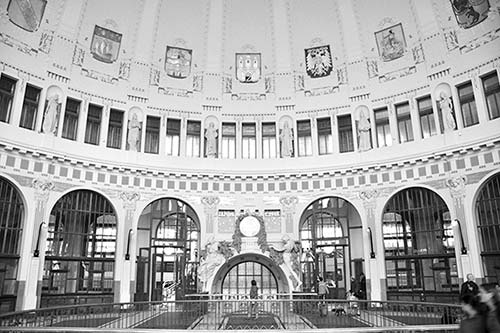
For a glimpse at the station’s genteel pre-communist times, find your way up into its original Art Nouveau Hall (from the main concourse, look for up escalators with Historical Building of the Station signs). You’ll emerge to stand under a grandly restored dome with elaborate decorations, providing an almost shocking contrast to the businesslike aura of the rest of the station.
On platform 1 (sector B) you’ll find a touching statue of a British gentleman with a young child. This monument honors the people of Great Britain who took in Czech and Slovak kids during World War II, offering them a safe home while their native country was in danger of attack.
Getting from the Main Station to Your Hotel
Even though the main train station is basically downtown, getting to your hotel can be a little tricky.
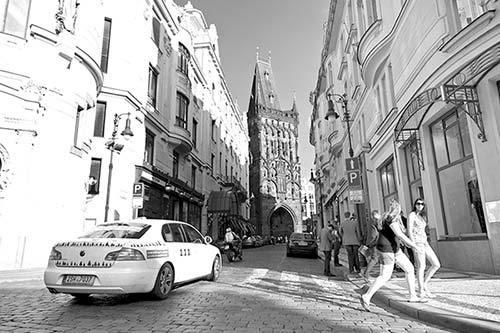
On Foot: Most hotels I list in the Old Town are within a 20-minute walk of the train station. Exit the station into a small park, walk through the park, and then cross the street on the other side. Head down Jeruzalémská street to the Jindřišská Tower and tram stop, walk under a small arch, then continue slightly to the right down Senovážná street. At the end of the street, you’ll see the Powder Tower—the grand entry into the Old Town—to the left. Alternatively, Wenceslas Square in the New Town is a 10-minute walk—exit the station, cross the park, and walk to the left along Opletalova street.
By Metro: The Metro is easy. The entrance is right inside the station’s main hall—look for the red M with two directions: Háje or Letňany. To purchase tickets from the machine by the Metro entrance, you’ll need a credit card. Validate your ticket in the yellow machines before you go down the stairs to the tracks.
To get to hotels in the Old Town, take the Letňany-bound red line from the train station to Florenc, then transfer to the yellow line (direction: Zličín) and get off at either Náměstí Republiky, Můstek, or Národní Třída; these stops straddle the Old Town.
Or, you can catch the Háje-bound red line to the Muzeum stop, then transfer to the green line (direction: Nemocnice Motol) and get off at either Můstek or Staroměstská. The next stop, Malostranská, is a 15-minute walk from my recommended hotels in the Lesser Town.
To get to my recommended hotels beyond Wenceslas Square, take the green line from Muzeum (direction: Depo Hostivař) to the first few stops. A color map of Prague’s public transportation system is at the end of the book.
By Taxi or Uber: The fair metered rate into the Old Town is about 200 Kč; if your hotel is farther out or across the river, it should be no more than 300 Kč. Avoid the “official” taxi stand that’s marked inside the station: These thugs routinely overcharge arriving tourists (and refuse to take locals, who know the going rate and can’t be fooled). Instead, to get an honest cabbie, exit the station’s main hall through the big glass doors, then cross 50 yards through a park to Opletalova street. A few taxis are usually waiting there in front of Hotel Chopin, on the corner of Jeruzalémská street. Or, call a taxi (operators speak English; AAA Taxi, +420 222 333 222; City Taxi, +420 257 257 257). Before getting into a taxi, always confirm the maximum price to your destination, and make sure the driver turns on the meter. For more pointers on taking taxis, see here.
Uber works the same way it does at home and typically costs less than a taxi. Drivers pick up from the small parking lot next to platform 1B.
By Tram: The nearest tram stop is to the right as you exit the station (about 200 yards away). Tram #9 (headed away from railway tracks) takes you to the neighborhood near the National Theater and the Lesser Town but isn’t useful for most Old Town hotels.
HOLEŠOVICE TRAIN STATION (NÁDRAŽÍ HOLEŠOVICE)
This station, slightly farther from the center, is suburban mellow. The main hall has the same services as the main train station, in a more compact area. On the left are international and local ticket windows (open 24 hours) and an information office. On the right is an uncrowded café. Two ATMs are just outside the first glass doors, and the Metro is 50 yards to the right (follow signs toward Vstup, which means “entrance”; it’s three stops to Hlavní Nádraží—the main station—or four stops to the city-center Muzeum stop). Taxis and trams are outside to the right (allow 300 Kč for a cab to the center).
TRAIN CONNECTIONS
All international trains pass through the main station (Hlavní Nádraží); some also stop at Holešovice (Nádraží Holešovice). Direct trains connect Prague to Berlin, Munich, Vienna, Budapest, Kraków, and Warsaw. For tips on rail travel, see the “Transportation” section of the Practicalities chapter.
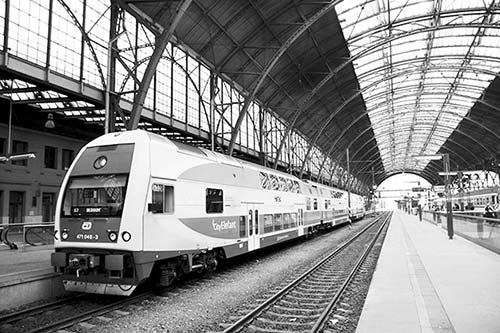
From Prague’s Main Station to Domestic Destinations: Konopiště Castle (train to Benešov, 2/hour, 1 hour, then 1.5-mile walk), Karlštejn (2/hour, 40 minutes, then a 20-minute hike), Křivoklát (2 morning departures, 1.5 hours, change in Beroun), Kutná Hora (hourly, 1 hour), Karlovy Vary (every 2 hours, 3 hours, bus is better), Český Krumlov (8/day, 1/day direct, 3 hours), České Budějovice (almost hourly, 2.5 hours), Moravský Krumlov (8/day, 4 hours, change in Brno), Třeboň (7/day, 2.5 hours, change at Veselí nad Lužnicí—get off at Třeboň-Lázně, not Třeboň-Město), Telč (3/day, 4-5 hours, 2 changes, bus is better), Třebíč (nearly hourly, 4-5 hours, bus is better), Slavonice (bus to Telč, 3-5/day, 2-3 hours; then 1-hour train to Slavonice, 5/day), Olomouc (at least hourly, 2.5 hours), Valtice (hourly, 4 hours, 1 change), Břeclav (with connections to Mikulov wine region; hourly direct, 3.5 hours), Brno (2/hour, 3 hours).
By Bus
Prague’s main bus station is at Florenc, east of the Old Town (Metro: Florenc). But some connections use other stations, including Roztyly (Metro: Roztyly), Na Knížecí (Metro: Anděl), Holešovice (Metro: Nádraží Holešovice), Hradčanská (Metro: Hradčanská), Zličín (Metro: Zličín), and the main train station (Metro: Hlavní Nádraží). Be sure to confirm which station your bus uses. Check Flixbus (www.flixbus.com) and Eurolines (www.eurolines.de) for international connections.
From Prague by Bus to: Terezín (3-4 direct Mon-Fri, fewer Sat-Sun, 1 hour, more with transfer, departs from Nádraží Holešovice), Český Krumlov (hourly, 3 hours, departs from Florenc or Na Knížecí), Karlovy Vary (hourly, 2 hours, operated by RegioJet and Flixbus, best from Hradčanská), Břeclav (with connections to Mikulov wine region; 1-2/hour from Florenc, fewer on weekends, 5-6 hours, train is better), Brno (2/hour from Florenc, 2.5 hours, train is better), Moravský Krumlov (1/day, 4 hours, change in Znojmo or Brno, train is better).
By Plane
VÁCLAV HAVEL AIRPORT
Prague’s modern, tidy, user-friendly Václav Havel Airport is located 12 miles (about 30 minutes) west of the city center. Terminal 2 serves destinations within the EU (no passport controls); Terminal 1 serves everywhere else. The airport has ATMs (avoid the change desks), transportation services (such as city transit and shuttle buses), kiosks selling city maps, and a TI (airport code: PRG, www.prg.aero).
If you’re flying out of Václav Havel Airport and need to process a VAT refund (see the Practicalities chapter), get your papers stamped at customs before you go through security. In Terminal 1, customs is located in the far-left-hand corner of the departure hall, next to the oversize baggage desk. At Terminal 2, customs is immediately to the right of the security check. You can cash in your refund at a Travelex office (minus a 4 percent fee): In Terminal 1, these are located both before and after security. In Terminal 2, Travelex has a booth before security only (just to the left).
Getting from the Airport to Your Hotel
Getting between the airport and downtown is easy. Leaving either airport terminal, you have several options, listed below from cheapest to priciest:
Dirt Cheap: Take bus #119 to the Nádraží Veleslavín stop (15 minutes), then take the Metro into the center (another 10 minutes, 40 Kč, buy tickets at info desk in airport arrival hall). This is also fastest as it avoids traffic jams.
Budget: Take the airport express (AE) bus to the main train station (60 Kč, runs every half-hour daily about 6:00-21:00, 40 minutes, look for the AE sign in front of the terminal and pay the driver, www.cd.cz). From the station, you can take the Metro, hire a taxi or Uber, or walk to your hotel.
Moderate: Prague Airport Transfers offers 24-hour shuttle and taxi service (door-to-door shared taxi-290 Kč/person; +420 222 554 211 from Czech Republic or +420 516 340 3070 from US, www.prague-airport-transfers.co.uk). Uber usually costs about half the price of a taxi; drivers pick up in the parking lot facing Terminal 1.
Expensive: Catch a taxi. Cabbies wait at the curb directly in front of the arrival hall. Or book a yellow AAA taxi through their office in the airport hall—you’ll get a 50 percent discount coupon for the trip back. AAA taxis wait in front of exit D at Terminal 1 and exit E at Terminal 2 (metered rate, generally 600 Kč to downtown).
By Private Car Service
Mike’s Chauffeur Service is a reliable, family-run company with fair and fixed rates around town and beyond. Friendly Mike’s motto is, “We go the extra mile for you.” If Mike is busy, he’ll send one of his colleagues—all of whom speak English (round-trip fares, with waiting time included, prices valid through 2025 with this book: Český Krumlov-4,800 Kč, Terezín-2,400 Kč, Karlštejn-2,400 Kč, Karlovy Vary and Pilsner Urquell brewery in Plzeň-4,800 Kč; surcharge for credit-card payment, these prices for up to 4 people, minibus for up to 7 or 8 also available; +420 602 224 893, www.mike-chauffeur.cz, mike.chauffeur@cmail.cz). On the way to Český Krumlov, Mike will stop for no extra charge at Hluboká Castle and/or České Budějovice, where the original Bud beer is made. Mike can also arrange a local guide for your time in many of these places. And for day trips from Prague, Mike can bring bicycles along and will pedal with you.
Mike also offers “Panoramic Transfers” to Vienna (8,000 Kč, depart Prague at 8:00, arrive Český Krumlov at 10:00, stay up to 5 hours, 1-hour scenic Czech riverside-and-village drive, then a 2-hour autobahn ride to your Vienna hotel, maximum 4 people), Budapest (11,500 Kč via Bratislava or the South Moravia wine country, 6 hours), and Kraków (10,800 Kč direct, or 11,500 Kč with a stop at Auschwitz; these prices include all road taxes). Mike can also pick you up in any of these cities and bring you to Prague. Check Mike’s website for special deals on last-minute transfers, including super-cheap “deadhead” rides when you travel in the opposite direction of a full-fare client.