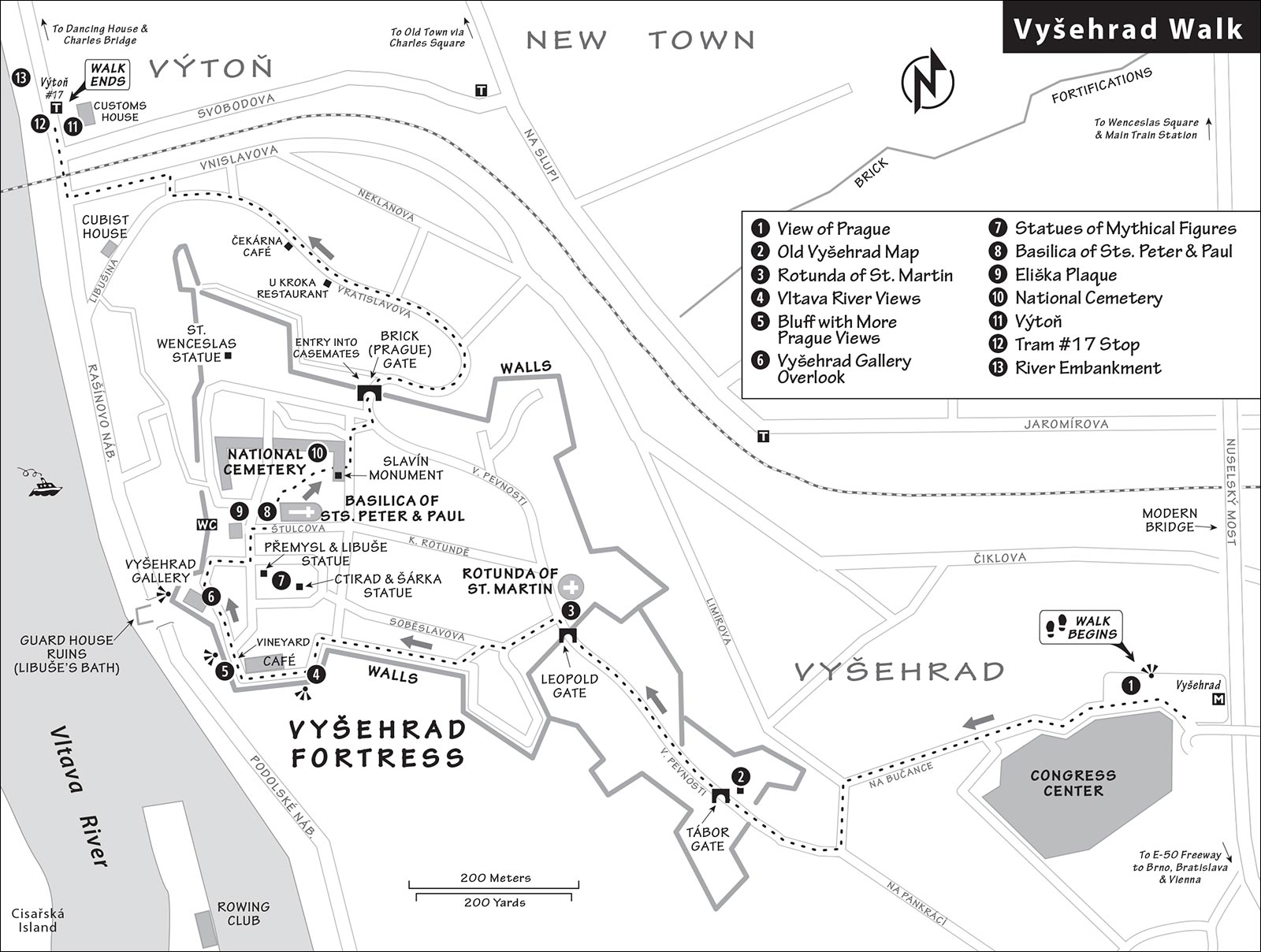
VYŠEHRAD WALK
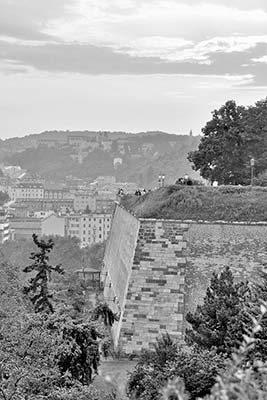
5 Bluff with More Prague Views
8 Basilica of Sts. Peter and Paul
11 Výtoň
For a park-like break from the big city, fine views, and a special insight into Czech culture and history, consider this easy walk through Vyšehrad (VEE-sheh-rahd), a park just south of the New Town with a 17th-century fortress overlooking Prague. You’ll ride the Metro to the top of the park and stroll through ramparts and trees with locals, past monuments and commanding views, then gradually head downhill, eventually ending up in the area known as Výtoň. From here, an easy walk along the river or a tram ride takes you back into the tourist action.
A visit to Vyšehrad is more meaningful if you remember that Prague has never been a purely “Czech” city but rather a crossroads where various powerful influences have mixed their linguistic, religious, and cultural agendas. From the Roman Catholic Church to the Germanic culture of the Holy Roman and Habsburg empires, the Czechs were often second-class citizens in their own capital. Vyšehrad is the place (even more than Prague Castle) that they’ve always considered their own—a stronghold of Czech culture.
Orientation
Length of This Walk: Allow two hours.
When to Go: This walk works well during the day but is also appealing in the evening. Note that although the area is romantically lit at night, most interiors (including the cemetery) close earlier in the evening.
Getting There: Take the Metro to the Vyšehrad stop.
Information: +420 241 410 348, www.praha-vysehrad.cz.
Basilica of Sts. Peter and Paul: 130 Kč, daily 10:00-18:00, Nov-March until 17:00.
National Cemetery: Free, daily 8:00-19:00, March-April and Oct until 18:00, Nov-Feb until 17:00.
Casemates: Viewable with 20-minute tour, 130 Kč, tours depart daily 10:00-17:00 at the top of the hour.
Starring: Grand views and stories of a grand history.
The Walk Begins
• The Vyšehrad Metro exit leads directly to a terrace with a balcony (on your right) overlooking the city. Take a few minutes to appreciate the...
1 View of Prague
Survey the scene. The tall, modern bridge was built in the 1970s to accommodate both the Metro and cars. To test whether it could carry its designed load, the first vehicles to cross the bridge were a battalion of tanks. Along the opposing slopes you can discern the brick fortifications of the New Town (one of the last places in Prague that these fortifications have been preserved). Now turn around. The gigantic glass-and-concrete building is the Congress Center. Finished in the early 1980s, it was originally designed to house Communist Party conventions but quickly came to be considered the ugliest building in town. In 1999, several former Warsaw Pact countries (including the Czech Republic) joined NATO, and the Congress Center became the first place in formerly communist Eastern Europe to host a NATO summit.
• It’s about a five-minute walk to the park entrance: Follow the granite banister the length of the Congress Center building, angling down the ramp. Track the brown Vyšehrad signs along a residential street down to the fortress walls. Pause a moment to notice the walls, made with a combination of red brick and white opuka, Prague’s native limestone. Now enter through a gate on the right. You’ll pop out in a charming park, where you can orient yourself at the map on an info post to your right.
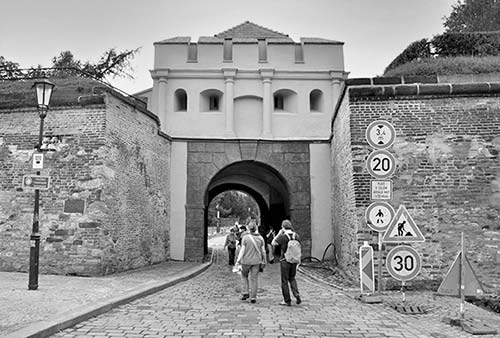
2 Old Vyšehrad Map
The map shows the layout of this 17th-century fortress, built in the shape of a pentagon with a bastion at every corner. The only access was from the east, along a fortified corridor with double gates. You are standing just inside the outer one, called the Tábor Gate.
Archaeological records show that Vyšehrad once housed a royal palace and an astounding number of churches. By the 10th century, this place had become a Slavic alternative to Prague Castle—which felt closer to the Vatican than to the local culture. Unfortunately, much of what was once here was destroyed by looters in 1420 during the Hussite Wars.
Two and a half centuries later, the Habsburgs chose this more-or-less empty site to serve as the city garrison. Despite the high construction costs, the fortress never saw real fighting. The Austrians remained at Vyšehrad until the 1840s.
Once the soldiers departed, another gate was blasted through the walls on the north side to create an easier connection to the New Town (this walk will take you around the ramparts and out through that gate). The fortress was eventually turned into a park that became popular with Romantic Czech artists, who walked the ramparts daydreaming about their nation’s mythic history. The less that remained of the Romanesque and Gothic past, the better, leaving that much more to the imagination and stirring the Czech soul inside artists like the composer Bedřich Smetana. Just as it had centuries before, Vyšehrad became the Slavic alternative to the city’s dominant culture (this time, Germanic).
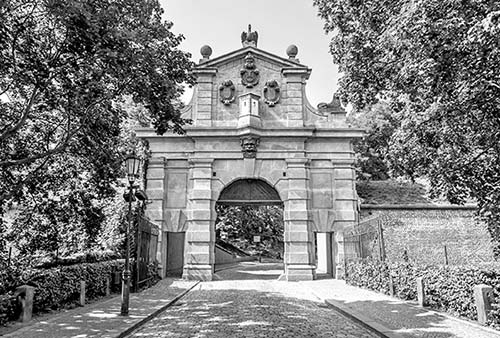
• Continue along the cobbled street. On the right, notice a tiny piece of a Gothic gate, a reminder of the pre-Hussite period. As you walk above the tennis courts and approach a second gate (the Leopold Gate), look up at the double-headed eagle—the coat of arms of the Habsburgs, who ruled in Prague for 300 years. Once through the gate, stop on the corner under a horse-chestnut tree to survey the little round...
3 Rotunda of St. Martin
This 11th-century Romanesque rotunda, constructed out of Prague’s native limestone, is named for St. Martin, patron saint of soldiers, horses, riders, geese, and vintners. St. Martin’s feast day falls on November 11 and is celebrated with roast goose and the year’s first wine. On this day, St. Martin arrives on a white horse, signifying snow and the coming of winter.
• Take the lane across the way from the chapel, under the chestnut tree. When the path forks, turn right, left, and right again to reach the ramparts. Walk the length of the wall and find a place to pause to enjoy...
4 Vltava River Views
You are looking south, or upstream. Bohemia, one of three regions that make up the Czech Republic (the others are Moravia and Silesia), is defined by its watershed. The region is essentially a big basin with mountains at its edges and Prague right in the middle. The Vltava originates in the south—at the border with Germany—and collects the waters from the south, east, and west before it flows into the Elbe River about 30 miles north of Prague. The Elbe breaks its way through the sandstone formations at the northern Czech/German border, marking the only place where water leaves Bohemia. It then flows through Dresden, on to Hamburg, and empties into the North Sea.
The TV tower on the horizon marks the spot where the Vltava meets up with two big rivers, one from the east and one from the west. The hill above the confluence was once the largest Celtic settlement in the country (Bohemia derives its name from the Celtic tribe that used to inhabit the area). Celts were the first to recognize Prague’s strategic location at a time when waterways were the main or only means of transportation. The two main products that traveled downstream were Austrian salt (Bohemia lacks its own salt) and wood from the border mountains.
The name of the river, Vltava, comes from the old German for “wild awa,” meaning wild waters. Moldau—what Germans call the river today—is a variant of the same word. The rapids that gave the river its name disappeared in the 1950s and ’60s under a series of dams that were, among other things, built to protect Prague from flooding. But in 2002 and again in 2013, the dams were unable to rein in massive flood waters during the country’s two biggest recorded floods.
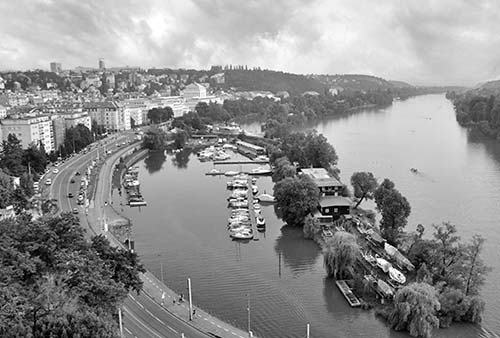
• Turn right and follow the ramparts to the end, where you’ll find yourself on a bluff overlooking the river.
5 Bluff with More Prague Views
Down below, find the wooden house flanked by yachts. This is Prague’s oldest rowing club. Next, locate the island across the way. In 1896, the first soccer match between Sparta and Slavia was played on the island’s meadow, marking the start of the biggest sports rivalry in the country. Just to the right, the large mansion topping a little hill of its own belongs to Karel Gott (literally “God” in German)—the never-fading Czech pop star whose fame has persisted from the 1950s to today (imagine if Elvis were still alive). The mansion is just a little uphill from Villa Bertramka, where Mozart stayed with friends during his visits to Prague.
Down below, perched on a cliff on this side of the river, are the ruins of a guard house for customs collectors. Popular legend has reinvented it as the bathhouse of Princess Libuše, Prague’s mythic founder. As the tale goes, Libuše led her Slavic people down from the plains north of Prague and decided to build a castle at Vyšehrad. Upon reaching the rocky hill, Libuše sent her men into the valley to ask about the name of the place where they had just arrived. The men encountered some charcoal makers. While standing in the doorway, they were told that they were “on the threshold” (práh). This popular interpretation of the etymology of the city’s name is indicative of the way locals perceive Prague: as a place of encounter between East and West, and between Latin culture and Slavic heritage.
• Walk downhill through the tiny vineyard. To the right is a delightful park café—good for a beer and a sandwich (indoor and outdoor seating). Carry on to the left to the...
6 Vyšehrad Gallery Overlook
The Vyšehrad Gallery has small exhibits featuring local artists (and may be closed for renovation when you visit). The overlook just next to the gallery boasts more city views. From here, study the sprawling Prague Castle in the distance, with its five noble palaces crowned by a cathedral. Just across the river from you is the smokestack of the Staropramen brewery (marked with a big A). Depending on the direction of the wind, you may be able to smell the malt. High up on the hill (look for the elevated lights) is a 200,000-seat stadium that has hosted mass calisthenics gatherings (called Sokol) since the 1930s. During the communist years, these were adapted into even more grandiose gatherings that took place every five years.
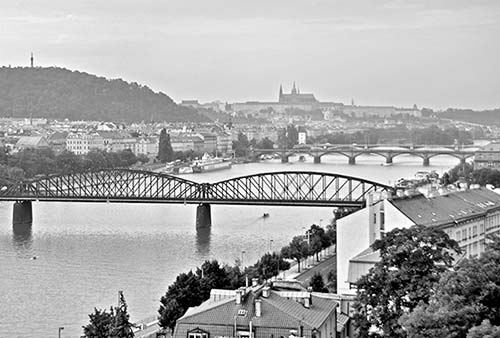
• Walk toward the church through a park dotted with deciduous trees typical of the Czech Republic: linden, oak, alder, and ash. This is where you’ll find a few...
7 Statues of Mythical Figures
Stand in the middle of the four 19th-century statues, which give shape to some old Slavic legends. The first group, nearest the church, depicts Princess Libuše with an outstretched hand and closed eyes, prophesizing the great future of the city. Her husband, Přemysl the Plower, holds (of course) a plow in his hands. Together they founded a historic dynasty that ruled from Prague for more than four centuries.
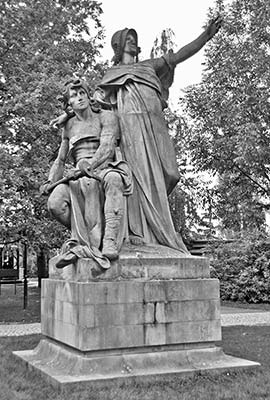
Diagonally across from that couple is a statue of a stout man with a mustache kneeling in front of a beautiful young woman. These are Ctirad (“the honor-loving one”) and Šárka (“the twilight girl”), the main protagonists of a 1,500-year-old battle of the sexes. According to the myth of “The Maidens’ War,” following the death of Princess Libuše, a group of women fought to establish their own kingdom. Knowing they would be unable to beat Ctirad—the most powerful fighter—and his men on the battlefield, they used a clever ruse: One summer day, they tied the beautiful Šárka to a tree, naked, and hid in the woods to await Ctirad and his men.
When the men arrived, Ctirad stopped to help Šárka, who told him that she had been left there to die as a traitor. Ctirad untied her, gave her some clothes, and sent his men to a nearby meadow to drink honey mead. Ctirad asked Šárka about the golden horn around her neck, and she encouraged him to try it. The sound of the horn signaled the other women, who jumped out of the woods, killed the drunk men, and took Ctirad as their prisoner, eventually tearing his limbs apart on a large wheel and tossing him into a gully to die a slow death.
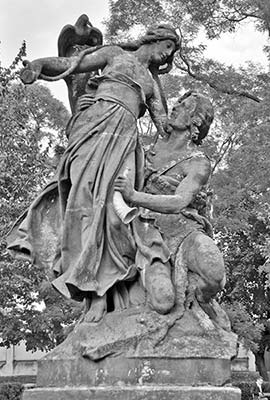
Enraged, Ctirad’s men attacked the women with vengeance. The men eventually won the war, bringing an end to matriarchy and ushering in patriarchy. As for Šárka, who fell in love with Ctirad, she eventually went mad and jumped off a cliff on the western edge of town.
• Continue to the nearby...
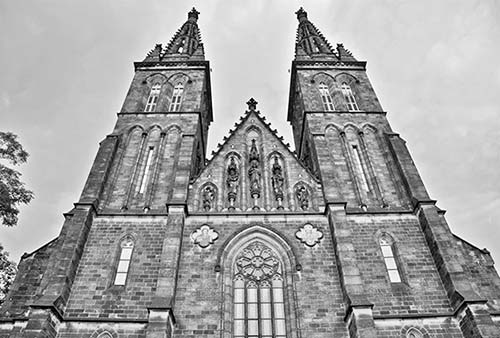
8 Basilica of Sts. Peter and Paul
The Neo-Gothic Basilica of Sts. Peter and Paul was built on the site of earlier Romanesque and Baroque churches. Until the 18th century, Vyšehrad was so important that this church and its priest answered directly to the pope (not to the bishops and archbishops of Prague). On the front facade are statues of Peter and Paul, along with mosaics depicting Cyril and Methodius, the Macedonian saints who first brought Christianity to the Slavs in their own language (rather than in Latin). The interior features circa-1900 Art Nouveau frescoes and richly decorated Neo-Gothic windows. Most of the chapels hold Baroque altars; the most precious of these is the first one on the right by Karel Škréta, dedicated to the patrons of Czech lands.
• Head back outside and face the facade of the church. Over your right shoulder, about 10 feet up on the corner of the building, look for the...
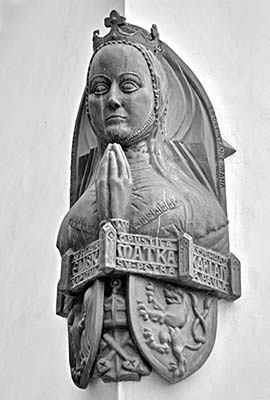
9 Eliška Plaque
This honors a 14th-century queen who was in many ways responsible for Prague’s golden age. Eliška’s brother was the final heir of the Czechs’ homegrown Přemysl dynasty—and when he was assassinated, that dynasty officially died out with him. But Eliška had entered into a strategic marriage with the powerful Count of Luxembourg, and had nurtured their son, Charles, to have a deep appreciation for his Czech roots. In fact, others in the court grew concerned that Charles was too attached to Czech ways, and sent him to travel and study in Paris and Italy. But when Charles took the Bohemian throne—and later become the Holy Roman Emperor—he chose to make Prague his capital, and built a famous bridge, a university, and much more. Much of the greatness of Prague that you’re enjoying today is thanks to that man, Charles IV...and to his mom.
• As you face the church, turn left to enter the...
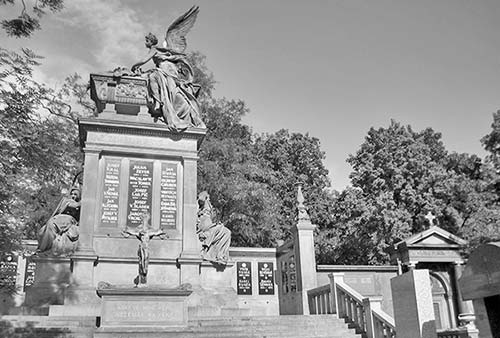
10 National Cemetery
Since the 1870s, major Czech cultural figures have been buried here, including Mucha, Smetana, and Dvořák (a map at the cemetery gate shows the locations of their graves). The most important tomb, at the far-right end as you enter, is Slavín (meaning “ground of glory”)—a massive monument capped by angels and the resting place of many cultural VIPs, including Mucha. Smetana’s tomb faces Slavín. The word Rodina, which you’ll see inscribed on gravestones, means family.
• Leave the graveyard through a gate just after the Slavín monument, turn left, and follow the cemetery wall. At the corner, continue straight down the steps, which lead out of the fortress through a big brick gate. Built into the gate are impressive 18th-century military casemates. These passageways lead to a chapel-like space (designed for ammunition storage), with six original statues from the Charles Bridge (viewable by tour only).
Follow the wide, cobbled lane as if you were arriving from Austria 150 years ago. You’ll exit the park onto Vratislavova street, which leads downhill, through the neighborhood called...
11 Výtoň
On your way to your tram stop, slow down to appreciate this very local-feeling residential neighborhood, which was once a quarter of sailors and fishermen.
About three short blocks down, on the left, are the two best options in the neighborhood for a tasty coffee and a full meal, respectively: 1930s-esque Čekárna (“Waiting Room”), with a secluded leafy garden in the back; and the modern U Kroka, with a broad menu of transformed Czech and European staples (and good-value daily specials).
Keep following Vratislavova as it heads downhill, then curves left. Pause at the park in front of the railway trestle and look left down the street (Libušina) that forks off toward the river—about halfway down the block on the right, the white house at #3 is one of a smattering of homes in this neighborhood built in the uniquely Czech Cubist style of the early 20th century.
Cut through the park and follow the rail trestle to the river. Crossing under the trestle and the busy street that parallels it, you’ll see the 12 stop for tram #17 in the middle of the riverside road.
On the corner next to that, sunken into the grassy lawn, is a red-roofed yellow house. This Renaissance former customs house is the only original building that survives from when this was a seamen’s quarter. Check out the gorgeously carved coats of arms of the city of Prague above the door. Like Josefov, the rest of this neighborhood was torn down in the late 19th century and replaced with townhouses more in keeping with the styles of the time—like the Art Nouveau and Cubist houses we’ve seen in the last few blocks. The museum on the second floor of this house, which uses photos and artifacts to document the river-centered life once led here, provides a good sense of the unique neighborhood that disappeared during the “city beautification” project (may be open weekends only; entry through external staircase on the right).
Before hopping on the tram, consider crossing the street from the customs house and climbing down the stairs to enjoy Prague’s utterly delightful 13 river embankment. This area is a thriving people zone, with cafés and snack stands filling the walkways and the barges that are lashed nearby—in good weather, there are few more enjoyable places to simply enjoy the city without tourists. And on Saturday mornings, it’s even more fun, thanks to a farmers market.
• From here, it’s a straight shot up the riverbank to the town center.
Nearby Sights
Several worthwhile sights are along or near the embankment road; if you’re not in a hurry, consider stopping off at some of them. You can enjoy walking the mile and a half up the embankment from here to the Charles Bridge, or you can hop on tram #17 to zip between the stops that interest you (the following sights are all described in the Sights in Prague chapter):
• Palacký Square and the adjacent Zítkovy Sady Park, with two dynamic monuments to František Palacký and WWI volunteers, and some fascinating WWII history (Palackého Náměstí tram stop)
• The Dancing House designed by Frank Gehry and, just inland, the National Memorial to the Heroes of the Heydrich Terror in the crypt of Sts. Cyril and Methodius Church (both at Jiráskovo Náměstí tram stop)
• The National Theater and the islands in the middle of the Vltava, including paddleboat rentals (Národní Divadlo tram stop)
• The Charles Bridge (Karlovy Lázně stop)
• The Jewish Quarter (Staroměstská stop)