MUCHA MUSEUM TOUR
Muchovo Museum
1 Timeline and Decorative Panels
7 Studio
Famous in his time but woefully underappreciated outside his homeland today (with the exception of Japan), Alphonse Mucha (1860-1939) was an enormously talented Czech artist who wowed the art world as he harnessed and developed the emerging style of Art Nouveau. Mucha’s slinky theater posters—which graced the streets of Paris at the turn of the century—earned him international fame. He could have done anything, but he chose to return to his home country and use his talent to celebrate Czech culture. This small but endearingly earnest museum is a great place to appreciate the artistic genius of Mucha.
His masterpiece, the Slav Epic—a series of huge paintings depicting epic events in the lives of the Slavs—is now on display in the small town of Moravský Krumlov (and described in the Southern Czech Towns chapter).
Orientation
Cost and Hours: 300 Kč, daily 10:00-18:00.
Information: +420 224 233 355, www.mucha.cz.
Getting There: It’s at Panská 7, two blocks east of Wenceslas Square.
Length of This Tour: One hour, including time to watch the 30-minute film at the end (usually starts at the top and bottom of the hour).
Starring: The early posters and artistic process of Alphonse Mucha.
The Tour Begins
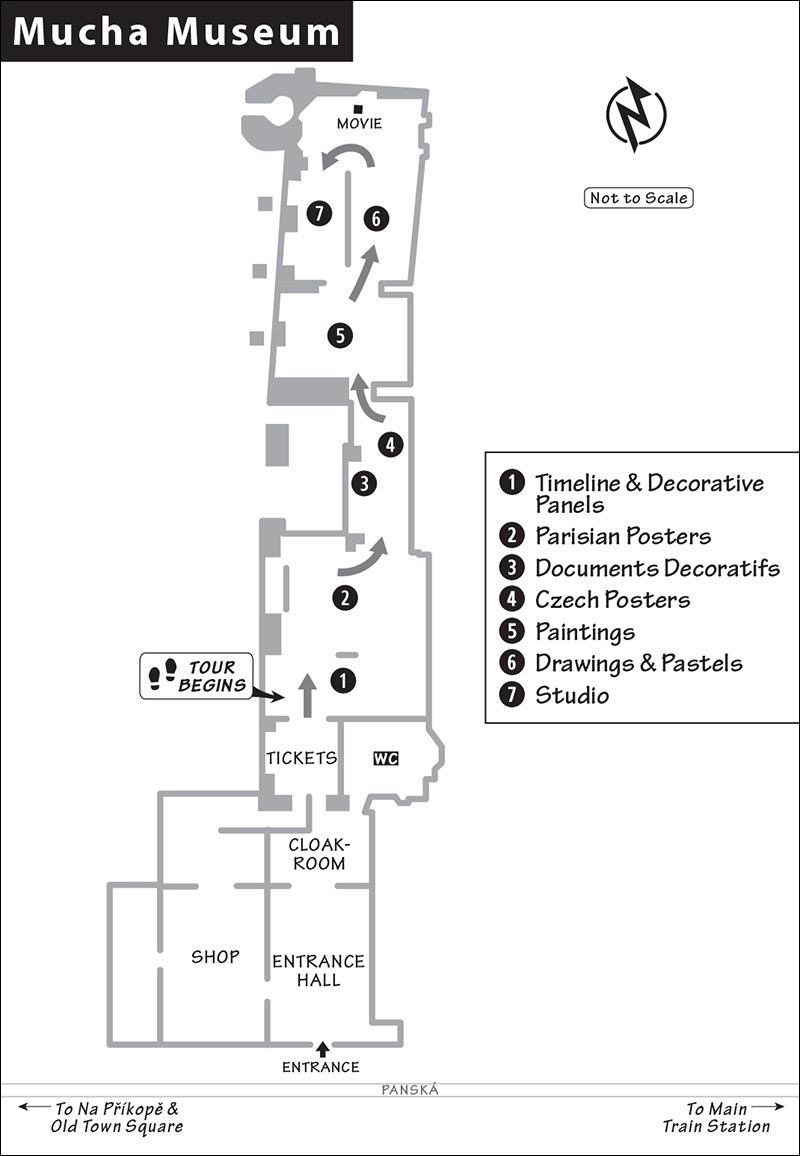
• Follow the chronological exhibit, section by section.
1 Timeline and Decorative Panels
Entering the museum, look left (in front of the window) to see a timeline of Mucha’s life, along with photos showing the artist, his wife Maruška, and some of the luminaries they hung out with—from painter Paul Gauguin (seated, pantsless, at Mucha’s beloved organ) to Czechoslovak president Tomáš Garrigue Masaryk to composer Leoš Janáček.
Mucha’s fame was hard-earned. It was the result of innate talent, hard work, and—at a few crucial moments—pure dumb luck. Mucha was born in the Moravian village of Ivančice, and almost from his infancy, he displayed prodigious artistic talent. After studying in Vienna, Mucha rode the train back to his homeland and hopped off where he happened to run out of money: in the Moravian village of Mikulov, where a local aristocrat hired him to decorate a newly built estate. That count’s cousin later employed Mucha and was impressed enough to bankroll the young artist’s studies in Paris.
Mucha arrived in Paris just in time for the banquet years at the turn of the 20th century. It was a flourishing of world-class artistic and literary talent rarely seen in history—when geniuses like Toulouse-Lautrec, Gauguin, Picasso, Hemingway, Gertrude Stein, and many others were rattling around the grand old city, creating a “bohemian” culture of a very different sort from the one Mucha knew. These artists—whose paths often crossed—found inspiration as they experimented with the arts, drugs, and whatever else they could get their hands on.
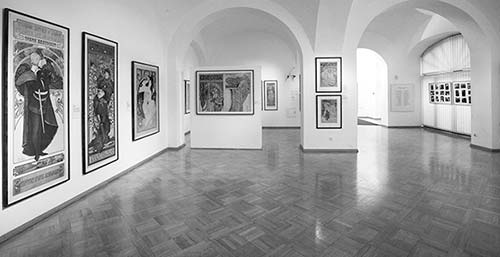
Across from the photos are several decorative posters, which were some of the earliest works that gained Mucha some acclaim. These employ many of the signature flourishes that would define Mucha’s style throughout his career: willowy maidens with flowing hair and gowns, curvaceous poses, and flowers in their hair. The ladies intertwine in the foliage around them, framed by Tiffany-glass backdrops and radiating pastel tones. You’ll see The Four Flowers (framed in Gothic windows), The Four Times of Day, and The Four Arts. Notice how, rather than the conventional method of depicting each figure with a concrete symbol (such as a paintbrush for painting, or an instrument for music), Mucha simply evokes a mood in each scene. For example, the flowers of the “painting” maiden radiate rainbows.
Philosophically, Mucha believed that art wasn’t to be elevated and kept at arm’s length in a museum; rather, he wanted it to be shared and experienced in everyday life. These panels were designed to be mass-produced, to decorate urbanites’ cramped flats. Mucha enjoyed the idea that, through his works, people could enjoy flowers inside, even in the wintertime. Throughout the collection, you’ll see how Mucha’s works toe the line between advertising and what we’d more conventionally call “art.” As the gap separating “pop culture” and just plain “culture” has blurred even more in our own age, Mucha’s works provide an interesting point of reflection.
• The next section is dedicated to...
2 Parisian Posters
Turn your attention to the tall, skinny Gismonda poster at the far end of the room—the result of another extremely lucky stroke for Mucha. It’s Paris, on the day after Christmas, 1894. Mucha—the low man on the totem pole at his design firm—is the lone artist on duty, while the more senior designers are enjoying some holiday time off. Unexpectedly, Sarah Bernhardt—perhaps the most famous theater actress who has ever lived—asks for a poster to be designed to promote her new play. In just a week, working under intense pressure, Mucha cranks out this poster, which is plastered all over town on New Year’s Day. Mucha becomes, literally, an overnight sensation. When Parisians start stealing the posters for themselves, it’s clear Mucha is on to something. Bernhardt signs him to a six-year contract, and he’s the most in-demand artist in town.
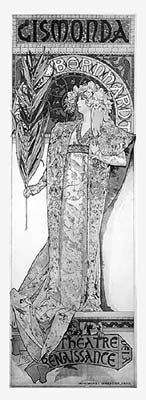
The poster was as revolutionary as it was typical of Mucha’s emerging style: tall, vertical, hazy pastels, slinky curlicues. Survey the other posters—advertising theater presentations (starring Bernhardt and others), art installations, even tobacco (Job). The posters are lithographs, a printing process popularized in late-19th-century Paris (think Toulouse-Lautrec’s ads for cancan shows). The artist draws on a stone slab with a grease crayon (or traces onto a greasy film), then coats the slab with water. The ink sticks to the greasy areas and is repelled by the watery parts. It was easy to crank out cheap (but exquisite) four-color posters—intended as throwaway advertising, but soon accepted as high art. Think about how in our age, movie posters (like Drew Struzan’s iconic posters for the Star Wars and Indiana Jones series), album covers, and comic-book characters decorated dorm rooms and rec rooms far more than any other artwork of the past 50 years. Increasingly, mass-produced art—accessible, eye-catching, and linked with fond memories of entertainment—is the art that really matters to the masses.
Before moving on, notice (in the windows) photos of models that Mucha posed, lit, photographed, and painstakingly copied for his works. You’ll see several figures wearing detailed costumes. As photography was a relatively new medium in Mucha’s day, this was a revolutionary tool that would have been unknown to previous generations of artists.
During this same period, Mucha grows more ambitious. He doesn’t just do posters—he also designs pavilions for the 1900 Paris World Exposition. A Renaissance man in Art Nouveau times, Mucha dabbles in everything. And he’s ready to share his expertise with the world.
• Continuing past the Parisian posters, the room narrows. On the left wall are excerpts from...
3 Documents Decoratifs
Mucha is a sensation, and can’t meet the demand all by himself. In keeping with his mission to spread art to the masses, in 1902 Mucha publishes a collection of 72 prints called Documents Decoratifs—essentially a how-to manual for Art Nouveau. Notice how, no matter the subject—from furniture to stained glass to jewelry to semi-erotic nudes—Mucha approaches the subject with his consistent (and consistently eye-pleasing) style. This guy literally wrote the book on his chosen art form.
• On the right wall are more posters, but now with Czech themes.
4 Czech Posters
Mucha and his wife Maruška meet in Paris and move for a while to the US—mostly to earn money to finance his planned magnum opus, the Slav Epic. But in 1910, they return to Bohemia—and get even more caught up in Czech patriotism. These are the waning days of the Austro-Hungarian Empire (which kept the Czech culture and language firmly under its thumb), and the burgeoning Czech National Revival has already inspired generations of Czechs to celebrate what makes their culture unique.
While working on the Slav Epic at his Bohemian countryside chateau, Mucha designs posters that commemorate Czech culture while promoting specific events: The Moravian Teachers’ Choir took the Czech music of Janáček and others on the road. The Sokol (“Falcon”) athletic movement had emerged during Austro-Hungarian times as an important exhibition of Czech strength and pride. And the Lottery of National Unity (in 1912) was used to raise funds for Czech-language education (in an age where German was the official language and given strongly preferential treatment in schools). Notice the consistent use of Slavia, a mythical goddess who blesses these proceedings. Mucha’s fragile Parisian maidens have become stout Czech peasants and strong workers; when it comes to Slavic women, power equals beauty—strong is sexy. In comparison, examine the contrasting figures Mucha uses in the lottery poster: The stubborn young girl, eagerly gripping her pencil and pad, dares you to help her learn Czech—and will surely grow into one of the strong women we see elsewhere. But in the hazy background behind her, the goddess Czechia is as withered as the tree she sits upon—wasting away from years of neglect.
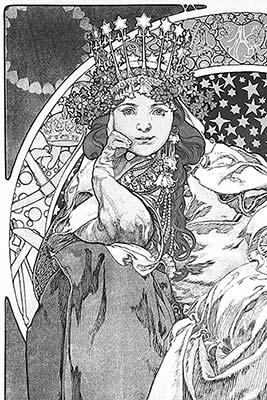
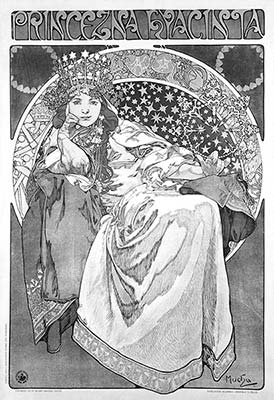
At the end of the room—between posters promoting cultural events—is the much-reproduced Princess Hyacinth, reclining in a chair with a frank, unflinching gaze. This Czech ballet—composed by a Czech, in the Czech language, starring a Czech actress—premiered in the Czech National Theater (a symbol of the Czech National Revival) in 1911...all of which would have been nearly unthinkable in the Austrian town of “Prag” just a few decades earlier.
• Continue into the next room, which you’ll circle counterclockwise, starting on your right.
5 Paintings
While we’ve mostly seen Mucha the draftsman so far, he was also a talented painter (the medium he used for his masterpiece, the Slav Epic). Find the giant canvas Star (also called Woman in the Wilderness), in which a starving Russian peasant woman sits and gazes up at a bright star. Here Mucha demonstrates his emotional connection to all Slavic peoples. This was painted in 1923, as the Czechs were living one of their historical high-water marks, the post-WWI creation of the state of Czechoslovakia. But at that same time, post-Bolshevik Revolution Russia was suffering from famine—and here, Mucha hasn’t forgotten his eastern comrades.
• The area at the end of the hall is a collection of Mucha’s...
6 Drawings and Pastels
Even his rudimentary sketches demonstrate an innate sense of design—from jewelry to a very early sketch of his stained-glass window of Cyril and Methodius in St. Vitus Cathedral (looking more rigidly geometrical than the final, more fluid version). Look carefully in the showcases in the middle of the room, which display (among other items) pages of books that Mucha illustrated. In the first case, find the Crucifixion that Mucha drew as a precocious eight-year-old. (His mother claimed that he could draw even before he could walk—she gave him a pencil to scrawl artfully on the floor.) In the second case, at the far end, find the banknotes and medals that Mucha designed for the budding nation of Czechoslovakia. Having already earned his fame and fortune, much of Mucha’s output in his later years was essentially donating his time and talent to celebrate his homeland and build national pride. In the smaller display cases along the window are Mucha’s sketchbooks, offering a glimpse at how he turned small-scale motifs into larger masterworks.
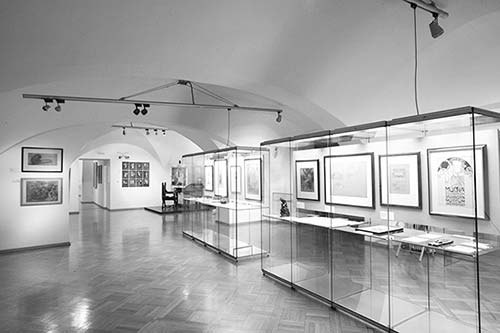
At the end of the room (you’ve been hearing it this whole time) is an excellent 30-minute movie that narrates Mucha’s life. It’s in English and generally plays at the top and bottom of each hour.
• Finally, circling back the way you came, you’ll find items from Mucha’s...
7 Studio
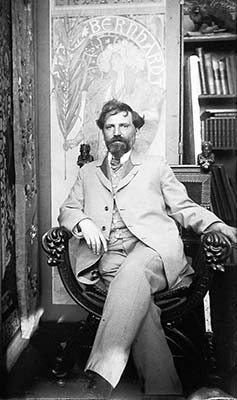
The desk, easel, and chair (in which Mucha is seated in the most famous portrait photograph of him) came from his studio. On the wall are more photographs of his models, many of them nude.
• After this revealing look at Mucha and his works, consider a visit to the Art Nouveau interiors of the Municipal House, where Mucha designed and painted the Mayor’s Salon.