WENCESLAS SQUARE WALK
Václavské Náměstí
4 Memorial to the Victims of 1969
5 Jalta Hotel and Cold War Museum
6 Walking down Wenceslas Square
12 Jungmann Square (Jungmannovo Náměstí)
14 Můstek and the Old City Wall
Though the Old Town gets all the attention (and most of the tourists), the New Town—and particularly its main square—is more the people’s Prague. In the 14th century, the king created this new town, tripling the size of what would become Prague. This short walk focuses on the New Town’s centerpiece, Wenceslas Square—once the horse market of this busy working-class district. Along the way, we’ll see sights associated with the square’s great moments in history, including the watershed protests of 1989 that helped create the modern nation.
Orientation
Length of This Walk: Allow an hour (add more time if dropping into sights along the way).
When to Go: This walk can be done at any time—and may work particularly well in the evening, after other sights have closed. However, if interested in visiting the Cold War Museum, plan your walk around their tour times.
National Museum: 250 Kč, daily 10:00-18:00, most Wednesdays opens at 9:00; Václavské Náměstí 68.
Cold War Museum: 400 Kč for one-hour guided tour; English tours daily at 11:00, 13:00, 14:30, and 16:00 from inside the Jalta Hotel; www.en.muzeum-studene-valky.cz.
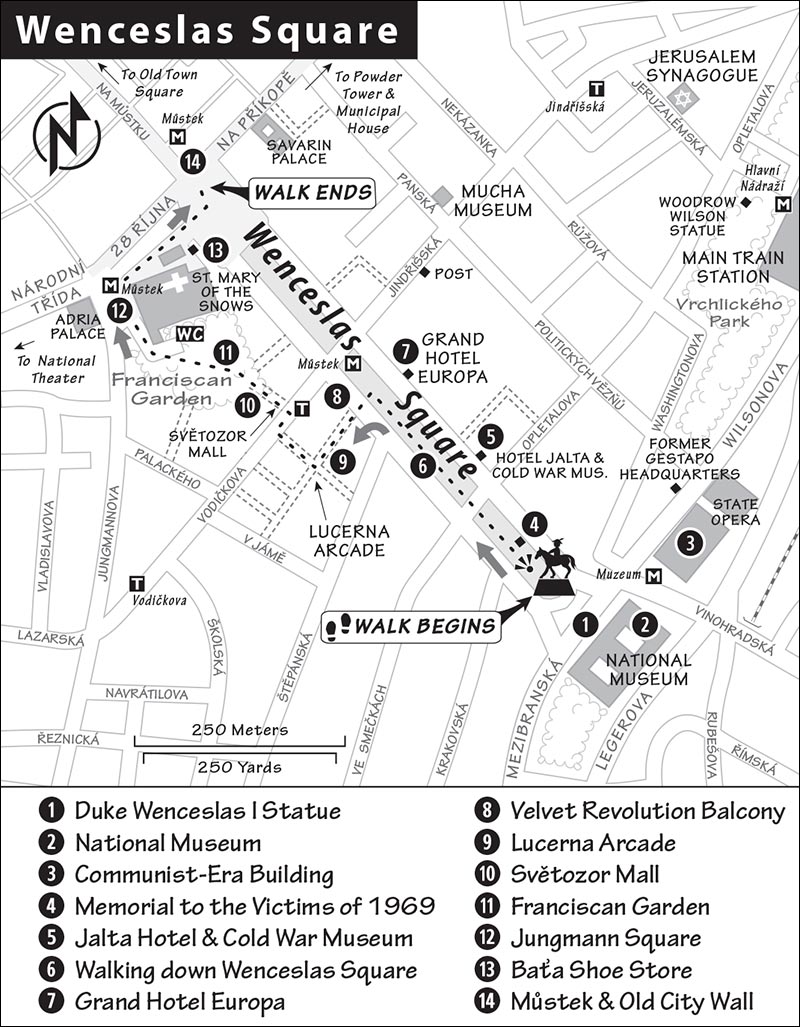
Getting There: The walk starts at the top of Wenceslas Square, in front of the National Museum; the nearest Metro stop is called Muzeum. If you’re coming from the Old Town, it’s probably easiest just to hike the length of the square up to the top to start the walk.
Eating: This walk passes a popular ice-cream parlor. Dozens of other eateries are nearby (see my recommendations on here).
Starring: Urban bustle, a secluded garden, and a thousand years of Czech history—from St. Václav to Václav Havel.
The Walk Begins
• At the top of Wenceslas Square, stand under the huge statue of “Good King Wenceslas” on a horse.
Join Wenceslas as he gazes proudly down this long, broad square. It’s actually more like a boulevard busy with cars, with a parklike median right down the middle. It’s a huge expanse, covering more than 10 acres. Stand here and take in the essence of modern Prague.
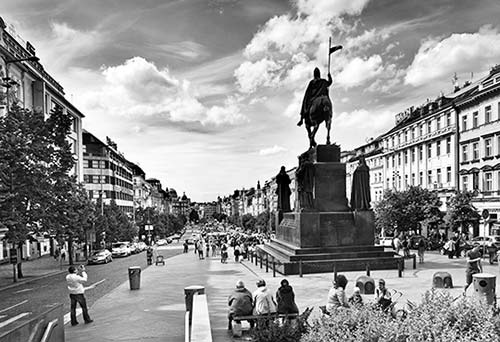
Think of how this place has served as a kind of national stage for important events in the history of the Czech people. In 1918, it was here that jubilant crowds gathered to celebrate the end of World War I and the subsequent creation of modern Czechoslovakia. During World War II, this was the scene of Nazi occupation, and then of rioting Czechs who drove the Nazis out. In the spring of 1968, the Czechs gathered here to protest against their next set of oppressors, the communist Soviets. These “Prague Spring” reforms gained international attention, but eventually Soviet tanks rumbled into town and crushed the rebellion. Then in 1989, more than 300,000 Czechs and Slovaks converged right here to reclaim their freedom once again.
Which brings us to today. Survey the square for a snapshot of “the now.” You’ll see businesspeople, families, Dumpster divers, security guards, hipsters, and students. It sums up the changes and rapid transformation of society here over the past 100 years.
• But let’s go back to the very beginning. Turn your attention now to the big equestrian statue of...
1 Duke Wenceslas I
The “Good King” of Christmas-carol fame was actually a wise and benevolent 10th-century duke. Václav (as he’s called by locals) united the Czech people, back when this land was known as Bohemia. A rare example of a well-educated and literate ruler, Wenceslas Christianized and lifted the culture. He astutely allied the powerless Czechs with the Holy Roman Empire of the German nation (making him likewise revered in the German-speaking world). And he began to fortify Prague’s castle as a center of Czech government. After his murder in 929, Wenceslas was canonized as a saint. He became a symbol of Czech nationalism (and appears on the 20 Kč coin). Later kings knelt before his tomb to be crowned. And he remains an icon of Czech unity whenever the nation has to rally. Like King Arthur in England, Wenceslas is more legend than history, but he symbolizes the country’s birth.
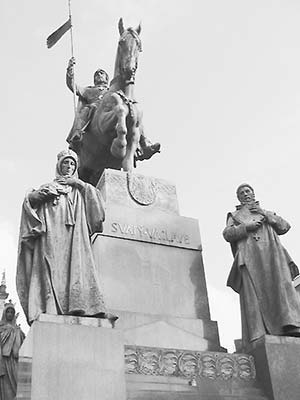
The statue is surrounded by the four other Czech patron saints. Notice the focus on books. A small nation without great military power, the Czechs have thinkers as national heroes, not warriors.
In January 1968, the Slovak politician Alexander Dubček replaced the aging apparatchiks at the helm of the Communist Party of Czechoslovakia. Handsome and relatively youthful, Dubček used the brand of a smiling playboy; he appeared on magazine covers in his Speedo, about to dive into a swimming pool. Young Czechs and Slovaks embraced Dubček as a potential hero of liberalization.
In April, Dubček introduced his “Action Program,” designed to tiptoe away from strict and stifling Soviet communism and forge a more moderate Czechoslovak variation. Censorship eased, travel restrictions were relaxed, state companies began forming joint ventures with Western firms, money poured into the sciences, and a newspaper called Tomorrow (rather than Today) became the most popular in the country. Plays put on at the Semafor Theater (in today’s Světozor mall) lampooned Soviet leader Brezhnev and his ilk. During this so-called “Prague Spring,” optimism soared.
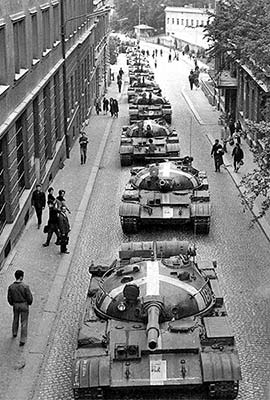
But then, around midnight on August 20, 1968, the thundering sound of enormous airplanes ripped across the floodlit rooftops of Prague. The Soviets had dispatched over 200,000 Warsaw Pact troops to invade Czechoslovakia, airlifting tanks right into the capital city. Dubček and his team were arrested and taken to Moscow. Czechs and Slovaks took to the streets, boycotting and striking. Tanks rolled through Wenceslas Square, spraying protesters with bullets...some of which are still embedded in the National Museum’s pillars. Over the course of the occupation, 72 Czechs and Slovaks were killed.
Dubček stepped down and went into internal exile, and his successor—the hardliner Gustáv Husák—immediately pursued a policy of “normalization.” People who refused to sign a petition commending the “Russian Liberation” were fired from their jobs and forced to find worse ones. Some protesters—including Jan Palach—went to the extreme of setting themselves on fire to protest against the regime. Tens of thousands of Czechs and Slovaks reluctantly emigrated to the West, fearing what might come next.
While the ill-fated tale of the Prague Spring is pessimistic, it provides an insightful bookend to what happened 21 years later: The children of the generation that suffered Czechoslovakia’s bitterest disappointment ushered in mass demonstrations that ended this dark era.
And this statue is a popular meeting point. Locals like to say, “I’ll meet you under the horse’s tail.”
• Circle behind the statue and stand below that tail; turn your attention to the impressive building at the top of Wenceslas Square.
2 National Museum
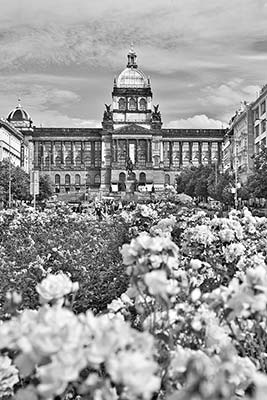
This grand, lavishly restored building dates from the 19th century, when modern nation-states were forming in Europe and the Czech people were still living under the auspices of Austria’s Habsburg Empire. Bold structures like this Neo-Renaissance building were a way to show the world that the Czech lands had a distinct culture and a heritage of precious artifacts, and that Czechs deserved their own nation.
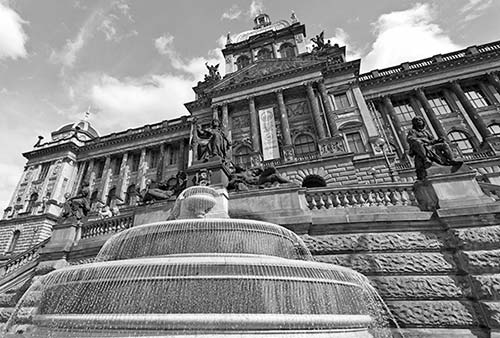
Look closely at the columns on the building’s facade. Those light-colored patches (meticulously preserved during the recent renovation) are covering holes where Soviet bullets hit during the 1968 crackdown. The state-of-the-art interior is filled with diverse exhibits ranging from minerals to modern history (for details, see here of the Sights in Prague chapter).
• To the left of the National Museum (as you face it) is a...
3 Communist-Era Building
This out-of-place modern structure (combining a 1930s core with a 1960s shell) once housed the rubber-stamp Czechoslovak Parliament back when it voted in lockstep with Moscow. At its base, under the canopy, is a statue from those days, in the style known as Socialist Realism. As was typical, it shows not just a worker...but a triumphant worker.
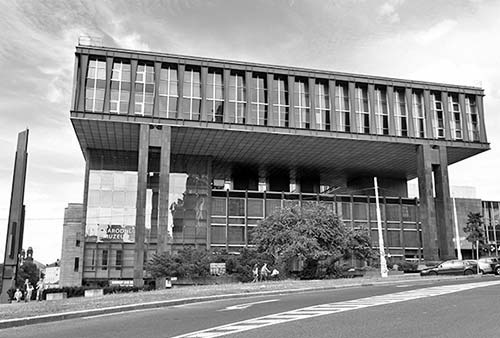
Between 1994 and 2008, this building was home to Radio Free Europe. After communism fell, RFE lost some of its funding and could no longer afford its Munich headquarters. In gratitude for its broadcasts—which had kept the people of Eastern Europe in touch with real news—the Czech government offered this building to RFE for 1 Kč a year. But as RFE energetically beamed its American message deep into the Muslim world from here, it drew attention—and threats—from Al-Qaeda. In 2009, RFE moved to a new fortress-like headquarters literally across the cemetery wall from Franz Kafka’s grave (an easier-to-defend locale farther from the center). Now this is an annex of the National Museum that displays temporary exhibits.
In addition to this building, the communist authorities built the nearby Muzeum Metro stop (the crossing point of two Metro lines) and the busy highway that runs between the top of the square and the National Museum. Since the communists checked out, city leaders have struggled with the legacy of this heavy-handed infrastructure, which makes the museum area the most polluted spot in the city.
Along the busy street just past the communist-era building (hard to see from here) is the recently renovated State Opera, which was built in the 1880s as the New German Theater—at a time when Prague’s once-dominant German population was feeling neglected after the opening of the Czechs’ National Theater across town. Facing this from across the road is a cold, Neoclassical building that was the local Gestapo headquarters during Nazi times. This chilling juxtaposition of high culture with authoritarian control pretty much sums up the Czechs’ love/hate relationship with their powerful German and Austrian neighbors.
• Start walking down Wenceslas Square. Pause about 30 yards along, at the little patch of bushes. In the ground on the downhill side of those bushes is a...
4 Memorial to the Victims of 1969
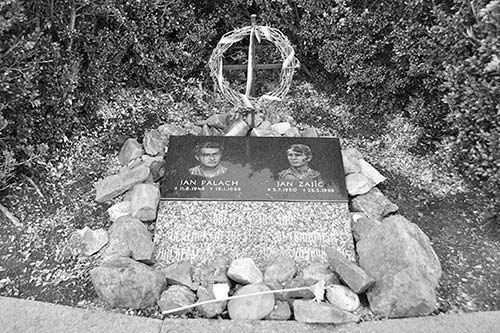
After the Russian crackdown of 1968, a young philosophy student named Jan Palach, inspired by a video of monks immolating themselves in protest in Vietnam, decided that the best way to stoke the flame of independence was to do the same right here. On January 16, 1969, Palach stood on the steps of the National Museum and ignited his body. He died a few days later. Hundreds of thousands turned up for his funeral, as his act resonated with the dark and desperate mood of the occupied country. A month later, another student did the same thing, followed by another. Czechs are keen on anniversaries, and 20 years after Palach’s defining act, in 1989, hundreds of Czechs gathered here again in protest. A sense of new possibility swept through the city, and 10 months later, the communists were history.
• Farther down the square, locate the building on the right with the beige travertine facade (and many balconies). This is the...
5 Jalta Hotel and Cold War Museum
This building is most representative of the 1950s Neoclassical, Socialist Realist style. Designed at the height of the Cold War as a hotel for VIPs, it came with an underground crisis-fallout shelter that visiting Soviet generals could use as a command center in case nuclear war broke out. The bunkers were recently refurbished back to their original state by a group of Czechoslovak army fans and converted into the ▲ Cold War Museum (visits by tour only; for details, see here of the Sights in Prague chapter).
• Continue down Wenceslas Square.
6 Walking down Wenceslas Square
Wenceslas Square is part of Prague’s New Town, one of the four traditional quarters. Prague got its start in the ninth century at the castle. It spilled across the river to the Old Town, which was fortified with a city wall. By the 1300s, the Old Town was bursting at the seams. King Charles IV expanded the town outward, tripling the size of Prague. Wenceslas Square, a central feature of the New Town, was originally founded as a horse market.
As you walk, notice the architecture. Unlike the historic Old Town, nearly everything here is from the past two centuries. Wenceslas Square is a showcase of Prague’s many architectural styles: You’ll see Neo-Gothic, Neo-Renaissance, and Neo-Baroque from the 19th century. There’s curvaceous Art Nouveau from around 1900. And there’s the modernist response to Art Nouveau—Functionalism from the mid-20th century, where the watchword was “form follows function” and beauty took a back seat to practicality. You’ll see buildings from the 1950s communist era, forgettable glass-and-steel buildings of the 1970s, modern stores from the 2000s, and new construction.
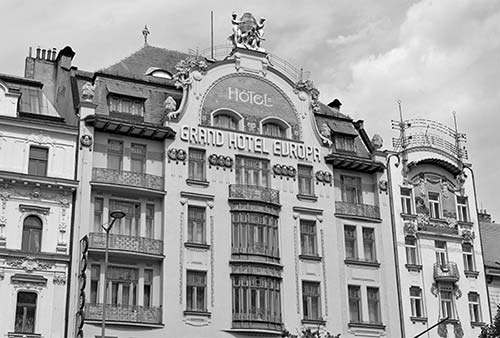
On the right-hand side of Wenceslas Square is 7 Grand Hotel Europa. It’s the one with the dazzling yellow Art Nouveau exterior. If you’re a fan of Art Nouveau, you’ll want to also check out Prague’s Municipal House (near the bottom of Wenceslas Square; see here) and the Mucha Museum (just up the street behind this hotel and described in the Mucha Museum Tour chapter).
Opposite Grand Hotel Europa (on the left side of the square), find the Marks & Spencer building and its balcony (partly obscured by trees).
• Standing here in the center of Wenceslas Square, look up at that balcony and take a moment to consider the events of November 1989.
8 The Velvet Revolution
Picture the scene on this square on a cold November night in 1989. Czechoslovakia had been oppressed for the previous 40 years by communist Russia. But now the Soviet empire was beginning to crumble, jubilant Germans were dancing on top of the shattered Berlin Wall, and the Czechs were getting a whiff of freedom.
Czechoslovakia’s revolution began with a bunch of teenagers, who—following a sanctioned gathering—decided to march on Wenceslas Square (see sidebar). They were surrounded and beaten by the communist riot police, and days later their enraged parents, friends, and other members of the community poured into this square to protest. Night after night, this huge square was filled with more than 300,000 ecstatic Czechs and Slovaks who believed freedom was at hand. Each night they would jingle their key chains in the air as if saying to their communist leaders, “It’s time for you to go home now.” Finally, they gathered and found that their communist overlords had left—and freedom was theirs.
On that night, as thousands filled this square, a host of famous people appeared on that balcony to greet the crowd. There was a well-known priest and a rock star famous for his rebellion against authority. There was Alexander Dubček, the hero of the Prague Spring reforms of 1968. And there was Václav Havel, the charismatic playwright who had spent years in prison, becoming a symbol of resistance—a kind of Czech Nelson Mandela. Now he was free. Havel’s voice boomed over the gathered masses. He proclaimed the resignation of the Politburo and the imminent freedom of the Republic of Czechoslovakia. He pulled out a ring of keys and jingled it. Thousands of keys jingled back in response to indicate time was up.
In previous years, the communist authorities would have sent in tanks to crush the impudent masses. But by 1989, the Soviet empire was collapsing and the Czech government was shaky. Locals think that Soviet head of state Mikhail Gorbachev (mindful of the Tiananmen Square massacre a few months before) might have made a phone call recommending a nonviolent response. Whatever happened, the communist regime was overthrown with hardly any blood being spilled. It was done through sheer people power—thanks to the masses of defiant Czechs who gathered here peacefully in Wenceslas Square, and Slovaks doing the same in Bratislava. A British journalist called it “The Velvet Revolution,” and the name caught on in the West. Locals call it simply “The Revolution.”
• Look downhill to the bottom of Wenceslas Square. We’ll be heading there eventually. But we’ll take a less-touristed detour to the left, with some interesting things to see.
Opposite Grand Hotel Europa is a shopping mall called the Lucerna Arcade. Use the entry marked Pasáž Rokoko and walk in. Continue about 100 yards straight through the mall until you find a horse hanging from the ceiling.
9 Lucerna Arcade
This grand mall retains some of its Art Deco glamour from the 1930s. But that’s not its most notable feature. In the middle of it all, you’ll see a sculpture—called Wenceslas Riding an Upside-Down Horse—hanging like a swing from a glass dome. David Černý, who created the statue in 1999, is one of the Czech Republic’s most original contemporary artists. Always aspiring to provoke controversy, Černý has painted a menacing Russian tank pink, attached crawling babies to the rocket-like Žižkov TV tower, hung Sigmund Freud on an iron rod, and sunk a shark-like Saddam Hussein inside an aquarium.
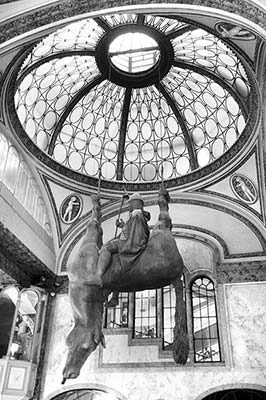
The grand staircase leading up from beneath the suspended sculpture takes you to a lavish 1930s Prague cinema, which shows mostly art-house films in their original language with Czech subtitles. The same staircase leads up to the swanky, Art Deco Café Lucerna, with windows overlooking this atrium. And in the basement, there’s the popular Lucerna Music Bar, which hosts ’80s and ’90s video parties on weekends, and concerts on other nights (for details, see the Entertainment in Prague chapter).
• From the horse, turn right and head for the side exit (passing the entrance to the Lucerna Music Bar on your left). After you exit into the open air, jog a bit to the right across busy Vodičkova street (with a handy tram stop), where you’ll find the entrance to the Světozor mall—it’s a few steps to the right, by the Kino Světozor sign. Go on in.
10 Světozor Mall
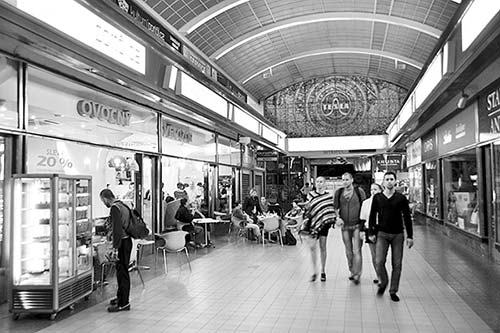
As you enter the mall, look up at a glass window from the 1930s advertising Tesla, a now-defunct Czech radio manufacturer. The window lends a retro brightness to the place. On the left, pause at the always-busy Ovocný Světozor (“World of Fruit”), a popular franchise ice-cream joint (their specialty is banana-strawberry). They also sell cakes, milkshakes, and “little breads”—delightful Czech-style open-face sandwiches—really cheap. English menus are available on request. While licking your cone, ponder this: This nondescript space once housed the Theatre of the Seven Small Forms (known as the Semafor Theater), the center of the unprecedented creative outburst of the Czech culture that culminated in what became known as the Prague Spring.
Václav Havel (1936-2011) was a playwright first and a politician second. Author of more than 20 absurdist plays, Havel served as the first president of post-communist Czechoslovakia and was later elected to two terms as president of the Czech Republic.
At heart, Havel was an unassuming writer-critic—but circumstances propelled him into the roles of political dissident and humanitarian. Banned from Czech theater in the aftermath of the 1968 Prague Spring, Havel became an enemy of the communist state and was repeatedly jailed. Though public channels of expression were closed to him, his controversial essays and plays were circulated secretly, both to Warsaw Pact countries and to the West.
While staring down Czechoslovakia’s communist regime during the 1989 Velvet Revolution, Havel and his fellow revolutionaries took to the streets with the chant, “Truth and love must prevail over lies and hatred.” Havel acted as leader of the informal human-rights group Charter 77, which challenged the regime’s suppression of Czech citizens. Their opposition began in defense of the right to freedom of expression—specifically, of a Czech counter-culture rock group, Plastic People of the Universe—that in 1976 was put on trial and convicted of disturbing the peace, essentially for performing without a permit. In Charter 77’s manifesto, Havel persuasively argued that if one person’s freedom is violated, everyone’s freedom is violated. Through his writings, he articulated a message of hope and strength, stressing the importance of becoming a community “living in truth” and strong enough to stop conforming to Soviet ideologies.
The idea that so inspired the martyr Jan Hus and his 14th-century followers was the heretical realization that each human being has an intrinsic capacity to know what a just, free, and beautiful life is. Six centuries later, Václav Havel used his plays to explore what happens to a human being who rejects the guidance of this inner compass. His characters fixate on the abstractions of various mundane “truths” while forgetting their moral obligations to themselves and others. Havel saw love and truth not just as political slogans but as everyday principles, and was himself catapulted by life into parts he had not scripted.
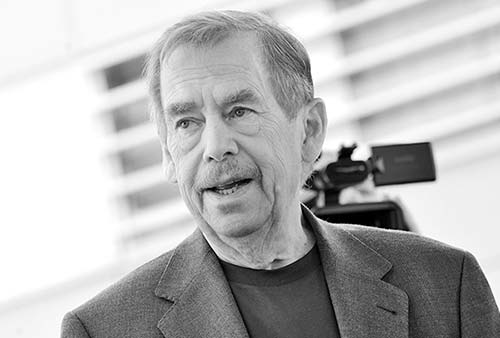
After serving two terms, Havel returned to his art, continuing to explore the ideas of freedom and morality. His death in 2011 at age 75 was marked by three days of national mourning and the renaming of Prague Airport as Václav Havel Airport Prague.
Havel will long be remembered for his clever use of art as a medium for political expression. In 2012, the Human Rights Foundation established the Václav Havel Prize for Creative Dissent. Prominent activists who have received this honor include Ai Weiwei (China), the Ladies in White (a Cuban opposition group), and Pussy Riot (a Russian punk-rock protest group).
• Walk under the Tesla sign to leave the mall. As you exit, turn left immediately to enter the gates of the peaceful...
11 Franciscan Garden
Ahhh! This garden’s white benches and spreading rosebushes are a universe away from the fast beat of the city, which throbs behind the buildings corralling this little oasis.
The peacefulness reflects the purpose of its Franciscan origin. St. Francis, the founder of the order, thought God’s presence could be found in nature. In the 1600s, Prague became an important center for a group of Franciscans from Ireland. Enjoy the herb garden and children’s playground. (And a WC is just out the far side of the garden.) The park is a popular place for a discreet rendezvous; it’s famous among locals for kicking off romances.
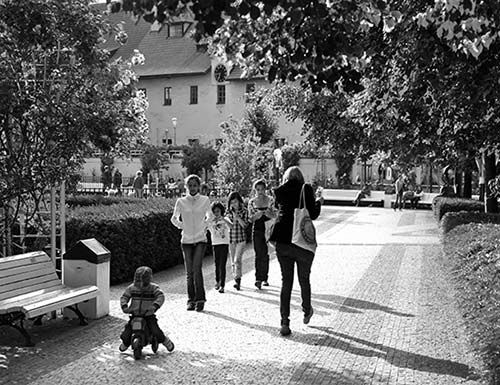
Looming up at the far end of the garden is a tall, truncated building that looks like it’s been chopped in half. When the New Town was founded, its leaders commissioned St. Mary of the Snows Church—with its elegant white Gothic walls and lofty apse—to rival St. Vitus Cathedral, across the river. Like St. Vitus, construction halted with the religious wars of the 1400s; unlike St. Vitus, it never resumed. (If you want to peek inside, we’ll pass the entrance soon.)
• Exit the garden at the opposite corner from where you entered (past the little yellow gardening pavilion—which now houses a design boutique—and the herb garden). You’ll pass a handy pay WC, then pop out through a big gate into...
12 Jungmann Square (Jungmannovo Náměstí)
The statue depicts Josef Jungmann (1773-1847), who revived the Czech language at a time when it was considered a simple peasants’ tongue. (If you’d like to step into St. Mary of the Snows’ tranquil interior—an airy silence permeated by the damp smell of centuries-old stucco—look for the entrance directly behind Jungmann’s rear end.) To the left as you face Jungmann is the decadent, almost overly ornamented Adria Palace—which served as Václav Havel’s “base camp” during those electrifying two weeks in November of 1989.
Turn right past the statue and follow the black paving stones as they cut through the skinny square. Ahead and on the right, look for the 13 Baťa shoe store, one of the big entrepreneurial success stories of prewar Czechoslovakia. By making affordable but good-quality shoes, Tomáš Baťa’s company thrived through the Depression years, only to be seized by the communists after World War II. The family moved their operation abroad but have now reopened their factory in their hometown of Zlín. Today, Baťa shoes remain popular with Czechs—and international fashionistas.
Just to the right of the shoe store, near the corner of the square, notice the zigzag Cubist lamppost—one of many such flourishes scattered around this city, from the brief period when this experimental, uniquely Czech style was in vogue. Just beyond the lamppost is a hidden beer garden that huddles around the base of the church.
• Keep following those black paving stones through the glassed-in gallery next to the Baťa shoe store. You’ll emerge near the bottom of Wenceslas Square.
14 Můstek and the Old City Wall
The bottom of the square marks the border between the Old Town and New Town. You’ll notice the Metro stop Můstek, meaning “Bridge.” You used to have to cross a bridge here, then pass through a fortified gate, to enter the Old Town, which was surrounded by a protective wall and moat. (You can detour down into the Můstek Metro station to see the original Old Town gate in the wall.) The Old Town and New Town were officially merged in 1784.
Let’s finish the walk by bringing Czech history up to the moment. The Soviets were tossed out in the 1989 Velvet Revolution. Then the Czech Republic and Slovakia peacefully separated in 1993. Through the 1990s, the fledgling Czech Republic was guided by President Václav Havel, that former key-jingling playwright. In 2004, the Czech Republic became a member of the European Union. Today, the Czech people are experiencing economic challenges, including inflation and higher energy costs, but the overall economy is stable. The Czech Republic finds its traditional political parties in crisis—much like others worldwide—with centrist populists as well as left and right extremists gaining appeal. The history of the Czech people continues to be written. In the meantime, their capital, Prague, remains one of the most popular tourist destinations in Europe.
• Our walk is done. Here at Můstek, you have many options: Continue straight ahead into the Old Town; turn right along Na Příkopě street (the former moat) to visit the Mucha Museum, Municipal House, or Museum of Communism; or go left along Národní street to the National Theater and the river. For places farther afield, you can hop on the Metro at Můstek. The rest of Prague is yours to enjoy.