MUSEUM OF MEDIEVAL ART TOUR
Středověké umění v Čechách a Střední Evropě
The former Convent of St. Agnes houses the Museum of Medieval Art in Bohemia and Central Europe. Its collections focus on the 14th century—Prague’s golden age. The religious art displayed in this Gothic space, gathered from churches across Central Europe, is a testament to the rich cultural life of the period. Each exquisite piece is well lit and thoughtfully described in English.
There’s a lot to like about this sight: It’s air-conditioned and never crowded, the fine building is interesting to explore, and it sits in one of the less touristed parts of the Old Town, a pleasant stroll from the Old Town Square. Still, many visitors might find the art itself to be, well, pretty boring—room after room of similar-looking paintings and statues of Madonnas-and-Children. Use my quick tour to see the collection’s highlights, then browse to your interests and explore the convent buildings.
Orientation
Cost: 250 Kč, 680 Kč combo-ticket also covers Sternberg Palace, Schwarzenberg Palace, and Veletržní Palace.
Hours: Tue-Sun 10:00-18:00, closed Mon.
Information: +420 224 810 628, www.ngprague.cz.
Getting There: The museum is two blocks northeast of the Spanish Synagogue, along the river at Anežská 12. It’s an easy 10-minute walk from Old Town Square: Exit the square from the northeast corner, walking down Dlouhá street. Continue straight as the street changes names to Kozí. At the five-way intersection, turn left to find the very narrow alleyway (also called Kozí). Follow this cozy, leafy, bird-chirping lane to U Milosrdných, turn right, then veer left down narrow Anežská.
Length of This Tour: One hour.
Starring: Medieval altar sculptures and paintings, exhibited in a historic cloister.
BACKGROUND
It’s 1350. Central Europe is emerging from a time of political turmoil, and outbreaks of the Black Death are giving people plenty to pray about. A thousand miles to the southwest, in Italy, the Renaissance is just about to bring light to the Middle Ages.
Medieval art is reaching its pinnacle—perhaps nowhere as much as here in the Bohemian heartland. Like a candle struggling to stay lit in the darkness, the enlightened-before-his-time King Charles IV is putting his hometown of Prague on the map. Importing culture and know-how from his far-and-wide travels, genuinely pious Charles cultivates a respect for the arts. The finely executed altarpieces and other ecclesiastical art that decorate the humble small-town and countryside churches throughout Charles’ realm demonstrate a level of artistic skill and cultural sophistication surprising for this time and place.
A fine sampling of these great medieval artworks are collected in this museum, the former Convent of St. Agnes. Like medieval art everywhere in Europe, it focuses on Mary, Christ, and the saints, but keep an eye out for some distinctive Bohemian features. Look for Madonnas with S-curvy bodies and warm smiles, the unique elements of Bohemia’s “Beautiful Style.” Recognize Bohemian art’s folk roots—crude figures with spindly bodies who nevertheless express deep emotion. Learn a few new Czech painters—these “Masters” may be anonymous to us today, but they were the Michelangelos of their era. And finally, realize how essentially un-Bohemian this art is—joyously incorporating shining Byzantine icons, eye-opening Italian 3-D, and lush French landscapes. This is cosmopolitan art of what was one of Europe’s most sophisticated cultures.
The Tour Begins
This department of the National Gallery is hosted by St. Agnes’ Convent. The convent and its church are stark but worth a look on the ground floor, and the exquisite collection of art fills the upper floor.
• Head into the cloister and turn left to find the ticket office. Then climb upstairs (following exhibition signs) to the top (second) floor.
MUSEUM
At the top of the steps before entering the gallery you’ll see a model illustrating the layout.
• Follow the arrows for a chronological sweep through Gothic art history. While the rooms are not labeled with their letters, it’s a stable arrangement—just follow the arrows.
Aspects of Mary (Room A)
The room features many variations on the mother of Jesus, who was adored in medieval Europe. You’ll see statues and paintings of her smiling, sitting, or standing; being thoughtful, playful, or majestic; with or without a crown; and nearly always cradling her baby. The first works date from the early 1200s, when this place was a world of women—the Convent of St. Agnes and the austere Order of Poor Clares.
Vyšší Brod Paintings (Room B)
These gold-backed paintings (from around 1350) tell the story of Christ, medieval-style. In the Annunciation, the angel kneels before Mary and announces (you can actually read his words) Ave gratia plena...“Hail, full of grace.” In the Nativity, Mary gives birth in a flimsy, and crudely drawn, shack. But the anonymous, Bohemian artist, known only as the Master of Vyšší Brod (the monastery where these panels originated), is experimenting with Italian-style perspective—there’s a definite foreground (the couple with water basin) and background (grazing animals). The Master tells Jesus’ story through his Crucifixion and up to the Resurrection—a remarkable painting of Christ in a brilliant red robe rising above astonished soldiers.
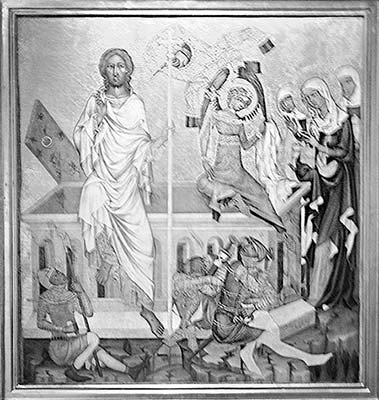
Bohemian art in the mid-1300s is surprisingly cosmopolitan (the Black Death, which killed a third of Europe, avoided Czech lands for a long time). Bohemian artists combined local folk art with Italian poses, French love of nature, and Byzantine gold-leaf backgrounds.
Also in Room B, several statues (by the similarly anonymous Master of the Michle Madonna) give Mary a new twist—the slight S-curve of the body called contrapposto.
Master Theodoric (Room C)
A half-dozen paintings here give a snapshot of Prague’s golden age. Around 1350, Emperor Charles IV was remaking Prague into an imperial city. He hired Theodoric of Prague—the country’s first “name” artist—to paint 129 saints for a chapel at Karlštejn Castle (outside of Prague), of which a few have been moved here. These are real people. Compared with the scrawny figures of his contemporaries, these saints are massive. They fill the frames of the wooden panels they’re painted on, some even spilling over the frame. They’re life-size (or bigger) and zoomed in to show them from the waist up, as if they’re peering out of windows at us.
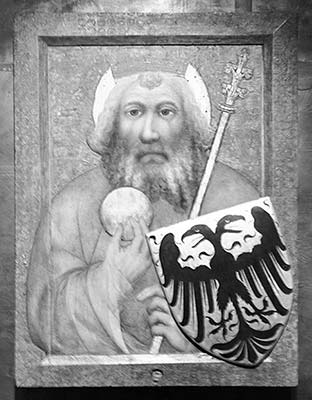
In the second painting, Charlemagne—the first Holy Roman Emperor—holds the same coronation objects used by his namesake, Charles IV: golden scepter, orb, and shield with the double-headed eagle. The shield even stands “outside” the frame, giving a sense of 3-D. The hand of Theodoric is everywhere: his signature beard style, thick outlines, brilliant colors, and “soft-focus” features. Notice these characteristics in the other paintings as well. Theodoric proves that Bohemian art holds its own against the work of pre-Renaissance Italian greats like Giotto.
• Pass through Room D (where a few Madonna statues are really starting to rock that S-curve), Room E (with the glorious, much-copied Madonna of Roudnice painting, by the Master of the Třeboň Altarpiece), and Room F—then turn right into the long and skinny Room G.
The Beautiful Style (Rooms G, H)
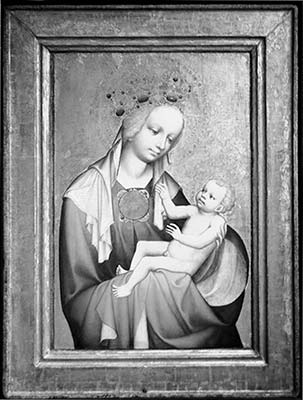
As Prague became increasingly cosmopolitan (c. 1400), foreign artists arrived, bringing the International Style—or, as it’s known in its Bohemian version, the Beautiful Style. These works are deliberately graceful, with delicate, curved lines.
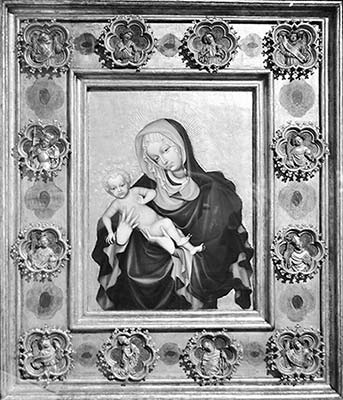
The Madonna from the St. Vitus Cathedral (midway down Room G, on the left) is a classic example. Rather than being stiff and straight, this Mary is S-curved to the max—her head tilts one way, her body the other. She presents Jesus to the congregation, and both look directly out with coy expressions. Mary’s heavy, dark robe has elaborate, deep creases, showing off the artist’s mastery of light and shadow. The complex composition—note how Mary’s head and Jesus’ body parallel each other—demonstrates a deliberate artfulness that marks the Beautiful Style. The painting, which once stood in St. Vitus Cathedral, was famous in its day. Churches everywhere had a copy. The ornate wooden frame may be original.
The Capuchin cycle (1410-1414) shows Jesus, Mary, John the Baptist, and 11 of the apostles (one panel is lost). Stroll by them looking into each face.
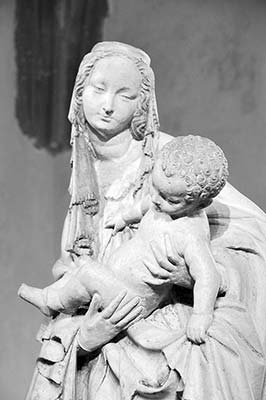
The next gallery (Room H) features more Madonna statues in the Beautiful Style. These are tempera painted on linden wood. Scholars often call this type of statue a Schöne Madonna. She smiles sweetly, her body sways seductively, her deeply creased robe is luxuriant, and Jesus squirms playfully in her arms. In churches all across Central Europe, worshippers were treated to these happy, “beautiful” (and once colorfully painted) images of an inviting saint—a vision of how the worlds of the spirit and flesh could unite harmoniously.
• But here on earth, the harmony of the Czech golden age was about to be shattered by religious warfare. For the next episode, backtrack and exit Room G, turning right down four steps into a large, long hall filled with—you guessed it—more altarpieces. Follow the arrows down the ramp to the right. You’ll exit this room at the far left.
Foreign Influence (Rooms J, K, L)
Jan Hus’ attempts to reform the church plunged the Czech people into decades of war and division. It sent many Hussites into a frenzy of violent protest and iconoclasm—storming churches to destroy paintings and statues. Homegrown Bohemian art would never be the same.
The large hall is filled with altarpieces from the post-Hus world. There’s some glorious stuff, as the art comes more in line with international trends. Discerning art historians see the influence of German artists (such as Cranach) and of Italian art, with its blossoming realism and 3-D perspective. The rest of us can just browse through these large, impressive, colorful works. Some highlights are the St. George Altar, the Puchner Ark, the Lamentation of Christ from Žebrák, and two works that show the influence of Cranach: the Litoměřice Altar and a Madonna and Child by the artist known only as Monogrammist IW, for the initials found on his paintings.
• Before leaving the hall, take note of the staircase in the middle of the room. This exit leads to the “churches”—that is, the convent buildings you can visit after the museum. But first, a few final artworks. Exit the large hall at the far end, entering rooms that display...
Some Foreign Masterpieces (Rooms M, N)
Room M displays lots of wooden altar statues and a glass case with woodcut prints. The four biggest prints are from Albrecht Dürer’s fascinating and famous Apocalypse series (1511). Finish your visit at the very end of Room N with an impressive wood-carved altarpiece by Monogrammist IP. In both the prints and the carvings, it’s easy to admire how these great German artists could render the medieval mindset with such meticulous Renaissance realism. With the world moving on, the golden age of Bohemian art, with its stylized visions of heaven, was relegated to the past.
• And we’ll move on, too—our museum tour is over. To reach the convent, backtrack into the large hall and take that staircase down. You’ll spill out on ground level, into one of the courtyards of the convent.
CONVENT OF ST. AGNES
In the year 1211, an Italian teenager named Clare met the charismatic St. Francis of Assisi. She immediately decided to dedicate herself to a life of Christian poverty and contemplation. She cut off her hair and went barefoot. Soon, she attracted a group of likeminded women, and they called themselves the Poor Clares. Their holy reputation spread.
In 1233, Princess Agnes, the daughter of a Bohemian king, established a branch of the Poor Clares in Prague. To house the new order of nuns, she built this complex—a convent, churches, the city’s first hospital—all of it state-of-the-art.
• Turn right and right again to enter the refectory.
Here in the refectory, the women ate meals, and also wove and copied manuscripts. They prayed many times a day. The nuns were known for their secret healing elixir (called “swallow water”), which they sold to the rich and gave to the poor. Though the Clares lived in strict poverty and humble contemplation, their order was warmed by the humanist spirit preached by St. Francis.
The convent flourished for around 150 years. But it all ended suddenly in the early 1400s with Jan Hus. During the anti-Catholic strife and Hussite wars, the Clares fled and the convent was ravaged. Over the next 500 years, the building underwent several incarnations—as an arsenal, a Dominican monastery, and public housing for the poor. The structure declined until a mid-20th-century renovation restored its original look. The Convent of St. Agnes was one of the first Gothic buildings in Bohemia, and now it’s the oldest Gothic building in Bohemia.
• Circle the courtyard counterclockwise, wandering through the (mostly empty) rooms surrounding it.
As you explore, imagine how the Poor Clares once lived here, secluded from the outside world. Pop into the room where kids (of all ages) are welcome to enjoy a little hands-on medieval art. Try dipping your quill into the ink jar and pen a few thoughts.
• Just before you make the full circle of the courtyard, three steps lead into a church.
Church of Christ the Salvator and the Přemysl Crypt
During Agnes’ time, the convent’s church became the official burial place for the ruling Přemysl family. The Přemyslid dynasty ruled Prague for nearly five centuries (c. 850-1306). Their royal burial chapel here was once glorious, but over time, the building was damaged and the tombs lost. Today the place is a bare shell. But on the floor, you’ll find plaques marking rediscovered Přemyslid graves (one in the back of the nave and the other in the adjoining hall). Kunigund (labeled Cunegundis, 1202-1248) was the granddaughter of the great Frederick I Barbarossa, Holy Roman Emperor. She married Wenceslas I (labeled Venceslaus I, 1205-1253)—not the 10th-century St. Wenceslas, but rather the king who annexed Austria and saved Bohemia from the Mongol hordes of Genghis Khan. The couple fathered Ottokar II, who ushered in the Bohemian golden age.
• On the left side of the church nave is a side room. This was...
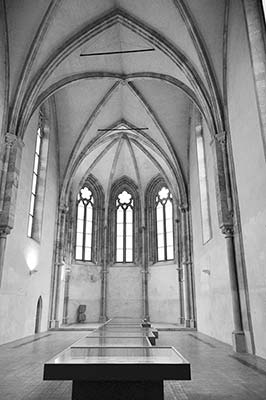
Agnes’ Oratory
This humble room is where Agnes Přemysl—the daughter of the king, and one of the most sought-after women in Europe—spent her days.
Agnes (1211-1282) was born the year Clare met Francis. Well educated in convent schools, the Přemysl princess was dangled as a potential bride in several politically expedient marriages—to the powerful son of the Holy Roman Emperor, to the king of England, and finally to the emperor himself. But they all fell through; she became a “bride of Christ” and entered the convent.
Agnes was well connected. Her father was King Přemysl Ottokar I, who united the warring Bohemians. Her brother was Wenceslas I (see above), and her nephew became Ottokar II. Agnes exchanged letters with Clare of Assisi, inviting five Italian nuns to come north to help found the first Clarist convent north of the Alps, with Agnes as mother superior.
When Agnes died, some speculate that she was buried here. Her remains were lost, but a legend says that whenever they are found, the Czech nation will enter a new golden age.
In 1989, Agnes was canonized by Pope John Paul II (who loved to promote the Slavic faithful). Since local celebrations of her sainthood on November 26 coincided with the Velvet Revolution, Agnes has since been regarded as the patron of the renascent Czech democracy.
• Exit through the shop at the far side of the courtyard (opposite the church). As you head back into the bustle of Prague, you’ll appreciate the peace of St. Agnes’ Convent.