APPENDIX
Holidays and Festivals
This list includes selected festivals in Prague and the Czech Republic, plus national holidays observed throughout the country. Many sights and banks close on national holidays—keep this in mind when planning your itinerary. The sights in Prague’s Jewish Quarter close on Jewish holidays (the major ones are listed next). Before planning a trip around a festival, verify the dates with the festival website, the Czech national tourist office, or my “Upcoming Holidays and Festivals in the Czech Republic” web page at RickSteves.com/europe/czech-republic/festivals.
| Jan 1 | New Year’s Day; Restoration of Czech Independence Day |
| Jan 19 | Anniversary of Jan Palach’s death (flowers in Prague’s Wenceslas Square) |
| March | One World International Human Rights Film Festival, Prague (www.oneworld.cz) |
| March/April | Easter Sunday and Monday: March 31-April 1, 2024; April 20-21, 2025 |
| April | Pesach (Passover) begins: April 22, 2024; April 12, 2025 |
| April 30 | Witches’ Night (similar to Halloween, with bonfires) |
| May 1 | Labor Day and Day of Love (akin to Valentine’s Day) |
| Early May | Prague International Marathon (www.runczech.com) |
| Early May | United Islands of Prague (cultural events and world music on the city’s islands, www.unitedislands.cz) |
| May 8 | Liberation Day |
| Mid-May | Czech Beer Festival, Prague |
| May/June | Shavu’ot (Jewish “Feast of Weeks”): June 11-13, 2024; June 1-3, 2025 |
| Mid-May-early June | “Prague Spring” Music Festival (https://festival.cz) |
| Late May | Prague Food Festival (food booths in Royal Gardens of Prague Castle, www.praguefoodfestival.cz) |
| Late May-early June | Khamoro World Roma Festival, Prague (celebration of Roma culture, www.khamoro.cz) |
| June-Sept | Prague Proms (music festival, www.pragueproms.cz) |
| Mid-to-late June | Five-Petalled Rose Celebration, Český Krumlov (medieval festival and knights’ tournament, www.ckrumlov.info) |
| July 5 | Sts. Cyril and Methodius Day |
| July 6 | Jan Hus Day |
| Mid-July-mid-Aug | International Music Festival, Český Krumlov (classical music and opera, www.festivalkrumlov.cz) |
| Late July-mid-Aug | Holidays in Telč Festival (folk music, open-air theater, exhibitions, www.prazdninyvtelci.cz) |
| Sept | Dvořák’s Prague Music Festival (www.dvorakovapraha.cz) |
| Sept/Oct | Rosh Hashanah: Oct 2-4, 2024; Sept 22-24, 2025 |
| Sept/Oct | Yom Kippur: Oct 11-12, 2024; Oct 1-2, 2025 |
| Sept/Oct | Sukkot (Jewish “Feast of Tabernacles”): Oct 16-23, 2024; Oct 6-13, 2025 |
| Sept/Oct | Shemini Atzeret and Simchat Torah (Jewish holidays): Oct 23-25, 2024; Oct 13-15, 2025 |
| Sept 28 | St. Wenceslas Day (celebrates national patron saint and Czech statehood) |
| Oct 28 | Independence Day |
| Nov 1-2 | All Saints’ and All Souls’ Remembrance Day (religious festival) |
| Nov 17 | Velvet Revolution Anniversary (flowers, candles, and large gatherings on Národní Třída/Wenceslas Square) |
| Dec | Christmas markets, Prague and most towns |
| Dec 5 | St. Nicholas Eve, Prague (St. Nicholas, devils, and angels walk the streets in search of nice—and naughty—children) |
| Dec 24-25 | Christmas Eve and Christmas Day |
| Dec 26 | St. Stephen’s Day |
| Dec 31 | St. Sylvester’s Day (fireworks) |
Books and Films
To learn more about the Czech Republic past and present, check out a few of these books or films.
Nonfiction
Alice’s Piano: The Life of Alice Herz-Sommer (Melissa Müller, 2012). A classical pianist uses music to bring hope to fellow prisoners at the Terezín concentration camp.
My Crazy Century (Ivan Klíma, 2009). Celebrated Czech author Ivan Klíma chronicles events spanning from his childhood in a concentration camp to the aftermath of the Velvet Revolution, painting a dynamic portrait of 20th-century Czechoslovakia.
Prague Winter: A Personal Story of Remembrance and War, 1937-1948 (Madeleine Albright, 2012). Former Secretary of State Albright describes her early years in Czechoslovakia during the Nazi occupation and World War II.
The Twelve Little Cakes (Dominika Dery, 2004). Dery details a childhood spent near Prague at the end of the communist era.
Under a Cruel Star: A Life in Prague, 1941-1968 (Heda Kovály, 1997). Kovály’s clear-eyed memoir recounts a Czechoslovakian’s fate under the Nazis and then during the Stalin regime.
The Wall: Growing Up Behind the Iron Curtain (Peter Sís, 2007). An illustrated children’s book depicts the author’s childhood in communist Czechoslovakia.
Fiction
City Sister Silver (Jáchym Topol, 1994). In this definitive novel of the 1989 generation, Topol explores the zeitgeist of post-liberation Czech Republic in a rich mixture of colloquial Czech and neologisms.
The Cowards (Josef Škvorecký, 1958). A Czech teen comes of age in post-WWII Bohemia.
Dita Saxová (Arnošt Lustig, 1962). A young concentration camp survivor struggles to resume a normal life in Prague.
The Garden Party and Other Plays (Václav Havel, 1994). The renowned playwright, the country’s first post-communist president, fuses political commentary and dry humor in these absurdist plays.
Good Soldier Švejk (Jaroslav Hašek, 1923). This darkly comic Czech classic follows the fortunes of a soldier in World War I’s Austro-Hungarian army.
How I Came to Know Fish (Ota Pavel, 1974). Pavel’s imaginative memoir juxtaposes the simple act of fishing with the complexities and terror of World War II.
I Served the King of England (Bohumil Hrabal, 1971). An eccentric busboy at a luxurious Prague hotel rises and falls in the years before World War II. Hrabal’s writing captures the Czech spirit and sense of humor.
The Metamorphosis (Franz Kafka, 1915). The famous Czech writer and existentialist wrote this novella in German, about a man turning into a giant cockroach.
R.U.R. (Karel Čapek, 1920). Čapek created the robot in this 1920s play.
Too Loud a Solitude (Bohumil Hrabal, 1976). Hrabal’s stream-of-consciousness style explores the endurance of knowledge and the written word.
The Trial (Franz Kafka, 1925). An urbanite is pursued and persecuted for crimes he knows nothing about.
The Unbearable Lightness of Being (Milan Kundera, 1981). Set during the 1968 Prague Spring uprising, this novel follows the lives and choices of two men and two women.
Films
Alice (1988). Inspiring Czech artist Jan Švankmajer adapts Lewis Carroll’s Alice’s Adventures in Wonderland in stop-motion animation combined with live action.
All My Loved Ones (1999). A Jewish family’s son is sent to England in the “Kindertransports” organized by Nicholas Winton, the British humanitarian who saved almost 700 Czech Jewish children.
Burning Bush (2013). This miniseries details the communist occupation of Czechoslovakia and the Prague Spring, focusing on Jan Palach, the Czech student who set himself on fire and died in protest against the Soviet occupation.
Closely Watched Trains (1966). This Oscar winner follows a young Czech man working at a German-occupied train station during World War II.
Czech Dream (2004). Two film students advertise and document the opening of a fake hypermarket in this hilarious, disturbing commentary on consumerism.
Divided We Fall (2000). A Czech couple hides a Jewish friend during Nazi occupation in this Academy Award-nominated film.
The Elementary School (1991). Set in the late 1940s, a rowdy classroom in suburban Prague faces reform under the strict guidance of a war-hero teacher.
I Served the King of England (2006). In this adaptation of Bohumil Hrabal’s novel, a man reminisces about his past as an ambitious waiter who suffers the consequences of World War II.
In the Shadow (2012). A burglary in 1950s Czechoslovakia sets off a political investigation of Jewish immigrants and a detective’s struggle for justice amid German prosecutors.
Intimate Lighting (1965). Two musicians reunite in a small town in this showcase of 1960s Czech New Wave.
Kolya (1996). A concert cellist in Soviet-controlled Czechoslovakia must care for an abandoned Russian boy.
Larks on a String (1990). Under the communist regime, bourgeois Czechs are forced into labor camps and struggle to maintain their humanity.
Loves of a Blonde (1965). Before he directed One Flew Over the Cuckoo’s Nest and Amadeus, Czech Miloš Forman directed this film about the relationship between a rural Czech woman and a jazz pianist from Prague. Another lesser-known Forman movie is The Firemen’s Ball (1967), about a one-day celebration in a Czech village.
Protektor (2009). In this WWII Czech drama, a man must reconcile his job at a Nazi-propaganda radio station and his relationship with his Jewish wife.
The Shop on Main Street (1965). The first Czechoslovak film to win an Oscar is a tragic WWII tale about a simple, greedy man who takes over a Jewish shop to “Aryanize” it—only to form a bond with its elderly owner.
Animation
The Czechs have a wonderful animation tradition that successfully competes with Walt Disney in Central and Eastern Europe and China. During communism when Western cartoons weren’t widely available, Czechoslovakia produced several that were beloved throughout the Soviet Bloc. Since the 1950s, every night at 18:45 a block of cartoons is shown on Czech television’s channel 1, with the lineup introduced by a character called Večerníček (“Bedtime”—a little boy with starry eyes and a sleeping cap). The most popular character is Krtek (or Krteček, “Little Mole”), who gets in and out of trouble. You’ll see plush black-and-white Krtek figures everywhere. Křemílek and Vochomůrka are brothers who live in the woods, Maxipes Fík is an oversized talking dog, and the comic duo Pat and Mat are builders who can’t seem to get anything right.
Conversions and Climate
Numbers and Stumblers
• Europeans write a few of their numbers differently than we do. 1 =  , 4 =
, 4 =  , 7 =
, 7 =  .
.
• In Europe, dates appear as day/month, so Christmas is 25/12.
• Commas are decimal points and decimals are commas. A dollar and a half is 1,50, one thousand is 1.000, and there are 5.280 feet in a mile.
• When counting with fingers, start with your thumb. If you hold up your first finger to request one item, you’ll probably get two.
• What Americans call the second floor of a building is the first floor in Europe.
• On escalators and moving sidewalks, Europeans keep the left “lane” open for passing. Keep to the right.
Metric Conversions
A kilogram equals 1,000 grams (about 2.2 pounds). One hundred grams (a common unit at markets) is about a quarter-pound. One liter is about a quart, or almost four to a gallon.
A kilometer is six-tenths of a mile. To convert kilometers to miles, cut the kilometers in half and add back 10 percent of the original (120 km: 60 + 12 = 72 miles). One meter is 39 inches—just over a yard.
| 1 foot = 0.3 meter | 1 square yard = 0.8 square meter |
| 1 yard = 0.9 meter | 1 square mile = 2.6 square kilometers |
| 1 mile = 1.6 kilometers | 1 ounce = 28 grams |
| 1 centimeter = 0.4 inch | 1 quart = 0.95 liter |
| 1 meter = 39.4 inches | 1 kilogram = 2.2 pounds |
| 1 kilometer = 0.62 mile | 32°F = 0°C |
Clothing Sizes
When shopping for clothing, use these US-to-European comparisons as general guidelines (but note that no conversion is perfect).
Women: For pants and dresses, add 30 in the Czech Republic (US 10 = Czech 40). For blouses and sweaters, add 8 for most of Europe (US 32 = European 40). For shoes, add 30-31 (US 7 = European 37/38).
Men: For shirts, multiply by 2 and add about 8 (US size 15 = European size 38). For jackets and suits, add 10. For shoes, add 32-34.
Children: Clothing is sized by height—in centimeters (2.5 cm = 1 inch), so a US size 8 roughly equates to 132-140. For shoes up to size 13, add 16-18, and for sizes 1 and up, add 30-32.
The Czech Republic’s Climate
First line, average daily high; second line, average daily low; third line, average days with some rain. For more detailed weather statistics for destinations in this book (as well as the rest of the world), check Wunderground.com.

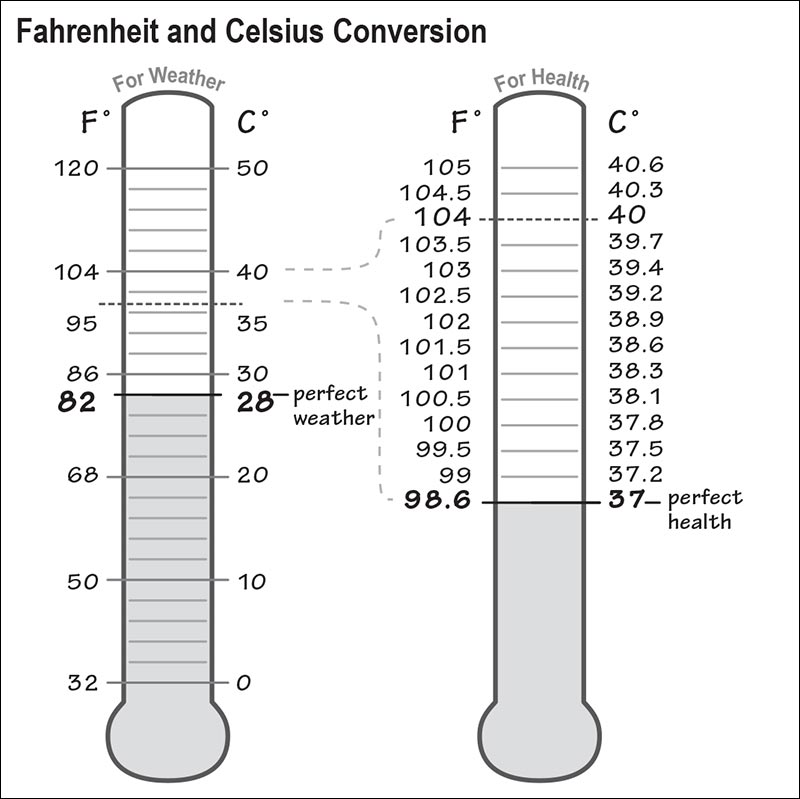
Europe takes its temperature using the Celsius scale, while we opt for Fahrenheit. For a rough conversion from Celsius to Fahrenheit, double the number and add 30. For weather, remember that 28°C is 82°F—perfect. For health, 37°C is just right. At a launderette, 30°C is cold, 40°C is warm (usually the default setting), 60°C is hot, and 95°C is boiling. Your air-conditioner should be set at about 20°C.
Whether you’re traveling for five days or five weeks, you won’t need more than this. Pack light to enjoy the sweet freedom of true mobility.
 5 shirts: long- & short-sleeve
2 pairs pants (or skirts/capris)
1 pair shorts
5 pairs underwear & socks
1 pair walking shoes
Sweater or warm layer
Rainproof jacket with hood
Tie, scarf, belt, and/or hat
Swimsuit
Sleepwear/loungewear
Debit card(s)
Credit card(s)
Hard cash (US $100-200)
Money belt
Passport
Other required ID: Vaccine card, entry visa, etc.
Driver’s license, student ID, hostel card, etc.
Tickets & confirmations: flights, hotels, trains, rail pass, car rental, sight entries
Photocopies of important documents
Insurance details
Guidebooks & maps
Mobile phone
Camera & related gear
Tablet/ebook reader/laptop
Headphones/earbuds
Chargers & batteries
Phone car charger & mount (or GPS device)
Plug adapters
Basics: soap, shampoo, toothbrush, toothpaste, floss, deodorant, sunscreen, brush/comb, etc.
Medicines & vitamins
First-aid kit
Glasses/contacts/sunglasses
Face masks & hand sanitizer
Sewing kit
Packet of tissues (for WC)
Earplugs
Day pack
Sealable plastic baggies
Laundry supplies: soap, laundry bag, clothesline, spot remover
Small umbrella
Travel alarm/watch
Notepad & pen
Journal
Second pair of shoes (flip-flops, sandals, tennis shoes, boots)
Travel hairdryer
Picnic supplies
Disinfecting wipes
Water bottle
Fold-up tote bag
Small flashlight
Mini binoculars
Small towel or washcloth
Inflatable pillow/neck rest
Tiny lock
Address list (to mail postcards)
Extra passport photos
Czech Survival Phrases
The emphasis in Czech words usually falls on the first syllable—but don’t overdo it, as this stress is subtle. A vowel with an accent (á, é, í, ú, ý) is held longer. The combination ch sounds like the guttural “kh” sound in the Scottish word “loch.” The uniquely Czech ř (as in Dvořák) sounds like a cross between a rolled “r” and “zh”; in the phonetics, it’s “zh.” Here are a few English words that all Czechs know: super, OK, pardon, stop, menu, problem, and no problem.
| Hello. (formal) | Dobrý den. doh-bree dehn |
| Hi. / Bye. (informal) | Ahoj. ah-hoy |
| Do you speak English? | Mluvíte anglicky? mloo-vee-teh ahn-glits-kee |
| Yes. / No. | Ano. / Ne. ah-noh / neh |
| I don’t understand. | Nerozumím. neh-roh-zoo-meem |
| Please / You’re welcome. / Can I help you? | Prosím. proh-seem |
| Thank you. | Děkuji. dyeh-kwee |
| Excuse me. / I’m sorry. | Promiňte. proh-meen-teh |
| Good. | Dobře. dohb-zheh |
| Goodbye. | Nashledanou. nah-skleh-dah-noh |
| one / two / three | jeden / dva / tři yay-dehn / dvah / tzhee |
| hundred / thousand | sto / tisíc stoh / tee-seets |
| How much? | Kolik? koh-leek |
| local currency | koruna (Kč) koh-roo-nah |
| Write it? | Napište to? nah-pish-teh toh |
| Is it free? | Je to zadarmo? yeh toh zah-dar-moh |
| Where can I buy / find…? | Kde mohu koupit / najít…? guh-deh moh-hoo koh-pit / nah-yeet |
| I’d like… (said by a man) | Rád bych… rahd bikh |
| I’d like… (said by a woman) | Ráda bych… rah-dah bikh |
| We’d like… | Rádi bychom… rah-dyee bee-khohm |
| …a room. | …pokoj. poh-koy |
| …a ticket to ____. | …jízdenka do ____. yeez-dehn-kah doh ____ |
| Where is…? | Kde je…? guh-deh yeh |
| …the train station | …nádraží nah-drah-zhee |
| …the bus station | …autobusové nádraží ow-toh-boo-soh-veh nah-drah-zhee |
| …the tourist information office | …turistická informační kancelář too-rih-stit-skah een-for-mahch-nee kahn-tseh-lahzh |
| …the toilet | …vécé veht-seh |
| men / women | muži / ženy moo-zhee / zheh-nee |
| left / right / straight | vlevo / vpravo / rovně vleh-voh / fprah-voh / rohv-nyeh |
| At what time…? | V kolik…? fkoh-leek |
| …does this open / close | …otevírají / zavírají oh-teh-vee-rah-yee / zah-vee-rah-yee |
| now / soon / later | teď / brzy / později tedge / bir-zih / pohz-dyeh-yee |
| today / tomorrow | dnes / zítra duh-nehs / zee-trah |
In a Czech Restaurant
| I’d like to reserve… (said by a man) | Rád bych zarezervoval… rahd bikh zah-reh-zehr-voh-vahl |
| I’d like to reserve… (said by a woman) | Ráda bych zarezervovala… rah-dah bikh zah-reh-zehr-voh-vah-lah |
| …a table for one / two. | …stůl pro jednoho / dva. stool proh yehd-noh-hoh / dvah |
| nonsmoking | nekuřácký neh-kuhzh-aht-skee |
| Is this table free? | Je tento stůl volný? yeh tehn-toh stool vohl-nee |
| Can I help you? | Mohu vám pomoci? moh-hoo vahm poh-moht-see |
| The menu (in English), please. | Jídelní lístek (v angličtině), prosím. yee-dehl-nee lee-stehk (fahn-gleech-tee-nyeh) proh-seem |
| Service is / isn’t included. | Spropitné je / není zahrnuto. sproh-pit-neh yeh / neh-nee zah-har-noo-toh |
| to go | s sebou seh-boh |
| with / and / or | s / a / nebo suh / ah / neh-boh |
| ready-to-eat meal | hotová jídla hoh-toh-vah yeed-lah |
| breakfast / lunch / dinner | snídaně / oběd / večeře snee-dahn-yeh / ohb-yeht / veh-cheh-sheh |
| appetizers | předkrmy pzhehd-krih-meh |
| bread / cheese / sandwich | chléb / sýr / sendvič khlehb / seer / sehnd-veech |
| soup / salad | polévka / salát poh-lehv-kah / sah-laht |
| meat / poultry / fish | maso / drůbež / ryby mah-soh / droo-behzh / rih-bih |
| fruit / vegetables | ovoce / zelenina oh-voht-seh / zeh-leh-nyee-nah |
| dessert | dezert deh-zehrt |
| (tap) water | voda (z kohoutku) voh-dah (skoh-hoht-koo) |
| mineral water | minerální voda mih-neh-rahl-nyee voh-dah |
| carbonated / not carbonated (spoken) | s bublinkami / bez bublinek sboob-leen-kah-mee / behz boo-blee-nehk |
| carbonated / not carbonated (printed) | perlivá / neperlivá pehr-lee-vah / neh-pehr-lee-vah |
| milk | mléko mleh-koh |
| (orange) juice | (pomerančový) džus (poh-mehr-ahn-choh-vee) “juice” |
| coffee / tea | káva / čaj kah-vah / chai |
| wine / beer | vino / pivo vee-noh / pee-voh |
| red / white | červené / bílé chehr-veh-neh / bee-leh |
| sweet / dry | sladké / suché slahd-keh / soo-kheh |
| glass / bottle | sklenka / lahev sklehn-kah / lah-hehv |
| light / dark | světlé / tmavé svyeht-leh / tmah-veh |
| Cheers! | Na zdraví! nah zdrah-vee |
| Enjoy your meal. | Dobrou chuť. doh-broh khoot |
| More. / Another. | Více. / Další. veet-seh / dahl-shee |
| The same. | To samé. toh sah-meh |
| The bill. | Účet. oo-cheht |
| I’ll pay. | Zaplatím. zah-plah-teem |
| tip | spropitné sproh-pit-neh |
| Delicious! | Výborné! vee-bohr-neh |