PRACTICALITIES
RESERVATIONS AND ADVANCE TICKETS
Map: Public Transportation in Central Europe
TAXIS AND RIDE-BOOKING SERVICES
Map: Driving in Central Europe
This chapter covers the practical skills of European travel: how to get tourist information, pay for things, sightsee efficiently, find good-value accommodations, eat affordably but well, use technology wisely, and get between destinations smoothly. For more information on these topics, see RickSteves.com/travel-tips.
Travel Tips
Travel Advisories: Before traveling, check updated health and safety conditions, including restrictions for your destination, at Travel.State.gov (US State Department travel pages) and CDC.gov (Centers for Disease Control and Prevention). The US embassy websites for each country are good sources of information (see later).
While most countries no longer require proof of Covid-19 vaccination for entry, some sights or tours may still have vaccination requirements (check websites). Even if it’s not required for your itinerary, it’s smart to pack a copy of your vaccine record and/or store a photo of your Covid-19 vaccine card on your phone.
ETIAS Registration: The European Union may soon require US and Canadian citizens to register online with the European Travel Information and Authorization System (ETIAS) before entering Schengen Zone countries (quick and easy process). For the latest, check https://travel-europe.europa.eu/etias_en.
Tourist Information: National tourist offices are a wealth of information (see websites below).
In Central Europe, a good first stop in every town is generally the tourist information office (abbreviated TI in this book). You’ll find local TIs are usually well organized and always have an English-speaking staff. While many TIs in Central Europe are still primarily government run—and therefore have the sole priority of helping you have a better trip—others are in cahoots with local, private tour operators, which tends to color their advice. I find TIs a great place to flip through brochures, pick up a free map, and ask basic questions. But I supplement what I learn there with advice from my hotel, other local contacts, and online sources. TIs also offer information on public transit (including bus and train schedules), walking tours, special events, and nightlife.
Czech Tourist Office: VisitCzechRepublic.com
Polish Tourist Office: Poland.travel
Hungarian Tourist Office: VisitHungary.com
Slovenian Tourist Office: Slovenia.info
Austrian Tourist Office: Austria.info
Slovakian Tourist Office: Slovakia.travel
Emergency and Medical Help: In all of the countries in this book, dial 112 for any emergency service—ambulance, police, or fire (operators typically speak English). If you get sick, do as the locals do and go to a pharmacist for advice. Or ask at your hotel for help—they’ll know the nearest medical and emergency services.
Theft or Loss: To replace a passport, you’ll need to go in person to the appropriate embassy or consulate (see next). If your credit and debit cards disappear, cancel and replace them (see “Damage Control for Lost Cards” on here). File a police report, either on the spot or within a day or two; you’ll need it to submit an insurance claim for lost or stolen items, and it can help with replacing your passport or credit and debit cards. For help with a lost phone, see “Damage Control for Lost Phones” on here. For more information, see RickSteves.com/help.
US Embassies and Consulates: For additional information, visit the US State Department’s website, Travel.State.gov. At any of these, it’s advisable to call ahead to ensure they’re open, and some may require an appointment.
Austria—Boltzmanngasse 16, Vienna, +43 1 313 390; consular services at Parkring 12a, Vienna; At.USEmbassy.gov.
Czech Republic—Tržiště 15, Prague, +420 257 022 000, Cz.USEmbassy.gov.
Hungary—Szabadság Tér 12, Budapest, +36 1 475 4400, Hu.USEmbassy.gov.
Poland—Aleje Ujazdowskie 29, Warsaw, +48 22 504 2000, Pl.USEmbassy.gov; also a US Consulate in Kraków at Ulica Stolarska 9, +48 12 424 5100, Pl.USEmbassy.gov/embassy-consulate/krakow.
Slovakia—Hviezdoslavovo Námestie 4, Bratislava, +421 2 5443 3338, Sk.USEmbassy.gov.
Slovenia—Prešernova 31, Ljubljana, +386 1 200 5500, Si.USEmbassy.gov.
Canadian Embassies and Consulates: For after-hours emergencies, Canadian citizens can call collect to the Foreign Services Office in Ottawa at +1 613 996 8885.
Austria—Laurenzerberg 2, Vienna, +43 1 531 383 000, Austria.gc.ca.
Czech Republic—Ve Struhách 95/2, Prague, +420 272 101 800, CzechRepublic.gc.ca.
Hungary—Ganz Utca 12, Budapest, +36 1 392 3360, Hungary.gc.ca; also provides services for Bosnia-Herzegovina and Slovenia.
Poland—Ulica Jana Matejki 1, Warsaw, Poland.gc.ca.
Slovakia—Mostová 2, Bratislava, +421 2 5920 4031, SlovakRepublic.gc.ca [URL inactive].
Slovenia (consulate office)—Linhartova Cesta 49a, Ljubljana; +386 1 252 4444, Slovenia.gc.ca [URL inactive]; some services provided through Canadian Embassy in Budapest, Hungary (listed above).
Borders: All of the core countries in this book have officially joined the open-borders Schengen Agreement. That means that there are no border checks between any of these countries, or between them and Western European countries such as Germany, Austria, and Italy. You’ll usually zip through the border without stopping, though in a few cases, you may need to stop briefly to flash a passport.
Non-Schengen countries (including Bosnia-Herzegovina, Montenegro, Bulgaria, and Romania) still have traditional border checkpoints—you’ll have to stop upon entering or exiting these countries. But whether traveling by car, train, or bus, you’ll find that border crossings are generally a nonevent: Flash your passport, maybe wait a few minutes, and move on. Drivers may be asked to show proof of car insurance (“green card”), so be sure you have this when you pick up your rental car.
Time Zones: Most of the countries listed in this book are generally six/nine hours ahead of the East/West Coasts of the US. (Bulgaria and Romania are one hour ahead of the rest of these countries—that’s seven/ten hours ahead of the East/West Coasts.) The exceptions are the beginning and end of Daylight Saving Time: Europe “springs forward” the last Sunday in March (two weeks after most of North America), and “falls back” the last Sunday in October (one week before North America). For a handy time converter, use the world clock app on your phone or download one (see www.timeanddate.com).
Weekends: Saturdays are virtually weekdays, but with earlier closing hours and no rush hour (though transportation connections can be less frequent than on weekdays). Sundays have the same pros and cons as they do for travelers in the US (special events, limited hours, banks and many shops generally closed, limited public-transportation options, no rush hour).
Watt’s Up? Europe’s electrical system is 220 volts, instead of North America’s 110 volts. Most electronics (laptops, phones, cameras) and appliances (hair dryers, CPAP machines) convert automatically, so you won’t need a converter, but you will need an adapter plug with two round prongs, sold inexpensively at travel stores in the US.
Rip up this book! Turn chapters into mini guidebooks: Break the book’s spine and use a utility knife to slice apart chapters, keeping gummy edges intact. Reinforce the chapter spines with clear wide tape, use a heavy-duty stapler, or make or buy a cheap cover (see the Travel Store at RickSteves.com), swapping out chapters as you travel.
Discounts: Discounts for sights are generally not listed in this book. However, seniors (age 65 and over), youths under 18, and students and teachers with proper identification cards (obtain from www.isic.org) can get discounts at many sights—always ask. Some discounts are available only to European citizens.
LGBTQ+ travelers may wonder whether they should travel in Central Europe—and specifically in countries (such as Hungary and Poland) that have been in the news for their anti-LGBTQ+ policies. Here are some factors to consider.
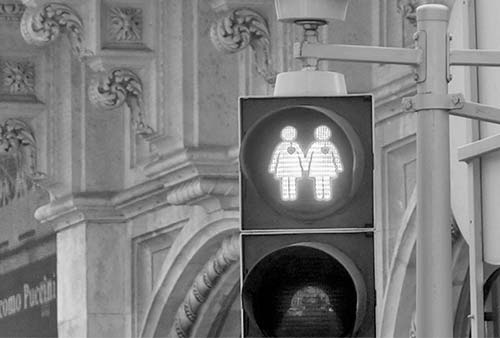
First, all countries in Central Europe are not alike. ILGA, a gay rights advocacy NGO, ranks European countries on how LGBTQ+-friendly they are (www.ilga-europe.org). Slovenia and Austria are in the middle of the pack; the Czech Republic and Slovakia still have antiquated policies but are working toward greater acceptance. Broadly speaking, these are progressive societies where LGBTQ+ rights are trending toward parity with much of the US and Western Europe. Poland and Hungary rank near the bottom on a European scale, for different reasons. (Equaldex.com is another useful resource offering country-by-country policy and public-opinion insights.)
Poland is devoutly Catholic, and religion is often entangled with politics and policy—which causes it to skew more conservative than the European norm. This makes Poland a challenging place to be gay or trans. Large cities—especially certain neighborhoods—can be more hospitable, offering venues where anyone can live more openly. But in broader society, LGBTQ+ people are largely invisible, and public displays of affection are rare; “don’t ask, don’t tell” is the status quo.
Poland has no legal recognition of same-sex partnerships, and the constitution defines marriage as between a man and a woman. The ruling Law and Justice party (PiS) has often blocked pro-LGBTQ+ legislation. In 2019, after Warsaw’s mayor signed a declaration of LGBTQ+ rights, PiS officials in several conservative areas declared “LGBT-free zones”—a political stunt that LGBTQ+ Poles and their allies found threatening and discriminatory.
But there are some signs of progress. Warsaw has hosted an “Equality Parade” each summer since 2001. Robert Biedroń, a popular and well-respected Polish politician, is openly gay and in a same-sex marriage (conducted abroad). And other contemporary Poles—writers, artists, and people of culture—are vocal in sharing their experiences of being LGBTQ+ in Poland.
Hungary has also become known for its anti-LGBTQ+ politics. In 2020, Prime Minister Viktor Orbán’s government withdrew legal recognition of transgender people. In 2021, Orbán’s party enacted a law “taking more severe action against pedophile offenders”—offensively conflating LGBTQ+ people with pedophiles. In a broader application of Florida’s “Don’t Say Gay” bill, the Hungarian law bans public expression of non-heteronormative content in schools, or in any media aimed at people under 18, ostensibly for the “protection of children.” These policies have sparked outrage and condemnation from many European countries, as well as the European Commission and the United States. US ambassador David Pressman, himself in a same-sex marriage, reports that many of his Hungarian counterparts have become overly preoccupied with this new anti-LGBTQ+ agenda.
And what about the Hungarian on the street? Especially in cosmopolitan Budapest, you’ll find a greater acceptance of LGBTQ+ people. Unlike Poland, Hungary recognizes legal same-sex partnerships—though not marriages. But more conservative Hungarians—especially outside of urban centers—have been stoked by Orbán’s anti-LGBTQ+ talking points and may express more disapproval, even hostility, toward what they consider a threat to their “Christian traditions.”
In both Poland and Hungary, you’ll encounter a wide diversity of beliefs and attitudes. Just as in some parts of the US, even as the political pendulum has swung against LGBTQ+ rights, there are still many locals who find that trend abhorrent. Ultimately, two questions face LGBTQ+ travelers who are considering a trip to Poland or Hungary: Is it safe to visit? And should you visit a place that doesn’t respect who you are?
On the first question, LGBTQ+ travelers have told me that—especially if they can pass as straight and cisgender—they have felt largely safe visiting these places. Big, progressive cities (like Budapest or Warsaw), and especially certain neighborhoods, may not feel different from other parts of Europe or the US. But in smaller towns and more conservative areas, public displays of affection between LGBTQ+ people could attract unwanted attention, occasional insensitive remarks, and potentially (though rarely) threats or violence. In these places, keeping a low profile is—unfortunately—probably the most prudent approach.
As for the second question: That’s a decision for each traveler—whether LGBTQ+ or an ally—to decide personally. If you simply can’t stomach the idea of traveling to a place that doesn’t honor LGBTQ+ rights, I certainly wouldn’t blame you for going elsewhere.
That said, some travelers see value in the transformative potential of people-to-people interactions. When you travel, you meet new friends from every walk of life and exchange perspectives. When we get to know each other, it becomes more difficult to dehumanize and demonize one another. And you can travel intentionally, spending money in a way that supports local LGBTQ+ people and their allies.
Online Translation Tip: The Google Translate app converts spoken or typed English into most European languages (and vice versa) and can also translate text it “reads” with your phone’s camera. Google’s Chrome browser instantly translates websites; Translate.google.com and DeepL.com are also handy.
Going Green: There’s plenty you can do to reduce your environmental footprint when traveling. When practical, take a train instead of a flight within Europe, and use public transportation within cities. In hotels, use the “Do Not Disturb” sign to avoid daily linen and towel changes (or hang up your towels to signal you’ll reuse them). Bring a reusable shopping tote and refillable water bottle (Europe’s tap water is safe to drink). Skip printed materials that you don’t plan to keep—get your info online instead. To find out how Rick Steves’ Europe is offsetting carbon emissions with a self-imposed carbon tax, see RickSteves.com/about-us/climate-smart.
Money
Here’s my basic strategy for using money wisely in Europe. I pack the following and keep it all safe in my money belt.
Credit Card: You’ll use your credit card for purchases both big (hotels, advance tickets) and small (little shops, food stands). Some European businesses have gone cashless, making a card your only payment option. A “tap-to-pay” or “contactless” card is widely accepted and simple to use.
Debit Card: Use this at ATMs to withdraw a small amount of local cash. Wait until you arrive to get local currency (European airports have plenty of ATMs); if you buy foreign currency before your trip, you’ll pay bad stateside exchange rates. While many transactions are by card these days, cash can help you out of a jam if your card randomly doesn’t work and can be useful to pay for things like tips and local guides.
Backup Card: Some travelers carry a third card (debit or credit; ideally from a different bank) in case one gets lost or simply doesn’t work.
Stash of Cash: I carry $100-200 in US dollars as a cash backup, which comes in handy in an emergency (for example, if your debit card gets eaten by the machine).
EXCHANGE RATES
Most of the countries in this book still use their traditional currencies. Only the ones listed below use the euro—and the others are unlikely to adopt it anytime soon. But even in countries that don’t officially use the euro, many businesses (especially hotels) quote prices in euros anyway.
Here are the rough exchange rates for each country. I’ve also suggested a strategy for roughly converting prices into US dollars. Note that in some cases, I’ve favored easier-to-remember equations even if they offer less-precise conversions. For a more precise conversion, use the online tool at Oanda.com.
1 euro (€) = about $1.10 (used in Slovenia, Austria, Slovakia, and Croatia, and unofficially elsewhere). To convert prices in euros to dollars, add about 10 percent: €20 = about $22, €50 = about $55. Like the dollar, one euro (€) is broken into 100 cents. Coins range from €0.01 to €2, and bills from €5 to €200.
20 Czech crowns (koruna, Kč) = about $1. To roughly convert prices in crowns to dollars, divide by 2 and drop the last digit. So that tasty lunch for 160 Kč is about $8.
4 Polish złoty (zł, or PLN) = about $1. To calculate prices in dollars, divide by four: 80 zł = about $20.
350 Hungarian forints (Ft, or HUF) = about $1. To very roughly figure dollars, divide by three and drop the last two digits: 1,000 Ft = about $3.
So, that 20 zł Polish woodcarving is about $5, the 5,000 Ft Hungarian dinner is about $16, and the 2,000 Kč taxi ride through Prague is...uh-oh.
BEFORE YOU GO
Know your cards. For credit cards, Visa and Mastercard are universal, while American Express and Discover are less common. US debit cards with a Visa or Mastercard logo will work in any European ATM.
Go “contactless.” Contactless pay options are now standard in much of Europe. Check to see if you already have—or can get—a tap-to-pay version of your credit card (look on the card for the tap-to-pay symbol—four curvy lines) and consider setting up your smartphone for contactless payment (see next section for details). Both options are more secure than a physical credit card: Instead of recording your credit-card number, a one-time encrypted “token” enables the purchase and expires shortly afterward.
Know your PIN. Make sure you know the numeric four-digit PIN for each of your cards, both debit and credit. Request it if you don’t have one, as it may be required for some purchases. Allow time to receive the information by mail—it’s not always possible to obtain your PIN online or by phone.
Report your travel dates. Some banks want to know that you’ll be using your debit and credit cards overseas, specifically when and where you’re headed. Depending on your bank, you can do this either online or over the phone.
Adjust your ATM withdrawal limit. Find out how much you can withdraw daily and ask for a higher daily limit if you want to get more cash at once. Note that European ATMs will withdraw funds only from checking accounts, not savings accounts.
Find out about fees. For any purchase or withdrawal made with a card, you may be charged a currency conversion fee (1-3 percent) and/or a Visa or Mastercard international transaction fee (less than 1 percent). Shop around; you can compare credit cards on Bankrate.com. Some cards offer lower international fees than others—and some don’t charge any at all. If you’re getting a bad deal, consider getting a new card. Most credit unions and some airline loyalty cards have low or no international transaction fees.
IN EUROPE
Using Credit Cards and Payment Apps
Tap-to-Pay or Contactless Cards: These cards have the usual chip and/or magnetic stripe, but with the addition of a contactless symbol. Simply tap your card against a contactless reader to complete a transaction—no PIN or signature required (except in some cases as a security measure for larger purchases). This is by far the easiest way to pay and is available in much of Europe.

Payment Apps: Just like at home, you can pay with your smartphone or smartwatch by linking a credit card to an app such as Apple Pay or Google Pay. To pay, hold your phone near a contactless reader; you may need to verify the transaction with a face scan, fingerprint scan, or passcode. If you’ve arrived in Europe without a tap-to-pay card, you can easily set up your phone to work in this way.
Will My US Card Work? Usually, yes. On rare occasions, you may run into a situation where your card doesn’t work. This is most likely at self-service payment machines (such as transit-ticket kiosks, tollbooths, or fuel pumps). Usually a tap-to-pay card does the trick in these situations. If not, look for a cashier who can process your payment manually, or use cash. Drivers should be prepared to move on to the next gas station if necessary. (In some countries, gas stations sell prepaid gas cards, which you can purchase with any US card). When approaching a toll plaza or ferry ticket line, use the “cash” lane.
Always Choose to Pay in the Local Currency: When making a credit-card transaction, the payment terminal will often ask whether you want to pay in US dollars or in the local currency. Always refuse the conversion and choose the local currency. While this “service”—called Dynamic Currency Conversion (DCC)—offers the illusion of convenience, it comes with a poor exchange rate and/or higher fees, and you’ll wind up losing money.
Using Cash
Cash Machines: European cash machines work just like they do at home—except they spit out local currency instead of dollars. In Europe, the universal term for an ATM is “bankomat.”
There are two broad categories of cash machines. The best choice are ones operated by a bank, which offer local cash calculated at the day’s standard bank-to-bank rate. Look for a cash machine marked with a bank logo, and ideally use one just outside a brick-and-mortar bank (in the rare event that you have any issues).
The other type are cash machines run by exchange or money-transfer companies, which have unfavorable rates, higher fees, or both. These can be marked Euronet, Travelex, Your Cash, and Cashzone—and often they’re simply marked generically, as “bankomat” or “ATM,” with no other identification. Avoid these unless you enjoy paying too much for your local cash.
Unfortunately, these rip-off exchange ATMs are often the only option at airports and train stations. On arrival, consider finding a cashless way to get downtown, then find a real bank near your hotel to withdraw local currency.
If your debit card doesn’t work, try a lower amount—your request may have exceeded your withdrawal limit or the ATM’s limit. If you still have a problem, try a different ATM or come back later.
Remember: If the ATM offers to let you convert your withdrawal to US dollars, choose the local currency for the best rates.
Exchanging Cash: Minimize exchanging money in Europe; it’s expensive (you’ll generally lose 5 to 10 percent). But because the countries in this region have different currencies, you may wind up with leftover cash. Coins can’t be exchanged once you leave the country, so spend them before you cross the border. Bills are easy to convert to your next country’s currency at exchange booths, but remember that regular banks have the best rates for the conversion.
Security Tips
Pickpockets target tourists. Keep your backup cash, credit cards, and passport secure in your money belt, and carry only a day’s spending money and one card in your front pocket or wallet.
Before inserting your card into an ATM, inspect the front of the machine. If anything looks crooked, loose, or damaged, it could be a sign of a card-skimming device. When entering your PIN, carefully block other people’s view of the keypad.
Avoid using a debit card for purchases. Because a debit card pulls funds directly from your bank account, potential charges incurred by a thief will stay on your account while your bank investigates.
To access your accounts online while traveling, be sure to use a secure connection (see the “Tips on Internet Security” sidebar, later).
Damage Control for Lost Cards
If you lose your credit or debit card, report the loss immediately to your bank (using a secure app) or the following global customer-assistance centers. With a mobile phone, call these 24-hour US numbers: Visa (+1 303 967 1096), Mastercard (+1 636 722 7111), and American Express (+1 336 393 1111).
You’ll need to provide the primary cardholder’s identification-verification details (such as birth date, mother’s maiden name, or Social Security number). You can generally receive a temporary card within two or three business days in Europe (see RickSteves.com/help for more).
If you report your loss within two days, you typically won’t be responsible for unauthorized transactions on your account, although many banks charge a liability fee.
TIPPING
Tipping in Europe isn’t as automatic and generous as it is in the US. For special service, tips are appreciated, but not expected. As in the US, the proper amount depends on your resources, tipping philosophy, and the circumstances, but some general guidelines apply.
Restaurants: At sit-down eateries, tip a small amount by rounding up the bill 5-10 percent. In a few cities (like Prague and Budapest), a service charge may be automatically added to your bill; look for this carefully to avoid double-tipping. If paying with a credit card, be prepared to tip separately with cash or coins; credit card receipts don’t have a tip line. For details on tipping in restaurants, see here.
Taxis: For a typical ride, round up your fare a bit (for instance, if the fare is €42, pay €45). If the cabbie hauls your bags and zips you to the airport to help you catch your flight, you might want to toss in a little more.
Services: For local guides, private drivers, or others who spend several hours with you and significantly improve the quality of your trip, a healthy tip (of around 10 percent) is not extravagant. In general, if someone in the tourism or service industry does a good job for you, a small tip (the equivalent of a euro or two) is appropriate...but not required. If you’re not sure whether (or how much) to tip, ask a local for advice.
To be eligible to get a VAT refund, you usually need to spend the listed minimum at a single store.
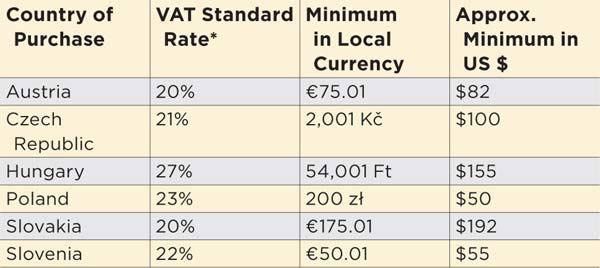
*VAT rates fluctuate based on many factors, including what kind of item you are buying. Your refund will likely be less than the rate listed above, especially if it’s subject to processing fees.
GETTING A VAT REFUND
Wrapped into the purchase price of your Central European souvenirs is a value-added tax (VAT) that varies per country—see the sidebar for specific rates. You’re entitled to get most of that tax back if you make a purchase of more than a set amount at a store that participates in the VAT refund scheme. Typically, you must ring up the minimum at a single retailer—you can’t add up your purchases from various shops to reach the required amount. (If the store ships the goods to your US home, VAT is not assessed on your purchase.)
Getting your refund is straightforward...and worthwhile if you spend a significant amount.
At the Merchant: Have the merchant completely fill out the refund document (they’ll ask for your passport; a photo of your passport usually works). Keep track of the paperwork and your original sales receipt. Note that you’re not supposed to use your purchased goods before you leave Europe.
At the Border or Airport: Process your VAT document with the customs agent who deals with VAT refunds at your last stop in the country in which you made your purchase (or, if you bought it in the European Union, at your last stop in the EU; allow plenty of extra time to deal with this process and have your purchased items easily accessible for inspection). At some airports, you’ll go to a customs office to get your documents stamped and then to a separate VAT refund service (such as Global Blue or Planet) to process the refund. Elsewhere, a single VAT desk handles the whole thing, or you may be able to do it at a self-validation kiosk. (Note that refund services typically extract a 4 percent fee, but you’re paying for the convenience of receiving your money in cash immediately or as a credit to your card.) Otherwise, you’ll need to mail the stamped refund documents to the address given by the merchant.
CUSTOMS FOR AMERICAN SHOPPERS
You can take home $800 worth of items per person duty-free, once every 31 days. Many processed and packaged foods are allowed, including cheeses, dried herbs, jams, baked goods, candy, chocolate, oil, vinegar, condiments, and honey. Fresh fruits and vegetables and most meats are not allowed, with exceptions for some canned items. As for alcohol, you can bring in one liter duty-free (it can be packed securely in your checked luggage, along with any other liquid-containing items).
To bring alcohol (or liquid-packed foods) in your carry-on bag on your flight home, buy it at a duty-free shop at the airport. You’ll increase your odds of getting it onto a connecting flight if it’s packaged in a “STEB”—a secure, tamper-evident bag. But stay away from liquids in opaque, ceramic, or metallic containers, which usually cannot be successfully screened (STEB or no STEB).
For details on allowable goods, customs rules, and duty rates, visit Help.cbp.gov.
Sightseeing
Central Europe offers high-quality, affordable sightseeing. Galleries proudly show off local artists that you may not be familiar with: Prague’s Alphonse Mucha, Poland’s Stanisław Wyspiański, Hungary’s Tivadar Csontváry Kosztka, Croatia’s Ivan Meštrović, and Bulgaria’s Zlatyu Boyadzhiev are just some of the names that will have you wondering why your art history classes left out this part of Europe. Another Central European specialty is historical museums; often newly opened, these generally do a thoughtful and stirring job of telling the story of a particular time and place: Warsaw’s Museum of the History of Polish Jews, Budapest’s House of Terror, Gdańsk’s European Solidarity Center, and so on. And sumptuous interiors—like Budapest’s Parliament or Opera House, or Warsaw’s Royal Palace—evoke the grandeur of an illustrious history.
Sightseeing can be hard work. Use these tips to make your visits to Central Europe’s finest sights meaningful, fun, efficient, and painless.
MAPS AND NAVIGATION TOOLS
Your best navigation tool is on your phone. Google Maps (and similar mapping apps) offer turn-by-turn directions for walking and driving, as well as detailed public transit instructions in most big cities. Simply plug in a destination and instantly get detailed directions for reaching it on foot or by subway, bus, or tram—including where to catch it, how long it takes, where to get off, and how far you’ll walk at the other end.
To conserve data, most mapping apps let you download maps in advance (do this when you’re on strong Wi-Fi). However, offline maps may not include every feature (most in-city public transit navigation doesn’t work offline). For more on how to get online with your phone during your trip, see here.
For offline navigation, the maps in this book are concise and simple, designed to help you locate recommended destinations, sights, hotels, and restaurants. In Europe, simple paper maps are generally free at TIs and hotels; maps with more detail are sold at newsstands and bookstores.
PLAN AHEAD
Set up an itinerary that allows you to fit in all your must-see sights. For a one-stop look at opening hours, see this book’s “At a Glance” sidebars for major cities (Prague, Kraków, Warsaw, Budapest, Ljubljana, and Vienna).
Don’t put off visiting a must-see sight—you never know when a place will close unexpectedly for a holiday, strike, or restoration. Opening days and hours can fluctuate; confirm the latest with the TI or at the sight’s official website (listed throughout this book).
Many museums are closed or have reduced hours at least a few days a year, especially on holidays such as Christmas, New Year’s, and Labor Day (May 1). A list of holidays is in the appendix; check for possible closures during your trip. In summer, some sights may stay open late. Off-season hours may be shorter.
Going at the right time helps avoid crowds. This book offers tips on the best times to see specific sights. Try visiting popular sights very early or very late. Evening visits (when possible) are usually more peaceful, with fewer crowds. Late morning is usually the worst time to visit a popular sight.
If you plan to hire a local guide, reserve ahead by email. Popular guides can get booked up.
Study up. To get the most out of the sight descriptions in this book, read them before you visit. Note: To avoid redundancy, many cultural or historical details are explained for one sight in this book and not repeated for another; to get the full picture, read the entire chapter for each destination you’ll visit.
RESERVATIONS AND ADVANCE TICKETS
Many popular sights come with long ticket-buying lines. Visitors who buy tickets online in advance (or who have a museum pass covering key sights) can skip the line and waltz right in. Advance tickets are generally timed-entry, meaning you’re guaranteed admission on a certain date and time.
For some sights, buying ahead is required (tickets aren’t sold at the sight and it’s the only way to get in). At other sights, buying ahead is recommended to skip the line and save time. And for many sights, advance tickets are available but unnecessary: At these uncrowded sights you can simply arrive, buy a ticket, and go in.
Don’t confuse the reservation options: available, recommended, and required. Use my advice in this book as a guide. Note any must-see sights that sell out long in advance and be prepared to buy tickets early. If you do your research, you’ll know the smart strategy.
Given how precious your vacation time is, I’d book in advance both where it’s required (as soon as your dates are firm) and where it will save time in a long line (in some cases, you can do this even on the day you plan to visit). You’ll definitely want to book well in advance for Auschwitz-Birkenau, the Oskar Schindler Factory Museum in Kraków, and the Hungarian Parliament in Budapest. In Vienna, reserve a day or two ahead for Schönbrunn Palace.
You’ll generally be emailed a digital ticket with a code that you’ll store on your phone to scan at the entrance (if you prefer, you can print it out). At the sight, look for the ticket-holders line rather than the ticket-buying line; you may still have to wait in a security line.
Sightseeing Passes: Some cities offer sightseeing passes that include free or discounted admission to several sights. Do the math to determine if a sightseeing pass makes sense for your visit. Even with a sightseeing pass, you’ll often still need to make reservations for the most popular sights.
AT SIGHTS
Here’s what you can typically expect:
Entering: You may not be allowed to enter if you arrive too close to closing time. And guards start ushering people out well before the actual closing time, so don’t save the best for last.
Some sights have a security check. Allow extra time for these lines. Many sights require you to check day packs and coats. (If you’d rather not check your day pack, try carrying it tucked under your arm as you enter.)
Photography: If the museum’s photo policy isn’t clearly posted, ask a guard. Generally, taking photos without a flash or tripod is allowed. Some sights ban selfie sticks; others ban photos altogether.
Audioguides and Apps: I’ve produced free, downloadable audio tours for my Prague City Walk, Vienna City Walk, Vienna’s St. Stephen’s Cathedral, and Vienna’s Ringstrasse Tram Tour; look for the  in this book. For more on my audio tours, see here.
For the millions of North Americans who have Polish, Czech, Hungarian, Slovenian, or other Central European roots, walking in the footsteps of your ancestors can be an unforgettable experience. One of this book’s co-authors has done just that, and managed to reconnect with living relatives in rural Polish villages outside Kraków. While not everyone gets that lucky, here are some pointers to increase your odds of success:
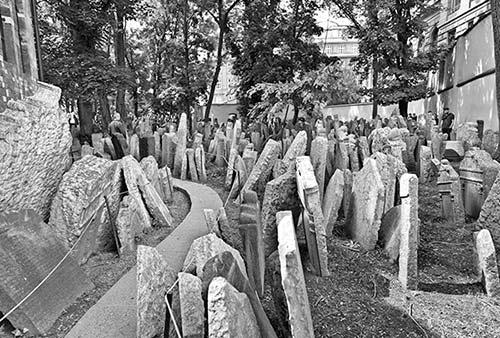
Do your homework. Don’t just head to Europe with a faint recollection of an ancestral village name and expect to stumble into a long-lost relation. Dig through documents, family bibles, old photos, and other heirlooms to track down any details.
Gather key information. Most helpful are the name of the city, town, or village; full first and last names of ancestors (be aware the spelling, or even the entire name, may have changed upon emigration); and any dates you can find for birth, baptism, marriage, emigration, or death.
Check online resources. Start with the free, comprehensive FamilySearch.org (operated by the LDS Church). Ancestry.com is popular but pricey; try it for free at a library before investing in a subscription. Also check US government resources such as Archives.gov and EllisIsland.org [URL inactive]. Find out if there are any local genealogical societies in your community. Facebook groups can also be helpful.
Understand the history and geography. Most locations in Central Europe have not been part of the same country throughout history. You may have been told that your ancestors were born in Hungary, only to discover that your ancestral village is now in Romania or Slovakia. You may think you’re Czech but find out your ancestors spoke German—or vice versa. Emigration records often noted “Austrian” as a catchall that could include Poles, Hungarians, Slovaks, Croats, or Jews.
This is why it’s critical to pinpoint the location of your ancestral village, town, or city—realizing that it may have a different name today (for instance, “Breslau” became “Wrocław” after World War II). Then, read up on that town to understand the political and linguistic reality when your ancestors lived there.
Here’s a case study: During the Partitions (1795-1918), the territory of Poland was divided among three neighboring powers. The German, Russian, and Austrian sectors managed their recordkeeping differently. In the Austrian and German zones, most records are in Latin, following a standardized column format. The Russian zone can be trickier; records are often flowery narrative passages, and can be handwritten in Cyrillic.
Track down the appropriate church to look for records or gravestones. Even if you find it, it may just be a starting point. Many churches were supposed to send vital records to the state archives during the 1950s; it varies whether these records can still be found at the church, elsewhere, or not at all. Also be aware that in many European cemeteries, graves are not owned in perpetuity; after a family stops paying for the plot, it may be dug up and reused by a new leaseholder.
Consider enlisting professional assistance. Some travelers enjoy the experience of doing their own homework; others are more results-focused and happy to pay a professional. Genealogy research organizations on both sides of the Atlantic can help; I recommend some in this book. For example, Prague-based Tom and Marie Zahn have been helping my readers track their Czech roots for decades (www.pathfinders.cz). Getting outside help is especially worthwhile for those with Jewish roots, whose records and cemeteries are more likely to have been wiped out during the Holocaust. A good general site is JewishGen.org. For those with Hungarian Jewish ancestry, check out Milev.hu; for Polish Jews, try JRI-Poland.org.
Hire a local guide/driver/translator. Especially if your ancestors came from a small town rather than a city, hiring someone who can drive you straight there saves time and frustration. With sufficient planning, your guide may be able to contact local authorities and have other leads lined up. Most important, if you do track down living relatives, you can’t assume they speak English. I can’t overstate the importance of having a friendly and fluent local helper to provide an introduction, to ease the shock of being visited by a long-lost cousin from America, and to translate the conversation. Local guides or drivers listed throughout this book are often happy to help with this task.
Prepare for surprises...and, maybe, disappointment. There’s no guarantee that your search will turn up any conclusive connections. If you have some luck, you may find yourself on a pensive stroll through a gloomy cemetery, past moss-covered headstones bearing your family name. But consider the possibility that you’ll meet some distant relatives. Brainstorm portable, replaceable items you might bring along that could be meaningful (perhaps copies of family photos they may not have seen).
Regardless of how “successful” your search turns out to be, simply carrying out that search—and setting foot in the place where generations of your ancestors spent their lives—can be an incredibly powerful experience. Good luck!
Some sights offer audioguides with dull recorded descriptions in English. Often you’ll use free Wi-Fi to download the tour to your mobile device on the spot; less frequently, you’ll borrow or rent a device preloaded with the audio content at the museum. Bring your own plug-in earbuds to enjoy better sound (with a splitter, two can often share one rented device).
Expect Changes: Artwork can be on tour, on loan, out sick, or shifted at the whim of the curator. Pick up a floor plan as you enter and ask museum staff if you can’t find a particular item.
Services: Important sights usually have a reasonably priced on-site café or cafeteria (handy and air-conditioned places to rejuvenate during a long visit). The WCs at sights are free and generally clean.
Before Leaving: At the gift shop, scan the postcard rack or thumb through a guidebook to be sure you haven’t overlooked something that you’d like to see. Every sight or museum offers more than what is covered in this book. Use the information I provide as an introduction—not the final word.
Sleeping
Extensive and opinionated listings of good-value rooms are a major feature of this book’s Sleeping sections. Rather than list accommodations scattered throughout a town, I choose hotels in my favorite neighborhoods that are convenient to your sightseeing.
My recommendations run the gamut, from dorm beds to luxurious rooms with all the comforts. I like places that are clean, central, relatively quiet at night, reasonably priced, friendly, small enough to have a hands-on owner or manager, and run with a respect for local traditions. I’m more impressed by a handy location and fun-loving philosophy than oversized TVs and a fancy gym. Most of my recommendations fall short of perfection. But if I can find a place with most of these features, it’s a keeper.
Book your accommodations as soon as your itinerary is set, especially if you want to stay at one of my top listings or if you’ll be traveling during busy times. For certain popular destinations, I’ve also noted times of year when accommodations are likely to book up fast. Also see the appendix for a list of major holidays and festivals in Central Europe.
Some people make reservations a few days ahead as they travel. This approach fosters spontaneity, and booking sites make it easy to find available rooms, but—especially during busy times—you run the risk of settling for lesser-value accommodations.
Hotels in this book are categorized according to the average price of a standard double room with breakfast in high season.
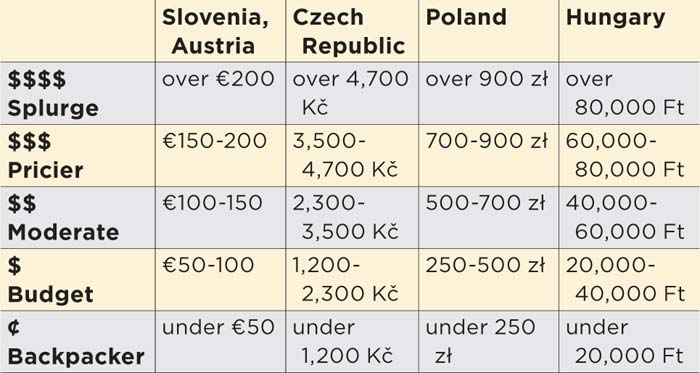
Unless otherwise noted, credit cards are accepted and hotel staff speak basic English. Comparison-shop by checking prices at several hotels (on each hotel’s own website, on a booking site, or by email). For the best deal, book directly with the hotel. Ask for a discount if paying in cash; if the listing includes RS%, request a Rick Steves discount.
RATES AND DEALS
I’ve categorized my recommended accommodations based on price, indicated with a dollar-sign rating (see sidebar). Room prices can fluctuate significantly with demand and amenities (size, views, and so on), but relative price categories remain constant. City taxes, which can vary from place to place, are generally insignificant (a few dollars per person, per night).
Some accommodations quote their rates in euros, while others use the local currency.
Booking Direct: Once your dates are set, compare prices at several hotels. You can do this by checking hotel websites and booking sites such as Hotels.com or Booking.com. After you’ve zeroed in on your choice, book directly with the hotel itself by phone, by email, or on the hotel’s website. This increases the chances that the hotelier will be able to accommodate special needs or requests (such as shifting your reservation). When you book direct, the owner avoids the commission paid to booking sites—in exchange, ask if they can give you a discount, a nicer room, or a free breakfast (if it’s not already included).
Getting a Discount: Some hotels extend a discount to those who pay cash or stay longer than three nights. And some accommodations offer a special discount for Rick Steves readers, indicated in this guidebook by the abbreviation “RS%.” Discounts vary: Ask for details when you reserve. Generally, to qualify for this discount, you must book direct (not through a booking site), mention this book when you reserve, show this book upon arrival, and sometimes pay cash or stay a certain number of nights. In some cases, you may need to enter a discount code (which I’ve provided in the listing) in the booking form on the hotel’s website. Rick Steves discounts apply to readers with either print or digital books. Understandably, discounts do not apply to promotional rates.
TYPES OF ACCOMMODATIONS
Hotels
In Central Europe, you can choose from a delightful variety of stylish and charming hotels and guesthouses. And rates are reasonable; you can find a central, straightforward-but-comfortable double for $100 just about anywhere. Plan on spending $100-150 per double in big cities, and $70-100 in smaller towns. You can uncover some bargains, but I think it’s worth paying a little more for comfort and a good location.
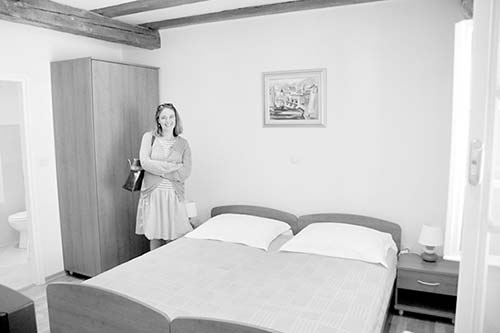
Some hotels can add an extra bed (for a small charge) to turn a double into a triple; some offer larger rooms for four or more people (I call these “family rooms” in the listings). In general, a triple room is cheaper than the cost of a double and a single. Three or four people can economize by requesting one big room.
Arrival and Check-In: Hotels and B&Bs are sometimes located on the higher floors of a multipurpose building with a secured door. In that case, look for your hotel’s name on the buttons by the main entrance. When you ring the bell, you’ll be buzzed in.
Hotel elevators are common, though small, and some older buildings still lack them. If stairs are unavoidable, you can ask the front desk for help carrying your bags up.
Most European countries require hotels to collect your name, nationality, and passport number. At check-in, the receptionist might ask for your passport and may keep it for several hours. If you’re not comfortable leaving your passport at the desk, bring a copy to give them instead.
If you’re arriving in the morning, your room probably won’t be ready. Check your bag safely at the hotel and dive right into sightseeing.
In Your Room: Most hotel rooms have a TV and free Wi-Fi, which can vary in strength and quality. Simpler places rarely have a room phone.
Breakfast and Meals: Breakfast, almost always served buffet-style, usually includes rolls, cold cuts, cheese, cereal, yogurt, fruit, coffee, milk, and juice; many places also provide eggs, either hard-boiled or scrambled.
Checking Out: While it’s customary to pay for your room upon departure, it can be a good idea to settle your bill the day before, when you’re not in a hurry and while the manager’s in.
Hotelier Help: Hoteliers can be a good source of advice. Most know their city well and can assist you with everything from public transit and airport connections to finding a good restaurant, the nearest launderette, or a late-night pharmacy.
Hotel Hassles: Even at the best places, mechanical breakdowns occur: Sinks leak, hot water turns cold, toilets may gurgle or smell, the Wi-Fi goes out, or the air-conditioning dies when you need it most. Report your concerns clearly and calmly at the front desk.
If you find that night noise is a problem (if, for instance, your room is over a nightclub or facing a busy street), ask for a quieter room in the back or on an upper floor. To guard against theft in your room, keep valuables out of sight. Some rooms come with a safe, and other hotels have safes at the front desk. I rarely bother to use one and in a lifetime of travel, I’ve never had anything stolen from my room.
For more complicated problems, don’t expect instant results. Above all, keep a positive attitude. Remember, you’re on vacation. If your hotel is a disappointment, spend more time out enjoying the place you came to see.
Rooms in Private Homes
Private accommodations offer travelers a characteristic and money-saving alternative for a fraction of the price of a hotel. Rooms in private homes are called sobe in Slovenia and Croatia; the German word Zimmer works there, too, and throughout Central Europe. These places are inexpensive, at least as comfortable as a cheap hotel, and a good way to get some local insight. The boss changes the sheets, so people staying several nights are most desirable—and those who stay fewer than three nights are often charged extra. While you can’t expect your host to also be your tour guide, some are interested in getting to know the travelers who pass through their home.
Short-Term Rentals
A short-term rental—whether an apartment, a house, or a room in a private residence—is a popular alternative, especially if you plan to settle in one location for several nights. For stays longer than a few days, you can usually find a rental that’s comparable to—and cheaper than—a hotel room with similar amenities. Plus, you’ll get a behind-the-scenes peek into how locals live.
Many places require a minimum stay and have strict cancellation policies. And you’re generally on your own: There’s no reception desk, breakfast, or daily cleaning service.
Finding Accommodations: Websites such as Airbnb, FlipKey, Booking.com, and VRBO let you browse a wide range of properties. Alternatively, rental agencies such as Interhomeusa.com and Rentavilla.com can provide a more personalized service (their curated listings are also more expensive).
Before you commit, be clear on the location. I like to virtually “explore” the neighborhood using Google Street View. Also consider the proximity to public transportation and how well connected the property is with the rest of the city. Ask about amenities (elevator, air-con, laundry, Wi-Fi, parking, etc.). Reviews from previous guests can help identify trouble spots.
Think about the kind of experience you want: Just a key and an affordable bed...or a chance to get to know a local? Some hosts offer self check-in and minimal contact; others enjoy interacting with you. Read the description and reviews to help shape your decision.
Confirming and Paying: Many places require payment in full before your trip, usually through the listing site. Be wary of owners who want to take your transaction offline; this gives you no recourse if things go awry. Never agree to wire money (a key indicator of a fraudulent transaction).
Apartments or Houses: If you’re staying in one place for several nights, it’s worth considering an apartment or rental house. These can be especially cost-effective for groups and families. European apartments, like hotel rooms, tend to be small by US standards. But they often come with laundry facilities and small, equipped kitchens, making it easier and cheaper to dine in.
Other Options: Swapping homes with a local works for people with an appealing place to offer (don’t assume where you live is not interesting to Europeans). Good places to start are HomeExchange.com and LoveHomeSwap.com.
Hostels
A hostel provides cheap beds in dorms where you sleep alongside strangers for usually under $20-30 per night. Travelers of any age are welcome if they don’t mind dorm-style accommodations and meeting other travelers. Most hostels offer kitchen facilities, guest computers, Wi-Fi, and a self-service laundry. Hostels almost always provide bedding, but the towel’s up to you (though you can usually rent one). Family and private rooms are often available.
Independent hostels tend to be easygoing, colorful, and informal (no membership required; www.hostelworld.com). You may pay slightly less by booking directly with the hostel. Official hostels are part of Hostelling International (HI) and share a booking site (www.hihostels.com). HI hostels typically require that you be a member or else pay a bit more per night.
Eating
Central Europe offers good food for relatively little money—especially if you steer clear of the easy-to-avoid tourist-trap restaurants. This is affordable sightseeing for your palate.
Slavic cuisine has a reputation for being heavy and hearty, with lots of pork, potatoes, and cabbage. And, to be fair, some of that reputation is well earned. But the food here is also delicious, and there’s a lot more diversity from country to country than you might expect. For example, Hungarian cuisine is rich and spicy (think paprika), while Slovenia has a knack for Mediterranean cooking (seafood, pastas), and Polish food is more “northern” (with lots of dill, berries, and cream). Tune in to the regional and national specialties and customs (see each country’s introduction in this book for details).
For a change of pace, seek out vegetarian, Italian, Middle Eastern, Indian, sushi, and other global places, which are especially good in big cities such as Prague, Budapest, Kraków, Warsaw, and Ljubljana (I’ve listed a few tasty options).
For listings in this guidebook, I look for restaurants that are convenient to your hotel and sightseeing. When restaurant hunting, choose a spot filled with locals, not the place with the big neon signs boasting, “We Speak English.” Venturing even a block or two off the main drag leads to higher-quality food for a better price.
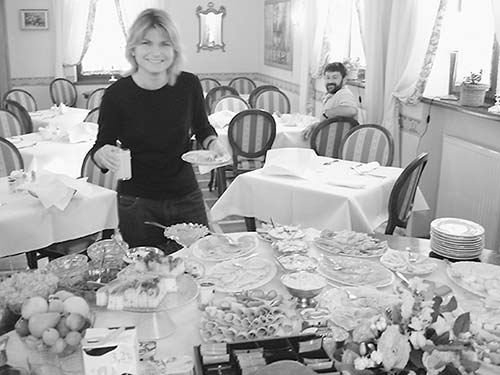
Locals eat better at lower-rent locales. Most restaurants tack a menu on their door for browsers and have an English menu inside. If the place isn’t full, you can usually just seat yourself (get a server’s attention to be sure your preferred table is OK)—the American-style host, with a carefully managed waiting list, isn’t common here. Once seated, feel free to take your time. In fact, it might be difficult to dine in a hurry. Only a rude server will rush you. Good service is relaxed (slow to an American).
When you’re in the mood for something halfway between a restaurant and a picnic meal, look for takeout food stands, bakeries (with sandwiches and savory pastries to go), shops selling pizza by the slice, or simple little eateries offering fast and easy sit-down restaurant food. In Poland, don’t miss the enticingly cheap “milk bar” cafeterias (see here). Many grocery stores sell sandwiches, and others might be willing to make one for you from what’s in the deli case.
The Czech Republic is beer country, with Europe’s best and cheapest brew. Poland also has fine beer, but the national drink is wódka. Hungary and Slovenia are known for their wines. Each country has its own distinctive liqueur, but they all have some variation on slivovice (SLEE-voh-veet-seh)—a plum brandy so highly valued that it’s the de facto currency of the Carpathian Mountains (used for bartering with farmers and other mountain folk). Menus list drink size by the tenth of a liter, or deciliter (dl). Nondrinkers will find all the standard types of Coke and Pepsi, along with some fun-to-sample local alternatives (such as Slovenia’s Cockta, described on here).
Eateries in this book are categorized according to the average cost of a typical main course. Drinks, desserts, and splurge items can raise the price considerably.
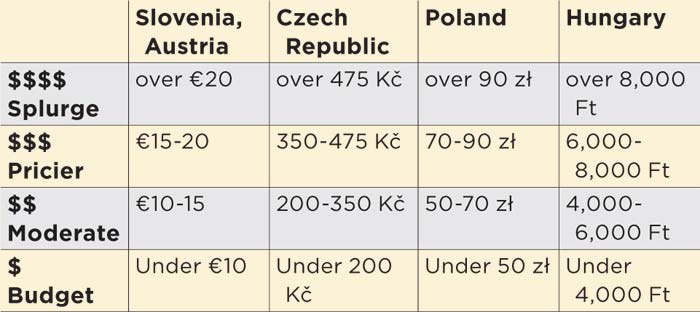
In Central Europe, a milk bar or takeout spot is $, a basic sit-down eatery is $$, a casual but more upscale restaurant is $$$, and a swanky splurge is $$$$.
TIPPING
Tip only at restaurants that have table service. If you order your food at a counter, don’t tip.
At restaurants that have a waitstaff, round up the bill 5-10 percent after a good meal. My rule of thumb is to estimate about 10 percent, then round slightly to reach a convenient total (for a 370 Kč meal, I pay 400 Kč—an 8 percent tip). Anywhere in Central Europe, a tip of over 10 percent is overly generous, verging on extravagant.
At most restaurants in Budapest, and at tourist-oriented ones in Prague, a service fee of around 10-12 percent is automatically added to the bill. Check your bill carefully; if this appears, then there’s no need to tip any extra. If you’re not sure whether your bill includes the tip, just ask.
RESTAURANT PRICING AND HOURS
I’ve categorized my recommended eateries based on the average price of a typical main course, indicated with a dollar-sign rating (see sidebar). Obviously, expensive specialties, fine wine, appetizers, and dessert can significantly increase your final bill.
The categories also indicate the personality of a place: Budget eateries include street food, takeaway, order-at-the-counter shops, basic cafeterias, and bakeries selling sandwiches. Moderate eateries are nice (but not fancy) sit-down restaurants, ideal for a pleasant meal with good-quality food. Most of my listings fall in this category—great for a taste of the local cuisine at a reasonable price.
Many visitors are pleasantly surprised to find that the language barrier in Central Europe is minimal. Frankly, I find it easier to communicate in Hungary or Slovenia than in France or Spain. Why? Because these countries are small and not politically powerful, and their residents realize it’s unreasonable to expect visitors to learn Hungarian or Slovene. It’s essential to find a common language with the rest of the world—so they learn English early and well. (I’ve had surprisingly eloquent conversations with Slovenian grade-schoolers.)
Central Europeans, realizing that their language challenges outsiders, often invent easier nicknames for themselves—Šárka goes by “Sara,” György introduces himself as “George,” Andrzej becomes “Andrew,” and Jaroslav tells you, “Call me Jerry.” They’re trying to meet you in the middle. Show your appreciation and make things easier on them by reading the following pointers.
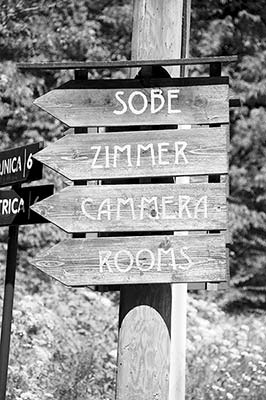
The people in most of this book’s destinations speak Slavic languages. These are closely related and, to varying degrees, mutually intelligible. A Czech and a Slovene can understand each other about as well as a Spaniard and an Italian. (Spellings change—for example, Czech hrad, or “castle,” becomes Slovene grad.)
Slavic languages have simple vocabularies but are highly inflected (as in Latin, meaning is conveyed by changing the ends of words). Slavic words are notorious for their long strings of consonants, and pronunciation can be tricky for outsiders. In fact, when the Christian missionaries Cyril and Methodius came to these lands a millennium ago, they invented a whole new alphabet to represent these strange Slavic sounds. A modified version of that alphabet—called Cyrillic—is still used today in eastern Slavic countries. Of the places mentioned in this book, Cyrillic is common only in Bulgaria, and in some parts of Bosnia and Montenegro. (For a Cyrillic primer, see here.)
Fortunately, nearly all the destinations covered in this book use the same Roman alphabet we do. However, they do add various diacritics—little markings below and above letters—to represent a wider range of sounds (for example, č, ą, ó, đ, ł). While these may look intimidating, they’re logical and easy to memorize. For example, while we add an h after a c to make the ch sound, the Czechs and Slovenes simply top it with a “little roof”: č.
Hungarian is another story altogether—it’s completely unrelated to Slavic languages, or to almost any other European language. (For more on the Magyar tongue, see the end of the Hungary chapter.) And Romanian is a Romance language, distantly related to Italian and French.
German is spoken in Vienna, and can be a useful second language throughout Central Europe, especially if you’re interacting with somebody over about age 50. (While few people under communism learned English, German rivaled Russian as a popular second language.) A few words of Italian can be handy in Slovenia and Croatia.
Even without a common language, it’s relatively easy to get your point across with a combination of gestures, shared words, and writing things down. For instance, to buy a train ticket at a small-town station, just write the name of where you’re going and the time you want to travel.
There are certain universal English words that all Central Europeans know: hello, please, thank you, super, pardon, stop, menu, problem, and no problem. Another handy word is servus (SEHR-voos)—the old-fashioned greeting from the Habsburg days.
Download and use the free Google Translate app. If you’re puzzling over a sign in a shop window, aim your phone’s camera at it for an instant translation. Or if you’re trying to get a point across to a new friend, you can speak into your phone in English, and it’ll spit out a translation—either in a clear robot voice, or in easy-to-read text.
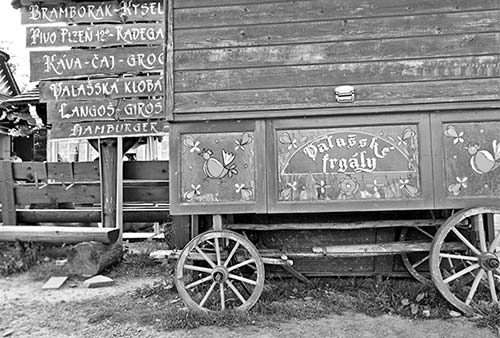
Looking at some of the intimidatingly long words and strange letters in these countries, it’s easy to throw up your arms in defeat. But unlike English, Central European languages are entirely phonetic—you can always sound out words with confidence, once you learn a few basic rules. In each of this book’s country introductions, you’ll find a list of unique letters and letter combinations, which provide the building blocks for sounding out words. This book also provides Survival Phrases for each language. Equipped with these tools, do your best to get an ear for the language and try it out. You may be surprised how quickly you get comfortable.
Regardless of how much (or how little) of the local language you speak, don’t be afraid to interact with locals. Often a simple smile is the only icebreaker you need. And knowing even a word or two of their language—which is more than most visitors bother with—will further endear you to anyone you meet. Give it your best shot, and the natives will appreciate your efforts.
Pricier eateries are a notch up, with more attention paid to the setting, presentation, and (often inventive) cuisine. Splurge eateries are dress-up-for-a-special-occasion swanky—typically with an elegant setting, polished service, and pricey and refined cuisine.
Most of my restaurant listings are open daily for lunch and dinner; I’ve noted exceptions.
Staying Connected
A mobile device is an indispensable tool for efficient travel. Fortunately, staying connected in Europe gets less complicated (and less expensive) each year. You can use your devices much like you do at home, by either getting an international plan or connecting to free Wi-Fi whenever possible. Another option is to buy a European SIM card for your mobile phone. More details are at RickSteves.com/phoning.
USING YOUR PHONE IN EUROPE
Here are some budget tips and options.
Sign up for an international plan. To stay connected at a lower cost, sign up for an international service plan through your carrier. Most providers offer a simple bundle that includes calling, messaging, and data. Your normal plan may already include international coverage (for example, T-Mobile’s covers unlimited text and low-speed data, plus reasonable per-minute voice calls).
Use free Wi-Fi whenever possible. Unless you have an unlimited-data plan, save most of your online tasks for Wi-Fi. Most accommodations in Europe offer free Wi-Fi. Many cafés (including Starbucks and McDonald’s) offer hotspots for customers; ask for the password when you buy something. You may also find Wi-Fi at TIs, city squares, major museums, public transit hubs, airports, and aboard trains and buses.
Minimize the use of your cellular network. The best way to make sure you’re not accidentally burning through data is to put your device in “airplane” mode (which also disables phone calls and texts) and connect to Wi-Fi as needed. Turn on your cellular network (or turn off airplane mode) only when you can’t find Wi-Fi.
Save large-data tasks for Wi-Fi. If your included data is slow or metered, wait until you’re on Wi-Fi to Skype or FaceTime, download apps, stream videos, or do other megabyte-greedy tasks. Using a navigation app such as Google Maps over a cellular network can require lots of data, so download maps when you’re on Wi-Fi, then use the app offline.
Limit automatic updates. By default, your device constantly checks for a data connection and updates app content. Check your device’s settings menu for ways to turn this off.
Use Wi-Fi calling and messaging apps. Skype, FaceTime, and Google Meet are great for making free or low-cost calls or sending texts over Wi-Fi worldwide. WhatsApp is especially popular with Europeans and is often the easiest way to communicate with guides, drivers, or other local contacts.
Buy a European SIM card. If you anticipate making a lot of local calls, need a local phone number, or your provider’s international-data rates are expensive, consider getting a European SIM card to replace the one in your (unlocked) device. SIM cards are sold at department-store electronics counters and some newsstands (you may need to show your passport), and vending machines. If you need help setting it up, buy one at a mobile-phone shop. Some newer devices may also allow you to download an eSIM from an international provider.
There are generally no roaming charges when using a European SIM card in other EU countries, but confirm when you buy.
Damage Control for Lost Phones: Losing your phone can be a significant inconvenience. Before you leave home, make sure your device is set up for automatic cloud backups, and enable the “find my phone” feature (make sure you have access to it from another device, like your travel partner’s phone or a laptop). Familiarize yourself with your phone’s “lost and lock” mode, which you should enable from another device if it goes missing. Report the loss to your mobile carrier; if your phone remains lost, use the “wipe” feature to erase its data.
For details on sending packages to your own home or to others, visit Cbp.gov, then select “Travel” and “Know Before You Go.” The Central European postal services work fine, but for quick transatlantic delivery (in either direction), consider services such as DHL (www.dhl.com).
Here’s how to dial from anywhere in the US or Europe, using the phone numbers of recommended hotels in Prague, Czech Republic (221 771 011); Budapest, Hungary (1 269 0222); and Vienna, Austria (01 534 050) as examples. If a number starts with 0, drop it when dialing from country to country.
Phone numbers in this book are presented exactly as you would dial them from a US mobile phone, from any location. For international access, press and hold 0 (zero) to get a + sign, then dial the country code (see the chart) and phone number.
 To call the Prague hotel, dial +420 221 771 011.
To call the Budapest hotel, dial +36 1 269 0222.
To call the Vienna hotel, dial +43 1 534 050.
| Country Codes | |
| Czech Republic | 420 |
| Poland | 48 |
| Hungary | 36 |
| Slovenia | 386 |
| Austria | 43 |
| Slovakia | 421 |
| Croatia | 385 |
| Bosnia-Herzeg. | 387 |
| Montenegro | 382 |
| Bulgaria | 359 |
| Romania | 40 |
Replace + with 011 (US/Canada access code), then dial the country code and phone number.
To call the Prague hotel from your home landline, dial 011 420 221 771 011.
To call the Budapest hotel, dial 011 36 1 269 0222.
To call Vienna hotel, dial 011 43 1 534 050.
To call from country to country, replace + with 00 (Europe access code), then dial the country code and phone number.
To call the Prague hotel from a Hungarian landline, dial 00 420 221 771 011.
To call the Budapest hotel from an Austrian landline, dial 00 36 1 269 0222.
To call the Vienna hotel from a Croatian landline, dial 00 43 1 534 050.
To call my US office from a Czech landline, dial 00 1 425 771 8303.
To call within a country, drop the country code and dial the phone number. Phone numbers in Austria, Slovakia, Croatia, Bosnia-Herzegovina, Montenegro, Bulgaria, and Romania require an initial 0 when dialing domestically. Polish and Czech numbers do not. In Hungary, if you are dialing from a landline, you must first dial 06 when calling to a different city or to a mobile phone.
To call the Prague hotel from a Czech landline, dial 221 771 011.
To call the Budapest hotel from a Hungarian landline, dial 06 1 269 0222.
To call the Vienna hotel from an Austrian phone, dial 01 534 050.
Local Numbers: European phone numbers and area codes can vary in length and spacing, even within the same country. Mobile phones use separate prefixes.
Toll and Toll-Free Calls: It’s generally not possible to dial European toll or tollfree numbers from a US mobile or landline (although you can sometimes get through using Skype). Look for a direct-dial number instead.
Calling the US from a US Mobile Phone, While Abroad: Dial +1, area code, and number.
More Phoning Help: See HowToCallAbroad.com.
Transportation
In Central Europe, I travel mostly by public transportation. For long distances between big cities (such as Prague to Kraków, Warsaw to Budapest, or Vienna to Ljubljana), I prefer to take a cheap flight or a night train. For shorter distances (like Gdańsk to Warsaw or Budapest to Bratislava), I take a daytime train or bus. In areas with lots of exciting day-trip possibilities, such as the Czech countryside (castles) or Slovenia’s Julian Alps (mountain scenery), I rent a car for a day or two. Or you can hire a local driver to take you around—freeing you up to enjoy the scenery...and the company (in this book, I recommend several drivers and tour guides with cars). If you’re tackling an ambitious itinerary spanning several countries, think carefully before renting a car for your entire trip. Distances are long, driving and parking in big cities is stressful, and the international drop-off fees can be prohibitively expensive (details later).
When deciding between flights, car rental, and train or bus trips, be aware of the potential downside of each option: A car is an expensive headache in any major city; with trains and buses you’re at the mercy of a timetable; flying entails a trek to and from a usually distant airport and leaves a larger carbon footprint.
For more detailed information on transportation throughout Europe, see RickSteves.com/transportation.
TRAINS
Trains are generally punctual and cover cities well, but frustrating schedules make a few out-of-the-way destinations difficult—or impossible—to reach (usually the bus will get you there instead; see “Buses,” later).
Schedules: Pick up train schedules from stations as you go, or print them out from an online source. To study ahead on the web, check Bahn.com, Germany’s excellent all-Europe timetable. Individual countries also have their own train timetable websites:
• Czech Republic: https://idos.idnes.cz
• Poland: www.intercity.pl
• Hungary: www.mavcsoport.hu
• Slovenia: https://potniski.sz.si
• Austria: www.oebb.at
• Slovakia: www.zssk.sk
Tickets: You can usually buy tickets in advance online and receive your electronic ticket via email to show on your phone. Otherwise, buy tickets at the train station. Try using the ticket machines, which typically have English instructions and take American credit cards.
Some tickets may not be available through the machines, in which case you’ll buy tickets from a staffed ticket window. In many big-city train stations, it can be tricky to find the correct line (you’ll see separate ticket windows for domestic trips, international journeys, immediate departures, and other concerns). Before getting in line, confirm with fellow travelers that you’ve chosen the right one. Many ticket sellers speak limited English—be prepared to write out your destination and time.
While most short-haul journeys do not require a reservation, you are required to reserve for some high-speed trains (including premium trains in Poland, such as the Warsaw-Kraków express). Schedules will indicate when a seat assignment is required on EuroCity or InterCity long-distance trains (particularly in Hungary). It’s also smart to reserve a sleeping berth if you’re taking a night train.
Night Trains: To cover the long distances between the major destinations in this book, consider using night trains. Each night on the train saves a day for sightseeing. However, Central European night trains aren’t as new, plush, or comfy as those in Western Europe (such as Austria’s slick Nightjet). Expect a bumpy, noisy ride and basic WCs. In general, if a higher degree of comfort is important to you, look for an affordable flight (see “Flights,” later), hire a driver to take you door-to-door (perhaps with some sightseeing stops en route), or take a day train. Thefts on night trains can occur, so lock the door of your compartment and secure your belongings (to make it difficult—or at least noisy—for thieves to rip you off). When sleeping on a night train, I wear my money belt.
Rail Passes: Since point-to-point train tickets are cheap throughout Central Europe, a rail pass isn’t likely to save you much money.
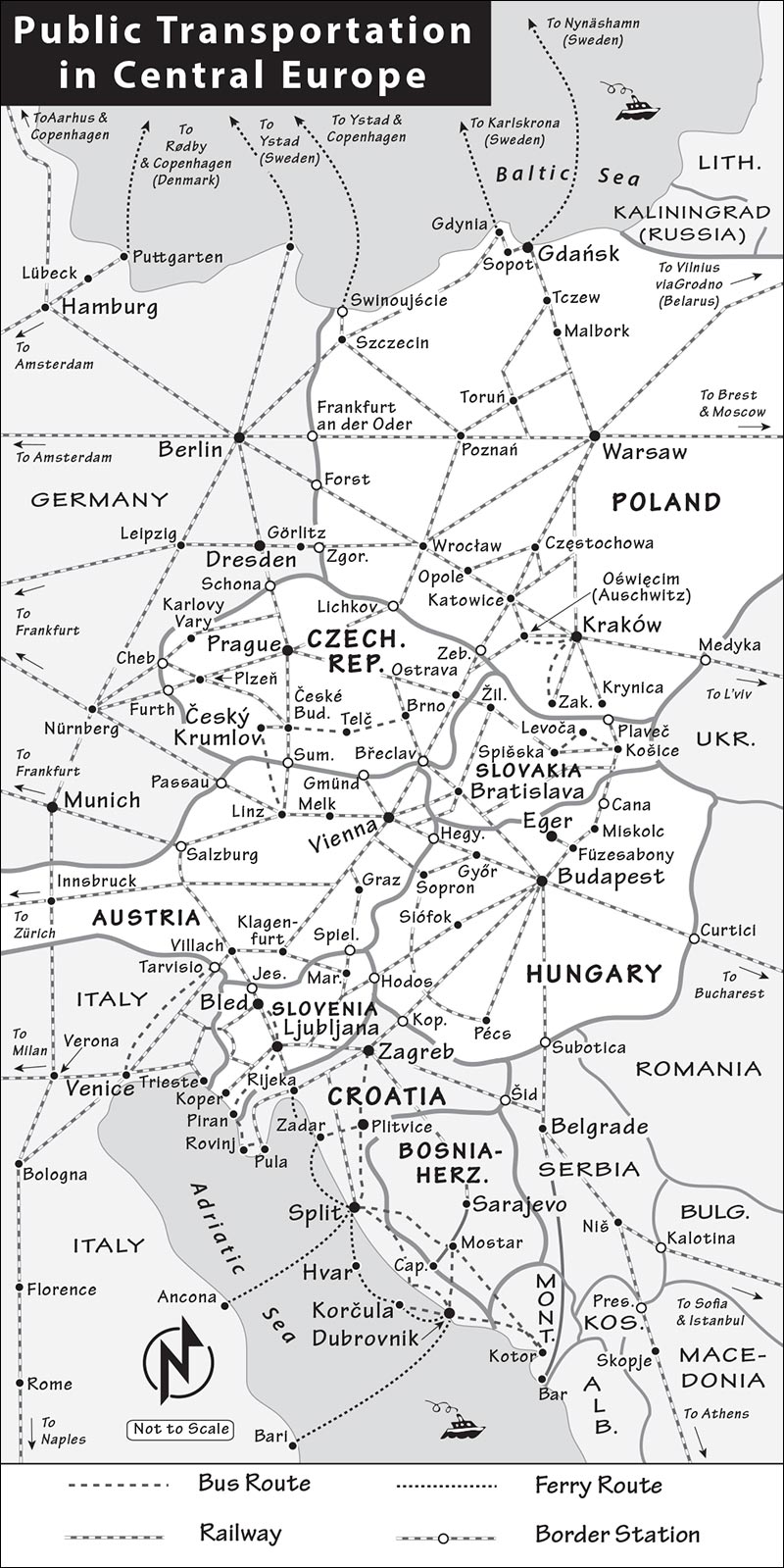
Each country except Slovakia, Bosnia, and Montenegro has its own individual Eurail pass, valid only within that country. The more expensive Eurail Global Pass covers most of Europe, including all the countries in this book, but is priced on the assumption that you’ll use it to cover long trips or travel in more expensive Western countries.
For more detailed advice on figuring out the smartest rail pass options for your train trip, and for point-to-point ticket-cost maps, visit RickSteves.com/rail.
BUSES
Increasingly, private bus companies are offering stiff competition to the established rail lines, with cheaper and sometimes faster connections between major cities, especially on international routes. The dominant outfit in Central Europe is the German-owned Flixbus (www.flixbus.com), which offers easy online booking and generally comfortable buses with air-conditioning and Wi-Fi. Other companies seem to come and go regularly, so search online to find the latest options (GetByBus.com is a good place to start).
There are areas within Central Europe where buses are simply better than trains. For example, in Slovenia, Ljubljana and Lake Bled are connected by both train and bus—but the bus station is right in the town center of Bled, while the train station is a few miles away. And a few destinations are accessible only by bus. When in doubt, ask at the local TI for advice.
TAXIS AND RIDE-BOOKING SERVICES
In Central Europe, legitimate taxis are an excellent value. In many cities, two people can travel short distances by cab for little more than the cost of bus or subway tickets. However, corruption is rampant and difficult to tame. Be sure you’re using a well-established local company. In countries where taxis are well regulated, it’s easy to spot legit cabs (for example, in Budapest they have yellow license plates). In other countries, taxis can charge whatever they want—and hopping in the first one you see in front of a train station or major sight and paying what’s on the meter is a great way to get overcharged. Locals always call for a cab from a reputable company (I’ve listed phone numbers throughout this book)—and get a fair fare. You can ask your hotel, the restaurant where you’re dining, or even TIs inside train stations to call you a legitimate taxi.
To avoid the risk of getting ripped off, I typically use ride-booking apps. In the Czech Republic, Poland, Slovenia, and many other places, Uber works just like back home. In other places, where Uber may not operate, you can still use apps to order a taxi; for example, in Hungary, you can order a taxi using the Bolt app. (Free Now is another taxi-hailing app that works in much of Europe.) Whether Uber or a competitor, these apps are a convenient alternative to calling a dispatcher or finding a taxi stand; prices are fixed up front, so you can’t be overcharged, and you can pay with a credit card (through the app). Figure out which apps work in the country you’re visiting, and if necessary, set them up on your phone.
RENTING A CAR
It’s cheaper to arrange most car rentals from the US, so research and compare rates before you go. Most of the major US rental agencies (including Avis, Budget, Enterprise, Hertz, and Thrifty) have offices throughout Europe. Also consider the two major Europe-based agencies, Europcar and Sixt. Consolidators such as Auto Europe (www.autoeurope.com—or the sometimes cheaper www.autoeurope.eu) compare rates at several companies to get you the best deal.
Wherever you book, always read the fine print. Check for add-on charges—such as one-way drop-off fees, airport surcharges, or mandatory insurance policies—that aren’t included in the “total price.”
Rental Costs and Considerations
If you book well in advance, expect to pay roughly $350-500 for a one-week rental for a basic compact car. Allow extra for supplemental insurance, fuel, tolls, and parking. To save money on fuel, request a diesel car.
Manual vs. Automatic: Cars with manual transmission are more common in Europe and generally cheaper than automatic. If you need an automatic, it’s wise to book well in advance. When selecting a car, don’t be tempted by a larger model, as it won’t be as maneuverable on narrow, winding roads or when squeezing into tight parking lots.
Age Restrictions: Some rental companies impose minimum and maximum age limits. Young drivers (25 and under) and seniors (69 and up) should check the rental policies and rules section of car rental websites.
Choosing Pickup/Drop-off Locations: Always check the hours of the locations you choose: Many rental offices close from midday Saturday until Monday morning and, in smaller towns, at lunchtime. When selecting an office, confirm the location on a map. A downtown site might seem more convenient than the airport but could actually be in the suburbs or buried deep in big-city streets. Pedestrianized and one-way streets can make navigation tricky when returning a car at a big-city office or urban train station. Wherever you select, get precise details on the location and allow ample time to find it.
Have the Right License: If you’re renting a car in Central Europe, bring your driver’s license. In Austria, Bulgaria, the Czech Republic, Hungary, Poland, Romania, Slovenia, or Slovakia, you’re also technically required to have an International Driving Permit—an official translation of your license (sold at AAA offices for about $20 plus the cost of two passport-type photos; see www.aaa.com). How this is enforced varies; I’ve never needed one.
Crossing Borders in a Rental Car: It’s typically not a problem to cross borders between Schengen countries—but if venturing beyond this open-borders area (for example, into Bosnia-Herzegovina), there may be restrictions.
Always tell your car-rental company exactly which countries you’ll be entering. Some companies levy extra insurance fees for trips taken in certain countries with certain cars (such as BMWs, Mercedes, and convertibles). Double-check with your rental agent that you have all the documentation you need before you drive off; at border checkpoints, it’s likely you’ll be asked to present proof of insurance (called a “green card”). Note that picking up a car in one country and dropping it off in another can be quite expensive—see “International Drop-Off Fees,” below.
Picking Up Your Car: Before driving off in your rental car, check it thoroughly and make sure any damage is noted on your rental agreement. Rental agencies in Europe tend to charge for even minor damage, so be sure to mark everything. Find out how your car’s gearshift, lights, turn signals, wipers, GPS, and fuel cap function, and know what kind of fuel the car takes (diesel is common in Europe). When you return the car, make sure the agent verifies its condition with you.
International Drop-Off Fees
If you’re planning a multicountry itinerary by car, be aware of often-astronomical international drop-off fees. There’s typically no extra charge for picking up and dropping off a car at different locations within the same country—but you’ll pay through the nose to drop off across the border. (For example, you can generally pick up a car in Kraków, drive it six hours to Gdańsk, and turn it in there for no charge—but if you drive the same car from Vienna just an hour to Bratislava and drop it off, it can cost you hundreds of extra dollars.)
For some itineraries, you may just have to live with the extra expense. But in most cases, you can plan your itinerary smartly to avoid it. Some people plan a circular itinerary (for example, Prague-Kraków-Budapest-Bratislava-Vienna-Prague) to ensure they can drop the car off where they picked it up. Others connect the longer distances on their itinerary with trains or flights, then rent a car strategically for a day or two in places where it’s warranted (such as the Czech or Slovenian countryside). This is a particularly smart plan when visiting big cities, where a car is an expensive and worthless burden (i.e., fighting urban traffic and paying for pricey secure parking).
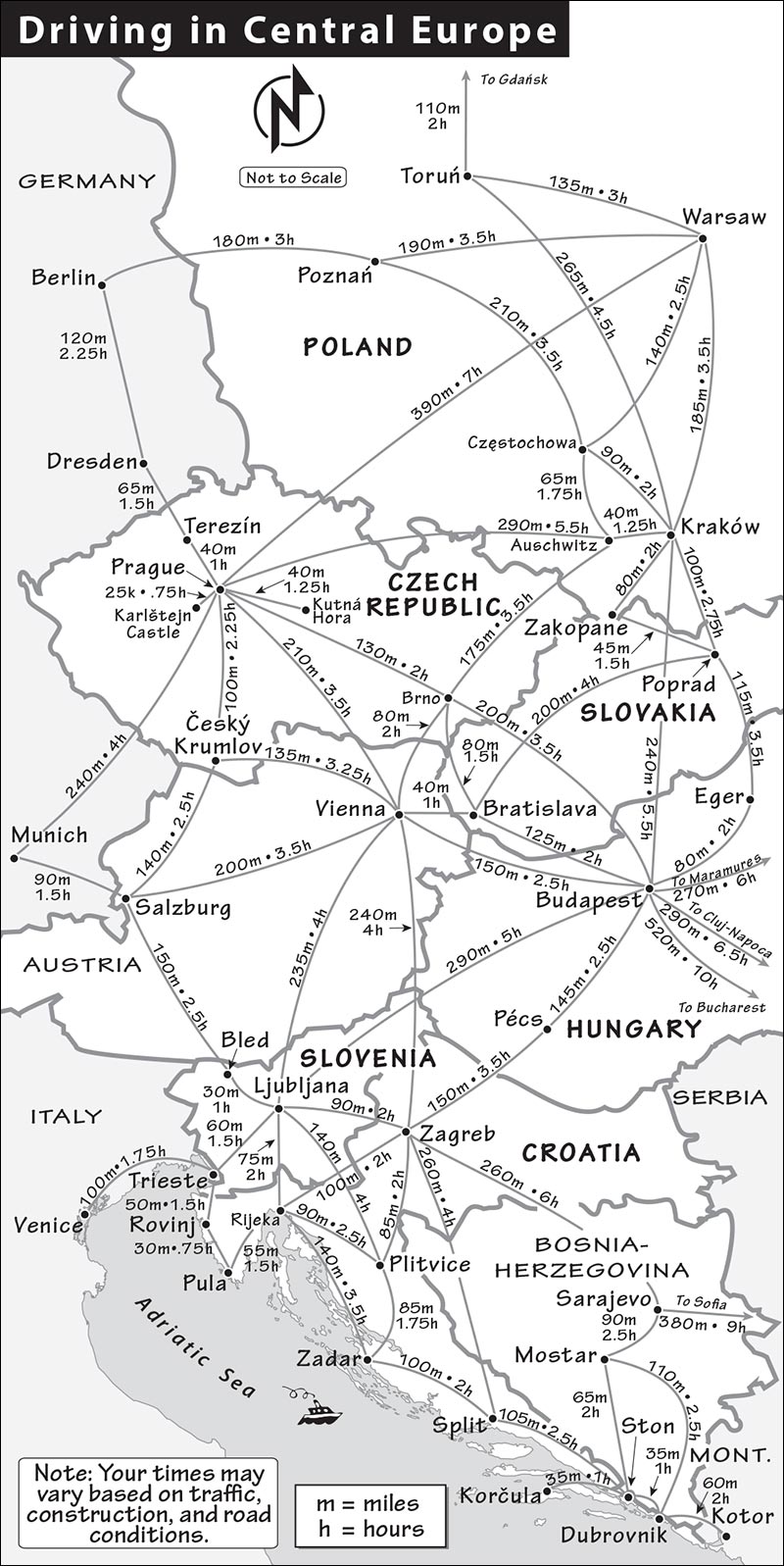
Car Insurance Options
When you rent a car in Europe, the price typically includes liability insurance, which covers harm to other cars or motorists—but not the rental car itself. To limit your financial risk in case of damage to the rental, choose one of these options: Buy a Collision Damage Waiver (CDW; also called “loss damage waiver” or LDW by some firms) with a low or zero deductible from the car-rental company (roughly 30-40 percent extra), get coverage through your credit card (essentially “free,” but more complicated if you need to use it), or get collision insurance as part of a larger travel-insurance policy.
Basic CDW costs $15-30 a day and typically comes with a $1,000-2,000 deductible, reducing but not eliminating your financial responsibility. When you reserve or pick up the car, you’ll be offered the chance to “buy down” the deductible to zero (for an additional $10-30/day; this is sometimes called “super CDW” or “zero-deductible coverage”).
If you opt for credit-card coverage, you must decline all coverage offered by the car-rental company—which means they can place a hold on your card to cover the deductible. In case of damage, it can be time-consuming to resolve the charges. Before relying on this option, quiz your card company about how it works. If you’re already purchasing a travel-insurance policy for your trip, adding collision coverage can be an economical choice. Both of these options are typically valid everywhere in Europe except the Republic of Ireland and Italy.
For more on car-rental insurance, see RickSteves.com/cdw.
Navigation Options
If you’ll be navigating using your phone, remember to bring a car charger. Most rental cars are equipped with a USB port so you can run your phone’s GPS through the dashboard display, but it can also be smart to bring a device mount.
Your Mobile Phone: The mapping app on your phone works fine for navigating Europe’s roads. To save on data, most apps allow you to download maps for offline use (do this before you need them, when you have a strong Wi-Fi signal). Some apps—including Google Maps—provide offline route directions, but you’ll need data access for current traffic. For more on using a mapping app, see “Using Your Phone in Europe,” earlier.
GPS Devices: Most cars come with a dedicated GPS unit, though it’s sometimes an add-on cost (about $15-20/day). The unit may come loaded only with maps for its home country; if you need additional maps, ask. Make sure you know how to use the device—and that the language is set to English—before you drive off.
Paper Maps and Atlases: Even when navigating primarily with GPS, I always have a paper map, ideally a big, detailed regional road map. It’s invaluable for getting the big picture, understanding alternate routes, and filling in if my phone runs out of juice. The free maps you get from your car-rental company usually don’t have enough detail. It’s smart to buy a better map before you go, or pick one up at a local gas station, bookshop, newsstand, or tourist shop.
Driving
Road Rules: Be aware of typical European road rules; for example, many countries—including most of the ones in this book—require headlights to be on at all times, and nearly all forbid handheld mobile-phone use. In Europe, you’re not allowed to turn right on a red light unless a sign or signal specifically authorizes it, and on expressways it’s illegal to pass drivers on the right. Ask your car-rental company about these rules, or check the “International Travel” section at Travel.state.gov (enter a country in the “Learn About Your Destination” box, then click on “Travel and Transportation”).
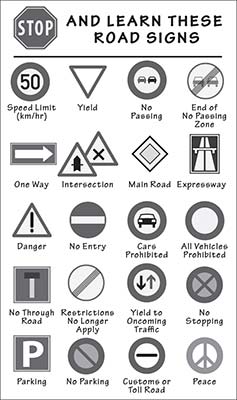
Fuel: Gas is expensive—often about $6-8 per gallon. Diesel cars are more common in Europe than back home, so be sure you know what type of fuel your car takes before you fill up. Some pumps are color coded: Unleaded pumps are green and labeled “E,” while diesel pumps (often yellow or black) are labeled “B.”
Road Conditions: Central Europe is nearing the end of an impressive binge of superhighway construction. It’s not unusual to discover that a much faster road has been built between major destinations since your five-year-old map was published. (This is another good reason to travel with the most up-to-date maps possible, and study them before each drive.) Over the last several years, superhighways have opened between Dresden and Prague (A-17) and between Warsaw and Berlin (A-2).
Occasionally, backcountry roads are the only option. These can be bumpy and slow, but they’re almost always paved (or, at least, they once were). In Poland, where the network of new expressways isn’t yet complete, locals travel long distances on two-lane country roads. Since each lane is about a lane and a half wide, passing is commonplace. Slower drivers should keep to the far right of their lane to allow faster cars to zip past them. Especially in Croatia and Slovenia, keep a close eye out for bikers—you’ll see scads of them on mountain roads, struggling to earn a thrilling downhill run.
Tolls: In many countries, driving on highways requires a toll sticker. These include the Czech Republic (dálnični známka, 310 Kč/10 days, 440 Kč/1 month, https://edalnice.cz), Slovakia (úhrada, €12/10 days, €17/1 month, https://eznamka.sk), Hungary (autópálya matrica, 5,500 Ft/10 days, 8,900 Ft/1 month, https://nemzetiutdij.hu), Slovenia (vinjeta, €15/week, €30/month, www.dars.si), and Austria (Vignette, €9.90/10 days, €29/2 months, www.asfinag.at). Fines for not having a toll sticker can be stiff.
Your rental car probably already comes with a toll sticker (ask at the rental agency). If it doesn’t—or if you’re crossing into a different country from where you rented the car—you have to get a sticker. The best way to do that is by going to one of the websites listed above to register your rental car for an electronic sticker. You’ll need the license plate number and possibly the VIN number.
If you don’t get an electronic sticker, you’ll need to buy a physical sticker to affix to the windshield. Look for a large gas station near the border. At the border itself, you may find machines or sales points for buying one. However, be warned that some unscrupulous private agencies at certain borders try to sell stickers at a markup. The safest bet is to buy it online or ensure that you’re using an official sales outlet. (If the price they charge is much higher than the ones listed above, be suspicious.)
Poland and Croatia have a different system: You’ll take a toll ticket as you enter the expressway, then pay when you get off based on how far you’ve traveled.
Parking: Parking is a costly headache in big cities. You’ll pay about $15-30 a day to park safely. Rental-car theft can be a problem in cities (especially Prague), so ask at your hotel for advice.
FLIGHTS
To compare flights, begin with an online travel search engine: Google Flights is comprehensive and easy to use, and Skyscanner includes many inexpensive flights within Europe. To avoid unpleasant surprises, before you book be sure to read the small print about refunds, changes, and the costs for “extras” such as reserving a seat, checking a bag, or printing a boarding pass.
Flights to Europe: Start looking for international flights about four to six months before your trip, especially for peak-season travel. Depending on your itinerary, it can be efficient and no more expensive to fly into one city and out of another.
Flights Within Europe: Flying between European cities is surprisingly affordable. Before buying a long-distance train or bus ticket, check the cost of a flight on one of Europe’s airlines, whether a major carrier or a no-frills outfit. Two well-established budget airlines are based in Central Europe: Wizz Air (https://wizzair.com, with a hub in Budapest) and Smart Wings (www.smartwings.com, based in Prague). Well-known cheapo airlines that fly to Central European destinations include EasyJet, RyanAir, and Norwegian. Be aware that flying with a discount airline can have drawbacks, such as minimal customer service and time-consuming treks to secondary airports.
Many national carriers also charge reasonable fares for short-distance trips. For example, check out Poland’s LOT Airlines (www.lot.com). On recent trips, I’ve flown affordably on LOT between Kraków and Ljubljana, and between Kraków and Budapest, avoiding lengthy overland journeys.
Flying to the US and Canada: Because security is extra tight for flights to the US, be sure to give yourself plenty of time at the airport (see www.tsa.gov for the latest rules).
Resources from Rick Steves
Begin Your Trip at RickSteves.com
My mobile-friendly website is the place to explore Europe in preparation for your trip. You’ll find thousands of fun articles, beautiful photos, videos, and radio interviews; a wealth of money-saving tips for planning your dream trip; travel news dispatches; a video library of travel talks; our latest guidebook updates (RickSteves.com/update); and the free Rick Steves Audio Europe app. You can also follow me on Facebook, Instagram, and Twitter.
Our Travel Forum is a well-groomed collection of message boards where our travel-savvy community answers questions and shares their personal travel experiences—and our well-traveled staff chimes in when they can be helpful (RickSteves.com/forums).
Our online Travel Store offers bags and accessories that I’ve designed to help you travel smarter and lighter. These include my popular carry-on bags (which I live out of four months a year), money belts, totes, toiletries kits, adapters, guidebooks, and planning maps (RickSteves.com/shop).
Our website can also help you find the perfect rail pass for your itinerary and your budget, with easy, one-stop shopping for rail passes, seat reservations, and point-to-point tickets (RickSteves.com/rail).
Rick Steves’ Tours, Guidebooks, TV Shows, and More
Small-Group Tours: Want to travel with greater efficiency and less stress? We offer more than 40 itineraries reaching the best destinations in this book...and beyond. Each year about 30,000 travelers join us on about 1,000 Rick Steves bus tours. You’ll enjoy great guides and a fun bunch of travel partners (with small groups of 24 to 28 travelers). You’ll find European adventures to fit every vacation length. For all the details, and to book a tour, visit RickSteves.com/tours or call us at +1 425 771 8303.
Books: This book is just one of many books in my series on European travel, which includes country and city guidebooks, Snapshots (excerpted chapters from bigger guides), Pocket Guides (full-color little books on big cities), “Best Of” guidebooks (condensed, full-color country guides), and my budget-travel skills handbook, Rick Steves Europe Through the Back Door. A complete list of my titles—including phrase books, cruising guides, and travelogues on European art, history, and culture—appears near the end of this book.

TV Shows and Video Library: My public television series, Rick Steves’ Europe, covers Europe from top to bottom with over 100 half-hour episodes—and we’re working on new shows every year. Watch full episodes for free (RickSteves.com/tv). My free online video library, Rick Steves Classroom Europe, offers a searchable database of short video clips on European history, culture, and geography (Classroom.RickSteves.com).
Monday Night Travel Talks: To raise your travel I.Q., join our virtual travel party every Monday, featuring Rick Steves guides discussing European destinations, art, culture, food, travel tips, and more. Join the live events or check out the video recordings (RickSteves.com/mnt).

Audio Tours on My Free App: I’ve produced 60 free, self-guided audio tours of the top sights in Europe. For those tours and other audio content, get my free Rick Steves Audio Europe app, an extensive online library organized by destination. For more on my app, visit RickSteves.com/audioeurope.
Radio: My weekly public radio show, Travel with Rick Steves, features interviews with travel experts from around the world. It airs on 400 public radio stations across the US. An archive of programs is available at RickSteves.com/radio.
Podcasts: You can enjoy my travel content via several free podcasts. The podcast version of my radio show brings you a weekly, hour-long travel conversation. My other podcasts include a selection of video clips from my public television show, and video recordings of my travel classes (RickSteves.com/podcasts).