POMERANIA
Malbork Castle • Toruń
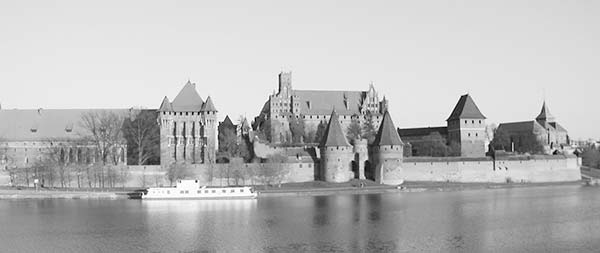
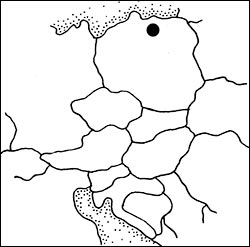
The northwestern part of Poland—known as Pomerania (Pomorze, as in “along the sea”)—is red-brick fairy tale country. While the region has nothing to do with excitable little dogs, it does offer two of Poland’s top attractions outside of the big cities: Malbork, the biggest Gothic castle in Europe, is one of the best castles in Central Europe. And farther south, the Gothic town of Toruń—the birthplace of Copernicus—holds hundreds of beautiful buildings...and, it seems, even more varieties of tasty gingerbread. The story of this region—which was part of the German world for much of its history—is tied inexorably to the Teutonic Knights, who ruled over this northern swath of present-day Poland and fortified their holdings with elegant red brick...still the hallmark of Pomerania.
Be prepared for a higher language barrier here; unlike Kraków and Warsaw, English is not the default. While they do get foreign visitors, most are Germans or Scandinavians—Americans make up a tiny percentage of the mix.
PLANNING YOUR TIME
Malbork works well as a side trip from Gdańsk (frequent trains, 30-45 minutes each way), and it’s also on the main train line from Gdańsk to Warsaw. And Toruń is well worth a stroll or an overnight if you want to sample a smaller Polish city. Unfortunately, Toruń is on a different train line than Malbork—visiting both in one day makes for a very long day. Consider doing Malbork as a side trip from Gdańsk, then visit Toruń on the way to or from Warsaw. If opting for this plan, Toruń is also a delightful place to settle in for the night.
Malbork Castle
Malbork Castle is soaked in history. The biggest brick castle in the world, the largest castle of the Gothic period, and one of Europe’s most imposing fortresses, it sprawls on a marshy plain at the edge of the town of Malbork, 35 miles southeast of Gdańsk. This was the headquarters of the Teutonic Knights, the Germanic band of ex-Crusaders who dominated northern Poland in the Middle Ages. It’s worth ▲▲▲ for castle lovers, or ▲▲ for anyone.
Touring the massive castle, you’ll see good exhibits on amber and armor, walk through vast halls with graceful Gothic arches and fan vaulting, learn a bit about the Teutonic Knights, and see enough red brick to last a lifetime. Visiting the whole place is a bit exhausting, but this chapter’s self-guided tour helps you focus on the highlights.
GETTING THERE
Malbork is conveniently located right on the express train line between Gdańsk and Warsaw. Coming by train from Gdańsk, be ready for grand views of the castle on your right as you cross the Nogat River. Bag storage is available at the station’s lockers (next to the exit doors).
Figure around 20 zł for a taxi or Uber to the castle. Or it’s an easy, 15-minute, mostly downhill walk: Leave the station to the right, walk straight past the bus stops, and go through the pedestrian underpass beneath the busy road (by the red staircase). Ascending the stairs on the other side, turn right and follow the busy road (noticing peek-a-boo views on your right of the castle’s main tower). Take the first right and head down Kościuszki, the main shopping street (partway down on the right, a fancy peach-colored building houses the TI). Near the bottom of Kościuszki, at the fountain and the McDonald’s, jog right, then—at the roundabout—turn left to cross the moat. The castle ticket office will be on your right.
If you want to avoid the uphill walk back to the station, ask the info desk clerk in the castle ticket office to call a (fairly priced) taxi for you.
ORIENTATION TO MALBORK CASTLE
Cost: The main “historical route” costs 80 zł and includes an audioguide. On Mondays, and after hours on other days—when the interiors are closed—you can pay 40 zł for a “green route” that includes only the exteriors.
Hours: The main “historical route” is open Tue-Sun 9:00-19:00 (Oct-April until 15:00), last entry two hours before closing. If you come on Mon, or after the last entry time Tue-Sun (17:00-18:30 in season and 13:00-14:30 off-season), you can get into the exteriors-only “green route.” The grounds stay open one hour later (until 20:00 in season, 16:00 off-season).
Information: +48 55 647 0978, www.zamek.malbork.pl.
Crowd-Beating Tips: The castle is busiest at midday, when there can be a line for tickets. If you anticipate crowds—or arrive to see a line—you can use your phone to buy a ticket on their website.
Tours: You’re required to visit either with a guided tour or with an audioguide. Effectively, most visitors simply borrow an included audioguide—then either use it, or ignore it and follow my self-guided tour. You can ask about the availability of an English tour, but these are relatively rare.
Eating: At the castle courtyard, $ Restauracja Piwniczka has stick-to-your-ribs, beer-hall fare served in atmospheric cellars or at outdoor tables. Several cheap $ food stands cluster outside the castle (by the river). To escape the crowds, after your castle visit you can take the footbridge across the river, then turn right along the opposite riverbank and go through the long parking lot to reach $ Bistro na Fali, perched on a small hill looking back over the castle (daily, Wałowa 10, +48 534 610 670, www.bistronafali.pl).
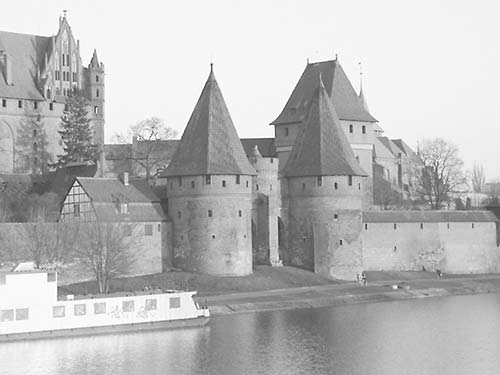
Best Views: The views of massive Malbork are stunning—especially at sunset, when its red brick glows. Be sure to walk out across the footbridge over the Nogat River. The most scenic part of the castle is the twin-turreted, riverside Bridge Gate, which used to be connected by a bridge to the opposite bank.
BACKGROUND
When the Teutonic Knights were invited to Polish lands in the 13th century to convert neighboring pagans, they found the perfect site for their new capital here, on the bank of the Nogat River. Construction began in 1274. After the Teutonic Knights conquered Gdańsk in 1308, the order moved its official headquarters from Venice to northern Poland, where they remained for nearly 150 years. They called their main castle Marienburg, the “Castle of Mary,” in honor of the order’s patron saint. Poles call it “Malbork.”
At its peak in the early 1400s, Malbork was both the imposing home of a seemingly unstoppable army and Europe’s final bastion of chivalric ideals. Surrounded by swamplands, with only one gate in need of defense, it was a tough nut to crack. Malbork Castle was never taken by force in the Middle Ages, though it had to withstand various sieges by the Poles during the Thirteen Years’ War (1454-1466)—including a campaign that lasted more than three years. Finally, in 1457, the Polish king gained control of Malbork by buying off Czech mercenaries guarding the castle. Malbork became a Polish royal residence for 300 years. But when Poland was partitioned in the late 18th century, this region went back into German hands. The castle became a barracks, windows were sealed up, delicate vaulting was damaged, bricks were quarried for new buildings, and Malbork deteriorated.
In the late 19th century, Romantic German artists and poets rediscovered the place. An architect named Konrad Steinbrecht devoted 40 years of his life to Malbork, painstakingly resurrecting the palace’s medieval splendor. A half-century later, the Nazis used the castle to house POWs. Hitler—who, like many Germans, had a soft spot for Malbork’s history—gave the order to defend it to the last man. About half of the castle was destroyed by the Soviet army, who saw it as a symbol of long-standing German domination. But it was restored once again, and today Malbork has been returned to its Teutonic glory.
 SELF-GUIDED TOUR
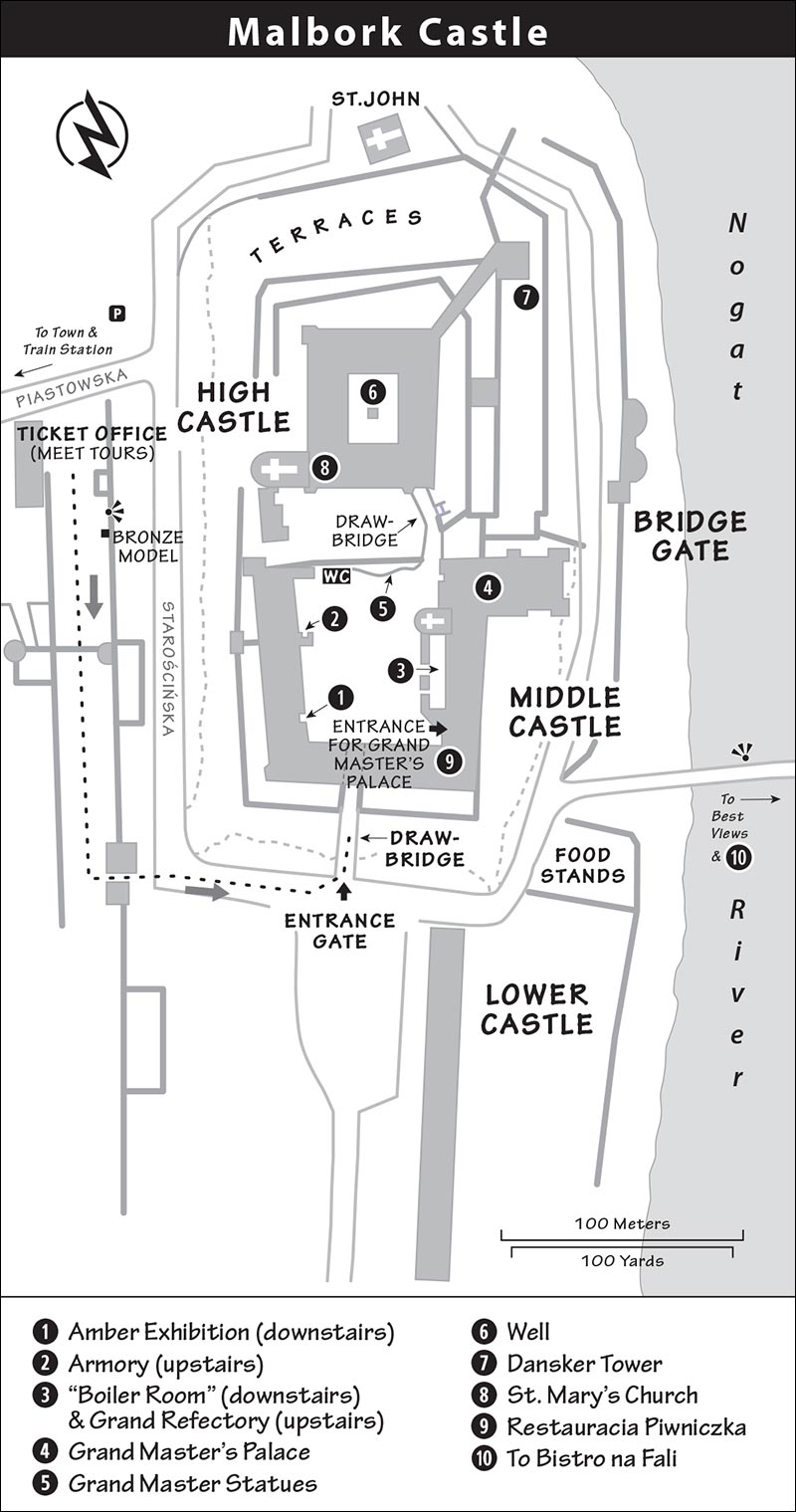
The official “historical tour” of Malbork lasts about three hours; my tour of the highlights takes about half that long, unless you linger. Use the map in this section to navigate. The castle complex is a bit of a maze, with multiple entrances and exits for each room, often behind closed (but unlocked) doors. Don’t be shy about grabbing a medieval doorknob and letting yourself in. If you’re here on a Monday or after hours, on a “green route” ticket, you won’t have access to many of the indoor areas described on this tour.
Entering the Castle Complex
From the ticket office, exit straight ahead and belly up to the brick wall by the bronze model for a panoramic view of the giant complex. Slowly pan across one of Europe’s most intimidating fortresses—home to the Grand Master, monks, and knights of the Teutonic Order. The High Castle (where the monks lived) is on the left, marked by the 30-foot-tall statue of Mary at the end of St. Mary’s Church. To the right is the Middle Castle, where the knights lived. We’ll loop around the right end (Middle Castle), working our way inside and ending at the High Castle.
The bronze model shows the realm of the Teutonic Knights at their peak—stretching from Gdańsk in the north to Toruń to the south, and, waaaay up on the northeast, the city of Kłajpeda, today part of Lithuania. For more than a century (1308-1410), the Teutonic Knights were a formidable presence. For more on this history, see the sidebar later in this chapter.
• Now turn right and cross the drawbridge under the brick tower. Keep going alongside the moat, turning left to cross another drawbridge into the castle ward. Ahead and to the right, the long, low-lying building was the Lower Castle, where servants and support staff lived. Just before that, on the left, is yet another drawbridge. Show your ticket here and cross partway over the bridge—pausing just outside the brick gate.
Entrance Gate
Above the door to the brick gate is a sculpture of the Virgin Mary with Baby Jesus, next to a shield and helmet. The message is twofold: This castle is protected by Mary, and the Teutonic Knights are here to convert pagans—by force, if necessary.
From the drawbridge, look right to observe the formidable fortifications. The Teutonic Knights connected nearby lakes to create a system of canals, forming a moat around the castle that could be crossed only by drawbridge. The rooster-capped corner tower (which contains a toilet) is connected by a sky bridge to the fancy Gothic 14th-century facade of the brick infirmary—kept at a distance for disease control.
Continue farther, until you’re inside the gate structure itself. Imagine the gate behind you slamming shut. Look up to see wooden chutes where archers are preparing to rain arrows down on you. Your last thought: Maybe we should have left the Teutonic Knights alone after all.
Before you’re pierced by arrows, read the castle’s history in its walls: The foundation is made of huge stones—rare in these marshy lands—brought from Sweden. But most of the castle, like so many other buildings in northern Poland, was built with handmade red brick. Throughout the castle, the darker-colored, rougher brick is original, and the lighter-colored, smoother brick was used during later restorations (in the 19th century, and again after World War II). Marvel at the ironclad doors and the heavy portcullis.
Venture through two more enclosed spaces, watching for the holes in the wall (for more guards and soldiers). Ponder the fact that you must pass through five separate, well-defended gates to reach the...
Middle Castle (Zamek Średni)
This part of Malbork, built at an uphill incline to make it even more imposing, was designed to impress. Knights and monks lived here.
Let’s get oriented: To your left is the east wing, where visiting monks would sleep. Today, this houses the Amber Exhibition (ground floor) and the armory (upstairs). To the right (west) as you enter the main courtyard is the Grand Refectory (closer to the entrance) and the Grand Master’s Palace (the taller, squarer building at the far end).
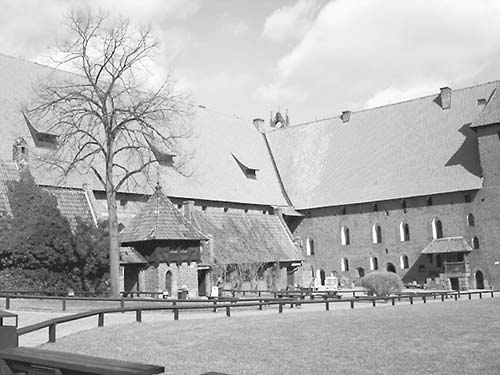
• Enter the ground floor of the building on the left (go through the small door and take a few steps down). Here you’ll tour the...
Amber Exhibition
Amber, precious petrified tree sap, is found here in Poland; for a primer, read the “All About Amber” sidebar on here. You’ll start 42 million years ago and follow the story of amber, then walk down the dimly lit corridor, checking out huge chunks of raw amber and illuminated displays of inclusions (bugs and other organic objects stuck in the amber, à la Jurassic Park). Some of the ancient amber artifacts displayed here are up to 3,000 years old, found in graves.
At the end of the corridor, U-turn and work your way back up a parallel hall, lined with all manner of exquisite amber creations: boxes, brooches, necklaces, chess sets, pipes, miniature ships, wine glasses, and belts for skinny-waisted, fashion-conscious women. Many of the finely decorated jewelry boxes and chests have ivory, silver, or shell inlays—better for contrast than gold. The portable religious shrines and altars allowed travelers to remain reverent on the road and still pack light. Notice the wide range of amber colors—from opaque white to transparent yellow to virtually black.
• Exit at the far end. As you emerge into the Middle Castle courtyard, go up the wooden staircase on your right, go inside, turn left and walk to the end of the long hall, and go up the stairs. Here you’ll find the...
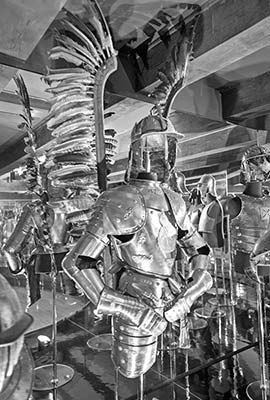
Armory
This enjoyable, well-displayed collection includes an impressive array of swords, armor, and other armaments. Look for the 600-year-old “hand-and-a-half” swords—too big to be held in one hand. Tucked behind the cannons is a giant shield. A row of these shields could be lined up to form a portable wall—called a phalanx—to protect the knights. In the big room with the decoratively hilted swords, look for the terrifying “flame-bladed sword.” You’ll also see pikes, maces, crossbows, rifles, and horse armor. And in the room with the body armor, the centerpiece is a suit of armor from the hussars—Polish horseback knights. Equipped with wings, it created a terrifying sound when the horses were galloping.
• At the end of the armory, head down the modern stairs and back outside (a handy WC is straight ahead). Cross the main courtyard, angling downhill, and enter the smaller courtyard through the passage next to the stubby, dark-wood-topped tower. Find the (unlabeled and sometimes closed) door to a dark, steep flight of stairs that leads down into the...
“Boiler Room”
The Teutonic Knights had a surprisingly sophisticated method for heating this huge complex. You see a furnace down below and a holding area for hot rocks above. The radiant heat given off by the rocks spread through the vents without also filling them with smoke (illustrated by a chart on the wall). This is one of 11 such “boiler rooms” in the castle complex. As you tour the rest of the castle, keep an eye out for saucer-sized heating vents in the floor.
• Climb back up the stairs, take an immediate left through a tiny arch, and then go left again, up through the second door (not down through the first door, which takes you out of the castle). This leads into the...
Grand Master’s Palace
This was one of the grandest royal residences in medieval Europe, used in later times by Polish kings and German kaisers. (Today, it’s sometimes used for special exhibitions.)
• From the kitchen—with its huge chimney (wow!)—turn left into the big and bright...
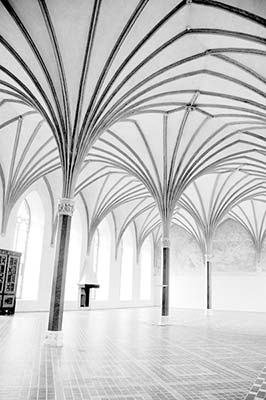
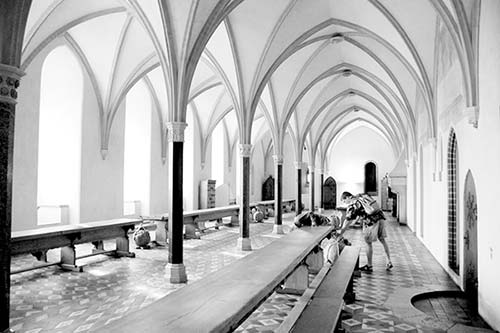
Grand Refectory: With remarkable palm vaulting and grand frescoes, this dining hall hosted feasts for up to 400 people to celebrate a military victory or to impress visiting dignitaries. In the floor, notice the 36 heating vents—which are directly above the boiler room you just visited—designed to keep the VIPs warm.
• At the far end of the refectory, climb the stairs into the...
Private Rooms of the Grand Master: Though the Teutonic Order dictated that the monks sleep in dormitories, the Grand Master made an exception for himself—with this suite of private rooms. This area is a bit of a maze, so stick with me (or just wander around looking for each of these rooms): From the hall where you enter, bear left into another hall, with show-off decor—including some 15th-century original frescoes of wine leaves and grapes.
Go through the door to the left of the fireplace into the Grand Master’s bedroom, decorated with (now very faint) frescoes of four virgins—female martyrs. Beyond that is the green-walled study of the Grand Master.
Continue through the study and you’ll step into the Top Knight’s dining room, the Winter Refectory, with fewer windows (better insulation) and more of the little heating vents in the floor. The walls are draped with tapestries, which also helped warm things up a bit.
For a dramatic contrast, continue into the next room—the Summer Refectory. With big stained-glass windows and delicate vaulting supported by a single central pillar, this room was clearly not designed with defense in mind. In fact, medieval Polish armies focused their attacks on this room. On one legendary occasion, the attackers—tipped off by a spy—knew that an important meeting was going on here and fired a cannonball into the room. It just missed the pillar. (You can see where the cannonball hit the wall, just above the fireplace.) The ceiling eventually did collapse during World War II.
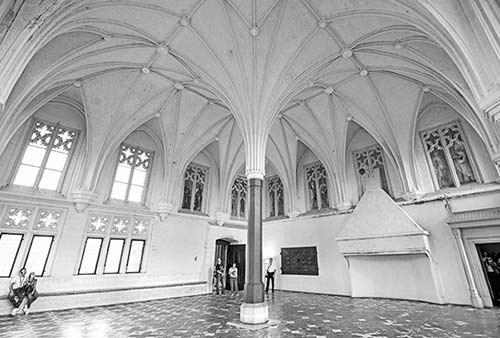
Continue through the Summer Refectory, stepping out into a hallway. Turn right, noticing the washbasin and trough along the corridor. Anyone wanting an audience with the Grand Master had to wash both his hands and his feet. Farther along, find the stairs down (on your left).
• Take those stairs back out in the courtyard. On your right are four...
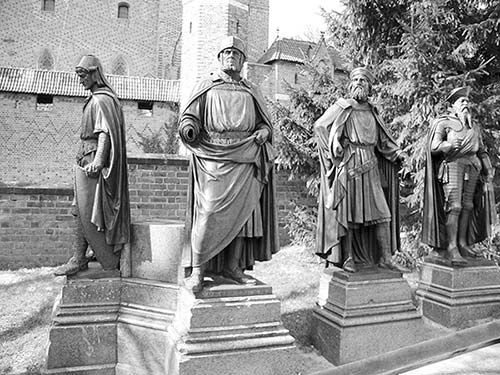
Grand Master Statues
Though this was a religious order, these powerful guys look more like kings than monks. From left to right, shake hands with Hermann von Salza (who was Grand Master when the Teutonic Knights came to Poland), Siegfried von Feuchtwangen (who actually moved the T. K. capital from Venice to Malbork, and who conquered Gdańsk for the knights—oops, can’t shake his hand, which was supposedly chopped off by Soviet troops), Winrich von Kniprode (who oversaw Malbork’s golden age and turned it into a castle fit for a king), and Markgraf Albrecht von Hohenzollern (the last Grand Master before the order dissolved and converted to Protestantism).
The Order of the Teutonic Knights began in the Holy Land in 1191, during the Third Crusade. These militarized German monks built hospitals and cared for injured knights. When the Crusades ended in the 12th century, the knights returned to Europe and reorganized as a chivalric order of Christian mercenaries—pagan-killers for hire.
In 1226, a northern Polish duke called in the Teutonic Knights to subdue a tribe of pagans who had been attacking his lands. Clad in their white cloaks with skinny black crosses, the Teutonic Knights spent 60 years “saving” the pagans by turning them into serfs or massacring them.
Job done, the Teutonic Knights decided to stick around. With the support of the pope and the Holy Roman Emperor (who were swayed by the knights’ religious zeal), the knights built one of Europe’s biggest and most imposing fortresses: Malbork. In 1308, they seized large parts of northern Poland (including Gdańsk), cutting off Polish access to the Baltic Sea. The knights grew rich from Hanseatic trade, specializing in amber, grain, and timber. By the late 14th century, the Teutonic Knights had grown to become Europe’s largest-ever monastic state and were threatening to overtake Lithuania.
Inspired by a mutual desire to oust the Teutonic Knights, the Poles and the Lithuanians teamed up. In 1386, Polish princess Jadwiga married Lithuanian prince Władysław Jagiełło, kick-starting a grand new dynasty: the Jagiellonians.
Every Pole knows the date July 15, 1410: the Battle of Grunwald. King Władysław Jagiełło and Lithuanian grand duke Vytautas the Great led a ragtag army of some 40,000 soldiers—Lithuanians, Poles, other Slavs, and even speedy Tatar horsemen—against 27,000 Teutonic Knights. At the end of the day, some 18,000 Poles and Lithuanians were dead—but so were half of the Teutonic Knights, and the other half had been captured. Poland and Lithuania were victorious.
The Battle of Grunwald marked the beginning of the end for the Teutonic Knights, who were conclusively defeated during the Thirteen Years’ War (1454-1466). The order officially dissolved in 1575, when they converted to Protestantism and much of their land was folded into Prussia. Later, 19th-century Polish Romantics reimagined the Teutonic Knights as an early symbol of Germanic oppression—poignant among Poles, who suffered through a new round of German abuse in World War II. Some conspiracy theorists believe the Teutonic Knights are still very much active...but that’s another story.
• We’re heading into the final section of the castle. Before we do, it’s a good time for a break—WCs and eateries are in this courtyard. When you’re ready, continue into the High Castle. To the right of the Grand Masters, cross over the...
Drawbridge
As you cross, notice the extensive system of fortifications and moats protecting the innermost part of the castle just ahead. Once inside the gate, on your left is a door leading to a green zone that runs around the High Castle. Here you’ll see a collection of stone catapult balls that were actually fired at this castle when it was under siege. (Look high above to see the dents such stones can make.) This is a fun area to explore on your way back out of the castle...if you’re not castled out by that point.
Continue straight ahead from the drawbridge, into a passage that’s lined with holes to the sides (for surveillance) and with chutes up above (to pour scalding water or pitch on unwanted visitors). It’s not quite straight—so a cannon fired here would hit the side wall of the passage, rather than enter the High Castle and its central courtyard...which is what you’re about to do now.
High Castle (Zamek Wysoki)
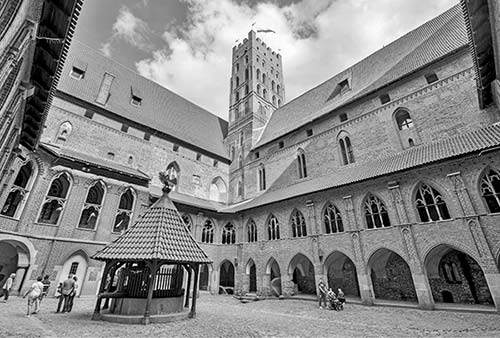
This is the heart of the castle and its oldest section. From this spot, the Teutonic Knights governed their vast realm—the largest monk-ruled territory in European history. As much a monastery as a fortress, the High Castle was off-limits to all but 60 monks of the Teutonic Order and their servants. (The knights stayed in the Middle Castle.) Here you’ll find the monks’ dormitories, chapels, church, and refectory. As this was the nerve center of the Teutonic Knights, it was also their last line of defense. They stored enormous amounts of food here in case of a siege.
In the middle of the High Castle courtyard is a well—an essential part of any inner castle, especially one as prone to sieges as Malbork. At the top is a sculpture of a pelican. Because this noble bird was believed to kill itself to feed its young (notice that it’s piercing its own chest with its beak), it was often used in the Middle Ages as a symbol for the self-sacrifice of Jesus.
• Take some time to explore the...
Ground Floor
Immediately to your left is a door leading to the prison, with small “solitary confinement” cells near the entrance. Diagonally across the courtyard, hiding in the far corner, is an exhibit on stained-glass windows from the castle church.
Back near where you entered the courtyard, step into the kitchen. This exhibit—with a long table piled with typical ingredients from that time—gives you a feel for medieval monastery life. The monks who lived here ate three meals a day and drank lots of beer (made here) and wine (imported from France, Italy, and Hungary). A cellar under the kitchen was used as a simple refrigerator—big chunks of ice were cut from the frozen river in winter, stored in the basement, and used to keep food cool in summer. Behind the long table, see the big dumbwaiter (with shelves for hot dishes), which connects this kitchen with the refectory upstairs. Step into the giant stove and peer up into the biggest chimney in the castle.
• Now go back out into the courtyard and climb up the stairs near where you first entered.
Middle Floor
• From the top of the stairs, the first door on the left (with the colorfully painted arch) leads to the most important room of the High Castle, the...
Chapter Room: Monks gathered here after Mass, and it was also the site for meetings of Teutonic Knights from throughout the realm. If a Grand Master was killed in battle, the new one would be elected here. Carvings above each chair indicated the status of the man who sat there. The big chair belonged to the Grand Master. Notice the little windows high on the wall above his chair, connecting this room to the church next door. Ecclesiastical music would filter in through these windows; imagine the voices of 60 monks bouncing around with these acoustics.
While monks are usually thought to pursue simple lives, the elegant vaulting in this room is anything but plain. The 14th-century frescoes (restored in the 19th century) depict Grand Masters. In the floor are more vents for the central heating.
• Leave the Chapter Room and walk straight ahead, imagining the monk-filled corridors of Teutonic times. The first door on the right is the...
Treasury: As you explore the five rooms of the tax collector and the house administrator, notice the wide variety of safes and other lock boxes. Documents, amber, and coins were kept behind heavily armored and well-locked doors.
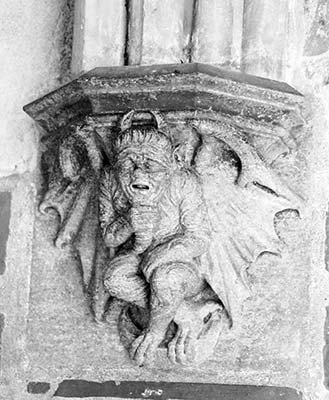
• Continue around the cloister. At the end of the corridor, spot the little devil (see photo next page) at the bottom of the vaulting (on the right, just above your head). He’s pulling his beard and crossing his legs—pointing you down the long corridor leading about 100 yards away from the cloister to the...
Dansker Tower: From the devil’s grimace, you might have guessed that this tower houses the latrine. Four wooden toilet stalls filled this big room. Where one is missing, you can look down to see how the “toilets” simply dropped the waste into the moat. For obvious sanitary (and olfactory) reasons, this potty tower is set apart from the main part of the castle. The bins above the toilets were filled with cabbage leaves, to be used by the T. K. as TP (and as an organic form of Preparation H). This tower could also serve as a final measure of defense—it’s easier to defend than the entire castle. Food was stored above, just in case. More info on this grand castle WC is on the wall.
• Return down the long corridor. Before the end, on the right-hand side of the long passage, a door leads into the...
Church Exhibition: Once dormitories for the monks, these three rooms now display a wide range of relics from the church. In the last room, on the far wall, is the artistic highlight of the castle: a finely carved and gilded three-panel altarpiece from 1504 featuring the coronation of Mary. Mary’s face is mesmerizing. Characteristic of the late Gothic period, the robes seem to fly unrealistically (as if they were bent metal).
• Back out in the main cloister, turn right and continue to the end, arriving at the...
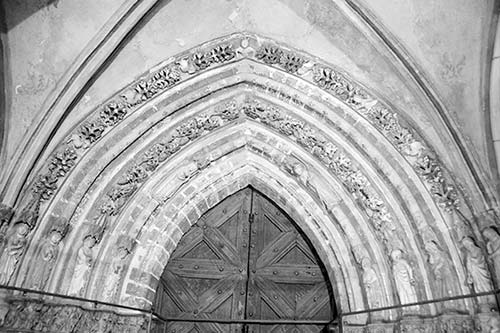
Golden Gate: This elaborate doorway—covered in protective glass—marks the entrance to St. Mary’s Church. Before entering, examine this rare original door. Ringed with detailed carvings from the New Testament and symbolic messages about how monks of the Teutonic Order should live their lives, it’s a marvelous example of late 13th-century art. At the bottom-left end of the arch, find the five wise virgins who, having filled their lamps with oil and conserved it wisely, are headed to heaven. On the right, the five foolish virgins who overslept and used up all their oil are damned, much to their dismay.
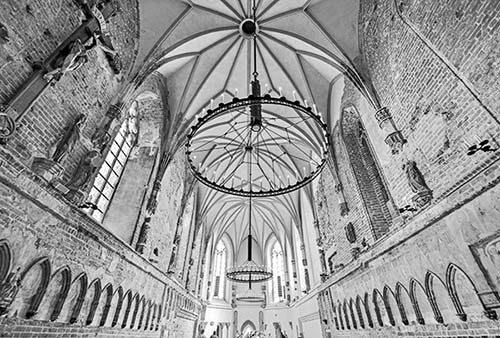
Step inside St. Mary’s Church to appreciate a glorious Gothic interior—recently reopened after a lengthy restoration. Straight ahead from where you entered, look for the 14th-century cross, which was partly burned when the castle was destroyed. Throughout the space, notice how the restorers intentionally used different materials to distinguish repairs from different eras: the brighter plaster dates from the recent work, while the darker plaster (closer to the area where you entered) is from the 19th century.
• Back outside, go through the narrow door next to the Golden Gate and hike up the tight spiral staircase to the final set of exhibits.
Top Floor
Walk through a space with temporary exhibits. At the end, descend into the monks’ common room (left, at the bottom of the stairs). Over the fireplace is a relief depicting the Teutonic Knights fighting the pagans. To the left and above (see the stone windows) is a balcony where musicians entertained the monks after a meal.
The next, very long room, with seven pillars, is the refectory, where the monks ate in silence. Along the right-hand wall are lockable storage boxes for tableware. At the end of this room, just beyond another ornate fireplace, notice the grated hole in the wall. This is where the dumbwaiter comes up from the kitchen (which we saw below). Beyond this room is an exhibit about the architectural renovation of the castle.
• Your Malbork tour ends here. You leave the way you came. En route, you can walk around terraces lining the inner moat, between the castle walls (stairs lead down off the drawbridge, by the catapult balls). It’s hardly a must-see, but it’s pleasant enough, with the Grand Master’s garden, a cemetery for monks, and the remains of the small St. Anne’s Chapel (with Grand Master tombs).
MALBORK CONNECTIONS
From Malbork by Train to: Gdańsk (2/hour, 30 minutes on express EIC train, 45 minutes on slower regional train), Toruń (about every 2 hours, 2.5 hours, change in Iława), Warsaw (hourly, 2.5 hours on express EIC train).
Toruń
Toruń (TOH-roon) is a living fairy tale that feels like Poland’s best-kept secret...and one of Europe’s, too. This pretty, lazy Gothic town, conveniently located about halfway between Warsaw and Gdańsk, is well worth a few hours to stroll the lively streets, ogle the huge red-brick buildings, and savor the flavor of perhaps Poland’s most livable city. You won’t regret spending the night...but when it’s time to leave, you may regret spending just one.
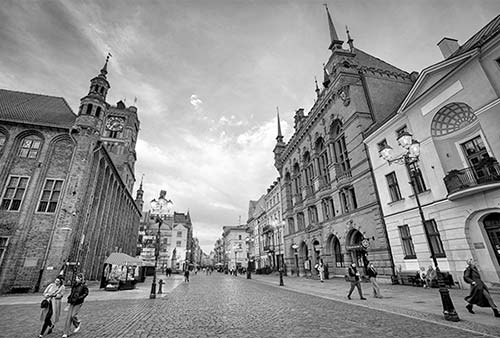
With about 210,000 residents and 30,000 students (at Copernicus University), Toruń is a thriving burg. Like Kraków (and unlike most other Polish cities), Toruń escaped destruction during World War II and remains well preserved today. Locals brag that their city is a “mini Kraków.” But that sells both cities short. Toruń lacks Kraków’s over-the-top romanticism, and its sights are quickly exhausted. On the other hand, Toruń may well be Poland’s most user-friendly city: tidy streets with a sensible grid plan, wide pedestrian boulevards crammed with locals who greet each other like they’re long-lost friends, and an easygoing ambience that seems to say, “Hey—relax.” It’s jammed with Polish school groups and families, and some in-the-know Germans...but few Americans.
Toruń clings fiercely to its two claims to fame: It’s the proud birthplace of the astronomer Copernicus (Mikołaj Kopernik), and home to a dizzying variety of gingerbread treats (piernika; pyer-NEE-kah).
Orientation to Toruń
Everything in Toruń worth seeing is in the walled Old Town, climbing up a gentle hill from the Vistula River. The broad, traffic-free main drag, Ulica Szeroka (called Różana at the entrance of town), bisects the Old Town, running parallel to the river. You can walk from one end of the town center to the other in about 15 minutes.
The helpful TI is right where the main square meets the main walking street, Ulica Szeroka (daily 10:00-17:00, closed Sun in winter, Ulica Szeroka 43, +48 56 621 0930, www.visittorun.com).
ARRIVAL IN TORUŃ
Toruń’s main train station (Toruń Główny) is across the river from the Old Town, about a mile away. The tidy main hall sits between tracks 1 and 2. Lockers are between the food hall and track 2.
To reach the Old Town, you can take a taxi—they wait out the door from the main hall (figure 20-25 zł or less to Plac Rapackiego, the start of my Toruń Walk, or most recommended hotels). To go by bus, first buy a single ticket from the Relay kiosk inside the station (about 4 zł), then use the escalators, stairs, or elevator to descend to the pedestrian underpass and exit toward Ul. Kujawska (past platform 4). You’ll surface near an old steam locomotive; nearby is the stop for bus #27 to Plac Rapackiego, the first stop after the long bridge. (Buses #11 and #14 also make this trip.) To return to the station, catch the bus across the busy road from where you got off. Note: Public transit is free for anyone over age 65 (just show your passport if asked).
Alternate Train Station: Some (but not all) trains also stop at Toruń Miasto station, which is a bit closer to the Old Town (about a 15-minute walk along the river). Check schedules carefully to see if your train stops here; those overnighting in town may find it more convenient.
Toruń Walk
This lazy, low-impact self-guided walk takes you through the heart of Toruń—showing you pretty much everything you’d want to see on a brief visit. With no stops, you could do it all in about 45 minutes.
• Coming from the train station, the bus stop is at...
Plac Rapackiego
The park that rings Toruń—once the site of the medieval city wall—is an inviting people zone. From the bus stop, walk straight ahead through the park, toward town. You’ll pass a borrow-a-bike station and a futuristic sculpture, labeled Solimnia Regit, honoring hometown boy Copernicus’ heliocentric theory...more on him later. The big, historic, ornately gabled building on your left is the Collegium Maximum, the historic headquarters of Toruń’s prestigious university.
Carry on straight ahead, going below the narrow house marked 1936 and the adjoining local Solidarity headquarters. Under the tower, you’ll find some remaining tram tracks, commemorating the line that ran along the city’s main drag from 1936 until 1970. You’ll pop out on the town’s main drag.
• Continue one block straight along the main street to reach the bustling...
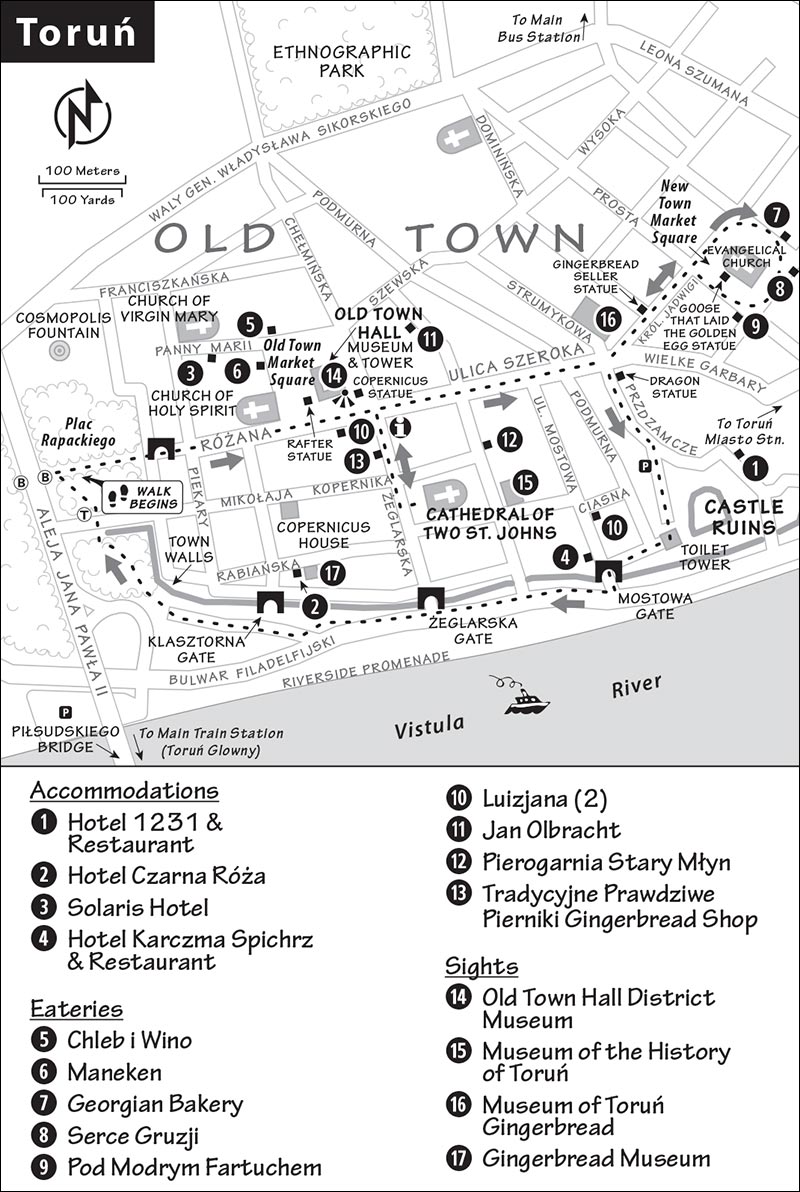
Old Town Market Square (Rynek Staromiejski)
This square is surrounded by huge brick buildings and outdoor restaurants buzzing with lively locals (for tips, see “Eating in Toruń,” later).
The Old Town Hall (Ratusz Staromiejski) fills the middle of the square. Like the Cloth Hall in Kraków, this building began life as a general market. Toruń is, at its heart, a trading city, and benefitted tremendously from its membership in the Hanseatic League—a trade union of Northern European maritime cities. Toruń’s prime position on the Vistula River, navigable by oceangoing vessels, put it on the map and allowed it to prosper. The Old Town Hall contains a fine, if dated, museum, and you can pay to climb its tower for a town view. To escape the square’s bustle, you can step into this building’s serene brick courtyard, with the ticket office and museum entrance (for details, see “Sights in Toruń,” later).
The ornate, dark-red building with the pointy spires facing the Old Town Hall is the Artus Court, marking the location where the medieval town council and merchants’ guilds met. While the town was founded in 1231, the current building is Neo-Gothic, dating from 1891; inside its dramatic, vertical, covered courtyard, you’ll find a New Orleans-themed restaurant (seriously...see “Eating in Toruń,” later). In the pavement directly in front of this building, plaques celebrate famous people who were born here or have ties to this town...sort of a Toruń walk of fame.
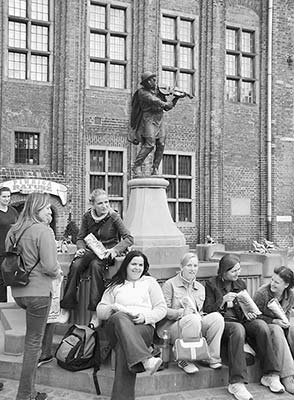
Toruń seems to specialize in statues that spin fanciful tales. The first of these is at the nearest corner of the Old Town Hall. Look for the fountain with the guy playing a violin. This is a rafter (retman)—one of the medieval lumberjacks who lashed tree trunks together and floated them down the Vistula to Gdańsk. This particular rafter came to Toruń when the town was infested with frogs. He wooed them with his violin and marched them out of town. (Hmm...sounds like a certain pied piper...)
Standing by the fountain, look in the direction the rafter’s bow is pointing. Two doors to the right of the giant Artus Court, at the very top of the skinny greenish building, spy the silhouette of a cat. According to local legend, while prowling the rooftops in the 17th century, this cat saw an invading Swedish army. So, he began howling loudly, waking the town just in time to prepare for the battle.
Now walk along the front of the Old Town Hall. At the far corner, the bigger statue depicts Mikołaj Kopernik, known internationally as Nicolaus Copernicus (1473-1543). This Toruń-born son of aristocrats turned the world on its ear when he suggested that the sun, not the earth, is the center of the universe (the “heliocentric theory”). Toruń is seriously proud of this local boy done good—he’s the town mascot, as well as the namesake of the local university. Among its fields of study, Copernicus U. has a healthy astronomy program. There’s a planetarium in the Old Town (just past the far corner of the square) and a giant radio telescope on the outskirts. Despite all the local fuss over Copernicus, there’s some dispute about his “nationality”: He was born in Toruń, but at a time when it was the predominantly German town of “Thorn.” So, is he Polish...or German? (For more on Copernicus, you can visit his birth house—now a museum—two blocks away; described later, under “Sights in Toruń.”) Either way, this statue is the town’s top selfie spot—you’ll see Polish families lining up to snap the perfect photo.
Copernicus faces a shiny donkey at the corner of Szeroka and Żeglarska streets. Notice the sharp ridge on the donkey’s back, which recalls a humiliating punishment. Centuries ago, delinquents and petty criminals needing to be set straight would be forced to straddle this donkey—after townspeople had tied heavy stones to their feet, weighing them down painfully.
• But you’re on vacation—and, rather than humiliation, you get gingerbread. Follow your nose to the right, down Żeglarska street, which is lined with...
Gingerbread Shops
For Poles, Toruń is synonymous with gingerbread (piernika)—you’ll smell its heavenly scent all over town. When Chopin visited, most of his impressions of Toruń revolved around gingerbread. Today, this Toruń treat can be topped with different kinds of jams or glazes, and/or dipped in chocolate. But historically, gingerbread was more straightforward—and a valuable commodity. The honey used in its dough and for glazing acted as a preservative, allowing gingerbread to be traded far and wide. And its spices aid digestion, so it served a medicinal purpose as well. Thanks to Hanseatic League connections, Toruń’s bakers had access to exotic, imported spices such as white ginger, cinnamon, clove, anise, citrus skins, cardamom, and peppercorns (for which piernika is named). Traditionally, gingerbread dough was pressed into wooden molds, giving each cookie a distinctive shape.
While you’ll spot a half-dozen options for buying gingerbread within a few steps of here, I like the one marked Tradycyjne Prawdziwe Pierniki (on the right, at #25). This shop has a fun system: All the varieties cost the same, so you can assemble just the mix you like by pointing. Róża is rose, malina is raspberry, czarna porzeczka is black currant, morela is apricot, and—of course—czekolada is chocolate.
• A few steps down and across the street is the...
Cathedral of Two Saint Johns (Katedra Św. Jana Chrzciciela i Jana Ewangelisty)
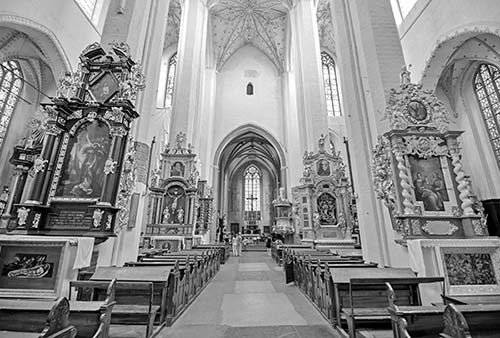
Dedicated in the 12th century to both John the Baptist and John the Evangelist, this is the parish church of the Old Town. Its massive bulk dominates the view of Toruń from across the river. From street level, appreciate the architectural heaviness: The marshy land lacked big stones, so instead of flying buttresses, medieval engineers employed an overbuilt brick structure so they could go big.
If it’s open, step into the interior, with graceful Gothic austerity—delicate ribs and whitewashed walls. The gravestones of big shots pave the floor. Each trade guild had its own chapel, with its own fancy altar. On the wall to the left of the main altar, notice the finely restored 13th-century Last Judgment fresco. As you leave, head to the back-right corner (opposite where you came in) and find the colorful baptismal font where, in 1473, Copernicus was baptized (free entry, tower climb extra, irregular hours).
• Having satisfied your ginger tooth and seen the town’s most important church, head back to the square and that painful donkey, turn right, and join the human stream down the appropriately named...
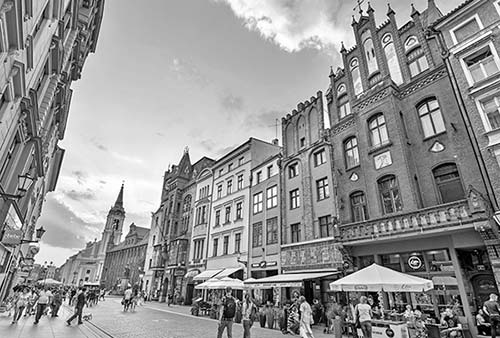
Ulica Szeroka (“Wide Street”)
This intoxicating-in-good-weather pedestrian promenade leads through the heart of town. Embedded in the paving bricks are the coats of arms of Toruń’s medieval trading partners. On each side of the street is an eclectic commotion of fun facades and intriguing shops. Stow your guidebook for a few minutes and just stroll and window-shop. I’ll meet you just before you get to a clock tower in the middle of the street.
About 30 yards before the road forks at the stately, white Empik building, look down narrow Przedzamcze street to the right to see fragments of the town wall. This marks the border between the Old Town and the New Town (chartered only about 30 years later—both in the 13th century). While these areas are collectively known today as the unified “Old Town,” they were quite different in the Middle Ages—each with its own market square and separated by a wall. Because the New Town lacked the easy access to the river, most of its residents were craftspeople who supplied the traders in the Old Town.
At the start of Przedzamcze street, on the left, notice the small, fenced stretch of stream that runs underground through town. Next to the stream is another legendary monument: a dragon. As the plaque explains, back in 1746, locals swore in official records that they saw a real-life, six-foot-long dragon right about here.
• Across Szeroka street from Przedzamcze, Strumykowa street leads to the better of Toruń’s two gingerbread museums (described later).
Let’s take a quick spin through the New Town. Bear left at the clock tower to head up Królowej Jadwigi street. At the first street on the left, look for the green statue of the gingerbread seller (piernikarka)—with lots of goodies in her basket.
Another block straight ahead, you pop out at...
New Town Market Square (Rynek Nowomiejski)
This sleepy, inviting square is nearly as appealing as its Old Town counterpart. Its centerpiece is an angular and austere Evangelical Church—a reminder that this northern part of Poland, with its Prussian roots, isn’t just for Catholics.
At the near end of the church, look for yet another fairy-tale statue—this time, one that may be more familiar: the Goose That Laid the Golden Egg.
Do a slow spin around the square, surveying options for a meal (either now or later—for recommendations, see “Eating in Toruń,” later). In addition to a historic pub, the far corner of the square has a surprising concentration of Georgian restaurants, from the republic in the Caucasus. If you haven’t tried this delicious cuisine before, now’s a good chance. (For more on Georgian food, see here.)
• When you’re ready, we’ll backtrack through town for our final stop—a look at the castle where Toruń began.
Head out of the square the way you came, on Królowej Jadwigi, just two short blocks to the intersection at the clock tower. Bear right here, then turn left down Przedzamcze—passing the dragon and his stream that we saw earlier. We’ll follow that (underground) stream down toward the river. When you reach the parking lot, bear left under the stubby, standalone brick gate. Emerging on the other side, you’ll see an old mill straight ahead and a crenellated brick tower on your right. You’re standing in the middle of what’s left of...
Toruń Castle
This castle, built by the Teutonic Knights who were so influential in northern Poland in the Middle Ages (see here), was destroyed in the 15th century by the locals—who, aside from a heap of bricks, left only the tower that housed the Teutonic toilets. You can pay to enter the ruins nearby—basically just foundations—but there’s little to see. However, what survives is one of the better toilet towers in Europe—which was connected to the castle by an elevated walkway and located far enough away to keep things hygienic. (Notice how it was positioned to drop into the dragon’s stream—which you can see uncovered here again.) The old mill next to the toilet is now a recommended hotel and restaurant named 1231, for the date the Teutonic Order arrived here.
• Our walk is over. You can backtrack the way you came and explore more of the city (including the sights listed next). Or you can take a quick riverside stroll: Go under the toilet tower and down to the Vistula River, turn right, and stroll along the castle and 14th-century city walls back to your starting point (and the bus stop back to the station). The road is called Bulwar Filadelfijski—for Toruń’s sister city in Pennsylvania.
Sights in Toruń
Toruń is more about strolling than it is about sightseeing—the town’s museums are underwhelming. Aside from its half-dozen red-brick churches (any of which are worth dropping into), the following attractions are worth considering on a rainy day.
Hours: Almost all of these sights—everything except the second Gingerbread Museum—are operated by the city and have the same hours: Tue-Sun 10:00-18:00, Oct-April until 16:00, closed Mon year-round (www.muzeum.torun.pl).
City History Museums
Toruń operates two different history museums. Both show off intimate bits and pieces of history—from pewter tankards to old gingerbread molds—that show the richness of this traders’ city. They’re essentially redundant—pick one.
The Old Town Hall District Museum, inside the centerpiece building on the main square, has more impressive spaces—including Gothic corridors and royal meeting rooms upstairs. But the collection is dusty and challenging to appreciate. The highlight is the Gothic Gallery on the main floor—featuring medieval church art saved from the region’s churches, with lots of Marys (the patron of the Teutonic Order), and a close-up look at some 14th-century stained glass. You can also pay to climb the 176 narrow wooden steps to the top of the tower for great views over the city center (36.50 zł combo-ticket covers museum and tower, 22.50 zł for one or the other, tower open until 20:00 in May-Sept).
A few blocks away, the Museum of the History of Toruń fills an old red-brick granary with four floors of well-explained artifacts, colorful exhibits, and English translations. While the space is less impressive, it’s a more meaningful experience. Your ticket includes an informative, 13-minute 3-D movie (with English subtitles) about the town’s history on the top floor (19.50 zł, Łazienna 16).
Gingerbread Museums
Toruń has various gingerbread experiences (mainly oriented to Polish school groups and families) that enjoy teaching about this important local product. Buying and sampling gingerbread is the only “essential” Toruń experience, but these options round out your visit nicely. Unlike cookies, you should choose just one.
The Museum of Toruń Gingerbread, just off the main drag at the far end of town, is more of a traditional museum. It fills the historic red-brick Weese family gingerbread factory, established in 1885. (The company still makes gingerbread, in a modern plant on the outskirts.) After watching a brief film, you’ll walk through three floors of quaint, modern exhibits that trace the history of gingerbread: artifacts (molds, ovens) in the cellar, a recreated late 19th-century street on the upper floor, and an interesting overview of the gingerbread-making process on the main floor. For a separate fee, they offer hands-on gingerbread demonstrations—predominantly in Polish, but if the guide speaks some English, they may add some extra commentary for you (36.50 zł combo-ticket includes museum and demo, 22.50 zł for one or the other, Strumykowa 4).
The Gingerbread Museum (Muzeum Piernika), between the main square and the river, is popular with kids and with anyone wanting an English demonstration rather than a traditional museum. Costumed medieval bakers spend about an hour walking you through the traditional process of rolling, cutting out, baking, and tasting your own batch of gingerbread cookies. After aging for 12 weeks to achieve the proper consistency, the dough bakes for only 12 minutes—or, according to medieval bakers, about 50 Hail Marys (34 zł, daily 10:00-18:00, Polish tours at the top of each hour, English tours about once daily—likely at 14:00 but confirm ahead, in peak times it’s smart to reserve online in advance, Rabiańska 9, +48 56 663 6617, www.muzeumpiernika.pl).
Old Toruń Gingerbread (Piernikarnia Starotoruńska), a block above the main square, is similar to the Gingerbread Museum, with costumed bakers and a hands-on demonstration, but feels less crowded and less commercial. English demonstrations are sporadic; call or email ahead to see if one is scheduled (32 zł, daily 10:00-18:00, Francziskańska 16, +48 56 621 1019, zwiedzajtorun@gmail.com).
Copernicus House (Dom Kopernika)
Filling a pair of gabled brick buildings between the main square and the river, this museum celebrates the hero of Toruń. As much about medieval Toruń as about the famous astronomer and sprawling over several floors, the exhibits loosely explain Nicolaus Copernicus’ life and achievements, with several re-created Gothic rooms. However, it’s not engaging and fails to do justice to this very important native son; ultimately, it’s a big disappointment and skippable for casual visitors. If you do visit, I wouldn’t bother paying the additional fee for the “4-D cinema”—while it provides a weighty introduction to astronomy and astrophysics, from the Big Bang to the plight of Pluto, it barely mentions Copernicus.
Cost and Hours: 22.50 zł, 4-D cinema-22.50 zł, Kopernika 15, +48 566 605 613.
Other Toruń Museums
Toruń is a popular destination for Polish families, and the TI loves to suggest attractions for those with more time. The “Mill of Knowledge” is a hands-on science museum designed for kids, with six floors of interactive exhibits. The Travelers Museum focuses on Toruń native Tony Halik, who hosted a travelogue TV show that was many Poles’ gateway to the world. The Toruń Fortress Museum, just north of the Old Town, offers a glimpse inside the city’s impressive red-brick fortifications. The city has two open-air folk museums: one just north of the Old Town, and a better one, called Olender, a few miles south of the river. And in the park ringing the Old Town, just a two-minute walk from the bus stop, is the Fontanna Cosmopolis, a dancing fountain that thrills kids with a little music-and-lights show each evening (generally runs May-Oct, get details at TI).
Sleeping in Toruń
$$ Hotel 1231 is trying to go high-class in this small town. It has 22 modern rooms filling a restored 13th-century mill at the bottom of town, next to the old toilet tower, with 20 additional sleek rooms in an annex. They also have a restaurant, bar, fitness center, sauna, “golf simulator,” and other amenities—all run with a whiff of pretense (air-con, elevator, Przedzamcze 6, +48 56 619 0910, www.hotel1231.pl, recepcja@hotel1231.pl).
$ Hotel Czarna Róża (“Black Rose”) feels fresh and modern, with 23 rooms on a back street. About half of the rooms are in the older building and cheaper, while the rest are pricier, as they have an elevator, air-con, and river views (Rabiańska 11, +48 56 19637, https://hotelczarnaroza.pl, hotel@hotelczarnaroza.pl).
$ Solaris Hotel, beautifully located just steps off the main square, has 23 conventional, cozy rooms tucked into a historic town house. It’s quirky but central and friendly (air-con, elevator, Panny Marii 9, +48 56 471 3042, https://hotelsolaris.pl, recepcja@hotelsolaris.pl).
$ Hotel Karczma Spichrz (“Granary”) has 24 rooms in a renovated old granary, and 20 more in a newer annex. Rustic and creaky, it has huge wooden beams around every corner (low ceilings, thin floors and walls can be noisy, air-con, elevator, a block off the main drag toward the river at Ulica Mostowa 1, +48 56 657 1140, www.spichrz.pl, hotel@spichrz.pl).
Eating in Toruń
Toruń is a great place to eat, with lots of tempting options—including several non-Polish, international choices. In this gingerbread-crazy town, look for various drinks, dishes, and desserts with that distinctive flavor (including gingerbread beer).
Old Town Market Square: The square surrounding the Old Town Hall is ringed with stay-awhile al fresco tables, any of which is a good choice for a scenic meal; most are open long hours daily. Favorites include $$ Chleb i Wino (“Bread and Wine”), which feels a bit more upscale, with Polish and Mediterranean dishes; and $ Maneken, the original outpost of a popular chain, which serves savory crêpe dishes in a convivial, trendy-feeling interior.
New Town Market Square: This out-of-the-way square is especially sleepy at night. There are some great choices here, including three Georgian restaurants. The $ Georgian bakery at #26 is handy for picking up a quick and tasty meal. Of the sit-down places, $ Serce Gruzji is charming, tasty, and family run (closed Mon, at #1, +48 787 383 665). A few steps away, $$ Pod Modrym Fartuchem (“Blue Apron Inn”) fills a charming gabled house with cozy tables, ye olde ambience, and traditional food—continuing a legacy that dates back to 1489 (daily, at #8, +48 533 331 985).
Cajun: Luizjana, named for the US state, serves Cajun cooking that’s better than it has any right to be, and offers a nice break from traditional Polish fare. They have two locations (both open daily for lunch and dinner); I’d opt for the one that fills the (covered) courtyard of the Artus Court, facing the Old Town Hall. This beautiful space is a lovely spot for a meal, and the New Orleans soundtrack is lively...even if it feels a bit out of place (Ulica Rynek Staromiejski 6, +48 883 117 711). The other location is on a more humdrum side street, with indoor and outdoor tables (Mostowa 10, http://restauracjaluizjana.pl).
Brewery: $ Jan Olbracht, filling a characteristic old brick building a short walk off the main drag, is a glitzy microbrewery with five beers on tap (you can order a sampler) plus pub grub (daily, Szczytna 15, +48 797 903 333, www.browar-olbracht.pl). Roughly across the street is a classic milk bar, Pod Małgośka.
Traditional Restaurants in Hotels: The recommended $$ Spichrz and $$$ 1231 hotels both have traditional restaurants in historic spaces, with tempting menus of stick-to-your-ribs traditional fare. Spichrz is a bit ye olde and more casual; 1231 feels more upscale (see contact information earlier).
Hearty Pierogi: Pierogarnia Stary Młyn (“Old Mill”), on a side street near the history museum, has an over-the-top-rustic interior (and some outdoor tables) and a long menu of pierogi—boiled, baked, pan-fried—with various fillings (daily, Łazienna 28, +48 566 210 309). This is a small chain, with a few other locations as well.
Toruń Connections
Toruń is a natural stopover on the way between Warsaw and Gdańsk. The connection to Warsaw or Gdańsk is quick and easy; to reach Malbork, you’ll usually need to change.
From Toruń by Train to: Warsaw (every 2 hours direct, 3 hours on express IC train), Gdańsk (4/day direct, 2.5 hours; additional options with a change in Bydgoszcz or Iława, 3 hours), Malbork (about every 2 hours, 2.5 hours, change in Iława), Kraków (1/day direct, 6.5 hours; more options with a change in Warsaw: 7/day, 6 hours), Berlin (4/day, 6 hours, change in Poznań).
By Bus: If heading to Gdańsk, consider buses operated by Flixbus, which are cheaper than the train (www.flixbus.com).