BUDAPEST
Map: Heroes’ Square & City Park
Map: Andrássy Út Hotels & Restaurants
Map: Downtown Pest Hotels & Restaurants
Map: Buda Hotels & Restaurants
Map: Leopold Town Hotels & Restaurants
Budapest—Europe’s most underrated big city—is a unique metropolis at the heart of a unique nation. Feel your stress ebb away as you soak in hundred-degree water, surrounded by opulent Baroque domes (and happy Hungarians). Ogle richly decorated interiors, evoking a proud nation’s bygone glory days. Dive into a bowl of goulash, the paprika-flavored peasant soup. Take an after-dinner stroll along the Danube, immersed in a grand city that’s bathed in floodlights.
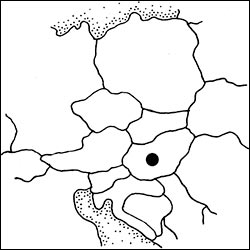
With nearly two million people (3.3 million in the outlying area), Budapest feels oversized. That’s because, like Vienna, the city was built as the head of a much larger empire than it now governs. But once you understand how Budapest is laid out, it’s easy to grasp. And visitors who get comfortable with the Metró, trams, and buses have the city by the tail (see “Getting Around Budapest,” later).
PLANNING YOUR TIME
Budapest demands at least two full days—and that assumes you’ll be selective and move fast. To slow down and really dig into the city, give it a third or fourth day. Adding more time allows for day trips.
Below are some possible plans, depending on the length of your trip. Each evening, you have a range of options: savoring good restaurants, attending an opera or concert, enjoying a romantic river cruise, relaxing in a thermal bath (some are open after hours), exploring the city’s ruin pubs and other nightlife, or simply strolling the floodlit Danube embankments and bridges.
Budapest in Two Days
You’ll only have time to squeeze in one or two big sights; the most worthwhile are the Parliament (book tickets ahead online), the Great Synagogue, the Opera House, and the House of Terror.
Day 1: Spend the day in Pest. Begin at the Parliament and stroll through Leopold Town, then walk through Downtown Pest, ending at the Great Market Hall. Then circle around the Small Boulevard to Deák Tér (perhaps stopping en route at the Great Synagogue) and consider walking up Andrássy Út to Heroes’ Square and City Park. Or, if you’re exhausted already, just take the M1/yellow Metró line to Hősök Tere and ogle the Heroes’ Square statues and Vajdahunyad Castle. In the late afternoon, reward yourself with a soak at Széchenyi Baths.
Day 2: In the morning, tackle any Pest sights you didn’t have time for yesterday. After lunch, ride bus #16 or #216 from Deák Tér to Buda’s Castle Hill. Finally, head back to Pest for dinner.
Budapest in Three or More Days
Day 1: Get your bearings in Pest. Begin by strolling through Leopold Town (including a tour of the Parliament—book tickets ahead online), followed by a walk up Andrássy Út (including touring the Opera House and the House of Terror) to Heroes’ Square and City Park. End your day with a soak at the Széchenyi Baths.
Day 2: Delve deeper into Pest, starting with a stroll through Downtown Pest. After visiting the Great Market Hall, circle around the Small Boulevard to explore the Great Synagogue and Jewish Quarter. If you’d like to squeeze in another spa, cross the river to Buda for a soak at the Gellért or Rudas baths.
Day 3: Use the morning to see any remaining Pest sights. Then, after lunch, take bus #16 or #216 from Deák Tér to Castle Hill.
With More Time: If you have a fourth day, spread the day 1 activities over more time, circle back to any sights you’ve missed, and consider heading out to Memento Park to see a collection of old communist statues.
Orientation to Budapest
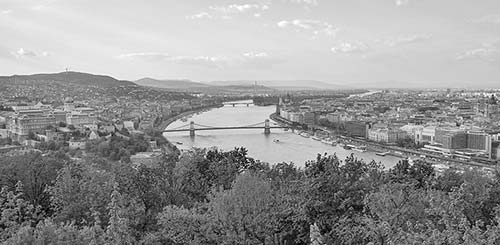
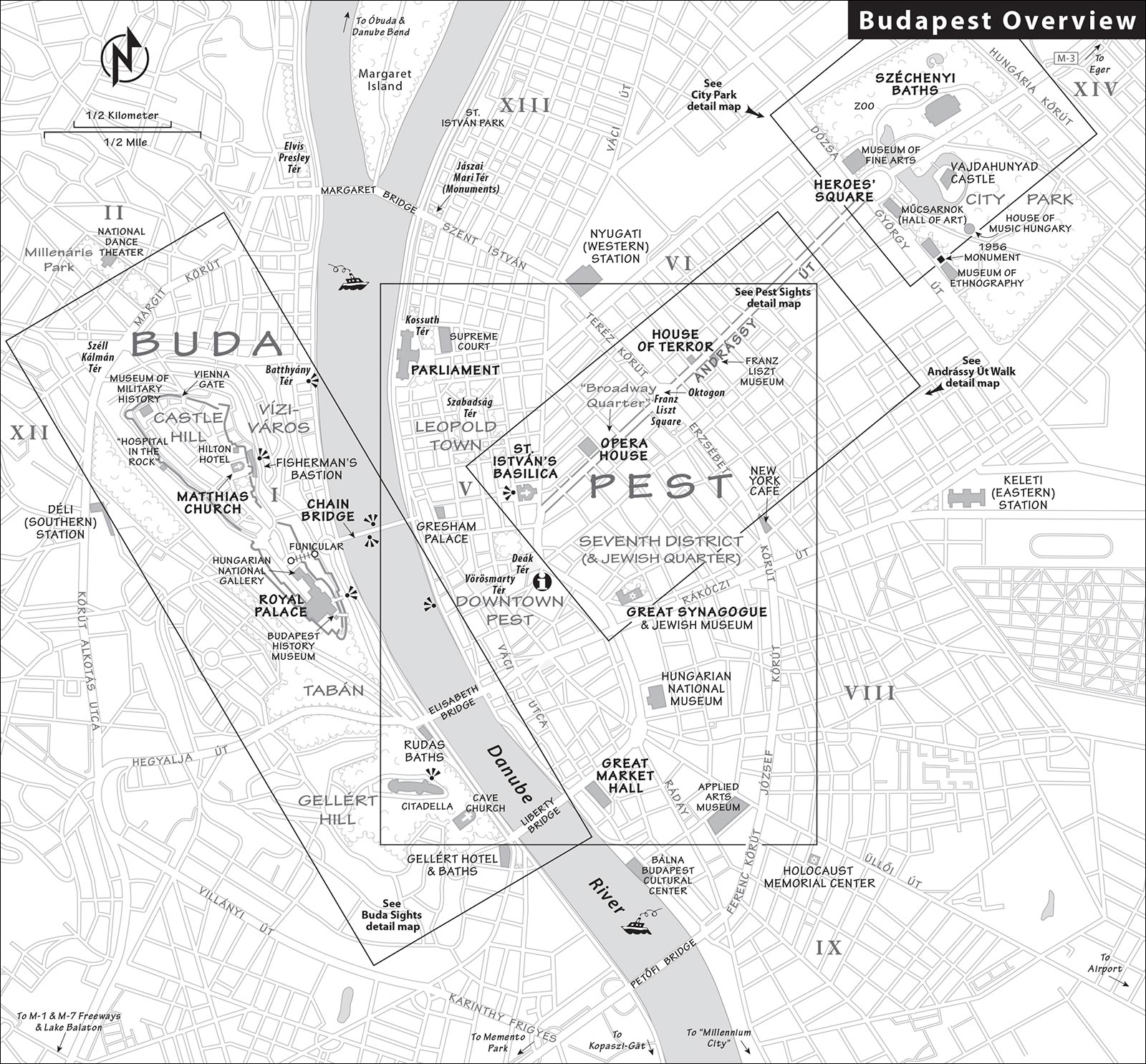
Budapest is split down the center by the Danube River. On the east bank is flat Pest (pronounced “pesht”), and on the west bank is hilly Buda. (A third part of the city, Óbuda, is north of Buda.)
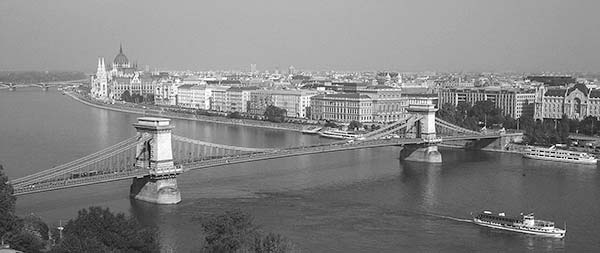
Bridges: Buda and Pest are connected by a series of characteristic bridges. From north to south, there’s the low-profile Margaret Bridge (Margit Híd, crosses Margaret Island), the iconic Chain Bridge (Széchenyi Lánchíd), the white and modern Elisabeth Bridge (Erzsébet Híd), and the green Liberty Bridge (Szabadság Híd). Four more bridges lie beyond the tourist zone.
Districts: Budapest uses a district system (like Paris and Vienna). There are 23 districts (kerület), identified by Roman numerals. For example, Castle Hill is in district I, central Pest is district V, and City Park is in district XIV. Addresses often start with the district’s Roman numeral.
Pest: Central Pest, along a gentle bend in the Danube, has two main parts—Downtown Pest (Belváros, BEHL-vah-rohsh) and, just to the north, the banking and government center called Leopold Town (Lipótváros, LEE-poht-vah-rohsh). You can walk from the northern end of Leopold Town (the Parliament area) to the southern end of Downtown Pest (the Great Market Hall) in about 30 minutes.
Pest is surrounded by four concentric ring roads (körút). Downtown Pest is corralled within the Kiskörút, or “Small Boulevard.” More attractions lie between there and the Nagykörút, or “Great Boulevard.” Arterial boulevards, called út, stretch from central Pest into the suburbs. These include the wide, genteel, entertaining Andrássy Út (AWN-drah-shee oot), with many of my recommended accommodations, restaurants, nightlife, and sightseeing.
More key sights lie along the Small Boulevard (connected by trams #47, #48, and #49), including the Great Synagogue, the National Museum, and the Great Market Hall.
Several other points of interest are spread far and wide along the Great Boulevard (circled by trams #4 and #6). From north to south, it passes Margaret Island (the city’s playground, in the middle of the Danube); the Nyugati/Western train station; the Oktogon intersection, where it crosses Andrássy Út; the opulent New York Café, with the Keleti/Eastern train station just up the street; and the intersection with Üllői Út, near the Holocaust Memorial Center and the Applied Arts Museum.
Buda: Two steep hills rise up from Buda’s riverbank—Castle Hill (Várhegy, VAHR-hehj), marked by the domes and steeples of the Castle District; and Gellért Hill, flanked by thermal baths (Rudas at the southern base of the hill, and Gellért at the northern base) and capped by a grand viewpoint. The pleasant Víziváros (VEE-zee-vah-rohsh, “Water Town”) residential neighborhood is squeezed between the castle and the Danube.
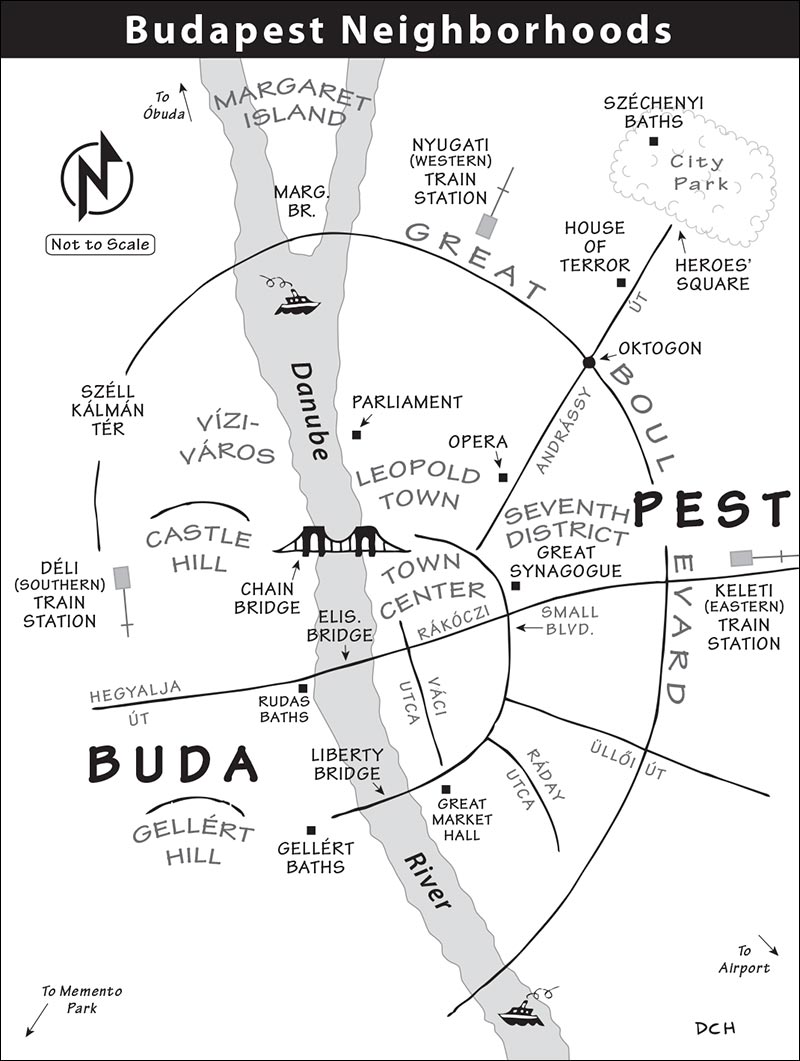
Central Buda is surrounded by a ring road, and the busy Hegyalja Út rumbles through the middle of the tourists’ Buda (between Castle and Gellért Hills). Behind Castle and Gellért hills is of little interest to tourists (except for the Déli/Southern train station).
The square called Batthyány Tér, at the north end of Víziváros, is a hub for the neighborhood, with a handy Metró stop (M2/red line), tram stops, market hall, and eateries. Just north of Castle Hill is Széll Kálmán Tér, another transit hub for Buda, with a Metró station (M2/red line), several tram stops, and the giant Mammut shopping mall.
TOURIST INFORMATION
The city of Budapest has just one official TI in Downtown Pest. It’s in the brightly colored kiosk on Városháza Park, near the Deák Tér transit hub (daily 9:00-19:00, Károly Körút, www.budapestinfo.hu). You may also find TI “mobile info points” in highly trafficked areas.
Sightseeing Passes: The Budapest Card includes all public transportation, walking tours of Buda and Pest, admission to a handful of sights (including the National Museum, National Gallery, and Memento Park), a shuttle bus up to the castle, and 10-50 percent discounts on many other major museums, thermal baths, and attractions (€29/24 hours, €43/48 hours, €56/72 hours, longer versions available, www.budapest-card.com [URL inactive]). If you take advantage of the included walking tours, the Budapest Card can be a good value for a very busy sightseer—do the math. Buy it online, then exchange the digital voucher for your card when you get to town. You can also purchase the card at the TI, at service points for BKK (the public transit authority), at many hotels, and at other locations around Budapest.
ARRIVAL IN BUDAPEST
By Train
Budapest has three major train stations (pályaudvar, abbreviated pu.): Keleti (“Eastern”) station, Nyugati (“Western”) station, and Déli (“Southern”) station; a fourth, suburban station—Kelenföld—is a common transfer point for destinations to the south (including Pécs). Before departing Budapest, it’s essential to confirm which station your train leaves from.
The taxi stands in front of each train station are notorious for ripping off tourists. Instead, use public transportation (each station is on at least one Metró line and well served by various buses and trams); order a taxi using the Bolt app (see “Getting Around Budapest—By Taxi,” later); or, if you must use a taxi, call for one rather than hopping into one parked outside (call +36 1 211 1111 or +36 1 266 6666, and tell the English-speaking dispatcher where you are). For tips on all of this—and on using the Metró system to connect into downtown Budapest—see “Getting Around Budapest,” later.
Getting Hungarian Cash on Arrival: At the train stations, it can be tricky, if not impossible, to find a reputable ATM. (The few that you see are most likely operated by Euronet—an exchange bureau that offers worse rates and higher fees than a bank-to-bank transaction.) Ideally, get to your hotel, then get advice on finding an ATM run by a real bank. These days, credit cards are widely accepted (for example, using the BudapestGO app for buying transit tickets, or the Bolt app for hailing a taxi); in fact, some short-term visitors get by without withdrawing any cash at all.
Keleti/Eastern Station
Keleti train station (Keleti Pu.) is south of City Park, east of central Pest. The station faces a plaza called Baross Tér, with stops for two different Metró lines (M2/red and M4/green).
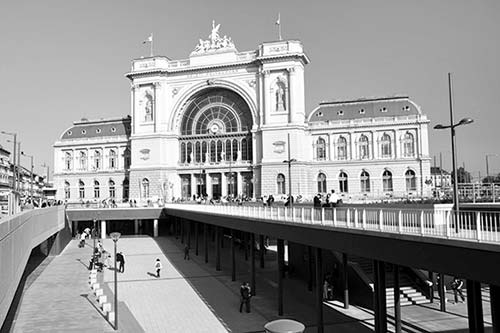
The long tracks 6-9 stretch all the way to the front doors of the station, which exit toward Baross Tér and the Metró stops. Tracks 1-5 and 10-13 are set back from the main entrance on either side.
Along track 6, a side door leads to a beautifully restored arrivals hall and an exit to a taxi stand (avoid it).
To get into town by Metró, head out the big front doors into the giant plaza, then take any of the staircases down into the lower area of the square; once down there, bear left to reach the M2/red Metró line, or right to reach the M4/green Metró line. For a taxi, order one using the Bolt app or by calling.
Nyugati/Western Station
Nyugati train station (Nyugati Pu.) is the most central of Budapest’s stations, facing the Great Boulevard on the northeast edge of downtown Pest.
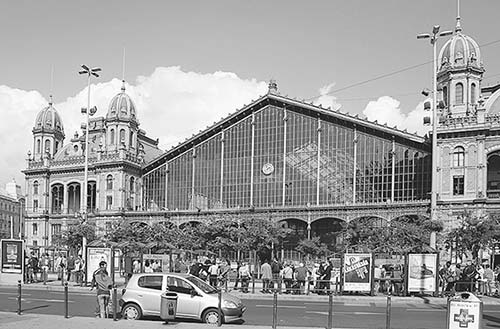
Most trains use the shorter tracks 1-9, which are set back from the main entrance. From the head of these tracks, use the stairs or escalator just inside the doors to reach an underpass and the Metró (M3/blue line). Or exit straight ahead into a small parking lot with buses, taxis, and—around to the right—the WestEnd City Center shopping mall. (The useful trams around the Great Boulevard are outside the main door, at the head of the longer tracks 10-13.)
Tracks 10-13 extend all the way to the main entrance. From here, exit straight ahead out the main entrance and you’ll be on Teréz Körút, the very busy Great Boulevard ring road. In front of the building are a stand selling heavenly smelling, cheap portions of kürtőskalács chimney cakes, and the stop for the handy trams #4 and #6 (which zip around the Great Boulevard); and to the right are stairs leading to an underpass (use it to avoid crossing this busy intersection, or to reach the Metró’s M3/blue line).
Beyond track 13, set back again from the main entrance, are four more platforms—tracks 14-17. From here, it’s easiest to simply walk along track 13 to the main entrance.
Déli/Southern Station
Tucked behind Castle Hill on the Buda side, this station is dreary. From the tracks, go straight ahead into the vast main hall, with well-marked domestic and international ticket windows. Downstairs, you’ll find several shops and eateries, and access to the very convenient M2/red Metró line, which takes you to several key points in town: Batthyány Tér (on the Buda embankment, at the north end of the Víziváros neighborhood), Deák Tér (the heart of Pest, with connections to two other Metró lines), and Keleti train station (where you can transfer to the M4/green Metró line).
By Plane
Budapest’s Liszt Ferenc Airport is 10 miles southeast of the center (code: BUD, www.bud.hu); some Hungarians may still call the airport by its former name, “Ferihegy.” The airport’s lone passenger terminal is called “Terminal 2.” The terminal has two adjacent parts, which you can walk between in just a few minutes: the smaller Terminal 2A is for flights to/from EU/Schengen countries (no passport control required), while Terminal 2B is for flights to/from other countries.
All flights feed into the same baggage claim area. Exiting baggage claim, you’ll find the desk for booking an airport shuttle, the kiosk for booking a taxi into town (outside, at the curb), and the ticket machines and stop for the public bus (also outside, past the taxi kiosk).
Getting Between the Airport and Downtown Budapest: The handiest public transit option is express bus #100E, which departs frequently and heads directly downtown, stopping only at three key Metró stations in central Pest: Astoria, Kálvin Tér, and Deák Tér (1,500 Ft, runs about every 10 minutes, 40-60 minutes depending on traffic). Bus #200E is cheaper (covered by a standard transit ticket or pass), but it goes only as far as the Kőbánya-Kispest Metró station, where you’ll need to transfer to get farther into town.
The miniBUD airport shuttle is a decent value for door-to-door minibus service, though it’s the slowest choice: You may have to wait for other arrivals to show up, and then you’ll make multiple stops around town. Still, it’s cost-effective for those not in a hurry who want an easy transfer (to the city center: €20/1 person, €23/2 people; takes about 30-60 minutes depending on hotel location, plus waiting time; +36 1 550 0000, www.minibud.hu; if arranging a minibus transfer to the airport, book it at least 24 hours in advance).
The fastest, priciest option is to take a taxi. Főtaxi has a monopoly at the taxi stand out front; figure about €30 (or around 12,000 Ft) to downtown, depending on traffic.
By Car
Avoid driving in Budapest if you can. Especially during rush hour (7:00-9:00 and 16:00-18:00), congestion is maddening. Don’t drive down roads marked with a red circle, or in lanes marked for buses; these can be monitored by traffic cameras, and you could be mailed a ticket.
There are three concentric ring roads, all of them slow: the Small Boulevard (Kiskörút), Great Boulevard (Nagykörút), and outermost Hungária Körút. Farther out, the M-0 expressway makes a not-quite-complete circle around the city center.
Parking: While in Budapest, unless you’re heading to an out-of-town sight (such as Memento Park), park the car at or near your hotel and take public transportation. Within the Great Boulevard, it’s generally free to park on the street from 20:00 until 8:00 the next morning (farther out, it’s free after 18:00). But in some heavily touristed areas, you may have to pay around the clock. Always check signs carefully, and confirm with a local (such as your hotelier) that you’ve parked appropriately. Also, be sure to park within the lines—otherwise, your car is likely to get “booted” (with a giant red brace on your wheel). A guarded parking lot is safer but more expensive (ask your hotel or look for the blue Ps on maps). As rental-car theft can be a problem, ask at your hotel for advice.
HELPFUL HINTS
Sightseeing Strategies: Just about everything in Budapest is walkable, but distances can be far. Plan your sightseeing geographically to minimize backtracking. Public transit and taxis save valuable time.
Keep in mind that (aside from the Gellért and Rudas Baths) Buda’s sightseeing is mostly concentrated on Castle Hill, and can easily be done in less than a day, while Pest deserves as much time as you’re willing to give it. Save relatively laid-back Buda for when you need a break from the big city.
Rip-Offs: Budapest is quite safe for a city of its size. Occasionally tourists run into con artists or pickpockets; wear a money belt and secure your valuables in touristy places and on public transportation.
Restaurants on the Váci Utca shopping street are notorious for overcharging tourists. Anywhere in Budapest, avoid restaurants that don’t list prices on the menu. Check your bill carefully. Most restaurants add a 12 percent service charge; if you don’t notice this, you might accidentally double-tip (for more on tipping, see here). Also, at Váci Utca and at train stations, avoid using the rip-off currency exchange booths (such as Euronet, Interchange, or Checkpoint). It’s better to simply get cash from an ATM associated with a major bank (including OTP, MKB, K&H, and various big international banks).
For tips on outsmarting cabbie crooks, see “Getting Around Budapest—By Taxi,” later.
Medical Help: Near Buda’s Széll Kálmán Tér, FirstMed Centers is a private, pricey, English-speaking clinic (by appointment or urgent care, call first, Hattyú Utca 14, 5th floor, district I, M2: Széll Kálmán Tér, +36 1 224 9090, www.firstmedcenters.com). The word for hospital is kórház.
Money: The Hungarian forint (Ft) has been volatile in recent years, so many businesses list their prices in the more stable euro currency. As rough shorthand, remember that 350 Ft is about €1.
English Bookstore: Bestsellers has a fine selection of new books, mostly in English; it’s near St. István’s Basilica (Mon-Fri 10:00-18:30, Sat 11:00-18:00, closed Sun, Október 6 Utca 11—see map on here, +36 1 312 1295).
Pharmacies: The helpful BENU Gyógyszertár pharmacy is dead-center in Pest, between Vörösmarty and Széchenyi squares. They have a useful directory that lists the Hungarian equivalent of US prescription medicines (Mon-Fri 8:00-20:00, closed Sat-Sun, Dorottya Utca 13, district V, M1: Vörösmarty Tér, for location see map on here, +36 1 317 2374). Each district has one 24-hour pharmacy (these should be noted outside the entrance to any pharmacy).
Laundry: The self-service launderette chain Bubbles is open 24/7, unstaffed, automated, and takes credit cards. The most convenient location is near the Small Boulevard, at the inner edge of the Seventh District, at Paulay Ede 3, M1: Bajcsy-Zsilinszky Út; check their website for others (www.bubbles.hu). Laundry Budapest, also in the Seventh District, is another good choice with lots of machines (daily 9:00-24:00, last wash at 22:00, Dohány Utca 37, near M2: Blaha Lujza Tér, +36 1 781 0098, www.laundrybudapest.hu). For locations, see the map on here.
For full service, Vajnóczki Tisztítószalon is a block from the Oktogon (next-day service, Mon-Fri 8:00-18:00, Sat until 13:00, closed Sun, Szófia Utca 8—see map on here, +36 1 342 3796).
Bike Rental: Budapest isn’t the easiest place for cyclists. But as the city adds more bike lanes and traffic-free zones, those comfortable with urban cycling may be tempted. The city transit authority has a subsidized public bike network called Bubi (for “Budapest Bikes”). Bike stations are scattered throughout town; you can rent and pick a bike up at any station and drop it off at any other, for affordable rates (for prices and details, see http://molbubi.bkk.hu [URL inactive]).
Drivers: Friendly, English-speaking Gábor Balázs can drive you around the city or into the surrounding countryside (€20/hour, 3-hour minimum in city, 4-hour minimum in countryside, +36 20 936 4317, bgabor.e@gmail.com). Zsolt Gál and his team offer transfers, side-trips, and longer trips to Prague or Vienna (+36 70 452 4900, forma111562@gmail.com). Note that these are drivers, not tour guides. For a licensed tour guide who also does countryside driving trips, see “Tours in Budapest,” later.
Best Views: Budapest is a city of marvelous vistas. Some of the best are from the Citadella fortress (high on Gellért Hill, may be under renovation), the promenade in front of the Royal Palace and the Fisherman’s Bastion on top of Castle Hill, and the embankments or many bridges spanning the Danube (especially the Chain Bridge). The classic Parliament view is from across the river, along the Buda embankment near Batthyány Tér (the light is best late in the day). Don’t forget the view from the tour boats on the Danube—particularly lovely at night.
GETTING AROUND BUDAPEST
Budapest sprawls. Connecting your sightseeing just on foot is tedious and unnecessary. It’s crucial to get comfortable with the well-coordinated public transportation system: Metró lines, trams, buses, and trolley buses. (Taxis can get you everywhere else.) Budapest’s transit system website is www.bkk.hu [URL inactive].
Tickets
The same tickets work for the entire transit system.
You can buy paper tickets at kiosks, Metró ticket windows, or user-friendly machines. As prices are affordable and it can be frustrating to find a ticket machine, I generally invest in a multiday ticket to have the freedom of hopping on at will.
Or you can download the BudapestGO mobile app, which offers real-time route planning and lets you buy tickets and passes directly through the app (for the same prices as the paper tickets).
Your ticket options are as follows:
• Single ticket (vonaljegy, for a ride of up to an hour on any means of transit; transfers allowed only within the Metró system)—350 Ft (or 450 Ft if bought from the driver)
• Short single Metró ride (Metrószakaszjegy, 3 stops or fewer on the Metró)—300 Ft
• Transfer ticket (átszállójegy—travel up to 90 minutes, including one transfer between Metró and bus)—530 Ft
• Pack of 10 single tickets (10 darabos gyűjtőjegy), which can be shared—3,000 Ft (note that these must stay together as a single pack—they can’t be sold separately)
• Unlimited multiday travel cards for Metró, bus, and tram, including a 24-hour travelcard (24 órás jegy, 2,500 Ft/24 hours), 72-hour travelcard (72 órás jegy, 5,500 Ft/72 hours), and seven-day travelcard (hetijegy, 6,500 Ft/7 days)
• 24-hour group travel card (csoportos 24 órás jegy, 5,000 Ft), covering up to five adults—a great deal for groups of three to five people
• Budapest Card, which combines a multiday ticket with sightseeing discounts (see “Tourist Information,” earlier)
Always validate single-ride tickets as you enter the bus, tram, or Metró station (stick it in the elbow-high box). On older buses and trams that have little red validation boxes, stick your ticket in the black slot, then pull the slot toward you to punch holes in your ticket. Multiday tickets only need to be validated once. The stern-looking people waiting as you enter or exit the Metró want to see your validated ticket. Cheaters are fined 12,000 Ft on the spot, and you’ll be surprised how often you’re checked. All public transit runs from 4:30 in the morning until 23:50; a few designated night buses and trams operate overnight.
Handy Terms: A ___ felé means “in the direction of ___.” Megálló means “stop” or “station,” and Végállomás means “end of the line.”
By Metró
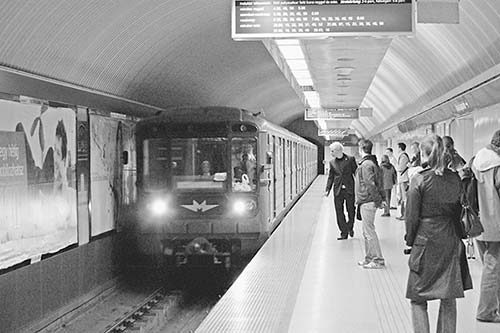
Riding Budapest’s efficient Metró, you really feel like you’re down in the guts of the city. There are four lines:
• M1/yellow—The first subway line on the Continent, this line runs beneath Andrássy Út from the center to City Park. Dating from 1896, “the Underground” (Földalatti) is so shallow that you must follow the signs on the street (listing end points—Mexikói Út Felé takes you toward City Park) to gauge the right direction, because there’s no underpass for switching platforms. Though recently renovated, the M1 line retains its old-time atmosphere.
• M2/red—Built during the communist days, it’s more than 100 feet deep and designed to double as a bomb shelter. Going under the Danube to Buda, the M2 connects the Déli/Southern train station, Széll Kálmán Tér (where you catch bus #16, #16A, or #116 to the top of Castle Hill), Batthyány Tér (Víziváros and the HÉV suburban railway), Kossuth Tér (behind the Parliament), Astoria (near the Great Synagogue on the Small Boulevard), and the Keleti/Eastern train station (where it crosses the M4/green line).
• M3/blue—This line makes a broad, boomerang-shaped swoop north to south on the Pest side. Key stops include the Nyugati/Western train station, Ferenciek Tere (in the heart of Downtown Pest), Kálvin Tér (near the Great Market Hall and many recommended hotels; this is also where it crosses the M4/green line), and Corvin-negyed (near the Holocaust Memorial Center).
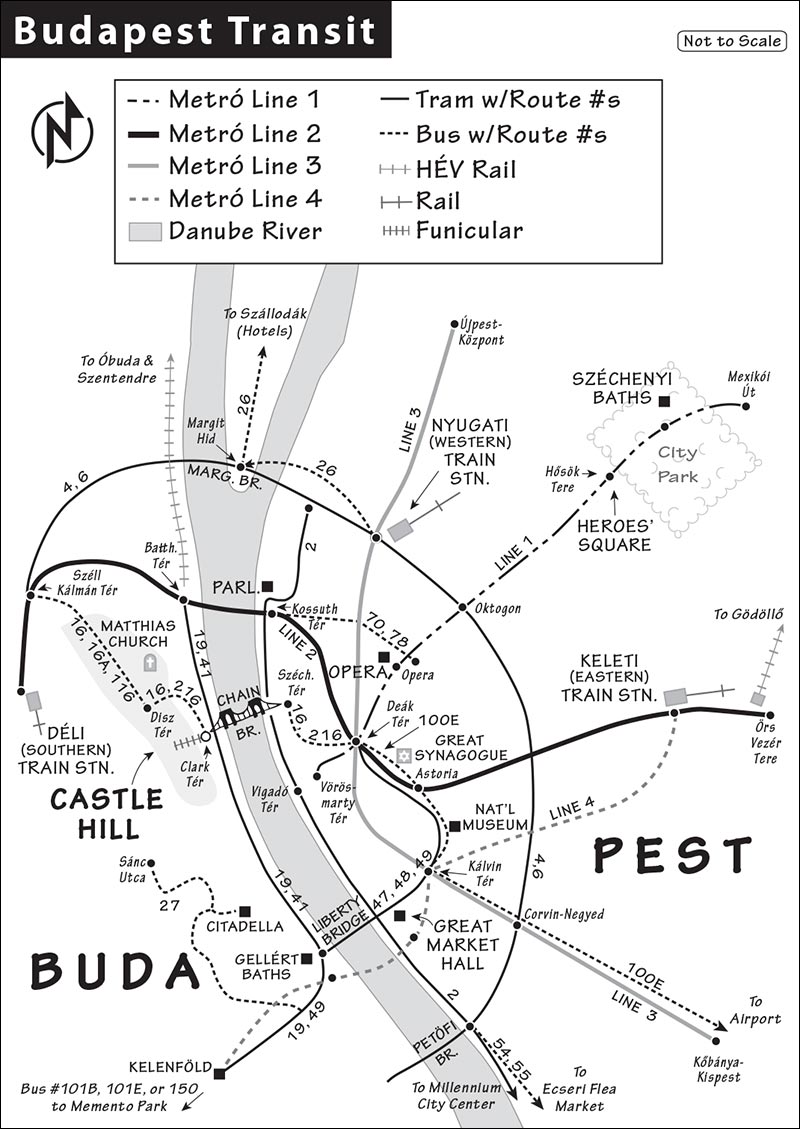
• M4/green—This line runs from southern Buda to the Gellért Baths, under the Danube to Fővám Tér (behind the Great Market Hall) and Kálvin Tér (where it crosses the M3/blue line), then up to Rákóczi Tér (on the Grand Boulevard) and the Keleti/Eastern train station (where it crosses the M2/red line).
The three lines—M1, M2, and M3—cross only once: at the Deák Tér stop (often signed as Deák Ferenc Tér) in the heart of Pest, near where Andrássy Út begins.
Aside from the historic M1 line, most Metró stations are at intersections of ring roads and other major thoroughfares. You’ll usually exit the Metró into a confusing underpass. Directional signs indicate which streets, addresses, and tram or bus stops are near each exit.
By HÉV
Budapest’s suburban rail system, or HÉV (pronounced “hayv,” stands for Helyiérdekű Vasút, “Railway of Local Interest”), branches off to the outskirts and beyond. On a short visit, it’s unlikely that you’ll need to use it, unless you’re heading to the Óbuda neighborhood (for its museums), the charming Danube Bend town of Szentendre, or the royal palace at Gödöllő.
The H5 (purple) HÉV line that begins at Batthyány Tér in Buda’s Víziváros neighborhood heads through Óbuda to Szentendre; from the station at Örs Vezér Tere, the H8 (pink) line runs east to Gödöllő.
The HÉV is covered by standard transit tickets and passes for rides within the city of Budapest (such as to Óbuda). But if going beyond—such as to Szentendre or Gödöllő—you’ll have to pay more.
By Tram
Budapest’s trams are handy and frequent, taking you virtually anywhere the Metró doesn’t. Here are some trams you might use:
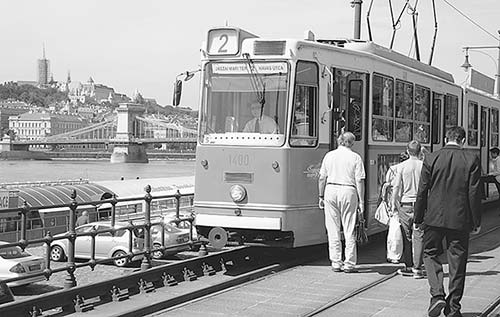
Tram #2 follows Pest’s Danube embankment, parallel to Váci Utca. From north to south, it begins at the Great Boulevard (Jászai Mari Tér, near Margaret Bridge and stops on either side of the Parliament (north side near the visitors center/Országház stop, as well as south side near the Kossuth Tér Metró stop), Széchenyi István Tér and the Chain Bridge, Vigadó Tér, and the Great Market Hall (Fővám Tér stop).
Trams #19 and #41 run along Buda’s Danube embankment from Batthyány Tér (with an M2/red Metró station, and HÉV trains to Óbuda and Szentendre). From Batthyány Tér, these trams run (north to south) through Víziváros, with several helpful stops: Clark Ádám Tér (the bottom of the Castle Hill funicular, near the stop for bus #16 or #216 up to Castle Hill), Várkert Bazár (Castle Park with escalators and elevators up to the Royal Palace), Rudas Gyógyfürdő (Rudas Baths), then around the base of Gellért Hill to Szent Gellért Tér (Gellért Baths and M4/green Metró station).
Trams #4 and #6 zip around Pest’s Great Boulevard ring road (Nagykörút), connecting Nyugati/Western train station and the Oktogon with the southern tip of Margaret Island and Buda’s Széll Kálmán Tér (with M2/red Metró station, and buses up to the castle). At night, this route is replaced by bus #6.
Trams #47, #48, and #49 connect the Gellért Baths in Buda with Pest’s Small Boulevard ring road (Kiskörút), with stops at the Great Market Hall (Fővám Tér stop), the National Museum (Kálvin Tér stop), the Great Synagogue (Astoria stop), and Deák Tér (end of the line).
By Bus and Trolley Bus
I use the Metró and trams for most of my Budapest commuting. But some buses are useful for shortcuts within the city, or for reaching outlying sights. Note that the transit company draws a distinction between gas-powered “buses” and electric “trolley buses” (powered by overhead cables). Unless otherwise noted, the following are standard buses:
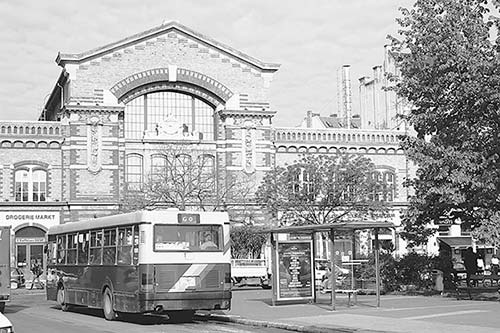
Buses #16, #16A, #116, and #216 all head up to the top of Castle Hill (get off at Dísz Tér—the closest stop to the Royal Palace). Buses #16 and #216 make several handy stops in Pest (Deák Tér, Széchenyi István Tér), then cross the Chain Bridge for more stops in Buda (including Clark Ádám Tér, at the Buda end of the Chain Bridge on its way up to the castle). From Széll Kálmán Tér, behind Castle Hill, buses #16, #16A, and #116 head up to the castle.
Trolley buses #70 and #78 zip from near the Opera House (intersection of Andrássy Út and Nagymező Utca) to the Parliament (Kossuth Tér).
Bus #26 begins at Nyugati/Western train station and heads around the Great Boulevard to Margaret Island, making several stops along the island.
Bus #27 runs from either side of Gellért Hill to just below the Citadella fortress at the hill’s peak (Búsuló Juhász stop).
Bus #100E is a handy, speedy express bus connecting Liszt Ferenc Airport to Deák Tér, with only two other stops en route (Astoria and Kálvin Tér Metró stops).
Buses #101B, #101E, and #150 run from Kelenföld (the end of the line for the M4/green Metró line) to Memento Park.
By Taxi
Budapest strictly regulates its official taxis, which must be painted yellow and have yellow license plates. These taxis are required to charge identical rates: a drop rate of 1,100 Ft, and then 440 Ft/kilometer, plus 110 Ft/minute for wait time. A 10 percent tip is expected. A typical ride within central Budapest shouldn’t run more than 2,000-3,000 Ft.
If you take an unofficial taxi, there’s a very high probability you’ll get ripped off with much higher rates. Unfortunately, cabbie crooks hang out at places frequented by tourists (such as at train stations). If you wave down a cab on the street, be sure it has a yellow license plate; otherwise, it’s not official. Better yet, do as the locals do and call a cab from a reputable company: City Taxi (+36 1 211 1111), Taxi 6x6 (+36 1 266 6666), or Főtaxi (+36 1 222 2222). Most dispatchers speak English; hotels and restaurants are often happy to call one for you.
Bolt App: Many popular ride-hailing apps (including Uber, Lyft, and FreeNow) don’t operate in Hungary. However, the similar Bolt app lets you request a regular taxi at the regular rates. The app allows you to pay by credit card (consider downloading it before your trip).
Tours in Budapest
Local Guides
While guides might be available last-minute, it’s better to book them in advance. These guides, who have all been indispensable help in writing and updating this book, have the same rates (€150/half-day, €300/full day): Péter Pölczman is an exceptional guide who really puts you in touch with the Budapest you came to see (+36 20 926 0557, www.budapestyourself.com, peter.polczman@gmail.com). Andrea Makkay has professional polish and a smart understanding of what visitors really want to experience (+36 20 962 9363, www.privateguidebudapest.com, andrea.makkay@gmail.com). George Farkas is well attuned to the stylish side of this fast-changing metropolis (+36 70 335 8030, georgefarkas@gmail.hu). György Ujlaki has a passion for history, food, wine, and culture, and is enjoyable to simply spend time with (+36 30 407 9875, gujlaki@gmail.com). Eszter Bokros brings enthusiasm to sharing her city (+36 70 625 6655, eszterbokros1@gmail.com).
Elemér Boreczky, a retired university professor, doesn’t lead conventional walking tours but enjoys chatting with curious visitors about Budapest’s rich cultural history. Reach out to Elemér if you’d enjoy an unconventional “tour” that’s essentially a graduate-level seminar on the nuances of this grand city (+36 30 491 1389, boreczky.elemer@gmail.com).
Walking Tours
Budapest’s best-established walking-tour company is Absolute Tours, run by Oregonian Ben Frieday. Their 3.5-hour All in One walking tour offers a good overview of the city (daily at 10:00). They also have a Buda Castle walk, a nighttime walk that also includes a boat trip, and private tours (RS%—enter code “RICK” when booking, +36 20 929 7506, www.absolutetours.com).
▲▲Danube Boat Tours
Cruising the Danube, while touristy, is a fun and convenient way to get a feel for the city’s grand layout. The most established company, Legenda Cruises, is a class act that runs well-maintained, glassed-in panoramic boats day and night. All of their cruises include a free drink and romantic headphone commentary. By night, TV monitors show the interiors of the great buildings as you float by.
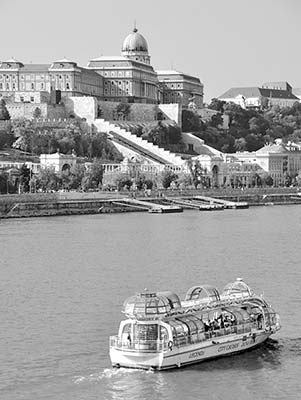
I’ve negotiated a special RS% discount with Legenda for my readers—but you must book directly and ask for the Rick Steves price (20 percent discount). By day, the 75-minute Duna Bella cruise costs €10.80 for Rick Steves readers; if you want, you can hop off at Margaret Island to explore on your own, then return after 45 minutes on a later cruise (departs every 45 minutes, in winter runs 1-2/day with no Margaret Island stop). By night, the one-hour “Danube Legend” cruise (with no Margaret Island visit) costs €15.20 for Rick Steves readers (4/day, 2/day in winter). On weekends, it’s smart to book ahead for the evening cruises.
The Legenda dock is in front of the Marriott on the Pest embankment (find pedestrian access under tram tracks at downriver end of Vigadó Tér, district V, M1: Vörösmarty Tér, +36 1 266 4190, www.legenda.hu). Competing river-cruise companies are nearby, but given the quality and the discount, Legenda offers the best value.
Bus Tours
Various companies run hop-on, hop-off bus tours, which make 12 to 16 stops as they cruise around town on a two-hour loop with headphone commentary (generally around €35/24 hours). Most companies also offer a wide variety of other tours, including dinner boat cruises and trips to the Danube Bend.
Private Tours into the Hungarian Countryside
The Hungarian countryside is well worth exploring. If you’d like a taste without driving yourself, hire Ádám Kiss, a licensed guide who lives in the folk-museum village of Hollókő. Ádám can pick you up in Budapest (at your hotel or the airport) and drive you to your choice of countryside destinations ($200/day, plus travel costs; for example, for an all-day visit to Hollókő and Eger for two people, you’d pay about $400 total for round-trip transportation, guiding, admissions, and lunch). Ádám also enjoys helping people track down their roots in the Hungarian countryside. Contact him for pricing (+36 20 379 6132, adamtheguide@gmail.com).
Sights in Pest
▲▲Hungarian Parliament (Országház)
▲Szabadság Tér (“Liberty Square”)
▲St. István’s Basilica (Szent István Bazilika)
Chain Bridge (Széchenyi Lánchíd)
▲Margaret Island (Margitsziget)
▲▲Great Market Hall (Nagyvásárcsarnok)
NATIONAL MUSEUM AND PALACE DISTRICT
▲Hungarian National Museum (Magyar Nemzeti Múzeum)
▲▲Great Synagogue (Nagy Zsinagóga)
▲▲Hungarian State Opera House (Magyar Állami Operaház)
Franz Liszt Square (Liszt Ferenc Tér)
▲▲House of Terror (Terror Háza)
Museum of Ethnography (Néprajzi Múzeum)
Map: Heroes’ Square & City Park
▲▲House of Music Hungary (Magyar Zene Háza)
▲▲Vajdahunyad Castle (Vajdahunyad Vára)
▲▲▲Széchenyi Baths (Széchenyi Fürdő)
▲▲Holocaust Memorial Center (Holokauszt Emlékközpont)
Most of Pest’s top sights cluster in five neighborhoods: Leopold Town and Downtown Pest (together forming the city’s central core); the Jewish Quarter, just outside the inner ring road; along the grand boulevard Andrássy Út; and at that boulevard’s end, near Heroes’ Square and City Park.
Several other excellent sights are not contained in these areas and are covered in greater depth in this chapter: along the Small Boulevard (Kiskörút), along the Great Boulevard (Nagykörút), and along the boulevard called Üllői Út.
Sightseeing Tips: Budapest boomed in the late 19th century, after it became the co-capital of the vast Austro-Hungarian Empire. Most of its finest buildings (and top sights) date from this age. To appreciate an opulent interior—a Budapest experience worth ▲▲▲—prioritize touring either the Parliament or the Opera House. The Opera tour is more crowd-pleasing, while the Parliament tour is grander and a bit drier (with a focus on history and parliamentary process). “Honorable mentions” go to the interiors of St. István’s Basilica, the Great Synagogue, the Párisi Udvar or New York Café coffeehouses (both require the purchase of a drink), and both the Széchenyi and the Gellért Baths.
LEOPOLD TOWN (LIPÓTVÁROS)
The Parliament building, which dominates Pest’s skyline, is the centerpiece of the city’s banking and business district. Called Lipótváros (“Leopold Town”), this snazzy “uptown” quarter features some of the best of Budapest’s many monuments. Below, I’ve linked up the top sights in Leopold Town as a self-guided walk, starting at the grandiose Parliament building and ending at the Chain Bridge.
▲▲Hungarian Parliament (Országház)
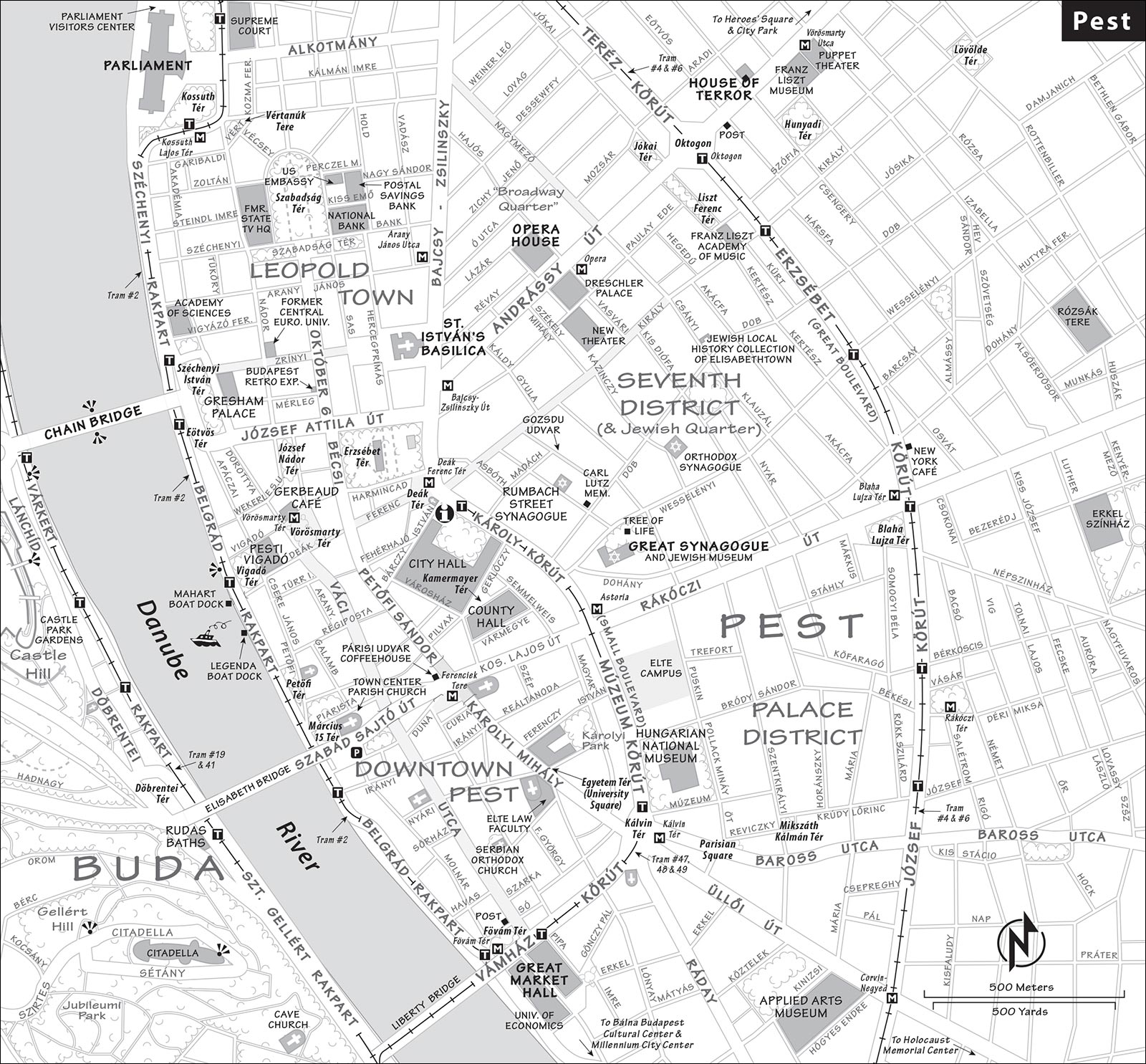
With an impressive facade and an even more extravagant interior, the oversized Hungarian Parliament dominates the Danube riverbank. A hulking Neo-Gothic base topped by a soaring Neo-Renaissance dome, it’s one of the city’s top landmarks. Touring the building offers the chance to stroll through one of Budapest’s most dazzling interiors.
Cost and Hours: 10,000 Ft for a required 45-minute tour in English (with a tour guide or an audioguide); visitors center open with frequent tour departures daily 8:00-18:00; Nov-April 8:00-16:00 (Fri-Sun until 18:00 in April). On Mondays when parliament is in session (generally about two times per month Sept-May), there are no tours after 10:00.
Information: +36 1 441 4904, www.parlament.hu.
Advance Tickets Recommended: Tickets come with an appointed tour time and usually sell out—sometimes two weeks in advance (even sooner at busy times). Book ahead through the official website (www.jegymester.hu/parlament). Select “Parliament Visit,” then a date and time of an English tour; some are with an audioguide, while others have a tour guide (same price).
If you can’t get tickets online, additional same-day tickets are typically available each morning. These are released shortly after 8:00 and can be booked online or purchased in person—but come early, as they’re often sold out by 9:00.
After booking, you’ll be sent an eticket (print it if you can). At your appointed time, head to the Parliament visitors center—a modern, underground space at the northern end of the long Parliament building (look for the statue of a lion on a pillar). If you can’t print your ticket, arrive early and go to the information desk (not the ticket desk, which can have long lines) to ask them to print it for you.
Getting There: Ride tram #2 to the Országház stop, which is next to the visitors center entrance (Kossuth Tér 1, district V). You can also ride the M2/red Metró line to Kossuth Tér, then walk to the other end of the Parliament building to find the visitors center.
Background: The Parliament was built from 1885 to 1902 to celebrate the Hungarian millennium year of 1896. Its elegant, frilly spires and riverside location were inspired by its counterpart in London (where the architect studied). When completed, the Parliament was a striking and cutting-edge example of the mix-and-match Historicist style of the day. The building is at once grandly ambitious and a hodgepodge of various influences—a Neo-Gothic palace topped with a Neo-Renaissance dome, which once had a huge, red communist star on top of the tallest spire. Fittingly, it’s the city’s top icon. The best views of the Parliament are from across the Danube—especially in the late-afternoon sunlight.
Visiting the Parliament: The visitors center has WCs, a café, a gift shop, and the Museum of the History of the Hungarian National Assembly. Also in the lobby is a brief but fun virtual reality ride in a hot-air balloon, which whisks you for about five minutes over the rooftop of the still-under-construction Parliament building, circa 1894 (2,500 Ft).
With your ticket in hand, be at the security checkpoint inside the visitors center at least five minutes before your tour departure time.
On the 45-minute tour, your guide will explain the history and symbolism of the building’s intricate decorations and offer a lesson in the Hungarian parliamentary system. You’ll also see dozens of bushy-mustachioed statues illustrating the occupations of workaday Hungarians through history.
You’ll see the building’s monumental entryway and 96-step grand staircase—slathered in gold foil and frescoes, and bathed in shimmering stained-glass light. Then you’ll gape up under the ornate gilded dome for a peek at the heavily guarded Hungarian crown, which is overlooked by statues of 16 great Hungarian monarchs, from St. István to Habsburg empress Maria Theresa. Finally, you’ll walk through a cushy lounge—across one of Europe’s largest carpets—to see the legislative chamber.
• The vast square behind the Parliament is studded with attractions. Stay where you are for a quick...
Kossuth Tér Spin-Tour
This square is sprinkled with interesting monuments and packed with Hungarian history. But it’s gone through a lot of changes in the last few years, under the steady guidance of the ruling Fidesz party, led by Viktor Orbán. A nativist, nationalistic party, which swept to power after Hungarians grew weary of the bumblings of the poorly organized, shortsighted left-wing opposition party, Fidesz has exerted its influence over every walk of Hungarian life...beginning with the look of this building and square, and the monuments around it. The square itself used to be a more higgledy-piggledy mix of ragged asphalt, parks, monuments, and trees. But Fidesz wanted the mighty Parliament building to stand bold and unobstructed. Several older monuments (including, ironically, an “eternal” flame honoring victims of the communists) were swept away. Trees were cut down overnight, before would-be protesters could make a peep. And today the square has a scrubbed-clean look that some critics consider borderline-fascist.
The year 1956 is etched into the Hungarian psyche. In that year, the people of Budapest staged the Soviet Bloc’s first major uprising against the communist regime. It also marked the first time that the Soviets implicitly acknowledged, in brutally putting down the uprising, that the people of Eastern Europe were not “communist by choice.”
The seeds of revolution were sown with the death of a tyrant: Josef Stalin passed away on March 5, 1953. Suddenly the choke hold that Moscow had on its satellite states loosened. During this time of “de-Stalinization,” Hungarian premier Imre Nagy presided over two years of mild reform, before his political opponents (and Moscow) became nervous and demoted him. (You can read more about Nagy later in this chapter.)
In 1955, Austria declared its neutrality in the Cold War. This thrust Hungary to the front line of the Iron Curtain and raised the stakes both for Hungarians who wanted freedom and for Soviets who wanted to preserve their buffer zone. When Stalin’s successor, Nikita Khrushchev, condemned Stalin’s crimes in a “secret speech” to communist leaders in February 1956, it emboldened the Soviet Bloc’s dissidents. A workers’ strike in Poznań, Poland, in October inspired Hungarians to follow their example.
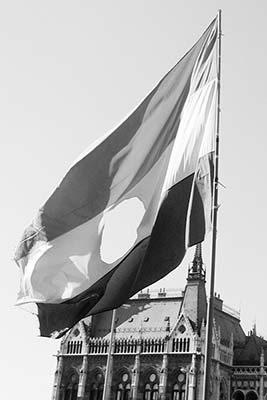
On October 23, 1956, the Hungarian uprising began. A student union group gathered in Budapest at 15:00 to articulate a list of 16 demands against the communist regime. Then they marched toward Parliament, their numbers gradually swelling. One protester defiantly cut the Soviet-style insignia out of the center of the Hungarian flag, which would become the uprising’s symbol.
By nightfall, some 200,000 protesters filled Kossuth Tér behind Parliament, calling for Imre Nagy, the one communist leader they believed could bring change. Nagy finally appeared around 21:00. Ever the pragmatic politician, he implored patience. Following the speech, a large band of protesters took matters into their own hands, marched to City Park, and tore down the hated Stalin statue that stood there (see here).
Another group went to the National Radio building to read their demands on the air. The ÁVH (communist police) refused to let them do it and eventually opened fire on the protesters. The peaceful protests evolved into an armed insurrection, as frightened civilians gathered weapons and supplies.
Overnight, Moscow decided to intervene. Budapesters awoke on October 24 to find Red Army troops occupying their city. That morning, Imre Nagy—who had just been promoted again to prime minister—promised reforms and tried to keep a lid on the simmering discontent.
The next day, October 25, a huge crowd gathered on Kossuth Tér behind the Parliament to hear from Nagy. In the hubbub, shots rang out as Hungarian and Soviet soldiers opened fire on the (mostly unarmed) crowd. Of the victims, 72 deaths are known by name, but likely hundreds more were injured or perished.
The Hungarians fought back with an improvised guerilla resistance. They made use of any guns they could get their hands on, as well as Molotov cocktails, to strike against the Soviet occupiers. Combatants included many adolescents (the celebrated “Pest Youth”). The fighting tore apart the city, and some of the fallen were buried in impromptu graves in city parks.
Political infighting in Moscow paralyzed the Soviet response, and an uneasy cease-fire fell over Budapest. For 10 tense days, it appeared that the Soviets might allow Nagy to push through some reforms. Nagy, a firmly entrenched communist, had always envisioned a less repressive regime...but within limits. While he was at first reluctant to take on the mantle of the uprising’s leadership, he gradually began to echo what he was hearing on the streets. He called for free elections, the abolishment of the ÁVH, the withdrawal of Soviet troops, and Hungary’s secession from the Warsaw Pact.
But when the uprisers attacked and killed ÁVH officers and communist leaders in Budapest, it bolstered the case of the Moscow hardliners. On November 4, the Red Army launched a brutal counterattack in Budapest that left the rebels reeling. At 5:20 that morning, Imre Nagy’s voice came over the radio to beg the world for assistance. Later that morning, he sought asylum at the Yugoslav Embassy across the street from City Park. He was never seen alive in public again.
János Kádár—an ally of Nagy’s who was palatable to the uprisers, yet firmly loyal to Moscow—was installed as prime minister. The fighting dragged on for about another week, but the uprising was eventually crushed. By the end, 2,500 Hungarians and more than 700 Soviets were dead, and 20,000 Hungarians were injured. Communist authorities arrested more than 15,000 people, of whom at least 200 were executed (including Imre Nagy). Anyone who had participated in the uprising was blacklisted; fearing this and other forms of retribution, some 200,000 Hungarians fled to the West.
Though the 1956 Uprising met a tragic end, within a few years Kádár did succeed in softening the regime, and the milder, so-called “goulash communism” emerged. And today, even though the communists are long gone, the legacy of 1956 pervades the Hungarian consciousness. Some Budapest buildings are still pockmarked with bullet holes from ’56, and many Hungarians who fled the country in that year still have not returned. October 23 remains Hungary’s most cherished holiday.
Look to the right end of the Parliament. Poking up is a pillar topped by a lion being strangled and bitten by a giant snake (a typically heavy-handed Fidesz monument). This pillar marks the entrance to the Parliament visitors center.
Looking a bit farther to the right, at the end of the park you’ll see a monument to Lajos Kossuth, the square’s namesake, who led the 1848 Revolution against the Habsburgs.
The street that leaves this square behind Kossuth’s left shoulder is Falk Miksa Utca, Budapest’s “antique row”—a great place to browse for nostalgic souvenirs.
Panning right from the Kossuth statue, across the tram tracks you’ll see a stately palace. The design was the first runner-up for the Parliament building, so they built it here, to house the Supreme Court.
To the right, the Ministry of Agriculture was the second runner-up for the Parliament. Today it features a very low-profile, but poignant, monument to the victims of the 1956 Uprising against Soviet rule: At the right end of the protruding arcade, notice that the walls are pockmarked with little metal dollops. Two days into the uprising, on October 25, the ÁVH (communist police) and Soviet troops on the rooftop above opened fire on demonstrators gathered in this square—massacring many and leaving no doubt that Moscow would not tolerate dissent. In the monument, each of the little metal knobs represents a bullet.
In the foreground, between you and the two big palaces, is a long, rectangular reflecting pond—a memorial to the people killed by government troops when they revolted here in 1956.
Between those two hulking buildings, notice a long, somber ramp that leads down toward an eternal flame—flickering behind giant stone plinths. This so-called Memorial of National Solidarity (Összetartozás Emlékhelye) commemorates the Treaty of Trianon, which stripped Hungary (one of the losers of World War I) of two-thirds of its historic territory. The walls of the ramp are etched with the names of cities and towns that were once part of a much larger, pre-Trianon Hungary. At the base, the flame is surrounded by seven jagged plinths—representing the seven countries that currently own some piece of what was once Hungary.
Spin farther to the right, where a dramatic equestrian statue of Ferenc Rákóczi stands in the park. Rákóczi valiantly—but unsuccessfully—led the Hungarians in their War of Independence (1703-1711) against the Habsburgs.
Now walk toward the far-left side of the Parliament (toward the river). Just before reaching the corner of the building, find the underground memorial marked 1956 (free, closed Mon). Head down the stairs to find a memorial to the 1956 Uprising that began on this very square. Follow the red line on the floor—first right, and then left. You’ll see photos of the events, good English descriptions, and video interviews of eyewitnesses to the massacre on this square on October 25, 1956 (as well as other government mass shootings around Hungary that fall). At the end of the hall is a memorial tomb to those killed by Hungarian secret police, and the symbol of the uprising: a tattered Hungarian flag with a hole cut out of the center.
If you’re interested in this grand building’s history, a similar underground exhibit on the opposite side (find the stairs down, back toward Kossuth) is a lapidarium (kőtár), holding some original statues and adornments that once encrusted the Parliament (free, closed Mon).
• Now let’s take a quick...
Monuments Stroll
Budapest is a city of great monuments, and some of the most vivid are on or near this square.
• Circle around the left side of the giant Parliament building, passing another statue on a pillar, and walk all the way to the banister overlooking a spectacular view of Buda. Walk along the banister to the left until you come upon a statue of a young man, lost deep in thought, gazing into the Danube.
Attila József (1905-1937): This beloved modern poet lived a tumultuous, productive, and short life before he took his own life at age 32. József’s poems of life, love, and death—mostly written in the 1920s and 1930s—are considered the high point of Hungarian literature. His birthday (April 11) is celebrated as National Hungarian Poetry Day.
Here József reenacts a scene from one of his best poems, “At the Danube.” It’s a hot day—his jacket lies in a heap next to him, his shirtsleeves are rolled up, and he cradles his hat loosely in his left hand. In the poem, József uses the Danube as a metaphor for life—for the way it has interconnected cities and also times—as he reflects that his ancestors likely pondered the Danube from this same spot.
• Stand along the railing in front of József, just above the busy road. If you visually trace the Pest riverbank to the left about 100 yards, just before the tree-filled, riverfront park, you can barely see several low-profile dots lining the embankment. This is a...
Holocaust Monument: Consisting of 60 pairs of iron shoes, this monument commemorates the Jews who were killed when the Nazis’ puppet government, the Arrow Cross, came to power in Hungary in 1944. While many Jews were sent to concentration camps, the Arrow Cross massacred some of them right here, shooting them and letting their bodies fall into the Danube.
• For a closer look at the shoes, use the crosswalk (50 yards to your right) to cross the busy embankment road and follow the waterline.
When you’re ready to move on, turn your back to the Danube and walk directly inland, following the tram tracks past an entrance to the Metró. From the back corner of Kossuth Tér, veer right, to a little tree-filled park.
Vértanúk Tere and the Missing Imre Nagy Monument: This small square is dominated by yet another recent monument—this one with a generic, chain-mailed Lady Hungaria honoring Victims of the Red Terror (A Nemzet Vértanúinak), when approximately 500 Hungarians lost their lives (including former prime minister István Tisza) during a brief period of communist rule at the end of World War I. Around back, a valiant hero fights a dragon; this is a vague and generic monument to all victims of communism.
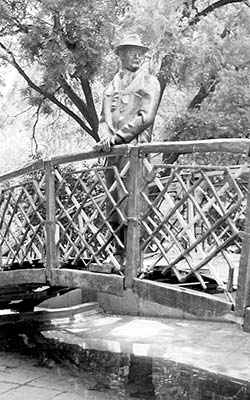
But the more significant story is the monument you won’t see on this square: a stirring homage to the 1956 hero Imre Nagy. Even in this city of abundant monuments, the Nagy statue was a favorite, with powerful symbolism: Nagy, standing on a bridge—representing his dream of creating a system that would bridge stifling Soviet-style communism and a more humane worldview—was literally keeping a watchful eye on the Parliament across the square. One night in 2018 it was removed, with no warning and under cover of darkness, by Fidesz authorities who couldn’t get past Nagy’s association with communism (even if he was a reformer). It has since been relocated to Jászai Mari Tér (described later, on here). Nagy is internationally lauded as a Hungarian hero and a martyr of the USSR. If wanting to honor “victims of communism”...why not simply keep that statue where it was?
• Go up the short, diagonal street beyond Vértanúk Tere, called Vécsey Utca. After one block, you emerge into...
▲Szabadság Tér (“Liberty Square”)
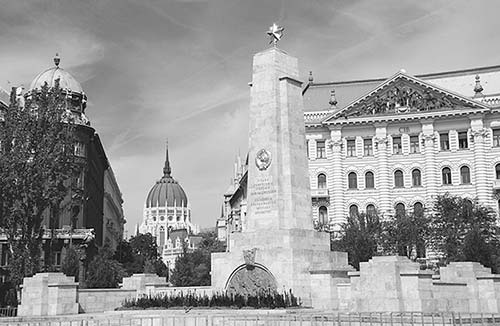
One of Budapest’s most genteel squares, this space is marked by a controversial monument to the Soviet soldiers who liberated Hungary at the end of World War II, and ringed by both fancy old apartment blocks and important buildings (such as the former Hungarian State Television headquarters, the US Embassy, and the National Bank of Hungary). A fine café, fun-filled playgrounds, statues of prominent Americans (Ronald Reagan and Harry Hill Bandholtz), and yet another provocative monument (to the Hungarian victims of the Nazis) round out the square’s landmarks.
Ronald Reagan: When Fidesz took power in 2010, they quickly began rolling back previous democratic reforms and imposing alarming constraints on the media. Many international observers—including the US government—spoke out against what they considered an infringement on freedom of the press. In an effort to appease American concerns, Prime Minister Orbán erected this statue—and then, perhaps not quite grasping the subtleties of American politics, invited then-Secretary of State Hillary Clinton to the unveiling. It’s fun to watch the steady stream of passersby (both Hungarians and tourists) do a double-take, chuckle, then snap a photo with The Gipper.
Since 2010, Ukrainian-born artist Mihály Kolodko has quietly scattered a series of small cast-bronze statues all over the cityscape of Budapest—known collectively as “Kolodko Minis,” each no larger than a Barbie doll. Originally, the artist was drawn to this mini-medium because it was much simpler than getting commissions and permissions for large-scale works. But now Kolodko’s distinctive style has made him an in-demand artist (www.kolodkoart.com).
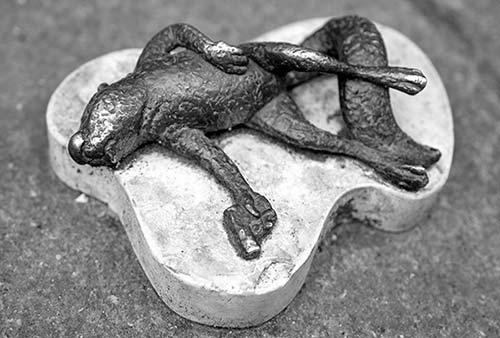
Kolodko’s subjects run the gamut, thematically. Many of them are historical: Franz Josef relaxing in a hammock; Franz Liszt sitting on his suitcase at the airport named for him; a drunken Roman legionnaire; a tiny tank to commemorate the 1956 Uprising; and a wind-up Trabant (the car from communist times). Kolodko often celebrates Jewish culture in his sculptures. You’ll find Zionist pioneer Tivadar (a.k.a. Theodor) Herzl (near the Great Synagogue); WWII paratrooper Hannah Szenes; Harry Houdini; and pianist Rezső Seress. And some pointed additions popped up after Russia’s 2022 invasion of Ukraine: Vladimir Putin piloting a warship, and a Russian soldier plundering someone’s pantry.
Others are from pop culture: Kermit the Frog, Ratatouille the culinary rat, Mr. Bean’s teddy bear (attached to the wall of the former British Embassy—a commentary on Brexit), a balloon-dog homage to Jeff Koons, a Rubik’s Cube (invented by a Hungarian), a urinal (à la Marcel Duchamp), or characters from Hungarian cartoons—Mekk Elek the handyman goat, Főkukac the happy worm, and Kockásfülű Nyúl the checkered-ear rabbit.
And some are simply whimsical, such as a dead squirrel, still clutching a handgun, outlined in chalk. There’s also a variety of distinctly Hungarian dogs—such as the Puli and the Viszla.
With its many ostentatious buildings, Budapest is a city that trains visitors to expand their scope—to look up, zoom out, and take it all in. But the Kolodko Minis encourage you to do just the opposite: Focus in on details.
There are about two dozen Kolodko Minis all around the city. I’ve pointed out a few in this book, but part of the fun is tracking them down yourself. You can find articles that list them and explain their significance, and most of the statues are on Google Maps (search for “Kolodko Mini”). Just be prepared to hunt...these can be as easy to miss as they are satisfying to discover.
• Now enjoy a slow stroll to the far end of the square, where you’ll find...
George H. W. Bush: In 1989, Bush became the first sitting US president to visit Hungary, shortly before the fall of the Iron Curtain, and just days after the death of the Hungarian premier János Kádár. He was giving a speech on Kossuth Tér in the pouring rain, but the paper with his prepared remarks became soaked and unreadable...so instead, he delivered an impromptu speech that wowed the crowd.
• At the opposite end of Liberty Square from where you entered, you’ll find a lively playground in one corner. Along the bottom of this side of the square, near the fountain, look for the...
Monument to the Hungarian Victims of the Nazis: This heavy-handed Fidesz production commemorates the German invasion of Hungary on March 19, 1944. Standing in the middle of a broken colonnade, an immaculate angel holds an orb with a double cross (part of the crown jewels and a symbol of Hungarian sovereignty). Overhead, a mechanized-looking black eagle (symbolizing Germany) screeches in, its talons poised to strike.
Like so many recent additions to this area, this monument was instantly controversial for the way it whitewashes Hungarian history. Viewing this, you might imagine that Hungary was a peaceful land that was unwittingly caught up in the Nazi war machine. In fact, the Hungarian government was an ally of Nazi Germany for more than three years before this invasion. And there’s no question that, after the invasion, many Hungarians enthusiastically collaborated with their new Nazi overlords.
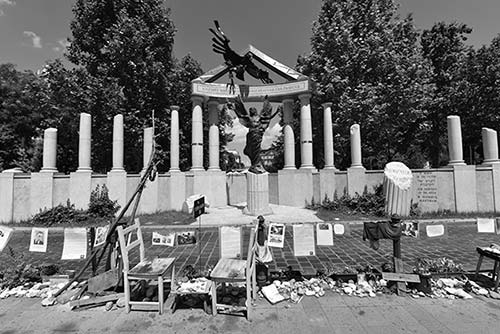
Mindful of the old adage about people who forget their own history, locals have created a makeshift counter-memorial to the victims of the World War II-era Hungarians (not just Germans) in front of this official monument.
On a lighter note, the fountain that faces the monument is particularly entertaining. Sensors can tell when you’re about to walk through the wall of water...and the curtain of water automatically parts just long enough for you to pass.
• From the monument, continue two blocks straight ahead, up Hercegprímás Utca. You’ll emerge into a broad plaza in front of...
▲St. István’s Basilica (Szent István Bazilika)
Budapest’s biggest church celebrates St. István, Hungary’s first Christian king. You can see his withered, blackened, millennium-old fist in a gilded reliquary. Or you can zip up on an elevator (or climb up stairs partway) to a panorama terrace with views over the rooftops of Pest. The skippable treasury has ecclesiastical items, historical exhibits, and artwork (reached by elevator, to the right as you face the church). The church also hosts regular organ concerts (advertised near the entry).
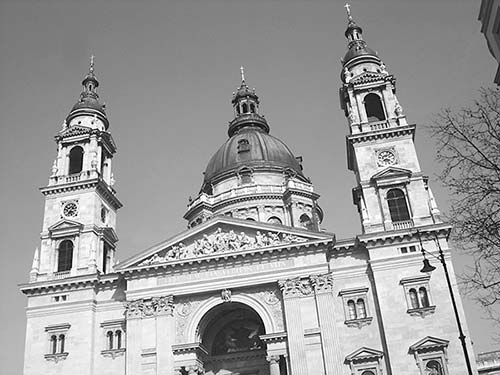
Cost and Hours: Basilica—2,000 Ft, open to tourists Mon 9:00-16:30, Tue-Sat 9:00-17:45, Sun 13:00-17:45; panorama terrace and treasury—3,200 Ft, open daily until 19:00; 4,500 Ft ticket covers all three; periodic concerts inside the basilica (see here); Szent István Tér, district V, M1: Bajcsy-Zsilinszky Út or M3: Arany János Utca.
Visiting the Church: Though it looks grand and old, this church only dates back about 130 years—like so many Budapest landmarks, it was built around the millennial celebrations of 1896.
Buy your tickets in the shop around the right side of the church. Then head up the grand stairs. The entrance to the interior is to the left, and to the right is the access to the treasury and the panoramic tower (both skippable).
St. István’s interior is dimly lit but gorgeously restored; all the gilded decorations glitter in the low light. You’ll see not Jesus but St. István (Stephen), Hungary’s first Christian king, glowing above the high altar.
Stand in the back and enjoy the glittering entirety of the interior. The church’s main claim to fame is the “holy right hand” of St. István. The sacred fist—a somewhat grotesque, 1,000-year-old withered stump—is inside a jeweled box. Pop in a 200 Ft coin for two minutes of light.
• From here, you’re very close to the boulevard called Andrássy Út, which leads to the Opera House, House of Terror, and City Park (all described later). To get there, walk around the right side of the basilica and turn right on busy Bajcsy-Zsilinszky Út; Andrássy Út begins across the street, on your left.
But for now, we’ll head to the Danube for a good look at the mighty Chain Bridge. From the square in front of the basilica, walk straight down Zrínyi Utca. (Note that about a block off Zrínyi Utca is the Budapest Retro Experience—a kitschy, engaging, but ultimately lightweight look at life during communist times—from Zrínyi Utca, turn left onto Október 6). Otherwise, continue down Zrínyi Utca, which dead-ends at the big traffic circle called Széchenyi István Tér. Turn left and walk a half-block to the entrance (on the left) of the...
Gresham Palace
This was Budapest’s first building in the popular Historicist style—but it also incorporates elements of Art Nouveau. Budapest boomed at a time when architectural eclecticism—mashing together bits and pieces of different styles—was in vogue. But because much of the city’s construction was compressed into a short window of time, even these disparate styles enjoy an unusual harmony. Damaged in World War II, the building was an eyesore for decades. In 1999, the Gresham Palace was meticulously restored to its former glory and converted to a luxury hotel. Even if you can’t afford to stay here (see “Sleeping in Budapest,” later), saunter into the lobby and absorb the gorgeous details (Széchenyi Tér 5, district V, M1: Vörösmarty Tér or M2: Kossuth Tér).
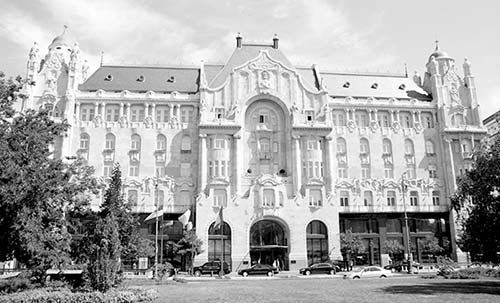
• Be sure to get a good look at the Gresham Palace’s fine facade. This also puts you right next to the grand...
Chain Bridge (Széchenyi Lánchíd)
One of the world’s great bridges connects Pest’s Széchenyi Tér and Buda’s Clark Ádám Tér. This historic, iconic bridge, guarded by lions (symbolizing power), is Budapest’s most enjoyable and convenient bridge to cross on foot.
Until the mid-19th century, only pontoon barges spanned the Danube between Buda and Pest. In the winter, the pontoons had to be pulled in, leaving locals to rely on ferries (in good weather) or a frozen river. People often walked across the frozen Danube, only to get stuck on the other side during a thaw, with nothing to do but wait for another cold snap.
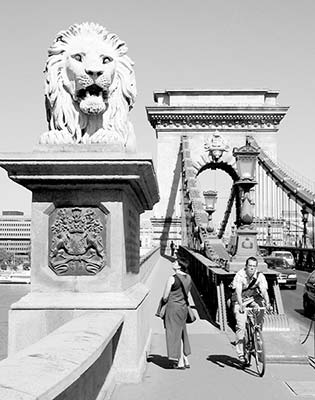
Count István Széchenyi was stranded for a week trying to get to his father’s funeral. After missing it, Széchenyi commissioned Budapest’s first permanent bridge—which was also a major symbolic step toward the unification of Buda and Pest. The Chain Bridge was built by Scotsman Adam Clark between 1842 and 1849, and it immediately became an important symbol of Budapest. The biggest and longest span of its day, the Chain Bridge was a model for famous suspension bridges that followed, including the Golden Gate in San Francisco and the Verrazano-Narrows in New York.
Széchenyi—a man of the Enlightenment—charged both commoners and nobles a toll for crossing his bridge, making it an emblem of equality in those tense times. Like all the city’s bridges, the Chain Bridge was destroyed by the Nazis at the end of World War II, but it was quickly rebuilt.
• As you look out to the Danube from here, to the right you can see the tip of...
▲Margaret Island (Margitsziget)
In the Middle Ages, this island in the Danube (just north of the Parliament) was known as the “Isle of Hares.” In the 13th century, a desperate King Béla IV swore that if God were to deliver Hungary from the invading Tatars, he would dedicate his youngest daughter Margaret to the Church. When the Tatars left, Margaret was shipped to a nunnery here. Margaret embraced her new life as a castaway nun and later refused her father’s efforts to force her into a politically expedient marriage with a Bohemian king. As a reward for her faith, she became St. Margaret of Hungary.
Today, while the island officially has no permanent residents, urbanites flock here to relax in a huge, leafy park. No cars are allowed on the island—just public buses. The island rivals City Park as the best spot in town for strolling, jogging, biking (you can rent a bike at Bringóhintó, with branches at both ends of the island), and people-watching. Rounding out the island’s attractions are an iconic old water tower, the remains of Margaret’s convent, a rose garden, a game farm, and a “musical fountain” that performs to the strains of Hungarian folk tunes.
Getting There: Bus #26 begins at Nyugati/Western train station, crosses the Margaret Bridge, then drives up through the middle of the island—allowing visitors to easily get from one end to the other (3-6/hour). Trams #4 and #6, which circulate around the Great Boulevard, cross the Margaret Bridge and stop at the southern tip of the island, a short walk from some of the attractions. It’s otherwise a long but scenic walk between Margaret Island and other points in the city.
• On the Pest embankment, just across the bridge from Margaret Island, are the...
Monuments of Jászai Mari Tér
This otherwise nondescript square is home to several evocative memorials. It’s a few minutes’ walk north of the Parliament area (along antiques-lined Falk Miksa Utca), and it’s the northern terminus of scenic tram #2 (and also on the route of Great Boulevard trams #4 and #6).
The main draw is the statue of Imre Nagy—the great communist reformer who reluctantly led Hungary’s 1956 Uprising (see the sidebar on here). The statue depicts Nagy standing on a bridge, symbolizing the middle path he sought between stifling, Soviet-style communism and a freer society.
Just toward the river from Nagy, tucked right up against the bridge to Margaret Island, you’ll see a long, black, marble wall. This is a monument to the victims of a horrific accident that occurred in May 2019, when a sightseeing boat called Hableány (Mermaid) ran into a Viking cruise ship under this bridge, killing 26 tourists and two crew members.
For a cheerier tribute, head a block away from the river on the busy ring road and pause at Falk Miksa Utca to see Columbo, the Hungarian-American actor Peter Falk.
DOWNTOWN PEST (BELVÁROS)
Pest’s Belváros (“Inner Town”) is its gritty urban heart—simultaneously its most beautiful and ugliest district. You’ll see fancy facades, some of Pest’s best views from the Danube embankment, richly decorated old coffeehouses that offer a whiff of the city’s golden age, and a cavernous, colorful market hall filled with Hungarian goodies. But you’ll also experience crowds, grime, and pungent smells like nowhere else in Budapest. Atmospherically shot through with the crumbling elegance of former greatness, Budapest is a place where creaky old buildings and sleek modern ones feel equally at home. This is a city in transition. Enjoy the rough edges while you can. They’re being sanded off at a remarkable pace—and soon, tourists like you will be nostalgic for the “authentic” old days.
Below, I’ve linked the main landmarks in the Town Center with walking directions, starting at the square called Vörösmarty Tér and ending at the Great Market Hall.
▲Vörösmarty Tér
The central square of the Town Center, dominated by the venerable Gerbeaud coffee shop and a giant statue of the revered Romantic poet Mihály Vörösmarty, is the hub of Pest sightseeing.
At the north end of the square is the landmark Gerbeaud café and pastry shop. Between the world wars, the well-to-do ladies of Budapest would meet here after shopping their way up Váci Utca. Today, it’s still the meeting point in Budapest...for tourists, at least. Consider stepping inside to appreciate the elegant old decor, or for a cup of coffee and a slice of cake. Better yet, hold off for now—even more appealing cafés are nearby (see “Budapest’s Café Culture,” on here).
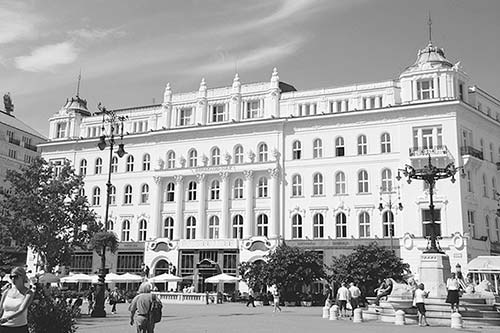
The yellow M1 Metró stop in front of Gerbeaud is the entrance to the shallow Földalatti, or “underground”—the first subway on the Continent (built for the Hungarian millennial celebration in 1896). Today, it still carries passengers to Andrássy Út sights, running under that boulevard all the way to City Park.
Walk to the far end of the square and look up the street that’s to your left. This traffic-free street (Deák Ferenc Utca)—also known as “Fashion Street,” with top-end shops—is the easiest and most pleasant way to walk to Deák Tér and, beyond it, through Erzsébet Tér to Andrássy Út.
• Extending straight ahead from Vörösmarty Tér is a broad, bustling, pedestrianized shopping street.
Váci Utca
Dating from 1810-1850, Váci Utca (VAHT-see OOT-zaw) is one of the oldest streets of Pest. Váci Utca means “street to Vác”—a town 25 miles to the north. This has long been the street where the elite of Pest would go shopping, then strut their stuff for their neighbors on an evening promenade. Today, the tourists do the strutting here—while the Hungarians go to American-style shopping malls.
This boulevard—Budapest’s tourism artery—was a dreamland for Eastern Bloc residents back in the 1980s. It was here that they fantasized about what it might be like to be free, while drooling over Nikes, Adidas, and Big Macs before any of these “Western evils” were introduced elsewhere in the Warsaw Pact region. In fact, partway down the street (on the right, at Régi Posta Utca) is the first McDonald’s behind the Iron Curtain, where people from all over the Eastern Bloc flocked to dine. Since you had to wait in a long line—stretching around the block—to get a burger, it wasn’t “fast food”...but at least it was “West food.”
Ironically, this street—once prized by Hungarians and other Eastern Europeans because it felt so Western—is what many foreign tourists today mistakenly think is the “real Budapest.” Visitors mesmerized by this stretch of souvenir stands, tourist-gouging eateries, and upscale boutiques are likely to miss some more interesting and authentic areas just a block or two away. Don’t fall for this trap. You can have a fun and fulfilling trip to this city without ever setting foot on Váci Utca.
• For a more appealing people zone than Váci Utca, detour from Vörösmarty Tér a block toward the river, to the inviting...
Danube Promenade
Some of the best views in Budapest are from this walkway facing Castle Hill—especially this stretch, between the white Elisabeth Bridge (left) and the iconic Chain Bridge (right). This is a favorite place to promenade (korzó), strolling aimlessly and greeting friends.
Dominating this part of the promenade is the Neo-Romantic-style Pesti Vigadó—built in the 1880s and recently restored. Charmingly, the word vigadó—used to describe a concert hall—literally means “joyous place.” In front, the playful statue of the girl with her dog captures the fun-loving spirit along this drag.
At the gap in the railing, notice the platform to catch tram #2, which goes frequently in each direction along the promenade—a handy way to connect riverside sights in Pest. It’s also incredibly scenic. Take it once between the Great Market Hall (to the left) and the Parliament (to the right) just for fun.
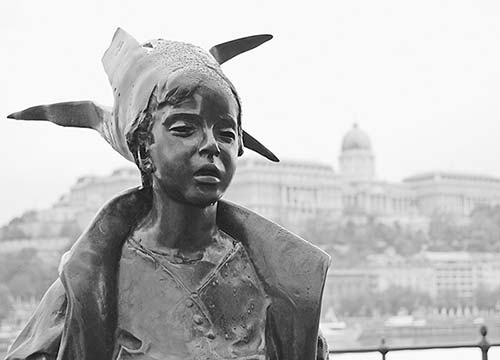
• About 30 more yards toward the Chain Bridge, find the little statue wearing a jester’s hat. She’s playing on the railing, with the castle behind her.
The Little Princess is one of Budapest’s symbols and a favorite photo-op for tourists. While many of the city’s monuments have interesting backstories, more recent statues (like this one) are simply whimsical and fun.
• Now walk along the promenade to the left (toward the white bridge). Directly in front of the corner Starbucks in the Marriott Hotel (and the nearby Shakespeare statue), watch for the easy-to-miss stairs leading down under the tram tracks to a crosswalk that leads safely across the busy road to the riverbank. From the top of these stairs, look along the river.
Lining the embankment are several long boats: Some are excursion boats for sightseeing trips up and down the Danube (especially pleasant at night), while others are overpriced (but scenic) restaurants. Kiosks along here dispense info and sell tickets for the various boat companies—look for Legenda Cruises (recommended earlier, under “Tours in Budapest”; their dock is just downstream from here—go down the stairs, cross the road, then walk 100 yards left).
• From here, both the promenade and Váci Utca cut south through downtown. At the end of this zone is one of Budapest’s top attractions.
▲▲Great Market Hall (Nagyvásárcsarnok)
“Great” indeed is this gigantic marketplace. The Great Market Hall still keeps local shoppers happy, even as it has evolved into one of the city’s top tourist attractions. Goose liver, embroidered tablecloths, golden Tokaji Aszú wine, pickled peppers, communist-kitsch T-shirts, savory lángos pastries, patriotic green-white-and-red flags, and paprika of every degree of spiciness...if it’s Hungarian, you’ll find it here. Come to shop for souvenirs, to buy a picnic, or just to rattle around inside this vast, picturesque, Industrial Age hall (Mon 6:00-17:00, Tue-Fri until 18:00, Sat until 15:00, closed Sun, Fővám Körút 1, district IX, M4: Fővám Tér or M3: Kálvin Tér).
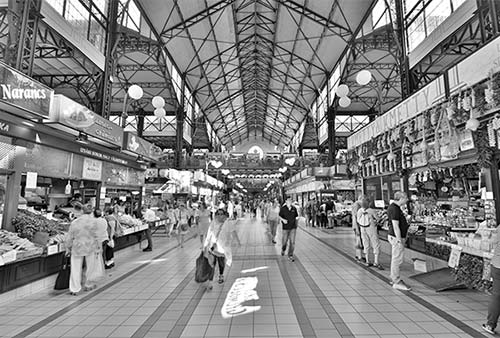
Visiting the Market Hall: Step inside the market and get your bearings: The cavernous interior features three levels. The ground floor has produce stands, bakeries, butcher stalls, heaps of paprika, goose liver, and salamis. Upstairs are stand-up eateries and souvenirs. And in the basement are a supermarket, a fish market, and piles of pickles.
Stroll along the market’s “main drag” (straight ahead from the entry), enjoying the commotion of produce stands and vendors selling authentic Hungarian products. About halfway along, you’ll see paprika on both sides. As you browse, note that there are two types of paprika: sweet (édes, used for flavor) and hot (csípős, used sparingly to add some kick). While you’re at it, pick up some spicy pastes (which hold their flavor better than the fast-degrading powders): the spicy Erős Pista, the sweet Édes Anna, the soup-enhancing Gulyáskrém, and the intensely spicy condiment called, simply, “Red Gold” (Piros Arany).
After you’ve worked your way to the far end of the hall, take the escalator to the upper level. This is a convenient place to look for souvenirs—with a wide selection of items that are traditional (embroidery) and not-so-traditional (commie-kitsch T-shirts). While the quality is typically low and there are no bargains here, the prices are slightly better than out along Váci Utca. For tips, see “Shopping in Budapest,” later.
As you move closer to the front half of the market, the left wall is lined with fun, cheap, stand-up, Hungarian-style fast-food joints and six-stool pubs. However, 90 percent of the clientele is tourists—with correspondingly high prices. I don’t recommend this area for a meal, but you can walk along here to get a glimpse of traditional foods. Many stands sell the deep-fried snack called lángos (LAHN-gohsh)—similar to elephant ears, but savory rather than sweet. The most typical version is sajtos tejfölös—with sour cream and cheese. You can also add garlic (fokhagyma). At the far end of the upper gallery, the Fakanál Étterem cafeteria above the main entrance is very touristy but handy and decent.
For a less glamorous look at the market, head down the escalators near the front of the market (below the restaurant) to the basement. Stop at one of the pickle stands and take a look. Hungarians pickle just about everything: peppers and cukes, of course, but also cauliflower, cabbage, beets, tomatoes, garlic, and so on.
Nearby: The Bálna Budapest shopping mall and cultural center stands along the riverbank behind the Great Market Hall. The complex was created by bridging a pair of circa-1881 brick warehouses with a swooping glass canopy that earns its name, “The Whale” (bálna). It’s a mix of shops, offices, eateries, and conference rooms (a three-minute stroll beyond the back door of the Great Market Hall; www.balnabudapest.hu).
NATIONAL MUSEUM AND PALACE DISTRICT
The Hungarian National Museum and Great Synagogue are along the Small Boulevard, between the Liberty Bridge/Great Market Hall and Deák Tér. The former Jewish Quarter, which sprawls behind the Great Synagogue, is also known as the Seventh District, one of Budapest’s most happening nightlife zones, with a fun selection of ruin pubs (for details, see “Nightlife in Budapest,” later).
▲Hungarian National Museum (Magyar Nemzeti Múzeum)
One of Budapest’s biggest museums features all manner of Hungarian historic bric-a-brac, from the Paleolithic age to a more recent infestation of dinosaurs (the communists). Artifacts are explained by good, if dry, English descriptions. The museum adds substance to your understanding of Hungary’s story—but it helps to have a pretty firm foundation first (read “Hungarian History” on here). The most engaging part is room 20, where you’ll find items from the communist period—including both pro- and (illegal) anti-Party propaganda. The exhibit ends with video footage of the 1989 end of communism—demonstrations, monumental parliament votes, and a final farewell to the last Soviet troops leaving Hungarian soil. The impressive Neoclassical building itself is historic: The 1848 Revolution against Habsburg rule was proclaimed from the front steps.
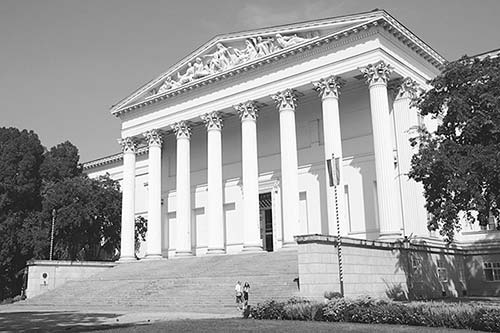
Cost and Hours: 2,900 Ft, more for temporary exhibits; Tue-Sun 10:00-18:00, closed Mon; near Great Market Hall at Múzeum Körút 14, district VIII, M3: Kálvin Tér, +36 1 327 7773, www.hnm.hu.
Nearby: The streets behind the National Museum—where locals far outnumber tourists—are part of the up-and-coming Palace District. For a nice taste of this area, stop by the Tasting Table wine shop to sample some Hungarian wines (see listing on here); or wander over to the delightful, leafy, no-name square where Baross Utca meets Reviczky Utca—with a bookseller kiosk, a lively al fresco café, and a distinctly Parisian ambience.
▲▲Great Synagogue (Nagy Zsinagóga)
Also called the Dohány Street Synagogue, Budapest’s gorgeous synagogue is the biggest in Europe and the second biggest in the world (after the Temple Emanu-El of New York). A visit here has three parts: touring its ornately decorated interior; exploring the attached museum, which offers a concise lesson in the Jewish faith; and lingering in the evocative memorial garden, with its weeping willow Tree of Life sculpture and other poignant monuments.
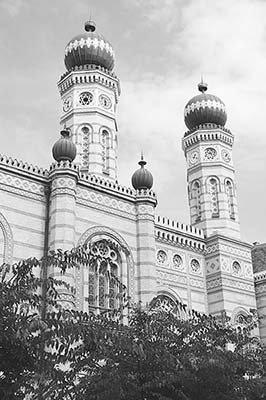
Cost and Hours: 9,000 Ft for Great Synagogue, museum, and garden, includes free tour (about 2/hour); Sun-Thu 10:00-20:00 (Oct and March-April until 18:00), Fri 10:00-16:00; Nov-Feb Sun-Thu 10:00-16:00, Fri until 14:00; closed Sat year-round and Jewish holidays; Dohány Utca 2, district VII, near M2: Astoria or the Astoria stop on trams #47, #48, and #49, +36 1 343 0420, www.dohany-zsinagoga.hu.
 Self-Guided Tour: The synagogue’s striking exterior captures the rich history of the building and the people it represents: The synagogue was completed in 1859 just outside what was then the city limits. Although Budapest’s Jews held fast to their own faith, they also wished to demonstrate their worth and how well integrated they were with the greater community.
The two tall towers are not typical of traditional synagogues. The Moorish-flavored architecture is a sign of the Historicism of the time, which borrowed eclectic elements from past styles. Specifically, it evokes the Sephardic Jewish culture that flourished in Iberia; many Hungarian Jews are descended from that group, who fled here after being expelled from Spain in 1492. To some, the towers evoke Moorish minarets. Others note how these towers—along with the rosette (rose window)—helped the synagogue resemble Christian churches of the time. In fact, when it was built, the synagogue was dubbed by one cynic “the most beautiful Catholic synagogue in the world.”
Step inside. Notice that the synagogue interior feels like a church with the symbols switched—with a basilica floor plan, a nave with two side aisles, two pulpits, and even a pipe organ. The organ—which Franz Liszt played for the building’s inauguration—is a clue that this synagogue belonged to the most progressive of the three branches of Judaism here at the time. (Orthodox Jews would never be permitted to do the “work” of playing an organ on the Sabbath.)
In the ark, at the front of the main aisle, 25 surviving Torah scrolls are kept. Catholic priests hid these scrolls during World War II (burying them temporarily in a cemetery). The two-tiered balconies on the sides of the nave were originally for women, who worshipped separately from the men.
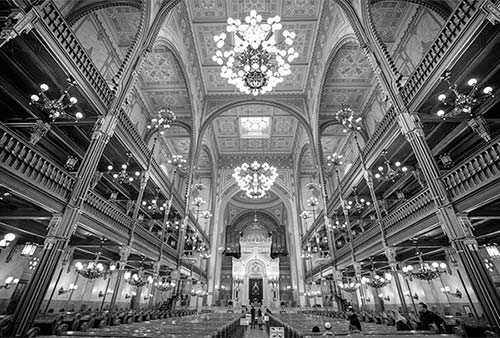
Ponder this building’s recent history: Although it survived World War II, the Great Synagogue sat neglected for 40 years. But in 1990, it was painstakingly rebuilt, largely with financial support from the Hungarian American cosmetics magnate Estée Lauder. Theodor (Tivadar) Herzl, a pioneer of Zionism, was born in a house next door to the Great Synagogue (now gone). Other people of Hungarian Jewish descent include big names from every walk of life: Harry Houdini (born Erich Weisz), Elie Wiesel, Joseph Pulitzer, Tony Curtis (and his daughter Jamie Lee), George Cukor, Goldie Hawn, George Soros, Peter Lorre, and Eva and Zsa Zsa Gabor. A visit to the Great Synagogue and surrounding Jewish Quarter offers insight into this vital facet of Hungarian history and contemporary life.
• When you’re finished inside, exit through the main doors, turn right, and go to the opposite end of the front arcade. Enter the building, then head upstairs (by stairs or elevator) to the...
Hungarian Jewish Museum (Magyar Zsidó Múzeum): This small but informative museum illuminates the Jewish faith, displaying a wide range of artifacts and succinct but engaging English explanations. The collection is always somewhat in flux, but typically you’ll see objects representing the stages of Jewish life: a day, a week, a year, a lifetime. Everyday items reveal how Judaism was interwoven with all aspects of life. It also explains the major holidays of the Jewish calendar—from Rosh Hashanah and Yom Kippur to Purim and Hanukkah. One of the museum’s prized pieces—typically displayed on the top floor—is a third-century tombstone from the Roman province of Pannonia (today’s Hungary), roughly etched with a menorah.
• Exiting back into the front courtyard, go down the passageway between the synagogue and the museum (straight ahead from the security checkpoint) to reach the...
Memorial Garden: During the Soviet siege that ended the Nazi occupation of Budapest in the winter of 1944-1945, many Jews in the ghetto here died of exposure, starvation, and disease. Soon after the Soviets liberated the city, an estimated 2,281 Jews were buried here—considered Hungary’s largest mass grave from the Holocaust. The trees and headstones (donated by survivors) were added later. The pillars you’ll pass have historical photos of the synagogue and Jewish Quarter.
• Reaching the end of the corridor, walk out to the garden behind the synagogue, where you’ll find the...
Tree of Life: Created by renowned artist Imre Varga, this weeping willow, cast in steel, was erected in 1990, soon after the fall of communism made it possible to acknowledge the Holocaust. The willow makes an upside-down menorah, and each of the 4,000 metal leaves is etched with the name of a Holocaust victim. New leaves are added all the time, donated by families of the victims.
• Immediately behind the synagogue is the...
Garden of the Just: This is a symbolic grave for the many diplomats from other nations who saved Hungarian Jews. The most famous of these—and the biggest name on the monument—is Raoul Wallenberg (1912-1947). An improbable hero, this ne’er-do-well Swedish playboy from a prominent family was sent as a diplomat to Hungary because nobody else wanted the post. He was empowered by the Swedish government to do whatever he could—bribe, threaten, lie, or blackmail—to save as many Jews as possible from the Nazis. He surpassed everyone’s low expectations by dedicating (and ultimately sacrificing) his life to the cause. By giving Swedish passports to Jews and admitting them to safe houses, he succeeded in rescuing tens of thousands of people from certain death. Shortly after the Soviets arrived, Wallenberg was arrested, accused of being a US spy, sent to a gulag...and never seen alive again. (Later, Russian authorities acknowledged he was executed in 1947, in Moscow’s Lubyanka prison.)
The grave is also etched with the names of other “Righteous Among the Nations” who went above and beyond to save Jews. According to the Talmud, “Whoever saves one life, saves the world entire.”
Other Jewish Quarter Sights
While this area was shrouded in soot and gloom during the communist period, today Budapest’s Jewish Quarter is coming back to life. You’ll find monuments and artifacts of Jewish history in these streets—but you sometimes have to hunt for them a bit.
Orthodox Synagogue: This colorfully decorated space is just two blocks behind the Great Synagogue. Built in the Vienna-inspired Secession style in 1912, this temple stood damaged and deserted for decades after World War II until being renovated in 2006. Today, it invites visitors to see its colorful, sumptuously decorated interior (1,000 Ft; unpredictable hours but likely Sun-Thu 10:00-17:30, Fri until 16:00; Oct-April Sun-Thu 10:00-16:00, Fri until 13:30; closed Sat year-round; enter down little alley, Kazinczy Utca 27, district VII, M2: Astoria).
Gozsdu Udvar: This long series of courtyards burrows through the middle of a city block, between Dob Utca 16 and Király Utca 13. When this neighborhood hosted a fast-growing Jewish population and space was at a premium, courtyards like this one were filled with community life: restaurants, shops, and other businesses.
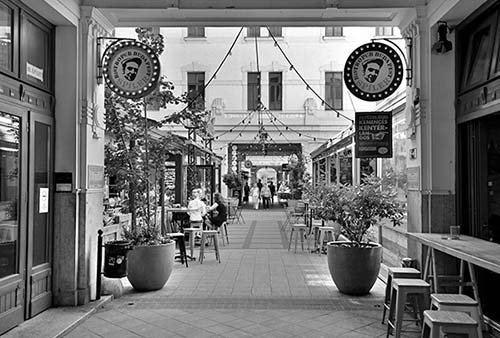
After decades of neglect, this passage was spruced up and opened to the public. This genteel space—which evokes the golden age of Jewish life in Budapest—is once again filled with cafés and bars, and after hours it’s a bustling nightlife hub.
▲Rumbach Street Synagogue: This exquisite synagogue, designed by Otto Wagner, recently reopened after an extensive refurbishment—and it’s once again gleaming. The Moorish-style house of worship is a fascinating counterpoint to the Great Synagogue and complements it in many ways. The concise but compelling museum exhibit on the third floor is the best in town for understanding the history of Hungarian Jews (3,000 Ft; Sun-Thu 10:00-20:00 (Oct and March-April until 18:00), Fri 10:00-16:00; Nov-Feb Sun-Thu 10:00-16:00, Fri until 14:00; closed Sat year-round and Jewish holidays; from the Tree of Life monument, it’s two blocks down Rumbach Utca toward Andrássy Út, district VII, M2: Astoria or M1/M2/M3: Deák Tér and exit for Király Utca).
Jewish Local History Collection of Elisabethtown: This endearingly humble (but lovingly presented) exhibit offers a more intimate look at the lives of the Jewish people who once resided in this neighborhood. They’ve reconstructed an old building (formerly a ruin pub) and refurnished a middle-class Jewish family apartment upstairs. At the back of the building is a much smaller, more modest one-room apartment belonging to a poor Zionist printer and his family. English information is sparse, but you may be able to borrow an English audioguide (900 Ft; Sun-Thu 14:00-18:00, Fri 10:00-14:00, closed Sat, likely shorter hours in Nov-March; Csányi Utca 5, district VII, M1: Oktogon, +36 1 369 3688, www.erzsitt.hu).
ANDRÁSSY ÚT
Connecting Downtown Pest to City Park, Andrássy Út is Budapest’s main boulevard, lined with plane trees, shops, theaters, cafés, and locals living very well. Budapesters like to think of Andrássy Út as the Champs-Elysées and Broadway rolled into one. While that’s a stretch, it is a good place to stroll, get a feel for today’s urban Pest, and visit a few top attractions on the way to Heroes’ Square and City Park.
I’ve arranged these sights in the order you’ll reach them if you walk up the boulevard from where it begins, near Deák Tér. The handy M1/yellow Metró line runs every couple of minutes just under the street, making it easy to skip several blocks ahead, or to backtrack (stops marked by yellow signs).
• Three blocks up Andrássy Út on the left is the...
▲▲Hungarian State Opera House (Magyar Állami Operaház)
The Neo-Renaissance home of the Hungarian State Opera features performances (almost daily except during outdoor music season, late June-early Sept) and delightful tours. The building dates from the 1890s, not long after Budapest had become co-capital of the Habsburg Empire. The Hungarians wanted to put their city on the map as a legitimate European capital, and that meant they needed an opera house. Emperor Franz Josef provided half the funds...on the condition that it be smaller than the opera house in his hometown of Vienna. And so, Miklós Ybl designed a building that would exceed Vienna’s famous Staatsoper in opulence, if not in size. (Franz Josef was reportedly displeased.) It was built using almost entirely Hungarian materials. After being damaged in World War II, it was painstakingly restored decades later. Today, with lavish marble-and-gold-leaf decor, a gorgeous gilded interior slathered with paintings of Greek myths, and high-quality performances at bargain prices, this is one of Europe’s finest opera houses.
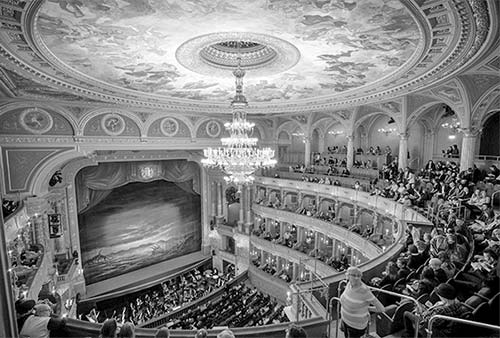
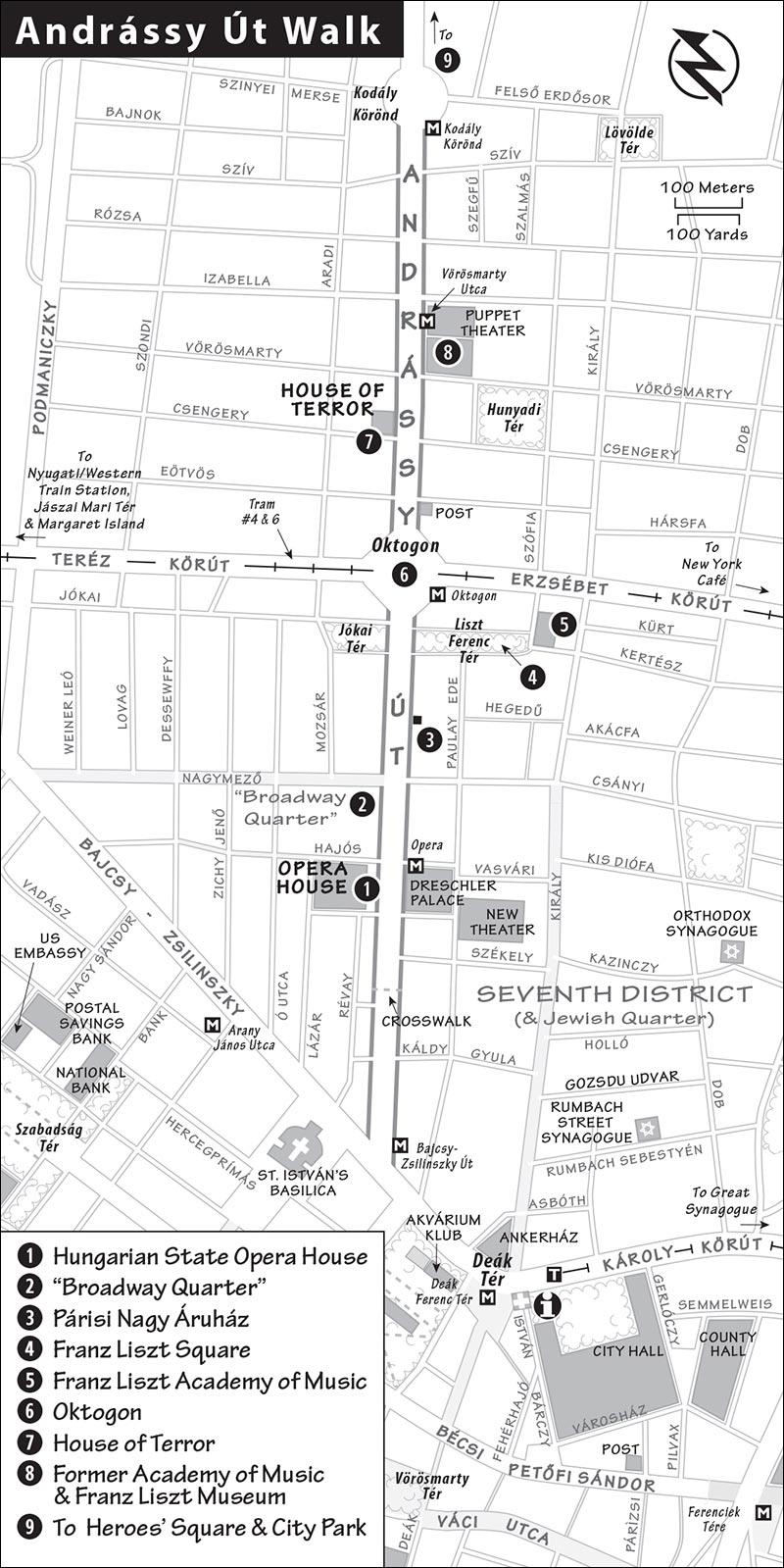
You can drop in whenever the box office is open to ogle the ostentatious lobby (daily 10:00-19:00 or until the first intermission, Andrássy Út 22, district VI, M1: Opera).
The one-hour tours of the Opera House are a must for music lovers and enjoyable for anyone, though the quality of the guides varies: Most spout plenty of fun, if silly, legends, but others can be quite dry. You’ll see the main entryway, the snooty lounge area, some of the cozy but plush boxes, and the lavish auditorium. You’ll find out why clandestine lovers would meet in the cigar lounge, how the Opera House is designed to keep the big spenders away from the rabble in the nosebleed seats (still the case today), and how to tell the difference between real marble and fake marble. The tour ends with a brief 10-minute performance on the grand staircase (7,000 Ft; English tours usually daily at 13:30, 15:00, and 16:30; prebook tour tickets on the official Opera website (www.opera.hu) or in person at the box office; wise to prebook on weekends, when tours can sell out a day or so ahead; on weekdays, you can generally just show up 15-20 minutes before the tour).
To experience the Opera House in action, take in an excellent and affordable performance (see “Entertainment in Budapest,” later).
• The Opera House marks the beginning of an emerging dining-and-nightlife neighborhood dubbed the...
“Broadway Quarter”
The major cross street, Nagymező Utca, features a chic cluster of restaurants, bars, and theaters (especially on the left side of Andrássy). This is an enjoyable place to stroll on a summer evening. While you might be tempted to attend a show along Budapest’s answer to Broadway, note that most of the plays and musicals here are in Hungarian only. Many of my recommended restaurants (described later, under “Eating in Budapest”) are in this neighborhood.
A half-block down on the right (at #39) is a grand old early 20th-century building marked Párisi Nagy Áruház (Paris Department Store). One of the city’s first department stores, this was a popular shopping stop for years, even through communism. Inside and upstairs is a gorgeous old frescoed ballroom, called Lotz Hall, which is sometimes home to a café; if you’d like a coffee break, consider heading inside and up the escalator to check if it’s open.
• Just after the end of the block is a popular outdoor dining area.
Franz Liszt Square (Liszt Ferenc Tér)
This leafy square is surrounded by hip, expensive cafés and restaurants. (The best is the recommended restaurant Menza.)
Strangely, neither the statue on this square nor the one facing it, across Andrássy Út, is of Franz Liszt. But deeper in the park, you’ll find a modern statue of Liszt energetically playing an imaginary piano. And at the far end of the square, fronting a gorgeous piazza, is the Franz Liszt Academy of Music, founded by and named for this half-Hungarian, half-Austrian composer who had a Hungarian name and passport. Liszt loved his family’s Magyar heritage (though he didn’t speak Hungarian) and spent his final six years in Budapest. His Academy of Music has been stunningly restored inside and out—step into the magnificent lobby. This space, though smaller, gives the Opera House a run for its money...and speaking of money, the concerts here are even cheaper than at the already reasonably priced Opera (for details on performances, and for more on Liszt, see “Entertainment in Budapest,” later).
• One block up from Franz Liszt Square is the gigantic crossroads known as the...
Oktogon
This vast intersection with its corners snipped off—where Andrássy Út meets the Great Boulevard ring road (Nagykörút)—was called Mussolini Tér during World War II, then November 7 Tér in honor of the Bolshevik Revolution. Today, kids have nicknamed it American Tér for the fast-food joints littering the square and streets nearby.
From here, if you have time to delve into workaday Budapest, hop on tram #4 or #6, which trundle in both directions around the ring road. For a short detour to the most opulent coffee break of your life, head for the recommended New York Café (described later, under “Eating in Budapest”). Just get on a tram to the right (tram #6 toward Móricz Zsigmond Körtér or tram #4 toward Fehérvári Út) and get off at the Wesselényi Utca stop.
• There’s one more major sight between here and Heroes’ Square. Walk two more blocks up Andrássy Út to reach the...
▲▲House of Terror (Terror Háza)
The building at Andrássy Út 60 was home to the vilest parts of two destructive regimes: first the Arrow Cross (the Gestapo-like enforcers of Nazi-occupied Hungary), then the ÁVO and ÁVH secret police (the insidious KGB-type wing of the Soviet satellite government). Now re-envisioned as the “House of Terror,” this building uses highly conceptual, bombastic exhibits to document the ugliest moments in Hungary’s difficult 20th century.
Cost and Hours: 4,000 Ft, Tue-Sun 10:00-18:00, closed Mon, audioguide-2,000 Ft, Andrássy Út 60, district VI, M1: Vörösmarty Utca—not the Vörösmarty Tér stop, +36 1 374 2600, www.terrorhaza.hu.
Tours: The English audioguide, good but plodding and almost too thorough, can be difficult to hear over the din of Hungarian soundtracks in each room (2,000 Ft).
Background: In the lead-up to World War II, Hungary initially allied with Hitler—both to retain a degree of self-determination and to try to regain its huge territorial losses after World War I’s devastating Treaty of Trianon (see here). But in March 1944, the Nazi-affiliated Arrow Cross Party was forcibly installed as Hungary’s new government. The Nazi surrogates deported nearly 440,000 Jewish people to Auschwitz, murdered thousands more on the streets of Budapest, and executed hundreds in the basement of this building.
When the communists moved into Hungary after the war, they took over the same building as headquarters for their secret police (the ÁVO, later renamed ÁVH). To keep dissent to a minimum, the secret police terrorized, tried, deported, or executed anyone suspected of being an enemy of the state.
Visiting the Museum: The atrium features a Soviet T-54 tank, and a vast wall covered with 3,200 portraits of people who were murdered by the Nazis or the communists in this very building. The one-way exhibit begins two floors up, then spirals down to the cellar.
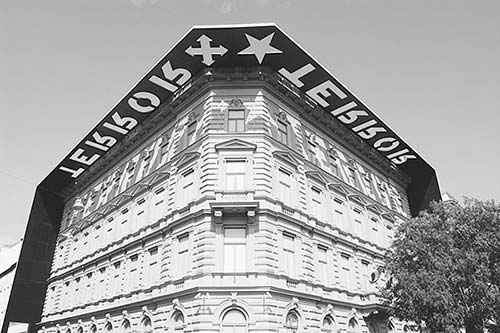
Upstairs sets the stage for Hungary’s 20th century: its territorial losses after World War I; its alliance with, then invasion by, the Nazis; and its “liberation,” then occupation, by the USSR. After passing through a room displaying uniforms and other gear belonging to Hungarian Nazis, you’ll reach the room devoted to the Gulag—a network of secret Soviet prison camps, mostly in Siberia. These were hard-labor camps where potential and actual dissidents were sent to punish them and make an example of those who would dare to defy the regime.
The Changing Clothes room satirizes the readiness of many Hungarians to align themselves with whomever was in power. The room on The Fifties examines the gradual insinuation of the communist regime into the fabric of Hungary. Their methods ranged from already-marked ballots to glossy propaganda. Behind the distorted stage is the dark underbelly of the regime: the constant surveillance that bred paranoia among the people. The Resistance room—empty aside from three very different kitchen tables—symbolizes the way that resistance to the regime emerged in every walk of life. The exhibit continues downstairs, where the Resettlement and Deportation section explains the ethnic cleansing that took place throughout Central and Eastern Europe in the years following World War II. In Hungary alone, 230,000 Germans were uprooted and deported.
In Surrender of Property and Land, we learn that under communism, the Hungarian people had to survive on increasingly sparse rations. Enter the labyrinth of pork-fat bricks, which remind old-timers of the harsh conditions of the 1950s. So often, dinner was simply lard on bread.
The next room examines the ÁVO, the communist secret police who intimidated the common people of Hungary. Before they were finished, the ÁVO/ÁVH imprisoned, abused, or murdered one person from every third Hungarian family. After passing through the office of Gábor Péter (the first director of the ÁVO), you’ll reach the “Justice” exhibit, which explores “show trials”—high-profile, loudly publicized, and completely choreographed trials of people who had supposedly subverted the regime. The burden of proof was on the accused, not on the accuser, and coerced confessions were fair game. From 1945 until the 1956 Uprising, more than 71,000 Hungarians were accused of political crimes, and 485 were executed.
Next you’ll encounter bright and cheery communist Propaganda. The poster about the Amerikai Bogár warns of the threat of the “American Beetle,” which threatened Hungarian crops. When a potato beetle epidemic hit, rather than acknowledging their own fault, the communists blamed an American conspiracy. Rounding out this floor are sections on “Hungarian Silver” (actually aluminum—lampooning the lowbrow aesthetic of that era) and Religion (those who were publicly faithful were discriminated against, closely supervised by the secret police, and often arrested). Then you’ll board an elevator. As it descends, you’ll watch a video about the grotesque execution process.
When the door opens, you’re in the Prison Cellar. In the large room after the cells, you’ll see a stool with a lamp; nearby are the torture devices. The bucket and hose were used to revive torture victims who had blacked out. After the torture room, a small room on the right contains a gallows that was used for executions.
The room commemorating the 1956 Uprising features a symbol of that uprising—a Hungarian flag with a hole cut out of the middle (a hastily removed Soviet emblem) and the slogan Ruszkik Haza! (“Russkies go home!”). For more on ’56, see the sidebar on here. After a sobering room that displays six symbolic gallows, the Emigration room features a wall of postcards. More than 200,000 Hungarians simply fled the country after the uprising. The Hall of Tears memorial commemorates all the victims of the communists from 1945 to 1967 (when the final prisoners were released from this building). The Room of Farewell shows the festive and exhilarating days in 1991 when the Soviets departed, making way for freedom; the reburial of the Hungarian hero, Imre Nagy, at Heroes’ Square; and the dedication of this museum.
The chilling finale: walls of photographs of the “Victimizers”—members and supporters of the Arrow Cross and ÁVO, some of whom are still living and who were never brought to justice.
• Across the street and a few steps up Andrássy Út is the...
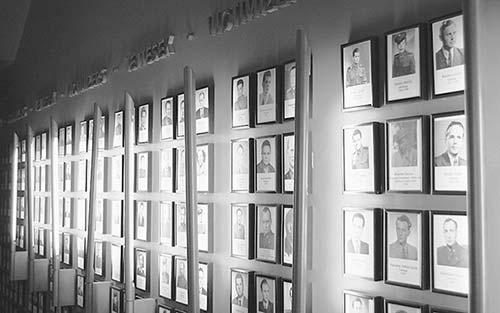
Franz Liszt Museum
In this surprisingly modest apartment where the composer once resided, you’ll find a humble but appealing collection of artifacts. A pilgrimage site for Liszt fans, it’s housed in the former Academy of Music, which also hosts Saturday-morning concerts (see “Entertainment in Budapest,” later).
Cost and Hours: 3,000 Ft; Mon-Fri 10:00-18:00, Sat 9:00-17:00, closed Sun; Vörösmarty Utca 35, district VI, M1: Vörösmarty Utca—not Vörösmarty Tér stop, +36 1 322 9804, www.lisztmuseum.hu.
• While you can walk from here to Heroes’ Square (visible in the distance, about a 15-minute walk), there’s less to see along the rest of Andrássy Út. If you prefer, hop on the Metró here and ride it three stops to Hősök Tere.
HEROES’ SQUARE AND CITY PARK
The grand finale of Andrássy Út, at the edge of the city center, is also one of Budapest’s most entertaining quarters. Here you’ll find the grand Heroes’ Square, dripping with history; the vast tree-filled expanse of City Park, dressed up with fanciful buildings that include an Art Nouveau zoo and a replica of a Transylvanian castle; and, tucked in the middle of it all, Budapest’s finest thermal spa and single best experience, the Széchenyi Baths. Over time, the vision is to relocate many of Budapest’s leading museums to this park—creating a kind of museum quarter.
▲▲Heroes’ Square (Hősök Tere)
Built in 1896 to celebrate the 1,000th anniversary of the Magyars’ arrival in Hungary, this vast square culminates at a bold Millennium Monument. Standing stoically in its colonnades are 14 Hungarian leaders who represent the whole span of this nation’s colorful and illustrious history. In front, at the base of a high pillar, are the seven original Magyar chieftains, the Hungarian War Memorial, and young Hungarian skateboarders of the 21st century. Look for names you may recognize: István, Béla IV, Mátyás Corvinus. The sculptures on the top corners of the two colonnades represent, from left to right: Work and Welfare, War, Peace, and the Importance of Packing Light. The square is also flanked by a pair of museums.
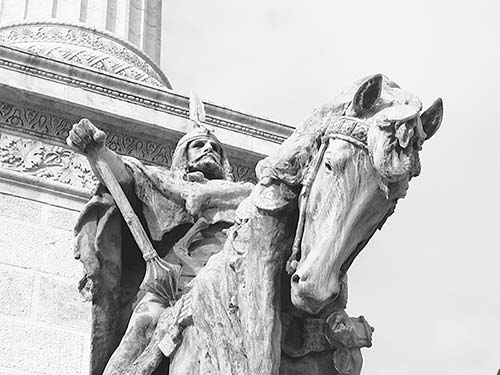
Museums on Heroes’ Square: The Museum of Fine Arts (Szépművészeti Múzeum) is Budapest’s best chance to appreciate some European masters. You’ll see mostly Germanic, Dutch, Belgian, and Spanish art, plus lesser works by the likes of Dürer, the Bruegels, Murillo, Velázquez, El Greco, Goya, and more (4,200 Ft; Tue-Sun 10:00-18:00, closed Mon, last entry one hour before closing; Dózsa György Út 41, +36 1 469 7100, www.szepmuveszeti.hu). Facing the Museum of Fine Arts from across Heroes’ Square, the Műcsarnok (“Hall of Art”) rotates temporary exhibits by contemporary artists—of interest only to art lovers (price varies depending on the exhibits; Tue-Sun 10:00-18:00 except Thu 12:00-20:00, closed Mon; Dózsa György Út 37, +36 1 460 7000, www.mucsarnok.hu).
• With the road on your right and the Műcsarnok museum on your left, carry on straight ahead. Soon you’ll see a huge metallic box rising from the grassy park.
Museum of Ethnography (Néprajzi Múzeum)
This striking building juxtaposes vivid objects from world cultures in surprising ways. In the lobby is a fascinating, free-to-view model of Budapest in the 1910s, and another model showing the ambitious plans for redeveloping City Park. But the building itself overshadows the exhibits, with its sloping U-shaped design and a rooftop you can walk all over.
Cost and Hours: Free to enter building and see city model, permanent exhibit—1,700 Ft, Tue-Sun 10:00-18:00, closed Mon, Dózsa György Út 35, +36 1 474 2100, www.neprajz.hu.
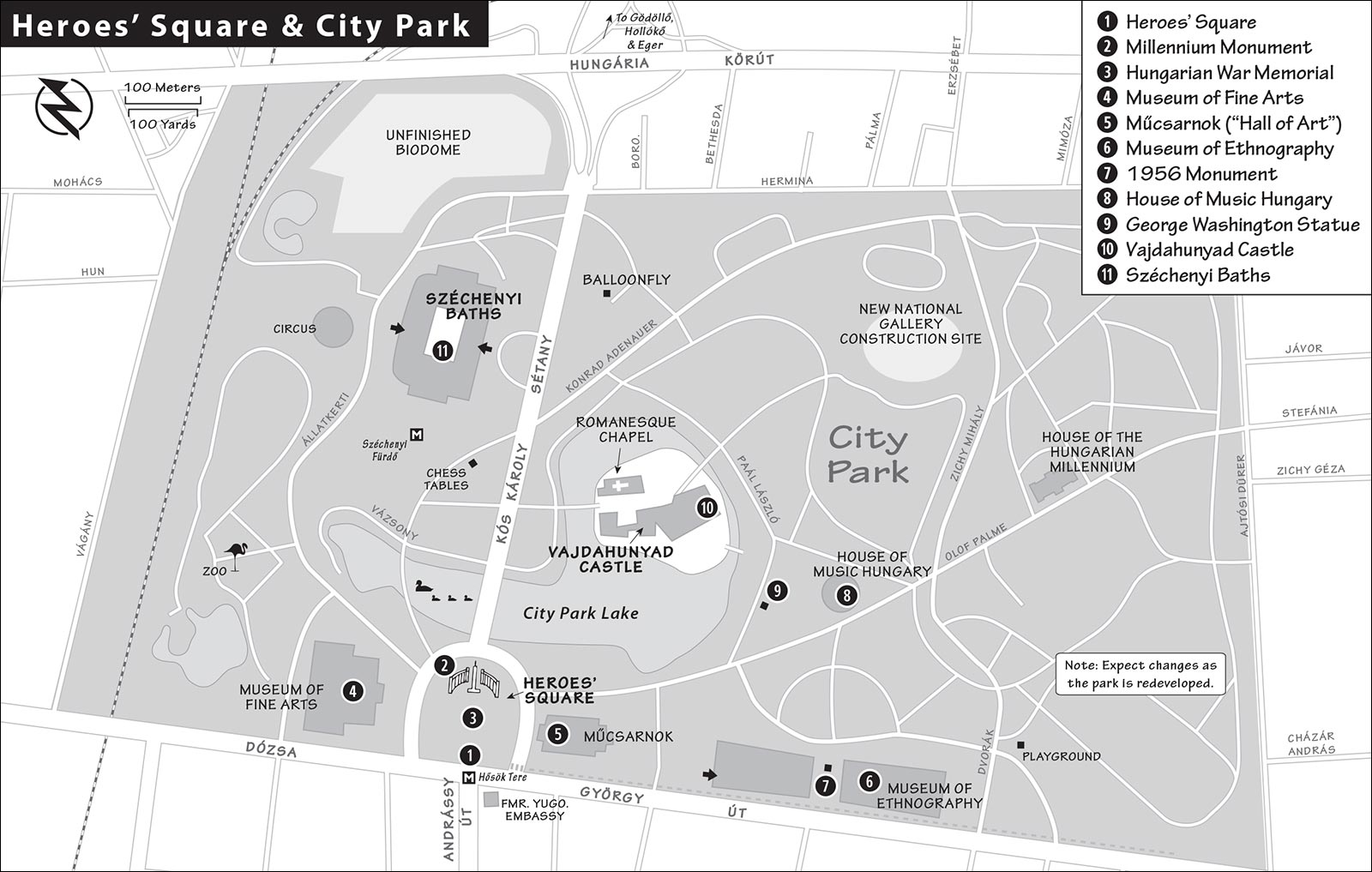
• In the middle of the building’s two halves stands the dramatic 1956 monument, honoring the 1956 Uprising, when the Hungarian people stood up against Soviet rule. Standing at the back of the monument—with the road behind you—look through the trees to see the wavy yellow roofline. Walk through the park to reach the...
▲▲House of Music Hungary (Magyar Zene Háza)
This striking building—shaped like a “Tree of Life”—hosts three different music venues and an excellent exhibit called Dimensions of Sound. Equipped with an audioguide, you’ll explore the history of music in Hungary and around the world, from the Magyar folk music of the countryside, to the evolution of church music, to the famous composers of the Romantic era, to the TV and movie soundtracks of today. There are also temporary exhibits and the Hangdóm (Sound Dome), a trippy sound-and-light show.
Cost and Hours: 3,400 Ft, Hangdóm and temporary exhibits covered by separate tickets, Tue-Sun 10:00-18:00, closed Mon, Olof Palme Sétány 3-5, +36 70 799 9449, www.zenehaza.hu.
• Exiting the House of Music, turn right and walk around its back side (toward the small lake). You’ll pass a statue of George Washington (funded and erected in 1906 by Hungarians who emigrated to the US). Imagine Washington turned right, strode toward the snack-and-drink stand, then turned left along the path under the trees (passing the bridge with a yellow railing). Continue until you reach the concrete bridge about 150 yards down that path. This takes you into the heart of...
▲▲City Park (Városliget)
Budapest’s not-so-central “Central Park,” which sprawls beyond Heroes’ Square, was the site of the overblown 1896 Millennial Exhibition, celebrating Hungary’s 1,000th birthday. Explore the fantasy castle of Vajdahunyad. Visit the animals and ogle the playful Art Nouveau buildings inside the city’s zoo, or enjoy a circus under the big top. Go for a stroll, rent a rowboat, eat some cotton candy, take a brief ride in a hot-air balloon, or challenge a local to a game of chess. Or, best of all, take a dip in Budapest’s ultimate thermal spa, the Széchenyi Baths.
▲▲Vajdahunyad Castle (Vajdahunyad Vára)
Many of the buildings for Hungary’s Millennial National Exhibition were erected with temporary materials, to be torn down at the end of the festival—as was the case for most world fairs at the time. But locals so loved Vajdahunyad Castle that it was rebuilt in brick and stone.
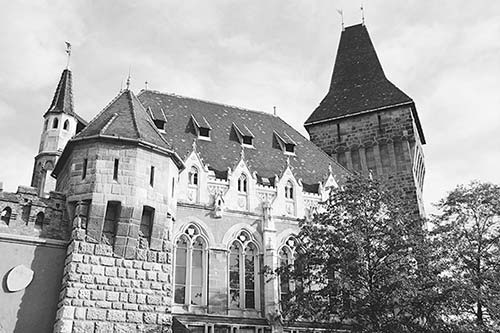
The complex actually has four parts, each representing a high point in Hungarian architectural style: Romanesque chapel, Gothic gate, Renaissance castle, and Baroque palace.
The first part you’ll reach (the ornate yellow mansion on the left as you cross the bridge) is the Baroque home of the Museum of Hungarian Agriculture (Magyar Mezőgazdasági Múzeum). It brags that it’s Europe’s biggest agriculture museum, but most visitors find the lavish interior more interesting than the exhibits.
Facing the museum entry is a monument to Anonymous—specifically, the Anonymous from the court of King Béla IV, who penned the first Hungarian history in the Middle Ages. This clever approach to depicting an unknown historical figure—whose features are barely visible under his heavy hood—is a favorite photo op.
Next up, on the right you’ll see a replica of a 13th-century Romanesque Benedictine chapel. Consecrated as an actual church, this is a popular spot for weddings on summer weekends.
In the middle of the complex are the distinctly Transylvanian-style trapezoidal towers. The section on the left (around the tallest tower, in the middle of the complex) is Renaissance, while the one on the right is Gothic. The Gothic part is a replica of a famous castle in Transylvania that once belonged to the Hunyadi family; this castle loaned its name to the entire complex.
• The park’s highlight is the big yellow building across the street from Vajdahunyad Castle...
▲▲▲Széchenyi Baths (Széchenyi Fürdő)
Visiting the Széchenyi Baths is my favorite activity in Budapest. It’s the ideal way to reward yourself for the hard work of sightseeing while enjoying a culturally enlightening experience. Soak in hundred-degree water, surrounded by portly Hungarians squeezed into tiny swimsuits, while jets and cascades pound away your tension. Go for a vigorous swim in the lap pool, giggle and bump your way around the whirlpool, take a dip in water green with minerals, feel the underwater jets tickle your legs, or challenge the locals to a game of Speedo-clad chess. And it’s all surrounded by an opulent yellow palace with shiny copper domes. The bright blue-and-white of the sky, the yellow of the buildings, the turquoise of the water...Budapest simply doesn’t get any better (for all the details, see “Experiences in Budapest,” later).
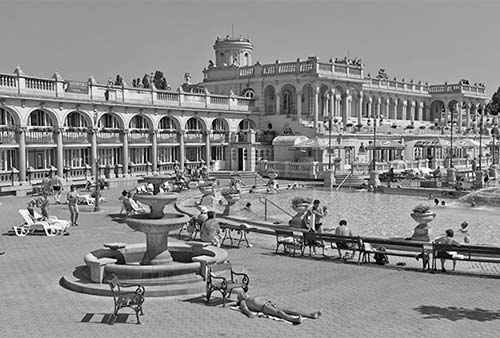
NEAR ÜLLŐI ÚT
The following museum is near the city center, on the boulevard called Üllői Út. You could stroll there in about 10 minutes from the Small Boulevard ring road (walking the length of the Ráday Utca café street gets you very close), or hop on the M3/blue Metró line to Corvin-Negyed (just one stop beyond Kálvin Tér).
▲▲Holocaust Memorial Center (Holokauszt Emlékközpont)
This sight honors the nearly 600,000 Hungarian victims of the Nazis...one out of every 10 Holocaust victims. The impressive modern complex (with a beautifully restored 1920s synagogue as its centerpiece) is a museum of the Hungarian Holocaust, a monument to its victims, a space for temporary exhibits, and a research and documentation center of Nazi atrocities. Interesting to anybody, but essential to those interested in the Holocaust, this is Budapest’s best sight about that dark time—and one of Europe’s best, as well.
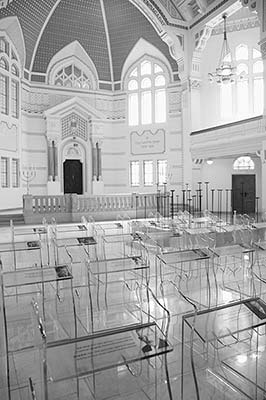
Cost and Hours: 2,400 Ft; Tue-Sun 10:00-18:00, closed Mon, last entry one hour before closing; Páva Utca 39, district IX, M3: Corvin-Negyed, +36 1 455 3333, www.hdke.hu.
Getting There: From the Corvin-Negyed Metró stop, use the exit marked Holokauszt Emlékközpont and take the left fork at the exit. Walk straight ahead two long blocks, then turn right down Páva Utca.
Visiting the Center: You’ll pass through a security checkpoint to reach the courtyard. Inside, a black marble wall is etched with the names of victims. Head downstairs to buy your ticket.
The excellent permanent exhibit, called “From Deprivation of Rights to Genocide,” traces (in English) the gradual process of disenfranchisement, marginalization, exploitation, dehumanization, and eventually extermination that befell Hungary’s Jews as World War II wore on. The finale is the interior of the synagogue, now a touching memorial filled with glass seats, each one etched with the image of a Jewish worshipper who once filled it. Up above, on the mezzanine level, you’ll find temporary exhibits and an information center that helps descendants of Hungarian Jews track down the fate of their relatives.
Nearby: A few blocks away (at Üllői Út 33) is the fanciful, late-19th-century Applied Arts Museum—a green-roofed castle that’s worth a quick look (from the outside, at least) for architecture fans (museum closed for renovation, likely at least through 2024).