CENTRAL EUROPE
Central Europe’s Top Destinations
Map: Central Europe’s Top Destinations
MORE CENTRAL AND EASTERN EUROPE
Wander among Prague’s fairy-tale spires, bask in the convivial bustle of Kraków’s Main Market Square, and soak with chess players in a Budapest thermal bath. Ponder Europe’s most moving Holocaust memorial at Auschwitz. Enjoy pristine nature as you glide across Lake Bled to a church-topped island in the shadow of the Julian Alps. Taste a proud Hungarian vintner’s wine and say, “Egészségedre!” (or stick with “Cheers!”).
From the Czech Republic and Poland to Hungary and Slovenia, Central Europe is a traveler’s delight, with lively squares, fascinating history, reasonable prices, and friendly locals. This book covers a selective cross-section of this sprawling region’s highlights, with enough in-depth coverage to fully appreciate each place. Most of this book is devoted to these four core countries:
The Czech Republic is home to Prague—the stunningly well-preserved showcase city of Central Europe—not to mention a countryside scattered with countless enchanting towns (Český Krumlov and Kutná Hora are tops).
Poland—bigger than the other three core countries combined—has an epic history, a noble spirit, and a variety of appealing cities, big and small: charming Kraków, bustling Warsaw, maritime Gdańsk, and red-brick Toruń.
Hungary is a delightfully enigmatic outlier—with a starkly different language, cuisine, and cultural heritage. Its huge capital city, Budapest, is the de facto capital of Central Europe.
Slovenia is a tiny, endearing alpine country tucked high in the mountains between Austria and Italy. It has an engaging cultural mix, wonderful locals, fabulous scenery, the adorable capital Ljubljana, the dreamy resort Lake Bled, and the cut-glass peaks of the Julian Alps.
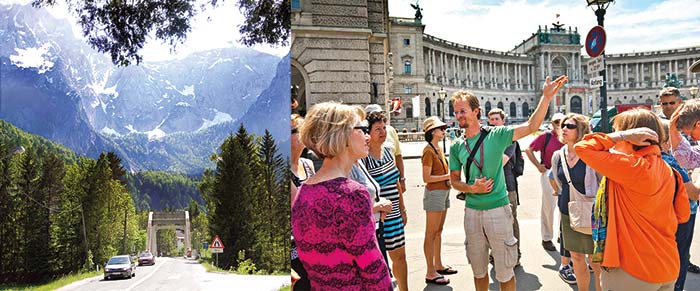
Slovenia’s Julian Alps are blanketed in lush forests; bask in Habsburg opulence at the lavish Hofburg in Vienna, Austria.
I’ve also included in-depth coverage of two Danube capitals that link up well with the places mentioned above: The modern Austrian capital of Vienna was once the capital of everything else mentioned here and remains something of a Central European melting pot. Its grandiose landmarks, world-class museums, and refined ambience—from classical music to genteel coffeehouses—still evoke those glory days. And the Slovak capital of Bratislava, with its compact and historic core, is an easy stopover on the way between Vienna and Budapest.
Finally, the “More Central and Eastern Europe” section, near the back of this book, features abbreviated coverage of several neighboring countries likely to show up on your itinerary: Croatia, Bosnia-Herzegovina, Montenegro, Bulgaria, and Romania.
Wherever you go in Central Europe, you’ll be impressed by each country’s vibrant culture, proud traditions, and strong identity. The Czechs have a sarcastic sense of humor and a wickedly subversive attitude toward authority, while the Hungarians can be quite formal and have produced great analytical minds. The Poles may be a bit brusque at first, then warm up beautifully; meanwhile, you’ll hit it off immediately with the gregarious Slovenes.
If you had to sum up the wonderful lands of Central Europe in a single word, it might just be “underappreciated.” The Czech Republic (except Prague), Poland, Hungary, Slovenia, and their neighbors get nowhere near the number of visitors that their ample charms merit. One reason: Many North American travelers still consider these countries to be part of “Eastern” Europe. But 35 years after the fall of the Iron Curtain, I’m here to set you straight: This is definitively Central Europe.
Germans call this region Mitteleuropa—“Middle Europe”—and looking at a map of Europe, it’s easy to see why: These lands occupy the very heart of the Continent. In fact, Prague lies to the west of Vienna, Stockholm...and most of Italy.
The “Eastern” label dates from the age of Soviet influence (1945-1989). Back then, the Eastern Bloc was a foreboding, dark, and gloomy corner of the “Evil Empire.” But that period represents just one brief chapter in the histories of these nations. (And today, “Eastern Europe” more properly refers to countries east of the ones in this book—Ukraine, Belarus, Russia, and so on—which have traditionally been more firmly in the Russian cultural orbit.)
While the countries of Central Europe are unique, strong cultural ties unite them. Except Hungary, all speak Slavic languages and were settled by the same ancestors. Historically, they were once part of a larger whole: the vast Habsburg (later Austro-Hungarian) Empire, which lasted for centuries and sprawled from Baltic beaches to Adriatic campaniles to Bosnian minarets. This realm included nearly every square inch covered by this guidebook, and much more.
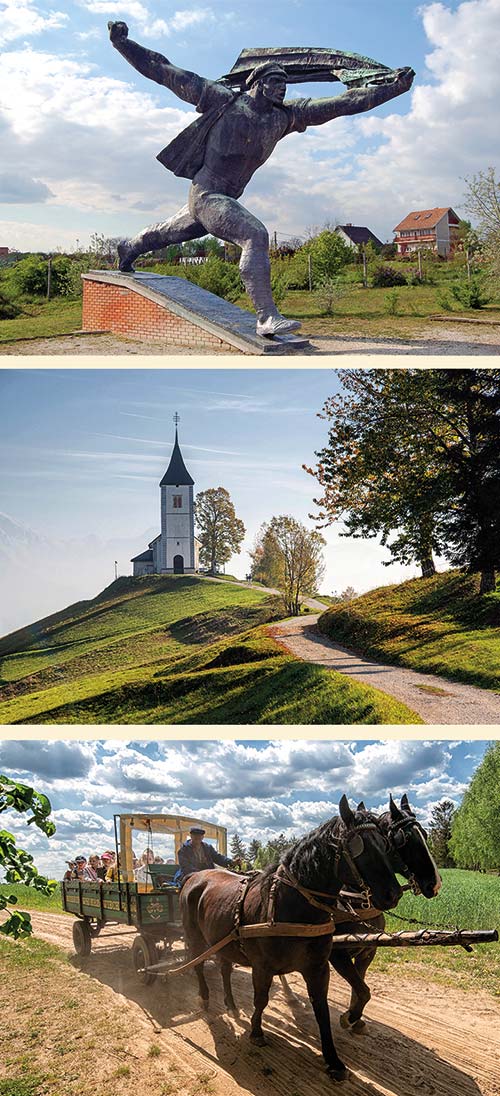
Communist statue in Memento Park in Budapest, Hungary; Jamnik Church near Lake Bled in Slovenia; Poland’s open-air folk museums bring traditions to life.
The Habsburgs had a centralized government and brought standardized infrastructure and architecture to the far corners of their empire. At the same time, for the most part they respected their subjects’ customs: German was the language of government, commerce, and urban life, but local languages and traditions lived on in the countryside. Later, revival movements swept across Europe starting in the mid-1800s, instilling pride in cultural differences.
Defeat in World War I spelled the end of Habsburg rule and ushered in an interwar scramble to establish modern, independent nation-states—in many cases (such as Czechoslovakia and Yugoslavia) for the first time. World War II saw most of this area quickly overrun by the Nazis. Then, by liberating this part of Europe (except Yugoslavia), the USSR won the right to draft the Czechs, Poles, Hungarians, and their neighbors into their Eastern Bloc of influence.
From 1945 to 1989, the USSR eroded cultural distinctions between each place, papering them over into a featureless block. It’s no wonder that, to this day, locals prefer not to still be associated with this oppressive, “Eastern” chapter of their history. (Only Yugoslavia, liberated by its homegrown Partisan Army rather than the Red Army, set its own course—adopting a milder form of communism and refusing to join either the Warsaw Pact or NATO.)
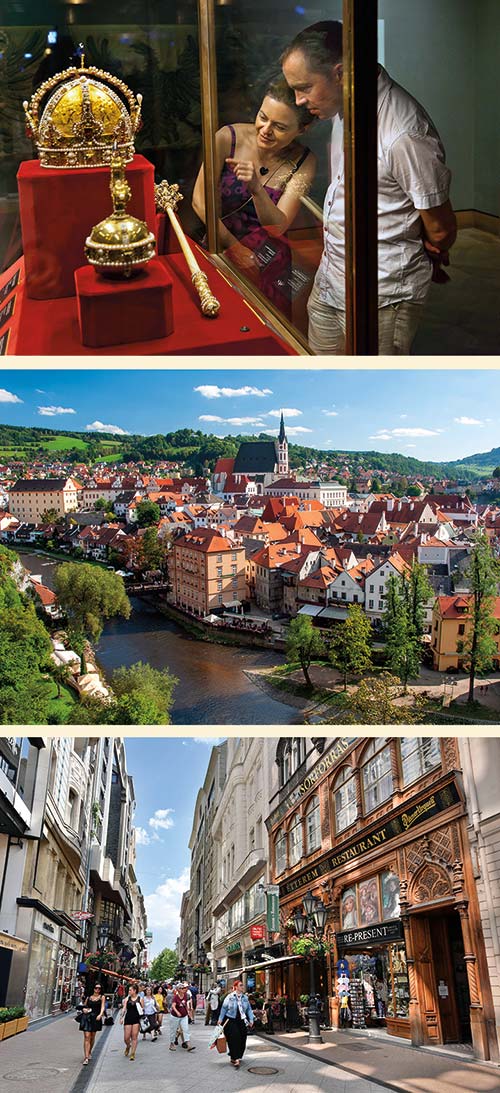
Habsburg royal regalia at the Hofburg Treasury in Vienna, Austria; picture-perfect Český Krumlov, Czech Republic; Váci Utca shopping street in Budapest, Hungary
A big milestone came in 2004, when all of this book’s core countries joined the European Union. Two decades later, it’s clearer than ever that the Czech Republic, Poland, Hungary, and Slovenia are “Eastern” no more.
Imagine a trip through this region as a scavenger hunt for cultural artifacts. Really try to understand why, unique among these lands, Poland’s churches are packed with reverent worshippers. Check out a Black Light Theater performance in Prague and see whether you love it, like the Czechs...or leave perplexed, as many visitors do. Sipping a coffee with new Slovenian friends at a riverside café, ask them why the mountains are so close to their nation’s heart and soul. Browse a bustling Hungarian market hall, savoring distinctive aromas and flavors. You’ll leave inspired to sprinkle a little more paprika into your cooking back home.
Speaking of food, you’ll find the cuisine in Central Europe hearty, delicious, affordable, and—like everything else—specific to each country. Dig into a gut-busting platter of Czech bread dumplings smothered in thick gravy, a steaming bowl of savory beetroot soup in a Polish milk bar, a Hungarian crêpe wrapped around meaty filling and blanketed in a spicy sauce, or a plate of handmade pasta at a trendy Slovenian sidewalk café.
And if you’re on a tight budget, these destinations hit a sweet spot in terms of value for money: The prices are lower than what you’ll pay in most of Europe, and standards are high enough that you won’t feel you’re compromising on quality. You can pay $3 for a mug of beer in a Prague pub, $6 for a basic but tasty meal in Poland, $10 for a seat in an opulent opera house in Budapest, or $15 for a riveting walking tour in Ljubljana. (Broadly speaking, Poland is on the lower end of the price spectrum, while Slovenia pushes the upper end, with Hungary and the Czech Republic somewhere in the middle.)
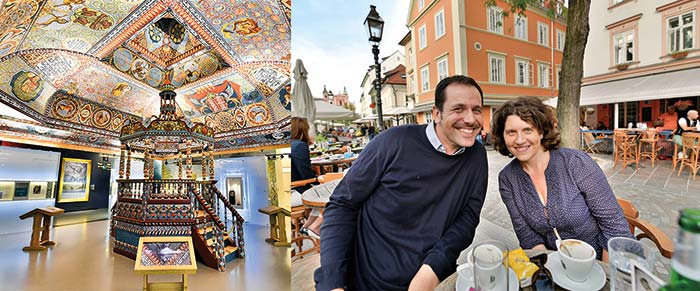
Synagogue prayer platform from Gwoździec at the Museum of the History of Polish Jews in Warsaw, Poland; riverside café in Ljubljana, Slovenia
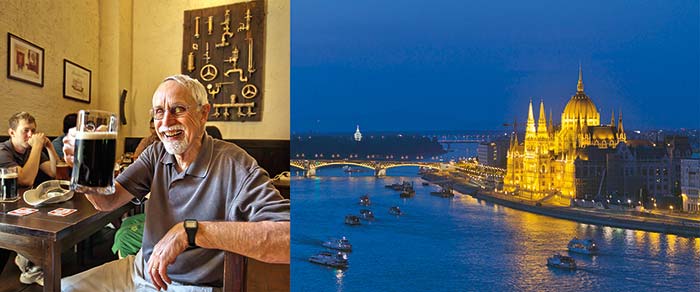
Historic brewery tour in Český Krumlov, Czech Republic; Budapest’s grand Hungarian Parliament glows along the Danube
Wherever your travels take you in Central Europe, you’ll appreciate the kind, unpretentious locals. The language barrier is easy enough to hurdle over (across this region, young people uniformly speak good English). And in most places—perhaps with the exception of Prague—people are refreshingly unjaded and enjoy getting to know visitors. Take advantage of the local hospitality.
With so much to experience in Central Europe, your visit may be just the first of many. Travelers can spend lifetimes exploring these beautiful and enticingly complex lands...and there’s always more to discover.
Central Europe’s Top Destinations
There’s so much to see in Central Europe...and so little time. This overview breaks the region’s top destinations into must-see places (to help first-time travelers plan their trip) and worth-it places (for those with extra time or special interests). I’ve also suggested a minimum number of days to allow per destination.
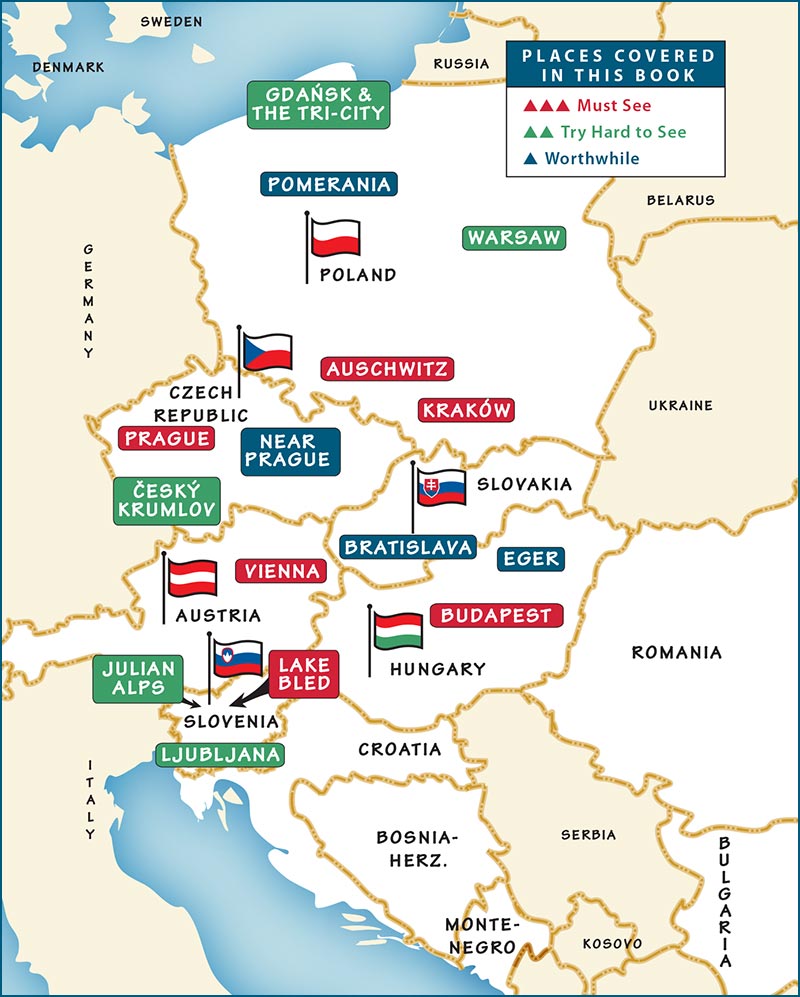
CZECH REPUBLIC
▲▲▲Prague (allow 2-3 days)
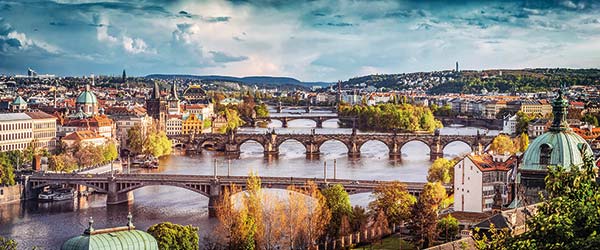
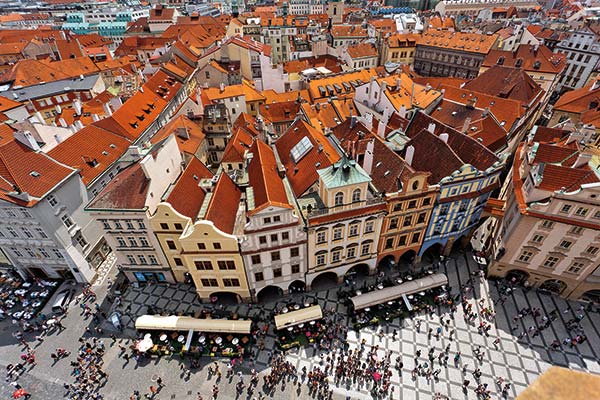
Prague, the Czech capital and one of Europe’s most romantic cities, boasts a remarkably well-preserved Old Town, a bustling New Town packed with Art Nouveau, an evocative Jewish Quarter, the iconic Charles Bridge, a historic castle atop a hill, rollicking pubs, and intriguing 20th-century history.
▲Near Prague (1-2 days)
Worthwhile visits include Kutná Hora’s offbeat bone church and grand cathedral, Terezín’s Nazi concentration camp memorial, and Konopiště Castle—the onetime residence of Franz Ferdinand, whose assassination sparked World War I.
▲▲Český Krumlov (1 day)
The country’s cutest and most touristic destination, this hill town huddles under a colorful castle (with a pristine Baroque theater) and hugs a river bend, fun for water sports such as canoeing.
POLAND
▲▲▲Kraków (2-3 days)
Poland’s cultural, intellectual, and historical capital, this lovely city has a massive yet cozy-feeling main square, easy-to-enjoy Old Town, thought-provoking Jewish quarter, oodles of quality museums (art, history, and more), a robust food and nightlife scene, and the country’s most important castle and cathedral.
▲▲▲Auschwitz-Birkenau Concentration Camp Memorial (1 day)
The largest and most notorious concentration camp in the Nazi system, this is now equal parts compelling museum and poignant memorial. Day-trip from Kraków and devote a day to the most powerful Holocaust site in Europe.
▲▲Warsaw (1-3 days)
Poland’s underrated capital is a city of contrasts, from its towering communist landmarks to its glittering new skyscrapers to its pristinely reconstructed Old Town. Come here to tour world-class museums (art, history, science, Chopin, Jewish heritage, WWII uprisings, and more) and to get a taste of today’s modern Poland, bustling with fashionable urbanites, hipster food halls, and artistic flair.
▲▲Gdańsk and the Tri-City (2 days)
This gorgeous Hanseatic trading city sits near Poland’s Baltic seafront and features a cancan of marvelous facades, insightful museums, and the shipyard where Lech Wałęsa and the Solidarity trade union challenged the communists in 1980. The Tri-City gives more of a taste of the Baltic, from beach resort Sopot to industrial Gdynia, with Poland’s top emigration museum.
▲Pomerania (1 day)
The Teutonic Knights’ gigantic, Gothic Malbork Castle is one of Europe’s most imposing fortresses; nearby, the red-brick, gingerbread-scented city of Toruń is a stroller’s delight.
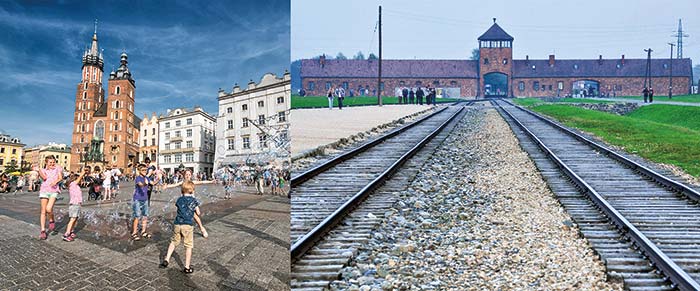
(Opposite) Old Town Square in Prague, Czech Republic; St. Mary’s Church in Kraków, Poland; Auschwitz-Birkenau Concentration Camp Memorial
HUNGARY
▲▲▲Budapest (2-3 days)
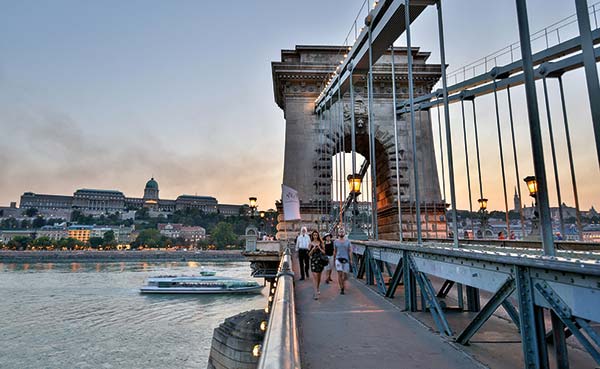
This grand, Danube-spanning cityscape is slathered with opulent late 19th-century buildings (parliament, opera house, basilica, market halls, etc.), layers of epic history, a fantastic dining and nightlife scene, and uniquely exhilarating thermal baths.
▲Eger (1 day)
This small city is strollable and pleasant, with a gaggle of gorgeous Baroque buildings, fun thermal-bathing opportunities nearby, and locally produced wines.
SLOVENIA
▲▲Ljubljana (1-2 days)
Slovenia’s capital is both vibrant and relaxing, simply a delightful place to hang out: Browse the riverside market, ogle the extravagant architecture, nurse a coffee along the willow-shaded promenade, savor one of the best food scenes in this part of Europe, and drop into a variety of quirky, artfully presented museums.
▲▲▲Lake Bled (1-2 days including side trips)
Slovenia’s photogenic lake resort huddles in alpine foothills; it’s famous for its church-topped island, cliff-hanging castle, lakefront path, and tasty desserts. And there are plenty of fun side trips: the less-developed Lake Bohinj, the spectacular Vintgar Gorge, and two towns with unaccountably intriguing museums: Radovljica (beekeeping) and Kropa (ironworking).
▲▲The Julian Alps (1 day)
Slovenia’s peaks are easily conquered by a twisty, intensely scenic mountain road over the Vršič Pass, ending in the tranquil Soča River Valley—filled with gorgeous scenery, low-key mountain towns and tourist farms, whitewater rafting near Bovec, and the exceptional WWI museum in Kobarid. While it’s doable as a long day trip from Lake Bled or Ljubljana, Alp-ophiles can spend a night (or several).
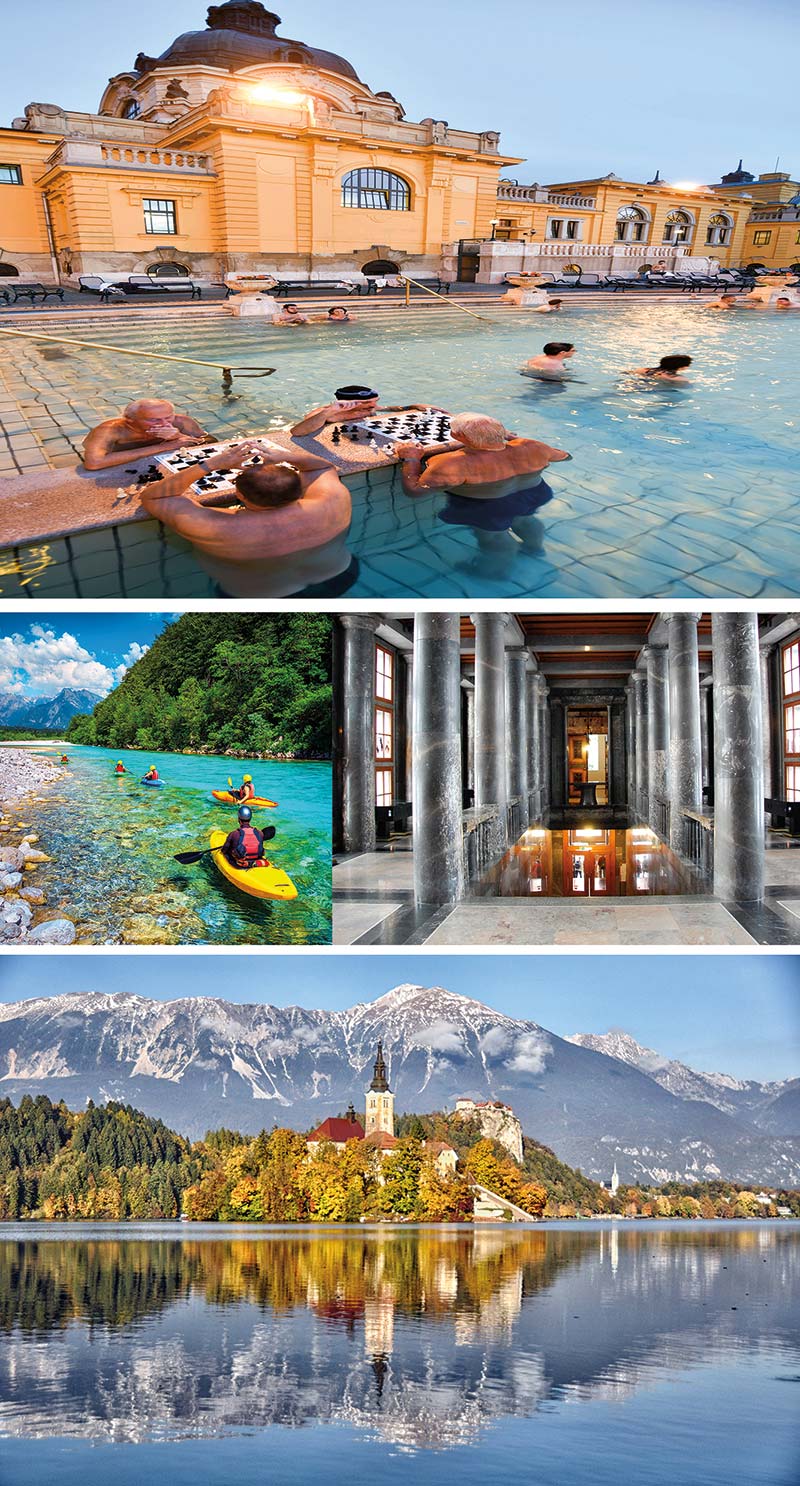
(Clockwise from top) Széchenyi Baths in Budapest, Hungary; Slovenia’s National and University Library in Ljubljana; Lake Bled, Slovenia; Soča River near Kobarid, Slovenia
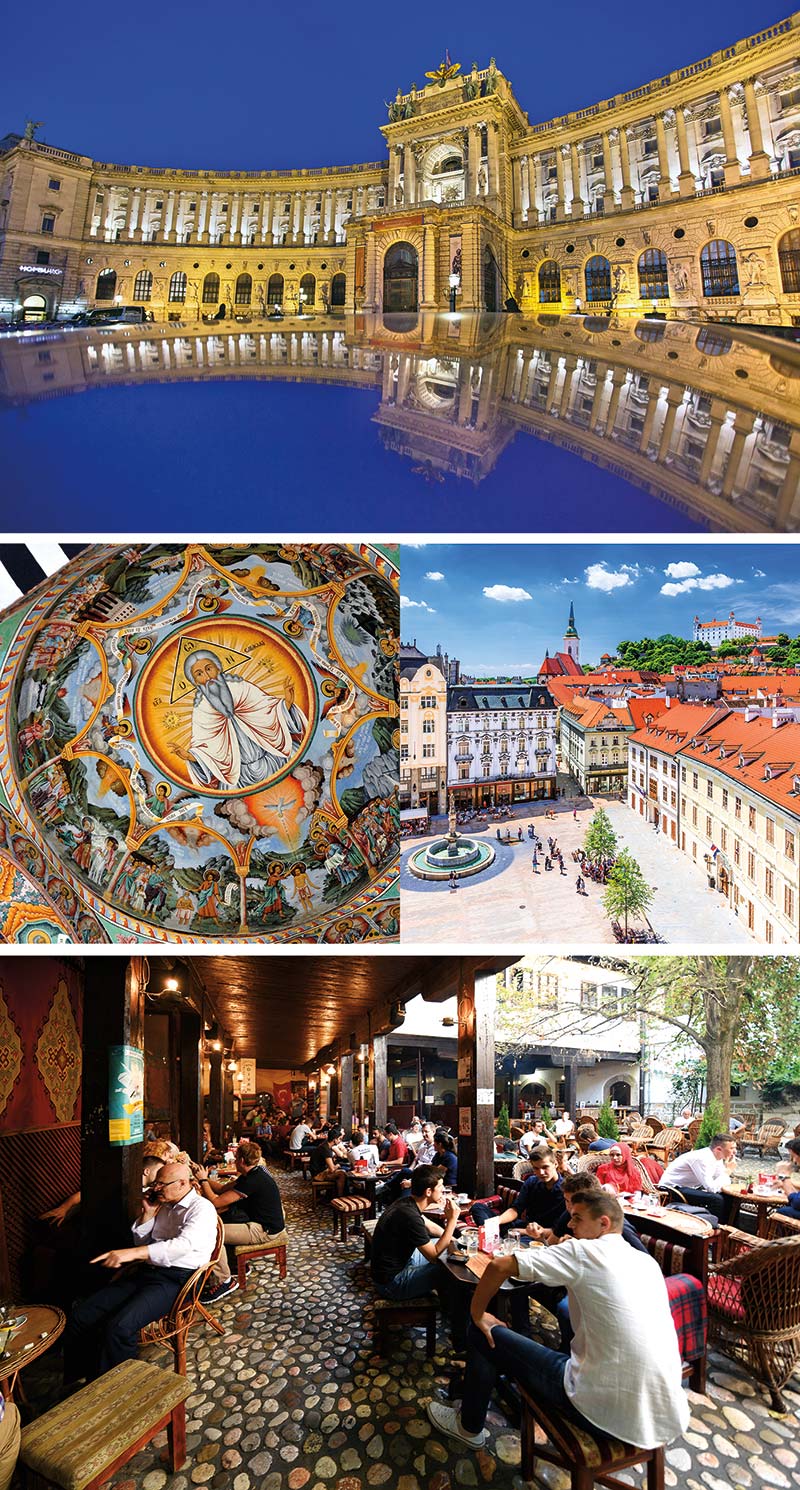
(Clockwise from top) Hofburg Palace in Vienna, Austria; Old Town in Bratislava, Slovakia; café in Sarajevo, Bosnia; Rila Monastery in Bulgaria
GATEWAY CITIES
▲▲▲Vienna, Austria (2-3 days)
Austria’s regal capital is rich with swirling architecture and world-class museums (including the art-packed Kunsthistorisches); towering St. Stephen’s Cathedral; impressive Habsburg sights at the Hofburg (royal apartments, treasury, crypt, and Lipizzaner stallions); sumptuous palaces (including Schönbrunn); a flourishing café culture; and a fabled classical-music tradition, from opera to the Boys’ Choir.
▲Bratislava, Slovakia (1 day)
Just down the Danube from Vienna (and on the way to Budapest), this lively capital bustles with colorfully restored historic buildings, a strollable Old Town, and a modern riverbank people zone.
MORE CENTRAL AND EASTERN EUROPE
Consider weaving any of these neighboring countries into your Central European vacation.
Croatia is Central Europe’s seafaring Riviera, with inviting beach towns (Hvar, Korčula), bustling port cities (Split), an interior of waterfalls and hill towns, a thriving capital (Zagreb), and delightful Dubrovnik—one of Europe’s best-preserved medieval cities.
Bosnia-Herzegovina, with a mountainous landscape and a predominantly Muslim cultural heritage, offers easy access to mosques, minarets, and cobbled bazaars, as well as an epic history.
Montenegro is the land of the “Black Mountain,” where soaring cliffs rocket up from the picturesque Bay of Kotor, and the rugged interior hides remote pockets of history.
Bulgaria, a surprising, underrated country, sits at the intersection of the Slavic, Greek, and Muslim worlds, with a mix of busy cities (Sofia, Plovdiv), soulful Orthodox monasteries (Rila), cliff-hanging towns (Veliko Tarnovo), and Black Sea beaches.
Romania, an eclectic crossroads with Roman roots, features a big, scruffy, yet captivating capital (Bucharest); the wooded mountains and plains of Transylvania, with its tidy towns, dramatic castles, and fortified churches; Maramureș, with Europe’s most vivid traditional folk life; and Bucovina, with lavishly painted monasteries.
Planning Your Trip
To plan your trip, you’ll need to design your itinerary—choosing where and when to go, how you’ll travel, and how many days to spend at each destination. For general advice on sightseeing, accommodations, restaurants, and more, see the Practicalities chapter.
DESIGNING AN ITINERARY
As you read this book and learn your options...
Choose your top destinations.
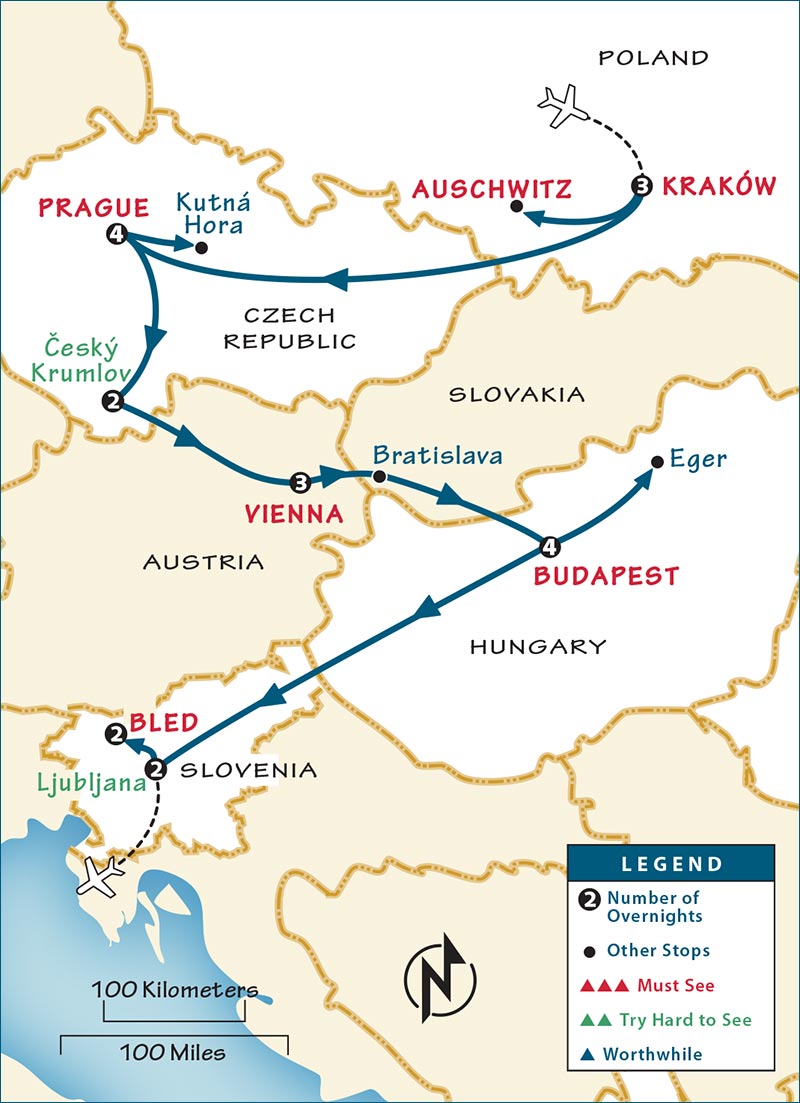
My recommended itinerary (on here) gives you an idea of how much you can reasonably see in 21 days, but you can adapt it to fit your own interests and time frame.
Most travelers target a combination of Prague, Budapest, Kraków, and Vienna. But consider working in lesser-known places, too. For example, Ljubljana (Slovenia) and Gdańsk (Poland) are unexpectedly rewarding destinations.
If you’d like to splice in some time in nature, two great options are the wooded Bohemian hills around Český Krumlov, or the alpine thrills of Slovenia’s Lake Bled and Julian Alps.
Or, delve more deeply into just one or two countries. You could happily spend a week or two in Poland—connecting the cities of Kraków, Warsaw, Toruń, and Gdańsk, plus side trips.
If you’ll spend a week or more in the Czech Republic, Hungary, or a Croatia-Slovenia-Bosnia swing, consider one of my other guidebooks, with more in-depth coverage of those destinations.
Decide when to go.
Central Europe’s “tourist season” runs roughly from May through mid-October. Summer has its advantages: the most predictable weather, very long days (light until after 21:00), and the busiest schedule of tourist fun.
In spring and fall—May, June, September, and early October—travelers enjoy fewer crowds and milder weather. This is my favorite time to travel here. However, in cities, conventions can raise hotel prices, especially in September; certain small towns can feel almost deserted before May or after October.
Winter travelers find concert season in full swing, with no tourist crowds (except in always-packed Prague, or during Christmas markets in Kraków, Budapest, and other cities). However, some accommodations and sights are either closed or run on a limited schedule. Confirm your sightseeing plans locally, especially when traveling off-season. The weather can be cold and dreary, and night will draw the shades on your sightseeing before dinnertime.
For weather specifics, see the climate chart in the appendix.
Connect the dots.
Link your destinations into a logical route. Determine which cities you’ll fly into and out of. Begin your search for transatlantic flights on Google Flights.
Decide if you’ll travel by car, public transportation, or—best for most trips—a combination. A car is a worthless headache in big cities like Prague, Budapest, and Vienna, and the distances between these cities are long—best suited for a train or flight. But there are a few locations where having a car opens up a world of possibilities: road-tripping around the Czech Republic to Český Krumlov, for example, or exploring Slovenia’s Julian Alps. Do most of your trip by public transit, then rent a car (or hire a driver) strategically, for a day or two, in places where it’s warranted.
To determine approximate travel times between destinations, study the driving maps in the Practicalities chapter or check Google Maps; visit Bahn.com for train schedules. Budget flights can be an alternative to long train rides; check Skyscanner.com for intra-European flights (but keep in mind air travel’s larger carbon footprint). If you sleep well on trains, a night train can be an efficient option for longer journeys.
| Day | Plan | Sleep |
| 1 | Fly into Kraków | Kraków |
| 2 | Kraków | Kraków |
| 3 | Side-trip to Auschwitz-Birkenau Memorial | Kraków |
| 4 | Travel to Prague (cheap flight, long train ride, or private driver) | Prague |
| 5 | Prague | Prague |
| 6 | Prague | Prague |
| 7 | Prague (maybe side-trip to Kutná Hora) | Prague |
| 8 | To Český Krumlov (by train, bus, or car)* | Český Krumlov |
| 9 | Český Krumlov | Český Krumlov |
| 10 | Shuttle bus to Vienna | Vienna |
| 11 | Vienna | Vienna |
| 12 | Vienna | Vienna |
| 13 | Train to Budapest (stop in Bratislava en route) | Budapest |
| 14 | Budapest | Budapest |
| 15 | Budapest | Budapest |
| 16 | Budapest (maybe side-trip to Eger) | Budapest |
| 17 | Train or bus to Ljubljana | Ljubljana |
| 18 | Ljubljana | Ljubljana |
| 19 | To Lake Bled (by train, bus, or car)** | Lake Bled |
| 20 | Lake Bled and nearby sights** | Lake Bled |
| 21 | Fly home from Ljubljana |
* Consider renting a car for a day or two of Czech road-tripping; by car, you can visit Konopiště Castle en route from Prague to Český Krumlov.
** Consider renting a car in Ljubljana or Lake Bled for a day or two of exploring Slovenia’s mountains; you could add a day to drive the Julian Alps loop.
Notes: This urban-focused plan spends most nights in cities (except for Český Krumlov and Lake Bled) with side trips to smaller towns.
Tricky Connections: To connect long distances between stops, get creative. From Kraków to Prague, you could take a 10-hour night train or a complicated daytime connection—or shop around for a cheap flight. Better yet, splurge on a private driver based in Kraków or Prague for this five-hour drive, and fit in a stop at Auschwitz en route (about $500-700). Train connections between Český Krumlov and Vienna require multiple changes, but shuttle services do the trip affordably in under four hours. From Budapest to Ljubljana, consider the direct train (7.5 hours) or a potentially faster bus (6 hours, www.flixbus.com).
Car Rental Concerns: Typically, you won’t pay extra to drop off a car at a different location within the same country, but international drop-offs come with astronomical fees. That’s another good reason to connect longer distances by public transit or flights, and rent cars selectively en route. For more on this, see the Practicalities chapter.
Two-Week Variation: If you’re tight on time, skip Slovenia (better yet, save it for another trip) and cut out some side trips (Kutná Hora, Eger).
Write out a day-by-day itinerary.
Figure out how many destinations you can comfortably fit in your time frame. Don’t overdo it—few travelers wish they’d hurried more. Allow enough days per stop (see estimates in “Central Europe’s Top Destinations,” earlier). Minimize one-night stands. It can be worth taking a late-afternoon drive or train ride to settle into a town for two consecutive nights—and gain a full uninterrupted day for sightseeing. Include sufficient time for transportation; whether you travel by train or car, it’ll take you a half-day to get between most destinations.
Staying in a home base (like Prague or Budapest) and making day trips can be more efficient than changing locations and hotels.
Take sight closures into account. Avoid visiting a town on the one day a week its must-see sights are closed. Check if any holidays or festivals fall during your trip—these attract crowds and can close sights. Note major sights where advance tickets are required (or recommended) or a free Rick Steves audio tour is available.
Give yourself some slack. Every trip, and every traveler, needs downtime for doing laundry, picnic shopping, peoplewatching, and so on. Pace yourself. Assume you will return.
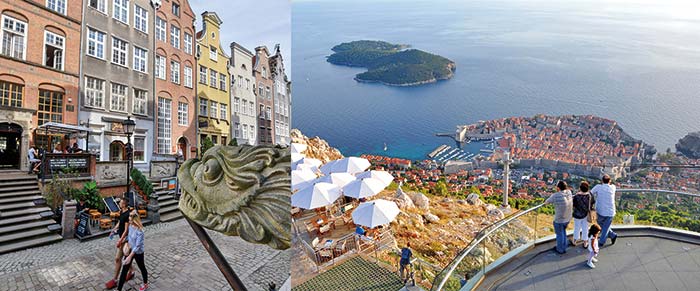
Delightful architecture in Gdańsk, Poland; Adriatic views in Dubrovnik, Croatia
Run a reality check on your dream trip. You’ll have major transportation costs in addition to daily expenses.
Flight: A round-trip flight from the US to Prague, Budapest, or Vienna costs about $900-1,500, depending on where you fly from and when. Flying into one city and out of another is typically about the same price.
Public Transportation: For a three-week trip, allow $300 per person for buses and second-class trains. In some cases, a short flight can be cheaper than taking the train.
Car Rental: Allow roughly $350-500 per week (booked well in advance), not including tolls, gas, parking, and insurance.
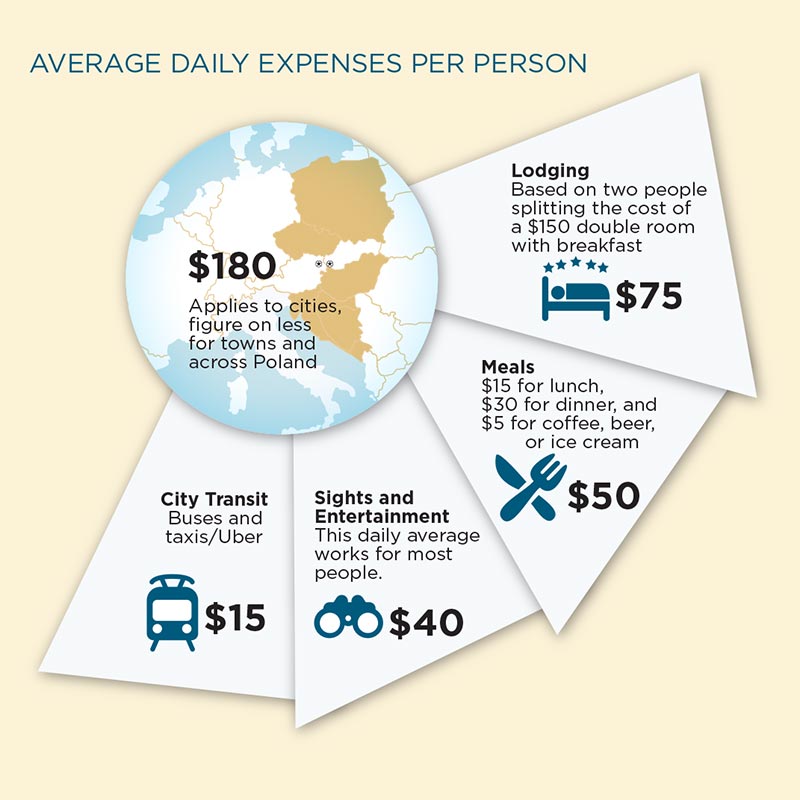
To cut your daily expenses, take advantage of the deals you’ll find throughout Central Europe and mentioned in this book.
City transit passes (for multiple rides or all-day usage) decrease your cost per ride.
Avid sightseers buy combo- tickets or passes that cover multiple museums. If a town doesn’t offer deals, visit only the sights you most want to see, and seek out free sights and experiences (people-watching counts).
Some businesses—especially hotels and walking-tour companies— offer discounts to my readers (look for the RS% symbol in the listings in this book).
Reserve your rooms directly with the hotel. Some hotels offer a discount if you pay in cash and/or stay three or more nights (check online or ask).
Rooms can cost less outside of peak season (roughly late October through early April). And even seniors can sleep cheaply in hostels (most have private rooms) for about $30 per person. Or check Airbnb-type sites for deals.
It’s no hardship to eat inexpensively in Central Europe. In the less pricey countries (such as Poland), even “fancy” sit-down meals come at a reasonable price. And anywhere you go, you’ll find tasty, affordable meals at food stands, bakeries, and takeout shops. Cultivate the art of picnicking in atmospheric settings.
When you splurge, choose an experience you’ll always remember, such as a Hungarian thermal bath, a cable-car ride in the Slovenian Alps, or an opera or concert in lavish surroundings. Minimize souvenir shopping; focus instead on collecting wonderful memories.
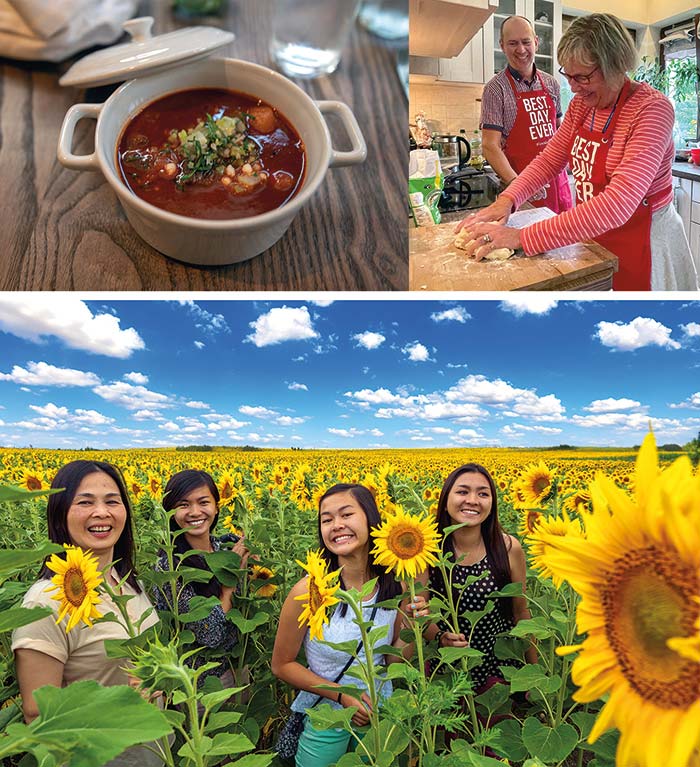
Paprika-flavored goulash in Hungary; cooking class in Poland; sunflower fields near Eger, Hungary
BEFORE YOU GO
You’ll have a smoother trip if you tackle a few things ahead of time. For more info on these topics, see the Practicalities chapter and RickSteves.com, which has helpful travel-tip articles and videos.
Make sure your travel documents are valid. If your passport expires within six months of your return date, you need to renew it (allow 12-plus weeks). Be aware of entry requirements; you may need to register with the European Travel Information and Authorization System (ETIAS; quick and easy process, https://travel-europe.europa.eu/etias_en). Get passport and country-specific travel info at Travel.State.gov.
Arrange your transportation. Book your international flights. Overall, Google Flights is the best place to start searching for flights. It’s worth thinking about buying essential train tickets online in advance, getting a rail pass (though this is rarely a good value in Central Europe), renting a car, or booking cheap European flights. (You can wing it once you’re there, but it may cost more.) Drivers: Consider bringing an International Driving Permit (sold at AAA offices in the US, www.aaa.com) along with your license.
Book rooms well in advance, especially if your trip falls during peak season or any major holidays or festivals.
Reserve ahead for key sights. Reserve online for the Auschwitz-Birkenau Concentration Camp Memorial—slots open up 90 days in advance. At peak times, reserve ahead for the Schindler’s Factory Museum and Wieliczka Salt Mine in Kraków. To tour the Hungarian Parliament in Budapest, try to book two weeks ahead. Reservations are smart for Vienna’s Schönbrunn Palace and may be required for the Vintgar Gorge near Slovenia’s Lake Bled.
Hire guides in advance. Local guides—an exceptional value in these countries—can get booked up. I’ve listed several favorites. If you want a specific guide, reserve ahead by email.
Consider travel insurance. Compare the cost of insurance to the cost of your potential loss. Understand what protections your credit card might offer and whether your existing insurance (health, homeowners, or renters) covers you and your possessions overseas.
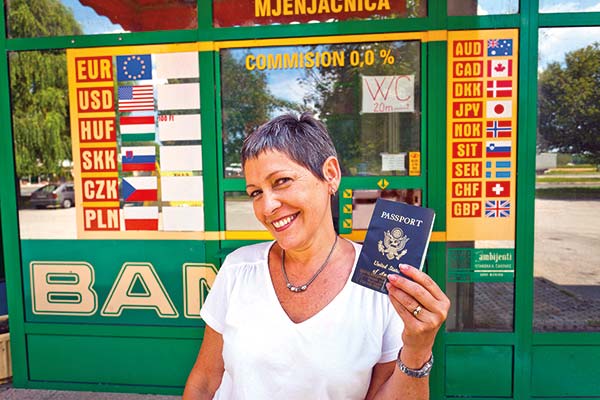
Manage your money. “Tap-to-pay” or “contactless” cards are widely accepted and simple to use. You may need your credit card’s PIN for some purchases—request it if you don’t have one. Alert your bank that you’ll be using your debit and credit cards in Europe. You don’t need to bring local cash for your trip; you can withdraw currency from ATMs in each country you visit.
Use your smartphone smartly. Sign up for an international service plan, or rely on Wi-Fi instead. Download any apps you’ll want on the road, such as maps, translators, and Rick Steves Audio Europe (see sidebar).
Pack light. You’ll walk with your luggage more than you think. I travel for weeks with a single carry-on bag and a day pack. Use the packing checklist in the appendix as a guide.
Rick Steves Audio Europe, a free app, makes it easy to download my audio tours and listen to them offline as you travel. For this book (look for the  ), free audio tours cover sights and neighborhoods in Prague and Vienna. The app also offers my public radio show interviews with travel experts from around the globe. Scan the QR code to find it in your app store, or visit RickSteves.com/AudioEurope.

Rick Steves Classroom Europe, a powerful tool for teachers, is also useful for travelers. This video library contains about 600 short clips excerpted from my public television series. Enjoy these videos as you sort through options for your trip and to better understand what you’ll see in Europe. Check it out at Classroom.RickSteves.com.

Travel Smart
Central Europe sometimes intimidates first-time visitors. It shouldn’t! These countries are as welcoming and well organized as the rest of the Continent (often more so). If you have a positive attitude, equip yourself with good information (this book), and expect to travel smart, you will.
Read—and reread—this book. Note opening hours of sights, closed days, crowd-beating tips, and whether reservations are required or advisable. Check the latest at RickSteves.com/update. Because this region’s history is complicated, study up for a broader understanding.
Be your own tour guide. As you travel, get up-to-date info on sights, reserve tickets and tours, reconfirm hotels and travel arrangements, and check transit connections. Visit local tourist information offices. Upon arrival in a new town, lay the groundwork for a smooth departure; confirm the train, bus, or road you’ll take when you leave.
Outsmart thieves. Pickpockets abound in crowded places where tourists congregate. Treat commotions as smokescreens for theft. Keep your passport and backup cash and cards secure in a money belt tucked under your clothes; carry only a day’s spending money and a card in your front pocket or wallet. Don’t set valuable items down on counters or café tabletops, where they can be quickly stolen or easily forgotten.
Minimize potential loss. Keep expensive gear to a minimum. Bring copies or take photos of important documents (passport and cards) to aid in replacement if they’re lost or stolen. Back up photos and devices to the cloud as you travel.
Beat the summer heat. If you wilt easily, choose a hotel with air-conditioning, start your day early, take a midday siesta, and resume your sightseeing later. Seek out museums that are comfortably air-conditioned, and take frequent breaks.
Guard your time and energy. Taking a taxi or Uber can be a good value if it saves you a long wait for a bus or an exhausting walk across town. To avoid long lines, follow my crowd-beating tips, such as buying tickets in advance, or sightseeing early or late.
Be flexible. Even if you have a well-planned itinerary, expect changes, strikes, closures, sore feet, bad weather, and so on. Your Plan B could turn out to be even better.
Attempt the language. Most Central Europeans—especially in the tourist trade and in cities, and just about anyone under age 50—speak English. But if you learn some of their language, even just a few pleasantries, you’ll get more smiles and make more friends. Apps such as Google Translate work for on-the-go translation help, but you can get a head start by practicing some survival phrases: You’ll find them after the country introductions in this book.
Connect with the culture. Interacting with locals carbonates your experience. Enjoy the friendliness of the Central European people. Ask questions; most locals are happy to point you in their idea of the right direction. Set up your own quest for the best bit of communist kitsch, mug of Czech beer, bowl of borscht, or scenic mountain viewpoint. When an opportunity pops up, make it a habit to say “yes.”
Central Europe...here you come!