HUNGARY
Magyarország
The Tatars, the Ottomans, and Other Outsiders (AD 1000-1686)
Habsburg Rule, Hungarian National Revival, and Revolution (1686-1867)
Budapest’s Golden Age (1867-1918)
The Crisis of Trianon (1918-1939)
World War II and the Arrow Cross (1939-1945)
Communism...with a Pinch of Paprika (1945-1989)
Hungary Today: Capitalism, EU Membership, and Orbán (1989-Present)
Hungary is an island of Asian-descended Magyars in a sea of Slavs. Even though the Hungarians have thoroughly integrated with their Slavic and German neighbors in the millennium-plus since they arrived, there’s still something about the place that’s distinctly Magyar (MUD-jar). Here in quirky, idiosyncratic Hungary, everything’s a little different from the rest of Europe in terms of history, language, culture, customs, and cuisine—but it’s hard to put your finger on exactly how.
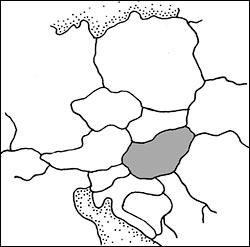
Just a century ago, this country controlled half of one of Europe’s grandest realms: the Austro-Hungarian Empire. Today, perhaps clinging to their former greatness, many Hungarians remain old-fashioned and nostalgic. With their dusty museums and bushy moustaches, they love to remember the good old days. Buildings all over the country are marked with plaques boasting MŰEMLÉK (“historical monument”).
Thanks to this focus on tradition, the Hungarians you’ll encounter are generally polite, formal, and professional. Hungarians have class. Everything here is done with a proud flourish. When a server comes to your table in a restaurant, they’ll say, “Tessék parancsolni”—literally, “Please command, sir.” The standard greeting, “Jó napot kívánok,” means, “I wish you a good day.” Women sometimes hear the even more formal greeting, “Kezét csókolom”—“I kiss your hand.” And when your train or bus makes a stop, you won’t be alerted by a mindless, blaring beep but instead by peppy music.
Hungarians are also orderly and tidy...in their own sometimes unexpected ways. Yes, Hungary has its share of litter, graffiti, and crumbling buildings, but you’ll find great reason within the chaos. The Hungarian railroad has a long list of discounted fares—for seniors, kids, dogs...and monkeys. (It could happen.) My favorite town name in Hungary: Hatvan. This means “Sixty” in Hungarian...and it’s exactly 60 kilometers from Budapest. You can’t argue with that logic.
Hungary’s tradition of orderly, left-brained thinking has produced titans of science, technology, and industry: Edward Teller (“father of the hydrogen bomb”), John von Neumann (computer science pioneer), George Soros (billionaire investor), and Ernő Rubik (creator of the famous cube). Hungarians’ enjoyment of a mind-bending puzzle is also evident in their fascination with chess, which is played in cafés, parks, and baths. Locals joke that Hungarians are so clever that they can enter a revolving door behind you and exit in front of you.
Like their Viennese neighbors, Hungarians appreciate the good life. Budapesters cultivate a genteel café culture, whiling away afternoons at coffeehouses while nursing a drink and dessert. And they revere classical music, having produced many great composers (including Béla Bartók, Zoltán Kodály, and Franz Liszt).
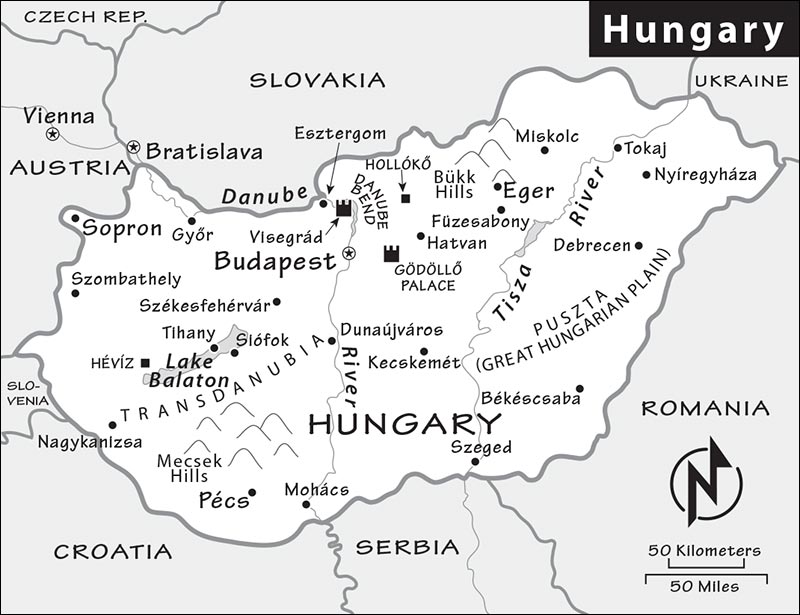
While one in five Hungarians lives in Budapest, the countryside plays an important role in the country’s economy—this has always been a highly agricultural region. The sprawling Great Hungarian Plain (Puszta) that makes up a vast swath of Hungary is the country’s breadbasket. You’ll pass through fields of wheat and corn, but the grains are secondary to Hungarians’ (and tourists’) true love: wine. Hungarian winemaking standards plummeted under the communists, but many vintner families have reclaimed their land, resumed their traditional methods, and are making wines worthy of pride once more. (For details, see the “Hungarian Wines” sidebar, later.)
Somehow Hungary, at the crossroads of Europe, has managed to become cosmopolitan while remaining perfectly Hungarian. The Hungarians—like Hungary itself—are a cross-section of Central European cultures: Magyars, Germans, Czechs, Slovaks, Poles, Serbs, Jews, Ottomans, Romanians, Roma (Gypsies), and many others. Still, no matter how many generations removed they are from Magyar stock, there’s something different about Hungarians. It’s a unique European culture that’s a pure joy to discover.
HELPFUL HINTS
First Name Last: Hungarians list a person’s family name first, and the given name is last—just as in many other Eastern cultures (think of Kim Jong-un). So the composer known as “Franz Liszt” in German is “Liszt Ferenc” in his homeland.
Toll Sticker: Driving on Hungarian expressways requires a toll sticker. Ask about this when you rent your car (if it’s not already included, you’ll have to buy one). For details, see “Tolls” on here.
HUNGARIAN HISTORY
The Hungarian story—essentially the tale of a people finding their home—is as epic as any in Europe. Over the course of a millennium, a troublesome nomadic tribe that was the scourge of Europe gradually assimilated with its neighbors and—through a combination of tenacity and diplomacy—found itself controlling a vast swath of Central Europe.
Locals toss around the names of great figures such as Kossuth, Széchenyi, and Nagy as if they’re talking about old friends. Take this crash course so you can keep up.
The story begins long, long ago and far, far away...
Welcome to Europe
The land we call Hungary has long been considered the place—culturally and geographically—where the West (Europe) meets the East (Asia). The Roman province of Pannonia once extended to the final foothills of the Alps that constitute the Buda Hills, on the west side of the Danube. Across the river, Rome ended and the barbarian wilds began. From here, the Great Hungarian Plain stretches in a long, flat expanse all the way to Asia—hemmed in to the north by the Carpathian Mountains. (Geologists consider this prairie-like plain to be the westernmost steppe in Europe—resembling the terrain that covers much of Central Asia.) After Rome collapsed and Europe fell into the Dark Ages, Hungary became the territory of Celts, Vandals, Huns, and Avars...until some out-of-towners moved into the neighborhood.
The seven nomadic Magyar tribes, led by the mighty Árpád (and, according to legend, guided by the mythical Turul bird), thundered into the Carpathian Basin in AD 896. But after their long and winding westward odyssey, the Great Hungarian Plain felt comfortingly like home to the Magyars—reminiscent of the Asian steppes of their ancestors.
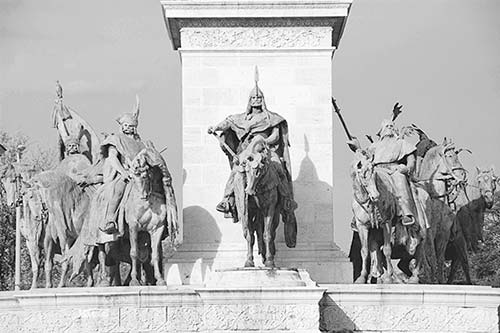
The Magyars would camp out in today’s Hungary in the winters, and in the summers, they’d go on raids throughout Europe. They were notorious as incredibly swift horsemen whose use of stirrups allowed them to easily outmaneuver foes and victims. From Italy, France, Germany’s Rhine, and the Spanish Pyrenees, all the way to Constantinople (modern-day Istanbul)—the Magyars had the run of the Continent.
For half a century, the Magyars ranked with the Vikings as the most feared people in Europe. To Europeans, this must have struck a chord of queasy familiarity: a mysterious and dangerous eastern tribe running roughshod over Europe, speaking a gibberish language, and employing strange, terrifying, relentless battle techniques. No wonder they called the new arrivals “Hun-garians.”
Planted in the center of Europe, the Magyars effectively drove a wedge in the middle of the sprawling Slavic populations of the Great Moravian Kingdom (basically today’s “Central Europe”). The Slavs were split into north and south—a division that persists today: Czechs, Slovaks, and Poles to the north; and Croats, Slovenes, Serbs, Bosniaks, and Bulgarians to the south. (You can still hear the division caused by the Magyars in the language: While Czechs and Russians call a castle hrad, Croats and Serbs call it grad.)
After decades of terrorizing Europe, the Magyars were finally defeated by a German and Czech army at the Battle of Augsburg in 955. Géza, Grand Prince of the Hungarians—realizing that if they were to survive, his people had to put down roots and get along with their neighbors—made a fateful decision that would forever shape Hungary’s future: He adopted Christianity; baptized his son, Vajk; and married him to a Bavarian princess at a young age.
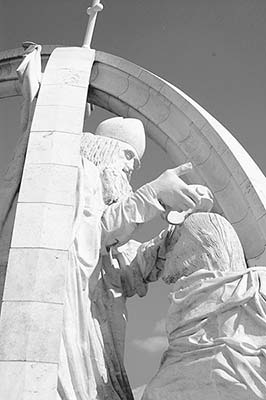
On Christmas Day in the year 1000, Vajk changed his name to István (Stephen) and was symbolically crowned by the pope. At István’s request, a Venetian missionary, Gerardo di Sagredo, came to Buda to help convert the Hungarians. But he was martyred for his efforts, becoming known to Hungarians as St. Gellért. The domestication of the nomadic Magyars was difficult—due largely to the resistance of István’s uncles—but was ultimately successful. Hungary became a legitimate Christian kingdom, welcomed by its neighbors. Under kings such as László I, Kálmán “the Book Lover,” and András II, Hungary entered a period of prosperity. Medieval Hungary ruled a vast empire—including large parts of today’s Slovakia, Romania (Transylvania), Serbia (Vojvodina), and Croatia.
The Tatars, the Ottomans, and Other Outsiders (AD 1000-1686)
One of Hungary’s earliest challenges came at the hands of fellow invaders from Central Asia. Through the first half of the 13th century, the Tatars—initially led by Genghis Khan—swept into Eastern and Central Europe from Mongolia. In the summer of 1241, Genghis Khan’s son and successor, Ögedei Khan, broke into Hungarian territory. The Tatars sacked and plundered Hungarian towns, laying waste to the kingdom. It was only Ögedei Khan’s death in early 1242—and the ensuing dispute about succession—that saved the Hungarians, as Tatar armies rushed home and the Mongolian Empire contracted. The Hungarian king, Béla IV, was left to rebuild his ruined kingdom—creating some of the first stout hilltop castles that still line the Danube.
Each of Béla’s successors left his own mark on Hungary, as the Magyar kingdom flourished. When the original Árpád dynasty died out in 1301, they imported French kings (from the Naples-based Anjou, or Angevin, dynasty) to continue building their young realm. King Károly Róbert (Charles Robert) won over the Magyars, and his son Nagy Lajos (Louis the Great) expanded Hungarian holdings.
This was a period of flux for all of Central Europe, as the nearby Czech and Polish kingdoms also saw their long-standing dynasties expire. For a time, royal intermarriages juggled the crowns of the region between various ruling families. Most notably, for 50 years (1387-1437) Hungary was ruled by Holy Roman Emperor Sigismund of Luxembourg, whose holdings also included the Czech lands, parts of Italy, much of Croatia, and more.
For more than 150 years, Hungary did not have a Hungarian-blooded king. This changed in the late 15th century, when a shortage of foreign kings led the enlightened King Mátyás (Matthias) Corvinus to ascend to the throne. The son of popular military hero János Hunyadi, King Matthias fostered the arts, sparked a mini-Renaissance, and successfully balanced foreign threats to Hungarian sovereignty (the Habsburgs to the north and west, and the Ottomans to the south and east). Under Matthias, Hungarian culture and political power reached a peak.
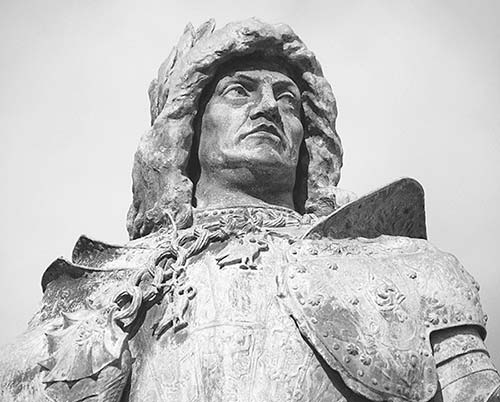
But even before the reign of “good king Mátyás,” the Ottomans (from today’s Turkey) had already begun slicing their way through the Balkan Peninsula toward Central Europe. In 1526, the Ottomans entered Hungary when Sultan Süleyman the Magnificent killed Hungary’s King Lajos II at the Battle of Mohács. By 1541, they took Buda. The Ottomans would dominate Hungarian life (and history) until the 1680s—nearly a century and a half.
The Ottoman invasion divided Hungary into thirds: Ottoman-occupied “Lower Hungary” (more or less today’s Hungary); rump “Upper Hungary” (basically today’s Slovakia), with its capital at Bratislava (which they called “Pozsony”); and the loosely independent territories of Transylvania, ruled by Hungarian dukes. During this era, the Ottomans built some of the thermal baths that you’ll still find throughout Hungary.
Ottoman-occupied Hungary became severely depopulated, and many of its towns and cities fell into ruins. While it was advantageous for a Hungarian subject to adopt Islam (for lower taxes and other privileges), the Ottomans rarely forced conversions—unlike the arguably more oppressive Catholics who controlled other parts of Europe at the time. Ottoman rule meant that Hungary took a different course than other parts of Europe during this time. Hungarians fully enjoyed the Renaissance but missed out on other major European historical events—from the Age of Discovery and Age of Reason to the devastating Catholic-versus-Protestant wars that plagued much of the rest of Europe.
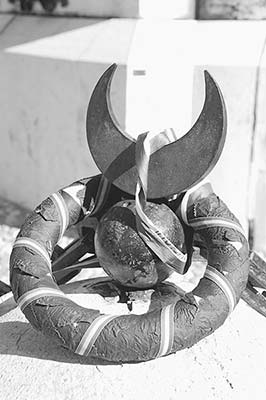
Crippled by the Ottomans and lacking power and options, desperate Hungarian nobles offered their crown to the Austrian Habsburg Empire in exchange for salvation from the invasion. The Habsburgs instead used Hungary as a kind of buffer zone between the Ottoman advance and Vienna. And that was only the beginning of a very troubled relationship between the Hungarians and the Austrians.
Habsburg Rule, Hungarian National Revival, and Revolution (1686-1867)
In the late 17th century, the Habsburg army, starting from Vienna, began a sustained campaign to push the Ottomans out of Hungary in about 15 years. They finally wrested Buda and Pest from the Ottomans in 1686. The Habsburgs repopulated the cities with Germans, while Magyars reclaimed the countryside.
The Habsburgs governed the country as an outpost of Austria. The Hungarians—who’d had enough of foreign rule—fought them tooth and nail. Countless streets, squares, and buildings throughout the country are named for the “big three” Hungarian patriots who resisted the Habsburgs during this time: Ferenc Rákóczi (who led the unsuccessful War of Independence in 1703-1711), István Széchenyi (a wealthy count who funded grand structures to give his Magyar countrymen something to take pride in), and Lajos Kossuth (who led the Revolution of 1848).
The early 19th century saw a thawing of Habsburg oppression. Here as throughout Europe, “backward” country traditions began to trickle into the cities, gaining more respect and prominence. It was during this time of reforms that Hungarian (rather than German) became the official language. It also coincided with a Romantic Age of poets and writers (such as Mihály Vörösmarty and Sándor Petőfi) who began using Hungarian to create literature for the first time. By around 1825, the Hungarian National Revival was underway, as the people began to embrace the culture and traditions of their Magyar ancestors. Like people across Europe—from Ireland to Italy, and from Prague to Scandinavia—the Hungarians were rediscovering what made them unique.
In March of 1848, a wave of Enlightenment-fueled nationalism that began in Paris ignited a revolutionary spirit in cities such as Vienna, Milan...and Budapest. On March 15, the Revolution of 1848 began with Petőfi reading a rabble-rousing poem on the steps of the National Museum in Pest.
In the spring of 1849, the Hungarians mounted a bloody but successful offensive to take over a wide swath of territory, including Buda and Pest. But in June, Franz Josef enlisted the aid of his fellow divine monarch, the Russian czar, who did not want the Magyars to provide an example for his own independence-minded subjects. Some 200,000 Russian reinforcements flooded into Hungary, crushing the revolution by August. After the final battle, the Habsburgs executed 13 Hungarian generals, then celebrated by clinking mugs of beer. Until very recently, clinking beer mugs was considered, by traditional Hungarians, just bad style.
For a while, the Habsburgs cracked down on their unruly Hungarian subjects. After a critical military loss to Bismarck’s Prussia in 1866, Austria understood that it couldn’t control its rebellious Slavic holdings all by itself.
And so, just 18 years after crushing the Hungarians in a war, the Habsburgs handed them the reins. With the Compromise (Ausgleich) of 1867, Austria granted Budapest the authority over the eastern half of their lands, creating the so-called Dual Monarchy of the Austro-Hungarian Empire. Hungary was granted their much-prized “home rule,” where most matters were administered from Budapest rather than Vienna. The Habsburg emperor, Franz Josef, agreed to a unique “king and emperor” (König und Kaiser) arrangement, where he was emperor of Austria but only king of Hungary. In 1867, he was crowned Hungarian king in both Buda (at Matthias Church) and Pest (on today’s March 15 Square). The insignia “K+K” (König und Kaiser)—which you’ll still see everywhere—evokes these grand days.
Budapest’s Golden Age (1867-1918)
The Ausgleich marked a turning point for the Hungarians, who once again governed their traditional holdings: large parts of today’s Slovakia, Serbia, and Transylvania, and smaller parts of today’s Croatia, Slovenia, Ukraine, and Austria. To better administer their sprawling realm, in 1873, the cities of Buda, Pest, and Óbuda merged into one mega-metropolis: Budapest.
Serendipitously, Budapest’s new prominence coincided with the 1,000th anniversary of the Hungarians’ ancestors, the Magyars, arriving in Europe. The year 1896 saw an over-the-top millennial celebration for which many of today’s greatest structures were created.
No European city grew faster in the second half of the 19th century than Budapest; in the last quarter of that century alone, Budapest doubled in size, building on the foundation laid by Széchenyi and other patriots. By 1900, the city was larger than Rome, Madrid, or Amsterdam. But before long, the Hungarians began to make the same mistakes the Habsburgs had—trampling on the rights of their minorities and enforcing a policy of “Magyarization” that compelled subjects from all ethnic backgrounds to adopt the Hungarian language and culture. Soon the golden age came crashing to an end, and Hungary plunged into its darkest period.
The Crisis of Trianon (1918-1939)
World War I marked the end of the age of divine monarchs, as the Romanovs of Russia, the Ottomans of Asia Minor, and the Habsburgs of Austria-Hungary saw their empires break apart. Hungary, which had been riding the Habsburgs’ coattails for the past half-century, now paid the price.
As retribution for their role on the losing side of World War I, the 1920 Treaty of Trianon (named for the palace on the grounds of Versailles where it was signed) reassigned two-thirds of Hungary’s former territory and half of its population to Romania, Ukraine, Czechoslovakia, and Yugoslavia.
The Treaty of Trianon had a huge impact on Hungarian history—and on the Hungarian psyche. Not unlike the overnight construction of the Berlin Wall, towns along the new Hungarian borders were suddenly divided down the middle. Many Hungarians found themselves unable to visit relatives or commute to jobs that were in the same country the day before. This sent hundreds of thousands of Hungarian refugees—now “foreigners” in their own towns—into Budapest, sparking a bittersweet boom in the capital.
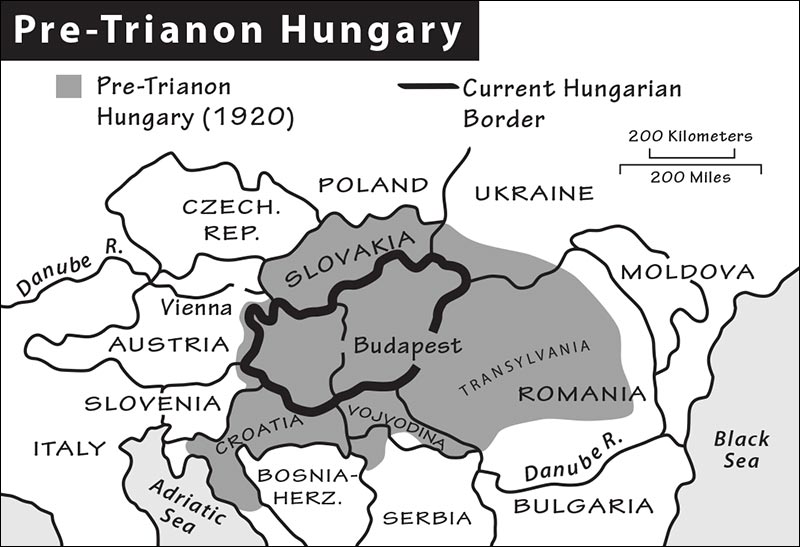
To this day, the Treaty of Trianon is regarded as one of the greatest tragedies of Hungarian history. Like the Basques and the Serbs, the Hungarians feel separated from each other by circumstances outside their control. Today, more than two million ethnic Hungarians live outside Hungary (mostly in Romania)—and many Hungarians believe that these lands should still belong to the Magyars. The sizeable Magyar minorities in neighboring countries have often been mistreated—particularly in Romania (under Ceauşescu), Yugoslavia (under Milošević), and Slovakia (under Mečiar). You’ll see maps, posters, and bumper stickers with the distinctive shape of a much larger, pre-WWI Hungary. (More recently, Hungary’s current leadership has learned that stoking resentment about Trianon can help further its political agenda.)
After Trianon, the newly shrunken Kingdom of Hungary had to reinvent itself. The Hungarian crown sat unworn in the Royal Palace, as if waiting for someone worthy to claim it. The WWI hero Admiral Miklós Horthy had won many battles with the Austro-Hungarian navy. Though the new Hungary had no sea and no navy, Horthy retained his rank and ruled the country as a regent. A popular joke points out that during this time, Hungary was a “kingdom without a king” and a landlocked country ruled by a sea admiral. This sense of compounded deficiency pretty much sums up the morose attitude Hungarians have about those gloomy post-Trianon days.
A mounting financial crisis and lingering resentment about the strict post-WWI reparations made Hungary fertile ground for some bold new fascist ideas.
World War II and the Arrow Cross (1939-1945)
As Adolf Hitler rose to power in Germany, some other countries that had felt mistreated in the aftermath of World War I—including Hungary—saw Nazi Germany as a vehicle to greater independence. Admiral Horthy joined forces with the Nazis with the hope that they might help Hungary regain the crippling territorial losses of Trianon. In 1941, Hungary (somewhat reluctantly) declared war on the Soviet Union in June—and against the US and Britain in December.
Being an ally to the Nazis, rather than an occupied state, also allowed Hungary a certain degree of self-determination through the war. And, although Hungary had its own set of anti-Semitic laws and was complicit in the mass murder of Jews lacking citizenship and living within their borders, the majority of its sizeable Jewish population was spared from immediate deportation to Nazi concentration camps. Winning back chunks of Slovakia, Transylvania, and Croatia in the early days of World War II also bolstered Hungarian acceptance of the Nazi alliance.
As Nazism took hold in Germany, Hungary’s homegrown fascist movement—spearheaded by the Arrow Cross Party (Nyilaskeresztes Párt)—gained popularity as well. As Germany increased its demands for Hungarian soldiers and food, Admiral Horthy resisted...until Hitler’s patience wore thin. In March 1944, the Nazis invaded and installed the Arrow Cross in power. The Arrow Cross made up for lost time, immediately beginning a savage campaign to execute Hungary’s Jews—not only sending them to death camps but also butchering them in the streets. As the end of the war neared, Hungarian Nazi collaborators resorted to desperate measures, such as lining up Jews along the Danube and shooting them into the river. Hungary lost nearly 600,000 Jews to the Holocaust.
The Soviet Army eventually “liberated” Hungary, but at the expense of Budapest: A months-long siege, from Christmas 1944 to mid-February 1945, reduced the proud city to rubble. One out of every ten Hungarian citizens perished in the war.
Communism...with a Pinch of Paprika (1945-1989)
After World War II, Hungary was gradually compelled to adopt Moscow’s system of government. The Soviet-puppet hardliner premier, Mátyás Rákosi, ruled Hungary with an iron fist. Everyday people were terrorized by the KGB-style secret police (called the ÁVO, later ÁVH) and intimidated into accepting the new regime. Non-Hungarians were deported, potential and actual dissidents disappeared into the horrifying gulag system of Siberia (and similar forced-work camps in Hungary), food shortages were epidemic, people were compelled to spy on their friends and families, and countless lives were ruined. Coming on the heels of Trianon and two devastating world wars, communist rule was a blow that Hungary is still recovering from.
Beginning on October 23, 1956, the Hungarians courageously staged a monumental uprising, led by Communist Party reformer Imre Nagy. Initially, it appeared that one of the cells on the Soviet Bloc might win itself the right to semiautonomy. But Moscow couldn’t let that happen. In a Tiananmen Square-style crackdown, the Soviets sent in tanks to brutally put down the uprising and occupy the city. When the dust settled, 2,500 Hungarians were dead and 200,000 fled to the West. (If you know any Hungarian Americans, their families more than likely fled in 1956.) Nagy was arrested, given a sham trial, and executed in 1958. For more on these events, see the “1956” sidebar on here.
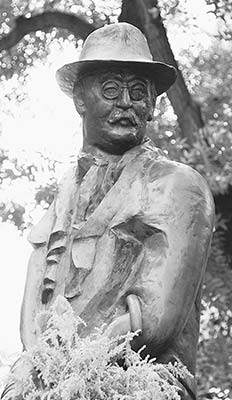
The Hungarians were devastated. They were frustrated that the Suez Canal crisis distracted the world from their uprising. Many felt betrayed that the US—which spoke so boldly against the Soviet Union—did not offer them military support (contrary to the promises of the American-operated Radio Free Europe). While the US and its Western allies understandably did not want to turn the Cold War hot, the Hungarians felt abandoned.
Weeks after the uprising came the now-legendary “Blood in the Water” match at the Melbourne Olympics. Soviet satellite states were often ordered to “throw” matches to allow the USSR’s athletes to prevail. On December 6, 1956, Moscow issued such a decree to the Hungarian men’s water polo team in their semifinal against the Soviet Union. The Hungarians refused and played their hearts out. The game turned violent, and in one indelible image, a Hungarian athlete emerged from the pool with blood pouring from a gash above his right eye. The Hungarians won 4-0 and went on to take the gold.
After the uprising, the USSR installed János Kádár—a colleague of Nagy’s who was loyal to Moscow—to lead Hungary. For a few years, things were bleak as the secret police ratcheted up their efforts against potential dissidents. But in the 1960s, Kádár’s reformist tendencies began to cautiously emerge. Seeking to gain the support of his subjects (and avoid further uprisings), Kádár adopted the optimistic motto, “If you are not against us, you are with us.” While still mostly cooperating with Moscow, Kádár gradually allowed the people of Hungary more freedom than citizens of neighboring countries had—a system dubbed “goulash communism.” The “New Economic Mechanism” of 1968 partly opened Hungary to foreign trade. People from other Warsaw Pact countries—Czechs, Slovaks, and Poles—flocked to Budapest’s Váci Utca to experience “Western evils” unavailable to them back home, such as Adidas sneakers and Big Macs. People half-joked that Hungary was the happiest barrack in the communist camp.
In the late 1980s, the Eastern Bloc began to thaw. And Hungary—which was always skeptical of the Soviets—was one of the first satellite states that implemented real change. In February 1989, the Hungarian communist parliament, with little fanfare, essentially voted to put an expiration date on their own regime. There were three benchmarks in that fateful year: May 2, when Hungary was the first Soviet Bloc country to effectively open its borders to the West (by removing its border fence with Austria); June 16, when communist reformer Imre Nagy and his comrades were given a proper, ceremonial reburial on Heroes’ Square; and August 19, when, in the first tentative steps toward the reunification of Europe, Hungarians and Austrians came together in a field near the town of Sopron for the so-called “Pan-European Picnic.” (Some 900 East Germans seized this opportunity to make a run for the border...and slipped into the West when Hungarian border guards refused orders to shoot defectors.) On October 23—the anniversary of the 1956 Uprising—the democratic Republic of Hungary triumphantly replaced the People’s Republic of Hungary.
Hungary Today: Capitalism, EU Membership, and Orbán (1989-Present)
The transition from communism to capitalism was not easy. While many Hungarians were eager for the freedom to travel and pursue the interests that democracy allowed them, many others struggled to cope with the sudden reduction of government-provided services.
In 2004, Hungary joined the European Union. And since then, it seems Hungary has often been in the international news.
The Hungarian Socialist Party (MSzP), which took control of parliament in 2002, stubbornly maintained and even extended some social programs, despite worries that mounting public debt would bankrupt the country.
As a result, rampant inflation continued to wrack the country. In late 2008, with Prime Minister Ferenc Gyurcsány warning of “state bankruptcy” and a currency collapse, Hungary received a $25 billion bailout package from the EU, International Monetary Fund, and World Bank. Gyurcsány resigned in early 2009, acknowledging that he was getting in the way of Hungary’s economic recovery.
Viktor Orbán, of the nationalistic, right-wing Fidesz Party, became prime minister in May 2010. Fidesz stands for traditional Christian and Hungarian values, economic interventionism, and severe skepticism about immigration and European Union membership.
Orbán seized on his two-thirds coalition majority to adopt a new, Fidesz-favorable constitution that stripped away checks and balances and entrenched party leaders in institutions that had previously been considered apolitical. Almost immediately, international observers—including the EU and US—grew concerned.
Fidesz has taken other actions that many consider troubling markers of illiberalism and a threat to open society. In early 2011, they created a new FCC-like media authority with broad latitude for suppressing material that it considers inappropriate. In 2020, Fidesz ended legal recognition of transgender people, and in 2021, they enacted “anti-pedophile” laws designed to discriminate against LGBTQ+ citizens. And over time, they’ve slowly nationalized the school system—ensuring that the same Fidesz-approved textbooks are now used in every school in Hungary.
Reinterpreting Hungarian history in a way that flatters Hungary (while leaving out complicated or uncomfortable details) is another hallmark of Fidesz. With a “Make Hungary Great Again” attitude, they’ve rehabilitated some figures (such as Miklós Horthy, who forged an alliance with Hitler’s Nazi Germany), while brushing aside other, less Fidesz-friendly figures (such as the communist reformer Imre Nagy, the hero of the 1956 Uprising). Fidesz has renamed more than two dozen streets, squares, and other features of Budapest, and they’ve removed or replaced several old monuments—including a beloved statue of Nagy that once stood proudly near the Parliament.
At the same time, Fidesz has been proactive about funneling European Union funds into public-works projects, and Budapest has made remarkable progress in renovating formerly dreary streets and squares.
Orbán outrages younger, EU-supporting, highly educated Hungarians who believe in an open society and liberal democracy. However, he has hit upon a successful formula for staying in power without their votes: He was decisively reelected in 2018 and again in 2022. He’s sometimes compared to his fellow nativist and traditionalist, Donald Trump. But Orbán possesses greater intelligence and self-control, and a savvy ability to suspend his own ego when it serves his political ends—making him even more challenging for opponents to dislodge.
Now essentially guaranteed to remain in power at least through 2026, Viktor Orbán stands as the poster boy of a pan-national movement of traditionalism and nativism. As he pulls Hungary farther from the tenets of liberal democracy, an open society, and the stated aims and values of the European Union, it remains to be seen whether Hungary’s political pendulum will swing back toward the center.
HUNGARIAN CUISINE
Hungarian cuisine is the undisputed best in Central Europe. It delicately blends Magyar peasant cooking (with rich spices), refined by the elegance of French preparation, with a delightful smattering of flavors from the vast, multiethnic Austro-Hungarian Empire (including Germanic, Balkan, Jewish, and Carpathian). Everything is heavily seasoned: with paprika, tomatoes, and peppers of every shape, color, size, and flavor.
An étterem (“eatery”) is a nice sit-down restaurant, while a vendéglő is usually more casual. A bisztró is a simple eatery with a concise but well-executed menu. A söröző (“beer place”) is a pub that sells beer and pub grub. A kávéház (“coffeehouse”) is where Hungarians gather to meet friends, get a caffeine fix...and sometimes to have a meal. Other cafés serve only light food, or sometimes only desserts. But if you want a wide choice of cakes, look for a cukrászda (pastry shop—cukor means “sugar”).
When foreigners think of Hungarian cuisine, what comes to mind is goulash. But tourists may find “real Hungarian goulash” isn’t the thick stew that they were expecting. The word “goulash” comes from the Hungarian gulyás leves, or “shepherd’s soup”—a tasty, rustic, nourishing dish originally eaten by cowboys and shepherds on the Great Hungarian Plain. Here in its homeland, it’s a clear, spicy broth with chunks of meat, potatoes, and other vegetables. Elsewhere (such as in neighboring Germanic and Slavic countries), the word “goulash” does describe a thick stew. The hearty Hungarian stew called pörkölt is probably closer to what most people think of as goulash.
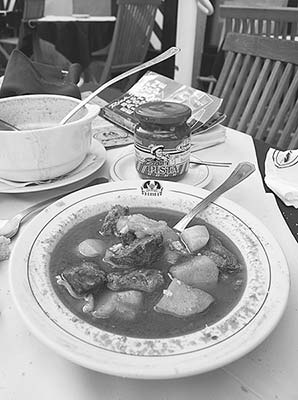
Aside from the obligatory gulyás, make a point of trying another unusual Hungarian specialty: cold fruit soup (hideg gyümölcs leves). This sweet, cream-based treat—generally eaten before the meal, even though it tastes more like a dessert—is usually made with meggy (sour cherries), but you’ll also see versions with alma (apples), körte (pears), and other fruits. It may be harder to find outside of summer.
Other Hungarian soups (levesek) include bableves (bean soup), zöldségleves (vegetable soup), gombaleves (mushroom soup), halászlé (fish broth with paprika), and húsleves (meat or chicken soup).
Hungarians adore all kinds of meat. Hús or marhahús is beef, csirke is chicken, borjú is veal, kacsa is duck, liba is goose, sertés is pork, sonka is ham, kolbász is sausage, szelet is schnitzel (Bécsi szelet means Wiener schnitzel)—and the list goes on. One trendy ingredient you’ll see on menus is mangalica. This uniquely Hungarian, free-range woolly pig (basically a domesticated boar) is high in unsaturated fat. Libamáj is goose liver, which is a local delicacy (anything prepared “Budapest style” is topped with goose liver). Lard is used extensively in cooking, making Hungarian cuisine very rich and filling.
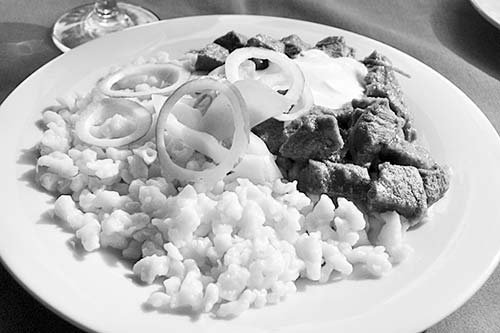
Meat is often covered with delicious sauces or garnishes, from rich cream sauces to spicy pastes to fruit jam. For classic Hungarian flavors, you can’t beat chicken or veal paprikás (described in the “Paprika Primer” sidebar).
Vegetarians have a tricky time in traditional Hungarian restaurants, many of which offer only a plate of deep-fried vegetables. A traditional Hungarian “salad” is composed mostly or entirely of pickled vegetables (cucumbers, cabbage, peppers, and others); even many modern restaurants haven’t quite figured out how to do a good, healthy, leafy salad. Fortunately, many modern, trendy eateries in the capital offer excellent vegetarian options.
Starches (köretek) can include nokedli (small, boiled “drop noodles”), galuska (noodles), burgonya (potatoes), sült krumpli (French fries), krokett (croquettes), or rizs (rice). Kenyér (bread) often comes with the meal. A popular snack—especially to accompany a wine tasting—is a pogácsa, a little ball of cheesy fried dough.
Sometimes your main dish will come with steamed, grilled, or deep-fried vegetables. A common side dish is káposzta (cabbage, often prepared like sauerkraut). You may also see töltött káposzta (cabbage stuffed with meat) or töltött paprika (stuffed peppers). Lecsó (LEH-choh) is the Hungarian answer to ratatouille: a richly flavorful stew of tomatoes, peppers, and other vegetables.
Thin, crêpe-like pancakes (palacsinta) are usually a starter, but sometimes served as a main dish. A delicious traditional dish is Hortobágyi palacsinta (Hortobágy pancakes). This is a savory crêpe wrapped around a tasty meat filling and drenched with creamy paprika sauce.
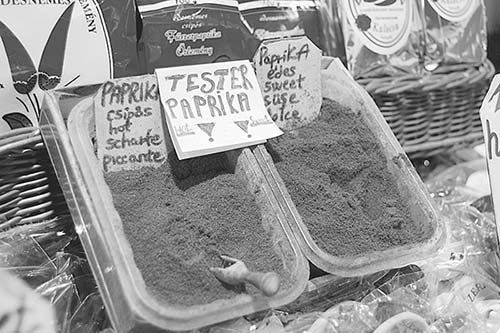
The quintessential ingredient in Hungarian cuisine is paprika. In Hungarian, the word paprika can mean both peppers (red or green) and the spice that’s made from them. Peppers can be stewed, stuffed, sautéed, baked, grilled, or pickled. For seasoning, red shakers of dried paprika join the salt and pepper on tables.
There are more than 40 varieties of paprika spice, with two main types: hot (csípős or erős) and sweet (édesnemes or simply édes; sometimes also called csemege—“delicate”). Hungarians typically cook with sweet paprika to add flavor and color. Then, at the table, they put out hot paprika so each diner can adjust the heat to his or her preferred taste.
On menus, anything cooked paprikás (PAW-pree-kash) comes smothered in a spicy red paprika gravy, thickened with sour cream. Most often you’ll see this option with csirke (chicken) or borjú (veal), and it’s generally served with dumpling-like boiled egg noodles called nokedli. This dish is the Hungarian staple.
To add even more kick to your food, ask for a jar of the bright-red, sambal-like paste called Erős Pista (EH-rewsh PEESH-taw). Literally “Spicy Steve,” this Hungarian answer to Tabasco is best used sparingly. Or try Édes Anna (AY-desh AW-naw, “Sweet Anna”), a variation that’s more sweet than spicy. You’ll also see tubes of Gulyáskrém (a bright-orange, sweet-but-not-hot paste for jazzing up soups) and Piros Arany (“Red Gold,” a deep-red, intensely flavorful, spicy paste). These—along with paprika—make a fun and tasty souvenir.
Pancakes also appear as desserts, stuffed and/or covered with fruit, jam, and other toppings. Most famous is the Gundel palacsinta, stuffed with walnuts and raisins in a rum sauce, topped with chocolate sauce, and flambéed.
Cakes and pastries are a big deal in Hungary. Try the Dobos torta (a many-layered chocolate-and-vanilla cream cake), flódni (layer cake of Jewish origin, with apples, walnuts, and poppy seeds), Rákóczi turós (sweet cheese curd cake with jam), somlói galuska (rum-soaked sponge cake), krémes (delicate custard wafer cake), anything with gesztenye (chestnuts), and rétes (strudel with various fillings, including túrós, curds). And many cukrászda also serve fagylalt (ice cream, fagyi for short), sold by the gomboc (ball).
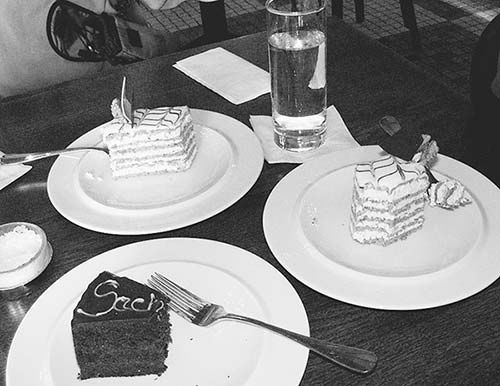
When the server comes to take your order, they might say “Tessék” (TEHSH-shayk), or maybe the more formal “Tessék parancsolni” (TEHSH-shayk PAW-rawn-chohl-nee)—“Please command, sir.” When they bring the food, they will probably say, “Jó étvágyat!” (yoh AYT-vah-yawt)—“Bon appétit.” When you’re ready for the bill, you can simply say, “Fizetek” (FEE-zeh-tehk)—“I’ll pay.”
Drinks
Kávé (KAH-vay) and tea (TEH-aw) are coffee and tea. (Confusingly, tej is not tea—it’s milk.) As for water (víz, pronounced “veez”), it comes as szódavíz (soda water, sometimes just carbonated tap water) or ásványvíz (spring water, more expensive).
Hungary is first and foremost a wine country. For the complete rundown on Hungarian wines, see the sidebar.
Hungary isn’t particularly well known for its beer (sör, pronounced “shewr”), but Dreher and Borsodi are two of the better brands. Világos is lager; if you prefer something darker, look for barna (brown). I’ve recommended some places to try Hungarian microbrews in Budapest (see “Entertainment in Budapest” in the Budapest chapter) and in Eger.
Hungary is almost as proud of its spirits as its wines. The local firewater, pálinka, is a powerful schnapps made from various fruits (most often plum, szilva; or apricots, barack). Also look for the pear-flavored Vilmos brandy.
Unicum is a unique and beloved Hungarian bitter liquor made of 40 different herbs and aged in oak casks. Look for the round bottle with the red cross on the label. The flavor is powerfully unforgettable—like Jägermeister, but harsher. Unicum started out as a medicine and remains a popular digestif for easing an upset stomach. Purists claim it’s better to drink it at room temperature, but novices find it easier to slug back when chilled. If the original Unicum overwhelms your palate, try one of the newer variations: Unicum Next, with more of a citrus flavor; Unicum Szilva (with a golden plum on the label), which is aged in plums that cut some of the bitterness with a rich sweetness; or Unicum Barista, infused with coffee (www.zwack.hu).
If you’re drinking with some new Magyar friends, impress them with the standard toast: Egészségedre (EH-gaysh-shay-geh-dreh; “to your health”).
Wine (bor) is an essential part of Hungarian cuisine.
Whites (fehér) can be sweet (édes), half-dry (félszáraz), or dry (száraz). Whites include the standards (riesling, chardonnay), as well as some wines made from more typically Hungarian grapes: leányka (“little girl”), a half-dry, fairly heavy, white table wine; cserszegi fűszeres, a spicy, light white that can be fruity; the half-dry, full-bodied hárslevélű (“linden leaf”); the dry, light, refreshing furmint; and the dry kéknyelű (“blue stalk”).
Reds (vörös) include familiar varieties (cabernet sauvignon, cabernet franc, merlot, pinot noir), and some that are less familiar. Spicy, medium-bodied, somewhat fruity kékfrankos (“blue Frankish”) is perhaps the most common Hungarian red wine grape. Kekporto is better known as blauer Portugieser in German-speaking countries. In Eger, try Bull’s Blood, a.k.a. Egri Bikavér, a distinctive blend of reds—typically with a kékfrankos base—that comes with a fun local legend (see here).
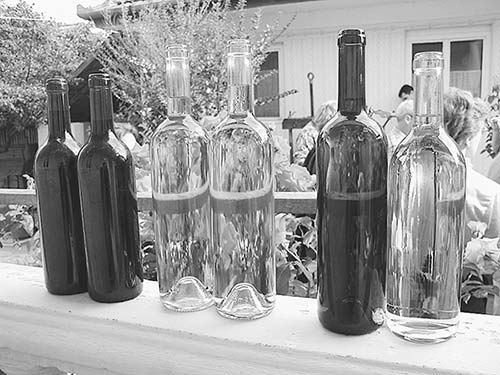
The most famous Hungarian wine is Tokaji Aszú, a sweet, late-harvest, honey-colored dessert wine made primarily from furmint grapes. It’s a D.O.C. product, meaning that to have that name, it must be grown in a particular region. Tokaj is a town in northeastern Hungary, while aszú is a “noble rot” grape. The wine’s unique, concentrated flavor—rich and sweet without being syrupy—is made possible by a fungus (Botrytis cinerea) that thrives on the grapes in the late fall. The grapes are left on the vine, where they burst and wither like raisins before they are harvested in late October and November. This sucks the water out of the grape, leaving behind a very high sugar content and a deep golden color. The best-quality Tokaji Aszú wines are numbered either five or six, indicating how many eight-gallon tubs (puttony) of these “noble rot” grapes were added to the base wine—the higher the number, the sweeter the wine.
Other variations on Tokaji, which mix that concentrated flavor with wine made from the later-harvest plump grapes, can be less sweet.
Except for Bull’s Blood and Tokaji Aszú, Hungarian wines are not widely available in the US. If you’d like to assemble a variety to ship home, the Tasting Table Wine Shop in Budapest works with an importer to make things easier (see here). And for a great introduction to Hungarian wines, consider the guided tastings offered by Taste Hungary (see here).
HUNGARIAN LANGUAGE
Even though Hungary is surrounded by Slavs, Hungarian is not at all related to the Slavic languages (such as Polish, Czech, or Croatian). In fact, Hungarian isn’t related to any European language, except for very distant relatives Finnish and Estonian. This can make it sound extremely “foreign” to outsiders. (Words can be quite long, because Hungarian is agglutinative: To create meaning, you start with a root word and then tack on suffixes—sometimes resulting in a pileup of extra sounds.) But it’s a highly rational language—the basics are easier to grasp than they may seem at first.
One easy word is “Szia” (SEE-yaw), which means both hello and goodbye (like “ciao” or “aloha”). Hungarians also have a charming habit of using the English word “hello” for both “hi” and “bye.” You might overhear a Hungarian end a telephone conversation with a cheery “Hello! Hello! Hello!” Another handy word that Hungarians (and people throughout Central Europe) understand is Servus (SEHR-voos, spelled Szervusz in Hungarian)—the old-fashioned greeting from the days of the Austro-Hungarian Empire. If you draw a blank on how to say hello, just offer a cheery, “Servus!”
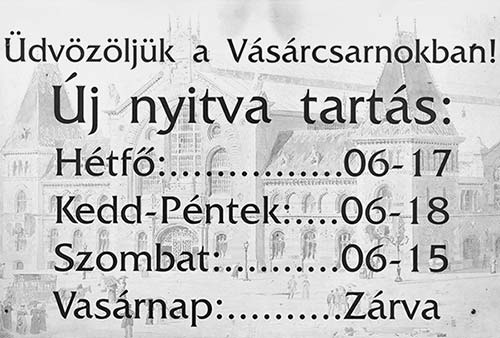
Hungarian pronunciation is clear and predicable, as long as you remember a few key rules. First, the emphasis always goes on the first syllable, and the following syllables are more monotone—giving the language a distinctive cadence that Hungary’s neighbors love to tease.
Several letters sound different in Hungarian than in other languages. For example, s alone is pronounced “sh,” while sz is pronounced “s.” This explains why you’ll hear in-the-know travelers pronouncing Budapest as “BOO-daw-pesht.” You might catch the busz up to Castle Hill—pronounced “boose.” And “Liszt” is easier to pronounce than it looks: It sounds just like “list.” To review:
s sounds like “sh” as in “shirt”
sz sounds like “s” as in “saint”
Hungarian has a set of unusual palatal sounds that don’t quite have a counterpart in English. To make these sounds, gently press the thick part of your tongue to the roof of your mouth (instead of using the tip of your tongue behind your teeth, as we do in English):
gy sounds like “dg” as in “hedge”
ny sounds like “ny” as in “canyon” (not “nee”)
ty sounds like “tch” as in “itch”
cs sounds like “ch” as in “church”
As for vowels: The letter a almost sounds like o (aw, as in “hot”), but with an accent (á), it brightens up to the more standard “ah.” Likewise, while e sounds like “eh,” é sounds like “ay.” An accent (á, é, í, ó, ú) indicates that you linger on that vowel but not necessarily that you stress that syllable. Like German, Hungarian has umlauts (ö, ü), meaning you purse your lips when you say that vowel: Roughly, ö sounds like “ur” and ü sounds like “ew.” A long umlaut (ő, ű) is the same sound, but you hold it a little longer. Words ending in k are often plural.
Here are a few other letters that sound different in Hungarian than in English:
c and cz both sound like “ts” as in “cats”
zs sounds like “zh” as in “leisure”
j and ly both sound like “y” as in “yellow”
OK, maybe it’s not that simple. But you’ll get the hang of it, and Hungarians will appreciate your efforts.
One more tip: Hungarians list a person’s family name first—so the composer Franz Liszt is called “Liszt Ferenc” in his homeland.
For a complete list of Hungarian survival phrases, see the following pages. As you navigate, remember these key Hungarian terms: tér (pronounced “tayr,” square), utca (OOT-zaw, street), út (oot, boulevard), körút (KUR-root, ring road), híd (heed, bridge), and város (VAH-rohsh, town). To better match what you’ll see locally, in the following chapters I’ve mostly used these Hungarian terms (instead of the English equivalents).
Hungarian Survival Phrases
In Hungarian, the letter a is pronounced “aw,” while á is a brighter “ah.” In the phonetics, dj is pronounced like the j in “jeans.”
| Hello. (formal) | Jó napot kívánok. yoh nah-poht kee-vah-nohk |
| Hi. / Bye. (informal) | Szia. / Hello. see-yaw / “Hello” |
| Do you speak English? | Beszél angolul? beh-sayl awn-goh-lool |
| Yes. / No. | Igen. / Nem. ee-gehn / nehm |
| I (don’t) understand. | (Nem) értem. (nehm) ayr-tehm |
| Please. / You’re welcome. | Kérem. / Szívesen. kay-rehm / see-veh-shehn |
| Thank you (very much). | Köszönöm (szépen). kur-sur-nurm (say-pehn) |
| Excuse me. / I’m sorry. | Bocsánat. boh-chah-nawt |
| No problem. | Semmi gond. sheh-mee gohnd |
| Good. | Jól. yohl |
| Goodbye. | Viszontlátásra. vee-sohnt-lah-tahsh-raw |
| one / two / three | egy / kettő / három edj / keh-tur / hah-rohm |
| four / five / six / seven | négy / öt / hat / hét naydj / urt / hawt / hayt |
| eight / nine / ten | nyolc / kilenc / tíz nyolts / kee-lehnts / teez |
| hundred / thousand | száz / ezer sahz / eh-zehr |
| How much? | Mennyi? mehn-yee |
| forint (local currency) | forint (Ft) foh-reent |
| Where is it? | Hol van? hohl vawn |
| Is it free (no charge)? | Ingyen van? een-jehn vawn |
| Where can I find / buy...? | Hol találok / vehetek...? hohl taw-lah-lohk / veh-heh-tehk |
| I’d like / We’d like... | Kérnék / Kérnénk... kayr-nayk / kayr-naynk |
| ...a room. | ...egy szobát. edj soh-baht |
| ...a ticket (to___). | ...egy jegyet (___-ig). edj yehdj-yeht (___-ig) |
| Is it possible? | Lehet? leh-heht |
| Where is the___? | Hol van a___? hohl vawn aw___ |
| big train station (in Budapest) | pályaudvar pah-yood-vawr |
| small train station (elsewhere) | vasútállomás vaw-shoot-ah-loh-mahsh |
| bus station | buszpályaudvar boos-pah-yood-vawr |
| tourist information office | turista információ too-reesh-taw een-for-maht-see-yoh |
| toilet | toalet / WC toh-aw-leht / vayt-say |
| men / women | férfi / női fayr-fee / nur-ee |
| left / right | bal / jobb bawl / yohb |
| straight | egyenesen edj-eh-neh-shehn |
| At what time...? | Mikor...? mee-kor |
| ...does this open / close | ...nyit / zár nyit / zahr |
| Just a moment. | Egy pillanat. edj pee-law-nawt |
| now / soon / later | most / hamarosan / később mohsht / haw-maw-roh-shawn / kay-shurb |
| today / tomorrow | ma / holnap maw / hohl-nawp |
In a Hungarian Restaurant
| I’d like to reserve a table for one / two people. | Szeretnék foglalni egy asztalt egy / két fő részére. seh-reht-nayk fog-lawl-nee edj aws-tawlt edj / kayt few ray-say-reh |
| Is this table free? | Ez az asztal szabad? ehz oz aws-tawl saw-bawd |
| Can I help you? | Tessék? tehsh-shayk |
| The menu (in English), please. | Kérem az (angol), étlapot kay-rehm oz (awn-gohl) ayt-law-poht |
| service (not) included | a számla a felszolgálási díjat (nem) tartalmazza aw sahm-law aw fehl-sohl-gah-lah-shee dee-yawt (nehm) tawr-tawl-maw-zaw |
| “to go” | elvitelre ehl-vee-tehl-reh |
| with / without | ____-val / nélkül ____vawl / nayl-kewl |
| and / or | és / vagy aysh / vawdj |
| breakfast / lunch / dinner | reggeli / ebéd / vacsora reh-geh-lee / eh-bayd / vah-choh-rah |
| fixed-price meal (of the day) | (napi) menü (naw-pee) meh-new |
| daily special | napi ajánlat naw-pee aw-yahn-lawt |
| main courses | főételek fur-ay-teh-lehk |
| appetizers | előételek eh-lur-ay-teh-lehk |
| bread / cheese | kenyér / sajt kehn-yayr / shayt |
| sandwich | szendvics send-veech |
| soup | leves leh-vehsh |
| salad | saláta shaw-lah-taw |
| meat / poultry | hús / szárnyasok hoosh / sahr-nyaw-shohk |
| fish | halak haw-lawk |
| seafood | tengeri halak tehn-geh-ree haw-lawk |
| fruit / vegetables | gyümölcs / zöldség jewm-urlch / zulrd-shayg |
| dessert | desszert deh-sehrt |
| vegetarian | vegetáriánus veh-geh-tah-ree-ah-noosh |
| (tap) water | (csap) víz (chawp) veez |
| mineral water | ásványvíz ash-vawn-veez |
| milk / (orange) juice | tej / (narancs) lé tay / (naw-rawnch) lay |
| coffee / tea | kávé / tea kah-vay / teh-aw |
| beer / wine | sör / bor shohr / bohr |
| red / white | vörös / fehér vur-rursh / feh-hayr |
| sweet / dry / semi-dry | édes / száraz / félszáraz ay-dehsh / sah-rawz / fayl-sah-rawz |
| glass / bottle | pohár / üveg poh-hahr / ew-vehg |
| Cheers! | Egészségedre! eh-gaysh-shay-geh-dreh |
| More. / Another. | Még. / Máskikat. mayg / mah-shee-kawt |
| The same. | Ugyanazt. oodj-aw-nawst |
| Bill, please. (literally, “I’ll pay.”) | Fizetek. fee-zeh-tehk |
| tip | borravaló boh-raw-vaw-loh |
| Bon appétit! | Jó étvágyat! yoh ayt-vah-yawt |
| Delicious! | Finom! fee-nohm |