Sights in Kazimierz
Part 1: Jewish Heritage on Ulica Szeroka
▲▲Old Jewish Cemetery (Stary Cmentarz)
Old Synagogue (Stara Synagoga)
Part 2: Contemporary Kazimierz
Isaac Synagogue (Synagoga Izaaka)
Meiselsa and Bożego Ciała Streets
Ulica Św. Wawrzyńca: Industrial Kazimierz
Galicia Jewish Museum (Galicja Muzeum)
MORE JEWISH SIGHTS IN KAZIMIERZ
▲New Jewish Cemetery (Nowy Cmentarz)
Ghetto Heroes’ Square (Plac Bohaterow Getta)
▲Pharmacy Under the Eagle (Apteka pod Orłem)
▲▲▲Schindler’s Factory Museum (Fabryka Emalia Oskara Schindlera)
The neighborhood of Kazimierz (kah-ZHEE-mehzh), 20 minutes by foot or 5 minutes by tram southeast of Kraków’s Old Town, is the historic heart of Kraków’s once-thriving Jewish community. After years of neglect, the district began a rejuvenation in the early 2000s. Today, while not quite as slick and polished as Prague’s Jewish Quarter, Kazimierz’s assortment of synagogues, cemeteries, and museums helps visitors appreciate the neighborhood’s rich Jewish legacy. At the same time, Kazimierz also happens to be the city’s edgy, hipster culture center—jammed with colorful bars, creative eateries, and designer boutiques. This unlikely combination—where somber synagogues coexist with funky food trucks—makes Kazimierz a big draw among all types of travelers.
Planning Your Visit: Try to visit any day except Saturday, when most Jewish-themed sights are closed (except the Old Synagogue and Galicia Jewish Museum). Monday comes with a few closures of non-Jewish sights: the Ethnographic Museum and Museum of Engineering and Technology. On Monday, the Schindler’s Factory Museum is free, but it’s open shorter hours and is more crowded than usual. It’s always smart to book ahead for the Schindler’s Factory Museum, which often sells out. For more suggestions on what to do in Kazimierz, see the Shopping, Entertainment, Sleeping, and Eating sections.
Etiquette: To show respect, men cover their heads while visiting a Jewish cemetery or synagogue. Most sights offer loaner yarmulkes, or you can wear your own hat.
Getting to Kazimierz: From Kraków’s Old Town, it’s about a 20-minute walk. From the Main Market Square, head down Ulica Sienna (near St. Mary’s Church) and through the Planty park. When you hit the busy ring road, bear right and continue down Starowiślna for 15 more minutes. The tram shaves off a few minutes: Find the stop along the ring road, on the left-hand side of Ulica Sienna (across the street from the Poczta Główna, or main post office). Catch tram #3 or #24, and ride two stops to Miodowa. Walking or by tram, at the intersection of Starowiślna and Miodowa, you’ll see a tiny park across the street and to the right. To reach the heart of Kazimierz—Ulica Szeroka—cut through this park. The same trams continue to the sights in Podgórze (including the Schindler’s Factory Museum), described later.
To return to the Old Town, catch tram #3 or #24 from the intersection of Starowiślna and Miodowa (kitty-corner from where you got off the tram).
Information: An official TI is at Ulica Józefa 7.
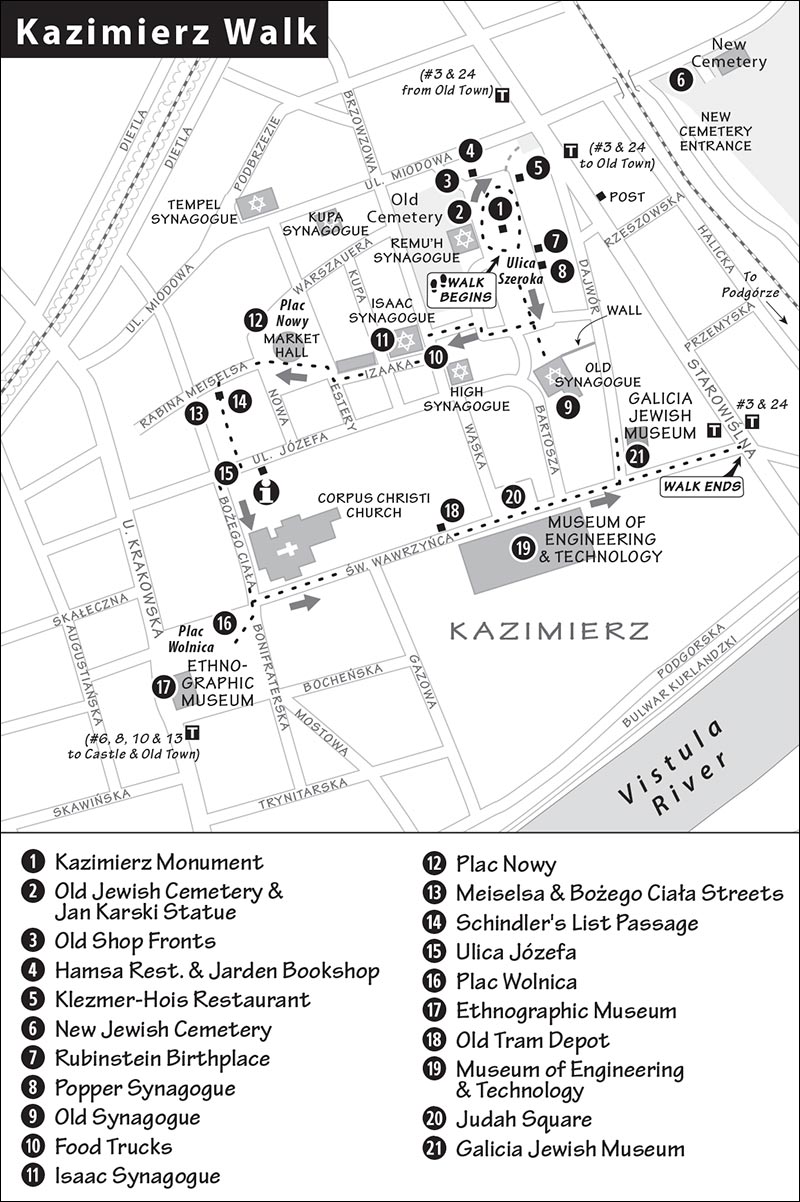
KAZIMIERZ WALK
This self-guided walk, worth ▲▲, is designed to help you get your bearings in Kazimierz, connecting both its Jewish sights (mostly in “Part 1”) and its eclectic other attractions, from trendy bars to underrated museums (“Part 2”). Allow about an hour for the entire walk, not counting museum, cemetery, and synagogue visits along the way. From the end of the walk, you can easily cross the river to this area’s biggest sight, the Schindler’s Factory Museum.
Part 1: Jewish Heritage on Ulica Szeroka
• We’ll start on Ulica Szeroka (“Broad Street”)—the center of the neighborhood, which feels like more of an elongated square than a “street.” Begin at the bottom (southern) edge of the small, fenced, grassy park, near the strip of restaurants. In the park with the tall trees, look for the low-profile, stone...
Kazimierz Monument
You’re standing in the historical heart of Kraków’s Jewish community. In the 14th century, King Kazimierz the Great enacted policies that encouraged Jews fleeing other kingdoms to settle in Poland—including in Kraków. He also founded this town, which still bears his name. Originally, Jews lived in the Old Town, but they were scapegoated after a 1495 fire and forced to relocate to Kazimierz. Back then, Kazimierz was still a separate town, divided by a wall into Christian (west) and Jewish (east) neighborhoods. Ulica Szeroka was the main square of the Jewish community. Over time, Jews were more or less accepted into the greater community, and Jewish culture flourished here.
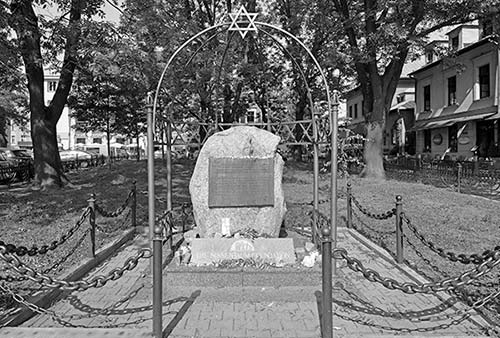
All that would change in the mid-20th century. The monument honors the “65 thousand Polish citizens of Jewish nationality from Kraków and its environs”—more than a quarter of the city’s pre-WWII population—who were murdered by the Nazis during the Holocaust. When the Nazis arrived, they immediately sent most of Kraków’s Jews to the ghetto in the eastern Polish city of Lublin. Soon after, they forced Kraków’s remaining 15,000 Jews into a walled ghetto at Podgórze, across the river. The Jews’ cemeteries were defiled, and their buildings were ransacked and destroyed. In 1942, the Nazis began transporting Kraków’s Jews to death camps (including Płaszów, just on Kraków’s outskirts; and Auschwitz-Birkenau).
Only a few thousand Kraków Jews survived the war. During the communist era, this waning population was ignored or mistreated. After 1989, interest in Kazimierz’s unique Jewish history was faintly rekindled. But it was only when Steven Spielberg chose to film Schindler’s List here in 1993 that the world took renewed interest in Kazimierz. (A local once winked to me, “They ought to build a statue to Spielberg on that square.”) Although the current Jewish population in Kraków numbers only 200, Kazimierz has become an internationally known destination for those with an interest in Jewish heritage.
• Facing the park, look to the left. The arch with the Hebrew characters marks the entrance to the...
▲▲Old Jewish Cemetery (Stary Cmentarz)
This small cemetery was used to bury members of the Jewish community from 1552 to 1800. With more than a hundred of the top Jewish intellectuals of that age buried here, this is considered one of the most important Jewish cemeteries in Europe.
Cost and Hours: 10 zł includes cemetery and attached Remu’h Synagogue; hours vary with demand—especially outside peak season—but generally open Sun-Fri 9:00-16:00, can be open until 18:00 May-Sept, closes earlier off-season and by sundown on Fri, closed Sat year-round, Ulica Szeroka 40.
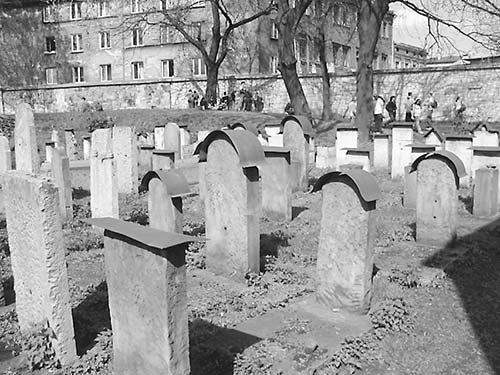
Visiting the Cemetery: Walk under the arch, pay the admission fee, step into the cemetery, and survey the tidy rows of headstones. This early Jewish resting place (later replaced by the New Cemetery, described later) was desecrated by the Nazis during the Holocaust. In the 1950s, it was discovered, excavated, and put back together as you see here. Shattered gravestones form a mosaic wall around the perimeter.
Notice that many graves have a curved top or are engraved with an arch-like pattern—suggesting passage into another realm. As in all Jewish cemeteries and memorials, you’ll see many small stones stacked on the graves. The tradition comes from placing stones—representing prayers—over desert graves to cover the body and prevent animals from disturbing it.
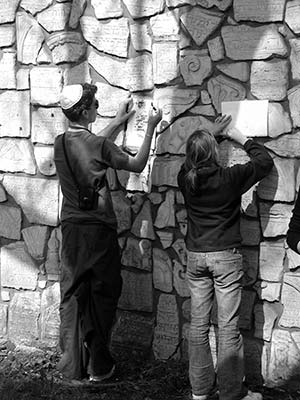
Behind the little synagogue to the left, in the elevated, fenced area near the tree, the tallest tombstone belonged to Moses Isserles (a.k.a. Remu’h), an important 16th-century rabbi. He is believed to have been a miracle worker, and his grave was one of the only ones that remained standing after World War II. Notice the written prayers crammed into the cracks and crevices of the tombstone.
Near the gate to the cemetery, step into the tiny Remu’h Synagogue (c. 1553, covered by cemetery ticket). Tight and cozy, this has been carefully renovated and is fully active. Notice the original 16th-century frescoed walls and ceilings, and the historic donation box at the door. For more on typical synagogue architecture, see the sidebar.
• Back outside, turn left and continue up to the top of...
Ulica Szeroka
Just above the cemetery gate, notice a bronze statue of a gentleman seated on a bench. This is a tribute to Jan Karski (1914-2000), a Catholic Pole and resistance fighter who published his eyewitness account The Story of a Secret State about the Holocaust in 1944. Karski—the ultimate whistleblower—was one of the first people who spoke out about Nazi atrocities, at a time when even many world leaders had only an inkling about what was happening in Hitler’s realm. Karski’s revelations, so shocking as to be literally unbelievable to many, went ignored by some key leaders—arguably extending the horrors of the Holocaust.
Just above that, at the top corner of the square, notice the side street with a row of rustic old Jewish shop fronts, which evoke the bustle of prewar Kazimierz. The Jewish names—Rattner, Weinberg, Nowak, Holcer—stand testament to the lively soul of this neighborhood in its heyday. This lane leads to Miodowa street, which you can follow left to reach two of Kazimierz’s lesser-known synagogues (Tempel and Kupa, both described later).
The building at the top of the square houses the recommended Hamsa restaurant (with modern Israeli food) and Jarden Bookshop, which serves as an unofficial information point for the neighborhood and sells a wide variety of fairly priced books on Kazimierz and Jewish culture in the region (daily, Ulica Szeroka 2).
Kitty-corner from the bookshop, notice Klezmer-Hois—one of many restaurants offering live traditional Jewish klezmer music nightly in summer (for more on klezmer music and details on your options, see “Entertainment in Kraków,” later).
The New Jewish Cemetery—less touristed and a striking contrast to the Old Jewish Cemetery we just saw—is a worthwhile detour, about a five-minute walk away (and described later in this section). To get there, cut through the grassy little lot between Jarden Bookshop and Klezmer-Hois, turn right, cross the busy street, then go through the railway underpass.
When you’re ready to move on, do a 180 and head back downhill on Ulica Szeroka. You’ll pass the little park again, then come to a row of lively, mostly Jewish-themed restaurants with outdoor tables. Some places along here typically feature outdoor klezmer music in good weather—allowing you to get a taste of this unique musical form before committing to a full meal.
Halfway down this side of the square, the green house at #14 is where Helena Rubinstein was born in 1870. At age 31, she emigrated to Australia, where she parlayed her grandmother’s traditional formula for hand cream into a cosmetics empire. Many cosmetics still used by people worldwide today were invented by Rubinstein, who was just one of many illustrious Jewish residents of Kazimierz.
Two doors past the Rubinstein house, notice the round arch marking the courtyard of the Popper Synagogue, which is now home to an extensive bookstore that’s worth a peek (daily).
Continue past the restaurants to the very bottom of Ulica Szeroka and pause at the steps before heading down into the sunken area around the Old Synagogue. To the synagogue’s left, notice a short, reconstructed stretch of Kazimierz’s 14th-century town wall, with a roofed rampart on top. This is a reminder that medieval Kazimierz was a separate city from Kraków. It’s easy to read some history into a map of Kazimierz (you’ll find one on the big panel in front of the Old Synagogue, down the stairs): Today’s Starowiślna and Dietla streets—which frame off Kazimierz in a triangle of land hemmed in by the riverbank—were once canals (Kazimierz was built on an island). When King Kazimierz the Great—who reportedly didn’t care much for Krakovians—founded this district in 1335, he envisioned it as a separate town to rival Kraków. It wasn’t until around 1800 that the two towns merged.
• The building at the bottom of the square is the...
Old Synagogue (Stara Synagoga)
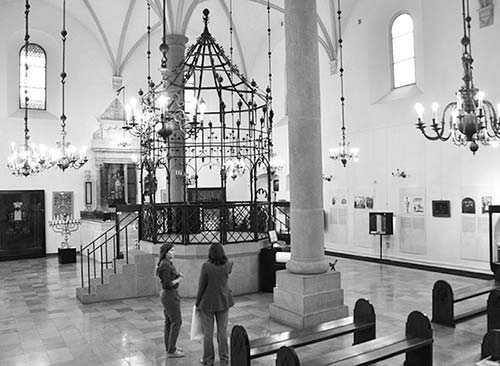
The oldest surviving Jewish building in Poland (15th century) sits eight steps below street level. Jewish structures weren’t allowed to be taller than Christian ones—and so, in order to have the proper proportions, the synagogue’s “ground floor” had to be underground. Today, the synagogue houses a good three-room museum on local Jewish culture, with informative English descriptions and a well-preserved main prayer hall (18 zł, free on Mon; Mon 10:00-14:00, Tue-Sun until 17:00; shorter hours off-season; Ulica Szeroka 24, +48 12 422 0962).
• A few more Jewish sights can be found in the surrounding streets; I’ll point these out in “Part 2,” though the rest of this walk focuses on a more recent chapter of the neighborhood.
Part 2: Contemporary Kazimierz
• Stand with your back to the Old Synagogue, at the top of the stairs, and turn left, heading up the little alley next to Szeroka 28—called Lewkowa.
Hipster Kazimierz
Follow Lewkowa between some old buildings. When you pop out into an open area, angle right, then continue straight along Ulica Ciemna. Soon you’ll hit an inviting little pod of food trucks. Pause here—perhaps while nursing an açaí smoothie, a Thai-style rolled ice cream, or a taco—and ponder the explosion of youthful culture that’s taken place in Kazimierz over the last generation.
At the end of World War II, Kazimierz was badly damaged and depopulated. And so it remained for generations, as the communist authorities brushed Jewish heritage under the rug. By the early 2000s, Kazimierz’s artistically dilapidated buildings, low rents, and easy proximity to the Old Town became enticing to creative young people. A variety of artsy entrepreneurs took root here, beginning with a cluster of ramshackle, rustic bars (inspired partly by Budapest’s “ruin pub” scene). Today, the district has the city’s (and probably Poland’s) highest concentration of trendy food trucks, cafés, bars, restaurants, and design shops—several of which we’ll see as we continue.
A synagogue is a place of public worship, where Jews gather to pray, sing, and read from the Torah. Most synagogues have similar features, though they vary depending on the congregation.
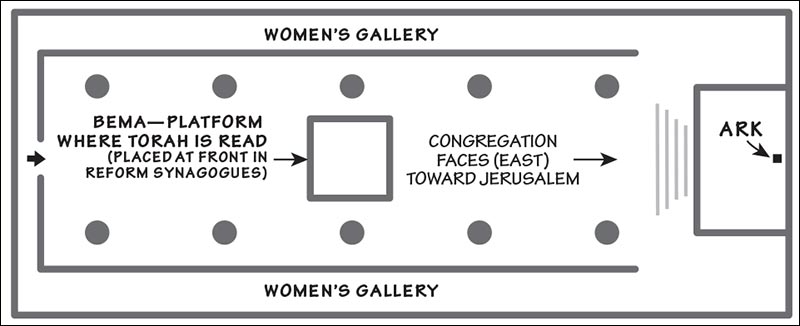
The synagogue generally faces, at least symbolically, toward Jerusalem (in Kraków, worshippers face east). At the east end is an alcove called the ark, which holds the Torah. These scriptures (the first five books of the Christian Old Testament) are written in Hebrew on scrolls wrapped in luxuriant cloth. The other main element of the synagogue is the bema, an elevated platform from which the Torah is read aloud (the equivalent of a pulpit in a Christian church). In traditional Orthodox synagogues, the bema is near the center of the hall, and the reader stands facing the same direction as the congregation. In other branches of Judaism, the bema is at the front, and the reader faces the worshippers. Orthodox synagogues have separate worship areas for men and women, usually with women in the balcony.
The synagogue walls might be decorated with elaborate patterns of vines or geometric designs, but never statues of people, which could be considered idol worship. A lamp above the ark is always kept lit, as it was in the ancient temple of Jerusalem, and candelabras called menorahs also recall the temple. Other common symbols are the two tablets of the Ten Commandments given to Moses, or a Star of David, representing the Jewish king’s shield.
At a typical service, the congregation arrives at the start of Sabbath (Friday evening). As a sign of respect toward God, men don yarmulkes (small round caps). As the cantor leads songs and prayers, worshippers follow along in a book of weekly readings. At the heart of the service, everyone stands as the Torah is ceremoniously paraded, unwrapped, and placed on the bema. Someone—the rabbi, the cantor, or a congregant—reads the words aloud. The rabbi (“teacher”) might give a commentary on the Torah passage.
• From the food trucks, continue straight ahead (on Izaaka street). This leads you along the left side of...
Isaac Synagogue (Synagoga Izaaka)
One of Kraków’s biggest synagogues, this was built in the 17th century. Recently under renovation, it may or may not be open to visitors. If you can get inside, notice how the walls in the prayer hall are decorated with giant paintings of prayers for worshippers who couldn’t afford to buy books.
• Just past Isaac Synagogue is the heart of Kazimierz’s nightlife zone (also bustling by day). Dive in, passing some characteristic cafés. Then jog right at the glitzy Plac Nowy 1 beer hall to reach...
Plac Nowy
Kazimierz’s endearing “new” market square, Plac Nowy (plats NOH-vee), retains much of the gritty flavor of the district before tourism and gentrification. The circular brick building in the center is a slaughterhouse where Jewish butchers would properly kill livestock, kosher-style. Today, its windows are filled with little stand-up eateries, most of them featuring the traditional, local, pizza-like zapiekanki. Circle the market hall and browse for a snack (for more on the Plac Nowy scene, see “Eating in Kraków,” later). This square is also ringed by several fun and funky bars—enjoyable by day but hopping at night.
• Leave Plac Nowy along Meiselsa street (to the left from where you entered, past the yellow Jewish Cultural Center). After one block, pause at the intersection of...
Meiselsa and Bożego Ciała Streets
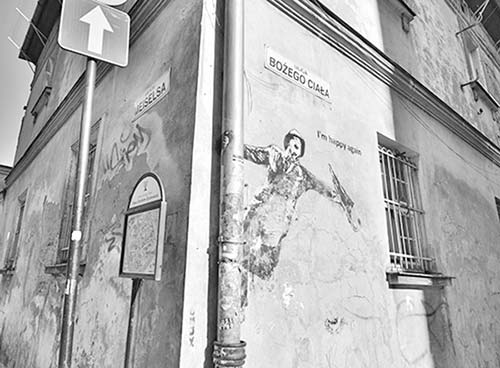
The Holocaust was a dark chapter that dominates Kazimierz’s history. But this intersection is a reminder that, up until the Nazis arrived, Kazimierz was a place where Jews and Christians lived side by side in relative harmony. Notice the street names, which mix Jewish and Catholic namesakes: Ulica Meiselsa (“Meisels Street”—honoring a deeply respected 19th-century rabbi) and Ulica Bożego Ciała (“Corpus Christi Street”—named for the towering brick church you can see just ahead). As if to celebrate the ecumenism of this intersection, a street artist has painted a graffiti Gene Kelly on the wall...very “happy again” indeed that Kazimierz is blossoming and full of life.
• Backtrack a few steps up Meiselsa and duck into the courtyard on the right, under the dilapidated arch.
Schindler’s List Passage
This courtyard is a popular tourist spot thanks to its brush with fame as a location for some key scenes in Schindler’s List (find the black-and-white stills from the movie—and actual historic photos—partway down on the right). Spielberg connection aside, this is a particularly evocative setting to nurse a relaxing drink in the atmospheric beer garden.
• Carry on all the way through the passage. You’ll emerge at...
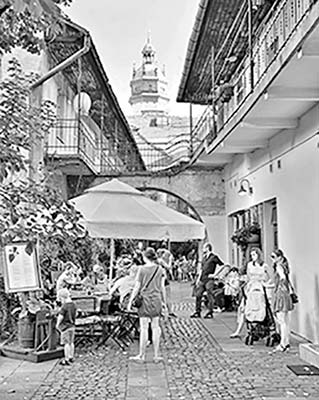
Ulica Józefa: Design Street
This street has Kazimierz’s highest concentration of funky, one-off boutiques: jewelry, fashion, housewares, and more. It’s a great place to browse. There’s also a TI just across the street.
• When you’re ready to move along, take Ulica Józefa right a few steps to the intersection with Ulica Bożego Ciała, turn left, and follow it a long block. You’ll pass Corpus Christi Church on your left, then arrive at...
Plac Wolnica
Remember that Kazimierz was originally a separate town from Kraków. This was its main market square, designed to one-up its crosstown rival—right down to the dramatic, red-brick Catholic church on the corner (Corpus Christi).
The former Kazimierz Town Hall at the far end of the square houses an unusually good Ethnographic Museum (Muzeum Etnograficzne)—worth ▲. If you’re interested in Polish folk culture, it’s worth a visit (18 zł, free on Tue, open Tue-Sun 10:00-19:00, closed Mon, Ulica Krakowska 46, +48 12 430 6023, www.etnomuzeum.eu). On the ground floor, you’ll find models of traditional rural Polish homes, as well as musty replicas of the interiors (like an open-air folk museum moved inside). The exhibit continues upstairs, where each in a long lineup of traditional Polish folk costumes is identified by specific region. Follow the one-way route through exhibits on village lifestyles, rustic tools, and musical instruments (including a Polish bagpipe). A highlight is the explanation of traditional holiday celebrations—from elaborate crèche scenes at Christmas to a wall of remarkably painted Easter eggs. Some items are labeled in English, but it’s mostly in Polish. The top floor features temporary exhibits.
• There’s more to see in Kazimierz. But if you’re pooped, several trams run from here back to Wawel Castle, then on to the Plac Wszystkich Świętych stop in the heart of the Old Town (catch tram from along Krakowska street, behind the Ethnographic Museum).
To continue the walk from Plac Wolnica, head up Ulica Św. Wawrzyńca (at the corner where you entered the square, with the Corpus Christi Church on your left).
Ulica Św. Wawrzyńca: Industrial Kazimierz
By the late 19th century, Kazimierz was not just a Jewish cultural hotspot but also a center of local industry. (It’s no coincidence that Oskar Schindler had his factory near here.) After the church, on your left, look for the glass-and-steel arched roof of the Industrial Age old tram depot, which now houses a recommended brewpub. In sunny summer weather, the pebbly courtyard is filled with happy drinkers.
Across the street, notice the many tram tracks leading into a courtyard with several more storage sheds for local trams. This gorgeously restored complex now houses the Museum of Engineering and Technology (Muzeum Inżynierii i Techniki)—yet another of Kraków’s many engaging, well-presented museums (closed Mon, Ulica Św. Wawrzyńca 15, www.mit.krakow.pl).
Continue along Ulica Św. Wawrzyńca a few more steps. At the intersection with Wąska, Judah Square (Skwer Judah) is a vacant lot with a gaggle of enticing food carts watched over by a giant mural. Commissioned for Kraków’s Jewish Cultural Festival in 2013, the illustration was painted by Israeli street artist Pilpeled. It shows a young boy who feels small and scared but lionhearted nevertheless—a poignant symbol for the Holocaust survivors of Kazimierz. If you’re ready for a meal or snack, you’ll find several good options here.
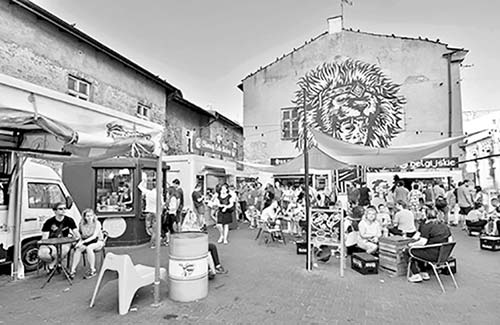
• A half-block farther down Ulica Św. Wawrzyńca is another place for refreshment, the recommended Craftownia (Polish microwbrews on tap, on the left at #22). Next you’ll reach the intersection with Dajwór street. Turn left here and walk a few steps up the street; on the right, you’ll find the...
Galicia Jewish Museum (Galicja Muzeum)
This museum, worth ▲ and housed in a restored Jewish furniture factory, focuses on the present rather than the past. The permanent “Traces of Memory” photographic exhibit shows today’s remnants of yesterday’s Judaism in the area around Kraków (a region known as “Galicia”). From abandoned synagogues to old Jewish gravestones flipped over and used as doorsteps, these giant postcards of Jewish artifacts (with good English descriptions) ensure that an important part of this region’s heritage won’t be forgotten. Temporary exhibits complement this permanent collection (20 zł, daily 10:00-18:00, one block east of Ulica Szeroka at Ulica Dajwór 18, +48 12 421 6842, www.galiciajewishmuseum.org). The museum also serves as a sort of cultural center, with a good bookstore and café.
• Our Kazimierz orientation walk is finished. From here, you have several options. To return to Ulica Szeroka, where we began, walk up Dajwór street past the museum, then angle left through the park at the reconstructed chunk of town wall—you’ll wind up at the Old Synagogue.
For the next two options, you’ll first head back down to Ulica Św. Wawrzyńca, turn left, and walk one more block to the intersection with Starowiślna street. Just to the left on Starowiślna, look for the tram stops. The tram stop on the far side of the street takes you back to the Old Town (tram #3 or #24). From the tram stop on the near side of the street, tram #3 or #24 zips you to the sights in Podgórze—including Ghetto Heroes’ Square and the Schindler’s Factory Museum (both described later). You can also reach the Podgórze sights on foot by turning right on Starowiślna and crossing the bridge (about a 10-minute walk).
MORE JEWISH SIGHTS IN KAZIMIERZ
In addition to the sights connected by the walk above, here’s another cemetery and a few more synagogues to round out your Jewish Kazimierz experience.
▲New Jewish Cemetery (Nowy Cmentarz)
This burial place—much larger than the Old Jewish Cemetery—has graves of those who died after 1800. It was vandalized by the Nazis, who sold many of its gravestones to stonecutters and used others as pavement in their concentration camps. Many have since been cemented back in their original positions, while others—which could not be replaced—have been used to create the moving mosaic wall and Holocaust monument (on the right as you enter). Most gravestones are in one of four languages: Hebrew (generally the oldest, especially if there’s no other language, though some are newer “retro” tombstones), Yiddish (sounds like a mix of German and Hebrew and uses the Hebrew alphabet), Polish (Jews who assimilated into the Polish community), and German (Jews who assimilated into the German community). The earliest graves are simple stones, while later ones imitate graves in Polish Catholic cemeteries—larger, more elaborate, and with a long stone jutting out to cover the body. Notice that some new-looking graves have old dates. These were most likely put here well after the Holocaust (or even after the communist era) by relatives of the dead.
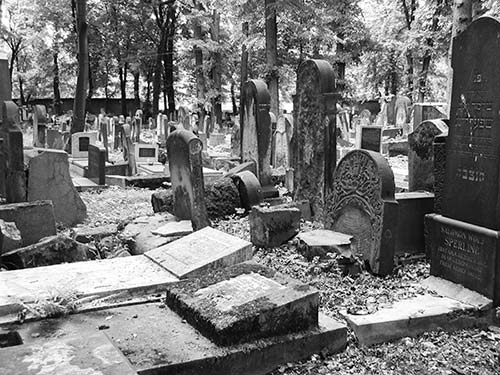
Cost and Hours: Free, Sun-Fri 8:00-16:00, closed Sat. It’s tricky to find: Go under the railway tunnel at the east end of Ulica Miodowa and turn right as you emerge; look for the gate with the small cmentarz żydowski sign.
Synagogues
In addition to the three synagogues mentioned on the Kazimierz Walk (Old Synagogue, Isaac, and Remu’h), others welcome visitors. Each of these charges a small admission fee and is closed Saturdays. The High Synagogue—so called because its prayer room is upstairs—displays changing exhibits, most of which focus on the people who lived here before the Holocaust (Ulica Józefa 38). Tempel Synagogue (Synagoga Templu) has the grandest interior—big and dark, with elaborately decorated, gilded ceilings and balconies (corner of Ulica Miodowa and Ulica Podbrzezie). The Jewish Community Centre next door offers activities both for members of the local Jewish community and for tourists (lectures, genealogical research, Friday-night Shabbat meals, Hebrew and Yiddish classes, and so on; https://linktr.ee/jcckrakow). Nearly across the street, the smaller Kupa Synagogue (Synagoga Kupa)—clean and brightly decorated—sometimes hosts temporary exhibits (Miodowa 27).
NEAR KAZIMIERZ: PODGÓRZE
The neighborhood called Podgórze (POD-goo-zheh), directly across the Vistula from Kazimierz, has one of Kraków’s most famous sights: Schindler’s Factory Museum. I’ve listed the area’s sights in the order you’ll reach them as you come from Kazimierz or the Old Town.
Background: This is the neighborhood where the Nazis forced Kraków’s Jews into a ghetto in early 1941. (Schindler’s List and the films in the Pharmacy Under the Eagle museum depict the sad spectacle of Jews loading their belongings onto carts and trudging over the bridge into Podgórze.) Non-Jews who had lived here were displaced to make way for the new arrivals. The ghetto was surrounded by a wall with a fringe along the top that resembled Jewish gravestones—a chilling premonition. A short section of this wall still stands along Lwowska street. The tram continued to run through the middle of Podgórze, without stopping—giving Krakovians a harrowing glimpse at the horrifying conditions inside the ghetto.
Getting There: To go directly to Ghetto Heroes’ Square, continue through Kazimierz on tram #3 or #24 (described earlier, under “Getting to Kazimierz”) to the stop called Plac Bohaterow Getta. Or you can ride the tram or walk 10 minutes across the bridge from the end of my Kazimierz Walk.
Ghetto Heroes’ Square (Plac Bohaterow Getta)
This unassuming square is the focal point of the visitor’s Podgórze. Today, the square is filled with a monument consisting of 68 empty metal chairs—representing the 68,000 people deported from here. This is intended to remind viewers that the Jews of Kazimierz were forced to carry all of their belongings—including furniture—to the ghetto on this side of the river. It was also here that many Jews waited to be sent to extermination camps. The small, gray building at the river end of Ghetto Heroes’ Square feels like a train car inside, evocative of the wagons that carried people from here to certain death.
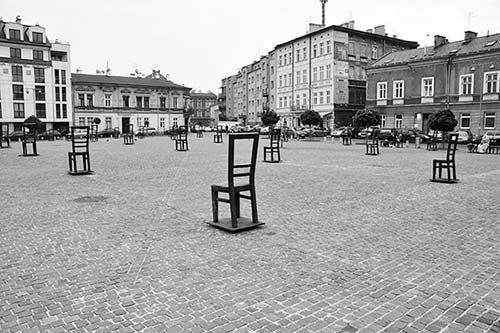
▲Pharmacy Under the Eagle (Apteka pod Orłem)
This small but good museum, on Ghetto Heroes’ Square, tells the story of Tadeusz Pankiewicz, a Polish Catholic pharmacist who chose to remain in Podgórze when it became a Jewish ghetto. During this time, the pharmacy was an important meeting point for the ghetto residents, and Pankiewicz and his staff heroically aided and hid Jewish victims of the Nazis. (Pankiewicz survived the war and was later acknowledged by Israel as one of the “Righteous Among the Nations”—non-Jews who risked their lives to help the Nazis’ victims during World War II. You’ll see his medal on display in the white memorial room at the end of the museum.) Today, the pharmacy hosts an exhibit about the Jewish ghetto.
Cost and Hours: 18 zł, free on Wed; open Wed-Sun 10:00-17:00, closed Mon-Tue; Plac Bohaterow Getta 18, +48 12 656 5625.
Visiting the Museum: You’ll enter into the re-created pharmacy, where the “windows” are actually screens that show footage from the era. Push buttons, pull out drawers, answer the phone—it’s full of interactive opportunities to better understand ghetto life. You’ll learn about people who worked in the pharmacy (including riveting interviews with eyewitnesses—some in English, others subtitled) and hear Pankiewicz telling stories about that tense time. You’ll also learn a bit about the pharmacy business from that period.
▲▲Schindler’s Factory Museum (Fabryka Emalia Oskara Schindlera)
One of Europe’s top museums about the Nazi occupation fills some of the factory buildings where Oskar Schindler and his Jewish employees worked. The museum tells the wartime story not only of Schindler and his workers but also of all of Kraków. It’s loaded with in-depth information (all in English), and touchscreens invite you to learn more and watch eyewitness interviews. Scattered randomly between the exhibits are replicas of everyday places from the age—a photographer’s shop, a tram car, a hairdresser’s salon—designed to give you a taste of 1940s Kraków. Note that you’ll see nothing of the actual factory or equipment, as the threat of the advancing Red Army forced Schindler to move his operation lock, stock, and barrel to Nazi-occupied Czechoslovakia in 1944.
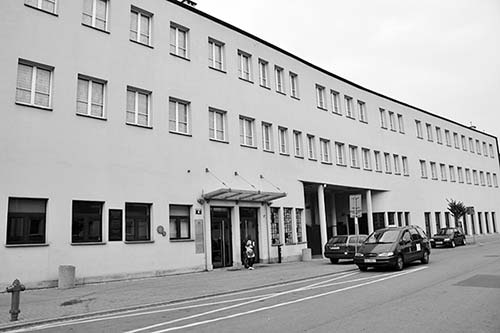
Cost and Hours: 32 zł, free on Mon; open Mon 10:00-14:00, Tue-Sun until 18:00 (except closed the first Tue of each month), last entry 1.5 hours before closing; +48 12 257 1017, www.muzeumkrakowa.pl.
Book Ahead: It’s always wise to book ahead for this very busy and popular sight, which frequently sells out. To get your choice of time slots, book at least several days in advance—the sooner, the better—at www.bilety.mhk.pl. (For Mondays, when it’s free and extremely busy, you may not be able to prebook online; check the website for the latest policy.) Or, if you arrive in Kraków without a ticket and it’s already sold out, stop by the Museum of Kraków Visitors Center on the Main Market Square (see “Tourist Information” on here). Ideally, swing by that office the day before you’d like to tour the museum; that’s when unsold tickets, previously bought up by local agencies, are returned and become available to procrastinators.
Crowd-Beating Tips: Once inside, the museum can be unpleasantly congested. For a more leisurely experience, the best strategy is to arrive right when it opens, or later in the day—if you have an average appetite for information, planning to arrive 2 hours before closing time should be about right.
Getting There: It’s in a gloomy industrial area a five-minute walk from Ghetto Heroes’ Square (Plac Bohaterow Getta): Go up Kącik street (to the left of the big, glass skyscraper), go under the railroad underpass, and continue two blocks, past MOCAK (the Museum of Contemporary Art in Kraków, described later) to the second big building on the left (Ulica Lipowa 4). Look for signs to Emalia.
Visiting the Museum: Entering on the ground floor, you’ll find special exhibits and a “film café” (interesting for fans of the movie) with refreshments. Then head upstairs to the first floor.
First Floor: The 35-minute film, called Lipowa 4 (this building’s address), sets the stage with interviews of both Jews and non-Jews describing their wartime experience (find it just off the museum’s first, circular room; subtitled in English, it runs continuously).
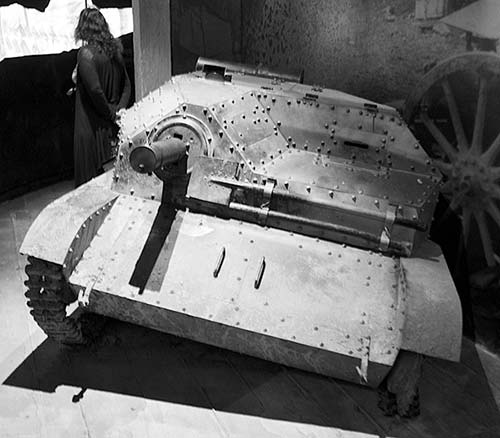
From here, the one-way route winds through the permanent exhibit, called “Kraków Under Nazi Occupation 1939-1945.” First, while pleasant music plays, “stereoscopic” (primitive 3-D) photos of prewar Kraków capture an idyllic age when culture flourished and the city’s Jews (more than one-quarter of the population) blended more or less smoothly with their Catholic-Pole neighbors. But then, a video explains the Nazi invasion of Poland in early September of 1939: It took them only a few weeks to overrun the country (which desperately awaited the promised help of their British and French allies, who never arrived).
Through the next several rooms, watch the film clip of SS soldiers marching through the Main Market Square—renamed “Adolf-Hitler-Platz”—and read stories about how the Nazis’ Generalgouvernement attempted to reshape the life of its new capital, “Krakau.” (Near the tram car, look for the decapitated head of the Grunwald monument, which had been a powerful symbol of a Polish military victory over German forces.) You’ll see the story of a newly German-owned shop selling Nazi propaganda and learn how professors at Kraków’s Jagiellonian University were arrested to prevent them from fomenting rebellion among their students. During this time, even Polish secondary schools were closed—effectively prohibiting learning among Poles, whom the Nazis considered inferior. But Polish students continued to meet clandestinely with their teachers. You’ll also see images of Hans Frank—the hated puppet ruler of Poland—moving into the country’s most important symbol of sovereignty, Wawel Castle.
The exhibit also details how early Nazi policies targeted Jews with roundups, torture, and execution. (Down the staircase is an eerie simulation of a cellar prison.) As the Nazis ratcheted up their genocidal activities, troops swept through Kraków on March 3, 1941, forcing all the remaining Jews in town to squeeze into the newly created Podgórze ghetto. At the bottom of the stairs, look for the huge pile of plunder—Jewish wealth stolen by the Nazis.
Second Floor: Climb upstairs using the long staircase, which was immortalized in a powerful scene in Schindler’s List. At the top of the stairs on the right is a small room that served as “Schindler’s office” for the film (though it’s been determined that his actual office was elsewhere; we’ll see it soon).
You’ll walk through a corridor lined by a replica of the wall that enclosed the Podgórze ghetto and see poignant exhibits about the horrific conditions there (including a replica of the cramped living quarters). The Nazis claimed that Jews had to be segregated here, away from the general population, because they “carried diseases.”
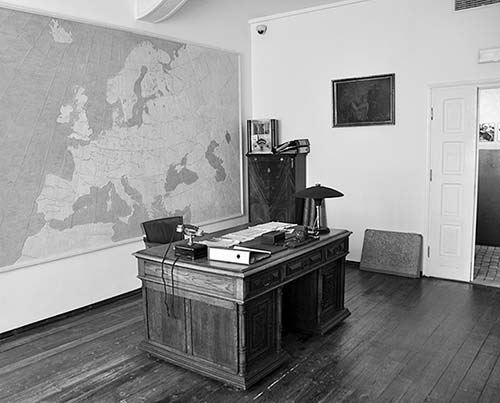
Continue into the office of Schindler’s secretary, with exhibits about Schindler’s life and video touchscreens that play testimonial footage of Schindler’s grateful employees. Then proceed into the actual Schindler’s office. The big map (with German names for cities) was uncovered when the factory was being restored. Because Schindler’s short tenure here was the only time in the factory’s history that these Polish place names would appear in German, it’s believed that this map was hung over his desk. Facing the map is a giant monument of enamel pots and pans, like those that were made in this factory. There are 1,200 pots—one for each Jewish worker that Schindler saved. Inside the monument, the walls are lined with the names on Schindler’s famous list. The creaky floorboards are intentional: a reminder that the Nazis knew every step you took.
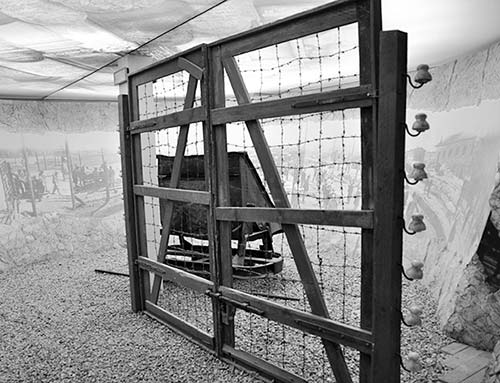
Proceeding through the exhibit, you’ll learn more about everyday life—both for ghetto dwellers and for everyday non-Jewish Krakovians, including the Polish resistance (see the Home Army’s underground print shop). More eyewitness accounts relate the terrifying days of March 13 and 14, 1943, when the Podgórze ghetto was liquidated, sending survivors to the nearby Płaszów Concentration Camp. The replica of the Płaszów quarry, where inmates were forced to work in unimaginably difficult conditions, provides a poignant memorial for those who weren’t fortunate enough to wind up on Schindler’s list.
Now head all the way back down to the ground floor.
Ground Floor: Exhibits here capture the uncertain days near the end of the war in the summer of 1944, when Nazis arrested between 6,000 and 8,000 suspected saboteurs after the Warsaw Uprising and sent them to Płaszów (see the replica of a basement hideout for 10 Jews who had escaped the ghetto); and later, when many Nazis had fled Kraków, leaving residents to await the Soviet Union’s Red Army (see the replica air-raid shelters). The Red Army arrived here on January 18, 1945—at long last, the five years, four months, and twelve days of Nazi rule were over. The Soviets caused their own share of damage to the city before beginning a whole new occupation that would last for generations...but that’s a different museum.
Finally, walk along the squishy floor—evoking how life for anyone was unstable and unpredictable during the Nazi occupation—into the Hall of Choices. The six rotating pillars tell the stories of people who chose to act—or not to act—when they witnessed atrocities. Think about the ramifications of the choices they made...and what you would have done in their shoes. The final room holds two books: a white book listing those who tried to help, and a black book listing Nazi collaborators. Exiting the museum, notice the portraits of Oskar Schindler’s workers who lived long and happy lives after the war.
Nearby: Before heading back to downtown Kraków, consider paying a visit to the superb Museum of Contemporary Art in Kraków (Muzeum Sztuki Współczesnej w Krakowie)—or MOCAK for short—that fills the warehouse buildings once occupied by Schindler’s workers, behind this main building (closed Mon, www.mocak.pl). Or, for a glass of wine, head just a few doors down from the museum to find the delightful Krakó Slow Wines (marked Lipowa 6F). This mellow, inviting wine bar and shop is well stocked with wines mostly from Central Europe (daily, +48 669 225 222.
John Paul II Pilgrimage Sights
Catholics coming to Kraków eager to walk in the footsteps of St. John Paul II appreciate the city’s dazzling churches and its Archdiocesan Museum. And for most, that’s enough. But true pilgrims head for worthwhile sights outside the city center: two sanctuaries related to John Paul II on the outskirts of Kraków and the St. John Paul II Family Home Museum in the town of Wadowice, an hour’s drive away.
Sanctuaries in Kraków
The two biggest, most impressive JPII destinations are about four miles south of Kraków’s Old Town, in the Łagiewniki neighborhood. While the main attraction here for pilgrims is the John Paul II Sanctuary, historically and geographically you’ll come first to the Divine Mercy Sanctuary—so I’ve covered that first. The sights aren’t worth the trek for the merely curious, but they offer a glimpse of the deep faith that characterizes the Polish people.
Getting There: A taxi or Uber from downtown takes 20-30 minutes and makes things easy. By public transit, you can take tram #8 from Plac Wszystkich Świętych in the Old Town (next to St. Francis Basilica) or tram #10 from the Poczta Główna stop, along the Planty at the eastern edge of the Old Town; on either tram, ride about 20 minutes and get off at the Łagiewniki SKA stop. From there, take the pedestrian underpass, turn right, cross the train tracks, and huff a few minutes uphill along the wall to find the entrance to the complex. (You can see the glass steeple of the church from the tram stop—a handy visual landmark.)
After touring the Divine Mercy sights, you’ll head to the St. John Paul II Sanctuary—a 15-minute walk or a short, inexpensive taxi or Uber trip. To go directly to the John Paul II Sanctuary from the Old Town, take tram #10 and ride it all the way to the Sanktuarium Bożego Miłosierdzia stop.
Divine Mercy Sanctuary (Sanktuarium Bożego Miłosierdzia)
This complex, built around a humble red-brick convent, honors the early 20th-century St. Faustina, who saw a miraculous vision of Jesus that became a powerful religious symbol for many Catholics. Today, pilgrims from around the world revere the relics both of Faustina and of John Paul II (who advocated for her sainthood), and learn more about her story from the convent’s present-day sisters—many of whom speak English.
Background: One cold and blustery evening in 1931, Sister Faustina Kowalska (1905-1938) answered the convent doorbell to find a beggar asking for some food. Faustina brought some soup to the man, who revealed his true nature: a figure of Jesus Christ clad in a white robe, with one hand raised in blessing and the other touching his chest. Emanating from his chest were twin beams of light: red (representing blood, the life of souls) and white (water, which through baptism washes souls righteously clean). Transformed by her experience, Faustina worked with an artist to create a painted version of the image—called the Divine Mercy—which is one of the most important symbols of Polish Catholicism.
Always frail in health, Faustina died at 33—the same age as Jesus. The story of Faustina deeply moved a young Karol Wojtyła. When he became pope, he dedicated the first Sunday after Easter as the day of Divine Mercy worldwide. In 2000, he made his fellow Krakovian the first Catholic saint of the third millennium. To properly revere the newly important St. Faustina, a futuristic church and visitors center was built alongside her original convent.
Cost and Hours: All parts of the complex are free to enter, but donations are happily accepted. Each part has slightly different hours (listed later; www.faustyna.pl). Note that the daily 15:00 “Hour of Mercy” service—in both the chapel and the modern church—is worth planning around.
Visiting the Complex: Entering the complex through the side gate, look uphill to find a walkway with flags from around the world and plaques translating the Divine Mercy’s message—“Jesus, I trust in you”—in dozens of languages.
Just before entering the original chapel, look up and to the right—the window with the flowers marks the cell where Faustina died. Inside the chapel (daily 6:00-21:15), the altar to the left of the main altar displays an early copy of Faustina’s Divine Mercy painting. Her relics are in the white case just below; in the white kneeler just in front of the chapel, notice the little reliquary holding one of her bones (which worshippers can embrace as they pray).
Leaving the chapel, turn left and go to the far end of the accommodations building. Enter the door on the right to find the replica of Faustina’s cell. While this is a newer building, here they’ve created Faustina’s convent cell, including many of her personal effects. Drop a coin in the slot for an evocative headphone description of these items, and of the vision of Jesus that put her convent on the map (usually open daily 8:30-18:00).
From here, head downhill and circle around the large brick building—passing (on the right) an area for outdoor Mass.
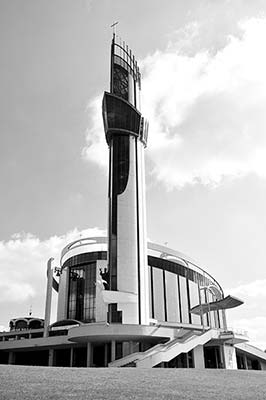
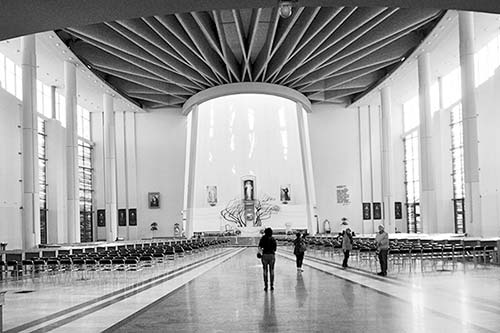
Dominating the campus is the futuristic, glass-and-steel main church, which was consecrated by Pope John Paul II on his final visit to Poland in 2002 (daily 7:00-20:00). The lower level has a variety of small chapels, each one donated by Catholic worshippers in a different country (Germany, Hungary, Slovakia, and so on)—and each with a dramatically different style. The central chapel on this level has a modern altar and another bone of St. Faustina. Upstairs, the main sanctuary is a sleek cylindrical space with wooden sunbeams sharply radiating from the altar area. That altar—framed by the gnarled limbs of windblown trees, representing the suffering of human existence—contains a replica of the Divine Mercy painting, flanked by the woman who saw the vision (Faustina, on the right) and the Polish pope who made it a worldwide phenomenon (John Paul II, on the left).
Head back out to the terrace surrounding the church. The bold tower—as tall as St. Mary’s on Main Market Square—has an elevator to a glassed-in viewpoint offering panoramas over the Divine Mercy campus, the adjacent John Paul II Sanctuary complex, and—on the distant horizon—the spires of Wawel Cathedral and Kraków’s Old Town (daily 8:00-19:00). Near the base of the tower is a canopy where Mass is said on Divine Mercy Sunday each year, before a crowd of 100,000 who fill the fields below.
Connecting to the St. John Paul II Sanctuary: You can see the rectangular, brick tower of the JPII Sanctuary from the Divine Mercy Sanctuary; it’s about a 15-minute walk through the park (downhill, then uphill). Alternatively, you can make a short, inexpensive trip in a taxi (see if any are waiting at the parking lot in front of the sanctuary’s hotel—the boxy, white building; otherwise, ask the receptionist to call one, or order an Uber).
St. John Paul II the Great Sanctuary (Sanktuarium Św. Jana Pawła II Wielkiego)
This complex, funded entirely by private donors, celebrates the life and sainthood of Kraków’s favorite son. A visit has two parts: the giant sanctuary (church) and the nearby museum.
Cost and Hours: Sanctuary—free, daily 7:30-19:00, until 18:00 in winter, www.sanktuariumjp2.pl; museum—15 zł, daily 9:00-17:00.
Sanctuary of St. John Paul II the Great: This hypermodern church is big and splendid. In the downstairs area, the central chapel features paintings of JPII’s papal visits to various pilgrimage sites, both in Poland (Częstochowa) and abroad (Fátima, Lourdes). Ringing that central area is a variety of interesting smaller chapels.
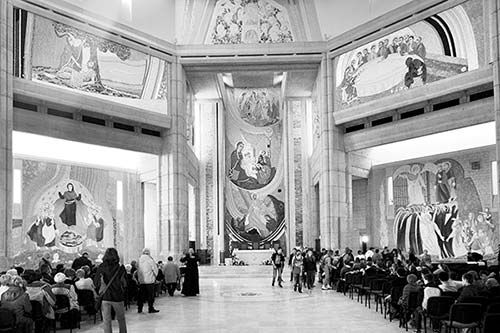
On the outer wall, look for three in particular: The Kaplica Kapłańska is a replica of the St. Leonard’s Crypt under Wawel Cathedral—where a young priest named Karol Wojtyła celebrated his first Mass. In this chapel, you’ll see JPII’s empty papal tomb from the crypt beneath St. Peter’s Basilica at the Vatican. (When he became a saint, his remains—which, controversially, are kept in Rome rather than his homeland—were moved up into the main part of the church in Rome, and a simple grave marker was donated to the church here.) You’ll also see a reliquary in the shape of a book with fluttering pages, holding a small amount of John Paul II’s blood (for the story of the book, see here). This blood was kept in secret by JPII’s personal secretary, only revealed after his death, when it was divvied up among a select few churches. Nearby, another chapel holds the tombs of a few recent cardinals; as they’re running out of space below Wawel Cathedral, this chapel is poised to handle the overflow. And the Kaplica Św. Kingi features finely executed reliefs in rock salt, in the style of Wieliczka Salt Mine.
Head upstairs to the sleek, modern main sanctuary. The concrete structure supports large walls, providing a canvas for dynamic mosaics of Bible stories. Above the main altar, in the middle, you’ll see the Three Kings delivering their gifts to the Baby Jesus and the Virgin Mary—with St. John Paul II serenely overlooking the scene. Other scenes include Adam and Eve, Jesus calming the storm, the wedding feast at Cana, and the Last Supper. In the back-left corner, a smaller chapel displays the blood-spattered vestments that St. John Paul II was wearing on May 13, 1981, when he was shot by a would-be assassin.
The sanctuary anchors a sprawling complex of conference facilities and other attractions for pilgrims. Poke around. The museum, described next (and on the right as you exit the sanctuary’s main door), is the sight most worth visiting.
St. John Paul II Museum: This collects many of the gifts bestowed on the beloved pope (African carved masks and ivory tusks; Latin American tapestries; the key to the city of Long Branch, New Jersey; a pair of glass doves of peace given to him—perhaps with a touch of irony—by US vice president Dick Cheney), ornate worship aids (chalices, crosses, and so on), and modern art that celebrates the modern pope and his life’s work. There are also personal items, from his papal ski and hiking gear to the place settings from his Vatican dinner table to his stylish red leather shoes. You’ll also see the throne from his last visit to Poland in 2002, and a replica of the humble room across the street from St. Francis Basilica where he stayed on visits back to his homeland.
Returning to Kraków: Taxis may be waiting at the sanctuary; otherwise, you can ask the museum desk to call one for you (or order an Uber). Or, you can walk downhill through the park to find the Sanktuarium Bożego Miłosierdzia stop; tram #10 goes back to the Old Town.
Wadowice—St. John Paul II’s Hometown
Karol Wojtyła was born and lived until age 18 in Wadowice (VAH-doh-veet-seh, pop. 20,000), about 30 miles southwest of Kraków. This working-class town, known for its woodworkers and factories, seems an unassuming place to have produced such a globally influential figure. And today, it’s a place of pilgrimage for admirers of the man young “Lolek” would become.
Getting There: Wadowice is about an hour’s drive from Kraków. As it’s roughly in the same direction as Auschwitz, a local guide or driver can help you connect both places for one very busy day of contrasts—though you’ll want to time things carefully. (If using public transit, doing both is not realistic.) Buses run frequently from Kraków to Wadowice’s train station (about 1.25 hours one-way, departs every 20 minutes); from there, you can walk about 10 minutes to the main square and museum.
Visiting Wadowice: The town of Wadowice has a beautifully restored main market square (Plac Jana Pawła II). Information panels around the square tell the story of the local boy done very, very good, and plaques in the cobbles list the cities and countries John Paul II visited. At the top of the square (opposite the church), the green cukiernia (pastry shop) sells the local cream cake, kremówki, which the pope raved about—having a slice is practically obligatory on a visit to Wadowice.
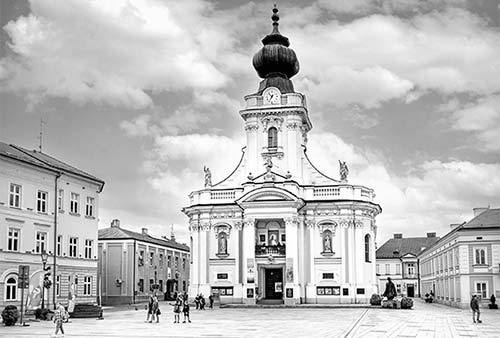
The square is dominated by the pretty Baroque steeple of the home church of young Karol Wojtyła (officially the Basilica of the Presentation of the Blessed Virgin Mary). Today, a larger-than-life statue of John Paul II stands outside that church, whose outer walls are plastered with plaques, photos, and information boards about the saint. Inside the church, in the chapel left of the main altar, you can see the font where he was baptized (a photo of him visiting the font as pope hangs on the wall nearby). He also took his First Communion and served as an altar boy here.
Immediately to the right of the church, across a narrow lane, stands the house where Karol Wojtyła was born and grew up—now an impressive museum.
▲▲St. John Paul II Family Home Museum
This thoughtfully presented multimedia museum tells the story of Karol Wojtyła, his journey to the papacy, and his legacy. It fills four floors of the tenement building where his family lived through his adolescence. Worth ▲▲▲ for the faithful, it’s engaging and informative to anyone—though detractors will note the complete omission of any criticism. The museum is essentially an exercise in lionizing a giant historical figure, and that it does very well; it’s a well-executed combination of important artifacts and stirring storytelling.
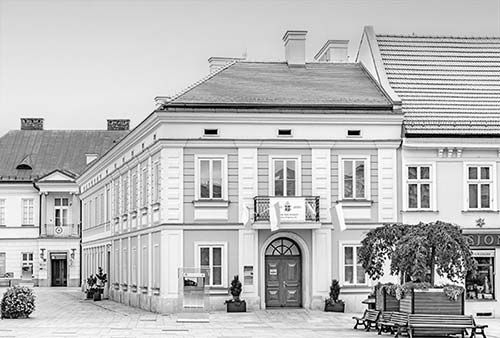
Cost and Hours: 39 zł includes audioguide, free on Tue; April-Oct Wed-Mon 9:00-18:00, Tue from 12:00, Nov-March until 16:00, May-Sept open until 19:00 Fri-Sun, closed last Tue of month year-round; last entry 1.25 hours before closing; on the main square next to the town church at Ulica Kościelna 7, +48 33 823 2662, https://domjp2.pl). Be sure to book ahead online to visit on Tuesdays, when the museum is free and very busy.
Tours: You can see the museum on your own (with an audioguide) or join a guided tour. If you already know the story of John Paul II, you may prefer to see it on your own to linger over the riveting exhibits—which offer lots to unpack—at your own pace. A tour is handy for those looking for an efficient introduction (or a refresher) on his life story. English tours run irregularly—check and book ahead on the website.
Visiting the Museum: You’ll begin with a wall of photographs featuring Karol Wojtyła’s parents and his youth—back when he was known as Lolek. The apartment in this tenement building was above a Jewish-run general store; that storefront has been re-created in the entryway. Inside is an homage to the approximately 20 percent of young Karol’s neighbors who were Jewish, many of whom died in the Holocaust. You’ll also see a hologram reconstruction of the town synagogue (destroyed by the Nazis) and footage of John Paul II’s historic visits to the Rome synagogue and the Wailing Wall in Jerusalem. (As pope, he was noted for his ecumenism—which the museum credits partly to his many Jewish friends and neighbors here in Wadowice.)
Next, you’ll learn of Karol’s deep spiritual ties to the nearby village of Kalwaria Zebrzydowska, which he visited more than 100 times. And you’ll see the skis and hiking gear he used to explore the nearby hills.
Upstairs is the three-room apartment where Karol’s family lived. Most of the furniture is from the period, but not actually the family’s; a few exceptions are in glass cases. You’ll see the parlor; the bedroom, where Karol was born and which he later shared with his father (see the two single beds); and the kitchen. The kitchen table looks out at a sundial on the side of the adjacent church. The motto Karol saw there every day—“Time flies; eternity dwells”—became one of his mantras. Perhaps this soulfulness at such a young age was inspired by the many losses in his life: He lost his mother at age 9, his brother at age 12, and his father at age 20.
Then you’ll step into the museum proper. The large red room covers the 40 years Karol Wojtyła spent in Kraków—from his time as a student, and then as a priest, archbishop, and cardinal, until he was called to the papacy. These stages are represented by the various robes, actually worn by him, displayed here.
Next, the replica of St. Peter’s boat marks his transition to the papacy. You’ll see a room about the attempt on his life in 1981 (the actual handgun used is in a glass case in the floor); a hall commemorating his eight pilgrimages home to Poland (the first three while it was still controlled by the communists); a rotunda with a replica of the Jubilee Doors at St. Peter’s Basilica in Rome, under a dome supported by giant illustrated versions of his encyclicals; and a room documenting the staggering 129 countries Pope John Paul II visited during his 104 pilgrimages. In the floor, transparent boxes hold soil from many of these countries (commemorating the pope’s tradition of kissing the ground in each place), and a nearby display case shows off some unusual mementos from those travels: an embroidery with the Lord’s Prayer in Inuit, a Congolese statue of Jesus with strongly African features, a Marvel comic book about the life of John Paul II, and a Burger King-branded cardboard periscope for catching a glimpse of the Popemobile over the crowds.
Use the elevator to descend to the basement and continue the visit. You’ll see the kayak he took on camping trips with his students in the 1970s, and a room dedicated to the World Youth Days he was instrumental in creating. (Conspicuously absent is any mention of John Paul II’s inaction when it came to protecting children who were molested by priests on his watch.)
The exhibit ends with the final days of John Paul II’s earthly life; you’ll see his bedside clock, stopped at the hour of his death, and a Bible displaying the final words he heard (as a nun was reading to him when he died). The red hall features a backup copy of the book of his funeral Mass, which famously flipped closed in the wind; and actual red robes worn by attendees. Then, the white room commemorates his sainthood—with an illustration of St. John Paul II surrounded by some of the many people he himself had sainted as pope; and walls of letters left behind by visitors to Rome around the time of his funeral, asking for his intercession.
Rounding out the museum are some temporary exhibits. You’ll return onto the square where young Karol Wojtyła spent his childhood. Now...time for some cream cake. Lolek would have wanted it that way.
Sights Outside Kraków
The following sights—an impressive salt mine, a purpose-built communist town, and an unusual earthwork—require a bus, tram, or train ride to reach. Also near Kraków are the St. John Paul II Family Home Museum in Wadowice (described above) and the poignant memorial at Auschwitz-Birkenau Concentration Camp (covered in the next chapter).
▲▲Wieliczka Salt Mine (Kopalnia Soli Wieliczka)
Wieliczka (veel-EECH-kah), a salt mine southeast of Kraków, is beloved by Poles. Hundreds of feet beneath the ground, the mine is filled with sculptures that miners have lovingly carved out of the salt. You’ll explore this unique gallery—learning both about the art and about medieval mining techniques—on a required tour. Though the sight is a bit overrated, it’s unique and practically obligatory if you’re in Kraków for a few days. In my experience, about half of those who visit love Wieliczka, while half feel it’s a waste of time—but it can be hard to predict which half you’re in. Read this description before you decide. And expect a lot of walking.
Cost and Hours: The standard “Tourist Route” costs 126 zł and is by guided tour only. English-language tours leave at the top of each hour, daily 8:00-18:00 (these are first and last tour times), with shorter hours off-season. More in-depth routes (such as the interactive “Miners’ Route,” where visitors wear coveralls and helmets and operate some of the old equipment) are explained on the website.
Information: The mine is in the town of Wieliczka at Ulica Daniłowicza 10 (+48 12 278 7302, www.kopalnia.pl).
Crowd-Beating Tips: This popular sight can be packed, and there’s a strict limit on how many people can be in the mine at once. It’s busiest between 10:00 and 16:00—try to arrive before or after those times (the ticket office opens at 7:30; since the last English tour leaves at 18:00 in summer, arriving in the afternoon can be a good way to stretch your sightseeing day). It’s most crowded on weekends and in the summer and overrun on long holiday weekends. Given the possibility of selling out, it’s smart to book an entry time on the website in advance (no extra charge).
Getting There: The salt mine is 10 miles from Kraków. By far the easiest option is to hop on train SKA1 at Kraków’s main train station (2/hour, 7 zł, 25 minutes, get off at Wieliczka Rynek-Kopalnia; from there, walk up through the parking lot and follow signs to the Daniłowicza shaft and entrance, about 5 minutes). In a pinch, you can take bus #304 (at the Dworzec Główny Zachód stop, on Ogrodowa street, at the opposite side of Galeria Krakowska mall from the train station); while these depart frequently, they take longer (about 40 minutes) and are subject to traffic delays. Private drivers also make this trip (see here).
Visitor Information: While taking pictures is allowed, flash photos often don’t turn out, thanks to the irregular reflection of the salt crystals. Dress warmly—the mine is a constant 57 degrees Fahrenheit. Before entering, you’ll have to check large bags.
Eating: There’s a good little $ cafeteria deep down in the mine, at the end of the tour route. Up at the surface is a wide range of eateries, from snack stands to sit-down restaurants.
Background: Going all the way back to Neolithic times, prehistoric tribes gathered salt from springs in this area. In the 1280s, Wieliczka Salt Mine began producing salt in earnest. Under Kazimierz the Great, one-third of Poland’s income came from these precious deposits—back in an age when salt was called “white gold” and was extremely valuable for its ability to preserve foods. (The Romans even paid workers in salt—salarium, the origin of our word “salary.”) The mines were so important that Kazimierz the Great enacted laws protecting the miners—the first known instance of worker-protection laws in Europe. Wieliczka was controlled by the Polish crown and, after the Partitions, by the Austro-Hungarian Empire (which outfitted miners with military-style uniforms). During this time, around the Industrial Revolution (and under efficient Austrian management), the mine hit peak productivity.
Wieliczka miners spent much of their lives underground, leaving for work before daybreak and returning after sundown, rarely emerging into daylight. To pass the time, beginning in the 17th century, miners carved figures, chandeliers, and even entire underground chapels out of the salt. For many modern visitors, these carvings are the most memorable part of Wieliczka.
Until just a few years ago, the mine still produced salt. Today’s miners—about 400 of them—primarily work on maintaining the 200 miles of chambers. This entire network is supported by pine beams—over time, the salt strengthens the wood (some you’ll see are more than 200 years old), whereas metal would rust. Per tradition, the wood beams are painted white to reflect the dim light of the miners’ oil lamps. Today, visitors see only about 1.5 percent of the sprawling mines. (You would not want to visit the original medieval mines, which have tunnels only about three feet tall.)
Visiting the Mine: For the main tour (“Tourist Route”), head for the Daniłowicz shaft, and buy your ticket if you haven’t already. At the appointed time, find the English tour area to wait for your guide, who leads you 380 steps down a winding staircase. If you’ve always wanted to experience true vertigo, peer between the banisters on your way down. Once at level 1, you begin a 1.5-mile stroll, generally downhill (more than 800 steps down altogether), past 20 of the mine’s 2,000 chambers (with signs explaining when they were dug), finishing 443 feet below the surface (at level 3). When you’re done, an elevator beams you back up.
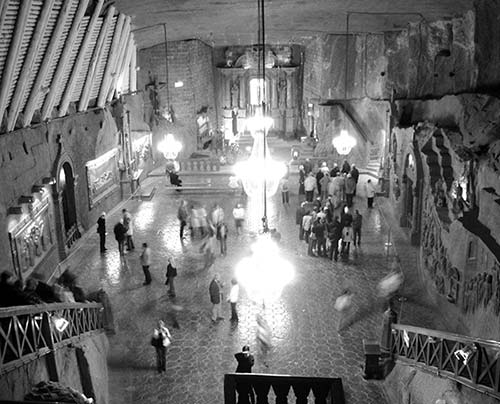
As you spelunk, your guide offers a canned commentary about the history of the mines. You’ll learn how the miners lived and worked, using horses who spent their entire adult lives without ever seeing the light of day. You’ll see the gigantic horse-pulled wheels used to operate lifts within the mines and find out why igniting pockets of methane gas near the ceiling was the most dangerous part of the job (the mortality rate for miners was about 1 in 10). All along the way, you’ll walk through tunnels caved out of the rock salt; although it can be dark in color (mixed with other minerals such as sandstone and gypsum), it’s about 90 percent pure salt. To transport the salt out of the mine, the miners would either carve it into big blocks or crush it and pour it into barrels.
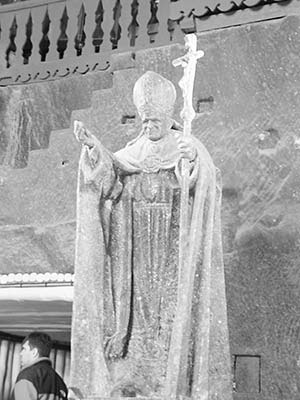
The tour takes you through vast underground caverns, past subterranean lakes (32 percent salt—like the Black Sea, the maximum allowed by nature), and introduces you to some of the mine’s many sculptures. You’ll see Copernicus (who actually visited here in the 15th century), an army of salt elves, the Polish military hero Józef Piłsudski, and this region’s favorite son, St. John Paul II.
Expect to be wowed by the enormous Chapel of St. Kinga, carved over three decades in the early 20th century. Look for the salt-relief carving of the Last Supper (its 3-D details are astonishing, considering it’s just six inches deep). The chapel is still used for services every Sunday morning at 7:30.
From there, you’ll see a few more chambers, including one with a big lake and a brief sound-and-light show. Your tour finishes in a deep-down shopping zone about 1.5 hours after you started. From here you can decide whether to return to the surface or add on the Mine Museum.
Returning to the Surface: You’ll loop around through a handy cafeteria, then take an old-school elevator through the Daniłowicz shaft, back up to where you began. (If it’s extremely busy, they may send you up the modern Regis shaft, which pops you out closer to the town center of Wieliczka—about a 10-minute walk through a pretty park back to the entrance building.)
Optional Add-On—Mine Museum: If you’re not pooped, you can tack on a visit to the museum (included in your ticket)—which adds about an hour and a mile more walking. While overkill for most, the museum provides a bit more historical context. A guide will take you through the exhibits, showing you the fancy Habsburg-era miner uniforms; historic maps and etchings of the networks of mines, and cutaway scenes of life below the surface; tools and mining equipment (including a variety of Aladdin-style oil lamps, and huge slings used to lower horses into the mines); a photo gallery of famous visitors, including kings, queens, popes, presidents, and Lech Wałęsa; and a remarkably detailed model of the town of Wieliczka circa 1645.
Nearby: Near the parking lot, you’ll see the “Graduation Tower,” a modern fort-like structure with a wooden walkway up top. The tower is designed to evaporate and then condense the supposedly very healthy brine from deep underground. The resulting moist, salty air is used to treat patients with lung problems. While locals are prescribed visits here, for most tourists it’s not worth the extra money.
▲Nowa Huta
Nowa Huta (NOH-vah HOO-tah, “New Steel Works”), an enormous planned workers’ town five miles east of central Kraków, offers a glimpse into the stark, grand-scale aesthetics of the communists. Although challenging to appreciate on your own, it’s particularly well suited to a guided tour (options noted below). While Nowa Huta is lost on many visitors, it’s a must for those curious for a look at large-scale artifacts of the communist period.
Getting There: Tram #4 goes from near Kraków’s Old Town (catch the tram on the ring road near Kraków’s main train station, at the Dworzec Główny stop) along John Paul II Avenue (Aleja Jana Pawła II) to Nowa Huta’s main square, Plac Centralny (about 30 minutes total), then continues a few minutes farther to the main gate of the Tadeusz Sendzimir Steelworks—the end of the line. From there, it returns to Plac Centralny and back to Kraków.
Tours: For a thoughtful look at Nowa Huta, book with Kraków Urban Tours (see here). Or, for something looser and more off-the-wall, consider Mike Ostrowski’s Crazy Guides, which offers private tours to Nowa Huta in genuine communist-era vehicles (mostly Trabants and Polski Fiats) with a laid-back hipster guide (€110/2 people for a 1.5-hour tour by car; €155/2 people for 2.5-hour version that adds a walking tour; see www.crazyguides.com for other options and to book, +48 500 091 200). If you’re already hiring a local guide or private driver in Kraków, consider paying a little extra to add a quick spin through Nowa Huta.
Background: Nowa Huta was the communists’ idea of paradise. It’s one of only three towns outside the Soviet Union that were custom-built to showcase socialist ideals. (The others are Dunaújváros—once called Sztálinváros—south of Budapest, Hungary; and Eisenhüttenstadt—once called Stalinstadt—near Brandenburg, Germany.) Completed in just 10 years (1949-1959), Nowa Huta was built here primarily because the Soviets felt that smart and sassy Kraków needed a taste of heavy industry. Farmers and villagers were imported to live and work in Nowa Huta. Many new residents, who weren’t accustomed to city living, brought along their livestock (which grazed in the fields around unfinished buildings).
For commies, Nowa Huta was idyllic: Dad would cheerily ride the tram into the steel factory, mom would dutifully keep house, and the kids could splash around at the artificial beach and learn how to cut perfect red stars out of construction paper. But Krakovians had the last laugh: Nowa Huta, along with Lech Wałęsa’s shipyard in Gdańsk, was one of the home bases of the Solidarity strikes that eventually brought down the regime. Now, with the communists long gone, Nowa Huta remains a major suburb of Poland’s cultural capital, with a whopping 200,000 residents.
Touring Nowa Huta: Nowa Huta’s focal point used to be known simply as Central Square (Plac Centralny), but in a fit of poetic justice, it was later renamed for the anticommunist crusader, Ronald Reagan.
A map of Nowa Huta looks like a clamshell: a semicircular design radiating from Central/Reagan Square. Numbered streets fan out like spokes on a wheel, and trams zip workers directly to the immense factory.
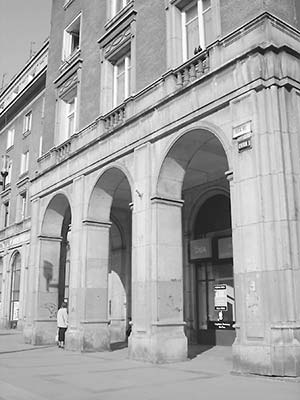
Nowa Huta’s designers found inspiration in a surprising source: the Italian Renaissance (which, thanks to the textbook Renaissance design of the Cloth Hall and other landmarks, Soviet architects considered typically Polish). Notice the elegantly predictable arches and galleries that would make Michelangelo proud. The settlement was loosely planned on the gardens of Versailles (both with axes radiating from a central hub).
Nowa Huta was delightfully orderly, primly painted, impeccably maintained, and downright beautiful...if a little boring. It was practical, too: Each of the huge apartment blocks is a self-contained unit, with its own grassy inner courtyard, school, and shops. Each is labeled with Os. (meaning “section”), plus a name and a number. Driveways, which appear to dead-end at underground garage doors, lead to vast fallout shelters.
Wander around. Poke into the courtyards, which often are filled with green parks, cheerful playgrounds, and ventilation for the fallout shelters beneath. The enclosed architecture makes you feel safe...but also monitored.
Reflect on what it would be like to live here. It may have been more pleasant than you imagine; the looming buildings are packed with happy little apartments filled with color, light, and warmth. These days, Nowa Huta is a very desirable place to live, partly because everything is smartly designed to be close at hand and easily connected to the city center by public transit—precisely what today’s urban planners aspire to.
For those interested to learn more, Museum of Kraków operates a Nowa Huta Museum (Muzeum Nowej Huty) along the main road south of Central/Reagan Square (closed Mon-Tue, Os. Centrum E 1, www.muzeumkrakowa.pl).
The wide boulevard running northeast of Central/Reagan Square, now called Solidarity Avenue (Aleja Solidarności, lined with tracks for tram #4), leads to the Tadeusz Sendzimir Steelworks. Originally named for Lenin, this factory was supposedly built using plans stolen from a Pittsburgh plant. It was designed to be a cog in the communist machine—reliant on iron ore from Ukraine and therefore worthless unless Poland remained in the Soviet Bloc. Down from as many as 40,000 workers at its peak, the steelworks now employs about 10,000. Today, there’s little to see other than the big sign, stern administration buildings, and smokestacks in the distance. Examine the twin offices flanking the sign—topped with turrets and a decorative frieze inspired by Italian palazzos, these continue the Renaissance theme of the housing districts.
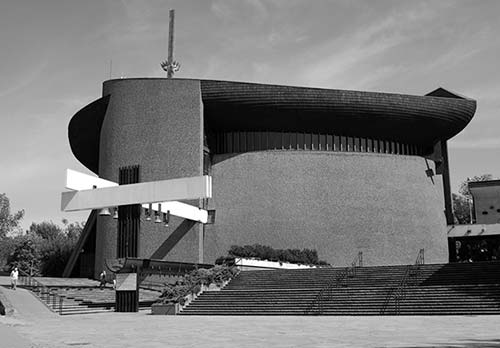
Another worthwhile sight in Nowa Huta is the Lord’s Ark Church (Arka Pana, several blocks northwest of Central/Reagan Square on Ulica Obrońców Krzyża). Back when he was archbishop of Kraków, Karol Wojtyła fought for years to build a church in this most communist of communist towns. When the regime refused, he insisted on conducting open-air Masses before crowds in fields, until the communists finally capitulated. No “official” building supplies were allowed to be used; all materials had to be sourced through back channels. Consecrated in 1977, the Lord’s Ark Church has a Le Corbusier–esque design that looks like a fat, exhausted Noah’s Ark resting on Mount Ararat—encouraging Poles to persevere through the deluge of communism. Inside, the giant crucifix depicts Christ in agony...while also, seemingly, about to take flight. The Carrara marble altar was donated by Italian Catholics.
Kościuszko Mound (Kopiec Kościuszki)
On a sunny day, the parklands west of the Old Town are a fine place to get out of the city and commune with Krakovians at play. On the outskirts of town is the Kościuszko Mound, a nearly perfectly conical hill erected in 1823 to honor Polish and American military hero Tadeusz Kościuszko. The mound incorporates soil that was brought here from battlefields where the famous general fought, both in Poland and in the American Revolution. Later, under Habsburg rule, a citadel with a chapel was built around the mound, which provided a fine lookout over this otherwise flat terrain. And more recently, the hill was reinforced with steel and cement to prevent it from eroding away. You’ll pay to enter the walls and walk to the top—up a curlicue path that makes the mound resemble a giant soft-serve cone—and inside you’ll find a modest Kościuszko museum. While not too exciting, this is a pleasant place for an excursion on a nice day.
Cost and Hours: 24 zł, includes museum, mound open daily 9:00-dusk, museum open daily 9:30-19:00—shorter hours off-season, café, +48 12 425 1116, www.kopieckosciuszki.pl.
Getting There: Ride tram #1 (from in front of the Wyspiański Pavilion or the main post office) to the end of the line, called Salwator. From here, you can either follow the well-marked path uphill for 20 minutes or hop on bus #100 to the top.
Shopping in Kraków
Two of the most popular Polish souvenirs—amber and pottery—come from areas far from Kraków. You won’t find any great bargains on those items here, but several shops specializing in them are listed below. Somewhat more local are the many wood carvings you’ll see.
The Cloth Hall, smack-dab in the center of the Main Market Square, is the most convenient place to pick up Polish souvenirs. It has a good selection at respectable prices (summer Mon-Fri 9:00-18:00, Sat-Sun until 15:00—but many stalls remain open later; winter Mon-Fri 9:00-16:00, Sat-Sun until 15:00).
Jewelry
The popular amber (bursztyn) you’ll see sold around town is found on northern Baltic shores; if you’re also heading to Gdańsk, wait until you get there (for more on amber, see here). One unique alternative that’s a bit more local is “striped flint” (krzemień pasiasty), a stratified stone that’s polished to a high shine. It’s mined in a very specific subregion near Kraków. Each piece has its own unique wavy, sandy patterns.
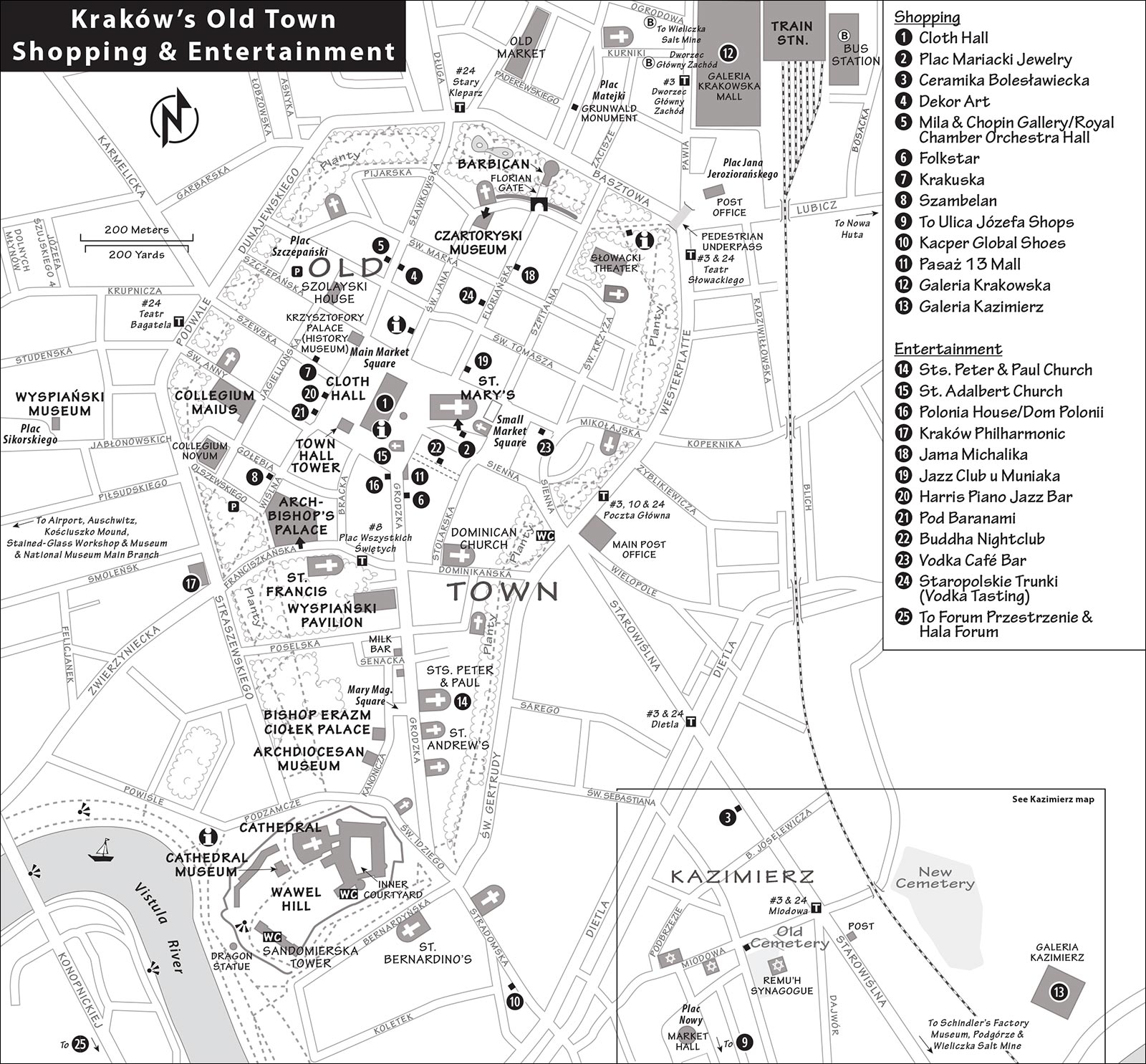
Jewelry shops abound in the Old Town. For a good selection of striped flint, amber, and other jewelry, try the no-name shop on Plac Mariacki, the little square facing the side entrance of St. Mary’s Church; they also have a selection of Polish folk costumes in the basement (at #9—look for Amber Souvenir in window). A few more jewelry and design shops cluster along Sławkowska street, which runs north from the Main Market Square.
Polish Pottery
“Polish pottery,” with distinctive blue-and-white designs, is made in the region of Silesia, west of Kraków (in and around the town of Bolesławiec). But assuming you won’t be going there, you can browse one of the shops in Kraków. Ceramika Bolesławiecka, on a busy urban street between the Old Town and Kazimierz, has a tasteful, affordable selection of pottery that’s oriented more toward locals than tourists (closed Sun, Starowiślna 43). In the Old Town—and with inflated prices to match—two places face each other across Sławkowska street, just a block north of the Square: Dekor Art at #11 and Mila at #14.
A Taste of Local Culture
While tacky souvenir shops abound in the streets near the Square, two locally run places sell mementos more closely tied to Polish culture. Folkstar, along Grodzka street just south of the Square, has all manner of products adorned with the exuberantly colorful floral folk patterns of the local countryside (daily, Grodzka 14). Krakuska, named for (and run by) female Krakovians, is a lovingly cluttered hole-in-the-wall with more folk items (daily, Szewska 9).
Szambelan, a block south of the Main Market Square, is a fun concept for vodka lovers: Peruse the giant casks of three dozen different flavored vodkas, buy an empty bottle, and they’ll fill and seal it to take home (daily, Gołębia 2 at the corner with Bracka).
Designer Shops along Ulica Józefa, in Kazimierz
As the epicenter of Kraków’s hipster scene, Kazimierz is the best place in town to browse one-off boutiques (both design and fashion). Several good options line up along Ulica Józefa, mostly concentrated along a two-block stretch. Head just one block south from Plac Nowy on Estery street, turn right, and survey the possibilities (mostly on the left side of the street). You’ll find jewelry boutiques, vintage ware, fascinating works by untrained artists, clothing and housewares from local designers, and much more.
Polish Leather Shoes
Kacper Global has a large outlet selling colorful, made-in-Poland shoes in styles from athletic to casual to stylish. They’re located in the area between Wawel Castle and Kazimierz—a handy add-on if you’re heading to either place (closed Sun, Stradomska 21, https://kacperglobal.pl).
Shopping Malls
A small but swanky mall called Pasaż 13 is a few steps off the southeast corner of the Main Market Square, where Grodzka street enters the square. Enter the mall under the balcony marked Pasaż 13. You’ll find a cool brick-industrial interior, with upscale international chains...and not much that’s Polish (daily).
Two enormous shopping malls lie just beyond the tourist zone. The gigantic Galeria Krakowska, with nearly 300 shops, shares a square with the train station (daily, kids’ play area upstairs from the main entry). Only slightly smaller is Galeria Kazimierz (daily, just a few blocks east of the Kazimierz sights, along the river at Podgórska 24).
Entertainment in Kraków
As a town full of both students and tourists, Kraków has plenty of fun options, especially at night.
IN THE OLD TOWN
For locations of the following places, see the “Kraków’s Old Town Shopping and Entertainment” map, earlier).
Main Market Square
Intoxicating as the Square is by day, it’s even better at night...pure enchantment. Have a meal or sip a drink at an outdoor café, or just grab a bench and enjoy the scene. There’s often live al fresco music coming from somewhere (either at restaurants, at a temporary stage set up near the Town Hall Tower, or from talented buskers). You could spend hours doing slow laps around the Square after dark and never run out of diversions. For a great view over the Square at twilight, nurse a drink at Café Szał—on the Cloth Hall’s upper terrace (long hours, enter through Gallery of 19th-Century Polish Art).
Concerts
You’ll find a wide range of musical events, from tourist-oriented Chopin concerts and classical “greatest hits” selections in quaint old ballrooms and churches, to folk-dancing shows, to serious philharmonic performances. The best all-around site for concert information is KrakowCulture.pl; also look for the hefty, free quarterly magazine Kraków Culture (at the TI). Other good listings can be found at CracowConcerts.com and Facebook.com/orkiestrasm. Hotel lobbies are stocked with fliers, but to get all of your options, visit the TI north of the Square on Ulica Św. Jana, which specializes in cultural events.
Popular Classical Concerts: The three main choices are organ concerts in churches (usually at 17:00), orchestral or chamber music, or Chopin (either can happen anytime between 18:00 and 20:00). The going rate for most concerts is around 60-70 zł. Many are held in churches (such as Sts. Peter and Paul on Ulica Grodzka and St. Adalbert on the Square). You’ll also find concerts in fancy mansions on or near the Main Market Square (including the Polonia House/Dom Polonii upstairs from Wierzynek restaurant at #14, near Ulica Grodzka; and the Chopin Gallery—also billed as the Royal Chamber Orchestra Hall—just up Sławkowska street from the Square at #14). Occasionally in summer, they’re held in various gardens around town.
Serious Concerts: The Kraków Philharmonic (Filharmonia im Krakowie) puts on concerts aimed at local music lovers rather than tourists—more serious than crowd-pleasing—in a 700-seat hall just west of the Planty (Zwierzyniecka 1, + 48 506 625 430, www.filharmonia.krakow.pl).
Folk Music: Various venues present a small, hardworking ensemble of colorfully costumed Krakovian singers, dancers, and musicians who put on a fun little folk show as you dine. While this is obviously a very touristy scene, it’s fun if you approach it with the right spirit—and the performers try hard to involve members of the audience in the polkas and circle dances. The Old Town lineup changes from year to year; start by checking at the historic Jama Michalika, with its dusty old Art Nouveau interior right along Floriańska street (150 zł includes dinner; Wed and Sat at 19:00; Floriańska 45, +48 12 422 1561, www.cracowconcerts.com). If you have a car, you can reach a more rustic venue 30 minutes outside the city: Skansen Smaków, filling a log cabin-like building, has shows each Thursday night (170 zł, book ahead, +48 12 357 1006, www.skansensmakow.pl).
Jazz
Kraków has a surprisingly thriving jazz scene. Several popular clubs hide on the streets surrounding the Main Market Square (open nightly, most shows start around 21:30, sometimes free or a cover of 20-30 zł for better shows). Jazz Club u Muniaka is the most famous and best for all-around jazz in a sophisticated cellar environment (Ulica Floriańska 3, +48 12 423 1205, www.jazzumuniaka.club). Harris Piano Jazz Bar, right on the Square (at #28), is more casual and offers a mix of traditional and updated “fusion” jazz, plus blues (+48 12 421 5741, www.harris.krakow.pl).
Nightlife in the Old Town
The entire Old Town is crammed with nightclubs and discos pumping loud music on weekends. On a Saturday, the pedestrian streets can be more crowded at midnight than at noon. Most of these nightspots are garden-variety dance clubs, lacking any personality or creativity. Worse, to save money, young locals stand out in front of nightclubs to drink their own booze (BYOB) rather than pay high prices for the drinks inside—making the streets that much more crowded and noisy. For low-key hanging out, people choose a café on the Square; otherwise, they head for Kazimierz, with a more interesting variety of nightspots.
That said, there are a few places right around the Square—in addition to the jazz options listed earlier—that are worth checking out.
First, at the southwest corner of the Square, go down the corridor with the Starbucks at #27, then find the staircase that descends to Pod Baranami (“Under the Rams”). This historic spot—once home to a subversive, counterculture cabaret show (and still hosting occasional performances)—feels like a mysterious speakeasy where well-dressed grown-ups meet to sip cocktails and relive their younger days. Cozy tables sprawl through several rooms (daily, +48 12 421 25 00, www.piwnicapodbaranami.pl).
Across the Square, on the east side (where it meets Grodzka street), are two more places worth checking out. At #6, head into the passage to find the Buddha nightclub, with comfy lounge sofas under awnings in an immaculately restored old courtyard. For something funkier and even more local, go down the passage at #19, which runs a surprisingly long distance through the block—passing a shot bar called Szototo. Soon you’ll start to see tables for the Herring Embassy; you’ll eventually emerge at Stolarska street, a still enjoyable but far less touristy scene (for more on the Herring Embassy and Stolarska, see here).
If you have (or would like to cultivate) an appreciation for vodka, stop by the Vodka Café Bar, serving more than 100 types of vodkas, liquors, and hard drinks. You can buy a tasting flight board with six small shots; they’ll help you narrow down your options. It’s a mellow, uncluttered space that lets you focus on the vodka and the company (daily from 15:00, weekends from 13:00, Mikołajska 5).
IN KAZIMIERZ
Aside from the Old Town’s gorgeous Square, Kraków’s best area to hang out after dark is Kazimierz. Although this is also the former Jewish quarter, the Jewish Sabbath has nothing to do with the bar scene here. You can, however, still hear traditional Jewish music called klezmer. For tips on enjoying a concert of klezmer music, see the sidebar.
Bars and Clubs
Squeezed between centuries-old synagogues and cemeteries are enticing hangouts running the full gamut from sober and tasteful to wild and clubby. The classic recipe for a Kazimierz bar: Find a dilapidated old storefront, fill it with ramshackle furniture, turn the lights down low, pipe in old-timey jazz music from the 1920s, and sprinkle with alcohol. Serves one to two dozen hipsters. After a few clubs of this type caught on, a more diverse cross-section of nightspots began to move in, including some loud dance clubs. The whole area is bursting with life. For locations, see the map on this page.
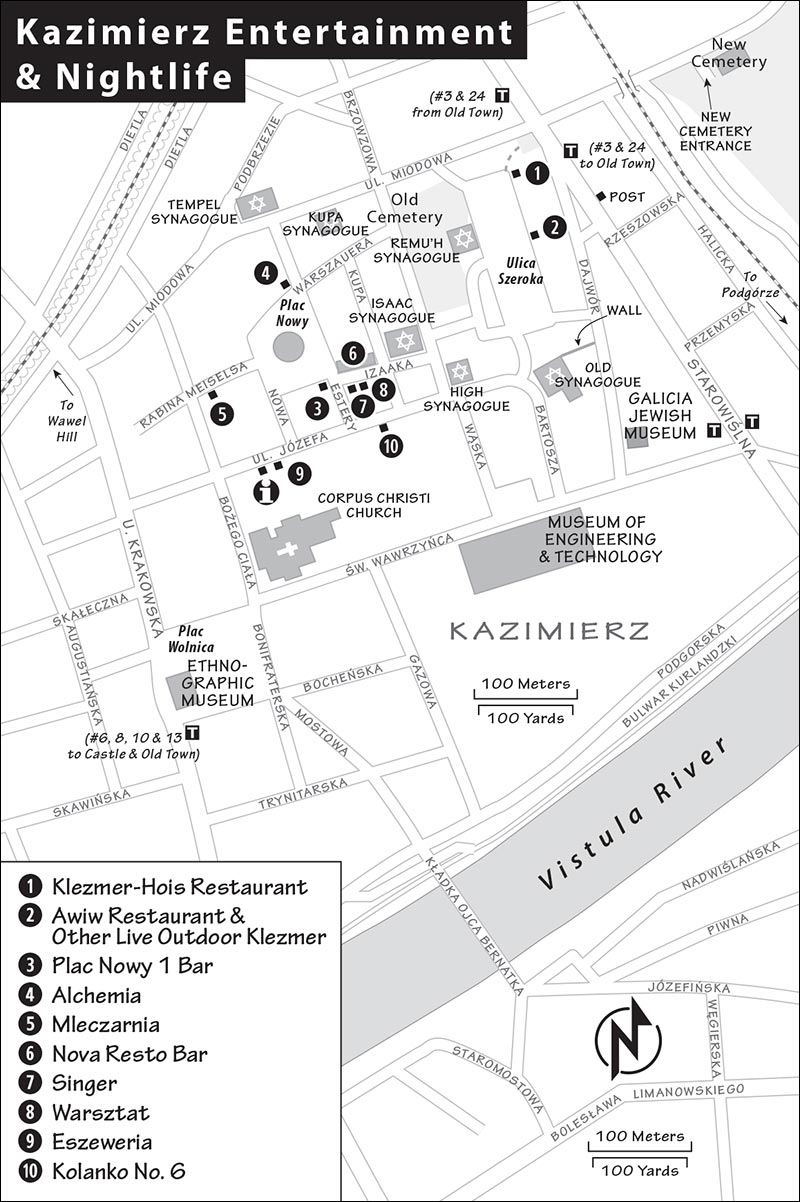
On and near Plac Nowy: The highest concentration of bars rings the Plac Nowy market square. Do a loop to browse your options. Plac Nowy 1 specializes in Polish microbrews and upmarket pub grub in a bright, sleek (and arguably “un-Kazimierz”) setting. Across the square, Alchemia, one of the first—and still one of the best—bars in Kazimierz, is candlelit, cluttered, and claustrophobic, with cavelike rooms crowded with rickety old furniture, plus a cellar used for live performances (Estery 5, www.alchemia.com.pl). Late at night, the little windows in the Plac Nowy market hall do a big business selling zapiekanki (baguette with toppings) to hungry bar-hoppers.
On Rabina Meiselsa street, just a half-block off Plac Nowy, under the arch to a characteristic courtyard is Mleczarnia, a beer garden with rickety tables squeezed under the trees and its cozy old-fashioned pub across the street (at #20).
Near Isaac Synagogue: A block east of Plac Nowy, a few more places cluster on the wide street in front of Isaac Synagogue. The huge Nova Resto Bar dominates the scene with a long covered terrace, a vast interior, and seating in their courtyard. This feels upscale and a bit pretentious compared to many of the others, but it’s the place to be seen (Estery 18, www.novarestobar.pl). Facing Nowa are some smaller, more accessible options: Singer is classy and mellow, with most of its tables made of old sewing machines (Estery 20), while Warsztat has an exploding-instruments-factory ambience (Izaaka 3, www.restauracjawarsztat.pl).
On Józefa Street: Yet more good bars are just a short block south. Along Józefa, you’ll find a pair of classic Kazimierz joints: Eszeweria, which wins the “best atmosphere” award, feels like a Polish speakeasy that’s been in mothballs for the last 90 years—a low-key, unpretentious, and inviting hangout (Józefa 9). A block up, Kolanko No. 6 has a cozy bar up front, a pleasant beer garden in the inner courtyard, and a fun events hall in back (Józefa 17, www.kolanko.net).
Beach Bar on the Riverbank
South of the river, roughly between Kazimierz and Wawel Castle, Forum Przestrzenie fills a dilapidated concrete hotel—a mostly abandoned dinosaur from communist times. But now the ground floor has been taken over by a lively hipster bar—especially appealing in the balmy summer months, when comfy low-slung chairs sprawl across a tidy lawn and a pebbly “beach” with views across the Vistula to Wawel Castle. They serve coffee, wine, beer, summery cocktails, and a wide variety of bar food. A few artists and designers also have boutiques here, and in the summer, they have live music and DJs (open daily in good weather until late, skip the trip if it’s not nice out, Ulica Marii Konopnickiej 28, +48 515 424 724, www.forumprzestrzenie.com). The enticing Hala Forum food hall is next door, and you may also see a Ferris wheel and/or a hot-air balloon ride nearby—making this lively scene easy to spot from afar.
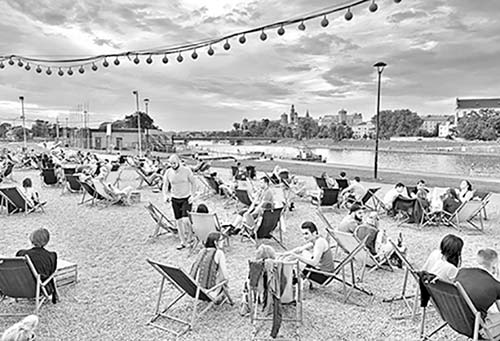
Sleeping in Kraków
Kraków has ample accommodation choices, and healthy competition keeps prices reasonable and makes choosing a hotel fun rather than frustrating. I’ve focused my accommodations in two areas: in and near the Old Town; and in Kazimierz, a hipper, more affordable neighborhood that’s home to both the old Jewish quarter and a thriving dining and nightlife zone.
Both neighborhoods can suffer from discos that thump loud music on weekend nights to attract roving gangs of rowdy drinkers. I’ve tried to avoid the areas most plagued by noise, but to help your odds, ask for a quiet room when you reserve...and bring earplugs.
IN AND NEAR THE OLD TOWN
Most of my listings are inside (or within a block or two of) the Planty park that rings the Old Town. Sleeping inside the Old Town comes with pros (maximum atmosphere; handy location for sightseeing and dining) and cons (high prices; the potential for noise—especially on weekends—as noted earlier). Places just outside the Old Town are still handy, but quieter and cheaper. If you need a room in a pinch, several slick, international chains (Ibis, Mercure, Puro) have branches near the train station.
$$$$ Hotel Copernicus is the top splurge inside Kraków’s Old Town, with 29 rooms in a historic shell on one of the finest, most serene streets in the historical center. The service is polished—verging on snobby—and the rooms are decorated with heavy beams, hand-painted frescoes, and antique furniture (air-con, elevator, Kanonicza 16, +48 12 424 3400, www.hotel.com.pl, copernicus@hotel.com.pl).
$$$ Donimirski Boutique Hotels are a reliably comfortable option that set the bar for quality and value (www.donimirski.com). All have friendly staff, discounts for my readers, and classy little extras that add up to a memorable hotel experience. Hotel Polski Pod Białym Orłem (“White Eagle”) has 60 classic rooms conveniently located near the Florian Gate just inside the Old Town walls (RS%, apartments available, air-con, elevator, Ulica Pijarska 17, +48 12 422 1144, hotel.polski@donimirski.com). Hotel Gródek offers 23 rooms a three-minute walk behind St. Mary’s Church, on a quiet dead-end street overlooking the Planty park (RS%, air-con, elevator, pay parking, Na Gródku 4, +48 12 431 9030, grodek@donimirski.com). They also have a six-room annex, Hotel Pugetów, that can be rented by a small group (Ulica Starowiślna 15A, pugetow@donimirski.com).
$$ Hotel Senacki is a business-class place renting 20 comfortable rooms between Wawel Castle and the Main Market Square. The staff is warm, professional, and conscientious, and the location is perfect, making this an ideal spot to stay. Top-floor “attic” rooms have low beams, skylight windows, and a flight of stairs after the elevator (air-con, elevator to all but the attic rooms, ask about nearby pay parking, Ulica Grodzka 51, +48 12 422 7686, www.hotelsenacki.pl, senacki@hotelsenacki.pl).
$$ Grand Ascot Hotel sits just beyond the end of the lively, pedestrianized Krupnicza dining drag—a pleasant walk away from the Old Town. With 63 business-class rooms over a plush lobby, it feels a bit posh yet reasonably priced (family rooms, air-con, elevator, sauna and fitness area, Józefa Szujskiego 4, +48 12 446 7600, www.grandascot.pl, rezerwacja@grandascot.pl).
$$ Hotel Wawel has 39 rooms on a well-located street that’s quieter than the Old Town norm. It’s colorful and serene; above the swanky marble lobby are hallways creatively painted with the history of the building and images from around Kraków. Out back, a fountain gurgles in a cute little courtyard (air-con, elevator—but doesn’t go to top floor, Ulica Poselska 22, +48 12 424 1300, www.hotelwawel.pl, hotel@hotelwawel.pl).
$$ Bracka 6, conveniently located one short block off the Main Market Square, is a sort of a hybrid between a hotel and an apartment house. The 16 stylish rooms—with sleek lines, lots of glass, and exposed brick—each have a kitchen, so breakfast is optional and extra (at a nearby café). The lack of full hotel amenities keeps the prices affordable for this level of modern elegance. In this central location, request a quieter room in back (air-con, elevator, laundry service, limited reception hours—let them know when you’re arriving, Bracka 6, +48 608 000 609, www.bracka6.pl, info@bracka6.pl).
$ Hotel Wielopole sits a block outside the Planty, on the way to the lively Kazimierz district. Its 35 tight rooms are tucked down a side street just past the main post office, facing a big Holiday Inn. The staff are proud of their attentive service, and they post an informative little newsletter daily (air-con, elevator, Italian restaurant in cellar, Wielopole 3, +48 12 422 1475, www.wielopole.pl, office@wielopole.pl).
$ Hotel Amber sits on a dreary urban street just outside the Planty park but still less than a 10-minute walk from the Square. Run by the same company as Hotel Wielopole (described above), it has an equally pleasant emphasis on welcoming service. The hotel has two parts: 18 perfectly fine, if smallish, rooms in the original building; and 20 slightly more upscale rooms in the newer “design” section. Both parts share a small gym, sauna, and garden in back (air-con, elevator, Garbarska 8-10, +48 12 421 0606, www.hotel-amber.pl, office@hotel-amber.pl).
$ Cracowdays is the farthest of my listings from the center of town, about a 15-minute walk away (a tram can cut a few minutes off the trek). But it’s also a notch more refined than the places listed previously. It sits in a pleasant residential neighborhood west of the Main Market Square, with eight beautifully decorated and thoughtfully tended rooms, all sharing a central kitchen (plus two stand-alone studio apartments in another building). Owner Magdalena, a great traveler, prides herself on creating an atmosphere where fellow wanderers can feel welcome far from home (air-con, Grabowskiego 7, +48 604 460 860, www.cracowdays.com, reservation@cracowdays.com).
$ Kraków for You Apartments offers 16 studios and one- and two-bedroom units with kitchenettes around a courtyard along one of Kraków’s most happening streets, just a few steps off the Main Market Square. A few of their rooms are elsewhere in the Old Town (reception open daily 10:00-20:00, request quieter courtyard room, lots of stairs with no elevator, go down the passage at Grodzka 4, +48 660 541 085, www.krakowforyou.com, info@krakowforyou.com, Mikołaj).
¢ Globtroter Guest House offers 17 basic, somewhat stuffy, rustic-feeling rooms with high ceilings and big beams around a serene garden courtyard. Marek (Mark) conscientiously focuses on value—keeping prices reasonable by not offering needless extras (RS%, 2 people can cram into a single to save money, family rooms, breakfast at nearby café extra, pay laundry service, fun 700-year-old brick cellar lounge, go down passageway at #7 at the square called Plac Szczepański, +48 12 422 4123, www.globtroter-krakow.com, globtroter@globtroter-krakow.com).
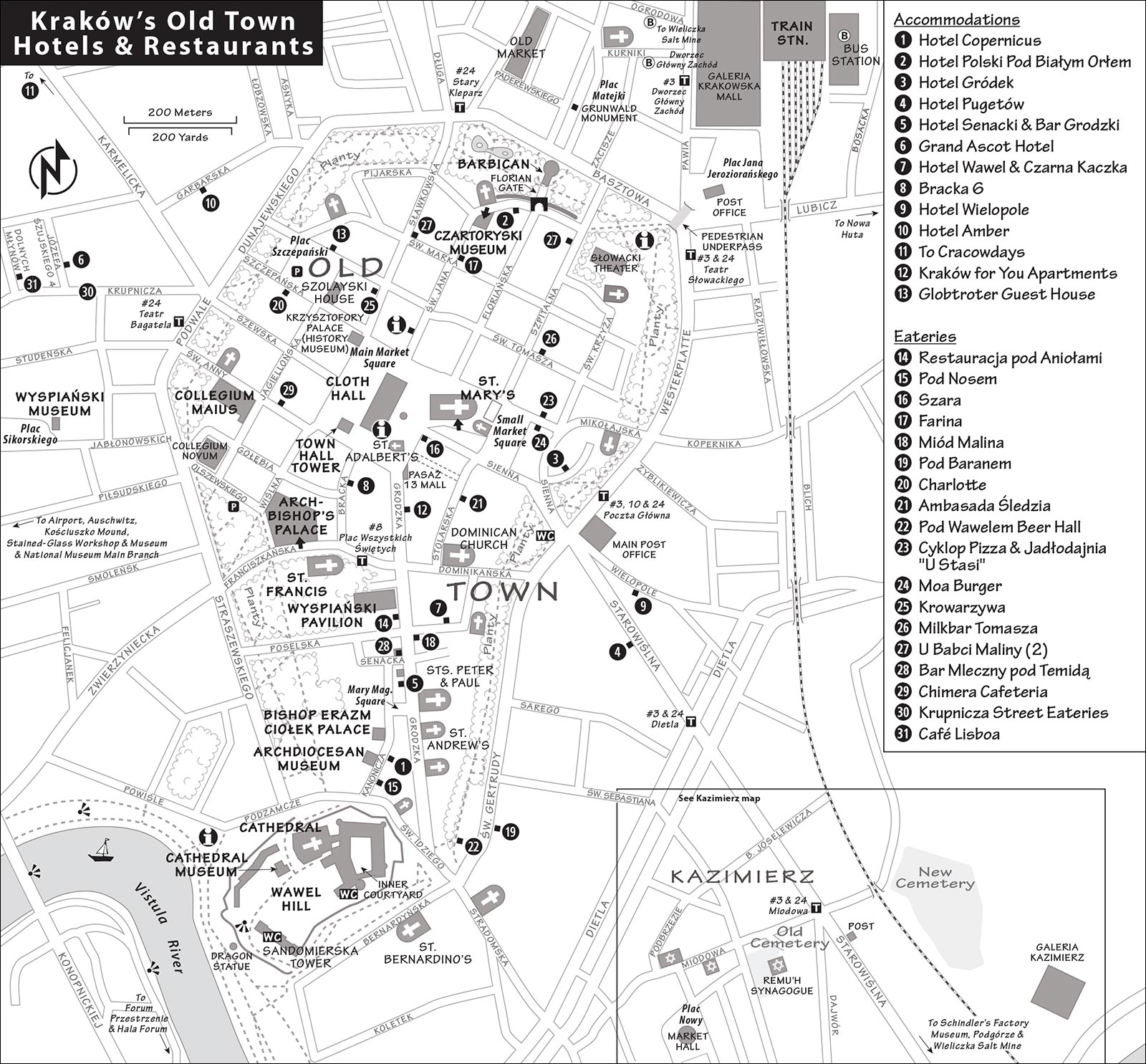
IN KAZIMIERZ
Kazimierz is both Kraków’s Jewish heart and soul, and its trendiest eating and nightlife zone. Sleeping here puts you in close proximity to synagogues and klezmer concerts, as well as to food trucks and hip nightclubs (expect some noise, especially on weekends). Keep in mind that, while pleasant in its own right, Kazimierz is a 20-minute walk or a 5-minute tram ride from Kraków’s atmospheric old center (for details on getting to Kazimierz from the Old Town, see here). For locations, see the map on here.
$$$ Metropolitan Boutique Hotel is an upscale refuge a block before the heart of Kazimierz (just off the busy road on the way to Kraków’s Old Town). Its 59 rooms—with exposed brick and slick modern style—sit along a somewhat dreary but conveniently located side street (air-con, elevator, gym, Joselewicza 19, +48 12 442 7500, www.hotelmetropolitan.pl, hotel@hotelmetropolitan.pl).
$$ Rubinstein Residence sits right in the middle of Ulica Szeroka—surrounded by klezmer restaurants and synagogues, in the heart of the neighborhood. It fills a painstakingly restored old townhouse (parts of it dating to the 15th century) with heavy wood beams and 30 swanky rooms—some of them palatial suites that incorporate old features like frescoes and pillars. The rooftop terrace—open to the public, with views over Kazimierz and to the Old Town—sets this place above (air-con, elevator, Szeroka 12, +48 12 384 0000, www.rubinstein.pl, recepcja@rubinstein.pl).
¢ Residence Tournet, well run by friendly Piotr and Sylwia Działowy, is your cheap-and-cheery option, offering 18 colorful, perfumed rooms near the edge of Kazimierz toward Wawel Castle (elevator plus a few stairs, reception open 7:00-22:00, Ulica Miodowa 7, +48 12 292 0088, www.accommodation.krakow.pl, tournet@nocleg.krakow.pl).
Eating in Kraków
Kraków has a wide array of great restaurants. As the food scene changes constantly, I’ve chosen established places that have a proven track record. In my listings, you’ll find a mix of old-school Polish eateries and modern alternatives (which are still rooted in the local tradition). You could also consider a food tour (see “Tours in Krakow” near the beginning of this chapter).
IN THE OLD TOWN
Kraków’s Old Town is loaded with dining options. All of these eateries (except the milk bars) are likely to be booked up on weekends—always reserve ahead. It’s tempting to dine on the Main Market Square; however, most restaurants here cater mainly to tourists and—other than Szara, recommended below—don’t provide the best value for the money. To enjoy the same experience more affordably, have just a drink on the Square and dine elsewhere.
$$$ Restauracja pod Aniołami (“Under Angels”) offers a dressy, candlelit atmosphere on a wonderful covered patio or in a deep, steep, romantic cellar with rough wood and medieval vaults. Peruse the elaborately described menu of medieval nobles’ dishes. The cuisine is traditional Polish, with an emphasis on grilled meats and trout (on a wood-fired grill). Every meal begins with smalec (spread made with lard, fried onion, bacon, and apple). Don’t go here if you’re in a hurry—only if you want to really slow down and enjoy your dinner. Reservations are smart (daily from 13:00, Ulica Grodzka 35, +48 12 421 3999, www.podaniolami.pl).
$$$$ Pod Nosem (“Under the Nose”) is a worthwhile splurge for refined, updated Polish cuisine in a sophisticated, untouristy atmosphere. It’s tucked at the far end of sleepy Kanonicza lane, just beyond the tourists and before Wawel Castle. In a tight dining room that skips the kitsch, they offer an extensive wine list and a short menu of artfully executed Polish dishes (daily, Kanonicza 22, +48 12 376 0014, www.kanonicza22.com).
$$$$ Szara owns a prime location right on the Main Market Square, in the 14th-century Kamienica Szara (“Grey House”). The restaurant is a well-regarded option for a higher-end meal of elevated Polish cuisine, with a short menu of meat and fish dishes. The interior feels rich and dressy, with gilded vaults and Józef Mehoffer-painted ceilings soaring overhead, and the outdoor tables own a prime location facing the Square. If you’re looking to splurge memorably for a special occasion, this is a fine choice (daily, Rynek Główny 6, +48 12 421 6669, www.szara.pl).
$$ Czarna Kaczka (“Black Duck”) features Polish fare with an emphasis on duck (of course) and dumplings. The cozy, steamy, arched interior is a central choice for traditional food done well, but not too rustic. As it fills up, book ahead (daily from 13:00, next to Hotel Wawel at Poselska 22, +48 500 195 149, https://czarnakaczka.pl).
$$$ Farina, specializing in international/Mediterranean fish and seafood dishes from chef Monika Turasiewicz, is a dressy, upscale-feeling, well-established choice for a memorable meal. It’s smart to reserve ahead (closed Mon, Św. Marka 16, +48 519 399 474, https://farina.com.pl).
$$ Miód Malina (“Honey Raspberry”) is an acceptably kitschy Polish-Italian fusion restaurant filled with the comforting aroma of its wood-fired oven. The menu is mostly Polish, with a few Italian dishes thrown in. Sit in the cozy, warmly painted interior or out in the courtyard (reservations smart, daily, Ulica Grodzka 40, +48 12 430 0411, www.miodmalina.pl).
$$$ Pod Baranem (“Under the Ram”) is a solid midrange bet for well-executed, traditional Polish food. Respected by locals, it sits just outside the tourist chaos, quietly facing the Planty near Wawel Castle. Several cozy rooms—tasteful but not stuffy—sprawl through a homey old building (daily from 13:00, Św. Gertrudy 21, +48 12 429 4022, www.podbaranem.com).
Youthful Style at Plac Szczepański: While seemingly every corner of the Old Town is jammed with tourists, the pleasant square called Plac Szczepański—tucked at the northwest corner of the Old Town—feels more like the terrain of university students. While just two short blocks from the Square, this small array of cafés and galleries has a vibe that’s more Warsaw-urbane than ye olde Kraków. Among these, $ Charlotte is a winner—it’s a classy, French-feeling bakery/café/wine bar. They make their own breads and pastries in the basement (with lots of seating—you can watch the bakers work if you come early enough in the morning), cultivate a stay-awhile coffeehouse ambience upstairs, and throw in a few square-facing sidewalk tables to boot. The food is light café fare—sandwiches, pastries, and salads—rather than a filling dinner (daily, Plac Szczepański 2, +48 12 431 5610).
On Stolarska Street: Stolarska street, a neatly pedestrianized, oddly untrammeled “embassy row” just a block away from the Main Market Square, is worth exploring for a meal or a drink. Stolarska has a fun variety of more locals-oriented bars and cafés. Begin at the Small Market Square (Maly Rynek) behind St. Mary’s Church and head south. On the left, look for the ridiculously long sign that perfectly identifies the business: Pierwszy Lokal Na Stolarskiej Po Lewej Stronie Idąc Od Małego Rynku (“The first pub on the left side of Stolarska coming from the Small Market Square”). Notice that this once-sleepy street is lined with embassies and consulates—it’s easy to spot the flags of Germany, the US, and France. On the left, in the stretch of cafés under canopies, you’ll see the $$ Ambasada Śledzia (“Herring Embassy”), with a divey, youthful atmosphere and a “Polish tapas” approach: A dozen different types of herring and other light meals, plus a variety of vodka to wash it down, are posted on the menu. You’ll order at the bar, then find a table or take it to go (daily, Stolarska 8). Across the street and 50 paces back up, the Pasaż Bielaka (look for the low-profile stone doorway at #5) runs through the middle of the block all the way out to the Main Market Square (emerging at Rynek Główny #19); in here is another sprawling branch of the Herring Embassy.
Beer Hall: The rollicking Czech-style $ Pod Wawelem (“Under Wawel”) is right on the Planty park near Wawel Castle. It’s packed with locals seeking big, sloppy, greasy portions of meaty fare, with giant mugs of various beers on tap (including Polish and Bavarian). Choose between the bustling interior and the outdoor terrace right on the Planty. Locals come here not for a romantic dinner but for a rowdy evening out with friends (different specials every day—such as giant schnitzel, pork ribs, or roasted chicken; daily, Ulica Św. Gertrudy 26-29, +48 12 421 2336).
Pizza: Cozy and charming $ Cyklop has good wood-fired pizzas, with 10 tables wrapped around the cook and his busy oven (daily, near St. Mary’s Church at Mikołajska 16, +48 12 421 6603).
Burgers (and Vegan Burgers): Gourmet hamburgers are all the rage in Poland. One of the best options in the center is $ Moa Burger, with a dozen different types of big, sloppy, “New Zealand-style” hamburgers. Order at the counter, then find a seat at a shared table. This isn’t “fast food”—everything is made to order (daily, Mikołajska 3, +48 12 421 2144). For vegan burgers, a handy place in the center is $ Krowarzywa (a pun roughly meaning both “Cow Alive” and “Cow Vegetable”)—with a hip atmosphere and an enticing menu of meatless options (daily, Sławkowska 8, +48 531 777 136).
Milk Bars and Other Quick, Cheap, Traditional Eats
Kraków is a good place to try the cheap cafeterias called “milk bars.” For pointers on eating at a milk bar, review the sidebar on here.
$ Milkbar Tomasza is an upgraded milk bar popular with local students. Modern and relatively untouristy, it serves big, splittable portions of high-quality food—a mix of Polish and international—plus breakfast dishes all day (great big salads, daily specials, open Tue-Sun until 18:00, closed Mon, Ulica Tomasza 24, +48 12 422 1706).
$ U Babci Maliny (“Granny Raspberry”), with a grinning Granny on the sign, is well established and much appreciated for its big portions of flavorful traditional food. One location, frequented almost entirely by Krakovians and designed for university students and staff, is tucked into an inner courtyard of the Science Academy. Find the door at Sławkowska 17, then make your way into the inner courtyard, with an entrance to a rustic cellar where it looks like a kitschy cottage bomb went off. Another location is across the street from the National Theater building at Szpitalna 38. The main floor, also done up in gaudy cottage style, is self-service and budget priced, while the cellar—with a drawing-room vibe—has table service and slightly higher prices (both are open daily). Both locations have walls of photos of the owner posing with bodybuilders and ultimate fighters...not quite in keeping with the country theme.
$ Jadłodajnia “U Stasi” is a throwback that makes you feel like you’re in on Kraków’s best-kept secret. Its hidden location—tucked at the far end of the passage with the recommended Cyklop pizzeria—attracts a wide range of loyal local clientele, from hardscrabble seniors to politicians, artists, and actors. They’re all here for well-executed, unpretentious, home-style Polish lunch grub. There can be a bit of a language barrier, so go with the flow: Pick up the English menu as you enter, find a table, wait for them to take your order, enjoy your meal, then pay as you leave. This is an excellent value and a real, untouristy Polish experience. The short menu changes every day—and when they’re out, they’re out (Mon-Fri until 17:00, closed Sat-Sun, Mikołajskiej 16).
Throwback Milk Bars on Grodzka Street: Just a couple of blocks south of the Main Market Square, on busy Ulica Grodzka, two classic milk bars somehow survive the onslaught of the modern world. First, at the corner with Senacka, is the remarkably basic and traditional milk bar, $ Bar Mleczny pod Temidą. The next best thing to a time machine to the communist era, this place has grumpy monolingual service, a mostly local clientele, and cheap but good food (daily). A few more steps down, also on the right (just before the two churches), $ Bar Grodzki is a single tight little room with shared tables. They specialize in tasty potato pancake dishes (placki ziemniaczane). Order high on the menu and try the rich and hearty “Hunter’s Delight”—potato pancake with sausage, beef, melted cheese, and spicy sauce. The English menu posted by the counter makes ordering easy. Order, sit, and wait to be called to fetch your food (daily).
$ Chimera Cafeteria, just off the Main Market Square, is a handy spot for a quick lunch in the center. It serves fast traditional meals to a steady stream of students. You’ll order at the counter—choose a big plate (6 items) or medium plate (4 items) and select from an array of salads and main dishes by pointing to what you’d like. Then eat on their quiet, covered garden courtyard (good for vegetarians, daily, near the university at Ulica Św. Anny 3). I’d skip their expensive full-service restaurant (in the basement), which shares an entryway.
Lively Student Zone Just West of the Old Town
A few minutes’ walk west of the Old Town is a trendy, energetic neighborhood with more students than tourists. If ye olde Kraków is getting a little olde, this area is a closer, easier escape than Kazimierz. The spine of this zone is Krupnicza street, a pedestrianized strip that begins just across the ring road from the Planty. To get here, head out Szewska street from the middle of the Square (to the west), cross the busy ring road, and fork left at the Teatr Bagatela. Several eateries along here are worth considering: $ Meat & Go, a cellar restaurant with hearty meat dishes (at #3 on the right); a pod of $ food trucks (just beyond #6 on the left, under the mural); $$ Dynia, with a hip brick interior and an inviting garden courtyard (at #20 on the left); and $ Meho Café, a casual place with drinks, light food, and delightful seating in the garden behind the Józef Mehoffer House Museum (at #26 on the left). At the end of the street, hook right to find the best place in the area for a sweet treat: $ Café Lisboa, which serves great coffee and excellent pastéis de nata, the national dessert of Portugal—made by a Pole who went to Belém to learn how to make it just right (Dolnych Młynów 3).
IN KAZIMIERZ
The entire district is bursting with lively cafés and bars—it’s a happening night scene. For locations, see the map on here.
Fast and Cheap
Kazimierz has some great takeout and street food—handy for a lunch break from daytime sightseeing here, or for an affordable dinner break from bar-hopping.
$ Food Trucks: Kazimierz has two pods of fun-to-browse food trucks—most open daily for lunch and dinner. Judah Square, named for its big graffiti mural by an Israeli street artist, is tucked at the southern fringe of the tourists’ Kazimierz, near the old tram depot (corner of Św. Wawrzyńca and Wąska). Mainstays here include Andrus (super-decadent and gooey roasted pork sandwiches), Boogie Truck burgers, Yatai sushi, Belgian-style fries, Pan Kumpir baked potatoes, and the beloved Chimney Cake Bakery, which rotisserie-roasts dough and sugar into a sweet and crunchy cake, then fills it with ice cream and other toppings—a Hungarian treat. Right in the heart of the tourist zone, another food truck pod fills a vacant lot behind Isaac Synagogue, just steps from Ulica Szeroka. Here you’ll find painted-wooden-pallet furniture, hammocks, twinkle lights, and a mellow vibe. Likely options include hot dogs, Mexican tacos, açaí smoothies, burgers, veggie wraps, Thai ice cream, and—of course—more chimney cakes. Note that any and all of these could reshuffle their carts—or be gone entirely, replaced by a ritzy new building—at any moment. But it’s clear that, in general, Kazimierz’s food-truck scene is here to stay.
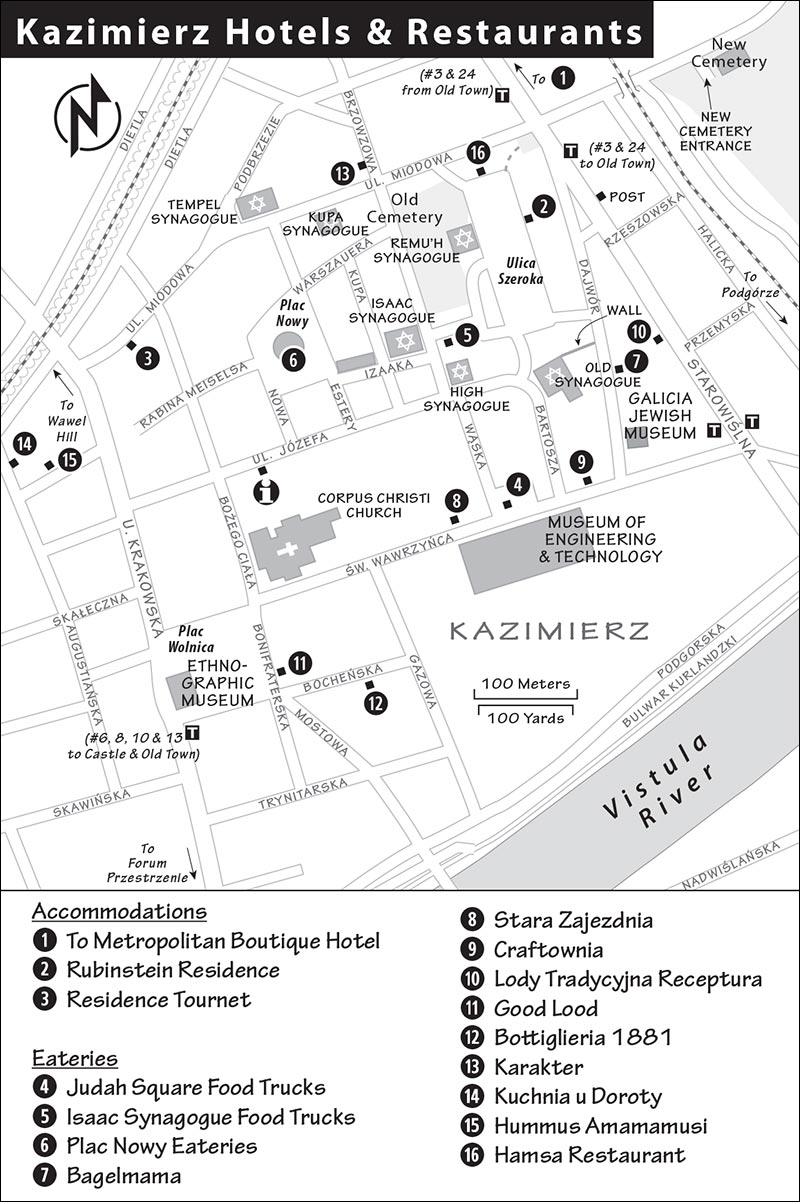
Polish Fast Food on Plac Nowy: The centerpiece of the Plac Nowy market is a circular brick slaughterhouse, which has recently been taken over by Kazimierz foodies. Each of the shop windows—which once housed butchers and basic Polish grub—is now operated by a different pop-up eatery, most of them serving the Poles’ beloved zapiekanki: toasted baguettes with cheese, ketchup, and a bewildering array of other toppings. You can take a spin around the building to survey your options—noting where the lines are longest (locals know which zapiekanek is best).
Bagels: A casual shop popular with expats and locals, $ Bagelmama is run by an American named Nava (who once worked as a private chef for tennis star John McEnroe). The bagels come dressed with a wide variety of spreads, and they also sell sandwiches, soups, salads, desserts, and fresh juices. You can eat in or get it to go (Mon-Fri until 16:00, Sat-Sun until 17:00, Ulica Dajwór 10, +48 12 346 1646).
Beer: Beer lovers find two different experiences along Św. Wawrzyńca. $$ Stara Zajezdnia (“Old Tram Depot”) fills exactly that—a cavernous old industrial hall—with tables and happy drinkers, draining huge mugs of the five different types of beer brewed on the premises. (You can also order a sampler.) In good weather, the vast courtyard out front becomes an idyllic, self-service beer garden filled with relaxing lounge chairs (Św. Wawrzyńca 12, +48 664 323 988). For craft beer aficionados, Craftownia has 18 Polish microbrews on tap (and many more by the bottle) in a nondescript setting (daily from 14:00, Św. Wawrzyńca 22, +48 515 010 565).
Hip Bars with Food: Several of the bars listed under “Entertainment in Kraków,” earlier, serve decent food. If you’re looking for classic ramshackle Kazimierz ambience first and something to munch on second, consider these $$ options: Alchemia (daily, Estery 5), Kolanko No. 6 (daily, Józefa 17), and Warsztat (daily, Izaaka 3). For locations, see the “Kazimierz Entertainment and Nightlife” map, earlier.
Ice Cream: True to its name, Lody Tradycyjna Receptura has some of the best “ice cream from a traditional recipe” in Kraków—if not in Poland. The straightforward, seasonal flavors—just a few varieties—are made fresh each morning and sold until they run out. Locals line up here—and if you have a sweet tooth, you should, too (daily, Starowiślna 83). Good Lood (a pun on lody—ice cream) is newer and hipper but based on the same concept: creative flavors made fresh daily. Once they’re out...they’re out (daily, Plac Wolnica 11).
Dining in Kazimierz
In addition to its hip, fast, and cheap eateries, Kazimierz is emerging as a foodie hotspot for sit-down, take-your-time meals. In fact, this neighborhood owns Kraków’s only Michelin star (at the first listing, below).
$$$$ Bottiglieria 1881—a chic, sophisticated restaurant tucked unassumingly just off Plac Wolnica—recently earned a Michelin star. Chef Przemysław Klima delicately constructs fixed-price menus of modern Polish and international fare. The cellar is stocked with wines from all over the world (with an emphasis on Italian). As this is one of Kraków’s top “destination” restaurants, be sure to book ahead (closed Sun-Mon, Bochenska 5, +48 660 661 756, www.1881.com.pl).
$$$ Karakter, a short walk from the core of Kazimierz, feels lively, trendy, fresh, and upmarket. They take a meat-focused, international approach, but with ample Polish influences. You’ll peruse a tempting menu of everything from pastas, mussels, and steaks to more innovative dishes like horse tenderloin tartare or beef tongue in wasabi sauce (Mon dinner only, Tue-Sun lunch and dinner, Brzozowa 17, +48 795 818 123).
$ Kuchnia u Doroty is a hidden gem for affordable, authentic, Grandma-style Polish food with zero pretense. Tucked along a forgotten side street at the edge of Kazimierz, its no-frills, welcoming interior is a haven for those seeking hearty local cuisine at a great value (cheap daily specials, open daily, Augustiańska 4, +48 517 945 338).
Middle Eastern: Hole-in-the-wall $ Hummus Amamamusi is a bar selling creamy, top-quality homemade hummus with various toppings, bread, and veggies. They also make their own soft drinks and have great coffee. The delicious food here is worth the short walk from the core of Kazimierz (daily until 17:00, Meiselsa 4, +48 533 306 288). $$$ Hamsa, with a prime location at the top of Ulica Szeroka and lots of tempting tables out front, offers “hummus and happiness,” with an updated take on Israeli food (that’s Middle Eastern, not traditional Jewish fare). Don’t come here for matzo balls and klezmer music, but for an enticing menu of mezes (small plates, like hummus and various dips) and grilled meat dishes in a modern, hip atmosphere (daily, Ulica Szeorka 2, +48 515 150 145).
Kraków Connections
For getting between Kraków and Auschwitz, see the next chapter. To confirm rail journeys, check specific times at the main train station or online (www.intercity.pl). You can also buy tickets on this website; you’ll be sent an eticket, which you can show to the conductor on board.
From Kraków by Train to: Warsaw (about hourly, 2.5 hours, slick EIC express train, requires seat reservation), Gdańsk (6/day direct, 5.5 hours on EIC express, plus night train, 9 hours), Toruń (7/day, 5.5 hours, most transfer at Warsaw’s Zachodnia station), Prague (2/day direct, 7.5 hours, plus 1 night train, 10 hours; additional connections may be possible with change in Katowice and other points; some connections are operated by private Czech rail company Leo Express, www.leoexpress.com), Berlin (2-3/day, 9-10 hours with change at Warsaw’s Zachodnia station, more options with multiple changes), Budapest (2/day direct—one during the day in 9 hours, the other overnight in 10 hours; additional connections possible with changes; also consider long-distance bus, www.flixbus.com), Vienna (2/day direct—1 during the day in 6 hours, the other overnight in 8.5 hours; additional connections possible with changes).
By Bus: For certain journeys between major cities—both domestic and international—you can save time and money by taking a bus instead of a train. Check your options with Flixbus (www.flixbus.com).