UNDERSTANDING YUGOSLAVIA
If you’re struggling to understand the complicated breakup of Yugoslavia, read this admittedly oversimplified, as-impartial-as-possible history to get you started. (For a more complete version, see www.ricksteves.com/yugo.)
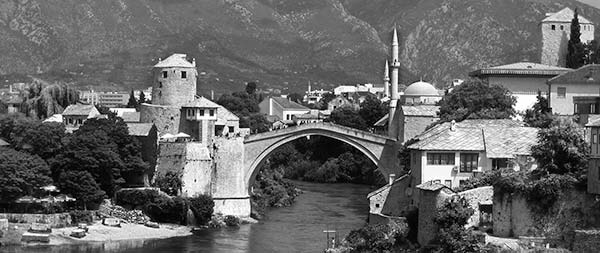
The Balkan Peninsula—between the Adriatic and the Black Sea, basically running from Hungary to Greece—has always been a crossroads of cultures, divided by a series of cultural, ethnic, and religious fault lines. The most important religious influences were Western Christianity (i.e., Roman Catholicism, introduced by Charlemagne and later championed by the Austrian Habsburgs), Eastern Orthodox Christianity (from the Byzantine Empire), and Islam (from the Ottomans).
Two major historical factors made the Balkans what they are today: The first was the split of the Roman Empire in the fourth century AD, dividing the Balkans down the middle into Roman Catholic (west) and Byzantine Orthodox (east)—roughly along today’s Bosnian-Serbian border. The second was the invasion of the Ottomans (from today’s Turkey) in the 14th century, which kicked off five centuries of Islamic influence in Bosnia-Herzegovina and Serbia, further dividing the Balkans into Christian (north) and Muslim (south).
Because of these and other events, several distinct ethnic identities emerged. The major ethnicities of Yugoslavia are all considered “South Slavs.” They’re all descended from the same ancestors and speak closely-related languages, but are distinguished by their religious practices. Roman Catholic Croats and Slovenes are found mostly west of the Dinaric Mountains (Croats along the Adriatic coast and Slovenes farther north, in the Alps); Orthodox Christian Serbs live mostly east of the Dinaric range; and Muslim Bosniaks (whose ancestors converted to Islam under the Ottomans) live mostly in the Dinaric Mountains. The region also has several smaller ethnic groups: the Slavic Montenegrins and Macedonians, plus Hungarians (concentrated in the north) and Albanians (concentrated in Kosovo and the south). The groups overlapped a lot—which is exactly why the breakup of Yugoslavia was so contentious.
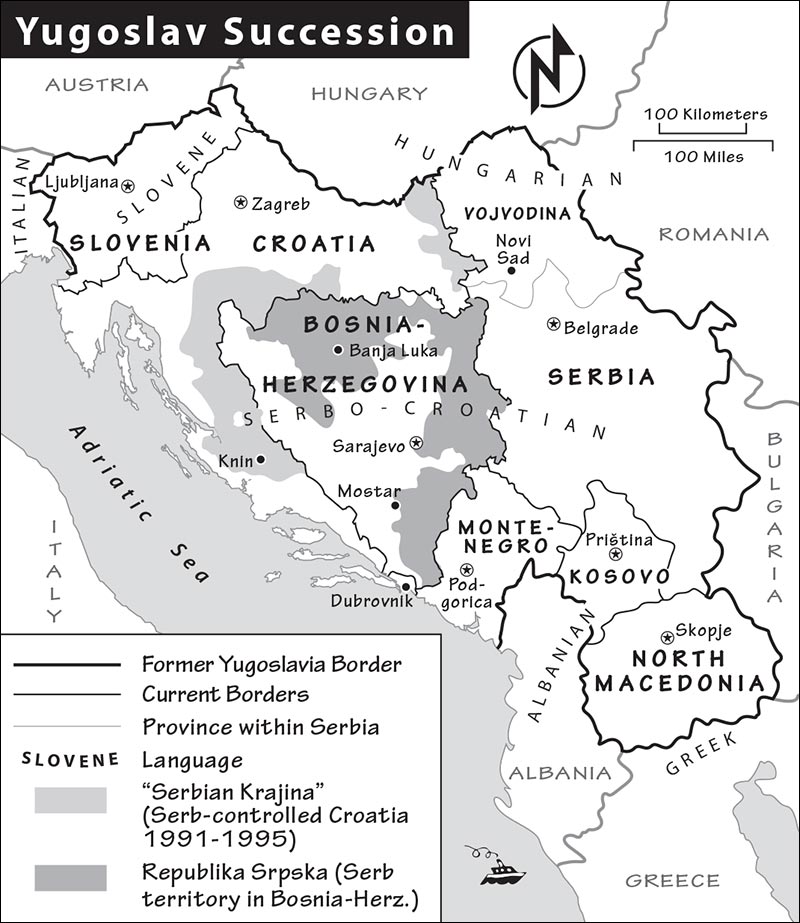
The lands of Yugoslavia were shuttled between various kingdoms and empires for much of their history, but by the late 19th century, most of the area was part of the Austro-Hungarian Empire. When that empire split apart at the end of World War I, the various mostly-Slavic groups in the region formed a new country: Yugoslavia (“Land of the South Slavs”). The union was almost immediately contentious, as various groups—especially Serbs and Croats—struggled to take control. By the dawn of World War II, it was already clear that Yugoslavia was a troubled proposition.
The seeds of the 1990s interethnic conflict were planted in World War II. Yugoslavia was invaded by Nazi Germany, then chopped up into puppet states for the Axis Powers. Some groups took advantage of changing circumstances in wartime Yugoslavia to exact revenge on their former compatriots. In occupied Croatia, the puppet Ustaše government imprisoned and executed large numbers of Serbs. In the eastern mountains, a Serbian royalist paramilitary group called the Četniks were every bit as brutal against Croats and Bosniaks. A third group—the homegrown Partisan Army—fought against Nazis, Ustaše, and Četniks to secure freedom for Yugoslavia. Unlike the other “Eastern European” countries, Yugoslavia was not liberated by the Soviet Union. This unique status allowed it to determine its own path after the war.
The Republic of Yugoslavia was the vision of a single man, who made it reality. Josip Broz—better known as Marshal Tito—presided over the most peaceful and prosperous era in this region’s long and troubled history. Three decades after his death, Tito is beloved by many of his former subjects...and yet, he was a communist dictator who dealt brutally with his political enemies. This love-him-and-hate-him autocrat is one of the most complex figures in the history of this very complicated land.
Josip Broz was born in 1892 to a Slovenian mother and a Croatian father in the northern part of today’s Croatia (then part of the Austro-Hungarian Empire). After growing up in the rural countryside, he was trained as a metalworker. He was drafted into the Austro-Hungarian army, went to fight on the Eastern Front during World War I, and was captured and sent to Russia as a prisoner of war. Freed by Bolsheviks, Broz fell in with the Communist Revolution...and never looked back.
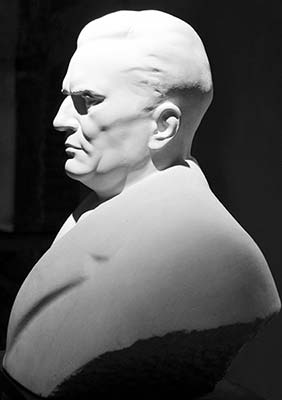
At war’s end, Broz returned home to the newly independent Yugoslavia, where he worked alongside the Soviets to build a national Communist Party. As a clandestine communist operative, he adopted the code name he kept for the rest of his life: Tito. Some believe this was a Spanish name he picked up while participating in that country’s civil war, while others half-joke that the name came from Tito’s authoritarian style: “Ti, to!” means “You, do this!” But one thing’s clear: In this land where a person’s name instantly identifies his ethnicity, “Tito” is ethnically neutral.
When the Nazis occupied Yugoslavia, Tito raised and commanded a homegrown, communist Partisan Army. Through guerilla tactics, Tito’s clever maneuvering, and sheer determination, the Partisans liberated their country. And because they did so mostly without support from the USSR, Yugoslavia was able to set its own postwar course.
The war hero Tito quickly became the “president for life” of postwar Yugoslavia. But even as he introduced communism to his country, he retained some elements of a free-market economy—firmly declining to become a satellite of Moscow. He also pioneered the worldwide Non-Aligned Movement, joining with nations in Africa, the Middle East, Asia, and Latin America in refusing to ally with the US or USSR. Stubborn but suitably cautious, Tito expertly walked a tightrope between East and West.
There was a dark side to Tito. In the early years of his regime, Tito resorted to brutal, Stalin-esque tactics to assert his control. Immediately following World War II, the Partisan Army massacred tens of thousands of soldiers who had supported the Nazis. Then Tito systematically arrested, tried, tortured, or executed those who did not accept his new regime. Survivors whose lives were ruined during this reign of terror will never forgive Tito for what he did.
But once he gained full control, Tito moved away from strong-arm tactics and into a warm-and-fuzzy era of Yugoslav brotherhood. Tito believed that the disparate peoples of Yugoslavia could live in harmony. For example, every Yugoslav male had to serve in the People’s Army, and Tito made sure that each unit was a microcosm of the complete Yugoslavia—with equal representation from each ethnic group. Yugoslavs from diverse backgrounds were required to work together and socialize—as a result, they became friends. He also worked toward economic diversification: Yugoslav tanks, some of the best in the world, were made of parts assembled in five different republics.
Tito’s reign is a case study in the power of the cult of personality. Rocks on hillsides throughout Yugoslavia were rearranged to spell “TITO,” and his portrait hung over every family’s dinner table. Each of the six republics renamed one of its cities for their dictator. The main street and square in virtually every town were renamed for Tito. Each year, young people would embark on a months-long, Olympics-style relay, from each corner of Yugoslavia, to present a ceremonial baton to Tito on his official birthday (May 25). Tito also had vacation villas in all of Yugoslavia’s most beautiful areas, including Lake Bled, the Brijuni Islands, and the Montenegrin coast. People sang patriotic anthems to their Druža (Comrade) Tito: “Comrade Tito, we pledge an oath to you.”
Tito died in 1980 in a Slovenian hospital. His body went on a grand tour of the Yugoslav capitals: Ljubljana, Zagreb, Sarajevo, and Belgrade, where he was buried before hundreds of thousands of mourners, including more heads of state than at any other funeral in history. At his request, his tomb was placed in the greenhouse where he enjoyed spending time.
The genuine outpouring of grief at Tito’s death might seem unusual for a man who was, on paper, an authoritarian communist dictator. But even today, many former Yugoslavs—especially Slovenes and Bosniaks—believe that his iron-fisted government was a necessary evil that kept the country strong and united. The eventual balance Tito struck between communism and capitalism, and between the competing interests of his ethnically diverse nation, led to this region’s most stable and prosperous era. In a recent poll in Slovenia, Tito had a higher approval rating than any present-day politician, and 80 percent of Slovenes said they had a positive impression of him.
And yet, the Yugoslavs’ respect for their former leader was not enough to keep them together. Tito’s death began a long, slow chain reaction that led to the end of Yugoslavia. As the decades pass, the old joke seems more and more appropriate: Yugoslavia had eight distinct peoples in six republics, with five languages, three religions (Orthodox Christian, Catholic, and Muslim), and two alphabets (Roman and Cyrillic), but only one Yugoslav—Tito.
After the short but rocky Yugoslav union between the World Wars, it seemed that no one could hold the southern Slavs together in a single nation. But one man could, and did: Partisan war hero Josip Broz, who is better known by his code name, Tito. With a Slovene for a mother, a Croat for a father, a Serb for a wife, and a home in Belgrade, Tito was a true Yugoslav. Tito had a compelling vision that this fractured union of the South Slavs could function (see the sidebar).
Tito’s new incarnation of Yugoslavia aimed for a more equitable division of powers. It was made up of six republics, each dominated by one ethnic group: Croatia, Slovenia, Serbia, Bosnia-Herzegovina, Montenegro, and Macedonia. Within Serbia, Tito set up two autonomous provinces, each one an enclave for an ethnicity that was a minority in greater Yugoslavia: Albanians in Kosovo (to the south) and Hungarians in Vojvodina (to the north). By allowing these two provinces some degree of independence, Tito hoped they would balance the political clout of Serbia, preventing a single republic from dominating the union.
While each republic had a measure of self-rule, the union was carefully overseen by President-for-Life Tito. Tito respected—and even celebrated—the diversity of his union, but he placed Yugoslav unity above all. He said that the borders between the republics should be “like white lines in a marble column.”
Tito’s Yugoslavia was communist, but it wasn’t Soviet communism. He refused to formally join either the Warsaw Pact or NATO, and ingeniously played the East and the West against each other. Economically, Tito’s vision was for a “third way,” somewhere between communism and capitalism. While large industries were collectivized, small businesses were also permitted. Though Yugoslavs could not become really rich, through hard work it was possible to attain modest wealth to buy a snazzy car, a vacation home, Western imports, and other niceties. Yugoslavia was also the most free and open of the communist states. Tourists (from both East and West) flocked here for vacation, and Yugoslavs could travel to far more places abroad than could residents of the Eastern Bloc.
Tito died in 1980, and before long, the fragile union he had held together started to unravel. The breakup began in the late 1980s in the autonomous province of Kosovo, with squabbles between the Serb minority and the ethnic-Albanian majority. Serbian politician Slobodan Milošević traveled to Kosovo to rouse his Serb comrades, which alarmed some of the other republics. When Milošević-led Serbia annexed Kosovo soon after, and negotiations among the Yugoslav republics broke down, Croatia and Slovenia decided it was time to declare independence (both on June 25, 1991). Small, relatively homogenous Slovenia weathered a brief 10-day skirmish (see here), while Croatia—which had a large Serb minority—was pulled into a gruesome war lasting several years. Bosnia-Herzegovina declared its independence a few months later. But, because that republic was by far Yugoslavia’s most ethnically diverse (with large populations of Muslim Bosniaks, Serbs, and Croats), its separation was hotly contested—plunging Bosnia into a horrifying four years of guerrilla warfare, medieval-style sieges, systematic rape, and ethnic cleansing.
Peace accords in 1995 brought an end to most of the hostilities throughout Yugoslavia, establishing the borders of Croatia and Bosnia that still exist today. Over the next several years, Slobodan Milošević and others accused of war crimes were arrested and tried by an international tribunal at The Hague, Netherlands (though Milošević died behind bars before a verdict was handed down). Later, additional parts of the former Yugoslavia split off, leaving behind seven independent nations where once was one: Croatia, Slovenia, Bosnia-Herzegovina, Montenegro, Serbia, Macedonia, and Kosovo.
Peace has reigned in these countries for more than two decades. The physical scars of war have mostly been repaired. And, considering that hospitality has been a forte of this region since long before the age of Yugoslavia, outside visitors feel welcome and safe—and are impressed at the candor of the people they meet, who are often willing to share their own wartime experiences. But, understandably, the psychological scars will take the longest to heal. Tensions still persist between formerly warring groups.
Thoughtful visitors to the former Yugoslavia grapple with trying to understand what happened here just a generation ago. Many find it hard to get an impartial take on the current situation, or even on historical “facts.” A very wise Bosniak once told me, “Listen to all three sides—Muslim, Serb, and Croat. Then decide for yourself what you think.” A Serb told me a similar local saying: “You have to look at the apple from all sides.”