BOSNIA-HERZEGOVINA
Bosna i Hercegovina
▲▲▲Sarajevo
▲▲Mostar
In the 1990s, Bosnia-Herzegovina became synonymous with war, sectarian violence, and genocide. That’s a shame, because for so much of its history this remarkable land has represented exactly the opposite. While skittish travelers may never experience it for themselves, Bosnia-Herzegovina boasts a unique mix of cultures and faiths, kind and welcoming people who pride themselves on their hospitality...and some of the most captivating sightseeing in southeastern Europe. A visit here offers a fascinating opportunity to sample the cultures of three major faiths within a relatively small area: In the same day, you can inhale incense in a mystical-feeling Serbian Orthodox church, hear the subtle clicking of rosary beads in a Roman Catholic cathedral, and listen to the Muslim call to prayer echo across a skyline of prickly minarets.
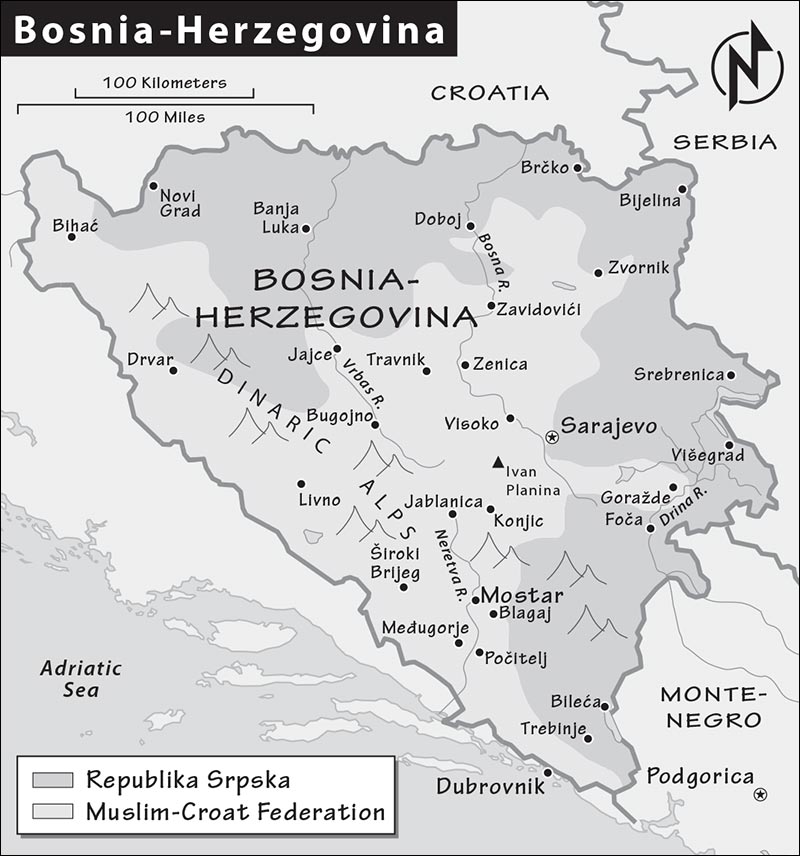
Where to Go: The highlights of Bosnia are just a short drive from Croatia’s Dalmatian Coast. Many side-trip from Dubrovnik or Split to Mostar, which is the country’s most accessible and tourist-friendly town. But for a more authentic and complete Bosnian experience, it’s worth going a few hours farther to reach Sarajevo—the gorgeously set capital, with its fascinating history (both old and recent), excellent sightseeing, and lively contemporary life. Three or four days is enough time to visit both great cities, with quick stops in some other towns and attractions in between, giving you an insightful first look at Bosnia.
Getting Around: Trains are slow and old (www.zfbh.ba); locals prefer to go by bus (https://getbybus.com usually catches most of your options). Bosnia is also a fine country for driving: The roads are good (though there are few freeways), and traffic is light. Given the mountainous terrain, affordable flights can save time; for example, Croatia Airlines flies affordably and frequently between Sarajevo and Zagreb (www.croatiaairlines.com).
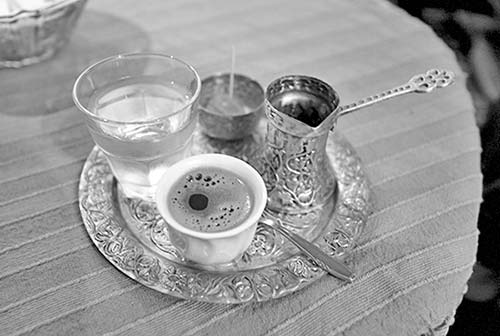
Bosnian Cuisine: The local food resembles what you may think of as “Greek” or “Turkish” food—with lots of tomatoes, peppers, soft cheeses, and grilled meats. The top street food is burek—a savory phyllo-dough pastry filled with meat, cheese, or spinach. Another Bosnian classic is ćevapčići (or ćevapi), a mix of minced meat (usually lamb and beef) formed into a sausage-link shape, then grilled. It’s served with other grilled meats, chopped raw onions, a soft and spreadable cheese called kajmak, the pita-like lepinje bread, and the powerful red pepper and eggplant spread called ajvar. Bosnian desserts are gooey with honey: baklava or the shredded-wheat-style kadaif. And Bosnian coffee (bosanska kafa)—a hearty unfiltered brew simmered in a copper kettle and served in a little ceramic cup—is as much a slow-down-and-smell-the-tulips social ritual as it is a drink.
Bosnian Language: English is widely spoken, especially in tourist areas. Bosnian is very close to Croatian (in fact, until a generation ago they were considered one language); key phrases include these pleasantries: “Hello” is Dobar dan (formal) or Zdravo (informal), “Please” is Molim, “Thank you” is Hvala, and “Goodbye” is Do viđenija. Bosniaks and Croats use basically the same Roman alphabet we do, while Serbs use the Cyrillic alphabet. You’ll see both alphabets on currency, official documents, and road signs, but the Roman alphabet predominates in the destinations covered here.
Top Bosnian Destinations
The following sections are designed to get you started planning a trip to Bosnia. For in-depth coverage—including self-guided walks and museum tours, detailed hotel and restaurant listings, and lots of practical advice—pick up my Rick Steves Croatia & Slovenia guidebook.
▲▲▲Sarajevo
Though once torn by the wars of the 1990s, the Bosnian capital of Sarajevo—picturesequely situated in a mountain valley blanketed with cute Monopoly houses—is a comfortable and safe place to visit (www.sarajevo-tourism.com). It’s a city of powerful experiences: Step into historic houses of worship from each of this region’s four major faiths—Muslim, Catholic, Orthodox Christian, and Jewish—and notice the similarities. Visit the street corner where World War I began. Climb up into the hills to the Olympic stadium that commanded the world’s attention in 1984, or ascend even higher for sweeping views over the capital. Make friends with a gregarious Sarajevan—it’s easy to do—and ask about the best way to prepare and drink Bosnian coffee. Ponder the scars of war, hunch over to squeeze through the tunnel that was the besieged Sarajevans’ one lifeline to the world, and listen to a local relate personal stories from the harrowing time of the siege. Shop your way through the copper-laden canyons of the Turkish-style bazaar, bartering down the price of a hand-hammered Bosnian coffee set. Relax in a hidden caravansary, take a slow drag on a šiša (water pipe spewing sweet plumes of fruity smoke), and sample some honey-dripping pastry treats. Go ahead—it’s OK to enjoy Sarajevo.
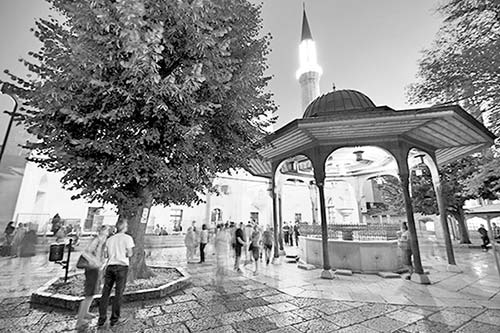
Visiting Sarajevo: Sarajevo is brought to life with the help of a good local guide; Amir Telibečirović is excellent and affordable (teleamir@gmail.com).
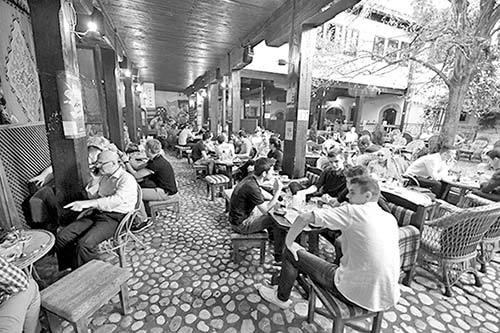
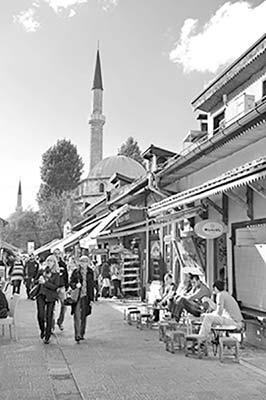
Begin in the Ottoman-flavored Old Town, called the Baščaršija—with cobbles, bazaars, minarets, and hardworking coppersmiths. In this area, ogle Sarajevo’s iconic fountain (called Sebilj), do some window-shopping, and consider dropping into the good ▲ City History Museum, filling a former covered market. After hours, don’t miss the atmospheric courtyard called Trgovke—filled with gregarious locals, thumping Balkan music, and the sweet smoke of water pipes.
A few blocks to the west begins a totally different-feeling part of town, with Habsburg-style architecture from the late 19th and early 20th centuries (the short-lived period when Bosnia was part of Austria-Hungary). The main drag, Ferhadija, feels worlds—rather than steps—away from the Baščaršija. During this Habsburg era, Sarajevo was the site of one of the most famous and important events in modern history: the assassination of the Habsburg heir, Franz Ferdinand, in 1914. You can see the riverside corner where the archduke and his wife were shot, visit the adjacent museum, or walk five minutes along the river to see the finest piece of architecture from this period, the Neo-Moorish City Hall, which Franz Ferdinand visited on that fateful day.
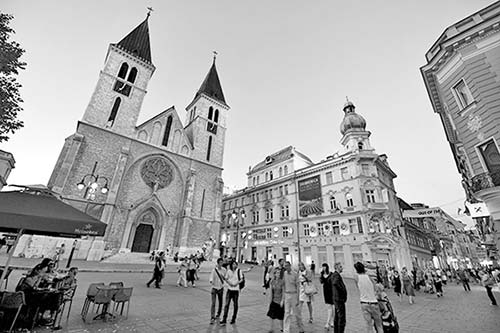
In this central zone of Sarajevo, various historic houses of worship sit a few steps apart. Stop in at Sarajevo’s big, showpiece ▲▲ Gazi Husrev-Bey Mosque and associated buildings; the atmospheric ▲ Old Serbian Orthodox Church, with a museum of icons; the Neo-Gothic Catholic Cathedral; and the city’s ▲▲ Old Synagogue and Bosnian Jewish Museum. (For more Jewish heritage, the sometimes-closed National Museum displays the priceless Jewish prayer book called the Sarajevo Haggadah.)
Sarajevo offers many powerful lessons in the grotesque genocide of the Yugoslav Wars. In the early 1990s, this multiethnic city—surrounded by the snipers of Bosnian Serb leaders Radovan Karadžić and Ratko Mladić—withstood the longest siege in modern military history (more than 1,300 days). Many locals are willing to share their harrowing stories from that time—being relentlessly shelled and shot at, day in and day out, for three and a half years. All around the city, watch for blast craters in the pavement that have been filled with red resin; these memorials, called “Sarajevo roses,” have been preserved to commemorate that difficult time.
For sites relating to the siege, visit the still-busy Markale Market, the site of a notorious bombing that killed dozens of innocent shoppers. The emotionally wrenching Memorial to the Children of Sarajevo pays respects to the more than 1,600 children who were among the estimated 10,000 Sarajevans killed during the siege. (The outstanding ▲▲ War Childhood Museum features items and stories from local children.) A few blocks away, walk through the skyscraper zone called Marijin Dvor, which was then known as “Sniper Alley”—where gunmen on the hillsides above would rain bullets down on civilians trying to live their lives in peace. And in the town center, the ▲▲ Srebrenica Exhibition collects photography and video testimony about the brutal ethnic cleansing campaign that systematically murdered at least 8,000 residents of a small Bosnian town.
Perhaps the most powerful sight relating to the Siege of Sarajevo is the ▲▲ Sarajevo War Tunnel Museum, where you can walk through a short stretch of the claustrophobic supply tunnel that ran a half-mile underneath the airport runway during the siege. This was the only safe way for besieged Sarajevans to escape to the outside world and bring home supplies to their loved ones (a taxi ride from downtown, www.tunelspasa.ba).
Sleeping in Sarajevo: Friendly, well-run guesthouses in or near the Old Town include $ Halvat Guest House (www.halvat.com.ba) and $ Hotel Old Town (www.hoteloldtown.ba). $$ Isa Begov Hamam Hotel fills part of an Ottoman-style bathhouse (www.isabegovhotel.com). For a big, international-style hotel a long walk or short drive from the Old Town, try $$$ Swissôtel Sarajevo (www.swissotel.com).
Eating in Sarajevo: There are plenty of options for traditional Bosnian fare in the Old Town. My favorite bureks (savory phyllo pastry) are at Buregdžinica Sač (just off the main square, in the alley called Bravadžiluk Mali). Good choices for ćevapčići are Mrkva (Bravadžiluk 15) and Petica (Oprkanj 2). In the modern part of town, the more cosmopolitan Žara Iz Duvara (Dženetića Čik) and Mala Kuhinja (Tina Ujevića 13) serve a mix of international and Bosnian fare. And for a scenic meal—with sweeping views over Sarajevo’s valley—head up into the hills to the pricier (but still affordable) Kibe Mahala (Vrbanjuša 164, easiest to reach by taxi, www.kibemahala.ba).
▲▲Mostar
For those side-tripping into Bosnia from the Dalmatian Coast, Mostar is ideal: It’s a convenient and very accessible microcosm of traditional Bosnian culture. Mostar straddles the banks of the gorgeous Neretva River, with tributaries and waterfalls that carve their way through the rocky landscape. The sightseeing—mosques, old Turkish-style houses, and the city’s spine-tingling Old Bridge—is engaging. And for those interested in recent history, the locals—who saw their city torn apart by the Yugoslav Wars of the 1990s, and have worked hard to rebuild—are often eager to share their stories. If you’re curious about Bosnia and only have a day to spend here, Mostar is the place.
Visiting Mostar: Almost everything of interest is within about a 15-minute walk in the town center. A local guide helps bring both the history and the powerful recent stories to life. I recommend Alma Elezović (aelezovic@gmail.com); her husband, Ermin, can be hired to drive you around Bosnia, or even to pick you up in Croatia.
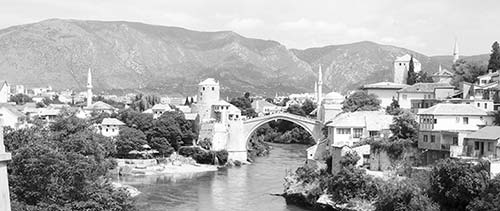
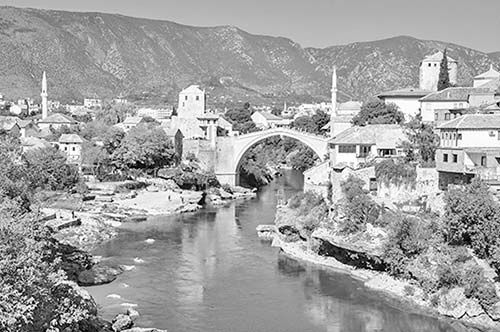
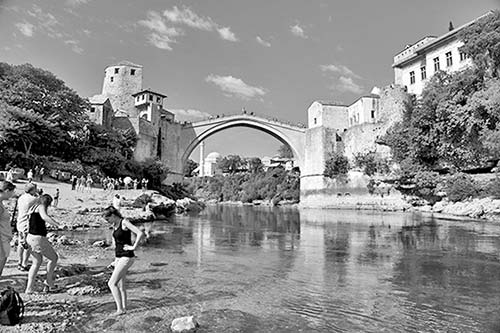
The city’s centerpiece and icon is its Old Bridge, commissioned in 1557 by the Ottoman Sultan Süleyman the Magnificent. Dramatically arched and flanked by two boxy towers, the bridge is stirring. In 1993, as the various factions of the city fought amongst themselves, Serb artillery on the mountaintop above fired on the Bosniak-held bridge. It was destroyed and fell into the river. In 2004, the bridge was rebuilt and remains a symbol of reconciliation. And today, as they have for generations, local young men hustle for tips from tourists before they swan-dive from the bridge 75 feet down into the icy-cold Neretva below.
The area around the bridge has a few small historical and photo exhibitions about the war, and a cobbled bazaar (called Coppersmiths’ Street) where locals sell trinkets to tourists.
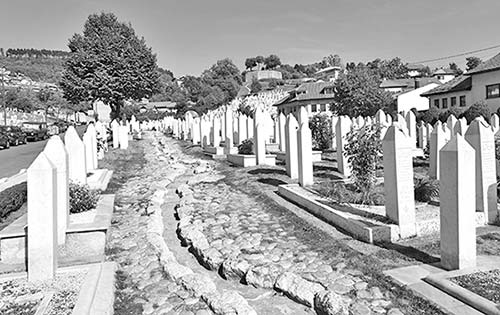
As it continues to repair itself, Mostar still has poignant reminders of the war, such as a few bombed-out husks of buildings, tucked between rebuilt ones. And scattered around Mostar are “new” cemeteries—former parks now filled with turban-shaped headstones, each one marked 1993 or 1994. When the Serb forces laid siege to the Muslims in Mostar’s Old Town, bodies had to be buried in small parks in the city center, in the dark of night, for fear of snipers. Today, the city remains effectively divided, between the Muslim community (around the Old Bridge, where most tourists go) and the Croat community (the modern sprawl to the west).
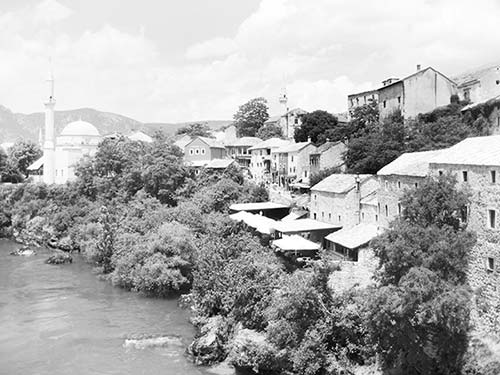
For those interested in Islam, Mostar offers the opportunity to visit various mosques. ▲ Koski Mehmet-Pasha Mosque, overlooking the Old Bridge, is the most representative and welcomes tourists. And you can step into a historical ▲ Ottoman-style house to see how Mostarians lived under the rule of the sultans and pashas (the Bišćević House or the Muslibegović House—both just above the river not far from the bridge—are equally good). Across the river is the towering concrete steeple of the Church of Sts. Peter and Paul—built after the war by local Croats, seemingly to one-up the minarets all over town.
Sleeping in Mostar: Guesthouses here are a great value. I like the $$ Muslibegović House (a historical monument that also welcomes guests into its traditional rooms with modern comforts, www.muslibegovichouse.com), $ Shangri La Mansion (on the hill above the Old Bridge, www.shangrila.com.ba), $ Villa Anri (modern comfort near the Old Bridge, villa.anri@gmail.com), and $ Hotel Kriva Ćuprija (lots of rooms tucked deep in the river valley near the Old Bridge—plus more in a modern annex, www.hotel-mostar.ba).
Eating in Mostar: It seems all Mostar restaurants have the same tourist-oriented menu of Bosnian classics: grilled-meat ćevapčići, flaky burek pastries, and so on. Most visitors prioritize the view over the food, settling in at one of the places clinging to the lush cliffs overlooking the river, with stunning views of the Old Bridge. For slightly better food (but less exciting views), Restoran Hindin Han has somewhat more refined food and a nice setting on a smaller canyon (Jusovina 10), and Irma-Tima, on the main drag near the Old Bridge, has great grilled meats (Onešćukova).
▲Sights near Mostar
Drivers exploring the area near Mostar can choose from several tempting stopovers.
Just outside of Mostar, the historical capital of Blagaj has an old dervish monastery (tekija) that sits at the bottom of a dramatic cliff face, where the Buna River bubbles up from underground.
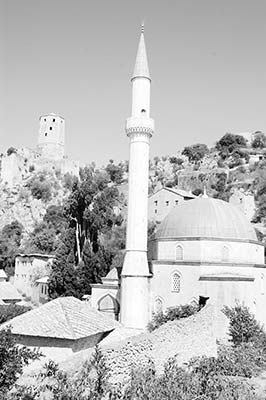
On the main road between Mostar and the Dalmatian Coast, it’s hard to resist stopping at Počitelj—dramatically set on chalky mountains, with a ruined castle and a proud mosque and minaret.
Also between Mostar and the coast—on a less-traveled route—is a powerful site of pilgrimage for Catholics: Međugorje, where six local teens claimed to have seen miraculous visions of the Virgin Mary in 1981. While there’s little to see beyond a modern church, believers (and the curious) find something spiritually powerful here.