BRATISLAVA
ON OR NEAR THE OLD TOWN’S MAIN SQUARE
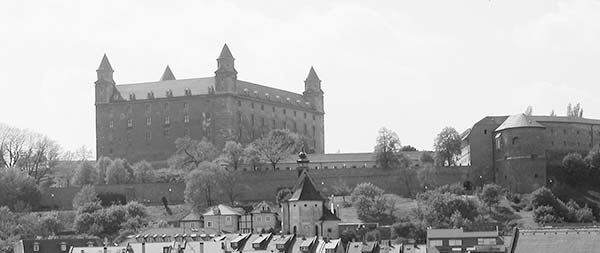
The Slovak capital, Bratislava, is an unexpected charmer. Its old town bursts with colorfully restored facades, lively outdoor cafés, and swanky boutiques. The ramshackle industrial quarter to the east is rapidly being redeveloped into a forest of skyscrapers. The hilltop castle gleams from a recent facelift. And even the glum communist-era suburb of Petržalka has undergone a Technicolor makeover. Bratislava and Vienna have forged a new twin-city alliance for trade and commerce, making this truly the nexus of Central Europe.
It’s easy to get the feeling that workaday Bratislavans—who strike some visitors as gruff—are being pulled to the cutting edge of the 21st century kicking and screaming. But many Slovaks embrace the changes and fancy themselves as the yang to Vienna’s yin: If Vienna is a staid, elderly aristocrat sipping coffee, then Bratislava is a vivacious, young professional jet-setting around Europe. Bratislava at night is a lively place; thanks in part to tens of thousands of university students, its youthful center thrives.
Bratislava’s location on the Danube (and the tourist circuit) makes it a convenient “on the way” destination between Budapest and Vienna. I admit that Bratislava used to leave me cold, but changes over the last 15 to 20 years have transformed it into a delightful destination. And its energy is inspiring.
PLANNING YOUR TIME
A few hours are enough to get the gist of Bratislava but may leave you wishing you had more time to explore this off-the-beaten-path European capital. Head straight to the old town and follow my self-guided walk, finishing with one or more of the city’s fine viewpoints: Ascend to the “UFO” observation deck atop the funky bridge, ride the elevator up to the Sky Bar for a peek (and maybe a drink), or hike up to the castle for the views. With more time, stroll along the Danube riverbank to the thriving, modern Eurovea development. If you spend the evening in Bratislava, you’ll find it lively with students, busy cafés, and nightlife.
Note that many museums and galleries are closed on Monday (except for Bratislava Castle, which is closed on Tuesday).
Day-Tripping Tip: Bratislava can be done as a long side trip from Budapest (or a short one from Vienna), but it’s most convenient as a stopover to break up the journey between Budapest and Vienna. Pay careful attention to train schedules, as connections alternate between Bratislava’s two train stations: Hlavná Stanica (serving all trains to/from Prague and Budapest and half of all trains to/from Vienna) and Petržalka (remaining trains to/from Vienna). If checking your bag at the station, be sure that your return or onward connection will depart from there.
Orientation to Bratislava
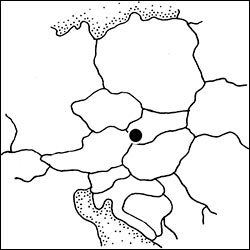
With 475,000 residents, Bratislava is Slovakia’s capital and biggest city. It has a compact, colorful old town (staré mesto), with the castle on the hill above. Most of the old town is traffic-free. This small area is surrounded by a vast construction zone, rotting residential districts desperately in need of beautification, and a sprawling communist-built suburb that is seeing new life (Petržalka, across the river).
TOURIST INFORMATION
The helpful TI is at Klobučnícka 2, on Primate’s Square behind the Old Town Hall (daily 9:00-18:00, Nov-April until 17:00, +421 2 16186, www.visitbratislava.com). In summer, a branch opens at the main train station (Hlavná Stanica; daily 9:30-17:00).
Bratislava City Card: The TI sells this card (€20/1 day, €25/2 days), which includes free transit and free or discounted admission to local sights. It’s worthwhile only if you’re doing the included old town walking tour (€15 without the card—see “Tours in Bratislava,” later). A cheaper option covers sights only, no public transit.
ARRIVAL IN BRATISLAVA
For information on Bratislava’s trains, buses, riverboats, and airport, see “Bratislava Connections” at the end of this chapter.
HELPFUL HINTS
Taxis: Taxis come in handy here but are poorly regulated—drivers can charge whatever they want. Any ride in the city center should be around €5. Cabbies waiting at the train station and tourist spots (such as the castle), however, often quote an inflated, flat price—usually €10-15. To improve your odds, call a taxi rather than hailing one on the street (or ask a hotelier or restaurant staffer to call one for you), or use a taxi with a logo and telephone number prominently on the door, and insist that they use the meter. Locals use ride-sharing apps like HOPIN or Bolt for the best rates.
Sitting quietly in the very center of Central Europe, wedged between bigger and stronger nations (Hungary, Austria, the Czech Republic, and Poland), Slovakia was brutally disfigured by the communists, then overshadowed by the Czechs. But in recent years, this fledgling republic has found its wings. Locals brag that the region around Bratislava has the hottest economy and highest income per capita of any region in the former communist region of Europe.
Early economic reforms caused two very different Slovakias to emerge: the modern, industrialized, flat, affluent west, centered on the capital of Bratislava; and the poorer, mountainous, “backward” east, with high unemployment and traditional lifestyles. Thanks to loads of money from the EU, that’s old news, and the east now looks better than the west.
Slovakia spent most of its history as someone else’s backyard. For centuries it was ruled from Budapest and known as “Upper Hungary.” At other times it was an important chunk of the Habsburg Empire, ruled from neighboring Vienna. But many visitors think first of another era: the 75 years that Slovakia was joined with the Czech Republic as the country of “Czechoslovakia,” a satellite of Soviet Russia. From its start following World War I, this union of Czechs and Slovaks was troubled; some Slovaks chafed at being ruled from Prague, while many Czechs resented the financial burden of their poorer neighbors to the east.
After the Czech Republic threw off communism in 1989’s peaceful Velvet Revolution, its separate peoples began to think of the future. The Slovaks wanted to rename the country Czecho-Slovakia (with that all-important hyphen signifying an equal partnership) and give themselves more autonomy. The Czechs balked, relations deteriorated, and Slovak nationalist candidate Vladimír Mečiar fared surprisingly well in the 1992 elections. Taking it as a sign that the two groups wanted to part ways, politicians pushed through (in just three months) the peaceful separation of the now-independent Czech and Slovak Republics. The “Velvet Divorce” became official on January 1, 1993.
At first the Slovaks struggled. Communist rule had been particularly unkind to them, and their economy was in shambles. Visionary leaders set forth bold solutions, including a flat tax (19 percent), followed by EU membership in 2004 and adoption of the euro currency in 2009. Before long, major international corporations noticed the same thing the Soviets had: This is a great place to build stuff, thanks to its strategic location (300 million consumers live within a day’s drive), low labor costs, and well-trained workforce. Today, multiple foreign automakers have plants here (Slovakia produces one million cars a year), and with its rapid technological development, Slovakia is gaining a reputation as the Silicon Valley of Central Europe.
Bratislava’s success story is impressive. The capital region enjoys almost full employment and is poised to lead Slovakia into a bright future.
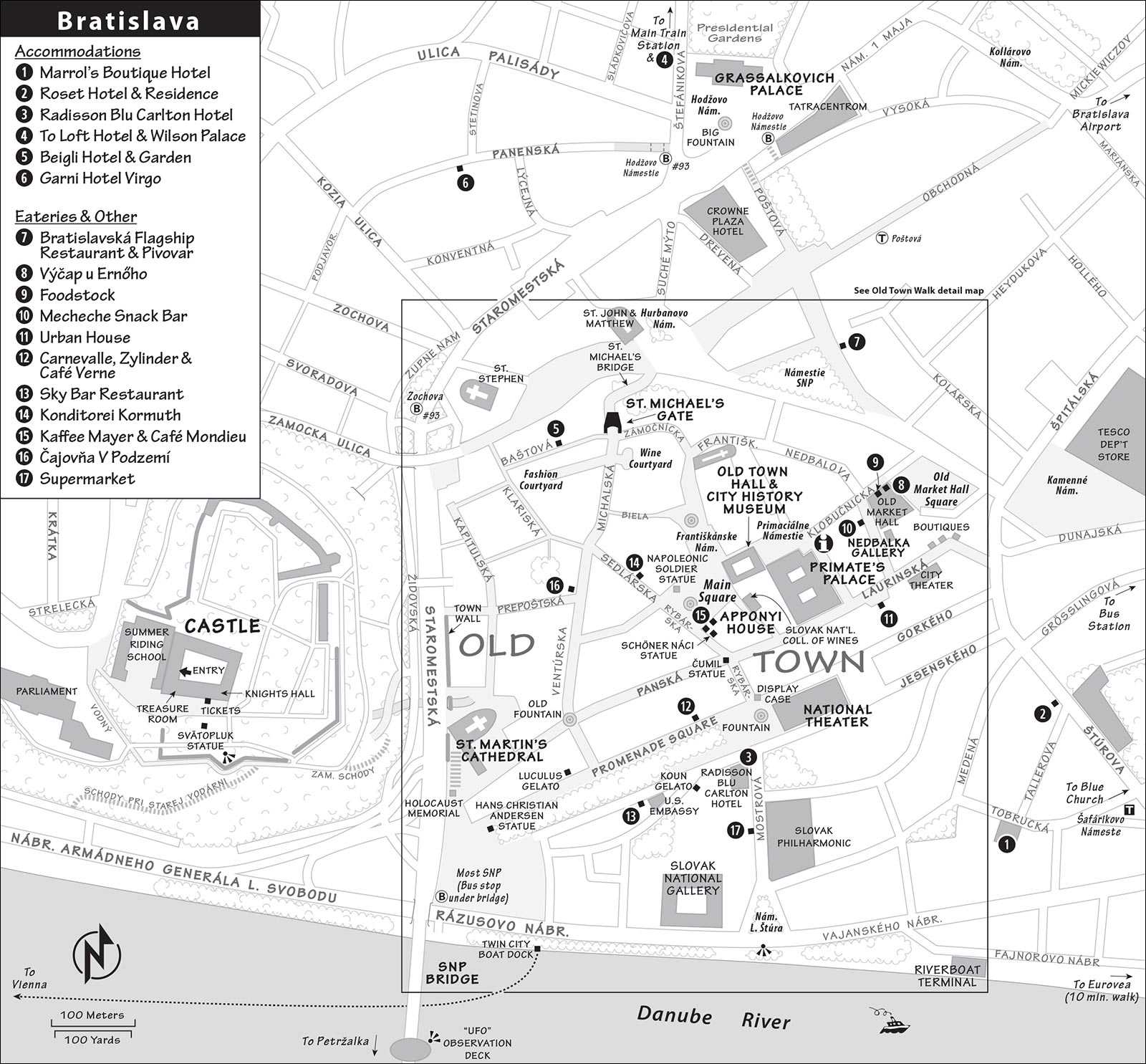
Supermarket: Centrally located, Billa is big and handy. Find it across from the Philharmonic, on Mostová street (Mon-Sat 7:00-21:00, Sun from 8:00).
Local Guidebook: For in-depth suggestions on Bratislava sightseeing, dining, and more, look for the eye-pleasing Bratislava Active guidebook (around €12, sold at every postcard rack).
Toll Sticker: Slovakia requires cars on its expressways to display a toll sticker. If your car doesn’t have one, buy one at some border crossings or at a gas station when you cross the border. You don’t need one if you’ll be dipping into the country on minor roads—only for major highways. For details, see “Tolls” on here.
Tours in Bratislava
Walking Tours
The TI offers a one-hour old town walking tour in English every day at 14:00 (€15, free with Bratislava City Card, must book at least 2 hours in advance). For €36, two people can book a private 1.25-hour tour with the same guides at whatever time is convenient. The TI can arrange this for you with a few hours’ notice (see “Tourist Information,” earlier). This can be a great way to become friends with the city.
Local Guide
MS Agency, run by Martin Sloboda, offers quality guides (€160/3 hours, €190/4 hours, +421 905 627 265, www.bratislava-guide.sk, sloboda@msagency.sk). Martin, a can-do entrepreneur and tireless Bratislava booster (and author of the great Bratislava Active guidebook described earlier), helped me put this chapter together. He’s part of the ambitious young generation that came of age as communism fell—and whose energy and leadership are reshaping the city.
Bratislava Old Town Walk
2 St. Michael’s Gate (Michalská Brána)
4 Main Square (Hlavné Námestie)
5 Primate’s Square (Primaciálne Námestie)
6 Old Market Hall (Stará Tržnica)
7 Laurinská Street—Bratislava’s Fashion Drag
9 Promenade Square (Hviezdoslavovo Námestie)
11 St. Martin’s Cathedral (Dóm Sv. Martina)
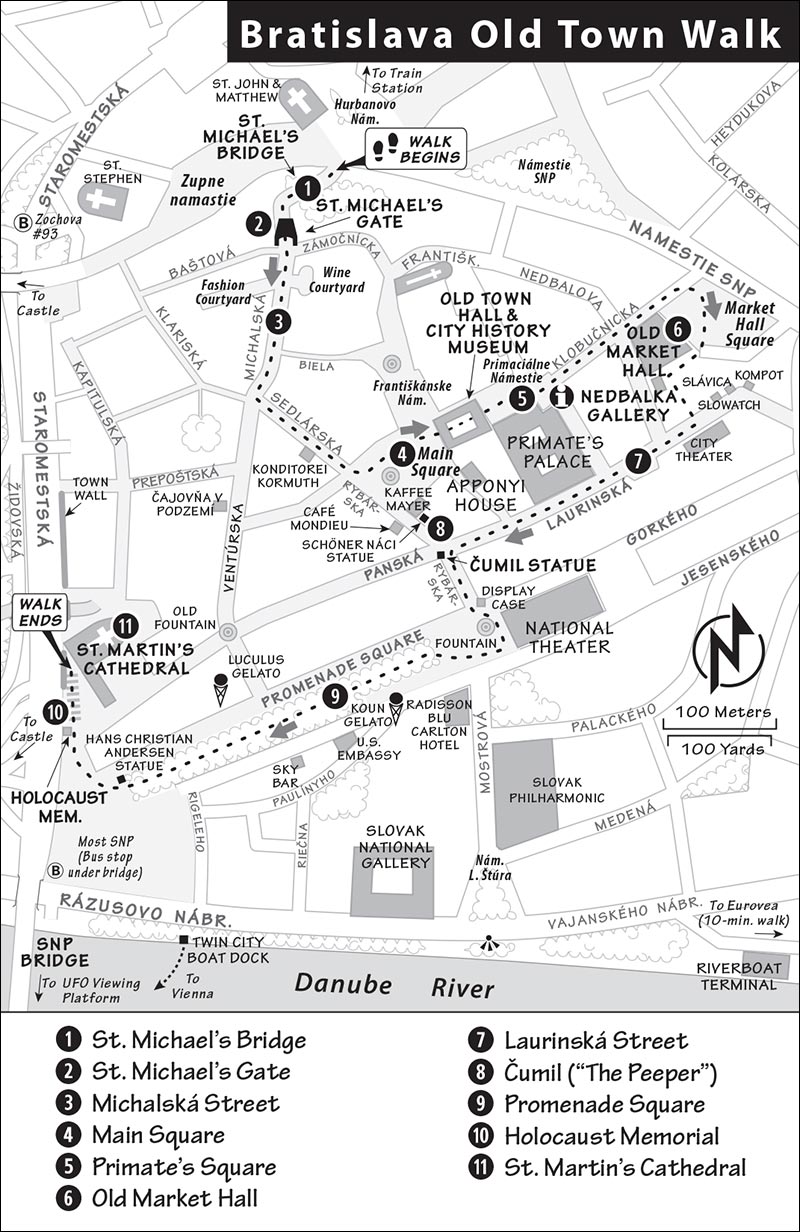
This self-guided orientation walk circles delightfully traffic-free old Bratislava (figure 1.5 hours, not including sightseeing stops).
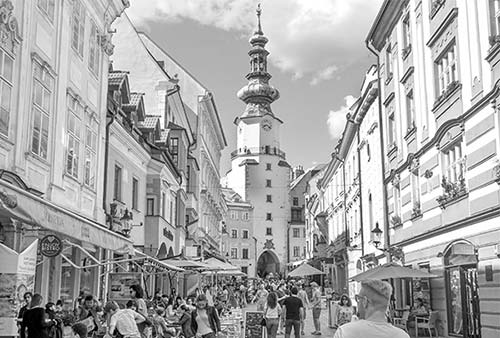
• Start on the bridge about 50 yards uphill from the green copper spire of the watchtower, St. Michael’s Gate (it looks like a church spire, at the top of the old town)—with the tram tracks of the ring road just beyond.
1 St. Michael’s Bridge
You’re standing below a watchtower marking St. Michael’s Gate (Michalská Brána), part of the town’s medieval wall. It’s capped with the Archangel Michael busy killing a dragon.
The Hungarian king gave Pressburg (as Bratislava was called back then) city status in 1291. This meant the city had permission to fortify, offer protection, and tax trade. Bratislava was at the crossroads of two medieval trade routes (the north-south “Amber Route” from the Baltics to the Mediterranean, and the east-west “Oriental Route” along the Danube). You’re standing over the former dry moat, now a garden of the city library and an outdoor concert venue.
Before heading in to the old town, look away from the tower. Notice the once-sleek Art Deco building on the right. Now a bar, when it was built in 1929 it was a supermodern department store designed to show off Bata shoes (a Czechoslovakian company that was once the largest shoe company in the world).
• Stroll over the bridge and enter the old center. You’re outside the wall, walking through a barbican—shaped like an “L” for better defense. Pause just after passing under the gate.
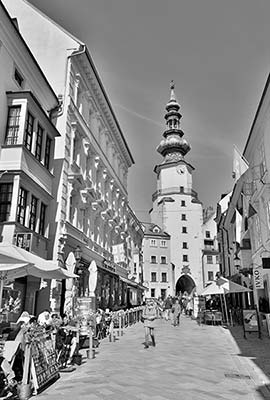
2 St. Michael’s Gate (Michalská Brána)
This is the last surviving tower of the city wall. Just below the gate, notice the “kilometer zero” plaque in the ground, marking the point from which distances in Slovakia are measured. But I wouldn’t trust the distances...unless we’re somehow on the equator. According to this, the North and South Poles are both 4,667 kilometers away.
• Before you stretches...
3 Michalská Street
Pretty as it is now, Bratislava’s old center was a decrepit ghost town during the communist era. The communist regime believed that Bratislavans of the future would live in large, efficient apartment buildings. They saw the old town as a useless relic of the bad old days of poor plumbing, cramped living spaces, social injustice, and German domination—a view that left no room to respect, or maintain, the town’s physical heritage.
For example, notice the uniform cobbles underfoot. In the 1950s, the communists sold Bratislava’s original medieval cobbles to cute German towns that were rebuilding themselves in a way that preserved their elegant Old World character. Locals avoided this stripped-down, desolate corner of the city, preferring to spend time in the Petržalka suburb across the river.
With the fall of communism in 1989, the new government began sorting out who had the rights to the old town’s buildings and returning them to their original owners. During this time, little repair or development took place (since there was no point investing in a building until ownership was clearly established). By 1998, most of the property issues were resolved. The city made the old town traffic-free, spruced up the public buildings, and encouraged private owners to restore their buildings as well.
Two decades later, the result is this delightful street, lined with inviting cafés and restaurants. Poke around to experience Bratislava’s charm, and notice that many of the people surrounding you are likely locals enjoying their newfound prosperity. This is a contrast to many European capitals like Prague, where locals avoid the tourist-filled old town center. Thanks to the Slovaks, who don’t like to brag, Bratislava has managed to keep a low profile.
Courtyards and passageways—most of them open to the public—burrow through the city’s buildings. Half a block down on the left, the courtyard at #12 was once home to vintners; their former cellars are now coffee shops, massage parlors, crafts boutiques, and cigar shops. More dead-end passages with characteristic shops are across the street, at #7 and #5.
• Two blocks down from St. Michael’s Gate, where the street changes to Ventúrska (at the signpost and big rock in the street), turn left along Sedlárska street.
Peek into Konditorei Kormuth (a few doors down on the right, at #8) and enjoy the elaborate window display. Mr. Kormüth dedicated many years and lots of money to creating a 17th-century setting for his café, with original furnishings and the history of the city beautifully painted on the walls. For roughly €10, you can enjoy a coffee and slice of cake made from old recipes from the Austro-Hungarian Empire and served on historical china in this unforgettable setting.
Farther on, you reach the historic...
4 Main Square (Hlavné Námestie)
This modest square, the centerpiece of Bratislava’s old town, feels too petite for a national capital. Its style is a mishmash—every building around it seems to date from a different architectural period.
The fountain, the most beautiful and historic in town, is a history lesson just waiting to happen. It celebrates the 1563 coronation of Maximillian II—the first Habsburg emperor to also be crowned “King of Hungary.” Back then, Slovakia was part of Hungary, which was ruled from Austria. (Got that?) As a mark of respect to the locals, Austrian emperors were crowned a second time, as Hungarian kings. (The German phrase for this arrangement—König und Kaiser, “king and emperor,” often abbreviated “K+K”—remains a mark of quality to this day.) I suppose if your choice as a Hungarian was to be ruled by the Ottomans or by an Austrian Habsburg, the answer was easy.
This arrangement also helps explain why Vienna and Bratislava—the present-day capitals of Austria and Slovakia—are the closest of any two capitals in Europe (you can actually see the lights of one from the other). This closeness wasn’t an accident—it was for security. Long before “Slovakia” existed, Bratislava (then called Pozsony) was the capital of “rump” Hungary—what was left of Hungary after most of its territory, including the capital, Buda, was conquered by the Ottomans. Bratislava was as far from the Ottoman Turks as possible while still being in Hungary and very well fortified. The castle crowning the hill high above the old town was the royal residence and protector of the crown jewels during this time. (For more on the complicated tricultural mix of the city—Austrian/German, Hungarian, and Slavic/Slovak—see the “City of Three Cultures” sidebar, later.)
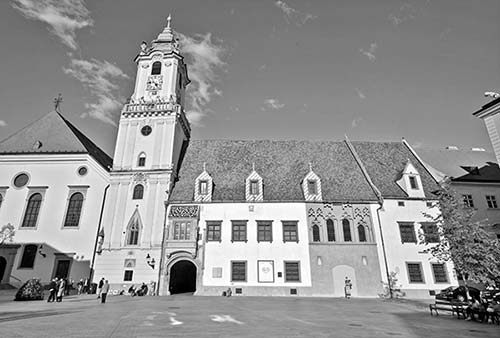
Standing in the middle of the main square, do a quick clockwise spin tour. (You’ll need to circle around the fountain to see everything.) Begin with the bold yellow tower of the Old Town Hall (Stará Radnica), which dominates the square. It’s Gothic at the core but with a Baroque facade. Near the bottom of the tower, to the left of the pointed window, find the Napoleonic cannonball embedded in the facade. It recalls Napoleon’s two sieges of Bratislava (the 1809 siege was 42 days long), which caused massive suffering—even worse than during World War II (the French consumed all the wine). This is just one of several cannonballs around town.
Down the street to the right of the Old Town Hall is the Apponyi House, the mansion of an 18th-century aristocrat that also holds the Slovak National Collection of Wine (described later, under “Sights in Bratislava”).
Turn farther right and note the venerable cafés. The classic choice is Kaffee Mayer, with dark awnings and outdoor seating facing the fountain. They’ve been selling coffee and cakes to a genteel clientele since 1873. You can enjoy your pick-me-up in the swanky old interior or out on the square.
At the corner in front of Kaffee Mayer (you may have to walk closer to see it) is a beloved statue. The jovial chap doffing his top hat is Schöner Náci, who lived in Bratislava until the 1960s. This eccentric old man, a poor carpet cleaner, would dress up in his one black suit and top hat and go strolling through the city, offering gifts to the women he fancied. (He’d often whisper “schön”—German for “pretty,” which is how he got his nickname.) Schöner Náci now gets to spend eternity greeting visitors outside his favorite café.
Across the street, the Art Nouveau Café Mondieu is known for its 1904 Klimt-style mosaics. The building was once a bank. These days the barista stands where a different kind of bean counter once did.
Now walk toward the Old Town Hall. In December, the square transforms into the city’s popular and atmospheric Christmas market. Step through the passageway leading to the Old Town Hall’s gorgeously restored courtyard, with its Renaissance arcades. (The entrance to the excellent City History Museum—described later—is inside the courtyard.)
• Continue all the way through the courtyard into…
5 Primate’s Square (Primaciálne Námestie)
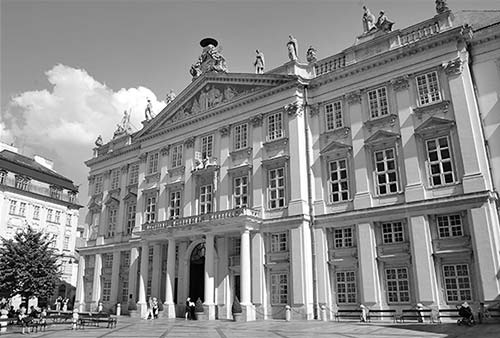
The pink mansion on the right is the Primate’s Palace—the new town hall in the old archbishop’s residence—with a fine interior decorated with English tapestries (described later). At the far end of this square is the TI.
Continue straight ahead (with the TI on your right) down the street called Klobučnícka—“Hatters Street.” In the Middle Ages, craftsmen gathered according to their trade, and streets were named for the craft found there. If you needed a hat, you knew where to find one.
• Continue two blocks straight ahead to a square on your right, fronted by a fine two-story Neoclassical market hall.
6 Old Market Hall (Stará Tržnica)
Built in 1910, today this busy community center hosts concerts and a Saturday market. The market hall square is a lively gathering place, too; see details on its monthly food-truck festivals under “Eating in Bratislava,” later.
On the right side of the square is a stark 12-story building—the tallest in town before WWII. If it looks barren, that was the point. It’s from the Bauhaus school—all the rage among German architects between the world wars. The battle cry for these harbingers of modernity: “Form follows function,” “less is more,” and “luxury does not require ornamentation.” Today, its ground floor is home to a dingy bingo parlor (visitors welcome).
The bombs of World War II mostly spared the old town but pulverized a nearby oil refinery and dynamite plant—targeted by Allies because they were a key part of the occupying Nazi war economy. But a few bombs went awry and hit the area just uphill from here, which accounts for all the post-1945 buildings. The concrete jungle beyond the tram tracks is modernist architecture of the 1960s communist era.
• Find a door just to the left of the Old Market Hall facade marked Centrál Pasáž (press buzzer if closed). It leads you through a 1920s Art Deco shopping gallery (cutting-edge a century ago) to a busy pedestrian boulevard.
7 Laurinská Street—Bratislava’s Fashion Drag
This street is lined with fun-to-browse boutiques. In the little nook where the street bends (just to the left) are three popular, very Slovak shops: Slowatch (upstairs in the Buffet store), with casual clothes and bags; Slávica, a high-end design shop with jewelry and accessories; and Kompot, selling a fun variety of unique, Slovak-themed T-shirts. This is a good spot to browse for a quality, nonkitschy souvenir.
Across from where you entered the street is the chillingly blocky facade of the communist-era City Theater (Mestské Divadlo). On the upper floor are Socialist Realist stained-glass windows—hard to see during the day, but illuminated at night, like a communist night light. We’ll see the much fancier National Theater in a moment.
Turn right on Laurinská and notice the Bratislava city seal hanging above you (a three-towered castle with a gate half-open). Stroll like a local for three long blocks, people-watching and window-shopping at more high-end shops.
• Look out, or you might stumble over a bronze fellow peeking out of a manhole.
8 Čumil (“The Peeper”)
Čumil was the first—and is still the favorite—of the many whimsical statues that dot Bratislava’s old town (such as Schöner Náci, whom we met earlier). Most date from the late 1990s, when city leaders wanted to entice locals back into the newly prettied-up and fun-loving center. There’s no story behind this one; the artist simply wanted to create a playful icon and let the townspeople make up their own tales. Čumil has survived being driven over by a truck—twice—and he’s still grinning.
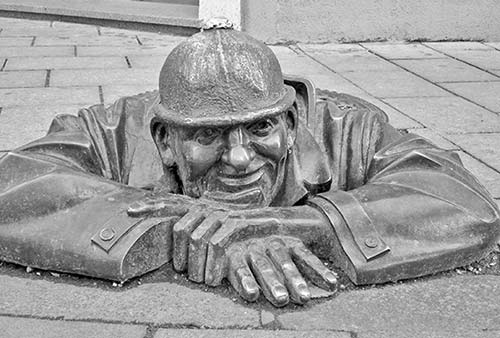
• Turn left at the man in the manhole and follow Rybárska to reach the long, skinny square called...
9 Promenade Square (Hviezdoslavovo Námestie)
At the near end of this square is Bratislava’s impressive opera house, the silver-topped Slovak National Theater (Slovenské Národné Divadlo). When the theater opened in the 1880s, half the shows were in German and half in Hungarian. Today, the official language is Slovak. Across the way, the opulent, beige Neo-Baroque building is home to the Slovak Philharmonic (Slovenská Filharmónia).
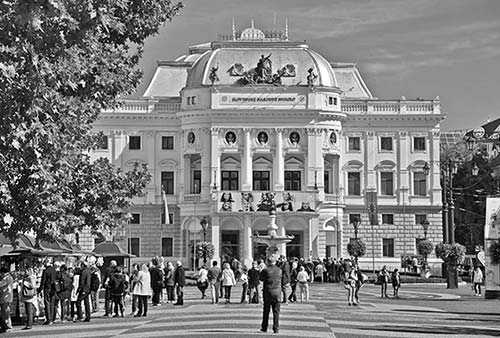
Right in front of the opera house, look down into the round, glass display case to see the foundation of the one-time Fishermen’s Gate into the city. Water surrounds the base of the gate: This entire square was once a tributary of the Danube, and the Radisson Blu Carlton Hotel (long the VIP hotel in town) across the way was once a series of inns on different islands. The buildings along the old town side of the square mark where the city wall once stood. Now the square is a lively zone on balmy evenings, with several good restaurants offering al fresco tables jammed with happy diners.
Turn right and stroll down the long square. Underfoot is a gigantic, cobbled version of Bratislava’s city seal. After passing a statue of the square’s namesake (Pavol Országh Hviezdoslav, a beloved Slovak poet), look for an ugly fence and barriers on the left. As usual, the US Embassy is the most heavily fortified building in the capital.
Historically more of an Austrian and Hungarian city than a Slovak one, Bratislava has always been a Central European melting pot. Over the years, notable visitors from Hans Christian Andersen to Casanova have sung the praises of this bustling burg on the Danube.
For most of its history, Bratislava was part of the Austrian Empire and known as Pressburg, with a primarily German-speaking population. (Only the surrounding rural areas were Slovak.) The Hungarians used Pozsony (as they called it) as their capital during the 150 years that Buda and Pest were occupied by Ottoman invaders.
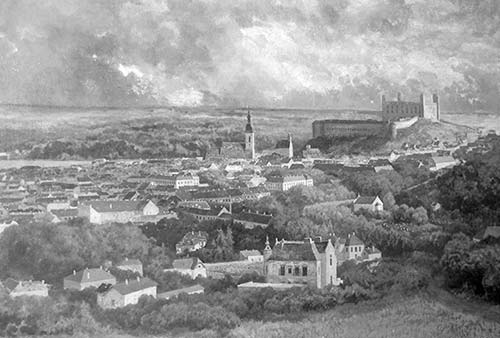
By its turn-of-the-20th-century glory days, the city was a rich intersection of cultures—about 40 percent German, 40 percent Hungarian, and 20 percent Slovak. Shop clerks greeted customers in all three languages. It was said that the mornings belonged to the Slovaks (farmers who came into the city to sell their wares at market), the afternoons to the Hungarians (diplomats and office workers filling the cafés), and the evenings to the Austrians (wine producers who ran convivial neighborhood wine pubs where all three groups would gather). In those wine pubs, the vintner would listen to which language his customers used, then bring them a glass with the serving size expected in their home country: 0.3 liters for Hungarians, 0.25 liters for Austrians, and 0.2 liters for Slovaks (a distinction that still exists today). Jews (one-tenth of the population) and Roma (then called Gypsies) rounded out the city’s ethnic brew.
When the new nation of Czechoslovakia was formed from the rubble of World War I, the city shed its German and Hungarian names and took the newly created Slavic name of Bratislava. The Slovak population was on the rise, but the city remained tricultural.
World War II changed all of that. With the dissolution of Czechoslovakia, Slovakia became an “independent” country under the thumb of the Nazis—who all but wiped out the Jewish population. At the end of the war, Czechoslovakia reunited under the USSR and expelled the city’s ethnic Germans and Hungarians in retribution for the misdeeds of Hitler and Horthy (Hungary’s wartime leader).
Bratislava’s urban heritage suffered terribly under the communists. The historic city’s multilayered charm and delicate cultural fabric were ripped apart, then shrouded in gray. The communists were prouder of their ultramodern SNP Bridge than of the city’s historic Jewish quarter—which they razed to make way for the bridge. Now the bridge and its highway slice through the center of the old town, and heavy traffic rattles the stained-glass windows of St. Martin’s Cathedral. The city’s Germanic heritage was also deliberately obscured.
But Bratislava’s most recent chapter is one of great success. Since the fall of communism, the city has gone from gloomy victim to thriving economic center and social hub. With a healthy free market economy, it now has the chance to re-create itself as Slovakia’s national capital. And its advantageous position on the Danube, a short commute from Vienna, is prompting its redevelopment as one of Europe’s up-and-coming cities. Once again, the streets of Bratislava are filled with German- and Hungarian-speakers...tourists and business travelers from nearby Vienna and Budapest.
Just past the embassy is the low-profile entrance to the Sky Bar, an affordable rooftop restaurant with excellent views (ride the elevator to the seventh floor). The glass-roofed pavilion in the center of the square is a popular venue for summer concerts. Behind it, on the old-town side of the square, is Luculus, where people are likely lined up outside for ice cream. (For ice cream without a lineup, you can backtrack to Koun Gelato—just before the US Embassy and immediately to the right of the Carlton Hotel.) On the right near the end of the park, a statue of Hans Christian Andersen is a reminder that the Danish storyteller enjoyed his visit to Bratislava, too.
• Reaching the end of the square, you run into the barrier for a busy highway. Turn right and walk one block to find the big, black marble slab facing a modern monument.
10 Holocaust Memorial
This was the site of Bratislava’s original synagogue. You can see an etching of the building in the big slab. At the base of the memorial sculpture, look for the word “Remember” carved into the granite in Hebrew and Slovak, commemorating the 70,000 Slovak Jews who were murdered during the Holocaust (out of a total population of 90,000 Slovak Jews). The fact that the town’s main synagogue and main church (described next) were located side by side illustrates the tolerance that characterized Bratislava before Hitler. Ponder the modern statue: the open doors of an evacuated home with shadows of people who once lived there, all crowned with bullet holes and the Star of David. It evokes the fate of the tens of thousands of Slovak Jews who died in the Holocaust.
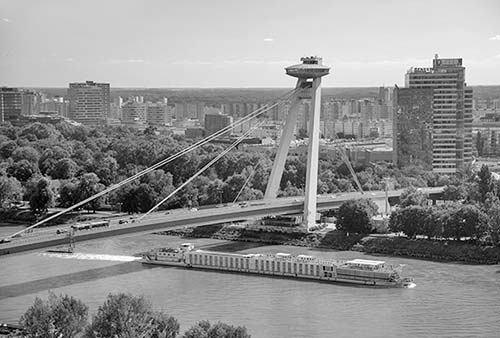
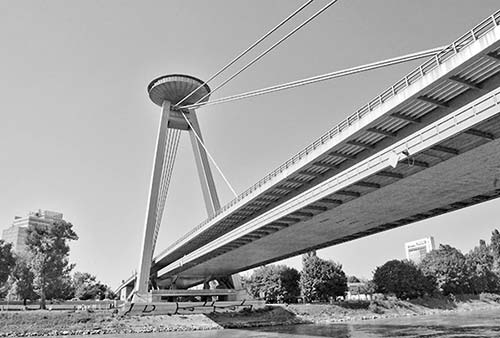
Hike up the stairs to the adjacent church. At the top of the stairs, pause to appreciate the view. Looking toward the river, you can’t miss the huge SNP Bridge (Most SNP), the communists’ pride and joy. The “SNP” is shorthand for the 1944 Slovak National Uprising against the Nazis, a common focus of communist remembrance. As with most Soviet-era landmarks in former communist countries, locals aren’t crazy about this structure—not only for the questionable Starship Enterprise design, but also because of the oppressive regime it represented. However, the restaurant and observation deck up top have been renovated into a posh eatery called (appropriately enough) “UFO.” You can visit it for the views, a drink, or a full meal. (For details, see the listing, later.)
The bridge was a groundbreaking design in 1972, but the freeway that runs across it messed up the city. If the highway thundering a few feet in front of this historic church’s door were any closer, the off-ramp would go through the nave. In the next decade, the plan is to move the highway into a tunnel that will emerge at the bridge—returning peace to this corner of Bratislava.
• Now turn your attention to the church towering overhead.
11 St. Martin’s Cathedral (Dóm Sv. Martina)
Nineteen Hungarian kings and queens were crowned in this church—more than anywhere else in Hungary. A replica of the Hungarian crown still tops the steeple. There’s relatively little to see inside the cathedral, but if it’s open, duck in (Mon-Sat 9:00-11:30 & 13:00-18:00, Sun 13:45-16:30). In the fairly gloomy interior you’ll find some fine carved-wood altarpieces (a Slovak specialty).
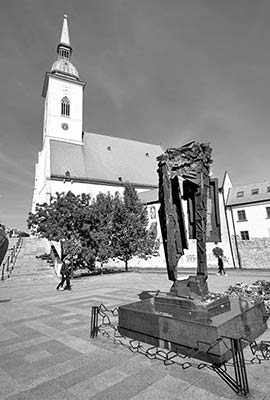
Just beyond the church is a stretch of the 15th-century town wall. The church was actually built into the wall, which explains its unusual north-side entry. In fact, look up to notice the fortified watchtower built into the corner of the church just above you.
• Our walk is over. From here you could either hike up to the castle (backtracking to the Holocaust Memorial, take the underpass beneath the highway, go up the stairs on the right marked by the Hrad/Castle sign, then turn left up the stepped lane marked Zámocké Schody), hike over the SNP Bridge (pedestrian walkway on lower level) to ride the elevator up the UFO viewing platform, or head for the river and stroll downstream to the thriving and futuristic new Bratislava—Eurovea (all of these are described under “Sights in Bratislava,” later).
Or you could carry on as described next to end up back where you started…
Back to St. Michael’s Gate
Continue the rest of the way around the church and take the grand stony staircase back down to busy Panská street. Turn left and follow Panská to the corner with Ventúrska. The old fountain here marks the actual cross point of the two great medieval trade routes (north-south from the Baltics to the Mediterranean, and east-west along the Danube). Head left, uphill (or north toward the Baltics, if you’re an amber merchant) toward St. Michael’s Gate.
Over the next few blocks, you may see the names of great composers on plaques marking historical buildings. Franz Liszt performed in Bratislava at age nine for local aristocrats and was discovered and sent to Vienna. Beethoven composed his Moonlight Sonata here. Mozart performed here at age six. Haydn conducted the orchestra here, and in the 20th century Béla Bartók called Bratislava home.
If you feel like a cup of tea along the way—or you’re nervous about a nuclear attack—climb through the thick iron door at #9 on the left (a long block after the fountain) and down into Čajovňa V Podzemí (“The Underground Tea Room,” Mon-Fri 11:00-22:00, Sat-Sun from 14:00), which fills an old bomb shelter with pillows, incense, and herby frills. A couple more blocks takes you back to where you started this walk.
Sights in Bratislava
Although Bratislava’s museums are underwhelming—and you could easily have a great day here without visiting any—a few right in the old town are worth considering.
ON OR NEAR THE OLD TOWN’S MAIN SQUARE
▲Primate’s Palace (Primaciálny Palác)
This tastefully restored French-Neoclassical mansion (formerly the residence of the archbishop, or “primate”) dates from 1781. The religious counterpart of the castle, it filled in for Esztergom—the Hungarian religious capital—after that city was taken by the Ottomans in 1543. Even after the Ottoman defeat in the 1680s, this remained the winter residence of Hungary’s archbishops. In the courtyard gurgles a fountain with St. George slaying a three-headed dragon; the exhibits are upstairs.
Cost and Hours: €3, Tue-Sun 10:00-17:00, closed Mon, Primaciálne Námestie 2, +421 2 5935 6394, www.visitbratislava.com.
Visiting the Museum: The palace, which now serves as the town hall, offers one fine floor of exhibits. Follow signs up the grand staircase to the ticket counter, then proceed up one more flight to the entrance lobby. From here, the Hall of Mirrors is on your left, straight ahead leads you to a series of state apartments decorated with precious tapestries (on the right), and at the far end is a long picture gallery leading to the chapel.
Portraits hang in the lobby of the German-speaking royals who ruled Hungary, which ruled the Slovaks, who lived in this part of the vast Habsburg empire...history here is like a set of Russian stacking dolls. You’ll see not one but two portraits of Habsburg empress Maria Theresa—young and old—as well as her father, Charles VI; and her son, Josef II. While Hungary was under Ottoman occupation, these Habsburg emperors came to Bratislava to also be crowned “kings of Hungary.”
Hall of Mirrors: This is perhaps the most historic room in the city. In 1805, the “Peace of Pressburg” treaty was signed here, sorting out logistics after Napoleon beat the Austrians and Russians at the Battle of Austerlitz. This victory marked the peak of Napoleon’s power. Today, the hall is used for concerts, city council meetings, and other important events. On the wall in the antechamber is a list of Bratislava’s mayors since the 1280s.
State Rooms and Tapestries: This series of large public rooms, originally designed to impress, is now an art gallery. Distributed through several of these rooms is the museum’s pride, and for many its highlight: a series of six English tapestries illustrating the ancient Greek myth of the tragic love between Hero and Leander.
The tapestries were woven in England by Flemish weavers for the court of King Charles I (in the 1630s). They were kept in London’s Hampton Court Palace until Charles was deposed and beheaded in 1649. Cromwell sold them to France to help fund his civil war, but after 1650, they disappeared...for centuries. In 1903, restorers broke through a false wall in this mansion and discovered the six tapestries, neatly folded and perfectly preserved. Nobody knows how they got here (perhaps they were squirreled away during the Napoleonic invasion, and whoever hid them didn’t survive). The archbishop—who had just sold the palace to the city—cried foul and tried to claim the tapestries (valued at triple the sales price of the entire palace), but the city said, “A deal’s a deal.”
Picture Gallery and Chapel: After traipsing through the grand rooms, go to the end of the main corridor and turn left down the hallway. This leads through the smaller rooms of the archbishop’s private quarters, which are now a picture gallery decorated with minor Dutch, Flemish, German, and Italian paintings. At the end of this hall, a bay window looks down into the archbishop’s private chapel. When the archbishop became too ill to walk down to Mass, this window was built so he could take part in the service in his pajamas.
▲City History Museum (Mestské Múzeum)
Delving thoughtfully into Bratislava’s past, this museum is rich in artifacts and well described in English and by the included audioguide. The core of the museum offers a sprawling, chronological look at local history through the 1920s, on two floors. The first floor features ecclesiastical art, including wood-carved statues. Upstairs, you’ll have a chance to climb up into the Old Town Hall’s tower, offering so-so views over the square, cathedral, and castle. Then you’ll see more exhibits in rooms once used by the town council—courthouse, council hall, chapel, and so on. This is a fascinating look at Habsburg rule and slice-of-life Bratislava in the early 20th century. Look for the model of “Pressburg” during the age of Maria Theresa. Farther along, trilingual street signs are a reminder that, historically, this was a city of three cultures and three languages (Slovak, German, Hungarian). The finale is down in the cellar: a graphic torture exhibit in the “law and order” zone, with replicas of torture equipment from the 16th through 18th century. At the far end of the exhibit, crouch down the passage to see three dreary and depressing cells...enough to make anybody behave.
Cost and Hours: €7, includes excellent audioguide, €8 combo-ticket with Apponyi House; open Tue-Sun 10:00-18:00, closed Mon; in the Old Town Hall—enter through courtyard, +421 2 259 100 812, https://muzeumbratislava.sk.
Apponyi House (Apponyiho Palác)
This nicely restored mansion of a Hungarian aristocrat is meaningless without the included audioguide (dull but informative). The museum has two parts. The cellar and ground floor feature an interesting exhibit on the vineyards of the nearby “Small Carpathian” hills, with historic presses and barrels and a replica of an old-time wine-pub table. (If this exhibit interests you, consider a stop at the Slovak National Collection of Wine, also at Apponyi House and listed next.) Upstairs are two floors of urban apartments from old Bratislava, called the Museum of Period Rooms. The first floor up shows off the 18th-century Rococo-style rooms of the nobility—fine but not ostentatious, with ceramic stoves. The second floor up (with lower ceilings and simpler decor) illustrates 19th-century bourgeois/middle-class lifestyles, including period clothing and some Empire-style furniture.
Cost and Hours: €5, includes audioguide, €8 combo-ticket with City History Museum; Tue-Sun 10:00-18:00, closed Mon; Radničná 1, +421 2 5910 0856, https://muzeumbratislava.sk.
Slovak National Collection of Wine
Run by the union of Slovak vintners, this room at the Apponyi House showcases the region’s wines, 80 percent of which are white. Filling a 16th-century brick-vaulted wine cellar, it features 100 Slovak wines that are open and eager to be tasted. Pick up the degustation list and track down what you like. An English-speaking sommelier is at your service.
Cost and Hours: Small tastings with explanations are an option, but for €30 you can taste up to 72 wines in 100 minutes...do this at the end of your sightseeing day (Tue-Fri 10:00-19:00, Sat from 11:00, closed Sun-Mon, Radničná 1, +421 2 4552 9967, www.salonvin.sk).
▲Nedbalka Gallery of Slovak Modern Art
This sleek, modern gallery is owned by a local tech millionaire and run as a private nonprofit. Ride the elevator to the top floor and work chronologically through the permanent collection of 20th-century Slovak art on four delightful floors. The ground floor is dedicated to temporary exhibits. You’ll notice glass is big in Slovakia (Chihuly is a Czech name, and Dale is well known and celebrated here). Admission includes a tablet multimedia guide and a nice coffee in the café.
Cost and Hours: €5, Tue-Sun 13:00-19:00, closed Mon, next to the Old Market Hall at Nedbalova 17, +421 2 2076 6031, www.nedbalka.sk.
BEYOND THE OLD TOWN
Bratislava Castle and Museum (Bratislavský Hrad a Múzeum)
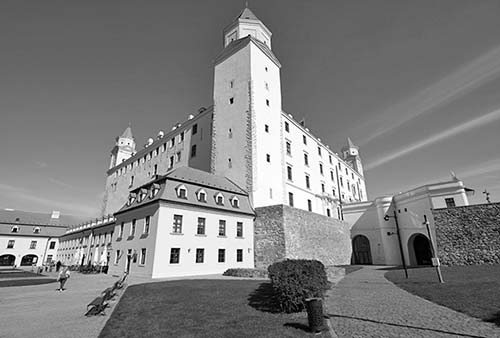
The imposing Bratislava Castle, crowning Bratislava’s hill, is the city’s most prominent landmark. Big and iconic as it is, it’s frankly dull up close—and the exhibits inside, although expanding, are not too exciting. Still, it’s almost obligatory to head up here simply for the grand views over Bratislava and the Danube...though, if the weather’s bad, you’d be forgiven for skipping it.
Cost and Hours: Castle grounds—free, museum—€12; Wed-Mon 10:00-18:00, Nov-March 9:00-17:00, closed Tue year-round, last entry one hour before closing; +421 2 2048 3104, www.snm.sk.
Getting There: For the best walking route to the castle, see the end of the “Bratislava Old Town Walk,” earlier in this chapter.
Background: When Habsburg empress Maria Theresa took a liking to Bratislava in the 18th century, she transformed the castle from a military fortress to a royal residence suitable for holding court. She added a summer riding school (the U-shaped complex next to the castle), an enclosed winter riding school out back, and lots more. Maria Theresa’s favorite daughter, Maria Christina, lived here with her husband, Albert, when they were newlyweds. Locals nicknamed the place “little Schönbrunn,” in reference to the Habsburgs’ summer palace on the outskirts of Vienna.
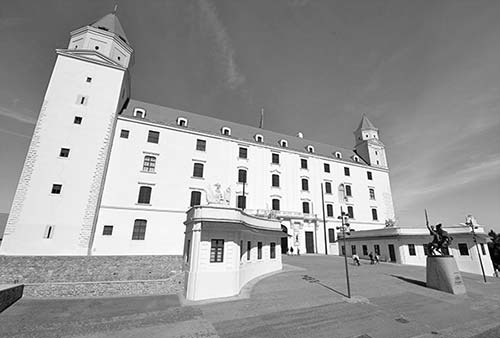
The palace became a fortress-garrison during the Napoleonic Wars, then burned to the ground in an 1811 fire started by careless soldiers, and was left as a ruin for 150 years. An extensive rebuild, based on the original plans discovered in the Habsburg archives in 2008, has breathed new life into the castle (which is surrounded by a delightful public park).
Visiting the Castle: The best part of a visit here is the grand view balcony in front, overlooking the Danube, the Petržalka suburb across the river (marked by the SNP Bridge—described next), and—just below and upstream—the nondescript, boxy, white office building that houses the Slovak parliament. The castle is surrounded by gardens that are enjoyable on a nice day.
The dynamic statue in front of the castle’s main entrance—with a knight waving his sword, rearing up on horseback—honors Svätopluk (846–894), the warrior-king who ruled over Great Moravia. His reign was the Slovaks’ historical high-water mark, when its territory included parts of the present-day Czech Republic, Austria, Germany, Poland, Bulgaria, Romania, Serbia, Croatia, and Slovenia. Unfortunately, this dominance was short-lived; in the early 10th century, soon after Svätopluk’s death, his kingdom was invaded by Magyars and folded into what became the Kingdom of Hungary—which Slovak lands would remain a part of for a thousand years. “Slovakia” has existed as a sovereign nation only since 1993; before that, you have to go all the way back to Svätopluk.
The castle interior features some interactive exhibits and an opportunity to climb its tallest tower. Inside, you’ll pass through a modest exhibit about the restoration of the castle, then make your way up the grand, red-carpeted staircase to several floors of exhibits. On the third floor is a café (tucked amid a fun exhibit of nostalgic advertisements) and the “History of Slovakia” exhibit, which begins with the prehistoric Celts, tracks the arrival of the Slavs, and ends with the fall of Great Moravia after Svätopluk’s time. Also on this floor, you can climb 87 steep, vertigo-inducing stairs to the top of the Crown Tower—the tallest part of the castle—for views over the city and the Danube basin (though the views from up top are not that much better than from down below).
▲▲SNP Bridge and UFO
Bratislava’s flying-saucer-capped bridge, completed in 1972 in heavy-handed communist style, has been reclaimed by capitalists. The saucer-shaped structure called the UFO (at the Petržalka end of the bridge) is now a spruced-up café/restaurant and observation deck, allowing sweeping 360-degree views of Bratislava from about 300 feet above the Danube.
Cost and Hours: €9.90, for €3 more you can return for the view after dark, elevator free if you have a meal reservation or order food at the pricey restaurant; elevator open daily 10:00-23:00, restaurant opens at 12:00; +421 2 6252 0300, www.u-f-o.sk.
Getting There: Walk across the bridge from the old town (walkways cross the bridge on a level below the road; the elevator entrance is a few steps down from the downstream-side walkway).
Visiting the UFO: The “elevator” that takes you up is actually a funicular—you may notice you’re moving at an angle. At the top, walk up the stairs to the observation deck, passing photos of the bridge’s construction.
Begin by viewing the castle and old town. The area to the right of the old town, between and beyond the skyscrapers, is a massive construction zone where the new Bratislava is taking shape.
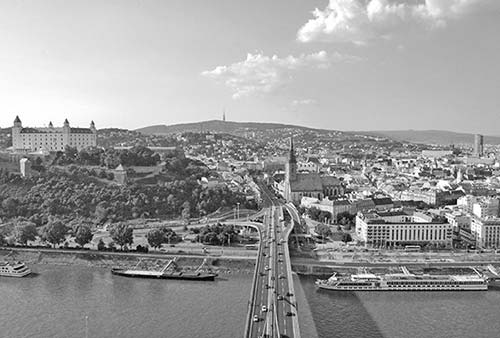
The huge TV tower caps a forested hill beyond the old town. Below and to the left of it, the pointy monument is Slavín, where more than 6,800 Soviet soldiers who fought to liberate Bratislava from the Nazis are buried. Under communist rule, a nearby church was forced to take down its steeple so as not to draw attention away from the huge Soviet soldier on top of the monument.
Now turn 180 degrees and cross the platform to face Petržalka, a planned communist suburb that sprouted here in the 1970s. The site was once occupied by a village, and the various districts of modern Petržalka still carry their original names (which now seem ironic): “Meadows” (Háje), “Woods” (Lúky), and “Courtyards” (Dvory). The ambitious communist planners envisioned a city laced with Venetian-style canals to help drain the marshy land, but the plans were abandoned after the harsh crackdown on the 1968 Prague Spring uprising. Without the incentives of private ownership, all they succeeded in creating was a grim, decaying sea of miserable concrete apartment paneláky (“panel buildings,” so-called because they’re made of huge prefab panels).
Today, one in six Bratislavans lives in Petržalka, and things are looking better. Like Dorothy opening the door to Oz, the formerly drab buildings have been splashed with bright new colors, and the interiors have been modernized. Far from being a slum, Petržalka is now a popular neighborhood for Bratislavan yuppies who can’t yet afford to build their dream houses.
Petržalka is also a big suburban-style shopping zone (note the supermall down below). But there’s still some history here. The park called Sad Janka Kráľa (originally, in German, Aupark)—just downriver from the bridge—was technically the first public park in Europe in the 1770s and is still a popular place for locals to relax and court.
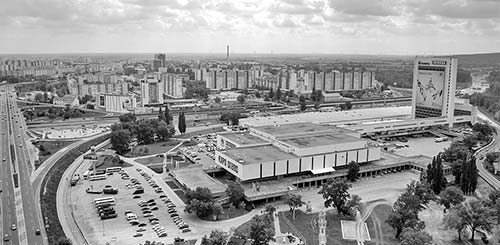
Scanning the horizon beyond Petržalka, two things stick out: on the left, the old communist oil refinery (which has been fully updated and is now state of the art); and on the right, a forest of modern windmills. These are just over the border, in Austria...and Bratislava is sure to grow in that direction quickly. Austria is about three miles that way, and Hungary is about six miles farther to the left.
Before you leave, consider a drink at the café. If nothing else, be sure to use the memorable WCs.
Blue Church of St. Elisabeth (Kostol Svätej Alžbety)
Just east of the old town—through a nicely manicured new park—is a lovely little neighborhood of cheery, colorful Art Nouveau buildings. The main landmark here is the gentle-blue, fancifully decorated Church of St. Elisabeth—also called simply the “Little Blue Church.” It’s straight out of a fairy tale, with rounded edges, pretty flourishes, and vivid colors. Designed by the great Hungarian Secessionist architect Ödön Lechner and completed in 1913, it’s worth the short walk from the old town for architecture fans. While the public open hours are limited, you can often peek through the glass doors to see the similarly soft and pretty interior (Bezručova 2).
▲Eurovea and the New Bratislava
Just downstream from the old town is the modern Eurovea complex, with four layers, each a quarter-mile long: a riverside park, luxury condos, a thriving modern shopping mall, and an office park. While it’s essentially a big riverfront shopping mall, those looking for a peek at the “new Bratislava” find it worth the lovely, short riverfront stroll from the old town...which is also a chance to check out all the moored riverboats.
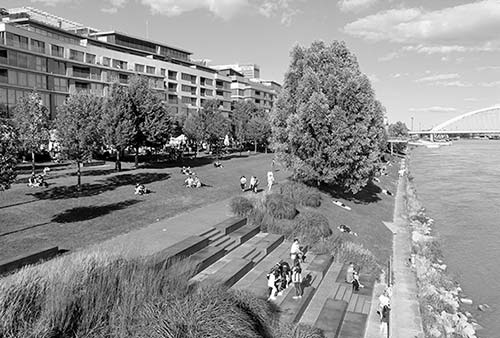
Eurovea’s central public space is a fountain- and statue-filled people zone between the Danube and Bratislava’s new National Theater. Directly in front of the theater, the pavement is pulled back to show original Roman paving stones that were excavated here (a reminder of the city’s long history as a trade crossroads). At the river end of the square, under the lion-topped pillar, a statue features General Milan Rastislav Štefánik, who represented Slovakia in a 1918 meeting in Pittsburgh and signed the “Pittsburgh Agreement”—creating the combined state of Česko-Slovensko. He’s holding a bronze copy of the document as he looks out at the Danube.
The riverfront strip of Eurovea is the embryo of a huge vision for a new Bratislava. Dozens of skyscrapers are being built at once, as the city’s old industrial zone (destroyed in World War II and now destined to be the city’s future tech-industry home) is one big construction site.
Exploring the old town gives you a taste of where this country has been. But wandering this riverside park, enjoying a drink in one of its chic outdoor lounges, and then browsing the thriving mall, you’ll enjoy a glimpse of where Slovakia is heading.
Sleeping in Bratislava
For locations, see the “Bratislava” map, earlier. Bratislava’s hotels are similar in price range to Vienna (see here).
$$ Marrol’s Boutique Hotel, on a quiet urban street, is the town’s most enticing option. Although the immediate neighborhood isn’t interesting, it’s just a five-minute walk from the old town, the public spaces are plush and luxurious, and its 54 rooms are tastefully appointed Old World country-style (air-con, elevator, gorgeous lounge and nice garden terrace, Tobrucká 4, +421 2 5778 4600, www.hotelmarrols.sk, rec@hotelmarrols.sk).
$$ Roset Hotel & Residence, facing the ring road’s tram tracks at the eastern edge of the old town (with some street noise), feels classy and upmarket. Its 26 rooms are spacious and plush (air-con, elevator, Štúrova 10, +421 917 373 209, www.rosethotel.sk, reservations@rosethotel.sk).
$$ Radisson Blu Carlton Hotel has been hosting VIPs for decades, with 170 rooms and all the big corporate trappings and expected services. It’s perfectly located, facing the National Theater and Promenade Square (air-con, elevator, Hviezdoslavovo Námestie 3, +421 2 5939 0000, www.radissonblu.com/hotel-bratislava, reservation.bratislava@radissonblu.com).
$$ Loft Hotel is an appealing midrange choice, tucked along the highway between the main train station and the old town (ask for a quieter back room facing the garden). It’s professional, stylish, and trendy—with comfy leather couches in the lobby, an on-site brewpub, and a staff that prides itself on its service. Of the 121 rooms, the “standard” rooms are fine; consider paying a bit more for a cushier, retro-industrial “premiere” room (air-con, elevator, coffee machine in rooms, Štefánikova 4, +421 2 5751 1000, www.lofthotel.sk, reservation@lofthotel.sk). They also have 10 more expensive, high-end rooms and apartments in the attached Wilson Palace, in the original building facing the main road.
$$ Beigli Hotel & Garden is a tight little hotel with a peaceful back garden tucked just inside St. Michael’s Gate in the old town. The 14 rooms are modern and comfortable, and the location—on a picturesque lane—is ideal. Locals love this spot for celebrating a special occasion (air-con, elevator, Baštová 4, +421 910 749 242, www.hotelbeigli.sk, office@hotelbeigli.sk).
$$ Garni Hotel Virgo, on a quiet residential street an eight-minute walk from the old town, rents 12 boutique-ish rooms (breakfast extra, reserve ahead for parking, Panenská 14, reception located at Panenská 5, +421 948 350 878, info@apartvirgo.sk). They also have some apartments in a nearby hotel.
Eating in Bratislava
Slovak cooking involves some Hungarian and Austrian influences, but it’s closer to Czech cuisine—lots of starches and gravy, and plenty of pork, cabbage, potatoes, and dumplings. Keep an eye out for Slovakia’s intensely filling national dish, bryndzové halušky (small potato dumplings with sheep’s cheese and bits of bacon). For a fun drink and snack that locals love, try a Vinea grape soda and a sweet, crescent-shaped Pressburger bagel in any bar or café.
Like the Czechs, the Slovaks produce excellent beer (pivo, PEE-voh). The dominant brand is Zlatý Bažant (“Golden Pheasant”). Bratislava’s beer halls are good places to sample Slovak beers—whether macrobrews or microbrews—and to get a hearty, affordable meal of stick-to-your-ribs pub grub. The Bratislava region also produces wines, similar to the ones that Vienna is known for. But, as nearly all is consumed locally, most outsiders don’t think of Slovakia as wine country.
Bratislava is packed with inviting new eateries. In addition to heavy Slovak staples, you’ll find trendy new bars and bistros and a smattering of non-European offerings. The best plan may be to stroll the old town and keep your eyes open for the setting and cuisine that appeals to you most. Or consider the areas listed next. All are within a short walk and offer a better, more interesting dining experience than the grotesquely touristy eateries that line Michalská street and other busy streets in the old town. For locations, see the “Bratislava” map, earlier.
Traditional Beer Hall on Námestie SNP
A couple of blocks north of the old town (and named for the Slovak National Uprising), the right side of this square is dominated by the following operation:
$$ Bratislavská Flagship Restaurant is a sprawling complex of eateries. The main location (door on the right) is the Bratislavská Reštaurácia. Walk through a maze of old-timey rooms, then up a flight of stairs to a huge dining hall that smells hoppy and feels happy (with the waitstaff sporting “Bar-tislava” and “Bra-tislava” T-shirts). The menu features classic Slovak dishes, and the portions are hearty and cheap. For a more intimate setting, the door to the left leads to the tight, woody Kláštorný Pivovar (“Monastery Brewery”), with a cozier ambience and the same menu. They also have tables outside on the square (daily, Námestie SNP 8, +421 917 927 673).
Near the Old Market Hall
While there’s often nothing actually inside the Old Market Hall (which fills a city block at the eastern edge of the old town, a five-minute walk from the main square), it’s surrounded by intriguing and trendy options. Once a month, the square in front features a “Street Food Park” with a wide variety of food trucks (worth planning around—check schedule at www.staratrznica.sk). At other times, walk around the block to survey your options (listed in order, from the front door).
$ Výčap u Ernőho is a popular, no-frills beer hall with a row of taps up front featuring a changing selection of quality beers. If you’d like to enjoy Slovak beers with local hipsters instead of the sloppy beer-hall tourist crowd, do it here (no food, Sun-Fri 16:00-24:00, Sat from 12:00, Námestie SNP 25, +421 948 360 153).
$ Foodstock is an enticing, hip, and healthy vegetarian place that advertises “good mood food.” It got its start as a food truck and now serves up a brief menu of delicious Asian-inspired dishes (including their popular gyoza) and all-you-can-drink homemade iced teas in a patchouli-scented space (daily, Klobučnícka 6, +421 905 456 654).
$$ Mecheche Snack Bar serves tiny, fancy sandwiches as if channeling a Barcelona tapas bar (Tue-Sat 17:00-24:00, closed Sun-Mon, Nedbalova 12, +421 948 853 444).
$$ Urban House, behind the Old Market Hall on fashionable Laurinská street, is California-trendy with a sprawling, industrial-mod, woody-bookstore ambience; great outdoor tables; and an appealing menu. The food (burgers, pizza, and so on) is nothing special, but the scene is fun (long hours daily, Laurinská 14, +421 911 755 205).
Restaurants on Promenade Square (Hviezdoslavovo Námestie)
This square is lined with restaurants, nearly all with open-feeling interior seating and mellow tables out on the square under the trees—ideal for enjoying the promenade of strollers. There’s no traffic, just the sound of fountains and the breeze. A strip of three places, side by side, makes for easy comparison-shopping; for a view, head up to Sky Bar.
$$$ Carnevalle is a hit for its steak. Their greeting? “Nice to meat you!” Their indoors feels outdoors—a spacious, glassed-in dining hall—and their tables on the square are inviting. The tasty dishes are nicely presented by a professional waitstaff (daily until late, at #20, +421 903 123 164).
$$$ Zylinder (“Top Hat”) re-creates a circa-1900 atmosphere to serve classy bourgeoise cuisine that leans closer to Austrian than traditional Slovak—think sausages and schnitzels (long hours daily, at #19, +421 903 123 134).
$ Café Verne, university-owned and unburdened by the high rent of its neighbors, feels like the dive bar of the strip—with mismatched antique tables spilling out onto the cobbles. It has a cozy, lowbrow, and mellow student vibe with stick-to-your-rib plates (pasta, goulash, salads) and drinks. You get what you pay for, but the price is right (long hours daily, at #18, +421 2 5443 0514).
Rooftop View: $$$$ Sky Bar Restaurant, just past the fenced-in US Embassy, features a Thai-meets-Mediterranean menu on its seventh-floor open-roof terrace. It’s a pretentious place, with local big shots dropping by and stuffy service. But the food’s good, and so are the views. It’s smart to reserve a view table in advance to dine here—or just drop by for a pricey vodka cocktail (Tue-Sat 17:00-24:00, closed Sun-Mon, Hviezdoslavovo Námestie 7, +421 948 109 400, www.skybar.sk).
Eurovea
This modern development facing the Danube River (a short walk downstream from the old town) has huge outdoor terraces rollicking with happy eaters. A variety of upscale and high-energy $$-$$$ restaurants lines the swanky riverfront residential and shopping-mall complex. Options include international—French, Italian, Brazilian—as well as branches of the Czech beer-hall chain Kolkovna and the British pan-Asian restaurant Wagamama. Or head to the $ food court in the shopping mall, where you’ll eat cheap. While the restaurants here are nothing special, it’s a fun excuse for a stroll along the Danube promenade, and to get a peek at the emerging “new Bratislava” zone beyond the old-town cobbles.
Bratislava Connections
BY TRAIN
Bratislava has two major train stations: the main station, walkable to some accommodations and the old town (Hlavná Stanica, abbreviated “Bratislava hl. st.” on schedules); and Petržalka station, in a suburb across the river and linked to town by bus. When checking schedules, pay attention to which station your train uses. Frequent bus #93 connects the two stations in about 10 minutes. For public transit info and maps, see http://imhd.sk.
Hlavná Stanica (Main Train Station)
This decrepit station is about a half-mile north of the old town. A left-luggage desk is to your right as you exit the tracks (úschovňa batožín; confirm open hours for pickup). There are also a few lockers along track 1; more are to the left from the main hall (after the vending machines and through the door). The station also has a TI window, and there’s an ATM in the main hall. A nicer, more modern waiting area is down the hallway to the left (with the tracks at your back).
Getting Downtown: It’s a short bus ride or a boring 15-minute walk to the town center. (Taxis stand by, but with rip-off prices—they’ll try to charge €15 rather than the legitimate €5 drop charge for the short ride. You can try insisting on the meter, but since they’re basically unregulated, it likely won’t help.)
Bus #93 leaves every five minutes from the right-hand curb 50 yards in front of the station; it stops at Grassalkovich Palace, Zochova (nearest the old town), and Most SNP (the bus station under the SNP Bridge, by the river). Buy a 30-minute základný lístok/basic ticket from the machine for €0.90 and stamp it as you get on the bus.
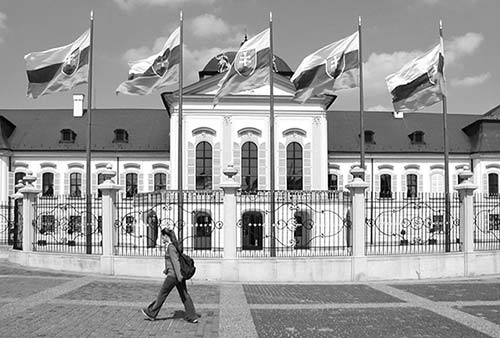
To walk downtown, exit out the station’s front door and follow the covered walkway past the bus stops. After the road bends right, take the pedestrian overpass, then head straight downhill on the busy main drag, Štefánikova. You’ll pass the presidential gardens, then Grassalkovich Palace, Slovakia’s “White House.” The old town—marked by the green steeple of St. Michael’s Gate (the start of my self-guided walk)—is a long block ahead of you.
Petržalka Train Station (ŽST Petržalka)
The main hall has an ATM and luggage lockers (by the door to the tracks).
Getting Downtown: Two different buses head to the old town from opposite sides of the station. For either bus, buy a 15-minute základný lístok/basic ticket from the machine for €0.90 and stamp it as you board. The stop closest to the old town is Zochova. Bus #80 stops closest to the station but makes more stops on the way to town: From the main hall, turn right to find the stop (direction: Kollárovo nám). Bus #93 is more direct but a longer walk from the station: Take the long tunnel under the tracks, exit on the other side, and follow the crosswalk straight across the busy highway to find the stop (direction: Hlavná Stanica).
Train Connections
From Bratislava by Train to: Budapest (6/day direct, 2.5 hours, most from main station), Vienna (2/hour, 1 hour; half from main station usually leaving hourly at :38, half from Petržalka usually leaving hourly at :15), Sopron (nearly hourly direct from Petržalka, 2.5 hours on RegionalExpress/REX), Prague (7/day direct, 4.5 hours, from main station). To reach other Hungarian destinations (including Eger and Pécs), it’s generally easiest to change in Budapest.
BY BUS
Two companies run handy buses that connect Bratislava, Vienna, and the airports in each city for about €10: Flixbus (www.flixbus.com) and Slovak Lines/Postbus (+421 2 5542 2734, www.slovaklines.sk). You can book ahead online, or (if arriving at the airport) just take whichever connection is leaving first.
BY BOAT
Riverboats run on the Danube several times a day, connecting Bratislava to Vienna. Conveniently, these boats dock right in front of Bratislava’s old town. While they are more expensive, less frequent, and slower than the train, some travelers enjoy getting out on the Danube. (Sail with your passport, as you’ll be crossing a border.)
The fast Twin City Liner runs modern catamarans between Vienna’s Schwedenplatz (where Vienna’s town center hits the canal) and a dock at the edge of Bratislava’s old town, along Fajnorovo Nábrežie (€31-36 each way, 3 or more/day, early April-Oct only, 1.5 hours; reservations smart, +43 1 904 8880, www.twincityliner.com).
BY PLANE
While Bratislava has a small airport (used mostly by discount airlines), the Vienna Airport is so close it’s considered the local airport.
Bratislava Airport (Letisko Bratislava)
This airport (code: BTS, www.bts.aero) is six miles northeast of downtown Bratislava. Budget airline Ryanair has many flights here. Some airlines market it as “Vienna-Bratislava,” thanks to its proximity to both capitals. It’s compact and manageable, with all the usual amenities.
From the Airport to Downtown Bratislava: The airport has easy public bus connections to Bratislava’s main train station (Hlavná Stanica, 1-hour ticket-€1.30, bus #61, 3-4/hour, 30 minutes). A taxi from the airport into central Bratislava should cost about €20.
To Budapest: Take the bus or taxi to Bratislava’s main train station, then hop a train to Budapest.
To Vienna: You can take Flixbus (www.flixbus.com) or Slovak Lines/Postbus (www.slovaklines.sk) to the Erdberg stop on Vienna’s U-3 subway line or the Hauptbahnhof (roughly €10, runs every 1-2 hours, 1.5 hours). A taxi from Bratislava Airport directly to Vienna costs €60-90 (depending on whether you use a cheaper Slovak or more expensive Austrian cab).
Vienna International Airport
This airport, 12 miles from downtown Vienna and 30 miles from downtown Bratislava, is well connected to both capitals (code: VIE, www.viennaairport.com). If you’re heading straight to Bratislava, there’s no need to go into Vienna from here. The easiest option is to take the Flixbus or Slovak Lines/Postbus bus described earlier. Check schedules on the airport website (under “Arrival & Parking”) or ask the airport TI which bus is leaving first, then head straight out the door and hop on. After about 45 minutes, the bus stops in downtown Bratislava, then heads to the Bratislava airport.