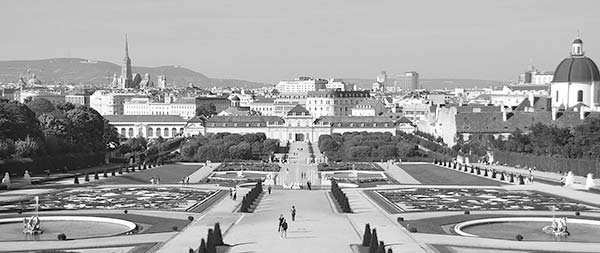
VIENNA
Wien
Map: Vienna’s Public Transportation
ON OR NEAR MARIAHILFER STRASSE
Map: Hotels & Restaurants near Mariahilfer Strasse
CASUAL EATERIES AND TRADITIONAL STANDBYS
Map: Restaurants in Central Vienna
WEIN IN WIEN: VIENNA’S WINE GARDENS
Vienna is the capital of Austria, the cradle of classical music, the home of the rich Habsburg heritage, and one of the world’s most livable cities. Many buildings still reflect the elegance of the 18th and 19th centuries, when Vienna was at the forefront of the arts and sciences. The city center is skyscraper-free, pedestrian friendly, dotted with quiet parks, and traversed by electric trams. Within just a few steps, you can nibble a decadent slice of Sacher torte over coffee with new friends, watch trained stallions prance, and ogle the crown jewels of the Habsburg empire.
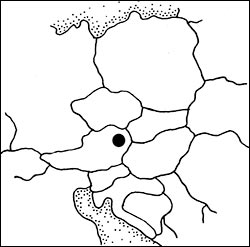
For much of its 2,500-year history, Vienna (Wien in German—pronounced “veen”) was on the frontier of “civilized” Europe. Located on the south bank of the Danube, it was threatened by Germanic tribes (in Roman times), marauding Magyars (today’s Hungarians, 10th century), Mongol raiders (13th century), Ottomans (the sieges of 1529 and 1683), and the USSR (during the Cold War, it was surrounded on three sides by the Iron Curtain).
The Habsburgs—who ruled for seven centuries, until 1918—transformed Vienna into the capital of a sprawling empire with some 50 million subjects...the majority of whom didn’t even speak German. The Habsburgs built their empire by making love, not war. Empress Maria Theresa, who ruled in the late 1700s, was famous both for her astute leadership and for cleverly marrying many of her 16 children (including Marie Antoinette) into royal families around Europe.
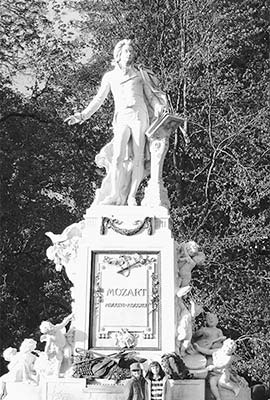
Vienna reached its zenith in the 19th century, when it was on par with London and Paris in size and importance. This cultural powerhouse was home to groundbreaking composers (Beethoven, Mozart, Brahms, Strauss, Haydn), scientists (Freud, Doppler), architects (Wagner, Loos), and painters (Klimt, Schiele, Kokoschka). By the turn of the 20th century, Vienna sat on the cusp between stuffy Old World monarchism and “subversive” modern trends.
After the turmoil of two world wars and the loss of Austria’s empire, Vienna has settled down into a laid-back, pleasant place where culture is still king. It’s a city of top-notch museums, big and small. Compared with most modern European urban centers, the pace of life is slow. People nurse coffee and pastries over the daily paper at cafés. Classical music is everywhere, and the waltz is still the rage.
From a practical standpoint, Vienna serves as a prime gateway city. Its central location is convenient to most major Central European destinations. Just upstream on the Danube from Budapest and Bratislava, and situated farther east than Prague, Ljubljana, and Zagreb, Vienna is also an ideal launchpad for a journey into Eastern Europe.
PLANNING YOUR TIME
For a big city, Vienna is pleasant and laid-back. Packed with sights, it’s worth two days and two nights on even the speediest trip.
If you’re visiting Vienna as part of a longer European trip, you could sleep on the train on your way in and out—Berlin, Paris, Kraków, Venice, Rome, and Frankfurt are each a handy night-train journey away.
Palace Choices: The Hofburg and Schönbrunn are both world-class palaces, but seeing both is redundant if your time or money is limited. If you’re rushed and can fit in only one palace, make it the Hofburg. It comes with the popular Sisi Museum, is adjacent to perhaps Europe’s best collection of crown jewels, and is right in the town center, making for an easy visit. With more time, a visit to Schönbrunn—set outside town amid a grand and regal garden—is also a great experience.
Vienna in One to Four Days
Below is a suggested itinerary for how to spend your daytime sightseeing hours. Whenever you need a break, linger in a classic Viennese café.
Evenings: The best options for evenings are taking in a concert, opera, or other musical event; enjoying a leisurely dinner (and people-watching) in the stately old town; heading out to the Heuriger wine pubs in the foothills of the Vienna Woods; or touring the Haus der Musik interactive music museum (open nightly until 22:00). Plan your evenings based on the schedule of musical events. If you’ve downloaded my audio tours (see here), both the Vienna City Walk and Ringstrasse Tram Tour work wonderfully in the evening.
Day 1
| 9:00 | Circle the Ringstrasse by tram (following my self-guided tram tour). |
| 10:30 | Drop by the TI for planning and ticket needs. |
| 11:00 | Tour the Vienna State Opera (schedule varies, check online). |
| 14:00 | Follow my Vienna City Walk, including visits to the Kaisergruft and St. Stephen’s Cathedral (nave closes at 16:30, or 17:30 July-Aug). |
| 18:00 | Dinner and romantic stroll in the old center. |
Day 2
| 9:00 | Browse the colorful Naschmarkt. |
| 11:00 | Tour the Kunsthistorisches Museum. |
| 14:00 | Tour the Hofburg Palace Imperial Apartments and Treasury. |
| Evening | See options earlier. |
Day 3
| 8:00 | Tour Schönbrunn Palace to enjoy the imperial apartments and grounds (reserve in advance). |
| 14:00 | Visit Belvedere Palace, with its fine Viennese art and great city views. |
| Evening | See options earlier. |
Day 4
Depending on your interests, enjoy the engaging Karlsplatz sights (Karlskirche, the Secession) or the Natural History Museum. Do some shopping along Mariahilfer Strasse. Or rent a bike and head out to the modern Donau City “downtown” sector, Danube Island (for fun people-watching), and Prater Park (with its amusement park).
Orientation to Vienna
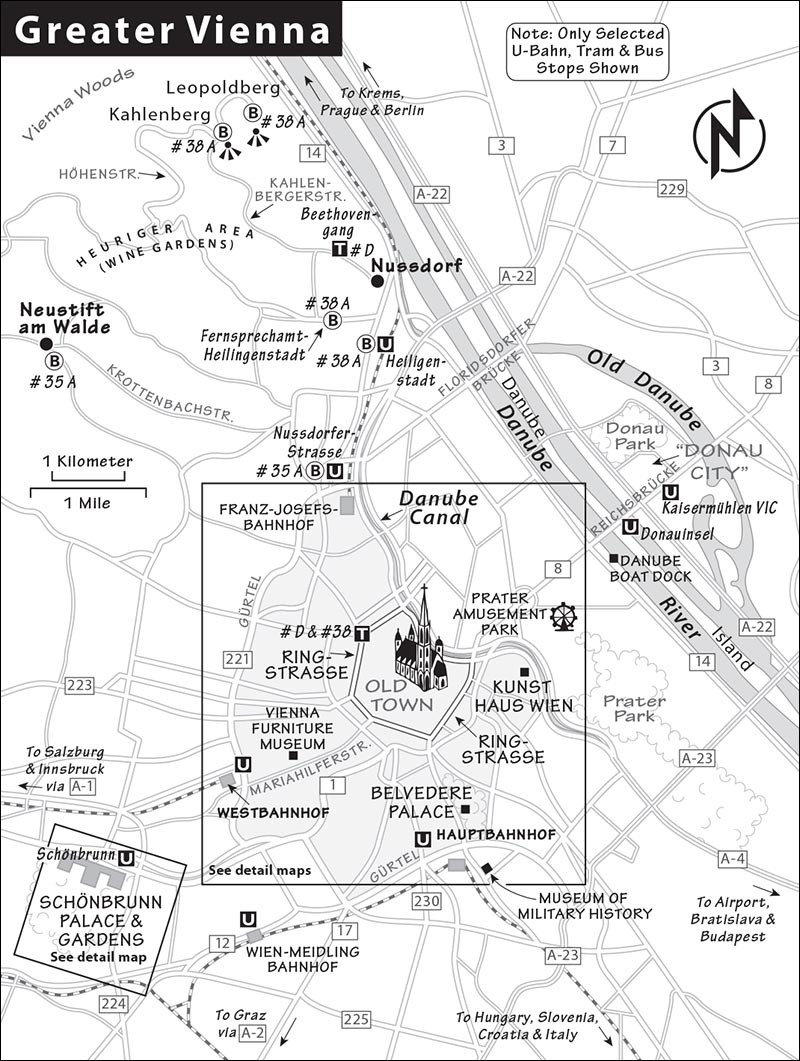
Vienna sits between the Vienna Woods (Wienerwald) and the Danube River (Donau). The Alps, which arc across Europe from Marseille, end at Vienna’s wooded hills, providing a popular playground for walking and sipping new wine. This greenery’s momentum carries on into the city. More than half of Vienna is parkland, filled with ponds, gardens, trees, and statue-maker memories of Austria’s glory days.
Think of the city map as a target with concentric circles: The bull’s-eye is St. Stephen’s Cathedral, the towering spired church south of the Danube. Surrounding that is the old town, bound tightly by the circular road known as the Ringstrasse, marking what used to be the city wall. The Gürtel, a broader, later ring road, contains the rest of downtown. Outside the Gürtel lies the uninteresting sprawl of modern Vienna.
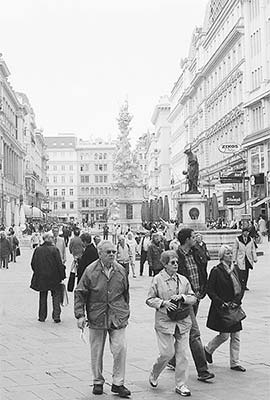
Much of Vienna’s sightseeing—and most of my recommended restaurants—are located in the old town, inside the Ringstrasse. Walking across this circular area takes about 30 minutes. St. Stephen’s Cathedral sits in the center, at the intersection of the two main (pedestrian-only) streets: Kärntner Strasse and the Graben.
Several sights sit along, or just beyond, the Ringstrasse: To the southwest are the Hofburg and related Habsburg sights, as well as the Kunsthistorisches Museum; to the south is a cluster of intriguing sights near Karlsplatz; to the southeast is Belvedere Palace. A branch of the Danube River borders the Ring to the north. As a tourist, concern yourself only with this compact old center. When you do, sprawling Vienna becomes easily manageable.
TOURIST INFORMATION
Vienna’s main TI is a block behind the Vienna State Opera at Albertinaplatz (daily 9:00-18:00, includes theater box office, +43 1 24 553, www.vienna.info). It’s a rare example of a TI in Europe that is really a service (possible because tourists pay for it with a hotel tax). There’s also a TI at the airport (daily 9:00-18:00).
You’ll get the same price here for theater tickets as you would at the venues or from the goofy salespeople on the street—the advantage here is that they have all the options, you can review them with a knowledgeable salesperson, and you can study the various venues. They also sell ferry tickets (to Bratislava, Slovakia) and intercity bus tickets.
Look for two good brochures: Walks in Vienna (with a schedule of walking tours—see “Tours in Vienna,” later) and Route (a helpful guide with seven self-guided city walks). The quarterly program Spot lists cultural highlights in town (including concerts).
ARRIVAL IN VIENNA
For a rundown on Vienna’s various train stations and its airport, see “Vienna Connections,” at the end of this chapter.
HELPFUL HINTS
Book Ahead: It’s wise to book your Schönbrunn Palace visit and reserved seats for the Vienna Boys’ Choir online in advance. Otherwise, a fancy dinner or any tours you hope to take are all you should be concerned with in advance.
Music Sightseeing Priorities: Be wary of Vienna’s various music sights. Many “homes of composers” are disappointing. My advice to music lovers is to take in a concert, tour the Vienna State Opera or snare cheap standing-room tickets to see a performance there, enjoy the Haus der Musik, or scour the wonderful Collection of Historic Musical Instruments in the Neue Burg (New Wing) of the Hofburg (included in your World Museum Vienna ticket). If in town on a Sunday, don’t miss the glorious music at the Augustinian Church Mass (see here).
Sightseeing Passes: The Vienna Pass is pricey and only a good option for those who value the convenience of the hop-on, hop-off bus (generally not necessary in this walkable city). The Sisi Ticket makes sense for those wanting to see both Habsburg palaces and the Treasury.
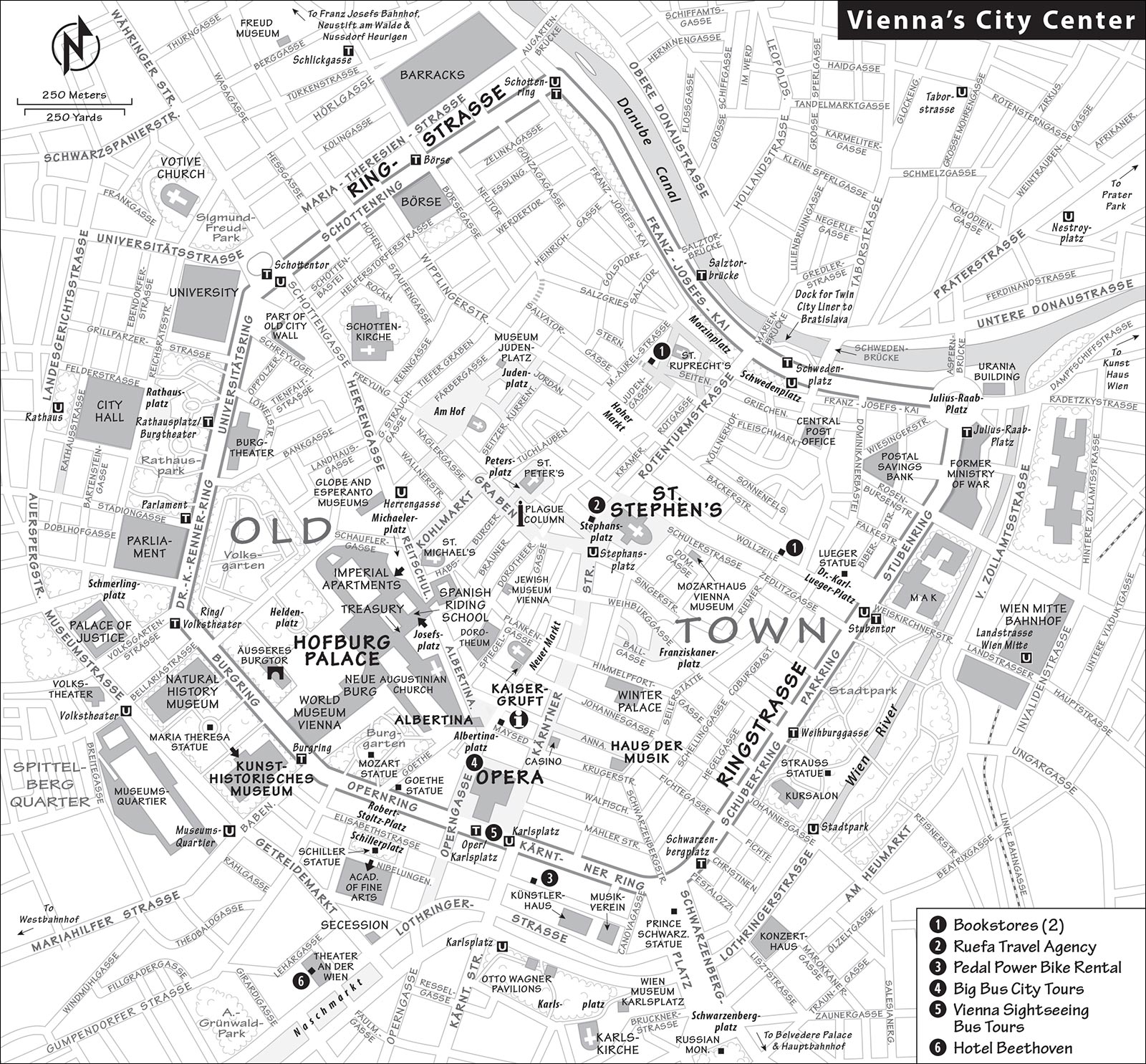
English Bookstore: Stop by the woody and cool Shakespeare & Co., in the historic and atmospheric Ruprechtsviertel district near the Danube Canal (Mon-Sat 9:00-21:00, closed Sun, north of Hoher Markt at Sterngasse 2, +43 1 535 5053, www.shakespeare.co.at). The biggest bookstore with a good English selection is Morawa (near the cathedral at Wollzeile 11). For locations, see the “Vienna’s City Center” map.
Travel Agency: Conveniently located on Stephansplatz, Ruefa sells tickets for flights and trains (Mon-Fri 9:00-18:30, closed Sat-Sun, Stephansplatz 10—see “Vienna’s City Center” map on here, +43 1 513 4524, Sandra speaks English).
Toll Sticker: If you’re driving on highways in Austria, you’re required to display a toll sticker. Your rental car may already come with the necessary sticker—ask. For details, see “Tolls” on here.
GETTING AROUND VIENNA
By Public Transportation
Take full advantage of Vienna’s efficient transit system, operated by Wiener Linien, which includes trams, buses, the U-Bahn (subway), and the S-Bahn (faster suburban trains). It’s fast, clean, and easy to navigate.
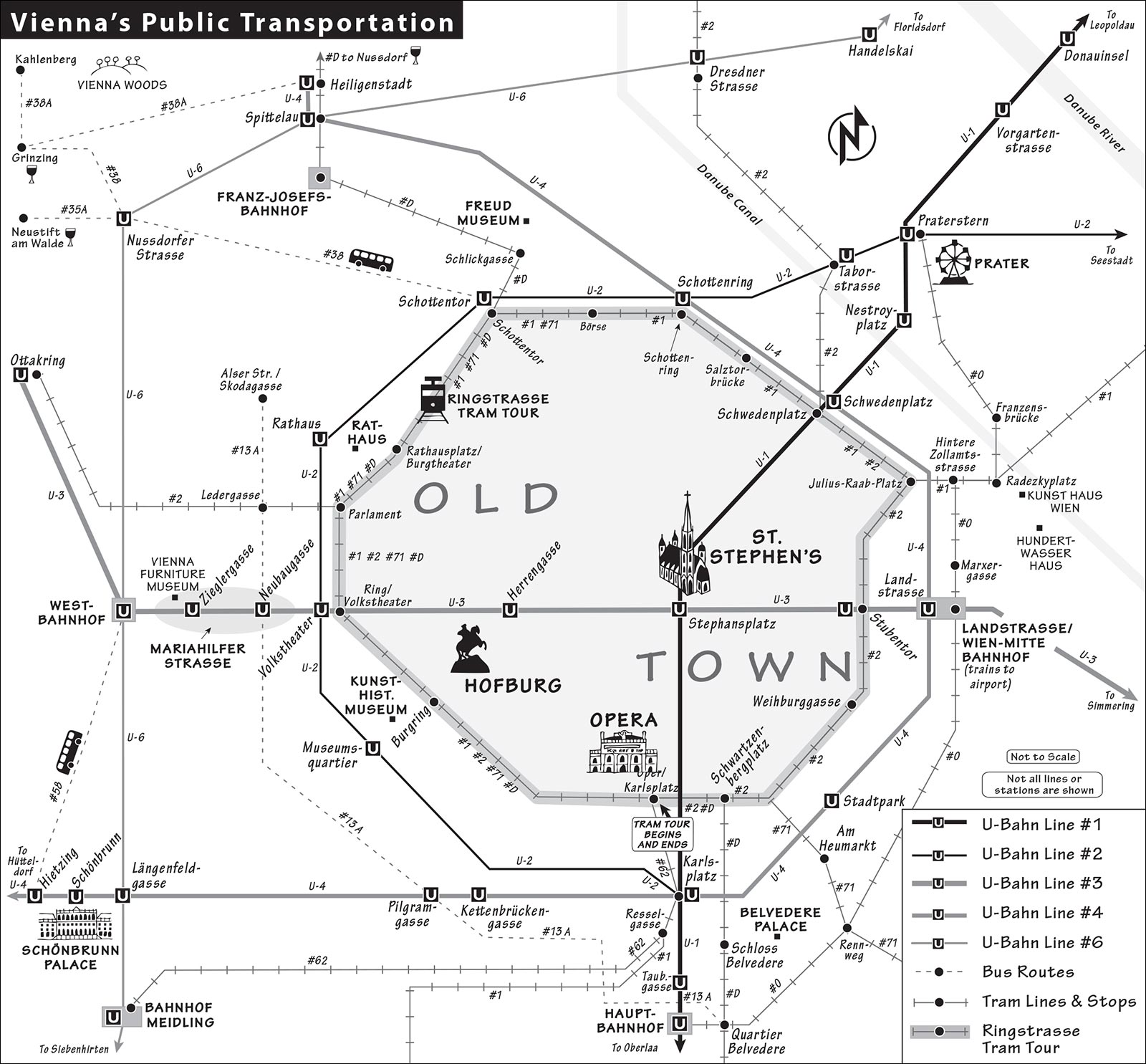
I generally stick to the tram to zip around the Ring (trams #1, #2, #71, #D, and #O) and take the U-Bahn to outlying sights, hotels, and Vienna’s train stations (see the “Vienna’s Public Transportation” map). There are five color-coded U-Bahn lines: U-1 red, U-2 purple, U-3 orange, U-4 green, and U-6 brown. If you see a bus number that starts with N (such as #N38), it’s a night bus, which operates after other public transit stops running. Transit info: +43 1 790 9100, www.wienerlinien.at.
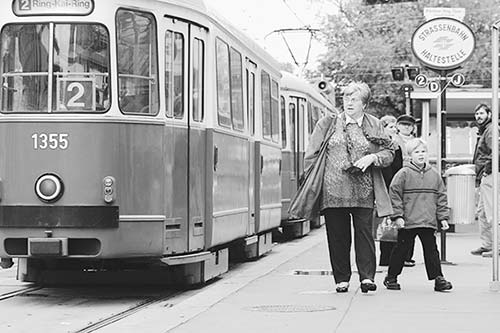
Tickets and Passes: Trams, buses, and the U-Bahn and S-Bahn all use the same tickets. Except on days spent entirely within the Ring, buying a single- or multiday pass is usually a good investment (and pays off if you take at least four trips). Many people find that once they have a pass, they end up using the system more.
Buy tickets from vending machines (easy and in English), ticket offices in stations, or at some tobacco shops. Not all trams have ticket machines, so it’s best to purchase tickets ahead of time. You cannot purchase tickets on buses.
You have lots of choices:
• Single tickets (€2.40, €2.60 on tram, good for one journey with necessary transfers)
• 24-hour transit pass (€8)
• 48-hour transit pass (€14.10)
• 72-hour transit pass (€17.10)
• There’s also a 7-day transit pass (Wochenkarte, €17.10) and a
8-day “Climate Ticket” (Acht-Tage-Klimakarte, €40.80, can be shared).
Transit Tips: To get your bearings on buses, trams, the U-Bahn, and the S-Bahn, know the end-of-the-line stop in the direction you’re heading. For example, if you’re in the city center at Stephansplatz and you want to take the U-Bahn to the main train station (Hauptbahnhof), you’d take U-1 going in the direction “Oberlaa.”
Stamp your ticket at the barriers in U-Bahn and S-Bahn stations, and in the machines on trams and buses (stamp multiple-use passes only the first time you board). When purchasing tickets from vending machines, you can choose to have them validated before being printed. There are no formal checks, but you may see random stops; cheaters pay a stiff fine (about €115), plus the cost of the ticket.
On some trams, stop announcements are voice-only and easy to miss—carry a map and stay alert. Rookies miss stops because they fail to open the door. Push buttons, pull latches—do whatever it takes.
Before you exit a U-Bahn station, study the wall-mounted street map and choose the most efficient exit.
Cute little electric buses wind through the tangled old center (from Schottentor to Stubentor). Bus #1A is best for a joyride—hop on and see where it takes you.
By Taxi or Uber
Though the city has a great public transit system and most of your time will be spent in the essentially traffic-free old town, you may need the occasional taxi. You can try waving one down, but locals either go to a taxi stand (there’s generally one nearby) or call one. All Uber drivers in Vienna are also taxis—so, while Uber works here just like back home, it’s essentially a taxi call service. Uber rates are a bit cheaper than official taxi metered rates, and there’s no extra charge for the call.
By Bike
With more than 600 miles of bike lanes (and a powerful Green Party), Vienna is a great city on two wheels. Consider using a rental bike for the duration of your visit (Pedal Power is the best option, see listing later in this section); you’ll go anywhere in town faster than a taxi can take you. Biking (carefully) through Vienna’s many traffic-free spaces is no problem. And bikes ride the U-Bahn for free (but aren’t allowed during weekday rush hours).
The bike path along the Ring is wonderfully entertaining—you’ll enjoy the shady parklike ambience of the boulevard while rolling by many of the city’s top sights.
Besides the Ring, your best sightseeing by bike is along the Danube Canal, across Danube Island, and out to the modern Donau City business district. These routes are easy to follow on the Radkarte bike map available from the TI. Bike lanes are usually marked with red-colored pavement, but some are marked just with white lines.
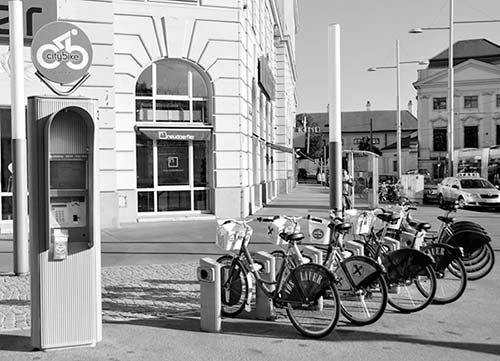
Borrowing a City Bike: WienMobil Rad (operated by Nextbike) has an app that lets you rent bikes from public racks all over town. Before your trip, download the WienMobil Rad app and register with your credit card. To get a bike at a stand, open the app and enter the number of the bike you want; you’ll receive a code to unlock it (+43 1 790 9100, www.wienerlinien.at/wienmobil-app).
Renting a Higher-Quality Bike: To ride beyond the town center—or for a better set of wheels—rent from Pedal Power (RS%—10 percent with this book, e-bikes available, daily May-Sept, shorter hours March-April and Oct-Nov, rental office near the opera house, a block beyond the Ring, at Bösendorferstrasse 5—see “Vienna’s City Center” map, earlier, +43 1 729 7234, www.pedalpower.at). For €17 extra, they’ll deliver a bike to your hotel and pick it up when you’re done. They also organize bike tours.
Tours in Vienna
 To sightsee on your own, download my free audio tours that cover some of Vienna’s top sights and neighborhoods, including my Vienna City Walk, St. Stephen’s Cathedral Tour, and Ringstrasse Tram Tour. The city walk and tram tour start at the opera house and work nicely in the evening as well as during the day. The cathedral tour can be spliced into the city walk for efficiency.
ON FOOT
TI’s “Walks in Vienna” Program
The TI’s Walks in Vienna brochure lists more than a dozen walks—many given in English, all for €20. Their basic 1.5-hour “Vienna at First Glance” introductory walk is usually offered daily in English throughout the summer (leaves from in front of the TI, reservations smart, +43 664 260 4388, www.wienguide.at).
Good Vienna Tours
This company (one of several offering such walks) runs a “pay what you like” 2.5-hour, English-only walk through the city center. While my Vienna City Walk is much more succinct, this can be an entertaining ramble with a local telling stories of the city. (Unlike other countries offering “free” walks, Austria requires that such guides be trained and licensed.) Just show up (pay what you think it’s worth at the end—no coins, paper only, daily departures at 10:00 and 14:00, also at 17:00 July-Aug, maximum 35 people, meet at fountain at tip of Albertina across from TI, +43 664 554 4315, www.goodviennatours.eu).
Food Tours
There are many good food tours capitalizing on the rich culinary heritage of Vienna and its “CCC” (Coffee, Cake, and Chocolate) culture. GTOUR (Genuss-Touren Food Tours) leads an array of small-group tours (4-8 people) in English, but their Naschmarkt tour is the best seller (€50/person, RS%—10 percent discount, use code “RSbook”; 2.5 hours, 10 stops). Tours depart most mornings at 9:00. They also do a popular coffeehouse tour, stopping to enjoy coffee and pastries at three coffeehouses (€55/person, 3 hours, +43 699 1234 7000, www.gtour.at).
ON WHEELS
Hop-On, Hop-Off Bus Tours
Two companies (Big Bus—red, Vienna Sightseeing—yellow) offer a complicated and busy program of hop-on, hop-off bus tours—but I don’t recommend them. Both offer 24-, 48-, and 72-hour tickets, including a circular bus route (with departures every 20 minutes) and options to add river cruises and walking tours. Prices start at around €32 for 24 hours. You’ll see booths at major stops (including the opera house for Vienna Sightseeing and Albertinaplatz for Big Bus) with flyers and staff that lay out all the options. While the ride can be scenic, gets you from sight to sight conveniently, and offers a stress-free overview, the recorded narration is almost worthless and cluttered with instructions, warnings, and cross-promotions.
Ringstrasse Tram Tour
One of Europe’s great streets, the Ringstrasse is lined with many of the city’s top sights. Take a tram ride around the Ring with my free audio tour (see here), which gives you a fun orientation and a ridiculously quick glimpse of some major sights as you glide by. No one tram makes the entire loop around the Ring, but you can see it all by transferring from tram #2 to tram #1 at the Schwedenplatz stop. You can use a single transit ticket (€2.40) to cover the whole route, including the transfer (though you can’t interrupt your trip, except to transfer). However, with a transit pass, you’re free to hop on and off as you like. For more on riding Vienna’s trams, see “Getting Around Vienna,” earlier.
Pedal Power
English tours cover the central district in three hours and run daily at 10:00 from May to September (€37/person, RS%—10 percent with this book, includes bike, €20 extra to keep bike for the day). They also rent bikes sans tour (for contact info, see listing under “Getting Around Vienna—By Bike,” earlier).
Horse-and-Buggy Tour
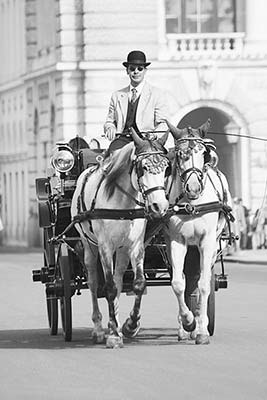
These traditional 19th-century horse-and-buggies, called Fiaker, take rich romantics on clip-clop tours lasting 20 minutes (Old Town—€55), 40 minutes (Old Town and the Ring—€95), or one hour (all of the above, but more thorough—€120). Before the advent of cars, one-horse versions of these served as Vienna’s taxis. You can share the ride and cost with up to four people (some may allow five).
LOCAL GUIDES
Vienna becomes particularly vivid and meaningful with the help of a private guide. I’ve enjoyed working with these guides; any of them can set you up with another good guide if they are already booked.
Quality Conventional Guides: Lisa Zeiler is a good storyteller with years of guiding experience (€160/2 hours, +43 699 1203 7550, lisa.zeiler@gmx.at). Adrienn Bartek-Rhomberg offers themed walks in the city as well as Schönbrunn Palace tours (€200/3 hours, €370/full day on foot, €360 “Panorama City Tour”—a 4-hour minibus and walking tour for up to six people, +43 650 826 6965, www.experience-vienna.at, office@experience-vienna.at).
Philosopher Guides: Wolfgang Höfler, a generalist with a knack for having psychoanalytical fun with history, enjoys the big changes of the 19th and 20th centuries. He’ll take you around on foot or by bike (€180/2 hours, €50 for each additional hour, bike tours—€180/3 hours, +43 676 304 4940, www.vienna-aktivtours.com, hofwolf@gmail.com). Gerhard Strassgschwandtner, who runs the Third Man Museum (see here), is passionate about history in all its marvelous complexity (€160/2 hours, +43 676 475 7818, www.special-vienna.com, gerhard@special-vienna.com).
Vienna City Walk
11 Graben
14 Loos’ Loos
15 Kohlmarkt
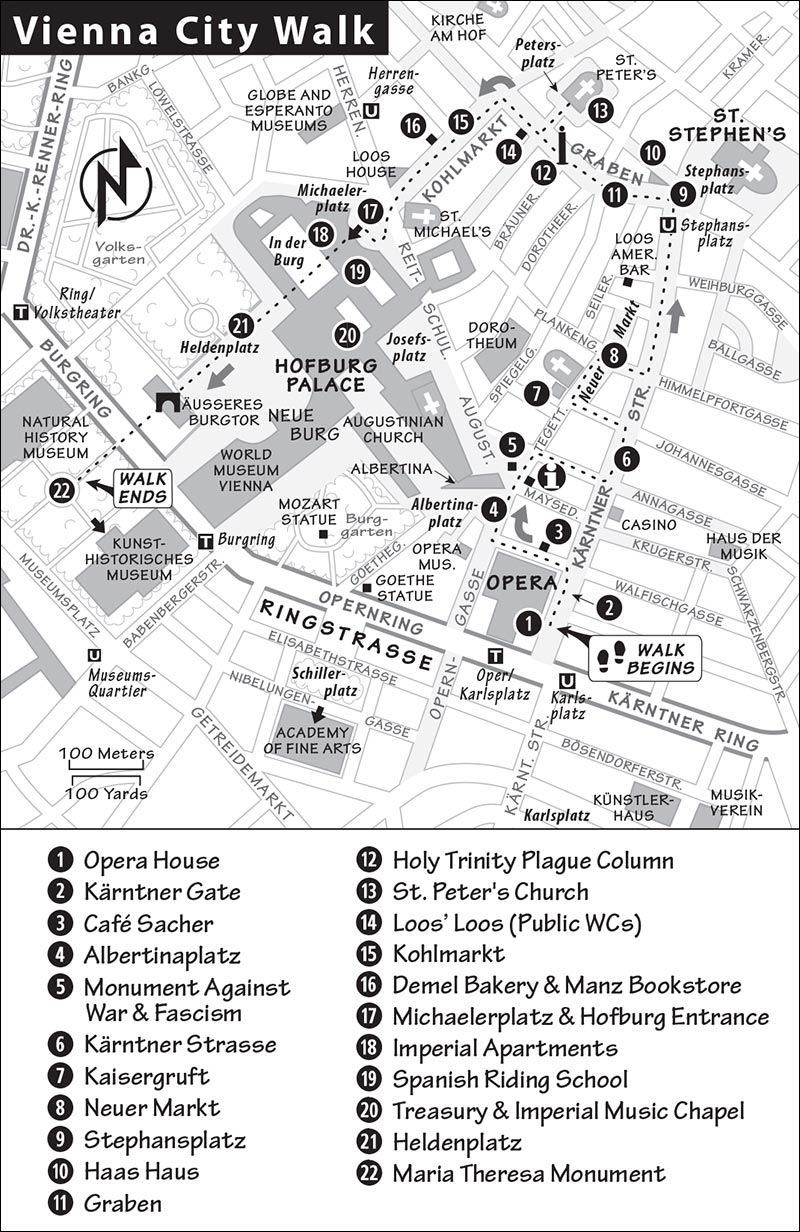
This self-guided walk connects the top three sights in Vienna’s old center: the Vienna State Opera, St. Stephen’s Cathedral, and Hofburg Palace. These and many of the other sights you’ll see along this walk are covered in more detail later in this chapter (see “Sights in Vienna,” later).
Allow one hour for the walk itself, more time if you plan to stop at any major sights along the way. This walk works just as well in the evening as it does during the day, as long as you don’t plan on touring some of the sights you’ll pass.
Tours: Download my free Vienna City Walk audio tour. For efficiency, splice my St. Stephen’s Cathedral audio tour into this walk.
• Begin at the square outside Vienna’s landmark opera house, home of the Vienna State Opera. (The entrance faces the Ringstrasse; we’re starting at the busy pedestrian square that’s to the right of the entrance as you’re facing it.)
1 Opera House
If Vienna is the world capital of classical music, this building is its throne room, one of the planet’s premier houses of music. It’s typical of Vienna’s 19th-century buildings in that it features a revival style—Neo-Renaissance—with arched windows, half-columns, and the sloping, copper mansard roof typical of French Renaissance châteaux.
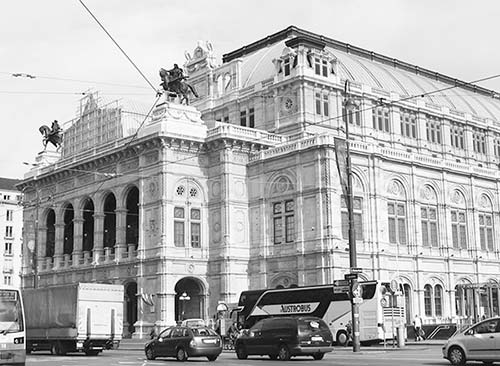
Since the structure was built in 1869, almost all of the opera world’s luminaries have passed through here. Its former musical directors include Gustav Mahler, Herbert von Karajan, and Richard Strauss. Luciano Pavarotti, Maria Callas, Placido Domingo, and many other greats have sung from its stage.
In the pavement along the side of the opera house (and all along Kärntner Strasse, the bustling shopping street we’ll visit shortly), you’ll find plaques forming a Hollywood-style walk of fame. These represent the stars of classical music—famous composers, singers, musicians, and conductors. Look up at the building. During opera season, you’ll notice the giant outdoor screen that shows some live performances (as noted in the posted schedules and on the screen itself).
If you’re a fan, take a guided tour of the opera. Or consider an evening performance (standing-room tickets are surprisingly cheap; see “Entertainment in Vienna,” later). Regular tickets are sold at the opera’s box office on Kärntner Strasse. For information about other entertainment options during your visit, check in at the Wien Ticket kiosk in the booth on this square.
The opera house marks a busy intersection in Vienna, where Kärntner Strasse meets the Ring. The Karlsplatz U-Bahn station in front of the opera is an underground shopping mall with fast food, newsstands, and lots of pickpockets.
• With your back to the Ringstrasse and the opera house on your left, face the busy pedestrian boulevard that leads into the center of town.
2 Kärntner Gate
Even though the center of town sits on an irregular medieval street plan, you’ll notice the parallel rows of more modern, uniform buildings in front of you. These were built where the city wall once stood. The opera’s lower stage is where the old moat used to be—outside the walls. This was a main gate, through which a road led to the Kärnten (Carinthia) region of southern Austria.
Notice the pedestrian signals and how they feature both gay and straight couples. Vienna’s Green Party is part of the city’s current ruling coalition, and they like to remind the world that, while Austria’s national government is more conservative (reflecting the fears and concerns of rural and small-town voters), Vienna celebrates diversity.
• Walk behind the opera and across the street toward the dark-red awning to find the famous...
3 Café Sacher
This is the home of the world’s classiest chocolate cake, the Sacher torte: two layers of cake separated by apricot jam and covered in dark-chocolate icing, usually served with whipped cream. It was invented in a fit of improvisation in 1832 by Franz Sacher, dessert chef to Prince Metternich (the mastermind diplomat who redrew the map of post-Napoleonic Europe). The cake became world famous when the inventor’s son served it next door at his hotel (you may have noticed the fancy door attendants). Look through the windows for a peek at 19th-century elegance. Many locals complain that the cakes here have gone downhill, and some tourists are surprised by how dry they are—you really need that dollop of Schlagobers.
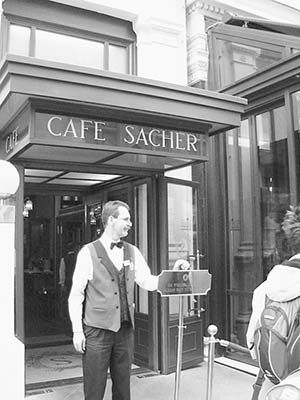
For a more genuine serving of 19th-century Viennese elegance, have your coffee and cake at the recommended Gerstner Café (facing the opera, back on Kärntner Strasse at #51). Enter under the green awnings, climb to the third level, and spend a little time back in the 1860s.
• Continue past Hotel Sacher. On a corner (to the right) at the end of the street, the Vienna TI has a handy ticket desk for concerts. And dead ahead is a small, triangular, cobbled square adorned with memorial sculptures.
4 Albertinaplatz
Overlooking the square, the tan-and-white Neoclassical building marks the tip of the Hofburg Palace—the sprawling complex of buildings that was long the seat of Habsburg power (we’ll end this walk at the palace’s center). The balustraded terrace up top was originally part of Vienna’s defensive rampart. Later, it was the balcony of Empress Maria Theresa’s daughter Maria Christina, who lived at this end of the palace. Today, her home houses the Albertina Museum, topped by a sleek, controversial titanium canopy (called the “diving board” by critics). The museum’s plush, 19th-century state rooms are the only Neoclassical (post-Rococo) palace rooms anywhere in the Habsburg realm.
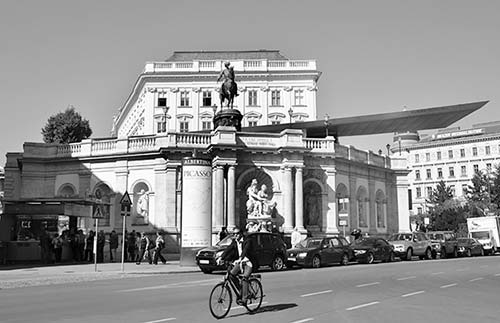
High above (just left of the “diving board”), a statue of Archduke Albrecht looks down on the city. A symbol of Habsburg oppression, he brutally suppressed popular uprisings in Vienna and Italy in the mid-1800s.
At street level is a grand fountain of Danubius, the Danube River god, flanked by six little gods. Each represents a major tributary that feeds the Danube as it flows through Austria.
The hot dog stand to the left of Danubius is known for its quality local sausages. This is the operagoers’ hangout...they gather here in their fine ballgowns and tuxedos enjoying some of the best of Vienna’s beloved wurst. By the way, this is the only sausage stand in town that sells champagne by the glass. And that bunny on the rooftop? It’s a reminder that the famous Albrecht Dürer watercolor Hare is in the adjacent Albertina Museum.
Albertinaplatz itself is filled with sculptures that make up the powerful, thought-provoking 5 Monument Against War and Fascism, which commemorates the dark years when Austria came under Nazi rule (1938-1945). Viewing this monument gains even more emotional impact when you realize what happened on this spot: During a WWII bombing attack, several hundred people were buried alive when the cellar they were using as shelter was demolished.
Austria was led into World War II by Germany, which annexed the country in 1938 with disturbingly little resistance, saying Austrians were wannabe Germans anyway. But Austrians are not Germans (this makes for an interesting topic of conversation with Austrians you may meet). They’re proud to tell you that Austria was founded in the 10th century, whereas Germany wasn’t born until 1870. For seven years just before and during World War II (1938-1945), there was no Austria. In 1955, after 10 years of joint occupation by the victorious Allies, Austria regained total independence on the condition that it would be forever neutral (and never join NATO or the Warsaw Pact). To this day, Austria is outside of NATO (and Germany).
Behind the monument is Café Tirolerhof, a classic Viennese café. Refreshingly air-conditioned, it’s full of things that time has passed by: chandeliers, marble tables, upholstered booths, formally dressed servers, and newspapers.
• From the café, turn right on Führichsgasse. Walk one block until you hit...
6 Kärntner Strasse
This grand, traffic-free street is the people-watching delight of this in-love-with-life city. Today’s Kärntner Strasse (KAYRNT-ner SHTRAH-seh) is mostly a crass commercial pedestrian mall—its famed elegant shops long gone. But locals know it’s the same road Crusaders marched down as they headed off from St. Stephen’s Cathedral for the Holy Land in the 12th century. Today, it’s full of shoppers.
Where Führichsgasse meets Kärntner Strasse, note the old Grundemann Esterházy Palace—now a Casino (across the street and to your right, at #41)—once elegant, now tacky, it exemplifies the worst of the street’s evolution. Turn left to head up Kärntner Strasse, going away from the opera house. As you walk, be sure to look up, above the modern storefronts, for glimpses of the street’s former glory.
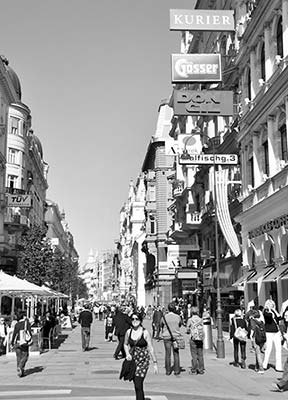
Local shops can’t compete with international chains, considering the high rent here. But one venerable shop that has survived is near the end of the block, on the left at #26: J & L Lobmeyr Crystal (“Founded in 1823”) still has its impressive brown storefront with gold trim, statues, and the Habsburg double eagle. In the market for some $400 napkin rings? Lobmeyr’s your place. Inside, breathe in the classic Old World ambience as you peruse the wares and visit the glass museum (free entry; ground floor—glasses and chandeliers, first floor—silver and Murano glass, second floor—museum; closed Sun).
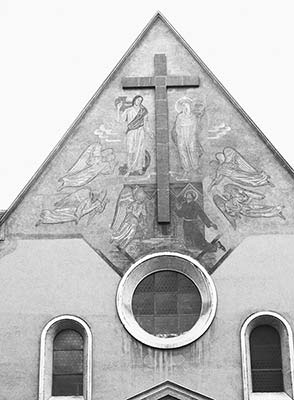
• At the end of the block, turn left on Marco d’Aviano Gasse (passing the fragrant flower stall) to make a short detour to the square called Neuer Markt. Straight ahead is an orange-ish church with a triangular roof and cross, the Capuchin Church. In its basement is the...
7 Kaisergruft
Under the church sits the Imperial Crypt, filled with what’s left of Austria’s emperors, empresses, and other Habsburg royalty. For centuries, Vienna was the heart of a vast empire ruled by the Habsburg family, and here is where they lie buried in their fancy pewter coffins. You’ll find all the Habsburg greats, including Maria Theresa, her son Josef II (Mozart’s patron), Franz Josef, and Empress Sisi. Before moving on, consider paying your respects here.
• Stretching north from the Kaisergruft is the square called...
8 Neuer Markt
Survey the architecture lining this square—a good mix, from 1700s to post World War II. You can tell which buildings replaced bombed-out ones. This square was once congested with parked cars, but a new-in-2022 underground garage turned Neuer Markt into the people-friendly space it is today.
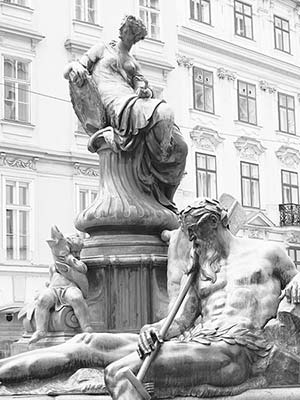
A block farther down, in the center of Neuer Markt, is the four rivers fountain showing Lady Providence surrounded by figures symbolizing the rivers that flow into the Danube. The sexy statues offended Empress Maria Theresa, who actually organized “Chastity Commissions” to defend her capital city’s moral standards.
• Return to Kärntner Strasse, where you’ll turn left. Continuing down Kärntner Strasse, you’ll find lots of shops filled with merchandise to entice tourists. Pass the U-Bahn station (which has WCs) where the street spills into Vienna’s main square...
9 Stephansplatz
The cathedral’s frilly spire looms overhead, worshippers and tourists pour inside the church, and shoppers buzz around the outside. You’re at the center of Vienna.
The Gothic St. Stephen’s Cathedral (c. 1300-1450) is known for its 450-foot south tower; its colorful, patterned roof; and its place in Viennese history. When it was built, it was a huge church for what was then a small town, and it helped put the fledgling city on the map. At this point, you may want to take a break from this walk to tour the church (for details, see here or download my audio tour).
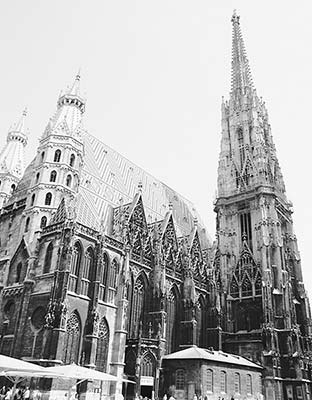
Where Kärntner Strasse hits Stephansplatz, the grand, soot-covered building with red columns is the Equitable Building (filled with lawyers, bankers, and insurance brokers). It’s a fine example of Neoclassicism from the turn of the 20th century—look up and imagine how slick Vienna must have felt in 1900.
Facing St. Stephen’s is the sleek concrete-and-glass 10 Haas Haus, a postmodern building by noted Austrian architect Hans Hollein (finished in 1990). The curved facade is supposed to echo the Roman fortress of Vindobona (its ruins were found near here). Although the Viennese initially protested having this stark modern tower right next to their beloved cathedral, since then, it’s become a fixture of Vienna’s main square. Notice how the smooth, rounded glass reflects St. Stephen’s pointy architecture, providing a great photo opportunity—especially at twilight.
• Exit the square with your back to the cathedral. Walk past the Haas Haus and bear right down the street called the...
11 Graben
This was once a Graben, or ditch—originally the moat for the Roman military camp. Back during Vienna’s 19th-century heyday, more than 200,000 people were packed into the city’s inner center (inside the Ringstrasse), walking on dirt streets. Today this area houses 20,000. The Graben was a busy street with three lanes of traffic until the 1970s, when the city inaugurated its new subway system and the street was turned into one of Europe’s first pedestrian-only zones. Take a moment to enjoy a slow 360-degree spin tour. Absorb the scene—you’re standing in an area surrounded by history, postwar rebuilding, grand architecture, fine cafés, and people enjoying life...for me, quintessential Europe.
Stroll down the Graben. Eventually you reach Dorotheergasse, on your left, which leads (after two more long blocks) to the Dorotheum auction house. Consider poking your nose in here later for some fancy window shopping. Also along this street are two recommended eateries: the sandwich shop Trześniewski—one of my favorite places for lunch—and the classic Café Hawelka.
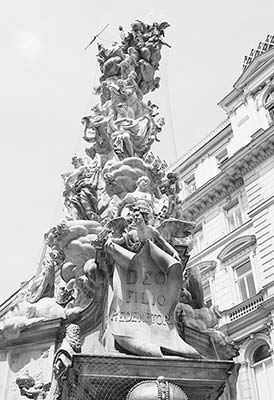
In the middle of the Graben pedestrian zone is the extravagantly blobby 12 Holy Trinity plague column (Pestsäule). The 60-foot pillar of clouds sprouts angels and cherubs, with the wonderfully gilded Father, Son, and Holy Ghost at the top (all protected by an anti-pigeon net).
In 1679, Vienna was hit by a massive epidemic of bubonic plague. Around 75,000 Viennese died—about a third of the city. Emperor Leopold I dropped to his knees (something emperors never did in public) and begged God to save the city. (Find Leopold about a quarter of the way up the monument, just above the brown banner. Hint: The typical inbreeding of royal families left him with a gaping underbite.) His prayer was heard by Lady Faith (the statue below Leopold, carrying a cross). With the help of a heartless little cupid, she tosses an old naked woman—symbolizing the plague—into the abyss and saves the city. In gratitude, Leopold vowed to erect this monument, which became a model for cities throughout the empire that were ravaged by the same plague. (The three golden banners represent the core of that empire: Austria, Hungary, and Bohemia.)
• Thirty yards past the plague monument, look down the short street to the right, which frames a Baroque church with a stately green dome.
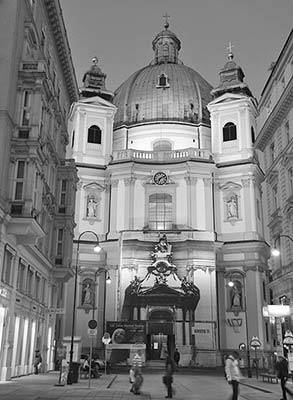
13 St. Peter’s Church
Leopold I ordered this church to be built as a thank-you for surviving the 1679 plague. The church stands on the site of a much older church that may have been Vienna’s first (or second) Christian church. Inside, St. Peter’s shows Vienna at its Baroque best. Note that the church offers free organ concerts (daily at 15:00, advertised at the entry).
• Continue west on the Graben, where you’ll immediately find some stairs leading underground to...
14 Loos’ Loos
In about 1900, a local chemical maker needed a publicity stunt to prove that his chemicals really got things clean. He purchased two wine cellars under the Graben and had them turned into classy WCs in the Modernist style (designed by Adolf Loos, a turn-of-the-20th-century architect), complete with chandeliers and finely crafted mahogany. While the chandeliers are gone, the restrooms remain a relatively appealing place to do your business. (In the men’s room, the urinals survive but are enjoying a peaceful retirement behind protective glass.) Locals and tourists happily pay €0.50 for a quick visit.
• The Graben dead-ends at the aristocratic supermarket Julius Meinl am Graben. From here, you could turn right into Vienna’s “golden corner,” with the city’s finest shops. But we’ll turn left. In the distance is the big green-and-gold dome of the Hofburg, where we’ll head soon. The street leading up to the Hofburg is...
15 Kohlmarkt
This is Vienna’s most elegant and unaffordable shopping street, lined with Cartier, Armani, Gucci, Tiffany, and the emperor’s palace at the end. Strolling Kohlmarkt, daydream about 16 Demel, the ultimate Viennese chocolate shop (#14, daily 9:00-19:00). While people line up to enjoy their famous café, there’s no wait to walk through the café to the shop in back, where you’ll find a room filled with Art Nouveau boxes of Empress Sisi’s choco-dreams come true: Kandierte Veilchen (candied violet petals), Katzenzungen (cats’ tongues), and so on. The cakes here are moist (compared with the dry Sacher tortes). Shops like this boast “K.u.K.”—signifying that during the Habsburgs’ heyday, it was patronized by the König und Kaiser (king and emperor—same guy).
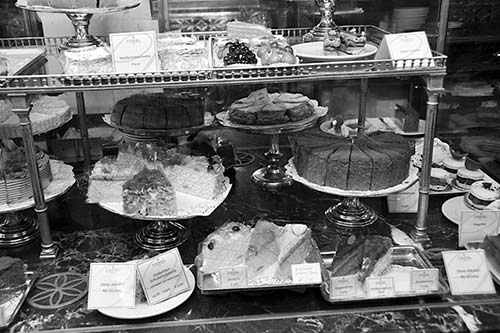
Next to Demel, the Manz Bookstore has a Loos-designed facade.
• Kohlmarkt ends at the square called...
17 Michaelerplatz
This square is dominated by the Hofburg Palace. Study the grand Neo-Baroque facade, dating from about 1900. The four heroic giants illustrate Hercules wrestling with his great challenges (Emperor Franz Josef, who commissioned the gate, felt he could relate). The facade’s Hercules statues remind mere mortals to stay in their place.
In the center of this square, a scant bit of Roman Vienna lies exposed just beneath street level.
Michaelerplatz Spin Tour: Do a slow, clockwise pan to get your bearings, starting (over your left shoulder as you face the Hofburg) with St. Michael’s Church, which offers fascinating tours of its crypt. To the right of that is the fancy Loden-Plankl shop, with traditional Austrian formalwear, including dirndls. Farther to the right, across Augustinerstrasse, is the wing of the palace that houses the Spanish Riding School and its famous white Lipizzaner stallions. Farther down this street lies Josefsplatz, with the Augustinian Church, and the Dorotheum auction house. At the end of the street are Albertinaplatz and the opera house (where we started this walk).
Continue your spin: Two buildings over from the Hofburg (to the right), the Loos House has a facade featuring a perfectly geometrical grid of square columns and windows. Compared to the Neo-Baroque facade of the Hofburg, the stern Modernism of the Loos House appears to be from an entirely different age. And yet, both of these were built in the same generation, roughly around 1900. In many ways, this jarring juxtaposition exemplifies the architectural turmoil of the turn of the 20th century and represents the passing of the torch from Europe’s age of divine monarchs to the modern era.
• Let’s take a look at where Austria’s glorious history began—at the...
Hofburg Imperial Palace
This is the complex of palaces where the Habsburg emperors lived out their lives (except in summer, when they resided at Schönbrunn Palace). Enter the Hofburg through the gate, where you immediately find yourself beneath a big rotunda (the netting is there to keep birds from perching). The doorway on the right is the entrance to the 18 Imperial Apartments, where the Habsburg emperors once lived in chandeliered elegance. Today, you can tour its lavish rooms, as well as a museum about Empress Sisi, and a porcelain and silver collection. To the left is the ticket office for the 19 Spanish Riding School.
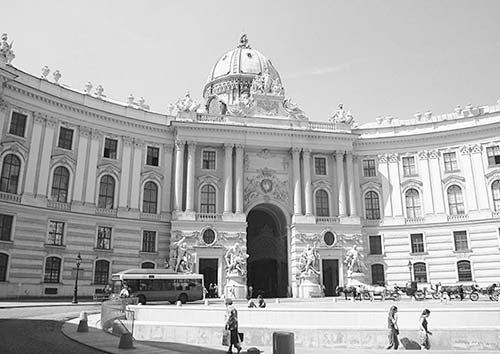
Continuing on, you emerge from the rotunda into the main courtyard of the Hofburg, called In der Burg. The Caesar-like statue is of Habsburg emperor Franz II (1768-1835), grandson of Maria Theresa, grandfather of Franz Josef, and father-in-law of Napoleon. Behind him is a tower with three kinds of clocks (the yellow disc shows the phase of the moon tonight). To the right of Franz are the Imperial Apartments, and to the left are the offices of Austria’s mostly ceremonial president (the more powerful chancellor lives in a building just behind this courtyard).
Franz Josef faces the oldest part of the palace. The colorful red, black, and gold gateway (behind you), which used to have a drawbridge, leads over the moat and into the 13th-century Swiss Court (Schweizerhof), named for the Swiss mercenary guards once stationed there. Study the gate. Imagine the drawbridge and the chain. Notice the Habsburg coat of arms with the imperial eagle above and the Renaissance painting on the ceiling of the passageway.
As you enter the Gothic courtyard, you’re passing into the historic core of the palace, the site of the first fortress, and, historically, the place of last refuge. Here you’ll find the 20 Treasury (Schatzkammer) and the Imperial Music Chapel (Hofmusikkapelle), where the Boys’ Choir sings Mass. Ever since Joseph Haydn and Franz Schubert were choirboys here, visitors have gathered like groupies on Sundays to hear the famed choir sing.
Returning to the bigger In der Burg courtyard, face Franz and turn left, passing through the tunnel, with a few tourist shops and restaurants, to spill out into spacious 21 Heldenplatz (Heroes’ Square). On the left is the impressive curved facade of the World Museum Vienna (formerly the New Palace). This vast wing was built in the early 1900s to be the new Habsburg living quarters and was meant to have a matching building facing it. But in 1914, the heir to the throne, Archduke Franz Ferdinand—while waiting politely for his long-lived uncle, Emperor Franz Josef, to die—was assassinated in Sarajevo. The archduke’s death sparked World War I and the eventual end of eight centuries of Habsburg rule.
Heldenplatz Spin Tour: Make a slow 360-degree turn and imagine this huge square filled with people.
In 1938, 300,000 Viennese gathered here, entirely filling vast Heroes’ Square, to welcome Adolf Hitler and celebrate their annexation with Germany—the Anschluss. The Nazi tyrant stood on the balcony of the then New Palace and declared, “Before the face of German history, I declare my former homeland now a part of the Third Reich. One of the pearls of the Third Reich will be Vienna.” He never said “Austria,” a word that was now forbidden.
When pondering why the Austrians—eyes teary with joy and vigorously waving their Nazi flags—so willingly accepted Hitler’s rule, it’s important to remember that Austria was already a fascist nation. Austrian chancellor Engelbert Dollfuss, though pro-Catholic, pro-Habsburg, and anti-Hitler, was a dictator who silenced any left-wing opposition. Also, memories of the grand Habsburg Empire were still fresh in the collective psyche. The once vast and mighty empire of 50 million at its 19th-century peak came out of World War I a tiny landlocked land of six million that now suffered terrible unemployment. The opportunistic Hitler promised jobs along with a return to greatness—and the Austrian people gobbled it up.
• Walk on through the Greek-columned passageway (the Äusseres Burgtor), cross the Ringstrasse, and stand between the giant Kunsthistorisches and Natural History Museums, built in the 1880s to house the private art and scientific collections of the empire and to celebrate its culture and power. A huge statue of the powerful Empress Maria Theresa stands in the center of it all.
22 Maria Theresa Monument
Vienna’s biggest monument shows the empress (the empire’s only female ruler) holding a scroll from her father granting the right of a woman to inherit his throne. The statues and reliefs surrounding her speak volumes about her reign: Her four top generals sit on horseback while her four top advisers stand. Behind them, reliefs celebrate cultural leaders of her day, including little Wolfie Mozart with mentor “Papa” Joseph Haydn (with his hand on Mozart’s shoulder, facing the Natural History Museum). The moral of this propaganda: that a strong military and a wise ruler are prerequisites for a thriving culture—attributes that characterized the 40-year rule of the woman who was perhaps Austria’s greatest monarch.
• Our walk is finished. You’re in the heart of Viennese sightseeing. Surrounding this square are some of the city’s top museums. And the Hofburg Palace itself contains many of Vienna’s best sights and museums. From the opera to the Hofburg, from chocolate to churches, from St. Stephen’s to Sacher tortes—Vienna waits for you.
Sights in Vienna
SIGHTSEEING PASSES AND COMBO-TICKETS
▲▲▲Hofburg Imperial Apartments (Kaiserappartements)
▲▲▲Hofburg Treasury (Kaiserliche Schatzkammer Wien)
▲▲World Museum Vienna (Weltmuseum Wien)
▲Spanish Riding School (Spanische Hofreitschule)
▲Augustinian Church (Augustinerkirche)
State Hall (Prunksaal) of the Austrian National Library
Butterfly House (Schmetterlinghaus) in the Palace Garden (Burggarten)
Church Crypts near the Hofburg
▲▲Kaisergruft (Imperial Crypt)
▲St. Michael’s Church Crypt (Michaelerkirche)
▲▲▲St. Stephen’s Cathedral (Stephansdom)
▲▲▲Vienna State Opera (Wiener Staatsoper)
▲Dorotheum Auction House (Palais Dorotheum)
▲St. Peter’s Church (Peterskirche)
Jewish Museum Vienna (Jüdisches Museum Wien)
▲▲Natural History Museum (Naturhistorisches Museum)
▲Karlskirche (St. Charles Church)
▲Academy of Fine Arts Painting Gallery (Akademie der Bildenden Künste Gemäldegalerie)
▲▲Belvedere Palace (Schloss Belvedere)
▲Kunst Haus Wien and Museum Hundertwasserhaus
▲▲▲Schönbrunn Palace (Schloss Schönbrunn)
Schönbrunn Zoo (Tiergarten Schönbrunn)
▲Imperial Carriage Museum (Kaiserliche Wagenburg)
Vienna has a dizzying number of sights and museums, which cover the city’s rich culture and vivid history through everything from paintings to music to furniture to prancing horses. Just perusing the list on your TI-issued Vienna city map can be overwhelming. To get you started, I’ve selected the sights that are most essential, rewarding, and user-friendly, and arranged them by neighborhood for handy sightseeing.
SIGHTSEEING PASSES AND COMBO-TICKETS
Avid sightseers should consider a pass or combo-ticket, but do the math first. Add up the cost of all the sights you think you’ll see, then consider whether you’d like to use the hop-on, hop-off bus to get around (included with the Vienna Pass). If you prefer to walk or take public transportation, you may be better off with one or more of the combo-tickets described below. Note that those under 19 get in free to state-run museums and sights.
Passes: The Vienna Card and the Vienna Pass are likely not worthwhile for most travelers (especially for youth and seniors over 65, who get a discount anyway). The Vienna Pass includes entry to the city’s top 70 sights and unlimited access to Vienna Sightseeing’s hop-on, hop-off tour buses (€85/1 day, €119/2 days, €149/3 days; purchase at TIs and several other locations around town—check at www.viennapass.com). It also lets you skip lines at some sights, but not at the Schönbrunn Palace where lines are the most frustrating.
Combo-Tickets: The €40 Sisi Ticket covers the Hofburg Imperial Apartments (with its Sisi Museum and Silver Collection—must see both on the same day), Schönbrunn Palace’s Grand Tour, and the Vienna Furniture Museum. At Schönbrunn, the ticket lets you enter the palace immediately, without a reserved entry time. Buy your Sisi Ticket in advance online (www.schoenbrunn.at or www.sisimuseum-hofburg.at) or at the Vienna Furniture Museum, where lines are shorter.
If you’re seeing the Hofburg Treasury (royal regalia and crown jewels) and the Kunsthistorisches (world-class art collection), the €24 combo-ticket saves you money.
The Haus der Musik (mod museum with interactive exhibits) has a combo deal with Mozarthaus Vienna (exhibits and artifacts about the great composer) for €20—saving a few euros for music lovers (though the Mozarthaus will likely disappoint all but the most die-hard Mozart fans).
HOFBURG PALACE SIGHTS
The imposing Imperial Palace, with 640 years of architecture, art, and history, demands your attention. This first Habsburg residence grew with the family empire from the 13th century until 1913, when the last “new wing” opened. The winter residence of the Habsburg rulers until 1918, the Hofburg is still home to the Austrian president’s office, 5,000 government workers, and several important museums.
Don’t get confused by the Hofburg’s myriad courtyards and many museums. Focus on three sights: the Imperial Apartments, the Treasury, and the museums in the Neue Burg (New Wing). With more time, consider the Hofburg’s many other sights, covering various facets of the imperial lifestyle.
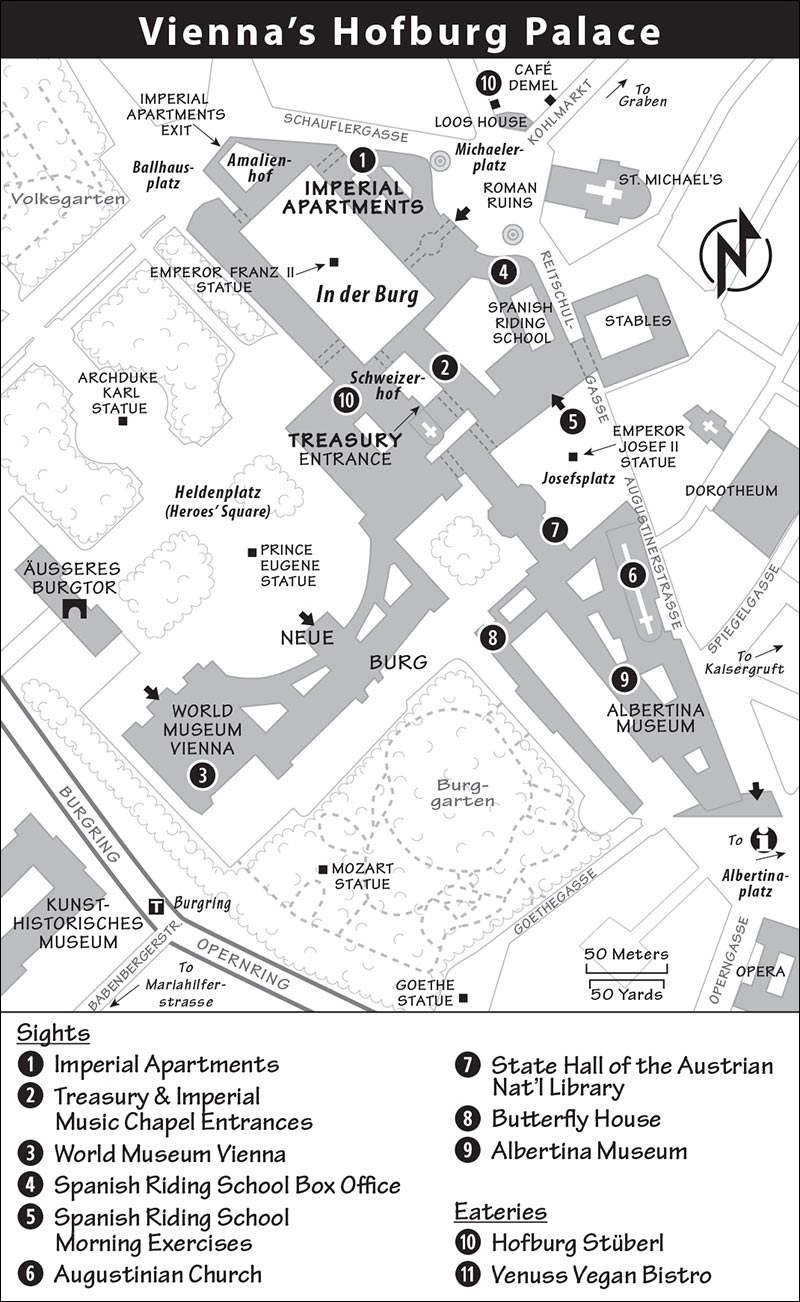
Eating at the Hofburg: Down the tunnel between the In der Burg courtyard and Heldenplatz is the tiny but handy $ Hofburg Stüberl sandwich bar—ideal for a cool, quiet sit and a drink or snack (open daily). The recommended $$ Venuss Vegan Bistro is a vegan-gelical place that almost makes you a believer (closed Sun, half a block off Michaelerplatz at Herrengasse 6).
Hofburg Palace
▲▲▲Hofburg Imperial Apartments (Kaiserappartements)
These lavish, Versailles-type, “wish-I-were-God” royal rooms are the downtown version of the suburban Schönbrunn Palace. Palace visits are a one-way romp through three sections: a porcelain and silver collection, a museum dedicated to the enigmatic and troubled Empress Sisi, and the luxurious apartments themselves.
The Imperial Apartments are a mix of Old World luxury and modern 19th-century conveniences. Here, Emperor Franz Josef I lived and worked along with his wife Elisabeth, known as Sisi. The Sisi Museum traces the development of her legend, analyzing her fabulous but tragic life as a 19th-century Princess Diana. You’ll read bits of her poetic writing, see exact copies of her now-lost jewelry, and learn about her escapes, dieting mania, and chocolate bills.
Cost and Hours: €16, includes well-done audioguide, covered by Sisi Ticket; daily 9:00-17:30, July-Aug until 18:00, last entry one hour before closing; €4 guided English tours daily at 14:00; enter from under rotunda just off Michaelerplatz, through Michaelertor gate; +43 1 533 7570, www.sisimuseum-hofburg.at.
Overview: Your ticket grants you admission to three exhibits, which you’ll visit on a one-way route. The first floor holds a collection of precious porcelain and silver knickknacks (Silberkammer). You then go upstairs to the Sisi Museum, which has displays about her life. This leads into the 20 or so rooms of the Imperial Apartments (Kaiserappartements), starting in Franz Josef’s rooms, then heading into the dozen rooms where his wife Sisi lived.
If you listen to the entire audioguide, allow 40 minutes for the porcelain and silver collection, 30 minutes for the Sisi Museum, and 40 minutes for the apartments.
Visiting the Imperial Apartments: Your visit (and the excellent audioguide) starts on the ground floor.
Imperial Porcelain and Silver Collection: Browse the collection to gawk at the opulence and to take in some colorful Habsburg trivia. (Who’da thunk that the court had an official way to fold a napkin—and that the technique remains a closely guarded secret?) Still, I wouldn’t bog down here, as there’s much more to see upstairs.
Once you’re through all those rooms of dishes, climb the stairs—the same staircase used by the emperors and empresses who lived here. At the top is a timeline of Sisi’s life. Swipe your ticket to pass through the turnstile, consider the rare WC (“Go when you can, not when you have to”), and enter the room with the model of the Hofburg. Circle to the far side to find where you’re standing right now, near the Hofburg’s largest dome. That dome tops the entrance to the Hofburg from Michaelerplatz.
A world within a world, the Hofburg was a kind of forbidden city accessible only to the ruling elite until 1891. Stand at the center and imagine the unfinished bit filled in, and ponder the imperial greatness of the palace complex. To the left of the dome (as you face the facade) is the steeple of the Augustinian Church. It was there, in 1854, that Franz Josef married 16-year-old Elisabeth of Bavaria and their story began.
Sisi Museum: Empress Elisabeth (1837-1898)—a.k.a. “Sisi” (SEE-see)—was Franz Josef’s mysterious, beautiful, and narcissistic wife. This museum traces her fabulous but tragic life.
The exhibit starts with Sisi’s sad end, showing her death mask, photos of her funeral procession (by the Hercules statues facing Michaelerplatz), and an engraving of a grieving Franz Josef. It was at her death that the obscure, private empress’ legend began to grow.
Sisi was nearly 5’8” (a head taller than her husband), had a 20-inch waist (she wore very tight corsets), and weighed only about 100 pounds. (Her waistline eventually grew...to 21 inches. That was at age 50, after giving birth to four children.) A statue, a copy of one of 30 statues that were erected in her honor in European cities, shows her holding one of her trademark fans. It doesn’t show off her magnificent hair, however, which reached down as far as her ankles in her youth.
Imperial Apartments: These were the private apartments and public meeting rooms for the emperor and empress. Franz Josef’s apartments illustrate the lifestyle of the last legendary Habsburg. In these rooms, he met with advisers and welcomed foreign dignitaries; hosted lavish, white-gloved balls and stuffy formal dinners; and raised his children. He slept (alone) on his austere bed while his beloved wife Sisi retreated to her own rooms. He suffered through the execution of his brother, the suicide of his son and heir, the murder of his wife, and the assassination of his nephew, Archduke Ferdinand, which sparked World War I and spelled the end of the Habsburg monarchy.
Among the rooms you’ll see is the audience chamber where Franz Josef received commoners from around the empire. Imagine you’ve traveled for days to have your say before the emperor. You’re wearing your new fancy suit—Franz Josef required that men coming before him wear a tailcoat, and women a black gown with a train. He’d stand at the lectern (far left) as the visiting commoners had their say (but for no more than two-and-a-half minutes). On the lectern is a partial list of 56 appointments he had on January 3, 1910 (three columns: family name, meeting topic, and Anmerkung—the emperor’s “action log”).
Empress Elisabeth—Franz Josef’s beautiful wife—was the 19th-century equivalent of Princess Diana. Born on Christmas Eve and known as “Sisi” since childhood, she became an instant celebrity when she married Franz Josef at 16.
The daughter of a Bavarian duke, Sisi enjoyed an idyllic girlhood riding horses in the forests near Munich. But after marrying, she became obsessed with preserving her reputation as a beautiful empress, maintaining her Barbie-doll figure (her goal: to stay under 110 pounds), and tending to her fairy-tale, ankle-length hair. In the 1860s, she was considered one of the most beautiful women in the world. But, despite severe dieting and fanatical exercise, age—not to mention the near impossibility of adhering to such demanding standards of feminine beauty—took their toll. After turning 30, she refused to allow photographs or portraits, and was generally seen in public with a delicate fan covering her face (and bad teeth).
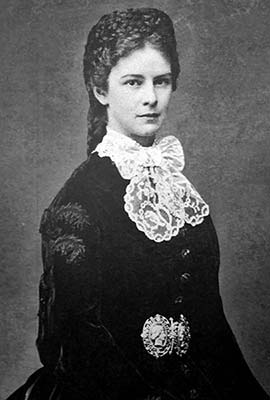
Complex and influential, Sisi was adored by Franz Josef, whom she respected. Although Franz Josef was supposed to have married Sisi’s sister Helene (in an arranged diplomatic marriage), he fell in love with Sisi instead. It was one of the Habsburgs’ few marriages for love.
Sisi had a special affinity for Hungary. She enthusiastically studied and spoke Hungarian, and her personal mission and political cause was promoting Hungary’s bid for autonomy within the empire—which her husband accommodated in 1867 by dividing his empire into the “Dual Monarchy” of the Austro-Hungarian Empire. Her personal tragedy was the death of her son Rudolf, the crown prince, in an apparent suicide (an incident often dramatized as the “Mayerling Affair,” named after the royal hunting lodge where it happened). Disliking Vienna and the confines of the court and eager for time out of the spotlight, Sisi traveled more and more frequently. (She spent so much time in Budapest, and with Hungarian statesman Count Andrássy, that many believe her third daughter to be the count’s.)
As the years passed, the restless Sisi and her hardworking husband became estranged. In 1898, while visiting Geneva, Switzerland, she was murdered by an Italian anarchist. Sisi’s beauty, bittersweet life, and tragic death helped create her larger-than-life legacy. However, her importance is often inflated by melodramatic accounts of her life. The Sisi Museum (here in the Hofburg) seeks to tell a more accurate story.
Franz Josef I—who ruled for 68 years (1848-1916)—was the embodiment of the Habsburg Empire as it finished its six-century-long ride. Born in 1830, Franz Josef had a stern upbringing that instilled in him a powerful sense of duty and—like so many men of power—a love of all things military.
His uncle, Ferdinand I, suffered from profound epilepsy, which prevented him from being an effective ruler. As the revolutions of 1848 rattled royal families throughout Europe, the Habsburgs forced Ferdinand to abdicate and put 18-year-old Franz Josef on the throne. He spent the first part of his long reign understandably paranoid, as social discontent continued to simmer.
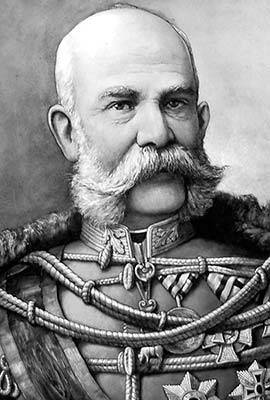
Franz Josef was very conservative. But worse, he wrongly believed that he was a talented military tactician, leading Austria into catastrophic battles against Italy (which was fighting for its unification and independence) in the 1860s.
Wearing his uniform to the end, Franz Josef never saw what a dinosaur his monarchy was becoming. He had no interest in democracy and pointedly never set foot in Austria’s parliament building. His passion for low-grade paperwork earned him the nickname “Joe Bureaucrat.” Mired in these petty details, he missed the big picture. In 1914, he helped start a Great War that ultimately ended the age of monarchs. The year 1918 marked the end of Europe’s big royal families: Hohenzollerns (Prussia), Romanovs (Russia), and Habsburgs (Austria).
Franz Josef’s study evokes how seriously the emperor took his responsibilities as the top official of a vast empire. Famously energetic, Franz Josef lived a spartan life dedicated to duty; in his bedroom, notice his no-frills iron bed. He typically rose before dawn and started his day in prayer, kneeling at the prayer stool against the far wall. While he had a typical emperor’s share of mistresses, his dresser was always well stocked with photos of Sisi.
Sisi’s bedroom was refurbished in the Neo-Rococo style in 1854. The room always had lots of fresh flowers. Sisi not only slept here but also lived here—the bed was rolled in and out daily—until her death in 1898. The desk is where she sat and wrote her letters and sad poems. In her dressing/exercise room, servants worked three hours a day on Sisi’s famous hair, while she passed the time reading and learning Hungarian. She’d exercise on the wooden structure and on the rings suspended from the doorway to the left. Afterward, she’d get a massage on the red-covered bed.
In the small salon, notice the portrait of Crown Prince Rudolf, Franz Josef’s and Sisi’s only son. On the morning of January 30, 1889, the 30-year-old Rudolf and a beautiful baroness were found shot dead in an apparent murder-suicide in his hunting lodge in Mayerling. The scandal shocked the empire and tainted the Habsburgs; Sisi retreated further into her fantasy world, and Franz Josef carried on stoically with a broken heart.
The tour ends in the dining room. It’s dinnertime, and Franz Josef has called his extended family together. The settings are modest...just silver. Gold was saved for formal state dinners. Next to each name card was a menu listing the chef responsible for each dish. (Talk about pressure.) Franz Josef enforced strict protocol at mealtime: No one could speak without being spoken to by the emperor, and no one could eat after he was done. While the rest of Europe was growing democracy and expanding personal freedoms, the Habsburgs preserved their ossified worldview to the bitter end.
In 1918, World War I ended, Austria was created as a modern nation-state, the Habsburgs were tossed out...and Hofburg Palace was destined to become the museum you’ve just toured.
▲▲▲Hofburg Treasury (Kaiserliche Schatzkammer Wien)
One of the world’s most stunning collections of royal regalia, the Hofburg Treasury shows off sparkling crowns, jewels, gowns, and assorted Habsburg bling in 21 darkened rooms. The treasures, well explained by an audioguide, include the crown of the Holy Roman Emperor, Charlemagne’s saber, a unicorn horn, and more precious gems than you can shake a scepter at.
Cost and Hours: €14, €24 combo-ticket with Kunsthistorisches; Wed-Mon 9:00-17:30, closed Tue; audioguide-€5 or €7/2 people; from the Hofburg’s central courtyard pass through the black, red, and gold gate, then follow Schatzkammer signs to the Schweizerhof; +43 1 525 240, www.kaiserliche-schatzkammer.at.
Visiting the Treasury: The Habsburgs saw themselves as the successors to the ancient Roman emperors, and they wanted crowns and royal regalia to match the pomp of the ancients. They used these precious objects for coronation ceremonies, official ribbon-cutting events, and their own personal pleasure. You’ll see the prestigious crowns and accoutrements of the rulers of the Holy Roman Empire (a medieval alliance of Germanic kingdoms so named because it wanted to be considered the continuation of the Roman Empire). Here’s a rundown of the highlights (the audioguide is much more complete).
Room 2: The personal crown of Rudolf II (1602) occupies the center of the room along with its accompanying scepter and orb; a bust of Rudolf II (1552-1612) sits nearby. The crown’s design symbolically merges a bishop’s miter (“Holy”), the arch across the top of a Roman emperor’s helmet (“Roman”), and the typical medieval king’s crown (“Emperor”).
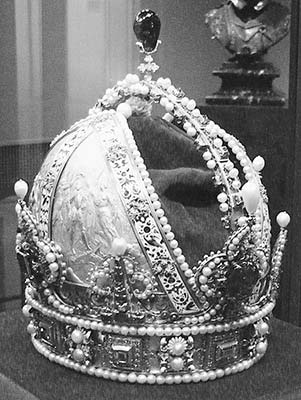
Two centuries later (1806), this crown and scepter became the official regalia of Austria’s rulers, as seen in the large portrait of Franz I (the open-legged guy behind you). Napoleon Bonaparte had just conquered Austria and dissolved the Holy Roman Empire. Franz (r. 1792-1835) was allowed to remain in power, but he had to downgrade his title from “Franz II, Holy Roman Emperor” to “Franz I, Emperor of Austria.”
Rooms 3 and 4: These rooms contain some of the coronation vestments and regalia needed for the new Austrian (not Holy Roman) Emperor. There was a different one for each of the emperor’s subsidiary titles—for example, King of Hungary or King of Lombardy. So many crowns and kingdoms in the Habsburgs’ vast empire!
Room 5: Ponder the Cradle of the King of Rome, once occupied by Napoleon’s son, who was born in 1811 and made King of Rome. While pledging allegiance to democracy, Napoleon in fact crowned himself Emperor of France and hobnobbed with Europe’s royalty. When his wife Josephine could not bear him a male heir, Napoleon divorced her and married into the Habsburg family.
Room 6: For Divine Right kings, even child-rearing was a sacred ritual that needed elaborate regalia for public ceremonies. The 23-pound gold basin and pitcher were used to baptize noble children, who were dressed in the baptismal dresses displayed nearby.
Room 7: These jewels are the true “treasures,” a cabinet of wonders used by Habsburgs to impress their relatives (or to hock when funds got low).
Religious Rooms: Several rooms display religious objects—crucifixes, chalices, mini-altarpieces, reliquaries, and bishops’ vestments. Like the medieval kings who preceded them, Habsburg rulers mixed the institutions of church and state, so these precious religious accoutrements were also part of their display of secular power.
Regalia of the Holy Roman Empire: The next few rooms contain some of the oldest and most venerated objects in the Treasury—the robes, crowns, and sacred objects of the Holy Roman Emperor.
The big red-silk and gold-thread coronation mantle, nearly 900 years old, was worn by Holy Roman Emperors when they received their crown. The collection’s highlight is the 10th-century crown of the Holy Roman Emperor. It was probably made for Otto I (c. 960), the first king to call himself Holy Roman Emperor. The Imperial Crown swirls with symbolism “proving” that the emperor was both holy and Roman: The cross on top says the HRE ruled as Christ’s representative on earth, and the jeweled arch over the top is reminiscent of the parade helmet of ancient Romans.
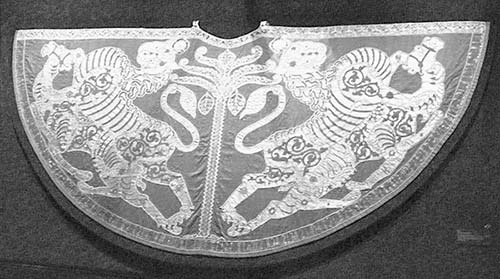
Nearby is the 11th-century Imperial Cross that preceded the emperor in ceremonies. Encrusted with jewels, it had a hollow compartment (its core is wood) that carried substantial chunks thought to be from the cross on which Jesus was crucified and the Holy Lance used to pierce his side (both pieces are displayed in the same glass case).
Another case has additional objects used in the coronation ceremony: The orb (orbs were modeled on late-Roman ceremonial objects, then topped with the cross) and scepter (the one with the oak leaves), along with the sword, were carried ahead of the emperor in the procession. In earlier times, these objects were thought to have belonged to Charlemagne himself, the greatest ruler of medieval Europe, but in fact they’re mostly from 300 to 400 years later (c. 1200).
Now picture all this regalia used together. The Josef II painting shows the coronation of Maria Theresa’s son as Holy Roman Emperor in 1764. Set in a church in Frankfurt (filled with the bigwigs—literally—of the day), Josef is wearing the same crown and royal garb that you’ve just seen.
More Hofburg Sights
▲▲World Museum Vienna (Weltmuseum Wien)
The World Museum Vienna houses several museums: They’re all part of one grand building and covered by one ticket. The World Museum is technically only the mezzanine level, which houses an expansive ethnology collection. The same ticket also grants you access to the Imperial Armory (with a killer collection of medieval weapons) and the impressive Collection of Historic Musical Instruments. An added bonus of the World Museum is a chance to wander among the royal Habsburg halls, stairways, and painted ceilings virtually alone.
Cost and Hours: €16; Thu-Mon 10:00-18:00, Tue until 21:00, closed Wed; +43 1 534 30 5052, www.weltmuseumwien.at. While there are short English descriptions throughout, investing in the €5 audioguide triples the value of your visit.
▲Spanish Riding School (Spanische Hofreitschule)
This stately 300-year-old Baroque hall at the Hofburg Palace is the home of the renowned Lipizzaner stallions. The magnificent building was an impressive expanse in its day. Built without central pillars, it offers clear views of the prancing horses under lavish chandeliers, with a grand painting of Emperor Charles VI on horseback at the head of the hall.
Lipizzaner stallions are known for their noble gait and Baroque profile. These regal horses have changed shape with the tenor of the times: They were bred strong and stout during wars, and frilly and slender in more cultured eras. But they’re always born black, fade to gray, and turn a distinctive white in adulthood.
Seeing the Horses and Buying Tickets: The school offers three ways to see the horses—performances, morning exercises, and guided tours of the stables (check the events list on the school’s website at www.srs.at). You can purchase tickets online or at the box office (opens at 9:00, located inside the Hofburg—go through the main Hofburg entryway from Michaelerplatz, then turn left into the first passage, +43 1 533 9031). Photos are not allowed at any events, nor are children under age 3.
To see the horses for free, just walk by the stables at any time of day when the horses are in town. From the covered passageway across from Josefsplatz, there’s a big window from where you can usually see the horses poking their heads out of their stalls.
Performances: The Lipizzaner stallions put on great 80-minute performances featuring choreographed moves to jaunty recorded Viennese classical music. The pricey seats book up months in advance, but standing room is usually available the same day. With just a few rows of seats and close-up standing-room spots, there’s not a bad view in the house (seats about €50-160, standing room about €25, prices vary depending on the show; Feb-mid-June and mid-Aug-Dec usually Sat-Sun at 11:00, no shows Jan and mid-June-mid-Aug).
Morning Exercises: For a less expensive, more casual experience, morning exercises with music take place on weekday mornings in the same hall and are open to the public. Don’t have high expectations, as the horses often do little more than trot and warm up. Tourists line up early at Josefsplatz (the large courtyard between Michaelerplatz and Albertinaplatz). Tuesdays are busiest (€15, family discounts; tickets may be available at the door in high season, but best to buy in advance online or at the box office; can also buy at visitors center on Michaelerplatz; generally Tue-Fri 10:00-11:00, no exercises July-mid-Aug).
Guided Tours: One-hour guided tours in English are given almost every afternoon year-round. You’ll see the Winter Riding School with its grand Baroque architecture, the Summer Riding School in a shady courtyard, and the stables (€19; tours usually daily at 13:00, 14:00, 15:00, and 16:00; reserve ahead by emailing office@srs.at or calling the box office).
▲Augustinian Church (Augustinerkirche)
Built into the Hofburg, this is the Gothic and Neo-Gothic church where the Habsburgs got married. Today, the royal hearts are in the church vault.
Cost and Hours: Church—free, open long hours daily; vault—€3, viewable by German tour only after Sunday Mass at about 12:45; at Augustinerstrasse 3, facing Josefsplatz.
Visiting the Church: Process up the main aisle as if you’re a bride or groom. In the front (above the altar on the right), notice the windows from which royals witnessed the Mass in private. Look back at what’s considered the finest pipe organ in Vienna (you’ll often hear someone practicing).
From the front, circle back to the right, walking up the aisle along the right wall to see three sights. A wooden door leads to a crypt with the hearts of 54 Habsburg nobles in urns. Next is a chapel dedicated to Charles I, the last Habsburg emperor (r. 1916-1918). Pushed by present-day Habsburg royalists who worship here, Charles is beatified and on a path to sainthood. Finally, don’t miss the exquisite, pyramid-shaped memorial (by the Italian sculptor Antonio Canova) to Maria Theresa’s favorite daughter, Maria Christina.
The church’s 11:00 Sunday Mass is a hit with music lovers. It’s both a Mass and a concert, often with an orchestra accompanying the choir (acoustics are best in front). Pay by contributing to the offering plate or buying their music afterward. Check posters by the entry or www.hochamt.at to see what’s on—typically you’ll hear one of Mozart’s or Haydn’s many short Masses.
State Hall (Prunksaal) of the Austrian National Library
The National Library’s State Hall (Prunksaal) is a postcard-perfect Baroque library (entered from Josefplatz, next to the Augustinian Church). In this former imperial library, with a statue of Charles VI in the center, you’ll find yourself whispering. The setting takes you back to 1730 and gives you the sense that, in imperial times, knowledge of the world was for the elite—and with that knowledge, the elite had power. The glorious paintings (with impressive 3-D) celebrate high culture and the library’s patron, Charles VI. More than 200,000 old books line the walls, but patrons go elsewhere to read them—the hall is just for show these days. Special exhibits fill glass cases down the nave-like main aisle with literary treasures, all well described in English.
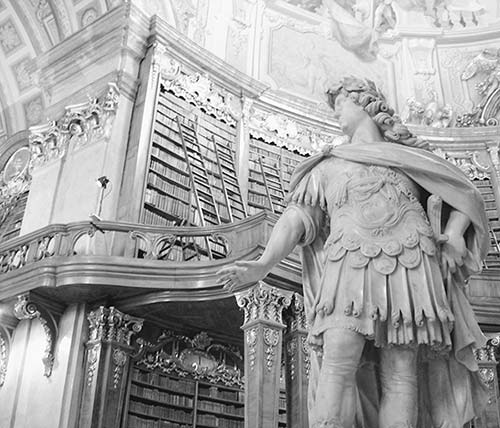
Cost and Hours: €10; Tue-Sun 10:00-18:00, may be open until 21:00 on Thu, closed Mon; +43 1 53 410, www.onb.ac.at.
Butterfly House (Schmetterlinghaus) in the Palace Garden (Burggarten)
The Burggarten greenbelt, once the backyard of the Hofburg and now a people’s park, welcomes visitors to loiter on the grass. The iron-and-glass pavilion (c. 1910 with playful Art Nouveau touches) now houses the recommended Palmenhaus and a small, fluttery butterfly exhibit. Watching the 400 free-flying butterflies is trippy.
Cost and Hours: €7; Mon-Fri 10:00-16:45, Sat-Sun until 18:15, daily until 15:45 in off-season; +43 1 533 8570, www.schmetterlinghaus.at.
▲▲Albertina Museum
This impressive museum has three highlights: the imposing state rooms of the former palace, noteworthy collections of classic modernist paintings and European graphic arts (sketches, etching, watercolors—especially Dürer), and excellent temporary exhibits.
The building, at the southern tip of the Hofburg complex (near the opera), was the residence of Maria Theresa’s favorite daughter, Maria Christina, who was allowed to marry for love rather than political strategy. Her many sisters were jealous. (Marie-Antoinette had to marry the French king...and lost her head over it.) Maria Christina’s husband, Albert of Saxony, was a great collector of original drawings and prints, which he amassed to cover all the important art movements from the late Middle Ages until the early 19th century (including prized works by Dürer, Rembrandt, and Rubens). As it’s Albert and Christina’s gallery, it’s charmingly called the “Alber-tina.”
Cost and Hours: €17.90; daily 10:00-18:00, Wed and Fri until 21:00; overlooking Albertinaplatz across from the TI and opera, +43 1 534 830, www.albertina.at.
Visiting the Museum: After the turnstile, you’ll pass some temporary exhibits. Climbing the stairs, you reach the main attractions (clearly labeled)—the state rooms (Prunkräume) on your left on level 1, and the Batliner Collection on your right on level 2. Excellent special exhibitions (generally featuring modern art and included in your ticket) are shown on level 2 and in the basement galleries.
State Rooms (Prunkräume, level 1): Wander freely under chandeliers and across parquet floors through a handful of rooms of 18th-century imperial splendor, unconstrained by velvet ropes. The exhibit spaces (never crowded, well described in English, and air-conditioned) are nearly as impressive as those at Schönbrunn Palace. Many rooms are often closed for special functions, but even a few rooms give a good look at imperial Classicism—this is the only post-Rococo palace in the Habsburg realm.
Batliner Collection (level 2): This manageable collection sweeps you quickly through modern art history, featuring minor works by major artists (such as Monet, Renoir, Munch, Picasso, Degas, and Matisse, among others). Though the collection is permanent, what’s on display rotates through about 100 works selected from the 300 in the archives.
Church Crypts near the Hofburg
Two churches near the Hofburg offer starkly different looks at dearly departed Viennese: the Habsburg coffins in the Kaisergruft and the commoners’ graves in St. Michael’s Church.
▲▲Kaisergruft (Imperial Crypt)
Visiting the imperial remains of the Habsburg family is not as easy as you might imagine. As bodies needed to lie in state to prove to nobility that they were actually dead (in an age of “seeing is believing”), the newly dead were gutted like a fish, with all the quick-to-go-bad parts removed (hearts and innards). These original organ donors left their bodies—about 150 in all—in the unassuming Kaisergruft, their hearts in the Augustinian Church (viewable Sun after Mass), and their entrails in the crypt below St. Stephen’s Cathedral.
Cost and Hours: €8, daily 10:00-18:00, free map includes Habsburg family tree and a chart locating each coffin, crypt is in the Capuchin Church at Tegetthoffstrasse 2 at Neuer Markt; +43 1 512 685 388.
Visiting the Kaisergruft: Descend into a crypt full of gray metal tombs. Start up the path, through tombs ranging from simple caskets to increasingly big monuments with elaborate metalwork ornamentation. You soon reach the massive pewter tomb of Maria Theresa under the dome, enjoying natural light. The only female Habsburg monarch, she had to be granted special dispensation to rule. Her 40-year reign was enlightened and progressive. She and her husband, Franz I, recline Etruscan-style atop their fancy coffin, gazing into each other’s eyes as a cherub crowns them with glory. At the four corners of the tomb are the Habsburgs’ four crowns: the Holy Roman Empire, Hungary, Bohemia, and Lombardy. At his parents’ feet lies Josef II, the patron of Mozart and Beethoven. Compare the Rococo splendor of Maria Theresa’s tomb with the simple coffin of Josef, who was known for his down-to-earth ruling style during the Age of Enlightenment.
Maria Theresa was the only woman to officially rule the Habsburg Empire in that family’s 640-year reign. She was a strong and effective empress (r. 1740-1780), but Austrians are also quick to remember Maria Theresa as the mother of 16 children (10 survived into adulthood). Ponder the fact that the most powerful woman in Europe either was pregnant or had a newborn for most of her reign. Maria Theresa ruled after the Austrian defeat of the Ottomans, when Europe recognized Austria as a great power. (Her rival, the Prussian king, said, “When at last the Habsburgs get a great man, it’s a woman.”)
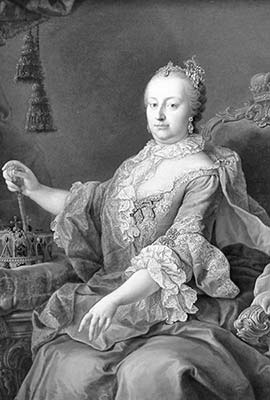
Maria Theresa’s reign marked the end of the feudal system and the beginning of the era of the grand state. The first of the modern rulers of the Age of Enlightenment, she was a great social reformer. During her reign, she avoided wars and expanded her empire by skillfully marrying her children into the right families. For instance, after daughter Marie-Antoinette’s marriage into the French Bourbon family (to Louis XVI), a country that had been an enemy became an ally. (Unfortunately for Marie-Antoinette, Maria Theresa’s timing was off.)
To stay in power during an era of revolution, Maria Theresa had to be in tune with her age. She taxed the Church and the nobility, provided six years of obligatory education to all children, and granted free health care to all in her realm. Maria Theresa also welcomed the boy genius Mozart into her court.
The empress’ legacy lived on in her son, Josef II, who ruled as emperor for a decade (1780-1790). He was an even more avid reformer, building on his mother’s accomplishments. An enlightened monarch, Josef mothballed the too-extravagant Schönbrunn Palace, secularized the monasteries, established religious tolerance within his realm, freed the serfs, made possible the founding of Austria’s first general hospital, and promoted relatively enlightened treatment of the mentally ill. Josef was a model of practicality (for example, he banned slow-to-decompose coffins and allowed no more than six candles at funerals)—and very unpopular with other royals. But his policies succeeded in preempting the revolutionary anger of the age, largely enabling Austria to avoid the antimonarchist turmoil that shook so much of the rest of Europe.
Head on through the next room—created in 1960—featuring Napoleon’s wife, Marie Louise, and a plaque to Franz Ferdinand (assassinated in 1914 in Sarajevo). Then head down three steps to a room illustrating the Habsburgs’ fading 19th-century glory. There’s the appropriately austere military tomb of the long-reigning Franz Josef (ruled 1848 to 1916, see sidebar on here). Alongside is his wife, Elisabeth—a.k.a. Sisi (see here)—who always wins the “Most Flowers” award. Their son was Crown Prince Rudolf. Rudolf and his teenage mistress supposedly committed suicide together in 1889 at Mayerling hunting lodge...or was it murder?
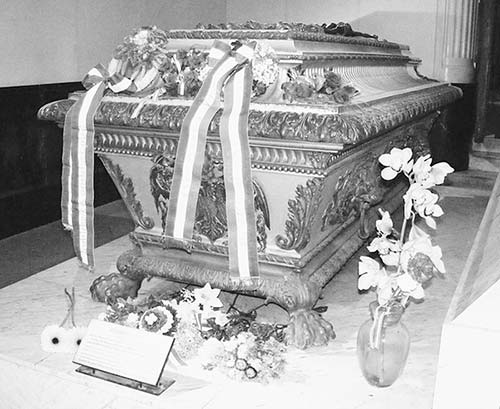
In the final room (with humbler copper tombs), you reach the final Habsburgs. Karl I (see his bust, not a tomb), the last of the Habsburg rulers, was deposed in 1918 and died in exile. His sons Crown Prince Otto and Archduke Karl Ludwig are entombed near their mother, Zita.
▲St. Michael’s Church Crypt (Michaelerkirche)
St. Michael’s Church, which faces the Hofburg on Michaelerplatz, offers a striking contrast to the imperial crypt. Tours take visitors underground to see a typical church crypt, filled with the rotting wooden coffins of well-to-do commoners.
Cost and Hours: €8 for 45-minute tour (crypt only accessible by tour), tours run Fri-Sat only, check website to confirm schedule and language—tours may be in German only, wait at church entrance at the sign advertising the tour and pay the guide directly, +43 650 533 8003, www.michaelerkirche.at.
Visiting the Crypt: Climbing below the church, you’ll see about a hundred 18th-century coffins and stand on three feet of debris, surrounded by niches filled with stacked lumber from decayed coffins and countless bones. You’ll meet 18th-century mummies in their original clothes—one wearing lederhosen and a wig; another clutching a cross and wearing high heels painted with flowers. You’ll learn about death in those times, including how the wealthy—not wanting to end up in standard shallow graves—instead paid to be laid to rest below the church, and how, in 1783, Emperor Josef II ended the practice of cemetery burials in cities but allowed the rich to become the stinking rich in crypts under churches.
MORE SIGHTS WITHIN THE RING
▲▲▲St. Stephen’s Cathedral (Stephansdom)
This massive Gothic church with the skyscraping spire sits at the center of Vienna. Its highlights are the impressive exterior, the view from the top of the south tower, a carved pulpit, and a handful of quirky sights associated with Mozart and the Habsburg rulers.
Cost and Hours: Church foyer and north aisle—free, daily 6:00-22:00; main nave—€6, includes audioguide, Mon-Sat 9:00-11:30 & 13:00-16:30, Sun 13:00-16:30, July-Aug until 17:30; south and north towers and catacombs have varying costs and hours—see below; English Mass each Sat at 19:00, +43 1 515 523 054, www.stephanskirche.at.
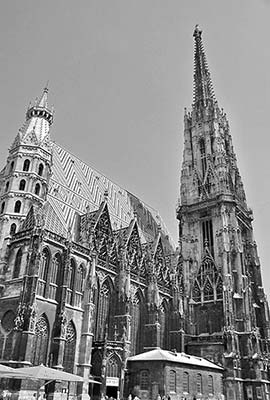
Tours: Entry fee includes audioguide. Or download my free St. Stephen’s Cathedral audio tour.
Catacombs: The catacombs are open to the public only by guided tour (€6, daily 10:00-11:30 & 13:30-16:30, tours generally depart on the half-hour and are in German and English together). Just be at the stairs in the left/north transept to meet the guide—you’ll pay at the end. You’ll see a crypt for bishops and archbishops, and Crock-Pots of Habsburg guts filling dusty shelves.
Towers: The iconic south tower rewards a tough climb up a claustrophobic, 343-step staircase with dizzying views through windows near the top. You can reach it via the entrance outside the church, around the right as you face the west facade (€5.50, daily 9:00-17:30).
The shorter north tower holds the famous “Pummerin” bell, and you ascend via elevator (no stairs). While not as high as the south tower, the views are still great (€6, daily 9:00-20:30, entrance inside the church on the left/north side of the nave; you can access this elevator without buying a ticket for the main nave).
 Self-Guided Tour: As you face the church’s main entry, go to the right across the little square. From here, you can absorb the sheer magnitude of this massive church, with its skyscraping spire.
Exterior: The church we see today is the third one on this spot. A tall, black, glassy info post describes the Virgil Chapel that stood here 800 years ago. Its dank shell survives today below your feet, viewable from the nearby U-Bahn station. Today’s church dates mainly from 1300 to 1450, when builders expanded on an earlier structure and added two huge towers at the end of each transept.
The impressive 450-foot south tower—capped with a golden orb and cross—took 65 years to build and was finished in 1433. The tower is a rarity among medieval churches in that it was completed before the Gothic style—and the age of faith—petered out.
The cathedral was heavily damaged at the end of World War II. The original timbered Gothic roof burned, the cathedral’s huge bell crashed to the ground, and the fire raged for two days. Civic pride prompted a financial outpouring, and the roof was rebuilt to its original splendor by 1952—doubly impressive considering the bombed-out state of the impoverished country at that time.
Main Entrance: The Romanesque-style main entrance includes bits of the oldest part of the church (which stood here in the 1200s). Right behind you is the site of Vindobona, a Roman garrison town. Before the Romans converted to Christianity, there was a pagan temple here, and this entrance pays homage to that ancient heritage. Roman-era statues are embedded inside the facade, and the two octagonal towers flanking the main doorway are dubbed the “heathen towers” because they’re built with a few recycled Roman stones (flipped over to hide the pagan inscriptions and expose the smooth sides).
• Enter the church.
Cathedral Interior: The immense nave is more than a football field long and nine stories tall. It’s lined with clusters of slender pillars that soar upward to support the ribbed crisscross arches of the ceiling. Stylistically, the nave is Gothic with a Baroque overlay.
Over the main doorway is the choir loft, with the 12,000-pipe organ, a 1960 replacement for the famous one destroyed during World War II. Along the left wall is the gift shop. Step in to marvel at the 14th-century statuary decorating its wall—some of the finest carvings in the church.
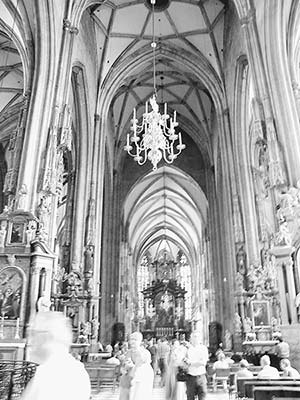
To the left of the gift shop is the gated entrance to the Chapel of Prince Eugene of Savoy. Prince Eugene (1663-1736), a seminary student from France, arrived in Vienna in 1683 as the city was about to be overrun by the Ottoman Turks. He volunteered for the army and helped save the city, launching a brilliant career as a military man for the Habsburgs. When he died, the grateful Austrians buried him here, under this chapel, marked by a tomb hatch in the floor.
• Nearby is the entrance to the main nave. Buy a ticket and start down the nave toward the altar. At the second pillar on the left is the...
Pulpit: The Gothic sandstone pulpit (c. 1500) is a masterpiece carved from three separate blocks (see if you can find the seams). A spiral stairway winds up to the lectern, surrounded and supported by the four “Latin Church Fathers,” who translated the Bible into Latin in the fourth century (making it more widely accessible to the faithful) and whose writings influenced early Catholic dogma. Each has a very different and very human facial expression (from back to front): Ambrose (daydreamer), Jerome (skeptic), Gregory (explainer), and Augustine (listener).
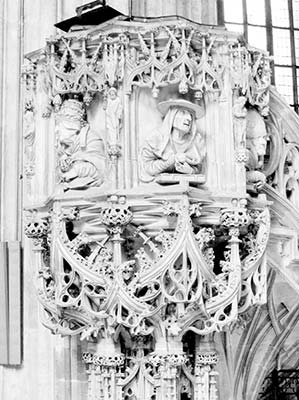
Find the guy peeking out from under the stairs. This may be a rare self-portrait of the sculptor (in medieval times, art was done for the glory of God, and artists worked anonymously). He leans out from a window, sculptor’s compass in hand, to observe the world and his work.
• Continue up the nave. Halfway up turn right and enter the south transept. Go all the way to the doors, then look left to find the...
Mozart Plaque: Wolfgang Amadeus Mozart (1756-1791) spent most of his brief adult life in Vienna. He attended Mass and was married in St. Stephen’s, and two of his children were baptized here. Mozart lived at the heart of Viennese society—among musicians, actors, and aristocrats. After his early success, Mozart fell on hard times. When he died at 35, his remains were dumped into a mass grave outside town. But he was honored with a funeral service here in St. Stephen’s.
• Now head to the chapel at the front-right corner of the church.
Tomb of Frederick III: This imposing, red-marble tomb is like a big king-size-bed coffin with an effigy of Frederick lying on top (not visible—but there’s a photo of the effigy on the left). The top of the tomb is decorated with his coats of arms, representing the many territories he ruled over. Frederick III (1415-1493) is considered the “father” of Vienna for turning the small village into a royal city with a cosmopolitan feel.
• Walk to the middle of the church.
High Altar: The tall, ornate, black marble altarpiece (1641, by Tobias and Johann Pock) is topped with a statue of Mary that barely fits under the towering vaults of the ceiling. It frames a large painting of the stoning of St. Stephen, painted on copper. Stephen (at the bottom), having refused to stop professing his faith, is pelted with rocks by angry pagans. As he kneels, ready to die, he gazes up to see a vision of Christ, the cross, and the angels of heaven.
▲▲▲Vienna State Opera (Wiener Staatsoper)
The opera house, facing the Ring and near the TI, is a central point for any visitor. Vienna remains one of the world’s great cities for classical music, and this building still belts out some of the finest opera, both classic and cutting-edge. While the critical reception of the building 130 years ago led the architect to commit suicide, and though it’s been rebuilt since its destruction by WWII bombs, it’s still a sumptuous place. The interior has a chandeliered lobby and carpeted staircases perfect for making the scene. The theater itself features five wraparound balconies, gold-and-red decor, and a bracelet-like chandelier. The only way to see the opera house interior (besides attending a performance) is with a guided 40-minute tour.
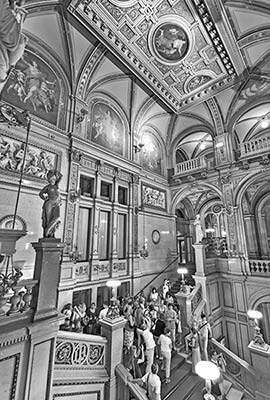
Cost and Hours: €13, tour schedule varies depending on rehearsals and performances—generally more tours in the afternoon and in July-Aug (when there are no performances), fewer tours Sept-June; reserve your spot online or risk it and show up at the tour entrance 30 minutes in advance; current month’s tour schedule posted online, at the tour entrance (on Operngasse), and at the box office (on Kärntner Strasse); +43 1 514 444 2250, www.wiener-staatsoper.at/en/staatsoper/guided-tours.
▲▲Haus der Musik
Vienna’s “House of Music” is a fun and interactive experience that celebrates this hometown forte. The museum, spread over several floors and well described in English, is unique for its effective use of touchscreen computers and headphones to explore the physics of sound. One floor is dedicated to the heavyweight Viennese composers (Mozart, Beethoven, and company) who virtually created classical music as we know it. Really experiencing the place takes time. It’s open late and is so interactive, relaxing, and fun that it can be considered an activity more than a sight—an evening of joy for music lovers.
Cost and Hours: €16, half-price after 20:00, €20 combo-ticket with Mozarthaus, daily 10:00-22:00, two blocks from the opera house at Seilerstätte 30, +43 1 513 4850, www.hausdermusik.com.
Visiting the Museum: It’s a one-way system; just follow the arrows on the floor. Scan the museum’s posted QR code for additional information to enhance your visit. The first floor highlights the Vienna Philharmonic Orchestra, known the world over for their New Year’s Eve concerts. (In a mini concert hall, a one-hour video—on a loop—lets you enjoy the event.) See Toscanini’s baton, Mahler’s cap, and well-used scores. Throw the dice to randomly “compose” a piece of music. The second floor explores the physics of sound. Enjoy the dark space and stop to notice isolated sounds of things you encounter every day. At the “instrumentarium,” four giant instruments, including a drum, demonstrate the principles of sound generation. Through these interactive exhibits, you’ll explore the nature of sound and music; I could actually hear what I thought only a piano tuner could discern. You can twist, dissect, and bend sounds to make your own musical language, merging your voice with a duck’s quack or a city’s traffic roar. The third floor celebrates the famous hometown boys—Haydn, Mozart, Beethoven, Schubert, Strauss (father and son), Mahler, Schönberg, Webern, and Berg. Before leaving, head to the top floor and pick up a virtual baton to conduct the Vienna Philharmonic.
▲Dorotheum Auction House (Palais Dorotheum)
For an aristocrat’s flea market, drop by Austria’s answer to Sotheby’s. The ground floor has shops, an info desk with a schedule of upcoming auctions (Sept-June only), and a few auction items. Some pieces are available for immediate sale (marked VKP, for Verkaufpreis—“sales price”), while others are up for auction (marked DIFF. RUF).
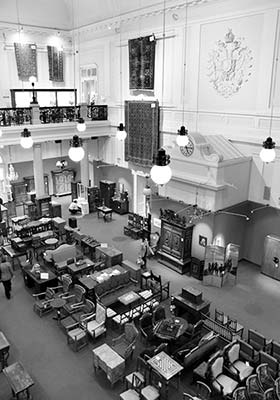
The first floor (above the mezzanine) has antique furniture and fancy knickknacks; the second floor has a showy antique gallery with fixed prices. Wandering through here, you feel like you’re touring a museum with exhibits you can buy.
Cost and Hours: Free, Mon-Fri 10:00-18:00, Sat 9:00-17:00, closed Sun, classy little café on second floor, between the Graben pedestrian street and Hofburg at Dorotheergasse 17, +43 1 515 60, www.dorotheum.com.
▲St. Peter’s Church (Peterskirche)
Baroque Vienna is at its best in this architectural gem, tucked away a few steps from the Graben. Admire the rose-and-gold, oval-shaped Baroque interior, topped with a ceiling fresco of Mary kneeling to be crowned by Jesus and the Father, while the dove of the Holy Spirit floats way up in the lantern. The church’s sumptuous elements—especially the organ, altar painting, pulpit, and coat of arms (in the base of the dome) of church founder Leopold I—make St. Peter’s one of the city’s most beautiful and ornate churches.
Cost and Hours: Free, Mon-Fri 8:00-19:00, Sat-Sun from 9:00, free organ concerts daily at 15:00, just off the Graben between the Plague Monument and Kohlmarkt, +43 1 533 6433, www.peterskirche.at.
Mozarthaus Vienna Museum
In September 1784, 27-year-old Wolfgang Amadeus Mozart moved into this spacious apartment with his wife, Constanze, and their week-old son Karl. For the next three years, this was the epicenter of Viennese high life. It was here that Mozart wrote Marriage of Figaro and Don Giovanni and established himself as the toast of Vienna. Today, the actual apartments are pretty boring (mostly bare rooms), but the museum does flesh out Mozart’s Vienna years with paintings, videos, and a few period pieces.
Cost and Hours: €12, includes audioguide, €20 combo-ticket with Haus der Musik; Tue-Sun 10:00-18:00, closed Mon; a block behind the cathedral, go through arcade at #5a and walk 50 yards to Domgasse 5, +43 1 512 1791, www.mozarthausvienna.at.
Jewish Museum Vienna (Jüdisches Museum Wien)
The museum operates two buildings a 10-minute walk apart. The main museum is on Dorotheergasse (near the Hofburg), and a smaller, more archaeological exhibit is at Judenplatz, which is also the site of a Holocaust memorial (near Am Hof).
The Jewish Museum Dorotheergasse (near the Hofburg) fills a four-story downtown building with exhibits, a bookstore, and a small, reasonably priced café serving Middle Eastern fare. The main part of the exhibit is on the second floor, covering the history of Vienna’s Jews up to World War II; a ground-floor exhibit carries the story forward to the present day.
The smaller, less interesting Museum Judenplatz (near Am Hof) was built around the scant remains of the medieval synagogue that served Vienna’s 1,500 Jewish residents up until their massacre in 1420. Its main exhibit is an underground hall where you see the synagogue’s foundations. The classy square above the ruins, called Judenplatz, is now dominated by a blocky memorial to the 65,000 Viennese Jews killed by the Nazis.
Cost and Hours: €12 ticket includes both museums; Dorotheergasse location, at #11—Sun-Fri 10:00-18:00, closed Sat, multimedia guide-€3; Judenplatz location, at #8—Sun-Thu 10:00-18:00, Fri until 17:00, closed Sat; +43 1 535 0431, www.jmw.at.
MUSEUM DISTRICT
In the 19th century, the Habsburgs planned to link their palace and museum buildings with a series of arches across the Ringstrasse. Although that dream was never fully realized, the awe-inspiring museums still face off across Maria-Theresien-Platz, with a monument to Maria Theresa at its center.
▲▲▲Kunsthistorisches Museum
The Kunsthistorwhateveritis Museum—let’s just say “Kunst” (koonst)—houses the family collection of Austria’s luxury-loving Habsburg rulers. Their joie de vivre is reflected in this collection—some of the most beautiful, sexy, and fun art from two centuries (c. 1450-1650). At their peak of power in the 1500s, the Habsburgs ruled Austria, Germany, northern Italy, the Netherlands, and Spain—and you’ll see a wide variety of art from all these places and beyond.
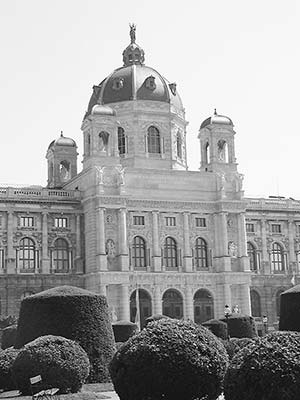
While there’s little Viennese art here, you will find world-class European masterpieces galore (including canvases by Raphael, Caravaggio, Velázquez, Rubens, Vermeer, Rembrandt, and a particularly exquisite roomful of Bruegels), all well displayed on one glorious floor, plus a fine display of Egyptian, classical, and applied arts.
Cost and Hours: €18, €24 combo-ticket with Hofburg Treasury; daily 10:00-18:00, Thu until 21:00, closed Mon Sept-May; audioguide-€6 or €8/2 people; on the Ringstrasse at Maria-Theresien-Platz, U: Volkstheater/Museumsplatz, +43 1 525 240, www.khm.at.
Visiting the Museum: Of its many exhibits, we’ll tour only the Picture Gallery (Gemäldegalerie) on the first floor. Italian-Spanish-French art is on one half of the floor, and Northern European art is on the other. The museum constantly moves around paintings, so be flexible, pick up the current floor plan in the lobby, and use it to locate the highlights from this tour.
Canaletto, Habsburg Palaces: In Saal VII, you’ll see glimpses of Baroque art showcasing over-the-top emotions and pudgy, winged babies (the surefire mark of Baroque). Find paintings by Canaletto of the former Habsburg palaces—Schönbrunn and Belvedere—one of which also shows the Viennese skyline in the distance.
Caravaggio, Madonna of the Rosary and David with the Head of Goliath: Caravaggio’s Madonna of the Rosary (the biggest canvas in the room) may be titled for the Virgin, but the star of the canvas is the plump young Jesus. He casually balances on his mother’s knee, one hand rubbing his plump tummy. St. Dominic, to the left of the mother and child, distributes rosaries to an imploring crowd (notice their dirty feet—typical of Caravaggio’s honest realism).
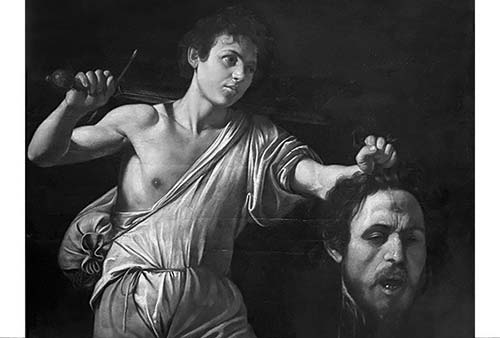
In David with the Head of Goliath, Caravaggio turns a familiar Bible story into a third-degree interrogation as David shoves the dripping head of the slain giant right in our noses. This David is not a heroic Renaissance Man like Michelangelo’s famous statue, but a homeless teen that Caravaggio paid to portray God’s servant. And the severed head of Goliath is none other than Caravaggio himself, an in-your-face self-portrait.
Velázquez, Habsburg Family Portraits: When the Habsburgs ruled both Austria and Spain, cousins kept in touch through portraits of themselves and their kids. Diego Velázquez was the greatest of Spain’s “photojournalist” painters—heavily influenced by Caravaggio’s realism, capturing his subjects without passing judgment, flattering, or glorifying them.
For example, watch little Margarita Habsburg grow up in three different portraits on the same wall, from age two to age nine. Margarita was destined from birth to marry her Austrian cousin, the future Emperor Leopold I. Pictures like these, sent from Spain every few years, let her pen pal/fiancé get to know her.
Arcimboldo, Portraits of the Seasons: These four cleverly deceptive portraits by the Habsburg court painter, Giuseppe Arcimboldo, depict the four seasons (and elements) as people. For example, take Summer—a.k.a. “Fruit Face.” With a pickle nose, pear chin, and corn-husk ears, this guy literally is what he eats. Its grotesque weirdness makes it typical of Mannerist art.
Titian, Ecce Homo: In the long career of Titian the Venetian (it rhymes), he painted portraits, Christian Madonnas, and sexy Venuses with equal ease. In the large canvas Ecce Homo, a crowd mills about, when suddenly there’s a commotion. They nudge each other and start to point. Follow their gaze diagonally up the stairs to a battered figure entering way up in the corner. “Ecce Homo!” says Pilate. “Behold the man.” And he presents Jesus to the mob.
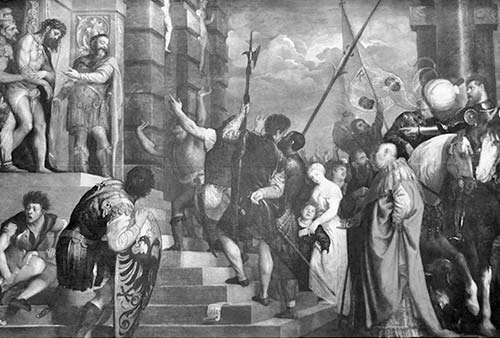
Raphael, Madonna of the Meadow: Young Raphael epitomized the spirit of the High Renaissance, combining symmetry, grace, beauty, and emotion. This Madonna is a mountain of motherly love—Mary’s head is the summit and her flowing robe is the base—enfolding Baby Jesus and John the Baptist. The geometric perfection, serene landscape, and Mary’s adoring face make this a masterpiece of sheer grace—but then you get punched by an ironic fist: The cross the little tykes play with foreshadows their gruesome deaths.
Titian, Danae: Titian’s Danae features a luscious nude reclining in bed, as she’s about to be seduced. Zeus, the king of the gods, descends as a shower of gold to consort with her—you can almost see the human form of Zeus within the cloud. Danae is enraptured, opening her legs to receive him, while her servant tries to catch the heavenly spurt with a golden dish. How could ultra-conservative Catholic emperors have tolerated such a downright pagan and erotic painting? Apparently, without a problem.
Correggio and Parmigianino: Explore the smaller side rooms, which display excellent small canvases. Look for Correggio’s Jupiter and Io, showing Zeus seducing another female, this time disguised as a cloud. Parmigianino’s Self-Portrait in a Convex Mirror depicts the artist gazing into a convex mirror and perfectly reproducing the curved reflection on a convex piece of wood. Amazing.
Exit this wing of the museum via Saal I. Next we’ll explore the other half of this floor, dedicated to Northern European art.
Peter Paul Rubens: In Rubens’ Self-Portrait (likely Room 20) admire the darling of Catholic-dominated Flanders (northern Belgium) in his prime: famous, wealthy, well traveled, the friend of kings and princes, an artist, diplomat, man about town, and—obviously—confident. Rubens’ work runs the gamut, from realistic portraits to lounging nudes, from Greek myths to altarpieces, from pious devotion to violent sex. But can we be sure it’s Baroque? Ah yes, I’m sure you’ll find a pudgy, winged baby somewhere, hovering in the heavens.
Jan Vermeer: In his small canvases, the Dutch painter Jan Vermeer quiets the world down to where we can hear our own heartbeat, letting us appreciate the beauty in common things. The curtain opens and we see The Art of Painting, a behind-the-scenes look at Vermeer at work. He’s painting a model dressed in blue, starting with her laurel-leaf headdress. The studio is its own dollhouse world framed by a chair in the foreground and the wall in back. Then Vermeer fills this space with the few gems he wants us to focus on—the chandelier, the map, the painter’s costume. Everything is lit by a crystal-clear light, letting us see these everyday items with fresh eyes.
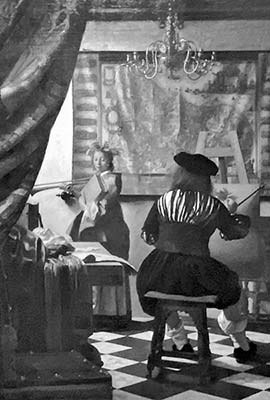
Rembrandt van Rijn: Rembrandt became wealthy by painting portraits of Holland’s upwardly mobile businessmen, but his greatest subject was himself. In his Large Self-Portrait we see the hands-on-hips, defiant, open-stance determination of a man who will do what he wants, and if people don’t like it, tough. In typical Rembrandt style, most of the canvas is a dark, smudgy brown, with only the side of his face glowing from the darkness. (Remember Caravaggio? Rembrandt did.)
Pieter Bruegel the Elder: The undisputed master of the slice-of-life village scene was Pieter Bruegel the Elder (c. 1525-1569)—think of him as the Norman Rockwell of the 16th century. He celebrated the peasants’ simple life, but he also skewered their weaknesses—not to single them out as hicks, but as universal examples of human folly. About a quarter of all known Bruegel paintings are gathered in this exciting room.
The Peasant Wedding, Bruegel’s most famous work, is less about the wedding than the food. It’s a farmers’ feeding frenzy, as the barnful of wedding guests scramble to get their share of free eats. Everyone’s going at it, including a kid in an oversized red cap who cleans the bowl with his fingers. In the middle of it all, look who’s been completely forgotten—the demure bride sitting in front of the blue-green cloth.
▲▲Natural History Museum (Naturhistorisches Museum)
The twin building facing the Kunsthistorisches Museum still serves the exact purpose for which it was built: to show off the Habsburgs’ vast collection of plant, animal, and mineral specimens and artifacts. It’s grown to become an exceptionally well-organized and enjoyable catalogue of the natural world, with 20 million objects, including moon rocks, dinosaur stuff, and the fist-sized Venus of Willendorf (at 25,000 years old, the world’s oldest sex symbol). Even though the museum has kept its old-school charm, nearly everything on display is presented and described well enough to engage any visitor, from kids to scientifically inclined grown-ups.
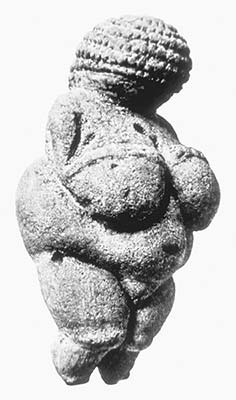
Cost and Hours: €14; Thu-Mon 9:00-18:30, Wed until 21:00, closed Tue; €6 audioguide (“Top 100”) isn’t necessary but can help you hit the highlights; on the Ringstrasse at Maria-Theresien-Platz, U: Volkstheater/Museumsplatz, +43 1 521 770, www.nhm-wien.ac.at.
MuseumsQuartier
The vast grounds of the former imperial stables now corral a cutting-edge cultural center for contemporary arts and design. Among several impressive museums, the best are the Leopold Museum, specializing in 20th-century Austrian modernists (Egon Schiele, Gustav Klimt, and Oskar Kokoschka, among others) and the Museum of Modern Art, Austria’s leading gallery for international modern and contemporary art. For many, the MuseumsQuartier is most enjoyable as a spot to gather in the evening for a light, fun meal; cocktails; and people-watching.
Cost and Hours: Leopold Museum—€15, Wed-Mon 10:00-18:00, some Thu until 21:00, closed Tue except in summer, audioguide-€4 or €7/2 people, +43 1 525 700, www.leopoldmuseum.org; Museum of Modern Art—€14, Tue-Sun 10:00-18:00, closed Mon, good multimedia guide-€4, +43 1 52 5000, www.mumok.at. The main entrance/visitors center is at Museumsplatz 1 (ask about combo-tickets if visiting more than just the Leopold and Modern Art museums). U: Volkstheater/Museumsplatz, +43 1 523 5881, www.mqw.at.
KARLSPLATZ AND NEARBY
These sights cluster around Karlsplatz, just southeast of the Ringstrasse. If you’re walking from central Vienna, use the U-Bahn station entrance at the opera house and follow the passageways to avoid crossing busy boulevards.
Karlsplatz
This picnic-friendly square, with its Henry Moore sculpture in the pond, faces the imposing facade of Vienna’s Technical University. The massive, domed Karlskirche and its twin spiral columns dominate the square. The small green, white, and gold pavilions that line the street across the square from the church are from the late-19th-century municipal train system (Stadtbahn). With curvy iron frames, decorative marble slabs, and painted gold trim, these are pioneering works in the Jugendstil style, designed by the Modernist architect Otto Wagner, who influenced Klimt and the Secessionists. One of the pavilions has a sweet little exhibit on Wagner that illustrates the Art Nouveau lifestyle around 1900 (€5, Tue-Sun 10:00-18:00, closed Mon and Nov-March, near the Ringstrasse, +43 1 5058 7478 5180, www.wienmuseum.at).
▲Karlskirche (St. Charles Church)
This “votive church” was proposed by Emperor Charles VI and dedicated to his patron saint, St. Charles Borromeo, in 1713 when an epidemic spared Vienna. The church offers some over-the-top Baroque designs, with a unique combination of columns (showing scenes from Borromeo’s life, à la Trajan’s Column in Rome), a classic pediment, an elliptical dome, and a terrific close-up look at its frescoes, thanks to a construction elevator that’s open to the public. The dome’s colorful 13,500-square-foot fresco—painted in the 1730s by Johann Michael Rottmayr—shows Signor Borromeo (in red-and-white bishop’s robes) gazing up into heaven, spreading his arms wide, and pleading with Christ to spare Vienna from the plague. Skip the dome if you’re even slightly afraid of heights.
Cost and Hours: €8, Mon-Sat 9:00-18:00, Sun 11:00-19:00, dome elevator runs until 17:30, pick up the free info booklet, www.karlskirche.at. There are often classical music concerts performed here on period instruments (usually Thu-Sat, www.concert-vienna.info).
▲Academy of Fine Arts Painting Gallery (Akademie der Bildenden Künste Gemäldegalerie)
Vienna’s art academy has a small but impressive collection of paintings to inspire and instruct its students. The gallery rotates temporary exhibits—everything from the masters to modern art—to illustrate contemporary themes. The highlights—the Last Judgment triptych by the master of medieval surrealism, Hieronymus Bosch, and works by Guardi, Titian, Rubens, and Van Dyck—are generally featured in the rotating themed exhibits.
Cost and Hours: €9, Tue-Sun 10:00-18:00, closed Mon, three blocks from the opera house at Schillerplatz 3, +43 1 588 162 201, www.kunstsammlungenakademie.at. There’s a fine and cheap cafeteria on the ground floor with hot lunches on weekdays.
▲The Secession
This little building was created by the Vienna Secession movement, a group of nonconformist artists led by Gustav Klimt, Otto Wagner, and friends. (For more on the art movement, see the sidebar.)
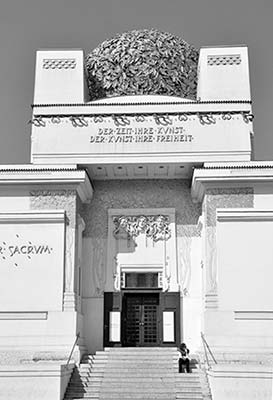
Having turned their backs on the stuffy official art academy, the Secessionists used the building to display their radical art. The stylized trees carved into the exterior walls and the building’s bushy “golden cabbage” rooftop are symbolic of a cycle of renewal. Today, the Secession continues to showcase contemporary cutting-edge art, and it preserves Gustav Klimt’s famous Beethoven Frieze. A masterpiece of Viennese Art Nouveau, this 105-foot-long fresco was the multimedia centerpiece of a 1902 exhibition honoring Ludwig van Beethoven.
Cost and Hours: €9.50 includes special exhibits, Tue-Sun 10:00-18:00, closed Mon, audioguide-€3, Friedrichstrasse 12, +43 1 587 5307, www.secession.at.
▲Naschmarkt
In 1898, the city decided to cover up its Vienna River. The long, wide square they created was filled with a lively produce market that still bustles most days. The stalls of the Naschmarkt (roughly meaning “Nibble Market”) stretch along Wienzeile street, just a short stroll south of the opera house. This is where top chefs like to get their ingredients. And it’s long been known as the place to get exotic faraway foods. In fact, locals say, “From here start the Balkans.”
Hours and Location: Mon-Fri 6:00-19:30, Sat until 18:00, closed Sun, closes earlier in winter; restaurants open until 23:00. The market stretches southwest from the opera to Kettenbrückengasse, between Linke Wienzeile and Rechte Wienzeile. I like to ride the U-Bahn to Kettenbrückengasse, then walk the length of the market back to the opera. Picnickers can grab their grub in the market and head over to Karlsplatz or the Burggarten.
Visiting the Naschmarkt: This “Belly of Vienna” has two parallel lanes. The right lane consists of market stalls, while the left lane is mostly eateries. In recent years, many stalls have been taken over by hip bars and eateries, bringing a youthful vibe and fun new flavors to the market scene. Food stalls make it clear that the Eastern European influences of the Habsburg times remain today. Wander through spices, exotic fruits, olives, cheeses, baklava, and more. From here, the market progresses from cheaper sausage stands and Turkish döner kebab stalls to trendier (and more expensive) eateries and upscale stalls. You’ll pass Zur Eisernen Zeit—the oldest Beisl (bistro) in the market. At the gourmet vinegar stall, you can sample the vinegar the way you would perfume—with a drop on your wrist (see photo).
Each Saturday, the Naschmarkt is infested with a huge flea market that stretches southwest of the Kettenbrückengasse U-Bahn station (Sat 6:30-14:00).
▲Wien Museum Karlsplatz
This underappreciated city history museum walks you through the story of Vienna with well-presented artifacts and good English descriptions. While closed for a major renovation, the museum is slated to reopen in its refreshed quarters in 2024 (Karlsplatz 8, +43 1 505 8747, www.wienmuseum.at).
SIGHTS BEYOND THE RING
The following sights are located outside the Ringstrasse but inside the Gürtel, or outer ring road (see the “Greater Vienna” map on here).
South of the Ring
▲▲Belvedere Palace (Schloss Belvedere)
This is the elegant palace of Prince Eugene of Savoy (1663-1736), the still much-appreciated conqueror of the Ottomans. Today, you can tour Eugene’s lavish palace, see sweeping views of the gardens and the Vienna skyline, and enjoy world-class art starring Gustav Klimt, French Impressionism, and a grab bag of other 19th- and early 20th-century artists. While Vienna’s other art collections show off works by masters from around Europe, this has the city’s best collection of homegrown artists.
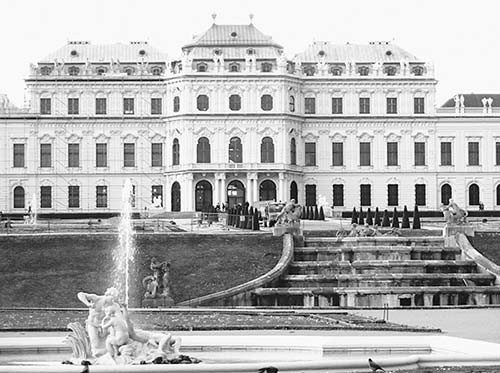
The palace complex includes the Upper Palace (world-class art collection), smaller Lower Palace (historical rooms and temporary exhibits), the Belvedere 21 (modern pavilion mostly filled with contemporary art), and pleasantly beautiful Baroque-style gardens (free and fun to explore). For most visitors, only the Upper Palace is worth the entrance fee.
Cost and Hours: €18 for Upper Belvedere Palace only, €26 for Upper and Lower Palaces (and special exhibits), gardens—free; daily 10:00-18:00, grounds open until dusk; audioguide-€5; good English descriptions; entrance at Prinz-Eugen-Strasse 27, +43 1 795 570, www.belvedere.at.
Eating at the Belvedere: There’s a charming little sit-down café on the ground floor of the Upper Palace; in summer you can dine outdoors in the garden.
Getting There: The palace is a 20-minute walk south of the Ring. To get there from the center, catch tram #D at the opera house (direction: Absberggasse). Get off at the Schloss Belvedere stop (just below the Upper Palace gate), cross the street, walk uphill one block, go through the gate (on left), and look immediately to the right for the small building with the ticket office.
Visiting the Upper Palace: The two grand buildings of the Belvedere Palace are separated by a fine garden that slopes down from the Upper to Lower Palace. For our purposes, the Upper Palace is what matters. Be aware that exhibits change frequently, so some of the things I mention here may not be on display during your visit. There are two grand floors, set around impressive middle halls, plus a third floor worth a peek. Throughout, look for small illustrations that show the rooms as they looked in Eugene’s day.
From the entrance, climb the staircase to the first floor and enter a grand red-and-gold, chandeliered Marble Hall. This was Prince Eugene’s party room.
Belvedere means “beautiful view,” and the view from the Marble Hall is the most iconic of the city (it’s notably captured in Canaletto’s painting displayed at the Kunsthistorisches Museum). Look over the Baroque gardens, the Lower Palace, and the city.
Then head to the East Wing. Sumptuous paintings by Gustav Klimt and his contemporaries (including Monet) fill the rooms in the East Wing. To Klimt, all art was erotic art. He painted during the turn of the 20th century, when Vienna was a splendid laboratory of hedonism. Even fully clothed, his women have a bewitching eroticism in a world full of pollen and pistils.
At the far end of the East Wing you’ll find what is perhaps Klimt’s best-known painting, The Kiss, where two lovers are wrapped up in the colorful gold-and-jeweled cloak of bliss. Klimt’s woman is no longer dominating, but submissive, abandoning herself to her man in a fertile field and a vast universe. In a glow emanating from a radiance of desire, the body she presses against is a self-portrait of the artist himself. While Klimt’s works are seductive and otherworldly, Egon Schiele’s tend to be darker and more introspective. One of Schiele’s most recognizable works, The Embrace, shows a couple engaged in an erotically charged, rippling moment of passion. Striking a darker tone is The Family. This melancholy painting from 1918 is Schiele’s last major painting—he and his pregnant wife died in the influenza epidemic that swept through Europe after World War I.
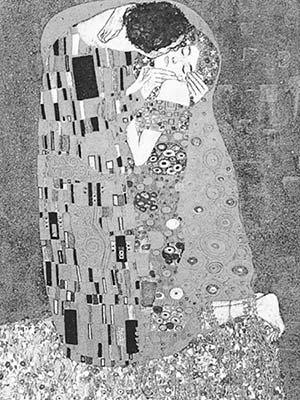
The rest of the Upper Palace collection goes through the whole range of 19th- and 20th-century art: Historicism, Romanticism, Impressionism, Realism, tired tourism, Expressionism, Art Nouveau, and early Modernism. In the West Wing of the first floor is the Belvedere’s collection of Austrian Baroque art, including a fascinating corner room of grotesquely grimacing heads by Franz Xaver Messerschmidt (1736-1783), a quirky 18th-century Habsburg court sculptor who left the imperial life to follow his own, somewhat deranged muse. After his promising career was cut short by mental illness, Messerschmidt relocated to Bratislava and spent the rest of his days sculpting a series of eerily lifelike “character heads” (Kopfstücke) whose unusual faces are contorted by extreme emotions.
▲Kunst Haus Wien and Museum Hundertwasserhaus
This “make yourself at home” museum and nearby apartment complex are a hit with lovers of modern art, mixing the work and philosophy of local painter/environmentalist Friedensreich Hundertwasser (1928-2000), a.k.a. “100H2O.”
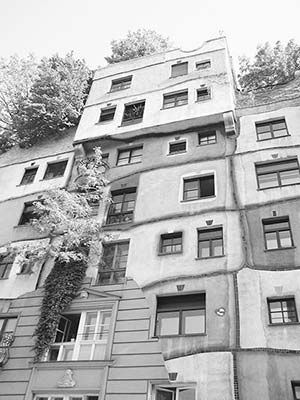
The museum provides by far the best look at Hundertwasser, but for an actual lived-in apartment complex by the green master, walk 10 minutes to the one-with-nature Hundertwasserhaus (at Löwengasse and Kegelgasse). This complex of 50 apartments, subsidized by the government to provide affordable housing, was built in the 1980s as a breath of architectural fresh air in a city of boring, blocky apartment complexes. While not open to visitors, it’s worth seeing for its fun and colorful patchwork exterior.
Cost and Hours: €11 for museum, €12 combo-ticket includes special exhibitions, open daily 10:00-18:00, audioguide-€3, +43 1 712 0491, www.kunsthauswien.com.
Getting There: It’s located at Untere Weissgerberstrasse 13, near the Radetzkyplatz stop on trams #O and #1 (signs point the way). Take the U-Bahn to Landstrasse and either walk 10 minutes downhill (north) along Untere Viaduktgasse (a block east of the station), or transfer to tram #O (direction: Praterstern) and ride three stops to Radetzkyplatz.
▲Prater Park (Wiener Prater)
Since the 1780s, when the reformist Emperor Josef II gave his hunting grounds to the people of Vienna as a public park, this place has been Vienna’s playground. For the tourist, the “Prater” is the sugary-smelling, tired, and sprawling amusement park (Wurstelprater). For locals, the “Prater” is the vast, adjacent green park with its three-mile-long, tree-lined main boulevard (Hauptallee). The park still tempts visitors with its huge 220-foot-tall, famous, and lazy Ferris wheel (Riesenrad), fun roller coasters, bumper cars, Lilliputian railroad, and endless eateries. Especially if you’re traveling with kids, this is a fun place to share the evening with thousands of Viennese and tourists.
Cost and Hours: Park is free and always open; amusement park—rides cost €2-8 and run May-Oct roughly 10:00-22:00 but often later in good weather in summer, fewer rides open in off-season; U: Praterstern, www.prater.at.
North of the Ring
Sigmund Freud Museum
Freud enthusiasts (and detractors) enjoy seeing the apartment and home office of the man who fundamentally changed our understanding of the human psyche. Dr. Sigmund Freud (1856-1939), a graduate of Vienna University, established his practice here in 1891. For the next 47 years, he received troubled patients who hoped to find peace by telling him their dreams, life traumas, and secret urges. It was here that he wrote his influential works, including the landmark Interpretation of Dreams (1899). The museum is narrowly focused on Freud’s life. If you’re looking for a critical appraisal of whether he was a cocaine-addicted charlatan or a sincere doctor groping toward an understanding of human nature, you won’t find it here.
Cost and Hours: €14, Wed-Mon 10:00-18:00, closed Tue, tiny bookshop, half-block from the Schlickgasse stop on tram #D, Berggasse 19, +43 1 319 1596, www.freud-museum.at.
West of the Ring
▲Mariahilfer Strasse Stroll
While there are more stately and elegant streets in the central district, the best opportunity to simply feel the pulse of workaday Viennese life is a little farther out, along Mariahilfer Strasse. The street is mostly pedestrian-only and is fast becoming an attraction in itself. An easy plan is to ride the U-3 to the Zieglergasse stop, then stroll and browse your way downhill to the MuseumsQuartier U-Bahn station. For a map of this area, see here.
If you’re interested in how Austria handles its people’s appetite for marijuana, seek out this interesting shop: Bushplanet Headshop (Mon-Fri 10:00-19:00, Sat until 18:00, closed Sun, Esterhazygasse 32, near the Neubaugasse U-Bahn stop,www.bushplanet.at). For a fine and free city view (along with reasonable eating), escalate to the top floor of the honeycombed Gerngross shopping center and find the Brandauer restaurant (at Mariahilfer Strasse #42).
SIGHTS ON VIENNA’S OUTSKIRTS
▲▲▲Schönbrunn Palace (Schloss Schönbrunn)
The Habsburgs’ former summer residence, just a 10-minute subway ride from downtown Vienna, is second only to Versailles among Europe’s grand palaces. Originally built in the 16th century as a small hunting lodge near a beautiful spring (schön-brunn), the residence grew over the next 300 years into the palace you see today. The highlight of the vast complex’s many sights is a tour of the Imperial Apartments where the Habsburg nobles lived (including Maria Theresa and her 16 children, and Franz Josef and Sisi). You can also stroll the palace gardens, visit the world’s oldest zoo, and view royal transport from the 19th century at the Imperial Carriage Museum.
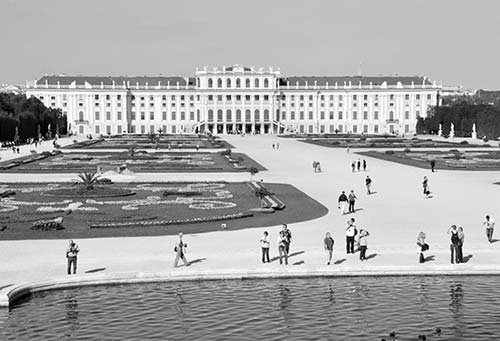
Cost: Visits to the palace are by timed-entry tour (book in advance). There are two tour options for the Imperial Apartments (both come with audioguides). The best is the 40-room Grand Tour, which includes both the rooms of Franz Josef and Sisi, as well as the more impressive Rococo rooms of Maria Theresa (€26, 50 minutes, covered by Sisi Ticket). The Imperial Tour covers only the less interesting first 22 rooms (€22, 35 minutes).
If venturing beyond the apartments, consider the Classic Pass combo-ticket, which includes the Grand Tour, as well as the Gloriette viewing terrace, maze, orangery, and privy garden (€31, available April-Oct only).
Hours: Imperial Apartments open daily 9:00-17:00, July-Aug until 17:30; gardens generally open 6:30-20:00 but varies with season. The palace is busiest from 9:00 to 12:00, and crowds start to subside after 14:00.
Information: +43 1 811 130, www.schoenbrunn.at.
Advance Tickets Recommended: In summer and on good-weather weekends, book your entry time in advance online. Otherwise, you’ll likely have to stand in line at the ticket desk, and then you’ll probably have to wait again for your assigned entry time—which could be hours later. Those with a Sisi Ticket can enter without a reserved entry time (buy your Sisi Ticket online or at the Vienna Furniture Museum—see here for details).
If you don’t have a reservation, come early or late in the day. You can save some time in line by using one of the ticket machines. If you have extra time before your entry time, spend it exploring the gardens or Imperial Carriage Museum.
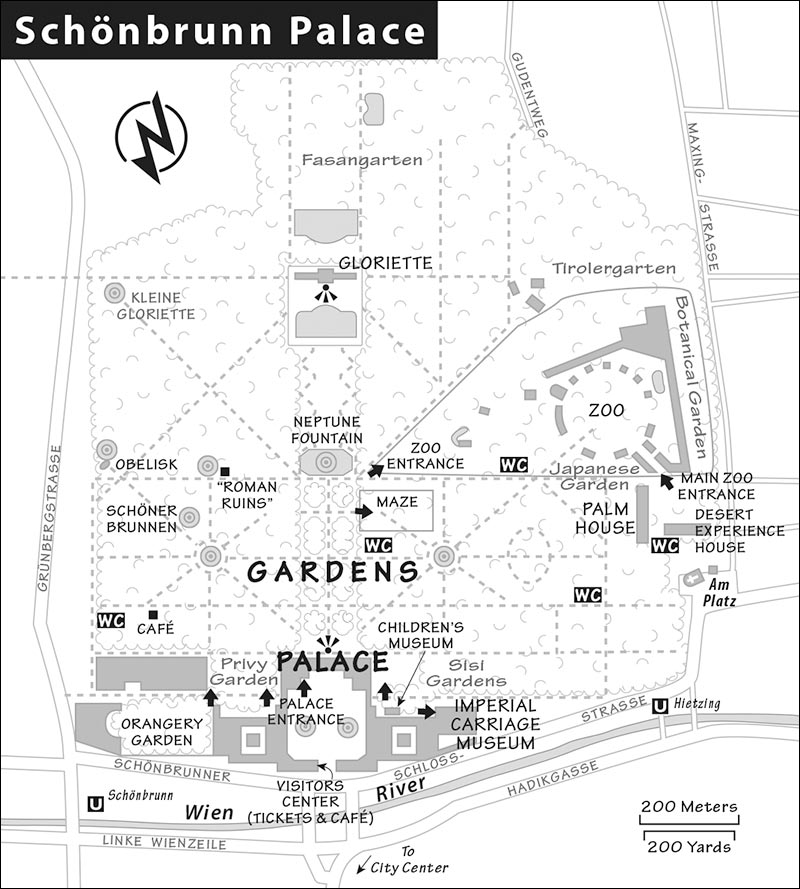
Getting There: Schönbrunn is an easy 10-minute subway ride from downtown Vienna. Take U-4 (which conveniently leaves from Karlsplatz) to Schönbrunn (direction: Hütteldorf) and follow signs for Schloss Schönbrunn. Exit bearing right, then cross the busy road and continue to the right to the far, far end of the long yellow building. There you’ll find the visitors center, where tickets are sold.
Planning Your Time: Allow at least three hours (including transit time) for your excursion to Schönbrunn Palace. The palace itself is sprawling and can be mobbed. After viewing the Imperial Apartments, wander the gardens (most of which are free). With more time and energy, pick and choose among the other sightseeing options and buy tickets as you go.
▲▲▲Imperial Apartments
In the 1500s, the Habsburgs built a small hunting lodge near a beautiful spring (schön-brunn), and for the next three centuries, they made it their summer getaway from stuffy Vienna. The palace’s exterior (late 1600s) is Baroque, but the interior was finished under Maria Theresa (mid-1700s) in let-them-eat-cake Rococo.
Visiting the Apartments: Your tour of the apartments, accompanied by an audioguide, follows a clearly signed one-way route. Think of the following minitour as a series of breadcrumbs, leading you along while the audioguide fills in the details.
Begin in the guards’ room, where jauntily dressed mannequins of Franz Josef’s bodyguards introduce you to his luxurious world. Continue through the Billiard Room to the Walnut Room. Wow. Rococo-style wood paneling and gilding decorate this room where Franz Josef—a hard-working modern monarch—received official visitors. Nearby is the study—Franz Josef (see his mustachioed portrait) worked at this desk, sometimes joined by his beautiful, brown-haired wife Sisi (see her portrait). In the bedchamber, a praying stool, iron bed, and little toilet all attest to Franz Josef’s spartan lifestyle (though the paintings here remind us of the grand scale of his palace).
Empress Sisi’s Study and Dressing Room: See her portrait in a black dress, as well as a reconstruction of the spiral staircase that once led down to her apartments. The long-haired mannequin and makeup jars in the dressing room indicate how obsessive Sisi was about her looks.
Franz Josef’s and Sisi’s Bedroom: The huge wood-carved double bed suggests marital bliss, but the bed is not authentic—and as for the bliss, history suggests otherwise.
Follow along to the dining room. The whole family ate here at the huge table; today it’s set with dinnerware owned by Maria Theresa and Sisi. Next is the children’s room, with portraits of Maria Theresa (on the easel) and some of her 11 (similar-looking) daughters.
Hall of Mirrors: In this room, six-year-old Mozart performed for Maria Theresa and her family (1762). He amazed them by playing without being able to see the keys, he jumped playfully into the empress’ lap, and he even asked six-year-old Marie-Antoinette to marry him.
Great Gallery: Imagine the parties they had here: waltzers spinning across the floor, lit by chandeliers reflecting off the mirrors, beneath stunning ceiling frescoes—and outside, views of the gardens and the Gloriette monument (described later). When WWII bombs rained on Vienna, the palace was largely spared. It took only one direct hit—crashing through this ballroom—but thankfully, that bomb was a dud.
More Fancy Rooms: It was in the Blue Chinese Salon, in 1918, that the last Habsburg emperor Karl I made the decision to relinquish power, marking the end of more than six centuries of Habsburg rule. Up next, the black-lacquer Vieux-Laque Room was remodeled by Maria Theresa as a memorial to her beloved husband, who died unexpectedly. Continue to the Napoleon Room. When Napoleon conquered Austria, he took over Schönbrunn and made this his bedroom. He dumped Josephine and took a Habsburg princess as his bride, and they had a son (cutely pictured holding a wreath of flowers).
Rich Bedchamber: This darkened room has what may have been Maria Theresa’s wedding bed, where she and her husband Franz produced 16 children. Then comes their study, with a fitting end to this palace tour—a painting showing the happy couple who left their mark all over Schönbrunn.
▲▲Palace Gardens
The large, manicured grounds fill the palace’s backyard, dominated by a hill-topping monument called the Gloriette. Unlike the gardens of Versailles, meant to shut out the real world, Schönbrunn’s park was opened to the public in 1779 while the monarchy was in full swing. Today, it’s a delightful, sprawling place to wander—especially on a sunny day. You can spend hours here, enjoying the views and the people-watching. And most of the park is free, as it has been for centuries (open daily sunrise to dusk, entrance on either side of the palace).
If the weather is good, huff up the zigzag path above the Neptune Fountain to the Gloriette, a purely decorative monument celebrating an obscure Austrian military victory. To gain access to the view terraces, you can pay for a pricey drink in the café or shell out for an admission ticket (€4.50)—but views are about as good from the lawn just in front of the monument.
Getting Around the Gardens: A tourist train makes the rounds all day, connecting Schönbrunn’s many attractions (€8, 2/hour in peak season, none Nov-mid-March, one-hour circuit).
Schönbrunn Zoo (Tiergarten Schönbrunn)
The world’s oldest zoo, next door to the palace grounds, was built in 1752 by Maria Theresa’s husband for the entertainment and education of the court. He later opened it up to the public—provided they wore proper attire. Today, it’s a modern A (anteater) to Z (zebra) menagerie that’s especially appealing to families.
Cost and Hours: Adults-€24, kids-€14, daily 9:00-18:30, closes earlier off-season, www.zoovienna.at.
▲Imperial Carriage Museum (Kaiserliche Wagenburg)
The Schönbrunn coach museum is a 19th-century traffic jam of 50 impressive royal carriages and sleighs. It’s overpriced (but worth it if you have extra time before your palace reservation). Highlights include silly sedan chairs, the death-black hearse carriage (used for Franz Josef in 1916, and most recently for Empress Zita in 1989), and an extravagantly gilded imperial carriage pulled by eight Cinderella horses.
Cost and Hours: €12, daily 9:00-17:00, shorter hours off-season, audioguide-€2, 200 yards from palace, walk through right arch as you face palace, +43 1 525 242 500, www.kaiserliche-wagenburg.at.