LJUBLJANA
AT CIRIL-METODOV TRG AND NEAR THE MARKET
Map: Ljubljana Hotels & Restaurants
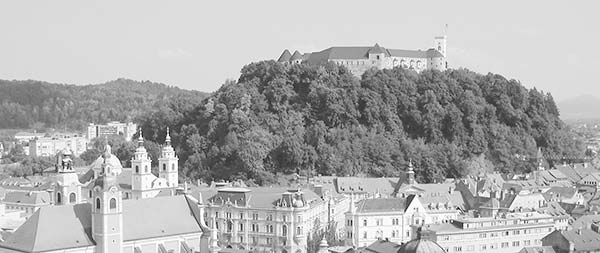
Ljubljana (lyoob-lyee-AH-nah) is irresistible. With a lazy Old Town clustered around a castle-topped hill, Slovenia’s capital is often likened to Salzburg. It’s an apt comparison—but only if you inject a healthy dose of fun-and-breezy Adriatic culture, add a Slavic accent, and replace favorite son Mozart with local architect Jože Plečnik.
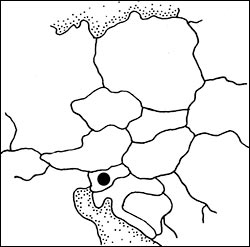
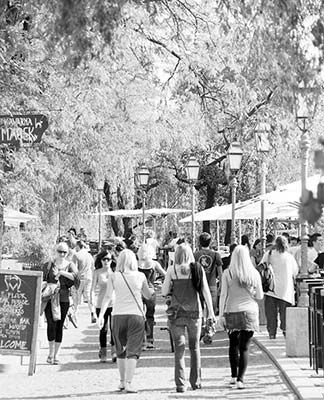
Ljubljana feels smaller than its population of 280,000. With several clusters of good museums that try hard—but have only so much to say—it does its best to please sightseers. But ultimately, this town is all about ambience. The idyllic, cobbled core of Ljubljana is slathered with one-of-a-kind architecture. Festivals fill the summer, and people enjoy a Sunday stroll any day of the week. Fashion boutiques and al fresco cafés jockey for control of the Old Town, while the leafy riverside promenade crawls with stylishly dressed students sipping kava and polishing their near-perfect English. Laid-back Ljubljana is the kind of place where graffiti and crumbling buildings seem elegantly atmospheric instead of shoddy. And even those shoddy buildings have been getting a facelift recently. At the same time, city leadership has been creating gleaming traffic-free zones left and right—turning what was already an exceptionally livable city into a pedestrians’ paradise.
Batted around by history, Ljubljana has seen cultural influences from all sides—most notably Prague, Vienna, and Venice. This has left the city a happy hodgepodge of cultures. Being the midpoint between the Slavic, Germanic, and Italian worlds gives Ljubljana a special spice.
PLANNING YOUR TIME
Ljubljana deserves at least a full day. Rather than checking off a list of museums, spend most of your time strolling the pleasant town center, exploring the many interesting squares and architectural gems, browsing the produce market, shopping at the boutiques, and sipping coffee at sidewalk cafés along the river.
Here’s the best plan for a low-impact sightseeing day: Begin on Prešeren Square, the heart of the city, and follow my “Ljubljana Walk” through town—including a browse through the riverside market area. Then wander south through the Krakovo gardens to tour the Jože Plečnik House. In the afternoon, commit some quality time to people-watching at a riverside café, window shopping at some colorful boutiques in the Old Town, or enjoying more sightseeing (good options include the City Museum of Ljubljana; the Serbian Orthodox Church and Tivoli Park, with the Contemporary History Museum, west of downtown; or the Slovenian Ethnographic Museum and other sights in Metelkova, north of downtown).
Ljubljana is sleepy on Sundays: Many shops are closed and the produce market is quiet, but museums are generally open, a modest flea market stretches along the riverfront, and the TI’s walking tour still runs. The city is also relatively quiet in August, when the students are on break and locals head to beach resorts.
From late spring through early fall, foodies should aim to be in Ljubljana on a Friday to enjoy the fun “Open Kitchen” street-food festival (see “Eating in Ljubljana,” later).
Orientation to Ljubljana
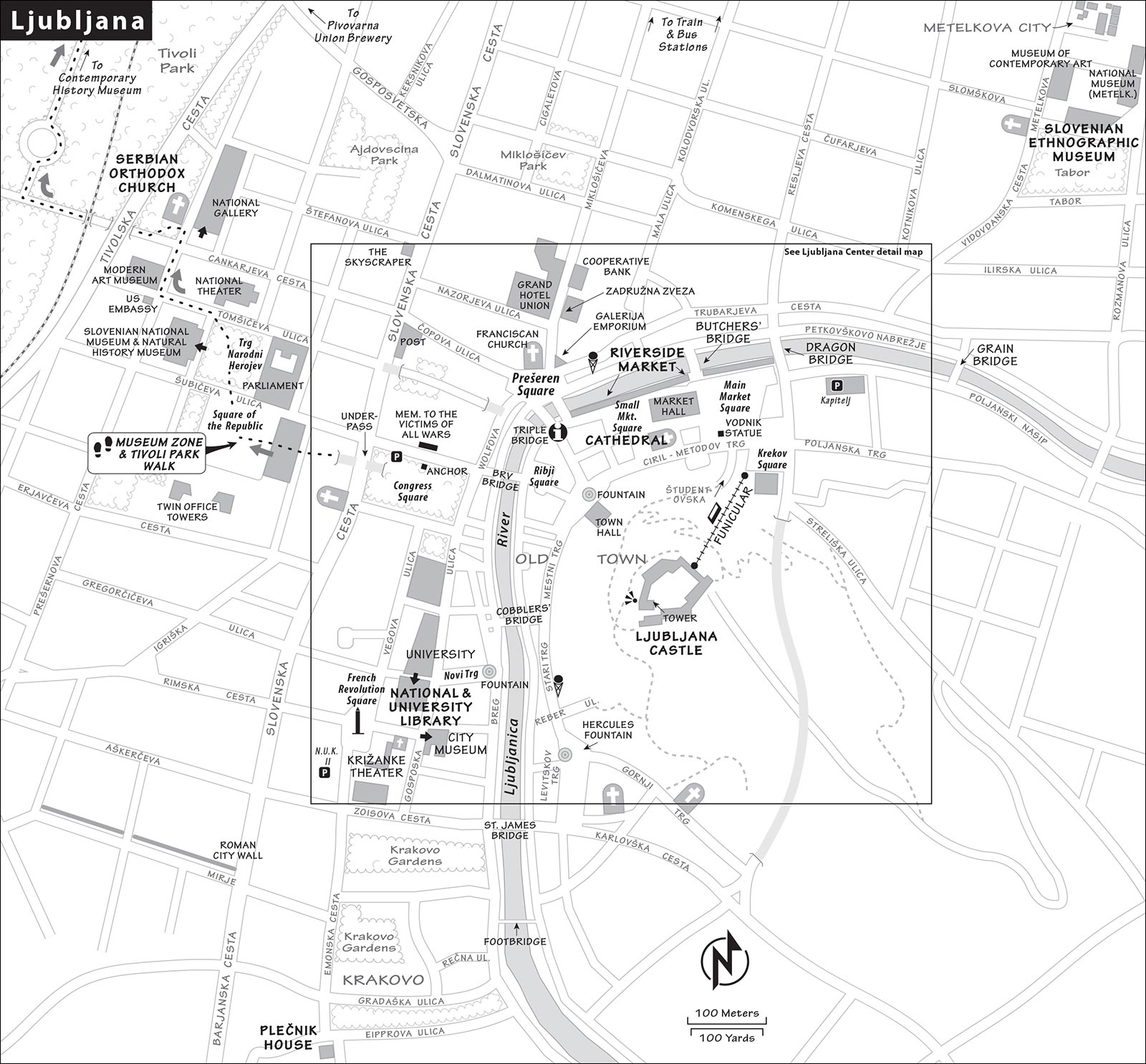
Ljubljana’s central zone is compact, and with a little wandering, you’ll quickly get the hang of it. The Ljubljanica River—lined with cafés, restaurants, and a buzzing outdoor market—bisects the city, making a 90-degree turn around the base of a castle-topped hill. Most sights are either along or just a short walk from the river. Visitors enjoy the distinctive bridges that span the Ljubljanica, including the landmark Triple Bridge (Tromostovje) and pillared Cobblers’ Bridge (Čevljarski Most)—both designed by Jože Plečnik. Between these two is a plain bridge (with great views) called Brv. The center of Ljubljana is Prešeren Square, watched over by a big statue of Slovenia’s national poet, France Prešeren.
I’ve organized the sights in this chapter based on which side of the river they’re on: the east (castle) side of the river, where Ljubljana began, which has more medieval charm; and the west (Prešeren Square) side of the river, which has a more Baroque/Art Nouveau feel and most of the urban sprawl. At the northern edge of the tourist’s Ljubljana is the train station and Metelkova museum and nightlife zone, at the southern edge are the garden district of Krakovo and the Jože Plečnik House, and at the western edge is Tivoli Park.
Ljubljana’s Two Big Ps: You’ll hear the following two easy-to-confuse names constantly during your visit. Mind your Ps, and your visit to Ljubljana becomes more meaningful: Jože Plečnik (YOH-zheh PLAYCH-neek, 1872-1957) is the architect who shaped Ljubljana, designing nearly all the city’s most important landmarks. France Prešeren (FRAHN-tseh preh-SHAY-rehn, 1800-1849) is Slovenia’s greatest poet and the namesake of Ljubljana’s main square.
TOURIST INFORMATION
Ljubljana’s helpful, businesslike TI is centrally located facing the Triple Bridge, across from Prešeren Square (Mon-Sat 8:00-18:00—may stay open until 19:00 in summer, Sun 8:00-15:00, Stritarjeva 1, +386 1 306 1215, www.visitljubljana.com).
The Ljubljana Tourist Card, which includes access to public transportation and covers entry to many city museums as well as the TI’s walking tours and boat trips, could save busy sightseers some money (€36/24 hours, €44/48 hours, €49/72 hours).
ARRIVAL IN LJUBLJANA
By Train: Ljubljana’s train station (Železniška Postaja) is at the northern edge of the city center. Emerging from the passage up to track 1a, turn right and walk under the long canopy to find the yellow arrivals hall. Everything is well signed in English; most services are in or near the big ticket office at the front of the station. Arrivals are prihodi, departures are odhodi, and track is tir.
You can walk to any of my recommended hotels within about 20 minutes (often less). To reach Prešeren Square at the city’s center, exit the station to the right and walk a long block along the busy Trg Osvobodilne Fronte (or “Trg O.F.” for short, with the bus station in the middle). After passing the bus stalls, turn left across Trg O.F. and go down Miklošičeva (look for the building with the round, red-brick columns). This takes you past some of Ljubljana’s most appealing architecture to Prešeren Square.
Avoid unscrupulous taxis waiting to spring on unsuspecting tourists at the station—call one that charges fair rates instead (less than €10 to any of my recommended hotels). Waiting just a few more minutes for your cab could easily save you €10 or more. See “Getting Around Ljubljana—By Taxi,” later, for recommended taxi companies. (Uber doesn’t operate in Slovenia.)
By Bus: Ljubljana’s bus station (Autobusna Postaja) is a low-profile building (with ticket windows, a bakery, and newsstands) in the middle of Trg O.F., right in front of the train station. To reach the city center from here, follow the directions under “By Train,” earlier.
By Car: Ljubljana is not car-friendly; much of the central zone along the river is entirely traffic-free. Even several blocks of the main thoroughfare, Slovenska Cesta—north of Congress Square, between Šubičeva Ulica and Gosposvetska Cesta—are closed to all traffic except buses. To reach the southern part of the city when entering downtown from the north, you need to circumnavigate the core by looping east along Resljeva Cesta, over the Dragon Bridge by the market, and through the tunnel beneath the castle; from here, Karlovška Cesta cuts back west over the river to the southern stretch of Slovenska Cesta.
Ask your hotel about parking—most have some available, usually for a price. There are two central parking lots, one beneath Congress Square and one called N.U.K. II, near the National and University Library. Both lots are accessible on Slovenska Cesta only from the south—if coming from the north, see previous directions for looping around town. Another handy lot is Kapitelj, just southeast of the Dragon Bridge. If staying overnight, plan to pay about €25-30.
Paid street parking downtown is marked by blue lines (look for meters); these spaces are free Saturdays after 13:00 and all day Sunday. For cheaper parking and longer stays, you can park along the river just south of downtown (in zone 3, south of St. James Bridge—see the “Ljubljana” map). Along here, parking is less than €1/hour, and free on weeknights between 17:00 and 7:00 and all day Sat-Sun.
There’s a huge gas station on Tivolska Cesta (just west of the train station, near the big Pivovarna Union brewery). It’s handy if you’re returning a rental car in central Ljubljana.
By Plane: See “Ljubljana Connections” at the end of this chapter.
HELPFUL HINTS
Pedestrian Safety: Many Ljubljana residents commute by bike—and they’re not shy about whizzing past pedestrians, even in seemingly “pedestrian-only” areas. Stay out of the designated bike lanes on the sidewalks, and stay aware everywhere.
Closed Days: Most Ljubljana museums (except the castle and a few less-important museums) are closed on Mondays.
Markets: In addition to the regular market that sprawls along the riverfront (described in my “Ljubljana Walk,” later), the wonderful Open Kitchen street-food festival runs Fridays from spring through fall (see “Eating in Ljubljana,” later). A colorful flea market hops along the Ljubljanica River’s Breg embankment, across the river from the castle, every Sunday (8:00-14:00), and on summer Saturdays a lively and colorful arts and handicrafts market runs in the same place (8:00-16:00).
Laundry: The handy self-service Speed Queen launderette is at the western edge of the center, a short walk from downtown (daily 6:00-24:00, Trg Mladinskih Delovnih Brigad 10, +386 64 229 007). The recommended Hostel Celica also has self-service laundry—but hostel guests have priority (cheap but not very central at Metelkova 8). For pricey full service, try Tekstilexpress, between the city center and Tivoli Park (takes 24 hours, Mon-Fri 7:00-18:00, Sat 9:00-13:00, closed Sun, Cankarjeva 10B, +386 1 252 7354). For locations, see the “Ljubljana Hotels and Restaurants” map, later.
Car Rental: Handy options include Hertz (Trdinova 9, +386 1 434 0147, www.hertz.com), Europcar (Miklošičeva 15, +386 59 077 040, www.europcar.com), Avis (in Grand Hotel Union at Miklošičeva 3, +386 1 421 7340, www.avis.com), and Sixt (facing the main platform at the train station, +386 1 234 4650, www.sixt.com). You can also rent from these agencies at the airport.
Best Views: The Skyscraper’s observation deck offers the best views in town (see listing under “More Sights in Ljubljana,” later). Views from the castle are nearly as good. At street level, my favorite views are from the bridge called Brv (between the Triple and Cobblers’ bridges)—especially at night—and from the river promenade.
GETTING AROUND LJUBLJANA
By Bus: Almost all of Ljubljana’s sights are easily accessible by foot. And using the buses is a bit of a headache: First, you have to buy a plastic Urbana card for €2, which you then load with credit to pay for rides (you can’t pay the driver). A ride costs €1.30 (valid for up to 90 minutes, card shareable by multiple people). Buy the card at the TI, where you can return it to reclaim your €2 at the end of your trip. Transit info: www.lpp.si.
By Taxi: Always call for a cab, or you’ll get ripped off. Legitimate taxis usually start at about €2, and then charge €1.50 per kilometer. But many unscrupulous cabbies legally charge far more and tack on bogus additional “surcharges.” (Because fares are unregulated, even if they use the meter you’ll still pay way too much.) However, if you call a reputable taxi company, Ljubljana is a good taxi town—a ride within the city center (such as from the station to a hotel) should run less than €10. Good companies include Laguna (+386 1 511 2314 or mobile +386 31 492 299), Metro Taxi (80 1190 from a Slovenian phone, or mobile +386 41 240 200), and Cammeo (+386 1 777 1212). Dispatchers speak English, and your hotel, restaurant, or the TI can call a cab for you.
By Bike: Ljubljana is a cyclist’s delight, with lots of well-marked bike lanes. It’s easiest to rent bikes at the TI (€6/2 hours, €10/4 hours, €14/day). Like many European cities, Ljubljana has a subsidized borrow-a-bike program (called BicikeLJ) with more than 60 locations around the city center. Once you register online with a credit card, rides are free or very cheap (free for the first hour, €1 for the second, €2 for the third, and so on). If you’re planning on doing lots of biking, it’s worth the hassle to sign up (http://en.bicikelj.si).
By Shuttle: A fleet of green electric carts, called Kavalirs, shuttle anyone (even tourists) around the traffic-free downtown pedestrian zone for free. Just wave one down and tell them where you want to go (or phone them at +386 31 666 331 or +386 31 666 332).
Tours in Ljubljana
To help you appreciate Ljubljana, taking a walking tour—either through the TI or by hiring your own local guide—is worth ▲▲.
Walking Tours
The TI organizes excellent two-hour guided town walks of Ljubljana in English, led by knowledgeable guides (€17, daily at 11:00). In summer, they offer a second tour each afternoon at 14:00 that includes a boat trip (€22). Tours meet at Town Hall, around the corner from the Triple Bridge and TI. They also offer a variety of themed tours, including ones that focus on the architectural works of Jože Plečnik. For details and to book, check www.visitljubljana.com, or ask at the TI.
Local Guides
Having an expert show you around his or her hometown for two hours for €100 has to be the best value going (extra for more than two people). Marijan Krišković, who leads tours for me throughout Europe, is an outstanding guide (+386 40 222 739, kriskovic@yahoo.com). Barbara Jakopič, thoughtful and extremely knowledgeable, also leads my tours (+386 40 530 870, jakopic_b@yahoo.com). You can also book a guide through the TI (at least 24 hours in advance).
Boat Cruise
A boat trip on the Ljubljanica River is more romantic than thrilling. You’ll see multiple companies hawking these €10, one-hour cruises all along the river in the center. But if you’d like some commentary en route, it’s best to take the TI’s version, which is narrated by a live guide (€15, 2/day in summer, get details at TI). Most other companies don’t have any commentary, though some may have recorded spiels (ask before you buy).
Excursions from Ljubljana
Many worthwhile sights near Ljubljana are tricky to reach by public transportation. Popular options include the caves at Škocjan and Postojna, Predjama Castle, Lipica Stud Farm, Lake Bled, and the coastal town of Piran. It’s possible to link up several of these in a (long) day on a 10-hour excursion, for around €90-100. Three relatively well-established outfits are Roundabout (www.travelroundabout.com), Slovenia Explorer (www.slovenia-explorer.com), and To Do in Slovenia (www.todoinslovenia.com). Nature Adventures focuses on active trips including rafting, paragliding, skydiving, and horseback riding (www.adventures-nature.com).
Ljubljana Walk
▲▲Prešeren Square (Prešernov Trg)
Small Market Square (Pogačarjev Trg)
Main Market Square (Vodnikov Trg)
Cyril and Methodius Square (Ciril-Metodov Trg)
▲Cobblers’ Bridge (Čevljarski Most)
▲▲National and University Library (Narodna in Univerzitetna Knjižnica, or NUK)
▲City Museum of Ljubljana (Mestni Muzej Ljubljana)
French Revolution Square (Trg Francoske Revolucije)
CONGRESS SQUARE (KONGRESNI TRG)
This walk—which meanders in a big loop on both sides of the river—offers an orientation for your Ljubljana wanderings. The whole walk takes about 1.5 hours (without entering sights). You’ll end just a few steps from where you begin, but along the way I’ll point out a few possible detours. (Ljubljana is so small and enjoyable to stroll that you’ll be doing lots of circling back.)
• Begin on the main square right in the center of Ljubljana, marked by the can’t-miss-it pink church.
PREŠEREN SQUARE AREA
▲▲Prešeren Square (Prešernov Trg)
This square is the heart of Ljubljana. The city’s meeting point is the large statue of France Prešeren, Slovenia’s greatest poet, whose works include the lyrics to the Slovenian national anthem (and whose silhouette adorns Slovenia’s €2 coin). The statue shows Prešeren, an important catalyst of 19th-century Slovenian nationalism, being inspired from above by a Muse. This statue provoked a scandal and outraged the bishop when it went up a century ago—a naked woman sharing the square with a church! To ensure that nobody could be confused about the woman’s intentions, she’s conspicuously depicted with typical Muse accessories: a laurel branch and a cloak. Even so, for the first few years citizens covered the scandalous statue with a tarp each night. And the model who posed for the Muse was the subject of so much criticism that no one in Slovenia would hire her—so she emigrated to South America and never returned.
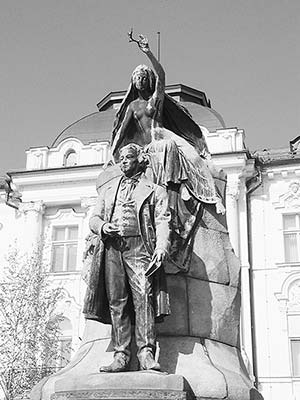
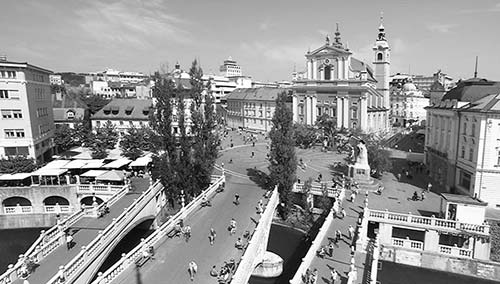
Stand at the base of the statue to get oriented. The bridge crossing the Ljubljanica River is one of Ljubljana’s top landmarks, Jože Plečnik’s Triple Bridge (Tromostovje). The middle (widest) part of this bridge already existed, but Plečnik added the two side spans to more efficiently funnel the six streets of traffic on this side of the bridge to the one street on the other side. (Now, delightfully, there’s no car traffic at all.) The bridge’s Venetian vibe is intentional: Plečnik recognized that Ljubljana, located midway between Venice and then-capital Vienna, is itself a bridge between the Italian and Germanic worlds. Across the bridge are the TI, WCs, ATMs, the market and cathedral (to the left), and the Town Hall (straight ahead).
Now turn 90 degrees to the right and look down the first street after the riverbank. Find the orange woman in the picture frame on the upper floor of the first yellow house. This is Julija Primic, the unrequited love of Prešeren’s life. Tour guides spin romantic tales about how the two met. But the truth is that Prešeren was a teacher in the Primic household when he was in his 30s and she was 4. Later in life, she inspired him from afar—as she does now, from across the square. Julija may have been his muse, but it’s not clear how she felt about Prešeren (she married a wealthy Bavarian).
When Ljubljana was hit by an earthquake in 1895, locals took the opportunity (using an ample rebuilding fund from the Austro-Hungarian Empire) to remake their city in style. Today, Ljubljana—especially the streets around this square—is an architecture-lover’s paradise. The Hauptmann House, to the right of Julija, was the only building on the square to survive the quake. A few years later, the owner redecorated it in the then-trendy Viennese Art Nouveau style you see today, using bright colors (his family sold dyes). All that remains of the original structure is the little Baroque balcony above the entrance.
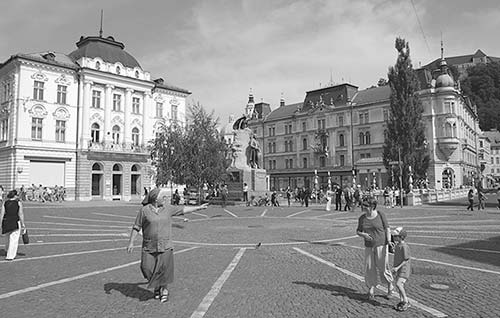
Just to the right of the Hauptmann House is a car-sized model of the city center—helpful for orientation. The street next to it is Čopova, once the route of Ljubljana’s Sunday promenade. A century ago, locals would put on their Sunday best and stroll from here to Tivoli Park, listening to musicians and dropping into cafés along the way. Plečnik called it the “lifeline of the city,” connecting the green lungs of the park to this urban center.
Continue looking to the right, past the big, pink landmark Franciscan Church of St. Mary (not much to see inside). Farther right, the characteristic glass awning marks Galerija Emporium—the first big post-quake department store, today government-protected. At the top of the building is Mercury, god of commerce, watching over the square that has been Ljubljana’s commercial heart since the city began. (If you look carefully, you can see the mustachioed face of the building’s owner hiding in the folds of cloth by Mercury’s left foot.) Because this area was across the river from medieval Ljubljana (beyond the town’s limits...and the long arm of its tax collector), it was the best place to buy and sell goods. Today, this sumptuously restored building houses a top-end fashion mall, making it the heart of Ljubljana’s boutique culture. Step inside for a glimpse of the grand staircase.
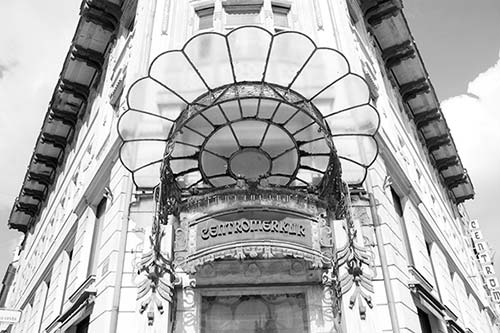
The street between Galerija Emporium and the pink church is Miklošičeva Cesta, which connects Prešeren Square to the train station.
• Go a short block up this street to see some striking architecture.
Miklošičeva Cesta
When Ljubljana was rebuilding after the 1895 earthquake, town architects and designers envisioned this street as a showcase of its new Art Nouveau image. Ahead on the left is the prominent Grand Hotel Union, with a stately domed spire on the corner. When these buildings were designed, Prague was the cultural capital of the Slavic world. The new look of Ljubljana paid homage to “the golden city of a hundred spires” (and channeled Prague’s romantic atmosphere). The city even had a law for several years that new corner buildings had to have these spires. Even the trees you’ll see around town were part of the vision. When the architect Plečnik designed the Ljubljanica River embankments a generation later, he planted tall, pointy poplar trees and squat, rounded willows—imitating the spires and domes of Prague.
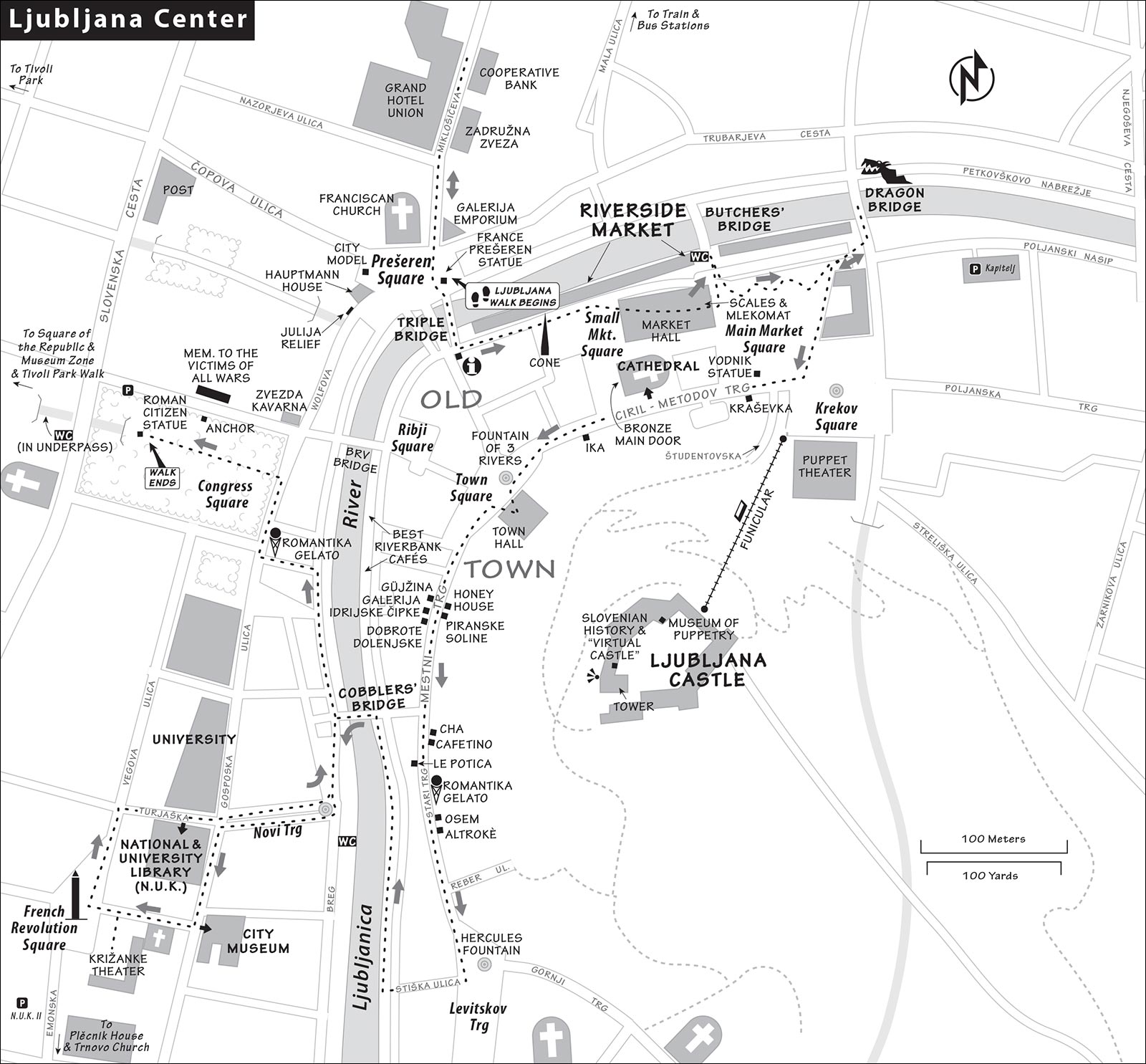
Across from the Grand Hotel Union are two more architectural gems of that era: First is a Secessionist building—marked Zadružna Zveza—with classic red, blue, and white colors (for the Slovenian flag). Next is the noisy, pink, zigzagged Cooperative Bank. The bank was designed by Ivan Vurnik, an ambitious Slovenian architect who wanted to invent a distinctive national style after World War I, when the Habsburg Empire broke up and Central and Eastern Europe’s nations were proudly emerging for the first time.
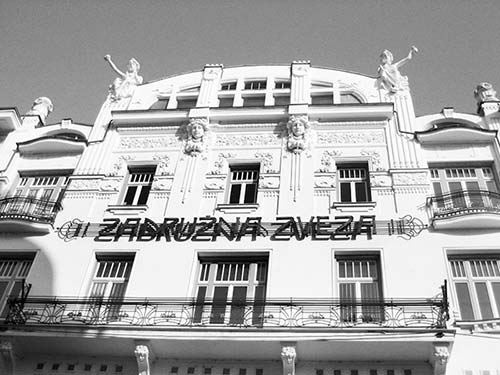
• Head back to Prešeren Square, then cross the Triple Bridge. The TI is straight ahead, and on your left is the first colonnade of Ljubljana’s market.
RIVERSIDE MARKET AREA
The east side of the river is the city’s most colorful and historic quarter, packed with Old World ambience.
▲▲Riverside Market (Tržnice)
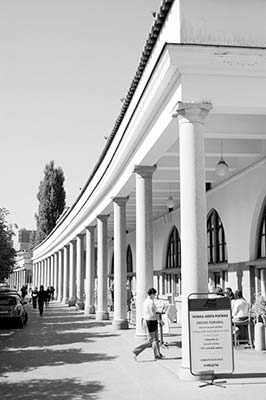
In Ljubljana’s thriving Old Town market, big-city Slovenes enjoy buying direct from the producer. The market, worth an amble any time, is best on summer Fridays for its “Open Kitchen” street-food festival (see “Eating in Ljubljana,” later); and on Saturday mornings any time of year, when the townspeople take their time wandering the stalls. Prices go down as the day gets late and as the week goes on. In this tiny capital of a tiny country, you may even see the president searching for the perfect melon.
The market area is slated for a future “modernization,” so it may be torn up (or reorganized) when you visit.
The riverside colonnade, which echoes the long-gone medieval city wall, was designed by Jože Plečnik. This first stretch—nearest the Triple Bridge—is good for souvenirs: woodcarvings, replica painted frontboards from beehives, honey products (including honey brandy), and lots of colorful candles.
Farther in, the market is almost all local, and the colonnade is populated by butchers, bakers, fishermen, and lazy cafés. Peek down at the actual river and see how the architect wanted the town and river to connect. The lower arcade hosts a robust, stinky fish market (ribarnica)—to take a whiff, head down the spiral stairs at the end of the souvenir stalls.
• Across from these stairs, you reach the...
Small Market Square (Pogačarjev Trg)
This square hosts the lively Open Kitchen street-food festival each Friday from spring through fall. The rest of the time, it simply serves as overflow for the main market square, which we’ll see soon.
On your right, at the corner of the market square, notice the 10-foot-tall concrete cone. Plečnik wanted to make Ljubljana the “Athens of the North” and imagined a huge cone-shaped national acropolis—a complex for government, museums, and culture. This ambitious plan didn’t make it off the drawing board, but part of Plečnik’s Greek idea came true: this marketplace, based on an ancient Greek agora. Plečnik’s cone still captures the Slovenes’ imaginations...and adorns Slovenia’s €0.10 coin.
At the top of this square, the tall domes mark the 18th-century cathedral, which stands on the site of a 13th-century Romanesque church. (We’ll visit the cathedral from the other side later on this walk.)
The building at the end of the small market square is the seminary palace, with the market hall (pokrita tržnica) in its basement. Just left of the central door, Tus Boutique sells products created or curated by Ana Roš—celebrity chef at the world-renowned Hiša Franko restaurant high in the Julian Alps (described on here).
Go through the central door of the seminary to enter the market hall, with vendors selling cheeses, meats, baked goods, dried fruits, nuts, and other goodies (Mon-Fri 7:00-16:00, Sat until 14:00, closed Sun). This place is worth a graze—walk all the way through. Most merchants are happy to give you a free sample (point to what you want, and say probat, prosim—“a taste, please”).
Leaving the market hall at the opposite end, look to your right to see the little scales in the wooden kiosks marked Kontrolna Tehtnica—allowing buyers to immediately check whether the producer cheated them (not a common problem, but just in case). The Habsburg days left locals with the old German saying, “Trust is good; control is better.” Nearby, look for the innovative “Nonstop Mlekomat” stand, a vending machine that lets you buy a plastic bottle and fill it with a liter of raw, unskimmed, farm-fresh milk for €1.
• From here, you’re looking out over the...
Main Market Square (Vodnikov Trg)
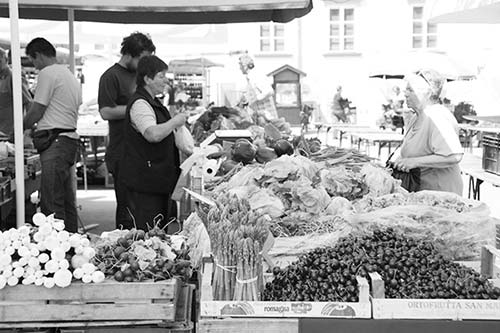
The square is packed with produce and clothing stands. (The colorful flower market hides behind the market hall.) Now’s a good time to do a little browsing. The vendors in the row nearest the colonnade sell fruit from all over, but the ones located deeper in the market sell only locally grown produce. Tell the vendor what you want—it’s considered rude for customers to touch the fruits and vegetables before they’ve paid for them. Over time, shoppers develop friendships with their favorite producers. On busy days, you’ll see a long line at one stand, while the other merchants stand bored. Your choice is simple: Get in line, or eat subpar produce.
• Along the river at the bottom of the main market square is the...
Butchers’ Bridge
Jože Plečnik designed a huge roofed bridge to be built here, but—like so many of his designs—the plans were scuttled. Decades later, Mayor Zoran Janković finally constructed this modern version of the bridge. While it looks nothing like Plečnik’s original plans, the bridge kept the old name and has been embraced by the community (there’s a handy public WC down below on the lower level). Almost as soon as it was built, the bridge’s railings were covered with padlocks—part of the Europe-wide craze for young couples to commemorate their love. The bridge’s sculptures—a mournful Adam and Eve being evicted from the Garden of Eden, and weird little lizards breaking out of their eggs along the railing—are by local artist Jakov Brdar, who enjoys hanging out here.
• From the bridge, follow the colonnade the rest of the way to its end. It terminates at the...
▲Dragon Bridge (Zmajski Most)
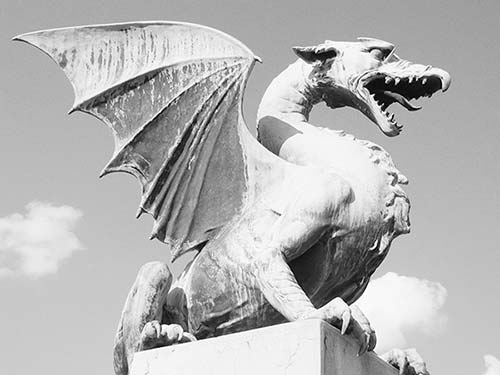
The dragon has been the symbol of Ljubljana for centuries, ever since Jason (of Argonauts and Golden Fleece fame) supposedly slew one in a nearby swamp. This is one of the few notable bits of Ljubljana architecture not by Plečnik (but by Jurij Zaninović, a fellow student of Vienna architect Otto Wagner). While the dragon is the star of this very photogenic Art Nouveau bridge, the bridge itself was officially dedicated to the 40th anniversary of Habsburg emperor Franz Josef’s reign (see the dates on the side: 1848-1888). Tapping into the emp’s vanity got new projects funded—vital when the city later rebuilt after the 1895 earthquake.
• Turn around and continue browsing your way through the main market square, heading toward its top end. Directly across the street from the top of the square, look for the funicular that trundles tourists up to Ljubljana Castle. You could zip up there now (see “More Sights in Ljubljana,” later)—or hold off on your visit and stick with me.
Facing the funicular, turn right and walk with the market on your right, passing the big statue of Slovene poet Valentin Vodnik and heading for the big dome. We’re entering...
LJUBLJANA’S OLD TOWN
The historic center of Ljubljana stretches along one long street that curls around the base of its castle-topped hill, beginning near the market.
• The first part is called...
Cyril and Methodius Square (Ciril-Metodov Trg)
Named for Byzantine missionaries who introduced Christianity to the Slavs (and invented the forerunner of the Cyrillic alphabet), this misnamed “square” is really just the first stretch of Ljubljana’s Old Town drag. In the early 19th century, Ljubljana was little more than this solitary main street (plus a small “New Town” across the river). Cyril and Methodius Square is great for a browse, with fun window shopping. As you pass bollards that rise up from the street to block cars, you enter the mostly traffic-free cobbled zone.
• The big, yellow building on the right is Ljubljana’s...
▲Cathedral (Stolnica)
Ljubljana’s cathedral is dedicated to St. Nicholas, protector against floods and patron saint of the fishermen and boatmen who have long come to sell their catch at the market. While the interior is worth a peek, the intricately sculpted bronze doors—created for Pope John Paul II’s visit here in 1996—are even more interesting.
Take a close look at the door about two-thirds of the way down the building, with images of the six 20th-century bishops of Ljubljana. (If you’re heading inside the cathedral, go through this door.) Another even more impressive bronze door is around the end of the building (hook right). You’ll find it under the high arch (both described next).
Cost and Hours: €2, generally daily 11:00-18:00 but opens Tue at 14:00 and Sun at 13:30, on weekends closes for an hour around 15:30.
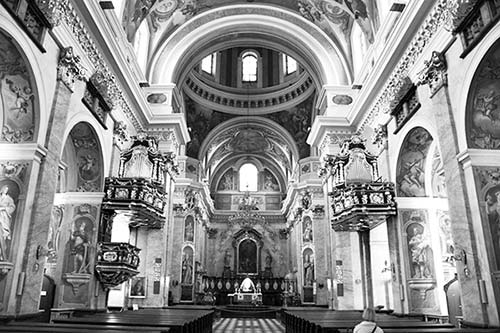
Visiting the Cathedral: Enter through the side door. In this Italian Baroque space, the transept is surrounded by sculptures of four bishops of Roman Ljubljana (when it was called Emona, or Aemon). Left of the main altar, notice the distinctive chair. This was designed by the very religious Jože Plečnik, whose brother was a priest here. Look up over the nave to enjoy the recently restored, gorgeous ceiling fresco. You’ll exit through the main door.
Bronze Main Door: Take a close look at this remarkable door. Buried deep in the fecund soil of the nation’s ancient and pagan history, the linden tree of life sprouts with the story of the Slovenes. The ceramic pots represent the original Roman settlement here. Just to the left, above the tree, are the Byzantine missionaries Cyril and Methodius, who came here to convert the Slavs to Christianity in the ninth century. Just above, Crusaders and Ottomans do battle. Near the top, see the Slovenes going into the cave—entering the dark 20th century (World War I, World War II, and communism). At the top is Pope John Paul II (the first Slavic pontiff, who also helped inspire the fall of communism). Beneath him are two men who are on track to becoming Slovenia’s first saints; the one on the right is the Venerable Frederic Baraga, a 19th-century bishop who became a missionary in Michigan and codified Chippewa grammar (notice the Native American relief on the book he’s holding). In the upper-right corner is a sun, which has been shining since Slovenia gained its independence in 1991.
• Carry on past the cathedral on Cyril and Methodius Square. Soon you’ll run into the giant fountain that marks Ljubljana’s...
▲Town Square (Mestni Trg)
The Fountain of Three Carniolan Rivers is inspired in style and theme by Rome’s many fountains. The figures with vases represent this region’s three main rivers: Ljubljanica, Sava, and Krka. This is one of many works in town by Francesco Robba, an Italian who came to Ljubljana for a job, fell in love with a Slovene, and stayed here the rest of his life—decorating the city’s churches with beautiful Baroque altars. (This is a replica; Robba’s original fountain is at the National Gallery.)
From the fountain, look down the wide gap between the buildings (and beyond the Triple Bridge) to see the giant pink church: We’ve done a near-loop, and you’re just a minute’s walk (across the bridge) from Prešeren Square. We’ll do another loop now, in the opposite direction.
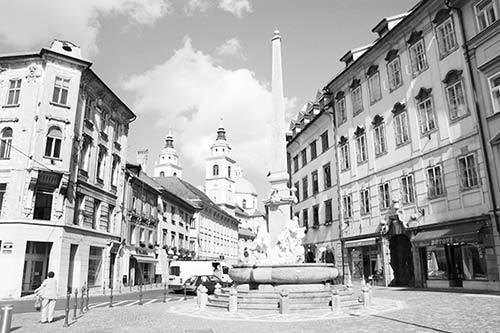
Just beyond the fountain on the left is the Town Hall (Rotovž), highlighted by its clock tower and pillared loggia. Step inside the Renaissance courtyard to see paintings, artifacts, and (high on one wall of the atrium) a map of late 17th-century Ljubljana. Studying this map, notice how the river, hill, and wall worked together to fortify the town. Courtyards like this (but humbler) are hidden throughout the city. As rent in these old places is cheap, many such courtyards host funky, characteristic little businesses.
Back out on the square, turn with the Town Hall on your left. We’ll continue down the Old Town’s main drag, connecting to two other “squares”—Stari Trg (Old Square) and Gornji Trg (Upper Square)—which have long since grown together into one big, atmospheric promenade lined with quaint boutiques, great restaurants, and cafés. As you walk, keep your eyes open for Ljubljana’s mascot dragon—it’s everywhere.
• Begin heading down the...
▲Old Town Shopping Zone
Even for nonshoppers, this strip is a delight to browse, offering an ethnographic and culinary introduction to Slovenia. Several shops along this strip specialize in typical Slovenian products.
A block past the Town Hall on the left, at Mestni Trg 7 (yellow sign), Honey House sells products harvested by beekeeper Luka. For tips on browsing your honey options, see here. Next door, at #8, Piranske Soline sells products from the giant salt pans that sit just south of Piran on Slovenia’s tiny coastline (www.soline.si). And across the street, at #19, the recommended Güjžina specializes in the cuisine of Prekmurje in northeastern Slovenia, with strong Hungarian influences...and a vegan twist.
Farther along, on the right (at #17), Galerija Idrijske Čipke shows off handmade lace from the town of Idrija (www.idrija-lace.com [URL inactive]). Next door, Dobrote Dolenjske sells a variety of flavored schnapps and gins, plus some handicrafts from the southeast Dolenje region...not to mention medvedova salama, bear salami (www.dobrote-dolenjske.si). Across the street, at #10, notice the long passage that leads to one of Ljubljana’s characteristic courtyards.
Continue along the street (which here changes names from Mestni Trg to Stari Trg), passing more fun shops. On the left, at Stari Trg 3, Cha tea shop sells over 100 varieties of tea, plus porcelain teapots and cups from all over. A few steps down on the left at #5, Cafetino serves more than 20 types of coffee—from espresso to Turkish-style—and has beans to take home.
Now you’ll wade through a stretch of enticing restaurants with wonderful outdoor tables (for my recommendations here, see the Old Town listings in “Eating in Ljubljana,” later). Notice Julija and Romeo, facing each other wistfully across the street.
Just after the little “restaurant row,” on the right, at #10, Le Potica sells (pricey) miniature versions of Slovenia’s traditional Bundt-style cake, potica (POH-teet-sah). From here, you’ll pass several more shops made-to-order for window shopping, including funky boutiques and rare-book and antique shops. Romantika, with Ljubljana’s best gelato, has a branch on the left at #15. If you smell something heavenly, watch for the recommended Osem, which bakes up fresh bread daily (on the left, at #17). Just past that, at #19, is the recommended restaurant Altrokè, with cuisine from Istria, in southern Slovenia.
The cobbled charm culminates at the square called Gornji Trg. Look uphill and notice the village charms of some of the oldest buildings in town: four medieval houses with rooflines slanted at the ends, different from the others on this street.
• Just past the square’s Hercules Fountain, turn right (on Stiška Ulica) through the gap in the buildings to the...
▲▲Ljubljanica Riverbank
Now let’s loop back on ourselves, yet again. Turn right and stroll for a couple of minutes along this beautiful promenade—worth ▲▲▲ on a sunny day, when the café tables are full. This part of the embankment is sleepy; farther along it’s a convivial people zone, packed with Slovenes out enjoying their capital.
Halfway to the first bridge—just after the first bunch of café tables—pause at the little notch and look down at the river and its embankments. Notice in particular the angled embankments across the river with seating carved out. These embankments were designed by (who else?) the great architect Jože Plečnik, who walked along this river every day on his way to the office.
• While you could follow this promenade all the way back to the Triple Bridge and Prešeren Square—just a few minutes away—we’re only going as far as the first bridge, with the tall pillars (Cobblers’ Bridge). We’ll cross the river here to explore some of Ljubljana’s architectural masterpieces. And that means we’re entering the world of Jože Plečnik. Walk halfway across the bridge and pause for a moment.
JOŽE PLEČNIK’S LJUBLJANA
Jože Plečnik is to Ljubljana what Antoni Gaudí is to Barcelona: a homegrown, amazingly prolific genius who reshaped his town with a unique and beautiful vision. And Plečnik’s mark on Ljubljana, much like Gaudí’s on Barcelona, has a way of turning people who couldn’t care less about architecture into fans. There’s plenty to see. In addition to the Triple Bridge, the riverside market and embankments, and the sights we’re about to see, Plečnik designed the embankments along the Gradaščica River in the Trnovo neighborhood; the rebuilt Roman wall along Mirje street, south of the center; the Church of St. Francis, with its classicist bell tower; St. Michael’s Church on the Marsh; Orel Stadium; Žale Cemetery; and many more buildings throughout Slovenia.
▲Cobblers’ Bridge (Čevljarski Most)
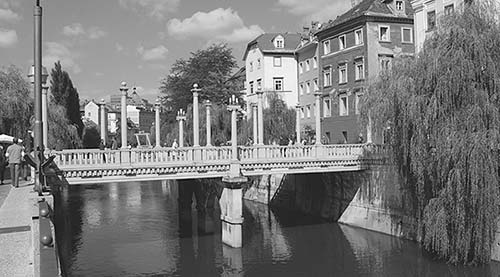
Named for the cobblers (shoemakers) who set up shop along the river in olden times, the bridge encapsulates Plečnik’s style perhaps better than any other structure: simple, clean lines adorned with classical columns. Ideal for people-watching (with the castle hovering scenically overhead—look behind you), this is one of Ljubljana’s most appealing spots.
• Cross Cobblers’ Bridge, turn left, and walk one short block to the big fountain, which marks the bottom of a broad plaza called Novi Trg. Turn right and head to the top of Novi Trg, where you’ll run into a red-brick building embedded with gray granite blocks in an irregular checkerboard pattern. This is the...
▲▲National and University Library (Narodna in Univerzitetna Knjižnica, or NUK)
Widely regarded as Plečnik’s masterpiece, this building is a bit underwhelming...until an understanding of its symbolism brings it to life. Aside from being a great work of architecture, the building also houses the most important library in Slovenia, with more than two million books (about one per Slovene). The library is supposed to receive a copy of each new book printed in the country. In a freaky bit of bad luck, this was the only building in town damaged in World War II, when a plane crashed into it. But the people didn’t want to see their books go up in flames—so hundreds of locals formed a human chain, risking life and limb to save the books from the burning building.
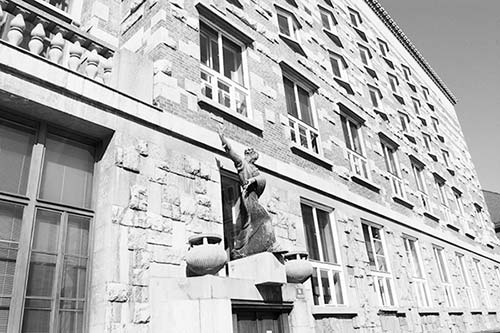
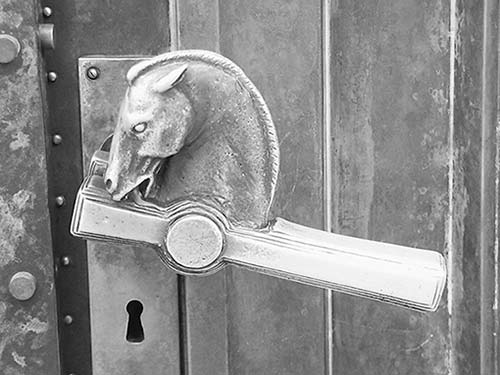
On the surface, the red-and-gray color scheme of the exterior evokes the red soil and chunks of granite of the Karst region, south of Ljubljana. But on a deeper level, the library’s design conveys the theme of overcoming obstacles to attain knowledge. In the facade, the blocks of irregular size and shape represent a complex numerological pattern that suggests barriers on the path to enlightenment. The sculpture on the river side (to the left) is Moses—known for leading his people through 40 years of hardship to the Promised Land. On the right side of the building, find the horse-head doorknobs—representing the winged horse Pegasus (grab hold and he’ll whisk you away to new levels of enlightenment).
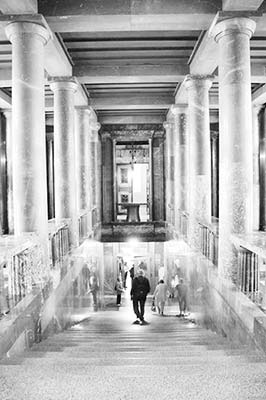
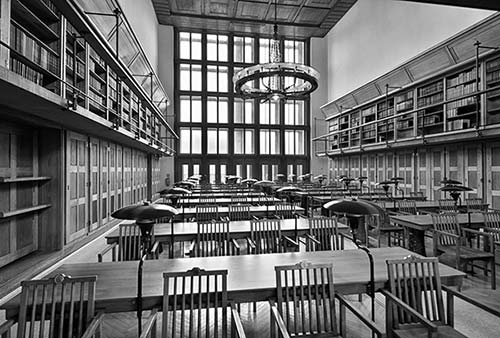
If you go inside, you’ll notice the main staircase is dark and gloomy—modeled after an Egyptian tomb. But at the top, through the door marked Velika Čitalnica, is the bright, airy main reading room: the ultimate goal, a place of learning. The top-floor windows are shaped roughly like open books. Sadly, most of the time you can’t actually enter the reading room; if it’s closed, you can look at postcards in the shop, and imagine young Ljubljanans hunched studiously over their books, surrounded by Plečnik’s bookshelves, railings, and high windows.
Cost and Hours: The library is free to enter and usually open Mon-Fri 10:00-18:00, Sat 14:30-18:00, closed Sun except in summer. The quiet main reading room is open to visitors (for €5) only during very brief periods: Most of the year, you can enter on Saturday afternoons (14:30-18:00), but hours are longer during the student break in the summer (mid-July-mid-Aug Mon-Sat 10:00-18:00, Sun 11:00-19:00).
• Back outside, head back to the corner where we got our first look at the library. As you face the building from the top of Novi Trg, turn left and head one block down Gosposka street. On your left, you’ll run into the...
▲City Museum of Ljubljana (Mestni Muzej Ljubljana)
Though not a Plečnik sight, this thoughtfully presented, kid-friendly museum, located in the Auersperg Palace, offers a high-tech, in-depth look at the story of this city using a wide range of well-described artifacts (all in English). In the cellar are Roman ruins (including remains of the original Roman road and sewer system, found right here) and layers of medieval artifacts. A model of the modern city—sitting upon footprints of the Roman (red) and medieval (blue) settlements—illustrates Ljubljana’s many layers of history.
Upstairs, the excellent permanent exhibit traces the history of this crossroads city, starting with the museum’s prized possession, the world’s oldest wooden wheel on an axle, dating from around 3200 BC and discovered in the Ljubljana marshlands. In the contemporary section, you’ll see an actual Fiat Zastava 750 car, the classic “Fičko” car that everyone owned—or wanted to own—in communist Yugoslavia (sort of a proto-Yugo).
Cost and Hours: €6, more for temporary exhibits, Tue-Sun 10:00-18:00, closed Mon, Gosposka 15, +386 1 241 2510, www.mgml.si.
Nearby: Your ticket includes admission to two archaeological sites nearby (May-Oct only)—pick up a map at the front desk.
• With the museum at your back, you’re facing yet another town square. On the left side of the square, just past the big, boxy, orange building, step through the gate into the courtyard of the ...
Križanke Theater
The Teutonic Knights of the Cross established this monastery around 1230, and it was rebuilt in Baroque style in 1715. In 1945—after the Socialist Federal Republic of Yugoslavia came to power—the monastery complex was nationalized and closed. In 1952, city leaders decided to repurpose the space as an outdoor venue for the Ljubljana Summer Theatre. (It’s still used for this purpose; the box office is on this courtyard.) Near the end of his life, Jože Plečnik drew up the designs for the theater, which turned out to be his last major work.
Plečnik modified the existing structure with new features, as well as elements recycled from other projects. For example, just inside the courtyard, on the left, the two saints on pillars were originally part of a local school building. On these pillars, notice the hammer, sickle, and star motif—unusual in the works of Plečnik but reflecting the time in which he did this project. On the right, look for the grapevine running along the side of the courtyard. Plečnik loved to incorporate grapevines (a subtle symbol for Christianity) into his works—even ones like this, commissioned by atheistic authorities. Sgraffito (etched plaster) decorations extend along the left side of the courtyard, incorporating Slovenian folk motifs, Ljubljana dragons, and the red, white, and blue color scheme of the Yugoslav flag.
• Exiting the Križanke, turn left and head a few more steps up to the top of the square, marked by the obelisk. This is...
French Revolution Square (Trg Francoske Revolucije)
Plečnik designed the obelisk in the middle of the square to commemorate Napoleon’s short-lived decision to make Ljubljana the capital of his Illyrian Provinces. It’s rare to find anything honoring Napoleon outside Paris, but he was good to Ljubljana. Under his rule, Slovenian culture flourished, the Slovene language became widely recognized and respected for the first time, schools were established, and roads and infrastructure were improved. The monument contains ashes of the unknown French soldiers who died in 1813, when the region went from French to Austrian control.
Detour to Jože Plečnik House: There’s one more major Plečnik sight, and it’s a big one: the house he lived in, now a museum. It’s about a 10-minute walk away, and described later, under “More Sights in Ljubljana.” If you’re on a Plečnik roll, you can bail out of this walk and head there now (for location, see the “Ljubljana” map, earlier): From the obelisk, turn left and walk down Emonska toward the twin-spired church. You’ll pass (on the left) the delightful Krakovo district—a patch of green countryside in downtown Ljubljana. Many of the veggies you see in the riverside market come from these carefully tended gardens. When you reach the Gradaščica stream, head over the bridge (also designed by Plečnik) and go around the left side of the church to find the house.
• To finish our walk and head back toward where we started, turn right at the obelisk (heading the way Napoleon is looking), and continue along the back of the library. After one block, turn right down Turjaška and continue straight down Novi Trg to the river. Turn left, pass the Cobblers’ Bridge, and keep going (with the river on your right) for one more minute. When you reach the big staircase on your left (with the Gustav Mahler statue on the far side), head up it. From the top of the stairs, bear right into the vast expanse of...
CONGRESS SQUARE (KONGRESNI TRG)
This grassy, tree-lined square hosts big events, from political rallies to music performances to celebrations. It’s ringed by some of Ljubljana’s most important buildings: the university headquarters, the Baroque Ursuline Church of the Holy Trinity, a classical mansion called the Kazina, and the Philharmonic Hall.
The greenbelt at the heart of the square, called Park Zvezda (“Star Park”) for its radiating paths, is fronted by several inviting cafés and restaurants; the recommended Zvezda Kavarna, near the lower corner, is a top spot for its local cakes and ice cream.
Halfway up the square, in the middle of the grassy section, the giant anchor celebrates the day in 1954 when Slovenia took possession of its tiny coastline, between Koper and Piran.
Just beyond that, notice the giant open space with two giant slabs, three trees, and six towering Slovenian flags. This is the Monument to the Victims of All Wars, erected in 2016, honoring the many lives lost to pointless conflict. The words along the base of the step are from 20th-century poet Oton Župančič: “One homeland is given to each one of us, and one life, and one death.”
At the top end of the square, by the entry to a pedestrian underpass, a Roman sarcophagus sits under a gilded statue of a Roman citizen—a replica of a Roman tomb sculpture from 1,700 years ago, when this town was called Emona. The busy street above you has been the site of the main trading route through town since ancient Roman times.
• Our walk ends where Ljubljana began. A variety of museums lie just west of Slovenska Cesta (the big street at the end of this square), leading eventually to Tivoli Park. To visit these now, you can carry on under this underpass, pop out the other side, and turn to here.
Otherwise, head back toward the river to the bottom of Congress Square, turn left, and in about one minute you’ll be on Prešeren Square, where we began. Or, you could head to the water and nurse a coffee along Ljubljana’s idyllic riverfront promenade.
More Sights in Ljubljana
▲Ljubljana Castle (Ljubljanski Grad)
▲▲Jože Plečnik House (Plečnikova Zbirka)
THE MUSEUM ZONE AND TIVOLI PARK
▲Square of the Republic (Trg Republike)
Slovenian National Museum (Narodni Muzej Slovenije) and Slovenian Museum of Natural History (Prirodoslovni Muzej Slovenije)
Museum of Modern Art (Moderna Galerija Ljubljana)
▲National Gallery (Narodna Galerija)
▲▲Serbian Orthodox Church of Sts. Cyril and Methodius
▲Contemporary History Musuem (Muzej Novejše Zgodovine)
▲▲Slovenian Ethnographic Museum (Slovenski Etnografski Muzej)
Slovenian National Museum-Metelkova (Narodni Muzej Slovenije)
Museum of Contemporary Art-Metelkova (Muzej Sodobne Umetnosti Metelkova, MSUM)
Metelkova City (Metelkova Mesto)
Ljubljana is bursting with well-presented, we-try-harder museums celebrating Slovenian history and culture. These include the Slovenian History Exhibition at the castle, the City Museum of Ljubljana (described in my “Ljubljana Walk”), and the Contemporary History Museum in Tivoli Park. As these are similar and largely overlapping, if you get museumed out easily, just pick the one that’s handiest to your sightseeing plan.
▲Ljubljana Castle (Ljubljanski Grad)
The castle above town offers enjoyable views over Ljubljana’s rooftops, the surrounding countryside, and the Alps on the horizon. There has probably been a settlement on this site since prehistoric times, though the first true fortress here was Roman. The 12th-century version was gradually added on to over the centuries, until it fell into disrepair in the 17th century. Today’s castle—rebuilt in the 1940s and renovated in the 1970s—is a hollow-feeling replica, lacking any sense of real history. However, in recent years they’ve filled this shell with some worthwhile attractions and respectable restaurants. The castle is a popular venue for the Ljubljana Festival, with concerts throughout the summer (+386 1 306 4293, www.ljubljanafestival.si).
Cost and Hours: The grounds are free to visit and open daily June-Sept 9:00-22:00, April-May and Oct until 20:00, shorter hours Nov-March. A ticket for the exhibits inside is €12, or €16 with the round-trip funicular. The exhibits close earlier: June-Sept at 20:00, April-May and Oct at 19:00, even earlier Nov-March.
Information: +386 1 232 9994, www.ljubljanskigrad.si.
Tours and Other Activities: For a few euros more you can rent an audioguide or take part in a variety of tours and themed activities, including a “Time Machine” guided tour (daily June-Sept, weekends only Oct-May), an “Escape Castle” game (where you solve a series of puzzles around the castle grounds), and even Friday-night jazz concerts. Options change frequently; get details on the castle website or when buying tickets.
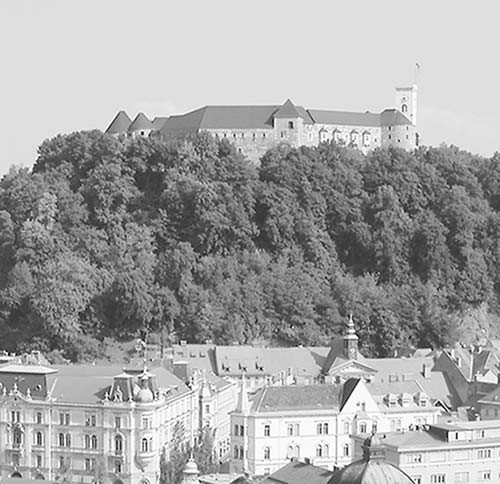
Getting to the Castle: A slick funicular whisks visitors to the top in a jiff (€3.30 one-way, €6 round-trip, included in combo-ticket described earlier; runs every 10 minutes during castle open hours, 1-minute ride; catch it at Krekov Trg, near the main market square). At the top, you’ll find free WCs and a few easy flights of stairs up into the heart of the castle complex (or take the elevator). There are also two handy trails from town up to the castle. The steeper-but-faster route begins near the Dragon Bridge: Find Študentovska lane, facing the statue of Valentin Vodnik in the market. This lane dead-ends at a gravel path, which you’ll follow up to a fork. Turn left to zigzag up the steepest and fastest route, which deposits you just below the castle wall; from here, turn left again and curl around the wall to reach the main drawbridge. Slower but a bit less steep is from a street called Reber, just off Stari Trg, a few blocks south of the Town Hall: Walk up to the top of Reber, and, at the dead end, turn right and start climbing up the stairs. From here on out, keep bearing left, then go right when you’re just under the castle (follow Grad signs).
Visiting the Castle: The castle’s information office, where you can pick up your audioguide or meet a tour, is near the main gate (from the funicular, follow the yellow i sign up the stairs). In the main castle courtyard, the sights cluster in two areas. The best sights are near the base of the tallest tower: The entrance to the history exhibit is to the left; the “Virtual Castle” film, chapel, penitentiary, and tower climb are to the right. To the right of that is the rounded Erasmus Tower, with the Museum of Puppetry. The upper floors of the castle complex house two wedding halls—Ljubljana’s most popular places to get married (free for locals).
The Slovenian History Exhibition offers a concise but engaging overview of this little country’s story. As you enter, ask to borrow the free audioguide, then head downstairs and work your way up. Dark display cases light up when you approach, revealing artifacts, video clips, and touchscreens with more information. A unique feature of the museum is that you’re invited to touch replicas of important historic items (in many cases, the originals are in other Ljubljana museums). The top floor (go up the glassed-in staircase) is the most interesting—covering the tumultuous 20th century. You’ll learn about topics ranging from the battlefields of World War I, to the creation of Yugoslavia, to the fascist occupation and harrowing Italian-run concentration camps of World War II, to the cult of personality around Partisan-war-hero-turned-Yugoslav-president Tito, to Slovenia’s bid for independence.
Entering the door to the right of the tower, you’ll first find the small penitentiary exhibit, recalling the post-Napoleonic era, when the castle was converted to a prison. It saw the most action during World War I, when it housed political prisoners (including the beloved Slovenian writer Ivan Cankar) and POWs. Modest exhibits inside actual former cells describe the history and list the names of past inmates.
If you head downstairs from the entrance, you’ll find a Gothic chapel with Baroque paintings of St. George (Ljubljana’s patron saint, the dragon-slayer) and coats of arms of the various aristocratic families that have called this castle home.
Heading up the stairs, you’ll find the informative, entertaining, and nicely animated “Virtual Castle” film, in which Ljubljana’s mascot dragon describes this hill’s layers of history (12 minutes, plays on the half-hour; often in English, but otherwise borrow English headset).
Finally, climb the 92 spiral steps up to the castle tower, with one of the best views in town.
Don’t miss the oddly fascinating Museum of Puppetry (ride up the elevator to the left as you face the round Erasmus Tower). This traces the history of puppetry as an art form, which flourished in the Modernist milieu of early 20th-century Ljubljana.
The castle also often has temporary exhibits—look for signs or ask at the information desk.
Eating: You can combine your visit to the castle with a meal at the recommended $$$ Gostilna na Gradu, with the best traditional Slovenian food in town, or the top-end $$$$ Strelec (both described later, under “Eating in Ljubljana”). $ Gradska Kavana (“Castle Café”) serves only drinks and cakes, and $ Gradska Vinoteka (“Castle Winery”) is a wine bar operated by Strelec.
▲▲Jože Plečnik House (Plečnikova Zbirka)
One of Ljubljana’s most interesting sights is the house of the architect who redesigned much of the city. Today, the house is decorated exactly as it was the day Plečnik died, containing much of his equipment, models, and plans. It can be toured only with a guide, whose enthusiasm brings the place to life. Still furnished with unique, Plečnik-designed furniture, one-of-a-kind inventions, and favorite souvenirs from his travels, the house paints an unusually intimate portrait of an artist. It’s a ▲▲▲ pilgrimage for those who get caught up in Ljubljana’s idiosyncratic sense of style.
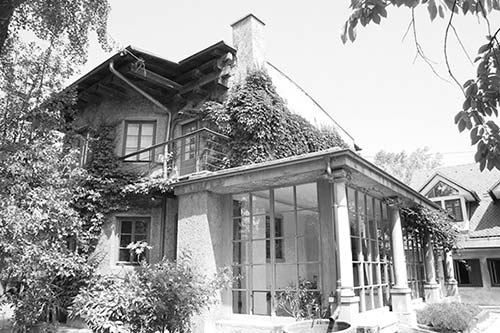
Cost and Hours: €8 for the worthwhile tour, €5 for just the modest museum and gardens; Tue-Sun 10:00-18:00—last tour departs at 17:00, closed Mon, 45-minute English tours begin at the top of each hour; Karunova 4, +386 1 280 1604, www.mgml.si.
Getting Tickets: Tours are limited to seven people and can sell out, especially on summer weekends. Consider calling ahead or emailing plecnik@mgml.si to save a space. Otherwise, it’s smart to show up 15-20 minutes early at busy times.
Getting There: It’s directly behind the twin steeples of the Trnovo Church, south of the town center. The 15-minute stroll from the center—the same one Plečnik took to work each day—is nearly as enjoyable as the house itself. You can either walk south along the river, then turn right onto Gradaška and stroll along the stream to the church, or, from French Revolution Square, head south on Emonska. If taking Emonska, you’ll pass through the garden district of Krakovo, where pea patches and characteristic Old World buildings gracefully cohabitate.
Background: Ljubljana’s favorite son lived here from 1921 until his death, in 1957. He added on to an existing house, building a circular bedroom for himself and filling the place with bric-a-brac he designed, as well as artifacts, photos, and gifts from around the world that inspired him as he shaped Ljubljana. Living a simple, almost monastic lifestyle, Plečnik knew what he liked, and these tastes are mirrored in his home.
Visiting the House: While waiting for your tour to begin, explore the modest but engaging museum, offering biographical details about Plečnik along with his personal effects (such as notebooks, tools, and eyeglasses). Look for the small model of Ljubljana that locates the many structures he designed all around the city. You’ll also see descriptions and photos of his greatest works, and large wooden models of two of his biggest “unrealized plans” that never made it off the drawing board: the cone-shaped “Cathedral of Freedom” and the roofed Butchers’ Bridge at the market. One room features his redesign of Prague Castle, including a small model of his gardens and walkways. You can try sitting on chairs that Plečnik designed while you watch a video loop of short films about the architect.
No other single architect has shaped one city as Jože Plečnik (YOH-zheh PLAYCH-neek) shaped Ljubljana. From libraries, cemeteries, and stadiums to riverside embankments and market halls, Plečnik left his mark everywhere.
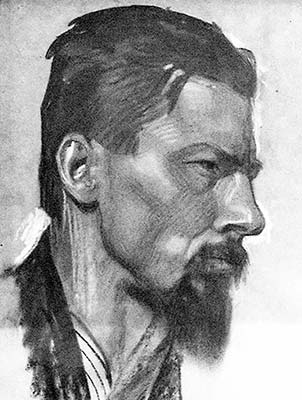
Plečnik was born in Ljubljana to a cabinet maker. He dabbled as a self-trained architect, catching the eye of the great Secessionist architect Otto Wagner, who invited him to study in Vienna. Plečnik’s first commissions, around the turn of the 20th century in Vienna, were pretty standard Art Nouveau. Then Tomáš Masaryk, president of the new nation of Czechoslovakia, decided that Prague Castle could use a new look by a Slavic architect. In 1921, Masaryk chose Jože Plečnik, who sprinkled the castle grounds with his distinctive touches. By now, Plečnik had perfected his simple, eye-pleasing style, which mixes modern and classical influences with ample columns and pyramids—at once austere and playful.
By the time Plečnik finished in Prague, he had made a name for himself. His prime years were spent creating for the Kingdom of Yugoslavia (before the ideology-driven era of Tito). Plečnik returned home to Ljubljana and set to work redesigning the city, both as an architect and as an urban planner. He lived in a humble house (now a recommended museum) behind the Trnovo Church. On his daily walk to work, he pondered ways to make the city even more livable. As you wander through town, notice how thoughtfully he incorporated people, nature, Slovenian heritage, town vistas, and symbolism into his works—it’s feng shui on a grand urban scale.
For all of Plečnik’s ideas that became reality, even more did not. After World War II, the very religious Plečnik fell out of favor with the communist government. (It’s fun to imagine how this city might look if Plečnik had always gotten his way.) After his death, in 1957, Plečnik was all but forgotten by Slovenes and scholars alike.
But a 1986 exposition about Plečnik at Paris’ Pompidou Center jump-started interest in the architect. Within a few years, Plečnik was back in vogue. Today, scholars laud him as a genius who was ahead of his time...while locals and tourists enjoy the elegant simplicity of his works.
The tour takes you through the actual rooms where Plečnik lived: kitchen, circular bedroom, sitting room, studio, and greenhouse. As you tour the place, appreciate the subtle details. Notice how reverently your guide (like other Slovenes) speaks of this man. Contrast the humbleness of Plečnik’s home with the dynamic impact he had on the cityscape of Ljubljana and the cultural heritage of Slovenia. Wandering Plečnik’s hallways, it’s hard not to be tickled by his sheer creativity and by the unique world he forged for himself. As a visitor to his home, you’re in good company. He invited only his closest friends here—except during World War II, when Ljubljana was occupied by Nazis and the university was closed, and Plečnik allowed his students to work with him here.
THE MUSEUM ZONE AND TIVOLI PARK
The west side of the river—beyond Prešeren Square and Congress Square—is the heart of modern Ljubljana, and home to several prominent squares and fine museums. I’ve listed these sights roughly in order from Congress Square and linked them with walking directions. For locations and to trace this route, see the “Ljubljana” map, earlier.
• The easiest way to get to this side of town is through the underpass (beneath Slovenska Cesta) at the top of Congress Square. Emerging on the other side of the underpass, walk straight through the gap in the Maxi shopping center into the...
▲Square of the Republic (Trg Republike)
This unusual plaza is ringed by an odd collection of buildings. While hardly quaint, the Square of the Republic gives you a good taste of a modern corner of Ljubljana. And it’s historic—this is where Slovenia declared its independence in 1991.
The twin office towers (with the world’s biggest digital watch, flashing the date, time, and temperature) were designed by Plečnik’s protégé, Edvard Ravnikar. As harrowing as these structures seem, imagine if the builders had followed the original plans—the towers would be twice as tall as they are now and connected by a bridge, representing the gateway to Ljubljana. These buildings were originally designed as the Slovenian parliament, but they were scaled back when Tito didn’t approve (it would have made Slovenia’s parliament bigger than the Yugoslav parliament in Belgrade).
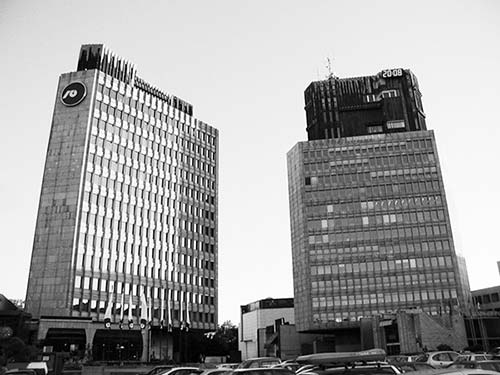
Instead, the Slovenian Parliament is across the square, in the low-profile office building with the sculpted entryway. The carvings are in the Socialist Realist style, celebrating the noble Slovenian people conforming to communist ideals for the good of the entire society.
Completing the square are a huge conference center (Cankarjev Dom, the white building behind the skyscrapers), a shopping mall, and some public art.
• Just a block north, across the street and through the grassy park (Trg Narodni Herojev), you’ll find the...
Slovenian National Museum (Narodni Muzej Slovenije) and Slovenian Museum of Natural History (Prirodoslovni Muzej Slovenije)
These two museums share a single historic building facing a park behind the Parliament. They’re both skippable but worth considering if you have a special interest or if it’s a rainy day.
Cost and Hours: €8 for National Museum, €4 for Natural History Museum, or €10 for both, some English descriptions, both open daily 10:00-18:00, Prešernova 20, +386 1 241 4400, www.nms.si and www.pms-lj.si.
Visiting the Museums: The National Museum focuses on archaeological finds (their Metelkova branch—described later—features applied arts). On the ground floor are temporary exhibits and a lapidarium with carved-stone Roman monuments and exhibits on Egyptian mummies. Upstairs and to the right are more exhibits of the National Museum, with archaeological findings, including the museum’s two prized possessions: a fragment of a 45,000-year-old Neanderthal flute fashioned from a cave bear’s femur—supposedly the world’s oldest musical instrument; and the “figural situla,” a beautifully decorated hammered-bronze bucket from the fifth century BC. Embossed with scenes of everyday Iron Age life, this object has been a gold mine of information for archaeologists.
Upstairs and to the left is the Natural History exhibit, featuring the flora and fauna of Slovenia. You’ll see partial skeletons of a mammoth and a cave bear; plenty of stuffed reptiles, fish, and birds; and an exhibit on “human fish” (Proteus anguinus—long, skinny, pale-pink, sightless salamanders unique to caves in this part of Europe).
At the far end of the building is a glassed-in annex displaying Roman stone monuments (free).
• Turning left around the museum building and walking one block, you’ll see the US Embassy. This pretty yellow chalet (with brown trim and a red roof, at Prešernova Cesta 31) wins my vote for quaintest embassy building in the world. (Resist the urge to snap a photo...those guards are all business.) Just up Prešernova Cesta from the embassy (to the right) are two decent art museums.
Museum of Modern Art (Moderna Galerija Ljubljana)
This museum has a permanent collection of modern and contemporary Slovenian artists, as well as temporary exhibits by both homegrown and international artists. To explore the “Continuities and Ruptures” permanent collection (aptly named for a place with such a fractured, up-and-down history), borrow the English floor plan and take a chronological spin through the 20th century. Unusual for a “modern” art museum is the room with Partisan art, with stiff, improvised, communist-style posters from the days when Tito and his crew were just a ragtag militia movement.
Cost and Hours: €5, ask about combo-ticket with contemporary branch at Metelkova—see here; Tue-Sun 10:00-18:00, July-Aug Thu until 20:00, closed Mon year-round; Cankarjeva 15, +386 1 241 6800, www.mg-lj.si.
▲National Gallery (Narodna Galerija)
This solid museum presents a good, chronological exhibit of works by Slovenian and European artists, as well as temporary exhibits. Although Slovenia doesn’t have a particularly renowned artistic tradition, this well-presented collection nicely paints a picture of the nation’s story and culture.
Cost and Hours: €8, more for special exhibits, permanent collection free first Sun of the month; open Tue-Sun 10:00-18:00, Thu until 20:00, closed Mon; two entrances: one at Cankarjeva 20 facing the National Museum, and another at the big glass box between two older buildings at Prešernova 24; +386 1 241 5418, www.ng-slo.si.
Visiting the Museum: Enter through the main (historic) building. Downstairs is a skippable collection of medieval church art; upstairs are works from the 17th through 19th century. Spend some time with Marko Pernhart’s Romantic views of the Slovenian countryside, including stunning panoramas of the Julian Alps (ringing the top of the stairwell).
Then you’ll cross the modern skybridge (peeking down to see the original Fountain of Three Carniolan Rivers, from the Old Town’s central square) to the 19th and 20th centuries. Find and savor the evocative portraits—bursting with personality—by Ivana Kobilca (1861-1926), a Slovenian painter working on the cusp of Impressionism. Art lovers enjoy her serene and lifelike Summer (1889-1890), in which a young woman (Kobilca’s self-portrait) plays with kids and flowers. Also look for pointillist works by Ivan Grohar (1867-1911), who painted Slovenian landscapes with a dash of Van Gogh and a dab of Seurat. Look for Grohar’s painting The Sower, which is noteworthy because it appears on Slovenia’s €0.05 coins. On your way out, stop by the small room near the Cankarjeva entrance that displays small, faded, abstracted works by another Slovenian artist, Zoran Mušič (1909-2005).
• By the busy road near the art museums, look for the distinctive Neo-Byzantine design (tall domes with narrow slits) of the...
▲▲Serbian Orthodox Church of Sts. Cyril and Methodius
Ljubljana’s most striking church interior isn’t Catholic, but Orthodox. This church was built in 1936, soon after the Slovenes joined a political union with the Serbs. Wealthy Slovenia attracted its poorer neighbors from the south—so it built this church for that community. Since 1991, the Serb population has continued to grow, as people from the struggling corners of the former Yugoslavia flock to prosperous Slovenia. Its gorgeous interior—which feels closer to Moscow than to Rome—offers visitors a taste of this important faith.
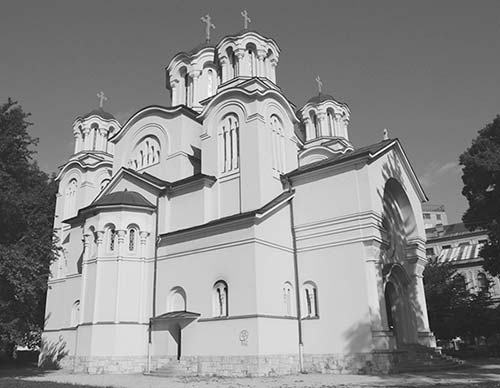
Cost and Hours: Free, daily 8:00-19:00; divine liturgy Sun at 8:30, other days services at 8:30 and 18:00; Prešernova 35, www.spc-ljubljana.si.
Visiting the Church: Step inside for the best glimpse of the Orthodox faith this side of Sarajevo. The church is colorfully decorated without a hint of the 21st century, mirroring a very conservative religion. Much of the church’s art consists of copies of famous frescoes that decorate medieval Serbian Orthodox monasteries throughout the Balkans. On the balcony (at the back of the nave), you’ll see Cyrillic script that explains the history of the church. Notice that there are no pews, because worshippers stand throughout the service. On the left, find the little room with tubs of water, where the faithful light tall, skinny candles (purchased at the little window in the back corner). At the front of the church, the painted wooden screen, or iconostasis, is believed to separate our material world from the spiritual realm behind it. Ponder the fact that several centuries ago, before the Catholic Church began to adapt to a changing world, all Christians worshipped this way. For more on the Orthodox faith, see the sidebar on here.
• On the other side of the busy street is...
Tivoli Park (Park Tivoli)
This huge park, just west of the center, is where Slovenes relax on summer weekends. The easiest access is through the underpass from Cankarjeva Cesta (between the Serbian Orthodox Church and the Museum of Modern Art). As you emerge, the Neoclassical pillars leading down the promenade make it clear that this part of the park was designed by Jože Plečnik. Along this “main boulevard” of the park, various changing photographic exhibitions are displayed.
• Aside from taking a leisurely stroll, the best thing to do in the park is visit the...
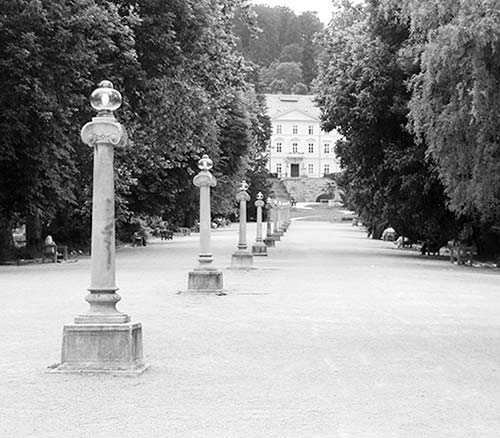
▲Contemporary History Museum (Muzej Novejše Zgodovine)
In a Baroque mansion (Cekinov Grad) in Tivoli Park, a well-done exhibit called “Slovenians in the 20th Century” traces the country’s most eventful hundred years—from World War I, through the Yugoslav period, to independence in 1991 and EU membership today. Out front is a yellow Zastava, a make of car that was ubiquitous during the Yugoslav years. Inside, the ground floor displays temporary exhibits, and upstairs you’ll find several rooms using models, dioramas, light-and-sound effects, and English explanations to creatively tell the story of one of Europe’s youngest nations. While it’s a little difficult to fully appreciate, the creativity and the spunky spirit of the place are truly enjoyable.
Cost and Hours: €5, permanent exhibit free first Sun of the month; Tue-Sun 10:00-18:00, closed Mon; in Tivoli Park at Celovška Cesta 23, +386 1 300 9610, www.muzej-nz.si.
Getting There: The museum is a 20-minute walk from the center, best combined with a wander through Tivoli Park. The fastest approach: As you emerge from the Cankarjeva Cesta underpass into the park, climb up the stairs, then turn right and go straight ahead for five minutes. Continue up the ramp, turn left after the tennis courts, and look for the big pink-and-white mansion on the hill.
Visiting the Museum: The exhibit begins at the dawn of the 20th century, during Slovenia’s waning days as part of the Austro-Hungarian Empire. Spiral stairs lead up to more exhibits about World War I. Back on the main floor, you’ll walk through a simulated trench from the Soča Front, then learn about the creation of the post-World War I Kingdom of Serbs, Croats, and Slovenes (or, as this exhibit pointedly puts it, “Kingdom of Slovenes, Croats, and Serbs”). During this time, some of what had historically been Slovenian became part of Italy.
Your footfalls echo loudly as you enter the room describing Slovenia’s WWII experience. You’ll learn how, during that war, Slovenia was divided between neighboring fascist powers Germany, Italy, and Hungary. Each one tried (but failed) to exert linguistic and cultural control over the people, hoping to eradicate the Slovenian national identity. Video screens show subtitled interviews with people who lived through those war years.
Passing through the ballroom, you reach the “Slovenia 1946-1960” exhibit, outlining both the good (modernization) and the bad (prison camps and secret police) of the early Tito years. Despite his ruthless early rule, Tito remains popular here; under his stern bust, page through the photo album of Tito’s visits to Slovenia. Find the display of the country’s former currencies. Examine the Yugoslav dinar and notice that the figureheads on that communist currency were generic, idealized workers, farmers, and other members of the proletariat...except for a few notable individuals (including Tito). Meanwhile, Slovenia’s short-lived post-Yugoslav currency, the tolar (1991-2006, R.I.P.), featured artists and scientists rather than heads of state and generals.
The most evocative room (1991-2008) has artifacts from the Slovenes’ brave declaration of independence from a hostile Yugoslavia in 1991. The well-organized Slovenes had only to weather a 10-day skirmish to gain their freedom. It’s chilling to think that, at one point, bombers were en route to level this gorgeous city. The planes were called back at the last minute by a Yugoslav People’s Army officer with allegiances to Slovenia.
Nearby: As you exit, the giant, modern, blocky, light-blue building across the busy road is the Pivovarna Union—the brewery for Ljubljana’s favorite industrial-produced beer, with a brewpub and the option of a brewery tour (www.union-experience.si).
• On your way back to the center, you could stop by...
▲The Skyscraper (Nebotičnik)
This 1933 building was the first skyscraper in Slovenia, for a time the tallest building in Central Europe, and one of the earliest European buildings clearly influenced by American architecture. Art Deco inside and out, it’s a thrill for architecture fans and anyone who enjoys a great view—the top floor, which hosts a restaurant, café, and observation deck, offers the best panorama of Ljubljana’s skyline. Zip up in the elevator to floor #12, with a $ café where you can enjoy a drink or a light meal with unobstructed views over the city and castle. (There’s wonderful outdoor seating. In bad weather, head up the spiral stairs to the glassed-in terrace.)
Cost and Hours: Free to ride the elevator up for a peek—but you should buy at least a drink if you want to stick around; terrace and café open daily 9:00-late; 2 blocks from Prešeren Square at Štefanova 1, +386 40 601 787, www.neboticnik.si.
METELKOVA
Three museums face each other on a slick modern plaza next to the park called Tabor, about a 15-minute walk northeast of Prešeren Square in the dull but up-and-coming district of Metelkova. Nearby, you can explore the funky squatters’ colony of Metelkova City (with Ljubljana’s famous prison-turned-youth hostel). For locations, see the “Ljubljana” map, earlier.
▲▲Slovenian Ethnographic Museum (Slovenski Etnografski Muzej)
Housed in a state-of-the-art facility, this delightful museum is Ljubljana’s most underrated attraction. With both permanent and temporary exhibits, the museum strives to explain what it is to be Slovene, with well-presented and well-described cultural artifacts from around the country. If you’ve caught the Slovenian folk-culture itch, this is the place to scratch it.
Cost and Hours: €6, free first Sun of month; open Tue-Sun 10:00-18:00, Thu until 20:00, closed Mon; great café, Metelkova 2, +386 1 300 8745, www.etno-muzej.si.
Visiting the Museum: The ground and first floors have good temporary exhibits; two permanent exhibits are upstairs.
The best exhibit, filling the third floor, is called “Between Nature and Culture.” As you exit the elevator, turn left and find the shrunken head, which comes with a refreshingly frank exhibit that acknowledges the shortsighted tendency for museum curators—including at this museum—to emphasize things that are foreign or different. Continue through “Reflections of Distant Worlds” (non-European cultures) to reach the core of the collection, which focuses on Slovenia. A good but slow-moving film visits the country’s four major regions. Another exhibit ponders how people half a world away—in Slovenia and in North America—simultaneously invented a similar solution (snowshoes) for a common problem. One display deconstructs Slovenian clichés (including this country’s odd fascination with its traditional hayracks). The arrangement of the collection emphasizes the evolution of an increasingly complicated civilization, from basic farming tools to ceramics to modern technology. You’ll see exhibits on traditional Slovenian beekeeping, blacksmithing, weaving, shoemaking, costumes and customs, pottery, furniture, and religious objects. The children’s “Ethnoalphabet” area features an A-to-Ž array of engaging, hands-on activities.
The other permanent exhibit, Plečnik’s Lectarija, shows off fixtures and fittings from an arts-and-crafts shop on Congress Square that was designed by Slovenia’s great architect. It’s a rare opportunity to poke around inside a (re-created) Plečnik interior. The exhibit also examines how Plečnik was inspired by traditional Slovenian crafts—and specifically by a nearby shop, selling candles and honey products, that the architect used to patronize.
Slovenian National Museum-Metelkova (Narodni Muzej Slovenije)
Next door to the Ethnographic Museum is this facility, where items (mostly applied arts) from the Slovenian National Museum that were formerly tucked away in storage are now displayed on two floors. The very pretty historical bric-a-brac is neatly presented without much context—it’s just an excuse to get a bunch of interesting stuff out into public view. Each room has a different collection: furniture, pottery and ceramics, church vestments, weapons and armor, and more. The painting gallery is nicely organized by century and style. The museum also features temporary exhibits. Everything’s labeled in English.
Cost and Hours: €8; Tue-Sun 10:00-18:00, Thu until 20:00, closed Mon; Maistrova 1, +386 1 230 7032, www.nms.si.
Museum of Contemporary Art-Metelkova (Muzej Sodobne Umetnosti Metelkova, MSUM)
This cutting-edge branch of the Museum of Modern Art showcases changing exhibitions of present-day, mostly Slovenian and Central European artists. The modern space is at once sleek and playful, making this museum worth a visit for art lovers who appreciate works from the 1960s to the present.
Cost and Hours: €5, ask about combo-ticket with Museum of Modern Art; Tue-Sun 10:00-18:00, July-Aug Thu until 20:00, closed Mon year-round; Maistrova 3, +386 1 241 6825, www.mg-lj.si.
Metelkova City (Metelkova Mesto)
The heart of Slovenia’s counterculture, this former military installation is now a funky, graffiti-slathered squatter’s colony, billed as an “autonomous cultural center.” Built by the Habsburgs in the 1880s, the complex—with barracks, warehouses, and a prison—was used by a laundry list of later occupiers, from Italian fascists to Nazis to the Yugoslav People’s Army. After Yugoslavia pulled its troops out of Slovenia (following the Ten-Day War), the cluster of buildings sat derelict and abandoned. In 1993, transient artists moved in and set up galleries, theaters, bars, and nightclubs. Though controversial at first, Meltelkova City has gradually become accepted by most Ljubljanans, and the city (which owns the property) not only tolerates but also actively encourages this hotbed of youthful artistic expression. While edgy, this place is fascinating to explore and a great spot to ogle street art—it’s sleepy by day and lively by night (www.metelkovamesto.org).
Anchoring the area is Hostel Celica, one of Europe’s most notable youth hostels, which fills a former prison building. Twenty artists were invited to decorate cells that have been turned into accommodations, and the ground floor features vibrant public spaces, a good and affordable restaurant (a nice place for a lunch or a light dinner), and a shoes-off “Oriental café.” You can drop by to see the building anytime, and ask to borrow a flashlight to explore the dank and gloomy basement solitary confinement cells, with a small but interesting exhibition on the history of the building (and the various prisoners who have called it home—including Janez Janša, who did time here during communism and later became Slovenia’s prime minister...twice). But if you visit, try to go at 13:00 for a free guided tour of the complex (tours run daily; you can try calling to arrange a tour at other times, +386 1 230 9700, www.hostelcelica.com).
Shopping in Ljubljana
Ljubljana, with its easygoing ambience and countless boutiques, is made-to-order for whiling away an afternoon shopping. It’s also a fun place to stock up on souvenirs. Popular items include wood carvings and models (especially of the characteristic hayracks that dot the countryside), different flavors of schnapps (the kind with a whole Williams pear inside—cultivated to actually grow right into the bottle—is a particularly fun gift), honey mead brandy (medica—sweet and smooth), bars of soap wrapped in wool (good for exfoliating), and those adorable painted panels from beehives (described on here). Rounding out the list of traditional Slovenian items are wrought-iron products from Kropa, crystal from Rogaska, lace from Idrija, and salt from Piran. The following neighborhoods are ideal places to browse.
AT CIRIL-METODOV TRG AND NEAR THE MARKET
The most atmospheric trinket-shopping is in the first stretch of the market colonnade, along the riverfront next to the Triple Bridge. See the “Ljubljana Hotels and Restaurants” map for locations.
Trgovina Ika, a small artisan boutique with its own hip and idiosyncratic sense of style, is a delightful place to browse for truly authentic Slovenian stuff that goes beyond souvenirs (variable hours, usually Mon-Fri 9:00-19:30, Sat until 18:00, closed Sun, Ciril-Metodov Trg 13, +386 1 123 21743).
If you’re looking for more traditional souvenirs that are serious handicrafts rather than trinkets, drop by the Rustika gallery, just over the Triple Bridge (on the castle side). In addition to beehive panels, they also have lace, painted chests and boxes, and other tasteful, local mementos (daily 10:00-19:00, Stritarjeva 9, +386 31 459 509). A bigger but more downscale souvenir shop is Dom Trgovina, on the main market square (Mon-Sat 9:00-21:00, Sun 10:00-20:30, Ciril-Metodov Trg 5).
Kraševka sells high-quality artisanal products (mostly edible) from the Karst region, and also acts as a sort of information office for that area (Mon-Fri 9:00-18:00, Sat until 15:00, closed Sun, Vodnikov Trg 4, +386 1 232 1445).
IN THE OLD TOWN
Ljubljana’s main Old Town street—which changes names from Mestni Trg to Stari Trg, then Gornji Trg—is also lined with several characteristic shops, selling a few of the unique gift items produced in this proud little country. Unless otherwise noted, all of these shops are open long hours on weekdays (often until 20:00); most close a bit earlier on Saturdays (around 17:00), and close in the early afternoon on Sundays (usually by 13:00 or 14:00).
This area is covered in my “Ljubljana Walk,” earlier; see the “Ljubljana Center” map for locations. Make it a point to seek out these goodies on Mestni Trg: honey (Honey House, at #7), sea salt from Slovenia’s tiny coastline (Piranske Soline, at #8), handmade lace from Idrija (Galerija Idrijske Čipke, at #17), and brandies and handicrafts from the Dolenje region (Dobrote Dolenjske, also at #17).
Chocolate Shops: Three tempting, high-end (yet still affordable) čokoladnice are within about a five-minute walk of each other, along Ljubljana’s Old Town main drag. Čokoladnica Cukrček is the grande dame of this scene, best known for its foil-wrapped “Prešeren Balls” chocolates—a clever and civic-minded take on Salzburg’s “Mozart Balls,” replacing the composer with Slovenia’s greatest poet (Ciril-Metodov Trg 19, www.cukrcek.si). La Chocolate is slightly less expensive and feels a bit more modern (Mestni Trg 8, www.lachocolate.si). And Čokoladnica Ljubljana attempts to compete with dragon-themed chocolates (Mestni Trg 11, www.cokoladnica-lj.si).
Sleeping in Ljubljana
Ljubljana has good accommodations in all price ranges. I’ve focused my listings in or within easy walking distance of the city center. To get the best value, book ahead and book directly with the hotel. The most expensive hotels raise their prices even more during conventions (Sept-Oct, and sometimes also June).
$$$$ Heritage Hotel, filling a 400-year-old building facing the Cobblers’ Bridge—near, but not too near, the liveliest stretch of the embankment—is a tempting splurge. Its 20 rooms are modern and stylish but retain a respect for tradition; some even come with heavy old beams (air-con, elevator, Čevljarska 2, +386 1 421 1400, www.hotelheritage.si, welcome@hotelheritage.si).
$$$$ Lesar Hotel Angel, on a cobbled square in the Old Town, feels plush and high-end. Its 14 rooms have crisp white decor, and the private garden is inviting (air-con, lots of stairs with no elevator, Gornji Trg 7, +386 1 425 5089, www.angelhotel.si, info@angelhotel.si).
$$$ Vander Urbani Resort is a novel concept: Nestled central as can be just off the riverfront embankment, it really does feel like an intensely hip resort in the city center—right down to the minuscule rooftop swimming pool and sundeck. The hotel prides itself on the cutting-edge urban design of its 20 rooms—with lots of plain concrete—and tries to use Slovenian and organic products wherever possible (air-con, elevator, café, restaurant, champagne bar, Krojaška Ulica 6, +386 1 200 9000, www.vanderhotel.com, info@vanderhotel.com).
$$$ Cubo Hotel is a jolt of trendy minimalism on Ljubljana’s hotel scene. Its 26 large rooms are the best place in town for sleek, urban elegance. Ask for a room on the quiet courtyard rather than facing the busy street (air-con, elevator, valet parking, Slovenska Cesta 15, +386 1 425 6000, www.hotelcubo.com, reception@hotelcubo.com).
$$ Hotel Mrak has 34 small but well-equipped rooms in a pleasant neighborhood near French Revolution Square. This trusty place—recently updated, with stylish business-class rooms—is my sentimental favorite in Ljubljana (RS%, air-con, elevator, breakfast terrace under “the oldest vine in Slovenia,” pay parking, Rimska 4, +386 1 421 9650, www.hotelmrak.si, info@hotelmrak.si, Kuharič family).
$$ Meščanka (“City Woman”) rents seven cozy, well-equipped rooms and apartments in a fantastic location right along the bustling riverfront promenade. The decor is mod, funky, and colorful, and the good windows work hard to provide silence (breakfast extra at next-door restaurant, air-con, self check-in, Ključavničarska 4, +386 51 880 044, www.mescanka.si, info@mescanka.si, Julija).
$$ Slamič B&B has 17 modern rooms with hardwood floors, tasteful decor, and absentee management. It’s over an appealing upscale café in a nondescript but central neighborhood (air-con, pay parking, reception open daily 7:30-23:00, Kersnikova 1, +386 1 433 8233, www.slamic.si, info@slamic.si).
$$ Adora Hotel, tucked behind a church at the edge of the cobbled Old Town zone, has 10 rooms with a restrained rustic style (air-con, elevator, free loaner bikes, pay parking, Rožna Ulica 7, +386 82 057 240, www.adorahotel.si [URL inactive], info@adorahotel.si).
$$ Art Hotel is a good value tucked down a courtyard a 10-minute walk from the heart of town, in a busy student zone. Its 10 straightforward rooms are an afterthought to the youthful, artsy café (air-con, elevator, Soteska 8, +386 1 252 6800, https://art.worhot.com, arthotel@mihovec.si).
$ Barbo Palace, in an excellent location a few steps from Congress Square and the river, is the best bet in town for a touch of history at a good price. Its 12 apartments and four rooms—all refurbished and very spacious—fill an antique building around a classic Old World atrium courtyard (no breakfast but kitchenettes in the apartments, air-con, elevator, reception open 8:00-20:00—call ahead if arriving later, Gosposka 1, +386 70 322 822, www.barbopalace.si, info@barbopalace.si).
$ Penzion Pod Lipo has 10 rooms above a restaurant about a 12-minute walk from Prešeren Square. While the rooms are dated and simple, the place is affordable and thoughtfully run by jolly Marjan (breakfast extra, family room, sometimes unstaffed—let them know when you’ll arrive, air-con, guest kitchen, putting green on terrace, Borstnikov Trg 3, +386 1 251 1683, mobile +386 31 809 893, www.penzion-podlipo.com, info@penzion-podlipo.com).
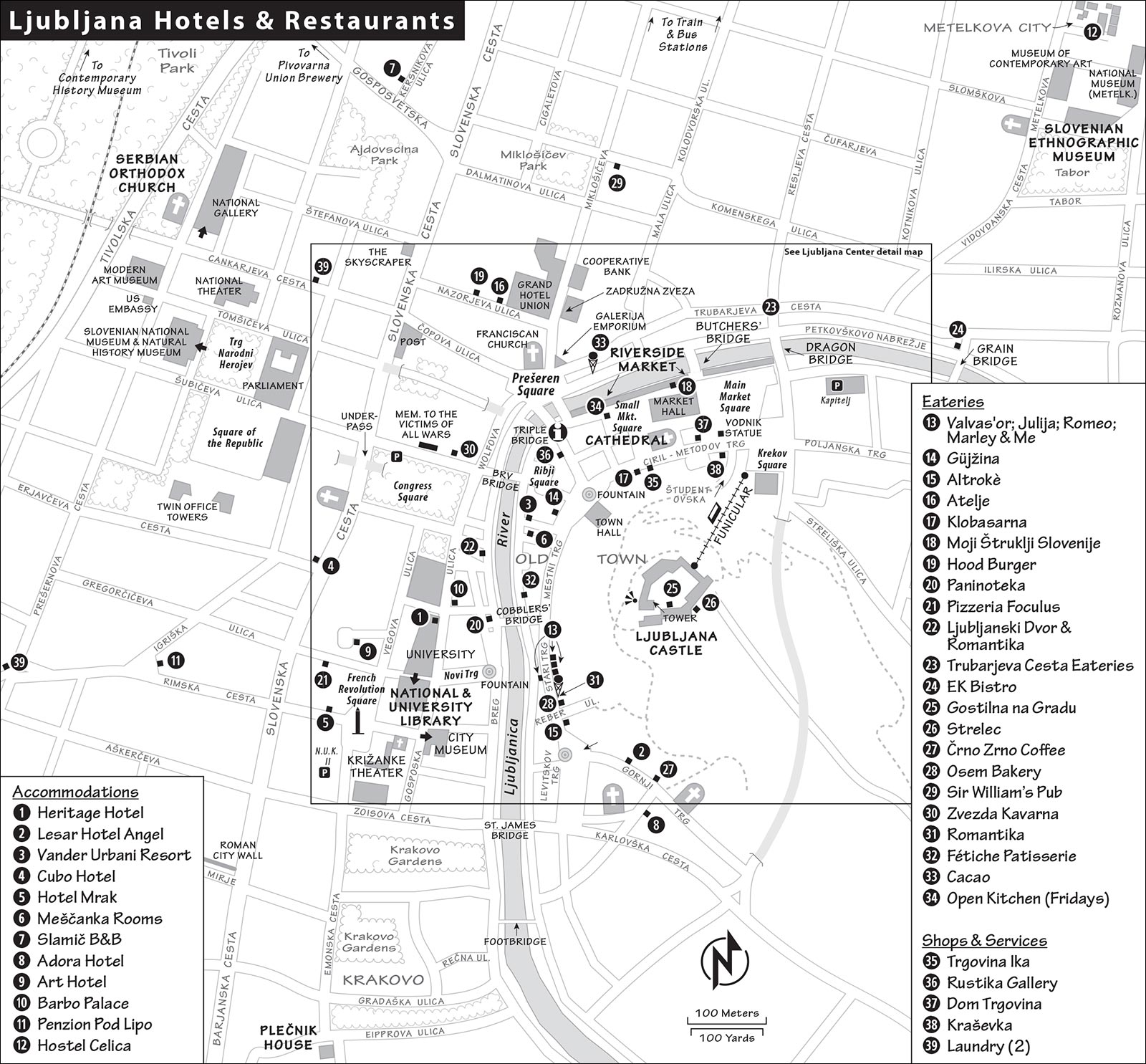
¢ Hostel Celica, a proud, innovative, and lively place, is owned by the city and run by a nonprofit student organization. This former military prison’s 20 cells (celica) have been converted into hostel rooms—each one unique and decorated by a different designer (free tours of the hostel daily at 13:00). The building also houses an art gallery, info desk, self-service laundry, and several eateries. For more on the history of this site, see “More Sights in Ljubljana: Metelkova,” earlier (private rooms available, offers active excursions around Slovenia, a dull 15-minute walk from Prešeren Square at Metelkova 8, eight minutes to the train station, +386 1 230 9700, www.hostelcelica.com, info@hostelcelica.com). The hostel hosts live-music events one night a week until around 24:00, but otherwise maintains “quiet time” after 23:00. The surrounding neighborhood—a bit run-down and remote, but safe—is a happening nightlife zone, which can make for noisy weekends.
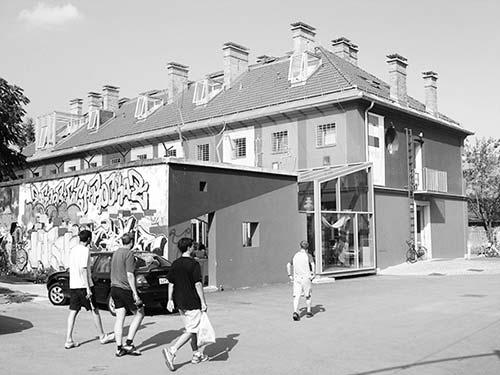
Eating in Ljubljana
At this crossroads of cultures (and cuisines), Italian and French flavors are just as “local” as meat-and-starch Slovenian food. This cosmopolitan city also dabbles in other cuisines; you’ll find Thai, Indian, Chinese, Mexican, and much more. Most places seem to offer a similar menu of Slovenian/Mediterranean fare with international flourishes. To locate these restaurants, see the “Ljubljana Hotels and Restaurants” map.
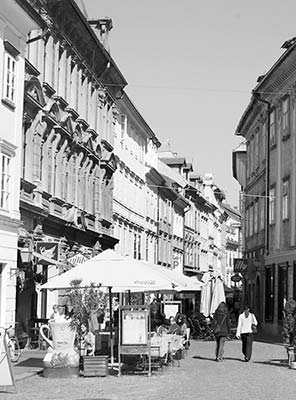
Lunch Deals: To stretch your budget, have your main meal at lunch, when most of Ljubljana’s top eateries serve one or two high-quality three-course meals (starter, main, dessert) at an affordable price—usually around €15 (or, at finer places, closer to €20-25), not including drinks. I’ve noted “lunch special” where applicable. Many places offer these deals only on weekdays.
Traditional Slovenian Food: Because Slovenes head into the countryside when they want traditional fare, Ljubljana isn’t the best place to find authentic Slovenian grub. But if you’d like to try some, your best budget bets are Klobasarna or Moji Štruklji Slovenije; for a more formal sit-down meal, head for Gostilna na Gradu at the castle. Other places feature “regional” cuisines, such as Pannonian, from northeast Slovenia (Güjžina), or Istrian, from the Adriatic coast (Altrokè). For a night of traditional food and culture (on the corny side), check out the Slovenian Evening dinner and folklore show, held at one of two restaurants near the Triple Bridge (around €60/person, for details and to book see www.slovenian-evening.com).
“Open Kitchen” Street-Food Festival: On Fridays from spring through fall, Ljubljana has one of the most appealing street-food markets anywhere: the Open Kitchen (Odprta Kuhna), which fills the first market square below the cathedral (across the Triple Bridge from Prešeren Square) with stalls featuring delicious creations by Slovenian chefs. Most places have big plates for around €6-8; you’ll run out of stomach space well before you run out of money (festival runs mid-March-late Oct Fri 10:00-21:00; can be cancelled when it rains; at Pogačarjev Trg, www.odprtakuhna.si).
IN THE CITY CENTER
Sit-Down Meals in the Old Town
The main drag through the Old Town (which starts at the Town Hall and changes names as it goes: Mestni Trg, then Stari Trg, then Gornji Trg) is lined with inviting eateries. Several popular options cluster in one particularly atmospheric stretch; all except Romeo offer a similar menu of Mediterranean-Slovenian cuisine and wonderful outdoor seating: $$$$ Valvas’or, the upscale option, has a dressy dining room and a posh gold color scheme (weekday lunch special, closed Sun, Stari Trg 7, +386 1 425 0455). $$$ Julija features homey country-Slovenian decor inside (lunch specials, daily, Stari Trg 9, +386 1 425 6463). $ Romeo, across the street, is a lowbrow bar serving so-so “global fusion” food, from Mexican to crêpes...but the name sure is clever (get it? “Romeo and Julija”). And $$ Marley & Me comes with a warm welcome from Matej (weekday lunch specials, daily, Stari Trg 9, +386 8 380 6610). Additional options are just a few steps away.
$$ Güjžina features food and wine from the Hungarian-influenced region of Slovenia called Prekmurje, done with a twist—it’s all vegan. This is an odd match for such a meat-heavy cuisine, and some dishes are more successful than others. But it’s satisfying to dig into a small kettle of rich, flavorful bograč—a spicy, goulash-like stew—and the roasted dumplings called dödöle. This is also a great place to taste some of Prekmurje’s underrated wines and to sample gibanica poppy-seed layer cake—originating in Prekmurje and beloved throughout Slovenia (long hours daily, Mestni Trg 19, +386 83 806 446).
$$$$ Altrokè highlights cuisine from Istria—the region shared by southern Slovenia and northern Croatia. That means Adriatic seafood, pršut (prosciutto), and lots of truffles, served in a cozy stone-walled dining room right along the Old Town’s main drag (daily, Stari Trg 19, +386 82 055 282).
Top-End Splurge Nearby: Just a short walk away from this zone, across the Triple Bridge, $$$$ Atelje is a notch above. Chef Jorg Zupan has earned a Michelin star for his “simple, but refined” cuisine, and designs a seasonal menu that mixes Slovenian and international ingredients and influences. Atelje fills a beautiful retro space next to Grand Hotel Union, just a block off Prešeren Square, with a few inviting al fresco tables out front. They have only fixed-price menus: dinner is seven courses for over €100; lunch is a more budget-friendly three courses for €35. Either way, book well ahead (closed Sun, Nazorjeva 2, +386 1 308 1907, www.restavracijaatelje.com [URL inactive]).
Fast and Cheap
$ Klobasarna is a budget foodie option specializing in kranjska klobasa—traditional Carniolan sausage, from the Slovenian uplands. The menu is simple—one wiener or two, extra for seasonal soup—and delicious. The soups are hearty and filling, often either jota (turnip stew) or ričet (barley stew). They also serve the Slovenian dumplings called štruklji (daily, Sun lunch only, Ciril-Metodov Trg 15, +386 51 605 017).
$ Moji Štruklji Slovenije (“My Slovenian Dumplings”), in the market colonnade, is a handy spot to sample the traditional Slovenian rolled dumplings called štruklji. They have over 20 varieties, both sweet and savory, which are fun to peruse in the display case. The interior seating is tight, so grab an outdoor table tucked under the colonnade. They also sell hearty Slovenian stews and soups (Mon-Sat 7:00-20:00, Fri until 22:00, Sun 10:00-18:00, shorter hours Nov-March, Adamič-Lundrovo Nabrežje 1, +386 59 042 190).
$ Hood Burger, part of a locally beloved chain, is Slovenia’s answer to In-N-Out. The owners pride themselves on using locally sourced ingredients (“100 percent Slovenian beef!”) and cultivate a personal relationship with their producers. The result is tasty, authentic burgers (daily, handiest location is just off Prešeren Square at Nazorjeva 4).
$ Paninoteka, with wonderful outdoor seating overlooking Cobblers’ Bridge and nice indoor seating, has affordable, tasty sandwiches; their full menu is good but more expensive (daily, Jurčičev Trg 3, +386 40 349 329).
Pizzerias: $$ Pizzeria Foculus, tucked in a boring alleyway a few short blocks up from the river, has a loyal local following, a happening atmosphere, an inviting interior, a few outdoor tables, and some of Ljubljana’s favorite pizza (over 50 types, daily, just off French Revolution Square across the street from Plečnik’s National and University Library at Gregorčičeva 3, +386 1 251 5643).
$$ Ljubljanski Dvor enjoys the most convenient and scenic location of any pizzeria in town. On a sunny summer day, the outdoor riverside terrace is unbeatable; I’d skip the dull interior and their pricier pasta restaurant around the corner (daily, 50 yards from Cobblers’ Bridge at Dvorni Trg 1, +386 1 251 6555). Ljubljanski Dvor also has a handy $ takeout window around back on Congress Square. Enjoy a cheap slice at one of their outdoor tables facing the square, or get it to go and munch it along the river.
Funky Student Zone on Trubarjeva Cesta: Here you’ll find a variety of cheap global fare, from falafel to Asian noodles to pizza by the slice, mixed in among home decor galleries, vape shops, and erotic boutiques. A few blocks east, detour a short block to the riverfront to find $$ EK Bistro, a brunch/lunch spot with a big foodie reputation (daily, Petkovškovo Nabrežje 65, +386 51 624 061).
AT THE CASTLE
Ljubljana’s castle complex has some basic eateries, and two high-end splurges—one traditional, the other a bit snobby and modern. For either of these, reserve ahead before making the trip.
$$$ Gostilna na Gradu offers Slovenian cuisine in the castle courtyard high above town—if you don’t mind going up to the castle to get it (the handy funicular costs €6 round-trip). It serves up a seasonal menu of traditional flavors with modern flair at fairly high prices. Choose between the dull vaulted interior, the glassed-in arcade, or an outdoor table (Mon-Sat 12:00-22:00—last seating at 20:00, Sun 12:00-17:00—last seating at 15:00, Grajska Planota 1, +386 820 51931, www.jezersek.si).
$$$$ Strelec (STREH-lets) is a heavily themed splurge run by chef Igor Jagodic. The elaborately described menu items are based on real historical recipes. It’s pretentious, but it’s earned a Michelin star and is worth booking ahead for foodies (Mon-Fri dinner only, Sat lunch and dinner, closed Sun, +386 31 687 648, www.kaval-group.si).
DRINKS AND TREATS
Riverfront Cafés: Enjoying a coffee, beer, or ice-cream cone along the breezy Ljubljanica River embankment (between the Triple and Cobblers’ bridges) is Ljubljana’s single best experience—worth ▲▲▲. Tables spill onto the street, and some of the best-dressed, best-looking students on the planet happily fill them day and night. (A common question from first-time visitors to Ljubljana: “Doesn’t anybody here have a job?”) This is some of the top people-watching in Europe. When ordering, the easiest choice is a bela kava (white coffee)—a caffe latte. For location, see the “Ljubljana Center” map, earlier.
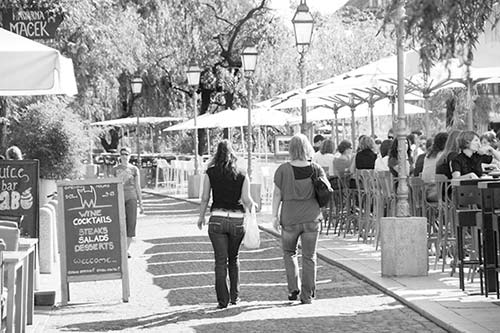
Quality Coffee: While the riverfront strip has good coffee and amazing ambience, coffee fanatics may want something more serious. Črno Zrno, tucked on historic Gornji Trg at the end of the Old Town drag, is owned by Alexander Nino, a coffee snob who sources beans from his native Colombia and serves a wide variety of coffee drinks in a tiny, colorfully tiled, hole-in-the-wall interior. If you take milk or sugar with your coffee, be prepared to defend your request (daily, Gornji Trg 17, +386 31 446 398).
Bakery: $ Osem (“Eight”), along the Old Town’s main drag, is a simple space that bakes breads from scratch each morning. You’ll smell it before you see it (daily, Sat until 13:00, closed Sun, Stari Trg 17, +386 40 562 699).
Microbrews: Sir William’s Pub is where beer aficionados go to get a taste of Slovenia’s burgeoning craft-beer scene. It has a few outdoor tables and a classic British pub interior, and a thoughtfully curated menu of both domestic and international microbrews on tap and by the bottle (no food, long hours Mon-Fri, Sat-Sun from 17:00, Tavčarjeva Ulica 8A, +386 59 944 825).
Cakes: Zvezda Kavarna, a trendy, central place at the bottom of Congress Square, is a local favorite for cakes, pastries, and ice cream. A nostalgic specialty here—once popular in communist times and recently reintroduced to great acclaim—is the emona kocka (Emona cube), a layer cake with nuts, cake, and chocolate (long hours daily, Sun until 20:00, Kongresni Trg 3, +386 1 421 9090). Their deli, just around the corner toward Prešeren Square, has takeaway coffee and smoothies, a wide variety of cakes to go, and some of the most decadent ice cream in town (same hours).
Ice Cream: Ljubljana is known for its Italian gelato-style ice cream. Romantika, just up the steps from the river, is the foodies’ choice, with creative and delicious artisanal flavors (just uphill from Ljubljanksi Dvor pizzeria at Dvorni Trg 1; a second branch is just across the river in the Old Town, at Stari Trg 15). Fétiche Patisserie, along the riverfront café embankment, is another good choice, with unusual, pungent, Asian-themed flavors. Other favorites include Cacao, across the river from the market (and just up the river from Prešeren Square), which also has wonderful embankment seating; and Zvezda’s deli.
Ljubljana Connections
As Slovenia’s transportation hub, Ljubljana is well connected to both domestic and international destinations. When checking schedules, be aware of city name variations: In Slovene, Vienna is “Dunaj,” Budapest is “Budimpešta,” and Venice is “Benétke.”
Local Alternative: When considering bus and train connections, don’t overlook the very handy GoOpti shared transfer service, which is often more convenient, faster, and not much more expensive. Locals swear by this service for airport transfers and reaching otherwise tricky-to-connect places like Venice and Istria; it can even be handy for getting to Zagreb, if the train schedule doesn’t suit your plans (for details, see “By Shared Shuttle Service,” later).
BY TRAIN
From Ljubljana by Train to: Lesce-Bled (roughly hourly, 40-60 minutes—but bus is better because it goes right to Bled town center), Postojna (nearly hourly, 1 hour), Divača (close to Škocjan Caves—free shuttle bus meets some connections, nearly hourly, 2 hours), Sežana (close to Lipica, nearly hourly, 2 hours), Piran (direct bus is better—see later; otherwise allow 4 hours, train to Koper, 2/day, 2.5 hours; then bus to Piran, 7/day, 30 minutes), Maribor (hourly, 2-3 hours, most direct, some with a transfer in Zidani Most), Ptuj (2/day direct, 2.5 hours, nearly hourly with transfer in Pragersko or Maribor), Zagreb (3/day direct, 2.5 hours), Rijeka (2/day direct, 3 hours), Pula (1/day with change at Divaca, likely in summer only, 4 hours), Split (2/day, including 1 night train, 9 hours on the train, plus layover time in Zagreb), Vienna (that’s Dunaj in Slovene, 1/day direct, 6 hours; otherwise 4/day with transfer in Villach or Maribor, 6 hours), Budapest (that’s Budimpešta in Slovene; 1/day direct, 8.5 hours, other connections possible with 1-2 changes but complicated, no convenient night train), Venice (called Benétke in Slovene; fastest by bus or GoOpti—see later; otherwise 2/day with transfer in Trieste, 5 hours), Salzburg (1/day direct, 4.5 hours; an additional 2/day possible with transfer in Villach), Munich (2/day direct, 6.5 hours, including 1 night train; also possible 2/day with transfer in Villach). If heading to Italy, you can ride the train to Trieste (2/day, 2.5 hours) and connect to high-speed Italian trains from there. Train info: www.slo-zeleznice.si.
BY BUS
The bus station is a low-profile building in front of the train station. Most buses depart from the numbered stalls in the middle of the street. For any of these buses, you can book online or buy tickets at the bus station ticket windows or at the automated e-kart kiosk (pay with credit card or cash)—not from the driver. For bus information, pick up one of the blue phones inside the station to be connected to a helpful English-speaking operator. Most timetables can be found at www.ap-ljubljana.si or https://getbybus.com. Buses operated by Flixbus have their own schedules and departure point, described later; tickets are only sold on their website (www.flixbus.com).
From Ljubljana to Popular Side Trips: Bled (Mon-Sat hourly—usually at the top of each hour, fewer on Sun, 1.5 hours), Postojna Caves (3/day, 1 hour; or ride an hourly bus to Postojna town and walk or taxi from there), Divača (close to Škocjan Caves, about every 2-3 hours, 1.5 hours), Piran (5/day Mon-Fri, 2/day Sat, 4/day Sun, 2.5 hours, more with change in Portorož).
Into the Julian Alps: Direct buses run from Ljubljana to the towns of Bovec and Kobarid via the valley town of Idrija (Mon-Fri 2/day, likely at 11:15 and 18:00; Sat-Sun only at 18:00; about 3 hours to Kobarid, 4 hours to Bovec). You can ask if there are direct buses that take the super-scenic route over the Vršič Pass (which take longer but add breathtaking views)—they run irregularly. To take this route, it’s more likely you’ll have to first head to the town of Kranjska Gora—in the valley just below Vršič—and change buses there (only possible in summer—otherwise the pass may be closed due to weather).
To Croatia: Slovenia is not well connected with Croatia’s Istria, though Flixbus usually provides connections (typically 1-2/day, stopping at Rovinj and/or Pula, about 4-5 hours). Other bus companies also connect to the transit hubs of Zagreb (8-10/day, fewer on weekends, 2.5 hours) and Rijeka (2/day, fewer off-season, 2.5 hours).
International Destinations on Flixbus: In addition to the Rovinj and Pula connections I’ve noted, Flixbus offers frequent, direct, long-distance buses to cities including Zagreb (2.5 hours), Rijeka (2.5 hours), Venice (4 hours), Vienna (5.5 hours), Munich (5.5 hours), and Budapest (6.5 hours)—often faster and cheaper than by train. These buses depart from platform/peron 29/30; check schedules and buy tickets at www.flixbus.com.
BY SHARED SHUTTLE SERVICE
If bus and train schedules don’t quite serve your needs, GoOpti—a company with an innovative business model for shared minibus transfers—can be a convenient and inexpensive alternative. Slovenes love it. First, go to www.goopti.com and select your destination, date, and preferred arrival or departure time, and book a slot. Twenty-four hours before your trip, you’ll receive an update with the specific pickup time, based on the needs of other passengers. Prices can flex dramatically, but it’s quite affordable (for example, an advance nonrefundable purchase from Ljubljana could be €15 to Piran, or €25 to Venice or Zagreb). They also offer airport transfers to or from downtown Ljubljana for €10-12. For a few euros extra, they can pick you up at your hotel rather than the train or bus station; to lock in a specific time, you can pay even more for a “VIP” transfer. Reserve in advance for this popular service, which can be fully booked a day (or longer) ahead.
GoOpti reaches destinations throughout Slovenia (including Ljubljana, the airport, Lake Bled, towns in the Karst such as Postojna and Sežana, and Piran and other Slovenian coastal destinations), but it’s also handy for farther-flung international destinations—such as Venice or its airport, Trieste, various Austrian cities (Vienna, Salzburg, Klagenfurt, etc.), and Croatian cities such as Zagreb, Rovinj, and Pula.
BY PLANE
Slovenia’s only airport (code: LJU) is 14 miles north of Ljubljana, about halfway to Bled. Confusingly, the airport goes by three names: Ljubljana Airport (the international version), Brnik (for the town that it’s near), and Jože Pučnik Airport (a local politician). The airport is small and manageable. If you’re on an early-morning flight, don’t bother showing up before 5:00, when the airport opens. Airport info: +386 4 206 1000, www.lju-airport.si.
Getting to Downtown Ljubljana: Exiting the baggage-claim area, you’ll see desks lined up offering €10-12/person shared shuttle rides into Ljubljana that take about 30 minutes. Well-established outfits include GoOpti (www.goopti.com—just described), Nomago (www.nomago.eu), and Markun (www.markun-shuttle.com). While it’s better to book these ahead, they often have space for those who just show up. Most drop you at the bus/train station area, though you may be able to pay about €5 extra for door-to-door service. These companies also go from downtown to the airport; book online in advance.
Otherwise, you could take public bus #28 (labeled Ljubljana-Brnik, to the right as you exit the airport; Mon-Fri 2/hour until 20:00—faster departures at :30 past the hour, otherwise 45 minutes, about €5-6 depending on route; 7/day Sat-Sun). Most expensive is a taxi; the fair rate is around €40, but the rip-off cabbies who wait at the airport charge much more. It’s best to call for a taxi (or ask the info desk to call one for you).
To Lake Bled: Several Bled-based companies offer handy shared shuttle services for connecting to the airport. For tips on going from the airport directly to Lake Bled, see “Lake Bled Connections” in the next chapter.
Airport Alternatives: Ljubljana’s airport—the only one in the country—charges high taxes and fees, and has limited connections to some European destinations. To save money (or to avoid a layover), many Slovenes fly in and out of relatively nearby airports in neighboring countries: Zagreb (2-hour drive from Ljubljana), Venice (3-hour drive from Ljubljana), Trieste (2-hour drive from Ljubljana), and Klagenfurt/Kärnten (especially for those going to Lake Bled, from which it’s a 2-hour drive). To get between these airports and your Slovenian destination, GoOpti, described earlier, is typically cheaper than a taxi and more convenient than a bus or train connection.