EGER
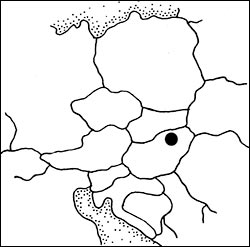
Eger (EH-gehr) is a county-seat town in northern Hungary, with about 60,000 people and a thriving teacher-training college. While you’ve probably never heard of Eger, among Hungarians, the town has various claims to fame. Its powerful bishops have graced it with gorgeous churches. It has some of the best and most beloved spas in this hot-water-crazy country (including some worth-a-detour options in the nearby countryside). And, perhaps most of all, Eger makes Hungarians proud as the town that, against all odds, successfully held off the Ottoman advance into Europe in 1552. This stirring history makes Eger a field trip mecca for Hungarian schoolkids. If the town is known internationally for anything, it’s for the surrounding wine region (its best-known red wine is Bull’s Blood, or Egri Bikavér).
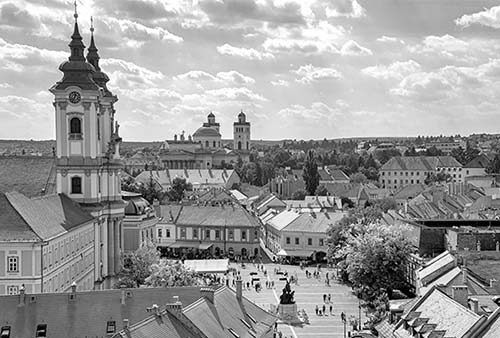
And yet, refreshingly, enchanting Eger remains mostly off the tourist trail. Egerites go about their daily routines amidst lovely Baroque buildings, watched over by one of Hungary’s most important castles. Everything in Eger is painted with vibrant colors, and even the communist apartment blocks seem quaint. The sights are few but fun, the ambience is great, and strolling is a must. It all comes together to make Eger an ideal taste of small-town Hungary.
PLANNING YOUR TIME
Mellow Eger is a fine side trip from Budapest. It’s a doable round-trip in a single day (about two hours by train, car, or bus each way), but it’s much more satisfying and relaxing to spend the night.
Get oriented with my self-guided town walk, including visits to the cathedral and the Lyceum’s fine old library and thrillingly low-tech camera obscura. Have a memorable lunch on the square, then hike up to the castle for views over town. In the late afternoon, unwind at a thermal bath—either in Eger or in the countryside. Round out your day with dinner on the square or a visit to Eger’s touristy wine caves in the Sirens’ Valley.
In July and August (when Hungarians prefer to go to Lake Balaton), Eger is busy with international visitors; in September and October, around the wine harvest, most of the tourists are Hungarians.
Orientation to Eger
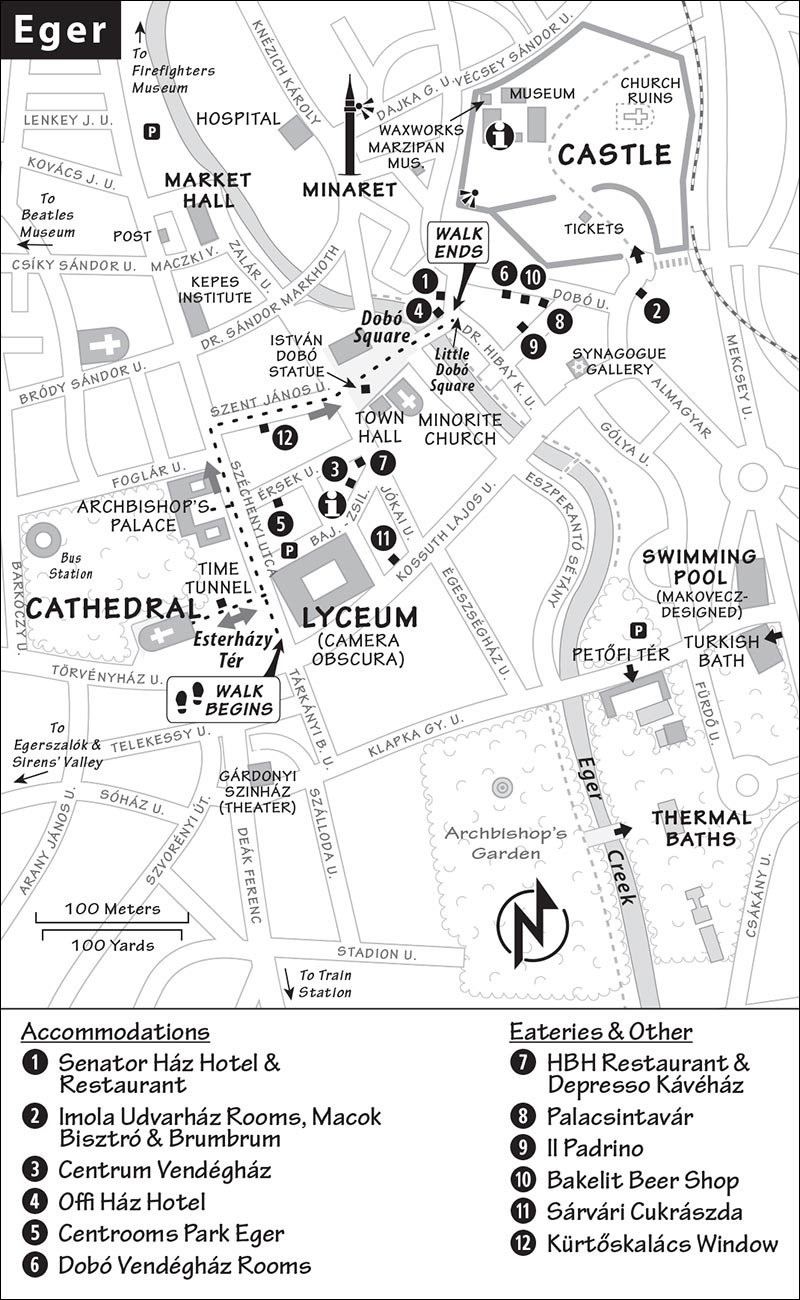
Eger Castle sits at the top of the town, hovering over Dobó Square (Dobó István Tér). Two blocks west of Dobó Square—away from the castle—is the main pedestrian drag, Széchenyi Utca, where you’ll find the Lyceum and the cathedral. A few blocks south from the castle (along the small creek) is Eger’s thermal bath complex.
TOURIST INFORMATION
Staff at Eger’s TI (TourInform) are eager to answer your questions (Mon-Fri 9:00-17:00, Sat until 13:00, closed Sun, Bajcsy-Zsilinszky Utca 9, +36 36 517 715, http://www.visiteger.com).
ARRIVAL IN EGER
By Train: Eger’s tiny train station is less than a mile south of the center. The baggage-deposit desk is along the platform by track 1, between the WCs. Taxis generally wait out front; try to take one marked with a company name and number. It’s about a 15-minute walk to the center: Leave the station straight ahead, walk one block, take the hard right turn with the road, and then continue straight (along busy Deák Ferenc Utca) about 10 minutes until you run into the cathedral. To cut your walk time in half, you could take a bus partway: Buy a ticket at the newsstand inside the station, go a block straight out the front door, and hop on bus #11, #12, or #14; get off when you reach the big yellow cathedral.
By Car: In this small town, most hotels provide parking or help you find a lot. For a short visit, head for the pay parking garage near the market hall (just north of the main square), or park in the pay lot near the thermal bath complex and swimming pool on Petőfi Sándor Tér (a 10-minute walk south of the main square).
GETTING AROUND EGER
Everything of interest in Eger is within walking distance. But a taxi can be helpful to reach outlying sights, including the Sirens’ Valley wine caves and the thermal baths in the countryside (try City Taxi, +36 36 555 555).
HELPFUL HINTS
Blue Monday: Note that the Lyceum’s library and the Kepes Institute are closed on Mondays. But you can still visit the cathedral, swim in the thermal bath, explore the market, tour the castle (museums closed Mon off-season), and enjoy the local wine.
Market: Eger has a humble, old-fashioned Market Hall (Piaccsarnok), which offers a taste of local life. This ramshackle hall is a totally untouristy scene, with rough plastic tubs piled high with an abundance of fresh local produce (opens daily at 6:00; while open weekday afternoons, it’s best in the mornings).
Nightlife: Things quiet down pretty early in this sedate town. Youthful student bars and hangouts cluster along the main “walking street,” Széchenyi Utca (especially Fri and Sat nights). Older travelers may feel more at home on Little Dobó Square, with schmaltzy live music until 21:00 or 22:00 in summer; wine bars nearby may stay open later.
Eger Town Walk
Charming Eger is a delight to stroll. This walk begins near two of the city’s main landmarks—in an area more local than touristy—then heads to its delightful main square before winding up to its castle. It includes pretty much anything you’d want to see in town and takes less than an hour, not including sightseeing stops (at the Lyceum and castle).
• We’ll begin on the parklike square called Eszterházy Tér, at the southern edge of the town center—between the cathedral (with two yellow rectangular towers and a dome) and the Lyceum (with a tall tower capped by an oxidized copper bulb). To get here from the main square, angle up Bajcsy-Zsilinszky Utca, passing a fine Art Nouveau facade and the TI.
Eszterházy Tér
This square is named for Bishop Károly Eszterházy (1725-1799), who helped put Eger on the map during his 40 years in power. Eszterházy had serious clout, which he wielded to transform Eger from a provincial town into a beautiful small city—with lovely architecture that far exceeded its lowly position.
Face the blocky building at the bottom of the square—the Lyceum, or teacher-training college. Eszterházy wanted a university in Eger, but Habsburg empress Maria Theresa refused to allow it. And so, instead, Eszterházy built the most impressive teacher-training college on the planet—and stocked it with the best books and astronomical equipment that money could buy. The Lyceum still trains local teachers (enrollment: about 2,000). Tourists also roam the halls of the Lyceum; they come to visit its classic old library and its astronomy museum (which has a fascinating camera obscura), both tucked away in the big, confusing building. For details, see “Sights in Eger,” later.
Now turn 180 degrees and face the cathedral, up the grand staircase at the opposite end of the square. The palace that sprawls to the right is the residence of the archbishop. And on the right side of the steps is the entrance to the Time Tunnel (Időalagút), a guided tour of the archbishop’s former wine cellar network (4,500 Ft, schedule posted at door; most tours in Hungarian with a smidge of English, but there are occasional English tours; check schedule and book ahead at www.idoalagut.hu, +36 70 414 5004).
Head up the grand staircase. You’ll pass saints István and László—Hungary’s first two Christian kings—and then the apostles Peter and Paul.
• At the top of the stairs, gape up at...
Eger Cathedral
The second-biggest church in Hungary (after Esztergom’s—see here) is worth ▲▲. The cathedral was built in the 1830s by an Austrian archbishop who had previously served in Venice and who thought Eger could use a little more class. The colonnaded Neoclassical facade, painted a pretty Habsburg yellow, boasts some fine Italian sculpture.
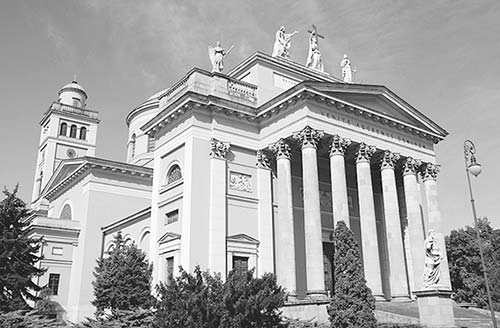
Cost and Hours: 300-Ft donation requested; Mon-Sat 8:30-18:00, Sun 13:00-18:00; Pyrker János Tér 1.
Organ Concerts: The cathedral organ on occasion will boom out a glorious 30-minute concert—most often summer Sundays at 12:45, but likely also at other times in high season (look for posted schedule).
Visiting the Cathedral: As you head inside, look near the back-left corner for the statue of Szent Rita, a local favorite (that’s the 15th-century saint Rita of Cascia, from Italy). The votive plaques that say köszönöm and hálából are offering “thanks” and “gratitude” for prayers answered.
Across from Rita is a statue honoring St. Maksymilian Kolbe (1894-1941), a Polish priest who was executed at Auschwitz; around the corner from him (in the corridor) is another 20th-century martyr, the Hungarian cardinal József Mindszenty (1892-1975), who ran afoul of the communist authorities and lived in the US embassy in Budapest until he escaped to Austria.
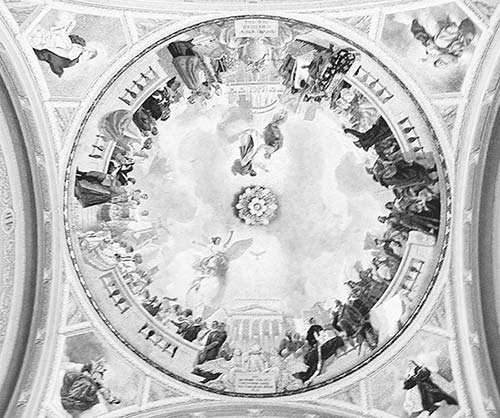
Now walk down the nave, to the first collection box. Then, turning back to face the door, look up at the ornate ceiling fresco: On the left, it shows Hungarians in traditional dress; and on the right, the country’s most important historical figures. At the bottom, you see this cathedral, celestially connected with St. Peter’s in Rome (opposite). This symbol of devotion to the Vatican was a brave statement when it was painted in 1950. The communists were closing churches in other small Hungarian towns, but the Eger archbishop had enough clout to keep this one open.
Continue to the transept, stopping directly underneath the main dome. The stained-glass windows decorating the north and south transepts were donated to the cathedral by a rich Austrian couple to commemorate the 1,000th anniversary of Hungary’s conversion to Christianity—notice the dates: 1000 (when St. István converted the Magyars to Christianity) and 2000.
Turning to leave, notice the enormous organ—Hungary’s second largest—above the door (try to catch an organ concert—see details earlier).
• Head back out of the church and down the stairs. When you reach the Lyceum, turn left and walk down...
Széchenyi Utca
This is Eger’s main walking street, lined with colorful townhouses, cafés, and eateries. You’ll find that the businesses are mostly oriented to locals (especially students), with a few touristy spots mixed in.
One block down the street, on the left, step through the gate into the grand garden courtyard of the Archbishop’s Palace. In the peaceful garden, observe the statue on the left, honoring St. István (see here), and on the right, a statue for St. Erzsébet (Elisabeth), whose smuggled bread for the poor changed to roses when she was caught—notice the roses in her apron. You can pay to enter the palace itself, with fine old halls described by the dryly informative audioguide (2,000 Ft, includes audioguide; open Tue-Sun 10:00-18:00, cheaper and open until 16:00 Oct-March, closed Mon year-round). As you walk through the bishop’s apartments, you’ll see vestments, a model of the cathedral, chalices, rare books, a picture gallery, and a balcony looking down into the bishop’s private chapel. However, it’s pretty dull, and other sights in Eger are more interesting.
Back out on Széchenyi Utca, continue one more block, then turn right down Szent János Utca (at the McDonald’s). Enjoy Eger’s pedestrianized core for one long block—noticing that these streets, too, are populated almost entirely by Egerites, despite being just a few steps off the main square. Near the end of the street, on the right at #10, look for the kürtőskalács window, selling that heavenly scented Hungarian sweet street food.
• You’ll pop out at...
Dobó Square (Dobó István Tér)
Dobó Square—worth ▲▲—is the heart of Eger. Ringed by pretty Baroque buildings and watched over by Eger’s historic castle, this square is one of the most pleasant spots in Hungary.
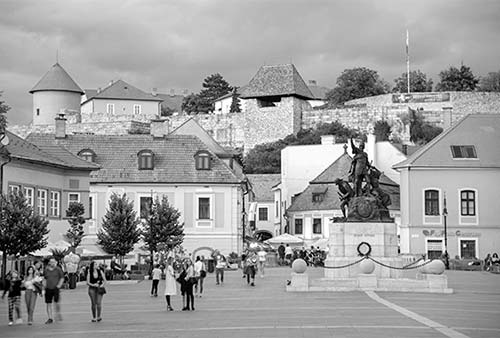
Looking to the left, you’ll spot a huge EGER sign—marking a second, adjoining square along the town creek. If you walk past the sign and keep going just a couple of minutes, you’ll run into the rustic town market (described earlier, under “Helpful Hints”).
Dominating the main square are the twin towers of the exquisitely photogenic Minorite Church—often said to be the most beautiful Baroque church in Hungary. The shabby interior is less interesting but has some appealing details. Go inside (free, daily 9:30-17:30). Notice that each of the hand-carved wooden pews has a different motif. Pay close attention to the side altars that flank the nave: The first set (left and right) are 3-D illustrations, painted to replicate the wood altars that burned in a fire; the next set is real. And looking up at the faded ceiling frescoes, you’ll see (in the second one from the entrance) the church’s patron: St. Anthony of Padua, who’s preaching God’s word to the fishes after the townspeople refused to hear him.
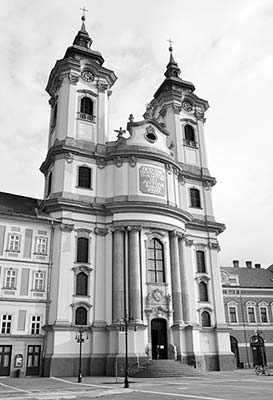
The green, arcaded building to the right of the Minorite Church is the Town Hall, next to an old-fashioned pharmacy.
Walk to the dynamic statue in the middle of the square, which depicts István Dobó (EESHT-vahn DOH-boh). The square’s namesake and Eger’s greatest hero, Dobó defended the city—and all of Hungary—from an Ottoman invasion in 1552 (see his story in the sidebar). Next to Dobó is his co-commander, István Mekcsey. And right at their side is one of the brave women of Eger—depicted here throwing a pot down onto the attackers.
In the 16th century, Ottoman invaders swept into Hungary. They easily defeated a Hungarian army—in just two hours—at the Battle of Mohács in 1526.
When Buda and Pest fell to the Ottomans in 1541, Eger became the last line of defense. István Dobó and his second-in-command, István Mekcsey, were put in charge of Eger’s forces. They prepared the castle for a siege and waited.
On September 11, 1552—after a summer spent conquering more than 30 other Hungarian fortresses on their march northward—40,000 Ottomans arrived in Eger. Only about 2,000 Egerites (soldiers, their wives, and their children) remained to protect their town. The Ottomans expected an easy victory, but the siege dragged on for 39 days. Eger’s soldiers fought valiantly, and the women of Eger also joined the fray, pouring hot tar down on the Ottomans. Gergely Bornemissza, sent to reinforce the people of Eger, startled the Ottomans with all manner of clever and deadly explosives. His “fire wheel”—a barrel of gunpowder studded with smaller jars of explosives—would be lit and rolled downhill to wreak havoc until the final, deadly explosion. Ultimately, the Ottomans left in shame, Eger was saved, and Dobó was a national hero.
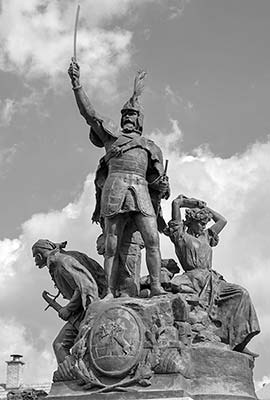
The unfortunate epilogue: The Ottomans came back in 1596 and succeeded in conquering an Eger Castle guarded by unmotivated mercenaries. The Ottomans controlled the region for close to a century.
In 1897, a castle archaeologist named Géza Gárdonyi moved from Budapest to Eger, where tales of the siege captured his imagination. Gárdonyi wrote a book about István Dobó and the 1552 Siege of Eger called Egri Csillagok (“Stars of Eger,” translated into English as Eclipse of the Crescent Moon, available at local bookstores and souvenir stands). The book—a favorite of many Hungarians—is taught in schools, keeping the legend of Eger’s heroes alive today.
Behind the statue of Dobó is a bridge over the stream that bisects the city. Just before you reach that bridge, look to the left and you’ll see the northernmost Ottoman minaret in Europe—once part of a mosque, it’s now a tourist attraction.
At the bridge, pause and look down at little Eger creek below street level. Notice the finely manicured trail that runs along the creek, beckoning to strollers and cyclists. If you follow this creek to the right, in less than 10 minutes you’ll reach Eger’s excellent thermal-bathing complex (described later, under “Experiences in Eger”). Like much of Hungary, this part of Eger sits on deposits of natural thermal water...can you detect a faint whiff of sulfur?
Across the bridge is the charming Little Dobó Square (Kis-Dobó Tér), the most atmospheric place in Eger for an al fresco drink or meal. The wine bar on the square offers tastings, and you’ll find more options just up the street.
• Our brief orientation walk is over. The town’s most prominent sight—the castle—is just overhead, hovering over Little Dobó Square. To reach it, bear right at the top of the square, then turn right on Dobó Utca. Follow this pleasant street—lined with an ever-changing array of gift shops, wine bars and wine shops, eateries, and other tourist-oriented businesses—a few short blocks. Soon you’ll reach a little park (with a lute-playing figure on a bench); the ramp up to the castle is just beyond this, on the left.
Sights in Eger
▲EGER CASTLE (EGRI VÁR)
The great St. István—Hungary’s first Christian king—founded a church on this hill a thousand years ago. The church was destroyed by Tatars in the 13th century, and this fortress was built to repel another attack. Most importantly, this castle is Hungary’s Alamo, where István Dobó defended Eger from the Ottomans in 1552—as depicted in the relief just outside the entry gate. These days, it’s usually crawling with field-tripping schoolchildren from all over the country. (Every Hungarian sixth grader reads Eclipse of the Crescent Moon, which thrillingly recounts the heroic siege of Eger.) For those of us who didn’t grow up hearing the legend of István Dobó, the complex is hard to appreciate, and English information is sparse. Most visitors find that the most rewarding plan is simply to stroll up, wander the grounds, play “king of the castle” along the ramparts, and enjoy the sweeping views over Eger’s rooftops. I’d skip the “casements tour,” which costs extra and is in Hungarian only.
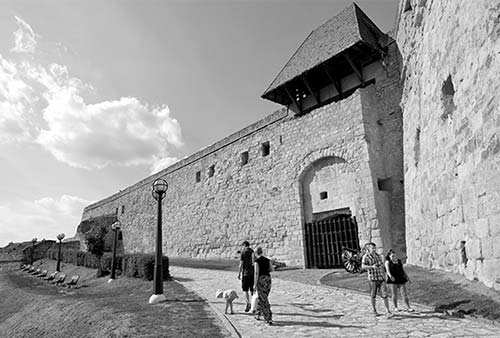
Cost and Hours: 3,600 Ft, 1,500-Ft “walking ticket” gets you into the castle grounds after the museums have closed—a good option; waxworks costs 600 Ft extra; castle grounds open daily 8:00-22:00, Nov-March until 21:00; exhibits open mid-March-Oct daily 10:00-18:00, off-season until 16:00 and closed Mon; +36 36 312 744, www.egrivar.hu. The entrance ramp to the castle is at the end of Dobó István Utca, a short walk from Little Dobó Square.
Visiting the Castle: Buy your ticket at the lower gate, then hike up the entry ramp and through the inner gate into the main courtyard—with grassy fields, souvenir stands, and easy access to the ramparts.
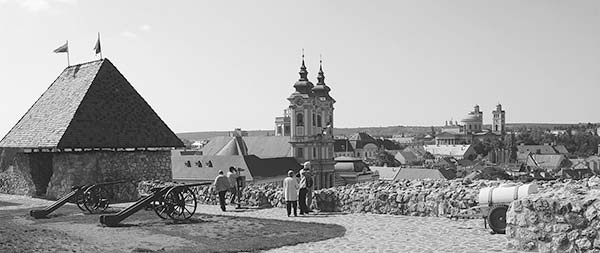
Get your bearings by walking up to the round turret with the tall Hungarian flag, to the left as you enter, and take a visual tour over the rooftops of Eger. (If you’ve completed my Eger Town Walk, this is a fun recap.)
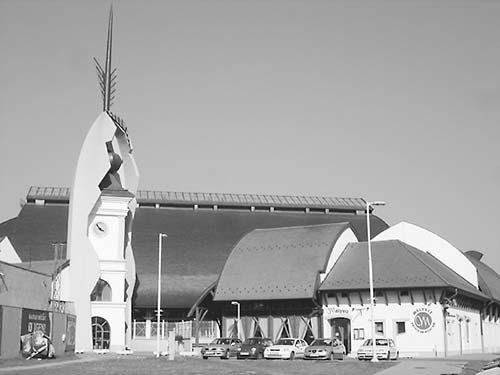
Looking left, spot what looks like a church tower with the feathers of an arrow vertically embedded in the top, next to a big, wooden, bulbous building. This is the Aladár Bitskey Pool, designed by the great Organic architect Imre Makovecz. It anchors Eger’s delightful thermal bath area—well worth considering for a break from sightseeing.
Panning 90 degrees to the right, look down over Eger’s charming main square, with the twin towers of the Minorite Church. Just beyond, see the round dome and two rectangular towers of the cathedral, and the boxy Baroque tower with a copper bulb on top—that’s the Lyceum, with its prized camera obscura. Széchenyi Utca—the main walking street—stretches from these two buildings to the right, to the twin yellow church spires.
Looking farther right, try to spot Eger’s minaret (which may be hidden behind the turret)—the northernmost Ottoman minaret still standing in Europe. And all around you are the wooded Bükk Hills, which hide an important wine-growing region.
Now head into the castle proper. Face straight ahead from where you entered. The round tower on your left usually holds good temporary exhibitions, down deep inside. And off on the right, just inside the wall, you may see an archery exhibit where you can pay to test your skill shooting old-fashioned bows and crossbows.
Now walk straight ahead, through the corridor with the little information window, and emerge into a pink, Gothic-style courtyard. Immediately to your left, notice the entrance to the dungeon. While the “casements” you may see advertised are not worth paying extra for, hiking down into this dungeon—covered by your castle ticket—is a similar experience. The long building on the left, next to the dungeon entrance, has the $$ 1552 Restaurant, serving up big plates of hearty traditional food; upstairs are temporary exhibits.
Straight ahead, upstairs in the building with the Gothic arches, is the castle’s museum (with English descriptions). You’ll see some architectural decorations, swords and suits of armor, and models of the castle through history—including one illustrating the Ottoman siege of Eger. Also inside are some paintings and a screen showing a classic movie that dramatizes the siege, adding to its legend. The most interesting exhibit is a small side room with objects the Ottomans left behind: weapons, everyday items (pots, bowls), a carpet, and some turban-shaped gravestones.
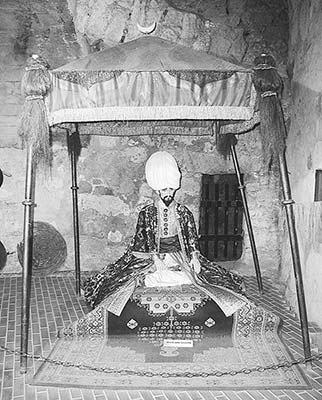
Head through the little gap between the two buildings of the courtyard to find the waxworks, or “Panoptikum.” Run separately from the castle sights, this costs 600 Ft extra. And, while it’s kind of silly, it’s fun for kids or kids at heart. You’ll see a handful of eerily realistic heroes and villains from the siege of Eger (including István Dobó himself, and the leader of the Ottomans sitting in his colorful tent). A visit to the waxworks also lets you scramble through a segment of the tunnels that run inside the castle walls (a plus, since it’s not really worth it to wait around through the similar, Hungarian-language casements tour).
From here, you can explore the grounds, including the remains of a once-grand cathedral, a smaller rotunda dating from the days of St. István (10th or 11th century; at the far-right corner as you enter), and the ruins of some old Turkish baths (not worth the extra ticket price).
SIGHTS IN THE LYCEUM (LÍCEUM)
Eger’s teacher-training college fills a historic old building that—among all the students, classrooms, and professors’ offices—houses two sights worth a look: a glorious Baroque library, with shelves of historic books and a frescoed ceiling; and the “Magic Tower,” with some scientific exhibits and a working camera obscura (Eszterházy Tér 1). While both are inside the same building, they are treated as separate sights.
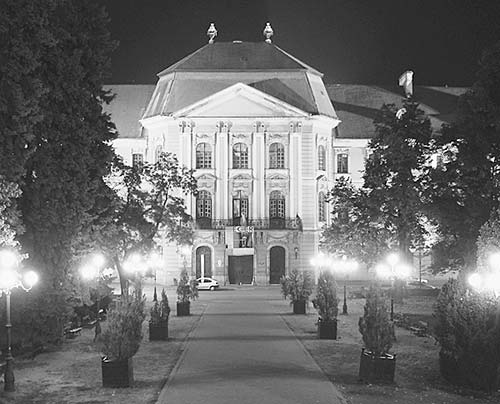
Cost and Hours: Library—1,200 Ft, open Tue-Sat 9:30-15:30, closed Sun-Mon, also generally closed off-season (since there’s no heating); Magic Tower—2,000 Ft, Tue-Sun 10:00-16:00, closed Mon, shorter hours (likely weekend mornings only) off-season; www.varazstorony.hu.
▲▲Baroque Library
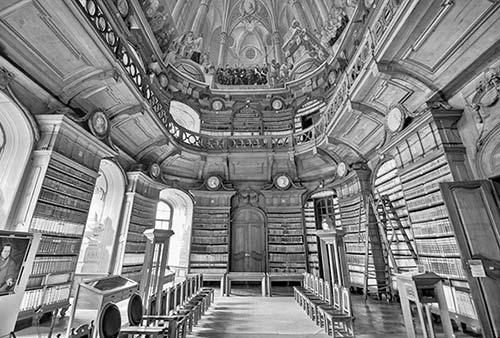
First, visit the Lyceum’s old-fashioned Baroque library one floor up: From the main entry hall, cut through the middle of the courtyard, go up the stairs to the next floor, and look for Room 223, marked Biblioteca Eszterhazyana (it’s on the right side of the complex as you face it from the entrance). This library houses 60,000 books (here and in the two adjoining rooms, with several stacked two deep), all cataloged carefully. This is no easy task, since they’re in over 30 languages—from Thai to Tagalog—and are shelved according to size rather than topic. Only one percent of the books are in Hungarian—but half of them are in Latin. The shelves are adorned with golden seals depicting some of the great minds of science, philosophy, and religion. Marvel at the gorgeous ceiling fresco, dating from 1778. To thank the patron of this museum, say köszönöm to the guy in the second row up, to the right of the podium (above the entry door, second from left, not wearing a hat)—that’s Bishop Károly Eszterházy, who founded the Lyceum and for whom the library is named. A portrait of him often stands on an easel at ground level. And the display cases ringing the room show off treasures from the collection—they are changed every year, to avoid exposing any books to sunlight for too long.
▲Magic Tower (Varázstorony)
Turn right as you leave the library to find the staircase that leads up the misnamed “Magic Tower,” which is really all about science (Varázstorony, follow signs several flights up). First you’ll reach the Astronomical Museum. Some dusty old stargazing instruments occupy one room, as well as a meridian line in the floor (a dot of sunlight dances along this line each day around noon). Across the hall is a fun, interactive magic room, where you can try out scientific experiments—such as using air pressure to make a ball levitate or sending a mini “hot-air balloon” up to the ceiling.
A few more flights up is the Lyceum’s treasured camera obscura—one of just two originals surviving in Europe (the other is in Edinburgh). You’ll enter a dark room and gather around a big, bowl-like canvas, where the guide will fly you around the streets of Eger (presentations about 2/hour, maybe more when busy). Fun as it is today, this camera must have astonished viewers when it was built in 1776—well before anyone had seen “moving pictures.” It’s a bit of a huff to get up here (nine flights of stairs, 302 steps)—but the camera obscura, and the actual view of Eger from the outdoor terrace just outside, are worth it.
Experiences in Eger
AQUA EGER
Swimming and water sports are as important to Egerites as good wine. They’re proud that many of Hungary’s Olympic medalists in aquatic events have come from the surrounding county. The town’s Aladár Bitskey swimming pool—arguably the most striking building in this part of Hungary—is practically a temple to water sports.
Eger also has several appealing thermal bath complexes: one right in town, and two more a few miles away (near the village of Egerszalók). Budapest offers classier bath experiences, but the Eger options are modern, fully accessible, and far less crowded with American tourists—making them, for some travelers, an all-around better experience. Before you go, be sure to read the thermal bath tips on here.
Baths and Pools in Eger
All of these are managed by the same organization (www.egertermal.hu). Bring your swimsuit, a towel, and flip-flops (or buy them at the pool).
Getting There: Eger’s bathing complex is a pleasant walk (less than 10 minutes) from the center of town. From the bridge on Dobó Square, follow the creek four blocks south (look for signs to Strand). When you reach Petőfi Tér, you’re in the aquatic area. The swimming pool is on your left (look for the unique steeple), and the thermal bathing complex is straight ahead; to reach the main entrance, continue straight into the park, then look for the entrance on your left, over a bridge, marked by a big dome. The Turkish bath entrance is around the other side of the complex.
Aladár Bitskey Swimming Pool (Bitskey Aladár Uszoda)
This striking swimming pool was designed by Imre Makovecz, the father of Hungary’s Organic architectural style (see sidebar). The building is worth a peek—and you can swim in it, too.
Cost and Hours: 1,200 Ft, Mon-Fri 6:00-21:00, Sat-Sun 7:30-18:00, Frank Tivadar Utca, +36 36 511 810.
▲Eger Thermal Bath (Eger Termálfürdő)
For a refreshing break from the sightseeing grind, consider a splash at the spa. This is a wonderful opportunity to try a Hungarian bath: fun, accessible, and frequented mostly by locals. Note that there are two adjoining sections: the sprawling indoor/outdoor thermal bath section and the smaller Turkish bath. Each has its own ticket, but it’s possible to move between them. If you’re going to be at the bath complex for less than 2.5 hours, it’s cheaper to enter through the Turkish bath section (see details later).
Cost and Hours: 3,200 Ft, plus 1,800 Ft to add Turkish bath; daily 9:00-19:00, may be open later in summer and have shorter hours off-season, last entry one hour before closing; Petőfi Tér 2, main entrance is through Archbishop’s Garden (Érsekkert), +36 36 510 558.
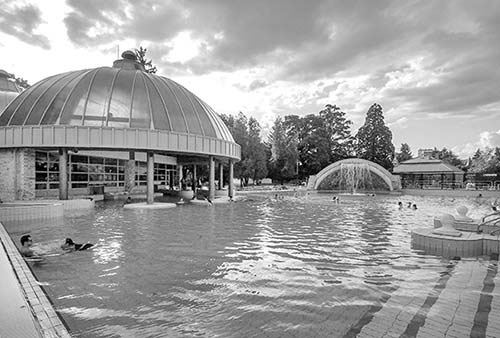
Taking the Waters: Eger’s bath complex uses a similar wristband system to the one in Budapest. After paying, you are issued a wristband that you’ll use to access your locker. The complex is huge, with a wide array of different pools, each one labeled with its depth and temperature. The best part is the double-domed, indoor-outdoor adventure bath, right at the main entrance (a very comfortable 34°C/93°F). Its cascades, jets, bubbles, geysers, and powerful current pool will make you feel like a kid again. The adjoining pool is warmer (36-38°C/97-100°F) and the most popular area to hang out—Egerites sit peacefully, ignore the slight stink, and feel their arthritis ebb away. Sprawling in both directions are additional pools—for kids, for swimming laps, and for hanging out. The waterslides at the right end (with your back to the main dome) are open only in summer, while the Turkish bath is in a smaller domed building at the opposite end, to the left.
▲Turkish Bath (Török Fürdő)
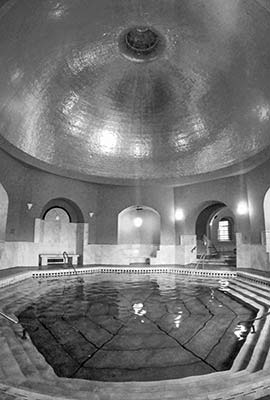
Eger’s beautifully refurbished Turkish-style bath—small but elegant—is tucked in one corner of the thermal bath complex. The underside of the central dome—over a 30°C/86°F pool—glitters with golden tile. Surrounding that are hotter mineral pools (34-36°C/93-97°F), as well as a sauna, steam bath, and aroma bath. This area connects to the thermal bath complex through a turnstile, and uses the same wristband system (Turkish bath entrance is around the left side as you approach the bath complex from the center).
Cost and Hours: The 2,700-Ft Turkish bath ticket is a great deal—it covers you for up to 2.5 hours in both the Turkish bath and the thermal bath area. (If you buy your bath ticket at the main entrance, then want to enter the Turkish bath, you’ll be charged an extra entry fee—a poor value.) The Turkish bath is also open later: daily until 21:00 (Mon-Tue from 16:30, Wed-Thu from 15:00, Fri from 13:00, Sat-Sun from 9:00; +36 36 510 522). If you visit late in the day, a good strategy is to enter and change at the Turkish bath (entrance at Fürdő Utca 3), head over to the thermal complex first, then move back into the Turkish bath when the rest is closed.
Baths near Eger, in Egerszalók
Two more thermal baths—Salt Hill and Demjén Cascade—sit in the countryside outside Eger, flanking a rocky hill between the villages of Egerszalók and Demjén. While these baths lack the old-fashioned class of the Budapest options, they more than compensate with soggy fun. Here’s a fun and very hedonistic afternoon plan: Take the bus or taxi to the spa, taxi back to Eger’s Sirens’ Valley for some wine-cave hopping, then taxi back to your Eger hotel.
Getting There: Both baths are about a mile outside the village of Egerszalók, which is itself about three miles from Eger. Drivers leave Eger to the south, toward Kerecsend/Route 25; at the roundabout on the outskirts of town, turn right toward Egerszalók and Demjén. A few minutes later, watch (on the left) for the easy-to-miss turnoff to Saliris Resort (park along the road)—or, for Demjén Cascade, carry on past this, turn left at the T intersection, and head into Demjén village.
Without a car, you can take a public bus from Eger’s bus station to the baths (take bus going toward Demjén; for Salt Hill, get off at the Egerszalók Gyógyfürdő stop—tell the bus driver “EH-gehr-saw-lohk FEWR-dur”—just after leaving the town of Egerszalók; for Demjén Cascade, get off at the entrance to Demjén village; bus runs 9/day Mon-Sat, fewer on Sun, 20-minute trip). Check the return bus information carefully (especially on weekends, when frequency plummets). Or you can take a taxi from Eger (+36 36 555 555 for a return taxi from Egerszalók).
Nearby Wineries: The village of Egerszalók has several fine wineries, including the excellent St. Andrea—fun to combine with your bath visit (for details, see the “Wineries near the Baths in Egerszalók” section, later).
▲▲Salt Hill Thermal Spa (at the Saliris Resort)
For decades, Egerites would come to this “salt hill” (a natural terraced formation caused by mineral-rich spring water running down the hillside) in the middle of nowhere and cram together to baste in pools of hot water. Today, the gigantic Saliris Resort hotel and spa complex, built near those original formations, offers a world of hot-water fun tucked into a scenic valley. With 12 indoor pools and five outdoor ones—many cleverly overlapping one another on several levels—these baths are worth the trip outside Eger.
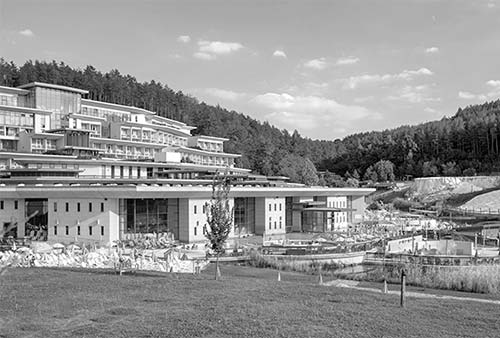
Cost and Hours: 7,200 Ft all day, cheaper for less than 3 hours or if arriving late in the afternoon; 2,750 Ft extra for sauna world; open Sun-Thu 10:00-20:00, Fri-Sat until 21:00, sauna world open daily 11:00-19:30; +36 36 688 500, http://salirisresort.hu/en.
Visiting the Bath: This complex uses the same system as at Eger’s thermal baths: Press your wristband against a computer screen to be assigned a locker, change in the private cabin, and then have fun.
From the locker room, a blue carpet leads you out to the pools. Take some time to explore the sprawling complex. The two main pools—warm (32-34°C/90-93°F) and hot (35-39°C/95-102°F)—extend both inside and outside and cascade over several levels. Outside, down on the lower level, is a vast kiddie pool.
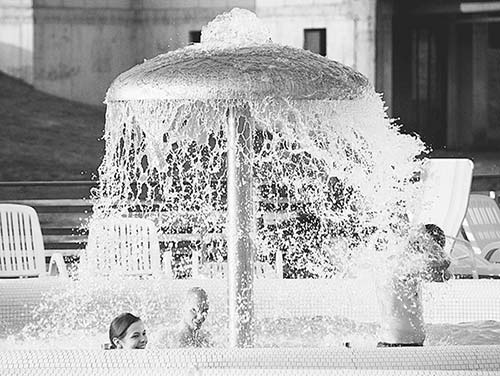
Tucked around the right side of the building (as you face the complex) is the “sauna world,” with five different types of saunas, some quieter soaking pools, and a clothing-optional outdoor area with wood cabin-type huts that contain Finnish and Russian saunas.
▲Demjén Cascade Thermal Spa
Just over the hill from Salt Hill Thermal Spa, Demjén Baths was recently converted into a high-end resort. The original “thermal valley” (termál völgy) part of the complex—pretty but unpretentious, with nicely rustic wooden buildings and pools—is reasonably priced and open long hours, making it popular with locals. Jets, fountains, and other “adventure bath”-type features are rare, and the goal here is simply stewing in pools of warm water. A separate “aquapark” section adds waterslides and a diving pool, for an extra charge. But the big draw for thermal-bathing enthusiasts is the newer “cave bath” (barlangfürdő)—a subterranean complex of pools, channels, waterslides, hidden grottoes, eerie mood lighting, and a sci-fi/fantasy theme. While the Salt Hill spa described earlier is still a more enjoyable all-around experience, those intrigued by the novelty of an underground thermal playland might prefer to check out Demjén.
Hungary’s postcommunist generation has embraced a unique, eye-catching style of architecture, called Organic, which was developed and championed by Imre Makovecz (1935-2011).
In his youth, Makovecz pursued a flowing style that was intentionally at odds with the rigid right angles of communist architecture. He was inspired by the Art Nouveau of a “decadent” golden age and by pioneering architects from other countries (including American Frank Lloyd Wright, who employed a more angular style but a similar aesthetic of fitting his works to their surroundings).
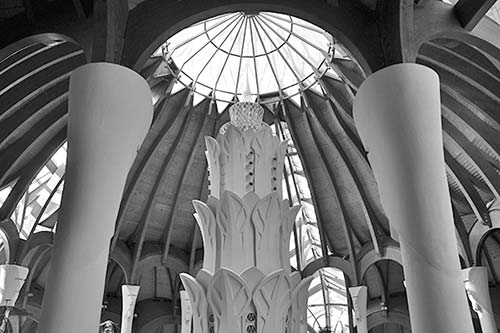
After being blacklisted by the regime for his adherence to his architectural vision—and for his nationalistic politics—Makovecz ramped up his pursuit of something new. Makovecz made do with sticks, rocks, and other foraged building materials. He was also inspired by Transylvanian village architecture: whitewashed walls with large, overhanging mansard roofs (resembling a big mushroom).
After the fall of the regime, Makovecz swiftly became Hungary’s premier architect. He believed that a building should be a product of its environment, rather than a cookie-cutter copy. Organic buildings use indigenous materials (especially wood) and take on unusual forms—often inspired by animals or plants—that blend in with the landscape. These buildings look like they’re rising up out of the ground, rather than plopped down on top of it. Makovecz preferred to work in small communities such as Eger (see photo on here) instead of working for large corporations. Makovecz wanted his creations—from churches, thermal baths, and campgrounds to cultural centers, restaurants, and bus stations—to represent the civic pride of the local community. For more on Makovecz, visit www.makovecz.hu.
Cost and Hours: 8,500 Ft for everything, cheaper for just parts of the complex; Mon-Thu 10:00-21:00, Fri 10:00-22:00, Sat 9:00-22:00, Sun 9:00-21:00; mobile +36 30 853 7419, www.demjencascade.hu.
EGER WINE
Eger is at the heart of one of Hungary’s best-known wine regions, internationally famous for its Bull’s Blood (Egri Bikavér). You’ll likely hear various stories as to how Bull’s Blood got its name during the Ottoman siege of Eger. My favorite version: The Ottomans were amazed at the ferocity displayed by the Egerites and wondered what they were drinking that boiled their blood and stained their beards so red...it must be potent stuff. Local merchants, knowing that the Ottomans were Muslim and couldn’t drink alcohol, told them it was bull’s blood. The merchants made a buck, and the name stuck.
Creative as these stories are, they’re all bunk—the term dates only from 1851. Egri Bikavér is a blend (everyone has their own recipe), so you generally won’t find it at small producers. It begins with a base of kékfránkos grapes, typically blended with cabernet sauvignon, merlot, and kékoportó.
But Bull’s Blood is just the beginning of what the Eger wine region offers. Although Eger is better known for its reds, 42 of the 62 regional varieties are white. (For details, see the the “Hungarian Wines” sidebar on here.)
Tasting Local Wine: While it would be enjoyable to drive around the Hungarian countryside visiting a few wineries (and I’ve recommended one great choice, St. Andrea), the most accessible way to get a quick taste of local wine is at a wine shop in town. Several cluster on Little Dobó Square (Kis-Dobó Tér) and just uphill, along Dobó István Utca. As specific shops tend to come and go, I’d simply stroll this area looking for signs advertising tastings or small glasses of wine, and find a clerk who speaks enough English to help you navigate your choices.
Sirens’ Valley (Szépasszony-völgy)
When the Ottoman invaders first occupied Eger, some residents moved into the valley next door, living in caves dug into the hillside. Eventually the Ottomans were driven out, the Egerites moved back to town, and the caves became wine cellars. (Most Eger families who can afford it have at least a modest vineyard in the countryside.) There are more than 300 such caves in the valley to the southwest of Eger, several of which are open for visitors.
Getting to the Sirens’ Valley: The valley is on the southwest outskirts of Eger—a long walk or an easy and affordable taxi ride.
Visiting the Sirens’ Valley: The best selection of these caves (about 50) is in the Sirens’ Valley (on local directional signs, the “Nice Woman Valley”). While the valley can feel vacant and dead, if you visit when it’s busy it can be a fun scene—locals showing off their latest vintage, with picnic tables and tipsy tourists spilling out into the street. At some places, you’ll be offered free samples; others have a menu for tastes or glasses of wine. While you’re not expected to buy a bottle, it’s a nice gesture if you’ve spent a while at one cave (and it’s usually quite affordable). Some of the caves are fancy and finished, staffed by multilingual waiters in period costume. Others feel like a dank basement, with grandpa leaning on his moped out front and a monolingual granny pouring the wine inside.
This experience is a strange mix of touristy and local, but not entirely accessible to non-Hungarian-speakers—it works best with a bunch of friends and an easygoing, sociable attitude (cellars generally open 10:00-21:00 in summer, best June-Aug in the late afternoon and early evening, plus good-weather weekends in the shoulder season; it’s sleepy and not worth a visit off-season, when only a handful of cellars remain open for shorter hours).
Wineries near the Baths in Egerszalók
The village of Egerszalók, near the Salt Hill and Demjén Cascade thermal baths, has a variety of fun wineries. The most interesting, and well worth a visit for wine lovers, is St. Andrea. This slick, modern, Napa Valley-esque facility offers cellar tours and tastings of their excellent wines, which show up on fine restaurant menus across Hungary. They focus on blends that highlight the unique properties of this region, and produce some good, pungent whites with volcanic qualities. While it may be possible to simply drop in for a tasting, it’s better to call ahead and let them know you’re coming (tastings from 7,000 Ft/person; Mon-Sat 10:00-18:00, closed Sun; Ady Endre Út 88 in Egerszalók, +36 36 474 018, www.standrea.hu, kostolas@standrea.hu). It’s most practical with a car (or by taxi), but you can also walk there from the bus stop in Egerszalók’s town center (about a half-mile; head down Ady Endre Út, toward the baths).
Sleeping in Eger
I’ve focused my listings on quaint, well-located hotels. There’s no real “luxury” in this town—just bigger, tour-oriented places on the outskirts. Elevators are rare—expect to climb one or two flights of stairs to reach your room. Most of these hotels are in pedestrian zones, so get detailed driving and parking instructions from your hotel; many offer free or cheap parking, but it’s often a block or two away. Most hotels quote their rates in euros but prefer to be paid in forints.
$ Senator Ház Hotel is a classic small, family-run hotel. Though the 11 rooms are a bit worn, this place is cozy and well run by András and Csöpi Cseh and their right-hand man, Peter. It feels trapped in a nostalgic time warp, with oodles of character, all the right quirks, and a picture-perfect location just under the castle on Little Dobó Square (RS%, air-con, free parking a block away, Dobó István Tér 11, +36 36 411 711, www.senatorhaz.hu, info@senatorhaz.hu). The Cseh family also runs $ Pátria Vendégház—with two doubles and two luxurious apartments around a courtyard nearby.
$ Imola Udvarház is a “dessert hotel” with 15 rooms and apartments—some with kitchen, living room, bedroom, and bathroom—all decorated in modern Ikea style. They’re roomy and well maintained, with a great location near the castle entrance, and the free on-site parking garage makes this a good choice for drivers (air-con, Tírodi Sebestyén Tér 4, +36 36 516 180, www.imolaudvarhaz.hu, info@imolaudvarhaz.hu).
$ Centrum Vendégház, at the bottom of the main square, has eight simple rooms and apartments around a courtyard. It’s basic but comfortable, with parquet floors and traditional furnishings, and well run by László and Timea. Check in at the little grocery store on the ground floor (breakfast extra, Bajcsy-Zsilinszky 17, mobile +36 30 591 3131, www.cve.hu, info@centrum-vendeghaz-eger.hu).
$ Offi Ház Hotel shares Little Dobó Square with Senator Ház (listed above). Its five rooms are classy and romantic but dated and a bit tight, with slanted ceilings. Communication can be tricky (German helps), but the location is superb (air-con, Dobó István Tér 5, +36 36 518 210, www.offihaz.hu, offihaz@upcmail.hu, Offenbächer family).
$ Centrooms Park Eger, an annex for the larger Hotel Park at the edge of town, is impersonal but indeed central, with 21 spartan but sleepable rooms right in the middle of town (breakfast extra and served at main hotel—better to just eat at a café on the square, air-con, Érsek Utca 4, +36 36 522 255, www.centroomseger.hu, info@centroomseger.hu).
¢ Dobó Vendégház, run by warm Marianna Kleszo, has seven basic but colorful rooms just off Dobó Square. Marianna speaks nothing but Hungarian but gets simple reservation emails translated by a friend (cash only, air-con in some upstairs rooms, free parking, Dobó Utca 19, +36 36 421 407, www.dobovendeghaz.hu, info@dobovendeghaz.hu).
Eating in Eger
$$ Macok Bisztró, near the base of the ramp up to the castle, is every foodie’s choice for the best spot in town—with modern, upscale cuisine and a more sophisticated dining experience. It has a classy interior, inviting tables filling a patio, a mix of Hungarian and international dishes, and an extensive wine list (daily, Tinódi Sebestyén Tér 4, +36 36 516 180, www.imolaudvarhaz.hu).
$ Brumbrum is the cheaper, more casual side-restaurant of Macok. They offer tasty, unpretentious, street-food-inspired plates of Hungarian and international fare, pizza by the slice, a variety of wines, and craft beer, all in an industrial-mod setting with subway tile and raw plywood (Wed-Sat lunch and dinner, Sun until 18:00, closed Mon-Tue, same contact information as above).
$$ HBH Restaurant (named for the Hofbräuhaus beer on tap) offers traditional Hungarian dishes, either in a brick-and-wood dining room or—better—at fine outdoor tables at the bottom of the main square (on weekends, reserve a view table in advance). While the service can be curt, the lengthy, well-described menu and good wine list make this a fine choice for a classic Hungarian meal (daily, at the bottom of Dobó Square at Bajcsy-Zsilinszky Utca 19, +36 36 515 516, www.hbh-eger.hu).
$$ Palacsintavár (“Pancake Castle”), near the ramp leading up to the castle, isn’t your hometown IHOP. They serve up inventive, artfully presented crêpe-wrapped main courses to a mostly student clientele. The spacious interior is decorated with old cigarette boxes, rock music plays on the soundtrack, and the outdoor tables are appealing (closed Mon, Dobó Utca 9, +36 36 413 980, www.palacsintavar.hu).
$$ Restaurant Senator Ház, on Little Dobó Square, offers the best setting for al fresco dining in town, with good Hungarian and international food. Sure, you’re paying a bit extra for the setting—but it’s worth it for the postcard-perfect outdoor seating, from which you can survey the Little Dobó Square action (daily, cheesy live music on summer evenings, same contact information as hotel). Neighboring restaurants (such as Offi Ház) offer the same ambience.
$$ Depresso Kávéház brings a touch of modern hipness to Eger’s stately main square. Despite its downer name, this young, fresh café features a wide variety of coffee drinks, wine, breakfasts, and a short menu of light meals (sandwiches, quiches, etc.). It owns a great location on the square—with fine outdoor tables facing the castle—and also has a bright, open interior (Wed-Sun lunch and dinner, Mon lunch only, closed Tue, Érsek Utca 14, mobile +36 30 886 6742, www.depresso.hu).
$ Il Padrino is a popular place for simple, cheap, tasty pizzas. It’s tucked down a non-touristy street a block over from the main square, with a kitschy interior and breezy outdoor tables (daily, Fazola Henrik Utca 1, mobile +36 20 547 9959, www.padrinopizza.hu).
Wine and Beer: To sample either of these, begin on Little Dobó Square and head up Dobó István Utca. You’ll pass a few wine bars featuring local wines, plus Bakelit, a shop selling a dizzying array of Hungarian and international craft beers (daily, Dobó Utca 17, www.bakelitbeer.com).
Student Eats on Széchenyi Utca: To browse for an affordable, forgettable meal, go for a walk on Eger’s main walking street, which begins at the cathedral. You’ll find a row of lowbrow student eateries serving a variety of pizza, gyros, and burgers, plus lots of bakeries and bars with food. A few tourist-oriented places are mixed in.
Dessert: Cukrászdák (pastry shops) line the streets of Eger. For a more local scene, find the tiny Sárvári Cukrászda, a block behind the Lyceum. Their pastries are good, but Egerites line up here for homemade gelato (daily, Kossuth Utca 1, between Jókai Utca and Fellner Utca). You’ll spot several ice cream parlors in this town, where every other pedestrian seems to be licking a cone. Another good option is the kürtőskalács window on Szent János Utca, where you can step up and grab a piping-hot chimney cake that’s slow-cooked on a rotisserie, then rolled in toppings (daily, Szent János Utca 10).
Eger Connections
BY TRAIN
The only major destination you’ll get to directly from Eger’s train station is Budapest (every 2 hours direct to Budapest’s Keleti/Eastern Station, 2 hours; more frequent and faster with a change in Füzesabony—see below). For other destinations, you’ll connect through Füzesabony or Budapest.
Eger is connected to the nearby junction town of Füzesabony (FEW-zesh-aw-bone) by frequent trains (13/day, 17 minutes). In Füzesabony, you can transfer to Budapest on either a slower milk run train or a speedier InterCity train (a little pricier, as it requires a supplement, but gets you to Budapest in just under 2 hours total).
BY BUS
Eger’s bus station is right in town, a five-minute uphill walk behind Eger’s cathedral and the Archbishop’s Palace: Go behind the cathedral and through the park, and look for the modern, green, circular building. Blue electronic boards in the center of the station show upcoming departures.
From Eger to Budapest: The direct Eger-Budapest bus service runs twice an hour, is about the same price as the train, and can be a bit faster (express bus—1 hour 50 minutes, regular bus—2 hours 10 minutes). While Eger’s bus station is closer to the town center than its train station, this bus takes you to a less central point in Budapest (near Budapest’s Stadionok bus station, on the M2/red Metró line).
To the Thermal Baths near Egerszalók: Buses from the same station also connect Eger to the thermal baths near Egerszalók (Salt Hill and Demjén Cascade; see “Getting There” on here). However, buses marked for Egerszalók do not actually go to the spa; instead, you need a bus going beyond Egerszalók, marked for Demjén.