Sights in Buda
▲Hungarian National Gallery (Magyar Nemzeti Galéria)
Budapest History Museum (Budapesti Történeti Múzeum)
▲▲Matthias Church (Mátyás-Templom)
Fisherman’s Bastion (Halászbástya)
▲Hospital in the Rock and Nuclear Bunker (Sziklakórház és Atombunker)
GELLÉRT HILL (GELLÉRTHEGY) AND NEARBY
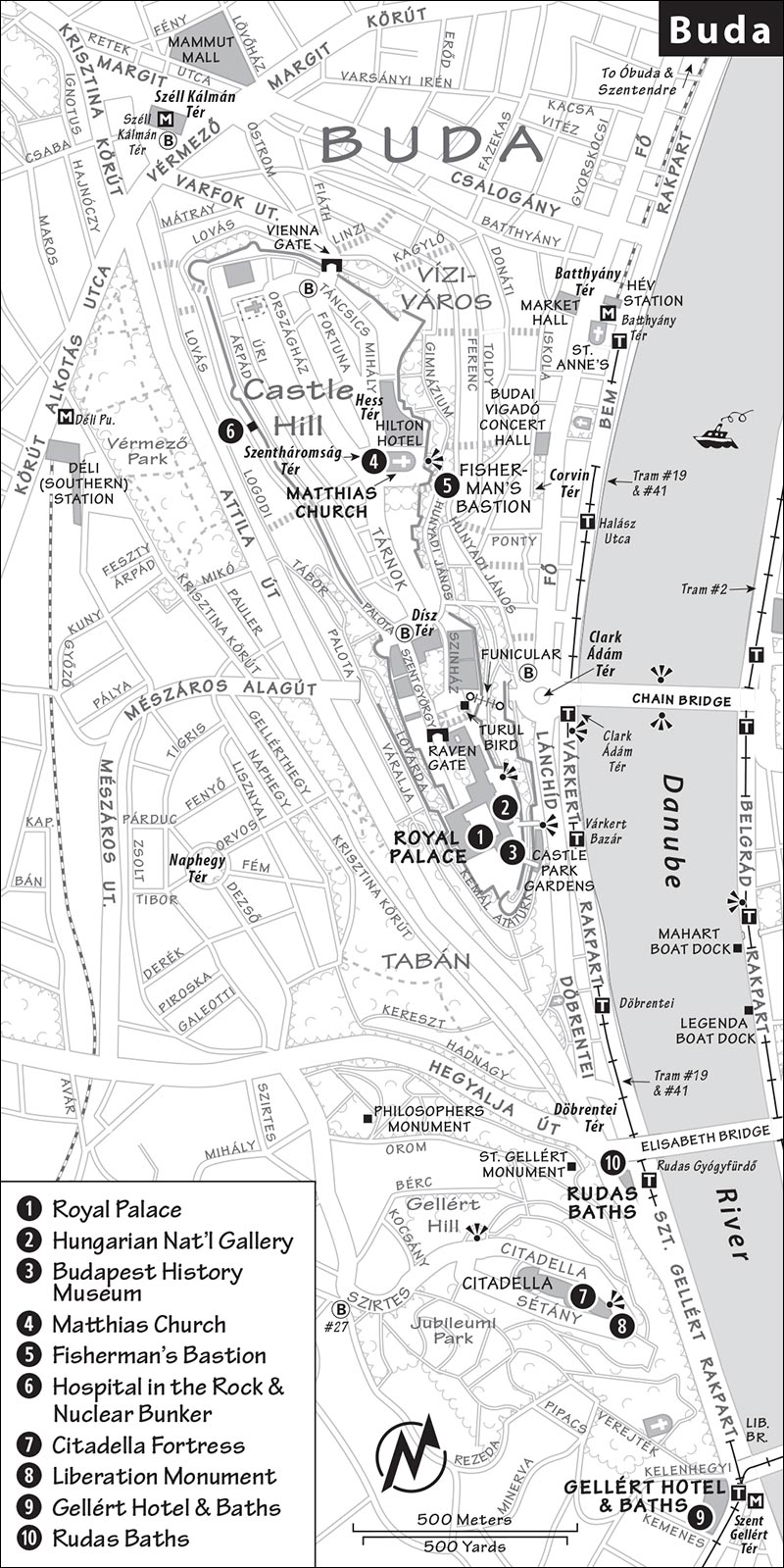
Nearly all of Buda’s top sights are concentrated on or near its two riverside hills: Castle Hill and Gellért Hill.
Two other major attractions—the part of town called Óbuda (“Old Buda”) and Memento Park (filled with communist-era monuments)—are on the Buda side of the river but away from the center. These sights, along with several others, are described under “Day Trips from Budapest,” at the end of the chapter.
CASTLE HILL (VÁRHEGY)
Once the seat of Hungarian royalty, and now the city’s highest-profile tourist zone, Castle Hill is a historic spit of land looming above the Buda bank of the Danube. Scenic from afar, but (frankly) a bit soulless up close, it’s best seen quickly. I’ve listed these sights in order from south to north and linked them together with a self-guided walk. All around the hilltop, “old” buildings from various eras are in the process of being rebuilt from scratch—part of a castle-renewal scheme called the National Hauszmann Program. This controversial initiative of the Fidesz government is an effort to both evoke the glory days of Hungarian history and reclaim this prime real estate for government offices. Expect to see construction—and, very likely, some brand-new, faux-historic buildings not mentioned here.
When to Visit: Castle Hill is jammed with tour groups in the morning, but it’s much less crowded in the afternoon. Since restaurants up here are touristy and a bad value, Castle Hill is an ideal after-lunch activity.
Getting There: The Metró and trams won’t take you to the top of Castle Hill, but you have several other good options. This walk begins at the big Turul bird statue by the monumental gate of the Royal Palace.
On Foot: For a free and scenic approach, you can walk up through the castle gardens called Várkert Bazár (trams #19 and #41 stop right in front). From the monumental gateway facing the Danube embankment, head up the stairs into the park, then look right for the covered escalator. From its top, you can either turn left to hike the rest of the way up (on the switchback path), or you can carry on straight ahead to find an elevator (under a rust-colored canopy) that zips you right up to the view terrace in front of the Royal Palace (floor 2). From here, you can begin the walk at the viewpoint in front of the palace, then see the Turul bird statue and funicular station on your way back across the hill later.
By Bus: From Pest, it’s usually fastest to hop on bus #16 or #216 with stops near the Deák Tér Metró hub (on Harmincad Utca alongside Erzsébet Tér; use exit “E” from the station underpass) and at Széchenyi Tér, at the Pest end of the Chain Bridge. (You can also catch it at Clark Ádám Tér at the Buda end of the Chain Bridge—across the street from the lower funicular station.) Or you can go via Széll Kálmán Tér (on the M2/red Metró line, or by taking tram #4 or #6 around Pest’s Great Boulevard); from here, bus #16, as well as buses #16A and #116, head up to the castle. All of these buses stop at Dísz Tér, at the crest of the hill, about halfway along its length (most people on the bus will be getting off there, too). From Dísz Tér, cross the street and walk five minutes toward the green dome, then bear left toward the ceremonial gate to find the Turul bird statue.
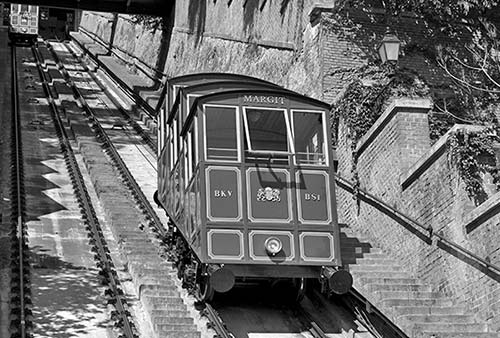
By Funicular: The funicular (sikló, SHEE-kloh) lifts visitors from the Chain Bridge to the top of Castle Hill, but it’s an outrageously overpriced two-minute trip (4,100 Ft, not covered by transit pass, daily 8:00-22:00, departs every 5-10 minutes, closed for maintenance every other Mon). It leaves you right at the Turul bird statue. Unless you enjoy throwing money at nostalgia, I’d skip this and either walk or hop on bus #16 or #216 across the roundabout (described earlier).
By Castle Bus: An oversized golf cart labeled “official Budapest castle bus” runs every 15 minutes from points at the base of the castle (including near the bottom station of the funicular, and in front of the Várkert Bazár) up to essentially the same stops the public bus uses at the top of the castle. While handy, this is a pricey little tourist trip (4,000 Ft round-trip)—worth taking only if you have a Budapest Card, which covers it.
• Begin the walk at the big statue of the...
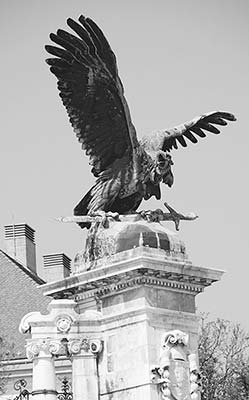
Turul Bird
This mythical bird of Magyar folktales supposedly led the Hungarian migrations from the steppes of Central Asia in the ninth century. He dropped his sword in the Carpathian Basin, indicating that this was to be the permanent home of the Magyar people. While the Hungarians have long since integrated into Europe, the Turul remains a symbol of Magyar pride. During a surge of nationalism in the 1920s, a movement named after this bird helped revive traditional Hungarian culture. And today, the bird is invoked by right-wing nationalist politicians.
If you hear a commotion while enjoying the view, it may be the changing of the guard ceremony that takes place at the Sándor Palace next to the funicular station, at the top of each hour.
• We’ll return this way later. But for now, go through the monumental gateway by the Turul and climb down the stairs, then walk along the broad terrace in front of the...
Royal Palace (Királyi Palota)
The imposing palace on Castle Hill barely hints at the colorful story of this hill since the day the legendary Turul dropped his sword. It was once the top Renaissance palace in Europe...but that was several centuries and several versions ago. In the early 15th century, the Renaissance King Mátyás (Matthias) Corvinus converted a humble medieval palace on this site into one of Europe’s most extravagant residences, putting Buda and Hungary on the map. Just a few decades later, invading Ottomans occupied Buda and turned the palace into a military garrison. When the Habsburgs laid siege to the hill for 77 days in 1686, gunpowder stored in the cellar exploded, destroying the palace. The Habsburgs took the hill, but Buda was deserted and in ruins. The palace was rebuilt, then damaged again during the 1848 Revolution, then repaired again. As World War II drew to a close, Budapest became the front line between the Nazis and the approaching Soviets. The Red Army laid siege to the hill for 100 days. They eventually succeeded in taking Budapest...but the city—and the hill—were devastated.
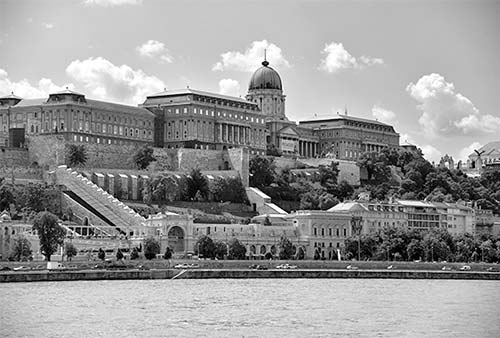
The current palace—a historically inaccurate, post-WWII reconstruction—is a loose rebuilding of previous versions. It’s big but soulless. The most prominent feature of today’s palace—the green dome—didn’t even exist in earlier versions. Fortunately, the palace does house some worthwhile museums (described later), and boasts the fine terrace you’re strolling on, with some of Budapest’s best views.
• Behind the big equestrian statue is the main entrance to the...
▲Hungarian National Gallery (Magyar Nemzeti Galéria)
This museum is the best place in Hungary to appreciate the works of homegrown artists, and to get a peek into the often-morose Hungarian worldview. The collection—which will eventually move to the New National Gallery in City Park—includes a remarkable group of 15th-century, wood-carved altars from Slovakia (then “Upper Hungary”); piles of gloomy canvases dating from the dark days after the failed 1848 Revolution; several works by two great Hungarian Realist painters, Mihály Munkácsy and László Paál; and paintings by the troubled, enigmatic, and recently in-vogue Post-Impressionist Tivadar Csontváry Kosztka. The collection’s highlights can be viewed quickly.
Cost and Hours: 3,800 Ft, Tue-Sun 10:00-18:00, closed Mon, café, in the Royal Palace—enter from terrace by Eugene of Savoy statue, district I, +36 20 439 7325, www.mng.hu.
• Head back outside and face the palace. Go through the passage to the right of the National Gallery entrance (next to the café). You’ll emerge into a courtyard decorated with a gorgeous fountain dedicated to King Matthias Corvinus (see the sidebar). Go around the right side of the fountain and through the passage, into the palace courtyard. At the far end of this too-big space is the entrance to the...
Budapest History Museum (Budapesti Történeti Múzeum)
This earnest collection strains to bring the history of this city to life. It’s a deep dive: If Budapest really intrigues you, this is a fine place to explore its history. Otherwise, skip it. The dimly lit fragments of 14th-century sculptures, depicting early Magyars, allow you to see how Asian those original Hungarians truly looked. The “Light and Shadow” exhibit deliberately but effectively traces the union between Buda and Pest. Rounding out the collection are exhibits on prehistoric residents and a sprawling cellar that unveils fragments from the oh-so-many buildings that have perched on this hill over the centuries. You can pay extra for a glimpse at St. Stephen’s Hall, a (small) reconstructed royal room.
The Árpád dynasty—descendants of the original Magyar tribes—died out in 1301. For more than 600 years, Hungary would be ruled by elected foreign rulers...with one exception.
In the mid-15th century, the Hungarian military general János Hunyadi enjoyed great success on the battlefield against the Ottomans (including a pivotal victory in 1456’s Battle of Belgrade). Meanwhile, Hungary’s imported kings kept dying unexpectedly. Finally, the Hungarian nobility took a chance on a Hungarian-born ruler and offered the throne to Hunyadi’s son, Mátyás (or Matthias in English). According to legend, they sent a raven with a ring in its mouth to notify Matthias, who was away in Prague. He returned to Buda, and took the raven both as his symbol and as his royal nickname: Corvinus (Latin for “raven”).
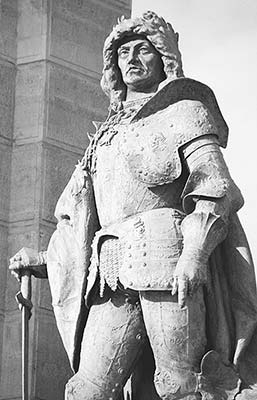
Matthias Corvinus (r. 1458-1490) became the first Hungarian-descended king in more than 150 years. Progressive and well educated in the Humanist tradition, Matthias Corvinus was the quintessential Renaissance king. A lover of the Italian Renaissance, he patronized the arts and built palaces legendary for their beauty. As a benefactor of the poor, he dressed as a commoner and ventured into the streets to see firsthand how the nobles of his realm treated his people.
A strong, savvy leader, Matthias created Central Europe’s first standing army—30,000 mercenaries known as the Black Army. No longer reliant on the nobility for military support, Good King Matthias was able to drain power from the nobles—earning him the nickname the “people’s king.”
Matthias was also a shrewd military tactician. Realizing that skirmishing with the Ottomans would squander his resources, he made peace with the sultan to stabilize Hungary’s southern border. Then he swept north, invading Moravia, Bohemia, and even Austria. By 1485, Matthias moved into his new palace in Vienna, and Hungary was enjoying a golden age.
But just five years later, Matthias died mysteriously at the age of 47, and his empire disintegrated. Before long the Ottomans flooded back into Hungary, and the country entered a dark period. It is said that when Matthias died, justice died with him. To this day, Hungarians rank him the greatest of all kings, and they sing of his siege of Vienna in their national anthem. They’re proud that for a few decades they had a truly Hungarian king—and a great one at that.
Cost and Hours: Main exhibit—2,400 Ft; St. Stephen’s Hall—3,500 Ft; ticket covering both—4,500 Ft; both open Tue-Sun 10:00-18:00, Nov-Feb until 16:00, closed Mon year-round; district I, +36 1 487 8800, www.btm.hu.
• From the palace courtyard, it’s time to...
Walk to Matthias Church
Leaving the palace courtyard, walk straight up the slight incline with the rebuilt Hungarian Royal Guard building on your left. You’ll pass under a gate with a raven holding a ring in its mouth—a symbol of King Matthias.
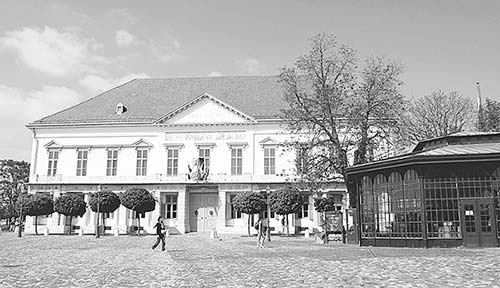
Just beyond the gate, you may see a construction zone (or some recently completed faux-historic buildings) on your left. This is one of many areas where historical buildings are being rebuilt, decades after being destroyed by WWII bombs, as part of the National Hauszmann Program.
Turn your attention to the buildings across the field on your right. The big white building near the funicular station is the Sándor Palace, the Hungarian president’s office (with the hourly changing of the guard out front). The yellow building on its left is the former Court Theater (Várszínház), which has seen many great performances over the centuries—including a visit from Beethoven in 1800. Several years ago, Prime Minister Viktor Orbán apparently grew jealous of the president’s swanky digs, kicked out the dancers, and moved his office from the Parliament to here.
Soon you reach a cross street, at a place called Dísz Tér (Parade Square), with convenient bus stops for connecting to other parts of Budapest. Cross the street and carry on straight, gently uphill, on Tárnok Utca, bearing right at the park. After being destroyed by Ottomans, streets like this one were rebuilt in sensible Baroque, lacking the romantic time-capsule charm of a medieval old town.
As you continue along, ponder the fact that miles of caves were burrowed under Castle Hill—carved out by water, expanded by the Ottomans, and used by locals during the siege of Buda at the end of World War II. You can tour one nearby (the Hospital in the Rock, described later).
On the left, the Prima grocery store sells reasonably priced cold drinks and picnic fixings. A good spot for dessert is just up the little lane in front of the grocery store, under the passage called Balta Köz: Rétesbár, selling strudel (rétes) with various fillings.
Just beyond the grocery store, a warty plague column from 1713 marks Szentháromság Tér (Holy Trinity Square), the main square of old Buda.
• Dominating the square is...
▲▲Matthias Church (Mátyás-Templom)
Arguably Budapest’s finest church inside and out, this historic house of worship—with a frilly Neo-Gothic spire and gilded Hungarian historical motifs slathered on every interior wall—is Castle Hill’s best sight. From the humble Loreto Chapel (with a tranquil statue of the Virgin that helped defeat the Ottomans), to altars devoted to top Hungarian kings, to a replica of the crown of Hungary, every inch of the church oozes history.
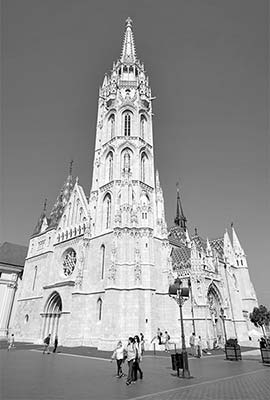
Cost and Hours: 2,500 Ft; Mon-Sat 9:00-17:00 (may close Sat afternoons in summer for weddings), Sun from 13:00; Szentháromság Tér 2, district I, +36 1 488 7716, www.matyas-templom.hu.
Background: Budapest’s best church has been destroyed and rebuilt several times in the 800 years since it was founded by King Béla IV. Today’s version—renovated at great expense in the late 19th century and restored after World War II—is an ornately decorated lesson in Hungarian history. The church’s unofficial namesake isn’t a saint, so it can’t be formally named for him. Its official name is the Church of Our Lady or the Coronation Church, but everyone calls it Matthias Church, for Matthias Corvinus, the popular Renaissance king who got married here—twice.
Visiting the Church: Examine the exterior. While the nucleus of the church is Gothic, most of what you see outside—including the frilly, flamboyant steeple—was added for the 1896 millennial celebrations. At the top of the stone corner tower facing the river, notice the raven—the ever-present symbol of King Matthias Corvinus.
Buy your ticket across the square from the church’s side door, at the ticket windows embedded in the wall. Then enter the church. There are good English descriptions posted throughout.
The sumptuous interior is wallpapered with gilded pages from a Hungarian history textbook. Different eras are represented by symbolic motifs. For example, check out the back wall next to the stairs by the side entrance: This giant coat of arms of beloved King Matthias Corvinus represents the Renaissance.
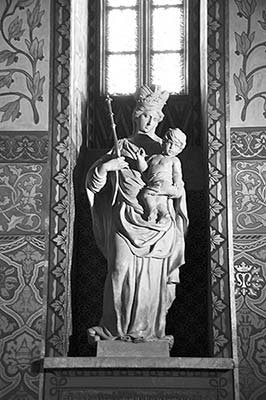
Work your way clockwise around the church. The first chapel (in the back corner, to the left as you face the closed main doors)—the Loreto Chapel—holds the church’s prize possession: a 1515 statue of Mary and Jesus. Anticipating Ottoman plundering, locals walled over its niche. The occupying Ottomans used the church as their primary mosque—oblivious to the precious statue hidden behind the plaster. Then, a century and a half later, during the siege of Buda in 1686, gunpowder stored in the castle up the street detonated, and the wall crumbled. Mary’s triumphant face showed through, terrifying the Ottomans. Supposedly this was the only part of town taken from the Ottomans without a fight.
Facing the doors, look about four paces to the right. At the top of the stout pillar, a carved capital shows two men gesturing excitedly at a book. Dating from 1260, these carvings are some of the earliest surviving features in this church, which has changed much over the centuries.
As you look down the nave, notice the banners. They’ve hung here since the Mass that celebrated Habsburg monarch Franz Josef’s coronation at this church on June 8, 1867. In a sly political compromise to curry favor in the Hungarian part of his territory, Franz Josef was “emperor” (Kaiser) of Austria, but only “king” (König) of Hungary. (If you see the old German phrase “K+K”—still used today as a boast of royal quality—it refers to this “König und Kaiser” arrangement.) So, after F. J. was crowned emperor in Vienna, he came down the Danube and said to the Hungarians, “King me.”
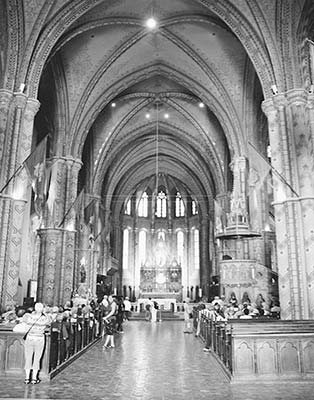
Now stand at the modern altar in the middle of the church, and look down the nave to the main altar. Mary floats above it all, and hovering over her is a full-scale replica of the Hungarian crown, which was blessed by Pope John Paul II. More than a millennium after István, Mary still officially wears this nation’s crown.
Left of the altar is the László Chapel, venerating a great Christian knight who fought pagans in the 11th century.
Climb the circular staircase (in the front-left corner) up to the gallery. Walk along the royal oratory to a small mezzanine that overlooks the altar area—giving you a better look at the altar’s details. Then head back along the gallery. In the room with a small organ is a statue of Sisi—Empress Elisabeth—who practically has a cult following among Hungarians. From here, huff up even more steps to a few more modest exhibits and great views down over the nave.
Back down at ground level, you exit the church under a replica of a fine Gothic tympanum. The weathered original is on display below, offering an unusual close-up look. The carved scene celebrates the centrality of the book in spreading the word of God.
• Back outside, at the end of the square next to Matthias Church, is the...
Fisherman’s Bastion (Halászbástya)
Seven pointy domes and a double-decker rampart run along the cliff in front of Matthias Church. Evoking the original seven Magyar tribes, and built for the millennial celebration of their arrival, the Fisherman’s Bastion is one of Budapest’s top landmarks. While some suckers pay for the views from here, you can enjoy virtually the same view through the windows next to the bastion café for free.
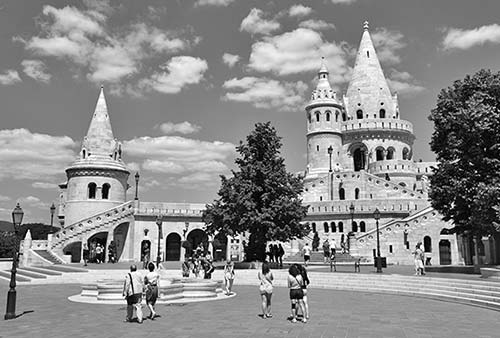
Cost and Hours: 1,200 Ft, buy ticket at ticket office along the park wall across the square from Matthias Church, daily 9:00-20:00; after closing time and off-season, no tickets are sold, but bastion is open and free to enter; Szentháromság Tér 5, district I.
• Between the bastion and the church stands a...
Statue of St. István
Hungary’s first Christian king tamed the nomadic, pagan Magyars and established strict laws and the concept of private property. In the late 900s, Géza, Grand Prince of the Hungarians, lost a major battle against the forces of Christian Europe—and realized that he must raise his son Vajk (c. 967-1038) as a Catholic and convert his people, or they would be forcefully driven out of Europe. Vajk took the Christian name István (EESHT-vahn, “Stephen”) and was baptized in the year 1000. The reliefs on this statue show the commissioners of the pope crowning St. István, bringing Hungary into the fold of Christendom. This pragmatic move put Hungary on the map as a fully European kingdom, forging alliances that would endure for centuries. Without this pivotal event, Hungarians believe that the Magyar nation would have been lost.
• Head down the charming little street (called Szentháromság Utca) that leads away from Matthias Church. Halfway down this street on the right, look for the venerable, recommended Ruszwurm café—the oldest in Budapest. Then continue out to the terrace and appreciate views of the Buda Hills—the “Beverly Hills” of Budapest, draped with orchards, vineyards, and the homes of the wealthiest Budapesters.
If you go down the stairs or elevator here, then turn right up the street, you’ll reach the entrance of the...
▲Hospital in the Rock and Nuclear Bunker (Sziklakórház és Atombunker)
Sprawling beneath Castle Hill is a 25,000-square-foot labyrinthine network of hospital and fallout-shelter corridors built during the mid-20th century. This lively and engaging tour balances out an otherwise sedate Castle Hill visit. While pricey, a visit here is a must for healthcare workers and WWII buffs.
Cost and Hours: 8,000 Ft for required one-hour tour, daily 10:00-19:00, English tours generally run at the top of each hour, last tour departs at 18:00, gift shop like an army-surplus store, Lovas Utca 4C, district I, +36 70 701 0101, www.sziklakorhaz.eu.
Visiting the Hospital and Bunker: First you’ll watch a 10-minute movie (with English subtitles) about the history of the place. Then, your guide leads you through the tunnels to see perfectly preserved WWII and 1960s-era medical supplies and equipment, most still in working order. More than 200 wax figures engagingly bring the various hospital rooms to life: giant sick ward, operating room, and so on. On your way to the fallout shelter, you’ll pass the decontamination showers, and see primitive radiation detectors and communist propaganda showing comrades how to save themselves in case of capitalist bombs or gas attacks. In the bunker, you’ll also tour the mechanical rooms that provided water and ventilation to this sprawling underground city, and you’ll learn about the atom bomb explosions in Hiroshima and Nagasaki.
• Our Castle Hill walk is finished. If you’re ready to head back down to the river (and the Víziváros neighborhood), you can exit down the big staircase below the Fisherman’s Bastion.
From the northern end of the hill, you can head out through the Vienna Gate and follow the road downhill to bustling Széll Kálmán Tér and its handy Metró stop (M2/red line).
GELLÉRT HILL (GELLÉRTHEGY) AND NEARBY
Gellért Hill rises from the Danube just downriver from the castle. When King István converted Hungary to Christianity in the year 1000, he brought in Bishop Gellért, a monk from Venice, to tutor his son. But some rebellious Magyars put the bishop in a barrel, drove long nails in from the outside, and rolled him down this hill...tenderizing him to death. Gellért became the patron saint of Budapest and gave his name to the hill that killed him. Today, the hill is a fine place to commune with nature on a hike or jog, followed by a restorative splash in either the elegant Gellért Baths (in the Gellért Hotel) or the Turkish-style Rudas Baths (both worth ▲▲ and described later, under “Experiences in Budapest”).
Citadella
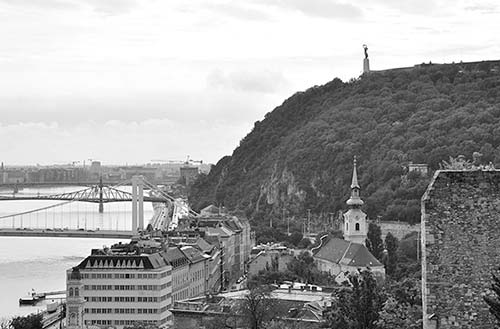
This strategic, hill-capping fortress was built by the Habsburgs after the 1848 Revolution to keep an eye on their Hungarian subjects. Like so many things in Budapest, it was badly damaged in World War II and never properly restored until now. The Fidesz party is rebuilding it top to bottom as a symbol of Hungarian might. Sometime in 2024 (perhaps later), it’s expected to reopen with a view platform and a museum about Hungary’s fight for freedom across the centuries, against various foreign oppressors. Before making the trip up here, check locally to make sure it’s open.
The hill is crowned by the Liberation Monument, featuring a woman holding aloft a palm branch. Locals call it “the lady with the big fish” or “the great bottle opener.” A heroic Soviet soldier, who once inspired the workers with a huge red star from the base of the monument, is now in Memento Park (see Memento Park listing, later, under “Day Trips from Budapest”).
Getting There: It’s a steep hike up from the river to the Citadella. Bus #27 cuts some time off the trip, taking you up to the Búsuló Juhász stop (from which it’s still an uphill hike to the fortress). You can catch bus #27 from either side of Gellért Hill.
▲▲Gellért Baths
Located at the famous and once-exclusive Gellért Hotel, right at the Buda end of the Liberty Bridge, this elegant bath complex has long been the city’s top choice for a swanky, hedonistic soak. It’s also awash in tourists, and the Széchenyi Baths beat it out for pure fun...but the Gellért Baths’ mysterious thermal spa rooms and giddy outdoor wave pool make it an enticing option. Note that the attached hotel is scheduled for a major renovation; they hope to keep the baths open, but confirm before visiting (for details on visiting the baths, see “Experiences in Budapest,” in the next section).
▲▲Rudas Baths
Along the Danube toward Castle Hill from Gellért Baths, Rudas (ROO-dawsh) offers Budapest’s most old-fashioned, Turkish-style bathing experience. The historic main pool of the thermal bath section sits under a 500-year-old Ottoman dome. On weekdays, it’s a nude, gender-segregated experience, while on weekends, it becomes more accessible (and mixed). Rudas also has a ho-hum swimming pool, and a state-of-the-art “wellness” section, with a variety of modern massage pools, a “sauna world,” and an inviting hot tub/sun deck on the roof with a stunning Budapest panorama (for details, see “Experiences in Budapest,” next).
Experiences in Budapest
THERMAL BATHS (FÜRDŐ)
Relaxing in Budapest’s thermal baths is the city’s top attraction. Bathing with the Magyars is far less daunting than it might sound. Hungary’s thermal baths are like your local swimming pool—except the water is 100 degrees, there are jets and bubbles to massage away your stress, and you’re surrounded by ornate architecture and by potbellied Hungarians. (And yes, you can wear your swimsuit.)
All this fun goes way back. The Carpathian Basin—which makes up most of Hungary—is a thin crust covering a vast reservoir of hot water. Budapest alone has 123 natural springs and some two dozen thermal baths.
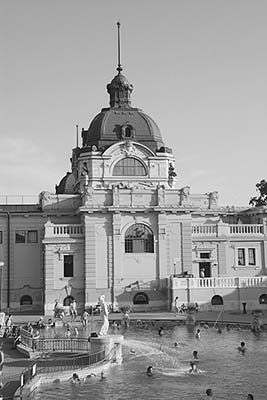
Those steamy springs have shaped Hungary’s history and culture. The Romans took advantage of those waters to build baths. Centuries later, the occupying Ottomans revived the custom. And today, thermal baths are still a fixture of Hungarian life.
The baths are administered and subsidized for patients as a part of the national health-care system. Doctors prescribe treatments that include massage, soaking in baths of various heat and mineral compositions, and swimming laps.
But increasingly, Hungary is playing up the fun side of their hot water. Adventure water parks are springing up all over the country, and many staid old baths have been updated to add “wellness centers” with jets, waterfalls, and currents. Some stately spas are even open late at night, transformed with thumping music and flashing lights.
Where else can you spend a couple of hours soaking in a hot bath and chalk it up to a culturally broadening experience? Overcome your jitters and dive in.
Baths Orientation
Some tourists may feel trepidation at the thought of bathing alongside locals. Relax! If you go into it with an easygoing attitude, I promise you’ll have a blast. The system has been modernized, and most bath attendants speak enough English to help you find your way.
Cost and Hours Warning: Baths are forever tinkering with their opening hours. Any cost and hours information in this book could change by the time you visit, so confirm the details before planning your trip to the baths (see www.spasbudapest.com).
Dress Code: While Budapest has some mostly nude, gender-segregated Turkish baths, the ones I describe here are less intimidating: You’re expected to wear a swimsuit the entire time, even in rare cases (such as certain days at Rudas) when parts of the baths are all-male or all-female.
You’re officially required to wear flip-flops (“slippers”), though this rule is unevenly enforced. Regardless, it’s a good idea for both sanitary and safety reasons. If you don’t have any, you can buy them at the baths (see later).
What to Bring: If you have them, bring a swimsuit, towel, flip-flops, bottle of water, soap and shampoo, comb or brush, swim cap if you want to do laps, plastic bag for your wet swimsuit, and maybe sunscreen and leisure reading. Hotels sometimes frown on guests taking their room towels to the baths; try asking nicely if they offer loaner towels for this purpose. A swim cap is required in lap pools; you can buy a flimsy one there, or try to grab a shower cap from your hotel.
Buying Towels, Flip-Flops, and Swimsuits at the Baths: If you didn’t bring along one of these items, you’ll need to buy it at the baths. Some baths have an expensive “spa shop” in the lobby, but you may be able to buy what you need once inside for less (ask when you buy your ticket). Figure about 6,000 Ft for a towel or a swimsuit, 4,000 Ft for flip-flops, and 2,000 Ft for a swim cap.
Entry Procedure: Credit cards are accepted. Don’t bother with “prepaid” bath tickets advertised around town.
All of Budapest’s baths use the same easy system: When you pay, you’ll be given a waterproof wristband that you’ll need to keep on. Touch it to the panel on the turnstile to enter, then again to be assigned a changing cabin, then again to unlock your cabin. At most baths (except Rudas), the door of your cabin should lock automatically when you close it. If you paid for a locker, choose any empty one and touch it with your wristband to lock it; from then on, it can only be locked and unlocked with the same wristband. If you forget the number of your cabin or locker, just touch your wristband to the panel, and it’ll remind you.
Lockers and Cabins: The main choice when buying your ticket is locker or cabin. The (default) locker price is slightly cheaper and gives you access to a gender-segregated, gymnasium-type locker room (which often has communal cabins where modest bathers can change). A cabin is all yours, offering more privacy for changing and a lockable door. I’ve found both cabins and lockers to be safe, but storing valuables here is at your own risk (if you’re nervous, you can pay to rent a safe).
Main Pools: Each bath complex has multiple pools. Big pools with cooler water are for serious swimming, while the smaller, hotter thermal baths (gyógyfürdő, or simply gőz) are for relaxing, enjoying the jets and current pools, and playing chess. The water bubbles up from hot springs at 77° Celsius (170° Fahrenheit), then is mixed with cooler water to achieve the desired temperatures. Most pools are marked with the water temperature in Celsius (cooler pools are about 30°C/86°F, warmer pools are closer to 36°C/97°F or 38°C/100°F, and the hottest are 42°C/108°F). Locals hit the cooler pools first, then work their way up to the top temps.
Other Bath Features: Most thermal baths also have a dry sauna, a wet steam room, a cold plunge pool, and sunbathing areas. Some baths have fun flourishes: bubbles, whirlpools, massage jets, waterfalls, wave pools, and so on. Be aware that the various water features sometimes take turns running. If a particularly fun feature of the pool doesn’t seem to be working, just give it a few minutes.
Kids: At many baths, children under 14 are not allowed in the indoor thermal pools. At baths with lots of fun outdoor options (like Széchenyi), kids can still have a fun time, but at Gellért in the winter, when the wave pool is closed, most of the complex is essentially off-limits to kids. If traveling with children, carefully check the latest policies on the bath’s website.
Massages: Don’t expect a relaxing, pampering experience. The list of options can be confusing. Generally speaking, these are organized into two categories: “classical” (the basic, medical-grade rubdown—figure 10,000 Ft/20 minutes, 15,000 Ft/45 minutes) and “premium” or “VIP” (longer and more pampering—20,000 Ft/1 hour).
Other helpful terms: A “relax massage” or “aroma massage” is a restful rubdown, typically using oil. A “refreshing massage” is similar but may involve more pressure and/or last longer. A “scrub massage” or “skin-firming massage” is intended to exfoliate your skin and involves some very hard scrubbing. On busy days (especially Mon, Fri, and Sat), you may have to wait an hour or two; at other times, you may be able to get your massage immediately.
The Baths
Of Budapest’s two-dozen thermal baths, the three listed here are the best known, most representative, and most convenient for first-timers. If you’re trying to choose, consider this: The Széchenyi Baths are big, fun, and beautiful—the classic Budapest bathing experience. Széchenyi can also be crowded, a little chaotic, and therefore less relaxing. And because of its size, it’s more challenging to navigate. The Gellért Baths feel a bit more upscale and genteel, attracting a more sedate, older clientele. The indoor baths here are among Budapest’s most beautiful, but the outdoor areas are less inviting and fun than Széchenyi. In general, there’s less to “do” at Gellért (especially off-season), but it’s very relaxing. The Rudas Baths are two baths in one: a historic, 500-year-old, Turkish-bath-like thermal section that feels ancient and extremely atmospheric; and a completely modern, almost clinical-feeling “wellness” section. It’s also (relatively) less crowded with tourists than the first two. For more information on all of Budapest’s baths, see www.spasbudapest.com.
Széchenyi Baths (Széchenyi Fürdő)
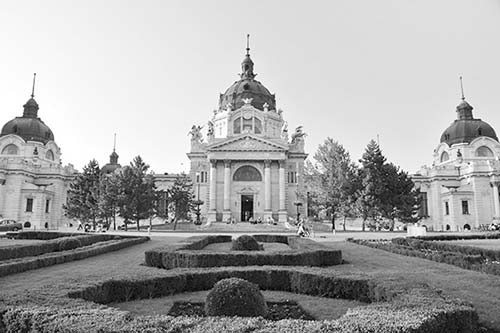
The big, yellow, copper-domed building in the middle of City Park, Széchenyi (SAY-chayn-yee) is easily worth ▲▲▲. Although it’s increasingly popular with tourists, you’ll still see a fair number of Hungarians here. Magyars of all shapes and sizes stuff themselves into tiny swimsuits and strut their stuff. Bankers and homemakers float blissfully in the warm water. Intellectuals and roly-poly elder statesmen stand in chest-high water around chessboards and ponder their next moves. This is Budapest at its best.
Cost: 9,400 Ft for ticket and locker (in gender-segregated locker room), 1,000 Ft more for personal changing cabin, cheaper if you arrive two hours before closing, 1,500 Ft more on weekends (Fri-Sun). Regardless of which entrance or ticket you use, the price includes both the outdoor swimming pool area and the indoor thermal bath and sauna.
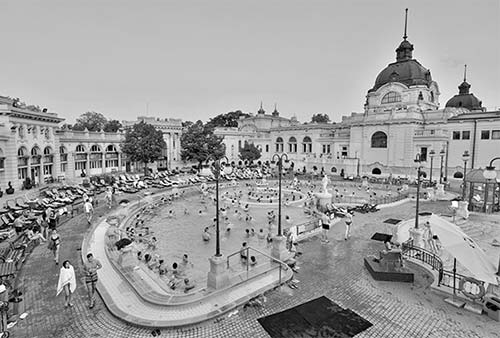
Hours: Mon and Wed-Thu 7:00-19:00, Tue and Fri 8:00-20:00, Sat-Sun 9:00-20:00, last entry one hour before closing. On some summer weekends, the baths may be open later (see “Night Bathing,” below).
Information: +36 1 363 3210, www.szechenyibath.hu.
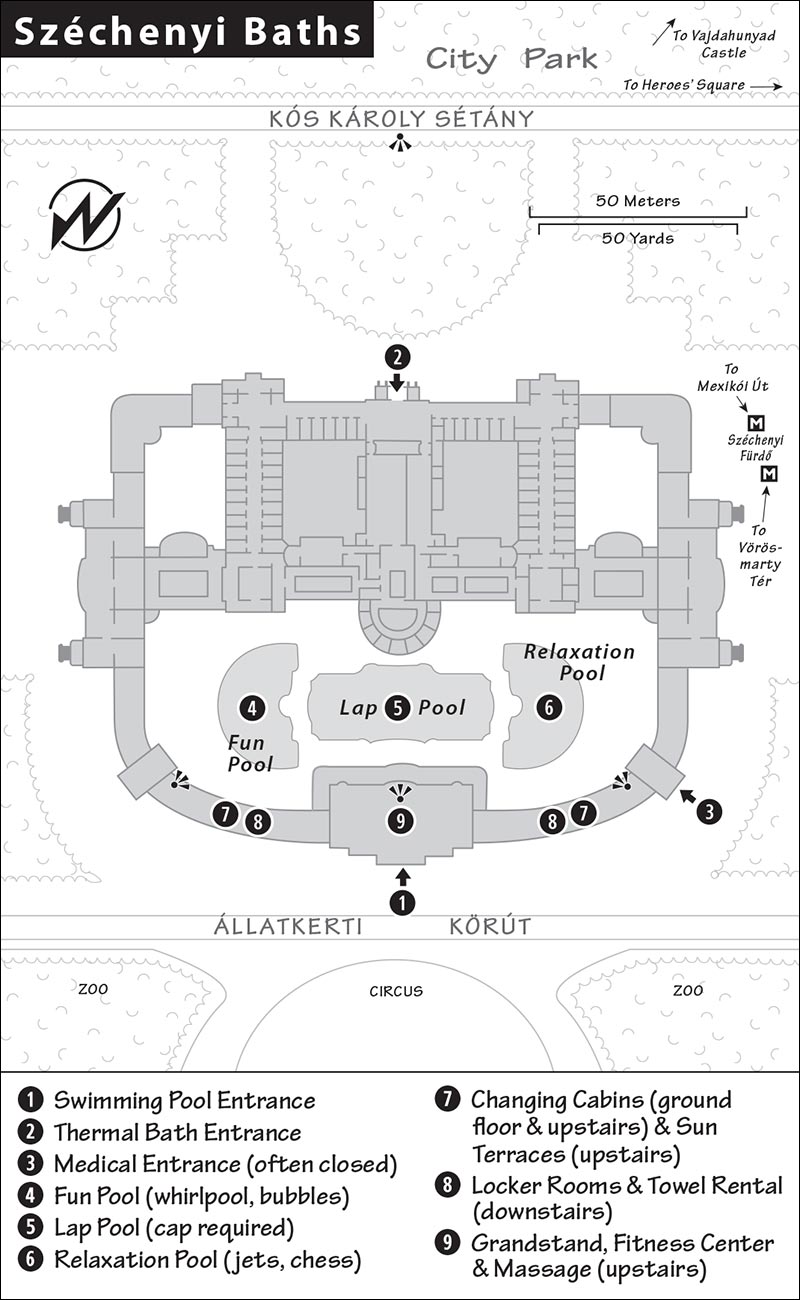
Location and Entrances: In City Park at Állatkerti Körút 11, district XIV, M1: Széchenyi Fürdő. The huge bath complex has three entrances. The “thermal bath entrance” is the grand main entry, facing south (roughly toward Vajdahunyad Castle). The “swimming pool entrance,” facing the zoo on the other side of the complex, can be busier, but makes it quick and easy to find the outdoor pools. A third, smaller “medical entrance”—open only when things are very busy—is between the other two (and near the Metró station). If there’s a long line at one of the entrances, check the others.
Massage: In the lobby, an English menu lists a wide array of massages and other treatments. In addition to the standard options, you’ll see offers of various special “VIP” or “private” packages (including some that give you access to an adjoining palm house, called “Dayspalm”).
Night Bathing: The baths are a joy in the evening, when both the price and the crowds are reduced. Additionally, Széchenyi is open late into the night on weekends for a “sparty” event, where the bath complex basically becomes one big hot-water dance club (€65, most Saturdays starting at 22:00, tickets sell out so book ahead at https://szechenyibath.com/sparties).
Entering the Baths: These instructions assume that you’re using the swimming pool entrance. First, in the grand lobby, pay the cashier, then touch your wristband to the turnstile and enter. Straight ahead is a row of private changing cabins. If you go up the stairs, you’ll find more changing cabins, “solarium” sun terraces, a fitness center, and a grandstand overlooking the main pool. (It’s worth heading upstairs just to snap some photos of the outdoor complex before you change.) If you go down the stairs, you’ll find a long hallway lined with hairdryers and mirrors, which leads to locker rooms at each end.
If you paid for a cabin, head to the cabins on the main floor, look for an electronic panel on the wall, and hold your wristband against this panel for a few seconds—you’ll automatically be assigned a number for a cabin. If you paid for a locker, you can head down to the locker room and choose one, then use your wristband to lock it.
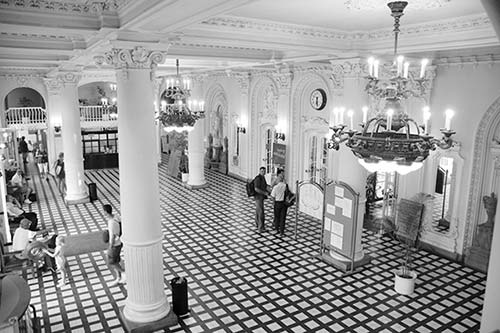
If you’re using the thermal bath entrance, the layout is similar: cabins on the main floor where you enter and upstairs, lockers in the basement. From this entrance, you’ll traverse a long series of indoor thermal bath rooms to make your way to the outdoor pools (from the locker room, bear left and circle around the complex).
Taking the Waters: The bath complex has two parts, outside and inside. For most visitors, the best part is the swimming pool area outside. Orient yourself to the three pools (facing the main, domed building): The pool to the left is for fun (cooler water—30°C/86°F, warmer in winter, lots of jets and bubbles, lively and often crowded, includes circular current pool). The pool on the right is for relaxation (warmer water—38°C/100°F, mellow atmosphere, a few massage jets, chess). The main (lap) pool in the center is all business (cooler water—28°C/82°F in summer, 26°C/79°F in winter, people doing laps, swim cap required). Stairs to saunas (with cold plunge pools, cold showers, and an ice maker) are below the doors to the indoor thermal bath complex.
Inside the main building is the thermal bath section, a series of indoor pools; each of these is designed for a specific medical treatment. You’ll also find steam rooms with an 18°C/64°F cold plunge pool nearby. The pools also have varying types and amounts of healthy minerals—some of which can make the water quite green and/or stinky.
Leaving the Bath: If you’re heading to the Metró, the Széchenyi Fürdő station is very close but easy to miss: It’s basically a pair of nondescript stairwells with yellow railings in the middle of the park, roughly toward Heroes’ Square from the thermal bath entrance (look for the low-profile, yellow Földalatti sign; to head for downtown, take the stairwell marked a Vörösmarty Tér Felé).
Gellért Baths (Gellért Fürdő)
The ▲▲ baths at Gellért (GEH-layrt) Hotel feel more upscale than Széchenyi. Gellért’s indoor thermal pools are Budapest’s most atmospheric—with exquisite porcelain details and an air of mystery. Its outdoor zone—mostly for sunbathing, and with just one smallish hot pool—is less interesting than Széchenyi, with one exception: It has a deliriously enjoyable wave pool that’ll toss you around like a queasy surfer (summer only). The hotel is slated for an extensive years-long renovation, which may begin in 2024; they’re hoping to keep the baths open for some or all of that time, but anticipate changes (and construction chaos)—it’s best to check first before making the trip here.
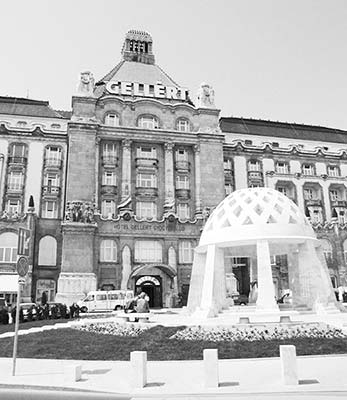
Cost: 9,400 Ft for ticket and locker, 1,000 Ft more for a personal changing cabin; 1,500 Ft extra on weekends (Fri-Sun).
Hours: Daily 9:00-19:00, last entry one hour before closing.
Information: +36 1 466 6166 ext. 165, http://gellertspa.com [URL inactive].
Location: It’s on the Buda side of the green Liberty Bridge (M4: Szent Gellért Tér; or take trams #47, #48, and #49 from Deák Tér in Pest, or trams #19 and #41 along the Buda embankment from Víziváros below the castle, Gellért Tér stop). The hotel’s main entrance faces the Danube and the tram and Metró stops. To find the baths entrance, circle around the right side of the huge building—it’s under a giant stone arch (Kelenhegyi Út 4, district XI).
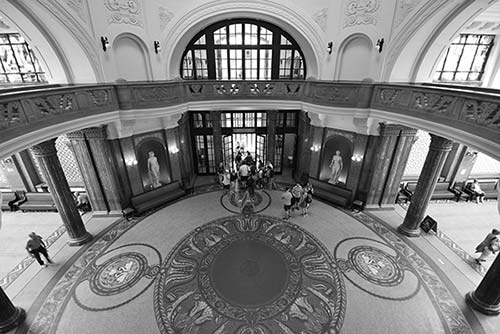
Entering the Baths: The entrance doors are flanked by ticket windows; just past those, on the right, is an info desk with English-speaking staff.
After buying your ticket, put on your wristband and glide through the swanky lobby. You’ll use the swimming pool entrance, on your right, under the grand dome. Go down the stairs, pass through a long corridor, then climb up the stairs. If you paid for a cabin, you’ll find a maze of them at the first landing; for a locker, proceed up one more flight to find the locker rooms. If you need to buy a towel or swimsuit, look for the desk near the entrance to the changing-cabin area.
Taking the Waters: From the locker room, look for signs to the effervescent bath-pool (for the indoor section) or to the swimming-pool with artificial waves (for the outdoor section).
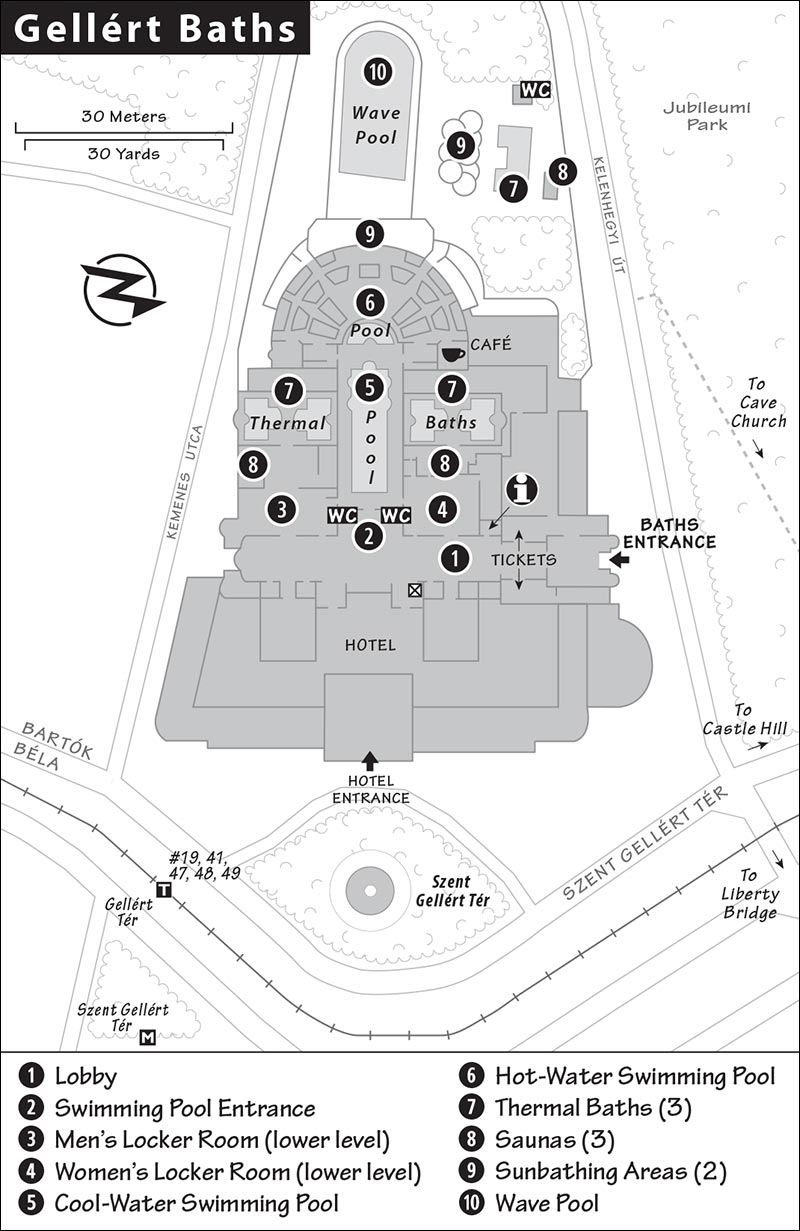
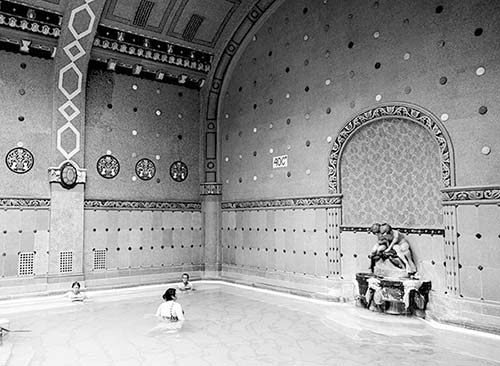
Inside, the central, genteel-feeling hall is home to a cool-water swimming pool (swim cap required) and a crowded hot-water pool (36°C/97°F). This is used for swimming laps and for periodic water-exercise classes. On sunny days, they crank open the retractable roof. Back toward the main hall are doors to the thermal baths. These were once segregated into men’s and women’s sections. To reach them, you’ll walk through a hall of curtained massage cabins. These grand old halls are the most atmospheric part of the bath—slathered with colorful porcelain decorations. The former men’s section is both hotter and more beautifully decorated than the women’s section. I’d focus on the former men’s section, which has big pools at either end. At the far end of the bath are a steam room (45-50°C/113-122°F) and a cold plunge pool (18°C/64°F). Back out near the changing cabins is a dry sauna (50-70°C/122-158°F). If you paid for a massage, you’ll report to the massage room in this section.
Outside, you’ll find several sunbathing areas. There’s just one warm thermal pool (36°C/97°F)—follow adventure pool signs up and to the right. Near the pool is a Finnish-style woody sauna and a big barrel-shaped plunge pool with cold water.
But the main outdoor attraction is the big, unheated wave pool in the center (generally closed Oct-April, weather dependent). The swells in the deeper area are fun and easy to float on, but the crashing waves at the shallow end are vigorous, if not dangerous.
Rudas Baths (Rudas Fürdő)
To get to the Turkish roots of Budapest’s obsession with thermal baths, head for Rudas (ROO-dawsh). Worth ▲▲, it’s the most historic, local, and potentially intimidating of the three baths I list—but it may also be the most rewarding, as it offers the most variety.
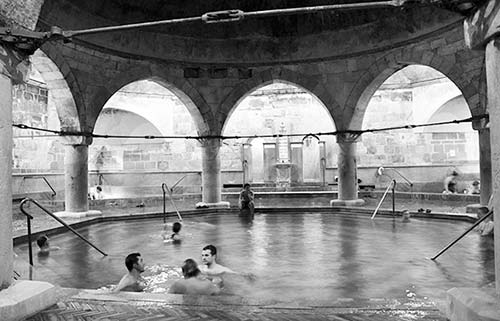
Rudas has two main sections: the dark, historic, mysterious-feeling Turkish-style thermal bathing zone; and the modern, fun wellness/“sauna world”/swimming pool section. However, on certain days and times the thermal section is open only to men or only to women (see “Hours,” later). On Friday and Saturday nights, the thermal section becomes a modern nightclub until the wee hours.
Overview: Rudas’ thermal section feels more like the classic Turkish baths of yore—with an octagonal central pool under a fine 500-year-old dome first built by the Ottomans. These baths are not about splashy fun—there are no jets, bubbles, or whirlpools. Instead, Rudas is about history and about serious temperature modulation—stepping your body temperature up and down between very hot and very cold.
The wellness area—with a handful of relaxing jet pools—is the modern, accessible yin to the thermal baths’ antique yang. The main reason to visit this section is the rooftop terrace, where you can sunbathe or soak while looking out over sweeping views of the Budapest skyline. The wellness area is also attached to a “sauna world” (with a half-dozen different wet or dry hot rooms) and a swimming pool for laps.
Cost: “All-in” ticket includes entire complex for 8,600 Ft weekdays, 12,200 Ft weekends; 1,000 Ft extra for private, lockable changing cabin; when the thermal baths are gender-segregated (see below), you can buy a ticket for just the thermal or wellness area (5,900 Ft each).
Hours: Daily 6:00-20:00, last entry one hour before closing. Wellness area mixed gender every day. Thermal section open only to men all day Mon and Wed plus Thu-Fri mornings; only open to women all day Tue; open to everyone Thu-Fri afternoons and Sat-Sun all day. Night bathing (described later) is also mixed gender.
Information: +36 1 375 8373, www.rudasbaths.com.
Location: It’s in a low-profile building at the foot of Gellért Hill, just south of the white Elisabeth Bridge (Döbrentei Tér 9, district I). Trams #19 and #41, which run along the Buda embankment, stop right out front (Rudas Gyógyfürdő stop). Those trams also work from Szent Gellért Tér, as do trams #56 and #56A or bus #7. From Pest, you can ride bus #7 from Astoria or Ferenciek Tere to the Rudas Gyógyfürdő stop.
Eating: There’s a fine $$ bistro on the wellness side, which welcomes both fully dressed customers and those wearing swimsuits. There’s also a little cocktail counter up at the rooftop sunbathing/soaking zone, and another basic food-and-drinks counter in the lobby.
Night Bathing: The baths are open—to both men and women, in swimsuits—with a dance hall ambience Fri-Sat 22:00-late (12,600 Ft).
Entering the Baths: If you paid for a private cabin, you’ll enter on the main floor into a corridor of cabins. Otherwise, you’ll go upstairs to a modern locker room, with men and women mixed (but with private cabins to change in).
Taking the Waters: Remember, Rudas has two distinct areas with entirely different protocols: the thermal bath section and the wellness/“sauna world”/swimming pool section. With the “all-in” ticket, you can float freely between them.
Thermal Bath: The central chamber, under an original 35-foot-high Turkish dome supported by eight pillars, is the historic core of the baths. This area is all about modulating your body temperature—pushing your body to its limit with heat, then dousing off quickly with a bucket of cold water, then heating up again, and so on. Pools of different temperatures let you do this as gradually or quickly as you like.
Along one wall are entrances to the wet sauna (nedves gőzkamra, to the left), with 50°C (122°F) scented steam; and the dry sauna (hőlégkamra, to the right), with three progressively hotter rooms ranging from 45°C (113° F) to 72°C (161°F). Near the entrance to each one is a shower or a bucket of frigid water (if you’re overheated, pull the rope for immediate relief...your skin won’t stop tingling for several minutes).
Surrounding this central chamber are hallways with other areas: resting rooms, tanning beds (szolarium), massage rooms, a cold plunge pool, and a scale to see how much sweat you’ve lost.
To move between the thermal bath and wellness sections, you’ll cross through the lobby.
Wellness/Sauna/Pool: First you’ll walk along the swimming pool (for laps, swim cap required); upstairs from here is an outdoor sun terrace. Once you’re in the far building, upstairs is the “sauna world,” where you can move between a variety of steam rooms and dry saunas.
At the far end is the wellness area. The first room, with a huge window looking out over the busy embankment road, has three pools of different temperatures, all with powerful massage jets. In the cold plunge pool, notice the ice maker that continually drops in a cube or two, every few seconds.
But the real highlight of the wellness area is upstairs: At the end of the room, find the staircase and head on up, passing the bistro on your way to the rooftop terrace. Whether soaking in rays on the sun deck or taking a dip in the thermal pool, you’re surrounded by the bustle of the city.
Entertainment in Budapest
Budapest is a great place to catch a good—and inexpensive—musical performance. In fact, music lovers from Vienna make the three-hour trip here just to take in a fine opera in a luxurious setting at a bargain price. To sort out your options, see the resources listed below, including the good classical music schedules at MuzsikaKalendarium.hu [URL inactive].
Locals dress up for the more “serious” concerts and opera, but many tourists wear casual clothes—as long as you don’t show up in shorts, sneakers, or flip-flops, you’ll be fine.
The following helpful websites offer current advice on cultural events and nightlife in Budapest: WeLoveBudapest.com, Funzine.hu, MuzsikaKalendarium.hu [URL inactive] (classical music), and XpatLoop.com (by and for expats living here).
For concerts and events, you can buy tickets direct on the websites for various venues, but you may be redirected to Jegymester.hu (sort of the Ticketmaster of Hungary, and a good place to survey what’s on) or Kulturinfo.Jegy.hu.
What’s on can vary by season. Some of the best nightclubs and bars are partly or entirely outdoors, so they’re far more enjoyable in the summer. Meanwhile, the Hungarian State Opera, the Puppet Theater, and other indoor cultural events tend to take a summer break from late June into early September (though that’s prime time for outdoor music).
For a list of some local festivals, which often include excellent live music, see “Holidays & Festivals” in the appendix.
A Night at the Opera
Take in an opera by one of the best companies in Europe, in one of Europe’s loveliest opera houses, for bargain prices. The Hungarian State Opera usually performs Tuesdays through Sundays (except late June through early September; no performances Mon). Most productions are at the stunning and historic main Hungarian State Opera House (Andrássy Út 22, district VI, M1: Opera, see here), but some take place at less impressive venues—make sure you’re clear on the location before you book. Most performances are in the original language with Hungarian and English supertitles.
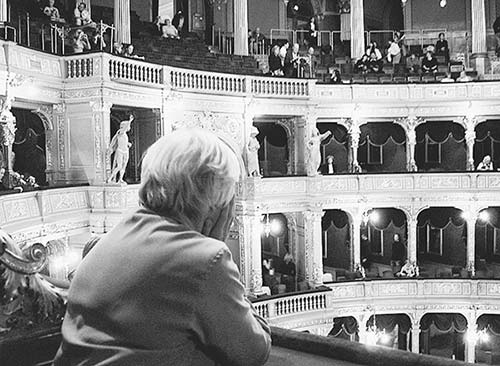
Tickets: Seats range from about 5,200 to 30,000 Ft; they can be booked most easily online, but be sure to use the official Opera website (www.opera.hu) rather than a third-party scalper site. You can also just drop by the Opera House once you’re in town and see what’s available (daily 10:00-19:00, or until the first intermission). However, tickets often sell out in advance.
Cheap Seats: The best music deal in Europe may be the “cheap seats,” which cost 1,800 Ft. There are two types of these tickets. Obstructed-view seats are typically in the back of the many small boxes that line the sides of the Opera House; basically, you can choose whether to sit and see nothing or stand and crane your neck to see about half the stage. These tickets go on sale with the other types of tickets and can be booked online.
Same-day standing tickets are located at the very top of the auditorium, wedged between a rail and a velvet-covered bench, allowing you to lean through the performance. Most also have a partially obstructed view of the stage (though big TV screens on the walls let you see what you’re missing). There are 84 standing spaces, and tickets go on sale two hours before show time and must be purchased in person at the Opera House box office. For popular shows that are otherwise sold out, these are a hot commodity; it’s wise to line up at the theater 10 to 15 minutes before they go on sale.
While opera lovers should splurge on better seats, if you’re simply curious for a peek inside this grand space, these cheap seats are a bargain—much cheaper than the guided tour, and offering a chance to see the venue in action. If your appetite for opera is limited, slipping out at intermission is less than a capital offense.
House of Music Hungary (Magyar Zene Háza)
This architecturally bold venue in City Park is a musical twofer. First, it has a 300-seat theater that hosts a wide variety of musical performances, plus a smaller lecture hall and an open-air stage under a canopy of gilded “leaves.” Classical, jazz, traditional folk, electronica, sacred music—the program here has all the bases covered. And second, it’s a museum with high-tech, exuberant exhibits that celebrate Hungarian and international music. Music lovers should drop by to tour the exhibits and check what’s on while in town (see www.zenehaza.hu; in the middle of City Park at Olof Palme Sétány 3-5, +36 70 799 9449). For a more in-depth description of this facility, see here.
Other Venues
Budapest has many other grand spaces for enjoying a performance. You can find details for each of these on their websites.
The Franz Liszt Academy of Music (Liszt Ferenc Zeneművészeti Egyetem, a.k.a. Zeneakadémia), on Franz Liszt Square, hosts high-quality professional concerts every night. Restored to its stunning late-19th-century splendor, this venue rivals even the Opera House for opulence—if attending a concert, make sure it’s in the Grand Hall, or Nagyterem (just off of Andrássy Út at Liszt Ferenc Tér 8, district VI, M1: Oktogon, www.zeneakademia.hu). They also do one-hour guided tours of the theater in English (5,300 Ft, includes brief concert by a student, usually 1/day—typically at 14:30).
The former Academy of Music (Régi Zeneakadémia)—just up Andrássy Út near the House of Terror—houses the Franz Liszt Museum and hosts performances on Saturday mornings at 11:00 (4,000 Ft, Vörösmarty Utca 35, www.lfze.hu).
The Pesti Vigadó (“Pest Concert Hall”), gorgeously restored and sitting proudly on the Pest embankment, is another fine place for a concert in elegant surroundings (Vigadó Tér 2, https://vigado.hu).
The city’s two finest churches—both with sumptuous interiors—host tourist-oriented concerts. Most of the shows in St. István’s Basilica are organ concerts—often scheduled for Monday afternoons, and sometimes also Friday evenings or at other times (check both www.organconcert.hu and www.budapestxplore.com; second option offers RS%—10 percent discount for direct bookings). Up on Castle Hill, Matthias Church hosts a variety of touristy shows, from organ recitals to string orchestras (check www.matyas-templom.hu; additional concerts may be found at www.concertsinbudapest.com).
In the Seventh District/Jewish Quarter, the Rumbach Street Synagogue is a beautiful space to enjoy a concert (there’s no consolidated website for these shows, but keep an eye out for this as a venue in event listings). The National Dance Theater (Nemzeti Táncszínház) puts on performances ranging from ballet to folk to contemporary in their main venue at Millenáris Park, just north of Castle Hill (Kis Rókus Utca 16-20, M2: Széll Kálmán Tér, +36 1 434 5900, www.dancetheatre.hu [URL inactive]). They also do some performances at Müpa Budapest.
The Millennium City Center complex, sitting on the Pest riverbank near the Rákóczi Bridge south of downtown (district IX), is a state-of-the-art facility with multiple venues. Müpa Budapest, short for Művészetek Palotája (Palace of Arts), features art installations as well as musical performances in two venues: the 1,700-seat Béla Bartók National Concert Hall and the 460-seat Festival Theater (www.mupa.hu).
Tourist Folklore Concerts: Hungária Koncert typically offers a performance about once weekly (likely Sat, Easter-Oct only, in the Aranytíz Kultúrház near the Chain Bridge at Arany János 10, RS%—10 percent discount if you book direct, +36 1 317 2754 or +36 1 317 1377, www.budapestxplore.com).
Nightlife in Budapest
In addition to strolling the floodlit promenades and taking an after-hours dip at a thermal bath (Széchenyi and Rudas are both partly open late—see “Experiences in Budapest,” earlier), here are some ideas for nighttime fun.
Yuppie Drinking Zones
The plaza in front of St. István’s Basilica is Budapest’s most fashionable locale for a glass of wine. Of the many upscale restaurants and bars in this area, DiVino—a bar with contemporary decor and a wide range of Hungarian wines by the glass—is a good choice (see “Eating in Budapest,” later).
Franz Liszt Square (Liszt Ferenc Tér), a leafy and inviting zone just off Andrássy Út, is lined with mostly tourist-oriented bars. The pedestrianized Ráday Utca, near Kálvin Tér just north of the Great Market Hall, has a similar scene.
For something a bit more genteel—evocative of this city’s late-19th-century golden age—locals pass their evenings sipping wine or nibbling dessert at a café (see “Budapest’s Café Culture” on here).
Ruin Pubs
These lively pubs (romkocsmák) are filled with ramshackle secondhand furniture, a bohemian-junkyard vibe—and plenty of drinkers having the time of their lives. Most of the clientele are in their 20s or 30s, but hip oldsters feel perfectly welcome. While some ruin pubs are edgy and high-energy, others are more fit for a hammock. To seek out your ideal ruin pub, know the terminology. A ruin pub may bill itself as a mulató (club, usually higher energy) or a kávézó (coffeehouse, usually mellower). Many have a kert (“garden”), filling deteriorating buildings’ courtyards with quirky décor and artful graffiti. Others have a tető (“rooftop”). The bigger ruin pubs often have a bouncer stationed outside—but curious travelers are more than welcome. For more info, including additional listings, see RuinPubs.com.
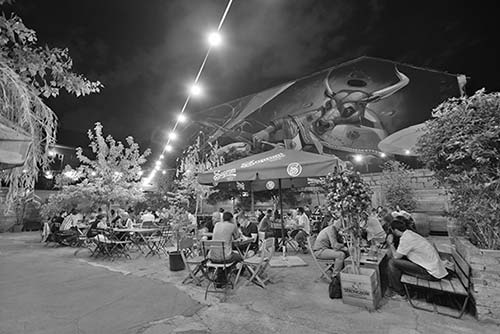
Ruin Pubs in the Seventh District: Budapest’s Seventh District—the historic Jewish Quarter, behind the Great Synagogue—teems with clubs, bars, and creative little hole-in-the-wall eateries. Why are so many of these funky bars concentrated in the Jewish Quarter? Because it’s conveniently central, yet it remained largely deserted and dilapidated after the communists took over—keeping rents very low and fostering just the right rickety-chic vibe for ruin pub purveyors.
While this scene changes constantly, here are a few good choices. If you only have time and interest for one, head straight to the first and best, Szimpla. This area can be very lively any night of the week, but it’s best Thursday through Saturday. During the peak of summer (July-Aug), most Budapesters are out of town on holiday, making this scene even more touristy. Szimpla Kert (“Simple Garden”) sprawls through an old building and spills out into a shoddy courtyard. Surrounding the garden is a warren of tiny rooms. There’s live music in a soundproof concert room and a selection of decent food (daily, Kazinczy Utca 14, www.szimpla.hu). Telep (“Site”) is a tumble-down secondhand bar steps from Gozsdu Udvar. There’s an art gallery upstairs and often live music (daily, Madách Imre Út 8, just off Rumbach Utca). Csendes (“Silent”), with two adjacent branches, is a mellower ruin pub tucked behind Károlyi Park, right in the core of Downtown Pest. The junk-cluttered main “art bar” is at Ferenczy István Utca 5. The Csendes Társ (“Silent Partner”) wine bar—a bit more upmarket and snooty—has delightful outdoor tables across the street at the gate to the park and is typically open only in good weather (daily, Magyar Utca 16).
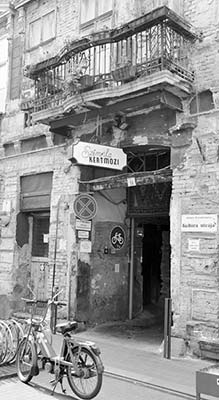
Nearby: While it’s not a ruin pub per se, if you’re exploring the area, be sure to poke your way down the extremely lively series of courtyards called Gozsdu Udvar—jammed with lively bars, cafés, and restaurants.
Summer Terraces (Tető) and Rooftop Bars
In addition to kert (“garden”), a key term for enjoying Budapest in the summer is tető (“roof”). Rooftop terraces offer laid-back scenery high above the congested city. Most roof terraces are open only in the summer (typically May-Sept) and in good weather, and they start serving drinks and light food around midafternoon. Several offer live music.
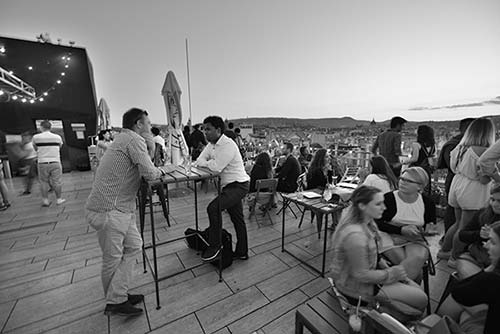
360 Bar is on the roof of the old Párisi Nagy Áruház (Andrássy Út 39, M1: Opera, www.360bar.hu).
High Note SkyBar has point-blank views of St. István’s. Don’t miss the glassed-in passage that leads to spiral stairs up to the two towers—both of which offer even higher, better views (atop the Aria Hotel at Hercegprímás Utca 5, district V, www.highnoteskybar.hu).
Solid Wine Bar, above the recommended Rum Hotel in Downtown Pest, overlooks University Square and comes with a younger but still upscale atmosphere (closed Sun-Mon, Királyi Pál Utca 4, district V, M3/M4: Kálvin Tér, www.solidbudapest.com).
The Duchess, on top of the Matild Palace Hotel, feels well dressed and high-end, with live DJs on weekends and sprawling indoor and outdoor areas—including some with grand views over the Elisabeth Bridge and across the Danube (daily from 17:00, Váci Utca 36, right next to M3: Ferenciek Tere, +36 70 402 4900, www.theduchessbudapest.com).
At Buda Castle: White Raven Skybar, on top of the landmark Hilton Hotel at the castle, has pricey drinks, bar snacks, and stunning views over the colorful rooftop and curlicue spire of the Matthias Church next door and across the river to Pest. Reservations are essential (inside the Hilton at Hess András Tér 1, district I, +36 30 676 2620, www.whiteravenskybar.com).
Local Craft Beer and Hungarian Wine
Craft Beer: Budapest has an increasing number of pubs specializing in both Hungarian and international microbrews. Gravity Brewing is behind the Great Market Hall (closed Sun-Mon, Lónyay Utca 22, +36 30 144 8404, www.gravitybp.com). In central Pest, just a few steps from the Deák Tér transit hub, stop by Madhouse—a big, industrial-feeling gastropub (daily, Anker Köz 1, +36 70 621 0741, www.madhousebudapest.hu). On the Buda side, Keg Sörművház, a long block up from the Gellért Baths (and Szent Gellért Tér tram and Metró stop), is a nondescript craft beer cellar (daily, Orlay Utca 1, www.kegsormuvhaz.hu).
Wine: If you prefer grapes to hops, there are several great spots to sample Hungarian wine. DiVino Wine Bar has two locations where you can taste a wide variety—in a trendy wine bar with grand views of St. István’s Basilica or tucked down the chaotic and lively Gozsdu Udvar passage in the Seventh District. Or, for a more refined experience, check out Taste Hungary’s guided wine tastings (www.tastehungary.com) and their lovely Tasting Table wine bar and shop (Bródy Sándor Utca 22, near M2: Astoria). For more on these places, see “Eating in Budapest,” later.
Shopping in Budapest
Perhaps Budapest’s most appealing street for shoppers is the city’s “antique row,” Falk Miksa Utca, just north of the Parliament.
If you just want a few light mementos, Budapest’s most convenient—if touristy—shopping venue is the Great Market Hall (described on here). In addition to all the colorful produce and spices downstairs, the upstairs gallery is full of fiercely competitive souvenir vendors. The Bálna (“Whale”) Cultural Center, which sits along the Danube just behind the Great Market Hall, has a few more options—and the architecture is interesting. Váci Utca features the city’s highest prices and worst values.
Up at Buda Castle, Castellum gallery showcases the work of 40 local artists and artisans (closed Wed-Thu, kitty-corner from recommended Ruszwurm café at Úri Utca 26, +36 30 656 1213).
Budapest has an excellent English bookstore, Bestsellers. For details, see “Helpful Hints,” earlier.
Hours: Smaller shops tend to be open Monday through Friday from 10:00 to 18:00 (sometimes later—until 20:00 or 21:00—on Thursday) and Saturday from 10:00 to 13:00 or 14:00, and are closed Sunday. Big malls have longer hours.
Bargaining: At touristy markets (but not established shops), haggling is common for pricier items (more than about 4,000 Ft)—but you’ll likely get the merchant to come down only about 10 percent (maybe 20 percent for multiple items). If you pay with a credit card, you’re less likely to snare a discount.
VAT Refunds and Customs Regulations: For tips on getting a VAT (value-added tax) refund and getting your purchases through customs, see the “Money” section of the Practicalities chapter.
Souvenir Ideas
Budapest’s best souvenirs are edible or drinkable. That quintessential Hungarian spice, paprika, is sold in metal cans, linen bags, or porcelain vases—and often accompanied by a tiny wooden scoop. Also look for a variety of paprika-infused pastes—sold in jars or tubes—used to spice up any recipe. (Remember that only sealed containers will make it through customs.) For more, see “Paprika Primer” on here.
Special drinks are a fun souvenir but tricky to bring home (you’ll have to wrap them very carefully and put them in your checked luggage). Good choices include the unique Hungarian spirit Unicum, which comes in many variations; various flavors of the local brandy called pálinka; or a bottle of Hungarian wine (such as the famous Tokaji Aszú). For more on these drinks, see here.
Another popular item is a hand-embroidered linen tablecloth. If the thread is thick and the stitching is very even, it was probably done by machine and is less valuable.
Fans of communist kitsch can look for ironic T-shirts that poke fun at that bygone era. A good selection is at the Memento Park gift shop, which also sells communist memorabilia.
For a wearable souvenir, Tisza shoes (Tisza Cipő) are retro and hip. Their flagship store is along the Small Boulevard near the Great Synagogue (at Károly Körút 1, www.tiszacipo.hu).
Hipster Design and Vintage
Budapest has plenty of fun and idiosyncratic design, home decor, and vintage shops. Many intriguing boutiques have emerged in the Seventh District/“Ruin Pub” zone. Scout the possibilities on Király (with an emphasis on home decor), Dob, Rumbach, Dohány, Wesselényi, Kazinczy, and neighboring streets. Printa, a print shop, is one reliable place to get a taste of the neighborhood’s vendors. Szimpla—the original ruin pub—hosts a colorful farmers market each Sunday (9:00-15:00, Kazinczy Utca 14, www.szimpla.hu). Very nearby—just across Andrássy Út from the Seventh District—you’ll also find a smattering of intriguing shops along Hajós Utca, behind the Opera House.
Sleeping in Budapest
Most travelers find staying in Pest more convenient than sleeping in Buda. Pest has most of the worthwhile sightseeing and nearly all the best restaurants. It also has more Metró and tram stops, making it a snap to get around. Pest feels more lively and local than stodgy, touristy Buda, but it’s also more urban. If you don’t enjoy big cities, consider sleeping in Buda instead. If you’re near the river in Buda, you may have great views across to the Parliament.
In Budapest, most hotels quote rates in euros for the convenience of international guests, and I’ve ranked them the same way. (Outside of the capital, hotels more often quote rates in forints.) The rate will automatically be converted to forints when you pay. If the credit card reader gives you a choice of currencies, choose forints rather than dollars to avoid excessive conversion fees. The majority of hotels don’t include the 4 percent tourist tax in their rates.
PEST
I’ve arranged my listings by neighborhood, clustered around the most important sightseeing sectors.
Near Andrássy Út
Andrássy Boulevard is handy, local-feeling, and endlessly entertaining. With its ample restaurants, upscale-residential vibe, and easy connection to downtown (via the M1/yellow line), it’s the neighborhood where I prefer to sleep.
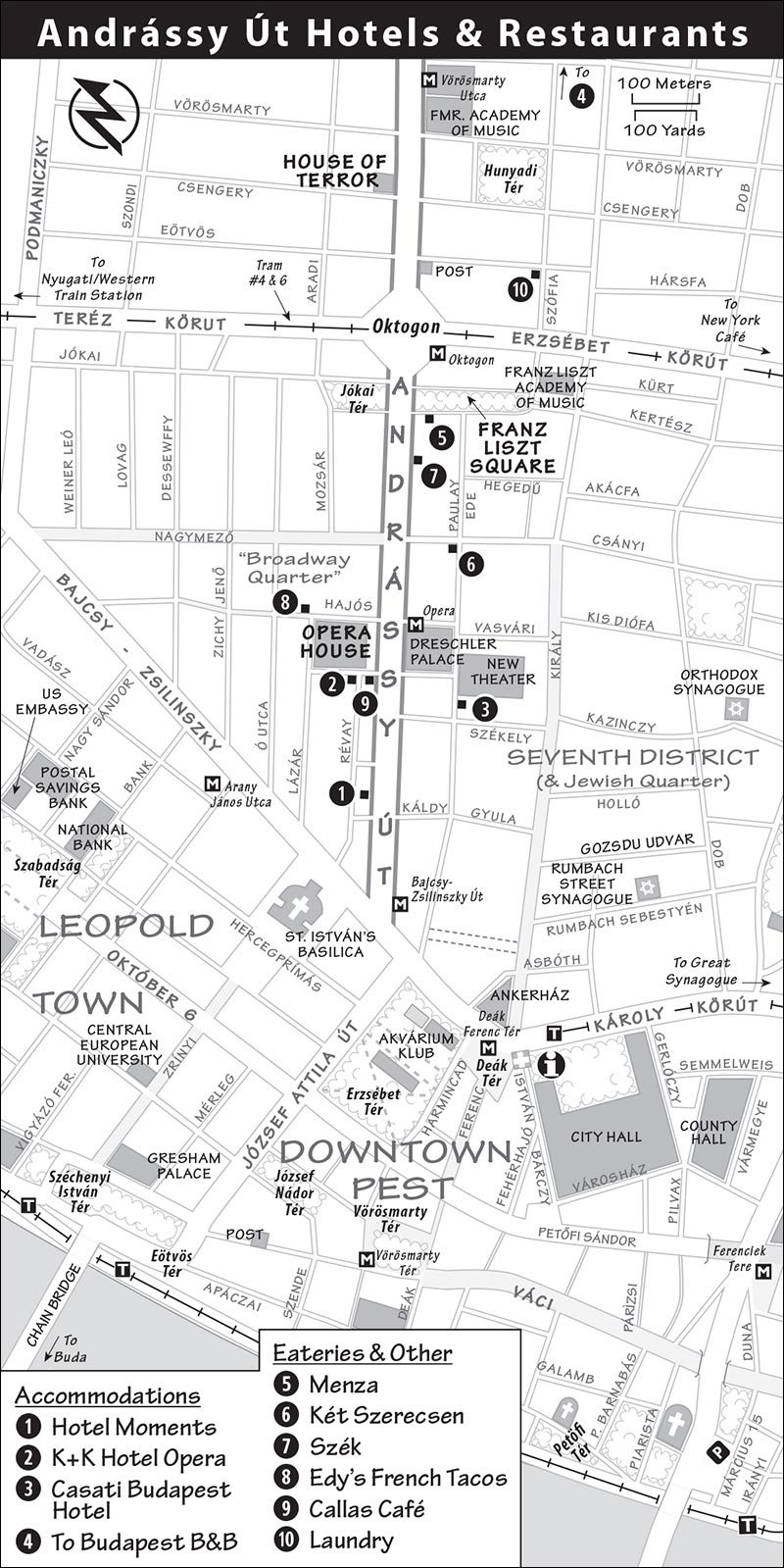
$$$$ Hotel Moments has 99 Art Deco rooms, a pristine atrium with iron railings, professional service, and a good location at the downtown end of Andrássy Út—making this a fine choice at a high price point. Because it’s surrounded by busy streets, light sleepers may be bothered by passing traffic (air-con, elevator, free coffee bar, Andrássy Út 8, district VI, M1: Bajcsy-Zsilinszky Út, +36 1 611 7000, www.hotelmomentsbudapest.hu, reservation@hotelmoments.hu).
$$ K+K Hotel Opera has 200 predictably solid business-class rooms, a great breakfast buffet, and helpful, professional service. Its biggest advantage is the outstanding location, wonderfully situated beside the Opera House and just steps from Andrássy Út and its handy Metró line (air-con, elevator, pay parking garage, Révay Utca 24, district VI, M1: Opera, +36 1 269 0222, www.kkhotels.com, reservations.opera@kkhotels.com).
$$ Casati Budapest Hotel is a solid value and conveniently located a block off Andrássy Út (across the boulevard from the Opera House, and then down a side street). This classy, Swiss-run hotel has 25 rooms in four different styles, ranging from “classic” to “cool” (review your options online and choose your favorite). Many rooms surround a peaceful courtyard—in this potentially noisy neighborhood, it’s worth requesting one of these (air-con, elevator, free sauna and fitness room, Paulay Ede Utca 31, district VI, M1: Opera, +36 1 343 1198, www.casatibudapesthotel.com, info@casatibudapesthotel.com).
$ Budapest Bed and Breakfast—run with care by András (OHN-drash) and Timea—has five simple yet well-equipped rooms farther from the center, in the quiet diplomatic quarter halfway between the Oktogon and City Park (air-con, a long block off Andrássy Út at Benczúr Utca 3, district VI, M1: Kodály Körönd, +36 30 964 7287, butterflyhomebandb@gmail.com). They also rent rooms in Downtown Pest, near the Great Market Hall (see Butterfly Home Danube B&B, later).
In the Seventh District/Jewish Quarter: A short walk from Andrássy Út, $$ ROOMbach Hotel Budapest Center—tucked down a gloomy but central street facing the Rumbach Street Synagogue—has 99 sleek, basic, smallish rooms with a stylish industrial design. It feels modern and solid, and the triple-glazed windows do their best to keep out the ruin-pub noise (air-con, elevator, pay parking, Rumbach Sebestyén Utca 14—for location see the map on here, +36 1 413 0253, www.roombach.com, hotel@roombach.com).
Downtown Pest (Belváros), near Váci Utca
Most hotels on the very central and convenient Váci Utca come with overly inflated prices. But these less expensive options—just a block or two off Váci Utca—offer better value.
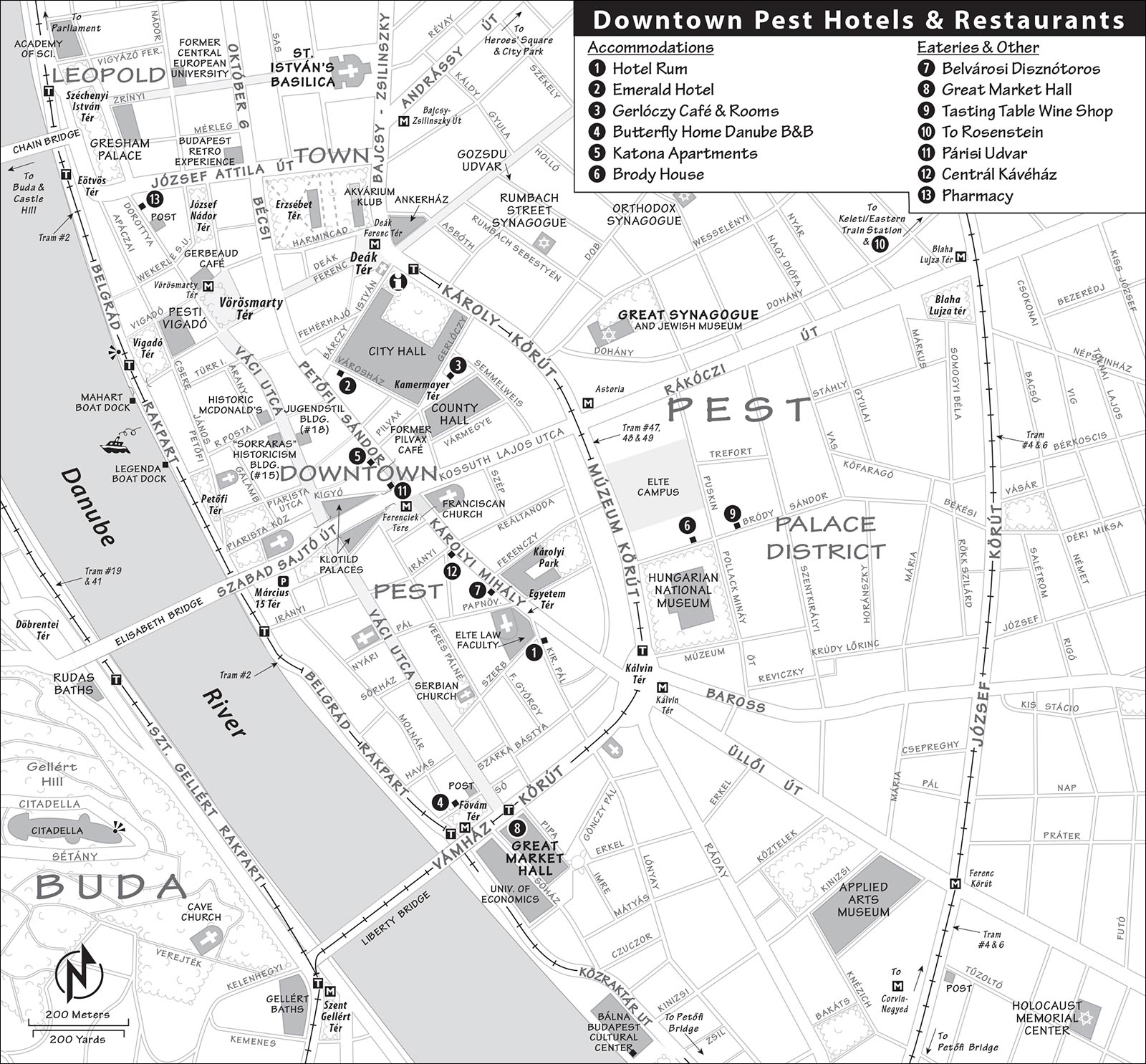
$$$ Hotel Rum is a sleek retreat overlooking the rejuvenated University Square in the heart of Downtown Pest. Its 40 sterile but trendy, industrial-mod, “New York-style” rooms come with concrete floors, subway tile, and open shelving. The top-floor wine bar has great views (air-con, elevator, Királyi Pál Utca 4, district V, M3/M4: Kálvin Tér, +36 1 424 9060, www.hotelrumbudapest.com, hello@hotelrumbudapest.com).
$$ Emerald Hotel is a big modern building wrapped almost entirely around an old church, so many of the rooms face a quiet courtyard. It’s a rare combination of extremely central (a short walk from the Deák Tér transit hub, in the heart of Downtown Pest) yet peaceful and removed. Its 160 units include compact, stylish rooms and larger suites. The breakfast room is also sharp and contemporary, with black-and-gold accents (family rooms, air-con, elevator, Városház Utca 20, district V, M1/M2/M3: Deák Tér, +36 70 645 9590, www.emeraldhotel.hu, info@emeraldsuites.hu).
$ Gerlóczy Café & Rooms, which also serves good coffee and meals in its recommended café, is an exceptional value—the best spot in central Budapest for affordable elegance. The 19 rooms, set around a classy old spiral-staircase atrium with a stained-glass ceiling, are thoughtfully appointed (some street noise, air-con, elevator, just off Városház Utca at Gerlóczy Utca 1, district V, M3: Ferenciek Tere or M2: Astoria or M1/M2/M3: Deák Tér, +36 1 501 4000, www.gerloczy.hu, info@gerloczy.hu).
$ Butterfly Home Danube B&B, run by András and Timea (from the Budapest Bed and Breakfast, listed earlier), has eight rooms and Danube views near the Great Market Hall (air-con, elevator, Fővám Tér 2-3, 2nd floor, suite #2, district V, M4: Fővám Tér, +36 30 964 7287, butterflyhomebandb@gmail.com).
$ Katona Apartments, with five simple units just around the corner from busy Ferenciek Tere, is conscientiously run by János and Virág. It’s a family-friendly budget option in the very center of the city, facing a drab—but appealingly quiet—central courtyard (no breakfast but kitchenette, air-con, elevator, Petőfi Sándor Utca 6, +36 70 221 1797, www.katonaapartments.hu, info@katonaapartments.hu).
In the Palace District: The up-and-coming Palace District is a formerly genteel zone that sprawls around and behind the National Museum, just across the Small Boulevard from Downtown Pest. $$$ Brody House, a hipster hangout with ample public spaces, began as an art gallery that provided a place for its guests to crash and has evolved into a comfortable, full-service B&B. With a trendy, scuffed, ruin-pub vibe, it’s classy yet ramshackle. It fills three spacious floors of a townhouse with eight rooms that all ooze a funky, idiosyncratic style (air-con in most rooms, two stories up with no elevator, Bródy Sándor Utca 10, district VIII, M3/M4: Kálvin Tér, +36 1 266 1211, www.brody.house, reception@brody.house).
Leopold Town
These options are within a short walk of St. István’s Basilica and the touristy dining zone that surrounds it. For locations, see the map on here.
$$$$ Four Seasons Gresham Palace is unquestionably Budapest’s top hotel. Stay here only if money is truly no object. You’ll sleep in what is arguably Budapest’s finest Art Nouveau building. Damaged in World War II, the Gresham Palace sat in disrepair for decades. Today, it sparkles from head to toe, and every detail in its lavish public spaces and 179 rooms is perfectly in place. Even if you’re not sleeping here, dip into the lobby to soak in the elegance (air-con, elevator, top-floor spa, Széchenyi Tér 5, district V, between M1: Vörösmarty Tér and M2: Kossuth Tér, +36 1 268 6000, www.fourseasons.com/budapest, budapest.reservations@fourseasons.com).
$$$$ Prestige Hotel, on a quiet side street around the corner from the Gresham Palace, is a suitably plush alternative for those seeking elegance at a lower price. Its 85 rooms surround a pristine white lobby with a giant twinkling chandelier, and high-end restaurants are just steps away (air-con, elevator, Vigyázó Ferenc Utca 5, district V, +36 1 920 1000, www.prestigehotelbudapest.com, prestigebudapest@zeinahotels.com).
$$ Cortile Hotel, the trendier little sister of Casati Hotel (listed earlier), has 39 rooms and a delightful rooftop swimming pool and bar. The decor has a cheery nature theme—each room is either sky, flora, moss, or terra—and the “no kids” policy attracts a hip, young (or young-at-heart) clientele seeking comfort and class. While the narrow street it’s on can be noisy on weekends (request a quieter courtyard room), it’s an easy walk to the Opera House or St. István’s (air-con, elevator, Dessewffy Utca 14, district VI, M3: Arany János Utca, +36 1 604 9339, www.cortilebudapesthotel.com, info@cortilebudapesthotel.com).
BUDA
Víziváros
The Víziváros neighborhood—or “Water Town”—is the lively part of Buda squeezed between Castle Hill and the Danube, where fishermen and tanners used to live. Víziváros is the most pleasant and convenient area to stay on the Buda side of the Danube, with fine views across the river toward the Parliament building and bustling Pest. Trams #19 and #41 zip along the embankment in either direction, stopping right in front of the first two places listed below. Batthyány Tér, a few minutes’ walk away, is a handy center with lots of restaurants, a Metró stop (M2/red line), and the HÉV train to Óbuda and Szentendre. All of these are in district I.
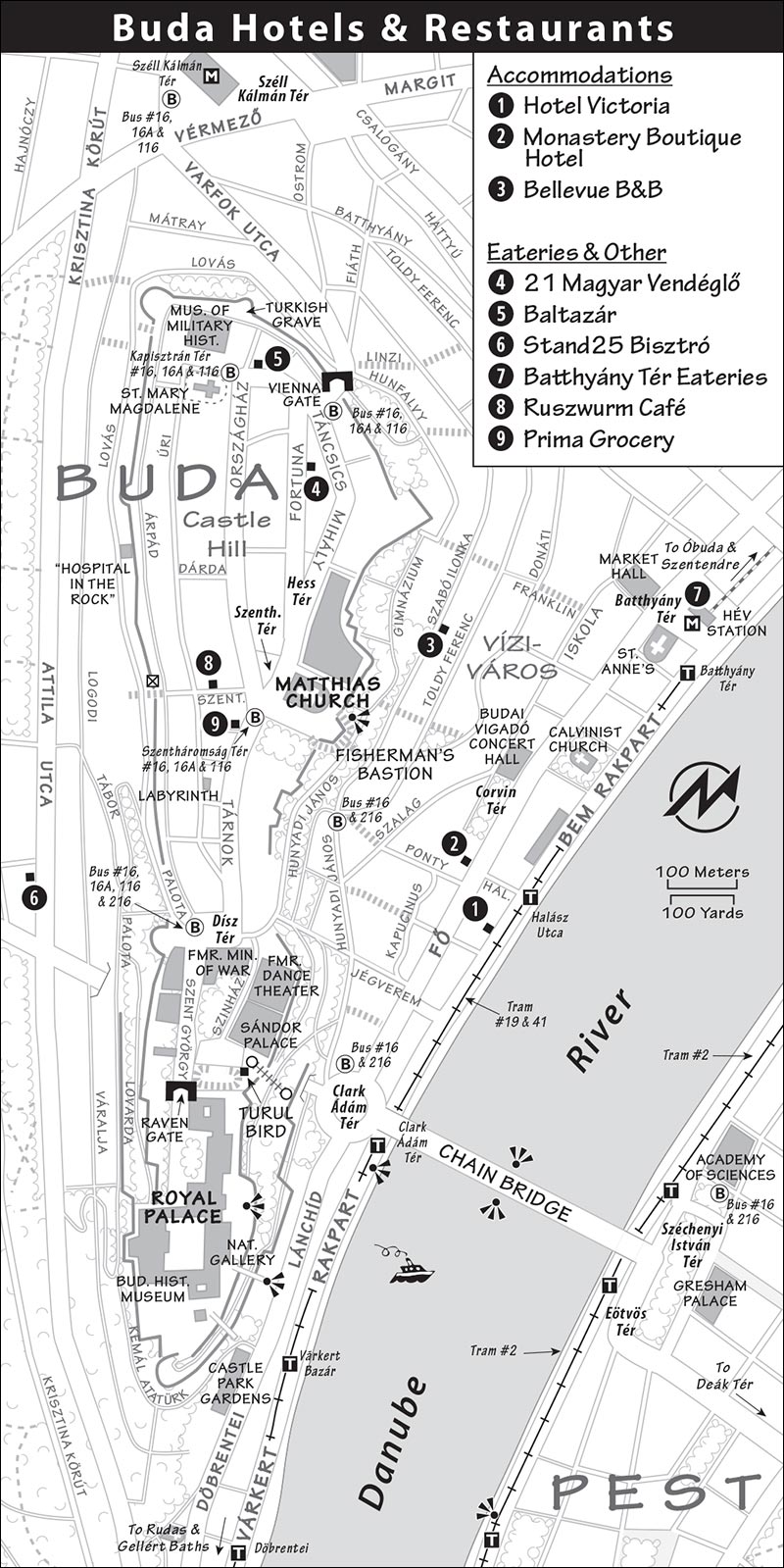
$$$ Hotel Victoria, with 27 stylish, spotless, business-class rooms—each with a grand river view—is a class act. This tall, narrow place (three rooms on each of nine floors) is run with pride and attention to detail by on-the-ball, father-and-son managers Zoltán and Oliver, along with their friendly staff. They also have a few cheaper rooms, facing the street in back. This gem is easily your best choice in this part of Buda (air-con, elevator, free sauna, reserve ahead for pay parking garage, Bem Rakpart 11, +36 1 457 8080, www.victoria.hu, victoria@victoria.hu). The painstakingly restored 19th-century Hubay Palace behind the hotel (entrance next to reception) is used for concerts and other events. It feels like a museum, with inlaid floors, stained-glass windows, and stuccoed walls and ceilings.
$$ Monastery Boutique Hotel offers 47 rooms in an actual Capuchin monastery attached to a church. The rooms—half of which overlook a very quiet courtyard—are modern, tasteful, and stylish, while respecting the history of the building. Although this is not directly on the river, it’s just a block away and well priced for the quality (air-con, elevator, Fő Utca 30, +36 1 770 8210, www.monasteryhotel.hu, info@monasteryhotel.hu).
$ Bellevue B&B hides in a quiet residential area on the Víziváros hillside, just below the Fisherman’s Bastion staircase. This gem is owned by retired economist Lajos (LIE-yosh) Szuhay, who lived in Canada for four years, and his right-hand man, Bálint. The breakfast room and some of the six straightforward, comfortable rooms have views across the Danube to the Parliament and Pest. Lajos and Bálint love to chat and pride themselves on offering genuine hospitality and a warm welcome—let them know what time you’re arriving (cash only, air-con; M2: Batthyány Tér plus a 10-minute uphill walk, or bus #16 or #216 from Deák, Széchenyi, or Clark Ádám squares to Dónati Utca plus a 2-minute walk uphill, then downhill—they’ll email you detailed directions; Szabó Ilonka Utca 15/B, +36 30 964 7287, www.bellevuebudapest.com, bellevuebudapestbandb@gmail.com).
Eating in Budapest
Budapest may be one of Europe’s most underrated culinary destinations. Hungarian cuisine is excellent—rich, spicy, smooth, and delicious. And Budapest specializes in trendy restaurants that mix Hungarian flavors with international flair, making the food here even more interesting and fun to sample. And while it’s not exactly a budget travel destination anymore, prices remain reasonable for such high quality.
EATING TIPS
I rank eateries from $ budget to $$$$ splurge. For a rundown of Hungarian cuisine and beverages, see here.
Tipping: Most restaurants in Budapest automatically add a service charge to the bill (look for “service,” “tip,” felszolgálási díj, or szervízdíj); if it’s been included, an additional tip is not necessary. Otherwise, round up about 10-12 percent.
Dining Hours: Most Hungarians dine between 19:00 and 21:00, peaking around 20:00; trendy zones such as St. István Square and Franz Liszt Square, which attract an after-work crowd, are lively earlier in the evening.
PEST
I’ve listed these options by neighborhood, emphasizing the areas with the best and most interesting choices, for easy reference with your sightseeing.
Seventh District (Ruin-Pub Zone and Jewish Quarter)
Along with the rise of “ruin pubs” (see “Nightlife in Budapest,” earlier), the Seventh District has seen the arrival of a world of great restaurants. Many places feature Jewish food, which comes in two broad categories: traditional (matzo ball soup) and Israeli (hummus, shakshuka—tomato-poached eggs—and other Middle Eastern fare).
$$ Mazel Tov, one of Budapest’s trendiest eateries (reserve ahead or line up), fills a dilapidated old building at the edge of the ruin-pub zone. Stepping across the tattered threshold, you emerge into an airy, vinestrewn, bare-brick courtyard where twinkle lights are strung over the hardworking open kitchen. With a wink to this district’s Jewish origins, they serve creative cocktails and Israeli/Middle Eastern dishes like kebabs, shawarma, falafel, tabbouleh, and shakshuka. The joyful atmosphere captures Budapest’s thriving foodie energy (daily, Akácfa Utca 47, between M1: Opera and M2: Blaha Lujza Tér, +36 70 626 4280, www.mazeltov.hu).
$$ Dobrumba, close to the Great Synagogue and giving Mazel Tov a run for its money, feels trendy and slightly ramshackle but still open and inviting. The menu—inspired by the Middle East, the Mediterranean, and the Caucasus—has an enticing variety of hot and cold meze (small plates), plus main dishes. The food is vibrantly flavored and delicious, but space is limited—reserve ahead (daily, Dob Utca 5, M1/M2/M3: Deák Tér, +36 30 194 0049, www.dobrumba.hu).
$$$$ Stand, operated by celebrity chefs Szabina Szulló and Tamás Széll, is the refined choice in this neighborhood, with a fixed-price menu of modern Hungarian and international dishes. The proud owner of two Michelin stars, it’s considered one of Budapest’s top restaurants. You’ll dine in a clean, contemporary setting with an open kitchen and impeccable service. Book far ahead (dinner only Tue-Sat—last seating at 20:00, closed Sun-Mon, Székely Mihály Utca 2, M1: Opera, +36 30 785 9139, www.standrestaurant.hu). They also run a more casual and affordable bistro across the river in Buda called Stand25 (see listing, later).
$$ Macesz Bistro (“Matzo”) is a grandma’s-dining-room-cozy corner restaurant serving traditional Jewish and Hungarian dishes, with a few modern flourishes. The setting is more elegant than many of the funky spots in the Seventh District, and they have a good wine list (daily, Dob Utca 26, M1: Opera, +36 1 787 6164).
$$ Kőleves (“Stone Soup”), next door to Macesz Bistro and filling an old kosher sausage factory, feels more casual and youthful. While the menu emphasizes Jewish and Hungarian dishes, other types are also mixed in (daily, Kazinczy Utca 41, M1: Opera, +36 20 213 5999). In good weather, they also have an adjacent garden courtyard.
$$$ KönyvBár & Restaurant is refined, mellow, and creative. The small dining room feels like a sleek, minimalist library, and the menu has a fun literary theme (könyv means “book”). As it’s small and all indoors, it can get warm. Bibliophiles should reserve ahead for an appealing dining experience (Wed-Thu dinner only, Fri-Sat lunch and dinner, closed Sun-Tue, Dob Utca 45, between M1: Opera and M2: Blaha Lujza Tér, +36 20 922 7027, www.konyvbar.hu).
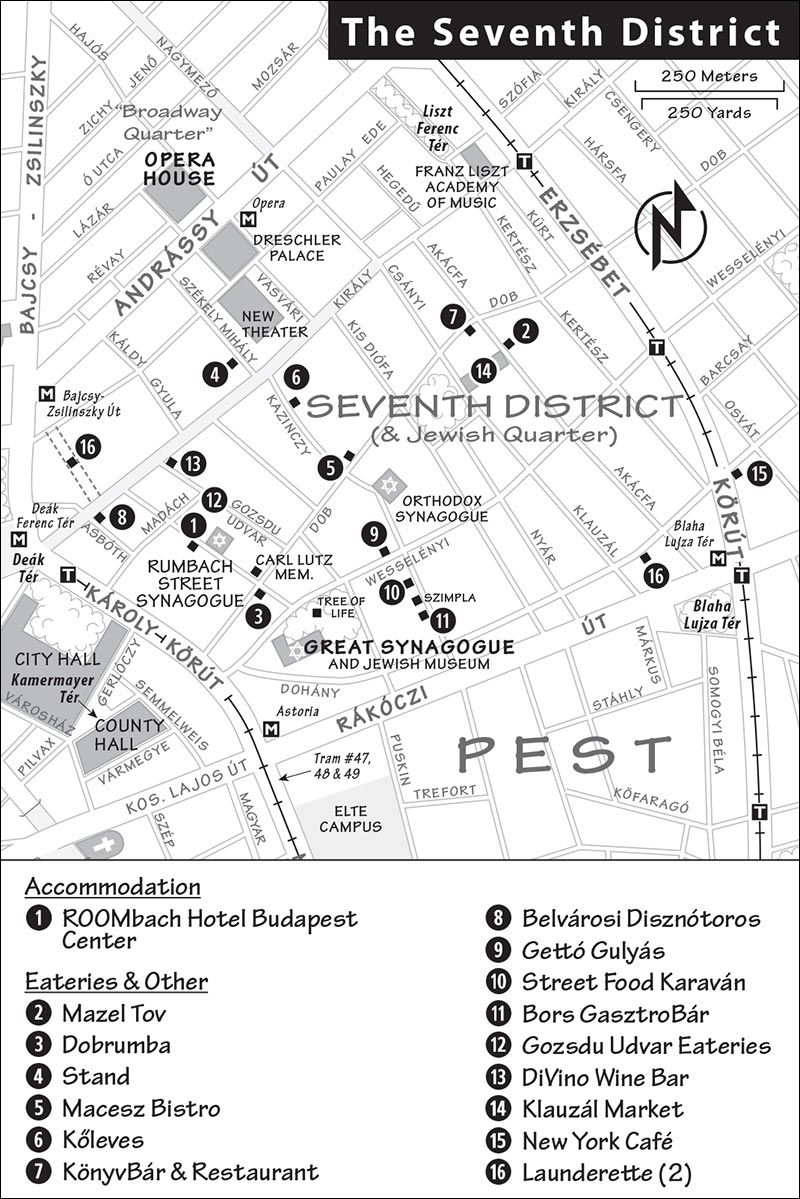
$ Belvárosi Disznótoros (“Downtown Pig Feast”) is a pork-centric place named for the traditional feast that follows the slaying of a pig. For an affordable, filling meal, choose from a wide variety of sausages and other meaty fare, priced by the weight, plus hearty sides (the fried cheese is popular). One display case features cooked food, while the other has marinated chicken they can throw on the grill (daily, just a few steps off the M1/M2/M3: Deák Tér transit hub at Király Utca 1/d, +36 70 709 8570, www.belvarosidisznotoros.hu). They have another location in Downtown Pest (see listing, later).
$ Gettó Gulyás is the place for stew. They have about a dozen different types, plus a few soups, pickled items, and a handful of pricier main courses, not to mention a decent wine list. Choose between the semi-industrial, bar-like interior or the outdoor stools (daily, Wesselényi Utca 18, M1/M2/M3: Deák Tér, +36 20 376 4480).
Food Trucks and Street Food: Just a couple of doors down from Szimpla (the oldest and best of the ruin pubs—see here), the $ Street Food Karaván fills a gravel lot with an array of creative food trucks and picnic tables. Options range from burgers and Mexican to vegan, goulash, and lángos (like a savory elephant ear). For dessert, try kürtőskalács—a delicious “chimney cake.” This is a fun, lively scene for the indecisive (daily 11:30-late, Kazinczy Utca 18, M2: Astoria). Several other tempting takeaway places line this street, including $ Bors GasztroBár (on the other side of Szimpla), which serves up grilled baguettes with a variety of tasty toppings, plus soups, in a hip and casual setting with no seating (daily, Kazinczy Utca 10, M2: Astoria, +36 30 698 9075).
Gozsdu Udvar: This passage—which laces together a series of courtyards as it runs under apartment blocks through this busy district—is jammed with bars and restaurants. The thriving and youthful scene sprawls for blocks, with options including a branch of DiVino Wine Bar (described later), all-day breakfast joints, homemade pasta bars, karaoke rooms...and even Hungarian cuisine.
Market Hall with Cheap Eats: At the northern edge of the ruin-pub zone is the $ Klauzál Market, a neighborhood market hall built in 1897. With soaring steel girders over pristinely restored food stalls and a handy Spar supermarket, it’s a fine place to browse for a picnic or grab some street food (most vendors open until about 17:00, supermarket open later, Klauzál Tér 6, runs through the block between Klauzál Utca and Akácfa Utca, between M1: Opera and M2: Blaha Lujza Tér).
Near Andrássy Út
For locations, see the “Andrássy Út Hotels and Restaurants” map on here. Note that the Seventh District eateries (in the previous section) are also nearby.
$$ Menza (the old communist word for “School Cafeteria”) is the only restaurant worth considering on touristy Franz Liszt Square. With recycled 1970s-era furniture and an orange-brown-gray color scheme, it should win a design award for its postmodern parody of an old communist café—half kitschy-retro, half contemporary-stylish. With tasty and well-priced updated Hungarian and international cuisine, embroidered leather-bound menus, brisk but efficient service, and indoor and outdoor seating, it’s a classic—book ahead (daily, halfway up Andrássy Út at Liszt Ferenc Tér 2, district VII, M1: Oktogon, +36 1 413 1482, www.menza.co.hu).
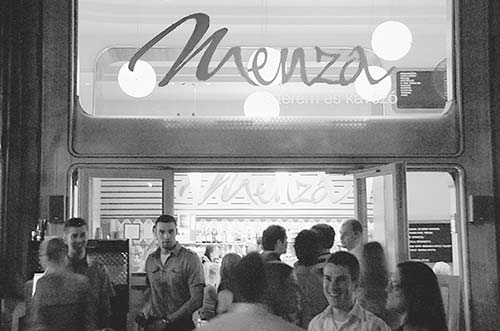
$$ Két Szerecsen (“Two Saracens”) is named for a historic coffee shop at this location that a trader filled with exotic goods. It stays true to that eclectic spirit by featuring a wide variety of cuisines—from Mediterranean to Asian—and has good indoor and outdoor seating, relatively small portions, and a menu that offers something for everyone. Book ahead for this popular place (daily, a block off Andrássy Út at Nagymező Utca 14, district VI, M1: Opera, +36 1 343 1984, https://ketszerecsen.hu/en).
$$$ Szék (“sayk”)—the Hungarian name for Transylvania—fills a stylish space right along Andrássy Út, but the menu features traditional flavors: csorba (pronounced “chorba”), a hearty soup made with a fermented-bran base; mics (“meech”), little mincemeat sausages; and even a “Carpathian Burger.” The cuisine is elevated and delicious, and while some of the flavors are similar to classic Hungarian food, it uses recipes that you won’t find at many other restaurants (daily, Andrássy Út 41, between M1: Opera and M1: Oktogon, +36 1 721 3154, www.szekrestaurant.hu).
$ Edy’s French Tacos is handy if you need a quick bite close to the Opera House. Edy likes to explain that in France, “tacos” are wrapped in a tortilla and grilled flat. (If you try to tell him that’s a “burrito,” he’ll happily set you straight.) You can design your own taco, then eat it at one of the tables in the small interior, or get it to go (closed Mon, Hajós Utca 19, M1: Opera).
Near St. István’s Basilica
The streets in front of St. István’s Basilica are jammed with upscale, tourist-oriented eateries (district V). They skew pricey—this is a neighborhood where restaurants shooting for a Michelin star set up shop (and a few have succeeded). But I’ve also scouted some budget choices, sometimes a little farther afield. For locations, see the “Leopold Town Hotels and Restaurants” map; these are all roughly between M1/M2/M3: Deák Tér, M1: Bajcsy-Zsilinszky Út, and M3: Arany János Utca.
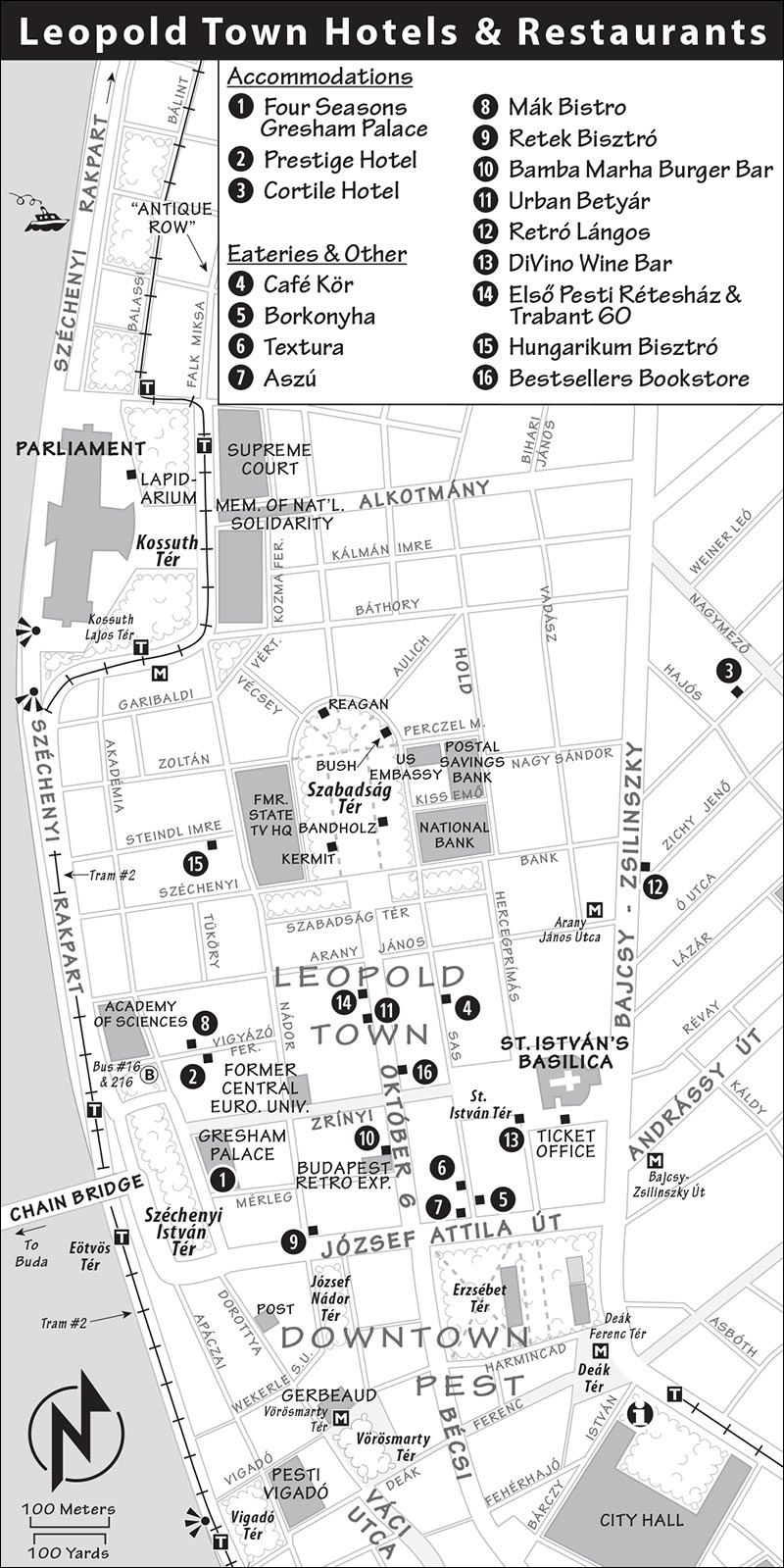
$$ Café Kör (“Circle”), a mainstay of quality and value, seems oblivious to the trends swirling around this fast-evolving zone. It’s a sophisticated but unstuffy neighborhood favorite, serving up mostly Hungarian and some global fare in a tasteful, tight, one-room interior and at a few sidewalk tables. They have good salads and enticing daily specials, and for most meals you can get a smaller portion for a reduced price. It’s wise to book ahead (closed Sun, Sas Utca 17, +36 1 311 0053).
$$$$ Borkonyha (“Winekitchen”), with a Michelin star, serves up top-quality modern Hungarian cuisine (“Hungarian dishes—but less paprika, less fat”). And, as the name implies, they’re evangelical about high-quality Hungarian wines—with several dozen types sold by the glass. The menu—especially the adventurous chalkboard specials—ventures into “nose-to-tail” cooking, using ingredients you won’t find everywhere. The decor is sophisticated black, white, and gold—a dressy place where wine snobs feel at home—and they also have sidewalk seating out front. Reservations are essential (Mon-Fri dinner only, Sat lunch and dinner, closed Sun, Sas Utca 3, +36 1 266 0835, www.borkonyha.hu).
$$$ Textura, across the street, is Borkonyha’s side restaurant, offering a more relaxed and youthful environment and a more affordable taste of their cooking (closed Sun, Sas Utca 6, +36 30 787 1051, www.texturaetterem.hu).
$$$ Aszú, along the same street, is another high-end place that’s trying to compete with its neighbors. It has a more stylized, modern interior and its own take on elevated Hungarian fare with fusion embellishments (daily, Sas Utca 4, +36 1 328 0360, www.aszuetterem.hu).
$$$$ Mák Bistro is unsnooty despite its Michelin star, and has a loyal following (reservations are essential). It feels like a well-kept secret, tucked down a forgotten side street parallel to the bustling Zrínyi Utca pedestrian drag. Inside, it has a lively brasserie ambience under white-painted brick vaults. The short, carefully selected seasonal menu is based on what’s fresh (Wed-Fri dinner only, Sat lunch and dinner, closed Sun-Tue, Vigyázó Ferenc 4, +36 30 723 9383, www.mak.hu).
$$ Retek Bisztró (“Radish”), owned by the people from Hungarikum Bisztró (described later), highlights traditional Hungarian cuisine with some modern pizzazz, in a cheery and floral environment, under high arches (daily, Nádor Utca 5, +36 20 253 5596, www.retekbisztro.hu).
$ Bamba Marha Burger Bar offers a Hungarian take on burgers—using locally sourced beef from szürkemarha, the indigenous gray longhorn cattle. (The other word in the name—bamba—means, basically, dummy; it’s a play on “mad cow.”) Part of a small chain, this location is handy for its relatively low prices compared to the many high-end options in the area (daily, Október 6 Utca 6, www.bambamarha.hu).
$$$ Urban Betyár, an immersive Hungarian-culture experience that borders on a theme-park vibe, is touristy—but in a way that makes you not want to look away. Stop in for a meal (Hungarian classics done reasonably well) or at least a coffee, and explore the sprawling folk museum that fills the basement (from the main floor, look for the giant old wine press to find the spiral stairs down to this time-warp zone). The tone is set by the life-sized betyár—an old-school Hungarian outlaw—with his puli dog out front (daily, Október 6 Utca 16, +36 1 796 3285, www.urbanbetyar.com). Rounding out their Hungarian-culture theme, they also own the Trabant 60 bar (with a retro-communism theme) and the recommended Első Pesti strudel shop (described below)—both next door.
$ Retró Lángos, across a busy boulevard from the back of the basilica, is a handy and casual place to try lángos—the big, hearty Hungarian fry bread with a wide variety of toppings. They have about two dozen different types, from the classic sour cream and garlic to creative variations, plus some palacsinta (crepe) options. Order inside, then take a seat, either in the sprawling interior wrapped around the busy kitchen or at an outdoor table. After eating one of these, you won’t need to eat again for, oh, about a week (daily, Bajcsy-Zsilinszky Út 25, +36 30 824 2679, www.retrolangos.hu).
$$ DiVino Wine Bar serves more than 100 types of Hungarian wine, listed by region on the chalkboard—all available by the glass or bottle. While a bit commercial, it’s still a handy spot to sample local wines—and the views gazing up at the basilica are superb (daily from 16:00, St. István Tér 3, +36 70 935 3980). They have another location—less scenic and a bit more serious about its wine—in the Seventh District’s Godszu Udvar corridor (similar hours, Király Utca 13).
Homemade Strudel: See how strudel (rétes) is made at Első Pesti Rétesház, a folkloric favorite among fans of this treat. Step inside to watch them roll out the long, paper-thin sheets of dough, then wrap them around a variety of fillings. Get a piece to go at the takeaway counter, or sit and enjoy your rétes with a cup of coffee (daily, also has a full food menu of traditional Hungarian dishes, Október 6 Utca 22, +36 1 428 0134).
Downtown Pest (Belváros), near Váci Utca
When you ask locals about good places to eat on Váci Utca, they just roll their eyes. But wander a few blocks off the tourist route, and you’ll discover a few alternatives with fair prices and better food. In addition to these choices, you’ll find recommendations in the “Budapest’s Café Culture” section, later. For locations, see the “Downtown Pest Hotels and Restaurants” map on here.
$$ Gerlóczy Café, tucked on a peaceful little square next to the giant City Hall, features attentive service and a concise, tasty menu of French, Hungarian, and other cuisine. The clientele is a mix of tourists and upscale-urban Budapesters, including local politicians and actors from nearby theaters. With a take-your-time ambience that’s almost Parisian—and with live piano music on weekends after 19:00—this is a classy, particularly inviting spot (good breakfasts, weekday lunch specials, long hours daily, two blocks from Váci Utca, just off Városház Utca at Gerlóczy Utca 1, district V, M3: Ferenciek Tere, +36 1 501 4000).
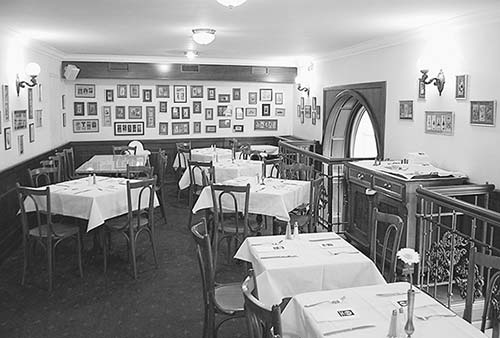
$ Belvárosi Disznótoros (“Downtown Pig Feast”), described earlier under the Seventh District, also has this very central outpost with shorter hours (Mon-Fri until 18:00, Sat until 17:00, closed Sun, Károlyi Mihály Utca 17, +36 70 602 2775).
Great Market Hall: At the far south end of Váci Utca, you can eat a quick lunch on the upper floor of the Great Market Hall (Nagyvásárcsarnok). Unfortunately, eateries here cater almost entirely to tourists. But if you’re nearby and hungry, here are some options inside the Great Market Hall: $$ Fakanál Étterem—the glassed-in, sit-down cafeteria above the main entrance—is touristy, but offers acceptable food, good seating (including some tables overlooking the thriving market hall), and live “Gypsy” music most days during prime lunch hours (closed Sun). The $ sloppy, stand-up stalls upstairs along the right side of the building are cheaper, but quality can vary. A favorite is the heavy fry bread called lángos. The basic one—slathered with sour cream, cheese, and (if you dare) garlic—is affordable, but order carefully, or they could add piles of toppings to triple or quadruple your bill. Another fine option is to use the market to assemble a picnic; get whatever else you need at the Aldi supermarket in the basement (market hall open Mon 6:00-17:00, Tue-Fri until 18:00, Sat until 15:00, closed Sun; supermarket open longer hours, Fővám Körút 1, district IX, M4: Fővám Tér).
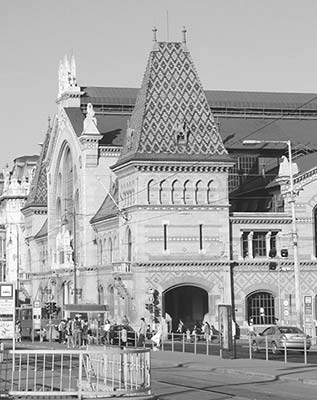
Nearby Wine Shop: Tasting Table (run by Taste Hungary) has a well-stocked wine shop on a quiet street in the Palace District, behind the National Museum. You can peruse wines from more than 200 different Hungarian producers, then order a glass or a flight; buy a bottle to consume on your trip; or ship home a handpicked selection. The knowledgeable staff is helpful (Mon-Sat 12:00-20:00, closed Sun, Bródy Sándor Utca 22, M2: Astoria or M3/M4: Kálvin Tér, +36 30 690 4913).
Elsewhere in Pest
Near Liberty Square: $$ Hungarikum Bisztró, tucked in an unassuming neighborhood between big government ministries, is my pick for classic Hungarian cuisine. Rather than gouging tourists, the youthful owners consider themselves ambassadors for the dishes their grandma raised them on. The mellow, unpretentious interior complements the strictly old-fashioned cuisine. Reservations are required (daily, Steindl Imre Utca 13—see map on here, district V, M2: Kossuth Lajos Tér, +36 1 797 7177, www.hungarikumbisztro.hu).
Near Keleti/Eastern Train Station: $$ Rosenstein is worth a trip out to the otherwise humdrum area surrounding Keleti station. Run by father-and-son team Tibor and Robert Rosenstein, it’s an unpretentious space (the main-floor dining room has slightly more character than the cellar) on a nondescript street. But it’s well known simply for the food: Everything on the menu, featuring Hungarian and Jewish dishes, is delicious. Reserve ahead (closed Sun, Mosonyi Utca 3, district VIII, M2: Keleti pu., +36 1 333 3492, www.rosenstein.hu).
BUDA
Eateries up on Castle Hill are generally overpriced and touristy—as with Váci Utca, locals never eat here. The Víziváros (“Water Town”) neighborhood, between the castle and the river, is a bit better. Even if you sleep in Buda, try to dine in Pest—that’s where you’ll find the city’s best restaurants. The restaurants listed here are all in district I. For locations, see the “Buda Hotels and Restaurants” map on here.
Castle Hill
For a quick bite, visit the handy, affordable Prima grocery store (daily, on Tárnok Utca facing Szentháromság Tér). For coffee and cakes, try the historic Ruszwurm (described later, under “Budapest’s Café Culture”). If you’d rather have a meal—and don’t want to head down to Víziváros—try the following choices:
$$$ 21 Magyar Vendéglő (“21 Hungarian Kitchen”) features traditional Hungarian fare that’s updated for the 21st century. While the mod interior is pleasant, it’s also fun to sit out on pretty Fortuna Utca (near the north end of the hill). Like all restaurants on Castle Hill, it’s pricey, but this is a rare castle-zone eatery that takes pride in its food rather than being a crank-’em-out tourism machine (daily, Fortuna Utca 21, +36 1 202 2113).
$$$ Baltazár, near the ruins of St. Mary Magdalene Church (a few short blocks from the main sights), is trying to inject some youthful liveliness into the staid, sleepy north end of Castle Hill. It’s a fun choice, with bright, brash decor, pleasant outdoor seating, and a wood-fired charcoal grill that churns out smoky dishes (daily, Országház Utca 31, +36 1 300 7050).
Worthwhile Splurge behind Castle Hill: $$$ Stand25 Bisztró, tucked just behind Castle Hill, is worth reserving ahead for a memorable meal. An outpost of the recommended Stand, which has two Michelin stars (see listing earlier, under the Seventh District), it’s mostly a lunch spot but also open for weekend dinners. Reservations for either are recommended (Mon-Thu lunch only, Fri-Sat lunch and dinner, closed Sun, Attila Út 10, +36 30 961 3262, www.stand25.hu). From the funicular station near the Chain Bridge at the base of the hill, it’s on the other side of the busy tunnel; nearby buses zip you through in a couple of minutes.
Batthyány Tér and Nearby
This bustling square—the transportation hub for Víziváros (on the M2 line)—is overlooked by a modernized, late-19th-century market hall (today housing a big Spar supermarket and various shops). Several worthwhile, affordable eateries cluster around this square.
$ Nagyi Palacsintázója (“Granny’s Pancakes”)—just to the right of the market hall entrance—serves up cheap sweet and savory crêpes (palacsinta) to a local crowd (open daily 24 hours, individual crêpes are small—order a combo for a filling meal, ask for English menu, Batthyány Tér 5).
As you face the market hall, go up the street that runs along its left side (Markovits Iván Utca) to reach more good $ eateries: Look for Coyote Coffee and Deli and (at the end of the block on the right) Édeni Végan, a self-service, point-and-shoot vegetarian cafeteria (both open daily).
HUNGARIAN STREET FOOD
For a lighter meal, keep an eye out for these two local specialties:
Lángos is a popular snack—a savory deep-fried flatbread similar to an elephant ear or Native American fry bread. Sold at stands on the street, at the recommended Retró Lángos, and upstairs in the Great Market Hall, the most typical version is spread with cheese and sour cream, and sometimes topped with garlic.
Kürtőskalács is a “chimney cake” pastry twisted around a spindle, rolled in sugar, and then slowly baked on a rotisserie until it’s coated in a caramelized crust. They roll it in toppings (cinnamon, coconut, chocolate) and hand it over hot. A basic and perfectly delicious version should run you no more than 700-800 Ft; but in touristy zones, you’ll see stands charging double (or more). One tourist-baiting gimmick is to load up the kürtőskalács with ice cream, whipped cream, flavored syrups, and other toppings...as an excuse to raise the price even higher. For the real deal, look for the vendors at the start of Andrássy Út, in front of the Nyugati/Western train station, along Váci Utca near March 15 Square, and in the Seventh District’s food-truck zone.
BUDAPEST’S CAFÉ CULTURE
In the late 19th century, a vibrant café culture boomed in Budapest, just as it did in Vienna and Paris. The kávéház (“coffeehouse”) was a local institution. By 1900, Budapest had more than 600 cafés. Locals, many of whom had moved to the city from the countryside, didn’t want to pay to heat their homes during the day. Instead, for the price of a cup of coffee, they could come to a café to enjoy warmth, companionship, and loaner newspapers.
Realizing that these neighborhood living rooms were breeding grounds for dissidents, the communists closed the cafés or converted them into eszpresszós (with uncomfortable stools instead of easy chairs) or bisztrós (stand-up fast-food joints with no chairs at all). But after 1989, nostalgia brought back kávéház culture—both as a place to get coffee and food, and as a social institution. While some serve only coffee and cakes, most serve light meals, and some offer full meals.
Over-the-Top Opulence
In Downtown Pest: $$$$ Párisi Udvar (“Paris Passage”) fills a stunning former shopping arcade in the heart of the city. Once borderline-abandoned and closed for years, a grand hotel has restored it to its previous elegance. Entering from Ferenciek Tere, you’ll first hit the café under a towering rotunda twinkling with stained glass, where you can order a drink or dessert. Deeper into the arcade, it becomes a full-service restaurant. As you sip, scrutinize the symbolism carved into the lavish decor of this Beaux-Arts space: The honeybees represent wealth, while the monkeys remind us of our humble beginnings. As with New York Café (see next), it’s worth overspending to travel back to a more elegant time. Unlike New York Café, this place feels a bit less discovered (daily, Ferenciek Tere 10, district V, right outside the exit for M3: Ferenciek Tere, +36 70 702 4088, www.parisipassage.hu).
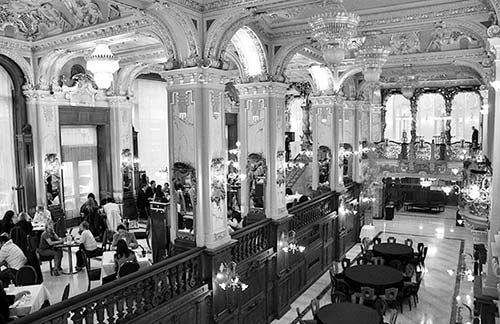
On the Great Boulevard: $$$$ New York Café was originally built in 1894 by a big American insurance company (who believed that having the most extravagant café imaginable for their clients would inspire confidence). This fanciful, over-the-top explosion of Neo-Baroque and Neo-Renaissance epitomizes the “mix and match, but plenty of everything” Historicist style of the day. In the early 20th century, artists, writers, and musicians came here to sip overpriced coffee and bask in opulence. Now it’s overrun by gawking, selfie-taking tourists...but still visually magnificent. Expect a line (no reservations possible before 18:00). It’s snooty and greedy, but it’s still a magnificent space to nurse a coffee or a dessert (daily, inside the Anantara New York Palace Hotel at Erzsébet Körút 9, district VII, +36 1 886 6167, www.newyorkcafe.hu). Take the M2/red Metró line to Blaha Lujza Tér and exit toward Erzsébet Körút, then walk a block. You can also take tram #4 or #6 from the Oktogon (at Andrássy Út) around the Great Boulevard to the Wesselényi Utca stop. For location, see the map on here.
Neighborhood Coffeehouses
Next to the Opera House: $$$ Callas straddles these two categories in both price and elegance. It boasts ideal outdoor seating facing the Opera House and one of the finest Art Nouveau interiors in town, with gorgeous Jugendstil chandeliers. While they do serve meals, most locals come here for coffee and cakes (daily, Andrássy Út 20—see the map on here, district VI, M1: Opera, +36 1 354 0954).
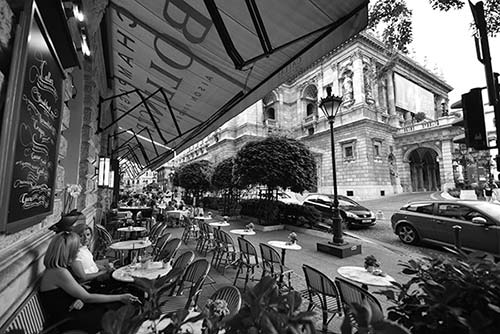
In Downtown Pest: $$ Gerlóczy Café nicely recaptures Budapest’s early-1900s ambience, with loaner newspapers on racks, marble tables, red-leather benches, a management that encourages loitering, and rich but not ostentatious decor (see restaurant listing, earlier). $$ Centrál Kávéház is another venerable favorite. While I’d skip the food, it has an enjoyable and atmospheric two-story interior and is great for a drink (daily, Károlyi Mihály Utca 9, district V, M3: Ferenciek Tere, +36 1 266 2110). For locations of both, see the map on here.
In Buda, on Castle Hill: $$ Ruszwurm lays claim to being Budapest’s oldest café (since 1827). Tiny but classy, with old-style Biedermeier furnishings and fine sidewalk seating, it upholds its venerable reputation with pride. Its dead-central location—a block in front of Matthias Church in the heart of the castle district—means that it’s a popular tourist spot (though it remains dear to locals’ hearts). Look for gussied-up locals chatting here after the Sunday morning Mass (daily until 19:00, Szentháromság Utca 7—see map on here).
Budapest Connections
BY TRAIN
Hungary’s train network is run by MÁV (Magyar Államvasutak). From centrally located Budapest, train lines branch out across Hungary like spokes on a wheel. Most connections between outlying cities aren’t direct—you often end up having to go back through Budapest. While Hungary’s trains are generally good, some are old and fairly slow; major routes use faster, newer, and slightly more expensive InterCity trains (marked with an “IC” or a boxed “R” on schedules). To ride an InterCity train, you must pay extra for a required reservation.
If traveling to international destinations such as Bratislava or Vienna, other trains are faster and more direct than the InterCity. Between Budapest and Bratislava, EuroCity (EC) trains are fastest and most direct. If traveling from Budapest to Vienna, Austrian RailJet (RJ) trains are fastest and direct, and don’t require seat assignments (but advance-purchase discounts lock you into a specific departure).
Warning: Trains can be very crowded on weekends, when it’s smart to book a reservation for any train trip.
For timetables, the first place to check is Germany’s excellent all-Europe site, www.bahn.com. You can also check Hungary’s own timetable website at http://elvira.mav-start.hu. For general rail information in Hungary, call +36 1 444 4499.
Remember that Budapest has three major train stations (pályaudvar, abbreviated pu.): Keleti (“Eastern”) station, Nyugati (“Western”) station, and Déli (“Southern”) station.
Buying Train Tickets: For domestic tickets and most international journeys, it’s easiest to book online on the Hungarian Railways website: www.mavcsoport.hu. You can send an eticket to your phone (you may have to create a login to do this); then, on the train, just flash your eticket to the conductor, who may ask to see your ID. More complicated international journeys—such as ones involving transfers—may need to be purchased in person at a train station ticket office.
If buying tickets at the station, simply use the ubiquitous MÁV ticket machines. If you need help, look for a staffed ticket desk—marked pénztár or jegypénztár. Sometimes international tickets are sold only at a special window (marked nemzetközi).
Other key words: Vágány (track), induló vonatok (departures), and érkező vonatok (arrivals).
From Budapest by Train to: Eger (every 2 hours direct, 2 hours, more with transfer in Füzesabony, usually from Keleti/Eastern station), Pécs (every 2 hours direct, 3 hours; a few more connections possible with transfer at suburban Kelenföld station), Sopron (every 2 hours direct, 2.5 hours, more with transfer at Kelenföld), Visegrád (trains arrive at Nagymaros-Visegrád station, across the river—take shuttle boat to Visegrád; 1-2/hour, 45 minutes, from Nyugati/Western station), Esztergom (hourly, 1 hour, usually from Nyugati/Western station; but Esztergom’s train station is far from the basilica, making the bus—described later—a better option), Kecskemét (hourly, 1.5 hours), Szeged (hourly, 2.5 hours).
Bratislava (Pozsony in Hungarian, every 2 hours direct, 2.5 hours; more with changes), Vienna (Bécs in Hungarian, every 2 hours direct on express Railjet, 2.5 hours; more with changes), Prague (5/day direct, 6.5 hours), Kraków (1/day, 9 hours, change in Bohumin), Zagreb (2/day direct, 5.5 hours), Ljubljana (1/day direct, 8.5 hours), Cluj-Napoca (hub for Transylvania in Romania, 2/day direct, 7.5 hours), Munich (every 2 hours direct on express RailJet, 7 hours).
By HÉV: Budapest has its own suburban rail network, called HÉV. For tourists, this is mostly useful for reaching Szentendre (from M2: Batthyány Tér) and Gödöllő (from M2: Örs Vezér Tere).
BY BUS
Buses can be relatively inexpensive, but are typically slower and less convenient than trains. The only bus you’re likely to take is the one to Eger (2/hour, 2 hours), which leaves from the Stadionok bus station (at the M2/Metró red line stop of the same name). You can search bus schedules at the website www.menetrendek.hu.
BY PLANE
For information about Budapest’s Liszt Ferenc Airport, see “Arrival in Budapest—By Plane” on here.
ROUTE TIPS FOR DRIVERS
For pointers on driving into (and parking in) Budapest, see “Arrival in Budapest—By Car” on here. Remember, to use Hungary’s expressways, you’ll need to buy a toll sticker (see here). To get out of town, here are some pointers.
To Eger and Other Points East: Head out of the city center on Andrássy Út, circling behind Heroes’ Square to access Kós Károly Sétány through the middle of City Park. You’ll pass Széchenyi Baths on the left, then (exiting the park) go over the Hungária Körút ring road, before getting on M-3. This expressway zips you conveniently to Eger (exit #114 for Füzesabony; go north on road 33, then follow road 3, then road 25 into Eger).
To Bratislava, Vienna, and Other Points West: From central Pest, head over the Danube on the white, modern Elisabeth Bridge (Erzsébet Híd). Once in Buda, the road becomes Hegyalja Út; simply follow Bécs-Wien signs to get on M-1.
Day Trips from Budapest
On a visit of a few days, Budapest will keep even the most avid sightseer busy. And after Budapest, Eger, covered in the next chapter, is one of the best Hungarian towns. But for a longer stay, a few outlying sights are worth considering. I’ve listed them here roughly in order of proximity to downtown Budapest.
▲▲Memento Park (a.k.a. Statue Park)
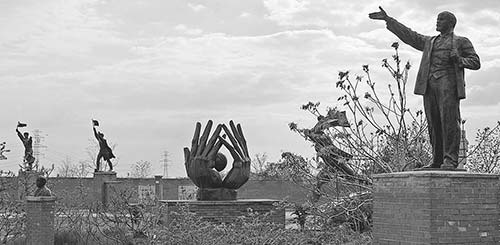
When regimes fall, so do their monuments...literally. Just think of all the statues of Stalin and Lenin that crashed to the ground in late 1989, when people throughout Eastern Europe couldn’t wait to get rid of those reminders of their oppressors. But some clever entrepreneur hoarded Budapest’s, collecting them in a park in the countryside just southwest of the city—where tourists flock to get a taste of the communist era. Though it can be time-consuming to visit, this collection is worth ▲▲▲ for those fascinated by Hungary’s commie past. You’ll see the great figures of the Soviet Bloc—both international (Lenin, Marx, and Engels) and Hungarian (local bigwig Béla Kun)—as well as gigantic, stoic figures representing Soviet ideals.
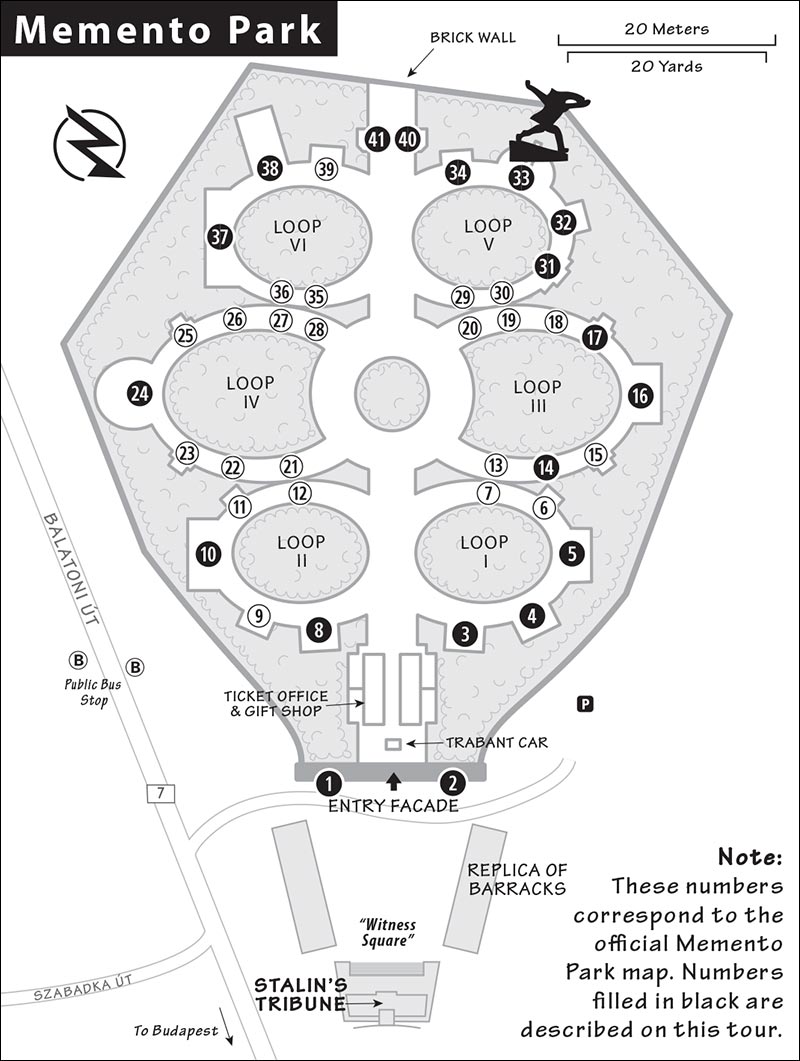
Cost and Hours: 3,000 Ft, daily 10:00-18:00, Nov-April until 16:00, six miles southwest of city center at the corner of Balatoni Út and Szabadka Út, district XXII; ride the Metró then bus (for details, see below); +36 1 424 7500, www.mementopark.hu.
Getting There: It’s in the countryside six miles southwest of the city center, at the corner of Balatoni Út and Szabadka Út, in district XXII.
Public transit is a bit complicated, but workable: Ride the Metró’s M4/green line to its end at Kelenföld. Follow signs to Őrmező and Péterhegyi Út (exit B). Emerging in this bus-stop zone, consult the electronic board. You want bus #101B or #101E, which zip to Memento Park in about 10 minutes (every 10-20 minutes, Mon-Fri only). Bus #150 takes longer (about 20 minutes), but it’s the only option on weekends (2-4/hour, runs daily). On any bus, be sure the driver knows where you want to get off.
A round-trip taxi, including about an hour of waiting time at the park, should cost around 25,000 Ft (ask your hotel to call one for you; confirm the price before leaving).
If you’d like to be picked up in the city center and brought to Memento Park in a Trabant—the classic communist-era car with loads of kitsch value—you can book that on the official website (€150, more with a guided tour, total experience is about three hours).
Visitor Information: The English guidebook, In the Shadow of Stalin’s Boots, is informative.
Tours: English tours depart from the entrance and last 70 minutes (7,200 Ft, typically available Thu-Sun at 11:00—but check times and prebook on their website).
Background: Under the communists, creativity was discouraged. The primary purpose of art was to further the goals of the state. Promoting Socialist Realist art served to encourage complicity with the brave new world the communists were forging. It was also a break with the “decadent” bourgeois art that came before it (Impressionism, Post-Impressionism, and other modern -isms). From 1949 until 1956, Socialist Realism was legally enforced as the sole artistic style of the Soviet Bloc.
As propaganda was an essential weapon in the Soviet arsenal, the regime made ample use of Socialist Realist art. Aside from a few important figureheads, individuals didn’t matter. Individual characteristics and distinguishing features were unimportant; people were represented as automatons serving their nation. Artistic merit was virtually ignored. Most figures are trapped in stiff, unnatural poses that ignore the 3,000 years of artistic evolution since the Egyptians. Sculptures and buildings alike from this era were designed to evoke feelings of power and permanence.
Visiting the Park: The numbers here match the statue labels in the park and on the official park map. You’re greeted by three of the Communist All-Stars: 1 Vladimir Lenin, a leader of Russia’s Bolshevik Revolution; and 2 Karl Marx and Friedrich Engels, the German philosophers whose Communist Manifesto first articulated the principles behind communism in 1848. Inside the gate, buy your ticket and head into the park. The six walkways branching off the main road all loop you right back to where you started—representing the endless futility of communism. Work your way clockwise around the park, starting with Loop I.
Liberation Monuments (Loop I): Dominating this loop is a 3 giant soldier holding the Soviet flag. Typical of Socialist Realist art, the soldier has a clenched fist (symbolizing strength) and a face that is inspired by his egalitarian ideology.
To the left of this soldier, 4 two comrades stiffly shake hands: the Hungarian worker thrilled to meet the Soviet soldier—protector of the proletariat. Beyond them is a 5 long wall, with a triumphant worker breaking through the left end—too busy doing his job to be very excited.
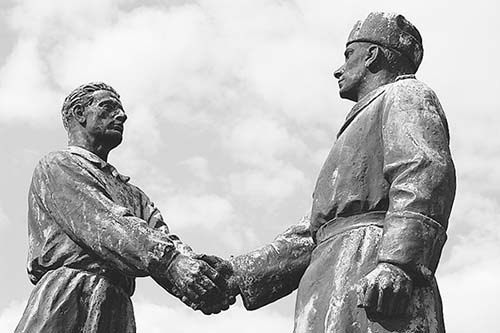
Crossing the “main street,” you’ll see a group of statues commemorating a key communist holiday.
April 4, 1945 (Loop II): On this date, the Soviets forced the final Nazi soldier out of Hungary. The tall panel nearest the entrance shows a Hungarian woman and a Soviet woman setting free the 8 doves of peace.
At the back of the loop, the 10 Hungarian worker and Soviet soldier are absurdly rigid even though they’re trying to be dynamic. (Even the statues couldn’t muster genuine enthusiasm for communist ideals.) Cross over and head up to the next loop.
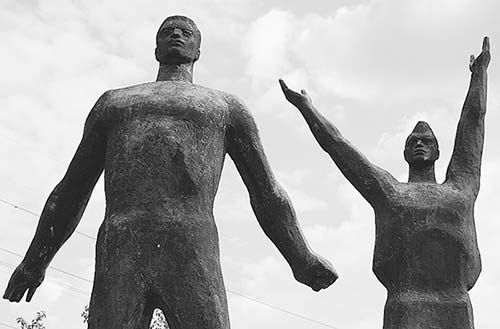
Heroes of the Workers’ Movement (Loop III): Look for the 14 bust of the Bulgarian communist leader Georgi Dimitrov—one of communist Hungary’s many Soviet Bloc comrades. At the back of this loop are 16 three blocky portraits. The middle figure is the granddaddy of Hungarian communism: Béla Kun. To the left is one of the park’s best loved, most photographed, and most artistic statues: 17 Vladimir Lenin, in his famous “hailing a cab” pose. Cross over—passing the giant red star made of flowers.
More Communist Heroes (Loop IV): This group is dominated by a 24 dramatic, unusually emotive sculpture by a genuine artist, Imre Varga (see here and here). Designed to commemorate the 100th anniversary of Béla Kun’s birth, this clever statue reinforces the communist message: Under the able leadership of Béla Kun, the crusty, bourgeois old regime of the Habsburg Empire (on the left, with the umbrellas) was converted into the workers’ fighting force of the Red Army (on the right, with the bayonets). And yet, those silvery civilians in back seem more appealing than the lunging soldiers in front. And notice the lamppost next to Kun: In Hungarian literature, a lamppost is a metaphor for the gallows. This reminds viewers that Kun was ultimately executed by communists in the Soviet Union during Stalin’s purges of the late 1930s.
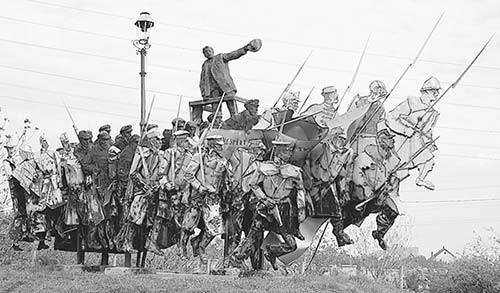
Communist Concepts (Loop V): Look for a rusty pair of 31 workers’ hands holding a sphere. This represented the hard-won ideals of communism, carefully protected by the hands—but also held out for others to appreciate. The 32 monument to Hungarian soldiers honors those who fought against the fascist Francisco Franco in the Spanish Civil War. Dominating this group is a 33 communist worker charging into the future, clutching the Soviet flag. To the left is a monument to the communist version of the Boy Scouts: the elementary-school-age 34 Little Drummers and the older Pioneers. While these organizations existed before the communists, they were slowly infiltrated and turned into propaganda machines. These kids were sent to camp to be properly raised as good little communists; many later forgot the brainwashing but still had fond memories of the socializing.
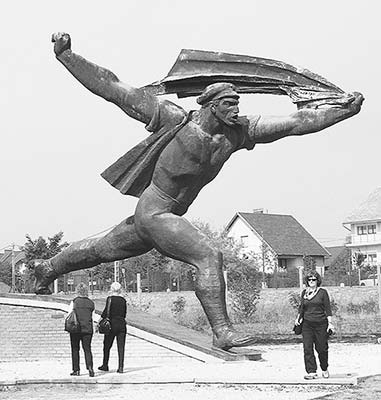
More Communist Concepts (Loop VI): The 37 long, white wall at the back of this section tells quite a story (from left to right): The bullet holes lead up to a jumbled, frightful clutter representing World War II. Then comes the bright light of the Soviet system, and by the end everyone’s properly regimented and looking boldly to the future (and enjoying a bountiful crop, to boot). The names in the center represent “heroes” who stayed true to the ideology, party, and nation and died in “defense of proletarian power” in 1956.
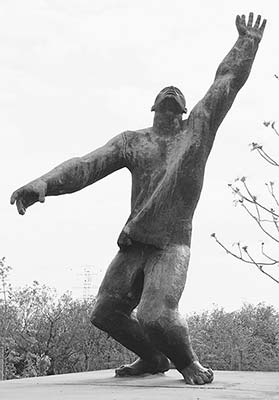
Next is a 38 fallen hero with arm outstretched, about to collapse to the ground—mortally wounded yet victorious. This monument to “the Martyrs of the Counter-Revolution” also commemorates those who died attempting to put down the 1956 Uprising.
Dead End: The main path dead-ends at the wall, symbolizing life’s frustrations under communism. Here stand statues of two Soviet officers who negotiated with the Nazis to end the WWII siege of Budapest. 40 Captain Miklós Steinmetz (on the right) was killed by a Nazi land mine, while 41 Ilja Ostapenko (on the left) was shot under mysterious circumstances as he returned from the successful summit. Both became heroes for the communist cause.
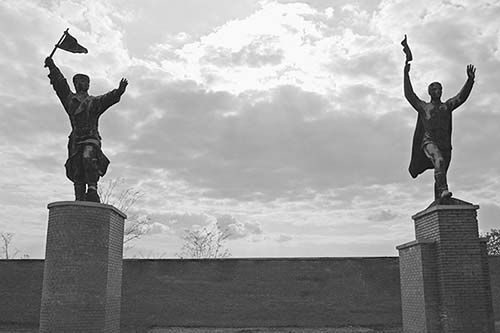
Return to the entry gate and head out across the parking lot.
Stalin’s Tribune: This section of the complex is a re-creation of the giant grandstand that once stood along “Parade Street.” Hungarian and Soviet leaders stood here, at the feet of a giant Stalin statue, to survey military and civilian processions. But during the 1956 Uprising, protesters cut Stalin off at the knees...leaving only the boots. (The entire tribune was later dismantled, and Stalin disappeared without a trace.) Behind the tribune, stairs lead up to a view over the park. In front of the tribune are barracks, reminiscent of the ramshackle barracks where political prisoners lived in communist-era work camps. These hold special exhibits. Sit down for the creepy film, The Life of an Agent—a loop of four training films that were actually used to teach novice spies about secret-police methods and policies.
Óbuda
“Old Buda,” just north of Buda, is the oldest part of Budapest, with roots going back to Celtic and Roman times. It has various sights that cluster around the Szentlélek Tér stop of the HÉV suburban train line (catch the HÉV from the Batthyány tér Metró stop in Buda). The most interesting museum displays works by Hungarian sculptor Imre Varga, who worked from the 1950s through the 1990s, and created many popular sculptures in Budapest and throughout Hungary. You’ll also find a museum filled with eye-popping, colorful paintings by Victor Vasarely, the founder of Op Art. If you ride the HÉV farther north to the Aquincum stop, you’ll reach an archaeological museum at the remains of the 2,000-year-old Roman town of Aquincum and its amphitheater. All of these sights are closed on Mondays.
Gödöllő Royal Palace
Holding court in an unassuming town on the outskirts of Budapest, this pink Baroque palace was once the residence of Habsburg emperor Franz Josef and his wife, Empress Elisabeth—better known to her beloved Hungarian subjects as Sisi (see here). While the Habsburg sights in Vienna and near Prague are better, this is the best place in Hungary to learn about its former monarchs.
Cost and Hours: 4,200 Ft for permanent exhibit (main palace apartments); daily 10:00-18:00, off-season shorter hours and may close Sat-Sun, last entry one hour before closing; tel. 28/410-124, www.kiralyikastely.hu.
Getting There: Take the M2/red Metró line to Örs Vezér Tere, then catch the HÉV suburban train to Gödöllő—figure about one hour each way from downtown Budapest.
The Danube Bend
This string of three river towns north of Budapest offers a convenient day-trip getaway for urbanites who want to commune with nature. While I find “the Bend” less than thrilling, it’s undeniably convenient to reach from the capital by train or boat; these destinations make for handy stopovers if you’re driving between Budapest and Bratislava or Vienna.
Szentendre is a colorful, “Balkans in miniature” artist colony. With a tidy main square, a few engaging art galleries, and several Orthodox churches built by the Serbs and Greeks who settled the town, it offers a relaxing escape from the city. This is the easiest pleasant small town to reach from Budapest—which means it’s also deluged by tourists. To reach Szentendre, hop on the HÉV suburban train at Budapest’s Batthyány tér Metró (the same one that goes to Óbuda, described earlier).
Visegrád offers a small riverside museum at the scant remains of a Renaissance palace built by King Matthias Corvinus, and a dramatic hilltop castle with fine views over the Bend. While you can get here by boat or by train (to the Nagymaros-Visegrád station, then boat across the river), it’s not worth the trip unless you’re driving.
Esztergom Basilica is Hungary’s biggest and most important church, built on the site where István, Hungary’s first Christian king, was crowned in AD 1000. Packed with history, it looms grandly above the Danube (free to enter basilica; 1,500 Ft for the treasury; 1,600 Ft for the “tourist areas” (including the crypt, panorama hall, and top of the dome); 2,900 Ft for everything; daily 8:00-19:00, off-season typically until 17:00, www.bazilika-esztergom.hu). The easiest way to reach it is by bus from Budapest’s Újpest-Városkapu bus station (at the Metró stop of the same name); trains and other buses from Budapest take you to the far end of town, an inconvenient 45-minute walk to the basilica.