GDAŃSK & THE TRI-CITY
Map: Gdańsk Hotels & Restaurants
Hel Peninsula (Mierzeja Helska)
Gdańsk (guh-DAYNSK), on the Baltic Coast of Poland, may be the great undiscovered Central European destination—rich with history and culture, slathered with gorgeous architecture old and new, loaded with world-class museums and great restaurants...and just plain fun.
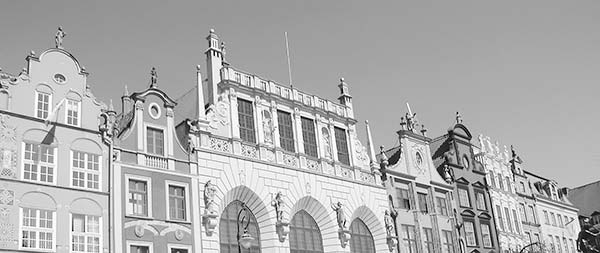
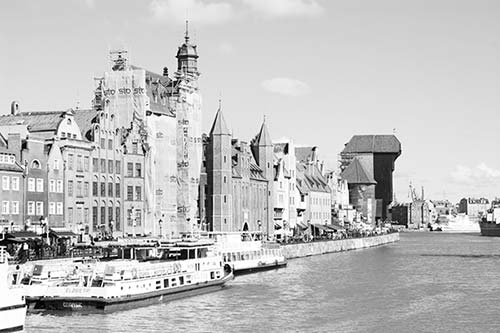
Exploring Gdańsk is a delight. It feels like Poland’s answer to Amsterdam or Scandinavia. The historical center is a gem, with block after block of red-brick churches and narrow, colorful, ornately decorated Hanseatic burghers’ mansions. The riverfront embankment, with its trademark medieval crane, oozes salty maritime charm. Gdańsk’s history is also fascinating—from its 17th-century golden age to the headlines of the late 20th century, big things happen here. You might even see ol’ Lech Wałęsa still wandering the streets. And yet Gdańsk is also unmistakably a city of the future, with state-of-the-art construction projects popping up all over.
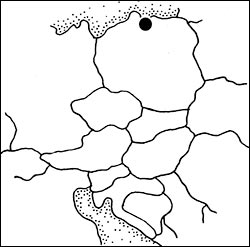
Gdańsk and two nearby towns (Sopot and Gdynia) together form an area known as the “Tri-City,” offering several day-trip opportunities north along the coast (see here). The belle époque seaside resort of Sopot beckons to holidaymakers, while the modern burg of Gdynia sets the pace for today’s Poland. Beyond the Tri-City, the sandy Hel Peninsula is a popular spot for summer sunbathing, and Malbork Castle (covered in the next chapter) is an easy half-hour train ride away.
PLANNING YOUR TIME
Gdańsk, with more than its share of great sights (and tempting side trips), demands two full days—which also makes the long trip up here more worthwhile. (Add a night in Toruń, while you’re at it.) If you’re in a rush and have a limited appetite for sightseeing, you could squeeze it into one day. If you have more time, Gdańsk will fill it.
Gdańsk sightseeing has three major components: the Royal Way (historic main drag with good museums); the river embankment, leading to the WWII history museum; and the modern shipyard where Solidarity was born (with a fascinating museum). If you have just one (very busy) day, follow my self-guided walk through the Main Town and then out to the Solidarity sights, followed by a spin through the WWII museum (closed Mon) and a stroll along the riverfront back into town.
With two days, I’d devote one day to the Main Town, riverbank, and WWII museum; and a second day to the Solidarity sights, rounding out your time with other attractions: Art lovers enjoy the National Museum (with a stunning altar painting by Hans Memling), history buffs make the pilgrimage to Westerplatte (where World War II began), castle fans side-trip to Malbork, and church and pipe-organ fans might visit Oliwa Cathedral in Gdańsk’s northern suburbs (on the way to Sopot).
If you have more time, consider the wide variety of side trips. The most popular option is the half-day round-trip to Malbork Castle (30-45 minutes each way by train, plus two or three hours to tour the castle—see next chapter). It only takes a quick visit to enjoy the resort town of Sopot (25 minutes each way by train), but on a sunny day, that town’s beaches may tempt you to laze around longer. Gdynia is skippable, but it does have one great sight (the Emigration Museum) and rounds out your take on the Tri-City. If you have a full day and great weather, and you don’t mind fighting the crowds for a patch of sandy beach, go to Hel.
Gdańsk gets very busy in late June, when school holidays begin, and it’s crowded with (mostly German, Norwegian, and Swedish) tourists from July to mid-September—especially during St. Dominic’s Fair (Jarmark Św. Dominika, three weeks from late July to mid-Aug), with market stalls, concerts, and other celebrations.
Closed (and Free) Days: Most sights in Gdańsk close one day each week, typically either Tuesday (Museum of Gdańsk branches) or Monday (other museums). And some sights are free one day each week—for example, the Museum of Gdańsk branches are free on Monday. Check these details when planning your sightseeing (as these days tend to change from year to year). If you’re in town when major museums are closed, good alternatives include visiting churches (including St. Mary’s) or the European Solidarity Center. If side-tripping anywhere, check ahead for closed days: For example, Malbork Castle’s interiors and Gdynia’s Emigration Museum are closed on Mondays.
Orientation to Gdańsk
With 460,000 residents, Gdańsk is part of the larger urban area known as the Tri-City (Trójmiasto, total population of one million). But the tourist’s Gdańsk is compact, welcoming, and walkable—virtually anything you’ll want to see is within a 20-minute stroll of everything else.
Focus on the Main Town (Główne Miasto), home to most of the sights described, including the spectacular Royal Way main drag, Ulica Długa. The Old Town (Stare Miasto) has a handful of old brick buildings and faded, tall, skinny houses—but the area is mostly drab and residential, and not worth much time. Just beyond the northern end of the Old Town (about a 20-minute walk from the heart of the Main Town) is the entrance to the Gdańsk Shipyard, with the excellent European Solidarity Center and its top-notch museum. From here, shipyards sprawl for miles.
Crossing the River: In addition to the big, permanent bridge in front of the Green Gate, Gdańsk has two pedestrian bridges in the tourist zone: a swing bridge near the Crane (connecting to the sleek modern strip on Granary Island) and a drawbridge farther north (just beyond the carousel on Fishmarket Square). Both bridges are available to pedestrians from :30 past each hour until the top of the hour; when the clock approaches :00, you’ll hear a siren and a recorded warning to clear the bridges so they can open for boat traffic. Then, after 30 minutes, they click back into place for pedestrians again. If exploring across the river, keep an eye on the time...unless you don’t mind taking a longer route back. You may also see a small ferry (named the Motława, like the river) that occasionally shuttles visitors back and forth on the extremely quick crossing between the Crane and the old granaries across the way (small fee, operated by the Maritime Museum).
Language Barrier: The second language in this part of Poland is German, not English. As this was a predominantly German city until the end of World War II, German tourists flock here in droves. But you’ll win no Polish friends if you call the city by its more familiar German name, Danzig.
Cruise Crowds: Gdańsk is an increasingly popular cruise destination, with about 100 ships calling here each year (most dock at the nearby city of Gdynia, and passengers take a bus or train in). During summer daytime hours, the town is filled with little excursion groups.
TOURIST INFORMATION
Gdańsk has two different TI organizations. Most helpful is the regional TI, which occupies the Upland Gate, at the start of my self-guided walk (daily 9:00-18:00, off-season until 17:00, +48 58 732 7041, www.pomorskie.travel). The city TI is conveniently located at the bottom end of the main drag, at Długi Targ 28 (just to the left as you face the river gate; daily 9:00-17:00, +48 58 301 4355, www.visitgdansk.com). There’s also a TI desk at the airport, and there may be one in the future at the Solidarity Center.
Sightseeing Pass: Busy sightseers should consider the Tourist Card, which includes entry to several sights in Gdańsk, Gdynia, and Sopot, and discounts at others (such as 20 percent off the European Solidarity Center). Check the list of what’s covered, and do the arithmetic (65 zł/24 hours, 85 zł/48 hours, 105 zł/72 hours, pay more to add local transit, sold only at TIs).
ARRIVAL IN GDAŃSK
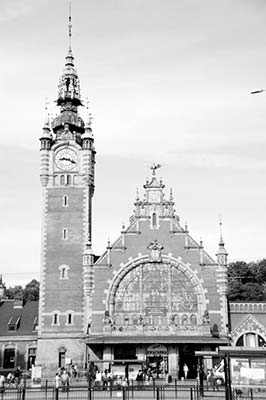
By Train at Gdańsk’s Main Train Station (Gdańsk Główny): If you’re on a PKP train, get off at the Gdańsk Główny stop. This station is a pretty brick palace on the western edge of the old center. (To save money, architects in Colmar, France, copied this exact design to build their city’s station.) As this station has been under construction, details may be in flux. But generally, trains to other parts of Poland (marked PKP) typically use platforms 1 or 2; regional trains with connections to the Tri-City (marked SKM) use platform 3. The bus station (Dworzec PKS) is behind the train station, accessible via the pedestrian tunnel that connects the platforms.
To walk into town, use the pedestrian underpass to go beneath the busy road; from where you emerge, it’s a 10-to-15-minute walk to the heart of town and most hotels (bear right from the underpass and head for all the red-brick church towers). Considering the stairs and the distance, it’s easier—and affordable—to hop in a taxi or request an Uber (about 20-25 zł); from the tunnel under the tracks, exit toward ul. Podwale Grodzkie to pop out at the busy road, where you can meet your Uber or find a taxi.
By Train at Gdańsk Śródmieście: If you’re arriving in Gdańsk on a commuter SKM train, consider getting off at the Gdańsk Śródmieście station, which is a slightly shorter walk to the start of my Gdańsk Walk. From Gdańsk Śródmieście, use the underpass to reach the gigantic Forum shopping mall. Walk straight through the mall to the far end; after exiting, if you look to the right, you’ll see a pedestrian underpass leading to the Upland Gate and the start of my walk.
By Plane: Gdańsk’s architecturally impressive, user-friendly airport, named for Lech Wałęsa, is about five miles west of the city center (code: GDN, www.airport.gdansk.pl). From the arrivals area, follow signs to the handy train, which zips to the main train station in about 30 minutes (5 zł, 1-2/hour). Public bus #210 also heads to the main train station; you can get off one stop earlier, at Hucisko, for a slightly shorter walk to the main part of town (5 zł, buy ticket at machine before boarding, 2/hour Mon-Fri, hourly Sat-Sun, 40 minutes). The 25-minute taxi ride into town should cost around 60-80 zł; an Uber typically costs less (except during peak times).
GETTING AROUND GDAŃSK
Nearly everything is within easy walking distance of my recommended hotels, but public transportation can be useful for reaching outlying sights such as Oliwa Cathedral, Westerplatte, Sopot, Gdynia, and Hel (specific transportation options for these places are described in each listing).
By Public Transportation: Gdańsk’s trams and buses work on the same tickets: single-ride ticket—4.80 zł, 24-hour ticket—18 zł. Major stops have user-friendly ticket machines, which take credit cards; otherwise, buy tickets (bilety) at kiosks marked RUCH. In the city center, the stops worth knowing about are Plac Solidarnośći (near the European Solidarity Center), Gdańsk Główny (in front of the main train station), and Brama Wyżynna (near the Upland Gate and the Gdańsk Śródmieście commuter train station).
By Taxi or Uber: Taxis cost about 8 zł to start, then 2-3 zł per kilometer (a bit more at night). However, taxis waiting at stands often have inflated rates; it’s safer to call a cab (try Neptun, +48 19686 or +48 585 111 555; EcoCar, +48 123 456 789; or Dajan, +48 58 19628). Uber works well in Gdańsk and is typically cheaper than a taxi.
Tours in Gdańsk
Private Guides
Hiring a local guide is an exceptional value. Agnieszka Syroka—personable and knowledgeable—is a wonderful guide (750 zł/half-day tour, more for all day, +48 502 554 584, www.tourguidegdansk.com, syroka.agnieszka@gmail.com). Other guides include Izabella Daszkiewicz (similar rates, +48 506 511 752, gedanka@op.pl, www.gedanka.pl) and Jacek “Jake” Podhorski, who teaches economics at the local university (500 zł/4 hours, more for all day and/or with his car, +48 603 170 761, jacek.podhorski@ug.edu.pl).
Gdańsk Walk
2 Torture Chamber (Katownia) and Prison Tower (Wieża Więzienna)
9 St. Mary’s Church (Kościół Mariacki)
10 The Gdańsk Armory (Zbrojownia)
PART 2: THROUGH THE OLD TOWN TO THE SHIPYARDS
11 St. Nicholas Church (Kościół Św. Mikołaja)
12 Market Hall
13 St. Catherine’s Church (Kościół Św. Katarzyny)
14 St. Bridget’s Church (Kościół Św. Brygidy)
15 The Great Mill and Heweliusz Park
16 Solidarity Square and the Shipyards
In the 16th and 17th centuries, Gdańsk was the wealthiest city in the Polish lands, with gorgeous architecture (much of it in the Flemish Mannerist style) rivaling that in the two historic capitals, Kraków and Warsaw. During this golden age, Polish kings would visit this city of well-to-do Hanseatic League merchants and gawk along the same route trod by tourists today.
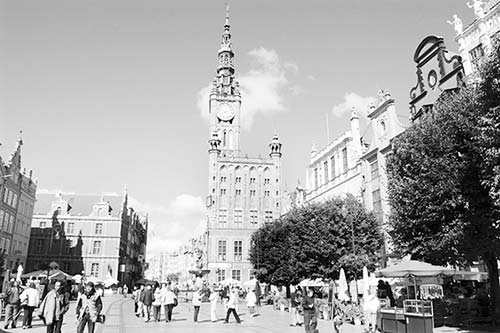
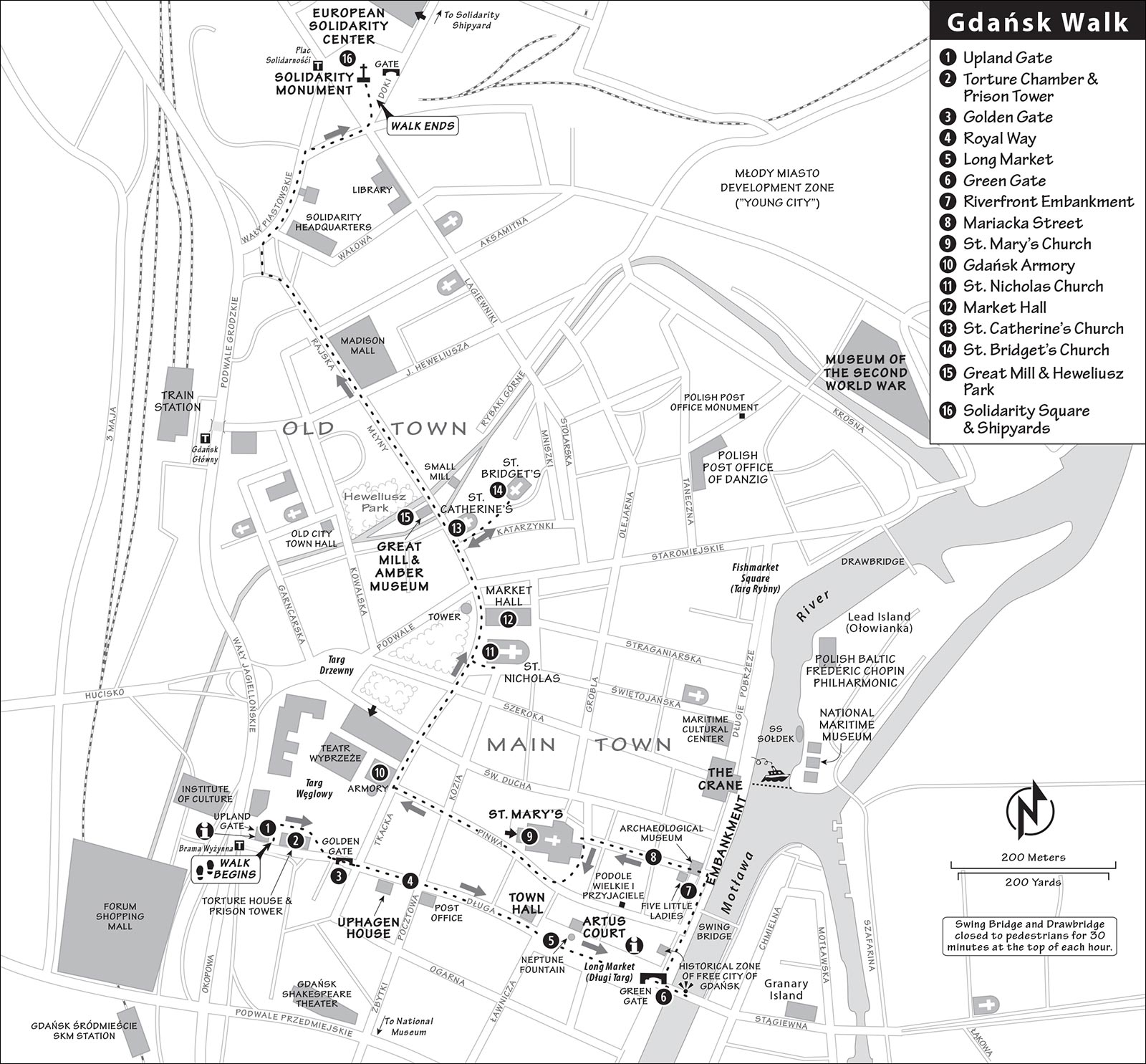
The following self-guided walk—rated ▲▲▲—introduces you to the best of Gdańsk. It bridges the two historic centers (the Main Town and the Old Town), dips into St. Mary’s Church (the city’s most important church), and ends at the famous shipyards and Solidarity Square (where Poland began what ultimately brought down the USSR). I’ve divided the walk into two parts (making it easier to split up, if you like): The first half focuses on a loop through the Main Town, with most of the high-profile sights; while the second part carries on northward, through the less touristy (but still interesting) Old Town to the shipyards.
PART 1: THE MAIN TOWN
• Begin at the west end of the Main Town, just beyond the last gate at the edge of the busy road—across from the mega-shopping mall.
1 Upland Gate (Brama Wyżynna)
The Main Town’s fortifications were expanded with a Renaissance wall bound by the Upland Gate (built in 1588). “Upland” refers to the low hills you see beyond—considered high country in this flat region. Standing with your back to the busy arterial (which traces the old moat), study the gate. Find its three coats of arms (the black eagle for Royal Prussia, the crowned white eagle for Poland, and the two crosses for Gdańsk). Recall that this city has, for almost the entirety of its history before the mid-20th century, been bicultural: Germanic and Polish, coexisting more or less peacefully. Also notice the little wheels that once hoisted a drawbridge.
Now look across the busy street, to the supermodern Forum shopping center. Controversial for its over-the-top design (and for covering over a historic canal), this replaced a ragtag old flea market area. A lion—symbol of Gdańsk—perches high on the corner of the rust-colored main building. I’m not in the habit of telling travelers to visit shopping malls...but this one really is worth a peek.
• It’s a straight line from here to the river. Walk around the arch (which houses a good TI—find the entrance on the back side) to the next arch, just a few steps ahead.
2 Torture Chamber (Katownia) and Prison Tower (Wieża Więzienna)
The tall, Gothic brick gate before you was part of an earlier protective wall made useless after the Renaissance walls were built in 1588. The evocative passage is generally open (and free) to walk through. Inside, find gargoyles (on the left, a town specialty) and the shackles from which prisoners were hung (on the right). Look waaaay up at the inside of the high gable to find the headless man, identifying this as the torture chamber. (If you stand in just the right spot, you can “reattach” his head to his body.) This old jail—with its 15-foot-thick walls—was used as a prison even in modern times, under Nazi occupation.
Leaving the Torture Chamber and Prison Tower through the far end, look to your left (100 yards away) to see a long, brick building with four fancy, uniform gables. This is the armory (zbrojownia), one of the finest examples of Dutch Renaissance architecture anywhere. Though this part of the building appears to have the facades of four separate houses, it’s an urban camouflage to hide its real purpose from potential attackers. But there’s at least one clue to what the building is really for: Notice the exploding cannonballs at the tops of the turrets. (We’ll get a better look at the armory from the other side, later in this walk.)
The round, pointy-topped tower next to the armory is the Straw Tower (Baszta Słomiana). Gunpowder was stored here, and the roof was straw—so if it exploded, it could easily blow its top without destroying the walls. And to the left you’ll see the sleek, modern Teatr Wybrzeże performing arts complex—one of many new venues that have opened around this cultural hub in recent years.
• Straight ahead, the final and fanciest gate between you and the Main Town is the...
3 Golden Gate (Złota Brama)
While the other gates were defensive, this one’s purely ornamental. The four women up top represent virtues that the people of Gdańsk should exhibit toward outsiders (left to right): Peace, Freedom, Prosperity, and Fame. The gold-lettered inscription, a psalm in medieval German, compares Gdańsk to Jerusalem: famous and important. Directly above the arch is the Gdańsk coat of arms: two white crosses under a crown on a red shield. We’ll see this symbol all over town. Photographers love the view of the Main Town framed in this arch. Inside the arch, you may see old photos showing the 1945 bomb damage. Heartbreaking aerial views of the city in 1945 illustrate how 80 percent of its buildings were in ruins.
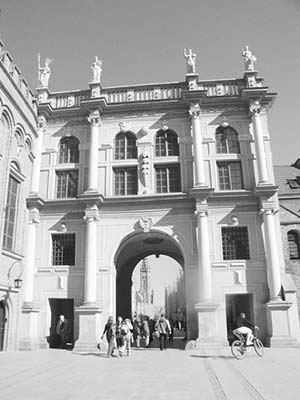
• Passing through the Golden Gate, you reach the Main Town’s main drag.
4 The Royal Way
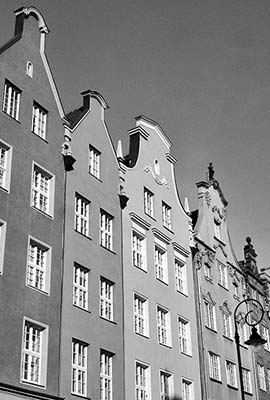
Before you stretches Ulica Długa (cleverly called the “Long Street”)—the main promenade of what, 600 years ago, was a tremendously wealthy city, thanks to its profitable ties to the Hanseatic League of merchant cities. This promenade is nicknamed the “Royal Way” because (just as in Warsaw and Kraków) the king would follow this route when visiting town.
Walk half a block and then look back at the Golden Gate. The women on top of this side represent virtues the people of Gdańsk should cultivate in themselves (left to right): Wisdom, Piety, Justice, and Concord (if an arrow’s broken, let’s take it out of the quiver and fix it). The inscription—sharing a bit of wisdom as apropos today as it was in 1612—reads, “Concord makes small countries develop, and discord makes big countries fall.” Gdańsk was cosmopolitan and exceptionally tolerant in the Middle Ages, attracting a wide range of people, including many who were persecuted elsewhere: Jews, Scots, Dutch, Flemish, Italians, Germans, and more. Members of each group brought with them strands of their culture, which they wove into the tapestry of this city—demonstrated by the eclectic homes along this street. Each facade and each gable was different, as nobles and aristocrats wanted to display their wealth. On one visit, a traveler seeing this street for the first time gasped to me, “It’s like stepping into a Fabergé egg.”
During Gdańsk’s golden age, these houses were taxed based on frontage (like the homes lining Amsterdam’s canals)—so they were built skinny and deep. The widest houses belonged to the super-elite. Different as they are from the outside, every house had the same general plan inside. Each had three parts, starting with the front and moving back: First was a fancy drawing room, to show off for visitors. Then came a narrow corridor to the back rooms—often along the side of an inner courtyard. Because the houses had only a few windows facing the outer street, this courtyard provided much-needed sunlight to the rest of the house. The residential quarters were in the back, where the family actually lived: bedroom, kitchen, office. To see the interior of one of these homes, pay a visit to the interesting Uphagen House (at #12, on the right, a block and a half in front of the Golden Gate; described later).
Visitors to Gdańsk are surprised at how “un-Polish” the city’s history is. In this cultural melting pot of German, Dutch, and Flemish merchants (with a smattering of Italians and Scots), Poles were only a small part of the picture until the city became exclusively Polish after World War II. However, in Gdańsk, cultural backgrounds traditionally took a back seat to the bottom line. Wealthy Gdańsk was always known for its economic pragmatism—no matter who was in charge, merchants here made money.
Gdańsk is Poland’s gateway to the waters of Europe, where its main river (the Vistula) meets the Baltic Sea. The town was first mentioned in the 10th century and was seized in 1308 by the Teutonic Knights (who called it “Danzig”; for more on the Teutonic Knights, see here). The Knights encouraged other Germans to settle on the Baltic coast, and gradually turned Gdańsk into a wealthy city. In 1361, Gdańsk joined the Hanseatic League, a trade federation of mostly Germanic merchant towns that provided mutual security. By the 15th century, Gdańsk was a leading member of this mighty network, which virtually dominated trade in northern Europe (and also included Toruń, Kraków, Lübeck, Hamburg, Bremen, Bruges, Bergen, Tallinn, Novgorod, and nearly a hundred other cities).
In 1454, the people of Gdańsk rose up against the Teutonic Knights, burning down their castle and forcing them out of the city. Three years later, the Polish king borrowed money from wealthy Gdańsk families to hire Czech mercenaries to take the Teutonic Knights’ main castle, Malbork (described in the next chapter). In exchange, the Gdańsk merchants were granted special privileges, including exclusive export rights. Gdańsk now acted as a middleman for much of the trade passing through Polish lands, and paid only a modest annual tribute to the Polish king.
The 16th and 17th centuries were Gdańsk’s golden age. Now a part of the Polish kingdom, the city had access to an enormous hinterland of natural resources to export—yet it maintained a privileged, semi-independent status. Like Amsterdam, Gdańsk became a progressive and booming merchant city. Its mostly Germanic and Dutch burghers imported Dutch, Flemish, and Italian architects to give their homes an appropriately Hanseatic flourish. At a time of religious upheaval in the rest of Europe, Gdańsk became known for its tolerance—a place that opened its doors to all visitors (many Mennonites and Scottish religious refugees emigrated here). It was also a haven for great thinkers, including philosopher Arthur Schopenhauer, women’s rights activist Käthe Schirmacher, and scientist Daniel Fahrenheit (who invented the mercury thermometer).
Along with the rest of Poland, Gdańsk declined in the late 18th century and became part of Prussia (today’s northern Germany) during the Partitions. But the people of Gdańsk—even those of German heritage—had taken pride in their independence and weren’t enthusiastic about being ruled from Berlin. After World War I, in a unique compromise to appease its complex ethnic makeup, Gdańsk once again became an independent city-state: the Free City of Danzig (about 750 square miles, populated by 400,000 ethnic Germans and 15,000 Poles). Like a holdover from medieval fiefdoms in modern times, it even issued its own currency (the Gulden) and stamps. Danzig, along with the so-called Polish Corridor connecting it to Polish lands, effectively cut off Germany from its northeastern territory. On September 1, 1939, Adolf Hitler started World War II when he invaded Gdańsk in order to bring it back into the German fold. Later, nearly 80 percent of the city was destroyed when the Soviets “liberated” it from Nazi control.
After World War II, Gdańsk officially became part of Poland and was painstakingly reconstructed. In 1970, and again in 1980, the shipyard of Gdańsk witnessed strikes and demonstrations that would lead to the fall of European communism. Poland’s great anticommunist hero and first postcommunist president, Lech Wałęsa, still lives here. When he flies around the world to give talks, he leaves from Gdańsk’s “Lech Wałęsa Airport.”
A city with a recent past that’s both tragic and uplifting, Gdańsk celebrated its 1,000th birthday in 1997. Very roughly, the city has spent about 700 years as an independent entity, and about 300 years under Germanic overlords (the Teutonic Knights, Prussia, and the Nazis). But today, Gdańsk is decidedly its own city. And, as if eager to prove it, Gdańsk has made big improvements at a stunning pace: museums (the European Solidarity Center and WWII museum), cultural facilities (the Shakespeare Theater), sports venues (a stadium that resembles a blob of amber, built for the 2012 Euro Cup tournament), and an ongoing surge of renovation and refurbishment that has the gables of the atmospheric Hanseatic quarter gleaming once again.
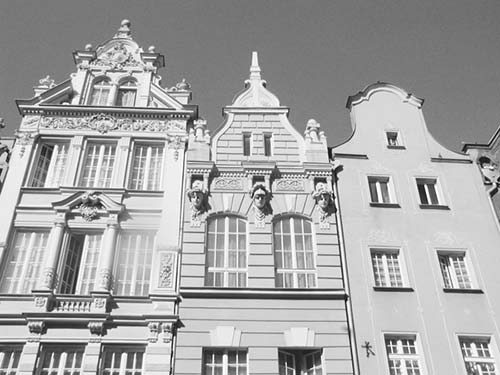
Pause in front of Uphagen House, look around, and ponder this beautiful street’s very ugly history. At the end of World War II, the Royal Way was in ruins. That epic war actually began here, in what was then the “Free City of Danzig.” Following World War I, nobody could decide what to do with this influential and multiethnic city. So, rather than assign it to Germany or Poland, it was set apart as its own little autonomous statelet. In 1939, Danzig was 80 percent German-speaking—enough for Hitler to consider it his. And so, on September 1 of that year, the Nazis seized it in one day with relatively minor damage (though the attack on the Polish military garrison on the city’s Westerplatte peninsula lasted a week).
But six years later, when the Soviets arrived (March 30, 1945), they devastated the city. This was the first traditionally German city that the Red Army took on their march toward Berlin. And, while it was easy for the Soviets to seize the almost empty city, the commander then insisted that it be leveled, building by building—in retaliation for all the pain the Nazis had caused in Russia. (Soviets didn’t destroy nearby Gdynia, which they considered Polish rather than German.) Soviet officers turned a blind eye as their soldiers raped and brutalized residents. An entire order of horrified nuns committed suicide by throwing themselves into the river.
It was only thanks to detailed drawings and photographs that these buildings could be so carefully reconstructed. Notice the cheap plaster facades done in the 1950s—rough times under communism, in the decade after World War II. (Most of the town’s medieval brick was shipped to Warsaw for a communist-sponsored “rebuild the capital first” campaign.) While the fine facades were restored, the buildings behind the facades were completely rebuilt to modern standards.
Just beyond Uphagen House, on the left at #73, Grycan has been a favorite for ice cream here for generations. Just a few doors down, also on the left, are some of the most striking facades along the Royal Way. The blue-and-white house with the three giant heads is from the 19th century, when the hot style was eclecticism—borrowing bits and pieces from various architectural eras. This was one of the few houses on the street that survived World War II.
At the next corner on the right is the huge, blocky, red post office, which doesn’t quite fit with the skinny facades lining the rest of the street. Step inside. With doves fluttering under an airy glass atrium, the interior’s a class act.
A few doors farther down on the left, just past #62/63, notice the colorful scenes over the windows. These are slices of life from 17th-century Gdańsk: drinking, talking, shopping, playing music. The ship is a koga, a typical symbol of Hanseatic ports like Gdańsk.
Across the street and a few steps down are the fancy facades of three houses belonging to the very influential medieval Ferber family, which produced many burghers, mayors, and even a bishop. On the house with the little dog over the door (#29), look for the heads in the circular medallions. These are Caesars of Rome. At the top of the building is Mr. Ferber’s answer to the constant question, “Why build such an elaborate house?”—PRO INVIDIA, “For the sake of envy.”
A few doors down on the right (at #33/34), is Gdańsk’s most scenically situated milk bar, Bar Mleczny Neptun. Back in communist times, these humble cafeterias were subsidized to give workers an affordable place to eat out. To this day, they offer simple and very cheap grub.
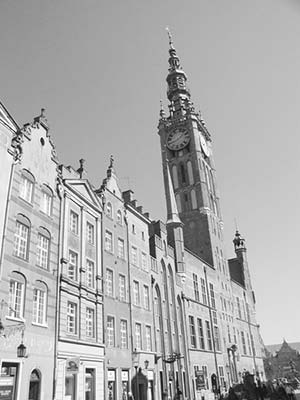
Before you stands the Main Town Hall (Ratusz Głównego Miasta) with its mighty brick clock tower. Consider climbing its observation tower and visiting its superb interior, which features ornately decorated meeting rooms for the city council (described later, under “Sights in Gdańsk”).
As you stroll along this street—and throughout your time in Gdańsk—you’ll periodically hear cheerful carillon music playing from the top of the Main Town Hall tower. This 14-bell instrument, which dates from 1561, chimes throughout the day, providing a lovely soundtrack to a Gdańsk visit. On Saturdays at noon, there’s a longer concert (www.carillongdansk.pl).
• Just beyond the Main Town Hall, Ulica Długa widens and becomes...
5 Long Market (Długi Targ)
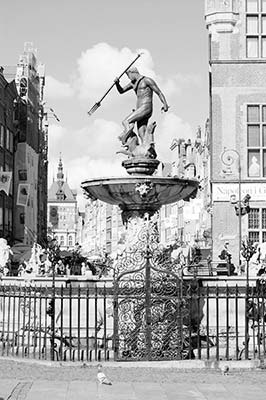
Step from the Long Street into the Long Market and do a slow, 360-degree spin to appreciate the amazing array of proud architecture. The centerpiece of this square is one of Gdańsk’s most important landmarks, the statue of Neptune—god of the sea. He’s a fitting symbol for a city that dominates the maritime life of Poland. Behind him is another worthwhile museum, the Artus Court. Step up to the magnificent door on the right side and study the golden relief just above, celebrating the Vistula River (in so many ways the lifeblood of the Polish nation): Lady Vistula is exhausted after her heroic journey and is finally carried by Neptune to her ultimate destination, the Baltic Sea. (This is just a preview of the ornate art that fills the interior of this fine building—described later.)
Midway down the Long Market (on the right, across from the Hard Rock Café) is a glass case with the thermometer and barometer of Daniel Fahrenheit. Although that scientist was born here—his birth house is just a few blocks away—he did his groundbreaking work in Amsterdam.
• At the end of the Long Market is the...
6 Green Gate (Zielona Brama)
This huge gate (named for the Green Bridge just beyond) was built as a residence for visiting kings...who usually preferred to stay back by Neptune instead (maybe because the river, just on the other side of this gate, stank).
A few steps down the skinny lane to the left is the endearing little Historical Zone of the Free City of Gdańsk museum, which explains the interwar period when “Danzig” was an independent and bicultural city-state (described later). During this period, four out of five people living in the free city identified themselves not as Germans or Poles but as “Danzigers.”
• Now go through the gate, walk out onto the Green Bridge, anchor yourself in a niche on the left, and look downstream.
7 Riverfront Embankment
The Motława River—a side channel of the mighty Vistula—flows into the nearby Baltic Sea. This port was the source of Gdańsk’s phenomenal golden-age wealth. This embankment was jam-packed in its heyday, the 14th and 15th centuries. It was so crowded with boats that you would hardly have been able to see the water, and boats had to pay a time-based moorage fee for tying up to a post.
Look back at the Green Gate and notice that these bricks are much smaller than the locally made ones we saw earlier on this walk. These bricks are Dutch: Boats from Holland would come here empty of cargo but with a load of bricks for ballast. Traders filled their ships with goods for the return trip, leaving the bricks behind.
See any pirate ships? The old-fashioned galleons and other tour boats depart hourly for a fun cruise to Westerplatte (where on September 1, 1939, Germans fired the first shots of World War II) and back. Though kitschy, the galleons are a fun way to get out on the water (see details on here).
Across the river is Granary Island (Wyspa Spichrzów), where grain was stored until it could be taken away by ships. Before World War II, there were some 400 granaries here; almost all were destroyed...and this island remained rubble until the mid-2010s, when developers began erecting a passel of modern new buildings (evoking the old Gdańsk gables) and wrapped the island in a scenic boardwalk—a wonderful place for a stroll. While there’s not much sightseeing value along here, it’s a delightful place to promenade, enjoy views back on the historic skyline across the river, and perhaps browse for a meal or drink. The three older-looking granaries downstream, in the distance on the next island, house exhibits for the National Maritime Museum (described later).
From your perch on the bridge, look down the embankment (about 500 yards, on the left) and find the huge wooden Crane (Żuraw) bulging over the water. This monstrous 15th-century crane—a rare example of medieval port technology—was once used for loading and repairing ships...beginning a shipbuilding tradition that continued to the days of Lech Wałęsa. The crane mechanism was operated by several workers scrambling around in giant hamster wheels. Treading away to engage the gears and pulleys, they could lift 4 tons up 30 feet, or 2 tons up 90 feet.
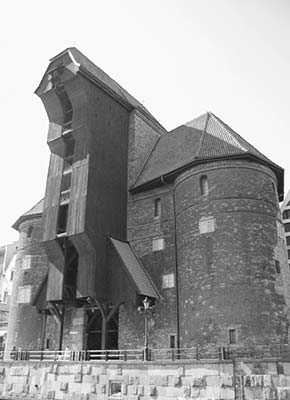
Near the Crane, notice the white, modern swing bridge that makes it easier for pedestrians to do a loop along both embankments. At the top of each hour, it swings parallel to the river to allow boats to pass, making it inaccessible for 30 minutes. (The similar white drawbridge, farther downstream, works on the same schedule.) You’ll hear a big commotion every time it’s about to swing; watch the tourists scurry.
• Walk along the embankment about halfway to the Crane. Along the way, you may pass the moorings for excursion boats heading to the Westerplatte monument. (Or these may be farther down along the embankment, beyond the Crane.)
Pause when you reach the big brick building with green window frames and a tower. This red-brick fort houses the Archaeological Museum (described later). Its collection includes the five ancient stones in a small garden just outside its door (on the left). These are the Prussian Hags—mysterious sculptures from the second century AD (a.k.a. “Five Little Ladies,” each described in posted plaques).
Turn left through the gate in the middle of the brick building. You’ll find yourself on the most charming lane in town...
8 Mariacka Street
The calm, atmospheric “Mary’s Street” leads from the embankment to St. Mary’s Church. Stroll the length of it, enjoying the most romantic lane in Gdańsk. (If you need a coffee break, the recommended Drukarnia—on the right—is tops.) The porches extending out into the street, with access to cellars underneath, were a common feature in Gdańsk’s golden age. For practical reasons, after the war, these were restored only on this street and a few others. Notice how the porches are bordered with fine stone relief panels and gargoyles attached to storm drains. If you get stuck there in a hard rainstorm, you’ll understand why in Polish these are called “pukers.” Enjoy a little amber comparison-shopping. As you stroll up to the towering brick St. Mary’s Church, imagine the entire city like this cobbled lane of proud merchants’ homes, with street music, delightful facades, and brick church towers high above.
Look up at the church tower viewpoint—filled with people who hiked 409 steps for the view. Our next stop is the church, which you’ll enter on the far side under the tower. Walk around the left side of the church, appreciating the handmade 14th-century bricks on the right and the plain post-WWII facades on the left. (Reconstructing the Royal Way was better funded. Here, the priority was simply getting people housed again.) In the distance is the fancy facade of the armory (where you’ll head after visiting the church).
• But first, go inside...
9 St. Mary’s Church (Kościół Mariacki)
Of Gdańsk’s 13 medieval red-brick churches, St. Mary’s (rated ▲▲) is the one you must visit. It’s the largest brick church in the world—with a footprint bigger than a football field (350 feet long and 210 feet wide), it can accommodate 20,000 standing worshippers.
Cost and Hours: Church entry—likely free for now, tower climb—16 zł, Mon-Sat 8:00-17:30, Sun from 13:00, until 18:30 in July-Aug, tower typically open later in summer but generally closed in winter.
 Self-Guided Tour: Inside, sit directly under the fine carved and painted 17th-century Protestant pulpit, two-thirds of the way down the nave (on the left side), to get oriented.
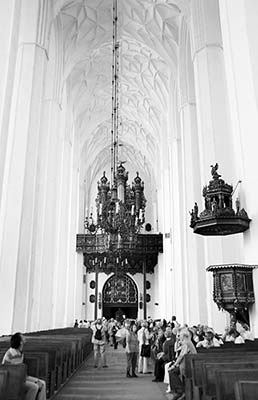
Overview: Built from 1343 to 1502 by the Teutonic Knights (who wanted a suitable centerpiece for their newly captured main city), St. Mary’s remains an important symbol of Gdańsk. The church started out Catholic, became Lutheran in the mid-1500s, and then became Catholic again after World War II. (Remember, Gdańsk was a Germanic city before World War II and part of the big postwar demographic shove, when Germans were sent west and Poles from the east relocated here. Desperate, cold, and homeless, the new Polish residents moved into what was left of the German homes.) While the church was originally frescoed from top to bottom, the Lutherans whitewashed the entire place. Today, some of the 16th-century whitewash has been peeled back (behind the high altar—we’ll see this area soon), revealing a bit of the original frescoes. The floor is paved with 500 gravestones of merchant families. Many of these were cracked when bombing sent the brick roof crashing down in 1945.
Most Gothic churches are built of stone in the basilica style—with a high nave in the middle, shorter aisles on the side, and flying buttresses to support the weight. (Think of Paris’ Notre-Dame.) But with no handy source of stone available locally, northern Polish churches are built of brick, which won’t work with the basilica design. So, like all Gdańsk churches, St. Mary’s is a “hall church”—with three naves the same height and no exterior buttresses.
Also like other Gdańsk churches, St. Mary’s gave refuge to the Polish people after the communist government declared martial law in 1981. When a riot broke out and violence seemed imminent, people flooded into churches, knowing that the ZOMO riot police wouldn’t dare follow them inside.
Most of the church decorations are original. A few days before the Soviets arrived to “liberate” the city in 1945, locals—knowing what was in store—hid precious items in the countryside. Take some time now to see a few of the highlights.
• From this spot, you can see most of what we’ll visit in the church: As you face the altar, the astronomical clock is at 10 o’clock, the Ferber family medallion is at 1 o’clock, the Priests’ Chapel is at 3 o’clock (under a tall, colorful window), and the magnificent 17th-century organ is directly behind you (it’s played at each Mass and during free concerts on Fri in summer).
Pulpit: For Protestants, the pulpit is important. Designed as an impressive place from which to share the Word of God in the people’s language, it’s located mid-nave so all can hear.
• Opposite the pulpit is the moving...
Priests’ Chapel: The 1965 statue of Christ weeping commemorates 2,779 Polish chaplains executed by the Nazis. See the grainy black-and-white photo of one about to be shot, above on the right.
• Head up the nave to the...
High Altar: The main altarpiece, beautifully carved in 1517, is a triptych showing the coronation of Mary. She is surrounded by the Trinity: flanked by God and Jesus, with the dove representing the Holy Spirit overhead. The church’s medieval stained glass was destroyed in 1945. Poland’s biggest stained-glass window, behind the altar, is from 1980.
• Directly to the right of the altar, high on a pillar, find the big, opulent family marker.
Ferber Family Medallion: The falling baby (under the crown) is Constantine Ferber. As a precocious child, li’l Constantine leaned out his window on the Royal Way to see the king’s processional come through town. He slipped and fell but landed in a salesman’s barrel of fish. Constantine grew up to become the mayor of Gdańsk.
• Now circle around behind the altar, on the right side. Search high above you, on the walls to your right, to spot those restored pre-Reformation frescoes. Behind the altar, look for a...
Glass Case: This case was designed to hold Hans Memling’s Last Judgment painting, which used to be in this church but is currently being held hostage by the National Museum (described later, under “Sights in Gdańsk”). To counter the museum’s claim that the church wasn’t a good environment for such a precious work, the priest had this display case built—but that still wasn’t enough to convince the museum to give the painting back. (You’ll see a smaller replica of the painting elsewhere in the church.) For years, the case was simply empty; more recently, finally taking the hint, the local priest has begun to display a few vestments and ecclesiastical gear here.
• Now circle back the way you came to the area in front of the main altar and turn right into the transept. High on the wall to your right, look for the...
Astronomical Clock: This 42-foot-tall clock is supposedly the biggest wooden clock in the world. Below it is an elaborate circular calendar that, like a medieval computer, calculates on which day each saint’s festival day falls in different years (see the little guy on the left, with the pointer). Above are zodiac signs and the time (back then, the big hand was all you needed). Way up on top, Adam and Eve are naked and ready to ring the bell. Adam’s been swinging his clapper at the top of the hour since 1473; these days, you’ll hear the clock clang on the quarter-hour, with a big show each day at 11:55.
• A few steps in front of the clock is a modern chapel with the...
Memorial to the Polish Victims of the 2010 Smoleńsk Plane Crash: The gold-shrouded Black Madonna honors the 96 victims of an air disaster that killed much of Poland’s government—including the president and first lady—during a terrible storm over Russia. The main tomb is for Maciej Płażyński, from Gdańsk, who was leader of the parliament. On the left, the jagged statue has bits of the wreckage and lists each victim by name.
• Head a few steps back toward the entrance, then look back at one of the nearby pillars to find a large painting (facing the back of the church).
Replica of Last Judgment Altarpiece: This is a smaller, mustier replica of the exquisite, priceless altarpiece housed in the National Museum. If you’re not planning to go see it at the National Museum, you could read the description on here now.
• In the back-left corner of the church are stairs—lots and lots of stairs—leading to the...
Church Tower: You can climb 409 steps to burn off some pierogi and pączki, and to earn a grand city view. It’s a long hike (and you’ll know it—every 10th step is numbered). But because the viewpoint is surrounded by a roof, the views are distant and may not be worth the effort. The first third is up a tight, medieval spiral staircase. Then you’ll walk through the eerie, cavernous area between the roof and the ceiling before huffing up steep concrete steps that surround the square tower (as you spiral up, up, up around the bells). Finally, you’ll climb a little metal ladder and pop out at the viewpoint.
• Leaving the church, angle left and continue straight up atmospheric Ulica Piwna (“Beer Street”)—a lovely lane lined with bars, cafés, and restaurants—toward the sprightly facade of the armory.
10 The Gdańsk Armory (Zbrojownia)
The 1605 armory, which we saw from a distance at the start of this walk, is one of the best examples of Dutch Renaissance architecture in Europe. Athena, the goddess of war and wisdom, stands in the center, amid motifs of war and ornamental pukers.
• If you want to make your walk a loop, you’re just a block away from where we started (to the left). Or, to continue through the Old Town to the European Solidarity Center’s fine museum, follow the second part of this walk.
PART 2: THROUGH THE OLD TOWN TO THE SHIPYARDS
The second part of this walk works its way out of the Main Town and heads into the Old Town, toward Solidarity Square and the shipyards. We’ll walk along this street (which changes names a couple of times) nearly all the way. The walk ends at the European Solidarity Center’s fine museum. You’ll want plenty of time to tour the museum and linger over its exhibits, so if you’re already pooped or it’s getting late in the day, consider finishing this walk another time.
• Facing the armory, turn right and head up Kołodziejska, which quickly becomes Węglarska. After two blocks (that is, one block before the big market hall), detour to the right down Świętojańska and use the side door to enter the brick church.
11 St. Nicholas Church (Kościół Św. Mikołaja)
Near the end of World War II, when the Soviet army reached Gdańsk on its march westward, they were given the order to burn all the churches. Only this one survived—because it happened to be dedicated to Russia’s patron saint. As the best-preserved church in town, it has a more dazzling interior than the others, with lavish black-and-gold Baroque altars.
• Backtrack out to the main street and continue along it, passing a row of seniors selling their grown and foraged edibles. Immediately after the church is Gdańsk’s...
12 Market Hall
Built in 1896 and renovated in 2005, Gdańsk’s market hall is fun to explore. Step inside (closed Sun) and appreciate the delicate steel-and-glass canopy overhead. Browse the market stalls; the meat is downstairs, and the veggies are outside on the adjacent square. As this was once the center of a monastic community, the basement has the graves of medieval Dominican monks, which were exposed when the building was refurbished: Peer over the glass railing and you’ll see some of those scant remains.
Across the street from the Market Hall, a round, red-brick tower, part of the city’s protective wall back in 1400, marks the end of the Main Town and the beginning of the Old Town.
• Carry on. For an ice cream break, watch on the right (after crossing the street) for the recommended Paolo Gelateria. Another block up the street, on the right, is the huge...
13 St. Catherine’s Church (Kościół Św. Katarzyny)
“Katy,” as locals call it, is the oldest church in Gdańsk, proud of its carillon (there’s a small Clock Tower Museum in the tower, and you can hear carillon concerts on Fridays at 11:00; see www.carillongdansk.pl). In May of 2006, a carelessly discarded cigarette caused the church roof to burst into flames. Local people ran into the church and pulled everything outside, so nothing valuable was damaged; even the carillon bells were saved. However, the roof and wooden frame were totally destroyed. The people of Gdańsk were determined to rebuild this important symbol of the city. Within days of the fire, fundraising concerts were held to scrape together most of the money needed to raise the roof once more. Step inside. The austere interior is evocative, with still-bare-brick walls that almost seem intentional—as if they’re trying for an industrial-mod look.
• The church hiding a block behind Katy—named for Catherine’s daughter Bridget—has important ties to Solidarity and is worth a visit. Go around the right side of Katy and skirt the parking lot to find the entrance, on the side of the church near the far end.
14 St. Bridget’s Church (Kościół Św. Brygidy)
This was the home church of Lech Wałęsa during the tense days of the 1980s. The church and its priest, Henryk Jankowski, were particularly aggressive in supporting the ideals of Solidarity. Jankowski became a vocal advocate for the movement. In gratitude for the church’s support, Wałęsa named his youngest daughter Brygida. Rated ▲, it’s the city’s second-most worthwhile church to enter, after St. Mary’s.
Cost and Hours: 5 zł, Mon-Sat 10:00-18:30, Sun from 13:30.
Visiting the Church: Head inside. For your visit, start at the high altar, then circle clockwise back to the entry.
The enormous, unfinished high altar is made entirely of amber—more than a thousand square feet of it. Features that are already in place include the Black Madonna of Częstochowa, a royal Polish eagle, and the Solidarity symbol (tucked below the Black Madonna). The structure, like a scaffold, holds pieces as they are completed and added to the ensemble; as it grows, it also spreads to adjacent walls, as if a slow-moving fungus. The giant bronze statues below the altar depict Cardinal Stefan Wyszyński (on the left, the head of the Polish Catholic Church through much of the communist period) and St. John Paul II (on the right).
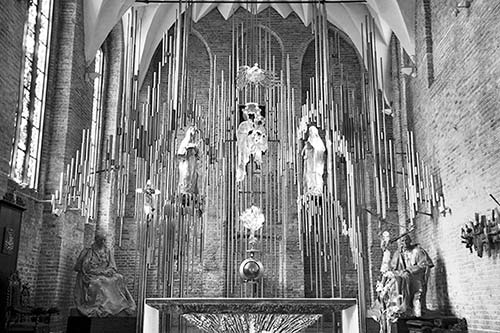
The wrought-iron gate of the adjacent Chapel of Fatima (right of main altar) recalls great battles and events in Polish history from 966 to 1939, with important dates boldly sparkling in gold. Some say the Polish Church is too political. Others argue that it was only through a politically engaged Church that this culture survived the Partitions of Poland over a century and a half, plus the brutal antireligious policies of the communist period. The national soul of the Polish people—whether religious or not, and for better or for worse—is tied up in the Catholic faith.
Henryk Jankowski’s tomb—a white marble box with dark-red trim—is along the same wall, but closer to the back of the church. Jankowski was a key figure during Solidarity times; the tomb proclaims him Kapelan Solidarności (“Solidarity Chaplain”). But his public standing took a nosedive near the end of his life—thanks to ego-driven projects like his amber altar, as well as accusations of anti-Semitism and corruption. Forced to retire in 2007, Jankowski died in 2010.
In the rear corner, where a figure lies lifeless on the floor under a wall full of wooden crosses, is the tomb of Solidarity martyr Jerzy Popiełuszko. A courageous and famously outspoken Warsaw priest, in 1984 Popiełuszko was kidnapped, beaten, and murdered by the communist secret police. Notice that the figure’s hands and feet are bound—as his body was found. The crosses on the wall above are historic—each one was carried at various strikes against the communist regime. The communists believed they could break the spirit of the Poles with brutality—like the murder of Popiełuszko. But it only made the rebels stronger and more resolved to ultimately win their freedom.
Under the choir loft, step into the evocative chapel with memorials to other 20th-century Polish martyrs.
Near the exit, on a monitor, a fascinating 12-minute video shows great moments of this church, with commentary by Lech Wałęsa himself.
• Return to the main street, turn right, and continue on. The big brick building ahead on the left, with the many windows in its roof, is the Great Mill. Walk just beyond the building and look down at the canal that once powered it.
15 The Great Mill and Heweliusz Park
This huge brick building dates from the 14th century. Look at the waterfalls and imagine standing here in 1400—with the mill’s 18 wheels spinning 24/7, powering grindstones that produced 20 tons of flour a day. Like so much else here, the mill survived until 1945. Today this building houses the Amber Museum—a starkly modern exhibit filling this old shell with countless examples of those precious deposits (described later).
Heweliusz Park, just beyond the mill, is worth a look. Just steps into the family-friendly park is a fountain that brings shrieks of joy to children on hot summer days. On the adjacent corner, notice a branch of the popular Pellowski bakery—a handy place to pick up a pączek (jelly doughnut) to enjoy at one of the benches.
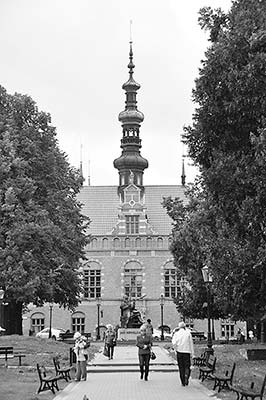
Venturing farther into the park, in the distance is the Old City Town Hall (Dutch Renaissance style, from 1595). The monument near the top of the park honors the 17th-century astronomer Jan Heweliusz. He’s looking up at a giant, rust-colored wall with a map of the heavens. Heweliusz built the biggest telescopes of his era to better appreciate and understand the cosmos. Behind the mill stands the miller’s home—its opulence indicates that, back in the Middle Ages, there was a lot of money in grinding.
• To get to the shipyards, keep heading straight up Rajska. You’ll pass the modern Madison shopping mall. After another long block, jog right, passing to the right of the big, ugly, and green 1970s-era skyscraper. On your right, marked by the famous red logo on the roof, is today’s Solidarity headquarters (which remains the strongest trade union in Poland, with 700,000 members, and is also active in many other countries). On the corner in front of the Solidarity building, look for two big chunks of wall: a piece of the Berlin Wall, and a stretch of the shipyard wall that Lech Wałęsa scaled to get inside and lead the strike. The message: What happened behind one wall eventually led to the fall of the other Wall.
From here, hike on (about 200 yards) toward the huge, rust-colored building in the distance, angling left at the roundabout to reach the trio of tall, skinny crosses in front of it.
16 Solidarity Square and the Shipyards
Three tall crosses mark Solidarity Square and the rust-colored European Solidarity Center (with an excellent museum). For the exciting story of how Polish shipbuilders set in motion events that led to the end of the USSR, turn to here.
Sights in Gdańsk
MAIN TOWN (GŁÓWNE MIASTO) AND OLD TOWN (STARE MIASTO)
▲▲Main Town Hall (Ratusz Głównego Miasta)
▲Amber Museum (Muzeum Bursztynu)
Other Museums in the Main Town
▲Fishmarket Square (Targ Rybny)
SOLIDARITY AND THE GDAŃSK SHIPYARD
▲▲▲Solidarity Square (Plac Solidarności) and the Monument of the Fallen Shipyard Workers
Gdańsk Shipyard (Stocznia Gdańska) Gate #2
▲▲▲European Solidarity Center (Europejskie Centrum Solidarności)
▲▲Museum of the Second World War (Muzeum II Wojny Światowej)
National Museum in Gdańsk (Muzeum Narodowe w Gdańsku)
Oliwa Cathedral (Katedra Oliwska)
MAIN TOWN (GŁÓWNE MIASTO) AND OLD TOWN (STARE MIASTO)
The following sights are listed roughly in the order you’ll see them on the self-guided walk.
Museum of Gdańsk
The Museum of Gdańsk has four excellent branches—the Uphagen House, Main Town Hall, Artus Court, and Amber Museum—and a few lesser ones. Along with St. Mary’s Church (described earlier), these are the four most important interiors in the Main Town. They are covered by separate tickets.
Cost: 22 zł each for Uphagen House, Main Town Hall, or Artus Court, 32 zł for Amber Museum. All are typically free on Mondays.
Hours: The Uphagen House, Main Town Hall, and Artus Court have the same hours, which are notoriously changeable but generally around June-Sept Tue-Sun 10:00-18:00, Mon from 12:00; Oct-May Wed-Mon 10:00-16:00, Thu until 18:00, closed Tue. The Amber Museum has different hours: July-Aug Mon 12:00-20:00, Tue-Sun 10:00-20:00; Sept-June Wed-Mon 10:00-18:00, closed Tue.
Information: The museums share a phone number and website (central +48 58 767 9100, www.muzeumgdansk.pl).
▲Uphagen House (Dom Uphagena)
This interesting place, at Ulica Długa 12, is your chance to glimpse what’s behind the colorful facades lining this street. It’s the only grand Gdańsk mansion rebuilt as it was before 1945, and it has the typical configuration of three parts: dolled-up visitors’ rooms in front, a corridor along the courtyard, and private rooms in the back. The finely decorated salon was used to show off for guests. You’ll see several examples of “Gdańsk-style furniture,” characterized by three big, round feet along the front, lots of ornamentation, and usually a virtually impossible-to-find lock (sometimes hidden behind a movable decoration). Passing into the dining room, note the knee-high paintings of hunting and celebrations. Along the passage to the back, each room has a theme: butterflies in the smoking room, flowers in the next room, birds in the music room. In the private rooms at the back, the decor is simpler.
Back downstairs, you’ll see the rustic working rooms: a humble bedroom, the kitchen, and the pantry. Step out into the courtyard to appreciate how it carves a little fresh air and sunshine out of a densely packed city. Back inside, look for the cross-section model showing the three parts of the house you just walked through. You’ll exit through a room with photos of the house before the war, which were used to reconstruct what you see today.
▲▲Main Town Hall (Ratusz Głównego Miasta)
This landmark building contains remarkable decorations from Gdańsk’s golden age. You can also climb 293 concrete steps to the top of the tower for commanding views (15 zł extra, closed Oct-April).
Visiting the Main Town Hall: Buy your ticket on the ground floor, which also houses a space for temporary exhibits. Then walk through the courtyard and up the stairs to the historic rooms. First you’ll be directed to the room on your left, the Great Weta Hall—a meeting room with big portraits and big windows.
Then, returning to the room where you first entered, ogle the finely crafted spiral staircase. The ornately carved wooden door is all-original, from the 1600s. Above the door are two crosses under a crown. This seal of Gdańsk is being held—as it’s often depicted—by a pair of lions. The felines are stubborn and independent, just like the citizens of Gdańsk. The surface of the door is carved with images of crops. Around the frame of the door are mermen, reminding us that this agricultural bounty, like so many of Poland’s resources, is transported on the Vistula and out through Gdańsk.
Step through the ornate door into the Red Hall, where the Gdańsk city council met in the summertime. (The lavish fireplace, with another pair of lions holding the coat of arms of Gdańsk, was just for show. There’s no chimney.) City council members would sit in the seats around the room, debating city policy. Marvel at the 17th-century inlaid wood panels (just overhead) showing slices of local life. Paintings on the wall above represent the seven virtues that the burghers meeting in this room should possess.
The exquisite ceiling—with 25 paintings in total—is all about theology. Including both Christian and pagan themes, the ceiling was meant to inspire the decision makers in this room to make good choices. Study the oval painting in the middle (from 1607)—the museum’s highlight. It shows the special place Gdańsk occupies between God, Poland, and the rest of the world. In the foreground, the citizens of Gdańsk go about their daily lives. Above them, high atop the arch, God’s hand reaches down (from within clouds of Hebrew characters) and grasps the Main Town Hall’s steeple. The rainbow arching above also symbolizes God’s connection to Gdańsk. Mirroring that is the Vistula River, which begins in the mountains of southern Poland (on the right), runs through the country, and exits at the sea in Gdańsk (on the left, where the rainbow ends).
Continue into the less impressive Winter Hall, with another fireplace (this one actually hooked up to a chimney) and another coat of arms held by lions. The desk behind glass belonged to Paweł Adamowicz, who served as the president (mayor) of Gdańsk during the tumultuous transitional period from 1998 through 2019—when he was, shockingly, stabbed during a charity event and died at age 53. You can see a photo of this beloved local politician on the wall behind.
From here, head up another flight of stairs to a series of rooms with temporary exhibits. Then, up yet another flight, is a fascinating exhibit about Gdańsk’s time as a “free city” (wolne miasto) between the World Wars—when, because of its delicate ethnic mix of Poles and Germans, it was too precarious to assign it to either country. You’ll see border checkpoints, uniforms, signs in German (the predominant language of “Danzig”), and reconstructed rooms (homes and shops) from the era.
Near the end of this section, you have the option to climb up to the top of the tower. Otherwise, head back down and out the way you came.
▲▲Artus Court (Dwór Artusa)
In the Middle Ages, Gdańsk was home to many brotherhoods and guilds (like businessmen’s clubs). For their meetings, the city provided this elaborately decorated hall, named for King Arthur—a medieval symbol for prestige and power. Just as in King Arthur’s Court, this was a place where powerful and important people came together. Of many such halls in Baltic Europe, this is the only original one that survives (in the tall, white, triple-arched building behind Neptune statue at Długi Targ 43; enter through the door to the left of the big arches).
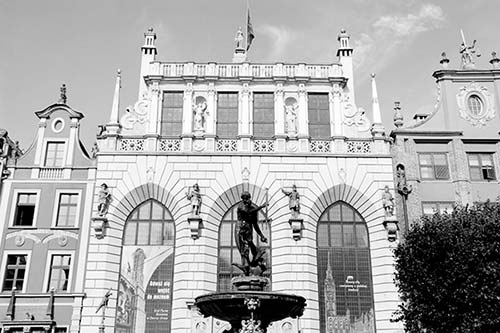
Visiting the Artus Court: In the grand hall, various cupboards line the walls. Each organization that met here had a place to keep its important documents and office supplies. Suspended from the ceiling are seven giant, elaborate model ships that depict Baltic vessels, symbolic of the city’s connection to the sea.
In the far-back corner is the museum’s highlight: a gigantic stove decorated with 520 colorful tiles featuring the faces of kings, queens, nobles, mayors, and burghers—a mix of Protestants and Catholics, as a reminder of Gdańsk’s religious tolerance. Almost all the tiles are original, having survived WWII bombs.
Notice the huge paintings on the walls above, with 3-D animals emerging from flat frames. Hunting is a popular theme in local artwork. Like minting coins, hunting was a privilege usually reserved for royalty, but it was extended in special circumstances to the burghers of special towns...like Gdańsk. These “paintings” are new, digitally generated reproductions of the originals, which were damaged in World War II.
The next room—actually in the next building—is a typical front room of the burghers’ homes lining Ulica Długa. Ogle the gorgeously carved wooden staircase, the Gdańsk-style cupboards, and three more model ships. A series of rooms with more artifacts leads to the exit.
▲Amber Museum (Muzeum Bursztynu)
This collection is displayed in a sleek, glossy, state-of-the-art space inside the very creaky and historic Great Mill, a short walk from the Main Town (and on the way to the Solidarity Sights, at Wielkie Młyny 16). The museum tells the story of the precious yellow deposits that the Baltic Sea is known for. But while the items displayed here are dazzling, the place is a bit light on actual information—this collection is all about ogling amber.
Visiting the Museum: From ye olde Gdańsk, you’ll step through the creaky doors into a different world: glassy black surfaces that reflect the yellows, oranges, and browns of the amber everywhere you look. Buy your ticket and head up to tour the exhibit, which fills two floors upstairs.
Floor 1 covers the geology and history of amber. Timelines date back eons, and case after case of jagged chunks of raw amber illustrate the wide range of colors. One case shows smooth-polished amber with inclusions trapped inside (like those dino-DNA mosquitoes in Jurassic Park). You’ll also learn about the various methods for finding amber (including special nets) and about its importance to golden-age Gdańsk. Touchscreens strain to explain the story of amber, but the information is pretty thin.
Floor 2 (“Amber in Culture”) is simply a showcase of objects created from amber, including altars, chests, necklaces, brooches, chess sets, tankards, candelabras, miniatures, a bowl of fruit, pipes, clocks, an entire table, contemporary jewelry, and a working guitar—all beautifully lit, and all made or decorated with amber.
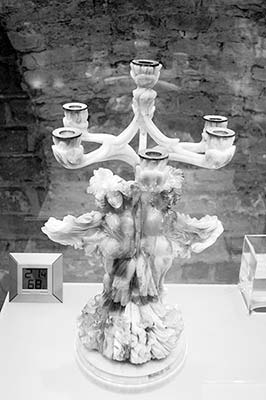
Back downstairs, the exit is through the extremely well-stocked gift shop (of course); there’s also a handy café.
Other Museums in the Main Town
With so many worthwhile sights in town, you’ll have your hands full with the biggies. But if you have a special interest, these museums are also worth considering for a visit:
The Historical Zone of the Free City of Gdańsk (Strefa Historyczna Wolne Miasto Gdańsk), tucked just off the main drag near the Green Gate, is the best place to learn about the fascinating period between World Wars I and II, when Gdańsk was not part of Germany or Poland but the self-governing Free City of Danzig. This modest museum earnestly shows off artifacts from the time—photos, stamps, currency (the Gulden), maps, flags, promotional tourist leaflets, and other Danzig artifacts (closed Mon, down the little alley just in front of the Green Gate at Warzywnicza 10A, +48 58 320 2828, www.strefahistorycznawmg.pl).
The Archaeological Museum (Muzeum Archeologiczne) is worth a quick peek: distinctive urns with cute faces (which date from the Hallstatt Period and were discovered in slate graves around Gdańsk), Bronze and Iron Age tools, before-and-after photos of WWII Gdańsk, and a reconstructed 12th-century Viking-like Slavonic longboat. You can also climb the building’s tower, with good views up Mariacka street toward St. Mary’s Church (closed Mon, Ulica Mariacka 25, +48 58 322 2100, www.archeologia.pl).
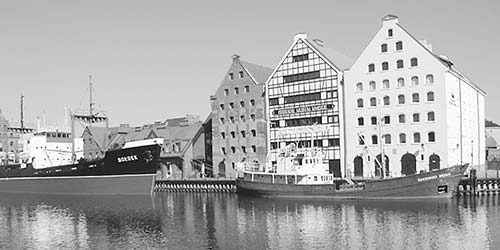
The National Maritime Museum (Narodowe Muzeum Morskie) is an eclectic collection spread among several buildings on either side of the river. The main point of interest is the medieval Crane that dominates Gdańsk’s historic waterfront; this recently reopened after a restoration. Next door is the skippable Maritime Cultural Center—of interest only to nautical nuts. Across the river, more exhibits fill the three rebuilt old granaries, and you can also crawl through the holds and scramble across the deck of a decommissioned steamship called the Sołdek—the first postwar vessel built at the Gdańsk shipyard (closed Mon, Ulica Ołowianka 9, +48 58 301 8611, www.nmm.pl).
Theater lovers may enjoy seeing the Gdańsk Shakespeare Theater (Teatr Szekspirowski), at the southern edge of the Main Town. As early as the 17th century, theater troupes from England would come to this cosmopolitan trading city to perform. In 1993, local actors revived the tradition with an annual Gdańsk Shakespeare Festival. In 2014, the city built the state-of-the-art Gdańsk Shakespeare Theater to honor its connection to the Bard. The architecture is minimalist, blocky, black brick (with a few symbolic faux buttresses to echo the gables of the surrounding buildings). The main theater can be modified to create three different types of performance spaces (proscenium, thrust stage, and theater-in-the-round)—and even has a retractable roof to wash the actors with direct sunlight. The theater hosts a wide variety of performances and festivals, and still does some Shakespeare in English during the annual Shakespeare Festival in summer. Call or check their website for details on tours and upcoming performances (Bogusławskiego 1, +48 58 351 0101, www.teatrszekspirowski.pl).
▲Fishmarket Square (Targ Rybny)
If out for a stroll, make your way just five minutes along the embankment past the Crane and swing bridge to this square, where a kid-friendly carousel spins next to a big Hilton hotel. It’s no longer an actual fish market, and there’s not much sightseeing here. But this vantage point offers great views up and down the river: Across the way, on Lead Island (Ołowianka), is the stately home of the Baltic Philharmonic, with its sail-like adornment, along with a giant Ferris wheel and a photo-op GDAŃSK sign. Downriver (to the left) you can see how the city is growing in that direction, with modern residential and commercial developments sprawling up the riverbank. Farther downstream (not visible from here) is Westerplatte, the point where World War II began. And upriver (to the right), you can see the three reconstructed old granaries and giant ship of the Maritime Museum, and beyond that, the swing bridge and Gdańsk’s slick new city-center Granary Island development. This is a fine spot to find a bench and enjoy the buzz of a proud historic city on the rise.
SOLIDARITY AND THE GDAŃSK SHIPYARD
Gdańsk’s single most memorable experience is exploring the shipyard (Stocznia Gdańska) that witnessed the beginning of the end of communism’s stranglehold on Central and Eastern Europe. Taken together, the sights in this area are worth ▲▲▲. Here in the former industrial wasteland that Lech Wałęsa called the “cradle of freedom,” this evocative site tells the story of the brave Polish shipyard workers who took on—and ultimately defeated—an Evil Empire. A visit to the Solidarity (Solidarność) sights has two main parts: Solidarity Square (with the memorial and gate in front of the shipyard), and the outstanding museum inside the European Solidarity Center.
Getting to the Shipyard: These sights cluster around Solidarity Square (Plac Solidarności), at the north end of the Old Town, about a 20-minute walk from the Royal Way. For the most interesting approach, follow Part 2 of my self-guided walk (earlier), which ends here. Or take tram #7 or #8 from the Brama Wyżynna stop (near the Upland Gate) or the train station to the Plac Solidarnośći stop.
Background: After the communists took over Central and Eastern Europe at the end of World War II, oppressed peoples throughout the Soviet Bloc rose up in different ways. The most dramatic uprisings—Hungary’s 1956 Uprising (see here) and Czechoslovakia’s 1968 “Prague Spring” (see here)—were brutally crushed under the treads of Soviet tanks. The formula for freedom that finally succeeded was a patient, nearly decade-long series of strikes and protests spearheaded by Lech Wałęsa and his trade union, called Solidarność—“Solidarity.” (The movement also benefited from good timing, as it coincided with the perestroika and glasnost policies of Soviet premier Mikhail Gorbachev.) While politicians tussled from their plush offices, imagine the courage it took for Wałęsa and his fellow workers to fight communism on the front lines—armed with nothing more than guts.
▲▲▲Solidarity Square (Plac Solidarności) and the Monument of the Fallen Shipyard Workers
The seeds of August 1980 were sown a decade before. Since becoming part of the Soviet Bloc, the Poles staged frequent strikes, protests, and uprisings to secure their rights, all of which were put down by the regime. But the bloodiest of these took place in December of 1970—a tragic event memorialized by the three-crosses monument that towers over what’s now called Solidarity Square.
The 1970 strike was prompted by price hikes. The communist government set the prices for all products. As Poland endured drastic food shortages in the 1960s and 1970s, the regime frequently announced what it called “regulation of prices.” Invariably, this meant an increase in the cost of essential foodstuffs. (To be able to claim “regulation” rather than “increase,” the regime would symbolically lower prices for a few select items—but these were always nonessential luxuries, such as elevators and TV sets, which nobody could afford anyway.) The regime was usually smart enough to raise prices on January 1, when the people were fat and happy after Christmas, and too hungover to complain. But on December 12, 1970, bolstered by an ego-stoking visit by West German chancellor Willy Brandt, Polish premier Władysław Gomułka increased prices. The people of Poland—who cared more about the price of Christmas dinner than relations with Germany—struck back.
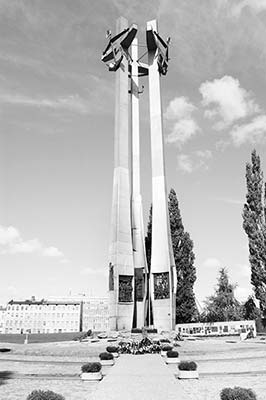
A wave of strikes and sit-ins spread along the heavily industrialized north coast of Poland, most notably in Gdańsk, Gdynia, and Szczecin. Thousands of angry demonstrators poured through the gate of this shipyard, marched into town, and set fire to the Communist Party Committee building. In an attempt to quell the riots, the government-run radio implored the people to go back to work. On the morning of December 17, workers showed up at shipyard gates across northern Poland, and were greeted by the army and police. Without provocation, the Polish army opened fire on the workers. While the official death toll for the massacre stands at 44, others say the true number is much higher. The monument, with a trio of 140-foot-tall crosses, honors those lost to the regime that December.
Go to the middle of the wall behind the crosses, to the monument of the worker wearing a flimsy plastic work helmet, attempting to shield himself from bullets. Behind him is a list—pockmarked with symbolic bullet holes—of workers murdered on that day. Lat means “years old”—many teenagers were among the dead. The quote at the top of the wall is from St. John Paul II, who was elected pope eight years after this tragedy. The pope was known for his clever way with words, and this very carefully phrased quote—which served as an inspiration to the Poles during their darkest hours—skewers the regime in a way subtle enough to still be tolerated: “Let thy spirit descend, and renew the face of the earth—of this earth” (that is, Poland).
Stretching to the left of this center wall are plaques representing labor unions from around Poland—and around the world (look for the Chinese characters)—expressing solidarity with these workers. To the right is an enormous Bible verse: “May the Lord give strength to his people. May the Lord bless his people with the gift of peace” (Psalms 29:11).
In 1980, the world was turned on its ear by a walrus-mustachioed shipyard electrician. Within three years, this seemingly run-of-the-mill Pole had precipitated the collapse of communism, led a massive 10 million-member trade union with enormous political impact, been named Time magazine’s Man of the Year, and won a Nobel Peace Prize.
Lech Wałęsa was born in Popowo, Poland, in 1943. After working as a car mechanic and serving two years in the army, he became an electrician at the Gdańsk Shipyard in 1967. Like many Poles, Wałęsa felt stifled by the communist government and was infuriated that a system that was supposed to be for the workers clearly wasn’t serving them.
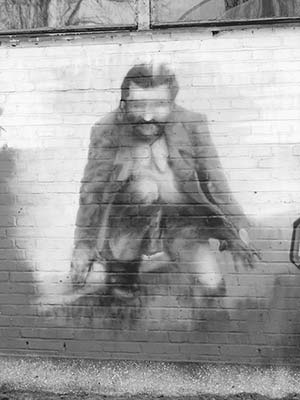
When the shipyard massacre took place in December of 1970 (see here), Wałęsa was at the forefront of the protests. He was marked as a dissident, and in 1976, he was fired. Wałęsa hopped from job to job and was occasionally unemployed—under communism, a rock-bottom status reserved for only the most despicable derelicts. But he soldiered on, fighting for the creation of a trade union and building up quite a file with the secret police.
In August 1980, Wałęsa heard news of the beginnings of the Gdańsk strike and raced to the shipyard. In an act that has since become the stuff of legend, Wałęsa scaled the shipyard wall to get inside.
Before long, Wałęsa’s dynamic personality won him the unofficial role of the workers’ leader and spokesman. He negotiated with the regime to hash out the August Agreements, becoming a rock-star-type hero during the so-called “16 Months of Hope”...until martial law came crashing down in December 1981. Wałęsa was arrested and interned for 11 months in a country house. After being released, he continued to struggle underground, becoming a symbol of anticommunist sentiment.
Finally, the dedication of Wałęsa and Solidarity paid off, and Polish communism dissolved—with Wałęsa rising from the ashes as the country’s first postcommunist president. But the skills that made Wałęsa a rousing success at leading an uprising didn’t translate well to the president’s office. Wałęsa proved to be a stubborn, headstrong politician, frequently clashing with the parliament. He squabbled with his own party, declaring a “war at the top” of Solidarity and rotating higher-ups to prevent corruption and keep the party fresh. He also didn’t choose his advisors well, enlisting old friends as staffers who wound up immersed in scandal. His overconfidence was his Achilles’ heel, and his governing style verged on authoritarian.
Unrefined and none too interested in scripted speeches, Wałęsa was a simple man who preferred playing Ping-Pong with his buddies to attending formal state functions. Though lacking a formal education, Wałęsa had unsurpassed drive and charisma...but that’s not enough to lead a country—especially during an impossibly complicated, fast-changing time.
Wałęsa was defeated at the polls, by the Poles, in 1995, and when he ran again in 2000, he received a humiliating 1 percent of the vote. Since leaving office, Wałęsa has kept a lower profile but still delivers speeches worldwide. Many poor Poles grumble that Lech, who started life simple like them, has forgotten the little people. But his fans point out that he gives much of his income to charity. And on his lapel, he still always wears a pin featuring the Black Madonna of Częstochowa—the most important symbol of Polish Catholicism.
Poles say there are at least two Lech Wałęsas: the young, bombastic, working-class idealist Lech, at the forefront of the Solidarity strikes, who will always have a special place in their hearts; and the failed President Wałęsa, who got in over his head and tarnished his legacy.
Inspired by the brave sacrifice of their true comrades, shipyard workers rose up here in August 1980, formulating the “21 Points” of a new union called Solidarity. Their demands included the right to strike and form unions, the freeing of political prisoners, and an increase in wages. The 21 Points are listed in Polish on the panel at the far end of the right wall, marked 21 X TAK (“21 times yes”). An unwritten precondition to any agreement was the right for the workers of 1980 to build a memorial to their comrades slain in 1970. The government agreed, marking the first time a communist regime ever allowed a monument to be built to honor its own victims. Wałęsa called it a harpoon in the heart of the communists. The towering monument, with three crucified anchors on top, was designed, engineered, and built by shipyard workers. The monument was finished just four months after the historic agreement was signed.
• Now continue to the gate and peer through into...
Gdańsk Shipyard (Stocznia Gdańska) Gate #2
When a Pole named Karol Wojtyła was elected pope in 1978—then visited his homeland in 1979—he inspired 40 million fellow citizens to believe that impossible dreams can come true. Prices continued to go up, and the workers continued to rise up. By the summer of 1980, it was clear that the dam was about to break.
In August, crane operator Anna Walentynowicz was fired unceremoniously just short of her retirement. (For more on Walentynowicz, see the sidebar.) This sparked a strike in the Gdańsk Shipyard (then called the Lenin Shipyard) on August 14, 1980. An electrician named Lech Wałęsa had been fired as an agitator years before. But on hearing news of the strike, Wałęsa went to the shipyard and climbed over the wall to get inside, soon taking over leadership for the strike.
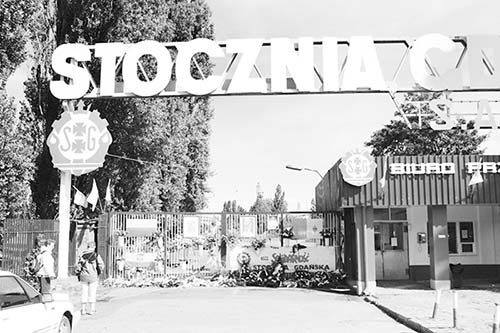
These were not soldiers, nor were they idealistic flower children. The strike participants were gritty, salt-of-the-earth manual laborers: forklift operators, welders, electricians, machinists. Imagine being one of the 16,000 workers who stayed here for 18 days during the strike—hungry, cold, sleeping on sheets of Styrofoam, inspired by the new Polish pope, excited about finally standing up to the regime...and terrified that at any moment you might be gunned down, like your friends had been a decade before.
Workers, afraid to leave the shipyard, communicated with the outside world through this gate—spouses and siblings showed up here and asked for a loved one, and those inside spread the word until the striker came forward. Occasionally, a truck pulled up inside the gate, with Lech Wałęsa standing atop its cab with a megaphone. Facing the thousands of people assembled outside the gate, Wałęsa gave progress reports on the negotiations and pleaded for supplies. The people of Gdańsk responded, bringing armfuls of bread and other food to keep the workers going. Solidarity.
During the strike, two items hung on the fence. One of them (which still hangs there today) was a picture of Pope John Paul II—a reminder to believe in your dreams and have faith in God (for more on the Pope and his role in Solidarity, see here). The other item was a makeshift list of the strikers’ 21 Points—demands scrawled in red paint and black pencil on pieces of plywood. (A replica now hangs above and on the right; the original is in the museum.)
• Walk through the passage at the right end of the gate and enter the former shipyard.
There’s not much to see today, but during its peak from 1948 to 1990, the shipyard churned out over a thousand ships and employed 16,000 workers. About 60 percent of these ships were exported to the USSR—and so, when the Soviet Bloc broke apart in the 1990s, they lost a huge market. Today, the facilities employ closer to 1,200 workers...who now make windmills.
Anna Walentynowicz (1929-2010) worked as a welder and a crane operator at the Lenin Shipyard. While she began her career as an exemplary socialist worker, the 1970 massacre of workers soured her on the communist regime. She joined an illegal trade union, distributed a workers’ newsletter to agitate for change, and spoke up when a supervisor stole money from a workers’ fund.
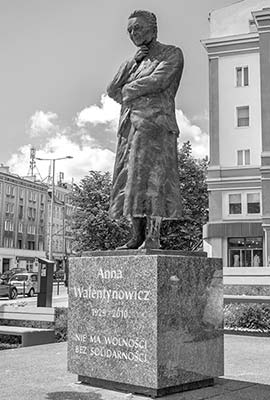
In the summer of 1980, at age 60, Walentynowicz was fired just a few months shy of her planned retirement. As the earliest strikes that would grow into Solidarity gained momentum, the rehiring of Walentynowicz was one of the strikers’ 21 Points. Before Wałęsa became “the face of Solidarity,” that face belonged to Walentynowicz. (Ultimately, Walentynowicz was reinstated and retired with her full pension.)
Another influential founder of Solidarity was shipyard nurse Alina Pienkowska (1952-2002). As the strike began, authorities cut off all phone lines—except the one to the clinic, which Pienkowska used to reach out to like-minded colleagues around Poland.
Just a few days into the strike, the authorities agreed to some of the workers’ lesser demands; Lech Wałęsa, among others, chalked this up as a success and began to wind down the protests. Many of the strikers began to leave the shipyard and head for home.
But Pienkowska was aware that what had begun here in Gdańsk was already spreading across Poland. On a loudspeaker, she implored her fellow workers to stick to their strike, alongside other trade unions across Poland that had already begun to join their cause. In fact, so determined were Pienkowska and Walentynowicz to fully live the idea of “solidarity” that they locked the shipyard gates to prevent more workers from leaving. Because of these brave and principled women, many of the strikers decided to stay, and even many of those who left returned the next day (reportedly at the urging of their wives) to carry on—transforming what could have ended as a historical footnote into a world-changing event.
Tragically, both women met untimely deaths. Pienkowska died of cancer in 2002, at age 50. And Walentynowicz was aboard the plane filled with Polish politicians and other influential figures that crashed in Smoleńsk, Russia, on April 10, 2010. But their legacy lives on. While Lech Wałęsa became the movement’s public face, Walentynowicz and Pienkowska are considered the conscience, heart, and soul of Solidarity. Both were ultimately awarded the Order of the White Eagle—Poland’s highest honor.
Before entering the museum, take a look around. This part of the shipyard, long abandoned, is being redeveloped into a “Young City” (Młode Miasto), with shopping, restaurants, offices, and homes. Rusting shipbuilding equipment is being torn down, and old brick buildings are being converted into gentrified flats. Farther east, the harborfront is also being rejuvenated, creating a glitzy marina and extending the city’s delightful waterfront people zone farther and farther to the north.
• The massive, rust-colored European Solidarity Center, which faces Solidarity Square, houses the museum where we’ll learn the rest of the story.
▲▲▲European Solidarity Center (Europejskie Centrum Solidarności)
Europe’s single best sight about the end of communism is made even more powerful by its location: in the very heart of the place where those events occurred. Filling just one small corner of a huge, purpose-built educational facility, the permanent exhibition uses larger-than-life photographs, archival footage, actual artifacts, interactive touchscreens, and a state-of-the-art audioguide to eloquently tell the story of the end of Eastern European communism.
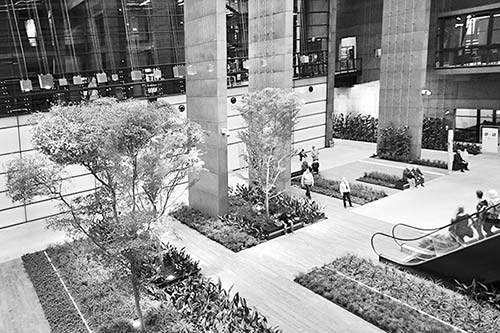
Cost and Hours: 30 zł, includes audioguide; Mon–Fri 10:00–19:00, Sat–Sun until 20:00; Oct–April Wed–Mon 10:00–17:00, Sat–Sun until 18:00, closed Tue; last entry one hour before closing, Plac Solidarności 1, +48 58 772 4000, www.ecs.gda.pl.
Self-Guided Tour: First, appreciate the architecture of the building itself. From the outside, it’s designed to resemble the rusted hull of a giant ship—seemingly gloomy and depressing. But step inside to find an interior flooded with light, which cultivates a surprising variety of life—in the form of lush gardens that make the place feel like a very expensive greenhouse. You can interpret this symbolism a number of ways: Something that seems dull and dreary from the outside (the Soviet Bloc, the shipyards themselves, what have you) can be full of brightness, life, and optimism inside.
In the lobby, buy your ticket for the permanent exhibit and pick up the essential, included audioguide. The exhibit has much to see, and some of it is arranged in a conceptual way that can be tricky to understand without a full grasp of the history. I’ve outlined the basics in this self-guided tour, but the audioguide can illuminate more details—including translations of films and eyewitness testimony from participants in the history.
Notice that the center also hosts temporary exhibits (filling a ground-floor space beneath the escalators), a “Play Department” area for kids, a simple $ café, and, back near the entrance, the more upscale $$ AmberSide restaurant. (For more eating options nearby, see here.)
• The permanent exhibit fills seven lettered rooms—each with its own theme—on two floors upstairs. From the lush lobby, head up the escalator and into...
The Birth of Solidarity (Room A): This room picks up right in the middle of the dynamic story we just learned out on the square. It’s August 1980, and the shipyard workers are rising up. You step straight into a busy shipyard: punch clocks, workers’ lockers, and—up on the ceiling—hundreds of plastic helmets. A big map in the middle of the room shows the extent of the shipyard in 1980. Nearby stands a small truck; Lech Wałęsa would stand on top of the cab of a truck like this one to address the nervous locals who had amassed outside the shipyard gate, awaiting further news.
In the middle of the room, carefully protected under glass, are those original plywood panels onto which the strikers scrawled their 21 demands and then lashed to the gate. Just beyond that, a giant video screen and a map illustrate how the strikes that began here spread like a virus across Poland. At the far end of the room, behind the partition, stand two tables that were used during the talks to end the strikes (each one with several actual items from that era, under glass).
After 18 days of protests (notice the dates marked on the floor), the communist authorities finally agreed to negotiate. On the afternoon of August 31, 1980, the Governmental Commission and the Inter-Factory Strike Committee (MKS) came together and signed the August Agreements, which legalized Solidarity—the first time any communist government had permitted a workers’ union. As Lech Wałęsa sat at a big table and signed the agreement, other union reps tape-recorded the proceedings and played them later at their own factories to prove that the unthinkable had happened. Take a moment to linger over the rousing film that plays on the far wall, which begins with the strike, carries through with the tense negotiations that a brash young Lech Wałęsa held with the authorities, and ends with the triumphant acceptance of the strikers’ demands. Lech Wałęsa rides on the shoulders of well-wishers out to the gate to spread the good news. The gate opens, the strikers file out, and the crowd cheers: “Leszek! Leszek!” (Lech-y! Lech-y!) The shipyard gate opens, and—finally!—the strikers get to return to the outside world.
• Back by the original 21 demands, enter the next exhibit...
The Power of the Powerless (Room B): This section traces the roots of the 1980 strikes, which were preceded by several far-less successful protests. It all begins with a kiss: a giant photograph of Russian premier Leonid Brezhnev mouth-kissing the Polish premier Edward Gierek, with the caption “Brotherly Friendship.” Soviet premiers and their satellite leaders really did greet each other “in the French manner,” as a symbolic gesture of their communist brotherhood.
Working your way through the exhibit, you’ll see the door to a prison cell—a reminder of the intimidation tactics used by the Soviets in the 1940s and 1950s to deal with their opponents as they exerted their rule over the lands they had liberated from the Nazis.
The typical communist-era apartment is painfully humble. After the war, much of Poland had been destroyed, and population shifts led to housing shortages. People had to make do with tiny spaces and ramshackle furnishings. Communist propaganda blares from both the radio and the TV.
A map shows “red Europe” (the USSR plus the satellites of Poland, Czechoslovakia, Hungary, and East Germany), and a timeline traces some of the smaller Soviet Bloc protests that led up to Solidarity: in East Germany in 1953, in Budapest and Poznań in 1956, the “Prague Spring” of 1968, and other 1968 protests in Poland.
In the wake of these uprisings, the communist authorities cracked down even harder. Peek into the interrogation room, with a wall of file cabinets and a lowly stool illuminated by a bright spotlight. (Notice that the white Polish eagle on the seal above the desk is missing its golden crown—during communism, the Poles were allowed to keep the eagle, but its crown was removed.)
The next exhibit presents a day-by-day rundown of the 1970 strikes, from December 14 to 22, which resulted in the massacre of the workers who are honored by the monument in front of this building. In the glass case, the leather jacket with bullet holes was worn by a 20-year-old worker who was killed that day. A wall of mug shots gives way to exhibits chronicling the steady rise of dissent groups through the 1970s, culminating in the June 1976 protests in the city of Radom (prompted, like so many other uprisings, by unilateral price hikes). On your way out of this section, you pass through a mock-up of a grocery store from the period...with empty shelves.
• Loop back through Room A and proceed straight ahead into...
Solidarity and Hope (Room C): While the government didn’t take the August Agreements very seriously, the Poles did...and before long, 10 million of them—one out of every four, or effectively half the nation’s workforce—joined Solidarity. So began what’s often called the “16 Months of Hope.” Newly legal, Solidarity continued to stage strikes and make its opposition known. Slick Solidarity posters and children’s art convey the childlike enthusiasm with which the Poles seized their hard-won kernels of freedom. The communist authorities’ hold on the Polish people began to slip. Support and aid from the outside world poured in, but the rest of the Soviet Bloc looked on nervously, and the Warsaw Pact army assembled at the Polish border and glared at the uprisers. The threat of invasion hung heavy in the air.
• Exiting this room, head up the staircase and into...
At War with Society (Room D): In this black room, you’re greeted by a wall of TV screens delivering a stern message. On Sunday morning, December 13, 1981, the Polish head of state, General Wojciech Jaruzelski—wearing his trademark dark glasses—appeared on national TV and announced the introduction of martial law. Solidarity was outlawed, and its leaders were arrested. Frightened Poles heard the announcement and looked out their windows to see Polish Army tanks rumbling through the snowy streets. (On the opposite wall, see footage of tanks and heavily armed soldiers intimidating their countrymen into compliance.) Those who were children at the time recall turning on their televisions for a beloved Sunday-morning cartoon show, Teleranek, and instead seeing this chilling message. Jaruzelski claimed that he imposed martial law to prevent the Soviets from invading. Today, many historians question whether martial law was really necessary, though Jaruzelski remained unremorseful through his death in 2014.
Continuing deeper into the exhibit, you come to a prisoner transport. Climb up inside to watch chilling scenes of riots, demonstrations, and crackdowns by the ZOMO riot police. In one gruesome scene, a demonstrator is quite intentionally run over by a truck. From here, pass through a gauntlet of milicja riot-gear shields to see the truck crashing through a gate. Overhead are the uniforms of nine striking miners from the Wujek mine who were massacred on December 16, 1981 (their names are projected on the pile of coal below). The regime called this event “pacification.”
Martial law was a tragic, terrifying, and bleak time for the Polish people. It did not, however, kill the Solidarity movement, which continued its fight after going underground. Passing prison cells, you’ll see a wall plastered with handmade, underground posters and graffiti. Notice how in this era, Solidarity propaganda is much more primitive; circle around the other side of the wall to see several presses that were actually used in clandestine Solidarity print shops during this time. The outside world sent messages of support as well as supplies—represented by the big wall of cardboard boxes. This approval also came in the form of a Nobel Peace Prize for Lech Wałęsa in 1983; you’ll see video clips of his wife accepting the award on his behalf (Wałęsa feared that if he traveled abroad to claim it, he would not be allowed back into the country). On the other side of the room is an exhibit about Pope John Paul II’s visit in the very tense days of 1983.
• But even in these darkest days, there were glimmers of hope. Enter...
The Road to Democracy (Room E): By the time the pope visited his homeland again in 1987, martial law had finally been lifted, and Solidarity—still technically illegal—was gaining momentum, gradually pecking away at the communists. Step into the small inner room with footage of the pope’s third pilgrimage to his homeland in 1987, by which time (thanks in no small part to his inspirational role in the ongoing revolution) the tide was turning.
Step into the room with the big, white roundtable. With the moral support of the pope and the entire Western world, the brave Poles were the first European country to throw off the shackles of communism when, in the spring of 1989, the “Roundtable Talks” led to the opening up of elections. The government arrogantly called for parliamentary elections, reserving 65 percent of seats for themselves.
In the next room, you can see Solidarity’s strategy in those elections: On the right wall are posters showing Lech Wałęsa with each candidate. Another popular “get out the vote” measure was the huge poster of Gary Cooper—an icon of America, which the Poles deeply respect and viewed as their friendly cousin across the Atlantic—except that, instead of a pistol, he’s packing a ballot. Rousing reminders like this inspired huge voter turnout. The communists’ plan backfired, as virtually every open seat went to Solidarity. It was the first time ever that opposition candidates had taken office in the Soviet Bloc. On the wall straight ahead, flashing a V-for-wiktoria sign, is a huge photo of Tadeusz Mazowiecki—an early leader of Solidarity, who became prime minister on June 4, 1989.
• For the glorious aftermath, head into the final room.
The Triumph of Freedom (Room F): This room is dominated by a gigantic map of Central and Eastern Europe. A countdown clock on the right ticks off the departure of each country from communist clutches, as the Soviet Bloc “decomposes.” You’ll see how the success of Solidarity in Poland—and the ragtag determination of a scruffy band of shipyard workers right here in Gdańsk—inspired people all over Central and Eastern Europe. By the winter of 1989, the Hungarians had opened their borders, the Berlin Wall had crumbled, and the Czechs and Slovaks had staged their Velvet Revolution. (Small viewing stations that circle the room reveal the detailed story for each country’s own road to freedom.) Lech Wałęsa—the shipyard electrician who started it all by jumping over a wall—became the first president of postcommunist Poland. And a year later, in Poland’s first true elections since World War II, 29 different parties won seats in the parliament. It was a free-election free-for-all.
In the middle of the room stands a white wall with inspirational quotes from St. John Paul II and Václav Havel—the Czech poet-turned-protester-turned-prisoner-turned-president—which are repeated in several languages. On the huge wall, the Solidarity “graffiti” is actually made up of thousands of little notes left behind by visitors to the museum. Feel free to grab a piece of paper and a pen and record your own reflections.
• Finally, head downstairs into a peaceful space.
Culture of Peaceful Change (Room G): Many visitors find that touring this museum—with vivid reminders of a dramatic and pivotal moment in history that took place in their own lifetimes and was brought about not by armies or presidents but by everyday people—puts them in an emotional state of mind. Designed for silent reflection, this room overlooks the monument to those workers who were gunned down in 1970. It shows footage of Pope John Paul II; Lech Wałęsa; Martin Luther King, Jr.; and others who dedicated their lives to peaceful change.
• For an epilogue, continue deeper into the former shipyard to see one more important landmark from 1980. Exit the building the way you came in and turn left. The path leads to a low-profile, red-brick building about 80 yards ahead, the...
Sala BHP
This is the building where the communists sat down across the table from Lech Wałęsa and his team and worked out a compromise (as seen in the videos inside the European Solidarity Center). Entering, turn left into the Small Hall to see shipyard photos, banners, office equipment, and other memorabilia from the time. The other side of the building (right from the entrance) is the actual, larger hall where those fateful meetings took place, with a long table set up on the stage. You’ll see a model of the shipyard, circa 1980, and models of the various ships that were built here.
Cost and Hours: Free, daily 10:00-18:00, Oct-April until 16:00, www.salabhp.pl.
NORTH OF THE MAIN TOWN
▲▲Museum of the Second World War (Muzeum II Wojny Światowej)
In 2017, Poland’s definitive WWII museum opened in a state-of-the-art, purpose-built facility a 10-minute walk north of Gdańsk’s Main Town. It uses artifacts, creative design, insightful storytelling, and ample archival footage to tell the story of the war that began right at Gdańsk’s doorstep—focusing on the Polish experience, but also expanding its focus to other aspects of the conflict. At more than 50,000 square feet, it’s one of the biggest historical exhibits in the world. (Pace yourself.) While those with a limited appetite for history may find it overwhelming, even those with a casual interest will be glad they invested two or three hours touring its exhibits.
As impressive as the museum is, it could have been that much better. The original design presented an ambitiously global, yet personal, perspective on the war—carefully calibrated to be evenhanded and international in its outlook. But as it neared completion, ruling politicians from the nationalistic Law and Justice Party deemed it too pacifistic and “not Polish enough”—it needed to be more bombastic and emotional. They replaced the museum director and his staff, and hired a new director who changed several exhibits to be more singularly patriotic—playing up the “martyrdom” aspect of Poland’s role in the war. In the end, it’s sad to think that this museum could have been Europe’s best WWII museum—if only trained historians had been allowed to control it, rather than politicians. For that reason, I rate it ▲▲ rather than ▲▲▲.
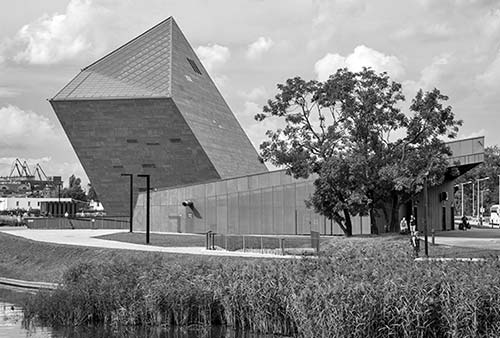
Cost and Hours: 29 zł, free on Tue, essential audioguide-12 zł; Tue 10:00-16:00, Wed-Sun 10:00-18:00 (until 20:00 in July-Aug), closed Mon year-round, last entry one hour before closing; Plac Władysława Bartoszewskiego 1, +48 58 760 0960, www.muzeum1939.pl.
Getting There: It’s a short walk north of the historical center. The most appealing approach is to walk north along the riverfront promenade all the way to its end; you’ll see the giant, rust-red, glassy tower on your left.
Visiting the Museum: As you approach, appreciate the symbolic architecture of the site. The ground level—nicely landscaped, with inviting slingback chairs in the summer—represents the present. The museum’s exhibit space is entirely underground—representing the past. And the tower rising above represents the future. All of the buildings are clad in rusted steel—the material of choice in this shipbuilding city.
Head down the stairs at the base of the tower, go inside, and take the elevator down to level -3. This area has ticket desks, a cloakroom, WCs, a $ bistro, a shop, a cinema, temporary exhibits, and the entrance to the permanent exhibition. For a more serious meal, you can ride the elevator up to floor 4 to find an affordable, bright $ restaurant with views over the city.
When you buy your ticket, spring for the audioguide, which helpfully navigates the highlights of the sprawling exhibits and translates some of the films. It’s geo-tagged, so it knows where you are and informs you accordingly.
Ticket and audioguide in hand, head through the turnstile. A long corridor stretches to your right; 18 clearly numbered exhibition halls weave in and out of this corridor, chronologically telling the story. As you crisscross through the corridor, take a moment to ponder its exhibits about everyday life in wartime, covering such topics as food and cooking, fashion and style, the black market, travel, and music.
Before heading into the main exhibition, consider turning left, into the Time Travel exhibit. Designed for Polish kids, it follows two children and their everyday life, before, during, and after the war—with the same apartment re-created for each time period.
The first part of the exhibit is straight ahead from the entrance turnstile: A movie that sets the stage by recapping the events of World War I and the interwar period.
Now proceed down the corridor and work your way chronologically through the numbered exhibits. Section 01—spread across three smaller rooms—traces the rise of communism in the Soviet Union (the quern stone was used for grinding grain by ethnic Poles in Ukraine, many of whom perished under Stalin’s policies), fascism in Italy (the Fiat embodies the populism—a car in every driveway—that drove Mussolini’s propaganda), and Nazism in Germany (with a bust and posters of Hitler, some hateful anti-Semitic propaganda, a Hitler Youth uniform, and a clip from Leni Riefenstahl’s Triumph of the Will).
Section 02 is a reconstructed Polish street from the interwar period. (Remember this.) The next hallway outlines the rise of imperialism in Japan, Franco’s ascent in Spain, and Germany’s dismantling of the Versailles system that ended the conflict of World War I. Gdańsk—then called Danzig—held a unique position: It was a free city, with Germany on one side and Poland on the other. As Hitler rose, Western Europeans already knew that Danzig would be a bulwark against his aggression (see the stone border marker)—giving rise to the slogan “Die for Danzig.” On the wall in the next room—wallpapered with giant swastikas and hammer-and-sickles—find a replica of the secret Molotov-Ribbentrop Pact between the USSR and Nazi Germany, agreeing to divide Poland down the middle...and clearing the way for invasion.
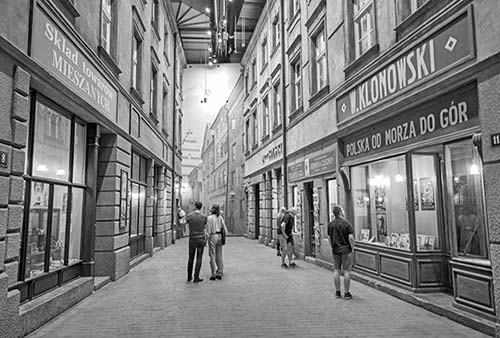
In section 03, you’ll learn how that invasion took place on September 1, 1939, when Hitler invaded Poland (en route to Danzig) and quickly overran the country—the first use of his relentless Blitzkrieg (“Lightning War”) strategy. One exhibit explains the first volley of that war, in which 200 Poles defended the military transit depot Westerplatte against 3,000 Nazi troops for seven days. You’ll learn about the brutal Nazi atrocities from that first invasion, including photos of bombed-out cities. One of the museum’s highlights is the film Siege, shot and narrated by American correspondent Julien Bryan, who was in Warsaw during the invasion and witnessed the Nazis bombarding a church during Mass, the bombing of a maternity ward, and a village of peasants machine-gunned from the air while digging up potatoes. You’ll learn how soon, the Soviet Union also invaded, per their secret agreement—meeting the Nazis in the middle and splitting Poland in half (see the huge map on the wall).
Across the main corridor, section 04 outlines Soviet conquests in other parts of Europe (Finland, the Baltic states, Romania). Section 05 (with a JU-87 dive bomber suspended from the wall) explains how this was a new kind of war, relying heavily on air warfare (Hitler’s Luftwaffe).
Back across the corridor, section 06 documents the ruthlessness of the Nazis, including their starvation of Soviet POWs (the “Hunger Plan” that killed more than three million captured troops), the 871-day Siege of Leningrad (today’s St. Petersburg, where one million civilians starved to death), and air raids that killed another one million civilians.
Across the corridor, section 07 considers how totalitarian regimes recruited collaborators in the countries they occupied—employing methods from propaganda to intimidation. You’ll see a replica of a “Red Corner”—a wood-paneled workers’ meeting hall, draped in communist propaganda, that you’d find in any workplace or institution. A film on Soviet propaganda methods explains Stalin’s philosophy of “national in form, Soviet in content”—appropriating locally beloved symbols but infusing them with a communist agenda.
Crossing the hall, giant letters spell out TERROR. Here, first bear left into section 08, which explains how totalitarian regimes rounded up and executed elites (such as the USSR’s Katyń Massacre of Polish intelligentsia, close to the heart of every Pole). The room with a vast map on the floor illustrates forced resettlement; the doors lining the walls have exhibits explaining specific examples. You’ll learn how heavily the occupying forces relied on forced labor—essentially exploiting 20 million slaves—including workers here in Gdańsk (the metal plates in revolving cases were used to keep track of workers). This section also has a powerful exhibit on daily life in Nazi concentration camps, with many powerful objects: striped uniforms and wooden clogs, a homemade nativity scene and tiny figures carved from a toothbrush by prisoners, a violin, and a baby’s christening gown. You’ll also see a wheelchair from a psychiatric hospital near Gdańsk. All of its inmates were executed.
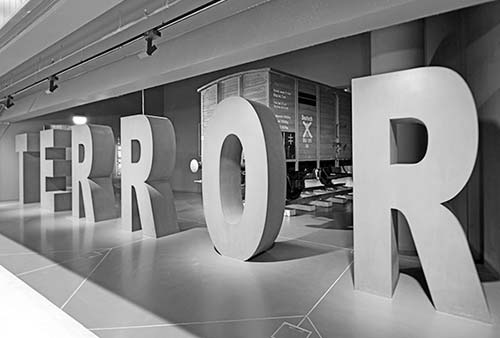
As you circle back to the giant TERROR letters, section 09 explores the methodical implementation of the Holocaust, including a train car used to transport prisoners. A wall of suitcases is a reminder of how prisoners were stripped of belongings on arrival. Nearby, a controversial exhibit touts the Poles who risked their lives to save their Jewish neighbors—with no mention of the Poles who looked the other way, or even collaborated with the Nazi occupiers. With this in mind, you’ll walk through a room displaying photographs of hundreds of Jewish Holocaust victims. Section 10 considers other instances of ethnic cleansing during World War II, including Serbs killed in the Nazi puppet state of Croatia and Poles killed in Ukraine.
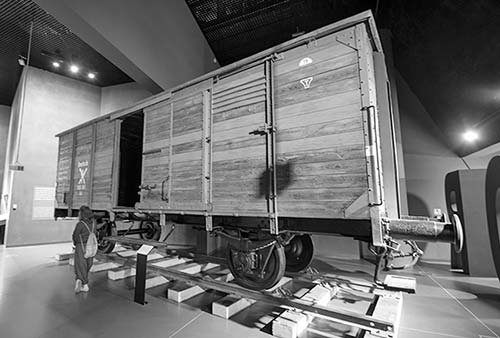
Section 11—with the giant letters OPÓR (“Resistance”)—explains the various ways that occupied peoples rose up. Poland maintained a government in exile, and a military that participated in Allied offensives (Poles were the first to reach the top of Monte Cassino in Italy)—essentially a continuation of prewar statehood, despite occupation. You’ll learn about both civilian resistance movements and partisan fighting forces on the battlefields (such as Tito’s Partisans in Yugoslavia). This section also honors various uprisings against totalitarian regimes.
Section 12 features the clandestine front—spies, espionage, and the battle over secrets. In a room with an actual Enigma machine, you’ll learn how it was Polish mathematicians who first broke the Nazis’ secret code...then furnished that breakthrough to the British. Today, Alan Turing and the other codebreakers at Britain’s Bletchley Park get virtually all of the credit for the tens of thousands of lives that were saved. (Many Poles believe that the breaking of the Enigma code was Poland’s single most important contribution to winning the war.)
Section 13 considers the ways that countries mobilize—economically and societally—in times of war. Wartime brought about such innovations as the jet engine, the computer, and the nuclear bomb. While the Nazis relied on slave labor to build armaments, the Allies mobilized female citizens...and outproduced their enemies three-to-one. In this section, you’ll see a Sherman Firefly tank (built in the UK).
The very brief section 14 explains how the tide of war turned toward the Allies, while section 15 considers the postwar reality—which was cooked up even before Hitler was dead, when Churchill, FDR, and Stalin met in Yalta, agreeing to divvy up Europe after their victory. (Many Poles still consider this a betrayal: After their suffering and valiant contributions, they were effectively left to the whim of the USSR.) The postwar period was bittersweet: victory parades celebrating the defeat of evil, but also a Poland left in ruins, the rise of a ruthless Soviet empire in Eastern Europe, and a series of forced population resettlements (to match the new borders) that uprooted millions. The bright-white room commemorates the first-ever use of nuclear weapons: the bombing of Hiroshima (see the shards of pottery, symbolizing the devastation).
Section 16 shows the same city street we saw earlier—but now in ruins, presided over by a Soviet tank. Giant panels (added later) emphasize how Poland lost more lives per capita than any other nation in this conflict. Next, a map in the floor illustrates postwar forced population shifts, and a mockup of a courtroom considers both the triumphs and the failings of the postwar justice system: Yes, high-profile war criminals were prosecuted. But the overflowing file cabinet on the dark side of the room is a reminder of the many lower-level war criminals who were never brought to justice.
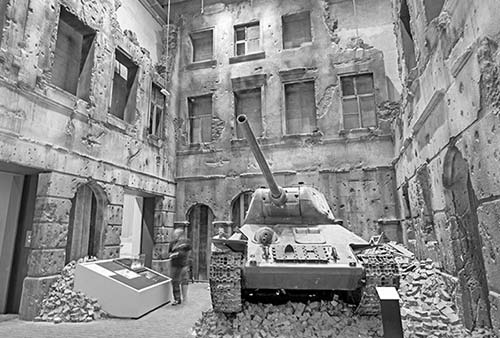
Cross the destroyed street to section 17, with photos of cities that were left in ruins at war’s end; and section 18, divided by a symbolic “Iron Curtain”—a reminder that World War II was only the beginning of a painful chapter for Poland and all of Central and Eastern Europe.
Just before you exit, playing overhead is a cheaply produced, rabble-rousing, hyperbolic, nakedly patriotic movie called The Unconquered...a sad reminder of the way a wonderful museum was mucked up by politics. (Before the right-wing government fired the museum director, this film was very different—ending the exhibit on a pensive note, with as many questions as answers. Now, it sends Polish visitors out into the world entirely assured of their own righteousness.)
Despite its shortcomings, the Museum of the Second World War is a powerful and comprehensive look at the most devastating conflict in human history, from the perspective of the country that was perhaps the most devastated by it.
Nearby: A short walk over a canal (across the Więcierze Bridge) from the museum is the Polish Post Office of Danzig (on Plac Obrońców Poczty Polskiej). History buffs recognize this landmark as part of the initial Nazi attacks on September 1, 1939, which began World War II. The post office—which was a nerve center for local Polish intelligence officers—was attacked by Nazi forces and defended by Polish officers. After 15 hours of fighting, everyone inside was dead or had fled; those who escaped were later executed. This event was immortalized in the 1959 Günter Grass historical novel The Tin Drum. The stately brick building is now a museum, and in the plaza out front is the giant and dramatic Monument to the Defenders of the Polish Post Office (from 1979): An angel hands a rifle down to a fallen fighter to continue the struggle; overhead, stylized birds flutter their wings dramatically into the sky.
SOUTH OF THE MAIN TOWN
A 10-minute walk south of the Main Town, this sight rounds out the Gdańsk experience for those with a special interest in art.
National Museum in Gdańsk (Muzeum Narodowe w Gdańsku)
This art collection, housed in what was a 15th-century Franciscan monastery, is worth ▲▲ to art lovers for one reason: Hans Memling’s glorious Last Judgment triptych altarpiece, one of the two most important pieces of art to be seen in Poland (the other is Leonardo da Vinci’s Lady with an Ermine, in Kraków’s Czartoryski Museum). If you’re not a purist, you can settle for seeing the much smaller replica in St. Mary’s Church. But if medieval art is your bag, it’s worth a visit.
Cost and Hours: 15 zł, free on Fri; open Tue-Sun 11:00-18:00, closed Mon, last entry 45 minutes before closing; walk 10 minutes due south from Ulica Długa’s Golden Gate, after passing the Shakespeare Theater take the pedestrian underpass beneath the big cross street, then continue down the busy street until you see signs for the museum; Ulica Toruńska 1, +48 58 301 6804, www.mng.gda.pl.
Visiting the Museum: Find the altarpiece by Hans Memling (c. 1440-1494)—from where you enter, it’s usually at the top of the stairs and to the right. The history of the painting is as interesting as the work itself. It was commissioned in the mid-15th century by the Medicis’ banker in Florence, Angelo di Jacopo Tani. The ship delivering the painting from Belgium to Florence was hijacked by a Gdańsk pirate, who brought the altarpiece to his hometown to be displayed in St. Mary’s Church. For centuries, kings, emperors, and czars admired it from afar, until Napoleon seized it in the early 19th century and took it to Paris to hang in the Louvre. Gdańsk finally got the painting back, only to have it exiled again—this time into St. Petersburg’s Hermitage Museum—after World War II. On its return to Gdańsk in 1956, this museum claimed it—though St. Mary’s wants it back.
Have a close look at Memling’s well-traveled work. It’s the end of the world, and Christ rides in on a rainbow to judge humankind. Angels blow reveille, waking the dead, who rise from their graves. The winged archangel Michael—dressed for battle and wielding the cross like a weapon—weighs the grace in each person, sending them either to the fires of hell (right panel) or up the sparkling-crystal stairway to heaven (left).
It takes all 70 square feet of paneling to contain this awesome scene. Jam-packed with dozens of bodies and a Bible’s worth of symbolism, and executed with astonishing detail, the painting can keep even a non-art lover occupied. Notice the serene, happy expressions of the righteous, as they’re greeted by St. Peter (with his giant key) and clothed by angels. And pity the condemned, their faces filled with terror and sorrow as they’re tortured by grotesque devils more horrifying than anything Hollywood could devise.
Tune in to the exquisite details: the angels’ robes, the devils’ genetic-mutant features, the portrait of the man in the scale (a Medici banker), Michael’s peacock wings. Get as close as you can to the globe at Christ’s feet and Michael’s shining breastplate: You can just make out the whole scene in mirror reflection. Then back up and take it all in—three panels connected by a necklace of bodies that curves downward through hell, crosses the earth, then rises up to the towers of the New Jerusalem. On the back side of the triptych are reverent portraits of the painting’s patron, Angelo Tani, and his new bride, Catarina.
Beyond the Memling, the remainder of the collection isn’t too thrilling. The rest of the upstairs has more Flemish and Dutch art, as well as paintings from Gdańsk’s golden age and various works by Polish artists. The ground floor features a cavernous, all-white cloister filled with Gothic altarpiece sculptures, gold and silver wares, and Gdańsk-style furniture.
OUTER GDAŃSK
These two sights—worthwhile only to those with a particular interest—are each within the city limits of Gdańsk, but they take some serious time to see round-trip.
Oliwa Cathedral (Katedra Oliwska)
The suburb of Oliwa, at the northern edge of Gdańsk, is home to this visually striking church. The quirky, elongated facade hides a surprisingly long and skinny nave. The ornately decorated 18th-century organ over the main entrance features angels and stars that move around when the organ is played. While locals are proud of this place, it takes some effort to reach—worthwhile only if you can make it to a concert.
Concerts: The animated organ performs its 20-minute show frequently, especially in summer (in high season, concerts at the top of most hours—confirm schedule online or at Gdańsk TI before making the trip, www.archikatedraoliwa.pl). Note that on Sundays and holidays, there are no concerts before 15:00.
Getting There: Oliwa is about six miles northwest of central Gdańsk, on the way to Sopot and Gdynia. To reach Oliwa from Gdańsk’s main train station, you have two options: Ride tram #6 or #12, get off at the Oliwa stop, and walk a few minutes through the park to the church (about 30 minutes total); or take an SKM commuter train to the Gdańsk Oliwa stop (15 minutes), then walk 15 minutes (or take a taxi) to Oliwski Park and the cathedral.
Westerplatte
World War II began on September 1, 1939, when Adolf Hitler sent the warship Schleswig-Holstein to attack this Polish munitions depot, which was guarding Gdańsk’s harbor. Though it gives serious WWII history buffs goosebumps, casual visitors will find little to see here aside from a modest museum, a towering monument, and some old bunkers. For many, the reason to “go to Westerplatte” isn’t for the destination, but for the chance to get there on a little cruise down the river...perhaps on a “pirate ship.”
Getting There: The most enjoyable option is to ride a replica 17th-century galleon, either the Galeon Lew (“Lion Galleon”) or the Czarna Perła (“Black Pearl”). These over-the-top-touristy boats depart hourly from the embankment in the heart of Gdańsk (you can’t miss them) for a lazy 1.5-hour round-trip cruise to Westerplatte and back. Alternatively, you can choose to get off at Westerplatte and return on a later boat. You’ll see more industry than scenery, but it’s a fun excuse to set sail (80 zł round-trip, 60 zł one-way, the two boats take turns departing at the top of each hour in season, +48 601 629 191, https://perlalew.pl). Two duller alternatives leave from nearby: big, modern Żegluga Gdańska boats (www.zegluga.pl); or cheaper but less frequent city-run ZTM “ferry trams” (tramwaj wodny), which depart from the embankment on the south side of the bridge (3-4/day). Another option is to take bus #106 or #138 from the main train station (about 30 minutes to Westerplatte).
Shopping in Gdańsk
The big story in Gdańsk is amber (bursztyn), a fossil resin available in all shades, shapes, and sizes (see the “All About Amber” sidebar, earlier). The best place to browse and buy amber is along the atmospheric Ulica Mariacka (between the Motława River and St. Mary’s Church). This pretty street, with old-fashioned balconies and dozens of display cases, is fun to wander even if you’re not a shopper.
To avoid rip-offs—such as amber that’s been melted and reshaped—always buy it from a shop, not from someone standing on the street. (But note that most shops also have a display case and salesperson out front, which are perfectly legit.) Prices everywhere are about the same, so instead of seeking out a specific place, just window shop until you see what you want. Styles range from gaudy necklaces with huge globs of amber, to tasteful smaller pendants in silver settings, to cheap trinkets. All shades of amber—from near-white to dark brown—cost about the same, but you’ll pay more for inclusions (bugs or other objects stuck in the amber).
Gdańsk also has several modern shopping malls, most of them in the Old Town or near the main train station. The most impressive is the Forum, across the street from the Upland Gate; the Madison shopping center is between the Main Town and the Solidarity shipyard.
Entertainment in Gdańsk
Strolling the Embankments: This city feels made to order for simply strolling. Before or after dinner, you’ll find yourself doing laps up and down both sides of the embankment and along the Royal Way. You’ll pass plenty of tempting spots for a dessert or a drink (for ideas, see below).
Live Music: Check the schedule for the Polish Baltic Philharmonic, officially named for Fryderyk Chopin, which performs in the red-brick hall across the embankment from Fishmarket Square (near the drawbridge; www.filharmonia.gda.pl).
Drinks: As a lively town with lots of both tourists and students, Gdańsk has plenty of rowdy bars that fill up on weekends. But it also has some more refined watering holes that enjoy showing off special local liquors. Better restaurants are likely to have two hard drinks that are distinctly Gdańsk: Goldwasser is a sweet, faintly anisey liqueur flecked with actual gold (similar to Goldschläger). Machandel, a juniper-based liquor, is served chilled in a shot glass with a dried plum on a toothpick. According to local superstition, for good luck, you’re supposed to drink the shot, chase it with the dried plum, then break the toothpick.
While those are quite traditional, Gdańsk also has a new generation of producers creating all manner of distillates that go beyond the stereotypical “Polish vodka.” Podole Wielkie i Przyjaciele is an inviting, educational, and fun place to sample some locally made options. They specialize in okowita—a.k.a. aqua vita, “water of life”—usually based on wheat, barley, rye, or potato and infused with various flavors. They grow everything on their own farm, about 50 miles outside the city. They’ve also got a unique line of liquor distilled from various beers. The i przyjaciele in their name means “and friends,” and they also carry some different drinks made by other local producers—ranging from gin and whiskey to more traditional vodka. You can stop in to do a tasting (priced per shot)—they enjoy guiding visitors through their options. The well-stocked shop has bottles generally in the 160-300-zł range (Mon-Sat until 21:00, Sun until 20:00, Chlebnicka 37/38, +48 730 850 066, www.podolewielkie.pl).
Sleeping in Gdańsk
The high season is generally May through September; at all of these places, you’ll pay a bit less off-season. Many hotels are booked up (mostly with German and Scandinavian tourists) in peak season—reserve ahead.
IN THE MAIN TOWN
The Main Town is convenient for sightseeing, but some places come with nighttime noise—particularly in summer, when loud bars and discos keep things lively. Request a quiet room...and pack earplugs.
$$ Gotyk House is a small hotel that’s comfortable while still respecting the sanctity of Gdańsk’s oldest house (and supposedly the residence of Copernicus’ longtime lover). You can’t get more central in this city; the chimes from St. Mary’s Church, next door, provide a pleasant soundtrack. The original, historic building has five rooms (air-con only on top floor); a modern annex out back holds six additional rooms with air-conditioning and more refined touches. Neither building has an elevator, so be ready for stairs (Ulica Mariacka 1, +48 58 301 8567, www.gotykhouse.eu, reservation@gotykhouse.eu).
$ Hotel Admirał is simply practical: a big, solidly built, business-class place with 44 comfortable rooms tucked in a peaceful residential alley at the north end of the embankment, just a few steps off Fishmarket Square. Reliably comfortable, if not fancy, and conveniently located, this is a handy home base (air-con, elevator, Tobiasza 9, +48 58 320 0320, www.admiralhotel.pl, recepcja@admiralhotel.pl).
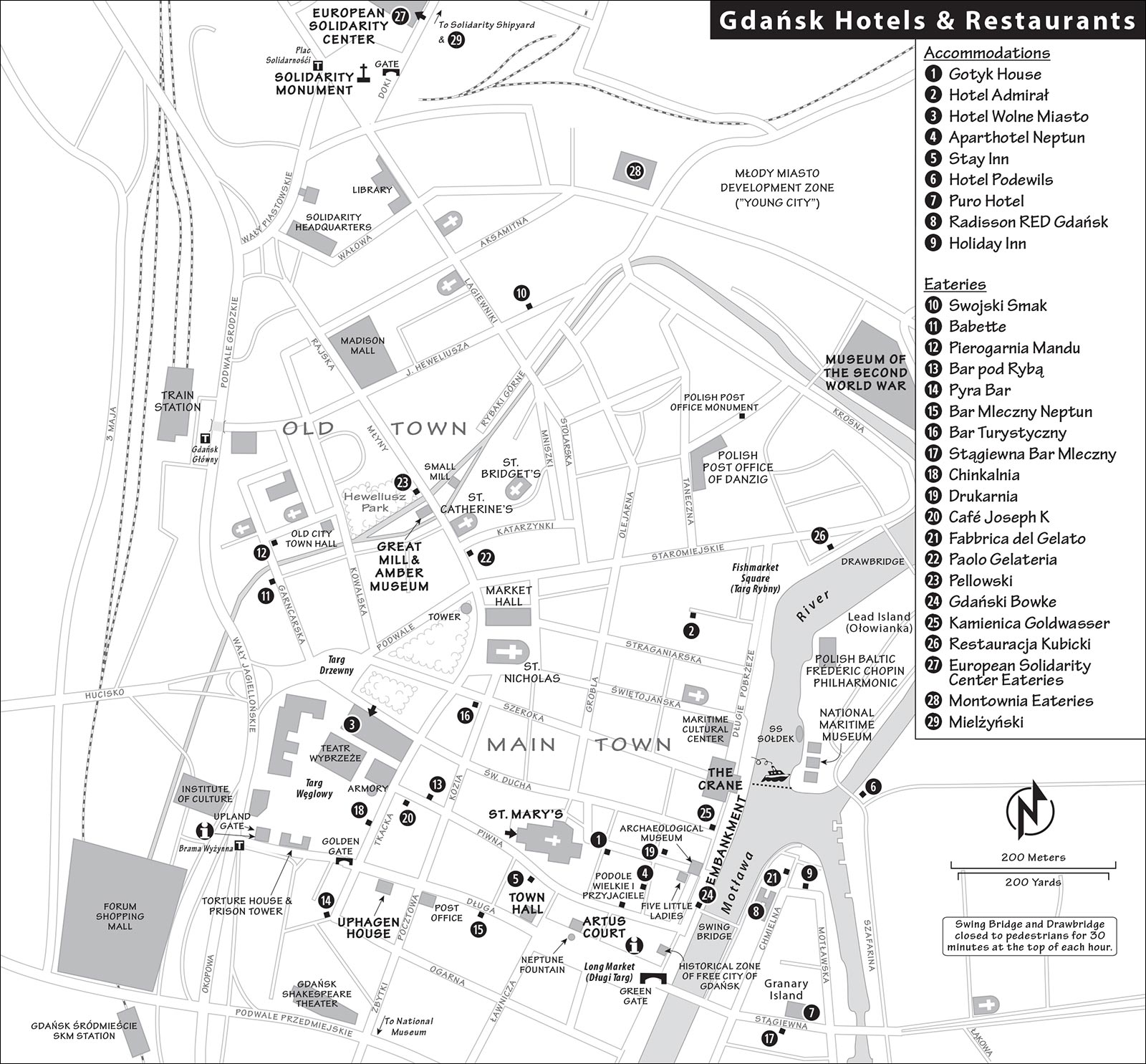
$ Hotel Wolne Miasto (“Free City”) offers lush, wood-carved public spaces with photos of old Gdańsk and 68 richly decorated rooms on the edge of the Main Town, just two blocks from the main drag. It’s above a popular disco that gets noisy on weekends (Thu-Sat nights), so it’s especially important to request a quieter room when you reserve (elevator, Ulica Świętego Ducha 2, +48 58 305 2255, www.hotelwm.pl, rezerwacja@hotelwm.pl).
$ Aparthotel Neptun lacks personality but owns a great location—on a slightly dreary side street between delightful Mariacka and the bustling Royal Way. While it’s just a few steps to most of the town’s big sights, it’s just far enough away to avoid crowds and weekend noise. The 39 rooms and apartments are modern, efficient, well equipped, and forgettable...but well priced for the central location (air-con on top floor only, elevator, spa, Grzaska 1, +48 604 466 466, www.apartneptun.com, info@apartneptun.com).
$ Stay Inn couldn’t be more central—facing the side of St. Mary’s Church, right in the heart of the Main Town. Although the street it’s on is quieter than most, a downstairs pub can be noisy on weekends. The place feels modern, and the 45 rooms are stylish and colorful (air-con, elevator, Piwna 28, +48 58 354 1543, www.stayinngdansk.com, booking@stayinngdansk.com).
ACROSS THE RIVER
These hotels are across the river from the Main Town, in the thriving new Granary Island area—still a short and easy walk to the Main Town sights.
$$$ Hotel Podewils is the top choice for a friendly, Old World splurge. Filling a storybook-cute house from 1728, overlooking the marina and across the river from a fine panorama of the Gdańsk embankment, it’s classy. The public spaces and 10 rooms have all the modern amenities, but with plush, almost Baroque, decor (air-con, Szafarnia 2, +48 58 300 9560, www.podewils.pl, gdansk@podewils.pl).
$$ Puro Hotel, in the middle of Granary Island, is part of a Norwegian chain. It’s big (eight floors), splashy, and fills brand-new buildings with towering glass atriums, a big restaurant, and a top-floor bar. The 211 rooms are modern, practical, and stylish; for the quality and location, it’s a great value for those wanting a big hotel (air-con, elevator, spa, Stągiewna 26, +48 58 563 5000, www.purohotel.pl, gdansk@purohotel.pl).
Other Big Hotels on Granary Island: Each year, more brand-new international chain hotels open on Granary Island. If you’re looking for big-hotel predictability (with air-con, elevators, etc.), consider two places filling sleek new buildings right along the embankment facing the Main Town: the smaller $$ Radisson RED Gdańsk (30 rooms, Chmielna 2, +48 58 600 2810, www.radissonhotels.com) and the gigantic $ Holiday Inn (240 rooms, Chmielna 1, +48 58 733 4000, www.ihg.com).
Eating in Gdańsk
With its heritage as a wealthy trading city, Gdańsk has its own distinct cuisine. While much of Poland—with its roots in poverty—dines on hearty, rustic countryside dishes, the Hanseatic merchants here preferred to flaunt their wealth with rich foods, lots of butter, and lively imported spices. For example, they favored deer (hunted—a pastime of the rich) over beef or pork (farm raised—a duty of the poor). This is perhaps best demonstrated by the local Goldwasser liqueur, with flecks of actual gold—see “Entertainment in Gdańsk,” earlier. And, of course, you’ll also find excellent Baltic seafood here on the north coast: Herring (śledż) is popular, as is cod (dorsz).
IN THE MAIN TOWN AND OLD TOWN
My recommendations are scattered around the city center, all within about a 15-minute walk of each other and all near the main sightseeing zones. I’ve covered the scenic options along the embankment in a separate section.
$$ Swojski Smak (“Taste of Home”), tucked away from the touristy town center on a nondescript residential street partway to the Solidarity shipyards, is an intriguing combination of new and old. The menu is classic Polish fare, just like Babcia used to make: pierogi, hearty soups, potato pancakes, and a long list of nostalgic “dishes from childhood.” But the setting is modern, industrial, and funky, with raw brick and a youthful, trendy vibe. They also pride themselves on their extensive selection of vodkas and good cakes (daily, Heweliusza 25/27, +48 58 320 1912, www.swojskismak.pl).
$ Babette is a delightful lunch or early dinner spot that feels both traditional and modern...trendy yet accessible. They serve a range of soups, stews, sides, and spreads, all with fresh-baked bread. Order at the counter, then find a table in the cozy contemporary café setting and dig in. It’s an ideal spot for a hearty, quick, delicious meal (daily until 19:00, Garncarska 4/6, +48 535 717 766, www.pracowniababette.pl).
$ Pierogarnia Mandu, a few steps away from Babette, serves a wide variety of pierogi—all handmade (see them working through the window), with modern flourishes. Hiding in a nondescript residential zone between the train station and the main tourist area, it’s worth seeking out for pierogi, plus a variety of other international dumplings. Book ahead to avoid waiting in line at the door. Don’t come here in a hurry—it can take some time for your dumplings to be made to order (daily, Elżbietańska 4, +48 58 300 0000, www.pierogarnia-mandu.pl).
Potatoes!: Two places—each just a block off the main drag (in opposite directions)—offer tasty, hearty, affordable potato dishes. $ Bar pod Rybą (“Under the Fish”) is nirvana for fans of baked potatoes (pieczony ziemniak). They offer more than 20 varieties, piled high with a wide variety of toppings and sauces, from Mexican beef to herring to Polish cheeses. They also serve fish dishes with salad and potatoes, making this a cheap place to sample local seafood. The interior has big, comfy couches, and the outdoor seating fills a big stone balcony on atmospheric Piwna street (daily, Piwna 61, +48 58 305 1307, www.barpodryba.pl). $ Pyra Bar is another potato-based eatery; in addition to baked potatoes, they also have individual-sized casseroles (similar to a gratin) and potato pancakes—all available with a wide range of toppings. I’d skip the dull interior; eat here only if you can enjoy the lovely outdoor seating on a characteristic corner. Pick a table, then go inside to order at the bar (daily, Garbary 6/7, +48 58 301 9282, www.pyrabar.pl).
Milk Bars: Gdańsk has several classic, basic, fill-the-tank milk bars that are handy for grabbing a quick meal. $ Bar Mleczny Neptun owns a prime location, right on the main drag facing the Main Town Hall (daily until 19:00, Ulica Długa 33, +48 58 301 4988). $ Bar Turystyczny (“Tourist”) is misnamed—it’s beloved by locals and always jammed (daily until 18:00, on the way between the Main Town and the Solidarity sights at Szeroka 8, +48 58 301 6013). $ Stągiewna Bar Mleczny, in the middle of Granary Island across the river, is a classy, updated, modern milk bar with appealing outdoor seating (daily until 18:00, Stągiewna 15, +48 570 112 222). For more on milk bars, see here.
Georgian: $$ Chinkalnia, part of a Ukrainian chain that’s now opening up locations around Poland, is an excellent place to sample Georgian food in a central setting, a half-block off the Royal Way. Choose between the cozy Georgian-village interior, or outdoor tables on a characteristic street. The photographic menu offers a user-friendly introduction to this delicious cuisine; for starters, the namesake chinkali are handheld dumplings (daily, Tkacka 6, +48 573 189 707). For a quick primer on Georgian food, see here.
Coffee: $ Drukarnia (“Printer”) is the best spot in town for gourmet coffee in a modern, trendy setting that still melds well with the tradition all around it. The industrial-mod interior fills two floors, and the outdoor seating occupies a stone balcony at a prime location along Gdańsk’s loveliest street, Mariacka. In addition to coffee and creative tea drinks, they have craft beers, breakfast, and other light bites—sandwiches and cakes (daily, Mariacka 36, +48 510 087 064).
Hipster Bar/Café: Café Joseph K, on charming Piwna street, is a popular hangout for coffee, craft beer, and creative cocktails. Similar to Drukarnia (but edgier and less coffee focused), they have a modern interior and stay-awhile outdoor tables. Locals marvel at how this place attracts revelers both young and old, with a mix of light communist-era kitsch and a trendy currency (long hours daily, Piwna 1, +48 572 161 510).
Ice Cream: The people of Gdańsk—and its many visitors—seem obsessed with ice cream (lody). There are two good options offering better quality: Fabbrica del Gelato, tucked between giant hotels on a back street of Granary Island, is run by mother-and-son team Natalja and Boris, who trained with Italian experts and now enjoy creating their own delicious, often creative flavors (daily, Chmielna 3/4, +48 530 181 917). Paolo Gelateria is another good choice, also with some interesting flavors (the chocolate and mushroom is strangely delicious), on the way between the Main Town and the Solidarity sights (daily, across from the Great Mill/Amber Museum at Podwale Staromiejskie 96, +48 504 222 651).
Pączki and Other Pastries: Pellowski, with multiple locations, is a small chain that locals swear by for pastries, especially pączki (jelly doughnuts). There’s a handy one at the Heweliusz Park next to the Amber Museum.
On the Riverfront Embankment
Perhaps the most appealing dining zone in Gdańsk stretches along the riverfront embankment near the Crane. On a balmy summer evening, the outdoor tables here are enticing. This area is popular—consider scouting a table during your sightseeing, and reserve your choice for dinner later that night. These places are slightly pricier than other options in town, but worth considering for the views and ambience—especially if it’s nice enough to sit outside. While these choices line up along the Main Town side of the river, you’ll find plenty more options—generally trendier and more international—across the river.
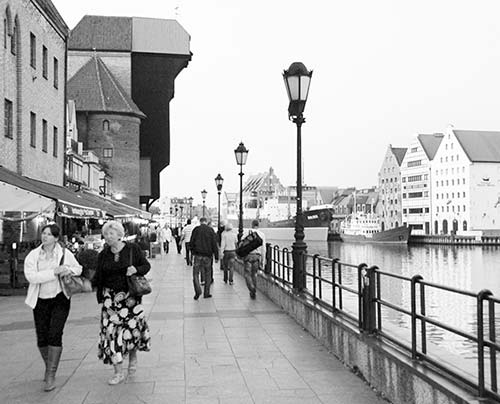
$$ Gdański Bowke is rollicking and ye olde, with model ships hanging from the rafters and a lively energy. The menu of classic local dishes looks like a big, vintage newspaper. They brew their own beer, and often have live music out on the embankment (daily, Długie Pobrzeże 11, +48 58 380 1111).
$$$ Kamienica Goldwasser is a classy choice, offering more elevated Polish and international cuisine in a posh European setting. Choose between cozy, romantic indoor seating on several levels, or scenic outdoor seating (daily, occasional live music, Długie Pobrzeże 22, +48 58 301 8878).
$$ Restauracja Kubicki, along the water just past the Hilton, has a long history (since 1918), but a recent remodel has kept the atmosphere—and its food—feeling fresh. This is a good choice for high-quality Polish and international cuisine in a fun, sophisticated interior that’s a clever mix of old and new (daily, Wartka 5, +48 58 301 0050).
NEAR THE SOLIDARITY SHIPYARD
This zone is still being developed, but some interesting dining options are opening up for those visiting the monuments and museum.
The European Solidarity Center itself has both a basic $ café and a nicer sit-down $$ restaurant.
A thriving new food hall, Montownia, may be open by the time you visit. This former industrial complex has been completely rejuvenated as a super-trendy commercial hub with more than 20 eateries (www.montowniafoodhall.pl; about a five-minute walk straight ahead, as you exit the European Solidarity Center).
And then there’s a completely unexpected, hidden gem of a wine bar in the middle of industrial blight. If you leave the European Solidarity Center to the left, pass the Sala BHP, cross the wide street, and angle left through the parking lot to the run-down-looking, red-brick building, you’ll discover $$ Mielżyński—a posh, upscale, inviting wine shop with an industrial-hip wine bar upstairs. They serve both Polish and international wines in a sophisticated setting, paired with thoughtfully crafted dishes. This is a classy oasis for in-the-know wine lovers willing to go looking for it (daily, Ulica Doki 1, +48 500 019 898, www.mielzynski.pl).
Gdańsk Connections
BY TRAIN
Gdańsk is well connected to the Tri-City via commuter SKM trains (explained later, under “Getting Around the Tri-City”). It’s also connected to Warsaw and Kraków by the high-speed EIC line (which requires reservations). Given the distance between Gdańsk and other Polish destinations, also consider domestic flights: LOT has easy flights between Gdańsk and Kraków for not much more than a train ticket.
From Gdańsk by Train to: Malbork (2/hour, about half are express EIC trains that take 30 minutes, the rest are slower regional trains that take around 45 minutes), Toruń (4/day direct, 2.5 hours; more with a change in Bydgoszcz or Iława, 3 hours), Warsaw (hourly, 3 hours on express EIC train), Kraków (6/day direct, 5.5 hours, plus 9-hour night train), Berlin (1/day direct, 6 hours; 3/day, 7.5 hours, change in Poznań).
BY BOAT
Boats depart from Gdańsk’s embankment to nearby destinations, including Westerplatte (the monument marking where World War II started—see here) and Hel (the beachy peninsula, described later; most boats take about 2 hours and are operated by Żegluga Gdańska, www.zegluga.pl). Some boats go only in the summertime (July-Aug), while others continue into the shoulder season; if connections from Gdańsk are limited, you may find more options from Gdynia. Boats generally don’t run in winter (Nov-March). As schedules are changeable, confirm your plans carefully at the TI.
BY CRUISE SHIP
A few cruise ships (under 800 passengers) dock in Gdańsk, near the Westerplatte monument (described earlier; connected to the center by 45-minute pleasure-boat trip or 30-minute ride on bus #106 or #138 to the Brama Wyżynna stop at the start of my self-guided walk; some cruise lines also offer a direct shuttle into town).
Many cruises advertising a stop in “Gdańsk” actually dock in the nearby town of Gdynia (described later in this chapter).
The Tri-City (Trójmiasto)
Gdańsk is the anchor of the three-part metropolitan region known as the Tri-City (Trójmiasto). The other two parts are as different as night and day: Sopot, a swanky resort town, and Gdynia, a practical, nose-to-the-grindstone business center. The Tri-City as a whole is home to bustling industry and a sprawling university, with several campuses and plenty of well-dressed, English-speaking students. Beyond the Tri-City, the long, skinny Hel Peninsula—a sparsely populated strip of fishing villages and fun-loving beaches—arches dramatically into the Baltic Sea.
Sopot—boasting sandy beaches, tons of tourists, and a certain elegance—is the most appealing day-trip option. Gdynia is less romantic, but comes with an excellent Emigration Museum and offers a glimpse into workaday Poland. Hel, which requires the better part of a day to visit, is worthwhile only if you’ve got perfect summer weather and a desire to lie on the beach.
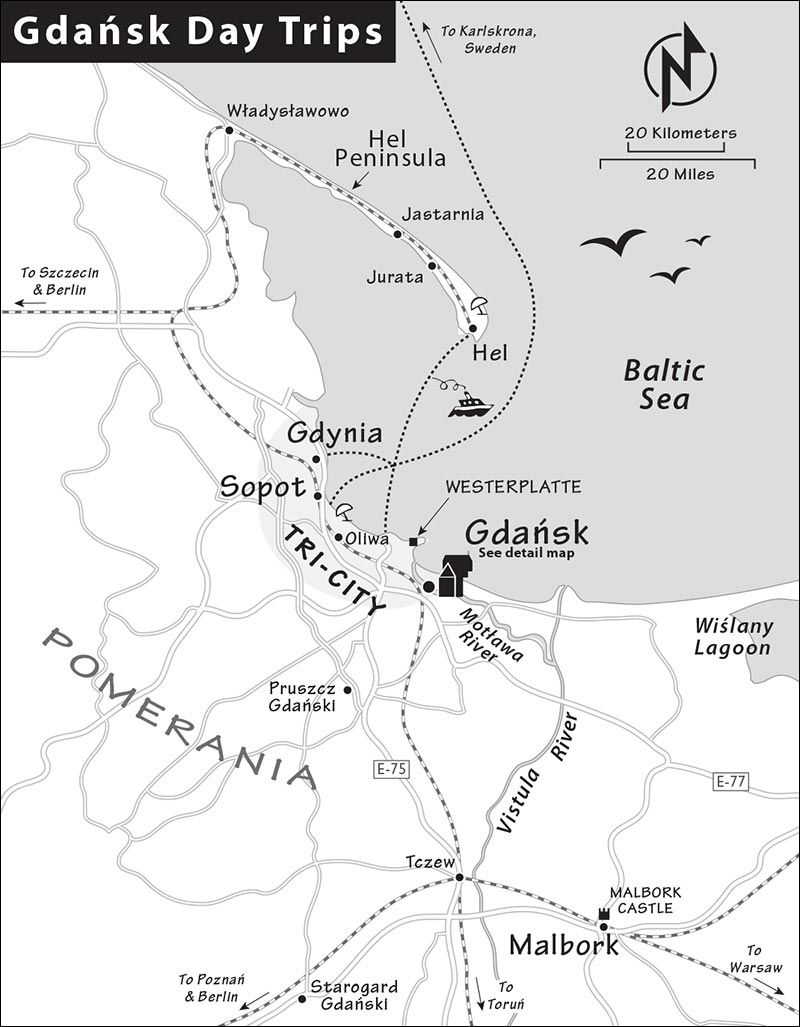
GETTING AROUND THE TRI-CITY
Gdańsk, Sopot, and Gdynia are connected by two different types of trains, both of which use Gdańsk’s main train station: regional commuter trains (kolejka, operated by SKM) and trains operated by Poland’s national railway (PKP). The SKM trains are cheaper, a bit slower, and more frequent than long-distance PKP trains. Trains to Hel are always operated by PKP.
Buying Tickets: Confusingly, SKM trains and PKP trains are covered by different tickets, which cost about the same (figure around 4-6 zł one-way between Gdańsk and Gdynia). Check posted schedules or look online to figure out which train works for you. For an SKM train, you can just hop on board, then pay the attendant in the first car (credit cards OK). For PKP trains, buy your ticket at a machine or ticket window before you board. Note that some special PKP trains require reservations, which cost extra.
Using the Right Stop: Each city has multiple stops. Remember, in Gdańsk, use either Gdańsk Główny (the main station for SKM and PKP) or Gdańsk Śródmieście (SKM only). For Sopot, use the stop called simply Sopot. For Gdynia, it’s Gdynia Główna (the main station).
Boat Alternative: For a more romantic—and much slower—approach, consider a boat (see “Gdańsk Connections,” earlier).
Sopot
Sopot (SOH-poht), dubbed the “Nice of the North,” was a celebrated haunt of beautiful people during the 1920s and 1930s, and it remains a popular beach getaway to this day.
Sopot was created in the early 19th century by Napoleon’s doctor, Jean Georges Haffner, who believed Baltic Sea water to be therapeutic. By the 1890s, it had become a fashionable seaside resort. This gambling center boasted enough high-roller casinos to garner comparisons to Monte Carlo.
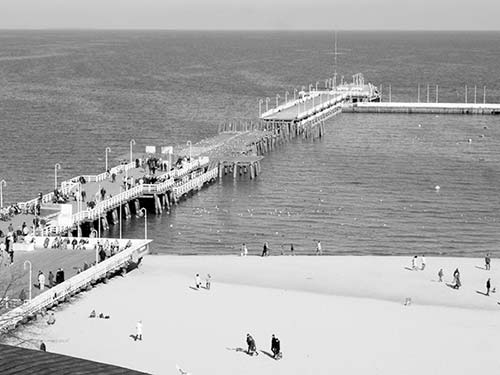
The casinos are gone, but the health resorts remain, and you’ll still see more well-dressed people here per capita than just about anywhere else in the country. While it’s not quite Cannes, Sopot feels relatively high class. But even so, a childlike spirit of summer-vacation fun pervades this St-Tropez-on-the-Baltic, making it an all-around enjoyable place.
You can get the gist of Sopot in just a couple of hours. Zip in on the train, follow the main drag to the sea, wander the pier, get your feet wet at the beach, then head back to Gdańsk. Why not come here in the late afternoon, enjoy those last few rays of sunshine, stay for dinner, and then take a twilight stroll on the pier?
Orientation to Sopot
The main pedestrian drag, Monte Cassino Heroes street (Ulica Bohaterów Monte Cassino), leads to the Molo, the longest pleasure pier in Europe. From the Molo, a broad, sandy beach stretches in each direction. Running parallel to the surf is a tree-lined, people-filled path made for strolling.
Tourist Information: The TI is in front of the train station at Dworcowa 4 (daily 9:00-17:00, +48 501 590 773, www.sopot.pl). A second branch is near the base of the Molo at Plac Zdrojowy 2 (closed Sat-Sun).
Arrival in Sopot: From the SKM station, exit to the left and walk down the street. After a block, you’ll see the PKP train station on your left. Continue on to the can’t-miss-it main drag, Ulica Bohaterów Monte Cassino (marked by the big red-brick church steeple). Follow it to the right, down to the seaside.
Sights in Sopot
▲Monte Cassino Heroes Street (Ulica Bohaterów Monte Cassino)
Nicknamed “Monciak” (MOHN-chak) by locals, this in-love-with-life promenade may well be Poland’s most manicured street (and is named in honor of the Polish soldiers who helped the Allies pry Italy’s Monte Cassino monastery from Nazi forces during World War II). The street is lined with happy tourists, trendy cafés, al fresco restaurants, movie theaters, and late 19th-century facades (known for their wooden balconies). The most popular building along here (on the left, about halfway down) is the so-called Crooked House (Krzywy Domek), a trippy, Gaudí-inspired building that looks like it’s melting. Hard-partying Poles prefer to call it the “Drunken House,” and say that when it looks straight, it’s time to stop drinking.
Molo (Pier)
At more than 1,600 feet long, this is Europe’s longest wooden entertainment pier. While you won’t find any amusement-park rides, you will be surrounded by vendors, artists, and Poles having the time of their lives. Buy a gofry (Belgian waffle topped with whipped cream and fruit) or an oversized cloud of wata cukrowa (cotton candy), grab your partner’s hand, and stroll with gusto (small entry fee, open long hours daily, www.molo.sopot.pl).
Climb to the top of the Art Nouveau lighthouse for a waterfront panorama. Scan the horizon for sailboats and tankers. Any pirate ships? For a jarring reality check, look over to Gdańsk. Barely visible from the Molo are two of the most important sites in 20th-century history: the towering monument at Westerplatte, where World War II started; and the cranes rising up from the Gdańsk Shipyard, where Solidarity was born and European communism began its long goodbye.
In spring and fall, the Molo is a favorite venue for pole vaulting—or is that Pole vaulting?
The Beach
Yes, Poland has beaches. Nice ones. When I heard Sopot compared to places like Nice, I’ll admit that I scoffed. But when I saw those stretches of inviting sand as far as the eye can see, I wished I’d packed my swim trunks. (You could walk from Gdańsk all the way to Gdynia on beaches like this.) The sand is finer than anything I’ve seen in Croatia...though the water’s not exactly crystal-clear. Most of the beach is public, except for a small private stretch in front of the Grand Hotel Sopot. Year-round, it’s crammed with locals. At these northern latitudes, the season for bathing is brief and crowded.
Overlooking the beach next to the Molo is the Grand Hotel Sopot. It was renovated to top-class status just recently, but its history goes way back. They could charge admission for a multiroom suite that has hosted the likes of Adolf Hitler, Marlene Dietrich, and Fidel Castro (but not all at the same time). With all the trappings of Sopot’s belle époque—dark wood, plush upholstery, antique furniture—this room had me imagining Hitler sitting at the desk, looking out to sea, and plotting the course of World War II.
Gdynia
Compared to its flashier sister cities, straightforward Gdynia (guh-DIN-yah) is all business. Gdynia is less historic than Gdańsk or Sopot, as it was built almost entirely in the 1920s to be Poland’s main harbor after “Danzig” became a free city. Called “The Gateway to Poland,” the city’s waterfront is built on large concrete piers (a communist-style fountain in the middle of the park marks the original coastline). Although nowhere near as attractive as Gdańsk or Sopot, Gdynia has an upscale, modern feel and a lovely waterfront promenade (www.gdynia.pl).
Gdynia is a major business center and—thanks to its youthful, progressive city government—has edged ahead of the rest of Poland economically. It enjoys one of the highest income levels in the country. The fine Modernist architecture of the downtown has been renovated, and Gdynia is becoming known for its top-tier shopping—all the big designers have boutiques here. If a Pole has been shopping on Świętojańska street in Gdynia, it means that he or she has some serious złoty.
Because Gdańsk’s port is relatively shallow, the biggest cruise ships must put in at Gdynia...leaving confused tourists to poke around town looking for some medieval quaintness before coming to their senses and heading for Gdańsk. Gdynia is also home to a major military harbor and an important NATO base.
To get a taste of Gdynia, take the train to the Gdynia Główna station, follow signs to wyjście do miasta, cross the busy street, and walk 15 minutes down Starowiejska. When you come to the intersection with the broad Świętojańska street, turn right (in the direction the big statue is looking) and walk two blocks to the tree-lined park on the left. Head through the park to the Southern Pier (Molo Południowe). This concrete slab—not nearly as charming as Sopot’s wooden-boardwalk version—features a modern shopping mall and a smattering of sights, including an aquarium and a pair of permanently moored museum boats.
The big sightseeing draw in Gdynia is at the fairly distant Nabrzeże Francuskie (French Quay, where cruise ships arrive—handy for cruisers but a taxi or Uber ride away for tourists coming on the train). Here you’ll find the excellent Emigration Museum, telling the story of Poles who left through Gdynia to find a better life in the New World.
Sights in Gdynia
▲▲Emigration Museum (Muzeum Emigracji)
This museum, right next to Gdynia’s cruise terminal, fills the former Marine Station building at the address Polska 1. This building opened in 1933, becoming the main port of departure for Polish American Lines passenger steamers to New York City and Quebec. For a time, vast numbers of Poles emigrated to the New World through right here. (Before that time, they mostly went through Hamburg or Bremen.) After World War II, the Iron Curtain slammed shut, the line was severed, and the Marine Station remained bombed out for decades. Now it has been renovated and hosts a high-tech, engaging museum that tells the story of the 3.5 million Poles who left their homeland in search of a better life between the mid-19th century and World War II. Concise yet informative, engaging, and all in English, the exhibit is a delight for anyone, and worth ▲▲▲ for Polish Americans.
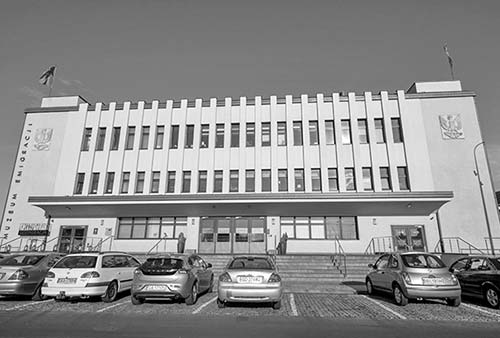
Cost and Hours: 18 zł, free on Wed; open Tue 12:00-20:00, Wed-Sun 10:00-18:00, closed Mon; good 10-zł audioguide, www.polska1.pl.
Getting There: It’s a 25-minute, dreary walk from Gdynia’s main train station. The taxis waiting out front overcharge; you’ll get a more reasonable price if you order an Uber or call for a taxi (try Hallo Express, +48 602 119 190). Or you can take a bus: #119 and #133 go from near the station to the Dworzec Morski/Muzeum Emigracji stop.
Visiting the Museum: Buy your ticket on the main floor, where you’ll also find WCs, a café, and a museum shop. Then head upstairs, through the middle of the cavernous building, to find the exhibit entrance. Inside, the permanent exhibition tells the story of Polish emigration. You’ll see photos of famous Poles who left (from Kościuszko to Chopin), and learn about the various waves of emigration throughout Polish history and what sparked each one: the Partitions in the late 18th century, failed uprisings in 1830 and 1864, and the potato famine (Poland suffered like Ireland did—the wall of potatoes symbolizes how important this staple was to peasant life). The Industrial Revolution sparked a different kind of (internal) emigration, as rural farming families moved into the cities for work.
The exhibit introduces the Sikora family and follows their emigration from Chmielnik to Chicago, by way of the port of Bremen. You’ll learn how the “emigration industry” operated: Steamer lines conducted a medical examination of each passenger before they left Europe—because if they were rejected upon examination once they arrived in the New World, the company had to pay to ship them back. Exhibits include a mock-up of a train station, the deck of an Atlantic steamship, a cross-section of life below decks, and a peek into a tight sleeping quarters, crammed with bunks where the poorest passengers would spend 10 days on turbulent seas. Finally, you arrive in New York City. Imagine seeing a wall of skyscrapers after a long journey from a thatched village. The train car is a reminder that from New York, new arrivals spread out across North America. Chicago is famous for its huge Polish émigré population, but you’ll learn that many Poles also went to Brazil (“Brazilian Fever”).
You’ll learn about the history of Gdynia (a purpose-built port, created entirely after World War I) and see a giant replica of the MS Stefan Bathory—a passenger steamer that was built here. (Sadly, when transatlantic travel ended after World War II, ships like this one were scrapped.) In the World War II section, trees cut down to their stumps represent the forced displacement of populations during and after the war. You’ll learn about the “Polish diaspora” around the world (Chicago, Rio, Britain, Australia). At the end of World War II, Polish officers who had fought alongside the Western Allies were warned not to return to Poland—where they’d be executed as potential rabble-rousers against the Soviet regime. So they stayed where they were, creating a new wave of “emigration.” The exhibit ends with a kitschy look at Poland under communism (and Solidarity).
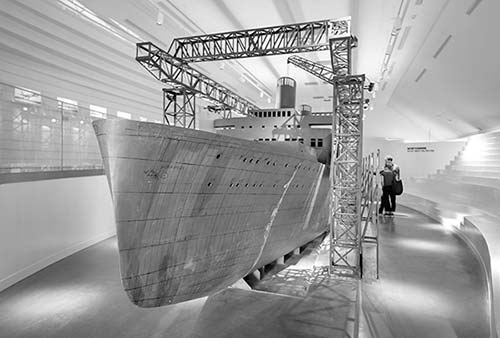
Exiting the exhibit, step out onto the long terrace that looks out over the cruise port. While it serves tourists today, this port evokes the millions of brave Poles who left behind everything they knew, set sail across a dangerous ocean, and had the courage to seek a new life in a New World.
ARRIVING BY CRUISE IN GDYNIA
Many Northern European cruises include a stop at “Gdańsk”; most of these actually put in at Gdynia’s sprawling port. And, while Gydnia’s town center is relatively manicured and pleasant, its port area is the opposite. Cruise ships are shuffled among hardworking industrial piers with few amenities. Port information: www.port.gdynia.pl.
Each of the port’s many piers is named for a country or region. Most cruise ships use French Quay (Nabrzeże Francuskie), which is also home to Gdynia’s best sight, the Emigration Museum. This deserves at least an hour of your time—or more, if you have Polish ancestry—and is a good place to spend any remaining time before “all aboard.”
To get from your cruise ship to Gdańsk, the best option is a shuttle bus-plus-train connection. The shuttle drops you off at Skwer Kociuski, in downtown Gdynia (5-10-minute trip). From here, it’s about a 15-minute walk to the train station (Dworzec Główna), then a 30-to-40-minute ride into Gdańsk (for details on various train options, see “Getting Around the Tri-City,” earlier). If you’re taking an SKM train that uses the Gdańsk Śródmieście stop, get off there for a quicker walk into the town center; otherwise, use the main Gdańsk Główny stop. Returning to Gdynia on the train, you want the Gdynia Główna stop.
Some cruise lines may offer a direct shuttle bus all the way to Gdańsk, which can be worth paying for, in the interest of efficiency.
Taxi drivers line up to meet arriving cruise ships. Cabbies here are usually unofficial (and therefore can set their own, inflated rates). It’s worth ordering an Uber or calling for a taxi to get legitimate rates. Taxi drivers generally take euros, though their off-the-cuff exchange rate may not be favorable.
For more details on Gdynia’s port—and several others on the Baltic, North Sea, and beyond—pick up the Rick Steves Scandinavian and Northern European Cruise Ports guidebook.
Hel Peninsula (Mierzeja Helska)
Out on the edge of things, this slender peninsula juts 20 miles into the ocean, providing a sunny retreat from the big cities—even as it shelters them from Baltic winds. Trees line the peninsula, and the northern edge is one long, sandy, ever-shifting beach.
On hot summer days, Hel is a great place to frolic in the sun with Poles. Sunbathing and windsurfing are practically religions here. Small resort villages line Hel Peninsula: Władysławowo (at the base), Chałupy, Kuźnica, Jastarnia, Jurata, and—at the tip—a town also called Hel. Beaches right near the towns can be crowded in peak season, but you’re never more than a short walk away from your own stretch of sand. There are few permanent residents, and the waterfront is shared by budget campgrounds, hotels hosting middle-class families, and mansions of Poland’s rich and famous (former president Aleksander Kwaśniewski has a summer home here).
The easiest way to go to Hel—aside from coveting thy neighbor’s wife—is by boat (see “Gdańsk Connections,” earlier). Most trains and buses to Hel depart from Gdynia, so you’ll likely need to transfer there if coming from Gdańsk. On sunny summer days—when Hel is notorious for its hellish traffic jams—overland transit is crowded and slow. The bus that connects Władysławowo to the outlying towns and beaches of Hel is—no joke!—bus #666.