KRAKÓW
John Paul II Pilgrimage Sights
Map: Kraków’s Old Town Shopping & Entertainment
Map: Kazimierz Entertainment & Nightlife
Map: Kraków’s Old Town Hotels & Restaurants
Map: Kazimierz Hotels & Restaurants
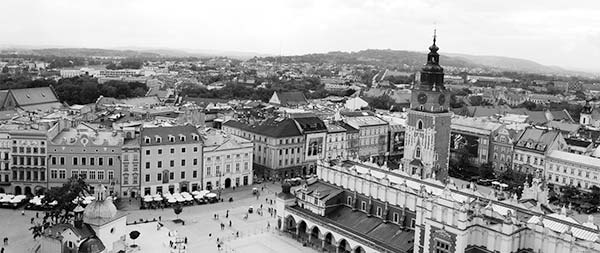
Kraków is easily Poland’s best destination: a beautiful, user-friendly, old-fashioned city buzzing with history, enjoyable sights, tourists, and college students. Even though the country’s capital moved from here to Warsaw more than 400 years ago, Kraków remains Poland’s cultural and intellectual center. Increasingly (and justifiably) popular, Kraków is giving Prague a run for its money on the “must visit” tourist route.
What’s so special about it? First off, Kraków is simply charming; more than any town in Europe, it seems made for aimless strolling. And its historic walls and former moat corral an unusually full range of activities and interests: bustling university life, thought-provoking museums, breathtaking churches that evoke a powerful faith (and include many sights relating to Poland’s favorite son, St. John Paul II), sprawling parks that invite you to relax, vivid artifacts of Poland’s Jewish heritage, and a burgeoning foodie and nightlife scene. Nearby, there are compelling side trips to the most notorious Holocaust site anywhere (Auschwitz-Birkenau), a communist planned workers town (Nowa Huta), and a mine filled with salty statues (Wieliczka). With so many opportunities to learn, to have fun, or to do both at once, it’s no surprise that Kraków has become a world-class destination.
PLANNING YOUR TIME
Don’t skimp on your time in Kraków. It takes a minimum of two days to experience the city, and a third (or even a fourth) day lets you dig in and consider a world of fascinating side trips.
Almost everyone coming to Kraków also visits the Auschwitz-Birkenau Concentration Camp Memorial—and should. As it’s about an hour and a half away, this demands the better part of a day. Visiting Auschwitz requires a reservation, which you need to book long in advance (see the next chapter).
If you have only two full days (the “express plan”), start off with my self-guided walk through the Old Town and a quick stroll up to Wawel Castle, then head over to the Schindler’s Factory Museum and wind down your day in Kazimierz. Your second day is for side-tripping to Auschwitz. This plan gives you a once-over-lightly look at Kraków but leaves almost no time for entering the sights.
More time buys you the chance to relax, enjoy, and linger: Tackle the Old Town and Wawel Castle on the first day, Kazimierz and museums of your choice on the second day, and Auschwitz (and other side trips) with additional days. If you have a special interest, you could side-trip to the St. John Paul II pilgrimage sites on the outskirts of town, or to the communist architecture of the Nowa Huta suburb. Wieliczka Salt Mine is another crowd-pleasing, half-day option.
Regardless of how long you stay, your evening choices are many and varied: Savor the Main Market Square over dinner or a drink, take in a jazz show, do a pub crawl through the city’s many youthful bars and clubs (best in Kazimierz), or enjoy traditional Jewish music and cuisine (also in Kazimierz).
Orientation to Kraków
Kraków (Poles say KROCK-oof, but you can say KRACK-cow; it’s sometimes spelled “Cracow” in English) is mercifully compact, flat, and easy to navigate. While it’s Poland’s second-biggest city (with 780,000 people), the tourist’s Kraków feels small—from the main square, you can walk to just about everything of interest in less than 15 minutes. Just to the south is Poland’s primary waterway, the Vistula River (Wisła, VEES-wah).
Most sights—and almost all recommended hotels and restaurants—are in the Old Town (Stare Miasto, STAH-reh mee-AH-stoh), which is surrounded by a greenbelt called the Planty (PLAHN-tee). In the center of the Old Town lies the Main Market Square (Rynek Główny, REE-nehk GWOHV-neh)—it’s such an important landmark, I call it simply “the Square.” At the Old Town’s northeast corner, just outside the ring road, is the main train station. And at the southern end of the Old Town, on the riverbank, is the hill called Wawel (VAH-vehl)—with a historic castle, museums, and Poland’s national church.
About a 20-minute walk (or quick tram/taxi ride) southeast of the Square is the neighborhood called Kazimierz (kah-ZHEE-mehzh)—with Jewish landmarks and Holocaust sites (including the Schindler’s Factory Museum) and the city’s best food and nightlife area.
A few more attractions are just beyond the core, including the St. John Paul II pilgrimage sites (in the Łagiewniki neighborhood), the communist-planned town of Nowa Huta, Wieliczka Salt Mine, and the Kościuszko Mound.
The southern mountains are not far away, and Kraków fills a shallow, bowl-shaped valley ringed by hills—which means the city has a tendency to trap fog and, sometimes, smog.
TOURIST INFORMATION
Kraków has many helpful TIs, called InfoKraków (https://infokrakow.pl). Four branches are in or near the Old Town (most are open daily 9:00-17:00, but some have slight variations):
• In the Planty park, between the main train station and Main Market Square (open later in July-Sept—until 19:00, in a round kiosk at Ulica Szpitalna 25, +48 533 818 291)
• On Ulica Św. Jana, just north of the Main Market Square (specializes in concert tickets, daily year-round 9:00-17:00, at #2, +48 533 826 409)
• In the Cloth Hall right on the Main Market Square (at #1/3, +48 530 290 661)
• Just west of Wawel Hill (also covers the entire region, Powiśle 11, +48 533 826 031)
Other TI branches are in Kazimierz (Ulica Józefa 7, +48 533 834 969) and the airport (daily 9:00-19:00, +48 533 825 344). There’s a “TI” marked inside the Wyspiański Pavilion, but it’s really more of a gift shop (called “Kraków Story”) that can answer a few questions. Note that the TIs sell tickets for only one tour company, Kraków Booking; for additional options, see “Tours in Kraków,” later, and look around online.
Sightseeing Pass: The TI’s Kraków Tourist Card includes admission to 40 city museums (basically everything except the Wawel Hill sights and Wieliczka Salt Mine)—but unless you’re sightseeing like mad, it’s unlikely you’d save money with the card. Given how walkable Kraków is, the version that does not include public transit is a better value than the one that does.
Warning: Many private travel agencies, room-booking services, and tour operators masquerade as TIs, with deceptive i signs. If I haven’t listed them in this section, they’re not a real TI.
Museum of Kraków (Muzeum Krakowa) Visitors Center: Facing the Main Market Square is an information office and ticket desk for the Museum of Kraków, where you can prebook tickets for the popular Schindler’s Factory Museum and Rynek Underground Museum. If you’ve arrived in town to find online tickets already sold out, additional tickets often become available here for the following day, as unused slots bought up by big tour operators are returned and resold (daily 10:00-19:00, at #35 at the Square’s northwest corner—see map on here, +48 12 426 5060). This location also has a town history exhibit.
ARRIVAL IN KRAKÓW
By Train
Kraków’s main train station (called “Kraków Główny,” KROCK-oof GWOHV-neh) sits just northeast of the Old Town, adjoining the sprawling Galeria Krakowska shopping mall. The station and the mall face a broad plaza (Plac Dworcowy) across the ring road from the Planty park and Old Town. My recommended Old Town hotels are within about a 15-to-20-minute walk, or a quick taxi ride. (If you’re staying in the Old Town, the tram doesn’t save you much time; for those staying in Kazimierz—a 30-minute walk away—the tram is worthwhile.)
The main concourse has all of the amenities: ATMs, lockers (under the big schedule board between the ticket windows), WCs, and a handy Biedronka minisupermarket. From this area, five numbered escalators lead up to the train platforms. If you need to buy tickets, tucked under the escalators is a long row of numbered ticket windows (some for domestic tickets only, others for domestic and international—check signs before you line up). In the middle of the ticket windows (between #11 and #12) is the PKP Passenger Service Center, which is more likely to have staff who speak English. There are ticket machines around this area, or you can buy most tickets online (www.intercity.pl).
Getting Between the Station and Downtown: The easiest option is to take a taxi; they wait in the parking lot on the station’s rooftop—go up the stairs or elevator from your platform (15-20 zł into town; for a fair rate, be sure to take a taxi marked with a company name and telephone number). Or order an Uber, which is often cheaper (see “Getting Around Kraków,” later).
If you prefer to walk or take a tram, you’ll be funneled through the Galeria Krakowska shopping mall. Begin by following Exit to the City signs. Once inside the mall, continue straight ahead. To walk, follow Old Town signs, which eventually route you to the left. You’ll pop out at a big plaza where you’ll continue straight, taking the broad ramp down into a pedestrian underpass beneath the ring road, emerging into the Planty. The Main Market Square is straight ahead (look for the twin spires of St. Mary’s Church).
If you’d rather take a tram, continue straight ahead through the mall, following signs for Exit Pawia street. Emerging here, you’ll see the Dworzec Główny Zachód tram stop; tram #3 in the direction of Nowy Bieżanów stops at the eastern edge of the Old Town (Poczta Główna stop) before continuing to Kazimierz (Miodowa stop).
There is a shortcut to avoid going through the sprawling and sometimes congested mall: The modern train station is attached to the old station (the yellow building facing the big plaza, now hosting art exhibitions) by a sidewalk under a green canopy. This can save you a little walking (and a lot of shopping temptations). It’s tricky to find from inside the station: Go behind the Biedronka supermarket, near track 1, and exit toward Lubicz street. Walk up the ramp and follow the green canopy to the plaza.
To get from town to the station (or to the bus station behind it), head to the northeast corner of the Planty, take the underpass beneath the ring road, walk across the plaza and into the Galeria Krakowska mall, and once inside, follow signs to Railway Station and Station Hall.
By Bus
The bus station is directly behind the main train station. When arriving by bus, first head into the train station, then continue through it, following the directions given earlier for arrival by train.
To get to the bus station from the Old Town (for example, to catch a bus to Auschwitz), walk all the way through to the far end of the train station area (past platform 5, exit marked for Bus Station). The bus terminal (marked Dworzec Autobusowy) is upstairs. Inside are the standard amenities (lockers and WCs), domestic and international ticket windows, and an electronic board showing the next several departures. Some bus departures, marked on the board with a G, leave from the upper (gorna) stalls, which you can see out the window. Other bus departures, marked with a D, leave from the lower (dolna) stalls in the garage beneath your feet; to find these, use the stairs or the elevator right in the middle of the bus terminal. Because the bus station area can be challenging to navigate, leave yourself plenty of time before departure.
By Car
Centrum signs lead you into the Old Town—you’ll know you’re there when you hit the ring road that surrounds the Planty park. Parking garages surround the Old Town. Your hotelier can advise you on directions and parking.
By Plane
The modern John Paul II Kraków-Balice Airport is about 10 miles west of the center (code: KRK, www.krakowairport.pl). The easiest way downtown is to hop on the slick and speedy train (follow Kolej do Centrum signs up the ramp, then across the sky bridge to the parking garage; 17 zł, 1-2/hour, 18 minutes to Kraków’s main train station—see arrival instructions earlier, under “By Train”). There’s also a taxi stand in front of the terminal; the official rate for the 30-minute ride into town should be about 110 zł. You can also order an Uber (typically cheaper than a taxi) or arrange a taxi transfer in advance (such as with recommended driver Andrew Durman, listed under “Tours in Kraków,” later).
Many budget flights—including some on Wizz Air and Ryanair—use the International Airport Katowice in Pyrzowice (Międzynarodowy Port Lotniczy Katowice w Pyrzowicach, code: KTW, www.katowice-airport.com). This airport is about 18 miles from the city of Katowice, which is about 50 miles west of Kraków. Direct buses run sporadically between Katowice Airport and Kraków’s main train station area (60 zł, trip takes 1.75 hours, generally scheduled to meet incoming flights, www.matuszek.com.pl). You can also take the bus from Katowice Airport to Katowice’s train station (hourly, 50 minutes), then take the train to Kraków (hourly, 1.5 hours). Wizz Air’s website (www.wizzair.com) is useful for figuring out your connection.
HELPFUL HINTS
Exchange Rate: 1 złoty (zł, or PLN) = about 25 cents; 4 zł = about $1.
Book Ahead: In Kraków, you’re wise to book in advance your visits to the popular Schindler’s Factory Museum, Wieliczka Salt Mine, and Rynek Underground Museum (see details in each listing)—and you definitely need to book well ahead for a visit to Auschwitz (see next chapter). That and perhaps a fancy dinner and any tour you hope to take is all you need to concern yourself with in advance.
Sightseeing Tips: Aside from the churches, most major sights are managed by one of three organizations: the National Museum in Kraków, mainly art collections (www.mnk.pl); Museum of Kraków/Muzeum Krakowa, mainly historical exhibits (including Schindler’s Factory and Rynek Underground Museum, www.muzeumkrakowa.pl); and the many underwhelming sights at Wawel Castle (www.wawel.krakow.pl). All three organizations tend to tinker with hours, closed days, and free days. Before heading out, check the “Kraków at a Glance” sidebar, later, and confirm with the websites above.
Many sights are closed on Monday, but others remain open: Wieliczka Salt Mine, all the churches, Jagiellonian University Museum, Jewish-themed sights in Kazimierz, and a few of the sights at Wawel Castle (morning only). On Tuesday, the Wawel Castle sights close early, but the cathedral remains open. On Saturday, most of Kazimierz’s Jewish-themed sights are closed. On Sunday, churches have limited hours for sightseers (for example, Wawel Cathedral opens at 12:30).
Also be aware of days that certain sights are free: On Tuesday, the National Museum branches (including the Czartoryski Museum, Wyspiański Museum, and Gallery of 19th-Century Polish Art in the Cloth Hall) are free, but some are open limited hours; the Rynek Underground Museum is also free (but open shorter hours and crowded). On Monday, the Schindler’s Factory Museum is free, open only in the morning, and extremely crowded.
Bookstore: For an impressive selection of new and used English books, try Massolit Books, just west of the Old Town. They also have a café with drinks and light snacks, and a good children’s section (daily 10:00-20:00, Ulica Felicjanek 4, +48 12 432 4150, www.massolit.com).
Laundry: The inviting Frania Café, a short walk from Wawel Castle (on the way to Kazimierz), is a café/pub with washers and dryers (pay more for full service), relaxing ambience, a full bar serving espresso drinks and laundry-themed hard drinks, an enticing menu, long hours, and a friendly staff (daily 7:30-22:00, Stradomska 19, +48 783 945 021, www.pralniasamoobslugowa.pl).
Betty Clean is a full-service laundry that’s slightly closer to the Old Town, but expensive (priced per item not per load, takes 24 hours—or pay extra for express service, Mon-Fri 8:00-18:00, Sat 10:00-14:00, closed Sun, just outside the Planty park at Ulica Zwierzyniecka 6, +48 12 423 0848).
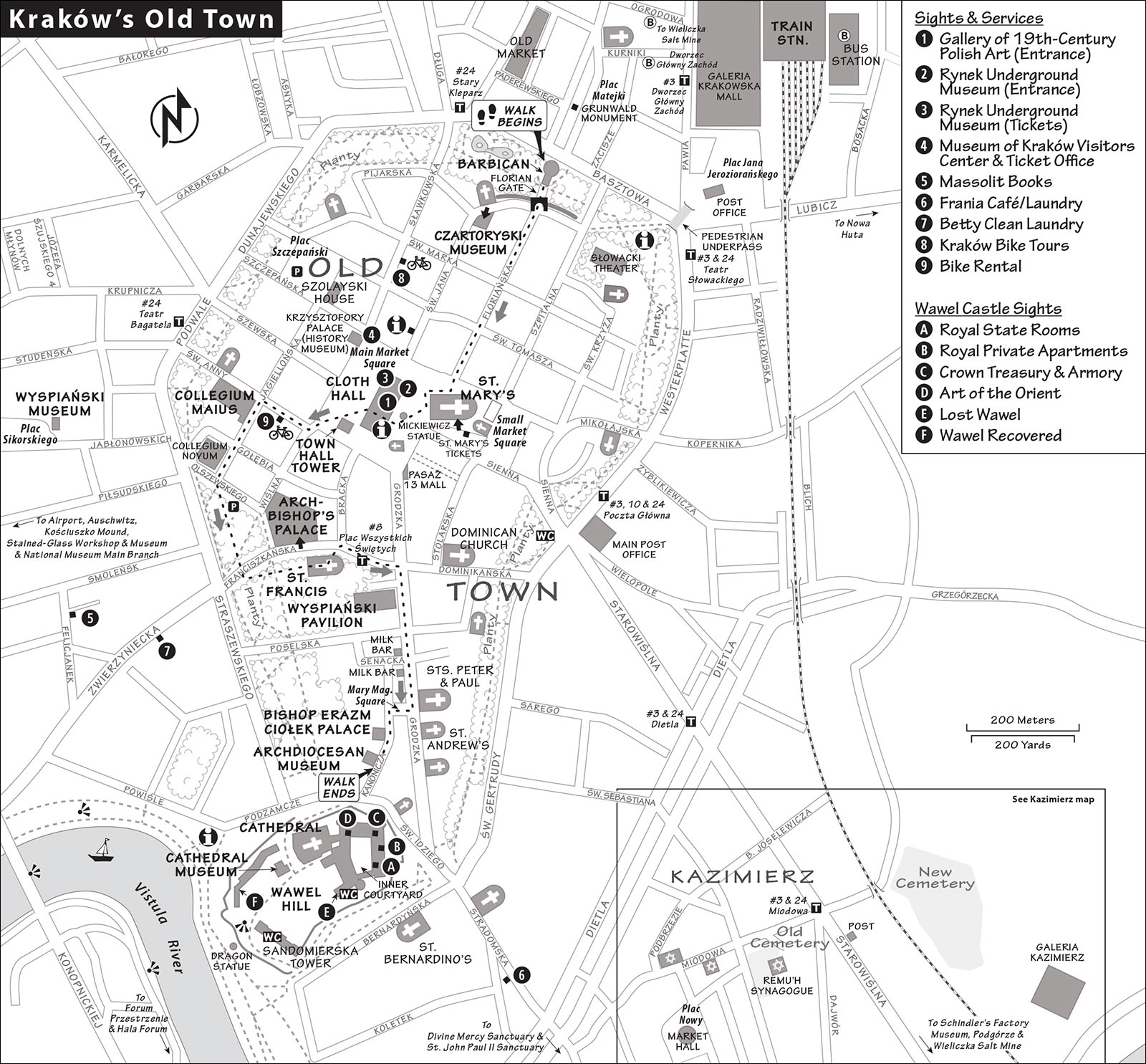
For locations, see the “Kraków’s Old Town” map.
GETTING AROUND KRAKÓW
Kraków’s top sights and best hotels are easily accessible by foot. You’ll need wheels only if you’re going to outlying areas (Kazimierz, Nowa Huta, John Paul II pilgrimage sites, and so on).
By Public Transit
Trams and buses zip around Kraków’s urban sprawl. The same tickets work system-wide and are based on how long the ride takes: 4 zł/20 minutes (20-minutowy), 6 zł/1 hour (60-minutowy). You can also get tickets good for 24 hours (17 zł), 48 hours (35 zł), and 72 hours (50 zł). Buy tickets at kiosks, at the machines you’ll see at bigger stops, or on board (look for a machine; if not, buy your ticket from the driver). Some machines take credit cards, others only cash. You can also buy tickets on the Jakdojade app, which works in other Polish cities as well. Always validate a single-ride ticket when you board the bus or tram. For a good route planner, see Jakdojade.pl [URL inactive].
Tram #3 is particularly handy. It goes from the side of the train station (Dworzec Główny Zachód) to the ring road in front of the station (Dworzec Główny), then stops at the eastern edge of the Old Town (Poczta Główna, at the main post office) before continuing to Kazimierz (Miodowa is at the north end, near Ulica Szeroka; Św. Wawrzyńca is at the south end, near the old tram depot) and Podgórze, near the Schindler’s Factory Museum (Plac Bohaterow Getta). Tram #24 is also useful: It stops at the western edge of the Old Town (Teatr Bagatela), then loops around the northern edge to stop near the Barbican (Stary Kleparz) before meeting up with tram #3 in front of the train station (Dworzec Główny) and continuing on to Kazimierz and Podgórze (same stops as listed above).
By Taxi or Uber
Only take cabs that are clearly marked with a company logo and telephone number. Legitimate Kraków taxis start at 9 zł and charge about 3 zł per kilometer—or more at night—while unofficial taxis charge whatever they like. Rides generally cost around 20-25 zł but can take longer than you’d expect: Due to the Old Town’s many traffic restrictions and pedestrian zones, a “short ride across town” may require looping all the way around the ring road. You’re more likely to get the fair metered rate by calling a cab, rather than taking one waiting at tourist spots. Well-established companies include iCar (+48 12 653 55 55), Megataxi (+48 12 19625), Radio Taxi (+48 12 19191), and Barbakan (+48 12 19661).
Uber is typically cheaper than Kraków’s official taxis (though prices can spike during busy “surge” periods). Be aware that, while some taxi companies are allowed to pick up and drop off within Kraków’s highly restricted Old Town, Ubers generally can’t—so you may need to walk to the ring road. In my experience, Polish Uber drivers (and their cars) are a bit less polished and professional than those back home—but they’re cheap, usually friendly, and handy.
By Bike
The riverfront bike path is enticing on a nice day; the Planty park, while inviting, can be a bit crowded for biking. KRK Bike Rental is very central and affordably rents a variety of bikes, from city touring bikes to electric models (daily 9:00-21:00, less in bad weather, closed Nov-March, Ulica Św. Anny 4, +48 509 267 733, www.krkbikerental.pl).
Tours in Kraków
Local Guides
I’ve enjoyed working with several wonderful Kraków guides. Prices are standard and affordable (500 zł/half-day, 900 zł/day), and some of them have cars for day-tripping into the countryside for an extra charge.
Tomasz Klimek (+48 605 231 923, tomasz.klimek@interia.pl) and his business partner Monika Prylinska (+48 693 648 528, monikaprylinska@gmail.com) are both top-notch guides; together they run Kraków Urban Tours (see later), but you can also hire them one-on-one (500 zł/half-day, 900 zł/day, slightly more with a car).
Two other great guides are Anna Bakowska (+48 604 151 293, leadertour@wp.pl) and Marta Chmielowska (+48 603 668 008, martachm7@gmail.com).
I wouldn’t bother hiring a guide for the trip to Auschwitz—only official Auschwitz guides can legally give tours on-site, so you’ll wind up joining one of the tours once there; instead, it’s a better value to hire a driver (like Andrew or Chester, listed next).
Drivers
Since Kraków is such a useful home base for day trips, it can be handy to splurge on a private driver for door-to-door service. Andrew (Andrzej) Durman, a Pole who lived in Chicago and speaks fluent English, is a gregarious driver, translator, miracle worker, and all-around great guy. While not a licensed tour guide, Andrew is an eager conversationalist and loves to provide lively commentary while you roll. Although you can hire Andrew for a simple airport transfer or an Auschwitz day trip, he also enjoys tackling more ambitious itineraries, from helping you explore your Polish ancestry to taking you on multiday journeys around Poland and beyond. These prices are transportation only for up to 4 people: 600 zł to Auschwitz, 350 zł to Wieliczka Salt Mine, 120 zł for transfer from Kraków-Balice Airport, or 800 zł for an all-day trip into the countryside—such as into the High Tatras or to track down your Polish roots near Kraków (more to cover gas costs for trips longer than 100 km one-way; long-distance transfers for up to 4 people to Prague, Budapest, Vienna, or Berlin for 2,500 zł—or 300 zł extra if he makes longer stops en route or picks you up there; all prices higher for bigger van, +48 602 243 306, andrew@tour-service.pl). If he’s busy, Andrew may send you with one of his English-speaking colleagues, such as Karol or Stefan.
Local guide Marta Chmielowska’s husband, Czesław (a.k.a. Chester), can also drive you to nearby locations (650 zł for all-day trip to Auschwitz, 400 zł to Wieliczka Salt Mine, or a very long day combining Wieliczka and Auschwitz for 1,000 zł; 2,400 zł for a transfer to Prague; to book, see Marta’s contact information, earlier).
Kraków Urban Tours
This company, run by recommended guides Tomasz and Monika (who also guide tours for me in Europe), works hard to put travelers in touch with genuine cultural experiences that many tourists miss. In addition to a variety of local walking tours—including a “Greatest Hits” Old Town walk (€50) and a food tour (€90)—they’ve curated some special experiences that offer more cultural intimacy. For example, their pierogi-making class begins at the Kleparz farmers market, where you’ll personally shop for the ingredients, then heads to a local home (rather than a classroom or restaurant) to make pierogi just like Babcia used to make (€70/person for a 4-plus-hour experience). They also have tours to Nowa Huta to learn about the communist period; all-day trips into the mountains around Zakopane; a “Made in Kraków” shopping tour that helps you find locally made, meaningful items to take home; an innovative pinhole photography tour; and a handmade souvenir workshop with proceeds that support local homelessness-relief charities. You can either join a scheduled tour with other travelers or (for a higher cost) book a private experience. It’s fun to peruse their offerings (+48 665 015 665, www.krakowurbantours.com, info@krakowurbantours.com).
Walking Tours
A variety of interchangeable companies run daily city walking tours in English in summer. Most do a three-hour tour of the Old Town as well as a three-hour tour of Kazimierz, the Jewish district (expect to pay about 70 zł per tour). Guide quality can be variable and the scene is continually evolving; it’s best to pick up local fliers (the TI works exclusively with one company, Kraków Booking, but hotel reception desks generally have more options), then choose the one that fits your interests and schedule. For a more established outfit, consider Kraków Urban Tours, earlier. You’ll also see ads for “free” tours—which are not really free (the guide gets paid only if you tip generously).
Food Tours
Kraków Urban Tours, described earlier, offers casual evening food walks that basically assemble a full meal with a little sightseeing thrown in (at 18:00, €90, 3 hours, www.krakowurbantours.com, info@krakowurbantours.com).
Another fine choice is Eat Polska, which smartly connects food to culture and history, making the experience equal parts informative and delicious (about €80 for a food tour or a vodka tasting with hearty food pairings, get details and book at www.eatpolska.com).
Crazy Guides
This irreverent company offers tours to the communist suburb of Nowa Huta and other outlying sights. For details, see here.
Bike Tours
Kraków Bike Tours is a well-established operation that runs daily four-hour bike tours in English, with 25 stops in the Old Town, Kazimierz, and Podgórze (€24, you can pay extra to use an electric bike, July-Sept daily at 10:00 and 15:00, spring and fall only 1/day at 10:00, confirm details and prebook online, office in the courtyard at Sławkowska 11, +48 510 394 657, www.krakowbiketour.com).
Bus Tours to Auschwitz or Wieliczka
As Kraków is so easily enjoyed on foot, taking a bus tour doesn’t make much sense in town. But they can be handy for reaching outlying sights. Various tour companies run itineraries to Auschwitz (6 hours), Wieliczka Salt Mine (4 hours), and other regional side trips (each itinerary around 140-170 zł).
Given the difficulty of reserving your own appointment at Auschwitz (explained in the next chapter), one of these bus tours—which include a guided tour of the camp—may be your most convenient option. See Kraków (www.seekrakow.com) and Discover Cracow (www.discovercracow.com) typically use smaller 19-seat minibuses. They sometimes offer hotel pickup, which seems convenient, but you’ll waste a lot of time driving around the city to other hotels. Kraków Booking (which has a monopoly at the TI; www.krakowbooking.com) and Cracow City Tours (www.cracowcitytours.com) use larger 50-seat buses with a central pickup point near the Old Town.
At any company, the on-bus guiding is hit-or-miss but largely irrelevant since you’ll be handed off to an official Auschwitz guide once at the camp. Note that the many tour offices and faux-TIs you’ll see around town simply sell tickets for these companies. If you waited too long to reserve at Auschwitz and are desperate to get in at short notice, try dropping into various agencies around town to see if anyone has space.
Buggy Tours
You’ll see (and hear) horse-drawn buggies that trot around Kraków from the Main Market Square. The going rate is a hefty 300 zł for a 30-minute tour to the castle and back (though prices can be soft when it’s not too busy). After dark, they’re lit up like fanciful Cinderella coaches—a memorable scene, all lined up in front of St. Mary’s Church.
Golf-Cart Tours
Several outfits around town (including on the Square) offer tours on a golf cart with recorded commentary. Given the limits on car traffic in the old center, this can be a handy way to connect the sights for those with limited mobility. Generally, you’ll pay about 250 zł for a 30-minute tour around the Old Town; to extend the trip to Kazimierz, it’s 500 zł; and adding the Podgórze former Jewish ghetto and Schindler’s Factory costs a total of 750 zł (these prices are for the entire golf cart, up to 5 people). Prices tend to be soft—try haggling.
Kraków’s Royal Way Walk
▲City Walls and Barbican (Barbakan)
▲▲Planty
The Old Market (Stary Kleparz)
Florian Gate (Brama Floriańska)
▲Floriańska Street (Ulica Floriańska)
▲▲St. Mary’s Church (Kościół Mariacki)
▲▲▲Main Market Square (Rynek Główny), a.k.a. “The Square”
Jagiellonian University and the Collegium Maius
▲▲St. Francis Basilica (Bazylika Św. Franciszka)
Mary Magdalene Square (Plac Św. Marii Magdaleny)
Kanonicza Street (Ulica Kanonicza)
This self-guided walk is designed to link up most of Kraków’s major sights (see the map on here). Much of the walk follows a route called the “Royal Way” because the king used to follow this same path when he returned to Kraków after a journey. After the capital moved to Warsaw, most kings still used Wawel Cathedral for important events. In fact, from 1320 to 1795, nearly every Polish king traversed Kraków’s Royal Way at least twice: on the day he was crowned and on the day he was buried. You could sprint through this walk in about an hour and a half (less than a mile altogether), but it’s much more fun if you take it like the kings did...slowly.
• Begin just outside the main gate (the Florian Gate) at the north end of the Old Town. Face the tall, rectangular tower marking the town entrance.
▲City Walls and Barbican (Barbakan)
Tatars—those battle-hardened invaders from Central Asia—destroyed Kraków in 1241. To better defend their rebuilt city, Krakovians built this wall. The original rampart had 47 watchtowers and eight gates. (You’ll find a bronze model of the wall just to the right of the tower.)
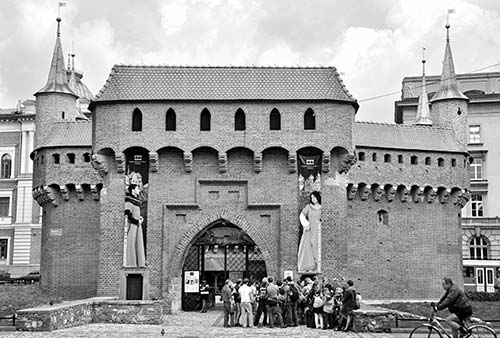
Now turn around. The big, round defensive fort standing outside the wall is the Barbican, built to provide extra fortification to weak sections—namely, the gates. Imagine how it looked in 1500, when the Barbican stood outside the town moat with a long bridge leading to the Florian Gate—the city’s main entryway. Today, you can pay a small fee to scramble along the passages and fortifications of the Barbican, though there’s little to see inside, other than a small but good exhibit giving you a sense of how the walls were designed. The same ticket also lets you climb up onto the surviving stretch of Old Town walls flanking the Florian Gate (entry from inside walls).
• The greenbelt within which the Barbican sits is called the...
▲▲Planty
By the 19th century, Kraków’s no-longer-necessary city wall had fallen into disrepair. As the Austrian authorities were doing all over their empire, they decided to tear down what remained, fill in the moat, and plant trees. (The name comes not from the English “plant” but from the Polish plantovac, or “flat”—because they flattened out this area to create it.) Today, the Planty is a beautiful park that stretches 2.5 miles around the entire perimeter of Kraków’s Old Town. To give your Kraków visit an extra dimension, consider a quick bike ride around the Planty (best early in the morning, when it’s less crowded) with a side trip along the parklike riverbank near Wawel Castle; you’ll see bike-rental places around the Old Town (including KRK Bike Rental, mentioned in “Getting Around Kraków,” earlier).
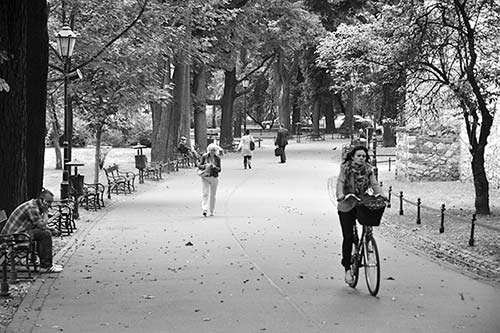
Circle around the left side of the Barbican. On your left, keep an eye out for a unique monument depicting an elderly, bearded man in the corner of a huge frame. This honors Jan Matejko, arguably Poland’s most beloved painter, who specialized in giant-scale epic historical scenes several times larger than this frame. We’ll hear Matejko’s name many more times on this walk.
As you continue around the Barbican, look down to see the much lower ground level around its base—making it easy to imagine that the Planty was once anything but flat.
• Across the busy street from the Barbican, standing in the middle of the long park, is the...
Grunwald Monument
This memorial honors one of the most important battles in the history of a nation that has seen more than its share: the Battle of Grunwald on July 15, 1410, when Polish and Lithuanian forces banded together to finally defeat the Teutonic Knights, who had been running roughshod over the lands along the Baltic. Lying dramatically slain at the base of this monument, like a toppled Goliath, is the defeated Grand Master of the Teutonic Knights—German crusaders who had originally been brought to Poland as mercenaries. It’s easy to see this vanquished statue as a thinly veiled metaphor for one of Poland’s powerful, often domineering neighbors. When the Nazis took power here, this statue was one of the first things they tore down. When they left, it was one of the first things the Poles put back up.
• If you’d like to see a slice of Krakovian life, side-trip one block to the left of the monument, to the local farmers market. It hides a block behind the busy ring road.
The Old Market (Stary Kleparz)
The colorful Old Market offers a refreshing dash of Kraków that has nothing to do with history or tourism. It’s just lots of hardscrabble people selling what they grow or knit, and lots of others buying. Wander around as if on a cultural scavenger hunt. Find the freshest doughnuts (pączki), the most popular bakery, the villager selling slippers she knitted, the smelliest smoked-fish stand, and the old man with the smoked cheese (Mon-Sat 7:00-18:00—but busiest and most interesting in the morning, closed Sun).
• Now retrace your steps to the Barbican and enter the Old Town by walking through the...
Florian Gate (Brama Floriańska)
As you approach the gate, look up at the crowned white eagle, representing courage and freedom—the historic symbol of the Polish people.
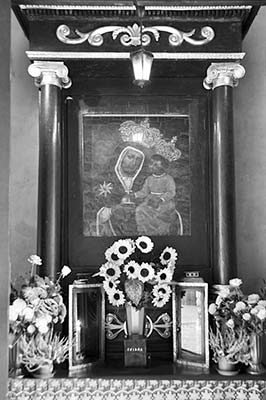
Inside the gate, notice the little chapel on the right with a replica of the famous Black Madonna of Częstochowa, the most important religious symbol among Polish Catholics. The original, located in Częstochowa (70 miles north of Kraków), is an Eastern Orthodox-style icon of mysterious origin with several mystical legends attached to it. After the icon’s believed role in protecting a monastery from Swedish invaders in the mid-17th century, it was named “Queen and Protector of Poland.”
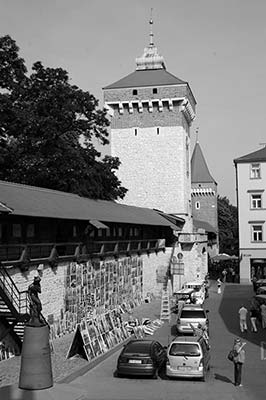
Once through the gate, look back at it. High above is St. Florian, patron of the fire brigade. As fire was a big concern for a wooden city of the 15th century, Florian gets a place of honor.
You’ll often see traditionally clad musicians near the gate, performing their lilting folk melodies for tips.
• You’re standing at the head of Kraków’s historic (and now touristic) gamut...
▲Floriańska Street (Ulica Floriańska)
In good weather, hanging on the inside of the city wall in both directions is a makeshift art gallery, where—traditionally—starving students hawk the works they’ve painted at the Academy of Fine Arts (across the busy street from the Barbican). The entrance to get on top of the wall—covered by the Barbican ticket—is at the left end of this gallery. If you detoured just a little farther along the wall, to the brick skybridge, you’d reach the entrance to the Czartoryski Museum, an eclectic collection of artifacts, including a famous portrait (no, not that one) by Leonardo da Vinci...see here).
Now begin strolling down Floriańska street (floh-ree-AHN-skah). Notice that all over town, storefronts advertising themselves as “tourist information” offices are actually tourist sales agencies (see a list of legitimate TIs on here). Along with the fast-food joints, also notice some uniquely Polish snacks: The various pizza and kebab windows also sell zapiekanka—a toasted baguette with toppings, similar to a French bread pizza. Or, for an even quicker bite, buy an obwarzanek (ring-shaped, bagel-like roll, typically fresh) from a street vendor; many still use their old-fashioned blue carts. Pijana Wiśnia (on the right at #36) sells the sour-cherry liqueur called wiśniówka; while this is a very old drink, it’s newly trendy—you’ll see shops like this one all over Poland.
About halfway down the first block, on the left (at #45, round green sign), look for Jama Michalika (“Michael’s Cave”). Around the turn of the 20th century, this dark, atmospheric café was a hangout of the Młoda Polska (Young Poland) movement—the Polish answer to Art Nouveau. The walls are papered with sketches from poor artists—local bohemians who couldn’t pay their tabs. Today, it hosts a folk troupe that performs traditional music and dance with dinner many evenings (see listing under “Entertainment in Kraków”). Poke around inside this circa-1900 time warp and appreciate this unique art gallery. (For a real time warp, notice the smokers in their own hazy room up front.)
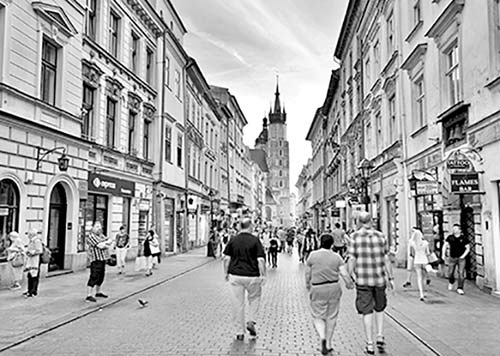
Tourist-clogged Floriańska has more than its share of tacky amusements: wax museum, “Beer House,” Thai spa, “I Heart Kraków” shop, and Candy Cat bulk-candy store. But there are some real family-run businesses mixed in: For example, about a block farther down, at #20 (on the right), Staropolskie Trunki (“Old Polish Drinks”) offers an education in vodka, with a long bar and countless vodkas and liquors—all open and ready to be tasted. They don’t carry any big brand names; these are all locally made. They can help you navigate your options—let them know if you like sweet, dry, and so on (four tastes for 25 zł with an explanation from the bartender, daily 10:00-late).
• Continue into the Main Market Square, where you’ll run into...
▲▲St. Mary’s Church (Kościół Mariacki)
A church has stood on this spot for 800 years. The original church was destroyed by the first Tatar invasion in 1241, but all subsequent versions—including the current one—have been built on the same foundation. You can look down the sides to see how the Main Market Square has risen about seven feet over the centuries.
How many church towers does St. Mary’s have? Technically, the answer is one. The shorter tower belongs to the church; the taller one is a municipal watchtower, from which you’ll hear a bugler playing the hourly hejnał song. According to Kraków’s favorite legend, during that first Tatar invasion, a town watchman saw the enemy approaching and sounded the alarm. Before he could finish the tune, an arrow pierced his throat—which is why, even today, the hejnał stops suddenly partway through. Today’s buglers—12 in all—are firemen first, musicians second. Each one works a 24-hour shift up there, playing the hejnał four times on the hour—with one bugle call for each direction. (It’s even broadcast on national Polish radio at noon.) While you’re in Kraków, you’ll certainly hear one of these tiny, hourly, broken performances.
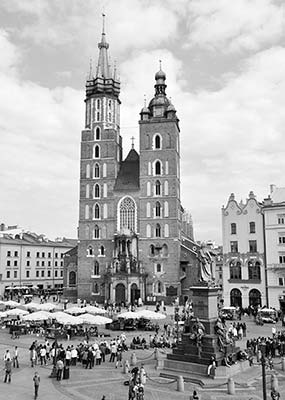
To see one of the most finely crafted Gothic altarpieces anywhere, it’s worth paying admission to enter the church. The front door is open 14 hours a day and is free to those who come to pray, but tourists use the door around the right side (buy your ticket across the little square from this door). The panels of the altarpiece are opened with fanfare each day at 11:50.
Cost and Hours: 15 zł, Mon-Sat 11:30-17:45, Sun from 14:00.
Visiting the Church: Inside, you’re struck by the lavish decor. This was the church of the everyday townspeople, built out of a spirit of competition with the royal high church at Wawel Castle.
At the altar is one of the best medieval woodcarvings in existence—the exquisite, three-part altarpiece by German Veit Stoss (Wit Stwosz in Polish). Carved over 12 years and completed in 1489, it’s packed with emotion rare in Gothic art. Get as close as you can and study the remarkable details. Stoss used oak for the structural parts and linden trunks for the figures. The open altar depicts the Dormition (death—or, if splitting theological hairs, heavenly sleep) of the Virgin. The artist catches the apostles around Mary, reacting in the seconds after she collapses. Mary is depicted in three stages: At the bottom, her body goes limp in the arms of her panicking followers. In the middle, her soul—radiating beams of light—is being escorted to heaven by Jesus. And, at the very top (in the cupola above the frame), Mary sits upon a heavenly throne as she’s crowned by Jesus. The six scenes on the sides are the Annunciation, birth of Jesus, visit by the Three Magi, Jesus’ Resurrection, his Ascension, and Mary becoming the mother of the apostles at Pentecost.
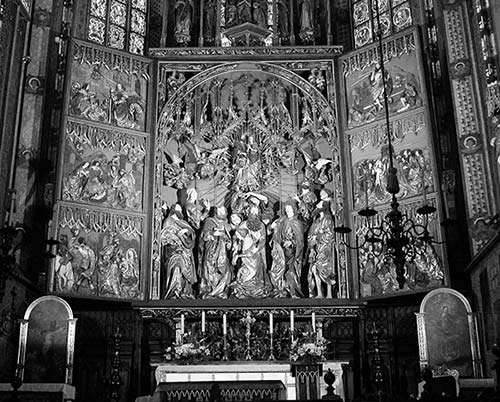
When the Nazis invaded Poland, they made a list of artistic masterpieces they planned to plunder and take home to Germany—and this altarpiece was on it. It was dismantled and taken to Nürnberg, where it was hidden away in a cellar and managed to survive that city’s destruction. After the war, it was returned here and painstakingly reassembled.
There’s more to St. Mary’s than the altar. While you’re admiring this church’s art, notice the flowery Neo-Gothic painting covering the choir walls. Stare up into the starry, starry blue ceiling. As you wander around, consider that the church was renovated a century ago by three Polish geniuses from two very different artistic generations: the venerable positivist Jan Matejko and his Art Nouveau students, Stanisław Wyspiański and Józef Mehoffer (we’ll learn more about these two later on our walk). The huge silver bird under the organ loft in back is that symbol of Poland, the crowned white eagle.
Tower Climb: For the best view in town, you can climb 271 steep, claustrophobic stairs to the top of the taller tower to visit the hejnał fireman (20 zł, pay at the ticket office for the church, departs at :05 and :30 past each hour; May-Sept Tue-Sat 10:00-17:30, Sun from 13:00, closed Mon; on good-weather days in shoulder season, open only Thu-Sat; closed off-season and in bad weather).
• Leaving the church, notice the neck clamps dangling from the exterior walls near the side door. If you were leaving Mass in centuries past, there would be criminals chained here for public humiliation. You’d spit on them before turning right and stepping into one of the biggest market squares anywhere.
▲▲▲Main Market Square (Rynek Główny), a.k.a. “The Square”
Kraków’s marvelous Square, one of Europe’s most gasp-worthy public spaces, bustles with street musicians, colorful flower stalls, cotton-candy vendors, loitering teenagers, the local breakdancing troupe, businesspeople commuting by foot, gawking tourists, soap-balloon-blowers, and the lusty coos of pigeons. The Square is where Kraków lives. It’s often filled with various special events, markets, and festivals. The biggest are the seasonal markets around Easter and Christmas, but you’re likely to stumble on something special going on just about any time of year (especially June through Aug).
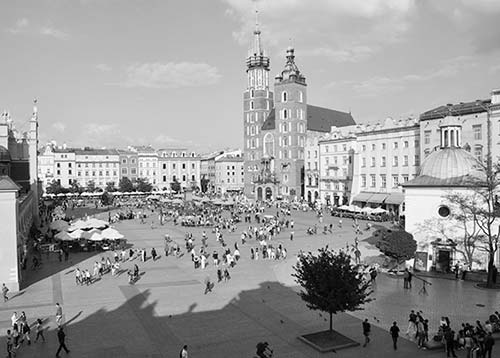
The Square was established in the 13th century, when the city had to be rebuilt after being flattened by the Tatars. At the time, it was the biggest square in medieval Europe. It was illegal to sell anything on the street, so everything had to be sold here on the Main Market Square. It was divided into smaller markets, such as the butcher stalls, the ironworkers’ tents, and the still-standing Cloth Hall (described later).
Notice the modern fountain with the glass pyramid at this end of the Square. A major excavation of the surrounding area created a museum of Kraków’s medieval history that literally sprawls beneath the Square (for more on the recommended Rynek Underground Museum, see here).
The statue in the middle of the Square is a traditional meeting place for Krakovians. It depicts Romantic poet Adam Mickiewicz (1789-1855), who’s considered the “Polish Shakespeare.” His epic masterpiece, Pan Tadeusz, is still regarded as one of the greatest works in Polish literature. A wistful, nostalgic tale of Polish-Lithuanian nobility, Pan Tadeusz stirred patriotism in a Poland that had been dismantled by surrounding empires through a series of three Partitions.
The Square is so beautiful partly because the Old Town was spared the bombs of World War II. The Nazis considered Kraków a city with Germanic roots and wanted it saved. But they were quick to destroy any symbols of Polish culture or pride. The statue of Adam Mickiewicz, for example, was pulled down immediately after occupation.
Polish art in the late 19th century was ruled by positivism, a school with a very literal, straightforward focus on Polish history. But when the next generation of Kraków’s artists came into their own in the early 1900s, they decided that the old school was exactly that. Though moved by the same spirit and goals as the previous generation—evoking Polish patriotism at a time when their country was being occupied—these new artists used very different methods. They were inspired by a renewed appreciation of folklore and peasant life. Rather than being earnest and literal (an 18th-century Polish war hero on horseback), the new art was playful and highly symbolic (the artist frolicking in a magical garden in the idyllic Polish countryside). This movement became known as Młoda Polska (Young Poland)—Art Nouveau with a Polish accent.
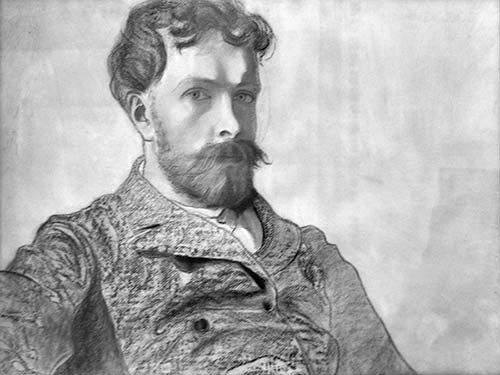
Stanisław Wyspiański (vees-PAYN-skee, 1869-1907) was the leader of Młoda Polska. He produced beautiful artwork, from simple drawings to the stirring stained-glass images in Kraków’s St. Francis Basilica. Wyspiański was an expert at capturing human faces with realistic detail, emotion, and personality. The versatile Wyspiański was also an accomplished stage designer and writer. His patriotic play The Wedding—about the nuptials of a big-city artist and a peasant girl—is regarded as one of Poland’s finest dramas. In Kraków, you can tour the Wyspiański Museum and see his works in St. Francis Basilica and other churches; he’s also well represented in Warsaw’s National Museum.
Józef Mehoffer (may-HOH-fehr), Wyspiański’s good friend and rival, was another great Młoda Polska artist. Mehoffer’s style is more expressionistic and abstract than Wyspiański’s, often creating an otherworldly effect. See Mehoffer’s work in Kraków’s St. Francis Basilica and at the artist’s former residence (see the Józef Mehoffer House), and in Warsaw at the National Museum.
Other names to look for include Jacek Malczewski (mahl-CHEHV-skee), who specialized in self-portraits, and Olga Boznańska (bohz-NAHN-skah), the movement’s only prominent female artist. Both are featured in Warsaw’s National Museum; Malczewski’s works also appear in Kraków’s Gallery of 19th-Century Polish Art.
At the far end of the Square, you’ll see the tiny, cubical, copper-domed Church of St. Adalbert, one of the oldest churches in Kraków (10th century). This Romanesque structure predates the Square. Like St. Mary’s (described earlier), it seems to be at an angle because it’s aligned east-west, as was the custom when it was built. (In other words, the churches aren’t crooked—the Square is. Any other “crooked” building you see around town predates the 13th-century grid created during the rebuilding of Kraków.)
Drinks are reasonably priced at cafés on the Square (figure 15-20 zł for a coffee, soft drink, beer, or wine; and about 30 zł for a fancier cocktail). Find a spot where you like the view and the chairs, then sit and sip. Order a coffee, Polish piwo (beer, such as Żywiec, Okocim, or Lech), or a shot of wódka (Żubrówka is a quality brand; for more on Polish drinks, see here). For a higher vantage point, the Cloth Hall’s Café Szał terrace—overlooking the Square and St. Mary’s Church—offers one of the best views in town (daily, enter through Gallery of 19th-Century Polish Art entrance).
As the Square buzzes around you, imagine this place before 1989. There were no outdoor cafés, no touristy souvenir stands, and no salespeople hawking cotton candy or neon-lit whirligigs. The communist government shut down all but a handful of the businesses. They didn’t want people to congregate here—they should be at home, because “a rested worker is a productive worker.” The buildings were covered with soot from the nearby Lenin Steelworks in Nowa Huta. The communists denied the pollution, and when the student “Green Brigades” staged a demonstration in this Square to raise awareness in the 1970s, they were immediately arrested. How things have changed.
• The huge, yellow building right in the middle of the Square is the...
▲▲Cloth Hall (Sukiennice)
In the Middle Ages, this was the place where cloth sellers had their market stalls. Kazimierz the Great turned the Cloth Hall into a permanent structure in the 14th century. In 1555, it burned down and was replaced by the current building. The crowned letter S (at the top of the gable above the entryway) stands for King Sigismund the Old, who commissioned this version of the hall. As Sigismund fancied all things Italian (including women—he married an Italian princess), this structure is in the Italianate Renaissance style. Sigismund kicked off a nationwide trend, and you’ll still see Renaissance-style buildings like this one all over the country, making the style typically Polish. We’ll see more works by Sigismund’s imported Italian architects at Wawel Castle.
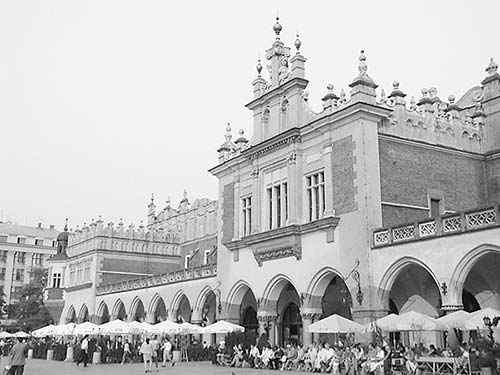
The Cloth Hall is still a functioning market—selling mostly souvenirs, including wood carvings, chess sets, jewelry (especially amber), painted boxes, and trinkets. Cloth Hall prices are slightly inflated, but still cheap by American standards. You’re paying a little extra for the convenience and the atmosphere, but you’ll see locals buying gifts here, too.
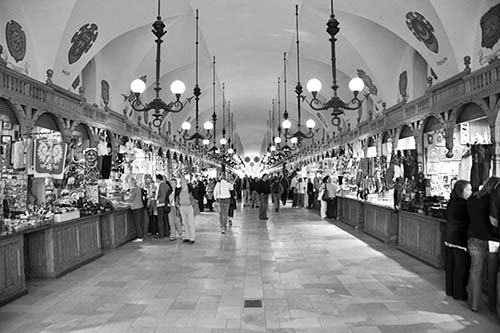
Pay WCs are at each end of the Cloth Hall. The upstairs of the Cloth Hall is home to the excellent Gallery of 19th-Century Polish Art (enter behind the statue of Adam; for a self-guided tour, see here).
• Browse through the Cloth Hall passageway. As you emerge into the sleepier half of the Square, the big tower on your left is the...
Town Hall Tower
This is all that remains of a town hall building from the 14th century—when Kraków was the powerful capital of Poland. (To visualize the intact structure, look for the bronze model to the right of the stairs.) After the 18th-century Partitions of Poland, Kraków’s prominence took a nosedive. As the town’s importance crumbled, so did its town hall. It was cheaper to tear down the building than to repair it, and all that was left standing was this nearly 200-foot-tall tower. In summer, you can climb the tower, stopping along the way to poke around an exhibit on Kraków history, but the views from up top are disappointing (18 zł, free on Mon, open March-Oct Mon 11:00-15:00, Tue-Sun until 18:00, likely closed off-season).
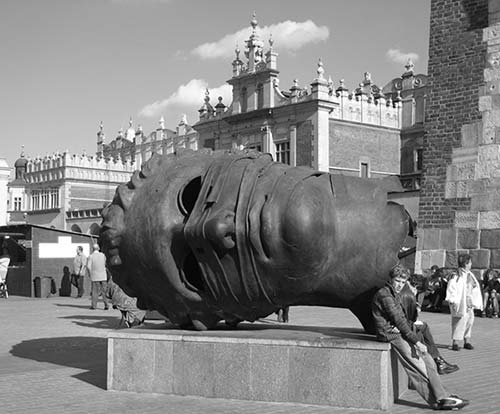
Nearby: The gigantic head at the base of the Town Hall Tower is a sculpture by contemporary artist Igor Mitoraj, who studied here in Kraków. Typical of Mitoraj’s works, the head is an empty shell that appears to be wrapped in cloth. While some locals enjoy having a work by their fellow Krakovian in such a prominent place, others disapprove of its sharp contrast with the Square’s genteel Old World ambience. Tourists enjoy playing peek-a-boo with the head’s eyes.
• When you’re finished on the Square, we’ll head toward Wawel Hill. The official Royal Way makes a beeline for the castle, but we’ll take a scenic detour to see some less touristy back streets, visit Kraków’s historic university and one of its best churches, and go for a quick walk through the Planty park.
Exit the square at the corner nearest the Town Hall Tower—basically, in the direction the giant head is looking—then turn right along Ulica Św. Anny. After one block, turn left onto Jagiellońska street. Enter the courtyard of the big, red-brick building on your right.
Jagiellonian University and the Collegium Maius
Kraków had the second university in Central Europe (founded in 1364, after Prague’s). Over the centuries, Jagiellonian U. has boasted such illustrious grads as Copernicus and St. John Paul II. And today, the city’s character is still defined largely by its huge student population (numbering around 150,000). Many of the university buildings fill the area to the west of the Old Town, so you’ll see more students (and fewer tourist traps) in this part of town than elsewhere.
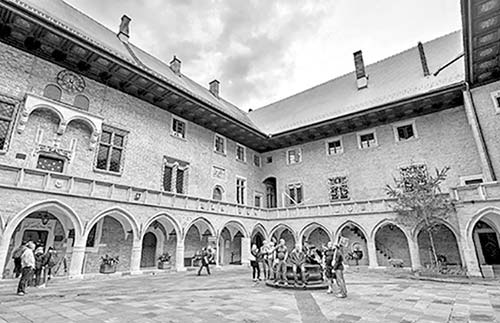
This building—called the Collegium Maius—is the historic heart of Kraków’s university culture. It dates from the 15th century. In the Middle Ages, professors were completely devoted to their scholarly pursuits. They were unmarried and lived, ate, and slept here in an almost monastic environment. They taught downstairs and lived upstairs. In many ways, this building feels more like a monastery than a university. While this courtyard is the most interesting part, you can also tour the interior. The courtyard also hosts free temporary exhibits; look for posters.
The university also comes with some chilling history. On November 6, 1939, the occupying Nazis called all professors together for a meeting. With 183 gathered unknowingly in a hall, they were unceremoniously loaded into trucks and sent to concentration camps, where many were killed. Hitler knew: If you want to decapitate a culture, you kill its intelligentsia.
Before you leave, if you’re a fan of rich, thick hot chocolate, enjoy a cup at Kawiarnia U Pęcherza (down the stairs near the entrance)—widely regarded as the best in town.
If it’s open, head down the sgraffito-lined passage on the side of the courtyard (it’s on your left as you enter the courtyard). You’ll emerge into the Professors’ Garden, a tranquil space filled with red brick, ivy, stony statues, and inviting benches (open daily 9:00-18:30 or until dusk, closed off-season).
• Exit the garden through the fancy gate and turn right on Jagiellońska. Spot any students? You’ll follow this for two more blocks, passing the much larger and newer, but still red-brick, Collegium Novum building—the modern administrative headquarters of Jag U., built in the late 19th century to commemorate the 500th anniversary of the building we just left.
Jagiellońska dead-ends at a dynamic statue on a pillar. Turn left into the inviting Planty—the ring park we saw at the start of this walk. You’ll stroll about five minutes through the Planty—dodging bikes and hearing the rattle of trams through the trees—with the Old Town buildings on your left and the ring road through the park on your right. When you reach a street with tram tracks, cross it and turn left. Pause in the park just before the church and take note of the light-yellow building on the left (across the street), with a picture of St. John Paul II smiling down from above the stone doorway.
Archbishop’s Palace
This building was St. John Paul II’s residence when he was the archbishop of Kraków. And even after he became pope, it remained his home-away-from-Rome for visits to his hometown. After a long day of saying formal Mass during his visits to Kraków, he’d wind up here. Weary as he was, before going to bed he’d stand in the window above the entrance for hours, chatting casually with the people assembled below—about religion, but also about sports, current events, and whatever was on their minds.
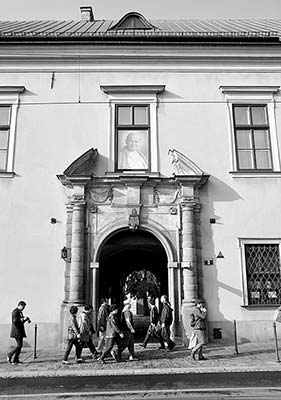
In 2005, when the pope’s health deteriorated, this street filled with his supporters, even though he was in Rome. For days, somber locals focused their vigil on this same window, their eyes fixed on a black crucifix that had been placed here. At 21:37 on the night of April 2, 2005, the pope passed away in Rome. Ten thousand Krakovians were on this street, under this window, listening to a Mass broadcast on loudspeakers from the church. When the priest announced the pope’s death, every single person simultaneously fell to their knees in silence. For the next several days, thousands of the faithful continued to stand on this street, staring intently at the window where they last saw the man they considered to be the greatest Pole.
• Now go through the back door of one of Kraków’s finest churches...
▲▲St. Francis Basilica (Bazylika Św. Franciszka)
This beautiful Gothic church, which was St. John Paul II’s home church while he was archbishop of Kraków, features some of Poland’s best Art Nouveau in situ (in the setting for which it was intended). After an 1850 fire, it was redecorated by the two leading members of the Młoda Polska (Young Poland) movement: Stanisław Wyspiański and Józef Mehoffer. The glorious decorations inside this church are the result of their great rivalry run amok.
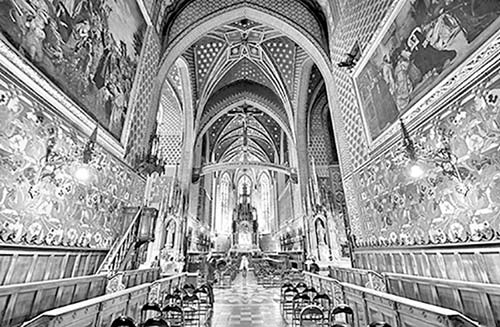
Cost and Hours: Free; open for visitors Mon-Sat 10:00-16:00, Sun 13:00-15:30; longer hours for services and prayer.
Visiting the Basilica: Step through the door and let your eyes adjust to the low light. Take a few steps up the nave, pausing at the third pew on the left. On the back of this pew, notice the silver plate labeled “Jan Paweł II”—marking JPII’s favorite place to pray when he lived in the Archbishop’s Palace across the street. Just beyond, on the left, you’ll see a painting of Poland’s premier pontiff.
Now walk another 20 feet down the nave and notice the painting on the right, with an orange-and-blue background. This depicts St. Maksymilian Kolbe, the Catholic priest who sacrificed his own life to save a fellow inmate at Auschwitz in 1941 (notice the 16670—his concentration camp number—etched into the background; read his story on here). Kolbe is particularly beloved here, as he actually served at this church.
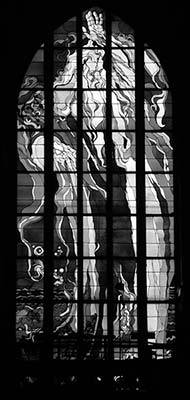
Now turn around and look up above the door you entered. There, in all its glory, is the stained-glass window titled God the Father Let It Be, created by the great Art Nouveau artist Stanisław Wyspiański—and regarded by some as his finest masterpiece. (For more on Wyspiański, see here.) The colors beneath the Creator change from yellows and oranges (fire) to soothing blues (water), depending on the light. Wyspiański was supposedly inspired by Michelangelo’s vision of God in the Sistine Chapel, though he used a street beggar to model God’s specific features. Wyspiański also painted the delightful floral stained-glass windows that line the nave, high up—fitting for a church dedicated to a saint so famous for his spiritual connection to nature.
Now turn back around to face the main altar and head into the chapel on the left. This important chapel houses a replica of the Shroud of Turin—which, since it touched the original shroud, is also considered a holy relic (displayed along the left side of the chapel). At the main altar in this chapel, notice the plaques honoring Michał Tomaszek and Zbigniew Strzałkowski. These two Polish priests traveled to Peru as missionaries. There, they (along with an Italian priest) were murdered by communist guerrillas calling themselves the Shining Path. Today, they are considered martyrs.
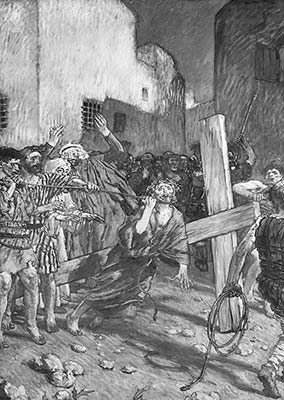
Before leaving this chapel, look high on the walls at the glorious Stations of the Cross. These were painted by Józef Mehoffer—a friend and rival of Wyspiański—as a response to Wyspiański’s work.
Now head back into the nave, turn left, and walk toward the main altar. (If a service is going on, you may not be able to get very far—just look from here.) On the walls, notice Wyspiański’s gorgeous Art Nouveau floral patterns.
Up in the apse, take a moment to appreciate the Wyspiański-designed stained-glass windows flanking the high altar. On the right is St. Francis, the church’s namesake, holding up his hands to show the stigmata on his palms. On the left is the Blessed Salomea—a medieval Polish woman who became queen of Hungary but later returned to Poland and entered a convent after her husband’s death. Notice she’s dropping a crown—repudiating the earthly world and giving herself over to the simple, stop-and-smell-God’s-roses lifestyle of St. Francis. Salomea (who’s buried in a side chapel) founded this church. Notice also the Mucha-like paintings by Wyspiański on the pilasters between the windows...yet one more sumptuous Art Nouveau detail in this church that’s so rich with them.
• Head back outside. If no services are going on, you can slip out the side door, to the left of the altar. Otherwise, head back out the way you came and hook right. Either way, you’re heading to the right along Franciszkańska street. After passing a few monuments and a tram stop, turn right down busy...
Grodzka Street
Now you’re back on the Royal Way proper. At the corner of Grodzka street stands the modern, copper-colored Wyspiański Pavilion. Step inside (daily 9:00-20:00) to see three recent stained-glass windows based on designs Wyspiański once submitted for a contest to redecorate Wawel Cathedral. Although these designs were rejected back then, they were finally realized on the hundredth anniversary of his death (in 2007). Visible from inside the building during the day, and gloriously illuminated to be seen outside the building at night, they represent three Polish historical figures: the gaunt St. Stanisław (Poland’s first saint), the skeletal Kazimierz the Great (in the middle), and the swooning King Henry the Pious.
If you’re not churched out, you can dip into the Dominican Church—just a block away, to your left (described later).
Now continue down Grodzka street. This lively thoroughfare, connecting the Square with Wawel, is teeming with shops—and some of Kraków’s best restaurants (see “Eating in Kraków,” later). Survey your options now and choose (and maybe reserve) your favorite for dinner tonight. This street is also characterized by its fine arcades over the sidewalks. While this might seem like a charming Renaissance feature, the arcades were actually added by the Nazis after they invaded in 1939; they wanted to convert Kraków into a city befitting its status as the capital of their Polish puppet state.
This is also a good street to find some of Kraków’s milk bars. The most traditional one is about two blocks down, on the right (at #45), with a simple Bar Mleczny sign. These government-subsidized cafeterias are the locals’ choice for a quick, cheap, filling, lowbrow lunch. Prices are deliriously cheap (soup costs about a dollar), and the food isn’t bad.
• One more block ahead, the small square on your right is...
Mary Magdalene Square (Plac Św. Marii Magdaleny)
This square offers a great visual example of Kraków’s deeply religious character. In the Middle Ages, Kraków was known as “Little Rome” for its many churches. Today, there are 142 churches and monasteries within the city limits (32 in the Old Town alone)—more per square mile than anywhere outside of Rome. You can see several of them from this spot: The nearest, with the picturesque white facade and row of saints out front, is the Roman-style Church of Saints Peter and Paul (Poland’s first Baroque church, and a popular tourist concert venue). The statues lining this church’s facade are the 11 apostles (minus Judas), plus Mary Magdalene, the square’s namesake. The next church to the right, with the twin towers, is the Romanesque St. Andrew’s (now with a Baroque interior). Dating from the rough-and-tumble 11th century, it was designed to double as a place of last refuge—notice the arrow slits around the impassable lower floor. According to legend, a spring inside this church provided water to citizens who holed up here during the Tatar invasions. The church was spared, but that didn’t save the rest of Kraków from being overrun by marauding armies. Imagine this stone fortress of God being the only building standing amid a smoldering and flattened Kraków after the 13th-century destruction.
If you look farther down the street, you can see three more churches. And even the square next to you used to be a church, too—it burned in 1855, and only its footprint survives.
• Go through the square and turn left down...
Kanonicza Street (Ulica Kanonicza)
With so many churches around here, the clergy had to live somewhere. Many lived on this well-preserved street—supposedly the oldest street in Kraków. As you walk, look for the cardinal hats over three different doorways. The Hotel Copernicus, on the left at #16, is named for a famous guest who stayed here five centuries ago. Directly across the street at #17, the Bishop Erazm Ciołek Palace hosts a good exhibit of medieval art and Orthodox icons. Next door, the yellow house at #19 is where Karol Wojtyła lived for 10 years after World War II—long before he became St. John Paul II. Today, this building houses the Archdiocesan Museum, which is the top spot in the Old Town to learn about Kraków’s favorite son. Both of these sights are described later, under “Sights in Kraków.”
• This marks the end of Kanonicza street—and the end of our self-guided walk. But there’s still much more to see. Across the busy street, a ramp leads up to the most important piece of ground in all of Poland: Wawel.
Sights in and near the Old Town
John Paul II Wawel Cathedral Museum
▲▲Gallery of 19th-Century Polish Art (Galeria Sztuki Polskiej XIX Wieku)
Czartoryski Museum (Muzeum Czartoryskich)
▲▲Stanisław Wyspiański Museum (Muzeum Stanisława Wyspiańskiego)
Bishop Erazm Ciołek Palace (Pałac Biskupa Erazma Ciołka)
▲▲Rynek Underground Museum (Podziemia Rynku)
▲Jagiellonian University Museum: Collegium Maius
Dominican Church, a.k.a. Holy Trinity Church (Bazylika Trójcy Świętej)
Archdiocesan Museum (Muzeum Archidiecezjalne)
▲Stained-Glass Workshop and Museum (Pracownia i Muzeum Witrażu)
WAWEL HILL
Wawel (VAH-vehl), a symbol of Polish royalty and independence, is sacred territory to every Polish person. A castle has stood here since the beginning of Poland’s recorded history. Today, Wawel—awash in tourists —is the most visited sight in the country. Crowds and an overly complex admissions system for the hill’s many historic sights can be exasperating. Thankfully, a stroll through the cathedral and around the castle grounds—with the help of the following commentary—is enough. I’ve described these sights in the order of a handy self-guided walk. The many museums on Wawel (all described in this section) are mildly interesting but can be skipped (grounds open daily from 6:00 until dusk, inner courtyard closes 30 minutes earlier). In May and June, it’s mobbed with students, as it’s a required field trip for Polish schoolkids.
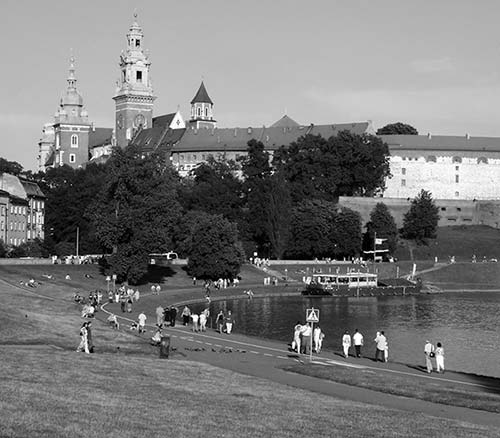
Wawel Sights: The sights you’ll enter at Wawel are divided into two institutions, cathedral and castle, each with separate tickets. Tickets for the castle sights are sold at two points (at the long line at the top of the ramp; or with no line at the top of the hill, across the central square). To enter the most important sight—the cathedral—buy your ticket at the office across from the cathedral entrance.
• From Kanonicza street—where my self-guided Old Town walk ends—head up the long ramp to the castle entry.
Entry Ramp
Huffing up this ramp, it’s easy to imagine how this location—rising above the otherwise flat plains around Kraków—was both strategic and easy to defend. When Kraków was part of the Habsburg Empire in the 19th century, the Austrians turned this castle complex into a fortress, destroying much of its delicate beauty. When Poland regained its independence after World War I, the castle was returned to its former glory. The bricks you see on your left as you climb the ramp bear the names of Poles from around the world who donated to the cause.
The jaunty equestrian statue ahead is Tadeusz Kościuszko (1746-1817). If that name seems familiar, it’s because Kościuszko was a hero of the American Revolution and helped design West Point. When he returned to his native Poland, he fought bravely but unsuccessfully against the Russians (during the Partitions that would divide Poland’s territory among three neighboring powers). Kościuszko also gave his name to several American towns, a county in Indiana, a brand of mustard from Illinois, and the tallest mountain in Australia.
• Hiking through the Heraldic Gate next to Kościuszko, you pass the ticket office (if you’ll be going into the museums, use the other ticket office, with shorter lines, on the top of the hill—see “Tickets and Reservations,” later). As you crest the hill and pass through the stone gate, on your left is...
▲▲Wawel Cathedral
Poland’s national church is its Westminster Abbey. While the history buried here is pretty murky to most Americans, to Poles, this church is the national mausoleum. It holds the tombs of nearly all of Poland’s most important rulers and greatest historical figures.
Cost and Hours: 22 zł ticket includes cathedral entry, tower climb, crypt, royal tombs, the John Paul II Wawel Cathedral Museum, and the Archdiocesan Museum not far away (described later). Buy this ticket at the house across from the cathedral entry—marked KASA—where you can also rent an audioguide. The cathedral is open Mon-Sat 9:00-17:00, Sun from 12:30 (except the cathedral museum is closed Sun off-season), Nov-March daily until 16:00 (+48 12 429 9516, www.katedra-wawelska.pl).
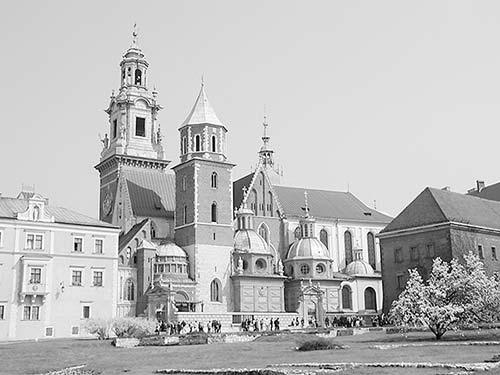
Cathedral Exterior
Before entering, go around to the far side of the cathedral to take in its profile. This uniquely eclectic church is the product of centuries of haphazard additions—it’s surrounded by some 17 chapels and towers that were grafted on to the original, Romanesque, 12th-century core. (The white base of the nearest tower is original. Anything at Wawel that’s made of white limestone like this was probably part of the earliest Romanesque structures.) In a sense, when you’re looking at the cathedral, you’re barely seeing the “cathedral” at all—just these many addenda. To give you a sense of the historical sweep, scan the chapels from left to right: 14th-century Gothic, 12th-century Romanesque (the base of the tower), 17th-century Baroque (the inside is Baroque, though the exterior is a copy of its Renaissance neighbor), 16th-century Renaissance, and 18th- and 19th-century Neoclassical. (This variety in styles is even more evident in the chapels’ interiors, which we’ll see soon.)
Pay attention to the two particularly interesting domed chapels to the right of the tall tower. The gold one is the Sigismund Chapel, housing memorials to the Jagiellonian kings—including Sigismund the Old, who was responsible for Kraków’s Renaissance renovation in the 16th century. The Jagiellonian Dynasty was a high point in Polish history. During that golden 16th century, Poland was triple the size it is today, stretching all the way to the Ottoman Empire and the Black Sea. Poles consider the Sigismund Chapel, made with 80 pounds of gold, to be the finest Renaissance chapel north of the Alps. The copper-domed chapel next to it, home to the Swedish Vasa dynasty, resembles its neighbor (but it’s a copy built 150 years later, and without all that gold).
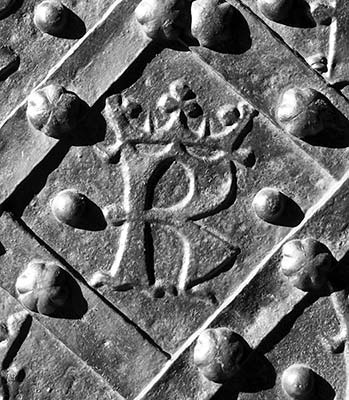
Go back around and face the church’s front entry for more architectonic extravagance. The tallest tower, called the Sigismund Tower, has a clock with only an hour hand. Climbing a few steps into the entry, you see Gothic chapels (with pointy windows) flanking the door, a Renaissance ceiling, lavish Baroque decoration over the door, and some big bones (a simple whale rib and two vertebrae). In the Middle Ages, these were thought to have been the bones of the mythic Wawel dragon and put here as an oddity to be viewed by the public. (Back then, there were no museums, so unusual items like these were used to lure people to the church.) The door is the original from the 14th century, with fine wrought-iron work. The K with the crown stands for Kazimierz the Great. The black marble frame is made of Kraków stone from nearby quarries.
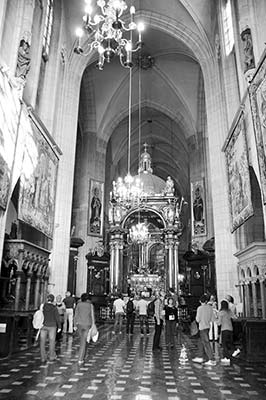
Cathedral Interior
The cathedral interior is slathered in Baroque memorials and tombs, decorated with tapestries, and soaked in Polish history. The ensemble was designed to help keep Polish identity strong through the ages. It has...and it still does.
After you step inside, you’ll follow the one-way, clockwise route that leads you through the choir, then around the back of the apse, then back to the entry.
At the entry, look straight ahead to see the silver tomb under a canopy, inspired by the one in St. Peter’s Basilica at the Vatican. It contains the remains of the first Polish saint, Stanisław (from the 11th century). In front of the canopy, look for a metallic reliquary that’s shaped like a book with its pages being ruffled by the wind (labeled, in Latin, Sanctus Johannes Paulus II). The glass capsule in the reliquary holds a drop of St. John Paul II’s blood. It takes this shape because of what believers consider a highly significant moment during his memorial service: Before a crowd of thousands on St. Peter’s Square in Rome, a book was placed on John Paul II’s simple wooden coffin. As the service processed, its pages were ruffled back and forth by the wind, until they were finally slammed shut...as if the Holy Spirit were “closing the book” on his life.
Go behind this canopy into the ornately carved choir area. For 200 years, the colorful chair to the right of the high altar has been the seat of Kraków’s archbishops, including Karol Wojtyła, who served here for 14 years before becoming pope. It’s also here that Polish royal coronations took place.
Now you’ll continue into the left aisle. Straight ahead is the entrance to the Sigismund Tower; to ascend it, you’ll climb 70 claustrophobic wooden stairs to the 11-ton Sigismund Bell and pleasant views of the steeples and spires of Kraków.
Before moving on, there’s another small sight back toward where you entered the church: Look for the low-profile staircase and descend into the little crypt (with a rare purely Romanesque interior), which houses the remains of Adam Mickiewicz, the Romantic poet whose statue dominates the Main Market Square; and another beloved Romantic poet and playwright, Juliusz Słowacki. You’ll also find a white marble monument to Fryderyk Chopin (who’s buried in Paris), put here on the 200th anniversary of his birth in 2010.
Now continue around the apse (behind the main altar). After looping around to the right, as you head back up the far aisle, look for the red-marble tomb (on the right) of The Great One—Kazimierz, of course. Look for Kazimierz III Wielki. At his feet you can see a little animal that was originally intended to be a lion, but because local craftspeople lacked a model, it wound up looking more like a beaver with a lion’s mane. This is an allusion to a famous saying about Kazimierz, the nation-builder: He found a Poland made of wood, and left one made of brick and stone. The belt Kazimierz wears represents the fortifications he built in a ring around his Polish realm.
You may notice that there’s one VIP (Very Important Pole) who’s missing...Karol Wojtyła, a.k.a. John Paul II. Even so, a few more steps toward the entrance, on the left, is the Chapel of St. John Paul II. The late pontiff left no specific requests for his body, and the Vatican controversially (to Poles, at least) chose to entomb him in Vatican City, instead of sending him back home to Wawel. While Karol Wojtyła’s remains are in St. Peter’s Basilica, this chapel was recently converted to honor him—with a plaque in the floor and an altar with his picture. Someday, Poles hope, he may be moved here (but, the Vatican says, don’t hold your breath).
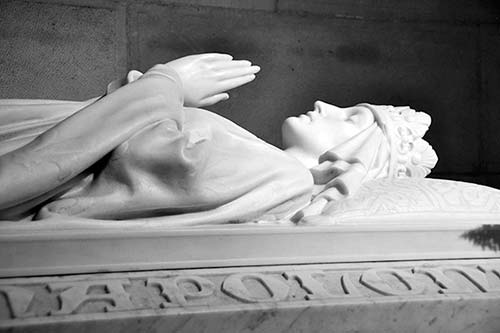
Back out in the main church, about 10 steps farther on the right, is the white sarcophagus of St. Jadwiga (with a dog at her feet). This 14th-century “king” of Poland advanced the fortunes of her realm by partnering with the king of Lithuania. The resulting Jagiellonian dynasty fought off the Teutonic Knights, helped Christianize Lithuania, and oversaw a high-water mark in Polish history. (Despite the queen’s many contributions, the sexism of the age meant that she was considered a “king” rather than a “queen.”) She was sainted by Pope John Paul II in 1997.
Across from Jadwiga, peek into the gorgeous 16th-century Sigismund Chapel, with its silver altar (this is the gold-roofed chapel you just saw from outside). Locals consider this the “Pearl of the Polish Renaissance” and the finest Renaissance structure outside Italy.
Next, look into the Vasa Chapel (past the side door, also on the left): Remember that its exterior matches the restrained, Renaissance style of the Sigismund Chapel, but the interior is clearly Baroque, slathered with gold and silver—quite a contrast.
To the left of the main door, take a look at the Gothic Holy Cross Chapel, with its seemingly Orthodox-style 14th-century frescoes.
In the back corner of the church—on the other side of the main door—is the entrance through the Czartoryski Chapel to the royal tombs. (You’ll exit outside the church, so be sure you’re done in here first.) Once downstairs, the first big room, an original Romanesque space called St. Leonard’s Crypt, houses Poland’s greatest war heroes: Kościuszko (of American Revolution fame), Jan III Sobieski (who successfully defended Vienna from the Ottomans; he’s in the simple black coffin with the gold inscription J III S), Sikorski, Poniatowski, and so on. Poles consider this room highly significant as the place where St. John Paul II celebrated his first Mass after becoming a priest (in November 1946).
Then you’ll wander through several rooms of second-tier Polish kings, queens, and their kids. Head down more stairs into a stark corridor, where you’ll run into the plaque honoring the Polish victims of the Katyń massacre in the USSR during World War II. Stepping into the next room, you’ll see the tomb of President Lech Kaczyński and his wife Helena, who were among the 96 Polish politicians killed in a tragic 2010 plane crash at Smoleńsk, where the diplomats had planned to attend a ceremony memorializing the Katyń massacre. Up a few stairs is the final grave, belonging to Marshal Józef Piłsudski, the WWI hero who later seized power and was the de facto ruler of Poland from 1926 to 1935. His tomb was moved here so the rowdy soldiers who came to pay their respects wouldn’t disturb the others.
• Exit near the Kaczyński tomb. To visit the cathedral’s museum (covered by the same ticket), cross the little square and head up the stairs next to the statue of St. John Paul II.
John Paul II Wawel Cathedral Museum
This small museum fills four rooms with artifacts relating to both the cathedral and St. John Paul II. Downstairs is the Royal Room, with vestments, swords, regalia, coronation robes, and items that were once buried with the kings, as well as early treasury items (from the 11th through 16th century). Upstairs is the “Papal Room” with items from St. John Paul II’s life: his armchair, vestments, caps, shoes, and miter (pointy pope hat), plus souvenirs from his travels. (If you’re into papal memorabilia, the collection at the nearby Archdiocesan Museum—covered by the same ticket and described later—is better.) The adjoining room holds a later treasury collection (17th through 20th century).
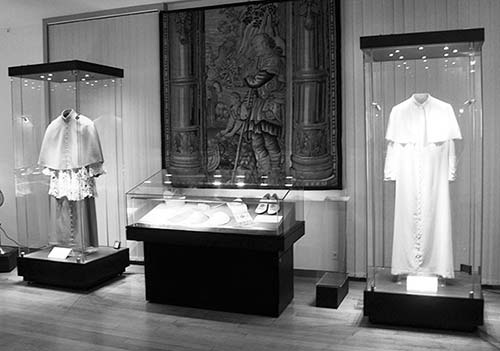
Cost and Hours: Same ticket and hours as the cathedral (see earlier), except the museum is closed Sun off-season.
• When you’re finished with the cathedral sights, stroll around the...
▲▲Wawel Castle Grounds
In the rest of the castle, you’ll uncover more fragments of Kraków’s history and have the opportunity to visit several museums. I consider the museums skippable, but if you want to visit them, buy tickets before you enter the inner courtyard. Read the descriptions on here to decide which, if any, museums appeal to you.
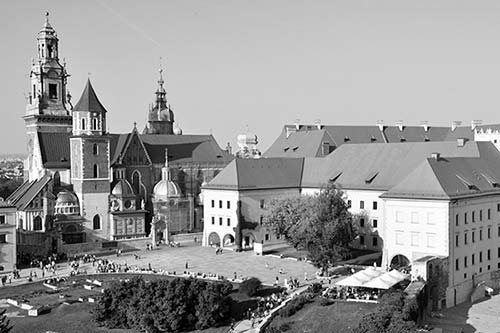
 Self-Guided Tour: This guided stroll, which doesn’t enter any of the admission-charging attractions, is plenty for most visitors.
• For a historical orientation, stand with the cathedral to your back, and survey the empty field between here and the castle walls.
Gothic Church Ruins: This hilltop has seen lots of changes over the years. Kazimierz the Great turned a small fortress into a mighty Gothic castle in the 14th century. But that original fortress burned to the ground in 1499, and ever since, Wawel has been in flux. For example, in the grassy field, notice the foundations of two Gothic churches that were destroyed when the Austrians took over Wawel in the 19th century and needed a parade ground for their troops. (They built the red-brick hospital building beyond the field, now used by the Wawel administration.)
• Facing the cathedral, look right to find a grand green-and-pink entryway. Go through here and into the palace’s dramatically Renaissance-style...
Inner Courtyard: If this space seems to have echoes of Florence, that’s because it was designed and built by young Florentines after Kazimierz’s original castle burned down. As with the Cloth Hall, recall that Sigismund the Old married an Italian princess (Bona Sforza, from the famous Milanese family). Along with his bride, he imported Italian architecture, fashion (low-cut dresses), and food (tomatoes and potatoes, which had arrived in Italy from the New World).
The courtyard has three distinct levels: The ground floor housed the private apartments of the higher nobility (governors and castle administrators), the middle level held the private apartments of the king, and the top floor—much taller, to allow more light to fill its large spaces—were the public state rooms of the king. (They have the opposite problem in Italy, where the goal is shade rather than sunshine, so the lower floors are taller—the reverse of what you see here.)
The wing to the right of where you entered is fascist in style (notice the column-like grooves around the windows). It was built as the headquarters of the notorious Nazi governor of German-occupied Poland, Hans Frank. (He was tried and executed in Nürnberg after the war.)
At the right end of the courtyard is a false wall, designed to create a pleasant Renaissance symmetry, and also to give the illusion that the castle is bigger than it is. Looking through the windows, notice that there’s nothing but air on the other side. When foreign dignitaries visited, these windows could be covered to complete the illusion. The entrances to most Wawel museums are around this courtyard, and some believe that you’ll find something even more special: chakra.
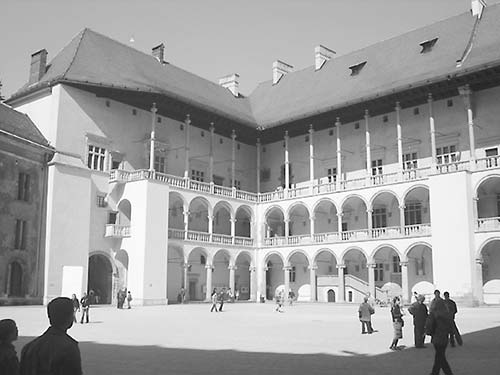
Adherents to the Hindu concept of chakra believe that a powerful energy field connects all living things. Some believe that, mirroring the seven chakra points on the body (from head to groin), there are seven points on the surface of the earth where this energy is most concentrated: Delhi, Delphi, Jerusalem, Mecca, Rome, Velehrad...and Wawel Hill—specifically over there in the corner (immediately to your left as you enter the courtyard—the stretches of wall flanking the door to the baggage-check room, and all the way to the door in the corner). Look for peaceful people (here or elsewhere on the castle grounds) with their eyes closed. One thing’s for sure: They’re not thinking of Kazimierz the Great. The smudge marks on the wall are from people pressing up against this corner, trying to absorb some good vibes from this chakra spot.
The Wawel administration seems creeped out by all this. They’ve done what they can to discourage this ritual (such as putting up information boards right where the power is supposedly most focused), but believers still gravitate from far and wide to hug the wall. Give it a try...and let the chakra be with you. (Just for fun, ask a Wawel tour guide about the chakra, and watch her squirm—they’re forbidden to talk about it.)
• If you want to visit some of the castle museums (you can enter most of them from this courtyard), you’ll first need to buy tickets elsewhere. Stick with me for a little longer to finish our tour of the grounds, and we’ll wind up near a ticket office.
Head slightly downhill through the square, across to the gap in the buildings beyond the field, to the...
Viewpoint over the Vistula: Belly up to the wall and enjoy the panorama over the Vistula River and Kraków’s outskirts. The “Polish Mississippi”—which runs its entire course in Polish lands—is the nation’s artery for trade and cultural connection. It stretches 650 miles from the foothills of the Tatra Mountains in southern Poland, through many of the country’s major cities (Kraków, Warsaw, Toruń), before emptying into the Baltic Sea in Gdańsk.
From this viewpoint, you can see some unusual landmarks, including the odd wavy-roofed building just across the river (which houses the Manggha Japanese art gallery) and the biggest conference center in Poland (to the left of the wavy building). A bit farther to the left is an eyesore of a communist concrete hotel, now home to a very cool summertime “beach bar” with a Ferris wheel (the Forum Przestrzenie, described on here). To the right, the suspiciously symmetrical little bulge that tops the highest hill on the horizon is the artificial Kościuszko Mound (described later). And on a particularly crisp day, far in the distance (beyond the wavy building), you can see the Tatra Mountains marking the border of Slovakia.
Now look directly below you, along the riverbank (to the left), to find a fire-belching monument to the dragon that was instrumental in the founding of Kraków. Once upon a time, a prince named Krak founded a town on Wawel Hill. It was the perfect location—except for the fire-breathing dragon that lived in the caves under the hill and terrorized the town. Prince Krak had to feed the dragon all of the town’s livestock to keep the monster from going after the townspeople. But Krak, with the help of a clever shoemaker, came up with a plan. They stuffed a sheep’s skin with sulfur and left it outside the dragon’s cave. The dragon swallowed it and, before long, developed a terrible case of heartburn. To put the fire out, the dragon started drinking water from the Vistula. He kept drinking and drinking until he finally exploded. The town was saved, and Kraków thrived. Today, visitors enjoy watching the dragon blow fire into the air (about every four minutes; can vary from a big plume to a tiny puff).
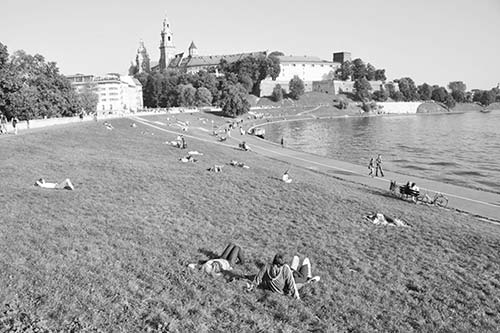
If you’d like a higher viewpoint on the riverfront, you can pay a few złoty to climb 137 stairs to the top of Sandomierska Tower (at the far end of the hill, past the visitors center, no elevator; open only in summer). But I’d skip it—the view from up top is only through small windows.
• Our Wawel tour is finished. If you’d like to explore some of the museums, you can buy your tickets in the nearby visitors center (head back into the main Wawel complex—with the empty field—and turn right); here you’ll also find WCs, a café, and a gift shop. Or you can head to the riverfront park: Walk downhill (through the Dragon’s Den, or use the main ramp and circle around the base of the hill) to reach the embankment—a delightful place to simply stroll and relax, with beautiful views back on the castle complex.
Wawel Castle Museums
Wawel Castle offers a dizzying array of museums, exhibits, and attractions, all covered by separate tickets. Visitors stand before a long, pointlessly complicated menu of options, puzzling over how to spend their time and money. But here’s the good news: Most, arguably all, of the Wawel Castle sights are skippable. While some of the castle’s fine artifacts and pretty rooms are appealing to Poles, most casual visitors find that the best visit is simply to enjoy the cathedral and the castle grounds (following my self-guided tour, earlier). But in case you’d like to dig deeper, here’s the scoop.
Tickets: Each sight has its own ticket (prices listed later); English descriptions are posted, and you can rent an audioguide for 12 zł that covers a few of the sights. Sort through your choices and buy tickets at the visitors center at the far corner of the castle grounds (across the field from the cathedral, in the big red-brick building). You can’t buy tickets at the door of any sight, so choose and buy your tickets here at the start of your visit. The number of tickets per sight are limited and come with an assigned entry time (though ticket-checkers tend to be pretty flexible). It’s possible to reserve ahead online or by phone (see the official website for details)...but I wouldn’t bother. Frankly, if they’re sold out, you’re not missing much.
Hours: The hours of the various exhibits change frequently and there can be exceptions from sight to sight; for the latest, see www.wawel.krakow.pl. But in general, most of these sights should be open Tue 9:30-14:00, Wed-Sun until 17:00. Most sights are closed Mondays, but some are open and free Monday mornings until 13:00 (these rotate every few months).
Sights: Unless you’re a Poland completist, the only Wawel attraction really worth considering is the first one.
To see the Royal State Rooms (Komnaty Królewskie), costing 35 zł and worth ▲, you climb up to the top floor and wander through some halls with antique furniture to reach the Throne Room, with 30 carved heads in the ceiling. According to legend, one of these heads got mouthy when the king was trying to pass judgment—so its mouth has been covered to keep it quiet. Continue into some of the palace’s finest rooms, with 16th-century Brussels tapestries (140 of the original 300 survive), remarkably decorated wooden ceilings, and gorgeous leather-tooled walls. Wandering these halls with their period furnishings, you get a feeling for the 16th- and 17th-century glory days of Poland, when it was a leading power in Central Europe. The Senate Room, with its throne and elaborate tapestries, is the climax.
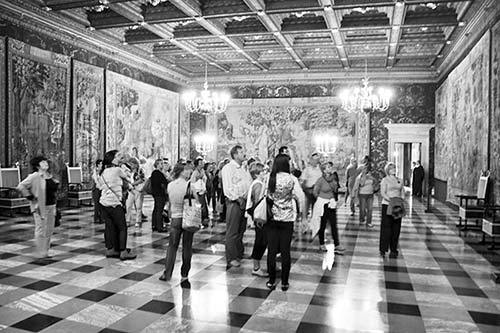
The Royal Private Apartments (Prywatne Apartamenty Królewskie) are similar to the State Rooms and essentially redundant. Touring these, you’ll see a columned hall, some Meissen porcelain, and a variety of artwork (30 zł).
The Crown Treasury (Skarbiec Koronny) shows off an impressive collection of regalia: giant banners (some dating back to the 16th century); swords, scepters, helmets, shields, and kingly chain mail; exquisite items gifted to Jan III Sobieski in thanks for defeating the Ottomans in the 1683 Battle of Vienna (including a sumptuous mantle from King Louis XIV and a comically oversized coronation sword from the pope); a rustic table loaded down with gold, silver, and enamel tankards; and lots of other fancy items once belonging to Polish royals (35 zł).
The Armory (Zbrojownia) is a decent collection of swords, saddles, and shields; ornately decorated muskets, crossbows, and axes; and cannons (20 zł).
The small Art of the Orient (Sztuka Wschodu) exhibit displays Ottoman swords, carpets, banners, vases, and other items dating from Jan III Sobieski’s victory in the Battle of Vienna (20 zł).
The Lost Wawel (Wawel Zaginiony) exhibit traces the history of the hill and its various churches and castles. You’ll see a model of the entire castle complex in the 18th century (pre-Austrian razing) then walk through scarcely explained excavations of a 10th-century church. On the way, you’ll see models of the cathedral at various stages, and a display of tiles from 16th-century stoves that once heated the place (15 zł).
The Wawel Recovered (Wawel Odzyskany) exhibit is a more modern look at the evolution of this hilltop—with more models and reconstructions than actual foundations (15 zł).
There are also temporary exhibits, a separate ticket to walk along the castle’s first-floor galleries, access to the Royal Gardens on the hillsides below the castle, and likely even more by the time you read this.
Eating: Various light eateries circle the castle courtyard, but if you just want a drink, it’s hard to beat the cheap self-service snack bar next to the Lost Wawel entrance, with fine views across to the cathedral.
KRAKÓW’S ART MUSEUMS
Kraków’s National Museum (Muzeum Narodowe) is made up of a series of small but interesting art collections scattered throughout the city (http://mnk.pl). These are some of the most engaging sights in town; you can find details on current exhibitions at the National Museum website. An 80 zł combo-ticket, called a karnet, covers the permanent collections in all of these museums (good for your entire stay)—worth considering if you’ll be visiting more than three of them. National Museum branches are usually free to enter one day a week—likely Tuesday, but check the website.
▲▲Gallery of 19th-Century Polish Art (Galeria Sztuki Polskiej XIX Wieku)
This small and surprisingly enjoyable collection of works by obscure Polish artists fills the upper level of the Cloth Hall. While you probably won’t recognize any of the Polish names in here—and this collection isn’t quite as impressive as Warsaw’s National Gallery—many of these paintings are just plain delightful. It’s worth a visit to see some Polish canvases in their native land and to enjoy views over the Square from the hall’s upper terraces.
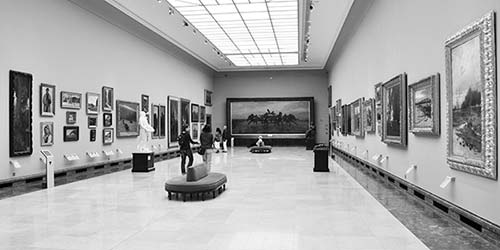
Cost and Hours: 32 zł, free on Tue; open Tue-Sun 10:00-18:00, closed Mon; entrance on side of Cloth Hall facing Adam Mickiewicz statue, +48 12 424 4600.
Background: During the 19th century—when every piece of art in this museum was created—there was no “Poland.” The country had been split up among its powerful neighbors in a series of three Partitions and would not appear again on the map of Europe until after World War I. Meanwhile, the 19th century was a period of national revival throughout Europe, when various previously marginalized ethnic groups began to take pride in what made them different from their neighbors. So the artists you see represented here were grappling with trying to forge a national identity at a time when they didn’t even have a country. You’ll sense a pessimism that comes from people who feel abused by foreign powers, mingled with a resolute spirit of national pride.
Self-Guided Tour: The collection fills just four rooms: two small rooms in the center and two big halls on either side. On a quick visit, focus on the highlights in the big halls I mention here.
Entering the Cloth Hall, buy your ticket and head up the stairs (or use the elevator). The obligatory coat check is on floor 1, and the museum is on floor 2. Between them, peek out onto the inviting café terrace for a fine view of the Square and St. Mary’s (then return here after your museum visit for a scenic drink.)
The first two small rooms contain little of interest. You enter Room I (Bacciarelli Room), with works from the Enlightenment; straight ahead is Room II (Michałowski Room), featuring Romantic works from 1822 to 1863. The larger, twin halls on either side merit a linger.
Siemiradzki Room (Room III, on the right): This features art of the Academy—that is, “conformist” art embraced by the art critics of the day. Entering the room, turn right and survey the canvases counterclockwise. The space is dominated by the works of Jan Matejko, a remarkably productive painter who specialized in epic historical scenes that also commented on his own era.
• Circling the room, look for these paintings.
Jan Matejko, Wenyhora: The first big canvas (immediately on your right as you enter, next to the door) is Matejko’s depiction of Wenyhora, a late-18th-century Ukrainian soothsayer who, according to legend, foretold Poland’s hardships—the three Partitions, Poland’s pact with Napoleon, and its difficulties regaining nationhood. Like many Poles of the era, Matejko was preoccupied with Poland’s tragic fate, imbuing this scene with an air of inevitable tragedy.
Jacek Malcezewski, Death of Ellenai: A similar gloominess is reflected in this canvas. The main characters in a Polish Romantic poem, Ellenai and Anhelli, have been exiled to a remote cabin in Siberia (in Russia, one of the great powers occupying Poland). Just when they think things can’t get worse...Ellenai dies. Anhelli sits immobilized by grief.
• A few canvases down, dominating the right side of the hall, is...
Jan Matejko, Tadeusz Kościuszko at Racławice: One of the heroes of the American Revolution, now back in his native Poland fighting the Russians, doffs his hat after his unlikely victory at the Battle at Racławice. In this battle (which ultimately had little bearing on Russia’s drive to overtake Poland), a ragtag army of Polish peasants defeated the Russian forces. Kościuszko is clad in an American uniform, indicating Matejko’s respect for the American ideals of democracy and self-determination.
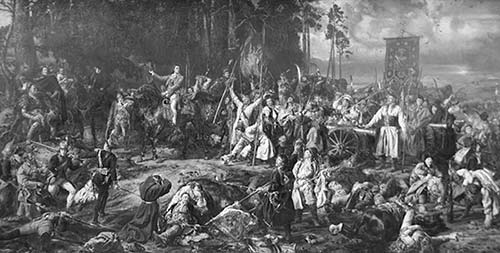
• Dominating the far wall is...
Henryk Siemiradzki, Nero’s Torches: On the left, Roman citizens eagerly gather to watch Christians being burned at the stake (on the right). The symbolism is clear: The meek and downtrodden (whether Christians in the time of Rome, or Poles in the heyday of Russia and Austria) may be persecuted now but have faith that their noble ideals will ultimately prevail.
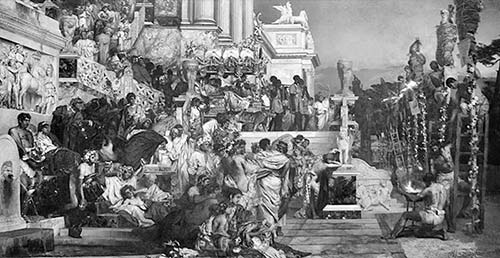
• On the next wall, find...
Pantaleon Szyndler, Bathing Girl: This piece evokes the orientalism popular in 19th-century Europe, when romanticized European notions of the Orient (such as “harem slave girls”) were popular artistic themes. Already voyeuristic, the painting was originally downright lewd until Szyndler painted over a man leering at the woman from the left side of the canvas.
• The huge canvas on this wall is...
Jan Matejko, The Prussian Homage: The last Grand Master of the fearsome Teutonic Knights swears allegiance to the Polish king in 1525. This historic ceremony took place in the Main Market Square in Kraków, the capital at the time. Notice the Cloth Hall balustrade and the spires of St. Mary’s Church in the background. Matejko has painted his own face on one of his favorite historical figures, the jester Stańczyk at the foot of the throne.
• Continue the rest of the way around the room. Keep an eye out for Tadeusz Ajdukiewicz’s portrait of Helena Modrzejewska, a popular actress of the time, attending a party in this very building. Finally, backtrack through Room I and continue straight ahead into the...
Chełmoński Room (Room IV): Featuring works of the late 19th century, this section includes Realism and the first inklings of Symbolism and Impressionism. Just as elsewhere in Europe (including Paris, where many of these painters trained), artists were beginning to throw off the conventions of the Academy and embrace their own muse.
• As you turn right and proceed counterclockwise through the room, the first stretch of canvases features landscapes and genre paintings. Among these, about halfway down, a particularly fine canvas is...
Wladyslaw Malecki, A Gathering of Storks: The majestic birds stand under big willows in front of the setting sun. Even seemingly innocent wildlife paintings have a political message: Storks are particularly numerous in Poland, making them a subtle patriotic symbol.
• A few canvases down, find...
Józef Brandt, A Meeting on a Bridge: This dramatic painting shows soldiers and aristocrats pushing a farmer into a ditch—a comment on the state of the Polish people at that time. Just to the right, see Brandt’s Fight for a Turkish Standard. This artist specialized in battle scenes, frequently involving a foe from the East—as was often the reality here along Europe’s buffer zone with Asia.
• A few more canvases to the left of Brandt’s works is...
Samuel Hirszenberg, School of Talmudists: Young Jewish students pore over the Talmud. One of them, deeply lost in thought, may be pondering more than ancient Jewish law. This canvas suggests the inclusion of Jews in Poland’s cultural tapestry during this age. While still subject to pervasive bigotry here, many Jewish refugees found Poland to be a relatively welcoming, tolerant place to settle on a typically hostile continent.
• Dominating the end of the room is...
Józef Chełmoński, Four-in-Hand: In this intersection of worlds, a Ukrainian horseman gives a lift to a pipe-smoking nobleman. Feel the thrilling energy as the horses charge directly at you through splashing puddles.
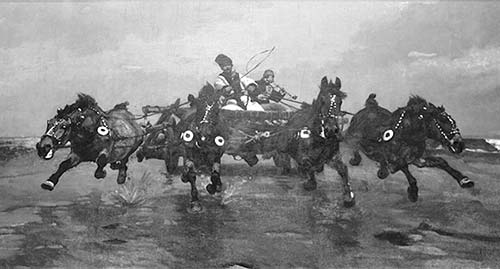
• Heading back toward the entrance, on the right wall, watch for...
Witold Pruszkowski, Water Nymphs: Based on Slavic legends (and wearing traditional Ukrainian costumes), these mischievous, siren-like beings have just taken one victim (see his hand in the foreground) and are about to descend on another (seen faintly in the upper-right corner).
Beyond this painting are some travel pictures from Italy and France (including some that are very Impressionistic, suggesting a Parisian influence).
• Flanking the entrance/exit door are two of this room’s best works. First, on the right, is...
Władysław Podkowiński, Frenzy: This gripping painting’s title (Szał), tellingly, has also been translated as Ecstasy and Insanity. A pale, sensuous woman—possibly based on a socialite for whom the artist fostered a desperate but unrequited love—clutches an all-fired-up black stallion that’s frothing at the mouth. This sexually charged painting caused a frenzy indeed at its 1894 unveiling, leading the unbalanced artist to attack his own creation with a knife (you can still see the slash marks in the canvas).
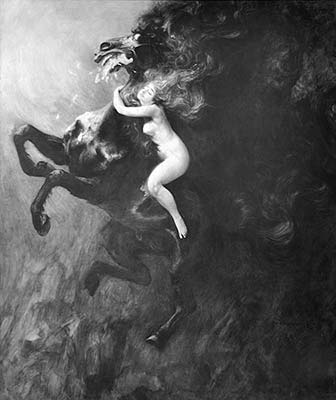
• And finally, on the other side of the door is...
Jacek Malczewski, Introduction: A young painter’s apprentice on a bench contemplates his future. Surrounded by nature and with his painter’s tools beside him, it’s easy to imagine this as a self-portrait of the artist as a young man...wondering if he’s choosing the correct path. Malczewski was an extremely talented Młoda Polska artist who tends to be overshadowed by his contemporary, Wyspiański. Viewing this canvas—and others by him—makes me feel grateful that he decided to stick with painting.
▲▲Czartoryski Museum (Muzeum Czartoryskich)
This eclectic collection, originally assembled by a precocious aristocrat to celebrate Poland’s cultural heritage, is best known to visitors for one painting: Leonardo da Vinci’s masterful Lady with an Ermine—which alone warrants the ▲▲ rating. The museum also has an excellent (and rare) Rembrandt landscape. The rest of the collection is a historical jumble: decorative arts, tapestries, treasury items, Meissen porcelain figures, old flags and banners, portraits of kings and aristocrats, majolica pottery, ornate suits of armor, a ceremonial Turkish tent from the 1683 siege of Vienna, and more Czartoryski family portraits than anyone not named Czartoryski would ever care to see. I’d suggest a quick stroll through the rest of the collection, then linger over the Rembrandt and (especially) the stunning Leonardo. Oh, baby!
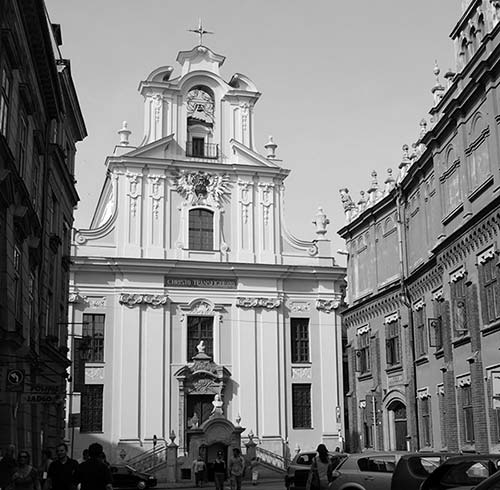
Cost and Hours: 38 zł, free on Tue; Tue-Sun 10:00-18:00, closed Mon; a short walk from the Florian Gate at Pijarska 15—enter near the brick skybridge, +48 12 370 54 66, http://mnk.pl.
Background: The museum’s collection came about, in part, thanks to Poland’s 1791 constitution (Europe’s first), which inspired Princess Izabela Czartoryska to begin gathering bits and bobs of Polish history and culture. Soon after, when the Partitions dismantled the country, Izabela doubled down on this pursuit—assembling proud Polish bric-a-brac with the motto, “The past for the future,” looking ahead to a time when Poland would be reconstituted. That would not happen within her lifetime; she fled with the collection to Paris after the 1830 insurrection. Her son, Adam Czartoryski—who purchased the Leonardo for his mom as a gift—was so influential during this period of exile that he was sometimes called the “uncrowned king of Poland.” It took 45 years after the family fled for Izabela’s grandson to return the collection to its present Kraków location. During World War II, the Nazis hauled the collection to Germany; although most of it has been returned, some pieces are still missing. The dusty old museum got a serious upgrade starting in 2010 and finally reopened in 2019.
Self-Guided Tour: There are some basic English descriptions, but for the full story, invest in the somewhat long-winded but insightful audioguide (10 zł). Or just follow this selective self-guided commentary for an efficient visit. Spoiler alert: The two all-star paintings are essentially the last things you’ll see on this tour. (If you’d like to get to them faster, consider skipping floor 1 and heading right up to floor 2, then speeding through the first few rooms.)
From the ticket desk, head through the lovely courtyard and take the stairs or elevator up to floor 1. You’ll begin in two Rooms of the Czartoryskis, with portraits and busts of the members of this illustrious family, who were VIPs about two centuries ago. (Their red family crest—with a horseback knight raising his sword—decorates the windows.) You’ll see their fancy sabers, ornate jackets and gowns, and a pair of ceremonial keys.
The next few rooms display Princess Czartoryska’s collection of Polish artifacts roughly chronologically, by dynasty. In the Room of the Jagiellonian Dynasty—tucked among altar paintings, tapestries, tattered flags, and other precious objects—look for the 10 small portraits of the Jagiełło clan in a single frame, done by the workshop of Lucas Cranach the Younger (see his trademark, the small winged lion, in the corner of each one). The Room of the Vasa Dynasty is more militaristic, as this was a time of warfare—hence the emphasis on weaponry over simple beauty.
The Room of the Victory of Vienna commemorates that fateful battle in 1683, when the Polish King Jan III Sobieski led a pan-European army to success in defending the Austrian capital against an Ottoman siege. The room’s centerpiece is a ceremonial tent and a Persian carpet like the ones used by the Ottomans in that battle. On display are actual weapons and equipment (shields, sabers, and saddles) used by the troops that day. Notice the winged hussar suit of armor—those rattling feathers made a fearsome sound when charging full-tilt on horseback. You’ll also see Sobieski’s ornate divinative shield and a ceremonial saber presented to him by the pope.
The Room of the Saxons illustrates how Poland’s next dynasty—the Wettins (imported from Dresden, in today’s Germany)—squandered their country’s resources, ultimately hastening its decline: Notice the expensive Meissen porcelain favored by the Wettins, and the wine glasses, goblets, and plates they used for one of their favorite pastimes...feasting.
The Room of the Enlightenment—a bright era for many European lands—coincides with Poland’s darkest moment, when the country was chopped up and divided among land-hungry neighbors in a series of three Partitions. The large portrait shows Stanisław August Poniatowski, Izabela Czartoryska’s cousin and the final Polish king, who took the throne at age 32 and presided over both Europe’s first democratic constitution in 1791...and, just a few years later, the fall of his nation. One case displays his ceremonial swords and medals; the other shows some of his belongings: cane, fan, flute, and powder horn.
Then you’ll enter a dimly lit wing with liturgical paraments (amber cross, vestments), then “Pompa Funebris,” illustrating the pomp surrounding funeral rituals (see the tattered tombstone banner from 1660, and nearby, the smaller coffin portraits).
The last section on this floor shows off three rooms of “Oriental Art”: first from Persia (carpet) and India (bronze statues), then from China (fans, porcelain, a giant bronze dragon), then from Japan (find the display case of netsuke—minuscule sculptures carved in ivory or wood).
Now head upstairs to level 2 and cross over the skybridge—looking down over the beautifully restored courtyard at the center of the complex.
While downstairs was mainly about Poland, this floor showcases European art. The Antiquity Parlor features paintings, sculptures, and tapestries inspired by ancient Greece and Rome; the Medieval Parlor has gilded altarpieces and other church art; and Northern European Art from the 15th to the 17th century displays...well, exactly that, including some Habsburg portraits.
Finally, we come to the room called Age of the Rembrandt Period. Ignore all the also-rans in this room (for now) and head straight across to the dramatically lit painting: Rembrandt van Rijn’s Landscape with the Good Samaritan (1638). This small, detailed painting depicting the popular parable is one of only a few known landscapes by Rembrandt. In the right foreground, the Samaritan helps the wounded man onto his horse as a little boy watches. To the left, much farther down the road (just beyond the waterfall), find the two tiny figures walking—the priest and the Levite who passed the injured man. The murky colors make it a little tricky to pick out all the details, but Rembrandt’s trademark dramatic lighting creates a powerful scene.
There’s a small, dimly lit room off of this Rembrandt hall—if you’re not looking for it, it’s easy to miss. But don’t miss it! This is the room where you’ll find Leonardo da Vinci’s Lady with an Ermine. This small (21 x 16 inches) but magnificently executed portrait of a 16-year-old young woman is a rare surviving work by one of history’s greatest minds.
Spend some time lingering over the canvas (dating from 1489 or 1490). The subject is likely Cecilia Gallerani, the young mistress of Ludovico Sforza, the duke of Milanand Leonardo’s employer. The ermine (white during winter) suggests chastity—thus bolstering Cecilia’s questioned virtue—but is also a naughty reference to the duke’s nickname, Ermellino—notice that his mistress is sensually, ahem, “stroking the ermine.”
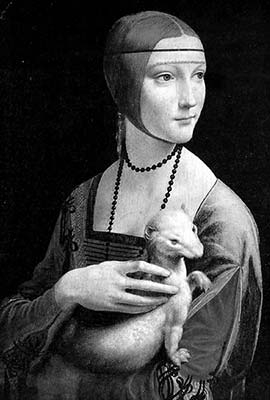
Painted before the Mona Lisa, the portrait was immediately recognized as revolutionary. Cecilia turns to look at someone, her gaze directed to the side. Leonardo catches this unguarded, informal moment, an unheard-of gesture in the days of the posed, front-facing formal portrait. Her simple body language and faraway gaze speak volumes about her inner thoughts and personality. Leonardo tweaks the generic Renaissance “pyramid” composition, turning it to a three-quarters angle, and softens it with curved lines that trace from Cecilia’s eyes and down her cheek and sloping shoulders before doubling back across her folded arms. The background—once gray and blue—was painted black in the 19th century.
Using special lights and cameras, conservators have been able to virtually peel back layers of paint to see earlier “drafts” of the painting (Leonardo was known to tinker with his works over time). They’ve revealed that the ermine was likely not included in the original version. Perhaps Leonardo added it later as a nod to the duke.
Lady with an Ermine is a rare surviving portrait in oil by Leonardo. She’s better preserved than her famous cousin in Paris (Mona Lisa), and—many think—simply more beautiful. Can we be sure it’s really by the enigmatic Leonardo? Yep—the master’s fingerprints were found literally pressed into the paint (he was known to work areas of paint directly with his fingertips).
After this grand finale, you’ll pass through the Polish Hall—painted a patriotic Polish red—displaying mementos of historical figures and events: gilded shields honoring mighty leaders, small sarcophagi with the remains of great Poles, portraits of monarchs, and flags and banners from the battlefield.
You’ll finish by walking through some temporary exhibits. The museum also has an exhibit called The Origins: Ancient Art Gallery—with items from Egypt, Greece, and Rome—but it costs extra and isn’t worth it for most visitors.
Before you depart, ponder this: The museum technically owns a third masterpiece, Raphael’s Portrait of a Young Man, but its whereabouts are unknown. Arguably one of the most famous and most valuable stolen paintings of all time, it’s quite likely a self-portrait (but possibly a portrait of Raphael by another artist), depicting a Renaissance dandy, clad in a fur coat, with a self-satisfied smirk. Painted in 1513 or 1514 and purchased by a Czartoryski prince around the turn of the 19th century, the work was seized by the occupying Nazis during World War II. Along with the paintings by Leonardo and Rembrandt, this Raphael decorated the Wawel Castle residence of Nazi governor Hans Frank. But when Frank and the Nazis fled the invading Red Army at the end of the war, many of their pilfered artworks were lost—including the Raphael.
▲▲Stanisław Wyspiański Museum (Muzeum Stanisława Wyspiańskiego)
One of the great joys of travel is getting to know supremely talented artists you’d never heard of back home. And if you give Stanisław Wyspiański a chance, he may tick that box for you. This concise, beautiful museum assembles many of Wyspiański’s best works, offering an ideal introduction to this leader of the Młoda Polska movement (Poland’s answer to Art Nouveau; see the sidebar on here). If you enjoyed Wyspiański’s stained glass and wall paintings in St. Francis Basilica, you’ll find even more to like here.
Cost and Hours: 18 zł, free on Tue, audioguide available; Tue and Fri-Sun 10:00-17:00, closed Mon and Wed-Thu; a five-minute walk outside the Planty and west of the Old Town at Plac Sikorskiego 6, +48 12 433 57 60, http://mnk.pl.
Visiting the Museum: With just a few rooms spread over three floors, the museum is easy to see. Most of Wyspiański’s works are not paintings or sculptures, but pastels, drawings, and designs for his grand-scale stained-glass windows; as these are fragile, specific items get shuffled in and out of the collection and some things mentioned here may not be on view. (You’ll notice some of the more delicate works even have rolled-up curtains hanging above them so they can be covered for protection as needed.)
A dynamic bust of Wyspiański greets you outside the door. Inside, buy your ticket and head into the lone exhibition room on the main floor: At Home, featuring an array of landscapes of the countryside around Kraków (plus his iconic pastel of St. Mary’s spires viewed from the balcony of the Cloth Hall); Toulouse-Lautrec-like portraits of Wyspiański’s contemporaries (including one showing his friend and rival Josef Mehoffer—twice on a single portrait); a variety of self-portraits at various ages (from fresh-faced student, to young and hungry artist, to fatherly family man); and—perhaps most beautiful—intimate portraits of his family members in everyday poses that capture the universality of human experience. These works showcase the personality and endearing behavior of wife Helen, daughter Helenka, and sons Mietek and Staś.
Next head upstairs to level 1. The first room, Elements, is devoted to the stunning decorations Wyspiański created for St. Francis Basilica. The theme: a Franciscan love of nature. The centerpiece is a gigantic, life-sized design for his masterpiece—the God the Father Let It Be stained-glass window—displayed on a massive roller. Examine the designs for other windows and for the beautiful floral wall decorations. If you’ve seen these in situ—hanging high on dimly lit walls—this is a wonderful opportunity to examine the details up close.
Next, hook left into the room marked Apollo Christ. The focal point here is Wyspiański’s design for a window he created for Kraków’s House of the Medical Society—titled Apollo, Copernicus’ System. In addition to Wyspiański’s mastery of religious themes, he was captivated by the ancient world, especially the Greeks. Notice how this design juxtaposes the story of Apollo, with a pose resembling Jesus’ Crucifixion, all wrapped up in the medieval breakthrough of a scientist who studied here in Kraków.
Also in this room, you’ll find some of the plays Wyspiański wrote (and a costume he designed for one of them), designs for his stained-glass windows inside St. Mary’s and the Dominican Church (both described elsewhere in this chapter), and some decorative arts handmade by Wyspiański—such as a bench and a tapestry with flowers.
Now cross over—again past the giant God the Father roller—to the next section, Wawel Castle: Drama of Kings. Yet another of Wyspiański’s passions was the evocative architecture of the churches and castles of the Middle Ages. In this room, you’ll see some sketches he made of such structures, both in Poland and abroad, and costume sketches (and an actual crown) he designed for a play he wrote about this era. In the center of the room is a model for an imaginative upgrade to Wawel Castle, which would have transformed it into the “Polish Acropolis” he felt it could and should become. (There’s even a Circus Maximus-like elongated stadium at the foot of the hill.) If you’ve been to Wawel, you know that these plans never materialized.
Also in this room are two more large-scale masterpieces. One is Wyspiański’s design (Polonia) for a stained-glass window in Lviv Cathedral (today in Ukraine, then part of Poland), and another is a hauntingly beautiful wintertime scene of the Planty, with black naked branches of trees lining a boulevard to a mirage-like Wawel Castle, hovering in the distance.
Now use the elevator (or stairs) to go down two floors, to level -1. Here are the two final, small exhibits: First is My Books, displaying books that Wyspiański wrote, designed illustrations for, or both. Then comes Metamorphoses, a deep dive into the plays that Wyspiański wrote (including another costume he designed). In this room, look for the VR headsets; you can sit down, strap one on, and go for a virtual “flight” over Kraków, zooming in for up-close visits to the locations that inspired many of the works we’ve seen here.
Leaving the museum, it’s hard to shake the feeling that there must be many other artists whose fame will never reach the level of their talent. But at least for you and Wyspiański, that’s no longer the case.
Bishop Erazm Ciołek Palace (Pałac Biskupa Erazma Ciołka)
This branch of the National Museum features two separate art collections. Upstairs, the extensive “Art of Old Poland” section shows off works from the 12th through the 18th century, with room after room of altarpieces, sculptures, paintings, and more. The “Orthodox Art of the Old Polish Republic” section on the ground floor offers a taste of the remote eastern reaches of Poland, with icons and other ecclesiastical art from the Orthodox faith. You’ll see a sizeable section of the iconostasis (wall of icons) from the town of Lipovec. Both collections are covered by the same ticket and are very well presented in a modern facility. Items are labeled in English, but there’s not much description beyond the rentable audioguide.
Cost and Hours: 18 zł, free on Tue; open Tue 10:00-18:00, Wed-Sun until 16:00, closed Mon; Kanonicza 17, +48 12 424 9371.
More National Museum Branches
While less interesting than the branches listed earlier, the National Museum’s Main Branch (Gmach Główny) is worth a visit for museum completists. It features 20th-century Polish art and compelling temporary exhibits (a few blocks west of the Main Market Square at Aleja 3 Maja 1).
The Szołayski House (Kamienica Szołayskich), just one short block from the Main Market Square, features high-quality temporary exhibits; art lovers can check what’s on (Plac Szczepański 9).
OTHER OLD TOWN ATTRACTIONS
▲▲Rynek Underground Museum (Podziemia Rynku)
In the early 2000s, a renovation of the Main Market Square’s pavement unearthed a wealth of remains from previous structures. Now you can do some urban spelunking with a visit to this high-tech medieval-history museum, which is literally underground—beneath all the photo-snapping tourists on the Square above.
Cost and Hours: 32 zł, free on Tue; open Mon and Wed-Thu 10:00-19:00 (but closed the second Mon of each month), Tue until 14:00, Fri-Sun until 20:00, last entry 1.25 hours before closing, Rynek Główny 1, +48 12 426 5060, www.podziemiarynku.com.
Crowd-Beating Tips: This museum can sell out on busy days (especially on Tuesdays—when it’s free and closes early—and on summer weekends). Because it’s popular with school groups, late afternoons and evenings are quieter. At busy times, it’s wise to book ahead online; alternatively, you can buy advance tickets in person at the Museum of Kraków office nearby, at the northwest corner of the Square (see “Tourist Information,” earlier).
Visiting the Museum: The entrance faces St. Mary’s and the pyramid-shaped fountain on the east side of the Cloth Hall (near the fountain), but the ticket office is around on the opposite side of the same building. If you already have your tickets, just go to the entrance; if you need to buy tickets, circle around to the ticket office (see locations on here).
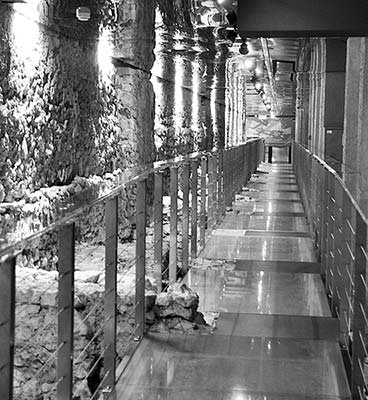
Once inside, climb down a flight of stairs and follow the numbered panels—1 to 70—through the exhibit (all in English). Modern museum technology illuminates life and times in medieval Kraków: Touchscreens let you delve into topics that intrigue you, 3-D virtual holograms resurrect old buildings, and video clips illustrate everyday life on unexpected surfaces (such as a curtain of fog).
All of this is wrapped around large chunks of early structures that still survive beneath the Square; several “witness columns” of rock and dirt are accompanied by diagrams helping you trace the layers of history. Interactive maps emphasize Kraków’s Europe-wide importance as an intersection of major trade routes, and several models, maps, and digital reconstructions give you a good look at Kraków during the Middle Ages—when the Old Town looked barely different from today. You’ll see a replica of a blacksmith’s shop and learn how “vampire prevention burials” were used to ensure that the suspected undead wouldn’t return from the grave. In the middle of the complex, look up through the glass of the Square’s fountain to see the towers of St. Mary’s above. Under the skylight is a model of medieval Kraków. While it looks much the same as today, notice a few key changes: the moat ringing the Old Town, where the Planty is today; and the several smaller market halls out on the Square.
Deeper in the exhibit, explore the long corridors of ruined buildings that once ran alongside the length of the Cloth Hall. There are many intriguing cases showing artifacts that shops would have sold (jewelry, tools, amber figurines, and so on). Also in this area, you’ll find a corridor with images of the Square all torn up for the renovation, plus a series of five modern brick rooms, each showing a brief, excellent film outlining a different period of Kraków’s history. These “Kraków Chronicles” provide a big-picture context to what otherwise seems like a loose collection of cool museum gizmos, and also help you better appreciate what you’ll see outside the museum’s doors.
Nearby: At the northwest corner of the Square, the Krzysztofory Palace (at #35) is the headquarters of Museum of Kraków. At the entrance is a visitors center where you can get information and book tickets and reservations for a variety of these sights (see “Tourist Information,” earlier). The building also has a city history museum, which offers a sprawling lesson on two floors (28 zł, free on Tue, open daily 10:00-19:00, last entry 1.25 hours before closing, Rynek Główny 35, +48 12 426 5060). While the exhibits try hard, this is best left to serious historians or those looking for a mildly engaging rainy-day activity. In the basement, you’ll find paintings, sculptures, suits of armor, busts of royalty, and old street signs; the most interesting section, at the end, is a film showing a virtual reconstruction of medieval Kraków. Upstairs, there are themed rooms (such as “spirituality” and “academia”) to complete the story. You’ll finish with a walk through a gigantic version of the nativity scenes that are featured in a festival each December.
Jagiellonian University Museum: Collegium Maius
Kraków’s historic university building sits in a quiet area a short walk from the Square. While the atmospheric courtyard itself—described earlier in “Kraków’s Royal Way Walk”—is worth ▲, the interior is less compelling. They routinely change details for how you enter—sometimes it’s with a student guide, other times you’re free to roam with an audioguide—but either way, you’ll likely see the library, refectory (with a gorgeously carved Baroque staircase), treasury (including Polish filmmaker Andrzej Wajda’s honorary Oscar), assembly hall, some old scientific instruments, and other academic artifacts.
Cost and Hours: 15 zł, free on Wed afternoons; guided tours depart 2/hour Mon-Fri 10:00-13:00; unaccompanied visits with audioguide Mon-Fri 13:00-17:00, Sat 10:00-15:00; closed Sun; two short blocks west of the Square at Jagiellońska 15, +48 12 663 1448, www.maius.uj.edu.pl).
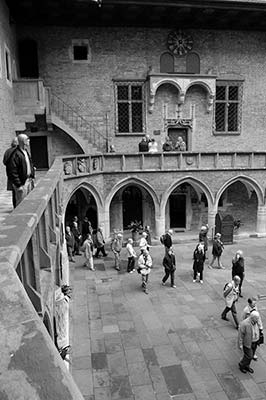
Dominican Church, a.k.a. Holy Trinity Church (Bazylika Trójcy Świętej)
In most towns, this church would be something special. In church-crazy Kraków, it’s an also-ran. Still, it’s easy to see (just a couple of blocks south of the Square) and worth a peek.
Cost and Hours: Free but donation requested, daily 6:30-13:00 & 16:00-20:00, facing Plac Dominikański at Stolarska 12.
Visiting the Church: Inside, you’ll find a Neo-Gothic space that was rebuilt after a devastating 1850 fire. The unique metal chandeliers are one of many modern flourishes added during the late-19th-century restoration of the church. Climb the staircase in the left aisle to reach the chapel of St. Hyacinth. Locally known as St. Jacek, this early Dominican leader—called the “Apostle of the North”—is also the patron saint of pierogi (stuffed dumplings, similar to ravioli). During a famine, St. Jacek supposedly invented pierogi and—in a loaves-and-fishes-type miracle—produced plateful after plateful, feeding the desperate locals. His image adorns Kraków’s annual Pierogi Cup contest, and to this day, when old-fashioned Poles are surprised, they might exclaim, “Święty Jacek z pierogami!” (“St. Jacek and his pierogi!”). Back down in the main part of the church, stroll slowly past the gorgeously carved wooden seats of the choir area (behind the altar); then, at the main altar, identify the three parts of the Trinity: Jesus (short beard), God (long beard), and Holy Spirit (beardless dove).
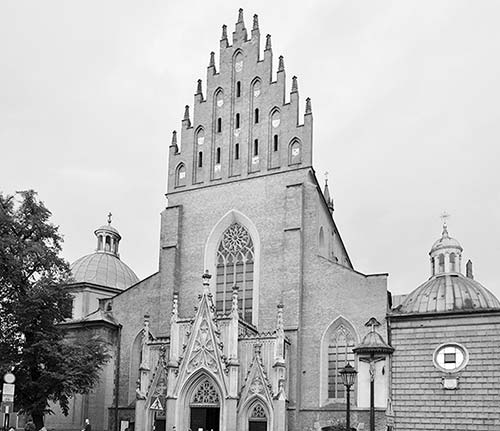
Archdiocesan Museum (Muzeum Archidiecezjalne)
This museum, in a building where St. John Paul II lived both as a priest and as a bishop, is a handy place to learn more about Kraków’s favorite son (without making the long trip to the St. John Paul II Sanctuary on the outskirts or his family home museum in Wadowice—both described later). The exhibition includes John Paul II’s personal effects, including clothes, handwritten notes, travel gear, bike, kayak, and skis—reminding visitors that he was one sporty pope. Then you’ll tour the lavish private apartments where he lived from 1958 until 1967, as archbishop of Kraków. Throughout the collection are many portraits and photographs of the late pontiff—making his cult of personality almost palpable.
Cost and Hours: 10 zł or included in Wawel Cathedral ticket—see earlier, Tue-Sun 10:00-17:00, closed Mon, Kanonicza 19, +48 12 421 8963, www.archimuzeum.pl.
▲Stained-Glass Workshop and Museum (Pracownia i Muzeum Witrażu)
This fascinating, offbeat attraction sits on a busy urban street about a 10-minute walk beyond the Planty west of the Old Town. Its centerpiece is the actual stained-glass workshop, from 1902, where Stanisław Wyspiański and other great artists created windows that decorate many Kraków churches. I like how this place approaches a very old craft with a fresh, youthful enthusiasm. You can take a tour of the production facility, including a demonstration of stained glass being created by hand; you can join a workshop to make your own stained-glass creation; or you can just come and hang out in their chill, easygoing café, decorated with some beautiful samples. Check the schedule and book ahead online, for either the tour or the workshop.
Cost and Hours: 50 zł for a 45-minute tour including a demo, usually Tue-Sat at 12:00 and 15:00; tour plus window-making workshop around 300 zł, longer courses also available; café open Tue-Sat 11:30-13:30 & 14:30-16:30, Sat 10:00-17:00, closed Sun-Mon; kitty-corner from National Museum main branch at Aleja Zygmunta Krasińskiego 23, +48 512 937 979, www.muzeumwitrazu.pl.