ČESKÝ KRUMLOV
Krumau
BETWEEN THE BUS STATION AND THE OLD TOWN
IN THE PLEŠIVECKÁ NEIGHBORHOOD
IN THE PLEŠIVECKÁ NEIGHBORHOOD
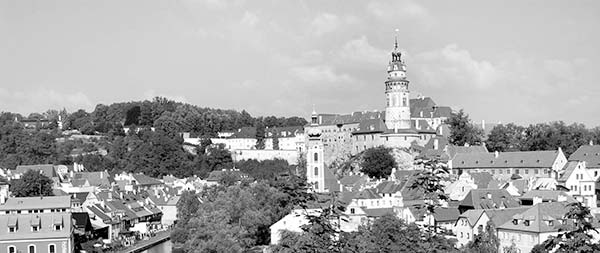
Surrounded by mountains, lassoed by its river, and dominated by its castle, this town mesmerizes visitors. When you see its awe-inspiring castle, delightful Old Town of cobbled lanes and shops, and easy canoeing options, you’ll understand why having fun is a slam-dunk here. Romantics are floored by Český Krumlov’s spectacular setting; you could spend all your time doing aimless laps from one end of town to the other.
The sharp bends in the Vltava provide natural moats, so it’s no wonder Český Krumlov has been a choice spot for eons. Celtic tribes settled here a century before Christ. Then came Germanic tribes. The Slavic tribes arrived in the ninth century. The Rožmberks (Rosenbergs)—Bohemia’s top noble family—ran the city from 1302 to 1602. You’ll spot their rose symbol all over town.
The 16th century was the town’s golden age, when Český Krumlov hosted artists, scientists, and alchemists from across Europe. In 1588, the town became home to an important Jesuit college. In 1602, the Rožmberks ran out of money to fund their lavish lifestyles, so they sold their territory to the Habsburgs—who ushered in a more Germanic period. After that, as many as 75 percent of the town’s people were German—until 1945, when most Germans were expelled (for more on this era and its repercussions, see the sidebar later in this chapter).
Český Krumlov’s rich mix of Gothic, Renaissance, and Baroque buildings is easy to miss. As you wander, be sure to look up...notice the surviving details in the fine stonework and pretty gables. Step into shops. Snoop into back lanes and tiny squares. Gothic buildings curve with the winding streets. Many precious Gothic and Renaissance frescoes were whitewashed in Baroque times (when the colorful trimmings of earlier periods were long out of style). Today, these frescoes are being rediscovered and restored.
Český Krumlov is a huge tourist magnet, which makes things colorful and easy for travelers. It can feel like a medieval theme park—but, fortunately, there are still a few hidden nooks and sleepy back alleys to savor. And a half-day float on the river can help you relax into the local pace.
PLANNING YOUR TIME
It’s easy to enjoy Český Krumlov without ever paying to enter a sight (morning and evening are best for strolling without crowds). But a tour of the Baroque Theater at the castle is worth considering—book ahead for an English tour (see “Sights in Český Krumlov,” later, for details), then build your day around your visit time. While you’re at it, consider booking an English tour of the castle interior. Visits to the synagogue and Seidel Photo Studio Museum bring more recent history alive.
If the outdoors is your thing, a paddle down the river is a highlight, and a walk up to the Křížový Vrch (Hill of the Cross) rewards you with a fine view of the town and its unforgettable riverside setting.
Many sights are closed on Monday, though the major attraction—the town itself—is always open. Evenings are for atmospheric dining and drinking.
Orientation to Český Krumlov
Český Krumlov (CHESS-key KROOM-lohv) means, roughly, “Czech Bend in the River.” Calling it “Český” for short sounds silly to Czech speakers (since dozens of Czech town names begin with “Český”)—rather, they call it “Krumlov.”
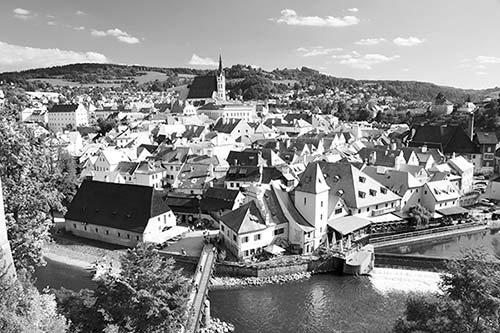
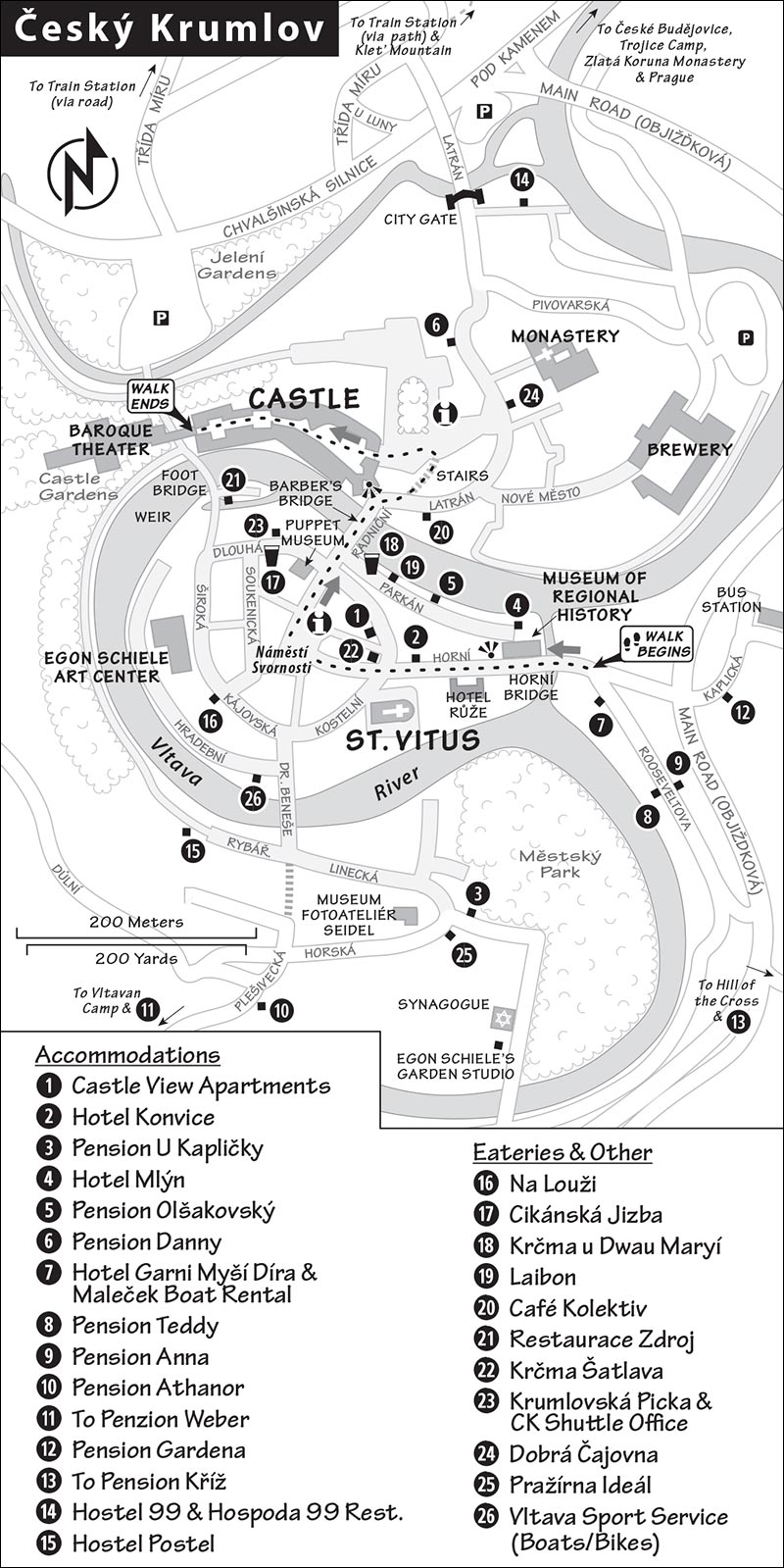
The city is extremely easy to navigate. The twisty Vltava River, which makes a perfect S through the town, ropes the Old Town into a tight peninsula. Above the Old Town is the Castle Town. Český Krumlov’s one main street starts at the isthmus and winds through the peninsula, crossing a bridge before snaking through the Castle Town, the castle complex (a long series of courtyards), and the castle gardens high above. I’ve narrated this route on my self-guided walk. The main square, Náměstí Svornosti—with the TI, ATMs, and taxis—dominates the Old Town and marks the center of the peninsula. My recommended restaurants, hotels, and sights are all within a 5-to-10-minute walk of this square.
TOURIST INFORMATION
The helpful city TI is on the main square (daily 9:00-18:00, June-Aug until 19:00, shorter hours in winter, +420 380 704 622, www.ckrumlov.info). The 129 Kč City Guide book includes a schematic town-and-castle map. The TI has a baggage-storage desk and can check train and bus schedules. Ask about concerts, city walking tours in English, and canoe trips on the river. The castle TI, which provides information about castle tours but does not sell tickets, is in the castle’s lowest courtyard (daily 9:00-18:00, +420 380 725 110).
Český Krumlov Card: This 400 Kč card, sold at the TI and participating sights, covers entry to the Round Tower and Castle Museum (but not castle tours), the Museum of Regional History, the Seidel Photo Studio Museum, and the Monastery Museum. Do the math to decide if it makes sense for you.
ARRIVAL IN ČESKÝ KRUMLOV
By Train: The train station is a 20-minute walk from town (turn right out of the station, then walk downhill onto a steep cobbled path leading to an overpass into the town center). Taxis are standing by to zip you to your hotel (about 100 Kč), or call +420 602 113 113.
By Bus: The bus station is just three blocks away from the Old Town. Follow signs for Centrum. Figure on 60 Kč for a taxi from the station to your hotel.
By Car: Parking lots ring the town center, each one marked by a blue P sign. If your hotel is in the mostly traffic-free center, you’ll be allowed to drive in (gingerly passing hordes of tourists) and park on the main square just long enough to drop off your bags and get directions to one of the outer lots. The flow of traffic is one-way: Enter at the east end of town, on Horní street, then exit across two bridges at the south end of town, on Linecká street (get details from your hotel before you arrive).
HELPFUL HINTS
Festivals: Locals and visitors alike drink oceans of beer and celebrate the town’s medieval roots at big events such as the Five-Petalled Rose Festival (Slavnosti Pětilisté Růže), where blacksmiths mint ancient coins, jugglers swallow fire, mead flows generously, and pigs are roasted on open fires (late June, www.ckrumlov.info). The summer also brings a top-notch international music festival, with performances in pubs, cafés, and the castle gardens (mid-July-mid-Aug, www.festivalkrumlov.cz). During St. Wenceslas celebrations, the square becomes a medieval market and the streets come alive with theater and music (late Sept).
Bike Rental: You can rent bikes at Vltava Sport Service (see listing under “Canoeing and Rafting the Vltava,” later).
Tours in Český Krumlov
Walking Tours
Since the town itself, rather than its sights, is what it’s all about here, taking a guided walk is the key to a meaningful visit. The Free Walking Tour offers a general town introduction. Reservations are required: Book online and meet in front of the TI on the main square (tip expected—about 200-400 Kč/person depending on group size, daily at 14:00, also at 10:30 in high season, 2 hours, www.wisemanfreetour.com).
Local Guides
Oldřiška Baloušková studied in California before starting a family back in her hometown, which she knows through and through (1200 Kč/1.5-hour tour, +420 737 920 901, oldriskab@gmail.com). Jiří (George) Václavíček, a gentle and caring man who perfectly fits mellow Český Krumlov, is a joy to share this town with (600 Kč/hour, +420 603 927 995, www.krumlovguide.com). Karolína Kortusová is an enthusiastic, experienced guide. Her company, Krumlov Tours, can set you up with a good local tour guide, palace and theater admissions, river trips, and more (guides-600 Kč/hour, +420 723 069 561, https://krumlovtours.com).
Český Krumlov Walk
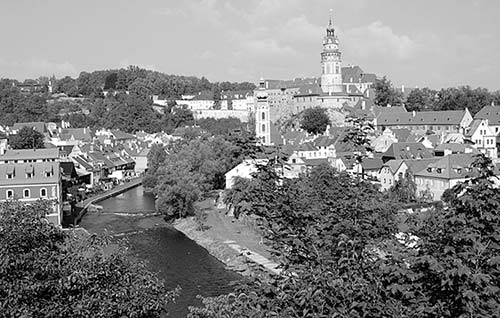
The town’s best sight is its cobbled cityscape, surrounded by a babbling river and capped by a dramatic castle. Most of Český Krumlov’s modest sights are laced together in this charming self-guided walk from the top of the Old Town, down its middle, across the river, and up to the castle. The walk begins at a fine viewpoint...and ends at an even better one. I’ve divided it into two parts: downhill, through the Old Town to the river; then uphill, ascending through the castle complex on the other side. You can also do the two parts on different days. The second half of the walk makes a useful spine for organizing a visit to the castle quarter. To trace the route of this walk, see the “Český Krumlov” map.
THE OLD TOWN
• Start at the bridge over the isthmus, which was once the fortified grand entry gate to the town. For the best view, step down to the little terrace in front of the restaurant gate.
Horní Bridge: From this “Upper Bridge,” note the natural fortification provided by the tight bend in the river. Trace the river to your right, where it curves around the last building in town, with a smokestack. This is the Pivovar Český Krumlov Brewery, makers of the hometown brew (with tours—see listing under “Sights in Český Krumlov,” later). Behind that, on the horizon, is a pile of white apartment high-rises—built in the last decade of the communist era to solve a housing shortage (many homes were demolished after their German owners were forced out at the end of World War II). To the left of the brewery stands a huge monastery (with the pointy red steeple; today, this hosts the Monastery Museum). Behind that, on Kleť Mountain—the highest hilltop—stands a TV tower and a world-class astronomical observatory and research center.
Head back up to the middle of the bridge. Look down and left, then down and right. Notice how the Vltava wraps entirely around the town center. Rafters take about a half-hour to circle around the Old Town peninsula, beginning and ending under this bridge.
• Head into town on...
Horní Street: As you step off the bridge, Český Krumlov’s aptly named “Upper Street” passes the Museum of Regional History on the right (see “Sights in Český Krumlov,” later). Just past the museum, a little garden overlook affords a fine castle view.
Immediately across the street (on the left), notice the Renaissance facade of Hotel Růže: This former Jesuit college hides a beautiful courtyard, now filled with artistic vendor stands. Pop inside to shop or just admire its decoration of faux sgraffito “bricks,” made by scratching into an outer layer of one color of plaster to reveal a different color beneath. This style was all the rage during the town’s boom time, and we’ll see several more examples on this walk.
• Walk another block down the main drag until you reach steps on the left leading to the...
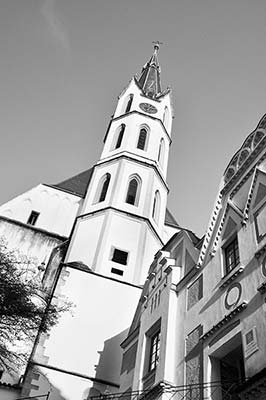
Church of St. Vitus: Český Krumlov’s main church was built as a bastion of Catholicism in the 15th century, when the Roman Catholic Church was fighting the Hussites. Step inside (generally open daily 9:00-16:30, Sunday Mass at 9:30, daily Mass at 17:00 in the winter chapel, +420 380 711 336). The 17th-century Baroque high altar shows a totem of religious figures: the Virgin Mary (crowned in heaven), St. Vitus (above Mary), and, way up on top, St. Wenceslas, the patron saint of the Czech people, long considered their ambassador in heaven. The canopy in the back, though empty today, once supported a grand statue of a Rožmberk atop a horse. The statue originally stood at the high altar. (Too egotistical for Jesuits, it was later moved to the rear of the nave and then lost for good.) While the 1906 Neo-Gothic main organ has been renovated, it’s the cute little circa-1716 Baroque beauty that gets more attention—deservedly so.
• Continuing on Horní street, you’ll come to the...
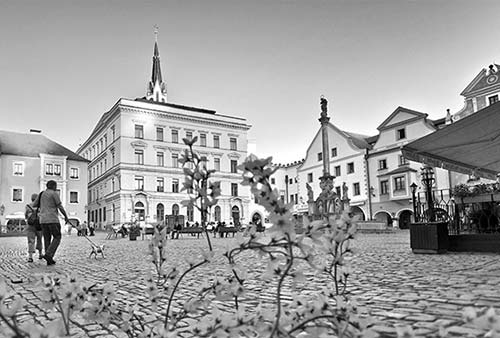
Main Square (Náměstí Svornosti): Lined with a mix of Renaissance and Baroque homes of burghers (all built on 12th-century Gothic foundations), the main square has a grand charm. The Town Hall (the crenellated white building on the right) flies both the Czech flag and the town flag, which shows the rose symbol of the Rožmberk family, who ruled the town for 300 years.
Imagine the history that this square has seen: In the 1620s, the town was held by the (very Catholic) Habsburgs, just as Lutheran Protestantism was rising to threaten Catholic Europe. Krumlov was a seat of Jesuit power and learning, and the intellectuals of the Roman church allegedly burned books on this square. Later, when there was a bad harvest, locals blamed witches—and burned them, too. Every so often, terrible plagues rolled through the countryside. In a nearby village, all but two residents were killed by a plague.
But the plague stopped before devastating the people of Český Krumlov, and in 1715—as thanks to God—they built the plague monument that stands on the square today (on the left). Much later, in 1938, Hitler stood right here before a backdrop of long Nazi banners to celebrate the annexation of the Sudetenland. And in 1968, Russian tanks spun their angry treads on the roads to this square to intimidate locals who were demanding freedom.
• From the main square, walk down Radniční street (on the right, just past the Town Hall) and cross the...
Barber’s Bridge (Lazebnický Most): This wooden bridge, decorated with two 19th-century statues, connects the Old Town and the Castle Town. On the right side stands a statue of St. John of Nepomuk, who’s also depicted by a prominent statue on Prague’s Charles Bridge. Among other responsibilities, he’s the protector against floods. In the great floods in August 2002, the angry river submerged the bridge (but removable banisters minimized the damage). Stains just above the windows of the adjacent building show how high the water rose.
• The second part of the walk involves lots of uphill hiking—but it’s worth it to see the castle courtyards and dramatic views.
KRUMLOV CASTLE
Big and imposing, the town castle boasts several fine courtyards, spectacular viewpoints, and gorgeous gardens—all of which are open to the public, free to enter, and fun to roam (though some areas may be closed on Mon). This part of the walk focuses on those public spaces, leading you from Barber’s Bridge, through the heart of the castle, and up to a picturesque viewpoint just before the gardens. The castle also has several individual sights (Round Tower, Castle Museum, Upper Castle, Baroque Theater) that can be laced into this walk but require paid admission and/or a reserved tour (for details, see listings under “Sights in Český Krumlov,” later).
• Cross the bridge and head up shop-lined Latrán street, which bends to the right. Just after that bend, look for the stairs on your left (in front of the gray-and-white building). Head up, passing under a stone arch with the wood-carved rose symbol of the Rožmberk family. You’ll emerge into the castle’s...
First (Lower) Courtyard: This is just the first of many courtyards that bunny-hop up through the castle complex. This was the site for workers and industry (stables, smithy, brewery, pharmacy, and so on)—convenient for aristocratic needs, but far enough away to keep noises and smells at bay.
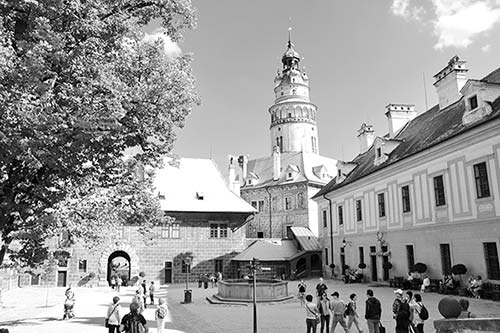
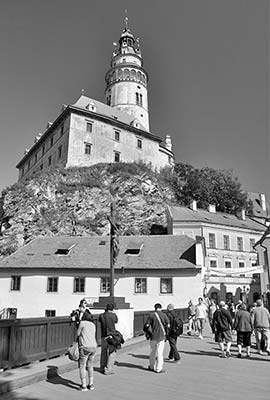
Looking up, you can’t miss the strikingly colorful Round Tower that marks the location of the first castle, built here to guard the medieval river crossing. It features a colorfully restored 16th-century Renaissance paint job, fancy astrological decor, terra-cotta symbols of the zodiac, and a fine arcade.
• Head up to the former drawbridge. Look over the sides of the bridge. Spot any bears?
Bear Pits (Medvědí Příkop): These hold a family of European brown bears, as they have since the Rožmberks added bears to their coat of arms in the 16th century to demonstrate their (fake) blood relation to the distinguished Italian Orsini family (whose name means “bear-like”). Featured on countless coats of arms, bears have long been totemic animals for Europeans. Pronouncing the animal’s real name was taboo in many cultures, and Czechs still refer to bears only indirectly. For example, in most Germanic languages, the word “bear” is derived from “brown,” while the Slavic medvěd literally means “honey eater.”
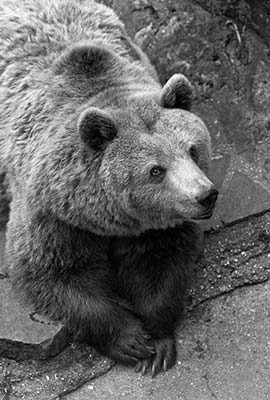
Near the top of the bridge, notice the gently worded sign suggesting that—rather than toss down your junk-food leftovers—you add a few coins in the collection slot to finance “more varied meals and delicacies” for the bears.
• Continue through the gateway into the...
Second Courtyard: Here you’ll spot more of the sgraffito (Renaissance faux features scraped into wet plaster) that decorates much of the castle. To your left, at the bottom of the courtyard, is the entrance to the tower climb and the Castle Museum. Farther up on the left is the ticket office for castle tours, including the Baroque Theater—stop in now (if you haven’t already) to see about a tour.
• From here, things get steep as we enter the...
Heart of the Castle Complex: Head up the bridge, noticing the little view terrace on the left—the first of several along here. You’ll emerge into the Third Courtyard, then (after a corridor) the Fourth Courtyard. Nicely preserved paintings enliven their blocky facades. Wrapped around these courtyards is the castle proper, a mighty Renaissance building sometimes called the Upper Castle (interiors open to visitors—notice the meeting points for various tour options). Continuing straight out through the end of the Fourth Courtyard, you’ll cross the breathtaking Cloak Bridge—a triple-decker, statue-lined, covered bridge spanning a vast gorge and connecting the castle firmly with the gardens that sprawl behind it. Enjoy the views—but, believe it or not, even better ones are coming up.
Notice the Baroque Theater, at the far end of the bridge, which still uses traditional methods for moving scenery and producing sound effects. Aspects of this back-in-the-day stagecraft still survive on Broadway today. This is one of only two such original theaters in Europe.
• After the bridge, continue uphill through the...
Fifth Courtyard: Really more of a pathway, this connects the castle to its gardens. Walk along the white wall—with peekaboo windows—until you are almost at the gate up top. High on the wall to the right, notice the sundial. Check the time: It’s dead-on...except for Daylight Saving Time, which was unknown to medieval timekeepers. Notice that the sundial cuts into one of the faux windows, painted on the lower level of the building to create Renaissance symmetry.
Now step through the low-profile door directly across from the sundial. You’ll emerge at a spectacular viewpoint that takes in the entire town, its curving river, and even the colorful tower and most of the castle complex you just came through. Jockey your way through the selfie-snapping crowd and drink it in. (Or literally drink, at the little adjacent bar.)
• Our walk is finished. But if you still have stamina, you can consider exploring the castle gardens—they’re just uphill, through the gate from the Fifth Courtyard.
Sights in Český Krumlov
KRUMLOV CASTLE COMPLEX (KRUMLOVSKÝ ZÁMEK)
▲Round Tower (Zâmecká Věž) and Castle Museum (Hradní Muzeum)
▲▲Baroque Theater (Zámecké Divadlo)
Castle Gardens (Zámecká Zahrada)
▲Seidel Photo Studio Museum (Museum Fotoateliér Seidel)
Museum of Regional History (Regionální Muzeum v Českém Krumlově)
Puppet Museum and Fairy Tale House (Muzeum Loutek a Pohádkový Dům)
▲Pivovar Český Krumlov Brewery Tour
Křížový Vrch (Hill of the Cross)
▲▲▲Canoeing and Rafting the Vltava
Zlatá Koruna Monastery (Klášter Zlatá Koruna)
KRUMLOV CASTLE COMPLEX (KRUMLOVSKÝ ZÁMEK)
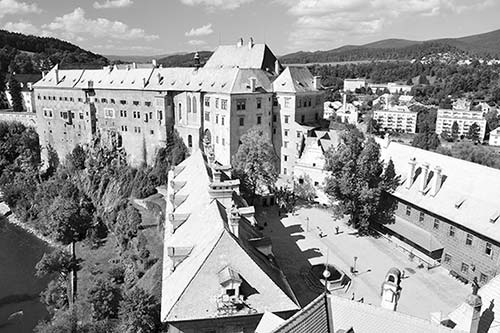
No Czech town is complete without a castle—and now that the nobles are gone, their mansions are open to us common folk. Český Krumlov is no different. Its immense Krumlov Castle complex, one of the largest in Central Europe, perches on a rock promontory overlooking the Vltava River and the town. The original Gothic castle took shape here in the 13th century, and eventually the Rožmberk, Eggenberg, and Schwarzenberg families each inherited it in turn. In successive waves of additions and renovations, they built it into the splendid Renaissance/Baroque property you see today.
The following sights are listed in the order you’ll reach them as you climb up through the complex (ideally following my self-guided walk, earlier). The Round Tower and Castle Museum can be visited at your leisure, while other castle interiors—including the excellent Baroque Theater—can be seen only with a guided tour (see next). On a quick visit, the only sight I’d bother paying admission for is the theater.
Reservations Recommended: It’s worth booking ahead to guarantee a slot on an English-language tour of the Upper Castle interior or the Baroque Theater (the theater is the castle attraction most likely to sell out). Book at least a day ahead on the castle website. You’ll be issued an eticket with your selected tour time. Print the ticket or have it accessible on your mobile device, and be in the correct courtyard a few minutes before your appointed time, or you’ll be locked out.
Reservations can also be made in person at the castle ticket office, or by phone.
Information: +420 380 704 721, www.zamek-ceskykrumlov.cz.
▲Round Tower (Zâmecká Věž) and Castle Museum (Hradní Muzeum)
These two sights share a ticket office at the bottom of the castle’s middle courtyard. While neither is a must, both are worth considering if you want a peek inside the castle without committing to a guided tour.
Colorfully impressive from the outside, the tower is also fun to climb. Twist up the 163 well-worn wood and stone steps to the top, where you’ll be rewarded with grand 360-degree views over the town, the rest of the castle complex, and happy boaters floating on the river.
The exhibits at the Castle Museum focus on key moments in the lives of the town’s various ruling families: Rožmberks, Eggenbergs, and Schwarzenbergs. Be sure to download the free mobile guide onto your phone before you enter. You’ll see a hall of aristocratic portraits; the offices, bedrooms, and dining rooms of the various inhabitants; and a modest religious treasury, armory, and musical instruments collection. At the end, you can sit in old-timey cinema seats and watch archival footage of the castle’s residents from the 1920s and 1930s.
Cost and Hours: Combo-ticket for tower and museum—180 Kč; both open daily 9:00-16:30, June-Aug until 17:30, shorter hours and closed Mon in winter; last entry one hour before closing. This ticket is not sold online.
▲Upper Castle (Horní Hrad)
While the Upper Castle grounds are free to explore, you’ll need to take a tour to access the interiors. Two different tour routes give you a glimpse of the places where the Rožmberks, Eggenbergs, and Schwarzenbergs dined, studied, worked, prayed, entertained, and slept. (By European standards, the castle’s not much, and the tours move slowly.) Imagine being an aristocratic guest here, riding the dukes’ assembly line of fine living: You’d promenade through a long series of elegant spaces and dine in the sumptuous dining hall before enjoying a concert in the Hall of Mirrors, which leads directly to the Baroque Theater (described next). After the play, you’d go out into the château garden for a fireworks finale.
Cost and Hours: Choose from Tour I (Baroque and Renaissance rooms, of the most general interest) or Tour II (19th-century castle life). Tours cost 240 Kč, leave regularly, and are conducted in Czech, English, and occasionally German (note that the English tours often book up). Tour I runs Tue-Sun 9:00-16:00, longer hours June-Aug; Tour II runs Sat-Sun 9:00-16:00, Tue-Sun July-Aug, longer hours in summer. It’s smart to book ahead—see “Reservations Recommended,” earlier.
▲▲Baroque Theater (Zámecké Divadlo)
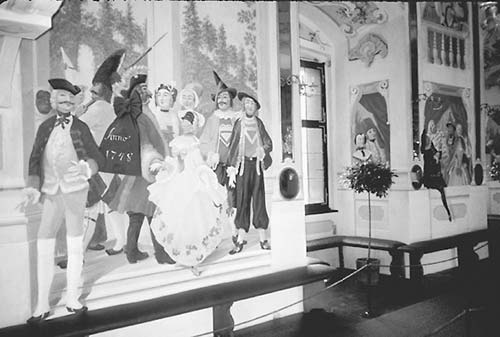
Europe once had several hundred Baroque theaters. Using candles for light and fireworks for special effects, most burned down. Today, only two survive in good shape and are open to tourists: one at Stockholm’s Drottningholm Palace, and one here, at Krumlov Castle. During the 45-minute tour, you’ll sit on benches in the theater and then go under the stage to see the wood-and-rope contraptions that enabled scenes to be scooted in and out within seconds (while fireworks and smoke blinded the audience). It’s a lovely little theater with an impressive 3-D effect that makes the stage look deeper than it really is, but don’t bother with the tour unless you can snare a spot on an English one. The theater is used only once a year for an actual performance, attended by Baroque theater enthusiasts.
Cost and Hours: 280 Kč, tours Tue-Sun May-Oct, no tours Nov-April; English departure generally at 10:00. Due to the theater’s fragility, groups are limited to 20 people, and English tours generally sell out. Reserve ahead—see “Reservations Recommended,” earlier.
Castle Gardens (Zámecká Zahrada)
This lovely, 2,300-foot-long garden crowns the castle complex. It was laid out in the 17th century, when the noble family would have it lit with 22,000 oil lamps, torches, and candles for special occasions. The lower part is geometrical and symmetrical—French garden-style. The upper part is wilder—English garden-style. Both are delightful.
Cost and Hours: Free, open May-Sept daily 8:00-19:00, April and Oct until 17:00, closed Nov-March.
OTHER SIGHTS IN TOWN
▲Seidel Photo Studio Museum (Museum Fotoateliér Seidel)
This fully preserved, meticulously renovated 1905 Art Nouveau villa featuring original furnishings, a garden, and 100-year-old photo equipment offers a welcome respite from the crowds and the ubiquitous Middle Ages. The museum, set in the home and studio of Josef Seidel (1859-1935) and his son František (1908-1997), features more than 100,000 of their original photographs of life in this mountainous region—Šumava, or Böhmerwald (Bohemian Forest)—between 1880 and 1950.
Josef Seidel was unique among his contemporaries in focusing his photography on just one region, and was the first in the country to use autochrome. Allowed to remain in Český Krumlov during and after World War II at a time when many Germans in the country were expelled, František continued his father’s photography business, remaining here until his death in 1997. After his wife died in 2003, the town bought the house and converted it into a delightful museum and a cultural center for cross-cultural understanding. Restored, functional equipment offers hands-on experience with the process of photography during the late 19th and early 20th centuries. You can literally smell the history.
Cost and Hours: 170 Kč, includes English audioguide; Tue-Sun 9:00-12:00 & 13:00-16:00; across the river south of Old Town at Linecká 272, +420 736 503 871, www.seidel.cz.
Synagogue
Completed in 1910 in a mixture of architectural styles, this synagogue served the small Jewish community of Český Krumlov and neighboring villages. In 1938, there were 200 congregants here, but only two members of the area’s Jewish community survived after World War II. Terribly run-down for decades after the war, the synagogue was restored to its former glory in 2015 by the Prague Jewish community, with funding from the European Union and German and Austrian sponsors. It contains an exhibit on its history and hosts concerts and contemporary art exhibits.
Cost and Hours: Free; Tue-Sun 10:00-16:00, closed Mon; shorter hours off-season, across the river south of Old Town at Za Soudem 282, +420 604 217 174, www.synagoga-krumlov.cz.
Eating: The $ Café Synagoga, with an assortment of cakes, occupies the former basement residence of the rabbi’s family and an adjacent peaceful garden (daily 10:00-18:00, closed Oct-April).
Museum of Regional History (Regionální Muzeum v Českém Krumlově)
This small museum gives you a quick look at regional costumes, tools, and traditions. When you pay, pick up the English translation of the displays (it also includes a lengthy history of Krumlov). Start on the top floor, where you’ll see a Bronze Age exhibit, old paintings, a glimpse of noble life, and a look at how the locals rafted lumber from the Böhmerwald Mountains all the way to Vienna (partly by canal). Don’t miss the fun-to-study ceramic model of Český Krumlov in 1800 (note the extravagant gardens high above the town). The lower floor comes with fine folk costumes and domestic art.
Cost and Hours: 60 Kč, Tue-Sun 9:00-12:00 & 12:30-17:00, July-Aug until 18:00, closed Mon year-round, Horní 152, +420 380 711 674, www.muzeumck.cz.
Puppet Museum and Fairy Tale House (Muzeum Loutek a Pohádkový Dům)
In three small rooms, you’ll view fascinating displays of more than 200 movable creations (overwhelmingly of Czech origin, but also some from Burma and Rajasthan). At the model stage, children of any age can try their hand at pulling the strings on their favorite fairy tale.
Cost and Hours: 100 Kč, daily 10:00-17:00, Nov-March 11:00-16:00, +420 723 325 262, Radniční 29, www.krumlovskainspirace.cz.
▲Pivovar Český Krumlov Brewery Tour
This may be one of the most intimate brewery tours in this land that so loves its beer. Tucked into a river bend on the edge of town, Český Krumlov’s spunky little brewery has an authenticity that can’t be matched by the big, soulless corporate breweries (such as Pilsner Urquell, in Plzeň, or the Czech Budweiser, in nearby České Budějovice). This is your chance to learn about the beer-making process at a facility where they’re still using the same giant copper vats from 1915. While some of the facility has recently been modernized (and ongoing works may reroute the tour a bit), you’ll still see lots of vintage equipment, including the original brew house (still in service), the fermentation vats, the cellars used for aging, and the bottling plant. Your tour ends with a visit to the pub, where you can sample some brews, including a “smoky” dark beer (Nakouřený Švihák), made with malt that tastes like salami and then aged for 100 days.
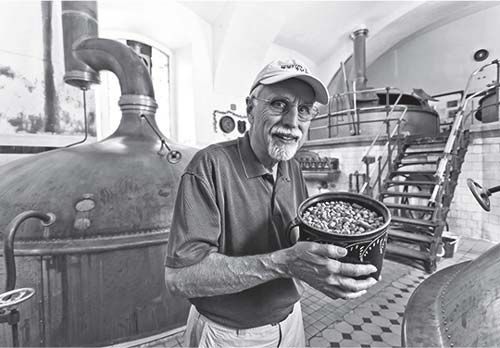
Cost and Hours: Tours are by appointment only, 1,250 Kč for groups of 1-4 people, 250 Kč/person for larger groups, includes three tastes. Reserve at least two days ahead by phone or email, +420 775 733 462, www.pivovarceskykrumlov.cz, tours@pivovarck.cz.
Getting There: It’s just a short stroll up Nové Město street from the main drag below the castle. During ongoing reconstruction, you may instead have to loop around town to the back entrance on Pivovarska—about a 10-minute walk.
Křížový Vrch (Hill of the Cross)
For an easy 30-minute hike up to the hill with commanding views, walk to the end of Rooseveltova street, cross at the traffic light, then head straight for the first (empty) chapel-like Station of the Cross. Turning right, it’s easy to navigate along successive Stations of the Cross until you reach the white church on the hill (closed to the public), set in the middle of wild meadows. Looking down into the valley at the medieval city nestled within the S-shaped river, framed by the rising hills, it’s hard to imagine any town with a more powerful genius loci (spirit of the place). The view is best at sunset.
▲▲▲Canoeing and Rafting the Vltava
For a quintessentially Czech experience, join the locals for a paddle down the Vltava River, the country’s most popular place for boating. Novices and hearty paddlers alike can spend as little as 30 minutes to a full day easing into a mellow, drifting mindset—stopping for a snack or a pivo at one of the many pubs and cafés along the way.
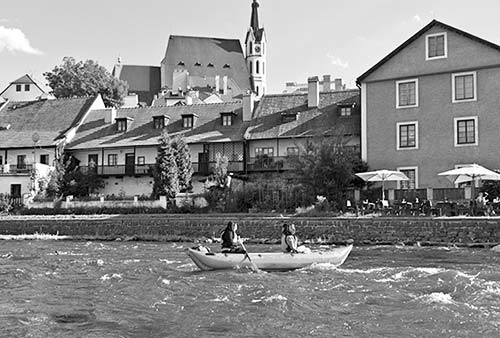
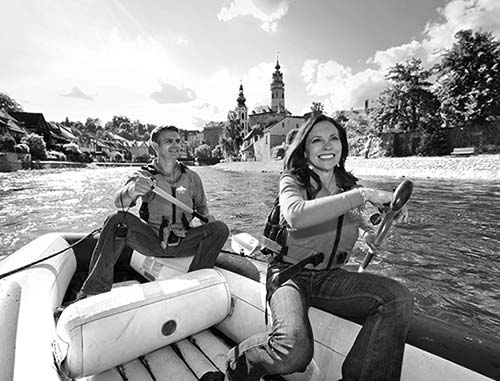
Rental companies all over town offer the same basic fleet: fiberglass canoes for two to three people, and rubber rafts for two to six people. While the canoes are faster and more agile, they require some experience to navigate a few whitewater areas. The rafts, meanwhile, are slower and easy to navigate, even for newcomers. A map, a waterproof bag, and all the necessary gear are included. With limited time, you can start from town and paddle as far as you like, then head back (see later for details). Plan to spend at least three hours on the river to fully appreciate the experience.
Rental Companies: Ingetour launches and picks up in each of the most useful locations (Krumlov Vltavan, Krumlov Trojice, Zlatá Koruna, Boršov) and runs a regular bus connecting them (Zlatá Koruna and Boršov are also connected by regular bus and train). You can end your paddle at any of their locations without committing from the start. While it’s best to reserve ahead, you can often just show up (www.ingetour.cz). Ingetour, like many other companies, also offers guided day trips. Other options are Maleček (Rooseveltova 28, +420 602 744 074, www.malecek.cz [URL inactive]) and Vltava Sport Service (Hradební 60, +420 380 711 988, www.ckvltava.cz). Vltava Sport Service offers a boat-and-bike option, boating down to Zlatá Koruna Abbey and cycling back via Dívčí Skála castle (Maiden’s Rock).
Downstream from Český Krumlov (1-7 hours): This plan allows you to paddle for as long as you want. Start at the Vltavan campsite above Český Krumlov, where most rental companies are based (it’s easiest to arrange a ride there with your rental company). From here, it’s about an hour (with some challenging sections) to the Trojice campsite at the other end of Český Krumlov (you can bail out here if you’ve had enough). Two hours more brings you to Zlatá Koruna Monastery, a beautifully set Gothic monastery (see listing under “Near Český Krumlov,” next). While many end their trip at the monastery (bus and train stations are close by), those who venture farther into the nature reserve that follows are rewarded with spectacular scenery and minimal river traffic. The water on this section also flows faster, so it is more fun. It can take close to four hours to reach the next stop in Boršov. To return to Český Krumlov from Boršov, you can take the Ingetour bus (last departure at 16:30) or the train (5-minute walk from dock; trains every 2 hours; 30 minutes).
NEAR ČESKÝ KRUMLOV
Zlatá Koruna Monastery (Klášter Zlatá Koruna)
This Cistercian abbey was founded in the 13th century by a Bohemian king to counter the growing influence of the Vítek family, the ancestors of the mighty Rožmberks. As you enter the grounds, notice the magnificent central linden tree, with its strange, capelike leaves; it’s said to have been used by the anti-Catholic Hussites when they hanged the monks. There are several tours: The one-hour tour takes you through the rare two-storied Gothic Chapel of the Guardian Angel, the main church, and the cloister; the 10-minute tour takes you to the abbey chapel, with the original Gothic Zlatá Koruna Madonna, the most treasured painting in the region; and the 30-minute tour combines highlights of both.
Cost and Hours: 180 Kč for one-hour tour in Czech, generally runs every half-hour, pick up English leaflet; 60 Kč for 10-minute abbey chapel tour; 140 Kč for 30-minute sacral tour; main tour runs June-Aug Tue-Sun 9:00-16:30, closed Mon, shorter hours in spring and fall, closed Nov-March; +420 380 743 126, www.klaster-zlatakoruna.cz.
Getting There: Drivers can reach the abbey in about 10 minutes from Český Krumlov (head north out of town and follow route #39). But it’s more fun to get there by raft or canoe—the abbey is directly above the river at the end of a three-hour float (see “Canoeing and Rafting the Vltava,” earlier).
Sleeping in Český Krumlov
Český Krumlov is filled with small pensions and hostels. Summer is busy all around. Plan to book months ahead to stay near the center, and at least a year ahead for places in the heart of town. Though I usually recommend booking directly with hotels, many of these small pensions are easier to book through Booking.com. My favorite neighborhood is called Plešivecká; it’s in the historic part of town, just a five-minute walk from the center, yet somehow away from all the tourist commotion.
IN AND NEAR THE OLD TOWN
$$$ Castle View Apartments rents seven diverse apartments. These are the best-equipped rooms I’ve found in town—the bathroom floors are heated, all come with kitchenettes, and everything’s done just right. Their website describes each stylish apartment; the “view” ones really do come with eye-popping vistas (RS%, apartment sleeps up to 6, breakfast at a nearby hotel, Šatlavská 140, +420 731 108 677, www.castleview.cz, info@castleview.cz).
$ Hotel Konvice is run by a German couple—and their three children—with a personal touch. Each room is uniquely decorated (a block above the main square at Horní 145, +420 380 711 611, https://en.stadthotel-krummau.de, hotelkonvice@quick.cz).
$ Pension U Kapličky, on a quiet street adjacent to a chapel and a city park, consists of two artistically designed apartments in an unusually shaped medieval house. Jitka, a teacher of stone carving at the local arts academy and one of the last old-timers still calling central Český Krumlov home, lives downstairs and bakes pastries for breakfast (reserve months ahead, Linecká 60, +420 606 434 090, https://ukaplicky.ckrumlov.cz, ukaplicky@ckrumlov.cz).
BELOW THE MAIN SQUARE
Secluded Parkán street, which runs along the river below the square, has a hotel and a row of small pensions. These places have a family feel and views of the looming castle above.
$$$ Hotel Mlýn, at the end of Parkán, is a tastefully furnished hotel with 50 rooms and all the amenities (elevator, pay parking, Parkán 120, +420 380 731 133, www.hotelmlyn.eu, info@hotelmlyn.eu).
$$ Pension Olšakovský, which has a delightful breakfast area on a terrace next to the river, treats visitors as family guests (free parking, Parkán 114, +420 792 311 040, www.olsakovsky.cz, office@olsakovsky.cz).
AT THE BASE OF THE CASTLE
A quiet, cobbled pedestrian street (Latrán) runs below the castle just over the bridge from the Old Town. Lined with cute shops, it’s a 10-minute walk downhill from the train station.
$ Pension Danny is a little funky place, with homey rooms and a tangled floor plan above a restaurant (in-room breakfast, Latrán 72, +420 603 210 572, www.pensiondanny.cz, recepce@pensiondanny.cz).
BETWEEN THE BUS STATION AND THE OLD TOWN
Rooseveltova street, midway between the bus station and the Old Town (a four-minute walk from either), is lined with several fine little places. The key here is tranquility—the noisy bars of the town center are out of earshot.
$$ Hotel Garni Myší Díra (“Mouse Hole”) hides 11 bright and woody Bohemian contemporary rooms overlooking the Vltava River just outside the Old Town (includes transfer to/from bus or train station, free parking, Rooseveltova 28, +420 380 712 853, www.hotelmysidira.cz). The no-nonsense reception, which closes at 20:00, runs a recommended boat rental company (Maleček, at the same address).
$ Pension Teddy offers three deluxe rooms that share a balcony overlooking the river and have original 18th-century furniture. Or stay in one of four modern-style rooms, some of which also face the river (cash only, staff may be unhelpful, pay parking, Rooseveltova 38, +420 724 003 981, www.penzionteddy.cz, info@penzionteddy.cz).
$ Pension Anna is well run, with two doubles, six apartments, and a restful little garden. Its apartments are spacious suites, with a living room and stairs leading to the double-bedded loft. The upstairs rooms can get stuffy during the summer (pay parking, Rooseveltova 41, +420 380 711 692, www.pensionanna-ck.cz, info@pensionanna-ck.cz). If you book a standard double and they bump you up to an apartment, don’t pay more than the double rate.
IN THE PLEŠIVECKÁ NEIGHBORHOOD
To reach this historical part of town—one of the last genuine-feeling neighborhoods in Český Krumlov—cross the Dr. Beneše Bridge, then climb the stairs directly ahead of you. These lead into a small, quiet square, with a couple of hotels and cafés. Take the street diagonally to the left (Plešivecká), which descends back toward the river, where you’ll find more local life. You’ll need to book up to a year in advance to stay in this neighborhood. A handy Coop supermarket is at the end of Plešivecká street.
$$ Pension Athanor is situated in a historic house on a quiet square (Plešivecké Náměstí 271, +420 720 611 712, www.apartmanyathanor.cz, info@apartmanyathanor.cz).
$ Penzion Weber is a family-run operation with a pleasant little garden overlooking the river (Plešivecká 129, +420 605 162 478, www.penzionweber.cz, weber.f@seznam.cz).
OUTSIDE THE CITY CENTER
$$ Pension Gardena has 16 spacious, airy rooms in two adjacent, tactfully renovated historical buildings. A family business with a garden, it’s on the way into town from the bus station just a hundred yards above Horní Bridge (Kaplická 21, +420 380 711 028, mobile +420 607 873 974, www.pensiongardena.com, gardena@seznam.cz).
$ Pension Kříž, with five rooms in a new house, is tucked away in a quiet, modern villa district under the Křížový Vrch (Hill of the Cross), just a five-minute walk from Horní Bridge (Křížová 71, +420 775 421 012, www.penzion-kriz.cz, ubytovani@penzion-kriz.cz).
HOSTELS
¢ Hostel 99’s picnic-table terrace looks out on the Old Town. While the gentle sound of the river gurgles outside your window late at night, you’re more likely to hear a youthful international crowd having a great time (cash only, private rooms available, laundry, recommended Hospoda 99 restaurant, 10-minute downhill walk from train station or two bus stops to Spicak; Věžní 99, +420 797 631 820, www.restaurant-99.com, hostel99@hostel99.cz).
¢ Hostel Postel is a small, artsy place with just 15 beds huddled down by the river, sleeping two to six people per room (Rybářská 35, +420 776 720 722, www.hostelpostel.cz, info@hostelpostel.cz).
Eating in Český Krumlov
With a huge variety of creative little restaurants, Český Krumlov is a fun place to eat. In peak season, the good places fill up fast, so make reservations or eat early.
IN AND NEAR THE OLD TOWN
$$ Na Louži seems to be everyone’s favorite Czech bistro, with 40 seats (many at shared tables) in one 1930s-style room decorated with funky old advertisements. They serve good, inexpensive, unpretentious local cuisine and hometown beer on tap (daily, near the Egon Schiele Art Center at Kájovská 66, +420 380 711 280, www.nalouzi.com).
$$ Cikánská Jizba (“Gypsy Pub”) is a Roma tavern filling one den-like, barrel-vaulted room. The Roma staff serves Slovak-style food (most of the Czech Republic’s Roma population came from Slovakia). While this rustic little restaurant—which packs its 10 tables under a mystic-feeling Gothic vault—won’t win any culinary awards, you never know what festive and musical activities will erupt, particularly on Friday and Saturday nights, when the band Cindži Renta (“Wet Rag”) performs here (closed Sun, 2 blocks toward castle from main square at Dlouhá 31, +420 722 236 615).
$$ Krčma u Dwau Maryí (“Tavern of the Two Marys”) is a characteristic old place with idyllic riverside picnic tables, serving medieval Czech cuisine and drinks. The fascinating menu explains the history of the house and makes a good case that the food of the poor medieval Bohemians was tasty and varied. Buck up for buckwheat, millet, greasy meat, or the poor-man’s porridge (daily, Parkán 104, +420 380 717 228).
$$ Laibon is a top choice for filling vegetarian meals, from Indian dal and vegetables to burritos, couscous, or Slovak gnocchi with sheep milk cheese. Settle down in the meditative inside or head out onto the castle-view river terrace and observe the raft-and-canoe action while you eat (daily, Parkán 105, +420 775 676 654).
$$ Café Kolektiv tries to inject some modern sophistication into this old town. It has a stark minimalist interior, a chalkboard menu, well-executed light café fare with some international flavors, a good cocktail selection, and stylish—if stuffy—service (daily until 18:00, Latrán 13, across from the castle stairs, +420 776 626 644).
$$ Restaurace Zdroj, with fine outdoor riverside seating and a somewhat less inviting interior, is the place in town to taste fresh carp, trout, or pike perch. They also offer non-fish daily specials (daily, on the island by the millwheel, +420 724 149 771).
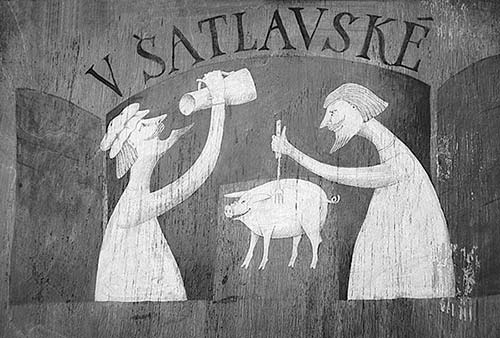
$$$ Krčma Šatlava is an old prison gone cozy, with an open fire, big wooden tables under a rustic old medieval vault, and tables outdoors on the pedestrian lane. It’s great for a late drink or roasted game (cooked on an open spit). Medovina is hot honey wine (daily, on Šatlavská, follow lane leading to the side from TI on main square, +420 380 713 344).
$ Krumlovská Picka, a tiny, atmospheric place on the island by the millwheel, offers takeout pizza and freshly baked-and-filled baguettes. Cuddle near the oven inside or picnic on the outside terrace (daily, closed off-season, Dlouhá 97, +420 777 804 638).
OUTSIDE THE CITY CENTER
$$ Hospoda 99 Restaurace serves good, cheap soups, salads, and meals. It’s the choice of hostelers and locals alike for its hamburgers, vegetarian food, Czech dishes, and cheap booze (daily, at Hostel 99, Věžní 99, +420 380 713 813). This place is booming until late, when everything else is hibernating.
$ Dobrá Čajovna, at the base of the castle, is a typical example of the quiet, exotic-feeling teahouses that flooded Czech towns in the 1990s as alternatives to smoky, raucous pubs. Though directly across from the castle entrance, it’s a world away from the tourist hubbub. With its meditative karma inside and a peaceful terrace facing the monastery out back, it provides a relaxing break (daily, Latrán 54).
IN THE PLEŠIVECKÁ NEIGHBORHOOD
Good traditional eateries with outdoor seating line the Vltava in the Plešivecká neighborhood; just cross the Dr. Beneše Bridge and head right along the river.
$ Pražírna Ideál (“Ideal Roastery”), on the corner of Linecká just past the Seidel Photo Studio Museum, is a tiny local place far away from the crowds and dead serious about the quality of its cakes and fair-trade brews (daily 9:30-19:00, Horská 70).
Český Krumlov Connections
BY PUBLIC TRANSPORTATION
Most trains to and from Český Krumlov require a transfer in the city of České Budějovice, a transit hub just to the north. Buses, on the other hand, are direct, if less comfortable. Bus and train timetables are available at https://idos.idnes.cz.
If you have time in České Budějovice between connections, consider a visit to the town’s gigantic medieval main square, Náměstí Přemysla Otakara II (about a six-block walk from the station). Store your bags in lockers at the train station, then exit the station to the right, cross the street at the crosswalk, and head straight down Lannova třida (which becomes Kanovnická street) to the square.
By Train
From Český Krumlov by Train to: České Budějovice (11/day, 45 minutes), Prague (9/day, 1/day direct, 3 hours), Vienna (8/day with changes in Budějovice and České Velenice, 5 hours), Budapest (6/day with changes in Budějovice and Linz, 7 hours).
By Bus
The state-of-the-art bus station is a five-minute walk above town (bus info +420 380 711 190). Regiojet (www.regiojet.com), Flixbus (www.flixbus.cz), and Leo Express (www.leoexpress.com) have online reservation systems, the newest buses, and a free drink for passengers.
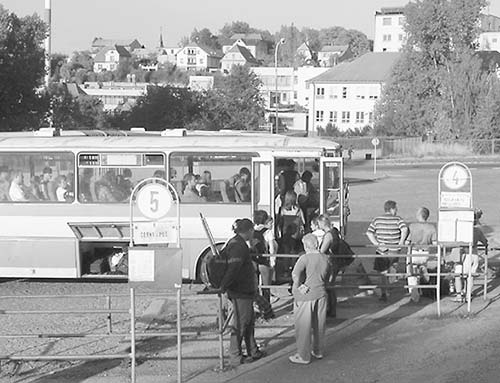
From Český Krumlov by Bus to: Prague (at least hourly, 3 hours; tickets can also be bought at the Český Krumlov TI), České Budějovice (transit hub for other destinations such as Třeboň, Telč, and Třebíč—hourly, 30 minutes).
BY SHUTTLE SERVICE
From Český Krumlov to Austria and Beyond: Several companies offer handy shuttle service. The best of the bunch is CK Shuttle, with free Wi-Fi on board and affordable fares: 1,200 Kč per person one-way to Vienna (3.5 hours), Salzburg (3 hours), Hallstatt (3 hours), or Prague (2.5 hours). They can also take you to Linz (where you can hop on the speedy east-west main rail line through Austria), Budapest, Munich, and other places. They offer door-to-door service to and from your hotel (office at Dlouhá 95, www.ckshuttle.cz). Another reliable option is Sebastian Tours (higher prices, +420 607 100 234 or mobile +420 608 357 581, www.sebastianck-tours.com, pensionsebastiantours@gmail.com).