Sights in the Lesser Town (Malá Strana)
Huddled under the castle on the west bank of the river just over the Charles Bridge, the Lesser Town is a Baroque time capsule. It’s the oldest of the four towns that make up Prague, dating to the early 10th century. It’s also the best-preserved part of the city, with only a few buildings here dating from after 1800.
Though underappreciated, there is nothing “lesser” about this part of town. If you like hidden, quiet alleyways rather than busy commercial bustle, you’ll want to take time to explore the neighborhood.
LESSER TOWN SQUARE AND NEARBY
From the end of the Charles Bridge (with TI in tower), Mostecká street leads two blocks up to the Lesser Town Square (Malostranské Náměstí) and the huge Church of St. Nicholas. This square is split into an upper and lower part by the domineering Church of St. Nicholas. A Baroque plague column oversees the upper square (and a handy Via Musica ticket office is on the uphill side).
Church of St. Nicholas (Kostel Sv. Mikuláše)
When the Jesuits came to Prague, they found the perfect piece of real estate for their church and its associated school—right on the Lesser Town Square. The church (built 1703-1760) is the best example of High Baroque in town.
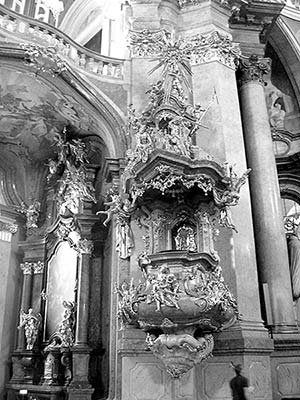
Cost and Hours: Church—100 Kč, daily 9:00-18:00, Nov-Feb until 16:00; tower climb—100 Kč, daily 10:00-22:00, shorter hours in winter, tower entrance is outside the right transept.
Visiting the Church: The church’s interior is giddy with curves and illusions. This is “dynamic Baroque,” with circles intersecting circles, creating an illusion of movement. Stand directly under the tallest dome and look up. Spin slowly around, greeting four giant statues—the fathers of the Eastern Church. Look up and see the earthly world merging with heaven above.
The altar features a lavish gold-plated Nicholas, flanked by the two top Jesuits: the founder, St. Ignatius Loyola, and his missionary follower, St. Francis Xavier—one killing evil, the other spreading the gospel.
Climb the staircase in the left transept up to the gallery for a close-up look at a collection of large canvases and illusionary frescoes by Karel Škréta, who is considered the greatest Czech Baroque painter. At first glance, the canvases are utterly dark, but as sunbeams shine through the window, various parts of the paintings brighten. The church walls seem to nearly fuse with the sky, suggesting that happenings on earth are closely connected to heaven.
Tower Climb: For a good look at the city and the church’s 250-foot dome, climb the 215 steps up the bell tower. Closed to the public during the communist period, the deck was used by the secret police to spy on activities at the nearby embassies of the US, Britain, and West Germany. There is a good exhibit in English on this aspect, as well as on the May 5, 1945, uprising against the Nazi occupiers.
Concerts: The church hosts evening classical music concerts; tickets are usually on sale at the church ticket desk (500 Kč, generally nightly at 18:00 except Tue, www.stnicholas.cz).
Nerudova Street
This steep, cobbled street, connecting the Lesser Town Square up to the castle, is named for Jan Neruda, a gifted 19th-century journalist. It’s lined with old buildings still sporting the characteristic doorway signs (such as two golden suns, a red lion, a green lobster, or three violins) that once served as street addresses. The surviving signs have been carefully restored and protected by law. They represent the family name, the occupation, or the various passions of the people who once inhabited the houses. In the 1770s, in order to run her empire (and collect taxes) more effectively, Habsburg empress Maria Theresa decreed that house numbers were to be used instead of these quaint names. The neighborhood is filled with noble palaces, now generally used as foreign embassies (the American embassy is a couple of blocks to the left as you hike uphill) and as offices of the Czech Parliament.
Kampa Island
One hundred yards from the castle end of the Charles Bridge, stairs on the left lead down to the main square of Kampa Island (mostly created from the rubble of the Lesser Town, after it was devastated in a 1540 fire). The island features relaxing pubs, a breezy park, hippies, lovers, a fine contemporary art gallery, and river access. At the far end of Kampa Square is the park entrance. Midway through the park (on the left) is the former mill building, Sovovy Mlýny. In it is the Museum Kampa, home to the Jan and Meda Mládek Collection, which features works once prohibited by the former communist regime, as well as other modern artworks (permanent exhibit—190 Kč, all exhibits—350 Kč, daily 10:00-18:00, www.museumkampa.cz).
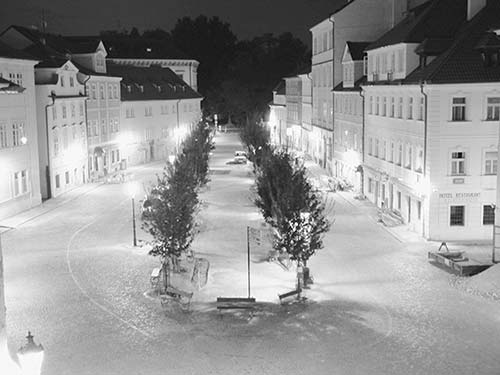
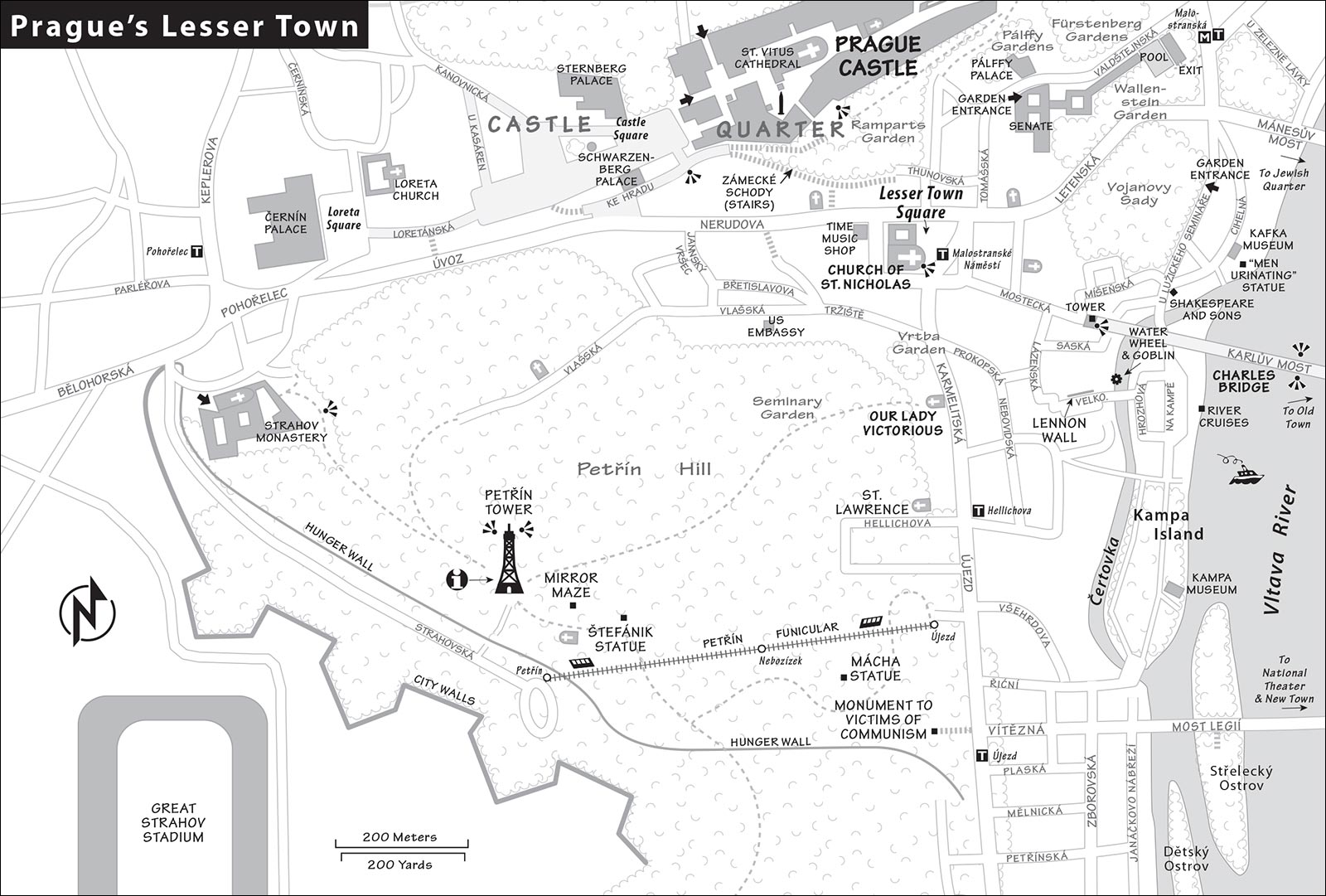
Returning to Kampa Square, as you leave the park take the first lane on the left, which winds around to a little bridge. The high-water mark at the end of the bridge dates from 1890. The old water wheel is the last survivor of many mills that once lined the canal here, powering industry before the arrival of steam power. Each mill had its own protective water spirit or goblin (vodník). Note the one sitting on a tree stump by the wheel.
Lennon Wall (Lennonova Zeď)
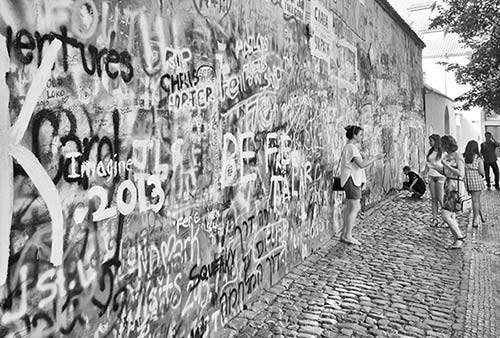
Near the old water wheel described earlier and just across the tiny bridge, beneath the trees on the right, is the colorful Lennon Wall. While V. I. Lenin’s ideas hung like a water-soaked trench coat upon the Czech people, singer John Lennon’s ideas gave many locals hope and a vision. When Lennon was killed in 1980, this large wall was spontaneously covered with memorial graffiti. Night after night, the police would paint over the “All You Need Is Love” and “Imagine” graffiti. And day after day, it would reappear. Until independence came in 1989, travelers, freedom lovers, and local hippies gathered here. Even today, people come here to imagine. “John žije” is Czech for “John lives.”
SOUTH OF LESSER TOWN SQUARE
Church of Our Lady Victorious (Kostel Panny Marie Vítězné)
This otherwise ordinary Carmelite church displays Prague’s most worshipped treasure, the Infant of Prague (Pražské Jezulátko). Kneel at the banister in front of the tiny lost-in-gilded-Baroque altar and find the prayer in your language (of the 13 in the folder). Brought to Czech lands during the Habsburg era by a Spanish noblewoman who came to marry a Czech nobleman, the Infant has become a focus of worship and miracle tales in Prague and Spanish-speaking countries. South Americans come on pilgrimage to Prague just to see this one statue. An exhibit upstairs shows tiny embroidered robes given to the Infant, including ones from Habsburg empress Maria Theresa of Austria (1754) and Vietnam (1958), as well as a video showing a nun lovingly dressing the doll-like sculpture.
Cost and Hours: Free, Mon-Sat 9:30-17:00, Sun 13:00-18:00, English-language Mass Sun at 12:00 and Thu at 17:00, Karmelitská 9, www.pragjesu.cz.
▲Petřín Hill (Petřínské Sady)
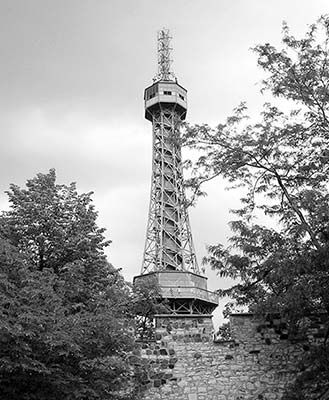
This hill, topped by a replica of the Eiffel Tower, features several unusual sights.
Monument to Victims of Communism (Pomník Obětem Komunismu): The sculptural figures of this poignant memorial, representing victims of the totalitarian regime, gradually atrophy as they range up the hillside steps. They do not die but slowly disappear, one limb at a time. The statistics inscribed on the steps say it all: From 1948 until 1989, in Czechoslovakia alone, 205,486 people were imprisoned, 248 were executed, 4,500 died in prison, 327 were shot attempting to cross the border, and 170,938 left the country.
Hunger Wall (Hladová Zed’): To the left of the Victims of Communism monument is this medieval defense wall, which was Charles IV’s 14th-century equivalent of FDR’s work-for-food projects. The poorest of the poor helped build this structure just to eke out a bit of income.
To the right (about 50 yards away) is the base of a handy funicular you can ride up the hill to the Petřín Tower (uses tram/Metro ticket, runs daily every 10-15 minutes 8:00-22:00).
Petřín Hill Summit and Tower: The top of Petřín Hill is considered the best place in Prague to take your date for a romantic city view. Built for an exhibition in 1891, the 200-foot-tall Petřín Tower—an elegant pure Art Nouveau steel and wood structure—is one-fifth the height of its Parisian big brother, which was built two years earlier. But, thanks to this hill, the top of the tower sits at the same elevation as the real Eiffel Tower. Before you climb up, appreciate the tower’s sinuous curves. Climbing the 400 steps rewards you with amazing views of the city (150 Kč, daily 9:00-21:00, shorter hours off-season). A mirror maze next door to the tower is fun for a quick wander if you’re already here (75 Kč, same hours as tower).
Sights in the Castle Quarter (Hradčany)
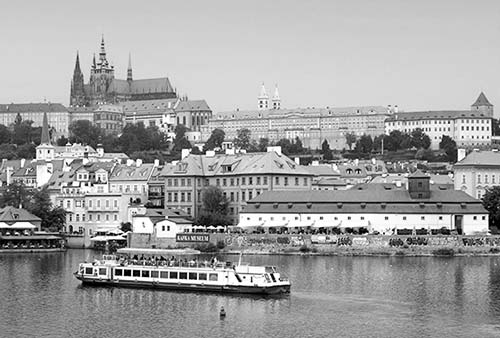
Looming above Prague, dominating its skyline, is the Castle Quarter. Prague Castle and its surrounding sights are packed with Czech history, as well as with tourists. The nearby Strahov Monastery (above the castle) has a fascinating old library and beautiful views over all of Prague.
PRAGUE CASTLE (PRAŽSKÝ HRAD)
This vast and sprawling complex has been the seat of Czech power for centuries. It collects a wide range of sights, including the country’s top church, its former royal palace, and an assortment of history and art museums (together rated ▲▲).
Getting There
By Tram: Trams #22 and #23 take you up to the castle. Catch either tram at Národní Třída (between Wenceslas Square and the National Theater in the New Town), in front of the National Theater (Národní Divadlo, on the riverbank in the New Town), or at Malostranská (the Metro stop in the Lesser Town). After rattling up the hill, trams make three stops near the castle:
Pražský Hrad (Prague Castle) offers the quickest commute to the castle—from the stop, simply walk along U Prašného Mostu and over the bridge, past the stone-faced but photo-op-friendly guards at the northern entrance, which leads into the castle’s Second Courtyard.
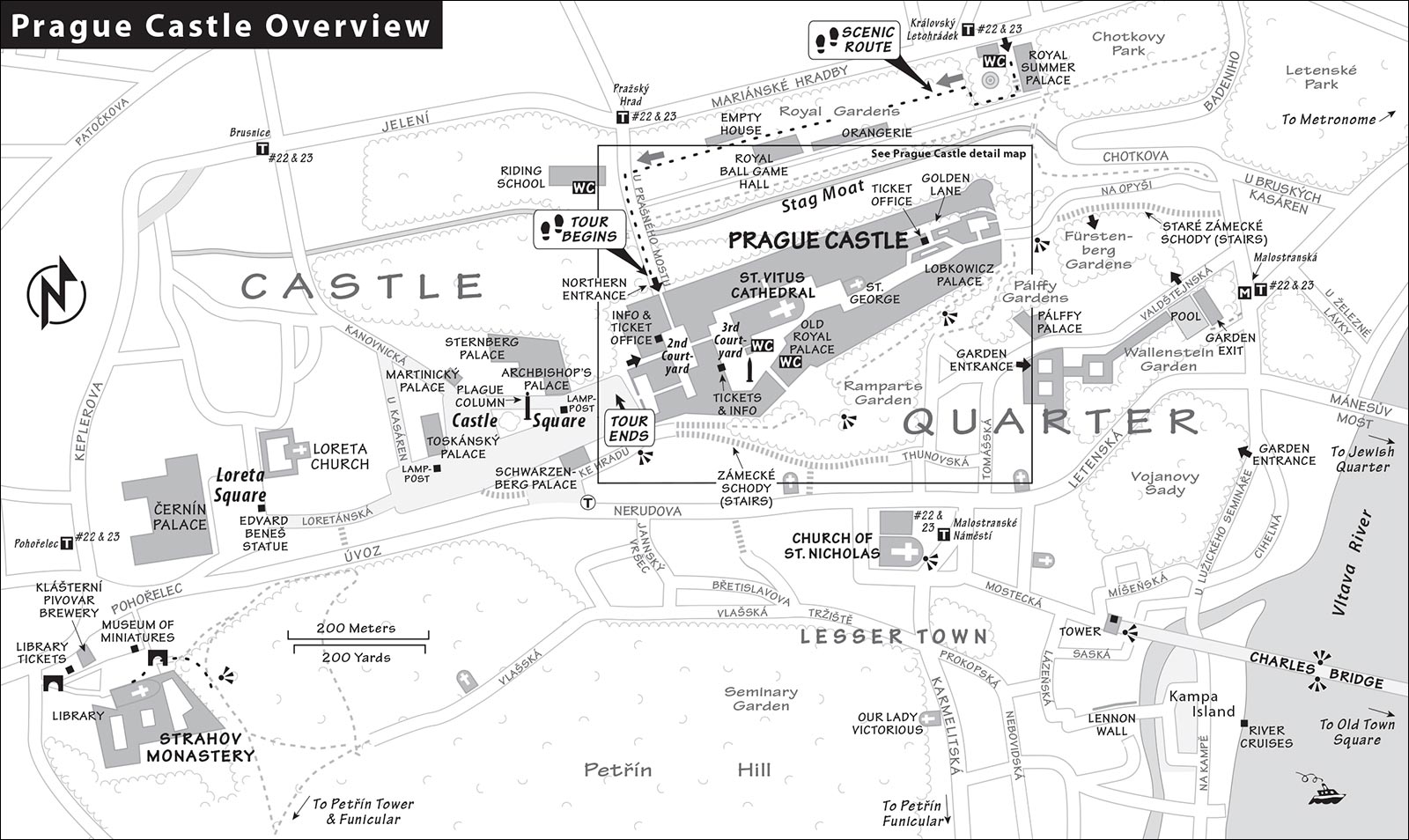
Královský Letohrádek (Royal Summer Palace) allows a scenic but slow approach through the Royal Gardens to the bridge near the castle’s northern entrance.
Pohořelec is best if you’d like to start with the Strahov Monastery, then hike 10 minutes down to Castle Square (by way of Loreta Church) and begin your tour there, at the castle’s main entrance.
By Taxi or Uber: Ask your driver to drop you at either Pražský Hrad or Královský Letohrádek (see above). Another option is to have them drop you off just under the castle at the top of Nerudova street (at the little square under the staircase), and then climb 200 yards up the pedestrian-only cobblestone street from there.
By Foot: The fairly steep, three-quarter-mile uphill walk from the river takes about 20 minutes. From the Charles Bridge, follow the main cobbled road (Mostecká) to the Lesser Town Square, marked by the huge, green-domed Church of St. Nicholas. From there, hike uphill along Nerudova street. After about 10 minutes, a steep lane on the right leads to Castle Square.
Planning Your Time
Prague Castle is the city’s most crowded sight. The grounds become a sea of tourists during peak times (worst 9:30-14:00 in high season). The most cramped area is the free vestibule inside St. Vitus Cathedral; any sight that you pay to enter—including other parts of the cathedral—will be less jammed.
Minimize the effect of crowds and maximize your enjoyment by following one of these plans.
Early-Bird Visit: Leave your hotel no later than 8:00. Ride the tram to the Pražský Hrad stop, look around Castle Square, and be sure you’re in line at the ticket office in the Third Courtyard, across from St. Vitus Cathedral, before 9:00. Once you have your ticket, head to the cathedral as soon as possible after it opens at 9:00, and for a few minutes, you’ll have the sacred space to yourself...then, on your way out, you’ll pass a noisy human traffic jam of multinational tour groups. Visit the rest of the castle sights at your leisure: the Old Royal Palace, the Basilica of St. George, and Lobkowicz Palace.
Afternoon Visit/Adding on Strahov Monastery and Loreta Church: If you’re heading to Prague Castle after lunch and want to add on an efficient visit to the sights above the castle, ride the tram to the Pohořelec stop. Tour the Strahov Monastery, then drop by Loreta Church on your way (downhill) to Castle Square. By the time you hit Castle Square, the crowds should be thinning out. The only risk is running out of time to enter all the sights by closing time.
Nighttime Visit: The castle is least crowded at night. True, the sights are closed, but the castle grounds are free, safe, peaceful, floodlit, and open late. The tiny, normally jammed Golden Lane (medieval merchant street) is empty and romantic at night—and no ticket is required.
Orientation to Prague Castle
Cost: Admission to the castle grounds is free, but you need a ticket to enter the sights. The “Basic circuit” ticket (250 Kč) covers the highlights: St. Vitus Cathedral, the Old Royal Palace, the Basilica of St. George, and the Golden Lane. A second “Permanent exhibitions” ticket (200 Kč) adds two sights (the Prague Castle Picture Gallery and The Story of Prague Castle exhibit) that interest those with a healthy appetite for history. Tickets are good for two days.
Hours: Castle grounds—daily 6:00-22:00; castle sights—daily 9:00-17:00, Nov-March until 16:00; castle gardens—daily 10:00-18:00, closed Nov-March. On Sundays, St. Vitus Cathedral is closed until noon for Mass. The cathedral can close unexpectedly for special services (check the event calendar at www.katedralasvatehovita.cz or call +420 724 933 441).
Information: +420 224 371 111, www.hrad.cz.
More Sights at the Castle: Additional sights within the complex are covered by separate tickets and have their own hours: the St. Vitus Treasury in the Chapel of the Holy Cross (300 Kč, daily 10:00-18:00, last entry one hour before closing), climbing the Great South Tower of St. Vitus Cathedral (150 Kč, daily 10:00-18:00, until 16:00 in winter), and Lobkowicz Palace (290 Kč, daily 10:00-18:00, +420 233 312 925, www.lobkowicz.cz).
Tours: An audioguide is available at ticket offices (350 Kč plus 500 Kč deposit). I’d skip it in favor of this book’s self-guided tour.
 Self-Guided Tour
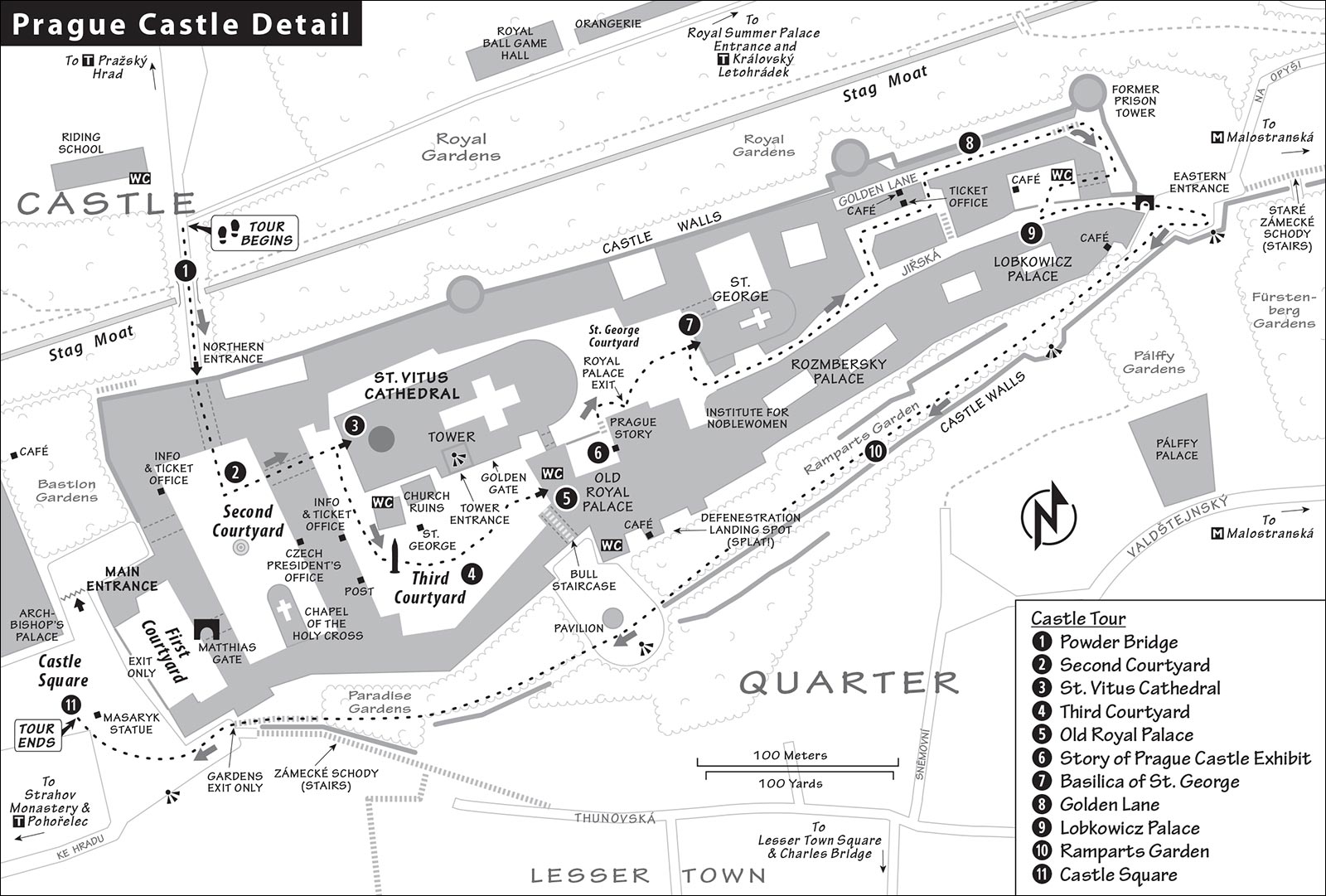
• Begin your visit to the castle complex at the bridge just outside the northern entrance. If approaching from Castle Square, join this tour at stop #2, the Second Courtyard.
1 Powder Bridge (Prašný Most)
Before you cross the bridge, survey the scene ahead of you. To your left is the most impressive view of the prickly steeples and flying buttresses of the majestic St. Vitus Cathedral, which stands in the middle of the medieval iceberg called Prague Castle. It’s a 1,900-foot-long series of courtyards, churches, and palaces, covering 750,000 square feet—by some measures, the largest castle on earth. Crossing the bridge (actually a landfill), look down into the abysmal Stag Moat (Jelení příkop) that naturally protects the fortress from the north.
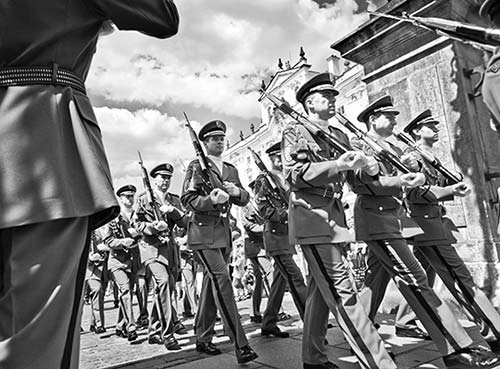
The stoic guards at this northern entrance make a great photo-op, as does the changing of the guard (on the hour). In fact, there’s a guard-changing ceremony at every gate. The biggest, most crowded ceremony occurs at noon, at the top gate by Castle Square.
• Walk through the double gate and emerge into the Second Courtyard. To your right is an information center where you can buy your ticket (or, if lines are long, try the one in the Third Courtyard, then come back to start the tour).
2 Second Courtyard
During the 18th century, Empress Maria Theresa commissioned her favorite Italian architect to connect the disparate buildings in the castle grounds into a unified Neoclassical whole. While Maria Theresa never resided here, the imposing—and to this day largely empty—complex was meant to project the aura of undisputed Habsburg power. This included painting the whole thing in the Habsburgs’ favorite shade of yellow. Locals still feel uncomfortable in these “Viennese” surroundings and rush through the courtyard to take cover in one of the blessedly medieval interiors.
Before you do the same, note the fountain and Renaissance well in the middle of the square. Just to the left of the well, the modern green awning (with the golden-winged, catlike griffin) marks the entrance to the offices of the Czech president. If the president is in town, his flag flies over the roof at the opposite end of the square.
• Now walk through the passageway (to the left of the president’s office) that leads into the Third Courtyard. There you’ll see the impressive facade of St. Vitus Cathedral. Even without a ticket, tourists can step into the church entryway for a crowded view of the nave (and a bit of the Mucha stained glass)—but it’s worth paying to see the whole church.
3 St. Vitus Cathedral (Katedrála Sv. Víta)
This Roman Catholic cathedral, worth ▲▲▲, is the Czech national church—it’s where kings were crowned, royalty have their tombs, the relics of saints are venerated, and the crown jewels are kept. Since AD 920, a church has stood on this spot, marking the very origins of the Czech nation.
The letters below correspond to the cathedral map.
A Entrance Facade: The two soaring towers of this Gothic wonder rise 270 feet. The ornate facade features pointed arches, elaborate tracery, Flamboyant pinnacles, a rose window, a dozen statues of saints, and gargoyles sticking out their tongues.
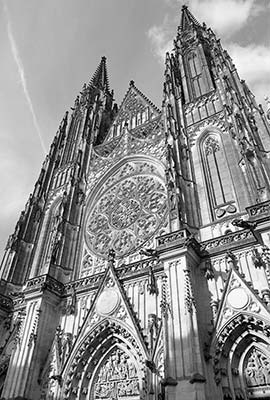
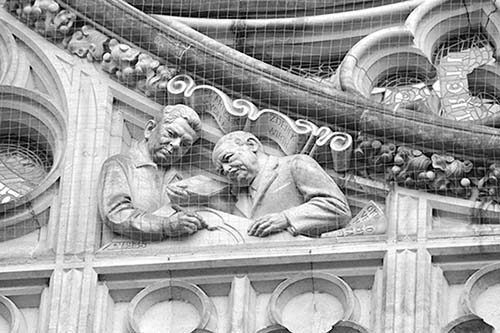
So what’s up with the four guys in modern suits carved into the stone, as if supporting the big round window on their shoulders? They’re the architects and builders who finished the church six centuries after it was started. Even though church construction got underway in 1344, wars, plagues, and the reforms of Jan Hus conspired to stall its completion. Finally, fueled by a burst of Czech nationalism, Prague’s top church was finished in 1929 for the 1,000th Jubilee anniversary of St. Wenceslas. The entrance facade and towers were the last parts to be finished.
• Enter the cathedral. If it’s not too crowded in the free entrance area, work your way to the middle of the church for a good...
B View down the Nave: The church is huge—more than 400 feet long and 100 feet high—and flooded with light. Notice the intricate “net” vaulting on the ceiling, especially at the far end. It’s the signature feature of the church’s chief architect, Peter Parler (who also built the Charles Bridge).
• Now make your way through the crowds and pass through the ticket turnstile (left of the roped-off area). The third window on the left wall is worth a close look.
C Mucha Stained-Glass Window: This masterful 1931 Art Nouveau window was designed by Czech artist Alphonse Mucha and executed by a stained-glass craftsman.
Mucha’s window was created to celebrate the birth of the Czech nation and the life of Wenceslas. The main scene (in the four central panels) shows Wenceslas as an impressionable child kneeling at the feet of his Christian grandmother, St. Ludmila. She spreads her arms and teaches him to pray. Wenceslas would grow up to champion Christianity, uniting the Czech people.
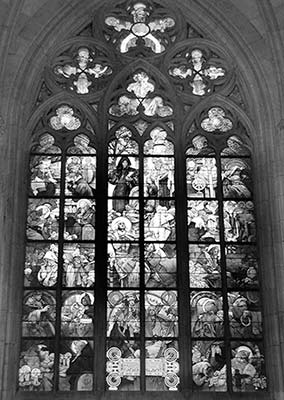
Above Wenceslas are the two saints who first brought Christianity to the region: Cyril (the monk in black hood holding the Bible) and his older brother, Methodius (with beard and bishop’s garb). They baptize a kneeling convert.
Follow their story in the side panels, starting in the upper left. Around AD 860 (back when Ludmila was just a girl), these two Greek missionary brothers arrive in Moravia to preach. The pagan Czechs have no written language to read the Bible, so (in the next scene below), Cyril bends at his desk to design the necessary alphabet (Glagolitic, which later developed into Cyrillic), while Methodius meditates. In the next three scenes, they travel to Rome and present their newly translated Bible to the pope. But Cyril falls ill, and Methodius watches his kid brother die.
Methodius carries on (in the upper right), becoming bishop of the Czech lands. Next, he’s arrested for heresy for violating the pure Latin Bible. He’s sent to a lonely prison. When he’s finally set free, he retires to a monastery, where he dies mourned by the faithful.
At the bottom center are two beautiful (classic Mucha) maidens, representing the bright future of the Czech and Slovak peoples.
• Continue circulating around the church, following the one-way, clockwise route.
D Old Church: Just after the transept, notice there’s a slight incline in the floor. That’s because the church was constructed in two distinct stages. You’re entering the older, 14th-century Gothic section. The front half (where you came in) is a Neo-Gothic extension that was finally completed in the 1920s (which is why much of the stained glass has a modern design). For 400 years—as the nave was being extended—a temporary wall kept the functional altar area protected from the construction zone.
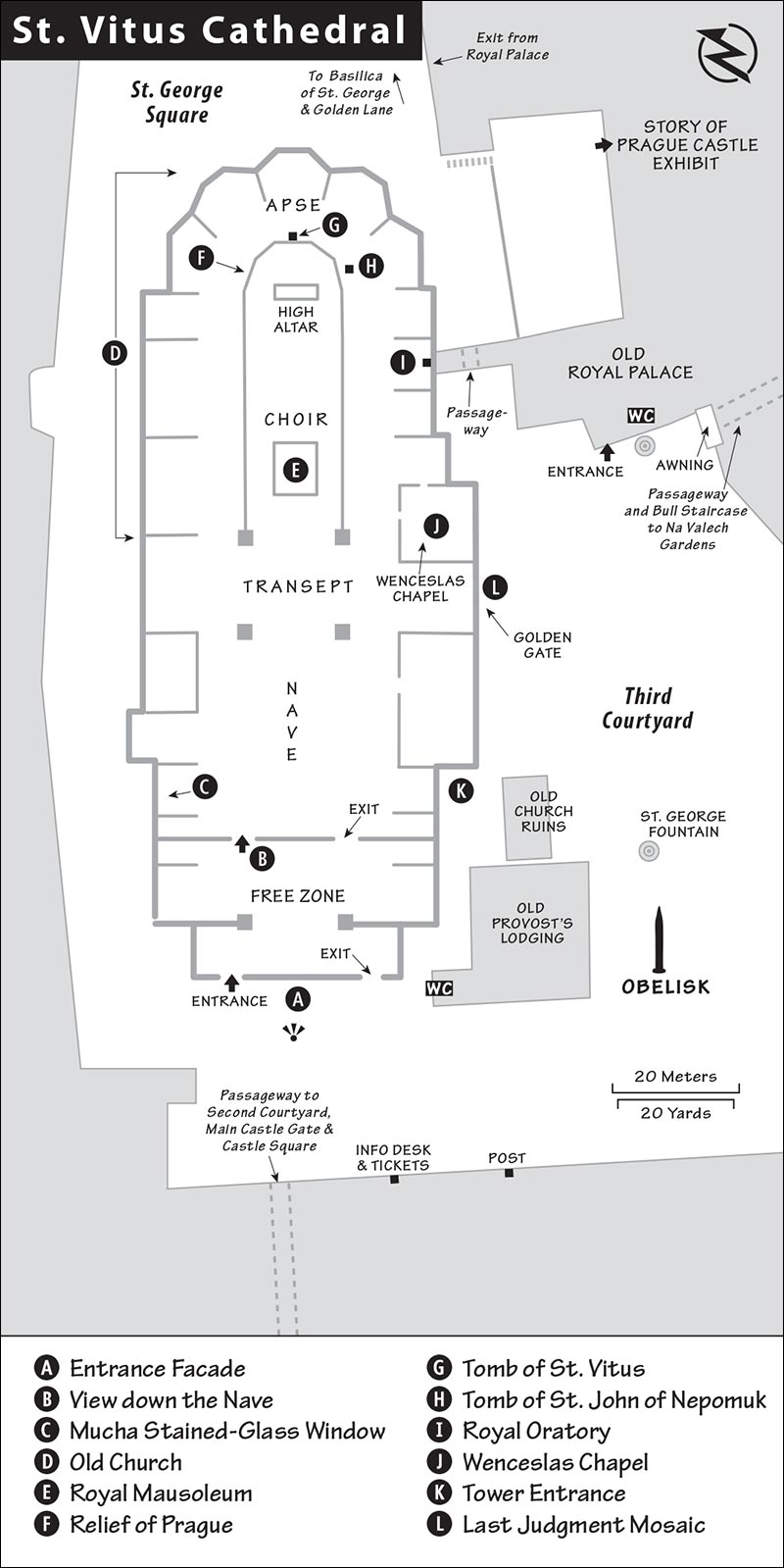
• In the choir area (on your right), soon after the transept, look for the big, white marble tomb surrounded by a black iron fence.
E Royal Mausoleum: This contains the remains of the first Habsburgs to rule Bohemia, including Ferdinand I, his wife Anne, and Maximilian II. The tomb dates from 1590, when Prague was a major Habsburg city.
• Just after the choir, as you begin to circle around the back of the altar, watch on your right for the fascinating, carved-wood...
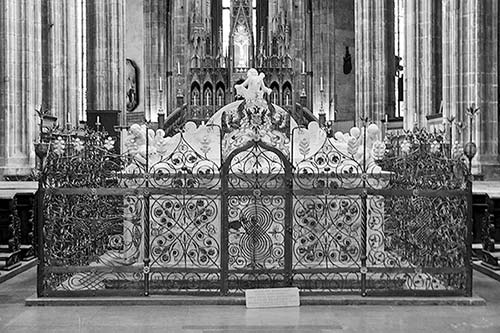
F Relief of Prague: This depicts the aftermath of the Battle of White Mountain, when the Protestant King Frederic escaped over the Charles Bridge (before it had any statues). Carved in 1630, the relief gives you a peek at old Prague. Find the Týn Church (far left) and St. Vitus Cathedral (far right), which was half-built at that time. Back then, the Týn Church was Hussite, so the centerpiece of its facade is not the Virgin Mary (more of a Catholic figure) but a chalice, a symbol of Jan Hus’ ideals. The old city walls—now replaced by the main streets of the city—stand strong. The Jewish Quarter is the flood-prone zone along the riverside below the bridge on the left—land no one else wanted. The weir system on the river—the wooden barriers that help control its flow—survives to this day.
• Circling around the high altar, you’ll see various...
Tombs in the Apse: Among the graves of medieval kings and bishops is that of G St. Vitus, shown as a young man clutching a book and gazing up to heaven. Why is this huge cathedral dedicated to this rather obscure saint, who was martyred in Italy in AD 303 and never set foot in Bohemia? A piece of Vitus’ arm bone (a holy relic) was supposedly acquired by Wenceslas I in 925. Wenceslas built a church to house the relic on this spot, attracting crowds of pilgrims. Vitus became quite popular throughout the Germanic and Slavic lands, and revelers danced on his feast day. (He’s now the patron saint of dancers.) At the statue’s feet is a rooster, because the saint was thrown into a boiling cauldron along with the bird (the Romans’ secret sauce)...but he miraculously survived.
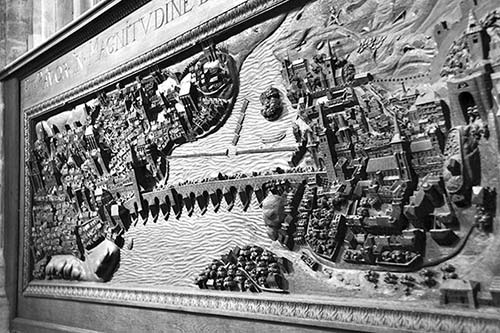
A few steps farther, the big silvery tomb with the angel-borne canopy honors H St. John of Nepomuk. Locals claim it has more than a ton of silver.
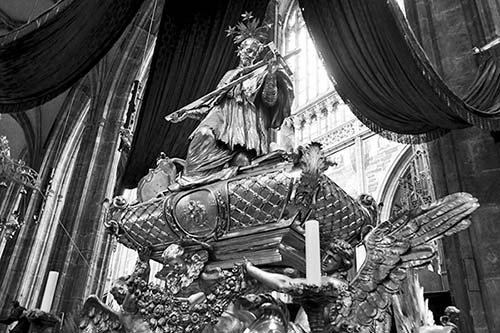
Just past the tomb, on the wall of the choir (on the right), is another finely carved, circa-1630 wood relief depicting an event that took place right here in St. Vitus: Protestant nobles trash the cathedral’s Catholic icons after their (short-lived) victory.
Ahead on the left, look up at the I royal oratory, a box supported by busy late-Gothic, vine-like ribs. This private box, connected to the king’s apartment by an outside corridor, let the king attend Mass in his jammies. The underside of the balcony is morbidly decorated with dead vines and tree branches, suggesting the pessimism common in the late Gothic period, when religious wars and Ottoman invasions threatened the Czech lands.
• From here, walk 25 paces and look left through the crowds and door to see the richly decorated chapel containing the tomb of St. Wenceslas. Two roped-off doorways give visitors a look inside. The best view is from the second one, around the corner and to the left, in the transept.
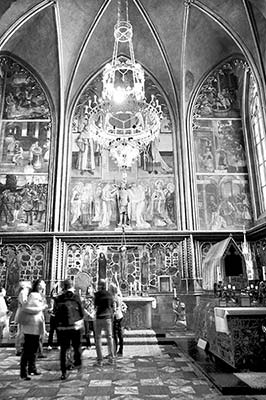
J Wenceslas Chapel: This fancy chapel is the historic heart of the church. It contains the tomb of St. Wenceslas, patron saint of the Czech nation; it’s where Bohemia’s kings were crowned; and it houses (but rarely displays) the Bohemian crown jewels. The chapel walls are paneled with big slabs of precious and semiprecious stones. The jewel-toned stained-glass windows (from the 1950s) admit a soft light. The chandelier is exceptional. The place feels medieval.
The tomb of St. Wenceslas is a colored-stone coffin topped with an ark. Above the chapel’s altar is a statue of Wenceslas, bearing a lance and a double-eagle shield. He’s flanked by (painted) angels and the four patron saints of the Czech people. Above Wenceslas are portraits of Charles IV (who built the current church) and his beautiful wife. On the wall to the left of the altar, frescoes depict the saint’s life, including the episode where angels arrive with crosses to arm the holy warrior. For centuries, Czech kings were crowned right here in front of Wenceslas’ red-draped coffin.
• Leave the cathedral, turn left (past the WC), and survey the...
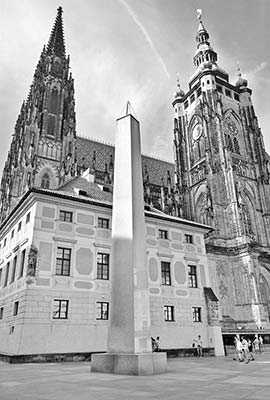
4 Third Courtyard
The obelisk was erected in 1928—a single piece of granite celebrating the 10th anniversary of the establishment of Czechoslovakia and commemorating the soldiers who fought for its independence. It was originally much taller but broke in transit—an inauspicious start for a nation destined to last only 70 years.
From here, you get a great look at the sheer size of St. Vitus Cathedral and its fat green tower (325 feet tall). Up there is the Czech Republic’s biggest bell (16.5 tons, from 1549), nicknamed “Zikmund.” You can view the bell as you climb up the 287 steps of the tower to the observation deck at the top (K tower tickets and entry near sculpture of St. George—a 1960s replica of the 13th-century original).
It’s easy to find the church’s Golden Gate (for centuries the cathedral’s main entry)—look for the glittering L 14th-century mosaic of the Last Judgment. The modern, cosmopolitan, and ahead-of-his-time Charles IV commissioned this monumental decoration in 1370 in the Italian style. Jesus oversees the action, as some go to heaven and some go to hell. The Czech king and queen kneel directly beneath Jesus and six patron saints. On coronation day, royalty would walk under this arch, a reminder to them (and their subjects) that even those holding great power are not above God’s judgment.
Across from the Golden Gate, in the corner, notice the copper, scroll-like awning supported by bulls. This leads to a fine garden just below the castle. The stairway, garden, and other features around the castle were designed in the 1920s by the Slovene architect Jože Plečnik (see here). Around the turn of the 20th century, Prague was considered the cultural standard-bearer of the entire Slavic world—making this a particularly prestigious assignment.
• In the corner of the Third Courtyard, near the copper awning, is the entrance to the...
5 Old Royal Palace (Starý Královský Palác)
The highlight of the palace building (dating from the 12th century), worth ▲▲, is the large Vladislav Hall—200 feet long, with an impressive vaulted ceiling of vine-shaped (late-Gothic) tracery. It could be filled with market stalls, letting aristocrats shop without going into town. It was big enough for jousts—even the staircase (which you’ll use as you exit) was designed to let a mounted soldier gallop in. Beginning in the 1500s, nobles met here to elect the king. The tradition survived into modern times. As recently as the 1990s, the Czech parliament crowded into this room to elect their president.
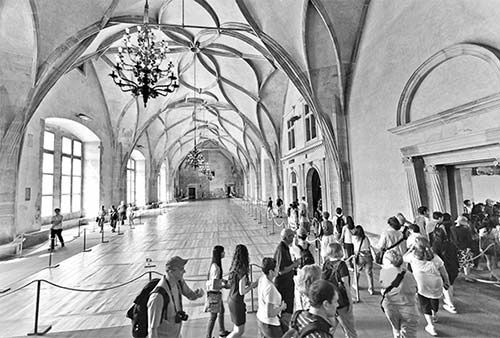
On your immediate right, enter the two small Renaissance rooms known as the “Czech Office.” From these rooms, two governors used to oversee the Czech lands for the Habsburgs in Vienna. Head for the far room, wrapped in windows. In 1618, angry Czech Protestant nobles poured into these rooms and threw the two Catholic governors out the window. (Amazingly, the two survived.) An old law actually permits this act—called defenestration—which usually targets bad politicians.
As you reenter the main hall, go to the far end and out on the balcony for a sweeping view of Prague.
• The next sight requires the extra “Permanent exhibitions” ticket; if you don’t have one, skip down to the Basilica of St. George. Otherwise, as you exit the Royal Palace, hook left around the side of the building and backtrack a few steps uphill to find stairs leading down to...
6 The Story of Prague Castle Exhibit (Příběh Pražského Hradu)
This museum of old artifacts (with good English descriptions) is your best look at castle history and its kings, all housed in the cool Gothic cellars of the Old Royal Palace. Throughout the exhibit, models of the castle show how it grew over the centuries.
• Directly across the courtyard from the rear buttresses of St. Vitus is a very old church with a pretty red facade. This is the...
7 Basilica of St. George (Bazilika Sv. Jiří)
Step into one of the oldest structures (worth ▲) at Prague Castle to see this re-created Romanesque church (a product of a 19th-century “purification” that removed the layers of Baroque) and the burial place of Czech royalty. The church was founded by Wenceslas’ dad before 920, and the present structure dates from the 12th century. (Its Baroque facade and side chapel that survived the purification came later.) Inside, the place is beautiful in its simplicity. Notice the characteristic thick walls and rounded arches. In those early years, building techniques were not yet advanced enough to use those arches for the ceiling—it’s made of wood instead.
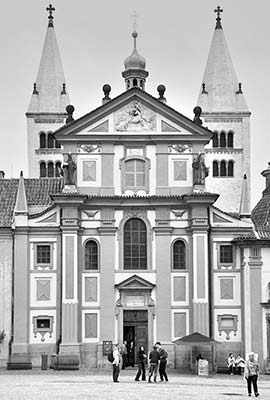
This was the royal burial place before St. Vitus was built, so the tombs here contain the remains of the earliest Czech kings. Climb the stairs that frame either side of the altar to study the area around the apse. St. Wenceslas’ grandmother, Ludmila, was reburied here in 925. Her stone tomb is in the added Gothic chapel just to the right of the altar. Inside the archway leading to her tomb, look for her portrait.
• Exit the church and continue walking downhill. Notice the basilica’s gorgeous Renaissance side entrance, with St. George fighting the dragon in the tympanum. You’ll next see the basilica’s Romanesque nave and towers—a strong contrast to the lavish painted Baroque facade. To your right, tucked together, you’ll see the palaces of Catholic nobility who wanted to be both close to power and able to band together should the Protestants grab the upper hand. Take a left once you have passed the apse of the St. George Basilica, then turn right and then left again to stroll through the...
8 Golden Lane
This medieval merchant street, worth ▲, was once lined with the former residences of soldiers and craftsmen. Today, it’s filled with touristy shops.
• At the end of the Golden Lane, walk down the stairway in a tunnel and, keeping the former prison tower to your left, make a sharp right turn through a small gate. Walk across a courtyard and exit to the left to face the...
9 Lobkowicz Palace (Lobkowiczký Palác)
This palace, rated ▲▲ and covered by a separate ticket, displays the private collection of a prominent Czech noble family, including paintings, ceramics, and musical scores. The Lobkowiczes’ property was confiscated twice in the 20th century: first by the Nazis at the beginning of World War II, and then by the communists in 1948. In 1990, William Lobkowicz, then a Boston real estate broker, returned to Czechoslovakia to fight a legal battle to reclaim his family’s property and, eventually, to restore the castles and palaces. The obvious care that went into creating this museum, the collection’s variety, and the personal insight it offers into Czech nobility make the Lobkowicz worth an hour of your time. Members of the Lobkowicz family (including William) narrate the delightful, included audioguide. If you visit, use the map that comes with your ticket to focus on the highlights.
• Once you’re done touring the palace, you can exit the castle complex through the gate at the bottom (eastern) end of the castle. A scenic rampart just below the lower gate offers a commanding view of the city. From there, you can either head to the Malostranská tram/Metro station and riverbank, or loop around to Castle Square (where this tour continues).
To reach Malostranská station, follow the crowds down the 700-some steps of a steep lane called Staré Zámecké Schody (“Old Castle Stairs”). To continue this tour (or to reach Strahov Monastery), take a hard right as you leave the castle gate and stroll through the long, delightful...
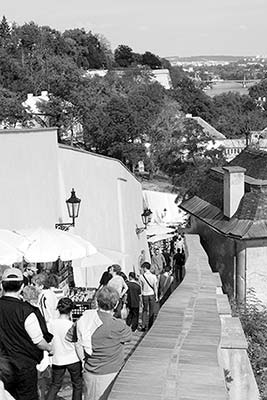
10 Ramparts Garden (Zahrada Na Valech)
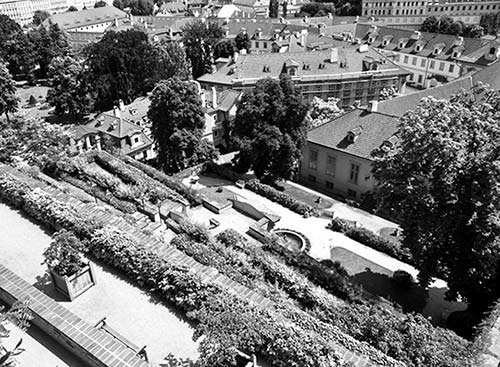
This garden comes with commanding views of the city below (free, daily 10:00-18:00 or later, closed Nov-March). Along the way, notice the Modernist layout of the garden, designed by Jože Plečnik of Slovenia. Halfway through the long park is a circular viewpoint. At roughly the same distance under the brick wall of the Royal Palace, find a Baroque column commemorating the miraculous survival of the defenestrated overlords. As you exit the garden at the far end through a narrow gate on top of a wide, monumental staircase, notice the cool wolf snout design of the adjacent doorknob, another Plečnik trademark.
• Make your way into...
11 Castle Square (Hradčanské Náměstí)
Castle Square was the focal point of premodern power. The Fighting Titans sculpture, depicting two triumphant gladiators, marks the main entry into the residence of Czech kings. The archbishop lived (and still lives) in the Archbishop’s Palace—the ornate, white-and-yellow Rococo building with the oversized facade. Above the doorway is the family coat of arms of the archbishop that built this palace: three white goose necks in a red field. (The portal on the left leads to the Sternberg Palace art museum, with European paintings.)
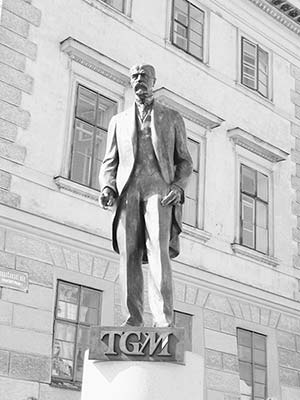
Closer to you, near the overlook, the statue of a man in a business suit (marked TGM) honors the father of modern Czechoslovakia: Tomáš Garrigue Masaryk. At the end of World War I, Masaryk—a university professor—united the Czechs and Slovaks into one nation and became its first president.
On the left side of the square, behind the statue, the building with a step-gable roofline is Schwarzenberg Palace, where the aristocrats from Český Krumlov stayed when they were visiting from their country estates. Notice the envelope-shaped patterns stamped on the exterior. These Renaissance-era adornments etched into wet stucco—called sgraffito—decorate buildings throughout the castle and all over Prague and the Czech Republic. Today, Schwarzenberg Palace is an art museum with a collection of Renaissance, Baroque, and Rococo masterpieces.
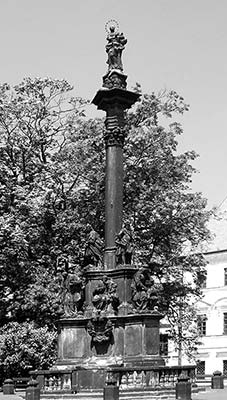
The dark gray Baroque sculpture in the middle of the square is a plague column. Erected as a token of gratitude to Mary and the saints for saving the population from epidemic disease, these columns are an integral part of the main squares of many Habsburg towns.
Two more palaces are worth looking at. At the far-right corner of the square, past the plague column, is the delightful Martinický Palace, with delicate Renaissance portals and detailed figural sgraffito depicting the feats of biblical Joseph and mythic Hercules. The pastel Toskánský Palace at the western end of the square is a beautifully balanced example of Baroque palatial architecture.
• From the top corner of Toskánský Palace, you can either continue up along Loretánská street to the Loreta Church and Strahov Monastery (both described later), or take the scenic staircase on the left down to the top of Nerudova street in the Lesser Town.
SIGHTS ABOVE THE CASTLE
The Strahov Monastery, with its twin Baroque domes, and the pretty Loreta Church sit above the castle and are easy to combine with your castle visit. Visiting the monastery first allows you to walk downhill to the castle (taking in fine views and passing Loreta Church on the way), but it also means you’ll wind up at the busiest entrance to the castle. If you anticipate crowds, see the castle sights first, then walk back up to Loreta and Strahov.
Getting There: From central Prague, take tram #22 or #23 to the Pohořelec stop. Follow the tracks for 50 yards, take the pedestrian lane that rises up beside the tram tracks, and enter the fancy gate on the left near the tall red-brick wall. You’ll see the twin spires of the monastery; the library entrance is on the little square with the monastery church. From the castle, exit Castle Square past the Toskánský Palace and walk up along Loretánská street to the church and monastery.
▲Strahov Monastery and Library (Strahovský Klášter a Knihovna)
This fine old monastery has perched on the hill just above Prague Castle since the 12th century. Medieval monasteries were a mix of industry, agriculture, and education, as well as worship and theology. In its heyday, Strahov Monastery had a booming economy of its own, with vineyards, a brewery, and a sizable beer hall—all now open once again. You can explore the monastery complex, check out the beautiful old library, and even enjoy a brew (no longer monk-made, but still refreshing).
Cost and Hours: Grounds—free and always open; library—150 Kč, daily 9:00-12:00 & 13:00-17:00, +420 233 107 718; www.strahovskyklaster.cz. Tickets are sold in the small former church to your left just after you pass through the fancy entrance gate. A pay WC is just to the right of the monastery entrance.
Visiting the Monastery and Library: The monastery’s main church, dedicated to the Assumption of St. Mary, is an originally Romanesque structure decorated by the monks in textbook Baroque (usually closed, but look through the gate inside the front door to see its interior). Notice the grand effect of the Baroque architecture—both rhythmic and theatric. Go ahead, inhale. That’s the scent of Baroque.
The library is just to the right of the church—head up the stairs for a peek at how enlightened thinkers in the 18th century influenced learning. The display cases in the library gift shop show off illuminated manuscripts, described in English. Some are in old Czech, but because the Enlightenment promoted the universality of knowledge (and Latin was the universal language of Europe’s educated elite), there was little place for regional dialects—therefore, few books here are in the Czech language.
Tomáš Masaryk founded the first democracy in Central Europe at the end of World War I, uniting the Czechs and the Slovaks to create Czechoslovakia. Like Václav Havel 70 years later, Masaryk was a politician whose vision extended far beyond the mountains enclosing the Bohemian basin.
Masaryk, from a poor servant family in southern Moravia, earned his PhD in sociology in Vienna, studied in Leipzig, and then became a professor at Charles University of Prague. By then, he was married to American Charlotta Garrigue, a social revolutionary from a Unitarian New York family. Through Charlotta, Masaryk was introduced to America’s high society, which proved crucial in 1918 when he successfully campaigned there for the recognition of his new country.
Masaryk was greatly impressed with America, and his admiration for its democratic system (and his wife) became the core of his evolving political creed. He traveled the world and served in the Vienna parliament. At the outbreak of World War I, while most other Czech politicians stayed in Prague and supported the Habsburg Empire, 64-year-old Masaryk went abroad in protest and formed a highly original plan: to create an independent, democratic republic of Czechs and Slovaks. Masaryk and his supporters recruited an army of 100,000 soldiers who were willing to fight with the Allies against the Habsburgs, establishing a strong case to put on official desks in Paris, London, and Washington.
On the morning of October 28, 1918, news of the unofficial capitulation of the Habsburgs reached Prague. Supporters of Masaryk’s plan quickly took control of the city and proclaimed the free republic. As the people of Prague tore down double-headed eagles (a symbol of the Habsburgs), the country of Czechoslovakia was born.
On December 21, 1918, four years after he had left the country as a political unknown, Masaryk arrived in Prague as the greatest Czech hero since the revolutionary priest Jan Hus. He told the jubilant crowd, “Now go home—the work has only started.” Throughout the 1920s and 1930s, Masaryk was a vocal defender of democratic ideals in Europe against the rising tide of totalitarian ideologies. Today, Masaryk is one of only a few foreign leaders to be honored with a statue in Washington, DC.
Two rooms (seen only from the doors) are filled with 10th-to-17th-century books, shelved under elaborately painted ceilings. The theme of the first and bigger hall is philosophy, with the history of the Western pursuit of knowledge painted on the ceiling. The second hall—down a hallway lined with antique furniture—focuses on theology. As the Age of Enlightenment began to take hold in Europe at the end of the 18th century, monasteries still controlled the books. Notice the gilded, locked case containing the libri prohibiti (prohibited books) at the end of the room, above the mirror. Only the abbot had the key, and you had to have his blessing to read these books—by writers such as Nicolas Copernicus, Jan Hus, and Jean-Jacques Rousseau. Even the French encyclopedia was locked away.
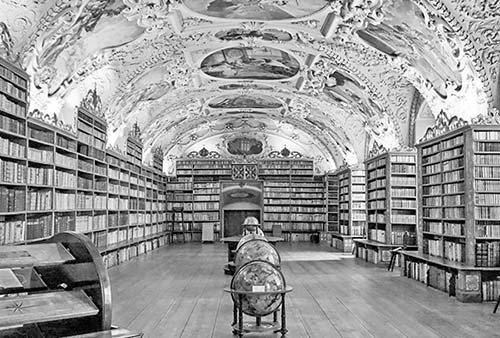
The hallway connecting the two library rooms was filled with cases illustrating the new practical approach to natural sciences. In the crowded area near the philosophy hall, find the dried-up elephant trunks (flanking the narwhal or unicorn horn) and one of the earliest models of an electricity generator.
Nearby: That hoppy smell you’re enjoying in front of the monastery is the recommended Klášterní Pivovar, where they brew beer just as monks have for centuries (in the little courtyard directly across from the library entrance; described on here).
Downhill and through the gate opposite where you came in, find the ▲ monastery garden view terrace to the right. From the public perch beneath the restaurant tables, you’ll have exquisite views over the domes and spires of Prague.
Loreta Square (Loretánské Náměstí)
On the way to Castle Square (from Strahov Monastery, or directly from the tram stop) is Loreta Square, dominated by the beautiful Baroque Loreta Church (described later).
Černín Palace, on the uphill (left) side of the square, was the unfortunate site of a modern-day defenestration. On March 10, 1948, soon after the communists took over, popular Czechoslovak politician Jan Masaryk (son of Tomáš Garrigue Masaryk, Czechoslovakia’s first president) was found dead in this building’s courtyard, below a palace bathroom window. While authorities at the time ruled it a suicide, an independent forensic examination in the 1990s confirmed foul play. The most likely theory is that Masaryk was killed by the Soviet secret police, who had learned of Masaryk’s plans to leave the country and represent it while in exile.
▲Loreta Church
This church has been a hit with pilgrims for centuries, thanks to its dazzling bell tower, peaceful yet plush cloister, sparkling treasury, and much-venerated Holy House. In the middle of the cloister courtyard, you’ll find what some pilgrims consider part of Mary’s actual home in Nazareth. You’ll also see one of Prague’s most beautiful Baroque churches, a fine treasury collection (upstairs), and—in a tiny chapel in one corner—“St. Bearded Woman,” the patron saint of unhappy marriages.
Cost and Hours: 210 Kč; daily 9:00-17:00, Nov-March 9:30-16:00; audioguide-150 Kč, +420 220 516 740, www.loreta.cz.
Shopping in Prague
Prague’s entire Old Town seems designed to bring out the shopper in visitors. The Ungelt, the courtyard tucked behind the Týn Church just off the Old Town Square, is packed with touristy but decent-quality shops. Michalská, a semihidden lane right in the thick of the tourist zone, has a variety of shops (from the Small Market Square/Malé Náměstí near the Astronomical Clock, go through the big stone gateway marked 459). On Havelská street, you can browse the open-air Havelská Market, a touristy but enjoyable place to shop for inexpensive handicrafts and fresh produce (daily 9:00-18:00, two long blocks south of the Old Town Square). And Celetná, exiting the Old Town Square to the right of the Týn Church, is lined with big stores selling traditional Czech goodies.
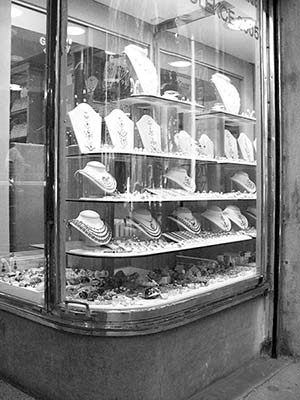
Na Příkopě, the mostly pedestrianized street following the former moat between the Old Town and the New Town, has the city center’s handiest lineup of modern shopping malls. Na Příkopě street opens up into Republic Square (Náměstí Republiky)—boasting Prague’s biggest mall, Palladium, hidden behind a pink Neo-Romanesque facade. Across the square is the communist-era, brown, steel-and-glass 1980s department store Kotva (“Anchor”) that has been recently remodeled inside.
Národní Třída (National Street), which continues past Na Příkopě in the opposite direction (toward the river), is less touristy and lined with some inviting stores. Karlova, the tourist-clogged drag connecting the Old Town Square to the Charles Bridge, should be avoided entirely.
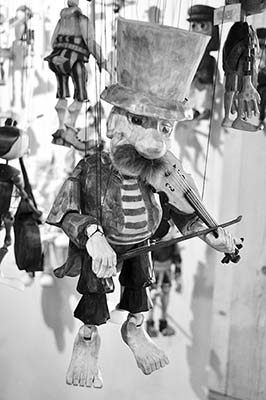
Puppets: Czechs have treasured the art of puppets for centuries. Good options are Galerie Michael, at U Lužického Semináře 7 in the Lesser Town and at Jilská 22 in the Old Town (https://buymarionettes.com); the no-name Loutky (“Puppets”) shop at the top of Nerudova (at #51, www.loutky.cz); and, in the Ungelt courtyard, V Ungeltu and Hračky, Loutky.
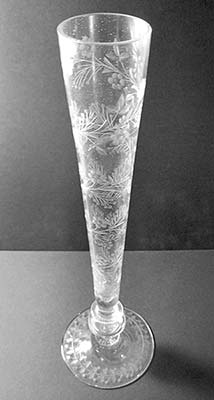
Glass and Crystal: Since the Renaissance, Prague has been known for its exquisite glass and crystal. Well-respected sources for Czech glass and crystal include Moser (flagship store at the Černá Růže shopping mall at Na Příkopě 12, plus a branch on the Old Town Square, www.moser.com), Artěl (see listing later, under “Art Nouveau Design Shops”), and Blue, specializing in sleek, modern designs (locations include Malé Náměstí 13, Pařížská 3, Melantrichova 6, Celetná 2, Mostecká 24, and at the airport; https://bluepraha.cz).
Bohemian Garnets (Granát): These blood-red gemstones have unique refractive properties. If you buy garnet jewelry, shop around, use a reputable dealer, and ask for a certificate of authenticity (glass imitations are common). Of the many garnet shops, Turnov Granát Co-op has the largest selection. It’s refreshingly unpretentious, with a vaguely retro-communist vibe (shops at Dlouhá 28, Panská 1, and inside the Pánská Pasáž at Na Příkopě 23; www.granat.cz). J. Drahoňovský’s Studio Šperk is an upscale-feeling shop with more creative designs (Dlouhá 19, www.drahonovsky.cz).
Costume Jewelry and Beads: You’ll see bižutérie (costume jewelry) all over Prague. AleAle is run by a couple who use a 3,000-year-old lamp method to make beads, which they combine with silver to create unique jewelry (Lázeňská 2, www.aleale.cz). Round, glass beads—sometimes called Druk beads—are popular and range from large marble-sized beads to minuscule “seed beads.” The biggest producer of glass beads is Jablonex, from the town of Jablonec nad Nisou. Material, in the Ungelt courtyard behind the Týn Church, has a fun selection of seed beads, as well as some finer pieces (www.i-material.com).
Organic Cosmetics and Handmade Gifts: Manufaktura is your classy, one-stop shop for good-quality Czech gifts, from organic cosmetics to handicrafts. You’ll find many locations near the Old Town Square (at Melantrichova 17, Celetná 12, and Karlova 26), at Republic Square (in the Palladium mall), near the Lesser Town end of the Charles Bridge (Mostecká 17), in the main train station, and even along Prague Castle’s Golden Lane (www.manufaktura.cz). Botanicus is similar but smaller (in the Ungelt courtyard behind the Týn Church, www.botanicus.cz).
Fashion and Design: Czechs have a unique sense of fashion. One popular trend is garments that are adorned with embroidery, leather, beads, hand-painted designs, or other flourishes—all handmade. The Jewish Quarter’s Pařížská street has the big-name international designers, but for something more local, focus on some of the side streets that run parallel to Pařížská. One block over, Elišky Krásnohorské street features boutiques selling local designs. A block farther east, more boutiques line Dušní street. A short walk away, Dlouhá street—which exits the Old Town Square near the Jan Hus statue—offers more Czech designers.
Fashionistas are sometimes surprised to learn that the famous and well-respected Baťa shoe brand is not Italian but Czech; their seven-story flagship store, on Wenceslas Square (at #6), is nirvana for shoe lovers. Nearby, one of the pavilions inside the Franciscan Garden (hiding just off Wenceslas Square) houses Bohemania, a fun and youthful boutique with clothes, jewelry, and other unique pieces (www.bohemania.com). For funky hipster design, Benediktská, a tiny street tucked in a quiet corner of the Old Town, has a little cluster of creative boutiques.
Art Nouveau Design Shops: Prague is Europe’s best Art Nouveau city—and several shops sell Art Nouveau glassware, home decor, linens, posters, and other items. Artěl is thoughtfully curated (by Lesser Town end of Charles Bridge at U Lužického Semináře 7; www.artelglass.com). Modernista (downstairs inside the Municipal House and in the House of the Black Madonna) has a fine selection of Art Nouveau and Art Deco jewelry, glassware, wooden toys, books, and so on. Their flagship store is in the Modernista Pavilon, a sleek, gorgeously restored former market hall that’s also home to a variety of trendy fashion and home-decor shops, out in the Vinohrady neighborhood (Vinohradská 50, www.modernista.cz). Kubista, in the House of the Black Madonna, has a fun-to-peruse selection of Czech Cubist dishes, jewelry, furniture, books, and more (Ovocný Trh 19, www.kubista.cz).
Books, Maps, Posters, and Music: Try Shakespeare and Sons, in the Lesser Town (described on here). Kiwi Map Store, near Wenceslas Square, is Prague’s best source for maps and travel guides (Jungmannova 23). ProVás stocks a wide array of unique posters—originals, reprints, and lots of vintage ads from the 1920s (closed Sat-Sun, Rybná 21).
Entertainment in Prague
Prague booms with live and inexpensive theater, classical music, jazz, and pop entertainment. Everything is listed in several monthly cultural-events programs (free at TIs).
Buying Tickets: To understand your options (the street Mozarts are pushing only their own concerts), drop by the Via Musica box office next to the Týn Church on the Old Town Square (daily 10:00-20:00, +420 224 826 440, www.viamusica.cz) or the Time Music shop in the Lesser Town Square across from the Church of St. Nicholas (daily 10:00-20:00, +420 257 535 568). If you don’t see a posted list of today’s events, just ask for it.
Tips: Locals dress up for the more serious concerts, opera, and ballet, but many tourists wear casual clothes (avoid shorts, sneakers, or flip-flops). For church concerts, ticket prices at the door are often soft and negotiable.
THEATER AND CONCERTS
Black Light Theater
A kind of mime/modern dance variety show, Black Light Theater has no language barrier. Unique to Prague, it originated in the 1960s as a playful and mystifying theater of the absurd. Shows last about an hour and a half. Arrive a few minutes early to avoid sitting in the first two rows, which are too close and can ruin the illusion.
Black Light Theatre Srnec: Founded and still run by Jiří Srnec, a visual artist and music composer who invented the Black Light Theater concept in 1961, this troupe offers simple narratives and revels in the childlike, goofy wonder of the effects. The intimate size of the theater also allows for mimes to spontaneously engage with the audience. Their primary show, Anthology, traces the development of the art over the past 60 years (600 Kč, generally nightly, on Národní Třída in the same building as the Reduta Jazz Club, Národní 20, +420 774 574 475, www.srnectheatre.com).
Image Theater: This show has more mime and elements of the absurd (and sometimes slapstick), and more dance along with the illusions. They offer the most diverse lineup of programs, including a “best of” (580 Kč, nightly, off Národní Třída 25 in the Metro passageway, +420 222 314 448, www.imagetheatre.cz).
Classical Concerts
Each day, classical concerts designed for tourists fill delightful Old World halls and churches with crowd-pleasing music: Vivaldi, Best of Mozart, Most Famous Arias, and works by the famous Czech composer Antonín Dvořák. Concerts typically cost 400-1,000 Kč and last about an hour. Typical venues include two buildings on the Lesser Town Square (the Church of St. Nicholas and the Prague Academy of Music in Liechtenstein Palace), the Klementinum’s Chapel of Mirrors, the Old Town Square (in a different Church of St. Nicholas), and the stunning Smetana Hall in the Municipal House. Musicians vary from excellent to amateurish.
For a memorable venue and top-notch musicians, see a concert at Smetana Hall, the Rudolfinum, or the National Theater—featuring Prague’s finest ensembles (such as the Prague Symphony Orchestra or Czech Philharmonic).
The Prague Symphony Orchestra plays mainly in the gorgeous Art Nouveau Smetana Hall of the Municipal House. Their ticket office is inside the building, just to the left past the main glass door entrance (Mon-Fri 10:00-18:00, +420 222 002 336, www.fok.cz).
The Czech Philharmonic performs in the classical Neo-Renaissance Rudolfinum across the street from the Pinkas Synagogue. Their ticket office is on the right side of the building, under the stairs (250-1,650 Kč, open Mon-Fri 10:00-18:00 and until just before showtime on concert days, on Palachovo Náměstí on the Old Town side of Mánes Bridge, +420 227 059 227, www.ceskafilharmonie.cz).
Both orchestras perform in their home venues about five nights a month from September through June. On most other nights these spaces are rented to agencies that organize tourist concerts of varying quality. Check first whether your visit coincides with either ensemble’s performance before settling for any of these substitutes.
You’ll find tickets for tourist concerts advertised and sold on the street in front of these buildings. Although the music may not be the finest, these concerts do allow you to experience music in one of Prague’s best venues on the night of your choice. This is especially worth considering if you want to enjoy classical music in the Municipal House when the Symphony Orchestra isn’t in town (but make sure your concert takes place in Smetana Hall rather than in the smaller and far less spectacular Grégr Hall).
Opera and Ballet
A handy ticket office for the following theaters (all part of the National Theater group) is directly across the street from the main entrance to the Estates Theater on Železná street.
The National Theater (Národní Divadlo), on the New Town side of Legií Bridge, has a stunning Neo-Renaissance interior to match its status as the top venue in the country (300-1,000 Kč, shows from 19:00, weekend matinees also at 14:00, +420 224 901 448, www.narodni-divadlo.cz).
The Estates Theater (Stavovské Divadlo) is where Mozart premiered and directed many of his most beloved works. Don Giovanni, The Marriage of Figaro, and The Magic Flute are on the program a couple of times each month (800-1,400 Kč, shows from 20:00, between the Old Town Square and the New Town on a square called Ovocný Trh, +420 224 901 448, www.narodni-divadlo.cz).
The State Opera (Státní Opera), formerly the German Theater, recently underwent an expensive remodel to rival the National Theater. Ballets and operas by non-Czech composers are typically performed here (400-1,200 Kč, at 19:00 or 20:00, 4 Wilsonova, on the busy street between the main train station and Wenceslas Square, see map on here, +420 224 901 448, www.narodni-divadlo.cz).
MUSIC CLUBS
Young locals keep Prague’s many music clubs in business. Most clubs—from rock to folk to jazz—are neighborhood institutions, generally holding 100-200 people. Most have a cover charge.
Old Town: A few blocks from the Old Town Square, Roxy features live bands from outside the country twice a week—anything from Irish punk to Balkan brass—and experimental DJs on other nights (Dlouhá 33, www.roxy.cz). Agharta Jazz Club showcases some of the best Czech and Eastern European jazz in a cool Gothic cellar just steps off the Old Town Square (Železná 16, www.agharta.cz).
New Town: The scene is young and trendy at Lucerna Music Bar, popular for its ’80s and ’90s video parties on Friday and Saturday nights (in the basement of Lucerna Arcade, Vodičkova 36, www.musicbar.cz). Reduta Jazz Club launches you into the 1960s-era classic jazz scene (when jazz provided an escape for trapped freedom lovers in communist times). It features regular performances by top Czech jazz musicians. US president Bill Clinton once played the sax here (on Národní Třída next to Café Louvre, www.redutajazzclub.cz).
The Lesser Town: With its tight, steamy, standing-room-only space, Malostranská Beseda is the only club in the center with daily live performances. The crowd tends to be a bit older (Malostranské Náměstí 21, www.malostranska-beseda.cz).
Žižkov: Originally a 1920s movie theater, today Palác Akropolis hosts a chill-out lounge, a literary café, and two halls that offer a mix of concerts, disco, and theater (advance ticket sales at café, Mon-Fri 10:00-24:00, Sat-Sun from 16:00, corner of Kubelíkova and Fibichova, under Žižkov TV tower, Metro: Jiřího z Poděbrad, +420 269 330 911, www.palacakropolis.cz).
Sleeping in Prague
Peak months for hotels in Prague are May, June, and September. Easter and New Year’s are the most crowded times, when prices are jacked up a bit. Book well in advance for peak season or if your trip coincides with a major holiday or festival (see the appendix). Many apartments in the city center are available for short-term rentals (Airbnb is the largest provider).
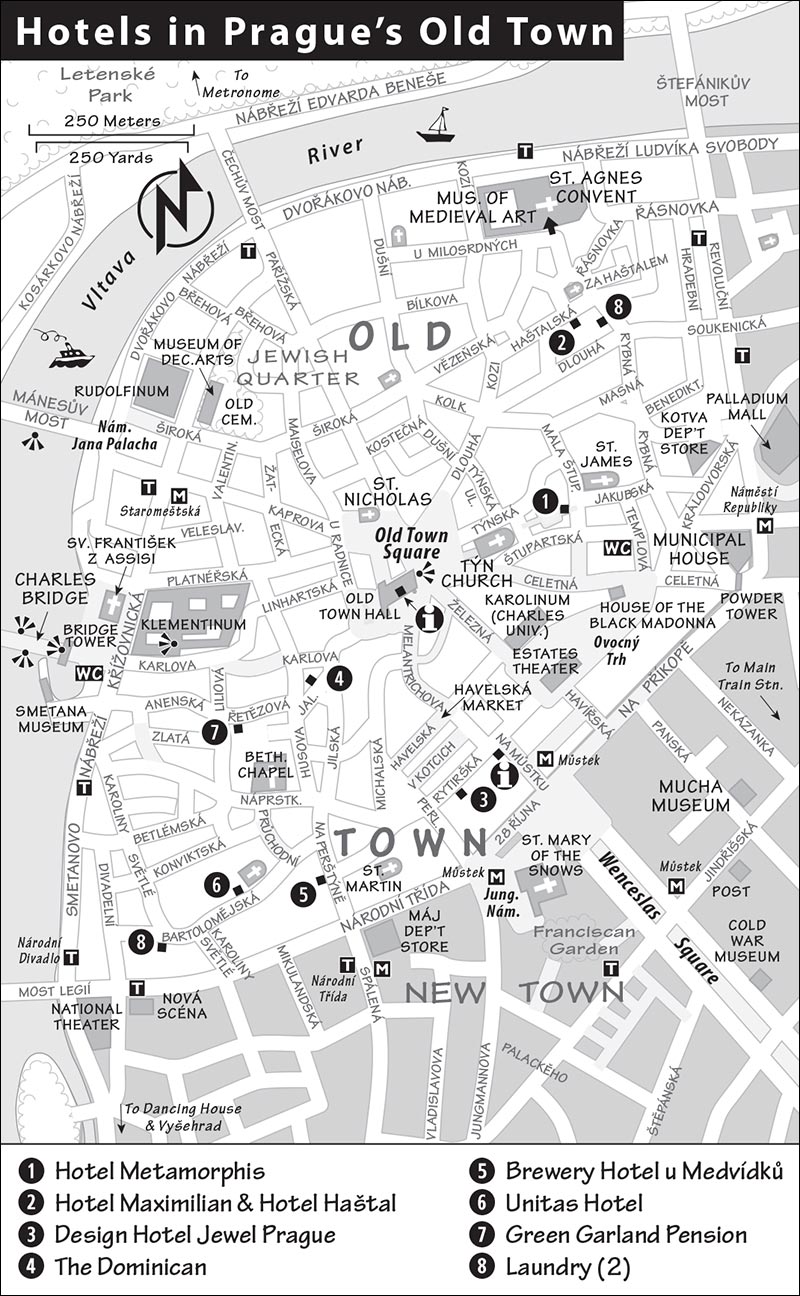
OLD TOWN HOTELS AND PENSIONS
You’ll pay higher prices to stay in the Old Town, but for many travelers, the convenience is worth the expense. These places are all within a 10-minute walk of the Old Town Square.
$$$$ Hotel Metamorphis is a splurge, with solidly renovated rooms in Prague’s former caravanserai (12th-century merchants’ hostel). Its breakfast room is in a spacious medieval cellar with modern artwork. Some of the street-facing rooms, located above two popular bars, are noisy at night (Malá Štupartská 5, +420 221 771 011, www.hotelmetamorphis.cz, hotel@metamorphis.cz).
$$$$ Hotel Maximilian is a sleek, mod, 71-room place with Art Deco black design; big, plush living rooms; and all the services and comforts you’d expect in a four-star hotel. It faces a church on a perfect little square just a short walk from the action (Haštalská 14, +420 225 303 111, www.maximilianhotel.com, reservation@maximilianhotel.com).
$$$ Design Hotel Jewel Prague (U Klenotníka), with 11 modern, comfortable rooms in a plain building, is three blocks off the Old Town Square (RS%—use promo code “ricksteves10” online, no elevator, Rytířská 3, +420 224 211 699, www.hoteljewelprague.com, info@jewelhotel.cz).
$$$ The Dominican has 28 luxurious rooms in a still-functional, 14th-century Dominican monastery. Rooms are historical, many with original medieval wooden ceilings, and the hotel has a pleasantly small feel (breakfast-350 Kč extra, for a better deal try the recommended cafés on Řetězová, hotel entrance on Jalovcová, +420 224 248 555, www.axxoshotels.com, reception.dominican@axxoshotels.com).
$$$ Brewery Hotel u Medvídků (“By the Bear Cubs”) has 43 comfortable rooms in a big, rustic, medieval shell with dark wood furniture. Upstairs, you’ll find lots of beams—or, if you’re not careful, they’ll find you (RS%—use promo code “oldgott” online, “historical” rooms cost slightly more, apartment available, Na Perštýně 7, +420 224 211 916, www.umedvidku.cz, info@umedvidku.cz, manager Vladimír). The pension runs a popular beer-hall restaurant with live music most Fridays and Saturdays until 23:00—request an inside room for maximum peace.
$$$ Unitas Hotel, in a former convent and communist prison, ironically offers plush comfort and bright, airy rooms. The premises formerly served as interrogation cells for the likes of Václav Havel (Bartolomějská 9, +420 224 230 533, www.unitas.cz, unitas@unitas.cz).
$$ Hotel Haštal is next to Hotel Maximilian (listed earlier) on the same quiet, hidden square. A popular hotel even back in the 1920s, this family-run place has been renovated to complement the neighborhood’s vibrant circa-1900 architecture. Its 31 rooms are comfortable and insulated against noise (RS%; free tea, coffee, and wine; air-con, Haštalská 16, +420 222 314 335, +420 725 369 369, www.hastal.com, info@hastal.com).
$$ Green Garland Pension (U Zeleného Věnce), on a central cobbled lane, has a small-place feel rare for the Old Town. Located in a thick 14th-century building with open beams, it has a blond-hardwood charm decorated with a warm and personal touch. The nine clean and simply furnished rooms are two and three floors up, with no elevator (RS%, family room, closed Jan-March, communication in off-season may be slow, Řetězová 10, +420 222 220 178, www.uzv.cz [URL inactive], pension@uzv.cz).
UNDER THE CASTLE, IN THE LESSER TOWN
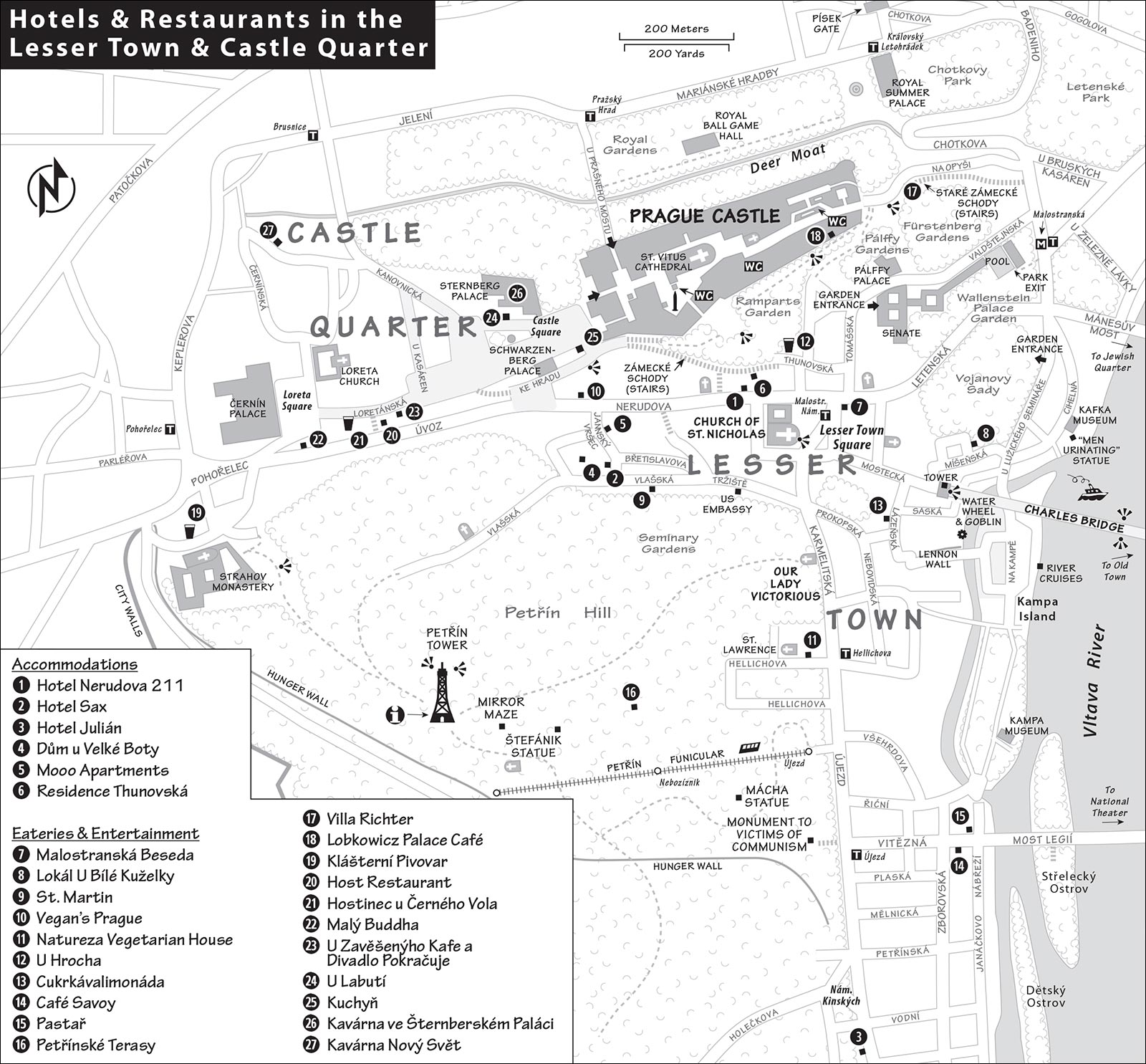
Several of these listings are buried on quiet lanes deep in the Lesser Town, among cobbles, quaint restaurants, rummaging tourists, and embassy flags.
$$$$ Hotel Nerudova 211 has eight suites and two apartments situated in a splendid Baroque house once owned—and redesigned—by renowned architect Jan Blažej Santini-Aichel. A thorough restoration highlights the period details, including painted wood ceilings, frescoed walls, and tile stoves. It’s a family-run operation, and it shows in the service and attention to detail (family rooms, Nerudova 14, +420 601 211 000, https://nerudova211.com, info@nerudova211.com).
$$$$ Hotel Sax’s 22 rooms are decorated in a retro, meet-the-Jetsons fashion. With a fruity atrium and a distinctly modern, stark feel, this is a stylish, no-nonsense place (air-con, elevator, free tea and pastries daily at 17:00, Jánský Vršek 3, +420 775 859 694, www.hotelsax.cz, hotel@sax.cz).
$$$ Hotel Julián is an oasis of professional, predictable decency in an untouristy neighborhood. Its 33 spacious, fresh, well-furnished rooms and big, homey public spaces hide behind a noble Neoclassical facade. The staff is friendly and helpful (RS%, family rooms, air-con, elevator, plush and inviting lobby, summer roof terrace, parking lot; Metro: Anděl, as you leave the Metro station go left and take tram #9, #12, or #20 for two stops; Elišky Peškové 11, Praha 5, +420 257 311 150, www.hoteljulian.com, info@julian.cz). Free lockers and a shower are available for those needing a place to stay after checkout (while waiting for a flight or train, for example).
$$$ Dům u Velké Boty (“House at the Big Boot”), on a quiet square in front of the German Embassy, is the rare quintessential family hotel in Prague: homey, comfy, and extremely friendly. Mellow Kuba, the second generation in charge and a film producer in winter, treats every guest as a (thirsty) friend and always has a supply of good advice and stories. Each of the 12 rooms is uniquely decorated, most in a tasteful, 19th-century Biedermeier style (RS%, cash only, cheaper rooms with shared bath, family rooms, children up to age 10 sleep free—toys provided, Vlašská 30, +420 257 532 088, www.dumuvelkeboty.cz, info@dumuvelkeboty.cz). There’s no hotel sign on the house—look for the splendid geraniums in the windows.
$$$ Mooo Apartments, in a meticulously restored 500-year-old house built around a secluded balconied courtyard, offers 13 spacious apartments with kitchenettes (no breakfast, some rooms without air-con, down the staircase from Nerudova at Jánský Vršek 8, +420 277 016 830, www.mooo-apartments.com, castle@mooo-apartments.com). For supplies, use the Žabka convenience store diagonally across the way. Mooo has an additional, larger location in a hip part of the New Town.
$$ Residence Thunovská, just below the Italian embassy on a relatively quiet staircase leading up to the castle, rents six rooms in a house that once belonged to the Mannerist artist Bartholomeus Sprangler. The renovated rooms are historic and equipped with kitchenettes and Italian furniture. The original chimney that runs through the house is inscribed with the date 1577, and the rest of the house is not much younger (RS%, breakfast extra—served in the next-door café, Thunovská 19, look for the Consulate of San Marino sign, reception open 9:00-19:00, +420 257 531 189, mobile +420 721 855 880, www.thunovska19.cz, resthunprague@gmail.com).
IN THE NEW TOWN
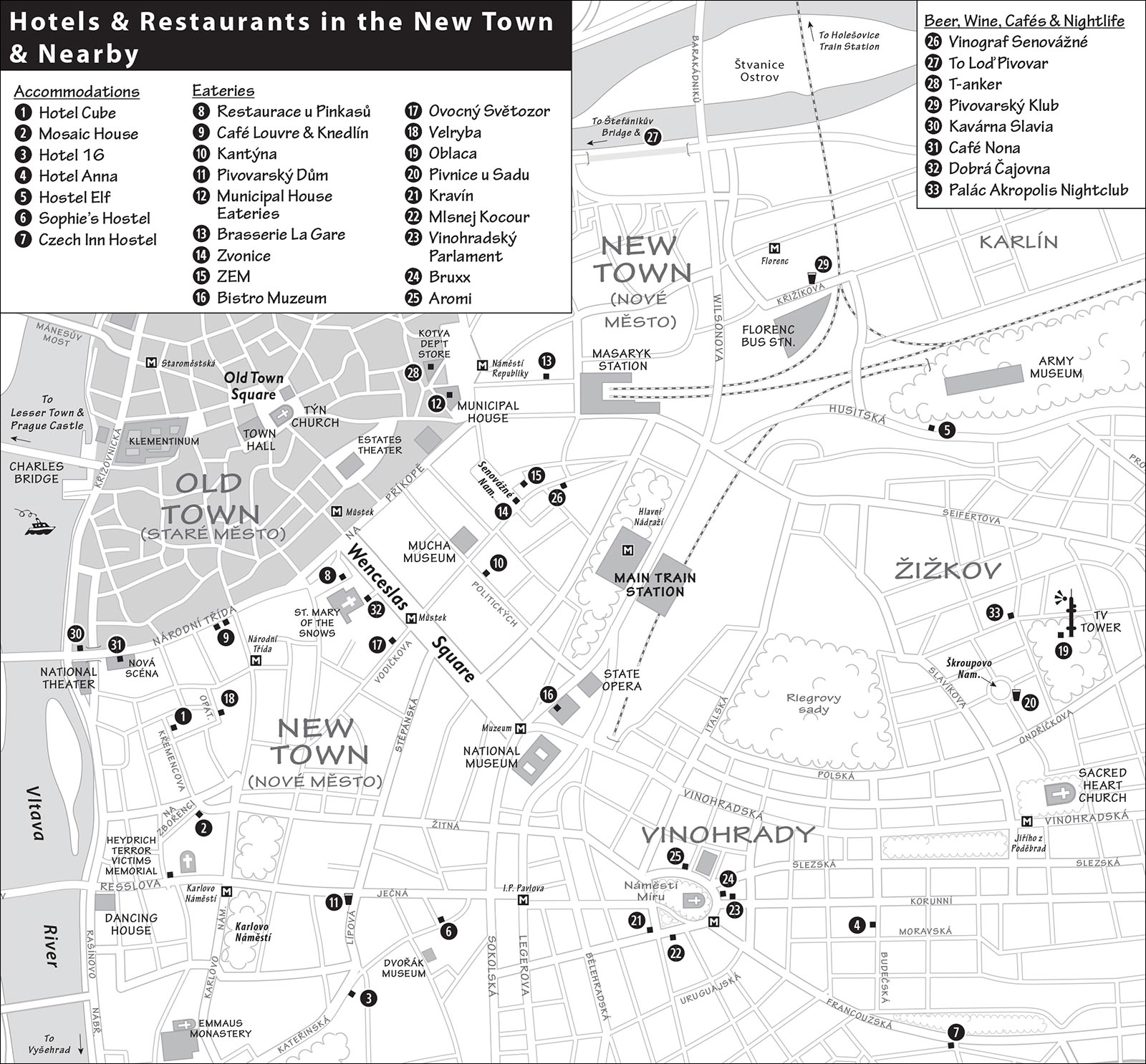
These hotels are in urban neighborhoods on the outer fringe of the New Town, beyond Wenceslas Square. But they’re still within several minutes’ walk of the sightseeing zone and are well served by trams.
$$$ Hotel Cube sets itself apart with its distinctive angular design and appealing location, on a quiet street just behind the National Theater, five minutes by foot from the sights and near a popular nightlife area. It’s a good option if your style leans more toward cool and modern than warm and traditional (family rooms, Křemencova 18, +420 251 019 811, www.hotelcube.cz, hotelcube@hotelcube.cz).
$$$ Mosaic House’s 90 rooms range from tiny to spacious, including 10 with outdoor terraces. It’s a “green” hotel, fueled by 100 percent renewable energy, and though it’s large, it manages not to feel impersonal: Each room is individually designed, with accents—mainly pictures and books—featuring a prominent Czech cultural figure. The large reception area, café, library, and spa all have a casual, stylish vibe (just off Karlovo Náměstí at Odborů 4, +420 277 016 880, www.mosaichouse.com, info@mosaichouse.com).
$$ Hotel 16 is a sleek and modern business-class place with an intriguing Art Nouveau facade, polished cherry-wood elegance, high ceilings, and 14 fine rooms. Guests are primarily interns at the nearby general hospital (RS%, back rooms facing the garden are quieter, triple-paned windows, air-con, free tea, elevator, limited free parking, 10-minute walk south of Wenceslas Square, Metro: I.P. Pavlova, Kateřinská 16, Praha 2, +420 776 245 960, no website, adam.sneider@vfn.cz).
$$ Hotel Anna offers 26 bright, simple, pastel rooms and basic service. It’s a bit closer to the action—just 10 minutes by foot east of Wenceslas Square (elevator, Budečská 17, Praha 2, Metro: Náměstí Míru, +420 222 513 111, www.hotelanna.cz, sales@hotelpro.cz).
HOSTELS
¢ Hostel Elf, a 10-minute walk from the main train station or one bus stop from the Florenc Metro station, is the wildest of these hostels: fun-loving, ramshackle, and covered with noisy, self-inflicted graffiti. They offer cheap, basic beds; a helpful staff; and useful services—free luggage room, no lockout, free tea and coffee, cheap beer, and a terrace (private rooms available, reserve four days ahead, Husitská 11, Praha 3, take bus #133 or #207 from Florenc Metro station for one stop to U Památníku, +420 222 540 963, www.hostelelf.com, info@hostelelf.com).
¢ Sophie’s Hostel, on a quiet street a 10-minute walk from the top of Wenceslas Square, has a modern design in an Art Nouveau building. There’s a shared kitchen as well as a hearty breakfast prepared by a real chef—not exactly the norm for hostels (private rooms and apartment available, Melounova 2, Praha 2, around the corner from I.P. Pavlova metro stop, +420 210 011 300, https://sophieshostel.com, info@sophieshostel.com).
¢ Czech Inn Hostel, two tram stops from Náměstí Míru metro in the expat Vinohrady neighborhood, has a cool design mixing natural wood, lacquered cement, and exposed brick. There’s a basement bar that regularly stages concerts and stand-up (cozy private rooms and apartments available, take tram #4 or #22 from Náměstí Míru two stops to Krymská, at Francouzská 76, +420 210 011 110, www.czech-inn.com, info@czech-inn.com).
Eating in Prague
A big part of Prague’s charm is found in wandering aimlessly through the city’s winding old quarters, marveling at the architecture, watching the people, and sniffing out fun restaurants. In addition to meat-and-potatoes Czech cuisine, you’ll find trendy, student-oriented bars and some fine international eateries (in general, Indian and Italian food tends to be very good, Thai and Vietnamese mediocre, Chinese drowned in soy sauce). For ambience, the options include traditional, dark Czech beer halls; elegant Art Nouveau dining rooms; and modern cafés.
I’ve listed eating and drinking establishments by neighborhood. Most of the options—and highest prices—are in the Old Town. For a light meal, consider one of Prague’s many cafés.
Generally, if you walk just a few minutes away from the tourist flow, you’ll find better value, atmosphere, and service. The more touristy a place is, the more likely you’ll pay too much—either in inflated prices or because waiters pad the bill.
Several areas well situated for sightseeing are lined with touristy restaurants. While these places are not necessarily bad values, I’ve listed only a few of your many options—just survey the scene in these spots and choose whatever looks best. Kampa Square, just off the Charles Bridge, feels like a quiet, small-town square. Havelská Market is surrounded by a mix of fancy restaurants and cheap little eateries. The massive Old Town Square is the place to nurse a drink or enjoy a meal while watching the tide of people, both tourists and locals, sweep back and forth. Bethlehem Square, still part of the Old Town but away from the main tourist flow, is my choice for an atmospheric outdoor evening meal.
EATING TIPS
Paying and Tipping: Look at your itemized bill carefully to make sure you understand each line (especially in touristy spots). Restaurants with sit-down service include a service charge on the bill. On top of that, locals tip by rounding up (usually 5 to 10 percent for good service—but not more).
Smoking in Restaurants: Like most European countries, the Czech Republic does not permit smoking inside restaurants and cafés. It is generally OK, however, to smoke in outdoor seating areas, which nonsmokers may occasionally find unpleasant.
Dining with a View: For great views, consider these options, described later: Villa Richter (next to Prague Castle, above Malostranská Metro stop), Petřínské Terasy (next to the funicular stop halfway up Petřín Hill), or the Oblaca restaurant and café (200 feet up in the Žižkov TV tower east of downtown).
Traditional Czech Places: While many Czechs have gradually come to prefer the cosmopolitan tastes of the world to the mundane taste of pork and sauerkraut, they like to revisit traditional institutions to reconnect with the childhood flavors of tripe soup or goulash. So while “authentic” Czech restaurants in the center have become touristy, they’re still great fun, a good value, and enjoyed by locals as well. Expect unadorned spaces, curt service, and reasonably good, inexpensive food.
Cheap-and-Cheery Sandwich Shops: All around town you’ll find modern little sandwich shops offering inexpensive fresh-made sandwiches (grilled if you like), pastries, salads, and drinks. You can get the food to go or eat inside at simple tables.
Groceries and Farmers Markets: Ask your hotelier for the location of the nearest grocery store. An even cheaper chain of small grocery stores, with several locations in the Old Town, is Žabka (look for a colored shopping basket sign outside).
Farmers markets crop up around the city and tantalize picnickers. Apart from vegetables, you’ll find quality cheeses, juices, cakes, coffee, and more (www.farmarsketrziste.cz). The most central is on Republic Square (Náměstí Republiky), just across the street from the Municipal House and the Powder Tower (Mon-Fri until 20:00). The most scenic is the Náplavka (“River Landing”) market on the Vltava embankment, just south of the Palacký Bridge (Sat 8:00-14:00).
THE OLD TOWN
For locations, see the “Restaurants in Prague’s Old Town” map.
Traditional Czech
$$ Restaurace u Provaznice (“By the Ropemaker’s Wife”) has all the Czech classics, peppered with the story of a once-upon-a-time-faithful wife. (Check the menu for details of the gory story.) Natives congregate under bawdy frescoes for the famously good “pig leg” with horseradish and Czech mustard. This is a handy spot on a peaceful lane just a block from the commotion at the bottom of Wenceslas Square (daily, Provaznická 3, +420 224 232 528).
$$ U Medvídků (“By the Bear Cubs”) started out as a brewery in 1466 (they still offer a range of their own microbrews, including one of the oldest-ever wheat beers) and is now a flagship beer hall of the Czech Budweiser. The one large room is bright, noisy, and touristy (daily, a block toward Wenceslas Square from Bethlehem Square at Na Perštýně 7, +420 736 662 900).
$ U Zlatého Tygra (“By the Golden Tiger Pub”) has long embodied the proverbial Czech pub, where beer turns strangers into kindred spirits as they share their life stories with one another. Today, “The Tiger” is a buzzing shrine to one of its longtime regulars, the writer Bohumil Hrabal, whose fictions immortalize many of the colorful characters that once warmed the wooden benches here (tight seating, daily from 15:00, just a block off Karlova at Husova 17, +420 222 221 111).
$ Restaurace u Betlémské Kaple, behind Bethlehem Chapel, is not “ye olde” Czech. It’s peaceful, woody, and spacious. Locals appreciate the cheap lunch deals and fish specialties. Portions are splittable and prices are good (daily, Betlémské Náměstí 2, +420 222 221 639).
$$ Restaurace Mlejnice (“The Mill”) is a fun little pub strewn with farm implements and happy eaters, located just out of the tourist crush two blocks from the Old Town Square. They serve traditional specials, hearty salads, and modern Czech plates. Reservations are smart for dinner (daily, between Melantrichova and Železná at Kožná 14, +420 224 228 635, www.restaurace-mlejnice.cz).
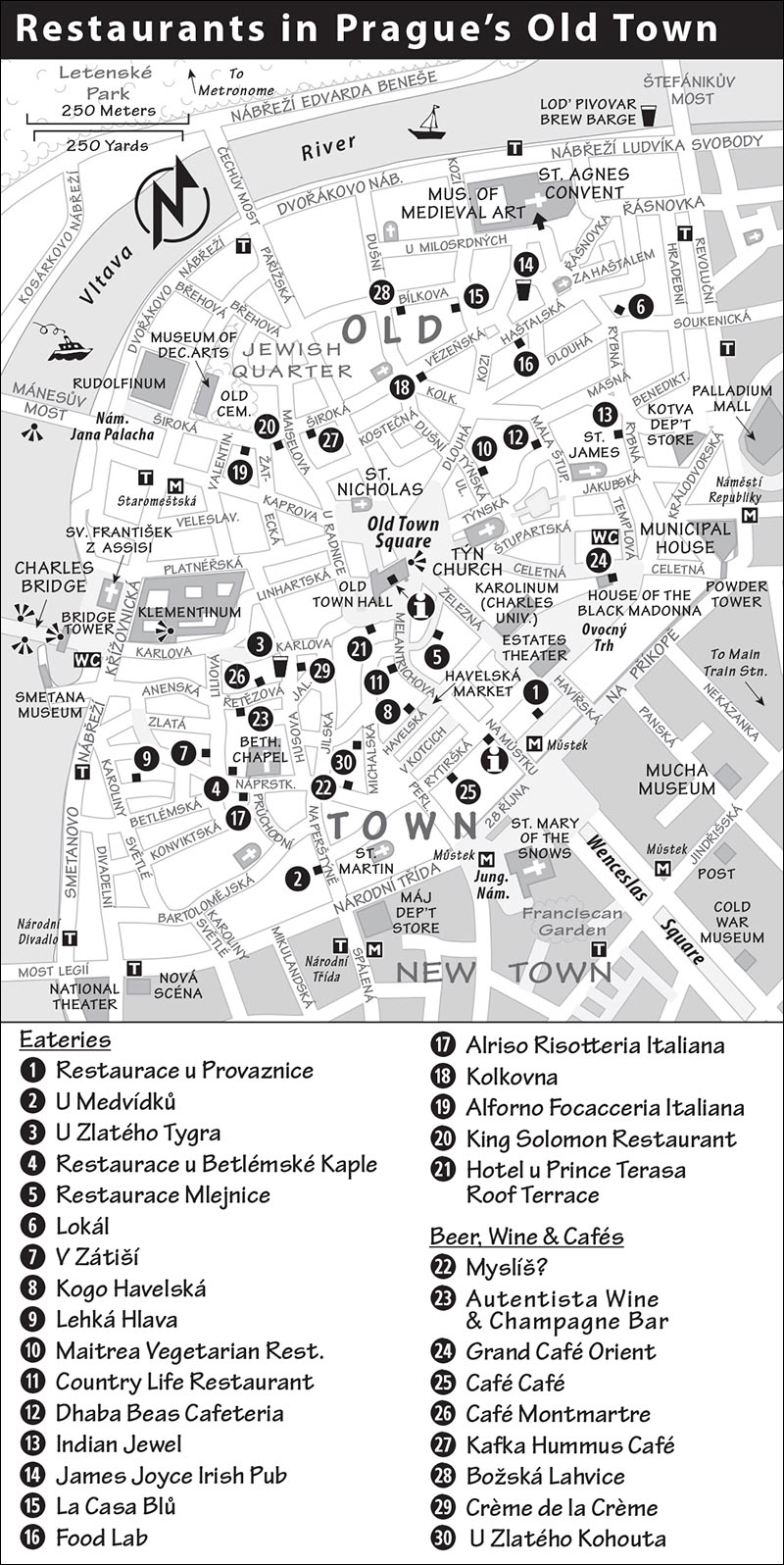
$$ Lokál is a hit for its good-quality Czech classics. Filling a long, arched space, the restaurant plays on nostalgia: The stark interior is a deliberate 1980s retro design, and it celebrates the hungry and thirsty working class. The name roughly means “the neighborhood dive”—a reference to the basic canteens of that age. Reservations are smart (daily until late, Dlouhá 33, +420 734 283 874, https://lokal-dlouha.ambi.cz).
Modern and Vegetarian
$$$$ V Zátiší prides itself on being untraditional in every sense, from the ambience and service to the chef’s imaginative concoctions. Delicate deer, duck, and fish typically swim in carefully calibrated sauces and come with unusual side dishes (Mon-Sat lunch and dinner, Sun dinner only, Liliová 1, +420 222 221 155).
$$$ Kogo Havelská serves modern takes on traditional Italian cuisine, including perfectly cooked pasta and fish and meats paired with seasonal ingredients. They also make their own bread and desserts (daily, Havelská 29, +420 224 210 259).
$ Lehká Hlava (“Clear Head”) is a vegetarian oasis of peace located within 100 yards of the Charles Bridge on a hidden cul-de-sac. Its delightful historic vaulted space, given a retro sci-fi remodel, couldn’t feel more distant from the bustle of the ubiquitous crowds. The chef is on a mission to please the senses with a wide-ranging menu of veggie takes on international cuisine. The daily lunch specials are a particularly good value (daily, limited options 15:30-17:30, Boršov 2, +420 222 220 665).
$$ Maitrea Vegetarian Restaurant is a favorite Old Town vegetarian place, where a spirit of wellness and feng shui prevails. The ground floor is fresh and modern. Downstairs is a world of fountains, pillows, and Buddhas. The extensive, creative menu will stoke your appetite (vegan-friendly, daily, cheap lunch specials Mon-Fri, half a block downhill from the Týn Church north door at Týnská 6, +420 221 711 631).
$$ Country Life Restaurant is a cafeteria with a well-displayed buffet of salads and hot veggie dishes. It’s midway between the Old Town Square and the bottom of Wenceslas Square. They’re serious about their vegetarianism, serving only plant-based, unprocessed, and unrefined food (pay by weight; Mon-Thu 8:30 until 19:00, Fri until 16:00, Sun 11:00-18:00, closed Sat; through courtyard at Melantrichova 15/Michalská 18, +420 224 213 366).
$$ Dhaba Beas Cafeteria is run by a Punjabi chef. Diners grab a steel tray and scoop up whatever looks good—typically various choices of dal (lentils) and sabji (vegetables) with rice or chapati (pancakes). The food is sold by weight—you’ll likely spend 200 Kč for lunch. Tucked away in a courtyard behind the Týn Church, this place is popular with university students and young professionals (daily, Týnská 19, +420 608 035 727).
International Eateries and Bars
Dlouhá, the wide street leading away from the Old Town Square behind the Jan Hus Memorial, takes you into a neighborhood west of the Jewish Quarter where you can eat your way around the world. Here are a few favorites from this United Nations of eateries.
Indian: Located in a modern building two blocks behind the Municipal House, $$$ Indian Jewel was among the first in a recent wave of quality Indian restaurants to arrive in Prague. They offer Indian classics, vegetarian options, and good-value lunch specials on weekdays. The hardworking owner, Sanjeev, is proud of his rare-in-Prague tandoor oven—ideal for baking authentic breads (daily, Rybná 9, +420 725 107 059).
Irish: $ James Joyce Irish Pub may seem like a strange recommendation in Prague—home of some of the world’s best beer—but it has the kind of ambience that locals (and few tourists) seek out. They serve basic pub grub, fish and chips, and curries. Expats have favored this pub for Guinness ever since the Velvet Revolution enabled the Celts to return to one of their original homelands. Worn wooden floors, dingy walls, and the Irish manager transport you right into the heart of blue-collar Dublin (daily until late, U Obecního Dvora 4, +420 224 818 851).
Mexican: One of the last student bastions in the Old Town, $$ La Casa Blů, with cheap lunch specials, Mexican plates, Staropramen beer, and greenish mojitos, is your own little pueblo in Prague. Painted in warm oranges and reds, energized by upbeat music, and guarded by creatures from Mayan mythology, La Casa Blů attracts a fiesta of happy eaters and drinkers (daily, Sun from 14:00, on the corner of Kozí and Bílkova, +420 224 818 270).
International Fusion: $$ Food Lab, with a sleek, modern interior, blends tastes from all over the world. Breakfast is sumptuous and the weekly lunch menus are a good value. Dinner portions encourage family-style sharing (daily, Haštalská 4, +420 257 310 713).
Italian near Bethlehem Square: Located on a quiet square near Bethlehem Chapel, $$$ Alriso Risotteria Italiana offers creative gluten-free dishes in a classy setting with seating both inside and out. Locals come here for the moist and flavorful rice bread (daily, Betlémské Náměstí 11, +420 222 233 341).
Jewish Quarter
These restaurants are well placed to reenergize after a demanding tour of the Jewish Quarter. Also consider the nearby international eateries listed earlier.
$$$ Kolkovna, the flagship restaurant of a chain allied with Pilsner Urquell, is big and woody yet modern, serving a fun mix of Czech and international cuisine—ribs, salads, cheese plates, and beer. It feels a tad formulaic...but not in a bad way (a bit overpriced, daily, across from Spanish Synagogue at V Kolkovně 8, +420 224 819 701).
$$$ Alforno Focacceria Italiana is a low-key slice of Italy conveniently located across the street from the Pinkas synagogue. You can splurge on fancy fish and meat dishes or opt for relatively affordable pasta dishes and weekday lunch specials (daily, Široká 25, +420 224 818 322).
$$$ King Solomon Restaurant, the oldest kosher restaurant in Prague, serves traditional Jewish dishes in a handsome setting, with an emphasis on roasted, grilled, and braised meats. The daily fixed-price menu, available at both lunch and dinner, gives you the chance to sample a range of dishes for a good price (daily, Fri and Sat Shabbat meals by reservation only, Široká 8, +420 224 818 752, www.kosher.cz).
Dining with an Old Town Square View
$$$$ Hotel u Prince Terasa, atop the five-star hotel facing the Astronomical Clock, is designed for foreign tourists. A sleek elevator inside the hotel takes you to the rooftop terrace, packed with tables and an open-air grill. The view is arguably the best in town—especially at sunset. The menu is overpriced, with photos that make ordering easy. Servers can be rude, dishonest, and aggressive. Confirm exact prices before ordering. This place is also great for a drink at sunset or late at night (daily, outdoor heaters, Staroměstské Náměstí 29, +420 737 261 842, www.terasauprince.com).
THE LESSER TOWN
These characteristic eateries are handy for a bite before or after your Prague Castle visit. For locations, see the “Hotels and Restaurants in the Lesser Town and Castle Quarter” map, earlier.
$$ Malostranská Beseda, in the impeccably restored former Town Hall, weaves together an imaginative menu of traditional Czech dishes (both classic and little known), vegetarian fare, and fresh fish. It feels a bit sterile and formulaic, but you can choose among three settings: the ground-floor restaurant on the left, the café on the right (serves meals, but it’s OK to have only coffee or cake), or the packed beer hall downstairs, where Pilsner Urquell is served (daily, Malostranské Náměstí 21, +420 257 409 112). The restaurant has a recommended music club upstairs.
$$ Lokál U Bílé Kuželky (“By the White Bowling Pin”), a branch of the Old Town’s recommended Lokál restaurant, is the best bet for quick, cheap, well-executed Czech classics on this side of the river (daily until late, Míšeňská 12; from the Charles Bridge, turn right around the U Tří Pštrosů Hotel just before the Lesser Town gate; +420 257 212 014).
$$ St. Martin is the quintessential neighborhood pub/restaurant serving inexpensive dishes (mainly burgers), a variety of beers, and a selection of wines from two family-owned Moravian wineries (daily, tucked away on a little street just above the American embassy at Vlašská 7, +420 257 219 728).
$$ Vegan’s Prague, on the top two floors and a tiny terrace of a narrow medieval house, serves vegan variations on Czech classics as well as Asian fare. The setting is a tasteful mix of Renaissance roof beams, Balinese art, and gorgeous vistas (daily, Nerudova 36, +420 735 171 313).
$$ Natureza Vegetarian House, on a quiet walnut-tree-shaded patio next to the Gothic walls of St. Lawrence Church, is a snug, family-run place offering eclectic vegetarian, vegan, and gluten-free food. Choose from soups, salads, veggie burgers, Asian-inspired dishes, burritos, risottos, desserts, and fancy nonalcoholic drinks (daily until 17:00, Hellichova 14, +420 721 678 883).
$ U Hrocha (“By the Hippo”), a small authentic pub with tar dripping from its walls, is packed with beer drinkers. Expect simple, traditional meals—basically meat starters with bread. Just below the castle near the Lesser Town Square (Malostranské Náměstí), it’s actually the haunt of many members of parliament, which is around the corner (cash only, daily from 12:00, chalkboard lists daily meals in English, Thunovská 10, +420 257 533 389).
$$ Cukrkávalimonáda (“Sugar, Coffee, Lemonade”) is part restaurant and part patisserie, serving big salads, made-to-order sandwiches, artful pastries, and freshly squeezed juice in a setting mixing old and new decor. The bistro—an oasis just a block away from the tourist crush—is 50 yards down the first street to the left after you exit the Charles Bridge (daily 9:00-19:00, Lázeňská 7, +420 257 225 396).
Across the Bridge from the National Theater: Consider these $$$ elegant choices near the riverfront. Café Savoy is the closest you’ll get to a Viennese café in Prague—with exquisite dishes mixing French, Viennese, and Czech influences; thoughtful service; and elegant Art Deco surroundings (lunch specials weekdays only, breakfast all day; long hours daily; Vítězná 5, +420 731 136 144). Pastař (“The Pasta Maker”) is serious about freshly made pasta. Their small menu—Italian with a bit of Czech—includes fine fish and meat dishes as well, and the service is attentive and friendly (daily, Malostranské Nábřeží 558, +420 777 009 108).
Near the Funicular, on Petřín Hill: Halfway up Petřín Hill, $$ Petřínské Terasy offers great views over the city from the terrace or woody seating indoors. The menu features traditionally prepared meats (cash only, daily, Petřín 393, +420 257 320 688).
THE CASTLE QUARTER
For locations, see the “Hotels and Restaurants in the Lesser Town and Castle Quarter” map, earlier.
$$$ Villa Richter, at the end of the castle promontory and surrounded by the country’s oldest vineyard, is a popular wedding venue—one look at the gorgeous city view tells you why. You can take it all in from the panoramic outdoor seating area while nibbling on “street food” paired with a glass of the vineyard’s wine (daily until 19:00, no reservations, past the castle exit gate by the Golden Lane, +420 702 282 402).
$$$ Lobkowicz Palace Café is conveniently located at the far end of the castle near the end of the Golden Lane. There are three seating options—aim for the terrace, which has to-die-for views over the city. A selection of soups, salads, sandwiches, and warm Czech classics is served at the premium prices you’d expect for the location (daily until 18:00, +420 731 192 281).
$$ Klášterní Pivovar (“Monastery Brewery”), founded by an abbot in 1628 and reopened in 2004, has two large rooms and a pleasant courtyard. This is the place, though touristy, to taste a range of unpasteurized beers brewed on the premises, including amber, wheat, and IPA. To accompany the beer, try the strong beer-flavored cheese served on toasted black-yeast bread (daily, Strahovské Nádvoří 301, +420 233 353 155). It’s directly across from the entrance to the Strahov Library (don’t confuse it with the enormous, tour group-oriented Klášterní Restaurace next door, to the right).
$$$ Host Restaurant is hidden in the middle of a staircase that connects Loretánská and Úvoz streets. This spot, which boasts super views of the Lesser Town and Petřín Hill, has a modern black-and-white design and an imaginative menu (daily; as you go up Loretánská, watch for stairs leading down to the left at #15—just before the arcaded passageway; +420 606 123 449).
$ Hostinec u Černého Vola (“By the Black Ox”) is a dingy old-time pub—its survival in the midst of all the castle splendor and tourism is a marvel. It feels like a kegger on the banks of the river Styx, with classic bartenders serving up Kozel beer (traditional “Goat” brand with excellent darks) and beer-friendly gut-bomb snacks (fried cheese, local hot dogs). The pub is located on Loretánská (cash only, daily, 50 yards from Loreta Church, no sign outside, look for the only house on the block without an arcade, English menu on request).
$$ Malý Buddha (“Little Buddha”) serves delightful food—especially vegetarian—and takes its theme seriously. You’ll step into a mellow, low-lit escape of bamboo and peace, where you’ll be served by people with perfect complexions and almost no pulse to the no-rhythm of meditative music. Eating in their little back room is like dining in a temple (cash only, closed Mon, between the castle and Strahov Monastery at Úvoz 46, +420 604 709 379).
$ U Zavěšenýho Kafe a Divadlo Pokračuje (“By the Hanging Coffee” and “The Show Goes On”), just below Loreta Square on the way to the castle, is a creative little pub/restaurant with friendly service that has attracted a cult following among Prague’s literati. You can “hang a coffee” here for a local vagabond by paying for an extra coffee on your way out (daily until late, Loretánská 13, +420 733 483 900).
$$ U Labutí (“By the Swans”) offers Czech food for a good price in a tranquil courtyard, just across from the Plague Column on Castle Square (daily, Hradčanské Náměstí 11, +420 220 511 191).
$$ Kuchyň (“Kitchen”), just behind the Tomáš Masaryk statue on Castle Square, has a small terrace with great city views. They serve Czech classics with a modern twist (daily, Hradčanské Náměstí 1, +420 736 152 891).
$ Kavárna ve Šternberském Paláci is the locals’ getaway from the tourist scene on Castle Square. It’s tucked behind the Archbishop’s Palace. They serve soup or goulash with bread and drinks in a quiet courtyard at unbeatable prices. Check out the garden with stunning sculptures that’s through the door on the left corner of the courtyard (Tue-Sun until 18:00, closed Mon, Hradčanské Náměstí 15, +420 703 372 197).
$ Kavárna Nový Svět (“New World Café”), on a quiet lane down from the Loreta Church, offers a tasty cake-and-coffee break from the tourist crowds, either in a cozy interior or a beautiful garden setting (Tue-Sun until 19:00, closed Mon, Nový Svět 2).
THE NEW TOWN AND NEARBY
For locations, see the “Hotels and Restaurants in the New Town and Nearby” map, earlier.
Traditional Czech
$$ Restaurace u Pinkasů, founded in 1843, is known among locals as the first place in Prague to serve Pilsner beer. It’s popular for solid, basic Czech pub grub. You can sit in its traditional interior, in front to watch the street action, or out back in a delightful garden shaded by the Gothic buttresses of the neighborhood church (daily, near the bottom of Wenceslas Square, between the Old Town and New Town, Jungmannovo Náměstí 16, +420 221 111 152).
$$ Café Louvre is an elegant favorite from long ago (it opened in 1902 and maintains its classic atmosphere). It features simple tables, paper tablecloths, and an army of young waiters serving up decent food (Czech classics, vegetarian dishes, lunch specials) at good prices (two-course lunch offered; long hours daily; Národní 22, +420 724 054 055).
$ Knedlín (“The Dumpling Village”) is a tiny place that, in keeping with its name, serves 20 kinds of dumplings, both sweet and savory. Having one is an indulgent snack; get two and you’re on your way to a meal. Order from the display case and then squeeze yourself in, like filling in a dumpling, at one of the minuscule tables (daily, Národní 24, +420 702 214 518).
$$ Kantýna serves “meat from the bone” (a.k.a., very fresh). A cross between a traditional butcher’s shop and a modern pick-from-the-counter canteen, this place offers the best quality fast food for carnivores. They also serve a wide selection of freshly made soups, salads, and traditional desserts (daily, a block off the middle of Wenceslas Square, just down the street from the Mucha Museum at Politických Vězňů 5, no reservations).
$$ Pivovarský Dům (“The Brewhouse”), on the corner of Ječná and Lípová, is popular with locals for its rare variety of fresh beers (yeast, wheat, and fruit-flavored), fine classic Czech dishes, and an inviting interior that mixes traditional and modern (daily, reservations recommended in the evenings, walk up Štěpánská street from Wenceslas Square for 10 minutes, or take tram #22 for two stops from Národní to Štěpánská; Lípová 15, +420 296 216 666, www.pivo-dum.cz).
Art Nouveau Splendor in the Municipal House
$$$ Kavárna Obecní Dům, a dressy café, is drenched in chandeliered, Art Nouveau elegance and offers the best value and experience here. Light, pricey meals and drinks come with great atmosphere and bad service (long hours daily, live piano or jazz trio in the evening, +420 222 002 763).
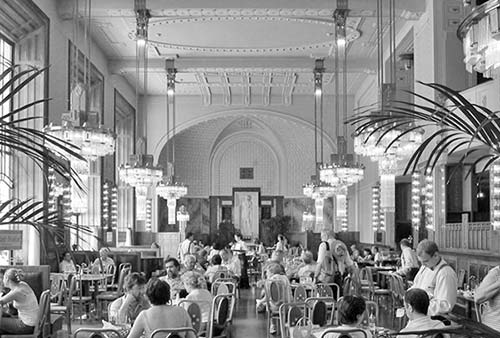
$$$ Restaurace Obecní Dům, in the next wing, is fine and formal, oozing Mucha elegance and slinky romance. They serve not particularly imaginative modern Czech cuisine with few international touches. You’re here more for the ambience than the food (daily, +420 222 002 770).
$$$ The beer cellar is overpriced and generally filled with tour groups (daily).
Other New Town Eateries
Near Masaryk Station: $$$ Brasserie La Gare opened with the mission to serve Czechs authentic French brasserie fare. It prides itself on its grilled fish and meats, and the lunch specials are a good value. The combination of wood-and-bronze interior and an open fire recreates a French-village atmosphere. There’s also a French bakery and a deli (daily, V Celnici 3, +420 222 313 712).
At and Near Jindřišská Tower: $$$$ Zvonice (“Bellfry”) is an over-the-top splurge nested between wooden beams, exposed brick, and a 16th-century bronze bell on the top two floors of the gothic Jindřišská Tower (reached by elevator). The chef specializes in traditional Czech preparations of game, and a few fish and vegetarian options are also available (daily, Jindřišská 33, the tower three blocks from central Wenceslas Square is hard to miss, +420 224 220 009, www.restaurantzvonice.cz).
$$$ ZEM (“Earth,” punning on Zen) melds Czech and Japanese influences to produce an “avant-garde” cuisine that puts a premium on creativity. Whether you order yakitori or schnitzel, what arrives on your plate will likely defy expectations. The setting is equally engaging: the artsy 1920s interior has the stagelike open kitchen as its focal point (lunch specials, daily, just behind the Jindřišská Tower three blocks from central Wenceslas Square at Senovážné Náměstí 23, +420 227 344 900).
Near Wenceslas Square: $ Bistro Muzeum, in the former communist parliament building (now part of the National Museum) at Wenceslas Square, offers daily menus, freshly roasted coffee, soups, and sandwiches in a pleasant, kid-friendly setting (daily until 18:00, Vinohradská 1, +420 220 960 458).
$ Ovocný Světozor (“World of Fruit”) is a colorful joint that’s popular for its ice cream, but they also sell really cheap (and good) Czech-style open-face sandwiches—plus cakes and other desserts. Ask for an English menu (long hours daily, in the Světozor Mall off Wenceslas Square at Vodičkova 39).
Near Národní Třída: $$ Velryba is a low-key, artsy café-restaurant in a cool neighborhood buzzing with students. Here you can enjoy a beer, a burger, and chicken wings five minutes from the Old Town with nary a tourist in sight (daily, Opatovická 24, +420 224 931 444).
Žižkov
$$$ Oblaca (“The Clouds”), the restaurant 200 feet up in the Žižkov TV tower, is expensive, but it comes with a Sputnik’s-eye view. A less pricey café serves breakfast and lunch (open late daily 11:00-24:00, less expensive café open 9:00-16:00, reservations recommended, Mahlerovy Sady 1, Metro: Náměstí Jiřího z Poděbrad, +420 210 320 086, https://towerpark.cz/oblaca, www.towerpark.cz/en/oblaca-restaurant [URL inactive]).
$ Pivnice u Sadu is the quintessential neighborhood pub, frequented as much by Czechs as by the Americans, Russians, and Slovaks who live in the area. Sit outside in the shade of a wild cherry tree, or in the interior decorated with whatever the neighbors found in their attics and gave to the restaurant (long hours daily, on a round square a block west from Žižkov TV tower at Škroupovo Náměstí 5, Metro: Náměstí Jiřího z Poděbrad, +420 222 727 072).
Vinohrady
Náměstí Míru Square: The area around this square has a wide choice of good restaurants. $$ Kravín (“Cowshed”) serves Czech classics, pasta, and grilled meats in a red-brick interior. The lunch menu is a good value (daily, Náměstí Míru 18, +420 702 015 054). $$ Mlsnej Kocour (“Fussy Cat”), run by the Pilsner brewery, focuses on Czech dishes in modern decor that can feel a bit formulaic (daily, Belgická 42, +420 222 541 584).
$$ Vinohradský Parlament specializes in classic Czech cuisine, particularly dumplings. At lunchtime it’s the local crowd’s first choice for a quick fix (daily, Korunní 1, +420 224 250 403). Nearby $$$ Bruxx is a Belgian brasserie with a good-value lunch menu (daily, Náměstí Míru 9, +420 224 250 404) and $$$$ Aromi is a high-end Italian restaurant serving meticulously prepared seafood in a fancy setting (lunch and dinner Mon-Fri, dinner only Sat, closed Sun, Náměstí Míru 6, +420 222 713 222).
CRAFT BEER AND WINE BARS
These places give you a good sense of Prague’s popular craft beer and wine scenes. For locations, see the “Hotels and Restaurants in the New Town and Nearby” map unless otherwise noted.
$$ Vinograf Senovážné is an intimate wine bar with over 500 bottles to choose from and a carefully crafted seasonal food menu that’s both creative and eclectic (lunch specials, closed Sun, just behind the Jindřišská Tower, three blocks from central Wenceslas Square at Senovážné Náměstí 23, +420 214 214 681).
$$ Loď Pivovar (“The Brewery Barge”) brews three staple beers and a range of specials on the premises. The upper deck is effectively an open-air beer garden, the middle deck doubles up as a restaurant with traditional Czech dishes, while the eye-at-water-level bottom deck is a pub that pairs beer with traditional Czech tapas (daily; at Dvořákovo nábřeží just under the Štefánik Bridge, near the Convent of St. Agnes; +420 773 778 788).
$$ T-anker is a beer terrace sitting on top of the 1970s Kotva department store just off Republic Square. While their Tanker beer is specially made for this location, they do a good a job of rotating beers from around Prague and the country on their nine taps. The view of the Old Town towers is unbeatable (daily; either enter through the main doors of Kotva and take the elevator to the fourth floor and then the escalator up one more floor, or take the side entrance from Králodvorská street and then the elevator to the fifth floor; +420 722 445 474).
$$ Pivovarský Klub (“The Brew Club”) serves a wide selection of Czech microbrews in a modern, blond-wood restaurant. Every week different beers are featured on tap (daily, evening reservations recommended; about 50 yards on the left along Křižíkova from Florenc Metro station, Křižíkova 17+420 222 315 777; https://pivo-klub.cz).
$$ Myslíš? (“Do You Think?”) specializes in Czech microbrews of diverse provenance, ranging from lagers to IPAs to stouts. It’s hard to beat the location—a small modern ground floor and a large, cool brick cellar in the heart of the Old Town (vegan lunch served, daily until late, Sat-Sun evening only, Skořepka 3, just around the corner from the Havelská Market—for location, see the “Restaurants in Prague’s Old Town” map, +420 774 591 091).
$$ Autentista Wine and Champagne Bar serves a carefully curated list of organic Czech and international wines in a vaulted space with modern design. You can accompany your vino with a selection of cheeses and cured hams (daily from 17:00, Řetězová 10—for location, see the “Restaurants in Prague’s Old Town” map, +420 602 587 827).
CAFÉS
The Prague coffeehouse scene is alive and kicking. While some cafés are dripping with history, new ones are popping up almost daily. Cafés in the Old Town and New Town are as much about the ambience as they are about the coffee.
Old Town
For locations, see the “Restaurants in Prague’s Old Town” map, earlier.
$$ Grand Café Orient is only one flight up off busy Celetná street, yet a world away from the crush of tourism below. Located in the Cubist House of the Black Madonna, the café is fittingly decorated with a Cubist flair. With its stylish, circa-1910 decor toned to dark green, this space is full of air and light—and a good value as well. The café takes its Cubism seriously: Traditionally round desserts are served square (sandwiches, salads, vanilla squares and other desserts, great balcony seating, long hours daily, Ovocný Trh 19, at the corner of Celetná near the Powder Tower, +420 224 224 240).
$$ Café Café, just off to the right from the main drag connecting the Old Town and Wenceslas Square, serves salads, sandwiches, and cakes in a fancy setting (long hours daily, Rytířská 10, +420 774 331 122).
$$ Café Montmartre, a block and a world away from the tourist crush of Karlova on the quiet Řetězová street, feels like a hidden meeting place for dissident poets from the 1950s (Mon-Fri from 14:00, Sat-Sun from 16:00, Řetězová 7, +420 601 364 137).
$$ Kafka Hummus Café is a stylish pit stop for a dose of coffee and a bite of crunchy falafel or homemade hummus in-between synagogue visits (Mon-Fri until 18:00, Sat-Sun until 20:00, in the Jewish Quarter at Široká 12).
$$ Božská Lahvice (“Divine Bottle”) is a café-cum-bookstore in a spacious, light-filled underground space just steps from the Spanish Synagogue. It’s a local favorite for wine, coffee, soup, and pierogi in between book browsing (long hours daily, Bílkova 6, +420 734 441 004).
At the intersection of Řetězová and Husova, Crème de la Crème’s ice cream is a hit with locals for its fruity and nutty flavors (daily, Husova 12).
New Town
For locations, see the “Hotels and Restaurants in the New Town and Nearby” map on here.
$$ Kavárna Slavia, across from the National Theater (facing the Legií Bridge on Národní street), is a fixture in Prague, famous as a hangout for its literary elite. Today, it’s past its prime, with a faded Art Deco interior and celebrity photos on the wall. But its iconic status makes it a fun stop for a coffee (long hours daily, sit as near the river as possible, Smetanovo Nábřeží 2, +420 224 218 493). Notice the Drinker of Absinthe painting on the wall (and on the menu)—with the iconic Czech writer struggling with reality.
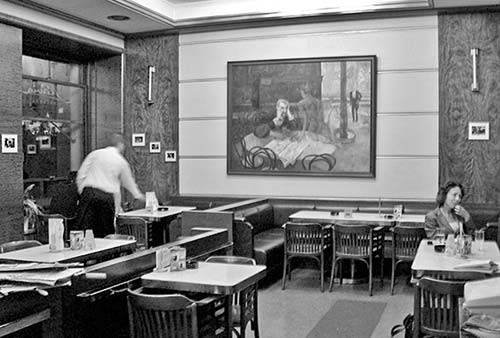
$$ Café Nona, on the second floor of the new building of the National Theater, takes you back to the 1980s with its fashionably retro design. Sip your coffee and enjoy the view of busy National Street below (long hours daily, Národní 4, +420 775 755 147).
TEAHOUSES
In the 1990s, after the borders opened, many young Czechs ventured beyond Western Europe to places like Southeast Asia, Africa, or Peru. When they returned, many gravitated toward Eastern-style teahouses, where the civilization-weary spirit was soothed by the strong taste of yogi chai and the scent of incense. While the teahouse boom has passed, two fine examples still survive in handy Old Town and New Town locales.
$ Dobrá Čajovna (“Good Teahouse”), only a few steps off the bustle of Wenceslas Square, takes you into a peaceful, bamboo-shaded world that elevates tea to a religious ritual. You’ll be given an English menu—which lovingly describes each tea—and a bell. The menu lists a world of tea (very fresh, prices by the small pot), “accompaniments” (such as Exotic Miscellany), and light meals “for hungry tea drinkers.” When you’re ready to order, ring your bell to beckon a tea monk (daily, Sun from 14:00; through a short passageway near the base of Wenceslas Square, opposite McDonald’s; at Václavské Náměstí 14, +420 224 231 480). For location, see the “Hotels and Restaurants in the New Town and Nearby” map on here).
$ U Zlatého Kohouta (“By the Golden Rooster”), nestled in the corner of a picturesque (and well-hidden) Old Town courtyard, feels even more intimate and less formulaic than Dobrá Čajovna. Japanese woodblock prints and old Chinese maps adorn the walls, and the menu ranges from Taiwanese oolongs to Himalayan yogi teas to a Czech grandma’s dried-fruit potions. Sit in one of three tiny vaulted rooms or outside in the circa-1800 workaday courtyard with Tibetan prayer flags flapping above (Mon-Fri from 13:00, Sat-Sun from 14:00; from the end of the Havelská Market farthest from the church, take a sharp right and head down a narrow street, then look for a small courtyard entry in the corner on the left at Michalská 3; +420 705 223 526). For location, see “Restaurants in Prague’s Old Town” map, earlier.
Prague Connections
BY TRAIN
Prague’s main train station (Hlavní Nádraží; “Praha hl. n.” on schedules) serves all international trains; most trains within the Czech Republic, including high-speed SC Pendolino trains; and buses to and from Nürnberg and Munich. Trains serving Berlin also stop at the secondary Holešovice station (Nádraží Holešovice, located north of the river). Both stations have ATMs (best rates) and exchange bureaus (rotten rates). You’ll find handy Czech train and bus schedules at https://idos.idnes.cz (for English, click on the drop-down menu in the top-right corner). It’s also worth checking the Czech Railways (České Dráhy) website, www.cd.cz, for specific connections.
To get a better geographical picture, remember that the Czech Republic is a country of landlocked, would-be sailors (recall the greeting “ahoj”). Accordingly, the four main international rail lines connect Prague to the closest ports on the four seas: the North Sea Line to Hamburg (7 hours) via Dresden and Berlin, the Baltic Line to Gdańsk (11 hours) via Warsaw, the Black Sea Line to Varna (40 hours) via Budapest and Belgrade, and the Adriatic Line to Split (20 hours) via Vienna and Zagreb.
Main Train Station (Hlavní Nádraží)
The station is a busy hive of shops and services; posted maps help you find your way. Three parallel tunnels connect the tracks to the arrival hall. Taking any of these, you’ll first reach a low-ceilinged corridor with several services: a variety of handy picnic-supply shops and the “official” taxi stands (avoid these rip-off cabbies—explained later).
Continuing straight down past this corridor, you’ll reach the main hall, with four Metro entrances in the center (two for each direction; see “Getting from the Main Station to Your Hotel,” later). The one good ATM (pink, Unicredit Bank) is under the stairs across from the main ticket office. Avoid the blue-and-yellow Euronet ATMs, which have bad rates. Lockers are in the corner under the stairs on the right, and a Billa supermarket is in the corner under the stairs to the left.
Buying Tickets: To get the best prices and to ensure you get on your preferred train (some can sell out), buy ahead online at https://idos.idnes.cz. Tickets for Czech Railways (České Dráhy) trains are also sold at www.cd.cz.
To purchase in person, for most trains head for the CD ticket office—marked ČD Centrum—in the middle of the main hall under the stairs. The regular ticket desks are faster if you already know your schedule and destination, but not all attendants speak good English. For more in-depth questions, look for the tiny ČD Travel office, on the left as you enter the main office, which sells both domestic and international tickets, and is more likely to provide help in English (Mon-Fri 9:00-18:00, Sat until 14:00, closed Sun, shorter hours in winter, +420 972 241 861, www.cd.cz).
The RegioJet travel office, with desks at both sides of the main ticket office, sells international train tickets from the DB (Deutsche Bahn—German railways) system and offers various DB deals and discounts. RegioJet also runs its own trains to Olomouc and Košice, Slovakia, and sells a variety of domestic (e.g., to Český Krumlov) and international (Vienna) bus tickets without a commission (daily until 19:45, +420 539 000 511, https://regiojet.cz). Despite its name, RegioJet does not sell plane tickets.
The Leo Express ticket office, across the hall from the ČD Centrum, sells tickets for its trains to Olomouc and Košice (www.le.cz).
Bus Stops: To reach the bus stops for the AE bus to the airport and the DB buses to Nürnberg and Munich, head upstairs to the Art Nouveau hall (explained later) and head outside.
Deciphering Schedules: Platforms are listed by number and—confusingly—sometimes also by letter. S (sever) means “north”—the corridor to the left as you face the tracks; J (jih) means “south”—the corridor to the right. But in practice, you can take any corridor and walk along the platform to your train. B1 means the bus platform (upstairs and out front), while 1B—used by Leo Express trains—is the shorter track at the far-left end of platform 1.
Getting from the Main Station to Your Hotel
Even though the main train station is basically downtown, getting to your hotel can be a little tricky.
On Foot: Most hotels I list in the Old Town are within a 20-minute walk of the train station. Exit the station into a small park, walk through the park, and then cross the street on the other side. Head down Jeruzalémská street to the Jindřišská Tower and tram stop, walk under a small arch, and then continue slightly to the right down Senovážná street. At the end of the street, you’ll see the Powder Tower—the grand entry into the Old Town—to the left. Alternatively, Wenceslas Square in the New Town is a 10-minute walk—exit the station, cross the park, and walk to the left along Opletalova street.
By Metro: The Metro is easy. The entrance is right inside the station’s main hall—look for the red M with two directions: Háje or Letňany. To purchase tickets from the machine by the Metro entrance, you’ll need a credit card. Validate your ticket in the yellow machines before you go down the stairs to the tracks.
To get to hotels in the Old Town, take the Letňany-bound red line from the train station to Florenc, then transfer to the yellow line (direction: Zličín) and get off at either Náměstí Republiky, Můstek, or Národní Třída; these stops straddle the Old Town.
Or you can catch the Háje-bound red line to the Muzeum stop, then transfer to the green line (direction: Nemocnice Motol) and get off at either Můstek or Staroměstská. The next stop, Malostranská, is a 15-minute walk from my recommended hotels in the Lesser Town.
By Taxi or Uber: The fair metered rate into the Old Town is about 200 Kč; if your hotel is farther out or across the river, it should be no more than 300 Kč. Avoid the “official” taxi stand that’s marked inside the station: These thugs routinely overcharge arriving tourists (and refuse to take locals, who know the going rate and can’t be fooled). Instead, to get an honest cabbie, exit the station’s main hall through the big glass doors, then cross 50 yards through a park to Opletalova street. A few taxis are usually waiting there in front of Hotel Chopin, on the corner of Jeruzalémská street. Or call a taxi (operators speak English; AAA Taxi, +420 222 333 222; City Taxi, +420 257 257 257). Before getting into a taxi, always confirm the maximum price to your destination, and make sure the driver turns on the meter. For more pointers on taking taxis, see here.
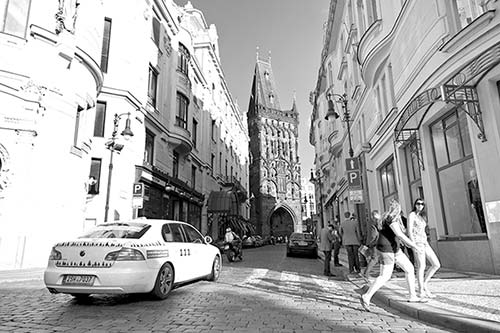
Uber works the same way it does at home and typically costs less than a taxi. Drivers pick up from the small parking lot next to platform 1B.
By Tram: The nearest tram stop is to the right as you exit the station (about 200 yards away). Tram #9 (headed away from railway tracks) takes you to the neighborhood near the National Theater and the Lesser Town but isn’t useful for most Old Town hotels.
Holešovice Train Station (Nádraží Holešovice)
This station, slightly farther from the center, is suburban mellow. The main hall has the same services as the main train station, in a more compact area. On the left are international and local ticket windows (open 24 hours) and an information office. On the right is an uncrowded café. Two ATMs are just outside the first glass doors, and the Metro is 50 yards to the right (follow signs toward Vstup, which means “entrance”; it’s three stops to Hlavní Nádraží—the main station—or four stops to the city-center Muzeum stop). Taxis and trams are outside to the right (allow 300 Kč for a cab to the center).
Train Connections
All international trains pass through the main station (Hlavní Nádraží); some also stop at Holešovice (Nádraží Holešovice). Direct trains connect Prague to Berlin, Munich, Vienna, Budapest, Kraków, and Warsaw. For tips on rail travel, see the “Transportation” section of the Practicalities chapter.
From Prague’s Main Station to Domestic Destinations: Konopiště Castle (train to Benešov, 2/hour, 1 hour, then 1.5-mile walk), Kutná Hora (hourly, 1 hour), Český Krumlov (8/day, 1/day direct, 3 hours), České Budějovice (almost hourly, 2.5 hours), Moravský Krumlov (8/day, 4 hours, change in Brno), Olomouc (at least hourly, 2.5 hours), Brno (2/hour, 3 hours).
BY BUS
Prague’s main bus station is at Florenc, east of the Old Town (Metro: Florenc). But some connections use other stations, including Roztyly (Metro: Roztyly), Na Knížecí (Metro: Anděl), Holešovice (Metro: Nádraží Holešovice), Hradčanská (Metro: Hradčanská), Zličín (Metro: Zličín), or the main train station (Metro: Hlavní Nádraží). Be sure to confirm which station your bus uses. Check Flixbus (www.flixbus.com) and Eurolines (www.eurolines.de) for international connections.
From Prague by Bus to: Terezín (3-4 direct Mon-Fri, fewer Sat-Sun, 1 hour, more with transfer, departs from Nádraží Holešovice), Český Krumlov (hourly, 3 hours, departs from Florenc or Na Knížecí), Brno (2/hour from Florenc, 2.5 hours, train is better), Moravský Krumlov (1/day, 4 hours, change in Znojmo or Brno, train is better).
BY PLANE
Václav Havel Airport
Prague’s modern, tidy, user-friendly Václav Havel Airport is located 12 miles (about 30 minutes) west of the city center. Terminal 2 serves destinations within the EU (no passport controls); Terminal 1 serves everywhere else. The airport has ATMs (avoid the change desks), transportation services (such as city transit and shuttle buses), kiosks selling city maps, and a TI (code: PRG, www.prg.aero).
Getting from the Airport to Your Hotel
Getting between the airport and downtown is easy. Leaving either airport terminal, you have several options, listed below from cheapest to priciest:
Dirt Cheap: Take bus #119 to the Nádraží Veleslavín stop (15 minutes) and then take the Metro into the center (another 10 minutes, 40 Kč, buy tickets at info desk in airport arrival hall). This is also fastest as it avoids traffic jams.
Budget: Take the airport express (AE) bus to the main train station (60 Kč, runs every half-hour daily about 6:00-21:00, 40 minutes, look for the AE sign in front of the terminal and pay the driver, www.cd.cz). From the station, you can take the Metro, hire a taxi or Uber, or walk to your hotel.
Moderate: Prague Airport Transfers offers 24-hour shuttle and taxi service (door-to-door shared taxi-290 Kč/person; +420 222 554 211 from Czech Republic or +420 516 340 3070 from US, www.prague-airport-transfers.co.uk). Uber usually costs about half the price of a taxi; drivers pick up in the parking lot facing Terminal 1.
Expensive: Catch a taxi. Cabbies wait at the curb directly in front of the arrival hall. Or book a yellow AAA taxi through their office in the airport hall—you’ll get a 50 percent discount coupon for the trip back. AAA taxis wait in front of exit D at Terminal 1 and exit E at Terminal 2 (metered rate, generally 600 Kč to downtown).
BY PRIVATE CAR SERVICE
Mike’s Chauffeur Service is a reliable, family-run company with fair and fixed rates around town and beyond. Friendly Mike’s motto is, “We go the extra mile for you.” If Mike is busy, he’ll send one of his colleagues—all of whom speak English (round-trip fares, with waiting time included, prices valid through 2025 with this book: Český Krumlov—4,800 Kč, Terezín—2,400 Kč, Karlštejn—2,400 Kč, Karlovy Vary and Pilsner Urquell brewery in Plzeň—4,800 Kč; surcharge for credit-card payment, these prices for up to 4 people, minibus for up to 7 or 8 also available; +420 602 224 893, www.mike-chauffeur.cz, mike.chauffeur@cmail.cz). On the way to Český Krumlov, Mike will stop for no extra charge at Hluboká Castle and/or České Budějovice, where the original Bud beer is made. Mike can also arrange a local guide for your time in many of these places. And for day trips from Prague, Mike can bring bicycles along and will pedal with you.
Mike also offers “Panoramic Transfers” to Vienna (8,000 Kč, depart Prague at 8:00, arrive Český Krumlov at 10:00, stay up to 5 hours, 1-hour scenic Czech riverside-and-village drive, then a 2-hour autobahn ride to your Vienna hotel, maximum 4 people), Budapest (11,500 Kč via Bratislava or the South Moravia wine country, 6 hours), and Kraków (10,800 Kč direct, or 11,500 Kč with a stop at Auschwitz; these prices include all road taxes). Mike can also pick you up in any of these cities and bring you to Prague. Check Mike’s website for special deals on last-minute transfers, including super-cheap “deadhead” rides when you travel in the opposite direction of a full-fare client.