PRAGUE
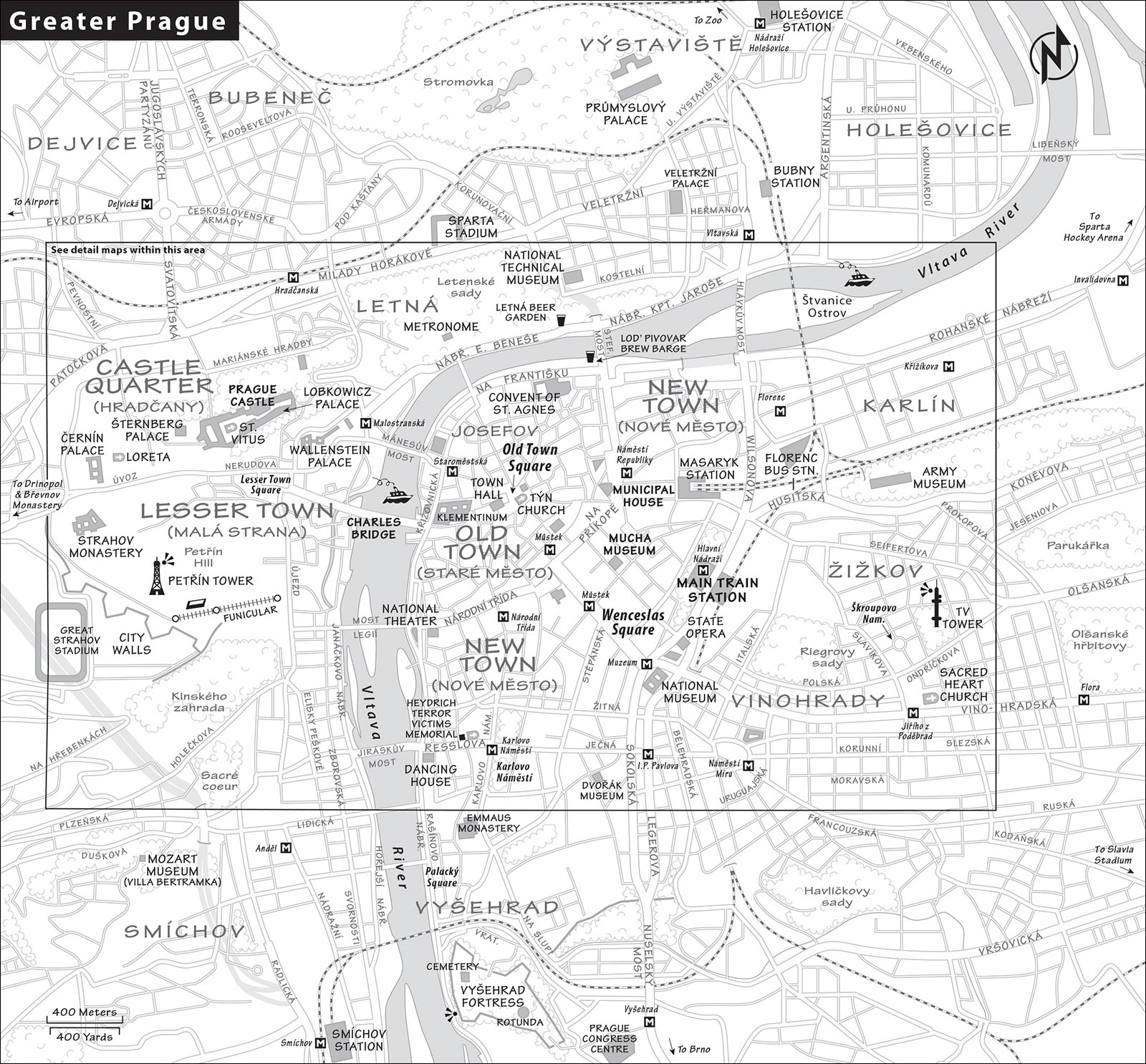
Map: Prague Public Transportation
Old Town and Charles Bridge Walk
Sights in the Old Town (Staré Město)
NORTH OF THE OLD TOWN SQUARE, NEAR THE RIVER
Sights in the New Town (Nové Město)
Sights in the Lesser Town (Malá Strana)
Sights in the Castle Quarter (Hradčany)
Map: Hotels in Prague’s Old Town
UNDER THE CASTLE, IN THE LESSER TOWN
Map: Hotels & Restaurants in the Lesser Town & Castle Quarter
Map: Hotels & Restaurants in the New Town & Nearby
Map: Restaurants in Prague’s Old Town
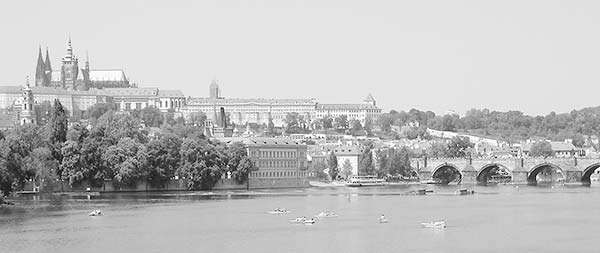
Few cities can match the over-the-top romance and Old World charm...and tourist crowds of Prague. But this fun, historic city is popular for good reason: It’s the only Central European capital to escape the bombing of the last century’s wars, and it’s one of the Continent’s best-preserved cities.
Prague is a photographer’s delight. As you wind past historic statues and pastel facades adorned with gables, balconies, lanterns, and countless little architectural details, the city itself seems a work of art. Besides its medieval and Baroque look, it’s a world of willowy Art Nouveau paintings and architecture. You’ll also see rich remnants of its strong Jewish heritage and stark reminders of the communist era. And you’ll meet an entrepreneurial mix of locals and expats, each with their own brilliant scheme of how to make money in the tourist trade.
To escape the crowds and have Prague to yourself, seek out the back lanes and pretend you’re strolling through the 18th century. Duck into pubs to enjoy the hearty food and good pilsner beer, and tour museums packed with fine art. Attend a concert. You’ll leave Prague dreaming of coming back.
PLANNING YOUR TIME
A few days in Prague is plenty of time to experience the city and enjoy some side trips. Even if you’re in a rush, allow at least two full days (with three nights) for a good introduction to the city.
Keep in mind that Jewish Quarter sights close on Saturday and Jewish holidays. Some museums, mainly in the Old Town, are closed on Mondays.
Prague in Two or More Days
Here’s my suggested plan for experiencing Prague in two days.
Day 1
| 9:00 | Orient yourself to the city’s core with my Old Town and Charles Bridge Walk. Along the way, enter some of the sights (such as the Municipal House) and climb the old tower at either end of the Charles Bridge to enjoy the view. |
| 13:00 | Have lunch in the Old Town or Lesser Town. |
| 15:00 | Explore the Jewish Quarter. |
| Evening | Choose between a beer hall, live music, or Black Light Theater. |
Day 2
| 8:00 | Zip up to Prague Castle on the tram. Be in the ticket line before 9:00, visit St. Vitus Cathedral before the crowds arrive, then visit the rest of the castle sights. |
| 11:00 | As you leave the castle, tour the Lobkowicz Palace. |
| 12:00 | Have lunch on Castle Square, at the Strahov Monastery, or in the Lesser Town. |
| 13:30 | Explore the Castle Quarter and Lesser Town (options include Loreta Church, Strahov Monastery, Nerudova street, Lesser Town Square, Lennon Wall, and Kampa Island). |
| 15:30 | Metro to the Muzeum stop (at the National Museum) and visit Wenceslas Square. |
| 16:30 | Tour the Mucha Museum. |
| Tips: | You could tour the Cold War Museum (on Wenceslas Square) while there, but check tour times in advance and adjust your day plan as needed. If you’d rather sleep in today, flip this plan—visit Wenceslas Square and the Mucha Museum, then tram up to the castle in the early afternoon (after 14:00) as the crowds disperse. |
Day 3 and Beyond
With more time, fit in additional museums that interest you. With four days or more, add some of Prague’s worthwhile day trips: Kutná Hora (delightful small town with gorgeous cathedral and famous bone church), the Terezín Memorial (Holocaust history), and/or Konopiště Castle (with a lived-in Habsburg interior). Český Krumlov is a bit far for a day trip—it’s much better if you stay overnight.
Orientation to Prague
PRAGUE BY NEIGHBORHOOD
Residents call their town “Praha” (PRAH-hah). It’s big, with about 1.3 million people—and it boasts one of the largest compact historical centers in Europe.
The Vltava River (VUL-tah-vah) divides the city in two. East of the river are the Old Town and the New Town (with its iconic Wenceslas Square; Václavské Náměstí, vaht-SLAHF-skeh NAH-myehs-tee), the main train station (Hlavní Nádraží, HLAV-nee NAH-drah-zhee), and most of my recommended hotels. To the west of the river is Prague Castle, and below that, the sleepy Lesser Town. Connecting the two halves are several bridges, including the landmark Charles Bridge (Karlův Most, KAR-loov most).
Until about 1800, Prague was four distinct towns with four town squares, all separated by fortified walls. Each town had a unique character, drawn from the personality of its first settlers. Today, much of Prague’s charm survives in the distinct spirit of these towns.
Old Town (Staré Město, STAR-eh MYEHS-toh): Nestled in the bend of the river, this is the historic core, almost traffic-free, where most tourists spend their time. It’s pedestrian-friendly, with small winding streets, old buildings, shops, and beer halls and cafés. In the center sits the charming Old Town Square (Staroměstské Náměstí, STAR-oh-myehst-skeh NAH-myehs-tee). Slicing east-west through the Old Town is the main pedestrian axis, along Celetná and Karlova streets.
Jewish Quarter (Josefov, YOO-zehf-fohf): Within the Old Town, this area by the river contains a high concentration of old synagogues and sights from Prague’s deep Jewish heritage. It also holds the city’s glitziest shopping area (with big-name international designers filling gorgeously restored Art Nouveau buildings).
New Town (Nové Město, NOH-vay MYEHS-toh): Stretching south from the Old Town is the long, broad expanse of Wenceslas Square, marking the center of the New Town. Arcing around the Old Town, the New Town cuts a swath from riverbank to riverbank. As the name implies, it’s relatively new (“only” 600 years old). It’s the neighborhood for noisy traffic, modern buildings, fancy department stores, and a few communist-era sights.
Castle Quarter (Hradčany, HRAD-chah-nee): High atop a hill on the west side of the river stands the massive complex of Prague Castle, marked by the spires of St. Vitus Cathedral. For a thousand years, this has been the neighborhood of Czech rulers (including today’s president and foreign minister). Consequently, the surrounding area is noble and leafy, with high art and grand buildings, little commerce, and few pubs.
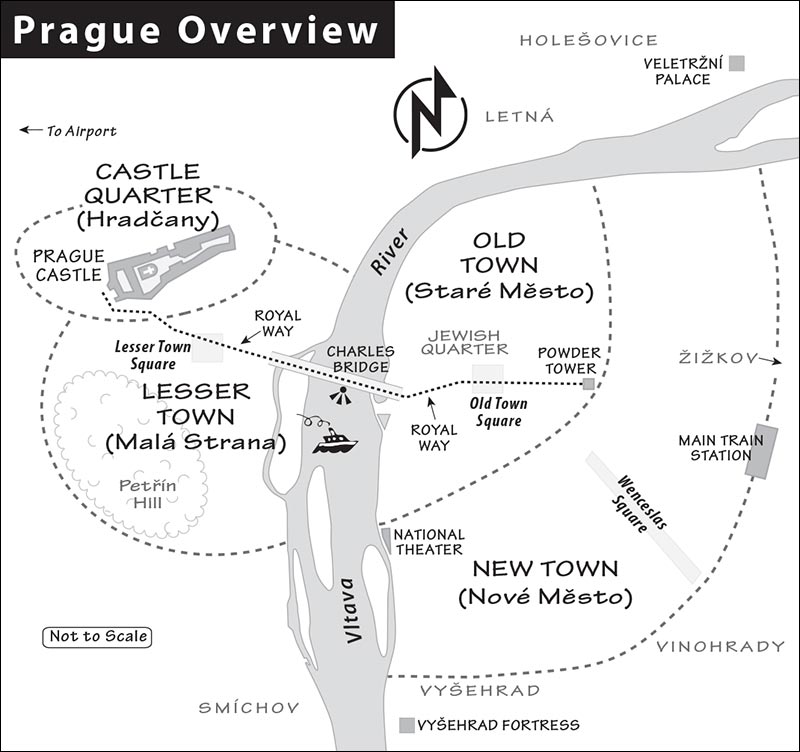
Lesser Town (Malá Strana, MAH-lah STRAH-nah): Nestled at the foot of Castle Hill is this pleasant former town of fine palaces and gardens (and a few minor sights). This is Prague’s diplomatic neighborhood, made to feel elegant by stately embassies, but lacking some of the funky personality of the Old Town.
The Royal Way: Cutting through the towns—from the Powder Tower through the Old Town, crossing the Charles Bridge, and winding up to St. Vitus Cathedral—is the ancient path of coronation processions. Today, this city spine (the modern streets of Celetná, Karlova, and Nerudova) is marred by tacky trinket shops and jammed by tour groups—explore beyond it if you want to see the real Prague.
TOURIST INFORMATION
The Old Town has two TIs: on the Old Town Square (in the Old Town Hall, just to the left of the Astronomical Clock; Tue-Sun 9:00-19:00, Mon from 11:00) and around the corner from Havelská Market (at Rytířská 12; daily 9:00-19:00). There’s also a TI in the Lesser Town at Petřín Tower (daily 9:00-20:30, shorter hours off-season). For general tourist information in English, dial +420 221 714 714 (Mon-Fri 9:00-17:00) or check the useful TI website: www.prague.eu. Look for the helpful transit guide and information on guided walks and bus tours. TIs can also book local guides and concerts.
Monthly event guides include the Prague Guide (small fee), and the free Prague This Month and Heart of Europe (summer only).
Sightseeing Passes: Prague has two pricey passes—the Prague Visitor Pass, offered by the TI, and the Prague CoolPass (www.praguecoolpass.com). For most travelers, neither is worth the steep cost (e.g., 2,100 Kč/2 days).
ARRIVAL IN PRAGUE
Most visitors arrive at Prague’s main train station (Hlavní Nádraží), on the eastern edge of downtown—a 20-minute walk, short taxi ride, or bus ride to the Old Town Square and many of my recommended hotels. Prague’s Václav Havel Airport—12 miles from downtown—is easily connected to the city center by public bus, airport bus, minibus shuttle, and taxis. For details on these options, see Prague Connections, at the end of this chapter.
HELPFUL HINTS
Sightseeing Tips: The Museum of Medieval Art is closed on Mondays, and Jewish Quarter sights are closed on Saturdays. St. Vitus Cathedral at Prague Castle is closed Sunday mornings for Mass.
Rip-Offs: As in any heavily touristed city, in Prague naive tourists can fall victim to con artists. Most scams happen right under your nose: being charged a two-scoop price for one scoop of ice cream, having extra items appear on your restaurant bill, or not getting the correct change. Anytime you pay for something with cash, make a mental note of how much it costs, how much you’re handing over, and how much you expect back. Count your change. Don’t be in a rush. Wait until you get all the money you’re due.
Freestanding ATMs are notorious for bad rates. Use an ATM attached to an actual bank (look for names that include the word banka or spořitelna, and avoid Euronet machines).
Pickpockets: They’re abundant in Prague. They can be little children, or adults dressed as professionals—sometimes even as tourists with jackets draped over their arms to disguise busy fingers. Thieves work crowded and touristy places in teams—for example, they might create a commotion at the door to a Metro or tram car. Assume any big distraction is a smokescreen for theft, keep things zipped up, and wear a money belt. All of this can sound intimidating, but Prague is safe. Simply stay alert.
Medical Help: For above-standard assistance in English (including dental care), consider the top-quality Hospital Na Homolce (appointment—less than 1,000 Kč, daily 8:00-16:00, Roentgenova 2, Praha 5, +420 257 271 111). The Canadian Medical Care Center is a small, private clinic with an English-speaking Czech staff at the Nádraží Veleslavín Metro station (appointment—3,000 Kč, house call—4,500 Kč, halfway between the city and the airport, +420 222 300 300).
Useful Apps: Czech Tourism’s free Czech Republic—Land of Stories app has info on popular destinations and events, along with historical background. The free Beer Adventures app guides you on a suds-sampling tour of Prague bars, pubs, and breweries.
Bookstore: Shakespeare and Sons is a friendly English-language bookstore with a wide selection of translations from Czech, the latest publications, and a reading space downstairs overlooking a river channel (daily 11:00-19:00, one block from Charles Bridge on Lesser Town side at U Lužického Semináře 10, +420 257 531 894, www.shakes.cz).
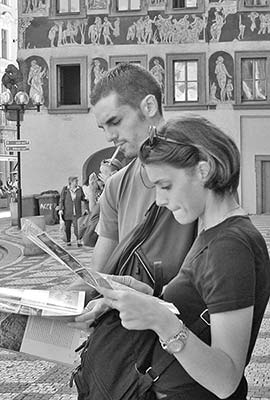
Maps: Google Maps works well here for navigation. A good map of Prague is also helpful. Look for one with trams and Metro lines marked, and tiny sketches of the sights (30-70 Kč; sold at kiosks, exchange windows, and tobacco stands). The Kartografie Praha city map, which shows all the tram lines and major landmarks, also includes a castle diagram and a street index.
Pharmacies: You’ll find handy pharmacies in the Palladium shopping center on Náměstí Republiky and at Palackého 5 near Wenceslas Square (both open 9:00-18:00). A 24-hour pharmacy is at the Na Františku hospital (on the embankment next to Hotel InterContinental, Na Františku 1).
Laundry: A full-service laundry near most of my recommended hotels is at Karolíny Světlé 11 (3-hour wash-and-dry, Mon-Fri 7:30-19:00, closed Sat-Sun, 200 yards from Charles Bridge on Old Town side, +420 721 030 446); another laundry is at Rybná 27 (same-day pickup, Mon-Fri 8:00-18:00, closed Sat-Sun, +420 602 511 695); for locations, see the map on here. Prague Andy’s Laundromat offers full service (weekdays only) and self-service (Mon-Fri 9:00-20:00, Sat-Sun from 8:00, last load at 18:30, near Náměstí Míru Metro stop at Korunní 14, Praha 2, +420 733 112 693, www.praguelaundromat.cz).
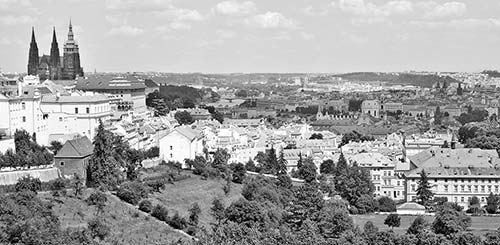
Enjoy the “Golden City of a Hundred Spires” during the early evening, when the light is warm and the colors are rich. Good viewpoints include the following:
• The garden terrace in front of Strahov Monastery, above the castle (see here)
• The many balconies and spires at Prague Castle
• Villa Richter restaurant, overlooking the city from just below the castle past the Golden Lane
• The top of either tower on Charles Bridge
• Old Town Square clock tower (with a handy elevator)
• Hotel u Prince’s rooftop dining terrace overlooking the Old Town Square (also with an elevator, free but for diners only)
• The steps of the National Museum overlooking Wenceslas Square
• The top of the Žižkov TV tower, offering spaceship views of the city, in the Žižkov/Vinohrady neighborhood east of the city center (150 Kč for elevator to observatory at 300 feet, free access to Oblaca restaurant at 200-foot level for customers)
Bike Rental: Prague’s network of bike paths makes bicycles a feasible option for exploring the center of town and beyond (see https://mapa.prahounakole.cz for a map). Two bike-rental shops are located near the Old Town Square: Praha Bike (Dlouhá 24, +420 732 388 880, www.prahabike.cz) and City Bike (Králodvorská 5, +420 776 180 284, www.citybike-prague.com). They also organize guided bike tours.
Car Rental: You won’t want or need to drive within compact Prague, but a car can be handy for exploring the countryside. All the biggies have offices in Prague.
Travel Service and Tours: Magic Praha is a tiny travel service run by Lída Jánská. A Jill-of-all-trades, she can help with accommodations and transfers throughout the Czech Republic, as well as private tours and side trips to historic towns (+420 604 207 225, magicpraha@magicpraha.cz).
GETTING AROUND PRAGUE
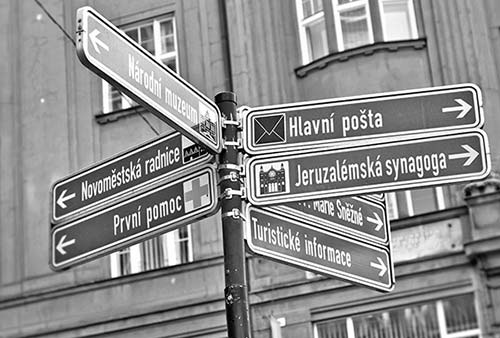
You can walk nearly everywhere. Brown street signs (in Czech, but with helpful little icons) direct you to tourist landmarks. For a sense of scale, the walk from the Old Town Square to the Charles Bridge takes less than 10 minutes (depending on crowds).
Prague’s Pedestrian Freeways: Four pedestrian thoroughfares cut through the essentially traffic-free center of Prague. You’ll find yourself swept along on an international river of touristic humanity on the following streets: Na Příkopě (“On the Moat”; from the bottom of Wenceslas Square to the Municipal House and Republic Square), Celetná (from Municipal House to the Old Town Square), Karlova (from the Old Town Square to the Charles Bridge), and Melantrichova/Na Můstku (from the bottom of Wenceslas Square to the Old Town Square). The shops along these tourist-clogged arteries are generally tourist traps. If you simply walk a block away, you’ll find better values and more charming corners.
Commit to Public Transportation: It’s worth figuring out the public transportation system, which helps you reach farther-flung sights (such as Prague Castle) and can save time and sweat jumping from spot to spot within the center. The Metro is slick, the trams fun, and Uber quick and easy. Prague’s tram system is especially wonderful—trams rumble by frequently and take you just about anywhere.
By Public Transportation
Excellent, affordable public transit (Metro, trams, and buses) is perhaps the best legacy of the communist era. You can find more information and a route planner in English at www.dpp.cz [URL inactive].
Tickets: The Metro, trams, and buses all use the same tickets:
• 30-minute short-trip ticket (krátkodobá), which allows as many transfers as you can make in a half-hour—30 Kč
• 90-minute standard ticket (základní)—40 Kč
• 24-hour pass (jízdenka na 24 hodin)—120 Kč
• 3-day pass (jízdenka na 3 dny)—330 Kč
Since Prague is a great walking town, most find that buying a few individual tickets works better than a pass. Tickets are available from several outlets: The official PID Lítačka app allows you to purchase mobile tickets, which you can either activate immediately or save to use later. To use a mobile ticket, scan the QR code as you board.
Paper tickets are sold at hotels, newsstand kiosks, and machines at Metro stops. Be sure to validate your ticket as you get on the tram or bus, or as you enter the Metro station, by sticking it in the yellow machine, which stamps a time on it. Inspectors routinely ambush ticketless riders (including tourists) and fine them 1,000 Kč on the spot.
For trams and buses, tickets are also sold on board at a red ticket machine in the middle of the tram car or bus (tap-to-pay cards only). Tickets bought from these onboard machines have the time printed on them and don’t need to be validated.
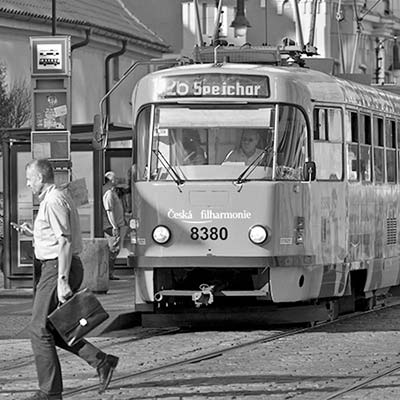
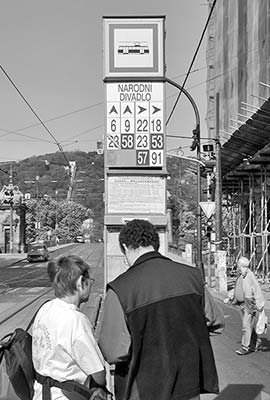
Trams: Trams run every few minutes in the daytime (a schedule is posted at each stop). Navigate by signs that list the end stations. At the platform, a sign lists all the stops for each tram in order. Remember that trams going one direction leave from one platform, while trams going the other direction might leave from a different platform nearby—maybe across the street or a half-block away. When the tram arrives, open the doors by pressing the green button.
As you go, follow along carefully so you’ll be ready when your stop comes up. Newer trams have electronic signs that show either the next stop (příští) or a list of upcoming stops. Also, listen to the recorded announcements for the name of the current stop, followed by the name of the stop that’s coming up next. (Confused tourists, thinking they’ve heard their stop, are notorious for rushing off the tram one stop too soon.) It’s best to sit on the right near the front, where it’s easy to see the sign on the platform of each stop.
Tram #22 (or #23, the retro 1960s version) is practically made for sightseeing, connecting the New Town with the Castle Quarter. The tram uses some of the same stops as the Metro (making it easy to get to—or travel on from—the tram route). The most convenient stops are in the New Town (at Národní Třída, between the bottom of Wenceslas Square and the river; and Národní Divadlo, at the National Theater), in the Lesser Town (Malostranské Náměstí, on the Lesser Town Square; and Malostranská Metro stop, near the riverbank), and above Prague Castle (Královský Letohrádek—for the Summer Palace and scenic entry to Prague Castle; Pražský Hrad—for the main castle entry; and Pohořelec—for the Strahov Monastery).
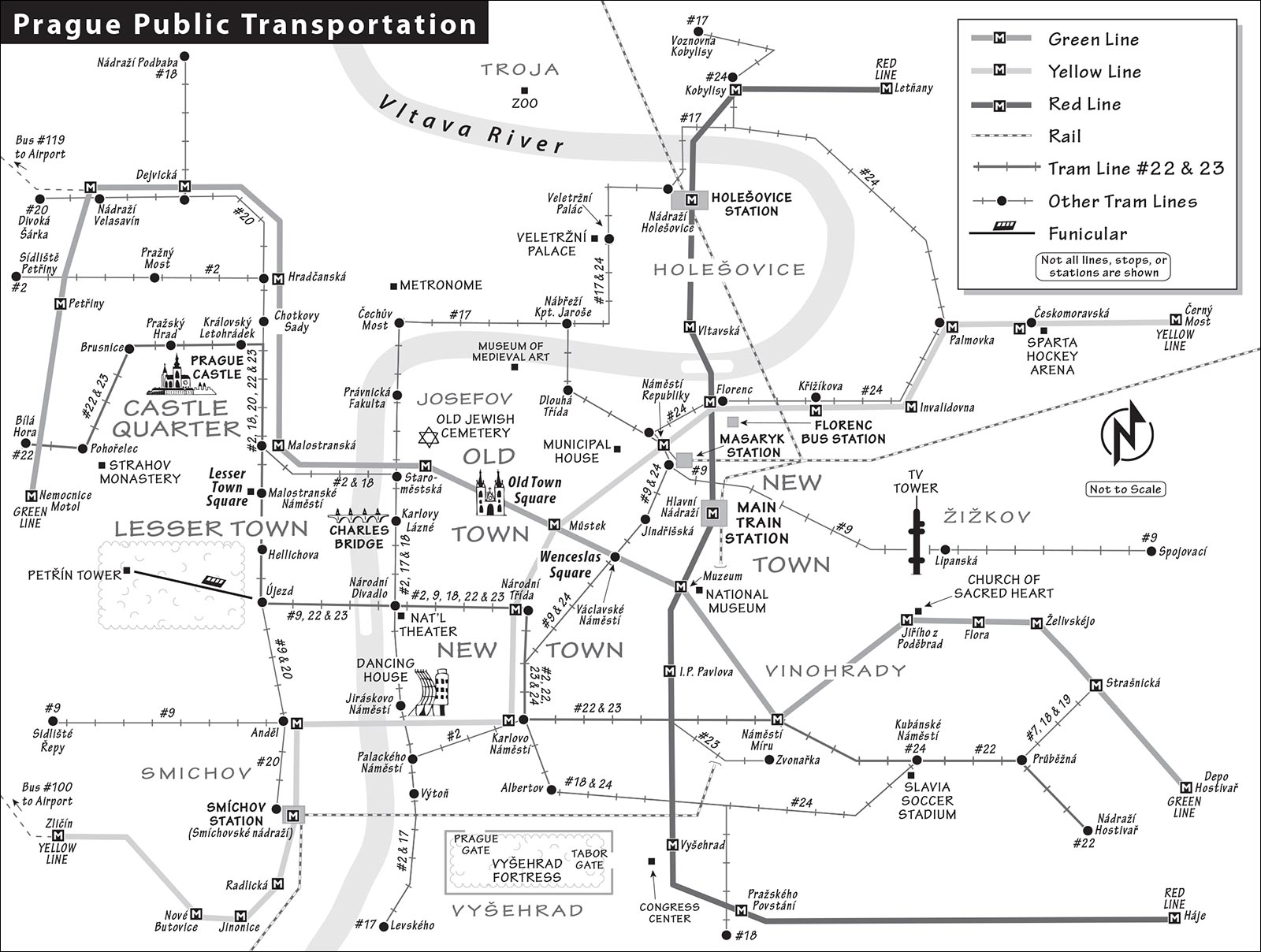
Metro: The three-line Metro system is handy and simple but doesn’t always get you right to the tourist sights (landmarks such as the Old Town Square and Prague Castle are several blocks from the nearest Metro stops). The Metro closes at midnight, but nighttime tram routes (identified with white numbers on blue backgrounds at tram stops) run all night at 30-minute intervals. Although it seems that all Metro doors lead to the neighborhood of Výstup, that’s simply the Czech word for “exit.”
By Uber and Taxi
While Prague is fraught with rip-off taxis, it’s well served by Uber. If you’re comfortable with Uber at home, it works the same way here and you can generally get a ride within five minutes with no fuss and at about half the taxi fare. The great things about Uber are that your driver knows exactly where you want to go without you having to pronounce the Czech name, you know exactly what it will cost, you don’t deal with cash, and you get to chat with a friendly local.
If you use taxis, here are a few tips to avoid being overcharged. Legitimate local rates are cheap: The drop charge starts at 40 Kč, the per-kilometer charge is around 30 Kč, and waiting time per minute is about 6 Kč. These rates are clearly marked on the door, so be sure the cabbie honors them. Also insist that cabbies turn on the meter and that it’s set at the right tariff, or “sazba” (usually but not always tariff #1). Unlike in many cities, there’s no extra charge for calling a cab—the meter starts only after you get in. Tip by rounding up; locals never tip more than 5 percent.
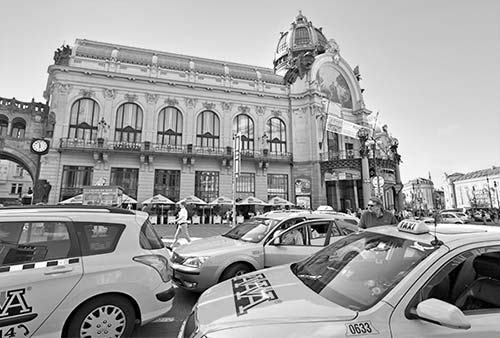
Have a ballpark idea of what your ride will cost. Figure about 150-200 Kč for a ride between landmarks within the city center (for example, from the main train station to the Old Town Square, or from the Charles Bridge to the castle). Even the longest ride in the center should cost under 300 Kč.
To improve your odds of getting a fair metered rate, call for a cab (or ask someone at your hotel or restaurant to call for you), rather than hailing one on the street. AAA Taxi (+420 222 333 222) and City Taxi (+420 257 257 257) are the most likely to have English-speaking staff and honest cabbies. Avoid cabs waiting at tourist attractions and train stations; these are far more likely to be crooked.
If a cabbie surprises you at the end with an astronomical fare, challenge it. Point to the rates on the door. Get your hotel receptionist to back you up. Pull out your phone and threaten to call the police. (Because of legislation to curb dishonest cabbies, the police will stand up for you.) Or simply pay what you think the ride should cost and walk away.
Tours in Prague
 To sightsee on your own, download my free Prague City Walk audio tour.
WALKING TOURS
A staggering number of small companies offer walking tours of the Old Town, the castle, and more (check at the TI). Since guiding is a routine side job for university students, you’ll generally get hardworking young guides with fine language skills at good prices. While I’d rather go with my own local guide (see below), public walking tours are cheaper (4 hours for about 450 Kč), cover themes you might not otherwise consider, connect you with other English-speaking travelers, and allow for spontaneity. The quality depends on the guide rather than the company. Your best bet is to show up at the Astronomical Clock a couple of minutes before 8:00, 10:00, or 11:00, then chat with a few of the umbrella-holding guides and choose the one you click with.
“Free” Tours: These are not really free—at the end, you’re expected to tip your guide (with bills, not coins). Guides are usually expat students who memorize a script and give an entertaining performance as you walk through the Old Town, with little respect for serious history. In general, they’re fine for the backpacker and hostel crowd (for whom they’re designed).
LOCAL GUIDES
In Prague, hiring a guide is particularly smart (and a ▲▲ experience). Expect to pay around 3,000 Kč for a half-day tour. Because prices are usually per hour (around 850 Kč), not per person, small groups can hire an inexpensive guide for a whole day or for chunks of time over several days. Guides meet you wherever you like and tailor the tour to your interests. Visit websites for details, then make arrangements by email.
Guide Services: These two outfits represent a cadre of top-notch guides.
At PragueWalker, Kateřina Svobodová, a hardworking historian-guide who knows her stuff, manages a team of enthusiastic and friendly guides (+420 603 181 300, www.praguewalker.com, katerina@praguewalker.com).
At Personal Prague Guide Service, Šárka Kačabová uses her teaching background to help you understand Czech culture, and has a team of personable and knowledgeable guides (RS%—30 minutes free with this book, +420 777 225 205, www.personalpragueguide.com).
Private Guides: These guides generally learned their trade post-communism but can still share memories of the time before the transition. For even more guides, see www.guide-prague.cz.
Jana Hronková has a natural style—a welcome change from the more strict professionalism of some other guides—and a penchant for the Jewish Quarter (+420 732 185 180, https://praguediscoveries.com). A tour with my co-author, Honza Vihan, adds more nuance and context to the history covered in this guidebook (+420 603 418 148, honzavihan@hotmail.com). Zuzana Tlášková speaks English as well as Hebrew (+420 774 131 335, tlaskovaz@seznam.cz). Martin Bělohradský, formerly an organic chemistry professor, is enthusiastic about fine arts and architecture (+420 723 414 565, martinb5666@gmail.com).
Jana Krátká enjoys sharing Prague’s tumultuous 20th-century history with visitors (+420 776 571 538, janapragueguide@gmail.com). Friendly Petra Vondroušová designs tours to fit your interests (+420 602 319 420, www.compactprague.com). Kamil and Pavlína run a family business specializing in tours of Prague and beyond. They also provide sightseeing and transport as far as Vienna and Berlin (+420 605 701 861, https://prague-extra.com).
Running Tours Prague are guided by Radim Prahl, a local with an appetite for ultramarathons; he’ll run you past monuments, through parks, and down back alleys at your own pace (1,250 Kč for one person, 1,500 Kč for two people; +420 777 288 862, www.runningtoursprague.com).
JEWISH QUARTER TOURS
Jewish guides (of varying quality) lead private three-hour tours in English of the Jewish Quarter. Consider Wittmann Tours (4,800 Kč, or 6,800 Kč with Sylvie Wittman herself, plus museum entry fees; +420 603 426 564, www.wittmann-tours.com). They also offer an all-day minibus tour to the Terezín Memorial. Several of the private guides recommended earlier also do good tours of the Jewish Quarter.
TOURS OUTSIDE PRAGUE
To get beyond the sights listed in most guidebooks, or for a deeply personal look at the usual destinations, contact Tom and Marie Zahn. Tom is American, Marie is Czech, and together they lead family-friendly day excursions (in Prague and throughout the country). Their specialty is Personal Ancestral Tours & History (P.A.T.H.)—with sufficient notice, they can help Czech descendants find their ancestral homes, perhaps even a long-lost relative. Tom and Marie can also help with other parts of your travel in Central and Eastern Europe (US +1 360 450 5959, Czech +420 257 940 113, www.pathways.cz for tours, www.pathfinders.cz for genealogy research).
Reverend Jan Dus, an enthusiastic pastor who lived in the US for several years, now serves a small congregation about 100 miles east of Prague. Jan can design itineraries and likes to help travelers connect with locals in little towns, particularly in northeastern Bohemia and Moravia. He also has an outstanding track record in providing genealogical services (US +1 800 807 1562, www.revjan.com).
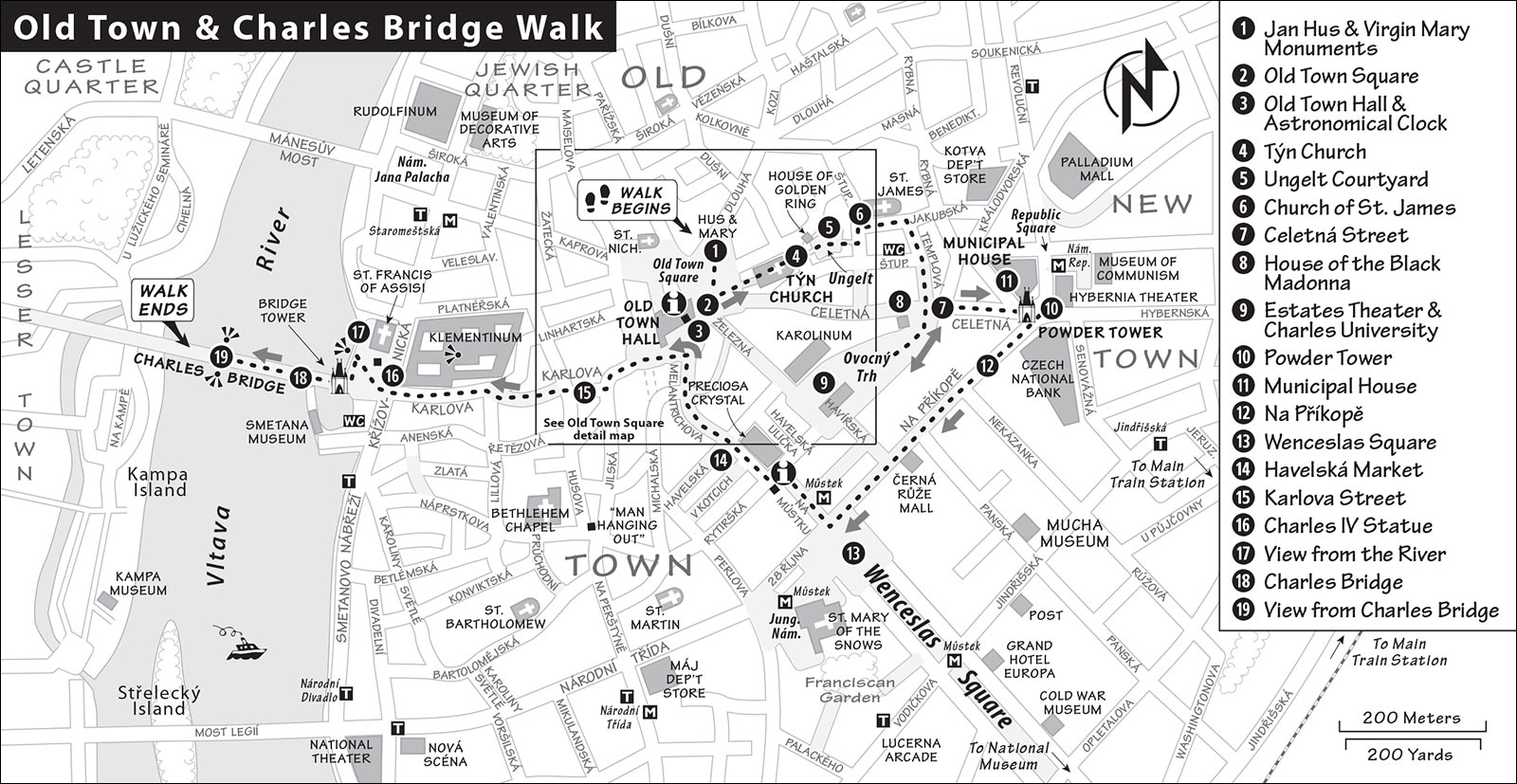
Old Town and Charles Bridge Walk
1 Jan Hus and Virgin Mary Monuments
Map: Old Town & Charles Bridge Walk
2 Old Town Square Orientation Spin-Tour
3 Old Town Hall and Astronomical Clock
6 Church of St. James (Kostel Sv. Jakuba)
8 House of the Black Madonna (Dům u Černé Matky Boží)
9 Estates Theater and Charles University
10 Powder Tower
11 Municipal House (Obecní Dům)
12 Na Příkopě, the Old City Wall
16 Charles IV Statue: The Bohemian Golden Age
18 Charles Bridge (Karlův Most)
Nestled in the bend of the river is Prague’s compact, pedestrian-friendly Old Town. It’s also Prague’s tourism ground zero, jammed with tasteful landmarks and tacky amusements alike.
A boomtown since the 11th century, the Old Town has long been the busy commercial quarter, filled with merchants, guilds, students, and supporters of the Church and social reformer Jan Hus (who wanted a Czech-style Catholicism). Here, Prague feels like the Gothic metropolis that it—at its heart—still is.
This walk (rated ▲▲▲) starts in the Old Town Square. From here we’ll snake through the surrounding neighborhood, get a glimpse of the New Town (at Wenceslas Square), and end on the Charles Bridge—one of the most atmospheric spots in all of Europe.
Length of This Walk: Allow three hours for this walk.
Crowd Warning: Much of this walk is packed with sightseers all day long. A huge bottleneck occurs in front of the Astronomical Clock near the top of each hour.
 SELF-GUIDED WALK
• Begin with the Old Town Square’s centerpieces, the...
1 Jan Hus and Virgin Mary Monuments
The Jan Hus Memorial, erected in 1915, is an enduring icon of the long struggle for (Czech) freedom. In the center, Jan Hus—the reformer who became the symbol of Czech nationalism—stands tall amid the rising flames. Hus, born in 1369, was a priest who challenged both the Church’s and the secular rulers’ claim to dominion. His defiant stance—depicted so powerfully in this monument—galvanized the Czech people, who rallied to fight not just for their religious beliefs but also for independence from any human controls.
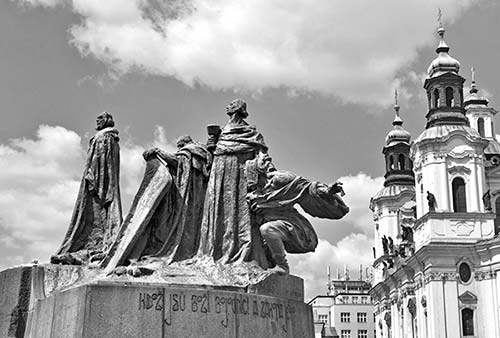
Hus was arrested, charged with heresy, excommunicated, and, in 1415, burned at the stake. His followers, called Hussites, picked up the torch and fought on for two decades in the Hussite Wars, which killed tens of thousands and left Bohemia a virtual wasteland.
Surrounding Hus’ statue are the Hussites who battled the entrenched powers of their time. Look into the faces of these medieval warriors of faith—it was a bitter fight. Two hundred years later, in 1620, a disorganized Czech rebellion was crushed by the united Habsburgs at White Mountain just outside Prague—effectively ending Czech independence and freedom of worship for three centuries.
Each subsequent age has interpreted Hus to its liking: For Protestants, Hus was the founder of the first Protestant church (though he was actually an ardent Catholic); for revolutionaries, this critic of the temporal powers was a proponent of social equality; for nationalists, this Czech preacher was the defender of the language; and for communists, this ideologue was first to preach the gospel of communal ownership (though he never spoke against individual property per se).
Now turn your attention to the Virgin Mary atop her sandstone column. Originally erected in 1652, shortly after the Thirty Years’ War, the first genuinely Baroque statue in Prague honored Mary as the city’s protector. Mary was intended to rally Catholics and non-Catholics alike—just as they had been rallied four years earlier to defend their homes from Swedish invasion. But by the late 19th century, ardent nationalists had come to perceive this delicate, Bernini-inspired Mary as a symbol of the militantly Catholic Habsburgs. (Cue installation of the Jan Hus Memorial, with Jan’s eyes locked on Mary in a defiant stare-down.)
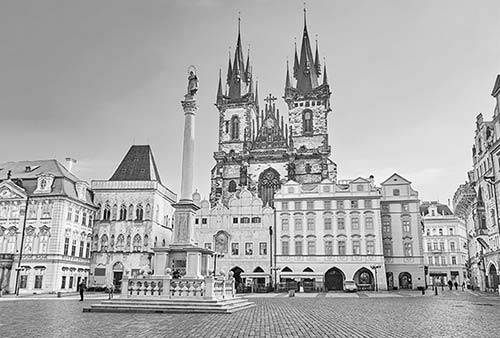
A few days after the declaration of independence in 1918, a rebellious mob turned on the “Habsburg” Virgin, tearing down the column and breaking the statue. At the time, the majority viewed this act as historical vindication. But pious Catholics (the country remained predominantly Catholic even after independence) felt a sense of injustice: Isn’t Mary a symbol of unity and peace?
Under communism there was little chance to restore the monument, but the debate resurfaced after 1989. For 23 years Czech sculptor Petr Váňa worked on a faithful replica. Finally, in 2020, Prague’s city council allowed the Virgin to return to her original spot, reigniting the century-old controversy.
It will take time for Prague’s citizens to get used to having two monuments in the square. I see Mary’s return as a sign of a mature democracy that allows minority voices to be heard, and as a more nuanced reflection of the country’s conflicted past.
• Stepping away from the monuments, stand in the center of the Old Town Square and take a 360-degree...
2 Old Town Square Orientation Spin-Tour
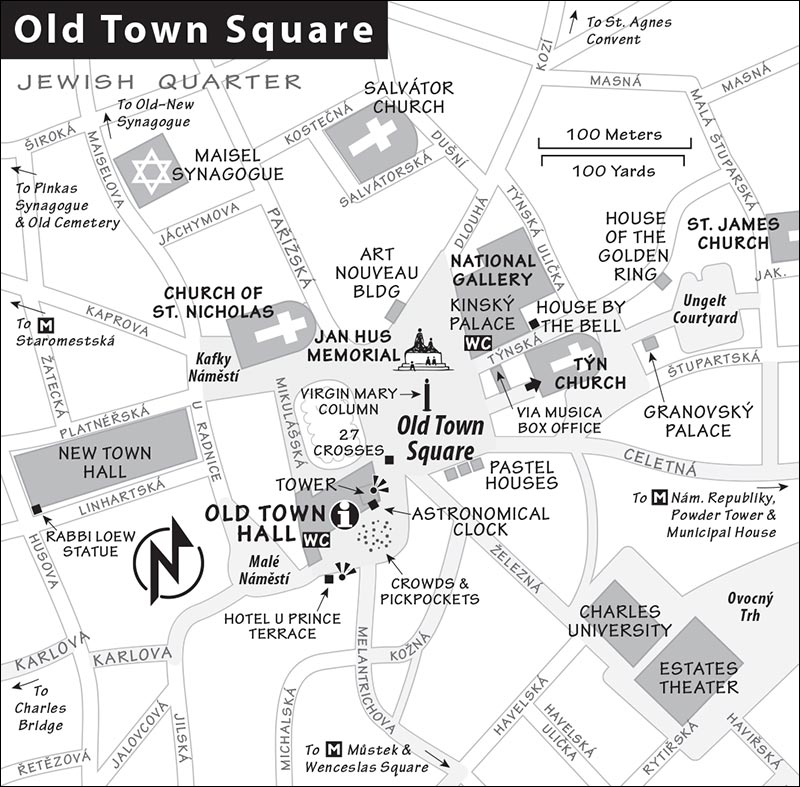
Whirl clockwise to get a look at Prague’s diverse architectural styles: Gothic, Renaissance, Baroque, Rococo, and Art Nouveau. Prague was largely spared the devastating aerial bombardments of World War II that leveled so many European cities (like Berlin, Warsaw, and Budapest). Few places can match the Old Town Square for Old World charm.
Start with the green domes of the Baroque Church of St. Nicholas. Originally Catholic, now Hussite, this church is a popular concert venue. The Jewish Quarter is a few blocks behind the church, down the uniquely tree-lined “Paris Street” (Pařížská)—which also has the best lineup of Art Nouveau houses in Prague.
Spin to the right. Behind the Hus Memorial is a fine yellow building that introduces us to Prague’s wonderful world of Art Nouveau: pastel colors, fanciful stonework, wrought-iron balconies, colorful murals—and what are those firemen statues on top doing? Prague’s architecture is a wonderland of ornamental details.
Continue spinning a few doors to the right to the large, red-and-tan Rococo Kinský Palace, which displays the National Gallery’s top-notch temporary exhibits (there’s a handy WC in the courtyard).
Immediately to the right of the Rococo palace stands the tower-like House by the Bell, one of the finest examples of a 13th-century Gothic patrician house anywhere in Europe (also the oldest building on the square).
Jan Hus (c. 1369-1415) lived and preached more than a century before Martin Luther (1483-1546), but they had many things in common. Both were college professors as well as priests. Both drew huge public crowds as they preached in their university chapels. Both condemned Church corruption, promoted local religious autonomy, and advocated for letting the common people participate more in worship rituals. Both established their national languages. (It’s Hus who gave the Czech alphabet its unique accent marks so that the letters could fit the sounds.) And, by challenging established authority, both got in big trouble.
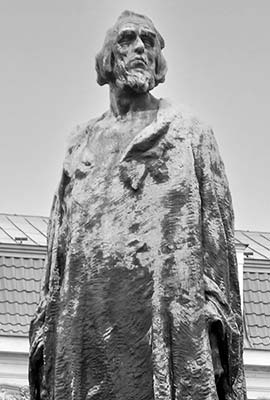
Hus was born in the small southern Bohemian town of Husinec and moved to Prague to study at the university. He served as a rector at Charles University starting in 1402. Preaching from the pulpit in Bethlehem Chapel (still open to the public), Hus drew inspiration from the English philosopher John Wycliffe (c. 1320-1384), who was an early advocate of reforming the Catholic Church to strip the clergy of its power.
Hus’ revolutionary sermons drew huge crowds of reverent but progressive-minded Czechs. He proposed that the congregation should be more involved in worship (for example, be allowed to drink the wine at Communion) and have services and scriptures written in the people’s language, not in Latin. Even after he was excommunicated in 1410, Hus continued preaching his message.
In 1414, the Roman Catholic Church convened the Council of Constance to grapple with the controversies of the day. First they posthumously excommunicated Wycliffe, proclaiming him a heretic and exhuming his corpse to symbolically burn at the stake. Then they called Hus to Constance, where on July 6, 1415, they declared him a heretic. After refusing to recant his beliefs and praying that God would forgive his enemies, Hus was tied to a stake and burned alive. But by this time, Hus’ challenging ideas had been embraced by many Czechs and sparked the bloodiest civil war in the country’s history.
The Council, this early Catholic precursor to the Counter-Reformation, kept things under control for three generations. But in the 16th century, a German monk named Martin Luther found a more progressive climate for these same revolutionary ideas. Thanks to the new printing press and his more widely spoken German language, Luther was able to spread his message cheaply and effectively. While Hus loosened Rome’s grip on Christianity, Luther orchestrated the Reformation that finally broke it. Today, both are honored as national heroes as well as religious reformers.
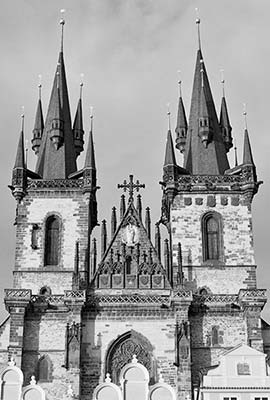
Farther to the right is the towering, Gothic Týn Church (pron. “teen”), with its fanciful twin spires. It’s been the Old Town’s leading church in every era. In medieval times, it was Catholic. When the Hussites came to dominate the city (c. 1420s), they made it the headquarters of their faith. After the Habsburg victory in 1620, it reverted to Catholicism. The symbolism tells the story: Between the church’s two towers, find a golden medallion of the Virgin Mary. Beneath that is a niche with a golden chalice. In Hussite times, the chalice symbolized their cause—that all should be able to take Communion. When the Catholics triumphed, they melted down the original chalice and made it into the golden image of Mary. In 2016, the chalice was returned to the niche.
The row of pastel houses in front of the Týn Church has a mixture of Gothic, Renaissance, and Baroque facades and gables. If you like live music, the convenient Via Musica box office near the church’s front door has all the concert options; we’ll pass it later on this walk.
Spinning right, to the south side of the square, take in more glorious facades, each a different color with a different gable on top—step gables, triangular, bell-shaped. The tan 19th-century Neo-Gothic house at #16 has a steepled bay window and a mural of St. Wenceslas on horseback.
Finally, you reach the pointed 250-foot-tall spire marking the 14th-century Old Town Hall. At the base of the tower, near the corner of the tree-filled park, find 27 white crosses inlaid in the pavement. These mark the spot where 27 nobles, merchants, and intellectuals—Protestants and Catholics—were beheaded in 1621 after the White Mountain defeat. This is still considered one of the grimmest chapters in the country’s history.
• Around the left side of the tower are two big, fancy, old clock faces being admired by many, many tourists.
3 Old Town Hall and Astronomical Clock
The Old Town Hall, with its distinctive trapezoidal tower, was built in the 1350s, during Prague’s golden age. First, turn your attention to the famous clock.
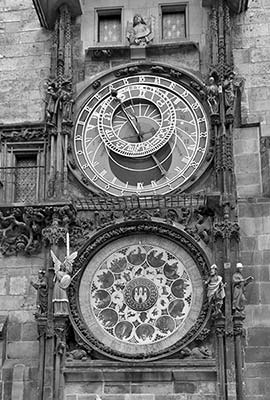
Astronomical Clock: See if you can figure out how it works. Of the two giant dials on the tower, the top one tells the time on two rings: The inner one, with Roman numerals, is similar to present-day clocks, while the outer one, numbered 1 through 24 in a strange but readable Bohemian script, rotates to reset each day at sunset. Within the dial is yet another revolving disc, where today’s zodiac sign is marked.
If all of this seems complex, it must have been a marvel in the early 1400s, when the clock was installed. Remember that back then, everything revolved around the Earth (the fixed middle background—with Prague marking the center, of course). The clock was heavily damaged during World War II, and much of what you see today is a reconstruction.
The second dial, below the clock, was added in the 19th century. It shows the signs of the zodiac, scenes from the seasons of a rural peasant’s life, and a ring of saints’ names. There’s one for each day of the year, and a marker on top indicates today’s special saint. In the center is a castle, symbolizing Prague.
Four statues flank the upper clock. These politically incorrect symbols evoke a 15th-century outlook: The figure staring into a mirror stands for vanity, a Jewish moneylender holding a bag of coins is greed, and (on the right side) a Turk with a mandolin symbolizes hedonism. All these worldly goals are vain in the face of Death, whose hourglass reminds us that our time is unavoidably running out.
The clock strikes the top of the hour and puts on a little glockenspiel show daily from 9:00 to 23:00 (until 20:00 in winter). As the hour approaches, keep your eye on Death. First, Death tips his hourglass and pulls the cord, ringing the bell, while the moneylender jingles his purse. Then the windows open and the 12 apostles shuffle past, acknowledging the gang of onlookers. Finally, the rooster at the very top crows and the hour is rung. The hour is often wrong because of Daylight Saving Time (completely senseless to 15th-century clockmakers).
Sights Inside the Old Town Hall: The ornately carved Gothic entrance door to the left of the clock leads to the TI, a pay WC, and the ticket desk for the clock-tower elevator and Old Town Hall tours. Step into the entry hall (free). It’s beautifully decorated with a 1904 Art Nouveau mosaic that celebrates Prague (Lady Prague on the throne is being honored by characters representing all the nationalities of the Habsburg Empire) and various Czech mythological scenes.
You can pay to see other sights inside. One ticket (300 Kč, sold on floors 1 and 3) covers the tour of the Old Town Hall—you’ll see a few sterile rooms and the workings of the Astronomical Clock—as well as the trip up the tower by elevator (from floor 3) for the big view (Tue-Sun 9:00-21:00, Mon from 11:00, shorter hours Jan-March; 45-minute tours usually 4/day in English at 10:00, noon, 14:00, and 16:00—preregister at ticket office).
• Now head back across the square to tour the pointy Týn Church. Enter by making your way through the cluster of buildings in front of it. (If the church is closed, try peeking in from the locked gate just inside the door.)
4 Týn Church
This is the Old Town’s main church (worth ▲). While it has roots dating back to the 1100s, this structure dates from Prague’s golden age. It was built around 1360 as the university church by the same architect who designed St. Vitus Cathedral at Prague Castle.
Cost and Hours: 40 Kč requested donation; Tue-Sat 10:00-13:00 & 15:00-17:00, Sun 10:30-12:00, closed Mon.
Visiting the Church: The structure is full of light, with soaring Gothic arches. The ornamentation reflects the church’s troubled history. Originally Catholic, it was taken over by the Hussites, who whitewashed it and stripped it of Catholic icons. When the Catholic Habsburgs retook the church, they redecorated with a vengeance—encrusting its once elegant and pure Gothic columns with ornate Baroque altars and statues of Mary and the saints.
At the front-right corner of the church (to the right of the pulpit), on the pillar is a brown stone slab showing an armored man with a beard and ruff collar, his hand resting on a globe. This is the first modern astronomer, Tycho Brahe (1546-1601). Buried here, he was brought to Prague by the Habsburgs.
Now circle around to face the stunning main altar, topped with a statue of the archangel Michael with a flaming sword. A painting (on the lower level) shows Mary ascending to heaven, where (in the next painting up) she’s to be crowned. To the right of the altar is a statue of one of Prague’s patron saints, John of Nepomuk—always easy to identify thanks to his halo of stars.
You’re surrounded by the double-eagle symbol of the Catholic Habsburgs: on the flag borne by a knight statue on the altar, atop the organ behind you (Prague’s oldest), and above you on the ceiling.
Leaving the Church: After exiting the church, walk through the Via Musica ticket office (on your right; a handy place to get classical-music tickets—see here. Leaving at the far end, turn right, where you’ll walk by the north (formerly main) entrance to the Týn Church (with the most delicate pieces of Gothic stone masonry in town—all original 14th century).
Look to the left across the street at Granovský Palace, the fine Renaissance building with sgraffiti and openings for muskets. In what was economically the most important place in the Old Town, this was a fortress within a fortified town. Notice the carved, stone gate to a courtyard and also the House of the Golden Ring (to the left).
• Tucked immediately behind the Týn Church is a welcome oasis of tranquility in the midst of the Old Town Square hubbub—the courtyard called the Ungelt. Through an imposing gate, enter what was once the commercial nucleus of medieval Prague.
5 Ungelt Courtyard
This pleasant, cobbled, quiet courtyard of upscale restaurants and shops is one of the Old Town’s oldest places. During the Bohemian golden age (c. 1200-1400), the Ungelt was a multicultural hub of international trade. Prague—located at the geographical center of Europe—attracted Germans selling furs, Italians selling fine art, Frenchmen selling cloth, and Arabs selling spices. They converged on this courtyard, where they could store their goods and pay their customs (which is what Ungelt means, in German). In return, the king granted them protection, housing, and a stable for their horses. By day, they’d sell their wares on the Old Town Square. At night, they’d return here to drink and exchange news. After centuries of disuse, the Ungelt has been marvelously restored—a great place for dinner, and a reminder that Prague has been a cosmopolitan center for most of its history.
• Exit the Ungelt at the far end. Just to your left, across the street, is the...
6 Church of St. James (Kostel Sv. Jakuba)
Perhaps the most beautiful church interior in the Old Town, the Church of St. James (worth ▲) has been the home of the Minorite Order almost as long as merchants have occupied the Ungelt. A medieval city was a complex phenomenon: Commerce and a life of contemplation existed side by side.
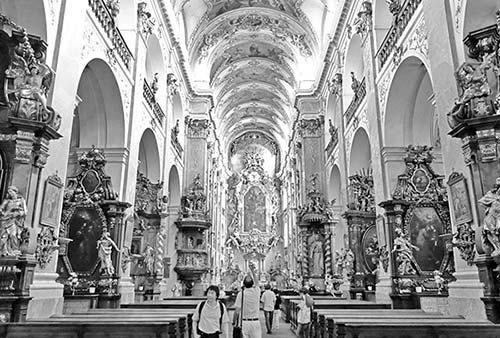
Step inside (or, if it’s locked, peek through the glass door). Artistically, St. James is a stunning example of how simple medieval spaces could be rebuilt into sumptuous feasts of Baroque decoration. The original interior was destroyed by fire in 1689; what’s here now is an early-18th-century remodel. The blue light in the altar highlights one of Prague’s most venerated treasures—the bejeweled Madonna Pietatis. Above the pietà, as if held aloft by hummingbird-like angels, is a painting of the martyrdom of St. James.
Cost and Hours: Free, Tue-Sun 9:30-12:00 & 14:00-16:00, closed Mon.
• Exiting the church, do a U-turn to the left (heading up Jakubská street, along the side of the church, past some rough-looking bars). After one block, turn right on Templová street. Head two blocks down the street (passing a nice view of the Týn Church’s rear end) and go through the arcaded passageway, where you emerge onto 7 Celetná street (since the 10th century, this has been a corridor in the busy commercial quarter—filled with merchants and guilds). To your right is a striking, angular, cinnamon-colored building called the...
8 House of the Black Madonna (Dům u Černé Matky Boží)
Back around the turn of the 20th century, Prague was a center of avant-garde art. Art Nouveau blossomed here, as did Cubism. The House of the Black Madonna’s Cubist exterior is a marvel of rectangular windows and cornices—stand back and see how masterfully it makes its statement while mixing with its neighbors...then get up close and study the details. The interior houses a Cubist café (the recommended Grand Café Orient, one flight up the parabolic spiral staircase)—complete with cube-shaped chairs and square rolls. The Kubista gallery in the far corner shows more examples of this unique style.
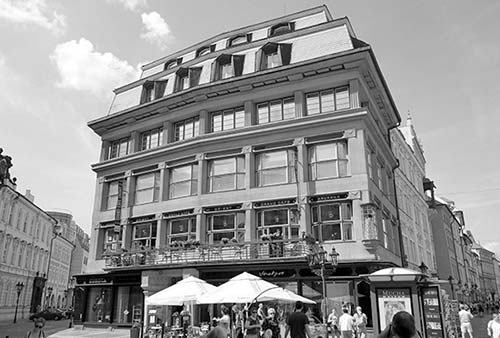
• The long, skinny square that begins just to the left of the Cubist house is the former fruit market (Ovocný Trh). For a peek at the local university and a historic theater, side-trip to the end of this square, then return to this spot.
9 Estates Theater and Charles University
The Estates Theater (Stavovské Divadlo) is the fancy green-and-white Neoclassical building at the end of the square. Built in the 1780s in a deliberately Parisian style, it was the prime opera venue in Prague at a time when an Austrian prodigy was changing the course of music. Mozart premiered Don Giovanni in this building (with a bronze statue of Il Commendatore, a character from that opera, duly flanking the main entrance), and he directed many of his works here. Today, the Estates Theater continues to produce The Marriage of Figaro, Don Giovanni, and The Magic Flute.
The main building of Prague’s Charles University, the Karolinum, is next door (on the right as you face the theater, tucked down a little courtyard). Prague in the late 1500s was one of the most enlightened places in Europe. The astronomers Tycho Brahe (who tracked the planets) and his assistant Johannes Kepler (who formulated the laws of motion) both worked here. Charles University has always been at the center of Czech political thinking and revolutions, from Jan Hus in the 15th century to the passionately patriotic Czech students who swept communists out of power in the Velvet Revolution. The ground-floor Gothic interior of the Karolinum can be visited for free—find the modern main entrance in the little fenced-off courtyard by the lions fountain (just turn left as you walk past the guard).
• Return to the House of the Black Madonna, then turn right and head up busy Celetná street to the big, black...
10 Powder Tower
The 500-year-old Powder Tower was the main gate of the old town wall. It also housed the city’s gunpowder—hence the name. This is the only surviving bit of the wall that was built to defend the city in the 1400s. (Though you can go inside, it’s not worth paying to tour the interior.)
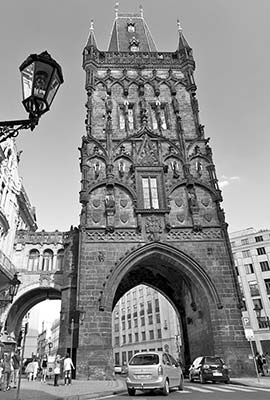
• Pass regally through the Powder Tower, leaving the Old Town. You’ll emerge into a big, busy intersection. To your left is the Municipal House, a cream-colored building topped with a green dome. Find a spot with a good view of the facade.
11 Municipal House (Obecní Dům)
The Municipal House is the “pearl of Czech Art Nouveau.” Art Nouveau flourished during the same period as the Eiffel Tower and Europe’s great Industrial Age train stations.
The same engineering prowess and technological advances that went into making those huge erector-set rigid buildings were used by artistic architects to create quite the opposite effect: curvy, organically flowing lines, inspired by vines and curvaceous women. Look at the elaborate wrought-iron balcony—flanked by bronze Atlases hefting their lanterns—and the lovely stained glass (as in the entrance arcade). Mosaics and sculptural knickknacks (see the faces above the windows) made the building’s facade colorful and joyous.
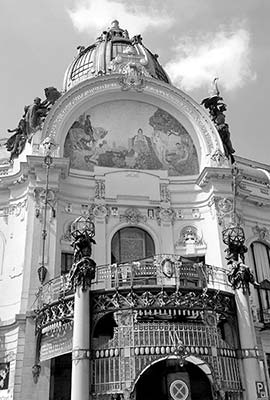
Prague is Europe’s best city for Art Nouveau. That’s the style of art and architecture that flourished throughout Europe around 1900. It was called “nouveau”—or new—because it was associated with all things modern: technology, social progress, and enlightened thinking. Art Nouveau was neo-nothing, but instead a fresh answer to all the revival styles of the late 19th century and an organic response to the Eiffel Tower art of the Industrial Age.
By taking advantage of recent advances in engineering, Art Nouveau liberated the artist in each architect. Notice the curves and motifs expressing originality—every facade is unique. Artists such as Alphonse Mucha believed that the style should apply to all facets of daily life. They designed everything from buildings and furniture to typefaces and cigarette packs.
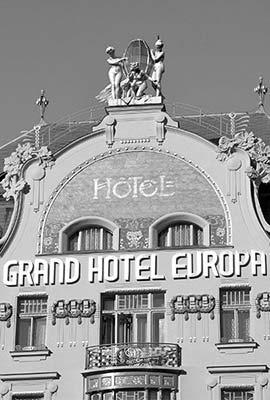
Though Art Nouveau was born in Paris, it’s in Prague where you’ll find some of its greatest hits: the Municipal House and nearby buildings, Grand Hotel Europa (on Wenceslas Square), the exuberant facades of the Jewish Quarter, the Jerusalem Synagogue, and—especially—the work of Mucha. You can see his stained-glass window in St. Vitus Cathedral (at Prague Castle) and his art at the excellent Mucha Museum (near Wenceslas Square). Mucha’s final masterpiece, The Slav Epic, is on display in his hometown of Moravský Krumlov.
The Municipal House was built in the early 1900s, when Czech nationalism was at a fever pitch. Having been ruled by the Austrian Habsburgs for the previous 300 years, the Czechs were demanding independence. This building was drenched in patriotic Czech themes, and all the artists and materials used were Czech. Within a few short years, in 1918, the nation of Czechoslovakia was formed—and the independence proclamation was announced to the people right here, from the balcony of the Municipal House.
The Municipal House interior has some of Europe’s finest Art Nouveau decor and is worth ▲▲ (for details, see “Sights in the New Town,” later). It’s free to enter and wander the public areas.
• Now head west down Na Příkopě.
12 Na Příkopě, the Old City Wall
The street called Na Příkopě was where the old city wall once stood. More specifically, the name Na Příkopě means “On the Moat,” and you’re walking along what was once the moat outside the wall. To your right is the Old Town. To the left, the New. The city was protected on two sides by its river and on the other two sides by its walls (marked by the modern streets called Na Příkopě, Revoluční, and Národní Třída). The only river crossing back then was the fortified Charles Bridge.
• Continue up Na Příkopě street to an intersection (and nearby Metro stop) called Můstek. To your left stretches the vast expanse of the wide boulevard called...
13 Wenceslas Square
Wenceslas Square—with the National Museum and landmark statue of St. Wenceslas at the very top—is the centerpiece of Prague’s New Town (rated ▲▲▲). This square was originally a thriving horse market. Today, it’s a world of high-fashion stores, fine old facades and jarringly modern ones, and fast-food restaurants.
• Let’s plunge back into the Old Town and return to the Old Town Square. Turn around, and with your back to Wenceslas Square, head downhill on the street called Na Můstku—“along the bridge”—that crossed the moat (příkopě) we’ve been following until now. After one touristy block, Na Můstku jogs slightly to the left and becomes Melantrichova. A block farther along, on the left, is the thriving...
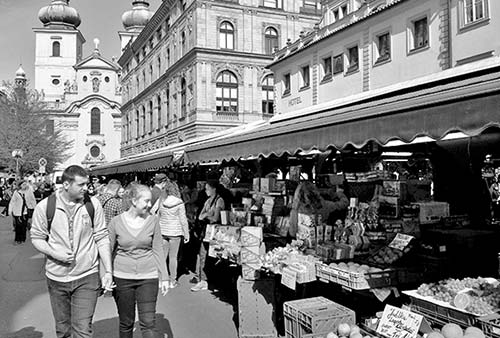
14 Havelská Market
This open-air market, offering crafts and produce, was first set up in the 13th century for the German trading community. Though heavy on souvenirs these days, the market (worth ▲) still feeds hungry locals and vagabonds. Lined with inviting benches, it’s an ideal place to enjoy a healthy snack—and merchants are happy to sell a single vegetable or piece of fruit. The market is also a fun place to browse for crafts. The cafés in the old arcades offer a relaxing vantage point from which to view the action.
• Continue along Melantrichova street. Eventually—after passing increasingly tacky souvenir shops—Melantrichova curves right and spills out at the Old Town Square, right by the Astronomical Clock. At the clock, turn left down Karlova street. The rest of our walk follows Karlova to the Charles Bridge. Begin by heading along the top of the Small Market Square (Malé Náměstí, with lots of outdoor tables), then follow Karlova’s twisting course—Karlova street signs keep you on track, and Karlův Most signs point to the bridge. Or just go generally downhill and follow the crowds.
15 Karlova Street
Although traffic-free, Karlova street is utterly jammed with tourists as it winds toward the Charles Bridge. But the route has plenty of historic charm if you’re able to ignore the contemporary tourism. As you walk, notice historic symbols and signs of shops, which advertised who lived there or what they sold. Cornerstones, designed to protect buildings from careening carriages, also date from centuries past.
The Klementinum (which once housed the university’s library) is the large building that borders Karlova street on the right. Just past the intersection with Liliová, where the street opens into a little square, turn right through the archway (at #1) and into a tranquil courtyard that feels an eternity away from the touristy hubbub of Karlova. You can also visit the Klementinum’s impressive ▲ Baroque interior on a guided tour.
• Karlova street leads directly to a tall medieval tower that marks the start of Charles Bridge. But before entering the bridge, stop on this side of the river. To the right of the tower is a little park with a great view of both the bridge and the rest of Prague across the river.
16 Charles IV Statue: The Bohemian Golden Age
Start with the statue of the bridge’s namesake, Charles IV (1316-1378). Look familiar? He’s the guy on the 100-koruna bill. Charles was the Holy Roman Emperor who ruled his vast empire from Prague in the 14th century—a high-water mark in the city’s history. The statue shows one of Charles’ many accomplishments: He holds a contract establishing Charles University, the first in Central Europe. The women around the pedestal symbolize the school’s four traditional subjects: theology, the arts, law, and medicine.
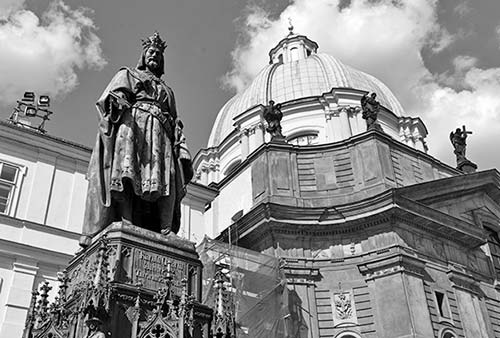
Charles was the preeminent figure in Europe in the late Middle Ages. His domain encompassed the modern Czech Republic and parts of Germany, Austria, Italy, and the Low Countries.
Charles was cosmopolitan. Born in Prague, raised in Paris, crowned in Rome, and inspired by the luxury-loving pope in Avignon, Charles returned home bringing Europe’s culture with him. Besides founding Charles University, he built Charles Bridge, much of Prague Castle and St. Vitus Cathedral, and the New Town (modeled on Paris). His Golden Bull of 1356 served as Europe’s constitution for centuries (and gave anti-Semite Charles first right to the property of Jews). Power-hungry, he expanded his empire through networking and shrewd marriages, not war. Charles traded ideas with the Italian poet Petrarch and imported artists from France, Italy, and Flanders. Under Charles, Prague became the most cultured city in Europe. Seemingly the only thing Charles did not succeed in was renaming Prague: He wanted it to be called “New Jerusalem.”
Now look up at the bridge tower (which you can climb for wonderful views; see next stop). Built by Charles, it’s one of the finest Gothic gates anywhere. The statuary shows the 14th-century hierarchy of society: people at street level, above them kings, and bishops above the kings.
• Stroll to the riverside, belly up to the banister, and take in the...
17 View from the River
Before you are the Vltava River and Charles Bridge. Across the river, atop the hill, is Prague Castle topped by the prickly spires of St. Vitus Cathedral. Prague Castle has been the seat of power in this region for over a thousand years, since the time of Wenceslas. By some measures, it’s the biggest castle on earth.
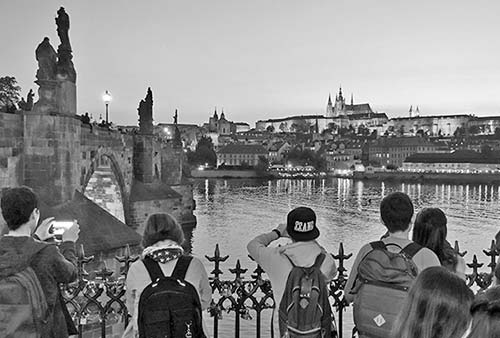
The Vltava River (from Old German “wild waters”) is better known by the modern German mutation of the same name, Moldau. It bubbles up from the Šumava Hills in southern Bohemia and runs 270 miles through a diverse landscape, like a thread connecting the Czech people. As we’ve learned, the Czechs have struggled heroically to carve out their identity while surrounded by mightier neighbors—Austrians, Germans, and Russians. The Vltava is their shared artery.
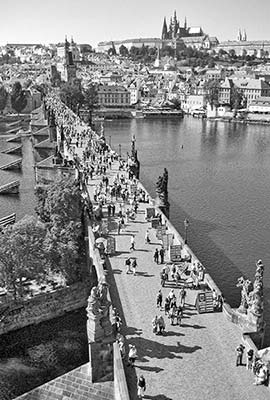
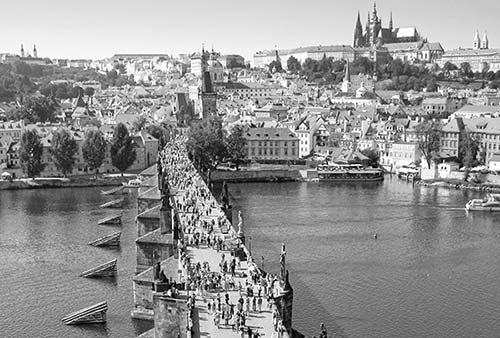
The view of Charles Bridge from here is supremely photogenic. The historic stone bridge, commissioned in 1342, connects the Old Town with the district called the Lesser Town at the base of the castle across the river. The bridge is almost seven football fields long, lined with lanterns and 30 statues, and bookended with medieval towers.
You can climb either tower. The one above you, on the Old Town side of the river (Staroměstská Mostecká Věž, 138 steps), rewards you with some of Prague’s best views: a stunning vista of the bridge and a perfect panorama that reminds you why Prague is called the “Golden City of a Hundred Spires.” On the Lesser Town side (Malostranská Mostecká Věž), you can huff up 146 steps for fine views of the bridge, the neighborhood rooftops, and the castle. If you’re trying to decide which to climb, consider that for snapping photos, the light is better if you climb the Old Town tower early in the day and the Lesser Town tower late in the day (150 Kč to climb each tower, daily 9:00-21:00, April-May and Sept 10:00-19:00, Oct-March until 18:00).
• Now wander onto the bridge. Make your way slowly across the bridge, checking out several of the statues, all on the right-hand side.
18 Charles Bridge (Karlův Most)
This much-loved ▲▲▲ bridge offers one of the most pleasant and entertaining strolls in Europe. Musicians, artisans, and a constant parade of people make it a festival every day. You can return to this bridge throughout the day to enjoy its various charms. Early and late, it can be enchantingly lonely. The impressively expressive statues on either side of the bridge depict saints.
Partway along the bridge, on your right, find a small brass relief showing a cross with five stars embedded in the wall of the bridge (it’s just below the little grate that sits on top of the stone banister). The relief depicts a figure floating in the river, with a semicircle of stars above him. This marks the traditional spot where the Czech patron saint John of Nepomuk is believed to have been tossed off the bridge and into the river.
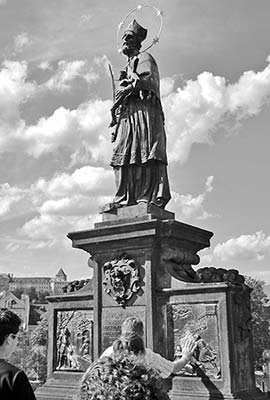
For the rest of that story, continue past two more statue groups to the bronze Baroque statue of St. John of Nepomuk, with the five golden stars encircling his head. This statue always draws a crowd. John was a 14th-century priest to whom the queen confessed all her sins. According to a 17th-century legend, the king wanted to know his wife’s secrets, but Father John dutifully refused to tell. The shiny plaque at the base of the statue shows what happened next: John was tortured and killed by being thrown off the bridge. The plaque shows the heave-ho. When he hit the water, five stars appeared, signifying his purity. Notice the date on the inscription—1683. This oldest statue on the bridge was unveiled on the supposed 300th anniversary of the martyr’s death. Traditionally, people believe that touching the St. John plaque will make a wish come true. But you get only one chance in life to make this wish, and you may never tell anyone what that wish is.
• A good way to end this walk is to enjoy the city and river 19 view from the bridge.
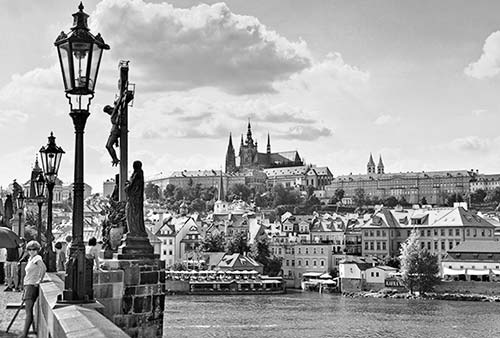
From here, you can continue across the bridge to the Lesser Town (Kampa Island, on your left as you cross the bridge, is a tranquil spot to explore; for more details, see “Sights in the Lesser Town,” later). You can also hike or take the tram up to the castle (a 10-minute walk to the right is the Malostranská stop for the Metro or for handy tram #22 or #23). Or retrace your steps across the bridge to enjoy more time in the Old Town.
Sights in the Old Town (Staré Město)
My Old Town and Charles Bridge Walk, earlier, covers the main sights in this area: the Old Town Square, Týn Church, Old Town Hall/Astronomical Clock, Church of St. James, and Charles Bridge. It also points out key landmarks, including the Ungelt courtyard, House of the Black Madonna, and Powder Tower.
Here are some additional sights in the Old Town. My Prague City Walk audio tour covers some of these.
JEWISH QUARTER (JOSEFOV)
Prague’s Jewish Quarter, worth ▲▲▲, is the best place in Europe to learn about this important culture and faith interwoven in the fabric of Central and Eastern Europe. Within a three-block radius, several original synagogues, a cemetery, and other landmarks survive, today collected into one big, well-presented sight known as the Jewish Museum in Prague. The impressive Old-New Synagogue completes the picture. It can get crowded here, so time your visit carefully (early or late is best). For background on typical synagogue architecture, see the sidebar on here.
Jewish Museum in Prague (Židovské Muzeum v Praze)
The “museum” consists of four synagogues, a ceremonial hall, and a cemetery—each described later and covered by the same ticket.
Cost and Hours: 400 Kč, 550 Kč combo-ticket includes Old-New Synagogue; open Sun-Fri 9:00-18:00, Nov-March until 16:30, closed Sat—the Jewish Sabbath—and on Jewish holidays, website lists all closures; 300 Kč audioguide is overkill, +420 222 317 191, www.jewishmuseum.cz.
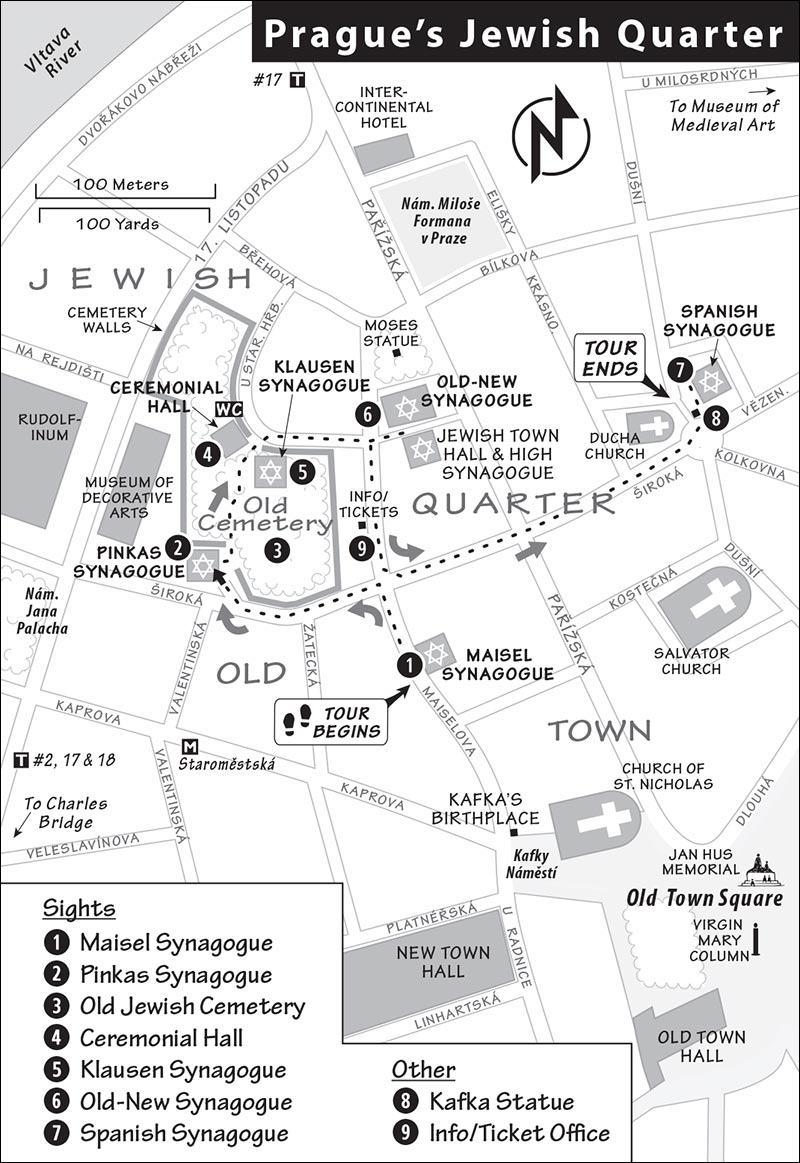
Buying Tickets and Avoiding Lines: Tickets are sold in person and on the Jewish Museum and Old-New Synagogue websites. In person, buy your ticket at the Maisel or Klausen synagogues or at the Information Center at Maiselova 15 (near the intersection with Široká street). Avoid buying at the Pinkas Synagogue, which tends to have long lines. The Pinkas Synagogue can be packed, especially between 10:00 and 11:30, so consider getting there right as it opens or later in the day.
Dress Code: Men are expected to cover their heads when entering an active synagogue or cemetery. While you’ll see many visitors ignoring this custom, it’s respectful to bring a cap or borrow a museum-issued yarmulke.
Getting There: The Jewish Quarter is an easy walk from Old Town Square, up delightful Pařížská street (next to the green-domed Church of St. Nicholas). The Staroměstská Metro stop is just a couple of blocks away.
Self-Guided Tour: You can see the sights in any order. This tour starts at the Maisel Synagogue; alternatively, you could plan your time around the crowded Pinkas Synagogue. Ideally, be there right as it opens to avoid the crowds.
Maisel Synagogue (Maiselova Synagóga): This pastel-colored Neo-Gothic synagogue, originally built as a private place of worship, now houses an interactive exhibit on Jewish history in the Czech lands up until 1800 and a few precious medieval objects. During the Nazi occupation, employees of the Jewish Museum used this building as a warehouse for a vast collection of Judaica gathered from vanished communities around the country. Rumor had it that Hitler planned to turn this collection into a “Museum of the Extinct Race.”
Inside, the interactive exhibit retraces a thousand years of Jewish history in Bohemia and Moravia. Well explained in English, topics include the origin of the Star of David, Jewish mysticism, the Golem legend, the history of discrimination, and the creation of Prague’s ghetto. Pre-WWII photographs of small-town synagogues from the region are projected on a large screen. Notice the eastern wall, with the holy ark containing a precious Torah mantel. Look for the banner of the Prague Jewish Butchers Guild, the emblem of the Cobblers Guild, a medieval seal ring, and the bema grillwork from Prague’s demolished Zigeuner Synagogue.
Pinkas Synagogue (Pinkasova Synagóga): For many visitors, this house of worship—today used as a memorial to Holocaust victims—is the most powerful of the Jewish Quarter sights.
Enter and go down the steps leading to the main hall of this small late-Gothic/early-Renaissance synagogue. Notice the old stone-and-wrought-iron bema in the middle, the niche for the ark at the far end, the crisscross vaulting overhead, and the Art Nouveau stained glass filling the place with light.
But the focus of this synagogue is its walls, inscribed with the handwritten names of 77,297 Czech Jews sent to the gas chambers at Auschwitz and other camps. Czech Jews were especially hard hit by the Holocaust. More than 155,000 of them passed through the nearby Terezín camp alone. Most died with no grave marker, but they are remembered here.
The names are carefully organized: Family names are in red, followed in black by the individual’s first name, birthday, and date of death (if known) or date of deportation. You can tell by the dates that families often perished together. The names are gathered in groups by hometowns (listed in gold, as well as on placards at the base of the wall). As you ponder this sad sight, you’ll hear the somber reading of the names alternating with a cantor singing the Psalms.
On your way out, watch on the right for the easy-to-miss stairs up to the small Terezín Children’s Art Exhibit. Well described in English, these drawings were made by Jewish children imprisoned at Terezín, 40 miles northwest of Prague (a worthy day trip from here). This is where the Nazis shipped Prague’s Jews for processing before transporting them east to death camps. Thirty-five thousand Jews died at Terezín of disease and starvation, and many tens of thousands more died in other camps. Of the 8,000 children transported from Terezín, only 240 came back. The teacher who led the drawing lessons and hid these artworks believed children could use imagination to liberate their minds from the camp. Their art survives to defy fate.
Old Jewish Cemetery (Starý Židovský Hřbitov): Hiding behind a wall and sitting above the street level, this is where Prague’s Jews buried their dead. A stroll through the crooked tombstones is a poignant experience.
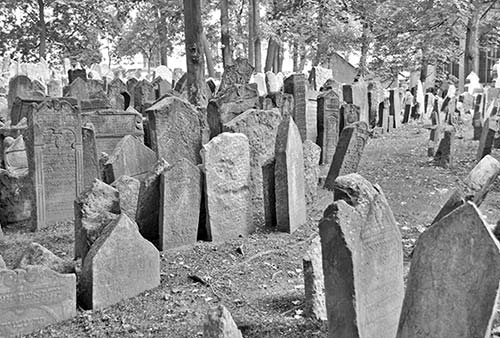
Meander along a path through 12,000 evocative tombstones. They’re old, eroded, inscribed in Hebrew, and leaning this way and that. A few of the dead have larger ark-shaped tombs. Most have a simple epitaph with the name, date, and a few of the deceased’s virtues.
From 1439 until 1787, this was the only burial ground allowed for the Jews of Prague. Over time, the bodies had to be stacked on top of each other—seven or eight deep—so the number of people buried here is actually closer to 85,000. Graves were never relocated because of the Jewish belief that, once buried, a body should not be moved. Layer by layer, the cemetery grew into a small plateau. Tune in to the noise of passing cars outside and you realize that you’re several feet above the modern street level—which is already high above the medieval level.
People place pebbles on honored tombstones. This custom, a sign of respect, shows that the dead have not been forgotten and recalls the old days, when rocks were placed upon a sandy gravesite to keep the body covered. Others leave scraps of paper that contain prayers and wishes.
Ceremonial Hall (Obřadní Síň): This rustic stone tower (1911), at the edge of the cemetery, was a mortuary house used to prepare the body and perform purification rituals before burial. The inside is painted in fanciful, flowery Neo-Romanesque style. It’s filled with a worthwhile exhibition on Jewish medicine, death, and burial traditions.
Klausen Synagogue (Klauzová Synagóga): This 17th-century synagogue is devoted to Jewish religious practices. The ground-floor displays touch on Jewish holidays. Upstairs, exhibits illustrate the rituals of everyday Jewish life. It starts at birth. There are good-luck amulets to ensure a healthy baby, and a wooden cradle that announces, “This little one will become big.” A male baby is circumcised (see the knife). The boy or girl grows to celebrate a coming-of-age Bar or Bat Mitzvah around age 12 or 13. Marriage takes place under a canopy, and the couple sets up their home—the exhibit ends with some typical furnishings.
Note that the Spanish Synagogue—described next—is a few blocks away from the core of the Jewish Quarter. Before heading over there, consider visiting the nearby Old-New Synagogue (described at the end of this section).
Spanish Synagogue (Španělská Synagóga): Called “Spanish” though its design is Moorish (which was all the rage when this was built in the 19th century), this has the most opulently decorated interior of all the synagogues. It marked a time of relative wealth and importance for Prague’s Jews, who in this era were increasingly welcome in the greater community and (in many cases) adopted a reformed approach to worship. Exhibits explain the lives of Czech Jews in the 19th and early 20th centuries, when they believed they were living their best days yet...unaware that the Holocaust was looming.
The decor is exotic and awe-inspiring. Intricate interweaving designs (of stars and vines) cover every inch of the red-gold and green walls and ceiling. A rose window with a stylized Star of David graces the ark.
The new synagogue housed a new movement within Judaism—a Reform congregation—which worshipped in a more modern way. The bema has been moved to the front of the synagogue, so the officiant faces the congregation. There’s also a prominent organ (upper right) to accompany the singing.
Displays of Jewish history bring us through the 18th, 19th, and tumultuous 20th centuries to today. In the 1800s, Jews were increasingly accepted and successful in the greater society. But tolerance brought a dilemma—was it better to assimilate within the dominant culture or to join the growing Zionist homeland movement? To reform the religion or to remain orthodox?
Upstairs, the balcony exhibits focus on Czech Jews in the 1900s. Start in the area near the organ, which explains the modern era of Jewish Prague, including the late 19th-century development of Josefov. Then work your way around the balcony, with exhibits on Jewish writers (Franz Kafka), philosophers (Edmund Husserl), and other notables (Freud). This intellectual renaissance came to an abrupt halt with World War II and the mass deportations to Terezín. The final display covers the modern nation of Israel. Finish your visit across the landing in the Winter Synagogue, showing a trove of silver—Kiddush cups, Hanukkah lamps, Sabbath candlesticks, and Torah ornaments.
Old-New Synagogue (Staronová Synagóga)
The oldest and most important building in the Jewish Quarter, the Old-New Synagogue goes back at least seven centuries. While the exterior seems simple compared to ornate neighboring townhouses, the interior is atmospherically 13th century.
Cost and Hours: 220 Kč, 550 Kč combo-ticket includes Jewish Museum in Prague; Sun-Thu 9:00-18:00, off-season until 17:00, Fri closes one hour before sunset, closed Sat and on Jewish holidays; +420 222 317 191, www.synagogue.cz.
Visiting the Synagogue: Built in 1270, this is the oldest synagogue in Central Europe (and some say the oldest still-working synagogue in all of Europe). The name may come from the fact that it was “New” when built but became “Old” when other, newer synagogues came on the scene. The exterior is simple, with a unique sawtooth gable. Standing like a reinforced bunker, it feels as though it has survived plenty of hard times.
As you enter, you descend a few steps below street level to the 13th-century street level and the medieval world.
The interior is pure Gothic—thick pillars, soaring arches, and narrow lancet windows. If it looks like a church, well, the architects were Christians. The stonework is original, and the woodwork (the paneling and benches) is also old. This was one of the first Gothic buildings in Prague.
Seven centuries later, it’s still a working synagogue. There’s the stone bema in the middle where the Torah is read aloud, and the ark at the far end, where the sacred scrolls are kept. To the right of the ark, one chair is bigger, with a Star of David above it. This chair always remains empty out of respect for great rabbis of the past. Where’s the women’s gallery? Here, women worshipped in rooms that flanked the hall, watching the service through those horizontal windows in the walls.
Before leaving, check out the lobby (the long hall where you show your ticket). It has two fortified old lockers—in which the most heavily taxed community in medieval Prague stored its money in anticipation of the taxman’s arrival.
NORTH OF THE OLD TOWN SQUARE, NEAR THE RIVER
Stray just a couple of blocks north of the Old Town Square and you’ll find a surprisingly tourist-free world of shops and cafés, pastel buildings with decorative balconies and ornamental statues, winding lanes, cobblestone streets, and mosaic sidewalks. It’s also home to this fine, underrated museum.
▲▲Museum of Medieval Art (Středověké umění v Čechách a Střední Evropě)
Prague flourished in the 14th century, and the city has amassed an impressive collection of altarpieces and paintings from that age. Today, this art is housed in the tranquil former Convent of St. Agnes, which was founded in the 13th century by a Czech princess-turned-nun as the first hospital in Prague. A visit here is your best chance to see exquisite medieval art in Prague.
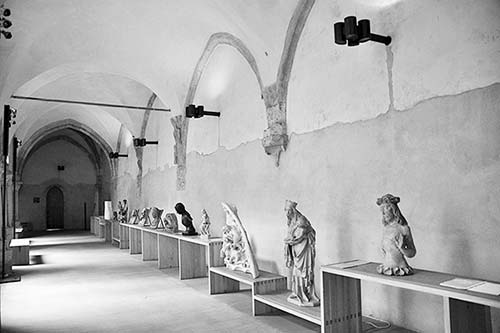
Cost and Hours: 250 Kč; Tue-Sun 10:00-18:00, closed Mon; two blocks northeast of the Spanish Synagogue, along the river at Anežská 12; +420 224 810 628, www.ngprague.cz.
Sights in the New Town (Nové Město)
Enough of pretty, medieval Prague—let’s leap into the modern era. The New Town, with Wenceslas Square as its focal point, is today’s urban Prague, characterized by bustling boulevards and interesting neighborhoods. Even today, the New Town is separated from the Old Town by a “moat” (the literal meaning of the street called Na Příkopě). As you cross busy Na Příkopě, you leave the medieval cuteness and souvenir shops behind, and enter a town of malls and fancy shops that cater to locals and visitors alike. The New Town is one of the best places to view Prague’s remarkable Art Nouveau art and architecture, and to learn more about its communist past.
Download my Prague City Walk audio tour, which covers some of these sights.
WENCESLAS SQUARE AND NEARBY
These sights are on or within a few blocks of the elongated main square of the New Town.
▲▲▲Wenceslas Square Walk (Václavské Náměstí)
More a broad boulevard than a square, this city landmark is named for St. Wenceslas, whose equestrian statue overlooks the square’s top end. Wenceslas Square functions as a stage for modern Czech history: The creation of the Czechoslovak state was celebrated here in 1918; in 1968, the Soviets suppressed huge popular demonstrations (called the Prague Spring) at the square; and in 1989, more than 300,000 Czechs and Slovaks converged here to demand their freedom (in the Velvet Revolution). Today, it’s a busy commercial thoroughfare.
Self-Guided Walk: For a taste of Prague’s 20th-century history, take a stroll beginning at the top of the square. (To get here quickly, ride the Metro to the Muzeum stop.)
• Begin at the big...
Statue of Duke Wenceslas I: The “Good King” of Christmas-carol fame was actually a wise and benevolent 10th-century duke. Václav (as he’s called by locals) united the Czech people, back when this land was known as Bohemia. A rare example of a well-educated and literate ruler, Wenceslas Christianized and lifted the culture. He astutely allied the powerless Czechs with the Holy Roman Empire of the German nation. And he began to fortify Prague’s castle as a center of Czech government. After his murder in 929, Wenceslas was canonized as a saint. He became a symbol of Czech nationalism (and appears on the 20 Kč coin). Later kings knelt before his tomb to be crowned. And he remains an icon of Czech unity whenever the nation has to rally. Like King Arthur in England, Wenceslas is more legend than history, but he symbolizes the country’s birth.
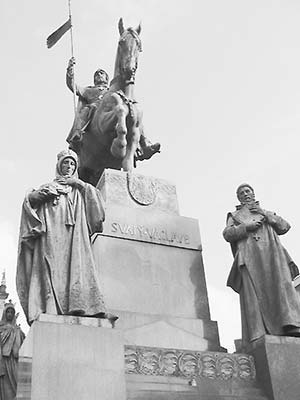
The statue is surrounded by the four other Czech patron saints. Notice the focus on books. A small nation without great military power, the Czechs have thinkers as national heroes, not warriors.
And this statue is a popular meeting point. Locals like to say, “I’ll meet you under the horse’s tail.”
• Circle behind the statue and stand below that tail; turn your attention to the impressive building at the top of Wenceslas Square.
National Museum: This grand, lavishly restored building dates from the 19th century, when modern nation-states were forming in Europe and the Czech people were still living under the auspices of Austria’s Habsburg Empire. Bold structures like this Neo-Renaissance building were a way to show the world that the Czech lands had a distinct culture and a heritage of precious artifacts, and that Czechs deserved their own nation.
Look closely at the columns on the building’s facade. Those light-colored patches (meticulously preserved during the recent renovation) are covering holes where Soviet bullets hit during the 1968 crackdown. The state-of-the-art interior is filled with diverse exhibits ranging from minerals to modern history (250 Kč, daily 10:00-18:00 plus most Wed from 9:00, www.nm.cz).
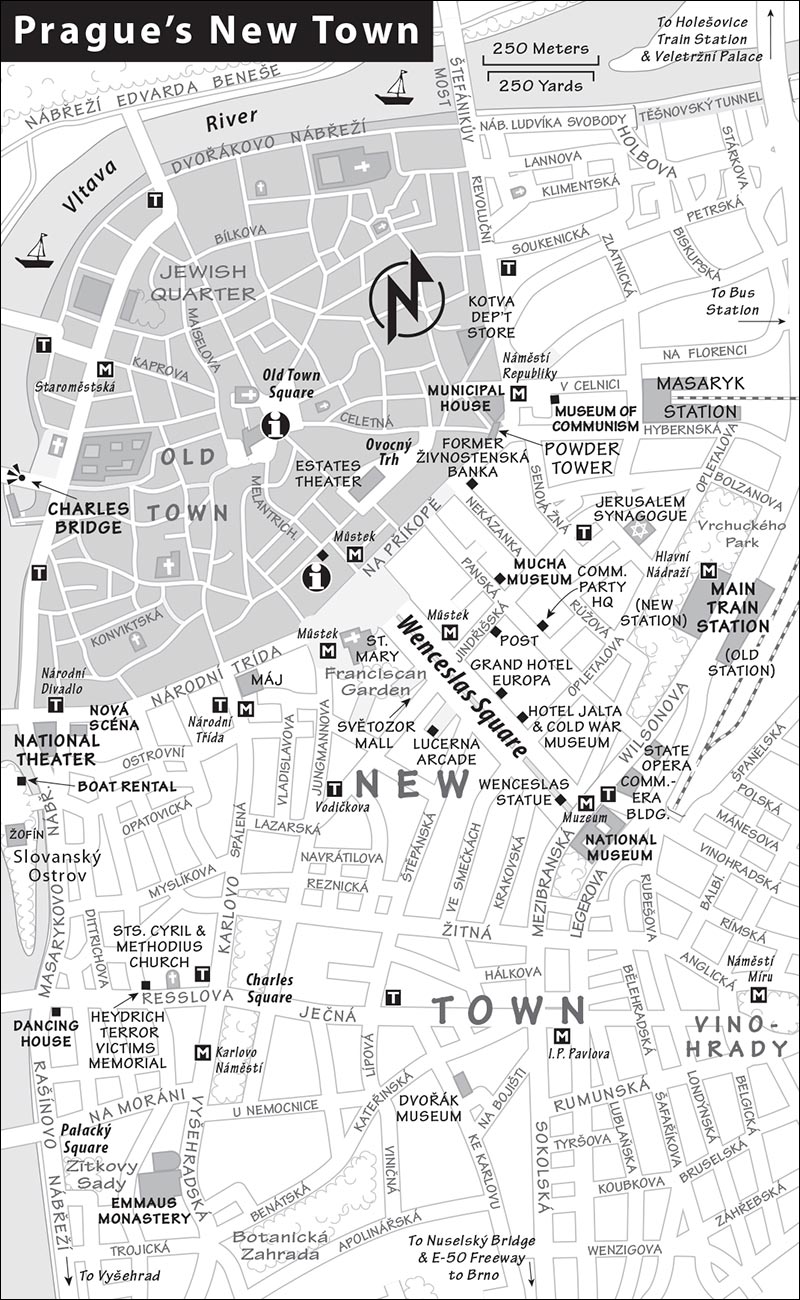
• To the left of the National Museum (as you face it) is a...
Communist-Era Building: This out-of-place modern structure once housed the rubber-stamp Czechoslovak Parliament back when it voted in lockstep with Moscow. Between 1994 and 2008, this building was home to Radio Free Europe. After communism fell, RFE lost some of its funding and could no longer afford its Munich headquarters. In gratitude for its broadcasts—which had kept the people of Eastern Europe in touch with real news—the Czech government offered this building to RFE for 1 Kč a year. But as RFE energetically beamed its American message deep into the Muslim world from here, it drew attention—and threats—from Al-Qaeda. In 2009, RFE moved to a new fortress-like headquarters literally across the cemetery wall from Franz Kafka’s grave (an easier-to-defend locale). Now this is an annex of the National Museum.
In January 1968, the Slovak politician Alexander Dubček replaced the aging apparatchiks at the helm of the Communist Party of Czechoslovakia. Handsome and relatively youthful, Dubček used the brand of a smiling playboy; he appeared on magazine covers in his Speedo, about to dive into a swimming pool. Young Czechs and Slovaks embraced Dubček as a potential hero of liberalization.
In April, Dubček introduced his “Action Program,” designed to tiptoe away from strict and stifling Soviet communism and forge a more moderate Czechoslovak variation. Censorship eased, travel restrictions were relaxed, state companies began forming joint ventures with Western firms, money poured into the sciences, and a newspaper called Tomorrow (rather than Today) became the most popular in the country. Plays put on at the Semafor Theater (in today’s Světozor mall) lampooned Soviet leader Brezhnev and his ilk. During this so-called “Prague Spring,” optimism soared.
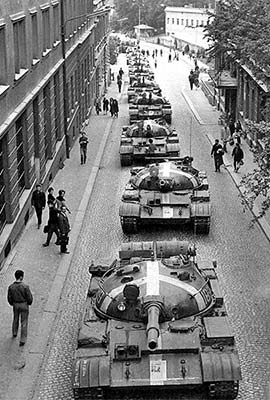
But then, around midnight on August 20, 1968, the thundering sound of enormous airplanes ripped across the floodlit rooftops of Prague. The Soviets had dispatched over 200,000 Warsaw Pact troops to invade Czechoslovakia, airlifting tanks right into the capital city. Dubček and his team were arrested and taken to Moscow. Czechs and Slovaks took to the streets, boycotting and striking. Tanks rolled through Wenceslas Square, spraying protesters with bullets...some of which are still embedded in the National Museum’s pillars. Over the course of the occupation, 72 Czechs and Slovaks were killed.
Dubček stepped down and went into internal exile, and his successor—the hardliner Gustáv Husák—immediately pursued a policy of “normalization.” People who refused to sign a petition commending the “Russian Liberation” were fired from their jobs and forced to find worse ones. Some protesters—including Jan Palach—went to the extreme of setting themselves on fire to protest against the regime. Tens of thousands of Czechs and Slovaks reluctantly emigrated to the West, fearing what might come next.
While the ill-fated tale of the Prague Spring is pessimistic, it provides an insightful bookend to what happened 21 years later: The children of the generation that suffered Czechoslovakia’s bitterest disappointment ushered in mass demonstrations that ended this dark era.
• Start walking down Wenceslas Square. Pause about 30 yards along, at the little patch of bushes. In the ground on the downhill side of those bushes is a...
Memorial to the Victims of 1969: After the Russian crackdown of 1968, a young philosophy student named Jan Palach, inspired by a video of monks immolating themselves in protest in Vietnam, decided that the best way to stoke the flame of independence was to do the same right here. On January 16, 1969, Palach stood on the steps of the National Museum and ignited his body. He died a few days later. A month later, another student did the same thing, followed by another. Czechs are keen on anniversaries, and 20 years after Palach’s defining act, in 1989, hundreds of Czechs gathered here again in protest. A sense of new possibility swept through the city, and 10 months later, the communists were history.
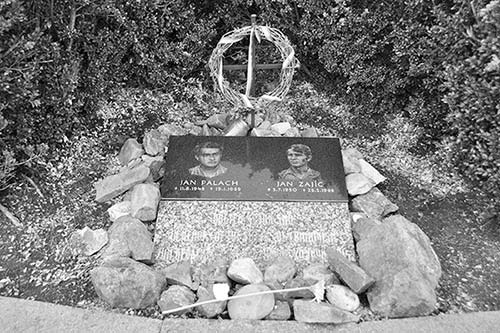
• Farther down the square, locate the building on the right with the beige travertine facade (and many balconies). This is the...
Jalta Hotel and Cold War Museum: This building is most representative of the 1950s Neoclassical, Socialist Realist style. Designed at the height of the Cold War as a hotel for VIPs, it came with an underground crisis-fallout shelter that visiting Soviet generals could use as a command center in case nuclear war broke out. The bunkers were recently refurbished back to their original state by a group of Czechoslovak army fans and converted into the ▲Cold War Museum, with a command room, hospital room, spying room (showing you how an operator tapped telephone conversations), and an air-filtering facility (visits by tour only, 400 Kč for one-hour tour in English, departing daily at 11:00, 13:00, 14:30, and 16:00 from inside Jalta Hotel, www.en.muzeum-studene-valky.cz).
• Continue down Wenceslas Square.
Architecture Along Wenceslas Square: As you walk, you’ll notice the architecture is unlike the historic Old Town—nearly everything here is from the past two centuries. Wenceslas Square is a showcase of Prague’s many architectural styles: You’ll see Neo-Gothic, Neo-Renaissance, and Neo-Baroque from the 19th century. There’s curvaceous Art Nouveau from around 1900. And there’s the modernist response to Art Nouveau—Functionalism from the mid-20th century, where the watchword was “form follows function” and beauty took a back seat to practicality. You’ll see buildings from the 1950s communist era, forgettable glass-and-steel buildings of the 1970s, modern stores from the 2000s, and new construction.
The Velvet Revolution: Opposite Grand Hotel Europa (on the left side of the square), find the Marks & Spencer building and its balcony (partly obscured by trees).
Picture the scene on this square on a cold November night in 1989. Czechoslovakia had been oppressed for the previous 40 years by communist Russia. But now the Soviet empire was beginning to crumble, jubilant Germans were dancing on top of the shattered Berlin Wall, and the Czechs were getting a whiff of freedom.
Czechoslovakia’s revolution began with a bunch of teenagers, who—following a sanctioned gathering—decided to march on Wenceslas Square (see sidebar). They were surrounded and beaten by the communist riot police, and days later their enraged parents, friends, and other members of the community poured into this square to protest. Night after night, this huge square was filled with more than 300,000 ecstatic Czechs and Slovaks who believed freedom was at hand. Each night they would jingle their key chains in the air as if saying to their communist leaders, “It’s time for you to go home now.” Finally, they gathered and found that their communist overlords had left—and freedom was theirs.
On that night, as thousands filled this square, a host of famous people appeared on that balcony to greet the crowd. There was a well-known priest and a rock star famous for his rebellion against authority. There was Alexander Dubček, the hero of the Prague Spring reforms of 1968. And there was Václav Havel, the charismatic playwright who had spent years in prison, becoming a symbol of resistance—a kind of Czech Nelson Mandela. Now he was free. Havel’s voice boomed over the gathered masses. He proclaimed the resignation of the Politburo and the imminent freedom of the Republic of Czechoslovakia. He pulled out a ring of keys and jingled it. Thousands of keys jingled back in response to indicate time was up.
In previous years, the communist authorities would have sent in tanks to crush the impudent masses. But by 1989, the Soviet empire was collapsing, and the Czech government was shaky. Locals think that Soviet head of state Mikhail Gorbachev (mindful of the Tiananmen Square massacre a few months before) might have made a phone call recommending a nonviolent response. Whatever happened, the communist regime was overthrown with hardly any blood being spilled. It was done through sheer people power—thanks to the masses of defiant Czechs who gathered here peacefully in Wenceslas Square, and Slovaks doing the same in Bratislava. A British journalist called it “The Velvet Revolution,” and the name caught on in the West. Locals call it simply “The Revolution.”
• A block from the bottom of Wenceslas Square, look for the gate tucked behind the Jungmann statue on Jungmannovo Náměstí. Head through to find the...
Franciscan Garden: Ahhh! This garden’s white benches and spreading rosebushes are a universe away from the fast beat of the city. The peacefulness reflects the purpose of its Franciscan origin. St. Francis, the founder of the order, thought God’s presence could be found in nature. In the 1600s, Prague became an important center for a group of Franciscans from Ireland. Enjoy the herb garden and children’s playground. (A WC is just out the far side of the garden.)
• Exit the garden at the opposite corner from where you entered (past the little yellow gardening pavilion and the herb garden). Continue straight ahead to reach the Old Town or turn right along Na Příkopě street to visit the Mucha Museum, Municipal House, or Museum of Communism. For places farther afield, hop on the Metro at Můstek. The rest of Prague is yours to enjoy.
▲Mucha Museum (Muchovo Muzeum)
This enjoyable little museum features a small selection of the insistently likeable art of Alphonse Mucha (MOO-kah, 1860-1939), whose florid style helped define what became known as Art Nouveau. It’s all crammed into a too-small space, some of the art is faded, and the admission price is steep—but there’s no better place to gain an understanding of Mucha’s talent, his career, and the influence he’s had on the world art scene. And the museum, partly overseen by Mucha’s grandson, gives you a peek at some of the posters that made Mucha famous. You’ll learn how these popular patriotic banners, filled with Czech symbols and expressing his people’s ideals and aspirations, aroused the national spirit. Enjoy decorative posters from his years in Paris, including his celebrated ads for the French actress Sarah Bernhardt. Check out the photographs of his models, which Mucha later re-created in pencil or paint, and be sure to see the 30-minute film on the artist’s life. Then peruse the well-stocked gift shop.
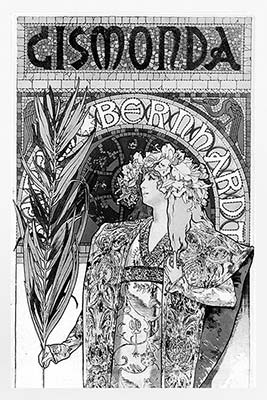
Cost and Hours: 300 Kč, daily 10:00-18:00, good English descriptions, two blocks off Wenceslas Square at Panská 7, +420 224 233 355, www.mucha.cz.
NEAR NA PŘÍKOPĚ
At the bottom of Wenceslas Square, the street running to the right is called Na Příkopě, meaning “On the Moat.” It is a showcase of Art Nouveau: Be sure to keep your eyes up as you stroll here. City tour buses leave from along this street, which also offers plenty of shopping temptations.
▲Museum of Communism (Muzeum Komunismu)
This small museum offers a fascinating look at the “dream, reality, and nightmare” of communism. You’ll walk through the years (with good English descriptions) between the 1918 birth of Czechoslovakia and World War II, when the Soviets “liberated” Czechoslovakia from the Nazis. The communists quickly came to power, with statues of Stalin and propaganda permeating Czech society. Then the dark side: attempted escapes, police, interrogation, and torture, as a video on the wall shows images that humanize the tragedy of this period. A section on the eventual fall of communism is inspiring.
Cost and Hours: 380 Kč, daily 9:00-20:00, a block off Republic Square at V Celnici 4, +420 224 212 966, www.museumofcommunism.com.
▲▲Municipal House (Obecní Dům)
The cultural and artistic leaders who financed this Art Nouveau masterpiece (1905-1911) wanted a ceremonial palace to reinforce self-awareness of the Czech nation. While the exterior is impressive, the highlight is the interior—and at least part of it is free. To extend your Art Nouveau bliss, take a guided tour or attend a concert here.
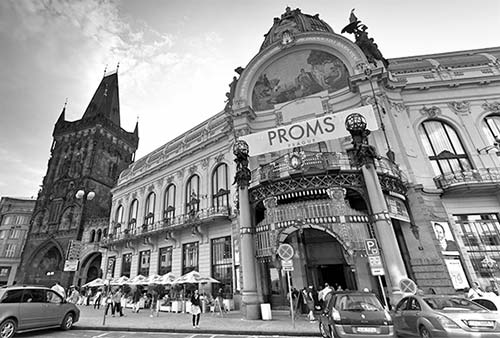
Cost and Hours: The entrance halls and public spaces are free to explore (daily 10:00-18:00). For an in-depth look at all the sumptuous halls and banquet rooms, join a one-hour tour (290 Kč, English tours—usually 3/day departing between 11:00 and 17:00; limited to 35 people—buy your ticket online or from the ground-floor shop where tours depart; Náměstí Republiky 5, +420 222 002 101, www.obecnidum.cz).
Concerts: Performances are held regularly in the lavish Smetana Hall (schedule on website). Note that many concerts are promoted as if they are held in the Municipal House, but are performed in a smaller, less impressive hall in the same building.
Visiting the House: Don’t be timid about poking around the interior, which is open to the public. Having lunch or a drink in one of the eateries is a great way to experience the decor, but you can also just glimpse them from the doorway (as you “check out the menu”).
Enter under the green, wrought-iron arcade. In the rotunda, admire the mosaic floor, stained glass, woodwork doorway, and lighting fixtures. To the left is a recommended café (kavárna)—a harmony of woodwork, marble, metal, and glittering chandeliers.
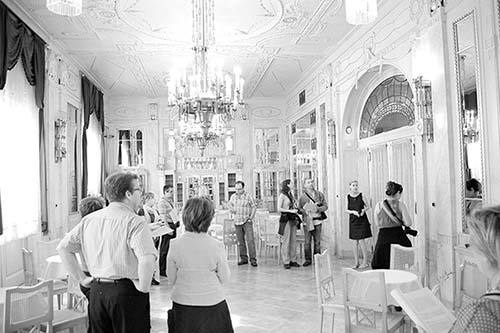
From the rotunda, step into the lobby, where you can look up the staircase that leads to the main concert hall (no tourist access upstairs). Also in the lobby is the box office, selling concert tickets and guided English tours of the building.
Facing the staircase, go right and head downstairs—yes, tourists are welcome there. Admire the colorful tiles in the stairwell and more colorful tiles in the downstairs main room. Look for the plaster model of this building and the adjacent Powder Tower, which shows how the angled facade conceals a surprisingly large performance space. Also check out the American Bar (salute the US flags above the bar) and the Plzeňská Restaurant (with its dark-wood booths and colorful tile scenes of happy peasants). Finish your tour by going back upstairs to find the Modernista shop (tucked to the left as you face the main staircase)—full of fancy teacups and jewelry.