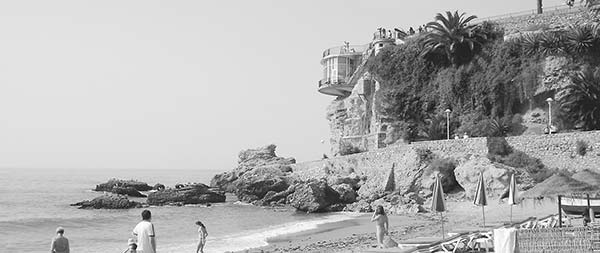
SPAIN’S SOUTH COAST
Nerja • Gibraltar • Tarifa
Sleeping in and near Gibraltar
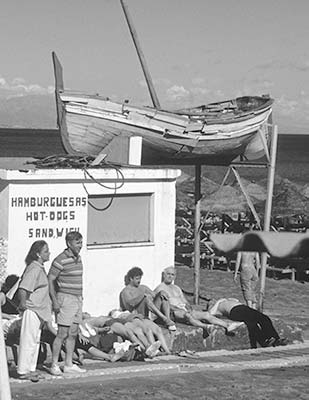
Much of Spain’s south coast is so bad, it’s interesting. To northern Europeans, the sun is a drug, and this is their needle. Anything resembling a quaint fishing village has been Speedo-strangled and Nivea-creamed. Oblivious to the concrete, pollution, ridiculous prices, and traffic jams, tourists lie on the beach like the local sardine skewers—cooking, rolling, and sweating under the sun. It’s a fascinating study in human nature.
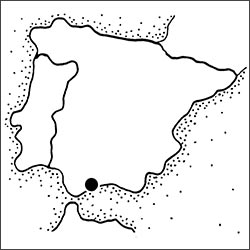
The most famous stretch of coast is the Costa del Sol, where human lemmings make the scene and coastal waters are so polluted that hotels are required to provide swimming pools. And where Europe’s most popular beach isn’t crowded by high-rise hotels, most of it’s in a freeway chokehold.
But the south coast holds a few gems. If you want a place to stay and play in the sun, unroll your beach towel at Nerja, the most appealing resort town on the coast.
And remember that you’re surprisingly close to jolly olde England: The land of tea and scones, fish-and-chips, pubs, and bobbies awaits you—in Gibraltar. Though a British territory, Gibraltar has a unique cultural mix that makes it far more interesting than the anonymous resorts lining the coast.
Beyond “The Rock,” the whitewashed port of Tarifa—the least-developed piece of Spain’s generally overdeveloped southern coast—is a workaday town with a historic center, broad beaches, and good hotels and restaurants. Most important, Tarifa is the perfect springboard for a quick trip to Tangier, Morocco (see next chapter).
These three places alone—Nerja, Gibraltar, and Tarifa—make Spain’s south coast worth a trip.
PLANNING YOUR TIME
My negative opinions on the “Costa del Turismo” are valid for peak season (mid-July to mid-Sept). If you’re there during a quieter time and you like the ambience of a beach resort, it can be a pleasant stop. Off-season it can be neutron-bomb quiet, with many hotels and restaurants closed until their clients return for the sun.
The whole 150 miles of coastline takes six hours by bus or three hours to drive with no traffic jams. You can resort-hop by bus across the entire Costa del Sol and reach Nerja for dinner. If you want to party on the beach, it can take as much time as it would to get to Mazatlán.
To day-trip to Tangier, Morocco, head for Tarifa.
Nerja
Despite cashing in on the fun-in-the-sun culture, Nerja (NEHR-hah) has kept much of its Old World charm. It has good beaches, a fun evening paseo (strolling scene) that culminates at the Balcony of Europe viewpoint, enough pastry shops and nightlife to keep you fed and entertained, and locals who get more excited about their many festivals than the tourists do.
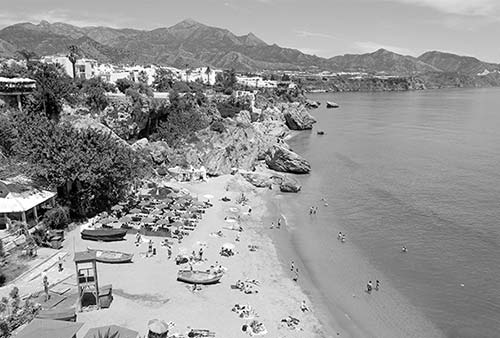
Although Nerja’s population swells from around 22,000 in winter to nearly 90,000 in the summer, it’s more of a year-round destination and a real town than many other resorts. Spaniards have a long tradition of vacationing here, and pensioners from northern Spain move here—enjoying long life spans, thanks in part to the low blood pressure that comes from a diet of fish and wine. While they could afford to travel elsewhere in summer, to escape the brutal heat of inland Spain many Spanish parents take turns with their kids in family condos on the south coast. Whoever stays home to work gets to “be Rodriguez” (estar de Rodríguez), an idiom whose closest English equivalent is “when the cat’s away, the mice will play.”
For the average traveler coming from Madrid or Barcelona, walking Nerja’s streets, where everyone seems to have all the time in the world, is a psychological adjustment—but that’s why you’re here.
Orientation to Nerja
The tourist center of Nerja is right along the water and crowds close to its famous bluff, the Balcony of Europe (Balcón de Europa). Fine strings of beaches flank the bluff, stretching in either direction. The old town is just inland from the Balcony, while the more modern section slopes up and away from the water.
Tourist Information: The helpful English-speaking TI has bus schedules, tips on beaches and side trips, and brochures for nearby destinations, such as the Caves of Nerja, Frigiliana, Málaga, and Ronda (generally Mon-Fri 10:00-14:00 & 17:00-20:30, Sat-Sun 10:00-13:30; morning only off-season; 100 yards from the Balcony of Europe and a half-block inland from the big church, +34 952 521 531, http://turismo.nerja.es). The “downloads” section of the website has English versions of multiple brochures, including a useful walking trails guide.
ARRIVAL IN NERJA
By Bus: The Nerja station is just a bus stop with an info kiosk on Avenida de Pescia (schedules posted, Alsa, www.alsa.es). To travel from Nerja, buy tickets at the kiosk; if the kiosk is closed, buy them on the Alsa app (no later than 30 minutes before departure) or on the bus. If uncertain, ask a local which side of the street your bus departs from. Because many buses leave at the same times, arrive at least 15 minutes before departure to avoid having to elbow other tourists.
By Car: To find the old-town center and the most central parking, follow Balcón de Europa, Centro Urbano, or Centro Ciudad signs, and then pull into the big underground municipal lot beneath the Plaza de España (which deposits you 200 yards from the Balcony of Europe). The enormous aboveground Parking Carabeo, just east of the Balcony, is slightly cheaper but exposed to brutal sun. The handiest free parking is about a 10-minute walk farther out, next to the bridge over the dry riverbed (near the town bus stop, just off N-340). Street parking in Nerja can be very tight. Blue lines mean it’s metered (pay and display); white lines indicate it’s generally free. If you do find a space, read signs carefully—on certain days of the month you’re required to move your car. It’s best to ask your hotelier if your street spot is OK.
HELPFUL HINTS
Book Ahead: If you plan to visit the Nerja Caves outside of town, reserve a timed-entry spot online in advance.
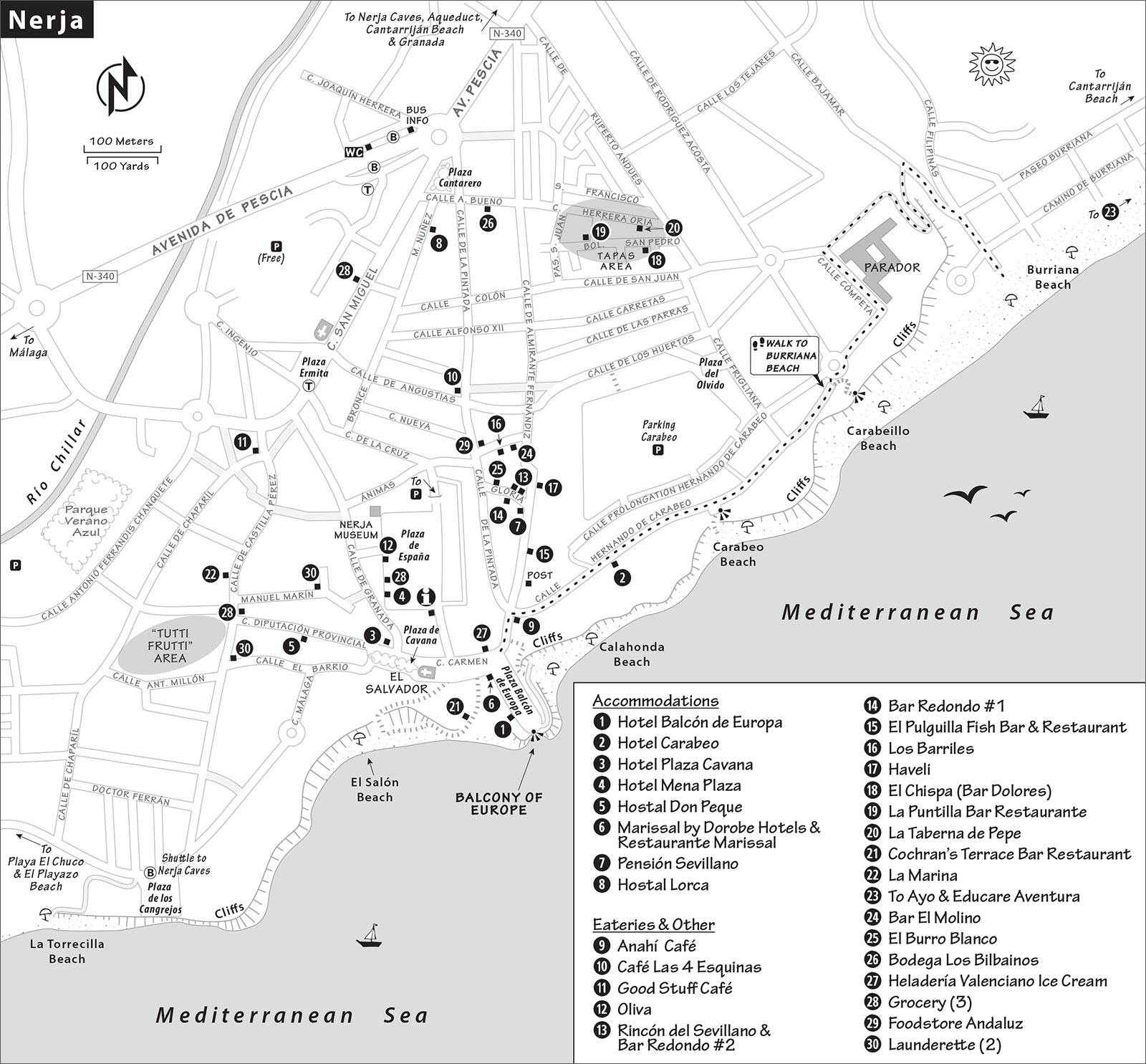
Laundry: Full-service launderette Bubbles Burbujas is run by friendly Jo from England (same-day service if you drop off in the morning, no self-service; Mon-Fri 10:00-14:00, Sat until 13:00, closed Sun; a few blocks north of Plaza de Cavana at Calle Manuel Marín 1, just off Calle Granada—look for Pasaje Granada pedestrian passage on left, +34 665 539 256). For self-service, try Lavandería Autoservicio Axarquia on Calle Castilla Pérez (coins only—no change given, daily 8:30-22:30, +34 952 522 104).
Media: For a taste of the British expat scene, pick up the monthly magazine Streetwise (www.streetwise.es) or tune in to Coastline Radio at 97.6 FM. To imagine being a retired Scandinavian here, have a look at Soltalk (www.soltalk.com). For regional news, there’s an English translation online of the Málaga-based newspaper Sur (www.surinenglish.com).
GETTING AROUND NERJA
You can easily walk anywhere you need to go. Taxis are widely available; you’ll find stands at Plaza Ermita and near the bus stops on Avenida de Pescia. Expect to pay €5-15 (for example, €6 to Burriana Beach, €9 to the Nerja Caves, €12 to Frigiliana, +34 952 524 519 or +34 952 520 537).
Tours in Nerja
Local Guide
Excellent licensed guide Carmen Fernández has vast regional knowledge extending from tailored cityscapes to stunning natural areas around Nerja, Frigiliana, Antequera, and Málaga (€90/3 hours, €125/5 hours, +34 610 038 437, mfeyus@gmail.com).
Sea and Land Adventures
Educare Aventura offers kayak and paddleboard rental at Burriana Beach, either on your own (€15/2 hours) or with a guide (€24/2.5 hours). They also offer adventure trips into the nearby Sierra de Tejeda and Sierra Nevada mountains (office located just behind the recommended Ayo restaurant at Camino de Burriano 28, +34 952 039 026, www.educare-aventura.com).
Jon Keo Walking Tours, run by engaging Irish expats, leads a full schedule of treks ranging from easy to ambitious (+34 646 273 502, www.hikingwalkingspain.com).
Sights in Nerja
▲▲Balcony of Europe (Balcón de Europa)
Church of El Salvador (Iglesia de El Salvador)
El Salón Beach (Playa El Salón)
Playa la Torrecilla and Playa el Chucho
Calahonda Beach (Playa Calahonda)
Carabeo and Carabeillo Beaches (Playa Carabeo/Playa Carabeillo)
Burriana Beach (Playa de Burriana)
Cantarriján Beach (Playa del Cantarriján)
▲▲Balcony of Europe (Balcón de Europa)
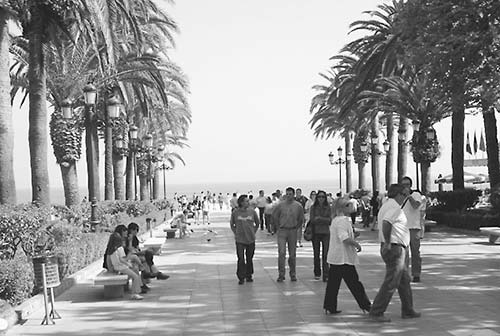
The bluff, jutting happily into the sea, is completely pedestrianized. It’s the center of Nerja’s paseo and a magnet for street performers. The mimes, music, and puppets can draw bigger crowds than the Balcony itself, which overlooks the Mediterranean, miles of coastline, and little coves below.
But this happy bluff was the site of a castle for a thousand years (from the ninth century until a big earthquake in 1884). The Nerja castle was part of a 16th-century lookout system. After the Christian Reconquista drove Muslim Moors into exile in 1492, pirate action from Muslim countries in North Africa picked up. Lookout towers were stationed within sight of one another all along the coast. Warnings were sent whenever pirates threatened (smoke by day, flames by night). To the east (left), if you look closely, you can see two towers breaking the horizon on the distant bluffs.
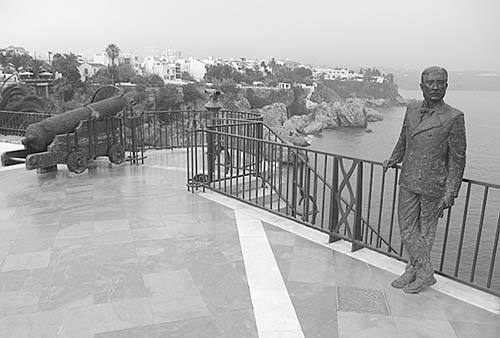
Later, a Spanish fort built here in the 16th century was destroyed by the English in the early 1800s to keep it from being captured by Napoleon. Its cannons tumbled into the sea, where they sat rusting for about a century. Two were salvaged, cleaned up, and placed here, pointing east and west. Study the beautifully aged metalwork.
Joining the promenade crowds is a cute statue of King Alfonso XII, reminding locals of this popular sovereign—the great-great-grandfather of today’s King Felipe VI—who came here after the devastating earthquake of 1884 (a huge number of locals died). He mobilized the local rich to dig out the community and put things back together. Standing on this promontory amid the ruins of the earthquake-devastated castle, he marveled at the view and coined its now-famous name, Balcón de Europa.
Walk beneath the Balcony for views of the scant remains (bricks and stones) of the ninth-century Moorish castle. Locals claim an underground passage connected the Moorish fortress with the mosque that existed where the Church of El Salvador stands today.
Church of El Salvador (Iglesia de El Salvador)
Just a block inland from the Balcony, this church was likely built on the ruins of a mosque (in around 1600). You can visit it briefly before the daily 19:00 Mass starts or possibly find it open during the afternoon (no set hours). Its wooden ceiling is Mudejar—made by Moorish artisans working in Christian times, with a woodworking technique similar to that featured in the Alhambra in Granada. Inlaid tiles depicting the stations of the cross ring the walls, and a modern mural of the Annunciation (by local artist Paco Hernandez) decorates the rear of the nave. In front, on the right, is a niche featuring Jesus with a young St. Isidoro, the patron saint of Madrid, Nerja, and farmers (sugarcane farming was the leading industry here before tourism hit). The towering tree in front of the church was brought here from Chile in 1885 and is a symbol of the city. From the porch of the church, look inland (left) to see City Hall, marked by four flags (Andalucía’s is green for olive trees and white for the color of the houses in this part of Spain).
Nerja Museum (Museo de Nerja)
This museum, with modern exhibits well described in English, is run in association with the Nerja Caves (described later, under “Sights near Nerja”). It’s a good option on a rainy day, when you’ve had too much sun, or for helpful context before or after a visit to the caves. Exhibits focus on the history of Nerja and the surrounding region, from prehistoric times through its sugarcane heritage and TV fame. A highlight is the exhibit of prehistoric tools, weapons, and a skeleton found in the Nerja Caves. Don’t miss the 10-minute video (on repeat in the theater) that shows a Franco-era newsreel about the discovery of the caves in 1959 by farm boys looking for bats.
Cost and Hours: €3, free with ticket to Nerja Caves; open Tue-Sun 10:00-16:00, closed Mon year-round; Plaza de España 4, +34 952 527 224, www.cuevadenerja.es/museodenerja.
Town Strolls
Nerja was essentially destroyed after the 1884 earthquake—and at the time there was little here beyond the castle anyway. So there’s not much to see in the town itself. However, a few of its main streets are worth a ramble. From the Balcony of Europe head inland. Consider first grabbing some ice cream at Heladería Valenciano, a local favorite. You could also try the refreshing chufa-nut specialty drink called horchata.
A block beyond the heladería, the old town’s three main streets come together. The oldest and most picturesque street, Calle Hernando de Carabeo, heads off to your right (notice how buildings around here are wired on the outside). On the left, Calle Pintada heads inland. Its name means “the painted street,” as it was spiffed up in 1885 for the king’s visit. Today it’s the town’s best shopping street, especially the stretch below Calle de la Gloria. And between Calles Carabeo and Pintada runs Calle Almirante Ferrándiz, Nerja’s restaurant row, which is particularly lively in the evenings.
BEACHES
The single best thing to do on a sunny day in Nerja is to hit the beach: swim, sunbathe, sip a drink, go for a hike along the rocky coves...or all of the above.
Many of Nerja’s beaches are well equipped with bars and restaurants, free showers, and rentable lounge chairs and umbrellas (€4-5/person for chair and umbrella, same cost for 10 minutes or all day). Nearby restaurants rent beach furniture, and you’re welcome to take drinks and snacks out to your spot. Spanish law requires all beaches to be open to the public. While there are some nude beaches (such as Cantarriján, described later), keep in mind that in Europe, any beach can be topless. Watch out for red flags on the beach, which indicate when the seas are too rough for safe swimming (blue = safe, orange = caution, red = swimming prohibited). Keep a careful eye on your valuables—or better yet, leave them in the hotel.
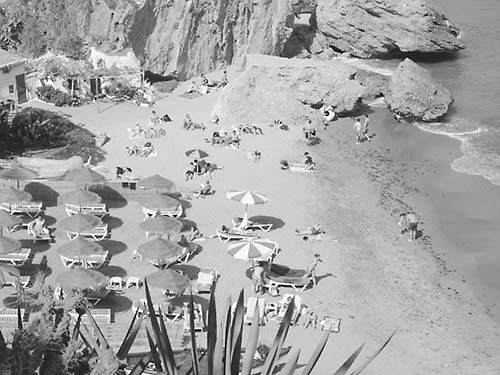
During the summer, Spanish sun worshippers pack the beach from about 11:00 until around 13:30, when they move into the beach restaurants for relief from the brutal rays. The most typical Spanish beach cafés are called chiringuitos—shacks selling drinks and simple, cheap-but-good eats. Considering practically every beach has one, chiringuitos are a way of life along the coast. When Spaniards play on the playa they simply say “see you at the chiringuito” to meet friends for a beer and espetos—fish, usually sardines, skewered whole, stacked tepee style, and cooked over coal in large barbeque pits.
Beaches lie west and east of the Balcony of Europe. For each area, I’ve listed beaches from nearest to farthest. Even if you’re not swimming or sunbathing, walking along these beaches (and the trails that connect them, if open) is a delightful pastime.
West of the Balcony of Europe
A pleasant series of beaches begins just beneath the Balcony of Europe and stretches on toward sunset. The first is a singular cove, while the next are accessed from the end of Calle Málaga, a five-minute walk through town, and are connected by a promenade and trails.
El Salón Beach (Playa El Salón)
The sandiest (and most crowded) beach in Nerja is down the walkway to the right of Restaurante Marissal, just west of the Balcony of Europe (to the right as you look out to sea). For great drinks with a view, stop by the recommended Cochran’s Terrace on the way down.
Playa la Torrecilla and Playa el Chucho
Farther west is another sandy beach, Playa la Torrecilla, crowded with sunbathers, shops, and restaurants. From here, a waterfront promenade brings you to the beach Playa el Chucho, popular with families for its shallow water.
El Playazo (“Big Beach”)
A short hike west of Playa el Chucho, this beach is preferred by locals, as it’s less developed than the more central ones (no showers, bring your own everything). It offers a couple of miles of wide-open spaces that allow for fine walks and a chance to “breathe in the beach.”
East of the Balcony of Europe
An appealing walkway called the Paseo de los Carabineros once connected the enticing beaches east of the Balcony, but it’s been closed for several years due to erosion and a lack of funds to restore it. For that reason, you’ll walk through the modern town above the coast to reach the beaches east of the Balcony of Europe.
Calahonda Beach (Playa Calahonda)
Directly beneath the Balcony of Europe (to the left as you face the sea) is one of Nerja’s most characteristic little patches of sun. This pebbly beach is full of fun pathways, crags, and crannies. To get to the beach from the Balcony, simply head down through the arch across from the Heladería Valenciano ice cream stand...you’ll be on the beach in seconds. Outside of July and August, this beach is relaxed and inviting.
Carabeo and Carabeillo Beaches (Playa Carabeo/Playa Carabeillo)
Tiny and barely developed, these two beaches are wedged into wee coves between the bustling Calahonda and Burriana beaches. For many, their lack of big restaurants and services is a deal-breaker. For others, it’s a plus. To reach them, walk along Calle Hernando de Carabeo. The stairs down to Carabeo Beach are at a little viewpoint on the right (with a big wall map of the area). A bit farther along, a larger view plaza has stairs down to Carabeillo.
Burriana Beach (Playa de Burriana)
Nerja’s leading beach is a 20-minute walk east from the Balcony of Europe. Big, bustling, crowded, and fun, it’s understandably a top attraction. Burriana is ideal for families, with a grand promenade, paddleboats, kayaks, playgrounds, volleyball courts, and other entertainment options. The beach is also lined with a wide range of inviting cafés and restaurants serving fresh seafood and espetos. The recommended Ayo chiringuito is a destination for its legendary lunchtime paella feast.
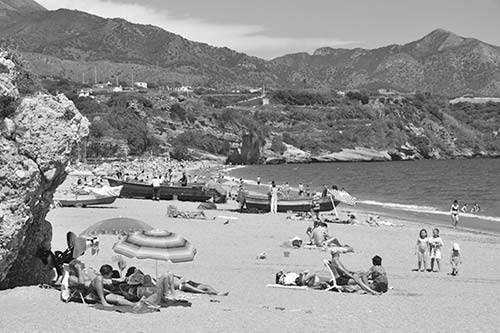
Getting There: It’s an easy walk or a €6 taxi ride. To walk, follow Calle Hernando de Carabeo to the viewpoint plaza above Carabeillo Beach. At the roundabout, go up the first street to the right (you’ll see a no-entry sign for cars), jog left (up Calle Cómpeta) alongside Nerja’s boxy parador, then walk around the parador, following the signs for Playa Burriana. The path will curl right, then twist down a switchbacked path to the beach.
Cantarriján Beach (Playa del Cantarriján)
The only beach listed here not within easy walking distance of Nerja, this is the place if you’re craving a more desolate beach (and have a car). Drive about four miles (15 minutes) east (toward Herradura) to the Cerro Gordo exit, and follow Playa Cantarriján signs (paved road, just before the tunnel). Park at the viewpoint and hike 30 minutes down to the beach (or, in summer, ride the shuttle bus). Down below, rocks and two restaurants separate two pristine beaches—one for people with bathing suits (or not); the other, more secluded, more strictly for nudists. As this beach is in a natural park and requires a long hike, it provides a fine—and rare—chance to experience the Costa del Sol in some isolation.
SIGHTS NEAR NERJA
The area around Nerja has its own charms, with caves, hiking, and the appealing whitewashed village of Frigiliana.
▲Nerja Caves (Cueva de Nerja)
These caves (2.5 miles east of Nerja), with an impressive array of stalactites and stalagmites, are a classic roadside attraction. The huge caverns, filled with backlit formations, are a big hit with cruise-ship groups and Spanish families—so it’s best to go in the morning, when crowds are usually lighter. The visit involves a 45-minute audioguide tour, during which you’ll climb deep into the mountain, up and down 400 dark stairs. At the end you reach the Hall of the Cataclysm, where you’ll circle the world’s largest stalactite column (certified by the Guinness Book of World Records). Someone figured out that it took one trillion drops to make the column. The caves, discovered in 1959, have hosted human beings for at least 30,000 years; prehistoric paintings here go back nearly that far. For preservation reasons the cave art isn’t viewable in person, but you can get a look at it in a virtual-reality room. If you’re fascinated by what you see here, check out the museum in town, which has a good exhibit on the caves (your caves ticket gains you free museum admission).
Cost and Hours: €15; daily 9:30-16:30, July-Aug until 19:00, timed entry—book ahead online; last entry one hour before closing; audioguide free to download or €2 with player, guided tours and science-oriented or nighttime tours also available; easy pay parking, +34 952 529 520, www.cuevadenerja.es.
Getting There: The Cueva Tren tourist tram shuttles visitors between Plaza de los Cangrejos (near Playa la Torrecilla) and the caves (€4 round-trip, usually hourly, 30 minutes, check schedule on caves website). A taxi costs around €9 one-way. You can also go by public transit, catching a bus across the street from Nerja’s main bus stop (Alsa bus, €1.34, about six daily, 10 minutes, get schedule from TI or the Nerja Museum, or check www.alsa.es). Drivers will find the caves well signed (exit 295 on A-7)—just follow the Cueva de Nerja signs right to the parking lot. As a little bonus, a footbridge behind the caves’ ticket window crosses over a free botanical garden before descending into the pleasant sea village of Maro.
Hiking Around Nerja
Europeans visiting the region for a longer stay generally use Nerja as a base from which to hike. The TI’s trail guide, available as a download from its website, is a good place to start when choosing a route. One of the most popular hikes, Rio Chillar, is a refreshing walk up a river (at first through a dry riverbed, and later up to your shins in water; about 7 miles one-way, 2-3 hours total, access the trail between Playa el Chucho and Playa el Playazo; look for the scenic little bridge where the river meets the sea). Another, more demanding hike takes you to the 5,000-foot summit of El Cielo for the most memorable king-of-the-mountain feeling this region offers.
An easy, somewhat dull two-mile walk ends with a surprisingly impressive sight with an interesting history—the Eagle Aqueduct (Acueducto del Águila). Heading east from town, follow the green-and-white stone sidewalk all the way along Avenida de Pescia. Thirty minutes outside Nerja, you’ll pass Capistrano Playa (above Burriana Beach), where you can enjoy views of the coastline, Nerja, and El Cielo in the distance. Half a mile later you’ll see the ruins of a 19th-century sugar mill (on the left).
Shortly after the ruins, look for the Cala Barranco del Maro sign pointing to the right. Follow the path downhill past the Old Maro Bridge to the base of the aqueduct. Thirty-six arches support four levels; it was built in the 1870s to supply water to the ruined sugar mill you passed on the way here. Look for the double-headed eagle weathervane that gives the aqueduct its name. Bombed during Spain’s civil war, the structure was restored in 2011. From here you can cross the Old Maro Bridge and continue on to Maro, a whitewashed, seaside, cliff-top village sitting just below the Nerja Caves (connected over N-340 by a pedestrian footbridge) and above two popular beaches. Alternately, backtrack to Nerja the way you came.
Nightlife in Nerja
Bar El Molino offers live Spanish folk singing nightly in a rustic cavern that’s actually an old mill—the musicians perform where the mules once trod. It’s touristy but fun (starts at 19:00 but pretty dead before 23:00, fewer shows off-season, no cover—just buy a drink, Calle San José 4). The local sweet white wine, vino del terreno—made up the hill in Frigiliana—is popular and inexpensive here.
El Burro Blanco is a touristy flamenco bar that’s enjoyable and intimate, with shows nightly in the summer from 21:30 (off-season shows run Tue, Thu, and Sat-Sun at 20:00). Keeping expectations low, they advertise “The Best Flamenco Show in Nerja” (€20 admission includes a drink, on corner of Calle Pintada and Calle de la Gloria, www.flamencoennerja.com, +34 615 153 961).
Bodega Los Bilbainos is a classic, dreary old dive—a favorite with local men and communists (tapas and drinks, Calle Alejandro Bueno 8).
For more nightlife, check out the pubs and dance clubs on Calle Antonio Millón and Plaza Tutti Frutti.
Sleeping in Nerja
Reserve in advance and expect minimum-stay requirements of up to three nights for peak season—basically mid-July through mid-September—prime time for Spanish families to hit the beaches. The entire Costa del Sol is especially crowded during August and Easter Week, when prices are at their highest. Any other time of year, Nerja has plenty of available comfy, easygoing, low-rise resort-type hotels and rooms.
Compared to the pricier hotels, the better hostales are an excellent value. Hostal Don Peque is within a few blocks of the Balcony of Europe on the pedestrianized Calle Diputación.
CLOSE TO THE BALCONY OF EUROPE
$$$$ Hotel Balcón de Europa is the most central place in town, right on the water and the square, with the prestigious address Balcón de Europa 1. It has 108 rooms with modern style, plus all the comforts—including a pool and an elevator down to the beach. It’s popular with groups. All the suites have seaview balconies, and most regular rooms also come with views (air-con, elevator, gym, sauna, pay parking, +34 952 520 800, www.hotelbalconeuropa.com, reservas@hotelbalconeuropa.com).
$$$$ Hotel Carabeo is a boutique hotel with seven classy rooms on the cliff east of downtown—less than a 10-minute walk away, but removed from the bustle of the Balcony of Europe (closed mid-Nov-March, five view rooms, two cheaper street-side rooms, includes continental breakfast, air-con, Calle Hernando de Carabeo 34, +34 952 525 444, www.hotelcarabeo.com, info@hotelcarabeo.com).
$$$ Hotel Plaza Cavana, with 40 rooms, overlooks a plaza lily-padded with cafés. It feels a bit institutional, but if you’d like a central location, marble floors, modern furnishings, an elevator, and a small unheated rooftop swimming pool, dive in (RS% and breakfast included for Rick Steves readers who book directly via phone or email, some view rooms, family rooms, air-con, mini fridge, elevator, pay parking, 2 blocks from Balcony of Europe at Plaza de Cavana 10, +34 952 524 000, www.hotelplazacavana.com, info@hotelplazacavana.com).
$$ Hotel Mena Plaza is clean, bright, and friendly, offering 34 rooms on the usually lethargic Plaza de España, near the Nerja Museum. Some rooms have views and wide balconies (family room, air-con, elevator, pay parking, pool, rooftop terrace, +34 952 520 965, www.hotelmenaplaza.es, info@hotelmenaplaza.es).
$$ Marissal by Dorobe Hotels has an unbeatable location next door to the fancy Hotel Balcón de Europa, and 23 modern, spacious rooms with old-fashioned furniture and balconies (some overlooking the Balcony of Europe action). Their cafeteria and bar, run by helpful staff, make the Marissal even more welcoming (family room, some view rooms, apartment, double-paned windows, air-con, elevator, Balcón de Europa 3, reception at Restaurante Marissal—staffed mornings only in off-season but they’ll send you a code to access your room, +34 952 520 199, www.hostalmarissal.com, reservas@hostalmarissal.com).
$ Hostal Don Peque, an easy couple of blocks’ walk from the Balcony of Europe, has 12 bright, colorful, and cheery rooms (eight with balconies—a few with sea views). Owners Roberto and Clara moved here from France and have infused the place with their personalities. They lend beach equipment, and their bar-terrace with a hot tub and views over rooftops and the sea is enticing (family room, breakfast May-Oct only, air-con, Calle Diputación 13, +34 952 521 318, www.hostaldonpeque.com, info@hostaldonpeque.com).
$ Pensión Sevillano offers nine sunny and airy rooms in the heart of “Restaurant Row,” so expect some street noise in front rooms (family suite, no air-con but fans and fridges, laundry service, beach equipment, Calle Almirante Ferrándiz 31, +34 952 524 138, www.pensionsevillano.com, info@pensionsevillano.com).
IN A RESIDENTIAL NEIGHBORHOOD
$ Hostal Lorca is in a quiet residential area a five-minute walk from the center, three blocks from the bus stop, and close to a small, handy grocery store. Run by a friendly, energetic Dutch couple, Femma and Rick, this hostal has nine modern, comfortable rooms and an inviting backyard with a terrace and a small pool. You can use the microwave and take drinks (on the honor system) from the well-stocked fridge. This quiet, homey place is a winner (family room, no air-con but fans, look for a house with flags at Calle Méndez Núñez 20, +34 952 523 426, www.hostallorca.com, hostallorcanerja@gmail.com).
Eating in Nerja
There are three Nerjas: the private domain of the giant beachside hotels; the central zone, packed with fun-loving (and often tipsy) expats and tourists eating and drinking from trilingual menus; and the back streets, where local life goes on as if there were no tourists. The whole old town (around the Balcony of Europe) is busy with lively restaurants. And you’re just a 10-minute taxi ride from the whitewashed hill town of Frigiliana, with several lovely restaurants tucked away in its back lanes and perched on its viewpoints.
Groceries: For picnic supplies, there are two handy Carrefour Express stores, one on Plaza de España between Hotel Mena Plaza and the Oliva restaurant, the other at the corner of Castilla Pérez and Manuel Marín (both long hours daily). There’s a wider selection at the Mercadona supermarket (long hours Mon-Sat, closed Sun, just north from Plaza Ermita at Calle San Miguel 11). For interesting imported foods, check out Frank and Marianne’s Foodstore Andaluz, a Dutch-run grocery that stocks especially good chocolates and sweets (Mon-Sat 10:00-20:00, closed Sun, Calle Pintada 46, +34 633 034 316).
BREAKFAST
Many hotels here overcharge for breakfast. Don’t hesitate to go elsewhere, as lots of places serve breakfast for more reasonable prices. For breakfast with a front-row view of the promenade action on the Balcony of Europe, head to one of the first two listed here.
$$ Restaurante Marissal (in the recommended hotel of the same name) features wicker seats under the palm trees (options include English breakfasts and a buffet, daily from 8:30).
$ Anahí Café serves tempting pastries and cheap breakfasts to early risers on a tiny balcony overlooking Calahonda Beach. They also sell picnic-perfect loaves of bread to go (daily, Calle Puerta del Mar 6, +34 952 521 457).
$ Café Las 4 Esquinas is where the chef fries up hot churros to dip into a hot pudding-like chocolate drink (long hours daily, churros 7:00-12:30 & 17:00-20:00, Calle Pintada 57, on the corner of Calle Angustias, +34 626 126 564).
If you’re up for a short hike before breakfast, a great target is the recommended $ Ayo on Burriana Beach (see “Paella Feast on Burriana Beach,” later).
At the $ Good Stuff Café, Adam makes savory quiches and pies, and Irene makes scones, brownies, carrot cake, banana bread, and Victoria sponge cake (Mon-Sat 9:00-15:00, closed Sun and August; Calle Castilla Perez 4, +34 606 512 586).
ON OR NEAR RESTAURANT ROW
Strolling the old town, especially up Calle Almirante Ferrándiz (which some locals call “Cristo” at its far end), you’ll find a good variety of eateries, albeit filled with tourists. The presence of expats means you’ll find places serving food earlier in the evening than the Spanish norm.
$$$$ Oliva feels like a premium restaurant on a cruise ship—white-tablecloth ambience and a gourmet twist on international fusion cuisine made from local products. It’s on the big Plaza de España, with seating both inside and outdoors (daily, Plaza de España 2, +34 952 522 988, www.restauranteoliva.com).
$$ Rincón del Sevillano, an elegant fixture in a sea of high-energy tapas bars, serves the hungry on both sides of Calle de la Gloria. While they have a standard bar offering free tapas with each drink, for formal dining try the ground-floor dining room or the second-floor rooftop section on the uphill side (daily, Calle de la Gloria 14, +34 951 325 119).
$$ Bar Redondo, a sloppy place popular with locals and visitors alike, is a colorfully tiled taparía and watering hole. Bartenders work from within the completely round, marble-topped bar; if you can’t find room there, grab a spot at a wine-barrel table on the street. Buy any drink and choose a free tapa from their enticing list of 25 options. Their bigger dishes, like the ensalada edondo, are worth considering. Their second venture, directly across the sidewalk, serves seafood and keeps the same format: round bar and free tapas with your drink (daily, Calle de la Gloria 10, +34 952 523 344).
$$ El Pulguilla Fish Bar and Restaurant is a great scene for Spanish cuisine, fish, and tapas. Its two distinct zones (tapas bar up front and more formal restaurant out back) are jammed with enthusiastic locals and tourists. The lively no-nonsense stainless-steel tapas bar doubles as a local pickup joint later in the evening. Drinks come with a free small plate of clams, mussels, shrimp, chorizo sausage, or seafood salad. For a sit-down meal (same menu and cost), head all the way back to one of two gigantic terraces (one under a canopy and the other under the stars). Enjoy an exhibit of old black-and-white town photos as you pass through the middle room. Half-portions (medias raciones) are available for many items, allowing you to easily sample different dishes (closed Mon—“to give our clients a day off,” Calle Almirante Ferrándiz 26, +34 952 521 384).
$$ Los Barriles is a family-run bar where Rafa, Carmen, and their son serve up drinks and a short, simple menu of raciones, including a fiery chorizo sausage. Your best bet is to order a drink and wait for the tapa that comes with it. Locals flock here and tourists are treated like locals (Mon-Sat dinner only, closed Sun, Calle San José 2).
$$ Haveli, run by Amit and his Swedish wife, Eva, serves good Indian cuisine in a dressy first-floor dining room and on a sunny rooftop terrace. For more than three decades, it’s been a hit with Brits, who know their Indian food (Thu-Tue dinner only, closed Wed, Calle Almirante Ferrándiz 44, +34 952 524 297).
TAPAS BARS ON OR NEAR CALLE HERRERA ORIA
A 10-minute gentle uphill hike from the water takes you into the residential thick of things, where the sea views come thumbtacked to the walls, prices are lower, and locals fill the tables. These three tapas bars are within a block of one another. Each is a colorful local hangout with different energy levels on different nights. Survey all three before choosing one or have a drink and tapa at each. These places offer table-service meals during normal dining hours, but the action is at the bar, which is generally open all day for tapas and drinks.
Remember that in Nerja, tapas are snack-size portions, generally not for sale but free with each drink. To turn them into more of a meal, ask for the menu and order a full-size ración or half-size media ración. The half-portions are generally much bigger than you’d expect.
$ El Chispa (a.k.a. Bar Dolores) is big on seafood, which locals enjoy on an informal terrace adjacent to the bar (enter directly from the street). Their tomate ajo (garlic tomato) is tasty, and their piping-hot berenjena (fried and salted eggplant) is worth considering—try it topped with miel de caña, molasses-like sugarcane syrup. They serve huge portions—medias raciones are enough for two (daily, Calle San Pedro 12, +34 952 523 697).
$ La Puntilla Bar Restaurante fills the corner with a boisterous, tiled bar and a more formal restaurant with outdoor tables spilling onto the cobbles, daily, Calle Bolivia 1, +34 952 528 951).
$$ La Taberna de Pepe is a family-run, sit-down restaurant (with a few outdoor tables), though it does have a small bar with tapas. The tight, cozy (almost cluttered) interior is decorated with old farm tools and crammed with happy eaters choosing from a short menu of well-executed seafood. It feels a cut above its neighbors (closed Wed-Thu, Calle Herrera Oria 30, +34 952 522 195).
NEAR THE BALCONY OF EUROPE
$$ Cochran’s Terrace Bar Restaurant serves mediocre meals in a wonderful seaview setting overlooking El Salón Beach (daily, frequent live music; Calle Salón behind Restaurante Marissal).
IN THE “TUTTI FRUTTI” AREA
$$ La Marina, away from the tourist zone, is a neighborhood seafood joint bustling with locals and worth the walk. Their gambas plate spills onto nearly every butcher-paper tablecloth in the restaurant (closed Wed, Calle Castilla Pérez 20, +34 952 521 299).
PAELLA FEAST ON BURRIANA BEACH
$ Ayo is famous for its character of an owner and its beachside paella feast at lunchtime. For 30 years, Tito (a.k.a. Ayo, a Spanish term of endearment similar to “grandfather”) has been feeding locals. A lovable ponytailed bohemian who promises to be here until he dies, Ayo is a very big personality. He’s one of the five kids who discovered the Nerja Caves, formerly a well-known athlete, and now someone who makes it a point to hire hard-to-employ people as a community service. The paella fires get stoked up at about noon and continue through mid-to-late afternoon. Grab one of a hundred tables under the canopy next to the rustic open-fire cooking zone and enjoy the beach setting in the shade with a jug of sangria. It’s a 20-minute walk from the Balcony of Europe, at the east end of Burriana Beach—look for Ayo’s rooftop pyramid (open daily “sun to sun” with a full menu, paella served only in the afternoon, cash only, Playa de Burriana, +34 952 522 289).
Breakfast at Ayo’s: Consider arriving at Ayo’s at 9:00. Locals order the tostada con aceite de oliva (toast with olive oil and salt). Ayo also serves toasted ham-and-cheese sandwiches and good coffee.
Nerja Connections
While there are some handy direct bus connections from Nerja to major destinations, many others require a transfer in the town of Málaga. The closest train station is in Málaga. Fortunately, connections between Nerja and Málaga are easy, and the train and bus stations in Málaga are right next to each other (for more about Málaga, see “Coastal Towns,” later).
Almost all buses from Nerja are operated by Alsa (www.alsa.es), except the local bus to Frigiliana, which is run by Grupo Fajardo (schedules posted at kiosk, or ask at the TI).
From Nerja by Bus to: Málaga (1-2/hour, 1.5 hours), Nerja Caves (typically 6/day, 10 minutes), Frigiliana (about hourly, 15 minutes), Granada (6/day, 2 hours), Sevilla (1/day direct, more with transfer in Málaga, 5 hours). To reach Ronda, Gibraltar, or Tarifa, you’ll transfer in Málaga.
To Málaga Airport (about 40 miles west): There’s one Alsa direct bus each weekday, leaving Nerja at 11:00 (2 hours). Alsa buses run frequently to the Málaga bus station, where you can catch either the local Line A express airport bus (2/hour, 15 minutes, €4, buy ticket on board) or commuter train C1 (2-3/hour, 10 minutes, €1.80; Málaga’s train station is a five-minute walk across the street from the bus station). A taxi from Nerja costs about €75, or ask your Nerja hotelier about airport shuttle transfers.
ROUTE TIPS FOR DRIVERS
Nerja to Granada (60 miles, 95 km, 100 views): Drive east along the coast toward Motril or take the faster A-7, then head north to Granada on the slower N-323 or the quicker A-44. While scenic side trips may beckon, don’t arrive late in Granada without a confirmed hotel reservation. See the Granada chapter (“Arrival in Granada/By Car”) for tips on how to avoid getting a traffic ticket when driving into the city center.
Frigiliana
The picturesque whitewashed village of Frigiliana (free-hee-lee-AH-nah), only four miles inland from Nerja, makes for a wonderful side trip. A thousand feet above sea level, full of history, and feeling like it dropped in from the mountains of Morocco, it’s a striking contrast to its beach resort sister.
Getting There: It’s easy: Catch the bus from the stop on Avenida de Pescia in Nerja (€1.20, roughly hourly, last bus back to Nerja about 21:00, 15 minutes, https://grupofajardo.es), or hop in a taxi—around €12 one-way.
Getting Oriented: Your landing pad is Plaza del Ingenio, a utilitarian hub dividing the old and the new towns. At this little square you’ll find the bus stop, taxi stand, tourist train departure point, free WC, and start of my self-guided old town walk. The TI is a 100-yard walk uphill, in the new town (daily 10:00-14:00, sometimes later; +34 952 534 261, www.turismofrigiliana.es). Pick up a map and the translations of the tiles you’ll see displayed around town. The TI shares a building with the free archaeological museum, with artifacts and tools unearthed near Frigiliana (including the fifth-century-BC skull of a 10-year-old child). Above the TI, situated on a bluff, is an old tower with a grand view.
Frigiliana has many characteristic and romantic little restaurants, some with commanding views. As the town is most charming in the evening, consider coming up for an early-evening walk and dinner (ride the bus up and catch a cab home). Local specialties to try are berenjenas con miel de caña (fried eggplant with local cane syrup) and tortillas de bacalao con miel de caña (cod cakes with cane syrup).
FRIGILIANA OLD TOWN WALK
This 30-minute stroll—rated ▲▲—comes with lots of ups and downs, commanding views, and delightful back lanes. (It’s easier to follow with the fine little town map from the TI.) If you’re planning to catch a bus back to Nerja, note departure times before you start.
Begin by climbing from Plaza del Ingenio up to the terrace in front of the factory (ingenio)—the blocky, un-whitewashed, double-smokestack building that dominates the town. Dating from the 16th century, this still produces molasses-like sugarcane syrup, miel de caña (factory closed to public).
From the left end of the factory terrace, hike up the steep street (Calle Real) past shops tempting you with local wine, cork products, and miel de caña. At the fork, stay right on the stepped lane (Calle Hernando el Darra) with its black-and-white pavement. At #10 (on the right), notice the tile in the wall—the first in a series of a dozen around town that describe, in poetic Spanish, the story of the 1568 Battle of Peñón.
A few steps before the top of the lane (at #26), turn right into a covered passageway. Climb 100 yards to a viewpoint on the right (above the romantic Garden Restaurant). The valley was once filled with sugarcane; it’s been replaced in recent decades by avocado and mango trees.
Circle uphill and to the left. The street plan dates to medieval times, when the Moors tucked their village here, high in the hills away from coastal raiders. The whitewash dates to the 18th century, when a plague killed 40 percent of the population. To sterilize the town, everything was burned or slathered in lime to kill the germs. It turned out that the whitewash reflected the sun, keeping things cool. People liked it, and it remains to this day. While houses must be white, the trim is your choice. Enjoy the traffic-free tranquility, small restaurants, big views, and flowers.
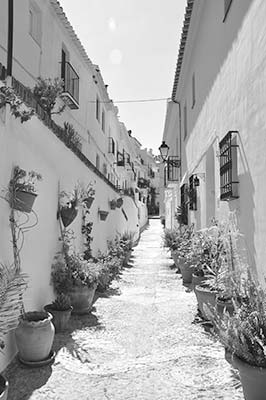
Follow the lane straight over the crest of the hill and then down. Notice the distinctive, traditional door knockers, shaped like a woman’s hand. Common in Morocco, these date back to Moorish times and are known as the “hand of Fatima”—the daughter of the Prophet Muhammad—and are intended to ward off evil.
Continuing scenically downhill, head left down the stepped and steep El Zacatín lane. This means “little souk,” and you can imagine it in Moorish times bustling with shops.
El Zacatin ends at Calle Real. At the T-intersection, go a few steps to the right to the inviting café-lined plaza in front of the Church of San Antonio of Padua. The church was built in 1679 and whitewashed in the 1700s to defend against the plague. Step inside. At the top of two arches, the church retains some of its original painted decor from 1679. Skulls (with bishop’s miter and royal crown) are a reminder that death is the great equalizer. The second arch is colorfully dedicated to Virgin Mary with her “Ave Maria” logo under the crown. The wooden ceiling is Mudejar style (done by Moorish craftsmen after the Christian reconquest). Many of the altarpieces are floats that hit the streets for a procession each Semana Santa (Holy Week, leading up to Easter). In the left front chapel, notice the dozen masks—one for each of the apostles—worn during Semana Santa.
Leaving the church, turn left and follow Calle Real (the only lane in the old town wide enough to fit a car) back to where you started.
Coastal Towns
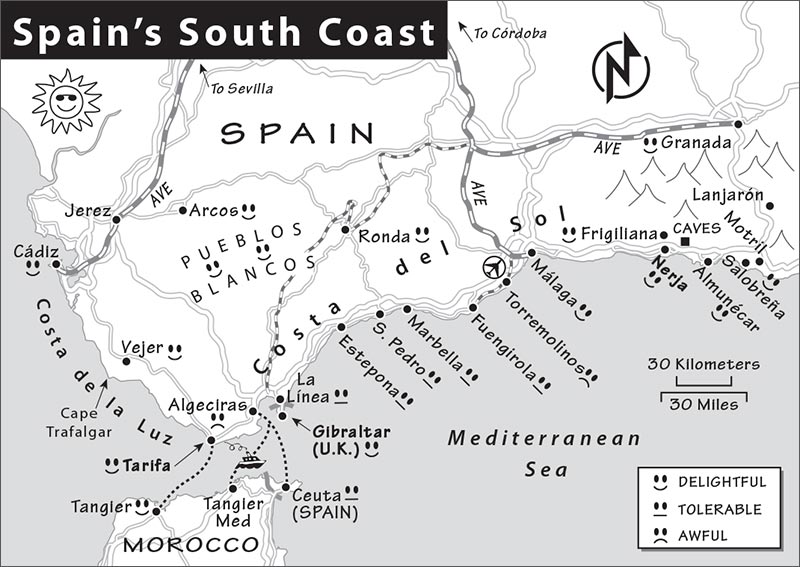
Buses take five hours to make the Nerja-Gibraltar trip, including a transfer in Málaga, where you change bus companies. Along the way, buses stop at each of the following towns (see map on here).
MÁLAGA
Málaga’s busy airport is the gateway to the Costa del Sol, and taking a long layover in this seaside city may be worth your while. It has spruced itself up in recent years and deserves at the very least a lengthy stroll and visits to two of its impressive museums.
Tourist Information: The TI has a branch at the center of the train station (in front of tracks 1-8; Mon-Sat 10:00-14:00 & 16:00-20:00, Sun 10:00-13:00, shorter hours off-season) and a larger office at the marina (daily 9:00-20:00, Plaza de la Marina 11, +34 951 926 020, www.malagaturismo.com [URL inactive]).
Arrival in Málaga: One of Spain’s busiest airports, Málaga-Costa del Sol Airport (code: AGP, www.aena.es) is five miles southwest of Málaga. The easiest and fastest way to get from the airport to the city center is by train (€1.80, 12 minutes, get off at Málaga Centro Alameda). You can also take a taxi (about €15, 15 minutes) to the casco viejo (old town). The Line A express bus (€4, pay cash on bus, 15-20 minutes) takes you blocks from the cathedral—get off at Paseo del Parque–Plaza de la Marina, a long, tree-lined plaza with florist stalls. From there you can easily wander into the old town’s pedestrianized zone, which is easy to navigate thanks to signposts on almost every corner indicating tourist sights.
The bus and train stations—a block apart at the western edge of the town center—both have pickpockets and lockers (for station details, see “Málaga Connections,” later). Day-trippers can store bags in the more modern lockers at the train station. If they’re closed, head for the self-service Stow Your Bags lockers at Calle Jovellanos 5, a two-minute walk east from the station.
Sights in Málaga: The Museo Picasso Málaga holds over 200 paintings, sculptures, and ceramics spanning the artist’s life and artistic styles. Pablo Picasso was born in Málaga and first discussed establishing a museum here in 1953. It finally opened 50 years later, thanks to a donation by the artist’s daughter-in-law and grandson (€9.50, includes audioguide; daily July-Aug 10:00-20:00, March-June and Sept-Oct until 19:00, Nov-Feb until 18:00; Calle San Agustín 8, a block away from the cathedral; +34 952 127 600, www.museopicassomalaga.org).
For a look at Spanish art just prior to Picasso, visit the Museo Carmen Thyssen Málaga, which features 19th-century paintings with mostly Andalusian themes from the collection of Carmen Cervera. (A former Miss Spain, she’s the widow of industrial tycoon Hans Heinrich von Thyssen-Bornemisza, whose famous art collection is housed in Madrid.) There are more than 250 works by Sorolla, Fortuny, Zuloaga, Zurbarán, and other Spanish artists exhibited in the restored 16th-century Palace of Villalón (€10, includes audioguide; Tue-Sun 10:00-20:00, closed Mon; Plaza Carmen Thyssen/Calle Compañía 10; +34 902 303 131, www.carmenthyssenmalaga.org).
Málaga Connections: Málaga is a major transit hub, with plane, bus, and train connections throughout Andalucía and onward to the rest of Spain. Its slick, modern train station (Estación María Zambrano) doubles as a mall, with the usual station services plus shops and fast-food options galore. Train info: +34 912 320 320, Renfe.com [URL inactive]. The main bus station is just across the street on Paseo de los Tilos, with several basic eateries, pleasant outdoor seating, and free WCs. Bus info: Alsa.es, Damas-sa.es, Interbus.es, AvanzaBus.com.
FUENGIROLA AND TORREMOLINOS
The most built-up part of the region, where those most determined to be envied settle down, is a bizarre world of Scandinavian package tours, flashing lights, pink flamingos, multilingual menus, and all-night happiness. Fuengirola is like a Spanish Mazatlán with a few older, less-pretentious budget hotels between the main drag and the beach. The water here is clean and the nightlife fun and easy. The once-idyllic Torremolinos has been strip-malled and parking-metered.
MARBELLA
This is the most polished and posh town on the Costa del Sol. High-priced boutiques, immaculate streets set with intricate pebble designs, and beautifully landscaped squares testify to Marbella’s position on the world-class-resort scene. Have a café con leche on the beautiful Plaza de Naranjos in the old city’s pedestrian section. Wander down to modern Marbella and the high-rise beachfront apartment buildings to walk along the wide promenade lined with restaurants. Check out the beach. Marbella is an easy stop on the Algeciras-Málaga bus route. You can also catch a handy direct bus here from the Málaga airport (€6, 1-2/hour, 45 minutes, www.avanzabus.com [URL inactive]).
SAN PEDRO DE ALCÁNTARA
This town’s relatively undeveloped sandy beach is popular with young travelers. San Pedro’s neighbor, Puerto Banús, is “where the world casts anchor.” This luxurious, Monaco-esque jet-set port, complete with casino, is a strange mix of Rolls-Royces, yuppies, boutiques, rich Arabs, and budget browsers.
Gibraltar
One of the last bits of the empire on which the sun never set, Gibraltar is an unusual mix of Anglican propriety, Union Jack tattoos, English bookstores, military memories, and tourist shops. It’s understandably famous for its dramatic Rock of Gibraltar, which rockets improbably into the air from an otherwise flat terrain, dwarfing everything around it. If the Rock didn’t exist, some clever military tactician would have tried to build it to keep an eye on the Strait of Gibraltar.
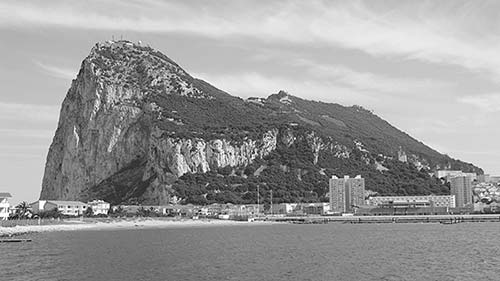
Britain has controlled this highly strategic spit of land since taking it by force in 1704, in the War of Spanish Succession. In 1779, while Britain was preoccupied with its troublesome overseas colonies, Spain (later allied with France) declared war and tried to retake Gibraltar; a series of 14 sieges became a way of life, and the already-imposing natural features of the Rock were used for defensive purposes. During World War II, the Rock was further fortified and dug through with more and more strategic tunnels. In the mid- to late 20th century, during the Franco period, tensions ran high—and Britain’s grasp on the Rock was tenuous.
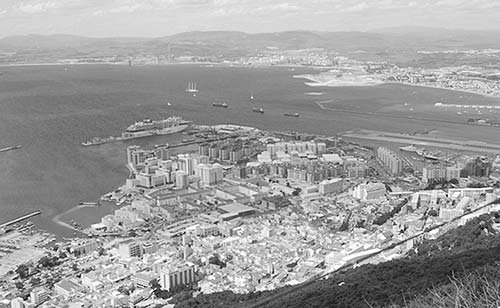
Strolling Gibraltar, you can see that it was designed as a modern military town (which means it’s not particularly charming). But in recent decades the economy has gone from one dominated by the military to one based on tourism (as, it seems, happens to many empires). On summer days and weekends, the tiny colony is inundated by holiday-goers, primarily the Spanish (who come here for tax-free cigarettes and booze) and British (who want a change in weather but not in culture). Glitzy high-rise resorts have sprouted up between the stout fortresses and ramparts, as if trying to create a mini-Monaco.
Though it may be hard to imagine a community of about 30,000 that feels like its own nation, real Gibraltarians, as you’ll learn when you visit, are a proud bunch. They were evacuated during World War II, and it’s said that after their return, a national spirit was forged. If you doubt that, be here on Gibraltar’s main holiday—September 10—when everyone’s decked out in red and white, the territory’s colors.
Gibraltarians have a mixed and interesting heritage. Their unique linguistic mix of Spanish and English is known as llanito (yah-NEE-toh), meaning “flat” in Spanish, though the residents live on a rock...a great example of southern Spanish sarcasm. The locals—a fun-loving and tolerant mix of British, Spanish, and Moroccan, virtually all of whom speak the King’s English—call their place “Gib.”
From a traveler’s perspective, Gibraltar—with its quirky combination of Brits, monkeys, and that breathtaking Rock—is an offbeat detour that adds some variety to a Spanish itinerary. If you’re heading to Gibraltar from Spain (as you almost certainly are), be aware most Spaniards still aren’t thrilled with this enclave of the Commonwealth on their sunny shores. They tend to ignore the place—so, for example, if you’re inquiring about bus schedules, don’t ask how to get to Gibraltar, but rather to La Línea de la Concepción, the neighboring Spanish town. A passport is required to cross the border.
PLANNING YOUR TIME
Make Gibraltar a day trip (or just one overnight); rooms are expensive compared to Spain. Avoid visiting on a Sunday, when just about everything except restaurants and the cable car is closed.
Gibraltar in One Day: Before you walk across the border, decide whether you want to take the cable car to the top of the Rock or visit it via a private taxi tour. You can book a taxi online or hire one on the spot at a stand just inside the border (see “By Taxi Tour” under “Sights in Gibraltar,” later).
If you decide on the cable car, stop at the GibraltarInfo window before passport control, next to the La Línea taxi stand. If the cable car is running, buy tickets here and, after passing through passport control, hop on the free shuttle directly to the cable-car station, where you can join the Fast Track line and avoid some of the wait. Ride to the peak for Gibraltar’s ultimate top-of-the-rock view.
Then, either walk down—taking in the Apes’ Den, siege tunnels, and other sights—or ride the cable car back into town. From the lower cable-car station, follow my self-guided town walk all the way back to Casemates Square. Spend your remaining free time in town before returning to Spain.
Overnighting in Gibraltar: Tourists who stay overnight find Gibraltar a peaceful place in the evening, when the town can just be itself. No one’s in a hurry. Families stroll, kids play, seniors window shop, and everyone chats...but the food is still not that great.
Orientation to Gibraltar
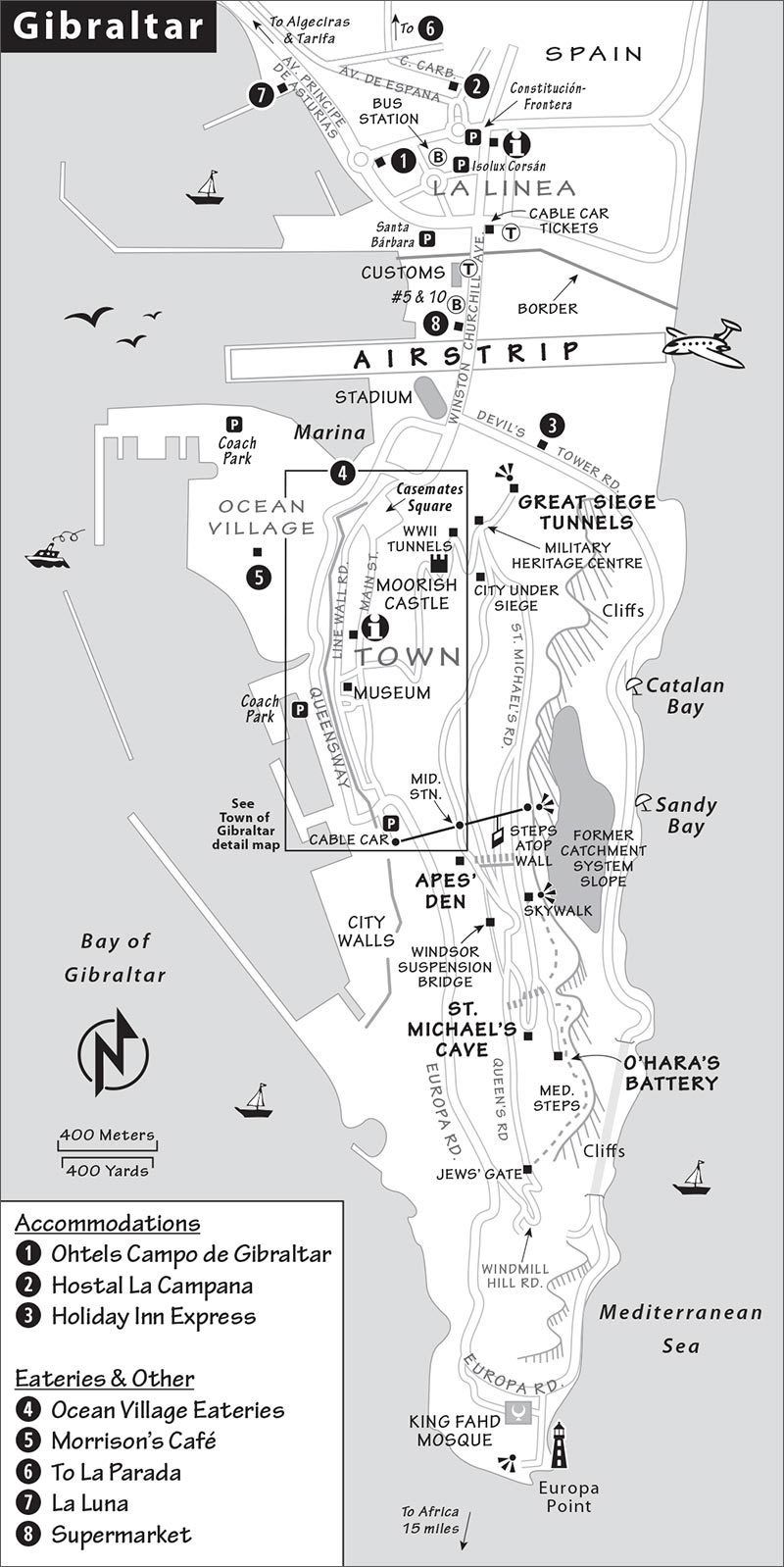
Gibraltar is a narrow peninsula (three miles by one mile) jutting into the Mediterranean. Virtually the entire peninsula is dominated by the steep-faced Rock itself. The locals live down below, in the long, skinny town at the western base of the mountain (much of it on reclaimed land). Note that all the old walls and fortresses make Gibraltar tricky to navigate. Ask for directions: Locals speak English.
For tips on little differences between Gibraltar and Spain—from area codes to electricity—see “Helpful Hints,” later.
Tourist Information: The most useful TI office is located at the border crossing, inside the customs building (Mon-Fri 9:00-16:30, Sat 9:00-15:30, Sun 10:00-13:00, +350 200 50762, www.visitgibraltar.gi). It’s unlikely you’ll need to visit the main TI at John Mackintosh Square, a 10-minute walk south of Casemates Square. Maps with essential info are posted all around the Rock; you can buy a copy with a €1 or £1 coin, or just take a photo for reference.
ARRIVAL IN GIBRALTAR
No matter how you arrive, you’ll need your passport to cross the border. These directions will get you as far as the border; from there, see “Getting from the Border into Town.”
By Bus: Spain’s La Línea de la Concepción bus station is a five-minute walk from the Gibraltar border. To reach the border, exit the station and bear left toward the Rock (you can’t miss it). If you need to store your bags, you can do so at the Gibraltar Airport (see “Helpful Hints,” later).
By Car: You don’t need a car in Gibraltar. It’s simpler to park in La Línea and just walk across the border.
Freeway signs in Spain say Algeciras and La Línea, often pretending that Gibraltar doesn’t exist until you’re very close. After taking the La Línea-Gibraltar exit off the main Costa del Sol road, your best bet is to follow signs for Aduana de Gibraltar (Gibraltar customs).
The Santa Bárbara parking lot is closest to the border, with room for 650 cars. Ignore anyone who claims to be a cashier and only pay as you leave, at machines or the official booth. If Santa Bárbara is full, try a bit farther away at either Parking Constitución-Frontera or Parking Isolux Corsán. La Línea’s main square—Plaza de la Constitución—covers a huge underground parking garage; just look for the blue “P” signs. The Isolux Corsán underground lot is also handy (cheaper with prepaid ticket sold at the below-ground info booth; on Avenida 20 de Abril, near the bus station). You’ll also find blue-lined pay parking spots in this area (signs give time limits). From the square, it’s a five-minute stroll to the border, where you can catch a bus or taxi into town (see “Getting from the Border into Town,” next).
If you do drive into Gibraltar, customs checks at the border create a bottleneck. There’s often a 30-minute wait during the morning rush hour into Gibraltar and during the evening rush hour back out. Once in Gibraltar, drive along the harbor side of the ramparts (on Queensway—but you’ll see no street name). There are big parking lots here and at the cable-car terminal. Parking is generally free—if you can find a spot (it’s tight during weekday working hours). By the way, while you’ll still find English-style roundabouts, cars here stopped driving on the British side of the road in the 1920s.
Spain has been annoyed about Gibraltar ever since Great Britain nabbed this prime 2.5-square-mile territory in 1704 (during the War of Spanish Succession) and was granted it through the Treaty of Utrecht in 1713. Although Spain long ago abandoned efforts to reassert its sovereignty by force, it still tries to make Gibraltarians see the error of their British ways. Over the years Spain has limited Gibraltar’s air and sea connections, choked traffic at the three-quarter-mile border, and even messed with the local phone system in efforts to convince Britain to give back the Rock. Still, given the choice—which they got in referenda in 1967 and 2002—Gibraltar’s residents steadfastly remain King Charles’ loyal subjects, voting overwhelmingly (99 percent in the last election) to continue as a self-governing British dependency. Brexit has raised new questions about the relationship, since 96 percent of the territory unsuccessfully voted to remain in the EU. Gibraltar continues to negotiate with Spain to prevent a hard border and stay within the Schengen Area.
Getting from the Border into Town
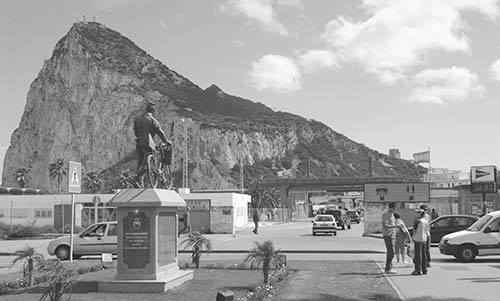
The “frontier” (as the border is called) is a chaotic hubbub of travel agencies, confused tourists, crafty pickpockets, and duty-free shops (you may see people standing in long lines, waiting to buy cheap cigarettes). The guards barely even look up as you flash your passport. (If you like collecting stamps in your passport, request one.) Note that as soon as you cross the border, the currency changes from euros to pounds (see “Helpful Hints,” next).
To reach downtown, you can walk (20 minutes), catch a bus, or take a taxi. To get into town by foot, walk straight across the runway (look left, right, and up), then head down Winston Churchill Avenue. Angle right at the second roundabout, then walk along the fortified Line Wall Road to Casemates Square.
From the border, you can ride bus #5/10 (regular or London-style double-decker, runs every 10-15 minutes, €2.40/£1.60 one-way, pay fare on boarding). Ask the driver for a heads-up when you’ve reached your stop, which will be either Market Place (just outside Casemates Square), Reclamation Road (near the cathedral and Gibraltar Museum at the center of town), or Boyd Street (a short walk to the cable car). From Market Place, other Gibraltar city buses (€2.40/£1.60 one-way, €3.30/£2.50 round-trip) head to various points on the peninsula. A useful route for most tourists is bus #2, which goes to the cable-car station and Europa Point, Gibraltar’s southernmost point. Consider purchasing an all-day Hopper Ticket if you’ll be using the bus for more than just getting to and from the border (€9/£6, good for all lines, buy from driver or online, www.citibus.gi).
A taxi from the border is pricey (€14/£9 to the cable-car station). If you plan to join a taxi tour up to the Rock (see “Sights in Gibraltar,” later), note that you can book one right at the border.
HELPFUL HINTS
Gibraltar Isn’t Spain: Gibraltar, a British colony, uses different coins, currency (see below), and stamps than those used in Spain. Note that British holidays such as the King’s (official) birthday (on a Saturday in June) and Bank Holidays are observed, along with local holidays such as Gibraltar’s National Day (Sept 10).
Use Pounds, not Euros: Gibraltar uses the British pound sterling (£1 = about $1.30). Like other parts of the United Kingdom, Gibraltar mints its own Gibraltar-specific banknotes and coins featuring local landmarks, people, and historical events—offering a colorful history lesson. Gibraltar’s pounds are not generally accepted in the UK, so try to use up your Gibraltar bills before you leave.
Merchants in Gibraltar also accept euros...but at an unfavorable exchange rate, and you may get change back in pounds. You’ll save money by hitting up an ATM and taking out what you’ll need (look along Main Street) or using your credit/debit card when possible. Before you leave, stop at an exchange desk and change back what you don’t spend (at about a 5 percent loss), since Gibraltar currency is hard to change in Spain.
Phones: To dial a Gibraltar phone number, use the local calling code 350 (rather than 34 for Spain).
Hours: Even though part of the UK, some Gibraltar businesses follow a siesta schedule, closing from 13:00 to 15:00 on weekdays and shutting down at 14:00 on Saturdays until Monday morning.
Electricity: Gibraltar uses the British three-pronged plugs (not the European two-pronged ones). Your hotel may be able to loan you an adapter.
Baggage Storage: There’s no luggage storage at the bus station, but there is a bag check at the Gibraltar Airport, which is right across the border (£3-6/item; go to airport info desk in departures hall).
John Mackintosh Hall: This is your classic British effort to provide a cozy community center. Without a hint of tourism, the upstairs library welcomes drop-ins to enjoy local newspapers and free Wi-Fi (Mon-Fri 9:30-19:30, closed Sat-Sun, 308 Main Street—see map on here, +350 200 75669).
Activities: The King’s Bastion Leisure Centre fills an old fortification (the namesake bastion) with a modern entertainment complex just outside Cathedral Square. On the ground floor is a huge bowling alley; upstairs are an ice-skating rink and a three-screen cinema (www.leisurecinemas.com). Rounding out the complex are bars, restaurants, discos, and lounges (daily 9:00-24:00, +350 200 44777, www.kingsbastion.gov.gi). For location, see the map on here.
Monkey Alert: The monkeys, which congregate at the Apes’ Den on the Rock, have been spoiled by being fed by tourists, and can be aggressive. Keep your distance and don’t feed them; it’s best to have no food with you when you visit the Rock.
Gibraltar Walk
Gibraltar town is long and skinny, with one main street (aptly called Main Street). Stroll the length of it from the cable-car station to Casemates Square, following this little self-guided walk. A good British pub and a room-temperature pint of beer await you at the end.
From the cable-car terminal, turn right (as you face the harbor) and head into town. Soon you’ll come to the Trafalgar Cemetery, a reminder of the colony’s English military heritage; two of the seamen who died of wounds after the 1805 Battle of Trafalgar are buried here, and those who perished during the battle were consigned to the sea. (Of course, Lord Nelson was taken to London and buried in St. Paul’s Cathedral.) Nearby is the Charles V wall—a reminder of Gibraltar’s Spanish military heritage—built in 1540 by the Spanish to defend against marauding pirates. Gibraltar was controlled by Moors (711-1462), Spain (1462-1704), and then the British (since 1704). Passing through the Southport Gates, you’ll see one of the many blue-and-white history plaques posted about town.
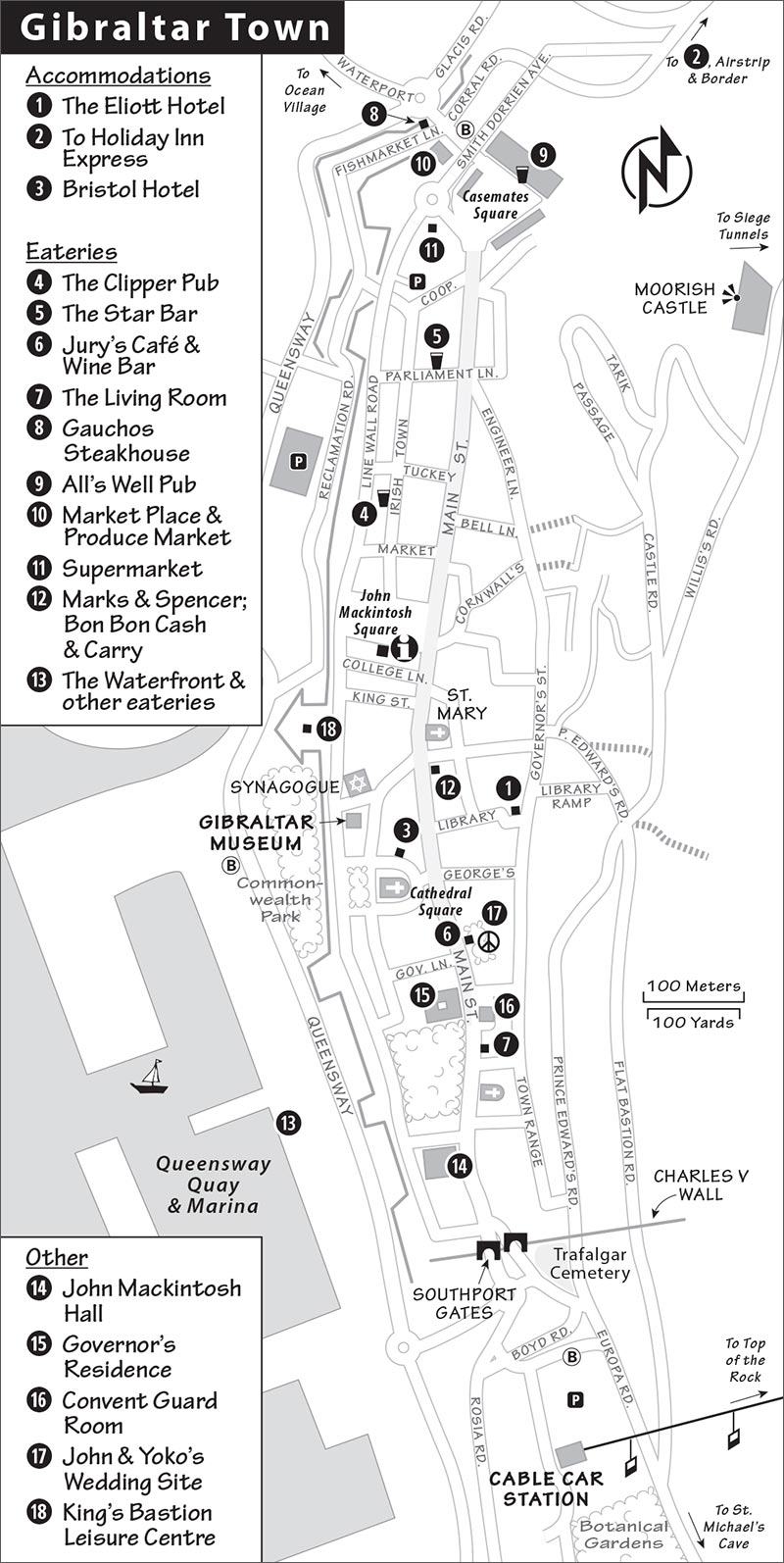
Heading into town, you pass the tax office, then John Mackintosh Hall, which has free Wi-Fi and a copy of today’s Gibraltar Chronicle upstairs in its library. The Chronicle comes out Monday through Friday and has covered the news since 1801. For a low-key weekday lunch with the locals, the recommended Living Room café is just down the street in the Methodist church.
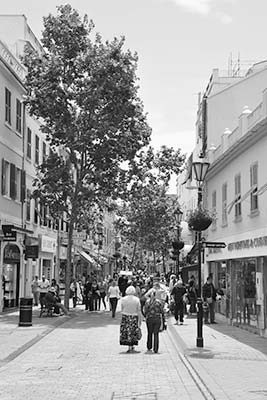
The pedestrian portion of Main Street begins near the governor’s residence. The British governor of Gibraltar took over a Franciscan convent, hence the name of the local White House: The Convent. The formally classic Convent Guard Room, facing the governor’s residence, is good for photos.
Gibraltar’s courthouse stands behind a small tropical garden, where John and Yoko got married back in 1969 (as the ballad goes, they “got married in Gibraltar near Spain”). Sean Connery did, too. Actually, many Brits like to get married here because weddings are cheap, fast (only 48 hours’ notice required), and legally recognized as British.
Main Street now becomes a shopping drag. You’ll notice lots of colorful price tags advertising tax-free booze, cigarettes, and sugar (highly taxed in Spain). Lladró porcelain, while made in Valencia, is popular here (because it’s sold without the hefty Spanish VAT—Value-Added Tax). The Catholic cathedral retains a whiff of Arabia (as it was built on the remains of a mosque), while the big Marks & Spencer department store helps vacationing Brits feel at home.
Continue several more blocks through the bustling heart of Gibraltar. If you enjoy British products, this is your chance to stock up on Cadbury chocolates, digestive biscuits, wine gums, and Weetabix—but you’ll pay a premium, since it’s all flown or shipped in from the UK.
The town (and this walk) ends at Casemates Square. While a lowbrow food circus today, it originated as a barracks and place for ammunition storage. When Franco closed the border with Spain in 1969, Gibraltar suffered a labor shortage, as Spanish guest workers could no longer commute into Gibraltar. The colony countered by inviting Moroccan workers to take their place—ending a nearly 500-year Moroccan absence, which began when the Moors were ousted by the Christian governor of Tarifa in 1462. As a result, today’s Moroccan community dates only from the 1970s. Whereas the previous Spanish labor force simply commuted in to work, the Moroccans needed apartments, so Gibraltar converted the Casemates barracks for that purpose. Cheap Spanish labor has crept back in, causing many locals to resent store clerks who can’t speak proper English.
If you go through the triple arches at the end of the square, you’ll reach the covered produce market and food stalls. Across the busy road a few minutes’ walk farther is the well-marked entrance to the Ocean Village boardwalk and entertainment complex (described later, under “Eating in and near Gibraltar”) and a large Morrisons grocery store and café.
Sights in Gibraltar
▲▲▲The Summit
IN TOWN
▲Gibraltar Museum
Built atop a Moorish bath, this museum tells the story of a chunk of land that has been fought over for centuries. Start with the cheerleading 15-minute video overview of the story of the Rock—a worthwhile prep for the artifacts (such as ancient Roman anchors made of lead) you’ll see in the museum. Then wander through the remains of the 14th-century Moorish baths. Upstairs you’ll see military memorabilia, a 15-foot-long model of the Rock (compare it with your map to see all the changes), wonderful century-old photos of old Gibraltar, paintings by local artists, and, in a cave-like room off the art gallery, a collection of prehistoric remains and artifacts. The famous skull of a Neanderthal woman found in Gibraltar is a copy (the original is in the British Museum in London). Unearthed in Forbes’ Quarry (at the north end of the Rock) in 1848, this was the first Neanderthal skull ever discovered. No one realized its significance until a similar skull found years later in Germany’s Neanderthal Valley was correctly identified—stealing the name, claim, and fame from Gibraltar.
Cost and Hours: £5, Mon-Fri 10:00-18:00, Sat until 14:00, closed Sun, on Bomb House Lane near the cathedral, www.gibmuseum.gi.
ON THE ROCK OF GIBRALTAR
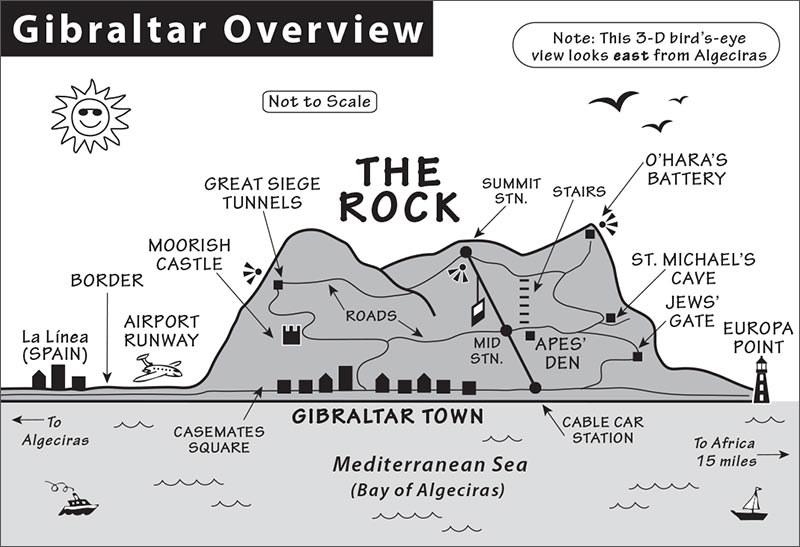
The actual Rock of Gibraltar—specifically, the Upper Rock Nature Reserve—is the colony’s best sight. Its main draws are the stupendous view from the very top and the temperamental resident monkeys you’ll encounter on the way down. Other attractions include a hokey cave (St. Michael’s), a glass “skywalk” and a suspension bridge, and the impressive Great Siege Tunnels drilled into the rock. For an overview of the Rock, see the map on here.
Visiting the Rock: You have two options for exploring the Rock itself—take a taxi tour or ride the cable car. Private cars are not allowed high on the Rock.
The taxi tour includes entry to St. Michael’s Cave and the Great Siege Tunnels, a couple of extra stops, and running commentary from your licensed cabbie/guide. Because the cable car doesn’t get you very close to the cave and tunnels (and doesn’t cover cave and tunnel admission), take the taxi tour if you’ll be visiting these sights and don’t want to walk.
The cable car takes you to the very top of the Rock (which the taxi tours don’t). You can then take a long, steep, scenic walk down, connecting the various sights by foot as you stroll along paved lanes on a pleasant walk down.
Taxi Tour of the Rock
Minivans driven by trained and licensed cabbies stand by at the border and at various points in town (including Cathedral Square, John Mackintosh Square, Casemates Square, and near the cable-car station). They charge £45/person in peak season (rates vary depending on time of year and demand, likely 4-person minimum, includes Nature Reserve and sights ticket, +350 200 70027, https://gtagibraltartours.com). All do a 1.5-hour loop tour with four stops: a Mediterranean viewpoint (called the Pillar of Hercules), St. Michael’s Cave (15-minute visit), a viewpoint near the top of the Rock where you can get up close to the monkeys, and the Great Siege Tunnels (20-minute visit). To save a few pounds, try buddying up with other travelers to negotiate a group rate.
Cable Car to the Summit
Buy your tickets for the six-minute cable-car ride at the GibraltarInfo kiosk just before the border, at the cable-car station, or online (http://gibraltarinfo.gi). Tickets bought at the GibraltarInfo kiosk or online include Fast Track entry as well as shuttle service to and from the border. The cable car won’t run if it’s windy or rainy; if the weather is questionable, ask at the GibraltarInfo kiosk or the TI before heading to the station.
To take in all the sights, I recommend hiking down instead of taking the cable car back. Simply hiking down without visiting the sights is enjoyable, too. Approximate hiking times: from the top of the cable car to St. Michael’s Cave—25 minutes; from the cave to the Apes’ Den—20 minutes; from the Apes’ Den to the Great Siege Tunnels—30 minutes; from the tunnels back into town, passing the Moorish Castle—20 minutes. Total walking time, from top to bottom: about 1.5 hours (on paved roads with almost no traffic), not including sightseeing. For hikers, I’ve connected the dots with directions later.
In winter (Nov-March), the cable car stops halfway down for those who want to get out, gawk at the monkeys, and take a later car down—but you’ll probably see monkeys at the top anyway.
Cost: A round-trip ticket is £19, but you won’t be able to leave the upper cable-car area. If you plan to ride up and walk down, you’ll need to buy a £34.50 one-way cable-car plus Nature Reserve ticket (includes entry to all sights).
Hours: The cable car runs every 10 minutes, or continuously in busy times (daily from 9:30; April-Oct last ascent at 19:15, last descent at 19:45; Nov-March last ascent at 17:15, last descent at 17:45). Lines can be long if a cruise ship is in town, so consider Fast Track options during peak season.
Information: http://gibraltarinfo.gi.
Multimedia Guide/App: The included multimedia guide explains what you’re seeing from the spectacular viewpoints up top (pick it up at the well-marked booth at the summit—must leave ID and return before leaving the summit—or download the guide using free Wi-Fi).
Sights on the Rock
The various sights on the Rock keep the same hours: Daily 9:30-19:15, until 18:15 late Oct-late March.
▲▲▲The Summit
The cable car takes you to the real highlight of Gibraltar: the summit of the spectacular Rock itself. The limestone massif is nearly a mile long, rising 1,400 feet with very sheer faces. According to legend, this was one of the Pillars of Hercules (paired with Djebel Musa, a mountain across the strait in Morocco), marking the edge of the known world in ancient times. Local guides say that these pillars are the only places on the planet where you can see two seas and two continents at the same time.
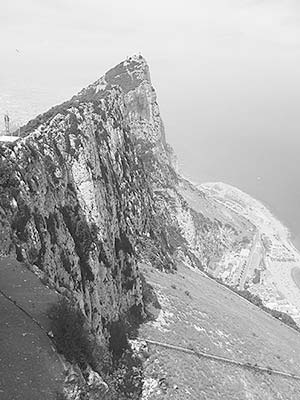
In AD 711, the Muslim chieftain Tarik ibn Ziyad crossed over from Africa and landed on the Rock, beginning the Moorish conquest of Spain and naming the Rock after himself—Djebel-Tarik (“Rock of Tarik”), which became “Gibraltar.”
At the cable-car terminal at the top of the Rock you’ll find a view terrace, a fancy restaurant/bar, and a café. From here you can explore old ramparts and drool at the 360-degree view of Morocco (including the Rif Mountains and Djebel Musa), the Strait of Gibraltar, the bay stretching west toward Algeciras, and the twinkling Costa del Sol arcing eastward. The views are especially crisp on brisk off-season days. Below you (to the east) stretches a vast, vegetation-covered slope—part of a giant catchment system built by the British in the early 20th century to collect rainwater for use by the military garrison and residents. Broad sheets once covered this slope, catching the rain and sending it through channels to reservoirs carved inside the rock. (Gibraltar’s water is now provided through a desalination system.)
• Up at the summit, you’ll likely see some of the famed...
▲▲Apes of Gibraltar
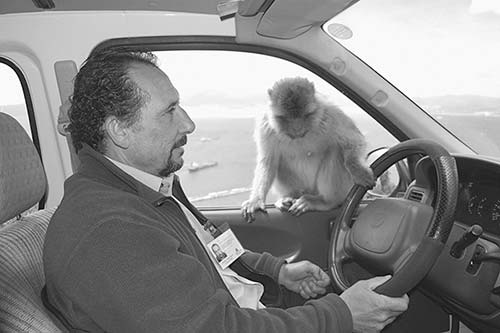
The Rock is home to about 200 “apes” (actually, tailless Barbary macaques—a type of monkey). Taxi tours stop at the Apes’ Den, but if you’re on your own, you’ll probably see them at the top and at various points on the walk back down (basically, the monkeys cluster anywhere that tourists do—hoping to get food). The males are bigger, females have beards, and newborns are black. They live about 15 to 20 years. Legend has it that as long as the monkeys remain here, so will the Brits. (According to a plausible local legend, when word came a few decades back that the ape population was waning, Winston Churchill made a point to import reinforcements.) Keep your distance from the monkeys. Guides say that for safety reasons, “they can touch you, but you can’t touch them.” And while guides may feed them, you shouldn’t—it disrupts their diet and encourages aggressive behavior, not to mention it’s illegal and there’s a £500 fine. Beware of the monkeys’ kleptomaniac tendencies; they’ll ignore the peanut in your hand and claw after the full bag in your pocket. Because the monkeys associate plastic bags with food, keep your bag close to your body: Tourists who wander by absentmindedly, loosely clutching a bag, are apt to have it stolen by a purse-snatching simian.
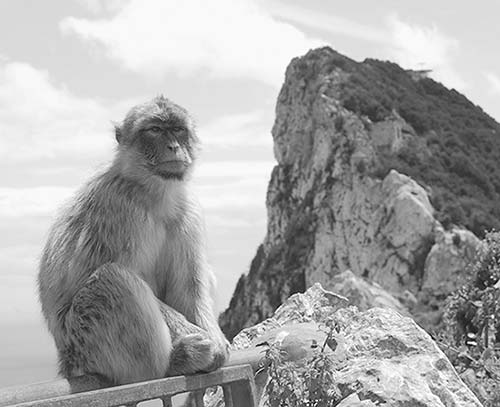
• If you’re hiking down, you’ll find that your options are clearly marked at most forks. I’ll narrate the longest route down, which passes all the sights en route.
From the top cable-car station, exit and head downhill on the well-paved path (toward Africa). You’ll go by the viewpoint for taxi tours (with monkeys hanging around, waiting for tour groups to come feed them), pass under a ruined observation tower, and eventually reach a wide part of the road. Most visitors will want to continue past the Skywalk observation deck to St. Michael’s Cave (skip down to that section if that’s you), but there’s also an opportunity to hike steeply up to...
O’Hara’s Battery
At 1,400 feet, this is the actual highest point on the Rock. A massive 9.2-inch gun sits on the summit, where a Moorish lookout post once stood. The battery was built after World War I, and the last test shot was fired in 1974. Locals are glad it’s been mothballed—during test firings, they had to open their windows, which might otherwise have shattered from the pressurized air blasted from this gun. You can go inside to see not only the gun but the powerful engines underneath that were used to move and aim it. The iron rings you see every 30 yards or so along the military lanes around the Rock once anchored pulleys used to haul up guns like the huge one at O’Hara’s Battery.
• Serious hikers can follow the strenuous Mediterranean Steps and curl around to the wilderness of Jews’ Gate at the tip of the Rock. Keep in mind that this route skips St. Michael’s Cave. If this challenging 1.5-to-2-hour hike sounds appealing, get details at the TI before setting out. Otherwise, from the crossroads below O’Hara’s Battery, take the right (downhill) fork to a cabin, restaurant, and shop, then the entrance to...
▲St. Michael’s Cave
Studded with stalagmites and stalactites, eerily lit, and echoing with classical music, this cave is dramatic, corny, and slippery when wet. Considered a one-star sight since Neolithic times, the cave was alluded to in ancient Greek legends—when it was believed to be the Gates of Hades (or the entrance of a tunnel to Africa). All taxi tours stop here, with entry included in the cost of the taxi tour. Walking through takes about 15 minutes; you’ll pop out at the gift shop.
• From here, head down to the Apes’ Den, with a possible detour to the Windsor Suspension Bridge for more great views. Start by following Spur Battery Road downhill. From the Queen’s Balcony, fit walkers may want to take the steep steps to the suspension bridge; there’s also an easier path to the bridge just off Old Queen’s Road. Bridge or no bridge, continue to the Apes’ Den, just before the cable car’s middle station. Monkeys tend to gather at this scenic terrace, and taxi tours stop for photo ops.
Follow signs for Great Siege Tunnels for about 30 more minutes. Eventually you’ll reach a terrace with flags of the United Kingdom and Gibraltar (until Brexit, the EU flag flew as well) and a fantastic view of Gibraltar’s airport, the “frontier” with Spain, and the Spanish city of La Línea de la Concepción. From here, the Military Heritage Centre (described later) is beneath your feet, and it’s a short but steep hike up to the...
▲Great Siege Tunnels
Also called the Upper Galleries, these chilly tunnels were blasted out of the rock by the Brits during the Great Siege by Spanish and French forces (1779-1783). The clever British, safe inside the Rock, wanted to chip and dig to a highly strategic outcrop called “The Notch,” ideal for mounting a big gun. After blasting out some ventilation holes for the miners, they had an even better idea: Use gunpowder to carve out a whole network of tunnels with shafts ideal for aiming artillery. Eventually they excavated St. George’s Hall, a huge cavern that housed seven guns. These were the first tunnels inside the Rock; more than 150 years later, during World War II, 30 more miles of tunnels were blasted out. Hokey but fun dioramas help recapture a time when Brits were known more for conquests than for crumpets.
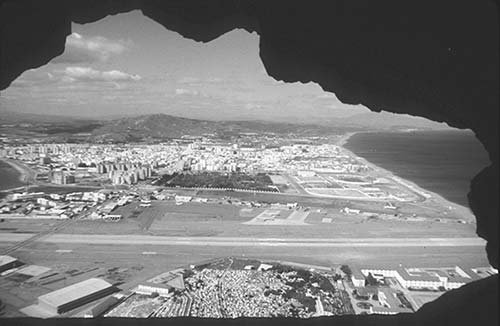
• Hiding out in the bunker below the flags (go down the stairs and open the heavy metal door—it’s unlocked) is the...
Military Heritage Centre
This small exhibit features a collection of old military photographs from Gibraltar. A second room holds a poignant memorial to the people who “have made the supreme sacrifice in defense of Gibraltar.”
• From here, the road switchbacks down into town. At each bend in the road you’ll find one of the next three sights.
City Under Siege
This hokey exhibit is worth a quick walk-through if you’ve been fascinated by all this Gibraltar military history. Displayed in some of the first British structures built on Gibraltar soil, it re-creates the days of the Great Siege, which lasted more than three and a half years (1779-1783)—one of 14 sieges that attempted but failed to drive the Brits off the Rock. With evocative descriptions, some original “graffiti” scratched into the wall by besieged Gibraltarians, and some dioramas, the exhibit explains what it was like to live on the Rock, cut off from the outside world, during those challenging times.
World War II Tunnels
In November 1942, American Army General Dwight D. Eisenhower took charge of Operation Torch, the Allies’ plan to occupy French North Africa. From a network of passageways deep within the Rock of Gibraltar, Eisenhower and British admiral Andrew Browne Cunningham conducted the first major collaboration between British and American forces in World War II.
During the war, Britain added 30 miles of tunnels beneath this strategic rock. It was enough space to accommodate an entire city—including a water distillation plant, barracks, generators, repair shops, hospitals, and a telephone exchange—for soldiers and civilians engaged in wartime operations against the Nazis.
Tours of the tunnels leave approximately hourly and are accompanied by an audioguide (included in the Nature Reserve ticket). You can simply show up and join the next available tour, or, if you’ve got your timing down, check at the TI or GibraltarInfo kiosk about reserving a spot.
Moorish Castle
Actually more a tower than a castle, this restored building is basically an empty shell. (The tourist board tried to change the name to the more diplomatic “Medieval Castle”...but it is Moorish, so the name didn’t stick.) It was constructed on top of the original castle built in AD 711 by the Moor Tarik ibn Ziyad, who gave his name to Gibraltar.
• The tower marks the end of the Upper Rock Nature Reserve. Heading downhill, you begin to enter the upper part of modern Gibraltar. While you could keep on twisting down the road, keep an eye out for staircase shortcuts into town (most direct are the well-marked Castle Steps).
Nightlife in Gibraltar
Compared to the late-night bustle of Spain, where you’ll see young parents out strolling with their toddlers at midnight, Gibraltar is extremely quiet after-hours. Main Street is completely dead (except for a few lively pubs, mostly a block or two off the main drag). Head instead to the Ocean Village complex, a five-minute walk from Casemates Square, where the boardwalk is lined with bars, restaurants, and a casino. Another waterfront locale—a bit more sedate—is the Queensway Quay Marina. (Both areas are described later, under “Eating in and near Gibraltar.”) Kids love the King’s Bastion Leisure Centre (see “Helpful Hints,” earlier).
Some pubs, lounges, and discos—especially on Casemates Square—offer live music (look around for signs, or ask at the TI). The Eliott Hotel hosts free live jazz on Thursday evenings.
Sleeping in and near Gibraltar
Gibraltar is not a good value for accommodations. There are only a handful of hotels and (disappointingly) no British-style B&Bs. As a general rule, rooms are either bad or overpriced. The places I list here range from about £100 to more than £200 a night.
As an alternative, consider staying at one of my recommended accommodations in La Línea de la Concepción, across the border from Gibraltar in Spain, where hotels are a better value.
IN GIBRALTAR TOWN
For locations, see the “Gibraltar Town” map.
$$$$ The Eliott Hotel, with four stars, boasts a rooftop pool with a view, fine restaurant, bar, terrace, inviting sit-a-bit public spaces, and 123 modern, stylish business-class rooms—all with balconies (air-con, elevator, pay parking, centrally located at 2 Governor’s Parade, up Library Street from main drag, +350 200 70500, www.eliotthotel.com, eliott@ocallaghancollection.com).
$$$ The Holiday Inn Express, near the north end of the Rock, has 120 reliably comfortable rooms, but it’s a distance from the major sights (air-con, elevator, limited free parking, 21 Devil’s Tower Road, +350 200 67890, www.ihg.com, reservations@hiexgibraltar.com).
$$ Bristol Hotel offers 60 basic, worn English rooms in the heart of Gibraltar—noise can be a problem (air-con, elevator, swimming pool across the street; limited free parking; 10 Cathedral Square, +350 200 76800, www.bristolhotel.gi, reservations@bristolhotel.gi).
ACROSS THE BORDER, IN LA LÍNEA
Staying in Spain—in the border town of La Línea de la Concepción—offers an affordable, albeit less glamorous, alternative to sleeping in Gibraltar. The streets north of the bus station are lined with inexpensive hostales and restaurants. These options are just a few blocks from the La Línea bus station and an easy 15-minute walk to the border—get directions when you book. For locations, see the “Gibraltar” map.
$$ Ohtels Campo de Gibraltar is a huge blocky building, with 227 cookie-cutter rooms spread over seven floors. It’s a big, friendly business-class hotel that is just blocks from the border, around the corner from the bus station. It’s also easy to access by car as it’s on the main road coming into town. Drivers should stay here to avoid lining up to cross the border. Ask for a room on the top floors with expansive views of the Rock (air-con, elevator, pool, large patio, underground pay parking, at the intersection of Avenida Príncipe de Asturias and Avenida del Ejército, +34 956 178 213, www.ohtels.es, recepcion.campodegibraltar@ohtels.es).
$ Hostal La Campana has 17 rooms at budget prices. Run by Ivan and his dad, Andreas, this place is simple, clean, and friendly but lacks indoor public areas except for its breakfast room (air-con, elevator, limited free street parking, pay parking in nearby underground garage, just off Plaza de la Constitución at Calle Carboneros 3, +34 956 173 059, www.hostalcampana.es, info@hostalcampana.es).
Eating in and near Gibraltar
IN GIBRALTAR TOWN
Take a break from jamón and sample some English pub grub: fish-and-chips, meat pies, jacket potatoes (baked potatoes with fillings), or a good old greasy English breakfast. English-style beers include chilled lagers and room-temperature ales, bitters, and stouts. In general, the farther you venture away from Main Street, the cheaper and more local the places become; I’ve listed a few of my favorites. Or explore one of Gibraltar’s more upscale developments with fewer tourists and more locals at either end of the old town: Ocean Village or Queensway Quay. For locations, see the “Gibraltar Town” map.
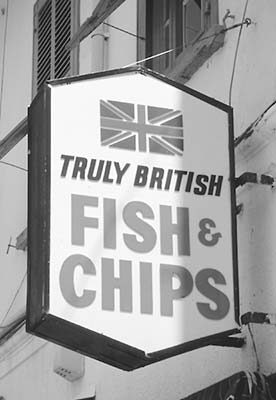
Downtown, near Main Street
$ The Clipper pub offers filling meals—including some salads and all-day breakfast—and Murphy’s stout on tap (long hours daily, on Irish Town Lane, +350 200 79791).
$$ The Star Bar, which claims to be Gibraltar’s oldest bar, is on a quiet side street with an unpubby, modern interior (long hours daily, 12 Parliament Lane, off Main Street and across from Corner House Restaurant, +350 200 75924).
$$ Jury’s Café and Wine Bar has a few outside tables for people-watching on the main drag, along with good food and friendly staff (long hours daily, 275 Main Street, +350 200 67898).
$ The Living Room is a fast, cheap-and-cheery café run by the Methodist church with a missionary’s smile. It’s upstairs in the Methodist church on Main Street (Mon-Fri 10:00-16:00, closed Sat-Sun and Aug, volunteer-run, no alcohol, 100 yards past the governor’s residence at 297 Main Street, +350 200 77491).
$$$ Gauchos is a classy, atmospheric steakhouse just outside Casemates Square (dinner only, closed Sun, 1 Fish Market Lane, +350 200 59700).
Casemates Square Food Circus: The big square at the entrance of Gibraltar contains a variety of restaurants, ranging from fast food (fish-and-chips joint, Burger King, and Pizza Hut) to inviting pubs spilling out onto the square. The $$ All’s Well pub serves everything from a full English breakfast to salads or fish-and-chips, and offers pleasant tables with umbrellas under leafy trees (food served daily 10:00-19:00, open later for drinks, +350 200 72987). Fruit stands and cheap takeout food stalls bustle just outside the entry to the square at the Market Place (Mon-Sat 9:00-14:00, closed Sun).
Groceries: The Spanish supermarket chain Eroski has handy branches on the border at 12 Winston Churchill Avenue and in the ICC building, just outside Casemates Square on Line Wall Road (Mon-Fri 8:00-21:00, Sun from 10:00, closed Sat). The Bon Bon Cash & Carry minimarket is on the main drag, off Cathedral Square (Mon-Fri 10:00-19:00, Sat until 14:00, closed Sun, Main Street 239). Nearby, Marks & Spencer has a small food market on the ground floor, with fresh-baked pastries (Mon-Fri 9:00-19:00, Sat until 17:00, closed Sun).
Ocean Village
This development is the best place to get a look at the bold new face of Gibraltar. Formerly a dumpy port, it’s been turned into a swanky marina fronted by glassy high-rise condo buildings. The boardwalk arcing around the marina is packed with shops, restaurants, and bars—Indian, Mexican, sports bar, pizza parlor, Irish pub, fast food, wine bar, and more. Anchoring everything is Gibraltar’s casino. While the whole thing can feel a bit corporate, it offers an enjoyable 21st-century contrast to the “English village” vibe of Main Street (which can be extremely sleepy after-hours). The best UK supermarket experience is at Morrisons near Ocean Village, with a budget café serving breakfast all day (Mon-Sat 7:00-23:00, Sun 8:00-20:00, café daily until 19:00).
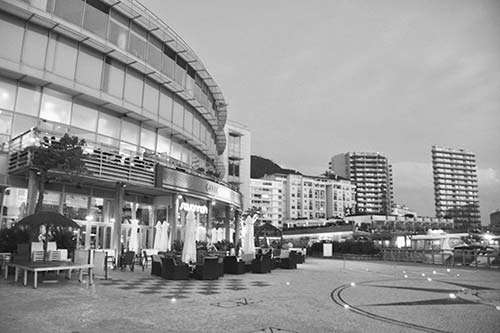
Queensway Quay Marina
To dine in yacht-club ambience, stroll the marina and choose from a string of restaurants serving the boat-owning crowd. When the sun sets, the quay-side tables at each of these places are prime dining real estate. $$$ The Waterfront Restaurant serves upscale bistro fare in its lounge-lizard interior and at great marina-side tables outside (daily, +350 200 45666). Other options include Indian, Italian, trendy lounges, and (oh, yeah) Spanish.
IN LA LÍNEA
The pedestrian street Calle Real, several blocks north of the La Línea bus station, is lined with inexpensive cafeterias, restaurants, and tapas bars. La Línea doesn’t offer anything out of the ordinary, but you could try the local indoor/outdoor ambience of $ La Parada for pescadito frito—typical Andalusian batter-fried fish (long hours daily, Calle Duque de Tetuán 2, Plaza de la Iglesia, +34 856 121 669). The chiringuito (beachfront restaurant) $$ La Luna is more upscale, with views of the bay and the Rock and seafood fresh from the Mediterranean (daily, Avenida Príncipe de Asturias 1D, +34 691 884 984). For locations, see the “Gibraltar” map.
Gibraltar Connections
BY BUS
The nearest bus station to Gibraltar is in La Línea de la Concepción in Spain, five minutes from the border—ask at the Gibraltar TI for schedules. The nearest train station is in Algeciras, which is the region’s main transportation hub (for Algeciras connections, see the end of this chapter).
From La Línea de la Concepción by Bus to: Algeciras (2/hour, fewer on weekends, 45 minutes), Tarifa (6/day, 1 hour; more with transfer in Algeciras), Málaga (5/day, 3 hours), Ronda (no direct bus, transfer in Algeciras; Algeciras to Ronda: 1/day, 3 hours), Granada (3/day, 6-7 hours, change in Malaga), Sevilla (5/day, 4.5 hours), Córdoba (1/day, 5 hours).
BY PLANE
From Gibraltar, you can fly to various points in Britain and Morocco: British Airways flies to London Heathrow (www.britishairways.com) and EasyJet connects to several UK airports (www.easyjet.com). The airport is easy to reach; you can’t enter town without crossing its runway (code: GIB, www.gibraltarairport.gi).
ROUTE TIPS FOR DRIVERS
Gibraltar to Nerja (125 miles/200 km): Barring traffic problems, the trip along the Costa del Sol is smooth and easy by car—much of it on a speedy toll highway. Just follow the coastal highway east. After Málaga, follow signs to Almería and Motril.
Tarifa
Mainland Europe’s southernmost town is whitewashed and Arab-feeling, with a lovely beach, an old castle, restaurants swimming in fresh seafood, enough windsurfers to sink a ship, and best of all, hassle-free boats to Morocco. Though Tarifa is pleasant, the main reason to come here is to use it as a springboard to Tangier, Morocco—a remarkable city worth ▲▲.
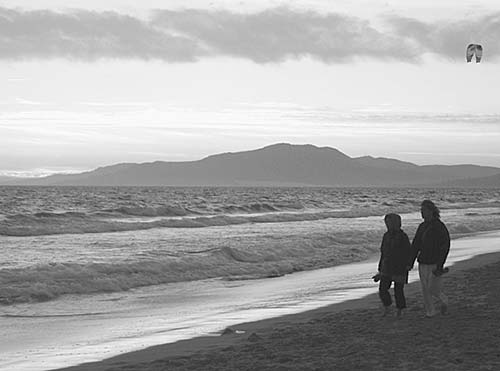
As I stood on Tarifa’s town promenade under the castle, looking across the Strait of Gibraltar at the almost-touchable Morocco, my only regret was that I didn’t have this book to steer me clear of gritty Algeciras on earlier trips. Tarifa, with 35-minute boat transfers to Tangier departing about every hour, is the best jumping-off point for a Moroccan side trip, as its ferry route goes directly to Tangier Ville Port in the city center.
In Tarifa, don’t expect blockbuster sights or a Riviera-style beach resort. Tarifa is a seaside town where it just feels good to be on vacation. Its atmospheric old town and long, broad stretch of wild Atlantic beachfront more than compensate for the more functional parts of this port city. The town is a hip and breezy mecca among windsurfers, drawn here by the strong winds created by the bottleneck at the Strait of Gibraltar.
In July and August Tarifa is mobbed with young adventure seekers from all over and madrileños looking for a bit of hippie chic (but can be quiet off-season). This crazy mix of a crowd makes Tarifa one of Spain’s trendiest-feeling towns. It has far more artsy, modern hotels than most Spanish towns its size, fine boutique shopping, and restaurant offerings that are atypically eclectic for normally same-Jane Spain—you’ll see vegetarian and organic, Italian and Indian, gourmet burgers and teahouses, and on each corner, it seems, there’s a stylish bar-lounge with techno music, mood lighting, and youthful Europeans just hanging out.
Orientation to Tarifa
The old town, surrounded by a wall, slopes gently up from the water’s edge (and the port to Tangier). The modern section stretches farther inland from Tarifa’s fortified gate.
Tourist Information: The TI faces the port at the top of Paseo de la Alameda. Ask here for bus schedules and information about local festivals—like the amazing Virgen de la Luz procession in September (TI open daily 10:00-13:30, Mon-Fri also 16:00-18:00, +34 956 680 993, www.turismodetarifa.com [URL inactive]).
Experiencia Tarifa: This organization, run by can-do Quino of the recommended Apartamentos Alborada, produces a yearly free magazine with a town map featuring hotels, restaurants, a wide array of activities, and bus schedules.
ARRIVAL IN TARIFA
By Bus: The bus station is on Calle Batalla del Salado, about a five-minute walk from the old town. If the station is closed, buy tickets directly from the driver—often cash only (station open Mon-Thu 7:30-12:30 & 14:15-18:00, Fri 8:30-12:30 & 14:15-16:45, Sun 14:00-20:00, closed Sat; bus station +34 956 684 038; most routes run by Comes bus company +34 902 199 208, www.tgcomes.es). To reach the old town, walk away from the wind turbines perched on the mountain ridge.
By Car: If you’re staying in the center of town, follow signs for Alameda or Puerto, and continue along Avenida de Andalucía to Tarifa’s main traffic intersection at the horseshoe-arched entrance to the old town. Look for free street parking throughout the workaday part of Tarifa. During the busiest summer months (July-Aug), you’ll need to use a pay lot or park farther out (for more on parking, see “Helpful Hints,” next).
HELPFUL HINTS
Laundry: Find clean self-service machines, and read one of several books suspended from hangers, at the Eco Lavandería (daily, Avenida de la Constitución 5, +34 674 468 490).
Tickets and Tours to Morocco: Ferries make the 35-minute crossing from Tarifa to Tangier almost hourly; see “Ferry Schedule and Tickets” on here for details. You can take a package tour from Tarifa, or book one of my recommended local guides, who can meet you in Tangier. Both options are explained at the beginning of the next chapter.
Long-Term Parking: Tangier day-trippers looking to leave their cars for the day or overnight can try one of these three long-term pay lots: on Calle San Sebastián, just off Avenida de Andalucía (secured garage); east of the old-town wall (guarded lot just behind the church); or at the port facility.
You can also park on the street for free. Observe the curb color: Yellow lines are no-parking areas for visitors. If it’s white or unmarked, it’s free.
Excursions: Check with Girasol Adventure for mountain-bike rentals, guided bike tours, national park hikes, rock-climbing classes, tennis lessons, and, when you’re all done...a massage. They also offer tours of Tarifa and Bolonia. Ask Sabine or Chris for details (Mon-Fri 10:00-14:00 & 18:30-20:30, Sat-Sun 11:00-14:00, Calle Colón 12, +34 956 627 037, www.girasol-adventure.com).
Sights in Tarifa
Church of St. Matthew (Iglesia de San Mateo)
Tarifa’s most important church, facing its main drag, is richly decorated for being in such a small town. Most nights, it seems life squirts from the church out the front door and into the fun-loving Calle Sancho IV el Bravo.
Cost and Hours: Free, Mon-Sat 8:30-13:00 & 18:00-21:00, Sun 10:00-13:00 & 19:00-21:00.
Visiting the Church: Find the fragment of an ancient tombstone—a tiny square (eye-level, about the size of this book) in the wall on the right—next to a chapel with a small iron gate (the third one off the right nave). Probably the most important historical item in town, this stone fragment proves there was a functioning church here during Visigothic times, before the Moorish conquest. The tombstone reads, in a kind of Latin Spanish (try reading it), “Flaviano lived as a Christian for 50 years, a little more or less. In death he received forgiveness as a servant of God on March 30, 674. May he rest in peace.” If that gets you in the mood to light a candle, switch on an electric “candle” by dropping in a coin. (It works.)
Head back out into the main nave and face the high altar. A relief of St. James the Moor-Slayer (missing his sword) is on the right wall of the main central altar. Since the days of the Christian “reconquest” of Spain, James has been the country’s patron saint. For more on this important figure—and why he’s fighting invaders that came to Spain centuries after his death—see here.
Both sides of the nave harbor several statues—showing typically over-the-top Baroque emotion—that are paraded through town during Holy Week. The Captive Christ (with hands bound) represents the arrest and trial of Jesus, one of the many moments of the Passion. The door on the left side of the nave is the “door of pardons.” For a long time Tarifa was a dangerous place—on the border between Christian and Muslim kingdoms. To encourage people to live here, the Church offered a second helping of forgiveness to anyone who lived in Tarifa for a year. One year and one day after moving to Tarifa, they would have the privilege of passing through this special “door of pardons” and a Mass of thanksgiving would be held in their honor.
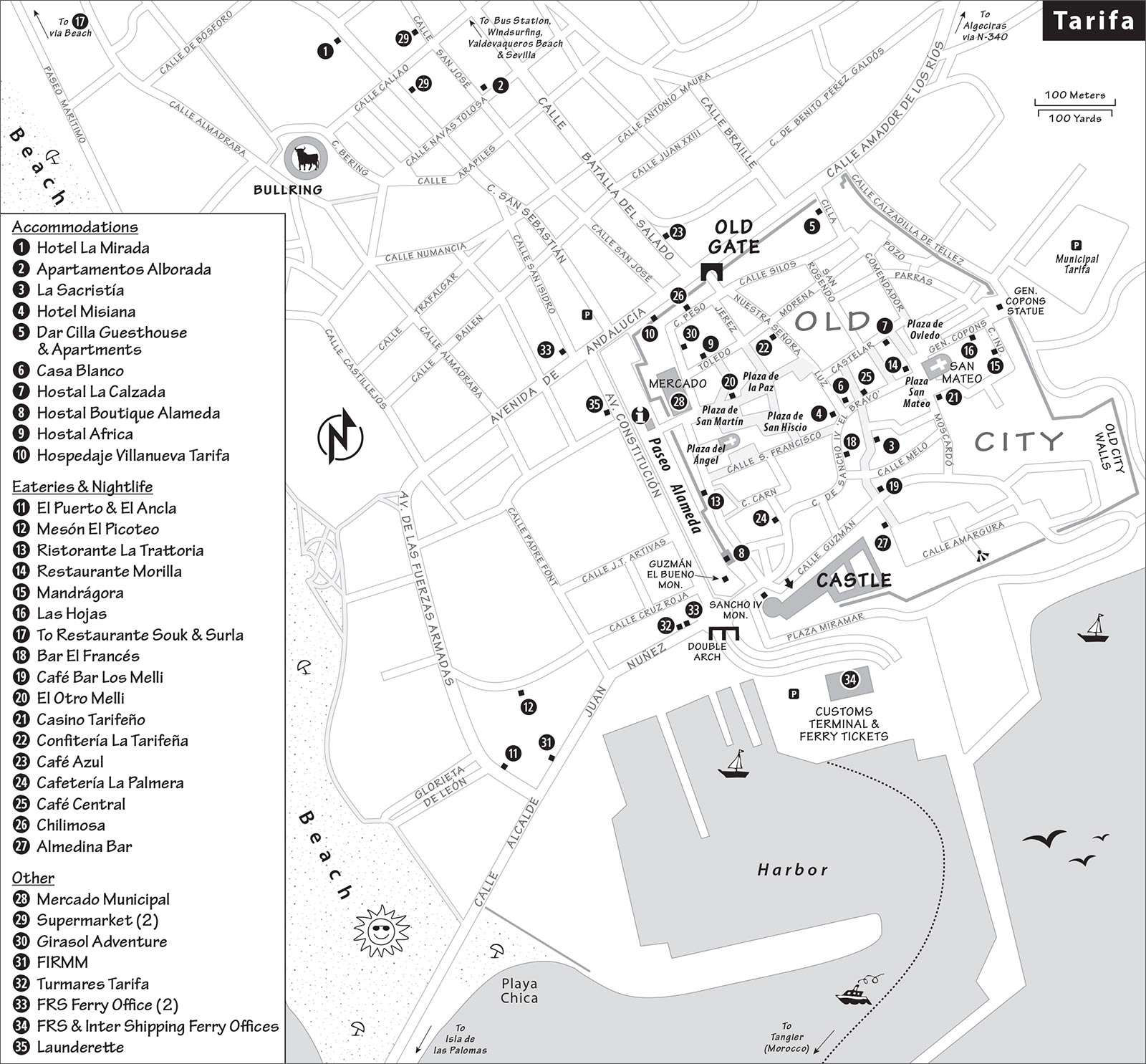
Castle of Guzmán el Bueno (Castillo de Guzmán el Bueno)
This 10th-century castle is set on the edge of Europe’s southernmost town—a strategically important location since Roman times, acting as a stronghold for Muslims and Christians for almost a thousand years. It was named after a 13th-century Christian general who gained fame in a sad show of courage while fighting the Moors. Holding Guzmán’s son hostage, the Moors demanded he surrender the castle or they’d kill the boy. Guzmán refused, even throwing his own knife down from the ramparts. It was used on his son’s throat. Ultimately, the Moors withdrew to Africa, and Guzmán was a hero. Today, the ramparts offer fine harbor views while an interpretive center explains how the castle was constructed and displays a modest collection of artifacts, including some original clothing.
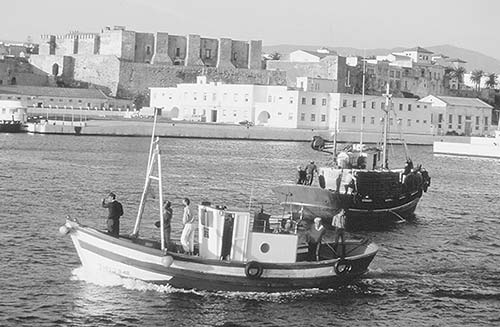
Cost and Hours: €4; Tue-Sun 10:00-16:00, also open Mon in spring and fall, last entry 45 minutes before closing; www.castilloguzmanelbueno.com.
Nearby Views: If you skip the castle, you’ll get equally good views from the plaza just left of the Town Hall. Following ayuntamiento signs, go up the stairs to the ceramic frog fountain in front of the Casa Consistorial, and continue left.
Bullfighting
Tarifa has a third-rate bullring where novices botch fights on occasional Saturdays through the summer. Professional bullfights take place during special events in August and September. The ring is a short walk from town. You’ll see posters everywhere.
▲Whale Watching
Several companies in Tarifa offer daily whale- and dolphin-watching excursions. Over the past four decades, people in this area went from eating whales to protecting them and sharing them with 20,000 visitors a year. The Spanish side of the Strait of Gibraltar is protected as part of El Estrecho Natural Park.
For any of the tours, it’s wise (but not always necessary) to reserve one to three days in advance. You’ll get a multilingual tour and a two-hour boat trip. Sightings occur on nearly every trip: Dolphins and pilot whales frolic here any time of year (they like the food), sperm whales visit from March through July, and orcas pass through in July and August. In bad weather, trips may be cancelled; each morning, tour company websites typically display weather updates and available tour times.
The best company is the Swiss nonprofit FIRMM (Foundation for Information and Research on Marine Mammals), which gives a 30-minute educational talk before departure. To reserve, call ahead or stop by their office (€45-65/person—pay immediately before departure, 1-4 trips/day April-Oct, sometimes also Nov; office at Calle del Alcalde Juan Núñez 10, daily 9:00-21:00; +34 956 627 008, +34 678 418 350, www.firmm.org). If you don’t see any whales or dolphins on your tour, you can join another trip for free.
Turmares Tarifa offers a two-hour whale-watching trip March through October (€45) and a three-hour orca trip from July through September (€65; Calle del Alcalde Juan Núñez 3, +34 956 680 741, www.turmares.com).
Isla de las Palomas
Extending out between Tarifa’s port and beaches, this island connected by a spit is the actual “southernmost point in mainland Europe.” Walk along the causeway, with Atlantic Ocean beaches stretching to your right and a bustling Mediterranean port to your left. Head to the tip, which was fortified in the 19th century to balance the military might of Britain’s nearby Rock of Gibraltar. The actual tip, still owned by the Ministry of Defense, is closed to the public, but a sign at the gate still gives you that giddy “edge of the world” feeling.
▲▲Beach Scene
Tarifa’s vast, sandy, and untamed beach stretches west from Isla de las Palomas for about five miles. You can walk much of its length on the Paseo Marítimo, a wide, paved walkway that fronts the sand and surf. Beach cafés and benches along the way make good resting or picnicking stops. Pick up the paseo where the causeway leads out to Isla de las Palomas, near Playa Chica. You’ll join dog walkers, runners, and neighbors comparing notes about last night’s rainstorm (they get some doozies here). Keep in mind that this is the Atlantic—the waves can be wild and the wind strong (if you’re looking for calm, secluded coves, spend your beach time in Nerja instead). On windy summer days, the sea is littered with sprinting windsurfers, while kitesurfers’ kites flutter in the sky. Paddleboarding is also popular.
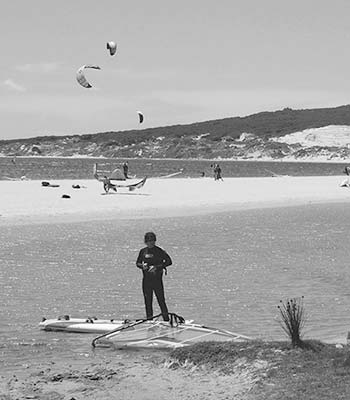
Those with a car can explore farther (following the N-340 road toward Cádiz). It’s a fascinating scene: A long string of funky beach resorts is packed with camper vans and fun-mobiles from northern Europe under mountain ridges lined with modern energy-generating windmills. The various resorts each have a sandy access road, parking, a cabana-type hamlet with rental gear, beachwear shops, a bar, and a hip, healthy restaurant. I like Valdevaqueros beach (five miles from Tarifa), with a wonderful thatched restaurant serving hearty salads, paella, and burgers. Torre de la Peña also has some fun beach eateries.
In July and August, inexpensive city-run buses do a circuit of nearby campgrounds, all on the waterfront (€2, 4-5 departures daily, confirm times with TI). Trying to get a parking spot in August can take the joy out of this experience.
Nightlife in Tarifa
You’ll find plenty of enjoyable nightspots—the entire town seems designed to cater to a young, international crowd of windsurfers and other adventure travelers. Just stroll the streets of the old town and dip into whichever trendy lounge catches your eye. For something more sedate, the evening paseo fills the parklike boulevard called Paseo de la Alameda (just outside the old-town wall), the Almedina Bar often hosts flamenco shows on Thursdays at 22:30 (at the south end of town, just below Plaza de Santa María, +34 956 680 474), and the theater next to the TI sometimes has musical performances (ask at the TI or look for posters).
Sleeping in Tarifa
Room rates vary with the season: lowest in winter and highest during Easter and from mid-June through September. Many hotels are closed in winter months and reopen the first week of March.
OUTSIDE THE CITY WALL
These hotels are about five blocks from the old town, close to the main drag, Batalla del Salado, in the plain, modern part of town. While in a drab area, they are well-run oases that are close to the beach and the bus station, with free and easy street parking.
$$ Hotel La Mirada, which feels sleek and stark, has 25 mod and renovated rooms—most with sea views at no extra cost. While the place lacks personality, it’s well priced and comfortable, with a large roof terrace with views and inviting lounge chairs (air-con, elevator, Calle San Sebastián 41, +34 956 680 626, www.hotel-lamirada.com, reservas@hotel-lamirada.com).
$$$ Apartamentos Alborada is a squeaky-clean, family-run place with two attractive patios and modern conveniences in 24 private apartments. Father Rafael and sons Quino (who speaks English and is generous with travel tips), Fali, and Carlos are happy to help make your Morocco tour or ferry reservation, or arrange any other activities you’re interested in. If they’re not too busy, they’ll even give you a free lift to the port (RS%—must book direct, air-con, Calle San José 40, +34 956 681 140, www.hotelalborada.com, info@hotelalborada.com).
INSIDE OR NEXT TO THE CITY WALL
The first three listings are funky, stylish boutique hotels in the heart of town—muy trendy and a bit full of themselves.
$$ La Sacristía, formerly a Moorish stable, now houses travelers who want stylish surroundings. It offers 10 fine and uniquely decorated rooms, mingling eclectic elements of chic Spanish and Asian style. They offer spa treatments, custom tours of the area, and occasional special events—join the party since you won’t sleep (sometimes includes breakfast, air-con, massage room, sauna, small roof terrace, very central at San Donato 8, +34 956 681 759, www.grupolasacristiatarifa.com, recepcion@grupolasacristiatarifa.com).
$$$ Hotel Misiana has 15 comfortable, recently remodeled, spacious rooms above a bar-lounge. Their designer gave the place a mod pastel boutique-ish ambience. To avoid noise from the lounge below, which is open until 3:00 in the morning, request a room on a higher floor (minimum stays of 2-4 nights in high season, air-con, double-paned windows, elevator, 100 yards directly in front of the church at Calle Sancho IV el Bravo 16, +34 956 627 083, www.misianahotel.com [URL inactive], info@misianahotel.com).
$$$ Dar Cilla Guesthouse & Apartments is a Moroccan-influenced riad (guesthouse), built into the town wall and remodeled into eight chic apartments surrounding a communal courtyard. Each apartment has a kitchen and is decorated in modern Moroccan style, with earth-tone walls, terra-cotta-tiled floors, and Moroccan rugs (family rooms; 2-, 4-, and 7-night minimums; air-con, large roof terrace with remarkable bird’s-eye view over the old town to the sea and Moroccan coastline, just east of the old-town gate at Calle Cilla 7, +34 653 467 025, www.darcilla.com, info@darcilla.com).
$ Casa Blanco, where minimalist meets Moroccan, is a newer, reasonably priced designer hotel. Each of its seven rooms (all with double beds) is decorated (and priced) differently. The place is decked out with practical amenities (minifridges in premium rooms) as well as romantic touches—loft beds, walk-in showers, and subtle lighting (air-con, small roof terrace, reception open 9:00-14:00 only, off main square at Calle Nuestra Señora de la Luz 2, +34 640 553 074, www.hotelcasablanco.es, info@hotelcasablanco.es).
$ Hostal La Calzada has eight airy, well-appointed rooms right in the lively old-town thick of things, though the management is rarely around (closed Dec-March, air-con, 20 yards from church at Calle Justino Pertíñez 7, +34 956 681 492, www.hostallacalzada.com, reservashostallacalzada@gmail.com).
$$ Hostal Boutique Alameda, overlooking a square where the local children play, glistens with pristine marble floors and subdued, chic decor. The main building has 11 bright rooms and the annex has 16 more modern rooms; both face the same delightful square (air-con, Paseo de la Alameda 4, +34 956 681 181, www.hostalalameda.com, info@hostalalameda.com, Antonio).
$ Hostal Africa, tucked away on a quiet street in the center of town, has 16 bright rooms (3 with shared bath, all with access to a fully equipped kitchen), a private apartment, and an inviting roof terrace. Its green-and-beige color scheme gives it a lush ambience (RS%, air-con, laundry service, yoga classes on roof, Calle María Antonia Toledo 12, +34 606 914 294, www.hostalafrica.com, info@hostalafrica.com). Check-in is digital but Timi is often around in the morning. Additional rooms are available at their sister property Casa Africa, five minutes away.
¢ Hospedaje Villanueva Tarifa offers 17 remodeled rooms at budget prices. It’s simple, clean, and friendly. It lacks indoor public areas but has an appealing terrace overlooking the old town on a busy street. Reconfirm your reservation by phone the day before you arrive (air-con, just west of the old-town gate at Avenida de Andalucía 11, access from outside the wall, +34 956 684 149, www.hospedajevillanuevatarifa.com, reservas@hospedajevillanuevatarifa.com).
Eating in Tarifa
I’ve grouped my recommendations below into two categories: Sit down to a real restaurant meal or enjoy a couple of the many characteristic tapas bars in the old town.
RESTAURANTS
Near the Port
$$$ El Puerto, in an untouristy area near the causeway out to Isla de las Palomas, has a great reputation for its pricey but very fresh seafood. Locals swear that it’s a notch or two above the seafood places in town (closed Thu, Avenida Fuerzas Armadas 13, +34 956 681 914).
$$$ Next door, El Ancla offers a more casual seafood alternative and is especially known for the local specialty croquetas de choco—delectable hot-and-fluffy croquettes made with squid ink (Sun for lunch, closed Mon, Avenida Fuerzas Armadas 15, +34 956 680 913).
$$ Mesón El Picoteo is a small, characteristic bar popular with locals and tourists alike for its good tapas and montaditos, served in sit-down-restaurant setting. Eat in the casual, woody interior or at one of the barrel tables out front (Mon for lunch only, closed Tue, a few blocks west of the old town on Calle Mariano Vinuesa 1, +34 956 681 128).
$$ Ristorante La Trattoria is a good option on the Alameda, with cloth-napkin class, friendly staff, and ingredients from Italy. Sit inside, near the wood-fired oven, or out along the main strolling street (daily; off-season dinner only and closed Wed; Paseo de la Alameda, +34 673 460 765).
Near the Church
$$ Restaurante Morilla, facing the church, is on the town’s prime piece of people-watching real estate. This is a real restaurant (tapas sold only at the stand-up bar and sometimes at a few tables), with good indoor and outdoor seating. It serves tasty local-style fish, grilled or baked—your server will tell you about today’s catch; it’s sold by weight, so confirm the price carefully (long hours, closed Wed, Calle Sancho IV el Bravo 2, +34 956 681 757).
$$$ Mandrágora serves a stylish fusion of Moroccan, Mediterranean, and Asian flavors: lamb shanks with plums and almonds, classic tagines and couscous, generous salads, and the best-anywhere berenjenas (eggplant drizzled with honey). It’s a sophisticated white-tablecloth place, but casual attire is fine (dinner only, closed Sun, tucked just behind the church at Calle Independencia 3, +34 956 681 291).
$$ Las Hojas entices diners with some of the best pizza in town (the owner is from Italy, naturalmente), but their tasty salads, pastas, and even fresh seafood dishes are also a big hit. This cozy tavern is perfect if everyone in your group wants something different (dinner only, closed Thu, General Copons 6, +34 956 681 249).
In the New Town
These two restaurants are in a residential area just above the beach, about a 15-minute walk along the Paseo Marítimo (or an easy car or taxi ride) from the old town. They’re worth a detour for their great food and the chance to see another part of Tarifa. As you walk the promenade, keep going until you pass the park and public swimming pool, then turn right into the passageway after the parking lot. You’ll find Surla just ahead on the left (in a corner of the large beige building). Souk is straight ahead, across the street and up two flights of stairs. To drive there, head up Calle San Sebastián, which turns into Calle Pintor Pérez Villalta. You’ll see the Surla building on the left.
$$ Restaurante Souk serves a tasty mix of Moroccan, Indian, and Thai cuisine in a dark, exotic, romantic, purely Moroccan ambience. The ground floor (where you enter) is a bar and atmospheric teahouse, while the dining room is upstairs (dinner only, off-season closed Tue, good wine list, Mar Tirreno 46, +34 956 627 065, friendly Claudia).
$$ Surla, a hipster surfer bar, serves up breakfast, lunch, and early-evening dinner, including wonderfully executed, shareable sushi platters, along with good coffee. Situated just a few steps above the beachfront walkway, it’s at the center of a sprawling zone of après-surf hangouts. They also offer delivery (daily 9:00-18:00, Sat-Sun until 19:30, dinner served Thu-Mon, Calle Pintor Pérez Villalta 64—look for the surfboard nailed to the building, +34 956 685 175).
TAPAS
$$ Bar El Francés is a thriving place where “Frenchies” (as the bar’s name implies) Marcial and Alexandra serve tasty little plates of tapas. This spot is popular for its fine raciones—especially octopus (pulpo a la brasa), fish in brandy sauce (pescado en salsa al cognac), and garlic-grilled tuna (atún a la plancha)—and cheap tapas. It’s standing-and-stools only inside, but the umbrella-shaded terrace outside (where you can order only from the regular menu—no tapas) has plenty of tables and is an understandably popular spot to enjoy a casual meal (long hours June-Aug, closed Wed-Thu and in winter; Calle Sancho IV el Bravo 21A—from Café Central, follow cars 100 yards to first corner on left; +34 685 857 005).
$$ Café Bar Los Melli is a local favorite for feasts on barrel tables set outside. This family-friendly place, run by Ramón and Juani, is a hit with locals and offers a good chorizo sandwich and patatas bravas—potatoes with a hot tomato sauce served on a wooden board (closed Wed; across from Bar El Francés—duck down the little lane next to the Radio Alvarez sign and it will be on your left at Calle Guzmán el Bueno 16, +34 685 869 236).
$$ El Otro Melli, run by Ramón’s brother José, is a few blocks away on Plaza de San Martín (Tue-Fri dinner only, Sat-Sun lunch and dinner, closed Mon, Plaza de San Martín 5, +34 680 402 090).
$$ Casino Tarifeño is just to the sea side of the church. It’s an old-boys’ social club “for members only” but offers a musty Andalusian welcome to visiting tourists, including women. Wander through. It has a low-key bar with tapas, a TV room, a card room, and a lounge. There’s no menu, but prices are standard. Just point and say the size you want: tapa, media ración, or ración. A far cry from some of the trendy options around town, this is a local institution (daily, Calle Coronel Moscardo 8).
OTHER EATING OPTIONS
Breakfast or Dessert: Sweet-tooth destination $ Confitería La Tarifeña serves super pastries and flan-like tocino de cielo (daily 9:00-20:00, at the top of Calle Nuestra Señora de la Luz, near the main old-town gate).
$ Breezy Café Azul is a blissful place to get energized for the day with their generously portioned fruit bowls, Spanish toasts, and fresh juice (daily 9:00-15:00, Calle Batalla del Salado 8).
$ Cafetería La Palmera serves breakfast before most hotels and cafés have even turned on the lights—early enough for you to get your coffee fix and/or bulk up on churros and chocolate before hopping the first ferry to Tangier (Wed-Mon 7:00-13:00, closed Tue, Calle Sanchez IV el Bravo 34).
Hipster Hangout: The perch for all the cool tourists is $$ Café Central, which has a decidedly international vibe that makes it feel less authentically Spanish than other places I’ve listed. The bustling ambience and appealing setting in front of the church are better than the food, but they do have good salads and impressive healthy fruit drinks when fruit is in season (daily from 14:00, near the church at Calle Sancho IV el Bravo 9, +34 956 682 877).
Vegetarian: Literally a small hole in the old town wall, $ Chilimosa serves fresh and healthy vegetarian options, homemade desserts, and a variety of teas. Eat at one of the few indoor tables, or get it to go and find a bench on the nearby Paseo de la Alameda (daily, closed Feb; just west of the old-town gate at Calle del Peso 6, +34 956 685 092).
Windsurfer Bars: If you have a car, head to the string of beaches west of town. Many have bars and fun-loving thatched restaurants that keep the wet-suit gang fed and watered (see “Beach Scene,” earlier).
Picnics: Stop by the mercado municipal (Mon-Sat 8:00-14:00, closed Sun, in old town, inside gate nearest TI). Other options include two supermarkets near my recommended hotels in the new town, Supeco (daily, at Callao and San José) and Día (daily, Calle San Sebastián 30).
Tarifa Connections
TARIFA
From Tarifa by Bus to: La Línea/Gibraltar (5/day, 1 hour, Comes), Algeciras (hourly, fewer on weekends, 45 minutes, Comes), Jerez (1/day, 2.5 hours, more frequent with transfer in Cádiz, Comes), Sevilla (4/day, 3 hours, Comes), and Málaga (2/day, 2.5-4 hours, Avanza). Bus info: TgComes.es, AvanzaBus.com.
Ferries from Tarifa to Tangier, Morocco: Two boat companies make the 35-minute journey to Tangier Ville Port about every hour (see the Morocco & Tangier chapter for details).
ALGECIRAS
Algeciras (ahl-heh-THEE-rahs) is only worth leaving. It’s useful to the traveler mainly as a transportation hub, with trains and buses to destinations in southern and central Spain. If you’re headed for Gibraltar or Tarifa by public transport, you’ll almost certainly change in Algeciras at some point. (It also has a ferry to Tangier, but it takes you to the Tangier Med port about 25 miles from downtown Tangier—take the more direct ferry from Tarifa instead.)
Everything of interest is on Juan de la Cierva, which heads inland from the port. The TI is about a block in (+34 670 948 731), followed by the bus station (alongside Hotel Mir Octavio), and, across the roundabout, the train station.
Trains: If arriving at the train station, head out the front door: The bus station is ahead and on the right; the TI is another three blocks (becomes Juan de la Cierva when the road jogs), also on the right; and the port is just beyond.
From Algeciras by Train to: Madrid (4/day, some transfer at Antequera, 6 hours, arrives at Atocha), Ronda (3/day, 1.5-2 hours), Granada (3/day, 4-5 hours), Sevilla (2/day, 5 hours, transfer at Antequera, bus is better), Córdoba (1/day direct on Intercity, 3 hours; more with transfer in Antequera, 4 hours), Málaga (1/day, 4 hours, transfer in Antequera; bus is faster). With the exception of the route to Madrid, these are particularly scenic trips; the best (though slow) is the mountainous journey to Málaga via Antequera.
Buses: Algeciras is served by five bus companies, all located in the same terminal (called San Bernardo Estación de Autobuses) next to Hotel Mir Octavio and directly across the roundabout from the train station. The companies generally serve different destinations, but there is some overlap. Lockers are near the platforms—purchase a token at the machines.
From Algeciras by Bus: Comes (www.tgcomes.es) runs buses to La Línea/Gibraltar (2/hour, fewer on weekends, 45 minutes), Tarifa (hourly, fewer on weekends, 45 minutes), Sevilla (4/day, 3-4 hours), Jerez (2/day 2.5 hours).
Interbus (www.interbus.es) travels to Madrid (1/day, overnight, 9 hours).
Avanza (www.avanzabus.com [URL inactive]) offers buses to Málaga (hourly, 2-3 hours), Málaga Airport (7/day, 2 hours), and Granada (2/day, 3.5-5.5 hours).
Autocares Valenzuela (www.grupovalenzuela.com) runs the most frequent direct buses to Sevilla (7/day, fewer on weekends, 2.5-3 hours) and Jerez (6/day, fewer on weekends, 1.5 hours).
Ferries from Algeciras to Tangier, Morocco: The ferry takes you to the Tangier Med Port, which is 25 miles east of downtown Tangier and a hassle. (You’re better off taking a ferry from Tarifa, which sails directly to the city port in Tangier.) If you must sail from Algeciras, buy your ticket at the port; companies sailing this route include FRS (www.frs.es) and Balearia (www.balearia.com). Official offices of the boat companies are inside the main port building, directly behind the helpful little English-speaking info kiosk (port open daily 7:00-21:45).
ROUTE TIPS FOR DRIVERS
Tarifa to Gibraltar (28 miles/45 km): This short drive takes you past a silvery-white forest of windmills with breathtaking views of the strait and North Africa, from peaceful Tarifa past Algeciras to La Línea (the Spanish town bordering Gibraltar). Passing Algeciras, continue in the direction of Estepona. At San Roque, take the La Línea-Gibraltar exit.