ANDALUCÍA’S WHITE HILL TOWNS
Arcos de la Frontera • Ronda • Zahara & Grazalema • Jerez de la Frontera
Andalucía’s White Hill Towns at a Glance
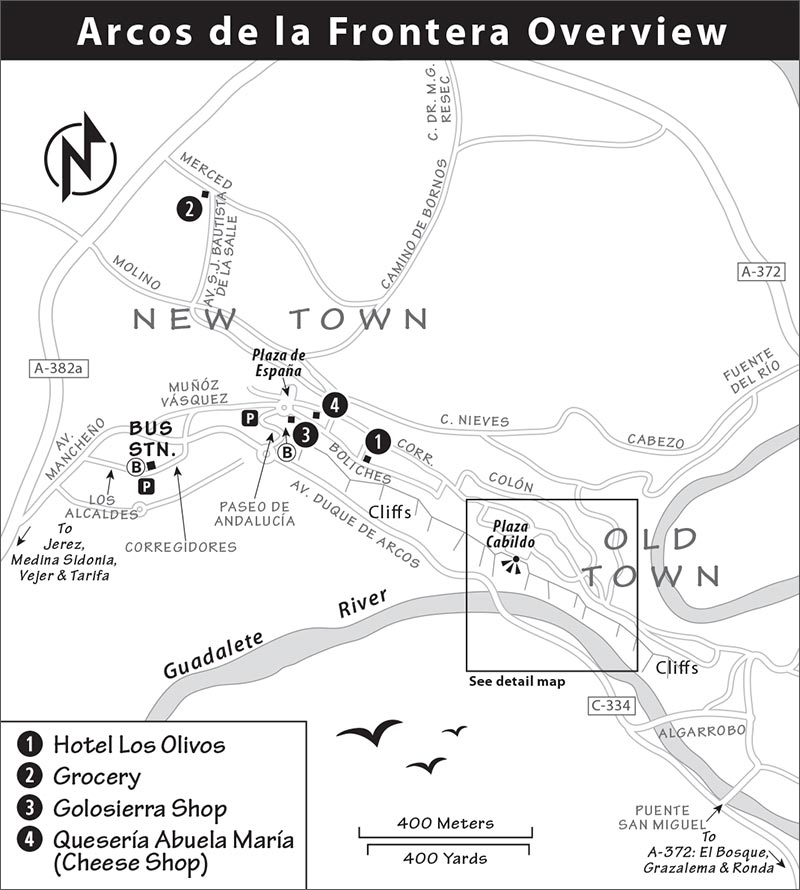
Map: Arcos de la Frontera Overview
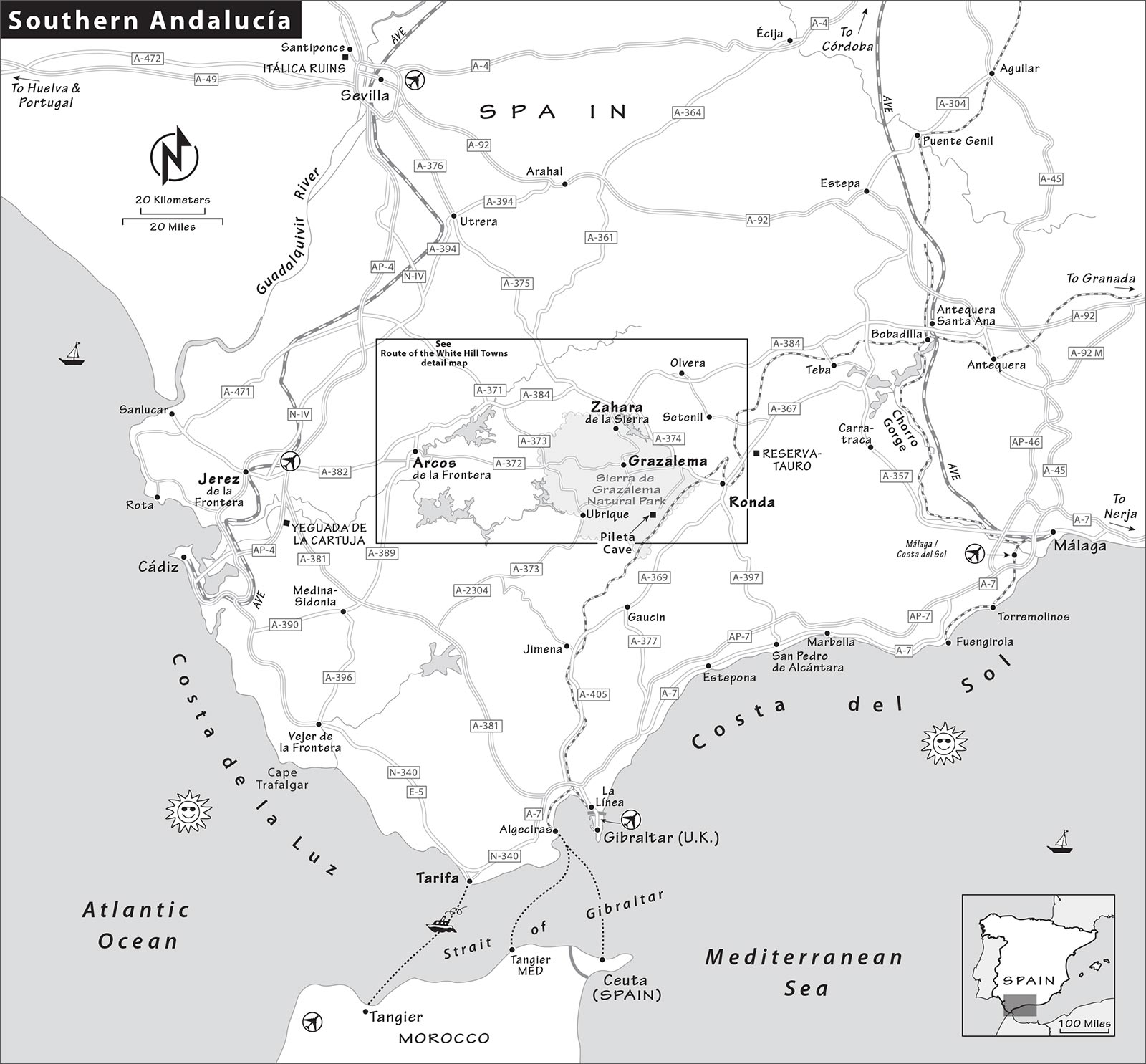
Map: Route of the White Hill Towns
Just as the American image of Germany is Bavaria, the Yankee dream of Spain is Andalucía. This is the home of bullfights, flamenco, gazpacho, pristine whitewashed hill towns, and glamorous Mediterranean resorts. The big cities of Andalucía (Granada, Sevilla, and Córdoba) and the south coast (Costa del Sol) are covered in separate chapters. This chapter explores Andalucía’s hill-town highlights.
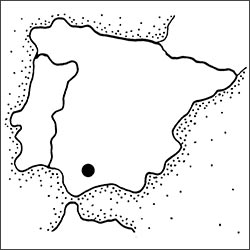
The Route of the White Hill Towns (Ruta de los Pueblos Blancos), Andalucía’s charm bracelet of cute villages perched in the sierras, gives you wonderfully traditional Spanish culture. The most substantial and entertaining home base is Ronda, which stuns visitors with its breathtaking setting—straddling a gorge that thrusts deep into the Andalusian bedrock. Ronda’s venerable old bullring, smattering of enjoyable sights, and thriving tapas scene round out its appeal. Or, for something quieter and more exotic, spend a night in the romantic queen of the white towns, Arcos de la Frontera. (Towns with “de la Frontera” in their names were established on the front line of the centuries-long fight to recapture Spain from the Muslims, who were slowly pushed back into Africa.) Smaller hill towns, such as Zahara and Grazalema, offer plenty of beauty. As a whole, the hill towns—no longer strategic, or on any frontier—are now just passing time peacefully. Except for the cruise groups that wash in from Costa del Sol resorts like the tide, these towns feel a bit bypassed and mysterious.
West of the hill towns, the city of Jerez de la Frontera—teeming with traffic and lacking in charm—is worth a peek for its famous dancing horses and a glass of sherry on a bodega tour.
PLANNING YOUR TIME
On a three-week vacation in Spain, Andalucía’s hill towns are worth at least two nights and one day. Ronda (bigger and with more going on) or Arcos (smaller and sleepier) make the best home bases. Ronda is closer to the Costa del Sol. Arcos is closer to Jerez, and conveniently situated halfway between Sevilla and Tarifa.
Ronda can keep you busy for an entire day. Arcos can be experienced in an evening. You could spend a day hopping from town to town in the more remote interior (including Grazalema and Zahara). See Jerez on your way in or out.
Unlike most hill towns, Arcos, Jerez, and Ronda are conveniently reached by public transportation: They have bus connections with surrounding towns, and Ronda is on a train line.
HELPFUL HINTS
Useful Website: Visit Andalucia.com for information on festivals, museums, nightlife, and sports in the region.
When to Go: Spring and fall are high season throughout this area. In summer you’ll encounter intense heat, but empty hotels, lower prices, and no crowds.
Local Guides: Two good roving guides can take you around the region. Contact Silverio Ruiz (+34 639 641 831, silverio.ruiz@gmail.com) or Mari Carmen Soto (+34 722 566 438, tuguiaencadiz@gmail.com).
Arcos de la Frontera
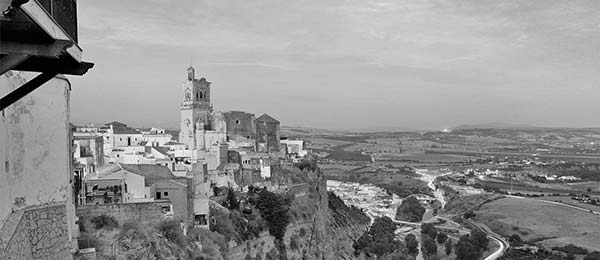
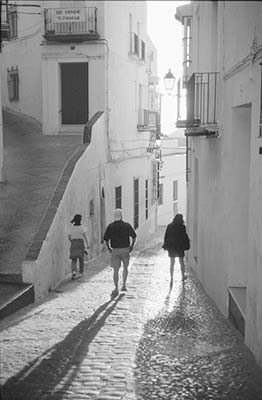
Arcos smothers its long, narrow hilltop and tumbles down the back of the ridge like the train of a wedding dress. It’s larger than most other Andalusian hill towns, but equally atmospheric. The old center is a labyrinthine wonderland, a photographer’s feast. Viewpoint-hop through town. Feel the wind funnel through the narrow streets as cars inch around tight corners. Join the kids’ soccer game on the churchyard patio. Enjoy the moonlit view from the main square.
Though it tries, Arcos is low energy. It has little to offer other than its basic whitewashed self. The locally produced English guidebook on Arcos waxes poetic and at length about very little. You can arrive late and leave early and still see it all.
Orientation to Arcos
Arcos consists of two parts: the fairy-tale old town on top of the hill, and the more commercial lower, or new, town. Of the city’s 30,000 or so residents, only about 10 percent lives in the old town.
Tourist Information: The main TI is on the skinny one-way road leading up into the old town (Sun-Tue 10:00-14:00, Wed-Fri 10:00-14:00 & 16:30-19:30, Sat 16:30-19:30, Cuesta de Belén 5, +34 956 702 264, www.turismoarcos.com). A model in their little museum room shows Arcos (in Latin, Arx Arcis—“high fortress”) as it was in 1264 when the Christian Reconquista forces retook it from the Moors.
ARRIVAL IN ARCOS
Whether you’re traveling by bus or by car, you’ll arrive at the foot of the hill, in the new town.
By Bus: The bus station is on Calle Corregidores. For details on how to reach the old town from here, see below.
By Car: Don’t expect to bring your car into the old town; cars are effectively banned from the old town, except for some local vehicles. (Arcos’ streets are famously narrow, and city walls get scratched by out-of-towners who miscalculate the width of their car.) Drivers must park at the bottom of the hill in the new town. There are two options: the big, free lot across from the bus station on Calle Corregidores; or the Parking El Paseo underground garage, just off Plaza de España (many hotels offer a discount-stamped parking ticket).
Getting to the Old Town: To get up to the old town, catch the shuttle bus (marked Centro) from the bus stalls behind the bus station. Tell the driver the name of your hotel, and they’ll bring you to the closest stop (€1, pay driver, generally departs around :15 and :45 past the hour, runs roughly Mon-Fri 7:45-21:15, Sat until 14:15, none on Sun). Alternately, get a taxi (about €6; if none are waiting, call +34 956 704 640), or hike 15 minutes uphill.
HELPFUL HINTS
Money: There are no ATMs in the old town. You’ll find several ATMs in the new town along Calle Corredera and on Plaza de España.
Groceries: You’ll find smaller stores with a basic selection of groceries in the old town or close to the TI. For a bigger grocery store, head to the Mercadona in the new town (Mon-Sat 9:00-21:30, closed Sun, Avenida San Juan Bautista de la Salle).
Gifty Edibles: Golosierra is a good spot for edible souvenirs from this region. You’ll find a fine selection of cheeses, sausages, honey, olive oil, sweets, and wine (daily, in the new town at the top of Plaza de España at #3, near the bus station). To pick up some Andalusian Payoyo cheese, produced in nearby Grazalema, stop by the Quesería Abuela María (Grandma Mary’s Cheese Shop), just up from Plaza de España (near the taxis at Calle Debajo del Corral 5).
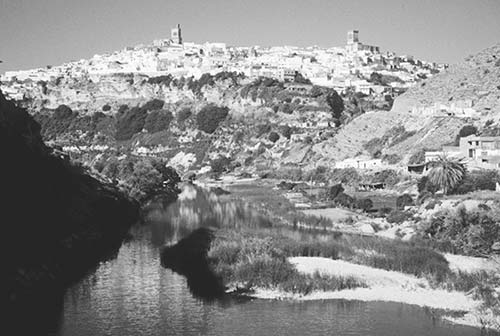
Views: If you’re driving to Arcos from the east (along highway A-372), you’ll enjoy lovely views of the town as you approach. In the old town, there are some fine viewpoints (for instance, from the main square, Plaza del Cabildo), and from the top of the Church of Santa María tower.
GETTING AROUND ARCOS
Shuttle Bus Joyride: For a fun (and air-conditioned) introduction to Arcos, take a 30-minute jaunt on the shuttle bus (marked Centro)—the same one that brings travelers up to the old town. This circular ramble is perhaps the best euro you can spend in Arcos. The shuttle constantly circles through the town’s one-way streets and around the valley (€1, pay driver). You can catch it in the new town (at the Plaza de España bus stop, departs around :15 and :45 past the hour—a few minutes after the shuttle stops behind the bus station) or at one of two stops in the old town: in front of the Church of Santa María (generally departs at :20 and :50 past the hour) or on Plaza Boticas.
Sitting in the front seat offers the best view of the tight squeezes down narrow streets and school kids hanging out in plazas. Rambling past car-scratched walls, ancient Roman corner pillars actually doing their work, and down steep whitewashed lanes, you’ll be glad you’re not driving. After passing under a Moorish gate, you enter a modern residential neighborhood, and suddenly it’s clear that the old town is nearly dead, and life is now in the more livable, car-friendly, and affordable suburbs. You’ll circle under the eroding cliff and return to the old town by way of the bus station and Plaza de España. If you get off at the Church of Santa María, you’re steps away from the start of my Arcos Old Town Walk, next.
Arcos Old Town Walk
This self-guided walk will introduce you to virtually everything worth seeing in Arcos. (Avoid this walk during the hot midday siesta.)
• Start at the top of the hill, in the main square dominated by the church.
Plaza del Cabildo
Stand at the viewpoint opposite the church on the town’s main square. Survey the square, which in the old days doubled as a bullring. On your right is the parador, a former palace of the governor (now one of my recommended hotels). It flies three flags: green for Andalucía, red and yellow for Spain, and blue and yellow for the European Union. On your left is City Hall, below the 11th-century Moorish castle where Ferdinand and Isabel held Reconquista strategy meetings (castle privately owned and closed to the public).
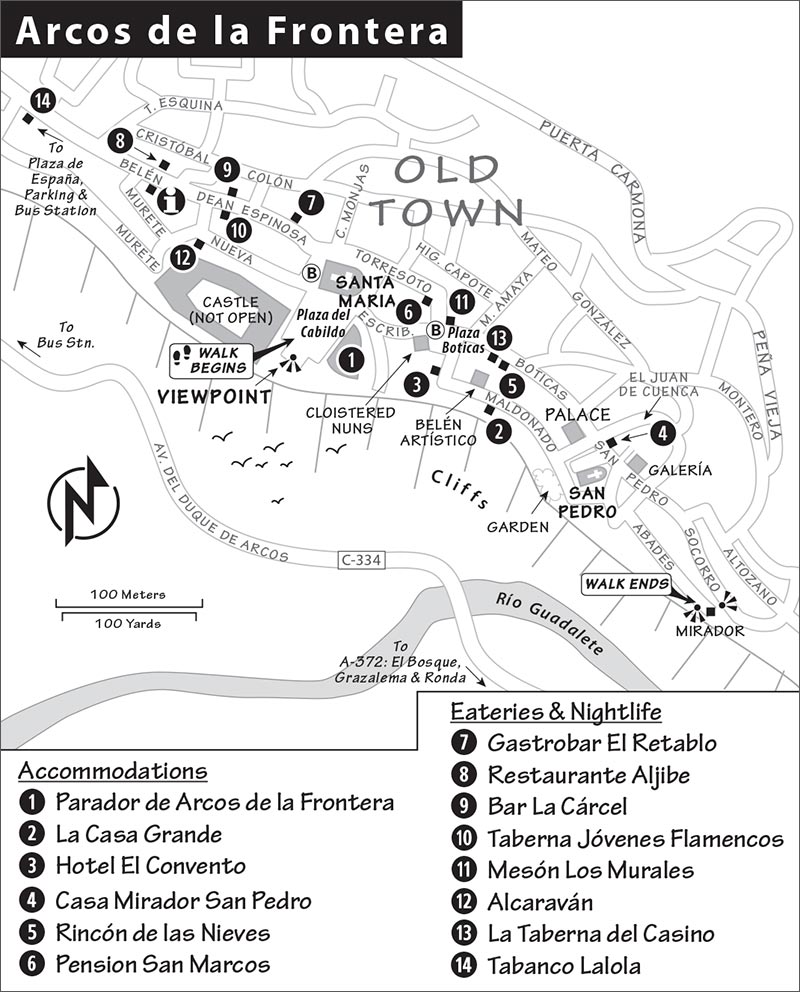
Now belly up to the railing and look down at the dramatic view. The people of Arcos boast that only they see the backs of birds as they fly. Ponder the parador’s erosion concerns (it lost part of its lounge in the 1990s when it dropped right off), the orderly orange groves, and the fine views toward the southernmost part of Spain. You’re 300 feet above the Guadalete River. (The parador’s wonderful terrace is open only to customers; thankfully, drinks are cheap.)
• Looming over the square is the...
Church of Santa María
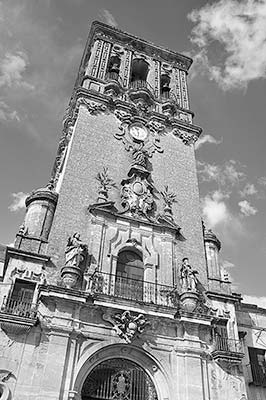
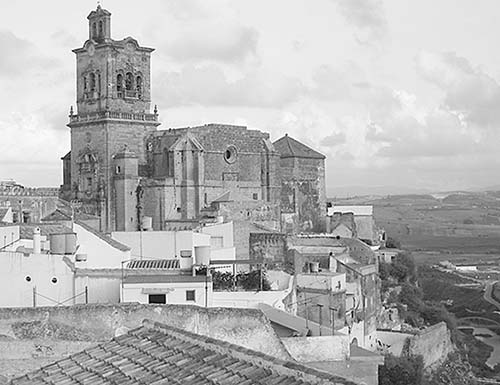
After Arcos was retaken from the Moors in the 13th century, this church was built atop a mosque. Notice the church’s fine but chopped-off bell tower. The old one fell in the earthquake of 1755 (famous for destroying Lisbon). The replacement was intended to be the tallest in Andalucía after Sevilla’s, but money ran out. It looks like someone lives on an upper floor. Until recently, someone did: It was the bell-ringing church guardian.
Cost and Hours: Church—€2; Tue-Sat 11:15-13:30 & 16:30-18:30, Sun from 9:30 (but no tower access; church closed to public during Mass), shorter hours in winter, closed Mon year-round. The church tower (€2) is accessed from the square, through a small door next to the church’s main entrance. The climb rewards you with big bells and a big view, but little more.
Visiting the Church: The interior bursts with decoration for such a small space. Work your way between the pews to examine the beautifully carved choir. Its organ was built in 1789 with that many pipes. The Renaissance high altar, carved in wood, covers up a Muslim prayer niche that survived from the original mosque. The altar shows God with a globe in his hand (on top), and scenes from the life of Jesus (on the right) and Mary (left). On the left wall past the altar is a fine surviving 14th-century Andalusian Gothic fresco.
Continue circling the church and notice the elaborate chapels. Although most of the architecture is Gothic, the chapels are decorated in the Baroque and Rococo styles that were popular when the post-earthquake remodel began. The ornate statues are used in Holy Week processions (a big deal in Arcos). Sniff out the “incorruptible body” (miraculously never rotting) of St. Felix—a third-century martyr (directly across from the entry). Felix may be nicknamed “the incorruptible,” but take a close look at his knee. He’s no longer skin and bones...just bones and the fine silver mesh that once covered his skin. Rome sent his body here in 1764, after recognizing this church as the most important in Arcos. In the back of the church, near a huge fresco of St. Christopher (carrying his staff and Baby Jesus), is a gnarly Easter candle from 1767.
• Back outside, circle clockwise around the church and examine the church exterior.
Down four steps, find the third-century Roman votive altar with a carving of the palm tree of life directly in front of you. Though the Romans didn’t build this high in the mountains, they did have a town and temple at the foot of Arcos. This carved stone was discovered in the foundation of the original Moorish mosque that once stood here. This has long been considered a fertility stone (women would come here to help with pregnancy).
Head down a few more steps and come to the west portal (technically the main entrance) of the church (always closed). This facade is a good example of Plateresque Gothic—Spain’s last and most ornate kind of Gothic.
In the cobblestones at your feet, notice the 15th-century “magic” circle with 12 red and 12 white stones—the white ones have various “constellations” marked. When a child would come to the church to be baptized, the parents stopped here first for a good Christian exorcism. The exorcist would stand inside the protective circle and cleanse the baby of any evil spirits. While locals no longer do this (and a modern rain drain now marks the center), many Sufi Muslims still come here in a kind of pilgrimage every November. (Down a few more steps, you can catch the public shuttle bus for a circular joyride through Arcos; see “Getting Around Arcos,” earlier.)
Go down the next few stairs to the street and circle right, passing a sweet little bakery. Peer down the next narrow path to the left, called Cuesta de las Monjas. The security grilles over the windows above protected cloistered nuns when this building was a convent. Look at the arches that prop up the houses downhill; all over town, arches support earthquake-damaged structures.
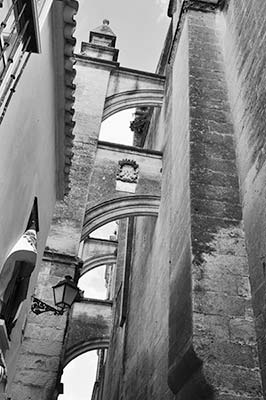
Continue straight under the flying buttresses. Notice the scratches of innumerable car mirrors on each wall (and be glad you’re walking). The buttresses were built to shore up the church when it was damaged by an earthquake in 1699. (Thanks to these supports, most of the church survived the bigger earthquake of 1755.)
• Now make your way from...
Santa María to the Church of San Pedro
Completing your circle around the Church of Santa María (huffing back uphill), turn left under more arches built to repair earthquake damage and walk east down the bright, white Calle Escribanos. (This “Street of the Scribes” was where people went to have something written or read to them, back in a time when most were illiterate.) Although the street changes names, you’ll basically follow this lane until you come to the town’s second big church (San Pedro).
After a block, you hit Plaza Boticas. On your right is the last remaining convent in Arcos. Notice the no-nunsense, spiky window grilles high above, with tiny peepholes in the latticework for the cloistered nuns to see through. If you’re hungry, check out the list and photos of the treats the nuns make. Then step into the foyer under the fine portico to find their one-way mirror and a spinning cupboard that hides the nuns from view. Push the buzzer, and one of the eight sisters (several are from Kenya and speak English well) will spin out some boxes of excellent, freshly baked cookies—made from pine nuts, peanuts, almonds, and other nuts—for you to consider (€8, usually open daily until 19:00; be careful—if you stand big and tall to block out the light, you might see the sister through the glass). If you ask for magdalenas, bags of cupcakes will swing around (€5). These are traditional goodies made from natural ingredients. Buy some treats to support their church work and give them to kids as you complete your walk.
• As you exit the convent, turn right, then right again down Calle Boticas. But first, consider side-tripping down the lane on the right (Calle Olivares Veas). After about 100 yards, you’ll pass Hotel El Convento, then come to a little cave-like museum, Belén Artístico. The museum highlights the popular Spanish tradition of creating nativity scenes using miniature figures (free, but donations accepted, daily 10:30-13:30). Just beyond the museum, at #13, you might catch a glimpse of José at work on his basket weaving. Now head back to Calle Boticas and turn right.
Be on the lookout for ancient columns tucked into building corners. All over town, these columns—many actually Roman, appropriated from their original ancient settlement at the foot of the hill—were put up to protect buildings from reckless donkey carts.
As you continue straight, notice that the walls are scooped out on either side of the windows. These are a reminder of the days when women stayed inside but wanted the best possible view of any action in the streets. In that more restrictive age, these “window ears” also enabled suitors to lean inconspicuously against the wall to chat up eligible young ladies.
Across from the old chapel facade ahead, find the Palacio del Mayorazgo, which houses the Association of San Miguel. Step inside, passing a bar where the old guys hang out. The bar is a club for retired men—always buzzing when a bullfight’s on TV or during card games. The guys are friendly, and drinks and tapas are cheap (public WC, bar open Mon-Sat until 15:00, closed Sun). There’s no Wi-Fi, as this bar believes connectivity is best with beer. Past the bar, you’ll step into one of the oldest courtyards in town. Standing here, you can still see the graceful Neo-Gothic lines of this noble home from 1850. Explore the web of exhibits that surround the courtyard, including old Arcos photos, a look at the region’s many renowned writers who were inspired by Arcos, and memories of the Civil War. Stairs lead down to a small garden. This is an Andalusian garden, with a formal Arabic style; aromatic plants such as jasmine, rose, and lavender; and water in the center.
• Exit the way you came. Across the small square (facing the elegant front door of Palacio del Mayorazgo), is Arcos’ second church...
Church of San Pedro
Enter through the small door to the left of the main entrance (€2, same hours as Church of Santa María). You know it’s the Church of San Pedro because San Pedro, mother of God, is the centerpiece of the facade. Let me explain. This really is the town’s second church, having had an extended battle with Santa María for papal recognition as the leading church in Arcos. When the pope finally favored Santa María (he declared it a minor basilica in 1993), San Pedro’s parishioners changed their prayers. Rather than honoring “María,” they wouldn’t even say her name. They prayed to “San Pedro, mother of God.” Like Santa María, it’s a Gothic structure, filled with Baroque decor (including a stunning organ teeming with cherubs), many Holy Week procession statues, and humble English descriptions. Santa María may have won papal recognition, but this church has more relic skeletons in glass caskets (flanking both sides of the main altar are St. Fructuoso and St. Víctor, martyrs from the third century). The music stand in the choir illustrates how the entire chorus can sing from just four hymnals.
• Back outside, explore the area’s...
Back Lanes, Artisan Workshop, and Viewpoint
In the cool of the evening, the tiny square in front of the church—about the only flat spot around—serves as the old-town soccer field for neighborhood kids. This church once had a resident bellman—notice the cozy balcony halfway up. He was a basket-maker and a colorful character, famous for bringing a donkey into his quarters that grew too big to get back out. Finally, he had no choice but to kill and eat the donkey.
Twenty yards beyond the church, step into the welcoming little Galería de Arte San Pedro, featuring artisans in action and their reasonably priced paintings, engravings, and pottery (daily).
Crossing behind the church to the next lane (Calle Abades), signs direct you to a mirador—a tiny square 100 yards downhill that affords a commanding view of Arcos. The reservoir you see to the northeast of town is used for water sports in the summertime. Modern windmills blink along the horizon at night. Relax on a bench and take in this spectacular view.
• Your old town walk is over. While you could wander the side lanes to peek into flower-bedecked patios with tiny wells and decorative pulleys, you won’t see much activity. Today, the vast majority of the old town’s residents has moved out, replaced by short-term tenants (like Airbnb travelers) that bring in more profit for landlords. Consequently, nearly all the commercial activity along the main drag caters to visitors, and these lanes downhill are like a dead coral reef—most poignant for visitors nostalgic for Arcos’ more vibrant past.
Nightlife in Arcos
Arcos is a quiet town. When I ask locals about nightlife, they say, “We sleep.” But you’ll find a tiny pulse of nocturnal energy here and there, especially in the new town. Bars hover around Plaza de España (15-minute walk from the old town), and in the cool of the evening, all generations seem to be out enjoying life.
The old town, by comparison, is pretty quiet after hours—but a few spots stand out. On weekends, Alcaraván’s outdoor tables cascade down the hill beneath City Hall, and locals duck into its cozy, vaulted-ceiling interior (closed Mon-Thu). Between the town’s two churches, along Calle Boticas, La Taberna del Casino has a breezy patio, cheap drinks, and a lively atmosphere (daily until late). And at the base of the old town, Tabanco Lalola—down the hill, past the TI at Corredera 11—is great for drinks, tapas, and “Flamenquito” Fridays with a guitarist and cajón player (closed Mon).
Sleeping in Arcos
Hotels in Arcos consider April, May, August, September, and October to be high season. Note that some hotels double their rates during the motorbike races in nearby Jerez de la Frontera (usually April or May) and during Holy Week before Easter. All hotels have air-conditioning, but only the parador has an elevator.
IN THE OLD TOWN
Drivers can’t drive into the old town; you’ll need to park down the hill in the new town (see “Arrival in Arcos,” earlier).
$$ Parador de Arcos de la Frontera is royally located, with 23 reasonably priced rooms and plenty of old-world elegance (eight have balconies). The terraces offer splendid views of the town and the valley below (Plaza del Cabildo, +34 956 700 500, https://paradores.es, arcos@parador.es).
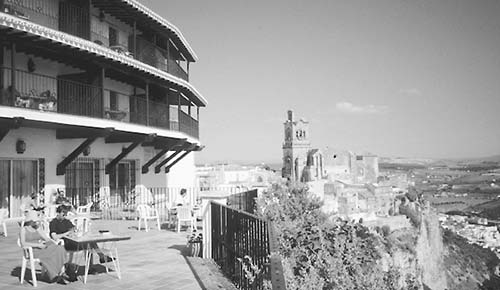
$$ La Casa Grande is a lovingly appointed Better Homes and Moroccan Tiles kind of place with artsy flair. Its eight rooms have big-view windows. You’re free to enjoy its fine view terrace and homey library or have a traditional breakfast (extra) on the atrium-like patio. They also offer massage services (family rooms, Wi-Fi in public areas only, Maldonado 10, +34 956 703 930, www.lacasagrande.net, info@lacasagrande.net, Elena and Estefania).
$ Hotel El Convento, deep in the old town just beyond the parador, is the best value in town. Run by a hardworking family and their wonderful staff, this cozy hotel offers 13 delicately romantic rooms—all with great views, most with balconies. In 1998 I enjoyed a big party here with most of Arcos’ big shots as they dedicated a fine room with a grand view balcony to “Rick Steves, Periodista Turístico.” Guess where I sleep when in Arcos...(RS%, communal terrace, usually closed Nov-Feb, Maldonado 2, +34 956 702 333, www.hotelelconvento.es, reservas@hotelelconvento.es, Maria José and her daughter, Sofia).
$ Casa Mirador San Pedro, in the shadow of the Church of San Pedro, has seven rustically cozy rooms and a whimsical rooftop terrace with great Arcos views. The windows are single pane, but the street noise quiets down in the evening (apartment available, El Juan de Cuenca 2—around the corner from Taberna San Pedro, +34 635 189 005, miradorjuandecuenca@hotmail.com).
$ Rincón de las Nieves, with simple Andalusian charm, has a cool inner courtyard filled with plants and ceramics surrounded by three rooms. Two rooms have their own outdoor terraces with obstructed views, and all have high ceilings and access to a rewarding rooftop terrace (the highest in town) with nearly 360-degree views (Boticas 10, also rents an apartment, +34 956 701 528 or +34 656 886 256, www.rincondelasnieves.com [URL inactive], rincondelasnieves@gmail.com, Paqui).
¢ Pensión San Marcos, above a neat little bar in the heart of the old town, offers five rooms and a great sun terrace with views of the reservoir (Marqués de Torresoto 6, +34 956 105 429 or +34 675 459 106, www.pensionsanmarcosdearcos.es, sanmarcosdearcos@hotmail.com, José Luis speaks some English).
IN THE NEW TOWN
For location, see the “Arcos de la Frontera Overview” map, earlier.
$ Hotel Los Olivos is a bright, cool, and airy place with 19 rooms, an impressive courtyard, roof garden, generous public spaces, bar, view, friendly folks, and easy pay parking. The four view rooms can be a bit noisy in the afternoon, but—with double-pane windows—are usually fine at night (RS%, includes breakfast, Paseo de Boliches 30, +34 956 700 811, www.hotel-losolivos.es, reservas@hotel-losolivos.es, lovingly run by Raquel, Marta, and Maria José).
Eating in Arcos
FINE DINING IN THE OLD TOWN
$$$ The Parador (described earlier, under “Sleeping in Arcos”) serves traditional Andalusian plates in its formal restaurant with a cliff-edge setting. Even though it’s by far the stuffiest and fanciest place in town, its prices are in line with those of its neighbors. Even just a drink and a snack on the million-dollar-view terrace at sunset is a nice experience (daily, reservations smart for dining room, no reservations needed for terrace, on Plaza del Cabildo, +34 956 700 500, https://paradores.es).
$$$ Gastrobar El Retablo has earned a reputation for great dining. Chef Antonio José Armario trained in coastal restaurants, which explains his fun and creative daily “suggestions of the chef.” Tuna—either crudo or grilled—and creamy cod dishes are a hit whether enjoyed inside or at streetside tables. Cristina makes sure diners are well cared for (closed Tue, reservations smart, Calle Dean Espinosa 6, +34 856 041 614, https://gastrobarelretablo.com).
$$$ Restaurante Aljibe takes diners farther south with romantic Moroccan ambience under Spanish chandeliers. The aromatic tajines and couscous are made with Andalusian ingredients (closed Tue, reservations smart, Carretera de Belén 10, +34 622 836 527, www.restauranteelaljibe.es).
CHEAPER EATS IN THE OLD TOWN
Several decent bar-restaurants are in the old town, within a block or two of the main square, and serve tapas and raciones. At the first two places, you’ll eat on a sleepy street, and at the third place, you’ll dine right on a square.
$$ Bar La Cárcel (“The Prison”) celebrates seafood and creative dishes with a friendly, attentive staff (closed Mon, Calle Dean Espinosa 18, +34 956 700 410).
$$ Taberna Jóvenes Flamencos offers a fun and accessible menu and is high energy for Arcos, with more outdoor tables than my other listings. Try their specialties—abajao, an egg-and-asparagus dish, and perolitos, an egg scramble in a minipan (closed Wed, Calle Dean Espinosa 11, +34 657 133 552).
$$ Mesón Los Murales is the best place on delightful Plaza Boticas. Savor their tasty, affordable tapas, raciones, and fixed-price meals in their simple bar or at tables in the square outside. Hardworking Manolo is proud of his fresh meat. Don’t confuse his place with the competition next door (closed Thu, Plaza Boticas 1, +34 678 064 163).
Arcos Connections
You’ll travel to and from Arcos by bus, taxi/Uber, or car. The closest train station to Arcos is in Jerez.
BY BUS
Be aware that Arcos’ bus station is unstaffed. Look up schedules in advance; you can assume there’s always an empty seat (just pay the driver when you board). Buses are often late, and departures are fewer on weekends.
Two bus companies—Damas and Comes—share Arcos. Check schedules online—or ask your hotelier or the TI for help (Damas, www.damas-sa.es; Comes, www.tgcomes.es). Also try Movelia.es for bus schedules and routes.
From Arcos by Bus to: Jerez (hourly, 45 minutes, Damas), Ronda (1/day, 2 hours, Comes), Sevilla (2/day, 2 hours, more departures with transfer in Jerez, Damas).
BY TAXI OR UBER
Public transportation options are sparse between towns, but taxis can be a good value here. From Arcos, you can taxi to Jerez (€50), Ronda (€110), or Sevilla (€120). While there’s no Uber service in the smaller towns, it’s easy to Uber between Arcos and Sevilla.
ROUTE TIPS FOR DRIVERS
Arcos to Sevilla (55 miles/90 km): The trip to Sevilla takes about 1.5 hours, mostly on highways A-393, E-5, and A-4. To continue to southern Portugal, follow the freeway to Sevilla, and skirt the city by turning west on the SE-30 ring road in the direction of Huelva. It’s a straight shot from there on A-49/E-1.
Arcos to Tarifa (80 miles/130 km): If you’re going to Tarifa, take the tiny A-389 road at the Jerez edge of Arcos toward Paterna and Medina Sidonia, where you’ll pick up A-381 to Algeciras, then on to Tarifa. Another option is to continue through Medina Sidonia to Vejer on A-396, from where you can cut south to Tarifa.
Ronda
With more than 34,000 people, Ronda is one of the largest white hill towns. It’s also one of the most spectacular, thanks to its gorge-straddling setting.
Approaching the town from the train or bus station, it seems flat...until you reach the New Bridge and realize that it’s clinging to the walls of a canyon. During Moorish times, this was a tight fortified town of 9,000—a bastion second only to Granada during the last years of Moorish rule in southern Spain. (It fell to Christian forces only in 1485—seven years before Granada.) The cliffside setting is now more inspirational than practical, and the old town remains home to only about 1,000 people.
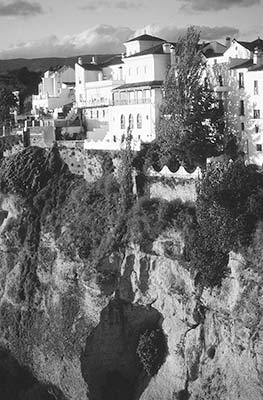
Ronda’s main attractions are its gorge-spanning bridges, the oldest bullring in Spain, and an intriguing old town. Spaniards know Ronda as the cradle of modern bullfighting and the romantic home of 19th-century bandoleros (bandits). But the real joy of Ronda these days lies in exploring its back streets and taking in its beautiful balconies, exuberant flowerpots, wispy gardens, and panoramic views. Walking the streets, you feel a strong local pride and a community where everyone seems to know everyone.
While day-trippers from cruise ships and the touristy Costa del Sol clog Ronda’s streets during the day, locals retake the town in the early evening, making nights peaceful. Since it’s served by train and bus, Ronda makes a relaxing break for nondrivers traveling between Granada, Sevilla, and Córdoba. Drivers can use Ronda as a convenient base from which to explore many of the other pueblos blancos.
Orientation to Ronda
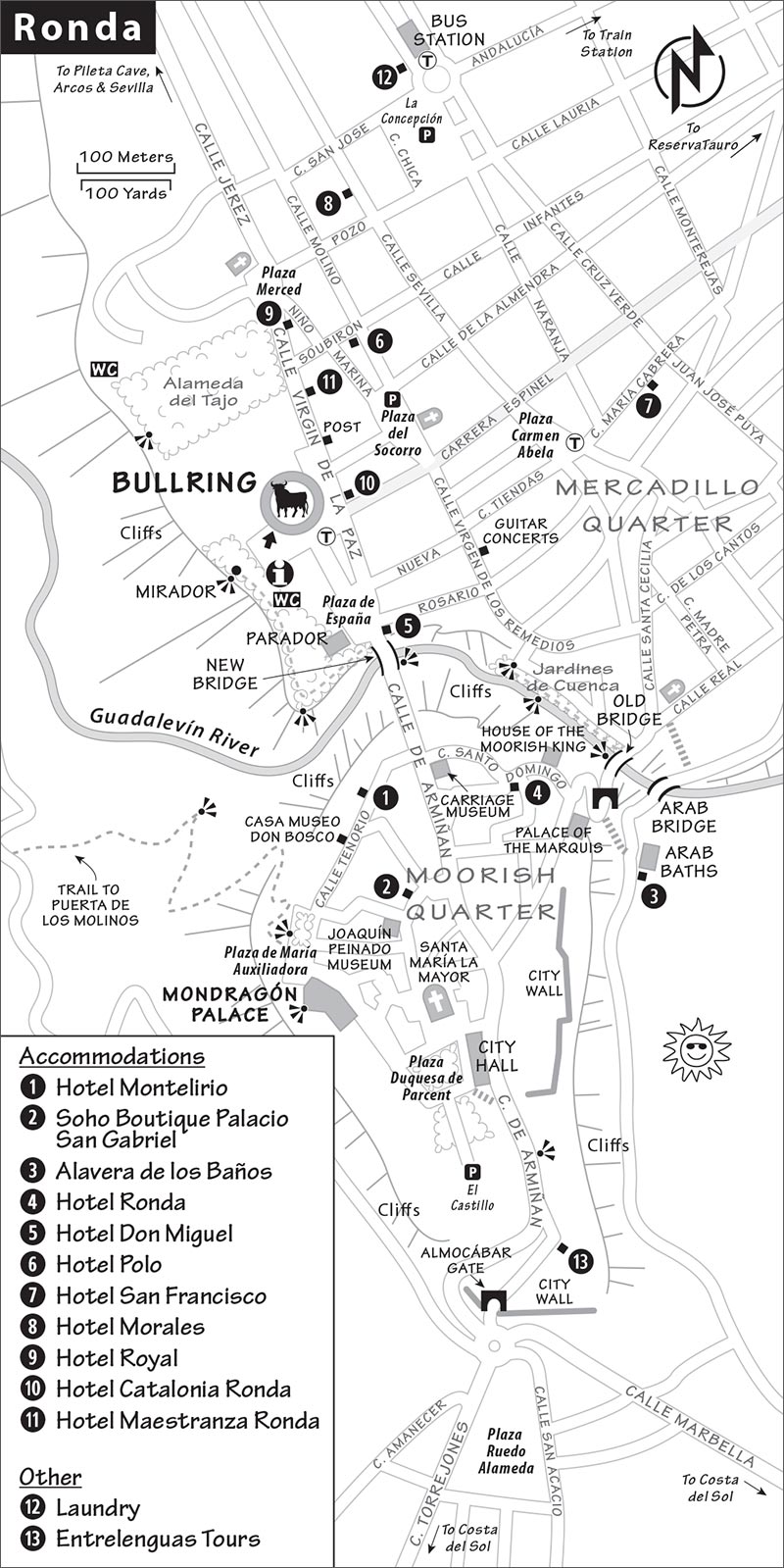
Ronda’s breathtaking ravine divides the town’s labyrinthine Moorish quarter (the old town) and its newer, noisier, and more sprawling Mercadillo quarter (the new town). A massive-yet-graceful 18th-century bridge connects these two neighborhoods. Most things of touristic importance (TI, hotels, bullring) are clustered within a few blocks of the bridge. The paseo (early evening stroll) happens in the new town, on Ronda’s major pedestrian and shopping street, Carrera Espinel.
TOURIST INFORMATION
Ronda’s hardworking TI, across the square from the bullring, covers the town—and all of Andalucía. It gives out good, free maps of the town, the region’s roads, Granada, Sevilla, and the Route of the White Towns. The TI also organizes tours, concerts, and walks, all described in helpful lists (Mon-Fri 9:30-19:00, Sat until 18:00, Sun until 15:00, shorter hours off-season, Paseo Blas Infante, +34 952 187 119, www.turismoderonda.es).
Sightseeing Pass: The Bono Turístico city pass is generally only worth purchasing if you want to see absolutely everything in Ronda. It comes in two price tiers (€12 for 6 sights, and €25 for 10 sights) and gets you into many sights, including the Arab Baths, Joaquín Peinado Museum, Carriage Museum, Casa Museo Don Bosco, and Mondragón Palace. It’s sold at the TI and at participating sights. Keep in mind that individual admission to all the included sights that I recommend totals only about €20.
ARRIVAL IN RONDA
By Train: The small train station has ticket windows, an information desk, and a café, but no lockers (though you will find them at the nearby bus station; see “Helpful Hints,” later).
From the station, it’s a 15-minute walk to the center: Exit the station, turn right onto Avenida de Andalucía, and walk to the large roundabout (you’ll see the bus station on your right). Continue straight down Calle San José until you reach Calle Jerez. Turn left and walk downhill past a church and the Alameda del Tajo park. Keep going, passing the bullring, to reach the TI and the famous bridge.
By Bus: To get to the center from the bus station, leave the station walking to the right of the roundabout, then follow the directions for train travelers described above. Baggage storage is available (see “Helpful Hints,” later).
By Car: Street parking away from the center is often free. The handiest place for paid parking is the underground lot at Plaza del Socorro (one block from the bullring). Narrow lanes and tight turns can be challenging for even medium-size vehicles, and some access is restricted for nonresidents. Get driving and parking instructions from your hotel.
HELPFUL HINTS
Baggage Storage: A few coin-fed lockers are available in the bus station, across from the WC.
Laundry: Next to the bus station, Nature Lavandería has a bank of self-service, coin-op machines (long hours daily, Calle Comandante Salvador Carrasco 9, +34 744 625 236).
Souvenirs: Grabados Somera, a printmaking studio near the New Bridge, is worth a browse. Their charming prints and colorized engravings of Ronda’s iconic scenery and famous bulls are hand-pulled right in their shop (cash only, daily 10:30-14:30 & 16:00-19:00, Calle Rosario 4).
Tours in Ronda
Walking Tours
Local guides work in conjunction with the TI to offer 1.5-hour city walks (€10, Mon-Thu at 12:30, also at 17:00 or 18:00 in summer). Reserve, pay, and start at the TI.
Entrelenguas is a cultural center in Ronda that offers much more than Spanish language lessons. Mar and her team guide visitors around Ronda, focusing on monuments, cultural immersion, and local businesses—with as much (or as little) Spanish as you’d like. They can also put together a cooking class for small groups (tours from €65, Calle Espíritu Santo 9, +34 951 083 862, www.slowronda.com, info@entrelenguas.com).
Local Guide
Energetic and knowledgeable Antonio Jesús Naranjo will take you on a private 2.5-hour walking tour of the city’s sights for €145 (+34 639 073 763, guiajesus@yahoo.es).
Sights in and near Ronda
NEW TOWN
Alameda del Tajo Park
One block away from the bullring, the town’s main park is a great place for a picnic lunch, people-watching, a snooze in the shade, or practicing your Spanish with seniors from the nearby old-folks’ home. Belly up to the tiny view terrace, which overlooks the scenic Serranía de Ronda mountains—and a drop of about 600 feet...straight down.
▲▲Bullring (Real Maestranza de Caballería de Ronda)
Ronda is the birthplace of modern bullfighting, and this was the first great Spanish bullring (completed in 1785). Philip II initiated bullfighting as war training for knights in the 16th century. Back then, there were two kinds of bullfighting: one featuring noble knights on horseback, and the other a coarser, man-versus-beast entertainment for the commoners (with no rules...think WWE wrestlers bringing out the folding chairs). Ronda practically worships Francisco Romero, who christened the bullring in 1785, melding the noble and chaotic kinds of bullfighting with rules to establish modern bullfighting. He introduced the scarlet cape, held unfurled with a stick. His son Juan further developed the ritual (local aficionados would never call it a “sport”; you’ll read newspaper coverage of fights not on the sports pages but in the culture section), and his grandson Pedro was one of the first great matadors (killing nearly 6,000 bulls in his career).
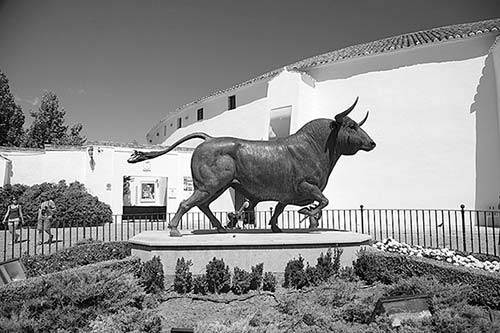
Ronda’s bullring and museum rival Sevilla’s as Spain’s most interesting. To tour them both, buy a ticket at the back of the bullring.
Cost and Hours: €10.50; daily 10:00-20:00, March and Oct until 19:00, Nov-Feb until 18:00, +34 952 874 132, www.rmcr.org. The excellent included audioguide describes everything and is essential to fully enjoy your visit.
Bullfights: Ronda hosts bullfights only one weekend a year—the first weekend of September, during its feria (fair). Whereas every other feria in Andalucía celebrates a patron saint, the Ronda fair glorifies legendary bullfighter Pedro Romero. As these fights are so limited and sell out immediately, Sevilla and Madrid are more practical places for a tourist to see a bullfight.
Visiting the Bullring: As you enter the ring, the bullfighting museum stretches under the stands to your right. To the left is an exhibit about the history of the knights, plus a collection of harnesses and livery. Also to the left, under the royal box, is the tunnel that leads to the bull pens.
Arena: This grandfather of Spain’s bullrings was inaugurated in 1785—on the 300th anniversary of the defeat of the Moors in Ronda. Walk out on the sand (the word “arena” comes from the Latin word for sand). Notice how the 136 classy columns create a kind of 18th-century theater. The ornamental columns and painted doorway on the left mark the royal box where the king and dignitaries sit (over the gate where the bull enters). Lovers of the “art” of bullfighting will explain that the event is much more than the actual killing of the bull. It celebrates noble heritage and Andalusian horse culture. Here’s your chance to play toro, surrounded by 5,000 empty seats. Imagine having to frantically find protection by squeezing behind the wooden bull barriers.
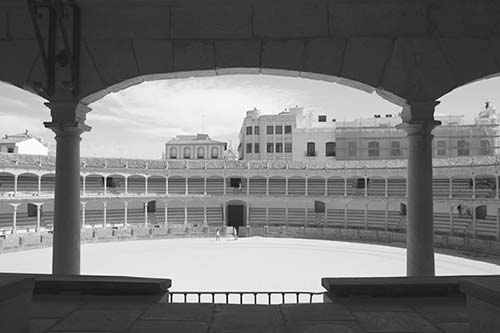
Bullpen: Leave the arena to the left, under the royal box, to explore the bullpen. There are six bulls (plus two backups) and three matadors per fight. Before the fight, the bulls are penned up in this bovine death row. Notice the ropes and pulleys, which safely open the right door at the right time.
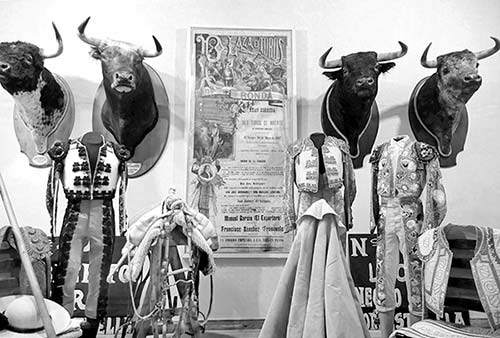
Bullfighting Museum: Return to where you entered the arena. Next to the tiny chapel, the Bullfighting Museum circles counter-clockwise under the seats, exploring the history of bullfighting—from ancient Minoans to its evolution in Spain (from horses and chaos to an orderly artform). Bullfights were held in town squares—you’ll see a painting of Madrid’s Plaza Mayor filled with spectators for a bullfight. (For this reason, even a purpose-built bullring is generally called plaza de toros—“square of bulls.”) You’ll also see stuffed bull heads, photos, “suits of light” worn by bullfighters, and capes (bulls are colorblind, but the traditional red cape was designed to disguise all the blood). One section explains some of the big “dynasties” of fighters. Running along the left wall are various examples of artwork glorifying bullfighting. At the end of the hall are historical posters from Ronda’s bullfights. From the end of the exhibit, you can climb the steps to the highest row of seats for a high-and-wide view of the arena.
La Real Maestranza and Livery Collection: Facing the museum entrance is another exhibit, running clockwise from the arena entrance. This small but worthwhile exhibit details the history of the Royal Institute of Knights of Ronda (La Real Maestranza de Caballería de Ronda, or “RMR”) and hosts a collection of harnesses and livery. The horse gear exhibit makes the connection with bullfighting and the equestrian upper class. As throughout Europe, “chivalry” began as a code among the sophisticated, horse-riding gentry. (In Spanish, the word for “gentleman” is the same as the word for “horseman”—caballero.)
Exiting the arena, back outside, you can circle to the right and stroll to the Mirador de Ronda viewpoint and then walk along the cliffside (behind the parador) to the New Bridge.
▲▲▲The Gorge and New Bridge (Puente Nuevo)
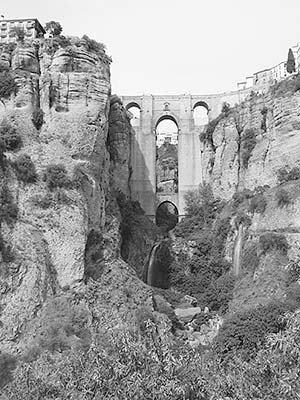
The ravine called El Tajo—over 300 feet deep and just about 200 feet wide—divides Ronda into the whitewashed old city (Moorish Quarter) and the new town (El Mercadillo) that was built after the Christian Reconquista in 1485. The New Bridge mightily spans the gorge. A different bridge was built here in 1735, but it fell after six years. This one was built from 1751 to 1793. Look down from the bridge viewpoint. Spit.
You can see the foundations of the original bridge and a super view of the New Bridge from the walkway between the gorge and the parador—the town’s former Town Hall-turned-hotel—which overlooks the gorge and bridge from the new-town side. (The New Bridge Interpretive Center is just an empty room—not worth the time or money.)
OLD TOWN
▲Church of Santa María la Mayor (Iglesia de Santa María)
This church (built from the 15th to the 17th centuries) has a fine Mudejar bell tower and shares a parklike square with lush orange trees and City Hall. It was built on and around the remains of Moorish Ronda’s main mosque (which was itself built on the site of an ancient Roman temple to Julius Caesar). With a pleasantly eclectic interior that features some art with unusually modern flair, and a good audioguide to explain it all, it’s worth a visit.
Cost and Hours: €4.50, includes helpful audioguide, daily 10:00-20:00, closed Sun 13:00-14:00 for Mass, closes earlier off-season, Plaza Duquesa de Parcent in the old town.
Visiting the Church: In the room where you purchase your ticket, look for the rare surviving door to the Moorish mosque (the mirror helps you see the details of the actual door). The mihrab faced not Mecca, but Gibraltar—where you’d travel to get to Mecca. Partially destroyed by an earthquake, the church was rebuilt with a mix of Gothic, Renaissance, and Baroque styles.
Entering the church, look left and marvel at the magnificent Baroque Altar del Sagrario, with a statue of the Immaculate Conception in the center.
The smaller altar (adjacent on the right) is a good example of Churrigueresque architecture, a kind of Spanish Rococo in which the decoration consumes the architecture—notice that you can hardly make out the souped-up columns. Its fancy decor provides a frame for the artistic highlight of the town, the Dolorosa (“Virgin of the Ultimate Sorrow”), a star of the Holy Week procession here.
The big fresco of St. Christopher with Baby Jesus on his shoulders (left, above the door where you entered) shows the patron saint both of Ronda and of travelers.
Facing the altar is the exterior wall of the choir. It features a series of modern reliefs depicting scenes from the life of the Virgin Mary. Similar to the Via Crucis (Way of the Cross), this is the Via Lucis (Way of the Light), with 14 stations focusing on the Resurrection and its aftermath (such as #13—the Immaculate Conception, and #14—Mary’s assumption into heaven) that serve as a worship aid to devout Catholics. The centerpiece is an ethereal Mary as the light of the world (with the moon, stars, and sun around her).
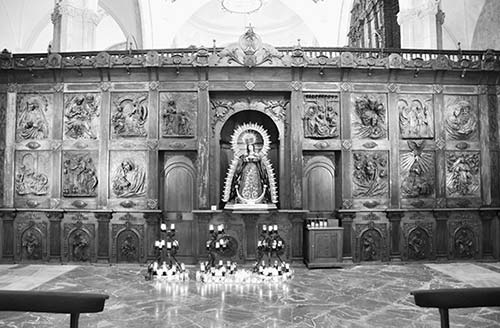
Head to the left around the choir, noticing the bright paintings along the wall by French artist Raymonde Pagegie. He gave sacred scenes a fresh twist—like the Last Supper attended by female apostles and servants, or the scene of Judgment Day, when the four horsemen of the apocalypse pause to adore the Lamb of God. Circle around the elaborate choir to appreciate its finely carved cedar and walnut interior (from 1736).
The treasury (through a door at the far-right corner, with your back to the choir) displays vestments that look curiously like matadors’ brocaded outfits—appropriate for this bullfight-crazy town. At the treasury’s entry, a hall leads to a spiral staircase. Climb the 73 steps to a U-shaped terrace around the church’s rooftop. Survey the entire deck (ducking under the buttresses) for great views. The highlight is actually inside: A tiny door leads to a breathtaking perch high above the elaborate main altar. (Imagine walking around this ledge before there was a railing.)
Mondragón Palace City Museum (Palacio de Mondragón)
This beautiful Mudejar mansion was built on the site of a 14th-century Moorish palace. Most of the “palace” you see today was constructed in the 16th century (though its facade is yet newer, dating from the 18th century). Its tiled courtyards and elegant gardens come with a Moorish flavor. On the mansion’s upper floor, a humble city museum focuses on ancient Ronda and the area’s geology and archaeology. The historic artifacts and kid-friendly displays are nicely explained in English. You’ll see exhibits on Neolithic toolmaking and early metallurgy (like a seventh-century-BC mold for making a sword from molten metal), and brief descriptions of local Roman history. If you plan to visit the Pileta Cave (see listing later), find the panels that describe the cave’s formation and shape. Linger in the two small gardens with wonderful panoramic views.
Cost and Hours: €4; Tue-Fri 9:30-19:00, Mon and Sat 10:00-14:00 & 15:00-18:00, Sun 10:00-15:00, shorter hours off-season; on Plaza Mondragón, +34 952 870 818.
Nearby: Leaving the palace, wander left a few short blocks to the nearby Plaza de María Auxiliadora for more views and a look at the two rare pinsapos (resembling extra-large Christmas trees) in the middle of the park; this part of Andalucía is the only region in Europe where these ancient trees still grow.
Plaza de María Auxiliadora leads to a long, steep pathway down to the best Ronda view at sunset, from a viewpoint where windmills once stood. Photographers go crazy reproducing the most famous postcard view of Ronda—the entirety of the New Bridge. Look for the tiled Puerta de los Molinos sign and head down, down, down. This pathway is not for the faint of heart, and a bad idea in the heat of the afternoon sun. Wait until just before sunset for the best light and cooler temperatures.
▲Joaquín Peinado Museum (Museo Joaquín Peinado)
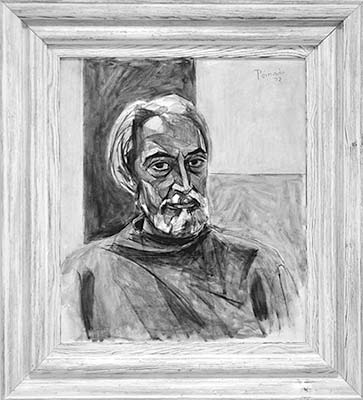
Housed in another old palace, this fresh museum features the life’s work of Joaquín Peinado (1898-1975), a Ronda native and pal of Picasso. Because Franco killed creativity in Spain for much of the last century, nearly all of Peinado’s creative work was done in Paris. His style evolved through the big “isms” of the 20th century, ranging from Expressionism to Cubism, and even to eroticism. Peinado’s works follow the major trends of his time—understandable, as he was friends with one of the art world’s biggest talents. There are good English explanations throughout the museum. Find a famous Cubist version of Don Quixote upstairs and a few Picasso pieces downstairs. It’s an interesting modern art experience with no crowds, and it’s fun to be exposed to a lesser-known but very talented artist in his hometown.
Cost and Hours: €4, Mon-Fri 10:00-17:00, Sat until 15:00, closed Sun, Plaza del Gigante, +34 952 871 585, www.museojoaquinpeinado.com.
▲Walk Through Old Town to Bottom of Gorge
From the New Bridge you can saunter down Calle Cuesta de Santo Domingo, past a few minor sights, into a world of whitewashed houses, tiny grilled balconies, and winding lanes—the old town.
• To get started, cross the bridge from the new town into the old and take the first left just beyond the former Dominican convent, once the headquarters of the Inquisition in Ronda. Be ready for a steep descent on occasionally slippery stones. At the top of the street on the right is the...
Carriage Museum (Museo del Carruaje): This museum shows off 23 historic carriages with English descriptions, along with some costumes of those who rode in the carriages (€5, Tue-Sat 10:00-19:00, Sun until 15:00, closed Mon, Calle Cuesta de Santo Domingo 2a, +34 744 703 307, https://museodelcarruajeronda.es).
• A couple of blocks steeply downhill (on the left), you’ll see the...
House of the Moorish King (Casa del Rey Moro): This was never home to a king; it was given its fictitious name by the grandson of President McKinley, who once lived here. Although the house is closed, its belle-époque garden is wistfully charming. A visit to this pricey sight is all about the “Mine,” an exhausting series of 210 slick, dark, and narrow stairs (like climbing down and then up a 20-story building) leading to the floor of the gorge. The Moors cut this zigzag staircase into the wall of the gorge in the 14th century to access water when under siege, then used Spanish slaves to haul water up to the thirsty town (€8, daily 10:00-21:30, off-season until 20:00).
• Fifty yards downhill from the garden, where the road bends right, is the...
Palace of the Marquis of Salvatierra (Palacio del Marqués de Salvatierra): As part of the “distribution” of spoils following the Reconquista here in 1485, the Spanish king gave the land for this grand house to the Salvatierra family (who live here to this day). Though the house is closed to the public, you can study the facade—rich in colonial symbolism from Spanish America. Note the pre-Columbian-looking characters (four Peruvian Indians) flanking the balcony above the door and below the family coat of arms.
• Follow the steps down to the left of the palace and stop to enjoy the view terrace. Look below. There are two old bridges, with the Arab Baths (our destination) just to the right.
Bridges: Twenty steps farther down, you’ll pass through the Philip V gate, for centuries the main gate to the fortified city of Ronda. Continuing downhill, you come to the Old Bridge (Puente Viejo), built in the 1500s. Until 1793, this was the only way to cross the gorge here. Enjoy the views from the bridge (but don’t cross it yet—we’ll do that after visiting the baths below). Continue down the old stairs, noticing the original Moorish steps that were carved into the rock long before the Reconquista. Before entering the Arab Baths, swing around the little chapel at the bottom of the staircase to look back up to the highly fortified Moorish city walls. A few steps ahead is the oldest bridge in Ronda, the Arab Bridge (a.k.a. the San Miguel Bridge). For centuries, this was the main gate to the fortified city. In Moorish times, you’d purify both your body and your soul here before entering the city. That’s why, just outside the gate, there was a little mosque (now the chapel) and the...
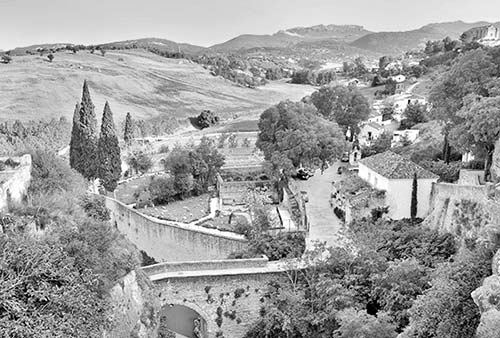
Arab Baths (Baños Árabes): Worth ▲, these evocative ruins warrant a quick look. They were located half underground to maintain the temperature and served by a donkey-powered water tower. (The squat structure can be accessed today via a ramp.) Water was hoisted from the river below to an aqueduct by ceramic containers that were attached to a belt powered by a donkey walking in circles. Inside the baths, two of the original eight columns scavenged from the Roman ruins still support brick vaulting (€4.50, credit card only; Tue-Fri 9:30-19:00, Mon and Sat 10:00-14:00 & 15:00-18:00, Sun 10:00-15:00, shorter hours off-season). A delightful 10-minute video brings the entire complex to life—Spanish and English versions run alternately. Ask about the next English showing as you go in. (If frustrated by the schedule, you can see the 10-minute clip any time on YouTube; search “Ronda Arab Bath.”)
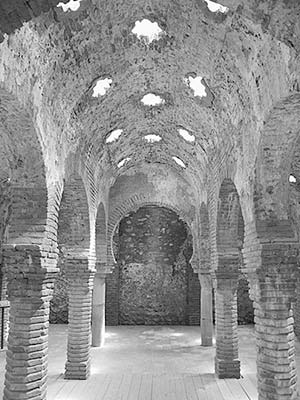
• From here, hike back to the new town along the other side of the gorge: Climb back up to the Old Bridge, cross it, and take the brick stairs immediately on the left, which lead scenically along the gorge through the wonderful Jardines de Cuenca hillside park. Exit the park going left and then uphill on Calle Virgen de los Remedios to the recommended Bar El Lechuguita. Stop here for a much-deserved break, then continue left onto Calle Rosario to return to the New Bridge.
NEAR RONDA
▲Pileta Cave (Cueva de la Pileta)
The Pileta Cave, set in a dramatic, rocky limestone ridge at the eastern edge of Sierra de Grazalema Natural Park, offers Spain’s most intimate look at Neolithic and Paleolithic paintings that are more than 30,000 years old. A local farmer, José Bullón, discovered the cave in 1905. Each night around sunset, Bullón had noticed bats flying out of an opening in the hillside. He hiked up to the chasm in hopes of harvesting highly prized bat guano for his fields; instead, he found this cave and its paintings. Today, the caves are open only to escorted groups, as guides (speaking English and Spanish) take up to 25 visitors at a time into the mountain. Because the cave’s temperature is consistent, and the number of visitors is strictly limited, Pileta’s rare paintings are among the best-preserved in the world.
Cost and Hours: €10, cash only; tours run daily in summer Mon-Fri at 10:30, 11:30, 13:00, 16:30, and 18:00; Sat-Sun on the hour from 11:00-13:00 & 16:00-18:00; fewer departures late Oct-April; +34 677 610 500 (phone answered 10:00-13:00), www.cuevadelapileta.es.
Reservations and Getting In: Call at least a day ahead, then arrive at least 25 minutes before your reserved time (they threaten to release unclaimed tickets 15 minutes before the tour begins). Budget 10 minutes for the steep hike to the ticket booth from the parking lot.
Know Before You Go: There are no WCs at the cave, nor anywhere near it. Bring a sweater and sturdy shoes, as footing can be uneven and slippery.
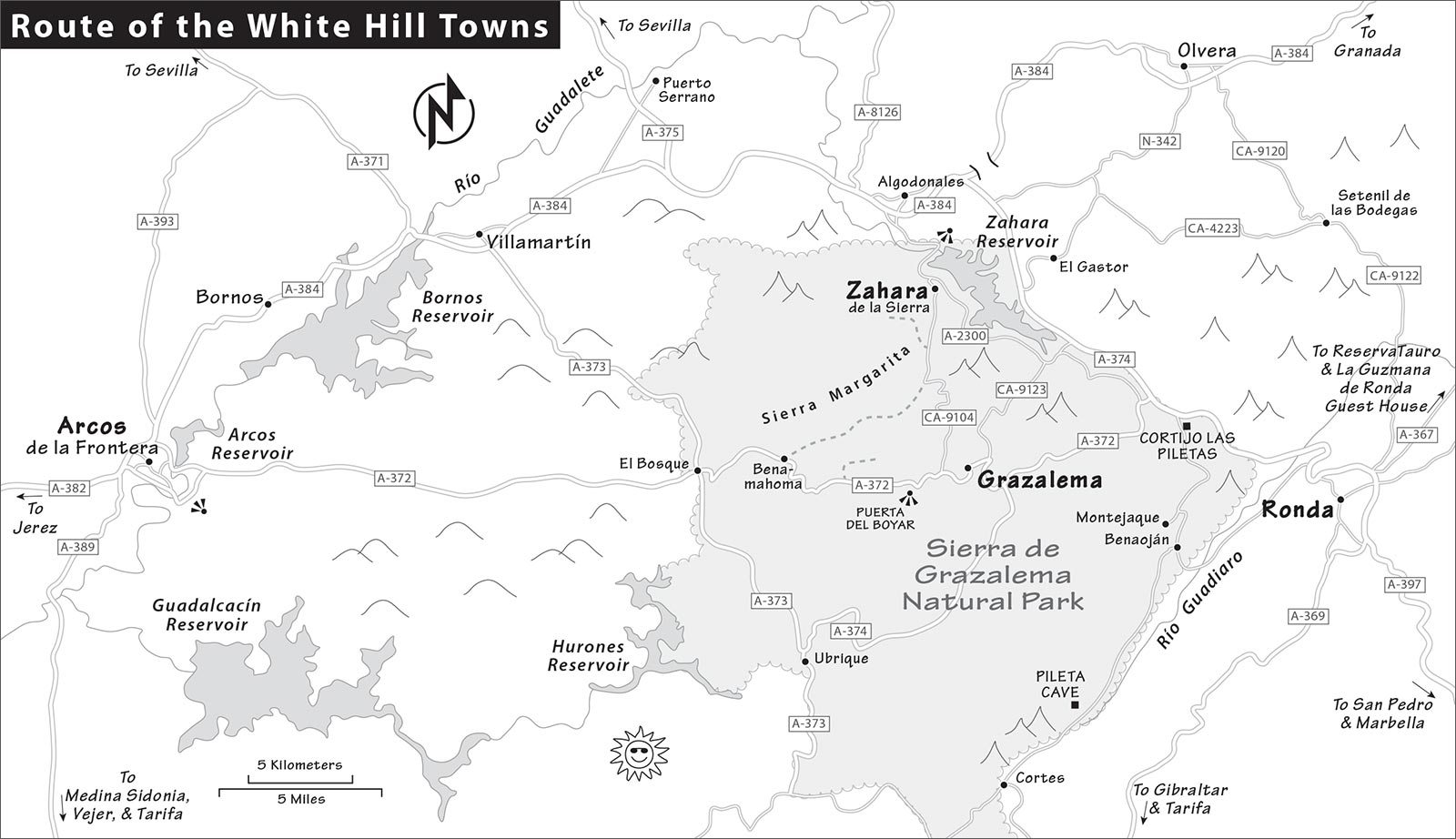
Getting There: Pileta Cave is 14 miles from Ronda, past the town of Benaoján, at the end of an access road easily reached between Ronda and Grazalema.
From Ronda, you can get to the cave by taxi—it’s about a half-hour drive on twisty roads—and have the driver wait (€90 round-trip). If you’re driving, it’s easy: Leave Ronda through the new part of town and take A-374 toward Sevilla. After a few miles, exit left toward Benaoján on MA-7401. Go through Benaoján (MA-7401 changes names to MA-8400), then take a sharp left onto MA-8401 and follow signs (reading Cueva de la Pileta) to the cave. Leave nothing of value visible in your car.
Visiting the Cave: Guides provide each person with a lantern to help navigate the route, which includes multiple sets of stairs.
The visit lasts about an hour. As you walk the cool half-mile, your guide explains how the black, ochre, and red drawings are made from a mixture of clay and fat. These paintings, created by finger-painting prehistoric people, are more than 30,000 years old—that’s five times as old as the Egyptian pyramids. Among other animals, you’ll see reindeer, horses, goats, cattle, and a rare giant fish. Surprisingly, the plain-looking stick drawings in black are more recent than the discernible animal shapes. That’s because they aren’t drawings, but calendars tracking the lunar cycle of prehistoric gestation. The 200-foot main hall, Salón del Pez, is cavernous and feels almost sacred. It’s believed artists painted in this room while listening to “music” created by others on nearby stalactites (your guide may demonstrate). Throughout the site, mineral monoliths look adorned in lace and drapery. Stalagmites and stalactites reach toward one another as they have for a million years or so in these caves, and some formations lend themselves to appropriate names like “The Organ” and “The Castle.”
Eating near the Cave: Nearby, the lovely village of Montejaque (much nicer than Benaoján) has several good restaurants clustered around the central square.
▲ReservaTauro
As the birthplace of modern bullfighting, Ronda attracts plenty of aficionados and even bullfighters themselves. Rafael Tejada worked as an engineer for many years but eventually switched gears to train as a bullfighter. In 2011, he bought land in the nearby foothills to raise Andalusian horses, cows, and stud bulls. Today his 500-acre estate is a nature preserve where Rafael welcomes visitors to experience his working farm and appreciate the cultural and historical importance of his life’s passion. A visit here allows you to get up close and personal with bulls and horses, as well as try out some matador skills in a practice ring (no bulls, no worries...just the capes). The two-hour option also lets you help the herdsman in one of his daily tasks, such as feeding the free-range bulls, and concludes with a surprise snack.
Cost and Hours: €29/person for 70 minutes, €42/person for 2 hours, €94/person for 2-3-hour private tour; visits offered daily at 12:00 and 16:30, winter afternoon visit at 16:00; reservations required, +34 951 166 008, www.reservatauro.com.
Getting There: Drivers should leave Ronda through the new part of town and take A-367 (Carretera Ronda-Campillos) toward Campillos. After about 5.5 miles, turn right into a stone gate marked by a small black-and-white, arrow-shaped sign labeled RESERVATAURO. If you’re visiting without a car, request a special taxi (€30) for round-trip transportation when you book your tour by phone or email.
Nightlife in Ronda
For locations, see the “Ronda Restaurants” map, later.
▲▲Ronda Guitar Concert
Local Spanish guitar artist Paco Seco performs a 45-minute solo concert on his historic Spanish guitar in a simple 80-seat hall (Ronda Guitar House). It’s an intimate affair, with the captivating Paco playing classical and flamenco numbers and sharing context for each piece. Travelers who show this guidebook get a free glass of Ronda wine to sip during the show (€18, Mon-Sat at 19:00, no shows July-Aug and Dec-Feb, Calle Virgen de los Remedios 23, +34 660 280 720, www.rondaguitarmusic.com).
▲Flamenco Guitar Concert
For an unforgettable musical experience, head to Casa Museo Don Bosco, where local flamenco guitarist Emilio Caracafé performs a 50-minute solo concert most evenings. It’s a delight to witness Emilio share his love of flamenco music, his proud Gypsy heritage, his percussive footwork, and the assistant’s translation of his joyful commentary. Think of the experience as more than a concert: Arrive at 18:00 (when the venue opens) to enjoy the included drink while exploring the venerable cliffside mansion and garden terrace in beautiful light. Then settle in for the show (€20, Mon, Wed, and Fri-Sun at 19:00, no shows Tue or Thu; buy tickets online, by phone, or in person at Casa Museo Don Bosco; Calle Tenorio 20, +34 672 468 082, www.casamuseodonbosco.es).
▲Evening Paseo
Ronda, with its dramatic cliffside viewpoints and iconic bridge, is perfect for the ritual evening stroll—the paseo. For locals, the highlight of the paseo is the long, straight Carrera Espinel, which leads from the bullring through the heart of town, away from most tourists. The street is so straight, it’s nicknamed “Calle la Bola” (bowling street). Make a point to stroll the entire street up and down, past ice-cream joints, shops, cafés, and happy-go-lucky locals. Detour into Plaza del Socorro. And remember, what happens on Calle la Bola never stays on Calle la Bola.
Drinks with a View
The rooftop bar at Restaurante Panorámico (atop the recommended Hotel Catalonia Ronda) offers a full range of drinks at easy-to-swallow prices. The commanding views include a look down on the town’s historic bullring, making this a sophisticated place for pre- or post-dinner drinks (open nightly, Calle Virgen de la Paz 16, +34 952 870 425).
Sleeping in and near Ronda
Ronda has plenty of reasonably priced, decent-value accommodations. It’s crowded only during Holy Week (the week leading up to Easter) and the first week of September (for bullfighting season). Most of my recommendations are in the new town, a short stroll from the New Bridge and about a 10-minute walk from the train station. In cheaper places, ask for a room with a ventana (window) to avoid the few interior rooms. Breakfast is usually not included. Most places have air-conditioning and an elevator (unless noted). If arriving by car, email your hotel for driving and parking instructions. For locations, see the “Ronda” map on here.
IN (OR BELOW) THE OLD TOWN
Clearly the best options in town, these hotels are worth booking far in advance.
$$$ Hotel Montelirio perches on the cliffs of the western side of the Moorish quarter with dramatic views of the valley and the new town. The former palace of a 17th-century count, it feels both traditional and plush with its 15 classically tasteful rooms (the view rooms are worth the splurge) and regal common areas (RS%—use code “RICKSTEVES”; pool, sun deck, Tenorio 8, +34 952 873 855, www.hotelmontelirio.com, recepcion@hotelmontelirio.com). Its recommended Restaurante Albacara fills a small and romantic terrace with views and fine dining (see “Eating in Ronda, later).
$$$ Soho Boutique Palacio San Gabriel is a large 1736 labyrinth of a townhouse that’s been converted into a characteristic hotel, marinated in history. It has 22 pleasant rooms, a kind staff, public rooms filled with art and books, a cozy wine cellar, and a fine garden terrace. If you’re a cinephile, kick back in the charming TV room—with seats from Ronda’s old theater and a collection of DVD classics—then head to the breakfast room to check out photos of big movie stars (and, ahem, a certain travel writer) who have stayed here (Calle Marqués de Moctezuma 19 at Plaza del Gigante, +34 952 190 392, www.sohohoteles.com, palaciosangabriel@sohohoteles.com).
$$ Alavera de los Baños, a delightful oasis located next to ancient Arab baths at the bottom of the hill (a steep climb below town), has nine comfortable rooms and two spacious suites with an eclectic aura of Mediterranean, Moorish, and modern decor. Guests enjoy big, inviting public places, a swimming pool, and a peaceful Arabic garden. Enjoy the pastoral views of the vast countryside and the horses just beyond the garden (includes breakfast, some rooms have balconies, free parking, closed mid-Dec-Jan, steeply below the heart of town at Calle Molino de Alarcón, +34 952 879 143, www.alaveradelosbanos.com, hotel@alaveradelosbanos.com, well run by personable Christian and Inma).
$ Hotel Ronda provides an interesting mix of minimalist and traditional Spanish decor in a refurbished mansion that is both quiet and homey. Although its five rooms are without views, the small, lovely rooftop deck overlooks the town (no elevator, Ruedo Doña Elvira 12, +34 952 872 232, www.hotelronda.net, reservas@hotelronda.net, some English spoken by kind and gentle Sra. Nieves).
IN THE NEW TOWN
$$ Hotel Don Miguel, facing the gorge next to the bridge, can seem like staying in a cave, but it couldn’t be more central. Of its 30 sparse and sterile but comfortable rooms, more than half have gorgeous views. Street rooms come with a little noise (pay parking a block away, Plaza de España 4, +34 952 877 722, www.hoteldonmiguelronda.com, reservas@dmiguel.com).
$ Hotel Polo is a simple and well-loved manor run by the Puya family in the heart of the new town. Each of its 36 bright and spacious rooms features a watercolor painted by Miguel Puya. Inviting common spaces like the social “Food Corner” and the vast cactus-filled, chill rooftop terrace provide a tranquil respite and cool views (family rooms, honesty bar, pay parking, Padre Mariano Souvirón 8, +34 952 872 447, www.hotelpolo.net, reservas@hotelpolo.net).
$ Hotel San Francisco offers 27 refreshing and nicely decorated rooms and a rooftop terrace a block off the main pedestrian street. The place is great and accommodating for families (family rooms, pay parking, María Cabrera 18, +34 648 943 695, www.hotelsanfrancisco-ronda.com, recepcion@hotelsanfrancisco-ronda.com).
$ Hotel Morales has 18 simple but prim-and-proper rooms, and friendly Lola helps you feel right at home. Interior rooms can be a bit dark, so request to be streetside. There’s little traffic at night (family rooms, pay parking nearby, Sevilla 51, +34 952 871 538, www.hotelmorales.es, reservas@hotelmorales.es).
¢ Hotel Royal has a dark reception hall but friendly staff and 29 clean, spacious, and institutional rooms—many on the main street that runs between the bullring and bridge. Thick glass keeps out most of the noise, and the tree-lined Alameda del Tajo park is just across the way (pay parking, Calle Virgen de la Paz 42, +34 952 871 141, www.hotelroyalronda.com, hroyal@ronda.net).
Business-Class Hotels: Though these don’t have the Andalusian charm and good value of my other recommendations, they are nice and reliable if all my other recommended hotels are booked: $$$$ Hotel Catalonia Ronda (rooftop bar, pool, Calle Virgen de la Paz 16, +34 952 870 300, www.cataloniahotels.com [URL inactive], ronda@cataloniahotels.com) and $$$ Hotel Maestranza Ronda (pay parking, Calle Virgen de la Paz 26, +34 952 187 072, www.hotelmaestranzaronda.com, reservas@hotelmaestranza.com).
IN THE COUNTRYSIDE NEAR PILETA CAVE
A good base for visiting Ronda and the Pileta Cave (as well as Grazalema) is $$ Cortijo las Piletas. Nestled at the edge of Sierra de Grazalema Natural Park (just a 15-minute drive from Ronda, with easy access from the main highway), this spacious, family-run country estate has 11 rooms, tranquil outdoor spaces, a large pool, and plenty of opportunities for exploring the surrounding area (includes breakfast, small honesty bar and fridge stocked with snacks and simple meals, +34 605 080 295, www.cortijolaspiletas.com, info@cortijolaspiletas.com, Pablo and Elisenda). Another countryside option is $ La Guzmana de Ronda Guest House. Six brightly appointed rooms surround an open patio at this renovated estate house (breakfast baskets available, pool, rental bikes, +34 600 006 305, www.laguzmana.com, info@laguzmana.com). Both hotels offer bird-watching, swimming, and hiking.
Eating in Ronda
Plaza del Socorro, a block in front of the bullring, is an energetic scene, bustling with tourists and local families enjoying the square and its restaurants. The pedestrian-only Calle Nueva is lined with hardworking eateries. Carrera Espinel is the famously long and straight local strolling favorite, lined with basic eateries, a busy churro shop, and great people-watching. To enjoy a drink or a light meal with great views (but lousy value), consider the terraces of Hotel Don Miguel just under the bridge.
Sweets: For coffee and pastries, locals like the elegant little $ Confitería Daver, where they say “once you step inside...it’s too late” (closed Mon, Calle Virgen de los Remedios 6).
Groceries: The Día supermarket is conveniently in the new town (Mon-Sat 9:00-21:30, closed Sun, Calle Cruz Verde 18). Maskom is two blocks from Alameda del Tajo park (Mon-Sat 9:00-21:00, Sun 9:30-14:30, Calle Molino 36).
IN THE CITY CENTER
Upscale Dining
Ronda is littered with upscale-seeming restaurants that toe the delicate line between a quality dinner spot and a tourist trap. My recommendations are both memorable and a good value for a fine and romantic meal.
$$$ Restaurante Albacara is a Michelin-rated spot at the recommended Hotel Montelirio, dramatically perched on a 12-table terrace overlooking the gorge with a nice view of the bridge. With attentive service and a tasty mix of Mediterranean and Spanish dishes, it’s a fine and scenic place to enjoy roast suckling pig (daily, Tenorio 8, +34 952 161 184).
$$$ Tragatá serves creative and tasty tapas in a stainless-steel, minimalist bar with a few tables on a lively street. The kitchen is all about sharing plates. They serve award-winning Russian salad, steaks, and Andalusian fare with a modern, Asian twist. It’s a pricey place, but if you want to sample gourmet Andalusian food, this is the place to do it (Wed-Sun lunch seatings at 13:00 and 13:30, dinner seatings at 20:00 and 20:30, closed Mon-Tue, reservations smart, Calle Nueva 4, +34 952 877 209, www.tragata.com).
$$$ Restaurante Pedro Romero is a venerable institution (even though it’s touristy, with a four-language menu). Dressy with mounted bull’s heads, white tablecloths, and gleaming glassware, it’s named for Ronda’s most famous son, the first great bullfighter. The short menu is heavy on meat, from wild partridge stew to rabbit confit. Their rabo de toro (oxtail stew) is the best I’ve had—even better when paired with the perfect glass of red wine. Assuming a shrine to bullfighting draped in el toro memorabilia doesn’t ruin your appetite, dine with the likes (well, photographic likenesses) of Spain’s greatest bullfighters, Orson Welles, Ernest Hemingway, and Francisco Franco (daily, across from bullring at Calle Virgen de la Paz 18, +34 952 871 110).
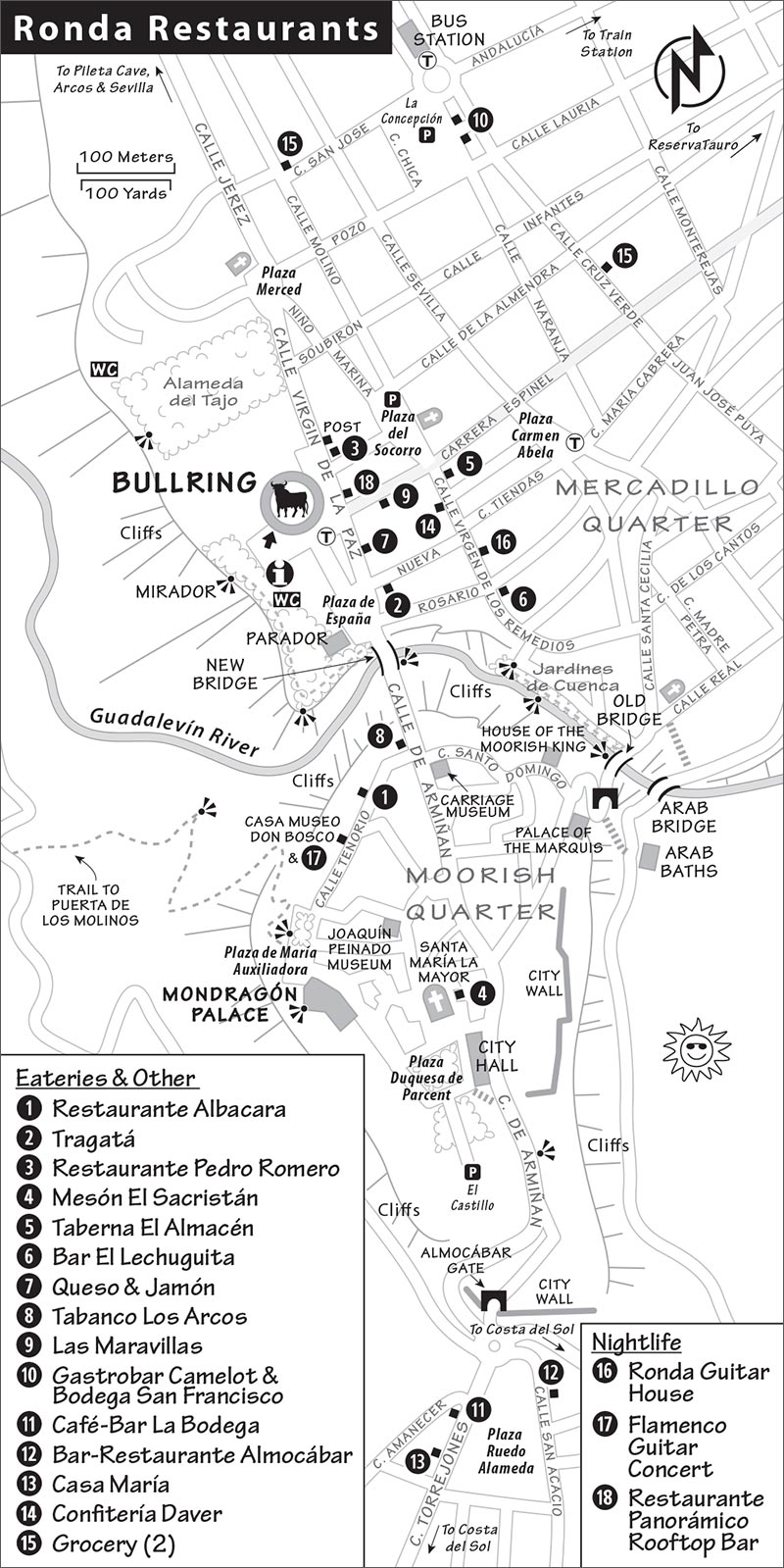
$$$ Mesón El Sacristán is a well-respected restaurant serving classical and innovative dishes with a focus on meat (many cooked in a wood-fired oven). Their 12-hour rabo de toro oxtail stew is a favorite. It’s a good place to slow down—enjoy the rustic setting either inside or on the quiet square. Owner and chef Antonio’s inexpensive tasting menus are enticing, and the savory homemade croquetas are exceptional (closed Tue-Wed, reservations smart, Plaza Duquesa de Parcent 14, +34 952 875 684, www.mesonelsacristan.com).
Tapas And Simple Eats
Ronda has a fine tapas scene. These bars have accessible tapas lists and bigger plates. Each of the following places could make a fine solo destination for a meal, but they’re close enough that you can easily try more than one.
$$ Taberna El Almacén offers a modern take on traditional tapas from many Spanish regions in an industrial chic setting. Friendly, approachable staff can explain the day’s specials that are fuera de carta (listed on a blackboard but not listed on the menu). Even veggie haters rave over their pisto—a type of ratatouille where all ingredients are first cooked separately, then mixed together and served with a fried egg on the side. This is a good spot to try local wines as well (closed Sun-Mon, Calle Virgen de los Remedios 7, +34 951 489 818).
$ Bar El Lechuguita, a traditional hit with locals, serves a long and tasty list of €1 tapas. Rip off a tapas inventory sheet, cross-reference it with the laminated English translation, and mark which ones you want. Be adventurous and don’t miss the bar’s namesake, lechuguita (a wedge of lettuce with vinegar, garlic, and a secret ingredient). The order-form routine makes it easy to communicate and get exactly what you like, plus you know the exact price. This place is small—just a bar and some stand-up ledges along the wall, plus some rustic tables with stools outside. Ideally, be there when the doors open and grab a spot at the bar (closed Wed dinner and all day Sun, Calle Virgen de los Remedios 35).
$ Queso & Jamón is my pick for quality bocadillos (sandwiches) with your choice of cheeses and hams. Brothers Antonio and Paco can also advise you on different cured meats, dairy products, oils, and marmalades for a customized foodie picnic (daily, Sun until 17:00, Plaza de España 1, +34 952 877 114).
$$ Tabanco Los Arcos bustles underneath the arches—hence the name—on the old town side of the New Bridge. Go early to snag a “gorge-ous” view table while sampling local cheese, elevated tapas, and the nice wine list. They’re happy to help match a suitable glass of wine with whatever looks good—if in doubt, try the albóndigas (giant meatballs) or alcachofas con jamon (artichokes with ham). Staff bustle between tables and are eager to serve (closed Mon, Calle Armiñán 6, +34 610 705 897).
$$ Las Maravillas is a traditional diner with a modern atmosphere, friendly service, and a fine tapas-style menu including good salads and a nice selection of wine by the glass. The tables outside are excellent for people-watching (a block from the bullring at Carrera Espinel 12, +34 666 219 462).
NEAR THE BUS STATION
A short walk away from the tourist crowds, a strip of bustling tapas bars along Calle Comandante Salvador Carrasco attracts a festival of hungry families. Locals, without a hint of the coast in their town, nickname this their paseo marítimo (beach promenade). Pop into one of these joints for an immersion course in typical Spanish and Andalusian dining.
$$ Gastrobar Camelot offers a sleek interior and tasty, great-value seafood and meat dishes, plus daily specials. Rondaños like to say it’s “food from here for people from here” (closed Mon-Tue, Calle Comandante Salvador Carrasco 2).
$$ Bodega San Francisco is a rustic bar with an accessible list of raciones and tapas in English, as well as serious plates and big splittable portions. It’s a little larger, with lower prices and bigger crowds than Camelot (daily, Calle Comandante Salvador Carrasco, +34 952 878 162).
OUTSIDE THE ALMOCÁBAR GATE
To entirely leave the quaint old town and bustling city center, hike 10 minutes out to the far end of the old town, past City Hall, to a big workaday square (Plaza Ruedo Alameda) that goes about life as if the world didn’t exist outside Andalucía. In summer, tables spill onto the plaza for dining al fresco.
$$ Café-Bar La Bodega is a traditional taberna that’s popular with locals. The accessible menu comes with good salads, shareable plates, and the predictable dishes from this region (closed Tue-Wed, Plaza Ruedo Alameda 32, +34 952 225 611).
$$ Bar-Restaurante Almocábar is a favorite eatery for many Ronda locals. Its restaurant—a cozy eight-table room with Moorish tiles and a window to the kitchen—serves up tasty, well-presented meals (including daily specials). Many opt for the good salads—rare in Spain. At the bar up front, choose from gourmet tapas or order from the dining-room menu (closed Tue, reservations smart, Plaza Ruedo Alameda 5, +34 952 875 977).
$$$ Casa María is a delightful, family-run place managed by Elias and Isabel, daughter Maria, and Lucero the dog. There’s no menu—only the promise of a wonderful meal. For a set price of about €35, you’ll be treated to a full home-cooked feast: salad, vegetables, fish, meat, and dessert. If you’re looking for a memorable night out, it’s worth making a reservation for this adventure (daily, facing Plaza Ruedo Alameda at #27, +34 951 083 663).
Ronda Connections
Some destinations are linked with Ronda by both bus and train. Direct bus service to other hill towns can be sparse (as few as one per day), and train service usually involves a transfer in Antequera. Your options improve from major transportation hubs such as Málaga.
From Ronda by Bus to: Algeciras (1/day, 3 hours, Comes), La Línea/Gibraltar (no direct bus, transfer in Algeciras; Algeciras to La Línea/Gibraltar—2/hour, 45 minutes, buy ticket on bus, Comes), Arcos (1/day, 2 hours, Comes), Zahara (2/day, Mon-Fri only, 1.5 hours, Comes), Sevilla (3-4/day, 2.5 hours, Damas), Málaga (6/day 2 hours, Damas), Marbella (4/day, 1.5 hours, Avanza), Nerja (4 hours, Damas or Avanza to Málaga, then Alsa to Nerja). There are no direct buses to Córdoba. Bus info: Damas-sa.es, AvanzaBus.com, and www.TgComes.es.
By Train to: Algeciras (3/day, 2 hours), Málaga (2/day, 2-3 hours, transfer in Antequera; bus is better), Sevilla (2/day, 3.5-4 hours, transfer in Antequera), Granada (3/day, 2.5-3 hours, transfer in Antequera), Córdoba (1/day direct, 2 hours; more with transfer in Antequera), Madrid (1/day direct, 4.5 hours; more with transfer in Antequera). Any transfer is a snap and time-coordinated; with four trains arriving and departing simultaneously, double-check that you’re jumping on the right one. Train info: +34 912 320 320, Renfe.com [URL inactive].
ROUTE TIPS FOR DRIVERS
Ronda to the South Coast: Drivers who want to dip down to the coast from Ronda can take A-397 and head over the mountains and down to San Pedro de Alcántara (about 30 miles/50 km). The longer, winding A-369/A-377 route (about 50 miles/80 km) offers a scenic alternative to reach the coastal town of Estepona. You’ll go through gorgeous countryside and a series of whitewashed villages, but note that the A-377 stretch of this road (from Gaucín to the coast), while perfectly drivable, is in rough shape—expect to go slowly.
Zahara and Grazalema
There are plenty of interesting hill towns to explore in Andalucía. Public transportation is frustrating, so I’d do these towns only by car. Useful information on the area is rare. Fortunately, a good map, the regional tourist brochure (pick it up in Sevilla or Ronda), and a spirit of adventure work fine.
Along with Arcos, Zahara de la Sierra and Grazalema are my favorite white villages. While Grazalema is a better overnight stop, Zahara is a delight for those who want to hear only the sounds of the wind, birds, and elderly footsteps on ancient cobbles.
ZAHARA DE LA SIERRA
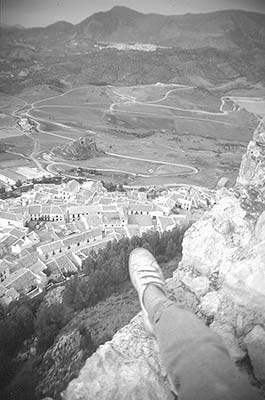
This tiny town in a tingly setting under a Moorish castle has a spectacular view over a turquoise reservoir. While the big church facing the town square is considered one of the richest in the area, the smaller church at the end of the street has the most-loved statue: The Virgin of Dolores is Zahara’s answer to Sevilla’s Virgin of Macarena (and is similarly paraded through town during Holy Week).
The TI is located at the castle (daily 9:15-14:00 & 17:30-20:45, www.zaharadelasierra.es [URL inactive]).
Drivers can park for free in the main plaza or continue up the hill to the parking lot at the base of the castle, just past the recommended Hotel Arco de la Villa. There’s also a pay parking lot near the main square (follow signs to Aparcamiento). It’s one way up and one way down, so follow salida signs to depart. The street that connects both churches, Calle de San Juan, is lined with tapas bars and cafés.
Sights in Zahara: During Moorish times, Zahara lay within the fortified castle walls above today’s town. It was considered the gateway to Granada and a strategic stronghold for the Moors by the Christian forces of the Reconquista. Locals tell of the Spanish conquest of the Moors’ castle (in 1482) as if it happened yesterday: After the Spanish failed several times to seize the castle, a clever Spanish soldier noticed that the Moorish sentinel would check if any attackers were hiding behind a section of the wall by tossing a rock and setting the pigeons in flight. If they flew, the sentinel figured there was no danger. One night a Spaniard hid there with a bag of pigeons and let them fly when the sentinel tossed his rock. Upon seeing the birds, the guard assumed he was clear to enjoy a snooze. The clever Spaniard then scaled the wall and opened the door to let in his troops, who conquered the castle. Ten years later Granada fell, the Moors retreated to North Africa, and the Reconquista was complete.
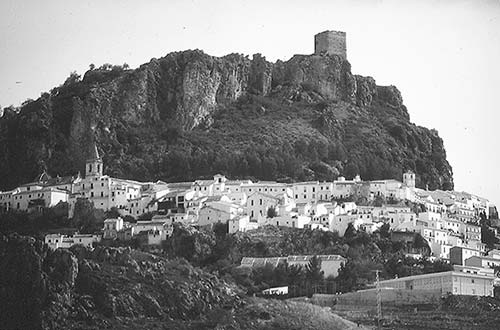
Wander the few streets that extend from the main square. The church is skippable, but it’s a fun climb up to the remains of the castle (€3.50, daily 9:15-14:00 & 17:30-20:45). Buy your ticket from the TI building at the castle complex—across from the town’s upper parking lot. It’s a moderately steep 15-minute hike past some Roman ruins and along a cactus-rimmed ridge to the top, where you can enter the tower. Use your phone’s flashlight or feel along the stairway to reach the roof, and enjoy spectacular views from this almost impossibly high perch far above the town. As you pretend you’re defending the tower, realize that what you see is quite different from what the Moors saw: The huge lake dominating the valley is a reservoir; before 1991, the valley had only a tiny stream.
Sleeping and Eating in Zahara: The town’s only real hotel is $ Hotel Arco de la Villa (16 small modern rooms, Wi-Fi in common areas only, +34 956 123 230, www.tugasa.com [URL inactive], arco-de-la-villa@tugasa.com). The hotel’s very good $ restaurant offers a reasonably priced menú del día, along with reservoir and mountain views.
GRAZALEMA
A beautiful postcard-pretty hill town, Grazalema offers a royal balcony for a memorable picnic, a square where you can watch old-timers playing cards, and plenty of quiet whitewashed streets and shops to explore. Situated within Sierra de Grazalema Natural Park, Grazalema is graced with lots of scenery and greenery. Driving here from Ronda on A-372, you pass through a beautiful parklike grove of cork trees. While the park is known as the rainiest place in Spain, it’s often just covered in a foggy mist. If you want to sleep in a small Andalusian hill town, this is a good choice.
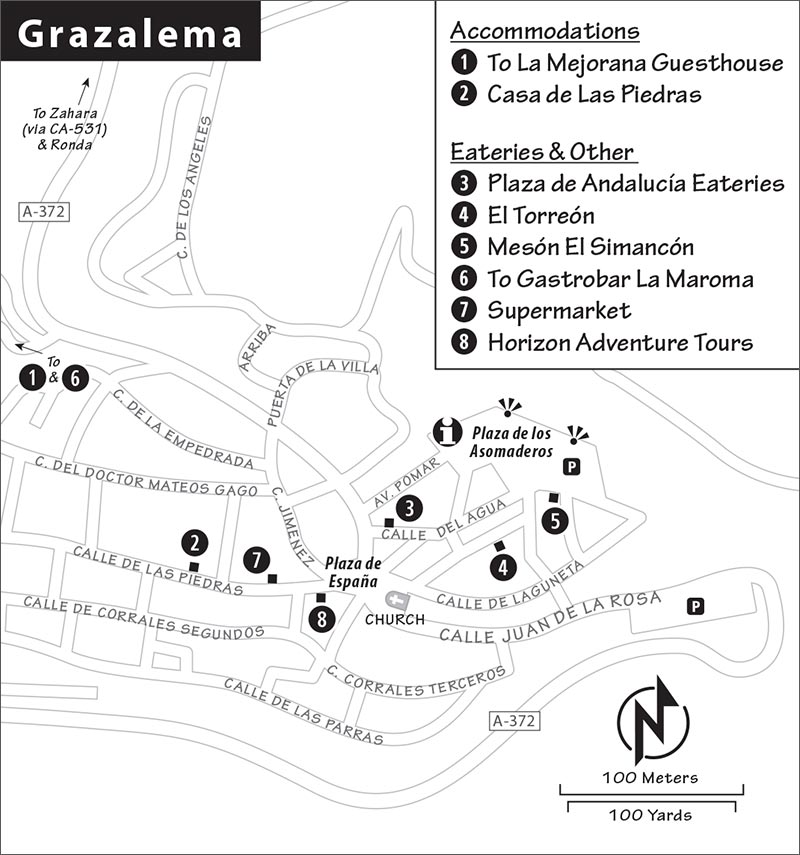
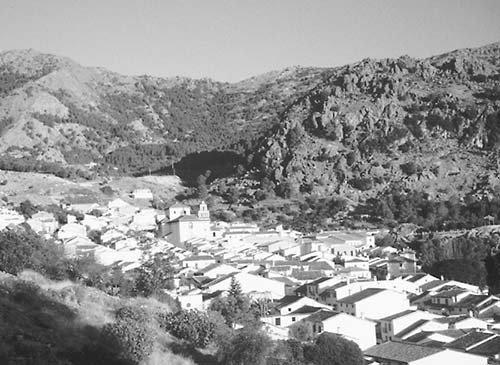
The bare-bones TI is located at the parking lot at the cliffside viewpoint, Plaza de los Asomaderos. When open, it’s generally staffed with Spanish-only speakers who can give you a town map and not much else (summer Wed-Sun 9:00-15:00, off-season 10:00-14:30 & 15:00-17:30, closed Mon-Tue year-round, +34 956 132 052, better info online at http://turismo.grazalema.es [URL inactive]). Enjoy the view, then wander into town.
A tiny lane leads a block from the center rear of the square (near the recommended Mesón El Simancón restaurant) to Plaza de Andalucía, bustling with the commotion of tapas bars. Shops sell the town’s beautiful and famous handmade wool blankets and good-quality leather items from nearby Ubrique. A block farther uphill takes you to the main square with the church, Plaza de España. A coffee on the square here is a joy. Small lanes stretch from here into the rest of the town.
For outdoor gear and adventures, including hiking, caving, and canoeing, contact Horizon (summer Mon-Sat 9:00-14:00 & 17:00-20:00, closed Sun, shorter hours off-season, off Plaza de España at Calle las Piedras 1, +34 956 132 363, +34 655 934 565, www.horizonaventura.com).
Sleeping in Grazalema: Your best bet is $ La Mejorana Guesthouse—if you can manage to get one of its nine rooms. This beautifully perched garden villa, with royal public rooms, overlooks the valley from the top of town (includes breakfast, pool, on tiny lane below Guardia Civil headquarters at Santa Clara 6, +34 956 132 527, +34 649 613 272, www.lamejorana.net, info@lamejorana.net, Ana and Andrés can help with local hikes).
¢ Casa de Las Piedras, just a block from the main square, is a rural house with 16 comfortable double rooms run by friendly Diego (who is also the house chef). The beds feature the town’s locally made wool blankets (Calle de las Piedras 32, +34 956 132 014, www.casadelaspiedras.es, reservas@casadelaspiedras.net).
Eating in Grazalema: Tiny Plaza de Andalucía has several good bars for tapas with umbrella-flecked tables spilling across the square, including $$ Zulema (big salads), $ La Posadilla, and $ Travesía. To pick up picnic supplies, head to the Eroski supermarket (closed Sun, Calle las Piedras 12).
$$ El Torreón specializes in local cuisine such as lamb and game dishes, with many vegetarian options. Diners are warmed by the woodstove while deer heads keep watch (closed Wed, Calle Agua 44, enter around the corner, +34 956 132 313).
$$ Mesón El Simancón serves well-presented regional cuisine in a romantic setting. While a bit more expensive, it’s considered the best restaurant in town (closed Tue, Plaza de los Asomaderos 54, +34 956 132 421).
$ Gastrobar La Maroma is a weekend-only place serving home-cooked regional specialties at affordable prices (closed Mon-Thu, Calle Santa Clara, near La Mejorana Guesthouse, +34 956 132 279).
Grazalema Connections: To get to Ronda (and beyond), take the bus (1/day, 45 minutes). Bus service is provided by Damas (www.damas-sa.es).
Jerez de la Frontera
With more than 200,000 people, Jerez de la Frontera is your typical big-city mix of industry and dusty concrete suburbs, but it has a lively old center and two claims to touristic fame: horses and sherry. Jerez is ideal for a noontime visit on a weekday. See the famous horses, sip some sherry, wander through the old quarter, and swagger out. For the most efficient visit if arriving by bus or train, take a taxi from the train station right to the Royal Andalusian School for the equestrian performance, then walk around the corner to the Sandeman bodega for the next English tour.
Orientation to Jerez
Thanks to its complicated medieval street plan, there is no easy way to feel oriented in Jerez—so ask for directions liberally.
There’s a helpful TI on Plaza del Arenal (Mon-Fri 9:00-15:00, closed Sat-Sun) and another inside the Alcázar (Mon-Fri 9:30-17:30, Sat-Sun until 14:30, +34 956 149 863, www.turismojerez.com).
ARRIVAL IN JEREZ
By Bus or Train: The bus and train stations are located side by side near the Plaza del Minotauro (with an enormous headless statue). Unfortunately, you can’t store luggage at either one. You can stow bags for free in the Royal Andalusian School’s guardaropa (coat room) if you attend their equestrian performance, but only for the duration of the show.
Cheap and easy taxis wait in front of the train station (€5 to TI; about €9 to the horses). Otherwise, it’s a 20-minute walk from the stations to the center of town: Angle across the brick plaza (in front of the stations, with two black smokestacks) to find Calle Diego Fernández de Herrera. Follow this street for several blocks until you reach a little square (Plaza de las Angustias). Leave the square at the far left side down Calle Corredera. In a few minutes you’ll arrive at Plaza del Arenal (ringed with palm trees, with a large fountain in the center); a TI is in the arcaded building across the plaza.
By Car from Arcos: Driving in Jerez can be frustrating. The outskirts are filled with an almost endless series of roundabouts. Continuing straight through each one (you’ll see a rail bridge) and follow traffic and signs to Centro Ciudad. The circuitous route will ultimately take you into Plaza Alameda Cristina; park in one of the many underground garages (at Plaza Alameda Cristina or Plaza Arenal) and catch a cab or walk. For street parking, blue-line zones require prepaid parking (2-hour maximum, put ticket on dashboard; Mon-Fri 9:00-13:30 & 17:00-20:00, Sat 9:00-14:00; free to park outside these hours, Sun mornings, and mornings in July-Aug).
Sights in Jerez
▲▲Royal Andalusian School of Equestrian Art
If you’re into horses, a performance of the Royal Andalusian School of Equestrian Art (Fundación Real Escuela Andaluza del Arte Ecuestre) is a must. Even if you’re not a horse aficionado, this is art like you’ve never seen.
Getting There: From the bus or train stations to the horses, it’s about a €9 taxi ride. Taxis wait at the school exit for the return trip. One-way streets mean there is only one way to arrive by car: Follow signs to Real Escuela de Arte Ecuestre. Expect to make at least one wrong turn, so allow a little extra time. You’ll find plenty of free street parking behind the school.
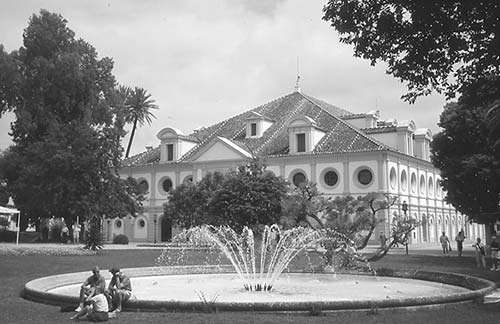
Equestrian Performances
This is an equestrian ballet with choreography, Spanish music, and costumes from the 19th century. The stern riders and their talented, obedient steeds prance, jump, hop on their hind legs, and do-si-do in time to the music, all to the delight of an arena filled with mostly tourists and local horse aficionados.
The riders cue the horses with subtle dressage commands, either verbally or with body movements. You’ll see both purebred Spanish horses (of various colors, with long tails, calm personalities, and good jumping ability) and the larger mixed breeds (with short tails and a walking—not prancing—gait). The horses must be three years old before their three-year training begins, and most performing horses are male (stallions or geldings), since mixing the sexes brings problems.
The equestrian school is a university, open to all students in the EU, and with all coursework in Spanish. Tightly fitted mushroom hats are decorated with different stripes to show each rider’s level. Professors often team with students and evaluate their performance during the show.
Cost and Hours: €24 general seating, €31 “preference” seating; 1.5-hour shows run at 12:00 Tue and Thu (March-July and Nov-Dec), Tue and Thu-Fri (Aug-Oct), and Thu (Jan-Feb); additional shows one Sat a month (twice in July); +34 956 922 580, best to buy tickets in advance at www.realescuela.org [URL inactive]. General seating is fine; some “preference” seats are too close for good overall views. The show explanations are in Spanish.
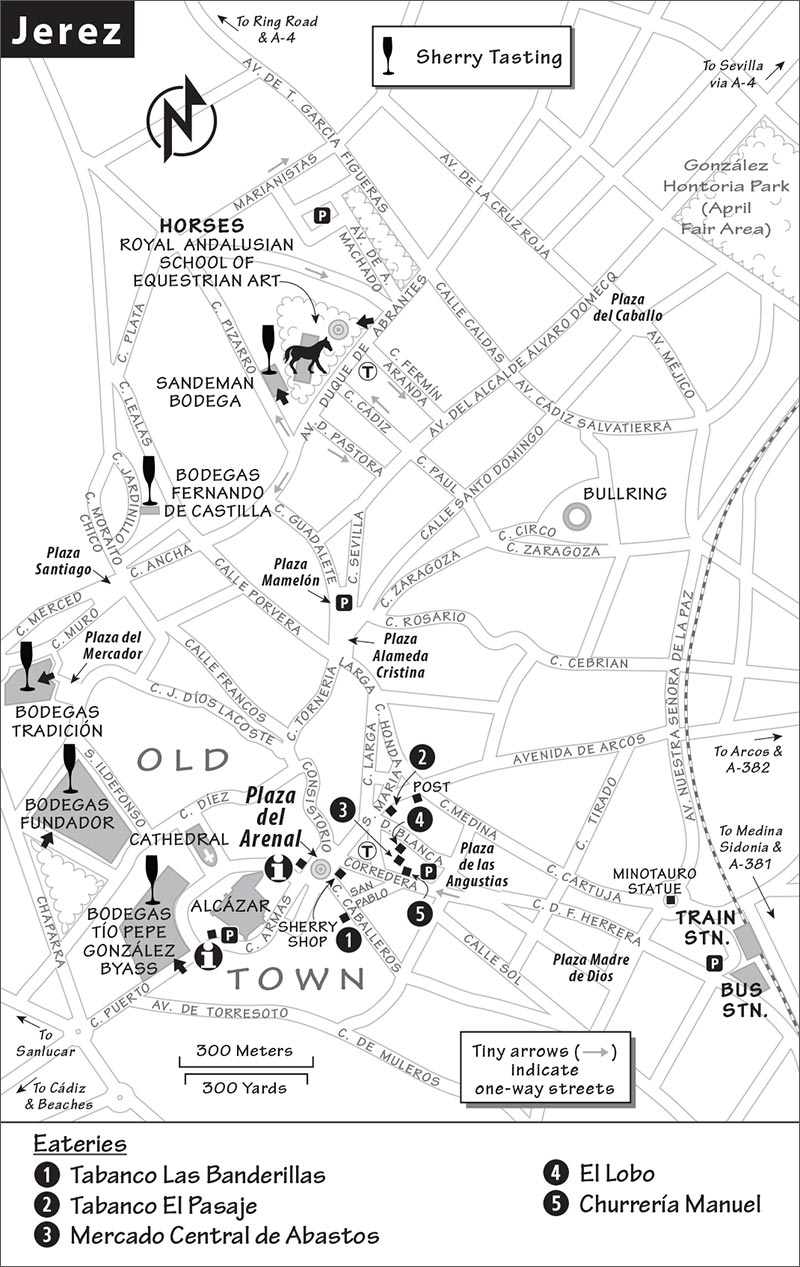
Training Sessions
The public can get a sneak preview at training sessions on Mondays (a nonperformance day). Sessions can be exciting or dull, depending on what the trainers are working on. Afterward, you can wander through the stables and visit the horses, multimedia and carriage museums, tack room, gardens, and horse health center. Sip sherry in the arena’s bar to complete this Jerez experience.
Cost and Hours: €13, Mon 10:00-14:00, last entry at 12:00, tours depart when a large-enough group forms. A shorter €8 visit on show days covers only the museums and saddlery.
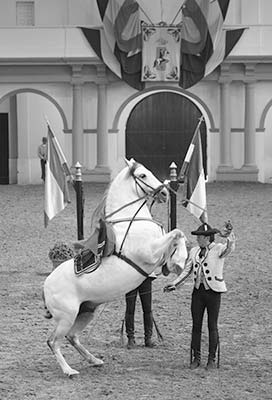
▲▲Sherry Bodega Tours
Spain produces more than 10 million gallons per year of the fortified wine known as sherry. The name comes from English attempts to pronounce Jerez. Although sherry was traditionally the drink of England’s aristocracy, today’s producers have left the drawing-room vibe behind. Your tourist map of Jerez is speckled with venencia symbols, each representing a sherry bodega that offers tours and tasting. (Venencias are specially designed ladles for dipping inside the sherry barrel, breaking through the yeast layer, and getting to the good stuff.) For all the bodegas, it’s smart to confirm tour times before you go, as schedules can be changeable.
Bodegas Tradición
Although founded in 1998, this winery continues family winemaking traditions that date back to 1650. Their guided tours do a remarkable job of explaining the sometimes difficult-to-understand method of producing sherry. Aficionados claim that their award-winning sherries are not to be missed. Art lovers will get an extra treat: walking among a museum-worthy private collection of works by Murillo, Velázquez, El Greco, Zurburán, Goya, and many others.
Cost and Hours: €50 for 1.5-hour tour, includes 5 sherries, always available in English for up to 12 people; Mon-Sat at 10:00 and 16:00, Sun at 10:00; reservations required, private tours available, Calle Cordobeses 3, +34 956 168 618, www.bodegastradicion.com.
Bodegas Rey Fernando de Castilla
Founded in the 1960s by a family with 200 years of winemaking experience, this bodega has become a powerhouse, focusing on producing amazing sherry, brandies, and vinegars. Of note are their Palo Cortado and Pedro Ximénez varieties.
Cost and Hours: €15 for tour and tasting; English tours available Mon-Fri 10:00-14:00—reservations required; Jardinillo 7, +34 956 182 454, www.fernandodecastilla.com, bodegas@fernandodecastilla.com.
Spanish sherry is not just the sweet dessert wine sold in the States as sherry. In Spain, sherry is (most commonly) a chilled and very dry fortified white wine, often served with appetizers such as tapas, seafood, and cured meats.
British traders invented the sherry-making process as a way of transporting wines so they wouldn’t go bad on a long sea voyage. Some of the most popular brands (such as Sandeman and Osbourne) were begun by Brits, and for years it was a foreigners’ drink. But today, sherry is typically Spanish.
Sherry is made by blending wines from different grapes and vintages, all aged together. Start with a strong, acidic wine (from grapes that grow well in the hot, chalky soil around Jerez). Mature it in large vats until a yeast crust (flor) forms on the surface, protecting the wine from the air. Then fortify it with distilled alcohol.
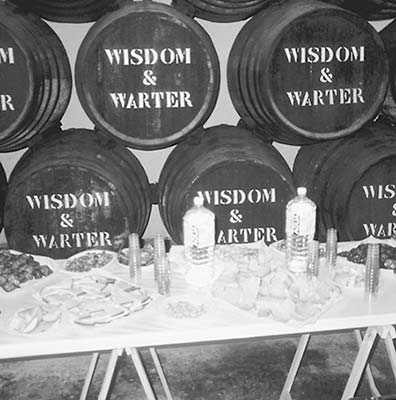
Next comes sherry-making’s distinct solera process. Pour the young, fortified wine into the top barrel of a unique contraption—a stack of oak barrels called a criadera. Every year, one-third of the oldest sherry (in the barrels on the ground level) is bottled. To replace it, one-third of the sherry in the barrel above is poured in, and so on. This continues until the top barrel is one-third empty, waiting to be filled with the new year’s vintage.
Fino is the most popular type of sherry (and the most different from Americans’ expectations)—white, dry, and chilled. The best-selling commercial brand of fino is Tío Pepe; manzanilla is a regional variation of fino, as is montilla from Córdoba. Darker-colored and more complex varieties of sherry include amontillado and oloroso. And yes, Spain also produces the thick, sweet cream sherries served as dessert wines. A good raisin-y, syrupy-sweet variety is Pedro Ximénez (often marked just “PX”), made from sun-dried grapes of the same name.
Sandeman
Just around the corner from the equestrian school is the venerable Sandeman winery, founded in 1790 and the longtime drink of English royalty. This tour is the aficionado’s choice for its knowledgeable guides and their quality explanations of the process. Each stage is explained in detail, with visual examples of flor (the yeast crust) in backlit barrels, graphs of how different blends are made, and a quick walk-through of the bottling plant. The finale is a chance to taste three varieties.
Cost and Hours: €15 regular sherries, €20 rare sherries, tour/tasting lasts 1-1.5 hours; English tours run Tue and Thu at 14:00—but confirm schedules online; reservations not required, Calle Pizarro 10, +34 675 647 177, www.sandeman.com.
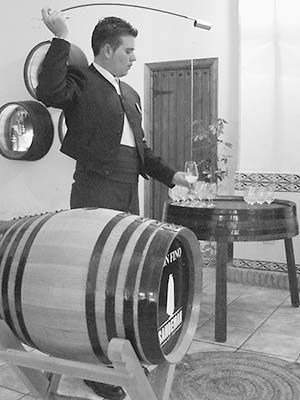
Tío Pepe González Byass
The makers of the famous Tío Pepe offer a tourist-friendly tour, with more pretense and less actual sherry-making on display (that’s done in an enormous plant outside town). But the grand circle of sherry casks signed by a Who’s Who of sherry drinkers is worthwhile. Taste two sherries at the end of the 2-hour tour.
Cost and Hours: €20 for tour/tasting, €25 for light tapas lunch with tour; tours run Tue-Fri at 12:30 and 16:30, Sat at 12:30; additional times may be available—confirm online; Manuel María González 12, +34 956 357 016, www.tiopepe.com. Drivers can park in the underground Alameda Vieja lot at the skippable Alcázar (€2.60/hour).
Other Sherry Bodegas
You’ll come across many other sherry bodegas in town, including Bodegas Fundador, located near the cathedral. This bodega, founded by Pedro Domecq, is the oldest in Jerez and the birthplace of the city’s brandy. Tastings here are generous (€18 for 3 sherries plus 1 brandy, €30 with light tapas, €35 for tour with tasting of “premium” sherries; Tue-Sat at 13:00, reservations required; Calle San Ildefonso 3, +34 956 151 552, http://bodegasfundador.site).
Sherry Shop
Vinos y Licores Corredera, run by Ana and Miguel, is a shrine to sherries, including smaller producers like Bodegas Tradición and Álvaro Domecq. They’ll happily guide you to a memorable bottle that suits your tastes (Mon-Fri 10:00-15:00 & 18:00-20:30, Sat mornings only, closed Sun, Calle Corredera 10, +34 856 107 621).
Eating in Jerez
TABANCOS
Jerez is dotted with characteristic tabancos—rustic bars serving tapas along with sherry straight from the cask. These eateries—some higher-end than others—started as shops dispensing sherry in bulk to locals who would bring their own bottles to fill.
This collection of bars scattered throughout town is known locally as the ruta de los tabancos (the tabancos route). Consider making a meal out of the ruta, nibbling and sipping your way through Jerez. The pedestrian Calle San Pablo is an especially appealing lane lined with several tabancos. The street ends at Tabanco Las Banderillas, dripping in bullfighting paraphernalia (try their chicharrones—fried pork rinds, daily, Calle Caballeros 12, +34 856 911 968).
Two blocks behind Plaza del Arenal, Tabanco El Pasaje is a venerable spot offering free flamenco shows (daily at 14:00) and pouring Maestro Sierra sherry—what my friend once called “the Rolls Royce of sherries” (daily, Calle Santa Maria 8, +34 956 333 359).
LIGHT LUNCH OPTIONS
The following places are only open through lunchtime.
$ Mercado Central de Abastos is Jerez’s covered market hall, located a block behind Plaza del Arenal. Known for its impressive displays of freshly caught seafood, it’s also a good place to assemble a picnic lunch with plenty of fruit, vegetable, cheese, and jamón stands (Mon-Sat until 14:45, closed Sun, Calle Dona Blanca 8).
$ El Lobo, in front of the market in an octagonal kiosk, is a fun and easygoing bar run by Jesús. Come here to try some sherry and whatever they’re grilling from the market that day (Tue-Sat until 15:00, closed Sun-Mon, on Plaza de Abastos, Calle Doña Blanca).
Churros: Next to El Lobo, Churrería Manuel is a popular place for mid-morning churros and traditional Spanish hot chocolate (Tue-Sun until 12:00, closed Mon, Calle Doña Blanca 10).
Jerez Connections
Jerez’s bus station is shared by multiple bus companies, each with its own schedule. The big ones serving most southern Spain destinations are Damas (www.damas-sa.es), Comes (www.tgcomes.es), and Socibus (https://socibusventas.es). While at the Jerez station, clarify routes for any further bus travel you may be doing in Andalucía—especially if you’re going through Arcos de la Frontera, where the bus station is unstaffed. Also try Movelia.es for bus schedules and routes.
From Jerez by Bus to: Tarifa (6/day, 2.5 hours, transfer in Cádiz, Comes), Algeciras (1/day, 3.5 hours, Comes) Arcos (hourly, 45 minutes, Damas), Ronda (1/day, 2.5-3 hours, Comes), Sevilla (6/day, 1-1.5 hours, Comes), Granada (1/day, 5 hours).
By Train to: Sevilla (hourly, 1 hour), Madrid (3/day direct, 4 hours; more with change in Sevilla, 4 hours), Barcelona (4/day, 7-8 hours, all with change in Sevilla and/or Madrid). Train info: +34 912 320 320, Renfe.com [URL inactive].
Near the Hill Towns
If you’re driving between Arcos and Tarifa, here are several sights to explore.
Yeguada de la Cartuja
This breeding farm, which raises Hispanic Arab horses according to traditions dating back to the 15th century, offers a 2-hour guided visit and show on Saturday at 11:00 (€25 for best seats in tribuna section, €19 for seats in the stands, Finca Fuente del Suero, Carretera Medina-El Portal, +34 956 162 809, www.yeguadacartuja.com [URL inactive]). From Jerez, take the road to Medina Sidonia, then follow signs to the farm, turning right in the direction of El Portal—you’ll see a cement factory on your right. Drive for five minutes until you see the farm.
Medina Sidonia
This town is as whitewashed as can be, surrounding its church and hill, which is topped with castle ruins. I never drive south through this area without detouring for a coffee break and a quick stroll here. Signs to centro urbano route you through the middle to Plaza de España (lazy cafés, bakery, plenty of free parking just beyond the square out the gate). If it’s lunchtime, consider buying a picnic, as all the necessary shops are nearby and the plaza benches afford a solid workaday view of a perfectly untouristy Andalusian town. According to its own TI, the town is “much appreciated for its vast gastronomy.” Small lanes lead from the main square up to Plaza Iglesia Mayor, where you’ll find the church and TI (+34 956 412 404, www.medinasidonia.com). At the church, an attendant will show you around for a tip. Even without giving a tip, you can climb yet another belfry for yet another vast Andalusian view. The castle ruins just aren’t worth the trouble.
Vejer de la Frontera
Vejer, south of Jerez and just 30 miles north of Tarifa, will lure all but the very jaded off the highway. Vejer’s strong Moorish roots give it a distinct Moroccan (or Greek Island) flavor—black-clad women whitewashing their homes, and lanes that can’t decide if they’re roads or stairways. The town has no real sights—other than its remarkable views—and very little tourism, making it a pleasant stop. The TI is at Calle de los Remedios 2 (+34 956 451 736, www.turismovejer.es).
The coast near Vejer has a lonely feel, but its pretty, windswept beaches are popular with windsurfers and sand flies. The Battle of Trafalgar was fought just off Cabo de Trafalgar (only a nondescript lighthouse today). I drove the circle so you don’t have to.
Sleeping in Vejer: The old town of Vejer has just a few hotels. $$ Hotel La Botica de Vejer provides 12 comfortable rooms in what was once a local apothecary. Homey decor and view patios add to the charm (Calle Canalejas 13, near Plaza de España, +34 956 450 225, www.laboticadevejer.com [URL inactive]). $$ Hotel Convento San Francisco is a poor-man’s parador with spacious rooms in a refurbished convent (Calle Plazuela, +34 956 451 001, www.tugasa.com [URL inactive]).