GRANADA
ALHAMBRA TICKETS IN A NUTSHELL
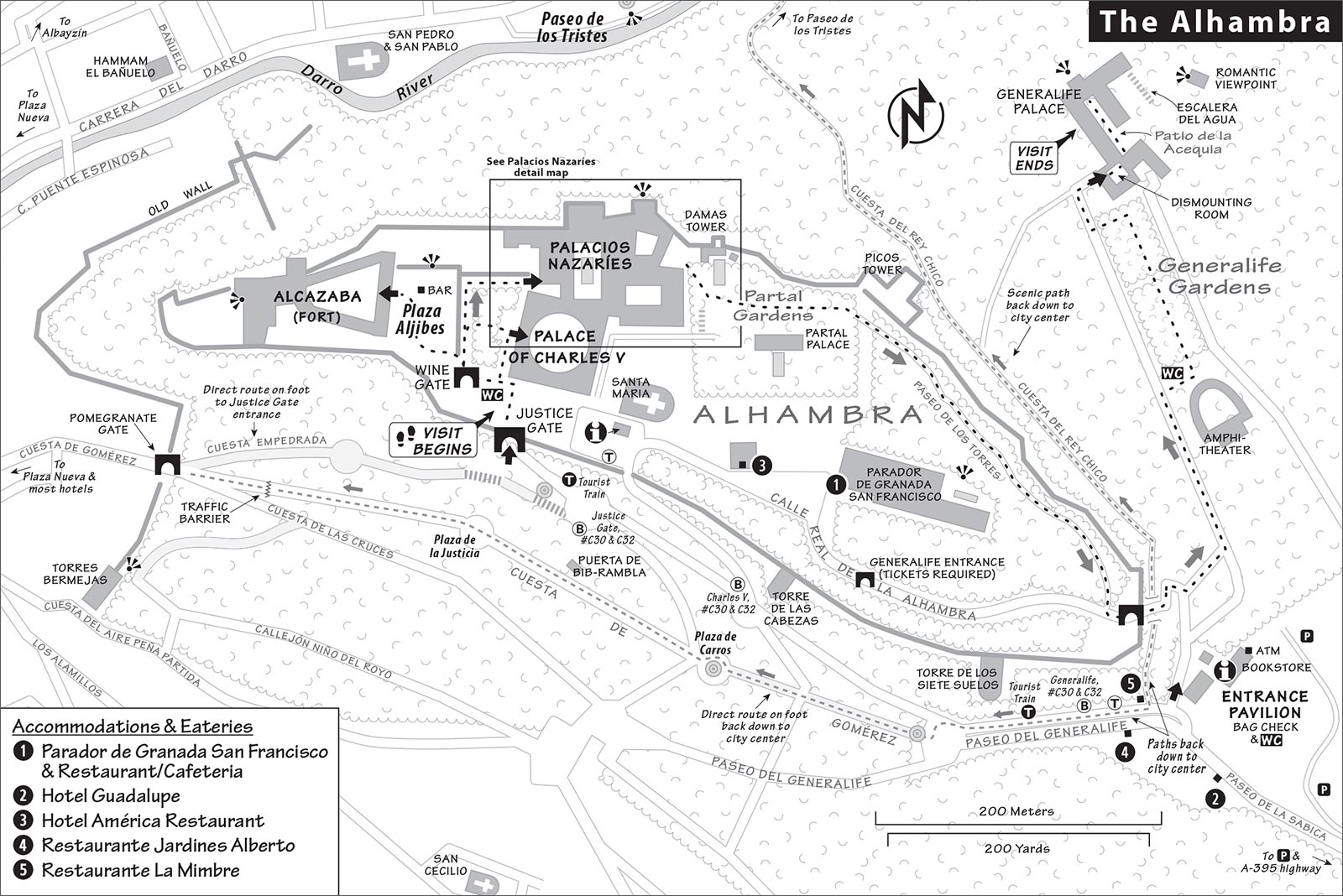
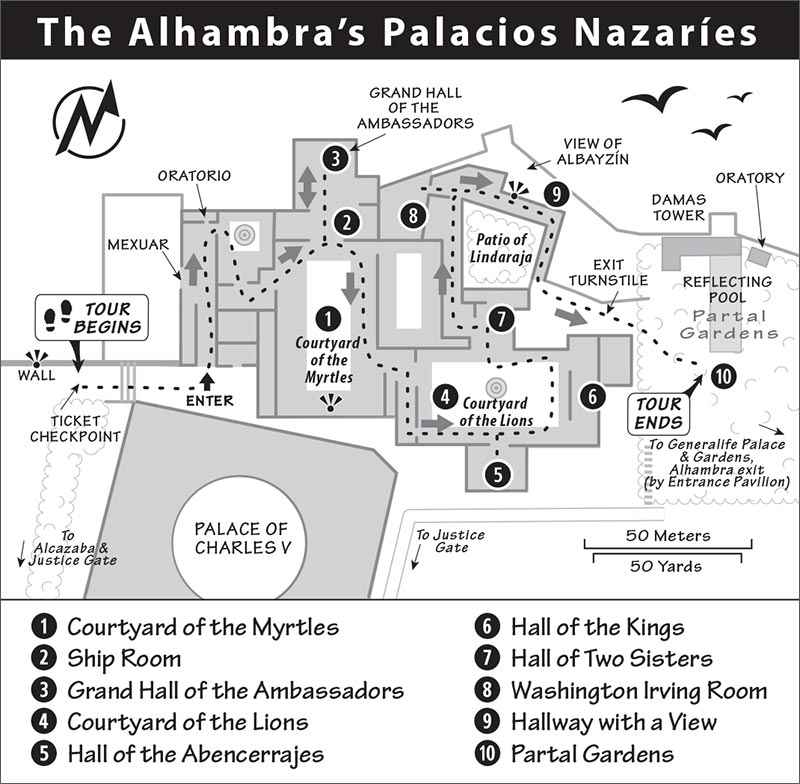
Map: The Alhambra’s Palacios Nazaríes
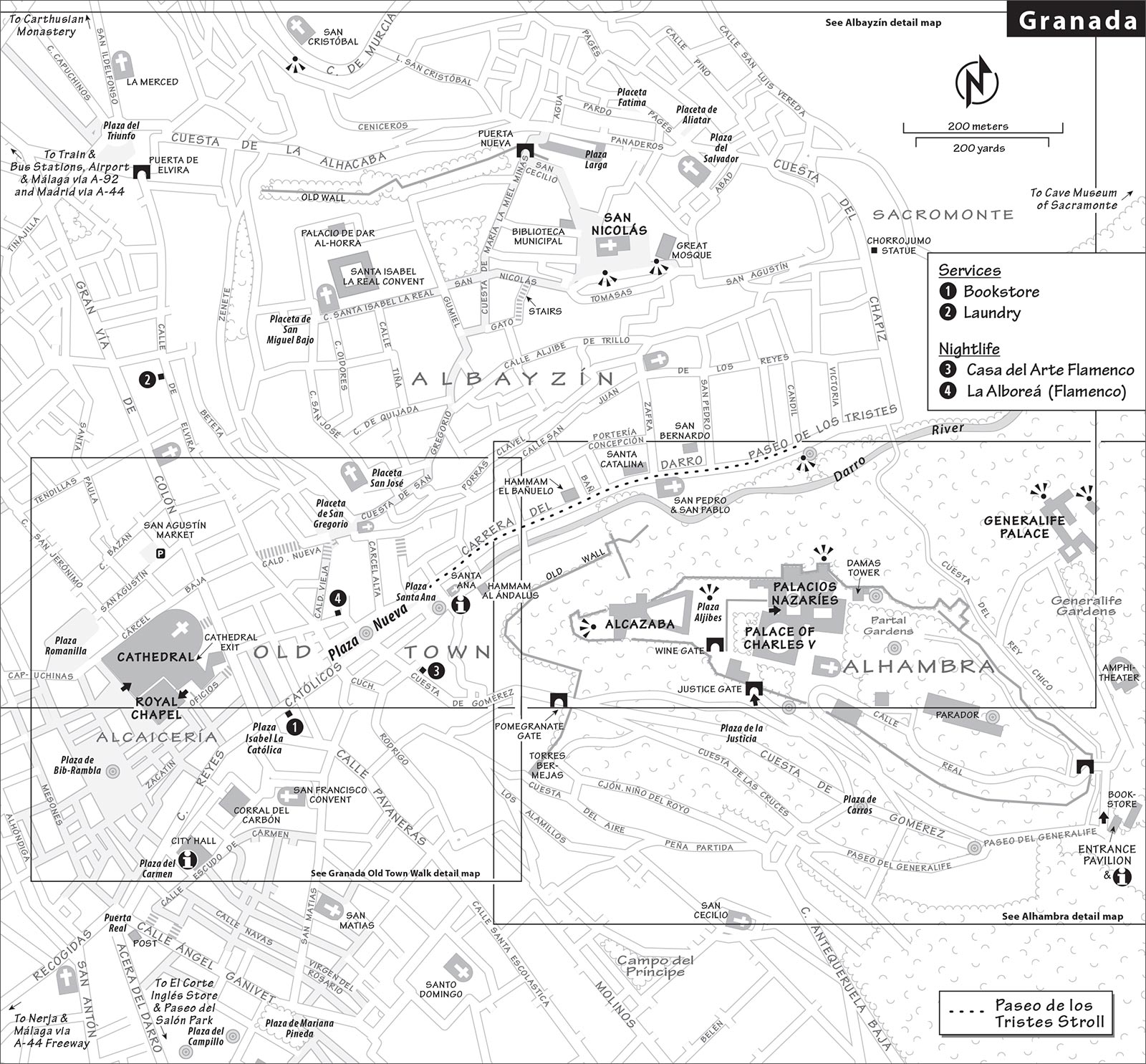
Map: Granada’s Hotels & Restaurants
CHEAP SLEEPS ON CUESTA DE GOMÉREZ
For a time, as a thriving Islamic city-state, Granada was the grandest city in Spain. But after the tumult that came with the change from Moorish to Christian rule, it lost its power and settled into a long slumber—until 19th-century Romantic writers and artists put it on the map. Today, Granada seems to specialize in evocative history and good living. Settle down in the old center and explore monuments of the Moorish civilization and its conquest. Taste the treats of a North African-flavored culture that survives here today.
Compared to other Spanish cities its size, Granada is delightfully cosmopolitan—it’s worked hard to accept a range of cultures, and you’ll see more diverse restaurants here than elsewhere in Andalucía. Its large student population (including many from abroad) also lends it a youthful zest. The Grenadine people are serious about hospitality and have earned a reputation among travelers for being particularly friendly and eager to help you enjoy their historic city.
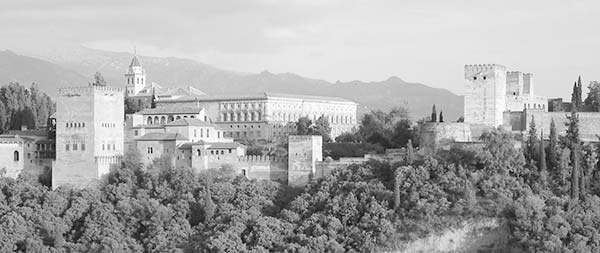
Granada’s magnificent Alhambra palace/fortress was the last stronghold of the Moorish kingdom in Spain. The city’s exotically tangled Moorish quarter, the Albayzín, invites exploration. From its viewpoints, romantics can enjoy the sunset and evening views of the grand, floodlit Alhambra.
After visiting the Alhambra and then seeing a blind beggar, a Spanish poet wrote, “Give him a coin, for there is nothing worse in this life than to be blind in Granada.” This city has much to see, yet it reveals itself in unpredictable ways; it takes a poet to sort through and assemble the jumbled shards of Granada. Peer through the intricate lattice of a Moorish window. Hear water burbling unseen among the labyrinthine hedges of the Generalife’s gardens. Listen to a flute trilling deep in the swirl of alleys around the cathedral. Don’t be blind in Granada—open all your senses.
PLANNING YOUR TIME
You could conceivably hit Granada’s highlights in one very busy day, sandwiched between two overnights. With a more relaxed itinerary, Granada is worth two days and two nights. You can easily connect to Granada by direct flights from Bilbao, Barcelona, and Madrid. And with the slick AVE train, Granada is just four hours from Madrid.
Note that it’s critical to reserve a ticket for the Alhambra well in advance (see “Alhambra Tour,” later). In the summer, do what you can to avoid the brutal heat of the early afternoon. Start early, take a break somewhere cool, and stay out late.
Granada in One Day
With just one full day here, fit in the top sights with this intense plan: In the morning (first thing, with an admission reserved long in advance), tour the Alhambra. After a quick lunch, follow my self-guided tour of the old town with visits to the cathedral and Royal Chapel. Wander the Albayzín quarter to the San Nicolás viewpoint (using my self-guided walk) for sunset, then find the right place for a suitably late dinner.
Granada in Two Days
Day 1: Stroll the Alcaicería market streets and follow my self-guided tour of the old town, including a visit to the cathedral and its Royal Chapel. Enjoy the vibe at Plaza de Bib-Rambla, the old town’s main square. Use my self-guided walk to wander up into the Albayzín Moorish quarter, stopping by a funky teahouse along the way. End your day at the San Nicolás viewpoint—the golden hour before sunset is best, when the Alhambra seems to glow with its own light.
Day 2: Follow my self-guided tour of the Alhambra; you’ll see the elaborate and many-roomed Palacios Nazaríes, the Renaissance Palace of Holy Roman Emperor Charles V, the refreshing Generalife and its gardens, and more.
On any evening, tapa-hop for dinner (consider Gayle’s Granada Tapas Tours) or splurge on fine dining (perhaps at an Albayzín carmen). When the evening cools down, join the paseo. Take in a zambra dance performance in the Sacromonte district. Relax in an Arab bath (Hammam al Ándalus) or a tetería (tea shop), or both. Slow down and smell the incense.
Orientation to Granada
Modern Granada sprawls (235,000 people), but its main sights are all within a 20-minute walk of Plaza Nueva, where dogs wag their tails to the rhythm of modern hippies and street musicians. Most of my recommended hotels are within a few blocks of Plaza Nueva. Make this the hub of your Granada visit.
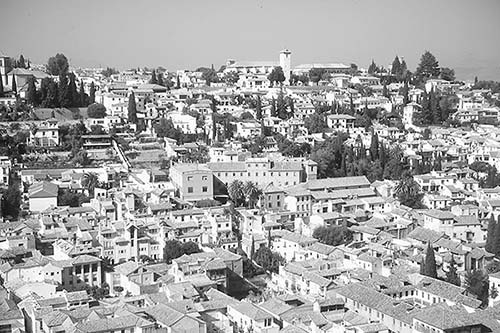
Granada is built on three hills: the Alhambra, the Albayzín, and Sacromonte. Plaza Nueva sits between two of them: On one side is the great Moorish palace, the Alhambra, and on the other is the best-preserved Moorish quarter in Spain, the ancient Albayzín (the first people settled here as early as the 7th century BC). To the southwest are the cathedral, Royal Chapel, and Alcaicería (Moorish market), where the city’s two main drags—Gran Vía de Colón (often just called “Gran Vía”) and Calle Reyes Católicos—lead away into the modern city.
TOURIST INFORMATION
The Granada TI is inside City Hall on Plaza del Carmen, a short walk from the cathedral (Mon-Sat 9:30-17:30, Sun until 13:30, shorter hours in July-Aug: daily until 14:00, +34 958 248 280, http://en.granadatur.com [URL inactive]). Another TI, tucked away just above Plaza Nueva near the Santa Ana Church, covers all of Andalucía. This TI also posts all of Granada’s bus departures (Mon-Fri 9:00-19:30, Sat-Sun 9:30-15:00, +34 958 575 202).
Sightseeing Pass: The €50 Granada Card may get you an Alhambra reservation when the main Alhambra website is sold out. It includes admission to the Alhambra, entry to the main sights in town (cathedral, Royal Chapel, Carthusian Monastery), plus bus rides and a few other admissions and discounts—and it’s good for two days. It’s sold only for dates when Alhambra entry is available (reserve a time when you purchase); it can be purchased online three months in advance (http://en.granadatur.com/granada-card [URL inactive]). The 24-hour €47 version includes a night visit to only the Alhambra’s Palacios Nazaríes (not the gardens or Generalife).
ARRIVAL IN GRANADA
By Train: Granada’s small but modern train station is connected to the center by a €6 taxi ride and frequent buses. The train station does not have luggage storage.
Taxis wait out front. If hoping to hop a cab upon arrival, go immediately to the taxi rank before the long line forms. It’s a two-minute walk to reach a city bus stop: Exiting the train station, walk straight up tree-lined Avenida de Andaluces (following the Metro tracks); at the first major intersection, find a covered bus stop to the right on Avenida de la Constitución. Buses #4 and #33 head down Avenida de la Constitución to Gran Vía and stop at the cathedral (Catedral)—three blocks from Plaza Nueva and most of my recommended hotels.
By Bus: Located on the city outskirts, Granada’s bus station (estación de autobuses) has ATMs, luggage lockers, and a privately run tourist agency masquerading as an official TI. The main arrivals hall has ticket windows, ticket machines, and a helpful information counter that hands out printed schedules. All buses are operated by Alsa (www.alsa.es). To get from the bus station to the city center, it’s either a 10-minute taxi ride (€8) or a 25-minute ride on bus #21 or #33. For Plaza Nueva, get off on Gran Vía at the Catedral stop.
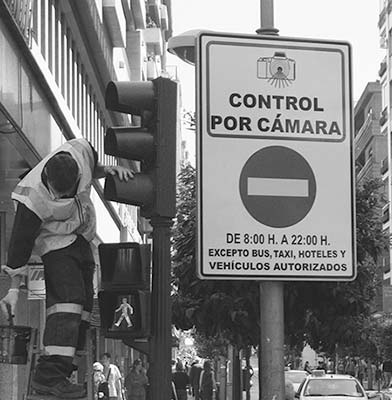
By Car: Driving in Granada’s historic center is restricted to buses, taxis, and tourists with hotel reservations. (Call ahead and make sure your hotelier registers you with the local traffic police—it’s routine, but if they don’t do it within 48 hours, you’ll be stuck with a steep ticket.) If you have a reservation, simply drive past the sign, making sure to stay out of the bus/taxi lane as you head to your hotel (or face a hefty fine). Hotels provide parking or have deals with central-zone garages (such as Parking San Agustín, just off Gran Vía del Colón, about €33/day).
If you don’t have a hotel reservation in the center, park outside the prohibited zone. The Alhambra, above the old town, has a huge pay lot (€22/24 hours); from there you can walk, catch the minibus, or taxi into the center. If you’re driving directly to the Alhambra, you can easily avoid the historic center (see “Getting There” under “Alhambra Tour,” later).
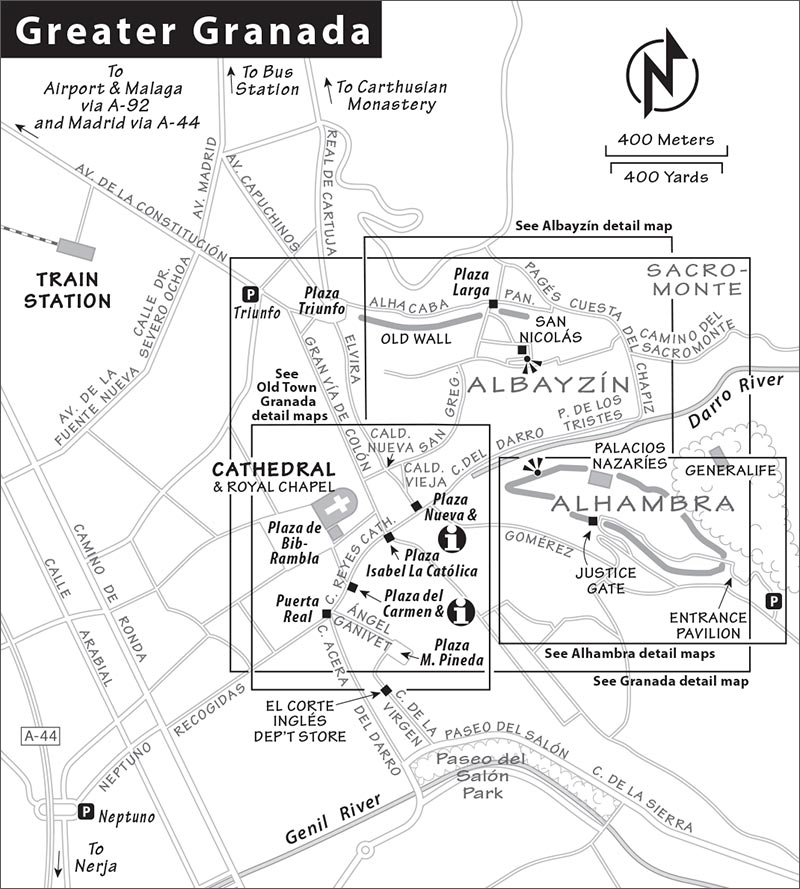
There are also garages just outside the restricted zone (about €20/24 hours), such as the Triunfo garage to the west (Avenida de la Constitución 5) or the Neptune garage to the south (Centro Comercial Neptuno, on Calle Neptuno). To reach the city center from Triunfo, catch the articulated #4 bus nearby (on Avenida de la Constitución). From Neptuno, it’s better to take a taxi. For locations, see the “Greater Granada” map.
By Plane: Granada’s relaxed airport is about 10 miles west of the city center. See “Granada Connections” near the end of this chapter.
HELPFUL HINTS
Book Ahead: Of all the sights and activities in Granada, only the Alhambra (which is why most people visit the city) needs to be booked in advance. See the “Alhambra Tour,” later, for all the details.
Theft Alert: Be on guard for pickpockets wherever there’s a crowd and especially late at night in the Albayzín. Your biggest threat is being conned while enjoying drinks and music in Sacromonte. Pushy women, usually hanging out near the cathedral and Alcaicería, may accost you with sprigs of rosemary, then demand payment for fortune-telling services—just say, “No, gracias.”
Festivals: In June and July, the popular Festival of Granada offers classical music, ballet, flamenco, and zarzuela (light opera) nightly in the Alhambra and other historic venues at reasonable prices (visit TI or ticket office in the Corral del Carbón for schedule, www.granadafestival.org [URL inactive]).
Bookstore: You’ll find the Alhambra Bookstore at Calle Reyes Católicos 40 (for location, see the “Granada” map). Other branches are at the entrance pavilion of the Alhambra and inside the Palace of Charles V (+34 958 227 846, www.alhambratienda.es).
Laundry: North of Plaza Nueva, La Colada is a convenient choice (daily 9:00-22:00, self-service, from west end of Plaza Nueva follow Calle de Elvira north to #85—for location, see the “Granada” map, +34 637 834 997).
Farewell to Singlehood: Famed for its fun tapas and cheap beer, Granada is inundated on weekend evenings with hen and stag parties (called “goodbye to singlehood” parties here). The city can seem busier at midnight than at noon as crazily dressed brides and grooms prowl the streets with gangs of friends looking for fun.
GETTING AROUND GRANADA
With cheap taxis, frisky minibuses, good city buses, and nearly all points of interest an easy walk from Plaza Nueva, you’ll get around Granada easily.
Tickets for minibuses and city buses cost €1.40 per ride (buy from curbside machines or driver; must use machine for bus #4 tickets). For schedules and routes, see TransportesRober.com.
Credibús cards save you money if you’ll be riding often—or, since they’re shareable, if you’re part of a group (purchase for €2, then load with €5, €10, or €20). To get a €5 card—likely all you’ll need if you’re solo—ask for “un bono de cinco.” These are valid on all buses and include transfers if made within 45 minutes.
By Minibus: Handy little made-for-tourists red minibuses cover the city center; they depart every few minutes from Plaza Nueva, Plaza Isabel La Católica, and Gran Vía (Catedral stop) from 6:00 until 23:00. Each makes a circular route in about 30 minutes with about four or five departures an hour. Note: If a minibus is already full, it’ll pass without stopping—just wait for the next one. For bus-stop locations in the city center, see the “Granada Old Town Walk” map, later.
Bus #C30 is the best for a trip up to the Alhambra, departing 30 yards uphill from Plaza Isabel La Católica, with stops at the Alhambra entrance pavilion and the Justice Gate (Puerta de la Justicia), among others.
Bus #C31 departs from Plaza Nueva and circles counterclockwise around the Albayzín quarter, navigating the narrow one-way lanes.
Bus #C32 connects the Alhambra to the Albayzín quarter and goes through the city center. For the Alhambra, catch it from the same spot as #C30 listed above (not from the Plaza Nueva stop).
Bus #C34 runs from Plaza Nueva to Sacromonte and then around the Albayzín.
Tours in Granada
Hop-On, Hop-Off Tourist Train
For a relaxing and scenic loop through the old town, the touristy hop-on, hop-off train can be time and money well spent (€9/24 hours, daily 9:30-21:00, Nov-March until 19:30, leaves every 25 minutes, includes Alhambra and Albayzín quarter, recorded English narration—use your own earbuds or buy onboard, www.granada.city-tour.com).
Walking Tours
Cicerone offers informative and spirited two-hour private city tours describing the fitful and fascinating changes the city underwent as it morphed from a Moorish capital to a Christian one over 500 years ago. The tours offer entrance to lesser-known museums and monuments, as well as drinks and tapas, and weaves together bits of the Moorish heritage that survive around the cathedral and in the Albayzín (price based on group size, figure €250 for two adults, RS%—use code “RICKSTEVES10”; +34 958 561 810, www.ciceronegranada.com). They also offer guided Alhambra tours that include an entry time to the Palacios Nazaríes.
“Free” (Tip-Based) Walking Tours
Students who’ve memorized a script lead entertaining walks daily in English through the historic town center. While you won’t get the quality of a licensed guide, the price is right: Just show up, have fun, and tip what you like. With competing advertising umbrellas and enthusiastic welcomes, groups offering these tours gather at Plaza Nueva and at Plaza Isabel La Católica. Some popular tours are Feel the City (www.feelthecitytours.com), Follow Me Granada (www.followmegranada.com [URL inactive]), Free Tour Granada (www.freetour.com/granada), and Walk in Granada (www.walkingranada.com).
Local Guides
Margarita Ortiz de Landazuri (+34 687 361 988, www.alhambratours.com) and Miguel Ángel (+34 617 565 711, miguelangelalhambratours@gmail.com) are good English-speaking, licensed private guides with lots of experience and a passion for teaching. In addition to the Alhambra, they give tours of Sacromonte, the Albayzín, and other parts of Granada. Guide rates are standard (€130/3 hours, €260/day).
Tapas Tours
Having lived in Granada since 1996, Scottish-born Gayle Mackie knows where to find the best food. She and her team at Gayle’s Granada Tapas Tours take small groups off the beaten path to characteristic tapas bars, providing cuisine tips and insights into Granada. It’s a moveable feast—three or four stops amounting to a filling meal—with a variety of fine local drinks (€50-65/person, RS%—request €5 discount when booking, daily at 13:00 and 20:00, 2.5 hours, tours for 2-8 people, private tours available, +34 619 444 984, www.granadatapastours.com). Gayle also offers a food shopping and three-course cooking experience at her home (€75/person, 2-6 people, 3 hours, lunch or early dinner, details on her website).
Granada Old Town Walk
This short self-guided walk covers all the essential old town sights. Along the way, we’ll see vivid evidence of the dramatic Moorish-to-Christian transition brought about by the Reconquista—the long and ultimately successful battle to take Spain from the Muslim Moors and establish Christian rule.
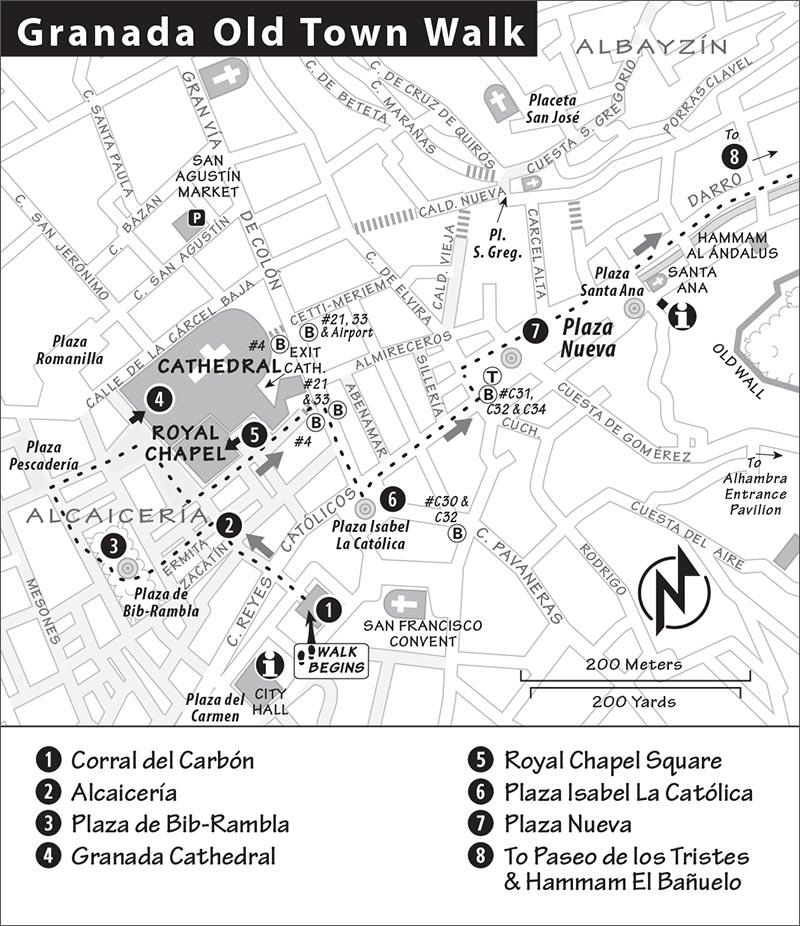
• Start at Corral del Carbón, near Plaza del Carmen.
1 Corral del Carbón
A caravanserai (of Silk Road fame) was a protected place for merchants to rest their animals, spend the night, get a bite to eat, and spin yarns. This Moorish structure, the only surviving caravanserai of Granada’s original 14, is just a block from the Alcaicería silk market (the next stop on this walk). Stepping through the grand horseshoe-arch entry, you’ll find a courtyard with 14th-century Moorish brickwork surrounding a fountain. This plain yet elegant structure evokes the times when traders gathered here with exotic goods and swapped tales from across the Muslim world.
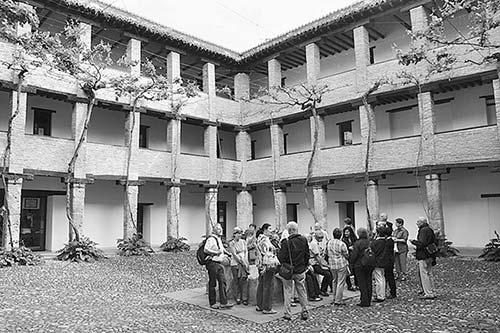
It’s a common mistake to think of the Muslim Moors as somehow not native to the Iberian Peninsula. They lived here for seven centuries and were just as “indigenous” as the Romans, Goths, and Celts. While the Moors were Muslim, they were no more connected to Arabia than they were to France.
After the Reconquista, this space was used as a storehouse for coal (hence “del Carbón”). These days it houses offices where you can buy tickets for musical events, a handy public WC (to the right as you enter), and sometimes, a friendly Alhambra info office.
• From the caravanserai, exit straight ahead down Puente del Carbón to the big street named Calle Reyes Católicos. The street covers the Darro River, which once ran openly here, spanned by a series of bridges. Today, the modern commercial center is to your left.
Cross here and continue one block farther to the horseshoe-shaped gate marked Alcaicería. Notice the pedestrian street, Zacatín, just before you reach the gate. It paralleled the Darro River in the 19th century; today it’s a favorite paseo destination, busy each evening with strollers. Pass through the Alcaicería gate and walk 20 yards into the old market to the first intersection at Calle Ermita.
2 Alcaicería
Originally an Arab souk (bazaar) and silk market, this warren of narrow streets is known as the Alcaicería (al-kai-thay-REE-ah). Offering precious silver, spices, and silk, the market had 10 armed gates and its own guards. Silk was huge in Moorish times, and silkworm-friendly mulberry trees flourished in the countryside. It was such an important product that the sultans controlled and guarded it by constructing this fine, fortified market. After the Reconquista, the Spanish realized this market was good for business and didn’t mess with it. Later, the more zealous Philip II had it shut down. A terrible fire in 1850 destroyed what was left. Today’s Alcaicería is an “authentic fake”—rebuilt in the late 1800s as a tourist attraction to complement the romantic image of Granada popularized by the writings of Washington Irving.
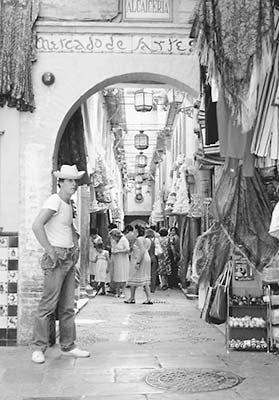
Explore the mesh of tiny shopping lanes: overpriced trinkets, popcorn machines, balloon vendors, leather goods spread out on streets, kids playing soccer, barking dogs, dogged shoe-shine boys, and the whirring grind of bicycle-powered knife sharpeners. You’ll invariably meet obnoxious and persistent women pushing their green rosemary sprigs on innocents in order to extort money. Be strong.
• Turn left down Calle Ermita. After 50 yards, you’ll leave the market via another fortified gate and enter a big square crowded with outdoor restaurants. Skirt around the tables to the Neptune fountain, which marks the center of the...
3 Plaza de Bib-Rambla
This exuberant square, with its four fine 19th-century Romantic-era lampposts, was once the center of Moorish Granada. Stop and stand facing the statue of Neptune.
Although Moorish rule of Spain lasted 700 years, it declined in its final centuries under weak leadership—even while Christian forces grew more determined. As Muslims fled south from reconquered lands, they flooded into Granada, then held by the last remnants of the Moorish kingdom. By 1400, Granada had an estimated 100,000 people—huge for medieval Europe. This was the main square, the focal point for markets and festivals, but it was much smaller then, hemmed in by the jam-packed city.
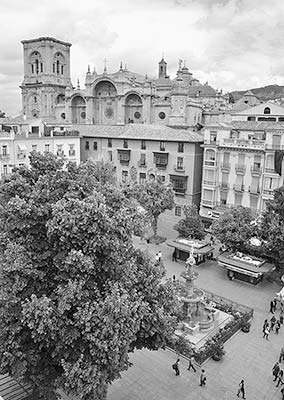
Under Christian rule, the Moors who remained were initially tolerated (as they were considered good for business), and this area became their ghetto. Then, with the Inquisition (which peaked under Philip II, c. 1550), ideology trumped pragmatism, and Muslims and Jews were evicted or forced to convert—and some were executed. It was in this era that this elegant square was built, and built big. To assert Christian rule, all the trappings of Christian power were layered upon what had been the trappings of Moorish power. In-your-face Catholic processions started here. Ahead on the right (at one o’clock) you’ll see the tower of the cathedral. Between here and the cathedral were the Christian University (the big orange building) and the adjacent archbishop’s palace.
Today Plaza de Bib-Rambla is good for coffee or a meal (behind you on the left is a great churrería) amid the color and fragrance of flower stalls and the burbling of its Neptune-topped fountain. It remains a multigenerational hangout, where it seems everyone is enjoying a peaceful retirement.
With Neptune facing you, we’ll leave the plaza ahead on the left (down Calle Pescadería) to reach a smaller, similarly lively square—little Plaza Pescadería, where families spill out to enjoy its many restaurants. For a quick snack, drop into tiny Cunini Pescadería—just beyond its namesake restaurant; for a takeaway cone of mixed fried fish, buy a cartucho de pescaito frito.
• Backtrack from the fried-fish joint and leave the plaza to the left, on Calle Marqués de Gerona; straight ahead you’ll see a small square fronting a very big church.
4 Granada Cathedral (Catedral de Granada)
Wow, the cathedral facade just screams triumph. That’s partly because its design is based on a triumphal arch, built over a destroyed mosque. Five hundred yards away, there was once open space outside the city wall with good soil for a foundation. But the Christian conquerors said, “No way.” Instead, they destroyed the mosque and built their cathedral right here on difficult, sandy soil. This was the place where the people of Granada had traditionally worshipped—and now they would worship as Christians.
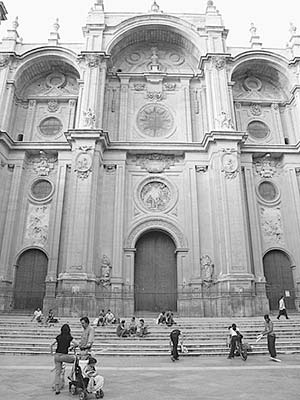
Building of the church started in the early 1500s and didn’t finish until the early 1700s. It began with a Gothic foundation, but over two centuries the design evolved: The interior layout is mostly Renaissance, its last altars are Neoclassical, and its facade, finished by hometown artist Alonso Cano (1601-1667), is Baroque. Accentuating the power of the Roman Catholic Church, the emphasis here is on Mary rather than Christ. The facade declares Ave Maria. This was Counter-Reformation time, and the Church was threatened by Protestant Christians. Mary was also more palatable to Muslim converts, as she is revered in the Quran, where an entire chapter is dedicated to her.
• To tour the cathedral now, you can enter here (the interior is described in more detail on here). You’ll exit on the far side, near the big street called Gran Vía de Colón.
If you’re skipping the cathedral interior for now, circle around the building to the right, keeping the church on your left, until you reach the small square facing the Royal Chapel.
5 Royal Chapel Square
This square was once ringed by important Moorish buildings: a hammam (public bath), a caravanserai (Days Inn), the silk market, the leading mosque, and a madrassa (school).
With Christian rule, the Palacio de la Madraza (its facade painted in Baroque style with faux gray stonework) became Granada’s first City Hall. Five hundred years ago, this was a Quranic school. Pop in for a peek at an ornate-as-the-Alhambra mini prayer room and mihrab.
Also on this square is the entrance to the Royal Chapel, where the coffins of Ferdinand and Isabel were moved in 1521 from the Alhambra (for details on visiting the chapel, see here).
• Continue up the cobbled, stepped lane to Gran Vía. Turn right, and walk to the big square just ahead. Cross busy Calles Reyes Católicos and stand by the statue.
6 Plaza Isabel La Católica
Two of Granada’s grand boulevards, Gran Vía and Calle Reyes Católicos, meet here at Plaza Isabel La Católica. Above the fountain, a beautiful statue shows Columbus unfurling a long contract with Isabel. It lists the terms of the explorer’s MCCCCLXXXXII voyage: “For as much as you, Columbus, are going by our command to discover and subdue some Islands and Continents in the ocean...” Two reliefs below the figures show the big events in Granada of 1492: Isabel and Ferdinand accepting Columbus’ proposal, and a stirring battle scene marking the triumphal end of the Reconquista.
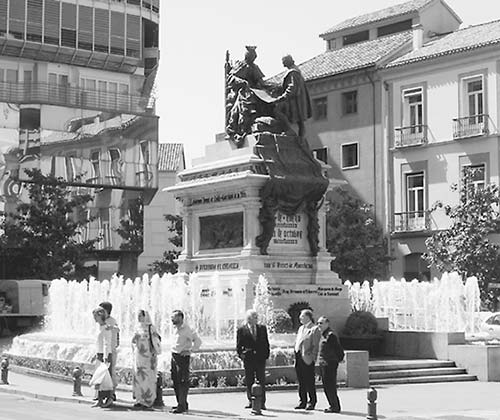
Isabel may have been driven by her desire to spread Catholicism, but Spain’s interest was in finding a maritime trade route to the Far East and its spices (Ottoman Turks had cut off the traditional overland route). Columbus himself was driven by his desire for money. As a reward for adding territory to Spain’s Catholic empire, Isabel promised Columbus the ranks of Admiral of the Oceans and Governor of the New World. To sweeten the pot, she tossed in one-eighth of all the riches he brought home.
Look back at the fine buildings flanking the start of Gran Vía. With the arrival of cars and the modern age, the people of Granada wanted a Parisian-style boulevard. In the early 20th century, they mercilessly cut through the old town and created Gran Vía and its French-style buildings. In the process they destroyed everything in their path, including many historic Moorish palaces and Christian convents. Elegant facades—like the two circa-1910 Paris-inspired buildings facing the square—once ornamented the entire Gran Vía. Now, turn 180 degrees to see the 1970s aesthetic: modern then but perhaps dated (dare I say, ugly) now.
Calle Reyes Católicos, named for the Catholic Monarchs Ferdinand and Isabel, leads from this square downhill to the busy intersection called Puerta Real. From there, Acera del Darro takes you through modern Granada to the river, passing the huge El Corte Inglés department store and lots of modern commerce. This area erupts with locals out strolling each night. For one of the best Granada paseos, wander the streets there around 19:00.
• Follow Calle Reyes Católicos uphill for a couple of blocks until you reach...
7 Plaza Nueva
Plaza Nueva is dominated at the far end by the regional Palace of Justice (grand Baroque facade with green and white Andalusian flag). The fountain is capped by a stylized pomegranate—the symbol of the city, always open and fertile. The main action here is the comings and goings of the busy little shuttle buses serving the Albayzín. The local hippie community, nicknamed the pies negros (black feet) for obvious reasons, hangs out here and on Calle de Elvira. They squat—with their dogs and guitars—in abandoned caves up in Sacromonte. Many are the children of rich Spanish families from the north, hell-bent on disappointing their high-achieving parents.
• You could end your walk here—or carry on with a stroll up Carrera del Darro. To continue, leave Plaza Nueva opposite from where you entered, on the little lane that runs alongside the Darro River. This area is particularly enjoyable in the cool of the evening. To trace this stroll, see the map on here.
8 Paseo de los Tristes Stroll
Carrera del Darro leads to a charming square called Paseo de los Tristes—“Walk of the Sad Ones.” It was once the route of funeral processions to the cemetery at the edge of town. As you leave Plaza Nueva, notice the small Church of Santa Ana on your right. This was originally a mosque—the church tower replaced a minaret. Notice the ceramic brickwork. This is Mudejar art created by Moorish craftsmen, whose techniques were later employed by the Spanish.
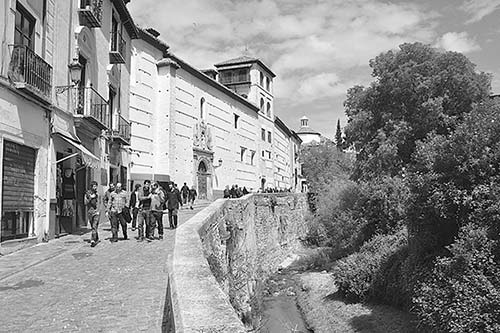
Follow Carrera del Darro along the Darro River, which flows around the base of the Alhambra. Six miles upstream, part of the Darro is diverted to provide water via an aqueduct for the Alhambra’s many fountains—a remarkable feat of Moorish engineering in 1238.
After passing two small, picturesque bridges, the road widens slightly for a bus stop. Here you’ll see the broken nub of a once-grand 11th-century bridge that led to the Alhambra. Notice two slits in the column: One held an iron portcullis to keep bad guys from entering the town via the river. The second held a solid door that was lowered to dam up water, then released to flush out the riverbed and keep it clean.
Across from the remains of the bridge is the brick facade of the stark but evocative ruins of the Hammam El Bañuelo (Arab Baths). This is a great place to explore a well-preserved example of an 11th-century Arab public bath (€7, free on Sun, covered by Alhambra Dobla de Oro card; daily 9:00-14:30 & 17:00-20:30, off-season 10:00-17:00; Carrera del Darro 31, www.alhambra-patronato.es). In Moorish times, hammams were a big part of the community (working-class homes didn’t have bathrooms). Baths were strictly segregated and were more than places to wash: These were social meeting points where business was done. In Christian times it was assumed that conspiracies brewed in these baths—therefore, only a few of them survive.
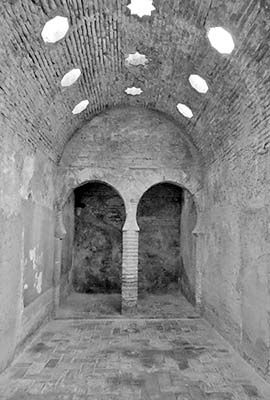
Upon entering, you pass through the foyer and into the cold room, the warm room (where services like massage were offered), and finally the hot, or steam, room. Beyond that, you can see the oven that generated the heat, which flowed under the hypocaust-style floor tiles (the ones closest to the oven were the hottest). The romantic little holes in the ceiling once had stained-glass louvers that attendants opened and closed with sticks to regulate the heat and steaminess. Whereas Romans soaked in their pools, Muslims just doused. Rather than being totally immersed, people scooped and splashed water over themselves. Imagine attendants stoking the fires under the metal boiler...while people in towels and wooden slippers (to protect their feet from the heated floors) enjoyed all the spa services you can imagine as beams of light slashed through the mist.
This was a great social mixer. As all were naked, class distinctions disappeared—elites learned the latest from commoners. Mothers found matches for their kids. A popular Muslim phrase sums up the attraction of the baths: “This is where anyone would spend their last coin.”
Notice just across from the baths is a stop for minibus #C31 and #C32—the easy way to head up to the Albayzín. On your left is Santa Catalina de Zafra, a convent of cloistered nuns (they worship behind a screen that divides the church’s rich interior in half).
Just past this, on your right is the Church of San Pedro and San Pablo (across from the Mudejar Art Museum). Within its rich interior is an ornate silver-encrusted oxcart used to carry the Communion host on the annual pilgrimage to Rocío, a town near the Portuguese border. A few steps farther along, on the left, the Convento de San Bernardo sells cookies and monastic wine: Cross under the archway opposite the church doors and head uphill until you reach a door under a ceramic portrait of San Bernardo (at #2); goods are sold from behind a lazy Susan.
Our stroll ends at a promenade with bar and restaurant tables spilling out under the floodlit Alhambra. From here, the road arcs up to the Albayzín and into Sacromonte.
Alhambra Tour
The last and greatest Moorish palace, the Alhambra, is one of Europe’s top sights and worth ▲▲▲. Attracting 8,000 visitors a day, it’s the reason most tourists come to Granada. Nowhere else does the splendor of Moorish civilization shine so beautifully.
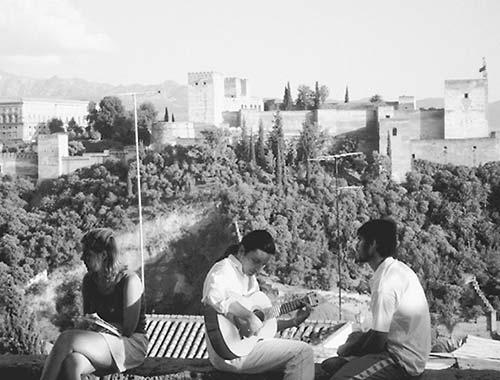
The last Moorish stronghold in Europe is really a symbol of retreat. As the Christian Reconquista gradually moved south, taking Córdoba (1237) and Sevilla (1248), displaced Muslims relocated to Granada, home of the Nasrids—the last Islamic kingdom in Spain. The Nasrids themselves would fall in 1492, but until that time Granada flourished as an intellectual and artistic center.
As you tour their grand palace, remember that while much of Europe slumbered through the Middle Ages, here Moorish magnificence blossomed—ornate stucco, plaster “stalactites,” colors galore, scalloped windows framing Granada views, exuberant gardens, and water, water everywhere. Water—so rare and precious in most of the Islamic world—was the purest symbol of life to the Moors. The Alhambra is decorated with water: standing still, cascading, masking secret conversations, and drip-dropping playfully.
The Alhambra consists of four sights clustered together atop a hill, all covered by the following self-guided tour (in this order):
• Palace of Charles V: Christian Renaissance palace plopped on top of the Alhambra after the Reconquista, with the fine Alhambra Museum inside (free to enter without a ticket).
• Alcazaba Fort: Empty but evocative old fort with tower and views (ticket required).
• Palacios Nazaríes: Exquisite Moorish palace, the Alhambra’s must-see sight (ticket required).
• Generalife Palace and Gardens: Small summer palace with fragrant, lovely manicured gardens (ticket required).
ALHAMBRA TICKETS IN A NUTSHELL
To ensure you’ll see the Palacios Nazaríes, the highlight of the Alhambra, book an “Alhambra General” ticket in advance; it includes the Palacios Nazaríes, Alcazaba, and Generalife Palace and its gardens. Demand far exceeds the supply of about 8,000 tickets per day, so buy as far in advance as possible (tickets available one year ahead, but keep in mind that they’re nonrefundable and cannot be changed; for more info, see “Orientation to the Alhambra—Reservation Tips,” later). Tickets covering just the Generalife and Alcazaba are more readily available—but you don’t want to miss the Palacios Nazaríes.
When booking tickets online, be prepared to enter the passport number of each visitor in your group; each person will be required to show their passport when entering the sight. (This is necessary to foil scalpers. Curses!)
Ticketing options for the Alhambra change frequently. Don’t be scammed by unofficial websites selling overpriced tickets. Confirm details only at Alhambra-Patronato.es.
GETTING THERE
There are two main entrances to the sprawling Alhambra: the Justice Gate (near the Palacios Nazaríes), and the entrance pavilion (400 yards farther along at the top of the complex). Inside, there are ticket checkpoints for the Palacios Nazaríes, the Alcabaza, and the Generalife. If you’ve booked ahead and have a QR-code ticket (printed or on your phone), you can go directly to the Justice Gate.
On Foot: For the most dramatic approach, hike uphill 20 minutes from Plaza Nueva. Leave the plaza going up Cuesta de Gomérez. Keep going straight—you’ll see the Alhambra high on your left. You’ll soon reach the impressive Justice Gate, which leads to the Palacios Nazaríes.
By Bus: A few steps uphill from Plaza Isabel La Católica, catch the #C30 or #C32 minibus, marked Alhambra. Get off at stops Generalife (entrance pavilion/ticket office and gardens) or Justice Gate (Palacios Nazaríes, Alcazaba, and Palace of Charles V). See “The Alhambra” map for stop locations. The ride can take as long as the hike depending on traffic; plan accordingly.
By Taxi: It’s a €6 ride from Plaza Nueva. You can be dropped at the Palace of Charles V inside the grounds.
By Car: If you have a car parked in town, don’t drive it to the Alhambra. But if you’re coming from outside the city, you can drive directly here without passing through Granada’s historic center. From the freeway, take the exit marked Alhambra. Signs lead you to a public paid parking lot, located near the entrance pavilion (both hourly and overnight/multiday parking is available, guarded at night).
PLANNING YOUR TIME
You can see the Alhambra sights in any order. To minimize walking, a good plan is to see the three sights at the lower end first: Start with the Palace of Charles V and the Alcazaba fort, then visit Palacios Nazaríes. When you finish touring the palace, leave through the Partal Gardens, then take a pleasant 15-minute gradual uphill stroll to the Generalife and its gardens. From there, you can walk a pleasant ravine lane back into town.
If you arrive at the Alhambra well before your Palacios Nazaríes appointment, you could do the Generalife Palace and the gardens first, then head down to the lower sights. Or you can kill time luxuriously on the breezy view terrace of the parador bar within the Alhambra wall.
Entering the Palacios Nazaríes: Alhambra General tickets come with a 30-minute time slot for admission to the Palacios Nazaríes. You must enter the Palacios Nazaríes within the 30-minute window, but once inside, you can linger as long as you like. Whatever you do, don’t miss your appointed time window. Ticket checkers at the Palacios Nazaríes are strict and inflexible (they like to say “machines don’t make mistakes”).
Three hundred people are let into the palace each half-hour. So if your ticket says 11:00, you have until 11:30 to enter. At 10:45 a long line starts to form for the 11:00 entry, but lining up isn’t necessary—if you arrive at 11:15, you’ll walk right in.
If you arrive near the end of your 30-minute window (say at 11:20), don’t risk missing the cut-off by getting in the wrong line—by then, 11:30 ticket holders are queuing up. Cut ahead of them via the empty lane to the left of the line; the guard at the turnstile will check your entry time and let you in. Guards also walk the line announcing upcoming time slots, ushering eligible visitors to the front.
Without a Reservation: If you are unable to get a reservation for the Palacios Nazaríes, try buying a Granada Card sightseeing pass (see here). It may score you a reservation even when the main Alhambra website is sold out. The TI in town and most hotels are adept at Alhambra issues. An Alhambra info desk sometimes operates inside the Corral del Carbón in the town center.
If you can’t secure a Palacios Nazaríes reservation, you can enjoy the rest of the Alhambra with a ticket covering just the gardens, Generalife, and Alcazaba. Walking the rest of the grounds, including the Palace of Charles V and the parador, is free.
ORIENTATION TO THE ALHAMBRA
Ticketing Options: There are many, many ticket options for the Alhambra (all-inclusive, night visits, garden-only, and so on). Whatever you choose, be sure to purchase a ticket that includes the essential Palacios Nazaríes.
Cost: Tickets range in price from €8 to €27, but the best ticket for most visitors is the Alhambra General (€19), which covers everything—the Palacios Nazaríes, Alcazaba fort, and Generalife Palace and its gardens. Children under 12 are free, but still need a reservation booked online in their name.
Reservation Tips: Once you’ve selected a ticket type and date, you’ll choose an entry time for the Palacios Nazaríes. When asked for a “document number,” use your passport number. Print the ticket and/or store it on your phone. Tickets are released in intervals throughout the year (at 12 months out, 3 months out, and 1 month out); if tickets appear sold out for a particular date three months in advance, for example, check again one month ahead.
Hours: The entire Alhambra complex is open daily 8:30-20:00 (mid-Oct-March until 18:00). Last entry is one hour before closing.
Night Visits: The Palacios Nazaríes and the Generalife are open and nicely lit some evenings (Tue-Sat 22:00-23:30; mid-Oct-March Fri-Sat 20:00-21:30). Note that night-visit tickets include the palace or the Generalife, but not both. These tickets are not timed-entry, and it’s extremely crowded when the doors open; you must enter no later than one hour before closing.
Information: Visitor info +34 958 027 971, ticket help line +34 858 889 002, https://tickets.alhambra-patronato.es. At both entrances to the complex you’ll see roaming green-shirted staff members ready to answer questions.
Getting In: Be prepared to show an official photo ID (passport or drivers license) for each person in your group, matched to their tickets.
Reentering the Complex: You can scan your ticket to enter the Palacios Nazaríes, Generalife, and Alcazaba just once, but otherwise you may come and go from the Alhambra complex throughout the day. Keep your ticket until the end of your visit.
Tours: The Alhambra’s excellent €6 interactive audioguide covers the entire complex (can be reserved ahead online). Rental booths are at both entrances as well as inside the Palace of Charles V; audioguides can be returned to any of these locations. The audioguide is also available as a €4 app, downloadable from the Alhambra website.
Alhambra Guidebook: The slick and colorful Alhambra and Generalife in Focus is sold at bookstores and shops lining the complex but not inside the Alhambra itself (€11; to make the most of your visit, buy and read it before you tour the sight).
Services: The two main entrances have a service center, with bag check (free for ticket holders only), WCs, and water and snack machines. There are no WCs inside the Palacios Nazaríes. Small day packs are allowed but must be worn in front, kangaroo-style.
Eating: Within the Alhambra walls, food options are limited and generally overpriced. Choose between the restaurant or the cafeteria at the $$$ parador, the peaceful ambience of the courtyard at $$$ Hotel América (daily 12:30-17:00), a small $ bar-café kiosk in front of the Alcazaba fort (basic sandwiches and snacks), and vending machines (at the WC) next to the Wine Gate, near the Palace of Charles V. You’re welcome to bring a picnic but must eat it outside ticketed areas.
For better-value (but still touristy) options, head to the area outside the entrance pavilion at the top of the complex. $$$ Restaurante Jardines Alberto has a nice courtyard and offers a charming setting (daily, often booked up; Paseo de la Sabica 1, +34 958 221 661, climb the stairs from the street). The breezy $$$ Restaurante La Mimbre offers shade and a break from the crowds. It also serves breakfast, has a fast sandwich bar, and offers a pleasant outdoor terrace (daily, Paseo del Generalife 18, +34 958 222 276).
City Tour from the Alhambra: The hop-on, hop-off tourist train leaves from the top of the Alhambra, offering a convenient hour-long sightseeing tour on the way back to town instead of walking (see “Tours in Granada,” earlier).
 SELF-GUIDED TOUR
This tour assumes that you’ll visit the Alhambra sights from the bottom of the complex to the top. The first three sights cluster at the bottom end, while the Generalife and its gardens are about a 15-minute walk away, at the top.
▲▲Palace of Charles V
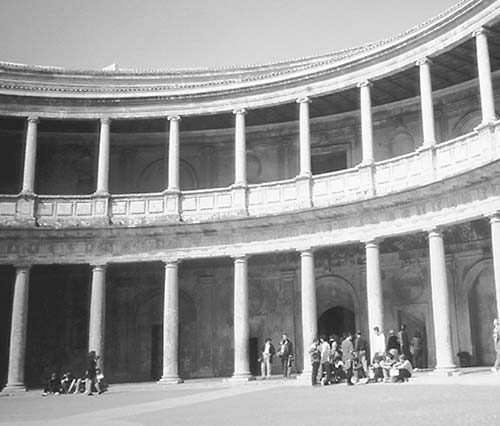
While it’s only natural for a conquering king to build his own palace over that of his foe, Holy Roman Emperor Charles V (who ruled as Charles I over Spain) respected the splendid Palacios Nazaríes. And so, in the early 1500s, to make his mark, he built a modern Renaissance palace for official functions and used the existing Moorish palace as a royal residence. With a unique circle-within-a-square design by Pedro Machuca, a pupil of Michelangelo, this is Spain’s most impressive Renaissance building. Admire the circular courtyard surrounded by puddingstone (quartz conglomerate) columns, then climb the stairs. Perhaps Charles’ palace was designed to have a dome, but it was never finished—his son, Philip II, abandoned it to build El Escorial, his own much more massive palace outside Madrid (the final and most austere example of Spanish Renaissance architecture). Even without a dome, acoustics are perfect in the center—stand in the middle and sing your best aria. The palace doubles as a venue for the popular Festival of Granada.
▲Alhambra Museum (Museo de la Alhambra)
On the ground floor of the Palace of Charles V, this museum helps you imagine life in the palace while offering your best look at Alhambra artifacts (like a 700-year-old chessboard) and shows off some of the Alhambra’s best surviving Moorish art. The well-described artifacts—including tiles; characteristic green, blue, and black pottery; lion fountains; dazzling gold doubloons; and a beautiful carved-wood door—are beautifully displayed (free, peaceful and air-conditioned, Wed-Sat 8:30-20:00, Sun and Tue until 14:30, shorter hours off-season, closed Mon year-round). The Fine Arts Museum (Museo de Bellas Artes, upstairs, free) has Christian-era paintings and statues and is of little interest to most.
• From the front of the Palace of Charles V, the Alcazaba is the towering brick structure across a moat, straight ahead.
Alcazaba
This fort—the original “red castle” (the literal meaning of Alhambra)—is the oldest and most ruined part of the complex, offering exercise and fine city views. What you see is from the mid-13th century. Once upon a time, this tower defended a medina (town) of 2,000 Muslims living within the Alhambra walls. Gazing down from the ramparts (which stretch more than a mile around the entire complex), you’ll see the moat or “dead zone” between the inner and outer walls. It’s a sprawling structure, essentially a barracks for the garrison that protected the Alhambra. Imagine the five miles of aqueducts needed to get water from a distant river flowing into this thirsty fortified community.
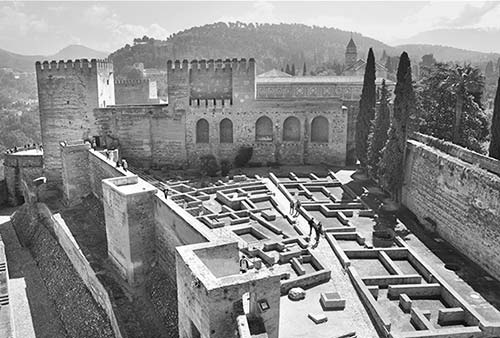
Winding your way through passages and courtyards (follow the arrows along the one-way route), over uneven terrain, you’ll eventually reach the biggest tower at the tip of the complex, where you’ll climb stairs steeply up to the very top. From here (looking north), find Plaza Nueva and the San Nicolás viewpoint in the Albayzín. To the south are the Sierra Nevada Mountains. Notice the tower’s four flags: the blue of the European Union, the green and white of Andalucía, the red and yellow of Spain, and the red and green of Granada.
Speaking of flags, imagine that day in 1492 when the Christian cross and the flags of Aragon and Castile were raised on this tower, and (according to a probably fanciful legend) the fleeing Moorish king Boabdil (Abu Abdullah, in Arabic) looked back and wept. His mom chewed him out, saying, “You weep like a woman for what you couldn’t defend like a man.” With this defeat, more than seven centuries of Muslim rule in Spain came to an end. Much later, Napoleon stationed his troops at the Alhambra, contributing substantially to its ruin.
• If you’re going from the Alcazaba to Palacios Nazaríes, backtrack toward the Palace of Charles V and join the line (to the left, behind the palace) during the 30-minute entry time on your ticket.
▲▲▲Palacios Nazaríes
Crowds crush into the jewel of the Alhambra at the start of each 30-minute entry interval. If your entry time is particularly crowded, consider lingering at the start to let things quiet down. Once inside, relax. You’re no longer under any time constraints. You’ll walk through three basic sections: royal offices, ceremonial rooms, and private quarters. Built mostly in the 14th century, this palace offers your best possible look at the refined, elegant Moorish civilization of al-Andalus (the Arabic word for the Moorish-controlled Iberian Peninsula).
For a general orientation, step into the first room (the mexuar), once reserved for administrative activities. Imagine the council of wise men and scribes busy doing the office work of the state bureaucracy. Notice the stunning prayer room (the oratorio, with a niche on the right facing Mecca, and lacy windows filling the space with light and affording great views). Throughout the palace you’ll be visiting rooms like this: decorated from top to bottom with carved wood ceilings, stucco stalactites, ceramic tiles, molded-plaster walls, and filigree windows. Open-air courtyards feature fountains with bubbling water, which give the palace a desert-oasis feel. A garden enlivened by lush vegetation and peaceful pools is the Quran’s symbol of heaven. The palace is well preserved and well restored, but the trick to fully appreciating it is to imagine it furnished and filled with Moorish life: Sultans with hookah pipes lounging on pillows upon Persian carpets, heavy curtains on the windows, and ivory-studded wooden furniture. The whole place was painted with bright colors, many suggested by the Quran—blue (heaven), green (oasis), red (blood), and gold (wealth). Throughout the palace, walls, ceilings, vases, carpets, and tiles were covered with decorative patterns and calligraphy, mostly poems and verses of praise from the Quran and from local poets.
As you wander, keep the palace themes in mind: water, a near absence of figural images (they’re frowned upon in Islam), “stalactite” ceilings—and few signs telling you where you are. As tempting as it might be to touch the stucco, don’t—it is very susceptible to damage from the oils from your hand. Use this book’s map to locate the essential stops listed below.
• Passing through a small courtyard with a round fountain, eventually you hit a big rectangular courtyard with a fishpond lined by two myrtle-bush hedges.
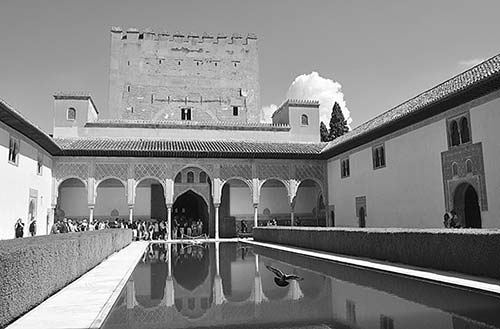
1 Courtyard of the Myrtles (Patio de Arrayanes): The standard palace design included a central courtyard like this. Moors loved their patios—with a garden and water, under the open sky. The apartments of the sultan’s women looked over this courtyard: two apartments for wives on either side (according to the Quran, four wives was the maximum allowed), and a dorm for the concubines at the far end (a man could have as many concubines as he could maintain with dignity). In accordance with medieval Moorish mores, women rarely ventured outside the home, so they stayed in touch with nature in courtyards like the Courtyard of the Myrtles—named for the fragrant myrtle hedges that add to the courtyard’s charm. Notice the wooden screens (“jalousies” erected by jealous husbands) that allowed the cloistered women to look out without being clearly seen. The upstairs was likely for winter use, and the cooler ground level was probably occupied in summer.
• Head left from the entry through gigantic wooden doors into the long narrow antechamber called the...
2 Ship Room (Sala de la Barca): It’s understandable that many think the Ship Room is named for the upside-down hull shape of its fine cedar ceiling. But the name is actually derived from the Arab word baraka, meaning “divine blessing and luck.” (President Obama’s first name came from the same Arabic root word.) As you passed through this room, blessings and luck are exactly what you’d need—because in the next room, you’d be face-to-face with the sultan.
• Oh, it’s your turn. Enter the ornate throne room.
3 Grand Hall of the Ambassadors (Gran Salón de los Embajadores): The palace’s largest room, also known as the Salón de Comares, functioned as the throne room. It was here that the sultan, seated on a throne opposite the entrance, received foreign emissaries. Ogle the room—a perfect cube—from top to bottom. Made from 8,017 pieces inlaid like a giant jigsaw puzzle, the star-studded, domed wooden ceiling suggests the complexity of Allah’s infinite universe. Wooden stalactites form the cornice, running around the entire base of the ceiling. The stucco walls, even without their original paint and gilding, are still glorious. The filigree windows once held stained glass and had heavy drapes to block out the heat. Some precious 16th-century tiles survive in the center of the floor.
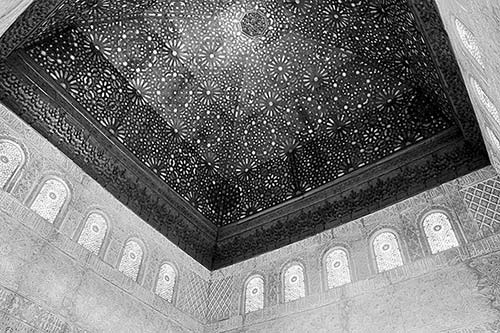
A visitor here would have stepped from the glare of the Courtyard of the Myrtles into this dim, cool, incense-filled world to meet the silhouetted sultan. Imagine the alcoves functioning busily as workstations, and the light at sunrise or sunset, rich and warm, filling the room.
Let your eyes trace the finely carved Arabic script. Muslims avoided making images of living creatures—that was God’s work. But they could carve decorative religious messages. One phrase—“only Allah is victorious”—is repeated 9,000 times throughout the palace. Find the character for “Allah”: It looks like a cursive W with a nose on its left side, with a vertical line to the right. The swoopy toboggan blades underneath are a kind of artistic punctuation used to set off one phrase.
In 1492, two historic events likely took place in this room. Culminating a 700-year-long struggle, the Reconquista was completed here as the last Moorish king, Boabdil, signed the terms of his surrender before eventually going into exile in Morocco.
And it was here that Columbus made one of his final pitches to Isabel and Ferdinand to finance a sea voyage to the Far East. Imagine the scene: The king, the queen, and the greatest minds from the University of Salamanca gathered here while Columbus produced maps and pie charts to make his case that he could sail west to reach the east. Ferdinand and the professors laughed and called Columbus mad—not because they thought the world was flat (most educated people knew otherwise), but because they thought Columbus had underestimated the size of the globe, and thus the length and cost of the journey.
But Isabel said, “Sí, señor.” Columbus fell to his knees (promising to pack light, wear a money belt, and use a good guidebook).
Just outside the Ship Room entrance, photographers pause for a picture-perfect view of the tower reflected in the Courtyard of the Myrtles pool. This archway below the tower was the original palace entrance (before the Palace of Charles V was built).
• Continue deeper into the palace, to a courtyard where, 600 years ago, only the royal family and their servants could enter. It’s the much-photographed...
4 Courtyard of the Lions (Patio de los Leones): This delightful courtyard is named for the famous fountain at its center with its ring of 12 marble lions—originals from the 14th century. From the center of the courtyard, four channels carry water outward—figuratively to the corners of the earth and literally to various more private apartments of the royal family. The arched gallery that surrounds the courtyard is supported by 124 perfectly balanced columns. The craftsmanship is first class. For example, the lead fittings between the precut sections of the columns allow things to flex during earthquakes, preventing destruction.
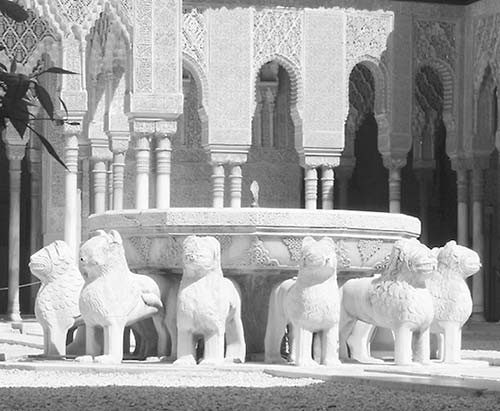
Six hundred years ago, the Muslim Moors could read the Quranic poetry that ornaments this court, and they could understand the symbolism of this lush, enclosed garden, considered the embodiment of paradise or truth. (“How beautiful is this garden / where the flowers of Earth rival the stars of Heaven. / What can compare with this alabaster fountain, gushing crystal-clear water? / Nothing except the fullest moon, pouring light from an unclouded sky.”) They appreciated this part of the palace even more than we do today.
Rather than make paintings and statues, Islamic artists expressed themselves with beautiful but functional objects. Ceramics (most of them blue and white, or green and white), carpets, glazed tile panels, stucco-work ceilings, and glass tableware are covered with complex patterns. The intricate interweaving, repetition, and unending lines suggest the complex, infinite nature of God, known to Muslims as Allah.
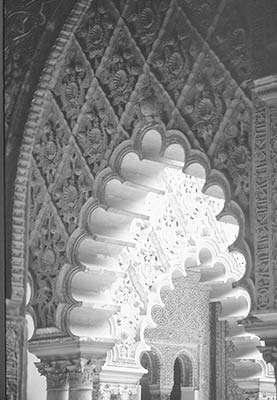
You’ll see few pictures of humans, since Islamic doctrine holds that the creation of living beings is God’s work alone. However, secular art by Muslims for their homes and palaces was not bound by this restriction; you’ll get an occasional glimpse of figurative art featuring men and women enjoying a garden paradise, a symbol of the Muslim heaven.
Look for floral patterns (twining vines, flowers, and arabesques) and geometric designs (stars and diamonds). The decorative motifs (Arabic script, patterns, flowers, shells, and so on) that repeat countless times throughout the palace were made by pressing wet plaster into molds. The most common pattern is calligraphy—elaborate lettering of an inscription in Arabic, the language of the Quran. A quote from the Quran on a vase or lamp combines the power of the message with the beauty of the calligraphy.
• On the right, off the courtyard, the only original door still in the palace leads into a square room called the...
5 Hall of the Abencerrajes (Sala de los Abencerrajes): This was the sultan’s living room, with an exquisite ceiling based on the eight-sided Muslim star.
The name of the room comes from a bloody event that’s said to have occurred here. According to a legend of the 16th century, the father of Boabdil invited members of the North African Abencerraje family to a banquet—and then promptly massacred them to thwart a threat to his dynasty. According to Washington Irving’s tale, he is said to have stacked 36 Abencerraje heads in the pool, under the sumptuous honeycombed stucco ceiling in this hall.
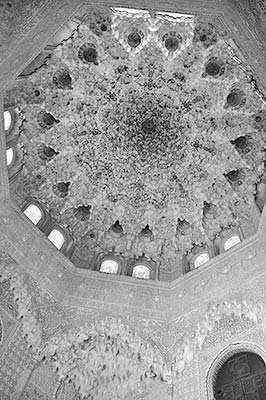
• At the end of the court opposite where you entered is the...
6 Hall of the Kings (Sala de los Reyes): This hall is famous for its circa 1360 paintings on the goat-leather ceiling depicting scenes of the sultan and his family. The center room’s group portrait shows the first 10 of the Alhambra’s 22 sultans. The scene is a fantasy, since these people lived over a span of many generations. The two end rooms display scenes of princely pastimes, such as playing chess, hunting, and shooting skeet. In a palace otherwise devoid of figures, these depictions offer a rare look at royal life in the palace.
• Continue around the lion fountain. Before entering the next room, you’ll pass doors leading right and left to a 14th-century WC plumbed by running water and stairs up to the harem. Next is the...
7 Hall of Two Sisters (Sala de Dos Hermanas): The Sala de Dos Hermanas—nicknamed for the giant twin slabs of white marble on the floor flanking the fountain—has another oh-wow stucco ceiling lit by clerestory windows. This is another royal reception hall, with alcoves for private use and a fountain. Running water helped cool and humidify the room but also added elegance and extravagance, as running water was a luxury most could only dream of.
The room features geometric patterns and stylized Arabic script quoting verses from the Quran. If the inlaid color tiles look “Escher-esque,” you’ve got it backward: Escher is Alhambra-esque. M. C. Escher was inspired by these very patterns on a visit here. Study the geometry of the patterns—they remind us of the Moorish expertise in math.
The sitting room (farthest from the entry) has low windows because Moorish people sat on the floor. Some rare stained glass survives in the ceiling. From here the sultana enjoyed a grand view of the medieval city (before a 16th-century wing blocked the view).
• That’s about it for the palace. From here, we enter the later, 16th-century section, and wander past the domed roofs of the old baths down a hallway to a pair of rooms decorated with mahogany ceilings. Marked with a large plaque is the...
8 Washington Irving Room: While living in Spain in 1829, American writer Washington Irving stayed in the Alhambra, and he wrote Tales of the Alhambra in this room. It was a romantic time, when the palace was home to vagabonds and donkeys. His “tales” rekindled interest in the Alhambra, causing it to be recognized as a national treasure. A plaque on the wall thanks Irving, who later served as the US ambassador to Spain (1842-1846). Here’s a quote from Irving’s The Alhambra by Moonlight: “On such heavenly nights I would sit for hours at my window inhaling the sweetness of the garden, and musing on the checkered fortunes of those whose history was dimly shadowed out in the elegant memorials around.”
• As you leave, stop at the open-air...
9 Hallway with a View: Here you’ll enjoy the best-in-the-palace view of the labyrinthine Albayzín—the old Moorish town on the opposite hillside. Find the famous San Nicolás viewpoint (below where the white San Nicolás church tower breaks the horizon—see the crowds of tourists taking pictures of you). Green patches are the gardens of cármenes (old noble farms, many that are now romantic restaurants). Below is the river and the Paseo de los Tristes (with its square filled with inviting restaurants). Creeping into the mountains on the right is the Sacromonte neighborhood. Still circling old Granada is the Moorish wall (built in the 1400s to protect the city’s population, swollen by Muslim refugees driven south by the Reconquista).
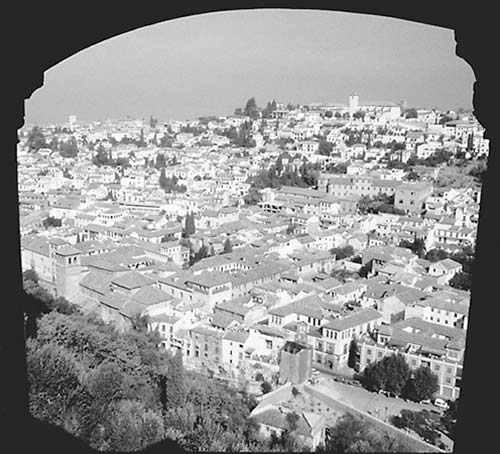
Below, the big green Patio of Lindaraja, with its maze-like hedges, marks the end of the palace visit. Before exiting, you can detour right into the “Secrets Room”—a domed brick room of the former baths with fun acoustics. Whisper into a corner, and your friend—with an ear to the wall—can hear you in the opposite corner. Try talking in the exact center.
• Step outside into the...
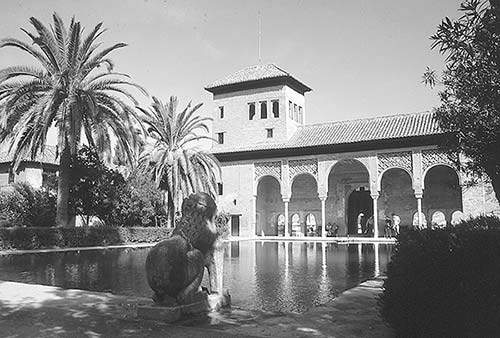
10 Partal Gardens (El Partal): The Partal Gardens are built upon the ruins of the Partal Palace. Imagine a palace like the one you just toured, built around this reflecting pond. A fragment of its living quarters still stands on the cooler north side. Its Mecca-facing oratory (the small building a few steps above the pool) survives. The Alhambra was the site of seven different palaces in 150 years. You have toured parts of just two or three.
• Leaving the palace, climb a few stairs, continue through the gardens, and follow signs directing you left to the Generalife (or right to the Alcazaba and the rest of the Alhambra grounds, if you haven’t already visited them).
The path to the Generalife and its gardens is a delightful 15-minute stroll through lesser (but still pleasant) gardens, along a row of fortified towers. Just before reaching the Generalife, you’ll cross over a bridge and look down on the dusty lane called Cuesta del Rey Chico (a handy shortcut for returning to town later).
As you wander the grounds, remember that the Alhambra was once a city of a thousand people fortified by a 1.5-mile rampart and 30 towers. The zone within the walls was a medina, an urban town. Passing through the ruins of the medina (destroyed by the French in 1812), the garden-like Calle Real de la Alhambra traces along the south wall, with its towers, from the entrance pavilion to the Palacios Nazaríes. In the distance are the snowcapped Sierra Nevada peaks—the highest in Iberia. While you need a ticket to visit the highlights of the Alhambra, the medina, the Palace of Charles V, a church, a line of shops showing off traditional woodworking techniques, and the fancy Alhambra parador are wide open and free to everyone.
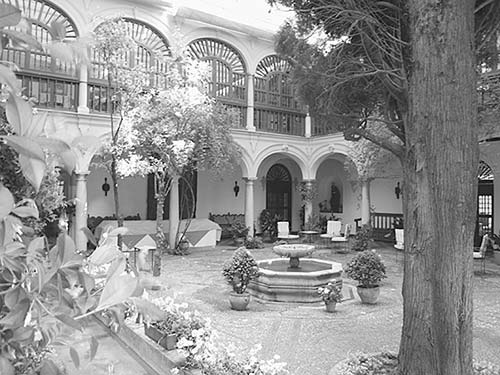
It’s especially fun to snoop around the historic Parador de Granada San Francisco, which—as a national monument—is open to the public (its terrace café has lush views of the Generalife). Once a Moorish palace within the Alhambra, it was later converted into a Franciscan monastery, with a historic claim to fame: Its church is where Ferdinand and Isabel chose to be buried. For a peek, step in through the front door leading to a small garden area and reception. Continue straight to see the burial place, located in the open-air ruins of the church (you’ll pass a delightful former cloister; the history is described in English). The slab on the ground near the altar—a surviving bit from the mosque that was here before the church—marks the place where the king and queen rested until 1521 (when they were moved to the Royal Chapel downtown).
The medina’s main road dead-ended at the Wine Gate (Puerta del Vino), which led to the fortress. When you pass through the Wine Gate, you enter a courtyard that was originally a moat, then a reservoir (in Christian times). The well—now encased in a bar-kiosk—is still a place for cold drinks.
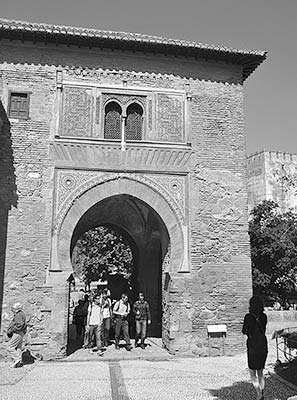
You can exit down to the city from the Wine Gate via the Justice Gate, immediately below. From there you’ll walk past a Renaissance fountain and pass through the Pomegranate Gate (Puerta de las Granadas) into the modern city, close to Plaza Nueva.
▲▲Generalife Palace and Gardens
The sultan’s vegetable and fruit orchards and the summer palace retreat called the Generalife (heh-neh-rah-LEE-fay) were outside the protection of the Alhambra wall; today, they’re a short hike uphill past the entrance pavilion. The thousand-or-so residents of the Alhambra enjoyed the fresh fruit and veggies grown here. But most important, this little palace provided the sultan with a cool and quiet summer escape.
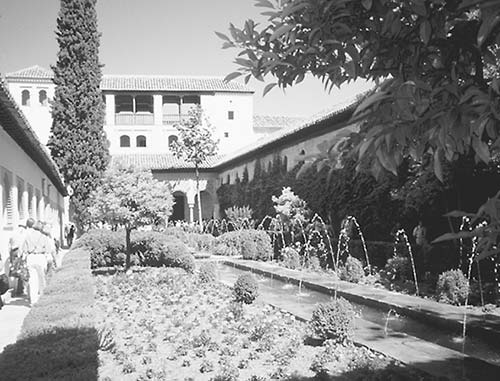
Follow the simple one-way path through the sprawling gardens. You’ll catch glimpses of a sleek, modern outdoor theater, built in the 1950s. It continues to be an important concert venue for Granada. From the head of the theater, signs will lead you through manicured hedges, along delightful ponds, and past flowing fountains to the sultan’s small summer palace.
Approaching the bright white palace, you’ll first pass through the dismounting room (imagine dismounting onto the helpful stone ledge, and letting your horse drink from the trough here). Enter the most accurately re-created Arabian garden in Andalucía, the Patio de la Acequia.
Here in the retreat of the Moorish kings, this garden is the closest thing on earth to the Quran’s description of heaven. It was first planted more than 600 years ago—that’s remarkable longevity for a European garden. In spirit the details in today’s garden evoke those lovingly described in old poems. The flowers, herbs, aromas, and water are exquisite...even for a sultan. Up the Darro River, the royal aqueduct diverted a life-giving stream of water into the Alhambra. It was channeled through this extra-long decorative fountain to irrigate the bigger garden outside, then along an aqueduct into the Alhambra for its thirsty residents. And though the splashing water jets are a delight, they are a 19th-century addition. The Moors liked a peaceful pond instead.
At the end of the pond, you enter the sultan’s tiny three-room summer retreat. From the last room, climb 10 steps into the upper Renaissance gardens (c. 1600). The ancient tree rising over the pond inspired Washington Irving, who wrote that this must be the “only surviving witness to the wonders of that age of al-Andalus.”
Climbing up and going through the turnstile, you enter the Romantic 19th-century garden. Your visit to the Alhambra is complete, and you’ve earned your reward. “Surely Allah will make those who believe and do good deeds enter gardens beneath which rivers flow; they shall be adorned therein with bracelets of gold and pearls, and their garments therein shall be of silk” (Quran 22.23).
• From here you can extend your visit to see the highest point of the Generalife from atop a 14th-century staircase, or exit the Alhambra.
Escalera del Agua and Return to Town
For a little more exercise (and views), turn left at the sign for continuación de la visita, and take the half-mile loop up and around to see the staircase called Escalera del Agua, whose banisters double as little water canals. From the top, you’ll have a chance to enter the “Romantic Viewpoint”—climb up the stairs for a top-floor view over the gardens (pleasant enough, but less impressive than other views at the Alhambra). Then hike back down through the garden and follow salida signs, through the long oleander trellis tunnel, to the exit and the minibuses.
But if you’re exhausted, skip this detour. Instead, just head to the right and follow salida signs toward the gardens’ exit (next to the Alhambra’s entrance pavilion). The #C30 and #C32 minibuses return from here to Plaza Isabel La Católica.
If you want to return to town on foot, there are two direct and scenic routes. One is the easily overlooked Cuesta del Rey Chico pathway. It starts under the two stone arches not far from the entrance pavilion, by Restaurante La Mimbre and the minibus stop—a sign just past the restaurant entrance will confirm you’re on the right path. You’ll walk downhill on a peaceful cobbled lane, scented with lavender and rock rose, beneath the Alhambra ramparts and past the sultan’s horse lane leading up to the Generalife. In 15 minutes you’re back in town at Paseo de los Tristes, where you can stroll along a level road to Plaza Nueva or continue walking into the Albayzín district (walking downhill on this trail from the Alhambra, you can’t get lost).
The other route is the shortest and most common: a straight walk along the main road and the base of the fortress wall until you reach a fountain on the left. Follow the shady canopy of trees down, down, down until reaching Cuesta de Gomérez and Plaza Nueva.
More Sights in Granada
▲Granada Cathedral (Catedral de Granada)
Hammam al Ándalus (Arab Baths)
▲▲San Nicolás Viewpoint (Mirador de San Nicolás)
▲Great Mosque of Granada (Mezquita Mayor de Granada)
▲Cave Museum of Sacromonte (Museo Cuevas del Sacromonte)
Carthusian Monastery (Monasterio de la Cartuja)
OLD TOWN
▲▲Royal Chapel (Capilla Real)
Without a doubt Granada’s top Christian sight, this lavish chapel in the old town holds the dreams—and bodies—of Queen Isabel and King Ferdinand. The Catholic Monarchs were all about the Reconquista. Their marriage united the Aragon and Castile kingdoms, allowing an acceleration of the Christian and Spanish push south. In its last 10 years, the Reconquista snowballed. Symbolic of Ferdinand and Isabel’s eventual victory, Granada—the last Moorish capital—was their chosen burial place. This chapel, while smaller and less architecturally striking than Granada’s cathedral, is far more historically significant.
Cost and Hours: €5, includes QR-code audioguide; Mon-Sat 10:00-18:30, Sun from 11:00; entrance on Calle Oficios, just off Gran Vía del Colón—go through iron gate; +34 958 227 848, www.capillarealgranada.com.
Visiting the Chapel: In the lobby, before you enter the chapel, notice the painting of Boabdil (on the black horse) giving the key of Granada to the conquering King Ferdinand. Boabdil wanted to fall to his knees, but the Spanish king, who had great respect for his Moorish foe, embraced him instead. They fought a long and noble war (for instance, respectfully returning the bodies of dead soldiers). Ferdinand is in red, and Isabel is behind him wearing a crown. The painting is flanked by glass-enclosed exhibits comparing painted wood sculptures of the four royal family members buried here with their marble tomb sculptures (their faces are too high up to see clearly inside the chapel).
Isabel decided to make Granada the capital of Spain (and the burial place of Spanish royalty) for three reasons: 1) With the conquest of this city, Christianity had finally overcome Islam in Europe; 2) her marriage with Ferdinand, followed by the conquest of Granada, had marked the beginning of a united Spain; and 3) in Granada, she agreed to sponsor Columbus.
Step into the chapel. The light and lacy silver-filigree style is Plateresque Gothic, named for and inspired by the fine silverwork of the Moors. The chapel’s interior was originally austere, with fancy touches added later by Ferdinand and Isabel’s grandson, Holy Roman Emperor Charles V. Five hundred years ago, this must have been the most splendid space imaginable. Because of its speedy completion (1506-1521), the Gothic architecture is unusually harmonious.
In front of the main altar, the four royal tombs are Renaissance-style. Carved in Italy in 1521 from Carrara marble, they were sent by ship to Spain. The faces—based on death masks—are considered accurate. Ferdinand and Isabel are the lower, and humbler, of the two couples. (Isabel fans attribute the bigger dent she puts in the pillow to the weight of her larger brain.) Isabel’s contemporaries described the queen as being of medium height, with auburn hair and blue eyes, and possessing a serious, modest, and gentle personality. (Compare Ferdinand and Isabel’s tomb statues with the painted and gilded wood statues of them kneeling in prayer, flanking the altarpiece.)
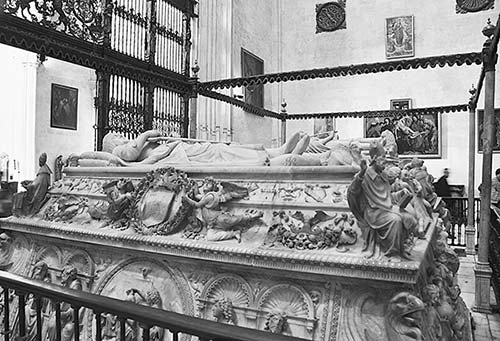
Philip the Fair and Juana the Mad (who succeeded Ferdinand and Isabel) lie on the left. Philip was so “Fair” that it drove the insanely jealous Juana “Mad.” Philip died young, and Juana, crazy like a fox, used her “grief” over his death to forestall a second marriage, thereby ensuring that their son Charles would inherit the throne. Charles was a key figure in European history, as his coronation merged the Holy Roman Empire (Philip the Fair’s Habsburg domain) with Juana’s Spanish empire. As Holy Roman Emperor, Charles V ruled a vast empire stretching from Holland to Sicily, and from Bohemia to Bolivia (1519-1556; you can see his fine Renaissance palace within the Alhambra complex). Today’s Spaniards reflect that while the momentous marriage created their country, it also sucked them into centuries of European squabbling, eventually leaving Spain impoverished.
Granada lost power and importance when Philip II, the son of Charles V, built his El Escorial palace outside Madrid, establishing that city as the single capital of a single Spain. This coincided with the beginning of Spain’s decline, as the country squandered its vast wealth trying to maintain an impossibly huge empire. Spain’s rulers were defending the romantic, quixotic dream of a Catholic empire—ruled by one divinely ordained Catholic monarch—against an irrepressible tide of nationalism and Protestantism that was sweeping across the vast Habsburg holdings in central and eastern Europe. Spain’s relatively poor modern history can be blamed, in part, on its people’s stubborn unwillingness to accept the end of this old-regime notion. Even Franco borrowed symbols from the Catholic Monarchs to legitimize his dictatorship and keep the 500-year-old legacy alive.
Look at the intricate carving on the Renaissance tombs. Dating from around 1520, it’s a humanistic statement, with these healthy, organic, realistic figures rising out of the Gothic age. Charles V thought the existing chapel wasn’t dazzling enough to honor his grandparents’ importance, so he funded decorative touches like the iron screen and the fine 16th-century copy of the Rogier van der Weyden painting The Deposition (to the left after passing through the screen). Immediately to the right of the painting, with the hardest-working altar boys in Christendom holding up gilded Corinthian columns, is an altar with a locked-away relic (an arm) of John the Baptist.
From the feet of the marble tombs, step downstairs to see the actual coffins. They are plain. Ferdinand and Isabel were originally buried in the Franciscan monastery up at the Alhambra (in what is today the parador). You’re standing in front of the two people who created Spain. The fifth coffin (on right, marked Príncipe Miguel) belongs to a young Prince Michael, who would have been king of a united Spain and Portugal. (A sad—but too-long—story...)
The high altar is one of the finest Renaissance works in Spain. It’s dedicated to two Johns: the Baptist and the Evangelist. In the center you can see the Baptist and the Evangelist chatting as if over tapas—an appropriately humanistic scene. Two scenes from the Baptist’s life are on the left: John beheaded after Salomé’s fine dancing, and (below) John baptizing Jesus. Scenes from the Evangelist’s life are on the right: John’s martyrdom (a failed attempt to boil him alive in oil), and, below, John in his shiny golden robe on Patmos (where he may have written the last book of the Bible, Revelation). John is talking to the eagle that, according to tradition, flew him to heaven. Flanking both Johns, statues of Ferdinand and Isabel kneel in prayer. A colorful series of reliefs at the bottom level recalls the Christian conquest of the Moors (from left to right): a robed processional figure, Boabdil with army and key to Alhambra, Moors expelled from Alhambra, the forced conversion of Muslims by tonsured monks (two panels, right of altar table), and another robed figure.
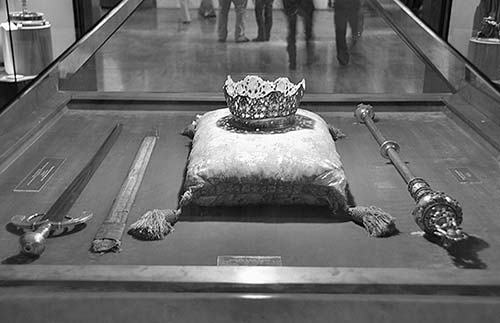
A finely carved Plateresque limestone arch, with the gilded royal initials F and Y, leads from the chapel into the sacristy/treasury/museum, where you’ll see a small glass pyramid. This holds Queen Isabel’s silver crown ringed with pomegranates (symbolizing Granada), her scepter, and King Ferdinand’s sword. Do a counterclockwise spin around the room to see it all, starting to the right of the entry arch. There you’ll see a big book—the devout Isabel’s prayer book, in which she followed the Mass. According to legend, the fancy box on the other side of the door is supposedly the one that Isabel filled with jewels and gave to bankers as collateral for the cash to pay Columbus. In the corner (also behind glass) is the ornate silver-and-gold cross that Cardinal Mendoza, staunch supporter of Queen Isabel, carried into the Alhambra on that historic day in 1492—and used as the centerpiece for the first Christian Mass in the conquered fortress. Below the cross is Isabel’s simple rosary, belt, and other personal items. She embraced Franciscan teaching, gave most of her jewels to the Church, and, for a queen, lived quite austerely.
Next, the big silver-and-gold silk tapestry is the altar banner for the mobile campaign chapel of Ferdinand and Isabel, who always traveled with their army. In the case to its left, you’ll see the original Christian army flags raised over the Alhambra in 1492.
The next zone of this grand hall holds the first great art collection established by a woman. Queen Isabel amassed more than 200 important paintings. After Napoleon looted occupied Granada (from 1808 until 1812), only 31 remained. Even so, this is an exquisite collection, all on wood, featuring works by Sandro Botticelli, Pietro Perugino, the Flemish master Hans Memling, and some Spanish masters. (Find the paintings by Perugino and Botticelli ahead on the left.)
Finally, at the end of the room are two carved sculptures of Ferdinand and Isabel, the fine originals from the high altar. Charles V considered these primitive (I disagree) and replaced them with the ones you saw earlier.
To reach the cathedral (described next), exit the treasury behind Isabel, and walk around the block to the right.
▲Granada Cathedral (Catedral de Granada)
Granada’s cathedral is the second-largest church in the country (after Sevilla’s) and one of the few to exhibit Renaissance features. Construction stretched over 200 years: The structure began as a Gothic church, was laid out with Renaissance elements, and finally decorated in Baroque style.
Cost and Hours: €5, includes QR-code audioguide, Mon-Sat 10:00-18:15, Sun from 15:00, WC next to the sacristy (near the exit), +34 958 222 959, www.catedraldegranada.com.
Visiting the Cathedral: Enter the church from Plaza de las Pasiegas. Before exploring the interior, step into the cathedral’s little museum (tucked into the corner behind the ticket counter).
The museum, filling the ground floor of the big bell tower, is worth seeking out for two pieces of art: a beautiful carved and painted bust of San Pablo (St. Paul) with his flowing beard (a self-portrait by hometown great Alonso Cano), and a hexagonal Gothic monstrance with a Renaissance-era base given to the cathedral by Queen Isabel.
Orbit this monstrance slowly to appreciate its glittering 15th-century, gold-plated detail. It’s so precious because it was designed to carry the Communion wafer symbolizing the body of Christ. Imagine that every year for more than 500 years this was paraded through the streets of Granada as the star of the Corpus Christi procession.
Leave the museum and stand in the back of the nave for an overview. Survey the church. It’s huge. It was designed to be the national church when Granada was the capital of a newly conquered-from-the-Muslims Spain. High above the main altar are square niches originally intended for the burial of Charles V and his family. But King Philip II changed focus and abandoned Granada for El Escorial, so the niches are now plugged with saintly paintings. High above under the stained glass are seven scenes from the life of Mary (by Alonso Cano).
The cathedral’s cool, spacious interior is mostly Renaissance—a refreshing break from the closed-in, dark Gothic of so many Spanish churches. In a move that was modern back in the 18th century, the wooden walls of the choir (which dominates the center of most Spanish churches) were taken out so that common people could see as well as hear Mass. At about the same time, a bishop ordered the interior painted with lime (for hygienic reasons, during a time of disease). The people liked it, and it stayed white.
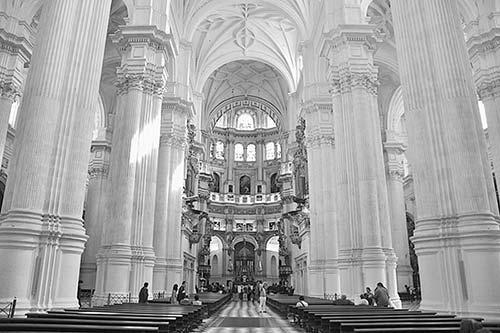
As you explore, remember that the abundance of Marys is all part of the Counter-Reformation. Most of the side chapels are decorated in Baroque style.
As you walk to the front for a closer look at the altar, take a small detour to the scale model of the entire complex (left of pews). Examine the cathedral’s immensity. The Royal Chapel (right side) is shaped like a small church would be, complete with mini transepts and fitting perfectly into the corner of the cathedral. Resume your walk to the altar, passing two fine Baroque organs with horizontal trumpet pipes that still play during Mass each Sunday.
Standing before the altar, notice the abundance of gold leaf. It’s from Spain’s Darro River, which originally attracted Romans here for its gold. As this is a seat of the local bishop, there’s a fine wooden bishop’s throne on the right.
Between the pairs of Corinthian columns that face the altar on both sides are sculptures with a strong parenting theme: Way up high, inside the thick, round frames, are busts of Adam and Eve, from whom came humankind. Around them are the four gold-covered evangelists, who—with the New Testament—brought the Good News of salvation to believers. Completing the big parenting picture (under Adam and Eve) are Ferdinand and Isabel, kneeling in prayer, who brought Catholicism to the land. Their complex coat of arms (beneath each respective statue) celebrates how their marriage united the influential kingdoms of Aragon and Castile to create the country we know as Spain.
To your right is the ornate carved-stone Gothic door that, before the cathedral was built, would have led into the Royal Chapel (described earlier). Its 15th-century decorations predate the cathedral. That chapel holds the most important historic relics in town—the tombs of the Catholic Monarchs. (This door is always closed; chapel entrance is outside around the corner.)
Now examine the chapels on each side of the closed Royal Chapel door. To the left is St. James the Moor-Slayer, with his sword raised high and an armored Moor trampled under his horse’s hooves. As Christian forces rallied to free Iberia from Muslim rule, they adopted St. James as the iconic defender of their faith.
The chapel to the right features a painting and frame by Cano—and the frame itself is a masterpiece. Cano carved the wooden frame, gilded it, painted over the gold leaf, and then scratched through where he wanted the gold to show.
Strolling behind the altar, look for the giant music sheets: They’re mostly 16th-century Gregorian chants. Notice the sliding C clef. Rather than a fixed G or F clef, the monks knew that this clef—which could be located wherever it worked best on the staff—marked middle C, and they chanted to notes relative to that. Go ahead—try singing a few verses of the Latin.
Step to the center (under the central dome) to view the high altar from the rear. The giant four-sided swiveling music rack held these huge sheets, allowing monks to sign in unison in the days before printed hymnals. Look up at the paintings in the dome: Church fathers plugging the planned royal tombs and, above those, the Cano scenes of Mary’s life.
The sacristy, between the exit and the St. James altarpiece (in the right corner), is worth a look. It’s filled with closets and drawers for the robes and garments necessary for the high Church pageantry. It’s lush and wide open; its gilded ceilings, mirrors, and wooden cabinets give it a light, airy feel. Two grandfather clocks made in London (one with Asian motifs) ensured that everyone got dressed on time. The highlight of this room is another work by Cano—a small, delicate painted wood statue of the Virgin of the Immaculate Conception (at the far end under the Crucifixion). This sculpture inspired many sweet Virgin Marys by later Spanish artists.
Exit the cathedral through its little shop (with a nicely curated selection of religious and secular souvenirs). Back outside, down the lane to the left is a colorful and fragrant spice and tea shop; straight ahead is busy Gran Vía.
Hammam al Ándalus (Arab Baths)
For an intimate and subdued experience, consider some serious relaxation at these Arab baths, where you can enjoy three different-temperature pools and a steam room. Your visit starts with a ritual hand cleansing followed by an explanation and tour of the facilities. Once inside, you’re free to roam the tranquil complex, lingering as you like. If you opt for a massage, they’ll come find you when it’s your turn.
Cost and Hours: €46 for 1.5-hour soak in the baths (figure €25-35 more if you add a massage), daily 10:00-24:00, appointments scheduled every even-numbered hour, coed with mandatory swimsuits, quiet atmosphere encouraged, free lockers and towels available, no loaner swimsuits but you can buy one, just off Plaza Nueva—follow signs a few doors down from the TI to Santa Ana 16, paid reservation required—cancellation policy described on website, +34 958 229 978, https://granada.hammamalandalus.com/en.
▲▲Paseo Without the Tourists
While Granada’s old town is great for strolling, it’s also fun to just be in workaday Granada with everyday locals. A five-minute walk from Plaza Nueva gets you into a delightful urban slice of Andalucía. To enjoy an evening paseo without tourists, start with a tapas crawl along any of the streets beyond Plaza del Carmen (see “Beyond Plaza del Carmen” under “Eating in Granada,” later), then stroll down Carrera de la Virgen, off Plaza del Campillo, where there’s always something cultural going on. Carrera de la Virgen leads gracefully down to the Paseo del Salón riverbank park, passing the El Corte Inglés department store.
THE ALBAYZÍN
Spain’s best old Moorish quarter, with countless colorful corners, flowery patios, and shady lanes, is worth ▲. While the city center of Granada feels more or less like many other pleasant Spanish cities, the Albayzín is unique. It was here, in the 11th century, that the Moors built a fortress. That citadel is gone, but a warren of narrow streets, whitewashed walls, and secluded patios survive. You can’t say you’ve really seen Granada until you’ve at least strolled a few of its twisty lanes. Following my “Albayzín Walk” (outlined later), you can climb high to the San Nicolás church for the best view of the Alhambra and wander through its evocative back streets.
Safety in the Albayzín: While this charming Moorish district is certainly safe by day, it can be edgy after dark. Most of the area is fine to explore, though many streets are poorly lit, and the maze of lanes can make it easy to get turned around. Some cautious travelers choose to avoid the neighborhood entirely after dark, but I recommend venturing into the Albayzín to enjoy its restaurants, ideal sunset views, and charming ambience. Just exercise normal precautions: Leave your valuables at your hotel, stick to better-lit streets, and take a minibus or taxi home if you’re unsure of your route. Violent crime is rare, but pickpocketing is common.
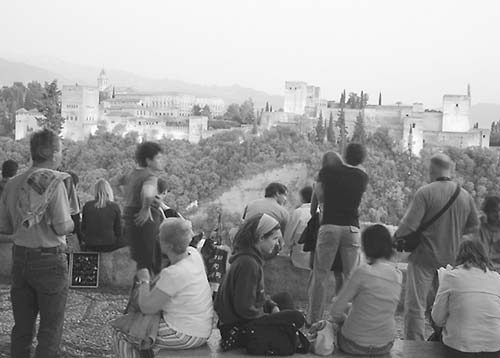
▲▲San Nicolás Viewpoint (Mirador de San Nicolás)
This popular spot, looking across to the Alhambra from the edge of the Albayzín, is one of Europe’s most romantic viewpoints. To best enjoy it, be here at sunset, when the Alhambra glows red and Albayzín seniors share the benches with lovers, hippies, and tourists. For an overpriced drink with the same million-euro view, step into the bar at the recommended El Huerto de Juan Ranas (restaurant just below the viewpoint and to the left, at Calle de Atarazana 8). Order a drink, tip the musicians who perform here, settle in, and consider it a concert. For more advice on drinking and dining with a view, see “Eating in Granada,” later.
Getting There: Ride the bus, hike up (see the “Albayzín Walk,” later), or take a taxi (about €5—ride up and explore downhill). The handy Albayzín minibuses #C31 and #C32 make a loop through the quarter, getting you scenically and sweatlessly to the San Nicolás viewpoint (buses depart about every 10-15 minutes from the Cathedral/Gran Vía or Plaza Nueva).
▲Great Mosque of Granada (Mezquita Mayor de Granada)
Granada has a vital Muslim community. Local Muslims write, “The Great Mosque of Granada signals, after a hiatus of 500 years, the restoration of a missing link with a rich and fecund Islamic contribution to all spheres of human enterprise and activity.” Built in 2003 (with money from the local community and Islamic Arab nations), it has a peaceful view courtyard and a minaret that comes with a live call to prayer five times a day (printed schedule inside). It’s stirring to hear the muezzin proclaim “God is Great” from the minaret. Visitors are welcome in the courtyard, which offers Alhambra views without the hedonistic ambience of the more famous San Nicolás viewpoint. Take a look at the video showing the mosque in action.
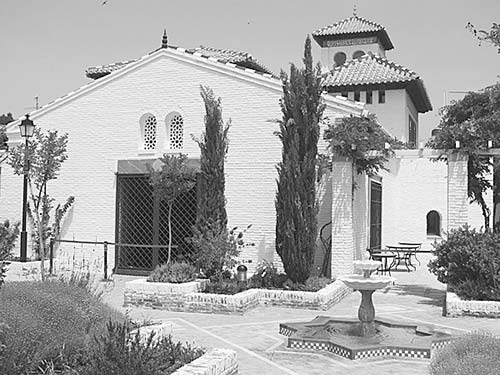
While many tourists come to Granada to learn about its complex cultural history, not all are aware of the ongoing relevance of its Islamic past. Today, five centuries after the Reconquista, there are almost 2 million Muslims in Spain. Those living in Granada and Andalucía are as Iberian as any modern Spaniard, as were their forebears. When you look out at the Alhambra from the mosque’s garden, you are witnessing something built not by outsiders but by the people of Granada, who in that era were Muslim and spoke Arabic. This mosque is an acknowledgment of Islam’s great importance to Granada’s cultural fabric.
Cost and Hours: Free, daily 11:00-21:00, shorter hours in winter, closes for prayer, +34 958 202 526, www.mezquitadegranada.com.
▲Albayzín Walk
This little stroll (best done to coincide with sunset) gets you from Plaza Nueva to the famous San Nicolás mirador—the heart of this quarter. Along the way, you’ll explore timeless lanes and learn why this hilltop neighborhood is recognized even by the people of Granada as a world apart. To trace the route, see the “Albayzín Neighborhood” map. Note: You can skip the first uphill stretch by catching minibus #C31 or #C32 from Plaza Nueva and then pick up the walk at Placeta de San Miguel Bajo.
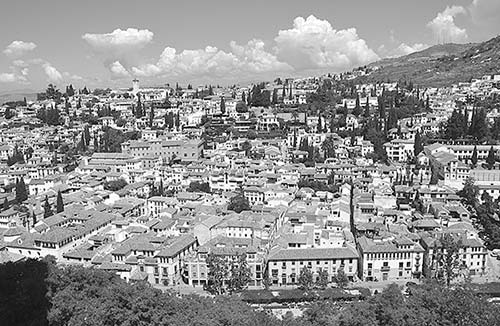
Each of the 20 churches in this district sits on a spot once occupied by a mosque. When the Reconquista first arrived in Granada, Christians and Muslims attempted to coexist. But within a short time, the Christian Spaniards forced Muslims to convert and then expelled them altogether. By 1570 all but a remnant of Granada’s Muslim community had been eliminated. What remained, though, was this neighborhood, the oldest part of Granada, with its narrow, cobbled streets and Moorish-style homes called cármenes. These large, walled houses with private gardens survive today in the form of the characteristic carmen restaurants so popular with visitors.
Self-Guided Walk: It’s a steep but fascinating 30-minute walk up. Start from the west end of Plaza Nueva (at the Nemrut kebab/pizzeria shop) and walk up Calle San Gil (soon to become Calle de Elvira). When you see a pair of traffic lights, turn uphill (90 degrees, right) on Calle Calderería Nueva—you’ll see a teal blue Kasbah sign welcoming you to the quarter. Follow this stepped street—a virtual tunnel of vendors of imported North African goods, leading to a stretch of Moroccan eateries and pastry shops, and inviting teterías (Moorish tearooms). Nujaila’s bakery (on the left at #7) has enticing honey-drenched Moroccan filo pastries. Farther uphill is the tiny square and church of San Gregorio.
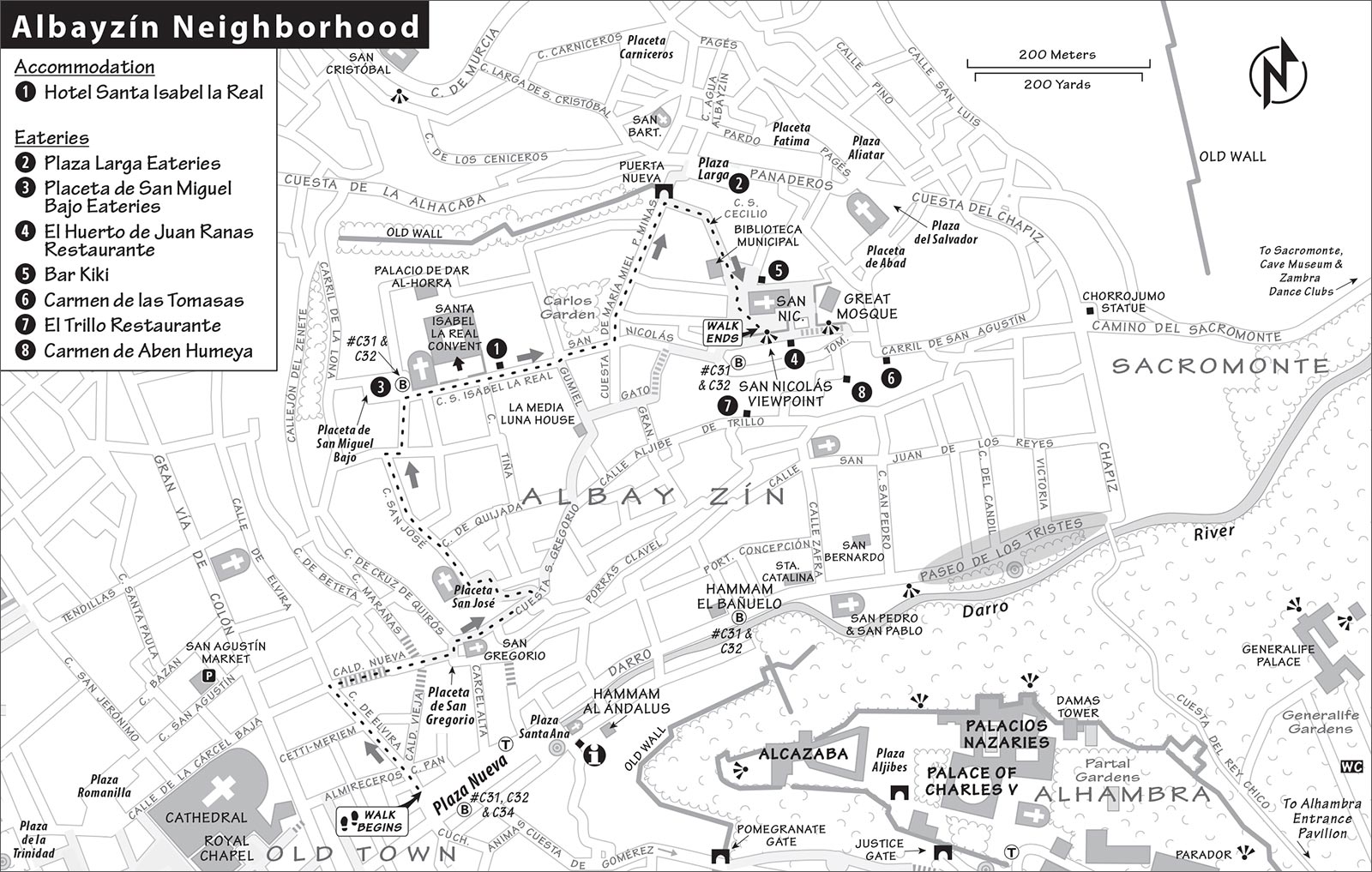
Placeta de San Gregorio, the tiny junction at the top of Calle Calderería Nueva, has a special hang-loose character. If you’re not in a hurry, grab a rickety seat here at Bar las Cuevas, under the classic church facade with potted plants and a commotion of tiled roofs. Enjoy the steady stream of people flowing by. Another fine perch a few steps higher up is Taverna El 22, great for a Reserva 1925 (Granada’s best craft beer), vermut de la casa, or a sweet sherry (jerez).
The Church of San Gregorio is the domain of a small group of Franciscan sisters. Step inside for a moment of tranquility and holiness in the midst of this lively town. One of the sisters, dressed in glorious white, kneels at the altar in prayer all day, every day.
• Continue your climb up Cuesta de San Gregorio (left side of church). A few steps after the Taberna del Beso (Tavern of the Kiss), switchback uphill, on the left, following the black sign to Mirador de San Nicolás. You’ll make a quick right, then left, emerging on Calle San José. Head uphill, toward the bell tower ahead on the left. Continue straight up, jogging right to go through Placeta Cauchiles de San Miguel; you’ll soon reach a tree-lined square.
The laid-back square called Placeta de San Miguel Bajo is ringed with options for a meal or refreshing snack (make sure you leave room for dessert at our next stop). Before you leave, check out the viewpoint overlooking modern Granada (to the left, at the end of the square).
• When you’re ready to move on, exit the square at the church and head down Calle Santa Isabel la Real, with a white bell tower in the distance.
After a block you’ll see the brick entrance (#15) to the Convent of Santa Isabel la Real, where you can buy sweets from the nuns (daily, enter straight through the courtyard to find a lazy-Susan revolving window in the back left corner).
• Follow the street past palm trees to Cuesta de María de la Miel. Turn left (uphill), passing a colorfully tiled Mudejar door on the corner. When the road starts to flatten out, continue straight (with the white wall and large gate on the left).
As the street gently slopes downhill, you’ll make out the large brick Puerta Nueva gate. Step down through this 11th-century “New Gate” (older than the Alhambra) and into Plaza Larga. You’re now in the heart of the Albayzín. In medieval times, this tiny square (called “long” because back then it was) served as the local marketplace. It still is a busy market each morning. Casa Pasteles, at the near end of the square, serves good coffee and cakes.
• Poke into the lanes around Plaza Larga for some characteristic Albayzín scenes. Then, walk back through the Puerta Nueva gate, turning left at the top of the stairs onto Callejón San Cecilio.
This small lane leads past a white sandstone arch (at the corner on your left), now a chapel built into the old Moorish wall. You’re walking in the scant remains of the pre-Alhambra fortress of Granada. Farther on, the Biblioteca Municipal (on your right) leads you straight to the church of San Nicolás and the viewpoint. If it’s not too late, consider visiting the ▲ Great Mosque of Granada (described earlier).
Linger at the ▲▲ San Nicolás mirador for the setting sun (if you’ve timed it just right). For more on the mirador, see the listing earlier.
• If you’ve reserved dinner at one of the carmenes, they’re just downhill from here. If not, make your way back down via nearby bus, by taxi, or on foot.
SACROMONTE
The Sacromonte hillside is the traditional home to Granada’s Gypsy (also known as Roma) community. While the neighboring Albayzín is a sprawling zone blanketing a hilltop, Sacromonte is much smaller—very compact and very steep. Most houses are burrowed into the cliff wall.
Marking the entrance to Sacromonte is a statue of Chorrojumo (literally, “exudes smoke”). He was the self-styled “King of the Gypsies,” popular for guiding people around Granada in traditional attire. Sacromonte has one main street: Camino del Sacromonte, which is lined with caves primed for tourists and restaurants ready to fight over the bill. Intriguing lanes run above and below this main drag—a steep hike above Camino del Sacromonte is the cliff-hanging, parallel secondary street, Vereda de Enmedio, which is less touristy, with an authentically residential vibe.
▲Cave Museum of Sacromonte (Museo Cuevas del Sacromonte)
This hilltop complex, also known as the Center for the Interpretation of Sacromonte (Centro de Interpretación del Sacromonte), is a kind of open-air folk museum about Granada’s unique Gypsy cave-dwelling tradition (though it doesn’t have much on the history of the people themselves). Getting there is a bit of a slog—but if you combine your visit with one of their summertime flamenco and/or classical guitar concerts, it will be worth your while (see museum website for offerings).
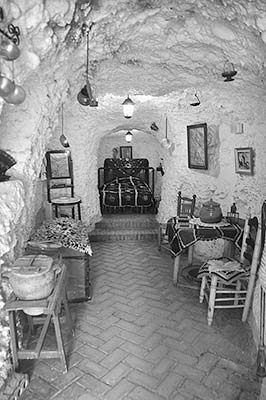
Cost and Hours: €5, daily 10:00-20:00, off-season until 18:00, café, Barranco de los Negros, +34 958 215 120, www.sacromontegranada.com.
Getting There: You can ride minibus #C34 from Plaza Nueva (ask driver, “¿Museo cuevas?”; departs every 15 minutes) or take a taxi; the bus gives you elevated views. Get off next to the big Venta El Gallo restaurant, along the main road (several zambra performance caves line up along here, too—see next listing). From here, it’s a steep 10-minute hike past cave dwellings up to the top of the hill—follow the signs.
Visiting the Museum: The exhibits (with English descriptions) are spread through a series of whitewashed caves along a ridge, with spectacular views to the Alhambra. As you stroll from cave to cave, you’ll see displays on the native habitat (rocks, flora, and fauna), crafts (basket weaving, pottery, metalworking, and weaving), and lifestyles (including a look into a typical home and kitchen). Cave 11 is particularly interesting, with old videos of flamenco dancing and singing, and the community when it was vibrant. You’ll also learn the history of how this community was persecuted.
There’s also an exhibit about other cave-dwelling cultures from around the “troglodyte world,” and one about Sacromonte’s vital role in the development of Granada’s brand of flamenco. As you wander, imagine this in the 1950s, when it was still a bustling community of Gypsy cave dwellers.
Zambra and Flamenco Dance
A long flamenco tradition exists in Granada, and the Gypsies of Sacromonte are credited with developing this city’s unique flavor of the Andalusian art form. Sacromonte is a good place to see zambra, a flamenco variation favoring slower and sultrier dance steps over flying footwork; the zambra singer also dances. It’s a show, but it’s also social; watching it feels like you’re at a party. Dancers chat with one another between songs in a casual, “did you see the guy in the corner” kind of way. A half-dozen cave-bars offering zambra in the evenings line Sacromonte’s main drag. Hotels are happy to book you a seat and arrange the included transfer. Experiencing flamenco in a cramped but cool Gypsy cave is like seeing art in situ.
Shows in Sacromonte: Two well-established venues are Zambra Cueva de la Rocio (€25 includes one drink, daily shows on the hour 20:00-23:00, 1 hour, Camino del Sacromonte 70, +34 958 227 129, www.cuevalarocio.es) and María la Canastera, a venue that’s been around so long that the Duke of Windsor and actor Yul Brynner came here to watch zambra (€29 includes drink and bus from hotel, €24 without transport, cash only, daily show at 21:00, 1 hour, Camino del Sacromonte 89, +34 958 121 183, www.marialacanastera.com). The biggest operation here is the restaurant Venta El Gallo, which has performances of more straightforward flamenco (not specifically zambra, €22 includes one drink, daily show at 21:00, dinner possible beforehand on outdoor terrace, Barranco de los Negros 5, +34 640 147 985, https://cuevaventaelgallo.es). Or consider the summer performances at the Cave Museum (see listing, earlier).
Shows near Plaza Nueva: If you don’t want to venture to Sacromonte, there are several venues within a few steps of Plaza Nueva. Each offers essentially the same hour-long shows twice a night. I like these two places: Casa del Arte Flamenco (€20, 50 seats, no bar, box office open at 11:00, shows at 19:00 and 20:30; Cuesta de Gomérez 11, +34 661 118 951, www.casadelarteflamenco.com) and La Alboreá (€20, 90 seats, drinks sold at bar prices, ticket office open all day, choose your seat when you buy a ticket, shows at 19:00 and 20:45, +34 858 124 931, Calle Pan 3—a block uphill from Plaza Nueva, www.alboreaflamenco.com). Both venues are intimate and have the same show structure and instruments, with singers, guitars, and dancers. The main difference is one serves drinks and the other doesn’t. For locations, see the “Granada” map on here.
OUTSIDE THE CITY CENTER
Carthusian Monastery (Monasterio de la Cartuja)
A mile north of town on the way to Madrid, this monastery was built by Carthusian monks between the 16th and 18th centuries. Its unassuming sandstone exterior hides an extraordinarily colorful interior. La Cartuja is sometimes called the “Christian Alhambra” for its elaborate decor.
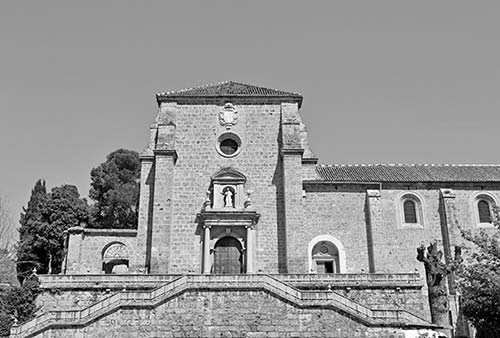
La Cartuja is a quintessential example of late Spanish Baroque (c. 1650-1750, also known as Churrigueresque). Spanish Baroque took the already ornate Baroque/Rococo style to even greater heights. With curved lines and odd shapes, it wows the viewer with a multimedia combo of architecture, sculpture, and painting. La Cartuja’s unique contribution is to achieve much of that effect with nothing but basic white stucco (plaster) that looks like it was squirted from a can of whipped cream.
Cost and Hours: €6, daily 10:00-18:00 except closed Sat 12:45- 15:00, +34 958 161 932, www.cartujadegranada.com.
Getting There: It may be easiest to just hop in a taxi (about €10). Bus #8 will get you there via its Paseo Cartuja–Monasterio stop. Bus #C34 also gets you very close—a couple of long blocks away from the Cristo de la Yedra 33 stop. If the weather is pleasant, the monastery is an easy 25-minute stroll from the city center.
Visiting La Cartuja: In the rooms around the cloister, consider monastic life while enjoying paintings of St. Bruno and his Carthusian martyrs placidly meeting their grisly fates. Highlights include Sánchez Cotán’s Last Supper (in the refectory) and saints Peter and Paul with a trompe l’oeil frame (in the Profundis room).
The highlight is the church, which gets increasingly more ornate with each step. The nave near the entrance (the area for commoners) is impressive enough, covered in white stucco shaped into niches, statues, arches, and garlands. A few steps farther, the choir (for the monks) is even more intricately stuccoed with a tangle of vines. The golden choir screen adds a splash of color with paintings by Sánchez Cotán, a Cartuja monk whose work appears throughout. The altar (for the priests) is more colorful still. A prickly gold canopy frames a statue of Mary being assumed into heaven. The statue looking on (from the upper right) is St. Bruno, the founder of the contemplative order of Carthusians shown contemplating a cross and a book.
The sancta sanctorum (the room behind the altar, seen through the paned-glass window) is the most elaborate of all. With black corkscrew columns supporting a red canopy over a temple for the communion host, the room is an explosion of brilliant art. There’s barely a straight line in sight. In the painted dome overhead, the heavens open to reveal the dove of the Holy Spirit surrounded by saints, including St. Bruno hefting the world on his holy shoulders.
The sacristy (to the left of the altar) is a white-walled palate cleanser. The stuccoed columns shatter into Baroque fractals of spirals, scallops, waves, and stalactites that recall Moorish decor. At the ripple-ice-cream marble altar, Bruno holds a skull and contemplates it all.
Sleeping in Granada
In July and August, when Granada’s streets are littered with sunstroke victims, rooms are plentiful and prices soft. In the crowded months of April, May, September, and October, prices can spike. Most places offer breakfast for an additional charge. All have air-conditioning and an elevator unless noted.
If you’re traveling by car, see “Arrival in Granada” at the beginning of this chapter for driving and parking information.
ON OR NEAR PLAZA NUEVA
Each of these (except the hostel) is professional, plenty comfortable, and perfectly located within a 5-10-minute walk of Plaza Nueva.
$$$$ Hotel Casa 1800 Granada sets the bar for affordable class. Its 25 rooms face the beautiful, airy courtyard of a 17th-century mansion in the lower part of the Albayzín (just steps above Plaza Nueva). Tidy, friendly, and well run, it has a free, 24-hour refreshment bar and complimentary tea each afternoon (pricier rooms not much different except for the Alhambra views, Benalúa 11, +34 958 210 700, www.hotelcasa1800granada.com, info.granada@hotelcasa1800).
$$$ Casa del Capitel Nazarí, just off the church end of Plaza Nueva, is a restored 16th-century Renaissance manor with 23 tastefully down-to-earth rooms that are intimate, bright, and spacious, most facing an art-filled courtyard (RS%, some view rooms, afternoon tea/coffee, loaner laptop, pay parking, Cuesta Aceituneros 6, +34 958 215 260, www.hotelcasacapitel.com, info@hotelcasacapitel.com). Their connected annex, $$$ Mariana Pineda, has five exquisitely decorated rooms in a former palace, most with views of the Alhambra.
$$ Hotel Monjas del Carmen is a modern hotel with 32 bright, clean rooms and a friendly staff. It’s nicely located just a few steps off Plaza Nueva, and the windows do a good job keeping noise out (Plaza de los Cuchilleros 13, pay parking, +34 958 101 619, www.hotelmonjasdelcarmen.com, hotelmonjasdelcarmen@amchoteles.com).
$$ Hotel Anacapri is a bright, cool marble oasis with 50 spiffy, clean rooms, a comfortable patio lounge, and sleek bathrooms (family rooms, pay parking, 2 blocks toward Gran Vía from Plaza Nueva at Calle Joaquín Costa 7, just a block from cathedral bus stop, +34 958 227 477, www.hotelanacapri.com, reservas@hotelanacapri.com).
$ Hotel Inglaterra makes up for its 36 somewhat outdated, business-style rooms with its ideal location. Rooms wrap around a central patio; exterior rooms come with some noise from the popular bars below (elevator to third floor only, pay parking, Cetti Merien 6, +34 958 221 559, www.hotelinglaterragranada.com, info@hotel-inglaterra.es).
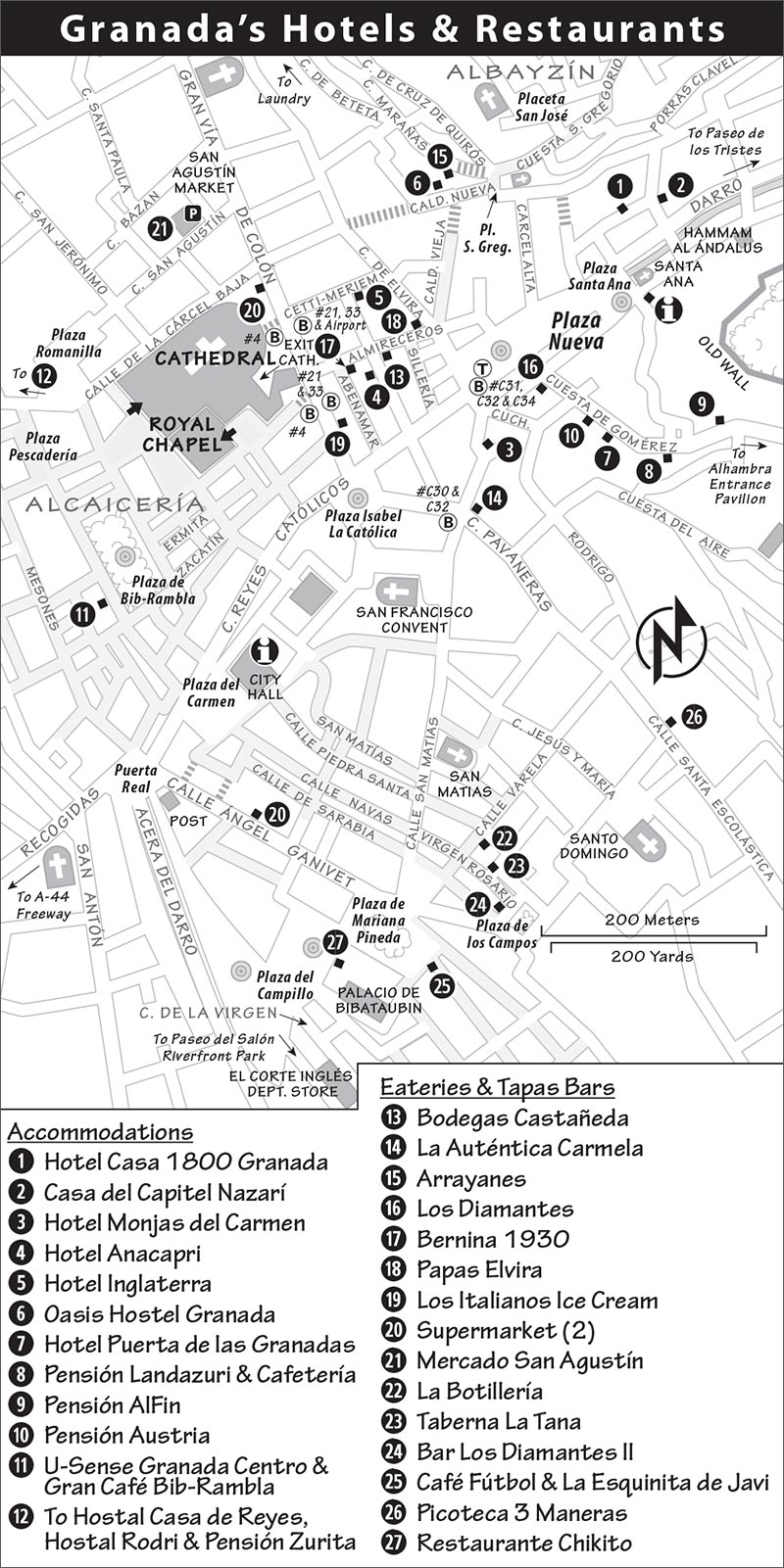
¢ Oasis Hostel Granada is a quintessential hostel with the standard amenities (shared kitchen, free coffee and tea, terrace, garden, and outdoor shower—for cooling off), a helpful staff, and backpackers kicking their feet up. It’s just a block above the lively Moorish-flavored tourist drag (includes welcome drink with direct booking, no elevator, pay parking, at the top end of Placeta Correo Viejo at #3, +34 958 215 848, www.oasisgranada.com, granada@hostelsoasis.com).
CHEAP SLEEPS ON CUESTA DE GOMÉREZ
These lodgings, all inexpensive and some ramshackle, are on a street leading from Plaza Nueva up to the Alhambra. Sprinkled among the knickknack stores are the storefront workshops of several guitar makers who are renowned for their handcrafted instruments.
$$ Hotel Puerta de las Granadas rents 36 crisp, clean rooms with a modern vibe. It has a courtyard, a terrace with views of the Alhambra and cathedral, and a handy location (family rooms, pay parking, Cuesta de Gomérez 14, +34 958 216 230, www.hotelpuertadelasgranadas.com, reservas@hotelpuertadelasgranadas.com).
$ Pensión Landazuri is run by friendly English-speaking Matilde Landazuri, her son Manolo, and daughters Margarita and Elisa. Their characteristic old house has 15 rooms; hardworking, helpful management; and a great roof garden with a splendid Alhambra view (family rooms, no air-con, no elevator, pay parking, Cuesta de Gomérez 24, +34 958 221 406, www.pensionlandazuri.com, info@pensionlandazuri.com). The Landazuris also run a good, cheap café open for breakfast and lunch, next door.
$ Pensión AlFin is located just up the street from Pensión Landazuri and run by the same family. Its five high-ceilinged rooms with antique wooden beams and marble columns are colorful and stylish. A glass floor in the lobby lets you peer into a well from an ancient house (some rooms with balconies, no air-con, no elevator, pay parking, reception at Pensión Landazuri, Cuesta de Gomérez 31, +34 958 228 172, www.pensionalfin.com, info@pensionalfin.com).
¢ Pensión Austria rents 15 basic, tiny but clean rooms (family rooms, no elevator, pay parking, Cuesta de Gomérez 4, +34 958 227 075, pensionaustria.com, pensionaustria@pensionaustria.com).
NEAR THE CATHEDRAL
$$ U-Sense Granada Centro offers 32 modern, boutique rooms (some with balconies) on the charming traffic-free Plaza de Bib-Rambla. The fifth-floor terrace has views of the cathedral and the Alhambra (family rooms, pay parking, Plaza de Bib-Rambla 4, +34 958 266 712, www.urbansense.es, reservas.granada@urbansense.es).
On or near Plaza de la Trinidad
The charming, parklike square called Plaza de la Trinidad, just a short walk west of the cathedral area (Pescadería and Bib-Rambla squares), is home to several good accommodations.
$$ Hostal Casa de Reyes has 15 extravagantly appointed rooms in connected buildings a block off the square. The house is flamboyantly decorated by Manolo, the owner, with medieval and Nasrid flair—colorful tiles, wood-carved life-sized figures, and swords. He calls the place his passion, not a business (home-cooked dinner available—book in advance, elevator in one building only, pay parking, Laurel de las Tablas 17, +34 958 295 029, www.hostalcasadereyes.com, info@hostalcasadereyes.com, Manolo and Carmen).
$ Hostal Rodri has 10 classy rooms a few doors down that feel like a bargain for their price range. Take in the sun on an “L”-shaped terrace (pay parking, Laurel de las Tablas 9, +34 958 288 043, www.hostalrodri.com, info@hostalrodri.com, run by Manolo’s brother José).
$ Pensión Zurita, well run by personable Francisco and Loli, faces Plaza de la Trinidad. Though a bit antiquated, 12 of the 14 rooms have private baths and small exterior balconies, and all are well cared for. Even with double-pane windows, some rooms may come with night noise from cafés below (no elevator, pay parking, Plaza de la Trinidad 7, +34 958 275-020, www.pensionzurita.es, pensionzurita@gmail.com).
IN THE ALBAYZÍN
For the location of this hotel in Granada’s most intriguing quarter, see the “Albayzín Neighborhood” map on here.
$$$ Hotel Santa Isabel la Real, a handsome 16th-century edifice, has 11 country-chic rooms ringing a charming courtyard. Basic rooms look to the patio; pricier ones have better exterior views. The owners’ antiques accentuate the Moorish ambience (includes breakfast, pay parking, midway between San Nicolás viewpoint and Placeta de San Miguel Bajo on Calle Santa Isabel la Real, minibuses #C31 and #C32 stop nearby, +34 958 294 658, www.hotelsantaisabellareal.com, info@hotelsantaisabellareal.com).
IN AND NEAR THE ALHAMBRA
To stay on the Alhambra grounds, choose between a famous, overpriced parador and a practical and economical hotel above the parking lot. Both are a half-mile up the hill from Plaza Nueva (see “The Alhambra” map on here for locations).
$$$$ Parador de Granada San Francisco offers 40 designer rooms in a former Moorish palace that was later transformed into a 15th-century Franciscan monastery. It’s considered Spain’s premier parador—and that’s saying something (pay parking, Calle Real de la Alhambra, +34 958 221 440, www.parador.es, granada@parador.es). You must book months ahead to spend the night in this lavishly located, stodgy, and historic palace. Any peasant, however, can drop in for a coffee, drink, snack, or meal. For more about the building’s history, see “The Alhambra Grounds” sidebar on here.
$$ Hotel Guadalupe, big and modern with 42 sleek rooms, is quietly and conveniently located overlooking the Alhambra parking lot. While it’s a 30-minute hike above the town, many—especially drivers—find this to be a practical option (special parking rate in Alhambra lot, Paseo de la Sabica 30, +34 958 225 730, www.hotelguadalupegranada.com, reservas@hotelguadalupegranada.com).
Eating in Granada
Granada’s bars pride themselves on serving a small tapa free with any beverage—a tradition that’s dying out in most of Spain. Save on your food expenses by doing a tapas crawl, claiming your “right” to a free tapa with every drink. Order your drink and wait for the free tapa before ordering food (if you order food with your drink, you likely won’t get the freebie). Avoid the touristy Calle Navas, right off Plaza del Carmen.
For more budget-eating thrills, buy picnic supplies near Plaza Nueva, and schlep them up into the Albayzín. This makes for a great cheap date at the San Nicolás viewpoint or on one of the scattered squares and lookout points.
In search of an edible memory? A local specialty, tortilla de Sacromonte, is a spicy omelet with lamb’s brain and other organs. Berenjenas fritas (fried eggplant) and habas con jamón (small, green broad beans cooked with cured ham) are worth seeking out. Tinto de verano—a red-wine spritzer with lemon and ice—is refreshing on a hot evening.
While servers are used to tourists, don’t be put off if someone is rude. Spaniards joke that Granadines don’t have blood, but “sour milk” in their veins (something to do with not having had sex for a long time).
IN THE ALBAYZÍN
The food scene in the Albayzín can be a mixed bag. Part of the charm of the quarter is the lazy ambience on its squares. My two favorites are Plaza Larga and Placeta de San Miguel Bajo. If dining late, take a taxi back to your hotel; Albayzín back streets can be poorly lit and confusing to follow. For locations, see the “Albayzín Neighborhood” map on here.
Placeta de San Miguel Bajo boasts a spirited local scene—kids kicking soccer balls, old-timers warming benches under the facade of a humble church, and women peering from windows overlooking the square. It’s circled by a half-dozen inviting little bars and restaurants—each very competitive with cheap lunch deals. In the evening, the most serious restaurant is $ Bar Lara, with nice traditional plates, salads, paellas, and fish (closed Wed, Placeta de San Miguel Bajo 4, +34 958 209 466). Minibus #C31 or #C32 rumbles by every few minutes, ready to zip you back to Plaza Nueva. Or just walk 10 minutes downhill.
Near the San Nicolás Viewpoint
This area is thoroughly touristy—don’t expect any local hangouts.
$$$ El Huerto de Juan Ranas Restaurante is a stuffy restaurant below a popular rooftop bar. Packed with a commotion of people taking selfies, sipping cocktails, and paying too much for tapas, it’s immediately below the San Nicolás viewpoint and has amazing Alhambra views (daily until late, Calle Atarazana Vieja 8, +34 958 286 925).
$$ Bar Kiki, a laid-back and popular bar-restaurant, serves lunch only on an unpretentious square with no view but plenty of people-watching. They serve simple dishes outside on rickety tables and plastic chairs. Try their tasty fried eggplant (Tue-Sat until 17:00, closed Sun-Mon, just behind viewpoint at Plaza de San Nicolás 9, +34 958 276 715).
Romantic Cármenes
For dinner in a dressy setting and a dreamy Alhambra view, consider dining in a carmen, a typical Albayzín house with a garden (buzz to get in). Long ago, wealthy families built these walled mansions with terraced gardens on the hillside. Today, many of those gardens host dining tables and romantic restaurants.
$$$ Carmen de las Tomasas is my favorite of these places: formal yet friendly service; accessible menu with tasty dishes; romantic, peaceful, and well-ventilated seating; killer views; and reasonable prices. And it feels like a carmen should, with pocket gardens and wistful fountains around a venerable mansion. Book long in advance on their website (closed Mon, Carril de San Agustín 4, +34 958 224 108, www.lastomasas.com, Joaquín). Their €60 tasting menu includes seven gourmet courses not on the à la carte menu.
$$ El Trillo Restaurante is homey, without pretense or big groups, and it’s less of a climb from town. Most tables are in a tranquil garden (with trees but no view); several choice tables upstairs have good Alhambra views. When it’s cold, meals are served in their vintage dining room. The menu of modern Mediterranean and Spanish dishes is fun and creative, often with a surprising twist (when reserving ask for garden or terrace—garden much easier to book, daily, Calle Aljibe de Trillo 3, +34 958 225 182, www.restaurante-eltrillo.com).
$$ Carmen de Aben Humeya is another smart option with a more intimate, open-air, modern dining room; soft music; and good views (daily, reservations recommended, Cuesta de las Tomasas 12, +34 958 228 345, www.abenhumeya.com).
NEAR PLAZA NUEVA
For people-watching, consider the many restaurants on Plaza Nueva or Plaza de Bib-Rambla. For locations, see the “Granada’s Hotels & Restaurants” map on here.
$$ Bodegas Castañeda, just a block off Plaza Nueva, has the right mix of lively, central, and cheap. When it’s crowded, you need to power your way to the bar to order. When it’s quiet, you can order at the bar and grab a little table (same prices). Consider their tabla castañeda caliente (a board with cheese, meat, and smoked fish)—a small one feeds two. Find an English “carta” and order with a spirit of adventure. The big kegs tempt you with local vermouths. Any drink—wine, vermouth, or beer—comes with a free tapa (daily until late, Calle Almireceros 1, +34 958 215 464). They’ve expanded with extra tables in the alley, where for 10 percent extra you can enjoy service and a bit of sanity as you dine.
$$ La Auténtica Carmela, with a casual ambience, is respected for its creative tapas. You can eat on the outside terrace or take a table in the modern interior. They take great care for special dietary needs (long hours daily, just up from Plaza Isabel La Católica at Calle Colcha 13, +34 958 225 794). They don’t take reservations but are very popular, especially with Koreans (after appearing on local TV there).
$ Cafetería Landazuri, connected to the recommended Pensión Landazuri, is a smart option for travelers walking up or down from the Alhambra and anyone who wants quality food at a bargain price (and they’re open for breakfast). Manolo cooks to order; his individual-sized tortilla española and salads are good and filling, and his coffee and fresh-pressed juices hit the spot at breakfast (daily until 16:00, Cuesta de Gomérez 24, +34 958 221 406).
$$ Arrayanes is a good Moroccan restaurant with a romantic whiff of the oasis; it’s a world apart from my other listings. Brothers Ibrahim and Mostafa and his charming wife Kawtar treat guests like old friends and will help you choose among the many salads, briwat (chicken-and-cinnamon pastry appetizer), pastela (first-course version of briwat), couscous, or tajin dishes. The homemade lemonade with mint pairs well with everything (daily, just off Calle Calderería Nueva—from Church of San Gregorio, walk one block and take first right, uphill to Cuesta Marañas 4 and 7, +34 624 512 851).
$$ Los Diamantes is a modern, packed, high-energy local favorite for fresh seafood (only raciones and half-raciones on the menu, same price for table seating or bar, daily until late, facing Plaza Nueva at #13, +34 958 075 313).
$ Bernina 1930 is a hardworking, bright, basic café that’s been serving locals since 1930. It’s an invitingly modern option for breakfast (churros!), a coffee break, or a light meal. It feels like a deli/bakery (but with plenty of alcohol) and serves hearty salads, nice tapas, and sandwiches (long hours daily, air-con, Almireceros 4—just behind Gran Vía but 30 yards off the big street opposite cathedral; +34 958 050 908).
$$ Gran Café Bib-Rambla, a fixture in Granada for over a century, has an Art Deco flair and wonderful tables under the trees on a charming plaza. Beloved for its churros and chocolate, it has a serious breakfast menu and a wide array of salads, tapas, pizzas, and traditional Spanish food for lunch and dinner (long hours daily, Plaza de Bib-Rambla 3, +34 958 256 820).
Cheap To-Go Options
A strip of dirt-cheap eateries (including pizza and kebab shops) lines the bottom end of Plaza Nueva. Some have stools, or get your food to go and enjoy it on a sunny plaza bench on the square.
$ Papas Elvira is a popular hole-in-the-wall run by hardworking and English-speaking Wasila. She serves up inexpensive Moroccan home cooking and Spanish dishes (including vegan and vegetarian options). Her pumpkin pie and chicken with pomegranate and almonds are favorites (handy for an early dinner, photos on the menu are helpful, open daily until late, Calle de Elvira 9).
Ice Cream: Italian-run and teeming with locals, popular Los Italianos serves ice cream, horchata (chufa-nut drink), and shakes. For something special, try their cassata, a slice (not scoop) of Neapolitan with frozen fruit in a cone (long hours daily, closed off-season, across the street from cathedral and Royal Chapel at Gran Vía 4, +34 958 224 034).
Supermarket: Find two handy Carrefour Express branches near the cathedral (long hours daily, Gran Vía de Colón 11 and Calle Ángel Ganivet 5).
Markets: Though heavy on fresh fish and meat, Mercado San Agustín also sells fruits and veggies. If nothing else, it’s as refreshingly cool as a meat locker (Mon-Sat 9:00-15:00, closed Sun, very quiet on Mon, a block north of cathedral and a half-block off Gran Vía on Calle Cristo San Agustín). Tucked away in the back of the market is a very cheap and colorful little eatery: Cafetería San Agustín. They make their own churros and give a small tapa free with each drink (menu on wall). If you are waiting for the cathedral or Royal Chapel to open, kill time in the market.
BEYOND PLAZA DEL CARMEN
Tapas Bars
Granada is a wonderland of happening little tapas bars. As the scene changes from night to night, it’s best to simply wander and see what appeals. You’ll be amazed at how the vibe changes when you venture just five minutes from the historic and touristic center. From Plaza del Carmen, walk through the gauntlet of touristy places along Calle Navas; it eventually becomes Calle Virgen del Rosario, with a cluster of fun tapas spots. Consider these places, all within a couple of blocks of each other:
$$ La Botillería is more reserved than the standard tapas bar. With a focus on grilled meat, it has a dressy zone (with nicer tables but the same menu) along with a fun bar scene and tables on a quiet little square. They serve good salads, tasty pork cheeks, and wine by the glass (daily until late, Calle Varela 10, +34 958 224 928).
$$ Taberna La Tana is a tight, intensely Andalusian place with no bar, tiny tables, and people hanging out in the street. It’s one of those scenes you’ll never forget. Run by a hardworking brother and sister, it’s well known for its fine (mostly cold) tapas, great wine, and classic raciones (daily, Placeta del Agua 3, +34 958 225 248).
$$ Bar Los Diamantes II is famous for its seafood and happy energy. The menu is easy, prices are great, and locals appreciate fish fried in fresh olive oil. Portions can be huge. Prices are the same at the brightly lit bar, in the dining room with overstuffed chairs, and on the plaza under the trees (closed Sun-Mon, Plaza de Los Campos 1, +34 619 787 828).
$$ Café Fútbol is an old-school classic diner with an Art Deco vibe, serving basic Spanish dishes inside or on the wonderful plaza. It’s great for breakfast and the best place in town to finish your pub crawl (or start your day) with a dessert of chocolate and churros; a media-racíon is plenty for two (long hours daily, Plaza de Mariana Pineda 6, +34 958 226 662). It’s just two blocks away (to the southwest) from a great local paseo street, Carrera de la Virgen, leading to the river (see “Paseo Without the Tourists” on here).
Restaurants for Full Meals
$$$ Picoteca 3 Maneras is popular with locals for chef Antonio’s creative dishes. Mixing Spanish and international cuisine, his menu offers a refreshing break from the traditional raciones. While the dining room is simple, the food is beautifully presented. Charming head waiter Miguel helps pair dishes with quality wines by the glass (closed Sun-Mon, Calle Santa Escolástica 19, +34 958 226 818).
$$$ Restaurante Chikito, a venerable classic on a leafy square at the top of a strolling boulevard, serves big plates (para compartir) designed to split. Its conservative local clientele appreciates the traditional Spanish cuisine and good value. Originally owned by an Argentine soccer star (see celebrity photos on the walls), it’s enthusiastic about its meat. You can munch at the bar; dine in the dressy, white-tablecloth interior; or grab a table on the delightful square (closed Wed, Plaza del Campillo 9, +34 958 223 364).
$$ La Esquinita de Javi has a convivial “crank-out-the-fresh-seafood” formula in a family-friendly sit-down restaurant. It’s so big and bustling that that part of the square is called “Javi’s corner.” It has an easy menu served in a well-lit, spacious interior and at pleasant tables on the square—where you’ll pay more (closed Sun-Mon, two locations on Plaza Mariana Pineda, the better one is adjacent to Café Fútbol on downhill side, +34 958 049 142).
Granada Connections
BY PLANE
Granada’s airport—Federico García Lorca Granada-Jaén Airport—provides connections to some parts of Spain. Try Vueling and Air Nostrum for direct flights to Madrid, Barcelona, and Bilbao (code: GRX, www.aena.es). Especially for Barcelona, flying is smart (1.5-hour trip versus a full day by train or bus).
To get between the airport and downtown, you can take a taxi (€35) or the much cheaper airport bus (run by Alsa), timed to leave from directly outside the terminal when flights arrive and depart (€3, 16/day, 45 minutes to/from the Cathedral bus stop at the end of Gran Vía).
BY TRAIN OR BUS
From Granada by Train to: Madrid (3/day direct, 4 hours), Toledo (5/day, 4.5 hours, transfer in Madrid), Málaga (3/day, 1.5 hours), Ronda (4/day, 2-4 hours, transfer in Antequera), Barcelona (5/day, 1 direct, 7 hours, more with transfer—consider flying instead), Córdoba (8/day, 1.5 hours), Sevilla (4/day direct, 2.5 hours, more with transfer). Train info: Renfe.com [URL inactive].
From Granada by Bus: Almost all buses from Granada are operated by Alsa (www.alsa.es), except the bus to Algeciras, which is run by Avanza (www.avanzabus.com [URL inactive]). Nerja (6/day, 2-3 hours), Sevilla (8/day to Plaza de Armas station, 3 hours), Córdoba (6/day, 2.5 hours), Madrid (hourly, 5-6 hours; 5/day to T4 Barajas Airport), Málaga (hourly, 1.5-2 hours, several direct to Málaga airport, change here to continue to La Línea de la Concepción/Gibraltar), Algeciras (5/day, 3.5-5.5 hours, Avanza), Barcelona (4/day, 14 hours). To reach Ronda, change in Antequera; to reach Tarifa, change in Algeciras or Málaga.