BARCELONA
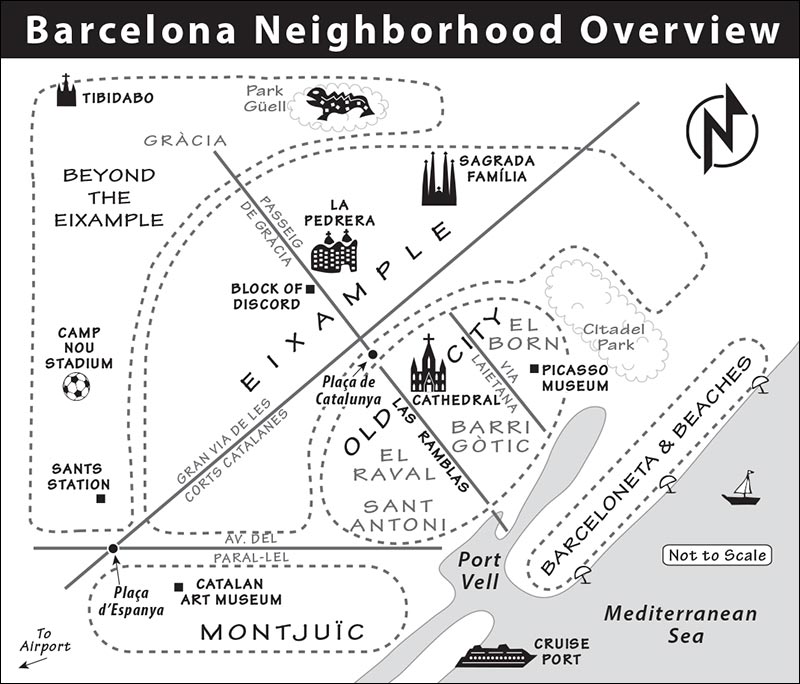
Map: Barcelona Neighborhood Overview
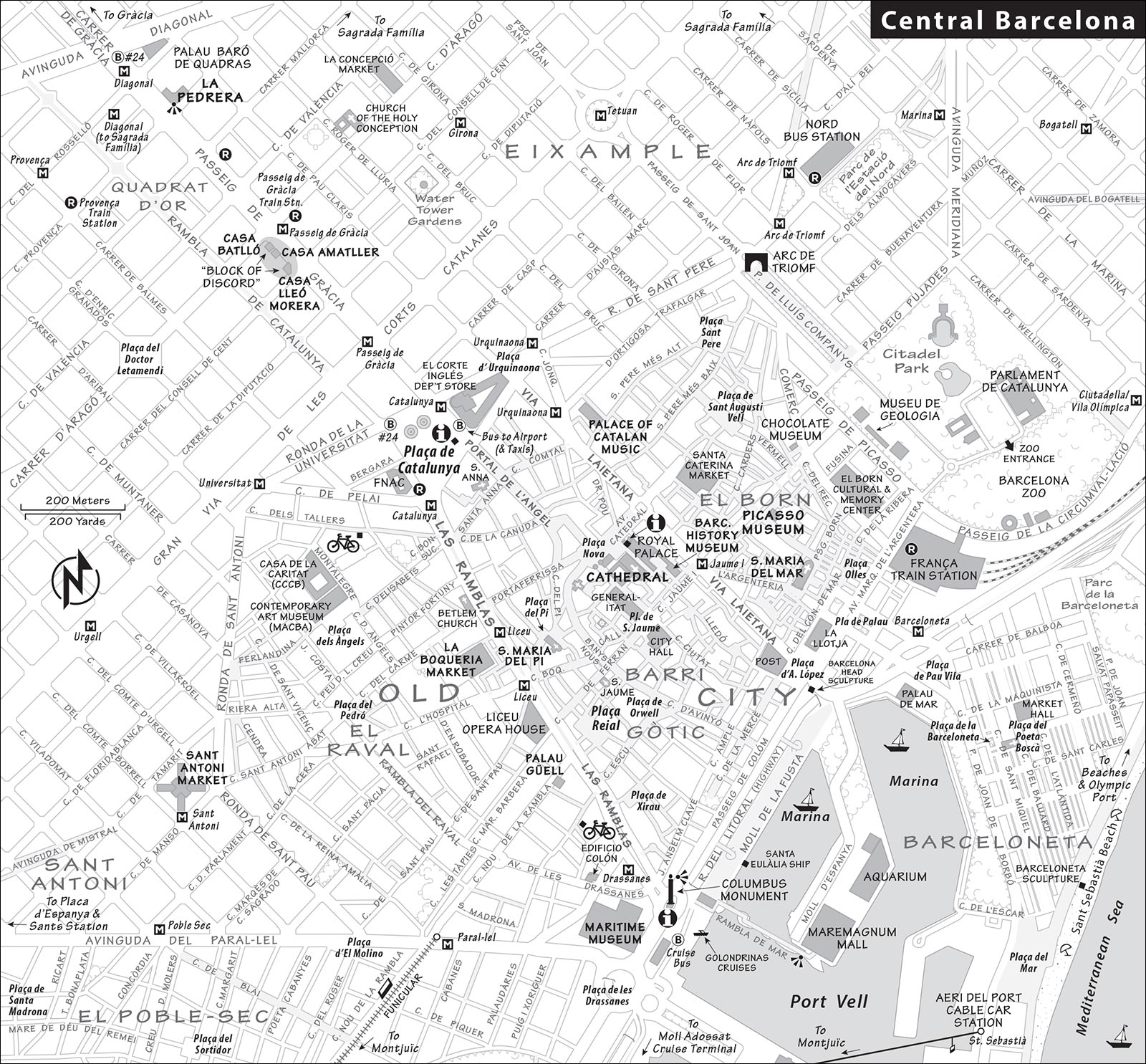
Map: Barcelona’s Public Transportation
SPECIALTY TOURS AND ACTIVITIES
AFTER-HOURS HANGOUT NEIGHBORHOODS
Map: Barcelona’s Old City Hotels
Map: Hotels & Restaurants in the Eixample
Map: Barcelona’s Old City Restaurants
If you’re in the mood to surrender to a city’s charms, let it be in Barcelona. The capital of Catalunya and Spain’s second city, Barcelona bubbles with life—in its narrow lanes, pedestrian-friendly boulevards, elegant modern uptown, bohemian corners, and bustling market halls, and along its long beach promenade spiked with inviting beach bars (chiringuitos).
As the capital of the Catalan people, Barcelona is full of history—with ancient Roman ruins, medieval churches, twisty Gothic lanes, and monuments to Columbus and the sea trade. By the late 19th century, Barcelona had boomed into an industrial powerhouse.
This thriving city became a showpiece of innovative art and architecture. Talented Catalan architects, including Antoni Gaudí, forged the Modernista style and remade the city’s skyline with curvy, fanciful buildings, culminating in Gaudí’s Sagrada Família, a gloriously avant-garde church under construction since 1882.
Pablo Picasso lived in Barcelona as a teenager—just as he was on the verge of reinventing painting. Salvador Dalí and Joan Miró are among the other world-changing 20th-century artists with ties to the city. All three artists are represented by dedicated museums in Barcelona or nearby.
Perched on the sea, Barcelona itself is a work of art. Find a viewpoint to enjoy it, whether from a cable car, a cathedral rooftop, or Gaudí’s colorful Park Güell.
In this coastal city, seafood is always on the menu, along with Spain’s ever-present ham. Restaurants serve dinner late by our standards, so do as the locals do, and dip into tapas bars in the early evening to enjoy Catalan small plates. Wash it all down with a caña (small beer), crianza (fine aged wine), or cava (sparkling wine). Then spill into the crowded streets to join the paseo, when everyone strolls in the cool of the evening.
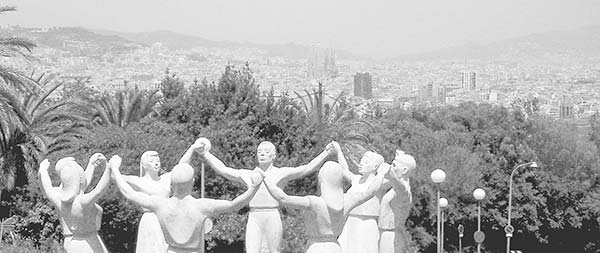
Today’s Barcelona is as vibrant as ever. Locals still hold hands and dance the everyone’s-welcome sardana in front of the cathedral. Neighborhood festivals jam the events calendar. Barcelona’s engaging culture is on an unstoppable roll in Spain’s most cosmopolitan and European corner.
PLANNING YOUR TIME
The following day plans offer suggestions for how to maximize your sightseeing. You can adapt these itineraries to fit your own interests. To find out what days sights are open, check “Helpful Hints,” later.  Note major sights where a free Rick Steves audio tour is available.
Reserve ahead for key sights. Every visitor wants to see the same sights in Barcelona—the Picasso Museum, La Pedrera (Casa Milà), Sagrada Família church, Casa Batlló, and Park Güell—so it’s essential to book in advance. While technically you can try to buy tickets at these sights (except Sagrada Família), I consider reservations mandatory in Barcelona.
Barcelona in One Day
For a relaxing day, stroll the Ramblas, visit the Sagrada Família and Picasso Museum, and have dinner in the El Born district. Or try the following ambitious plan (only possible with advance reservations).
Barcelona in Two or More Days
With at least two days, divide and conquer the town geographically: Spend one day in the Old City (Ramblas, Barri Gòtic/cathedral area, Picasso Museum/El Born) and another on the Eixample and Gaudí sights (La Pedrera, Sagrada Família, Park Güell). If you have a third day, visit Montjuïc and/or side-trip to Montserrat (see the next chapter).
With extra time, consider taking a hop-on, hop-off bus tour for a sightseeing overview (for example, the Bus Turístic blue route links most Gaudí sights and could work well on Day 2).
Day 1: Old City
| 9:00 | Follow my Barri Gòtic Walk and tour Barcelona Cathedral. (Or follow my Barcelona City Walk audio tour.) |
| 11:00 | Browse the fun Barri Gòtic shops (described under “Shopping in Barcelona,” later). |
| 13:00 | Starting near the cathedral, explore El Born. Drop into Santa Caterina Market for lunch. |
| 15:00 | Tour the Picasso Museum. |
| 17:00 | Stroll the Ramblas (follow my Ramblas Ramble and visit La Boqueria market). |
| Evening | For a tapas-bar dinner, choose among the neighborhoods listed in my one-day plan. Other possibilities include sightseeing (many sights are open late), concerts, or hanging out at a beach bar in Barceloneta. |
Day 2: Modernisme
| 9:00 | Spend the morning in the Eixample, touring La Pedrera and/or one of the Block of Discord houses—Casa Batlló or Casa Amatller. Have lunch along the way. |
| 12:30 | From Plaça de Catalunya, hop a taxi or Metro to the Sagrada Família. |
| 13:00 | Tour the Sagrada Família. |
| 15:00 | Choose among these options: Taxi to Park Güell for more Gaudí. Or take the bus to Montjuïc (if you’re not going to Montjuïc on Day 3) to enjoy the city view and your pick of sights. Or explore the harborfront La Rambla de Mar, the Old Port, and the beach scene. |
| Evening | Choose among the evening activities listed earlier. |
Day 3: Montjuïc and Barceloneta
Tour Montjuïc, stopping at Fundació Joan Miró, the Catalan Art Museum, and CaixaForum. Take the scenic cable-car ride down from Montjuïc to the port and spend the rest of the day at Barceloneta—stroll the promenade, hit the beach, and find your favorite beach bar for dinner.
Day 4: Day Trip
Consider a day trip to the mountaintop monastery of Montserrat, the beach resort town of Sitges, or the Salvador Dalí sights at Figueres and Cadaqués (reserve both in advance; see the next chapter).
Connecting with the Rest of Spain
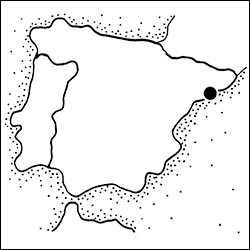
Located in the far northeast corner of Spain, Barcelona makes a good first or last stop for your trip. From the US, it’s as easy to fly into Barcelona as it is to land in Madrid, Lisbon, or Paris. Or you could sandwich Barcelona between flights or high-speed rail trips. Those who plan on renting a car later in their Spain trip can start in Barcelona, take the high-speed train to Madrid (3 hours), sightsee Madrid and Toledo, then pick up a car—cleverly saving on several days’ worth of rental fees. For more on train travel and car rentals in Spain, see the Practicalities chapter.
Orientation to Barcelona
Bustling Barcelona is geographically big and culturally complex. Plan your time carefully, carving up the metropolis into manageable sightseeing neighborhoods. Use my day plans to help prioritize. For efficiency, learn to navigate Barcelona by Metro, bus, and taxi. Make reservations in advance for Barcelona’s most popular sights—otherwise, you might not get in at all. Armed with good information and a thoughtful game plan, you’re ready to go. Then you can relax, enjoy, and let yourself be surprised by all that Barcelona has to offer.
Apart from your geographical orientation, it’s smart to orient yourself linguistically to a language distinct from Spanish. Although Spanish (“Castilian”/castellano) is widely spoken, the native tongue in this region is Catalan—nearly as different from Spanish as Italian (see the “You’re Not in Spain, You’re in Catalunya!” sidebar, later).
BARCELONA: A VERBAL MAP
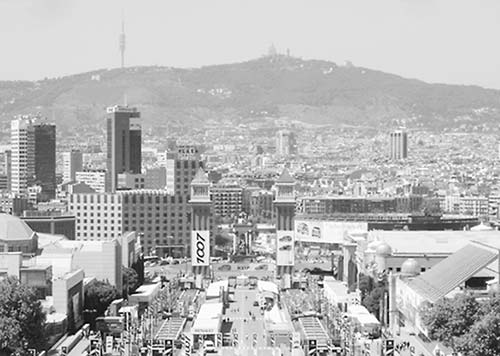
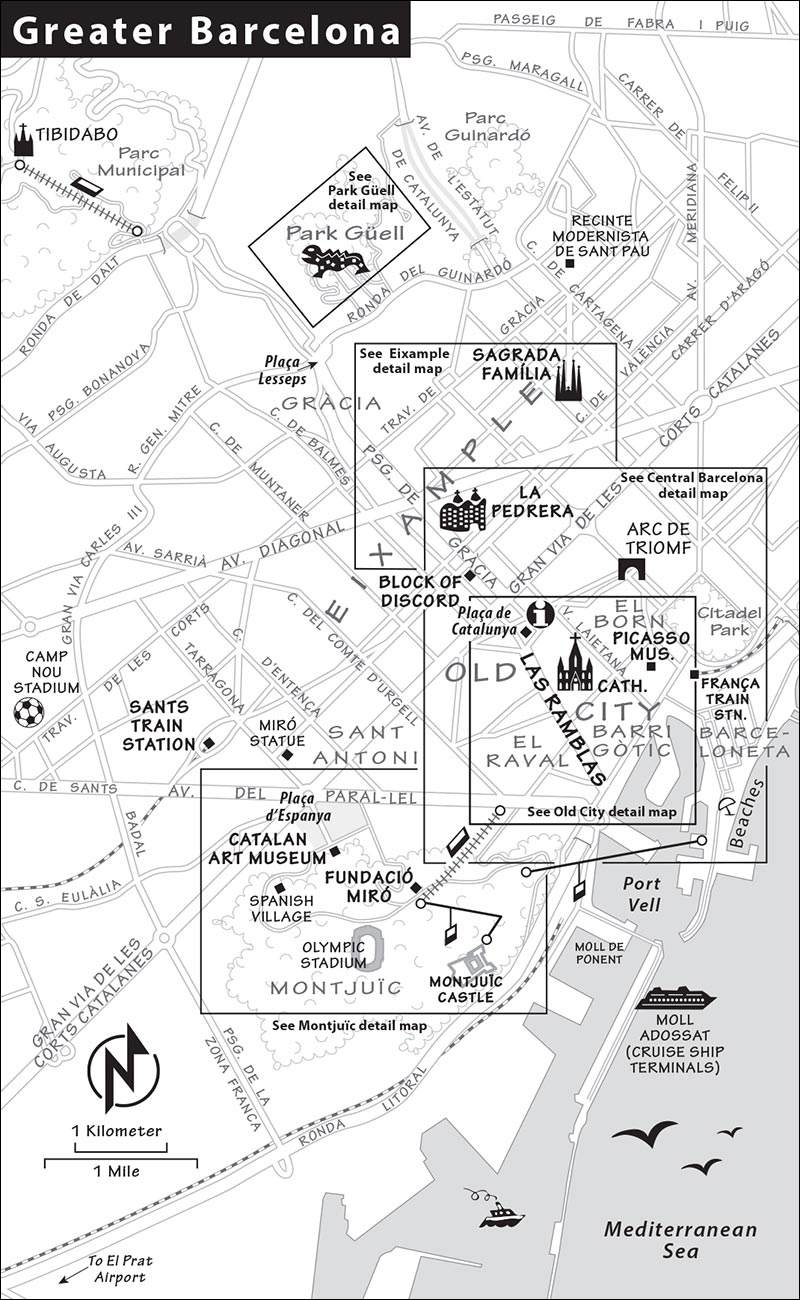
Like Los Angeles, Barcelona is basically flat, sloping gently from the foothills down to the sea. A large central square, Plaça de Catalunya, divides the older and newer parts of town. Above the square is the modern part called the Eixample. Below the square is the Old City and hilly Montjuïc, overlooking the harbor.
Barcelona is a big city, but its major sights cluster in convenient zones. Travelers need only focus on a few areas: the Old City, the harbor/Barceloneta, the Eixample, and Montjuïc. Antoni Gaudí’s Park Güell is north of the Eixample in the Gràcia district. Grouping your sightseeing, walks, dining, and shopping thoughtfully can save you lots of time and money.
Old City (Ciutat Vella)
This is the compact core of Barcelona—ideal for strolling, shopping, and people-watching—where you’ll probably spend most of your time. It’s a labyrinth of narrow streets that once were confined by medieval walls. The lively pedestrian drag called the Ramblas goes through the heart of the Old City from Plaça de Catalunya to the harbor.
The Old City is divided into thirds by the Ramblas and Via Laietana, a vehicle-heavy thoroughfare running roughly parallel to the Ramblas. Between the Ramblas and Via Laietana is the characteristic Barri Gòtic (BAH-ree GOH-teek), with the cathedral as its navel. Locals call it “El Gòtic” for short. To the east of Via Laietana is the trendy El Born district (a.k.a. “La Ribera”), a shopping, dining, and nightlife mecca centered on the Picasso Museum and the Church of Santa Maria del Mar. To the west of the Ramblas is El Raval (rah-VAHL), enlivened by its university and modern-art museum. While rough-edged in places, it is the emerging foodie zone.
Harborfront
The old harbor, Port Vell, gleams with landmark monuments and new developments. A pedestrian bridge links the Ramblas with the modern Maremagnum shopping/aquarium/entertainment complex. On the peninsula across the quaint sailboat harbor is Barceloneta, a traditional fishing neighborhood with gritty charm and some good seafood restaurants. Beyond Barceloneta, a gorgeous man-made beach several miles long stretches east to the commercial and convention district called the Fòrum.
Eixample
Above the Old City, beyond the bustling hub of Plaça de Catalunya, is the elegant Eixample (eye-SHAM-plah) district, its grid plan softened by cutoff corners. Much of Barcelona’s Modernista architecture is found here—especially along the swanky artery Passeig de Gràcia, an area called Quadrat d’Or (Golden Quarter). To the east is the Sagrada Família; to the north is the Gràcia district and Antoni Gaudí’s Park Güell.
Montjuïc
The large hill overlooking the city to the southwest is Montjuïc (mohn-jew-EEK), home to a variety of sights, including some excellent museums (Catalan Art, Joan Miró) and the Olympic Stadium. At the base of Montjuïc, stretching toward Plaça d’Espanya, are the former 1929 World Expo Fairgrounds, with additional fine attractions (including the CaixaForum art gallery and the bullring-turned-mall, Las Arenas).
TOURIST INFORMATION
Barcelona’s helpful TI has several branches (+34 932 853 832, www.barcelonaturisme.com). The primary TI is hidden beneath the main square, Plaça de Catalunya (daily 8:30-20:30, entrance just across from El Corte Inglés department store—look for red sign and take stairs down). Other branches are scattered around the city and generally have the same hours (some have shorter hours Sat-Sun). Locations include on Pla de la Seu in the Barri Gòtic (next to the Barcelona Cathedral), inside the base of the harborside Columbus Monument, at the airport (terminals 1 and 2B), and at the Sants train station.
Smaller info kiosks pop up in touristy locales: on Plaça d’Espanya, in the park across from the Sagrada Família entrance, near the Columbus Monument (where the shuttle bus from the cruise port arrives), seasonally at the Nord bus station, at cruise terminals along the port, and on Plaça de Catalunya. Throughout the summer, red-jacketed tourist-info helpers appear in touristy parts of town; although they work for the hop-on, hop-off Bus Turístic, they are happy to answer questions.
The free El Corte Inglés map, provided at the store’s Plaça de Catalunya customer service desk (just inside the entrance), is better than the TI’s map.
TIs are handy places to buy tickets to most major sights (except the Picasso Museum). They also sell the ArticketBCN sightseeing pass, tickets for the Bus Turístic or TI-run walking tours (all described later), and tickets to FC Barcelona soccer games (men’s and women’s leagues).
Modernisme Route: A handy map showing all 120 of Barcelona’s Modernista buildings is available online (www.rutadelmodernisme.com). The site also offers a great guidebook at bookstores throughout town (€12, 20-50 percent discounts at many Modernista sights—worthwhile if going beyond the biggies).
Sightseeing Passes: The ArticketBCN pass covers admission to six art museums and their temporary exhibits, letting you skip ticket-buying lines. Sights include the recommended Picasso Museum, Catalan Art Museum, and Fundació Joan Miró (€38, valid 12 months; sold online, at participating museums, and at most TIs; www.articketbcn.org [URL inactive]). If you visit three or more covered museums, this ticket can save you money and time. Just show your ArticketBCN to the ticket taker or at the info desk, and you’ll get your museum ticket, which you can use to enter at any time (especially useful for Picasso Museum).
For most travelers, the Barcelona Card and the Barcelona Card Express are not worth the trouble.
Digital Publications: Good pretrip planning tools include Time Out BCN Guide (concise but thorough day-by-day list of events, www.timeout.com/barcelona) and Barcelona Metropolitan magazine (timely coverage of local topics and events, www.barcelona-metropolitan.com).
ARRIVAL IN BARCELONA
For more information on getting to or from Barcelona by train, plane, or bus, see “Barcelona Connections” at the end of this chapter.
By Train: Virtually all trains end up at Barcelona’s Sants train station, west of the Old City. AVE trains from Madrid go only to Sants station. But many other trains also pass through other stations en route, such as França station (between the El Born and Barceloneta neighborhoods) or the downtown Passeig de Gràcia or Plaça de Catalunya stations (which are also Metro stops—and very close to most of my recommended hotels). Figure out which stations your train stops at (ask the conductor) and get off at the one most convenient to your hotel.
By Plane: Most flights use the city’s primary Josep Tarradellas Barcelona-El Prat Airport; a few budget flights use a smaller airstrip 60 miles away, called Girona–Costa Brava Airport. Information on both airports can be found on the official Spanish airport website, Aena.es.
HELPFUL HINTS
Book Ahead: To ensure you’ll see Barcelona’s top (and very crowded) sights—the Picasso Museum, La Pedrera (Casa Milà), Sagrada Família, Casa Batlló, and Park Güell—book timed-entry tickets online in advance. It’s easy, it’s cheap, and it’s for your own good (and for Sagrada Família, it’s required).
When booking, aim for midafternoon or early evening, to avoid crowds: The city’s major sites are busiest in the morning before 13:00 and during free entry times.
If you didn’t book ahead, the TI may sell last-minute tickets to these sights (for a few extra euros).
Closed Days: Many sights are closed on Monday, including the Picasso Museum, Catalan Art Museum, Palau Güell, Barcelona History Museum, Santa Eulàlia schooner (part of the Maritime Museum), Fundació Joan Miró, Frederic Marès Museum, El Born Cultural and Memory Center, and Olympic and Sports Museum. On Sunday, the food markets are closed, and some sights close early—check hours when planning your day.
Theft and Scam Alert: You have a better chance of being pickpocketed here—especially on the Ramblas—than anywhere else in Europe. The Sagrada Família (both inside and out), with its hordes of tourists gawking skyward, is also popular with pickpockets. Leave valuables in your hotel. Whenever you pay with cash, count your change carefully.
Street scams are easy to avoid if you recognize them. Most common is the too-friendly local who tries to engage you in conversation. If a super-friendly man acts drunk and wants to dance because his soccer team just won, he’s a pickpocket. Beware of groups of women aggressively selling flowers, people offering to clean a stain from your shirt, and so on. If you stop for any commotion or show on the Ramblas, put your hands in your pockets before someone else does. Assume any scuffle is a distraction by a team of thieves.
Personal Safety: Some areas feel seedy and can be unsafe after dark. Most crime is nonviolent, but muggings do occur. Certain parts of the Barri Gòtic (basically the two or three blocks directly south and east of Plaça Reial) and El Raval (just west of the Ramblas) can be dicey. One block can separate a comfy tourist zone from the junkies and prostitutes. If you use common sense in avoiding dark and lonely lanes, you should be fine.
Baggage Storage: Locker Barcelona is located just a few minutes’ walk from Plaça de Catalunya. For weekends and holidays, book a locker in advance (cost depends on size, daily 8:30-22:30, shorter hours in winter, Carrer d’Estruc 36, +34 933 028 796, www.lockerbarcelona.com). For location, see the map on here.
Pharmacy: Pharmacies are sprinkled throughout the Barri Gòtic and Eixample: Look for a bright-green illuminated cross. A 24-hour pharmacy is across from La Boqueria Market at #98 on the Ramblas.
Laundry: The clean-as-a-whistle LavaXpres is centrally located near recommended Plaça de Catalunya and Ramblas hotels (self-service, English instructions, daily 8:00-22:00, Passatge d’Elisabets 3, www.lavaxpres.com). Speed Queen, just off the Ramblas, is in a seedier neighborhood just down the street past Palau Güell (self-service, daily 7:00-23:00, Carrer Nou de la Rambla 19, +34 622 414 638). For both locations, see the map on here.
Bike Rental: Biking is a joy in Citadel Park and along the beach, but it’s stressful in the city center. Bike-rental shops are in just about every part of the city; I’ve listed only a few.
Barcelona Rent a Bike is located near Plaça de Catalunya (in the courtyard at Carrer dels Tallers 45). Both standard and e-bikes are available (daily, +34 933 171 970, www.barcelonarentabike.com).
A-Bike is near the Drassanes Metro stop, just a block from the Ramblas, and is a good place to pick up a bike for a trip to Barceloneta or Citadel Park (daily, standard and e-bikes, Carrer de Montserrat 8, +34 666 057 655, www.a-bike.es).
You’ll see racks of government-subsidized “Bicing” borrow-a-bikes around town, but these are only for locals. Instead, check out the apps Donkey Republic and RideMovi (e-bikes), which offer rental bikes all over town.
GETTING AROUND BARCELONA
Barcelona’s Metro and bus system is run by TMB—Transports Metropolitans de Barcelona (+34 932 987 000 or +34 932 148 000, www.tmb.cat).
It’s worth asking for TMB’s excellent Metro/bus map at the TI, larger stations, or the TMB info counter in the Sants train station. Google Maps is a great route planner for both Metro and bus riders.
Tickets and Multiride Cards: The Metro and local buses use the same ticket. A single-ride ticket (bitllet senzill) costs €2.40. One “ride” covers you for 1.25 hours of unlimited use on all Metro and local bus lines, as well as local rides on the Renfe and Rodalies de Catalunya train lines (including the ride to the train station) and the suburban FGC trains. Transfers made within your 1.25-hour limit are not counted as a new ride, but you must revalidate your multiride card whenever you transfer.
The T-Casual card (€11.35 for 10 rides) and the T-Dia card (€10.50 for 24 hours) are for individual travelers only. The T-Familiar card (€10 for 8 rides) is shareable as long as you stay together the entire journey (you’ll be fined for riding without a ticket). Taking the Metro to or from the airport requires a separate €5.15 fare (more convenient by Aerobus shuttle).
Multiday “Hola BCN!” travel cards cover unlimited travel for two or more days and include Metro service between the city and airport (€16.40/2 days, €23.80/3 days, €31/4 days, €38.20/5 days).
Tickets are sold on the TMB app (see next) and from easy-to-use machines at Metro stations and some bus stops. Most machines accept coins, bills, and credit/debit cards—just press “English” to start. On buses you can use contactless payment methods (credit card or phone), but not cash, to buy a single ticket.
TMB App: With the TMB app you can find your nearest station, get real-time transit updates, and buy tickets for all forms of public transit. The T-Mobilitat app is most useful on Android devices, where it allows tickets to be stored and validated directly on the phone. Non-Android phone users can make purchases in the app but must then collect and validate a T-Mobilitat smartcard at the station.
By Metro
The city’s Metro, among Europe’s best, connects just about every place you’ll visit. Among the several color-coded Metro lines, most useful for tourists is the L3 (green) line. Handy city-center stops on this line include (in order):
Sants Estació: Main train station
Espanya: Plaça d’Espanya, with access to the lower part of Montjuïc and trains to Montserrat
Paral-lel: Funicular to the top of Montjuïc
Drassanes: Bottom of the Ramblas, near Maritime Museum and Maremagnum mall
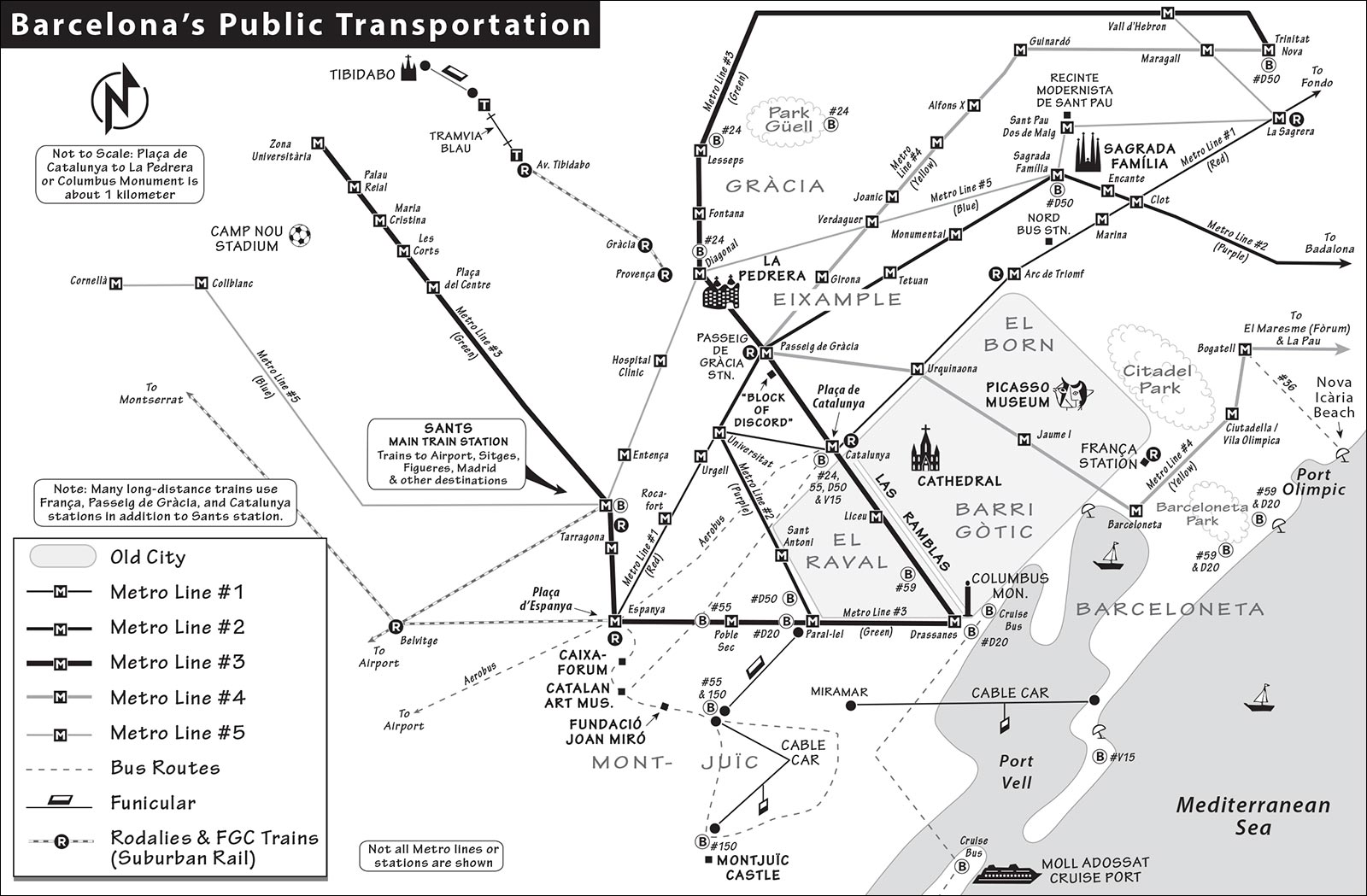
Liceu: Middle of the Ramblas, near the heart of the Barri Gòtic and cathedral
Plaça de Catalunya: Top of the Ramblas and main square with TI, airport bus, and lots of transportation connections
Passeig de Gràcia: Classy Eixample street at the Block of Discord; also connection to L2 (purple) line to Sagrada Família and L4 (yellow) line (described below)
Diagonal: Gaudí’s La Pedrera
Lesseps: Closest stop for Gaudí’s Park Güell
The L4 (yellow) line, which crosses the L3 (green) line at Passeig de Gràcia, has a few helpful stops, including Jaume I (between the Barri Gòtic/cathedral and El Born/Picasso Museum) and Barceloneta (at the south end of El Born, near the harbor action).
Riding the Metro: Before boarding, study a map (posted at Metro entrances, platforms, and aboard Metro cars) to get familiar with the system. Look for your line number and color, and find the end stop for your direction of travel. With a physical ticket, enter the Metro by inserting your ticket into the turnstile (with the arrow pointing in), retrieving it, and passing through. If you’re using the T-Mobilitat app or smartcard, hold your phone or smartcard above the contactless symbol on the turnstile. Once inside, follow signs for your line and direction.
On board, most cars have handy lighted displays that indicate upcoming stops. Because the lines cross one another multiple times, there can be several ways to make any one journey. (It’s a good idea to carry a general map with you—especially if you’re transferring.) Keep your Metro ticket until you’ve exited the system, just in case an inspector asks to see it.
This is a popular nationalistic refrain you might see on T-shirts or stickers around town. Catalunya is not the land of bullfighting and flamenco that many visitors envision when they think of Spain (visit Madrid or Sevilla for those).
The region of Catalunya, with Barcelona as its capital, has its own language, history, and culture. Its people—eight million strong—have a proud, independent spirit. Historically, Catalunya (“Cataluña” in Spanish, sometimes spelled “Catalonia” in English) has often been at odds with the central Spanish government in Madrid.
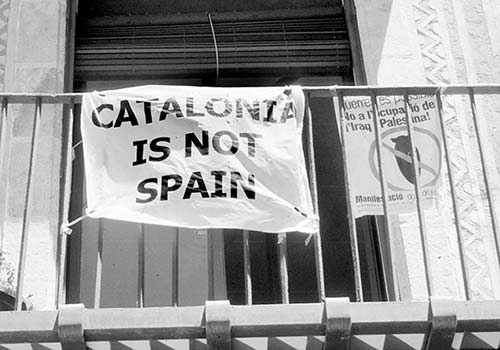
The Catalan language and culture were discouraged or even outlawed at various times, as Catalunya often chose the losing side in wars and rebellions against the kings in Madrid. In the Spanish Civil War (1936-1939), Catalunya was one of the last pockets of democratic resistance against the military coup of the fascist dictator Francisco Franco, who punished the region with four decades of repression. During that time, the Catalan flag was banned (locals showed their regional pride by flying their football team’s flag instead).
Three of Barcelona’s monuments are reminders of royal and Franco-era suppression. Citadel Park was originally a military citadel, constructed in the 18th century to keep locals in line. The Castle of Montjuïc, built for similar reasons, was the site of many political executions, including hundreds in the Franco era. The Sacred Heart Church atop Tibidabo, completed under Franco, was meant to atone for Barcelona’s sins during the civil war—the main sin being opposition to Franco. Today, Catalunya is still divided: Some favor independence, while others are loyal to Spain.
To see real Catalan culture, look for the sardana dance or an exhibition of castellers. The main symbol of Catalunya is the dragon slain by St. George (“Jordi” in Catalan)—the region’s patron saint. You’ll find dragons all over Barcelona, along with the Catalan flag—called the Senyera—with four horizontal red bars on a gold field. Why red stripes? According to legend, Wilfred the Hairy—a count of Barcelona and one of the founding fathers of Catalunya—was wounded in a ninth-century battle. A grateful neighboring king rewarded Wilfred’s bravery with a copper shield and ran Wilfred’s four bloody fingers across its surface, leaving four red stripes.
The Catalan language is irrevocably tied to the history and spirit of the Catalan people. After the mid-1970s end of the Franco era, the Catalan language made a huge comeback. Schools are now required to conduct all classes in Catalan; most school-age children learn Catalan first and Spanish second. While all Barcelonans speak Spanish, nearly all understand Catalan, three-quarters speak Catalan, and half can write it.
Most place names in this book are listed in Catalan. Here’s how to pronounce some of the city’s major landmarks:
| Plaça de Catalunya | PLAH-sah duh kah-tah-LOON-yah |
| Eixample | eye-SHAM-plah |
| Passeig de Gràcia | PAH-sehj duh GRAH-see-ah |
| Catedral | KAH-tah-dral |
| Barri Gòtic | BAH-ree GOH-teek |
| Montjuïc | mohn-jew-EEK |
When finding your way, these terms will be useful:
| exit | sortida (sor-TEE-dah) |
| square | plaça (PLAH-sah) |
| street | carrer (kah-REHR) |
| boulevard | passeig (PAH-sehj) |
| avenue | avinguda (ah-veen-GOO-dah) |
Watch your valuables. If I were a pickpocket, I’d set up shop along the made-for-tourists L3 (green) line.
By Bus
Given the excellent Metro service, it’s unlikely you’ll spend much time on local buses. Buses are useful, however, to get to Park Güell (bus #24), to connect the sights on Montjuïc, and to reach the beach. Just insert your ticket in the machine behind the driver or use contactless pay options.
By Taxi
Barcelona is one of Europe’s best taxi towns. Save time by catching a cab (figure €10 from Ramblas to Sants station). Taxis are plentiful and honest, and cab rates are reasonable (€2.55 drop charge; €1.23/kilometer during the day; €1.51/kilometer 20:00-8:00, Sun, and holidays; €1 surcharge per large suitcase; €2.50 surcharge to/from Sants train station; and €4.50 surcharge for airport or cruise port). Similar to Uber, the Taxi Barcelona & AMB app lets you order a car and offers a fixed-price ride to your destination.
Tours in Barcelona
ON FOOT
To sightsee on your own, download my free Barcelona City Walk and Eixample Walk audio tours, which illuminate some of the city’s top sights and neighborhoods (see here).
TI Walking Tours
The TI at Pla de la Seu (next to the Barcelona Cathedral) offers great guided walks through the Barri Gòtic. You’ll learn the medieval story of the city as you walk through the cathedral neighborhood (€25, small discount if you buy online, daily at 10:00, 2 hours; buy online in advance—especially in summer when they sell out; otherwise buy ticket 15 minutes early at the TI desk—not from the guide; +34 932 853 832, www.barcelonaturisme.com).
The TI at Plaça de Catalunya offers a Picasso walk through the streets of his youth and early career, finishing in the Picasso Museum (€35, discount online, year-round Tue and Sat at 10:00 and 15:00, Thu at 10:00, 2 hours including museum visit). It’s smart to reserve these walks in advance and double-check departure times with the TI (www.barcelonaturisme.com).
“Free” Walking Tours
A few companies offer “free” walks that rely on—and expect—tips to stay in business. These walks can be a fun, casual way to get your bearings. Runner Bean Tours, run by Gorka, Ann-Marie, and a handful of local guides, is reliable and well established. They offer two 2.5-hour, English-only walks, one on the Old City and the other covering Gaudí (daily at 11:00, Old City tour also at 16:30 April-Oct, +34 636 108 776, www.runnerbeantours.com). They also do an array of fixed-price tours, including for families.
Local Guides
These are three reliable and good local guides that I’ve enjoyed working with for years. They do both walking tours and visits to museums and sights (from about €250/3 hours): Sònia Crespo (+34 610 442 052, sonia@barcelonaexperts.com), Mónica Sánchez Sabater (+34 639 319 759, monicasanchezsabater@gmail.com), and Mariona Prats (+34 607 605 776, mariona@barcelonasustainabletours.com).
José Soler is a great and fun-to-be-with local guide who enjoys tailoring a walk through his hometown to your interests (€295/4 hours, +34 615 059 326, details at www.pepitotours.com, info@pepitotours.com). He and his driver also take small groups by car, van, or minibus on four-hour Barcelona highlights tours and tours outside the city (from €525); they can meet you at your hotel, the cruise port, or the airport.
Adi Mahler is a knowledgeable local guide giving tours of the Gothic Quarter with a focus on the history of Jews in Barcelona (€45/person for 2 hours, €80/person for 4 hours, adi_mahler@yahoo.co.uk, +34 633 400 142).
Live Barcelona is a team of professional, enthusiastic guides led by Cristina Sanjuán since 1997. They offer a variety of walking or chauffeured tours and can arrange cruise excursions and transfers (from €225/3 hours, +34 609 205 844, www.livebarcelona.com, info@livebarcelona.com).
ON WHEELS
Guided Bus Tours
Catalunya Bus Turístic runs excursions to nearby destinations, including some that are difficult to reach by public transportation. Trips run April to October and include The Montserrat Tour (€64, Mon-Fri at 10:00, 6 hours), Easy Montserrat (€52, Sun-Fri at 10:00, 6 hours, includes the rack railway), and Salvador Dalí sights in Figueres and Girona (€82, Tue-Sun at 8:30, 11 hours). Itineraries depart from the Nord bus station, close to the Triumphal Arch (live trilingual commentary in Catalan, Spanish, and English; €5 extra for a more in-depth English audioguide; no tours mid-Nov-late March, book online for 10 percent discount, +34 932 805 805, www.catalunyabusturistic.com).
Hop-On, Hop-Off Buses
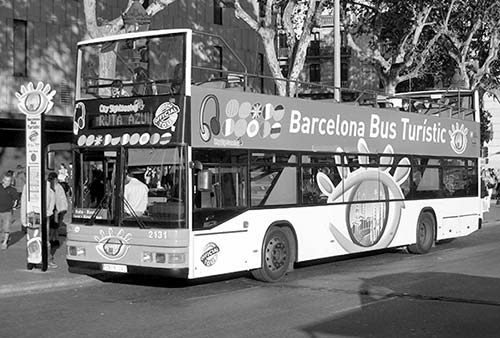
The handy hop-on, hop-off Bus Turístic offers two multistop circuits in colorful double-decker buses that go topless in sunny weather and are useful as a once-over-lightly tour or simply to get around. The two-hour blue route covers north Barcelona (most Gaudí sights, departs from El Corte Inglés on Plaça de Catalunya). The two-hour red route covers south Barcelona (Barri Gòtic and Montjuïc, departs from the Ramblas side of Plaça de Catalunya). All have headphone commentary and free Wi-Fi (daily 9:00-19:00, buses run every 20-30 minutes depending on season, www.barcelonabusturistic.cat). One-day (€33) and two-day (€44) tickets, which you can buy on the bus, at the TI, or cheaper online, offer discounts on the city’s major sights and walking tours. Another company, Barcelona City Tour, offers a nearly identical service (same price and discounts, www.barcelona.city-tour.com).
Bike Tours
Barcelona Bike Tour offers 2.5-hour bike tours taking you from sight to sight, mostly on bike paths and through parks, with stop-and-go commentary in English (€30, daily at 10:00, limited to 10 people—reserve online in advance, Carrer Tallers 45, +34 933 171 970, www.barcelonaciclotour.com).
Barcelona eBikes offers daily themed tours, including Gaudí Highlights (€40, daily at 11:00), Sagrada Família (€69, daily at 11:00, includes admission), and a Picasso and Bohemian tour (€40, daily at 16:00). Tours start at their office in El Born (Plaça San Agustín Vell 16, +34 935 480 457, www.barcelonaebikes.com [URL inactive]).
SPECIALTY TOURS AND ACTIVITIES
Spanish Civil War Tours
Nick Lloyd is the author of Forgotten Places: Barcelona and the Spanish Civil War. He and his guiding partner, Catherine Howley, are passionate teachers who take small groups on walks through the Old City to explain the social context and significance of the Spanish Civil War (1936-1939) in Barcelona. History buffs really love this tour (€25/person, Mon-Tue and Thu-Sat mornings, fewer in winter, 3 hours with an hour-long stop in a café for a sit-down talk, English only, https://thespanishcivilwar.com).
Cooking Classes and Food Tours
Cook & Taste offers group cooking classes in which you’ll make and eat traditional dishes paired with local wines (group classes daily at 11:00 and 17:00, €70/person, €12 extra for guided La Boqueria or Santa Caterina visit offered Tue-Sat morning or Fri afternoon before the cooking class, Carrer Paradís 3, +34 933 021 320, www.cookandtaste.net). They also offer private classes and a chef-guided gastronomic tour of gourmet food and wine shops and La Boqueria.
Food Lovers Company guides carefully select traditional and atmospheric spots where you can sample high-quality seasonal specialties as they share personal insights on Barcelona and its cuisine (from €150/person, morning or evening tours, 4 hours, 6 people maximum, +34 635 604 290, www.foodloverscompany.com, hello@foodloverscompany.com). They also offer an all-day private winery tour in the nearby Penedés region that includes stops at two family-run wineries, with tastings, brunch, and transport in a private van.
The Barcelona Taste takes small groups on guided walks, making three stops in roughly three hours. They enthusiastically introduce you to lots of local treats and drinks. Options include a lunch tour (12:45-15:30) in the Eixample and evening tours (19:00-22:00) in the Gothic Quarter or the up-and-coming Poble Sec neighborhood (from €113/person, Mon-Sat, reserve early in season, www.thebarcelonataste.com).
Walks in Barcelona
3 Rambla of the Little Birds (RIP)
11 Waterfront
1 Avinguda del Portal de l’Angel
4 Fountain
8 Monument to the Martyrs of Independence
13 Roman Temple of Augustus (Temple Roma d’August)
These two self-guided walks take you through the old town—down the main boulevard (“Ramblas Ramble”) and through the cathedral neighborhood (“Barri Gòtic Walk”).
My free Barcelona City Walk audio tour covers the Ramblas (in part) and the Barri Gòtic neighborhood.
RAMBLAS RAMBLE
For more than a century, Barcelona’s main boulevard has been a magnet for visitors. This one-hour stroll down the Ramblas goes from Plaça de Catalunya gently downhill to the waterfront, with an easy return by Metro.
Traditionally, the Ramblas was the place where locals flocked to buy flowers, lottery tickets, and a daily newspaper, or to enjoy a spot of shade while watching the world go by. But much of the local charm of the Ramblas has been taken over by sightseers, tacky trinkets, and lousy eateries. Many shops now cater to visitors more than locals, and the old neighborhood population has fled to more affordable homes in the suburbs. Still, if you come to Barcelona...you’ve got to ramble the Ramblas. (And if you stroll first thing in the morning, you’ll find it more charming.)
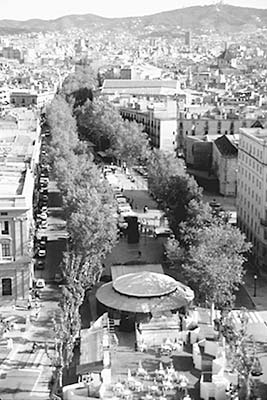
The word “Ramblas” is plural; the street is actually a succession of five separately named segments. But street signs and addresses treat it as a single long street—“La Rambla,” singular. This one-hour walk will help you see beyond the tourist crowds to discover the essence of the area. On the wide central sidewalk, you’ll raft the river of tourism as you pass plenty of historic bits and pieces of this great city.
When to Go: The Ramblas is two different streets by day and by night. To fully experience its yin and yang, walk it once in the evening and again in the morning, grabbing breakfast on a stool in a market café. Note that the Ramblas can be rowdy and off-putting late at night or after the Barça soccer team wins a match. Saturday is the best time to see La Boqueria Market.
Pickpockets: The Ramblas is prime hunting ground for pickpockets. Keep only today’s spending money in your front pocket; secure your credit/debit cards, extra cash, and passport in your money belt.
Services: You’ll find WCs at La Boqueria, beneath the statue at Plaça del Teatre, and at the Maremagnum mall at the end of this walk.
Eating: The eateries here are tourist traps: Avoid them. But just off the street you’ll find a few handy lunch spots, and the stalls of La Boqueria Market invite grazing. For details, see “Eating in Barcelona,” later.
 Self-Guided Walk
• Start your ramble on Plaça de Catalunya, at the top of the Ramblas.
1 Plaça de Catalunya
Dotted with fountains, statues, and pigeons—and ringed by grand buildings—this plaza is Barcelona’s center. Plaça de Catalunya is the hub for the Metro, bus, airport shuttle, and Bus Turístic. Of the region’s 7.6 million Catalans, more than half live in greater Barcelona. Plaça de Catalunya is their Times Square.
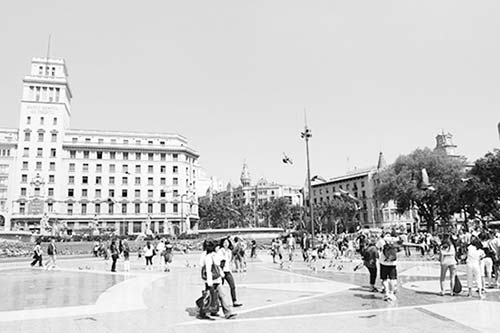
Geographically, the 12-acre square links the narrow streets of old Barcelona with the broad boulevards of the newer city (the Eixample). Four grand thoroughfares radiate from here: The Ramblas is the popular tourist promenade; Passeig de Gràcia, Barcelona’s answer to Paris’ Champs-Elysées, has fashionable shops and cafés (and noisy traffic); Rambla de Catalunya is equally fashionable but cozier and more pedestrian-friendly; and Avinguda del Portal de l’Angel (shopper-friendly and traffic-free) leads to the Barri Gòtic.
While Plaça de Catalunya is the center of Barcelona, it’s also the cultural heart of the entire Catalunya region. At the Ramblas end of the square, the odd, inverted-staircase monument represents the shape of Catalunya. An inscription honors one of its former presidents, Francesc Macià i Llussà, who declared independence for the breakaway region in 1931. (It didn’t quite stick.) Sculptor Josep Maria Subirachs, whose work you’ll see at the Sagrada Família, designed it. These days, Catalans gather on the square by the tens of thousands to demonstrate passionately about whether Catalunya should be independent from Spain.
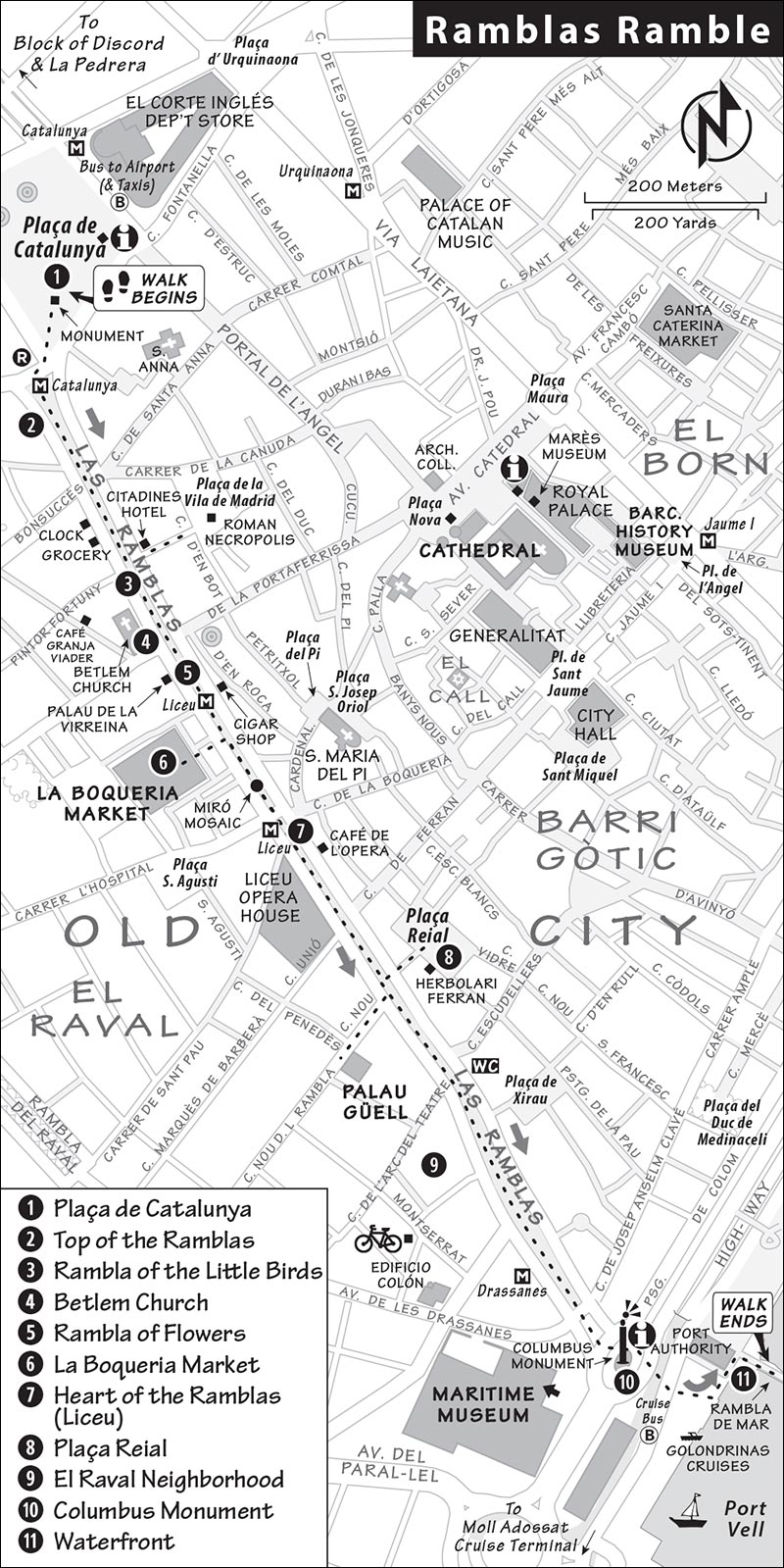
The giant El Corte Inglés department store towering above the square (on the northeast side) has just about anything you might need.
• Cross the street, head down about 30 yards, and pause to take in the scene.
2 Top of the Ramblas
The street called the Ramblas stretches before you, sloping gently downhill from here to the harbor. It’s dotted with trees and ironwork lampposts, lined with fanciful buildings, paved with colorful mosaics, and trod upon by thousands of people both day and night.
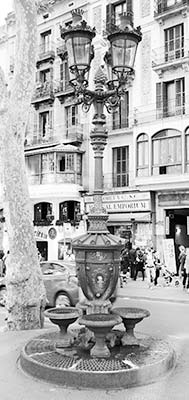
Start with the ornate black-and-gold lamppost on your right. The base is a water tap called the Fountain of Canaletes, which has been a local favorite for more than a century. When Barcelona tore down its medieval wall and created this elegant promenade, this fountain was one of its early attractions. Legend says that a drink from the fountain ensures that you’ll come back to Barcelona one day. The fountain is still a popular rendezvous spot and a gathering place for celebrations and demonstrations.
As you survey the Ramblas action, get your bearings for our stroll. You’ll see the following features here and all along the way:
Wavy Tile Work: The pavement decorations represent the stream that once flowed here. Rambla means “stream” in Arabic, and this used to be a drainage ditch along one of the medieval walls enclosing the Barri Gòtic (to the left). Many Catalan towns, established where rivers approach the sea, have streets called “Ramblas.” Today, Barcelona’s “stream” has become a river of humanity.
Skinny Balconies: Look up to see the city’s characteristic shallow balconies. They’re functional as well as decorative, with windows opening from floor to ceiling to allow light and air into the tight, dark spaces of these cramped old buildings.
Hardy Plane Trees: The deciduous trees lining the boulevard are known for their peeling bark and toughness in urban settings. They’re ideal for the climate, letting in maximum sun in the winter and providing maximum shade in the summer.
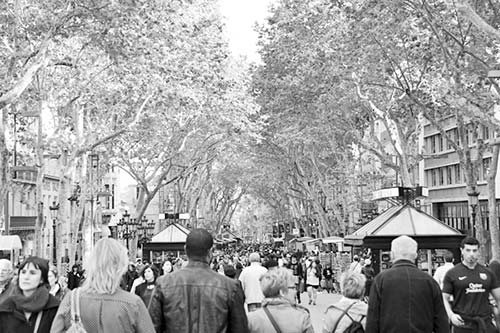
Fixed Chairs: Nearby, notice the chairs fixed to the sidewalk at jaunty angles. It used to be that you’d pay to rent a chair here to look at the constant parade of passersby. Seats are now free, and it’s still the best people-watching in town. Enjoy these chairs while you can—you’ll find virtually no public benches or other seating farther down the Ramblas, only cafés that serve beer and sangria in just one (expensive) size: gegant.
ONCE Booths: Across from the fountain and a few steps down, notice the first of many booths along this walk that sell lottery tickets in support of ONCE, Spain’s organization for the blind.
Soccer Souvenirs: You’ll see soccer paraphernalia, especially the scarlet and blue of FC Barcelona—known as Barça. The team motto, “More than a club” (Mes que un club), suggests that Barça represents not only athletic prowess but also Catalan cultural identity.
• Continue strolling.
Walk 100 yards farther to #115, with an entrance flanked by two columns and a fine facade struggling to be noticed above the Ramblas ruckus. This marks the venerable Royal Academy of Science and Arts building (now home to a performing-arts theater). The building is emblematic of the city’s striking architecture from the late 1800s—an industrial boom time that brought lots of construction. The Carrefour supermarket next door has cheap groceries (at #113).
• Remember that each of the Ramblas segments has its own name. You’re now standing at what was the...
3 Rambla of the Little Birds (RIP)
A generation ago, the Ramblas had a different kind of commerce. Locals came here for their newspapers, flowers, and even domestic pets. Traditionally, kids brought their parents here to buy birds, but also turtles and hamsters. But the clientele stopped coming and animal-rights groups lobbied to cut back on the stalls. Today, none of the traditional pet kiosks survive—and there’s not a bird in sight. The commerce that remains is trinkets and drinks for hordes of tourists. Only the locals—and you—know the story behind the name for this stretch of the Ramblas.
• At #122 (the big, modern Citadines Hotel on the left), take a 100-yard detour through a modern passageway marked with the hotel’s name to a restored...
Roman Necropolis: Look down and imagine a 2,000-year-old road lined with tombs. Barcelona was founded about 10 BC by Romans, during the reign of Emperor Augustus, as the city of “Barcino,” and this was the main road (Via Augusta) in and out of the walled town. (Today, the highway from Barcelona to France still follows the route laid out by this Roman thoroughfare.) In Roman cities, tombs were generally placed along roads outside the city walls. Emperor Augustus spent a lot of time on the Iberian Peninsula conquering new land, so the Romans were sure to incorporate Hispania into the empire’s infrastructure. Looking down at these ruins, you can see that Roman Barcino was about 10 feet lower than today’s street level.
• Return to the Ramblas and continue down 100 yards or so to the next cross street, Carrer de la Portaferrissa (on the left). Cross the street to see the decorative tile over a fountain still in use by locals. The scene shows what this spot looked like three centuries ago: There’s the original city wall with its gate, and merchants are busy selling flowers, bananas, and, I believe, Barça T-shirts. Now cross the boulevard to the front of the big church.
4 Betlem Church
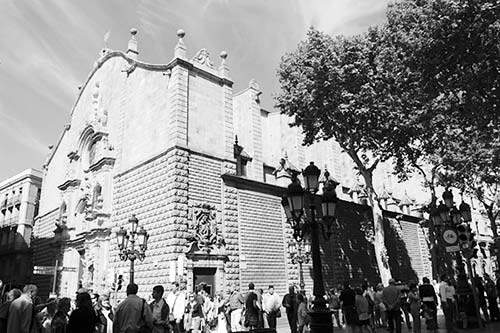
This imposing church is dedicated to Bethlehem, and for centuries locals have flocked here at Christmastime to see nativity scenes.
The church’s diamond-shaped stonework is 17th-century Baroque: Check out the sloping roofline, ball-topped pinnacles, corkscrew columns, and scrolls above the entrance. This Baroque style, so common elsewhere in Europe, is unusual in Barcelona. That’s because during the Baroque and Renaissance eras (1500-1800), Barcelona was broke. The city enjoyed two heydays: in the 1300s as a medieval sea-trading power, and in the 1800s during the prosperous Industrial Age. In between, Barcelona languished as New World discoveries shifted lucrative trade to the Atlantic and the Spanish crown kept unruly Catalunya on a short leash. The church interior is stark, having been burned during the Spanish Civil War in the 1930s.
For a sweet treat, head around to the narrow lane on the far side of the church (Carrer d’en Xucla) to the recommended Café Granja Viader.
• Continue down the boulevard, through the stretch called the...
5 Rambla of Flowers
Pause at this charming section of the Ramblas to admire the nice apartment facades. This colorful block is lined with flower stands. Besides admiring the blossoms on display, gardeners covet the seeds sold here for varieties of radishes, greens, peppers, and beans seldom seen in the US—including the iconic green Padrón pepper of tapas fame (note that if you buy seeds, you’re obligated to declare them at US customs when returning home).
At #99 (on the right), the Palau de la Virreina sells last-minute tickets to dance and musical concerts.
At #97 (right), the Casa Beethoven shop is a cultural throwback to an earlier era, sedately selling music books, sheet music, and antiques like vinyl records.
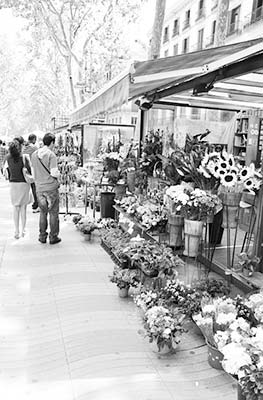
On the left, at #100, Tabacs Gimeno has been selling cigars since the 1920s. Step inside and appreciate the dying art of cigar boxes and hand-crafted pipes.
• A little farther on, across the street (opposite the Erotic Museum), is the arcaded entrance to Barcelona’s great covered market, La Boqueria.
6 La Boqueria Market
This lively market hall (worth ▲) is an explosion of jamón legs, bags of live snails, stiff fish, delicious oranges, and odd odors.
The market was originally located just outside the city, as were many in medieval times. It later expanded into the colonnaded courtyard of a monastery before being covered with a colorful arcade in 1850.
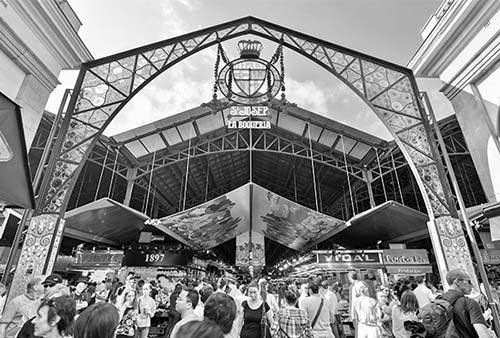
While tourists are drawn to the area around the main entry, locals know that the stalls up front pay the highest rent—and therefore inflate their prices and cater to out-of-towners. Skip the tempting but more expensive juices sold here and head to a booth farther in or along the sides (market open Mon-Sat 8:00-20:30, best mornings after 9:00, closed Sun, many stalls shut down early on Mon).
Fresh, Local Produce: Stands show off seasonal fruits and vegetables that you’ll see on menus. The focus here is on Spanish specialties like olives and saffron. The tubs of little green peppers that look like jalapeños are lightly fried for the dish called pimientos de Padrón. In a culinary form of Russian roulette, a few of these mild peppers sometimes turn out to be hot—greeting the eater with a fiery jolt. In the fall, you’ll see lots of mushrooms; in the winter, artichokes.
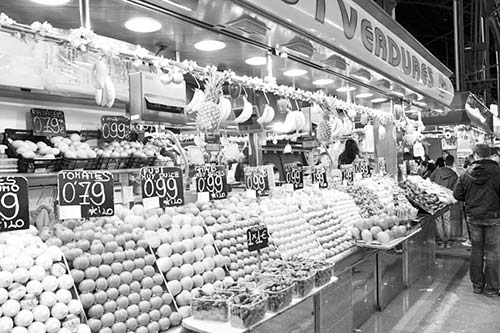
Ham: Full legs of jamón (ham) abound. The many varieties of jamón serrano are distinguished by the type of pig they come from and what that pig ate. Top quality are ibérico (Iberian) and bellota (acorn eaters). Even by the slice these are very expensive, but gourmets pay €300 or more to go whole hock (see the “Sampling Jamón” sidebar on here).
Sausage: You’ll see many types of the Catalan botifarra sausage. Some are ready to eat, while others must be cooked. Chorizo is the red Spanish sausage that’s sometimes spicy (a rare bit of heat in an otherwise mild cuisine). A few meats are less common in American dishes, like rabbit and suckling pig. Beware: Huevos de toro means “bull testicles”—surprisingly inexpensive...and oh so good.
Seafood: The fishmonger stalls could double as a marine biology lab. In this Mediterranean city, people have come up with endless ways to harvest the sea. Fish is sold whole, not filleted—local shoppers like to look their dinner in the eye to be sure it’s fresh. Count the many different types of shrimp (gamba, langostino, clawed cigala). Another popular treat is the tubular razor clam (navaja).
Cod: Some stalls specialize in dried salt cod (bacalao). Historically, codfish—preserved in salt and dried—provided desperately needed protein on long sea voyages as Catalan merchants ventured far from their homes. Before it can be eaten, salt cod must be rehydrated, so it’s sold either covered in salt or already submerged in water, to hasten the time between market and plate.
Olives: These are a keystone of the Spanish diet. Take a look at the 25 kinds offered at the Graus Olives i Conserves shop (center, at the back).
• After you’ve scoped out the market, head back to the street and continue down the Ramblas.
On your left, you’re skirting the old Barri Gòtic neighborhood. Glance left through a modern cutaway arch for a glimpse of the medieval church tower of Santa Maria del Pi. This marks the Plaça del Pi and a great shopping street, Carrer Petritxol, which runs parallel to the Ramblas. Also nearby is the Taverna Basca Iratí, one of many user-friendly, Basque-style tapas bars in town.
On the right side of the Ramblas (at #83), find the highly regarded Escribà bakery, with its appealing Modernista facade: Look for the Antigua Casa Figueras sign arching over the doorway, mosaics of twining plants, a stained-glass peacock displaying his tail feathers, and undulating woodwork. In the sidewalk in front of the door, a plaque dates the building to 1902. Step inside the fine interior and indulge in a cream-filled xuixo pastry before continuing your ramble.
• After another block, you reach the Liceu Metro station, marking the...
7 Heart of the Ramblas
At the Liceu Metro station’s elevators, the Ramblas widens a bit into a small, lively square (Plaça de la Boqueria). Liceu marks the midpoint of the Ramblas between Plaça de Catalunya and the waterfront.
Underfoot, find the much-trod-upon Joan Miró mosaic in red, white, yellow, and blue. The mosaic’s black arrow represents an anchor, a reminder of the city’s attachment to the ocean and a welcome to visitors arriving by sea. Miró’s simple, colorful designs are found all over the city, from murals to mobiles to the CaixaBank logo. The best place to see his work is in the Fundació Joan Miró at Montjuïc (described later, under “Sights in Barcelona”).
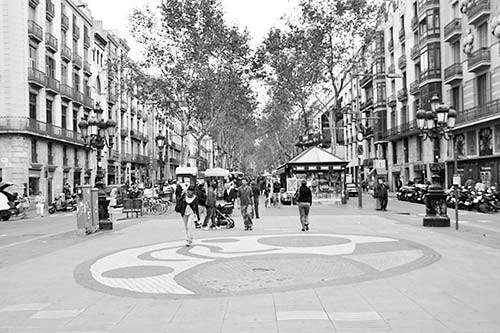
The surrounding buildings have playful ornamentation typical of the city. The Chinese dragon holding a lantern (at #82) decorates a former umbrella shop (notice the fun umbrellas perched high up). While the dragon may seem purely decorative, it’s actually an important symbol of Catalan pride for its connection to the local patron saint, St. George (Jordi).
A few steps down (on the right) is the Liceu Opera House (Gran Teatre del Liceu), which hosts world-class opera, dance, and theater (box office left of main entrance, open Mon-Fri 10:00-19:00, Sat until 18:00, closed Sun). Opposite the opera house is Café de l’Opera (#74), an elegant stop for an expensive beverage. This bustling café, with Modernista decor and a historic atmosphere, boasts that it’s been open since 1929, even during Spain’s civil war.
• We’ve seen the best stretch of the Ramblas; to cut this walk short, you could catch the Metro from here back to Plaça de Catalunya. Otherwise, let’s continue to the port.
Thirty yards along, pause and look left down a wide, straight street (Carrer de Ferran). Enjoy the view of elegant lamps, facades, and balconies as it leads to Plaça de Sant Jaume, the governmental center for both Barcelona and the region of Catalunya.
Head down the Ramblas another 50 yards (to #46) and turn left down an arcaded lane (Carrer de Colom) to the square called...
8 Plaça Reial
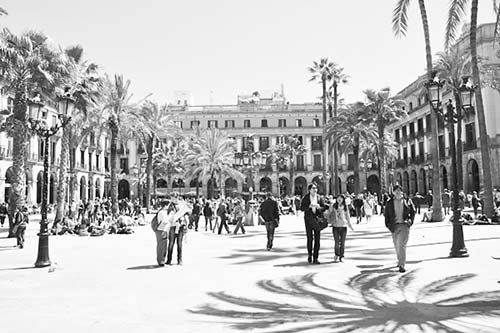
Dotted with palm trees, surrounded by an arcade, and ringed by yellow buildings with white Neoclassical trim, this elegant square has a colonial ambience. It’s a lively hangout by day or night. You’ll find old-fashioned taverns (cervecerías), modern bars with patio seating, and a Sunday coin-and-stamp market. Completing the picture are Gaudí’s first public works (the two colorful helmeted lampposts).
• Head back out to the Ramblas and cross to the other side.
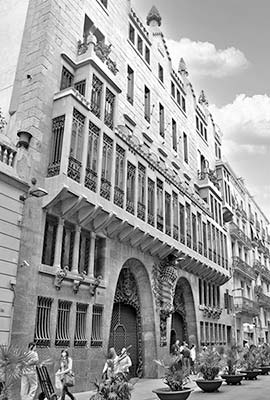
A half-block detour down Carrer Nou de la Rambla brings you to Palau Güell, designed by Antoni Gaudí (on the left, at #3). Even from the outside, you get a sense of this innovative apartment, the first of Gaudí’s Modernista buildings. As this is early Gaudí (built 1886-1890), it’s darker and more Neo-Gothic than his more famous later work. The two parabolic-arch doorways and elaborate wrought-iron work signal his emerging nonlinear style. Completely restored in 2011, Palau Güell offers an informative look at a Gaudí interior (see the listing on here).
• Return to the Ramblas and keep heading down the street.
9 El Raval Neighborhood
The neighborhood on the right side of this stretch of the Ramblas was nicknamed the Barri Xinès—the world’s only Chinatown with nothing even remotely Chinese in or near it. The name was a prejudiced term broadly applied to any foreigner—whether from abroad or from another part of Spain. The neighborhood’s actual inhabitants were poor people from different backgrounds—Spanish, North African, and Gypsy (Roma). At night, the Barri Xinès was frequented by sex workers, drug pushers, and thieves, many of whom catered in one way or another to sailors wandering up from the port. Today, the Raval neighborhood is rapidly gentrifying.
The skyscraper to the right of the Ramblas is the 28-story Edificio Colón, built in 1970 as Barcelona’s first high-rise. Nearby is the Maritime Museum, housed in what were the city’s giant medieval shipyards.
• Near the bottom of the Ramblas, take note of the Drassanes Metro stop, which can take you back to Plaça de Catalunya when you’re ready. Up ahead is the...
10 Columbus Monument
The 200-foot column honors Christopher Columbus, who came to Barcelona in 1493 after journeying to America. This Catalan answer to Nelson’s Column on London’s Trafalgar Square (right down to the lions, perfect for posing with at the base) was erected for the 1888 Universal Exposition, an international fair that helped vault a surging Barcelona onto the world stage.
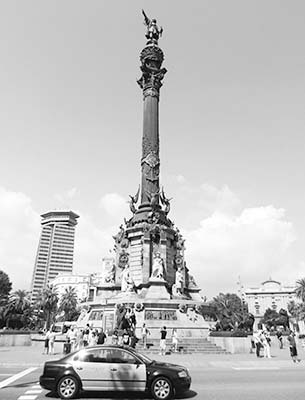
The base of the monument, ringed with four winged victories (taking flight to the four corners of the earth), is loaded with symbolism: statues and reliefs of mapmakers, navigators, early explorers preaching to Native Americans, and (enthroned just below the winged victories) the four regions of Spain. The reliefs near the bottom illustrate scenes from Columbus’ fateful voyage. A tiny elevator ascends to the top of the column to a covered observation area for fine panoramas over the city (the entrance/ticket desk is in the TI, inside the base of the monument; elevator—€8, daily 8:30-14:30, may stay open later when cruise ships are in town).
• Scoot across the busy traffic circle and continue straight ahead to the water’s edge. Turn left, walk 50 yards, and find a pedestrian bridge that juts out over the harbor (with a wavy design and a wooden floor). Walk onto the bridge, then turn back and face the Columbus statue. This is a good spot to check out the...
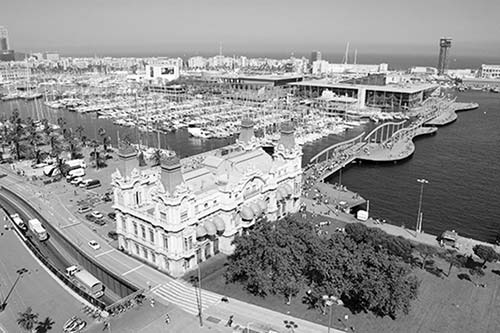
11 Waterfront
Survey Barcelona’s bustling maritime zone. For more than 2,000 years, this harbor’s trade has been the reason Barcelona is on the world map.
The wooden pedestrian bridge you’re standing on is a modern extension of the Ramblas, called La Rambla de Mar (“Rambla of the Sea”). The bridge can swing out to allow boat traffic into the marina.
As you face Columbus, take in the sights. At the foot of the Ramblas are the docks with the golondrinas harbor-cruise boats (for details, see listing under “Sights in Barcelona,” later). To the left of Columbus is the big Maritime Museum. Farther left, in the distance, is the majestic, 570-foot bluff of parklike Montjuïc, with sights and museums reachable by cable car (as you can see). To the right of the Columbus statue, the fanciful yellow Modernista-style building is the former port authority. Stretching to the right of that is a delightful promenade along the seawall of Barcelona’s Old Port (Port Vell); it’s worth a stroll. Along the promenade is a permanently moored historic schooner, the Santa Eulàlia (part of the Maritime Museum). Finally, over your right shoulder is Maremagnum, a modern shopping mall with a huge aquarium, restaurants, and piles of people. Its nighttime scene is rollicking and trendy.
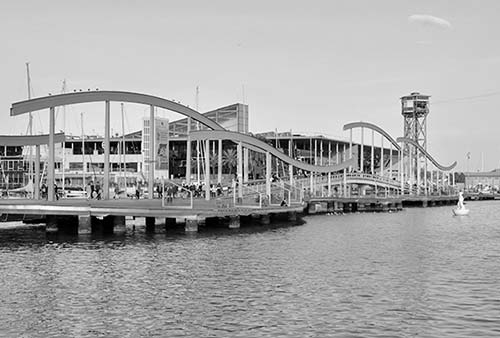
• Your ramble is over. To get to other points in town, your best bet is to backtrack to the Drassanes Metro stop. Alternatively, you can catch bus #59 from the waterfront on Avenue Passeig de Colom (or take a cab) back to Plaça de Catalunya (where my “Barri Gòtic Walk,” next, begins).
To extend this walk, it’s fun to stroll the length of the promenade to the iconic Barcelona Head sculpture (by American Pop artist Roy Lichtenstein). This puts you right at the edge of El Born’s shopping and restaurant area. Or, from the Barcelona Head, circle back through Maremagnum, making a nice pedestrian loop around the marina.
BARRI GÒTIC WALK
Barcelona’s Barri Gòtic (Gothic Quarter) is a bustling world of shops, bars, and nightlife packed into narrow, winding lanes and undiscovered courtyards. This is Barcelona’s birthplace—where the ancient Romans built a city, where medieval Christians built their cathedral, where Jews gathered together, and where Barcelonans lived within a ring of protective walls until the 1850s, when the city expanded.
Treat this 1.5-hour self-guided walk from Plaça de Catalunya to Plaça del Rei as a historical scavenger hunt. You’ll focus on the earliest chunk of Roman Barcelona right around the cathedral and explore some legacy sights from the city’s medieval era.
When to Go: If you plan to enter the museums mentioned on this walk, avoid Monday, when some sights are closed.
Eating: For restaurants and tapas bars along the way, see here.
Self-Guided Walk
• Start on Barcelona’s grand main square, Plaça de Catalunya. From the northeast corner (between the giant El Corte Inglés department store and the Banco de España), head down the broad pedestrian boulevard called...
1 Avinguda del Portal de l’Angel
For much of Barcelona’s history, this street was home to a major city gate. A medieval wall enclosed the city, and the entrance here—the “Gate of the Angel”—gave the street its name. An angel statue atop the gate purportedly kept Barcelonans safe from plagues and bid voyagers safe journey as they left the security of the city. Imagine the fascinating scene here at the Gate of the Angel, where Barcelona stopped and the Iberian wilds began.
Much later, this same boulevard (and much of the city) got a facelift in preparation for the 1888 Universal Exposition, the first international fair held in Spain.
Picture the traffic congestion here in the 1980s, before this street was closed to most motorized vehicles (if you visit in the morning, you’ll still dodge delivery trucks supplying stores). Today, you’re elbow-to-elbow with shoppers cruising through some of the most expensive retail space in town.
Although today this street has been globalized and sanitized, a handful of businesses with local roots survive. On the right at the first corner (at #25), a blue-and-gold sign and appetizing display window mark Planelles Donat—long appreciated for its sweet turró (or turrón, an almond-and-honey candy), ice cream, refreshing orxata (or horchata, an almond-flavored drink), and granissat (or granizado, ice slush). Imagine how historic shops like this started, with artisans from villages camping out here in a vestibule of some big building, selling baskets of their homemade goodies—and eventually evolving into real shops.
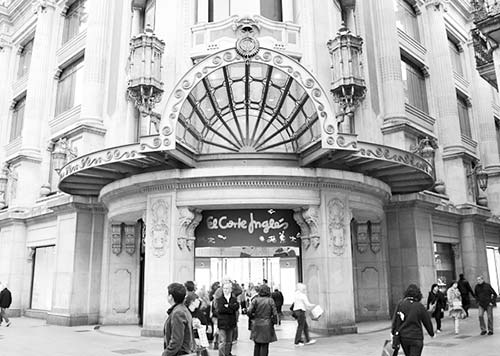
• A block farther down, pause at Carrer de Santa Anna to admire the Art Nouveau awning. From here, take a half-block detour to the right on Carrer de Santa Anna. At #32, go through a large entryway to the pleasant courtyard of the...
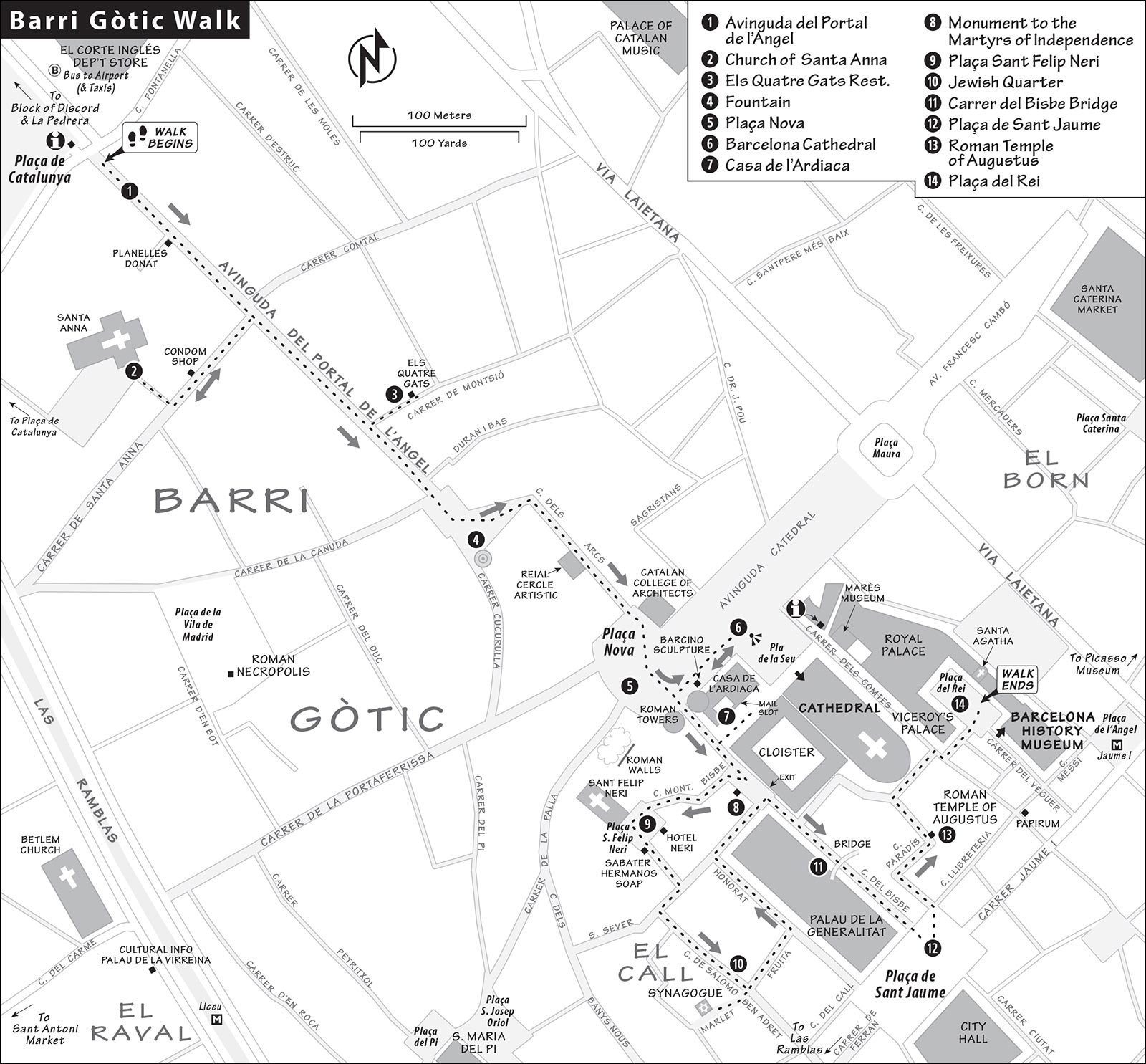
2 Church of Santa Anna
This austere Catalan Gothic church—a 12th-century gem—was part of a convent and still has its marker cross standing outside. To the left of the cross, approach the gate, where you can peek inside the fine cloister—an arcaded walkway around a leafy courtyard. Climb the modern stairs across from the church for views of the bell tower. Inside the church you’ll find a bare Romanesque interior, topped with an octagonal wooden roof. At the back of the nave, the recumbent-knight tomb is of Miguel de Boera, renowned admiral of Charles V (church entry free, usually Mon-Sat 10:00-12:00 & 16:00-18:00, Sun 10:00-14:00).
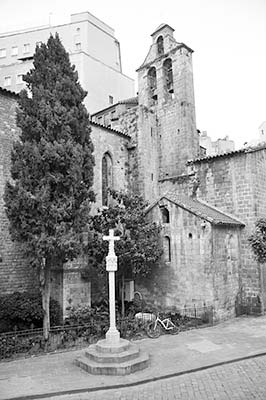
Take a moment here on Carrer de Santa Anna to notice little details. Look up at pulleys (handy in buildings with no elevators). See the ironwork buildings with fine old entrances and cheaper facades (with plasterwork fashioned into fake columns). Note how all the buildings maxed out their late-19th-century height limits. Here (and around town), you may see the estelada flag—red and gold with a blue triangle and white star—a symbol of Catalan separatists.
• Backtrack to Avinguda del Portal de l’Angel and continue down the street. At Carrer de Montsió (on the left), side-trip a half-block to...
3 Els Quatre Gats
This restaurant (at #3) is a historic monument, tourist attraction, nightspot, and recommended eatery (see listing on here). It’s famous for being the circa-1900 bohemian-artist hangout where Picasso nursed drinks with friends and had his first one-man show. The building itself, by prominent architect Josep Puig i Cadafalch, represents Neo-Gothic Modernisme. Take a look around the corner from the entrance—it looks more like a medieval church or a castle, with pointed arches, windows with stone tracery, and gargoyles peeking from the stonework.
Stepping inside, you feel the turn-of-the-century vibe. Even if you don’t eat or drink here, you can check out the vintage photos on the wall and take a quick look around (ask “Solo mirar, por favor?”). Rich Barcelona elites and would-be avant-garde artists looked to Paris (not Madrid) for cultural inspiration. This place was clearly influenced by Paris’ Le Chat Noir, a cabaret/café and the hangout of Montmartre intellectuals. Like Le Chat Noir, Els Quatre Gats even published its own artsy magazine for a while. The story of the name? When the proprietor told his friends that he’d stay open 24 hours a day, they said, “No one will come.” Using a popular Catalan phrase, they told him, “It’ll just be you and four cats.”
• Return to and continue down Avinguda del Portal de l’Angel. You’ll soon reach a fork in the road and a building with a...
4 Fountain
The blue-and-yellow tilework, a circa-1918 addition to this even older fountain, depicts ladies with big jugs of water. Picture the scene here back in the 17th century. No one had indoor plumbing, and the neighborhood women would gather to fill their big crocks and take them home. This fountain was especially important as the last watering stop for horses before leaving town.
• Shoppers will feel the pull of wonderful little shops down the street to the right. But be strong and take the left fork, down Carrer dels Arcs. Rounding the corner, you’ll pass the Reial Cercle Artístic, hosting exhibitions by Catalan artists (free, daily 10:00-14:00 & 15:00-20:00). Continue and enter the large square called...
5 Plaça Nova
As you enter the square, you can’t miss the prickly steeple of the Barcelona Cathedral (which we’ll visit shortly). But first, take in a few other sights.
Two bold Roman towers flank a street leading off the square. These once guarded the entrance gate of the ancient Roman city of Barcino. The big stones that make up the base of the (reconstructed) towers are actually Roman. Near the base of the left tower, modern bronze letters spell out “BARCINO.” The city’s name may have come from Barca, one of Hannibal’s generals, who is said to have passed through during Hannibal’s roundabout invasion of Italy. At Barcino’s peak, the Roman wall (see the section stretching to the left of the towers) was 25 feet high and a mile around, with 74 towers. It enclosed a population of 4,000.
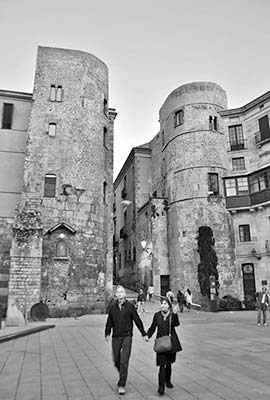
One of the towers has a bit of reconstructed Roman aqueduct (notice the streambed on top). In ancient times, bridges of stone carried fresh water from the distant hillsides into the walled city.
Opposite the towers is the modern Catalan College of Architects building (Collegi d’Arquitectes de Barcelona), which is, ironically for a city with so much great architecture, quite ugly. The frieze was designed by Picasso (1962) in his distinctive simplified style. With just a few squiggly stick-figures, Picasso captured traditional Catalan activities. If you check out all three sides of the building, you’ll see scenes suggesting music, bullfighting, sea trade, and the sardana dance. The branch-waving kings represent the giant puppets (gegants) paraded through the streets during local festivals (see sidebar, here). Picasso spent his formative years (1895-1904, age 14-23) here in the Old City. He drank with fellow bohemians at Els Quatre Gats and frequented brothels a few blocks from here on Carrer d’Avinyó (“Avignon”)—which inspired his influential Cubist painting Les Demoiselles d’Avignon.
In much of Spain, you’ll find four languages on ATM screens, and all are native to Spain: Spanish (of course), Euskara (used by the northern Basques), Galician (of the Celtic northwest), and Catalan. It suggests that regional differences are strong—and the thirst for local independence thrives.
The roots of the Catalan independence movement go back to—well, really, medieval times, when Catalunya was a self-ruling country. After their defeat in the War of Spanish Succession in 1714, the Catalans chafed under Castilian control. Then, in 1978, when post-Franco Spain adopted its modern constitution, Catalunya was granted special autonomy as a “nationality.” Catalans began energetically reviving their long-suppressed language and customs.
By the 21st century, the movement was growing. When the Spanish government tried to clarify that “nationality” didn’t really mean political autonomy so much as cultural heritage, it only stoked separatism. Spain’s 2008 banking crisis threw more gas on the fire, as hardworking Catalans resented bailing out the Madrid establishment. By 2010, Barcelona commonly witnessed demonstrations of a million people peacefully chanting, singing, and waving their red-and-yellow flags.
The case for independence is multifaceted. First, of course, is Catalunya’s unique heritage and language. Then there’s the economy: Catalans see their wealthy region as carrying the rest of the country on its back. Politically, Catalunya is generally more liberal than the rest of Spain. Catalans tend to view the national government as incompetent and out of touch with local needs (Catalunya’s more-progressive measures are frequently vetoed).
In 2014, Catalans held a referendum and voted to leave Spain…only to have the national government nullify the referendum as unconstitutional. In response, in 2015, Catalunya’s government voted to begin the secession process…but that too was declared unconstitutional.
Things came to a head in 2017. The Catalan people once again voted for independence, and their parliament declared Catalunya a sovereign nation. This time, though, Spain cracked down—hard. They sent thousands of police to break up demonstrations, spy on activists, and arrest ringleaders. The Catalan parliament was dissolved, and politicians who favored independence were charged with sedition and imprisoned. Catalan President Carles Puigdemont fled to Brussels to avoid arrest.
At first, Spain’s heavy-handed tactics brought an angry backlash, even from nonseparatists. But over time, the crackdown worked. Demonstrations slowly dwindled from the thousands to the hundreds. And, in a bid to ease tensions, the Spanish government eventually pardoned many jailed separatists (though others remained fugitives).
The independence roller coaster has left Catalans exhausted—and divided. While all Catalans support regional pride, they’re sharply split over exactly what that means. Some still favor outright secession, while others simply want more federal autonomy. Many fear that talk of secession scares off business, and others are loath to leave the security of the Spanish fold. The Catalan press has one perspective, while the Madrid media has another. The unfortunate thing about the independence votes so far is that they’re all or nothing, while many Catalans are somewhere in the middle.
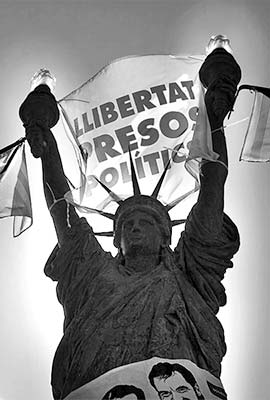
The sad result is that in everyday political discourse, name-calling has become common: Are you a “fascist” (Spanish nationalist) or a “politically correct” secessionist, a “collaborator” or a “seditionist”? Catalans have become less likely to talk openly, turning to less-divisive topics (not unlike the political dynamic in the US today). A Catalan friend told me that the real victim is the Catalan people. He misses the good old days when, on the feast of St. Jordi, the roses given in his honor were all red—not (as now) yellow, the color of protest.
Only time will tell what the future holds for Catalunya. Though the independence movement is dormant for now, it’s far from dead. And Catalan pride remains as strong as ever.
• Immediately to the left as you face the Picasso frieze, Carrer de la Palla is another inviting shopping street (described under “Shopping in Barcelona,” later). But let’s head left through Plaça Nova to take in the mighty...
6 Barcelona Cathedral
The facade is a virtual catalog of Gothic motifs. There’s the pointed arch over the entrance and the stained-glass windows with elaborate stone tracery. Statues of robed saints stand in niches, and winged angels teeter on the octagonal bell towers. And the whole thing is topped with three tall steeples. These pointy spires are meant to give the impression of a church flickering with spiritual fires. This was the Gothic style called Flamboyant—meaning “flame-like.”
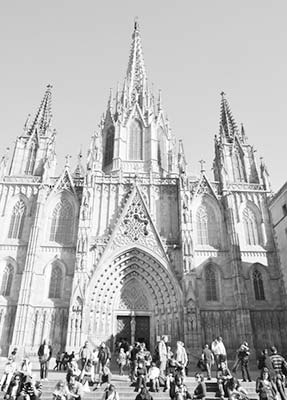
This has been Barcelona’s holiest spot for 2,000 years. The Romans built their temple of Jupiter right here. In AD 343, that pagan temple was replaced by a Christian cathedral. Around the year 1000, that building was replaced again, this time by a Romanesque-style church. The current Gothic structure was started around 1300, during the medieval glory days of the Catalan nation, and finished in 1450. But the much newer facade, dating from the 1800s, is in the Neo-Gothic style of Modernisme. That part of the construction was capped in 1913 with the central spire, 230 feet tall. So, in a way, the cathedral is evidence of Barcelona’s two “golden ages”—its seaport heyday in the 1300s and its 19th-century revival.
The square in front of the cathedral, Pla de la Seu, is flanked on the left by a building housing a small TI and the Diocesan Museum of Barcelona. This area is where Barcelonans dance the patriotic dance called the sardana on weekends. If there’s no dancing, you may see a street musician. The city strictly regulates buskers and gives permits only to quality performers at designated points like this one.
The cathedral’s interior—with its vast space, peaceful cloister, and many ornate chapels—is worth a visit (see listing under “Sights in Barcelona,” later). If you interrupt this tour to visit the cathedral now, you’ll exit the cloister a block down Carrer del Bisbe. From there you can circle back to the right, following the wall of the cathedral to visit stop #7—or skip #7 and step directly into stop #8.
As you stand in the square facing the cathedral, look far to your left to see the multicolored, wavy canopy marking the roofline of the Santa Caterina Market. The busy street between here and the market—called Via Laietana—is the boundary between the Barri Gòtic and the funkier, edgier El Born neighborhood.
• For now, return to the Roman towers and pass between them to head up Carrer del Bisbe. Take an immediate left, up the ramp to the entrance of...
Anyone who’s experienced a festival in Barcelona can’t have missed the dancing costumed giants bobbing and swinging to the music. These gegants (gigantes in Castilian) first appeared in Corpus Christi celebrations back in the 14th century and were modeled on biblical themes. Over time the puppets lost their strictly religious identities and came to also represent royalty, local luminaries, and historical figures, as well as simple, everyday people.
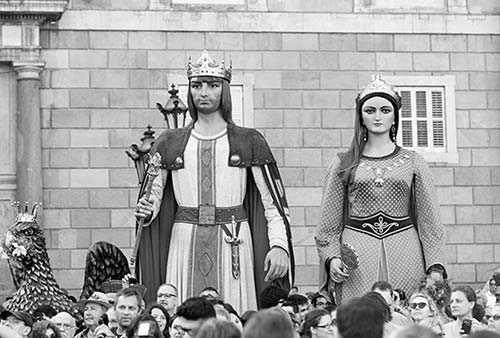
Gegants rise to a height of 10 to 12 feet, and sometimes even taller. Their heads and arms are made of papier-mâché and are attached to a framework of wood or aluminum that’s covered by the character’s costume. The whole rig is then carried by a puppeteer who, hidden inside, is linked to the framework with a harness. As the puppeteer dances and spins, the puppet’s arms swing freely through the air.
Often seen along with the gegants are the comical capgrossos (“big heads”)—costumed characters with oversized papier-mâché heads.
7 Casa de l’Ardiaca
It’s free to enter this mansion that was once the archdeacon’s residence and now functions as the city archives (closed Sun). The elaborately carved doorway is Renaissance. To the right of the doorway is a carved mail slot by 19th-century Modernista architect Lluís Domènech i Montaner. Enter a small courtyard with a fountain. Notice how the century-old palm tree seems to be held captive by urban man. Next, step inside the air-conditioned lobby of the city archives, where—along the back of the ancient Roman wall—there are often free exhibits. At the left end of the lobby, go through the archway and look down into the stairwell for a peek at more impressive Roman stonework. Back in the courtyard, climb to the balcony for views of the cathedral steeple and gargoyles. From this vantage point, note the small Romanesque chapel on the right (the only surviving 13th-century bit of the cathedral) and how it’s dwarfed by the towering cathedral.
• Return to Carrer del Bisbe and turn left. After a few steps, you reach a small square with a bronze statue ensemble.
8 Monument to the Martyrs of Independence
Five Barcelona patriots—including two priests—calmly receive their last rites before being garroted (strangled) for resisting Napoleon’s occupation of Spain in the early 19th century. They’d been outraged by French atrocities in Madrid (depicted in Goya’s famous Third of May painting in Madrid’s Prado Museum). According to the plaque marking their mortal remains, these martyrs to independence gave their lives in 1809 “por Dios, por la Patria, y por el Rey”—for God, country, and king.
• Exit the square down tiny Carrer de Montjuïc del Bisbe (to the right as you face the martyrs). This leads to the cute...
9 Plaça Sant Felip Neri
This shaded square serves as the playground of an elementary school and is often bursting with energetic kids speaking Catalan (just a couple of generations ago, this would have been illegal and they would be speaking Spanish). It’s a fun scene to enjoy at a respectful distance (no photos of the children, please).
The Church of Sant Felip Neri, which Gaudí attended, is still pocked with bomb damage from the Spanish Civil War. As a stronghold of democratic, anti-Franco forces, Barcelona saw a lot of fighting. The shrapnel that damaged this church was meant for the nearby Catalan government building (Palau de la Generalitat, which we’ll see later on this walk).
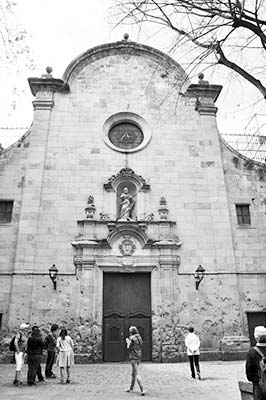
Just as the Germans practiced their new air force technology in Guernica in the years leading up to World War II, the fascist friends of Franco (both German and Italian) also helped bomb Barcelona from the air. As was the fascist tactic, a second bombing followed the first as survivors combed the rubble for lost loved ones. A plaque on the wall (left of church door) honors the 42 killed—mostly children—in that 1938 aerial bombardment.
The buildings here were paid for by the guilds that powered the local economy. The shoemakers guild (to the right of the arch where you entered the square) is decorated above the windows with reliefs depicting boots.
• Grab a beverage and stay awhile (the posh Hotel Neri serves drinks overlooking the square). Or exit the square past the fun Sabater Hermanos artisanal soap shop and head down Carrer de Sant Felip Neri. At the T-intersection, turn right onto Carrer de Sant Sever, then immediately left on Carrer de Salomó Ben Adret. You’ve entered the...
10 Jewish Quarter (El Call)
In Catalan, a Jewish quarter goes by the name El Call—literally “narrow passage,” for the tight lanes where medieval Jews were forced to live under the watchful eye of the nearby cathedral. (Some believe El Call comes from the Hebrew kahal, which means congregation.) At the peak of Barcelona’s El Call, some 4,000 Jews were crammed into just a few alleys in this neighborhood.
Walk down Carrer de Salomó Ben Adret and pass through the charming little square (a gap in the dense tangle of medieval buildings cleared by another civil war bomb), where you will find a few cafés. Take the next lane to the right (Carrer de Marlet). On the right is the (literally) low-profile, four-foot-high entrance to what in the Middle Ages was likely Barcelona’s main synagogue (L’Antiga Sinagoga Mayor; €4 to enter Mon-Fri 10:30-14:30 & 15:00-18:30 and Sun 10:30-15:00; free to enter Sun 16:00-19:00; closed Fri afternoons and Sat, shorter hours off-season).
The structure dates from the third century, but it was destroyed during a brutal pogrom in 1391. The city’s remaining Jews were expelled in 1492, and artifacts of their culture—including this synagogue—were forgotten for centuries. In the 1980s, a historian tracked down the synagogue using old tax-collection records. Another clue that this was the main synagogue: In accordance with Jewish traditions, it stubbornly faces east (toward Jerusalem), putting it at an angle at odds with surrounding structures. The sparse interior includes access to two small subterranean rooms with Roman walls topped by a medieval Catalan vault. Look through the glass floor to see dyeing vats used for a shop that later occupied this site.
• From the synagogue, start back the way you came but then continue straight ahead, onto Carrer de la Fruita. At the T-intersection, turn left, then right, to find your way back to the Martyrs statue. From here, we’ll turn right down Carrer del Bisbe to the...
11 Carrer del Bisbe Bridge
This has been a main street since the days of ancient Barcino. The Romans built straight streets on a rectangular grid plan, and this one led to their town center. Arching across Carrer del Bisbe is a medieval-looking skybridge. This structure—reminiscent of Venice’s Bridge of Sighs—connects the Catalan government building (on the right) with what was the Catalan president’s ceremonial residence (on the left). Though the bridge appears to be centuries old, it was constructed in the 1920s by Catalan architect Joan Rubió (a follower of Gaudí), who also did the carved ornamentation on the buildings.
• Continue along Carrer del Bisbe to...
12 Plaça de Sant Jaume
This stately central square of the Barri Gòtic takes its name from the Church of St. James (in Catalan: Jaume, JOW-mah) that once stood here. After the church was torn down in 1823, the square was fixed up and rechristened “Plaça de la Constitució” in honor of the then-decade-old Spanish constitution. But the plucky Catalans never embraced the name, and after Franco, they went back to the original—even though the church is long gone.
Set at the intersection of ancient Barcino’s main thoroughfares, this square was once a Roman forum. In that sense, it’s been the seat of city government for 2,000 years.
For more than six centuries, the Palau de la Generalitat (on the uphill side of the square) has housed the offices of the autonomous government of Catalunya. It always flies the Catalan flag next to the obligatory Spanish one. Above the building’s doorway is Catalunya’s patron saint—St. George (Jordi), slaying the dragon. The dragon (which you’ll see all over town) is an important Catalan symbol. From these balconies, the nation’s leaders (and soccer heroes) greet the people on momentous days.
Facing the Generalitat across the square is the Barcelona City Hall (Casa de la Ciutat). It sports a statue (in the niche to the left of the door) of a different James—“Jaume el Conqueridor.” The 13th-century King Jaume I is credited with freeing Barcelona from French control, granting self-government, and setting it on course to become a major city. He was the driving force behind construction of the Royal Palace (which we’ll see shortly).
Look left and right down the main streets branching off the square; they’re lined with ironwork streetlamps and balconies draped with plants. Carrer de Ferran, which leads to the Ramblas, is classic Barcelona.
In ancient Roman days, when Plaça de Sant Jaume was the town’s central square, two main streets converged here—the Decumanus (Carrer del Bisbe—bishop’s street) and the Cardus (Carrer de la Llibreteria/Carrer del Call). The forum’s biggest building was a massive temple of Augustus, which we’ll see next.
• Facing the Generalitat, exit the square going up the second street to the right of the building, on tiny Carrer del Paradís. Follow this street as it turns right. When it swings left, pause at #10, the entrance to the...
13 Roman Temple of Augustus (Temple Roma d’August)
You’re standing at the summit of Mont Tàber, the Barri Gòtic’s highest spot. A plaque on the wall by the entrance reads: “Mont Tàber, 16.9 meters” (elevation 55 feet). At your feet, a millstone inlaid in the pavement also marks a momentous spot. It was here that the ancient Romans founded the town of Barcino around 12 BC. They built a castrum (fort) on the hilltop, protecting the harbor, and this temple to honor their emperor, Augustus.
Go inside for a peek at the last vestiges of the imposing Roman temple (free, Tue-Sat 10:00-19:00, Sun until 20:00, Mon until 14:00). All that’s left are four columns and some fragments of the transept and its plinth (good English info on-site). The huge columns, dating from the late first century BC, are as old as Barcelona itself. They were part of the ancient town’s biggest structure, dedicated to Augustus, who was worshipped as a god. These Corinthian columns (with deep fluting and topped with leafy capitals) were the back corner of a 120-foot-long temple that extended from here to Barcino’s forum...Plaça de Sant Jaume (where you just were).
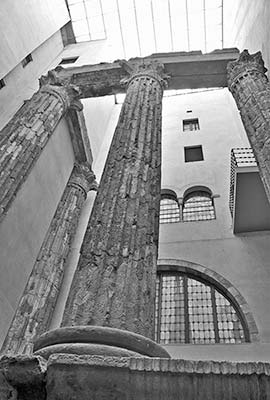
• Continue down Carrer del Paradís one block. When you bump into the back end of the cathedral, pause to notice how amazingly well preserved the cityscape is here, under an assembly of gargoyles.
Take a right, going down Carrer de la Pietat/Baixada de Santa Clara. (Is that a unicorn gargoyle on the side of the church? A unigoyle?) Go 100 yards until you emerge into a square called...
14 Plaça del Rei
This square is a great place to end our walk, as it calls up Barcelona’s medieval golden age. The buildings enclosing the square recall the city’s medieval past. Face the central section (topped by a five-story addition), which was the core of the Royal Palace (Palau Reial Major). A vast hall on its ground floor once served as the throne room and reception room. From the 13th to the 15th century, the Royal Palace housed Barcelona’s counts as well as the resident kings of Aragon. One of those kings of Aragon, Ferdinand, married Isabel, queen of Castile, creating the united country of Spain. In 1493, here in this Royal Palace, they hosted a triumphant Christopher Columbus, accompanied by six New World natives (whom he called “indios”) and several pure-gold statues. King Ferdinand and Queen Isabel welcomed him home and honored him with the title “Admiral of the Oceans.”
To the right and up the stairs is the palace’s church, the 14th-century Chapel of Santa Agatha, where royalty worshipped. The venerable church sits atop the foundations of a Roman wall (entrance included in Barcelona History Museum admission; see here).
To the left is the Viceroy’s Palace (Palau del Lloctinent). It was built in the 1500s for the right-hand man of the Spanish monarch, who was now located in far-off Castile. So, in a way, this building represents the rise of Spain and the decline of Aragon, Catalunya, and the city of Barcelona. Catalunya was swallowed up into greater Spain, the Royal Palace was demoted to a small regional residence, and Barcelona declined.
Step into the interior courtyard, a delightful Renaissance space with a fine staircase, a coffered wood ceiling, and an imposing bronze door sculpted by Josep Maria Subirachs (who is also responsible for the Passion Facade at the Sagrada Família). Over the years, this building served as the local headquarters of the Spanish Inquisition. It currently houses the historical archives of the crown of Aragon. Among their treasures is the so-called Santa Fe Capitulations—the 1492 contract between Columbus and the Catholic Monarchs that set the terms for his upcoming sea voyage. (The document is rarely on display, but there’s often a poster of it on the courtyard wall.)
• Our walk is over. While you’re here, you could check out the Plaça del Rei branch of the Barcelona History Museum, starring some excavated Roman ruins. (For a peek at the Roman streets without going in, look through the low windows lining the square.)
It’s easy to get your bearings by backtracking to either Plaça de Sant Jaume or the cathedral. The Jaume I Metro stop is two blocks away (leave the square on Carrer del Veguer and turn left). From here, you could head over to the Santa Caterina Market or simply wander through more of this area, enjoying Barcelona at its Gothic best.
Sights in Barcelona
▲Maritime Museum (Museu Marítim)
▲Barcelona Cathedral (Catedral de Barcelona)
▲Frederic Marès Museum (Museu Frederic Marès)
▲Barcelona History Museum—Plaça del Rei (Museu d’Història de Barcelona)
▲▲▲Picasso Museum (Museu Picasso)
▲▲Palace of Catalan Music (Palau de la Música Catalana)
▲Santa Caterina Market (Mercat de Santa Caterina)
▲Church of Santa Maria del Mar (Basílica de Santa Maria del Mar)
▲Sant Antoni Market (Mercat de Sant Antoni)
▲▲▲Sagrada Família (Holy Family Church)
Castle of Montjuïc (Castell de Montjuïc)
Olympic Stadium (Estadi Olímpic)
▲▲Catalan Art Museum (Museu Nacional d’Art de Catalunya)
1929 WORLD EXPO FAIRGROUNDS AND NEARBY
▲Magic Fountains (Font Màgica)
Citadel Park (Parc de la Ciutadella)
For the most popular sights (the Picasso Museum and the big Modernista sights—Sagrada Família, Park Güell, Casa Batlló, and La Pedrera), book tickets online well in advance. For general tips, see the “Sightseeing” section in the Practicalities chapter.
Many of the following sights are also covered in my free Barcelona City Walk and Eixample Walk audio tours.
NEAR THE RAMBLAS
The Ramblas, Barcelona’s most famous boulevard, flows from Plaça de Catalunya, past the core of the Barri Gòtic, to the harborfront Columbus Monument. Several sights located along this main boulevard are covered in my “Ramblas Ramble” self-guided walk, including the booming La Boqueria Market (worth ▲ and described on here) and the Columbus Monument (here). The following sights are located just off the Ramblas.
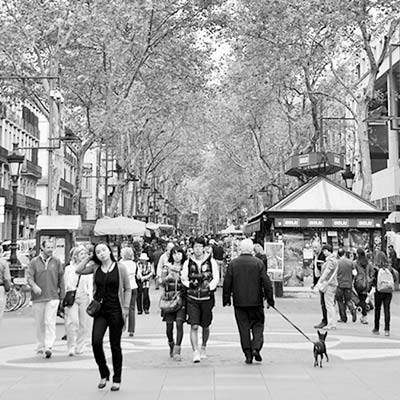
▲Palau Güell
Just as the Picasso Museum reveals a young genius on the verge of a breakthrough, this early building by Antoni Gaudí (completed in 1890) shows the architect taking his first tentative steps toward what would become his trademark curvy style. Dark and masculine, with castle-like rooms, Palau Güell (pronounced “gway”) was custom-built to house the wealthy Güell family and gives an insight into Gaudí’s artistic genius. The rooftop has his signature colorful tile mosaic chimneys and offers a panorama of the city. While some people will find this redundant if also visiting La Pedrera, others will appreciate this exquisite building for its delightfully loopy rooftop and far fewer crowds.
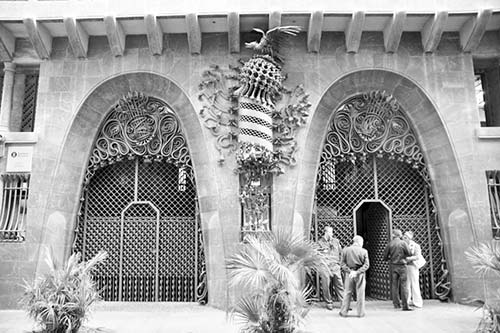
Cost and Hours: €12 ticket includes good audioguide; open Tue-Sun 10:00-20:00, Oct-March until 17:30, closed Mon year-round; last entry one hour before closing, rooftop closes when raining; guided tour in English Sat at 10:30; a half-block off the Ramblas at Carrer Nou de la Rambla 3, Metro: Liceu or Drassanes, +34 934 725 775, www.palauguell.cat [URL inactive].
▲Maritime Museum (Museu Marítim)
Barcelona’s medieval shipyard, the best preserved in the entire Mediterranean, is home to an excellent museum near the bottom of the Ramblas. The museum’s permanent collection covers the salty history of ships and navigation from the 13th to the 20th century. Even if you choose not to pay for a full visit, the building is worth a look; interesting free exhibits are in the lobby (inside the main entrance facing the water), where you can get a glimpse of the building’s interior.
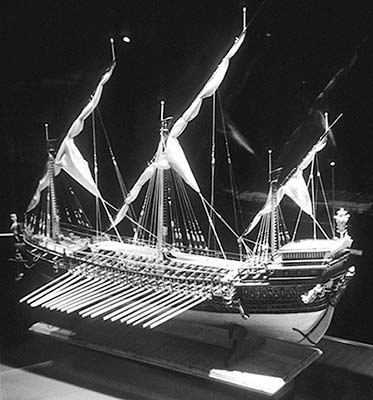
Cost and Hours: €10, free Sun from 15:00, ticket includes visit to Santa Eulàlia boat; open daily 10:00-20:00, last entry one hour before closing; nice café with seating inside or out on the museum courtyard (free to enter), Avinguda de les Drassanes, Metro: Drassanes, +34 933 429 920, www.mmb.cat.
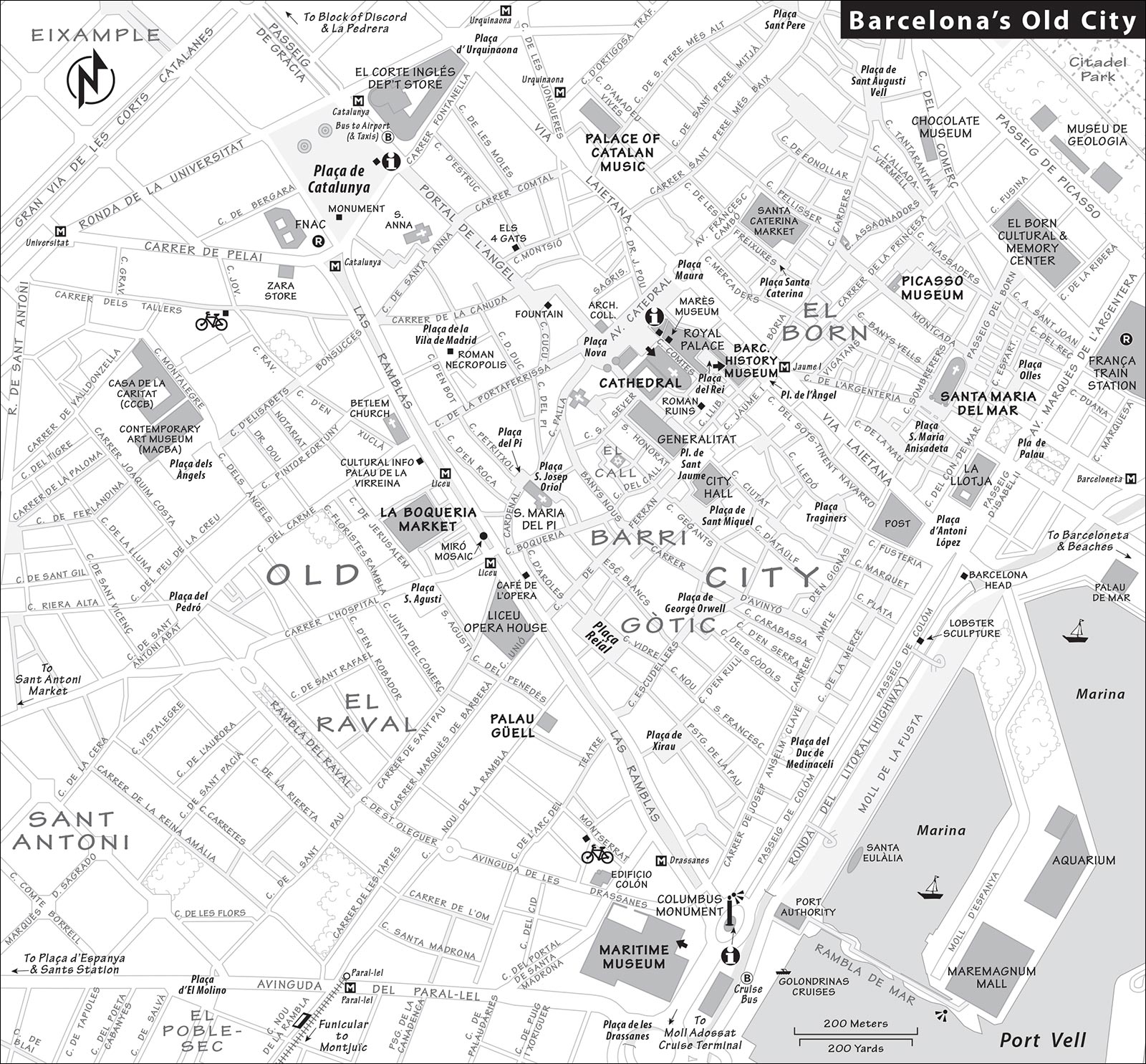
Visiting the Museum: Scan the QR code at the ticket desk to access the audioguide. The building’s cavernous halls evoke the 14th-century days when Catalunya was a naval and shipbuilding power, cranking out 30 huge galleys each winter. As in the US today, military and commercial ventures mingled as Catalunya built its trading empire.
Start your visit by going up the ramp to the right and into a screening room, where a film tells the history of shipyards and galleys. In the next room is a model of the shipyard buildings (drassanes), which today have been converted into the Maritime Museum. Head into the next room and, on the far right, find a model of 15th-century Barcelona’s waterfront. Notice the shipyard all the way to the left, the old medieval walls surrounding the city, and the Church of Santa Maria del Mar to the right.
Then head to the highlight: the impressively huge and richly decorated replica of the royal galley of Juan de Austria, which fought in the 1571 Battle of Lepanto. To get a seagull’s-eye view, go up the stairs to a raised platform at the bow and midship. Displays describe its history and daily life on a galley. At the stern of the boat, a screening room shows a five-minute first-person dramatized video about galley life.
Nearby: Your museum ticket includes entrance to the Santa Eulàlia, an early-20th-century schooner docked a short walk from the Columbus Monument (otherwise €3; Tue-Fri and Sun 10:00-20:00, Sat 14:00-20:00, shorter hours Nov-March, closed Mon year-round). On Saturday mornings, you can sail around the harbor on the schooner for three hours (Sat 10:00-13:00, €15 for adults, €9 for kids 7-14, sign up online well in advance, www.mmb.cat).
Golondrinas Cruises
At the harbor near the Columbus Monument, tourist boats called golondrinas offer two unguided trips, giving you a view of Barcelona’s (unimpressive) skyline from the water. The shorter version goes around the harbor in 40 minutes (€8, departures Sat-Sun 11:15-16:15). The hour-long cruise goes beyond the harbor (€10, departures daily 11:30-18:00, Sat-Sun also at 18:00, more in summer, fewer in winter, +34 934 423 106, www.lasgolondrinas.com).
BARRI GÒTIC
For more details on this area and several of the following sights, see the Barri Gòtic Walk, earlier.
▲Barcelona Cathedral (Catedral de Barcelona)
The city’s 14th-century, Gothic-style cathedral (with a Neo-Gothic facade) has played a significant role in Barcelona’s history—but as far as grand cathedrals go, this one is relatively unexciting. Still, it’s worth a visit to see its richly decorated chapels, finely carved choir, tomb of Santa Eulàlia, and restful cloister with gurgling fountains and resident geese. Minor sights within include a rooftop terrace and an altarpiece museum.
Cost and Hours: €11 includes cathedral, choir, view terrace, museum, and cloister. Cathedral open Mon-Fri 9:30-18:30, Sat until 17:15, Sun 14:00-17:00; last entry 45 minutes before closing, access may be limited during services; +34 933 428 262, www.catedralbcn.org.
Dress Code: The dress code is strictly enforced; don’t wear tank tops, shorts, or skirts above the knee.
Tours: Download my free Barcelona City Walk audio tour, which includes a tour of the cathedral interior. Or scan the QR code at the entrance for a downloadable audioguide.
Visiting the Cathedral: This has been Barcelona’s holiest spot for 2,000 years. The Romans built their Temple of Jupiter here. In AD 343, the pagan temple was replaced with a Christian cathedral. That building was supplanted by a Romanesque-style church (11th century). The current Gothic structure was started in 1298 and finished in 1450, during the medieval glory days of the Catalan nation. The facade was humble, so in the 19th century the proud local bourgeoisie (enjoying a second golden age) redid it in a more ornate, Neo-Gothic style. Construction was capped in 1913 with the central spire, 230 feet tall.
The nave is ringed with 28 chapels. Besides creating worship spaces, the walls defining these chapels serve as interior buttresses supporting the roof (which is why the exterior walls are smooth, without the normal Gothic buttresses outside). Barcelona honors many of the homegrown saints found in these chapels with public holidays.
In the middle of the nave, the 15th-century choir (coro) features ornately carved stalls. During the standing parts of the Mass, the chairs were folded up, but VIPs still had those little wooden ledges to lean on. Each was creatively carved, and—since you couldn’t sit on sacred things—the artists were free to enjoy some secular and naughty fun here.
Look behind the high altar (beneath the crucifix) to find the bishop’s chair (cathedra). As a cathedral, this church is the bishop’s seat—hence its Catalan nickname of La Seu. To the left of the altar is the organ and the elevator up to the terrace (included in your ticket). To the right of the altar, the wall is decorated with Catalunya’s yellow-and-red coat of arms.
Steps beneath the altar lead to the crypt, featuring the marble and alabaster sarcophagus (1327-1339) containing the remains of Santa Eulàlia. The cathedral is dedicated to this saint. Thirteen-year-old Eulàlia, daughter of a prominent Barcelona family, was martyred by the Romans for her faith in AD 304. Legends say she was subjected to 13 tortures, then crucified on an X-shaped cross—a symbol you’ll find carved into pews and seen throughout the church. As one of Barcelona’s two patron saints, Eulàlia is honored with an annual festival (with gegants, fireworks, and human towers) in February.
The elevator in the left transept takes you up to the rooftop terrace for an expansive city view. Otherwise, exit through the right transept to enter the cloister. Its arcaded walkway surrounds a lush circa-1450 courtyard. Ahhhh. It’s a tropical atmosphere of palm, orange, and magnolia trees; a fish pond; trickling fountains; and squawking geese.
As you wander the cloister (clockwise), check out the coats of arms as well as the tombs in the pavement. These were for rich merchants who paid good money to be buried as close to the altar as possible. A few pavement stones here and there have the symbols of their trades: scissors, shoes, bakers, and so on. The resident geese have been here for at least 500 years. There are always 13, in memory of Eulàlia’s 13 years and 13 torments.
The little museum at the far end of the cloister has the six-foot-tall 14th-century Great Monstrance, a ceremonial display case for the communion wafer that’s paraded through the streets during the Corpus Christi festival.
▲Sardana Dances
If you’re in town on a weekend, you can see the sardana, a traditional dance in which Barcelonans link hands and dance in a circle in an expression of their Catalan identity (Sun at 11:15, many Sat at 18:00, no dances in Aug, event lasts one hour, in Pla de la Seu square in front of the cathedral; for details, see sidebar).
▲Frederic Marès Museum (Museu Frederic Marès)
This delightful and often overlooked museum, adjacent to the cathedral, features the eclectic collection of Frederic Marès (1893-1991), a local sculptor and packrat. The museum sprawls through several old Barri Gòtic buildings around a peaceful courtyard. It offers a fascinating look at ancient Roman statues from this region and is an exquisite warehouse of Romanesque and Gothic Christian art from Catalunya.
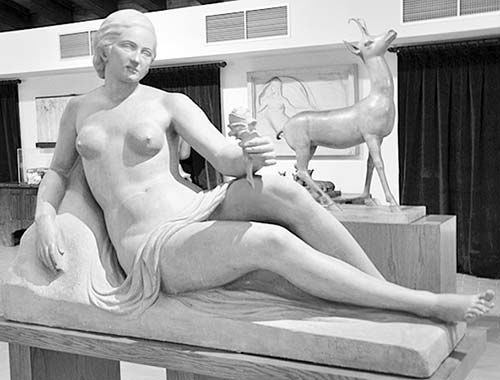
Cost and Hours: €4.20, free first Sun of the month and all other Sun from 15:00; open Tue-Sat 10:00-19:00, Sun until 20:00, closed Mon; audioguide-€1, Plaça de Sant Iu 5, Metro: Jaume I, +34 932 563 500, www.museumares.bcn.cat.
From circle dancing to human towers, Catalans are proud of their distinctive cultural traditions.
For many, the slow-motion sardana dance is a patriotic display of Catalan unity, while for others, it’s a fun chance to kick up their heels. To dance the sardana, participants form a circle, often on a public square. Holding hands with their arms raised, they gracefully step and hop to the music. The band consists of a long flute, oboes, strange-looking brass instruments, and a bongo-like drum.
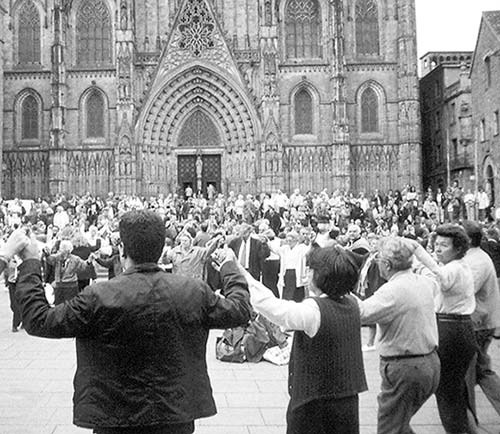
All are welcome to join in, even tourists cursed with two left feet. Dances are held in the square in front of the cathedral on Sundays at 11:15 and many Saturdays at 18:00, except in August. (Put your day bag in the center of your circle, as other participants do, to guard against theft.)
Another Catalan tradition is the castell, a tower erected solely of people. Towers can be up to 10 humans high. The burliest form the base, supporting the manilles (“handles”), who help haul others to the top, including the smallest of all, who becomes the steeple. Spotters cluster around the base in case anyone falls. Castelleres are judged on how quickly they build their towers and how fast they dismantle them. Castells pop up at festivals (such as Festa Major de Gràcia in mid-August and La Mercè in late September) and usually in the cathedral square on spring and summer Saturdays at 19:30.
Both traditions—the sardana and castells—require group participation, which is fitting for Catalunya, known for its community spirit. Keeping its traditions and language alive, Catalans proudly say, “Visca Catalunya!” (Long live Catalunya!)
▲Barcelona History Museum—Plaça del Rei (Museu d’Història de Barcelona)
At the Plaça del Rei branch of the city history museum (MUHBA for short), you’ll see objects gathered from archaeological digs around Barcelona. But the real highlight is an underground labyrinth of excavated Roman ruins. Though the museum is housed in part of the former Royal Palace complex, you’ll see only a bit of that grand space. Instead, the focus is on the exhibits on the basement level. You’ll find English explanations and a handful of video screens showing what this site must have once looked like in ancient times.
Cost and Hours: €7; includes other MUHBA branches; free first Sun of month and all other Sun from 15:00; open Tue-Sat 10:00-19:00, Sun until 20:00, closed Mon; Plaça del Rei, enter on Carrer del Veguer, Metro: Jaume I, +34 932 562 122, www.barcelona.cat/museuhistoria/en [URL inactive].
Visiting the Museum: Start with the 10-minute introductory video in the theater (at the end of the ground floor). Then take an elevator down 65 feet (and 2,000 years—see the date spin back as you descend) to the basement to stroll the now-underground streets of Roman Barcino—founded by Emperor Augustus around 10 BC.
The history is so strong here, you can smell it as you stroll across walkways over the excavated ruins of Roman Barcelona. This was a working-class part of town. The route leads through areas used for laundering clothes and dyeing garments, the remains of a factory that salted fish and produced garum (a fish-derived sauce used extensively in ancient Roman cooking), and facilities for winemaking. Next, wander through bits of a seventh-century early-Christian church and an 11th-century bishop’s palace that show Barcelona through its glory days in the Middle Ages. The final section downstairs takes you through Visigothic remains, including the octagonal font where Christians were baptized.
Finally, head upstairs to see a model of the city from the early 16th century. From here, you can enter Tinell Hall (part of the Royal Palace), with its long, graceful, rounded vaults and displays on local medieval history in a Mediterranean context. The nearby 14th-century Chapel of St. Agatha sometimes has free temporary exhibits.
With a little extra time, circle back to the innovative “Barcelona Flashback” exhibit one floor above the ticket desk. It’s a refreshing display of objects, stories, and connections from the 20th century where participants are invited to interpret Barcelona’s heritage on their own. Along the way, you’ll find several unexpected terraces overlooking the Gothic Quarter.
EL BORN
El Born is home to the Picasso Museum, with narrow lanes sprouting from the neighborhood’s main artery, Passeig del Born.
▲▲▲Picasso Museum (Museu Picasso)
Pablo Picasso may have made his career in Paris, but the years he spent in Barcelona—from age 14 through 23—were among the most formative of his life. It was here that young Pablo mastered the realistic painting style of his artistic forebears—and it was also here that he first felt the freedom that allowed him to leave that all behind and give in to his creative, experimental urges. When he left Barcelona, Picasso headed for Paris...and revolutionized art forever.
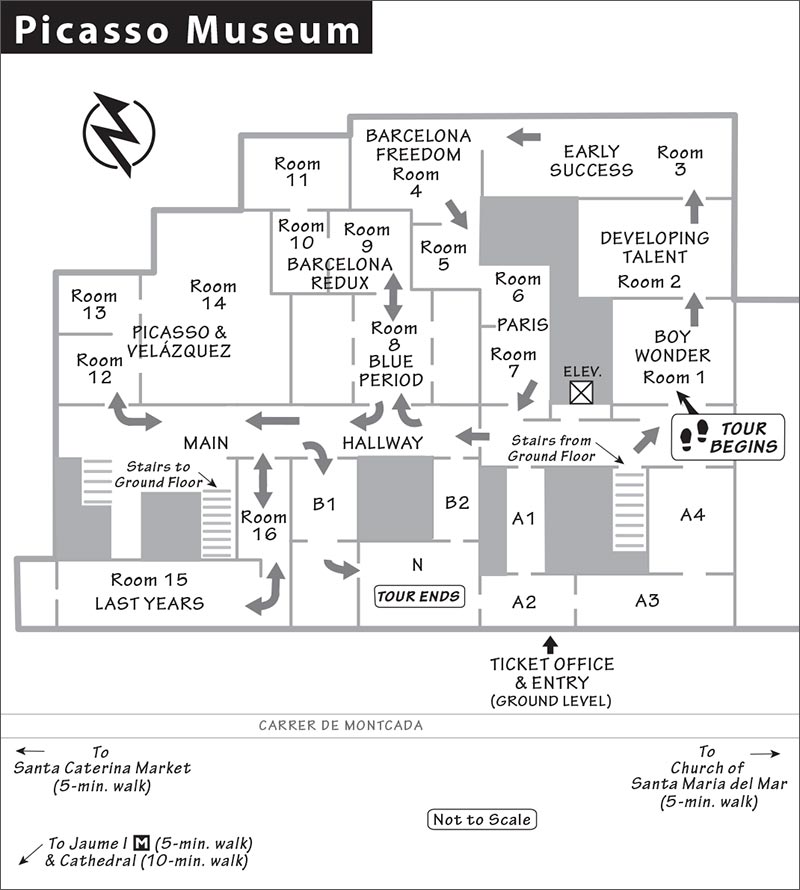
The pieces in this excellent museum capture that priceless moment just before this bold young thinker changed the world. You’ll also see works from his twilight years. It’s the top collection of Picassos in his native country.
Cost and Hours: €12 timed-entry ticket to permanent collection; free Thu late afternoon-close and all day first Sun of month—you must also reserve entry during free hours (up to 4 days ahead); open Tue-Sun 10:00-20:00, Nov-April until 19:00, closed Mon year-round; audioguide-€5, English-language tours run Tue at 15:00 and 16:00 and Sun at 11:00; confirm opening days and times online; Carrer de Montcada 15, +34 932 563 000, https://museupicassobcn.cat.
Reservations and Ticketing Tips: Buy a timed-entry ticket in advance at the museum website. While tickets are sold at the door, there’s nearly always a long line and the museum often sells out.
The museum’s website can be temperamental—keep trying. If you’re unsuccessful, buy an ArticketBCN when you arrive (for pass details, see here), which allows you to enter the galleries whenever you wish (if you already have a pass, notify museum staff when you arrive).
The museum’s busiest times are mornings before 13:00, all day Tue, and during free entry times. Day-of tickets (when available) are also sold online (must purchase at least 2 hours before your visit).
Getting In: The galleries sit one floor above a free-to-enter courtyard. Tickets are sold at the center ground-floor entry at #19.
Getting There: The museum is on Carrer de Montcada; from the Jaume I Metro stop, it’s a five-minute walk. It’s a 10-minute walk from the cathedral and many parts of the Barri Gòtic.
Services: The ground floor has a required bag check, a bookshop, and WC.
Self-Guided Tour
The Picasso Museum’s collection of nearly 300 paintings is presented more or less chronologically. With good text panels in every room providing context, it’s easy to follow the evolution of Picasso’s work. This tour (like the museum itself) is arranged by the stages of his life and art. Don’t be surprised if a painting described here is not on view. Individual paintings are rotated in and out constantly (to keep it interesting for locals and repeat visitors). But the themes and chronology remain constant.
Boy Wonder (Room 1)
Pablo’s earliest art is realistic and earnest. His work quickly advanced from childish pencil drawings (from about 1890), through a series of technically skilled art-school works (copies of plaster feet and arms), to oil paintings of impressive technique. Pablo was born in 1881, so you can easily calculate how amazingly young he was when he painted these works. His portraits—of grizzled peasants, family members, and himself (at age 15)—demonstrate surprising psychological insight. Though Pablo dabbled in landscapes, still lifes, and everyday scenes, he was always, first and foremost, a painter of people.
Developing Talent (Room 2)
Pablo moved to Barcelona at age 14. During a summer trip to Málaga (his birthplace and boyhood home) in 1896, he experimented with a series of fresh, Impressionistic-style landscapes (relatively rare in Spain at the time). As a 15-year-old, Pablo dutifully entered art-school competitions. A case along the wall shows off his art-school studies, Barcelona scenes from 1896 (allowing you to see the city through Picasso’s eyes), and classical studies of the human body.
His first big work, First Communion, tackled a prescribed religious subject, but Picasso made it an excuse to paint his family. His sister Lola was the model for the communicant, and the man beside her has the face of Picasso’s father.
You may find a touching portrait of his mother, with a cameo-like face and fine details in her white blouse. Find the portrait of his aunt Tía Pepa, painted in Málaga in 1896 (this and other family portraits are frequently rotated). It’s said Picasso painted this in less than a day. Notice how ably he captured the toughness of his aunt.
Early Success (Room 3)
In the large, classically painted Science and Charity (1897), Picasso used realistic means to represent subjects of social concern—a technique typical of the social realism movement of the late 19th century. The doctor (modeled on Pablo’s father) represents science. The nun represents charity and religion. From the hopeless face and lifeless hand of the sick woman, it seems that Picasso believes nothing will save her from death.
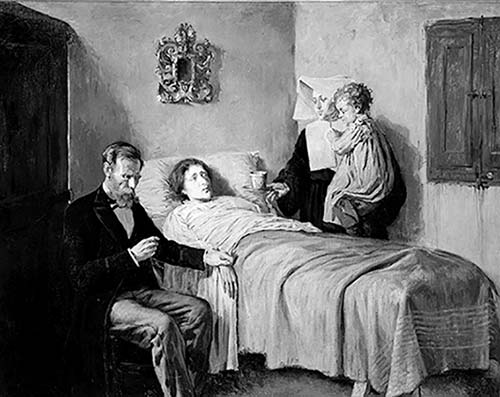
Science and Charity won second prize at a fine-arts exhibition, earning Picasso the chance to study in Madrid. Stifled by the stuffy art school there, he hung out instead in the Prado Museum and learned by copying earlier Spanish masters, especially Diego Velázquez, with whom he developed a virtual friendship. An example of Picasso’s impressive mimicry is sometimes displayed in this room—a nearly perfect copy of a portrait of Philip IV by Velázquez. (Near the end of this tour, we’ll see a much older Picasso riffing on another Velázquez painting.)
In this room you’ll also see outdoor views of Madrid (mostly in Retiro Park) and rural village scenes. In 1898, Pablo fell sick and was sent to convalesce in the mountain village of Horta de Sant Joan. Away from his father and the conservative art establishment in Madrid, his creative spirit was freed. You can sense that Picasso was finding his artistic independence as he painted these landscapes and scenes of village life.
Barcelona Freedom (Room 4)
After regaining his health, Picasso returned to Barcelona in 1900. Art Nouveau was all the rage there. He quit art school and fell in with an avant-garde crowd. These bohemians congregated daily at Els Quatre Gats (“The Four Cats,” a popular restaurant to this day—see here). Picasso even created the menu cover for this favorite hangout. Further establishing his artistic freedom, he painted often dark and brooding portraits of his new friends (including Carlos Casagemas and Jaume Sabartés, who later became Picasso’s personal assistant and donated the foundational works of this museum). Still a teenager, Pablo exhibited his first one-man show—a series of neighborhood sketches in the style of Toulouse-Lautrec—at Els Quatre Gats in 1900.
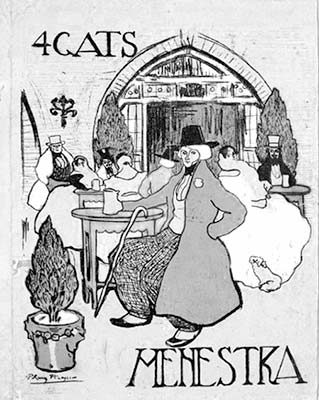
Paris (Rooms 6-7)
In 1900, Picasso made his first trip to Paris, a city bursting with life, light, and love. He began sampling the contemporary art styles around him: He painted cancan dancers like Toulouse-Lautrec, still lifes like Paul Cézanne, brightly colored Fauvist works like Henri Matisse, and Impressionist landscapes like Claude Monet (you may see examples on the walls of this room). In The Waiting (Margot), the subject—with her bold outline and strong gaze—pops out from the vivid, mosaic-like background.
Blue Period (Room 8)
Picasso would travel to Paris several times before settling there in 1904. The suicide of his best friend Casagemas, his own poverty, and the influence of new ideas linking color and mood led Picasso to abandon jewel-bright color for his Blue Period (1901-1904). Now the artist was painting not what he saw, but what he felt. Painting misfits and street people, Picasso, like Velázquez and Toulouse-Lautrec before him, revealed the beauty in ugliness.
During a visit back to Barcelona, Picasso painted a nighttime view over the rooftops of the city. His palette is still blue, but here we see proto-Cubism...five years before the first real Cubist painting.
Rose Period
Picasso finally lifted out of his funk after meeting a new lady, Fernande Olivier (a bronze bust of her from 1906 may be on view). He moved out of the blue and into the happier Rose Period (1904-1907), dominated by soft pink and reddish tones. Other than the Portrait of Bernadetta Bianco, the museum is weak on Rose Period works.
Cubism
Pablo’s role in the invention of the groundbreaking Cubist style (with his friend Georges Braque) is well known—at least I hope so, since this museum has no true Cubist paintings. The technique of “building” a subject with “cubes” of paint simmered in Picasso’s artistic stew for years. The idea was to simultaneously see several 3-D facets of the subject.
Barcelona Redux (Rooms 9-10)
Picasso spent six months back in Barcelona in 1917 (yet another girlfriend, a Russian ballet dancer, had a gig in town). The paintings in these rooms demonstrate the artist’s irrepressible versatility: He had already developed Cubism, but he also continued to play with other styles. In Woman with Mantilla, we see a little Post-Impressionistic Pointillism in a portrait that is as elegant as a classical statue. Nearby, Gored Horse has all the anguish and power of his iconic Guernica (painted years later).
Remember that this museum has very little from the most famous and prolific “middle” part of Picasso’s career—basically, from his adoption of Cubism to his sunset years on the French Riviera. (To fill in the gaps in his middle career, see the sidebar.)
Picasso and Velázquez (Rooms 12-14)
Whoosh. We’ve skipped ahead a few decades in Picasso’s life, and suddenly he is 40 years older. We left him at age 36 in 1917. Now it’s 1957 and he’s 76. As a mature artist, Picasso had few peers. He turned to the great Old Masters for inspiration.
He decided to make a series of works related to what many consider the greatest painting by anyone, ever: Diego Velázquez’s Las Meninas. The 17th-century original (in Madrid’s Prado Museum) depicted the young maids of honor (or meninas) of the Spanish royal court. Heralded as the first completely realistic painting, Las Meninas became, centuries later, an obsession for Picasso.
Pablo, who had great respect for Velázquez, painted more than 40 interpretations of the masterwork and donated all of them to the museum, which rotates the versions on display. Picasso deconstructed Velázquez and then injected light, color, and perspective as he improvised on the earlier masterpiece. In Picasso’s big black-and-white version, he more or less re-created Velázquez’s painting in its entirety. But here, the king and queen (reflected in the mirror in the back of the room) are hardly seen, while the painter—the great Velázquez—towers above everyone. In other paintings in the series, Picasso uses vibrant color and focuses on details—one maid of honor or a pair of them, or just their faces.
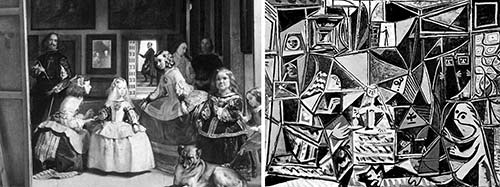
Velázquez’s Las Meninas (left) inspired many versions by Picasso (right).
Last Years (Room 15)
Picasso spent the last 36 years of his life living simply in the south of France. With simple black outlines and Crayola colors, Picasso painted sun-splashed nature, peaceful doves, and the joys of the beach.
His last works have the playfulness of someone much younger. As is often said of Picasso, in his youth he was taught to see the world like an adult, and in his golden years he enjoyed seeing and portraying the world with the freedom of a child.
Nearby (in Rooms B1, N, and B2), you’ll see how in his later years Picasso became a master of other media besides painting. With his ceramics, he made bowls and vases in fun animal shapes, decorated with simple motifs.
Picasso died with brush in hand, still growing as an artist. Sadly, since he vowed never to set foot in fascist, Franco-ruled Spain, Picasso never returned to his homeland...and never saw this museum. But to the end, Picasso continued exploring and loving life through his art.
Other Sights in El Born
▲▲Palace of Catalan Music (Palau de la Música Catalana)
This concert hall, built in just three years, was finished in 1908. Its tall facade has many beautiful decorations, but its location—on a narrow street that offers little perspective—makes it hard to appreciate from the outside. Still, the building, by Lluís Domènech i Montaner, boasts my favorite Modernista interior in town. Its inviting arches lead you into the 2,138-seat hall, which is accessible only with a tour (or by attending a concert). A kaleidoscopic skylight features a choir singing around the sun, while playful carvings and mosaics celebrate music and Catalan culture. If you’re interested in Modernisme, this tour is one of the best—and helps balance the hard-to-avoid focus on Gaudí as “Mr. Modernisme.”
Cost and Hours: 50-minute guided tour in English—€20, runs daily on the hour 9:00-15:00, tour times may vary with performance schedule; 50-minute audioguide tour—€18, every 30 minutes until 15:30, you’ll download an audio tour to your phone, bring your own earbuds/headphones; self-guided tour—€16, available 9:00-15:30, follow along with a printed brochure. Tickets are sold on the website, just inside the ornate entrance on Carrer de Sant Pere Més, and at the box office around the corner at Carrer Palau de la Música 4. Metro: Urquinaona, 10-minute walk from the Barcelona Cathedral or Picasso Museum, +34 932 957 207, www.palaumusica.cat.
Concerts: An excellent way to see the hall is by attending one of its frequent concerts (see website for details, box office +34 932 957 207). To see the Modernista main concert hall, be sure the show is being held in the Sala de Concerts—not the new Petit Palau hall.
▲Santa Caterina Market (Mercat de Santa Caterina)
This eye-catching market hall was built on the ruins of an old Dominican monastery, then renovated in 2006 with a wildly colorful, swooping, Gaudí-inspired roof and shell built around its original white walls (a good exhibition at the rear entrance provides a view of the foundations and English explanations). Come for the outlandish architecture but stay for the food and the local color (it lacks the tourist logjam of La Boqueria). It’s one of my favorite lunch spots in town—either at the recommended Cuines Santa Caterina (with inviting restaurant seating inside and out) or at one of several tapas bars in the market. These tapas bars epitomize all that is good with this kind of eating in Spain.
Cost and Hours: Free; Mon-Sat 7:30-15:30, Tue and Thu-Fri until 20:00, closed Sun; shorter hours Tue and Thu in July-Aug; Avinguda de Francesc Cambó 16, +34 933 195 740, https://mercatsantacaterina.com.
▲Church of Santa Maria del Mar (Basílica de Santa Maria del Mar)
This so-called “Cathedral of the Sea” was built entirely with local funds and labor in the heart of the wealthy merchant El Born quarter. Proudly independent, the church features a purely Catalan Gothic interior that was forcibly uncluttered of its Baroque decor by civil war belligerents. On the big front doors, notice the figures of workers who donated their time and sweat to build the church. The stone they used was quarried at Montjuïc and carried across town on the backs of porters called bastaixos. Although they’ve always been celebrated by residents, their work is now more widely appreciated following the release of the historical novel Cathedral of the Sea (2006), which tells the story of the church’s construction from the perspective of an ambitious bastaixo.
Cost and Hours: Free entry during worship Mon-Sat 18:00-20:30 and Sun 10:00-13:00; otherwise entry is €5 (€10 to visit the rooftop) Mon-Sat 10:00-18:00 and Sun 14:00-18:00, when the interior is illuminated and you have access to the choir and the crypt. Guided rooftop tours generally run Sat-Sun on the hour during paid-entry times (€14, 1 hour, check for English tours and sign up at the door or on the website). Plaça Santa Maria, Metro: Jaume I, +34 933 102 390, www.santamariadelmarbarcelona.org.
EL RAVAL AND NEARBY
Historically edgy El Raval is Barcelona’s “new El Born”—a bohemian-chic magnet for the young and trendy and the foodie crowd. Its streets are lined with creative and fun-loving shops, cafés, bars, and restaurants; entrepreneurs, artists, and chefs with more vision than money are finding their futures here.
El Raval Stroll
To explore this area, I’d follow this route (see map): From the top of the Ramblas, take a right on Carrer del Bonsuccés, which becomes Carrer d’Elisabets and leads to the Museum of Contemporary Art and Casa de la Caritat (a cultural center). Then turn left on Carrer dels Àngels to reach Carrer del Carme, where a right takes you to the community square at Plaça del Pedró.
Continue down Carrer de Sant Antoni Abat to the Sant Antoni Market, then follow tree-lined Ronda de Sant Pau to Carrer del Parlament, which ends at the Poble Sec Metro stop on wide Avinguda del Paral-lel. Cross this busy street into the El Poble-Sec neighborhood at the base of the Montjuïc hill. Follow the pedestrian street Carrer de Blai (with cheap tapas bars) and Carrer del Roser to Metro Paral-lel. For eating recommendations along this route, see here.
▲Sant Antoni Market (Mercat de Sant Antoni)
This sprawling market complex, spanning an entire block, was built near the former gate of Sant Antoni and was completed in 1882 (the same year works on the Sagrada Família began). Some of the food stalls have been run by the same families for generations: The Masclans family has been selling salted cod here since the market was inaugurated. A recent renovation brought the clothing stalls (encats) that once surrounded the market inside, lining the perimeter of the building. A popular outdoor flea market pops up here every Sunday, selling books, antiques, and other collectibles.
Unlike La Boqueria Market on the touristy Ramblas, Sant Antoni is a market made for locals (notice their shopping carts), and there are just a few eateries. Casa Blanca, in the center of the market, is a good choice for a sit-down meal.
Cost and Hours: Free; Mon-Sat 8:00-20:30, closed Sun, clothing stalls also closed Tue; Carrer del Comte d’Urgell 1, +34 934 263 521, www.mercatdesantantoni.com.
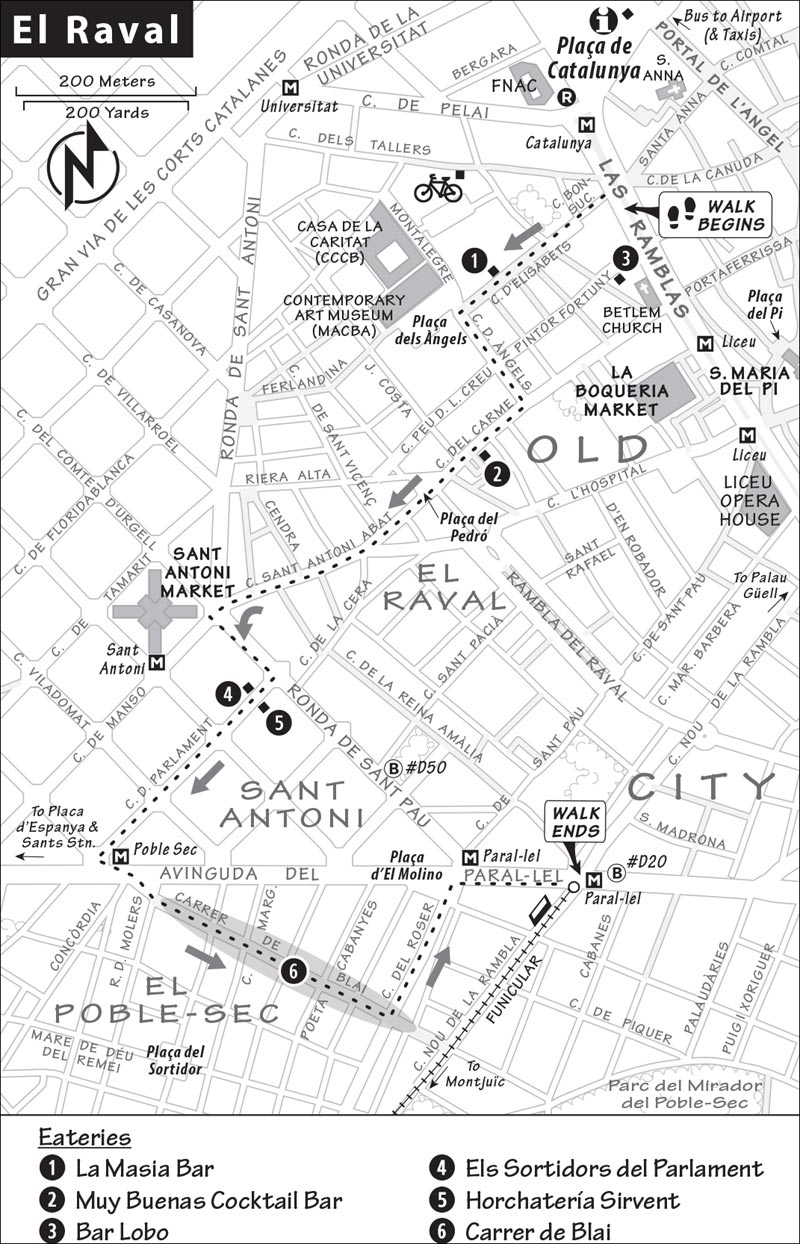
THE EIXAMPLE
For many visitors, Modernista architecture is Barcelona’s main draw. And at the heart of the Modernista movement was the Eixample, a carefully planned “new town” just beyond the Old City with wide sidewalks, hardy shade trees, and a rigid grid plan cropped at the corners to create space and lightness at each intersection. Conveniently, all this new construction provided a generation of Modernista architects with a blank canvas for creating boldly experimental designs.
Block of Discord
At the center of the Eixample is the Block of Discord, where three colorful Modernista facades compete for your attention: Casa Batlló, Casa Amatller, and Casa Lleó Morera (all on Passeig de Gràcia—near the Metro stop of the same name—between Carrer del Consell de Cent and Carrer d’Aragó). All were built by well-known Modernista architects at the end of the 19th century. Because the mansions look as though they are trying to outdo each other in creative twists, locals nicknamed the noisy block the “Block of Discord.” Of the three houses, two are open to visitors—Casa Batlló and the less-crowded Casa Amatller.
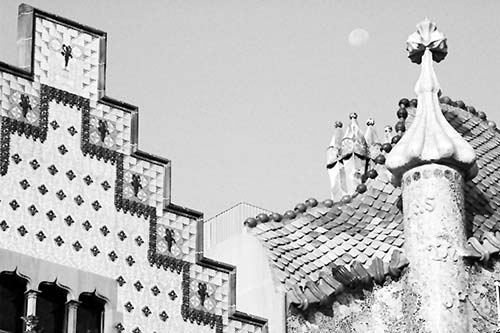
For a tour of the Eixample, download my free Eixample Walk audio tour.
▲Casa Batlló
While the highlight of this Gaudí-designed residence is the roof, the interior is also interesting—and much more over-the-top than La Pedrera’s. The house features a funky mushroom-shaped fireplace nook on the main floor, a blue-and-white ceramic-slathered atrium, an attic with parabolic arches, and a dragon-inspired rooftop. The Gold ticket includes a good (if long-winded) virtual-reality guide on a tablet that depicts the rooms as they may have been.
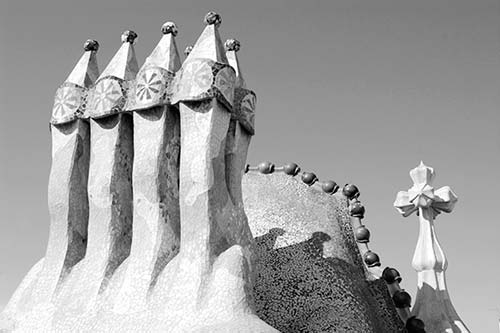
Cost and Hours: €39 Blue ticket includes audioguide; €49 Gold skip-the-line ticket includes a hall with period furniture, virtual-reality tablet, and dizzying “Gaudí Dome” experience at the end; €45 early-entrance ticket promises fewer crowds (offered at 8:30 or 8:45). All tickets are timed entry—buy online in advance (€4 more at the door). Open daily 9:00-20:00, Passeig de Gràcia 43, +34 932 160 306, www.casabatllo.es.
Nighttime Visits and Concerts: Magic Night tickets include the same features as the Gold and Blue tickets above, but also a rooftop concert and a glass of cava (most nights in peak season at 20:00, €69 Blue ticket, €89 Gold ticket gets you a better seat).
Casa Museu Amatller
The middle residence of the Block of Discord, Casa Amatller was designed by Josep Puig I Cadafalch in the late 19th century for the Amatller chocolate-making family. Only viewable via a group tour, it features mostly original furniture, placed just as the owners had it when they lived there. Without a ticket, you can still admire the home’s Neo-Catalan Gothic facade, with tiles and esgrafiado decoration, or step inside the foyer (free during open hours) to see the Modernista stained-glass door and ceiling and an elaborate staircase. Past the foyer is a café and chocolate shop, where you can taste Amatller hot chocolate with toast.
Cost and Hours: €17 for 45-minute visit with audioguide—generally on the hour and half-hour (daily 10:00-19:00, shorter hours in winter). A €20 one-hour guided English tour is offered daily at 10:00 and includes a gift of Amatller chocolate; Passeig de Gràcia 41, +34 932 160 175, www.amatller.org.
▲▲La Pedrera (Casa Milà)
One of Gaudí’s trademark works, this house—built between 1906 and 1912—is an icon of Modernisme. The wealthy industrialist Pere Milà i Camps commissioned it, and while some still call it Casa Milà, most call it La Pedrera (The Quarry) because of its jagged, rocky facade. While it’s fun to ogle from the outside, it’s also worth going inside, as it’s arguably the purest Gaudí interior in Barcelona—executed at the height of his abilities (unlike his earlier Palau Güell)—and it contains period furnishings.
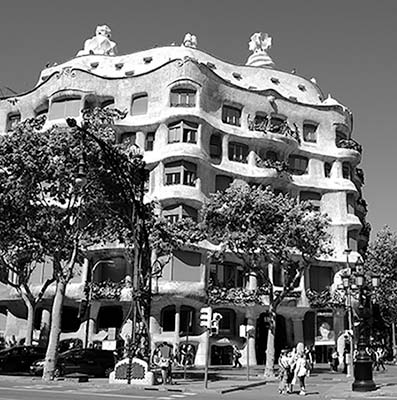
While Casa Batlló has a Gaudí facade and rooftop, these were appended to an existing building; La Pedrera, on the other hand, was built from the ground up according to Gaudí’s plans. Your ticket includes entry to the interior (with the furnished apartment) and to the delightful rooftop, with its forest of tiled chimneys.
Cost and Hours: €25 timed-entry ticket includes good audioguide, buy online in advance (€3 more at the door); open daily 9:00-20:30, Nov-Feb until 18:30, nighttime visits available—see later; roof may close when it rains; at the corner of Passeig de Gràcia and Provença (visitor entrance at Provença 261), Metro: Diagonal, +34 932 142 576, www.lapedrera.com.
Avoiding Lines: Buy in advance online to guarantee entry. The €35 premium ticket allows you to arrive whenever you wish (no entry time) and skip all lines, including those for audioguides and the elevator. There’s also an early-bird La Pedrera Sunrise guided tour at 8:00 (€39, certain days in peak season, details online).
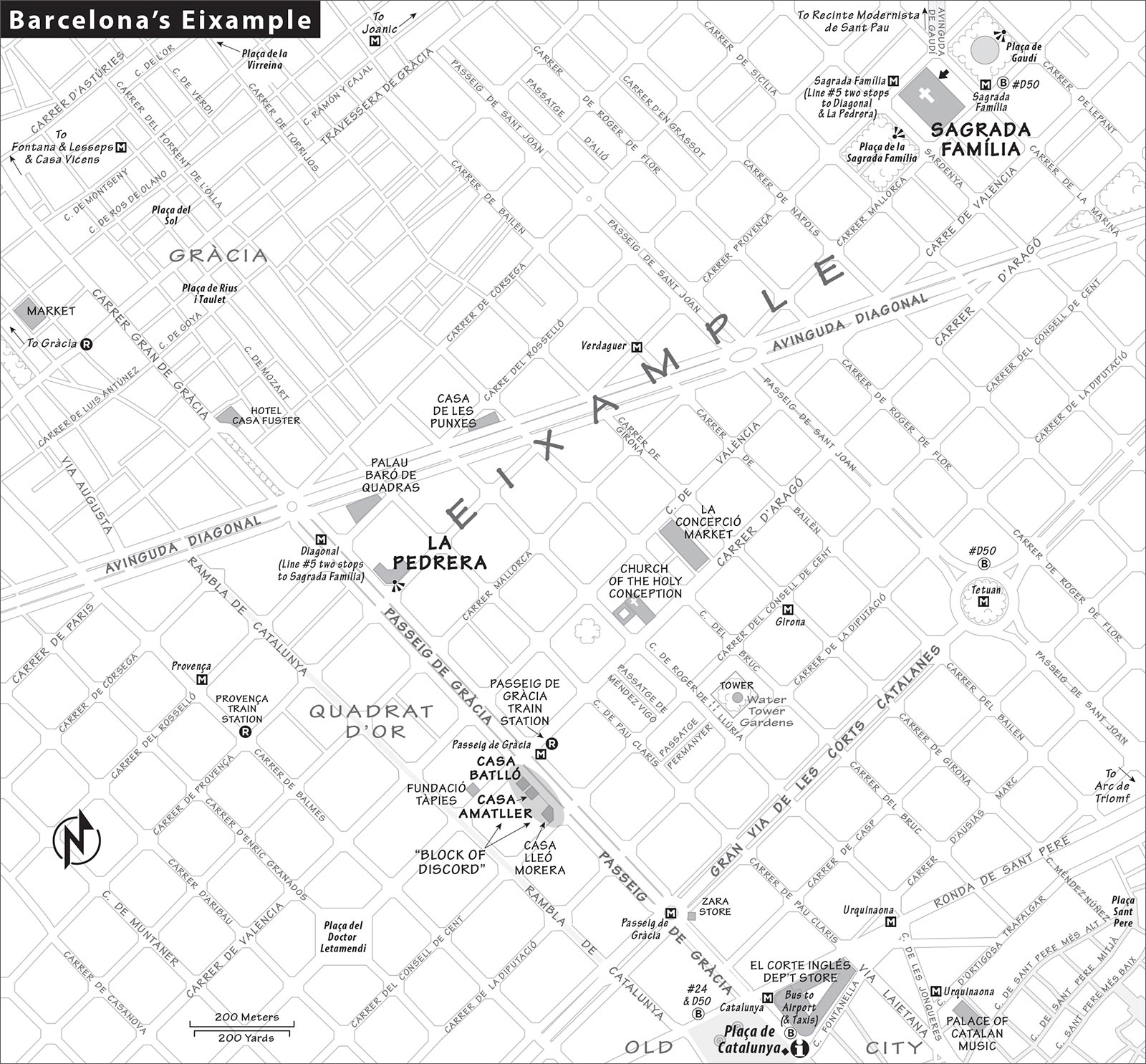
Modernisme is Barcelona’s unique contribution to the Europe-wide Art Nouveau movement. Meaning “a taste for what is modern”—such as streetcars, electric lights, and big-wheeled bicycles—this free-flowing organic style lasted from 1888 to 1906.
Broadly speaking, there were two kinds of Modernisme (otherwise known as Catalan Art Nouveau). Early Modernisme has a Neo-Gothic flavor, clearly inspired by medieval castles and towers—logically, since architects wanted to recall the days when Barcelona was at its peak. From that starting point, Antoni Gaudí branched off on his own, adding the color and curves we most associate with the look of Barcelona’s Modernisme.
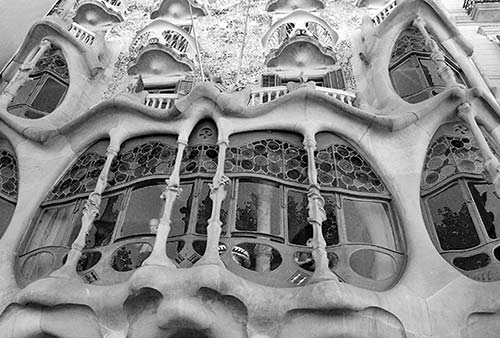
The aim was to create buildings that were both practical and decorative. To that end, Modernista architects experimented with new construction techniques. Their most important material was concrete, which they could mold to curve and ripple like a wave and enliven with brightly colored glass and tile. Their structures were fully modern, but the decoration was a clip-art collage of natural images, Moorish or Chinese themes, and fanciful Gothic crosses and knights to celebrate Catalunya’s medieval glory days.
It’s ironic to think that Modernisme was a response against the regimentation of the Industrial Age—and that all those organic shapes were only made possible thanks to Eiffel Tower-like iron frames. As you wander through the Eixample looking at all those fanciful facades and colorful, leafy, blooming shapes in doorways, entrances, and ceilings, remember that many of these homes were built at the same time as the first skyscrapers in Chicago and New York City.
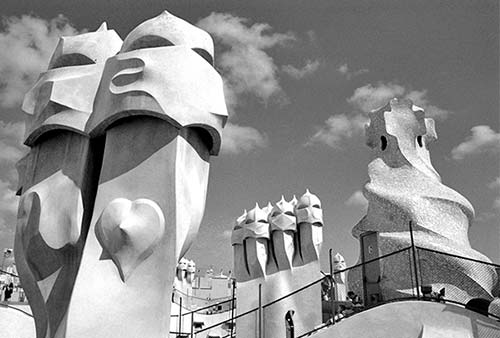
Underpinning Modernisme was the Catalan cultural revival movement called the Renaixença. Across Europe, it was a time of national resurgence. It was the dawn of the modern age, and downtrodden peoples—from the Basques to the Irish to the Hungarians to the Finns—were throwing off the cultural domination of other nations and celebrating what made their own culture unique. Here in Catalunya, the Renaixença encouraged everyday people to get excited about all things Catalan—from their language, patriotic dances, and inspirational art to their surprising style of architecture.
Nighttime Visits: After-hours visits dubbed “La Pedrera Night Experience” include a guided tour of the building (but not the apartment), along with a rooftop light show and glass of cava (€38, usually daily 20:30-23:00, earlier in winter, book ahead). A nighttime combo-ticket (€45) includes the rooftop night experience plus the regular timed-entry daytime admission.
Concerts: On some summer nights, an evening rooftop concert series, “Summer Nights at La Pedrera,” features live jazz and the chance to see the rooftop illuminated (€38, check website for details, book ahead).
Visiting the House: A visit covers three sections—the rooftop, the attic, and the apartment. Start by walking through the fanciful, nature-inspired courtyard. Notice how the windows gradually get smaller as you look up to the top floors, allowing an equivalent amount of light and air to enter on the top floor as on the bottom floor.
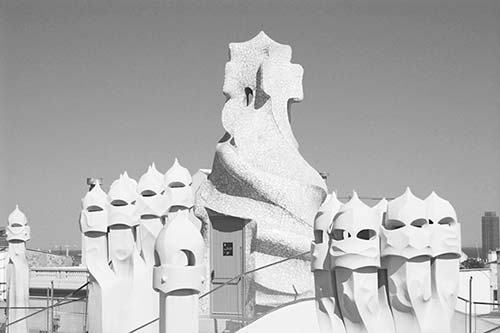
Pick up your audioguide and head up the elevator to the bourgeois apartment, decorated as it might have been when the building was first occupied by middle-class urbanites (a short video explains Barcelona society at the time). Notice Gaudí’s clever use of the atrium to maximize daylight in all the apartments.
Follow the signs to the attic, which houses a sprawling multimedia exhibit tracing the history of the architect’s career, with models, photos, and videos of his work. It’s all displayed under distinctive parabola-shaped arches. While evocative of Gaudí’s style in themselves, the arches are formed this way partly to support the multilevel roof above. This area was also used for ventilation, helping to keep things cool in summer and warm in winter. Tenants had storage spaces and did their laundry up here. In the 1940s, there were actually 13 apartment units in this attic space.
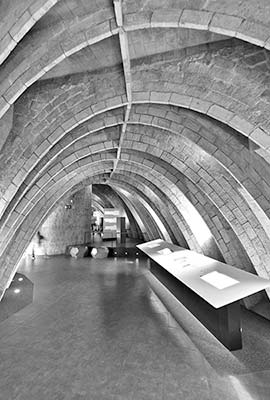
Make your way to the jaw-dropping rooftop, where 30 chimneys and ventilation towers play volleyball with the clouds. (It could be that George Lucas got his inspiration for his Darth Vader helmet from the chimneys.) Look for the archway that frames the Sagrada Família in the distance, and study the layout of the city from mountain to sea. For a great view of Eixample city planning, look over into this block’s central area, filled with gardens.
Back at the ground level of La Pedrera, poke into the dreamily painted original entrance courtyard.
▲▲▲Sagrada Família (Holy Family Church)
Gaudí’s grand masterpiece sits unfinished in a residential Eixample neighborhood 1.5 miles north of Plaça de Catalunya. An icon of the city, the Sagrada Família boasts bold, wildly creative, unmistakably organic architecture and decor inside and out—from its melting Glory Facade to its skull-like Passion Facade to its rainforest-esque interior.
Cost and Hours: All tickets are timed-entry and must be purchased online in advance (no physical tickets sold on-site). All tickets include an audioguide (via an app); €26 ticket includes church, €30 ticket includes church and 50-minute live guided tour, €36 ticket includes church and one tower, and €40 ticket includes church, guided tour, and one tower. Open Mon-Sat 9:00-20:00, Sun from 10:30; March and Oct daily until 19:00, Nov-Feb until 18:00; +34 932 080 414, www.sagradafamilia.org.
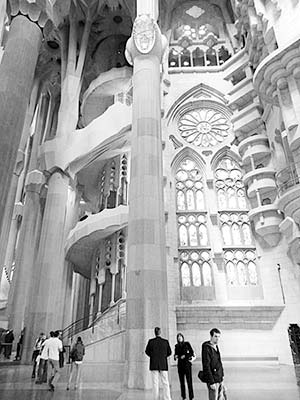
La Sagrada Família App: When you book online, you’ll receive a link to the official La Sagrada Família app with audioguide, which can be downloaded to your phone. You can also access your ticket (or buy tickets) via the app.
When to Go: The church is always busy, but late afternoon and early evening tend to be less crowded—and also the best time to catch the “golden hour” when light floods through the stained-glass windows.
Getting There: The Metro stop Sagrada Família puts you right on the church’s doorstep. Exiting toward Plaça de Gaudí (follow silhouette logos of the church) will save a little walking.
Getting In: If you show up without a ticket, try scanning the posted QR code to buy online on the spot. Carefully note your assigned entry time. You can enter the church from 15 minutes before your ticketed time and up to 30 minutes after. Make your way to the Nativity Facade side, show your ticket (either on your phone or printed out), and go through security.
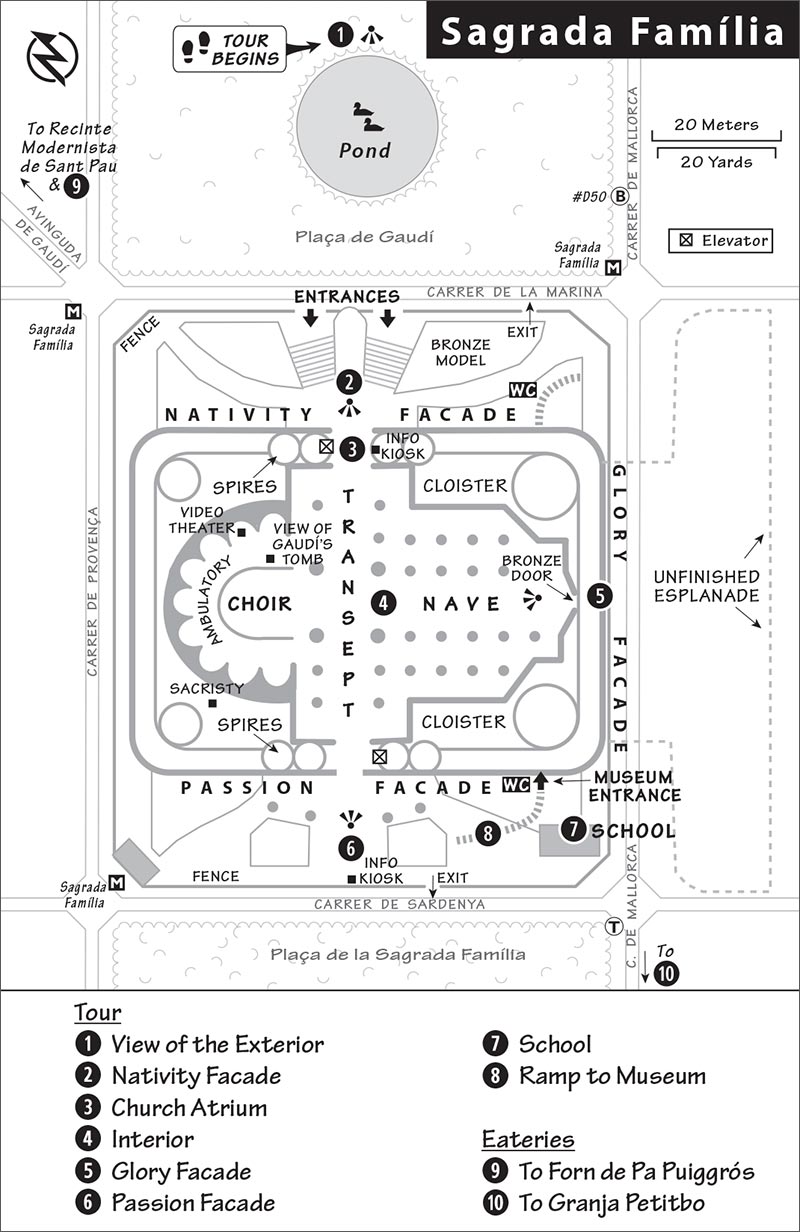
Sharp items like pocketknives must be checked (you’ll get a claim number to pick up your item upon exiting through this side). All hats must be removed.
Church Services: Mass (in various languages) is held every Sunday at 9:00; those who actually want to worship here are admitted at no charge. Entry to the church begins at 8:00, but lines can form as early as 6:30.
Towers: The €36 and €40 tickets include access to one tower. (If tickets including a tower visit are sold out online, check at the info kiosk near the Passion Facade for last-minute availability.) Towers can close when windy or rainy (if that happens, the tower portion of your ticket will be refunded).
Elevators on opposite sides of the church take you partway up the towers—one on the Passion Facade, and one on the Nativity Facade. The elevators only go up—to get down, you’ll use a tightly wound, narrow staircase with 400 steps. The Passion Facade elevator takes you up a bit higher, and the stairs to come down are slightly wider than those descending from the Nativity Facade elevator. The facades are not joined, so it isn’t possible to cross from one facade to the other. From either side, you’ll have great views of the city and a gargoyle’s-eye perspective of the loopy church.
Baggage Check: Day bags are allowed in the church but are scanned. Backpacks are not allowed in the towers: Small lockers are available at each elevator when the towers are open (lockers only for tower ticket holders).
Background
Gaudí labored on Sagrada Família for 43 years, from 1883 until his death in 1926. Nearly a century on, people continue to toil to bring Gaudí’s designs to life. There’s something inspirational about a community of committed people with a vision who’ve worked on a church that wouldn’t be finished in their lifetimes—as was standard in the Gothic age. The progress of this remarkable building is a testament to the generations of architects, sculptors, stonecutters, fundraisers, and donors who shared Gaudí’s astonishing vision. After paying the admission price (becoming a partner in this building project), you will actually feel good. If there’s any building on earth I’d like to see, it’s the Basílica de la Sagrada Família...finished.
Self-Guided Tour
• Before entering the church, start on the far side of the pond in the park that faces the Nativity Facade (where the entry lines are located). From there, you’re back far enough to take in the entire towering facade. This is a great place to take a photo and take in the...
1 View of the Exterior from Beyond the Pond
Stand and imagine how grand this church will be when completed. The eight 330-foot spires topped with crosses are just a fraction of this mega-church. When finished, it will have 18 spires. Rising above the spires are four taller towers, dedicated to the four Evangelists and topped with giant figures: an angel for Matthew, a lion for Mark, an ox for Luke, and an eagle for John. A tower dedicated to Mary rises still higher—400 feet—with an illuminated crystal star at its top. And in the very center of the complex will stand the grand 560-foot Jesus tower, topped with a cross that will shine like a spiritual lighthouse, visible even from out at sea.
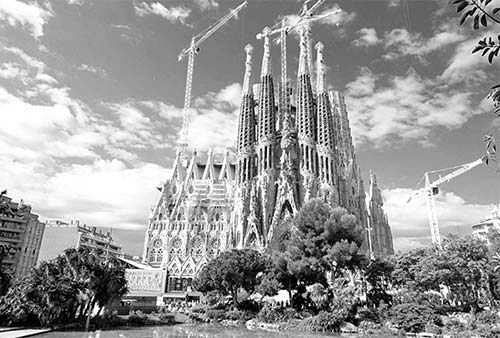
The Nativity Facade—where tourists enter today—is only a side entrance to the church. The grand main entry, through the Glory Facade, will be around to the left. To accommodate the church’s planned entrance esplanade, a nine-story apartment building will have to be torn down. (This is an ongoing controversy as authorities negotiate with landowners.)
The three facades—Nativity, Passion, and Glory—will chronicle Christ’s life from birth to death to resurrection. Inside and out, a goal of the church is to bring the lessons of the Bible to the world. Despite his boldly modern architectural vision, Gaudí was fundamentally traditional and deeply religious. He designed the Sagrada Família to be a bastion of solid Christian values in the midst of what was a humble workers’ colony in a fast-changing city.
When Gaudí died, the only section that had been completed was the Nativity Facade (with its themes of birth and new life). Notice the dove-covered Tree of Life on top, with playful little creatures carved into nooks and crannies throughout, and a white pelican at the bottom. Because it was believed that this noble bird would feed its young with its own blood, the pelican was a common symbol in the Middle Ages for the self-sacrifice of Jesus.
The Nativity Facade’s four spires are dedicated to apostles, and they repeatedly bear the word “sanctus,” or holy. Their colorful ceramic caps symbolize the miters (formal hats) of bishops. The shorter spires (to the left) symbolize the Eucharist (communion), alternating between a chalice with grapes and a communion host with wheat.
The rest of the church, while inspired by Gaudí’s long-range vision, has been designed and executed by others. This artistic freedom was amplified in 1936, when civil war shelling burned many of Gaudí’s blueprints. Supporters of the ongoing work insist that Gaudí, who enjoyed saying, “My client [God] is not in a hurry,” knew he wouldn’t live to complete the church and recognized that later architects and artists would rely on their own muses for inspiration.
• Keep an eye on the time. About 15 minutes before your assigned time-slot, join the line to enter the church complex. Pass through security, then walk up the stairs to the viewing plaza in front of the Nativity Facade. Check out the small bronze model of how the church might look when completed. Then stand as far back as you can to take in this facade.
2 Nativity Facade
This is the only part of the church essentially finished in Gaudí’s lifetime (although the architect had intended for this facade to be painted). The four spires decorated with his naturalistic sculpture mark this facade as unmistakably part of his original design. Mixing Gothic-era symbolism, images from nature, and Modernista asymmetry, the Nativity Facade is the best example of Gaudí’s original vision, and it established the template for future architects. Cleverly, this attractive facade was built and finished first to bring in financial support for the project.
The theme of the facade, which faces the rising sun, is Christ’s birth. A statue above the doorway shows Mary, Joseph, and Baby Jesus in the manger, while a curious cow and donkey peek in. It’s the Holy Family—or “Sagrada Família” (literally “sacred family”)—to whom this church is dedicated. Flanking the doorway are the three Magi and adoring shepherds. Other statues at this height show Jesus as a young carpenter (far right), the Holy Family fleeing to Egypt (far left), and angels playing musical instruments. Much higher up, in the arched niche, Jesus crowns Mary triumphantly.
The doors in the middle of the facade (covered with small, colorful bugs and leaves) were designed by head sculptor Etsuro Sotoo. Born in Japan, Sotoo visited Barcelona for the first time in 1978 and fell in love with the project. He worked hard to become a part of it and even converted to Catholicism.
• If your ticket includes a tower or a guided tour, a guard will direct you to your elevator or tour meeting point. Otherwise, enter the 3 church atrium through Sotoo’s doors. Continue to the center of the church, near the altar, to survey the magnificent...
4 Interior
Typical of even the most traditional Catalan and Spanish churches, the floor plan is in the shape of a Latin cross, 300 feet long and 200 feet wide. Ultimately, the church will accommodate 8,000 worshippers. The crisscross arches of the ceiling (the vaults) show off Gaudí’s distinctive engineering. The church’s roof and flooring were completed in 2010—just in time for Pope Benedict XVI to arrive and consecrate the church.
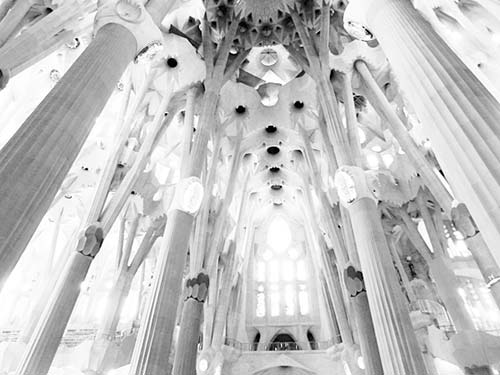
Part of Gaudí’s religious vision included a love for nature. He said, “Nothing is invented; it’s written in nature.” Like the trunks of trees, these columns (56 in all) blossom with life, complete with branches, leaves, and knot-like capitals. The columns vary in color and material—brown clay, gray granite, dark gray basalt.
Light filtering through the stained-glass windows has the dappled effect of a rainforest canopy. Notice how splashes of color breathe even more life into this amazing space. The morning light shines in through blues, greens, and other cool colors, whereas the evening light glows through reds, oranges, and warm tones. Gaudí envisioned an awe-inspiring symphony of colored light to encourage a contemplative mood.
At the center of the church stand four main columns, each marked with an Evangelist’s symbol and name in Catalan: angel (Mateu), lion (Marc), bull (Luc), and eagle (Joan). These columns support a ceiling vault that’s 200 feet high—and will also support the central steeple (the Jesus tower with the shining cross).
The Holy Family is looking down from on high: Jesus is above the altar, Mary is in the left transept, and Joseph is in the right transept.
To the right, behind the high altar, peer down to see a surprisingly traditional space—the 19th-century Neo-Gothic building that Gaudí was originally hired to finish. Today, this is a crypt holding the tomb of Gaudí himself. A few steps away are two small theaters in adjacent side chapels. One shows a short video about the architect and his work.
• Walk through the forest of massive columns to the opposite end of the church. The view from here is best for appreciating the majesty of the building’s interior. (A big mirror is placed here to make admiring the ceiling easier.) Notice the statues representing, once again, the four Evangelists. These are models of the sculptures placed on the pinnacles of the four exterior towers dedicated to each Evangelist. Suspended high above the nave, the U-shaped choir can seat a thousand singers, who will eventually be backed by four organs.
Doors here will one day open to the...
5 Glory Facade
While you can’t go out what will one day be the main entrance, you can study a life-size image of the bronze door intended for this spot, emblazoned with the Lord’s Prayer in Catalan and surrounded by “Give us this day our daily bread” in 50 languages. If you were able to exit through the actual door, you’d be face-to-face with drab, doomed apartment blocks. In the 1950s, the mayor of Barcelona, figuring this day would never really come, sold the land destined for the church project. Now the city must buy back these buildings to fulfill Gaudí’s vision of a grand esplanade leading to this main entry. Four towers will rise. The facade’s sculpture will represent how the soul passes through death, faces the Last Judgment, avoids the pitfalls of hell, and finds its way to eternal glory with God.
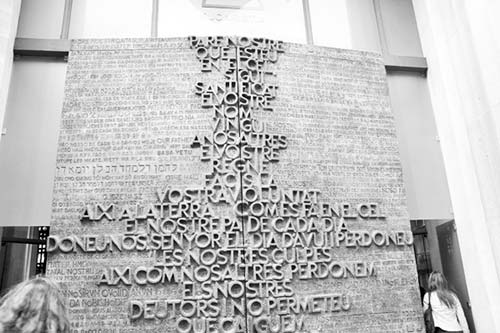
• Head back up the nave and exit through the left transept. To the left, notice the second elevator up to the towers. To the right, stroll through the sacristy, where you will find benches, candelabras, and sacristy furniture designed by Gaudí. Before exiting, look down at the fine porphyry floor with scenes of Jesus’ entry into Jerusalem. Now head outside and down the ramp. Step away to take in the...
6 Passion Facade
Judge for yourself how well Gaudí’s original vision has been carried out by later artists. The Passion Facade’s four spires were designed by Gaudí and completed (quite faithfully) in 1976. But the lower part was only inspired by Gaudí’s designs. The sculptures intended for this facade were interpreted freely and sternly (also controversially) by Josep Maria Subirachs (1927-2014), who completed the work in 2005.
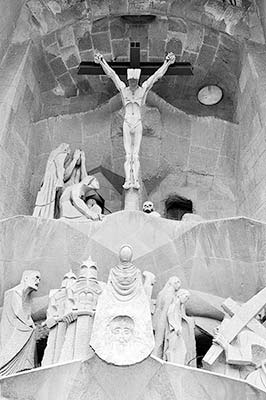
Subirachs tells the story of Christ’s torture and execution. The various scenes—Last Supper, betrayal, whipping, and so on—zigzag up from bottom to top, culminating in Christ’s crucifixion over the doorway. The style is severe and unadorned, quite different from Gaudí’s signature naturalism. Large letters high above spell out “Iesus Nazarenus Rex Iudæorum” (Jesus the Nazarene, King of the Jews). The bone-like archways are closely based on Gaudí’s original designs. And Gaudí had made it clear that this facade should be grim and terrifying.
• Now, for a fun little break from all this church architecture, head into the small building outside the Passion Facade. This is the...
7 School
Gaudí erected this school for the children of the workers building the church. Today, it displays a replica classroom and old photos of school activities during Gaudí’s time.
• Back outside, head down the 8 ramp, where you’ll find WCs and the entrance to the...
Museum
Housed in what will someday function as the church crypt, the museum takes you through the past, present, and future of Sagrada Família’s development.
It starts with a photo of the master himself and a timeline illustrating how construction has progressed from Gaudí’s day until now. Walking the hall, you’ll pass pieces of Gaudí’s original plaster model of the church (damaged during Spain’s civil war; on the left), and his reconstructed studio (also on the left). Compare Gaudí’s old-fashioned space with a nearby photo of the current team, working with the latest technology.
In a room at the end of the hall, four plaster models show the evolution of Gaudí’s thinking (clockwise from left): 1) the Neo-Gothic design by the church’s first architect, Francisco de Paula del Villar; 2) Gaudí’s reenvisioned plan, with a nave formed of narrow parabolic arches; 3) a plan with the middle story opened up; and 4) finally, an even more open plan with tree-like columns fanning out at the top.
Exploring further, you’ll find a small theater showing a worthwhile nine-minute movie. You’ll also find an intriguing “hanging model” for Gaudí’s unfinished Church of Colònia Güell (in a suburb of Barcelona), with a design similar to that of Sagrada Família.
Gaudí lived on the site of Sagrada Família for more than a decade and is buried here in the Neo-Gothic 19th-century crypt. You can look (steeply) down at his tomb. There’s a move afoot to beatify Gaudí and make him a saint.
Back in the main hall, peer into the actual workshop where artists employ the latest technology (such as 3-D printing) to test ideas and create models.
• Our tour is over. From here, you have a few options. To return to central Barcelona, it’s simple to hop on the Metro. Bus #D50 goes to the heart of the Eixample (corner of Gran Via de les Corts Catalanes and Passeig de Gràcia). Or you can take a taxi to Park Güell, two (uphill) miles to the northwest.
BEYOND THE EIXAMPLE
▲▲Park Güell
Designed as an upscale housing development for early-20th-century urbanites, this park is home to some of Barcelona’s most famous symbols, including a dragon guarding a whimsical staircase and a wavy bench bordering a panoramic view terrace supported by a forest of columns. Gaudí used vivid tile fragments to decorate much of his work, creating a playful, pleasing effect. The park contains the Gaudí House Museum, where Gaudí lived for a time (not worth the separate entry fee).
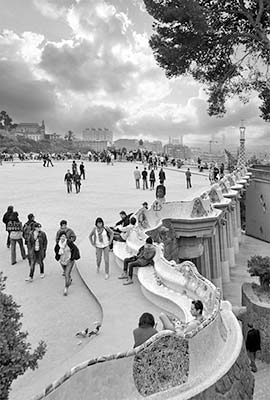
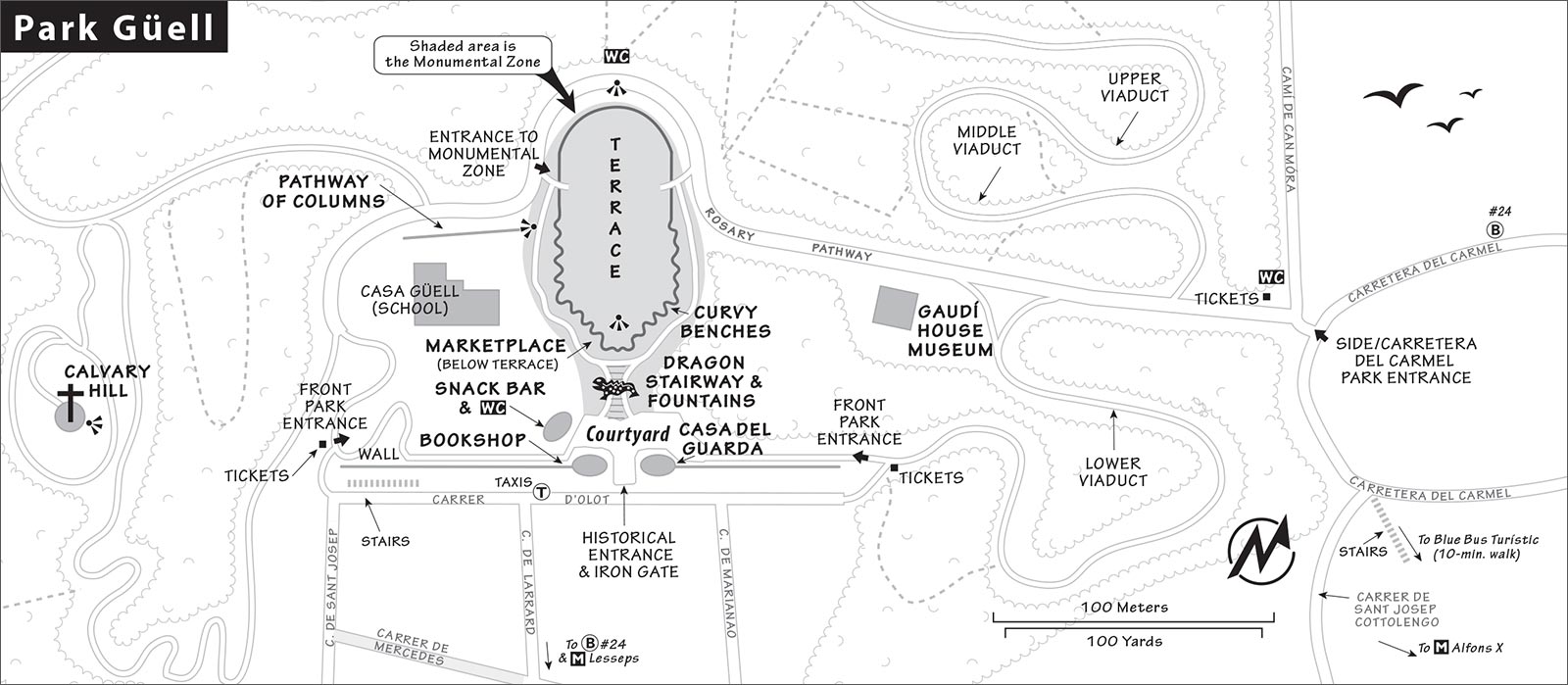
Cost: €10 timed-entry park admission. The only smart way to visit is to buy your ticket online in advance (tickets are sold at the park, but they often sell out and you’ll wait in a long line).
Hours: April-Oct 9:30-22:00, last entry at 19:30; rest of year 9:30 until sunset.
Information: +34 934 091 831, www.parkguell.barcelona.
When to Go: To avoid the biggest crowds, visit as early in the day as possible or after 18:00. You can enjoy the park at twilight from April-Oct, when it stays open until 22:00 (last entry at 19:30).
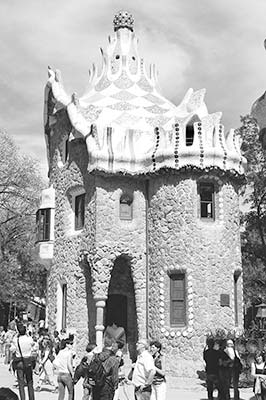
Getting There: Park Güell is about 2.5 miles from Plaça de Catalunya, beyond the Gràcia neighborhood in Barcelona’s foothills. If asking for directions, ask for “Park Gway” (sounds like “parkway”).
From downtown, a taxi (about €16) is the easiest way to get directly to the park’s entrance. Public transit options leave you within walking distance: Take bus #24 (direction: El Carmel) from the southwest corner of Plaça de Catalunya to the Carretera del Carmel-Albert Llanas stop, a two-minute walk to my preferred park entrance. Also from Plaça de Catalunya, the blue Bus Turístic drops you about four blocks from the Carretera del Carmel entrance (10-minute uphill walk). Or you can ride the Metro (L3) to the Lesseps stop and walk 15 minutes, partly uphill.
Getting In: The park has a dizzying number of entrances. I prefer starting at the side entrance on Carretera del Carmel (near the bus #24 stop) and ending at the Monumental Zone. At all entrances you’ll find a ticket office, WCs nearby, and plenty of park staff to help orient you. Signage inside can be confusing, so pick up a map to supplement the one in this book. Hang on to your ticket; you’ll need it when you exit (you can exit anywhere).
Overview: Gaudí intended this 30-acre garden to be a high-end community with 60 upscale residences. Funded by his frequent benefactor Eusebi Güell, he began work on the project in 1900; however, the project stalled in 1914, with the outbreak of World War I, and it never resumed. Only two houses were built, neither designed by Gaudí (one is now the Gaudí House Museum). Be thankful that the housing development faltered—as a park, this place is a delight. It offers a novel peek into Gaudí’s eccentric genius in a setting that’s wonderfully in keeping with the naturalism that pervades his work.
Visiting the Park: Like any park, this one is made for aimless rambling, and you are free to stay as long as you like. From the side entrance on Carretera del Carmel, make your way to the entrance of the Monumental Zone.
Sit on a colorful bench and enjoy one of Barcelona’s best views on the view terrace. (Find the Sagrada Família in the distance.) The terrace is ringed by a 360-foot-long bench that functions as both a balustrade and a seat, designed to fit your body just so. To Gaudí, this terrace evoked ancient Greek theaters that burrowed scenically into the sides of hills—but it is more like an ancient Greek agora, a wide-open meeting place, jammed with people feasting on the view. The big pink house flanking the stairs on the right side of the terrace is where Eusebi Güell lived. Now a school, this house predates the park project and was not designed by Gaudí.
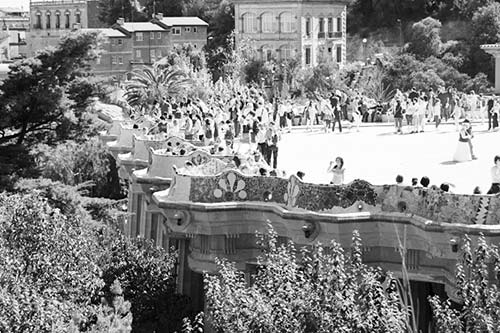
Walking down the stairs, stop to explore the playful Pathway of Columns. Gaudí drew his inspiration from nature, and this arcade is like a surfer’s perfect tube. Both structural and aesthetic, it is one of many clever double-decker viaducts that Gaudí designed for the grounds: vehicles up top, pedestrians in the portico down below. Continuing down the stairs will lead you to the marketplace (Hypostyle Room), designed to house a produce market for the neighborhood’s inhabitants. Eighty-six Doric columns—each lined at the base with white ceramic shards—populate the marketplace and add to its vitality. (Their main job, though, is to hold up the view terrace above.) Shards of white ceramic also cover the multiple domes of the ceiling. The four giant mosaic decorations overhead represent the four seasons.
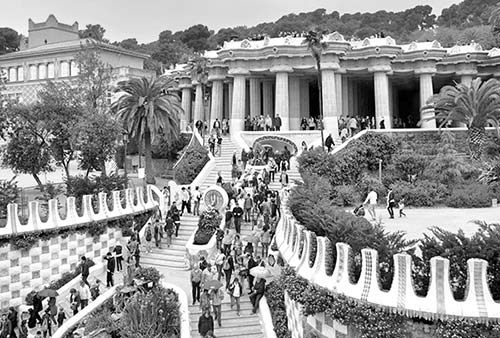
Next you’ll come to the top of twin staircases curving downward, separated by three fountains stacked between them. The first, at the top of the steps, is an icon of the park, and of Barcelona: a smiling dragon, slathered in colorful tile. Next is a red-and-gold Catalan shield, with the head of a serpent poking out. The third fountain is rocky and leafy, typical of Gaudí’s naturalism.
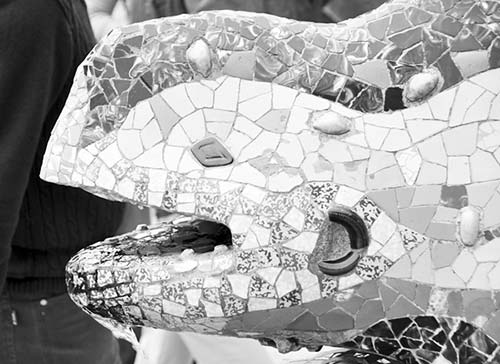
The two grottos flanking the stairs were functional: One was a garage for Eusebi Güell’s newfangled automobiles; the other was a cart shelter.
At the bottom of the dragon stairway, you’ll come to Gaudí’s historical front entrance, with its palm-frond gate and gas lamps on either side, made of wrought iron. Gaudí’s dad was a blacksmith, and he always enjoyed this medium.
As you wander, consider that, as a high-end housing development, Gaudí’s project flopped (back then, high-society ladies didn’t want to live so far from the cultural action). But a century later, as a park, it’s a magnificent success.
• You have several options for returning to the city center.
Returning to Town: Taxis wait outside the exit on Carrer d’Olot. Or walk five minutes downhill on Carrer de Larrard to Travessera de Dalt to catch bus #24. The blue Bus Turístic stops at 7 Avinguda de la Mare de Déu de Montserrat—a 10-minute walk downhill from the side park entrance. For the Metro, it’s a 15-minute walk to the Lesseps Metro stop.
MONTJUÏC
I’ve listed these sights by altitude, from the hill-topping castle down to the 1929 World Expo Fairgrounds at the base of Montjuïc (“Mount of the Jews”). If you’re visiting them all, ride to the top by bus, funicular, or taxi, then visit them in this order so that most of your walking is downhill.
Here’s one simple plan: From Metro Paral-lel, take the funicular up (included in your Metro ticket). Walk five minutes (left from exit) gradually downhill to the big white Fundació Joan Miró, five minutes more to the Olympic Stadium, and five more to the Catalan Art Museum. From there, descend the stairs to the Magic Fountains. Detour left (if interested) to the CaixaForum. Then return to the Magic Fountains and continue to Plaça d’Espanya, Las Arenas mall, and a Metro stop to the rest of Barcelona.
Getting to Montjuïc: You have several choices. The simplest is to take a taxi directly to your destination (about €12 from downtown).
Buses also take you up to Montjuïc. From Plaça de Catalunya, bus #55 goes as far as Montjuïc’s cable-car station/funicular. To get higher (to the castle), ride the Metro from Plaça de Catalunya to Plaça d’Espanya, then make the easy transfer to bus #150 to ride all the way up the hill. Alternatively, the red Bus Turístic will get you to the Montjuïc sights.
Another option is the funicular (covered by Metro ticket, runs every 10 minutes 9:00-22:00, shorter hours in winter). To reach it, take the Metro to the Paral-lel stop, then follow signs for Parc Montjuïc and the funicular icon—you can enter the funicular without using another ticket. (If the funicular is closed, you’ll find a shuttle bus.) From the top of the funicular, turn left and walk gently downhill for the Fundació Joan Miró, Olympic Stadium, and Catalan Art Museum. If you’re heading all the way up to the Castle of Montjuïc, you can ride bus #150 or the cable car from the top of the funicular (see castle listing, later).
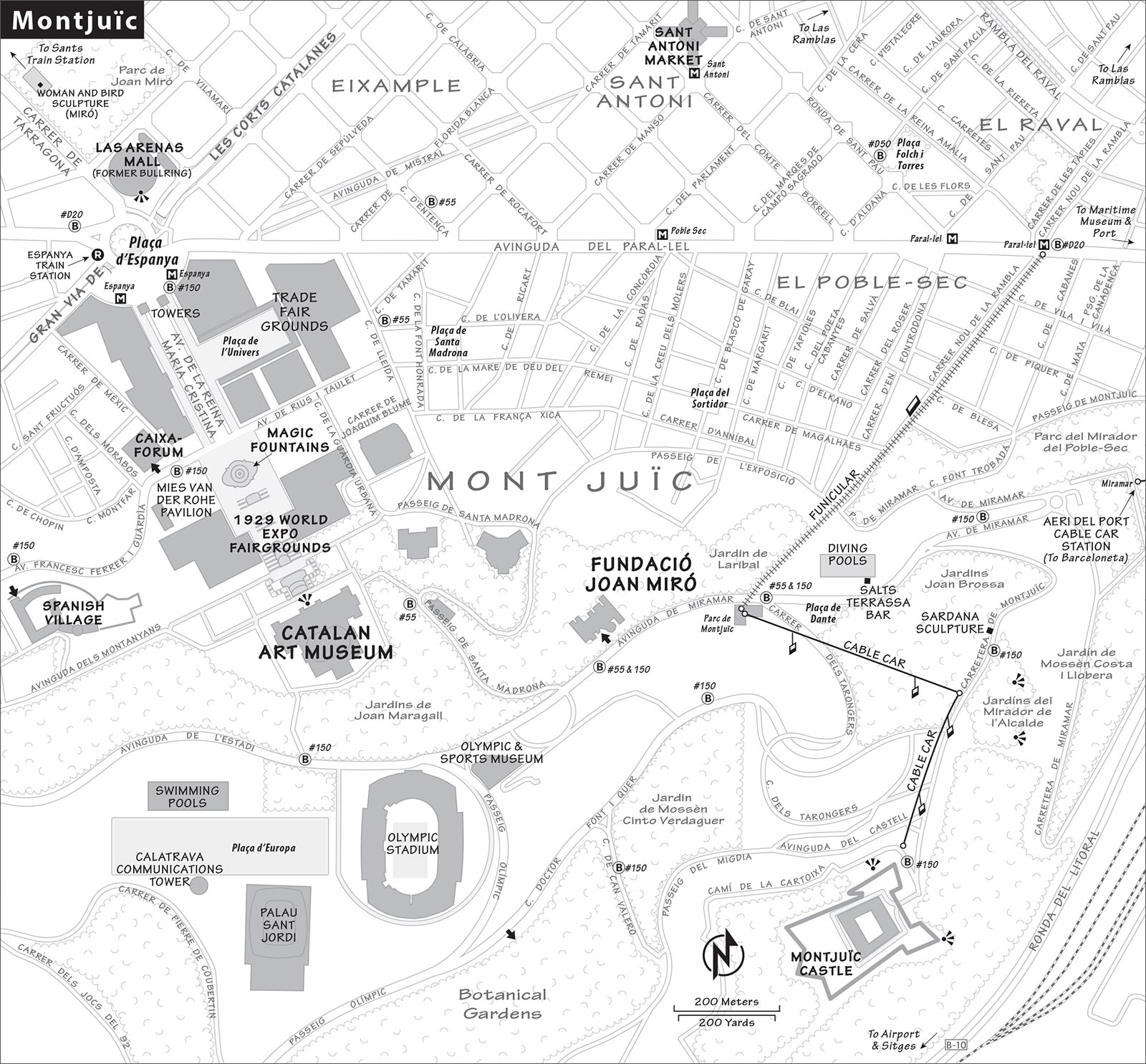
For a scenic (if slow) approach to Montjuïc, you can ride the fun circa-1929 Aeri del Port cable car (telefèric) from the tip of the Barceloneta peninsula (across the harbor, near the beach) to the Miramar viewpoint park in Montjuïc. (Another station, along the port near the Columbus Monument, is closed.) The cable car is expensive, loads excruciatingly slowly (especially coming from the beach), and goes between two relatively remote parts of town, so it’s really not an efficient connection. It’s only worthwhile for its sweeping views over town or to head back down to Barceloneta at the end of the day. Lines are shorter if you board in Montjuïc (€12.50 one-way, €20 round-trip, 3/hour, daily 10:30-19:00, June-Sept until 20:00, Nov-Feb 11:00-17:30, closed in high wind, +34 934 304 716, www.telefericodebarcelona.com).
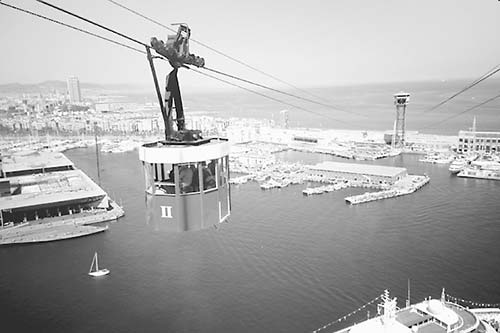
If you’re only visiting the Catalan Art Museum and/or CaixaForum, you can take the Metro to Plaça d’Espanya and walk up (primarily riding handy escalators).
Getting Around Montjuïc: Up top, it’s easy and fun to walk between the sights—especially downhill. You can also connect the sights using the red Bus Turístic or one of the public buses. Bus #150 does a loop around the hilltop and is the only bus that goes to the castle; on the way up, it stops at or passes near the CaixaForum, the Catalan Art Museum, the Olympic Stadium, Fundació Joan Miró, the lower castle cable-car station/top of the funicular, and, finally, the castle. On the downhill run, it loops by Avinguda Miramar, the cable-car station for Barceloneta. Bus #55 connects only the funicular/cable-car stations, Fundació Joan Miró, and the Catalan Art Museum.
Castle of Montjuïc (Castell de Montjuïc)
The castle, which is pretty empty, is mostly worthwhile for the great city views from its ramparts. It was built in the 18th century with a Vauban-type star-fortress design by the central Spanish government to keep an eye on Barcelona and stifle citizen revolt. Until the late 20th century, the place functioned more to repress the people of Barcelona than to defend them. When the 20th-century dictator Franco was in power, the castle was the site of hundreds of political executions. These days it serves as a park and host to a popular summer open-air cinema.
Cost and Hours: €9, free first Sun of the month and all other Sun from 15:00; open daily 10:00-20:00, Nov-Feb until 18:00; €4 tours in English Sat-Sun at 13:00; www.bcn.cat/castelldemontjuic.
Getting There: To spare yourself the hike up, ride bus #150 to the base of the castle, catching it from Plaça d’Espanya, the top of the Montjuïc funicular, or various other points on Montjuïc. Or if the lines aren’t too long, consider the much pricier cable car (Telefèric de Montjuïc), which departs from near the upper station of the Montjuïc funicular and offers excellent views (€10 one-way, €15 round-trip, runs daily June-Sept 10:00-21:00, shorter hours off-season).
▲Fundació Joan Miró
This museum has the best collection anywhere of works by Catalan artist Joan Miró (ZHOO-ahn mee-ROH, 1893-1983). Born in Barcelona, Miró divided his time between Paris and Catalunya (including Barcelona and his favorite village, Mont-roig del Camp). This building—designed in 1975 by Josep Lluís Sert, a friend of Miró and a student of Le Corbusier—was built to show off Miró’s art. The museum displays an overview of Miró’s oeuvre (as well as generally excellent temporary exhibits of 20th- and 21st-century artists). Consider renting the wonderful multimedia guide, which is well worth the extra charge.
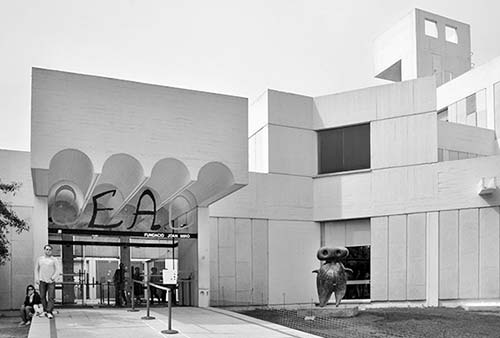
Cost and Hours: €15, cheaper online; Tue-Sat 10:00-20:00, Sun until 18:00, shorter hours in winter, closed Mon year-round; 200 yards from top of funicular, Parc de Montjuïc, +34 934 439 470, www.fmirobcn.org/ca.
Olympic Stadium (Estadi Olímpic)
Originally built for the 1929 World Expo, the stadium was updated and expanded 50-some years later in preparation for the 1992 Summer Olympics. Aside from the memories of the medals, the stadium offers little to see today. But if the doors are open, you’re welcome to step inside. History panels along the railings overlooking the playing field tell the stadium’s dynamic story.
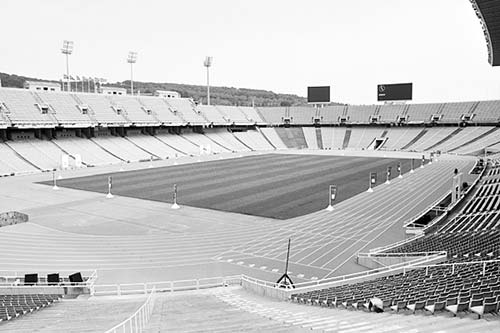
Nearby: Across the street, the Olympic and Sports Museum is high-tech but hokey—worth the time and money only for those nostalgic for the ’92 Games. Hovering over the stadium is the futuristic Montjuïc Communications Tower (designed by prominent Spanish architect Santiago Calatrava), originally used to transmit Olympic highlights and lowlights around the world.
▲▲Catalan Art Museum (Museu Nacional d’Art de Catalunya)
The mission of this wonderful museum is to showcase Catalan art from the 10th century through the mid-20th century. Often called “the Prado of Romanesque art” (and “MNAC” for short), it holds Europe’s best collection of Romanesque frescoes and offers a good sweep of modern Catalan art. It’s all housed in the grand Palau Nacional (National Palace), an emblematic building from the 1929 World Expo with magnificent views over Barcelona, especially from the building’s rooftop terrace.
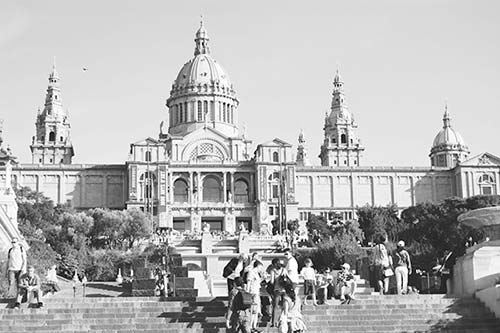
Cost and Hours: €12, free Sat from 15:00 and first Sun of month; open Tue-Sat 10:00-20:00 (Oct-April until 18:00), Sun 10:00-15:00, closed Mon year-round; above Magic Fountains near Plaça d’Espanya—take escalators up; +34 936 220 360, www.museunacional.cat.
Eating: The museum hosts the chic and pricey Oleum restaurant with vast city views (€30 fixed-priced lunch, Tue-Sun 12:30-16:00, closed Mon). There’s also a fine outdoor terrace café near the museum entrance (serving snacks with more city views; same hours as museum, closing time varies with Magic Fountains schedule) and a peaceful self-service restaurant hidden under the dome inside.
Rooftop Terrace: The rooftop terrace offers views across the city. It’s free with your museum ticket (otherwise €2; same hours as museum). To reach the terrace from the main entrance, pass the WCs on the left and show your ticket to ride the elevator most of the way, then climb a few flights of stairs up to the terrace. To take an elevator the whole way, go to the far end of the museum, through the huge dome room, to the far-right corner.
Visiting the Museum: As you enter, pick up a map and download the audioguide app; bring your own earbuds or headphones. The left wing is Romanesque, and the right wing is Gothic, Renaissance, and Baroque. Upstairs is more Baroque, plus modern art, photography, coins, and more.
Romanesque: The MNAC’s world-class collection of Romanesque (Romànic) art gives a rare glimpse into the medieval mind. Most pieces came from a handful of Catalan village churches clustered in a remote valley in the Pyrenees that thrived c. 1000-1300.
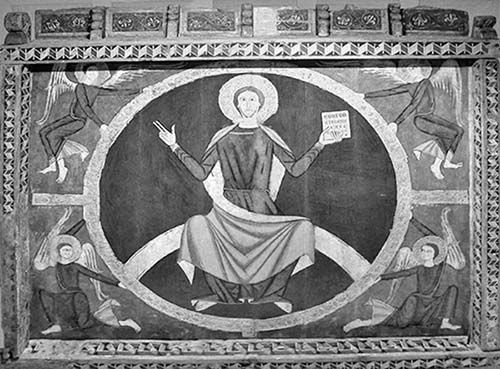
In Room 1, you’re greeted by a fresco of Mary painted in a re-created apse of one of the churches.
Room 2 has the collection’s most lively and colorful murals, painted in a straightforward literal style. In the evocative Stoning of St. Stephen, unbelievers throw baked-potato-size rocks at Stephen (kneeling at right), who’s comforted by a heavenly beam of light.
In Room 4, one apse features saints in halos (Peter with his keys alongside Mary with a flaming chalice) and the countess who paid for the painting (lower right). The other apse has winged angels (seraphim) who appear to the prophets Isaiah (lower left) and Ezekiel (right), alongside Ezekiel’s vision of the four-wheeled flaming chariot.
Rooms 5-7 focus on one of the most popular images in the medieval world: Christ in Majesty (a.k.a. the Pantocrator, or All Powerful). Jesus is depicted inside an almond-shaped halo, seated on a throne, with one hand raised in blessing, the other holding an open Bible. He’s surrounded by either seraphim or the four symbols of the Evangelists. Christ is always easy to identify—he’s the only one with a cross in his halo. Room 7 puts all the Romanesque elements together for a great in situ experience—a replica church, with Christ in Majesty in the apse and other Romanesque themes.
Browse through Rooms 8-16, seeing leafy column capitals, wooden crucifixes, and statues of Mary and the saints, until you spill back out into the main hall.
• Cross the hall to the rooms of...
Gothic Art: Picking up where Romanesque left off (c. 1300), fresco murals give way to vivid 14th-century wood-panel paintings of Bible stories. Make your way to Room 26 (straight in, then to the left) and find the collection’s highlight: a half-dozen paintings by the Catalan master Jaume Huguet (1412-1492), particularly his Consagración de San Agustín (Consecration of Saint Augustine).
These paintings (impressive enough on their own) were once part of a huge altarpiece—an estimated 40 feet tall and 30 feet wide—with some 20 paintings, done for a church in El Born. Huguet labored on the project for more than 20 years. Huguet’s masterpiece was the Consecration scene, where Augustine becomes bishop and is crowned with the hat. The details are incredible: the bright colors and gold leaf, the sober expressive faces, the brocaded robe with pictures of saints, and the early attempt at 3-D created by the floor tiles. Notice that this isn’t simply a “painting”—it has a raised surface, like a cameo. It’s a sheet of wood topped with molded stucco, then covered with paints and gold leaf. Nearby is Huguet’s Last Supper, which was also part of the Augustine altarpiece.
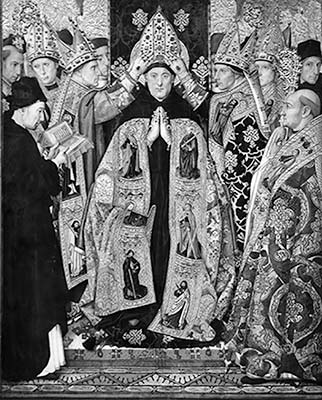
• The Gothic collection leads into...
Renaissance and Baroque: Browse several rooms, watching as Renaissance artists make altarpieces more balanced and serene, with distant realistic backgrounds. You’ll see Spain’s golden age (Zurbarán, heavy religious scenes, and Spanish royals with their endearing underbites) and examples of Romanticism (dewy-eyed Catalan landscapes). Room 32 has El Greco’s Christ Carrying the Cross and José de Ribera’s saints with wrinkled foreheads. In addition, you’ll find minor works by major—if not necessarily Catalan—masters like Velázquez, Goya, Tintoretto, Rubens, and Titian.
Rest of the Museum: The Gothic/Renaissance/Baroque exit spills out by the room of the huge dome, which has a cafeteria.
From here, you can ride the glass elevator upstairs to the modern art section, where a big chronological clockwise circle covers Symbolism, Modernisme, fin de siècle fun, Art Deco, and more.
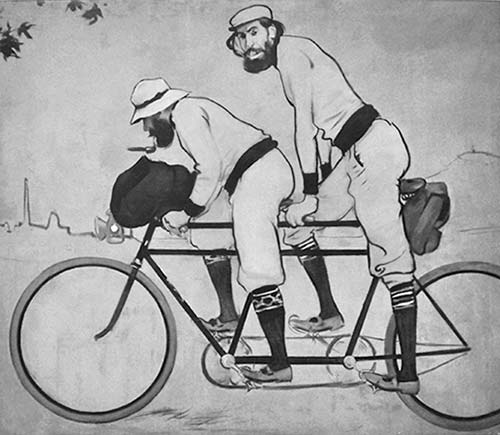
1929 WORLD EXPO FAIRGROUNDS AND NEARBY
Nearly everything you see here dates from the 1929 World Expo (the exceptions are CaixaForum and Las Arenas mall). The expo’s theme was to demonstrate how electricity was about more than lightbulbs: Electricity powered the funicular, the glorious expo fountains, the many pavilion displays, and even the flame atop the fountain marking the center of Plaça d’Espanya.
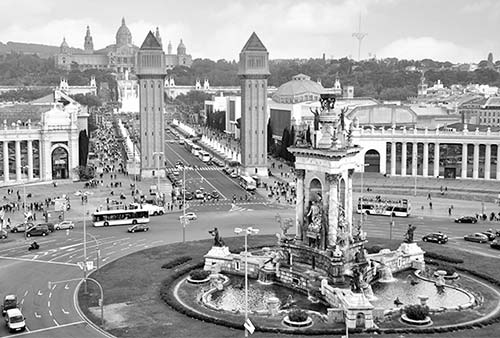
Getting There: The fairgrounds sprawl at the base of Montjuïc, from the Catalan Art Museum’s doorstep to Plaça d’Espanya. It’s easiest to see these sights on your way down from Montjuïc. Otherwise, ride the Metro to Espanya, then use the series of stairs and escalators to climb up through the heart of the fairgrounds (eventually reaching the Catalan Art Museum).
▲Magic Fountains (Font Màgica)
Music, colored lights, and huge amounts of water make an artistic and coordinated splash in the evening near Plaça d’Espanya. Check ahead, as the fountains do not run when drought causes the city to restrict water usage.
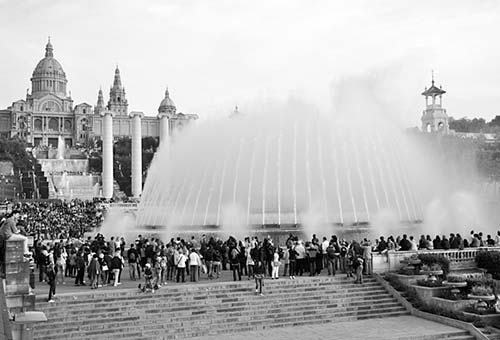
Cost and Hours: Free 20-minute shows start every half-hour; June-Sept Wed-Sun 21:30-22:30, April-May and Oct Thu-Sat 21:00-22:00, winter Thu-Sat 20:00-21:00 (no shows in drought conditions and Jan-Feb); from the Espanya Metro stop, walk toward the towering National Palace.
▲CaixaForum
The CaixaForum Social and Cultural Center is housed in one of Barcelona’s most important Art Nouveau buildings. In 1911, Josep Puig i Cadafalch (a top architect often overshadowed by Gaudí) designed the Casaramona textile factory, using Modernista design in an industrial rather than a residential context. It functioned as a factory for less than a decade, then later served a long stint as a police station under Franco. Beautifully refurbished in 2002, the facility reopened as a great center for bringing culture and art to the people of Barcelona.
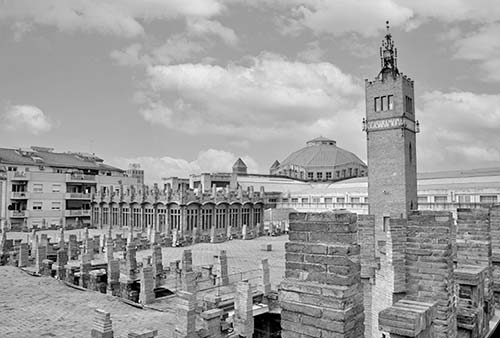
Cost and Hours: €6, daily 10:00-20:00, Avinguda de Francesc Ferrer i Guàrdia 6, +34 934 768 600, www.caixaforum.es/barcelona.
Visiting the Center: From the lobby, signs point to Sala 2, 3, 4, and 5; each typically hosts an outstanding temporary exhibition. Ride the escalator to the first floor, which features a modest but interesting exhibit about the history and renovation of the building. Then head into the appealing red-brick courtyard to access the exhibition halls. The sight features some English descriptions.
Take the stairs or elevator up to the Modernista Terrace (Planta 2, or look for signs to Aula 1). This terrace, boasting a wavy floor and bristling with fanciful brick towers, offers views over the complex and to Montjuïc.
Las Arenas Mall
The grand Neo-Moorish Modernista plaça de toros functioned as an arena for bullfights from around 1900 to 1977, and then reopened in 2011 as a mall. The rooftop terrace, with stupendous views of Plaça d’Espanya and Montjuïc, is ringed with eateries (reachable by external glass elevator for €1 or from inside escalators/elevators for free). Besides getting a bird’s-eye perspective of the fairgrounds, you can gaze down at Parc de Joan Miró, which includes the giant sculpture Woman and Bird (Dona i Ocell). Miró’s sense of humor is evident—if the sculpture seems phallic, keep in mind that the Catalan word for “bird” is also slang for “penis.”
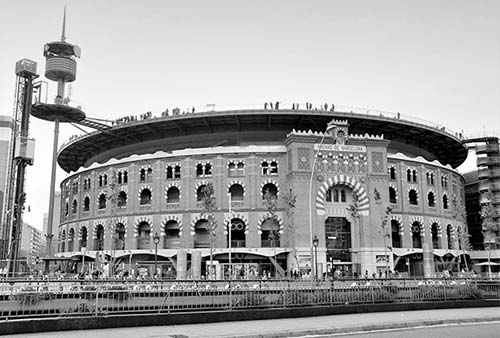
Cost and Hours: Free; daily 10:00-22:00, Oct-May 9:00-21:00; outside elevator and restaurants open late year-round, Gran Via de les Corts Catalanes 373, Metro: Espanya, exit following Sortida Tarragona signs, www.arenasdebarcelona.com.
BEACHES & NEARBY
▲Barcelona’s Beaches
Barcelona has created a summer tourist trade by building a huge stretch of beach east of the town center. From Barceloneta, an uninterrupted band of sand tumbles three miles northeast to the Fòrum.
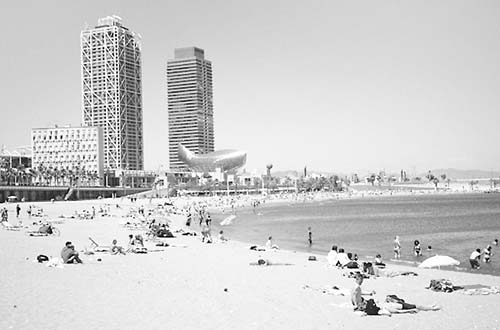
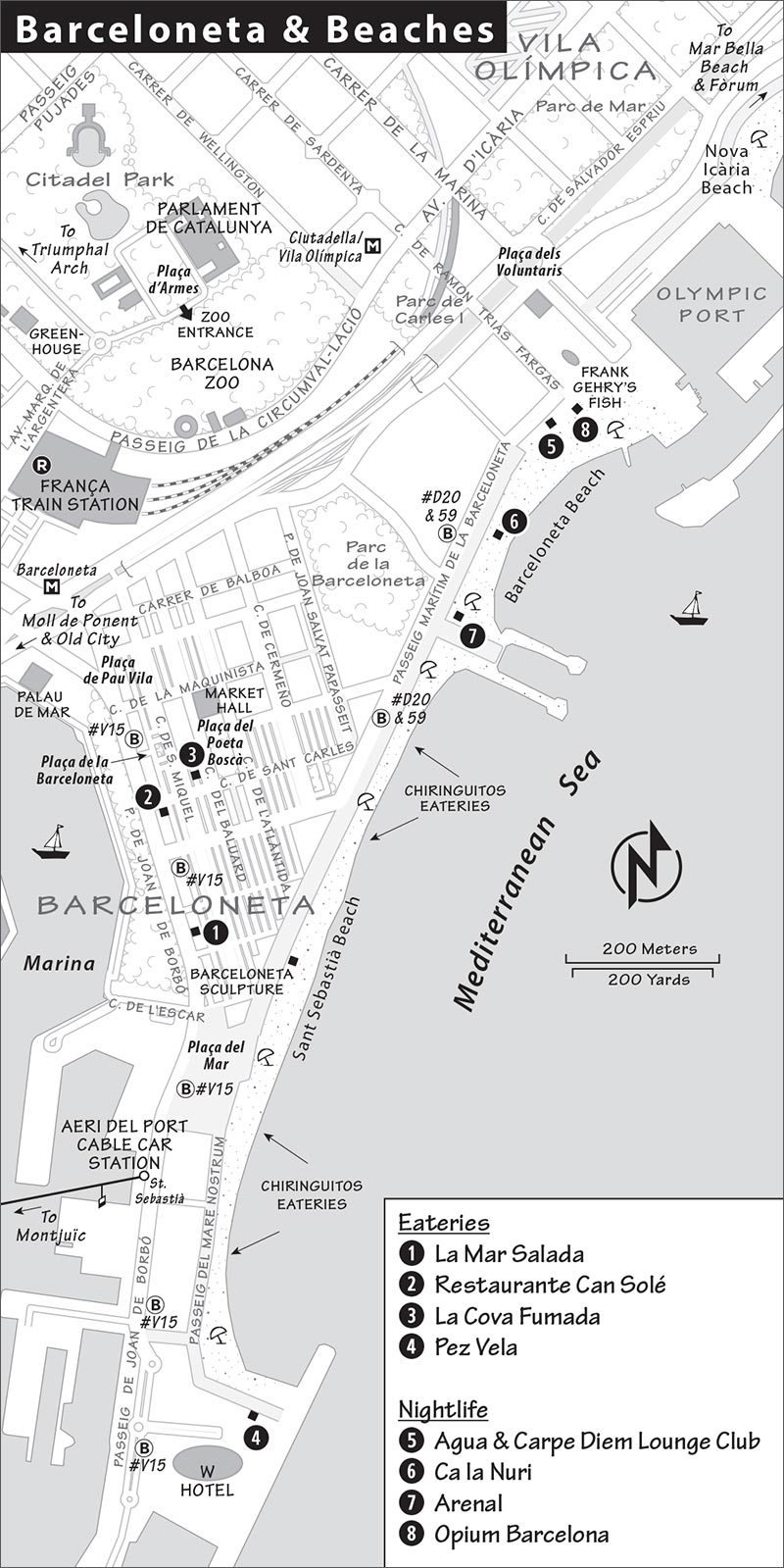
The overall scene is great for sunbathing and for an evening paseo before dinner. It’s like a resort island—complete with lounge chairs, volleyball, showers, WCs, bike paths, and inviting beach bars called chiringuitos. Each beach segment has its own vibe: Sant Sebastià (closest, popular with older beachgoers and families), Barceloneta (with many seafood restaurants), Nova Icària (pleasant family beach), and Mar Bella (attracts a younger crowd, clothing-optional).
Getting There: The Barceloneta Metro stop leaves you a long walk from the sand. To get to the beaches without a hike, take the bus. From the Ramblas, bus #59 will get you as far as Barceloneta Park; bus #D20 leaves from the Columbus Monument and follows a similar route. Bus #V15 runs from Plaça de Catalunya to the tip of Barceloneta (near the W Hotel).
Biking the Beach: For a break from the city, rent a bike and take the following little ride: Explore Citadel Park, filled with families enjoying a day out. Then roll through Barceloneta. This artificial peninsula was once the home of working-class sailors and shippers. From the Barceloneta beach, head up to the Olympic Village, where the former apartments for 13,000 visiting athletes now house permanent residents. From here you’ll come to a series of man-made crescent-shaped beaches, each with trendy bars and cafés. You might find yourself pedaling past people working on an all-over tan. In the distance is the huge solar panel marking the Fòrum shopping and convention center.
Citadel Park (Parc de la Ciutadella)
In 1888, Barcelona’s biggest, greenest park—originally the site of a much-hated military citadel—was transformed for a Universal Exhibition (world’s fair). The stately Triumphal Arch at the top of the park, celebrating the removal of the citadel, was built as the main entrance. Inside you’ll find wide pathways, plenty of trees and grass, a zoo, a museum of geology, and a castle-like former restaurant for the fair (closed to the public).
Enjoy the ornamental fountain that the young Antoni Gaudí helped design, and consider a jaunt in a rental rowboat on the lake in the center of the park. Check out the tropical Umbracle greenhouse and the Hivernacle winter garden, which has a pleasant café-bar.
Cost and Hours: Park entry is free, daily 10:00 until dusk, north of França train station, Metro: Arc de Triomf, Barceloneta, or Ciutadella/Vila Olímpica.