CÓRDOBA
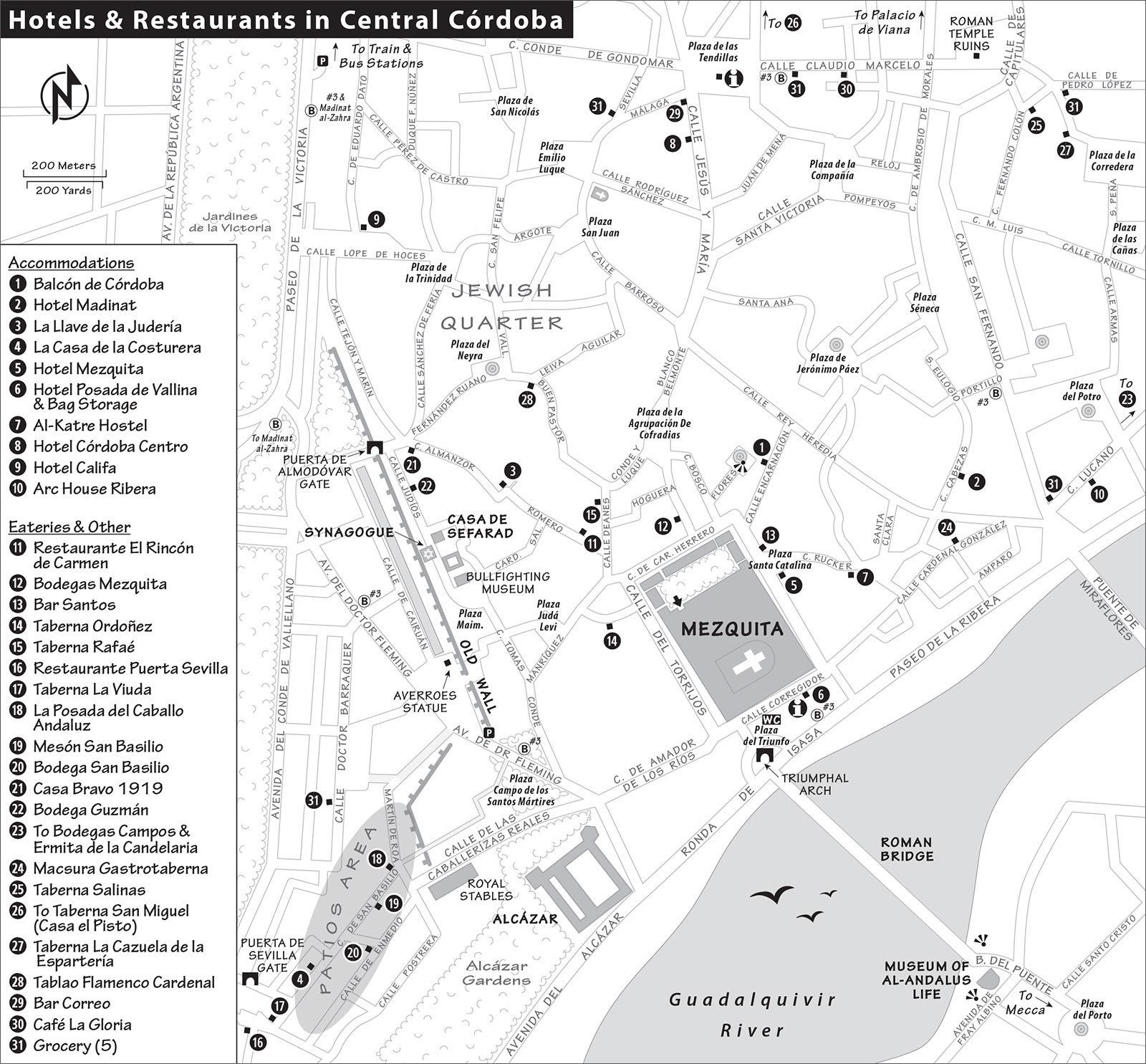
Map: Hotels & Restaurants in Central Córdoba
BETWEEN PUERTA DE ALMODÓVAR AND THE JEWISH QUARTER
JUST EAST OF THE MEZQUITA ZONE
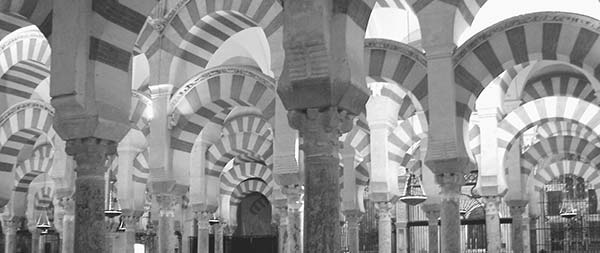
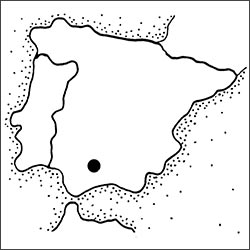
Straddling a sharp bend of the Guadalquivir River, Córdoba has a glorious Roman and Moorish past, once serving as a regional capital for both empires. It’s home to Europe’s best Islamic sight after Granada’s Alhambra: the Mezquita, a splendid and remarkably well-preserved mosque that dates from AD 784. When you step inside the mosque, which is magical in its grandeur, you can imagine Córdoba as the center of a thriving and sophisticated culture. During the Dark Ages, when much of Europe was barbaric and illiterate, Córdoba was a haven of enlightened thought—famous for religious tolerance, artistic expression, and dedication to philosophy and the sciences. To this day, you’ll still see and feel the Muslim influence in Córdoba.
Beyond the magnificent Mezquita, the city of Córdoba has two sides: the touristy maze of old town streets immediately surrounding the giant main attraction (lined with trinket shops, hotels, and restaurants), and the workaday but interesting modern city (centered on Plaza de las Tendillas). In between are the side lanes of the Jewish Quarter, humming with history. Just a quick walk takes you from a commercialized vibe into real-life Córdoba.
PLANNING YOUR TIME
Ideally, Córdoba is worth two nights and a day. Don’t rush the magnificent Mezquita, but consider sticking around to experience the city’s other pleasures.
If time is tight, many do Córdoba as a quick stopover or easy day trip—made possible by the city’s convenient location on the AVE bullet train line between Granada and Sevilla (about an hour from each, with plenty of departures).
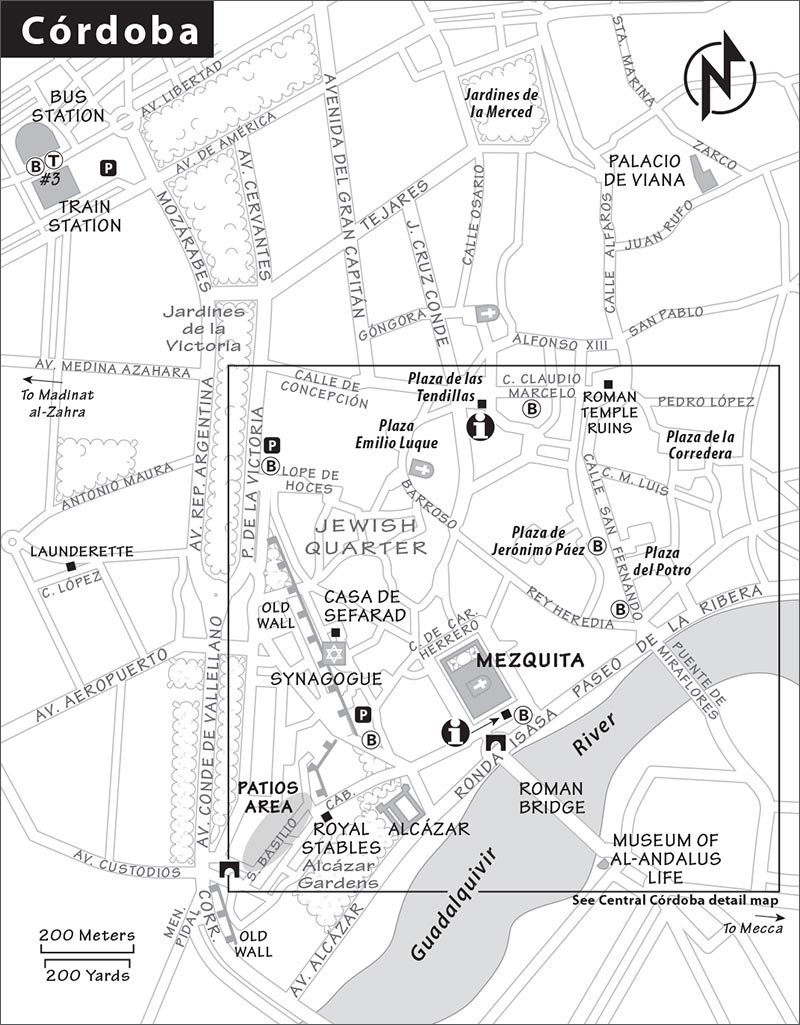
Ideas for your Córdoba quickie: Stash your luggage in lockers at the bus station (next to the train station), and either take a taxi, bus #3, or the hop-on, hop-off bus from the train station to the central point where the Roman Bridge hits the Mezquita. I’d spend my time seeing the Mezquita (2 hours), having lunch (1 hour), and sightseeing the old quarter (3 hours visiting whatever appeals to you from this chapter).
There is no need to book anything in advance. Prepare for brutal heat in season.
Orientation to Córdoba
Córdoba’s big draw is the mosque-turned-cathedral called the Mezquita (meth-KEE-tah). Most of the town’s major sights are nearby, including the Alcázar, a former royal castle. And though the town seems to ignore its marshy Guadalquivir River (a prime bird-watching area), the riverbank sports a Renaissance triumphal arch next to a stout “Roman Bridge.” The bridge leads to the town’s old fortified gate (which houses a museum on Moorish culture, the Museum of al-Andalus Life). The Mezquita is buried in the characteristic medieval town. Around that stretches the Jewish Quarter, then the modern city—with some striking Art Deco buildings at Plaza de las Tendillas and more modern architecture lining Avenida del Gran Capitán.
TOURIST INFORMATION
Córdoba has a helpful TI at Plaza de las Tendillas (daily 9:00-14:30, +34 957 471 577, https://turismodecordoba.org). Another option is the visitors center near the Mezquita, which has good tips on Córdoba nightlife and covers the entire Andalucía region (Mon-Sat 9:00-19:00, Sun until 14:30, free WCs in basement along with a few ruins and a reproduction of how the Moorish city of “Qurtuba” looked 1,000 years ago, Plaza del Triunfo, +34 957 355 179, same website as the TI).
ARRIVAL IN CÓRDOBA
By Train or Bus: Córdoba’s train station is located on Avenida de América. The modern glass-and-steel station has ATMs, restaurants, shops, an information counter, and a small lounge for first-class passengers of the high-speed AVE train line. Taxis and local buses are just outside, to the left as you come up the escalators from the platforms.
The bus station is across the street from the train station (on the north side of Avenida Vía Augusta). There’s no luggage storage at the train station, but the bus station has lockers (look for Consigna/Locker sign, buy a token at the machine near ticket booth #11, lockers are around the corner). Car-rental agencies are located in both stations.
To get to the old town, hop a taxi (€8 to the Mezquita) or catch bus #3 (stop is between the train and bus stations, parallel to the taxi line, buy €1.30 ticket on board). The route includes convenient stops for recommended hotels near Plaza de las Tendillas; Calle San Fernando, a short walk to the Mezquita; Puerta del Puente, ideal for the riverfront; and the patio-filled neighborhood of San Basilio.
It’s about a 25-minute walk from either station to the old town. To walk from the train station to the Mezquita, turn left onto Avenida de América, then right through the pleasantly manicured Jardines de la Victoria park. Near the end of the park, on the left, you’ll see a section of the old city walls. The Puerta de Almodóvar gate and a statue of Seneca mark the start of Calle de Cairuán (sometimes signposted as Kairuán). Follow this street downhill, with the wall still on your left, until you reach Plaza Campo de los Santos Mártires. Then head left, past the Alcázar, down Calle Amador de los Rios, which leads directly to the Mezquita and the river.
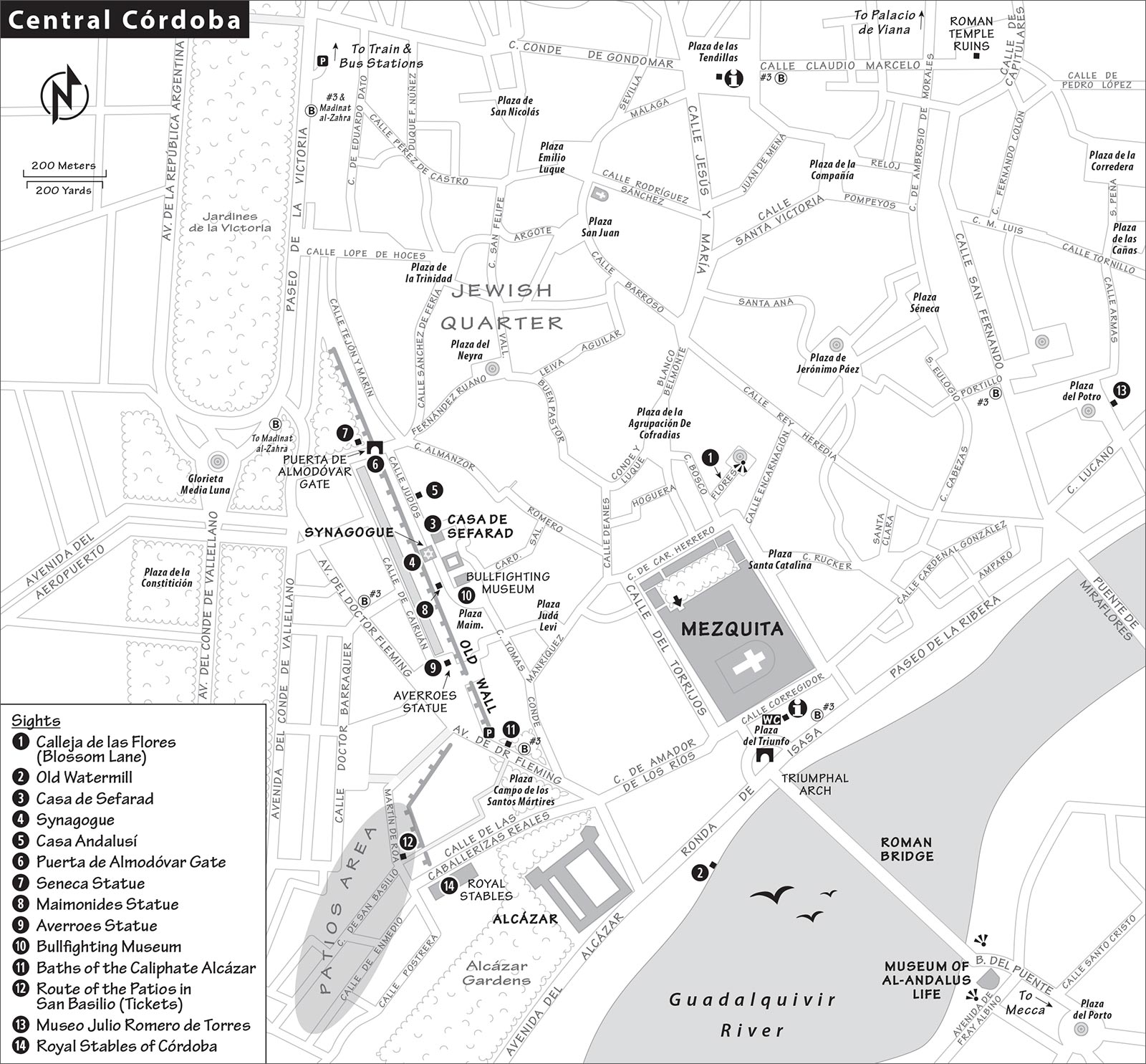
By Car: The easiest way to enter the city center from Madrid or Sevilla on A-4/E-5 is to follow signs for Córdoba sur and Plaza de Andalucía, following palm-tree-lined A-431 (a.k.a. Avenida del Corregidor). For public parking, half a mile after crossing the Guadalquivir River, veer right onto Paseo de la Victoria, then look for a blue parking sign on the left (just before Calle Concepción) and a ramp down to an underground lot. To reach the bus or train station (with car-rental agencies), continue north on Paseo de la Victoria. The best and most central garage near the Mezquita is Parking la Mezquita de Córdoba (open 24/7, 200 spots, Calle Cairuan 1, +34 957 787 959).
HELPFUL HINTS
Closed Days: The Alcázar, Madinat al-Zahra, Bullfighting Museum, Museo Julio Romero de Torres, Palacio de Viana, Casa de Sefarad, and Synagogue are closed on Monday.
Addresses: Addresses with a street name followed by “s/n” have no street number.
Festivals: Held for 10 days late in May, Córdoba’s Spring Fair is like Sevilla’s more famous fair, but the caseta party tents are more public and welcoming. It’s elegant by day and more like a teen disco in the evening. Calle San Fernando (a.k.a. Calle de la Feria) sees a parade of women in extravagant flamenco dresses and men in traditional Cordovan sombreros strolling over the river to the fairgrounds. In the summer, the TI hosts a series of free flamenco shows called Flamenco en la Terraza (June-Sept Thu-Sat at 22:00, Plaza del Triunfo).
Heat Alert: Climate change is hitting Andalucía particularly hard—Écija, halfway between Córdoba and Sevilla, is called “the frying pan of Spain.” Recent summers have seen historic heat and almost no rain. Córdoba is a city of sunscreen and shade-hopping, with the temperature peaking at about 17:00. Thankfully the heat is dry and things cool down at night.
Baggage Storage: The bus station has lockers. In the old town, the recommended Hotel Posada de Vallina, on the river side of the Mezquita, is as central as can be and offers a secure bag-check service (€6/day per bag, open 24/7, friendly Manuel speaks English, Calle Corregidor Luis de la Cerda 83, +34 957 498 750).
Laundry: Find self-service machines at Solymar Tintorería (Mon-Fri 9:30-13:30 & 17:30-20:00, Sat 9:30-13:30 only, closed Sun, shorter hours in summer, Calle Maestro Priego López 2, +34 957 233 818).
Tours in Córdoba
ON FOOT
Private Tours: Good licensed local guides can bring this historic city to life with private tours (figure €150/3 hours, €180 on weekends). I’ve enjoyed working with Isabel Martínez Richter (+34 669 369 645, isabmr@gmail.com), Lola Santos Serrano (L646475345@gmail.com, +34 646 475 345), and Maria and Francisco (mariafont@gmail.com, +34 607 955 008, they also offer public tours—see below).
Public Tours: Maria Font arranges various shared city walks described on her website (around €30/person, www.visitarmezquitadecordoba.com, mariafont@gmail.com, +34 607 955 008).
ON WHEELS
Bike Tours
Francisco Meijer, a Dutchman who’s lived here for many years, organizes two-hour bike tours in English, which start and finish in the Santa Marina district and give a good and fun overview (€25, daily 10:00 and 12:30, maximum 10 per group, info@ontdekcordoba.com, www.ontdekcordoba.com, +34 648 643 829). Francisco also gives private walks (€120/2 hours) and public walking tours.
Hop-On, Hop-Off Bus
A €22 ticket (good for 24 hours) gives you access to two bus routes and two walking tours. The big bus “panoramic” circuit stops at the train/bus station (handy for day-trippers) and the “intimate” microbús route stops at the Mezquita, Plaza de las Tendillas, Palacio de Viana, and elsewhere. The ticket also includes two walking tours, including one of the Jewish Quarter (buses with recorded narrations depart about every 30 minutes, letting you hop on and off from 9:30 to 21:00, until 18:00 off-season; www.city-sightseeing.com).
Sights in Córdoba
Calleja de las Flores (Blossom Lane)
Triumphal Arch and Plague Monument
▲Museum of al-Andalus Life and Calahorra Tower (Museo Vivo de al-Andalus y Torre Calahorra)
Jewish Córdoba and West of the Mezquita
City Walls and Statues of Seneca, Maimonides, and Averroes
▲Bullfighting Museum (Museo Taurino Córdoba)
Alcázar (Alcázar de los Reyes Cristianos)
Baths of the Caliphate Alcázar (Baños del Alcázar Califal)
▲Route of the Patios in San Basilio
Madinat al-Zahra (Medina Azahara)
MEZQUITA
Worth ▲▲▲, this massive former mosque—with a 16th-century church rising from the middle—was once the center of Western Islam and the heart of a cultural capital that rivaled Baghdad and Constantinople. A wonder of the medieval world, it’s remarkably well preserved, giving today’s visitors a chance to soak up the ambience of Islamic Córdoba in its 10th-century prime.
Cost: €13, buy timed-entry ticket online in advance or inside the Patio de los Naranjos with credit card at machine or with cash at window (OK to enter 30 minutes before or after your assigned time). Visitors are welcome to explore the mosque and church for free Mon-Sat from 8:30 until the 9:30 Mass (no access to altar, choir, or treasury during free entry period).
Hours: Mon-Sat 10:00-19:00, Sun 8:30-11:30 & 15:00-19:00; Nov-Feb closes daily at 18:00; Christian altar accessible only after 10:00 unless you attend Mass; usually less crowded after 15:00. During religious holidays, particularly Holy Week, the Mezquita may close to sightseers at certain times of day—check the online events calendar before you go. You can also enjoy the Mezquita on a sound-and-light tour on most summer evenings (described under “Entertainment in Córdoba,” later).
Information: +34 957 470 512, www.mezquita-catedraldecordoba.es.
Tours: Detailed but dry audioguide-€4.
Bell Tower Climb: €3, limited to 20 people every half-hour, daily 9:30-18:30, until 17:30 in winter. Reserve a time for your climb when you buy your ticket.
Planning Your Visit: Usually one hour is enough to visit the interior of the Mezquita. If you plan to climb the bell tower, save it for last.
 Self-Guided Tour
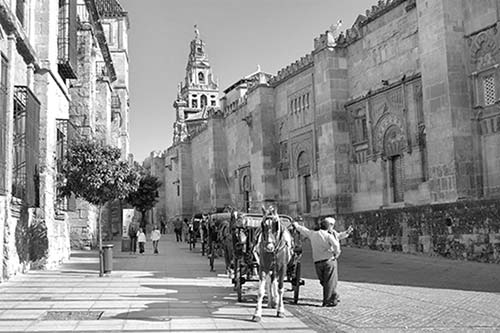
Before entering the patio, take in the exterior of the Mezquita. The mosque’s massive footprint is clear when you survey its sprawling walls from outside. At 600 feet by 400 feet, it dominates the higgledy-piggledy medieval town that surrounds it.
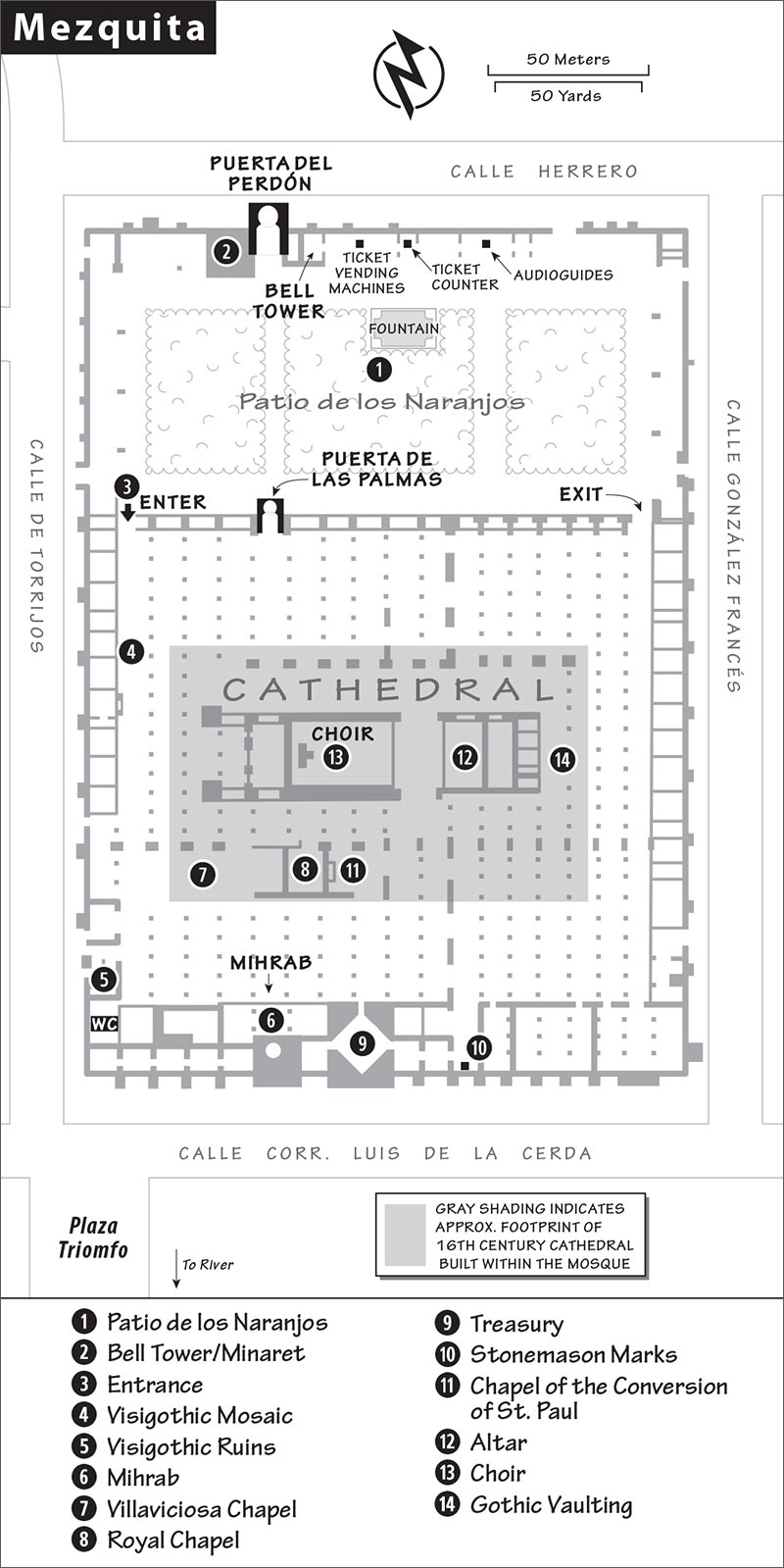
1 Patio de los Naranjos
The Mezquita’s big, welcoming courtyard is free to enter. When this was a mosque, the Muslim faithful would gather in this courtyard to perform ablution—ritual washing before prayer, as directed by Muslim law. The courtyard walls display many of the former mosque’s carved and painted ceiling panels and beams, which date from the 10th century. The original mosque had open horseshoe arches creating one big indoor/outdoor prayer space. The rows of orange trees were added as a continuation of the columns in the prayer hall.
2 Bell Tower/Minaret
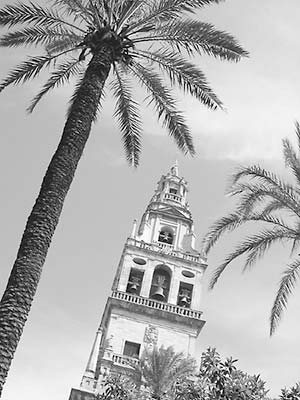
Gaze up through the trees for views of the Renaissance-style bell tower (c. 1600), built over the remains of the original Muslim minaret. For four centuries, five times a day, a singing cleric (the muezzin) would ascend the minaret, then call to all Muslims within earshot that it was time to face Mecca and pray. And for the last five centuries the big bells have called Christians to prayer.
• Buy your ticket to enter the mosque (and, if you wish, rent an audioguide at a separate kiosk to the right).
3 Entrance
Walking into the former mosque from the patio, you pass from an orchard of orange trees into a forest of delicate columns (erected here in the eighth century). The more than 800 red-and-blue columns are topped with double arches—a round Romanesque arch above a Visigothic horseshoe arch—made from alternating red brick and white stone. The columns and capitals (built of marble, granite, and alabaster) were recycled from ancient Roman ruins and conquered Visigothic churches. (Golden age Arabs excelled at absorbing both the technology and the building materials of the peoples they conquered—no surprise, considering the culture’s nomadic roots.) The columns seem to recede to infinity, as if reflecting the immensity and complexity of Allah’s creation.
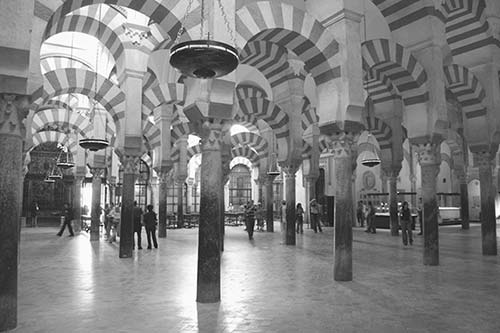
Although it’s a vast room, the low ceilings and dense columns create an intimate and reverent atmosphere. The original mosque was brighter, before Christians renovated the place for their use and closed in the arched entrances from the patio and street. The giant cathedral built after the Reconquista sits in the center of the mosque. We’ll visit it after exploring the mosque.
• From the entrance, count five columns into the building and look for two small walls. Between them, find a glass floor covering a section of mosaic floor below. Look in.
4 Visigothic Mosaic
Archaeologists want to believe the mosque stands on the site of the early-Christian Church of San Vicente, built during the Visigothic period (sixth century). Peering down, you can see a mosaic that could be the remains from that original church. (It may also simply be some ancient Roman-decorated floor.) This is important to Catholic locals, as it proves there was a church here before the mosque—thereby giving credence to those who see the modern-day church on this spot as a return to the site’s original purpose, rather than a violation of the mosque.
• Continue ahead to the wall opposite the entrance, where you’ll find more...
5 Visigothic Ruins
On display in the corner are rare bits of carved stone from that same sixth-century church. (Most other stonework here had been scrubbed of its Christian symbolism by Muslims seeking to reuse them for the mosque.) According to Arabic chronicles, Prince Abd al-Rahman bought the church from his Christian subjects before leveling it to build his mosque. From here, pan to the right to take in the sheer vastness of the mosque. (A hidden WC and drinking fountain are in the corner.)
• Walk to your left until you come to the mosque’s focal point, the...
6 Mihrab
The equivalent of a church’s high altar, this was the focus of the mosque and remains a highlight of the Mezquita today. Picture the original mosque at prayer time, with a dirt floor covered by a patchwork of big carpets. More than 20,000 people could pray at once here. Imagine the multitude kneeling in prayer, facing the mihrab, rocking forward to touch their heads to the ground, and saying, “Allahu Akbar, la ilaha illa Allah, Muhammad rasul Allah”—“Allah is great, there is no God but Allah, and Muhammad is his prophet.”
The mihrab, a feature in all mosques, is a decorated niche—in this case, more like a small room with a golden-arch entrance. During a service, the imam (prayer leader) would stand here to read scripture and give sermons. He spoke loudly into the niche, his back to the assembled crowd, and the architecture worked to amplify his voice so all could hear. Built in the mid-10th century by al-Hakam II, the exquisite room reflects the wealth of Córdoba in its prime. Three thousand pounds of shimmering multicolored glass-and-enamel cubes panel the walls and domes in mosaics designed by Byzantine craftsmen, depicting flowers and quotes from the Quran. Gape up. Overhead rises a colorful, starry dome with skylights and interlocking lobe-shaped arches.
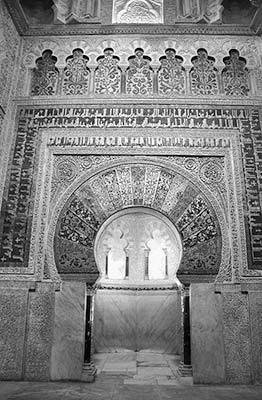
• Now turn around so that you’re facing away from the mihrab. Ahead of you, and a bit to the left, is a roped-off open area. Gaze into the first chapel built within the mosque after the Christian Reconquista.
7 Villaviciosa Chapel
For about four centuries, the Christian place of worship within the mosque was quite small and stood right here. In 1236, Saint-King Ferdinand III conquered the city and turned the mosque into a church. The higher ceiling allowed for clerestory windows and more light, making it feel more church-like. Still, the locals continued to call it “la Mezquita,” and left the structure virtually unchanged (70 percent of the original mosque structure survives to this day). Sixteen columns were removed and replaced by Gothic arches to make this first chapel. It feels as if the church architects appreciated the opportunity to incorporate the sublime architecture of the preexisting mosque into their church. Notice how the floor was once almost entirely covered with the tombs of nobles and big shots eager to make this their final resting place.
• Immediately to your right (as you face the main entrance of the Mezquita), you’ll see the walled-off...
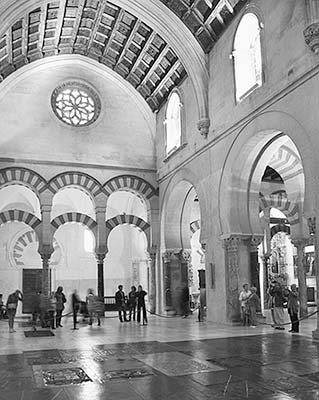
8 Royal Chapel
The chapel—designed for the tombs of two Christian kings of Castile, Fernando IV and Alfonso XI—is completely closed off. Peek through the windows here or wander to the right side for the best views. While it was never open to the public, the tall, well-preserved Mudejar walls and dome are easily visible. Notice the elaborate stucco and tile work. The lavish Arabic-style decor dates from the 1370s, done by Muslim artisans after the Reconquista of the city. The floor inside has been raised to accommodate tombs buried beneath it. The fact that a Christian king chose to be buried in a tomb so clearly Moorish in design indicates the mutual respect between the cultures (before the Inquisition changed all that). The remains of both Castilian kings were moved to another Córdoba church in the 1700s, so it remains a mystery why this chapel is still closed to visitors.
• Return to the mihrab, then go through the big, pink marble door to your immediate left, which leads into the Baroque...
9 Treasury (Tesoro)
The treasury is filled with display cases of religious artifacts and the enormous monstrance that is paraded through the streets of Córdoba each Corpus Christi, 60 days after Easter (notice the handles).
The monstrance was an attempt by 16th-century Christians to create something exquisite enough to merit being the holder of the Holy Communion wafer. As they believed the wafer actually was the body of Christ, this trumped any relics. The monstrance is designed to direct your gaze to heaven. While the bottom is silver-plated 18th-century Baroque, the top is late Gothic—solid silver with gold plating (much of it “imported” from Mexico) courtesy of 16th-century conquistadors. Gaze up at an equally spectacular ceiling.
The big canvas nearest the entrance shows Saint-King Ferdinand III, who conquered Córdoba in 1236, accepting the keys to the city’s fortified gate from the vanquished Muslims. The victory ended a six-month siege and resulted in a negotiated settlement: The losers’ lives were spared, providing they evacuated. Most went to Granada, which remained Muslim for another 250 years. The same day, the Spaniards celebrated Mass in a makeshift chapel right here in the great mosque.
The black-and-white marble funerary monument at the entrance opposite Ferdinand III belongs to Fray Pedro de Salazar y Toledo. After studies in Salamanca, Salazar had the honor of being the main preacher to two Spanish kings, Philip IV and Charles II. In 1686, he was named cardinal by Pope Innocent XI, but his local claim to fame is as founder of one of the first public hospitals in Córdoba, in use today as the School of Philosophy for the local university.
Among the other Catholic treasures, don’t miss the ivory crucifix (next room, body carved from one tusk, arms carefully fitted on) from 1665. Get close to study Jesus’ mouth—it’s incredibly realistic. The artist? No one knows.
• Just outside the treasury exit you enter the last part of the mosque to be built. A glass case (on the right) holds casts that show many…
10 Stonemason Marks
These casts bear the marks and signatures left by those who cut them to build the final wing of the mosque. Try to locate the actual ones on nearby columns. (I went five for six.) This part of the mosque has the best light for photography, thanks to skylights put in by 18th-century Christians.
This section of the mosque was an add-on. In fact, if you look over and above the door you just passed through, you’ll see what was until about the year 1000 the mosque’s original exterior wall.
The mosque grew over several centuries under a series of rulers. Remarkably, each ruler kept to the original vision—rows and rows of multicolored columns topped by double arches. Then came the Christians.
11 Chapel of the Conversion of St. Paul
Sharing a back wall with the Royal Chapel, the church ceded this space for the burial of Pedro Muñiz de Godoy—Grand Master of the Order of Santiago, who fought several battles for Castile against the Portuguese in the 1300s. Godoy’s descendants spent a fortune to painstakingly clean and restore the chapel, which drips with gold and 17th-century sculpture. The chapel is likely by the same architect as the choir you are about to see.
• Find the towering church in the center of the mosque and step in.
12 Altar
Rising up in the middle of the forest of columns is the bright, restored cathedral, oriented with its altar at the east end, per Christian tradition. Gazing up at the rich, golden decoration, it’s easy to forget that you were in a former mosque just seconds ago. While the mosque is about 30 feet high, the cathedral’s space soars 130 feet up. Look at the glorious ceiling.
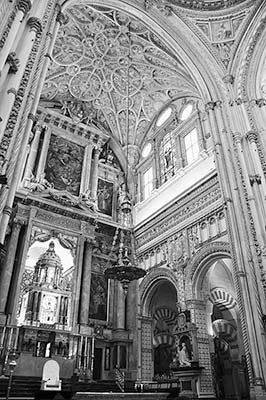
In 1523 Córdoba’s bishop proposed building this grand church in the Mezquita’s center. The town council opposed it, but the Spanish king ordered it done. If that seems like a travesty to you, consider what some locals will point out: Though it would have been quicker and less expensive for the Christian builders to destroy the mosque entirely, they respected its beauty and built their church into it instead.
As you take in the styles of these two great places of worship, ponder how they may reflect the differences between Catholic and Islamic aesthetics and psychology when this architecture was built: horizontal versus vertical, intimate versus powerful, loving versus fear-inspiring, dark versus bright, simple versus elaborate, feeling close to God versus feeling small before God.
The basic structure is late Gothic, with fancy Isabelline-style columns. The nave’s towering Renaissance arches and dome emphasize the triumph of Christianity over Islam in Córdoba. The twin pulpits feature a marble bull, eagle, angel, and lion—symbols of the four evangelists. The modern throne-like cátedra (the seat of the bishop) is made of Carrara marble.
While churches and mosques normally both face east (to Jerusalem or Mecca), this space holds worship areas aimed 90 degrees from each other, since the mihrab faces south. Perhaps it’s because from here you have to travel south (via Gibraltar) to get to Mecca. Or maybe it’s because this mosque was designed by the Umayyad branch of Islam, whose ancestral home was Damascus—from where Mecca lies to the south.
• Facing the high altar is a big, finely decorated wooden enclosure.
13 Choir
The Baroque-era choir stalls were added much later—made in 1750 of Caribbean mahogany. While cluttering up a previously open Gothic space, the choir is considered one of the masterpieces of 18th-century Andalusian Baroque. Each of the 109 stalls (108 plus the throne of the bishop) features a scene from the Bible: Mary’s life on one side facing Jesus’ life on the other. The lower chairs feature carved reliefs of the 49 martyrs of Córdoba (from Roman, Visigothic, and Moorish times), each with a palm frond symbolizing martyrdom and the scene of their death in the background.
The medieval church strayed from the inclusiveness taught by Jesus: choirs (which were standard throughout Spain) were for clerics (canons, priests, and the bishop). The pews in the nave were for nobles. And the peasants listened in from outside. (Lay people didn’t understand what they were hearing anyway, as Mass was held in Latin until the 1960s.) Those days are long over. Nowadays, a public Mass is said—in Spanish—right here before the site is open to the public (Mon-Sat at 9:30, Sun at 12:00 and 13:30).
• Before leaving, walk to the back of the altar to admire the 14 Gothic vaulting mingled with Moorish arches—a combination found nowhere else in the world.
NEAR THE MEZQUITA
These sights are all within a few minutes’ walk of the Mezquita.
North of the Mezquita
Calleja de las Flores (Blossom Lane)
For a pretty picture, find Calleja de las Flores (a.k.a. “Blossom Lane”). This narrow flower-bedecked street frames the Mezquita cathedral’s bell tower as it hovers in the distance. The view is a favorite for the Instagram crowd and local guidebook covers.
On and near the River
Just downhill from the Mezquita is the Guadalquivir River, which flows on to Sevilla and eventually out to the Atlantic. While silted up today, back in Roman times it was navigable from here. The town now turns its back on the Guadalquivir, but the arch next to the Roman Bridge (with its ancient foundation surviving) and the fortified gate on the far bank (now housing a museum, described later) evoke a day when the river was key to the city’s existence.
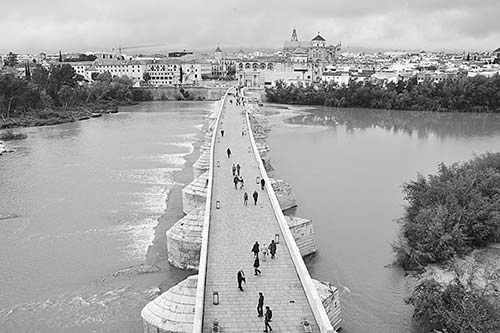
Triumphal Arch and Plague Monument
The unfinished Renaissance arch was designed to give King Philip II a royal welcome, but he arrived before its completion—so the job was canceled. (“Very Andalusian,” according to a local friend.) The adjacent monument with the single column is an 18th-century plague monument dedicated to St. Raphael, who was in charge of protecting the region’s population from its main scourges: plague, hunger, and floods. When Covid-19 hit in 2020, Córdoba had a light casualty rate. Many who prayed at this historic column believe that was St. Raphael coming once again to the rescue.
Roman Bridge and River Views
The ancient bridge sits on its first-century-AD foundations and retains its 16th-century arches. It was the first bridge built over the Guadalquivir and established Córdoba as a strategic place. It went pedestrian-only in 2009, and Cordovans stroll here nightly. Walk across the bridge for a fine view of the city—especially the huge mosque with its cathedral busting through the center. Viewing Córdoba from midbridge, you’ll notice how no building is allowed to be taller than the bell tower at the Mezquita.
The Guadalquivir River, while tamed by dams today, powered its medieval industry with watermills. It’s safe to say any ruined building in a river like this was a millhouse where, for example, wheat was ground into flour. Notice the big waterwheel on the left side of town. Called the Molino de la Albolafia, with river power it filled jugs and raised them high to dump into a small aqueduct that provided running water to the Alcázar. Today’s big industry is tourism, with a steady flow of people arriving riverside to make Córdoba’s historic south gate today’s tourist gate.
Crossing the bridge, you’ll reach the museum described next.
▲Museum of al-Andalus Life and Calahorra Tower (Museo Vivo de al-Andalus y Torre Calahorra)
This museum fills the fortified gate (built in the 14th century to protect the Christian city) at the far side of the Roman Bridge. Its worthy mission: to explain the thriving Muslim Moorish culture of 9th- to 12th-century Córdoba and al-Andalus. You’ll don a headset and wander through eight rooms of simple displays as the gauzy commentary starts the one-hour tour with “May this visit be for you a honeymoon with history.” You’ll sit at the feet of the great poets, poke into Moorish living rooms, squint at scale models of the Mezquita, and, with the help of dollhouse tableaus, imagine life in the market, mosque, university, and baths. It’s worth the climb up to the rooftop terrace for the best panoramic view of Córdoba.
Cost and Hours: €4.50, includes one-hour audio tour; daily 10:00-14:00 & 16:30-20:30, March-May and Oct until 19:00, Nov-Feb until 18:00; Torre de la Calahorra, +34 957 293 929, www.torrecalahorra.es.
Jewish Córdoba and West of the Mezquita
Córdoba’s Jewish Quarter dates from the late Middle Ages, after Muslim rule and during the Christian era. These days, little evidence of that time remains. For a sense of the neighborhood in its thriving heyday, visit the sights listed next.
▲Casa de Sefarad
Set inside a restored 14th-century home directly across from the synagogue, this museum brings to life Córdoba’s rich Jewish past. Exhibits in the rooms around a central patio recount Spanish Jewish history, focusing on themes such as domestic life, Jewish celebrations and holidays, and Sephardic musical traditions. Upstairs is an interpretive exhibit about the synagogue, along with rooms dedicated to the philosopher Maimonides and the Inquisition. Along with running this small museum, the Casa de Sefarad is a cultural center for Sephardic Jewish heritage (Sephardic Jews are those from Spain or Portugal). They teach courses, offer a library, and promote an appreciation of Córdoba’s Jewish past.
Cost and Hours: €4.50, Tue-Sun 11:00-18:00, closed Mon, across from synagogue at corner of Calle de los Judíos and Calle Averroes, +34 957 421 404, www.turismodecordoba.org/the-house-of-sepharad.
Tours: The house has a sweet mission of explaining Jewish heritage, and (with your admission) they offer a free 30-minute guided tour in English by request if a guide is available (or by appointment if you email casadesefarad@hotmail.com). The tour is generally capped with a delightful bit of singing.
Concerts: The Casa de Sefarad hosts occasional concerts—acoustic, Sephardic, Andalusian, and flamenco—on its patio (€15, usually at 19:00, confirm schedule).
Synagogue (Sinagoga)
This small yet beautifully preserved synagogue was built between 1314 and 1315 and was in use right up until the final expulsion of the Jews from Spain in 1492.
Cost and Hours: Free, Tue-Sat 9:00-21:00, Sun and summer until 15:00, closed Mon year-round; Calle de los Judíos 20, +34 957 202 928, www.turismodecordoba.org/synagogue.
Visiting the Synagogue: The synagogue was built by Mudejar craftsmen during a period of religious tolerance after the Christian Reconquista of Córdoba (1236). During Muslim times, Córdoba’s sizable Jewish community was welcomed in the city, though its members paid substantial taxes—money that enlarged the Mezquita and generated goodwill. That goodwill came in handy when Córdoba’s era of prosperity and mutual respect ended with the arrival of the intolerant Almohad Berbers. Christians and Jews were repressed, and brilliant minds—such as the philosopher Maimonides, whose statue sits nearby—fled for their own safety.
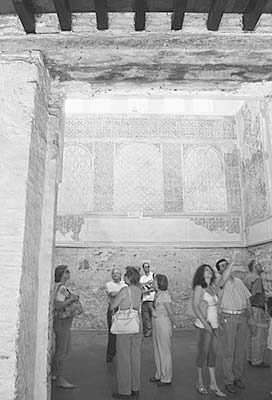
Its relatively small dimensions lead historians to believe this was a private or family synagogue. It’s one of only three medieval synagogues that still stand in Spain. That it survived at all is due to its having been successively converted into a church (look for the cross painted into a niche), a hospital, and a shoemakers’ guild. The building’s original purpose was only rediscovered in the late 19th century.
Rich Mudejar decorations of intertwined flowers and arabesques plaster the walls. The inscriptions in the main room are nearly all from the Bible’s Book of Psalms (in Hebrew, with translations posted on each wall). On the east wall (the symbolic direction of Jerusalem), find the niche for the Ark, which held the scrolls of the Torah (the Jewish scriptures). The upstairs gallery was reserved for women.
Casa Andalusí
A peek at this historic home complements your synagogue visit, though its marketing pitch—“a celebration of the senses…the last remaining refuge of the splendor of caliphal Córdoba”—is an overstatement. Explore exhibits in several rooms on the ground floor, then head downstairs to see Roman mosaics, a reminder that the city sits on an ancient Roman substructure.
Cost and Hours: €4, daily 10:00-23:00, Calle de los Judíos 12, +34 957 290 642, http://lacasaandalusi.com).
City Walls and Statues of Seneca, Maimonides, and Averroes
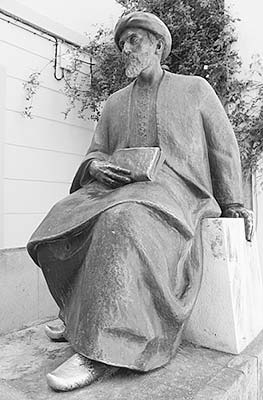
Built upon the foundation of Córdoba’s Roman walls, these fortifications date mostly from the 12th century. While the city stretched beyond the walls in Moorish times, these fortifications protected its political, religious, and commercial center. Of the seven original gates, the Puerta de Almodóvar (near the synagogue) is best-preserved today. Along this wall, you’ll find statues honoring Córdoba’s great thinkers: a Roman philosopher forced to commit suicide (Seneca) and a Jew and a Muslim (Maimonides and Averroes) who were both driven out during the wave of intolerance after the fall of the Umayyad caliphate. (Seneca is right outside the Puerta de Almodóvar; Maimonides is 30 yards downhill from the synagogue; Averroes is outside the old wall, where Cairuán and Doctor Fleming streets meet.)
Lucius Annaeus Seneca the Younger (c. 3 BC-AD 65) was born into a wealthy Cordovan family but was drawn to Rome early in life. He received schooling in Stoicism and made a name for himself in oration, writing, law, and politics. Exiled to Corsica by Emperor Claudius, a remarkable reversal brought him into the role of trusted adviser to Emperor Nero, but eventually Nero accused Seneca of plotting against him and demanded Seneca kill himself. In true Stoic fashion, Seneca complied with this request in AD 65, leaving behind a written legacy that includes nine plays, hundreds of essays, and numerous philosophical works that influenced the likes of Calvin, Montaigne, and Rousseau.
Moses Maimonides (1135-1204), “the Jewish Aquinas,” was born in Córdoba and raised on both Jewish scripture and the philosophy of Aristotle. Like many tolerant Cordovans, he saw no conflict between the two. An influential Talmudic scholar, astronomer, and medical doctor, Maimonides left his biggest mark as the author of The Guide for the Perplexed, in which he asserted that secular knowledge and religious faith could go hand-in-hand (thereby inspiring the philosophy of St. Thomas Aquinas). In 1148, Córdoba was transformed when the fundamentalist Almohads assumed power, and young Maimonides and his family were driven out. Today tourists, Jewish scholars, and fans of Aquinas rub the statue’s foot in the hope that some of Maimonides’ genius and wisdom will rub off on them.
The story of Averroes (1126-1198) is a near match of Maimonides’, except that Averroes was a Muslim lawyer, not a Jewish physician. He became the medieval world’s number-one authority on Aristotle, also influencing Aquinas. Averroes’ biting tract The Incoherence of the Incoherence attacked narrow-mindedness, asserting that secular philosophy (for the elite) and religious faith (for the masses) both led to truth. The Almohads banished him from the city and burned his books, ending four centuries of Cordovan enlightenment.
▲Bullfighting Museum (Museo Taurino Córdoba)
This museum, in a beautiful and air-conditioned old palatial home of brick arcades and patios, examines Córdoba’s bullfighting tradition. (The Babe Ruth of bullfighting is a man known as El Córdobes—“the guy from Córdoba.”) Two 10-minute videos are worth viewing: an introductory one by the entry (ask for the English version) and a dazzling video portrayal of bullfighting as a cultural artform (upstairs, click to play in English). Displays explore the landscape where bulls are bred and raised, pay tribute to great bullfighters of the past (and their remarkably tiny waistlines), and celebrate the tempo and aesthetics of the bullfight. It’s high-tech, spacious, and merits a visit if you’re interested in learning about an important local tradition. But if you’ve already seen the bullfight museums in Ronda or Sevilla, give this one a pass.
Cost and Hours: €4; open same hours as Alcázar (see next listing); Plaza de Maimonides s/n, +34 957 201 056, www.museotaurinodecordoba.es.
Alcázar (Alcázar de los Reyes Cristianos)
Tourists line up to visit Córdoba’s overrated fortress, the “Castle of the Christian Monarchs,” which sits strategically next to the Guadalquivir River. (I think they confuse it with the much more worthy Alcázar in Sevilla.) Upon entering, look to the right to see a big, beautiful garden rich with flowers and fountains. To the left is a modern-feeling, unimpressive fort. While it was built along the Roman walls in Visigothic times, constant reuse and recycling has left it sparse and barren (with the exception of a few interesting Roman mosaics—decorative floors that now hang on the walls like stone tapestries). Crowds squeeze up and down the congested spiral staircases of “Las Torres” for meager views. Ferdinand and Isabel donated the castle to the Inquisition in 1482, and it became central to the church’s effort to discover “false converts to Christianity”—mostly Jews who had decided not to flee Spain in 1492.
Cost and Hours: €5; Tue-Fri 8:15-20:00, Sat 9:30-18:00, Sun 8:15-14:45, summer Tue-Sun 8:15-14:45, closed Mon year-round; +34 957 420 151, https://alcazardelosreyescristianos.cordoba.es. On Fridays and Saturdays, you’re likely to see people celebrating civil weddings here.
Baths of the Caliphate Alcázar (Baños del Alcázar Califal)
The scant but evocative remains of these 10th-century royal baths are all that’s left from the caliph’s palace complex. They date from a time when the city had hundreds of baths to serve a population of several hundred thousand. The exhibit teaches about Arabic baths in general and the caliph’s in particular. A 10-minute video (normally in Spanish; English on request) tells the story well.
Cost and Hours: €3, open same hours as Alcázar, on Plaza Campo de los Santos Mártires, just outside the wall—near the Alcázar, +34 608 158 893.
▲Route of the Patios in San Basilio
While you can peek into some flower-bedecked patios throughout Córdoba (see the “Patios” sidebar), the best way to enjoy the town’s prize-winning patios is with a ticket to the Route of the Patios in the San Basilio quarter. Purchase a ticket at the office, pick up your route map, and dive into this delightful neighborhood; their outlined route takes about 45-50 minutes. A great plan might be to go in late afternoon, stay for a drink on the square facing the neighborhood church, then eat dinner in this neighborhood. (I recommend five fine places ranging from top-end romantic to a rough bar filled with fino and cod-loving locals; see “Eating in Córdoba,” later.)
Cost and Hours: €6 for five patios, office and featured patios open daily 10:00-14:00 & 17:00-20:00, closed July-Aug; buy tickets at Calle de San Basilio 14, +34 957 941 881, www.depatios.com.
AWAY FROM THE MEZQUITA
▲Plaza de las Tendillas
To feel the heartbeat of today’s Córdoba, you must visit Plaza de las Tendillas. While most tourists leave Córdoba having seen only the Mezquita and the cute medieval quarter that surrounds it, this slice of the modern city, where the community gathers, offers a good peek at urban Andalucía.
Plaza de las Tendillas comes with an Art Deco charm, playful fountains, a statue of the “Gran Capitan” who helped finally beat the Moors in Granada in 1492, and a clock tower that chimes the hours with the chords of flamenco guitarist Juan Serrano—a Cordovan classic since 1961.
The pedestrian boulevards that converge on the plaza are favorites for shopping, café sipping, and the daily paseo parade. It’s fun to explore the mix of characteristic cafés (like Café la Gloria at Calle Claudio Marcelo 15), restaurants (my favorite is Taberna San Miguel—see here), and bars (like Bar Correo, a hole-in-the-wall that famously serves only beer, and more of it than any other bar in town; Calle Jesús y María 8).
In Córdoba, patios are taken seriously—even to the point of competition. In the first half of every May, the city hosts a fiercely fought contest, the Concurso Popular de Patios Cordobeses, to pick the city’s most picturesque.
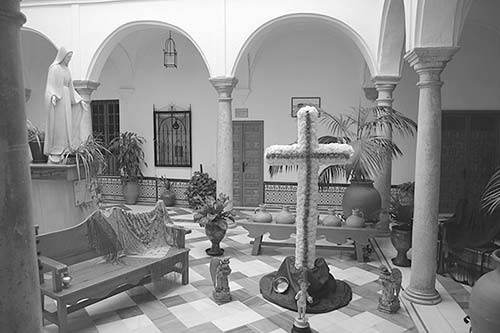
Patios, a common feature of houses throughout Andalucía, have a long history here. The Romans used them to cool off, and the Moors added lush, decorative touches. With tight quarters and generally no conventional yard, patio walls can serve as a vertical garden. The patio functioned as a quiet outdoor living room, an oasis from the heat. Inside elaborate ironwork gates, roses, geraniums, and jasmine spill down whitewashed walls, while fountains play and caged birds sing. Some patios are owned by individuals, some are communal courtyards for several homes, and some grace public buildings like museums or convents.
Today homeowners take pride in these mini paradises and have no problem sharing them—for Spaniards, viewing patios is the greatest home show. Keep an eye out for square metal signs that indicate historic homes. As you wander Córdoba’s back streets, pop your head into any wooden door that’s open. The proud owners (who keep inner gates locked) enjoy showing off their picture-perfect patios. If you manage to get inside a patio, notice long watering poles hooked up to hoses, look down ancient wells, and be sure to compliment the proud caretakers of the patio with “Muy bonito! Gracias!”
From Plaza de las Tendillas, a short walk takes you to three interesting sights, in this order: the Roman Temple, Plaza de la Corredera, and the Museum of Julio Romero de Torres.
Roman Temple (Templo Romano)
Stroll by the remains of this first-century Roman temple on Calle de Capitulares for a vivid reminder that history here goes back well into ancient times (centuries before the Moors). The downhill side shows remains of the old Roman wall, now part of the new City Hall. It’s particularly striking at night when illuminated.
Plaza de la Corredera
Named for the bullfights it used to host, this is the only Castilian-style city square in Andalucía. From the 17th century, like its inspiration, Plaza Mayor in Madrid, this was the traditional center of Córdoba. Today it feels both overlooked yet like a much-loved neighborhood center, with a very local crowd: families with strollers and grannies in tow, teens out on cheap dates, and open-air concerts. A selection of playful tabernas spill their tables onto the huge square, all offering the same basic Andalusian menus.
▲Museo Julio Romero de Torres
A city rich in mystical monuments and colorful patios, Córdoba has produced several fine artists during its long history. Julio Romero de Torres began painting at the age of 10 in 1884, under the tutelage of his father, who was also a painter and director of the city’s fine-arts museum. Early works resembled those of fellow Impressionists like Joaquín Sorolla, but in the 1920s, inspired by his passion for (or obsession with) flamenco, Julio developed a distinct style. He loved to paint soulful portraits of Cordovan women—considered the most beautiful in Spain—with their melancholic gazes and dreamy eyes. After he died in 1930, his family donated his works to the city government and this little museum opened to show them off. Get in the mood with the intro video (on a 10-minute loop in the first room). Then stroll through six small rooms and discover the sumptuous spirit of Córdoba through this captivating artist’s eyes.
Cost and Hours: €4; Tue-Fri 8:30-20:00, Sat 9:30-18:00, Sun 8:30-15:00, shorter hours in summer, closed Mon year-round; Plaza del Potro 1, +34 957 491 909, https://museojulioromero.cordoba.es.
Palacio de Viana
Decidedly off the beaten path, this former palatial estate is a 25-minute walk northeast from the cluster of sights near the Mezquita. The complex’s continued use over its 500-year history is a case study in changing tastes. A guided tour whisks you through each room of an exuberant 16th-century estate (in Spanish, with an English handout allowing you to follow along). The house is best enjoyed by simply admiring the massive collection of paintings, tapestries (including the New Indies series presenting the discovery of America—and all our elephants, lions, and...raccoons), and decorative arts (the gallery of ceramic tiles is especially impressive). If your interests run more to flowers, skip the house and buy a “patio” ticket: 12 connecting garden patios, each with a different theme, sprawl around and throughout the residence. It’s no Alhambra, but if you won’t see the gardens in Granada, these offer a wee taste of the Andalusian style.
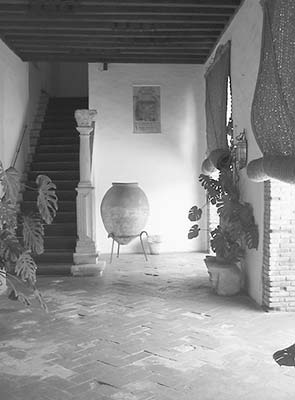
Cost and Hours: House—€11, patios only—€7; Tue-Sat 10:00-19:00, Sun until 15:00, shorter hours in summer, closed Mon year-round, last entry one hour before closing; Plaza de Don Gome 2—for location see “Córdoba” map on here, +34 957 496 741, www.palaciodeviana.com.
NEAR CÓRDOBA
Madinat al-Zahra (Medina Azahara)
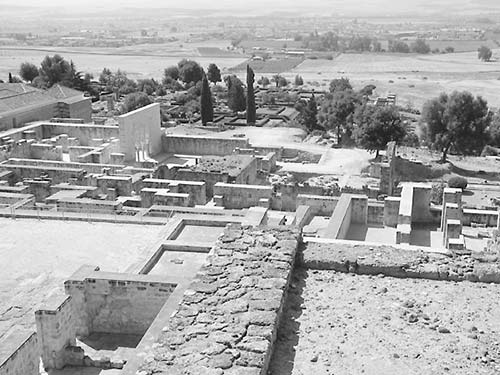
Five miles northwest of Córdoba, this once-fabulous palace of the caliph was completely forgotten until excavations of its ruins began in the early 20th century. Extensively planned, with an orderly design, Madinat al-Zahra was meant to symbolize and project a new discipline on an increasingly unstable Moorish empire in Spain. It failed. Only 75 years later, the city was looted and destroyed. Today, the site is mostly underwhelming—a jigsaw puzzle waiting to be reassembled by patient archaeologists. Check at the TI before committing to a trip, as the most interesting sections of the site may be closed for restoration.
Cost and Hours: €1.50; mid-March-mid-June Tue-Sat 9:00-18:00, Sun until 15:00; mid-June-mid-Sept Tue-Sun 9:00-15:00; off-season Tue-Fri until 18:00, closed Sat-Sun; the site stays open late some evenings (museum closed); closed Mon year-round; +34 957 104 933, www.museosdeandalucia.es.
Getting There: Madinat al-Zahra is located on a back road five miles from Córdoba. By car, head to Avenida de Medina Azahara (one block south of the train station), following signs for A-431; the museum is well signed from the highway. The TI runs a 20-minute shuttle bus that leaves twice daily and returns 3 hours later (€10, buy ticket at any TI; Tue-Sat at 10:00 and 10:45; sometimes additional departures July-Oct; confirm current bus schedule at TI, informative English booklet). Your shuttle bus ticket (show driver) includes the required €3 minibus that connects the museum with the actual site (round-trip, departures every 15 minutes, last minibus 1 hour before closing). Catch the shuttle on Paseo de la Victoria at either of two stops shared with the Bus Turístico route (see the “Central Córdoba” map, earlier). You can also take a taxi—your driver will wait as you explore the site, then drive you back into town. Have your hotel call to reserve (Radio Taxi Córdoba, €30 for up to 4 people, +34 957 764 444).
Visiting Madinat al-Zahra: Start at the museum, where a short film gives a concise history and re-creates the site (which helps immensely when visiting the ruins). Browse briefly through the accompanying exhibit, which traces the founding, daily living, destruction, and recovery of Madinat al-Zahra. Then head outside to catch the (required) minibus to the site.
Built in AD 929 as a power center to replace Córdoba, Madinat al-Zahra was both a palace and an entirely new capital city—the “City of the Flower”—covering nearly half a square mile (only about 10 percent has been uncovered).
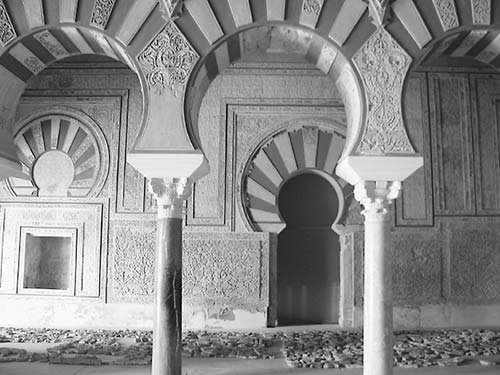
Excavations of the upper terrace have revealed stables and servants’ quarters. Farther downhill, the house of a high-ranking official has been partially reconstructed. At the lowest level, you’ll come to the remains of the mosque—placed at a diagonal, facing true east. The highlight of the visit is an elaborate reconstruction of the caliph’s throne room, capturing a moody world of horseshoe arches and delicate stucco. Legendary accounts say the palace featured waterfall walls, lions in cages, and—in the center of the throne room—a basin filled with mercury, reflecting the colorful walls. The effect likely humbled anyone fortunate enough to see the caliph.
Entertainment in Córdoba
Royal Stables of Córdoba (Caballerizas Reales de Córdoba)
An equestrian show (espectáculo ecuestre) at the royal stables just beyond the Alcázar combines an artful demonstration of different riding styles with flamenco dance. If you’re not going to Jerez to see the show at the Royal Andalusian School of Equestrian Art, this is a fun and convenient alternative (€16.50, €22 premium seats give you access to the stables 30 minutes prior to the show, and slightly better seats; one-hour shows Wed-Sat June-mid-Sept at 21:00, April-May at 20:00, earlier off-season, no shows Sun-Tue year-round; outside unless it’s raining or too hot for the horses, Caballerizas Reales 1, +34 671 949 514, www.cordobaecuestre.com). You can also tour the stables and get a peek at the horses rehearsing (€5, free with a show ticket, 11:00-13:00 & 18:30-20:00 for shows starting at 21:00 or 17:30-19:00 for shows starting at 20:00).
Flamenco
While flamenco is better in nearby Sevilla, you can see it in Córdoba, too. Tablao Flamenco Cardenal is the city’s most popular and awarded show, with 120 seats in a beautifully decorated private patio. They also offer a preshow dinner with typical dishes from Córdoba (€23, includes one drink, 1.5-hour shows Mon-Sat at 20:30, July-Aug at 21:30, no shows Sun, confirm schedule online, Buen Pastor 2—for location, see the “Hotels & Restaurants in Central Córdoba” map, later; +34 691 217 922, www.tablaocardenal.es, info@tablaocardenal.es).
El Alma de Córdoba
To experience “the soul of Córdoba”—or at least the Mezquita by night—you can take this pricey one-hour audio tour, joining about 80 people to be shepherded around the complex listening via headset to an obviously Christian-produced sound-and-light show (€20, March-Oct Mon-Sat, off-season Fri-Sat only, 1-2 shows a night, hours vary according to sunset; buy tickets at Mezquita box office during the day or book online at www.mezquita-catedraldecordoba.es). As this tour is more poetic than informative, consider it a complement to your actual Mezquita visit.
Sleeping in Córdoba
Córdoba’s high season spikes with the spring fair and patio competition. Outside these times, it’s relatively easy to find a decent room at a reasonable rate. Whether you choose the tangled old town, near the Mezquita, or the modern part of the city, all my recommendations come with air-conditioning, which is essential here.
NEAR THE MEZQUITA
These are all within a five-minute stroll of the Mezquita.
$$$$ Balcón de Córdoba is an elegant little boutique hotel buried in the old town, just steps away from the Mezquita. With a compassionate staff, 10 stylish rooms, tranquil and charming public spaces, plenty of attention to detail, and a magnificent rooftop terrace, it’s a lot of luxury for the price. It feels both new and steeped in tradition. Look for the original architectural features of the 14th-century convent that once occupied this space. The restaurant serves wonderful cuisine, enhanced by evening views of the Mezquita from the terrace (includes breakfast, elevator, restaurant open daily 12:30-16:00 & 19:30-23:00, Calle Encarnación 8, +34 957 498 478, www.balcondecordoba.com, reservas@balcondecordoba.com).
$$$$ Hotel Madinat, the former mayor’s home, blends original brick and tilework with bespoke modern style. The 11 ethereal rooms, some with exposed deep tubs, provide a relaxing stay (some rooms with Mezquita views, rooftop terrace, cozy bar, Calle Cabezas 17, +34 975 395 000, www.hotelmadinat.com, info@hotelmadinat.com).
$$$ La Llave de la Judería is a nine-room jewel box of an inn, featuring plush furniture, elegant and traditional decor, and welcoming service. Quiet and romantic, it’s tucked in the old quarter just far enough away from the tourist storm, yet still handy for sightseeing (terrace with Mezquita view, midway between Puerta de Almodóvar and the Mezquita at Calle Romero 38, +34 957 294 808, www.lallavedelajuderia.es, info@lallavedelajuderia.es). Charming Ana Luna and staff greet you by name, making you feel right at home.
$$ La Casa de la Costurera offers a uniquely Cordovan experience: sleeping in one of the city’s prize-winning patios. Araceli and her sister rent four homey and colorful apartments, each with a kitchenette. While some noise might come from patio visitors during the day, the neighborhood is quiet at night and close to several recommended restaurants (Calle de San Basilio 40, +34 654 530 377, www.lacasadelacosturera.com, info@elpatiodelacosturera.com).
$$ Hotel Mezquita, just across from the mosque-cathedral, rents 32 pleasant rooms with old-world touches—10 with Mezquita views. The grand entrance lobby elegantly recycles an upper-class mansion (elevator, Plaza Santa Catalina 1, +34 957 475 585, www.hotelmezquita.com, recepcion@hotelmezquita.com).
$$ Hotel Posada de Vallina’s 24 rustic rooms incorporate old-fashioned furniture and original architecture surrounding a classic, covered Andalusian patio. On the river side of the Mezquita, it’s central and easy to access. They claim Christopher Columbus once slept here (elevator, also stores bags for day-trippers, Calle Corregidor Luis de la Cerda, 83, +34 957 498 750, www.hhposadadevallina.es, reservas@hhposadadevallina.es).
¢ Al-Katre Hostel is a fun 40-bed hostel run in a casual, homey way by two women. Its rooms (each with shared bathrooms) gather around a cool courtyard and a stay-a-while terrace (shared kitchen, Calle Martínez Rucker 14, +34 626 389 706, www.alkatre.com, alkatre@alkatre.com).
IN THE MODERN CITY
While still within easy walking distance of the Mezquita, these places are outside of the main tourist zone—not buried in all that tangled medieval cuteness.
$$ Hotel Córdoba Centro sits at a good crossroads between the historic center around the Mezquita and the modern part of the city. Most of its 25 comfortable, business-style rooms are interior, assuring a solid night’s sleep, while nine rooms face the pedestrian street and coffee shop below (elevator, Calle Jesús y María 8, +34 957 497 850, www.hotel-cordobacentro.es [URL inactive], reservas@hotel-cordobacentro.es).
$$ Hotel Califa, a modern 65-room business-class hotel belonging to the NH chain, sits on a quiet street a block off busy Paseo Victoria, on the edge of the jumbled old quarter. Still close to the sights, it has a beautiful patio courtyard, and its slick, minimalist rooms can be a great value if you get a deal (elevator, gym, pay parking, Lope de Hoces 14, +34 957 299 400, www.nh-hotels.com, nhcalifa@nh-hotels.com).
¢ Arc House Ribera rents 40 hostel beds in a great neighborhood (simple private rooms available, terrace, kitchen, laundry facility, right by Plaza del Potro bus stop—take #3 from station—at Calle Lucano 12, +34 954 913 002, www.archouse.es/córdoba [URL inactive], cordoba@archouse.es).
Eating in Córdoba
Córdoba can offer memorable dining experiences, with options ranging from obvious touristy bars in the old center to enticing, locals-only hangouts a few blocks away. Note that unlike Granada, Córdoba does not have the tradition of serving a free tapa with a drink at the bar.
NEAR THE MEZQUITA
Touristy options abound near the Mezquita. By walking a couple of blocks north or east of the Mezquita, you’ll find plenty of places offering a better value.
$$$ Restaurante El Rincón de Carmen has a lovely plant-filled outdoor patio and a bright, open interior dining room. The menu includes all the Córdoba classics—salmorejo, huevos rotos, berenjenas, flamenquín, rabo de toro—plus heartier meat and fish mains (closed Mon-Tue, Calle Romero 4, +34 957 291 055).
$$ Bodegas Mezquita is one of the touristy places, but it’s easy and handy—a good bet for a spacious, bright, air-conditioned place near the mosque. They have an easy-access menu of tapas, half-raciones, and raciones (daily, one block above the Mezquita patio at Calle Céspedes 12, +34 957 490 004).
$ Bar Santos, facing the Mezquita, supplies the giant tortilla de patatas (potato omelette) that you see locals happily munching on the steps of the mosque. Their “fast” food is served to-go in disposable containers. A hearty tortilla and a beer make for a very cheap meal; add a salmorejo and it feels complete (daily, Calle Magistral González Francés 3, +34 957 893 220).
$$ Taberna Ordoñez is a fresh and bright place with a fun traditional menu (including lots of wine) and tables filling a tiny quiet square. They open a little early to accommodate hungry tourists (daily, behind Starbucks a block from the Mezquita at Medina y Corella 3, +34 957 106 949).
$$ Taberna Rafaé, with the same management, formula, and easy English menu as Taberna Ordoñez, is also handy in the touristic center (daily, Calle Deanes 2, +34 957 299 008).
BARRIO SAN BASILIO
This delightful little quarter outside the town wall, just a couple of minutes’ walk west of the Mezquita and behind the royal stables, is famous for its patios (see here). It’s traffic-free, quaint as can be, and feels perfectly Cordovan without the crush of tourists around the Mezquita. These places open around 20:00 or 20:30, so you have an opportunity to tour the patios and then enjoy a pre-dinner drink on the square facing the church and its landmark bell tower.
$$$ Restaurante Puerta Sevilla has a very traditional menu of pricier, fancier plates. Walls of photos feature local celebrities happily dining here at romantic tables. The plush patio has a vertical garden (daily, reservations smart, Calle Postrera 51, +34 957 297 380, www.puertasevilla.com).
$$ Taberna La Viuda is a fine value for a memorable mix of tapas and raciones served with house wine. It fills a charming dining room with colorful tiles, flowers, and wooden beams. The waitstaff is friendly and speaks no English (daily, at far end of Calle de San Basilio at #52, +34 957 296 905).
$$ La Posada del Caballo Andaluz is a fresh, modern restaurant with tables delightfully scattered around a courtyard (no bar area). Enjoy tasty traditional Cordovan cuisine at great prices while sitting amid flowers and under the stars (daily, Calle de San Basilio 16, +34 957 290 374, Isabel speaks English).
$$ Mesón San Basilio is the longtime neighborhood favorite, with no tourists and no pretense. Although there’s no outside seating, it still offers a certain patio ambience, with a view of the kitchen action (closed Sun-Mon, Calle de San Basilio 19, +34 957 297 007).
$ Bodega San Basilio, around the corner, is a rougher place serving rustic tapas and edible meals to workaday crowds, with plenty of cod and no concessions for tourists. The bullfight decor gives the place a crusty character—and you won’t find a word of English here (closed Tue, on the corner of Calle de Enmedio and the small street leading to Calle de San Basilio at #29, +34 957 297 832).
Groceries: A Super Alcoop is at Calle Dr. Barraquer 12 (Mon-Fri 9:00-21:00, Sat until 14:00, closed Sun).
BETWEEN PUERTA DE ALMODÓVAR AND THE JEWISH QUARTER
The evocative Puerta de Almodóvar gate connects a parklike scene outside the wall with the delightfully jumbled Jewish Quarter just inside it, where cafés and restaurants take advantage of the neighborhood’s pools, shady trees, and dramatic face of the wall.
$$ Casa Bravo 1919 is a rustic place in the middle of all the tourism but with a local energy. There are three seating zones (in the bar with the action, peaceful in a back patio, and outside on a busy pedestrian lane) and three fun and accessible menus (à la carte, daily €13 menu, and tapas). The house special (pick 6 of the 12 tapas for €18) feeds two (closed Tue, a block in from Almodóvar gate on Calle Almanzor, +34 615 181 415).
$ Bodega Guzmán could hardly care less about attracting tourists. This bristly, dark holdover from a long-gone age proudly displays the heads of brave-but-unlucky bulls, while serving cold, rustic tapas and raciones to locals who burst into song when they feel the flamenco groove. Notice how everyone seems to be on a first-name (and signature drink) basis with the waiters (study the English menu on the wall or with the QR code). There’s no drink list, just the basics: vermouth, sangria, fino, or white or red wine. Choose a table or belly up to the bar and try a glass of local white wine, either dry (blanco seco) or sweet (blanco dulce). If it’s grape juice you want, ask for mosto (closed Thu, Calle Judíos 7, +34 957 290 960).
JUST EAST OF THE MEZQUITA ZONE
$$$$ Bodegas Campos is a historic eatery, attracting so many locals it comes with its own garage. The menu is inviting: House specialties are oxtail stew (rabo de toro) and anything with pisto, the local ratatouille-like vegetable stew. The place is a virtual town history museum: Explore its maze of dining rooms to see wine barrels signed by VIPs, the old refectory from a convent, a collection of classic feria posters, and more memorabilia (reservations smart, a 10-minute walk from the Mezquita at Calle Lineros 32, +34 957 497 500, www.bodegascampos.com).
$$$$ Ermita de la Candelaria is romantic with white tablecloths, a smart clientele, and a very traditional menu (hits are rabo de toro, pisto, and hake). While borderline stuffy, it’s quiet, spacious, and the food is excellent (closed Sun-Mon, Calle Candelaria 2, +34 957 738 968).
$$ Macsura Gastrotaberna serves beautifully presented international dishes for anyone who might need a break from jamón—think Asian-Spanish fusion. Choose between bright and white inside or watch the locals go by on a triangular patio outside (daily, Calle Cardenal González, +34 957 486 004).
Groceries: A Carrefour Express is at Calle Lucano 1 (daily 9:00-22:00).
IN THE MODERN CITY
These places are a 10- to 15-minute walk and a world apart from the main tourist zone. Combine a meal here with a paseo through the Plaza de las Tendillas area to get a good look at modern Córdoba. If Taberna Salinas is full, as is likely, there are plenty of characteristic bars nearby on or in the lanes around Plaza de la Corredera.
$$ Taberna Salinas seems like a movie set designed to give you the classic Córdoba scene. Though all the seating is indoors, it’s still pleasantly patio-esque and popular with locals for its 1879 vibe, traditional cuisine, and exuberant bustle. The seating fills a big courtyard and sprawls through several smaller, semiprivate rooms. The fun menu features a slew of enticing raciones (spinach with chickpeas is a house specialty). Study what locals are eating before ordering. There’s no drink menu—just beer, fino, or inexpensive wine. If there’s a line (as there often is later in the evening), leave your name and throw yourself into the adjacent tapas-bar mosh pit for a drink (closed Sun-Mon and Aug; +34 957 482 950).
$$ Taberna San Miguel is nicknamed “Casa el Pisto” for its famous ratatouille-like vegetable stew. Well-respected, it’s packed with smart locals who appreciate regional cuisine, a good value, and a place with a long Cordovan history. There’s great seating in its charming interior or on the lively square (tapas at bar only, closed Sun-Mon and Aug, 2 blocks north of Plaza de las Tendillas at Plaza San Miguel 1, +34 957 470 166).
$$ Taberna La Cazuela de la Espartería offers traditional Andalusian and Cordovan recipes, featuring dishes baked in cazuelas (ceramic dishes), such as berenjenas de barro (a kind of eggplant lasagna). The specialties pair nicely with the restaurant’s numerous Spanish wines. Eat in the rustic dining room or enjoy their tapas and raciones at barrel tables in the bar or outdoors. Be sure to check out the “Las Tavernas” room upstairs, with striking bullfighter photos (closed Sun, Calle Rodríguez Marin 16, +34 957 488 952).
Groceries: Three big modern supermarkets are near Plaza de las Tendillas (each open 9:00-22:00; all but Carrefour are closed Sun): Día (Calle Sevilla 4), Aldi (Calle Claudio Marcelo 19), and Carrefour Express (at Calle Rodríguez Marín 13, between Plaza de la Corredera and the Roman Temple ruins).
Córdoba Connections
From Córdoba by Train: Córdoba is on the slick AVE train line (reservations required), making it an easy stopover between Madrid (almost hourly, 2 hours) and Sevilla (55 minutes). The Avant train connects Córdoba to Sevilla just as fast for a lower price (hourly, 55 minutes). The slow media distancia train to Sevilla takes about twice as long but doesn’t require a reservation and is even cheaper (4/day, 1.5 hours).
Other trains go to Barcelona (4/day direct, 5 hours, many more with transfer in Madrid), Granada (8/day, 1.5 hours), Ronda (1/day direct on Intercity, 2 hours), Jerez (7/day direct on media distancia, 2.5 hours, more with transfer in Sevilla), Málaga (fast and cheap Avant train, 5/day, 1 hour; more expensive but no faster on AVE), and Algeciras (1/day direct, 3 hours). Train info: +34 912 320 320, Renfe.com [URL inactive].
By Bus to: Granada (7/day, 2.5 hours, Alsa), Sevilla (7/day, 2 hours, Alsa), Madrid (4/day, 5 hours, Socibus), Nerja (9/day, transfer in Malaga, 4.5-5.5 hours, Alsa), Málaga (6/day, 2.5-3.5 hours, Alsa). You can check all schedules at www.estacionautobusescordoba.es. Bus info: Alsa.es, SocibusVentas.es.