SEVILLA
Map: Sevilla Shopping & Nightlife
▲▲▲FLAMENCO
WEST OF AVENIDA DE LA CONSTITUCIÓN
BARRIO SANTA CRUZ AND CATHEDRAL AREA
BETWEEN THE CATHEDRAL AND THE RIVER
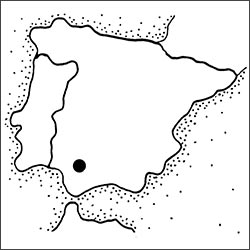
Flamboyant Sevilla (seh-VEE-yah) throbs with flamenco music, sizzles in the summer heat, and pulses with passion. It’s a place where bullfighting is still politically correct and little kids still dream of being flamenco dancers. While Granada has the great Alhambra and Córdoba has the remarkable Mezquita, Sevilla has soul. As the capital of Andalucía, Sevilla offers a sampler of every Spanish icon, from sherry to matadors to Moorish heritage to flower-draped whitewashed lanes. It’s a wonderful-to-be-alive-in kind of place.
As the gateway to the New World in the 1500s, Sevilla boomed when Spain did. The explorers Amerigo Vespucci and Ferdinand Magellan sailed from its great river harbor, discovering new trade routes and abundant sources of gold, silver, cocoa, and tobacco. For more than a century, it all flowed in through the port of Sevilla, bringing the city into a golden age. By the 1600s, Sevilla had become Spain’s largest and wealthiest city, home to artists like Diego Velázquez and Bartolomé Murillo, who made it a cultural center. But by the 1700s, as trade routes shifted, the harbor silted up, the Spanish empire crumbled, and Sevilla’s golden age was ending.
Nevertheless, Sevilla remained a major stop on the Grand Tour of Europe. European nobles flocked here in the 19th century, wanting to see for themselves the legendary city from story and song: the daring of Don Giovanni (Don Juan), the romance of Carmen, the spine-tingling cruelty of the Spanish Inquisition, and the comic gaiety of The Barber of Seville. To build on this early tourism, Sevilla planned a grand world’s fair in 1929. Bad timing. But despite the worldwide depression brought on by the US stock market crash, two million visitors flocked to see Sevilla’s new parks and new neighborhoods, which are still beautiful parts of the city. In 1992, Sevilla got a second chance, and this world’s fair was an even bigger success, leaving the city with impressive infrastructure: a new airport, six sleek bridges, a modern train station, and the super AVE bullet train (making Sevilla a 3-hour side trip from Madrid). In 2007, the main boulevards—once thundering with noisy traffic and mercilessly cutting the city in two—were pedestrianized, enhancing Sevilla’s already substantial charm.
Today, Spain’s fourth-largest city (pop. 700,000) is Andalucía’s leading destination, but it’s suffering from its popularity. Like many other European cities—including Barcelona—Airbnb-type rentals are driving locals out of charming older sections (like Barrio Santa Cruz), and the only shops and eateries that can survive are those catering to tourists. Locals feel like strangers in their own neighborhoods, no longer able to identify with their non-Spanish-speaking neighbors. Sevilla is a rare city center with a shrinking population—high rents are driving some to more affordable suburbs or less-touristed cities like Zaragoza.
Nevertheless, you’ll find the city buzzing with festivals, color, guitars, castanets, and street life, and enveloped in the fragrances of orange trees and jasmine. And Sevilla has its share of impressive sights. It’s home to the world’s largest Gothic cathedral. The Alcázar is a fantastic royal palace and garden ornamented with Islamic flair. But the real magic is the city itself, with its tangled former Jewish Quarter, riveting flamenco shows, thriving bars, and teeming evening paseo. As James Michener wrote, “Sevilla doesn’t have ambience, it is ambience.”
PLANNING YOUR TIME
On a three-week trip, spend three nights and two days here. On even the shortest Spanish trip, I’d zip here on the slick AVE train for a day trip from Madrid. With more time, if ever there was a Spanish city to linger in, it’s Sevilla.
The major sights are few and simple for a city of this size. The cathedral and the Alcázar can be seen in about three hours—but only if you buy tickets in advance (consider this required). A wander through the Barrio Santa Cruz district takes about an hour.
You could spend a second day touring Sevilla’s other sights. Stroll along the bank of the Guadalquivir River and cross Isabel II Bridge to explore the Triana neighborhood and to savor views of the cathedral and Torre del Oro. An evening in Sevilla is essential for the paseo and a flamenco show. Stay out late to appreciate Sevilla on a warm night—one of its major charms.
Córdoba (an hour away by train, see next chapter) is the most convenient and worthwhile side trip from Sevilla, or a handy stopover if you’re taking the AVE to or from Madrid or Granada. Other side trip possibilities include Arcos or Jerez (each about an hour’s drive away).
Orientation to Sevilla
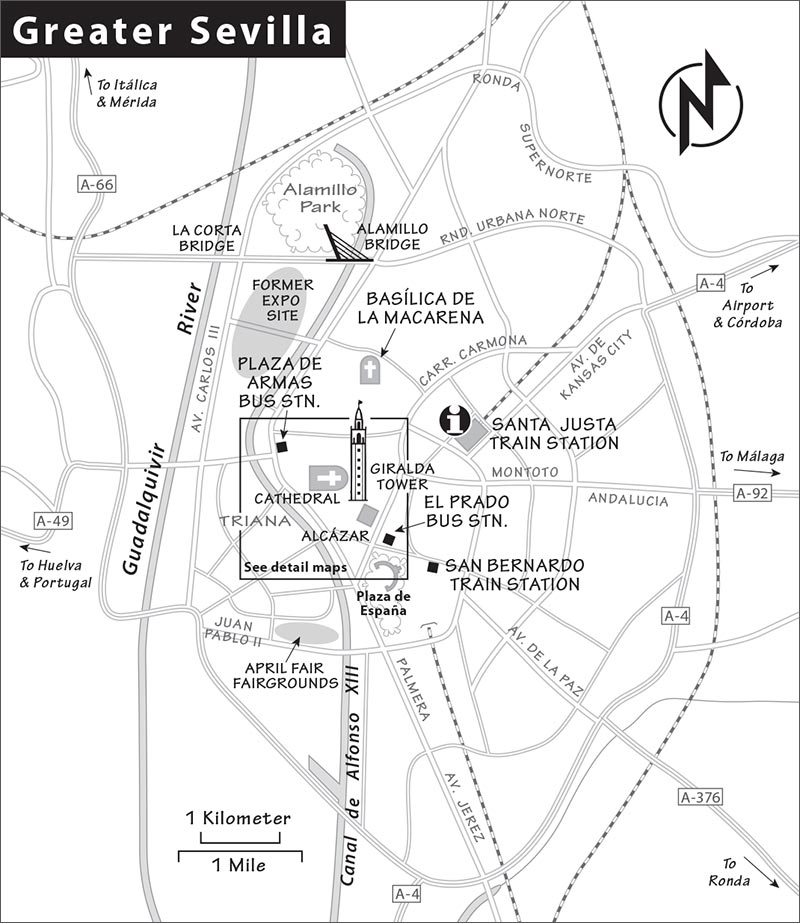
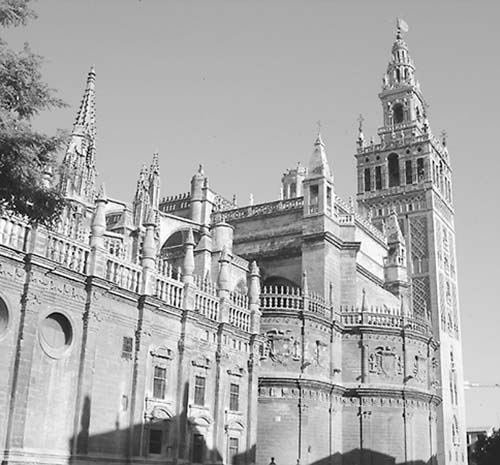
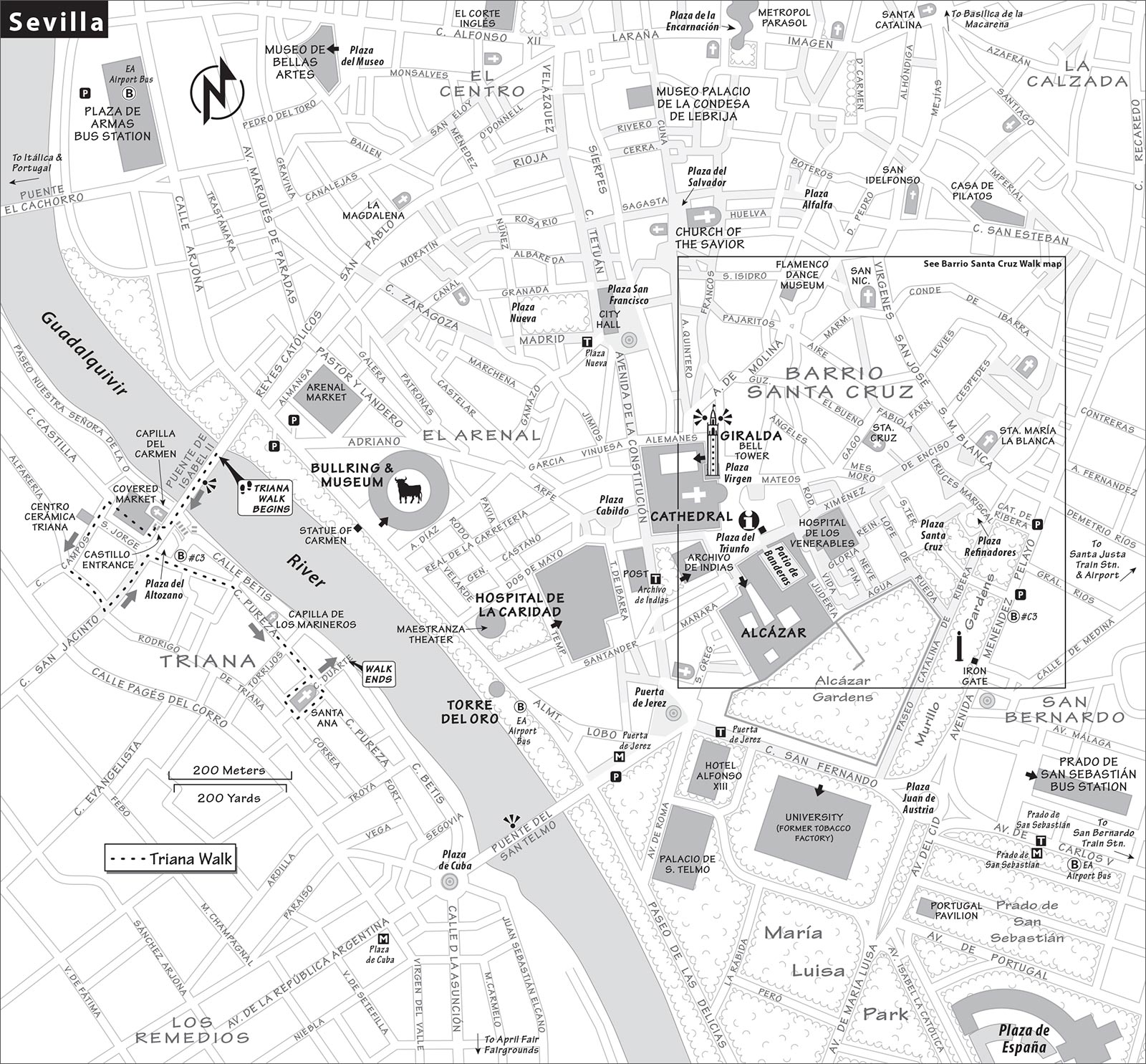
For the tourist, this big city is small. The bull’s-eye on your map should be the cathedral and its Giralda bell tower, which can be seen from all over town. Nearby are Sevilla’s other major sights, the Alcázar (palace and gardens) and the lively Barrio Santa Cruz district. The central north-south pedestrian boulevard, Avenida de la Constitución, stretches north a few blocks to Plaza Nueva, gateway to the shopping district. A few blocks west of the cathedral are the bullring and the Guadalquivir River, while Plaza de España is a few blocks south. The colorful Triana neighborhood, on the west bank of the Guadalquivir River, has a thriving market and plenty of tapas bars, but no major tourist sights. While most sights are within walking distance, don’t hesitate to hop in a taxi or Uber to avoid a long, hot walk (they are plentiful and cheap).
TOURIST INFORMATION
Sevilla has provincial tourist offices at the airport (Mon-Fri 9:00-19:30, Sat-Sun 9:30-15:00, +34 954 449 128), at Santa Justa train station (same hours as airport TI, +34 954 782 002), and near the Alcázar on Plaza del Triunfo (Mon-Fri 9:00-19:30, Sat-Sun from 9:30, +34 954 210 005).
At any TI, you can pick up three things: a city map, the El Giraldillo monthly events guide (in Spanish, with exhibitions, concerts, etc.), and the English version of Horarios (the excellent one-sheet of opening hours). The websites TurismoSevilla.org [URL inactive] and VisitaSevilla.es/en are also helpful.
Steer clear of orange-and-white “visitor centers” at Santa Justa train station (overlooking tracks 6-7) and throughout the city, which are private enterprises masquerading as TIs.
ARRIVAL IN SEVILLA
By Train: All long-distance trains arrive at modern Santa Justa station, with restaurants, ATMs, and a TI. There’s no baggage storage at the station, but you can leave luggage at Lock & Enjoy around the corner (exit out doors to the right, turn right on Avenida Pablo Iglesias and cross the street; €7/day, open 24 hours, Avenida Pablo Iglesias 7, https://lockandenjoy.com). The easy-to-miss TI sits by sliding doors just before the left-hand exit as you leave the station. The plush little AVE Sala Club welcomes those with a first-class AVE ticket and reservation (across the main hall from track 1).
The town center is marked by the ornate Giralda bell tower, peeking above the apartment flats (visible from the front of the station—with your back to the tracks, it’s at 1 o’clock). Sevilla is working to extend the existing tram line to Santa Justa, which will make getting to the city center a breeze. Until then (possibly 2024 or 2025), it’s a flat and boring half-hour walk or about an €8 taxi or Uber ride. By city bus, it’s a short ride on #C1 or #21 to the El Prado de San Sebastián bus station (find bus stop 100 yards in front of the train station, €1.40, pay driver), then a 10-minute walk or short tram ride the rest of the way (see next section).
Regional trains use San Bernardo station, linked to the center by a tram (see “Getting Around Sevilla,” later).
By Bus: Sevilla’s two major bus stations—El Prado de San Sebastián and Plaza de Armas—both have information offices, basic eateries, and baggage storage.
The El Prado de San Sebastián bus station, or simply “El Prado,” covers most of Andalucía. From the bus station to downtown (and Barrio Santa Cruz hotels), it’s about a 15-minute walk: Exit the station straight ahead. When you reach the busy avenue (Menéndez Pelayo) turn right to find a crosswalk and cross the avenue. Enter the Murillo Gardens through the iron gate, emerging on the other side in the heart of Barrio Santa Cruz. Sevilla’s tram connects the El Prado station with the city center (and many of my recommended hotels): Turn left as you exit the bus station and walk to Avenida de Carlos V (€1.40, buy ticket at machine before boarding; ride it two stops to Archivo General de Indias to reach the cathedral area, or three stops to Plaza Nueva).
The Plaza de Armas bus station (near the river) serves long-distance destinations such as Madrid, Barcelona, Lagos, and Lisbon. Taxis line up outside on Calle Arjona, and bus #C4 goes into the city center (€1.40, get off at Puerta de Jerez).
By Car: To drive into Sevilla, follow Centro Ciudad (city center) signs. The city is no fun to drive in and parking can be frustrating. If your hotel lacks parking or a recommended plan, I’d pay for a garage (€25/day) and grab a taxi to your hotel from there. For hotels in the Barrio Santa Cruz area, the handiest parking is the Cano y Cueto garage near the corner of Calle Santa María la Blanca and Avenida de Menéndez Pelayo (open daily 24 hours, at edge of big park, underground).
By Plane: Sevilla’s San Pablo Airport sits about six miles east of downtown and has several car-rental agencies in the arrivals hall (code: SVQ, www.aena.es). If you’re arriving from outside the European Union, your luggage may arrive on belts 7-8 (not with the other carousels).
Sevilla’s tram line may extend to the airport by the time you visit. Until then, the Especial Aeropuerto (EA) bus connects the airport with Santa Justa and San Bernardo train stations, both bus stations, and several stops in the town center (4/hour, fewer in off-peak hours, runs 4:30-24:00, 40 minutes, €4, buy a ticket at the window in the arrivals hall or pay driver). The two most convenient stops downtown are south of the Murillo gardens on Avenida de Carlos V, near El Prado de San Sebastián bus station (close to my recommended Barrio Santa Cruz hotels); and on the Paseo de Cristóbal Colón, near the Torre del Oro. Look for the small EA sign at bus stops. If you’re going from downtown Sevilla to the airport, the bus stop is on the side of the street closest to Plaza de España. To taxi into town, go to an airport taxi stand to ensure a fixed rate (€25 by day, €27 at night and on weekends, luggage extra, confirm price with driver before your journey).
HELPFUL HINTS
Book Ahead: It’s wise to book ahead for the Royal Alcázar and Sevilla Cathedral. You should also consider booking in advance for any restaurant and tour you have your heart set on.
Festivals: Sevilla’s peak season is April and May, and it has two one-week spring festival periods when the city is packed: Holy Week and April Fair.
While Holy Week (Semana Santa, the week between Palm Sunday and Easter Sunday) is big all over Spain, it’s biggest in Sevilla. Locals start preparing for the event up to a year in advance. What would normally be a five-minute walk can take an hour if a religious procession crosses your path, and many restaurants stop serving meat during this time. But any hassles become totally worthwhile as you listen to the saetas (devotional songs) and give in to the spirit of the festival.
Then, after taking two weeks off to catch its communal breath, Sevilla holds its April Fair (April 4-10 in 2025; April 19-25 in 2026). This is a celebration of all things Andalusian, with plenty of eating, drinking, singing, and merrymaking (though most of the revelry takes place in private parties at a large fairground).
Book rooms well in advance for these festival times. Prices can be sky-high and many hotels have four-night minimums.
Rosemary Scam: In the city center, and especially near the cathedral, you may encounter women thrusting sprigs of rosemary into the hands of passersby, grunting, “Toma! Es un regalo!” (“Take it! It’s a gift!”). The twig is free...but then they grab your hand and read your fortune for a tip. Coins are “bad luck,” so the minimum payment they’ll accept is €5. Never open your wallet in their presence as it can become a self-service buffet. They can be very aggressive, but you don’t need to take their demands seriously—don’t make eye contact, don’t accept a sprig, and say firmly but politely, “No, gracias.”
Laundry: Lavandería Tintorería Roma offers quick and economical drop-off service (Mon-Fri 10:00-13:30 & 17:30-20:00, Sat 10:00-13:30, closed Sun, a few blocks west of the cathedral at Calle Arfe 22, +34 954 210 535). Near the recommended Barrio Santa Cruz hotels, The Laundry Room, on the plaza where Calle Ximénez de Enciso meets Calle Santa María la Blanca, is a slick self-service option with three machines and instructions in English (long hours daily, Calle Santa María la Blanca 2, +34 954 42 30). For locations, see the “Sevilla Hotels” map on here.
Bike Rental: This biker-friendly city has designated bike lanes and a public bike-sharing program (€3/day or €14 one-week subscription, first 30 minutes of each ride free, €2 for each subsequent hour, www.sevici.es). Ask the TI about this and other bicycle-rental options.
Architecture Guidebook: For a more in-depth exploration into Sevilla’s trademark brickwork, ceramic, and wrought-iron architecture, consider downloading Regionalismo, written by Robert Wright, who leads some of my Spain tours. This guidebook (available as a PDF) features seven 30-minute walks (approximately 15 buildings each) through the city center and to neighborhoods outside the typical tourist circuit ($5.50, www.endlessmile.com).
GETTING AROUND SEVILLA
Most visitors have a full and fun experience in Sevilla without ever riding public transportation. The city center is compact, and most of the major sights are within easy walking distance.
By Taxi: Sevilla is a great taxi town; they’re plentiful and cheap. Two or more people should go by taxi rather than public transit. You can hail one showing a green light anywhere, or find a cluster of them parked by major intersections and sights (€3.60 minimum—most daytime rides in the center fall within this amount; prices go up on evenings and weekends; calling for a cab adds about €3). Although I’m quick to take advantage of taxis, note that because of one-way streets and traffic congestion it’s often just as fast to hoof it between central points. Uber also operates in Sevilla.
By Bus, Tram, and Metro: A single trip on any form of city transit costs €1.40. Skip the various transit cards—they are a hassle to get and not a good value for most tourists. Various #C buses, which are handiest for tourists, make circular routes through town (note that all of them except the #C6A eventually wind up at Basílica de la Macarena). For all buses, buy your ticket from the driver. The #C3 stops at the Murillo Gardens, Triana, then La Macarena. The #C4 goes the opposite direction, but without entering Triana.
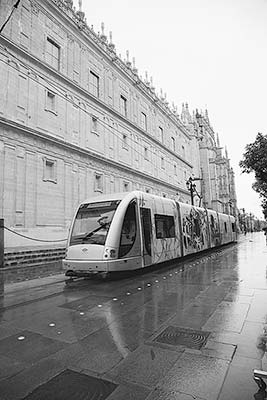
A tram (tranvía) makes just a few stops in the heart of the city but can save you a bit of walking. Buy your ticket at the machine on the platform before you board (runs about every 8-10 minutes daily until 23:30). It makes five city-center stops (from south to north): San Bernardo (at the San Bernardo train station), Prado San Sebastián (next to El Prado de San Sebastián bus station), Puerta de Jerez (south end of Avenida de la Constitución), Archivo General de Indias (next to the cathedral), and Plaza Nueva (beginning of shopping streets). By the time you visit, this line may extend to Santa Justa train station and the airport.
Sevilla also has a one-line underground Metro, but it’s of little use to travelers since its primary purpose is to connect the suburbs with the center. Its downtown stops are at the San Bernardo train station, El Prado de San Sebastián bus station, and Puerta de Jerez.
Tours in Sevilla
 To sightsee on your own, download my free Sevilla City Walk audio tour.
ON FOOT
Sevilla Walking Tours
A joy to listen to, Concepción Delgado is an enthusiastic teacher who takes small groups on English-only walks. Although you can just show up, it’s smart to confirm departure times and reserve a spot (4-person minimum, none on Sun and certain holidays, +34 616 501 100, www.sevillawalkingtours.com, info@sevillawalkingtours.com). Because she’s a busy mom, Concepción sometimes sends her equally excellent colleagues to lead these tours.
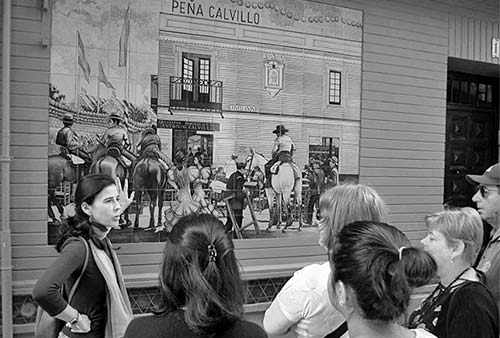
City Walk: This fine two-hour introduction to Concepción’s hometown is a fascinating cultural show-and-tell that skips the famous monuments and shares intimate insights the average visitor misses. Other than seeing the cathedral and Alcázar, this to me is the most interesting two hours you could spend in Sevilla (€18/person, Mon-Sat at 10:30, check website for Dec-Feb and Aug schedule, meet at statue in Plaza Nueva).
Cathedral and Alcázar Tours: For those wanting to really understand the city’s two most important sights, Concepción offers 75-minute visits to the cathedral and the Alcázar, which are scheduled to fit efficiently after her city walk. Both tours should be booked in advance at her website (cathedral tour including admission-€26; Mon, Wed, and Fri at 12:45, 13:00, and 13:30; Alcázar tour including admission-€30; Tue, Thu, and Sat at 12:45, 13:00, and 13:30; additional tours in spring and fall Mon, Wed, and Fri at 15:30). For both tours, meet at the statue in Plaza del Triunfo.
Private Tours
Concepción Delgado (listed above) also offers private tours (€200/3.5 hours). If she’s booked up, try Carmen Martinez, with over 20 years of experience as a licensed local guide (€130/3 hours, +34 669 856 629, www.sevillavisita.com).
All Sevilla Guided Tours
Licensed guides Susana and Elena offer quality private tours (€170/2.5 hours). Their “orientation tour” complements this book’s self-guided tours of Sevilla Cathedral, the Royal Alcázar, and Barrio Santa Cruz. They also offer affordable private excursions to other Andalusian destinations (+34 606 217 194, www.allsevillaguides.com).
“Free” Walks
Free tour companies dominate the walking tour scene in Sevilla. They are not “free,” as you’re aggressively hit up for a tip at the end, and you’ll spend a good part of the tour hearing a sales pitch for the companies’ paid offerings. The walk spiel is entertaining but with little respect for history or culture, and your “guide” is often a student who has memorized a script. Still—it’s “free” and you get what you pay for. You’ll see these guides with color-coded umbrellas at various starting points around the city.
Food Tours
For information on tapas tours and cooking lessons, see the sidebar on here.
BY BUS AND BUGGY
Hop-On, Hop-Off Bus Tours
Two competing city bus tours leave from the curb near the riverside Torre del Oro. You’ll see parked buses and salespeople handing out fliers. Each tour does about an hour-long swing through the city with recorded narration. The tours, which allow you to hop on and off at 14 stops, are heavy on Expo ’29 and Expo ’92 neighborhoods—of limited interest nowadays. While the narration does its best, Sevilla is most interesting in places buses can’t go (daily 10:00-22:00, off-season until 18:00, €22 for red bus: www.city-sightseeing.com; €22.50 online in advance for green bus: http://sevilla.busturistico.com).
Horse-and-Buggy Tours
A carriage ride is a classic, popular way to survey the city and to enjoy María Luisa Park (€45 for a 45-minute clip-clop, much more during Holy Week and the April Fair, talk to a few drivers to find a likable English-speaking one for better narration). There are several departure points around town: Look for rigs at Plaza de América, Plaza del Triunfo, the Archivo General de Indias, the Alfonso XIII Hotel, and Plaza de España.
Holy Week—the week between Palm Sunday and Easter—is a major holiday throughout the Christian world, but nowhere is it celebrated with as much fervor as in Andalucía, especially Sevilla. Holy Week is all about the events of the Passion of Jesus Christ: his entry into Jerusalem, his betrayal by Judas and arrest, his crucifixion, and his resurrection. In Sevilla, on each day throughout the week, 60 neighborhood groups (brotherhoods, called hermandades or cofradías) parade from their neighborhood churches to the cathedral with about 100 floats depicting some aspect of the Passion story. (With the help of my Sevilla guides and friends, this amazing event was featured in my Rick Steves’ European Easter public television special, viewable at RickSteves.com/tv.)
As the week approaches, anticipation grows: Visitors pour into town, grandstands are erected along parade routes, and TV stations anxiously monitor the weather report. (The floats are so delicate that rain can force the processions to be called off—a crushing disappointment.)
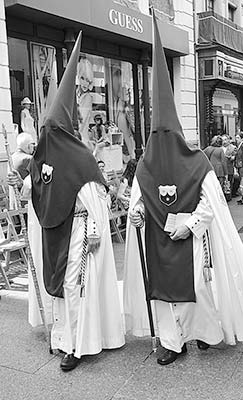
By midafternoon of any day during Holy Week, thousands line the streets. The parade begins. First comes a line of “penitents” carrying a big cross, candles, and incense. The penitentes perform their penance publicly but anonymously, their identities obscured by pointy, hooded robes. (The penitents’ traditional hooded garb has been worn for centuries—long before such hoods became associated with racism in the American South.) Some processions are silent, but others are accompanied by beating drums, brass bands, or wailing singers.
A hush falls over the crowd as the floats (los pasos) approach. First comes a Passion float, showing Christ in some stage of the drama—being whipped, appearing before Pilate, or carrying the cross to his execution. More penitents follow—with hundreds or even thousands of participants, a procession can stretch out over a half-mile. All this sets the stage for the finale—typically a float of the Virgin Mary, who represents the hope of resurrection.
The elaborate floats feature carved wooden religious sculptures, most embellished with gold leaf and silverwork. They can be adorned with fresh flowers, rows of candles, and even jewelry on loan from the congregation. Each float is carried by 30 to 50 men (los costaleros), who labor unseen—although you might catch a glimpse of their shuffling feet. The bearers wear turban-like headbands to protect their heads and necks from the crushing weight (the floats can weigh as much as three tons). Two “shifts” of float carriers rotate every 20 minutes. As a sign of their faith, some men carry the float until they collapse.
As the procession nears the cathedral, many pass through the square called La Campana, south along Calle Sierpes, and through Plaza de San Francisco. (Some parades follow a parallel route a block or two east.) Grandstands and folding chairs are filled by VIPs and Sevilla’s prominent families. Thousands of candles drip wax along the well-trod parade routes, forming a waxy buildup that causes shoes and car tires to squeal for days to come.
Being in Sevilla for Holy Week is both a blessing and a curse. It’s a remarkable spectacle, but it’s extremely crowded. Parade routes can block your sightseeing for hours. Check printed schedules if you want to avoid them. But, if a procession blocks your way, look for a crossing point marked by a red-painted fence, or ask a guard. Even if all you care about on Easter is a chocolate bunny, the intense devotion of the Andalusian people during their Holy Week traditions is an inspiration to behold.
Barrio Santa Cruz Walk
The soul of Sevilla is best found in the narrow lanes of its oldest quarter—Barrio Santa Cruz. Of Sevilla’s once-thriving Jewish neighborhood, only the tangled street plan and a wistful Old World ambience survive.
The neighborhood’s name—literally Holy Cross—is a reminder of how precious little survives. A synagogue once stood in what is now Plaza de Santa Cruz, but it was demolished in the 14th century and replaced with a Christian church (Church of Santa Cruz). This pogrom, the violent Inquisition of the 15th century, and more recently the Fascist reign of Franco (until 1975) left Sevilla with almost no Jewish population. It’s so strongly Catholic that, until the last generation, most Christian women in Sevilla were named María.
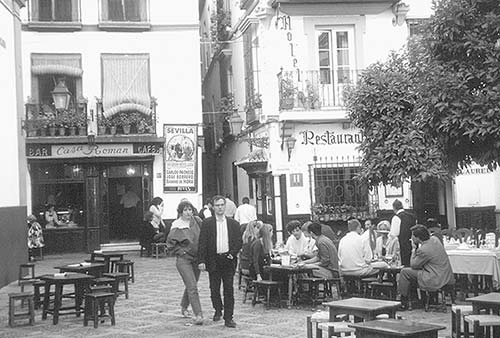
This classy maze of lanes (too tight for most cars), small plazas, tile-covered patios, and whitewashed houses with wrought-iron latticework draped in flowers is a great refuge from the summer heat and bustle of Sevilla. The streets are narrow—some with buildings so close they’re called “kissing lanes.” A happy result of the narrowness is shade: Locals claim Barrio Santa Cruz is three degrees cooler than the rest of the city.
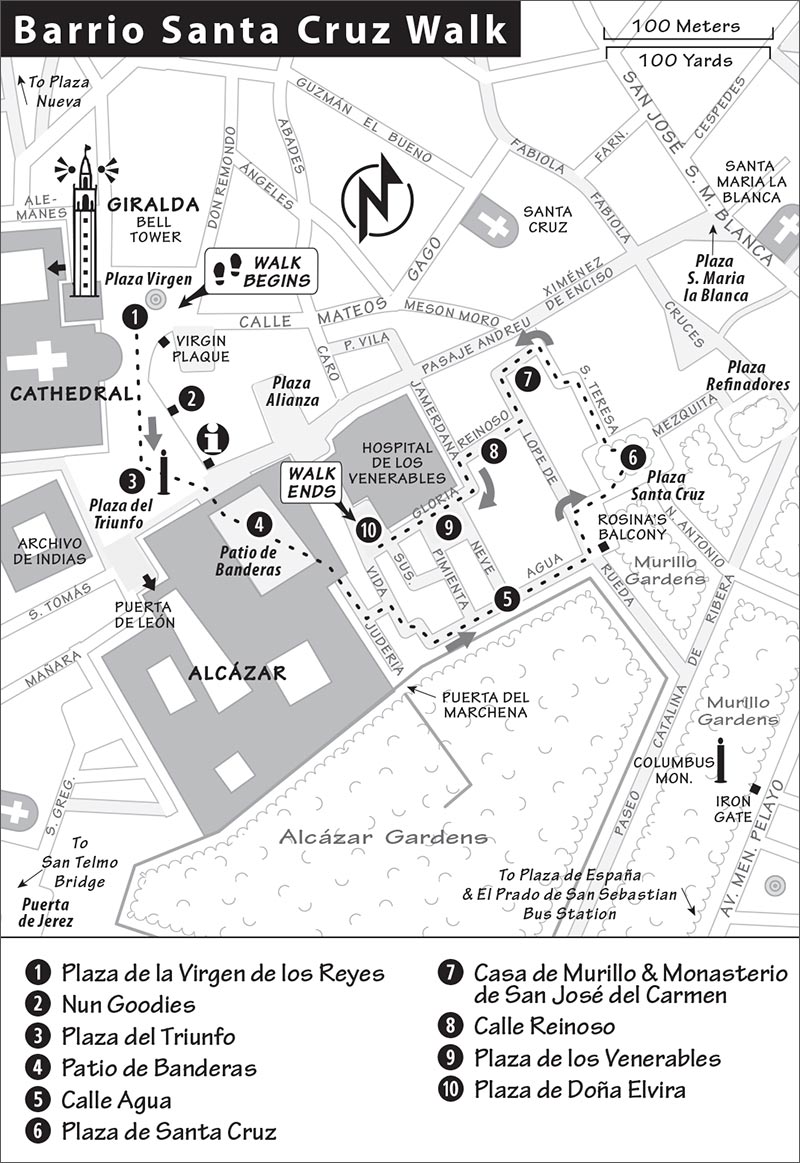
The barrio is made for wandering. Getting lost is easy, and I recommend doing just that. But to get started, here’s a self-guided plaza-to-plaza walk that loops you through the corazón (heart) of the neighborhood and back out again. Along the way, we’ll get an introduction to some of the things that give Sevilla its unique charm.
Download my free Sevilla City Walk audio tour, which complements this walk (following stops at the Sevilla Cathedral and Royal Alcázar).
When to Go: Tour groups often trample the barrio’s charm in the morning. I find that early evening—around 19:00—is the ideal time to explore the quarter.
• Start in the square in front of the cathedral, at the lantern-decked fountain in the middle that dates from the 1929 Expo.
1 Plaza de la Virgen de los Reyes
Do a 360-degree spin and take in some of Sevilla’s signature sights. There’s the gangly cathedral with its soaring Giralda bell tower. To the right is the ornate red Archbishop’s Palace, a center of power since Christians first took the city from the Moors in 1248. The next building is almost a cliché of late-19th-century (and now government-protected) Sevillian architecture—with goldenrod trim and ironwork balconies. The street stretching away from the cathedral is lined with another Sevillian trademark—tapas bars, housed in more typical Andalusian buildings with their ironwork. Continuing your spin, there’s a row of Sevilla’s signature orange trees. Hiding in the trees is a statue of Pope John Paul II, who performed Mass here before a half-million faithful Sevillians during a 1982 visit. Finally, you return to the Giralda bell tower.
The Giralda encapsulates Sevilla’s 2,000-year history. The large blocks that form the very bottom of the tower date from when Sevilla was a Roman city. (Up close, you can actually read some Latin inscriptions.) The tower’s main trunk, with its Islamic patterns and keyhole arches, was built by the Moors (with bricks made of mud from the river) as a call-to-prayer tower for a mosque. The top (16th-century Renaissance), with its bells and weathervane figure representing Faith, was added after Christians reconquered Sevilla, tore down the mosque, built the sprawling cathedral—and kept the minaret as their bell tower.
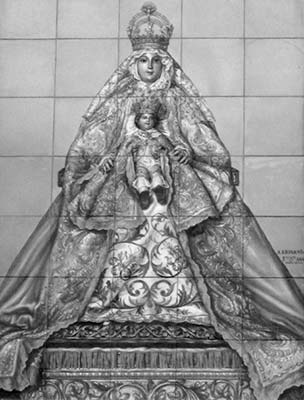
This square is dedicated to that Christian reconquest, and to the Virgin Mary. Turn 90 degrees to the left as you face the cathedral and find (hiding behind the orange trees) the Virgin of the Kings (see her blue-and-gold-tiled plaque on the white wall). This is one of the many different versions of Mary you’ll see around town—some smiling, some weeping, some triumphant—each appealing to a different type of worshipper’s needs.
Notice the columns and chains that ring the cathedral, as if put there to establish a border between the secular and Catholic worlds. Indeed, that’s exactly the purpose they served for centuries, when Sevillians running from the law merely had to cross these chains to find sanctuary—like crossing the county line. Many of these columns are far older than the cathedral, having originally been made for Roman and Visigothic buildings and later recycled by medieval Catholics.
• Facing the cathedral, turn left and walk toward the next square to find some...
2 Nun Goodies
The white building on your left was an Augustinian convent. Step inside the door at #3 to meet (but not see) a cloistered nun behind a fancy torno (a lazy Susan the nuns spin to sell their goods while staying hidden). The sisters raise money by selling rosaries, incense, prayer books, and communion wafers (tabletas—bland, but like sin-free cookies). Consider buying something here just as a donation. The sisters, who speak only Spanish, have a sense of humor—have fun practicing your Spanish with them (Mon-Sat 9:00-13:00 & 16:45-18:15, Sun 10:00-13:00).
• Step into the square marked with a statue of the Virgin atop a pillar. This is...
3 Plaza del Triunfo
Bordered by three of Sevilla’s most important buildings—the cathedral, the walled Alcázar, and the Archivo General de Indias (filled with historic papers)—this plaza was the center of the action during the golden age of the 16th and 17th centuries. Merchants from all over Europe gathered here to trade in the exotic goods pouring in from the New World. That wealth produced a flowering of culture, including Sevilla’s most beloved painter, Bartolomé Murillo, who is honored at the base of the pillar (the sculptor used a famous painting by Murillo for his model of the Immaculate Conception on top).
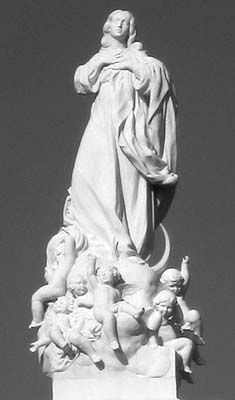
The “Plaza of Triumph” is named for yet another Virgin statue atop a smaller pillar at the far end of the square. This Virgin helped the city miraculously “triumph” over the 1755 earthquake that destroyed Lisbon but only rattled Sevilla.
• Before leaving the square, consider stopping at the TI (to pick up a good map and the handy one-sheet with the latest opening hours of all the sights). Then pass through the arched opening in the Alcázar’s spiky, crenellated wall. You’ll emerge into a white-and-goldenrod courtyard called the...
4 Patio de Banderas
The Banderas Courtyard (as in “flags,” not Antonio) was part of the Alcázar, the Spanish king’s residence when he was in town. This square was a military parade ground, and the barracks surrounding it housed the king’s bodyguards.
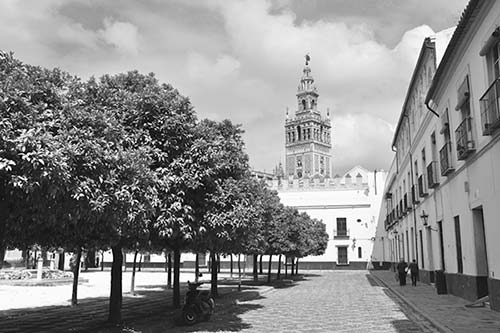
Before the Alcázar was the palace of the Christian king, it was the palace of the Muslim Moors who ruled Sevilla. Archaeologists found remains of the Moorish palace (as well as 2,000-year-old Roman ruins) beneath the courtyard. They excavated it, then covered the site to protect it.
Orange trees abound. Because they never lose their leaves, they provide constant shade. But forget about eating the oranges. They’re bitter and used only to make vitamins, perfume, cat food, and that miserable marmalade you can’t avoid in British B&Bs. But when they blossom (for three weeks in spring, usually in April), the aroma is heavenly. (You can identify a bitter orange tree by its leaves—they have a tiny extra leaf between the main leaf and the stem.)
The far-right corner of this square usually has a queue of people waiting to buy Alcázar tickets (which you’ll avoid by buying yours online in advance). Head for the arch at the far-left corner, do a 180, and enjoy the view of the Giralda bell tower.
• Exit the courtyard through the Judería arch. Go down the long, narrow passage still paved with its original herringbone brickwork. Emerging into the light, you’ll be walking alongside the red Alcázar wall. Take the first left at the corner lamppost and you’ll pass another gate. A gate here was locked each evening—at first to protect the Jewish community (when they were the privileged elite—bankers, merchants, tax collectors) and later during times of persecution to isolate them (until they were finally expelled in 1492). Passing the gate, go right, through a small square, and follow the long, narrow alleyway called...
5 Calle Agua
This narrow lane is typical of the barrio’s tight quarters, born when the entire Jewish community was forced into a small segregated ghetto. As you walk, on your right is one of the older walls of Sevilla, dating back to Moorish times. Glancing to the left, peek through iron gates for occasional glimpses of the flower-smothered patios of restaurants and exclusive private residences (sometimes open for viewing). The patio at #2 is a delight—ringed with columns, filled with flowers, and colored with glazed tiles. The tiles are not merely decorative—they keep buildings cooler in the summer heat. If the gate is closed, try the next door down, or just look up for a hint of the garden’s flowery bounty. Admire the expensive ornamental mahogany eaves.
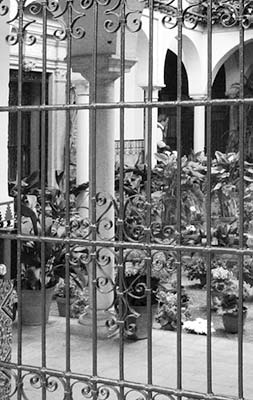
The plaque above and to the left of #2 remembers Washington Irving. He and Romantic novelists, poets, and painters of his era inspired early travelers and popularized the Grand Tour. Aristocrats back in the 19th century had their favorite stops as they gallivanted around Europe, and Sevilla—with its operas (like Carmen), bullfighting, and flamenco—was hard to resist.
Emerging at the end of the street, turn around and look back at the openings of two old pipes built into the wall. These 12th-century Moorish pipes once carried fresh spring water to the Alcázar (and today give the street its name—Agua). They were part of a 10-mile-long aqueduct system that was originally built by the ancient Romans and expanded by the Moors, serving some parts of Sevilla until the 1600s. You’re standing at an entrance into the pleasant Murillo Gardens (through the iron gate), formerly the fruit and vegetable gardens for the Alcázar.
Before moving on, find the romantic little round balcony overlooking the gardens (by the palm tree). It’s named for Rosina, the character in Rossini’s The Barber of Seville opera. You can imagine Rosina gazing over the Murillo Gardens. In the entryway under the balcony, you can see a variety of ancient Roman columns excavated from this site and creatively recycled (they reinforce the corners of buildings, like the ones on this peaceful little square).
• Don’t enter the gardens now, but instead cross the square diagonally, and continue 20 yards down a lane to the...
6 Plaza de Santa Cruz
Arguably the heart of today’s barrio, this pleasant square is graced with orange trees and draping vines, with a hedged garden in the center.
This square encapsulates the history of the neighborhood. In early medieval times, it was the Judería, with a synagogue standing where the garden is today. When the Jews were rousted in the 1391 pogrom, the synagogue was demolished, and a Christian church was built on the spot (the Church of Santa Cruz). It was the neighborhood church of the Sevillian painter Bartolomé Murillo (and later his burial site). But when the French (under Napoleon) invaded, the church was demolished. A fine 17th-century iron cross in the center of the square now marks the former site of the church. This “holy cross” (santa cruz), from a renowned Sevillian forge, has inspired similar-looking crosses still carried in Holy Week processions, and gave this former Jewish Quarter its Christian name.
At #9, you can peek into a lovely courtyard that’s proudly been left open so visitors can enjoy it. It’s a reminder of the traditional Andalusian home, built around an open-air courtyard. The square is also home to the recommended Los Gallos flamenco bar, which puts on nightly performances (see “Nightlife in Sevilla,” later).
• Exit the square right of Los Gallos, going uphill (north) on Calle Santa Teresa. Notice millstones in the walls. (The river once powered mills using stones like these to grind wheat into flour and other products.) Tour guides like to say this was a way for a wealthy miller to show off (like someone today parking a fancy car in their driveway). Notice also the well-worn ancient column functioning as a cornerstone. With the ruins of Roman Hispalis (Sevilla) and nearby Itálica (see here), Sevilla had a ready quarry for such ornamental corner pieces.
After the kink in the road, find #8 (on the left).
7 Casa de Murillo and Monasterio de San José del Carmen
Born and raised in Sevilla, the famous 17th-century painter Bartolomé Esteban Murillo spent his final years in this plush two-story mansion with a central patio. He soaked in the ambience of street life in this characteristic barrio and reproduced it in his paintings of cute beggar children. He also painted iconic versions of local saints and took Sevilla’s devotion to the Virgin to another level with his larger-than-life Immaculate Conceptions. Wedding extreme religiosity with down-to-earth street life, he captured the Sevillian spirit—and an age when nearly every woman’s first name was María.
Directly across from Casa de Murillo is the enormous wooden doorway of the Monasterio de San José del Carmen. This convent was founded by the renowned mystic, St. Teresa of Ávila. When she arrived in Sevilla in 1575, it was Spain’s greatest city, and she stayed here for 10 years. Today, the Baroque convent keeps some of Teresa’s artifacts and spiritual manuscripts, but it’s closed to the public except for early-morning Mass (Mon-Fri at 8:45 and Sun at 9:00).
• Continue north on Calle Santa Teresa, then take the first left on Calle Lope de Rueda (just before the popular Las Teresas café). Here you enter a series of very narrow lanes. Take a left again, then right on...
8 Calle Reinoso
This street—so narrow that the buildings almost touch—is one of the barrio’s “kissing lanes.” A popular explanation suggests the buildings were so close together to provide maximum shade. But the history is more complex than that: This labyrinthine street plan goes back to Moorish times when this area was a tangled market. Later, this was the densely populated Jewish ghetto.
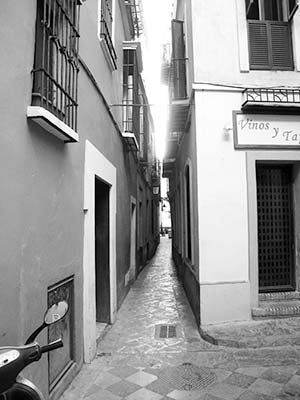
By the way, in the darkest depths of the Covid-19 pandemic, locals here were confined to their apartments. For seven months they could go out only for groceries, to walk their dogs, or for an hour if they had children. (Dogs suddenly were in high demand.) Today, it seems locals appreciate the freedom to be out in bars, cafés, and doing the paseo more than ever. Before the pandemic, the size of your apartment was of no importance—life here happens in the streets. But without that option, a small apartment became a prison.
Sadly, today the Barrio Santa Cruz population has been almost entirely pushed out by more-profitable-for-landlords short-term rentals. The consequence: Only businesses that cater to tourists can survive, the character vanishes, and the only thing remaining that’s truly traditional about the quarter is its architecture.
• Leaving the kissing zone, just to the left, the street spills onto...
9 Plaza de los Venerables
This tiny square is another candidate for “heart of the barrio,” as it captures the romantic ambience that inspired so many operas in Sevilla (from Don Giovanni and Carmen to The Barber of Seville and The Marriage of Figaro). The square serves as the lively hub for several narrow streets that branch off it, oozing local color. With its vibrant buildings and visitor-oriented businesses, it typifies the barrio today: traditional and touristy at the same time.
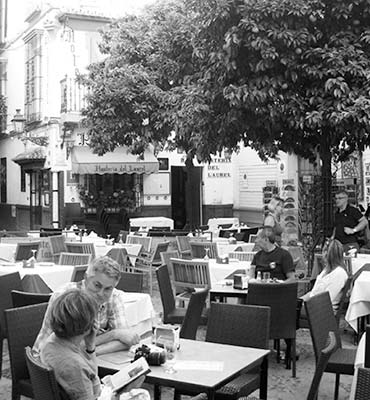
The harmonious red-and-white Sevillian-Baroque Hospital de los Venerables (1675) was once a retirement home for old priests (the “venerable” ones). It’s now a cultural foundation worth visiting for its ornate church and small but fine collection of Sevillian paintings (see listing later, under “Sights in Sevilla”). The ceramic shop at the far end of the square welcomes tourists to use its bus-tour-friendly WCs.
• Pass through the square. Just as you reach Calle de Gloria, on the right is an interesting tile map of the Jewish Quarter. (Retrace your steps. Find yourself in the lower left, second row up, third tile from the left.) Now continue west on Calle de Gloria, where you’ll soon emerge into...
10 Plaza de Doña Elvira
This square—with orange trees, tile benches, and a stone fountain—sums up our barrio walk. Shops sell work by local artisans, such as ceramics, embroidery, and fans. The plaza has a long history. In the 19th century, aristocrats flocked here to see the supposed home of the legendary lady love of the legendary Don Juan. At night, with candlelight and Spanish guitars playing, this is indeed a romantic place to share a sweet moment.
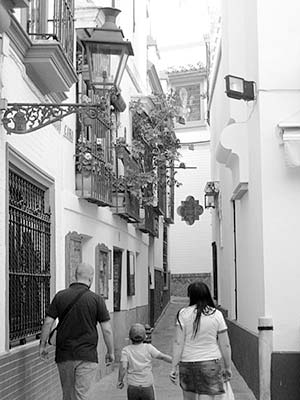
But the plaza we see today reflects the fate of much of the barrio. After the neighborhood’s Jews were expelled in 1492, the area went into slow decline. Napoleon’s invasion furthered the destruction. By the early 1900s it was deserted and run down. Sevilla began an extensive urban renewal project, which culminated in the 1929 world’s fair. They turned much of the barrio, including this plaza, into a showcase of Neo-Romantic Andalusian style. Architects renovated with traditional-style railings, tile work, orange trees, and other too-cute, Epcot-like adornments. Barrio Santa Cruz may not be quite as old as it appears, but the new and improved version respects tradition while carrying the neighborhood’s 800-year legacy into the future.
• Our walk is over. To return to the area near the start of this walk, cross the plaza and head north along Calle Rodrigo Caro; keep going until you enter the large Plaza de la Alianza. From here, a lane on the left (Calle Joaquín Romero Murube) leads back to the Alcázar.
Sights in Sevilla
BETWEEN THE CATHEDRAL AND THE RIVER
▲Archivo General de Indias (General Archives of the Indies)
Torre del Oro (Gold Tower) and Naval Museum
▲▲Church of the Savior (Iglesia del Salvador)
▲Museo Palacio de la Condesa de Lebrija
▲Flamenco Dance Museum (Museo del Baile Flamenco)
▲▲▲SEVILLA CATHEDRAL
Sevilla’s cathedral (Catedral de Sevilla) is the third-largest church in Europe (after St. Peter’s at the Vatican in Rome and St. Paul’s in London) and the largest Gothic church anywhere. When they ripped down a brick mosque on this site in 1401, the Reconquista Christians vowed they’d build a cathedral so huge that “anyone who sees it will take us for madmen.” When it was finished in 1528, it was indeed the world’s biggest, and remained so for a century until St. Peter’s came along. Even today, the descendants of those madmen proudly point to a Guinness Book of Records letter certifying, “Santa María de la Sede in Sevilla is the cathedral with the largest area.”
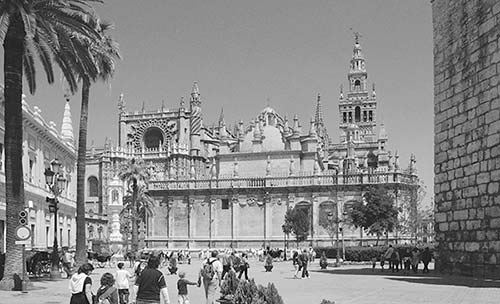
On this self-guided tour, we’ll marvel at the vast interior, over-the-top altars, world-class art, a wooden crocodile, and the final resting place of Christopher Columbus.
Cost and Hours: €11 combo-ticket also includes Giralda bell tower and entry to the Church of the Savior—buy online in advance for €1 extra to avoid a long line in the hot sun; Mon-Sat 10:45-17:30 (May-Oct until 18:30), Sun 14:30-19:00; www.catedraldesevilla.es.
Advance Tickets Recommended: It’s smart to buy your ticket online to avoid the long, time-consuming line (available about a month in advance). If you’re in town without a ticket, you can try to buy one online for that day, or consider buying a combo-ticket at the Church of the Savior first, where lines aren’t a problem.
Getting In: Advance-ticket holders use the Puerta del Lagarto entrance (near the bell tower; enter within 30 minutes of your appointed time). Without a reservation, buy your ticket and enter at the Puerta de San Cristóbal entrance (south gate). If you purchased a combo-ticket from the Church of the Savior, enter through Puerta de San Cristóbal (skipping past the ticket-buyer line).
Tours: The €5 audioguide is excellent (rent at either entry, drop at exit). The cathedral offers a guided tour (€8) that provides only a little extra information; consider joining Concepción Delgado’s guided tour instead (see “Tours in Sevilla,” earlier).
The cathedral offers a 90-minute guided rooftop visit in English (€20, book online, meet at west facade 15 minutes before tour, includes cathedral entrance via the advance ticket-holders line). If you do this tour, skip the Giralda tower climb.
My free Sevilla City Walk audio tour includes background detail and descriptions of the cathedral exterior, but doesn’t cover the interior.
Visitor Services: A WC and drinking fountain are by the art pavilion (southwest corner) and also in the courtyard near the exit.
 Self-Guided Tour
• If you arrive early for your timed-entry slot, take time to circle the exterior and study the facades (you can also do this at the end of the tour).
Exterior
Sevilla’s cathedral has an odd exterior that is hard to fully appreciate. As the mosque was square and the cathedral was designed to entirely fill its footprint, the transepts don’t show from the outside. And with no great square leading to the church, you hardly know where the front door is (it’s on the west side). The church is circled by pillars and chains, which provided sanctuary to those escaping secular law (but not Christian law) 500 years ago.
East Side: This side is dominated by the Giralda tower, which stands next to the Puerta del Lagarto gate. If you have a timed-entry ticket, you’ll enter at this door. From here, circle the cathedral counterclockwise following my self-guided tour.
South Side: The south facade is 19th-century Neo-Gothic and unfinished—notice the empty niches that never got their statues. In the courtyard stands a full-size replica of the Giraldillo statue that caps the bell tower.
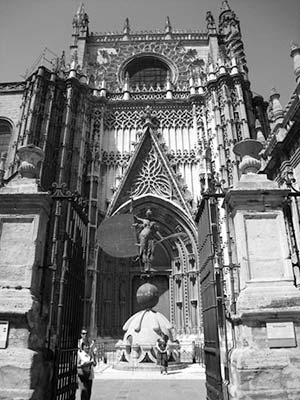
West Side: This side faces the trams, horses, and commotion of Avenida de la Constitución. Though this is the main entry to the cathedral, it seems totally ignored. The central door shows the Assumption of Mary, with the beloved Virgin rocketing up to heaven to be crowned by God with his triangular halo (reminding all of the Trinity). While this part wasn’t finished until the 19th century, the side doors—with their red terra-cotta saints—date from the 15th century.
At the northwest corner (across from Starbucks) you’ll see animal-blood graffiti from 18th-century students celebrating their graduation—revealed in a recent cleaning project.
North Side: On the north side is the Puerta del Perdón, the entry to the mosque’s courtyard (and where you’ll exit after touring the cathedral). But, as with much of the Moorish-looking art in town, it’s now actually Christian—the two coats of arms are a giveaway. The relief above the door shows the Bible story of Jesus ridding the temple of the merchants...a reminder to contemporaries that there will be no retail activity in the church. (German merchants gathered on this street—notice the name: Calle Alemanes.) The plaque on the right honors Miguel de Cervantes, the great 16th-century writer; this is one of many plaques scattered throughout town showing places mentioned in his books. (In this case, the topic was pickpockets.)
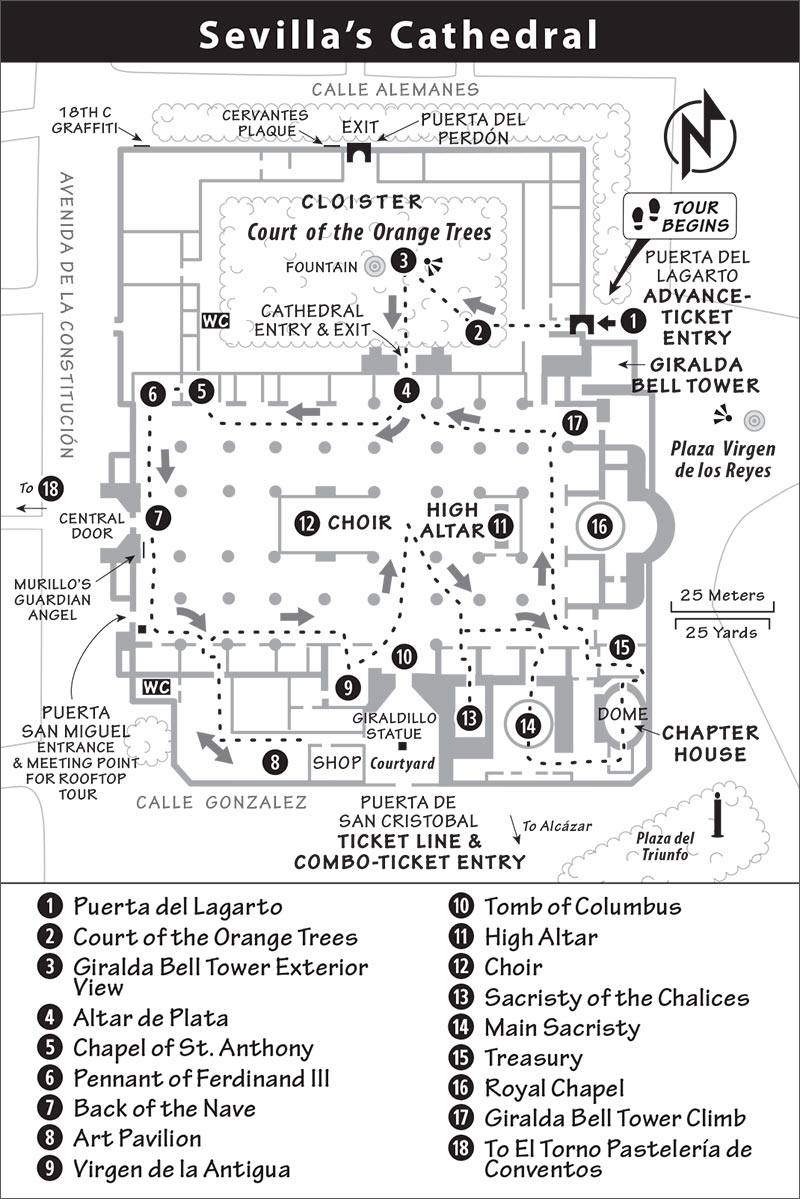
• Circle back to the east side. With your timed-entry ticket, enter at 1 Puerta del Lagarto. Why is a crocodile hanging at this gate? It’s a reminder of the live crocodile (lagarto) given as a show of goodwill by the Islamic sultan of Egypt in 1260 to the Christian king Alfonso the Wise. Alfonso proudly showed off his croc, and when it died he had the body stuffed for display. When that rotted, it was replaced with this wooden replica. You’re now in an open-air courtyard (with WCs at the far end). If you get routed through a different entry (as entry procedures are variable), just make your way to the courtyard to join our tour.
2 Court of the Orange Trees
This courtyard—one of the few things remaining from the original mosque—was the place for ritual ablutions. Muslims would enter through the keyhole-shaped archway; stop at the fountain to wash their hands, face, and feet; then proceed inside to pray. Another remnant is the Puerta del Perdón (“Door of Forgiveness”), the keyhole-arch entrance, with its original green doors of finely wrought bronze-covered wood. The lanes between the courtyard bricks were once irrigation streams—a reminder that the Moors introduced irrigation to Iberia. Otherwise, the Christians completely leveled the site and turned a mosque of brick into a cathedral of stone.
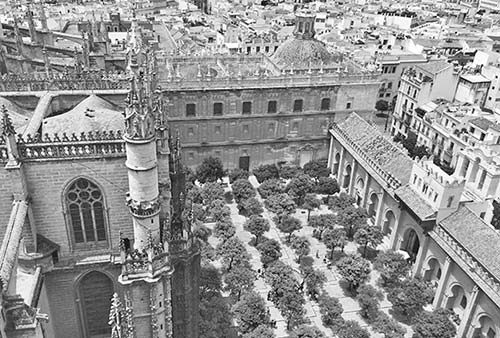
• The biggest remnant of the original mosque ended up becoming the symbol of Sevilla itself—the Giralda bell tower. Find a shady spot in the courtyard where you can take in the tower.
3 Giralda Bell Tower Exterior View
This was the mosque’s minaret from which Muslims were called to prayer. After the Reconquista, it still called the faithful to prayer...but as a Christian bell tower. The tower offers a brief recap of the city’s history: a strong foundation of precut blocks from ancient Rome; a middle section of brick made by the Moors; and the rebuilt tower from the Christian era (the original fell in 1356 and was rebuilt even higher in the 1550s).
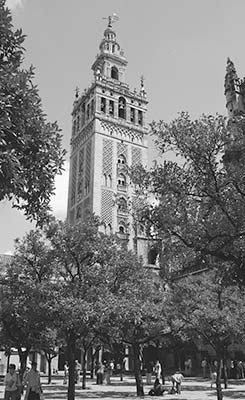
Capping the tower is a 4,000-pound bronze female angel symbolizing the Triumph of Faith—specifically, the Christian faith over the Muslim one. The statue serves as a weathervane. (In Spanish, girar means “to rotate”; la giralda refers to this figure that turns with the wind.) A ribbon of letters (you can make out Nomen Die from this vantage point) proclaims, “The strongest tower is the name of God.”
• Now enter the cathedral, where you’ll encounter the...
4 Altar de Plata
This gleaming “altar of silver” is meant to resemble a monstrance—that’s the ceremonial vessel that displays a communion wafer in the center. This one is gargantuan, big-enough-for-a-card-table-sized wafer (and made from more than 5,000 pounds of silver looted from Mexico by Spanish conquistadores in the 16th century). Amid the gleaming silver is a colorful statue of the Virgin. In 2014, Sevilla’s celebration of La Macarena’s 50th anniversary “jubilee” culminated here, remembering when this beloved icon was granted a canonical coronation by the pope.
• From here, we’ll tour some sights going counterclockwise around the church. Head right from the Altar de Plata, pass a few chapels where people come to pray to their chosen saint, and keep going to the last chapel on the right (with the big, marble baptismal font).
5 Chapel of St. Anthony
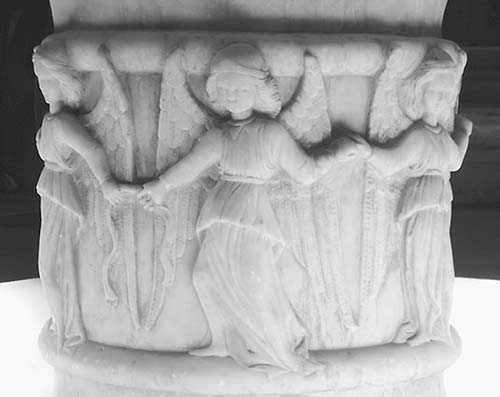
This chapel (Capilla de San Antonio) holds a special place in the hearts of Sevillians. Many were baptized in the big Renaissance-era font with the delightful carved angels dancing along its base. The chapel is also special for Murillo’s tender painting of the Vision of St. Anthony (1656). The saint kneels in wonder as Baby Jesus comes down surrounded by a choir of angels. Anthony, one of Iberia’s most popular saints, is the patron saint of lost things—so people come here to pray for his help in finding jobs, car keys, and life partners. (In 1874, the cathedral had to find Anthony himself, when thieves stole this painting; it turned up in New York.) Above the Vision is The Baptism of Christ, also by Murillo. As for the stained glass, you don’t need to be an art historian to know that it dates from 1685. The women are Santa Justa and Santa Rufina, the third-century Roman sisters eaten by lions at Itálica (a Roman town six miles away, see here) because of their faith and now two of Sevilla’s five patron saints. Potters by trade, they’re easy to identify by their palm branches (symbolic of martyrdom), their pots (at their feet or in their hands), and the Giralda bell tower symbolizing the town they protect. As you tour, keep a lookout for this dynamic hometown duo.
• Exiting the rear of the chapel, look for the enormous glass display case with the...
6 Pennant of Ferdinand III
This 800-year-old battle flag shows the castle of Castile and the lion of León—the two kingdoms Ferdinand inherited, forming the nucleus of a unified, Christian Spain two centuries later. This pennant was raised here over the minaret of the mosque on November 23, 1248, as Christian forces finally expelled the Moors from Sevilla. For centuries afterward, it was paraded through the city on special days.
• Continuing on, stand at the...
7 Back of the Nave
Face the choir and appreciate the ornate immensity of the church. Can you see the angels trumpeting on their Cuban mahogany? Any birds? On the floor before you (breaking the smooth surface) is the gravestone of Ferdinand Columbus (Hernando Colón), Christopher’s second son. Having given the cathedral his collection of 6,000 precious books, he was rewarded with this prime burial spot. Behind you (behind an iron grille, left of the curtain-covered, large door) is Murillo’s Guardian Angel pointing to the light and showing an astonished child the way.
The church is 137 yards long and 90 yards wide. That’s more than two acres, the size of an entire city block in downtown Manhattan. Measured by area, this is still the world’s largest church. (The church’s footprint needed to be big enough to stamp out every trace of the mosque it replaced.) While most Gothic churches are long and tall, this nave is square and compressed. The pillars are massive. Like other Spanish churches, this nave is clogged in the middle by the huge rectangular enclosure called the choir.
• Still moving counterclockwise (passing the WC, a drinking fountain, and the entry for those without a prebooked ticket), find a small door that leads to the...
8 Art Pavilion
This room features paintings that once hung in the church. You’ll see a few by Sevilla’s 17th-century master, Bartolomé Murillo, including paintings of beloved local characters who’ll crop up again on our tour. King (and saint) Ferdinand III—usually shown with sword, crown, globe, and ermine robe—is the man who took Sevilla from the Moors and made this church possible. Remember you’ve seen Santa Justa and Santa Rufina before, holding up the Giralda bell tower (in the Chapel of St. Anthony).
• Return to the church and continue counterclockwise. Find a chapel (opposite the towering organ) with a big wall of statues whose centerpiece is a golden fresco of Mary and Baby Jesus.
9 Virgen de la Antigua
In this gilded fresco, the Virgin delicately holds a rose while the Christ Child holds a bird. It’s some of the oldest art here (from the 1300s), even older than the cathedral itself. This chapel was once the site of the mosque’s mihrab—the horseshoe-shaped prayer niche that points toward Mecca. When Christians moved in (1248), they initially used the mosque for their church services, covering the mihrab with this Virgin. The mosque served as a church for about 120 years—until it was completely torn down and replaced by today’s cathedral. But the Virgin stayed, thanks to her beauty and her role as protector of sailors—crucial in this port city. Gaze up. Hanging from the ceiling (above the metal gate you passed through) are flags of all the New World countries where the Virgen de la Antigua is revered.
• Just past the Virgen de la Antigua chapel is the...
10 Tomb of Columbus
Four royal pallbearers carry the coffin of Christopher Columbus. It’s appropriate that Columbus is buried here. His 1492 voyage departed just 60 miles away, and the port of Sevilla became the exclusive entry point for all the New World plunder that made Spain rich. Columbus’ pallbearers represent the traditional kingdoms that formed the core of Spain: Castile, Aragon, León, and Navarre (identify them by their team shirts). The last kingdom, Granada, is also represented: Notice how Señor León’s pike is stabbing a pomegranate, the symbol of Granada—the last Moorish-ruled city to succumb to the Reconquista in that momentous year of 1492.
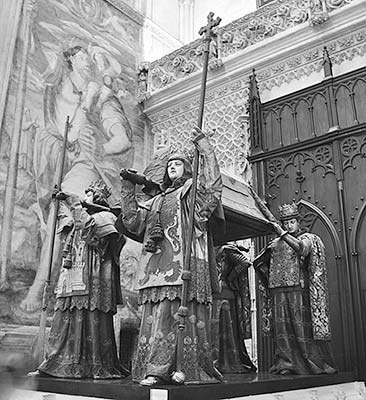
Columbus didn’t just travel a lot while alive—he even kept it up posthumously. He died in 1506 in northwestern Spain (in Valladolid) and was buried there. His remains were then moved to a monastery here in Sevilla, then to what’s now the Dominican Republic (as he’d requested), then to Cuba. Finally—when Cuba gained independence from Spain in 1902—his remains sailed home again to Sevilla. After all that, are these really his remains? In 2006, a DNA test matched the bones of his son (buried just a few steps from here), giving Sevillians some evidence to substantiate their proud claim.
Columbus’ tomb stands, appropriately, at the church entrance reserved for pilgrims, near a 1584 mural of St. Christopher, patron saint of travelers. The clock above has been ticking since 1788.
• Walk to the center of the church, where you can enjoy a view of the main altar. Look through the wrought-iron Renaissance grille at the...
11 High Altar
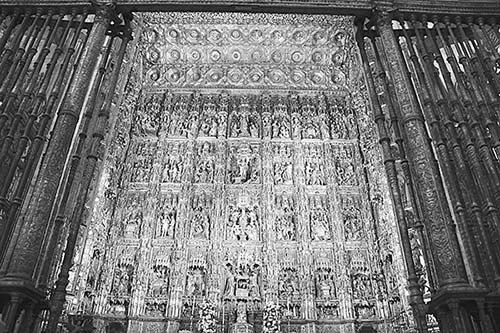
This dazzling 80-foot wall of gold covered with statues is considered the largest altarpiece (retablo mayor) ever made. Carved from walnut and chestnut, and blanketed by a staggering amount of gold leaf, it took three generations to complete (1481-1564). Its 44 scenes tell the story of Jesus and Mary—left to right, bottom to top. Focus on the main spine of scenes running up the center. At the bottom sits a 750-year-old silver statue of Baby Jesus and Mary—the cathedral’s patroness since Christians first worshipped here in the old converted mosque. Above Mary, find the scene of Baby Jesus (with cow and donkey) being born in a manger. Above that, Mary (flanked by winged angels) is assumed into heaven. Above that, a shirtless, flag-waving Jesus stands atop his coffin, having been resurrected. And above that, he ascends past his disciples into heaven. Bible scholars can trace the entire story through the miracles, the Passion, and the Pentecost. Look way up to the tippy-top, where a Crucifixion adorns the dizzying summit: That teeny figure is six feet tall.
The son of a barber of Seville, Bartolomé Murillo (mur-EE-yoh) got his start selling paintings meant for export to the frontier churches of the Americas. In his 20s, he became famous after he painted a series of saints for Sevilla’s Franciscan monastery. By about 1650, Murillo’s sugary, simple, and accessible religious style was spreading through Spain and beyond.
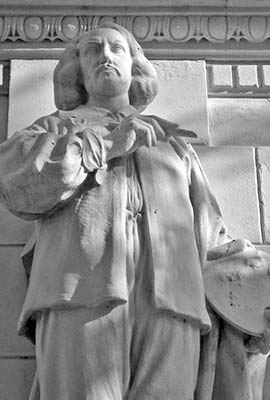
Murillo painted street kids with cute smiles and grimy faces, and radiant young Marías with Ivory-soap complexions and rapturous poses (Immaculate Conceptions). His paintings view the world through a soft-focus lens, wrapping everything in warm colors and soft light, with a touch (too much, for some) of sentimentality.
Murillo became a rich, popular family man, and the toast of Sevilla’s high society. In 1664, his wife died, leaving him heartbroken, but his last 20 years were his most prolific. At age 65, Murillo died after falling off a scaffold while painting. His tomb is lost somewhere under the bricks of Plaza de Santa Cruz.
Now crane your neck skyward to admire the elaborate ceiling with its intricate interlacing arches. Though done in the 16th-century Spanish Renaissance style, this stonework is only about 100 years old. You’re standing under the cathedral’s central dome, which has collapsed three times in the past 500 years.
• Don’t even think about that. Turn around and check out the...
12 Choir
A choir area like this one—enclosed within the cathedral for more intimate services—is where church VIPs can gather close to the high altar. Choirs are common in Spain and England, but rare in churches elsewhere. They’re called choirs because singers were also allowed here to accompany services. This one features an organ of more than 7,000 pipes (played Mon-Fri at the 10:00 Mass, Sun at the 10:00 and 13:00 Mass, not in July-Aug, free entry for worshippers). The big, spinnable book holder in the middle of the room held giant hymnals—large enough for all to chant from in an age when there weren’t enough books to go around.
• Return to Columbus’ tomb and find the next chapel.
13 Sacristy of the Chalices
This space is where the priests get ready each morning before Mass. The painting above the altar is remarkable for several reasons: It’s by the well-known artist Goya, it was specifically painted for this room, and it features our old friends Justa and Rufina with their trademark bell tower, pots, and palm leaves. Here they’re bathed in a heavenly light, triumphing over a broken pagan statue, while the lion who was supposed to attack meekly licks their toes. Goya daringly portrayed the two third-century Romans dressed like fashionable women of his time.
• Two chapels farther along is the entrance to the...
14 Main Sacristy
Marvel at the ornate, 16th-century dome of the main room, a grand souvenir from Sevilla’s golden age. The intricate masonry, called Plateresque, resembles lacy silverwork (plata means “silver”). God is way up in the cupola. The three layers of figures below him show the heavenly host, relatives in purgatory—hands folded in prayer—looking to heaven in hope of help, and the wretched in hell, including naked sinners engulfed in flames and teased cruelly by pitchfork-wielding monsters.
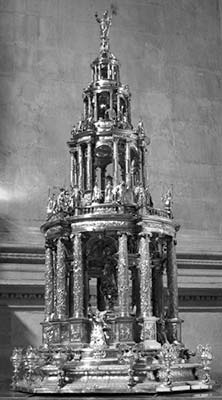
Dominating the room is a nearly 1,000-pound, silver-plated monstrance (vessel for displaying the communion wafer). This is the monstrance used to parade the holy host through town during Corpus Christi festivities.
• The next door down leads you through a few rooms, including one with a red wall under a unique oval dome.
This is the 16th-century chapter house (sala capitular), where monthly meetings take place with the bishop (he gets the throne, while the others share the bench). The paintings here are by Murillo: The Immaculate Conception (1668, high above the bishop’s throne) is one of his finest (and largest) depictions of Mary (in blue and white, standing amid a cloud of cherubs). To the right of her is Ferdinand (with sword and globe), along with more of Sevilla’s favorite saints.
• Now enter the...
15 Treasury
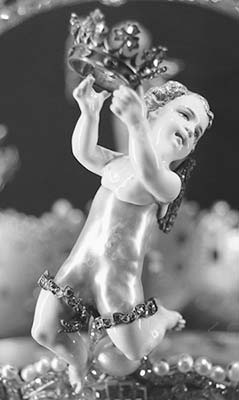
This wood-paneled Room of Ornaments shows off gold and silver reliquaries, which hold hundreds of holy body parts and splinters of the true cross. The star of the collection is Spain’s most valuable crown—the Corona de la Virgen de los Reyes. Made in 1904, it sparkles with countless precious stones, including the world’s largest pearl—used as the torso of an angel. This amazing treasure was completely paid for by devoted locals. Not fit for a human head, once a year the crown is taken out and placed on the head of a statue of the Virgin who represents Mary as patron of this cathedral.
• Leave the treasury and continue around, passing (directly behind the high altar) the closed-to-tourists 16 Royal Chapel. Though it’s only open for worship (access from outside), it’s the holy-of-holies of Sevillian history, with the tombs of Sevilla’s founder Ferdinand III, his enlightened successor Alfonso the Wise, and Pedro I, who built the Alcázar.
In the far corner is the entry to the Giralda bell tower. It’s time for some exercise (unless you’re touring the rooftop later—then you can skip it).
17 Giralda Bell Tower Climb
Your church admission includes entry to the bell tower, a former minaret. Notice the beautiful Moorish simplicity as you climb to its top, 330 feet up (35 ramps plus 17 steps), for a grand city view. The graded ramp was designed to accommodate a donkey-riding muezzin, who clip-clopped up five times a day to give the Muslim call to prayer back when a mosque stood here. It’s less steep the farther up you go, but if you get tired along the way, stop at balconies for expansive views over the entire city.
Back on the ground, return to the giant silver altar and head outside through the Court of the Orange Trees. Before leaving, take in the whole scene—Giralda tower, courtyard, and the church with its flying buttresses and magnificent Gothic doorways. Enjoy the impressive remnants of the former mosque and the additions of today’s church. And appreciate the significance of this site that was sacred to two great world religions.
• Your cathedral tour is finished. (Remember to keep your ticket as it gets you into the exquisite Church of the Savior, if you didn’t go there first.) Exit the courtyard through the Puerta del Perdón onto Calle Alemanes. If you haven’t already done so, loop around the exterior of the cathedral (described at the start of the tour).
Or for a truly religious experience, consider one more stop. After exiting the cathedral, make a U-turn left onto Avenida de la Constitución. At #24 (directly across from the church door), enter the passageway marked Plaza del Cabildo, which leads into a quiet arcaded courtyard with a humble little hole-in-the-wall shop.
18 El Torno Pastelería de Conventos
Here, nuns from convents around Sevilla sell baked goods (daily from 10:30, closed Aug). You won’t actually see the cloistered sisters, since this shop is staffed by laypeople, but the pastries they make are heavenly—some of Sevilla’s best cookies, bar nun.
▲▲▲ROYAL ALCÁZAR
This palace has been a lavish residence for Spain’s rulers for a thousand years. Originally a 10th-century palace built for the governors of the local Moorish state, it still functions as one of the royal family’s homes—the oldest in Europe that’s still in use. The core of the palace features an extensive 14th-century rebuild, done by Muslim workmen for the Christian king, Pedro I (1334-1369). Pedro was nicknamed either “the Cruel” or “the Just,” depending on which end of his sword you were on. Pedro’s palace embraces both cultural traditions.
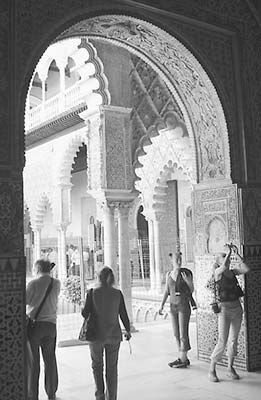
Today, visitors can enjoy spectacularly decorated halls and courtyards with distinctive Islamic-style flourishes. Exhibits call up the era of Columbus and Spain’s New World dominance. The lush, sprawling gardens invite exploration.
Cost and Hours: €13.50, €1 extra to buy advance tickets online; daily 9:30-19:00, Oct-March until 17:00; +34 912 302 200, www.alcazarsevilla.org. Your ticket gets you free admission to four other museums in Sevilla, including the Antiquarium (in the basement of the Metropol Parasol—see here) and the Centro Cerámica Triana (see here).
Advance Tickets Recommended: Avoid the long line (and potential disappointment) by booking a timed-entry ticket online. Tickets go on sale one month in advance. To safeguard against scalping, your passport number is required to book online, and a physical passport is required when purchasing on-site. With your QR code (printed or on your phone) you’ll wait in the shorter and fast-moving savvy-traveler line (you must enter within 30 minutes of your appointed time). A very limited number of same-day tickets can be booked around the corner from the entrance at the ticket office in the Patio de Banderas (credit cards only, try as soon as they open), but you’re better off booking in advance.
Tours: The 1.5-hour audioguide gives those with a long attention span some worthwhile information (€6, or scan QR code at entrance for free mobile version). Or consider Concepción Delgado’s guided tour (see “Tours in Sevilla,” earlier).
My free Sevilla City Walk audio tour includes background information and descriptions of the Royal Alcázar exterior, but not the interior.
Upper Royal Apartments Option (Cuarto Real Alto): With a little planning, you could fit in a visit to the 15 lavish, chandeliered, Versailles-like rooms used by today’s monarchs, including the official dining room, living rooms, and stunning Mudejar-style Audience Room. Your group (15 people max) will be escorted on a 30-minute tour while using the included audioguide. It’s a delightful and less-crowded part of the palace, but you’ll need to book well in advance (€20 combo-ticket with Alcázar, must check bags in lockers, check in 15 minutes early, last tour departs at 13:30).
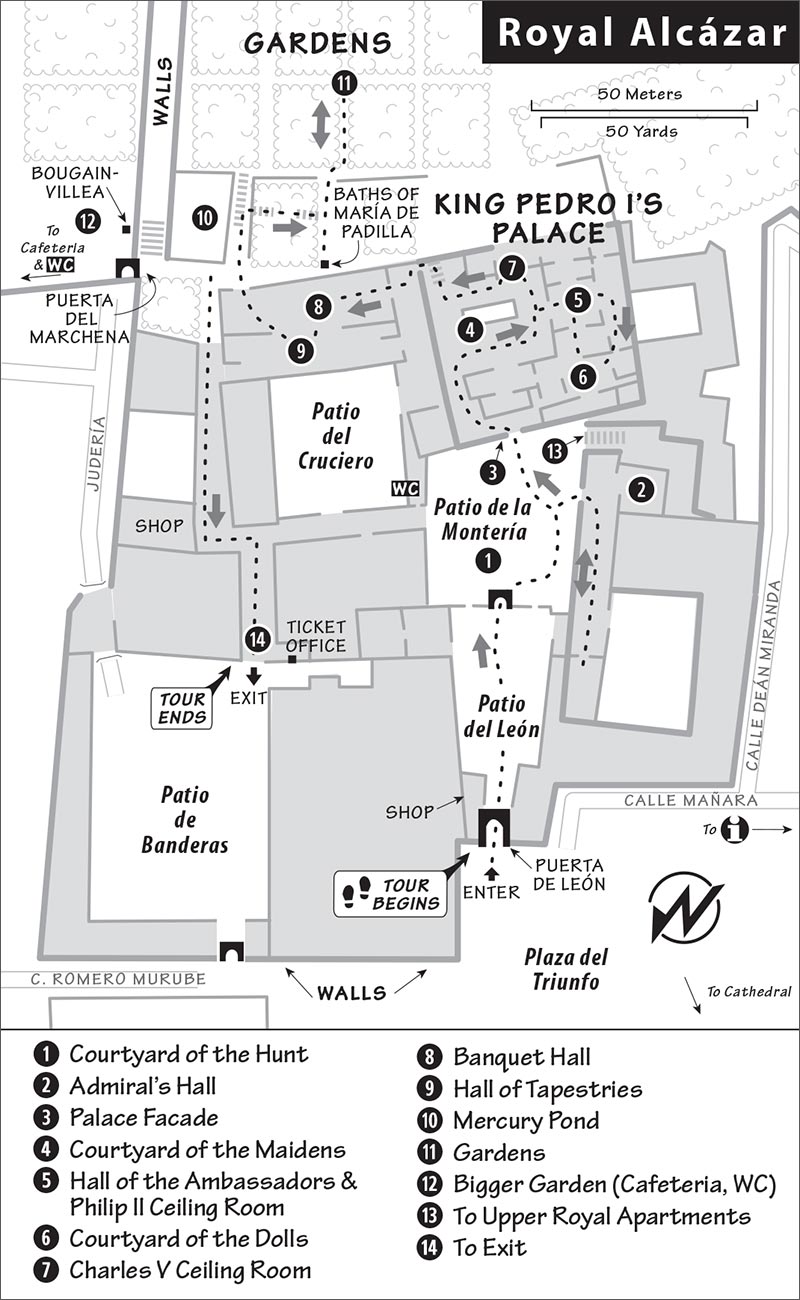
Self-Guided Tour
Sevilla’s royal palace is decorated with a mix of Islamic and Christian elements—a style called Mudejar. It offers a thought-provoking glimpse of a graceful al-Andalus world that might have survived its Castilian conquerors...but didn’t. Remember that Sevilla was reconquered in 1248 and this palace was built mostly in the 1300s—around the same time as Granada’s Alhambra. But the Alhambra was built by Moors for Muslim rulers while Sevilla’s was made for Christians, built in the Moorish style by Moorish artisans. The floor plan is intentionally confusing, to make experiencing the place more exciting and surprising.
• Just past the entrance, you’ll go through the garden-like Lion Patio (Patio del León), with the rough original structure of the older 10th-century Moorish fortress on your left (the door leads to a few arches around a pool), and through the 12th-century arch into a courtyard called the...
1 Courtyard of the Hunt (Patio de la Montería)
For centuries, this has been the main gathering place in the Alcázar (and it’s now where tourists converge). Grab some shade and get oriented. The palace’s main entrance is directly ahead, through the elaborately decorated facade.
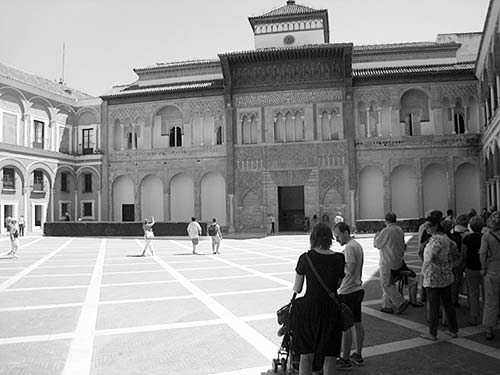
History is all around you. The Alcázar was built over many centuries (after 1248), with rooms and decorations from the various rulers who’ve lived here. Behind you, the courtyard you passed through has remnants of the original 10th-century Moorish palace. The towering entrance facade before you dates from after Sevilla was Christianized, when King Pedro I built the most famous part of the complex. To the right are rooms dedicated to Spain’s golden age, when the Alcázar was home to Ferdinand and Isabel and, later, their grandson Charles V (the most powerful man in Europe...the Holy Roman Emperor). Each successive monarch left their mark, adding still more luxury. And today’s king and queen still use the palace’s upper floor as one of their royal residences.
• Before entering the heart of the palace, let’s get a sense of its history. Start in the wing to the right of the courtyard.
2 Admiral’s Hall (Salón del Almirante)
In the first room, filled with big canvases, find the biggest painting (and most melodramatic). This shows the crucial turning point in the Alcázar’s history: The king who defeated the Moors in 1248, and turned the palace from Moorish to Christian, is kneeling humbly before the bishop, symbolically giving his life to God. Other paintings depict later royalty who made their mark on the Alcázar’s history. (This particular room is still used today for fancy government receptions.)
Queen Isabel put her stamp on the Alcázar by building this series of rooms (1503). Having debriefed Columbus after his New World discoveries, she realized the potential business opportunity. She created this wing to administer Spain’s New World ventures. In these halls, Columbus recounted his travels, Ferdinand Magellan planned his around-the-world cruise, and Amerigo Vespucci tried to come up with a catchy moniker for that newly discovered continent.
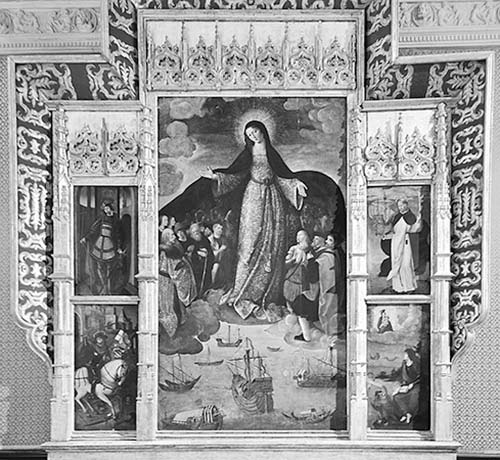
Continue into the pink-and-red Audience Chamber, once the Admiralty’s chapel. The altarpiece painting is St. Mary of the Navigators (Santa María de los Navegantes, Alejo Fernández, 1530s). The Virgin—the patron saint of sailors and a favorite of Columbus—keeps watch over the puny ships beneath her. Her cape seems to protect everyone under it—even the Native Americans in the dark background (the first time “Indians” were painted in Europe). Kneeling beside the Virgin (on the right, dressed in gold, almost joining his hands together in prayer) is none other than Christopher Columbus. He’s on a cloud and this is heaven (this was painted a few decades after his death). Notice that Columbus is blond. Columbus’ son said of his dad: “In his youth his hair was blond, but when he reached 30, it all turned white.” Many historians believe this to be the earliest known portrait of Columbus. If so, it’s also likely to be the most accurate. The man kneeling on the left side of the painting, with the big gold cape, is King Ferdinand, the husband of Isabel.
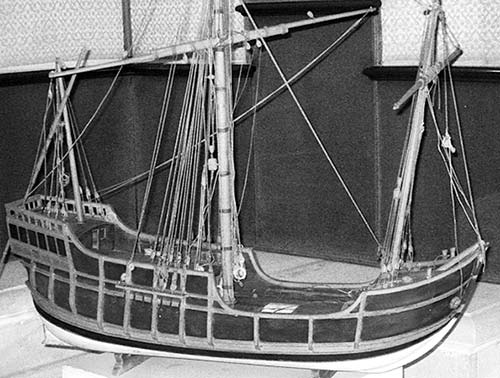
Left of the painting is a model of Columbus’ Santa María, his flagship and the only of his three ships not to survive the 1492 voyage. Columbus complained that the Santa María—a big cargo ship, different from the sleek Niña and Pinta caravels—was too slow. On Christmas Day it ran aground off present-day Haiti and tore a hole in its hull. The ship was dismantled to build the first permanent structure in America, a fort for 39 colonists. (After Columbus left, the natives burned the fort and killed the colonists.) Opposite the altarpiece (in the center of the back wall) is the family coat of arms of Columbus’ descendants, who now live in Spain and Puerto Rico. Using Columbus’ Spanish name, it reads: “To Castile and to León, a new world was given by Colón.”
As you return to the courtyard, don’t miss the room (beyond the grand piano) with display cases of ornate fans (mostly foreign and well described in English). A long painting (designed to be gradually rolled across a screen and viewed like a primitive movie) shows 17th-century Sevilla during Holy Week. Follow the procession, which is much like today’s, with the same traditional floats carried by teams of men along with a retinue of penitents.
• Back in the Courtyard of the Hunt, face the impressive entrance to the...
3 Palace Facade
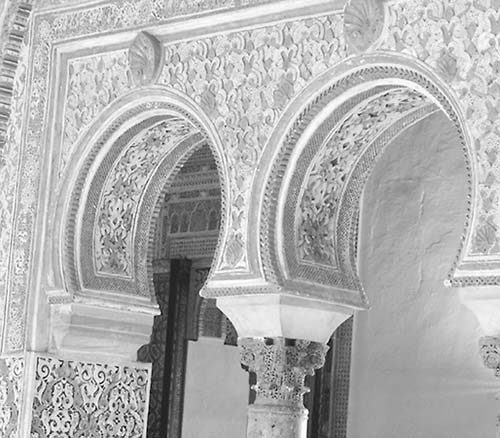
This is the entrance to King Pedro I’s Palace (Palacio del Rey Pedro I), the Alcázar’s 14th-century nucleus. Though it looks Islamic—with lobed arches, slender columns, and intricate stucco work—it’s a classic example of the palace’s Mudejar style. Looking closer you’ll see Christian motifs mixed in—coats of arms of Spain’s kings and heraldic animals. About two-thirds of the way up, find the inscription dedicated to the man who built the gate (center of the top row)—“Conquerador Don Pedro.” The facade’s elaborate blend of Islamic tracery and Gothic Christian elements introduces us to the unique style seen throughout Pedro’s part of the palace.
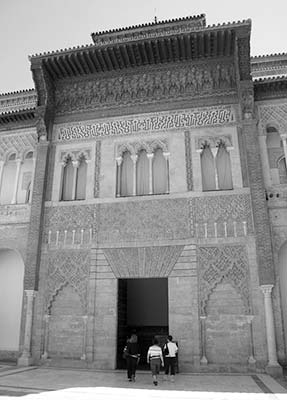
• Enter the palace. Go left through the vestibule (impressive, yes, but we’ll see better), and emerge into the big courtyard with a long pool in the center. This is the...
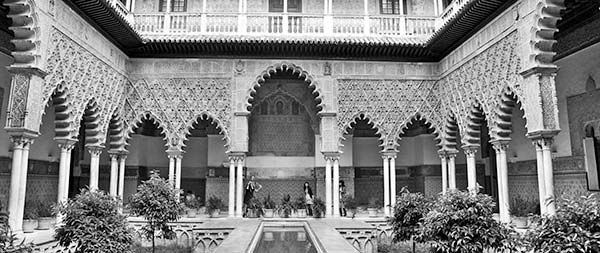
4 Courtyard of the Maidens (Patio de las Doncellas)
You’ve reached the center of King Pedro’s palace. It’s an open-air courtyard, surrounded by rooms. In the middle is a long, rectangular reflecting pool. Like the Moors who preceded him, Pedro built his palace around water.
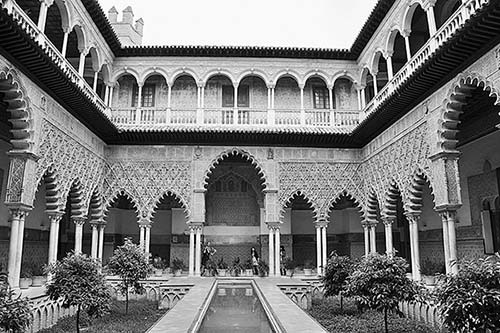
King Pedro cruelly abandoned his wife and moved into the Alcázar with his mistress, then hired Muslim workers from Granada to re-create the romance of that city’s Alhambra in Sevilla’s stark Alcázar. The designers created a microclimate engineered for coolness: water, sunken gardens, pottery, thick walls, and darkness. This palace is considered Spain’s best example of the Mudejar style. Stucco panels with elaborate designs, coffered wooden ceilings, and intricate lobed arches atop slender columns create a refined, pleasing environment. Ceramic tiles on the walls add color. The elegant proportions and symmetry of this courtyard are a photographer’s delight.
Pedro’s original courtyard was a single story; the upper floors were added by Isabel’s grandson, Charles V, in the 16th century. Today, those upper-story rooms are part of the Spanish monarchs’ living quarters. See the different styles: Mudejar below (lobed arches and elaborate tracery) and Renaissance above (round arches and less decoration).
• Let’s explore some rooms surrounding the courtyard. Start with the room at the far end of the long reflecting pool—beneath the big octagonal tower. This is the palace’s most important room.
5 Hall of the Ambassadors (Salón de Embajadores)
Here, in his throne room, Pedro received guests and caroused in luxury. The room is a cube topped with a half-dome, like many important Islamic buildings. In Islam, the cube represents the earth, and the dome is the starry heavens. In Pedro’s world, the symbolism proclaimed that he controlled heaven and earth. Islamic horseshoe arches stand atop recycled columns with leafy golden capitals. As you marvel, remember that this is original, from the 1300s.
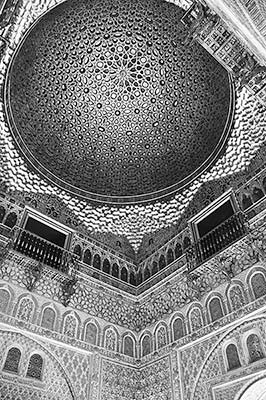
The stucco on the walls is molded with interlacing plants, geometrical shapes, and Arabic writing. Despite this being a Christian palace, the walls are inscribed with unapologetically Muslim sayings: “None but Allah conquers” and “Happiness and prosperity are benefits of Allah, who nourishes all creatures.” The artisans added propaganda phrases, such as “Dedicated to the magnificent Sultan Pedro—thanks to God!” (Perhaps the Allah quotes survived because Muslims and Christians praise the same God, and in Arabic—Muhammad’s native language—God is called Allah.)
The Mudejar style also includes Christian motifs. Find the row of kings, high up at the base of the dome, chronicling all of Castile’s rulers from the 600s to the 1600s (portrayed as if on playing cards). Within the intricate patterns inside the dome, you can see a few coats of arms—including the castle of Castile and the lion of León. These symbols (along with another royal symbol with twin columns) are seen throughout the palace. The Mudejar style also incorporates birds, seashells, and other natural objects you wouldn’t normally find in Islamic decor, as it traditionally avoids realistic images of nature.
Notice how it gets cooler as you go deeper into the palace. Straight ahead from the Hall of the Ambassadors, in the Philip II Ceiling Room (Salón del Techo de Felipe II), look above the arches to find peacocks, falcons, and other birds amid interlacing vines. Imagine day-to-day life in the palace—with VIP guests tripping on the tiny steps.
• Make your way to the second courtyard (with your back to the Hall of the Ambassadors, circle right). This smaller courtyard (with the skylight) is the...
6 Courtyard of the Dolls (Patio de las Muñecas)
This delicate courtyard was reserved for the king’s private family life. Originally, the center of the courtyard had a pool, cooling the residents and reflecting decorative patterns that were once brightly painted on the walls. The columns—recycled from ancient Roman and Visigothic buildings—are of alternating white, black, and pink marble. The courtyard’s name comes from the tiny doll faces found at the base of one of the arches. They’re underwhelming and hard to find. (Hint: They’re just a couple of inches tall and eight feet up—kitty-corner from where you entered.)
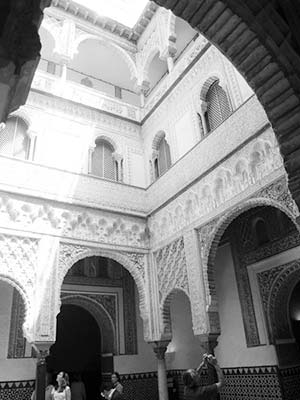
• Wander around before returning to the big Courtyard of the Maidens. In the middle of the right side, an arch leads to the...
7 Charles V Ceiling Room (Salón del Techo del Carlos V)
Emperor Charles V ruled Spain at its peak and, flush with New World wealth, expanded the palace. His marriage to his beloved cousin Isabella—which took place in this room—joined vast realms of Spain and Portugal. Devoutly Christian, Charles celebrated his wedding night with a midnight Mass, and later ordered the Mudejar ceiling in this room to be replaced with the less Islamic (but no less impressive) Renaissance one you see today. At the base of the ceiling, find Charles’ coat of arms—the black double eagle.
• When you’re ready to move on, return to the Courtyard of the Maidens, then turn right. In the corner, find the small staircase. Go up to rooms decorated with bright ceramic tiles and Gothic vaulting. Pass directly through the chapel (with its majestic mahogany altar on your right) and into a big, long room.
8 Banquet Hall (Salón Gótico)
This airy banquet hall is where Charles and Isabella held their wedding reception. Note the two huge coats of arms: Charles’ double eagle at one end and Isabella’s shield of Portugal at the other. Both are painted cloth from the 1500s. Tiles of yellow, blue, green, and orange (from the 16th century) line the room, some decorated with whimsical human figures with vase-like bodies. Imagine a formal occasion here, as elegant guests took in the views of the gardens. To this day, city officials and VIPs still host receptions here.
• Midhall, on the left, enter the...
9 Hall of Tapestries (Salón Tapices)
Next door, the walls are hung with 18th-century Spanish copies of 16th-century Belgian tapestries showing the power, conquests, and industriousness of Charles’ prosperous reign. This series of scenes depicts the pivotal Conquest of Tunisia (1535), which stopped the Muslim Ottomans in North Africa at a time when they were threatening Europe on different fronts. (The highlights are described in Spanish along the top, and in Latin along the bottom.) The map tapestry of the Mediterranean world has south pointing up. Find Genova, Italy, on the bottom; Africa on top; Lisbon (Lisboa) on the far right; the large city of Barcelona in between; and Tunisia (Tunis). The ships of the Holy Roman Empire gather in anticipation of a major battle. The artist included himself (far right) holding the legend—with a scale in both leagues and miles.
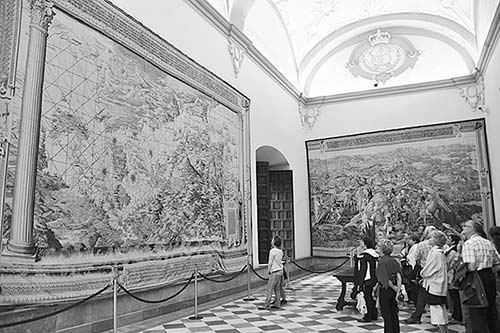
At the far end of the room is a big, dramatic portrayal of the Spanish Navy. With cannon-laden warships and a merchant fleet to haul goods and people, Spain ruled the waves—and thereby an empire upon which the sun never set. Its reign lasted from 1492 until the defeat of the Spanish Armada in 1588; after that, Britannia’s navy took the helm, and it was her crown that controlled the next global empire.
• Return to the Banquet Hall, then head left and go outside at the far end to the extensive landscaped gardens. First up is the...
10 Mercury Pond
The Mercury Pond is marked by a tiny bronze statue of the messenger of the gods, with his cute little winged feet. This was a reservoir fed by a 16th-century aqueduct that irrigated the palace’s entire garden. As only elites had running water, the fountain was an extravagant show of power. The long stucco-studded wall along one side of the garden was part of the original Moorish castle wall. In the early 1600s, when fortifications were no longer needed here, that end was redesigned to be a grotto-style gallery for strolling.
• From the Mercury Pond, steps lead into the formal gardens. Just past the bottom of the steps, a tunnel on the right leads under the palace to the coolest spot in the city—the Baths of María de Padilla. This long underground pool was a rainwater cistern, named for Pedro of Castile’s mistress, who frequented the place. Its mysterious medieval atmosphere is like something out of Game of Thrones—which actually did use this and other Alcázar settings in several episodes of the television series. Finally, explore the rest of the...
11 Gardens
The intimate geometric zone nearest the palace is the Moorish garden. The far-flung garden beyond that was the backyard of the Christian ruler.
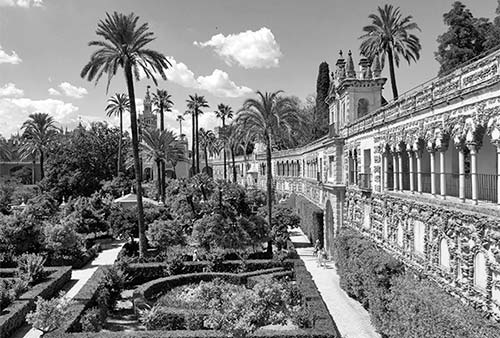
Here in the gardens, as in the rest of the palace, Christian and Islamic traditions merge and mingle. Both cultures used water and nature as essential parts of their architecture. The gardens’ pavilions and fountains only enhance this. Wander among palm trees, myrtle hedges, and fragrant roses. While tourists pay to be here, these are actually public gardens, free to locals. They’ve been that way since 1931, when the king was exiled and Spanish citizens took ownership of royal holdings. In 1975, the Spanish people allowed the king back on the throne—but on their terms...which included keeping these gardens.
From the Moors to Pedro I to Ferdinand and Isabel, and from Charles V to today’s King Felipe VI, we’ve seen the home of a millennium of Spanish kings and queens. Feel free to explore the exotic landscape they created and create your own Arabian Nights fantasies.
• Your Alcázar tour is over. When you’re ready to leave these gardens, return to the Mercury Pond and step back into the palace into a small courtyard with palm trees. From here, consider your options:
Just a few steps away, on the other side of the stucco wall, is a massive bougainvillea and a 12 bigger garden with a cafeteria and WCs. Once a farm that provided for the royal community, the garden is now home to a cool and convenient cafeteria with a delightful terrace.
If you’ve booked a spot to visit the 13 Upper Royal Apartments, return to the Courtyard of the Hunt, and head upstairs.
Otherwise, follow 14 exit signs and head out through the Patio de Banderas, once the entrance for guests arriving by horse carriage. Enjoy a classic Giralda bell tower view as you leave.
BETWEEN THE CATHEDRAL AND THE RIVER
▲Archivo General de Indias (General Archives of the Indies)
To the right of the Alcázar’s main entrance, the Archivo General de Indias houses historic papers related to Spain’s overseas territories. Its miles of shelving contain millions of pages documenting a once-mighty empire. While little of interest is on show, a visit is free, easy, and gives you a look at the Lonja Palace, one of the finest examples of Renaissance architecture in Spain. Designed by royal architect Juan de Herrera, the principal designer of El Escorial, the building evokes the greatness of the Spanish empire at its peak (c. 1600).
Cost and Hours: Free, Mon-Sat 9:30-17:00, Sun 10:00-14:00, Avenida de la Constitución 3, +34 954 500 528.
Background: In the early 1500s, as exotic goods began pouring into Sevilla from newly discovered lands, this spot between the cathedral and the Alcázar was an open-air market. Sevilla was the only port licensed to trade with the New World, and merchants came here from across Europe, establishing the city as a commercial powerhouse. The area evolved as a hub of Spanish power, where the royal palace, business community, and cathedral all came together.
In 1583, this grand building was built as a place for those merchants, moneychangers, and accountants to do their business—an early stock market, or lonja. (On the cathedral-facing side of the building stands a stone cross where businessmen would “swear to God” to be honest in their trade.) Mapmakers, sea captains, and navigators also gathered here, as well as lawyers, accountants, and politicians who could administer Spain’s far-flung colonies. Herrera designed a no-nonsense Renaissance building of symmetrical doors and windows, balustrades, and distinctive rooftop pinnacles.
By 1785, with Sevilla in decline (a victim of plagues, a silted-up harbor, and the rise of Cádiz as Spain’s main port), the building was put to new use as an archive: the storehouse for documents the country was quickly amassing from its discovery, conquest, and administration of the New World.
Visiting the Archives: The ground floor houses a small rotating exhibit that tells the story of the building (in Spanish). You may see copies of famous documents here, like the Treaty of Tordesillas (1494, when Spain and Portugal divvied up the New World) or the Capitulations of Santa Fe (the contract Columbus signed with Ferdinand and Isabel for his 1492 voyage). The cannon was discovered by American treasure hunter Mel Fisher. He used information in the archives to find a Spanish galleon that sank off the Florida coast in 1616—with a huge treasure onboard. Fisher returned the cannon as a gesture of goodwill.
Upstairs (up an extravagant marble staircase) you’ll find, frankly, not much. There’s a huge 16th-century security chest—meant to store gold and important documents. Its elaborate locking mechanism (it fills the inner lid) could be opened only by following a set series of pushes, pulls, and twists. There are portraits of the explorers whose discoveries made this building possible, scholars who archived the documents, and the powdered-wig administrators (teniente general) of the colonial empire...along with lots of empty shelves.
Avenida de la Constitución
Old Sevilla is bisected by this grand boulevard. Its name celebrates the country’s 1978 adoption of a democratic constitution, as the Spanish people moved quickly to reestablish their free government after the 1975 death of longtime dictator Francisco Franco (an understandable change, since it was previously named for the founder of Spain’s Fascist Party, José Antonio Primo de Rivera).
The busy avenue was converted into a pedestrian boulevard in 2007. Overnight, the city’s paseo route took on a new dimension. Suddenly cafés and shops here had fresh appeal. The tram line, once controversial as it violated what could have been a more purely pedestrian zone, is now a hit with locals.
▲▲Hospital de la Caridad
This charity hospital, which functioned as a place of final refuge for Sevilla’s poor and homeless, was founded in the 17th century by the nobleman Don Miguel Mañara. Your visit includes an evocative courtyard, a church filled with powerful art, and a good audioguide that explains it all. This is still a working charity, so when you pay your entrance fee, you’re advancing the work Mañara started.
Cost and Hours: €8, includes audioguide, Mon-Fri 10:30-14:00 & 15:00-18:30, Sat-Sun 14:00-19:00, Calle Temprado 3, +34 954 223 232, www.santa-caridad.es.
Background: Hospital founder Don Miguel Mañara (1626-1679) was the happy-go-lucky mayor of Sevilla at its peak of prosperity and sophistication. A big-time playboy and enthusiastic sinner, he had a massive change of heart late in life and dedicated his last years to strict worship and taking care of the poor. In 1674, Mañara acquired some empty warehouses in Sevilla’s old shipyard and built this 150-ward “place of heroic virtues.”
Mañara could well have been the inspiration for Don Juan, the quasi-legendary character from a play set in 17th-century Sevilla, popularized later by Lord Byron’s poetry and Mozart’s opera Don Giovanni (Giovanni is Italian for Juan). While no one knows for sure, it adds some fun to the visit. Regardless, the hospital iconography’s message—the sudden realization that, in the face of death, all of life’s pleasures are fleeting, and only by doing acts of charity can we gain eternal life—is what inspired the Don Juan story.
Visiting the Hospital: Entering the courtyard you’re greeted by a statue of a woman and two ecstatic cherubs, filled with the love of mankind. It’s Charity, the mission of this hospital. The statues come from Genoa, Italy, as Mañara’s family were rich Genovese merchants who moved to Sevilla to get in on the wealth from New World discoveries. The Dutch tiles (from Delft), depicting scenes from the Old and New Testament, are a reminder that the Netherlands was under Spanish rule in centuries past. This charming red-and-white courtyard, surrounded by offices, was the administrative hub of the hospital’s charitable work and its ongoing assistance to the poor. You’re likely to see seniors shuffling in and out, as this is still a home for the poor—Mañara’s legacy in action.
The Sala de Cabildos, a small room at the end of the courtyard, is Mañara’s former office. It has fine paintings from Mañara’s art collection.
Stepping out of the Sala de Cabildos, the chapel is on your right. But first, head left into a small, evocative courtyard. These arches are part of the 13th-century shipyards. Wander around and imagine the huge halls where the ships were produced that enabled Columbus, Vasco da Gama, and Magellan to broaden Europe’s horizons and make Spain a world power. (Plans are in the works to open these massive and historic shipyards to the public.)
From the courtyard, step into a fine little museum that celebrates the work of Don Miguel and the charity brotherhood he founded (visit the sick, feed the hungry, shelter the pilgrim).
Next, cross the inner courtyard and head up a few steps into the highlight—the chapel. It’s an over-the-top masterpiece of Sevillian Baroque—a fusion of architecture, painting, and sculpture. Don Miguel hired Sevilla’s three greatest artists (who were also his friends): the painters Bartolomé Murillo and Juan de Valdés Leal and the sculptor Pedro Roldán. Mañara himself worked with them to design the church and its themes.
Start with the painting at the back of the nave, on the left wall. Worshippers would be greeted by Leal’s In the Blink of an Eye (In Ictu Oculi). In it, the Grim Reaper extinguishes the candle of life. Filling the canvas are the ruins of worldly goods, knowledge, power, and position. It’s all gone in the blink of an eye—true in the 1670s...and true today. Don Miguel experienced that personally when his wife suddenly died—along with half of Sevilla—in a devastating plague.
Directly opposite is Leal’s The End of the Glories of the World. The painting shows Mañara and a bishop decaying together in a crypt, with worms and assorted bugs munching away. Above, the hand of Christ—pierced by the nail—holds the scales of justice: sins (“Nimas,” on the left) and good deeds (“Nimanos,” on the right). The placement of both paintings gave worshippers plenty to think about during and after their visit. This Counter-Reformation propaganda, while certainly thought-provoking, is exactly the opposite of Martin Luther’s theology.
Strolling up the nave, you’ll see paintings and statues that show various good deeds and acts of self-sacrifice and charity performed by Jesus and the saints—the kinds of things that we should emulate to save us from eternal death. Most of the paintings leading up to the altar are replicas of Murillo’s pieces, lost during Napoleonic times. On the left wall, Moses strikes a rock to bring water to the needy Israelites. A trademark Murillo beggar-boy atop a horse points at Moses as if saying, “Do what he did.” On the right wall, Jesus gives loaves and fishes to thousands of hungry people. Murillo, a devoted member of this charity, was hammering home one of the institution’s functions—give food and drink to the poor.
The giant altar is carved wood with gold leaf, with a dozen hardworking cupids providing support. Christ’s lifeless body has been taken from the cross and some workers are bringing in the dark-gray tombstone. This illustrated the mission of the monks here—to provide a proper Christian burial to society’s outcasts, like executed criminals. The carved-and-painted statues by Roldán are realistic and emotional, in the style of his famed La Macarena statue. Atop the altar are three female figures representing faith (left), hope (right), and—the star of this place—charity. Notice how the altar’s painting blends seamlessly with the statues of his burial below. The rocks and shrubs of the painting morph into sculpted 3-D rocks and shrubs, as the events of the Crucifixion become the more tangible reality of Jesus’ very dead body.
Before you leave the church, do Don Miguel Mañara a favor. Find his tombstone and step on it. It’s located in the back, tucked within the big wooden entranceway. Set in the pavement, this tombstone has served as a humble doormat since 1679. He requested to be buried here so everyone would step on him as they entered. The tombstone reads, “Beneath this stone lies the worst man in the world.” By focusing on the vanity of his own life and dedicating himself to charity, Don Miguel hoped to be saved from his sins.
Outside, more big shots—many of Sevilla’s top families to this day—are featured on tombstones paving the exit.
Across the street from the entry is a park. Pop in and see Don Miguel—wracked with guilt—carrying a poor, sick person into his hospital. One thing’s for certain: Don Miguel is on the road to sainthood. But since you need to perform miracles to become a saint, his supporters request that you report any miraculous answers to prayers to the Vatican.
Torre del Oro (Gold Tower) and Naval Museum
Sevilla’s historic riverside Gold Tower was, until 1717, the starting and ending point for all shipping to the New World. It’s named for the golden reflection of the sun off the Guadalquivir River—not for all the New World booty that landed here. Ever since the Moors built it in the 13th century, it’s been part of the city’s fortifications, and long anchored a heavy chain that draped from here across the river to protect the harbor. In 1248, King Ferdinand III’s ships rammed the chain and broke through, taking the city from the Moors. Today, it houses a fine little naval museum on two floors, with a few historic artifacts and copies of maritime paintings, well described in English. It provides a good historic overview of the Age of Discovery, and its spiral staircase leads to a commanding river view (€3 donation, Mon-Fri 9:30-19:00, Sat-Sun from 10:30).
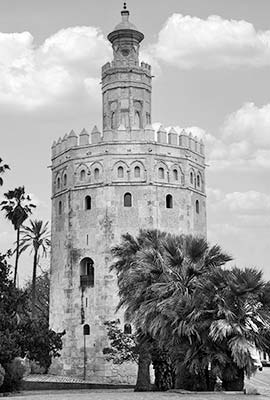
Nao Victoria 500
Magellan may not have returned from his round-the-world expedition, but the Nao Victoria did, and this is a full-scale replica of that ship. A small, overpriced museum and on-deck visit outline the voyage and how Basque navigator Juan Sebastián Elcano took charge of the last of five ships and brought 17 men safely back to Sevilla.
Cost and Hours: €10, Wed-Fri 9:00-14:30, Sat-Sun 10:00-18:00, closed Mon-Tue, +34 954 470 891, www.fundacionnaovictoria.org.
BARRIO SANTA CRUZ
For a self-guided walk through this neighborhood, see my “Barrio Santa Cruz Walk,” earlier, or download my free Sevilla City Walk audio tour.
Hospital de los Venerables
This former charity-run old-folks home and hospital comes with a Baroque church and an exquisite painting gallery that includes the Centro Velázquez, which displays works by one of Spain’s premier artists. It merges local history, art, and architecture in one building. Everything is well explained by the audioguide.
Cost and Hours: €12, includes audioguide, Mon-Sat 10:00-19:00, Sun until 15:00, Plaza de los Venerables 8, +34 697 898 659, www.hospitalvenerables.es.
Visiting the Hospital: In the courtyard, you get a sense of how retired priests and Sevilla’s needy mingled around its sunken fountain.
The church, which takes you back to the year 1700, is bursting with Baroque decor, one of Spain’s best pipe organs, and frescoes by Juan de Valdés Leal. Of note is the trompe l’oeil he painted on the sacristy ceiling, turning a small room into a piece of heaven. The decor exalts the priesthood and Spain’s role as standard-bearer of the pope.
The top-notch painting gallery is dedicated to one of the world’s greatest painters, Diego Velázquez (1599-1660), who was born in Sevilla and worked here as a young man. Velázquez’s Vista de Sevilla helps you imagine the excitement of this thriving city in 1649 when, with 120,000 people, it was the fourth largest in Europe. You’ll recognize landmarks like the Giralda bell tower, the cathedral, and the Torre del Oro. The pontoon bridge leads to Triana—where citizens of all ranks strolled the promenade together, as they still do today.
The Sevilla that shaped Velázquez was the gateway to the New World. There was plenty of stimulation: adventurers, fortune hunters, and artists passed through here, and many stayed for years. Of the few Velázquez paintings remaining in his hometown, three are in this gallery. Upstairs has little of interest, but the staircase dome is worth a look, as is the private box view into the church.
NORTH OF THE CATHEDRAL
Plaza Nueva
The pleasant “New Square” is a five-minute walk north of the cathedral, and has been the end of the line for Sevilla’s tram system, which zips down Avenida de la Constitución (by the time you visit, it may extend to the Santa Justa train station and the airport).
At the center of the square is a statue of King Ferdinand III, who liberated Sevilla from the Moors in the 13th century and was later sainted. This is another example of Sevilla’s devotion to the Virgin. If you look closely at the statue, you can see the horn of the king’s saddle is actually his treasured Virgin of the Battles statuette. Made of hollowed ivory, it was carved to fit over the saddle horn, and he rode with it into battle many times. When his 13th-century tomb was opened in the 17th century, they found the same ivory Mary with his incorrupt body. (And that very statue is now in the cathedral’s big sacristy.)
For centuries after the Christian reconquest, a huge Franciscan monastery stood on this site; it was a spiritual home to many of the missionaries who colonized the California coast. But in the 1800s, when the Jesuits threatened the secular government and stood in the way of modern, post-revolutionary thinking, the power of the monasteries was overturned and grand monasteries like this were destroyed.
Running along the square is the relatively modern City Hall. Couples use the grand salon upstairs for weekend weddings, then join their photographers on the front steps. For a more interesting look at this building, circle around to the other end (to the smaller square, called Plaza de San Francisco). This square—the site of the Spanish Inquisition’s infamous auto-da-fé—has been used for executions, bullfights, and (today) big city events.
▲▲Church of the Savior (Iglesia del Salvador)
Sevilla’s second-biggest church, built on the site of a ninth-century mosque, gleams with freshly scrubbed Baroque pride. While the larger cathedral is a jumble of styles, this church is uniformly Andalusian Baroque—the architecture, decor, and statues are all from the same period. The church is home to some of Sevilla’s most beloved statues that are paraded through town during religious festivals.
Cost and Hours: €6, includes audioguide; free with Sevilla Cathedral ticket (see next); Mon-Sat 11:00-18:00 (July-Aug from 10:00), Sun 15:00-19:30; Plaza del Salvador, +34 954 211 679, www.catedraldesevilla.es. There’s a public WC in the church (left of the altar).
Cathedral Combo-Ticket: This church is included (whether you like it or not) in the cathedral ticket (€12 online in advance; €11 if you purchase here, which also allows you to skip the line at the Cathedral; good for two days). While you can buy the combo-ticket online, there’s rarely a line at the Church of the Savior.
Visiting the Church and Semana Santa Statues: The spacious nave covers the same footprint as the mosque it replaced from the year 830, and because of that it’s oddly shaped (square, like the cathedral). This Baroque structure dates from around 1700, built to replace an earlier (run-down) church.
Grab a pew and savor the extravagant wood-carved and gilded high altar. The enormous altar features a golden Jesus (being Transfigured) atop an eruption of black clouds. But the artistic stars here are the whirling pair of angels holding lamps with red ropes. Look high above to see frescoes that, once long forgotten, were revealed by a recent cleaning. (It’s easy to forget how sooty Europe’s art treasures were until the last generation or so.)
The church’s many richly decorated chapels are the highlight. Each has a distinct statue, generally made of wood, painted, and expressive in the Sevillian style. The realistic statues depict events from the Passion (the week leading up to Easter), showing Jesus being tortured and crucified, and Mary mourning her son. Some are set atop floats during Holy Week—and many are on pedestals, making them portable. The rest of the year, they reside here and are cared for by brotherhoods dedicated to charitable works. (If you visit here just before Holy Week, you might see floats being assembled and bedecked in flowers in the nave.) Some of the better-known statues headquartered here include:
The Little Donkey, or Borriquita (right of altar), carries a statue of Jesus into Jerusalem to kick off Holy Week on Palm Sunday. (In Spain, Palm Sunday is a bigger celebration than Easter Sunday.) All six statues in this corner of the church parade together during Holy Week. The grippingly beautiful Christ of Love (adjacent chapel, left of the donkey), showing the Crucifixion, dates from about 1600 and is one of the oldest in the parade.
Our Lady of the Waters (large chapel, right of the Little Donkey) is a maternal pyramid filling an extravagantly Baroque chapel with a white marble baptismal font in front. She predates this church by about 400 years. Though permanently parked now, for centuries she was paraded through Sevilla in times of drought. (While this Mary is parked, throughout Spain other Our Lady of the Waters statues have been employed recently in street processions to plead for water during climate change-caused droughts.)
Christ Suffering for the Afflicted (left of the altar, at about eye level) shows Christ laboring under his tortoiseshell and silver cross for souls stranded in purgatory—see groups in flames at the bottom.
Christ of the Passion (left of the altar, in the left transept) shows Jesus carrying the cross to his death. Made in 1619 by Juan Martínez Montañés, this is one of the city’s most beloved statues. It’s so revered by pilgrims and worshippers that it’s always viewable: either from the church (if the curtain is open) or via its own chapel. To reach the Christ of the Passion chapel, exit the church and go right, then right again. Under the stubby tower, go through a small door into a courtyard and then through a small pilgrims’ shop (free, daily 10:30-13:30 & 17:00-21:00).
For centuries, the faithful have come here to pray, marvel at the sadness that fills the chapel, then kiss Jesus’ heel. (To join them, head up the stairs behind the altar.) Jesus is flanked by John the Evangelist and a grieving, red-eyed María Dolorosa, with convincing tears and a jeweled dagger in her heart. Also next to Jesus are two Jesuit missionaries who were martyred in Japan. Their skulls are under their feet. In the adjacent shop (above the cashier), a wall tile shows the Christ of the Passion statue in a circa-1620 procession.
Back outside, in the courtyard, you can feel the presence of the mosque that once stood on this spot. Its minaret is now the Christian bell tower and the mosque’s arches are now halfway underground.
Nearby: Finish your visit by enjoying Plaza del Salvador, a favorite local meeting point. Strolling this square, you become part of the theater of life in Sevilla.
Casa de Pilatos
This 16th-century palace offers a scaled-down version of the Royal Alcázar (with a similar mix of Gothic, Moorish, and Renaissance styles) and delightful courtyard gardens. The nobleman who built it was inspired by a visit to the Holy Land, where he saw the supposed mansion of Pontius Pilate. While it doesn’t compete with the Alcázar’s historic significance (if you’ve seen the Alcázar, this probably isn’t worth the time or money), it’s a quieter, less-crowded experience and makes the palace feel like a temporary oasis. Your visit comes in two parts: the stark ground floor and gardens (a tile lover’s fantasy, with good audioguide), and a plodding, 25-minute guided English/Spanish tour of the lived-in noble residence upstairs (not worth it on hot days).
Cost and Hours: €15, includes entire house and guided tour; €10 covers just the ground floor and garden; audioguide included with both tickets; daily 9:00-19:00, off-season until 18:00, tours run 2/hour (check schedule at entry); Plaza de Pilatos 1, http://en.fundacionmedinaceli.org.
▲Museo Palacio de la Condesa de Lebrija
This aristocratic mansion takes you back to the 18th century like no other place in town. The Countess of Lebrija was a passionate collector of antiquities. Her home’s ground floor is paved with Roman mosaics (that you can actually walk on) from nearby Itálica and lined with musty old cases of Phoenician, Greek, Roman, and Moorish artifacts—mostly pottery. The grand staircase and dining-room tiles came from a former Augustinian convent, and several rooms were even modified to fit the collectibles the countess bought (a good example is the octagonal room built to house an eight-sided Roman floor mosaic). To see a plush world from a time when the nobility had a private priest and their own chapel, take a quickie tour of the upstairs, which shows the palace as the countess left it when she died in 1938.
Cost and Hours: €12, includes English/Spanish tour of “lived-in” upstairs—offered every 45 minutes; open daily 10:00-17:00, July-Aug until 14:30, free and obligatory bag check, Calle Cuna 8, +34 954 227 802, www.palaciodelebrija.com.
Plaza de la Encarnación
Several years ago, in an attempt to revitalize this formerly nondescript square, the city unveiled what locals call “the mushrooms”: a gigantic, undulating canopy of five waffle-patterned, toadstool-esque, hundred-foot-tall wooden structures. Together, this structure (officially named Metropol Parasol) provides shade, a gazebo for performances, and a traditional market hall. While the market is busy each morning, locals don’t know what to make of the avant-garde structure. A staircase under the canopy leads down to ancient-Roman-era street level, where a museum (the Antiquarium) displays Roman ruins found during the building process. From the museum level, an overpriced ticket pays for an elevator ride to the top, where you can do a loop walk along the terrace, taking in city views—but it’s not worth the time or trouble.
Cost and Hours: Plaza level always open and free, Antiquarium—€2.10 or free with Alcázar ticket, www.setasdesevilla.com [URL inactive].
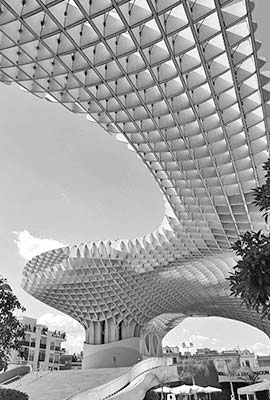
▲Flamenco Dance Museum (Museo del Baile Flamenco)
Though small and pricey, this museum is worthwhile for anyone looking to understand more about the dance that embodies the spirit of southern Spain. The main exhibit, on floor 1, takes about 45 minutes to see. It features well-produced videos, flamenco costumes, and other artifacts collected by the grande dame of flamenco, Cristina Hoyos. The top floor and basement house temporary exhibits, mostly of photography and other artwork. On the ground floor and in the basement, you can watch flamenco lessons in progress—or even take one yourself (one hour, first person-€90, €22/person after that, shoes not provided but yours are OK).
Cost and Hours: €10, €29 combo-ticket includes evening flamenco performance (see “Nightlife in Sevilla,” later), daily 10:00-19:00, pick up English info sheet at front desk; about 3 blocks east of Plaza Nueva at Calle Manuel Rojas Marcos 3—follow signs for Museo del Baile Flamenco; +34 954 340 311, www.museoflamenco.com.
▲Museo de Bellas Artes
Sevilla’s passion for religious art is preserved and displayed in its Museum of Fine Arts. While most Americans go for El Greco, Goya, and Velázquez (not a forte of this collection), this museum opens horizons and gives a fine look at other, less well-known Spanish masters: Zurbarán and Murillo. Rather than exhausting, the museum is pleasantly enjoyable.
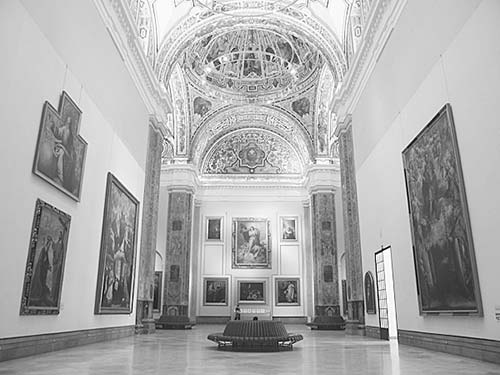
Cost and Hours: €1.50; Tue-Sat 9:00-21:00, until 15:00 on Sun and in Aug, closed Mon year-round; mandatory bag check, Plaza Museo 9—a 15-minute walk or cheap taxi ride from the cathedral, +34 954 786 498, www.museosdeandalucia.es.
Background: As Spain’s economic golden age (the 1500s) blossomed into its arts and literature golden age (the 1600s), wealthy Sevilla reigned as the sophisticated capital of culture while Madrid was still a newly built center of government. Several of Spain’s top painters—Zurbarán, Murillo, and Velázquez—lived in Sevilla in the 1600s. They labored to make the spiritual world tangible, and forged the gritty realism that marks Spanish painting. You’ll see balding saints and monks with wrinkled faces and sunburned hands, radiating an inner spirituality. This highly accessible style inspired the Catholic faithful in an age when Protestants were demanding a closer personal relationship with God.
Appropriately, this collection of (mostly) religious art is now displayed in the halls of what once was a convent for friars of the Order of Mercy. The building itself is an attraction: It was a particularly wealthy convent boasting some of the finest courtyards and decorative tiles in the city. In the early 1800s, Spain’s ultra-secular government began disbanding convents and monasteries, and secular fanatics had a heyday looting churches. Fortunately, much of Andalucía’s religious art was rescued and hung safely here.
Self-Guided Tour: The permanent collection features 20 rooms in neat chronological order. It’s easy to breeze through once with my tour, then backtrack to what appeals to you. Pick up the English-language floor plan, which explains the theme of each room.
• Enter and follow signs to the permanent collection, which begins in Sala I (Room 1).
Rooms 1-4: Medieval altarpieces of gold-backed saints, Virgin-and-babes, and Crucifixion scenes attest to the religiosity that nurtured Spain’s early art. Spain’s penchant for unflinching realism culminates in Room 2 with Michelangelo friend/rival Pietro Torrigiano’s 1525 statue of an emaciated San Jerónimo, whose gaze never falters from the cross, and in Room 3 with the painted clay head of St. John the Baptist—complete with severed neck muscles, throat, and windpipe. This warts-and-all naturalism would influence the well-known Sevillian art teacher Francisco Pacheco (also Room 3), as well as his student and son-in-law, Velázquez (Room 4). Velázquez’s Head of an Apostle—a sober portrait of a bearded, balding, wrinkled man—exemplifies how Sevillian painters could make once-inaccessible saints seem flesh and blood like you and me.
• Continue through the pleasant outdoor courtyard (the convent’s former cloister) to the grand, former church that is now Room 5.
Room 5: Large-scale religious art now hangs in what was once a church nave. On the left wall is the Apotheosis of St. Thomas Aquinas (Apoteosis de Santo Tomás de Aquino, 1631) by Francisco de Zurbarán (thoor-ba-RAHN, 1598-1664). This is the artist’s most important work, done at the height of his career. Zurbarán presents the pivotal moment when the great saint-theologian experiences his spiritual awakening. He’s surrounded by ultra-realistic portraits of other saints, whose stately poses and simple gestures speak volumes. What’s unique about Zurbarán is the setting. He strips away any semblance of 3-D background to portray how these real people are having a surreal experience. Thomas has suddenly found himself in a heavenly cloud surrounded by long-dead saints, while his contemporaries below gaze upward, sharing the vision. We’ll see more of Zurbarán later in our tour.
As you approach the former church’s main altar, you find works of another hometown boy, Bartolomé Murillo, including several paintings of the Virgin Mary, his signature subject (for more on Murillo, see the sidebar on here). He portrayed the Immaculate Conception of Mary, the doctrine that she was born without the taint of original sin. Typically, he depicted Mary as young, dressed in white and blue, gazing rapturously. She stands atop the moon (crescent or full), surrounded by tumbling winged babies. Murillo’s tiny Madonna and Child (Virgen de la Servilleta, 1665), at the end of the room in the center, shows the warmth and appeal of his work.
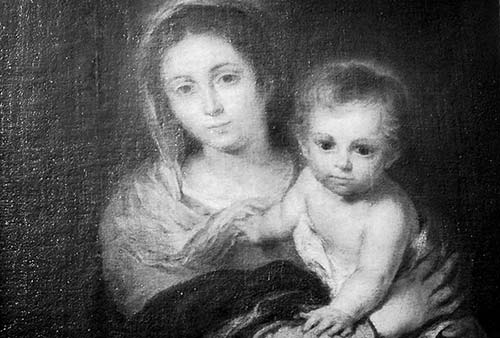
Murillo’s sweet naturalism is quite different from the harsh realism of his fellow artists, so his work was understandably popular. For many Spaniards, Mary is their main connection to heaven. They pray directly to her, asking her to intercede on their behalf with God. Murillo’s Marys are always receptive and ready to help.
Besides his Inmaculadas, Murillo painted popular saints. They often carry sprigs of plants, and cock their heads upward, caught up in a heavenly vision of sweet Baby Jesus. Murillo is also known for his “genre” paintings—scenes of common folk and rascally street urchins—but the museum has few of these.
• Now head back outside to enjoy the coolness of the cloister and the beauty of its tiles, then go up the Imperial Staircase to the first floor.
Rooms 6-9: In Rooms 6 and 7, you’ll see more Murillos and Murillo imitators. Room 8 is dedicated to yet another native Sevillian (and friend of Murillo), Juan de Valdés Leal (1622-1690), whose work is also featured in the Hospital de la Caridad (see listing earlier). He adds Baroque motion and drama to religious subjects. His surreal colors and feverish, unfinished style create a mood of urgency. In Room 9, art students will recognize the work of José de Ribera—a Spaniard living in Italy—who merged Spanish realism with Caravaggio’s strong dark-light contrast.
Room 10: Here you’ll find more Zurbarán saints and monks, and the miraculous things they experienced, with an unblinking, crystal-clear, brightly lit, highly detailed realism. Browse the paintings, enjoying the weathered faces, voluminous robes, and precisely etched details. These photorealistic people are shown against a neutral background, as though existing in the landscape of an otherworldly vision. Monks and nuns could meditate upon Zurbarán’s meticulous paintings for hours, finding God in the details.
In Zurbarán’s St. Hugo Visiting the Refectory (San Hugo en el Refectorio), white-robed Carthusian monks gather for their simple meal in a communal dining hall. Above them hangs a painting of Mary, Baby Jesus, and John the Baptist. Zurbarán created paintings like this for monks’ dining halls. His audience: celibate men and women who lived in isolation, as in this former convent, devoting their time to quiet meditation, prayer, and Bible study. Zurbarán shines a harsh spotlight on many of his subjects, creating strong shadows. Zurbarán’s people often stand starkly isolated against a single-color background—a dark room or the gray-white of a cloudy sky. He was the ideal painter for the austere religion of 17th-century Spain as it led the Counter-Reformation, standing strong against the rising tide of Protestantism in Europe.
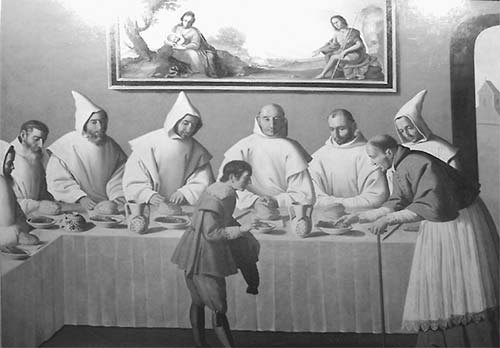
Adjacent to St. Hugo, find The Virgin of the Caves (La Virgen de las Cuevas) and study the piety and faith in the monks’ weathered faces. Zurbarán’s Mary is protective, with her hands placed on the heads of two monks. Note the loving detail on the cape embroidery, the brooch, and the flowers at her feet.
Rest of the Museum: Spain’s subsequent art, from the 18th century on, generally followed the trends of the rest of Europe. Room 11 is a hallway with a dozen joyous scenes from the 1700s of carriages and parade floats filing by Sevillian landmarks. Room 12 has creamy Romanticism and hazy Impressionism. You’ll see typical Sevillian motifs such as matadors, flamenco, cigar-factory girls, and river landscapes. Of particular interest is the large Death of the Master by José Villegas Cordero, in which bullfighters touchingly express their grief after their teacher, gored in the ring, dies in bed. Enjoy these painted slices of Sevilla, then exit to experience similar scenes today.
FAR NORTH OF THE CATHEDRAL
▲▲Basílica de la Macarena
The Basílica de la Macarena hosts two of Sevilla’s most impressive Holy Week floats and the darling of Semana Santa, the statue of the Virgen de la Macarena. Although far from the city center, it’s located on Sevilla’s ring road and easy to reach. (While La Macarena is the big kahuna, for a more central look at beloved procession statues, consider stopping by the Church of the Savior or Triana’s Church of Santa Ana, both described in this chapter.)
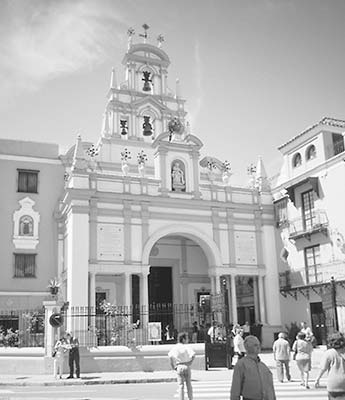
Cost and Hours: Church—free, treasury museum—€2.50; daily 9:00-14:00 & 18:00-21:00, mid-Sept-May daily 9:00-14:00 & 17:00-20:30 except Sun from 9:30, closed a few weeks before Holy Week for float preparation; +34 954 901 800, www.hermandaddelamacarena.es.
Getting There: A taxi is about €6 from the city center. The quickest bus routes are #C3 and #C4 from Puerta de Jerez (near the Torre del Oro) or Avenida de Menéndez Pelayo (the ring road east of the cathedral). Buses #C1 and #C2 also go there but take much longer.
Visiting the Church: Despite the long history of the Macarena statue, the Neo-Baroque church was only built in 1949 to give the oft-moved sculpture a permanent home. Grab a pew and study the statue.
Weeping Virgin: La Macarena is known as the “Weeping Virgin” for the five crystal teardrops trickling down her cheeks. She’s like a Baroque doll with human hair and articulated arms, and even has underclothes. Sculpted in the late 17th century (probably by Pedro Roldán), she’s become Sevilla’s most popular image of Mary.
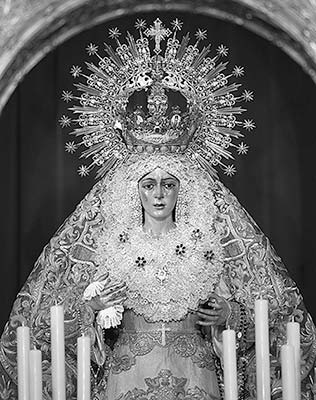
Her beautiful expression—halfway between smiling and crying—is ambiguous, letting worshippers project their own emotions onto her. Her weeping can be contagious—look around you. She’s also known as La Esperanza, the Virgin of Hope, and she promises better times after the sorrow.
Installed in the left side chapel is the Christ of the Judgment (from 1654), showing Jesus on the day he was condemned. This statue and La Macarena stand atop the two most important floats of the Holy Week parades. The side chapel on the right has an equally remarkable image of the Virgen del Rosario, which is paraded around the city on the last Sunday of October.
Tesoro (Treasury Museum): To see the floats and learn more, head to the museum (to reach the entrance—on the church’s left side—either exit the church or go through a connecting door at the rear). This small, three-floor museum tells the history of the Virgin statue and the Holy Week parades. Though rooted in medieval times, the current traditions developed around 1600, with the formation of various fraternities (hermandades). During Holy Week, they demonstrate their dedication to God by parading themed floats throughout Sevilla to retell the story of the Crucifixion and Resurrection of Christ (see the sidebar on here). The museum displays ceremonial banners, scepters, and costumed mannequins; videos show the parades in action (some displays in English).
Start your visit on the second floor. The three-ton float that carries the Christ of the Judgment is slathered in gold leaf and shows a commotion of figures acting out the sentencing of Jesus. (The statue of Christ—the one you saw in the church—is placed before this crowd for the Holy Week procession.) Pontius Pilate is about to wash his hands. Pilate’s wife cries as a man reads the death sentence. During the Holy Week procession, pious Sevillian women wail in the streets while relays of 48 men carry this float on the backs of their necks—only their feet showing under the drapes—as they shuffle through the streets from midnight until 14:00 in the afternoon every Good Friday. The men rehearse for months to get their choreographed footwork in sync.
La Macarena follows the Christ of the Judgment in the procession. Mary’s smaller 1.5-ton float seems all silver and candles—“strong enough to support the roof, but tender enough to quiver in the soft night breeze.” Mary has a wardrobe of three huge mantles, worn in successive years; these are about 100 years old, as is her six-pound gold crown/halo (see both in the next room). This float has a mesmerizing effect on the crowds. They line up for hours, then clap, weep, and throw roses as it slowly sways along the streets, working its way through town. A Sevillian friend once explained, “She knows all the problems of Sevilla and its people; we’ve been confiding in her for centuries. To us, she is hope.”
The third floor of the collection contains some matador paraphernalia and Semana Santa artwork. La Macarena is the patron saint of bullfighters, and they give thanks for her protection. Copies of her image, like those seen here, are popular in bullring chapels. In 1912, bullfighter José Ortega, hoping for protection, gave La Macarena the five emerald brooches she wears. It worked for eight years...until he was gored to death in the ring. For a month, La Macarena was dressed in widow’s black—the only time that has happened.
Macarena Neighborhood: Outside the church, notice the best surviving bit of Sevilla’s old walls. Originally Roman, what remains today was built by the Moors in the 12th century to (unsuccessfully) keep the Christians out. And yes, it’s from this city that a local dance band (Los del Río) changed the world by giving us the popular 1990s song, “Macarena.” He-e-y-y, Macarena!
SOUTH OF THE CATHEDRAL
University
Today’s university was yesterday’s fábrica de tabacos (tobacco factory), which employed 10,000 young female cigarreras—including the saucy femme fatale of Bizet’s opera Carmen. In the 18th century, it was the second-largest building in Spain, after El Escorial. Today it boasts a gallery of reproduced sculpture, a beautiful chapel, and a studious library. It’s free to visit outside of school hours (Fri 9:30-12:30 & 16:00-18:00, Sat 9:30-14:00, closed to public Sun-Thu and Aug).
Plaza de España
This square, the surrounding buildings, and the adjacent María Luisa Park are the remains of the 1929 world’s fair, where for a year the Spanish-speaking countries of the world enjoyed a mutual-admiration fiesta. This delightful area—the epitome of world’s fair-style architecture—is great for people-watching (especially during the 20:00-22:00 peak paseo hour). The park’s highlight is this former Spanish Pavilion. Its tiles—a trademark of Sevilla—show historic scenes and maps from every province of Spain (arranged in alphabetical order, from Álava to Zaragoza). Climb to one of the balconies for a classic postcard view of Sevilla, complete with clip-clopping horse carriages. Wandering around this zone, you may feel like you’ve been here before: Lots of filming has been done here, including bits of Star Wars: Episode II and Lawrence of Arabia. A pleasant stroll leads from the east (right) side of Plaza de España to the Plaza de América, where kids enjoy feeding the pigeons.
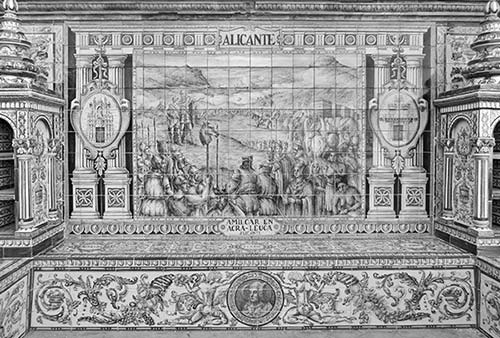
▲▲TRIANA WALK
In Sevilla—as is true in so many other European cities that grew up in the age of river traffic—what was long considered the “wrong side of the river” is now the most colorful part of town, where locals outnumber tourists. Sevilla’s Triana, west of the river, is a proud neighborhood that identifies with its working-class origins and is famed for its flamenco soul (characterized by the statue that greets arrivals from across the river). Known for their independent spirit, locals describe crossing the bridge toward the city center as “going to Sevilla.” To trace the route described next, see the “Sevilla” map on here.
• To reach Triana from downtown Sevilla, head to the river and cross over...
Puente de Isabel II: Note the bridge’s distinctive design as you approach. It was inspired by an 1834 crossing over the Seine River in Paris—look for the circles under each span that lead the way into Triana.
While crossing the Guadalquivir River, to the right you can see Sevilla’s single skyscraper—designed by Argentine architect César Pelli of Malaysia’s Twin Towers fame. Locals lament the Torre Sevilla because according to city law, no structure should be taller than the Giralda bell tower. But since this building doesn’t sit within the city center, developers found a way to avoid that regulation. Today it houses a bank, offices, a swanky shopping center, and a fancy five-star hotel with a pay-for-the-view bar on top. Surrounding the skyscraper are leftover buildings from the 1992 Expo.
At the end of the bridge, the Capilla del Carmen and its bell tower add glamour to the entrance to Triana. Before leaving the bridge, stop at the chapel and watch locals pause for this Mary’s blessing. Until 1975, women were required to have Mary in their name to be baptized here.
• Just past the chapel, walk down the staircase on the right.
Triana’s Castle and Market: The Castillo de San Jorge is a 12th-century castle that in the 15th century was the headquarters for Sevilla’s Inquisition. It now houses a small TI and an adjoining room where the prison cells once existed (free, daily 10:00-14:00). Pop in for a brief peek, then retrace your steps to visit the neighborhood’s covered market. Built in 2005 in the Moorish Revival style, it sits within the ruins of the castle (you can see its remains as you exit at the other side). The market bustles in the mornings and afternoons with traditional fruit and vegetable stalls as well as colorful tapas bars and cafés. This is a great spot to stop for coffee, watch produce being sold, and see locals catching up on the latest gossip.
• Exit the market downstairs out the back door, turn left, and go about 50 yards.
Ceramic Museum and Shops: Here you can discover the district’s ceramic history, starting with the Centro Cerámica Triana (with its fine ceramic exterior), which focuses on tile and pottery production. Located in the remains of a former riverside factory, the museum explains the entire process—from selecting the right type of earth to kiln firing—with a small collection of ceramics and well-produced videos of interviews with former workers (good English translations). Another short video highlights Triana’s neighborhood pride (€2.10, free with Alcázar ticket, Tue-Sun 10:00-20:00, closed Mon, last entry one hour before closing, Calle Antillano Campos 14).
After your museum visit, enjoy some nearby shops. Walk along Calle Antillano Campos, then turn left on Calle Alfarería. This area is lined with the old government-protected facades of ceramic workshops that once populated this quarter. Most have closed up or moved to the outskirts of town, where rent is cheaper. But a few stalwarts remain, including the lavishly decorated #21 and the large showroom of Santa Isabel (directly opposite, at Calle Alfarería 12). The recommended Las Golondrinas Bar is also in this area (see “Eating in Sevilla,” later).
• Continue down Calle Alfarería to...
Calle San Jacinto: This is the main street of the neighborhood. While pedestrianizing this street was at first controversial, now people love it. Feel the community: church, school, kids, gossiping adults, and bike and pedestrian lanes. Imagine a few years ago when there were cars in the street instead of restaurant tables. This is the new green norm—especially here where apartments are so small that community life is in the streets. Each evening is a festival. Venturing down side lanes, you find classic 19th-century facades with fine ironwork and colorful tiles.
• Turn left down Calle San Jacinto toward the bridge. The final cross-street (to the right) is...
Calle Pureza: This street cuts through the historic center of Triana. As you wander, pop into bars and notice how the decor mixes bullfighting lore with Virgin worship. It’s easy enough to follow your nose into Dulcería Manu Jara, at Calle Pureza 5, where tempting artisan pastries are made on the spot.
At #12 is the recommended La Antigua Abacería (see “Eating in Sevilla,” later). An abacería is a traditional neighborhood grocer that also functions as a neighborhood bar. Step inside and feel the presence of the Virgin Mary, flamenco culture, wine, and ham hocks...beautiful ham hocks.
At #28, sculptor José Gómez is busy with his restoration work and sculpting. If it’s early in the year, he’s likely particularly busy, preparing for Holy Week.
Take a moment to gaze down the street—looking above the shops—and appreciate the real community feel of this colorful line of homes. Appreciate the lovely tile and iron work. Iron grills let in the breeze but not the thieves. Peek into a traditional entry leading to a courtyard shared by several apartments. Your next stop is marked by the white-and-yellow church bell tower.
Capilla de los Marineros (Chapel of the Mariners): Across from #54 is the Capilla de los Marineros, home of the beloved Virgin statue called Nuestra Señora de la Esperanza de Triana (Our Lady of Hope of Triana). She’s a big deal here. In Sevilla, upon meeting someone, it’s customary to ask not only which football team they support, but which Virgin Mary they favor. The top two in town are the Virgen de la Macarena and La Esperanza de Triana. On the Thursday of Holy Week, it’s a battle royale of the Madonnas, as Sevilla’s two favorite Virgins are both in processions on the streets at the same time. Step inside to see her presiding like a queen from the high altar. The adoration is palpable. Pause and observe as locals—young and old—drop prayerfully by. In the pilgrims’ shop adjacent, see the video of this Mary in the streets being mobbed by what seems like the entire population of Triana. Jesus with his cross is almost second fiddle. The brotherhood of this Virgin keeps her in fresh flowers and runs a delightful (if you’re into Mary) museum where you can see her Holy Week float, lots of regalia, and video clips (€4 entry).
• Continue down Calle Pureza to explore the...
Rest of Triana: The next church is the Church of Santa Ana, nicknamed the “Cathedral of Triana.” Walking around the little church, on the far side is a delightful square with two recommended eateries, Bar Bistec and Taberna La Plazuela. Circling farther around (note the corner building with the garden balconies—a reminder that balconies here are more for plants than people, who prefer the streets and bars), return to Calle Pureza and the tiny Calle Duarte, which leads to the river. Gazing across the water, imagine the ships that sailed from here to kick off the Age of Discovery.
Don’t cross the river hungry. Consider making the neighborhood you just explored your destination for a tapas crawl.
NEAR SEVILLA
Itálica
One of Spain’s most impressive Roman ruins is found outside the sleepy town of Santiponce, about six miles northwest of Sevilla. Founded in 206 BC for wounded soldiers recuperating from the Second Punic War, Itálica became a thriving town of great agricultural and military importance. It was the birthplace of the famous Roman emperors Trajan and Hadrian. Today its best-preserved ruin is its amphitheater—one of the largest in the Roman Empire—with a capacity for 25,000 spectators (and used as a backdrop for dragons in Game of Thrones). Other highlights include beautiful floor mosaics, such as the one in Casa de los Pájaros (House of the Birds), with representations of more than 30 species of birds. In summer, plan your visit to avoid the midday heat—arrive either early or late in the day, and definitely bring water. After being picked clean as a quarry for centuries by Sevillian builders, there’s not much left here.
Cost and Hours: €1.50; generally open Tue-Sat 9:00-18:00, Sun until 15:00, closed Mon, shorter hours mid-June-mid-Sept but check online in advance; +34 600 141 767, www.museosdeandalucia.es.
Getting There: You can get to Itálica on bus #M-170A or #M-170B from Sevilla’s Plaza de Armas station (2/hour Mon-Sat, hourly on Sun, 30 minutes). If you’re driving, head west out of Sevilla in the direction of Huelva; after you cross the second branch of the river, turn north on SE-30, exit on to N-630, and after a few miles, get off at Santiponce. Drive past pottery warehouses and through the town to the ruins at the far (west) end.
Experiences in Sevilla
▲Bullfights
Some of Spain’s most intense bullfighting happens in Sevilla’s 12,000-seat bullring, Plaza de Toros, known as the Cathedral of Bullfighting. The arena hosts about 45 fights each year, which are held (generally at 18:30) on most Sundays in May and June, on Easter and Corpus Christi, daily during the April Fair, and for two weeks in late September (during the Feria de San Miguel). These serious fights, called corridas de toros, often sell out in advance. On many Thursday evenings in July, the novillada fights take place, with teenage novices doing the killing and smaller bulls doing the dying. Corrida de toros seats range from €60 for high seats looking into the sun to €225 for the first three rows in the shade under the royal box; novillada seats are half that—and easy to buy at the arena a few minutes before showtime (ignore scalpers outside; get information at a TI, your hotel, by phone, or online; +34 655 430 455, www.taquillaoficial.com).
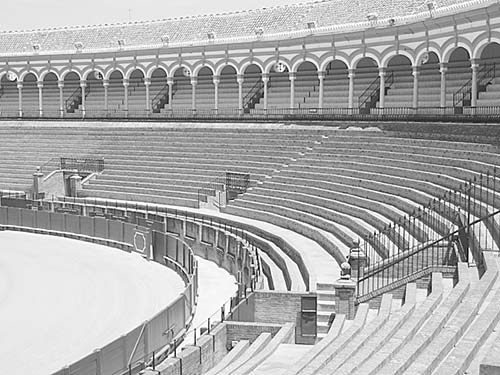
▲▲Bullring (Plaza de Toros) and Bullfight Museum (Museo Taurino)
Sevilla’s bullring traces the history and cultural heritage of Spanish bullfighting as you walk in the footsteps of matadors. Its museum displays uniforms, gear, great classic scenes dedicated to canvas, and the heads of a few bulls (including Arrojado, the first bull pardoned in Sevilla)—awarded the bovine equivalent of an Oscar for a particularly good fight. The city was so appalled when the famous matador Manolete was killed in 1947 that even the mother of the bull that gored him was destroyed. Matadors—dressed to kill—are heartthrobs in their “suits of light.”
Your visit also includes the chapel where the matador prays before the fight. (Thanks to readily available blood transfusions, there have been no deaths here in three decades.) The two most revered figures of Sevilla, the Virgen de la Macarena and the Jesús del Gran Poder (Christ of All Power), are represented in the chapel. Finally, step into the center of the ring. With the sun beating down, imagine 12,000 spectators watching as the matador waits for the bull to enter the arena—the bravest kneeling in the dirt as the gate opens, focused on receiving enough glory to exit through the Prince’s Gate (reserved only for exemplary performances). See here for more on the “art” of bullfighting.
Cost and Hours: €10, includes audioguide—scan the QR code, daily 9:30-21:30, Nov-March until 19:00; until 15:00 on fight days, when chapel and horse room are closed (+34 954 210 315, www.realmaestranza.com).
April Fair
Two weeks after Easter, much of Sevilla packs into its vast fairgrounds for a grand party (April 4-10 in 2025; April 19-25 in 2026). The fair, seeming to bring all that’s Andalusian together, feels friendly, spontaneous, and very real. The passion for horses, flamenco, and sherry is clear—riders are ramrod straight, colorfully clad girls ride sidesaddle, and everyone’s drinking sherry spritzers. Women sport outlandish dresses that would look clownish elsewhere but are somehow brilliant here en masse. Every day for one crazy week, horses clog the streets in an endless parade until about 20:00, when they clear out and the lanes fill with exuberant locals. The party goes on literally 24 hours a day.
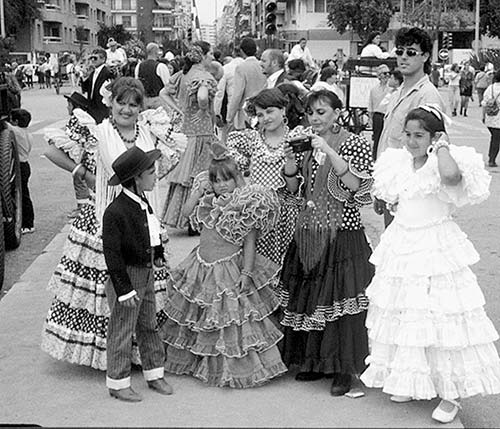
Countless private party tents, called casetas, line the lanes. Each tent is the private party zone of a family, club, or association. You need to know someone in the group—or make friends quickly—to get in. Because of the exclusivity, it has a real family-affair feeling. In each caseta, everyone knows everyone. It seems like a thousand wedding parties being celebrated at the same time.
Any tourist can have a fun and memorable evening by simply crashing the party. The city’s entire fleet of taxis (who can legally charge double) and buses seems dedicated to shuttling people from downtown to the fairgrounds. Given the traffic jams and inflated prices, you may be better off hiking: From the Torre del Oro, cross the San Telmo Bridge to Plaza de Cuba and hike down Calle Asunción. You’ll see the towering gate to the fairgrounds in the distance. Just follow the crowds (there’s no admission charge). Arrive before 20:00 to see the horses, but stay later, as the ambience improves after the caballos giddy-up on out. Some of the larger tents are sponsored by the city and open to the public, but the best action is in the streets, where party-goers from the livelier casetas spill out. Although private tents have bouncers, everyone is so happy that it’s not tough to strike up an impromptu friendship, become a “special guest,” and be invited in. The drink flows freely, and the food is fun, bountiful, and cheap.
Flamenco Classes
Eva Izquierdo shares her passion for flamenco culture with an inspiring master dance class at a studio in the city center. Eva introduces you to the essentials of flamenco from its origins and rhythms, to the different styles (palos) and proper clapping—technique is everything. Once you’ve got the beat down, you’ll learn some of the basic foot and leg work as Eva guides you through a fun, unique routine—olé! If flamenco captivates you with its passion and tension, this class will help you express those feelings and get more out of any show. All experience levels are welcome (€28, reservations required, 1 hour, 1-4 classes daily—contact her for details, Calle Gravina 50, +34 692 303 634, www.ishowusevilla.com).
Shopping in Sevilla
For the best local shopping experience in Sevilla, visit the popular pedestrian streets Sierpes, Tetuán, Velázquez, and Cuna near Plaza Nueva. They, and the surrounding lanes, are packed with people and shops. For details, see my “Shopping Paseo,” later in this section.
Clothing and shoe stores stay open all day. Other shops generally take a siesta, closing between 13:30 and 16:00 or 17:00 on weekdays, as well as on Saturday afternoons and all day Sunday. Big department stores such as El Corte Inglés stay open (and air-conditioned) right through the siesta. El Corte Inglés on Plaza del Duque also has a supermarket downstairs, a pricey cafeteria, and the Gourmet Experience food court on the fifth floor, with several international options and a view terrace (daily 10:00-22:00).
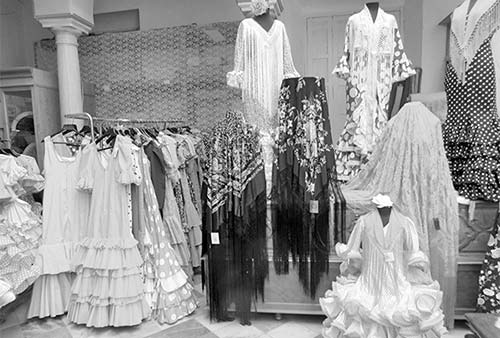
Souvenir Markets
Popular Sevillian souvenir items include ladies’ fans, shawls, mantillas (ornate head scarves), other items related to flamenco (castanets, guitars, costumes), ceramics, and bullfighting posters. The following markets are worth a browse.
Collectors’ markets hop on Sunday. You’ll see stamps and coins, and kids trading soccer cards like American kids trade baseball cards, at Plaza del Cabildo (near the cathedral). You can browse art on Plaza del Museo (by the Museo de Bellas Artes).
The arts-and-crafts Mercado El Postigo, in an architecturally interesting old market building behind the Hospital de la Caridad, features artisan wares of all types (Mon-Fri 10:00-19:00, Sat-Sun until 20:00, at the corner of Calles de Arfe and Dos de Mayo, +34 954 560 013).
The Arenal Market (Mercado del Arenal), the covered fish-and-produce market, is perfect for hungry photographers.
▲▲Shopping Paseo
Although many tourists never get beyond the cathedral and Barrio Santa Cruz, the lively pedestrianized shopping area north of the cathedral is well worth a wander. The best shopping streets—Calle Tetuán, Calle Sierpes, and Calle Cuna—also happen to be part of the oldest section of Sevilla. A walk here is a chance to join one of Spain’s liveliest paseos—that bustling celebration of life that takes place before dinner each evening, when everyone is out strolling, showing off their fancy shoes and checking out everyone else’s.
This walk, if done after 20:00, gives you a chance to experience the paseo scene while getting a look at the town’s most popular shops. First, to get warmed up, we’ll walk from Plaza Nueva down Calle Tetuán (a pedestrian mall with more trendy fashion). Then we’ll double back on the much more interesting (and traditional) Calle Sierpes.
Start on the pedestrianized Plaza Nueva—the 19th-century square facing the ornate City Hall. From here wander the length of Calle Tetuán, where old-time standbys bump up against fashion-forward boutiques and mainly modern Spanish brands, such as Camper shoes, Massimo Dutti, Zara, and Mango. Hardworking immigrants nicknamed “Blanket People” compete with the shops rent-free, selling cheap knockoffs. They often have string on the corners of their blanket to pull up their goods and run if the police show up.
Next to the Chico jewelry store (#9, three blocks up on the right) you’ll see a large tile panel serving as permanent advertising for a US import that was significant in Sevilla in the 1920s: the Studebaker. During the remainder of this walk, make sure to look up occasionally, because the shopping streets are dotted with other surviving ads in tile work. Another three blocks past Chico, you’ll find a traditional little box office (at #12 on the left, just after Massimo Dutti) that’s been selling bullfight tickets since 1939.
Calle Tetuán (which changes names to Calle Velázquez) ends three blocks later at La Campana, a big intersection and popular meeting point. The super department store El Corte Inglés is just beyond, on Plaza del Duque de la Victoria. (Its fifth-floor gourmet food court features many small eateries with shared seating, including on their rooftop terrace.)
Turn right at the end of the street. At the corner of Calle Sierpes awaits a venerable pastry shop, Confitería La Campana, with a fine 1885 interior...and Sevilla’s most tempting sweets (take a break at the outdoor tables around the corner, or head to the back of the shop, where you can grab a coffee and pastry at the stand-up bar).
The green former newsstand in front of the pastry shop is still called Prensa (The Press) even though there are no more newspapers to be sold.
You may see someone nearby selling lottery tickets to benefit a charity named ONCE (Spain’s national organization for people with disabilities). They not only raise money for the charity this way, but they also provide job opportunities for people who would be otherwise difficult to employ.
At Calle Sierpes #5 is Papelería Ferrer, where the Ferrer family has been selling traditional stationery and pens since 1856. Such elegance survives and is appreciated by the people of Sevilla.
Ahead, at #19, is the clock-covered, wood-paneled El Cronómetro shop, where master watchmakers have been doing business since 1901. If you’ve got a problem with your Rolex, drop in—they’re an official retailer of all the luxury brands.
Half a block down at #33 is a Juan Foronda shop, since 1926 carrying traditional ladies’ accessories for Sevilla’s many festivals.
If it’s teatime, #45 is a handy next stop. Step in. Since 1910 Ochoa confitería and salón de té has been tempting locals with a long display case of sweets. In back is a buffet line for tapas and a light lunch (daily set menu or just point to what looks good, nice seating inside and out). Ahead on the right (#40) is the perfect place for a fancy festival hat. Sombrerería Maquedano is a styling place—especially for men. They claim to be the oldest hat seller in Sevilla. Check out the great selection of wide-brimmed horse-rider hats, perfect for the April Fair. The inventory is huge but hiding—hats are stacked Pringles-style within boxes throughout the store.
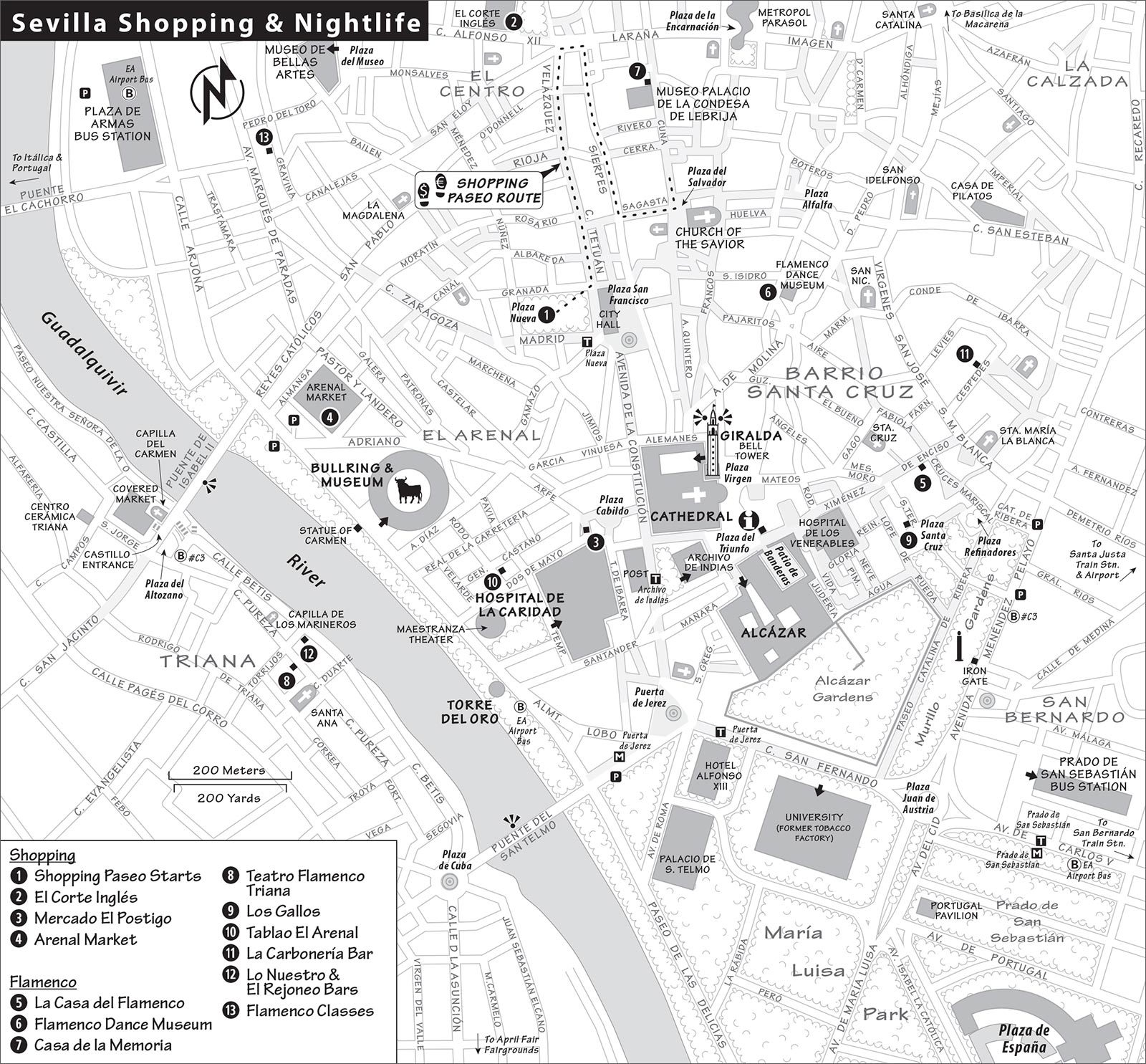
Just before the next corner, you’ll find several fine shops featuring more Andalusian accessories. Abanicos Díaz (#69) has a dazzling selection. Drop in to see how serious locals are about their fans, mantillas (shawls), and peinetas (combs designed to secure and prop up the mantilla). The most valuable mantillas are silk, and the top-quality combs are made of tortoiseshell (though people generally opt for much more affordable polyester and plastic). Andalusian women accessorize with fans, matching them to different dresses. The mantilla comes in black (worn only on Holy Thursday and by the mother of the groom at weddings) and white (worn at bullfights during the April Fair).
From here turn left down Calle Sagasta. Look up, above the ground-floor shop windows, and notice that the street has two names—the modern version and a medieval one: Antigua Calle de Gallegos (“Former Street of the Galicians”). With the Christian victory in 1248, the Muslims were given one month to evacuate. To consolidate Christian control during that time, settlers from Galicia, the northwest corner of Iberia, were planted here; this street was the center of their neighborhood.
The first shop on the right is Lotería Sagasta, the government-run national lottery. It’s well known that the government makes a 30 percent margin on bettors; it’s essentially a tax on those who aren’t so bright. At Christmastime, a line of those hoping to strike it rich stretches down the street. Wish someone “buena suerte.”
If you did win, you’d want to dress up. On the right, at #5, Galán Camisería is a traditional men’s store that sells the “uniform” for the older gentlemen of Andalucía. While young men dress casually in T-shirts and jeans, older men still dress up to go out (especially for the Sunday paseo). Do a quick visual survey and see how that old formality persists...or not.
Now jump into Plaza del Salvador—it’s teeming with life at the foot of the Church of the Savior (well worth a visit; described earlier, under “Sights in Sevilla”). If you’re in the market for a fancy custom-made flamenco dress for the fair, head to the left and browse down Calle Cuna. Otherwise, rattle your castanets out of here.
Nightlife in Sevilla
▲▲▲FLAMENCO
This music-and-dance art form has its roots in the Roma (Gypsy) and Moorish cultures. Even at a packaged “flamenco evening,” sparks fly. The men do most of the flamboyant machine-gun footwork. The women often concentrate on the graceful turns and smooth, shuffling step of the soleá version of the dance. Watch the musicians. Flamenco guitarists, with their lightning-fast finger-roll strums, are among the best in the world. The intricate rhythms are set by castanets or the hand-clapping (called palmas) of those who aren’t dancing at the moment. In the raspy-voiced wails of the singers, you’ll hear echoes of the Muslim call to prayer.
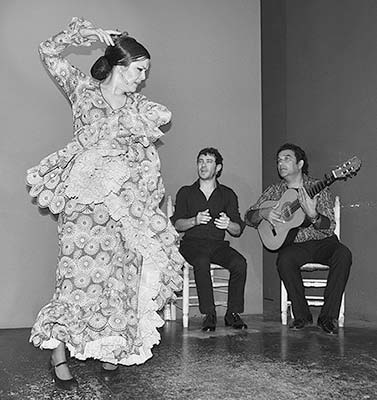
Like jazz, flamenco thrives on improvisation. Also like jazz, good flamenco is more than just technical proficiency. A singer or dancer with “soul” is said to have duende. Flamenco is a happening, with bystanders clapping along and egging on the dancers with whoops and shouts. Get into it.
Hotels push tourist-oriented, nightclub-style flamenco shows, but they charge a commission. Fortunately, it’s easy to book a place on your own.
Sevilla’s flamenco offerings tend to fall into three categories: serious concerts (€20-25 and about an hour long), where the singing and dancing take center stage; touristy dinner-and-drinks shows with table service (generally around €40—not including food—and 90 minutes long); and—the least touristy option—casual bars with late-night performances, where for the cost of a drink you can catch impromptu (or semi-impromptu) musicians at play. Here’s the rundown for each type of performance. For venue locations, see the “Sevilla Shopping & Nightlife” map, earlier.
Serious Flamenco Concerts
While it’s hard to choose among these four nightly, one-hour flamenco concerts, I’d say enjoying one is a must during your Sevilla visit. To the novice viewer, each company offers equal quality. They cost about the same, and each venue is small, intimate (congested seating in not-very-comfy chairs), and air-conditioned. For many, the concerts are preferable to the shows (listed next) because they’re half the cost, length, and size (smaller audience), and generally start earlier in the evening. Also, shows are not appropriate for kids under six (or perhaps vice versa).
My recommended concerts are careful to give you a good overview of the art form, covering all the flamenco bases. At each venue you can reserve by phone and pay upon arrival, or drop by early to pick up a ticket (some also offer online tickets). While La Casa del Flamenco is the nicest and most central venue, Flamenco Dance Museum has an exhibit that can add to the experience, and Casa de la Memoria has a roster of well-regarded dancers performing in an appealing patio. And, for a change of scenery, you can cross the river to Triana for a concert in an actual theater.
La Casa del Flamenco, with five enchanting performers, is in a delightful arcaded courtyard right in Barrio Santa Cruz (€22, RS%—€2 discount with this book if you book directly and pay cash; shows nightly at 19:00 and 20:30, earlier or later performances added with demand—confirm on their website or stop by the venue; no drinks, 70 spacious seats, next to recommended Hotel Alcántara, Calle Ximénez de Enciso 28, +34 955 029 999, www.lacasadelflamencosevilla.com).
Flamenco Dance Museum, while the most congested venue (with 100 tightly packed seats and no bar) puts on a bigger production (six performers). It has festival seating—the doors open early, so for earlier performances, you can grab the seat of your choice, then tour the museum before the show (€25, nightly at 17:00, 19:00, and 20:45; earlier or later performances added with demand; €29 combo-ticket includes the museum—described earlier under “Sights in Sevilla”; reservations smart, +34 954 340 311, www.museoflamenco.com).
Casa de la Memoria, housed in the former stables of an aristocratic mansion, strikes the right balance of professional and festive with delightfully intimate and energetic shows that make you feel like you’ve stepped into the feria (€22, nightly at 19:30 and 21:00, Calle Cuna 6, +34 954 560 670, www.casadelamemoria.es).
Teatro Flamenco Triana offers three riveting performances a day with five musicians in an actual theater across the river in Triana (€25, book online or in person, 120 seats, no bar; shows nightly at 17:30, 19:30, and 21:00; Calle Pureza 76, +34 611 002 330, www.teatroflamencotriana.com).
Razzle-Dazzle Flamenco Shows
These packaged shows can be a bit sterile—and an audience of mostly tourists doesn’t help—but I find both entertaining. While El Arenal may have a slight edge on performance flair, and certainly feels slicker, Los Gallos has a cozier setting, with cushy rather than hard chairs, and is cheaper and less pretentious.
Los Gallos presents nightly 75-minute shows with eight (often nationally known) performers at 19:00 and 20:45 (€35, RS%—enjoy a free drink with this book if attending the late show; festival seating so arrive 30 minutes early for best seats, bar, no food served, Plaza de Santa Cruz 11, +34 954 216 981, www.tablaolosgallos.com). Their box office is open at 11:00 (you’ll pass it on my Barrio Santa Cruz Walk).
Tablao El Arenal is more of an old-fashioned dinner show with arguably more serious performers and a roomier, white-tablecloth setting. Dinner customers get preferred seating, but there are no bad seats. Servers work throughout the performance without causing noticeable disruption (€41 ticket includes drink, €65 includes tapas, €79 includes dinner, 75-minute shows at 19:00 and 21:30, likely later in summer, near bullring at Calle Rodo 7, +34 954 216 492, www.tablaoelarenal.com).
Impromptu Flamenco in Bars
Spirited flamenco singing still erupts spontaneously in bars throughout the old town after midnight—but you need to know where to look. Ask a local for the latest.
La Carbonería Bar, the sangria equivalent of a beer garden, is a few blocks north of Barrio Santa Cruz. It’s a big, covered hall filled with youthful vagabonds, casual guitar strummers, and nearly nightly amateur flamenco from about 19:30 to 24:00. Located just a few blocks from most of my recommended hotels, this is worth finding if you want to see younger, less-professional performers share their passion for flamenco, and you’re not quite ready to end the day (no cover, daily 19:00-very late; near Plaza Santa María—find Hotel Fernando III, along the side alley Céspedes at #21; +34 954 214 460).
While the days of Roma (Gypsy) performers and flamenco throbbing throughout Triana are mostly long gone, a few bars still host live dancing; Lo Nuestro and El Rejoneo are favorites (at Calle Betis 31A and 31B).
OTHER NIGHTLIFE
▲▲Evening Paseo
Sevilla is meant for strolling. The paseo thrives every evening (except in winter) in these areas: along either side of the river between the San Telmo and Isabel II bridges (Paseo de Cristóbal Colón and Triana district; see “Eating in Sevilla,” later), up Avenida de la Constitución, around Plaza Nueva, at Plaza de España, and throughout Barrio Santa Cruz. The best paseo scene is about 20:00 to 22:00 (and later with recent heat waves), and on hot summer nights, even families with toddlers are out and about past midnight. Spend some time rafting through this river of humanity.
Sleeping in Sevilla
All my listings are centrally located, mostly within a five-minute walk of the cathedral, and come with air-conditioning and elevators unless otherwise noted. But be warned that Spain’s air-conditioning often isn’t the icebox you’re used to, especially in Sevilla.
My first listings are near the charming but touristy Barrio Santa Cruz. The last group is just as central but closer to the river, across the boulevard in a less touristy zone.
Room rates as much as double during the two Sevilla fiestas (Holy Week and the April Fair). In general, the busiest and most expensive months are April, May, September, and October. Hotels put rooms on the discounted push list in July and August—when people with good sense avoid this furnace—and from November through February. If you do visit in July or August, you’ll find the best discount deals in central, business-class places.
BARRIO SANTA CRUZ
These places are off Calle Santa María la Blanca and Calle Ximénez de Enciso. The most convenient parking lot is the underground Cano y Cueto garage (see here). A self-service launderette is on the plaza where those two streets meet (see “Helpful Hints” on here).
$$$$ Casa del Poeta offers a timeless elegance that seems contrary to its location in the heart of Santa Cruz. At the end of a side street, Trinidad and Ángelo have lovingly converted an old family mansion into a home away from home. The 17 spacious and well-appointed rooms surround a tranquil central patio where guests relax and enjoy evening guitar concerts. A fantastic view terrace and traditional Andalusian design add to an already worthwhile splurge (free breakfast if you reserve on their website, family room, Calle Don Carlos Alonso Chaparro 3, +34 954 213 868, www.casadelpoeta.es, info@casadelpoeta.es).
$$$$ Hotel Las Casas de la Judería has 178 quiet, classy rooms and junior suites, most of them tastefully decorated with hardwood floors and a charming Old World ambience. The service can be too formal, but the rooms, which spread out through three connected buildings surrounding a series of peaceful courtyards, are a romantic splurge (pool in summer, valet parking, Plaza Santa María 5, +34 954 415 150, www.casasypalacios.com, juderia@casasypalacios.com).
$$$$ Hotel Casa 1800, well priced for its elegance, is worth the extra euros. Located dead-center in Barrio Santa Cruz (facing the boisterous recommended Bodega Santa Cruz, which quiets down after midnight), its 33 rooms are accessed via a lovely chandeliered patio lounge, where guests enjoy a daily free afternoon tea. With a rooftop terrace and swimming pool offering an impressive cathedral view, and tastefully appointed rooms with high, beamed ceilings, it’s a winner (family rooms, Calle Rodrigo Caro 6, +34 954 561 800, www.hotelcasa1800.com, info@hotelcasa1800.com).
$$$ Hotel Amadeus is a classy and comfortable gem, with welcoming public spaces lovingly decorated with musical motifs, and a very charming staff. The 42 renovated rooms are situated around small courtyard spaces among four interconnected buildings. Elevators take you to a multitiered roof terrace that covers the entire property and boasts an under-the-stars hot tub, bar, and small pool. Breakfast is plentiful—enjoy it in your room, in the lounge, or on a terrace (laundry service, pay parking nearby, Calle Farnesio 6, +34 954 501 443, www.hotelamadeussevilla.com, reservas@hotelamadeussevilla.com, wonderfully run by María Luisa and her daughters Zaida and Cristina).
$$$ Hotel Palacio Alcázar is the former home and studio of John Fulton, an American who moved here to become a bullfighter and painter. This budget-friendly hotel has 12 crisp, basic rooms, and each soundproofed door is painted with a different dreamy scene of Sevilla. Triple-paned windows keep out the noise from the plaza (rooftop terrace with bar and cathedral views, Plaza de la Alianza 11, +34 954 502 190, www.hotelpalacioalcazar.com, hotel@palacioalcazar.com).
$$$ Hotel Murillo enjoys one of the most appealing locations in Santa Cruz, along one of the very narrow “kissing lanes.” Above its antiques-filled lobby are 64 nondescript, salmon-colored rooms with marble bathrooms (Calle Lope de Rueda 7, +34 954 216 095, www.hotelmurillo.com, reservas@hotelmurillo.com). They also rent kitchen-equipped apartments on Plaza Santa Cruz (in the building with Rosina’s balcony mentioned on my Barrio Santa Cruz Walk; see website for details).
$$$ Hotel Alcántara comes with a friendly, helpful staff and offers clean and casual comfort in the heart of Santa Cruz. Well situated, it rents 23 slick rooms—most with patio views—at a good price (buffet breakfast available, outdoor patio, Calle Ximénez de Enciso 28, +34 954 500 595, www.hotelalcantara.es, info@hotelalcantara.net). The hotel also functions as the box office for the nightly La Casa del Flamenco show, next door (see “Nightlife in Sevilla,” earlier).
$$ El Rey Moro encircles its spacious, colorful patio with 18 mismatched and well-loved rooms. Colorful, quirky, and thoughtful about including extras (such as free loaner bikes, a welcome drink, afternoon snacks, and private rooftop whirlpool-bath time), it’s a reliable option (Reinoso 8, +34 954 563 468, www.elreymoro.com, hotel@elreymoro.com).
$$ La Abadía de la Giralda, once an 18th-century abbots’ house, is now a homey, no-frills 14-room hotel tucked away on a little street right off Calle Mateos Gago, just a couple of blocks from the cathedral. The exterior rooms have windows onto a pedestrian street, and a few of the interior rooms have small windows that look into the inner courtyard; all rooms are basic but colorfully appointed (no elevator, Calle Abades 30, +34 954 228 324, http://abadiagiralda.alojamientosconencantosevilla.com, giralda@alojamientosconencantosevilla.com).
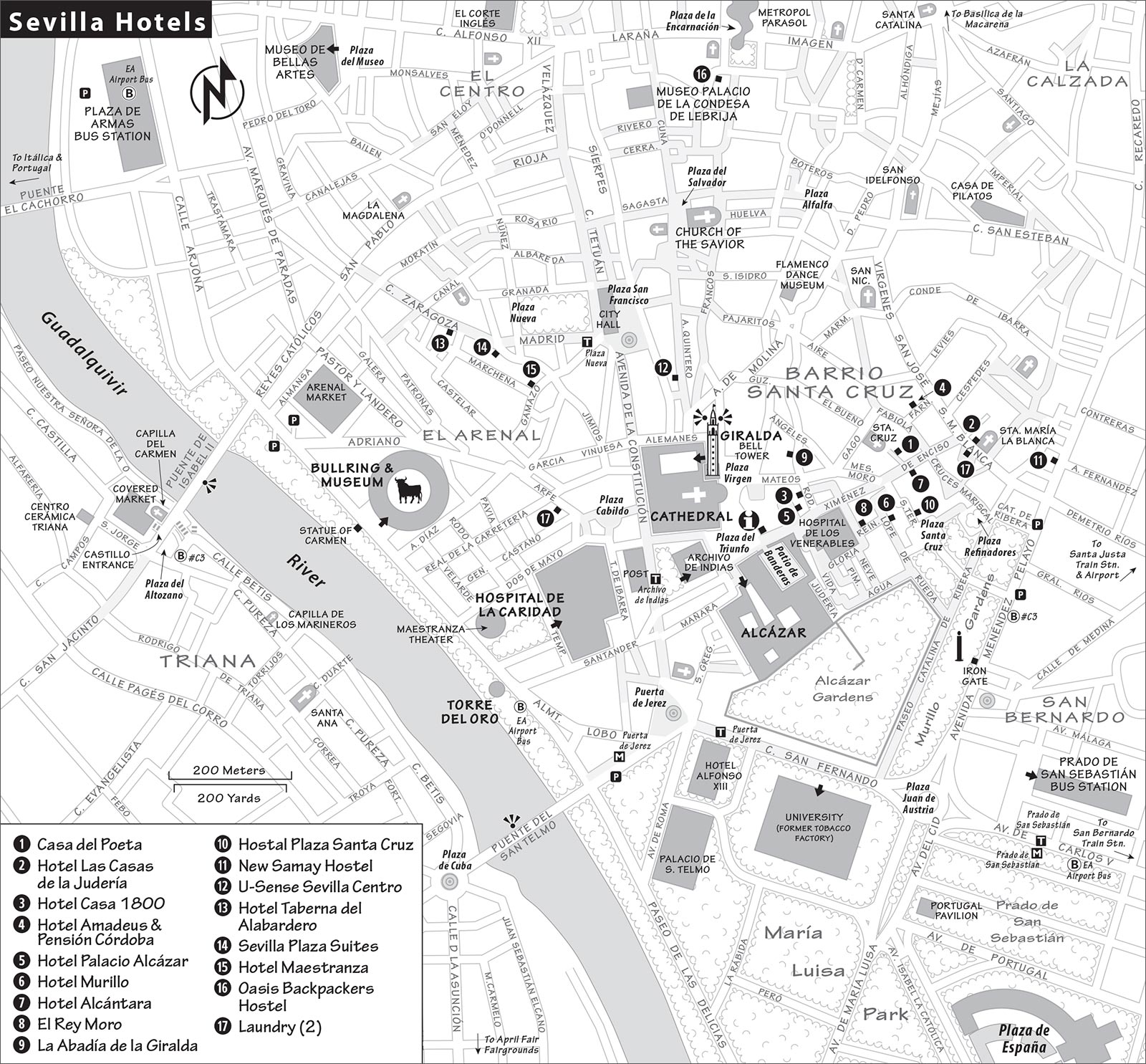
$ Pensión Córdoba, a homier and cheaper option, has 11 tidy, quiet rooms with cool-tone decor, and a showpiece tiled courtyard (no elevator, on a tiny lane off Calle Santa María la Blanca at Calle Farnesio 12, +34 954 227 498, www.pensioncordoba.com, reservas@pensioncordoba.com, twins Ana and María).
$ Hostal Plaza Santa Cruz is a charming little place, with thoughtful touches that you wouldn’t expect in this price range. The 17 basic rooms are cheerful and surround a bright little courtyard that’s buried deep in Barrio Santa Cruz, just off Plaza Santa Cruz. They also have nine even-nicer rooms with a common terrace in a renovated residential palace on Calle Ximénez de Enciso (no elevator, Calle Santa Teresa 15, +34 954 228 808, www.alojamientosconencantosevilla.com, plaza@alojamientosconencantosevilla.com).
¢ New Samay Hostel, on a busy avenue a block from the edge of Barrio Santa Cruz, is a youthful, well-run slumbermill with 76 beds in 17 rooms (each room has its own private bathroom, shared kitchen, 24-hour reception, rooftop terrace, closed mid-July to mid-Aug, Avenida de Menéndez Pelayo 13, +34 954 720 983, www.newsamayhostel.com, info@newsamyhostel.com).
NEAR THE CATHEDRAL
$$$ U-Sense Sevilla Centro, part of a national chain, rents 11 sophisticated rooms 100 yards from the cathedral. Double-pane windows keep it quiet at night, and two rooms have private terraces. They also rent apartments nearby (see website for details, Calle Álvarez Quintero 52, +34 954 293 913, www.urbansense.es, reservas.sevilla@urbansense.es).
WEST OF AVENIDA DE LA CONSTITUCIÓN
$$$ Hotel Taberna del Alabardero has a special charm with seven spacious rooms occupying the top floor of a poet’s mansion—each one named and decorated after an Andalusian town. It’s nicely located, a great value, and the ambience is perfectly circa-1900—notice the original Triana-made tiles in the entrance (pay parking, Zaragoza 20, +34 954 502 721, www.tabernadelalabardero.es, info@tabernadelalabardero.es).
$$ Sevilla Plaza Suites rents 10 self-catering apartments with wood floors, kitchenettes, and a shared laundry room. It’s squeaky clean, family friendly, and well located—and comes with an Astroturf sun terrace with a cathedral view. While service is scaled down, reception is open long hours (9:00-21:00) and rooms are cleaned daily (no elevator, inside rooms are quieter, a block off Plaza Nueva at Calle Zaragoza 52, +34 955 038 533, www.suitessevillaplaza.com, info@suitessevillaplaza.com, Javier).
$ Hotel Maestranza, sparkling with understated charm and run with loving care, has 17 simple, bright, clean rooms well located on a street just off Plaza Nueva. It feels elegant for its price. Double-pane windows help to cut down on noise from the tapas bars below (family rooms available, 5 percent discount if you pay cash, Gamazo 12, +34 954 561 070, www.hotelmaestranza.es, sevilla@hotelmaestranza.es, Antonio).
NEAR PLAZA DE LA ENCARNACIÓN
¢ Oasis Backpackers Hostel is a good place for cheap beds, and perhaps Sevilla’s best place to connect with young backpackers. Each of the eight rooms, with up to eight double bunks, comes with a modern bathroom and individual lockers. The rooftop terrace—with lounge chairs, a small pool, and adjacent shared kitchen—is well used (no air-con or elevator, just off Plaza de la Encarnación on the tiny and quiet lane behind the church at Compañía 1, confirm check-in time when you book, +34 955 228 287, www.oasissevilla.com, sevilla@hostelsoasis.com).
Eating in Sevilla
Eating in Sevilla is fun and affordable (visitors from more-expensive Madrid and Barcelona find it a wonderful value). Make a point to get out and eat at some of my top-end recommendations when you’re here, but note that many close for up to four weeks in summer, typically around the Assumption holiday (see the Appendix).
It seems every other door around town is some kind of eatery, and the variety is dizzying. Traditional places offer the basic tapas/medias raciones/raciones formula and the trend is to serve fewer tapas at the bar and more raciones at tables. Still, I’ve favored places that have a nice list of tapas (€3-6) and a bar where curious travelers can immerse themselves in the action. Study the menu to know what’s cooking—you’ll be less inclined to stick with your standby dishes.
Before heading out, review my “Tapas Menu Decoder” and the drinks vocabulary in the Practicalities chapter. Better yet, check out Sevilla-Tapas.com, a web-tionary of tapas and characteristic eating by Shawn Hennessey (who runs Azahar Sevilla Tapas tours—see the sidebar). Shawn celebrates family-run, labor-of-love small restaurants and bars rather than faux-traditional corporate chains. Her website covers key words and a selection of bars by neighborhood.
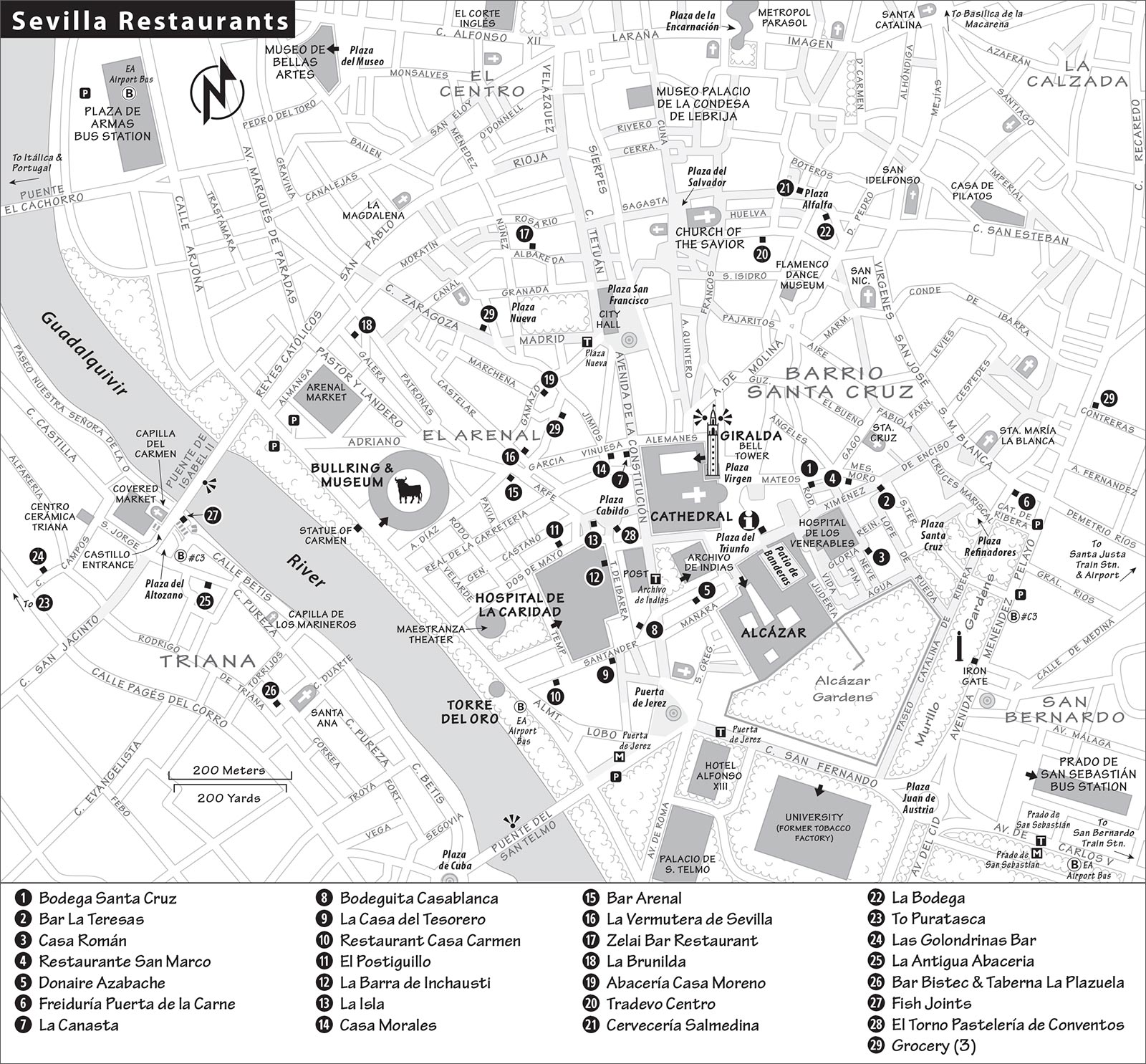
Breakfast: To save money and get out a little earlier, skip breakfast at your hotel and head to your favorite plaza. Bars are sleepy in the morning and many serve the basic desayuno fare for just a few euros (toast with oil, tomato, and ham; potato omelet; churros or pastries; coffee; and fresh-squeezed orange juice). Good spots (beyond the neighborhood bar on your favorite plaza) include the recommended Bodega Santa Cruz (rustic tapas bar) and La Canasta (modern diner)—both described later, Confitería La Campana (tempting pastries), and the places around the delightful Plaza de la Alfalfa (neighborhood plaza by the Church of the Savior, with tables under the trees next to a playground). If you’re sleeping in Barrio Santa Cruz, consider following the locals to Calenteria 1860 for churros.
BARRIO SANTA CRUZ AND CATHEDRAL AREA
For tapas, Barrio Santa Cruz is romántico and turístico. Plenty of atmospheric joints fill the neighborhood near the cathedral. Calle Mateos Gago, in front of the cathedral and tower, is jammed with tourists, fun bars, and eateries. Cervecería Giralda (in a 12th-century hammam) is now a venerable—if touristy—bar. La Azotea Vinos y Tapas is a better value. And Bodega Santa Cruz (see next) seems to be everyone’s favorite.
$ Bodega Santa Cruz (a.k.a. Las Columnas) is a popular local standby with lots of tourists, affordable tapas, and an unforgettable scene. You can keep an eye on the busy kitchen from the bar or hang out like a cowboy at the tiny stand-up tables out front. As peak times can be overwhelming, coming early or late makes ordering easier. At all times, you may need to muscle your way to the bar to order—a fun experience in itself (no table service). Drinks are listed at the door and separate chalkboards list tapas and montaditos. Breakfast here is understandably popular (long hours daily, Calle de Rodrigo Caro 1A, +34 954 218 618).
$$ Bar La Teresas, a few steps into the Jewish Quarter, is a classic family-run bar even though it’s buried in the barrio’s tourism. Their passion for ham is clear (with ham hocks hanging from the ceiling since 1870). Study their list of hot and cold tapas. Choose a table outside for people-watching or at the bar to absorb the action (drinks listed on door, Mon-Fri 10:00-late, Sat-Sun from 11:00, Calle Santa Teresa 2, +34 954 213 069).
$$ Casa Román, nestled on a charming square in Barrio Santa Cruz, feels like a tourist poster, with a relaxing and traditional dining room and plenty of locals. They serve quality food at good prices in the busiest area in town (daily, Plaza de los Venerables 1, +34 954 228 483).
$$ Restaurante San Marco serves pasta, pizza, and basic Mediterranean dishes under the arches of what was a Moorish bath (1,000 years ago) and then a disco (30 years ago). The air-conditioned atmosphere feels upscale, but it’s easygoing and family-friendly, with live Spanish guitar nightly after 20:30 (daily, Calle Mesón del Moro 6, +34 954 214 390).
$$ Donaire Azabache is a utilitarian place next to the Alcázar, where tour guides grab a break between gigs. They offer tasty standards from Spain’s south, with quick and attentive service, nice tables outside or in the back, and a bar—handy when the tables are filled (daily, Calle Santo Tomás 11, +34 954 224 702).
$ Freiduría Puerta de la Carne is a fried-fish-to-go place, with great outdoor seating. Study the photos of your options; un quarto (250 grams, for €5-7) serves one person. Then head out front and grab a table. If you need a drink or even a small salad, just flag down a server from the El 3 de Oro restaurant across the lane (closed Tue, usually no lunch service in summer; Calle Santa María la Blanca 34, +34 954 426 820).
Groceries: Más is close to many of my recommended hotels (Mon-Sat 9:00-22:00, closed Sun, Avenida Menéndez Pelayo 50).
BETWEEN THE CATHEDRAL AND THE RIVER
The area between the cathedral and the river, just across Avenida de la Constitución, is a wonderland of tapas, cheap eats, and fine dining. Calle García de Vinuesa leads past several colorful and cheap tapas places to a busy corner surrounded by an impressive selection of happy eateries (where Calle Adriano meets Calle Antonia Díaz).
$$ La Canasta (“The Basket”) is a modern diner facing the cathedral. While not particularly characteristic, it’s bright, efficient, and air-conditioned, and the fun and accessible menu offers a nice break from tapas fare. It’s also popular for breakfast, a bakery nibble, simple lunches, and smoothies (long hours daily, Avenida de la Constitución 16, +34 955 671 654).
$$$ Bodeguita Casablanca is famously the choice of bullfighters—and even the king. Just steps from the touristy cathedral area, this feels like a neighborhood spot, with stylish locals and a great menu. I’m partial to their solomillo (tenderloin) and artichokes. Tapas are available outside Monday through Thursday and inside anytime, while raciones are always available inside and out. This is a good place to be bold and experiment with your order (closed Sat-Sun and Aug, reservations smart, across the way from Archivo General de Indias at Calle Adolfo Rodríguez Jurado 12, +34 954 224 114, www.bodeguitacasablanca.com).
$$$ La Casa del Tesorero is a good, dressy Italian alternative to the tapas commotion, with mellow lighting and music (and with a full range of salads, pastas, and pizzas). It creates its own world, with a calm, spacious, elegant interior built upon 12th-century Moorish ruins (look through the glass floor) and under historic arches of what used to be the city’s treasury (daily, Calle Santander 1, +34 954 503 921).
$$ Restaurant Casa Carmen is spacious, classy, fresh, and modern. The food is a mix of international and Spanish flavors with good salads, vegetarian dishes, and tapas. The classy vibe spills into the courtyard out back (daily, Calle Santander 15, +34 854 708 609).
$$ El Postiguillo has a fun ambience—sort of bullfighting-meets-Bonanza—where stuffed bulls’ heads decorate the walls of a fanciful wooden stable. Locals come for the top-quality, traditional dishes, while tourists like the easy menu and snappy service. Try the carrillada (stewed pork cheeks), cola de toro (bull-tail stew), or chilled salmorejo (a thicker, Córdoba-style gazpacho). Tapas are an option anywhere you sit (daily, no reservations, Calle Dos de Mayo 2, +34 954 565 162). Jaime, who speaks English, is dedicated to your happiness.
$$$ La Barra de Inchausti is an understated, breezy eatery with a focused menu on all things from the Spanish seas. While you can splurge on a main course, their pleasing range of small bites and shareable dishes provides an appealing feast at a reasonable price for seafood aficionados (closed Sun-Mon, Calle Tomás de Ibarra 10, +34 954 871 322).
$$$ La Isla, tucked away in a narrow alley behind the Postigo craft market, is bright, spacious, dressy, and sought out for what locals say is some of the best seafood and paella in town. A nautical theme reminds diners of its fruit-of-the-sea specialties. You’ll get classy service whether dining outside, at the bar (tapas only), or in the restaurant (closed Sun-Mon, Calle Arfe 25, +34 954 215 376).
$ Casa Morales, oozing old-Sevilla atmosphere and now in the family’s fifth generation, is what a local bar should be. The front area is the original bar (a bit classier and drinking-oriented, with nice vermouth). The back section (use the separate entrance around the corner), which was the old storage room for the winery, is a carnival of eating and drinking with a fun bar and lots of stools at small tables. I like sitting at the bar to marvel at the tiny kitchen’s productivity and to see what’s being served. This is a place to order with a sense of adventure—like the sopresa íberica (quail egg and pork jowls). Note the old 2,800-liter terra-cotta urns, which were used to store wine until the 1980s (closed Sun, Calle García de Vinuesa 11, +34 954 221 242).
$ Bar Arenal is a classic bull bar—stark and simple with bullfighting on TV and tables spilling out onto a great street-corner setting. It’s good for just a drink and to hang out with a crusty crowd. They sell cheap, old-school tapas (daily, Calle Arfe 2, +34 954 223 686).
$ La Vermutera de Sevilla, a short block from Bar Arenal, is a tight and tiny zone of Vermouth-fueled fun, run by Luis and Miriam. Settling into this bar can be a rewarding adventure as you sort through the canned fish and salty-and-pickled treat options—all designed to make the vermouth go down nicer (closed Sun-Mon, Calle Castelar 2, +34 644 809 104).
Near Plaza Nueva
$$$ Zelai Bar Restaurant is utterly contemporary, without a hint of a historic-Sevilla feel or touristy vibe. Their pricey gourmet dishes are a hit with a smart local crowd, who enjoy an elevated fusion of Mediterranean and Peruvian flavors. Food is served in both the bar area and the dressy little restaurant out back, where reservations are generally required (closed Sun-Mon, off Plaza Nueva at Calle Albareda 22, +34 954 229 992, www.restaurantezelai.com).
$$ La Brunilda offers stylish, modern Spanish dishes along with “gastro-tapas” from around the world in a comfortable, clean atmosphere. There’s something for everyone—their duck confit, risotto, and desserts all get rave reviews (daily, reserve for one of two seatings—20:30 and 22:15, Calle Galera 5, +34 954 220 481, www.labrunildatapas.com).
$$ Abacería Casa Moreno is a classic abacería, a neighborhood grocery store that doubles as a standing-room-only tapas bar. Squeeze into the back room and you’re slipping back in time—and behind a tall language barrier. They’re proud of their top-quality jamón serrano, queso manchego, super-tender mojama (cured, dried tuna), and the well-used toaster oven that serves as the kitchen. Rubbing elbows here with local eaters, under a bull’s head, surrounded by jars of peaches and cans of sardines, you feel like you’re in on a secret (closed Sat-Sun, 3 blocks off Plaza Nueva at Calle Gamazo 7, +34 954 228 315).
Groceries: Two handy Carrefour Express markets are near Plaza Nueva and stocked with all the basics, plus prepared foods and picnic supplies (daily until 22:00, Calle Zaragoza 31 and Calle Harinas 7).
PLAZA DE LA ALFALFA
There’s something about this old livestock market—with its joyful playground, neighborhood vibe, and convivial feel—that makes me want to sit under the trees and sip a drink while people-watching. The square is ringed with nondescript eateries, their tables spilling onto the square: Bar Casa Diego (old-school tapas), Alfalfa 8 (more modern with lots of drinks), Casa Manolo (best plaza tables and caracoles in spring), and La Escaloná. And three of my favorite finer-dining restaurants in Sevilla are each about 30 yards off the plaza.
$$$ Tradevo Centro has a creative young chef who’s earned a Michelin rating with his “tradevo” (tradition with evolution) cuisine. The small but inviting menu includes beautifully presented dishes that give classics a little snap, and plenty of wines by the glass. There’s a fun, youthful vibe with no pretense in the spacious modern dining room (with a bustling kitchen soundtrack) or you can dine outside on a pleasant corner (daily, reservations required, Cuesta del Rosario 15, +34 854 807 424, www.tradevo.es/tradevo-centro).
$$$ Cervecería Salmedina is a fish lover’s dream come true, with a menu shaped by the last catch. Tucked into a small corner with a minimalist interior (that seems designed to cleanse your palate) and nice terrace tables, this place serves the freshest possible seafood from their own providers on the Cádiz coast. Owners/chefs Jaime and Pedro have created a positive energy where the good-natured staff works as if in a gastronomic ballet. Not to be missed: their sweet-and-savory cheesecake (daily, reservations smart, 30 yards off Plaza de la Alfalfa at Calle Guardamino 1, +34 954 213 172). Barbadillo, a white wine from Cádiz, is a great fit for seafood.
$$ La Bodega feels like the casual neighborhood hangout: a happy, convivial, and brightly lit high-energy room full of locals with an appetite-stoking menu, a good wine selection, and a fun-loving crew. Cod is a favorite here, as are their salads (daily, Calle Alfalfa 4, +34 954 227 362).
TRIANA
Colorful Triana, across the river from the city center, offers a nice range of eating options, especially around trendy Calle San Jacinto and the neighborhood scene behind the Church of Santa Ana.
Other than my listings, consider eating at Triana’s covered market, home to a world of tempting lunchtime eateries. Take a stroll, take in the scene, and take your pick (busiest Tue-Sat morning through afternoon). You might also consider the riverside fish joints at the Isabel II Bridge. These charge a little extra for their scenic setting, but they’re your best option if you want to eat on the river.
On or near Calle San Jacinto
The area’s pedestrianized main drag is lined with the tables of several easy-to-enjoy restaurants. For a relaxed dinner with lots of action around you, stroll the entire Calle San Jacinto block and find a dish to match your mood. Or, walk a couple blocks off the main drag for one of these more distinctive and memorable options:
$$$$ Puratasca, in the middle of a residential complex, is not your typical tapas restaurant. It’s a bit of a walk from my other places and a bit pricey, but it’s Michelin-rated for good reason, with beautifully presented gourmet creations such as arroz meloso (creamy rice) and tempura chorizo (closed Sun, no reservations, Calle Numancia 5, +34 954 331 621).
$$ Las Golondrinas Bar (“The Swallows”) is famed in Triana for its wonderful list of tasty tapas (from a fun and accessible menu). The dining area upstairs on the mezzanine is limited to raciones. The tapas scene at the bar is lively—cling to a corner and watch the amazingly productive little kitchen jam; be aggressive to get your order in. The clatter in the kitchen is the steady pounding of pork being tenderized. Favorites here are the pork punta de solomillo (tenderloin) and champiñones (mushrooms). Complement your meat with a veggie plate from the aliños section of the menu (daily, Calle Antillano Campos 26, +34 954 331 626).
$$ La Antigua Abacería, dolled up to meet your touristic Andalusian dream, serves traditional dishes with a rustic romance. The bar is tight with five tiny tables, but an adjacent dining room is much more spacious, lending itself to a more serious meal. Both the tapas menu and full menu are accessible and inviting (closed Tue, Calle Pureza 12, +34 620 031 832).
Behind the Church of Santa Ana
This is a more rustic and casual neighborhood scene, offering a charming setting where you can sit down under a big tree in the shade of the old church and munch on fried, greasy standards with locals.
Two humble restaurants with the same prices, quality, and owner fill the charming and leafy Plazuela de Santa Ana with their rickety tables. I prefer $ Bar Bistec, which is enthusiastic about its cod fritters, fried zucchini (calabacín), and calamari, and brags about their quail and snails in sauce. Before taking a seat out on the square, consider the indoor seating and the fun action at the bar (tapas menu posted for the bar only, closed Sun-Mon, +34 954 274 759). $ Taberna La Plazuela is simpler, doing fried fish, and caracoles (snails) in spring (closed Tue, +34 686 976 293).
Sevilla Connections
Note that many destinations are well served by both trains and buses.
BY TRAIN
All trains arriving and departing Sevilla, including high-speed AVE trains, leave from the larger, more distant Santa Justa station. But many cercanías and regional trains heading south to Granada, Jerez, Cádiz, and Málaga also stop at the smaller San Bernardo station a few minutes from Santa Justa, which is connected to downtown by tram. Hourly cercanías trains connect both stations (about a 4-minute trip). By the time you visit, Santa Justa may also be connected by tram. For tips on arrival at Santa Justa, see “Arrival in Sevilla,” earlier.
Train Tickets: For schedules and tickets, consult the Renfe website or visit the Renfe Travel Center at the train station (daily 8:00-22:00, take a number and wait). Train info: +34 912 320 320, Renfe.com [URL inactive].
From Sevilla by AVE Train to Madrid: The AVE express train is expensive but fast (3 hours to Madrid; hourly departures 7:00-21:00). Departures between 16:00 and 19:00 can book up far in advance, and surprise holidays and long weekends can totally jam up trains—reserve as far ahead as possible.
From Sevilla by Train to Córdoba: There are three options for this journey: slow and cheap regional media distancia trains (7/day, 1.5 hours), fast and cheap regional high-speed Avant (or Alvia) trains (hourly, 45 minutes, requires reservation), and fast and expensive AVE trains (almost hourly, 45 minutes, requires reservation). Unless you must be on a particular departure, there’s no reason to pay more for AVE; Avant trains are just as quick and half the price. However, promotional fares for the AVE can be as cheap as regional trains when booked in advance. (If you have a rail pass, you still must buy a reservation; Avant reservations are about half the cost of AVE.)
Other Trains from Sevilla to: Málaga (5/day, 2 hours on Avant; 4/day, 3 hours on slower regional trains), Ronda (3/day, 3.5-4 hours, transfer in Antequera), Granada (5/day, 2.5 hours), Jerez (nearly hourly, 1 hour), Toledo (hourly, 4 hours, transfer in Madrid), Barcelona (2/day direct, more with transfer in Madrid, 6-7 hours). There are no direct trains to Lisbon, Portugal; buses or a direct flight to Lisbon are far better (see later).
BY BUS
Sevilla has two bus stations: The El Prado de San Sebastián station, near Plaza de España, primarily serves regional destinations; and the Plaza de Armas station, farther north (past the bullring), handles most long-distance buses with Alsa (www.alsa.com). Go to the TI for the latest schedules.
From El Prado de San Sebastián station to Andalucía and the South Coast: Regional buses are operated by Comes (www.tgcomes.es) and Damas (https://damas-sa.es). Connections to Jerez are frequent, as many southbound buses head there first (7/day, 1.5 hours, run by both companies; note that train is also possible—see earlier). Damas runs buses to some of Andalucía’s hill towns, including Ronda (4/day, 2.5 hours, fewer on weekends) and Arcos (2/day, 2 hours; more departures possible with transfer in Jerez). For Spain’s South Coast, a Comes bus departs Sevilla four times a day and heads for Tarifa (3 hours, but not timed well for taking a ferry to Tangier that same day—best to overnight in Tarifa), then Algeciras (3.5 hours), and ends at La Línea/Gibraltar (4 hours). There is one bus a day from this station to Granada (3 hours); the rest depart from the Plaza de Armas station with Alsa or Socibus.
From Plaza de Armas station to: Madrid (4/day, 6.5 hours, https://socibusventas.es), Córdoba (7/day, 2 hours), Granada (7/day, 3 hours), Málaga (6/day direct, 3 hours), Nerja (1/day direct, more with transfer in Málaga, 5 hours).
By Bus to Portugal: The cheapest way to get to Lisbon is by bus (12/day, 7 hours, leaves from both Plaza de Armas bus station and Santa Justa train station, arrives at either Lisbon Oriente station or Sete Rios bus station, check details on Alsa.es or Rede-Expressos.pt [URL inactive], two companies share service). Overnight departures connect in Lisbon to Coimbra and Porto (including the airport). Sevilla also has direct bus service to Lagos, on the Algarve (8/day, 5 hours, buy ticket a day or two in advance May-Oct, www.alsa.es). The bus departs from Sevilla’s Plaza de Armas bus station and arrives at the Lagos bus station. If you’d like to visit Tavira on the way to Lagos, purchase a bus ticket to Tavira (3-hour trip), have lunch there, then take the train to Lagos.
ROUTE TIPS FOR DRIVERS
Sevilla to Arcos (55 miles/88 km): The remote hill towns of Andalucía are a joy to tour by car with Michelin map 578 to supplement your GPS. Drivers can follow signs to Cádiz on the expressway (blue signs, E-5, AP-4); the N-IV is curvy and dangerous. About halfway to Jerez, at Las Cabezas de San Juan, take A-371 to Villamartín. From there, circle scenically (and clockwise) through the thick of the Pueblos Blancos—Zahara and Grazalema—to Arcos.
It’s about two hours from Sevilla to Zahara. You’ll find decent but winding roads and sparse traffic. It gets worse (but very scenic) if you take the tortuous series of switchbacks over the 4,500-foot summit of Puerto de Las Palomas (Pigeons Pass, climb to the viewpoint) on the direct but difficult road (CA-9104) from Zahara to Grazalema (you’ll see several hiking trailheads into Sierra de Grazalema Natural Park).
Another scenic option through the park from Grazalema to Arcos is the road (A-372) that goes up over Puerto del Boyar (Boyar Pass), past the pretty little valley town of Benamahoma, and down to El Bosque.
To skirt the super-twisty roads within the park while passing through a few more hill towns, try the road from Ronda to El Gastor, Setenil (cave houses and great olive oil), and Olvera—another picturesque alternative.