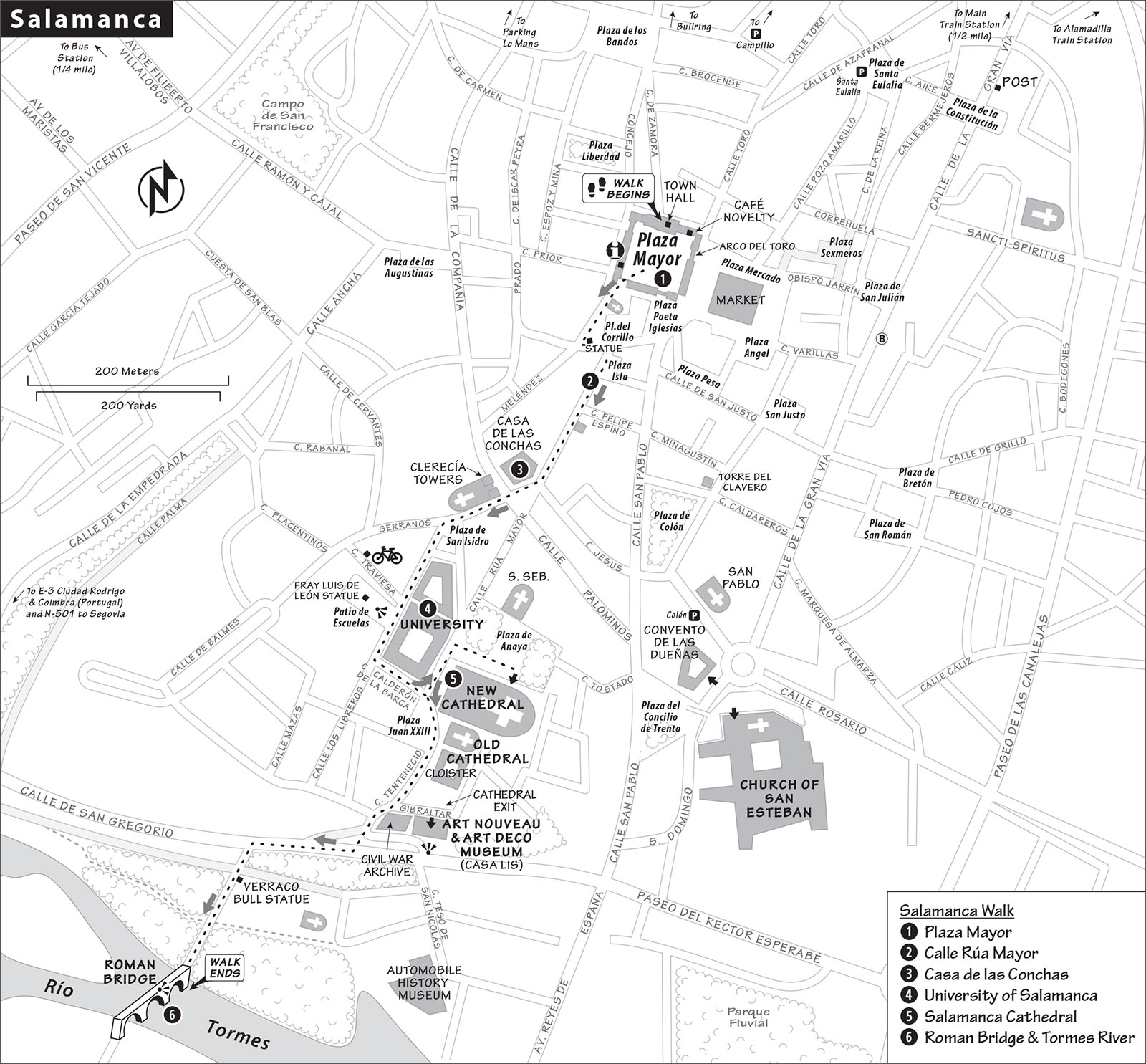
SALAMANCA
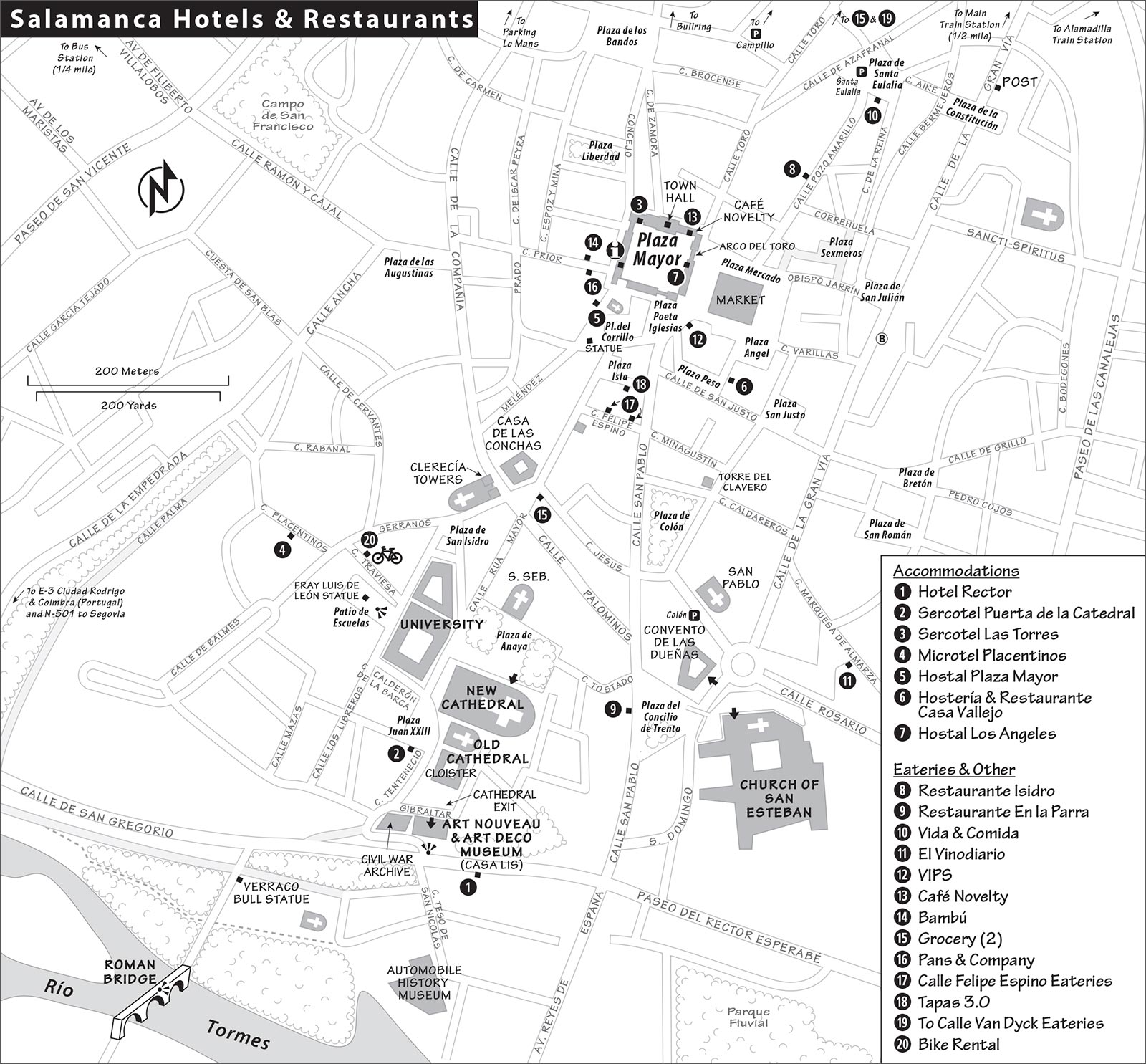
Map: Salamanca Hotels & Restaurants
CASUAL EATERIES ON PLAZA MAYOR
OFF THE BEATEN PATH ON CALLE VAN DYCK
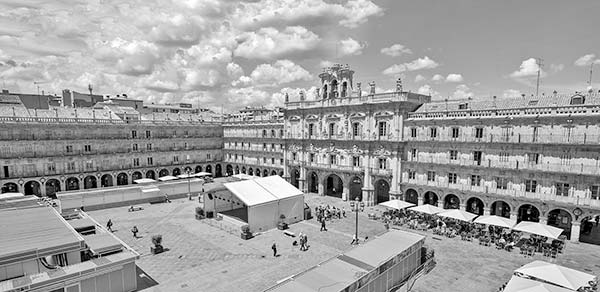
This sunny sandstone city boasts Spain’s grandest plaza, its oldest university, and a fascinating history, all swaddled in a strolling, college-town ambience. A youthful, less touristy, less hilly version of Toledo, Salamanca is home to a fine ensemble of monuments, a pair of buttress-sharing cathedrals from different centuries, clusters of cloisters, and some surprisingly good museums. It’s also affordable, as the many students help keep prices down.
Prestigious yet remote, Salamanca has that unusual mix of pride, pretense, and provinciality often found in old university towns. While Spaniards adore Salamanca, it feels undiscovered by tourists. That’s probably because it’s a bit far (1.5 hours each way) for an easy day trip from Madrid and not really on the way to other big destinations. But Salamanca rewards those who make the trip.
Enjoy strolling Salamanca’s elegant streets and squares, watching the bright sunlight hit the golden sandstone just so. At day’s end, join the paseo with the local crowd through Plaza Mayor, down Calle Rúa Mayor, and out to the river. In Salamanca, young people congregate until late in the night, chanting and cheering, talking and singing. When I asked a local woman why young men here suddenly break into song, she said, “Doesn’t it happen where you live?”
PLANNING YOUR TIME
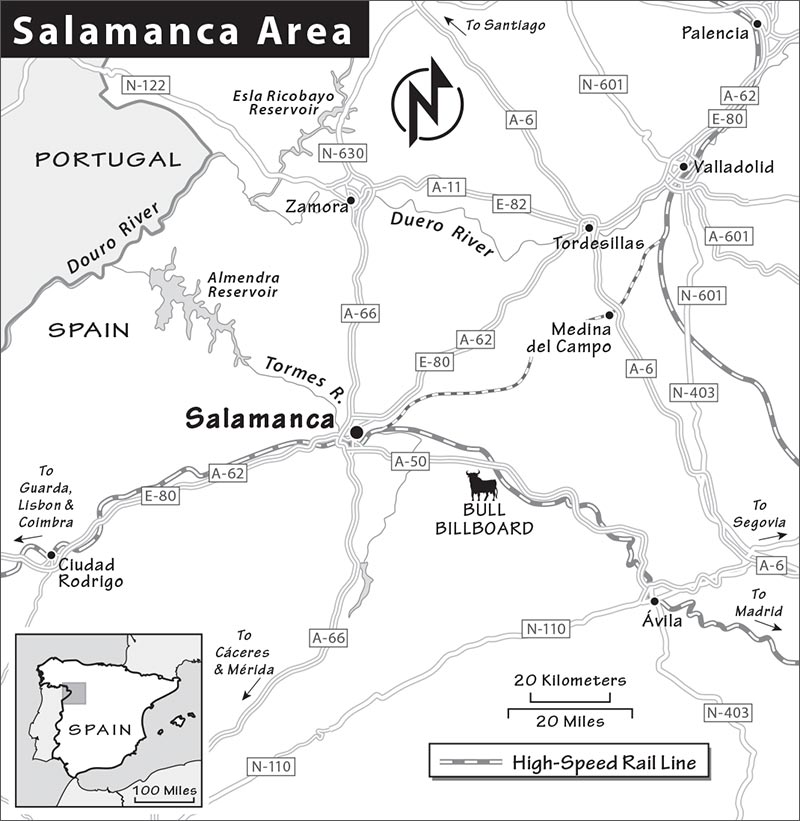
Salamanca is feasible as a long day trip from Madrid (1.5 hours via high-speed train). By car or bus, it’s 2.5 hours from Madrid. If you’re bound for Santiago de Compostela or Portugal, Salamanca is a natural stop. For those with more time in Spain, Salamanca is worth a full day and two nights.
Begin on the stunning Plaza Mayor, following my self-guided walk on Calle Rúa Mayor through the heart of town to the university and cathedrals. After lunch, tour the Art Nouveau and/or automobile museums, and—if you’re not churched out—visit the Church of San Esteban. Have a pre- or post-dinner drink on Plaza Mayor. To enjoy local tapas scenes, head out to Calle Van Dyck for a progressive dinner; for a sit-down meal, splurge at a quality restaurant in the center. If you’re staying overnight, be sure to take one last stroll through Plaza Mayor before bedtime.
Orientation to Salamanca
Salamanca’s sights cluster in a barbell shape, with its magnificent town square (Plaza Mayor) at the north end and the cathedrals and university a 10-minute walk south. The surrounding streets are lively with eateries, shops, and people. It’s fun to just get lost browsing the beautiful, mostly traffic-free back lanes of Salamanca’s old town, embraced by a ring road.
TOURIST INFORMATION
The TI is on Plaza Mayor (Mon-Fri 9:00-19:00, Sat from 10:00, Sun 10:00-14:00, Plaza Mayor 32, +34 923 218 342). The TI website (www.salamanca.es) is a good source of practical information; you can also check the regional TI website (www.turismocastillayleon.com) to find out about events and festivals in and around Salamanca.
Museum Combo-Ticket: If you plan to visit both the Automobile History Museum and Art Nouveau and Art Deco Museum, stop at the TI first to buy a €5 combo-ticket—cutting your entry costs in half (not sold at sights).
ARRIVAL IN SALAMANCA
From either Salamanca’s train or bus station to Plaza Mayor, it’s a 20-minute walk, an easy bus ride (€1.05, pay driver), or a €10 taxi trip. The train station has no lockers; day-trippers can store bags at the bus station (consignas; at bay level facing main building on your left).
By Train: Most trains arrive at Salamanca’s main train station. To walk from here into the center, exit left and head down to the ring road. Cross it at Plaza de España, then angle slightly left up Calle Azafranal. To go by bus, exit the front of the station, cross the street, and take bus #1 to Plaza de San Julián, a couple of blocks away from Plaza Mayor.
Some slower trains continue to the town’s second station, Salamanca Alamedilla station, which is a bit closer to the center. If you arrive here, walk down Avenida Alamedilla past a park to Plaza de España, then to Calle Azafranal. Note that you cannot depart from or buy tickets at Salamanca Alamedilla station.
By Bus: To walk into the center from the bus station, exit right and walk down Avenida Filiberto Villalobos; take a left on the ring road and the first right on Ramón y Cajal, head through Plaza de las Augustinas, and continue on Calle Prior to reach Plaza Mayor. Or take bus #4 (exit station right, catch bus on same side of the street as the station) to the city center; the closest stops are on Gran Vía, about two blocks east of Plaza Mayor.
By Car: The old center is ringed by underground parking garages. Convenient options are at Plaza Santa Eulalia, Parking Plaza del Campillo, Parking Le Mans, and Parking Colón. If you’re overnighting, many hotels offer garages or valet parking for comparable fees.
HELPFUL HINTS
Book Ahead for Easter and September: During Easter week, bullfighting events, and the first half of September (Salamanca’s Feria patron-saint celebration), hotels fill up and room prices increase.
Bike Rental and Tours: Juanjo and Javi from Bikecicletas Salamanca offer bike rentals and route tips along with guided tours for six people or more (reserve tours a few days in advance, Calle Traviesa 18—around the corner from the university facade, +34 923 216 940, www.alquilerbicisalamanca.com).
Local Guide: Get a town walk tailored to your interests with Inés Criado Velasco, a good English-speaking guide (weekdays-€100/3 hours, 10 percent more on weekends and holidays, €150/5 hours for groups of 1-30, +34 609 557 528, www.inescriado.com, guia@inescriado.com).
Salamanca Walk
This stroll through the heart of Salamanca—worth ▲▲—connects all of the town’s main sights in about an hour (not counting the time to enter museums). We’ll begin on Spain’s finest square, then walk south to one of its finest cathedrals and one of its most historic universities, before ending at a scenic viewpoint along the river.
• Start on Salamanca’s main square.
1 Plaza Mayor
Built from 1729 to 1755 by brothers Alberto and Nicolas Churriguera, Spain’s ultimate plaza is worth ▲▲▲. It’s a lovely place to simply hang out, enjoy a cup of coffee, and watch the world go by.
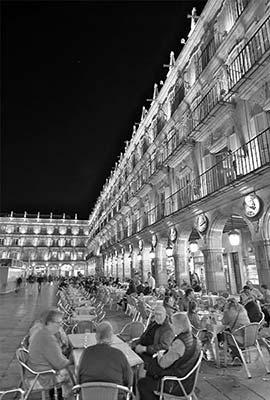
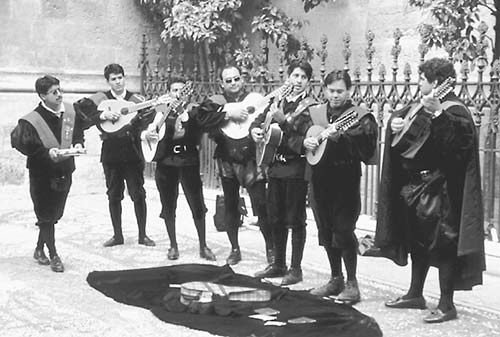
Plaza Mayor has long been Salamanca’s community living room. It seems to continually be hosting some kind of party. Imagine the excitement of the days (until 1893) when bullfights were held in the square. Old-timers who gather here each day remember an earlier era, when teenage girls would promenade clockwise around the colonnade while the boys cruised counterclockwise. Today, if you’re lucky, you may find local student tuna musicians performing on the square—most likely on summer weeknights (see sidebar). Perhaps the best time for people-watching is Sunday after Mass (13:00-15:00), when the grandmothers gather here in their Sunday best.
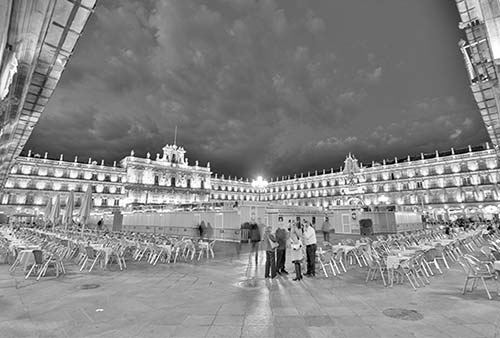
The Town Hall, with the clock, grandly overlooks the square. While most Town Halls in Spain fly three or four flags, Salamanca’s flies five. In order, from left to right: the province of Salamanca (purple with coat of arms), the state of Castile and León (red-and-white checkerboard, with castles and lions), Spain (red and yellow), the city of Salamanca (red with coat of arms), and the EU (blue with circle of gold stars).
Appreciate the harmonious architecture and the unique feel of this grand square—carved, like much of Salamanca, from a lemony, local sandstone called piedra de Villamayor. When first quarried, this stone is easy to carve, but over time it hardens—ideal for delicate but durable architectural decoration. Notice the square’s perfectly symmetrical arches (hiding a pleasantly shaded arcade), its three levels of charming little balconies with matching shutters, and its artful lampposts. The square’s designers, the Churriguera brothers, pioneered the intricately decorative look of the buildings that surround you. That look became a style all its own, called “Churrigueresque,” which became popular around Spain and throughout its New World colonies.
While most European squares honor a single king or a saint, Plaza Mayor—ringed by famous Castilians—is for all the people. The medallions above the colonnade surrounding the plaza depict writers (Miguel de Cervantes), heroes and conquistadors (Christopher Columbus and Hernán Cortés), as well as numerous kings. Immediately to the right of the Town Hall, find Juan Carlos I, who abdicated in 2014, with Queen Sofía. Fascist dictator Francisco Franco was featured in a medallion until 2017.
You could spend all day noticing details around the square, but before we take off, here’s just one more: Here on Plaza Mayor and throughout Salamanca, keep an eye out for scallop shells. Salamanca sits on the Camino de Santiago pilgrimage route from Seville to Galicia. The shell—a symbol of St. James (Santiago)—is used to mark pilgrimage routes to his tomb in Santiago de Compostela, whose famous cathedral is also in the Churrigueresque style.
Facing the Town Hall, look to the right, where you’ll find the square’s most venerable coffee house, Café Novelty—an institution since 1905. It’s filled with character and literary memories. The metal sculpture depicts a famous local writer, Torrente Ballester. Before city council meetings, delegates line up at the bar to hash out their strategies; though left and right are both represented, they rarely interact.
Traditionally, Salamanca’s poorer students earned money to fund their education by singing in the streets. This 15th-to-18th-century tradition survives today, as musical groups of students (representing the various faculties)—dressed in traditional black capes and leggings—sing and strum mandolins and guitars. They serenade the public in the bars on and around Plaza Mayor. The name tuna, which has nothing to do with fish, refers to a vagabond student lifestyle and later was applied to the music these students sing. They’re out only on summer weeknights (singing for tips from 22:00 until after midnight), because they make more serious money performing for weddings on weekends.
Now turn to the right to face the Arco del Toro (built into the eastern wall)—it leads to the covered market. Consider a brief detour here—especially during the morning, when it’s busy—to enjoy the market bustle and maybe nurse a stand-up coffee surrounded by shoppers.
• Now we’ll head down Salamanca’s main drag to its most interesting sights—the university and cathedrals. With your back to the Town Hall, leave Plaza Mayor through the arch at about one o’clock. You’ll walk straight up the busy little adjoining square, called Plaza del Corillo (passing a stout, Romanesque church on your left), until you reach a statue of a bearded, stooped gentleman named Remigio González Martín. Writing under the pen name Adares, he was a beloved 20th-century poet who sold his works right here on this square.
Crossing the busy street behind Adares, angle left to reach the start of...
2 Calle Rúa Mayor—Salamanca’s Main Drag
This lively and lovable thoroughfare runs through the heart of Salamanca, connecting Plaza Mayor with the city’s religious and academic institutions.
Start walking down Calle Rúa Mayor toward the cathedral spire. This is a prime strip to window-shop restaurants for lunch or dinner. The second street on the left, Calle Felipe Espino, is lined with tempting tapas bars (described later, under “Eating in Salamanca”). Just past that, on the left at #13, notice the historic facade being held up by concrete and metal beams. The protected nature of Salamanca’s historic old center makes it extremely expensive to renovate—you can’t just tear down and build from scratch. So this has been a virtual ruin for years. At the end of the facade, at #17, notice the Mudéjar-style double keyhole arches. (Mudéjar is the Romanesque-Islamic Moorish design style made in Spain after the Christian conquest.)
Soon you’ll pop out at a triangular little square with a monument honoring maestro Francisco de Salinas, a blind musicologist who taught at the University of Salamanca in the 16th century...one of many former professors you’ll see celebrated around town. The building on the right is the 3 Casa de las Conchas. One of Salamanca’s most famous landmarks, its facade is encrusted with more than 300 scallop shells of St. James—again honoring the Camino de Santiago pilgrimage route that passes along here.
Circle around to the right, to the other side of the Casa de las Conchas, to see even more shells. Facing that facade are the twin towers of La Clerecía Church—nicknamed the “Stairway to Heaven.” You can climb up these 200 steps for grand views (details later, under “Sights in Salamanca”).
• From here, let’s detour from the main drag for a look at the key landmarks of Salamanca’s famous university.
Head up the street to the left of La Clerecía Church, through the wide Plaza de San Isidro. Take the second street on your left—the one on the right side of the building with the oversized door. This is Calle los Libreros, sprinkled with cafés and bars. Follow this for three short blocks, through the heart of the student zone, until a glorious facade opens up on your left. This is the historical main building of the...
4 University of Salamanca
This university, the oldest in Spain (Universidad de Salamanca, est. 1218), was one of Europe’s leading centers of learning for 400 years. Columbus came here for travel tips. Today, though no longer so prestigious, it’s laden with history and popular with Americans, who enjoy its excellent summer program.
While you can pay to enter its historic lecture halls, the most interesting features of the university—worth ▲▲—are free to view and ring this square.
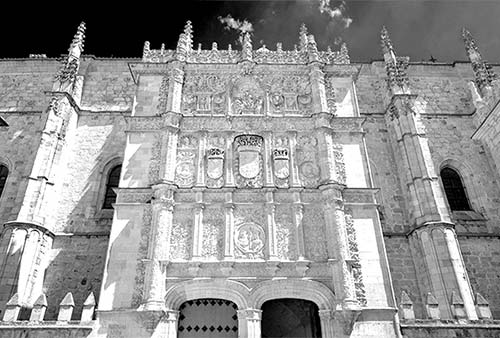
Duck into the plaza (Patio de Escuelas) opposite the university and face the ornately decorated grand entrance facade. Dating from the 16th century, this is the textbook example of Spain’s Plateresque style—named for its delicate, detail-packed, filigree-like carvings that resemble fine jewelry (plata means silver). The people studying the facade aren’t art fans. They’re trying to find a tiny frog on a skull that students look to for good luck. But forget the frog (for now)—follow the facade’s symbolic meaning. It was made in three sections by Charles V. The bottom band—with the giant medallion—celebrates the Catholic Monarchs. Ferdinand and Isabel saw that the university had no facilities befitting its prestige, and they granted the money for this building.
The immodest middle section celebrates the grandson of Ferdinand and Isabel, Charles V. He appears with his queen, the Habsburg double-headed eagle, and the complex coat of arms of the mighty Habsburg Empire. Since this is a Renaissance structure, it features Greek and Roman figures in the shells. And, as a statement of intellectual independence from medieval Church control, the top shows the pope flanked by Hercules and Venus.
Dominating the square opposite the facade is a statue of Fray (Friar) Luis de León (1527-1591). In his role as an academic here, Luis de León challenged the Church’s control of the word of God by translating part of the Bible into Castilian. For this he was denounced to the Inquisition and jailed for nearly five years. Upon being released, he started his first post-imprisonment lecture with, “As we were saying...” Such courageous men of truth believed the forces of the Inquisition were not even worth acknowledging. Salamantinos admire Fray Luis de León for maintaining the independence of academia in the face of questionable political mores.
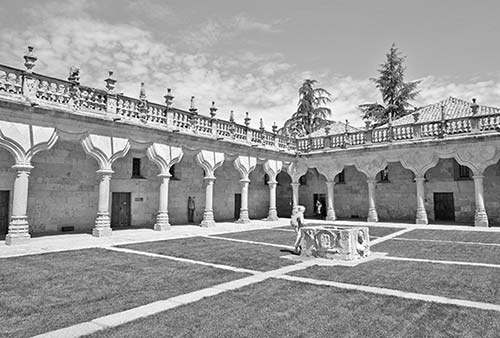
At the end of the plaza behind Fray Luis de León, skip the modest museum, but do dip into the beautiful courtyard at the left corner of the square, with pillars shaped like parting curtains. In one of these rooms, look for Fernando Gallego’s fanciful 15th-century Sky of Salamanca ceiling mural—a depiction of the night sky of constellations, illustrated with mythological figures.
So...the frog? Head back out and face the facade. It’s on the right pillar, nearly halfway up, on the leftmost of three skulls.
You’ve already seen the most important parts of the university (including, yes, the frog). But if you like, you can also pay to visit the lecture halls, which are austere and pricey but contain a lot of history (enter through the door under the facade; for details, see “Sights in Salamanca,” later).
• When you’re ready to move on, face the facade and turn right down Calle los Libreros. Take the first left, on Calle de Calderón de la Barca. You’ll run right into...
5 Salamanca Cathedral
Salamanca’s cool-on-a-hot-day cathedral is two-in-one: a 12th-century Romanesque church (the “Old Cathedral,” hiding behind the tower on your right) adjoining the much larger, newer “annex” that you’re facing now (the “New Cathedral,” completed in the 18th century).
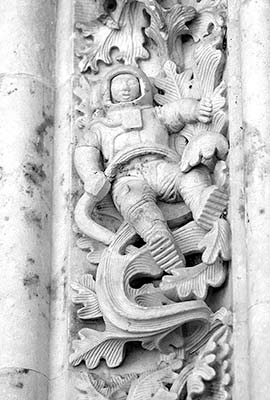
Turn left and circle around to the main facade, facing the park. Like the university, it’s decorated Plateresque—Spain’s version of Flamboyant Gothic. You may notice tourists making a fuss over the entrance door (the one on the right, as you face this side of the cathedral). They’re looking for the astronaut added by a capricious restorer in 1993. At first this caused an outrage, but now locals shrug and say, “He’s the person closest to God.” I’ll give you a chance to find him on your own...
Meanwhile, turn around and survey the lovely garden square the cathedral faces, Plaza de Anaya. The cathedral buttresses face the stern, Neoclassical facade of the university’s philology faculty. Genteel spaces like this help give Salamanca its “Spanish Oxford” vibe.
Now’s a good time to tour the worthwhile cathedral interior (described later, under “Sights in Salamanca”).
Oh, yeah—still looking for that astronaut? Here’s some help: He’s just a little guy, about the size of a Ken-does-Mars doll, entwined in the stone trim to the left of the New Cathedral side door, roughly 10 feet up. If you like that, check out the dragon (an arm’s length below, and just to the right). Historians debate whether he’s eating an ice-cream cone or singing karaoke.
• Facing the astronaut, turn right, then left, circling all the way to the downhill side of the cathedral complex. (If you’re touring the cathedral, you’ll pop out at the same place.) From there, head downhill on Calle Tentenecio (passing the Sercotel Puerta de la Catedral hotel on your right). After one block, you’ll see the fine facade of Spain’s General Archive of the Civil War—an important documentation center for that still-poignant era of Spanish history. If you turn left here, the building next to the archive is Salamanca’s excellent Art Nouveau and Art Deco Museum, which is well worth a visit (described later, under “Sights in Salamanca”).
Bear right (downhill) at the archive to curl down one more block to a busy road along Salamanca’s riverbank, Calle de San Gregorio. Bear right and cross the street to reach our final stop, the...
6 Roman Bridge and Tormes River
This low-slung bridge (Puente Romano), with its elegantly simple arches, dates back to the late first century AD. Until the 20th century, it remained Salamanca’s primary river crossing; today it’s open only to promenading pedestrians (and has one of the city’s best paseo scenes on a warm evening).
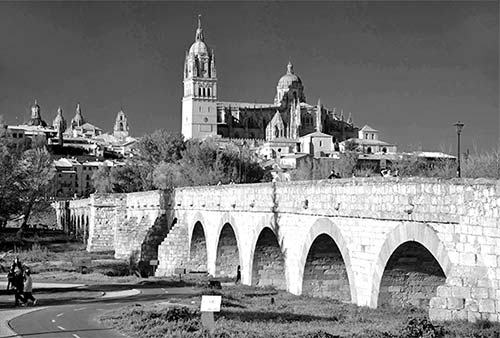
Notice the weathered stump of a statue on the pillar by the bridge. Called a verraco, this is what’s left of a Roman-era statue of a bull, a treasured symbol of the city. You’ll see a stone bull and an arched bridge on Salamanca’s coat of arms.
Salamanca’s river is the Río Tormes, well known among Spaniards thanks to Lazarillo de Tormes—a 16th-century novella that, in the Spanish literary pantheon, takes a backseat only to Cervantes. Young Lazarillo’s tale, which every young Spanish student reads in school, begins here on the Tormes riverbank, then winds through Spain as he embarks on various adventures. Lazarillo de Tormes is credited with creating a whole new literary form: the picaresque novel, in which a pícaro (rascal) travels around on a series of humorous adventures, outsmarting everyone he meets...the literary inspiration for everyone from Huck Finn to Pippi Longstocking to Hunter S. Thompson.
• Our walk is finished. If the weather’s nice and people are out strolling, join them and head across the bridge, where you’ll look back to see the classic view of Salamanca’s sandstone cityscape.
If you stand with the bridge and its bull to your back, you can head straight up the way you came to reach the cathedral and the main route through town; or you can turn right and walk just a couple of minutes to Salamanca’s surprisingly good Automobile History Museum. And just beyond that is one more worthwhile sight: the fine Church of San Esteban, about a 10-minute walk from here. Both are described under “Sights in Salamanca.”
Sights in Salamanca
CATHEDRAL AND UNIVERSITY AREA
This zone is about a 10-minute walk south of Plaza Mayor. These are listed in the order you’ll reach them on my “Salamanca Walk,” outlined earlier.
▲Clerecía Towers/Stairway to Heaven (Torres de La Clerecía/Scala Coeli)
The twin spires of La Clerecía Church offer a bird’s-eye view of the city and a panorama of the Old and New cathedrals. The church is behind the Casa de las Conchas, just off the Calle Rúa Mayor. You’ll huff up 200 steps—the last stretch of which is the original bell-tower staircase, which has been restored. I’d skip the attached museum, and just climb the towers.
Cost and Hours: €3.75, daily 10:00-20:00, until 18:00 in winter, last entry 45 minutes before closing, Calle Compañia 5, +34 923 277 174.
University of Salamanca Lecture Halls
The best features of Salamanca’s prestigious university—its glorious facade and starry-skied old ceiling fresco—are free, and described in my self-guided “Salamanca Walk,” earlier. But for a hefty fee, you can also enter the old lecture halls around the cloister, where many of Spain’s golden age heroes studied. The lecture halls are interesting for academics and those with a serious interest in Salamanca’s university history. But they’re expensive, pretty stark, and difficult for a casual visitor to appreciate.
Cost and Hours: €10, Mon-Sat 10:00-20:00, off-season until 19:00, Sun 10:00-14:00 year-round, +34 923 294 400, ext. 1150, www.usal.es.
Visiting the Lecture Halls: Buy a ticket, enter the courtyard, and turn left to make a clockwise loop—following the good, posted English information for each room. You’ll pass several different lecture halls, all of them quite austere—even monastic—and each one named for an important university figure. For example, the namesake of the second lecture hall, Miguel de Unamuno (1864-1936), was a Basque-born playwright, poet, novelist, philosopher, and University of Salamanca rector from the so-called “Generation of ’98” (a creative and intellectual blossoming in turn-of-the-century Spain). He served here right up until the civil war. Following a heated debate with one of Franco’s generals, he condemned both sides of the conflict, was stripped of his rectorship, and died in disgust under house arrest 10 weeks later.
The next lecture hall—for Fray Luis de León—is the most historic. The narrow wooden-beam tables and benches, whittled down by centuries of studious doodling, are originals. Professors spoke from the Church-threatening cátedra (pulpit). This was where the friar boldly resumed his lectures, right where he left off, following five years of Inquisition punishment.
Continuing around the courtyard, look up to appreciate the colorful Mudejar-style decorations between the ceiling beams. Step into the chapel, where the main altarpiece depicts professors swearing to Mary’s virginity—an example of the conflict between academia and religion. (How did they know?)
Climb upstairs beside the Plateresque banister for a peek into the oldest library in Spain. Outside the library, look into the courtyard at the American sequoia, brought here 150 years ago and standing all alone. Continuing around the upper courtyard, look up at the cathedral’s adjacent bell tower. See any giant nests? Storks stop here from February through August on their annual journey from Morocco to northern Europe. There are hundreds of these stork nests in Salamanca.
▲▲Salamanca Cathedral (Catedral de Salamanca)
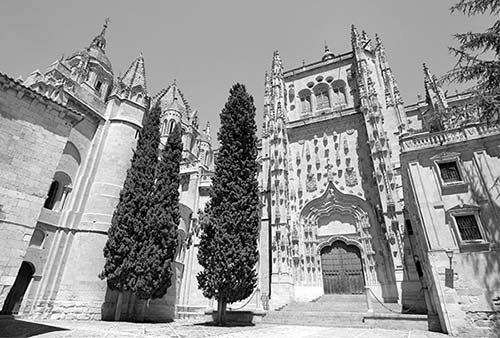
Salamanca’s cathedral is a two-fer: When constructing a spacious new cathedral (built 1513-1733), Church fathers put it right next to the town’s 12th-century Romanesque church. The “New Cathedral,” a towering mix of Gothic, Renaissance, and Baroque, shares buttresses with its older partner.
Cost and Hours: Cathedrals, cloister, and museum—€10, includes audioguide, daily 10:00-18:00, last entry 45 minutes before closing; tower—€3.75, daily 10:00-20:00, shorter hours in winter, last entry one hour before closing; +34 923 217 476, www.catedralsalamanca.org.
Visiting the Cathedrals: To get to the old, you have to walk through the new.
New Cathedral (Catedral Nueva): Before entering the New Cathedral, check out its ornate front door (west portal on Calle Rúa Mayor—described earlier on my self-guided “Salamanca Walk”).
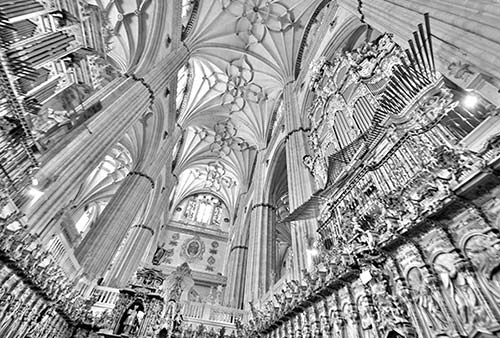
Head inside. The interior is vast and majestic—architecturally rivaling any in Spain (but lacking the famous art that singles out others, like Toledo’s). Fancy stone trim is everywhere, and the dome decoration is particularly wonderful. Occasionally the music is live, not recorded. The coro, or choir, blocks up half of the church (normal for Spanish Gothic), but its wood carving is sumptuous; look up to see the recently restored, elaborate organ.
• Enter the Old Cathedral through the San Lorenzo Chapel, to the left of the New Cathedral’s main door.
Old Cathedral (Catedral Vieja): Sit in a front pew to study the altarpiece’s 53 scenes from the lives of Mary and Jesus (by the Italian Florentino, 1445) surrounding a precious 12th-century statue of the Virgin of the Valley. High above, notice the dramatic Last Judgment fresco of Jesus sending condemned souls into the literal jaws of hell.
Enter the cloister (off the right transept) and explore the chapels, notable for their unusual tombs, ornate altarpieces, and ceilings with leering faces at the bases of the supports. In the Capilla de Santa Bárbara (second on the left), you can sit as students once did for their tests. During these final exams, a stern circle of professors formed around the students at the tomb of a Salamanca bishop. (The university originated in the cathedral school, with a group of teacher-priests who met in this room.)
As you continue through the cloister, you’ll find the chapterhouse (salas capitulares), home to the museum. Immediately on your right, look for a 13th-century sculpture of the Virgin that opens to show scenes of Mary’s life. Beyond that, pass under a beautiful 16th-century coffered ceiling to see a fine collection of 15th- and 16th-century Castilian paintings, mostly church altarpieces.
Continuing around the cloister, the Capilla de Santa Catalina was used as the university’s library until 1610. The room is lined with tombs and paintings from the 15th to the 17th centuries. The Capilla de Anaya, farthest from the cloister entrance, has a gorgeously carved 16th-century alabaster tomb (look for the dog and lion making peace—or negotiating who gets to eat the worried-looking rabbit—at the foot of the tomb) and a wooden 16th-century Mudejar organ.
At the end of your visit, you will exit onto Calle Gibraltar across from the Casa Lis Art Nouveau and Art Deco Museum and the civil war archives. To loop back up to the tower and where you entered the cathedral, take your first right and go uphill on Calle Tentenecio.
Tower: For a fantastic view of the upper floors and terraces of both cathedrals, and a look at the inside passages with small exhibits about the cathedrals’ history and architecture, visit the tower (marked Jeronimus). It was sealed after Lisbon’s 1755 earthquake to create structural support, and not opened again until 2002. The tower entrance is to the right as you exit the Old Cathedral.
▲Church of San Esteban
Salamanca’s “second church” rivals the first church of many Spanish cities. It sits a few blocks east of the cathedral. Dedicated to St. Stephen (Esteban) the martyr, this complex contains a restored cloister, tombs, museum, sacristy, and church.
Cost and Hours: €4, church open daily 10:00-14:00 & 16:00-20:00, until 18:00 in winter, last entry 45 minutes before closing, museum closed Sun afternoons and all day Mon, +34 923 215 000, www.conventosanesteban.es.
Visiting the Church: The visitors entrance is to the right of the church entrance (which is closed except during services).
Before you enter, notice the Plateresque facade and its bas-relief of the stoning of St. Stephen. The Crucifixion above is by Italian Renaissance artist Benvenuto Cellini. As you enter the building, look at the large poster explaining the facade’s many characters.
After buying your ticket, enter the cloister, turn right, and circle around—enjoying the serenity. About three-quarters of the way around, you’ll enter a hall where signs indicate ways to the church (iglesia), sacristy (sacristía), choir (coro), and museum (museo). Head to the church first. Once inside, follow the free English pamphlet.
The nave is overwhelmed by a 100-foot, 4,000-piece wood altarpiece by José Benito Churriguera (1665-1725) that replaced the original Gothic one in 1693. You’ll see St. Dominic on the left, St. Francis on the right, and a grand monstrance holding the Communion wafers in the middle, all below a painting of St. Stephen being stoned. This is a textbook example of the intricately detailed Churrigueresque style that influenced many South American mission buildings. Quietly ponder the dusty, gold-plated cottage cheese, as tourists shake their heads and say “too much” in their mother tongues.
Go up the architecturally unique staircase, built without any interior support; you’ll notice that when you walk, you definitely lean inward. Turn left and make a loop around the upper level of the cloister, enjoying the calm, then visit the museum with its illustrated 14th-to-16th-century Bibles and choir books. Notice also how the curved ivory Filipino saints all look like they’re carved out of an elephant’s tusk. And don’t miss the fascinating “chocolate box reliquaries” on the wall in the back (on the right), from the 16th and 17th centuries. Survey whose bones are collected between all the inlaid ivory and precious woods. Before leaving, take a quick look at the collection of 19th-to-20th-century pharmacy-related pieces.
Exit the museum and step into the balcony choir loft for a fine overview of the nave. The big, spinnable book holder in the middle of the room held giant music books—large enough for all to chant from in an age when there weren’t enough books for everyone. Amen.
Convento de las Dueñas
Located next door to the Church of San Esteban, the much simpler convento is a joy (enter by the door facing the busy roundabout). It consists of a double-decker cloister with a small museum of religious art. Check out the stone meanies exuberantly decorating the capitals on the cloister’s upper deck. No English information is displayed, but an English booklet is available for a small fee. The nuns also sell sweets—their specialty is amarguillos (almonds, egg whites, and sugar; no assortments possible even though their display box raises hopes).
Cost and Hours: €2, generally Mon-Sat 10:30-12:45 & 16:30-19:00, closed Sun year-round, +34 923 215 442.
NEAR THE RIVER
The Art Nouveau and Art Deco Museum and the Automobile History Museum sit a couple of steep blocks below the cathedral area, just above Salamanca’s riverbank. A €5 combo-ticket sold only at the TI on Plaza Mayor covers both sights.
▲▲Art Nouveau and Art Deco Museum (Museo Art Nouveau y Deco)
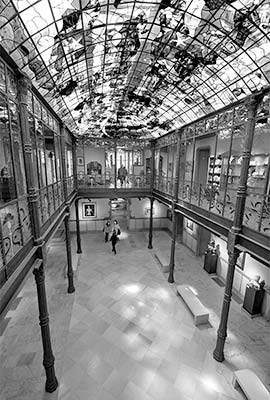
Located in the turn-of-the-century Casa Lis, this museum displays a stunning collection of stained glass, paintings, vases, furniture, jewelry, cancan statuettes, and toy dolls. Nowhere else in Spain will you enjoy an Art Nouveau collection in a building from the same era. A visit here offers a welcome, lighter-than-air change of pace from Salamanca’s heavy, somber, sandstone cityscape.
Cost and Hours: €5, free Thu 11:00-14:00; Mon-Fri 11:00-17:00, Sat until 20:00, Sun until 15:00, hours subject to change—check online; between the cathedrals and the river at Calle Gibraltar 14, +34 923 121 425, www.museocasalis.org.
Visiting the Museum: You’ll enter the museum in its airy atrium, bathed in colorful light from the stained-glass skylight. The 19 themed exhibits—highlighting various media and an international pantheon of talented artists—fill two floors. The English brochure translates the posted Spanish text.
First, tour the ground floor counterclockwise, beginning with porcelain, including fine works from Hungary’s Zsolnay factory, which revolutionized porcelain for architectural use. You’ll see a collection of bronzes from Vienna, exquisite jewelry by René Lalique, and paintings. Look for a playful series of chryselephantines—slinky statuettes made from a combination of gold (chrysos), ivory (elephas), and other precious materials, a style dating from ancient Greece. The chryselephantine collection includes fanciful, exotic, imaginative works by Austria’s Ferdinand Preiss, and stylized dancers and well-to-do ladies by Romania’s Demétre Chinarus. Also on this floor is a lovely café, with reasonably priced drinks and light bites in a fine Art Nouveau interior, looking out from inside the stained-glass facade.
Then head to the upper floor, which you’ll also tour counterclockwise beginning with exquisite French dolls...and creepy German ones. You’ll see sleek, Bauhaus-inflected figurines by Karl Hagenhauer, and a fascinating collection of “characters”—more like caricatures, with exaggerated features reminiscent of early Hummels. Rounding out this floor are bronzes, jewelry, fans, furniture, and glass, with an entire room devoted to the delicate works of French glass artist Émile Gallé.
For one more look at Art Nouveau beauty, exit the museum to the left and go down toward the busy road; turning left here, you can look back up to see the stained glass of the beautiful main facade.
▲Automobile History Museum (Museo de Historia de la Automoción)
This museum—worth ▲▲▲ for gearheads—has three floors showcasing about 100 vehicles in chronological order from 1886 to the present. There’s no posted English information, but at least you’ll know the make, model, and year of each automobile. You’ll begin in the basement, then work your way up through the vehicles. Find the 1899 Catalan three-wheeled car that was shown at the World’s Fair in Paris, a 1930 fire truck, a big black 1970 Caddie used for shuttling heads of state (including Franco), and Formula 1 race cars driven by Fernando Alonso (2009) and Michael Schumacher (1995). The exhibit finishes with a collection of motorcycles.
Cost and Hours: €5, Tue-Sun 10:00-14:00 & 17:00-20:00 (17:30-20:30 in July-Aug), closed Mon year-round; downloadable audioguide-€2.50, Plaza del Mercado Viejo, near the river immediately below the Art Nouveau and Art Deco Museum, +34 923 260 293, www.museoautomocion.com.
Sleeping in Salamanca
Salamanca, a student town, has plenty of good eating and sleeping values. Prices tend to go up on weekends. Most of my listings are on or within a three-minute walk of Plaza Mayor (Hotel Rector, Sercotel Puerta de la Catedral, and Microtel Placentinos are a little farther). The city is noisy on the weekends, so if you’re a light sleeper, ask for an interior room.
$$$$ Hotel Rector is the place to splurge in Salamanca. Sitting at the bottom edge of town, just above the riverbank, it has 14 rooms with high-end touches—such as fresh flowers in every room—and a staff that hustles to please (air-con, elevator, fitness room, pay parking, Paseo Rector Esperabé 10, +34 923 218 482, www.hotelrector.com, info@hotelrector.com, Teresa and Ignacio).
$$ Sercotel Puerta de la Catedral is a business-class hotel on a quiet pedestrian street around the corner from the cathedral entrance. While part of a chain, it has only 37 rooms, giving it a boutique feel. It’s worth the extra euros for a room with a great view of the cathedral (air-con, elevator, pay parking, Plaza de Juan XXIII 5, +34 923 004 808, www.sercotelhoteles.com, reservas@sercotel.com).
$ Sercotel Las Torres is a chain hotel with 53 modern, spacious rooms (several with see-through bathroom doors) and all the amenities. It’s nothing special...except that it’s located right on Plaza Mayor (some view rooms, air-con, elevator, exit Plaza Mayor at 11 o’clock to find hotel entry just off square at Calle Concejo 4, +34 923 212 100, www.sercotelhoteles.com, reservas@sercotel.com).
$ Microtel Placentinos is quaint and intimate, with nine rustic rooms buried deep in the streets near the university buildings. A bit idiosyncratic, it has personality and class (air-con, elevator, Calle Placentinos 9, +34 923 281 531, www.microtelplacentinos.com, reservas@microtelplacentinos.com).
$ Hostal Plaza Mayor, with 19 small, simple, older rooms, has a homey feel and a good location practically on Plaza Mayor—but with no views (air-con, most rooms served by elevator, pay parking, Plaza del Corrillo 20, +34 923 262 020, www.hostalplazamayor.es, info@hostalplazamayor.es).
$ Hostería Casa Vallejo is a welcoming, family-run place, with 12 rustic but modernized rooms a block away from Plaza Mayor. The attached, recommended tapas bar/restaurant serves up tasty deals (air-con, elevator, San Juan de la Cruz 3, +34 923 280 421, www.hosteriacasavallejo.com, info@hosteriacasavallejo.com, Amparo and Jesús).
$ Hostal Los Angeles rents 10 simple but cared-for rooms, four of which overlook the square. Stand on the balcony and inhale the essence of Spain. View rooms are popular and more expensive—when you reserve, request “Con vista, por favor” (cheaper rooms and family room with shared bath, three steep flights of stairs above the square, Plaza Mayor 10—about 3 o’clock as you face the Town Hall, +34 923 218 166, www.pensionlosangeles.com, info@pensionlosangeles.com).
Eating in Salamanca
Local specialties include serrano ham, which is in just about everything (see sidebar on here); roast suckling pig (called tostón around here); and sopa de ajo, the local garlic soup. Patatas meneadas (potatoes with Spanish paprika and bacon) is a simple but tasty local tapa. If you always wanted seconds at Communion, buy a bag of the local specialty called obleas—flat wafers similar to giant Communion hosts. Restaurants generally serve lunch from 13:30 to 16:00 and dinner from about 20:30 until very late (remember, Spaniards don’t start dinner until about 21:00). Tapas bars and cafés may be open all day, though they serve simpler food off-hours.
I’ve listed two areas to find tapas—one in the very center, and the other a worthwhile taxi ride or longish walk away. Drinks ordered at a bar usually come with a free pincho, a taste of one of the larger portions of tapas. Sometimes you can even choose between several options. For the price of three drinks, you can make a light meal of pinchos while standing or sitting at the bar.
SIT-DOWN MEALS
$$$ Restaurante Casa Vallejo, open since 1941, is known for its grilled meats, traditional dishes, and good wine (closed Sun for dinner and all day Mon, San Juan de la Cruz 3, +34 923 280 421).
$$$ Restaurante Isidro is a thriving Salamantino favorite—a straightforward, hardworking eatery where Alberto offers a good assortment of fish and specialty meat dishes with quick and friendly service. They have a sophisticated interior and some sidewalk tables in an upscale-workaday pedestrian zone (€18 fixed-price meal, big portions, good roasts, closed Sun for dinner and all day Mon, Pozo Amarillo 23, about a block north of covered market near Plaza Mayor, +34 923 262 848, www.restauranteisidro.com).
$$$$ Restaurante En la Parra (“On the Grill”) has a Michelin star and may be Salamanca’s finest splurge. Chef Rocío Parra Haro brings high-end, creative Spanish cooking to several tasting menus starting at €70. The interior is sleek yet welcoming, providing a memorable experience for those who want to celebrate a special occasion (no à la carte, closed Mon, Calle San Pablo 80, +34 923 064 783, www.restaurantenlaparra.com).
$$$ Vida & Comida feels fresh and modern, serving a fusion of traditional and creative cuisine. It combines sit-down tablecloth ambience with an informal, fun menu of small plates (closed Sun for dinner and all day Mon, Plaza Santa Eulalia 11, +34 923 281 236).
$$ El Vinodiario is tucked away on a delightful square in the streets near the Church of San Esteban and Convento de las Dueñas. Their wine selection includes their own vintages, and tapas and meals are proudly made with local ingredients (daily, Plaza Basilios 1, +34 923 614 925).
$$ VIPS is the Spanish answer to a diner, with long hours, takeout, and an easy menu of burgers, club sandwiches, salads, and American-style breakfasts (long hours daily, Plaza del Poeta Iglesias 6, +34 923 050 929).
CASUAL EATERIES ON PLAZA MAYOR
Enjoy a meal sitting on the finest square in Spain and savor some of Europe’s best people-watching. The bars, with little tables spilling onto the square, serve raciones and €3 glasses of wine. A ración de embutidos y quesos (a mixed plate of hams, sausages, and cheese), a ración of patatas bravas (chunks of potatoes with a slightly spicy tomato sauce), and two glasses of wine make up a nice dinner for two for about €25—one of the best eating values in all of Europe. The places here are basically interchangeable—just find the view you like best and don’t expect high cuisine. For dessert, stroll with an ice-cream cone from $$ Café Novelty, Plaza Mayor’s Art Nouveau café. Dating from 1905, it’s the oldest café in Salamanca—and has some customers who look like they’ve been there since it opened (long hours daily, +34 923 219 990).
Just Off the Square: Bright, energetic, family-friendly $$ Bambú is a fresh, modern change from all the traditional woody bars, but with similarly delicious tapas. Look for a black-and-white sign, then go downstairs to the bar or the sit-down restaurant, which serves grilled meats, several salads, and varied raciones (closed Mon-Tue, Calle Prior 4, +34 923 260 092, www.bambubrasas.com).
PICNIC FOOD
The beautiful covered market on Plaza Mercado has fresh fruits and veggies, as well as a bar to enjoy a morning coffee in the middle of the shopping action (Mon 8:00-19:00, Tue-Sat until 14:30, closed Sun, on east side of Plaza Mayor).
Supermarkets: A small Carrefour Express grocery, on the main drag between Plaza Mayor and the cathedrals, has just the basics (long hours daily, Calle Rúa Mayor 35). For variety, the big Carrefour Market supermarket is your best bet, but it’s a six-block walk north of Plaza Mayor on Calle Toro (daily, across from Plaza San Juan de Sahagún and its church).
Sandwiches: The Pans & Company fast-food sandwich chain is always easy, with a branch on Calle Prior across from Burger King (long hours daily).
TAPAS NEAR CALLE RÚA MAYOR
The main drag connecting Plaza Mayor to the cathedral and university zone—Calle Rúa Mayor—is packed with eateries that mostly cater to tourists. But a few steps away, you can find some eateries offering better values. One good place to browse is Calle Felipe Espino (the second cross-street you reach, on the left, after leaving Plaza Mayor). Along here a strip of places offer both indoor and outdoor seating. The first one, $$ Tapas 2.0, is a “gastrotasca” that tries for updated versions of classic Spanish tapas at reasonable prices (closed Tue-Wed, at #10). A few steps down is $$$ La Aldaba, with a pricey, atmospheric sit-down restaurant in back, affordable tapas at the bar in front where locals gather, and outdoor tables where diners can eat from the restaurant menu or the tapas menu (closed Sun dinner, at #6). Farther along, the more lowbrow $$ Bar La Fragua is a basic, traditional spot that feels like a throwback (closed Sun, at #2). Sister to Tapas 2.0, with a similar concept, $$$ Tapas 3.0 is one street up and a little more expensive, creative, and formal (closed Mon-Tue, Calle Sánchez Barbero 9).
OFF THE BEATEN PATH ON CALLE VAN DYCK
Locals and students head outside the old town to hit the tapa/pincho scene along a main artery called Calle Van Dyck. It’s about a 20-minute walk or a short taxi ride from the edge of the old town, but it’s worth the effort. You’ll spend, on average, €2.50 for a caña (small beer), which comes with a small tapa. To get there on foot, go to the end of Calle Toro, cross the main drag (Avenida de Mirat), and go up Calle Maria Auxiliadora; after crossing the wide Avenida de Portugal, take the third left onto Calle Van Dyck.
Start at the neighborhood classic, which has been around for more than 40 years—$ Cafe Bar Chinitas at #18—where Victorio, Manoli, and their son Javi serve up a delicious selection of 45 tapas. This feels like a very local scene, where Salamantino families drop in with their kids mid-paseo (closed Sun in summer and Mon year-round; also closed all of Aug, +34 923 229 471). Or try the Galician seafood eatery $$$ Bodega Chicho, farther down the street at #34 (or enter around corner at Alfonso de Castro 15). You can either dine at their bar or sit down in the restaurant for grilled fish and seafood raciones galore. They don’t do free pinchos with drinks—come here to commit to a quality meal (Wed dinner only, Thu-Sat lunch and dinner, Sun lunch only, closed Mon-Tue, +34 923 123 775).
Farther down, $$ Slainte Cervecería (at #28)—sort of a hybrid between an Irish pub and a Spanish tapas bar—has forgettable food and a long chalkboard list of microbrews on tap from around Spain and other countries. The traditional $$ La Parilla de Isma is dominated by its namesake grill—sizzling up both pinchos and belt-busting, meaty raciones (at #55).
Salamanca Connections
From Salamanca by Train to: Madrid Chamartín (4/day on speedy Alvia, 1.75 hours), Ávila (7/day, 1-1.5 hours), Segovia (4/day on speedy Alvia to Segovia’s Guiomar station—a 20-minute bus ride to downtown, about 1.5 hours total), Barcelona (5-6/day, 5-7 hours, change in Madrid from Chamartín or Principe Pio station to Atocha station via Metro or cercanías train), Burgos (5/day, 2.5-5 hours, transfer in Segovia). Train info: Renfe.com [URL inactive].
By Bus to: Madrid (frequent departures, 2.5-3.5 hours, arrives at Madrid’s Estación Sur or airport terminals T1 or T4, Avanza bus), Segovia (1/day, 3 hours, Avanza—train connection is much faster), Ávila (4/day, 1.5 hours, Avanza), Santiago (2/day, 1 with change in Ponferrada, 7-9.25 hours, Alsa), Barcelona (2 night buses, change in Burgos, 11.5 hours, Alsa), Burgos (3/day, 3.5 hours, Alsa), Lisbon, Portugal (1/day, 7.5 hours; Alsa). Bus info: Alsa.es, AvanzaBus.com; also try Movelia.es for multiple company listings.