NEAR BARCELONA
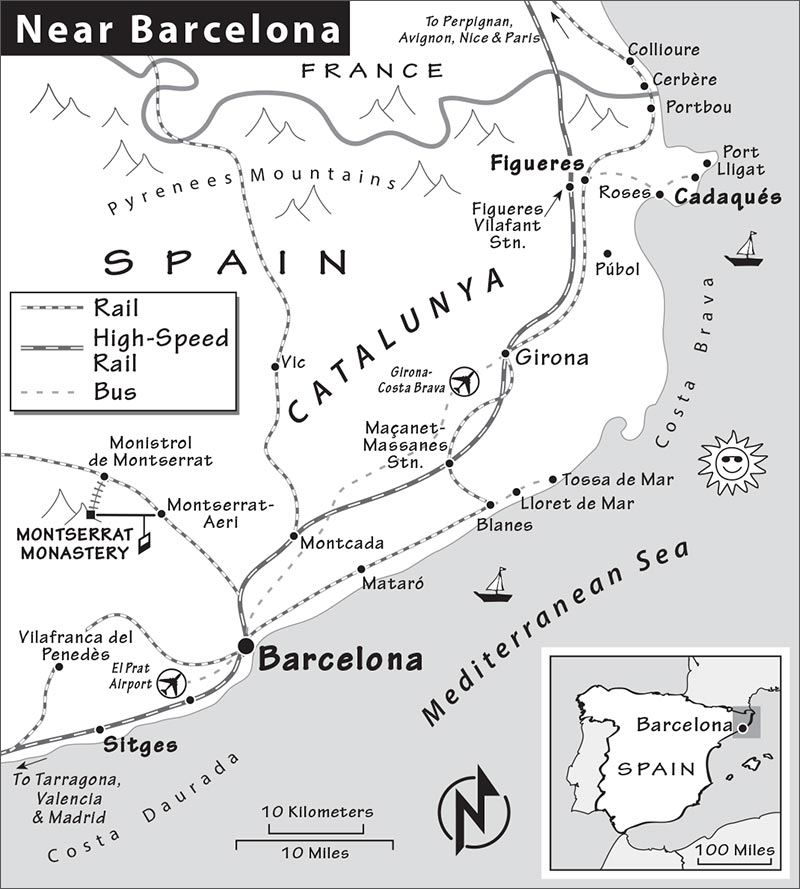
Montserrat • Figueres • Cadaqués • Sitges
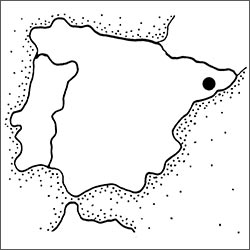
Four fine sights are day-trip temptations from Barcelona. Pilgrims with hiking boots head 1.5 hours into the mountains for the most sacred spot in Catalunya: Montserrat. Fans of Surrealism can enjoy a fantasy in Dalí-land by combining a stop at the Dalí Theater-Museum in Figueres (1-2 hours from Barcelona) with a day or two in the classy, often sleepy port-town getaway of Cadaqués (an hour from Figueres). And beach lovers can head 40 minutes south to the charming and free-spirited beach town of Sitges.
Montserrat
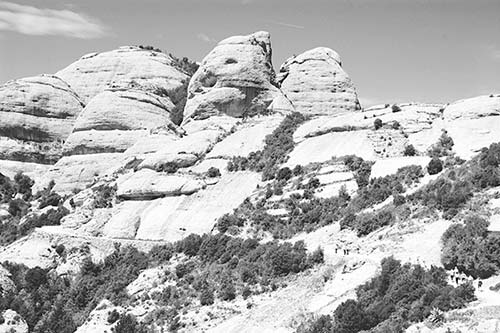
Montserrat—the “serrated mountain”—rockets dramatically up from the valley floor northwest of Barcelona. With its unique rock formations, mountaintop monastery (also called Montserrat), and spiritual connection with the Catalan people, it’s a popular day trip. This has been Catalunya’s most important pilgrimage site for a thousand years. Hymns explain how the mountain was carved by little angels with golden saws. Geologists blame nature at work.
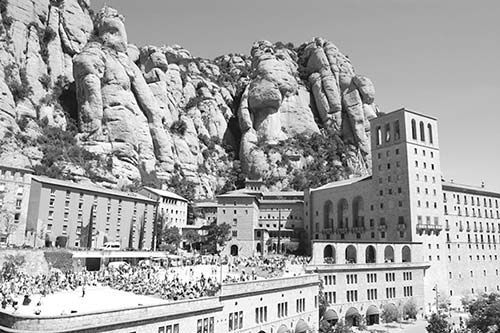
Once upon a time, there was no mountain. A river flowed here, laying down silt that solidified into sedimentary layers of hard rock. Ten million years ago, the continents shifted, and the land around the rock massif sank, exposing this series of peaks that reach upward to 4,000 feet. Over time, erosion pocked the face with caves and cut vertical grooves near the top, creating the famous serrated look.
The monastery is nestled in the jagged peaks at 2,400 feet, but it seems higher because of the way the rocky massif rises out of nowhere. The air is certainly fresher than in Barcelona. In a quick day trip, you can view the mountain from its base, ride a funicular up to the top of the world, tour the basilica and museum, touch a Black Virgin’s orb, hike down to a sacred cave, and listen to Gregorian chants by the world’s oldest boys’ choir.
Montserrat’s monastery is Benedictine, and its 30 monks carry on its spiritual tradition. Since 1025, the slogan “ora et labora” (“prayer and work”) has pretty much summed up life for a monk here.
GETTING TO MONTSERRAT
Barcelona is connected to the valley below Montserrat by a convenient train; from there, a cable car or rack railway transports you up to the mountaintop. They are similar in cost and travel time, but you have to decide which to take when you buy your ticket in Barcelona—see the “Tickets to Montserrat” sidebar. Altogether, it’s about 1.5 hours each way between downtown Barcelona and the monastery.
Other options are driving or taking the bus.
By Train Plus Cable Car or Rack Railway
Trains to Montserrat leave from Barcelona’s Plaça d’Espanya. Take the Metro to Espanya, then follow signs for Montserrat (which show a graphic of a train and the FGC symbol—for Ferrocarrils de la Generalitat de Catalunya) through the tunnels to the FGC station. Once there, check the overhead screens or ask for help (staff are usually at the ticket machines) to find the track for train line R5 (direction: Manresa, 1-2/hour—usually at :36 and/or :56).
Hang on to your train ticket; you’ll need it to exit the FGC station when you return to Plaça d’Espanya. You’ll ride about an hour on the train. For the cable car, get out at the Montserrat-Aeri station; for the rack railway, continue another few minutes to the next station, Monistrol de Montserrat (or simply “Monistrol de M.”).
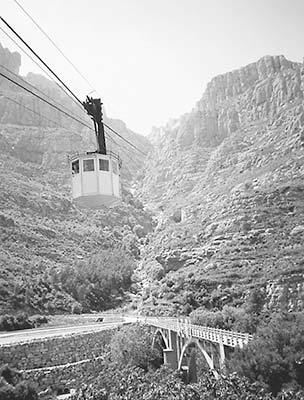
Cable Car or Rack Train? For the sake of scenery and fun, I enjoy the little German-built cable car more than the rack railway. Departures are more frequent (4/hour rather than 1-3/hour on the railway), but because the cable car is small, you may wait a while to get on (up to an hour when crowded). If you dislike heights, take the rack train. If you’d like to try both, buy a one-way ticket to Montserrat including the cable car, and buy the return ticket for the rack railway and train back to Barcelona from the Cremallera station in Montserrat.
Cable Car, from Montserrat-Aeri Station: Departing the train, follow signs to the cable-car station (covered by your train or combo-ticket; 4/hour, 5-minute trip, April-mid-Oct daily 9:30-19:00, shorter hours in winter, www.aeridemontserrat.com). Don’t linger on the platform: Make your way to the cable car quickly, as you may have to wait to go up. On the way back down, cable cars depart from the monastery every 15 minutes; make sure to give yourself enough time to catch a Barcelona-bound train (these leave at :05 and :45 past the hour Mon-Fri, only at :45 Sat-Sun).
Rack Railway (Cremallera), from Monistrol de Montserrat Station: From this station, you can catch the Cremallera rack railway up to the monastery (covered by your train or combo-ticket; 1-3/hour, 20-minute trip, www.cremallerademontserrat.cat). On the return trip, trains depart the monastery at :15 past the hour, allowing you to catch the Barcelona-bound train leaving Monistrol de Montserrat at :45 past the hour. The last convenient connection leaves the monastery at 19:15. Confirm the schedule when you arrive. Note that the rack railway has one intermediate stop (Monistrol-Vila, at a large parking garage), but—either coming or going—you want to stay on until the end of the line. There’s a good info booth at the Cremallera station (daily 8:00-14:00).
By Car
Once drivers get out of Barcelona (Road A-2, then C-55), it’s a short 30-minute drive to the base of the mountain, then a 10-minute series of switchbacks to the actual site (where you can find pay parking). It may be easier to park your car down below and ride the cable car or rack railway up; there’s plenty of free parking at the Monistrol-Vila rack railway station (cable car—€8.60 one-way, €13 round-trip; rack railway—€8.10 one-way, €13.50 round-trip, €17.80 version also includes Museum of Montserrat).
By Bus
One bus per day connects downtown Barcelona directly to the monastery at Montserrat (departs from Carrer de Viriat near Barcelona’s Sants station daily at 9:15; returns from the monastery to Barcelona at 18:00 June-Sept, at 17:00 Oct-May; €5.10 each way, 1.5 hours, operated by Autocares Julià, https://autocaresjulia.com). Since the other options are scenic, fun, and relatively easy, the only reason to take a bus is to avoid transfers.
Orientation to Montserrat
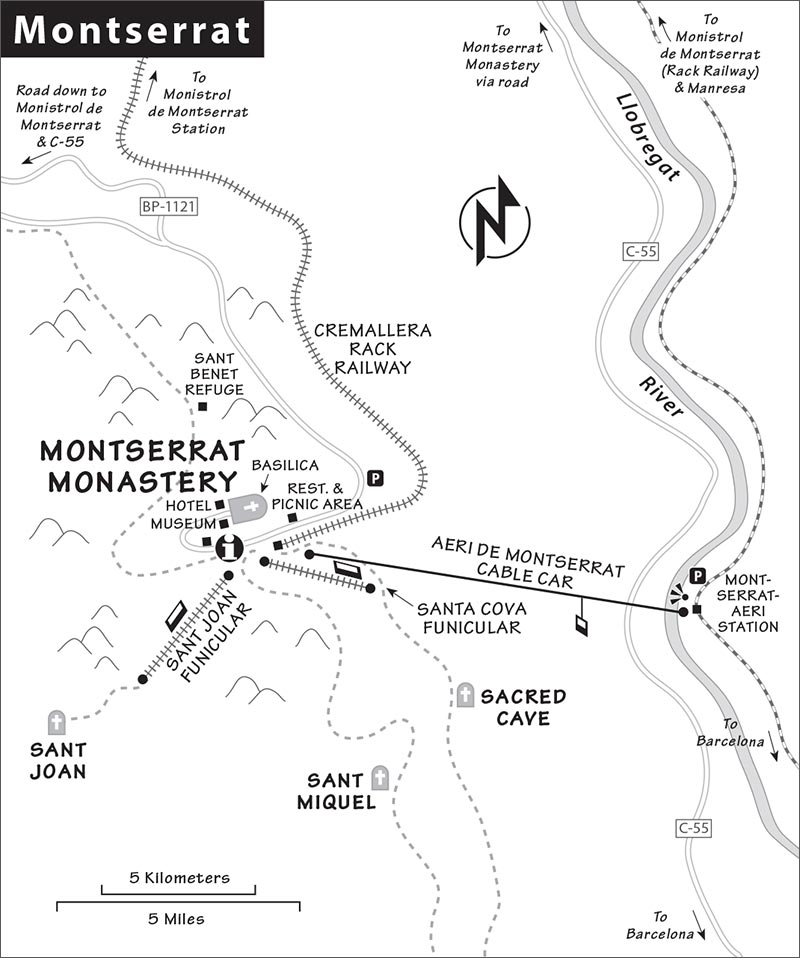
When you arrive at the base of the mountain, look up the rock face to find the cable-car line, the monastery near the top, and the tiny building midway up (marking the Sacred Cave).
However you make your way up to the Montserrat monastery, it’s easy to get oriented once you arrive at the top. Everything is within a few minutes’ walk of your entry point. All the transit options—including the rack railway and cable car—converge at one big station. Above that are the funicular stations: one up to the ridge top, the other down to the Sacred Cave trail. Across the street is the TI, and above that (either straight up the stairs or up the ramp around the left side) is the main square.
Crowd-Beating Tips: Arrive early or late, as tour groups mob the place midday. Crowds are less likely on weekdays and worst on Sundays.
TOURIST INFORMATION
The square below the basilica houses a helpful TI, right across from the rack railway station (daily from 9:00 until just after last train heads down, +34 938 777 701, www.montserratvisita.com). A good audioguide, available only at the TI, describes the general site and basilica (€6.50; €18 includes entrance to museum, bland audiovisual presentation, and book). If you’re a hiker, ask for the handout outlining hiking options here. Trails offer spectacular views (on clear days) to the Mediterranean and even (on clearer days) to the Pyrenees.
Sights in Montserrat
▲▲Basilica
Although there’s been a church here since the 11th century, the present structure was built in the 1850s, and the facade dates from 1968. The decor is Neo-Romanesque, so popular with the Romantic artists of the late 19th century. The basilica itself is ringed with interesting chapels, but the focus is on the Black Virgin (La Moreneta) sitting high above the main altar.
Cost and Hours: Basilica-€6, La Moreneta-add €2, must reserve timed-entry ticket online in advance at https://tickets.montserratvisita.com/en; covered by Trans Montserrat and Tot Montserrat tickets; open daily 8:30-18:15.
Visiting the Basilica: Montserrat’s top attraction is La Moreneta, the small wood statue of the Black Virgin, discovered in the Sacred Cave in the 12th century. Legend says she was carved by St. Luke (the gospel writer and supposed artist), brought to Spain by St. Peter, hidden away in the cave during the Moorish invasions, and miraculously discovered by shepherd children. (Carbon dating says she’s about 800 years old.) “Moreneta” is usually translated as “black” in English, but the Spanish name actually means “tanned.” The statue was originally lighter, but it darkened over the centuries from candle smoke, humidity, and the natural aging of its original varnish.
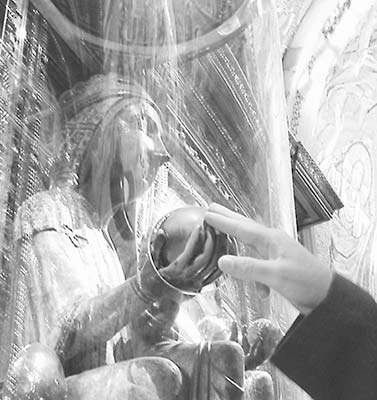
Though Mary is behind a protective glass case, the royal orb she cradles in her hands is exposed. Pilgrims touch Mary’s orb with one hand and hold their other hand up to show that they accept Jesus. Newlyweds in particular seek Mary’s blessing.
Immediately after La Moreneta, to the right, is the delightful Neo-Romanesque chapel where worshippers can sit behind the Virgin and pray. The ceiling, painted in the Modernista style in 1898 by Joan Llimona, shows Jesus and Mary high in heaven. The trail connecting Catalunya with heaven seems to lead through these serrated mountains.
You’ll exit by walking along the Ave Maria Path (along the outside of the church), with thousands of colorful votive candles. Before you leave the inner courtyard and head out into the main square, pop in to the humble little room with the many votive offerings left as part of a prayer request or as thanks for divine intercession.
Museum of Montserrat
This bright, shiny, and cool collection of paintings and artifacts was mostly donated by devout Catalan Catholics. While it’s nothing earth-shaking, you’ll enjoy an air-conditioned wander past lots of antiquities and fine artwork. Head upstairs first to see some lesser-known works by the likes of Picasso, Caravaggio, Monet, Renoir, Pissarro, Degas, and local Modernista artists. Down on the main floor, you’ll see ecclesiastical gear, a good icon collection, and more paintings.
Cost and Hours: €8, covered by Tot Montserrat combo-ticket, daily 10:00-18:15, +34 938 777 745.
▲Sant Joan Funicular and Hikes
This funicular climbs 820 feet above the monastery in five minutes. At the top of the funicular, you are at the starting point of a 20-minute walk that takes you to the Sant Joan Chapel (follow sign for Ermita de St. Joan). Other hikes also begin at the trailhead by the funicular (get details from TI before you ascend; basic map with suggested hikes posted by upper funicular station). For a quick and easy chance to get out into nature and away from the crowds, simply ride up and follow the most popular hike—a 45-minute, mostly downhill loop through mountain scenery back to the monastery. To take this route, go left from the funicular station; the trail, marked Monestir de Montserrat, will first go up to a rocky crest before heading downhill.
Cost and Hours: €9.75 one-way funicular ride, €15 round-trip, €17.85 combo round-trip for both Sant Joan and Santa Cova, covered by Trans Montserrat and Tot Montserrat combo-tickets, goes every 20 minutes, more often with demand.
Sacred Cave (Santa Cova)
The statue known as La Moreneta was originally discovered in the Sacred Cave (or Sacred Grotto), a 40-minute hike down from the monastery (then another 50 minutes back up). The path (c. 1900) was designed by devoted and patriotic Modernista architects, including Gaudí and Josep Puig i Cadafalch. It’s lined with Modernista statues depicting scenes corresponding to the Mysteries of the Rosary—prayers that reflect on the life and death of Jesus. While the original Black Virgin statue is now in the basilica, a replica sits in the cave. A three-minute funicular ride cuts 20 minutes off the hike. (The funicular may be closed for repairs—check locally.) If you’re here late in the afternoon, check the schedule before you head into the Sacred Cave to make sure you don’t miss the final ride back down the mountain.
Cost and Hours: €3.90 one-way funicular ride, €6 round-trip, €17.85 combo round-trip for both Sant Joan and Santa Cova, covered by Trans Montserrat and Tot Montserrat combo-tickets, goes every 20 minutes, more often with demand.
Choir Concert
Montserrat’s Escolania, or Choir School, has been training voices for centuries. Fifty young boys, who live and study in the monastery itself, make up the choir. The boys sing for only 10 minutes, the basilica is jam-packed, and it’s likely you’ll see almost nothing.
Cost and Hours: €8, reservation required, generally Mon-Fri at 13:00, choir on vacation late June-late Aug, check schedule and reserve at https://tickets.montserratvisita.com/en/.
Eating in Montserrat
Montserrat is designed to feed hordes of pilgrims and tourists. You’ll find a cafeteria along the main street (across from the train station) and a grocery store and bar with simple sandwiches where the road curves on its way up to the hotel. In the other direction, follow the covered walkway below the basilica to reach the Mirador dels Apòstols, with a bar, cafeteria, restaurant, and picnic area. The Hotel Abat Cisneros also has a restaurant, and the Montserrat-Aeri train station has a ramshackle but charming family-run bar with outdoor tables, simple food, and views of the mountain and the cable cars. The best option is to pack a picnic from Barcelona, especially if you plan to hike.
Figueres
The town of Figueres (feeg-YEHR-ehs)—conveniently connected by train to Barcelona—is of sightseeing interest mainly for its Dalí Theater-Museum. In fact, the entire town seems Dalí dominated. But don’t be surprised if you also see bargain-hunting French shoppers. Some of the cheapest shops in Spain—called ventas—are here to lure French visitors.
GETTING TO FIGUERES
Figueres is an easy day trip from Barcelona or a handy stopover en route to France. It has two train stations on opposite sides of town: Figueres-Vilafant (served by the high-speed train from Barcelona’s Sants station, about hourly, 1 hour, buy in advance) and Figueres (served by the less-expensive but slower regional train; departs from Barcelona’s Sants station or from the Renfe station at Metro: Passeig de Gràcia; hourly, 2.5-3 hours; slightly more expensive media distancia trains take closer to 2 hours). If you’re on your way to Paris, it’s possible to take the high-speed train from Barcelona in the morning, visit the Dalí Theater-Museum, and catch the late-afternoon TGV train (also called “InOui”) to Paris. Neither train station has baggage storage, but the bus station (across from Figueres station) and the Dalí Theater-Museum do. For bus connections to Cadaqués, see “Getting to Cadaqués,” later.
Orientation to Figueres
You’ll find the town’s museums and sights clustered within a couple of blocks of one another—the Rambla shopping street, church, City Hall, toy museum (Museu del Joguet), and Catalan art museum (Museu de l’Empordà)—as well as the only sight that matters for most visitors, the Dalí Theater-Museum.
Tourist Information: The TI is at Plaça de l’Escorxador 2 (Mon-Sat 9:30-18:00, Sun 10:00-15:00, +34 972 503 155, www.visitfigueres.cat [URL inactive]). An info desk sometimes opens at the Figueres TGV train station.
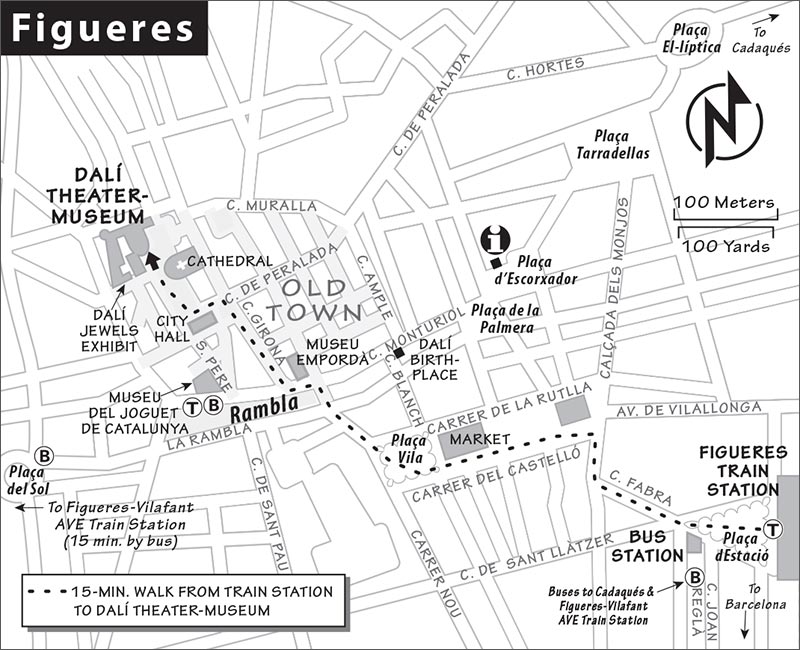
Arrival in Figueres: To reach the Dalí museum from Figueres-Vilafant station, take the Teisa bus in front. Don’t delay—buses depart only with the arrival of each train (€1.85, buy ticket from driver, cash only). Get off at the Plaça del Sol stop—ask the driver for a map with a timetable to plan out your return. From there, it’s a five-minute walk uphill to the museum. Taxis charge about €12 to and from the station. If you miss the bus, plan to take a taxi or make the 20-minute walk.
To get to the museum from Figueres station, simply follow Museu Dalí signs (and the crowds) for the 15-minute walk to the museum. See the map in this section for a suggested route.
Sights in Figueres
DALÍ THEATER-MUSEUM
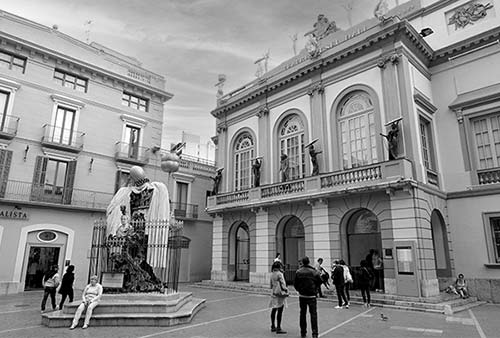
This ▲▲▲ museum is the essential Dalí sight—and, if you like his work, one of Europe’s most enjoyable museums, period. Inaugurated in 1974, the Dalí Theater-Museum (Teatre-Musei Dalí) is a work of art in itself. Ever the entertainer and promoter, Dalí personally conceptualized, designed, decorated, and painted it to showcase his life’s work. The museum fills a former theater and contains the artist’s mausoleum (his tomb is in the crypt below center stage). It’s also a kind of mausoleum to Dalí’s creative spirit.
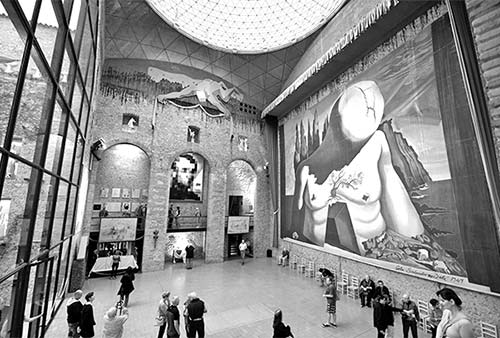
Dalí worked here over many years and personally designed the core of the museum (Rooms 1-18). Even the building’s exterior—painted pink, studded with golden loaves of bread, and topped with monumental eggs and a geodesic dome—exudes the artist’s outrageous public persona. The Dalí Theater-Museum is called the largest Surrealist object in the world.
Cost: €17 (€3 more July-Aug); purchase a timed-entry ticket online in advance. Your ticket includes free entry to the nearby Museu de l’Empordà (Catalan paintings) and discounted entry to the Museu del Joguet de Catalunya (toys).
Born in Figueres to a well-off family, Dalí showed talent early. After a breakthrough art exhibit in Barcelona in 1925, Dalí moved to Paris. He hobnobbed with fellow Spaniards Pablo Picasso and Joan Miró, along with a group of artists exploring Sigmund Freud’s theory that we all have a hidden part of our mind, the unconscious “id,” which surfaces when we dream. Dalí became the best-known spokesman for this group of Surrealists, channeling his id to create photorealistic dream images (melting watches, burning giraffes) set in bizarre dreamscapes.
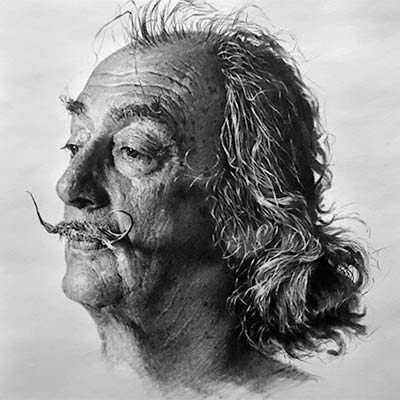
His life changed forever in 1929, when he met an older, married Russian woman named Gala who would become his wife, muse, model, manager, and emotional compass. Dalí’s popularity spread to the US, where he (and Gala) weathered the WWII years.
In the prime of his career, Dalí’s work became less Surrealist and more classical, influenced by past masters of painted realism (Velázquez, Raphael, Ingres, Vermeer) and by his own study of history, science, and religion. He produced large-scale paintings of historical events (e.g., Columbus arriving in America, the Last Supper) that were collages of realistic scenes floating in a surrealistic landscape, peppered with thought-provoking symbols.
Dalí—an extremely capable technician—mastered many media, including film. He designed Alfred Hitchcock’s big-eye backdrop for the dream sequence of Spellbound (1945). He made jewels for the rich and clothes for Coco Chanel, wrote a novel and an autobiography, and pioneered what would come to be called “installations.” When Gala died in 1982, Dalí retreated to his hometown, living his last days in the Torre Galatea of the Theater-Museum complex.
Hours: July-Aug daily 9:00-20:00; Sept-June Tue-Sun 10:30-18:00, occasionally open Mon—call or confirm online; last entry 45 minutes before closing, +34 972 677 500, www.salvador-dali.org.
Reservations Recommended: It’s important to reserve ahead online for this museum, which can be a mob scene, especially when bad weather drives beach crowds here (they let in no more than 200 people each half-hour). You can make a reservation online as little as two hours in advance—or check the board in front of the ticket window for last-minute availability (you’ll pay €1 more) if you arrive sans reservation.
Bag Check: The free bag check will have your belongings waiting for you at the exit. It’s OK to leave checked backpacks and small suitcases here while you browse the town.
Sightseeing Tip: Much of Dalí’s art is movable and coin-operated—bring a few €0.20 and €1 coins and keep an eye out for the machines where you insert them.
 Self-Guided Tour
The museum has two parts—the theater-mausoleum and the “Dalí’s Jewels” exhibit in an adjacent building. There’s no logical order for a visit (that would be un-Surrealistic). Naturally, there’s no audioguide (but there is a good museum book for sale and a free map available at the entrance).
Courtyard (Ground Floor): Step into the courtyard (with its audience of golden statues) and face the stage (visible through the window wall). You know how you can never get a cab when it’s raining? Pop a coin into Dalí’s personal 1941 Cadillac and it rains inside the car. Look above, atop the tire tower: That’s the boat Dalí enjoyed with his soulmate, Gala—his emotional life preserver, who kept him from going overboard. When she died, so did he (for his last seven years). Blue tears made of condoms drip below the boat.
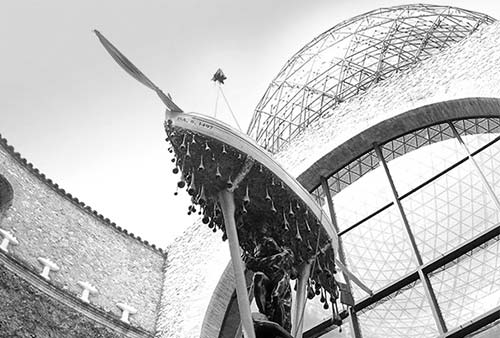
Stage/Cupola (Ground Floor): Now cross through the courtyard and go up to the stage. On the left wall, squint at the big digital Abraham Lincoln, and president #16 comes into focus. Approach the painting to find that Abe’s facial cheeks are Gala’s butt cheeks—or use the coin-operated telescope (at the far end) or your phone’s camera to focus on his face.
Treasures Room (Ground Floor): Under Lincoln, a door leads to the Treasures Room (Room 4), with the best collection of original Dalí oil paintings in the museum. (Many of the artworks displayed elsewhere in the building are prints.) You’ll see Cubist visions of Cadaqués and dreamy portraits of Gala. One portrays her half-nude, as if her arms are a woven basket supporting her exposed breast like a crust of bread. Dalí said, “She has become my basket of bread.” In the tiny-but-powerful Specter of Sex Appeal, crutches—a recurring Dalí theme—also represent Gala, who kept him supported whenever a meltdown threatened.
Downstairs Crypt (Lower Level): Make your way downstairs, below the stage, and pay respect at the artist’s crypt, within dimly lit rooms filled with golden sculptures. True to the irreverent spirit of Dalí, the public toilets are right next to his tomb.
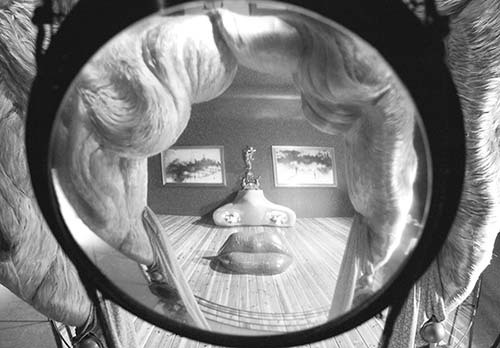
Mae West Room (First Floor): Back upstairs and to the right (as you face the stage), head into the famous Mae West Room (Room 11), a tribute to the sultry seductress. Dalí loved her attitude. Saying things like, “Why marry and make one man unhappy, when you can stay single and make so many so happy?” Mae West was to conventional morality what Dalí was to conventional art. Climb the stairs to the vantage point where the sofa lips, fireplace nostrils, painting eyes, and drapery hair come together to make the face of Mae West.
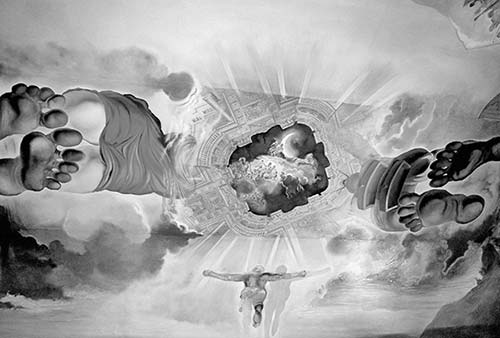
Smoking Lounge (First Floor): Circle around to Room 15, with purple walls, labeled “Palace of the Wind” (just above the entrance). Formerly the theater’s smoking lounge, it displays portraits of Gala and Dalí bookending a Roman candle of creativity. The fascinating ceiling painting shows the feet of Gala and Dalí as they bridge the earth and the heavens. Dalí’s drawers are wide open and empty, indicating that he gave everything to his art. It was in this hall that the young Dalí first exhibited his art to the public.
Final Section (First Floor): Circle clockwise around the theater and take a good look at the stage once more, then go through the Bramante’s Temple Room, followed by several more exhibits in Rooms 19 to 22. You’ll be routed back downstairs and through the gift shop.
Nearby: As you leave the theater through the turnstile gate, hook right around the corner to pop into the adjacent, not-to-be-missed Dalí’s Jewels exhibit (Dalí-Joies, covered by your theater ticket). It shows sketches and paintings of jewelry Dalí designed, and the actual pieces jewelers made from those surreal visions.
Cadaqués
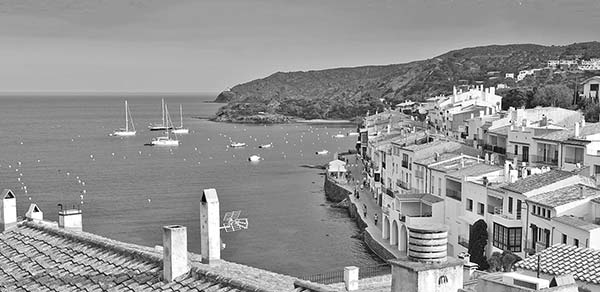
Since the late 1800s, Cadaqués (kah-dah-KEHS) has served as a haven for intellectuals and artists alike. The fishing village’s craggy coastline, sun-drenched colors, and laid-back lifestyle inspired Fauvists such as Henri Matisse and Surrealists such as René Magritte, Marcel Duchamp, and Federico García Lorca. Even Picasso, drawn to this enchanting coastal haunt, painted some of his Cubist works here.
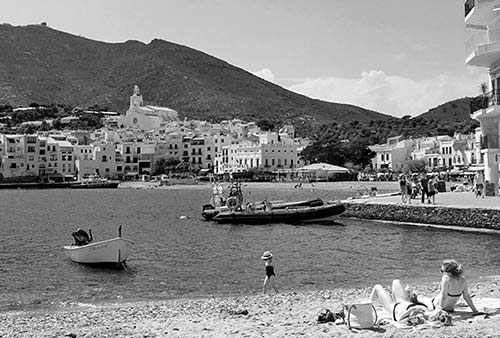
The Salvador Dalí House at Port Lligat, a 20-minute walk from the Cadaqués town center, is the main sightseeing attraction (reservations required). Dalí, raised in nearby Figueres, brought international fame to this sleepy Catalan port. As a kid, Dalí spent summers here in the family cabin, where he was inspired by the rocky landscape that would later be the backdrop for many Surrealist canvases. In 1929, he met his future wife, Gala, in Cadaqués. Together they converted a fisherman’s home in nearby Port Lligat into their semipermanent residence, dividing their time between New York, Paris, and Cadaqués. It was here that Dalí did his best work.
In spite of its fame, Cadaqués is mellow and feels off the beaten path. At the easternmost tip of Spain, it’s remote, with no train service and only a tiny access road that dead-ends, making it less developed than it might otherwise be. If you want a peaceful beach-town escape near Barcelona, this is it.
GETTING TO CADAQUÉS
Reaching Cadaqués is very tough without a car. There are no trains and only a few buses a day. A taxi from Figueres is another option.
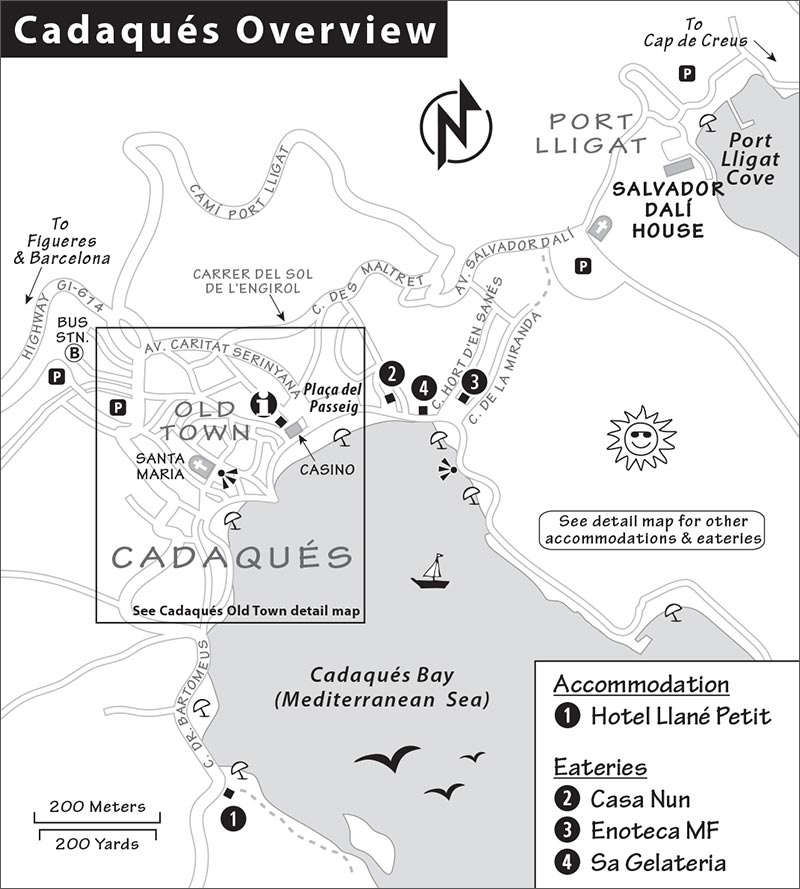
By Car: Cadaqués is about an hour’s drive from Figueres. To visit the town center, park in the big lot just above the city—don’t try to park near the harborfront. The handiest free parking is on Riera de Sant Vicenç, the long, generally dry riverbed that flows through the center of town (but steer clear on Monday, when the town market happens here).
To drive to the Salvador Dalí House, carefully track Port Lligat signs at the big, elongated roundabout as you enter Cadaqués (as you approach from Figueres, you’ll loop all the way around the roundabout and exit at its top corner—near where you entered). A big parking lot is just past the Salvador Dalí House, an easy five-minute walk along a gravel beach.
By Bus: Moventis Sarfa buses serve Cadaqués from Figueres (4/day weekdays, 2/day weekends, 1 hour) and from Barcelona (1-2/day, 3 hours). You can buy tickets in Barcelona at the TI on Plaça de Catalunya. Bus info: +34 972 258 713 (Cadaqués), https://compras.moventis.es. On busy summer days, it’s wise to buy your ticket in advance.
By Taxi: A one-way taxi from Figueres costs about €75. It’s just a little more for a round-trip—including the drive to Port Lligat and a couple of hours’ wait. You can arrange a ride over the phone in advance (+34 972 505 043; good Spanish skills help—or ask your hotelier), or in person at the taxi stand on the Rambla in Figueres (from the Dalí Theater-Museum, walk down Carrer Sant Pere to the Rambla). Driver Josep María has an official taxi-and-van service and offers the same rates (book in advance, +34 696 906 476).
Orientation to Cadaqués
TOURIST INFORMATION
The TI is near the waterfront at Carrer Cotxe 2 (July-mid-Sept Mon-Sat 9:00-21:00, shorter hours Sun and off-season plus closed for lunch, +34 972 258 315, www.visitcadaques.org).
HELPFUL HINTS
Electric Golf Carts and Bikes: EcoCar has a handful of electric golf carts and drivers that can take you around, including to the Dalí House in Port Lligat (€4/person) and to the spectacular clifftop views at Cap de Creus (€8/person). They also rent carts and electric bikes by the hour, half-day, or day (cash only, arrange in advance, Avinguda Caritat Serinyana 10, +34 618 883 656, www.ecocarcadaques.com, Diego speaks English).
Local Guide: Simply a delight to be with, Mercè Donat organizes tours in and around Cadaqués (€90/two-hour town walk, other options available, +34 686 492 369, www.rutescadaques.com).
Tourist Train: The tourist train goes around town and to Port Lligat and back, with recorded narration and a few photo stops—including the Dalí House (€11, usually departs at 11:00 and on the hour 15:00-18:00, 1 hour). It also does a loop to the lighthouse at Cap de Creus, where you can enjoy the views for about 20 minutes before returning to Cadaqués (€17, departs at 12:00, 2 hours; for either tour, purchase tickets at the booth in the square just below the casino, +34 653 829 442, www.estrenetdecadaques.cat).
Taxis: There are only two taxis in Cadaqués. Schedule in advance if you need a ride. Pepe speaks just enough English (+34 606 067 015).
Cadaqués Walk
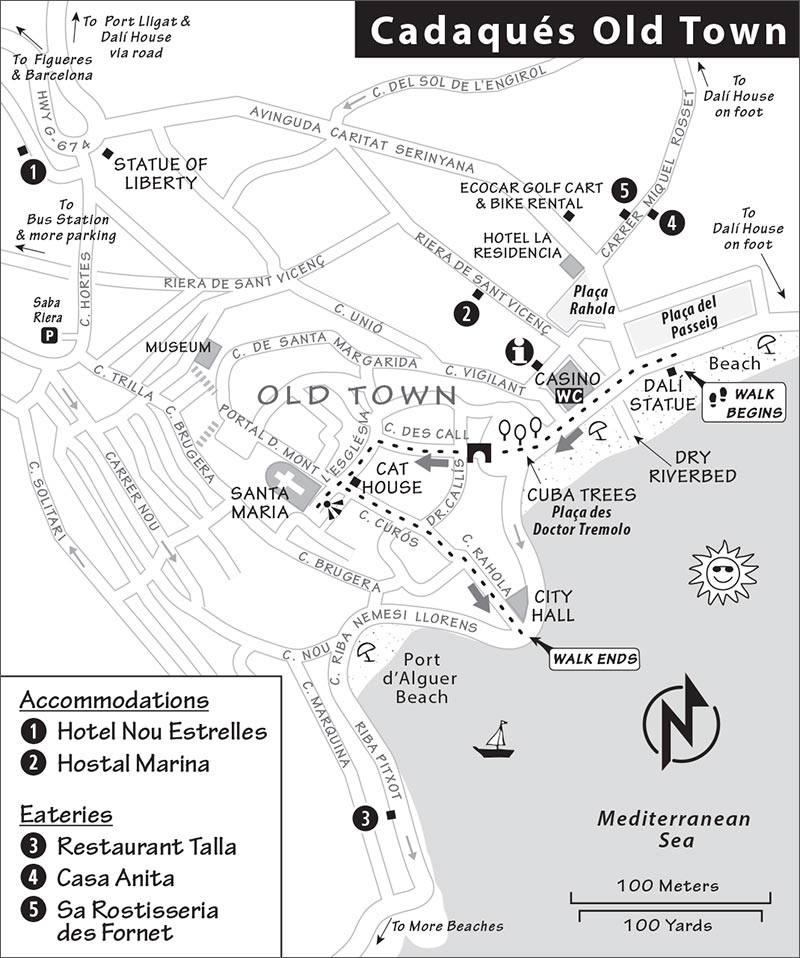
Cadaqués has no really important “sights” other than the Dalí House. But the old town is remarkably interesting and easy to miss. Here’s a quick eight-point walk. Having strolled this, you can better relax along the harbor knowing you’ve “done” Cadaqués.
Dalí Statue on Beach: Start near the statue of Salvador Dalí. The artist called Cadaqués home (he lived a 20-minute walk away in the 1920s and 1930s). He did his best work here and put this small town on the map. From the Dalí statue, walk down to the water’s edge and survey the harbor. Looking inland, you can see the Hotel La Residencia. This was the only hotel in town when Dalí arrived, and it remains a kind of time warp.
• Notice the street that runs below grade, beneath a short bridge that’s nearly at the water’s edge.
Riverbed Street: This street, just in front of the casino building, is actually a paved (and usually dry) riverbed. A couple of times each year, after big rains, this big drain becomes a raging river, saving the city from flash floods—which washed out several earlier bridges. Old-timers remember previous bridges on this spot, which separates the old town from the new. Traditionally, the bridge was where people hung out on benches, but the new bridge is too narrow to host loungers. Now people make do with the wide windowsills of the casino.
• Walk over to the casino entrance.
Casino: This place feels like the timeless clubhouse of the town, where the old boys gather to play cards and pool. Wander inside. There’s a public WC next to the pool table. Enjoy the old photos on the walls.
• Just past the casino is a small park with three...
Cuba Trees: These stubby “elephant trees” were imported by locals who left Cuba when it won its independence from Spain in 1897. These trees are a reminder that lots of Catalans moved to Cuba in the 19th century and came back home when Spanish rule ended. Just uphill from the top tree are bits of the beloved (and well-used) old bridge benches. From here, try to imagine when Cadaqués was a small walled town filling the bluff above you.
• Climb uphill to the right, through the archway above, into the...
Old Town and Jewish Quarter: Stepping through the main gate, you enter a different world. Climb up Carrer des Call, the old Jewish street. There was a strong Jewish community in Spain from the first century until 1492. That’s when Christian fanaticism (gone wild with the final Reconquista victory) led to the expulsion of Jews and Muslims from Catholic Spain. Notice the characteristic slate pavers underfoot.
• Keep climbing until the T-intersection. There, at the top, turn left to the church.
Church of Santa Maria: Enjoy the commanding view from in front of the church. This spot marks the high point of the old town. If the church is open, step inside to enjoy its amazing Baroque altar from the 1700s (generally open daily 10:00-13:00 & 16:00-20:00). Pop a euro into the light box to appreciate this treasure (and support the church). Carved from pine wood with 365 figures, it’s covered with gold from the Americas. Peter (with the keys) and Paul (with his trusty sword) are actually part of the doors that lead into the sacristy. Fishermen paid for this altar—as you’re reminded by the two guys in red and green, dressed as fishermen would have been in the mid-1700s. Treasures like this throughout Spain survived until the rampant destruction of churches during the civil war in the 1930s. This altar exists today because industrious locals built a protective wall in front of it all the way to the ceiling.
• From the church, walk steeply down Carrer Curós. But first, on the left, notice the Cat House, a one-woman mission to care for the town’s homeless cats. (She lives here with 20 cats and one dog.)
Carrer Curós, or Gallery Street: This characteristic lane is lined with art galleries. Near the lower end, local painters show off by painting the covers on electrical panels.
• The street bottoms out at City Hall (on the left) and a small terrace overlooking the harbor.
City Hall: You’re at the Casa de la Vila, or City Hall. The top of the old city wall here now serves as a balustrade for a view terrace, and it’s a delightful spot to look out for pirates. The last Barbary pirate raid (from North Africa) was in 1828. You should be safe.
Sights near Cadaqués
▲▲▲SALVADOR DALÍ HOUSE AND GARDEN
Once Dalí’s home, this house (Casa Salvador Dalí) in Port Lligat gives fans a chance to explore a labyrinthine compound. This is the best artist’s house I’ve toured in Europe. It shows how a home can really reflect the creative spirit of an artistic genius and his muse. The ambience, both inside and out, is perfect for a Surrealist hanging out with his creative playmate.
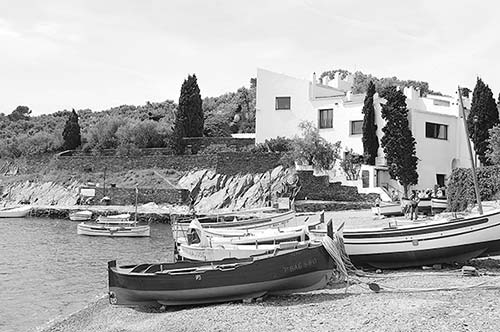
Cost and Hours: House-€15, garden only-€8 (€3 more July-Aug); mid-June-mid-Sept daily 9:30-20:30; rest of year Tue-Sun 10:30-18:00, often closed Mon—see website. Last tour departs 50 minutes before closing. No bags are allowed in the house; the baggage check is free.
Reservations Required: You must have reservations to visit the house (+34 972 251 015, www.salvador-dali.org). In summer, book at least a few weeks ahead. You must arrive 30 minutes early to pick up your ticket, or they’ll resell it. Really! For a full visit, see the home (with a timed entry and escorted tour) followed by the garden.
No Reservation? Those without a ticket to the home can easily get a garden ticket and see all the exteriors (including the pool).
Getting There: Parking is free nearby. There is no public bus service, but from Cadaqués, you can arrange a ride to and from in an EcoCar (see “Helpful Hints,” earlier). If arriving by taxi, ask to be dropped off in Port Lligat. On foot, the house is a 20-minute, one-mile walk over the hill from Cadaqués to Port Lligat. (The path, which cuts across the isthmus, is straight up and over. It’s much shorter than the road.) Follow signs to Casa S. Dalí.
Visiting the House
Only eight people are allowed inside every 10 minutes. A guide will escort you through the house and give you a brief explanation before turning you loose for a few minutes. The entire visit takes 50 minutes. Before or after your tour, enjoy the video that plays in the waiting lounge—with walls covered in Dalí media coverage—just across the lane from the house.
The house’s interior is left almost precisely as it was in 1982, when Gala died and Dalí moved out—never to return. (He died in 1989.) You’ll see Dalí’s studio (the clever easel cranks up and down to allow the artist to paint while seated, as he did eight hours a day), the bohemian yet divine living room (complete with a mirror to reflect the sunrise onto their bed each morning), and the painter’s study. Like Dalí’s art, his home is offbeat, provocative, and fun.
Visiting the Garden
While you’ll get a guided tour of Dalí’s home, you’re on your own in his playful garden—which is where your house tour ends. It’s a one-way circle (following numbered signs, 14-20). Here’s what to look for:
Dalí’s patio is where you can enjoy a little playful Dalí hide-and-seek, with crickets in cages, a horseshoe-shaped slate dining table, and cool corridors leading to the olive garden out back. Enter the “egg terrace” to the right (#15, the egg symbolizes fertility), protected from the steady wind. Above, in a niche, is a sink—a reminder of Dalí’s belief (or joke) that to gain salvation you must be clean. He was ambiguous about his religion. From a platform, you’ll view Christ of the Rubbish, a huge statue (#17) that sprawls on the ground, created from collected junk.
In the olive grove (#18), relax on Dalí’s six-legged chairs (“they never fall”). And then enjoy a commanding view of the bay, including an island where hippies slept back in the 1960s. At the top of the garden is a theater with video documentaries (rarely with English subtitles).
Descend through Dalí’s “historic garden,” noting that he preserved this oasis to honor the hard labor and time it took to create. At a little patio you reach a broken eggshell sculpture (symbolizing how Dalí and Gala were “hatched”)—climb in for some photo fun.
Now it’s party time, and you’re poolside. Dalí’s penis-shaped pool (#20) is surrounded by stylish kitsch (Mae West lips sofa, fountain with cheap Spanish sherry bottles)—decor as eclectic as his circle of friends. Imagine the parties.
Your exit was Dalí’s entry. Dalí had a national phone booth placed here for the convenience (and expense) of friends who needed to make a call. Notice the white sculpture of a warrior with a small child (see the two little feet) emerging from it. The message: Leave your warrior outside and let your inner child enter.
NEAR CADAQUÉS
Cap de Creus
The top excursion for nature lovers is the easternmost point of mainland Spain—Cap de Creus. The cape, marked by a lighthouse, is a popular nine-mile round-trip hike (get details at the Cadaqués TI). There are swimming coves along the way and a restaurant at the lighthouse. The easy way to get there is via EcoCar or tourist train (see “Helpful Hints,” earlier).
Sleeping in Cadaqués
$$ Hotel Llané Petit, with 32 spacious rooms (half with view balconies), is a small resort-like hotel with its own little beach, a 10-minute walk south of the town center (some view rooms, air-con, elevator, free breakfast, pay parking, Carrer del Doctor Bartomeus 37, +34 972 251 020, www.llanepetit.com, info@llanepetit.com).
$ Hotel Nou Estrelles is a big, concrete exercise in efficient, economic comfort. Facing the bus stop a few blocks in from the waterfront, this family-run hotel offers 15 rooms at a great value (air-con, elevator, Carrer Sa Tarongeta 3, +34 972 259 100, www.hotelnouestrelles.com, info@hotelnouestrelles.com, Emma).
$ Hostal Marina is run by a local family with care and enthusiasm and has 30 fresh rooms at a great location a block from the harborfront main square (RS%—use code “Rick Steves,” some rooms with balcony, family rooms, no elevator, Riera de Sant Vicenç 3, +34 972 159 091, www.hostalmarinacadaques.com, info@hostalmarinacadaques.com, Pau and Isabel).
Eating in Cadaqués
$$$$ Restaurant Talla serves modern Mediterranean top-end cuisine. It has a rustic yet elegant interior and some fine harborside tables outside. Call ahead to reserve a seating (daily except winter, Riba Pitxot 18, +34 972 258 739).
$$$ Casa Nun, serving wonderful traditional Catalan dishes and the freshest seafood, has been run by Paco since 1979 (fun photos in the back). Its cozy interior is whitewashed and tiled, and the little front porch gives a few tables great harbor views. Portions are big—don’t hesitate to split first courses family-style (closed Mon-Tue, Plaça Portixó 6, +34 676 312 300).
$$ Casa Anita is good for an entertaining meal. You’ll sit with others around a big table and enjoy fresh local fish and homemade helado (ice cream). There’s no menu—you’ll just eat what they serve you (closed Mon, Carrer Miquel Rosset 16, +34 972 258 471, Joan and family).
$$$ Enoteca MF is popular for their creative tapas and raciones, prepared with local ingredients that they mostly produce or catch themselves (Riba des Poal, +34 972 258 954).
$ Sa Rostisseria des Fornet is a very simple deli designed mostly for takeout but with a couple of humble tables. There’s no atmosphere, but it’s cheap (you pay by weight), fast, and tasty (Carrer Miquel Rosset 3, +34 972 258 501).
For Dessert: The venerable ice cream shop Sa Gelateria faces the harbor (east of the center). Along with gelato, they serve homemade popsicles.
Sitges
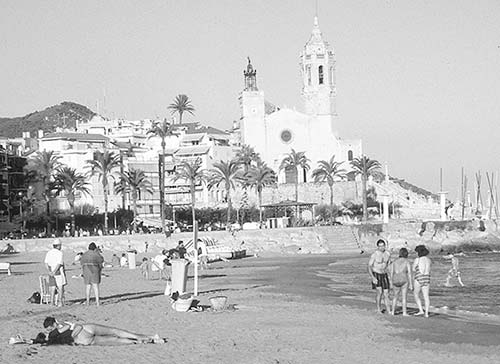
Sitges (SEE-juhz) is one of Catalunya’s most popular resort towns. Because the town beautifully mingles sea and light, it’s long been an artists’ colony. Here you can still feel the soul of the Modernistas...in the architecture, the museums, the salty sea breeze, and the relaxed rhythm of life. Today’s Sitges is a world-renowned vacation destination among the gay community. Despite its jet-set status, the Old Town has managed to retain its charm. With a much slower pulse than Barcelona, Sitges is an enjoyable break from the big city.
If you visit during one of Sitges’ two big festivals (St. Bartholomew on Aug 24 and St. Tecla on Sept 23), you may see teams of castellers competing to build human pyramids.
To reach Sitges, you can take the train or bus. Southbound trains depart Barcelona from the Sants and Passeig de Gràcia stations (take the frequent Rodalies train on the dark-green line R2sud toward Sant Vicenç de Calders, 35 minutes). The TI is to the left after you exit the train station. They can provide information about beaches and the town in general (Plaça Eduard Maristany 2, +34 938 944 251, www.sitgesanytime.com). Bus Garraf runs an easy and frequent bus from downtown Barcelona (with stops near the university and Plaça d’Espanya) that stops at Barcelona’s airport en route to Sitges (1 hour, www.busgarraf.cat).
Visiting Sitges: Sitges basically has two attractions—its tight-and-tiny Old Town (with a couple of good museums) and its long, luxurious beaches.
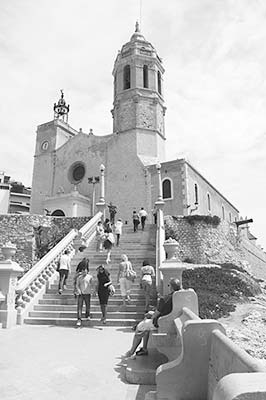
Take time to explore the Old Town’s narrow streets. They’re crammed with cafés, boutiques (many closed midday), and all the resort staples. The focal point, on the waterfront, is the 17th-century Baroque-style Sant Bartomeu i Santa Tecla Church (not open to the public). The terrace in front of the church will help you get the lay of the land. Poke into the Old Town or take the grand staircase down to the beach promenade.
The town’s two appealing museums share one entrance and fee and are located just behind the church (closed Mon, www.museusdesitges.cat). The Museu Maricel, which began as an eclectic display of art from a local collector, proudly shows works from the 10th century through the first half of the 20th, including pieces by Sitges artists. The Museu del Cau Ferrat bills itself as a “temple of Modernism,” as collected by local artist and intellectual Santiago Rusiñol.
Nine beaches, separated by breakwaters, extend about a mile southward from town. Stroll down the seaside promenade, which stretches from the town to the end of the beaches (beach chairs available to rent). The crowds thin out about halfway down, and the last three beaches are more intimate and cove-like. Along the way, restaurants and chiringuitos (beach bars) serve tapas, paella, and drinks.