TOLEDO
PLAZA DE ZOCODOVER TO THE CATHEDRAL AND SANTO TOMÉ
DEEP IN TOLEDO, NEAR THE CATHEDRAL
Map: Toledo Hotels & Restaurants
OUTSIDE TOWN WITH GRAND TOLEDO VIEW
About an hour south of Madrid, Toledo teems with tourists, souvenirs, and great art by day, and delicious dinners, echoes of El Greco, and medieval magic by night. Incredibly well preserved and full of cultural wonder, the entire city has been declared a national monument. To keep the city’s historic appearance intact, the Spanish government has forbidden any modern exteriors.
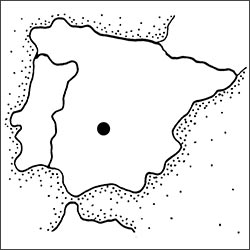
Toledo was once Spain’s capital and packs 2,500 years of tangled history—Roman, Jewish, Visigothic, Moorish, and Christian—onto a rocky perch protected on three sides by the Tajo River. This rich mix of heritages makes Toledo one of Europe’s cultural highlights and a great way to sample Spain’s cultural layers all in one place.
Today, Toledo thrives as a provincial capital and tourist destination—it’s a slick 30-minute train ride from Madrid. And whether you arrive by car, train, or bus, getting into town is easy. You’ll find an old city center that’s largely traffic-free.
Despite its tourist vibe, this stony wonderland remains the historic, artistic, and spiritual center of Spain. Toledo sits enthroned on its history, much as it was when Europe’s most powerful monarch, the Holy Roman Emperor Charles V (King Charles I in Spain), and its most famous resident artist, El Greco, called it home. Be sure to get off the main walkways and explore some of the back streets. In just a few steps, you’ll find a corner of Toledo all your own.
PLANNING YOUR TIME
To see Toledo’s top sights—including its museums (great El Greco) and cathedral (best in Spain)—and to experience its medieval atmosphere (wonderful after dark), you’ll need at least a night and a day. A second day offers a more relaxing visit and lets you see more than the highlights. Keep in mind that early and late trains tend to sell out to commuters and other day-trippers. After dark, Toledo is the rare Spanish city that feels downright sleepy.
Here’s a good one-day plan: Upon arrival, head to the main square, Plaza de Zocodover, and get oriented by following my self-guided walk. Then visit the cathedral interior and the finest El Greco, inside Santo Tomé church. With any remaining time, consider the Santa Cruz Museum (for art lovers), the El Greco Museum (the artist’s life and times), two remarkably well-preserved historic Mudejar synagogues (Tránsito and Santa María Blanca), the Army Museum (for history aficionados), or the royal burial church at San Juan de los Reyes. Thorough visits to all of these would take two days, but selective sightseers can mix and match to fill one memorable day. In the evening—or before returning to Madrid—wander the back lanes, sample sweet mazapán, people-watch at Plaza de Zocodover, and dine well—carcamusas (pork stew), anyone?
Orientation to Toledo
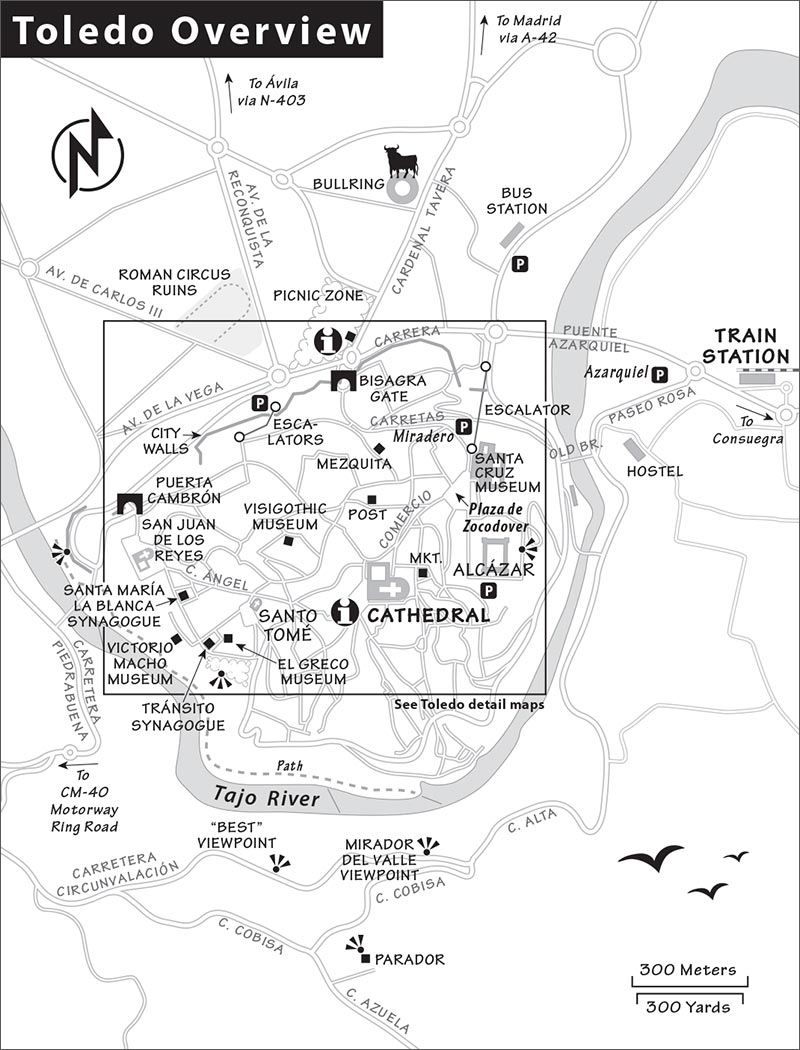
Toledo sits atop a circular hill, with the cathedral roughly in the center. Lassoed into a tight tangle of streets by the sharp bend of the Tajo River, Toledo has Spain’s most confusing medieval street plan. But it’s a small town within its walls, with only 10,000 inhabitants (84,000 live in greater Toledo, including its modern suburbs). Toledo’s economy is based on the administration of the Castille-La Mancha region, and even more on tourism. Each morning the trains from Madrid bring an invasion of day-trippers who march into the city en masse and then, at the end of the sightseeing day, march back out. The major sights are well signed, and locals will politely point you in the right direction.
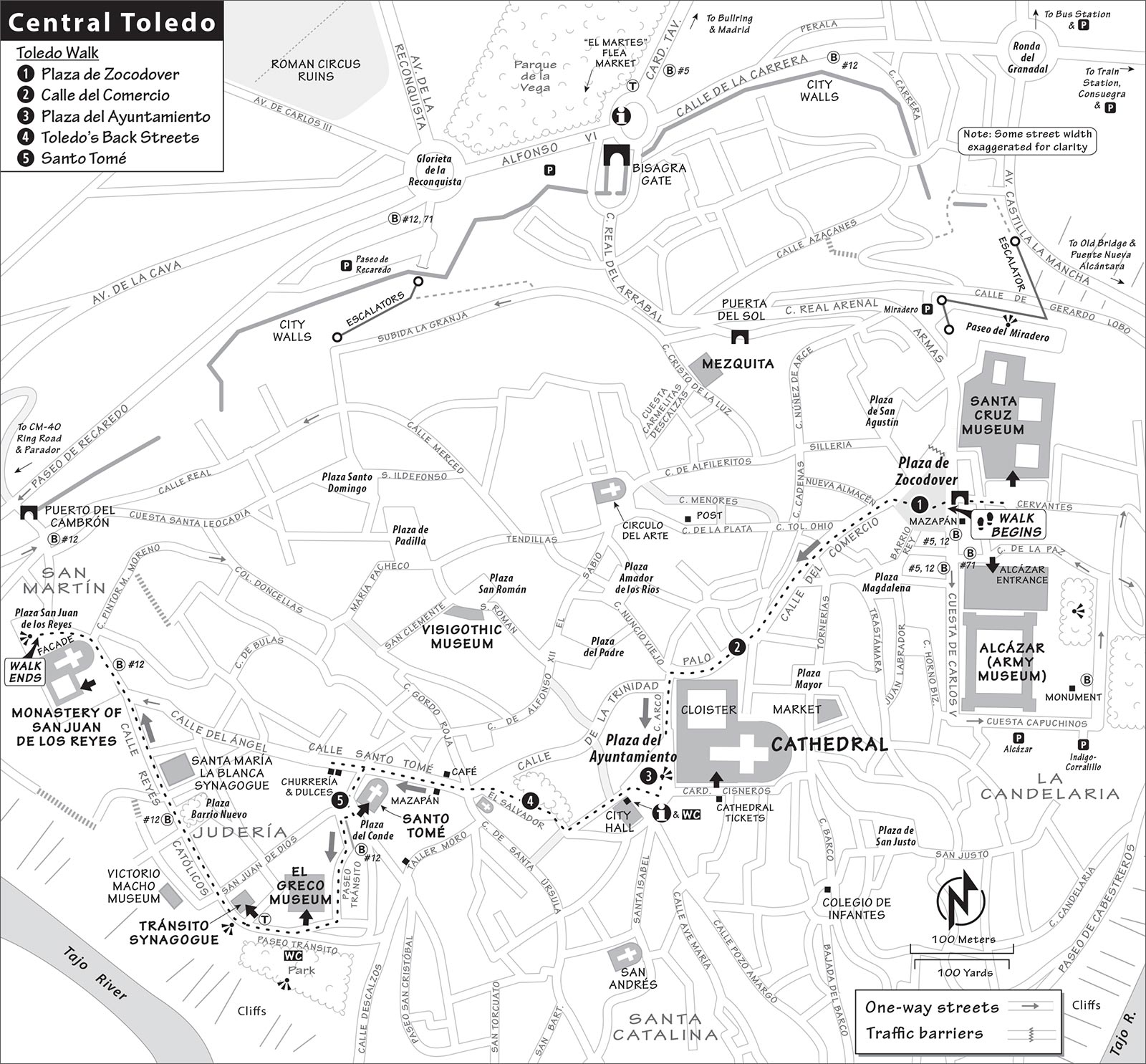
The top sights stretch from the main square, Plaza de Zocodover (thoh-koh-doh-VEHR), southwest along Calle del Comercio (nicknamed Calle Ancha, “Wide Street”) to the cathedral, and beyond that to Santo Tomé and more. Most tourists never stray from this axis. Make it a point to get lost. The town is compact. When it’s time to return to someplace familiar, pull out your map or ask, “¿Para Plaza de Zocodover?” From the far end of town, handy bus #12 circles back to Plaza de Zocodover.
Although the city is very hilly (in Toledo, they say everything’s uphill—it certainly feels that way), nothing is more than a short hike away.
TOURIST INFORMATION
Toledo’s TIs share a website at Toledo-turismo.com. Look for TIs in a freestanding building in the park just across from Bisagra Gate (Mon-Sat 10:00-18:00, Sun until 14:00, +34 925 211 005) and inside City Hall on Plaza del Ayuntamiento, facing the cathedral (daily 10:00-15:30, +34 925 254 030).
Sightseeing Passes: Skip the Toledo Pass and Toledo Card—neither saves you money over individual tickets.
The Pulsera Turística wristband (€12, sold at participating sights) doesn’t cover the cathedral, the Santa Cruz Museum, or the Army Museum (the three top sights in town). It makes sense only if you plan to see at least four of the monuments and churches it covers (each €4 to enter): Santo Tomé, Santa María la Blanca Synagogue, Monastery of San Juan de los Reyes, Mezquita del Cristo de la Luz, Church of El Salvador, Real Colegio de Doncellas Nobles, and Church of San Ildefonso/Jesuitas (no time limit as long as it stays on your wrist, nontransferable).
ARRIVAL IN TOLEDO
Since the train and bus stations are below the town center, and parking can be a challenge, “arriving” in Toledo means getting uphill to Plaza de Zocodover. This involves a taxi (affordable), a city bus (cheap), or a 20-to-30-minute walk plus a ride up a series of escalators.
By Train: Toledo’s early-20th-century train station is Neo-Moorish and a national monument itself for its architecture and art, both of which celebrate the three cultures that coexisted here.
If you’re day-tripping from Madrid, it’s smart to buy a round-trip ticket online or at a travel agency in advance, as early and late trains can sell out (hourly departures, 30 minutes, about €14, €22 round-trip, last departure for Madrid at 21:30). For more flexibility, consider the bus, which goes twice an hour and generally has plenty of seats (see below).
From the train station to Plaza de Zocodover, a taxi is about €5 (the ride to individual hotels might cost a bit more). It’s easy to take city bus #5, #61, or #62; leaving the station, the bus stop is 30 yards to the right (€1.40, pay on bus, confirm by asking, “¿Para Plaza de Zocodover?”). Skip the red-and-purple tourist buses that meet arriving day-trippers at the station—they’re a bad value.
It costs very little to take the public bus, or even a taxi, so there’s little reason to walk (especially in warm weather). But if you feel the need, allow 25-30 minutes. Turn right as you leave the station and follow the crowds—or the faded purple line on the sidewalk. Track this line (and periodic escalator symbols) past a bus stop, over the bridge (with car traffic), around the roundabout to the left, and into a bus parking area. From here, go up a series of escalators: You’ll emerge about a block downhill from Plaza de Zocodover.
When it’s time to catch your train back to Madrid, the 15-minute walk downhill from Plaza de Zocodover is a scenic delight. Head through the horseshoe arch and past the Cervantes statue down Calle Miguel de Cervantes. After passing the Santa Cruz Museum, take the first left onto Bajada Alcántara, descend to the river, cross the old pedestrian bridge Puente Alcántara, and turn left to wind down Paseo de la Rosa. At the big roundabout, take a right to get to the station.
By Bus: At the bus station, buses park downstairs. Before leaving the station, confirm your departure time (around 2/hour to Madrid). Buses don’t often book up, and you can put off buying a return ticket until just minutes before you leave Toledo.
From the bus station, Plaza de Zocodover is a €4.50 taxi ride or a short bus ride (catch #5 or #12 downstairs; €1.40, pay on bus). It’s also possible to walk: Exit the bus station, go straight through the roundabout, and continue straight ahead. Look for a tunnel burrowed into the cliff (below the big, blocky convention center), where you can ride a series of escalators into town, letting you off just below Plaza de Zocodover.
By Car: Arriving by car, you can enjoy a scenic big-picture orientation by following the Ronda de Toledo signs on a circular drive around the city. You’ll see the city from many angles along the Circunvalación road across the Tajo Gorge. For the best view, stop at the second viewpoint (though the third and fourth are lovely also and may be less crowded). The best time for this trip is the magic hour before sunset, when the top viewpoints are busy with tired old folks and frisky young lovers.
A car is useless within Toledo’s city walls, where the narrow, twisting streets are no fun to navigate (cars drive with mirrors pulled in). Many hotels offer discounted parking rates at nearby garages; ask when making your reservation.
The most convenient place to park is in town at the Alcázar Garage (just past the Alcázar). You can also try the big underground Miradero Garage (drive through Bisagra Gate, go uphill half a mile, look for sign on the left directing you to Plaza del Miradero). From here you can ride an escalator into town. There are also two big, free, uncovered parking lots: The one between the river and the bus station is easy if you take the escalators to get up to the center; the other lot is between the river and the train station. North of the city walls, you’ll find pay parking and another set of escalators going up at Paseo de Recaredo, but at the top you’ll be far from Plaza de Zocodover.
HELPFUL HINTS
Madrid-Toledo Day Trip: The standard busy tourist experience in Toledo is a day trip on the fast 30-minute AVE train from Madrid (book in advance, €22 round-trip). Hike into town or arrange to meet a local guide at the station (€150/3-hour tour). Don’t arrive before things open at 10:00. I’d book the last return train (21:30) to enjoy the quiet evening (things settle after 18:00).
Addresses: Addresses with a street name followed by “s/n” have no street number.
Money: Banks with ATMs line Plaza de Zocodover.
Public WCs: You’ll find them at City Hall (facing the cathedral) and in the park in front of the El Greco Museum.
Laundry: Open Blue launderette is just past the Santa Cruz Museum on Calle Miguel de Cervantes 7 (daily 8:00-23:00; for location, see the map on here).
Taxis: There are three taxi stands in the old center: Plaza de Zocodover, Bisagra Gate, and Paseo del Tránsito. Rides to and from the train station cost about €5. For around €15, taxis routinely give visitors a standard “panoramic route” tour with scenic photo stops outside of town (see “Tours in Toledo,” later).
Local Guidebook: Toledo de la Mano (Toledo Hand-in-Hand, €15) has helpful walking tours and sight descriptions that delve into the city’s history and traditions. It’s sold at gift shops in the cathedral, at sights such as Santa María la Blanca Synagogue and the Mezquita del Cristo de la Luz, and at the bookstore Librería Hojablanca (Calle Martín Gamero 6).
Tours in Toledo
In this chapter, I’ve covered all the sightseeing information you’d need for up to two days in Toledo. Avoid hop-on, hop-off tourist buses—most sightseeing is in Toledo’s walkable old core, where buses can’t go. Tip-based “free tours” gather their groups on Plaza de Zocodover, but local guides are better quality and worth it.
The “Panoramic Route” (La Ruta Panorámica)
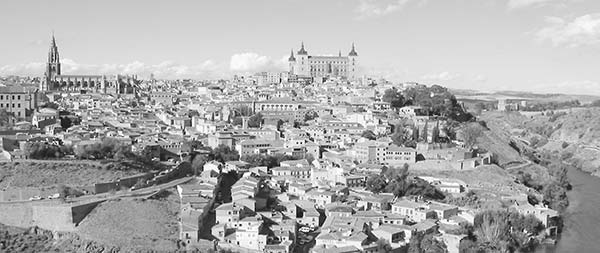
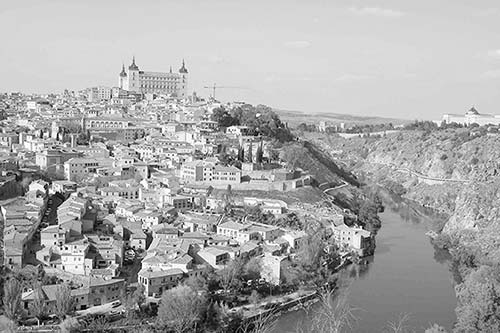
Toledo is classically situated, perfectly preserved, and held tightly by the hairpin turn of the Tajo River. Enjoying the grand city view from across the river gorge is a highlight—and for many, their first stop after the train station. The fancy parador hotel famously hogs the most dramatic viewpoint (you must be a customer to enjoy it), but the scenic road looping around Toledo below the parador is just as good. Taxis are accustomed to taking tourists on this scenic “panoramic route” around the entire city from the train station or downtown, including photo stops, for around €15. Ask the driver: “La ruta panorámica, por favor?” (Note that there are two “Mirador del Valle” viewpoints, and the second is far better than the first.) The city bus does this route for cheap (bus #71 from Plaza de Zocodover), but if you get out for the photo, you’ll wait an hour for the next bus. The tourist train also makes a photo stop on its tour (next).
Tourist Train
For a pleasant city overview, take the TrainVision Tourist Train—a 45-minute putt-putt through Toledo and around the Tajo River Gorge. It’s a cheesy but fine way for nondrivers to enjoy views of the city from across the Tajo Gorge (€8, buy ticket from kiosk on Plaza de Zocodover, where it leaves daily 1-2/hour 10:00-18:30, later in summer, recorded English/Spanish commentary, +34 625 301 890). For the best views, sit on the right side, not behind the driver. There’s a five-minute photo stop at the viewpoint.
Local Guides
For these guides, you can book by email and pay cash after your tour. While they can tailor the walk to your interests, they all do the basic best three-hour tour designed for day-trippers from Madrid: Meet at the train station, hop in a taxi for the big views from across the river, and then do a town walk including the cathedral (around €160 plus €15 for the taxi and any entrance fees).
Juan José Espadas (a.k.a. Juanjo) is a good guide who enjoys sharing his hometown with travelers. He gracefully brings meaning to the complex mix of Toledo’s history, art, religion, and culture (€170/3 hours, +34 667 780 475, http://besttoledotours.com, juanjo@guiadetoledo.es).
Adolfo Ferrero is a personable guide with a background in art history—and he wrote the city guidebook Toledo Hand-in-Hand mentioned earlier (€155/3 hours, +34 629 177 810, www.toledodelamano.com, adolfo.ferrero@toledodelamano.com).
Luis Morlanes (€150/3 hours, +34 690 111 646, morlanes83@gmail.com) and Laura Romero-Salazar (€160/3 hours, +34 630 389 664, laurarsg@gmail.com) are also smart, charming guides who know and love their hometown.
Toledo Walk
This walk snakes through the center of town from Plaza de Zocodover to the cathedral and Santo Tomé and then down to the Jewish Quarter, linking all of Toledo’s top sights (described in more detail under “Sights in Toledo”). Use this walk to get oriented, then choose which sights appeal to you (prioritize the cathedral interior and Santa Cruz Museum). On a quick day trip from Madrid, stick to the first half of this walk (about an hour if you don’t enter any sights); with more time, add the second half, which covers the Jewish Quarter (an additional half-hour). At the end, you can ride bus #12 back to Plaza de Zocodover. To trace the route, see the “Central Toledo” map, earlier.
PLAZA DE ZOCODOVER TO THE CATHEDRAL AND SANTO TOMÉ
• Begin at Toledo’s main square, where taxis and buses from the train and bus stations drop off arriving visitors.
1 Plaza de Zocodover
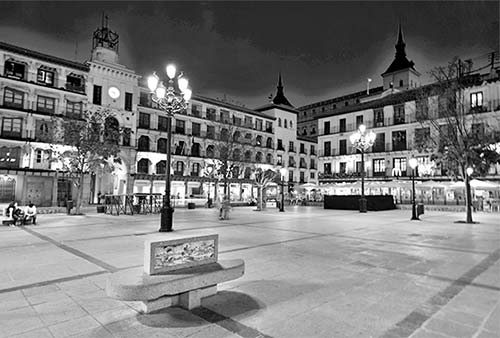
Position yourself in the middle of the square and survey the scene. Surprisingly modest for the main square of one of Spain’s finest and most historic towns, Plaza de Zocodover is Toledo’s transportation hub and your gateway to the old town. The word “Zocodover” derives from the Arabic for “livestock market.” This was once the scene of Inquisition judgments and bullfights, but it’s now a lot more peaceful. Like an incoming tide, day-trippers from Madrid flood the square with the arrival of each morning train. Still, for locals—young and old—this is the town’s gathering place.
Perched strategically in the center of Iberia, Toledo was for centuries a Roman transportation hub. After Rome fell, Toledo became a Visigothic capital (AD 554). In 711 the Moors (Muslims) made it a regional center. Because of its importance, Toledo was the first city in the crosshairs of Christian forces. It fell in 1085, marking the beginning of the end of Muslim Spain, which culminated in the fall of Granada in 1492. A local saying goes, “A carpet frays from the edges, but the carpet of al-Andalus (Muslim Spain) frayed from the very center”—Toledo.
Though the city was now dominated by Christians, many Moors remained, tolerated and respected as scholars and craftspeople. During its medieval heyday (c. 1350), Toledo was a city of the humanities, where God was known by many names. People of different faiths lived in harmony. The Jewish community—educated, wealthy, and cosmopolitan—thrived (relatively) from the city’s earliest times. Jews of Spanish origin are called Sephardic Jews.
The city reached its peak in the 1500s, when Spain was in its golden age, Toledo’s bishops wielded vast political power, Emperor Charles V made it his “Imperial City,” and artists like El Greco called it home. All of Spain considered Toledo to be the heart of what was becoming a budding nation-state.
Then, in 1561, Philip II suddenly decided to move the capital to a small town north of here—Madrid. Some say that Madrid was the logical place for a capital in the geographic center of newly formed España. Others think Philip wanted more room to grow, or to separate politics from religion. Whatever the reason, Toledo—though still Spain’s religious capital—began a slow decline. Its medieval structures were never rebuilt, leaving it mothballed. In the 19th century, Romantic travelers rediscovered it and wrote of it as a mystical place, which it remains today.
The tourist train to the panoramic Mirador del Valle viewpoint south of town leaves from here, as do city buses #5, #61, and #62 to the train station. Just uphill, near the taxi stand, are the stops for bus #12, which travels around the old town to Santo Tomé (and works as a good self-guided tour—described at the end of this section), and for the hourly bus #71, which heads out to the viewpoint.
Toledo is the capital of Castile-La Mancha, and the orange-hued government building—sort of the “state capitol”—overlooks Plaza de Zocodover. Look for the three flags: one for Europe, one for Spain, and one for Castile-La Mancha. And speaking of universal symbols, find the low-key McDonald’s. A source of controversy, it was finally allowed...with only one small golden arch. Next came the bigger Burger King, which no one blinked at.
Notice the double-headed eagle emblem emblazoned on bus windows (you’ll find it all over town). It symbolizes the Habsburg monarchs, who briefly made their home here, but has been appropriated as Toledo’s city seal.
The “square” has an oddly triangular footprint. In the 16th century, King Philip II—one of those Habsburgs—tried in vain to knock down some buildings and create a more typical square, like the showcase Plaza Mayor in Madrid. But key buildings were owned by the Church, which refused to grant permission. The cathedral in Toledo—Spain’s most important—has always exerted an oversized influence on civic life. And that’s one of the many reasons Philip II decided to relocate his capital (in 1561) to Madrid, where he could build whatever he liked. The throne’s departure left Toledo a forgotten historic backwater...exactly why it’s so beloved by visitors today.
Notice the colorful scenes on the tiled benches in the square, illustrating events from Cervantes’ Don Quixote. Cervantes’ wife came from near Toledo, and he knew the city well, often mentioning it in his writings. Don Quixote even includes a tongue-in-cheek mention that Cervantes didn’t write the work—he just translated it from an Arabic manuscript found in Toledo.
Now walk to the edge of the square along the busy street and face the big governmental building. Look uphill to your right to see two of the four corner turrets of the Alcázar—the mighty fortress that was for a time (in the 16th century, before Philip left in a huff) Spain’s seat of power. During the Spanish Civil War, Franco’s Nationalists holed up inside the Alcázar, and the Republicans laid siege to the fortress (see “The History of the Alcázar” sidebar, later in this chapter). Most of the area around the Alcázar was destroyed—this part of town, including much of Plaza de Zocodover, has been rebuilt (notice the Restaurado 1945 sign on the governmental building). Today the Alcázar houses the Army Museum, a sprawling exhibit on Spain’s military history. (I’ll point out the entrance in a moment.)
Dodge buses as you cross the street and look right to see an outpost of Santo Tomé, one of Toledo’s top shops for the delicious almond confection called mazapán (more on mazapán later in this walk).
Continue down the stairs straight past the mazapán shop, head through the arch, and snap a selfie with the statue of Cervantes (who’s looking down the street named for him). He famously stayed in an inn down the hill, where he did a lot of his writing.
Looking back above Cervantes’ head, notice that the archway you just came through has a distinctive keyhole shape—a classic feature of Mudejar architecture, the Moorish style employed by Muslim craftspeople for Christian clients after the Moors lost control of their territories. Toledo—which was the first major town retaken by the Reconquista, in 1085—is the top Mudejar city in Spain. (For more on the Reconquista, see the Spain: Past and Present chapter.) Cities farther south, like Granada, remained Moorish for centuries longer. In many ways, Toledo is a hinge between the Moorish-flavored south and the very Christian north. Throughout the city, keep an eye out for the distinctly Mudejar look.
A few steps beyond Cervantes, look right up the street to the big, blocky building. This is the entrance to the Army Museum, inside the Alcázar fortress. Then continue 30 paces straight ahead (downhill on Cervantes Street) and look left to see the frilly Plateresque entrance to the Santa Cruz Museum, with a fine collection of art, including some top El Grecos.
You’re standing in the middle of what, a thousand years ago, would have been Toledo’s answer to Granada’s Alhambra—the center of Muslim Moorish rule. The keyhole arch you passed under would have been the main gate. To the right, today’s Alcázar and Army Museum would have been the military center. To the left stood the palace, destroyed by Christian forces after 1085 and eventually replaced by the cross-shaped hospital that now houses the Santa Cruz Museum.
• Retrace your steps past Cervantes, back through that keyhole arch, and cross the street into Plaza de Zocodover. Continue straight through the middle of the square and carry on (past a row of ATMs) along Toledo’s main shopping artery, the aptly named...
2 Calle del Comercio
This main drag, connecting Plaza de Zocodover with the cathedral, is jammed with day-trippers. But toledanos still shop here, too, and you’ll notice a mix of local businesses (clothing stores, banks, lotto shops) and tourist-oriented shops (offering knives, leather, mazapán, and damascene—fine inlaid work). Many visitors never break free of this gauntlet, but make sure you do—some of Toledo’s most appealing back streets lie just above and below here.
As the name indicates, Calle del Comercio has long been Toledo’s street of commerce. In the narrow buildings, merchants kept their shops at street level and lived upstairs. The characteristic miradores (bay windows) were designed to let in maximum light—helpful in such crowded quarters.
After one block, at the Starbucks, look up the intersecting street on the right (above the yogurt shop) for the most-photographed street sign in town: Calle de Toledo de Ohío...in honor of “the other Toledo.” (Elsewhere in Toledo, a similar sign adorns a suburban street called Calle de Corpus Christi—for the Texan town named for Toledo’s biggest religious celebration.)
Walk a few blocks along Calle del Comercio as it winds through the heart of town. Where the street widens, take the right fork (Calle del Hombre del Palo). Soon you’re walking along the bulky wall of the cathedral complex, on your left. At the next fork—at the lovely building with the double-headed eagle on top—take a sharp left and continue downhill alongside the cathedral.
As you walk along the cathedral, look about 20 feet up to see metal girders. During the annual celebration of Corpus Christi, 60 days after Easter, these support priceless Flemish tapestries from the cathedral’s collection, some dating back to the 16th century. On that feast day, the communion host is paraded around town in a gigantic gold monstrance (you can see it inside the cathedral). For a month leading up to the big day, the 1.5-mile procession route is rigged with a cloth canopy and hung with ceremonial lights.
You’ll pass under a skybridge that connects the cathedral to the bishop’s palace—the gigantic, hulking building on your right.
• Just below that, you pop out into the square called...
3 Plaza del Ayuntamiento
This square is named not for the cathedral but for the City Hall—the mini Alcázar straight ahead, with a TI inside (and a public WC at its lower-right corner). Notice that this building flies not three flags but four: the EU, Spain, Castile-La Mancha (purple-and-white), and the city flag of Toledo (purple). Look around and see how many double-headed eagles you can count on this very proudly toledana square.
The cathedral faces the Archbishop’s palace, home of the leading figure in Spain’s church (note the Vatican flag next to Spain’s). Perhaps it was the power of the Archbishop in 1561 that drove the king to abandon holy Toledo and establish his political center in Madrid, 45 miles to the north.
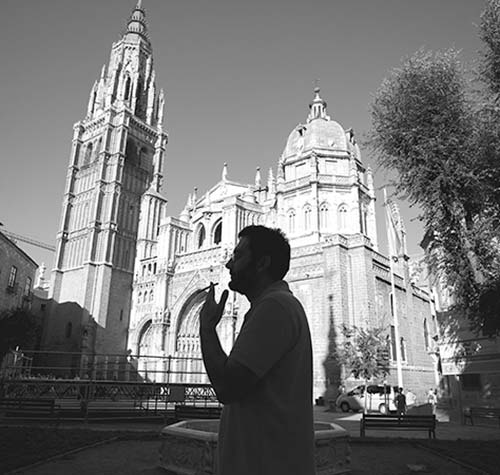
Enjoy the view of the cathedral. The tower rocketing up is capped with three crowns—signifying this cathedral’s primacy over all other Spanish churches. On the right side, notice the stubby base of what was planned to be a matching second steeple. As work progressed, the foundation began to crumble (you can see the damage). It was being built on the artificially leveled-out square rather than the angled rock at the base of the existing tower. So plans were scaled back and a domed chapel was built instead.
Step closer to study the facade. The tympanum (over the door) illustrates the founding story of the cathedral: In the seventh century, the local Bishop Ildefonso wrote a book about the Virgin Mary—who rewarded him by miraculously appearing and offering him a holy vestment, legitimizing Toledo as the leading Christian city of Spain. The original carvings were in soft, white limestone, but in the 18th century, the original facade was in danger of crumbling, so it was bolstered by a stronger outer facade of finely carved granite. Step back for a broader view and notice how the newer, supporting facade obscures the fine Gothic rose window that was the centerpiece of the original facade. The statues depicting the Last Supper are also from that more modern granite structure.
The cathedral interior is undoubtedly the top sight in town. To enter, head up the lane on the right side of the cathedral. The ticket office is on the right side of the street. (A self-guided tour of the interior is outlined later, under “Sights in Toledo.”)
The pond in front of the City Hall is worth a look and some photo fun. It’s one part of a three-part artwork by Cristina Iglesias called Three Waters (2014), referring to the town’s nickname, City of Three Waters—and the fact that for centuries (until 1492) Muslims, Jews, and Christians co-existed peacefully here. (The other two “Waters” are in the nearby Convent of Santa Clara and in an old water tower on the campus of the university.) Made with 20 tons of bronze, the fountain resembles the Tajo riverbed, with water that rises and falls twice an hour to create an ever-changing reflecting pond—great for capturing an interesting shot of the church’s facade. (Dogs dig it too.)
• When you’re ready to move on, we’ll take a stroll through...
4 Toledo’s Back Streets
Leave Plaza del Ayuntamiento on the narrow, uphill lane to the right of the City Hall. Continuing straight ahead, you’ll go under an arch, then through a little passage and out a door on the other side onto a fine little square.
Turn right, then right again, and curl steeply uphill. You’ll be walking along the apse (on your left) of the Mudejar-style Santa Ursula convent from the 13th century (notice the keyhole arches), once home to mazapán-making nuns. They’ve moved out, but there are still several active nunneries in Toledo.
Cresting the hill on Camino el Salvador, notice the wide-open space on your right. In Toledo’s medieval cityscape—where streets are tight and buildings are close together—open space like this is a sign that something once here is now gone. Sure enough, this was a site of yet another monastery, which collapsed. Now it’s a rare park. The modern, bunker-like building behind the park (cleverly lit with skylights) is an archive.
Ahead, on the left, stands the Church of El Salvador, built upon the site of a mosque that was built upon a Visigothic church that was built upon a Roman temple—there’s a lot of history here. The original minaret (now the church’s bell tower), the oldest of seven in town, dates from the ninth century and is made mostly of stones scavenged from ancient Roman buildings.
The church faces Calle Santo Tomé, where plaques in the pavement indicate that this is the start of the Jewish Quarter. Between here and the rectangular steeple a hundred or so yards ahead is a strip of touristic shops that offer some good traditional Toledo shopping: ironwork, damascene, and mazapán. This is an excellent opportunity to see and sample Toledo’s leading sweet treat.
On the right, at #2, El Café de las Monjas sells desserts created by nuns living in Toledo’s convents (notice the adorable-slash-creepy window display of nun dolls hard at work in the kitchen with their almonds, sugar, egg-yolk fillings, and pine nuts). But to buy some mazapán, I’d go across the street to #3, to the original branch of the Santo Tomé mazapán shop that we saw on Plaza de Zocodover. The goodies have been made at this location since 1856, and if you’re lucky they’ll give you a peek at the baking action in the kitchen. Glass cases show off the assortment of traditional mazapán, about €1 each. Facing the cases, find the nearly 12-foot mazapán statue of Don Quixote.
As you stroll and browse, you may wonder: Why are knives such a big deal in Toledo? In the Middle Ages, Toledo made the very best steel—using know-how imported from the Middle East via Muslim craftspeople. Don Quixote-type knights of the age considered a Toledo-cast sword the ultimate status symbol. And Spain’s top bullfighters wouldn’t have their swords made anywhere else.
The shop at #7 offers a good peek at both ironwork and damascene jewelry. Toledo is also Spain’s damascene center, where, for centuries, craftspeople have inlaid black steel with gold and silver wire. Damascene is named for the capital of Syria, a reminder that this craft originated in the Middle East and was introduced to Spain by the Moors. Artisans around town pound gold and silver threads into a steel base to create shiny inlaid plates, decorative wares, and jewelry. While most damascene is a tourist racket, it’s fun to pop into a shop and see the intricate handiwork.
Stroll ahead to the chunky square tower, then venture about 20 yards farther along Calle Santo Tomé for two interesting stops: Churrería Chocolatería, at #27, is a traditional little hot-chocolate-and-churros shop (open 6:30-11:00, closed Mon). Just beyond that at #31 is a convent with a bakery shop open to the public. Dulces Artesanos Convento de San Antonio, run by Franciscan sisters, sells a variety of nun-made cookies.
• Return to the chunky, rectangular tower and head downhill on a lane called Travesía del Conde. You’ll emerge at the long square marking...
5 Santo Tomé
This otherwise unexceptional church is home to the masterpiece of Toledo’s great medieval painter, El Greco. The Burial of the Count of Orgaz illustrates a local bigwig’s funeral, with VIP guests both in heaven and here on earth. You’ll likely see a line at the ticket office (facing the long square), but the wait is worth it. (For details and a description of the painting, see the “Santo Tomé” listing under “Sights in Toledo.”)
The square extending behind Santo Tomé—Plaza del Conde—is the terminus for handy bus #12 (bus stop at far end of square). This marks the end of the first half of this walk. If your time in Toledo is short, visit San Tomé, then hightail it back to Plaza de Zocodover on the bus (or walk back via the back streets instead of the clogged Calle del Comercio).
• With more time, continue through...
TOLEDO’S JEWISH QUARTER
You’ve already entered Toledo’s former Jewish Quarter, where up until the Middle Ages, Jews were allowed to live, work, and practice their religion. But in 1492, Isabel and Ferdinand expelled the Jews (except for those who converted to Christianity). Most of Toledo’s synagogues and other Jewish institutions were destroyed or repurposed as churches, but two rare synagogue buildings survived.
To reach the heart of the Jewish Quarter—and those synagogues, among other sights (all described in more detail later, under “Sights in Toledo”)—continue 20 steps in front of the Santo Tomé church across Plaza del Conde and then head left steeply downhill on a cobbled lane that leads to the El Greco Museum, on your right.
While the best paintings by El Greco are displayed in three sights we’ve already passed—the Santa Cruz Museum, the cathedral, and Santo Tomé—the El Greco Museum offers a more in-depth look at the painter’s life and times (see listing under “Sights in Toledo”).
Across the street from the El Greco Museum is a big park that marks the place of the painter’s long-gone house. Along with a memorial to El Greco, the park comes with a rose garden, a free public WC, and a fine viewpoint overlooking the Tajo River.
The Tajo (called the “Tejo” in Portugal) is the longest river in Iberia, running 626 miles until it meets the Atlantic at Lisbon. You can imagine how its hairpin turn here created a natural fortification for Spain’s capital city, with just one wall needed across the isthmus to keep the city safe. In ancient times, an aqueduct brought water from a source miles away. And under Moorish rule, a series of waterwheels—with a river-powered do-si-do of jugs—brought water into the city directly from the Tagus. Notice the ruins in the river below. These were once mills that harnessed the strong current (before it was tamed by dams) to do various grinding chores. Across the gorge are cigarrales, noble family summer houses that provide elites a breezy summertime escape. And today, the cliffs are popular with rock climbers.
Past the park and across the street is the entrance to the historic Tránsito Synagogue, which also houses a fine museum (see listing under “Sights in Toledo”). As you continue along Calle de los Reyes Católicos, notice the bronze plaques named for the Catholic monarchs and shaped like the Iberian Peninsula—they feature letters representing the Hebrew word for Iberia (Spain), Sepharad. Sephardic Jews are the branch of the Jewish diaspora that settled in Spain and Portugal and lived here until their expulsion in 1492. These plaques are placed in former Jewish quarters all over Spain as reminders. Farther along on the right is a little park with a bus stop. Just beyond that is the Santa María la Blanca Synagogue, with a more pristine Mudejar-style interior than the Tránsito Synagogue.
Finally, Calle de los Reyes Católicos passes the huge San Juan de los Reyes monastery complex, designed as the final resting place for Isabel and Ferdinand to assert the Christian hold on the last Moorish capital (though they wound up being buried in Granada instead). The interior of the monastery and its chapel are also worth a look. At the very end of the street, around the corner of the church, the castle-like exterior displays a variety of chains that were supposedly used by the Moors to shackle Christians in Granada before the Reconquista. At the viewpoint by the church, notice the uplifting Ascensión sculpture—a resurrected Christ whirling a Hula-Hoop—created by Italian artist Nino Longobardi and donated to the city by local art collector Roberto Polo in 2023. (A plaque interprets it in English.)
• Our walk is finished. Across the street from the Monastery of San Juan de los Reyes is another stop for bus #12, which you can take on a scenic ride outside Toledo’s walls and then back up to Plaza de Zocodover. See the end of the “Sights in Toledo” section for details.
Sights in Toledo
▲▲Santa Cruz Museum (Museo de Santa Cruz
▲Army Museum (Museo del Ejército)
▲Visigothic Museum in the Church of San Román (Museo de los Concilios y de la Cultura Visigoda)
▲El Greco Museum (Museo del Greco)
▲Tránsito Synagogue and Sephardic Jewish Museum (Sinagoga del Tránsito y Museo Sefardí)
Santa María la Blanca Synagogue (Sinagoga de Santa María la Blanca)
▲Monastery of San Juan de los Reyes (Monasterio de San Juan de los Reyes)
▲Bus #12 Self-Guided Tour (A Sweat-Free Return Trip from Santo Tomé to Plaza de Zocodover)
I’ve organized Toledo’s sights geographically: near Plaza de Zocodover, the cathedral and nearby, and in the town’s southwest end. You can link the major sights using my self-guided “Toledo Walk,” earlier.
NEAR PLAZA DE ZOCODOVER
▲▲Santa Cruz Museum (Museo de Santa Cruz)
This stately Renaissance building, formerly an orphanage and hospital, was funded by money left by the humanist and diplomat Cardinal Mendoza when he died in 1495. The cardinal, confirmed as Chancellor of Castile by Queen Isabel, was so influential that he was called “the third monarch.” Today it’s the best museum in town, with a good permanent exhibit (including several El Grecos) about Spain under Charles V and his offspring, a peaceful cloister with a good ceramics collection, and temporary exhibits.
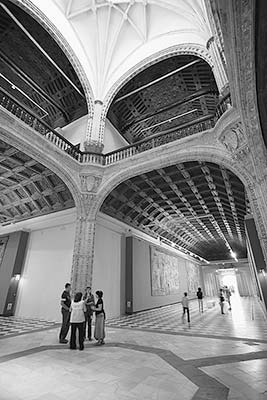
Cost and Hours: Free; Mon-Sat 10:00-18:00, Sun until 15:00; from Plaza de Zocodover, go through arch to Calle Miguel de Cervantes 3; +34 925 221 402, https://cultura.castillalamancha.es [URL inactive].
Visiting the Museum: The building’s facade still wears bullet scars from the Spanish Civil War. The frilly decorations around the main entrance (as well as the cloister arches and stairway leading to the upper cloister) are fine examples of the ornate Plateresque style, named for the detailed work of Spanish Renaissance silversmiths of the 16th century. Note the Renaissance-era mathematics—ideal proportions, round arches, square squares, and classic columns.
The Santa Cruz hospital, built on a Greek cross plan to honor its founder, feels rather like a palace. The “nave” is decorated with 16th-century tapestries (hung on streets during the festival of Corpus Christi) under a masterful Renaissance coffered wooden ceiling.
As you make your way down the long hall toward the El Grecos, browse the exhibits that set the stage. A century before El Greco’s heyday in Toledo, the “Catholic Monarchs”—Ferdinand and Isabel—were turning Spain into a militantly religious country. They were aided by Cardinal Mendoza (look for his portrait), who drove the Muslims from Granada, founded this Christian charity hospital, and was buried among kings at the high altar of Toledo Cathedral. In Spain’s new ultra-religious climate, altarpieces and paintings of saints were artists’ bread and butter.
The Catholic Monarchs’ grandson, Charles V (see his glittering bust in the left “transept”), spread Spanish Catholicism throughout his worldwide empire. His son, Philip II (see exhibits in the apse, near the El Grecos), was especially devout, battling Protestants in the Counter-Reformation as well as Muslim Turks (see the big blue banner from the Battle of Lepanto, 1571). This was the environment the Greek immigrant known as El Greco found when he arrived in Spain in 1577 and started working for the introverted ascetic Philip II. It’s little wonder that El Greco’s main art was designed to express the intense spiritual fervor of 16th-century Spain.
The highlight of the museum is the dozen or so El Greco paintings. El Greco’s specialty was capturing ascetic Christian saints in the throes of visionary experiences. They tilt their faces heavenward or express their spiritual awakening with simple hand gestures. The scenes are rendered in bright, almost florescent colors that suggest the intense religiosity of the saints.
Most impressive is Assumption of Mary, a spiritual poem on canvas (housed in its own little caged room). This altarpiece, finished one year before El Greco’s death in 1614, is the culmination of his unique style. (The Assumption more likely depicts the Immaculate Conception, which is how it’s labeled.) Bound to earth, the city of Toledo sleeps, but a vision is taking place overhead. An angel in a billowing robe, as if doing the breaststroke with his wings, flies up, supporting Mary, the mother of Christ. She floats up through warped space, to be serenaded by angels and wrapped in the radiant light of the Holy Spirit. Mary flickers and ripples, charged from within by her spiritual ecstasy, caught up in a vision that takes her breath away. No painter before or since has captured the supernatural world better than El Greco. (For more on El Greco, see here.)
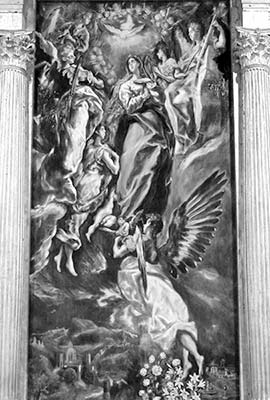
Nearby is El Greco’s Holy Family. The tender, otherworldly scene of Mary and Anne adoring the Baby Jesus is given a down-to-earth touch with a stormy Toledo sky and a balding Joseph—probably modeled after the work’s patron. Notice the little scrap of paper in the lower-right corner, signed with El Greco’s full name in Greek.
El Greco’s San Ildefonso celebrates Toledo’s hometown saint and early bishop of the cathedral. He meditates on the Bible while wearing the ornate robe marking him as Spain’s “Primate,” or head bishop.
A doorway in the right “transept” leads into the peaceful Renaissance cloister. On the far wall you’ll see artifacts reminding all that Toledo’s history goes way back: Roman columns recycled as Muslim tombstones in the 11th century, a fine third-century Roman mosaic celebrating the four seasons, and a well head, also dating from the 11th century. Note the grooves made by generations pulling their buckets up by rope.
Climb the frilly (Plateresque) staircase to the upper level of the cloister, and take a moment to look out over the tranquil courtyard. Up here you can visit the beautiful Carranza Collection of tiles and ceramics dating from the end of the Reconquista (1492). Stroll through and see how each region (Valencia, Catalunya) had its own style or color scheme, building up to Toledo’s distinctive blue pieces in the final room.
From the top level of the courtyard, you may be able to go up a short flight of stairs to a temporary exhibit hall with a view down into the atrium that runs through the navel of the museum.
▲Army Museum (Museo del Ejército)
One of Europe’s top military museums, the Army Museum is worth ▲▲ and at least three hours for military history buffs (and totally skippable for those bored by old weapons). Much of Spain’s history is military, and this museum—housed in the mighty Alcázar fortress that caps Toledo—tells that story from 1492 to the 20th century. You’ll see Spanish military collections of armor, uniforms, cannons, guns, paintings, and models. The posted English information is excellent, and the audioguide is a worthwhile supplement. The museum has one major flaw: its skimpy coverage of the Spanish Civil War (1936-1939). The collection, in the midst of a major renovation, may be closed when you visit.
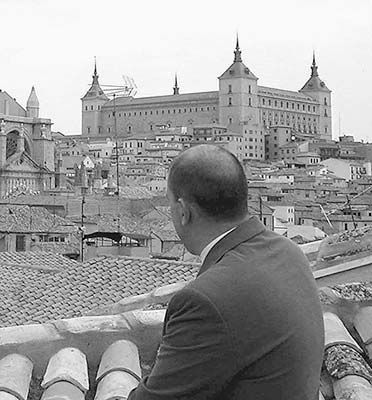
The permanent exhibits fill four floors: thematic exhibits on T1 and T2, and a chronological sweep through Spanish military history on H1 and H2. Read my descriptions before your visit and target what interests you—or follow my once-over-lightly tour of the highlights.
Cost and Hours: May be closed for renovation; when open, €5, free on Sun; free to enter temporary exhibits and archaeological ruins—ask for pass at ticket office; open Tue-Sun 10:00-17:00, closed Mon; great audioguide-€3, café/restaurant and view terrace, +34 925 238 800, www.museo.ejercito.es.
 Self-Guided Tour: The floor plan is sprawling and confusing—be sure to pick up the English map to navigate. We’ll breeze quickly through, but even at that, this huge collection will test your endurance. So buck up, soldier.
• From the ticket booth, head up a series of escalators (over the excavated ruins of earlier fortifications) to the...
Permanent Collection (Floor T2): At the top of the escalators, cut through the gift shop to reach the thematic exhibits. We’ll skip these for now and head for the far-right corner, where you can take the elevator or stairs to floor H1 to find the “Start of the Historical Tour,” a chronological sweep through 500 years of Spanish history.
1492-1843 (Floor H1): In the first room (labeled The Catholic Monarchs), it’s 1492, the Muslims have been driven out (see Boabdil the Moor’s captured sword and robe), and a united Spain emerges as a major military power. Conquistadors like Cortés (see his Historia) were conquering the New World, and Emperor Charles V (portrait) assumed the role of policeman for all of Europe.
• From here, begin the clockwise loop around level H1 (following “historical round” arrows), sweeping through Spain’s military history.
Browse through the flags (banderas), weapons, and armor of the period. Next, learn about Spain’s many wars in the 1500s, including in the New World (with exhibits of Native American weapons).
You’ll pass through the open-air Charles V Courtyard—Italian-inspired Renaissance in style and adorned with a proud statue of Holy Roman Emperor Charles V (a.k.a. King Charles I of Spain), the ultimate military king and Europe’s most powerful 16th-century leader. It’s hard to believe that this massive fortress was virtually demolished in the 1930s and later elegantly restored.
• Continue through floor H1.
A dozen steps in, find a darkened room with a press-the-button exhibit on the Battle of Almansa (1707). Fought by many armies, this battle encapsulates the ultra-confusing War of the Spanish Succession, when all of Europe fought over who should rule Spain. (The Bourbons of France won.) In the next series of rooms, you see how Napoleon overthrew the Bourbons and brought still more turmoil.
• Cross the stairwell and go into a room labeled The Napoleonic War 1808-14.
On “El Dos de Mayo” (May 2), Napoleon’s troops attacked Madrid. You’ll see a tattered uniform of a proud Spanish defender; some swords, hats, and portraits of other Spanish patriots; and small works by the artist Goya (he chronicled the brutal invasion in a series of famous paintings now in Madrid’s Prado).
A few steps farther (and a century later), you reach the Moscardó Room. It’s 1936, in the midst of the Spanish Civil War, and Toledo’s Alcázar is under siege. This office was the headquarters of Toledo’s fascist forces, led by Nationalist Colonel José Moscardó, holding out against the Republicans. (For more on the siege and the colonel, see the sidebar.) The room is preserved as it was by the end, battered and bullet-ridden. Photos show how the Alcázar was blasted to smithereens.
Complete your tour of this floor by viewing swords, uniforms, and portraits of the Spaniards who fought against Simón Bolívar and other emancipators of Spain’s colonies in America.
• Now take the stairs or elevator up (a half-flight) to floor CI to glimpse the Imperial Chapel of Philip II, featuring the 16th-century “Charles V tent.” Continue up another half-flight to...
1843-20th Century (Floor H2): Pass through a series of rooms on the “Liberal State,” when Spain was in decline and her monarchs battled the forces of democracy. Spain also battled the United States (1898) over Cuba and the Philippines (see US Army gear, a video on the sinking of the Maine, and insignia from Teddy Roosevelt’s charge up San Juan Hill).
Continue to “The 20th Century” and the Spanish Civil War. Though the war was the event of 20th-century Spanish history, the curators chose to dodge the still-controversial issue by going light on it. Displays trace Primo de Rivera’s dictatorship of the 1920s and the rise of the fascist General Francisco Franco in the 1930s. Continue past the displays of 1930s-era weapons and the stairwell to “How the War Unfolded.” There you’ll find some timelines and maps, a script of Franco’s victory speech, and objects rescued from the rubble of the Alcázar—a motorcycle, a telephone, and a daily ration of bread.
Next, it’s World War II. Though officially neutral, Franco supported Hitler, while many Spaniards became “El Maquis”—guerrillas fighting the fascists. The final exhibits cover the 1970s, when Franco died (1975) and his powerful military state made a peaceful transition to democracy.
• Whew. You’ve finished your 500-year march through history. Now descend (by elevator or stairs) to...
Thematic Exhibits (Floors T2 and T1): Each room is dedicated to a particular collection: uniforms, medieval armor and swords, cannons and early rifles, toy soldiers, medals, wartime photography, and non-European weaponry. The “Crypt” (labeled on your map) has the stark tomb of Colonel José Moscardó—who led the Nationalists during the siege of the Alcázar in 1936—and his wife and kids. Room T9 has artifacts from the entire history of the Alcázar—from Roman pottery to Charles V to the disastrous 1936 siege. If you like these exhibits, a few similar ones are one floor lower (T1). These cover the evolution of Spain’s flag and display weapons—from battle axes, swords, and pikes to cannons, muskets, pistols, German lugers, and machine guns.
Mezquita del Cristo de la Luz
Of Muslim Toledo’s 20 mosques, this barren little building (dating from about 1000) is the best survivor. Enter through the modern, rust-colored building just below, buy your ticket, and head into the mosque. Looking up, you’ll notice the Moorish fascination with geometry—each dome is a unique design. The lovely keyhole arch faces Mecca. In 1185, a century after the city was recaptured by Christian forces, the mosque was changed to a church and renamed Iglesia de Cristo de la Luz. In 1187 the Christian apse (with its crude Romanesque art) was added and became the city’s first example of Mudejar art and the model for all that would come after it. The small garden, with its fountains, is a reminder of the Quranic image of heaven. At the back of the garden, you can enjoy a view of the Mudejar-style Puerta del Sol gateway. And running along the fence in front of the mosque is a Roman road leading to the city wall (discovered when the mosque was undergoing restoration).
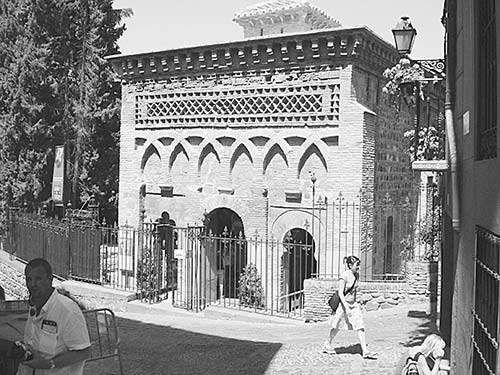
Cost and Hours: €4, Mon-Fri 10:00-18:45, until 17:45 on Sat-Sun and in winter, audioguide-€1, west of Plaza de Zocodover at Cuesta de las Carmelitas Descalzas 10, +34 925 254 191.
THE CATHEDRAL AND NEARBY
▲▲▲Toledo Cathedral
Holy Toledo! Spain’s leading Catholic city has a magnificent cathedral. For more than 1,500 years, the people of Toledo have worshipped on this spot. The first were Visigoth Christians, in a small church. Around 711, Islamic Moors conquered the city, tore down that church, and built a magnificent mosque. When Toledo was reconquered (in 1085), Christians started using the mosque for their own services. But in 1226, the now-crumbling structure was dismantled, and construction began on the current cathedral. With its long history, Toledo’s cathedral is still considered the spiritual heart of Spain.
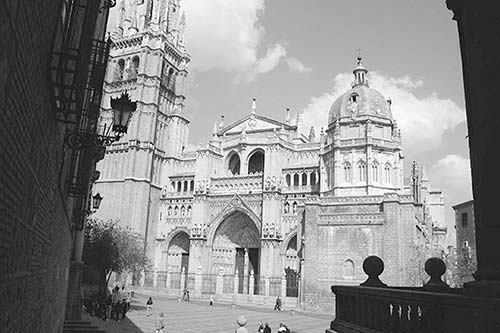
Over the centuries, the church was decorated with the sights we see today: a five-story Gothic altarpiece, Renaissance-era frescoes, a one-of-a-kind Baroque skylight, a ten-foot-tall golden monstrance, and museum-worthy paintings by El Greco and others. Shoehorned into the old center, the cathedral’s exterior is hard to appreciate. But its rich and lofty interior will have you wandering around like a Pez dispenser stuck open, whispering “Wow.”
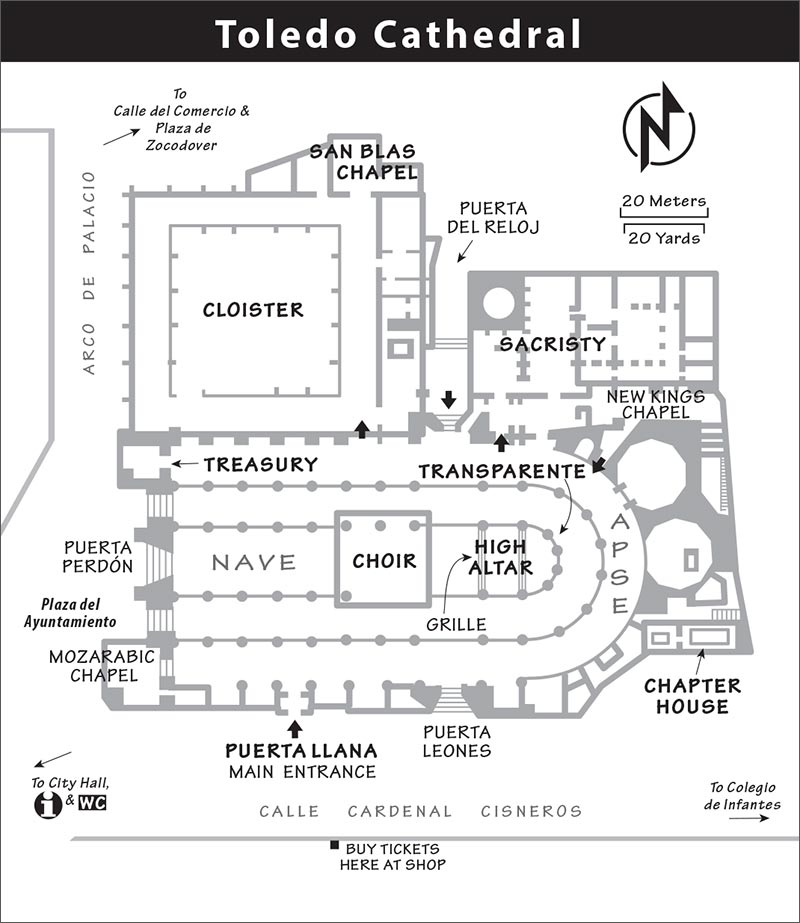
Cost and Hours: €10 ticket includes multimedia guide and Colegio de Infantes; tickets sold in shop opposite church entrance on Calle Cardenal Cisneros; cathedral open Mon-Sat 10:00-18:30, Sun from 14:00, open earlier for prayer only; +34 925 222 241, www.catedralprimada.es. The nearest WC is across the square at City Hall.
Self-Guided Tour
• Begin in the…
Nave: Wander among the pillars, thick and sturdy as a redwood forest. Sit under one and imagine a time when the lightbulbs were candles and the tourists were pilgrims—when every window provided both physical and spiritual light.
This cathedral is Spain’s purest example of the Gothic style. Enjoy the soaring crisscross ceiling, elaborate wrought-iron work, lavish wood carvings, and windows of 500-year-old stained glass. Though Gothic, the church has some unusual features. It’s especially wide (200 feet) relative to the length (400 feet) because it follows the footprint of the earlier mosque. (A few red-tinted columns incorporated into the choir wall may have come from that mosque.) The nave is divided into five aisles (not the usual three), clogged with columns, and filled with the choir—the walled enclosure in the middle. Circling the interior are ornate chapels, purchased by the town’s most noble families.
• Head for the space between the choir and the high altar, with its enormous carved altarpiece.
High Altar: Climb two steps and grip the iron grille as you marvel at one of the most stunning altarpieces in Spain. Eighty feet tall and made of real gold on wood (one kilogram of gold leaf), it’s one of the country’s best pieces of Gothic art. Twenty-seven Flemish, French, and local artists—architects, woodcarvers, painters, and goldsmiths—labored on it for seven years.
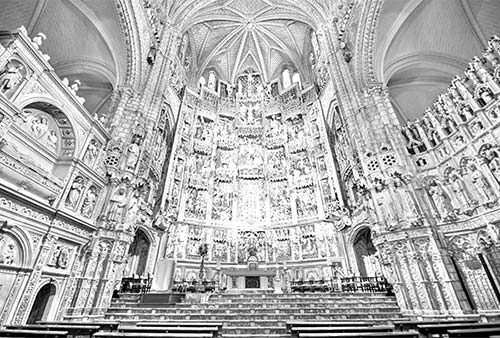
Study the wall with the scenes from the life of Christ, frame by frame. You can begin in the center with Jesus’ birth. On the left side, he’s arrested, forced to carry his cross, and crucified. On the right side, he’s resurrected and appears to his followers. The images seem to celebrate the colorful Assumption of Mary (upper center), with Mary escorted by six upwardly mobile angels. The crucified Christ on top is nine feet tall—taller than the lower statues—an illusion designed to keep this towering altar approachable.
To the right of the altarpiece is a row of stone statues of venerable bishops, saints...and one Muslim. That mellow-looking guy with the cone-shaped hat and beard is the “Wise Moor,” who brokered the peaceful handover of the mosque to the Christians in 1085.
To the left of the altarpiece, the two-story tomb in the style of a triumphal arch honors the bishop who ushered in the cathedral’s golden age in the 1500s. Cardinal Mendoza helped Ferdinand and Isabel conquer the Moors in Granada, promoted Columbus, and oversaw completion of this Gothic-style church (its construction took 250 years—1226-1493). He then began a new era of building in a new style—Renaissance. Mendoza and his powerful successors left their imprints, adding the grand altarpiece, the choir, and several of the chapels we’ll see later. The wide-ranging decor reflects the church’s long history: Gothic, Renaissance, Baroque, and Neoclassical.
Take note of the finely worked, gold-plated iron grille itself—considered to be the best from 16th-century Spain.
• About-face to the...
Choir: This intimate space, lined with 120 carved-wood stalls, is where priests (today only around 30 serve at this church) celebrate Mass near the high altar. Stepping inside, you’re greeted by a 700-year-old statue of the Virgin and Child. Mary smiles sweetly, her body sways seductively, her deeply creased robe is luxuriant, and Jesus playfully tweaks his mother’s chin. This “White Virgin” is thought to be a gift from France.
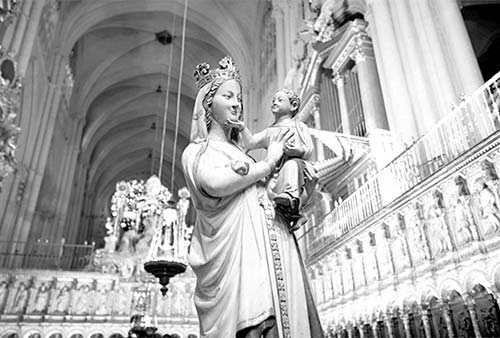
The choir is ringed by stone statues—an alabaster genealogy of Christ—starting (opposite the entry) with Adam and Eve and working counterclockwise to Joseph and “S. M. Virgo Mater” (St. Mary the Virgin Mother). Compare the stiff, forward-facing statues on the right wall with the more lifelike, twisting, side-posing ones on the left—by Alonso Berruguete, “the Michelangelo of Spain.” All this imagery is designed to remind viewers of the legitimacy of the bishop of Toledo’s claims to religious power.
The focal point is the archbishop’s throne, in the center of the far wall. Get close and find the fine alabaster relief just above the throne. It shows the miraculous event that put this cathedral on the map: In the seventh century, Mary came down from heaven to the cathedral to give Toledo’s bishop, Saint Ildefonso, a holy robe. This legitimized Toledo as the spiritual capital (and therefore political capital) of the budding nation of Spain. The legend is found in artwork all over the cathedral and the city—including on the music stands nearby and the tympanum outside.
Now turn to the richly carved wooden stalls, where worshippers half-sit/half-stand during services. The carvings depict scenes of the Christian Reconquista, specifically the steady one-city-at-a-time finale—the conquering of the towns around the Muslim kingdom of Granada. Each castle represents a different town, labeled with its name, besieged by Christian armies. The assault culminates at the archbishop’s throne (the two reliefs to either side), with the final victory at Granada in 1492. The soldiers’ clothing, armor, and weaponry are so detailed that historians have studied them to learn the evolution of weaponry.
Also check out the seat backs, made of carved walnut and featuring New Testament figures—including Peter (key) and Paul (sword) alongside the archbishop himself. Now turn to the stalls’ misericords—the tiny seats that allowed tired worshippers to lean while they “stood.” These carvings depict various sins and proverbs. They feature folksy, sexy, secular scenes: animals, mermaids, unicorns, and common laborers. Apparently, since you sat on it, it could never be sacred anyway.
The iron grille of the choir is notable for the dedication of Domingo de Céspedes, the Toledo ironworker who built it for 6,000 ducats. The project, which lasted from 1541 until 1548, went way over budget. The medieval Church didn’t accept cost overruns, so Domingo sold everything he owned to finish it and went into debt. He died a poor but honorable man.
Before leaving the choir, take a moment to absorb the marvelous complexity, harmony, and cohesiveness of the art around you. Look up. There are two fine pipe organs: one (frilly, on the left) is early-18th-century Baroque, and the other (austere and pointy, on the right) is late-18th-century Neoclassical. Music has been a big deal here since medieval times. It’s part of the tradition that Toledo’s bishops trace back to Saint Ildefonso and the days of the Visigoths.
• As you leave the choir, face the huge altarpiece and go around it to your right to the door in the back-right corner, where you can enter the...
Chapter House (Sala Capitular): Under a lavish ceiling, a fresco celebrates the humanism of the Italian Renaissance (early 1500s). There’s a Deposition (taking crucified Jesus off the cross), a pietà, and a Resurrection on the front wall; they face a fascinating Last Judgment, where the seven sins are spelled out in the gang going to hell: arrogance (the guy striking a pose), avarice (holding his bag of coins), lust (the easy woman with the lovely hair and fiery crotch), anger (shouting at lust), gluttony (the fat guy), envy, and laziness. Think about how instructive this was in the 16th century.
Below the fresco, a pictorial review of 1,900 years of Toledo archbishops circles the room. The upper row of portraits dates from the 16th century. Except for the last two, these were not painted from life (the same face seems to be recycled over and over). The lower row—actual portraits added one at a time from 1515 on—is of more historic than artistic interest. Imagine sitting down to church business surrounded by all this tradition and theology.
The current cardinal—whose portrait will someday grace the next empty panel—is the top religious official in Spain. When he speaks—especially about controversial topics like divorce, abortion, and contraception—it makes news all over Spain.
As you leave, notice the iron-pumping cupids carved into the pear-tree panels lining the walls.
• Go behind the high altar to find the...
Transparente: This towering white, red, and gold altarpiece bursting with statues is a unique feature of the cathedral. But that’s just half of this multimedia extravaganza. Look up. In the 1700s, a hole was cut in the ceiling. The opening faces east, and on the morning of the summer solstice, the sun sends a beam into the church to strike the altarpiece, lighten this space for worship, and remind all that God is light. Natural light pours in and down a radiant tunnel of painted angels, which become 3-D angels molded out of stucco—the whole assembly tumbling toward the altar near ground level. On the altar is a marble statue of Mary holding Baby Jesus, who looks up in wonder. Put these elements together, and the result is a Baroque masterpiece.
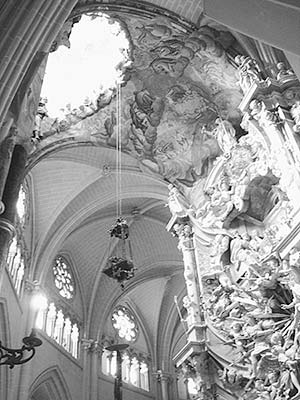
Now turn to the altarpiece itself. Gape up at this riot of angels doing flip-flops, babies breathing thin air, bottoms of feet, and gilded sunbursts. Carved out of marble from Italy, it’s bursting with motion and energy. Appreciate those tough little cherubs who are supporting the whole thing—they’ve been waiting for help for about 300 years now.
Step back to appreciate the altar’s symbolism: The good news of salvation springs from Baby Jesus, up past the archangels (including one in the middle who knows how to hold a big fish correctly) to the Last Supper high above, and beyond into the light-filled dome. Also notice the two red cardinals’ hats hanging on chains from the edge of the hole. A perk that only a cardinal enjoys is to choose a burial place in the cathedral and hang his hat over that spot until the hat rots. I guess the cardinals liked the Transparente, too.
• Continue around the apse. On the right, a door takes you into the...
Sacristy: The cathedral’s sacristy is a mini Prado, with 19 El Grecos and masterpieces by Francisco de Goya, Titian, Diego Velázquez, Caravaggio, and Giovanni Bellini.
First, notice the fine perspective work on the ceiling, painted by Neapolitan artist Luca Giordano around 1690. It seems all the angels of heaven are hurrying toward the far end of the room, where Mary (in blue, holding the golden robe) is descending to earth to give the priestly robe to a kneeling Saint Ildefonso. (You can see the artist himself—with his circa-1690 spectacles—in the far-left corner.)
The most important painting in the collection—framed by marble columns—is El Greco’s The Disrobing of Christ (1579). The great Spanish painter was Greek, and this is the first masterpiece he created after arriving in Toledo. It hangs exactly where he intended it to—in the room where priests donned their sacred robes for Mass.
El Greco shows Jesus surrounded by a sinister mob and suffering the humiliation of being stripped in public before his execution. His scarlet robe is about to be yanked off; the women (lower left) avert their eyes, turning to watch a carpenter at work (lower right) boring the holes for nailing Jesus to the cross. While the carpenter bears down, Jesus—the other carpenter—looks up to heaven. The contrast between the motley crowd gambling for his clothes and Jesus’ noble face underscores the quiet dignity with which he endures this ignoble treatment. Jesus’ delicate white hand stands out from the flaming red tunic with an odd gesture that’s common in El Greco’s paintings—with his ring finger and middle finger together.
Other El Grecos adorn the room. His various saints show his trademark style: thin, solemn, weathered men on a neutral background, with simple expressive gestures. Close to the entrance is a scene rarely painted: St. Joseph and the Christ Child. Joseph is walking with Jesus, just as El Greco enjoyed walking around the Toledo countryside with his sons. Notice Joseph’s gentle expression—and the Toledo views in the background.
To the right of The Disrobing of Christ is a more down-to-earth depiction of Christ’s Passion: Francisco de Goya’s Betrayal of Christ. It shows Judas preparing to kiss Jesus, thus identifying him to the Roman soldiers. In an adjoining room are more treasures by master artists, including Titian’s probing portrait of Pope Paul III and Cardinal Mendoza’s cross—the first cross to enter Granada after 800 years of Muslim rule.
• From the cross continue through two more rooms, enjoying paintings by Caravaggio and Raphael, to a small door into a stony courtyard. Cross the courtyard and enter the...
Chapel of the New Kings (Capilla de los Reyes Nuevos): These reclining statues mark the tombs of just some of the monarchs buried in this venerable cathedral. In the 16th century, Emperor Charles V moved these eight tombs of medieval-era kings here. In the short hallway connecting the chapel to the apse, look for a facsimile of an 800-year-old Bible, hand copied and beautifully illustrated by French monks; it was a gift from St. Louis, the 13th-century king of France. Imagine looking at these lavish illustrations with medieval eyes. (This is a replica; the fragile lambskin original is preserved out of public view.)
• As you step back into the nave, turn right, and head for the far end. As you go, glance high up to your right at a beautiful rose window—the oldest stained glass in the church (14th century). You’ll pass the north entry, where worshippers can enter without a ticket. Through doors on your right, steps lead into the...
Cloister: As you walk through the cloister, appreciate its finely carved colonnade. Just off the cloister is the funerary San Blas Chapel. The ceiling fresco over the alabaster tomb of a bishop is by a student of the 14th-century Italian Renaissance master Giotto.
• Returning to the cathedral the way you came, turn right to find the...
Treasury: The solo attraction here is a 10-foot-high, 430-pound gold-and-silver monstrance—the ceremonial tower designed to hold the Holy Communion wafer (the host) that is paraded through the city during the annual festival of Corpus Christi (“body of Christ”). Built in 1517 by Enrique de Arfe, it features more than 250 little individual statuettes and details. It’s made of 500 pieces held together by 12,500 screws. There are diamonds, emeralds, rubies, and 400 pounds of gold-plated silver. The inner part (which is a century older) is 40 pounds of solid gold.
• Your essential cathedral tour is over, but there are several other sights to consider.
More Cathedral Sights
Mozarabic Chapel (Capilla Mozárabe): Though historic and impressive—with its 16th-century frescoes—this chapel is only open for Mass (daily at 9:00, Sun at 9:45, enter through northern entrance—Puerta del Reloj—on the market side). This Visigothic Mass (in Latin) is the oldest surviving Christian ritual in Western Europe. Toledo’s proud Mozarabic community of 1,500 people traces its roots to Visigothic times. You’re welcome to partake in this stirring example of peaceful coexistence of faiths. (But be warned: The door is locked for the one-hour service—no one enters...and no one leaves.)
Cathedral View: Exiting the cathedral, turn right and walk a half-block to the Plaza del Ayuntamiento, the square presided over by the City Hall. Here you’ll find the best exterior view of the cathedral’s prickly tower—a fitting end to your tour.
Colegio de Infantes: This is where the cathedral displays its fine collection of tapestries and vestments (€2, included in cathedral ticket, daily 10:00-18:00; from the cathedral go down Calle Barco to Plaza Colegio Infantes, +34 925 258 723). Many of the 17th-century tapestries here are still used to decorate the cathedral during the festival of Corpus Christi. You’ll also find the lavish-but-faded Astrolabe Tapestry (c. 1480, Belgian). It shows a new view of the cosmos at the dawn of the Age of Discovery: God (far left) oversees all, as Atlas (with the help of two women and a crank handle) spins the universe, containing the circular Earth. The wisdom gang (far right) heralds the wonders of the coming era. Rather than a map of Earth, this is a chart showing the cosmic order of things, as the constellations spin around the stationary North Star (center).
▲Visigothic Museum in the Church of San Román (Museo de los Concilios y de la Cultura Visigoda)
Though small, this museum offers a thought-provoking collection of artifacts from Toledo’s infancy, displayed in a colorfully decorated church in an untouristed part of Toledo. In the seventh century, Visigoth Christians built a church on this site atop one of Toledo’s highest hills. In the 10th century, the church was knocked down and a mosque was built in its place. Three centuries later, the mosque was replaced by the church you see today.
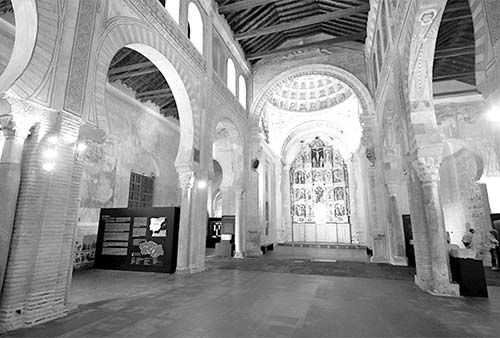
Cost and Hours: €2; Tue-Sat 10:00-14:00 & 16:00-18:00, Sun 9:00-15:00, closed Mon; no English information, west of the cathedral at Plaza San Román, +34 925 227 872.
Visiting the Museum: Start with the church interior. A few Visigoth capitals from the original church were reused and placed atop columns in the nave. The keystone arches, lobed windows, and murals with Christian themes represent the Mudejar mix of Christian and Islamic—each culture both conquering and celebrating their predecessors.
The 13th-century Romanesque murals are especially lively. Facing the altar, begin a 360-degree counterclockwise tour: On the left wall is the ever-popular giant St. Christopher (though this particular fresco is not all that old). In the back corner is an apocalyptic dragon/griffin. The back wall has rows of saints flanking Islamic-style windows. Next, find naked Eve covering herself by the forbidden tree, while God says, “Put some clothes on.” On the long wall is a remarkably literal Resurrection: Angels blow trumpets to wake the dead, who lift their coffin lids to climb out. Finally, find three winged angels (one with a bull’s head) representing the Evangelists writing their Gospels. Beneath them is St. Eugene (“EVGENII”), the seventh-century bishop who founded Toledo Cathedral in the days of the Visigoths.
Now turn to the Visigoth artifacts from the “Siglo VII”—the seventh century. (Some are 1,400-year-old originals; some are replicas.) There are column capitals with Roman-style acanthus leaves and stone slabs with Latin inscriptions. To the Romans, the Visigoths were “barbarians” from Germany who conquered and looted the Empire, but in the long run the Visigoths adopted and preserved Roman culture. As Rome fell (AD 500), the Visigoths settled down in Roman Spain, making Toledo their capital and ruling Spain for two centuries.
The Visigoths adopted Christianity and built churches—as is clear from numerous stone fragments here. A carved relief depicts a row of robed saints and naked Adam and Eve. You’ll see early-Christian symbols: crosses, doves, and olive branches. The X-shaped symbol flanked by the Greek letters alpha and omega represents how Christ (the X) is the beginning and end of all.
Old coins attest to the Visigoths’ thriving Mediterranean trade networks. Manuscripts preserve the Visigoth Law and theological writings that shaped Spanish legal and religious institutions for centuries. (Even Spain’s current king traces his lineage—at least, in theory—back to the legendary Visigoth kings.) Pottery, jewelry, and elaborate metalworked belt buckles give a glimpse into everyday life of these long-ago people.
Most impressive are the votive crowns (they look like hanging lanterns). The crowns are made of gold, crusted with gems, dripping with dangling pendants, and filigreed with intricate metalwork. Votive crowns, popular in medieval times, were not designed to be worn. Rather, these ceremonial objects were given to a church or bishop by devoted followers (or nobles needing a favor) to be hung by a chain directly over the altar. Because Toledo was the spiritual center of Spain, the city acquired many. (These crowns are replicas of ones unearthed in a big Visigoth treasure trove 10 miles southwest of Toledo.)
Finally, take in the entire church. Imagine it’s the year 600, and Toledo is the center of thriving Visigothic Spain. Kings are crowned here in Toledo (including right here in this church). Nobles and bishops from throughout Spain convene here regularly to set policy. They debate whether Jesus was human (as the Arian Visigoths believed) or part of a three-in-one Trinity (as Roman Catholics believed and the Visigoths eventually converted to). During the Visigoth era, Bishop Ildefonso had his vision of the Virgin Mary.
The Visigoths reigned supreme until the year 711, when the Islamic Moors invaded. Because Toledo was the political, cultural, and spiritual head of Spain, by decapitating Toledo, the Moors quickly took the entire peninsula. Consider the history of the place where you are standing: They built a mosque on top of a Visigoth church, which was, in turn, knocked down to make room for this medieval Mudejar church. Now artifacts from Visigothic times are on display, bringing the story full circle.
SOUTHWEST TOLEDO
These sights cluster at the southwest end of town. For efficient sightseeing, visit them in this order, then return to the center on bus #12 (listed at the end of this section).
▲Santo Tomé
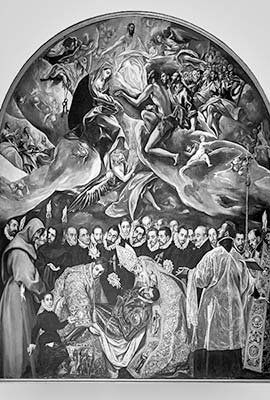
A simple chapel on Plaza del Conde holds El Greco’s most celebrated painting—The Burial of the Count of Orgaz—which couples heaven and earth in a way only The Greek could. It feels so right to see a painting in the same church where the artist placed it 400 years ago (though moved slightly to accommodate modern crowds). This 15-foot-tall masterpiece, painted at the height of El Greco’s powers, is the culmination of his unique style.
Cost and Hours: €4; daily 10:00-18:45, off-season until 17:45; +34 925 256 098. There’s often a line to get in; try going early or late to avoid tour groups.
Visiting Santo Tomé: The year is 1323. Count Don Gonzalo Ruiz of Orgaz, the mayor of Toledo, has died. You’re at his burial right here in the chapel that he himself had ordered built. (Count Orgaz’s actual granite tombstone is at your feet.) The good count was so holy, even saints Augustine and Stephen have come down from heaven to lower his body into the grave. Meanwhile, above, the saints in heaven wait to receive his blessed soul. (The painting’s subtitle is “Such is the reward for those who serve God and his saints.”)
More than 250 years after the count’s death, in 1586, a local priest (depicted on the far right, reading the Bible) hired El Greco to make a painting of the burial to hang over the count’s tomb. The funeral is attended by Toledo’s most distinguished citizens. (El Greco used local nobles as models.) The two saints, wearing rich robes, bend over to place Count Orgaz, dressed in his knight’s armor, into the tomb. The detail work is El Greco at his best. Each nobleman’s face is a distinct portrait, capturing a different aspect of sorrow or contemplation. The saints’ robes are intricately brocaded and have portraits of saints on them. Orgaz’s body is perfectly foreshortened, sticking out toward us. The officiating priest wears a wispy, transparent white robe. Orgaz’s armor is so shiny, you can see St. Stephen’s reflection on his chest.
The serene line of noble faces divides the painting into two realms—heaven above and earth below. Above the faces, the count’s soul, symbolized by a little baby, rises up through a mystical birth canal to be reborn in heaven, where he’s greeted by Jesus, Mary, and all the saints. A spiritual wind blows through as colors change and shapes stretch. This is Counter-Reformation propaganda—notice Jesus pointing to St. Peter, the symbol of the pope in Rome, who controls the keys to the pearly gates. With its surreal colors, wavelike clouds, embryonic cherubs, and elongated forms, heaven is as surreal as the earth is sober. But the two realms are united by the cross at right.
Born on Crete and trained in Venice, Doménikos Theotokópoulos (tongue-tied friends just called him “The Greek”) came to Spain to get a job decorating El Escorial. He failed there but succeeded in Toledo, where he spent the last 37 years of his life. He mixed all three regional influences into his palette. From his Greek homeland, he absorbed the solemn, abstract style of icons. In Italy, he learned the bold use of color, elongated figures, twisting poses, and dramatic style of the later Renaissance. These elements were then fused in the fires of fanatic Spanish-Catholic devotion.
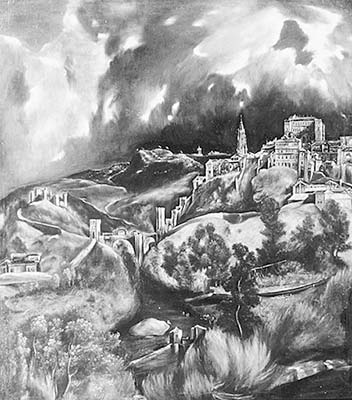
Not bound by the realism so important to his fellow artists, El Greco painted dramatic visions of striking colors and figures—bodies unnatural and lengthened as though stretched between heaven and earth. He painted souls, not faces. His work is on display at nearly every sight in Toledo. Thoroughly modern in his disregard for realism, he didn’t impress the austere Philip II. But his art still seems as fresh as contemporary art does today. El Greco was essentially forgotten through the 18th and most of the 19th centuries. Then, with the Romantic movement (and the discovery of Toledo by Romantic-era travelers, artists, and poets), the paintings of El Greco became the hits they are today.
El Greco considered this to be one of his greatest works. It’s a virtual catalog of his lifelong techniques: elongated bodies, elegant hand gestures, realistic faces, surreal colors, voluminous robes, and a mix of heaven and earth. The boy in the foreground—pointing to the two saints as if to say, “One’s from the first century, the other’s from the fourth...it’s a miracle!”—is El Greco’s own son. On the handkerchief in the boy’s pocket is El Greco’s signature, written in Greek. The only guy in this whole scene who doesn’t seem to be completely engaged in the burial is the seventh figure from the left, looking directly out at the viewer—El Greco himself.
▲El Greco Museum (Museo del Greco)
Housed in a faux 16th-century villa located near the site of El Greco’s actual home, this museum offers a look at the genius of his art and Toledo in his day. While you won’t find many great works by El Greco here (for those, visit Santo Tomé, the cathedral, and the Santa Cruz Museum), there are a few good ones, along with thoughtful exhibits about his life and work.
Cost and Hours: €3, free Sat afternoon from 14:00 and all day Sun; open Tue-Sat 9:30-19:30 (off-season until 18:00), Sun 10:00-15:00, closed Mon; next to Tránsito Synagogue on Calle Samuel Leví, +34 925 223 665, www.culturaydeporte.gob.es/mgreco.
Visiting the Museum: From the ticket office, head through the garden to the museum building, go across the courtyard, and then climb the stairs to begin the one-way route, which shows the evolution of El Greco’s art. Upstairs, you’ll learn about his upbringing in Crete, his training in Venice and Rome, and his arrival in Toledo—each step spurring his style to evolve. One highlight is the long hall lined with portraits of the 12 apostles, plus Jesus. Compare El Greco’s style with apostles painted by his contemporaries, displayed directly opposite. At the end of the hall is the remarkable View and Plan of Toledo, a panoramic map showing the city in 1614—a 400-year-old version of the tourist maps the TI hands out today. It was commissioned to promote the city (suddenly a former capital) after the king moved to Madrid. Study the map and list of sights, executed with stunning detail—El Greco must have scratched the writing onto the canvas with a needle dipped in paint.
Continue downstairs, where an El Greco altar painting of San Bernardino occupies a chapel of its own, under a fine Mudejar ceiling and set inside a simple golden frame El Greco designed himself. The ascetic Italian preacher seems lost in his huge Franciscan robe. At his feet are bishops’ hats, representing the prestigious offices he turned down to preach peace to the poor. The painting’s lines—the slender cane, the dangling tassel in the robe, the edge of his Bible—all point upward, and Bernardino’s robe tapers as it rises, depicting an idealistic saint who clearly had his head in the clouds.
The exhibit wraps up with a description of El Greco’s workshop and creative process, and an “El Greco After El Greco” section showcasing work of his students, some great (like Luis Tristán) and some mediocre (like his son Jorge Manuel—the kid in the Burial of Count Orgaz).
Nearby: Across the street is a delightful park marking the place where El Greco’s actual house stood, with great views of Toledo’s rooftops and river and a giant monument to Dominico Thetocopvli—better known as El Greco.
▲Tránsito Synagogue and Sephardic Jewish Museum (Sinagoga del Tránsito y Museo Sefardí)
Built in 1361, this is the best surviving slice of Toledo’s Jewish past. The austere interior rewards patient visitors with its fine details. Serving as Spain’s national Sephardic Jewish museum, the building also displays a modest selection of Jewish artifacts, including traditional costumes, menorahs, and books. As there are no English explanations, the €2 audioguide is helpful.
Cost and Hours: €3, free Sat afternoon from 14:00 and all day Sun; open Tue-Sat 10:00-19:30 (off-season until 18:00), Sun 10:00-15:00, closed Mon; near El Greco Museum on Calle de los Reyes Católicos, +34 925 223 665, www.culturaydeporte.gob.es/msefardi.
Background: This 14th-century synagogue was built at the peak of Toledo’s enlightened tolerance—constructed for Jews with Christian approval by Muslim craftsmen. Nowhere in the city does Toledo’s three-culture legacy shine brighter than at this place of worship. But in 1391, just a few decades after the synagogue was built, the Church and the Spanish kings began a violent campaign to unite Spain as a Christian nation, forcing Jews and Muslims to convert or leave. In 1492 Ferdinand and Isabel exiled Spain’s remaining Jews, and although a third of them left, others converted (or at least claimed to) in order to remain in the country.
Visiting the Synagogue: Your visit comes with three parts: the main hall of the synagogue, a ground-floor exhibition space with a history of Spain’s Jews, and the women’s gallery upstairs, which shows lifestyles and holy rituals among Sephardic Jews.
Pass your bag through an x-ray machine, buy your ticket, and step into the great hall. Built as a place for Jews to worship, it still has a few features found in many synagogues today. Men worshipped here on ground level, women in the upper balcony. They all faced the hall’s east end (symbolically facing Jerusalem), where a three-arched niche in the wall held the Torah.
But what makes this synagogue unique is that its interior decor looks more Muslim than Jewish. After Christians reconquered the city in 1085, many Moorish workmen stayed on, beautifying the city with the style called Mudejar. The synagogue’s intricate, geometrical carving in stucco—nearly all original, from 1360—features leaves, vines, and flowers; there are no human shapes, which are forbidden by the Torah—like the Quran—as being potential objects of idolatry. In the frieze (running along the upper wall, just below the ceiling), the Arabic-looking script is actually Hebrew, quoting psalms (respected by all “people of the book”—Muslims, Jews, and Christians alike).
Move up to the front. Stand close to the holy wall and study the exquisite workmanship (with reminders of all three religions: the coat of arms of the Christian king, Hebrew script, and Muslim decor). Look down. The small rectangular patch of the original floor survived only because the Christian altar table sat there.
Next, in the side hall, you’ll see displays about the history of Toledo’s Jews and the development of the Jewish Quarter. The Memorial Garden displays Jewish tomb markers from around Spain.
Head upstairs—through a sunny patio—to reach the women’s gallery, which hosts a small exhibit about Jewish traditions. You’ll see candelabras from Hanukah, fancy Torah scrolls, bar mitzvah clothes, wedding regalia, and a circumcision knife, as well as a model of the synagogue itself. There’s a display on the Sephardi—Jews who settled in Spain, dispersed across the globe after 1492, but still retain unique customs, language, and heritage. Together, the exhibits help paint a picture of Jewish life in medieval Toledo and today.
Santa María la Blanca Synagogue (Sinagoga de Santa María la Blanca)
This synagogue-turned-church has Moorish horseshoe arches and wall carvings. While just a single empty room, it’s a vivid reminder of the religious cultures that shared (and then didn’t share) this city. It may look like a mosque, but it never was one. Built as a Jewish synagogue by Muslim workers around 1200, it became a church in 1391, when Toledo’s Jews were first expelled from the city by Christians—hence the mix-and-match name. After being used as horse stables by Napoleonic troops, it was further ruined in the 19th century. Today, fully renovated and sparkling white, it’s beautiful in its simplicity. In many ways it’s a more evocative and architecturally pleasing sight than the Tránsito Synagogue up the street.
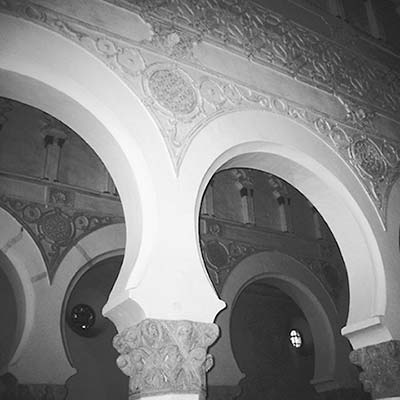
Cost and Hours: €4; daily 10:00-18:45, until 17:45 in winter; Calle de los Reyes Católicos 4, +34 925 227 257.
▲Monastery of San Juan de los Reyes (Monasterio de San Juan de los Reyes)
“St. John of the Monarchs” is a grand Franciscan monastery, impressive church, and delightful “Isabeline” cloistered courtyard. The style is late Gothic, contemporaneous with Portugal’s Manueline (c. 1500) and Flamboyant Gothic elsewhere in Europe. It was the intended burial site of the Catholic Monarchs, Isabel and Ferdinand. But after the Moors were expelled in 1492 from Granada, their royal bodies were planted there to show Spain’s commitment to maintaining a Moor-free peninsula.
Cost and Hours: €4, daily 10:00-18:45, off-season until 17:45, San Juan de los Reyes 2, +34 925 223 802, www.sanjuandelosreyes.org.
Visiting the Monastery: Go to the side door to enter the monastery, head down the stairs, buy your ticket, and step into the cloister for a clockwise stroll. Notice details of the fine carvings. At eye level, you’ll find (lurking amid the foliage) various animals and fantastic beasts: dragons, lions, eagles, cupids, and naked people. Everything had meaning in the 15th century. In the first corner, just above eye level, find a small monkey—an insulting symbol of Franciscans—on a toilet reading the Bible upside-down. Perhaps a stone carver snuck in a not-too-subtle comment on Franciscan pseudo-intellectualism, with their big libraries and small brains.
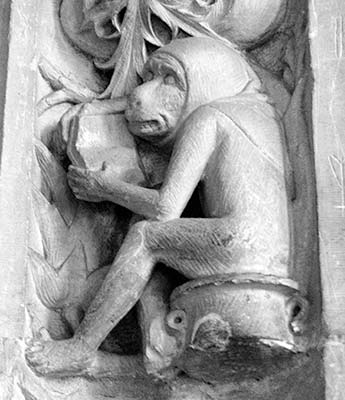
Then step into the glorious chapel—made of creamy stone, with clean lines and intricate trim. It’s topped with an octagonal dome with interlacing vaults. Even without the royal tombs that would have dominated the space, the chapel gives you a sense of Spain when it was Europe’s superpower. The monastery was built to celebrate the 1476 Battle of Toro, which made Isabel the queen of Castile. Since her husband, Ferdinand, was king of Aragon, this effectively created the Spain we know today. (You could say 1476 is to Spain what 1776 is to the US.) Once united, Spain’s new Christian rulers were able to quickly finish the Reconquista, driving the Moors out of Iberia within the next decade and a half.
Sitting in the chapel, you’re surrounded by propaganda proclaiming the Catholic Monarchs’ greatness. Their coat of arms—complex because of Iberia’s many kingdoms (e.g., a lion for León and a castle for Castile)—is repeated obsessively. Above each one, the eagle with the halo disk represents St. John, protector of the royal family. The yoke (representing the “Y” for Ysabel) and arrows (flechas, representing an “F” for Ferdinand) that flank the coat of arms are the symbols of the two monarchs. And the lions underneath remind people of the power of the kingdoms joined under Ferdinand and Isabel.
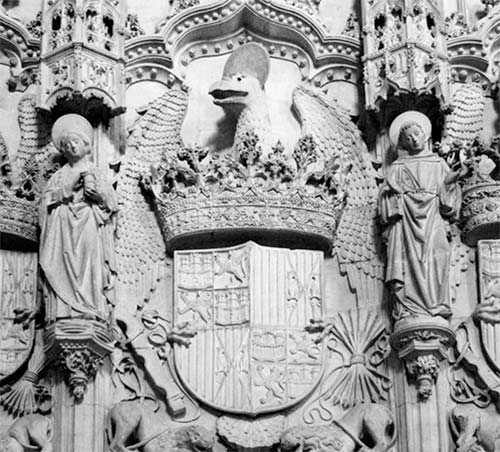
As you leave, look up over the door to see the Franciscan coat of arms, with the five wounds of the Crucifixion (the stigmata—which St. Francis earned through his great faith) flanked by angels with dramatic wings.
Napoleon’s troops are mostly to blame for the destruction of the church, a result of Napoleon’s view that monastic power in Europe was a menace. While Napoleon’s biggest error was to invade Russia, his second-dumbest move was to alienate the Catholic faithful by destroying monasteries such as this one. This strategic mistake eroded popular support from people who might have seen Napoleon as a welcome alternative to the tyranny of kings and the Church.
The skippable upper cloister offers a simple walk around the top level of the courtyard under a finely renovated Moorish-style ceiling.
Back outside, at the downhill end of the church, take in the facade. It’s famously festooned with 500-year-old chains, supposedly used by Moors to shackle Christians in Granada until their defeat in 1492. It’s said that the freed Christians brought these chains to the church, making them a symbol of their Catholic faith and a sign of victory.
▲Bus #12 Self-Guided Tour (A Sweat-Free Return Trip from Santo Tomé to Plaza de Zocodover)
When you’re finished with the sights at the Santo Tomé end of town, you can hike all the way back to Plaza de Zocodover (not fun), or simply catch bus #12 (fun!). The ride offers tired sightseers an interesting 15-minute look at the town walls. You can catch the bus from Plaza del Conde in front of Santo Tomé. This is the end of the line, so buses wait to depart from here twice hourly (at :25 and :55, until 21:25, pay driver €1.50, ticket allows one 30-minute stop, best views from seats on the right). You can catch the same bus a few stops downhill, at the very bottom of Toledo’s sightseeing spine, across the street from the San Juan de los Reyes ticket entrance (a few minutes after it leaves Plaza del Conde). You can do this tour in reverse by riding bus #12 from Plaza de Zocodover to Plaza del Conde (departing at :00 and :30, same price and hours).
If you start your #12 bus ride at Santo Tomé, here’s what you’ll see along your way:
Leaving Plaza del Conde, you’ll first ride through Toledo’s Jewish Quarter. On the right, you’ll pass the El Greco Museum, Tránsito Synagogue, and Santa María la Blanca Synagogue, followed by—on your left—the ornate Flamboyant Gothic facade of the Monastery of San Juan de los Reyes. After squeezing through the 16th-century city gate, the bus follows along the outside of the mighty 10th-century wall that protected the leading capital of Europe where the river gorge didn’t. (Toledo was never conquered by force...only by siege.)
Just past the big escalator (which brings people up from parking lots into the city) and the Hotel del Cardenal, the wall gets fancier, as demonstrated by the little old Bisagra Gate. Soon after, you see the big new Bisagra Gate, the main entry into the old town. While the city walls date from the 10th century, this gate was built as an arch of triumph in the 16th century. The massive coat of arms of Emperor Charles V, with the double-headed eagle, reminded people that he ruled a unified Habsburg empire (successor of ancient Rome), and they were entering the capital of an empire that, in the 1500s, included most of Western Europe and much of America. (We’ll re-enter the town next to this gate in a couple of minutes.) Just outside the big gate is a well-maintained and shaded park—a picnic-perfect spot and one of Toledo’s few green areas.
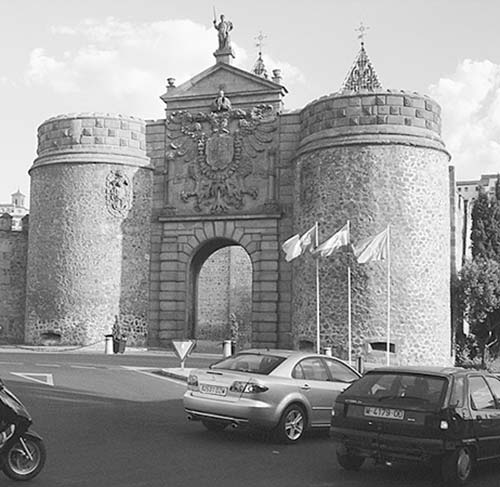
After a detour to the bus station basement to pick up people arriving from Madrid, you swing back around Bisagra Gate. As recently as 1960, all traffic into the city at this spot passed through this gate’s tiny original entrance.
As you climb back into the old town, you’ll pass the fine 14th-century Moorish Puerta del Sol (Gate of the Sun) on your right. Then, on your left is the modern Palacio de Congresos Miradero convention center, which is artfully incorporated into the more historic cityscape. Within moments you pull into Plaza de Zocodover.
Nightlife in Toledo
Toledo is sleepy after dark. Your best bet may be to pick up a few pastries and head down to the cathedral for a sweet and romantic evening dessert. Sit on one of the Plaza del Ayuntamiento’s benches (or stretch out on the stone wall to the right of the TI). A fountain is on your right, Spain’s best-looking City Hall is behind you, and there before you is the cathedral, shining brightly against the black night sky. Enjoy the cathedral in the reflection pond.
For cocktails or something livelier, try the following (for locations, see the “Toledo Hotels and Restaurants” map):
Terraza del Miradero, on a grand perch with a commanding view at the top of the escalator and a block below Plaza de Zocodover, is the leading spot in town for a memorable cocktail after dark. They have an inviting menu of cocktails and drinks, breakfast, lunch, and dinner, with occasional live music and a DJ (no cover, long hours daily, Calle Gerardo Lobo 1, +34 925 220 792).
Bú Terraza is a lofty and breezy retreat perched above the river just past the towering Alcázar and its Franco-era propaganda statue garden. They serve Spanish bar food to complement their drinks (daily 12:00-late, Corralillo de San Miguel s/n, +34 662 686 305).
Hotel Carlos V Rooftop: The rooftop terrace (“Azotea”) of the Hotel Carlos V sits high above the old town between the Alcázar and the cathedral and is a romantic spot for views with a drink or a meal (bar from 17:00, closed Mon; restaurant from 20:00, closed Mon-Tue; Plaza Horno Magdalena s/n, go into hotel and hop the elevator to the rooftop, +34 925 222 100).
Círculo del Arte is a place for the adventurous to hang out with the local kids after midnight. This bar and music venue fills a cavernous 12th-century Mudejar hall—with keyhole brick arches—hiding in back streets near the top of town. It offers a diverse slate of musical events—generally free, some with a cover—accompanied by plenty of booze and young people (schedule at https://circuloartetoledo.org, Plaza San Vicente 2, +34 925 256 653).
Sleeping in Toledo
Day-trippers darken the sunlit cobbles, but few stay to see Toledo’s medieval moonrise. Spend the night. Toledo’s hotels are modest—it’s hard to really splurge here (except for the parador and Posada de la Sillería). Most hotels have a two-tiered price system, with prices at least 20 percent higher on Friday and Saturday (I’ve based my price rankings on weekday rates). Spring and fall are high season; rooms are scarce and prices go up during the Corpus Christi festival as well (usually late May or early June). Most places have an arrangement with parking lots in town that can save you a few euros; ask when you reserve.
DEEP IN TOLEDO, NEAR THE CATHEDRAL
These places hide out on characteristic lanes near the cathedral; because they’re not close to bus stops, it’s best to take a taxi on arrival.
$ Hotel Santa Isabel, in a 15th-century building two blocks from the cathedral, has 41 clean, modern, and comfortable rooms and squeaky tile hallways (some view rooms, elevator, scenic roof terrace, pay parking—call same day to reserve, drivers enter from Calle Pozo Amargo, Calle Santa Isabel 24, +34 925 253 120, www.hotelsantaisabeltoledo.es, info@hotelsantaisabeltoledo.es).
$ La Posada de Manolo rents 14 tight, rustic, cozy rooms across from the downhill corner of the cathedral. Manolo (and wife Almudena) opened this hostal with each of its three floors themed differently—Moorish, Jewish, and Christian. The place has its quirks, and noise carries through its tiled halls, but it has personality and is popular with European tourists (RS%, view terraces, Calle Sixto Ramón Parro 8, +34 925 282 250, www.laposadademanolo.com, toledo@laposadademanolo.com).
$ Hotel Eurico cleverly fits 23 dated, simple, but well-priced and well-located rooms into a medieval building buried deep in the old town (air-con, Calle Santa Isabel 3, +34 925 284 178, www.hoteleurico.com, reservas@hoteleurico.com).
NEAR PLAZA DE ZOCODOVER
$$$ Posada de la Sillería Hotel, a four-star hotel with 24 crisp, contemporary rooms, fills a charming, historic house just off Plaza de Zocodover (air-con, Calle Sillería 10, +34 925 951 915, https://hotelposadasilleria.es, reservas@hotelposadasilleria.es, Alejandro).
$ Antídoto Rooms, although part of a hotel chain, is an antidote to the epidemic of same-old, same-old hotels in Toledo. Its 10 modern rooms are crafted with concrete floors and pops of color, and each has a tiny balcony. It’s ideally located on a back street just a short stroll from Plaza de Zocodover (air-con, elevator, Calle Recoletos 2, +34 925 285 191, www.antidotorooms.com, reservas@hotelpintorelgreco.com).
$ Hotel Toledo Imperial, sitting efficiently above Plaza de Zocodover, rents 29 nondescript rooms (air-con, elevator, Calle Horno de los Bizcochos 5, +34 925 280 034, www.maxihoteles.com/hotel-toledo-imperial, hotel@hoteltoledoimperial.com).
$ Hotel La Conquista de Toledo, with 35 dated but well-priced rooms, gleams with marble—it almost feels more like a hospital than a hotel (family rooms, air-con, elevator, Juan Labrador 8, +34 925 210 760, www.hotelconquistadetoledo.com, conquistadetoledo@yithoteles.com).
IN THE JEWISH QUARTER
Most of the hotels I list in Toledo are older and rough around the edges. But the two listed here are slick, more expensive business-class options. They sit lower in the old town—near the Jewish Quarter sights and El Greco Museum—in an area that’s less convenient to the central sights or the train and bus stations, but more historic and appealing than the area near Bisagra Gate.
$$ Hotel Pintor El Greco is a chain hotel with 54 modern, colorful rooms across the street from the El Greco Museum (air-con, elevator, pay parking, Calle Alamillos del Tránsito 13, +34 925 285 191, www.hotelpintorelgreco.com, info@hotelpintorelgreco.com).
$$ Hotel San Juan de los Reyes fills a historic 19th-century brick factory building with 35 cookie-cutter, characterless, but predictably comfortable rooms, on the road between its namesake monastery and the Tránsito Synagogue (air-con, elevator, pay parking, Calle Reyes Católicos 5, +34 925 283 535, www.hotelsanjuandelosreyes.com, info@hotelsanjuandelosreyes.com).
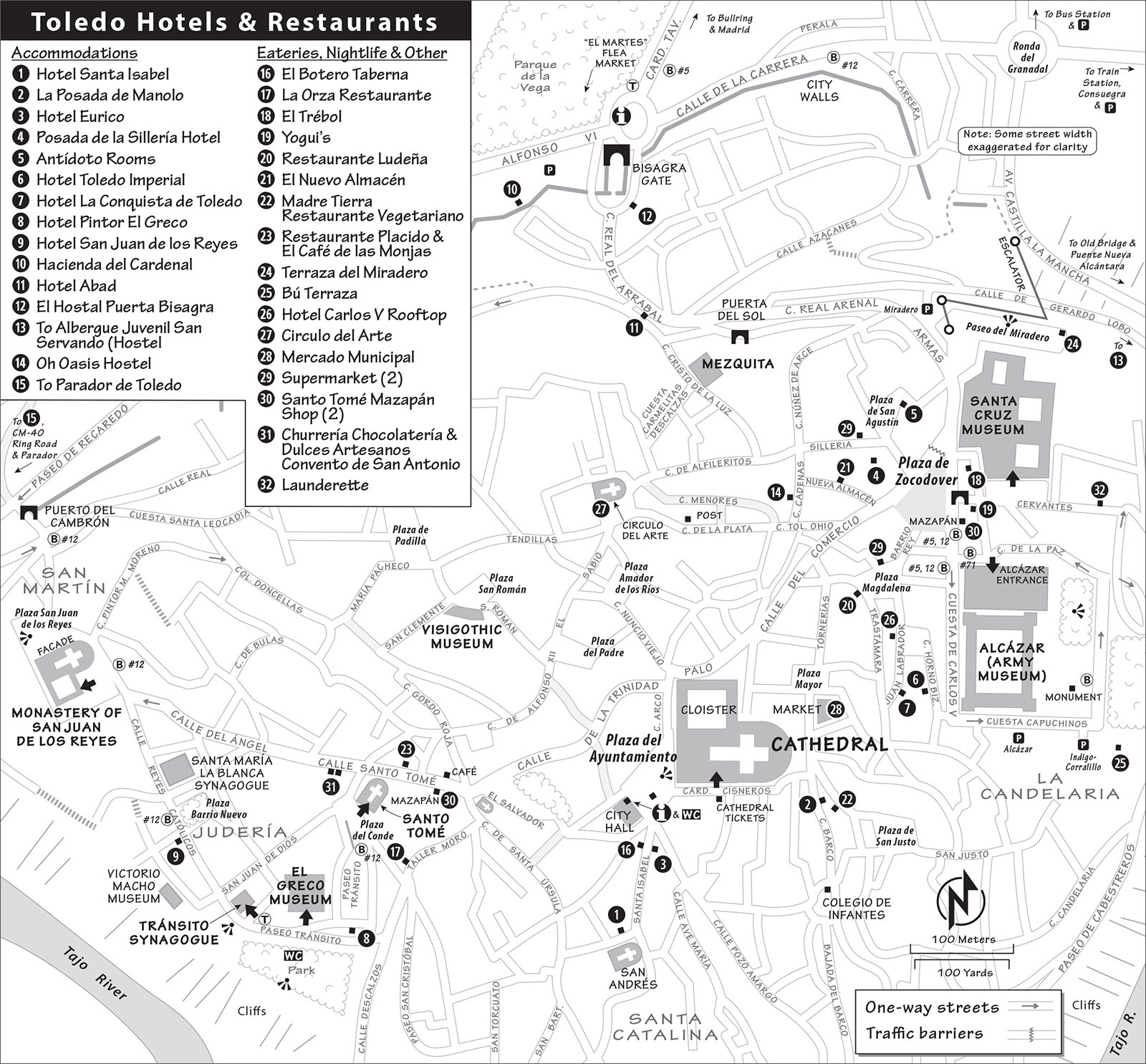
NEAR BISAGRA GATE
These places are a bit handier to the train and bus stations and have easier parking for drivers. The trade-off is that they require a steep hike (with the help of escalators) or a bus or taxi ride to reach the core of Toledo’s sightseeing. All face busy roads, so expect street noise.
$$ Hacienda del Cardenal, a 17th-century cardinal’s palace built into Toledo’s wall, is quiet and elegant, with 27 rooms, a cool garden, and a stuffy restaurant. This poor-man’s parador—a pleasant oasis next to the dusty old gate of Toledo—is close to the station but below all the old-town action (air-con, elevator, enter through town wall 100 yards below Bisagra Gate, Paseo de Recaredo 24, +34 925 224 900, www.haciendadelcardenal.com, hotel@haciendadelcardenal.com).
$ Hotel Abad, just a block inside the Bisagra Gate (next to the Puerta del Sol), feels more stylish than the Toledo norm. They rent 28 trendy-rustic rooms with stone walls, wooden rafters, and contemporary furnishings at the higher end of this price range (air-con, elevator, Calle Real del Arrabal 1, +34 925 283 500, www.hotelabad.com, reservas@hotelabad.com).
$ El Hostal Puerta Bisagra, in a sprawling old building, is fresh and modern inside. It’s picturesquely located right next to Bisagra Gate, with 38 comfortable rooms at a good value (air-con, elevator, Calle del Potro 5, +34 925 285 277, www.puertabisagra.com, puertabisagra@yithoteles.com).
HOSTELS
¢ Albergue Juvenil San Servando youth hostel, located in the 10th-century Moorish castle of San Servando, is lavish but affordable, with 96 beds and small rooms for two or four people (swimming pool, 10-minute walk from train station, 15-minute hike from town center, over Puente de Alcántara outside town, +34 925 224 554, reservations +34 925 221 676, alberguesclm@jccm.es, no English spoken).
¢ Oh Oasis Hostel is a fresh, professionally run 21-room hostel right around the corner from Plaza de Zocodover. They have a pleasant rooftop terrace, shared dorms, and private rooms that are even nicer than some more expensive, more traditional hostales; however, given the younger clientele, weekends can be noisy (air-con, elevator, Calle Cadenas 5, +34 925 227 650, https://oasistoledo.com, toledo@hostelsoasis.com).
OUTSIDE TOWN WITH GRAND TOLEDO VIEW
$$$ Parador de Toledo, with 79 rooms, is one of Spain’s best-known inns. Guests enjoy a sprawling Toledo view across the Tajo Gorge (some view rooms, fixed-price meals sans drinks in their fine restaurant overlooking Toledo, 2 windy miles from town at Cerro del Emperador—it may come up as Carretera de Cobisa on mapping apps, +34 925 221 850, https://parador.es, toledo@parador.es).
Eating in Toledo
A day full of El Greco and the romance of Toledo after dark puts me in the mood for game (hunted in the hills to the south, along the border with La Mancha). Typical Toledo dishes include partridge (perdiz), venison (venado), wild boar (jabalí), roast suckling pig (cochinillo asado), or baby lamb (cordero—similarly roasted after a few weeks of mother’s milk). Also popular is the flavorful pork stew called carcamusas—everyone seems to have their own recipe. After dinner, find a mazapán place for dessert.
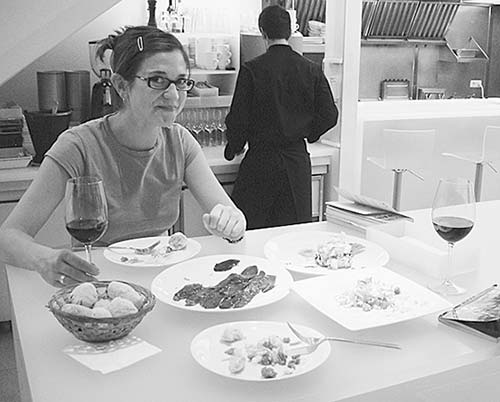
Compared to many Spanish cities, Toledo doesn’t have a thriving, concentrated tapas scene, but most bars (including some of my recommendations) serve a tapa with your drink. Toledo is a good place for a sit-down meal. The Hacienda del Cardenal restaurant and La Orza serve delicious traditional roast suckling pig. At finer places dinner starts at 21:00 and you’ll need to reserve in advance.
MEMORABLE DINING
$$$ El Botero Taberna is a delightful little hideaway. The barman downstairs serves great cocktails, fine wine, and exquisite tapas that are well priced and described. Upstairs is an intimate, seven-table restaurant with romantic, white-tablecloth ambience, serving a modern fusion of Spanish, Asian, and Peruvian dishes (reservations smart, Mon lunch only, closed Tue, a block from cathedral at Calle de la Ciudad 5, +34 925 280 967, https://tabernabotero.com).
$$$ La Orza Restaurante is Michelin-rated for its tasty and well-presented “freestyle regional cuisine.” They serve a smart local clientele, far from tourist noise yet just 50 yards from Santo Tomé church. Choose between a fine patio and a romantic dining room. Roast suckling pig is always on the menu, and though it’s not on the menu, they have wine by the glass (reservations essential, closed Wed and Sun, downhill from Plaza del Conde at Calle de Descalzos 5, +34 925 223 011, www.restaurantelaorza.com).
$$ Taberna Skala, buried deep in the old center, is the place if you’re looking for a thriving top-end tapas bar with a friendly waitstaff and great prices, and a 19th-century atmosphere for lunch (or dinner on weekends). It’s all about traditional, nicely presented local specialties, served tapas style and easy to share. Opt for the stand-up-and-order-at-the-bar zone or a table in the dining room, and don’t be intimidated by the energetic local crowd—that’s a great sign (daily 11:00-17:00, Fri-Sat also 20:00-24:00, a couple blocks north of the cathedral at Cuesta de Sal 5, +34 610 469 956).
SIMPLE RESTAURANTS
Plaza de Zocodover is busy with eateries serving basic food at affordable prices, and its people-watching scene is great. But my recommended eateries are on side streets a bit off the main drag. These places are listed roughly in geographical order from Plaza de Zocodover to Santo Tomé. It’s worth a few extra minutes—and the navigating challenge—to find places where you’ll be eating with locals as well as with tourists. Toledo also has a lively midday tapas scene, and almost every bar you pop into for a stand-up drink will come with a small plate of something to nibble.
$$ El Trébol, a tapas bar tucked peacefully away just a few steps off Plaza de Zocodover, is the place to dine with younger Spaniards. Locals enjoy their pulgas (sandwiches), and their mixed grill can feed two. The seating inside is basic, but the outdoor tables are nice (long hours daily, Calle de Santa Fe 1, +34 925 281 297).
$ Yogui’s is a local favorite for homestyle cooking and their daily €15 lunch menu. They have nice seating both indoors and out (daily, lunch only, a block in front of the Santa Cruz Museum at Plaza Santiago de Caballeros 2, +34 925 216 707).
$$ Restaurante Ludeña is a classic eatery and tapas bar with a dive bar up front, a well-worn dining room in back, and a handful of tables on a sunny courtyard. It’s very central. Arrive early, as lots of locals duck in here to pretend there’s no tourism in Toledo. They serve up big, stick-to-your-ribs portions of traditional comfort food, including a rich, bright-red carcamusas pork stew; their filling fixed-price meals are a good value (closed Wed, Plaza de la Magdalena 10, +34 925 223 384).
$$ El Nuevo Almacén cooks up classic Spanish ingredients in its breakfasts, tapas, pizzas, sandwiches, and hamburgers. It’s pricey but low stress, with good seating inside and out, conveniently located just off Plaza de Zocodover (long hours daily, Calle Nueva 7, +34 925 283 937).
$$ Madre Tierra Restaurante Vegetariano is Toledo’s answer to a vegetarian’s prayer. While service can be slow, the place is bright, spacious, classy, and air-conditioned. Its appetizing vegetarian dishes are based on both international and traditional Spanish cuisine (good tea selection, closed Mon-Tue, 20 yards below La Posada de Manolo just before reaching Plaza de San Justo, Bajada de Tripería 2, +34 925 223 571).
$$ Restaurante Plácido, run by high-energy Anna and Sagrario, serves traditional family-style cuisine on a shady terrace or in a wonderful Franciscan monastery courtyard (call first for dinner, lunch only in winter, about a block uphill from Santo Tomé at Calle Santo Tomé 2, +34 925 222 603).
Picnics: Find picnic provisions at the humble city market, Mercado Municipal, on Plaza Mayor (on Alcázar side of cathedral, dominated by a supermarket inside open Mon-Sat 9:00-14:30 & 17:00-20:00; a few traditional stalls open mostly in the mornings, closed Sun). Carrefour Express is a modern supermarket just off Plaza de Zocodover on Calle Sillería (daily). Suma Supermarket, on Plaza de la Magdalena, has groceries and lots of other stuff at good prices (daily, just below Plaza de Zocodover). For a picnic with people-watching on an atmospheric square, consider a bench on Plaza de Zocodover or Plaza del Ayuntamiento.
AND FOR DESSERT: MAZAPÁN
Toledo’s famous almond-fruity-sweet mazapán is sold all over town. The nuns living in Toledo’s convents were once the main providers of this delight—each piece lovingly shaped by hand—but the number of nuns is dwindling. If you can’t track down a convent still selling sweets in the labyrinth of Holy Toledo, visit El Café de las Monjas, a pastry and coffee shop around the corner from the Santo Tomé church that brings in mazapán from local convents (daily 9:00-21:00, Calle Santo Tomé 2).
The big mazapán producer is Santo Tomé (several outlets, including near Plaza de Zocodover and at Calle Santo Tomé 3, daily 9:00-21:00). Browse their tempting window displays. They sell mazapán goodies individually (sin relleno—without filling—is for purists, de piñon has pine nuts, imperiales is with almonds, others have fruit fillings). Boxes are good for gifts, but if you want an assortment, tell them what you want à la carte. Their toledana is a bigger, nutty, crumbly, not-too-sweet cookie with a subtle thread of squash filling.
Toledo Connections
FROM TOLEDO TO MADRID
Madrid and Toledo are very easily connected. The train makes the trip in 30 minutes to Madrid’s fairly central Atocha station; impractical buses depart twice as frequently but take nearly twice as long to reach the distant Plaza Elíptica. Three or four people traveling together can share a taxi economically. To get elsewhere in Spain from Toledo, assume you’ll have to transfer in Madrid; see “Madrid Connections” at the end of that chapter.
By Train: Nearly hourly, 30 minutes by AVE or Avant to Madrid’s Atocha station (www.renfe.com [URL inactive]); early and late trains can sell out—reserve in advance.
By Bus: 2/hour, 1-1.5 hours, bus drops you at Madrid’s Plaza Elíptica Metro stop, 1/day direct morning bus to Madrid’s Barajas Airport Terminal 4, 1.5 hours, Alsa (www.alsa.es); you can almost always just drop in and buy a ticket minutes before departure.
By Taxi: While it may seem extravagant, if you have limited time, luggage, and a small group, simply taking a taxi from your Toledo hotel to your Madrid hotel is breathtakingly efficient (€100, one hour door-to-door, +34 925 255 050 or +34 925 227 070, or speak with your hotel to arrange). You can ask several cabbies for their best “off the meter” rate. A taxi to the Madrid airport costs €120 (find one who will go “off the meter”) and takes an hour.
ROUTE TIPS FOR DRIVERS
Toledo to Madrid (45 miles, 1 hour): It’s a speedy autovía north, past one of La Mancha’s classic bull billboards, to Madrid (on A-42). The highways converge into M-30, which encircles Madrid. Follow it to the left (Nor or Oeste) and take the Plaza de España exit to get to the city center. If you’re airport-bound, keep heading into Madrid until you see the airplane symbol (N-II).
To drive to Atocha station in Madrid, take the exit off M-30 for Plaza de Legazpi, then take Delicias (second on your right off the square). Parking for rental-car return is on the north side of the train station. The less-convenient toll road AP-42 will also take you from Toledo to Madrid.
Toledo to Granada (230 miles; 3.5 hours): Driving between Toledo and Granada, you’ll pass through La Mancha, which shows a side of Spain that you’ll see nowhere else—vast and flat. You feel lost in rough seas of olive-green polka dots. Random buildings look like houses and hotels hurled off some heavenly Monopoly board.
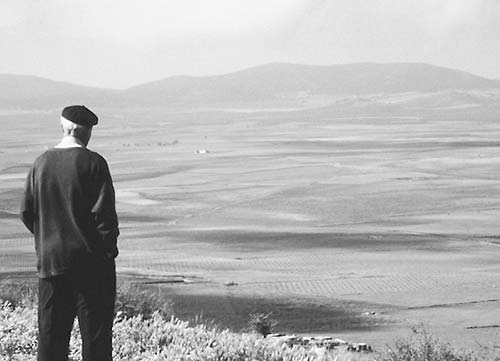
This is the setting of Miguel de Cervantes’ Don Quixote, published in the early 17th century after England sank the Armada and the Spanish Empire began its decline. Cervantes’ star character fights doggedly for good, for justice, and against the fall of Spain and its traditional old-regime ideals. Ignoring reality, Don Quixote is a hero fighting a hopeless battle. Stark La Mancha is the perfect stage.
Above Almonacid (8 miles from Toledo), follow the ruined lane past the ruined church up to the ruined castle. The jovial locals hike up with kids and kites.
But the epitome of Don Quixote country is the town of Consuegra (one hour south of Toledo, www.aytoconsuegra.es). It must be the La Mancha that Cervantes had in mind. Drive up to the ruined 12th-century castle and joust with a windmill. It’s hot and buggy here, but the powerful view overlooking the village—with its sun-bleached light-red roofs, modern concrete reality, and harsh, windy silence—makes for a profound picnic. The castle belonged to the Knights of St. John (12th and 13th centuries) and is associated with their trip to Jerusalem during the Crusades. Originally built from the ruins of a nearby Roman circus, it has been recently restored. Sorry, the windmills are post-Cervantes, only about 250 years old—but you can go inside the Molino de Bolero to see how it works.