NORTHWEST OF MADRID
El Escorial • Valley of the Fallen • Segovia • Ávila
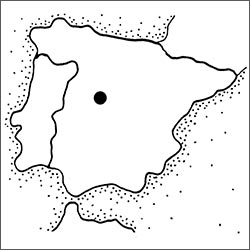
Spain’s lavish, brutal, and complicated history is revealed throughout Old Castile. This region, northwest of Spain’s capital city, is where the dominant Spanish language (castellano) originated, and is named for its many castles—battle scars from the long-fought Reconquista. Before slipping out of Madrid, consider several fine side trips here, all conveniently reached by car, bus, or train.
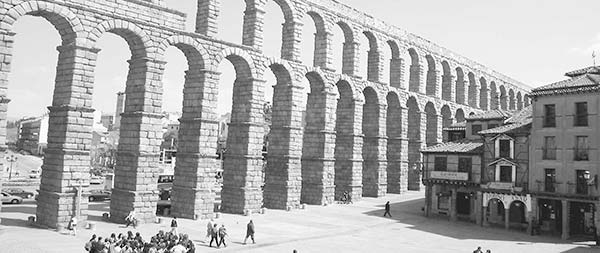
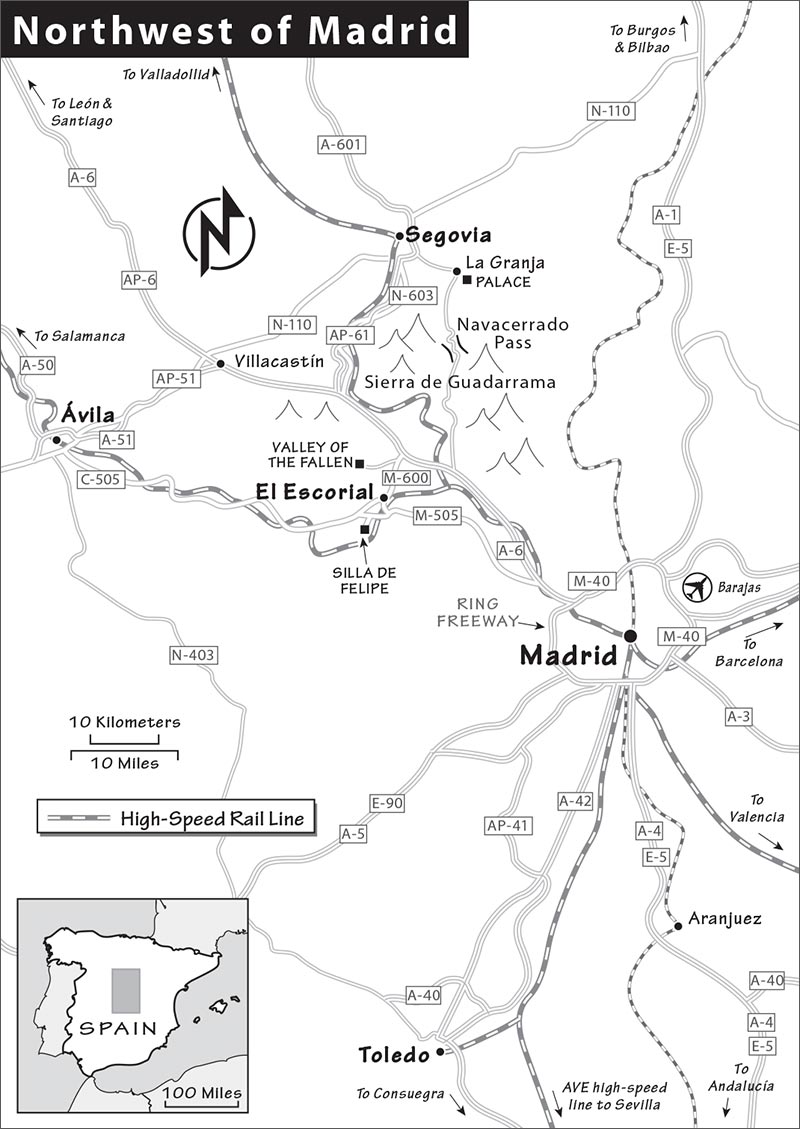
An hour from Madrid, tour the imposing palace at El Escorial. Nearby, at the awe-inspiring Valley of the Fallen (also known as the Valley of Cuelgamuros), pay tribute to the countless victims of Spain’s bloody civil war. Segovia, an altogether lovely burg with a remarkable Roman aqueduct, fine cathedral, and romantic castle, is another worthwhile destination. And Ávila warrants a quick stop to walk its perfectly preserved medieval walls.
All of these sights are located in the rugged, mountainous part of Castile in and near the Sierra de Guadarrama range. Be prepared for hilly terrain, cooler temperatures (thanks to the altitude), and often-snowcapped mountains on the horizon...giving this area an almost alpine flavor.
PLANNING YOUR TIME
History buffs can see El Escorial and the Valley of the Fallen (Valley of Cuelgamuros) in less than a day—but don’t go on a Monday, when both sights are closed. By bus, see them as a day trip from Madrid; by car, see them en route to Segovia.
If you just like nice towns, Segovia, also easy to reach from Madrid, is worth a half-day of sightseeing (and potentially more for lingering). If you have time, spend the night—the city is a joy in the evenings. Ávila, while charming, merits only a quick stop to marvel at its medieval walls and, perhaps, St. Teresa’s finger.
Thanks to speedy train connections, it’s possible to see Segovia on the way from Madrid to Salamanca. It’s trickier but doable to also squeeze in Ávila: Take the fast train (or bus) to Segovia, then bus from Segovia to Ávila, and finally continue to Salamanca by bus or train.
Note that Toledo and Salamanca (covered in separate chapters) are also popular and doable side trips from Madrid.
El Escorial
When Spain defeated France in a crucial 1557 battle, a grateful King Philip II (1527-1598) vowed to build a grand structure to the glory of God: the Monasterio de San Lorenzo de El Escorial (worth ▲▲).
The sprawling complex would serve God in several ways: as a monastery to further the Catholic faith, a school to promote knowledge, a mausoleum to honor Spanish royalty, and a palace to provide respite from the bustle of Madrid. For two decades (1563-1584), Philip poured Spain’s wealth into building El Escorial. The result was a massive structure, 30 miles northwest of Madrid, packed with art and history. Because of this bully in the national budget, Spain has almost nothing else to show from this most powerful period of her history.
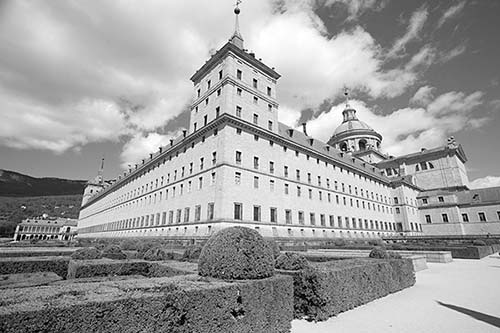
You’ll see grandiose buildings, colorful frescoes, quiet cloisters, somber tombs, a towering altarpiece, chandeliered rooms, canvases by Titian and El Greco, an ingenious model of the cosmos, and King Philip’s bedpan. El Escorial is a time capsule of Spain’s golden age—and its glorious decline.
GETTING THERE
From Madrid, El Escorial is about an hour by car and can easily be combined with a visit to the nearby Valley of the Fallen (Valley of Cuelgamuros). By public transportation, the bus gets you closer to the palace than the train does.
By Bus: At Madrid’s Moncloa bus station, follow signs to Terminal 1 (blue), go up to the platforms in the blue hallway, and find platform 11 (#664 and #661, 4/hour, fewer on weekends, 1 hour, €4.20 one-way, buy ticket from driver, Alsa, +34 911 779 951).
Either bus drops you downtown in San Lorenzo de El Escorial, a pleasant 10-minute stroll from the palace (see map): Exit the bus station from the back ramp that leads over the parked buses (note that return buses to Madrid leave from platform 3 or 4 below; schedule posted by info counter inside station). Once outside, turn left and follow the cobbled pedestrian lane, Calle San Juan, as it veers right and becomes Calle Juan de Leyva. A few short blocks later, it dead-ends at Duque de Medinaceli, where you’ll turn left and see the palace. Stairs lead past several decent eateries, through a delightful square, past the TI, and directly to the tourist entry of El Escorial. The TI has a free mini museum—including a monastery model made of sugar—and offers maps of two lovely and easily accessible hiking routes (Mon-Sat 10:00-14:00 & 15:00-18:00, Sun 10:00-15:00, +34 918 905 313, www.sanlorenzoturismo.org).
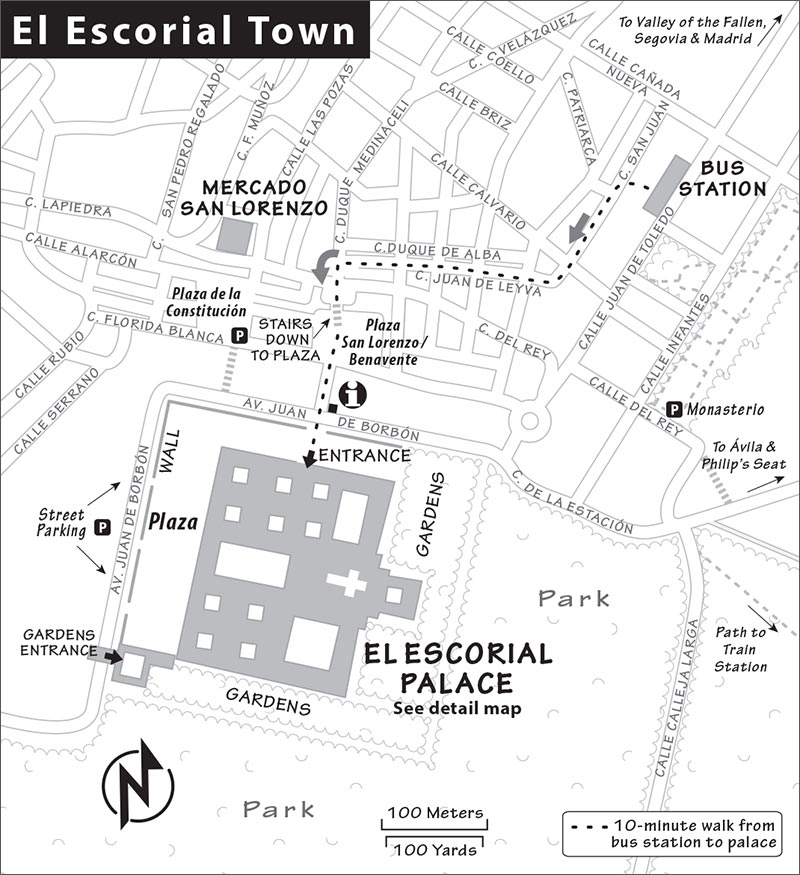
By Train: Local trains run to El Escorial from Madrid’s Atocha and Chamartín stations (cercanías line C-3A, 1-2/hour). From the El Escorial station, the palace is a 20-minute walk straight uphill through Casita del Príncipe park. Or you can take a shuttle bus (L1) from the station (2/hour, usually timed with train arrival, €1.30) or a taxi (€7.50) to the town center and the palace.
By Car: It’s simple and takes about an hour without traffic. Head out of Madrid on highway A-6 (watch for signs to A Coruña). At kilometer 18, stay on A-6, skipping an exit for El Escorial. Later, around kilometer 37, you’ll see the cross marking the Valley of the Fallen (also known as the Valley of Cuelgamuros) ahead on the left. Keep going and exit at kilometer 47 to M-600 (following signs toward El Escorial/Guadarrama). The road goes right past the entrance to the Valley of the Fallen (after a half-mile, see a granite gate on the right, marked Valle de los Caídos), then continues to El Escorial (follow signs to San Lorenzo de El Escorial, and then centro histórico).
Parking: There are several parking options near the monastery. To park in the convenient garage beneath Plaza de Constitución, watch for the very sharp turnoff on the right at a roundabout immediately before the monastery, then follow blue P signs on a loop through town to the garage entrance. The monastery is just across the street and down the stairs. To park on the street alongside the monastery, bypass the garage turnoff, then turn right when you hit the monastery. Loop around it, watching for pay-and-display parking on your right.
Leaving El Escorial: To return to Madrid (or continue to Segovia/Ávila, Toledo, or other points), follow signs to A-6 Guadarrama. After about six miles you pass the Valley of the Fallen and hit the freeway.
ORIENTATION TO EL ESCORIAL
Cost and Hours: €12, Tue-Sun 10:00-20:00, Oct-March until 18:00, closed Mon year-round, last entry one hour before closing. For even a quick visit, allow two hours.
Free Entry: The palace is free to enter Wed and Sun beginning at 17:00 (Oct-March from 15:00).
Information: +34 918 905 904, www.patrimonionacional.es.
Tours: For an extra €4, a 1.5-hour guided tour takes you through the complex and other buildings on the grounds, including the House of the Infante and House of the Prince. There are very few tours in English; if nothing’s running soon, go on your own: Follow my self-guided tour, or rent the €5 handheld multimedia guide.
Visitor Information: English descriptions are scattered throughout the palace. For more information, get the Guide: Monastery of San Lorenzo El Real de El Escorial, which follows the general route you’ll take (€9, available at shops in the palace).
Weather: At an elevation of nearly 3,500 feet, it can be very cold. Dress appropriately.
Services: Backpacks must be checked in cloakroom lockers (€1 coin required).
Eating: True to its austere orientation, El Escorial doesn’t even have a simple café; for food or drinks, you must venture across the street, into town. The Mercado San Lorenzo, a four-minute walk from the palace, is a good place to shop for a picnic (Mon-Fri 9:30-13:30 & 18:00-20:30, Sat 9:30-14:00, closed Sun, Calle del Rey 9). Plaza Jacinto Benavente and Plaza de la Constitución, two blocks north of the palace complex, host a handful of nondescript but decent restaurants serving fixed-price lunches or tapas, often at shady outdoor tables.
 SELF-GUIDED TOUR
Exterior
The building is huge, a symbol of power rather than elegance—like a penitentiary. At about 700 feet long and 500 feet wide, it covers eight acres and has 2,600 windows, 1,200 doors, more than 100 miles of passages, and 1,600 overwhelmed tourists.
It was designed by the architect Juan de Herrera (inspired by his mentor, Juan Bautista de Toledo). El Escorial was classic Herrera: grid-like windows, austere granite, slate roofs, corner towers with pyramid-shaped spires, and geometrical simplicity with little ornamentation. Its monumental scale captured the grandiose political and spiritual aspirations of King Philip II. El Escorial inspired countless Herreresque buildings across Spain, including Madrid’s Plaza Mayor.
If El Escorial seems, well, severe, consider that it was shaped by a kind of bunker mentality: Spain’s Catholics were in the fight of their lives battling the Protestants of northern Europe. But to Philip, El Escorial also embodied how progressive Catholics could merge Renaissance humanism with Catholic spirituality. To Protestants, on the other hand, it epitomized the evil of closed-minded Catholicism. To architects, the building—on the cusp between styles—exudes both Renaissance simplicity and Counter-Reformation grandeur.
All in all, El Escorial feels less like a luxurious palace and more like an austere fortress—a fortress for God.
• Let’s go in. Pass through security, buy your ticket, and follow the signs to the beginning of the tour. The vast complex may seem daunting, but the visita arrows and signs will guide you. You’ll first go through a series of courtyards and stone halls that lead you into a big courtyard. Turn around and face the six statues of the biblical kings who gave the name to...
The Courtyard of the Kings (El Patio de los Reyes)
Here in the central courtyard of the complex, get oriented. The building with the six kings is the basilica. Beneath the basilica (not visible from here) are the royal tombs, and behind it are the royal residences. The building to your right is the monastery, where you’ll see the cloisters. To your left is the school (which you won’t visit), and behind you is the library.
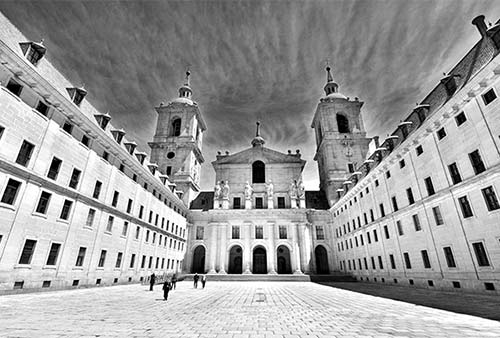
Imagine being a 16th-century visitor arriving in this immense courtyard, awed by Philip II, the most powerful man in Europe. The six shiny-crowned kings of the tribe of Judah underscored his divine kingship. Philip—enigmatic, introverted, ascetic, and extremely religious—used El Escorial to rule his vast empire and to champion the Catholic cause.
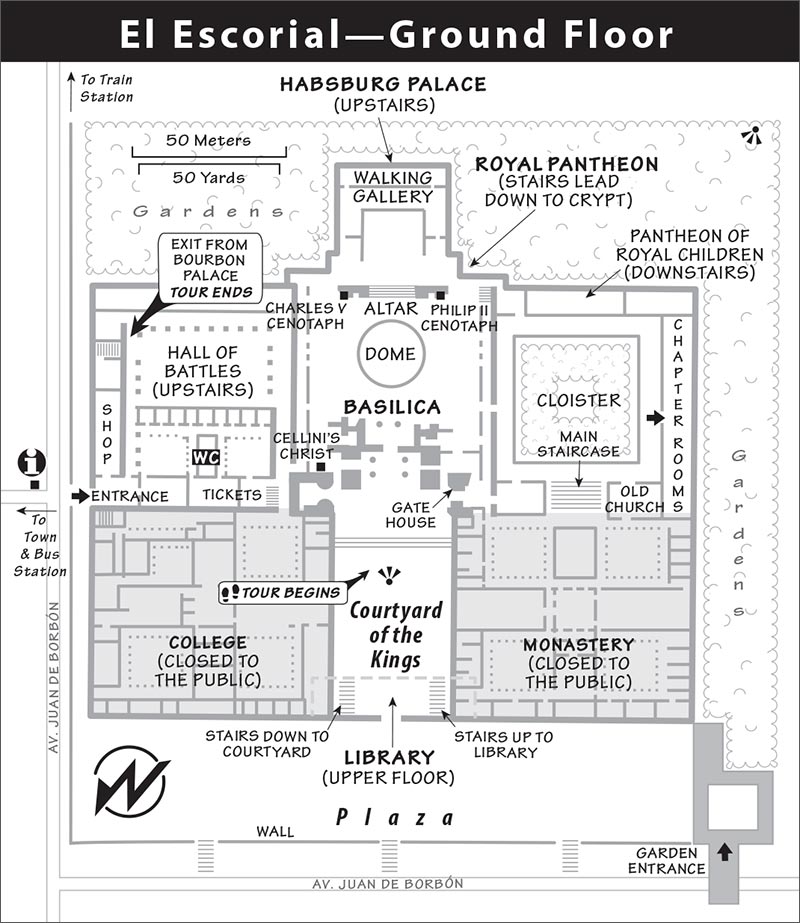
• A crucial part of Philip’s plan was education. Let’s go see the library. Turn your back to the kings, find the stairs in the corner (near the exit), and head up. Before you enter the library, look above the fancy door with the plaque warning “Excomunión...”—you’ll be excommunicated if you steal a book (or fail to show the guard your ticket).
Royal Library (Biblioteca Real)
This long, sumptuous, book-lined room makes it clear that Philip valued learning. Monks here devoured the world’s knowledge, the better to understand God and battle Protestant “heresies.” The library’s location—linking the school with the monastery—symbolized the dovetailing of secular and religious thought. The books on the carved bookcases (designed by Herrera) are shelved spine-first to allow the golden pages to breathe and to create a royal aesthetic.
The big globe in the room is an armillary sphere—an elaborate model of the solar system. When you turned a (now missing) crank, it spun like a gyroscope, demonstrating how the heavenly bodies revolved around Earth (with a misshapen North America still mostly unexplored by Europeans). Designed by a math professor from Pisa, this device was state-of-the-art science circa 1580...until the man’s colleague, Galileo, established the sun as the center of the universe.
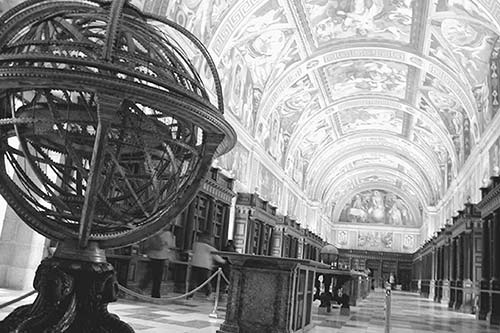
In the burst-of-color ceiling fresco (by Pellegrino Tibaldi), robed women symbolize the subjects taught here: geometry, grammar, astronomy, and so on. They led the eager student to the ultimate goal (at the far end of the room): “Philosophia,” or love of wisdom.
• Exit (wiser) at the far end and head downstairs. You’ll pass a WC, then go through a souvenir shop, before walking back across the Courtyard of the Kings. You are now entering the stretch of the tour focusing on El Escorial’s religious side: the church, cloisters, and religious art. Go through the central arch under the six kings into the...
Basilica
This church is the spiritual centerpiece and beating heart of this entire faith-driven enterprise. Herrera designed the cavernous space as a perfect 50-meter square with four equal arms, symbolizing divine perfection. Soaring overhead is a 100-meter-high central dome inspired by the one being built at the same time at St. Peter’s in Rome. The vast ceiling frescoes (by the prolific Luca Giordano) are like visions of heaven, including a choir of angels above the basilica’s choir loft.
Approach the high altar. It’s a towering, 100-foot-tall, four-tiered frame of red marble and green jasper. It holds gilded bronze statues (like Jesus crucified on the top) and dramatic paintings (like the angels who mourn him). At the base is the temple-like tabernacle (by Herrera), for the Communion wafers. In the very center of the altar is its most important painting—of St. Lawrence, or San Lorenzo. It shows the Christian martyr being literally roasted atop a flaming grill. The reclining saint is taking “turn the other cheek” to new extremes. Lorenzo was so cool, he reportedly told his Roman executioners, “You can turn me over now—I’m done on this side.”
The basilica, the monastery, and the town adjoining El Escorial are all named for San Lorenzo. And the entire complex of El Escorial is built on a grid-like floorplan in honor of St. Lawrence’s grill.
The golden statues flanking the altar mark royal tombs in the crypt below (which you’ll visit later). To the left is the great Charles V (with his family), who built Spain’s mighty empire and ushered in its golden age. To the right is his son, Philip II, who used that wealth to build El Escorial. From here, you can’t see the faces of Charles or Philip...but you’re not the target audience. Later on, you’ll see a place with a view of the back of the altar, where Spain’s monarchs could privately attend Mass while gazing upon these statues of their illustrious ancestors.
As you make your way back outside, browse some of the church’s 36 Baroque altars, then detour to the right corner for Benvenuto Cellini’s marble masterpiece, The Crucifixion (1562). Jesus is stark naked (though he’s sometimes given a loincloth), with a face supposedly modeled after the Shroud of Turin. Cellini carved this from Carrara marble for his own tomb in Florence, but instead ended up selling it to the Medicis, who diplomatically gave it to Philip.
• Exit to your left and continue to the Gate House (Portería), which served as a waiting room for people visiting the monks. From here, you’ll enter the...
Cloister (Claustro)
Turn right and work your way around the cloister, which glows with bright paintings by Pellegrino Tibaldi (who also did the library). The pavilion in the courtyard is by (who else?) Herrera.
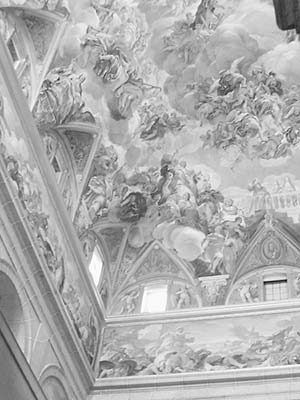
Detour briefly up the main staircase to marvel at Luca Giordano’s awe-inspiring ceiling fresco, The Glory of the Spanish Monarchy. The heavens open, revealing Jesus (near his cross), along with God the Father, the dove of the Holy Spirit, and countless saints and angels reclining on plush clouds. Just below the Trinity, find Philip II kneeling before them, holding two crowns they’ve blessed him with. To the right is his dad, Charles (holding the globe of his empire), and to the left is an adoring San Lorenzo. At the very bottom, a mortal on a balcony tells his friends, “Yep, that’s my family!” Luca Giordano painted this and a dozen other mammoth frescoes in the monastery in a mere 22 months—a testament to his nickname, “Speedy Luca!”
• Let’s see more art. At the end of the cloister’s first corridor, on the right, step into the...
Old Church (Iglesia Vieja)
This venerable space, predating El Escorial, had been used to inter several kings, and was where Philip lived during construction. Among the many paintings, look above the main altar for the powerful Martyrdom of St. Lawrence by Titian. Titian was Philip’s favorite painter, and this was supposed to be the glorious centerpiece of the basilica’s high altar. With its dramatic dark background and glowing coals, it was a masterpiece...but it turned out to be the wrong size.
• Continue circling the cloister. Along the next corridor, on the right, are the...
Chapter Rooms (Salas Capitulares)
These gloriously frescoed rooms, where monks gathered to do church business, evolved into a small art gallery.
As you enter, you’re face-to-face with El Greco’s Martyrdom of St. Maurice and the Theban Legion (1580-1582). Obsessed with saintly sacrifice, Philip II commissioned this scene to grace the basilica. But Philip was so disappointed, it wound up here. Why? Because El Greco made the actual beheading of the saint (lower left) an afterthought, while he focused on a moment he personally found more moving—when St. Maurice convinces his comrades not to give up on their Christian faith. Disappointed as Philip was, artistry wins out: Today, this is the most significant painting at El Escorial.
In the room on the left, look for another painting Titian did for his patron Philip—a Last Supper.
• Now head underground, to the land of the dead. Head into the room on the right and go down the stairs at the far end. You’ll pass a wall of wooden archive boxes, then go through a shop, then continue into the...
Pantheon of the Princes (Panteón de los Principes)
These corridors are filled with the tombs of lesser (nonruling) members of the royal family. Each bears that person’s name (in Latin), relationship to the king, and slogan or epitaph.
You’ll pass the evocative, wedding-cake Pantheon of Royal Children (Panteón de los Infantes), which holds the remains of royal children who died before the age of seven (and their first Communion). This is a poignant reminder of the scourge of child mortality back in those days, even among the super-wealthy.
• Continue down another hall, with more tombs of lesser royals. You’ll walk up a flight of stairs, then down a long stairway to reach the...
Royal Pantheon (Panteón Real)
This octagonal, marble-and-bronze-paneled room is the gilded resting place of 26 kings and queens...four centuries’ worth of Spanish monarchy in uniform gray-marble coffins, labeled with bronze plaques. In the room’s postmortem filing system, rulers are on the left, consorts on the right.
On the top shelf to the left of the altar is the great Charles (Carolvs) V, who ruled as Holy Roman Emperor during Spain’s golden age. He’s flanked by his Queen Isabel (labeled in German, Elisabeth). Their son and the builder of El Escorial, Philip II, rests below Charles, opposite his wife—the one (of four) who produced a ruling heir.
There are plenty of other illustrious kings, like Philip IV, who patronized Velázquez, and Charles III, the so-called “mayor” who beautified Madrid. The only female ruler buried on the left side is Isabel II, the backward-looking 19th-century queen who was toppled by a liberal revolution. The most recent tomb is Victoria Eugenia (bottom left, as you face the door), the great-grandmother of Spain’s current king, Felipe VI.
Will more recent royalty be buried here? There are two empty niches (above the door) ready to be filled. But this prime real estate comes with a waiting process. Before a royal corpse can rest here, it needs to decompose in a nearby room (closed to tourists) for at least 25 years. The deceased grandparents of the current king, Johannes III and Maria de Mercedibus, have been penciled in for burial as soon as their remains are ready. After that, where does that leave Felipe’s parents, Juan Carlos and Sofía, and Felipe himself, and monarchs still to come? This hotel seems to be completo.
• Head back up the stairs. As you ascend, consider this: El Escorial’s lower level was reserved for the dead. The middle level (with the basilica and cloisters) was for the Church. You’re now headed for the upper level—the royal residences.
Habsburg Palace (Palacio de los Austrias)
Among its many functions, El Escorial was a royal palace—a popular retreat from the heat and politics of Madrid, a place to meditate in the monastery and hunt in the mountains. This part of the palace is named for the Habsburg family dynasty—Charles V, Philip II, and so on—who ruled Spain for 200 years.
You begin in Philip II’s apartment. Look at the king’s humble bed...barely queen-size. Philip was notoriously austere, and when he stayed here he dropped royal trappings to focus on God. Speaking of God, remember (when we were in the basilica) that there was a private place for monarchs to attend Mass, with a view of the back of the altar and the front of the ancestors’ faces. Peek through the window.
The red box next to Philip’s pillow holds the royal bedpan. But don’t laugh—he’s looking down from the wall to your left. Philip lived a long and productive life and left El Escorial as his legacy. And at age 71, now gout-ridden and overseeing a dying empire, he died at his beloved El Escorial, here in this bed.
Continue on to the King’s Antechamber, with its fine inlaid-wood door, one of a set of five (a gift from the German emperor that celebrates the exciting humanism of the age). The slate strip angling across the room on the floor is a sundial from 1755. It lined up with a (now plugged) hole in the wall so that at noon a tiny beam hit the middle of the three lines. Palace clocks were set by this. Where the ray crossed the strip indicated the date and sign of the zodiac.
In the Walking Gallery that follows, the royals got their exercise privately, with no risk of darkening their high-class skins with a tan. Here and in the next rooms you find galleries filled with portraits of the—let’s be honest—quite unattractive Habsburg royals. Note the family resemblance: the jutting Habsburg jaw and lips. That’s the kind of thing you get when you mix blue blood with more blue blood (a common problem among Europe’s royals).
Find Charles V (1500-1558, King Charles I in Spain) over the fireplace mantel. As Holy Roman Emperor, Charles ruled over not only Spain but also Germany, Austria, the Low Countries, much of Italy, and the Americas. The guy with the red tights to the right of Charles is his illegitimate son, Don Juan de Austria—famous for his handsome looks, thanks to a little fresh blood.
But during Philip II’s reign, Spain was drained by war—including the naval defeat of the Spanish Armada by England (1588)—and went into decline. Later Habsburg rulers were ineffectual and inbred. Charles II (1665-1700, to the right of the door you came in), who suffered from epilepsy, had a severe underbite. Dubbed “Charles the Mad,” he was the last of the Spanish Habsburgs. He died without an heir in 1700, ushering in the War of the Spanish Succession, the dismantling of Spain’s empire, the rise of France’s Bourbon dynasty...and the need for a new wing in El Escorial. (But we’re getting ahead of ourselves.)
For now, continue through the Habsburg wing, noticing the adjustable sedan chair that Philip II, thick with gout, was carried in (for seven days) on his last trip from Madrid to El Escorial. He wanted to be here when he died.
Go through the Guards’ Room to the King’s Apartments and find the small portrait of Philip II flanked by two large paintings of his daughters. The palace was like Philip: austere. Notice the simple floors, plain white walls, and bare-bones chandelier. Peek into the bedroom of one of his daughters, Isabel Clara Eugenia. The sheet warmer beside her bed was often necessary during the winter. If the bed curtains are drawn, bend down to see the view from her bed...of the high altar in the basilica next door. The entire Habsburg Palace was built in a U-shape around that venerated altar.
• Go up several stairs to the...
Hall of Battles (Sala de Batallas)
The paintings celebrate Spain’s great military victories—including the one that brought us El Escorial. It was the Battle of San Quentin, won on the feast day of St. Lawrence (August 10, 1557), that inspired Philip II to construct El Escorial. The sprawling series of paintings (1590) helped teach later kings the elements of military tactics and formations. (To follow along, note that Spain flew the white-and-red flags, France the blue.)
• Continue through a door next to the one you entered to the...
Bourbon Palace (Palacio de los Borbones)
These royal apartments—the frilly yin to the Habsburgs’ austere yang—housed Spain’s next (and current) dynasty, the Bourbons.
Around 1700, the Habsburgs were defeated by Europe’s rising power, France, and the French grandson of Louis XIV became king of Spain. The Bourbons turned this wing into a mini Versailles: chandeliers, mirrors, heavy drapes, and elaborate Baroque furniture. They also loved high-art tapestries, for both insulation and decoration. Hunting scenes were popular, as this was their main activity when they retreated here. Many tapestries came from the Royal Tapestry Factory in Madrid (which you can still visit today).
In the first room (the Banqueting Hall), the Dance on the Banks of the Manzanares Canal was designed by the great painter Goya. Continuing on, you’ll find more Goya tapestries depicting cheery scenes of Bourbon aristocrats frolicking in their carefree lives, while Europe’s poor plotted revolution. As you pass through room after sumptuous room, listen for the ticking of the royal clock collection...while you ponder the ticking of Time. How Philip II built El Escorial, then passed it down through the later Habsburgs, to the Bourbons...to today’s King Felipe VI, the great-great-great-great-great-great-great-great-great grandson of France’s “Sun King,” Louis XIV.
• Our tour is done. From here, you can check out temporary exhibits just past the cloakroom, or head outside. To get a nice view of El Escorial from its fine gardens—rather than the stark plaza that surrounds it on two sides—you can head to...
El Escorial Gardens
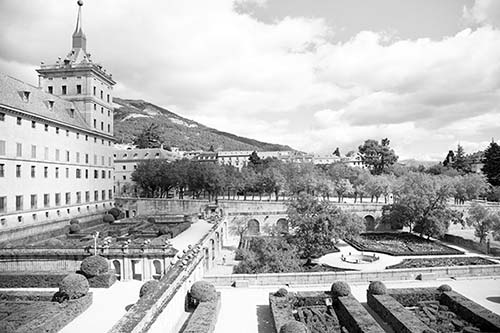
To reach the gardens (free to enter), circle all the way around the right side of the building as you face it. Going beneath the arcade running over the road, look left for the garden entrance. While the gardens are as stark and geometrical as the building itself (with sharply manicured hedges rather than flowers and trees), this is where you’ll enjoy the best views of El Escorial—especially in the afternoon light. Listen for a nagging peacock and enjoy the views over the wooded hillsides to the distant skyscrapers of Madrid.
NEAR EL ESCORIAL: PHILIP’S SEAT
Drivers can visit the nearby Silla de Felipe II (Philip’s Seat), a rocky viewpoint where the king would come to admire his palace as it was being built. It’s well marked from M-505, which runs between Madrid and Ávila. If you leave El Escorial by first heading back toward Madrid and then turning off for Ávila, you’ll see the turnoff to Philip’s Seat on your left after about a mile. It’s a couple minutes’ drive up a twisty road to a hill adjacent to the monastery.
Valley of the Fallen
Six miles from El Escorial, high in the Sierra de Guadarrama Mountains, is the memorial site commonly known as the Valley of the Fallen (Valle de los Caídos). Here a 500-foot-tall granite cross sits atop an immense underground basilica that serves as a monument to victims of Spain’s 20th-century nightmare—the Spanish Civil War (1936-1939). That conflict is still extremely controversial in Spain today—it’s rarely commemorated by monuments or even addressed in museums—and this site is itself marked by division.
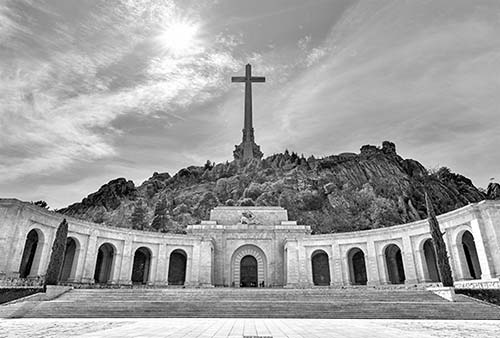
The valley was officially renamed the Valley of Cuelgamuros in 2022, and you may see that name here and there, but the old Valley of the Fallen name still prevails in popular use. The monument was built in the 1940s and ’50s partly using the labor of political prisoners, and was originally intended to memorialize members of Franco’s Nationalist forces. That plan was revised to honor victims on both sides—which resulted in thousands of Republicans being exhumed and reburied here in unmarked graves, without the knowledge or consent of their families. Upon his death in 1975, Franco himself was buried here, turning the monument into a pilgrimage site for his enthusiasts. In 2019, after years of debate, his remains were moved to his wife’s mausoleum in the Mingorrubio Cemetery in El Pardo, a suburb of Madrid.
All of that makes the Valley of the Fallen, a.k.a. the Valley of Cuelgamuros, a powerful, sobering visit for anyone interested in 20th-century history (or monumental fascist architecture).
GETTING THERE
Most visitors side-trip to the Valley from El Escorial. If you don’t have your own wheels, the easiest way to get between these two sights is to negotiate a deal with a taxi to take you here from El Escorial, wait 30-60 minutes, and then bring you back to El Escorial (figure €45 total). There is a local bus, but it’s not very frequent or convenient (it drops you three miles from the site).
Drivers can find tips under El Escorial’s “Getting There—By Car,” earlier. Pay at the booth as you enter from the main road, then drive about three miles through a pine forest to the site itself. A big parking lot is next to the café, a short walk from the basilica.
ORIENTATION TO THE VALLEY
Cost and Hours: €9, Tue-Sun 10:00-19:00, Oct-March until 18:00, closed Mon year-round, +34 918 905 902, www.patrimonionacional.es.
Mass: You can enter the basilica during Mass, but you can’t sightsee the central area or linger afterward. One-hour services run Tue-Sat at 11:00 and Sun at 11:00, 13:00, and 17:30 (17:00 in winter). During services, the entire front of the basilica (altar and tombs) is closed. Mass is usually accompanied by the resident boys’ choir, the “White Voices” (Spain’s answer to the Vienna Boys’ Choir).
Visitor Services: There’s a $$ café with WCs at the site’s main parking lot.
VISITING THE VALLEY
The main thing to see at the Valley of the Fallen/Valley of Cuelgamuros is the basilica interior. While the cross at the top of the monument is undergoing a lengthy restoration, there is no access to it by funicular or by foot along the trail (marked Sendero de la Cruz). Given that, an hour is enough for a quick visit.
Approaching by car or bus, you enter the sprawling park through a granite gate. The best views of the cross are from the bridge (but note that it’s illegal for drivers to stop anywhere along this road). On the right, tiny chapels along the ridge mark the stations of the cross, where pilgrims stop on their hike to this memorial.
In 1940, prison workers dug 220,000 tons of granite out of the hill to form an underground basilica, then used the stones to erect the cross (built like a chimney, from the inside). Since it’s built directly over the dome of the subterranean basilica, a seismologist keeps a careful eye on things.
The stairs that lead to the imposing monument are grouped in sets of tens, meant to symbolize the Ten Commandments (including “Thou shalt not kill”—hmm). The emotional pietà draped over the basilica’s entrance is huge—you could sit in the palm of Christ’s hand. The statue was sculpted by Juan de Ávalos, the same artist who created the dramatic figures of the four Evangelists at the base of the cross. It must have had a powerful impact on mothers who came here to remember their fallen sons.
A solemn silence and a stony chill fill the basilica. At 300 yards long, it was built to be longer than St. Peter’s...but the Vatican had the final say when it blessed only 262 of those yards. It’s nearly empty inside, making it feel much larger.
After walking through the two long vestibules, stop at the iron gates of the actual basilica. The line of torch-like lamps adds to the shrine-like ambience. Franco’s prisoners, the enemies of the right, spent a decade digging this memorial out of solid rock. (Though it looks like bare rock still shows on the ceiling, it’s just a clever design.) The sides of the monument are lined with copies of 16th-century Brussels tapestries of the Apocalypse, and alabaster statues of the Virgin Mary perch above the arches of the side chapels. Notice the hooded figures peering out at you all over the space.
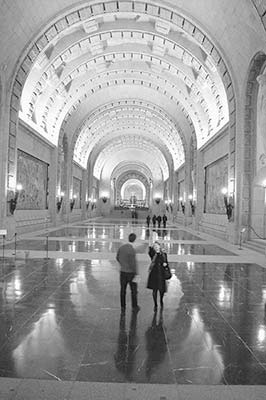
Take the long walk down the nave, then up 10 steps into the main part of the church, populated with rough wooden pews. Under a glittering mosaic dome is the high altar. At the base of the dome, four gigantic bronze angels look down over you.
Interred behind the high altar and side chapels (marked “RIP, 1936-1939, died for God and country”) are the remains of approximately 34,000 people, including both Franco’s Nationalists and the 12,000 or so anti-Franco Republicans who lost their lives in the war (the urns are not visible). This is also where Franco was interred until his body was moved to Madrid in 2019—you might still see flowers strewn on the site of Franco’s original grave.
In front of the altar was the grave of José Antonio Primo de Rivera (1903-1936), the founder of Spanish fascism, killed by Republicans during the civil war. In 2023 his remains, like Franco’s, were moved to a family plot in Madrid. Next to the former location of Primo de Rivera’s grave, the statue of a crucified Christ is lashed to a timber Franco himself is said to have felled. The seeping stones seem to weep for the victims.
Today, families of the buried Republicans and Nationalists, along with many Spaniards, remain conflicted about this site and what its future should hold. The war is still a deep wound in Spanish society, and the sight inspires heavy emotions.
As you leave, stare into the eyes of those angels with swords and think about all the “heroes” who keep dying “for God and country,” at the request of the latter.
The expansive view from the monument’s terrace includes the peaceful, forested valley and sometimes snow-streaked mountains.
Segovia
A beautiful city built along a ridge, Segovia is one of Madrid’s most tempting day trips...and even better overnight. Fifty miles from Madrid, this town of 55,000 boasts a thrilling Roman aqueduct, a grand cathedral, and a historic castle. In days past, Segovia was a Roman town, a medieval trade center, and a perennial favorite of the kings and queens of Castile.
With its echoes of that history, Segovia remains one of Spain’s most pleasant towns. Since the city is more than 3,000 feet above sea level and just northwest of a mountain range, it’s exposed to cool northern breezes, and people come here from Madrid for a break from the summer heat. It’s a fun place to simply hang out and enjoy some low-impact sightseeing.
Day-Tripping from Madrid: Considering the easy train and bus connections, Segovia makes a fine day trip from Madrid (30 minutes one-way by AVE train, 1.5 hours by bus). The disadvantage of this plan is that you’ll miss the charming evening scene in Segovia, and you’ll pay more for a hotel in Madrid than in Segovia. If you have time, spend the night. But even if you just stay the day, Segovia offers a rewarding and convenient break from the big-city intensity of Madrid.
GETTING THERE
To link Madrid to Segovia, choose between the fast AVE train and the bus. Even though the 30-minute AVE train takes less than half as long as the bus, the train stations in Segovia and Madrid are less convenient, so the total time spent in transit is about the same. (Skip the cercanías commuter trains, which take two hours and don’t save you much money.)
The AVE train goes from Madrid’s Chamartín station to Segovia’s Guiomar station (labeled “Segovia AV” on booking sites, up to 4/hour, 30 minutes). The station is a few miles outside of town, linked by city bus #11 to the base of the aqueduct (see details later, under “Arrival in Segovia”).
Buses run from Madrid’s Moncloa station to Segovia (2/hour, 1.5 hours, www.avanzabus.com [URL inactive]). To find the bus at Moncloa station, follow signs to Terminal 1 (blue). From there, signs marked Taquillas Segovia lead you to the ticket office, or look for the ticket machines.
When riding the bus from Madrid to Segovia, about 30 minutes after leaving Madrid you’ll see—breaking the horizon on the left—the dramatic concrete cross of the Valley of the Fallen/Valley of Cuelgamuros. Its grand facade marks the entry to the mammoth underground memorial.
Orientation to Segovia
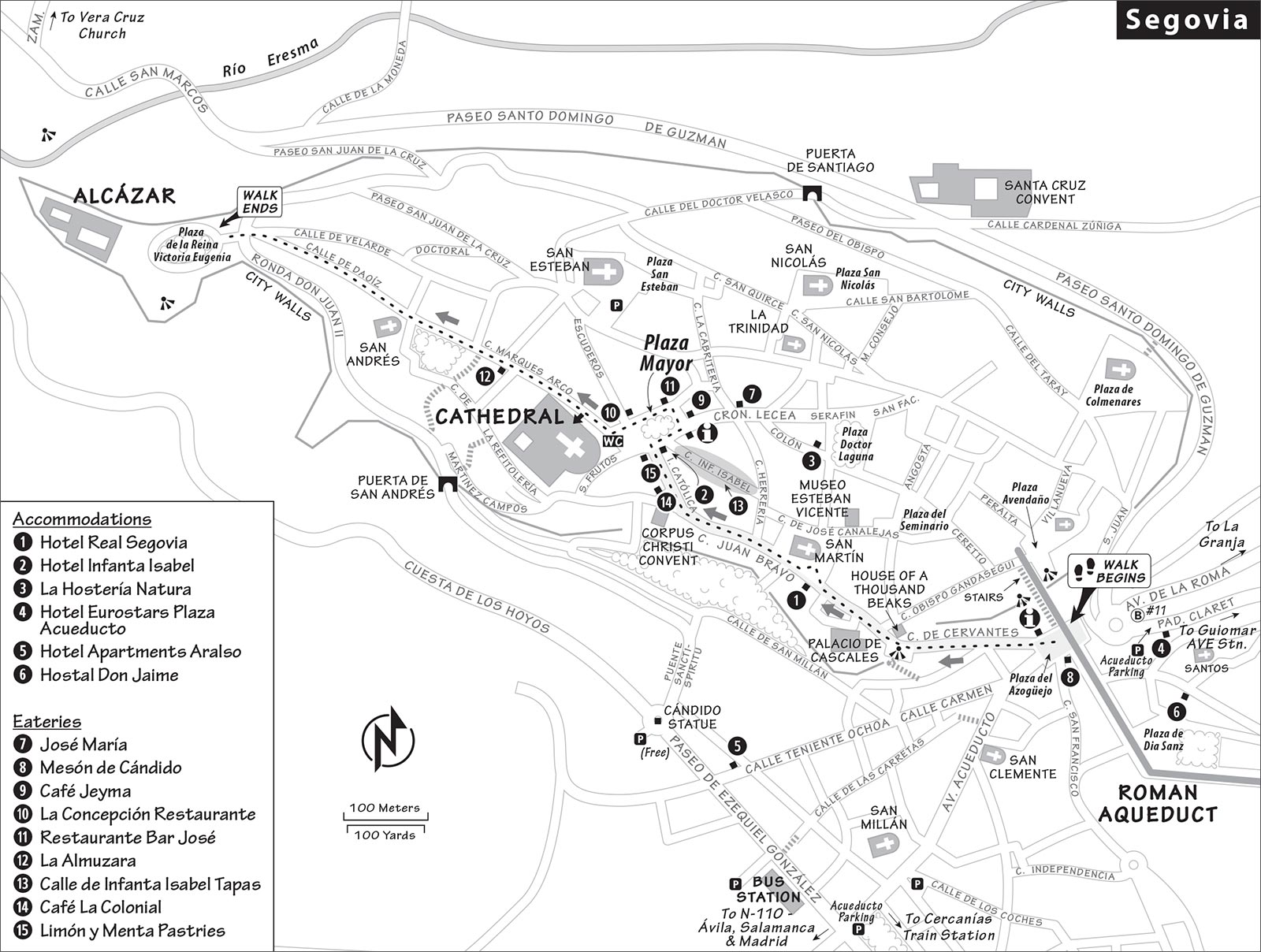
Segovia is a medieval “ship” ready for your inspection. Start at the stern—the aqueduct—and stroll up Calle de Cervantes and Calle Juan Bravo to explore the tangle of narrow streets around playful Plaza Mayor, head for the prickly Gothic masts of the cathedral, and then descend to the Alcázar at the bow.
Tourist Information: The TI at Plaza del Azogüejo, at the base of the aqueduct, specializes in Segovia and has friendly staff, two wooden models of Segovia helpful for orientation, a €5 city audioguide, pay WCs, and a gift shop (Mon-Sat 10:00-19:00, Sun until 15:00, +34 921 466 720, www.turismodesegovia.com). A different TI, on Plaza Mayor, covers both Segovia and the surrounding region (at #10; Mon-Sat 9:30-14:00 & 16:00-19:00, Sun 9:30-17:00, shorter hours off-season, +34 921 460 334, www.turismocastillayleon.com). A smaller TI at the Guiomar AVE train station opens for weekend day-trippers (Sat-Sun 10:00-13:30 only, east of town, +34 921 447 262).
ARRIVAL IN SEGOVIA
If day-tripping from Madrid, confirm the return schedule when you arrive here.
By Train: Trains arrive at the AVE train station (called Guiomar) about four miles from the center. It has no luggage storage. From the station, take a taxi or ride bus #11 for 20 minutes to the base of the aqueduct (buses are timed to meet arriving trains). Bus #12 also takes you into town, but it drops you off at the bus station, a 10-minute walk to the aqueduct.
By Bus: You’ll find luggage storage near the exit from the bus station (tokens sold daily 9:00-14:00 & 16:00-19:00, gives you access to locker until end of day). It’s a 10-minute walk from the bus station to the town center: Exit left out of the station, continue straight across the street, and follow Avenida Fernández Ladreda, passing San Millán church on the left, then San Clemente church on the right, before coming to the aqueduct.
By Car: It’s best not to drive into the heart of town, which requires maneuvering your car uphill through tight bends. The Acueducto Oriental Parking garage is a good option—it’s located at the foot of the aqueduct and easy to find upon entering town.
If you must park in the old town, look for spots marked with blue stripes, pay the nearby meter, and place the ticket on your dashboard (pay meter every 2 hours; free parking 20:00-9:00, Sat afternoon, and all day Sun).
HELPFUL HINTS
Free Churches: Segovia has plenty of little Romanesque churches that are free to enter shortly before or after Mass (see TI for a list of times). Keep your eyes peeled for these hidden treasures: Church of Santos Justo y Pastor, above the aqueduct; San Millán church on Avenida Fernández Ladreda; San Martín church, on a square of the same name; and San Andrés church on the way to the Alcázar on Plaza de la Merced.
Shopping: A flea market is held on Plaza Mayor on Thursdays (roughly 8:00-15:00, food also available).
Local Guide: Knowledgeable Leticia Pascual Valero is a friendly Segovian guide who can take you through the city and its monuments (€130-180 for 2-4 hours, +34 653 028 088, guiasensegovia@gmail.com).
Group Tours: The TI on Plaza del Azogüejo, at the base of the aqueduct, offers a two-hour “World Heritage” tour in English (€16, includes entrance to the Alcázar and sometimes the cathedral, check schedule and reserve at TI).
Walk with a View: With its trio of visually striking landmarks (aqueduct, cathedral, Alcázar) perched atop a ridge, Segovia boasts a striking skyline when seen from a distance. If you’re up for a longish walk, consider following the valley road all the way around the base of Segovia’s promontory. Much of the route is labeled Ruta Turística Panorámica. From the bus-station area, follow Cuesta de los Hoyos west, looping around under the Alcázar (with striking views of its Disney-like towers). Then, when you cross the river, turn right and hook back around the north side of town—detouring to the Vera Cruz church. From there, you can take the steep trail back up to the Alcázar, or continue all the way along the river, then cut back up to the aqueduct.
Segovia Walk
Most people park outside town, ogle the Roman aqueduct, and make a beeline for the Alcázar. There’s lots to see along the way, though, so I’ve narrated the route in this 30-minute self-guided walk. We’ll start at the Roman aqueduct, hike uphill along the pedestrian-only street to the main square (with the cathedral and collection of sights), then continue down to the Alcázar.
While you can use this walk to visit Segovia’s main sights during daylight hours, it’s also enjoyable just before dinner, when the town is cool and filled with strolling Segovians.
• Start where Segovia’s history did, at...
Plaza del Azogüejo and the Roman Aqueduct
This lively square, often made livelier by a cheery carousel, is named “small market” (compared to the big market—Plaza Mayor—at the end of this walk).
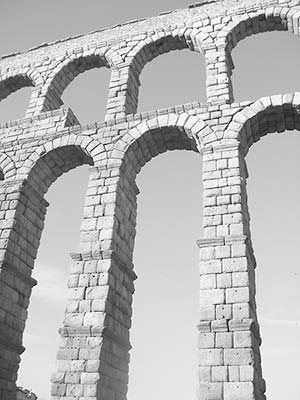
The square is dominated by Segovia’s defining feature: its 2,000-year-old acueducto romano—worth ▲▲. Ancient Segóbriga was approximately the same size as today’s Segovia—with some 50,000 inhabitants, including soldiers at a military base, all of whom needed a reliable water supply. Emperor Trajan’s engineers built a nine-mile aqueduct to channel water from the Río Frío to the city, culminating at the Roman castle (today’s Alcázar). Though most of that conduit was underground, this elegant, double-arched bridge was needed to keep the precious stream of water flowing evenly across this stretch of valley. It’s an impressive structure: 2,500 feet long and 100 feet high, with 118 arches, made from 24,000 granite blocks without any mortar, and still carrying a stream of water.
The aqueduct was damaged in the Reconquista warfare of the 11th century and was later rebuilt by Queen Isabel. It functioned until the late 19th century. Notice the cross at the base and the statue in the high niche of the Virgen de la Fuencisla—Segovia’s patron saint. (In Roman days this held a statue of Hercules.)
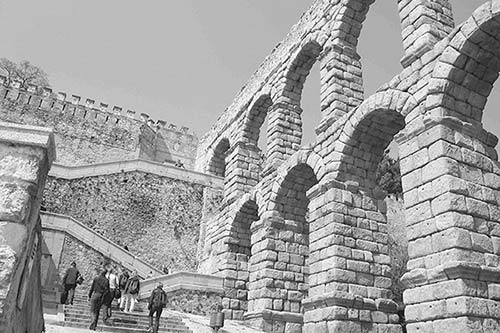
From the square, a grand stairway leads from the base of the aqueduct to the top—offering close-up looks at the imposing work and a sweeping water’s-eye-view panorama over the length of the aqueduct. Back at ground level, as you walk through Segovia’s streets, keep an eye out for small plaques depicting the arches of the aqueduct, which tell you where the subterranean channel runs through the city.
Facing the square is the flashy Mesón de Cándido—the most famous of many Segovia restaurants serving the local specialty, roast suckling pig (cochinillo asado; for recommended places to try this specialty, see “Eating in Segovia,” later). On the other side of the aqueduct is a practical little roundabout where buses zip to and from the AVE train station.
• You’ll now move on from Segovia’s Roman birthplace to its medieval core. Head up...
Segovia’s Main Street
With the aqueduct at your back, head uphill on Calle de Cervantes, appreciating the workaday nature of the town and some of its more imaginative architecture. This street is known as the Calle Real—the “Royal Street”—because it leads, eventually, to the Alcázar.
Pause after about a block, at the gap in the buildings on the left, and enjoy the viewpoint (Mirador de la Canaleja). Survey the rooftops of Segovia’s lower neighborhood, San Millán, and notice how the city is carved out of a very hilly terrain. On the horizon are the often-snowcapped Sierra de Guadarrama mountains that separate Segovia and Madrid.
Continue up the street, where there’s a reminder of the next phase of Segovia’s history—the medieval mix of Islamic and Christian elements. Just uphill on the right is the unmistakably prickly facade of the so-called “house of a thousand beaks” (Casa de los Picos). This building’s original Moorish design is still easy to see, despite the wall just past the door that blocks your view from the street. This wall, the architectural equivalent of a veil, hid this home’s fine courtyard—Moors didn’t flaunt their wealth. You can step inside to see art students at work and perhaps an exhibit, but it’s most interesting from the exterior.
Notice the house’s truncated tower at its uphill end—one of many fortified towers that marked the homes of feuding local noble families. In medieval Spain, clashing loyalties led to mini civil wars. In the 15th century, as Ferdinand and Isabel centralized authority in Spain, nobles were required to lop their towers. You’ll see the once-tall, now-stubby towers of 15th-century noble mansions all over Segovia.
Continue up the main drag (which has now become Calle de Juan Bravo). About 50 yards farther up at tiny Plaza del Platero Oquendo sits the Palacio de Cascales, another example of a once-fortified, now-softened house with a cropped tower. Notice the brick horseshoe arch, an example of Mudejar-style architecture, the influence of Moorish artisans working for Christians. The floral and geometrical pattern on the facade is called esgrafiado. You will see this stucco style, originally from the 15th and 16th centuries, all over Segovia, even on more contemporary buildings. This palace is now an administrative building—push on the door to see if it’s open. If it is, go in to check out the traditional Segoviano courtyard patio with more interior esgrafiado, a well, and a beautiful stained-glass ceiling.
Continue uphill until you come to the complicated Plaza de San Martín, a commotion of history surrounding a striking statue of Juan Bravo. When Spain’s King Charles V, a Habsburg who didn’t even speak Spanish, took power, he imposed his rule over Castile. This threatened the local nobles, who, inspired and led by Juan Bravo, revolted in 1521. Although Juan Bravo lost the battle—and his head—he’s still a symbol of Castilian pride. This statue was erected in 1921, on the 400th anniversary of his death.
In front of the Juan Bravo statue stands the bold and bulky House of Siglo XV. Its fortified isabelino style was typical of 15th-century Segovian houses before the boldness of these houses was softened with the esgrafiado decorative stucco. The 14th-century Tower of Lozoya, behind the statue, is another example of the lopped-off towers.
On the same square, the 12th-century Church of St. Martín was built as Christians were reinhabiting the formerly Islamic city. The style is Segovian Romanesque: a mix of Christian Romanesque (clustered columns with narrative capitals) and Moorish styles (minaret-like towers built with bricks).
• Although our walk doesn’t stop here, fans of modern art should consider at some point checking out the nearby...
Museo de Arte Contemporáneo Esteban Vicente
A collection of abstract art by local artist Esteban Vicente (1903-2001) is housed in two rooms of the remodeled remains of the 1455 palace of Isabel’s half-brother Henry IV. Wilder than Rothko but more restrained than Pollock, Vicente’s vibrant work influenced post-WWII American art. The place is a good reminder that Segovia’s long cultural heritage lives on.
Cost and Hours: Free; Tue-Fri 11:00-14:00 & 16:00-19:00 (July-Sept 17:00-20:00), Sat 11:00-20:00, Sun until 15:00, closed Mon; +34 921 462 010, www.museoestebanvicente.es.
• Continue up the street another 100 yards, until you reach a triangular square, Plaza del Corpus.
Corpus Christi Convent and Jewish Quarter
The Gothic arch on the left is the entrance to the Corpus Christi Convent. For €1, you can pop in to see the Franciscan church, which was once a synagogue, and before that, a mosque (closed Tue and Fri). It is sweet and peaceful, with lots of art featuring St. Francis, and allows you to see the layers of religious history here. Also in the building’s entryway, look for the little window where cloistered nuns sell the treats they make on the premises.
Back out on the little square, notice the narrow street forking off to the left, which leads to Segovia’s former Jewish quarter. For two centuries (c. 1200-1400), Segovia hummed with a vibrant community of Jews. (Still, as throughout Europe, Jews were relegated to the less-desirable land—lower on the hill, and therefore more vulnerable to attackers.) This neighborhood thrived until anti-Jewish sentiment bubbled up across Spain, culminating in Isabel’s expulsion of all Jews from Spain in 1492. While there’s not much left from this time, those with a special interest can follow this street a couple of blocks down. The columned building on the left (at #12) was once the house of Abraham Seneor, who was a rabbi and an accountant for Spain’s royal family. This building now holds municipal offices, as well as an information center about the Jewish story of Segovia.
• From the Corpus Christi Convent, take the right fork up to inviting...
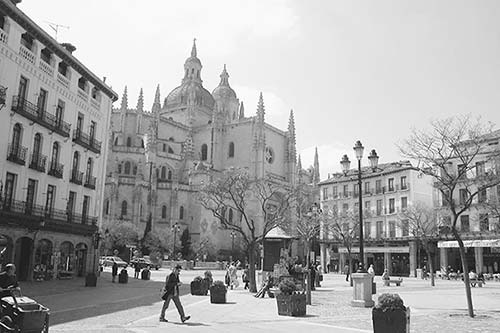
Plaza Mayor
As Segovia’s main square for centuries, this has been the scene of colorful spectacles of all sorts. In medieval times there were executions and performances of religious theater. In 1474, Isabel was proclaimed Queen of Castile here. (It was at the San Miguel church—since replaced with a Renaissance structure—opposite the twin-spired City Hall and behind the TI.) Bullfights were also staged here, with spectators jamming the balconies. When the bullfights ended in the 19th century, grumbling Segovians were given a gentler form of entertainment—bands in the gazebo. To bring Segovia’s history full-circle, find the symbol of Segovia’s aqueduct—where you started—in the seals on the Theater Juan Bravo and atop the City Hall.
Today, the very best entertainment is simply enjoying some tapas and a drink in your choice of the many restaurants and cafés lining the square. Finally, treat yourself to the town’s specialty pastry, ponche segoviano (marzipan cake), at the recommended Limón y Menta, the bakery on the corner where you entered Plaza Mayor.
• Our walk now continues toward two of Segovia’s greatest sights. The first has its prickly hind end abutting Plaza Mayor—the massive...
Segovia Cathedral (Catedral de Segovia)
Segovia’s cathedral (worth ▲▲) is the grandest legacy of the city’s peak of prosperity in the 1500s. Built from 1525 through 1768 (the third on this site), it was Spain’s last major Gothic building. Embellished to the hilt with pinnacles and flying buttresses, the exterior is a great example of the final, overripe stage of Gothic, called Flamboyant. Yet the Renaissance arrived before it was finished—as evidenced by the fact that the cathedral is crowned not by a spire but by a dome. The spacious and elegantly simple interior provides a delightful contrast to the frilly exterior.
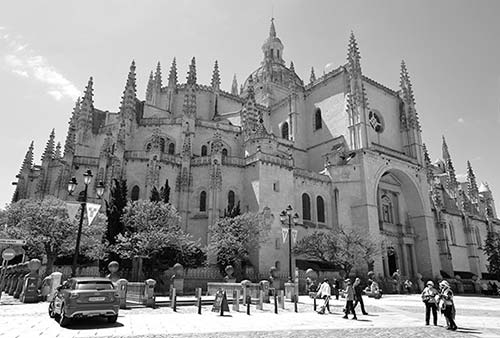
Cost and Hours: Cathedral—€4, combo-ticket with tower—€10, free on Sun mornings 9:00-10:00 and in Nov-March 9:30-10:30 (cathedral access only—no cloisters); open daily 9:30-21:30, Nov-March until 18:30; tower visits by guided tour only, tours depart every 90 minutes 10:30-19:30 (fewer in winter), English tour at 15:00; +34 921-462-205, https://catedralsegovia.es.
Visiting the Cathedral: As you enter, angle right to the choir, which features finely carved wooden stalls from the previous church (1400s). The cátedra (bishop’s chair) is in the center rear of the choir.
The many side chapels are mostly 16th-century and come with big locking gates—a reminder that they were the private sacred domain of the rich families and guilds that “owned” them. They could enjoy private Masses here with their names actually spoken in the blessings and a fine burial spot close to the altar.
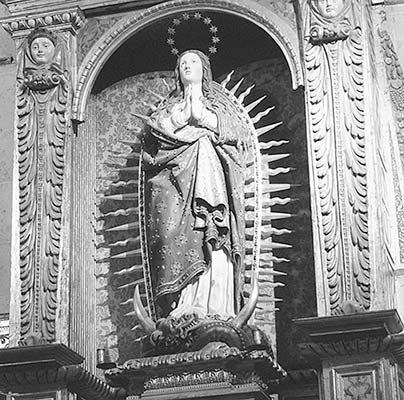
Find the Capilla La Concepción (as you face the choir, it’s the last chapel ahead on the right, just inside the door to the terrace). Its many 17th-century paintings hang behind a mahogany wood gate imported from colonial America. The painting, Tree of Life, by Ignacio Ries (left of the altar), shows hedonistic mortals dancing atop the Tree of Life. As a skeletal Grim Reaper prepares to receive them into hell (by literally chopping down the tree...timberrrr), Jesus rings a bell imploring them to wake up before it’s too late. The chapel’s center statue is Mary of the Apocalypse (as described in Revelations, standing on a devil and half-moon, which looks like bull’s horns). Mary’s pregnant, and the devil licks his evil chops, waiting to devour the baby Messiah.
Opposite from where you entered, a fine portal (which leads into the cloister) is crowned by a painted Flamboyant Gothic pietà in its tympanum.
Step through that portal into the cloister, turn right, and circle counterclockwise. The first room you’ll come to is a nice little museum containing paintings and silver reliquaries. Continuing around the cloister, the next door leads into the sumptuous, gilded chapter room—draped with precious Flemish tapestries. Out in the bottom of the stairwell, notice the gilded wagon. The Holy Communion wafer is placed in the top of this temple-like cart and paraded through town each year during the Corpus Christi festival. At the top of the stairs is a collection of tapestries and vestments under delicate fan vaulting. Back out in the cloister, hanging on the wall between rooms, a glass case displays keys to the 17th-century private chapel gates. Circle the rest of the way around the cloister, enjoying the peace. From the cloister courtyard, you can see the Renaissance dome rising above the otherwise Gothic rooftop.
The 290-foot tower offers stunning views of the city and the surrounding area. You can climb 190 steps to the top on a guided tour several times a day (enter directly opposite the Capilla La Concepción).
• The final stop on our walk is the Alcázar, which is 10 minutes from the cathedral along Calle Marques del Arco (which becomes Calle Daoíz). You approach the Alcázar through a small park with a monument to those “heroes of May 2” who bravely but vainly resisted the 1808 invasion of Spain by the French (symbolized by the pesky eagle). Until 1808, Segovia had never been overrun, thanks to its mighty...
Alcázar
Segovia has one of the most fanciful, striking castles in all of Spain, thanks to a Romantic Age faux-medieval remodel job, and is worth ▲▲ to visit. It’s the closest thing Spain has to its own Neuschwanstein. A castle has stood on this spot since around 1100. Throughout the Middle Ages, this fortified palace was one of the favorite residences of the monarchs of Castile and a key fortress for controlling the region. The Alcázar grew through the ages, and its function changed many times: After its stint as a palace, it was a prison for 200 years, and then a royal artillery school. It burned in 1862, after which it was remodeled in the eye-pleasing style you see today. First ogle the exterior. Then visit the finely decorated interior and view terrace. And finally—if you don’t mind the steps—climb to the top of the tower for the only 360-degree city view in town. This description quickly covers the highlights, but the audioguide is a good investment if you’d like the full story.
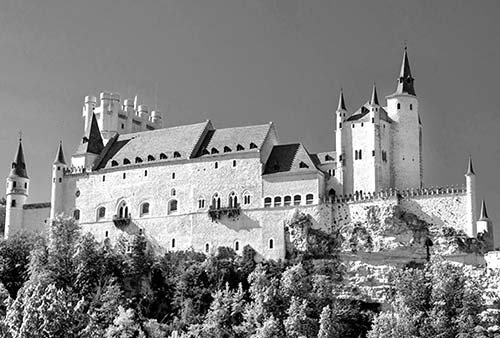
Cost and Hours: Palace—€7, tower—€3, daily 10:00-20:00, Nov-March until 18:00, €3 audioguide describes each room (45 minutes, €5 deposit), tower closed in windy or rainy weather, +34 921 460 759, www.alcazardesegovia.com.
Visiting the Alcázar: Buy your ticket in the building on the left as you face the Alcázar (and ask for a map near the ticket desk). Then head over the drawbridge. Peer down into the deep, deep “moat,” and appreciate the strategic smarts of building a castle on a promontory at the tip of Segovia’s ridge.
Once inside, follow signs to the start of the tour. You’ll enjoy a one-way route through 11 royal rooms. What you see today inside the Alcázar is rebuilt, like the outside—a Disney-esque exaggeration of the original. Still, its fine Moorish decor and historic furnishings are fascinating. The sumptuous ceilings are accurately restored in Mudejar style.
Entering the exhibit, you’ll be greeted by knights on horseback, then find your way to the Throne Room, whose ceiling is the artistic highlight of the palace. Facing the throne are portraits of Ferdinand and Isabel, whose union made Spain a medieval powerhouse. Imagine teenage Isabel before her famous marriage, growing up in this castle: reading, embroidering, taking music lessons, and learning the strategy of chess.
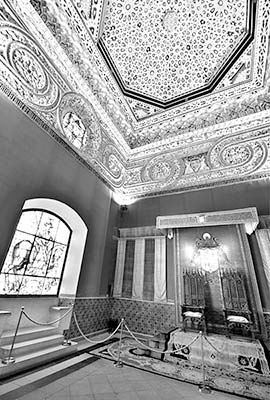
Next, in the Gallery Room—with another fine ceiling—is a big mural of Queen Isabel the Catholic being proclaimed Queen of Castile and León in Segovia’s main square in 1474. Enjoying the views of the countryside from the huge windows, it’s clear the current building was designed in the “just for show” late 19th century, rather than the original “danger lurks around every corner” Middle Ages.
Continue through more rooms, including the Pine Cone Room, where 392 pinecone-shaped adornments hang from the Mudejar ceiling. The Royal Bedroom is made cozy by hanging tapestries on the stony walls.
Pause to savor the striking Hall of the Monarchs. The upper walls feature statues of the 52 rulers of Castile and León who presided during the long and ultimately successful Reconquista (711-1492) and the two decades afterward: from Pelayo (the first, over the room’s exit door and a bit to the left), clockwise to Juana VII (the last). Alfonso VI reconquered Castile from the Moors, turning Segovia Christian. Alfonso the Wise was one of several monarchs who made Segovia’s Alcázar their home. Another resident, Henry IV, “The Impotent,” died childless, paving the way for his half-sister Isabel to assume the throne and change history. There were only seven queens during the period (the numbered ones).
From here, head through the small, window-lined Cord Room (decorated with the cord-like belts of the Franciscan order) to reach the chapel. As you face the main altar, notice the painting in the center of the altar on your left: a scene of St. James the Moor-Slayer—with Muslim heads literally rolling at his feet. James is the patron saint of Spain. His name was the rallying cry in the centuries-long Christian crusade to push the Muslim Moors back into Africa.
Exiting the royal rooms, step into the modest armory. The finest item is the 16th-century, ornately carved ivory crossbow, with a hunting scene shown in the accompanying painting.
From the armory, step out onto the terrace (the site of the original Roman military camp, circa AD 100; may be closed in winter and in bad weather). Taking in its vast views, marvel at the natural fortification provided by this promontory cut by the confluence of two rivers. The Alcázar marks the end (and physical low point) of the gradual downhill course of the nine-mile-long Roman aqueduct. Can you find the mountain nicknamed Mujer Muerta (“dead woman”)?
On your way back out, you can cut through the Museum of Artillery, recalling the period (1764-1862) when this was the royal artillery school. It shows the evolution of explosive weaponry, with old photos and prints of the Alcázar.
Finally, back at the drawbridge, you can choose to climb the tower. Hiking 152 steps up a tight spiral staircase rewards you with sweeping views over the town and the countryside...all in all, a satisfying end to our Segovia walk.
Sights near Segovia
The three big sights in Segovia are its aqueduct, cathedral, and the Alcázar—all covered on the “Segovia Walk,” earlier. Two sights nearby are worth knowing about.
▲Vera Cruz Church
Perched on a ridge below the Alcázar is this unusual, historic church. Built in the 13th century by an order of chivalric knights (possibly the Knights Templar), this 12-sided Romanesque church once supposedly housed a piece of the “true cross.” Pick up an English flier at the entrance and step into the simple, nearly unadorned interior, where you’ll find a unique floor plan: a circular nave ringing a giant central column called an edicule. The inner chamber was used for chivalrous ceremonies. (While this architecture was typical of churches built by knights’ orders, few survive today.) You’ll see the red Maltese cross, signifying that the church is linked with the Knights Hospitaller, who still use it from time to time. With its unique shape and history, the space carries a mystical feeling. And the views back up to the Alcázar from here are excellent as well.
Cost and Hours: €2.50; Tue 16:00-19:00, Wed-Sun 10:30-13:30 & 16:00-19:00, off-season until 18:00, closed Mon and when caretaker takes an autumn holiday; outside town beyond the castle, 25-minute walk from main square; +34 921 431 475.
▲La Granja de San Ildefonso Palace
This “little Versailles,” six miles south of Segovia, is another royal residence, more pastoral than Segovia’s Alcázar and cozier than El Escorial. La Granja’s palace and gardens were a favorite of Spain’s Bourbon rulers, whose family roots were in France. It was built by a homesick Philip V, the grandson of Louis XIV. Today it’s restored to its original 18th-century splendor, with its royal collection of tapestries, clocks, and crystal (actually made at the palace’s royal crystal factory). Plumbers and gardeners imported from France and Italy made Philip a garden that rivaled Versailles’. The Bourbon Philip chose to be buried here (in the adjacent church) rather than with his Habsburg predecessors at El Escorial.
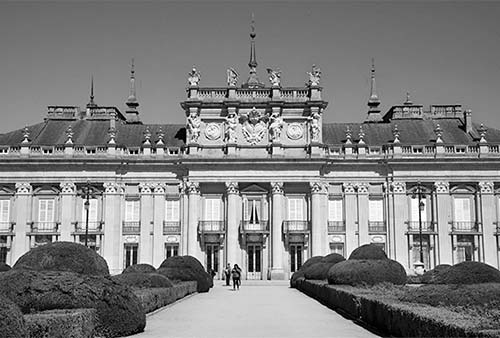
Cost and Hours: Palace—€9, Tue-Sun 10:00-20:00, Oct-March until 18:00, closed Mon year-round, last entry one hour before closing, audioguide-€3 (available Fri-Sun only), guided tour-€4 (ask for one in English—you might need to wait); park—free except when fountains are running (when you may need a palace ticket or €4 fountains-only ticket to enter), daily 8:00-20:30, until 21:30 in summer, shorter hours off-season; +34 921 470 019, www.patrimonionacional.es.
Getting There: Linecar buses make the 25-minute trip from Segovia (catch at the bus station) to San Ildefonso-La Granja (check schedule online, +34 921 427 705, www.linecar.es). Drivers find the palace at the top of town, facing a peaceful park; there’s no official parking lot but plenty of free street parking nearby.
Visiting the Palace and Gardens: The palace interior ranks low on a European scale (nearby, Madrid’s Royal Palace and El Escorial’s Bourbon Palace are better). And it’s hard to appreciate without the audioguide. After touring three large rooms of tapestries, you’ll circulate through the typical lineup of royal apartments—ceiling frescoes, glittering chandeliers, gilded furniture, marble floors, and lots of paintings by little-known artists. The ground-floor halls are lined with Neoclassical statues and garden views.
You’ll exit the palace into the real draw: the gardens. (You can also enter the gardens directly—for free except when the fountains are running—by circling all the way around the right side of the palace.) The sprawling grounds radiate from the palace in a Versailles-like grid-and-axis layout, with a more rugged section just beyond. The pine trees and snowcapped peaks on the horizon contribute to an almost alpine feel. The gardens are decorated with fanciful fountains, most featuring mythological stories. However, the fountains run only on certain days (check the website for the schedule and entry details).
Sleeping in Segovia
The best places are on or near the central Plaza Mayor. This is where the city action is—the best bars, most tourist-friendly and típico eateries, and the TI. During busy times—on weekends and in July and August—reserve in advance.
NEAR PLAZA MAYOR
$$ Hotel Real Segovia is a classic hotel (quick to brag about the many old-time movie stars who stayed here). They rent 37 beautifully updated rooms with all the modern amenities right along the main drag, between the aqueduct and Plaza Mayor. In spite of its central location, many of its rooms face the quiet countryside, and its top-floor terrace has nice views (air-con, elevator, pay parking, Juan Bravo 30, +34 921 462 663, www.hotelrealsegovia.com, realsegovia@recordishotels.com).
$$ Hotel Infanta Isabel, right on Plaza Mayor, has 38 elegant rooms—some with plaza views—and a welcoming staff. It faces both the main square and a popular tapas bar-lined street—it’s smart to request a quiet room (air-con, elevator, pay parking, Plaza Mayor 12, +34 921 461 300, www.hotelinfantaisabel.com, infanta@recordishotels.com).
$ La Hostería Natura is an hostal with more personality. Their 18 colorful, tiled rooms—accessed by an old wooden staircase—are a few short blocks away from Plaza Mayor (air-con, Calle Colón 5, +34 921 466 710, www.naturadesegovia.com, info@naturadesegovia.com).
NEAR THE AQUEDUCT
$$$ Hotel Eurostars Plaza Acueducto has little character but provides the comforts of a business-class hotel. It’s right at the foot of the aqueduct and next to the bus stops for the AVE train station. Some of its 72 rooms have full or partial views of the aqueduct (air-con, elevator, gym, pay parking; Avenida Padre Claret 2, +34 921 413 403, www.eurostarshotels.com, reservas@eurostarsplazaacueducto.com).
$ Hotel Apartments Aralso is a practical choice—a 10-minute hike below the aqueduct, near the bus station. This solidly built guesthouse in a workaday residential area rents 12 well-appointed, functional rooms with fully equipped kitchens. Sweetly run by André and María, it’s a good choice for those who don’t mind being a bit outside the creaky old center (family rooms, air-con, elevator, nearby pay parking, Calle Teniente Ochoa 8, +34 921 444 816, www.apartamentosaralso.com, reservas@apartamentosaralso.com).
$ Hostal Don Jaime, on a gentle hill just above the aqueduct, is a friendly, family-run place with 38 basic, older yet well-maintained rooms in two buildings (a few single rooms with shared bath, family rooms, breakfast included for Rick Steves readers, pay parking, Ochoa Ondategui 8, +34 921 444 787, www.hostaldonjaime.com, hostaldonjaime@hotmail.com).
Eating in Segovia
Look for Segovia’s culinary claim to fame, roast suckling pig (cochinillo asado: 21 days of mother’s milk, into the oven, and onto your plate—oh, Babe). It’s salty and tender, wrapped in crispy skin, and worth a splurge here (or in Toledo or Salamanca).
For slightly lighter fare, try sopa castellana—soup mixed with eggs, ham, garlic, and bread—or warm yourself up with the judiones de La Granja, a popular soup made with flat white beans from the region. Segovia also has a busy tapas bar scene, featuring small bites served up with every drink you order.
Ponche segoviano, a dessert made with an almond-and-honey mazapán base, is heavenly after an earthy dinner or with a coffee in the afternoon (at the recommended Limón y Menta).
PLACES TO EAT ROAST SUCKLING PIG
While some of the places listed later also serve this classic local dish, these two are the most renowned options for those who really want to pig out in the old town.
$$$$ José María doesn’t have the history or fanfare of Cándido (see next), but Segovians claim this high-energy place serves the best roast suckling pig in town. It thrives with a hungry mix of tourists and locals. The bar leading into the restaurant is a scene in itself. Muscle up to the bar and get your drink and tapa before going into the dining room. It’s smart to reserve ahead (daily, air-con, a block off Plaza Mayor at Cronista Lecea 11, +34 921 466 017, www.restaurantejosemaria.com).
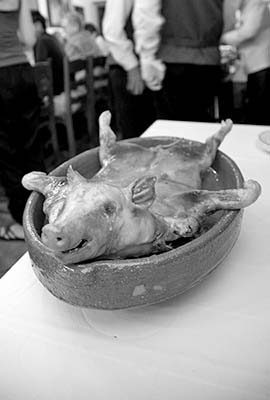
$$$$ Mesón de Cándido, one of the top restaurants in Castile, is famous for its memorable dinners. Even though it looks like a ye-olde tourist trap at the base of the aqueduct, it’s a grand experience. Take time to wander around and survey the photos of celebs—from Juan Carlos I to Antonio Banderas and Melanie Griffith—who’ve dined here. Try to get a table in a room with an aqueduct view (daily, reservations recommended, Plaza del Azogüejo 5, air-con, under aqueduct, +34 921 428 103, www.mesondecandido.es). Three gracious generations of the Cándido family still run the show.
OTHER OPTIONS IN THE OLD CENTER
Plaza Mayor, the main square, provides a great backdrop for a light lunch, dinner, or drink. Compare menus and views and choose your best. Things here are fairly interchangeable, and you’ll pay a premium for the location, but café prices are generally reasonable, and many offer a good selection of tapas and raciones. Grab a table at the place of your choice and savor the scene. Good options include $$$ Café Jeyma, with a great cathedral view (but the worst reputation for food); $$$ La Concepción Restaurante, closer to the cathedral; and $$$ Restaurante Bar José.
$$ La Almuzara is a garden of veggie and organic delights: whole-wheat pizzas, pastas, tofu, seitan, and even a few dishes with meat (closed Mon-Tue, between cathedral and Alcázar at Marques del Arco 3, +34 921 460 622).
Segovia’s Trendy Tapas Strip: Many of the eateries described above have good tapas bars up front. But to sample several bars in one go, stroll down Calle de Infanta Isabel (angling off Plaza Mayor). The places here skew young and trendy, but inside you’ll find a mixed-ages crowd.
Breakfast: In the morning, I like to eat on Plaza Mayor (many choices) while enjoying the cool air and the people scene. Or, 100 yards down the main drag toward the aqueduct, $$ Café La Colonial serves good breakfasts (with seating on a tiny square or inside, Plaza del Corpus).
Nightlife: After hours, the bars on Plaza Mayor, Calle de Infanta Isabel, and Calle de Isabel la Católica are packed. There are a number of late-night dance clubs along the aqueduct.
Dessert: Limón y Menta offers a good, rich ponche segoviano (marzipan) cake by the slice—or try the lighter, crunchy, honey-and-almond crocantinos (Mon-Fri 9:00-20:30, Sat-Sun until 21:00, seating inside, Calle de Isabel la Católica 2, +34 921 462 141).
Market: An outdoor produce market thrives on Plaza Mayor on Thursday (roughly 8:00-15:00). Nearby, on Calle del Cronista Ildefonso Rodríguez, a few stalls are open daily except Sunday. Carrefour Express, a small supermarket, is across from the Casa de los Picos (daily 9:00-21:00, Calle Juan Bravo 54).
Segovia Connections
From Segovia’s Guiomar Station by Train to: Madrid’s Chamartín station (AVE, up to 4/hour, 30 minutes), Salamanca (Alvia, 4/day, 1.5 hours). City bus #11 links Guiomar Station to the base of the aqueduct (20 minutes, buses usually timed to match trains). Train info: +34 912 320 320, Renfe.com [URL inactive].
From Segovia by Bus to: Madrid’s Moncloa station (2/hour, 1.5 hours, www.avanzabus.com [URL inactive]), Ávila (4/day, 2/day on weekends, 1 hour, Avanza, www.avanzabus.com [URL inactive]). Some Ávila buses continue to Salamanca (3.5 hours)—but the train is much faster.
ROUTE TIPS FOR DRIVERS
From Segovia to Salamanca (100 miles/160 km): Leave Segovia by driving around the town’s circular road, which offers good views from below the Alcázar. Then follow signs for Ávila (road N-110). Notice the fine Segovia view from the three crosses at the crest of the first hill. You could stay on N-110 all the way to Ávila, but it’s cheap to hop on the speedy AP-51 tollway at Villacastín, about halfway to Ávila. If time allows, exit at Ávila for a look at the town walls and to stretch your legs. Continuing from Ávila to Salamanca, be ready to pull over for the best views of the Ávila walls: Just after you cross the river at the far end of the town wall, watch for the Cuatro Postes pullout on the right (it’s just uphill from the river). Soon after, hop on the speedy and free A-50 expressway, which zips you to Salamanca in under an hour.
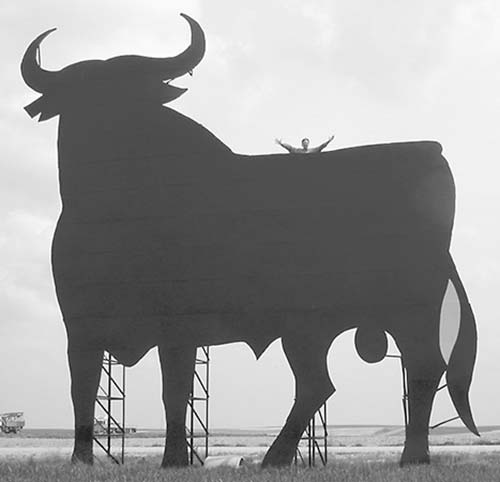
About 20 miles before Salamanca, you’ll spot a huge bull on the left side of the road. As you get closer, it becomes more and more obvious it isn’t alive. (It’s not realistic to pull over for a photo if you’re on the expressway, but it’s reachable if you take the slower N-501.) Soon you’ll see the massive church towers of Salamanca on the horizon and enjoy great panoramic views of the city from across the river as you get closer.
Ávila
Ávila is famous for its perfectly preserved medieval walls, as the birthplace of St. Teresa, and for its yummy yema treats. For more than 300 years, Ávila was on the battlefront between the Muslims and Christians, changing hands several times—hence its heavily fortified appearance. But today, perfectly peaceful Ávila has a charming old town that weathers only occasional incursions of day-trippers from Madrid, Segovia, or Salamanca (each about an hour away by car). Ávila doesn’t quite crack the top tier of great walled European cities—it’s sort of a wannabe Carcassonne. But it’s handy to reach, has several fine churches and monasteries, and makes for an enjoyable quick stop between Segovia and Salamanca.
Orientation to Ávila
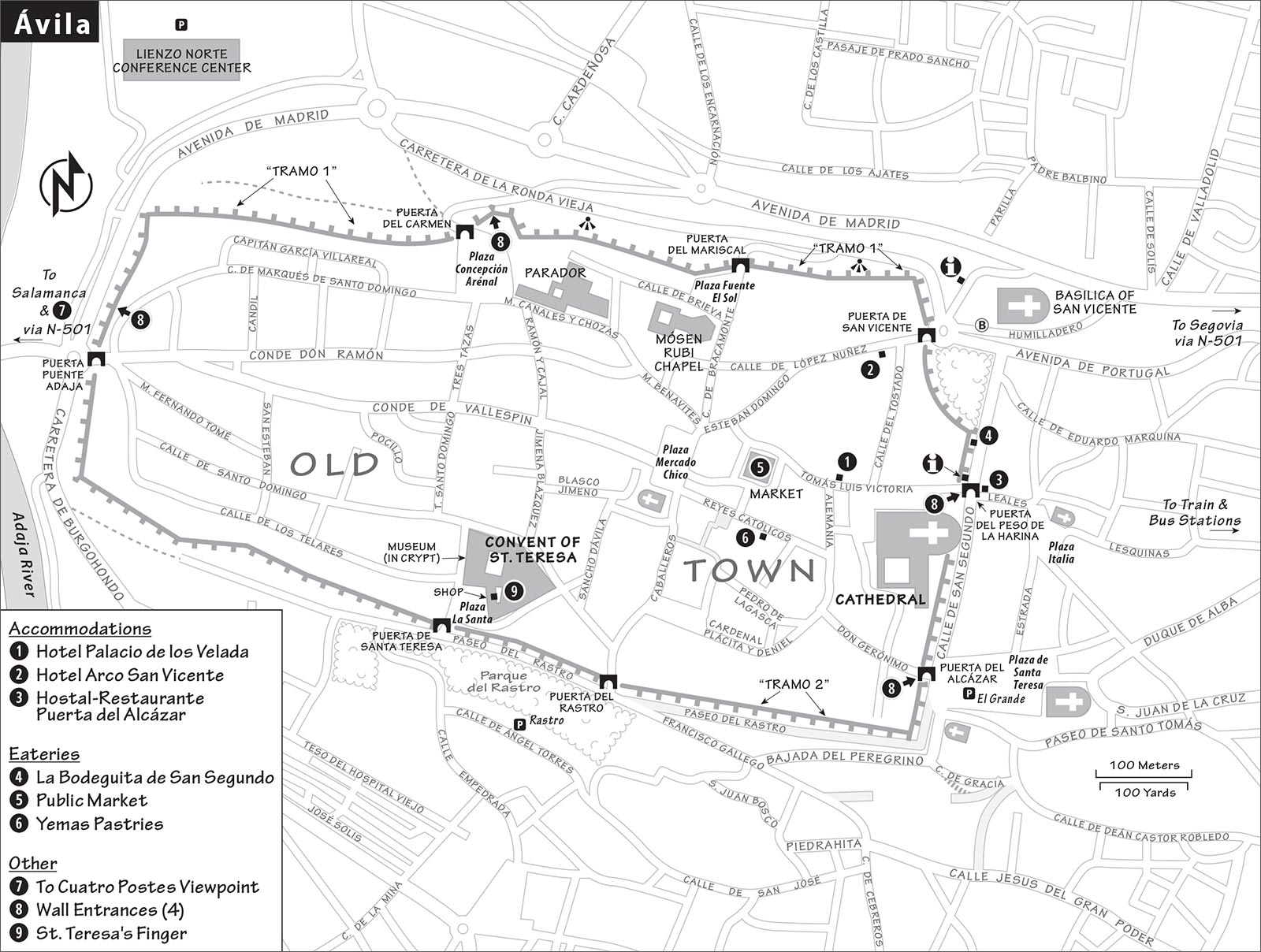
Surrounded by modern sprawl, Ávila’s walled old center is shaped like an elongated, backward “D.” The flat side of the “D”—facing east—is where you’ll find the TIs, parking, and most of the sights (including two points to access the top of the walls). On a quick visit, most people focus on this busy little zone. Inside the walls, Ávila is sleepy: From the cathedral (which abuts the eastern wall), it’s a 10-minute walk on the main drag, Calle de los Reyes Católicos, past the market to the humble main square, Plaza Mercado Chico. A five-minute walk south of there is the only other important sight within the walls, the Convent of St. Teresa.
Tourist Information: Ávila’s city TI is just outside the northeast corner of the walls, facing the Basilica of San Vicente (daily 9:00-20:00, Nov-March until 18:00, free WCs, well-equipped shop, helpful wooden models of the town and important wall sections, +34 920 350 000 ext. 370, www.avilaturismo.com). A less helpful regional TI is inside the wall ticket office, near the cathedral (Mon-Sat 9:30-14:00 & 17:00-20:00, Sun 9:30-17:00, shorter hours mid-Sept-May, +34 920 211 387).
Sightseeing Pass: The ÁvilaCard is €15 and valid for 48 hours. It includes the wall, cathedral, museum of St. Teresa, and a handful of other sights, and can save you a few euros if you plan on seeing them all.
ARRIVAL IN ÁVILA
By Bus or Train: Ávila’s bus and train stations sit kitty-corner from each other about a mile east of the wall. There are lockers at Ávila’s bus station, but not at the train station. To reach the Basilica of San Vicente, you can walk (allow 15-20 minutes) or take city bus #4 or #1. From the bus station, exit to the right, go down through the underpass, and look right for the “Puente de la Estación” stop. To catch these buses from the train station, exit straight ahead to find the “Renfe” stop (to the right of the roundabout).
By Car: To get close to the sights, go to the convenient (and well-marked as you approach town) Parking El Grande, a five-minute walk from the cathedral and main wall entry point, beneath Plaza de Santa Teresa (your license plate will be photographed as you enter; pay at the machine before you leave by punching in your plate number). There’s also ample pay-and-display street parking outside the walls (marked by blue lines), but there’s a two-hour limit—so this works only for a quick visit.
Sights in Ávila
▲Walls of Ávila
Built from around 1100 on even-more-ancient remains, Ávila’s fortified walls are the oldest, most complete, and best preserved in Spain. Walking around the walls, climbing the towers, and peeking between crenellations is a fun stroll. But there’s not much to see up top—the views are better from ground level (and best from Cuatro Postes, across the river—see next). If it’s blazing hot and you’re short on time, the wall walk is skippable. But if you want to play “king of Castile”...it’s right there, waiting for you.
Cost and Hours: €5, includes audioguide with a QR for your phone, free Tue 14:00-16:00; open daily 10:00-20:00, July-Aug until 21:00; Nov-March Tue-Sat 10:00-18:00, closed Mon; last entry 45 minutes before closing.
Walking the Walls: There are two stretches of wall that you can walk along (both covered by the same ticket—but you can’t reenter a section you’ve already entered). The main section (called “Tramo 1”)—stretching eight-tenths of a mile, one-way—is along the north side. Enter the wall by the gate closest to the cathedral (Puerta del Peso de la Harina). From here, you can head up to the northeast corner, then curve left and go all the way along the north side. There are two other entrances/exits for this stretch: Puerta del Carmen (about halfway along the north side) and Puerta Puente Adaja (on the far west end, opposite the cathedral). Go as far as you like. Then, either exit at one of those two points and return to ground level, or go back the way you came on top of the wall. The shorter section (“Tramo 2”), just about 300 yards one-way, can be accessed at the Puerta del Alcázar, just off Plaza de Santa Teresa.
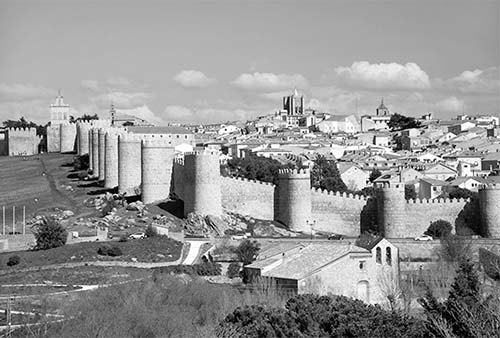
Viewing the Walls: The best views of the walls themselves are actually from street level. If you’re wandering the city and see arched gates leading out of the old center, pop out to the other side and take in the impressive wall from the ground. Drivers can see the especially impressive north side as they circle to the right from Puerta de San Vicente.
Paseo Outside the Walls: An interesting paseo scene takes place along the outside of the walls each night—make your way along the southern wall (Paseo del Rastro) to Plaza de Santa Teresa for spectacular vistas across the plains.
Viewing Ávila from Cuatro Postes
The best overall view of the walled town of Ávila is about a mile away on the Salamanca road (N-501), at a clearly marked turnout for Cuatro Postes (four posts). Drivers should keep an eye out on the right, after they cross the river and are on their way uphill. If you’re without wheels, you have a few options: You could walk or take a public bus to the far west end of the wall (to the bridge called Ponte de Allaja), then hike uphill for about 10-15 minutes to Cuatro Postes. Or you can catch a tourist trolley (€6, www.eltranvia.es) or tuk-tuk (€7, www.tuktukavila.com) for a little loop tour around town, which includes a sweat-free ride up to the viewpoint. All run infrequently—confirm your options at the TI.
Ávila Cathedral (Catedral de Ávila)
While it started as Romanesque, Ávila’s cathedral, finished in the 16th century, is now considered the first Gothic cathedral in Spain. Its position—with its granite apse actually part of the fortified wall—underlines the “medieval alliance between cross and sword.” The cathedral interior doesn’t rank very high on a Spanish scale (and even just in Ávila, San Vicente’s is more interesting). It’s weighty, stony, and bottom-heavy, with delicate Gothic windows illuminating a much lighter (and light-filled) top half. The focal point is the exquisitely carved outer stone wall of the choir (“retrochoir”)—with Plateresque carvings of Jesus’ life. In the right transept, find your way into the sacristy, cloister, and museum (including a minor painting by El Greco).
Cost and Hours: Pricey at €8, includes audioguide; Mon-Sat 10:00-21:00, Sun from 12:30, generally closes 2-3 hours earlier off-season; Plaza de la Catedral.
Tower: For €2 extra, you can get an assigned time slot to climb the 130 spiral stairs of the cathedral tower, earning a great panoramic view over Ávila (1-3/day, more in July-Aug, Sat-Sun only in winter).
Basilica of San Vicente
Sitting just outside the northeast corner of the wall (facing the TI), this hulking church—with its distinctive Romanesque-arch arcade facing the busy street—is worth a peek. The 12th-century interior oozes history, with rough tombstones embedded in the floor, heavy columns framing round windows, a glittering altarpiece, and a huge, canopied, colorfully painted tomb holding three local fourth-century martyrs.
Cost and Hours: €3, includes audioguide, Mon-Sat 10:00-19:00, Sun 16:00-18:00, off-season closed for lunch 14:00-16:00.
Convent of St. Teresa
Built in the 17th century on the spot where the saint was born, this convent is a big hit with pilgrims (10-minute walk from cathedral). St. Teresa (1515-1582)—reforming nun, mystic, and writer—bought a house in Ávila and converted it into a convent with more stringent rules than the one she belonged to. She faced opposition in her hometown from rival nuns and those convinced her visions of heaven were the work of the devil. However, with her mentor and fellow mystic St. John of the Cross, she established convents of Discalced (shoeless) Carmelites throughout Spain, and her visions and writings led her to sainthood (she was canonized in 1622).
Inside the humble convent church, a lavishly gilded side chapel marks the actual place of her birth (left of main altar). Pope John Paul II’s visit on the 400-year anniversary of Teresa’s death in 1982 is commemorated on a plaque near the door.
Teresa’s finger is housed in the little Sala de Reliquias at the back of the church shop (as you face the church, it’s on your right, no photos or videos allowed). You’ll see the finger, complete with a fancy emerald ring, along with one of her sandals. Above the finger is her walking stick, which Pope Francis kissed when he declared the church a basilica on a visit in 2022.
A museum dedicated to the saint is in the crypt (around the left side as you face the church). Inside, under heavy stone vaults, you’ll see a wide collection of items relating to Teresa, including replicas of her spartan bedroom and items she might have used. There’s also an extensive collection of books, portraits, stamps, and coins of St. Teresa—helping explain why this woman and this convent are so important to so many people around the world.
Cost and Hours: Convent—free, daily 10:00-13:30 & 17:00-19:00; museum—€3, Tue-Sun 10:00-14:00 & 16:00-19:00, shorter hours off-season, closed Mon year-round.
Yemas
These pastries, made by local nuns, are more or less soft-boiled egg yolks that have been cooled and sugared (yema means yolk). They’re sold all over town. The shop Las Delicias del Convento is a retail outlet for the cooks of the convent (€5.50 for a small box, Mon-Sat 10:30-20:00, Sun until 18:00, between the TI and convent at Calle de los Reyes Católicos 12, +34 920 220 293).
Sleeping and Eating in Ávila
Sleeping: With Salamanca and Segovia so close, you’re unlikely to need a bed in Ávila, but here are a few possibilities. Consider $$ Hotel Palacio de los Velada (in a five-centuries-old palace at Plaza de la Catedral 10, +34 920 255 100, www.veladahoteles.com), $ Hotel Arco San Vicente (one block from the Basilica of San Vicente at Calle López Núñez 6, +34 920 222 498, www.arcosanvicente.com), or $ Hostal Puerta del Alcázar (next to the Puerta del Peso de la Harina, just outside the wall at San Segundo 38, +34 920 211 074, www.puertadelalcazar.com).
Eating: Restaurants around Plaza del Mercado Chico, the main square of the old center, are good spots to try Ávila specialties called chuletón, a thick steak, and judías del Barco de Ávila, big white beans often cooked in a meaty stew. Other good eating options include $$$ Restaurante Puerta del Alcázar (filled with more locals than hotel guests, San Segundo 38, +34 920 211 074) and $$$ La Bodeguita de San Segundo (good for a light lunch, outside the wall near the cathedral at San Segundo 19, +34 920 257 309). For a coffee or hot chocolate, try the courtyard café of the recommended $$ Hotel Palacio de los Velada. For picnic supplies, head to the town’s market house between Plaza del Mercado Chico and the cathedral, or the great Friday-morning farmers market on Plaza del Mercado Chico.
Ávila Connections
The bus terminal is closed on Sundays, but you can purchase tickets when you board. Bus info: AvanzaBus.com, JimenezDorado.com. Train info: +34 912 320 320, Renfe.com [URL inactive].
From Ávila to: Segovia (4 buses/day, 2/day weekends, 1 hour, Avanza), Madrid Chamartín (2 trains/day, 1.5-2 hours), Madrid Príncipe Pío (nearly hourly trains, 1.5-2 hours), Madrid Estación Sur (nearly hourly buses, 6/day on weekends, 1.5 hours, Jiménez Dorado), Salamanca (7 trains/day, 1-1.5 hours; 4-5 buses/day, 1.5 hours, Avanza).