Sights in Madrid
▲▲▲ROYAL PALACE
▲▲▲Prado Museum (Museo Nacional del Prado)
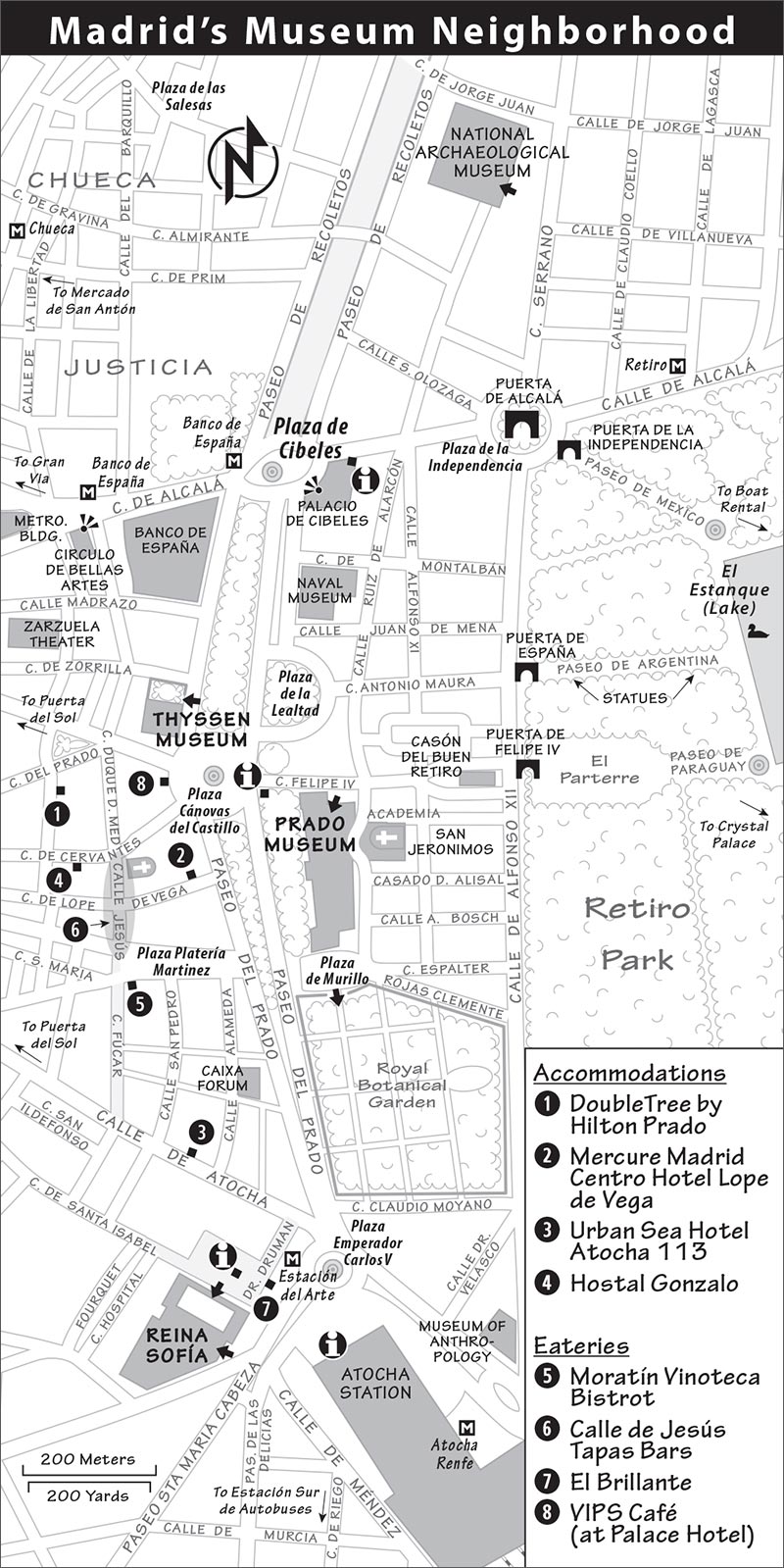
Map: Madrid’s Museum Neighborhood
▲Royal Botanical Garden (Real Jardín Botánico)
▲▲Thyssen-Bornemisza Museum (Museo del Arte Thyssen-Bornemisza)
▲▲Retiro Park (Parque del Buen Retiro)
▲▲National Archaeological Museum (Museo Arqueológico Nacional/MAN)
Temple of Debod (Templo de Debod) and “Park of the West” (Parque de Oeste)
▲Museum of the Americas (Museo de América)
Clothing Museum (Museo del Traje)
▲Hermitage of San Antonio de la Florida (Ermita de San Antonio de la Florida)
▲▲Sorolla Museum (Museo Sorolla)
▲Madrid History Museum (Museo de Historia de Madrid)
▲▲▲ROYAL PALACE
Spain’s Royal Palace (Palacio Real) is Europe’s third-greatest palace, after Versailles and Vienna’s Schönbrunn. It has arguably the most sumptuous original interior, packed with tourists and royal antiques. For three centuries, Spain’s royal family has called this place home.
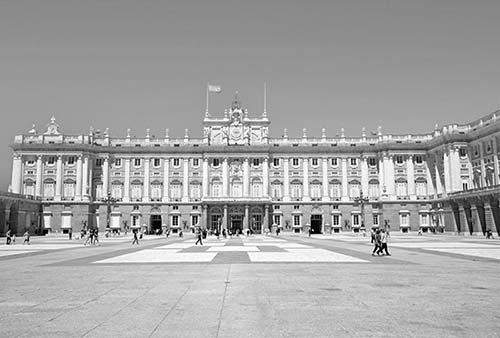
The palace is the product of many kings over several centuries. Philip II (1527-1598) left Toledo and established Madrid as Spain’s capital, making a wooden fortress on this site his governing center. When that palace burned down, the current structure was built by King Philip V (1683-1746). Philip V wanted to make it his own private Versailles, to match his French upbringing: He was born in Versailles—the grandson of Louis XIV—and ordered his tapas in French. His son, Charles III (whose statue graces Puerta del Sol), added interior decor in the Italian style, since he’d spent his formative years in Italy. These civilized Bourbon kings were trying to raise Spain to the cultural level of the rest of Europe. They hired foreign artists to oversee construction and established local Spanish porcelain and tapestry factories to copy works done in Paris or Brussels. Over the years, the palace was expanded and enriched, as each Spanish king tried to outdo his predecessor.
Today’s palace is ridiculously supersized—with over a thousand rooms, tons of luxurious tapestries, a king’s ransom of chandeliers, frescoes by Tiepolo, priceless porcelain, and bronze decor covered in gold leaf. While these days the royal family lives in a mansion several miles away, this place still functions as the ceremonial palace, used for formal state receptions and official acts (which periodically close it to tourists with short notice), royal weddings, and tourists’ daydreams.
Cost: Palace-€12, royal kitchen-€6, palace and kitchen combo-ticket-€16, buy online to avoid long ticket-buying lines, all tickets are timed-entry.
Hours: Open daily 10:00-19:00, Oct-March until 18:00, last entry one hour before closing. Palace can close for royal functions—confirm in advance.
Getting There: From Puerta del Sol, walk 15 minutes down pedestrianized Calle del Arenal (Metro: Ópera).
Information: +34 914 548 800, www.patrimonionacional.es.
Crowd-Beating Tips: The palace is free for EU citizens—and most crowded—Monday-Thursday 17:00-19:00 in summer and 16:00-18:00 in winter. To avoid crowds, it’s best to go early any day, or late Friday-Sunday. At all times, buy a ticket in advance to avoid the ticket-buying line.
Visitor Information: Short English descriptions posted in each room complement what I describe in my tour.
Tours: The €5 audioguide is good (with standard input jack). Or download in advance the helpful Royal Palace of Madrid app (€4).
Length of This Tour: Allow 1.5 hours.
Services: Free lockers, a WC, and a gift shop are just past the ticket booth.
Eating: Though the palace has a refreshingly air-conditioned $ cafeteria upstairs in the ticket building, I prefer to walk a few minutes and find a place near the Royal Theater or on Calle del Arenal. For two recommended restaurants nearby, see here.
 Self-Guided Tour
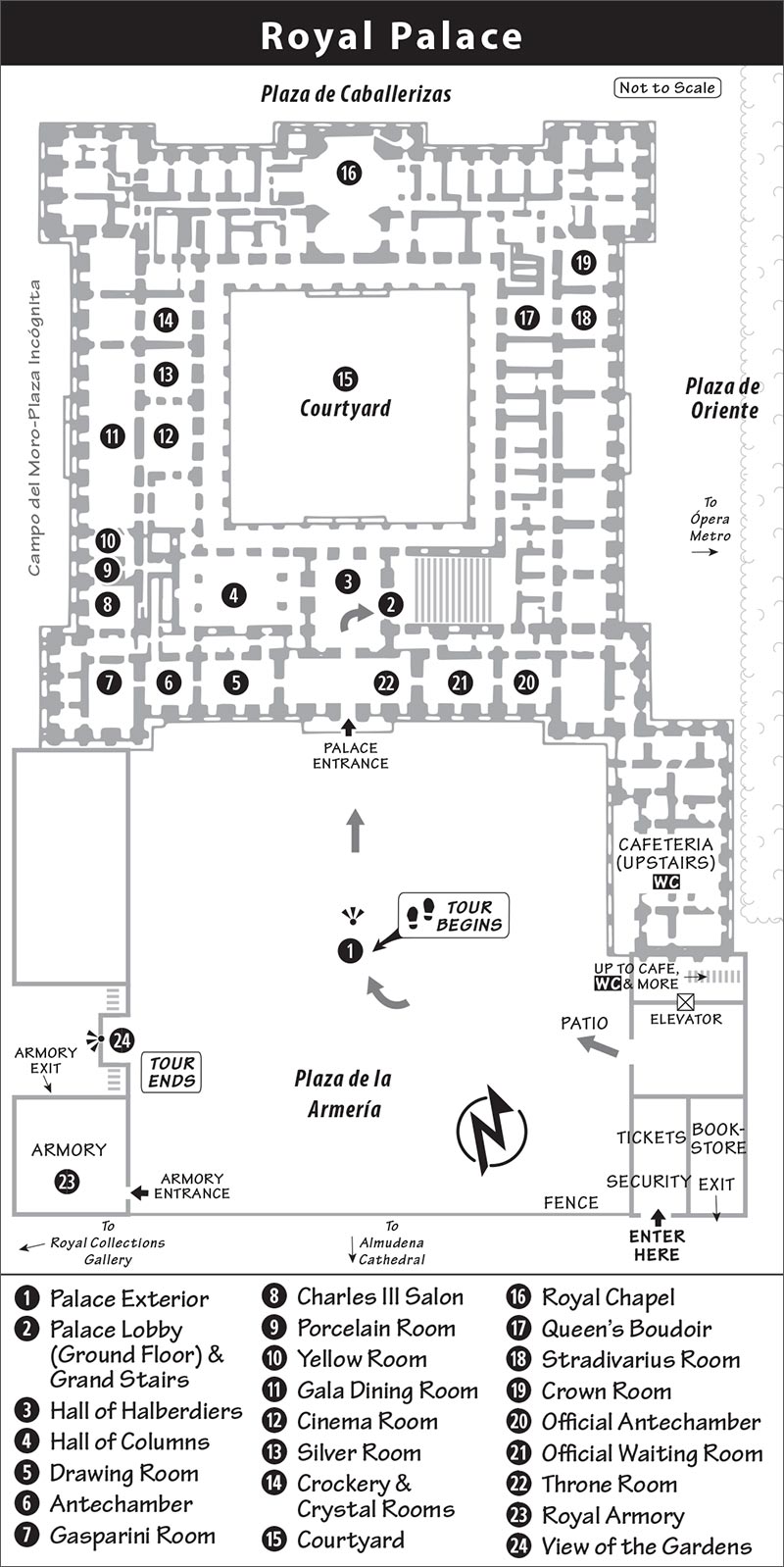
You’ll follow a simple one-way circuit on a single floor covering more than 20 rooms.
• Pass through the ticket check and metal detector, proceed outside, stand in the middle of the vast open-air courtyard, and face the palace entrance.
1 Palace Exterior
The palace sports the French-Italian Baroque architecture so popular in the 18th century—heavy columns, classical-looking statues, a balustrade roofline, and a false-front entrance. The entire building is made of gray-and-white local stone (very little wood) to prevent the kind of fire that leveled the previous castle. This became Spain’s center of power; notice how the palace of the king faces the palace of the bishop (the cathedral). Now, imagine the place in its heyday, with a courtyard full of soldiers on parade, or a lantern-lit scene of horse carriages arriving for a ball.
• Enter the palace. Here you’ll find an info desk, cloakrooms, and the meeting point for guided tours and the Royal Kitchen visit (if your ticket includes the Royal Kitchens, a guide will take you downstairs to the high-ceilinged kitchens, where you’ll see copper pots, stove tops, cauldrons, and tables where meals for up to 140 people would be prepared).
2 Palace Lobby and Grand Stairs
In the old days, horse-drawn carriages would drop you off inside this covered arcade. Today, stretch limos do the same thing for gala events. When you reach the foot of the Grand Stairs, you’ll see a statue of a toga-clad Charles III—the man most responsible for the lavish rooms we’re about to see (see the “Charles III” sidebar, later).
Stand at the base of the Grand Stairs and take in the scene. Gazing up the imposing staircase, you can see that Spain’s kings wanted to make a big first impression. Whenever high-end dignitaries arrive, fancy carpets are rolled down the stairs (notice the little metal bar-holding hooks).
Begin your ascent, up steps that are intentionally shallow, making your climb slow and regal. Pause at the first landing. The burgundy coat of arms represents the current king, Felipe VI. He’s part of a long tradition of kings stretching directly back to the Bourbon King Philip V, and even further back to Ferdinand and Isabel—and (according to legend) all the way back to the Visigothic kings who arrived after the fall of Rome. Overhead a fresco depicts the mutual admiration society of a heavenly host of characters and Spain’s royals.
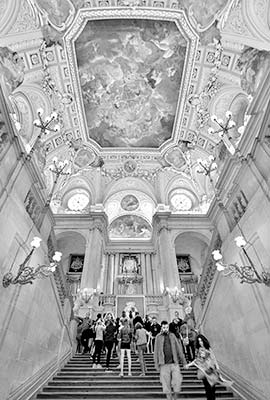
Continue up to the top of the stairs. Before entering the first room, look to the right of the door to find a white marble bust of Felipe VI’s great-great-g-g-g-g-great-grandfather Philip V, who began the Bourbon dynasty in Spain in 1700 and had this palace built. He was a direct descendant of France’s “Sun King” Louis XIV...in case you couldn’t tell from the curly wig.
• From here, your visit is a 20-room one-way loop on this floor, finishing here (notice the people just leaving). Now enter the first of the rooms. These were part of King Charles III’s apartments, and even today, they belong to Charles’ descendants. A big modern portrait of today’s royal family seems to begrudgingly welcome visitors to their home: “Mi casa es mi casa.”
3 Hall of Halberdiers (Royal Guard)
The fresco’s theme here, of Vulcan forging Aeneas’s armor, relates to this room’s function as the palace guards’ lounge.
The giant portrait depicts Spain’s royal family: the current king Felipe (right), his dad and mom, Juan Carlos I and Sofía (center), and his two sisters (left). It was Juan Carlos who resumed the monarchy in the 1970s after Francisco Franco’s dictatorial regime. Rather than end up “Juan the Brief” (as some were nicknaming him), he steered the country toward democracy. Unfortunately, J. C. showed poor judgment in flaunting his wealth during Spain’s recent economic crisis and was pressured to hand over the crown to his son, Felipe. Juan Carlos had commissioned this family portrait way back in 1993...and it was completed just in time for his abdication in 2014. (You can imagine the artist adding a few more wrinkles with each passing year.) Notice how Felipe stands apart from the rest of his family—a grouping that’s open to interpretation. Perhaps he’s the baby bird, being nudged from the nest, ready to shoulder the massive responsibility of a proud nation? Felipe’s wife and Spain’s current queen, Letizia Ortiz, isn’t pictured—when this portrait was begun, they had not yet met.
Of the many monarchs who’ve enlarged or redecorated the Royal Palace, it was Charles III who set the tone for its Rococo interior. Charles’ mother was Italian, and he spent his formative years in Italy (much of which was ruled by Spain in the 18th century). When he became Spain’s king, he brought along sophisticated Italian artists to decorate his new home—the painter Tiepolo, the architect Sabatini, and the decorator Gasparini. They created some of the most elaborate, jaw-dropping rooms tourists see in the palace today.
Charles was an enlightened ruler who tried to reform Spain along democratic principles. He failed. After his death, Spain dwindled into repressive irrelevance. But over the centuries, each of his successors labored to top Charles in ostentatious decoration, making Madrid’s Royal Palace his greatest legacy.
• Proceed into the...
4 Hall of Columns
In Charles III’s day, this sparkling, chandeliered venue was the grand ballroom. The tapestries (like most you’ll see in the palace) are 17th-century Belgian, from designs by Raphael. Appropriately, the ceiling fresco (by Jaquinto, following Tiepolo’s style) depicts a radiant young Apollo driving the chariot of the sun, while Bacchus enjoys wine, women, and song with a convivial gang. The message: A good king drives the chariot of state as smartly as Apollo, so his people can enjoy life to the fullest.
Today this space is used for intimate concerts as well as important ceremonies. This is where Spain formally joined the European Union in 1985, where Spaniards honored their national soccer team after their 2010 World Cup victory, and where Juan Carlos I signed his abdication in 2014.
Throughout the palace, pay attention to the carpets. They’re part of a long tradition. Some are from the 18th century and others are new, but all were produced by the same Madrid royal tapestry factory and woven the traditional way—by hand.
• Note that this is the last room where photos are allowed. The next several rooms were the living quarters of King Charles III. First comes his 5 drawing room (with red-and-gold walls), where the king would enjoy the company of a similarly great ruler—notice two marble busts of the Roman emperor Trajan, one of two Roman emperors born in Spain. The heroics of Trajan, painted on the ceiling, naturally made the king feel good. Next, you enter the blue-walled...
6 Antechamber
This was Charles III’s dining room. The gilded decor you see here and throughout the palace is bronze with gold leaf. The furnishings reflect the tastes of various kings and queens who’ve inhabited this palace. The two paintings, by Francisco de Goya, are of Charles III’s son and successor, King Charles IV (looking a bit like a dim-witted George Washington), and his wife, María Luisa (who wore the pants in the palace). Goya also made duplicates of these portraits (now in the Prado) to meet the demand for his work. Velázquez’s famous painting Las Meninas (also in the Prado) originally hung in this room.
The 12-foot-tall clock—in porcelain, bronze, and mahogany—sits on a music box. Reminding us of how time flies, it depicts Chronus, the god of time, both as a child and as an old man. The palace’s clocks are wound—and reset—once a week to keep them accurate.
By the way, these old clocks, still in working order, are part of a collection of hundreds amassed as a hobby by Spain’s royal family. The palace’s audioguide has a section on just clocks.
7 Gasparini Room
(Gasp!) The entire room is designed, top to bottom, as a single gold-green-rose ensemble: from the frescoed ceiling to the painted stucco figures, silk-embroidered walls, chandelier, furniture, and multicolored marble floor. Each marble was quarried in, and therefore represents, a different region of Spain. Birds above the chandeliers spread their wings, vines sprout, and fruit bulges from the surface. With curlicues everywhere (including their reflection in the mirrors), the room dazzles the eye and mind. It’s a triumph of the Rococo style, with exotic motifs such as the Chinese people sculpted into the corners of the ceiling. (These figures, like many in the palace, were formed from stucco, or wet plaster, that was molded into shape and painted.) The fabric gracing the walls was recently restored. Sixty people spent three years replacing the rotten silk fabric and then embroidering the original silver, silk, and gold threads back on.
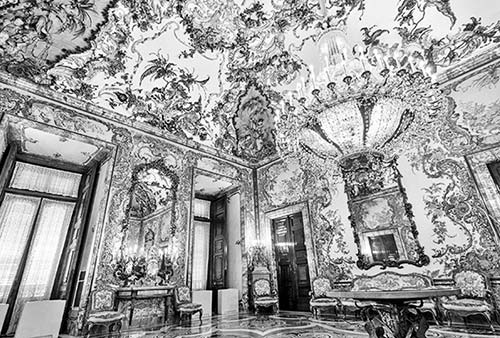
Note the table. The Roman temple, birds, and flowers in the design are a micro-mosaic of teeny stones and glass. This was a typical souvenir from any aristocrat’s trip to Rome in the mid-1800s. The chandelier, the biggest in the palace, is mesmerizing, especially with its glittering canopy of crystal reflecting in the wall mirrors.
The mirrors mark this as the king’s dressing room. For a divine monarch, dressing was a public affair. The court bigwigs would assemble here as the king, standing on a platform—notice the height of the mirrors—would pull on his leotards and adjust his wig.
• In the next small room, the silk wallpaper is clearly from modern times—note the intertwined “J. C. S.” of the former monarchs Juan Carlos I and Sofía. Pass through the silk room to reach the...
8 Charles III Salon
This was Charles III’s grand bedroom, and he died here in his bed in 1788. His grandson, Ferdinand VII, redid the room to honor the great man. The room’s color scheme recalls the blue robes of the religious order of monks Charles founded here. A portrait of Charles on the wall shows him also in blue. The ceiling fresco shows Charles (kneeling, in armor) establishing his order, with its various (female) Virtues. Along the bottom edge (near the harp player), find the baby in his mother’s arms—that would be Ferdy himself, the long-sought male heir, preparing to continue Charles’ dynasty.
The chandelier is in the shape of the fleur-de-lis (the symbol of the Bourbon family) capped with a Spanish crown. As you exit the room, notice the thick walls between rooms. These hid service corridors for servants, who scurried about mostly unseen.
9 Porcelain Room
This tiny but lavish room is paneled with green-white-gold porcelain garlands, vases, vines, babies, and mythological figures. The entire ensemble was disassembled for safety during the civil war. (Find the little screws in the greenery that hide the seams between panels.) Notice the clock in the center with Atlas supporting the world on his shoulders.
10 Yellow Room
This was a study for Charles III. The chandelier was designed to look like a temple with a fountain inside. Its cut crystal shows all the colors of the rainbow. Stand under it, look up, and sway slowly to see the colors glitter. This brilliantly lit room gives a glimpse of what the entire palace would look like whenever it was lit up for an occasion.
In 1762, King Charles III invited Europe’s most celebrated palace painter, Giambattista Tiepolo (1696-1770), to decorate three rooms in the newly built palace. Sixty-six-year-old Tiepolo made the trip from Italy with his two well-known sons as assistants. They spent four years atop scaffolding decorating in the fresco technique, troweling plaster on the ceiling and quickly painting it before it dried.
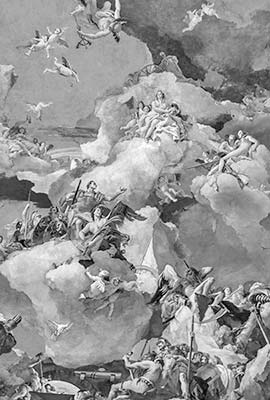
Tiepolo’s translucent ceilings seem to open up to a cloud-filled heaven, where Spanish royals cavort with Greek gods and pudgy cherubs. Tiepolo used every trick to “fool the eye” (trompe l’oeil), creating dizzying skyscapes of figures tumbling at every angle. He mixes 2-D painting with 3-D stucco figures that spill over the picture frame. His colorful, curvaceous ceilings blend seamlessly with the flamboyant furniture of the room below. Tiepolo’s Royal Palace frescoes are often cited as the final flowering of Rococo art.
• And if it was a special occasion, the next room is where everyone would gather and be dazzled.
11 Gala Dining Room
This vast venue—perhaps the grandest room in the palace—is the main party room. The parquet floor was the preferred dancing surface when balls were held in this fabulous room. The room is lined with vases from China and fine tapestries. The central ceiling fresco depicts the historical event that made Spain rich and made this opulent palace possible: Christopher Columbus kneels (globe in hand) before Ferdinand and Isabel, while his crew presents exotic souvenirs and his new, native friends.
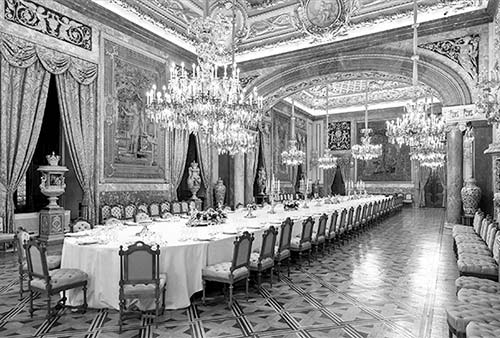
Imagine this hall in action when a foreign dignitary dines here. Up to 12 times a year, the king entertains as many as 144 guests at this bowling lane-size table. If needed, the table can be extended the entire length of the room. The king and queen preside from the center. Find their chairs (slightly higher than the rest, and pulled out from the table a bit). The tables are set with fine crystal and cutlery. And the whole place glitters as the 15 chandeliers (and their 900 bulbs) are fired up.
• Pass through the next room, originally where the royal string ensemble played for parties next door, but now known as the 12 Cinema Room because the royal family once enjoyed Sunday afternoon movies here. From here, move into the...
13 Silver Room
Some of this 19th-century silver tableware—knives and forks, bowls, salt and pepper shakers, and the big punch bowl—is used in the Gala Dining Room on special occasions. If you look carefully, you can see quirky royal accessories, including a baby’s silver rattle and fancy candle snuffers.
14 Crockery and Crystal Rooms
Each display case has a different style from a different period and made by a different factory. The oldest and rarest pieces belonged to the man who built this palace—Philip V. His china actually came from China, before that country was opened to the West. Soon, other European royal families were opening their own porcelain works (such as France’s Sèvres or Germany’s Meissen) to produce high-quality knockoffs (and cutesy Hummel-like figurines). The porcelain technique itself was kept a royal secret. As you leave, check out Isabel II’s excellent 19th-century crystal ware.
• Exit to the hallway and notice the interior courtyard you’ve been circling one room at a time.
15 Courtyard
Like so many traditional Spanish homes, this palace was built around an open-air courtyard. The royal family lived on this spacious middle floor, staff lived upstairs, and the kitchens, garage, and storerooms were on the ground level. In 2004, this courtyard took on a new use when it was decorated to host King Felipe VI’s royal wedding reception. Felipe married journalist Letizia Ortiz, a commoner (for love), and the two make it a point to be approachable with their subjects—they remain very popular. (But then, so was Juan Carlos I, not long before his abdication. Royal life is fickle.)
• Between statues of two of the giants of Spanish royal history (Isabel and Ferdinand), you’ll enter the...
16 Royal Chapel
This huge domed chapel is best known among Spaniards as the place for royal funerals. When a monarch dies, the royal coffin lies in state here before making the sad trip to El Escorial to join the rest of Spain’s past royalty (see next chapter). The glass coffin in the niche straight ahead contains the entire body of St. Felix, given to the Spanish king by the pope in the 19th century. Note the glassed-in “crying room” to the left (opposite main altar) for royal babies. While the royals rarely worship here (they prefer the cathedral adjacent to the palace), the thrones are here just in case.
• Continue around the courtyard, then pass through the green 17 Queen’s Boudoir—where royal ladies hung out—and into the...
18 Stradivarius Room
Of all the instruments made by the renowned Italian violin maker Antonius Stradivarius (1644-1737), only 300 survive. This is the world’s best collection and the only matching quartet set: two violins, a viola, and a cello. Charles III, a cultured man, fiddled around with these. Today, a single Stradivarius instrument might sell for $15 million.
• The next room (on the left) is the...
19 Crown Room
This room is kind of like the palace’s “crown jewels” sanctuary. It displays the precious objects related to the long tradition of crowning a new monarch. In the middle of the room is the scepter of the last Spanish king of the Habsburg family, Charles II, from the 17th century. Alongside is the stunning crown of Charles III, from the succeeding (and current) dynasty, the Bourbons. There’s a lion-footed chair, one of Charles III’s thrones. Nearby is a golden necklace of the Order of the Golden Fleece, an exclusive club of European royalty (to which all Spanish monarchs belong) that dates back to medieval times. Many of these venerable objects are brought out whenever a new monarch is proclaimed, but today’s constitutional monarchs don’t go through an elaborate coronation ceremony or don a crown.
There are also more recent royal symbols, such as Juan Carlos I’s wooden military baton (a traditional symbol of royal power). There’s the 2014 proclamation from when Juan Carlos abdicated, and another from when Felipe VI accepted. Notice which writing implement each man chose to sign with: Juan Carlos’ traditional classic pen and Felipe VI’s modern one. The fine inlaid marble table in this room was used when King Juan Carlos signed the treaty finalizing Spain’s entry into the European Union in 1985.
• Walk back through the Stradivarius Room and into the courtyard hallway, passing the skippable Stucco Room. Cross over the top of the Grand Stairs, then continue your visit in the blue-wallpapered...
20 Official Antechamber
Here, amid royal portraits, ambassadors would wait for their big moment when they met the king in the (upcoming) Throne Room. Tiepolo’s ceiling fresco, of Jason returning with the Golden Fleece, would remind them of the exclusive company the Spanish monarch kept, as a Knight of the Golden Fleece. Notice Tiepolo’s skill at creating a seemingly three-dimensional space with a two-dimensional painting. He makes a castle tower seem to tower upward, and a trumpeting angel flies directly away from us.
• After waiting here, the anticipation would build as ambassadors were called into the next room, the red-wallpapered...
21 Official Waiting Room
Here dignitaries would have to wait a bit longer—awed by the rich tapestries, paintings, and Tiepolo’s reverent ceiling fresco of the Spanish monarchy. It depicts Spain as a woman in white (with her lion and castle symbols), being crowned by wing-footed Mercury and adored by the gods, while an angel plunges dramatically downward. Even today, officials are received in this room by royalty for an official photo op to remember their big moment.
• And now we’ve reached the grand finale, as you finally enter the...
22 Throne Room
This room, where the Spanish monarchs preside, is one of the palace’s most glorious.
The throne stands under a gilded canopy, on a raised platform, guarded by four lions (symbols of power found throughout the palace). The coat of arms above the throne shows the complexity of the Spanish empire across Europe—which, in the early 18th century, included Naples, Sicily, parts of the Netherlands, and more. Though the room was decorated under Charles III (late 18th century), the throne itself dates only from 2014. Traditionally, a new throne is built for each king or queen, complete with a gilded portrait on the back. Felipe VI decided to keep things simple, so his throne has only a crown.
Today, this room is where the king’s guests salute him before they move on to state dinners. Felipe receives them relatively informally...standing at floor level, rather than seated up on the throne.
The room holds many of the oldest and most precious things in the palace: silver-and-crystal chandeliers (from Venice’s Murano Island), elaborate lions, and black bronze statues from the fortress that stood here before the 1734 fire. The 12 mirrors, impressively large in their day, each represent a different month.
The ceiling fresco (1764) is the last great work by Tiepolo, who died in Madrid in 1770. His massive painting (88 feet by 32 feet) celebrates the vast Spanish empire—upon which the sun also never set. The Greek gods look down from the clouds, overseeing Spain’s empire, whose territories are represented by the people and exotic animals ringing the edges of the ceiling. Follow the rainbow to the macho red-caped conquistador who motions toward the big bale of booty and the people he’s conquered—feather-wearing Native Americans.
Admire Tiepolo’s skill: At the far end of the room, he makes a pillar seem to shoot straight up into the sky. The pillar’s pedestal has an inscription celebrating Tiepolo’s boss, Charles III (“Carole Magna”). Notice how the painting spills over the gilded wood frame, where 3-D statues recline alongside 2-D painted figures. A woman’s painted robe spills over the edge to become a hem made of stucco. Two fish have 2-D bodies but 3-D tails. All of the throne room’s decorations—the fresco, gold garlands, mythological statues, wall medallions—unite in a multimedia extravaganza dedicated to the glory of Spain.
• Your tour of the palace interior is done. Permission granted to call it a tour. But if you want one more interesting collection, you’ll find it back outside. Exit the palace down the same grand stairway you climbed at the start. Cross the big courtyard, heading to the far-right corner to the...
23 Royal Armory
Here you’ll find weapons and armor belonging to many great Spanish historical figures. While some of it was for battle, kings also wore armor for royal hunts, sporting events (such as jousting tournaments), and official ceremonies. Much of this armor dates from Habsburg times, before this palace was even built. Circle the big room clockwise.
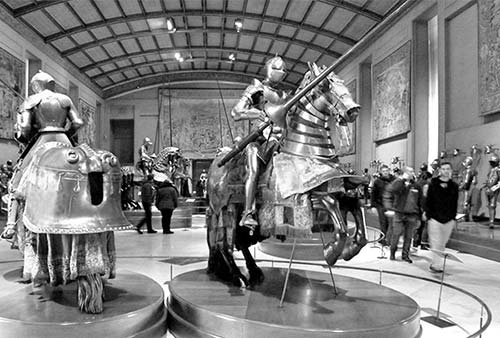
In the three glass cases on the left, you’ll see the oldest pieces in the collection. In the central case (case III) are the shield, sword, belt, and dagger of Boabdil, the last Moorish king, who surrendered Granada in 1492. In case IV, the armor and swords belonged to Boabdil’s conqueror, King Ferdinand.
The center of the room is filled with knights in armor on horseback. Many of the pieces belonged to the two great kings who ruled Spain at its 16th-century peak, Charles V (a.k.a. the Holy Roman Emperor) and his son, Philip II.
The long wall on the left displays a full array of Charles V’s personal armor. At the far end, the mannequin of Charles on horseback wears the same armor and assumes the same pose as in Titian’s famous painting of him (in the Prado).
The opposite wall showcases the armor and weapons of Philip II, the king who impoverished Spain with his wars against the Protestants, beginning the country’s downward slide. Philip anticipated that debt collectors would ransack his estate after his death and specifically protected his impressive collection of armor by founding this armory.
The tapestries above the armor once warmed the walls of the otherwise stark palace that predated this one. Back when kings had to travel from palace to palace, they packed tapestries to make their home on the road “fit for a king.”
Find the stairs near the entrance and head down. You’ll see more armor, a mixed collection mostly from the 17th century, plus early guns and Asian armor. The pint-size armor you may see wasn’t for children to fight in. Rather, it’s training armor for noble youngsters, who as adults would be expected to ride, fight, and play gracefully in these clunky getups. Before you leave, notice the life-saving breastplates dimpled with bullet dents (to right of exit door).
• Climb the steps from the armory exit to the viewpoint.
24 View of the Gardens
Looking down from this high bluff, it’s clear why rulers have built on this strategically located spot since the ninth century. The vast palace backyard, once the king’s hunting ground, is now a city park, dotted with fountains. Take in the view, as kings and queens have for centuries, and—at least for a moment—you can feel like the ruler of all you survey.
• Whew. After all those rooms, frescoes, chandeliers, knickknacks, kings, and history, consider a final stop in the palace’s upstairs café for a well-deserved rest. As you depart the gift shop, the portrait of Felipe VI and Letizia bids you adiós.
NEAR THE ROYAL PALACE
▲▲Royal Collections Gallery
The sleek, spare, modern building housing the Royal Collections Gallery grows out of the rocky hill that the Royal Palace and the Almudena Cathedral sit atop. The concept for this museum, to display highlights from the Spanish monarchy’s vast collection of art and artifacts, was first proposed in the 1930s. It took nearly a century to become a reality, opening in 2023. It makes for a striking contrast in styles: The gallery’s 21st-century brand of opulence would have left Charles III dazed and confused. While the gallery can’t match the masterpieces of the Prado, it offers a window into Spanish history through art, decorative objects, and documents. It’s a unique experience that merits a place in the crowded field of Madrid’s top-tier museums.
The museum is arranged chronologically over three long floors and displays some 650 objects out of more than 150,000 in its collection. (The royal family’s treasures now belong to the nation and are regularly rotated.) There’s plenty of A-list art, including seldom-before-shown paintings by Bosch, Titian, El Greco, Velázquez, Caravaggio, Goya, and Tiepolo. The museum’s greatest triumph may be the way it intersperses these works with exceptional decorative art and other historically significant objects, from tapestries to royal carriages to a first edition of Cervantes’ Don Quixote. Strolling through the exhibits, you get a sense of how the tastes of the times—and the tastes of Spain’s kings—evolved.
Cost and Hours: €14, free entry two hours before closing Mon-Thu; open Mon-Sat 10:00-20:00, Sun until 19:00, last entry 45 minutes before closing, same-day reentry allowed, audioguide-€5, free bag check, entrance between Almudena Cathedral and Plaza de la Armería just off Calle de Bailén, +34 918 403 883, www.galeriadelascoleccionesreales.es.
Getting In: With the Almudena Cathedral on your left and the Royal Palace on the right, go straight ahead to the viewpoint. Enter the gallery building on the left, pass through security, and find the info desk with audioguide rentals, the cloakroom, and the cafeteria. Beyond this is the gift shop, ticket office, and access to the galleries. With online tickets, head straight to the gallery entrance to the right of the ticket office.
Visiting the Museum: Start at the top: From the entrance next to the cathedral and the Plaza de Armería, take the ramp down to a floor full of pieces collected by members of the Habsburg dynasty. Some highlights include Bosch’s Garden of Earthly Delights in tapestry; the harness, headpiece, and saddle Charles V used in his 1547 victory in Muhlberg (depicted in Titian’s painting of him in the Prado museum); the Adoration of the Name of Jesus by El Greco; and Landscape with St. Christopher by Joachim Patinir. On this level you’ll also find an artifact that predates the monarchs—remains of a ninth-century wall and gate, built when Madrid was under Moorish control and rediscovered during the museum’s construction.
The next floor down is dedicated to acquisitions of the Bourbons—notice how both French and Italian influences became more prominent when the Bourbons took over. You’ll see clocks, mirrors, ceramics, and furniture, including the 18th-century royal sedan chair of Bárbara de Braganza, Ferdinand VI’s wife. Another highlight here is a series of Goya paintings, including The Manufacture of Bullets and The Manufacture of Gunpowder.
The floor below that has themed temporary exhibits, plus an immersive video cube that shows off royal properties elsewhere in Spain, where many of the items in the collections came from. Windows on the west side look out over the Campo del Moro gardens to the Casa de Campo (in the distance). When you’re done, if you’re headed to the historic center, return to the entrance by the Cathedral and Royal Palace to exit. Alternatively, you can use the Cuesta de la Vega exit to visit the Campo del Moro gardens.
MADRID’S MUSEUM NEIGHBORHOOD
Three great museums, all within a 10-minute walk of one another, cluster in east Madrid. The Prado is Europe’s top collection of paintings. The Thyssen-Bornemisza sweeps through European art from old masters to moderns. And the Centro de Arte Reina Sofía has a choice selection of modern art, starring Picasso’s famous Guernica.
Time-Saving Combo-Ticket: If visiting all three museums, you can skip ticket lines and save a few euros with the Paseo del Arte combo-ticket (€32, sold at all three museums and on the Thyssen and Reina Sofía websites, good for a year). To save time, buy it online or at the less-crowded Thyssen or Reina Sofía.
Free Entry: The Prado and the Reina Sofía are free the last two hours of every day they’re open. The Thyssen-Bornemisza Museum is free on Mondays.
▲▲▲Prado Museum (Museo Nacional del Prado)
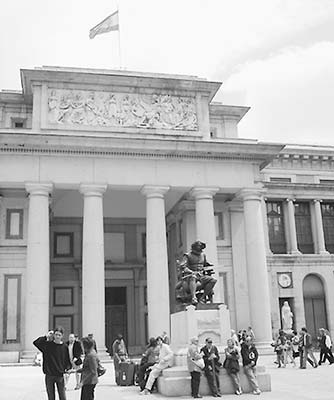
With more than 3,000 canvases, including entire rooms of masterpieces by superstar painters, the Prado (PRAH-doh) is my vote for the greatest collection of paintings anywhere. Centuries of powerful Spanish kings (and lots of New World plunder) funded art from all across Europe, so you’ll see first-class works from the Italian Renaissance (Raphael, Titian) as well as Northern art (Rubens, Dürer, and Bosch’s fantastical Garden of Earthly Delights). Mainly, the Prado is the place to enjoy the holy trinity of Spanish painters—El Greco, Velázquez, and Goya—including Velázquez’s Las Meninas, considered by some to be the world’s finest painting, period. Because the Prado is so huge, my tour zeroes in on the “Top Ten” stops (featuring about three dozen paintings in all). Allow at least two hours to speed through these highlights—but many spend three hours or more.
Cost and Hours: €15, Mon-Sat 10:00-20:00, Sun until 19:00, free for last two hours of every day (ticket required even at free times, they hand them out fast at Goya entrance or you can save time and get yours online in advance), under age 18 always free (ticket required).
Information: +34 913 302 800, www.museodelprado.es.
Advance Tickets Recommended: Buy tickets online in advance. You’ll receive an eticket with a QR code.
If you have a Paseo del Arte combo-ticket (described earlier), you need to exchange your voucher for a ticket at the Goya entrance; go to the shorter Paseo del Arte line (ask a security guard for directions if you can’t find it).
Crowd-Beating Tips: The Prado is generally less crowded from 14:00 to 18:00. It’s busiest in the evening (when it’s free) and on weekends.
Getting There: It’s on Paseo del Prado. The nearest Metro stops are Banco de España (line 2) and Estación del Arte (line 1), each a 10-minute walk from the museum.
It’s a 15-minute walk from Puerta del Sol to the Prado. You can zip down the noisy Carrera de San Jerónimo, or make it a more pleasant stroll along nearly traffic-free Calle de Las Huertas.
Getting In: You’ll enter at the Jerónimos entrance, at the north end of the museum, tucked below the Jerónimos church. Here you’ll check any bags, go through security, and begin your visit. (My self-guided tour starts here.)
The Goya entrance, also at the north end of the building, is the location of the ticket office, where you can exchange Paseo del Arte vouchers for tickets (or buy tickets if you haven’t booked ahead), then proceed to the Jerónimos entrance.
The Murillo entrance (south end of the building across from the Botanical Garden) is only for student groups. The Velázquez Entrance—in the middle of the building—is typically closed to the public.
Tours: The audioguide is a great investment. It’s a helpful supplement to my self-guided tour, allowing you to wander and dial up commentary on 250 masterpieces as you come across them (€5, available at info desks at the Jerónimos and Goya entrances).
Services: Facilities include info desks, WCs, bag check, bookshop, and café.
No-no’s: No photos, drinks, food, larger bags and backpacks, or large umbrellas are allowed inside. These rules are enforced: You’ll need to check bags, dump water, and keep your phone in your pocket.
Cuisine Art: The museum’s self-service $ cafeteria/restaurant, just inside the Jerónimos entrance (Mon-Sat 10:00-19:30, Sun until 18:30, hot dishes served only 12:30-16:00), is a disappointment. Across the street from the Goya entrance, you’ll find $$ VIPS, a chain restaurant handy for a cheap and filling salad or sandwich, with some outdoor tables facing the Neptune fountain (daily 9:00-24:00, across the boulevard from northern end of Prado at Plaza de Canova del Castillo, under Palace Hotel). Next door is Spain’s first Starbucks, opened in 2001. A strip of wonderful $$ tapas bars is just a few blocks west of the museum, lining Calle de Jesús (see here).
Self-Guided Tour
Thanks to Gene Openshaw for writing the following tour.
The vast Prado Museum sprawls over four floors. This tour is designed to hit the highlights with a minimum of walking and in a (roughly) chronological way. We’ll see altarpieces of early religious art, the rise of realism in the Renaissance, the royal art of Spain’s golden age, and the slow decline of Spain—bringing us right up to the cusp of the modern world.
While I’ve only described about 20 paintings, these greatest hits of the Prado are generally surrounded by related works also well worth enjoying. Paintings are moved around frequently. If you can’t find a particular work, ask a guard or at an information desk.
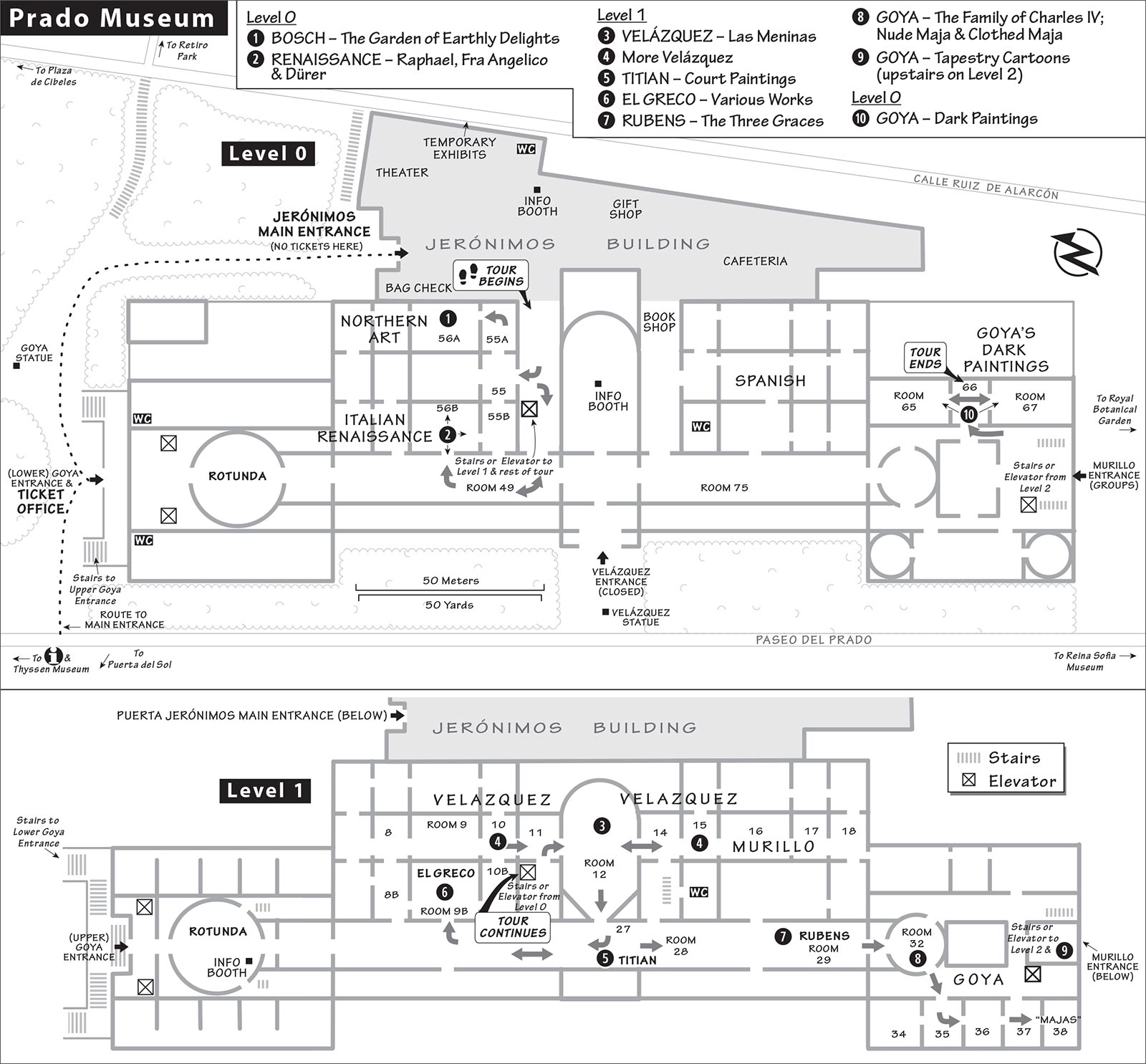
• Enter at the Jerónimos entrance. Pick up a museum map—you’ll need it (or use the one in this book). Locate where you are on the map—on Level 0, at the Jerónimos entrance. Our first stop should be nearby, in Room 56A.
To get there, find the corridor (near the security checkpoint) to the Edificio Villanueva. Head down the corridor about 30 yards and turn right into Room 55, then immediately right again (into 55A), then left into Room 56A. Let’s kick off this tour of artistic delights with a large three-panel painting of The Garden of Earthly Delights.
1 Hieronymus Bosch
In his cryptic triptych The Garden of Earthly Delights (El Jardín de las Delicias, c. 1505), the early Flemish painter Bosch (c. 1450-1516) paints a wonderland of eye-pleasing details. The message is that the pleasures of life are fleeting, and we’d better avoid them or we’ll wind up in hell. Take your time here to unpack this dense masterpiece.
This altarpiece has a central scene and two hinged outer panels. All the images work together to teach a religious message. Imagine the altarpiece closed (showing the back side). The world is gray and bare, before God’s creation. Now open it up, bring on the people, and splash into this colorful Garden of Earthly Delights.
The left panel is Paradise, showing naked Adam and Eve before original sin. Everything is in its place, with animals behaving virtuously. Innocent Adam and Eve get married, with God himself performing the ceremony.
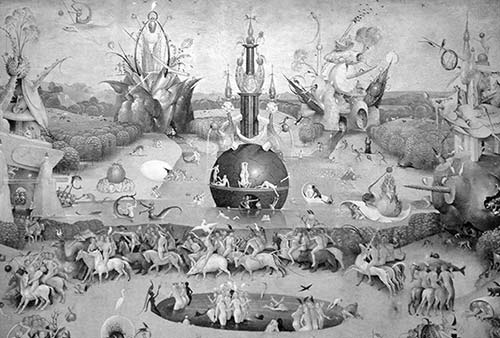
The central panel is a riot of naked men and women, black and white, on a perpetual spring break—eating exotic fruits, dancing, kissing, cavorting with strange animals, and contorting themselves into a Kama Sutra of sensual positions. In the background rise the fantastical towers of a medieval Disneyland. It’s seemingly a wonderland of pleasures and earthly delights. But where does it all lead? Men on horseback ride round and round, searching for but never reaching the elusive Fountain of Youth. Humankind frolics in earth’s “Garden,” oblivious to where they came from (left) and where they may end up...
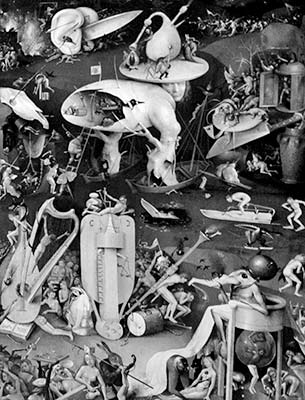
Now, go to hell (right panel). It’s a burning Dante’s Inferno-inspired wasteland where genetic-mutant demons torture sinners. Everyone gets their just desserts, like the glutton who is eaten and re-eaten eternally, the musician strung up on his own harp, and the gamblers with their table forever overturned. In the center, hell is literally frozen over. A creature with a broken eggshell body hosting a tavern, tree-trunk legs, and a hat featuring a bagpipe (symbolic of hedonism) stares out—it’s the face of Bosch himself.
If you want more Bosch, check out the nearby table featuring his Seven Deadly Sins (Los Pecados Capitales, late 15th century). Each of the four corners has a theme: death, judgment, paradise, and hell. The fascinating wheel, with Christ in the center, names the sins in Latin (lust, envy, gluttony, and so on), and illustrates each with a vivid scene that works as a slice of 15th-century Dutch life.
You’re surrounded by the biggest collection of Bosch paintings anywhere. Nearby, another Bosch triptych, The Haywain (El Carro de Heno, c. 1516), has still more vivid imagery about the consequences of sin and the transience of earthly life.
• Next up, we’ll go to the source of European painting as we know it: the Italian Renaissance.
Backtrack the way you came. Reaching the corridor, turn right and go past the elevators (remember them—we’ll use the elevators later). About 30 yards along, turn right into Room 49—a large, long, sage-green hall labeled XLIX above the door you’ve just entered. You’ve reached...
2 The Renaissance
During its golden age (the 1500s), Spain may have been Europe’s richest country, but Italy was considered its most cultured. Spain’s kings loved how Italian Renaissance artists captured a three-dimensional world on a two-dimensional canvas, bringing Bible scenes to life and celebrating real people and their emotions.
• Start midway down Room 49, on the left-hand wall, with a guy in red painted by Raphael.
Raphael (1483-1520) was the undisputed master of realism. When he painted Portrait of a Cardinal (El Cardenal, c. 1510-1511), he showed the sly Vatican functionary with a day’s growth of beard and an air of superiority, locking eyes with the viewer. The cardinal’s slightly turned torso is as big as a statue. Nearby are several versions of Holy Family and other paintings by Raphael.
• Now climb the four stairs in the middle of the room, up to Room 56B.
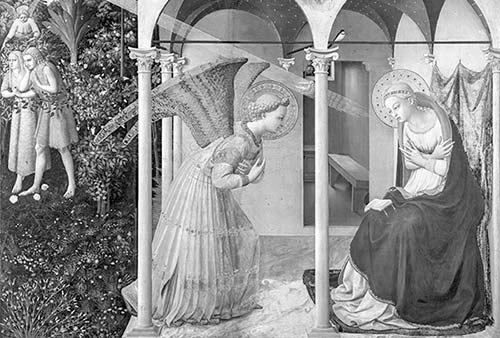
Fra Angelico’s The Annunciation (La Anunciación, c. 1426) is half medieval piety, half Renaissance realism. In the crude Garden of Eden scene (on the left), a scrawny, sinful First Couple hovers unrealistically above the foliage, awaiting eviction. The angel’s Annunciation to Mary (right side) is more Renaissance, both with its upbeat message (that Jesus will be born to redeem sinners like Adam and Eve) and in the budding photorealism, set beneath 3-D arches. (Still, aren’t the receding bars of the porch’s ceiling a bit off? Painting three dimensions wasn’t that easy.)
• To see how the Italian Renaissance spread to northern lands, step into the adjoining Room 55B (to the left, as you face the main hall).
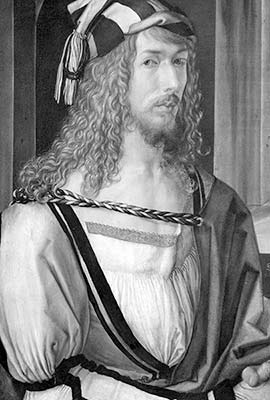
Albrecht Dürer’s Self-Portrait (Autorretrato), from 1498, is possibly the first time a Western artist depicted himself looking so confident and proud. The artist, age 26, is German, but he’s all dolled up in a fancy Italian hat and permed hair. He’d recently returned from Italy and wanted to impress his countrymen with his sophistication. Dürer (1471-1528) wasn’t simply vain. He’d grown accustomed, as an artist in Renaissance Italy, to being treated like a prince. Note Dürer’s signature, the pyramid-shaped “A. D.” (D inside the A), on the windowsill.
Nearby are Dürer’s 1507 panel paintings of Adam and Eve—the first full-size nudes in Northern European art. Like Greek statues, they pose in their separate niches, with three-dimensional, anatomically correct bodies. This was a bold humanist proclamation that the body is good, man is good, and the things of the world are good.
• The down-to-earth realism of Renaissance art soon spread to Europe’s richest country—Spain.
Backtrack down the four steps into Room 49, and make a U-turn to the left, to reach those elevators we saw earlier. Take the elevator up to level 1 and turn left into Room 11. A painting here (by Velázquez) of a radiant Apollo surprising the cuckold Vulcan and a gang of startled workmen introduces us to the main feature of Spanish art—unflinching realism.
Let’s begin next door, in the large, lozenge-shaped Room 12.
3 Velázquez, Las Meninas
Diego Velázquez (vel-LAHTH-keth, 1599-1660) was the photojournalist of court painters, capturing the Spanish king and his court in formal portraits that take on aspects of a candid snapshot. Room 12 is filled with the portraits Velázquez was called on to produce. Kings and princes prance like Roman emperors. Get up close and notice that his remarkably detailed costumes are nothing but a few messy splotches of paint—the proto-Impressionism Velázquez helped pioneer.
The room’s centerpiece, and perhaps the most important painting in the museum, is Velázquez’s Las Meninas (Maids of Honor, c. 1656). It’s a peek at nannies caring for Princess Margarita and, at the same time, a behind-the-scenes look at Velázquez at work. One hot summer day in 1656, Velázquez (at left, with paintbrush and Dalí moustache) stands at his easel and stares out at the people he’s painting—the king and queen. They would have been standing about where we are, and we see only their reflection in the mirror at the back of the room. Their daughter (blonde hair, in center) watches her parents being painted, joined by her servants (meninas), dwarves, and the family dog. At that very moment, a man happens to pass by the doorway at back and pauses to look in. Why’s he there? Probably just to give the painting more depth.
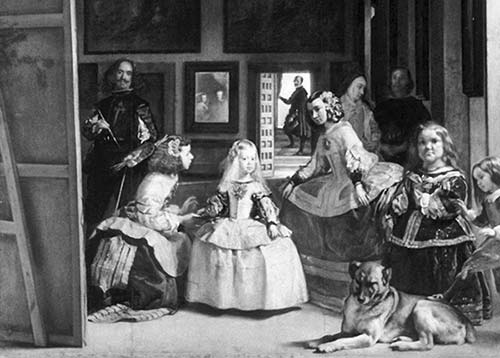
This frozen moment is lit by the window on the right, splitting the room into bright and shaded planes that recede into the distance. The main characters look right at us, making us part of the scene, seemingly able to walk around, behind, and among the characters. Notice the exquisitely painted mastiff—annoyed by the little girl, but staying put...for now.
If you stand in the center of the room, the 3-D effect is most striking. This is art come to life.
• Let’s see more of Velázquez, whose work covers a wide range of subjects and emotions. Facing this painting, leave to the left, pass through Room 11, and enter Room 10.
4 More Velázquez
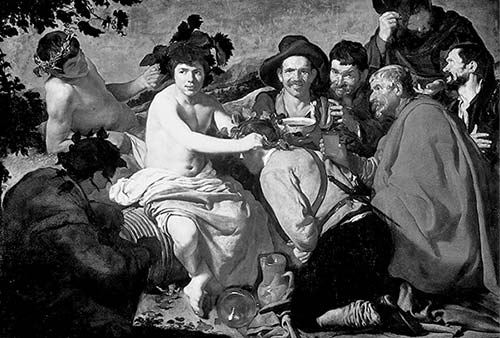
Velázquez enjoyed capturing light—and capturing the moment. The Feast of Bacchus (Los Borrachos, c. 1628-1629) is a group selfie in a blue-collar bar. A couple of peasants mug for a photo-op with a Greek god—Bacchus, the god of wine. This was an early work, before Velázquez got his court-painter gig, and shows off his admiration for “real” people. Hardworking farmers enjoying the fruit of their labor deserved portraits, too. Notice the almost-sacramental presence of the ultrarealistic bowl of wine in the center, as Bacchus, with the honest gut, crowns a fellow hedonist.
• Backtrack through the big gallery with Las Meninas, and continue straight ahead into Room 14.
Velázquez’s boss, King Philip IV, had an affair, got caught, and repented by commissioning The Crucified Christ (Cristo Crucificado, c. 1632). Christ hangs his head, humbly accepting his punishment. Philip would have been left to stare at the slowly dripping blood, contemplating how long Christ had to suffer to atone for Philip’s sins. This is an interesting death scene. There’s no anguish, no tension, no torture. Light seems to emanate from Jesus as if nothing else matters. The crown of thorns and the cloth wrapped around his waist are particularly vivid. Above it all, a sign reads in three languages: “Jesus of Nazareth, King of the Jews.”
• Continue on through Room 15 (with Velázquez’s insightful portraits of the royal court dwarves) and detour into Rooms 16 and 17.
Take a moment to appreciate these paintings by one of Velázquez’s admirers: Bartolomé Murillo. Murillo (1618-1682) soaked up Velázquez’s unflinching photorealism, but added a spoonful of sugar. In his most famous works—called The Immaculate Conception—Murillo put a human face on the abstract Catholic doctrine that Mary was conceived and born free of original sin. His “immaculate” virgins float in a cloud of Ivory Soap cleanliness, radiating youth and wholesome goodness. Mary wears her usual colors—white for purity and blue for divinity. (For more on Murillo, see here.) Murillo’s sweet and escapist work must have been very comforting to the wretched people of his hometown of Sevilla, which was ravaged by plague in 1647-1652.
• Backtrack to the Meninas room (12) and turn left. You’ll exit into the museum’s looooong grand gallery (Rooms 25-29) and come face-to-face with a large canvas of an emperor on horseback.
5 Titian’s Court Paintings
Spain’s golden age kings Charles V and Philip II both hired Europe’s premier painter—Titian the Venetian (c. 1485-1576)—to paint their portraits.
In The Emperor Charles V at Mühlberg (Carlos V en la Batalla de Mühlberg, 1548), the king rears on his horse, points his lance at a jaunty angle, and rides out to crush an army of Lutherans. Charles, having inherited many kingdoms and baronies through his family connections, was the world’s most powerful man in the 1500s. (You can see the suit of armor depicted in a painting in the Royal Palace armory.)
In contrast (just to the right), Charles I’s son, Philip II (Felipe II, c. 1550-1551), looks pale, suspicious, and lonely—a scholarly and complex figure. He moved Spain’s capital from Toledo to Madrid and built the austere, monastic palace at El Escorial. These are the faces of the Counter-Reformation, as Spain took the lead in battling Protestants. Father and son had one thing in common: underbites, a product of royal inbreeding (which Titian painted...delicately).
• The ultra-Catholic Philip II amassed a surprisingly large collection of Titian’s Renaissance playmates, which you could seek out elsewhere on this floor. But let’s turn to a quite different painter that Philip hired—El Greco.
Facing Charles and Philip, turn right, walk about 30 yards, and turn right at the first door, into Room 9B.
6 El Greco
El Greco (1541-1614) was born in Greece (his name is Spanish for “The Greek”), trained in Venice, then settled in Toledo—60 miles from Madrid. His paintings are like Byzantine icons drenched in Venetian color and fused in the fires of Spanish mysticism. (For more on El Greco, see here.) The El Greco paintings displayed here in Rooms 8B, 9B, and 10B rotate, but they all glow with his unique style.
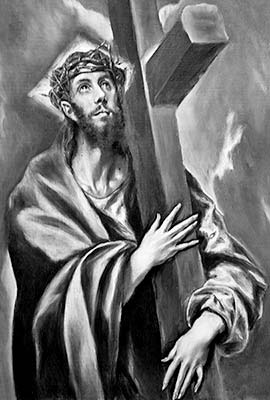
In Christ Carrying the Cross (Cristo Abrazado a la Cruz, c. 1602), Jesus accepts his fate, trudging toward death with blood running down his neck. He hugs the cross and directs his gaze along the crossbar. His upturned eyes (sparkling with a streak of white paint) lock onto his next stop—heaven.
The Adoration of the Shepherds (La Adoración de los Pastores, c. 1614), originally painted for El Greco’s own burial chapel in Toledo, has the artist’s typical two-tiered composition—heaven above, earth below. The long, skinny shepherds are stretched unnaturally in between, flickering like flames toward heaven.
El Greco’s portraits of Spanish nobles and saints (such as The Nobleman with His Hand on His Chest, El Caballero de la Mano al Pecho, c. 1580) focus on their aristocratic expressions. A man’s hand with his fingers splayed out, but with the middle fingers touching, was El Greco’s trademark way of expressing elegance (or was it the 16th-century symbol for “Live long and prosper”?). Though the identity of the nobleman is unknown, some have suggested it’s El Greco himself. Several paintings have El Greco’s signature written in faint Greek letters—“Doménikos Theotokópoulos,” El Greco’s real name.
• While El Greco was painting austere Christian saints, other European artists were painting sensual Greek gods, in a dramatic new style—Baroque.
Return to the main gallery, turn left, pass by Charles and Philip again, and proceed to the gallery’s far end (technically Rooms 28 and 29) for the large, colorful, fleshy canvases by...
7 Rubens
A native of Flanders (the Dutch-speaking part of Belgium), Peter Paul Rubens (1577-1640) painted Baroque-style art meant to play on the emotions, titillate the senses, and carry you away. His Diana and Her Nymphs Surprised by Satyrs is typical of how his paintings surge with Baroque energy and ripple with waves of figures. Surveying his big, boisterous canvases, you’ll notice his trademarks: sex, violence, action, emotion, bright colors, and ample bodies, with the wind machine set on full. Gods are melodramatic, and nymphs flee half-human predators. Rubens painted the most beautiful women of his day—well-fed, no tan lines, squirt-gun breasts, and very sexy.
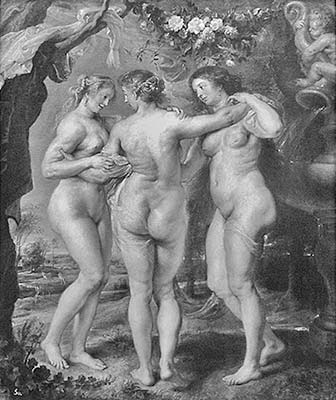
Rubens’ The Three Graces (Las Tres Gracias, c. 1630-1635) celebrates cellulite. The ample, glowing bodies intertwine as the women exchange meaningful glances. The Grace at the left is Rubens’ young second wife, Hélène Fourment, who shows up regularly in his paintings.
• Rubens, El Greco, Titian, and Velázquez had all made their living working for Europe’s royalty. But that world was changing, and revolution was in the air. No painter illustrates the changing times more than our final artist—Goya.
From Rubens, continue to the end of the long main gallery and enter the round Room 32, where you’ll see royal portraits by Goya.
8 Goya—Court Painter
Follow the complex Francisco de Goya (1746-1828) through the stages of his life—from dutiful court painter, to political rebel and scandal maker, to the disillusioned genius of his “black paintings.” The museum’s exciting Goya collection is displayed on three different levels: classic Goya on this level, early cartoons upstairs, and his dark and political work downstairs.
In the group portrait The Family of Charles IV (La Familia de Carlos IV, 1800), the royals are all decked out in their Sunday best. Goya himself stands at his easel to the far left, painting the court (a tribute to Velázquez in Las Meninas) and revealing the shallowness beneath the fancy trappings. Charles, with his ridiculous hairpiece and goofy smile, was a vacuous, henpecked husband. His toothless yet domineering queen upstages him, arrogantly stretching her swanlike neck. The other adults, with their bland faces, are bug-eyed with stupidity.
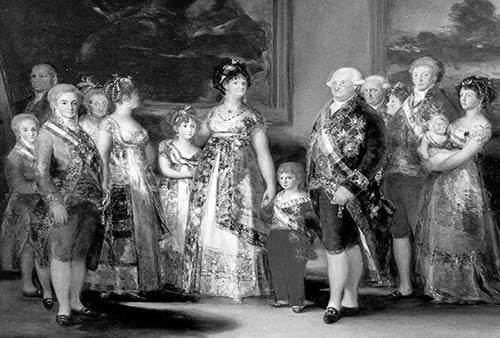
Surrounding you in this same room are other portraits of the king and queen. Also notice the sketch paintings, quick studies done with the subjects posing for Goya. He used these for reference to complete his larger, more finished canvases.
• Exit to the right across a small hallway, turn left, and walk through to Room 38, where you’ll find Goya’s most scandalous works.
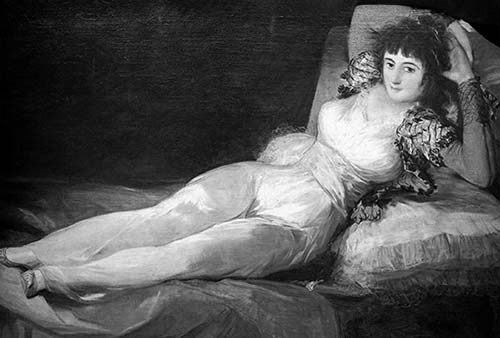
Rumors flew that Goya was fooling around with the vivacious Duchess of Alba, who may have been the model for two similar paintings, Nude Maja (La Maja Desnuda, c. 1800) and Clothed Maja (La Maja Vestida, c. 1808). A maja was a trendy, working-class girl. Whether she’s a duchess or a maja, Goya painted a naked lady—an actual person rather than some mythic Venus. And that was enough to risk incurring the wrath of the Inquisition. The nude stretches in a Titian-esque pose to display her charms, the pale body with realistic pubic hair highlighted by cool green sheets. (Notice the artist’s skillful rendering of the transparent fabric on the pillow.) According to a believable legend, the two paintings were displayed in a double frame, with the Clothed Maja sliding over the front to hide the Nude Maja from Inquisitive minds.
• Just off Room 37 are an elevator and a staircase. Head up to level 2, to Rooms 85-87 and 90-94, for more Goya.
9 Goya—Tapestry Cartoons
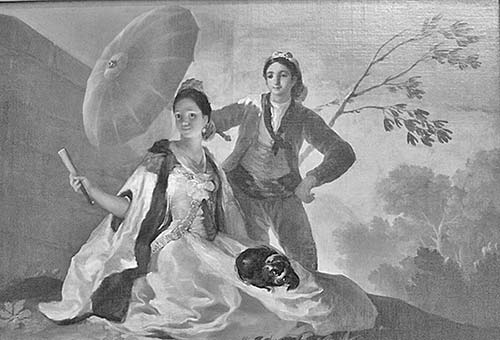
These rooms display Goya’s designs for tapestries (known as “cartoons”) for nobles’ palaces. Dressed in their gay “Goya-style” attire, nobles picnic, dance, fly kites, play paddleball and Blind Man’s Bluff, or just relax in the sun—as in the well-known The Parasol (El Quitasol, Room 86). It’s clear that, while revolution was brewing in America and France, Spain’s lords and ladies were playing, blissfully ignorant of the changing times.
• Goya’s later paintings took on a darker edge. Take the stairs down to level 0 and make a right into Room 66; or, from the elevator, go up and down the stairs (across the Murillo Entrance) to Room 66. Entering, go left into Room 65, with its powerful military scenes.
10 Goya—Dark Paintings
Despite working for Spain’s monarchs, Goya became a political liberal and a champion of the Revolution in France. But that idealism was soon crushed when the supposed hero of the Revolution, Napoleon, morphed into a tyrant and invaded Spain. Goya, who lived on Madrid’s Puerta del Sol, captured the chaotic events that unfolded there.
In The Second of May, 1808 (El 2 de Mayo de 1808, 1814), Madrid’s citizens rise up to protest the occupation in Puerta del Sol, and the French send in their dreaded Egyptian mercenaries. They plow through the dense tangle of Madrileños, who have nowhere to run. The next day, The Third of May, 1808 (El 3 de Mayo de 1808, 1814), the French rounded up ringleaders and executed them. The colorless firing squad—a faceless machine of death—mows them down, and they fall in bloody, tangled heaps. Goya throws a harsh prison-yard floodlight on the main victim, who spreads his arms Christ-like to ask, “Why?”
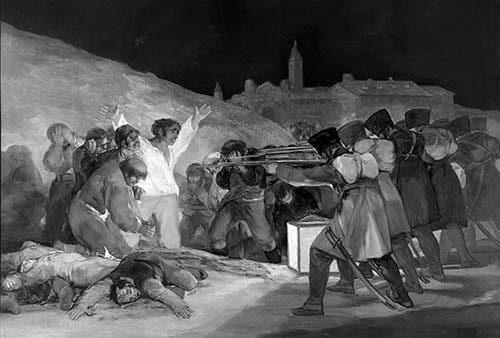
Politically, Goya was split—he was a Spaniard, but he knew France was leading Europe into the modern age. His art, while political, has no Spanish or French flags. It’s a universal comment on the horror of war. Many consider Goya the last classical and first modern painter...the first painter with a social conscience.
• Finish the tour with Goya’s final, late-in-life paintings. Turn left to the “black paintings” in Room 67.
Depressed and deaf from syphilis, Goya retired to his small home and smeared its walls with his “black paintings”—dark in color and in mood. During this period in his life, Goya would paint his nightmares...literally. The style is considered Romantic—emphasizing emotion over beauty—but it foreshadows 20th-century Surrealism with its bizarre imagery, expressionistic and thick brushstrokes, and cynical outlook.
Stepping into Room 67, you are surrounded by art from Goya’s dark period. These paintings are the actual murals from the walls of his house, transferred onto canvas. Imagine this in your living room. Goya painted what he felt with a radical technique unburdened by reality—a century before his time. And he painted without being paid for it—perhaps the first great paintings done not for hire or for sale. We know frustratingly little about these works because Goya wrote nothing about them.
Dark forces convened continually in Goya’s dining room, where The Great He-Goat (El Aquelarre/El Gran Cabrón, c. 1820-1823) hung. The witches, who look like skeletons, swirl in a frenzy around a dark, Satanic goat in monk’s clothing who presides over the obscene rituals. The black goat represents the devil and stokes the frenzy of his wild-eyed subjects. Amid this adoration and lust, a noble lady (far right) folds her hands primly in her lap (“I thought this was a Tupperware party!”). Or, perhaps it’s a pep rally for her execution, maybe inspired by the chaos that accompanied Plaza Mayor executions. Nobody knows for sure.
In Fight to the Death with Clubs (Duelo a Garrotazos, c. 1820-1823), two giants stand face-to-face, buried up to their knees, and flail at each other with clubs. It’s a standoff between superpowers in the never-ending cycle of war.
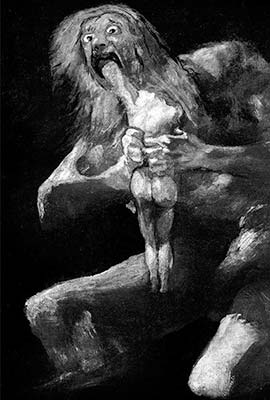
In Saturn (Saturno, c. 1820-1823), fearful that his progeny would overthrow him, the god eats one of his offspring. Saturn, also known as Kronus (Chronus, or time), may symbolize how time devours us all. Either way, the painting brings new meaning to the term “child’s portion.”
The Drowning Dog (Perro Semihundido, c. 1820-1823) is, according to some, the hinge between classical art and modern art. The dog, so full of feeling and sadness, is being swallowed by quicksand...much as, to Goya, the modern age was overtaking a more classical era. And look closely at the dog. It also can be seen as a turning point for Goya. Perhaps he’s bottomed out—he’s been overwhelmed by depression, but his spirit has survived. With the portrait of this dog, color is returning.
• Keep that hope alive for one more painting. Head back to Room 65 or 66 and look for the portrait of a seated young woman gazing downward.
The last painting we have by Goya is The Milkmaid of Bordeaux (La Lechera de Burdeos, c. 1827). Somehow, Goya pulled out of his depression and moved to France, where he lived until his death at 82. As an old man, color returned to his palette. His social commentary, his passion for painting what he felt (more than what he was hired to do), and, as you see here, the freedom of his brushstrokes explain why many consider Francisco de Goya to be the first modern artist. This is a good place to reflect on all we’ve seen in the Prado. Goya combined the vivid imagination of Bosch, Renaissance techniques, the sober realism of Velázquez, and the emotion of El Greco to pave the way to the future of art.
• There’s a lot more to the Prado, but there’s also a lot more to Madrid. You can leave the museum via any open entrance. For a nature break from all this art, pop into the delightful Royal Botanical Garden, described next. It faces the Prado on the opposite side from where you entered. The quickest way to get there is through the Murillo entrance at the building’s south end.
▲Royal Botanical Garden (Real Jardín Botánico)
After your Prado visit, you can take a lush and fragrant break in this sculpted park. Wander among trees from around the world, originally gathered by—who else?—the enlightened King Charles III. This garden was established when the Prado’s building housed the natural science museum.
Cost and Hours: €7, free Tue from 10:00-13:00; open daily May-Aug 10:00-21:00, April and Sept until 20:00, shorter hours off-season; entrance opposite the Prado’s Murillo/south entry, Plaza de Murillo 2, +34 914 203 017.
▲▲Thyssen-Bornemisza Museum (Museo del Arte Thyssen-Bornemisza)
Locals call this stunning museum simply the Thyssen (TEE-sun). It displays the impressive collection that Baron Thyssen (a wealthy German married to a former Miss Spain) sold to Spain for $350 million. The museum offers a unique chance to enjoy the sweep of all of art history—including a good sampling of the “isms” of the 20th century—in one collection. It’s basically minor works by major artists and major works by minor artists. (Major works by major artists are in the Prado.) But art lovers appreciate how the good baron’s art complements the Prado’s collection by filling in where the Prado is weak—art of the 19th and 20th centuries, such as Impressionism, which is the Thyssen’s forte.
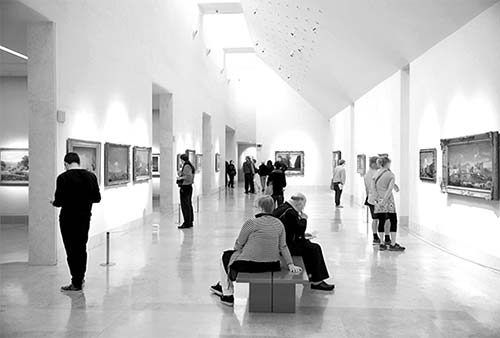
Cost and Hours: €13, free on Mon, includes temporary exhibits; open Mon 12:00-16:00, Tue-Sun 10:00-19:00; audioguide-€5; +34 917 911 370, www.museothyssen.org.
Getting There: It’s located kitty-corner from the Prado at Paseo del Prado 8 in Palacio de Villahermosa (Metro: Banco de España).
Services: The museum has free baggage storage (good for bags, backpacks, and umbrellas; they won’t take large suitcases), a restaurant, and a shop/bookstore.
Self-Guided Tour
After purchasing your ticket, pick up a museum map at the info desk. The museum’s permanent collection is divided into the Carmen Thyssen Collection on the ground floor, and the Thyssen Collection on the first and second floors.
Ground Floor: Walk down the wide main hall to see the four larger-than-life paintings of former monarchs Juan Carlos I and Sofía, and the baron (d. 2002) and his art-collecting baroness, Carmen. Then head to the entrance to the Carmen Thyssen Collection, where you can see the baroness’s additions since the 1980s. The works are arranged in chronological order, from the 17th century to the 20th. Carmen Thyssen’s collection is intriguing, but don’t linger—the Thyssen Collection has the heavyweight artists.
• Ascend to the second floor and work your way back down, taking a delightful walk through art history. The numbered rooms lead you from Primitive Italian (Room 1) to Surrealism and Pop Art (Rooms 41-43). Here’s a breezy stroll that hits the highlights:
Floor 2: The second floor focuses on the Old Masters of the 17th through the 19th centuries. Start where Western art did—with religious altarpieces from Italy depicting holy people in the golden realm of heaven (Rooms 1-2). Meanwhile, Flemish painters were discovering oil paints, allowing them to give their Virgin Marys more detail and human tenderness (Room 3). The Italians pioneered 3-D realism, to bring heavenly scenes down into the real world (Room 4).
Turn the corner into the long hallway, featuring portraits of famous Europeans circa 1500. The most prestigious is a likeness of England’s Henry VIII by the accomplished Hans Holbein, who spent years portraying the nobility of the Tudor court (Room 5). Pop into Room 6 for a few El Grecos. In Room 12, begin the Baroque with Caravaggio, then turn the corner into Room 13 and pass through the 1600s. In Room 17, look for Canaletto’s views of Venice, and find portraits by Rubens in Room 19. As you continue through Rooms 22-28, notice how, while Italians painted myths and goddesses, the practical Dutch enjoyed down-to-earth portraits, group portraits, everyday scenes, landscapes, seascapes, and detailed still-lifes of fruit and flowers. A proud self-portrait by Rembrandt may be on display when you visit. In Room 29, experience Goya’s Romanticism.
• Now go downstairs to...
Floor 1: On the first floor you will find the Modern Masters, from Impressionism to the 20th century. In the 1800s, the French led the march toward modernism (Room 30). Artists painted in the open air to capture rural landscapes and the working poor with increasing spontaneity.
In Room 33, the movement culminates in Impressionism. The museum has a laudable collection of works by Manet, Monet, Pissarro, and their Impressionist contemporaries, who painted landscapes, Parisian street scenes, a night at the ballet (Degas), or backstage scenes of the Moulin Rouge (Toulouse-Lautrec).
As Impressionism becomes Post-Impressionism, and Expressionism bursts in (Rooms 34-36), note the variety of painters who used Impressionist techniques but with brighter colors, thicker paint, and more furious brushwork. Increasingly, they simplified reality and flattened the 3-D.
Simplified reality led to abstraction, and artists like Kandinsky began creating beautiful patterns of pure line and color (Room 39). Marc Chagall used modern art techniques to create a dreamlike world of weightless lovers and fiddler-on-the-roof villages (Room 40).
The Spaniard Picasso and his Parisian roommate Georges Braque invented Cubism—a revolutionary style many others would imitate (Rooms 41-42). As artists increasingly turned away from photorealism, Mondrian experimented with simple rectangular grids of the primary colors—red, yellow, blue—on a white canvas (Room 43).
In Room 44, we see more varieties of Cubism—including collage, in which artists literally glued things onto the canvas to produce a kind of sculpture—as well as Surrealism and other “isms,” explored by Picasso, Dalí, and Miró.
In Rooms 48-49 we see how the world wars affected the art world. Artists “expressed” their emotions in big, minimal “abstract” canvases—Abstract Expressionism. Francis Bacon captured the horror of World War II’s destruction with his screaming, caged, isolated figures in a barren landscape (Room 49).
• Whew. That’s five centuries of Western Art.
▲▲▲Centro de Arte Reina Sofía
Best known as home to Picasso’s Guernica, the Reina Sofía is also one of Europe’s top modern-art museums. Its exceptional collection maps the development of Modernism from its origins in the late 19th century until today. The focus is on 20th-century Spanish artists—Picasso, Dalí, Miró, and Gris—but you’ll also find works by Kandinsky, Braque, Magritte, and other giants of modern art. Many works are displayed alongside contemporaneous documents—letters, newspaper clippings, posters, gallery invitations—that place the art into social context. Those with an appetite for modern and contemporary art can spend several delightful hours in this museum.
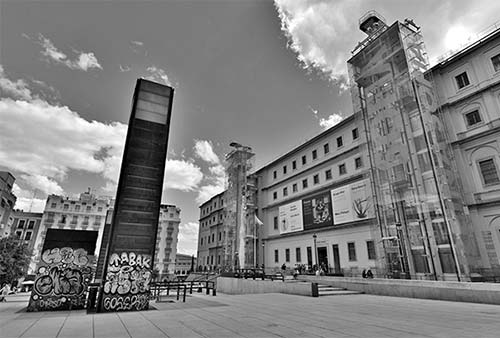
Cost and Hours: €12, €16.50 with worthwhile audioguide; Mon and Wed-Sat 10:00-21:00, Sun until 14:30, closed Tue.
Free Entry: The museum is free—and crowded—the last two hours of every day it’s open (must pick up a ticket to enter).
Advance Tickets Recommended: It’s smart to purchase tickets online in advance.
Information: +34 917 741 000, www.museoreinasofia.es.
Getting There: It’s a block from the Estación del Arte Metro stop, on Plaza Sánchez Bustillo at Calle de Santa Isabel 52. In the Metro station, follow signs for the Reina Sofía exit. Emerging from the Metro, walk straight ahead a half-block and turn right on Calle de Santa Isabel. The museum is housed in two connected buildings, the historic 18th-century Sabatini building and the Nouvel building, added in 2005. Look for the tall, exterior glass elevators that flank the museum’s main entrance.
A second entrance in the newer section of the building sometimes has shorter lines. To get there, face the glass elevators and walk left around the old building to the large gates of the red-and-black Nouvel building.
Services: Bag storage is free. The librería just outside the Nouvel wing has a larger selection of Picasso and Surrealist reproductions than the main gift shop at the entrance.
Cuisine Art: The museum’s $$ café (a long block around the left from the main entrance) is a standout for its tasty cuisine. The square immediately in front of the museum is ringed by fine places for a simple meal or drink. My favorite is $$ El Brillante, a classic dive offering pricey tapas and famous fried squid sandwiches. Sit at the simple bar or at an outdoor table (long hours daily, two entrances—one on Plaza Sánchez Bustillo, the other at Plaza del Emperador Carlos V 8, see the “Madrid’s Museum Neighborhood” map). And just a 10-minute walk north is my favorite strip of tapas bars, on Calle de Jesús (see here).
Self-Guided Tour
If you’re looking for all the Picasso works here and all the Dalí paintings there, you’ll be frustrated. As is trendy in modern art museums everywhere, the collection is arranged by theme, and the big-name works are scattered. The organization emphasizes both the historical context that the art was born from, and how the works fit into the evolution of major social and political movements, including feminism, decolonization, and ecology.
The museum has four floors. Floor 2 holds many of the highlights, including Guernica, and is where we’ll spend most of our time on the following self-guided tour. But if you feel like wandering, you’re bound to make interesting discoveries on every level. Floor 1 has a courtyard with sculptures by Calder and Picasso—it’s a good place to get some fresh air. Floor 3 is always dedicated to temporary exhibits, and floor 4 mainly focuses on Spain in the 1940s, tying the art—including works by Miró, Dalí, and Tapiés—in with the political, social, and economic circumstances of that turbulent decade.
• Entering the Sabatini building through the main entrance, cross the courtyard and take one of the glass elevators to floor 2. When you exit the elevator your tour begins: You’ll make a full circle, counterclockwise, from Space 201 to Space 208 (with the courtyard below to your left). Each “space” is a cluster of connecting rooms with a unifying theme that’s identified on the signage. Laminated information sheets, available in English, fill in details.
Birth of Modernism: First up, Spaces 201 to 203 focus on Madrid, Paris, Madrid, Barcelona, and New York during the first decades of the 20th century. A mix of photos, paintings, posters, and architectural drawings document the link between the birth of the modern city and the birth of modern art. Photos and paintings in Room 201.01 show life in Madrid 100 years ago. In Room 201.02, see if you can pick out the early Picassos (they’re two of the most conventional works in the room, showing little sign of the masterpieces to come). More striking is the portrait of Picasso—a 1914 terracotta bust (by Pablo Gargallo) that captures Picasso’s brash confidence, with a smirk on his lips and a lock of hair rakishly falling over one eye. Room 203.02 features art by Spanish women of the 1920s and ’30s; the creative works by Delhy Tejero feel like something from another world.
• A left turn in the hall brings you to Space 204, “Cubist Nation.”
Give your eyes and your mind time to adjust to the Cubist style. Even today it feels revolutionary.
Cubism: This area is one of the Reina Sofía’s highlights, featuring work by Picasso, Georges Braque, and Madrid’s own Juan Gris.
While rooming together in Paris, Picasso and Braque invented a new way of portraying the world through painting—Cubism. They “shattered” images of familiar objects and then reassembled them as geometrical forms on a canvas. The things they painted—bottles, fruit, dead birds, playing cards, guitars, a woman’s head—are vaguely recognizable, but composed of many different “cubes.” It was a way of showing more than two dimensions at once. (Imagine walking around a statue to take it in at all angles, and then attempting to put what you’ve seen on a 2-D plane.)
Picasso and Braque were soon joined in Paris by Gris. Each of the three took the Cubist concept in his own direction: Notice how Braque’s Bottle and Fruit and Gris’ Violin and Guitar resemble each other in composition, but Braque chooses muted umber tones, while Gris is all sharp colors and sharp lines. They’re so similar...but so different.
• Taking another left turn, you step into the world of the Spanish Civil War as you enter Space 205, “High Culture and Popular Art: Guernica and the 1930s.”
Experiencing Guernica: Rooms 205.01 to 205.09 supply context for Picasso’s harrowing masterpiece. As you move through each room, you get a different perspective on Spain at the time of the civil war. Room 205.03 shows how groundbreaking photojournalists shaped the world’s understanding of the conflict. Room 205.05 is filled with bold, stylized posters—a crucial tool for expressing the pro-communist, anti-Franco leanings of much of the population. Rooms 205.08 and 205.09 are dedicated to the 1937 Paris International Exposition, where Guernica was first displayed; a model of the expo’s Spanish Pavilion includes a tiny reproduction of Picasso’s work. Thanks to Guernica, the pavilion became a center for pro-Republic, anti-Franco propaganda and fundraising. (Notice the pavilion flies the flag of the Republicans: red, yellow, and purple.)
• Enter Room 205.10 to come face to face with the great painting itself.
Guernica—Background: Perhaps the single most impressive piece of art in Spain, the monumental Guernica canvas—one of Europe’s must-see sights—is not only a piece of art but a piece of history, capturing the horror of modern war in a modern style.
While it’s become a timeless classic representing all war, it was born in response to a specific conflict—the Spanish Civil War (1936-1939), which pitted the democratically elected Second Republican government against the fascist general Francisco Franco. Franco won and ended up ruling Spain with an iron fist for the next 36 years. At the time Franco cemented his power, Guernica was touring internationally as part of a fundraiser for the Republican cause. With Spain’s political situation deteriorating and World War II looming, Picasso in 1939 named New York’s Museum of Modern Art as the depository for the work. It was only after Franco’s death, in 1975, that Guernica ended its decades of exile. In 1981 the painting finally arrived in Spain (where it had never before been), and it now stands as Spain’s national piece of art.
Guernica—The Bombing: On April 26, 1937, Guernica—a Basque market town in northern Spain and an important Republican center—was the target of the world’s first saturation-bombing raid on civilians. Franco gave permission to his fascist confederate Adolf Hitler to use the town as a guinea pig to try out Germany’s new air force. The raid leveled the town, causing destruction that was unheard of at the time—though by 1944 it would be commonplace. (For more on the town and the bombing, see the Guernica section of the Basque Country chapter.)
News of the bombing reached Picasso in Paris, where coincidentally he was just beginning work on a painting commission awarded by the Republican government. Picasso scrapped his earlier plans and immediately set to work sketching scenes of the destruction as he imagined it. In a matter of weeks, he put these bomb-shattered shards together into a large mural (286 square feet). For the first time, the world could see the destructive force of the rising fascist movement—a prelude to World War II.
Guernica—The Painting: The bombs are falling, shattering the quiet village. 1 A woman howls up at the sky (far right), 2 horses scream (center), and 3 a man falls from a horse and dies, while 4 a wounded woman drags herself through the streets. She tries to escape, but her leg is too thick, dragging her down, like trying to run from something in a nightmare. 5 On the left, a bull—a symbol of Spain—ponders it all, watching over 6 a mother and her dead baby...a modern pietà. 7 A woman in the center sticks her head out to see what’s going on. The whole scene is lit from above by the 8 stark light of a bare bulb. Picasso’s painting threw a light on the brutality of Hitler and Franco, and suddenly the whole world was watching.
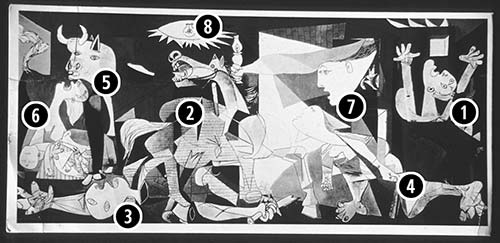
Picasso’s abstract, Cubist style reinforces the message. It’s as if he’d picked up the shattered shards and pasted them onto a canvas. The black-and-white tones are as gritty as the black-and-white newspaper photos that reported the bombing. The drab colors create a depressing, almost nauseating mood.
Picasso chose images with universal symbolism, making the work a commentary on all wars. Picasso himself said that the central horse, with the spear in its back, symbolizes humanity succumbing to brute force. The fallen rider’s arm is severed and his sword is broken, more symbols of defeat. The bull, normally a proud symbol of strength and independence, is impotent and frightened. Between the bull and the horse, the faint dove of peace can do nothing but cry.
The bombing of Guernica—like the entire civil war—was an exercise in brutality. As one side captured a town, it might systematically round up every man, old and young—including priests—line them up, and shoot them in revenge for atrocities by the other side.
Thousands of people attended the Paris exhibition, and Guernica caused an immediate sensation. They could see the horror of modern war technology, the vain struggle of the Spanish Republicans, and the cold indifference of the fascist war machine. Picasso vowed never to return to Spain while Franco ruled (the dictator outlived him).
With each passing year, the canvas seemed more and more prophetic—honoring not just the hundreds or thousands who died in Guernica, but also the estimated 500,000 victims of Spain’s bitter civil war and the 55 million worldwide who perished in World War II. Picasso put a human face on what we now call “collateral damage.”
• Take a deep breath, collect yourself, and prepare for another mind-bending take on modern art, with another Spanish master at the forefront. Rooms 205.11 to 205.17 and Space 206 explore other art movements of the 1930s, most notably Surrealism.
Surrealism and Dalí: Disillusioned by the irrationality of the war, Surrealists rebelled against traditional mores and the shackles of the rational mind. Influenced by Freud’s theories about the power of the subconscious, they let their emotions and primal urges speak freely on the canvas. They painted imagery from their dreams (mindscapes, rather than landscapes). They captured the realm beyond the world we see—it was “surreal.”
Spaniard Salvador Dalí (1904-1989) was one of Surrealism’s founders and would become its biggest star. (For more on Dalí, see here.)
Dalí’s works in these rooms show that he had a range of styes, but it’s his distinct, melting-object Surrealism that really stands out. Dalí places familiar items in bizarre juxtaposition within stark landscapes, creating an eerie effect. Figures morph into misplaced faces and body parts. Background and foreground play mind games—is it an animal (seen one way) or a man’s face (seen another)? A waterfall or a pair of legs? It’s a wide shot...no, it’s a close-up.
Find Dalí’s Face of the Great Masturbator (1929) in Room 205.13. It’s psychologically exhausting, depicting through Surrealism a lonely, highly sexual genius (Dalí) in love with his muse (Gala, at the time still married to a French poet). This is the first famous Surrealist painting. Like a dream, it mixes and matches seemingly unrelated objects. Swarming ants. A limp earthworm hanging from a hook. Faceless mannequins roaming a desert. A teetering tower of rock, cork, seashell, and olive. What does it mean? What does any dream mean? You tell me.
• Next you’ll take a short step back in time in Spaces 207 and 208.
Early-20th-Century Social Tensions: Space 207 examines how Spanish art during World War I reflected the ideological tensions that gripped the country, and particularly Barcelona. One room re-creates the setting of the Galeries Dalmau, a hub of Barcelona’s vibrant art scene (look for works by Miró, Gris, and a pre-Surrealist Dalí). Space 208, the final stop on this tour, is dedicated to early-20th-century photography, taking as its main subject the growth of Spain’s urban working class. Like many of the landmark photographs being produced around the world at this time, these striking images are at once anthropology, history, and art.
• You’ve come full circle and are back at the elevators. If you’ve had your fill of art, and it’s late enough in the day, now might be the time to explore the neighborhood’s great tapas bars (see “Eating in Madrid,” later). But for art lovers, there’s still satisfying wandering to be done on the Reina Sofía’s other floors.
NEAR THE PRADO (AND BEYOND)
Several other worthy sights are located in and around the museum neighborhood (see the “Madrid’s Museum Neighborhood” map, earlier). This is also where my self-guided bus tour along Paseo de la Castellana to the modern skyscraper part of Madrid starts (see here).
▲▲Retiro Park (Parque del Buen Retiro)
Once the private domain of royalty, this majestic park has been a favorite of Madrid’s commoners since Charles III decided to share it with his subjects in the late 18th century. Siesta in this 300-acre green-and-breezy escape from the city. At midday on Saturday and Sunday, the area around the lake becomes a street carnival, with jugglers, puppeteers, and lots of local color. These peaceful gardens offer great picnicking and people-watching (closes at dusk). From the Retiro Metro stop, walk to the big lake (El Estanque), where you can rent a rowboat. Enjoy the 19th-century glass-and-iron Crystal Palace, which often hosts free exhibits and installations. Past the lake, a grand boulevard of statues leads to the Prado.
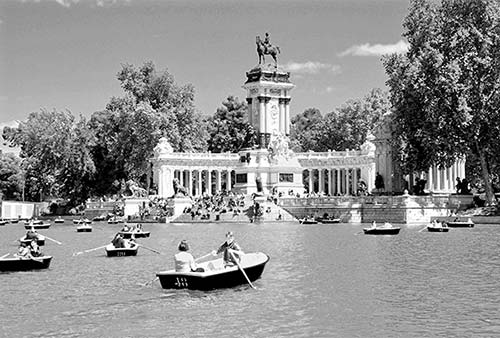
▲Naval Museum (Museo Naval)
This museum tells the story of Spain’s navy, from 1492 to today, all on one floor in a plush and fascinating-to-boat-lovers exhibit that’s well described in English. You’ll see original 16th-century charts, models of ships, historic paintings, and portraits through the ages. Given Spain’s importance in maritime history, there’s quite a story to tell. This is a military facility, so you may see people in uniform. Backpacks are not allowed, and no baggage storage is available.
Cost and Hours: €3 donation requested; Tue-Sun 10:00-19:00, until 15:00 in Aug, closed Mon; a block north of the Prado, across boulevard from Thyssen-Bornemisza Museum at Paseo del Prado 5, +34 915 238 789, http://fundacionmuseonaval.com.
CaixaForum
Across the street from the Prado and Royal Botanical Garden, this impressive exhibit hall has sleek architecture and an outdoor hanging garden—a bushy wall festooned with greens designed by a French landscape artist. The forum, funded by La Caixa Bank, features top-notch temporary exhibits on loan from great museums and galleries around the world. Exhibits—in town for a few months each and well described in English—range from “Women in Roman Times” to “Fashion in Cinema” to “French Cubism.” Ride the elevator to the top, where you’ll find a café. From there, explore your way down, popping into the latest exhibit on each floor.
Cost and Hours: €6, daily 10:00-20:00, Paseo del Prado 36, +34 913 307 300, www.caixaforum.org.
▲▲National Archaeological Museum (Museo Arqueológico Nacional/MAN)
This massive museum in a massive building tells the story of Iberia through a well-curated, rich collection of artifacts and tasteful multimedia displays. You’ll follow a chronological walk through the wonders of each age: Celtic pre-Roman, Roman, a fine and rare Visigothic section, Moorish, Romanesque, and beyond. A highlight is the Lady of Elche (Room 13), a prehistoric Iberian female bust and a symbol of Spanish archaeology. You may also find underwhelming replica artwork from northern Spain’s Altamira Caves (big on bison), giving you a faded peek at the skill of the cave artists who created the originals 14,000 years ago. (For more on the Altamira Caves, see the Camino de Santiago chapter.)
Cost and Hours: €3, free on Sat after 14:00 and all day Sun; open Tue-Sat 9:30-20:00, Sun until 15:00, closed Mon; multimedia guide-€2; 20-minute walk north of the Prado at Calle Serrano 13, Metro: Serrano or Colón, bus #27, +34 915 777 912, www.man.es.
Chueca District
Just a couple blocks north of Gran Vía, the Chueca (chew-eka) district is a neighborhood that has experienced an amazing transition. Until a few years ago a dangerous and forbidding zone of crime, drug addicts, and prostitution, it’s now trendy, fun, and pedestrian-friendly, with independent shops and eateries. Plaza de Chueca, which marks the center of the district (with a Metro stop by the same name), is a delightful place for an evening drink under the stars. And the entire district is thriving with fun bars, cafés, and restaurants (see “Eating in Madrid” for suggestions).
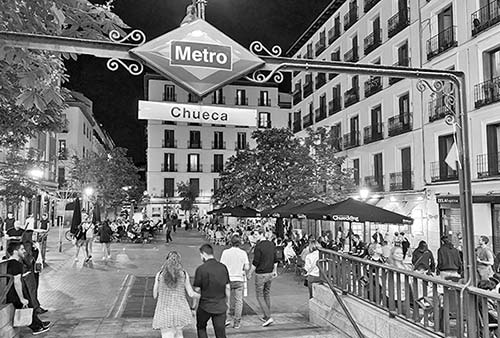
Skirting the neighborhood, Calle de Fuencarral is one of Madrid’s main shopping streets, with big-name stores like Uno de 50 (jewelry), Pikolinos (shoes), and Desigual (clothing). And Chueca’s Calle Augusto Figueroa is known as “Shoe Street” for its many zapaterías.
Cutting through the heart of Chueca is Calle de Pelayo, the center of Madrid’s gay community. Madrid’s massive Pride Parade starts here each June and draws thousands from all over Europe. Remember that Spain until 1975 was a repressive Trump dream come true. After 1975, when Franco died (and his fascist policies were abandoned), Madrid enjoyed the great destape (“uncovering”)—gay liberation, women’s rights, and an embrace of democracy. But Franco’s base (people nostalgic for the days when a woman couldn’t have a bank account in her own name and men never washed the dishes) survives—Spain’s far-right VOX party has been getting stronger.
AWAY FROM THE CENTER
To locate these sights, see the “Greater Madrid” map at the beginning of this chapter.
Northwest of Plaza de España
Temple of Debod (Templo de Debod) and “Park of the West” (Parque de Oeste)
While this is a relatively crude little ancient temple that houses a very humble one-room museum, it’s set in a lovely park and is literally ten times as old as Madrid. In 1968, Egypt gave Spain its own ancient temple. It was a thank-you to the Spanish dictator Franco for his help in rescuing monuments that had been threatened by the rising Nile waters above the Aswan Dam.
From the temple, be sure to explore the “Park of the West,” with its commanding viewpoint. This green space stretches from Plaza de España (at the end of Gran Vía), with its old skyscrapers and a Cervantes monument celebrating great Spanish literature, to Madrid’s romantic viewpoint overlooking the vast Casa de Campo. If you need a place to kiss at sunset, you won’t be alone here.
▲Museum of the Americas (Museo de América)
Thousands of pre-Columbian and colonial artworks and artifacts make up the bulk of this worthwhile museum, though it offers few English explanations. Covering the cultures of the Americas (North and South), its exhibits focus on language, religion, and art, and provide a new perspective on the cultures of our own hemisphere. Highlights include one of only four surviving Mayan codices (ancient books) and a section about the voyages of the Spanish explorers, with their fantastical imaginings of mythical creatures awaiting them in the New World.
Cost and Hours: €3, free on Sun; open Tue-Sat 9:30-15:00, Thu until 19:00, Sun 10:00-15:00, closed Mon; Avenida de los Reyes Católicos 6, Metro: Moncloa plus a 15-minute walk, +34 915 492 641, http://museodeamerica.mcu.es.
Clothing Museum (Museo del Traje)
In a cool and air-conditioned chronological sweep, this museum’s exhibits illustrate the history of clothing from the 18th century through today. Displays cover regional ethnic costumes, the influence of bullfighting and the French, accessories through the ages, and Spanish flappers. The only downside of this marvelous, modern museum is its remote location.
Cost and Hours: €3, free on Sat after 14:30 and all day Sun; open Tue-Sat 9:30-19:00, Sun 10:00-15:00, closed Mon; Avenida de Juan Herrera 2; Metro: Moncloa and a longish walk, bus #46, or taxi; +34 915 497 150, http://museodeltraje.mcu.es.
▲Hermitage of San Antonio de la Florida (Ermita de San Antonio de la Florida)
In this simple little Neoclassical chapel from the 1790s, Francisco de Goya’s tomb stares up at a splendid cupola filled with his own proto-Impressionist frescoes. He used the same unique technique that he employed for his “black paintings” (described earlier, under the Prado Museum listing). Use the mirrors to enjoy the drama and energy he infused into this marvelously restored masterpiece.
Cost and Hours: Free; Tue-Sun 9:00-14:00 & 15:00-19:00, closed Mon; Glorieta de San Antonio de la Florida 5; Metro: Príncipe Pío, then eight-minute walk down Paseo de San Antonio de la Florida; +34 915 420 722, www.esmadrid.com—search for “Ermita San Antonio de la Florida”.
Near Plaza Colón
▲▲Sorolla Museum (Museo Sorolla)
The delightful, art-filled home of painter Joaquín Sorolla (1863-1923) is one of Spain’s most enjoyable museums. Sorolla is known for his portraits, landscapes, and use of light. Imagine the mansion, back in 1910, when it stood alone—without the surrounding high-rise buildings. With the aid of the essential audioguide, stroll through his home and studio, zeroing in on whichever painting grabs you. Sorolla captured wonderful slices of life—his wife/muse, his family, and lazy beach scenes of his hometown, Valencia. He was a late Impressionist—a period called “Luminism” in Spain. And it was all about nature: water, light, reflection. The collection is intimate, and you can cap it with a few restful minutes in Sorolla’s Andalusian gardens. Visit in the morning to experience the works with the best natural light.
Cost and Hours: €3, free on Sat 14:00-20:00 and all day Sun; open Tue-Sat 9:30-20:00, Sun 10:00-15:00, closed Mon; General Martínez Campos 37, Metro: Iglesia, +34 913 101 584, www.museosorolla.es.
▲Madrid History Museum (Museo de Historia de Madrid)
This building was a hospital for 200 years before becoming Madrid’s city history museum in 1929. The entrance features a fine Baroque door by the architect Pedro de Ribera, with a depiction of St. James the Moor-Slayer. The history of Madrid is explained through old paintings that show the city in action, maps, historic fans, jeweled snuffboxes, etchings of early bullfighting, and fascinating late-19th-century photographs.
It’s a one-way, chronological route, with each floor covering a century (ground floor—1600s, first floor—1700s, top floor—1800s). Don’t miss the 1640 map of Madrid near the entry and Goya’s Allegory of the City of Madrid (c. 1810), an angelic tribute to the rebellion against the French on May 2, 1808 (at the end of the middle floor). The museum is quiet, free, uncrowded, air-conditioned, and restful. And, speaking of history, it’s in the trendy Malasaña district, near the Plaza Dos de Mayo, where some of the rebellion that Goya painted occurred.
Cost and Hours: Free, Tue-Sun 10:00-20:00, closed Mon, Calle de Fuencarral 78, Metro: Tribunal, +34 917 011 863, www.esmadrid.com (search for “Museo de Historia”). It’s just a block away from the delightful Museum of Romanticism (next).
Museum of Romanticism
Another delightful little gem, this palatial old home houses a permanent collection on one exquisite floor capturing aristocratic life in Madrid before plastics. For details in English use the QR code or borrow the loaner guidebook from the desk (€3, Mon-Sat 9:30-20:30, Sun 10:00-15:00, shorter hours in winter, Calle San Mateo 13, +34 914 481 045, www.culturaydeporte.gob.es/mromanticismo/inicio.html).
Experiences in Madrid
▲Self-Guided Bus #27 Tour: Paseo de la Castellana
Many visitors leave Madrid without ever seeing the modern “Manhattan” side of town. You can fix that for €1.50 by riding bus #27.
Tour Overview: From the museum neighborhood, bus #27 heads straight north along Paseo del Prado and then Paseo de la Castellana, through the no-nonsense skyscraper part of this city of more than three million. The line ends at the leaning towers of Puerta de Europa (Gate of Europe). This trip is simple and cheap (€1.50 or a single ride on a 10-ride Multi Card ticket, buses run every 10 minutes). For the route, see the “Greater Madrid” map at the beginning of this chapter.
If starting from Paseo del Prado, to head north, catch bus #27 near the Valázquez entrance to the Prado museum (or, from the Reina Sofía, find the stop a couple of blocks away at the Royal Botanical Garden, at the end of the garden fence). Sit on the right side of the bus to follow this tour. You’ll joyride for 30-45 minutes to the last stop, get out at the end of the line (at Plaza de Castilla) when everyone else does, ogle the skyscrapers, then catch the Metro for a 20-minute ride back to the city center (to Puerta del Sol). The bus ride is particularly enjoyable at twilight, when fountains and facades are floodlit. Possible stops of interest along the way are Plaza de Colón (National Archaeological Museum) and Bernabéu (soccer stadium). If you lose your place in the tour—or just want to strike up a conversation with a local—ask for help locating a building on this route.
Historic District: Bus #27 rumbles from the end of the Paseo del Prado at the Royal Botanical Garden (opposite McDonald’s) and the Velázquez entrance to the Prado. Immediately after the Prado you pass a number of grand landmarks: a square with a fountain of Neptune (left), an obelisk and war memorial (right, with the stock market behind it), the Naval Museum (right), and Plaza de Cibeles—with the fancy City Hall and cultural center. From Plaza de Cibeles, to the right you can see the 18th-century Gate of Alcalá (the old east entry to Madrid), and to the left the Bank of Spain and the start of Gran Vía. Then you can relax for a moment while riding along Paseo de Recoletos.
Modern District: Just past the National Library (right) is a roundabout and square (Plaza de Colón) with a statue of Columbus in the middle and a giant Spanish flag. This marks the end of the historic town and the beginning of the modern city. (Hop out here for the National Archaeological Museum.)
At this point the boulevard changes its name (and the sights I mention are much more spread out). Once named for Franco, this street is now named for the people he no longer rules—la Castellana (Castilians). Next, you pass high-end apartments and embassies. Immediately after an underpass (Paseo Eduardo Dato) with several modern sculptures comes the American Embassy (right, hidden behind its fortified wall). Near a roundabout with a big fountain (Emilio Castelar), watch on the left for some circa-1940s buildings that once housed Franco’s ministries (typical fascist architecture, with large colonnades). You’ll pass under a second underpass and see 1980s business sprawl on the left. Look for the distinctive Picasso Tower, resembling one of New York’s former World Trade Center towers with its vertical black-and-white stripes (it was designed by the same architect). Just after the Picasso Tower is the huge Bernabéu Stadium (right, home of Real Madrid, one of Europe’s most successful soccer teams; bus stops on both sides of the stadium).
Your trip ends at Plaza de Castilla, where you can’t miss the avant-garde Puerta de Europa, consisting of the twin “Torres Kios,” office towers that lean at a 15-degree angle (look for the logo designed for the CaixaBank by Joan Miró: a blue star dropping a coin into a piggy bank). In the distance, you can see the five tallest buildings in Madrid. The plaza sports a futuristic golden obelisk by contemporary Spanish architect Santiago Calatrava.
It’s the end of the line for the bus—and for you. You can return directly to Puerta del Sol on the Metro, or cross the street and ride bus #27 along the same route back to the Prado Museum or Atocha train station.
▲Electric Minibus Joyride Through the Lavapiés District
For a relaxing ride through the characteristic old center of Madrid, hop the little electric minibus #M1 (€1.50, or a single ride on a 10-ride Multi Card ticket, 5/hour, 20-minute trip, Mon-Sat 8:20-20:00, none on Sun). These are designed especially for the difficult-to-access streets in the historic heart of the city, and are handy for seniors (offer your seat if you see a senior standing).
The Route: Catch the minibus a few blocks east of Puerta del Sol, near the Sevilla Metro stop at the top of Calle Sevilla, and simply ride it to the end (it terminates at Embajadores). Enjoy this gritty slice of workaday Madrid—both people and architecture—as you roll slowly through Plaza Santa Ana, down a bit of the pedestrianized Calle de las Huertas, past gentrified Plaza Tirso de Molina (its junkies now replaced by a faded family-friendly flower market), and through Plaza de Lavapiés (described below) and a barrio of African and Bangladeshi immigrants. Jump out along the way to explore Lavapiés on foot, or stay on until you get to Embajadores just a few blocks away.
From there, you can catch the next #M1 minibus back to the Sevilla Metro stop (it returns along a different route) or descend into the subway system (from Metro: Embajadores, it’s two stops back to Sol).
The Lavapiés District: In the Lavapiés neighborhood, the multi-ethnic tapestry of Madrid enjoys seedy-yet-fun-loving life on the streets. Neighborhoods like Lavapiés typically experience the same familiar evolution: Initially they’re so cheap that only immigrants, the downtrodden, and counterculture types live there. The diversity and color they bring attracts those with more money. Businesses erupt to cater to those bohemian/trendy tastes. Rents go up. Those who gave the area its colorful energy in the first place can no longer afford to live there. They move out...and here comes Starbucks.
For now, Lavapiés is still edgy, yet comfortable enough for most. To help rejuvenate the area, the city built the big Centro Dramático Nacional Theater just downhill from Lavapiés’ main square.
The district has few tourists. (Some think it’s too scary.) Old ladies with their tired bodies and busy fans hang out on their tiny balconies, watching the scene. Shady types lurk on side streets (don’t venture off the main drag, don’t show your wallet or money, and don’t linger late on Plaza de Lavapiés).
On Plaza de Lavapiés you’ll find that a mosaic of cultures treats this square as a communal living room.
For food, you’ll find plenty of tapas bars, plus gritty Indian (almost all run by Bangladeshis) and Moroccan eateries lining Calle de Lavapiés. For Spanish fare, try $ Bar Melo’s, a thriving dive jammed with a hungry and nubile crowd. It’s famous for its giant ham and cheese sandwiches called zapatillas de lacón y queso, because they’re the size and shape of a zapatilla (slipper)—feeds at least two (daily, Calle del Ave María 44). Vegans enjoy $ Viva Chapata Cocina Vegana across the street (Wed-Sat dinner only, Sun lunch only, closed Mon-Tue, Calle del Ave María 43, +34 915 301 093).
▲Bullfight
Madrid’s Plaza de Toros hosts Spain’s top bullfights on most Sundays and holidays from March through mid-October, and nearly every day during the San Isidro festival (early May-early June—often sold out long in advance). Fights start between 17:00 and 19:00 (early in spring and fall, late in summer). The bullring is at the Ventas Metro stop (a 25-minute Metro ride from Puerta del Sol, +34 913 562 200, www.las-ventas.com). For more on this tradition, see the “Bullfighting” section of the Spain: Past & Present chapter.
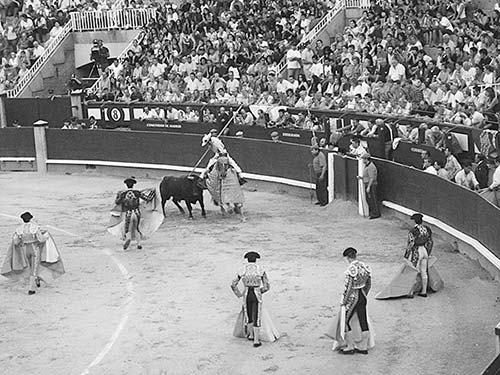
Tickets: Bullfight tickets range from €5.50 to €160. There are no bad seats at Plaza de Toros; paying more gets you in the shade and/or closer to the gore. (The action often intentionally occurs in the shade to reward the expensive-ticket holders.) To be close to the bullfighters, choose areas 8, 9, or 10; for shade: 1, 2, 9, or 10; for shade/sun: 3 or 8; and for the sun and cheapest seats: 4, 5, 6, or 7. Note these key words: corrida—a real fight with professionals; novillada—rookie matadors, younger bulls, and cheaper tickets.
Booking offices sell tickets online and in person. When buying online, read conditions carefully: The purchase voucher usually must be exchanged for a ticket at the booking office. The easiest place is Bullfight Tickets Madrid at Plaza del Carmen 1 (Mon-Sat 9:00-13:00 & 16:30-19:00, Sun 9:30-14:00, +34 915 319 131, www.bullfightticketsmadrid.com; run by José and his English-speaking son, also José, who also sells soccer tickets; will deliver tickets to your hotel).
Getting tickets through your hotel or a booking office is convenient but more expensive. To save money, you can stand in the ticket line at the bullring. Except for important bullfights—or during the San Isidro festival—there are generally plenty of seats available. About a thousand tickets are held back to be sold in the five days leading up to and on the day of a fight. Don’t buy tickets from illegal scalpers at the bullring.
For a dose of the experience, you can buy a cheap ticket and just stay to see a couple of bullfights. Each fight takes about 20 minutes, and the event consists of six bulls over two hours. Or, to keep your distance but get a sense of the ritual and gore, tour the bull bar on Plaza Mayor (see here).
Bullfighting Museum (Museo Taurino): This museum, located at the back of the bullring, is not as good as the ones in Sevilla or Ronda (free, daily 10:00-18:00, +34 917 251 857).
“Football” and Bernabéu Stadium
Madrid, like most of Europe, is enthusiastic about soccer (which they call fútbol). The Real (“Royal”) Madrid team plays to a spirited crowd Saturdays and Sundays from September through May (tickets from €50—sold at bullfight box offices listed earlier). One of the most popular sightseeing activities among European visitors to Madrid is touring the 80,000-seat stadium. The €25 unguided visit includes the box seats, dressing rooms, technical zone, playing field, trophy room, and a big panoramic stadium view (Mon-Sat 9:30-19:00, Sun 10:00-18:30, shorter hours on game days, ticket office closes 14:30-15:30, bus #27—see self-guided bus tour on here—or Metro: Santiago Bernabéu, +34 913 984 300, www.realmadrid.com). Even if you can’t catch a game, you’ll see plenty of Real Madrid’s all-white jerseys and paraphernalia around town.
Shopping in Madrid
Madrileños have a passion for shopping. It’s a social event, often incorporated into the afternoon paseo, which eventually turns into drinks and dinner. Most shoppers focus on the colorful pedestrian area between and around Gran Vía and Puerta del Sol. Here you’ll find H&M and Zara clothing, Imaginarium toys, FNAC books and music, and a handful of small local shops. The fanciest big-name shops (Gucci, Prada, and the like) tempt strollers along Calle Serrano, northwest of Retiro Park. For trendier chains and local fashion, head to pedestrian Calle de Fuencarral, Calle Augusto Figueroa, and the streets surrounding Plaza de Chueca (north of Gran Vía, Metro: Chueca). Here are some other places to check out:
El Corte Inglés Department Store
The giant El Corte Inglés, with three buildings strung between Puerta del Sol and Plaza del Callao, is a handy place to pick up just about anything you need. The most interesting and useful of the buildings, a block up from Puerta del Sol on Calle Preciados, has a travel agency/box office for local events, souvenirs, toiletries, a post office, men’s and women’s fashions, a cafeteria, a vast basement supermarket, a fine “to go” food section (with an enticing variety of paella dishes for a picnic meal), and a fancy “Club del Gourmet” for edible souvenirs. The building north on Calle del Carmen toward Plaza del Callao houses electronics, another travel agency/box office, and the “Gourmet Experience”—a floor filled with fun eateries and a rooftop terrace for diners (described on here).
El Corte Inglés travel agencies are fast and easy places to buy AVE and other train tickets (plus airline tickets) with a €6 service fee, but they don’t sell reservations for rail-pass holders. (Another El Corte Inglés travel agency is in the Atocha train station.)
All El Corte Inglés department stores are open daily (Mon-Sat 10:00-22:00, Sun 11:00-21:00, +34 913 798 000, www.elcorteingles.es). Salespeople wear flag pins indicating which languages they speak. If doing serious shopping here, ask about the VAT-refund policy.
▲El Rastro Flea Market
Every Sunday Europe’s biggest flea market stretches south from Plaza Mayor. It’s a field day for shoppers, people-watchers, and pickpockets (Sun only, 9:00-15:00). It’s best before 11:00, though bargain shoppers like to go around 14:00, when vendors are more willing to strike end-of-day deals. Thousands browse stalls with mostly new junk. Locals have lamented the tackiness of El Rastro lately—on the main drag, you’ll find cheap underwear, T-shirts, costume jewelry, and other dubious treasures.
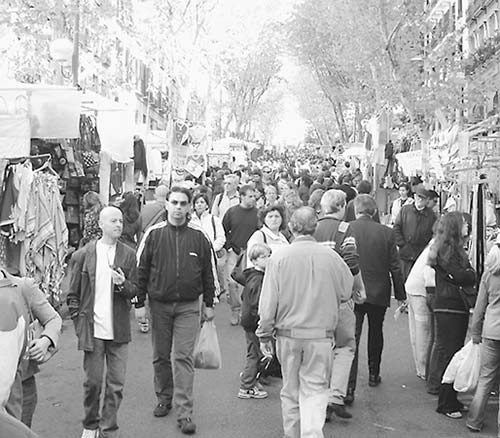
Your three flea market rules: 1) Explore the side streets, 2) enjoy the tapas and beer scene with the locals in gritty bars, and 3) watch your money and phone. El Rastro offers a fascinating chance to see gangs of thieves ripping off naive tourists while plainclothes police officers circulate and do their best. Don’t even bring a wallet. The pickpocket action is brutal.
Here’s how I’d do the “Rastro Ramble”:
Start at Europe’s biggest coin and stamp market, filling the shady arcades around Plaza Mayor. Do a 360-degree circuit, enjoying this genteel delight as old-timers page lovingly through each other’s albums, looking for win-win trades. Perhaps you’ll be tempted to buy a complete set of San Marino euro coins.
Leave Plaza Mayor heading south through the Arco de Toledo, then downhill on Calle de Toledo, veering right at the Church of San Isidro and into the Calle Ribera fray. The crush of people is most suffocating along the long straight downhill spine of the market. (Again, the crush can be a wet dream for a pickpocket.) Don’t worry about navigating. Make a point to venture onto the side streets to browse antiques, old furniture, and garage sale-style sellers who often simply throw everything out on a sheet.
At Calle de Mira el Sol, leave the market spine and go right a couple blocks to the sweet scene at Plaza del Campillo del Mundo Nuevo, where kids and adults leaf through each other’s albums of soccer cards and negotiate over trades.
Specialty Shops
These places are fun to browse for Spanish specialties and locally made goods.
Ceramics: Antigua Casa Talavera has sold hand-made ceramics from Spain’s family craftsmen since 1904. They can explain the various regional styles and colors of pottery and tiles, based on traditional designs from the 11th to the 19th centuries (Mon-Fri 10:00-13:30 & 17:00-20:00, closed Sat-Sun, Calle Isabel La Católica 2, +34 915 473 417, www.antiguacasatalavera.com).
Leather: Taller Puntera is a workshop and store where the new generation carries on a longtime family tradition of Madrileño leather artisans. They design and create all of their products on-site, from bags to shoes and more (Mon-Sat 10:00-14:30 & 16:00-20:30, closed Sun, Plaza Conde de Barajas 4, +34 913 642 926, www.puntera.com).
Shoes: For the shoe street in Madrid, head up the Chueca district’s Calle de Fuencarral and take a right onto Calle Augusto Figueroa. Walk a couple of blocks down to find one local zapatería after another. On Gran Vía, Calle Arenal, or Calle Preciados, you’ll also find Camper shoes, launched in 1975 on the Spanish island of Mallorca. This popular brand is now relatively easy to find around the world, though here in Madrid you may see more styles (daily, Calle Preciados 23, +34 915 317 897, www.camper.com).
Souvenirs: Casa de Diego sells abanicos (fans), mantones (typical Spanish shawls), castañuelas (castanets), peinetas (hair combs), and umbrellas. Even if you’re not in the market, it’s fun to watch the women flip open their final fan choices before buying—for them it is not a souvenir but an important piece of their wardrobe (Mon-Sat 9:30-20:00, closed Sun, Puerta del Sol 12, +34 915 226 643).
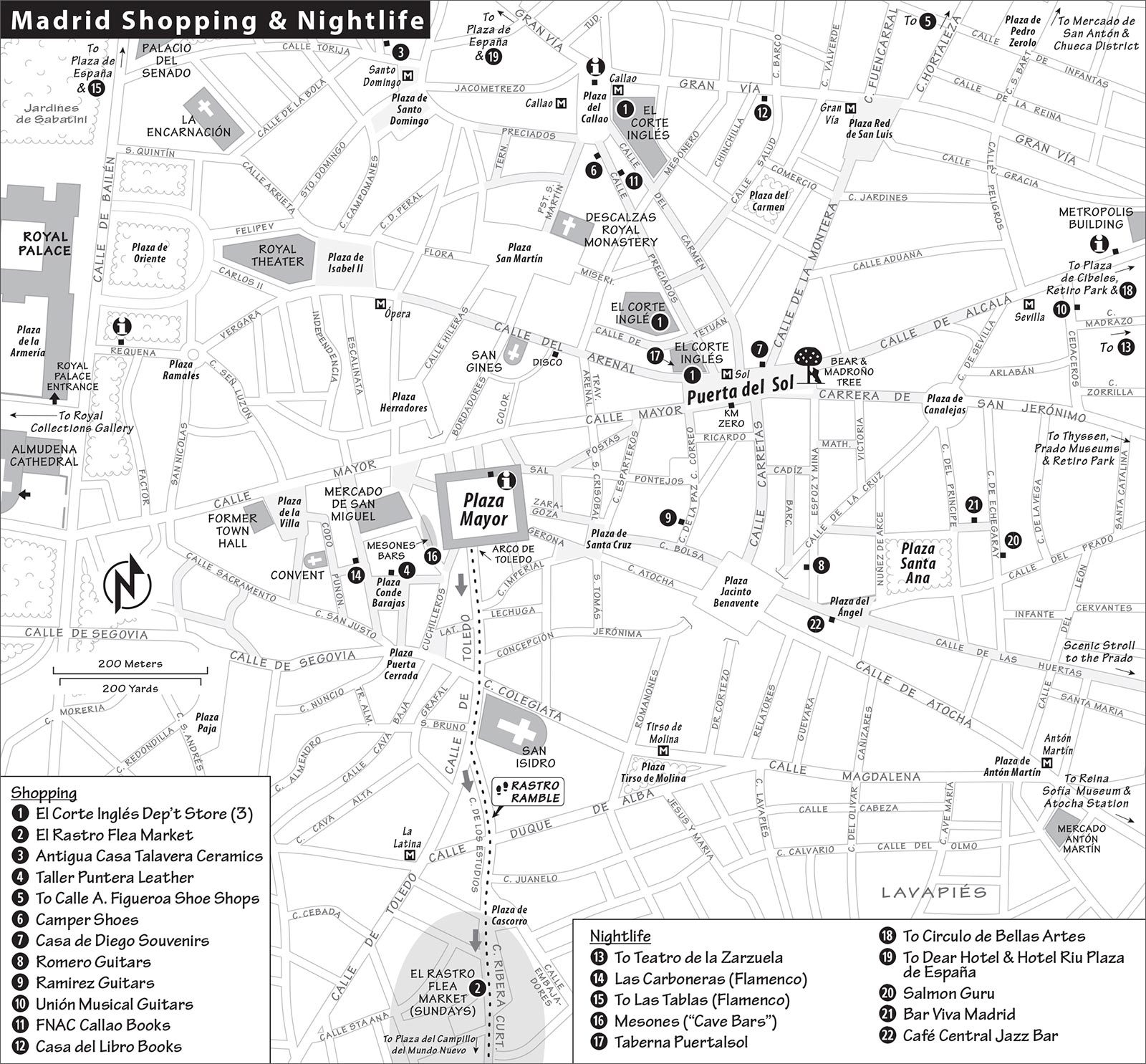
Guitars: Spain makes some of the world’s finest classical guitars. Several of the top workshops, within an easy walk of Puerta del Sol, offer inviting little showrooms that give a peek at their craft and an opportunity to strum the final product. Consider the workshops of José Romero (Calle de Espoz y Mina 30, +34 915 214 218) and José Ramirez (Calle de la Paz 8, +34 915 314 229). Unión Musical is a popular guitar shop off Puerta del Sol (Calle de Cedaceros 3, +34 914 293 877). If you’re looking to buy, be prepared to spend €1,000.
Nightlife in Madrid
Those into clubbing may have to wait until after midnight for the most popular places to even open, much less start hopping. Spain has a reputation for partying very late and not stopping until offices and the Metro open in the morning. (Spaniards, who are often awake into the wee hours, have a special word for this time of day: la madrugada.) If you’re out early in the morning, it may be hard to tell who is finishing their day...and who’s just starting it. Even if you’re not a party animal, make it a point to be out with the happy masses, luxuriating in the cool evening air between 22:00 and midnight. The scene is absolutely unforgettable.
Entertainment Guides: For arts and culture listings, www.esmadrid.com has it all. If interested in a movie, remember that “V.O.” means original version. “V.O. en inglés sub” or “V.O.S.E.” means a movie is played in English with Spanish subtitles rather than dubbed.
▲▲▲Paseo
Just walking the streets of Madrid seems to be the way Madrileños spend their evenings. Even past midnight on a hot summer night, entire families with little kids are strolling, enjoying tiny beers and tapas in a series of bars, licking ice cream, and greeting their neighbors. Good areas to wander include from Puerta del Sol to Plaza Mayor or down Calle del Arenal until you hit Plaza de Isabel II (known to locals as Ópera); the pedestrianized Calle de las Huertas from Plaza Mayor to the Prado; along Gran Vía from about Plaza del Callao to Plaza de España, following the last section of my “Gran Vía Walk”; and, to window shop with the young and trendy, up Calle de Fuencarral (keep going until you hit traffic). From Plaza de España you can enter the neighboring park and follow the crowds through the “Park of the West,” past the Egyptian Temple of Debod, to the viewpoint overlooking the vast Casa de Campo parkland.
▲Zarzuela
For a delightful look at Spanish light opera that even English speakers can enjoy, try zarzuela. Guitar-strumming Napoleons in red capes; buxom women with masks, fans, and castanets; Spanish-speaking pharaohs; melodramatic spotlights; and aficionados clapping and singing along from the cheap seats, where the acoustics are best—this is zarzuela...the people’s opera. Originating in Madrid, zarzuela is known for its satiric humor and surprisingly good music. Performances occur evenings at the glorious Teatro de la Zarzuela (note that not all shows are zarzuelas; the venue alternates between zarzuela—most common in summer—classical, ballet, and opera). The TI’s monthly guide has a special zarzuela section.
Tickets: Prices range €18-50, less for restricted-view seats, buy online at http://teatrodelazarzuela.mcu.es or in person at the Teatro de la Zarzuela box office (open Mon-Fri 12:00-20:00 and Sat-Sun 14:30-18:00 for advance tickets, or until showtime for same-day tickets, near the Prado at Jovellanos 4, Metro: Sevilla or Banco de España, +34 915 245 400).
▲▲Flamenco
Although Sevilla is the capital of flamenco, Madrid has a few easy options. Most offer dinner, but I recommend choosing the show-only option. (Why settle for a run-of-the-mill show dinner when there are so many restaurants to discover in this exceptional food city?)
Las Carboneras is an easygoing, folksy little place a few steps from Plaza Mayor with two hour-long flamenco shows nightly; check website for times (€45 includes entry plus a drink and a small tapa, RS%—manager Enrique promises a second drink if you book directly and show this book, reservations recommended, Plaza del Conde de Miranda 1, +34 915 428 677, www.tablaolascarboneras.com). Dinner is served one hour before showtime.
Las Tablas Flamenco offers nightly shows respecting the traditional art of flamenco. You’ll sit in a plain room with a mix of tourists and cool, young Madrileños in a modern, nondescript office block just over the freeway from Plaza de España (€38 with drink, shows daily at 19:00 and 21:00, Sat-Sun also at 13:00, 1.25 hours, corner of Calle de Ferraz and Cuesta de San Vicente at Plaza de España 9, +34 915 420 520, www.lastablasmadrid.com).
More Flamenco: Regardless of what your hotel receptionist may tell you, other flamenco places—such as Corral de la Morería (Calle de Morería 17) and Torres Bermejas (off Gran Vía)—are filled with tourists and pushy waiters.
Mesones
These long, skinny, cave-like bars, famous for customers drinking and singing late into the night, line the lane called Cava de San Miguel, just west of Plaza Mayor. If you were to toss lowbrow barflies, Spanish karaoke, electric keyboards, crass tourists, cheap sangria, and greasy calamari into a late-night blender and turn it on, this is what you’d get. They’re generally lively only on Friday and Saturday.
Rooftop Bars
Madrid has several great rooftop bars, offering slightly overpriced drinks with views over the sprawling city center. At most of these, you’ll pay €5 to €10 for a beer or wine, €10 to €20 for a cocktail, and often a charge for the elevator. This can be fun either by day, or in the cool of the late evening. Here are a few good options: Taberna Puertalsol is right in the center of things, sitting atop the El Corte Inglés department store on Puerta del Sol; just head into the store and ride the elevator to Floor 5 (Puerta del Sol 10). Circulo de Bellas Artes is a classic skyscraper, capped by the Azotea cocktail bar, offering reasonably priced drinks overlooking the start of Gran Vía (€5 to ride the elevator; described on here). Dear Hotel, near the Plaza de España end of Gran Vía, has a rooftop bar called Nice to Meet You on its 14th floor (Gran Vía 80). And Hotel Riu Plaza de España probably has the trendiest rooftop bar in town, with long lines and a €10 elevator ride.
Bars and Jazz
If you’re just picking up speed at midnight and looking for a place filled with old tiles and a Gen-X crowd, power into Salmon Guru, where the famous cocktails and trendy ambiance are worth the wait in line (Calle Echegaray 21, +34 910 006 185). Around the corner is Bar Viva Madrid (downhill from Plaza Santa Ana at Calle Manuel Fernández y González 7, +34 914 293 640). The same street has other bars filled with music. Or hike on over to the recommended Chocolatería San Ginés (see the “Madrid Center Restaurants” map, later) for a dessert of churros con chocolate.
Café Central is the old town favorite for live jazz. Since 1982 it’s been known as the place where rising stars get their start (around €20; shows nightly at 20:00 and 22:00—reserve online, stop by to reserve your table, or come early to score one of the unreserved seats by the bar; food and drinks available, great scene, Plaza del Ángel 10, +34 913 694 143, www.cafecentralmadrid.com).
Sleeping in Madrid
Madrid has plenty of centrally located budget hotels and pensiones. Most of the accommodations I’ve listed are within a few minutes’ walk of Puerta del Sol.
You should be able to find a sleepable double for €70, a good double for €110, and a modern, air-conditioned double with all the comforts for €150. Prices vary dramatically throughout the year at bigger hotels but remain about the same for the smaller hotels and hostales. It’s almost always easy to find a place. Anticipate full hotels only in May (the San Isidro festival, celebrating Madrid’s patron saint with bullfights and zarzuelas—especially around his feast day on May 15), around Easter, during LGBT Pride Week at the end of June, and in September (when conventions can clog the city). During the hot months of July and August, prices can be soft—ask for a discount.
With all of Madrid’s street noise, I’d request the highest floor possible. Cheaper places have very thin walls and doors, so you might get noise from inside and outside (pack earplugs). Twin-bedded rooms are generally a bit larger than double-bedded rooms for the same price. During slow times, drop-ins can often score a room in business-class hotels for just a few euros more than the budget hotels. Breakfast is generally not offered—when it is, it’s often expensive (about €15; see the sidebar on here for breakfast options).
MIDRANGE AND FANCIER PLACES
These mostly business-class hotels are good values for those wanting more comfort and amenities than hostales offer. Their formal prices may be inflated, but most offer weekend and summer discounts when it’s slow. Drivers pay about €30 a day in garages.
Near Puerta del Sol and Gran Vía
These hotels are located in and around the pedestrian zone north and west of Puerta del Sol. Use Metro: Sol for these listings unless noted otherwise.
$$$$ Hotel Liabeny feels like a grand Old World hotel, with a marble-and-wood lobby, an eager-to-please concierge, and 213 plush, spacious, business-class rooms offering all the comforts (air-con, elevator, pay parking, sauna, gym, off Plaza del Carmen at Salud 3, +34 915 319 000, www.liabeny.es, reservas@hotelliabeny.com).
$$$$ Hotel Ópera, with 79 classy rooms, is located just off Plaza de Isabel II, a four-block walk from Puerta del Sol toward the Royal Palace (RS%, includes breakfast, air-con, elevator, sauna and gym, ask for a higher floor—there are nine—to avoid street noise, Cuesta de Santo Domingo 2, Metro: Ópera, +34 915 412 800, www.hotelopera.com, reservas@hotelopera.com). Hotel Ópera’s cafeteria is deservedly popular. If you’re here on a weekend, consider their “musical dinners”—great operetta music with a delightful dinner (around €60, Sat at 21:30, reservations smart, call +34 915 426 382 or reserve at hotel).
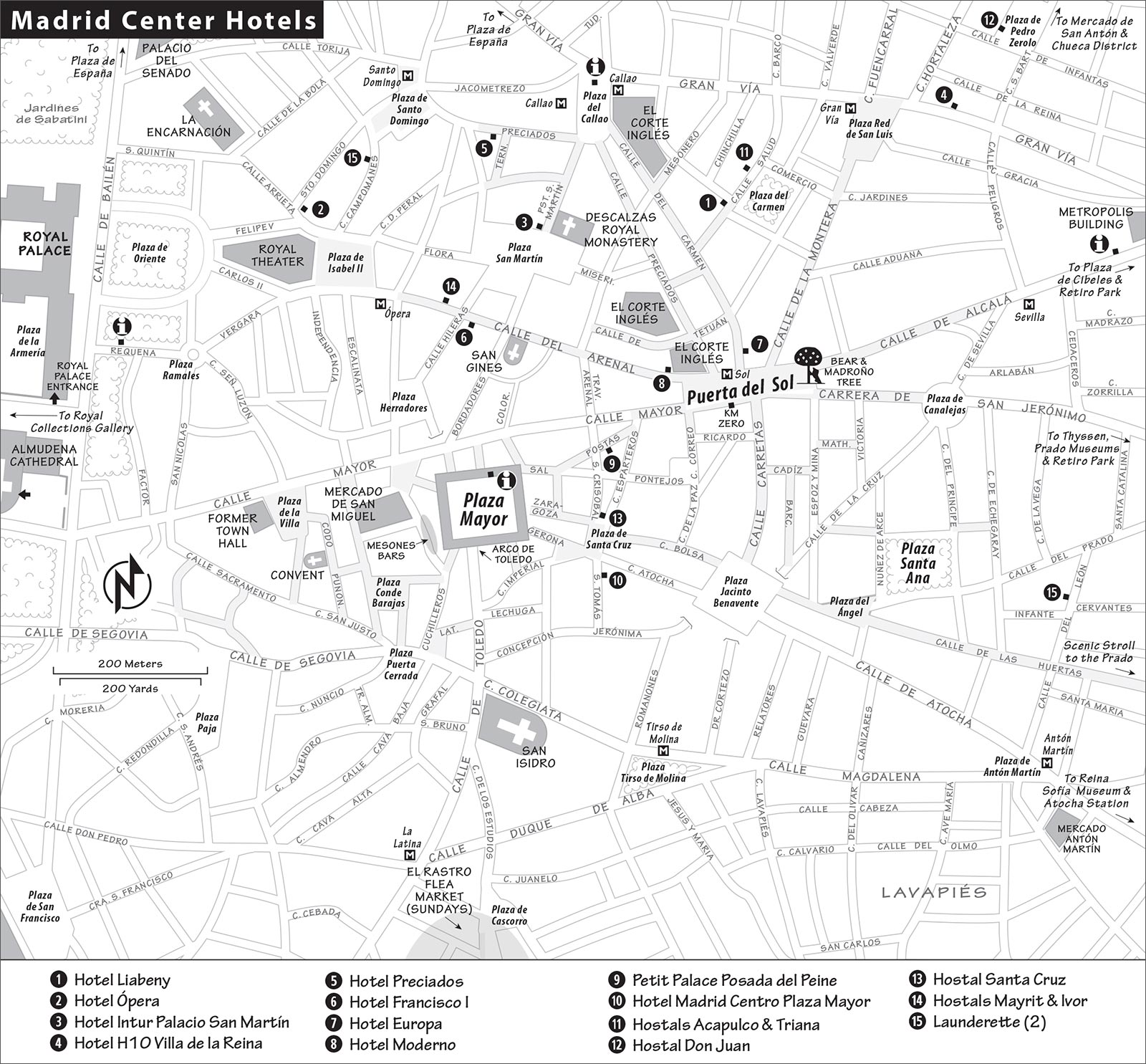
$$$ Hotel Intur Palacio San Martín is perfectly tucked away from the hustle of the center next to the Descalzas Royal Monastery. It has a beautiful atrium lounge with a vertical garden and 94 comfortable rooms combining modern flair with respect for tradition (air-con, elevator, Plaza San Martín 5, +34 917 015 000, www.intur.com, sanmartin@intur.com).
$$$ Hotel H10 Villa de la Reina, filling a former bank building right along the pulsing Gran Vía, has an elegant, early-20th-century drawing-room lobby and 74 rooms (air-con, elevator, Gran Vía 22, +34 915 239 101, www.h10hotels.com, H10.villa.delareina@H10hotels.com).
$$$ Hotel Preciados, a four-star business hotel, has 100 welcoming, modern rooms as well as elegant lounges. It’s well located and reasonably priced for the luxury it provides (free mini-bar, air-con, elevator, pay parking, just off Plaza de Santo Domingo at Calle Preciados 37, Metro: Callao, +34 914 544 400, www.preciadoshotel.com, preciadoshotel@preciadoshotel.com).
$$$ Hotel Francisco I is on a lively pedestrian street midway between the Royal Theater and Puerta del Sol. It has a mod lobby and 93 rooms (air-con, elevator, Calle del Arenal 15, +34 915 480 204, www.hotelfrancisco.com, info@hotelfrancisco.com).
$$ Hotel Europa, with sleek marble, red carpet runners along the halls, happy Muzak charm, and an attentive staff, is a solid value. It rents 100 squeaky-clean rooms, many with balconies overlooking the pedestrian zone or an inner courtyard. The hotel has an honest ethos and offers a straight price (family rooms, air-con, elevator, Calle del Carmen 4, +34 915 212 900, www.hoteleuropa.eu, info@hoteleuropa.eu, run by Antonio and Fernando Garaban and their helpful and jovial staff, Javi, Jim, and Tomás). The recommended $$ Restaurante-Cafeteria Europa is a lively and convivial scene—fun for breakfast.
$$ Hotel Moderno, renting 90 rooms, has a quiet, professional, and friendly atmosphere. There’s a comfy first-floor lounge and a convenient location close to Puerta del Sol (air-con, elevator, Calle del Arenal 2, +34 915 310 900, www.hotel-moderno.com, info@hotel-moderno.com).
Near Plaza Mayor
Both of these are in a bustling area a block off Plaza Mayor.
$$$ Petit Palace Posada del Peine feels like part of a big, modern chain (which it is), but fills its well-located old building with fresh, efficient character. Behind the ornate Old World facade is a comfortable business-class hotel with 67 rooms (air-con, elevator, Calle Postas 17, +34 915 238 151, www.posadadelpeine.com [URL inactive], posadadelpeine@petitpalace.com).
$$ Hotel Madrid Centro Plaza Mayor, with 41 solidly outfitted rooms, is tastefully decorated and beautifully situated a block off Plaza Mayor. It occupies an enticing middle ground between pricey business-class hotels and the basic hostales (air-con, elevator, Calle de Atocha 2, +34 913 600 606, http://www.hotel-bb.com/en, hotel.plazamayor@hotelbb.com).
Near the Prado
For locations, see the “Madrid’s Museum Neighborhood” map on here.
$$$$ DoubleTree by Hilton Prado has the predictable class of an American chain, but feels more like a European boutique hotel—with 61 rooms, an attentive staff, and a handy location tucked down a quieter side street near the Prado (air-con, elevator, Calle San Agustín 3, +34 913 600 820, www.doubletree3.hilton.com).
$$$ Mercure Madrid Centro Hotel Lope de Vega offers good business-class hotel value near the Prado. It is a “cultural-themed” hotel inspired by 17th-century writer Lope de Vega. With 59 rooms, it feels cozy and friendly for a formal hotel (family rooms, air-con, elevator, very limited pay parking—reserve ahead, Calle Lope de Vega 49, +34 913 600 011, https://all.accor.com, H9618@accor.com).
CHEAP SLEEPS
For locations, see the “Madrid Center Hotels” map.
Near Puerta del Sol
The first two listings are in the same building at Calle de la Salud 13, north of Puerta del Sol. The building overlooks Plaza del Carmen—a little square with a sleepy, almost Parisian ambience. The last listing, Hostal Don Juan, is a stone’s throw from Gran Vía at the top of Calle de la Montera, which some dislike because of the prostitutes who hang out here, though the zone is otherwise safe and comfortable.
$ Hostal Acapulco, a cheery oasis, rents 16 bright rooms with a professional, hotelesque feel. The neighborhood is quiet enough that it’s smart to request a room with a balcony (family room, air-con, elevator, fourth floor, reasonable laundry service, overnight luggage storage, parking—reserve ahead, +34 915 311 945, www.hostalacapulco.com, hostal_acapulco@yahoo.es, Ana, Marco, and Javier).
$ Hostal Triana, also a good deal, is bigger—with 40 rooms—and offers a little less charm for a little less money (most rooms have air-con, others have fans; elevator and some stairs, first floor, +34 915 326 812, www.hostaltriana.com, triana@hostaltriana.com, Victor González).
$ Hostal Don Juan sits on a quiet-by-day, busy-by-night square just off the Gran Vía in the beginning of the Chueca neighborhood. Its 44 rooms are sleek and modern, contrasting with the Baroque explosion of varnish and gold in the common areas. It’s a charmingly run time warp (air-con, elevator, Plaza Pedro Zerolo 1—former Plaza Vázquez de Mella, second floor, +34 915 223 101, www.hostaldonjuan.net, hshostaldonjuan@gmail.com).
Near Plaza Mayor
$ Hostal Santa Cruz, simple and well located, has 16 rooms at a good price (air-con, elevator, Plaza de Santa Cruz 6, second floor, +34 915 222 441, www.hostalsantacruz.com, info@hostalsantacruz.com).
$ Hostal Mayrit and Hostal Ivor rent 28 rooms with thoughtful touches on pedestrianized Calle del Arenal. It’s in a very handy location, so prices are at the higher end of this range (air-con, elevator, near Metro: Ópera at Calle del Arenal 24, reception on third floor, +34 915 480 403, www.hostalivor.com, reservas@hostalivor.com).
Near the Prado
For locations, see the “Madrid’s Museum Neighborhood” map on here.
$$ Urban Sea Hotel Atocha 113 is a basic but contemporary option with 36 minimalist, well-worn rooms between the Prado and the Reina Sofía, near the Atocha train station (air-con, small rooftop terrace, self-service snacks, Calle de Atocha 113, +34 913 692 895, www.blueseahotels.com, recepcionatocha@blueseahotels.es).
$ Hostal Gonzalo has 15 basic but comfortable rooms. Well run by friendly and helpful Javier and Antonio, it’s popular with European budget travelers (air-con, elevator, Cervantes 34, third floor, Metro: Antón Martín—but not handy to Metro, +34 914 292 714, www.hostalgonzalo.com, hostal@hostalgonzalo.com).
Eating in Madrid
In Spain, only Barcelona and the Basque Country rival Madrid for tastebud thrills. You have three dining choices: a memorable, atmospheric sit-down meal in a well-chosen restaurant (reservations essentially required, made online well in advance...or with a phone call); a forgettable, basic sit-down meal on the fly; or a meal of tapas at a bar or two...or four.
Unless otherwise noted, restaurants start serving lunch at 13:00 or 13:30 and dinner around 20:30. Depending on what time you show up, the same place may seem forlorn (if too early), touristy, or thriving with local eaters (later). Many restaurants close in August. Madrid has famously good tap water, and waiters willingly serve it free—just ask for agua del grifo. (If you don’t ask, you’ll get bottled.) Restaurants and bars in Spain are smoke-free inside, but lighting up is allowed in outdoor seating areas. There’s often an extra charge for dining outside.
I’ve broken my recommended choices into groups: serious dining establishments, tapas places, and simple, economical venues. For suggestions on where to eat near the Prado and Reina Sofía, see their individual sight listings.
Food Tours: There are plenty of good food tours in Madrid, offered by small companies run by foodies who take groups of about eight tourists on three- to four-hour tours dropping by a handful of spots for a mobile feast and education. For my favorites, see “Tours in Madrid” on here.
FINE DINING
These are the places I’d go for a full-blown meal, for a special evening out, and to eat one of Madrid’s famed fancy dishes. All are within a 10-minute walk of Puerta del Sol. Top-end recommendations like these are generally open from 13:00 to 16:00 and from 20:30 to 24:00 and closed a day or two a week. Prices are roughly €15 for starters, €25 for main courses, with fine wine by the €5 glass. Study their menus online to stoke your appetite and understand your options. Consider reservations required (online well in advance, or you can call once you’re in town), especially in peak season and on weekends.
$$$$ Casa Lucio, just south of Plaza Mayor, is a favorite splurge for traditional specialties among Madrileños. While VIPs from Juan Carlos and Sofía (the former king and queen of Spain) to Bill Clinton have dined here, it’s totally accessible to commoners (daily, closed Aug, Calle Cava Baja 35, +34 913 653 252, www.casalucio.es).
$$$ Taberna La Carmencita (north of Gran Vía in Chueca), with tight tables and tiled, candlelit charm, is an anchor of heritage in the trendy Chueca neighborhood—it’s been in operation since 1854. Study their website (click “carta” and then “the menu” for a menu in English) and consult with the attentive aproned waitstaff to fully appreciate their traditional dishes—steaks, fish, lavish “tomato steak”—all raciones served with a creative flair (daily, Calle de la Libertad 16, +34 915 310 911, https://tabernalacarmencita.es).
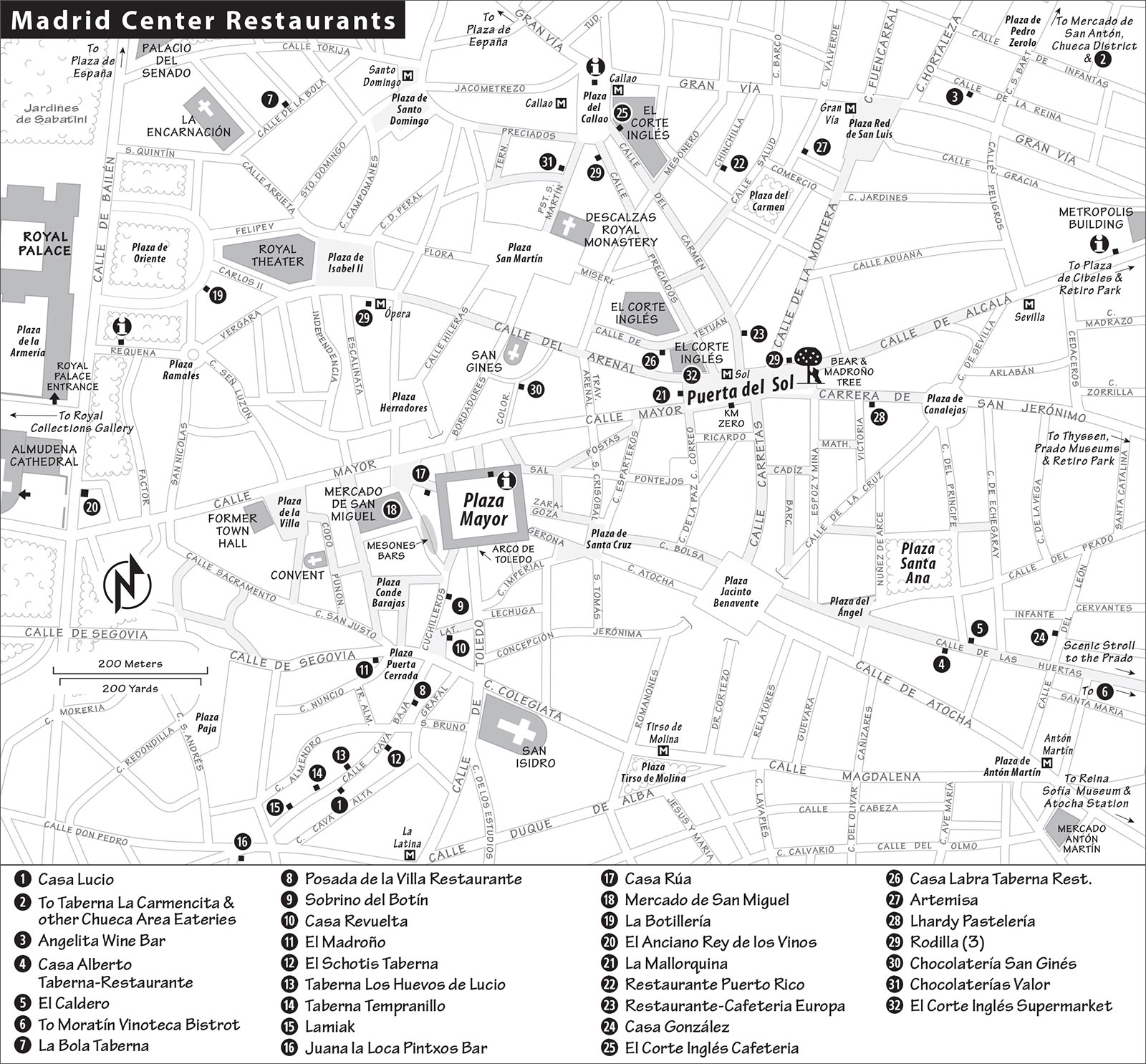
$$$ Angelita Wine Bar is a dressy restaurant just north of Gran Vía with spacious seating, a short menu (a la carte or an enticing tasting menu with paired wines), and a long list of good wines by the glass. An elegant place for a fine meal, it draws a smart local crowd (closed Sun, 100 yards from Gran Vía Metro station at Calle de la Reina 4, +34 915 216 678, https://madrid-angelita.es).
$$$ Casa Alberto Taberna-Restaurante, on pedestrianized Calle de las Huertas, makes tourists swoon with its traditional look and vibe, and it’s highly thought of by locals too. They serve classic tapas in front (no reservations taken) and there’s a small, more serious restaurant in back (reservations needed). The bar is a Spanish free-for-all, strewn with ham hocks and celebrity photos (Tue-Sat lunch and dinner, Sun lunch only, closed Mon; midway between Puerta del Sol and the Prado at Calle de las Huertas 18; +34 914 299 356, www.casaalberto.es).
$$$ El Caldero (“The Pot”), also on Calle de las Huertas, is an uncluttered spot with the focus on fine-quality paella and other rice dishes. A local crowd appreciates its subdued elegance and crisp service. The house specialty, arroz al caldero (a variation on paella), is served with panache from a cauldron hanging from a tripod. Most of the formal rice dishes come in pans for two. Wash it all down with the house sangria (Tue-Sat lunch and dinner, Sun lunch only, Calle de las Huertas 15, +34 914 295 044, https://elcaldero.com).
$$$ Moratín Vinoteca Bistrot is a smart, romantic-feeling little place (10 tables) near the Prado that’s Michelin-rated for its fine traditional Spanish cuisine. You’ll enjoy helpful service, enthusiasm for wine, and quality without any pretense (closed Sun and Mon, reservations by phone only, Calle de Moratín 36—see map on here for location, +34 911 276 085, www.vinotecamoratin.com).
$$$$ La Bola Taberna is touristy but friendly, cozy, and tastefully elegant—it exudes “old school.” Women-run, it specializes in cocido madrileño (Madrid stew), made from various meats, carrots, and garbanzo beans cooked in earthen jugs. Traditionally a winter dish, it’s prepared here all year and served as two courses: First enjoy the broth as a soup, then dig into the meat and veggies (daily lunch seatings at 13:30 and 15:30, Mon-Sat dinner 20:30-23:00, closed Sun for dinner, midway between Royal Palace and Gran Vía at Calle Bola 5, +34 915 476 930, http://labola.es).
Roast Suckling Lamb and Pig: A dining ritual in this part of Spain is cochinillo and cordero lechal asado...tender roast baby lambs and pigs that lived 21 days on mother’s milk only. Two places, Posada de la Villa for lamb and Sobrino del Botín for pig, are high on the tourist list, each a short walk from Plaza Mayor and a worthy spurge (plan on €50 per meal). With centuries of tradition serving roast suckling lamb, $$$$ Posada de la Villa Restaurante is a venerable, sprawling, woody restaurant with a big, showy oak-burning oven. While it’s packed with tourists, and has a menu designed to wiggle up your cost, it’s the place for suckling lamb (a few nice tables outside, Mon-Sat lunch and dinner, Sun lunch only, near Plaza Puerta Cerrada at Cava Baja 9, +34 913 66 860, www.posadadelavilla.com). $$$$ Sobrino del Botín, a block downhill from Plaza Mayor, is a hit with many Americans because “Hemingway ate here.” While grotesquely touristy today, it’s still loved by many for the roast suckling pig (daily, Calle Cuchilleros 17, +34 913 664 217, https://botin.es).
Treating Tapas Bars as “Fine Dining” Restaurants: Of the many recommended tabernas and tapas bars listed next, several have tables and menus that lend themselves to fine dining. If you don’t mind the commotion of the nearby bar action, you can order high on the menu in these places and, I’d say, eat better and more economically than in the more formal restaurants listed earlier.
TAPAS BAR-HOPPING
For maximum fun, people, and atmosphere, go mobile for dinner: Do the tapeo, a local tradition of going from one bar to the next, munching, drinking, and socializing. If done properly, a pub crawl can be a trip highlight. Before embarking upon this culinary adventure, study and use the tapas tips in the Practicalities chapter. Try speaking a little Spanish: You’ll enjoy a much better (and likely less expensive) experience. While tiny tapas plates are standard in Andalucía, Madrid’s bars generally offer bigger sharing plates for around €8 (vegetables) to €15 (meat and fish). Called raciones, these are ideal for a small group to share. Figure three raciones to fill two people. (Order two first and see how you feel.) Half portions are often available even if “off menu.” While the energy is fun and local after 20:00, you may find it easier to get service and a spot by dining earlier.
There are tapas bars almost everywhere, but two areas in the city center are particularly rewarding for a tapa-crawl meal: Calle de Jesús (near the Prado) is the easiest, with several wonderful and diverse places in a two-block row, while trendy Calle Cava Baja (south of Plaza Mayor) has fancier offerings and feels most energetic. I’ve dropped a third area, between Puerta del Sol and Plaza Santa Ana, from my listings as it’s become overrun with low-end tourist traps.
The Great Tapas Row on Calle de Jesús
This two-block stretch of tapas bars across the boulevard from the Prado offers a variety of fun places (for location, see the “Madrid’s Museum Neighborhood” map on here). While the offerings are pretty similar, each has its own personality. Most have chaotic bars in front and small and inviting sections with tables in back—both serving the same menu at the same cost. As each place has its strengths, it’s fun to survey them all (they’re listed in order along the same street), see which hold the most appeal, and then make a plan (remembering that there’s no reason to spend all your time and appetite at your first stop). Calle de Jesús stretches between Calle de Cervantes and Calle de las Huertas, behind the Palace Hotel. Start near the big church at the first recommended bar, Cervecería Cervantes. These places are generally open every day for long hours.
$$ Cervecería Cervantes serves hearty raciones and specializes in octopus (intersection of Plaza de Jesús and Calle de Cervantes, +34 914 296 093).
$$ Taberna de la Daniela Medinaceli, part of a local chain, is popular for its inviting menu (Plaza de Jesús 7, +34 913 896 238).
$$ La Dolores, with a rustic little dining area, has been a hit since 1908 and is still extremely popular. Its tostas and canapés are listed on the wall (Plaza de Jesús 4, +34 914 292 243).
$$ Cervezas La Fabrica packs in seafood lovers at the bar. They serve a nice cava (Spanish sparkling wine), which goes well with seafood (Calle de Jesús 2, +34 913 690 671).
$$ Cervecería Los Gatos is a kaleidoscope of Spanish culture, with chandeliers swinging above wine barrels in the intense bar area and characteristic tables in the more peaceful zone behind. Lola’s forte is tostas—toasted bread topped creatively (Calle de Jesús 2, +34 914 293 067).
$$$ Taberna Maceira is a Galician place with a wonderfully woody and rustic energy. A sit-down restaurant (no longer a bar), it specializes in octopus, cod, pimientos de Padrón, and caldo gallego (white bean soup)—all classic Galician specialties of northwest Spain (closed Sun, Calle de Jesús 7, +34 914 291 584). Around the corner on Calle Huertas is its sister location.
Tapas on Calle Cava Baja
A few minutes’ walk south of Plaza Mayor, Calle Cava Baja fills each evening with a mix of young professionals and sloppy drunks prowling for chic tapas and social fun. I’ve listed a few standards, but excellent new eateries are always opening up. For a good, authentic Madrid dinner experience, survey the options, then choose your favorites. The street has two distinct personalities: It feels sleepy and a bit run down earlier in the evening; after about 20:00 when every bar is open and it’s getting dark, the energy becomes more appetizing. Remember, it’s easier and touristy early, and jammed with locals later. For a formal dining experience on this street, come early and pick a place you like with tables in the back (Taberna Tempranillo or Juana la Loca would be my first choices), or consider the places recommended under “Fine Dining,” earlier (Casa Lucio and Posada de la Villa).
These tapas bars, listed in the order you’ll reach them as you walk down from Plaza Mayor and then up Calle Cava Baja, are worth special consideration. Most are open nightly, but many don’t open until 20:00.
$ Casa Revuelta is small, very simple, and beloved by locals for its laser focus on fried cod (bacalao). The cod servings are big. A good start to your tapas crawl might be here sipping a caña (small beer) and sharing a bacalao (closed Sun and Mon, Latoneros 3, +34 913 663 332). If there’s a line, check their sister location just across the street.
$$ El Madroño (“The Berry Tree,” a symbol of Madrid), more of a cowboy bar, serves all the clichés. If Buffalo Bill were Spanish, he’d eat here. Preserving a bit of old Madrid, a tile copy of Velázquez’s famous Drinkers grins from its facade. Inside, enjoy photos of 1902 Madrid and study the coats of arms of Madrid through the centuries as you try a vermut (vermouth) on tap. Or ask for a chupito of the licor de madroño (distilled from the fruit of the tree on the city emblem, it’s served in an edible chocolate shot glass). Sidewalk tables come with good people-watching (a block off the top of Calle Cava Baja at Plaza de la Puerta Cerrada 7, +34 913 645 629).
$ El Schotis Taberna manages to be a party every night—stoked by a fun list of tapas—without being sloppy. Choose between two zones: a convivial bar and a more spacious, family-friendly back dining area (Cava Baja 11, +34 674 710 959).
$$ Taberna Los Huevos de Lucio, owned by the same family as the venerable and more formal Casa Lucio (described under “Fine Dining,” earlier), feels like a family-friendly restaurant serving good tapas, salads, huevos estrellados (fried eggs over fried potatoes), and wine (Calle Cava Baja 30, +34 913 662 984).
$$ Taberna Tempranillo, ideal for hungry wine lovers, offers fancy tapas and fine wine by the glass (see the board or ask for their English menu). While there are a few tables, the bar is just right for hanging out. Employ a spirit of adventure and their fascinating menu to assemble your dream meal. When I order high on their menu, I’m generally very happy (closed Aug, Calle Cava Baja 38, +34 913 641 532).
$ Lamiak is another inviting bar with a casual and easy-going vibe and lots of Basque-style pintxos (Cava Baja 42, +34 913 655 212).
$$ Juana la Loca Pintxos Bar (“Crazy Juana”) overlooks a lonely square at the top end of Calle Cava Baja (on the left). Minimalist and without the tourist kitsch, it feels sophisticated and civilized, with elegant raciones, a focus on good wine, refined-yet-tight seating, gorgeously presented dishes from a foodie menu, and reasonable prices for the quality. While reservations are generally needed for a table, I like the bar (which takes no reservations). The menu is fun, enticing, and creative—be sure to read it in English. I’d start with their classic: the runny tortilla de patatas with piles of decadently caramelized onions (closed Mon, Plaza Puerta de Moros 4, +34 913 665 500).
In the Chueca District
Chueca, just north of Gran Vía, in the past decade has gone from a sleazy no-go zone to a trendy and inviting neighborhood. Riding the Metro to the Chueca stop, you’ll emerge right on Plaza de Chueca. The square feels like today’s Madrid...without the tourism. A handful of places offer relaxing tables on the square, the neighborhood’s San Antón market hall (Mercado de San Antón, a block away) is now a fun food circus, and nearby streets hold plenty of hardworking, creative new eateries. Here are some good options (for locations, see the “Gran Vía Walk” map on here).
$ Antigua Taberna Angel Sierra Vermouth Bar offers an old-time ambience that almost takes you back to 1917, when it opened. Belly up to the bar with its classic zinc and original taps in the tight front room facing the square. Or, for more elbow room, use the side entrance to reach a rustic back room filled with giant wooden casks and more spacious tables. They offer a simple menu of light, cold tapas. Study the QR-code menu to know your options. Go wild, it’s cheap (on Plaza de Chueca, Calle Gravina 11, +34 915 310 126).
$ Hermanos Vinagre (Vinegar Brothers), a few doors down on Calle de Narváez, is Antigua Casa Angel Sierra’s very modern cousin. It serves all the pickled bites the young crowd likes with their vermouth (nothing in English, Calle de Narváez 58, +34 915 391 169).
$$ PerretxiCo, a modern, brightly lit, and family-friendly pintxo bar/restaurant with an Ikea-showroom ambiance, is run by a Basque family that took its winning restaurant formula to the big city. The fun point-and-choose display under glass is like a trip to San Sebastián (Calle de Augusto Figueroa 32, +34 919 890 716).
Mercado de San Antón, with three bustling floors of edible temptations, is flat-out fun for anyone who likes food (daily 10:00-late). There’s a supermarket in the basement, and a meat-and-fish market on the ground floor. The first floor is a circle of tapas joints (#24 is famous for its burgers) with sample dishes on display for easy ordering and shared tables looking down on the market action. The top floor is a more formal restaurant, $$$ 11 Nudos Terraza Nordés, offering modern Mediterranean dishes and cocktails, served in a hidden rooftop garden. If you get a table outside you’ll feel like you crashed a Spanish party (Augusto Figueroa 24, +34 913 300 294).
Angelita Wine Bar and Taberna La Carmencita are dressy little restaurants in this neighborhood described earlier under “Fine Dining.”
MORE GOOD, MEMORABLE, AND/OR CONVENIENT EATING OPTIONS
On or near Plaza Mayor
Madrileños enjoy a bite to eat on Plaza Mayor (without its high costs) by grabbing food to go (like a squid-ring sandwich) from a nearby bar and just planting themselves somewhere on the square to eat. But for many tourists, dinner at a sidewalk café right on Plaza Mayor is worth the premium price (consider Cervecería Pulpito, southwest corner of the square at #10).
Calamari Sandwiches: Plaza Mayor is famous for its bocadillo de calamares. For a tasty squid-ring sandwich, line up at $ Casa Rúa at Plaza Mayor’s northwest corner, a few steps up Calle Ciudad Rodrigo. Hanging up behind the bar is a photo-advertisement of Plaza Mayor from the 1950s, when the square contained a park (long hours daily).
Mercado de San Miguel: This early-20th-century market sparkles after a recent renovation and bustles with a trendy food circus of eateries (daily 10:00-24:00, https://mercadodesanmiguel.es). While it’s expensive, touristy, and often impossibly crowded, it can be fun and accessible. You can stroll while you munch, grab a bar stool and hang out, or try to find a seat at one of the market’s food-court-style tables. For tips on grazing here, see here.
Near the Royal Palace
$$$ La Botillería is recommended mostly for its location next to the National Theater and overlooking Plaza de Oriente. It’s a venerable and elegant (and expensive) opera-type café with fine tables on the square. The menu is pricey, but they have a decent €19 weekday lunch special (daily, more interesting menu after 20:00, Plaza de Oriente 2, +34 915 484 620, www.botilleria.es).
$$$ El Anciano Rey de los Vinos, high powered with a quality menu, has a 1910 belle epoch ambiance with a glittering bar interior and breezy outdoor tables. While expensive for a bar, it can be fun (closed Tue, across from cathedral and palace on Calle Bailén, +34 915 595 332).
Near Puerta del Sol and Plaza Mayor
$$ La Mallorquina (“The Girl from Mallorca”), on the downhill end of Puerta del Sol, is a venerable pastry shop serving the masses cheap napolitana pastries (custard is the classic, or chocolate-filled) at the bar or for takeaway on the ground floor. Upstairs is a refined little 19th-century café—popular for generations, offering an accessible menu (prices nearly the same as the bar) and a relative oasis of quiet (also savory empanadas, daily 9:00-21:00, closed mid-July-Aug, Puerta del Sol 8, +34 915 211 201).
$$ Restaurante Puerto Rico, a simple, no-nonsense place, serves good meals for great prices to tourists in a long, congested hall (daily, Chinchilla 2, between Puerta del Sol and Gran Vía, +34 915 219 834).
$$$ Restaurante-Cafeteria Europa is a high-energy scene with a mile-long bar, old-school waiters, local dishes, a good breakfast menu, and a €15 fixed-price lunch special (menú del día, inside only). The menu lists three price levels: bar (use the plastic barra menu), table, or terrace, which has the highest prices but good people-watching (long hours daily, next to Hotel Europa, 50 yards off Puerta del Sol at Calle del Carmen 4, +34 915 212 900).
$$$ Casa González is a revered gourmet cheese-and-wine shop/cafe with a circa-1930s interior and friendly service. It offers a genteel opportunity to enjoy a first-class cheese plate and a glass of wine in a fun setting recalling the happy days of the Republic of Spain—after the old-fashioned monarchy but before Franco. Their €13 assortment of five Spanish cheeses—more than enough for two—is a cheese lover’s treat (made even better by 40 wines by the glass). The menu has plenty more (open-faced sandwiches, salads, pâté) for a fuller meal—great for lunch. They also do a very nice breakfast. While relaxed by day, it can be packed at night (daily 10:00-24:00, Calle de León 12, +34 914 295 618, Francisco and Luciano).
$$$ El Corte Inglés’ “Gourmet Experience,” the ninth-floor cafeteria in Madrid’s landmark department store, houses a specialty grocery mart and 10 mini restaurants with a wide range of cuisines—from burgers to Basque tapas to Mexican to Japanese. This snazzy and wildly popular complex is fresh, modern, and not particularly cheap. Grab a seat at any of the indoor tables, or out on the open terrace—ideally with a grand view over Madrid (daily 10:00-23:00, in the location at the top of Calle del Carmen, a half-block below Plaza del Callao).
$ Casa Labra Taberna Restaurante is famous as the birthplace of the Spanish Socialist Party in 1879...and as a spot for great cod. Their tasty little tajada de bacalao dishes put them on the map. Packed with Madrileños, it manages to be both dainty and rustic. It’s a wonderful scene with three distinct sections: the cheap stand-up bar (line up for cod, croquettes, and fried tuna as you enter, then power up to the bar to pay for a drink—see blackboard on wall for options), a peaceful little sit-down area in back (still cheap but with service), and a fancy, more expensive restaurant. Consider the outdoor tables self-serve like the bar (daily, a block off Puerta del Sol at Calle Tetuán 12, +34 915 310 081).
Vegetarian: $$ Artemisa is a hit with vegetarians and vegans who like good, healthy food without any hippie ambience (weekday lunch specials, open daily, north of Puerta del Sol at Tres Cruces 4, a few steps off Plaza del Carmen, +34 915 218 721).
Peaceful Time Warp: $$ Lhardy Pastelería is like a wealthy grandmother, offering a genteel taste of Old World charm in a district of rowdy pubs. This refined dining room has been a fixture since 1839. Step past the glass cases to the fancy soup dispenser. The Lhardy experience: Choose a drink from the line of elegant opened bottles (each a different Iberian fortified wine: sherry, port, and so on), choose a meat pastry from the revolving case, and order a chicken broth consommé with a splash of sherry (daily, Carrera de San Jerónimo 8, +34 915 222 207).
Sandwiches
You’ll notice a quick sandwich is the popular Madrileño fast food. For more character, you’ll find bars with jamón (ham) and calamari (fried squid ring) sandwiches everywhere.
$ Rodilla: Rather than a hamburger joint, Madrid’s sandwich chain of choice is Rodilla. Branches of this old-school institution are all over town: fast, cheap, good quality, huge selection, easy to order, eat in or take out. Choose from a big selection of sandwiches—mostly white bread with crusts trimmed off. Sharable set menus let you choose your selection of sandwiches and eat cheaper yet—two for €10 (chicken curry and ham-and-cheese are favorites). There’s generally a quiet, less-crowded eating area upstairs. Rodilla works for breakfast too, with sandwiches, tostada con tomate, and pastries (long hours daily, prime locations at Puerta del Sol 13, Calle de Preciados 25, and Calle del Arenal 23).
Churros con Chocolate
Those not watching their calories will want to try the deep-fried doughy treats called churros (or the thicker porras), best enjoyed by dipping them in pudding-like hot chocolate. Though many chocolaterías offer the dunkable fritters, churros are most delicious when consumed fresh out of the bubbling cauldron at a place that actually fries them. Two Madrid favorites are near Puerta del Sol:
Chocolatería San Ginés is a classy institution, beloved for a century by Madrileños for its churros con chocolate. While busy all day, it’s packed after midnight (the popular club and theater Teatro Eslava is next door). Order at the counter, get a ticket, find a seat, and give your ticket to the server, who delivers your order (open 24 hours; from Puerta del Sol, take Calle del Arenal 2 blocks west and turn left at the brick church on bookstore-lined Pasadizo de San Ginés and follow the eager crowd; +34 913 656 546).
Chocolaterías Valor, a modern chain and Spanish chocolate maker, does churros with pride and gusto. (Peek into the back room to see the frying in action.) A few minutes’ walk from most of my hotel recommendations, it’s a fine place for breakfast (long hours daily, 00, a half-block below Plaza del Callao and Gran Vía at Postigo de San Martín 7, +34 915 229 288).
Madrid Connections
BY TRAIN
Madrid has two main train stations: Chamartín and Atocha. Both stations offer long-distance trains (largo recorridos) as well as smaller local trains (regionales and cercanías) to nearby destinations.
Check out all the possible trains: nationally run Renfe (+34 912 320 320, www.renfe.com [URL inactive]), as well as discount French-run Ouigo (www.ouigo.com) and Italian-run Iryo (www.iryo.eu). Ouigo and Iryo leave from the same tracks as Renfe trains.
Buying Train Tickets: Train station ticket counters can have long lines, especially during high season or holidays, and ticket machines at stations don’t always accept US credit cards. It’s best to buy tickets online or at a travel agency. There’s an El Corte Inglés travel agency at Atocha station (Mon-Fri 8:00-22:00, Sat 10:00-14:00, closed Sun, small fee, on ground floor of AVE side at the far end); you’ll also find travel agencies at the El Corte Inglés department store (see the listing in the “Shopping in Madrid” section, earlier) and at the airport.
Chamartín Station
The impressively large information, ticket, and customer-service office is at track 11. You can relax in the Sala VIP Club if you have a first-class rail pass and first-class seat or sleeper reservations (between tracks 13 and 14). Baggage storage (consigna) is across the street, opposite track 17. The station’s Metro stop is also called Chamartín (not “Pinar de Chamartín”). Train connections from here are listed later.
Atocha Station
The station is split in two: the AVE side (mostly long-distance trains) and the cercanías side (mostly local trains to the suburbs—called cercanías—and the Metro for connecting into downtown). The two parts are connected by a corridor of shops and eateries. Each side has separate schedules and customer-service offices. The station’s Metro stop is called Atocha Renfe.
Ticket Offices: I’d avoid buying tickets at a ticket office, but if you must, here are the details. The cercanías side has two offices for Renfe trains—a small one for local trains and a big one for major trains (such as AVE). The AVE side of Atocha has a spacious, airy office that sells tickets for AVE and other long-distance trains. In the ticket hall, sales points include venta anticipada (tickets in advance), salida inmediata (immediate departures of certain trains), and salidas hoy (departures today, but only for certain destinations).
AVE Side: Located in the cavernous old brick station building, the AVE area boasts a lush, tropical garden filling its grand hall. It’s used by AVE trains and other fast trains (Grandes Líneas). Here you’ll find a customer service and information office (under the moving ramps), the spacious ticket office (facing the garden, on the right side), a long-hours pharmacy (just past the ticket office), a handful of cafés and restaurants, and a pay WC. Baggage storage (consignas), if open, is at the far end of the garden. Be clear on which level to catch your train: Some departures leave from the lower level (planta baja on departure boards); others leave from the “first floor” (planta primera, ride up the moving ramps). Within the first-floor departure zone (past security) is the Club AVE/Sala VIP lounge for AVE business-class travelers and first-class ticket holders or Eurailers with a first-class reservation (free drinks, newspapers, showers, and info desk).
Cercanías Side: This is where you’ll find the local cercanías trains, regionales trains, some eastbound faster trains, and the Atocha Renfe Metro stop. The Atención al Cliente office in the cercanías section has information only on trains to destinations near Madrid. Clearly marked signs lead you to a direct route to the cercanías train that goes to the airport, or to the Metro, taxi stand, or back to the AVE side.
AVE, Ouigo, and Iryo Trains
Spain’s bullet trains open up good itinerary options. You can get from Madrid’s Atocha station to Barcelona nonstop in 2.5 hours (at nearly 200 mph), with trains running almost hourly. The bullet trains are faster and easier than flying, but not necessarily cheaper, unless you find a less-expensive Ouigo or Iryo train that fits into your schedule. AVE second-class tickets are about €110-130 one-way; first-class tickets are €180. Advance purchase and online discounts are available through the national rail company (Renfe) but sell out quickly. Save by not traveling on holidays. Your ticket includes one commuter-train transfer in Madrid or Barcelona. Avlo, a low-cost bullet train run by Renfe, is another option for the Madrid-Barcelona route (check www.renfe.com [URL inactive] for status). For Ouigo and Iryo train prices, check their websites: www.ouigo.com and www.iryo.eu.
The AVE is also handy for visiting Sevilla (and, on the way, Córdoba). Consider this exciting, exhausting day trip: 7:00-depart Madrid, 8:45-12:40-in Córdoba, 13:30-20:45-in Sevilla, 23:15-back in Madrid.
Other AVE destinations include Granada, Toledo, Segovia, Valencia, Alicante, and Malaga. Prices vary with times, class, and date of purchase—they’re usually cheapest up to two months in advance. Reserve each AVE segment ahead. Eurail Pass holders pay a seat reservation fee (for example, Madrid to Sevilla is €13 second class, and Madrid to Toledo is €4; must purchase at Renfe ticket windows—not available at ticket machines).
Train Connections
Below I’ve listed both non-AVE and (where available) AVE trains. Ouigo and Iryo trains are servicing a growing number of destinations but are not listed here; see their websites for details.
From Madrid by Train to: Toledo (AVE or cheaper Avant: nearly hourly, 30 minutes, from Atocha), El Escorial (cercanías, 2/hour, from Atocha and Chamartín, but bus is better—see next chapter), Segovia (best on AVE, up to 4/hour, 30 minutes plus 20-minute city bus to Segovia center, from Chamartín, take train going toward Valladolid), Ávila (nearly hourly, 1.5-2 hours, from Madrid’s Príncipe Pío station; also 2/day, 1.5-2 hours, from Chamartín), Salamanca (4/day on speedy Alvia, 1.5 hours; or 7/day on much slower regional Media Distancia train, 3 hours; both from Chamartín), Valencia (AVE: nearly hourly, 2 hours, from Atocha; in Valencia, AVE passengers arrive at Joaquín Sorolla station), Santiago de Compostela (nearly hourly, 3-4 hours, longer trips transfer in Ourense), Barcelona (AVE: at least hourly, 2.5-3 hours, from Atocha), San Sebastián (6/day, 5-8 hours, from Chamartín), Bilbao (2-4/day, 5-7 hours, some transfer in Zaragoza, from Chamartín), Pamplona (4/day direct, 3.5 hours, from Atocha), Burgos (6/day, 2.5-4.5 hours, from Chamartín), León (8/day, 2.5-5 hours, from Chamartín), Granada (AVE: 3/day, 3.5 hours, from Atocha), Sevilla (AVE: hourly, 2.5 hours, departures from 16:00-19:00 can sell out far in advance, from Atocha), Córdoba (AVE: almost hourly, 2 hours; Altaria trains: 4/day, 2 hours; all from Atocha), Málaga (AVE: hourly, 2.5-4 hours, from Atocha), Algeciras (2/day, 1 direct, 5.5-6 hours, from Atocha), Lisbon, Portugal (1/day, 11 hours, two transfers, from Atocha, bus or plane is better), Marseille, France (1/day direct, 8 hours, from Atocha; also stops at Montpellier, Nîmes, Avignon, and Aix-en-Provence).
BY BUS
Madrid has several major bus stations with good Metro connections. There are also several routes serving Barajas Airport’s Terminal 4. Multiple bus companies operate from these stations, including Alsa (www.alsa.es) and Avanza (www.avanzabus.com [URL inactive]). If you take a taxi from any bus station, you’ll be charged a legitimate €3 supplement (not levied for trips to the station).
Plaza Elíptica Station: Served by Alsa. Buses to Toledo leave from here (2/hour, 1-1.5 hours, directo faster than ruta, Metro: Plaza Elíptica).
Estación Sur de Autobuses (South Station): Served by Alsa, Socibus, Avanza, and Interbus. From here, buses go to Ávila (nearly hourly, 6/day on weekends, 1.5 hours, Avanza), Burgos (2/day, 3.5 hours, Alsa), Salamanca (hourly express, 2.5-3 hours, Avanza), León (10/day, 4 hours, Alsa), Santiago de Compostela (4/day, 9 hours, includes 1 night bus, Alsa), Granada (nearly hourly, 5-6 hours, Alsa), Algeciras (1/day, overnight, 9 hours, Interbus), and Lisbon (2/day, 9 hours, Alsa). The station sits squarely on top of the Méndez Álvaro Metro (has TI, +34 914 684 200, www.estacionautobusesmadrid.com).
Moncloa Station: This station, in the Moncloa Metro station, serves León (6/day, 3.5-4.5 hours, Alsa), Santiago de Compostela (3/day, 9 hours, Alsa), El Escorial (4/hour, fewer on weekends, 1 hour, see next chapter), and Segovia (about 2/hour, La Sepulvedana). To reach the Valley of the Fallen, it’s best to connect via El Escorial.
Avenida de América Station: Served by Alsa. Located at the Avenida de América Metro, buses go to Lisbon (4/day, 9 hours), Burgos (hourly, 3 hours), Granada (3/day, 6 hours), and Pamplona (almost hourly, most with transfer, 6 hours).
BY PLANE
Both international and domestic flights arrive at Madrid’s Barajas Airport. Options for getting into town include public bus, cercanías train, Metro, taxi, and minibus shuttle.
Adolfo Suárez Barajas Airport
Ten miles east of downtown, Madrid’s massive airport (code: MAD, www.aena.es) has four terminals. Terminals 1, 2, and 3 are connected by long indoor walkways (about a 10-minute walk apart); the newer Terminal 4 is farther away, and also has a separate satellite terminal called T4S. Be clear on which terminal your flight uses before heading to the airport. To transfer between Terminals 1-3 and Terminal 4, you can take a 10-minute shuttle bus (free, leaves every 10 minutes from departures level), or ride the Metro (stops at Terminals 2 and 4). Make sure to allow enough time if you need to travel between terminals (and then for the long walk within Terminal 4 to the gates).
Services: At the Terminal 1 arrivals area, you’ll find a helpful Turismo Madrid TI (Mon-Sat 8:00-20:00, Sun 9:00-14:00, +34 913 058 656), ATMs, a flight info office, a post office window, a pharmacy, eateries, and car-rental agencies. Upstairs at the check-in level, Terminal 1 has an El Corte Inglés travel agency. The super-modern Terminal 4 offers essentially the same services, as well as a Renfe office (where you can get train info and buy long-distance train tickets, long hours daily). You’ll find baggage storage (consigna) in Terminals 1, 2, and 4.
Handy Domestic Flights: Consider flying between Madrid and other cities in Spain (see “Flights” in the Practicalities chapter). Domestic airline Vueling (www.vueling.com) is popular for its discounts (e.g., Madrid-Barcelona flight as cheap as €40 if booked in advance).
Getting Between the Airport and Downtown
By Public Bus: The Exprés Aeropuerto runs between all terminals of the airport and downtown, making three stops: O’Donnell, Plaza de Cibeles, and Atocha train station (€5, pay driver in cash—largest bill €20—or with tap-to-pay credit card, departs from arrivals level every 15-20 minutes, ride takes about 40 minutes, runs 24 hours a day). Once at Atocha, you can take a taxi or the Metro to your hotel. The bus back to the airport leaves Atocha from near the taxi stand on the cercanías side. From 23:30 to 6:00, the bus only goes to Plaza de Cibeles, not all the way to Atocha.
Bus #200 runs to the center from all terminals but leaves you farther from downtown (at the Metro stop at Avenida de América, northeast of the historical center); I don’t recommend it.
By Cercanías Train: From Terminal 4, passengers can ride a cercanías train to either of Madrid’s stations (€2.60, 2/hour, 25 minutes to Atocha, 12 minutes to Chamartín). Those returning to Madrid’s airport by AVE train from elsewhere in Spain can transfer for free to the cercanías at Atocha: Scan your AVE ticket at the cercanías ticket machine to receive a ticket for the airport train. Be sure to board a train labeled T-4. For terminals 1, 2, or 3, the bus is a more convenient choice.
By Metro: Considering the ease of riding the Exprés Aeropuerto bus in from the airport, the Metro is not a great option. The subway involves two transfers to reach the city; it’s not difficult, but usually involves climbing some stairs. Note there’s a €3 fare supplement for Metro rides to and from the airport.
By Taxi or Uber: The flat rate is €30 for a taxi between the airport and downtown (no charge for luggage). Uber also serves the airport for a similar fare (but can go higher with demand). Plan on getting stalled in traffic. With cheap and easy alternatives available, there’s not much reason to take a taxi or Uber unless you have lots of luggage or just want to go straight to your hotel.
Getting Between the Airport and Other Towns
Some buses leave from the airport to far-flung destinations, such as Pamplona (see www.alsa.es; buy ticket online or from driver).
BY CAR
Avoid driving in Madrid. If you’re planning to rent a car, pick it up as you depart the city.
Route Tips for Drivers
To leave Madrid, follow signs for A-6 (direction Villalba or A Coruña) for Segovia, El Escorial, or the Valley of the Fallen (see next chapter for details). For Madrid-Toledo routes, see here.
From Madrid to Segovia (60 miles/97 km): After leaving Madrid on A-6, exit 39 gets you to Segovia via a slow, winding route over the scenic mountain. Exit at 60 (after a long toll tunnel) or get there more quickly by staying on the toll road all the way to Segovia. At the Segovia aqueduct, follow casco histórico signs to the old town (on the side where the aqueduct adjoins the crenellated fortress walls).