MADRID
Map: Madrid’s Historic Core Walk
Map: Madrid’s Museum Neighborhood
Map: Madrid Shopping & Nightlife
Map: Madrid Center Restaurants
MORE GOOD, MEMORABLE, AND/OR CONVENIENT EATING OPTIONS
Today’s Madrid is upbeat and vibrant. You’ll feel it. Look around—just about everyone has a twinkle in their eyes.
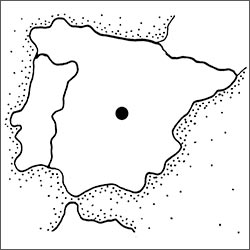
Madrid is the hub of Spain. This modern capital—Europe’s second-highest, at more than 2,000 feet above sea level—is home to more than 3 million people, with about 6 million living in greater Madrid.
Like its population, the city is relatively young. In medieval times, it was just another village, wedged between the powerful kingdoms of Castile and Aragon. When newlyweds Ferdinand and Isabel united those kingdoms in 1469, Madrid—sitting at the center of Spain—became the focal point of a budding nation. By 1561, Spain ruled the world’s most powerful empire, and King Philip II moved his capital from cramped, medieval Toledo (and the influence of its powerful bishop) to spacious Madrid.
Successive kings transformed the city into a European capital. By 1900, Madrid had 575,000 people, concentrated within a small area. In the mid-20th century, the city exploded with migrants from the countryside, creating modern sprawl. Today Madrid is working hard to make itself more livable. Massive urban-improvement projects—pedestrianized streets, new parks, extended commuter lines, and renovated Metro stations—are transforming the city. Once-dodgy neighborhoods are turning trendy, and the traffic chaos is subsiding. Madrid feels orderly and welcoming.
Fortunately for tourists, the historic core survives intact and is easy to navigate. Dive headlong into the grandeur and intimate charm of Madrid. Feel the vibe in Puerta del Sol, the pulsing heart of modern Madrid and of Spain itself. The lavish Royal Palace, with its gilded rooms and frescoed ceilings, rivals Versailles. The Prado has Europe’s top collection of paintings, and nearby hangs Picasso’s chilling masterpiece, Guernica. Retiro Park invites you to take a shady siesta and hopscotch through a mosaic of lovers, families, skateboarders, pets walking their masters, and expert bench-sitters. On Sundays, cheer for the bull at a bullfight or bargain like mad at a megasize flea market. Swelter through the hot, hot summers or bundle up for the cold winters. Save some energy for after dark, when Madrileños pack the streets for an evening paseo and tapeo (tapas crawl) that can continue past midnight. Lively Madrid has enough street-singing, bar-hopping, and people-watching vitality to give any visitor a boost of youth.
PLANNING YOUR TIME
Madrid is worth two days and three nights on even the fastest trip. Divide your time among the city’s top three attractions: the Royal Palace (worth two hours), the Prado Museum (worth a half-day), and doing the tapa tango through characteristic neighborhoods.
Here’s a two-day plan that hits Madrid’s highlights. With more time, Madrid has several days’ worth of other museums to choose from (royal collection, archaeology, city history, the cultures of the Americas, local artists, and so on). Or, for good day-trip possibilities, see the Northwest of Madrid and Toledo chapters.
Day 1
Morning: Get your bearings with my self-guided city walk, which loops from Puerta del Sol to the Royal Palace and back—with a tour through the Royal Palace in the middle (purchase ticket in advance).
Afternoon: Your afternoon is free for other sights, shopping, or exploring—consider my self-guided walk of the glitzy Gran Vía or self-guided bus tours of the busy Paseo de la Castellana or the funky Lavapiés district. Be out at the golden hour—just before sunset—for the evening paseo, when beautifully lit people fill Madrid.
Evening: End your day with a progressive tapas dinner at a series of characteristic bars.
Day 2
Morning: Take a brisk good-morning-Madrid walk along Calle de las Huertas to the Prado, where you’ll enjoy some of Europe’s best art (purchase ticket in advance).
Afternoon: Enjoy an afternoon siesta in Retiro Park. Then tackle art of the 19th and 20th centuries at the Thyssen-Bornemisza Museum and/or modern art at the Reina Sofía, which displays Picasso’s Guernica (closed Tue).
Evening: Take in a flamenco or zarzuela performance, or have a special dinner (book ahead).
Orientation to Madrid
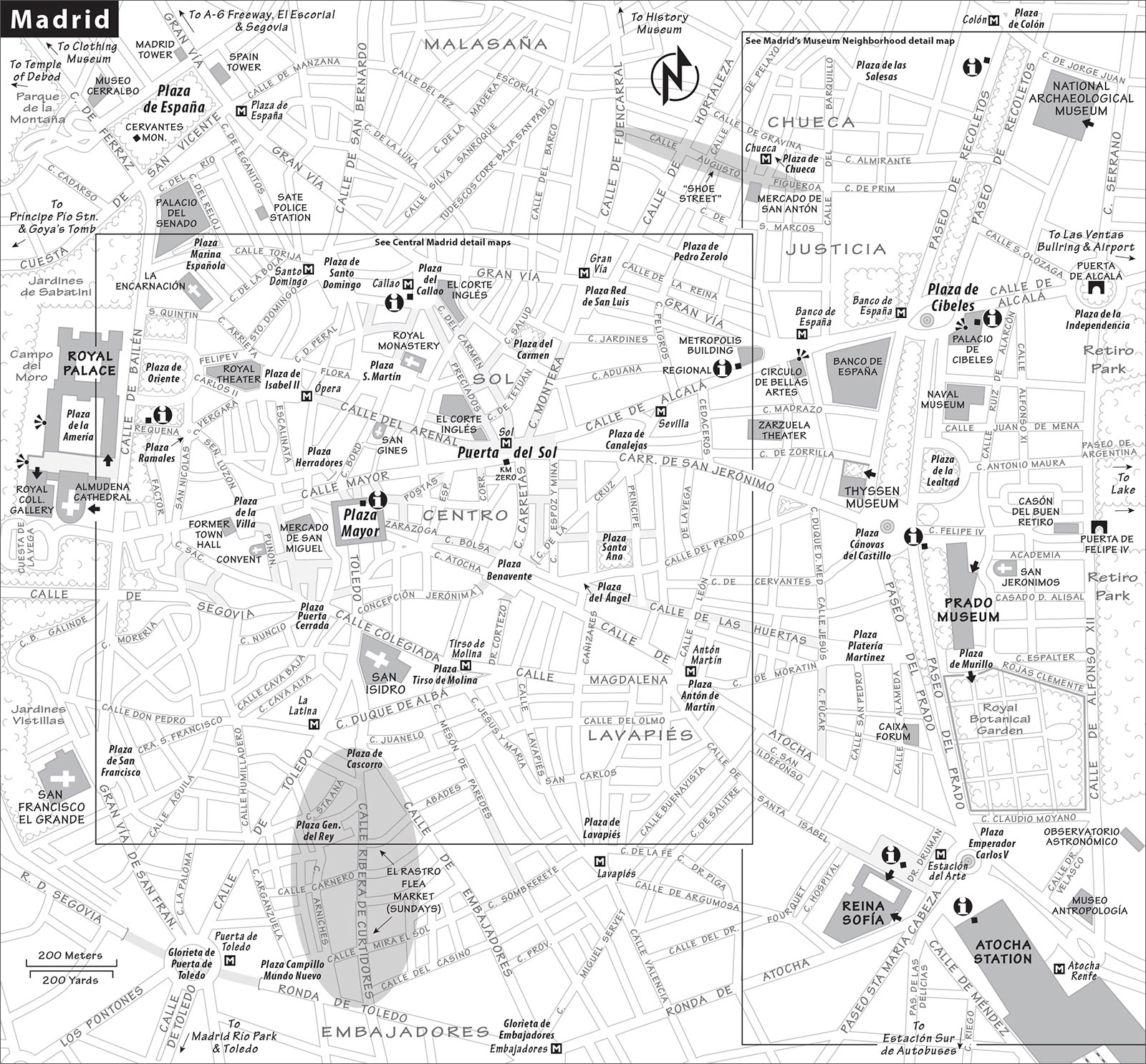
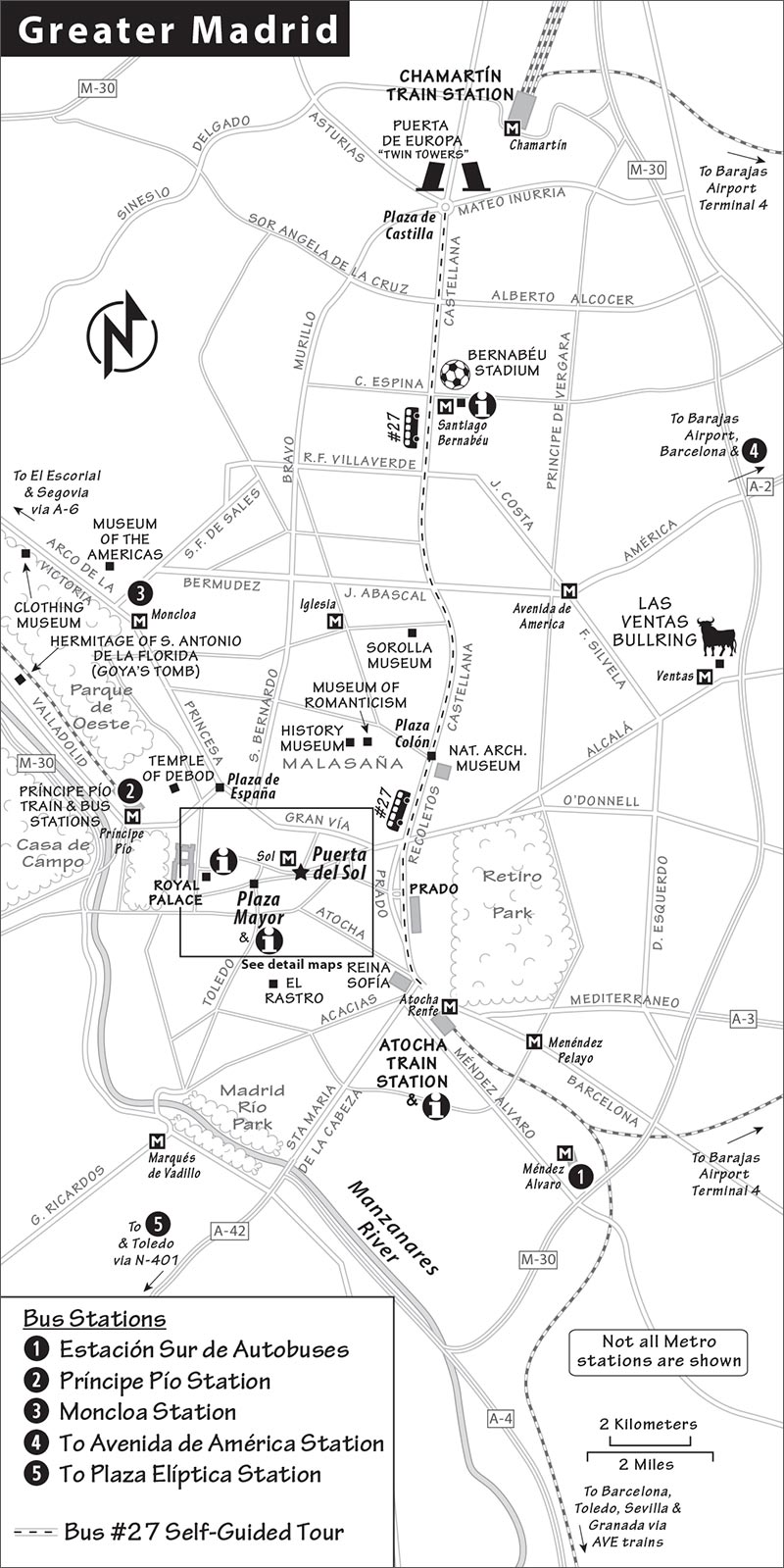
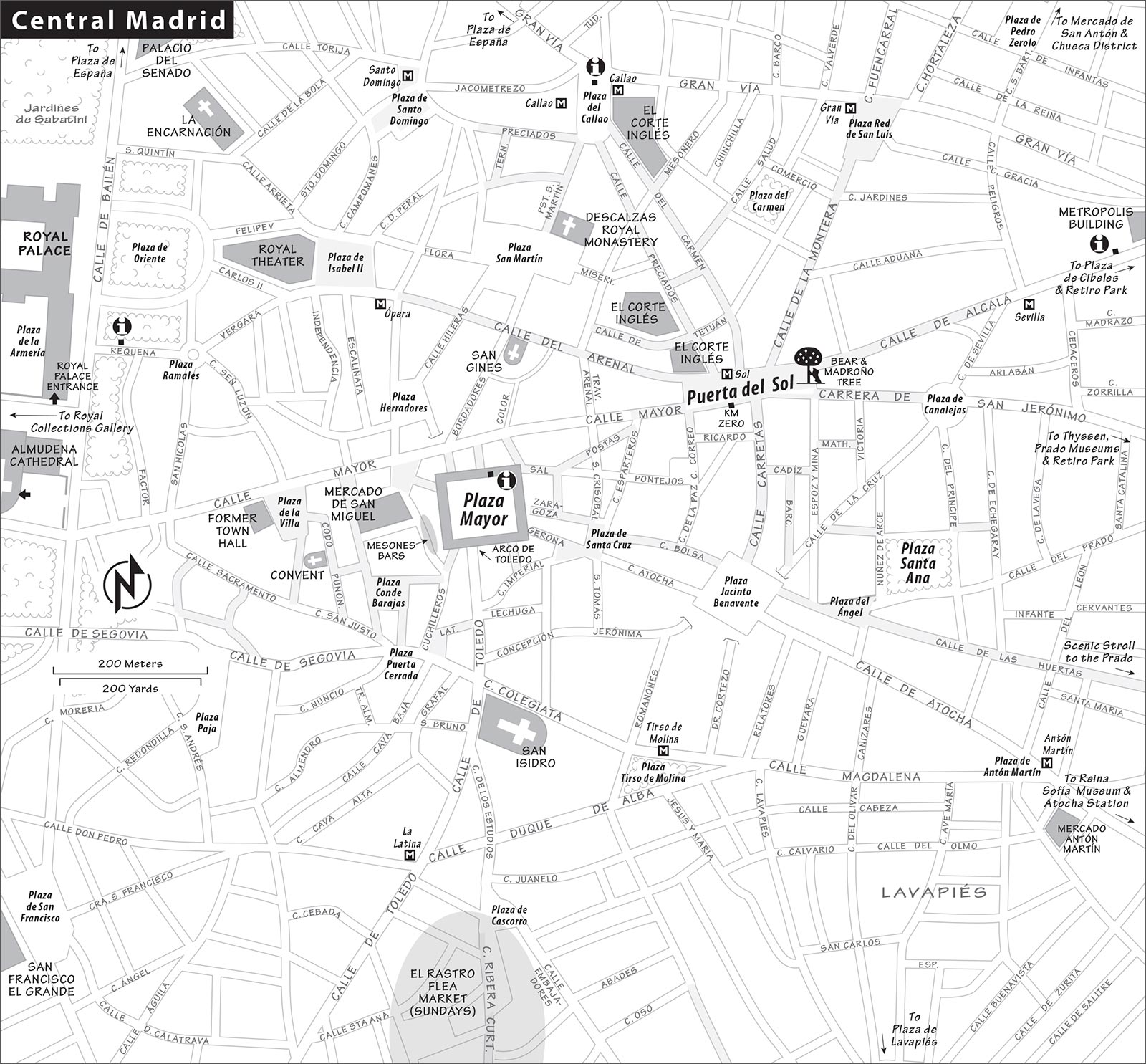
While Madrid is a massive city, its historic core—which short-time visitors rarely leave—is compact and manageable. Frame it off on your map: The square called Puerta del Sol marks the center of Madrid. To the west is the Royal Palace. To the east are the great art museums: Prado, Reina Sofía, and Thyssen-Bornemisza. North of Puerta del Sol is Gran Vía, a broad east-west boulevard throbbing with people and bubbling with shops and cinemas. Between Gran Vía and Puerta del Sol is a lively pedestrian shopping zone. And southwest of Puerta del Sol is Plaza Mayor, the center of a 17th-century, slow-down-and-smell-the-cobbles district. Everything described here (roughly the area contained in the “Central Madrid” map in this chapter) is within about a 20-minute stroll or a €10 taxi ride of Puerta del Sol.
For exploring, a wonderful chain of pedestrian streets crosses the city east to west, from the Prado to Plaza Mayor (along Calle de las Huertas) and from Puerta del Sol to the Royal Palace (on Calle del Arenal). Stretching north from Gran Vía, Calle de Fuencarral is a shopping-and-strolling pedestrian street leading deep into the trendy Chueca neighborhood.
TOURIST INFORMATION
Madrid has both city and regional TIs. Both are good for city information; the regional offices can also help plan excursions out of town.
City TIs share hours and contact info (daily 9:30-20:30 or later, +34 915 787 810, www.esmadrid.com). The central city TI is on Plaza Mayor, and branches are scattered all over the city in convenient freestanding kiosks: near the Prado (facing the Neptune fountain), near the Royal Palace (across from the group entrance), in front of the Reina Sofía art museum, along Gran Vía at Plaza del Callao, and at the airport (Terminals 2 and 4). At any location, ask for Es Madrid, the English-language monthly magazine, which includes city and Metro maps and event listings (or at www.esmadrid.com, select English, and search for “Magazine”). Themed Madrid Guide booklets on various topics (families, museums, viewpoints, gastronomy) are also available.
Regional TIs also share hours and a website (www.turismomadrid.es; Mon-Sat 8:00-20:00, Sun 9:00-14:00, +34 912 723 400). The main branch is just east of Puerta del Sol at Calle de Alcalá 31; branches are also inside the Sol Metro station (inside the underground corridor), at Atocha train station (AVE arrivals side; this branch open Mon-Sat 8:00-15:30, Sun 9:00-14:00), and at the airport (Terminals 1 and 4).
ARRIVAL IN MADRID
For more information on arriving at or departing from Madrid, including stations and connections, see “Madrid Connections,” at the end of this chapter.
By Train: Madrid’s two train stations, Chamartín and Atocha, are on both Metro and cercanías (suburban train) lines with easy access to downtown Madrid. Chamartín handles most international trains and the AVE (AH-vay) train to and from Segovia. Atocha generally covers southern Spain, as well as AVE trains to and from Barcelona, Córdoba, Granada, Sevilla, and Toledo. Many train tickets include a cercanías connection to or from the train station and downtown Madrid.
Traveling Between Chamartín and Atocha Stations: The cercanías train is the fastest option (€1.70 plus €0.50 for a “+Renfe & Tú” card purchased at a ticket counter or machine, 6/hour, 13 minutes; Atocha-Chamartín lines C1, C3, C4, C7, C8, and C10 each connect the two stations; lines C3 and C4 also stop at Sol—Madrid’s central square). Any Renfe train ticket to Madrid includes a free transfer within three hours of your travel time: At the cercanías ticket machine, choose combinado cercanías, then scan your train ticket bar code and choose your destination. These trains depart from Atocha’s track 6 and generally Chamartín’s track 1, 3, 8, or 9—check the salidas inmediatas board to be sure. You can also take the Metro (€2, line 1, 30 minutes; see “Getting Around Madrid,” later).
By Bus: Madrid has several bus stations, each one handy to a Metro station: Estación Sur de Autobuses (for Ávila, Salamanca, and Granada; Metro: Méndez Álvaro), Plaza Elíptica (for Toledo, Metro: Plaza Elíptica), Moncloa (for El Escorial, Metro: Moncloa), and Avenida de América (for Pamplona and Burgos, Metro: Avenida de América). From any of these, just ride the Metro or a taxi to your hotel.
By Plane: See “Madrid Connections” at the end of this chapter.
HELPFUL HINTS
Book Ahead: Smart travelers will make these bookings well in advance of arrival in Madrid: the Prado, the Royal Palace, AVE train tickets in and out of town (even for shorter trips, such as to Toledo or Segovia), and any special dinner. The Reina Sofía can merit advanced booking on busy weekends.
Sightseeing Tips: The Prado, Royal Palace, and Royal Collection Gallery are open daily. The Reina Sofía (with Picasso’s Guernica) is closed on Tuesday, and many other sights are closed on Monday, including the Monasterio de San Lorenzo de El Escorial, a popular day trip outside of Madrid (see next chapter). If you’re here on a Sunday, consider visiting the famous El Rastro flea market (year-round) and/or a bullfight (most Sun and holidays in March-mid-Oct plus almost daily during the San Isidro festival in early May-early June).
Theft Alert: Be wary of pickpockets—anywhere, anytime, but especially in crowded areas such as Puerta del Sol, the busy street between the Puerta del Sol and the Prado (Carrera de San Jerónimo), El Rastro flea market, on the Gran Vía, on the Metro, on bus #27, and at the airport. In general, be alert to the people around you. Thieves often dress like tourists and work the areas near big sights. Assume any commotion is a scam to distract people about to become victims of a pickpocket. Wear your money belt. For help if you get ripped off, see the next listing.
Tourist Emergency Aid: SATE is an assistance service for tourists who need help with anything from canceling stolen credit cards to reporting a crime (central police station, daily 9:00-24:00, near Plaza de Santo Domingo at Calle Leganitos 19). They can act as an interpreter if you have trouble communicating with the police. Or you can call in your report to the SATE line (24 hours, +34 902 102 112, follow automated instructions in English to connect to a live person).
Sex Work: While it’s illegal to make money from someone else selling sex (i.e., pimping), sex workers over 18 can solicit legally. You may see sex workers on Calle de la Montera (leading from Puerta del Sol to Gran Vía).
One-Stop Shopping at El Corte Inglés: Madrid’s dominant department store, El Corte Inglés, fills three huge buildings in the pedestrian zone just off Puerta del Sol. From fashion and housewares to groceries and event tickets, El Corte Inglés has it all. See “Shopping in Madrid,” later.
Bookstores: For books in English, try FNAC Callao (Calle Preciados 28) or Casa del Libro (Gran Vía 29).
Laundry: For a self-service laundry, try Colada Express at Calle Campomanes 9 (free Wi-Fi, daily 9:00-22:00, +34 657 876 464) or Lavandería Cervantes at Calle León 6 (self- and full-service, Mon-Fri 9:00-14:00 & 16:30-20:30, Sat 12:00-15:00, closed Sun; +34 914 299 545). For locations see the “Madrid Center Hotels” map on here.
GETTING AROUND MADRID
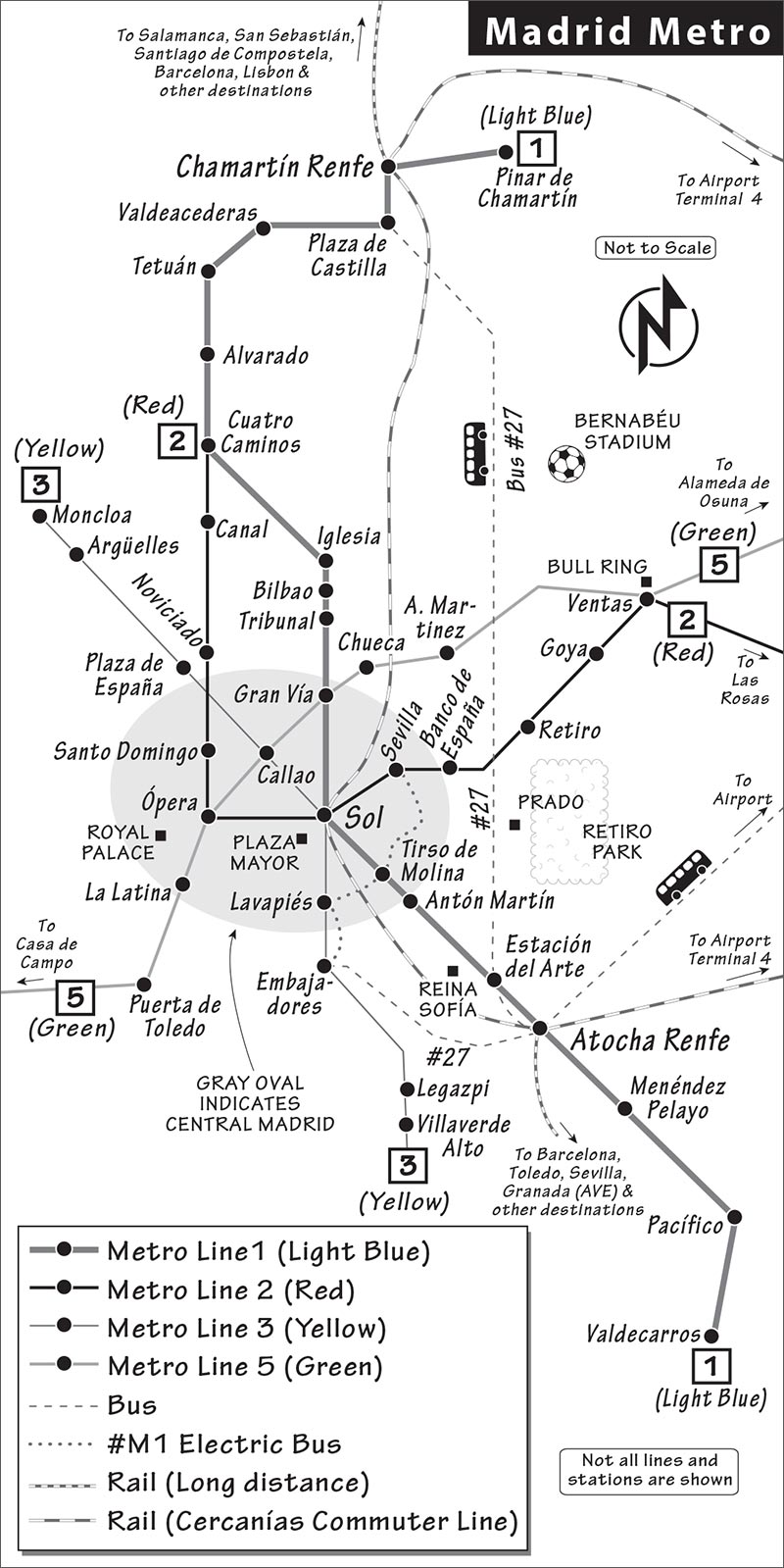
Madrid has excellent public transit. Metro maps are included on most tourist city maps; you can also pick one up at Metro stations, or look for maps posted throughout the Metro system. For buses get the fine, free Public Transport map, available at some TIs. The metropolitan Madrid transit website (www.crtm.es) covers all public transportation options (Metro, bus, and suburban rail).
By Metro: Madrid’s Metro is simple, speedy, and cheap. Distances are short, but the city’s broad streets can be hot and exhausting, so a subway trip of even a stop or two saves time and energy. The Metro runs from 6:00 to 1:30 in the morning. At all times, be alert to thieves, who thrive in crowded stations. Metro info: Metromadrid.es.
Tickets: A 10-ride ticket costs €12.20 and is valid on the Metro and buses; it can be shared by several travelers with the same destination (two people taking five rides should get one). A single-ride ticket, valid only on the Metro, costs €1.50-2 depending on distance; zone A covers most of the city (travel to or from the airport requires a €3 supplement).
To buy tickets, you’ll first buy a rechargeable, nonrefundable Multi Card (tarjeta) for €2.50 (available from station ticket machines), then load it with the type of ticket you want.
I’d skip the tourist ticket (billete túristico) you may see advertised; unless you’re riding transit like crazy, it’s unlikely to save you money over the 10-ride ticket.
Riding the Metro: Study a Metro map—the simplified “Madrid Metro” map in this chapter can get you started. Lines are color-coded and numbered; use end-of-the-line station names to choose your direction of travel. To enter the Metro system, tap your Multi Card on the turnstile (no need to touch it again to exit). Once in the Metro station, signs direct you to the train line and direction (e.g., Línea 1, Valdecarros). Once you reach your destination, look for green salida signs pointing to the exits.
By Bus: City buses, though not as easy as the Metro, can be useful. You can use a Multi Card loaded with a 10-ride ticket (see details earlier), or buy a single-ride ticket on the bus, paying the driver in cash (€1.50; bus maps at TI or info booth on Puerta del Sol, poster-size maps usually posted at bus stops, buses run 6:00-24:00, much less frequent Buho buses run all night). The EMT Madrid app finds the closest stops and lines and gives accurate wait times (there’s a version in English). Bus and app info: EmtMadrid.es.
By Taxi or Uber: Madrid’s taxis are reasonably priced and easy to hail. A green light on the roof indicates that a taxi is available. Foursomes travel almost as cheaply by taxi as by Metro; for example, a ride from the Royal Palace to the Prado costs about €12. After the drop charge (about €3), the per-kilometer rate is around €1.30.
Rates can be higher outside Madrid. There’s a flat rate of €30 between the city center and any one of the airport terminals. Other legitimate charges include a €3 supplement for leaving any train or bus station, €20 per hour for waiting, and €5 if you call to have the taxi come to you. Make sure the meter is turned on as soon as you get into the cab so the driver can’t tack anything on to the official rate. If the driver starts adding up “extras,” look for the sticker detailing all legitimate surcharges (it should be on the passenger window).
Uber works in Madrid pretty much like it does at home, but with fleets of standard cars, not personal ones. Outside of peak times, an Uber ride can be slightly cheaper than a taxi.
Tours in Madrid
 To sightsee on your own, download my free Madrid City Walk audio tour.
LOCAL GUIDES
Federico and his team of licensed guides lead city walks and museum tours in Madrid and nearby towns. They design tours to your interest and enjoy tailoring tours for families, kids, and teens (4 hours-€220, all day-€330; +34 649 936 222, www.spainfred.com). Federico rents his centrally located top-floor apartment exclusively to Rick Steves readers (sleeps up to 4 people).
Inés Carriedo and her all-women team of licensed guides eloquently take you through Madrid and its monuments and museums (€170/2 hours, €220/4 hours, +34 655 433 992, icscher@gmail.com).
Amanda Buttinger, an American living in Spain, has been a Rick Steves guide for nearly two decades and can be your friend in Spain, offering orientation, city, and tapas tours; travel tips; and tools to enjoy Madrid and Spain as you venture onward (tours-€60/hour, travel advice-€100/consultation, +34 649 933 035, www.gathertotravel.com, amanda@gathertotravel.com).
Across Madrid is run by Almudena Cros, a well-traveled art history professor. She offers several specialized tours, including one on the Spanish Civil War that draws on her family’s history, and one on mythology in the Prado (generally €70/person, maximum 7 people, book well in advance, also gives good tours for children, +34 652 576 423, www.acrossmadrid.com).
Mayte Larraya knows her hometown well and loves showing it off (€200/4 hours, €350/all day, +34 627 562 020, maytela@gmail.com).
Letango Tours’s team of guides in Madrid offers a kid-friendly “Madrid Discoveries” tour that mixes a market walk and history with a culinary-and-tapas introduction (€325/group of up to 5, kids free, 3-plus hours). They also lead tours to Barcelona, whitewashed villages, wine country, and more (private tours, travel consulting, packages, and stays all over Spain with a focus on families and groups; www.letango.com [URL inactive]).
Madridivine’s guides share their passion for Spanish life on cultural-immersion tours of historic Madrid. They emphasize an insider’s perspective, introducing private groups to locals—and to local food and wine (€220/group of up to 7 people, 3 hours, food and drinks extra—usually around €50, www.madridivine.com, info@madridivine.com).
Walk and Eat Spain Food Tours, founded by former Seattleite Margit Sperling, takes you through the Malasaña district. Morning tours explore a neighborhood market, with tasty stops along the way. Evening tapas tours visit four bars for a classic crawl (morning tour—€90/person, Mon-Sat, 3 hours; evening tour—€120/person, Tue-Sun, 4 hours; RS%—10% off with code “RS10,” maximum 8 people, private tours available, +34 912 158 281, www.walkandeatspain.com, hola@walkandeatspain.com).
BY BUS
Hop-On, Hop-Off Bus
Madrid City Tour makes two different hop-on, hop-off circuits through the city: historic and modern (each with 16-21 stops, 1.5 hours, buses depart every 15 minutes). The two routes intersect at the south side of Puerta del Sol and in front of Starbucks across from the Prado. Your ticket covers both loops (€25/1 day, €30/2 consecutive days; discount if bought online, otherwise pay driver; recorded narration, daily 9:30-22:00, Nov-Feb 10:00-18:00, +34 917 791 888, https://madrid.city-tour.com).
Big-Bus City Sightseeing Tours
Julià Travel offers bus tours in Madrid and side trips to nearby destinations. Their 2.5-hour Madrid tour is narrated by a live guide in two or three languages (€30, one shopping stop, no museum visits, usually at 9:00 and 15:00, check website for schedule, no reservation required—just show up 15 minutes before departure). Tours leave from their office at Calle San Nicolás 7 near Plaza de Ramales, just south of Plaza de Oriente (+34 915 599 605, www.juliatravel.com).
Self-Guided Tours by Bus or Minibus
I’ve narrated two bus rides that make good self-guided tours. A ride on public bus #27 from the museum neighborhood up Paseo del Prado and Paseo de la Castellana to the Puerta de Europa and back gives visitors a glimpse of the modern side of Madrid (see here), while a ride on electric minibus #M1 takes you through the characteristic, gritty old center (see here).
Walks in Madrid
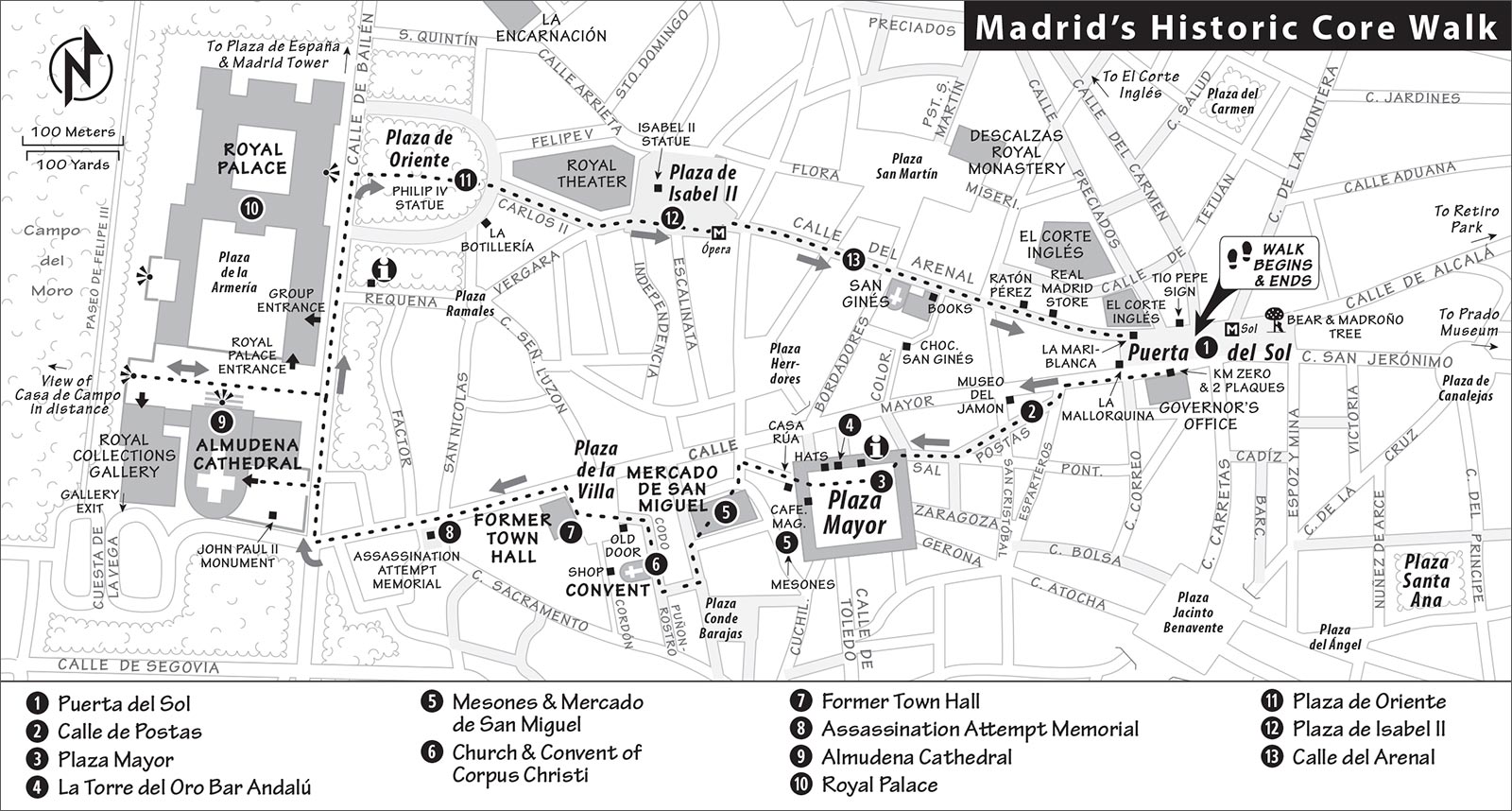
Map: Madrid’s Historic Core Walk
5 Mesones and Mercado de San Miguel
6 Church and Convent of Corpus Christi
8 Assassination Attempt Memorial
10 Royal Palace
Two self-guided walks provide a look at two sides of Madrid. For a taste of old Madrid, start with my “Historic Core Walk,” which winds through the center. My “Gran Vía Walk” lets you glimpse a more modern side of Spain’s capital.
To do the main walk with me in your ear rather than having to read it, download my free Madrid City Walk audio tour.
HISTORIC CORE WALK
Madrid’s historic center is pedestrian-friendly and filled with spacious squares, a trendy market, bulls’ heads in a bar, and a cookie-dispensing convent. Allow about two hours for this self-guided, mile-long walk that loops from Madrid’s central square, Puerta del Sol, to the Royal Palace and back to the square (Metro: Sol).
• Start in the middle of the square, by the equestrian statue of King Charles III, and survey the scene.
1 Puerta del Sol
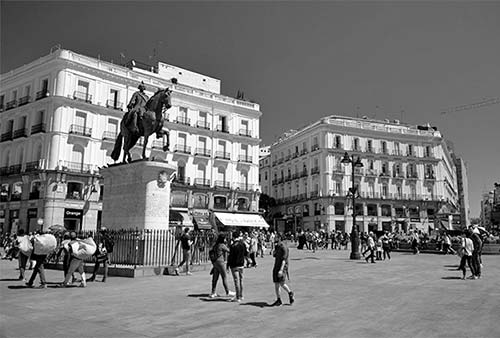
The bustling Puerta del Sol, rated ▲▲, is Madrid’s—and Spain’s—center. In recent years, the square has undergone a facelift to become a fully pedestrianized and wide-open gathering place. For Spaniards, this place (with its iconic Tío Pepe sign) is probably the most recognizable spot in the city. It’s a popular site for political demonstrations and national celebrations. For Madrileños, Puerta del Sol is a transportation hub for the Metro and regional trains. It’s also a magnet for strolling locals, sightseers, pickpockets, and revelers. In many ways, it’s the soul of the city.
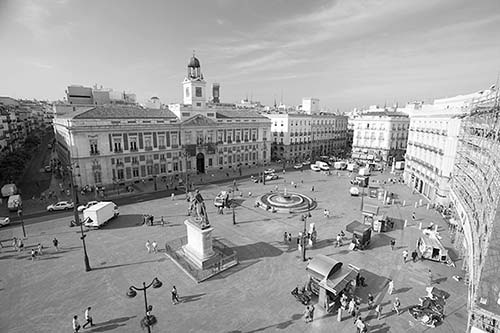
The equestrian statue honors the man who established the Puerta del Sol as an urban hub—King Charles III (1716-1788). His enlightened urban policies earned him the affectionate nickname “the best mayor of Madrid.” He decorated city squares with beautiful fountains, got those meddlesome Jesuits out of city government, established the public-school system, mandated underground sewers, opened his private Retiro Park to the public, built the Prado, made the Royal Palace the wonder of Europe, and generally cleaned up Madrid. (For more on Charles, see here.)
At the slightly uphill end of the square find the black statue of a bear pawing a tree. This image has been a symbol of Madrid since medieval times. Bears used to live in the royal hunting grounds (Casa del Campo) outside the city. And the madroño trees produce a berry that makes the traditional madroño liqueur.
The grand red-and-white building with a bell tower was Madrid’s first post office, which Charles III founded in the 1760s. Today it’s the county governor’s office, home to the “president” who governs greater Madrid. The building is notorious for having once been dictator Francisco Franco’s police headquarters. A tragic number of those detained and interrogated by the Franco police tried to “escape” by jumping out its windows to their deaths.
Appreciate the harmonious architecture of the buildings that circle the square—yellow-cream, four stories, balconies of iron, shuttered windows, and balustrades along the rooflines. Even though buildings are often totally rebuilt on the inside, by law, landowners must preserve these elegant facades.
Crowds fill the square on New Year’s Eve as the rest of Spain watches the Times Square-style action on TV. The bell atop the governor’s office chimes 12 times, while Madrileños eat one grape for each ring to bring good luck through each of the next 12 months.
• Cross the square to the governor’s office and a point directly below the clock tower.
Here a plaque in the pavement marks “kilometer zero,” the symbolic center of Spain, from which the country’s six main highways radiate (as the plaque shows). Standing on the zero marker with your back to the governor’s office, get oriented visually: Directly ahead, at 12 o’clock, is the famous Tío Pepe sign. This big neon billboard—25 feet high and 80 feet across—pictures a jaunty Andalusian caballero with a sombrero and guitar. He’s been busy advertising a local sherry wine since the 1930s.
Beyond the sign is a thriving pedestrian commercial zone, anchored by the huge department store El Corte Inglés. At two o’clock starts the seedier Calle de la Montera, a street (with shady characters and prostitutes after dark) that leads to the trendy, pedestrianized Calle de Fuencarral. At three o’clock is a big Apple store; the Prado is about a mile farther to your right. Back over at 10 o’clock is the pedestrianized street called Calle del Arenal...where we’ll finish this walk.
Now turn around. On the walls flanking the entrance to the governor’s office are several white marble plaques. These commemorate three significant and painful experiences for Madrileños. The plaque on the right marks an event from 1808. An angry crowd gathered here to rise up against an invasion by France. Suddenly, French soldiers stormed the square and began massacring the Spaniards. The event galvanized the country, which eventually drove out the French. The painter Francisco de Goya, whose studio was not far from here, captured the event in his famous paintings The Second of May, 1808 and The Third of May, 1808 (now in the Prado museum).
The plaque to the left of the entry remembers the terrorist bombings on March 11, 2004, when brave Spanish citizens helped fellow citizens. Americans have our 9/11—Spain has its 3/11 (commonly referred to as “11M”).
The plaque on the far left commemorates the victims of Covid-19, especially those who died alone. It’s dated October 2020—far from the end of the pandemic.
Civil guardsmen stand here guarding the entry. Traditionally they wore curious hats with square backs, which (it’s said) were cleverly designed so that the guards could lean against the wall while enjoying a cigarette.
Walk to the corner of Puerta del Sol and Calle Mayor (at the downhill end of Puerta del Sol) to the busy, recommended confitería La Mallorquina, “fundada en 1.894.” A crowded takeaway section is in front, a stand-up bar is in back, and a more genteel sit-down tearoom with nice views of the square is upstairs. Go inside for a tempting peek at racks with goodies hot out of the oven. Enjoy observing the churning energy of Madrileños popping in for a fast coffee and a sweet treat. The shop is famous for its napolitana pastry (like a flat croissant filled with custard or chocolate). Every month or so there’s a holiday or seasonal special—ask a local what’s the latest.
Before leaving the shop, find the tiles above the entrance door and above the bar with the 18th-century views of Puerta del Sol. This was before the square was widened, when a church stood at its top end. Compare this with today’s view out the door.
Puerta del Sol (“Gate of the Sun”) is named for a long-gone gate carved with a rising sun, which once stood at the eastern edge of the old city. From here, we begin our walk through the historic town that dates back to medieval times.
• Leaving the bakery, cross busy Calle Mayor and turn right. Just past McDonald’s, turn left. Go a few steps up the side street, then angle right on the pedestrian-only street called...
2 Calle de Postas
The street sign shows the post coach heading for that famous first post office we’ve left behind in Puerta del Sol. Medieval street signs like this posted on the lower corners of buildings included pictures so the illiterate (and monolingual tourists) could “read” them.
Thirty yards up the street you’ll find several classic bocadillo (sandwich) shops. Look for jamón on the right and bocadillos de calamares—fried squid rings on a small baguette—on the left. A half-block to your right, the aptly named Museo del Jamón (Museum of Ham) bar is famous for its ham sandwiches and, while extremely touristy, still fun to drop into.
• Continue up Calle de Postas, and take a slight right on Calle de la Sal through the arcade, where you emerge into...
3 Plaza Mayor
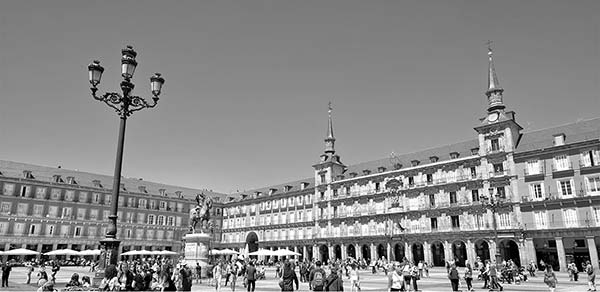
This vast, cobbled square (worth ▲▲) dates back to Madrid’s glory days, the 1600s. Back then, this—not Puerta del Sol—was Madrid’s main square (plaza mayor). The equestrian statue (wearing a ruffled collar) honors Philip III, who made this square the centerpiece of the budding capital in 1619. Philip’s dad (Philip II) made Madrid the country’s capital and the son transformed a former marketplace into this state-of-the-art Baroque plaza.
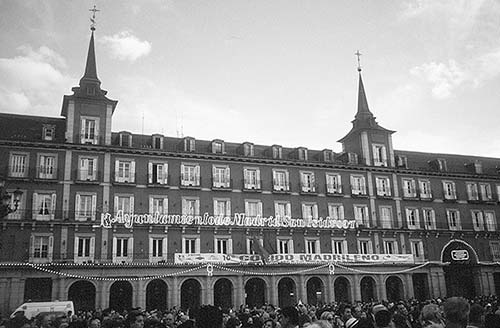
The square is 140 yards long and 100 yards wide, enclosed by four-story buildings with symmetrical windows, balconies, slate roofs, and steepled towers. Each side of the square is uniform, as if a grand palace were turned inside-out. This distinct look, pioneered by architect Juan de Herrera (who finished El Escorial), is found all over Madrid.
This site served as the city’s 17th-century open-air theater. On this stage, much Spanish history has been played out. The square’s lampposts have reliefs on the benches below illustrating major episodes: bullfights fought here, dancers and masked revelers at Carnaval, royal pageantry, a horrendous fire in 1790, and events of the gruesome Inquisition (see sidebar).
During the Inquisition, many were tried here—suspected heretics, Protestants, Jews, and Muslims whose “conversion” to Christianity was dubious. The guilty were paraded around the square before their executions, wearing placards listing their many sins (bleachers were built for bigger audiences, while the wealthy rented balconies). The heretics were burned, and later, criminals were slowly strangled as they held a crucifix, hearing the reassuring words of a priest as the life was squeezed out of them with a garrote. Up to 50,000 people could crowd into this square for such spectacles. The last such execution in Spain by strangulation was in 1974 (and the people here dressed as cartoon characters who pose for photos for a fee don’t seem to even care).
The square’s buildings are mainly private apartments (many of which are now rented out as Airbnbs). Want to buy one? Costs run from €450,000 for a tiny attic studio to €2 million and up for a 2,500-square-foot flat. The square is painted a democratic shade of burgundy—the result of a citywide poll. Since the end of decades of dictatorship in 1975, Spain has had a passion for voting. Three different colors were painted as samples on the walls of this square, and the city voted for its favorite.
The building to Philip’s left, on the north side beneath the twin towers, was once home to the bakers guild and now houses the central city TI, which is wonderfully air-conditioned.
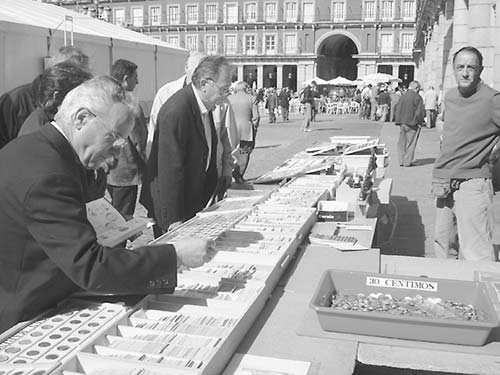
A stamp-and-coin market bustles at Plaza Mayor on Sundays (10:00-14:00). Day or night, Plaza Mayor is a colorful place to enjoy an affordable cup of coffee or overpriced food. Throughout Spain, lesser plazas mayores provide peaceful pools in the whitewater river of Spanish life.
• Head to #26, which is under the arcade just to the left of the twin towers. This is a bar called...
4 La Torre del Oro Bar Andalú
For some Andalú (Andalusian) ambience, an entertaining (if gruff) staff, and lots of fascinating (if gruesome) bullfighting lore, step inside. Order a drink at the bar and sightsee while you sip. Warning: First check the price list posted on the wall at the far end of the bar to understand the two price tiers: the cheaper is the price at the bar; “terraza” is the price at an outdoor table. A caña (small draft beer), Coke, or agua mineral should cost about €3. Your drink may come with a small, free tapa, per the old Spanish tradition. But to avoid being charged by surprise, clarify, “Gratis?”
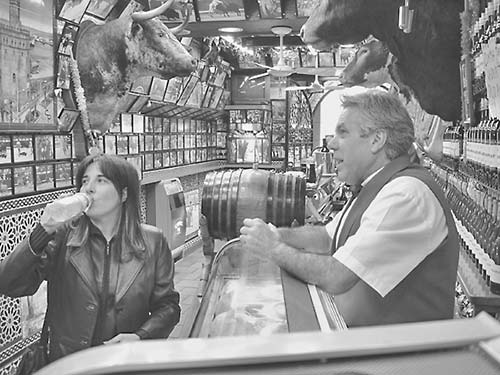
The interior is a temple to bullfighting, festooned with gory decor. Notice the breathtaking action captured in the many photographs. Look under the stuffed head of Barbero the bull (center, facing the bar). At eye level you’ll see a puntilla, the knife used to put poor Barbero out of his misery at the arena. The plaque explains: weight, birth date, owner, date of death, which matador killed him, and the location.
Just to the left of Barbero is a photo of longtime dictator Franco shaking hands with the famous bullfighter Manuel Benítez Pérez—better known as El Cordobés, the Elvis of bullfighters and a working-class hero.
At the top of the stairs going down to the WC (on the right), find the photo of El Cordobés and Robert Kennedy—looking like brothers. Just above RFK find the photo of the famous matador Paquirri that captures a poignant moment: about to take his last breath after being gored, he smiles at the camera.
Below and left of the Kennedy photo is a picture of El Cordobés’ illegitimate son being gored. Disowned by El Cordobés senior, yet still using his dad’s famous name after a court battle, the junior El Cordobés is one of this generation’s top fighters.
At the end of the bar, in a glass case, is the “suit of lights” the great El Cordobés wore in an ill-fated 1967 fight, in which the bull gored him. El Cordobés survived; the bull didn’t.
In the case with the “suit of lights,” notice the photo of a matador (not El Cordobés) horrifyingly hooked by a bull’s horn. Take a slow browse along the length of the bar, past photos of matadors having both very good and very bad days. You can play “spot the celebrity”—there’s Bruce Springsteen...and Jimmy Carter. Bull fighting attracted the most macho of aficionados, from Hemingway...to the Latin American revolutionary Che Guevara, whose photo is in the corner just to the left of the door you entered through.
Between Che and the door you’ll find a small shrine to the Virgin Mary. With all the literally gory encounters with bulls, you can understand why religion and superstition followed matadors into the ring.
Leaving the bull bar, turn right and notice the La Favorita hat shop (at #25). See the plaque in the pavement honoring the shop, which has served the public since 1894.
Consider taking a break at one of the tables on Madrid’s grandest square. Cafetería Magerit (nearby) occupies Plaza Mayor’s sunniest corner and is a good place to enjoy a coffee with the view. The scene is easily worth the extra euro you’ll pay for the drink.
• Leave Plaza Mayor on Calle de Ciudad Rodrigo (at the northwest corner of the square), passing a series of solid turn-of-the-20th-century storefronts and sandwich joints, such as Casa Rúa (to the left), famous for their cheap bocadillos de calamares.
Emerging from the arcade, turn left and head downhill toward the iron-covered market hall. Before entering the market, look downhill to the left, down a street called Cava de San Miguel.
5 Mesones and Mercado de San Miguel
Lining the street called Cava de San Miguel is a series of traditional dive bars called mesones. If you like singing and sangria, come back after 22:00 to visit one. Full of tourists and multilingual menus, it’s a lowbrow, electric-keyboard, karaoke-type ambience, best on Friday and Saturday nights. The odd shape of these bars isn’t a contrivance for the sake of atmosphere—Plaza Mayor was built on a slope, and these underground vaults are part of a structural system that braces the leveled plaza.
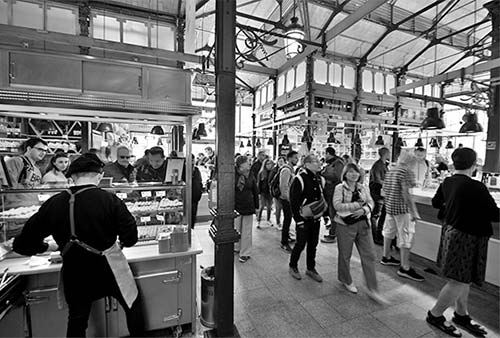
For a more refined setting, pop (or shuffle—it’s often busy) into the Mercado de San Miguel (daily 10:00-24:00). This historic iron-and-glass structure from 1916 stands on the site of an even earlier marketplace. Renovated in the 21st century, the city’s oldest surviving market hall is now a trendy and touristy food court celebrating all the Spanish taste treats. Go on an edible scavenger hunt by simply grazing down the center aisle. You’ll find a variety of tapas, including croquettes, fish, artisan cheeses, and lots of olives. Skewer them on a toothpick and they’re called banderillas—for the decorated spear a bullfighter thrusts into the bull’s neck. You’ll find a draft vermut (vermouth) bar, along with sangria and sherry (V.O.R.S. means, literally, very old rare sherry—dry and full-bodied). And, on the far right, facing the window, Paella Power dishes up reliably good paella. Finally, the stall at the end of the center aisle is for your sweet tooth. You’ll probably hear “Que aproveche!”—the Spanish version of bon appétit.
• Exit the market at the far end and turn left, heading downhill on Calle del Conde de Miranda. At the first corner, turn right and cross the small plaza to the brick church in the far corner.
6 Church and Convent of Corpus Christi
The proud coats of arms over the main entry announce the rich family that built this Hieronymite church and convent in 1607. In 17th-century Spain, the most prestigious thing a noble family could do was build and maintain a convent. To harvest all the goodwill created in your community, you’d want your family’s insignia right there for all to see. (You can see the donating couple, like a 17th-century Bill and Melinda Gates, kneeling before the communion wafer in the central panel over the entrance. In the wall, just inside the door, is a donation box; even just a euro from visitors like us helps fund this church today.) Inside is a cool and quiet oasis with a Last Supper altarpiece. Peek above the pews in the back to see a kind of balcony behind a privacy screen where the cloistered nuns gather to worship.
Now for a unique shopping experience. A dozen steps to the right of the church entrance is its associated convent—it’s the big brown door on the left, at Calle del Codo 3 (Mon-Sat 9:30-13:00 & 16:30-18:30, closed Sun). The sign reads Venta de Dulces (Sweets for Sale). To buy goodies from the cloistered nuns, buzz the monjas button, then wait patiently for the sister to respond over the intercom. Say “dulces” (DOOL-thays), and she’ll let you in. When the lock buzzes, push open the door. It will be dark—look for a glowing light switch to turn on the lights. Walk straight in and to the left, then follow the sign to the torno—the lazy Susan that lets the sisters sell their baked goods without being seen. Scan the menu, announce your choice to the quiet sister (she may tell you she has only one or two of the options available), place your money on the torno, and your goodies (and change) will appear. Galletas (shortbread cookies) are the least expensive item (a medio-kilo costs about €10).
• Continue uphill on Calle del Codo, where, in centuries past, those in need of bits of armor shopped (as depicted on the tiled street sign on the building). Bend sharply left with the street—named “Elbow Street”—and head toward the Plaza de la Villa. Before entering the square, notice an old door to the left of the Real Sociedad Económica sign, made of wood lined with metal. This is considered the oldest door in town on Madrid’s oldest building—inhabited since 1480. It’s set in a Mudejar keyhole arch. Remember, for many centuries (from 711 to 1492), Spain was largely Muslim, and that influence lived on in its Mudejar craftspeople. Look up to see a tower, once used as a prison.
Now continue into the square called Plaza de la Villa, dominated by Madrid’s...
7 Former Town Hall
The impressive structure features Madrid’s distinctive architectural style—symmetrical square towers, topped with steeples and a slate roof...Castilian Baroque. The building was Madrid’s Town Hall. Over the doorway, the three coats of arms sport many symbols of Madrid’s rulers: Habsburg crowns on each, castles of Castile (in center shield), and the city symbol—the berry-eating bear (shield on left). This square was the ruling center of medieval Madrid in the centuries before it became an important capital.
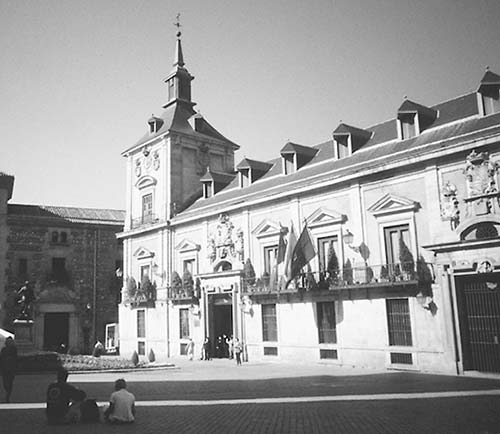
Imagine how Philip II took this city by surprise in 1561, when he decided to move the capital of Europe’s largest empire (even bigger than ancient Rome) from Toledo to humble Madrid. Madrid proved to be a perfect choice. It was located in the geographical center of the country. It united the two great kingdoms of Philip’s great-grandparents, Ferdinand and Isabel. And with plenty of room to grow, Madrid became the ideal spot to administer the growing Spanish empire.
Philip II went on a building spree, and his son Philip III continued it. This particular building reflects the hasty development. It’s glorious, yes—but like much of Madrid, it’s built with inexpensive brick rather than costly granite.
The venerable Town Hall also bore witness to the decline of Spain’s fortunes after the golden age. The statue in the little garden is of Philip II’s admiral, Don Alvaro de Bazán, who defeated the Turkish Ottomans at the battle of Lepanto in 1571. This was Spain’s last great victory. Mere months after Bazán’s death in 1588, his “invincible” Spanish Armada was destroyed by England...and Spain’s empire began its slow fade.
• By the way, a charming little shop selling traditional monk- and nun-made pastries from around Spain is just down the lane (El Jardin del Convento, at Calle del Cordón 1, on the back side of the cloistered convent we dropped by earlier). For small-town and rural convents, sales of such goodies often provide a substantial part of their revenue.
From the top of the square, turn left on Calle Mayor, which leads downhill (along the right side of the old Town Hall) toward the Royal Palace. You’ll pass a fine little shop specializing in books about Madrid (at #80, on the right). A few blocks down Calle Mayor, where the street opens up a bit on the left, is a small plaza in front of a church, where you’ll find the...
8 Assassination Attempt Memorial
This statue memorializes a 1906 assassination attempt. The targets were Spain’s King Alfonso XIII and his bride, Victoria Eugenie, as they paraded by on their wedding day. While the crowd was throwing flowers, an anarchist (as terrorists used to be called) threw a bouquet lashed to a bomb from a balcony at #84 (across the street). He missed the royal newlyweds, but killed 28 people. The king and queen went on to live to a ripe old age, producing many great-grandchildren, including the current king, Felipe VI.
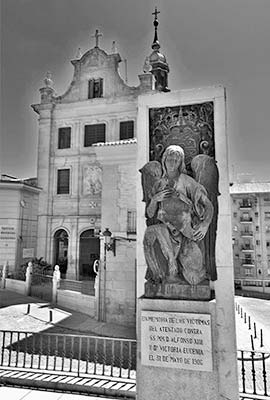
• Continue down Calle Mayor one more block to a busy street, Calle de Bailén. Take in the big, domed...
9 Almudena Cathedral
Madrid’s massive, gray-and-white cathedral (Catedral de Nuestra Señora de la Almudena, 110 yards long and 80 yards high) opened in 1993, 100 years after workers started building it. This is the side entrance for tourists.
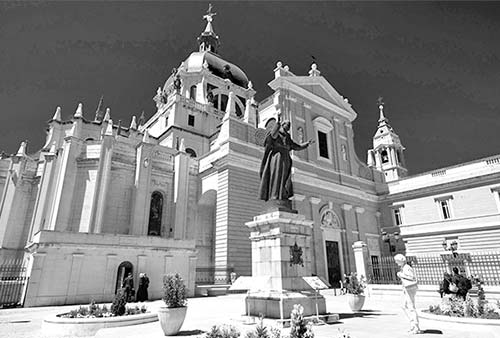
Climbing the steps to the church courtyard, you’ll come to a monument to Pope John Paul II’s 1993 visit, when he consecrated Almudena—ending Madrid’s 300-year stretch of requests for a cathedral of its own. A depiction of the big 1993 event, showing John Paul II and many of Spain’s leading citizens, is just to the right of the church entry on the big green bronze door.
Unlike in most Spanish cities, Madrid’s churches aren’t its most interesting sights. Madrid was built as a capital, so its main landmarks are governmental rather than religious. This cathedral is worthwhile, but if you’re running out of steam, it’s skippable.
If you go in (€1 donation requested), stop in the center, immediately under the dome, and face the altar. Beyond it, colorful paintings—rushed to completion for the pope’s ’93 visit—brighten the apse. In the right transept (opposite where you entered), the faithful venerate a 15th-century Gothic altarpiece with a favorite statue of the Virgin Mary—a striking treasure considering the otherwise 20th-century Neo-Gothic interior. Peer down at the glittering 5,000-pipe organ in the rear of the nave.
The church’s historic highlight is directly behind the altar: a 13th-century coffin. It’s made of painted leather on wood, and depicts scenes of cows, horses, and strolling people. The coffin is now empty, but it once held Madrid’s patron saint, Isidro. The story goes that Isidro was only a humble farmer, but he was exceptionally devout. One day, he was visited by angels. They agreed to plow his fields so he could devote himself to praying. When Isidro died, he was buried in this simple coffin. Forty years later, the coffin was opened, and his body was still perfectly preserved. This miracle convinced the pope to canonize Isidro. He is now the patron saint of farmers, and of the city of Madrid.
• Leave the church from the transept where you entered. Head back to the street, and turn left. Circle around the church to its rarely used front door. Climb the cathedral’s front steps and face the imposing...
10 Royal Palace
Since the ninth century, this spot has been Madrid’s center of power: from Moorish castle to Christian fortress to Renaissance palace to the current structure, built in the 18th century. With its expansive courtyard surrounded by imposing Baroque architecture, it represents the wealth of Spain before its decline. Its nearly 1.5 million square feet make it Europe’s largest palace.
For a commanding vista, side-trip about 40 yards to the view terrace. Stretching toward the mountains in the distance is the vast Casa del Campo (a former royal hunting ground, now a city park). To the left is the entrance to Madrid’s new Royal Collections Gallery.
• You could visit the palace now, using my self-guided tour (see here), or head to the Royal Collections Gallery to explore the Spanish monarchy’s collection of treasures (see here).
Or, to follow the rest of this walk back to Puerta del Sol, go between the cathedral and the palace back to the busy Calle de Bailén (walking alongside the palace). In the distance you’ll see the Madrid Tower skyscraper. This was a big deal in the 1950s, when it was one of the tallest buildings in Europe (460 feet) and the pride of Franco and his fascist regime. The tower marks Plaza de España, and the end of my “Gran Vía Walk” (see here). To Spaniards, it symbolizes the boom time the country enjoyed when it sided with the West during the Cold War (allowing the US and not the USSR to build military bases in Spain).
You’ll pass the palace group entrance (on your left), and a TI (on your right). When you reach the large palace side entrance (on your left; note the palace guards), turn right. You’ll find yourself facing a statue of a king on a horse, and the Royal Theater.
11 Plaza de Oriente
As its name suggests, this square faces east. The grand yet people-friendly plaza is typical of today’s Europe, where energetic governments are converting car-congested wastelands into inviting public spaces. Where’s the traffic? Under your feet. A former Madrid mayor who spearheaded the project earned the nickname “The Mole” for all the digging he did.
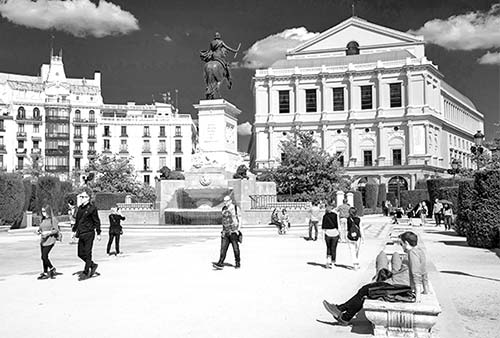
Notice the quiet. You’re surrounded by more than three million people, yet you can hear the birds, bells, and fountain. The park is decorated with statues of Visigothic kings who ruled from the fifth to eighth century. Romans allowed them to administer their province of Hispania on the condition that they’d provide food and weapons to the empire. The Visigoths inherited real power after Rome fell, but lost it to invading Moors in 711. Throughout Spain’s history, the monarchs have traced their heritage back to these distant Visigothic ancestors.
The fine bronze equestrian statue of Philip IV, dating from the 1630s, was a striking technical feat in its day, as the horse rears back dramatically balanced atop its fragile ankles. It was only made possible with the help of Galileo’s clever calculations (and by using the tail for extra support).
The king faces the 1,700-seat Royal Theater (Teatro Real), built in the mid-1800s and rebuilt in 1997. It hosts traditional opera, ballets, concerts, and that unique Spanish form of light opera called zarzuela.
• Continue through the square and then walk along the right side of the Royal Theater to...
12 Plaza de Isabel II
This square is marked by a statue of Isabel II, who ruled Spain in the 19th century and was a great patron of the arts. Although she’s immortalized here, Isabel had a rocky reign. She was a conservative out of step with Spain’s march toward democracy. A revolution in 1868 forced her to abdicate—bringing Spain its first (brief) taste of democracy—and Isabel lived out her life in exile. Today, Isabel’s statue stands before her most lasting legacy—the Royal Theater she built.
• From here, follow Calle del Arenal (on the right side of the square), walking gradually uphill. You’re heading straight back to Puerta del Sol.
13 Calle del Arenal
As depicted on the tiled street signs, this was the “street of sand”—where sand was stockpiled during construction. Each cross street is named for a medieval craft that, historically, was plied along that lane (for example, “Calle de Bordadores” means “Street of the Embroiderers”). Wander slowly uphill. As you stroll, imagine this street as a traffic inferno—which it was until the city pedestrianized it a couple decades ago (and now monitors it with police cameras atop posts at intersections). Notice also how orderly the side streets are. Where a mess of cars once lodged chaotically on the sidewalks, orderly bollards (bolardos) now keep vehicles off the walkways. The gray concrete blobs in the street (versions of which you’ll see all over town...and Europe) are a safeguard to prevent some lunatic in a car from going on a murderous rampage down this pedestrian paradise. The fancier facades (such as the former International Hotel at #19—look up to see the elaborate balconies) are in the “eclectic” style (the Spanish version of Historicism—meaning a new interest in old styles) of the late 19th century.
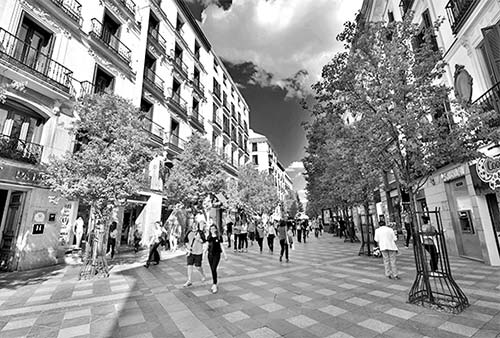
Continue 200 yards up Calle del Arenal to a brick church on the right. As you walk, consider how many people are simply out strolling. The paseo is a strong tradition in this culture—people of all generations enjoy being out, together, strolling. And local governments continue to provide more and more pedestrianized boulevards to make the paseo better than ever.
The brick St. Ginés Church (on the right) means temptation to most locals. It marks the turn to the best chocolatería in town. From the uphill corner of the church, look to the end of the lane where—like a high-calorie red-light zone—a neon sign spells out Chocolatería San Ginés...every local’s favorite place for hot chocolate and churros (always open; see listing on here). Also notice the charming bookshop clinging like a barnacle to the wall of the church. It’s been selling books on this spot since 1650.
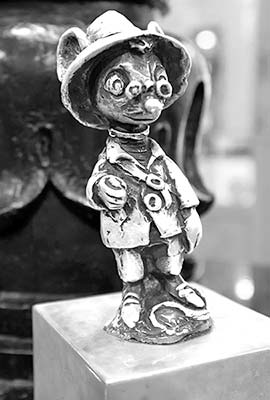
Continue strolling up Calle del Arenal. Farther up on the left, in a little mall (at #8), are a couple of sights celebrating Spain’s answer to Mickey Mouse, called “Ratón Pérez”—Perez the Mouse. First, find the six-inch-tall bronze statue of the beloved rodent in the lobby. Ratón Pérez first appeared in a children’s book in the late 1800s, and kids have adored him ever since. He also serves as Spain’s tooth fairy, leaving money under kids’ pillows when they lose a tooth. Upstairs is the fanciful Casita Museo de Ratón Pérez (€5, daily, Spanish only) with a fun window display. A steady stream of adoring children and their parents pour through here to learn about this wondrous mouse.
Just uphill (at #6, on the left) is an official retailer of Real Madrid football (soccer) paraphernalia. Many European football fans come to Madrid simply to see its 80,000-seat Bernabéu Stadium. Madrid is absolutely crazy about football. They have two teams: the rich and successful Real Madrid, and the working-class underdog, Atlético. It’s like David and Goliath, or the Yankees vs. the Mets. Step inside to see posters of the happy team posing with the latest trophy.
• You’re just a few steps from where you started this walk, at Puerta del Sol. Back in the square, you’re met by a statue popularly known as La Mariblanca. The statue, which is at least 400 years old, represents a kind of Spanish Venus, possibly a fertility goddess. At her feet, she has Madrid’s coat of arms, with our old friend, the bear and the berry tree. Today, La Mariblanca stands tall amid all the modernity, as she blesses the people of this great city.
GRAN VÍA WALK
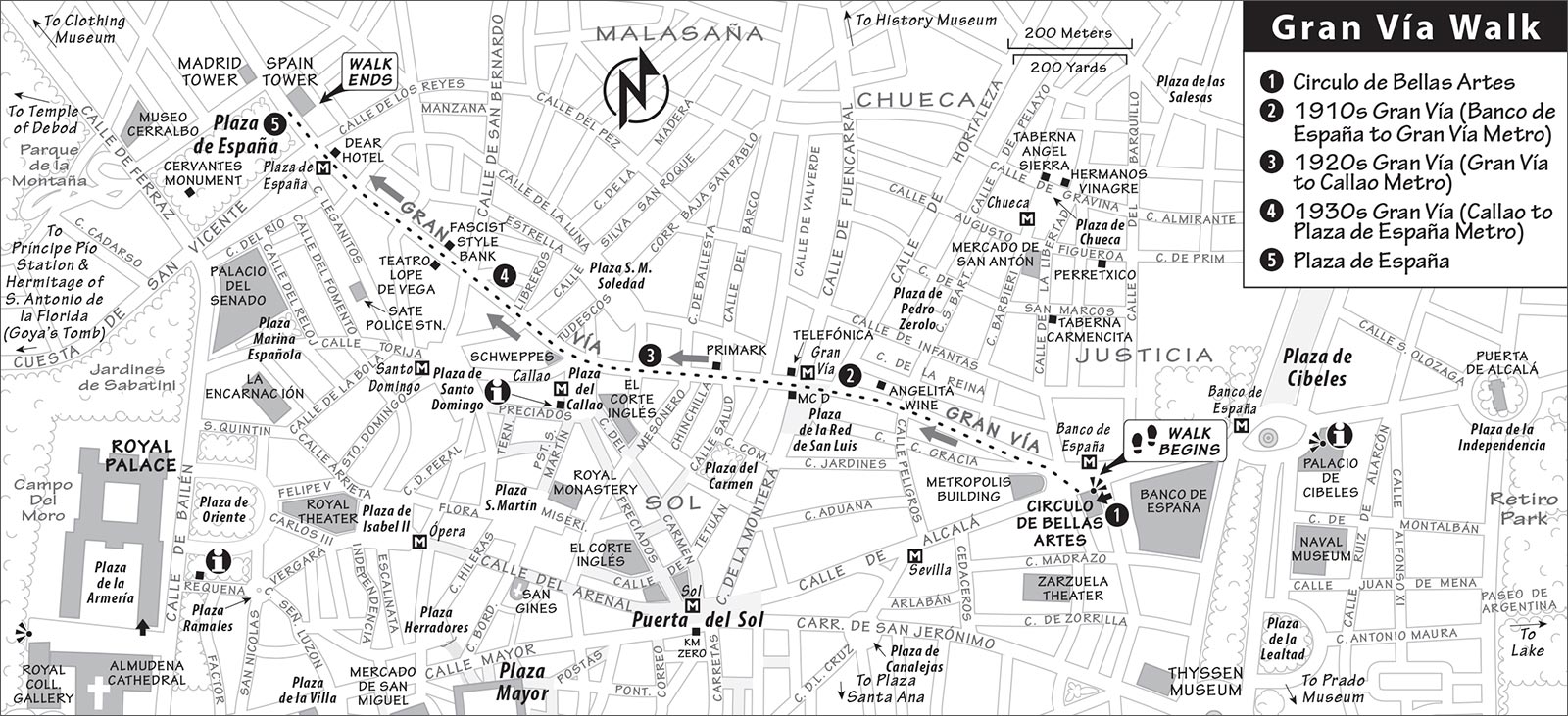
While central Madrid’s centuries-old street plan generally survives, with the advent of cars and the popularity of trolleys, a grand modern boulevard—aptly called Gran Vía—was slashed through the middle. Built up primarily between 1910 and the 1930s, this is Spain’s version of NYC’s Fifth Avenue, and whether you’re appreciating the 20th-century skyscraper architecture or just feeling the people-filled pulse of today’s city, it’s great for a stroll. As you walk, you’ll notice that Madrid’s main boulevard has been renovated with wide sidewalks and traffic is mostly limited to buses and taxis. I’ve broken this self-guided walk into five sections, each of which was the ultimate in its day, starting near Plaza de Cibeles and ending at Plaza de España.
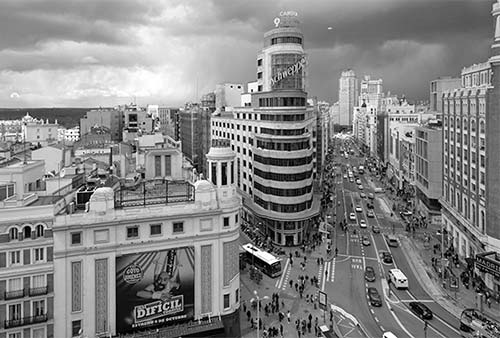
• Start at the skyscraper at Calle de Alcalá #42 (Metro: Banco de España).
1 Circulo de Bellas Artes
This 1920s skyscraper has a venerable café on its ground floor (free entry to enjoy its belle époque-style interior) and the best rooftop view around. Ride the elevator (€5, daily 12:00-24:00) to the seventh-floor Azotea roof terrace/lounge and bar, a fine place to nurse a scenic drink on a sunny day.
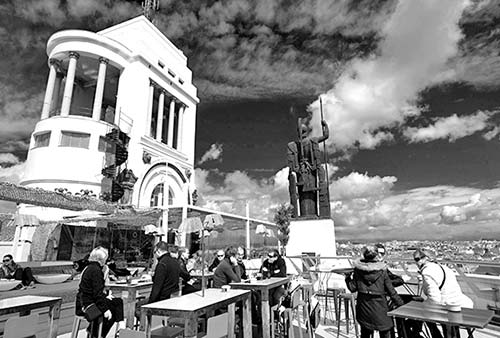
On the roof, stand under a black Art Deco statue of Minerva, perhaps put here to associate Madrid with this mythological protectress of culture and high thinking, and survey the city. Start in the far left and work your way around the perimeter for a clockwise tour.
Looking down to the left, you’ll see the gold-fringed dome of the landmark Metropolis building (inspired by Hotel Negresco in Nice), once the headquarters of an insurance company and now being converted into a luxury space with a hotel, restaurants, and a spa. It stands at the start of Gran Vía and its cancan of proud facades celebrating the good times in pre-civil war Spain. On the horizon, the Guadarrama Mountains hide Segovia. Farther to the right, in the distance, skyscrapers mark the city’s north gate, Puerta de Europa (with its striking slanted twin towers peeking from behind other towers). Round the terrace corner. The big traffic circle and fountain below are part of Plaza de Cibeles, with its ornate and bombastic cultural center and observation deck (Palacio de Cibeles—built in 1910 as the post-office headquarters, and since 2006 the Madrid City Hall). Behind that is the vast Retiro Park. Farther to the right (at the next corner of the terrace), the big low-slung building surrounded by green is the Prado Museum.
• Take the elevator back down and cross the busy boulevard immediately in front of Círculo de Bellas Artes to reach the start of Gran Vía.
2 1910s Gran Vía
This first stretch, from the Banco de España Metro stop to the Gran Vía Metro stop, was built in the 1910s as a strip of luxury stores with a French-inspired flamboyance. While the people-watching and window-shopping can be enthralling, be sure to look up and enjoy the beautiful facades along the way, and to peek into some of the lovely lobbies, too. The Bar Chicote (at #12, on the right, marked Museo Chicote) is a classic cocktail bar that welcomed Hemingway and the stars of the day.
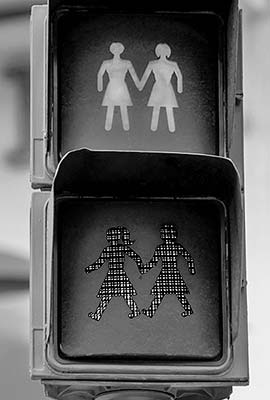
The thriving and trendy Chueca district (just north of this first stretch of Gran Vía) is the heart of Madrid’s gay community. As you stroll along Gran Vía (or anywhere in Madrid), tune in to the pedestrian traffic lights. In honor of Pride Day, in 2017 a progressive mayor replaced dozens of these with a version showing two men or two women holding hands as they wait or cross (see photo).
3 1920s Gran Vía
The second stretch, from the Gran Vía Metro stop to the Callao Metro stop, starts where two recently pedestrianized streets meet up. The Metro stop (in front of the McDonald’s) is rebuilt in original 1919 Art Deco style. To the right, Calle de Fuencarral is one of the trendiest pedestrian zones in town, with famous brand-name shops and a youthful vibe. To the left, Calle de la Montera is known for prostitution. The action runs from the McDonald’s down a block or so. Some find it an eye-opening little detour.
The 14-story Telefónica skyscraper (on the right) is nearly 300 feet tall. Perched here at the highest point around, it seems even taller. It was one of the city’s first skyscrapers (the tallest in Spain until the 1950s), with a big New York City feel—and with a tiny Baroque balcony, as if to remind us we’re still in Spain. Telefónica was Spain’s only telephone company through the Franco age (and was notorious for overbilling people, with nothing itemized and no accountability). Today it’s one of Spain’s few giant blue-chip corporations.
With plenty of money and a need for corporate goodwill, the building now houses the free Espacio Fundación Telefónica (Tue-Sun 10:00-20:00, closed Mon), with an art gallery, kid-friendly special exhibits, and a fun permanent exhibit telling the story of telecommunications, from telegraphs to iPhones. This exhibit fills the second floor amid exposed steel beams—a space where a thousand “09 girls,” as operators were called back then, once worked.
Farther along is a strip of fashion stores, including Primark at #32, which occupies the building that held the first modern department store in town. Step in and gape up at the open atrium. Farther along and just before the Callao Metro station, on the left at #37, stands a 1928 building that used to be the elegant Cine Avenida movie theater. Locals sometimes pause here to mourn the loss of another venerable theater to retail. So many once-beloved venues are now glittering shells of themselves, filled with racks of pants and dresses.
4 1930s Gran Vía
The final stretch, from the Callao Metro stop to Plaza de España, is considered the “American Gran Vía,” built in the 1930s to emulate the buildings of Chicago and New York City. The Schweppes building (Art Deco in the Chicago style, with a round facade and curved windows) was radical and innovative in 1933. Today this section of Gran Vía is the Spanish version of Broadway. Madrid is a leading city for musicals, and these theaters survive thanks to Spanish-language productions of Broadway shows originally performed in English—productions that get a huge second life here and in Latin America.
Head a few blocks down the street. Across from the Teatro Lope de Vega (on the left, at #57) is a quasi-fascist-style building (on the right, #60). It’s a bank from 1930 capped with a stern statue that looks like an ad for using a good, solid piggy bank. Looking down the street toward the Madrid Tower (dead ahead), the buildings become more severe.
The Dear Hotel (at #80) has a restaurant on its 14th floor and a rooftop lounge called Nice to Meet You. (Walk through the hotel lobby and ride the elevator to the 14th floor, where, on the right, outdoor stairs lead to a little bar on the dramatic rooftop terrace.) The views from here are free and among the best in town (and the drinks are reasonable).
5 Plaza de España
The end of Gran Vía is marked by Plaza de España (with a Metro station of the same name). Statues of the epic Spanish characters Don Quixote and Sancho Panza (part of a Cervantes monument) grace the park, and two Franco-era buildings do their best to scrape the sky above. Franco wanted to show he could keep up with America, so he had the Spain Tower (shorter) and Madrid Tower (taller) built in the 1950s. But they reminded people more of Moscow than the USA.
A recent makeover has diverted traffic under Plaza de España, and it now connects via pathways and promenades to a wonderful park and green space leading to the Egyptian Temple of Debod and a best-place-to-kiss viewpoint overlooking the vast Casa de Campo parkland.