SANTIAGO DE COMPOSTELA
ARRIVAL IN SANTIAGO DE COMPOSTELA
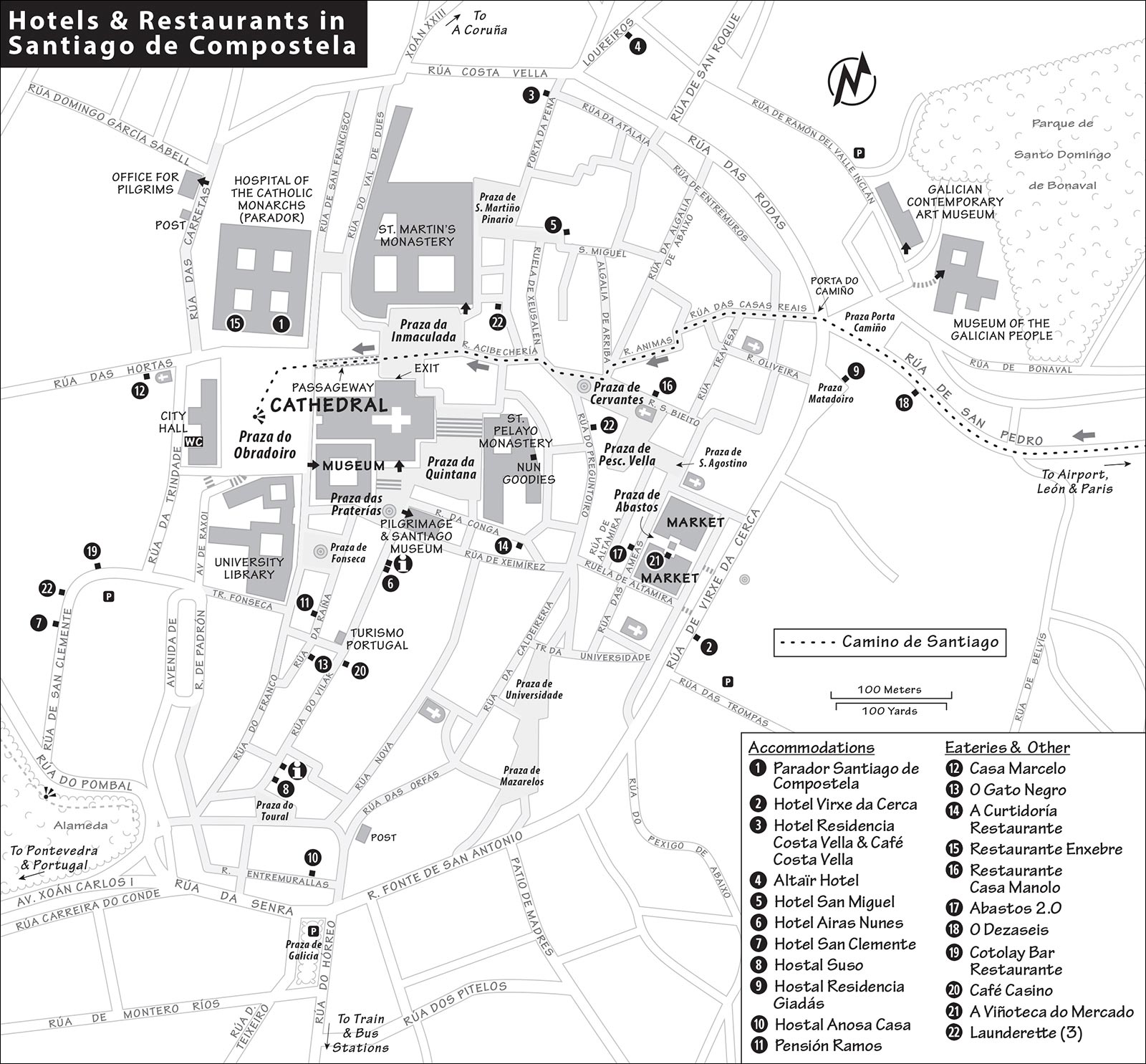
Map: Hotels & Restaurants in Santiago de Compostela
MEMORABLE EATING IN THE OLD CENTER
GOOD VALUES AWAY FROM THE TOURIST CENTER
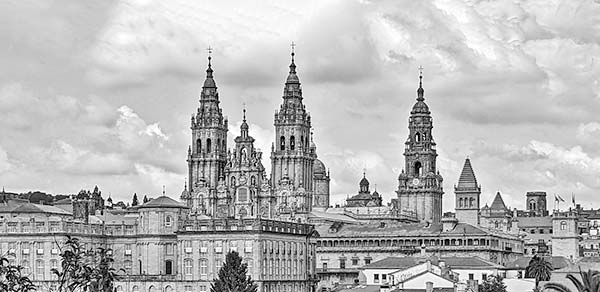
The best destination in the northwestern province of Galicia, Santiago de Compostela rivals Granada as the most magical city in Spain. While Granada reminds visitors of Spain’s Moorish past, Santiago de Compostela offers one of the most significant cathedrals in the Christian world—and a glimpse back through centuries of pilgrimage. The Santiago Cathedral and its relics of St. James have long had a powerful draw on travelers: More than a thousand years’ worth of Christian pilgrims have trod the desolate trail across the north of Spain just to peer up at the cathedral’s glorious facade.
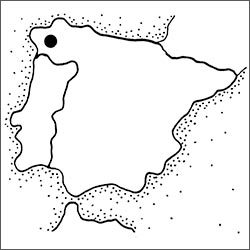
But there’s more to this city than pilgrims and the remains of St. James. Contrary to what you’ve heard, the rain in Spain does not fall mainly on the plain—it falls in Galicia. The Spanish interior might be arid, but the northwest enjoys far more precipitation than Spain’s interior and requires rain gear. The Atlantic northwest of Spain is much like the Pacific Northwest of the United States, with hilly, lush terrain, dramatic coastal scenery, delicious seafood, fine local wines, and an easygoing ambience. Even the tourists here have a grungy vibe: Packs of happy hipster pilgrims seek to find themselves while hiking the ancient Camino de Santiago (described in the previous chapter).
Santiago is the capital of Galicia, so there are government workers here in addition to the many locals who serve the constant flow of tourists. It’s a sturdy city that, in its day, was one of Europe’s most important religious centers, built of granite and later turned mossy green by the notorious weather.
As a pilgrim mecca, Santiago features accommodations, eateries, and sights geared toward low-budget travelers. And the city has a generally festive atmosphere, full of travelers from every corner of the globe celebrating the end of a long journey.
PLANNING YOUR TIME
Santiago’s biggest downside is its location: Except by air, it’s a very long trip from any other notable stop in Spain. But if you visit, you—like a millennium’s worth of pilgrims before you—will find it’s worth the trek. You can get a good feel for Santiago in a day, but a second day relaxing on the squares makes the long trip here more worthwhile.
The city has one real sight: the cathedral, with its fine museum and surrounding squares. Spend the rest of your time munching seafood, spotting pilgrims, and browsing the stony streets. The highlight of a visit just may be hanging out on the cathedral square to welcome pilgrims completing their long journey.
Orientation to Santiago
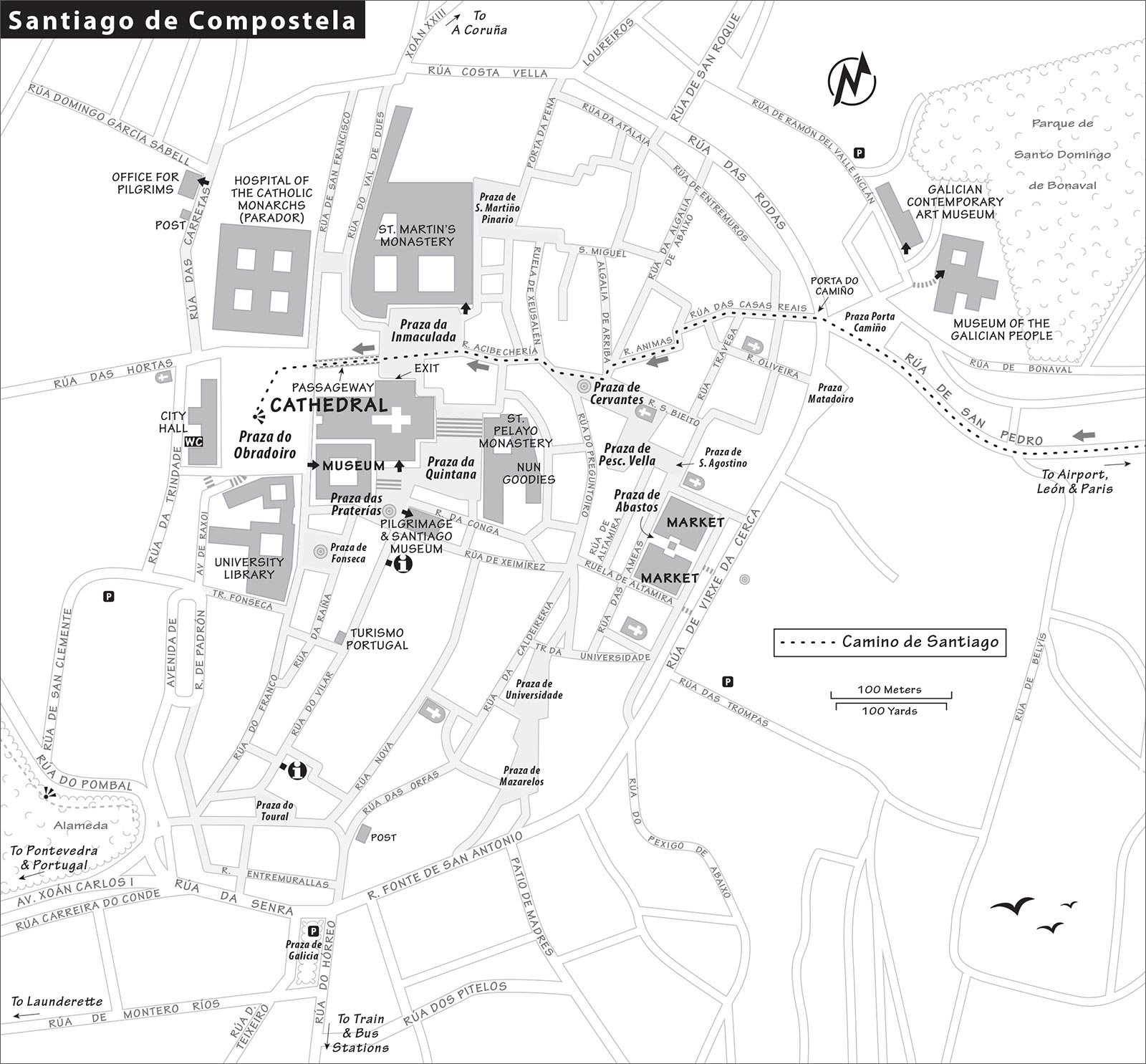
Santiago is built on hilly terrain, with lots of ups and downs. The tourist’s Santiago is small: You can walk across the historical center, or Zona Monumental, in about 20 minutes. There you’ll find the city’s awe-inspiring cathedral as well as several other churches, a maze of pretty squares, a smattering of small museums, and a bustling restaurant scene.
The historical center is circled by a busy street that marks the former location of the town wall (easy to see on a map). Beyond that is the commercial city center called Céntrico. A 10-minute walk through Céntrico takes you to the train station.
TOURIST INFORMATION
The eager-to-help Santiago de Compostela TI is at Rúa do Vilar 63 (daily 9:00-19:00, shorter hours off-season, +34 981 555 129, www.santiagoturismo.com). Stop by to scan the QR code for their downloadable walking tour of the historical center or for an exhaustive list of guided city and regional tours.
On the same street (at #30), you’ll find Turismo do Porto e Norte de Portugal, which offers information about destinations just across the border in Portugal, plus tips on how to get there (Tue-Sat 10:00-17:30, closed Sun-Mon, +34 981 565 590, www.portoenorte.pt).
Nearby, the regional Galicia TI gives visitors several options for exploring the region outside of Santiago (Mon-Fri 10:00-16:00, closed Sat-Sun, Rúa do Vilar 1, +34 881 866 397, www.turismo.gal).
ARRIVAL IN SANTIAGO DE COMPOSTELA
There’s luggage storage at the bus station, but not the train station.
By Train: Santiago’s train station is on the southern edge of the modern Céntrico district. You’ll find ATMs, a cafeteria, car-rental offices, and a helpful train information office. It’s a 20-minute walk (some uphill) to the historical center. It’s about €9 for a taxi from the station to your hotel.
By Bus: Santiago’s bus station (Estación Intermodal) is right next to the train station.
By Plane: Santiago’s small airport (Code: SCQ, www.aena.es) is about nine miles east of the city center. Bus #6A (not #6) connects the airport the bus station (€1—cash only, runs 7:00-23:00, 2-3/hour, about 45 minutes). A taxi into town costs about €25.
By Car: The A-54 Santiago-Lugo brings you to the north end of town; it splits off to the SC-20 if you need to swing around to the south end. Parking lots ring the old city; the big underground garage just off Rúa de San Clemente is closest to the cathedral.
HELPFUL HINTS
Sightseeing Tips: In the morning, it’s great fun to see pilgrims arriving in Praza do Obradoiro, but it’s probably the worst time to enter the cathedral, which can be crushed by pilgrims lining up to attend Mass and see the saint’s tomb. When the cathedral reaches capacity, you’ll wait in a line without shade until the crowds thin. In busy times, go in the late afternoon, when you’ll have the place nearly to yourself.
Office for Pilgrims (Oficina de Acogida al Peregrino): A walkway down the west side of the parador leads to the official pilgrim’s reception office (Rúa das Carretas 33, daily 9:00-19:00, https://oficinadelperegrino.com). This is where pilgrims pick up their compostela, the certificate that documents their successful Camino. The office website keeps track of pilgrim statistics (including daily arrivals, often in the thousands each day during the busiest months).
Festivals: In late July the city celebrates St. James’ feast day and hosts a world music festival and impromptu concerts all over town, along with fireworks on July 24 and 31. During this time, the royal family attends Mass in Santiago, staying in a suite at the fancy parador overlooking the square. Indoor and outdoor summer concerts in the old town are held during the Music in Compostela festival in early August.
Shopping: Not surprisingly, many of Santiago de Compostela’s shops feature pilgrim-related products. Jet, a black gemstone (called azabache in Spanish), is believed to protect pilgrims from harm as they travel along the Camino, and you’ll see it fashioned into jewelry in windows throughout town. Classic hiking staffs, carved from a single piece of wood and adorned with a scallop shell (symbol of the Camino), are displayed alongside modern metal and fiberglass versions. You’ll see stylized scallop shells plastered on T-shirts, tote bags, and coffee mugs—and actual shells, which pilgrims attach to their backpacks. The bookstore/gift shop at the cathedral has limited choices but better quality than you’ll find in the gauntlet of tourist shops.
Laundry: Perhaps because all those pilgrims need fresh clothes, Santiago is awash in launderettes. Near Praza de Cervantes, Lavandería Waterproof is a five-minute walk east of the cathedral (daily 7:30-23:00, Rúa do Preguntoiro 17, +34 604 001 988). SC18 Laundry is close to Alameda Park (daily 7:00-23:30, Rúa de San Clemente 18, +34 673 753 869). And the tiny Lavandaría da Troia hides out at Rúa da Troia 9 (daily 8:30-23:00).
Local Guide: To navigate the cathedral and its museum, consider personable María de los Angeles Rodríguez (€140/2-4 people plus admission, 2.5 hours, can fine-tune itinerary to include nearby city sights, +34 691 341 240, angeles@italopendola.com).
Best Views: There are beautiful views back toward the cathedral from Alameda Park. From the cathedral, follow Rúa do Franco to the end. Swing right into the park and continue up the path on the far right to the viewpoint (mirador). You can enjoy another excellent view from the very top of the park.
Street Music: You’ll likely hear bagpipes (gaitas) being played in the streets of Santiago. Nobody knows for certain how this unlikely instrument caught on in Galicia, but it’s thought to have taken hold when the Celts lived here. You’ll undoubtedly hear bagpiping buskers enjoying the acoustics in the covered passageway between Praza de Inmaculada and Praza do Obradoiro. On many summer nights, caped musicians called tunas—once groups of university students but now a mix of students, faculty, and the public—gather to sing traditional Galician songs on Praza do Obradoiro (usually 22:00-24:00).
Sights in Santiago
▲▲Cathedral Museum (Museo Catedral de Santiago)
▲Pilgrimage and Santiago Museum (Museo das Peregrinacións e de Santiago)
Museum of the Galician People (Museo do Pobo Galego)
▲▲SANTIAGO CATHEDRAL
Santiago’s cathedral (Catedral de Santiago) isn’t the biggest in Spain, yet it’s certainly the most mystical. In medieval days, the cathedral was one of the top three pilgrimage sites in the Christian world (after Jerusalem and Rome). It still exerts a spiritual magnetism that attracts people from all walks of life and all corners of the globe. (To more fully appreciate the pilgrim experience, read the first part of the Camino de Santiago chapter starting on here before visiting the cathedral.)
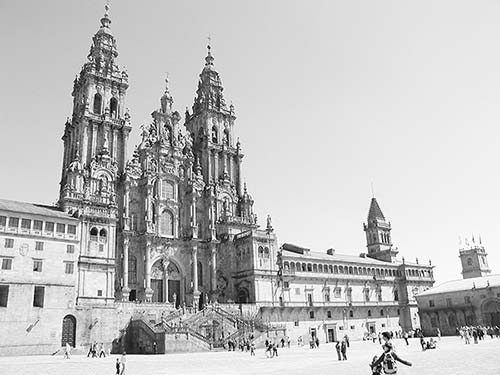
The cathedral complex includes the church itself (with the tomb of St. James), the Portico of Glory (part of the original facade and a magnificent example of Romanesque art), and the cathedral museum (encompassing a collection of cathedral treasures, the Gelmírez Palace, and the church towers and rooftop). Exploring one of the most important churches in Christendom, you’ll do some time travel, putting yourself in the well-worn shoes of the millions of pilgrims who have trekked many miles to this powerful place.
Cost and Hours: Cathedral—free, daily 7:00-21:00, rest of complex daily 10:00-20:00; Portico of Glory—free with seven-day advance reservation, otherwise €12 combo-ticket with cathedral museum; cathedral museum—€6 or €12 combo-ticket with towers and rooftop, www.catedraldesantiago.es. A €20 ticket covers the Portico of Glory, museum, towers, and roof.
Tours: Regularly scheduled one-hour guided tours of the museum and Portico of Glory are available in Spanish only (€20, usually offered at 12:00 and 17:00). To request a tour in another language, email deac@catedraldesantiago.es.
Masses: Pilgrim Masses are held daily at 7:30, 9:30, 12:00, and 19:30 in the cathedral. A pilgrim Mass in English takes place at 10:30—but in the chapel at the Office for Pilgrims.
Baggage Check: Large backpacks aren’t allowed in the church, and small bags require a security check. Pilgrims with a certificate will find free baggage storage at the Office for Pilgrims (Rúa das Carretas 33, downhill from the parador).
 Self-Guided Tour
• Begin facing the cathedral’s main facade, in the big square called...
Praza do Obradoiro
Find the pavement stone with the scallop shell right in the middle of this square. For more than a thousand years, this spot has been where millions of tired pilgrims have taken a deep breath and thought to themselves: “I made it!” To maximize your chance of seeing pilgrims, be here at about 10:00—the last stop on the Camino de Santiago is two miles away, and pilgrims try to get to the cathedral in time for the 12:00 Mass. It’s great fun to chat with pilgrims who’ve just completed their journey. They seem to be very centered, content, and tuned in to the important things in life...like taking time to talk with others. You’ll likely see ecstatic reunions between pilgrims who met along the way and then lost track of each other until the grand finale. Every time I visit, I find myself taking photos for people: A fun and easy way to meet pilgrims is by offering to capture their personal triumphs with a picture.
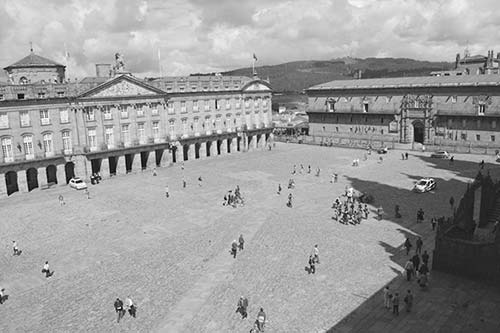
• Take a spin around the square (start facing the cathedral).
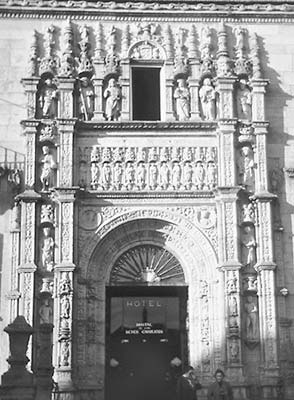
To your left is the Hospital of the Catholic Monarchs (Hostal dos Reis Católicos), now a fancy parador hotel. Isabel and Ferdinand came to Santiago in 1501 to give thanks for successfully forcing the Moors out of Granada. When they arrived, they found many sick pilgrims at the square. (Numerous pilgrims came to Santiago to ask for help in overcoming an illness, and the long walk here often only made their condition worse.) Isabel and Ferdinand decided to build a hospital to give pilgrims a place to recover on arrival (you’ll see their coats of arms flanking the intricately carved entryway). It remained a working, free hospital until 1952—many local seniors were born there—when it was converted into a parador (see “Sleeping in Santiago,” later). The modern white windows set against the old granite facade might seem jarring—but this contrast is very common in Galicia, maximizing the brightness that accompanies any sunny spells in this notoriously rainy region.
Another 90 degrees to the left is the Neoclassical City Hall (Concello). Notice the equestrian statue up top. That’s St. James, riding in from heaven to help the Spaniards defeat the Moors. All over town, Santiago’s namesake and symbol—a Christian evangelist on a horse—is wielding his sword.
Completing the square (90 more degrees to the left) is the university building (its rectory faces the square; the tower behind with the flags marks the original building, which is now the library). Santiago has Spain’s third-oldest university, with more than 30,000 students.
You’ll likely see Spanish school groups on the square, field-tripping from all over the country. Teachers love to use this spot for an architecture lesson, since it features four building styles (starting with the cathedral and spinning left): 18th-century Baroque, 16th-century Plateresque, 18th-century Neoclassical, and medieval Romanesque (the door of the rectory).
• Take a look at the...
Cathedral Facade
Twelve hundred years ago, a monk followed a field of stars (probably the Milky Way) to the little Galician village of San Fiz de Solovio and discovered what appeared to be the long-lost tomb of St. James. On July 25, 813, the local bishop declared that St. James’ remains had been found. They set to building a church here and named the place Santiago (St. James) de Compostela (campo de estrellas, or “field of stars,” for the celestial bodies that guided the monk).
The little church was soon overwhelmed by visitors—and so were its larger replacements over the next century and a half—so in 1075, construction began on a Romanesque cathedral that would be grand enough to receive the throngs of pilgrims. (The granite workers who built it set up shop on this very square, still called Praza do Obradoiro—literally, “Workshop Square.”) Much of the design is attributed to a Spanish artist identified as Maestro Mateo, whom we’ll meet a little later. The work took nearly 150 years, and subsequent alterations added elements of Gothic, Renaissance, and Baroque styles.
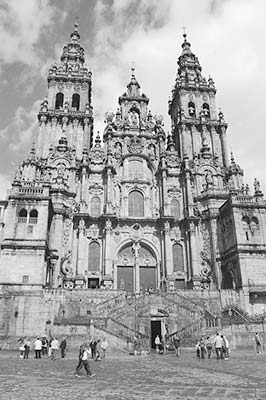
The exterior of the cathedral you see today is not the one that medieval pilgrims saw (though the interior is much the same). In the mid-18th century, Santiago’s bishop—all fired up from a trip to Baroque-slathered Rome and wanting to improve the original, now-deteriorating facade—decided to spruce up the building with a new Baroque exterior.
Study the facade and its symbolic decoration. Atop the middle steeple is St. James, dressed like the pilgrim he was. Right below him, we see the miraculous discovery of his remains—marked by a chest and a star, one of the many symbols of St. James (to decipher the symbols, see sidebar on here). On either side of the chest are Theodorus and Athanasius, James’ disciples who brought his body to Santiago. On the side pillars are, to the left, James’ father, Zebedee; and to the right, his mother, Salomé.
To the right of the main facade is a Renaissance-era cloister, now the cathedral museum.
Don’t you wish you had a miniature replica of this beautiful facade to carry around? Actually, you probably do. Check your pocket for a copper-colored euro coin worth €0.01, €0.02, or €0.05. Sevilla and Toledo may have bigger cathedrals, but Santiago has the symbolism to propel its church onto Spain’s EU currency.
• We’re ready to go inside. To find the entrance, circle around the cloister (past the entrance to the cathedral museum) to the square called Praza das Praterias. We’ll talk about the square later; for now, enter the cathedral and make your way to the rear of the...
Nave
Look up to take in the barrel vault and the austere Romanesque design of the church. (The original freestanding church had about 80 glorious alabaster windows. They were mostly bricked up when a complex of buildings was built around the church.) Up near the top, notice the gallery; this is where sweaty, smelly pilgrims slept in the Middle Ages.
Up and down the nave, notice the symbols carved into the granite. The masons who made the columns left these markings to keep track of what they’d be paid for.
• Continue up the nave until you reach the transept, where you’ll see a thick rope hanging from a pulley system high in the dome, which is attached to the...
Botafumeiro
This huge brass, silver-plated incense censer (120 pounds and about the height of a small child), suspended from the ceiling, is used about 12 times a year on special holy days (ask at TI if a special Mass with the botafumeiro is scheduled during your visit). During Compostela Holy Years (which take place when July 25 is a Sunday; the next one is 2027), it swings nearly daily at the end of each pilgrims’ Mass at 12:00. But pilgrimage groups can request that the botafumeiro swing into action (for a hefty fee—about €500) during Mass.
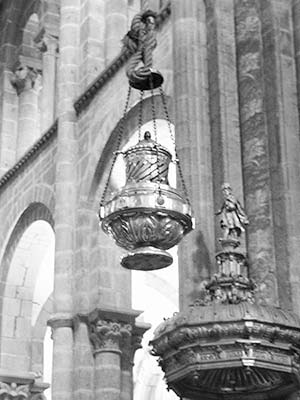
After communion, eight men (called tiraboleiros) pull on the rope, and this huge contraption swings in a wide arc up and down the transept, spewing sweet-smelling incense. Rising to the top of the cathedral, the smoke symbolizes pilgrims’ prayers lifting up to heaven.
If you’re here when the botafumeiro is swinging, the most impressive view is from either side of the main altar. From this position, the botafumeiro seems to whiz directly over your head.
• Stand in the center of the nave, in front of the...
Altar
To pump up the significance of St. James and reflect his glory, the high altar got a complete makeover in the 17th century. The monumental altar, of South American silver and gold, is covered by an extravagant canopy, held aloft on the shoulders of enormous sculpted angels. St. James is represented in all three of his guises (see sidebar): Up top, on a white horse, is James the Warrior-Knight, defender of Christianity; below that (just under the canopy) is Pilgrim James; and below that is James the Apostle (from the workshop of Maestro Mateo)—it is this caped figure that pilgrims embrace at the end of their trek to Santiago.
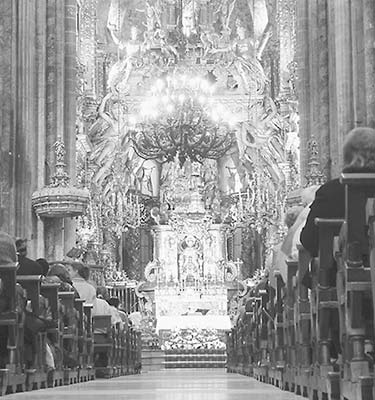
• In the apse, behind the altar, notice the sumptuous chapels built by noblemen who wanted to be buried close to St. James; today, priests set up here to hear confessions (in your choice of language). Directly behind the altar is the greenish...
Holy Door
This special door is open only during Holy Years, when pilgrims use it to access the tomb and statue of the apostle. The door, sculpted by a local artist for the 2004 Holy Year, shows six scenes from the life of St. James: the conversion moment when Jesus invited those Galilean fishermen to become “fishers of men,” Jesus with the 12 apostles (James is identified by his scallop shell), James doing his “fishing” in Spain, his return to Jerusalem in AD 44 to be beheaded, the ship taking his body back to Spain, and the discovery of James’ body in 813. At the bottom, the little snail is the symbol of the pilgrim...slow and steady, with everything on its back.
• In high season, to see the saint’s tomb and embrace his statue (open 8:30-21:00), you’ll need to exit the cathedral from the north transept onto Praza da Inmaculada, join the line that forms there, and reenter the church to be routed to a little stairway (see the green light of the Entrada sign on your right) down to the level of the earlier, 10th-century church and the...
Tomb of St. James
There he is, in the little silver chest, marked by a star up above: Santiago. Pilgrims kneel before the tomb and make their request or say their thanks.
• Continue through the little passage and up the stairs, turn left. This is your chance to…
Hug St. James
There’s one more pilgrim ritual to complete. Climb the stairs under the huge babies and find Maestro Mateo’s stone statue of St. James. The gilded cape he wears, caked with “gems,” is a facsimile (the original has moved to the cathedral treasury). Embrace him from behind and enjoy a saint’s-eye view of the cathedral...under the vigilant eye of a cathedral watchman, there to ensure you’re not overcome by the unholy temptation to pry loose a jewel.
• Congratulations, pilgrim! You have completed the Camino de Santiago. Now go in peace.
OTHER SIGHTS AT THE CATHEDRAL
▲▲▲Portico of Glory
The 12th-century Portico of Glory, hidden behind the later Baroque facade, is a step back in time. Remember, this used to be the main entry of the cathedral, sculpted from roughly 1168 to 1211 by Maestro Mateo. Pretend you’re a medieval pilgrim and you’ve just walked 500 miles from the Frankish lands to reach this cathedral. You’re here to request the help of St. James in recovering from an illness or to give thanks for a success. Maybe you’ve come to honor the wish of a dying relative or to be forgiven for your sins. Whatever the reason, you came here on foot.
You can’t read, but you can tell from the carved images that this magnificent door represents the story of salvation—and the glory of God. Old Testament prophets on the left arch announce Christ’s coming. On the right arch, God divides the just from the sinners. In the central arch, the resurrected Jesus reigns directly above, approachable to the humble Christian pilgrim via St. James with his staff (on the column that divides the entryway).
Theologically, pilgrims are coming not for St. James but to get to Christ via St. James. Jesus is front and center, surrounded by his evangelists: Matthew, Mark, Luke, and John.
Beside them are angels carrying attributes of Christ’s Passion—the cross, the crown of thorns, nails and the spear, and a jug of vinegar. Arching above them are 24 musicians playing celestial music—each one with a different medieval instrument.
St. James, seated below Christ, rests his feet on a column with the Tree of Jesse—showing the genealogy of Jesus, with Mary near the top and, above her, the Holy Trinity: Father, Son, and a dove representing the Holy Spirit. Pilgrims, trembling with excitement at the culmination of the long journey, would place a hand into the well-worn finger holes on the column (see five grooves at about chest level) and bow their head to give thanks to St. James for safe passage.
Around the other side of the column, at knee level, you’ll see a sculpture of Maestro Mateo himself, the architect of this fine facade. People used to kneel and touch the sculpture in hopes that some of his genius would rub off on them (but a guard now prevents this longstanding ritual).
Access: Access to the Portico of Glory is limited to 25 people per 30-minute timed-entry visit. Free visits are unguided but there’s a free downloadable brochure and a low-cost app is available.
Cost and Hours: To view the Portico of Glory for free, request a timed-entry ticket up to seven days in advance of the date of your visit (look for “Free visits Pórtico de la Gloria” on the cathedral website at http://catedraldesantiago.es), free visits available Mon 10:00-14:00 & 16:00-19:00, Tue-Sun 16:00-19:00; €12 combo-ticket for the Portico of Glory and the cathedral museum can be purchased two months in advance (timed entry to the Portico of Glory but can enter museum any time 10:00-20:00). Be at the main cathedral gate on Praza do Obradoiro five minutes before your entry time.
▲▲Cathedral Museum (Museo Catedral de Santiago)
The museum, spread over four floors of the cathedral cloister, shows off a fine treasury collection and artifacts from the cathedral’s history. Your ticket includes a look inside the Romanesque-Gothic Gelmírez Palace and its exhibit dedicated to Maestro Mateo.
Cost and Hours: €6, daily 10:00-20:00, last entry one hour before closing, entrance on Praza do Obradoiro, to the right of the cathedral stairs, www.catedraldesantiago.es.
Tours: One-hour tours of the museum, which include the Portico of Glory, are offered twice a day but only in Spanish (€20, 12:00 and 17:00). To request a tour in English, email deac@catedraldesantiago.es.
Ground Floor: Exhibits here cover the origins of the Romanesque-era cathedral. You’ll find a reconstruction of Maestro Mateo’s 12th-century stone choir, with some surviving original sections. When liturgical fashion changed in later times, the stone choir was disassembled and replaced with a wood version (c. 1604). The old stone, used as infill around the cathedral, was forgotten until archaeologists over the years began recovering it (other choir pieces were recycled into the Baroque-era facade that surrounds the exterior entrance to the Holy Door).
Also of interest are two fabulous c. 1110 spiral columns of solid marble. Even the 12th-century Codex Calixtinus chronicler mentioned them when he wrote up his cathedral tour.
First Floor: This level showcases a wide-ranging collection of cathedral sculpture. In the first room, look for the statue of a pregnant Mary, illustrating a theme that’s unusual in most of Europe but common in Galicia and neighboring Portugal in the 15th century.
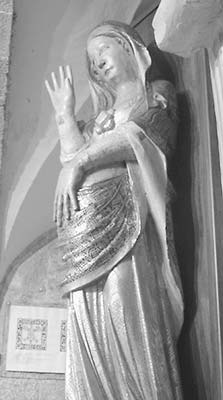
The final room on this floor is dedicated to various portrayals of St. James (see sidebar), with some incarnations of him as Matamoros (the Moor-Slayer). Notice the wooden door showing the rescue of James’ body by his disciples and its transfer to Galicia by sea—you’ll see this motif repeated throughout Santiago.
Second Floor: Enter the Renaissance cloister, where a series of tombs holding the remains of cathedral canons line the floor. Enter the courtyard to see the 12th-13th century fountain that once stood on Praza da Inmaculada; medieval pilgrims cleansed themselves in its water before entering the church. The original church bells (replaced with new models in 1989) are here too.
The Treasury, on the north side of the cloister, houses the most precious pieces from the cathedral collection. You can’t miss the gleaming solid-gold monstrance at the entry, used for carrying the communion host around the cathedral on the Feast of Corpus Christi (the wafer sits in the little round window in the middle).
The next room contains a beautiful-smelling cedar altar that houses dozens and dozens of relics. The centerpiece, at eye level, holds the remains—likely the skull—of St. James the Lesser (the other Apostle James). Look up to find St. James riding heroically out of the woodwork to rally all of Europe to reconquer the Iberian Peninsula. This altarpiece was restored after a fire around 1900.
Santiago is Spanish for “St. James.” You’ll see three different depictions of St. James in the cathedral and throughout the city:
Apostle James: James dressed in typical apostle robes, often indistinguishable from the other apostles (he sometimes carries a pilgrim’s stick or shell).
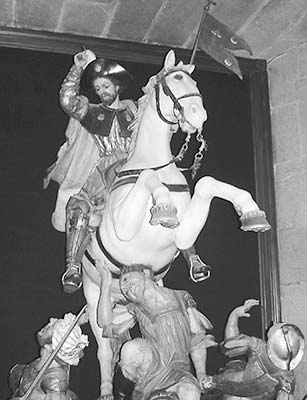
Pilgrim James: James wearing some or all of the traditional garb of the Camino de Santiago pilgrim: brown cloak, floppy hat, walking stick, shell, gourd, and sandals. Among pilgrims, he’s the one carrying a book.
Crusader James, the Moor-Slayer (Matamoros): Centuries after his death, the Spaniards called on St. James for aid in various battles against the Moors. According to legend, St. James appeared from the heavens and massacred the Muslim foes. In this depiction, the saint is shown in armor and helmet, astride a white horse, hacking at Muslim victims with a sword. The cathedral chapel dedicated to this version of James now often obscures the brutality of the scene with floral displays that cover the slain Moors.
Other bits of religious finery await your inspection in the Treasury. The original silver gem-encrusted cape worn by St. James at the high altar (the huggable saint) is here (too many pilgrims were chipping off souvenir bits of silver—hence the hole in the cape). Look for the intimate c. 1700 carving of the nursing Virgen de la Leche. The artist, Luisa Roldán, worked at the Spanish court, an unusual recognition for a woman in her time.
This level is also home to the cathedral Library/Archive. Here you’ll find precious scrolls documenting the cathedral’s early history as well as a facsimile of the 12th-century Codex Calixtinus, with its invaluable pilgrim’s guide. Notice the spare botafumeiro displayed in the corner.
• Leave the library and go up one more floor to enjoy views from a fine balcony overlooking Praza do Obradoiro.
Third Floor: On this floor, dedicated to the cathedral’s collection of textile art, you’ll walk through several rooms of restored tapestries, including some from designs by Rubens and Goya. Here you’ll also find the painstakingly restored gallardete (long, triangular standard) flown from the Spanish captain’s ship during the 1571 Battle of Lepanto. Don Quixote author Miguel de Cervantes was wounded in this battle—and likely saw this very flag—as Spain fought to victory over the Turks, gaining control of the Mediterranean.
Before leaving this level, be sure to step out on the balcony to appreciate the grandness of the Praza do Obradoiro and watch pilgrims congregate.
The Rest of the Museum: Also included in your museum ticket is Gelmírez Palace (Pazo de Xelmírez), the medieval home and traditional residence of the archbishop, now showcasing an exhibit documenting the workshop of Maestro Mateo. Show your ticket to access the palace through the doorway to the left of the cathedral’s exterior central stairs.
CATHEDRAL SQUARES
There is a square on each side of the cathedral. You’ve already visited Praza do Obradoiro, on the west side. Here are the other three, working clockwise (to reach the first one, go up the passage—which street musicians appreciate for its acoustics—to the left as you’re facing the main cathedral facade).
Praza da Inmaculada
It was through this square that most medieval pilgrims walking the French Way approached the cathedral (notice the star and pilgrim’s shell over the doors). Before entering the church, in an act of purification and simple hygiene, pilgrims washed in a stone fountain that once stood here (now in the cathedral museum).
Walk to the corner of the Praza da Inmaculada with the arcade (to the post with the sign for Rúa da Acibechería, under the streetlight). If you look to the roof of the cathedral, between the big dome and the tall tower, you can make out a small white cross. This is where the clothes of medieval pilgrims were burned when they finally arrived at Santiago. This ritual was created for hygienic reasons in an age of frightful diseases—and filthy pilgrims.
The facade you see here, however, is not what medieval visitors saw. Church fathers demolished the Romanesque portal in the mid-18th century and replaced it with today’s Baroque/Neoclassical version.
Across the square is St. Martin’s Monastery (Mosteiro de San Martiño Pinario), one of two monasteries that sprang up around the church to care for pilgrims. It grew quickly and became the second-largest monastery in Spain after El Escorial, and its Baroque altar continues to make jaws drop. Today the monastery houses an enormous museum of ecclesiastical artifacts and special exhibits (€5, Wed-Mon 11:00-14:00 & 15:30-19:30, closed Tue, entrance on the right corner of the building, https://www.espacioculturalsmpinario.com).
• Continue along the arcade and around the corner, then go down the stairs to enter...
Praza da Quintana
Just at the bottom of the stairs is the cathedral’s Holy Door facade, with a metal gate. St. James, in pilgrim mode, is flanked by the disciples who brought his body back to Galicia. Below them are more biblical characters, perhaps the 12 apostles and 12 prophets. Tip: Old Testament prophets hold scrolls. New Testament apostles hold books. This facade is Baroque, but see if you can pick out the two much older sculptures from Maestro Mateo’s workshop (possibly recycled from his stone choir). The actual Holy Door is behind the metal gate (for more on the door, see the cathedral tour).
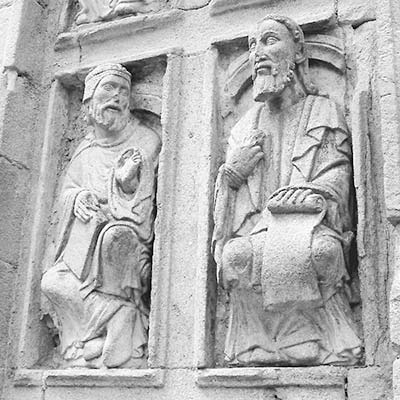
Across from the Holy Door stands the imposing St. Pelayo Monastery (Mosteiro San Paiode Antealtares). The windows of its cells (now used by Benedictine sisters—notice the bars and privacy screens) face the cathedral. The church at the north end of this monastery is worth a peek for its frilly Baroque altar and a statue with a typical Galician theme: a pregnant Mary (to the left as you face the main altar). The nuns sing at evening vespers following the 19:30 Mass (Mon-Fri; 30 minutes earlier Sat-Sun, www.monasteriosanpelayo.org). Just off this sanctuary is the entrance to the monastery’s Sacred Art Museum (Museo de Arte Sacra), with a small but interesting collection (modest entry fee, closed Sun).
The nuns of St. Pelayo make Galicia’s famous tarta de Santiago—almond cake with a cross of Santiago in powdered sugar dusted on top. To buy one, walk all the way around the monastery to find the green doors at Travessa de San Paio de Antealtares 23. Step inside and check the window display on the right, with current offerings and prices; then ring the bell at the window on the left to place your order (9:00-14:00 & 15:30-18:30).
• Continue circling the cathedral to return where you entered the church at...
Praza das Praterías
This “Silversmiths’ Square” is where Santiago’s silver workers used to have their shops (and some still do). Overlooking the square is a tall clock tower. Its lantern is lit in Holy Years to guide pilgrims to the cathedral.
The cathedral entry here is the only original Romanesque portal that remains. But it’s not entirely unmodified: After a fire in 1117, Romanesque decoration from around the cathedral was somewhat chaotically repurposed here. Even so, the facade is rich with detail. Evil is depicted as monkeys and snakes. An adulterous woman (or Eve?) holds her lover’s severed head in her lap. Adam and Eve are expelled from the garden (easy to pick out, as they discreetly cover their private parts). These scenes and others—the Passion of Christ, the Temptation of Christ—were meant to be read like the pages of a book, revealing Christian dogma to medieval believers.
The fountain in the square features a woman sitting on St. James’ tomb, holding aloft a star—a typical city symbol. The mansion facing the cathedral is actually a collection of buildings with a thin yet effective Galician Baroque facade built to give the square architectural harmony. Its centerpiece even copies the fountain’s star. Facing the fountain is the excellent (and free) Pilgrimage and Santiago Museum (described later in this chapter).
MORE SIGHTS IN SANTIAGO
▲▲Market (Mercado de Abastos)
This wonderful market, housed in Old World stone buildings, offers a good opportunity to do some serious people-watching (Mon-Sat 8:00-14:00, closed Sun). It’s busiest and best on Saturday, when villagers from the countryside come to sell things. (Monday’s the least interesting day, since the fishermen don’t go out on Sunday.)
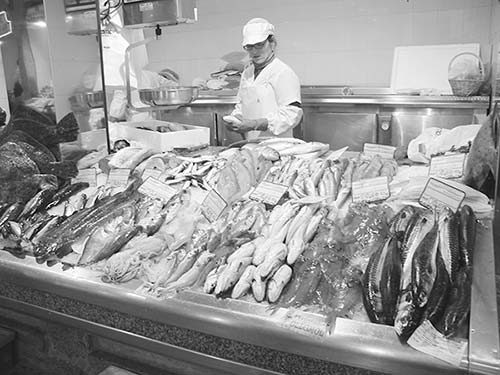
The market, built in the 1920s, is perfectly compatible with the medieval wonder that surrounds it. Keep an eye out for the specialties you’ll want to try later—octopus, shrimp, crabs, lobsters, and expensive-as-gold percebes (barnacles; see sidebar). You’ll also see large loaves of country bread and the local chorizo (spicy sausage).
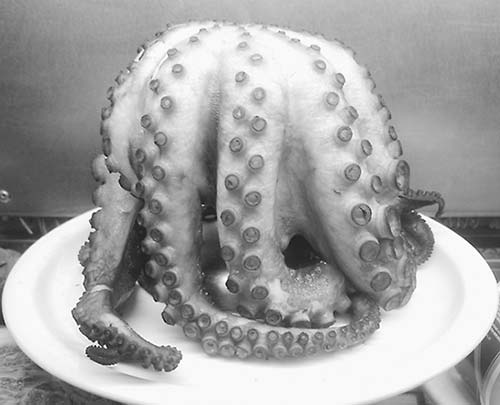
Grelos, local turnip greens with thick stalks and long, narrow leaves, are used in the caldo galego soup. The little green pimientos de Padrón (in season June-Oct) look like jalapeños but lack the kick...sometimes. Now and then you’ll find an impromptu stand outside cooking up fresh octopus. (See the “Santiago Specialties” sidebar, later.)
Local gooseneck barnacles, called percebes, are a delicacy. Percebes grow only on rocks that see a lot of dangerous waves. It takes specialists to harvest them: a team of two gatherers, one with a rope tied to his waist, the other spotting him from above. Because of the danger, percebes are very expensive. You’ll see them stacked in the windows of seafood bars, where you’ll pay about €8 for 100 grams ($35/lb—although this price can double during the Christmas holidays). Two beers and a small 100-gram plate to split with your travel partner make for a wonderful snack. Just twist, rip, and bite: It’s a bit like munching the necks off butter clams. I ask for toasted bread on the side.
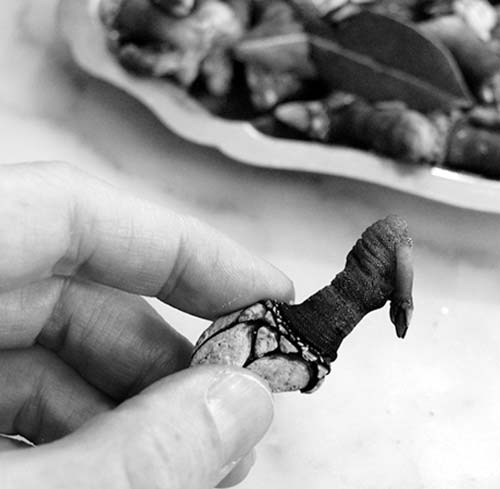
For the freshest percebes at half the price—and twice the experience—buy them at the market, then let Mariscomanía boil them for you right there in their market café. They’ll boil up any seafood (or meat) you buy in the market (it takes just a few minutes), charging €6 per person for table service (Tue-Sat 9:00-15:00, closed Sun-Mon, aisle 5 in the market, +34 981 560 982). Otherwise, you can check out any of the cafés in aisle 5, all of which can serve you percebes (and other market-fresh seafood).
In the cheese cases you’ll see what look like huge yellow Hershey’s Kisses...or breasts—in fact, this creamy cheese is called tetilla (“small breast” in Galego). According to legend, artists at the cathedral sculpted a very curvaceous woman and the townspeople loved it. The bishop made them redo the statue with fewer sexy lines, so the locals got even by making their cheese look like breasts. Through the centuries since, Santiago has been full of tasty reminders of a woman’s physical beauty. A smoked version of the cheese, called San Simón da Costa, can be found as well.
A perfect place to enjoy your goodies is A Viñoteca do Mercado, in the center of the market by the fountain. They specialize in regional wines, a perfect match to market products. Claim a stand-up table, open your picnic, have a glass of Ribeiro, and watch the world go by (closed Sun year-round plus Mon in off-season, +34 663 883 635).
▲Pilgrimage and Santiago Museum (Museo das Peregrinacións e de Santiago)
Whether you see this first-rate, well-designed museum before or after your cathedral visit, don’t miss it. With excellent English text panels, it thoughtfully examines the concept of pilgrimage through two lenses: as a universal phenomenon, practiced by faiths worldwide, and as an event experienced locally along the Camino de Santiago.
On the ground floor, exhibits explore the rich diversity of pilgrimage activities and motivations around the world. The first floor delves into the traditions, history, and legends of St. James, with differing depictions of the saint (apostle, pilgrim, and crusader) throughout history. On level two, you’ll learn about the discovery of the saint’s tomb, the birth of the Camino, and the system that sprang up to support it. Finally, on level three, exhibits look at the symbols (scallop shells, staffs, etc.) of the Camino and its many rituals, such as the completion of the compostela document (in use since the 15th century). There are also models that capture the evolution of the cathedral from a simple shrine to today’s massive complex.
Cost and Hours: Free; Tue-Fri 9:30-20:30, Sat 11:00-19:30, Sun 10:15-14:45, closed Mon, Praza das Praterías 2, +34 881 867 401, http://museoperegrinacions.xunta.gal.
Museum of the Galician People (Museo do Pobo Galego)
This ethnographic museum is dedicated to rural Galician folkways, showing off boat-building and fishing techniques, farm implements and horse-drawn carts, tools of trade and handicrafts, traditional costumes, unique regional architecture, and a collection of musical instruments. The exhibits are tired, there’s no English, and this is the type of place school kids go to—so unless you really need to fill a spare hour, you can safely skip it.
Cost and Hours: €4; Tue-Sat 11:00-18:00, Sun until 14:00, closed Mon; on Costa de San Domingos, at northeast edge of historical center in monastery of San Domingos de Bonaval, just beyond Porta do Camiño, +34 981 583 620, www.museodopobo.gal.
Sleeping in Santiago
To cater to all those pilgrims, Santiago has a glut of cheap, basic accommodations, but the current popularity of the Camino means there are also very good hotel options. High season is roughly Easter through September; most places charge more during this time. The trickiest dates to book are Easter Sunday weekend and the days around the Feast of St. James (July 25), so if you plan to be in town around these times, reserve your rooms well ahead. The hostales speak enough English to make a reservation by phone (though sometimes not much more).
$$$$ Parador Santiago de Compostela is also known as the Hostal dos Reis Católicos. Founded by the Catholic Monarchs at the beginning of the 16th century to house and restore pilgrims to health, it claims to be the oldest hotel in Spain. It was converted to upscale lodgings in 1952 and inaugurated by Franco (when royal family members are in town, they stay in his former suite overlooking the square). This grand building, with 137 rooms surrounding a series of four courtyards, has the best address in Santiago...and prices to match (pay parking, Praza do Obradoiro 1, +34 981 582 200, www.parador.es, santiago@parador.es).
Still remembering its roots, the parador follows Ferdinand and Isabel’s edict to watch over pilgrims by offering a free lunch to the first 10 who arrive each day at the pilgrim’s office.
$$$ Hotel Virxe da Cerca is on the edge of the historical center, across the busy street from the market. Its standard rooms are in a modern building, but its “special” historic rooms—with classy old stone and hardwoods—are in a restored 18th-century Jesuit residence. All 42 rooms surround a lush garden oasis, and a beautiful glassed-in breakfast room overlooks the garden (elevator, pay parking nearby, Rúa da Virxe da Cerca 27, +34 981 569 350, www.pousadasdecompostela.com, vdacerca@pousadasdecompostela.com).
$$ Hotel Residencia Costa Vella is my favorite spot in Santiago, with 14 comfortable rooms combining classic charm and modern comforts. The glassed-in breakfast room and lounge terrace overlook a peaceful garden, with lovely views of a nearby church and monastery and into the countryside beyond. They deserve a feature in Better Stones and Tiles magazine (laundry service, pay parking nearby, Rúa Porta da Pena 17, +34 981 569 530, www.costavella.com, hotelcostavella@costavella.com, friendly José Antonio, Roberto, Anna, and wonderful staff).
$$ Altaïr Hotel, owned by the Liñares family (see Costa Vella listing, later), is located in a renovated three-story residence. Its 11 spacious rooms and mod decor can best be described as “rustic minimalist.” Exposed stone walls and open beams mixed with a sleek design provide a unique yet surprisingly affordable experience (RS%—free breakfast for Rick Steves readers who book direct, laundry service, Rúa dos Loureiros 12, +34 981 554 712, www.altairhotel.net, info@altairhotel.net).
$$ Hotel San Miguel occupies a quiet square that’s just a few minutes’ walk from the cathedral. The 16 rooms, comfortable and well sized, overlook the surrounding historic buildings or a lovely interior courtyard (elevator, Plaza de San Miguel das Agros 9, +34 981 555 779, http://sanmiguelsantiago.com, hotel@sanmiguelsantiago.com).
$$ Hotel Airas Nunes and Hotel San Clemente are affiliated with Hotel Virxe da Cerca. They’re both good, stress-free, and professional feeling, located in restored old buildings with classy touches (+34 981 569 350, www.pousadasdecompostela.com, info@pousadasdecompostela.com). Hotel Airas Nunes is in the heart of the touristic center, a few blocks in front of the cathedral (10 cozy rooms, Rúa do Vilar 17, anunes@pousadasdecompostela.com). Hotel San Clemente, with 10 rooms, is just outside the historical center on a quieter side street (Rúa de San Clemente 28, sclemente@pousadasdecompostela.com).
$ Hostal Suso, in the heart of Santiago, is a great value, offering 14 affordable, updated, smallish rooms around an airy atrium and a little bar where breakfast is served (Rúa do Vilar 65, +34 981 586 611, www.hostalsuso.com, info@hostalsuso.com).
$ Hostal Residencia Giadás, tucked away just beyond the market, faces a tidy little square as if it owns it. The eight rooms, some with slanted floors, are simple but charming (elevator, next to Porta do Camiño at Praza do Matadoiro 2, reception in downstairs café, close to the airport bus stop, +34 981 587 071, www.hostalgiadas.com [URL inactive], info@hostalgiadas.com, friendly Giadás family).
$ Hostal Anosa Casa, on a quiet street, is a five-minute walk to the cathedral and 10 minutes to the train station. Its nine compact rooms are clean, basic, and affordable (Rúa de Entremurallas 9, +34 981 585 926, www.anosacasa.com, reservas@anosacasa.com). Little English spoken here.
$ Pensión Ramos rents nine big, tasteful, clean rooms right in the center. It has lots of stairs, which is a blessing, since they take you farther away from the night noise (closed Nov-Easter, Rúa da Raiña 18, +34 981 581 859, pleasant Josefa speaks no English but some of her younger staff does).
Eating in Santiago
Restaurants generally serve lunch from 13:00 to 16:00 and dinner from 20:00 until very late. If you find a restaurant serving before 13:00 or 21:00, you’ll be all alone with a few sorry-looking tourists. Early-bird eaters should know that ordering a drink at any bar will generally get you a free tapa—Santiago is among the few places in Spain that still honor this tradition.
For a quick meal on the go, grab a traditional meat pie, or empanada, which comes de carne (with pork), de bonito or de atún (tuna), de bacalao (salted cod), de zamburiñas (tiny scallops), de berberechos (cockles)—and these days, even de pulpo (octopus).
GOURMET DINING
$$$$ Casa Marcelo, Santiago’s elite gourmet option, earned a Michelin star for its international cuisine. Diners share one communal table in a long narrow room with the kitchen in plain view at one end. The ever-changing fixed-price menu fuses Galician food traditions with elements from all over the world (open for lunch and dinner Tue-Sat, lunch only on Sun, closed Mon-Tue, reservations recommended—specify if you are vegetarian, down the steep lane below the cathedral, Rúa das Hortas 1, +34 981 558 580, www.casamarcelo.net).
RÚA DO FRANCO RESTAURANT ROW
Since hungry pilgrims first filled the city in the Middle Ages, Rúa do Franco (named for the first French pilgrims) has been lined with eateries and bars. Today this street, which leads away from the cathedral, remains lively with foreign visitors—both tourists and pilgrims. There are dozens of seafood places, a few time-warp dives, and several lively bars with little montaditos (sandwiches) for the grabbing. Stroll it once to see what appeals, and then go back to eat.
$$ O Gato Negro, a no-frills seafood tapas bar stuck in the past and filled with loyal locals, is worth seeking out. It’s one of the last places to serve Ribeiro wine in a ceramic cup (Tue-Sat lunch and dinner, closed Sun-Mon, near Rúa do Franco on side street Rúa da Raiña—look for black cat sign outside, +34 981 583 105).
MEMORABLE EATING IN THE OLD CENTER
$$$ A Curtidoría Restaurante (“The Tannery”) is a modern, spacious, and romantic place in the old town, rare for its open feeling. While the Mediterranean food is nothing exceptional, the setting is enjoyable and it’s a solid value for a midday meal near the cathedral (good paella and fish plates, Rúa da Conga 2, +34 981 554 342, www.acurtidoria.com).
The fancy old Parador Santiago de Compostela has two restaurants on its stone-vaulted lower level. I’d skip the stiff tuxedoed service at $$$ Restaurante Dos Reis and eat at $$ Restaurante Enxebre, right next door, where you’ll find a livelier, easygoing tavern vibe; good traditional Galician food; and reasonable prices (daily, +34 981 582 200).
$ Restaurante Casa Manolo, a smart little family-run eatery, serves only one thing: a €13 fixed-price meal consisting of two generous courses, water, bread, and dessert. It’s popular with students on a tight budget who want a filling meal out. The service is rushed (a good thing if you’re in a hurry), but the value is unbeatable (arrive when they open—13:00 for lunch, 19:30 for dinner—or plan on waiting; daily, at the bottom of Praza de Cervantes, +34 981 582 950).
Abastos 2.0 has a prime location right on the edge of the market, and its kitchen makes excellent use of everything that’s fresh and in season. They operate an informal $$ terrace with a tiny tapas bar and a comfortable, casual $$$$ dining room, where the €30 “market menu” is a contemporary take on traditional cuisine that changes daily but always includes beautifully prepared tapas, a vegetable, fish of the day, and dessert—reserve ahead (lunch and dinner Mon-Sat, closed Sun, at the main market entrance on Rúa das Ameas/Praza de Abastos, +34 654 015 937, www.abastosdouspuntocero.com). If you can’t get into Abastos, explore the nearby streets and Prazo do San Agostino. The area around the market, which used to shut up tight when the market stalls shut down, is finding renewed street life with a flurry of cafés.
GOOD VALUES AWAY FROM THE TOURIST CENTER
$$$ O Dezaseis (“The Sixteen”) is every local’s favorite (and mine, too). As soon as you walk down into its sprawling, high-energy vaulted dining room, you know this is the best place in town. Savvy diners enjoy friendly service under stone walls, heavy beams, and modern art. You can choose from meat and fish plates, but simply ordering one ración per person and splitting their hearty mixed salad for some veggies makes a fine and inexpensive meal. They do octopus just right here and have nice wines at good prices (Mon-Sat 14:00-16:00 & 20:30-24:00, closed Sun, reservations smart, Rúa de San Pedro 16, +34 981 577 633, www.dezaseis.com).
$$ Cotolay Bar Restaurante and two adjacent bar-restaurants are a hit with locals for drinks with free tapas. They are good budget bets for a meal of raciones without the tourists (€7-15 raciones, Tue-Sat 12:30-16:00 & 20:00-23:30, Sun lunch only, closed Mon, Rúa de San Clemente 8, +34 981 573 014).
CAFÉS
$ Café Costa Vella, in the breakfast room and garden of the highly recommended Hotel Residencia Costa Vella, is a little Eden tucked just beyond the tourist zone. The café welcomes nonguests for coffee and a break in a relaxing garden with leafy views (great toasted sandwiches, plus a wide array of drinks, daily, Rúa Porta da Pena 17, +34 981 569 530).
$ Café Casino, a former private club, is an old-school time warp of faded elegance with occasional live piano music. Stop here if you need a place to rest in a comfortable chair with a piece of red velvet cake and an elegant coffee or tea (daily, Rúa do Vilar 35, +34 981 577 503).
Santiago Connections
From Santiago de Compostela by Train to: Madrid (6/day, 3-4 hours), Salamanca (2/day, 5.5-7.5 hours with transfers), León (1/day direct, 5.25 hours; 2/day with transfer in Ourense, 6.5 hours), Bilbao (1/day, transfer in Segovia, 8.5 hours), San Sebastián (2/day with transfers, 9-11 hours), Lugo (3/day, 3.5 hours, requires transfer in Ourense or A Coruña—bus is better), Porto, Portugal (1/day via Vigo, 4.5 hours, better by bus—see below). Train info: +34 912 320 320, Renfe.com [URL inactive].
By Bus to: Lugo (6/day, 2.5 hours), Madrid (5/day to Estación Sur, 8.5-12 hours, includes night bus that leaves at 21:30, most also serve Madrid’s Barajas Airport Terminal 4; 3/day to Moncloa, 8-11.5 hours), Salamanca (1/day, 7.5 hours), Astorga (6/day, 4.5-6.5 hours), León (2/day, 6 hours), Burgos (1/day, 8.5 hours), Bilbao (2/day continue to San Sebastián, includes 1 night bus, 11 hours to Bilbao, 1.5 hours more to San Sebastián), Porto, Portugal (3/day, 4 hours, stops at Porto’s airport before arriving in city center). All long-distance destinations are served by the Alsa bus company (www.alsa.es).