THE CAMINO DE SANTIAGO
St-Jean-Pied-de-Port • Pamplona • Burgos • León • O Cebreiro • Lugo • Cantabria
The Camino de Santiago at a Glance
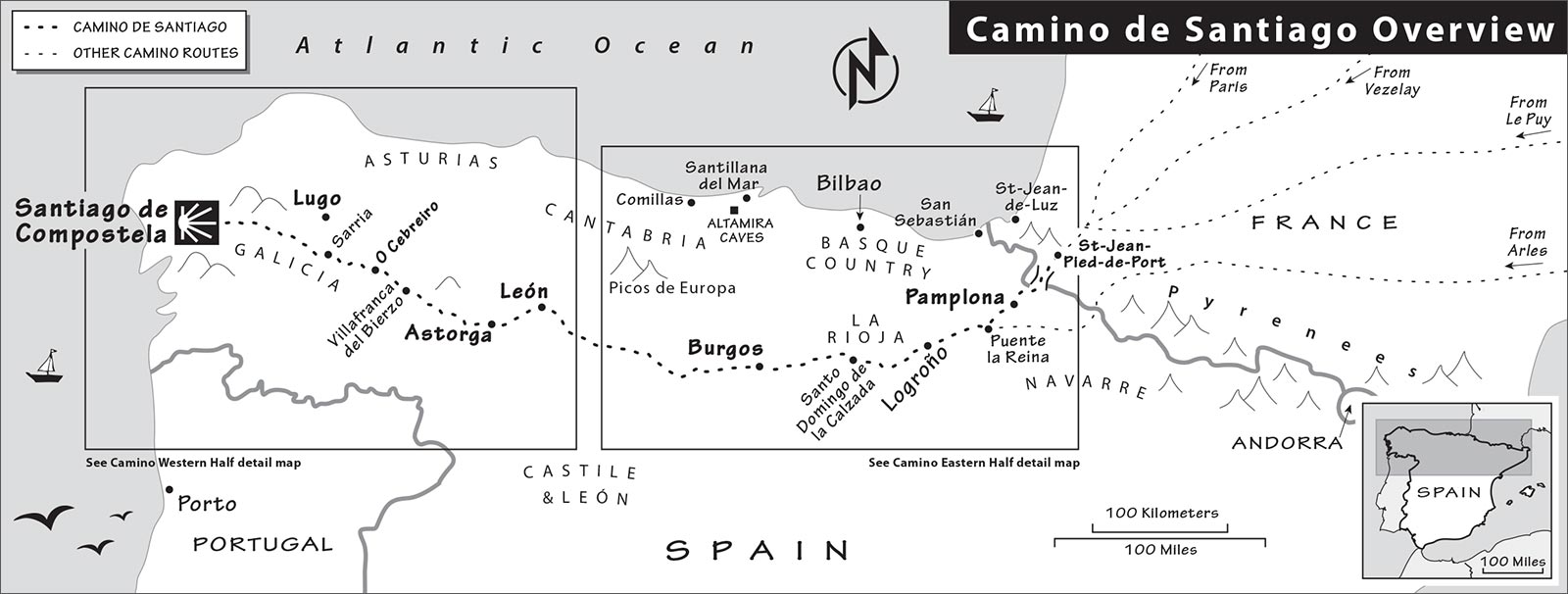
Map: Camino de Santiago Overview
Sights in St-Jean-Pied-de-Port
Sleeping and Eating in St-Jean-Pied-de-Port
St-Jean-Pied-de-Port Connections
From St-Jean-Pied-de-Port to Pamplona
Map: Camino de Santiago: Eastern Half
Map: Camino de Santiago: Western Half
Sleeping and Eating in O Cebreiro
The Camino de Santiago—the “Way of St. James”—is Europe’s ultimate pilgrimage route. Since the Middle Ages, humble pilgrims have trod hundreds of miles across the north of Spain to pay homage to the remains of St. James in his namesake city, Santiago de Compostela. After several lonely centuries, the route has been rediscovered and more and more pilgrims are traveling—by foot, bike, and horse—along this ancient pathway.
While dedicating a month of your life to walk the Camino is admirable, you might not have that kind of time. But with a car (or public transportation), any traveler can use the Camino as a sightseeing spine—a string of worthwhile cities, towns, and countryside sights—and an opportunity to periodically step into a pilgrim’s shoes.
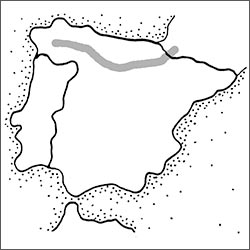
There were many ancient pilgrimage routes across Europe to Santiago de Compostela, but the most popular one across Spain—and the route described here—is the Camino Francés—the French Way, which covers nearly 500 miles across northern Spain from the French border to Santiago de Compostela.
The route begins in the French foothills of the Pyrenees, in the Basque village of St-Jean-Pied-de-Port. Twist up and over rugged Roncesvalles Pass into Spain, and on to Pamplona—the delightful Basque-flavored capital of Navarre, famous for its Running of the Bulls. From here, head west through the fertile hills of Navarre to the vineyards of La Rioja, then across the endless wheat fields and rough, arid plains of northern Castile to Burgos and León, with their beautiful dueling Gothic cathedrals—one a riot of architectural styles, the other gracefully simple but packed with stained glass.
Near the time-passed mountain village of O Cebreiro, the path crosses into Galicia and the terrain changes, becoming lush and green. This last leg of the journey is the most popular: Pilgrims pass simple farms, stone churches, moss-covered homes with slate roofs, apple orchards, flocks of sheep, dense forests of oak, sweet chestnut, and eucalyptus...and plenty of other pilgrims. Just before Santiago de Compostela, the ancient walled Roman city of Lugo is a worthwhile detour for car travelers.
Whether undertaken for spiritual edification or sightseeing pleasure, the Camino de Santiago ties together some of Spain’s most appealing landscape, history, architecture, and people.
And if you’re traveling between the Basque Country (see previous chapter) and Galicia (Santiago de Compostela), consider several interesting stops in the province of Cantabria, along Spain’s northern coast. These include the appealing town of Santillana del Mar (close to the prehistoric Altamira Caves); Comillas, a beach town with fine examples of Modernista architecture (even a Gaudí); and the dramatic Picos de Europa mountains.
GETTING AROUND THE CAMINO DE SANTIAGO
By Car: For car pilgrims who want to trace the Camino and linger at the highlights, this chapter provides specific route tips, road numbers, and directional signs. To supplement these instructions, it’s essential to use GPS/Google Maps and to carry a good road map that covers all of northern Spain (National Geographic and Freytag & Berndt make good ones). Driving the full Camino nonstop would take about 9-10 hours. Assuming you’re taking the most direct (expressway/autovía) route, figure these estimated times for specific legs of the Camino by car (without taking into account stops or detours, such as the Rioja Wine Loop):
• St-Jean-Pied-de-Port to Pamplona—1.5 hours
• Pamplona to Burgos—2.5 hours
• Burgos to León—2 hours
• León to Astorga—45 minutes
• Astorga to O Cebreiro—1.5 hours
• O Cebreiro to Lugo—1 hour
• Lugo to Santiago—1.5 hours
Many freeways are marked Autovía Camino de Santiago to keep you on track. But be warned that Camino de Santiago directional signs in small towns can be misleading, since they’re sometimes intended for foot pilgrims, not drivers. Navigate by town names and road numbers instead.
By Public Transportation: Most of the Camino route can be done by bus and/or train, except for out-of-the-way stops such as O Cebreiro. Where feasible, I’ve listed train and bus connections. Trains cover all the major cities, and Alsa buses also link the main stops (www.alsa.es).
The Old-Fashioned Way: If you’re walking or biking the entire Camino, don’t rely exclusively on my coverage in this chapter. Equip yourself with a good day-by-day guidebook with details on each leg and get good advice about what to pack. For starters, see the “Walking the Way” sidebar on here.
PLANNING YOUR TIME
Drivers begin their journey in Basque Country (San Sebastián in Spain or St-Jean-de-Luz in France). If you’re in a hurry, skip St-Jean-Pied-de-Port and start from Pamplona. The plan below covers the highlights in the minimum amount of time; for a more leisurely pace, stretch out your journey with extra nights in Pamplona, Burgos, or León, or detour for a day or two into the Picos de Europa or the Rioja wine region.
Day 1: Drive through the French Basque villages (see previous chapter) to St-Jean-Pied-de-Port, then over Roncesvalles Pass to Pamplona. Sleep in Pamplona.
Day 2: Explore Pamplona, then drive westward to Burgos (stopping en route at Puente la Reina and detouring for the Rioja Wine Loop if you have time and a healthy interest in wine). Sleep in Burgos.
Day 3: Sightsee Burgos this morning, then drive to León and dip into the cathedral there. Sleep in León—or, for a smaller town, continue an hour farther to sleep in Astorga.
Day 4: Continue westward to Galicia, stopping at O Cebreiro and Lugo before arriving at Santiago de Compostela.
ORIENTATION TO THE CAMINO
The term “Camino de Santiago” actually refers to many different routes across Europe. For my description of the popular French Way (Camino Francés), we’ll begin in the French Basque town of St-Jean-Pied-de-Port, cross over the Pyrenees at Roncesvalles, then pass through three northern Spanish cities (Pamplona, Burgos, León), before climbing into green Galicia, ending at Santiago de Compostela.
Tourist Information: Pilgrims will find no shortage of helpful resources along the way. In addition to TIs in each town (listed in this chapter), you’ll see “Pilgrim Friend” associations and other offices (often attached to an albergue or refugio) that offer kind advice to the weary traveler.
Holy Year: The Compostela Holy Year (Año Xacobeo) occurs when the Feast of St. James (July 25) falls on a Sunday (next in 2027); during a Holy Year, traffic on the trails doubles, and the pilgrim atmosphere is even more festive.
Tours: Several tour companies run guided and self-guided walking and hiking tours in English for individuals and small groups along the Camino de Santiago and on Spain’s northern coast (as well as through the Pyrenees). Tours organized by Iberian Adventures highlight each area’s natural environment, history, culture, cuisine, and wine, while emphasizing environmental awareness and respect for local customs (+34 620 939 116, www.iberianadventures.com, info@iberianadventures.com).
UK-based Walks in Spain offers guided and self-guided tours, including one that covers the final third of the Camino Francés. They’ll also customize Camino itineraries to travelers’ abilities and available time (+34 650 263 708—WhatsApp/FaceTime, www.walksinspain.com, info@walksinspain.com).
St-Jean-Pied-de-Port
Just five miles from the Spanish border, the walled town of St-Jean-Pied-de-Port (san-zhahn-pee-ay-duh-por) is the most popular village in the French Basque countryside (you may also see it labeled as Donibane Garazi, its Basque name). Traditionally, St-Jean-Pied-de-Port has been the final stopover in France for Santiago-bound pilgrims, who gather here to cross the Pyrenees together and continue their march through Spain. The scallop shell of “St. Jacques” (French for “St. James”) is etched on walls throughout the town.
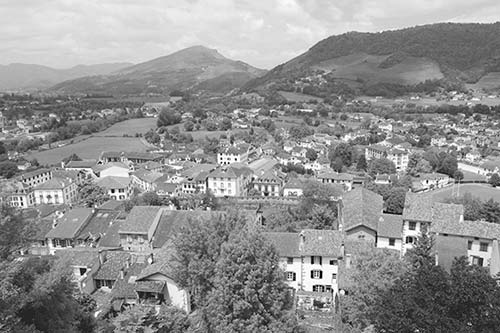
About half the visitors to this town are pilgrims; the rest are mostly French tourists. Gift shops sell a strange combination of pilgrim gear (such as quick-drying shirts and shorts) and Basque souvenirs. This place is packed in the summer (so come early or late).
Tourist Information: The TI is on the main road along the outside of the walled old town (April-Oct Mon-Sat 9:30-12:30 & 14:00-18:00, closed Sun except July-mid Sept 10:00-13:00; Nov-March Mon-Sat 9:00-12:30 & 14:00-17:30; +33 5 59 37 03 57, www.en-pays-basque.fr). For Camino information, you’ll do better at the Pilgrim Friends Office (described later). Ask the TI about weekly pelota vasca games (usually Mon at 17:00 at the trinquet court on Place du Trinquet).
Arrival in St-Jean-Pied-de-Port: Look for ample and well-signed parking near the main road. If arriving by train, exit the station to the left, then follow the first road to the right (Avenue Renaud). Signs for the TI and the Camino will lead you uphill to a gate in the city wall.
Sights in St-Jean-Pied-de-Port
There’s little in the way of sightseeing here, other than pilgrim-spotting. But St-Jean-Pied-de-Port feels like the perfect “Welcome to the Camino” springboard for the upcoming journey. Many modern pilgrims begin their Camino in this traditional spot because of its easy train connection to Bayonne, and because—as its name implies (“St. John at the Foot of the Pass”)—it offers a very challenging but rewarding first leg: up, over, and into Spain.
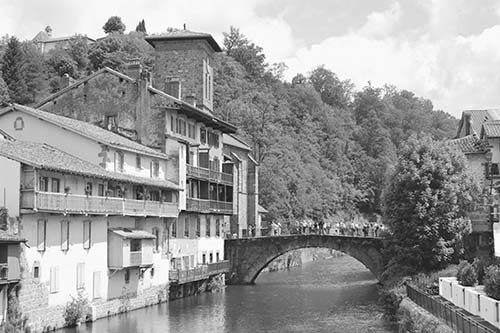
After passing through the gate in the city wall, follow Rue de France to the main drag, Rue de la Citadelle. Head left, uphill, and stop at #39, the Pilgrim Friends Office (Les Amis du Chemin de Saint-Jacques, daily 7:30-12:00 & 13:30-20:00, Fri and Sun also 21:30-22:30, +33 5 59 37 05 09). This is where pilgrims check in before their long journey to Santiago.
For €2, pilgrims can buy the official credential (credenciel in French, credencial in Spanish) that they’ll get stamped at each stop between here and Santiago to prove they walked the whole way and thereby earn their compostela certificate. Pilgrims also receive a warm welcome, lots of advice (like a handy chart breaking down the walk into 34 stages, with valuable distance and elevation information), and help finding a bunk (the well-traveled staff swears that no pilgrim ever goes without a bed in St-Jean-Pied-de-Port).
A few more steps up, on the left, you’ll pass the skippable Bishop’s Prison (Prison des Evêques). Continue on up to the citadel, dating from the mid-17th century—when this was a highly strategic location for keeping an eye on the easiest road over the Pyrenees between Spain and France. Although this stout fortress is not open to the public (as it houses a school), the grounds around it offer sweeping views over the French Basque countryside.
Now backtrack downhill toward the river. With rosy-pink buildings and ancient dates above doorways, this lane simply feels old. Notice lots of signs for chambres (rooms) and refuges—humble, hostel-like pilgrim bunkhouses. The Notre-Dame Gate, which was once a drawbridge, is straight ahead. Cross the old bridge over the Nive River (the same one that winds up in Bayonne) and head up Rue d’Espagne to restaurant row—Rue d’Uhart—for a break before your Camino begins.
Sleeping and Eating in St-Jean-Pied-de-Port
Sleeping: Lots of humble pilgrim lodgings line the main drag, Rue de la Citadelle. If you’re looking for a bit more comfort, consider these options (stars are based on the French rating system).
$$ Hotel Ramuntcho** is the only real hotel option in the old town, located partway up Rue de la Citadelle. Its 17 rooms above a spacious breakfast room are straightforward but modern (1 Rue de France, +33 5 59 37 03 91, www.hotel-ramuntcho.com, hotel.ramuntcho@wanadoo.fr).
$ Itzalpea,** a café and teahouse, rents five rooms along the main road just outside the old town (closed Sat off-season, air-con, 5 Place du Trinquet, +33 9 81 88 38 26, https://itzalpea.com, hotelitzalpea@gmail.com).
$ Maison Simonenia has five clean and bright rooms along the main drag. A small breakfast is served on the patio (12 Rue de la Citadelle, +33 5 59 37 56 10, https://hommetelsa.wixsite.com/simonenia, simonenia@orange.fr).
Eating: Tourists, pilgrims, and locals alike find plenty of $$ places to eat along Rue de la Citadelle (heading up to the citadel), Rue du Trinquet (the main traffic street into town), and Rue d’Uhart. Consider Café de Navarre (2 Rue d’Uhart, +33 5 59 37 01 67), Cafe Ttipia (2 Place Charles Floquet, +33 5 59 37 11 96), or Restaurant Oillarburu (8 Rue de l’Eglise, +33 5 59 37 06 44), all very popular with locals. If you’re lucky enough to land here on a Monday morning, shop at the weekly market, where farmers, cheesemakers, and winemakers bring their products from the countryside.
St-Jean-Pied-de-Port Connections
A scenic train conveniently links St-Jean-Pied-de-Port to Bayonne (4/day, 1 hour) and from there to St-Jean-de-Luz (about 45 minutes beyond Bayonne, www.sncf.fr). It’s about a 1.5-hour drive to St-Jean-de-Luz. There is also limited bus service from St-Jean-Pied-de-Port to Pamplona (bus stop at Place Juan de Huarte near Hôtel Les Remparts, 1/day, 1.5 hours, run by the Spanish line Alsa, www.alsa.es). NavarVIP offers taxi service to Pamplona for about €100 (+34 948 102 100, www.navarvip.com, Luis).
From St-Jean-Pied-de-Port to Pamplona
The first stretch of the Camino, crossing the Pyrenees from France into Spain, is among the most dramatic. There’s little in the way of civilization, but this stretch from St-Jean-Pied-de-Port to Pamplona is a memorable start for the journey.
• From St-Jean-Pied-de-Port, look for green signs to Pamplona, then follow road signs to Arnéguy on road D-933. (But be warned that the road signs for Camino de Santiago take a much more roundabout high-mountain, one-lane road instead of the direct road to the border.)
As you go over the stone bridge in the village of Arnéguy, you’re passing from France into Spain. For centuries this bridge was the site of a delicate dance between nervous smugglers and customs police. Today you’ll barely notice you’ve crossed a border, except for the gigantic ventas—large duty-free malls catering to a mainly Spanish clientele. Along the drive, keep a watchful eye out for stone pillars with crosses—old trail markers for pilgrims.
The road meanders through a valley before twisting up to the pass called Puerto de Ibañeta (also known as the Roncesvalles Pass). This scrubby high-mountain pass is one of the Basque Country’s most historic spots. The most accessible gateway through the Pyrenees between France and Spain, this pass has been the site of several epic battles. According to a popular medieval legend, Charlemagne’s nephew Roland was killed fighting here. Vengeful Basque tribes, seeking retribution for Charlemagne’s sacking of Pamplona, followed the army as it began its return to France—and felled the mighty Roland along this very road. Several centuries later, Napoleon used the same road to invade Spain.
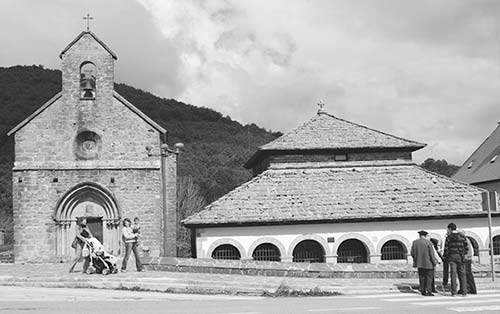
Coming down from the pass, you reach Roncesvalles/Orreaga (“Valley of Pines”), which gave this area its name. This jumble of buildings surrounding a monastery is sort of a pilgrim depot, where travelers can pause to catch their collective breath after clearing the first arduous leg of the Camino. The big building on the right is a simple refugio, filled with bunk beds. In the afternoon, you might see pilgrims washing their clothes at the spigots in front, then hanging them to dry amid the cows and knobby trees out back. The big church (on the left) has a tourable cloister and museum (€5 for both, daily 10:00-14:00 & 15:30-19:00, off-season until 18:00, includes audioguide, guided tours but no fixed times or guarantee of English). As you leave town, you pass the first sign for Santiago de Compostela...790 kilometers (490 miles) straight ahead.
The first person to undertake the Camino de Santiago was...Santiago himself. After the death of Christ, the apostles scattered to the corners of the earth to spread the Word of God. Supposedly, St. James went on a missionary trip from the Holy Land all the way to the northwest corner of Spain, which at that time really was the end of the Western world. (For more on St. James, see the sidebar on here.)
According to legend, St. James’ remains were discovered in 813 in the town that would soon bear his name. This put Santiago de Compostela on the map as one of three places—along with Rome and Jerusalem—where remains of apostles are known to be buried. In 951 the bishop of Le Puy in France walked to Santiago de Compostela to pay homage to the relics. As other pilgrims followed his example, the Camino de Santiago informally emerged. Then, in the 12th century, Pope Callistus II decreed that any person who walked to Santiago in a Holy Year, confessed their sins, and took Communion at the cathedral would be forgiven. This opportunity for a cheap indulgence made the Camino de Santiago one of the most important pilgrimages in the world.
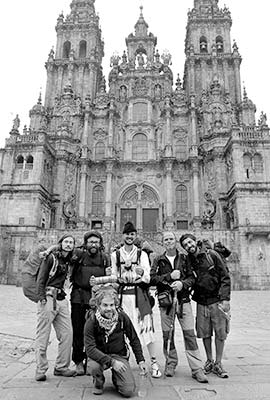
It’s probably no coincidence that St. James’ remains were “discovered” and promoted just as the Reconquista was in full swing. The pope’s decree helped to consolidate the Christians’ hold over lands retaken from the Moors. Pilgrims were ideal candidates to repopulate and defend northern Spain. Many of those who made the journey to Santiago stuck around somewhere along the route (often because of privileges granted them by local rulers who needed help rebuilding). It became a self-sustaining little circle: Pilgrims came along the Camino, saw great sights, and decided to stay...to build even greater sights for the next pilgrims to enjoy.
The Christian monarchy designated an old Roman commercial road from France across northern Iberia as the “official” route, and soon churches, monasteries, hostels, hospitals, blacksmiths, and other pilgrims’ services began to pop up. Religious-military orders such as the Knights of Santiago and the Knights Templar protected the route from bandits and fought alongside Christian armies against the Moorish resurgence, allowing the evolving Catholic state to gather strength in the safe haven created by the Camino.
In the Middle Ages, pilgrims came to Santiago from all over Europe. Many prominent figures embarked on the journey, including St. Francis of Assisi, Dutch painter Jan van Eyck, and the Wife of Bath in Chaucer’s Canterbury Tales.
This steady flow of pilgrims from around Europe resulted in a rich exchange of knowledge, art, and architecture. Even today you’ll find magnificent cathedrals along the Camino in cities such as Burgos and León, which incorporated and improved on the latest in cathedral design from France at that time.
By 1130 the trek was so popular that it prompted a French monk named Aimery Picaud to pen (likely with the help of some ghostwriters) a chronicle of his journey, including tips on where to eat, where to stay, the best way to get from place to place, and how to pack light and use a money belt. This Codex Calixtinus (Latin for Camino Through the Back Door) was the world’s first guidebook—the great-great-granddaddy of the one you’re holding right now.
In the age of Columbus, the Renaissance, and the Reformation, interest in the Camino dropped way off. When the Moors were finally defeated in 1492, the significance of Reconquista icon St. James fell by the wayside. The discovery of the New World in the same year led both the Church and the monarchy to turn their attention across the Atlantic, and the pilgrimage began to wane. That was followed by a century of religious wars pitting Catholics against Protestants, which also distracted potential pilgrims. Feeling threatened by the pirate Francis Drake (not considered “sir” in Spain), the church hid the remains of St. James so thoroughly that they were lost for generations. Meanwhile, the rise of humanism during the Renaissance diminished the mystique of the pilgrimage. For the next centuries, only a few hardy souls followed the route.
In the late 1960s, a handful of parish priests along the Camino began working to recover the route, establishing associations of “friends of the Camino” that would eventually agree on a path and mark it. They received help from none other than Generalísimo Francisco Franco, who decided that Catholicism and nationalism went hand-in-hand. By reviving the Camino, he reasoned, Spain was assured to relive its most glorious days. In 1982, and again in 1989, Pope John Paul II visited Santiago de Compostela, reminding the world of the town’s historic significance. In 1987 the European Union designated the Camino as Europe’s first Cultural Itinerary. And after the success of the 1992 Expo in Sevilla, the Galician government decided to pour funds into reviving the tradition for the Holy Year in 1993.
The plan worked, and now—aided by European Union funding—the route has enjoyed a huge renaissance of interest, with more than 400,000 pilgrims each year trekking to Santiago.
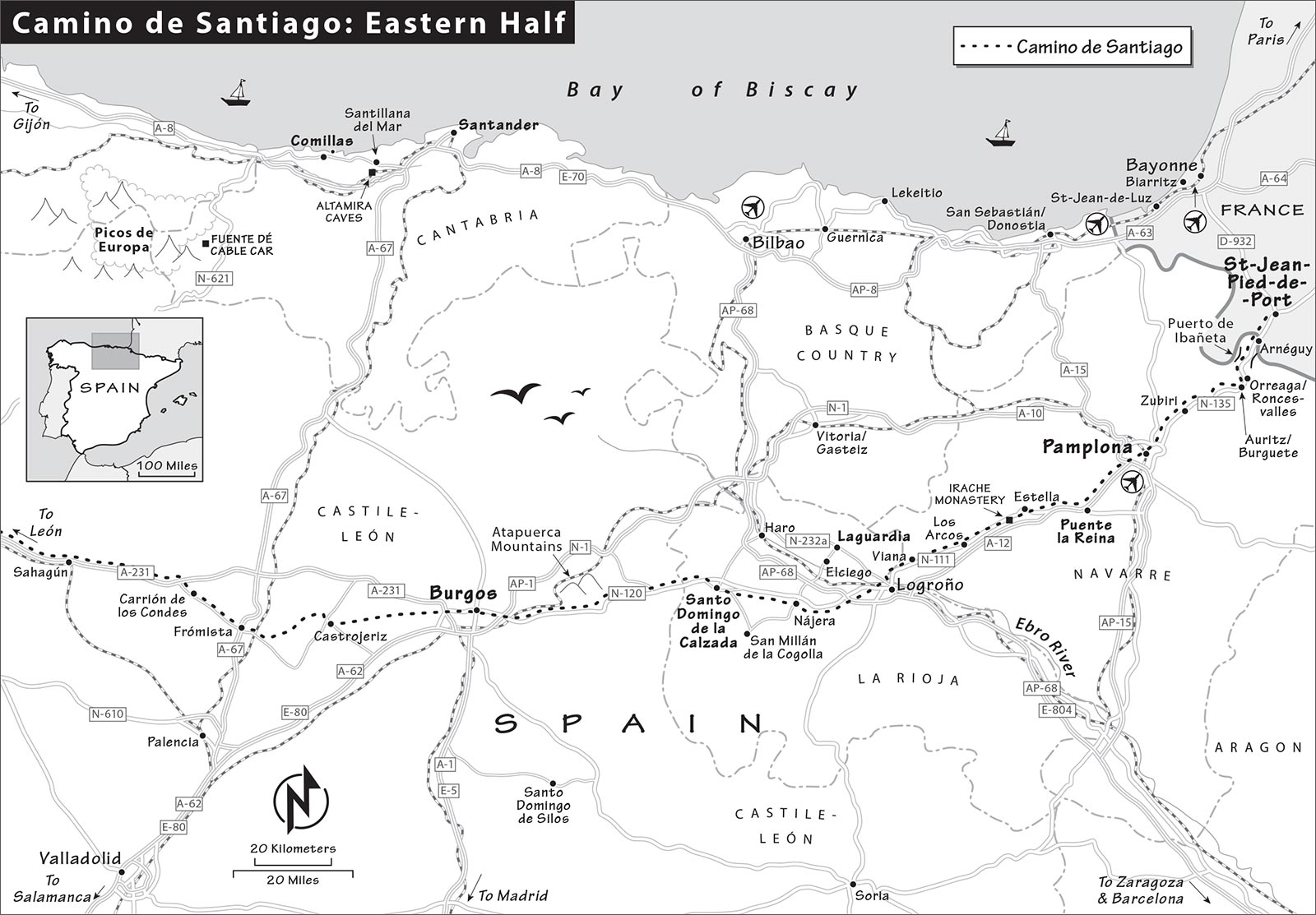
From here to Pamplona, the Camino passes through some pretty rolling hills and meadows, and several appealing villages. The first after Roncesvalles, picture-perfect Auritz/Burguete, was supposedly Hemingway’s favorite place to fish for trout when he needed to recover from a Pamplona bender.
Zubiri marks the halfway point between the pass and Pamplona, with two powerful reminders of the old Basque Country: a Guardia Civil bunker built to withstand separatist bomb attacks, and a giant magnetite quarry mined for steel production.
• Around that next bend is the first big city on the Camino: Pamplona.
Pamplona
Proud Pamplona, with stout old walls standing guard in the Pyrenees foothills, is the capital of the province of Navarre (“Navarra” in Spanish). At its peak in the Middle Ages, Navarre was a grand kingdom that controlled parts of today’s Spain and France. (The king of Spain, Felipe VI, is a descendant of the French line of Navarre royalty.) After the French and Spanish parts split, Pamplona remained the capital of Spanish Navarre.
Today Pamplona—“Iruña” in the Basque language—feels at once affluent (with the sleek new infrastructure of a town on the rise), claustrophobic (with its warren of narrow lanes), and fascinating (with its odd traditions, rich history, and ties to Hemingway). Culturally, the city is a lively hodgepodge of Basque and Navarrese. Locals like to distinguish between Vascos (people of Basque citizenship) and Vascones (people who identify culturally as Basques, as do many Navarros). Pamplona is also an important seat for Opus Dei, a controversial wing of the Catholic Church founded in Spain in 1928 by the priest Josemaría Escrivá. He established the private Pamplona-based University of Navarra, and Opus Dei also runs a hospital and several schools in the city.
Of course, Pamplona is best known as the host of one of Spain’s (and Europe’s) most famous festivals: the Running of the Bulls (held in conjunction with the Fiesta de San Fermín, July 6-14). For latecomers, San Fermín Txikito (“Little San Fermín”) offers a less touristy alternative in late September. But there’s more to this town than bulls—and, in fact, visiting at other times is preferable to the crowds and 24/7 party atmosphere that seize Pamplona during the festival. Contrary to the chaotic image that its famous festival might suggest, Pamplona is welcoming, sane, and enjoyable.
Orientation to Pamplona
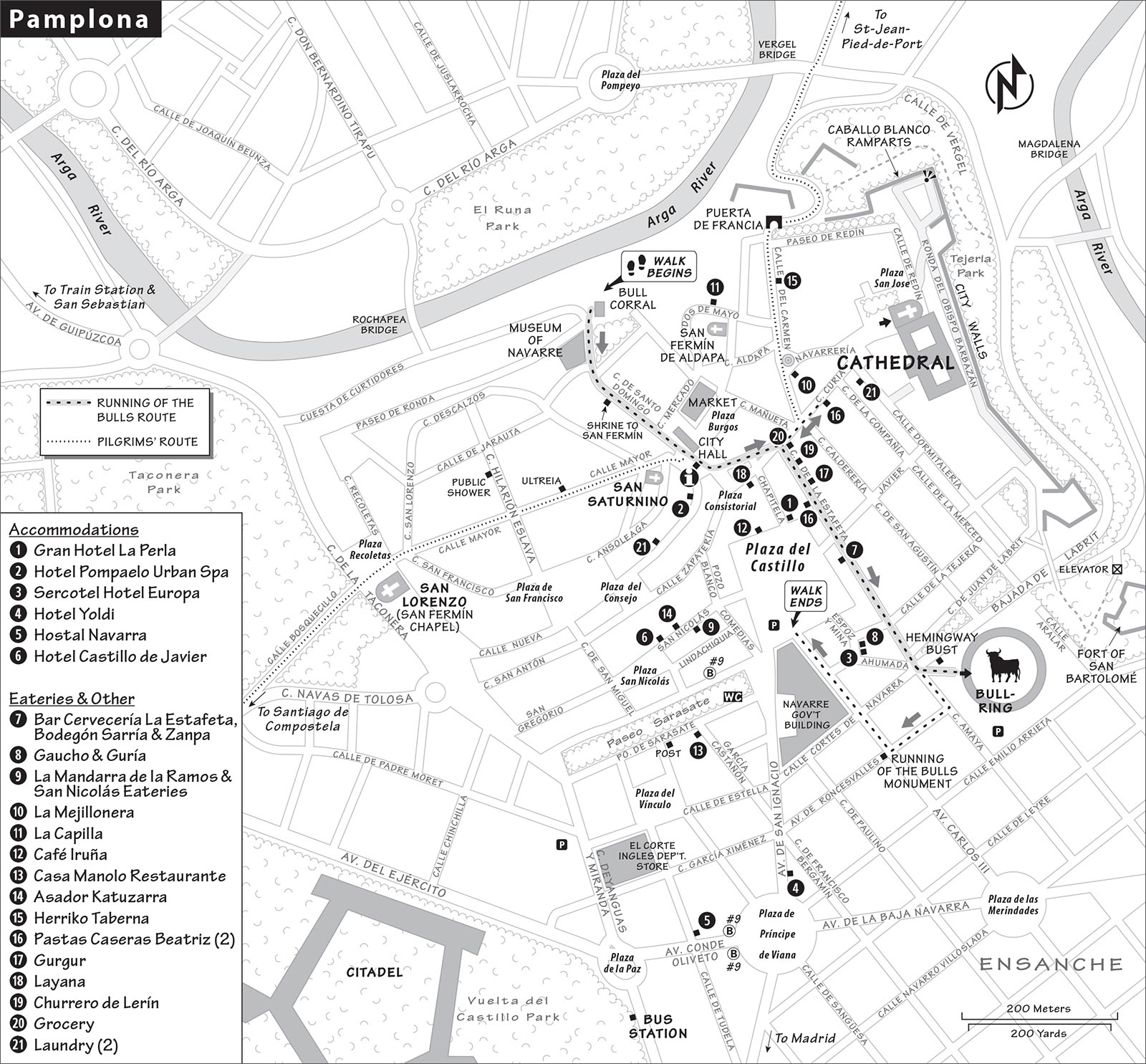
Pamplona has about 200,000 people. Most everything of interest is in the tight, twisting lanes of the old town (casco antiguo), centered on the main square, Plaza del Castillo. The newer Ensanche (“Expansion”) neighborhood to the south and west—with a sensible grid plan—holds several good hotels and the bus station.
TOURIST INFORMATION
Pamplona’s TI is located next to City Hall (daily 10:00-14:00 & 15:00-19:00, closed afternoons off-season, on Plaza Consistorial at Calle San Saturnino 2, +34 948 420 700, www.pamplona.es/turismo).
Ultreia, a pilgrim welcome center, sells Camino credentials and has information for those embarking on the French Way (Mon-Sat 10:00-14:00 & 16:00-20:00, Sun 10:00-14:00; Feb-June and mid-Sept-Dec 10:00-14:00 and closed Mon; closed in Jan; Calle Mayor 20, +34 948 420 705, www.pamplona.es/en/turismo/caminodesantiago/ultreia).
ARRIVAL IN PAMPLONA
You can store bags at the bus station, but not at the train station.
By Bus: The sleek, user-friendly bus station (with a trip-planning desk) is underground along the western edge of the Ensanche area at Calle Yanguas y Miranda 2, about a 15-minute walk from the old-town sightseeing zone (Mon-Fri 9:30-13:30 & 15:00-19:00, +34 948 203 566).
By Train: The Renfe station is farther from the center, across the river to the northwest. It’s easiest to hop in a taxi (€7 to the old center) or on public bus #9 (€1.50, pay driver, every 15 minutes, stops at Plaza Príncipe de Viana traffic circle south of the old town—look for a roundabout with a fountain in the center—and at Paseo de Sarasate near Plaza del Castillo).
By Car: Everything is well marked: Simply follow the bull’s-eyes to the center of town, where individual hotels are clearly signposted. There’s handy parking (close to several recommended hotels) right at Plaza del Castillo and Plaza de Toros, by the bullring.
By Plane: Pamplona Airport is located about six miles from the city center (code: PNA, +34 913 211 000, www.aena.es). A regular taxi from the airport to the cathedral area costs around €16. A shared taxi with a fixed schedule goes between the airport and Paseo de Sarasate 1 (€0.70/person, 1/hour, daily 7:30-21:30 to the airport, trips from the airport to town start at 10:00, call ahead to reserve, +34 948 232 300 or +34 948 351 335).
HELPFUL HINTS
No Bull—There’s Another Fiesta: The last weekend in September, Pamplona celebrates San Fermín Txikito (“Little San Fermín”), a bull-free and practically tourist-free festival centered on the church of San Fermín de Aldapa (located above the Mercado Santo Domingo on Calle Aldapa). Used only for Mass the rest of the year (and housing little of interest except a small statue of the saint), this church opens its doors each fall to become the heart of a celebration involving concerts, brass-band and food competitions, and parades of giant mannequins (gigantes).
Laundry: Find Lavandería de lo Viejo conveniently located a block off the main square (daily 8:00-22:00, Calle Zapatería 28, +34 616 332 233). Lavandería Catedral is just across from the cathedral square (daily 9:00-21:00, Calle Dormitalería 8, +34 635 429 346).
Taxis: There are a few taxi stands on the edges of the old city, but you won’t always find cabs waiting. To be sure to catch a ride, it’s best to call +34 948 232 300 or +34 948 351 335.
Official Camino Stamps: Lots of places are happy to stamp your pilgrim credentials, but the only official stamps are given at the cathedral, the tourist office, and San Saturnino Church.
Local Guide: Top-notch guide Francisco Glaría is simply a delight to be with (€180/half-day up to 4 hours, extra for San Fermín and holidays, +34 629 661 604, www.novotur.com).
Grocery: There’s a handy Carrefour Express at the corner of Estafeta and Calle Mercaderes (the infamous “curva de Estafeta,” daily, +34 914 908 900).
Pamplona Walk
Even if you’re not in town for the famous San Fermín festival, you can still get a good flavor of the town by following in the foot- and hoof-steps of its participants. This self-guided walk takes you through the town center along the same route of the Running of the Bulls.
• Begin by the river, at the...
Bull Corral (Corrales de Santo Domingo): During the San Fermín festival, the bulls are released from here (the smallest bulls go first) at 8:00 each morning (the rest of the year, it’s a parked-car corral). They first run up Cuesta de Santo Domingo; signs labeled El Encierro mark their route. Follow them.
• About 200 feet ahead, up above on the right, is the...
Museum of Navarre (Museo de Navarra): This museum, worth ▲, has four floors of artifacts and paintings celebrating the art of Navarre, from prehistoric to modern (€2, free Sat afternoons and all day Sun; open Tue-Sat 9:30-14:00 & 17:00-19:00, Sun 11:00-14:00, closed Mon; Santo Domingo 47, +34 848 426 492, www.museodenavarra.navarra.es). Formerly a 16th-century hospital, the building retains its original Renaissance entrance. Art is displayed chronologically: prehistoric tools and pottery and a fine Roman mosaic floor in the basement, Roman art and artifacts from the Middle Ages on the first floor; Gothic and Renaissance artifacts along with castle frescoes on the second floor, Baroque and 18th- and 19th-century works (including Goya’s 1804 portrait of the Marqués de San Adrián) on the third floor, and 20th- and 21st-century paintings by local artists on the top floor. The ground floor hosts free rotating exhibitions. Don’t miss the terrace on the ground level (near the stairs to the prehistory section) for a bird’s-eye view of the bull corral. Spacious and well arranged, the museum can be toured within an hour—consider circling back here after our walk. Check out the adjoining chapel (on the left as you exit, show museum ticket), with its impressive golden Baroque-Rococo altarpiece depicting the Annunciation.
• Continue along Cuesta de Santo Domingo. Embedded high in the wall on your right, look for the small shrine containing an image of San Fermín—those running with the bulls gather here before the encierro to ask for the saint’s protection. Farther up on your left is the Santo Domingo Market (Mercado Santo Domingo), a handy spot to buy picnic supplies, including fine local cheeses (closed Sun, supermarket upstairs, market stalls downstairs). Ahead in the square is...
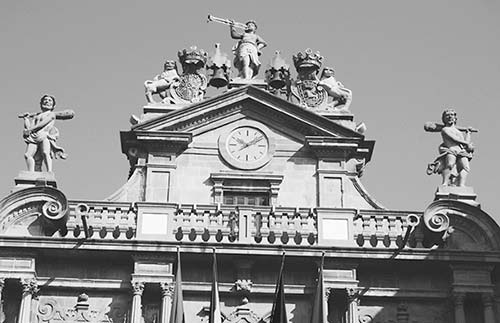
City Hall (Ayuntamiento, with the flags): When Pamplona was just starting out, many Camino pilgrims who had been “just passing through” decided to stick around. They helped build the city you’re enjoying today but tended to cling to their own regional groups, which squabbled periodically. So in 1423, the king of Navarre (Charles III) tore down the internal walls and built a City Hall here to unite the community. This version (late Baroque, from the 18th century) is highly symbolic: Hercules demonstrates the city’s strength, while the horn blower trumpets Pamplona’s greatness.
The festival of San Fermín begins and ends on the balcony of this building. Next to the TI are some of the barricades used during festivities. Look in the direction you just came from (the route of the bulls) and find the line of metal squares in the pavement; they secure barricades during the run. On this square, an inner barricade is for journalists and emergency medical care; spectators line up along the outer barrier. This first stretch of the run is uphill, allowing the bulls to use their strong hind legs to pick up speed.
• Continue two blocks down Calle de Mercaderes and go right on Calle de la Estafeta to follow the route of the bulls. But if you want to detour for a cathedral visit now, continue straight (the cathedral towers directly ahead).
Calle de la Estafeta: At this turn, the bulls—who are now going downhill—begin to lose their balance, often sliding into the barricade. After regaining their footing, they charge up the middle of La Estafeta. Because the old town was walled until 1923, space here was at a premium—making houses tall and streets narrow. There’s no room here for barricades—and no escape for the daredevils trying to outrun the bulls.
Racing bulls aside, La Estafeta is one of the most appealing streets in Pamplona. It’s lively every night with some of the best tapas bars in town. And it’s home to Pastas Caseras Beatriz (at #22), whose bakers make the best treats in Pamplona. Their mini croissants come in three types: garrotes de chocolate, filled with milk chocolate; cabello de angel, filled with sweet pumpkin; and manzana, apple. So simple...but oh so good.
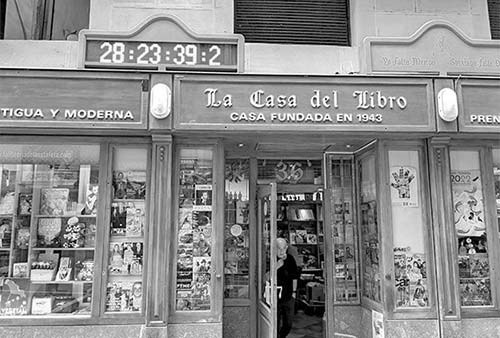
Halfway down the street, notice the stepped alley on the right leading to the main square (we’ll circle back there later). And notice, on the facade of La Casa del Libro, a countdown clock ticking down the days until the next encierro.
• La Estafeta eventually leads you right to Pamplona’s...
Bullring (Plaza de Toros): Here’s where the bulls meet their fate, but it’s used for bullfights only nine days each summer (during the festival). The original arena from 1922 was expanded in the 1960s (see the extension at the top), doubling its capacity and halving its architectural charm.
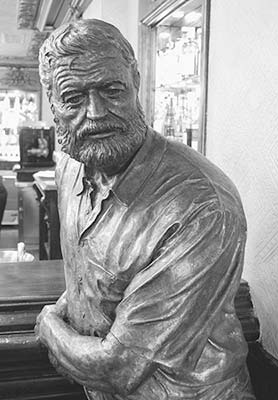
Look for the big bust of Ernest Hemingway, celebrated by Pamplona as if he were a native son. Hemingway came here for the first time during the 1923 Running of the Bulls. Inspired by the spectacle and the gore, he later wrote about the event in his classic The Sun Also Rises. He said that he enjoyed seeing two wild animals running together: one on two legs, and the other on four. This literary giant put Pamplona and its humble, obscure bullfighting festival on the world map; visitors travel from far and wide even today, searching for adventure in Hemingway’s Pamplona. He came to his last Running of the Bulls in 1959 and reportedly regretted the attention his writing had brought to what had been a simple local festival. But the people of Pamplona appreciate “Papa” as one of their own. At the beginning of the annual festival, young people tie a red neckerchief around this statue so Hemingway can be properly outfitted for the occasion.
If you’ve always wanted to tour a bullring, this is your chance. The exhibit (worth ▲) gives a behind-the-scenes look at this iconic space (€7, includes audioguide; daily 10:30-19:00 or 20:00; shorter hours and usually closed Mon in spring and fall; closed mid-June-late July and off-season—best to confirm hours online; +34 948 225 389, www.feriadeltoro.com). At the start, you’ll go down the same ramp and through the same red door that the bulls do during the festival. Once inside, you’ll view an immersive video that puts you in the middle of the running of the bulls. Then you’ll circle the arena, in the space where the bullfighting teams duck and dodge when the bulls are in the ring. The spectator seats are divided into three sections: those closest and in the shade are the most expensive.
The pilgrim route leading to Santiago de Compostela is rife with symbolism. Here are a few key items you’ll see along the way.
St. James: The Camino’s namesake is also its single biggest symbol. St. James can be depicted three ways: as a pilgrim, as an apostle, and as a crusader.
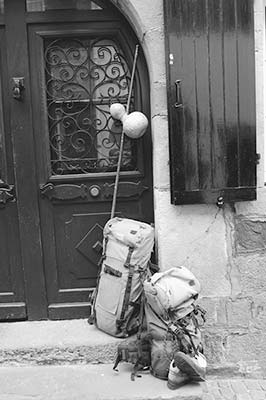
Scallop Shell (Vieira): The scallop shell identifies pilgrims on the Camino. Figuratively, the various routes from Europe to Santiago come together like the lines of a scallop shell. And literally, scallops are abundant on the Galician coast. Though medieval pilgrims carried shells with them only on the return home—to prove they’d been here and to scoop water from wells—today’s pilgrims also carry them on the way to Santiago. The yellow sideways shell that looks like a starburst marks the route for bikers.
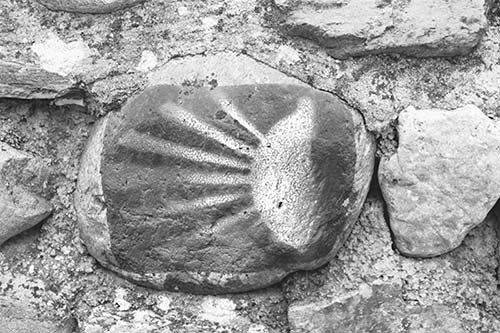
Gourd (Calabaza): Old-time pilgrims used gourds to carry water.
Yellow Arrow: These arrows direct pilgrims at every intersection from France to Santiago.
Red Cross: This long, skinny cross with curly ends at the top and sides, and ending in a sword blade at the bottom, represents the Knights of Santiago. This 12th-century Christian military order had a dual mission: to battle Muslim invaders while providing hospice and protection to pilgrims along the Camino de Santiago.
Tomb and Star: St. James’ tomb (usually depicted as a simple coffin or box), and the stars that led to its discovery, appear throughout the city of Santiago, either together or separately.
Next you’ll enter the corrals where the bulls are held prior to the bullfight. In the former horse stable, another video portrays the life of a bull from its simple Ferdinand existence in the countryside to its sudden end. The displays also explain the different stages of a bullfight and its major players.
Finally, you’ll come to the arena itself. Just before you reach the ring, peek into the chapel (on the left) where the toreadors say their prayers before entering the ring. Once you’re out on the sand, go to the center and yell “Olé!” to test the great acoustics. Imagine 20,000 people roaring from their seats. Look for section number 2, where Hemingway used to sit so he could hear the workers comment on the strengths and weaknesses of the different bulls.
“A San Fermín pedimos, por ser nuestro patrón, nos guíe en el encierro, dándonos su bendición.”
“We ask San Fermín, because he is our Patron, to guide us through the Running of the Bulls, giving us his blessing.”
-Song sung before the run
For nine days each July, a million visitors pack into Pamplona to watch a gang of reckless, sangria-fueled adventurers thrust themselves into the path of an oncoming herd of furious bulls. Locals call it El Encierro (literally, “the enclosing”—as in, taking the beasts to be enclosed in the bullring)...but everyone else knows it as the “Running of the Bulls.”
The festival begins at City Hall at noon on July 6, with various events filling the next nine days and nights. Originally celebrated as the feast of San Fermín—who is still honored by a religious procession through town on July 7—it has since evolved into a full slate of live music, fireworks, general revelry, and an excuse for debauchery. After dark the town erupts into a rollicking party scene. To beat the heat, participants chug refreshing sangria or kalimotxo—half red wine, half cola. The town can’t accommodate the crowds, so some visitors day-trip in from elsewhere, and many young tourists simply pass out in city parks overnight (public showers are on Calle Hilarión Eslava in the old town).
The Running of the Bulls takes place each morning of the festival and is broadcast nationwide on live TV. The bulls’ photos appear in the local paper beforehand, allowing runners to size up their opponents. If you’re here to watch, stake your claim at a vantage point along the outer barrier by 6:30 or 7:00 in the morning. Don’t try to stand along the inner barrier—reserved for press and medical personnel—or you’ll be evicted when the action begins.
Before the run starts, runners sing a song to San Fermín (see lyrics above) three times to ask for divine guidance. Soon the bulls will be released from their pen near Cuesta de Santo Domingo. From here they’ll stampede a half-mile through the town center...with thrill-seekers called mozos (male) or mozas (female) running in front of the herd, trying to avoid a hoof or horn in the rear end.
Runners traditionally wear white with strips of red tied around their necks and waists and carry a newspaper to cover the bull’s eyes when they’re ready to jump out of the way. Two legends explain the red-and-white uniform: One says it’s to honor San Fermín, a saint (white) who was martyred (red); the other says that the runners dress like butchers, who began this tradition. (The bulls are color-blind, so they don’t care.)
At 8:00, six bulls are set loose. The beginning of the run is marked by two firecrackers—one for the first bull to leave the pen, and another for the last bull. The animals charge down the street, while the mozos and mozas run in front of them for as long as possible before diving out of the way. To keep the bulls on course, side streets are fenced off (with openings just big enough for runners to escape). Shop windows and doors are boarded up.
A bull becomes most dangerous when separated from the herd. For this reason, a few steers—who are calmer, slower, have bigger horns, and wear a bell—are released with the bulls, and a few more trot behind them to absorb angry stragglers and clear the streets. (There’s no greater embarrassment in this muy macho culture than to think you’ve run with a bull...only to realize later that you actually ran with a steer.)
The bulls’ destination: the bullring...where they’ll be ceremonially slaughtered as the day’s entertainment. (For more on bullfighting, see here.)
If you’re considering running with the bulls, locals suggest a few guidelines: First, understand that these are very dangerous animals, and running with them is entirely at your own risk. Be as sober as possible and wear good shoes. (Runners wearing sandals might be ejected by police.) You’re not allowed to carry a backpack, as its motion could distract the bulls. If you fall, wait for the animals to pass before standing up—it’s better to be trampled by six bulls than to be gored by one.
Cruel as this all seems to the bulls—who scramble for footing on the uneven cobblestones as they rush toward their doom in the bullring—the human participants don’t come away unscathed, either. Each year, dozens of people are gored, trampled, or otherwise injured. Over the last century, at least 16 runners have been killed at the event.
The festival ends at midnight on July 14, when the townspeople congregate in front of the City Hall, light candles, and sing their sad song, “Pobre de Mí”: “Poor me, the Fiesta de San Fermín has ended.”
During the festival, bullfights start at 18:30, and tickets are expensive. But the price plummets if you buy tickets from scalpers after the first or second bull. The audience at most bullfights is silent, but Pamplona’s spectators are notorious for their raucous behavior. They’re known to intentionally spill things on tourists just to get a reaction...respond with a laugh and a positive attitude, and you’ll earn their respect—and you’ll probably have the time of your life.
• From the bullring, walk 20 yards while keeping the arena on your left, then cross the busy street and walk a block into the pedestrian zone (on Avenida de Roncesvalles) to the life-size...
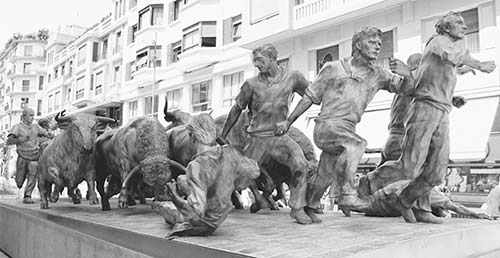
Running of the Bulls Monument (Monumento al Encierro): This statue (pictured on the next page) shows 6 bulls, 2 steers, and 10 runners in action. Find the self-portrait of the sculptor (bald, lying down, and about to be gored). The statue is a local favorite but it’s not without controversy: There are 10 mozos but no mozas—where are the female runners?
• Facing the monument, you can turn right and walk two blocks up the street to the main square...
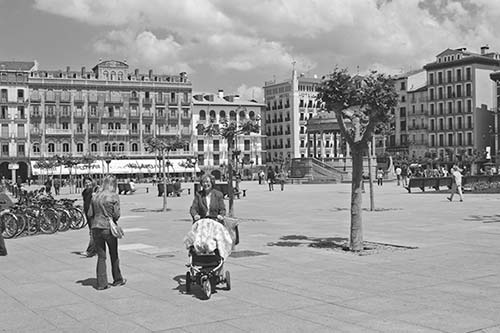
Plaza del Castillo: Pamplona’s main square has something particularly inviting about it. Locals call it their living room (el cuarto de estar). It’s dominated by the Navarre government building (sort of like a state capitol). Several Hemingway sights surround this square. The recommended Gran Hotel La Perla, in the corner, was his favorite place to stay. Although the hotel has been renovated to five-star standards, Hemingway’s room—with balconies overlooking the bull action on La Estafeta street—was kept exactly as he liked it, right down to the furniture he used while writing (although the bathroom has been luxuriously upgraded). He was known to frequent Bar Txoko at the corner opposite La Perla (as well as pretty much every other bar in town) and the venerable Café Iruña, where he reportedly hunkered down to write The Sun Also Rises.
• You’ve survived the run. Now enjoy the rest of Pamplona’s sights.
Sights in Pamplona
▲Pamplona Cathedral (Catedral Santa María la Real de Pamplona)
In The Sun Also Rises, Hemingway’s protagonist remarks: “At the end of the street I saw the cathedral...The first time I saw her I thought she had an ugly facade, but now I like her.”
It’s true that Pamplona’s cathedral can feel like an architectural also-ran. It’s a hodgepodge of styles: Built over a Romanesque predecessor in the 14th and 15th centuries, the French Gothic structure got a Neoclassical facelift in the 18th century. But it’s important as the first real cathedral pilgrims encounter along the French Way, and it’s where the kings of Navarre were crowned. After an expansive restoration, it looks like new and holds an interesting museum.
Cost and Hours: Cathedral and museum—€5, daily 10:30-19:00, until 17:00 in winter, museum closed Sun and during church services, last entry one hour before closing, let ticket office know if you want to do the 11:15 bell tower climb (best to arrive at 10:30 and take a number), +34 948 212 594, www.catedraldepamplona.com. If you want to see only the cathedral (for free), try visiting before 10:30 or after 18:00.
Visiting the Cathedral: The cathedral—a Gothic core wrapped in a Neoclassical shell—is shiny and clean from the outside. Note the bell tower on the north (left) side; its 12-ton bell, called María, is the largest one in Spain still regularly tolled.
The interior is dark and mysterious. The prominent alabaster tomb dominating the middle of the nave holds Charles III (ruler of Navarre in the 1400s) and his wife, Eleanor. The blue fleur-de-lis pattern on the king’s robe is a reminder that the kings of Navarre once controlled a large swath of France. Around the base of the tomb, monks from various orders mourn the couple’s death, and faithful dogs rest at their feet.
One of the few surviving Romanesque touches in the cathedral resides under a canopy behind the altar. There you’ll find the 12th-century statue of the church’s namesake, Santa María la Real, carved from wood and gilded in silver. It was in front of this image that the Navarran kings were crowned.
The museum, housed in the former cloister and attached buildings, is worth a look (it’s already included with your admission—though there’s little English; entrance on right side of nave). You’ll first go through a room that chronicles the stages of cathedral construction, then pass through the Gothic cloister to a variety of exhibits. The Archaeology Hall exposes the excavated foundations of Pamplona’s Roman period. You’ll also see the enormous 14th-century refectory and the Barbazana Chapel, whose entrance is flanked with impressive Gothic carvings of saints Peter and Paul.
Ramparts View
For a peek at some of the old city fortifications that define Pamplona, take a detour behind the cathedral. Walk through the tree-lined square to the left of the church and down picturesque Calle del Redín. You’ll emerge at a viewpoint overlooking the Caballo Blanco ramparts (with a seasonal terrace café). This is an easy way to see part of Pamplona’s imposing city walls—still 80 percent intact, designed to defend against potential invaders from the Pyrenees, and now an inviting parkland.
The little hut you see here (with a low roof that children scramble on) has the look of a rustic chapel, with a cross and a holy-water dish by the door. It’s actually an old munitions storehouse, and the holy water was insurance for the poor soul sent inside with a torch to retrieve gunpowder.
Explore the overlook, with views across the city’s suburban sprawl. Beyond those hills on the horizon to the left are San Sebastián and the Bay of Biscay. Camino pilgrims enter town through the Puerta de Francia gate down below. It’s the only survivor of the 16th-century town’s original six gates.
This area is popular with people who are in town for the Running of the Bulls but didn’t make hotel reservations. Sadly, it was not unusual for people to fall asleep on top of the wall...then roll off. The hodgepodge fencing here is designed to prevent that from happening during the next festival.
Church of San Saturnino
As a prominent town on the Camino route, Pamplona has its share of interesting pilgrim churches. This one, the most important of the bunch, is an architectural two-fer with an interesting back story.
When Emperor Constantine granted religious freedom to Christians in 313, traveling priests and holy men began fanning out across Europe seeking converts. San Saturnino, a bishop from France, crossed the Pyrenees and began proselytizing. Just outside the entry to this church, notice the emblem in the pavement that commemorates the spot where Saturnino is said to have baptized locals—including San Fermín.
Slip inside the church. It’s actually two churches, with two main altars—one 13th-century Gothic (to the left) and one 18th-century Baroque (straight ahead). Above the Gothic altar, San Saturnino sits above the image of a bull. This has nothing to do with the Running of the Bulls: When Saturnino returned home to France after his successful Christianizing, a Roman general insisted that he pay tribute to the Roman god Jupiter by sacrificing a bull. Saturnino refused—and the bull was set loose to gore the saint.
Camino pilgrims stop here to get their credentials stamped in the sacristy and to pay respects to a Romanesque image of the Virgin of the Camino, displayed in an ornate altarpiece in the Baroque church.
Cost and Hours: Free, Mon-Sat 9:15-12:00 & 18:00-19:30, Sun 10:00-13:30 & 18:30-19:30, Calle San Saturnino 3, +34 948 221 194, http://iglesiasansaturnino.com.
Chapel of San Fermín at San Lorenzo Church (Capilla de San Fermín)
San Fermín is a big name in town, and you’ll find shrines, chapels, and churches dedicated to him around town. The most important representation of the saint is in the San Lorenzo Church. There, in a giant side chapel (on the right), the statue of San Fermín—made of silver-trimmed wood, dressed in red and wearing a gold miter—presides over the altar.
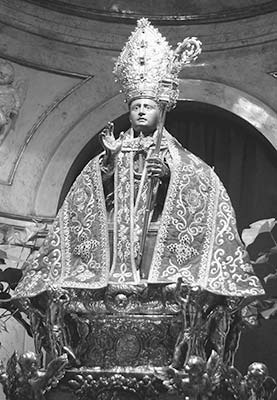
Pamplona was founded by the Roman emperor Pompey (hence the name) in the first century BC. Later, a Roman general here became the first in the empire to allow Christians to worship openly. The general’s son, Fermín, even preached the word himself...until he was martyred. Fermín has been Navarre’s patron saint ever since.
Just below the statue’s Adam’s apple, squint to see a reliquary holding Fermín’s actual finger. The statue—gussied up in an even more over-the-top miter and staff—is paraded around on Fermín’s feast day, July 7, which was the origin of today’s bull festival. This chapel is the most popular place in town for weddings.
Cost and Hours: Free, daily 8:15-12:30 & 17:30-20:30, overlooking the ring road at the edge of the old town at Calle Mayor 74, +34 629 443 777, www.capillasanfermin.com.
Nearby: Just beyond San Lorenzo Church is Pamplona’s oldest city park, the Taconera Gardens. Built around old fortifications, its moats are now home to deer, ducks, peacocks, and chickens. The park is a welcome green oasis on a steamy day, with flower and tree species from around the world. From the north end of the park, it’s possible to walk the city walls back to the cathedral.
Pamplona Citadel and Vuelta del Castillo Park
Pamplona’s city walls originally divided the town into three separate boroughs, but they were refashioned into a single ring around the whole city during the reign of Charles III. By the 16th century, a constant threat from nearby France forced the city to adopt new defensive measures: a star-shaped wall with bastions at each of its five points (inspired by France’s Vauban fortifications).
Pamplona is still defined by its remarkably preserved fortifications, considered some of the finest in Europe. A stroll through the city center often brings walls and gates into view. The large citadel that protected the hard-to-defend southwest corner of the old town, a prime example of Spanish Renaissance military architecture, has become one of the city’s favorite green spaces. The sloping green belt circling the citadel—once part of its defenses—is now Vuelta del Castillo Park. These parklands are typical of Pamplona’s reuse of its former fortifications.
Sleeping in Pamplona
All hotel prices go way, way up for the San Fermín festival, when you must book as far in advance as possible.
$$$$ Gran Hotel La Perla is the town’s undisputed top splurge. Hemingway’s favorite hotel, sitting right on the main square, offers 44 rooms at Pamplona’s best address (air-con, elevator, restaurant, Plaza del Castillo 1, +34 948 223 000, www.granhotellaperla.com, informacion@granhotellaperla.com). Well-heeled lit lovers can drop a bundle for a night in the Hemingway room, still furnished as it was when “Papa” stayed there and stocked with copies of his books.
$$$ Hotel Pompaelo Urban Spa has 30 modern rooms located just off Plaza Consistorial. The hotel has a sky bar with vistas buenas, and a spa for hotel guests in the basement. The reception area and some of the rooms include historical walls from the old city tower (air-con, elevator, Plaza Consistorial 3, +34 848 473 137, www.hotelpompaelo.com, reservas@hotelpompaelo.com).
$$ Sercotel Hotel Europa, a few blocks off the square and up a flight of stairs, offers 25 rooms with reasonable prices for its tasteful elegance and ideal location (air-con, elevator, Calle Espoz y Mina 11, +34 948 221 800, www.hoteleuropapamplona.com, info@hoteleuropapamplona.com). Their Restaurante Europa is a well-regarded Michelin splurge.
$$ Hotel Yoldi is a comfortable modern hotel, well located just off Plaza Príncipe de Viana. Its 50 modern rooms are handy for travelers arriving by bus from the train station (family rooms, elevator, café, discounted pay parking nearby, Avenida de San Ignacio 11, +34 948 224 800, www.hotelyoldi.com, yoldi@hotelyoldi.com).
$ Hostal Navarra is a good value in Pamplona, with 14 modern, well-maintained, clean rooms. Near the bus station, but an easy walk from the old town, it’s well run by Miguel (RS%, check-in from 14:00, reception closes at 22:00—but you can check in online 24 hours, Calle Tudela 9, +34 627 374 878, www.hostalnavarra.com, info@hostalnavarra.com).
$ Hotel Castillo de Javier, right on the bustling San Nicolás bar street (request a quieter back room), rents 19 small, simple rooms above their tapas bar (air-con, elevator, Calle San Nicolás 50, +34 948 203 040, www.hotelcastillodejavier.com, info@hotelcastillodejavier.com). This budget option is a step up from the several cheap hostales that line the same street.
Eating in Pamplona
Typical specialties in Pamplona are piquillo (red peppers), white asparagus, and menestra (vegetable stew). Try the Navarran Roncal cheese and finish off your meal with a local dessert: pantxineta (a custard and almond tart) or txantxigorri (a cake made of lard, bread dough, and sugar). Pair these with a fine Navarran wine or the local, sloe-flavored pacharán liqueur—considered a good digestif.
All the eateries listed here are within a couple minutes’ walk of one another, and the tapas bars make a wonderful little pub crawl. Especially on weekends, it’s smart to book ahead for any sit-down restaurant, even if you just stop by earlier in the day.
TAPAS CRAWL
On Calle de la Estafeta: The best concentration of trendy tapas bars is on and near the skinny drag called La Estafeta. My favorites here are $$ Bar Cervecería La Estafeta (try the gulas—baby eels—stuffed in a red pepper, daily, at #54, +34 948 222 157); $$ Bodegón Sarría, where you’ll lick your lips for escombro, a hot sandwich with Iberian ham and chorizo (dining room to enjoy Navarran dishes, at #50, +34 948 227 713); and $$ Zanpa, which serves pintxos in the front and has convivial (noisy) sit-down dining in the back (look for their grilled meat and tortilla de patatas, at #48, +34 948 484 848).
Near Plaza del Castillo: A proud little prizewinning place, $$ Gaucho serves tasty tapas cooked to order. You could sit down, enjoy three tapas, and have an excellent meal. I never pass up the huevo con trufo—stir the truffle into the soft-boiled egg to get the full effect of the flavors (closed Tue, just a few steps off Plaza del Castillo at Calle Espoz y Mina 7, +34 948 225 073).
$$ Guría, next door to Gaucho, is a more modern spot. Besides snacking on first-class pintxos, you can order your choice of scallop, spider crab, shrimp, or cod fritters (daily, Calle Espoz y Mina s/n, +34 948 124 188).
The narrow and always bustling Calle San Nicolás has more than its share of competing tapas joints, with a multigenerational clientele and straightforward tapas. $$ La Mandarra de la Ramos (“Ramos’ Apron”), at #9, is a pork lover’s paradise, where cured legs dangle enticingly over your head. Ham it up with a couple of tostadas de jamón, best washed down with a glass of the local vino tinto (daily, +34 948 212 654).
Near the Cathedral: Seafood lovers can go to $$ La Mejillonera, where they can enjoy a caña (small draft beer) and media (half-portion) de calamares bravos in a fast-food atmosphere. The deep-fried mini calamari are the perfect vehicle for picking up all that mayo and hot sauce (daily, Calle Navarrería 12, +34 948 229 184). In warm weather, students skip the simple, homey interior to sit near the fountain on the square in front.
RESTAURANTS
$$$ La Capilla transformed a former chapel into a pristine, white dining space that’s crowned by a grand chandelier. Escape here if you want a dressy setting to enjoy contemporary Navarran cuisine (Tue-Sat, closed Sun-Mon, in Pamplona Catedral Hotel at Calle Dos de Mayo 4, +34 948 987 404).
$$$ Café Iruña, which clings to its venerable past and its connection to Hemingway (who loved the place), serves up drinks out on the main square and food in the delightful old 1888 interior. While the food isn’t memorable, the ambience is great. Find the little “Hemingway’s Corner” (El Rincón de Hemingway) side eatery in back, where the bearded one is still hanging out at the bar (accessible only on weekends). Enjoy black-and-white photos of Ernesto, young and old, in Pamplona (open daily, Plaza del Castillo 44, +34 948 222 064, www.cafeiruna.com).
$$$ Casa Manolo Restaurante is a white-tablecloth place, elegant and inviting, situated upstairs in a building that was once a cafeteria for workers. It’s an excellent spot to try out traditional food such as espárragos frescos (fresh asparagus) and Navarran beef (Tue-Sat 13:00-16:00 & 21:00-23:00, Sun lunch only, closed Mon, reservations smart, across from the fancy Zara store at Calle de García Castañón 12, +34 948 225 102, www.restaurantecasamanolo.com).
$$$ Asador Katuzarra, like most spots on Calle San Nicolás, is popular for its tapas served up front. But don’t miss its spacious stone-walled dining room in back, paired with a patio garden. It’s a relaxing place for grilled meats and fish, served sizzling from the wood-fired barbecue (daily, Calle San Nicolás 34, +34 948 224 634, www.katuzarra.es).
$$ Herriko Taberna, with a woodsy Scan-mod vibe, serves an appealing Basque-focused €16.50 three-course menú del día, with a vegetarian option available. Reserve ahead—it’s popular (daily, lunch only on Sun, Calle del Carmen 34, +34 948 222 828, www.herriko.eus [URL inactive]).
SWEETS
To satisfy a sugar craving, visit Pastas Caseras Beatriz, which sells delicious mini croissants (garrotes) with various sweet fillings (closed Sun, two locations—Calle Estafeta 22 and Calle Curia 16). Near the first location, Gurgur, named for the rumbling sound of a hungry belly, has specialties such as chorizo de Pamplona, coffee caramels, txantxigorri cake, the local pacharán liqueur, and Roncal cheese—ask to have it sliced (daily, at Calle Estafeta 21).
The confiteria Layana, in business since 1871, summons passersby with the thick scent of sugar and butter. A line of locals often spills out the doors because they know that both the pasta de nata and the pasta de mermelada (cream-filled and marmalade-filled cookies) are worth the wait (closed Sun, Calle Calceteros 12, +34 948 221 124).
Churrero de Lerín serves the best churros y chocolate in Pamplona. The doughnut-like hoops are perfect with the thick, hot chocolate. You’re welcome to add graffiti to the walls...as long as you don’t write about politics or religion (daily, Calle Estafeta 5, +34 618 434 976).
Pamplona Connections
Note that the bus station is closer to the old town than the train station, and that some connections are faster by bus.
From Pamplona by Bus to: St-Jean-Pied-de-Port (1/day, 1.5 hours, Alsa), San Sebastián (6/day direct, 1 hour, Alsa), Bilbao (6/day, 2 hours, La Burundesa), Madrid (almost hourly—most with transfer, 6 hours, Alsa and Jiménez Movilidad), Madrid Barajas Airport (4/day, 5-6 hours, Alsa, buy online in advance—tickets sell out). Bus info: Alsa (www.alsa.es), La Burundesa (www.laburundesa.com), Jiménez Movilidad (https://jimenezmovilidad.es).
By Train to: Burgos (5/day, 2.5 hours—direct, faster trains in afternoon), San Sebastián (2/day, 2 hours), Madrid (4/day direct, 3.5 hours).
From Pamplona to Burgos
The stretch of the Camino between Pamplona and Burgos is particularly appealing, with several tempting stopovers. As you finish your descent from the rugged Pyrenees, you enter the flatter, more cultivated landscape that typifies the long middle stretch of the Camino (basically from here to Galicia). The two best stops along here are the small town of Puente la Reina (with an iconic old bridge) and a potential detour for wine lovers through La Rioja wine country.
• Begin by taking the A-12 expressway west from Pamplona (toward Logroño). Consider stopping in Puente la Reina, as it’s a very easy detour—the exit is well marked from the expressway. Approaching town, parking is outside the old center (either before you reach the first bell tower or after the road curves around the old town).
PUENTE LA REINA/GARES
The Camino de Santiago’s two French routes (Francés and Aragonés) converge in this cozy sun-baked village, just one walking stage (about 12 miles) west of Pamplona. Named for a graceful 11th-century stone bridge at the far end of town, the village retains its pilgrims’ vibe. All the sights here fall on a straight axis: church, main street, and bridge with built-in TI (Tue-Sat 10:00-14:00 & 16:00-19:00, Sun 11:00-14:00; shorter hours off-season, closed Mon year-round; Calle Puente de los Peregrinos 1, +34 948 341 301). Parking the car where the town starts and wandering to the bridge gives “car hikers” a whiff of Camino magic.
Enter the town on the straight, wide Calle Mayor. Classic Camino towns feature main drags like this one, flanked with all the services pilgrims needed to eat, sleep, pray, and deal with health problems.
Watch for the Church of the Crucifixion (Iglesia del Crucifijo), with a stork’s nest on its steeple. The Knights of St. John, who came to protect pilgrims from the Moors, founded this church in the 12th century. Inside you’ll find a distinctive crucifix left behind by a 14th-century German pilgrim—a reminder of the Camino’s pan-European appeal—and a carved Gothic “Santiago peregrino”—St. James in his pilgrim guise (notice the scallop shell on his jaunty cap). A pilgrims’ refugio in town, run by a contemporary religious order (Padres Reparadores), offers bunks and credential stamps to Camino walkers. The TI can also give pilgrims that coveted stamp.
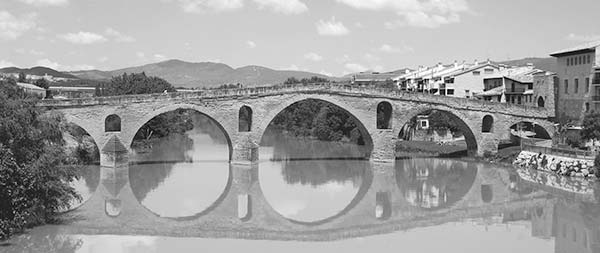
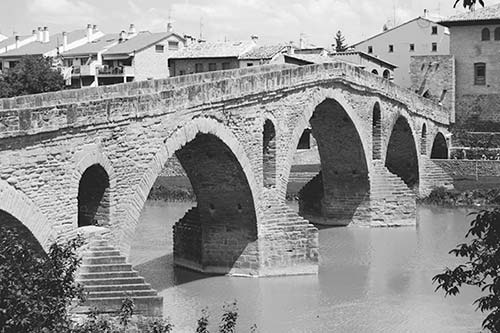
The main street leads directly to the most interesting sight in town (and its namesake), the “Bridge of the Queen” (which you can also see on the right as you drive across the modern bridge near the end of town). With a graceful seven-arch Romanesque design (one arch is underground) that peaks in the middle, the bridge represents a life span: You can’t quite see where you’re going until you get there. Notice a clever bit of 11th-century engineering: extra arches, like vents, are designed to let high water through whenever the river rises. The bridge was built expressly so pilgrims could easily cross over the River Agra. Even today, pilgrims enjoy congregating on the riverbank under the bridge (ramp across from TI)—a great place to stop and stretch your legs.
• From here, hop immediately back on the A-12 expressway (toward Estella) to speed along. As you pass by Estella/Lizarra, you’ll begin to notice that you’re entering wine country with scrubby vegetation, red soil, and hill towns dotting the landscape. Take exit 44, direction: Ayegui, and follow signs to Irache Monastery, a worthwhile, quick, and fun detour.
IRACHE MONASTERY AND WINE FOUNTAIN
The monastery (Monasterio de Santa María de Irache), once operated by the Benedictines, now sits largely empty (the monks left in 1985 and plans to convert the complex into a parador are on hold). Consider briefly wandering through the monastery’s large Romanesque church and Platersque cloister (free, closed Mon-Tue).
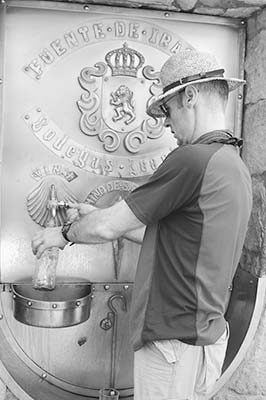
The monastery’s viticulture tradition continues, however, at the adjacent Bodegas Irache winery (established 1891, www.irache.com). In keeping with the Benedictine practice of aiding passing pilgrims, the winery has the unique custom of offering free wine to pilgrims. Follow the fuente de vino sign down the Camino path that crosses in front of the monastery. In a few steps you’ll find a fountain that dispenses wine from one spigot and water from the other, quenching the pilgrim’s thirst and brightening the way ahead (daily 8:00-20:00; pilgrims can step inside the winery to get a stamp on their credential).
Also on the grounds is the little Museo del Vino. Besides viewing wine-related exhibits, you can taste and buy the bodega’s wines (Wed-Sun 9:00-14:00 & 16:00-19:00).
Wine lovers enjoy detouring off the Camino at Logroño to visit the wine villages of Laguardia and Haro. Just 30 minutes apart, these two towns and the roads in between are filled with emblematic Rioja wineries.
Protected from the elements by the Cantabrian Mountains to the north, Rioja vineyards have thrived in the valley of the Ebro River since Roman times. Rioja wines, which can be red, white, or rosé, grow in a variety of soil types dominated by red clay and limestone. The reds, made primarily from the tempranillo grape, are medium- to full-bodied in the Bordeaux style and characterized by aging in oak barrels. You’ll see four types of Rioja wines, depending on how long they’ve been aged (from shortest to longest, and cheapest to most expensive): simply Rioja (or sometimes cosecha, “harvest,” or joven, “young”), crianza, reserva, and gran reserva.
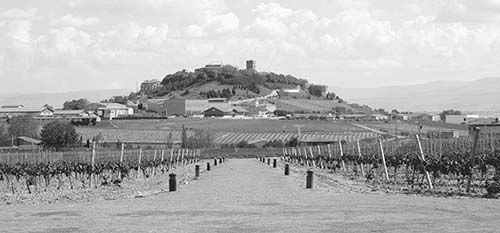
Be warned that not all Rioja wineries are set up for impromptu visitors. All wineries require reservations for a tour and formal tasting, but it is often possible to drop in at a bodega’s wine bar for a glass or two, or even a tasting flight. If you’re serious about your Rioja, set up here for a day or two and reserve at the wineries of your choice.
• From Logroño follow N-232a northwest to Laguardia and find (free) parking outside the medieval town wall.
This small town, the scenic center of Rioja wine-tasting country, is perched on a promontory with fine views of the surrounding region. Under your feet are more than 300 wine cellars (bodegas) where Rioja quietly ages. You have several choices for drop-in tastings right in town: El Fabulista (Plaza San Juan, +34 945 621 192, www.bodegaelfabulista.com), Carlos San Pedro (Calle Páganos 44, +34 945 621 111, www.bodegascarlossanpedro.com [URL inactive]), and the cave in the basement of the fancy Los Parajes hotel (Calle Mayor,+34 945 621 130, www.hospederiadelosparajes.com). Laguardia’s helpful TI can direct you to wine tastings in town and nearby; be sure to ask for their map of the area (Mon-Fri 10:00-14:00 & 16:00-19:00, Sat 10:00-14:00 & 17:00-19:00, Sun 10:45-14:00, Calle Mayor 52, +34 945 600 845, www.laguardia-alava.com).
The countryside between Laguardia and nearby Haro is blanketed with well-regarded bodegas. A few of them are architecturally distinctive and worth a look even if you aren’t a wine drinker. Haro, at the western edge of this area, is a leisurely 30 minutes from Laguardia and is convenient for a one-stop visit to its walkable cellars and tasting rooms.
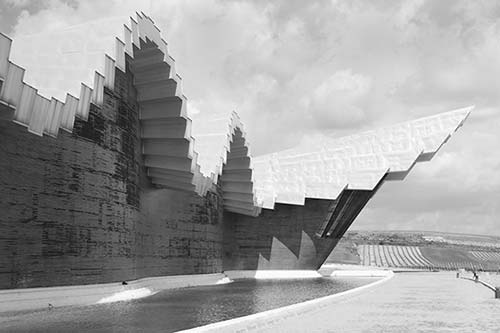
Ysios is a modern winery whose bold building, designed by Spanish architect Santiago Calatrava, declares it a serious temple of wine. Visitors can arrange a 90-minute tour with tastings (€35, must book in advance) or just drop in at the wine bar—no appointment necessary (+34 945 600 640, http://www.bodegasysios.com—choose “English” from the home page to ensure you are booking an English-language tour). You’ll see the building’s distinctive undulating roof from afar; it’s just a three-minute drive from Laguardia, toward the mountains.
• From the Laguardia area, follow signs south to Elciego (on A-3210, pull off into town and walk up to the church for a great photo op), then head to...
Marqués de Riscal, in the village of Elciego, is a pioneer of the Rioja industry. Besides its respected history, the winery gets attention for its colorful, wavy, Frank Gehry-designed four-star hotel. The hotel is off-limits unless you are a guest (or have reservations at one of its fancy restaurants), but you’ll get a better view from the road as you drive in than at the property itself. Visitors can tour the vast wine cellar (€22, 1.5 hours, includes tasting, must book online in advance, +34 945 606 000, www.marquesderiscal.com) or sip a glass or two at the wine bar/gift shop (bus tours often stop here).
• From Elciego, track back to A-3214/N-232a, heading toward Samaniego.
From the road, the ultramodern Baigorri winery appears to be just a simple glass pavilion, but it sits over seven levels (some underground) of glass, concrete, and steel. Basque architect Iñaki Aspiazu designed the hillside structure to take advantage of gravity in the winemaking process (€20 tour and tasting, Tue-Sat 10:30-13:00, reserve in advance, restaurant, wine bar open Tue-Sat 10:30-12:30 & 15:30-17:30, www.bodegasbaigorri.com).
• Heading west on N-232a, watch for Labastida/Bastida and turn off onto A-3203. Just after crossing the Ebro River, you’ll pass under a railway bridge. Pull into the parking lot on your right.
Haro’s Barrio de la Estación is home to a number of the oldest and best-regarded Rioja cellars (Muga, CVNE, and La Rioja Alta, among others), conveniently clustered within steps of one another near the town train station. The bodegas range in style from modern to old school and each keeps its own schedule. It’s best to check BarrioEstacion.com for current tasting times and tour offerings.
• To rejoin the Camino road and head toward Burgos, follow N-126/LR-111/N-120 from Haro toward Santo Domingo.
• Continuing southwest, you can choose your route: To save time, zip on the A-12 expressway right toward Logroño. But for a scenic and only slightly slower meander through some cute villages (El Busto, Sansol) and larger towns (Los Arcos and Viana, with its ornate cathedral), take the expressway only as far as Los Arcos, then follow NA-1110/N-111 from there. Either way, you’ll end up at...
LOGROÑO AND LA RIOJA
Just before the skippable big city of Logroño, you’ll cross the Ebro River. Today, as in centuries past, this river marks the end of the Basque territory (and Navarre) and the beginning of La Rioja. Renowned especially for its robust red wines, the Rioja region historically served as a buffer between the Basques and the powerful forces to the south (the Moors) and east (Castilian Spaniards).
• Again, choose your route from here. If you have time and a healthy interest in wine (and vineyard scenery), detour off the Camino by heading north on N-232a to the village of Laguardia, rejoining the Camino later (see “La Rioja Wine Loop” sidebar). Otherwise, stick with the expressway to...
SANTO DOMINGO DE LA CALZADA
This Rioja town, a larger version of Puente la Reina, has a fine cathedral, oodles of historic buildings, tranquil squares, and all the trappings of a pilgrim zone (seashells in the pavement, refugios, vending machines, and launderettes).
The town is named for its founder Domingo (b. 1019), who dedicated himself to supporting pilgrims passing through the area. Besides opening a hospice, he built a bridge over the river and generally improved the Camino pathway. Today the patron saint of roadbuilders (calzada means “road”), he’s buried in the cathedral, where his mausoleum is surrounded by votives from engineering firms.
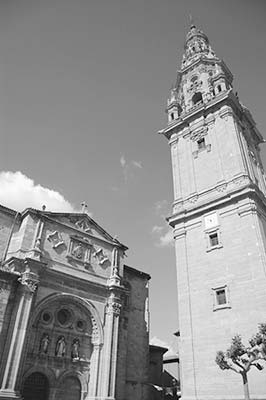
You’ll see images of a rooster and a hen around town (including on the tomb of San Domingo), thanks to a colorful local legend: A chaste pilgrim refused to be seduced by the amorous daughter of an innkeeper. For revenge she hid a silver cup in his bed and accused him of theft. The judge, eager to hang the lad, proclaimed that the pilgrim was as dead as the roasted rooster and hen the judge was about to eat. The charred birds suddenly stood up and began to crow and cluck, saving the pilgrim from certain death. To this day, a live chicken and rooster inhabit a special coop in the cathedral.
• Soon after Santo Domingo de la Calzada, you pass into the region of...
CASTILLA Y LEÓN
Welcome to Spain’s largest province (about the size of Indiana). If you’ve always wanted to see the famous plains of Spain...here they are. This vast, arid, high-altitude Meseta Central (“Inner Plateau”) stretches to hilly, rainy Galicia in the northwest and all the way past Madrid to the south coast. Those walking the entire Camino find this flat, dry stretch to be either the best part (getting away from it all with a pensive stroll) or the worst part (boring and potentially blistering hot).
• The next big city on the Camino is just around the bend: Burgos.
Burgos
Burgos (BOOR-gohs) is a pedestrian-friendly city lined up along its pretty river. Apart from its epic history and urban bustle, Burgos has a major claim to touristic fame: its glorious Gothic cathedral, packed to the gills with centuries’ worth of elaborate decorations.
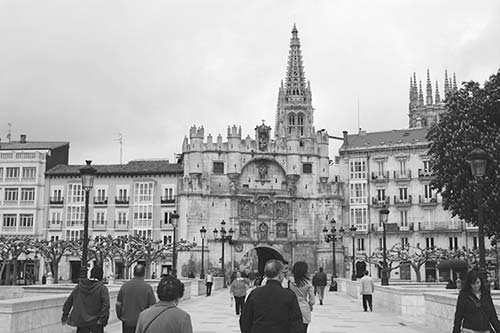
Like so many towns in the north of Spain, the burg of Burgos was founded during the Reconquista to hold on to land that had been won back from the Moors. Its position on the Camino de Santiago and a flourishing trade in wool (sent to the Low Countries to become Flemish tapestries) helped it thrive. Beginning in 1230, it became the capital of the kingdom of Castile for half a millennium (having usurped the title from León). The town’s favorite son is the 11th-century Spanish hero El Cid (locals say “el theeth”), celebrated for his exploits fighting for and against the Moors. The 20th century saw the town decline, even as it briefly became the capital of Franco’s forces during the Spanish Civil War (1936-1939). Later the dictator industrialized Burgos.
Today the outskirts of Burgos still feel workaday, but the old town gleams with a hint of elegance. The city constantly tries to improve itself—new public sculpture decorates nearly every plaza, greeting strollers on their evening paseo. Old architecture blends with the new (for example, find the public library at the end of Calle San Juan). Wealthy, well-dressed locals fill Burgos’ churches on weekends for weddings, christenings, and First Communions. Stately plane trees line up along the riverside promenade. And watching over everything is that grand cathedral.
Orientation to Burgos
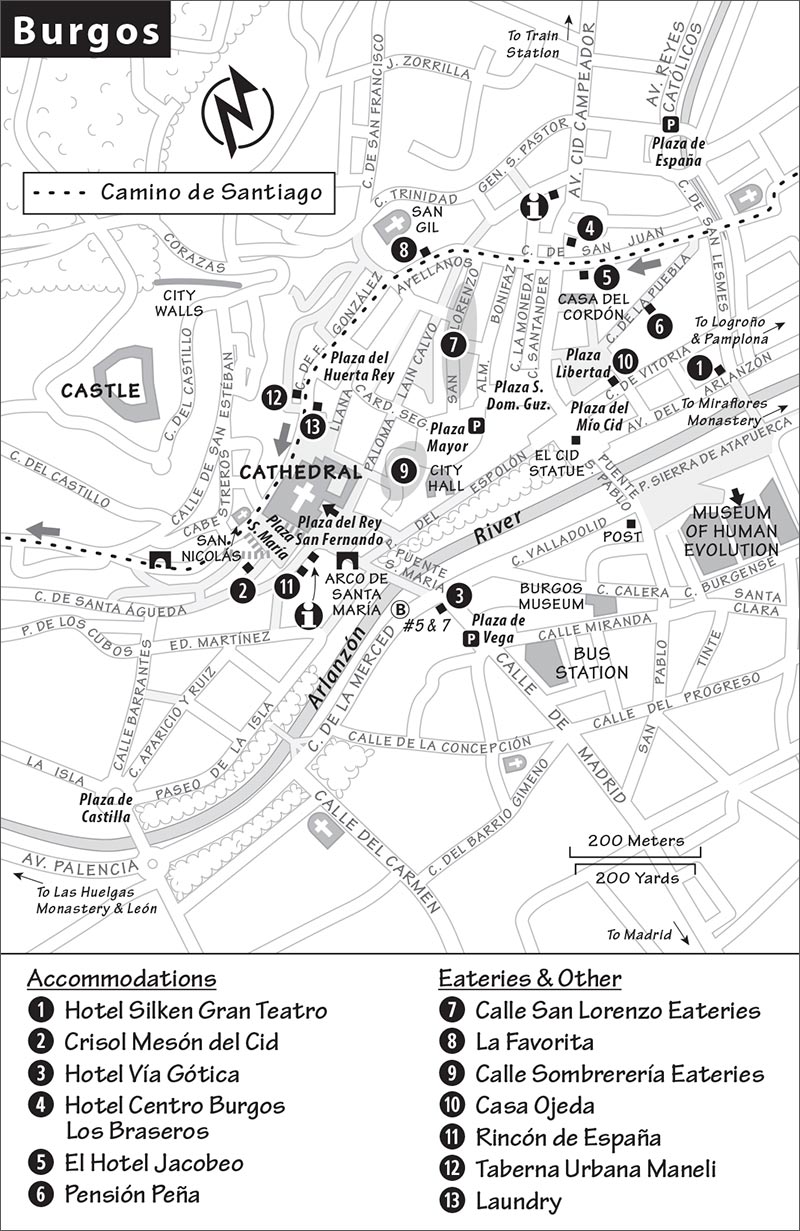
With about 180,000 inhabitants, Burgos is bisected by the Arlanzón River. The old town is centered on the huge cathedral. The city center is mostly pedestrianized and very manageable.
TOURIST INFORMATION
Burgos’ main TI is just off Plaza del Rey San Fernando, near the cathedral (daily 9:00-20:00, Oct-May 10:00-14:00 & 16:00-19:30, Calle Nuño Rasura 7, +34 947 288 874, http://turismo.aytoburgos.es [URL inactive]). A second TI at Plaza de Alonso-Martínez 7 covers the entire province of Castile and León (www.turismocastillayleon.com).
HELPFUL HINTS
Laundry: Tiny La Colada del Cid is conveniently located on the Camino path just above the cathedral (daily, Calle de Fernán González, Bajo, +34 644 444 005.)
Local Guide: Enthusiastic Rosalía Lopez Murillo offers cathedral tours and city walks as well as bike tours and visits to nearby sights and villages (half-day from €135, full day from €165, +34 629 955 746, www.burgosvisitasguiadas.es, info@burgosvisitasguiadas.es).
Taxi: Call +34 947 277 777 or +34 947 481 010.
ARRIVAL IN BURGOS
By Bus: The close-in bus station is just across the river from the cathedral, at Calle Miranda 4.
By Train: Burgos’ Rosa Manzano rail station is about 3 miles north of the old town. City buses (#2 will get you to Plaza España) and taxis (your best bet) line up at the main door.
By Car: Burgos is relatively easy to navigate, and its underground parking lots are well signed. On the old town side of the river, the garage at Plaza Mayor is central but more challenging to navigate to; Plaza de España is easier to reach. Just across the river from the Arco de Santa María, the lot at Plaza de Vega is close in and convenient.
Sights in Burgos
The Burgos Cathedral is the premier sight in town. Start your visit there, and with enough time, see the rest of the old city’s main attractions, which I’ve tied together here in an easy walk.
▲▲Burgos Cathedral (Catedral de Burgos)
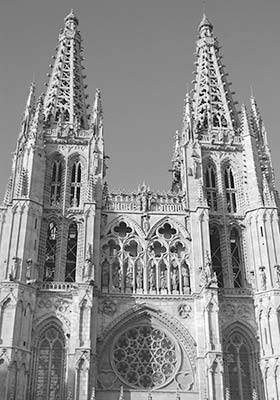
Burgos is rightfully famous for its showpiece Gothic cathedral (Catedral de Burgos), with soaring, frilly spires and an interior that’s been enhanced across the centuries with richly decorated chapels, a cloister, and an elaborate choir.
The cathedral was the brainchild of the king of Castile, Fernando III, and Bishop Don Mauricio. The bishop, who had studied in Paris, had a hand in bringing French architects and masters of the Gothic style to Burgos.
The builders set the first stone in place in 1221 and kept going until 1567; in the process they unwittingly mapped the evolution of the Gothic style for future generations. The cathedral’s earliest phase introduced French Gothic style to Spain, and later revisions to the building brought in skilled craftsmen from the Rhineland, Burgundy, and Flanders—international teams who would influence Spanish architects and sculptors, who themselves disseminated new art styles throughout the country.
Cost and Hours: €11, €5 for pilgrims with credentials, downloadable audioguide; daily 9:30-18:30, shorter hours off-season, evening sound-and-light tours Fri-Sat some summer nights, last entry one hour before closing; free lockers, +34 947 204 712, www.catedraldeburgos.es.
 Self-Guided Tour: Buy your ticket at the office facing Plaza del Rey San Fernando. To simplify your navigation, this tour is keyed to the audioguide numbers you’ll see posted at the chapels throughout the cathedral. The main entrance is up the stairs just to the right of the ticket office.
Exterior: Before climbing the stairs, take a minute to study the 13th-century doorway, the oldest and best preserved of the cathedral’s four portals. The sculptures above the door spell out all a medieval worshipper needed to know: Christ sits majestically, his holy words captured by his evangelists busy at their desks; the 12 apostles, just below, are charged with transmitting the Gospels far and wide; while the bishop (between the doors) preaches God’s word.
• Enter and turn left, into the first of the church’s many…
Chapels: The original cathedral was built in the Latin-cross floor plan, but over many centuries that footprint changed as private chapels were added. A wide range of benefactors, anxious to be remembered after their passing, spared little expense in creating final resting places with all the elements of a personal church: altar, altarpiece, choir stall, dome, and religious paintings. How can you tell if you are in a private chapel? You’d need a key to unlock the metal screen separating the chapel from the church. This room, the Chapel of the Visitation (#4), belonged to Bishop Alonso of Cartagena (died 1456), whose effigy lies atop the finely carved alabaster tomb.
• Continue to the nave and turn left to begin a clockwise spin around the church.
The first few chapels are just a warm-up: The Chapel of St. John of Sahagún (#6) features some frescoes (unusual in this church), and the Chapel of the Relics (#7) contains venerated bits of various saints.
• Turn into the…
Chapel of the Presentation (#8): Notice the wrinkles in the face of the alabaster effigy of this chapel’s benefactor. His tomb is from the early 16th century, when humanistic thought surged and idealism in art began giving way to realism. The tomb is decorated not just with saints, but personifications of the cardinal virtues of Christian thought: Prudence, Justice, Temperance, and Fortitude. The main Neoclassical altarpiece features a painting by the Italian Renaissance master Il Piombo.
• Head to the back of the church.
Barriers separate the tourist zone from the worship area—which has been reduced to just two chapels reserved for daily Masses. But look high up, just to the right of the rose window, to see the church mascot: the 16th-century “Fly-Catcher” clock, which rings out every quarter-hour. Above the clock is a whimsical statue of its German maker, whose mouth opens and closes when the bell rings at the top of each hour, and next to it, another automaton announces the quarter-hour. (The tourists who crane their necks to gape up at the show seem to be imitating the clockmaker.) While amusing curiosities today, the mechanical precision of these automatons was once the height of high tech.
Continue up the left aisle to the Chapel of the Conception (also called the Chapel of St. Anne, #12). Here you’ll find a spectacular, flowery late-Gothic altarpiece (1483-1486) carved by the Spanish master Gil de Siloé and painted by a Burgos local, Diego de la Cruz. The complicated iconography of the retablo asserts support for the much-debated Middle Ages concept of the Immaculate Conception of Mary. The idea that Mary was born without original sin—which stained all the rest of humankind—was so controversial that it wouldn’t be settled as Catholic dogma until the mid-19th century.
In the altarpiece, the central figures, Mary’s parents, exchange loving glances as they chastely touch; above them, their daughter Mary is enthroned as the Queen of Heaven with the Baby Jesus on her lap. Below them, the branching family tree of Jesus springs from the reclining figure of Jesse, father of King David. (The sculptor included his self-portrait as one of the evangelists—find the bespectacled guy, the second from left in the bottom row.)
• You’ve now circled back around to the...
Transept: On your left is the sumptuous Golden Staircase (#13, 1523), clearly inspired by Italian Renaissance models. Annoyed church fathers had removed an earlier staircase because townspeople were using it as a shortcut to move their animals from the high end to the low end of town. They eventually relented and paid for this narrow, flattened replacement (not at all suited for livestock).
Opposite the stairs you can enter the crossing area of the transept. Step into the very center—of the cathedral—and place yourself directly under the sumptuous Plateresque dome with its eight-pointed star. Look back down again to see the tomb of El Cid (Rodericus Didaci Campidoctor) and his wife (#15). El Cid’s well-traveled remains were interred in Valencia, then in various points in Burgos, before being brought here in the early 20th century (for more about El Cid, see the description of his statue later on this walk).
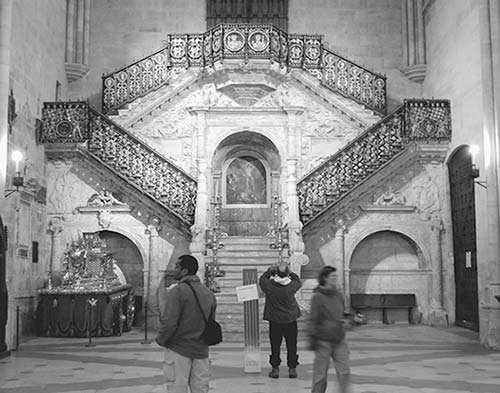
Take a look at the carved wooden choir and the main altar, with a fine statue of Mary slathered in silver.
• Directly behind the main altar, enter the cathedral’s best chapel, the...
Chapel of the Constables (#22): Because it has its own main altarpiece (and two lesser ones), two side aisles, a choir, and an organ, this chapel has been called “the cathedral within the cathedral.” Such a flamboyant chapel could only have belonged to a VIP in the Middle Ages—in this case, a “constable,” the title awarded to the second in command to a Castilian king or queen. Here recumbent effigies in Carrara marble represent Constable Velasco of Castile (died 1492) and his wife; enormous carvings of their family coats of arms flank the main altarpiece. Be sure to look up to the Mudejar-style vault, with another eight-pointed star. Also notice a pair of grand paintings here: a beautiful Flemish depiction of a woman in a red dress (likely from the school of Hans Memling) and a sorrowful Mary Magdalene, by a follower of Leonardo da Vinci.
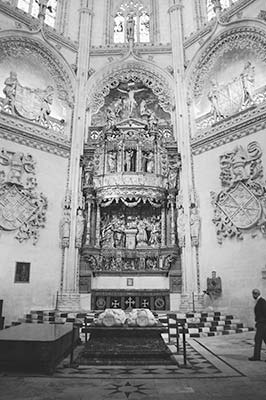
• Continuing around, you’ll walk past the beautifully carved main sacristy (#23), then enter the...
Upper Cloister (#24): The tour route takes you counterclockwise around this cloister, to a few more chapels and museum exhibits: The Corpus Christi Chapel (#26) features stairs up to the library (closed to the public) and access to the chapter house (#27), where the monks would meet.
Continuing to the Chapel of St. John the Baptist and St. James (#29), you find the cathedral’s museum collection, including ecclesiastical items (such as some exquisitely detailed crosses and chalices), an emotive statue of Christ, and an altar depicting St. James as the Moor Slayer.
• Finally you’ll head downstairs to the...
Lower Cloister (#33): At the foot of the stairs and straight ahead is a series of chambers leading off to the right. In the first is a model of the original Romanesque church (with the current Gothic footprint around it for comparison), Romanesque capitals from cathedral columns, and a sarcophagus. The second chamber emphasizes the Gothic aspects of the cathedral and contains a large model of the entire cathedral complex. Farther down the cloister, Renaissance exhibits include a restored heraldic stained-glass window and a carved nativity scene. Original sculptures from the cathedral facade are also preserved in this cloister.
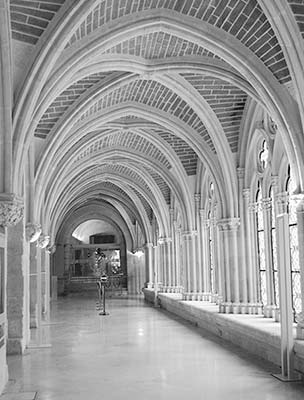
• We have one final stop. Exit through the ticket office (also contains the gift shop), and turn right, up the stairs, to the Plaza de Santa Maria to study the…
Main Facade: You can read the building’s history in this well-known view of the cathedral. French architects started the facade in the 13th century, using a simple, graceful style for its three sections: the lowest, doorway level (regretfully destroyed by a Neoclassical remodel in the 1800s); higher up, a rose window; and, above that, an openwork arcade with saintly statues. The nearly identical Gothic towers resemble those at Notre-Dame in Paris. Later, when German cathedral builders took over, the towers were topped with flamboyant openwork spires. The Virgin Mary, to whom this cathedral is dedicated, presides over the highest point of the facade, surrounded by Latin letters reading “pulc[h]ra es et decora,” meaning “You are pure and beautiful”—a fitting epithet for this cathedral.
• Your cathedral tour is done. But before leaving this square, consider climbing the staircase behind you to the…
▲Church of San Nicolás de Bari (Iglesia de San Nicolás de Bari)
This impressive little Gothic gem is tucked away above the Burgos Cathedral, along the pilgrimage route to Santiago de Compostela. Begun in 1408, its modest exterior gives no hint of the complex, filigreed 16th-century altarpiece inside. A worthy collection of Flemish tapestries is displayed in an annex.
Cost and Hours: €2; Mon, Wed-Sat 11:30-13:30 & 17:00-19:00, Sun 11:30-13:30, closed Tue; Calle de Fernán Gonzáles, +34 947 260 539.
• Retrace your way back to the main cathedral square (with the ticket office). Pass through the big arched gateway in the corner, walk out about 25 yards, and then turn around to take in the gleaming white…
Arco de Santa María
Once the main gate into old Burgos, this triumphal arch is one of 12 defensive gates (six of which survive) that protected the stout-walled city. Built in the 12th century, it was redecorated in Renaissance style in the 16th century as a sign of fidelity to Holy Roman Emperor Charles V. Charles takes the top center seat, surrounded by two judges, El Cid, and a Castilian king. The gate’s two-story interior was Burgos’s city hall from the 13th to 15th century; it now houses varied exhibits open to the public.
• With the gate at your back, turn left into the leafy…
Paseo del Espolón
When Burgos tore down its medieval walls in the 18th century, it gained a riverside esplanade ideal for strolling. There are three zones: A band of cafés and tapas bars unfurls where the wall once stood; the main promenade, lined with knobby plane trees, fountains, statues, and old-fashioned lampposts, has an almost Provençal ambience; and a riverside path is the domain of runners and dog walkers. To feel like a local in Burgos, stroll this promenade on its most popular section, between the bridges of Santa María and San Pablo. As you walk, notice the plane trees overhead, their branches carefully intertwined to form a continuous leafy canopy.
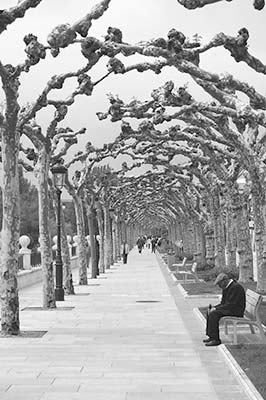
• Where the Espalón meets Plaza del Mío Cid, you’ll be greeted by an…
Equestrian Statue of El Cid
In the center of the square stands this iconic image of Burgos’ favorite son. According to legend, El Cid died on June 10, 1099, having been pierced by an arrow while defending the city of Valencia from a Moorish incursion. It’s thought, though, that he died sometime after the battle, and you can decipher clues to his demise in the position of his steed’s hooves: One front hoof on the ground and one in the air suggest he was wounded in battle but died later (in the world of hoof symbolism, two hooves up signifies an immediate death in battle; four hooves down, a peaceful death in bed).
Revered for his role as a Reconquista crusader, in truth Rodrigo Díaz de Vivar hired himself out to both Christian and Muslim leaders. He fought as a professional soldier, for his own benefit, more than as a combatant driven by ideals. Nevertheless, his life story quickly took on epic if hazily untruthful proportions, and he received honorifics in both Arabic (al-Sid, which would become El Cid—The Lord) and Spanish (El Campeador, The Valiant). La Tizona, El Cid’s famous sword, is displayed at the Burgos Museum (Museo de Burgos, closed Mon, just across the river at Calle Miranda 13, www.museoscastillayleon.jcyl.es); he and his wife are interred in a place of honor in Burgos Cathedral; and an exhibit at Arco de Santa María features his left radius (arm bone).
• From here, you can head back into the old city—this square flows right into Plaza Libertad, with restaurants and the imposing Casa del Cordón palace, where the Catholic Monarchs received Columbus after his second New World voyage.
Or, follow the tip of El Cid’s sword and cross the river to the…
▲▲Museum of Human Evolution (Museo de la Evolución Humana)
This excellent museum, housed in a glass building by the river, was inspired by a Pleistocene-era site discovered in the nearby Atapuerca Mountains, about nine miles east of Burgos. Known since the late 19th century for its abundance of hominid remains, Atapuerca continues to yield information about our earliest ancestors.
The main exhibits, with excellent English explanations, are spread over three compact levels. The ground floor (-1) details specific Atapuerca sites and discoveries, such as the 850,000-year-old skull of a Homo antecessor child and the world’s most complete pelvis fossil (400,000 years old). The next level (0) looks at the theory of evolution (with a full-size mock-up of Charles Darwin’s ship, the HMS Beagle) and examines the biology of human evolution, using a combination of actual fossils and hyper-realistic hominid replicas to trace our evolutionary path from 7 million years ago to the modern day. Aspects of cultural evolution (tool making, hunting and food gathering, use of fire, the first herders and farmers) are considered on level 1. The top level (2) has a café, a gift store, and a continuously running film on ecosystems in evolution, from savannahs to forests.
Cost and Hours: €6; open Tue-Fri 10:00-14:30 & 16:30-20:00, Sat and Aug 10:00-20:00, Sun 10:00-15:00, closed Mon year-round; €3 audioguide or download it for free, Paseo Sierra de Atapuerca, +34 947 421 000, www.museoevolucionhumana.com. You can reserve a guided visit to the actual archaeological site, but there are no tours given in English (€6, see www.atapuerca.com for details).
MONASTERIES
Burgos has two notable monasteries, Las Huelgas and Miraflores. Las Huelgas is closer to the center, and if your Spanish is good, you can join a required tour there. Miraflores, although farther from the center, sits in a lovely park, perfect for a picnic.
▲Las Huelgas Monastery (Monasterio de las Huelgas)
Founded in the 12th century as a retreat for noble women, the Cistercian monastery of Las Huelgas is still home to an order of nuns. The imposing complex contains a Gothic church (with the tombs of the founding monarchs and other royals), a Gothic cloister with Mudejar details, a chapter house with 13th-century stained glass, and a Romanesque cloister. Of particular interest is an exhibit of fabrics and royal garments of the period. The royal tombs were opened in the 1940s, and to everyone’s amazement, the 700-year-old garments turned out to be surprisingly well preserved and now form the basis of the display. Entrance is by guided tour only.
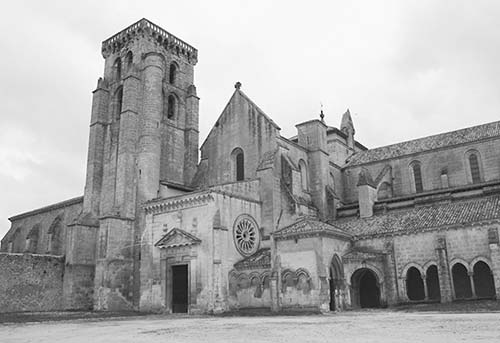
Cost and Hours: €6 required guided tour in Spanish only; 5-8 tours/day, Tue-Sat 10:00-14:00 & 16:00-18:30, Sun 10:30-15:00, closed Mon; tickets sold on-site if not sold out; otherwise reserve online at www.patrimonionacional.es; Plaza Compás, +34 947 201 630.
Getting There: It’s about a 20-minute walk west of the city center, or you can catch city bus #5 or #7 at a stop across the bridge from the cathedral.
Miraflores Charterhouse (Cartuja de Miraflores)
Built as a burial place for Isabel the Catholic’s parents, this Carthusian monastery is notable for its late Gothic church with a flamboyant altarpiece covered with gold said to have been brought back from the Americas by Columbus. Set in a large park, Miraflores is a nice destination for a pleasant two-mile walk. To get there, cross the river by Plaza del Mío Cid and turn left, following the river until you reach the monastery. Or take a taxi out and walk back.
Cost and Hours: Free, Mon-Sat 10:15-15:00 & 16:00-18:00, Sun from 11:00, +34 947 252 586, www.cartuja.org.
NEAR BURGOS
Santo Domingo de Silos
This unassuming village—about 40 miles (an hour’s drive) south of Burgos—has a fine Benedictine monastery that’s become a quirky footnote in popular music. The monastery’s monks are famous for their melodic Gregorian chants, which were recorded and released as the hugely popular album Chant in 1994. (It went on to sell six million copies.) Although the monks don’t perform concerts, some of their daily services—which are free and open to the public—include chanting. The lengthy vespers (vísperas) service is entirely chanted (daily at 19:00 except Thu at 20:00 in July-Sept, 2.5 hours); there’s also some chanting at the shorter Eucharist service (Mon-Sat at 9:00, Sun at 11:00). You can also tour the cloister and museum (€4, free on Wed afternoons; open to the public Tue-Sat 10:00-13:00 & 16:30-18:00, Sun 12:00-13:00 & 16:00-18:00, closed Mon). Call to confirm before making the trip (+34 947 390 049, www.abadiadesilos.es).
Sleeping in Burgos
$$ Hotel Silken Gran Teatro is comfortable, modern, and well located beside the river (connected by a footbridge to the Museum of Human Evolution). Prices for its 117 rooms vary wildly depending on season and view—book well in advance for a good deal (air-con, elevator, café, restaurant, free gym, pay parking, Avenida del Arlanzón 8, +34 947 253 900, www.hoteles-silken.com, recepcion.granteatro@hoteles-silken.com).
$$ Crisol Mesón del Cid enjoys Burgos’ best location, gazing across a quiet square at the cathedral’s facade (full-frontal cathedral views are worth the extra euros). The 49 rooms in two buildings come with classy tile floors and traditional furniture (air-con, elevator, restaurant, Plaza de Santa María 8, +34 947 208 715, www.eurostarshotels.com, mesondelcid@mesondelcid.es).
$$ Hotel Vía Gótica, immediately across the river from the Arco de Santa María, is ideal for drivers (and convenient for anyone). Public parking is right around the corner and the pedestrianized old town and cathedral are just steps away. The Ikea-modern rooms are basic, some with colorful photomural decor; most have tiny balconies (air-con, elevator, café, Plaza de Vega 3, +34 947 244 444, www.hotelviagoticaburgos.com, info@hotelviagoticaburgos.com).
$ Hotel Centro Burgos Los Braseros, set back a little from the street, offers modern class for reasonable prices. Its lobby hosts a popular café and its 59 rooms are a good value (air-con, elevator, request quiet room, pay parking nearby, Avenida del Cid 2, +34 947 252 958, www.hotelcentroburgos.com, reservas@hotelcentroburgos.com).
If you have a month of your life to devote to a Camino trek, consider walking it, the intended and traditional way.
The Spanish national tourism office (www.spain.info) has posted good online resources, and there’s no shortage of good Camino guidebooks and maps. Frequently updated guidebooks include A Pilgrim’s Guide to the Camino de Santiago by John Brierly, Moon Camino de Santiago by Beebe Bahrami, and Hiking the Camino de Santiago by Anita Dintaman and David Landis. For a more philosophical take, check out Walking to the End of the World by Beth Jusino, Following the Milky Way by Elyn Aviva, and On Pilgrimage by Jennifer Lash. Also look for The Way, an excellent fictionalized film account of one man’s pilgrimage, directed by Emilio Estevez and starring his father, Martin Sheen.
The procedure for walking the Camino has remained the same throughout history, though a cloak, floppy hat, walking stick, and gourd for drinking are no longer strictly required. (For more on the significance of these items and others, see the sidebar on here.) Early in the journey, pilgrims buy their “credential” (credencial)—a sort of passport—which they get stamped and dated at churches and lodgings along the way. They can also show it to stay at cheap refugios and to get a reduced pilgrim’s rate at many museums and churches en route.) At the end, pilgrims present the stamped credential in Santiago and receive a special certificate called a compostela. Only those who meet the two principal criteria qualify: You must do the pilgrimage for spiritual reasons (which has been expanded to include those who are “searching”), and you must walk at least the last 100 kilometers (about 62 miles, roughly from Sarria) or ride your bike or horse the last 200 kilometers (124 miles) into Santiago.
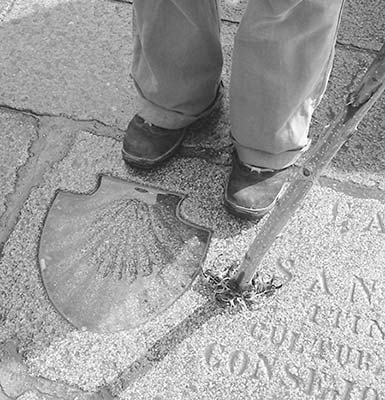
Doing the entire French Way from the border to Santiago takes about four to six weeks on foot (averaging 12-15 miles per day, with an occasional rest day—32 days is a typical Camino). Bikers can do it in about two weeks.
Pilgrims find their way thanks to the yellow arrows or scallop shells that mark pathways and intersections. Many of the trails, originally dirt paths, are now being paved. The journey itself is a type of hut-hopping: At regular intervals along the route (about every 5-10 miles), pilgrims can get a bunk for the night at humble little hostels called albergues (ahl-BEHR-gehs), refugios (reh-FOO-hee-ohs), or hospitales (oh-spee-TAH-lehs). Some of these are run by the government (€7-10/bunk, even if they’re “free,” a donation is requested; some are first-come, first-served, with priority given to credential-holding pilgrims arriving on foot—but reserving ahead is becoming more common). Other accommodations are privately run and typically a bit more expensive (€10-20—some take reservations). Those who prefer more comfort can choose from a range of simple hostales, grand hotels, and paradores (I’ve listed some in this chapter).
What began as a trek to pay homage at the tomb of St. James has evolved into a journey undertaken by anyone who just wants some time to think. Trudging step after step across endless plains toward an ever-receding horizon spurs introspection. Spiritually inclined or not, you can’t help but come to terms with your regrets, demons, “sins,” or anything else that’s on your conscience. This process of self-reflection is symbolized by picking up a small stone somewhere early on the Camino, then depositing it at the Iron Cross near the end of the trek—releasing yourself from whatever’s been weighing you down.
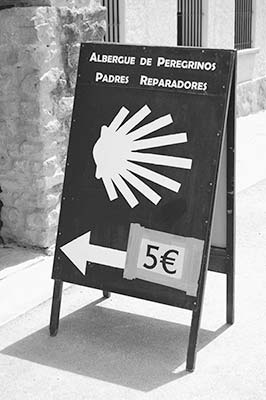
A wonderful pilgrim camaraderie percolates along the length of the Camino, as a United Nations of vagabonds—young and old—swaps stories and tips. Driving, on foot, or on bike, you’ll cross paths with the same pilgrims again and again...the guy who checked in before you at the hotel last night is at the cathedral with you the next morning. Along the way, the standard greeting is “Buen Camino!”
No matter how you get to Santiago, you’ll share in the jubilation pilgrims have felt through the ages when—four miles out of town—the spires of the cathedral come into view.
$ El Hotel Jacobeo is a comfortable no-frills option, with 18 modern rooms along a lively pedestrian street (all rooms face the back—so it’s quiet, Calle de San Juan 24, +34 947 260 102, www.hoteljacobeo.com, hoteljacobeo@hoteljacobeo.com).
¢ Pensión Peña is Burgos’ best budget option. Lively Loli, who speaks no English, rents seven simple but bright and spotless rooms (sharing three bathrooms) on the second floor of an old apartment building with a newish elevator (Calle de la Puebla 18, +34 947 206 323, +34 639 067 089, no website—reserve on Booking.com or by calling directly).
Eating in Burgos
TAPAS
The places listed here are known for their tapas, but several have dining rooms in the back or up one flight for a quieter, relaxed dining experience.
On Calle San Lorenzo: The streets surrounding Plaza Mayor are a lively place to end your sightseeing day. You’ll rub shoulders with pilgrims taking a break from the Camino and locals meeting up with friends. Calle San Lorenzo has charm and a more diverse tapas scene than elsewhere. Begin your crawl from the narrow access to the street on Plaza Mayor, working your way from traditional to modern cuisine. To sample a good Spanish wine with your tapas, try a glass of the strong local red, Ribera del Duero, or a refreshing white Albariño from Galicia. Or in summer, try a tinto de verano (literally “summer red wine”), a mix of lemonade and wine served over ice.
$$ Casa Pancho has a long, inviting bar and friendly staff who churn out tapas as old-school as many of their clientele. Their specialty is cojonuda—quail egg, blood sausage, and red pepper on bread (daily, at #13, comfortable upstairs restaurant for full meals, +34 947 203 405).
Next, cross the street to $$ Mesón Los Herreros, with an excellent wine selection, larger tapas than most, and a cojonuda that’s the spiciest thing I’ve eaten in Spain. Do a comparison taste test (daily, at #20, upstairs restaurant, +34 947 202 448).
When you’re finished, continue up to the modern $$ La Quinta del Monje. Choose among the tapas on display under glass or check the chalkboard (and QR code on the wall) for other options. Their chef offers playful variations on tried-and-true favorites (daily, at #19, +34 947 208 768). To wet your whistle, $$ El Pez de San Lorenzo makes great mint-orange vermouths (daily, at #31, +34 653 662 129).
At the far end of Calle San Lorenzo, detour left on Calle Avellanos to reach the popular La Favorita, spacious with high ceilings and big wooden beams, for tapas and charcoal-grilled meats (closed Wed, Avellanos 8, +34 947 205 5949).
On Calle Sombrerería: Several good $$ eateries are on this somewhat touristy street near the cathedral. Bar Gaona Jardin, at #29 (daily, +34 947 206 191), has a leafy interior and cooks up nice, hot tapas. Across the street at #27, Cervecería Morito is popular, with a more chaotic ambience. There’s one tight room with tables and a bar, or pay a little more to eat at the terrace across the road (cash only, daily, +34 947 267 555). At the end of the street, Rimbombín, at #6, wins awards for their tortilla española and good service (daily, +34 947 261 200).
RESTAURANT DINING
$$$ Casa Ojeda is a venerable institution that’s a reliable choice for a real restaurant meal. Specializing in roast lamb, they offer seating at the bar downstairs (only tapas and raciones served here) or in the upstairs dining room (meals served 20:30-23:00). Relax and enjoy the subdued ambience (closed Sun evening and Mon, Calle Vitoria 5, +34 947 209 052).
$$$ Rincón de España has a great location on Plaza del Rey San Fernando, close to the cathedral. It’s popular with locals for its regional dishes, including cochinillo (roast suckling pig) and cordero (roast lamb) cooked in a wood-fired oven. The restaurant often fills with wedding parties on weekends, and its outdoor terrace sports views of the cathedral spires (daily, closed Mon-Tue evenings off-season, Calle Nuño Rasura 11, +34 947 205 955).
$$ Taberna Urbana Maneli, a popular spot for both locals and visitors, is on the Camino pathway above the cathedral. It has a bar for tapas and a sit-down restaurant for lunch and dinner. Parts of the interior incorporate the old city wall dating from the 11th century. The food is homestyle and well priced, though their house specialty, roasted lamb for two, is a splurge (Wed-Sat 11:00-16:00 & 19:00-23:00, Tue and Sun lunch only, closed Mon, Calle Fernán González 36, +34 947 205 957).
Burgos Connections
From Burgos by Bus to: León (3/day, 2-3 hours), Bilbao (8/day, fewer on weekends, 1.75-3 hours), Santiago de Compostela (1/day, 8 hours), San Sebastián (6/day, 3-4 hours), Salamanca (3/day, 3.5 hours), Madrid (hourly, 10/day go directly to T4 at Barajas Airport, 2.5-3 hours). Keep in mind that Sunday connections are very sparse. Bus info: Alsa.es.
By Train to: Pamplona (5/day, 2.5-3 hours), León (5/day, 1.5 hours), Bilbao (4/day, 2.5-5 hours), San Sebastián (5/day, 3 hours), Salamanca (5/day, 2.5-4 hours), Madrid (6/day, 1.5-2 hours).
From Burgos to León
While there are some worthwhile stops between Burgos and León, this is a good place to put some serious miles under your belt: Follow signs for the A-231 expressway and zip between the cities in two hours. Sticking with the true Camino—a confusing spaghetti of roads without a single straight highway to keep you on track—takes you through a humble countryside with few sights. Some travelers enjoy dipping into towns along here such as Castrojeriz, Frómista, and Carrión de los Condes—or the slightly larger town of Sahagún, with its impressive monastery and massive bell tower—but on a tight itinerary, your time is better spent in Burgos or our next stop, León.
León
With a delightfully compact old town, central León (lay-OWN) has an enjoyable small-town atmosphere. But most important, it has a pair of sights that serve as a textbook for medieval European art styles: Romanesque (the San Isidoro Monastery, with astonishingly well-preserved frescoes) and Gothic (the cathedral, with the best stained glass outside France).
León means “lion” in Spanish—but in this case, the name derives from Rome’s seventh legion (legio), which was stationed here. Founded as a Roman camp at the confluence of two rivers in AD 68, León gradually grew prosperous because of the gold that passed through (mined in the Las Médulas hillsides to the west). In 910, as the Moors were pushed ever southward, the capital of the Reconquista moved here from Oviedo, and for three centuries León was the capital of a vast kingdom (until it was supplanted by Burgos). Today, León is the capital of one of Spain’s biggest provinces, making it an administrative and business center. It’s also a major university town, with some 15,000 students who imbue it with an enjoyable vitality.
Orientation to León
León, with 130,000 people (200,000 in the metro area), sits along the Bernesga River. On a short visit, tourists can ignore everything outside the rectangular old town, which sits a few blocks up from the river.
TOURIST INFORMATION
León’s TI is on the square facing the cathedral (Mon-Sat 9:30-14:00 & 17:00-20:00, mid-Sept-June Mon-Sat 9:30-14:00 & 16:00-19:00; Sun 9:30-17:00 year-round; Plaza de Regla 2, +34 987 237 082, www.leon.es).
HELPFUL HINTS
Grocery: There’s a handy Carrefour Express at Calle Ancha 7, just a few steps from the cathedral (daily).
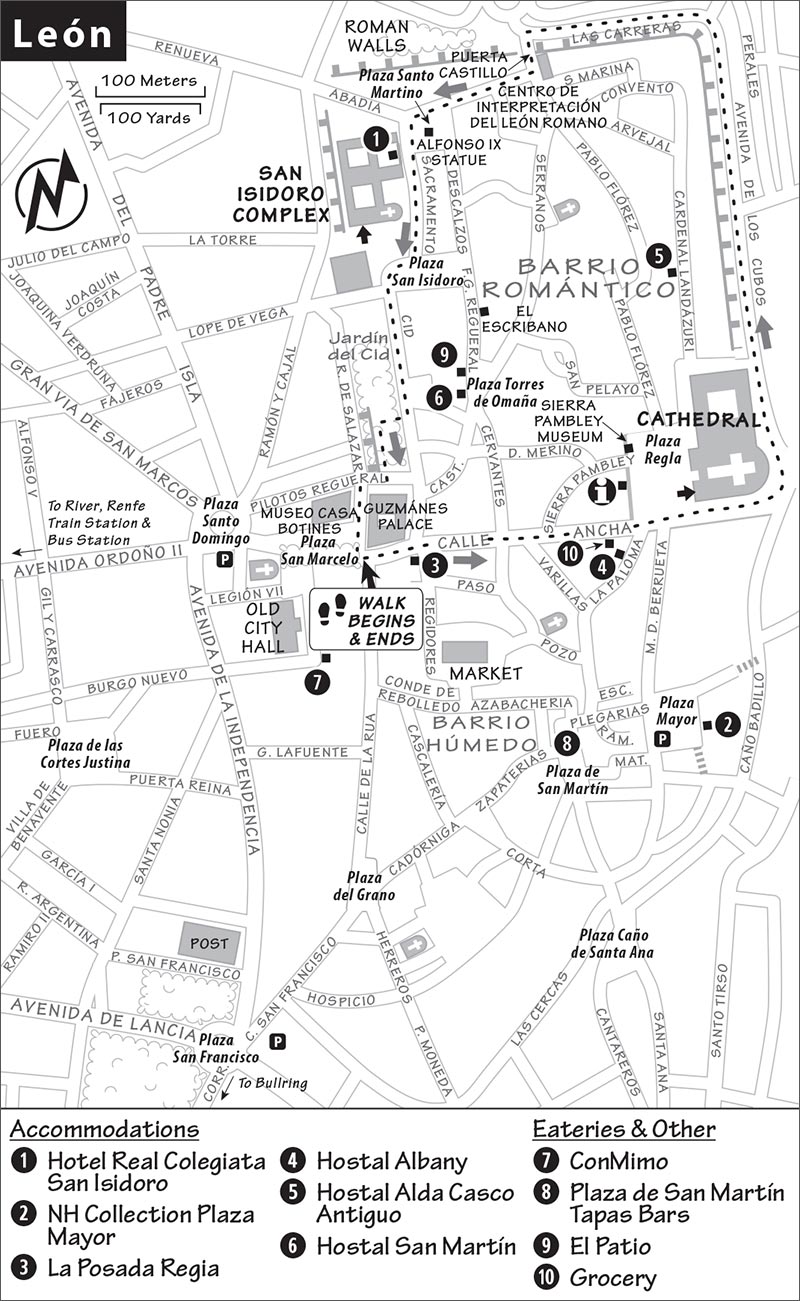
Taxi: Call +34 987 261 415 or +34 987 070 305 (www.radiotaxileon.com).
Local Guide: The engaging Blanca Lobete is an excellent teacher who happily shares León’s history and architectural gems with travelers (€130/2.5 hours, +34 669 276 335, guiaslegio@hotmail.com).
Souvenirs: Calligrapher/illustrator Antonio runs El Escribano, a browse-worthy shop in the Barrio Romántico where you can get a personalized Camino map (Calle Fernando González Regueral 6, +34 987 073 222).
ARRIVAL IN LEÓN
By Train or Bus: The train and bus stations are almost next to each other along the river, about a 20-minute walk from the old town. A taxi can take you into town for about €8.
By Car: Compared with the other cities in this chapter, León is not well signed. Do your best to follow centro ciudad signs to the city center; once there, park in the convenient underground garage at Plaza Santo Domingo, right at the start of the old town (and within a three-minute walk of all my recommended accommodations). Nearby Plaza Mayor also has a parking garage.
León Walk
León’s two most notable sights complement each other perfectly: the remarkable Romanesque frescoes at San Isidoro and the gorgeous stained glass of the cathedral. To connect these major sights and get a look at León’s old city center, follow this self-guided walk.
• Start at...
Plaza San Marcelo: The old City Hall (Casa Consistorial) sports a variety of flags, from national to provincial. In the plaza’s small park (at the north end of the square), you’ll find a bronze relief map depicting León’s development during three major periods. León began as a Roman military camp nearly 2,000 years ago—we’ll see some Roman defensive walls later in this walk. After the Moorish occupation of the Iberian Peninsula, the city fell into decline, but it later reemerged as the capital of a Christian kingdom. Medieval walls enlarged the city, and as evidenced by the modern street plan, León prospers to this day.
• We’ll come back to this square at the end of this walk—for now, turn toward the cathedral on the pedestrianized...
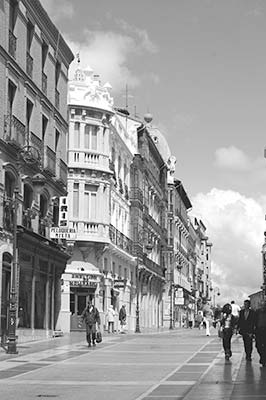
Calle Ancha: This “Wide Street” cuts through the heart of the old town. Broadened in the mid-19th century to create an appropriate pathway to the cathedral, it is lined with grand mansions of local elites who wanted to live close to God. The street retains a belle époque feel, with wrought-iron balconies overflowing with potted flowers. Closed to car traffic, it’s a much-enjoyed people zone.
Once Calle Ancha was widened, it effectively divided the old town into two distinct barrios. As you walk toward the cathedral, the neighborhood to the left is the Barrio Romántico (locals often use its older name, Barrio del Cid); to the right is the Barrio Húmedo, or “Wet Quarter,” so named for all the bars that speckle its streets (see “Eating in León,” later). With its narrow streets and irregularly shaped squares, the Húmedo neighborhood is the essence of the historic city. Deep within it is the vast Plaza Mayor, which transforms into a market every Wed and Sat morning.
• Calle Ancha deposits you at León’s monumental cathedral. Visit it now if time is tight (cathedral described below), or continue this walk with me and come back later. Hugging the right side of the cathedral, circle around to its back side, onto Avenida de los Cubos, where you’ll soon encounter…
León’s Roman Walls: Medieval Gothic soon gives way to imperial Rome along this pedestrianized avenue. What was once a tight street busy with cars is now a parklike stretch of cafés and restaurants, intermingled with shops and apartments—and those Roman walls. Strolling here, you’ll get a great view of the European tendency to live with its history.
The Romans, who had a gold-mining operation west of León, established a camp here in AD 68 that lasted until the end of the Empire. These walls are survivors from the third and fourth centuries (with some medieval repairs and additions).
• Where the wall curves to the left, you should too (onto Calle Carreras). Proceed to the arched gate, Puerto Castillo, to reenter the old city. Immediately on your left is the ...
Centro de Interpretación del León Romano: Now that you’ve seen the walls, pop into this free museum for a more in-depth look at León’s Roman era. You’ll see models of the Roman camp and city, reproductions of camp furniture, and replicas of legion weaponry; it’s also possible to walk on a short stretch of the walls (daily 10:00-21:00, closes at lunch Sat-Sun).
• Leaving the museum, head straight ahead (with the Roman wall on your right) into Plaza Santo Martino.
The main feature of the square is a statue of Alfonso IX, king of León (r. 1188-1230), who is remembered for granting a voice to ordinary townspeople in his royal council; he also founded the University of Salamanca in 1218.
• Alfonso is facing the salmon-colored walls of the...
Real Colegiata de San Isidoro: Part of the monumental San Isidoro complex of basilica, cloister, and museum, this historical structure once housed about 100 Augustinian monks within its 11th-century walls. Over time, the number of monks dwindled, and by 1956 only four remained. Unable to sustain itself, the chapter converted to a secular institution but with some pastoral obligations (a few church canons still live here). As a result, this part of the complex was converted to a four-star hotel in the early 2000s, where guests now pay to stay in the (redecorated) monks’ cells (see hotel listing, later).
• From the hotel, turn down narrow Calle Sacramento. You’ll soon emerge onto…
Plaza San Isidoro: On this square, you’ll find other elements of the San Isidoro complex, including its Romanesque church and its excellent museum (see its listing under “Sights,” later).
Plant yourself in front of the church entrance. The door on the far right is a puerta del perdón (door of forgiveness); Camino pilgrims too weak to carry on to Santiago de Compostela could pass through or touch this door to gain absolution without finishing their trek. Notice the relief of the Ascension into Heaven over the door, on the left: Christ, having trouble achieving lift-off, gets a boost from two sturdy apostles.
On the same square, at the far (east) end, you can see a 92-foot-tall, Roman-inspired column. It was put up in 1968 to commemorate the Seventh Legion of the Imperial Roman Army, whose soldiers are considered the founders of the city. On top of the column is the nest of a white stork that returns every year.
• Exit Plaza San Isidoro down Calle Cid, directly opposite the church.
A few steps along, on the left, spot the plaque dedicated to León’s favorite son, Guzmán el Bueno. This hero of the Reconquista, who famously defended Tarifa from a 1294 Moorish invasion, was born in this mansion.
• Continue down Calle Cid and pass through the tranquil Jardín del Cid, built on the site of an old convent and backed by more Roman wall. If you climb the stairs in the southwest corner of the park, you’ll have an excellent view of our next stop.
Walk back onto Plaza San Marcelo, where we started this walk, to visit...
Museo Casa Botines: This turreted Neo-Gothic building is one of just three works by Antoni Gaudí outside Catalunya (another is the bishop’s palace in Astorga, described later in this chapter). Built in 1891 as a commercial space on the lower floors and a palacio up above, it’s now a museum (see sight listing, later). Over the entry door, Gaudí placed a statue of St. George, patron saint of his native Catalunya. Notice the architect himself on the bench across the square, admiring his work.
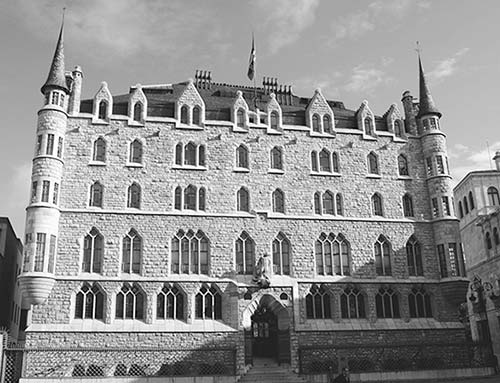
• We’ve come full circle. From here you can backtrack and enter any of the sights we’ve seen—nothing in the compact old town is more than a few steps away.
Sights in León
▲▲León Cathedral (Catedral de León)
León’s 13th-century Gothic cathedral is filled with some of the finest stained glass in all of Europe. Pray for a sunny day when you can see its gorgeous colors scattered across this monumental space.
Cost and Hours: Cathedral and cloister—€7, museum—€3, use posted QR code to download app; open Mon-Sat 9:30-13:30 & 16:00-20:00, Sun 9:30-11:30 & 15:00-20:00, shorter hours off-season; +34 987 875 770, www.catedraldeleon.org.
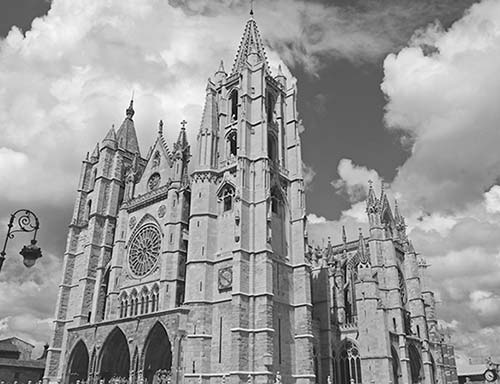
Window Restoration: The cathedral’s 737 stained-glass panels have been painstakingly restored in a decades-long project that began in the 1990s. Each window was carefully removed from its old lead frame, cleaned, and reset. Clear glass windows installed outside now protect the stained glass from the elements.
Historical Context: In the Middle Ages, Europe was in a rut—rural and sparsely populated, with peasants subjugated by their feudal masters. Churches of the era, sprinkled throughout the countryside, were mostly associated with monasteries. In Romanesque style, they had heavy stone vaults, thick walls, few windows, and huge buttresses to hold everything up.
But over time, a bourgeois class began to develop along with a new urban culture. Guilds of artisans and merchants came on the scene and city fathers, royalty, and church bigwigs celebrated their burgeoning prosperity and reinvigorated faith by erecting great cathedrals. By the 13th century, builders had figured out how to replace those bulky Romanesque vaults with airier crossed-rib vaults. Suddenly, Gothic was born: Walls could be higher and thinner, windows bigger—and filled with glass. In just one century some 200 Gothic cathedrals were built throughout Europe, as cities and towns vied with one another to erect the largest and most impressive churches.
In Spain, the appearance of Gothic style coincided with the collapse of Muslim power. With the Reconquista in hand, triumphant Christian kingdoms exerted their regained authority and importance by building cathedrals, notably in Burgos and León.
Self-Guided Tour: Before going inside, take a look at the facade.
Exterior: Built over just 50 years in the second half of the 13th century, this cathedral is a classic example of Gothic style: the pointed arches of the three porticos, the flying buttresses separating the two towers from the central nave, and all those windows. The tower on the right is a bit taller—it was capped in the 15th century with a frilly spire to keep up with what was going on in Burgos.
• Now approach the central door, above which is a carving of the Last Judgment.
Above the door, St. Michael weighs souls to determine who is going to party with the musicians of heaven (left; his scale bar is missing) or roast in the cauldrons with the demons of hell (right). If you look carefully you’ll see that all of those kicking back in heaven are members of the clergy or royalty. This subtle message made the Camino de Santiago even more appealing to pilgrims: If you weren’t a priest or an aristocrat, completing the Camino was your only ticket to eternal bliss.
• Enter the cathedral and let your eyes adjust to the light.
Interior: Notice the purely Gothic structure: extremely high walls, with columns and pointed arches directing your gaze ever heavenward, and the stained-glass windows, allowing light to take center stage. Of all this glass (the second most glass in any European cathedral, after Chartres in France), 70 percent is original, from the 13th through the 16th centuries.
Everything about the windows is meant to lead to God. The builders labored to bring to earth an image of the divine world, contemplation of which would aid in transporting the faithful to heaven—and light is essential to this purpose. Like most ancient churches, the head of the cathedral points to the east so that the sun’s first rays strike the central windows of the apse, where an allegory of Christ’s family tree is represented. As the day wears on, the sun travels across the southern windows, populated in warm hues with apostles, bishops, and martyrs—all of whose lives were illuminated by the light of God.
The windows on the north side, in cooler colors, never shine with direct light. They are reserved for the prophets and people of the Old Testament. Because these figures lived before the arrival of Christ, they could not directly experience his light—but they symbolically advance toward it, toward the east.
At the back of the cathedral, above the main door, the rose window is dedicated, like the cathedral itself, to the Virgin Mary, with 12 angels playing trumpets around her. It is onto this window and the image of Mary—the iconographic heart of the cathedral—that the sun sets every day.
Now trace the layers of Gothic cathedral construction from the bottom up, as the building (like your eyes) stretches ever higher, closer to God. The lowest level is the stone foundation (with pointed archways embedded in the walls), symbolic of the mineral world. The first windows show flowers, trees, and animals—the natural world. At the top of each nature window are three medallions showing the human world: common people doing their thing—demonstrating both vices and virtues.
• Head up the right-hand nave.
Just before reaching the transept, turn the corner to the right to view an illuminated sepulcher. This is the burial spot of Bishop Martin Fernández, counselor and friend of Alfonso X, king of Castile and León (r. 1252-1284). Driven by the vision of these two men, León—then a town of just 5,000 inhabitants—became an impressive cultural center with this cathedral as its centerpiece.
Unfortunately, this part of the cathedral almost didn’t survive a well-intended but botched Baroque-era reconstruction. A heavy dome placed over the transept proved too heavy for the four graceful main pillars, causing a significant chunk of the church to collapse. The transept’s blue (north) rose window, featuring Christ, survives from the 13th century, while the red (south) one, with Mary, is from the 19th century.
Walk into the carved wooden choir at the center of the nave. The curved wooden part over the top of each chair is a “sounding board” (tornavóz), helping voices carry. The giant glass door replaced a solid wooden one in the early 20th century—opening the church to even more of God’s light.
In the apse aisle that circles behind the main altar, locate a chapel with the 13th-century “White Virgin,” holding a child on her arm. This statue stood for centuries between the main doors of the cathedral, greeting pilgrims crossing the threshold of her cathedral.
• For a close-up look at all the decorative bits missing from the cathedral’s interior, exit on the north side to visit the cloister and museum.
Cloister and Museum: The cloister offers a good view of the flying buttresses that make the stained glass structurally possible. By removing the weight from the walls and transferring it to these buttresses, medieval engineers could build higher and make larger windows.
The cloister leads to the entrance of the museum, which is split into two sections (just follow the signs; separate admission fee and skippable for most). You’ll start in the Sala de Piedra, with fine polychromed sculptures from the cathedral and around town. Find the unique Jewish tombstones and early tiles in the display cases. You’ll also see a Visigothic antiphonary, the most complete surviving liturgical book of chants from Spain’s early-Christian days. How the chants sounded remains a mystery—modern musicians cannot transcribe them because pitches weren’t indicated. The Sala Capitular focuses on 15th- and 16th-century paintings, and the Sala del Románico has a collection of 13th-century wooden sculptures.
In the museum’s second part, you’ll find St. James on his horse, an impressive Mudéjar cabinet, and a room full of sacred vestments. Don’t get scared by the mummy glaring at you, or by the tools that look like torture instruments but are really just candle cutters.
OTHER SIGHTS IN LEÓN
▲Museo Casa Botines
Eager to attract new business, a pair of Leonese textile merchants wanted a new headquarters in their city, and they had the good fortune in 1892 to hire architect Antoni Gaudí (he designed only three buildings outside Catalunya). The Neo-Gothic building with corner turrets, wrought-iron details, and a slate roof had commercial space and warehouses on the lower floors, and fancy large apartments on the upper levels that generated rental income. This was a relatively early commission for Gaudí, and especially in the interior spaces, you can see his persistent attention to detail as he tests decorative and structural innovations that would show up again and again in his later work.
Exhibits tell the history of the building, reconstruct the sales floor and offices of the textile business, and delve into Gaudí’s creative genius. You’ll also pass through the rooms of an apartment, with some original furniture, of one of the 19th-century owners. Although the textile company gave up the building in 1929 and it operated mostly as a bank in the succeeding years, the structure was not much modified—handrails, doorknobs, and windows still have that Gaudí touch.
Gaudí added the sculpture of St. George that presides over the entry. Made of porous limestone, it deteriorated in León’s wet weather and in 1953 was taken down so a replica could be made. To everyone’s amazement, a pipe hidden away inside the dragon was found to contain the original plans for the building, complete with Gaudí’s signature.
Cost and Hours: €7, Wed-Mon 10:00-19:00, Fri-Sat until 20:00, closed Tue year-round; gift shop Plaza de San Marcelo 5, +34 987 353 247, www.casabotines.es.
Sierra Pambley Museum
Behind its plain facade, this building on the cathedral’s plaza contains the well-preserved if musty living quarters and reception rooms of a 19th-century businessman. Its authentic wallpapers, carpets, furniture, and fabrics will be of most interest to decorative-arts fans. There’s an unusual backstory: The owner built the house—complete with children’s rooms—to entice the woman he hoped to marry, but she turned him down anyway (and he died single).
Cost and Hours: Museum, guided 45-minute visits only—€5, Wed-Sun timed entrances at 11:00, 13:00, 17:00, and 19:00 (stop by to put your name on the list for a tour), closed Mon-Tue; tour in Spanish but English descriptions available, Calle Sierra Pambley 2, +34 987 276 775, www.sierrapambley.org/museo.
▲▲San Isidoro Museum (Museo de San Isidoro)
The real attraction of the San Isidoro complex, an ensemble of medieval monastic buildings, is its first-rate museum. Inside you’ll see a library, a cloister, a chapter house, and a “pantheon” of royal tombs featuring some of the most exquisite Romanesque frescoes in Spain.
Cost and Hours: €5, downloadable information via QR codes, guided tour—€7, reserve ahead by two or more days for English tour (online or by email to reservas@museosanisidoro.com), Tue-Sat 10:00-14:00 & 17:00-20:00, Sun 10:00-14:00, closed Mon; shorter hours off-season; Plaza de San Isidoro 4, +34 987 876 161, www.museosanisidorodeleon.com.
Visiting the Museum: Your visit begins upstairs in the evocative old library, holding some 2,000 books spanning the 10th to 18th centuries. Marvel at the size of the Gregorian chant books lined up in the foyer, and note the rare Visigothic-Mozarabic Bible from 960. The monks who made it came from southern Spain, so while the text is written in Latin, its marginal notes are in Arabic. Perfectly preserved, it’s not missing a single one of its 514 parchment leaves, whose colorful illustrations vividly capture the architecture, dress, plants, and animals of the 10th century.
In the tower alongside the library sits one solitary precious piece—an onyx chalice studded with gems. The body of the chalice is made of two ancient Roman cups, strapped together by bands of stamped and filigreed gold, and decorated with amethysts, sapphires, and emeralds. Local legend asserts that Christ used one of the cups at the Last Supper.
Now skirt around the upper level of the cloister and descend the stairs to enter the chapter house (sala capitular). This is a showcase for a glittering assortment of Romanesque reliquary chests and luxury items for medieval kings. You can’t miss the huge seventh-century metal rooster—until recently, it sat upon the church tower as a weathervane. Its metal has been identified as Persian in origin, but no one has (yet) figured out how it ended up in León.
Finally, you’ll come to the Royal Pantheon (Pantéon Real). Built in the 11th century by the king and queen of León, the pantheon contained the tombs of 33 kings, queens, and infantes (children of the monarchs).
But who’s buried here pales in comparison to the beautiful, vivid frescoes on the vaulting above them. Created in the late 11th and early 12th centuries, these frescoes have never been repainted—they’re incredibly well preserved. While most Romanesque frescoes have been moved to museums, this is a rare opportunity to see some in situ, where the artist and patrons originally intended.
Follow along as the frescoes trace the life of Christ (go clockwise, starting on the wall in the front right corner with the cloister on your left). The angel Gabriel visits Mary in the scene of the Annunciation, and above that (on the ceiling in the corner) an angel appears to shepherds dressed in traditional 11th-century Leonese clothing. There’s even a Leonese mastiff dog, lapping at his master’s milk (while he’s distracted by the angel).
In the next ceiling section (closer to the entry), Roman soldiers carry out the gruesome slaughter of the innocents. Then it’s time for the Last Supper (middle section of the ceiling). As you take in the bold colors, notice that only 11 of the apostles have halos...all but Judas (under the table). In this fresco’s corner, find the black rooster (gallus), a symbol of Jesus, who harkened the dawn of a new day for God’s people. But in the next section we see the rooster used as a different symbol—as Peter denies Christ three times before the cock crows. Also see Jesus’ arrest, Simon helping Jesus carry the cross, and Pontius Pilate washing his hands of the whole business. Finally (on wall, left of main altar) we see Jesus nailed to the cross.
The final panel, in the middle of the room, is the most artistically and thematically impressive: Jesus returning triumphant to judge the living and the dead. He’s depicted here as Pantocrator (“All Powerful”). Over his shoulders are the symbols for alpha and omega, and he’s surrounded by the four evangelists, depicted—according to the prophecy of Ezekiel—as winged creatures: angel, bull, eagle, and lion.
An interesting detail is the calendar running along the archway near Jesus’ right hand. The 12 medallions—one for each month (labeled in Latin)—portray typical activities during that month. In January, a man closes one door (or year) while he opens the next. He proceeds to warm himself by the fire (February), prune (March), plant his crops (April), harvest (July), pick wine grapes (September), forage (October), slaughter the fattened pig (November), and bless his bread by the fire (December).
Sleeping in León
These listings are all inside the old town—the best place to stay in León.
$$$ Hotel Real Colegiata San Isidoro gracefully occupies a historic building that was once the monastery of the San Isidoro complex. Its former monks’ cells have been remodeled into 40 serenely tasteful rooms, all surrounding a restful garden cloister. Guests receive free guided tours of the San Isidoro basilica and discounted tickets to the museum (air-con, elevator to upper floors, free parking, Plaza de San Martino 5, +34 987 875 088, www.hotelrealcolegiata.es, reservas@hotelrealcolegiata.es).
$$$ NH Collection Plaza Mayor is the old-town splurge, with 51 rooms right on Plaza Mayor (some with views). Part of a classy chain, this place offers modern four-star comfort (air-con, elevator, Plaza Mayor 15, +34 987 344 357, www.nh-hotels.com, nhcollectionplazamayor@nh-hotels.com).
$ La Posada Regia is a creaky traditional little hotel with 36 rooms just off the main walking street. The old-fashioned, pleasant decor is a combination of wood beams and patches of stone (restaurant, pay parking nearby, Regidores 9, +34 987 213 173, www.regialeon.com/posada-regia, marquitos@regialeon.com).
$ Hostal Albany offers 19 very mod rooms at a reasonable price, just a few steps off the main walking street and cathedral square (reception not always staffed—best to confirm arrival time and get self-check-in details, air-con, elevator, Calle La Paloma 13, +34 987 264 600, http://grupoalbany.com, recepcionalbany@gmail.com).
$ Hostal Alda Casco Antiguo, with 16 inviting rooms, is situated on a quiet street just next to the cathedral. There’s a common area and on-site reception until 15:00; after that, you’ll check in with a code (air-con, elevator, Calle Cardenal Landázuri 11, +34 987 620 050, www.aldacascoantiguo.es, cascoantiguo@aldahotels.com).
$ Hostal San Martín is a good budget option in a great location, run by friendly Esperanza and Fernando. It has 11 comfortable rooms (some with shared bath); some overlook a noisy-at-night tapas square—ask for an interior room (cozy lounge; Plaza Torres de Omaña 1—located up the stairs on the second floor; +34 987 875 187, www.sanmartinhostales.es, sanmartinhostal@hotmail.com).
Eating in León
León is one of a few Spanish cities whose bars still honor the tradition of giving a free (if modest) tapa to anyone buying a drink. In many bars the menu includes limonada, a Leonese drink of chilled red wine mixed with cinnamon, lemon, sugar, and sometimes other fruit.
It’s not hard to find good eats in León. Stroll the Barrio Húmedo area, south of Calle Ancha, or the Barrio Romántico, north of Calle Ancha. Both zones are packed with restaurants and bars offering good food and ambience. If you prefer a more refined atmosphere, try the cafés and restaurants that line Plaza San Marcelo. ConMimo, at #15, has an informal bar and more serious dining upstairs. Come here for fresh takes on old standards, such as croquetas de kimchi or grilled shitakes with toasted onion sabayon (+34 987 045 350).
Plaza de San Martín Tapas Crawl: In the Barrio Húmedo, locals head for Plaza de San Martín to eat and drink. Survey the many little bars on or near the square, noting how locals know each bar’s specialty and generally stick to that dish when ordering. Consider these joints: $$ Tabierna Los Cazurros is a popular hangout with delicious morcilla (+34 987 252 233). $ Mesón Jabugo, next door, has a wide range of tapas—try the local specialty cecina de León—beef that has been salted, sun-dried, and smoked (#6, +34 620 982 186). If you’re still hungry, $$ Mesón el Tizón fills one tight room with a bar in front and seating in back—order hot raciones from its chalkboard menu (closed Mon, Calle de las Carnicerías 1, +34 987 256 049). At the other end of the square (#8), El Racimo de Oro has a charming half-timbered interior, with a bar for tapas up front and dining rooms upstairs and down (+34 987 214 767).
Just off the square are two restaurants offering tasty local cured meats and hearty regional stews: $$ La Bodega del Húmedo (Calle Plegarias 8, +34 987 076 128) and $$ Bar El Altar (Calle Plegarias 7, +34 987 031 028).
Barrio Romántico: There’s plenty of tapas action on the Barrio Romántico side of Calle Ancha, especially on Calle Cervantes and Plaza Torres de Omaña. Stroll and take your pick. El Patio, right on the square, is a sloppy fun oasis, with rickety tables set under trees in a side patio (+34 987 033 355).
León Connections
From León by Bus to: Astorga (hourly, 50 minutes), Burgos (3/day, 2-3 hours), Lugo (8/day, 4.5 hours), Santiago de Compostela (1/day, 6 hours), Madrid (10/day to Estación Sur, 4 hours; 6/day direct to Moncloa and Madrid Barajas Airport, 4 hours). Bus info: Alsa.es.
By Train to: Burgos (4/day, 2 hours), San Sebastián (2/day, 5-6 hours), Pamplona (2/day, 4.5 hours), Santiago de Compostela (1/day direct, 4.5 hours; 2/day with transfer in Ourense, 6.5 hours), Madrid (8/day, 2.5-5 hours).
From León to Galicia
This section, arguably the most diverse stretch of the Camino, begins in the flatness of the Meseta Central around León. Then, around Astorga, the landscape gradually becomes more varied and lush, as the Camino approaches the mountainous El Bierzo region (the northwest fringe of Castile and León).
In its final stretch, the Camino leaves the broad expanse of the Meseta Central and climbs steeply into Galicia (gah-LEE-thee-ah). Green and hilly, Galicia shatters visitors’ preconceptions about Spain. There’s something vaguely Irish about Galicia—and it’s not just the mossy stonework and green, rolling hills. The region actually shares a strain of Celtic heritage with its cousins across the Cantabrian Sea. People here are friendly, and if you listen hard enough, you might just hear the sound of bagpipes.
• Begin by making your way west, to Astorga. You can stay on the N-120 highway or pay a toll to zip there more quickly on the AP-71 expressway.
ASTORGA
Astorga (ah-STOR-gah) sits at the intersection of two ancient roads: the Camino and a north-south trade route from Sevilla to the north coast. When León was a humble Roman camp, “Asturica” was the provincial capital. But today the fortunes are reversed, as sleepy Astorga (with about 11,000 people)—just big enough to have some interesting sightseeing and good hotels and restaurants—is a nice small-town alternative to the big city of León.
The main attraction here is the memorable bishop’s palace by Antoni Gaudí. On a sweet side note, Astorga’s connection to chocolate dates back to the 16th century, when Hernán Cortés brought the cocoa bean from Central America to Spain. Some even claim that Astorga is the European birthplace of chocolate. The local industry peaked in 1925 with 51 chocolatemakers in business. Today there are only a few left, but chocolate can be found everywhere.
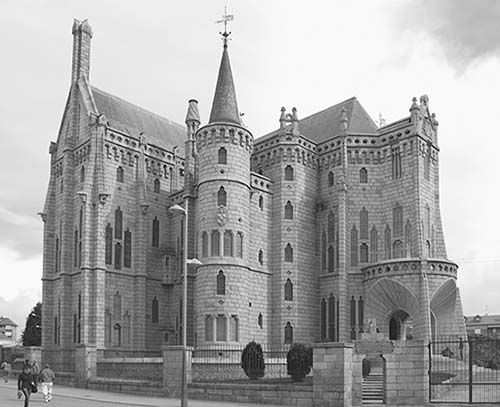
About half of the city is still belted by stout Roman walls (started in the late third century). To get a memorable view of them, enter the town from its northwest side, where the bishop’s palace and the cathedral loom over the walls.
Tourist Information: Astorga’s TI sits directly across from the bishop’s palace (daily 10:00-14:00 & 16:00-19:00, shorter hours off-season and closed Sun afternoon and all day Mon, Plaza Eduardo de Castro 5, +34 987 618 222, www.turismoastorga.es [URL inactive]).
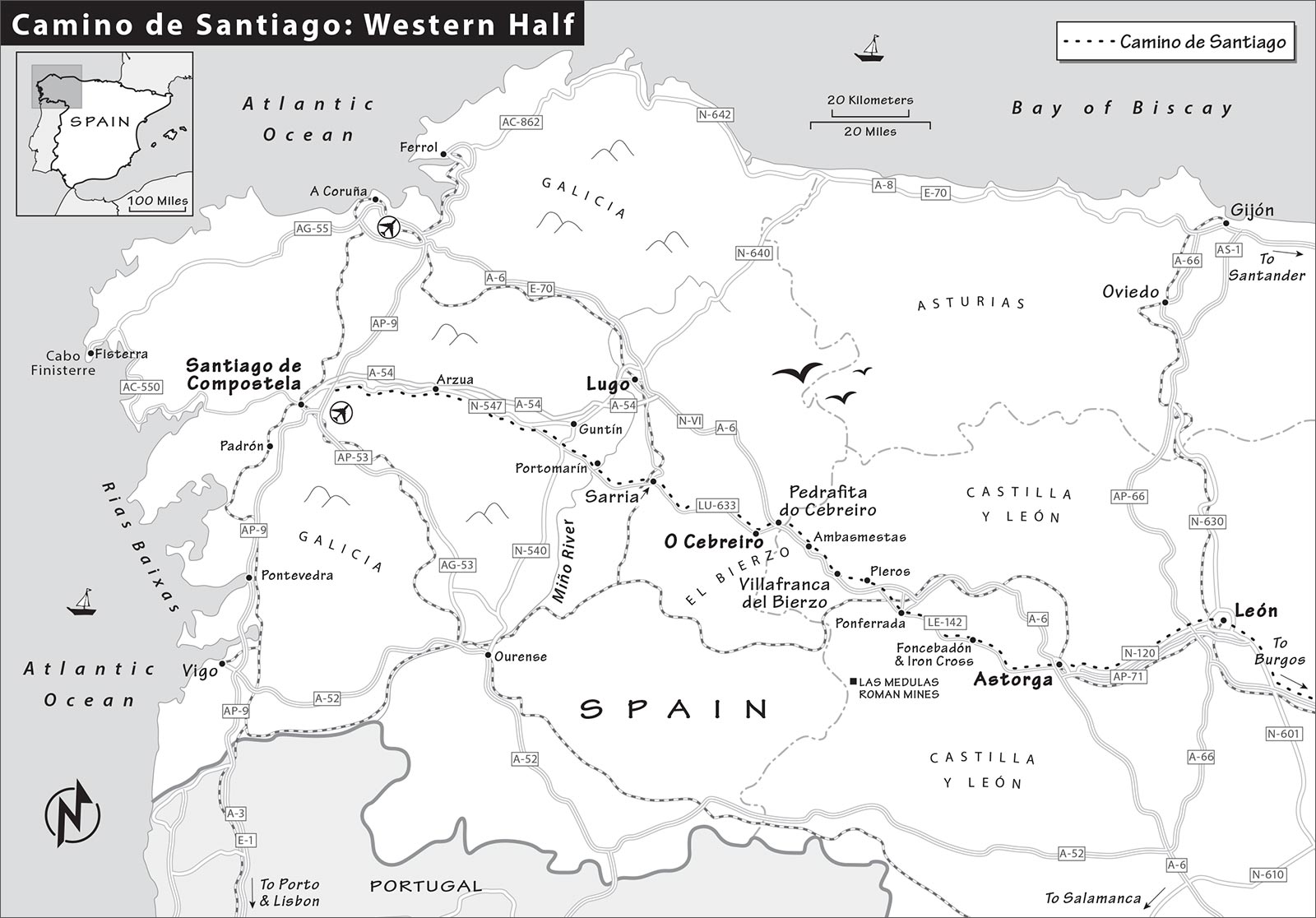
Arrival in Astorga: The bus station is just outside the old town, across from the bishop’s palace; the train station is on the outskirts, a 15-minute walk from the palace. Drivers follow signs for Centro Ciudad and Centro Urbano, drive through the middle of town, and park in front of the TI and cathedral (pay and display). Or park below the cathedral outside the Roman wall for free.
Sights in Astorga: The striking Gaudí Palace (Palacio de Gaudí), rated ▲, is a fanciful Neo-Gothic castle that verges on the Disneyesque (€6, includes downloadable audioguide; daily 10:00-14:00 & 16:00-20:00, shorter hours off-season, +34 987 616 882, www.palaciodegaudi.es). Gaudí took on the commission after a fire destroyed an earlier episcopal building. But when the sitting bishop died midway through construction, Gaudí butted heads with the church fathers and he quit the project. A diocesan architect completed the building, doing his best to adhere to Gaudí’s plans.
Inside you’ll be directed to start your visit on the top (second) floor and work your way down. But I’d skip the skimpy temporary exhibits on level two and start with level one, where you can see Gaudí’s genius in the fine chapel, study, dining room, and reception room designed for the bishop’s personal and official use. The rest of the palace hosts a museum of the Camino that provides a safe place for some of the region’s fine medieval church art. You’ll see a 17th-century statue of Pilgrim James, a few historical Camino documents, ecclesiastical gear, and a gallery of contemporary Spanish art from the surrounding region.
Next to (and upstaged by) the palace is Astorga’s late Gothic cathedral, with a carved choir and a chapel to St. James that is popular with pilgrims. Tourists can’t enter the cathedral directly: You must first wind through a substantial collection of paintings, altarpieces, and vestments. If you’ve been inside the cathedrals at León or Burgos, skip this interior and simply admire the building’s encrusted facade, with three portals flanked by square towers joined to the main body by flying buttresses (€6, includes downloadable audioguide, daily 10:00-20:30 but closes for Mass, shorter hours Nov-March, www.catedralastorga.com).
If you have extra time and love chocolate, the 10-minute walk from the cathedral to the Chocolate Museum (Museo del Chocolate) is well worth it (although most displays are in Spanish only). Follow the signs on Avenida de la Estación to an elegant yellow mansion and the museum (€4, Tue-Sat 10:30-14:00 & 16:30-19:00, Sun morning only, closed Mon, Avenida de la Estación 16, +34 987 616 220). Inside, the exhibits explain artisanal chocolate production, which has been a part of the local economy since the 18th century. On your way out, you’ll be treated to a few samples in the little shop. You can find several small stores selling artisanal chocolate (along with mantecadas, local muffin-like pastries) on the street leading from the cathedral to Plaza España.
Sleeping in Astorga: Small-town Astorga is a good alternative to the big city of León (though values here are no better than in the city).
$$ Hotel Gaudí has 35 woody rooms over a restaurant across from the cathedral; some have picture-perfect views of the bishop’s palace (air-con, elevator, pay parking, Plaza Eduardo de Castro 6, +34 987 615 654, www.gaudihotel.es, reservas@gaudihotel.es).
$$ Hotel Astur Plaza has 40 rooms right on the main square. Choose between a room overlooking the square—with a clock tower that clangs every 15 minutes—or a quieter back room. They offer spa access at their sister hotel for weary pilgrims (air-con, pay parking, Plaza de España 2, +34 987 617 665, www.exeasturplaza.com, reservas@exeasturplaza.com).
$$ Hotel Spa Ciudad de Astorga has 33 rooms with contemporary decor, a pleasant patio, and a spa with garden terrace. It’s about three blocks from the cathedral (air-con, pay parking, Calle de los Sitios 7, +34 987 603 001, www.hotelciudaddeastorga.com, call-center@portblue.com).
Eating in Astorga: A couple of blocks from the cathedral right along the Camino, the charmingly old-fashioned $$ Restaurante Las Termas is known for its traditional slow-cooked stew, cocido maragato (open for lunch only, closed Mon, Calle Santiago 1, +34 987 602 212). $$ Hotel Gaudí, listed earlier, has an atmospheric bar with tapas and raciones, as well as a restaurant (open daily).
Connections: Astorga is well connected by bus to León (hourly, 50 minutes), Ponferrada (hourly, 1 hour), Villafranca del Bierzo (3/day, 2 hours), Lugo (8/day, 2-3 hours), and Santiago de Compostela (5/day, 5 hours).
• After Astorga, you can either zip toward Lugo on the quick A-6 expressway (toward Ponferrada) or stick with the Camino a bit farther south on a much slower and twisty regional byway (LE-142). Driving this tiny ribbon of a road and stopping to see the Iron Cross, Villafranca del Bierzo, and O Cebreiro will add considerable time to your travels, but the wooded hills and valleys will bring you closer to the Camino experience. You can’t hurry here.
If you’re sticking with the Camino, you’ll drive about 35 minutes before passing the little stone village of Foncebadón. Soon after, you arrive at the...
IRON CROSS (CRUZ DE FERRO)
No one seems to know how this iron cross atop a spindly wooden pole came to be set in a huge pile of stones on the side of the Camino. Some say that St. James himself erected the cross; others say the Romans used the spot to mark a boundary. The pile has been built up over the years by pilgrims who, according to tradition, bring a rock from home (or picked up en route) and place it at the foot of the cross as a symbol of leaving one’s burdens behind. It’s a major landmark for Camino pilgrims, who seek a moment of peace here (even though it’s directly next to the road).
• The LE-142 and A-6 converge again at the small city of Ponferrada. Soon after, A-6 climbs up into the hills to the town of Villafranca del Bierzo.
VILLAFRANCA DEL BIERZO
Villafranca is the capital of El Bierzo, the westernmost part of the province of León. Dubbed “Little Compostela” for its array of historical buildings, the town is set in an attractive hilly terrain strewn with grapevines, cherry trees, and vegetable patches. The ancient Codex Calixtinus (12th-century guidebook) lists the town as the 10th stop on the Camino, and it’s worth a look for its pilgrim ambience.
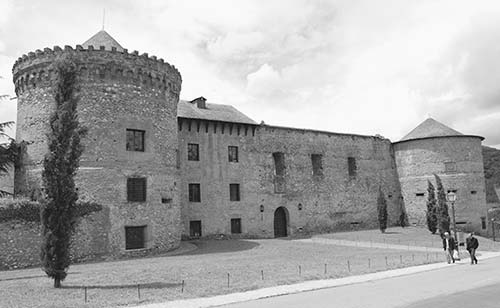
Tourist Information: The friendly TI is at Avenida Díaz Ovelar 10 (daily 10:00-14:00 & 16:00-20:00, shorter hours off-season and closed Mon, +34 987 540 028, www.villafrancadelbierzo.org). Plenty of free parking is available near the TI, just past the main square and the big pilgrim’s refugio in the center of town.
Sights in Villafranca: To play pilgrim, hike from the main square up to the town’s stout 16th-century castle (not open to the public). Then follow signs for Iglesia Románica, the Romanesque 12th-century Church of Santiago. This simple church is an important one, for it’s only the second church on the Camino to have a “door of forgiveness” (puerta del perdón, on the side facing the town; the first one is in León). Thanks to a 16th-century papal ruling, if a pilgrim had come this far, fell ill, and couldn’t continue over the rugged terrain to Santiago, he or she was pardoned anyway. (Handy loophole.)
Next to the church is the Albergue Ave Fénix, a funky dorm with oodles of pilgrims bonding. It was built on the site of a medieval clinic that cared for those who needed to take advantage of the puerta del perdón (at the time, the clinic here was the only source of medical aid for 300 miles). Today this albergue provides bunks to thousands of pilgrims a year. They even have a separate room for snorers. If you’d like to learn about the system (or buy a scallop shell), stop in. It’s run by Jesús, who welcomes curious nonpilgrims.
Sleeping and Eating in Villafranca: Fancy pilgrims will find a comfortable and economical stay at $ La Puerta del Perdón, warmly run by Daniel. A couple of the seven rooms in this 16th-century building have low, angled ceilings, so taller travelers may need to duck. The fine little restaurant is open for lunch and by reservation only for dinner (open Tue-Sun, no dinner on Sun, facing the castle on the uphill side a block below the Church of Santiago at Plaza de Prim 4, +34 987 625 904, www.lapuertadelperdon.com, info@lapuertadelperdon.com).
• Just after Villafranca del Bierzo on the A-6 expressway, you cross into the final region on the Camino: Galicia.
Shortly after entering Galicia, take the freeway exit and follow signs to Pedrafita do Cebreiro. From Pedrafita, a well-maintained mountain road (LU-633) twists its way up to the classic Galician pilgrim village of O Cebreiro. The road has plenty of pullouts for photo ops. The town itself is not well marked; turn off at Conxunto Histórico-Artístico for parking.
O Cebreiro
An impossibly quaint hobbit hamlet perched on a ridge high above nothing, O Cebreiro (oh theh-BRAY-roh) whispers “Welcome to Galicia.” This once-isolated village—now within a five-minute drive of the freeway—evokes an uncomplicated past, when people lived close to nature in stone igloos with thatched roofs. With sweeping views across the verdant Galician landscape, O Cebreiro is dreamy when the sun shines, but it can be pummeled by some of the fiercest weather in Spain.
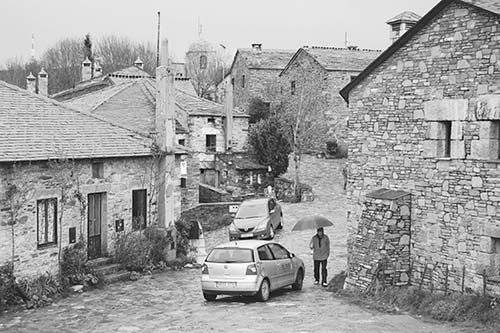
Wander around. Enjoy the remoteness. Get a snack or drink at a bar, or browse through a gift shop. A few townspeople (who jabber at each other in Galego—see here) share the town with weary pilgrims on an adrenaline high after finally reaching Galicia. The town’s dogs, who’ve known each other their whole lives, still bark at each other territorially from across the street, completely ignoring the backpackers who regularly trudge through town.
Sights in O Cebreiro
▲Ethnographic Complex of O Cebreiro (Conjunto Etnográfico de O Cebreiro)
From Celtic times 1,500 years ago right up until the 1960s, the villagers of O Cebreiro lived in humble round stone huts with peaked thatched roofs, called pallozas. Configured to sustain the weight of snow and withstand fierce winds, the structures are ideally adapted to their setting. For years, a village priest loosely ran one palloza as a museum while conducting other pilgrim business. But now, administered by a governmental entity, the museum consists of four surviving pallozas with exhibits of furniture, textiles, tools, and other artifacts of mountain life.
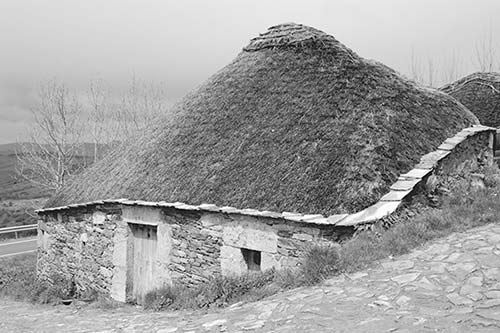
Cost and Hours: Free, hours vary with hut caretaker’s schedule, generally Tue-Sat 8:30-14:30, off-season 11:00-18:00, closed Sun-Mon year-round, https://museos.xunta.gal. If a door of a round hut is open, poke inside.
Visiting the Huts: Here visitors can learn about the lifestyle of the people who lived in pallozas until not so long ago. Upon entering a palloza, you’ll find the only “private” room in the house, belonging to the parents. Beyond that is a living area around a humble fire. (Notice there’s no chimney—smoke seeps out through the thatch.) Ponder the ancient furniture. Surrounding the fire are clever benches (which were also used by the kids as very hard beds) with pull-down counters so they could double as a table at mealtime. The big beam with the chain could be swung over the fire for cooking. Looking up, you’ll see the remains of a wooden ceiling that prevented sparks from igniting the thatch. The giant black-metal spirals suspended from the ceiling were used to smoke chorizo sausage—very efficient.
Attached to this living area is a miniature “barn.” Animals lived on the lower level, while people slept—kept warm by all that livestock body heat—on the upper level (which has been removed, but you can still see on the wall where the floor was once supported). About a dozen people (and their animals) lived in one small hut. But thanks to the ideal insulation provided by the thatch, and the warmth from the fire and animals, it was toasty even through the difficult winter.
▲Church of Santa María la Real (Iglesia de Santa María la Real)
All roads lead to the village church. Founded for the Benedictine order in the year 836—not long after the remains of St. James were found in Santiago—this pre-Romanesque building is supposedly the oldest church on the entire French Way of the Camino.
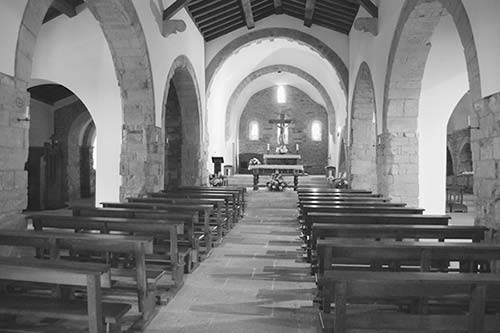
Cost and Hours: Free, daily 9:00-13:00 & 15:00-20:00.
Visiting the Church: Before entering, look to the right and find the bust of Elías Valiña Sampedro, a former priest well known for his work on the revival of the Camino. He was the first to paint the invaluable yellow arrows that pilgrims follow.
The interior is surprisingly spacious but very simple. Notice the sunken floor: The thick slate and granite walls are dug into the ground for added stability against winter storms, and the bell in the tower is said to have been rung to guide pilgrims when visibility was poor. At the desk inside they stamp pilgrims’ credentials and sell votive candles. (I don’t think there’s anything wrong with giving your guidebook an O Cebreiro stamp—I did.)
In the chapel to the right of the main altar is a much-revered 12th-century golden chalice and reliquary, which holds items relating to a popular local miracle: A peasant from a nearby village braved a fierce winter snowstorm to come to this church for the Eucharist. The priest scoffed at his devotion, only to find that the host and wine had turned into the body and blood of Christ, staining the linens beneath them, which are now in the silver box.
Sleeping and Eating in O Cebreiro
O Cebreiro is popular with pilgrims but has only about 100 beds on offer—reserve ahead if you want to sleep here. The town has a half-dozen pub-restaurants, which feed pilgrims and other visitors hearty Galician cuisine in a communal atmosphere; many also rent out a few rooms. With inclement weather, doors are often closed—don’t be shy; just walk right in. While some rooms are rustic, they’ll have everything you need.
Try $ Hotel O Cebreiro, close to the village church, with five comfortable rooms and a homey bar/restaurant downstairs (+34 982 367 182, www.hotelcebreiro.com, informacion@hotelcebreiro.com). On the small main square, find ¢ Casa Navarro—a casa rural with a handful of cozy, second-floor rooms—run by friendly owner José (+34 982 367 007, www.casaturismoruralnavarro.com, info@casaturismoruralnavarro.com). At ¢ Casa Antón, you’ll find cozy rooms and get personal attention from helpful Diego (also offers mountain bike rental, call to reserve—+34 638 350 753, https://hostal-meson-anton.negocio.site). The ¢ albergue, perched on a hill at the edge of town, is open only to pilgrims.
ROUTE TIPS
From O Cebreiro you’ve got another route decision to make.
To stick with the Camino, you’ll continue on LU-633, along twisty roads, toward Santiago. Along the way you’ll pass through some interesting larger towns. Samos has a gigantic monastery and perfectly manicured cloister garden. Sarria is forgettable, but it’s just over 100 kilometers (62 miles) from Santiago, making it a popular place to begin a truncated pilgrimage (since you need to walk at least that far to earn your compostela certificate). Portomarín is a relatively new town, built only after the River Miño was flooded to create a reservoir in the 1950s. The stout and blocky late-Romanesque Church of San Juan was moved to a new site, stone by stone—and if you look closely enough you can see how the stones were numbered to keep track of where they fit.
I prefer the faster expressway route (backtrack to A-6, which you’ll take north, following signs for A Coruña), which offers the opportunity to dip into the appealing walled city of Lugo.
Lugo
While not technically on the French Way of the Camino de Santiago, the midsized city of Lugo (pop. 98,000) warrants a detour for car travelers. Boasting what are arguably the best-preserved Roman walls in Spain—a mile and a third long, completely encircling the town, draped with moss, and receding into the misty horizon—Lugo offers an ideal place for an evocative stroll. Lugo feels like a poor man’s Santiago, with a patina of poverty and atmospherically crumbling buildings. Quirky chimneys thrust up through rickety old slate roofs. And yet there’s something proud and welcoming about the town. Aside from the walls, Lugo has a cathedral and gregarious Galician charm, making it a fine place to spend some time.
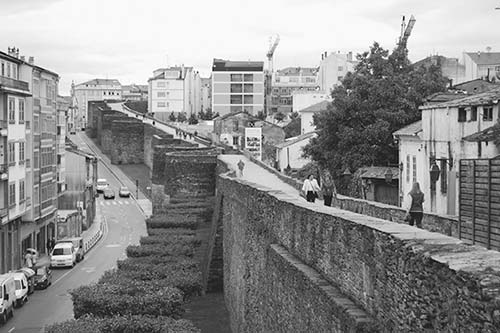
Orientation to Lugo
Tourist Information: The TI is a few steps up a pedestrian street off the Plaza Mayor, near the cathedral—look for the yellow signs (daily 10:00-20:00, shorter hours off-season; Praza do Campo 11, +34 982 251 658, http://museoslugo.gal/oficina-de-turismo-de-lugo). Inside the TI is an interpretive center describing the city’s history and Roman walls.
Arrival in Lugo: Drivers follow signs to Centro Ciudad and Centro Urbano. Once you enter the town walls, parking garages are signed for Plaza de Santo Domingo or Anxel Fole—both are centrally located. The bus and train stations are outside the town walls.
Sights in Lugo
Roman Walls (Murallas Romanas)
Lugo’s well-preserved Roman walls were erected in the third century AD to defend the city against barbarian threat. They provide a kind of circular park where locals and visitors can stroll at rooftop level (they’re some 32 feet tall and 12 feet wide). You can walk the entire way around, glancing into residents’ backyards, in about 45 minutes (you’ll find stairs near most of the gates where traffic enters the old town). With less time the most interesting stretch is along the west side of town: Walk up the ramp behind the cathedral and turn right, watching behind you for tingly views of the walls and cathedral spires.
Lugo Cathedral (Catedral de Lugo)
Lugo’s cathedral is vast, dark, and dusty, and like many cathedrals built and rebuilt over centuries, it shows a plurality of styles (in this case, from late Romanesque and onward). It has an unexpected Rococo altarpiece glittering with silver and a notable choir carved from walnut in the 17th century. While it’s a lovely cathedral, it pales in comparison to Santiago’s.
Cost and Hours: Cathedral, cloister, and museum—€6; open Mon-Sat 9:30-19:30, Sun 10:00-18:30, shorter hours off-season; guided tour of roofs and towers offered Fri-Sat; +34 683 166 703, www.catedraldelugo.es.
Sleeping in Lugo
While many travelers will want to continue to Santiago de Compostela (about an hour away) to spend the night, there are some options here. The following two hotels are the only ones inside the old town, although Airbnb listings can be found throughout.
$$ Pazo de Orban e Sangro is the town splurge, renting 12 light and airy rooms with hardwood floors and luxurious furnishings in an 18th-century manor house. It’s just inside the town walls near the cathedral (some with views of the walls, air-con, elevator, pay parking, Travesía Miño, +34 982 240 217, www.pazodeorban.es, info@pazodeorban.es).
$ Hotel Méndez Núñez, on the edge of the old town, is a business-class place, with 70 serviceable renovated rooms (air-con, elevator, pay parking nearby, Rúa da Raiña 1, +34 982 230 711, www.hotelmendeznunez.com, hotel@hotelmendeznunez.com).
Lugo Connections
Lugo is connected by Alsa bus to Santiago de Compostela (5/day, 2.5 hours), Astorga (8/day, 2-3 hours), and León (8/day, 4.5 hours). By Renfe train, you can travel to Santiago de Compostela (2/day, via A Coruña-San Cristobal, 2.5 hours), León (4/day via Monforte de Lemos, 5.25 hours), and Madrid (1/day, 5.5 hours).
• After Lugo, the end of the Camino is in sight. Drivers have one final route decision to make: The fastest way is to catch N-547/A-54 straight to Santiago, a little more than an hour away. But if you’d like to stick with the Camino for the last stretch—tracing the footsteps (or tire treads) of a millennium of pilgrims—follow signs from Lugo toward Ourense (on N-540/N-640, about 20-30 minutes longer). In Guntín, split off on N-547/A-54 and head for Santiago de Compostela (see next chapter). Buen Camino!
Cantabria
ON THE NORTH COAST
If you’re connecting the Basque Country and Galicia (Santiago de Compostela) along the coast, you’ll go through the provinces of Cantabria and Asturias. Both have beaches, forests, and mountains, but Cantabria (kahn-TAH-bree-ah) has a few villages and sights that are especially worth a visit. A drive through the Cantabrian countryside comes with endless glimpses of charming stone homes. And a night or two in this region is a good way to break up the long drive between Bilbao and Santiago (figure over seven hours straight through).
The dramatic peaks of the Picos de Europa and their rolling, green foothills define this region, giving it a more rugged feel than the “northern Riviera” ambience of the Basque countryside. The quaint town of Santillana del Mar makes a fine home base for visiting the prehistoric Altamira Cave, while Comillas is a pleasant beach town with a surprising abundance of Modernista architecture.
Though it’s largely ignored by Americans, Cantabria is heavily touristed by Europeans and very crowded in July and August. For more information on the area, go to TurismoDeCantabria.com.
Seasonal Hours: Sights throughout Cantabria generally have three sets of hours: baja, media, and alta. The transition from the “middle” to “high” season is typically in mid-June—but this varies. It’s a good idea to confirm all sight hours in advance to avoid an unexpected midday closure.
Towns and Sights in Cantabria
SANTILLANA DEL MAR
Every guidebook imparts the same two tidbits about Santillana del Mar: One is that it’s known as the “town of three lies,” as it’s neither holy (Santi), nor flat (llana), nor on the ocean (del Mar). The other is that the existentialist philosopher Jean-Paul Sartre once called it the “prettiest village in Spain.”
The town is worth the fuss—it’s what Spaniards would call precioso. The proud little stone village consists of three cobbled streets and a collection of squares, climbing up over mild hills from where the village meets the main road.
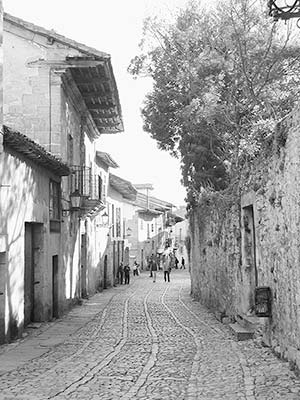
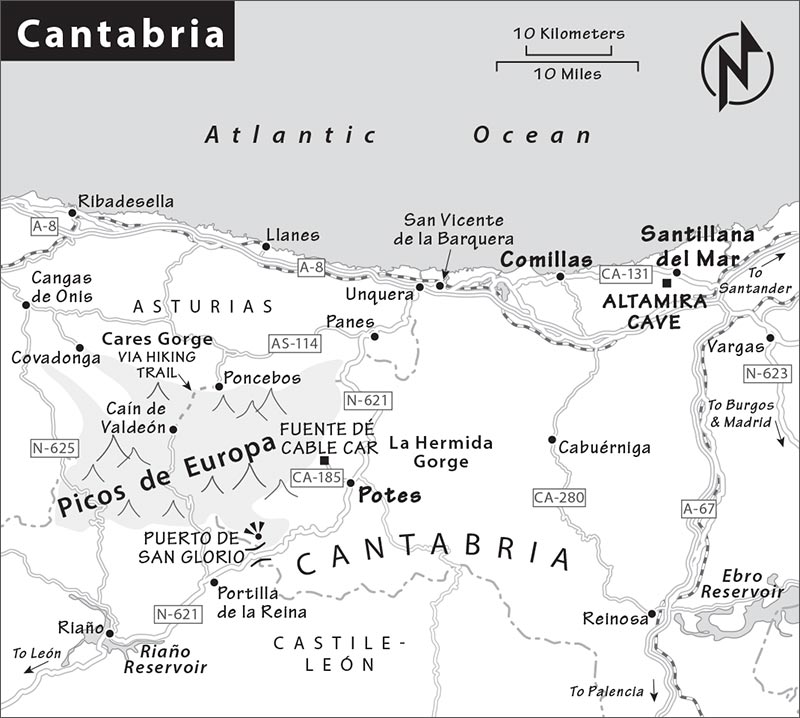
Tourist Information: The modern TI is a short block off the main road (CA-131) near the entrance to the town (open daily, Jesús Otero 20, +34 942 818 812). Only residents (and guests of hotels that offer parking) are allowed to drive in the center; instead, leave your car in one of the two big pay parking lots—one by the TI, and the other just to the south, at Plaza del Rey. High season here is July to mid-September.
Sleeping in Santillana: Two swanky $$$ paradores hold court on the main square—Parador de Santillana del Mar (may be closed for renovation during your visit) and Parador de Santillana Gil Blas (www.parador.es for both). Other options include the antique-filled, palatial $ Hotel Museo Los Infantes (https://hotel-los-infantes.com) or the simple ¢ Hospedaje Octavio (https://hospedajeoctavio.negocio.site).
▲▲ALTAMIRA CAVE (CUEVA DE ALTAMIRA)
Northern Spain is honeycombed with prehistoric limestone caves, but not far from Santillana del Mar, the Altamira Cave (Cueva de Altamira) contains some of the best prehistoric art anywhere (worth ▲▲▲ for those who are passionate about prehistory). In 1879, a local naturalist, responding to rumors circulating among local shepherds, sought out and discovered the limestone cave and its 14,000-year-old paintings. By the 1960s and 1970s, it became a tremendously popular tourist destination. The number of visitors became too much for the delicate paintings, and the cave was closed. Now a carefully reconstructed replica cave and museum with good English explanations sit near the original site, allowing visitors to experience these facsimiles of prehistoric artwork in something approximating the original setting.
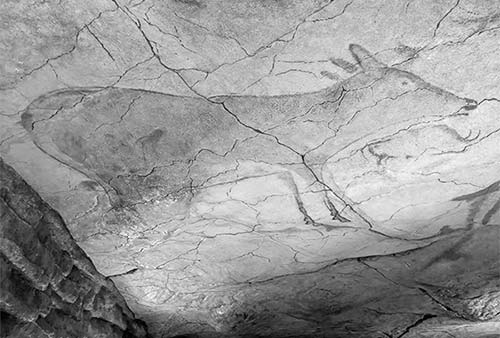
Cost and Hours: €3, free Sat after 14:00 and all day Sun; open Tue-Sat 9:30-20:00, Nov-April until 18:00; Sun 9:30-15:00 and closed Mon year-round; shop, café, lockers available, +34 942 818 005, http://museodealtamira.mcu.es.
Reservations: In summer, reserve an entry time online in advance (no reservations possible for free Saturday afternoon and Sunday visits). The parking lot fills with tour buses and cars before midday; come when the site opens for a more pleasant experience.
Getting In: Take your confirmation to the information counter and exchange it for a ticket. Visitors are admitted in groups of 25 or so to avoid overcrowding.
Getting There: The caves are on a ridge in the countryside a little over a mile southwest of Santillana del Mar. To get to the caves without a car, it’s either a 30-minute walk or a cheap taxi ride.
Visiting the Caves: Your visit starts in the replica cave and then moves on to the museum.
The replica cave (dubbed the Neo Cave), with a broad mouth open to daylight and the Cantabrian countryside, shows how the site might have looked 13,000 years ago, before a landslide collapsed its entrance. Long-ago inhabitants used the front of the cave, archaeologists presume, for shelter and cooking (activities represented by holograms).
You’ll see a facsimile excavation site that describes the multiple layers of habitation at Altamira: On the bottom are remains of humans who were here 22,000 years ago (Gravettian period); hunting tools and chips of flint from the Solutrean era come next (18,000 years ago); above that is a thin layer without evidence of humans (although hibernating bears did use the cave for a time); and, finally, the top layer holds camp sites, spearheads, needles, and tools from the Magdalenian period (14,000 years ago).
A workshop area demonstrates the techniques and tools of the prehistoric artists, who worked primarily with charcoal, ocher, and water. Finally, you’ll reach the great cave, where red, yellow, black, and brown paintings of bison, running boars, horses, and a giant deer dance overhead. There are also a few handprints and several undeciphered symbols.
What is the meaning of this paleolithic art? Archaeology can provide only limited answers. It could be art for art’s sake—a simple aesthetic experience, a kind of magic to ensure good hunting, or an element in shamanistic rituals. Ultimately, these delicate compositions can be understood as a form of communication or an expression of a belief system to which we no longer have the code.
The fine museum has an account of the cave’s discovery and its eventual acceptance by the scientific community, numerous artifacts excavated from the original site, and videos and reproductions of the cave dwellers and their clothes, tools, and remains.
COMILLAS
Just 15 minutes west of Santillana del Mar, perched on a hill overlooking the Bay of Biscay, you’ll find quirky Comillas. A resort town for more than a century, Comillas presides over pristine sandy beaches but feels more like a hill town, with twisty lanes clambering up away from the sea. It makes a good home base if you prefer beach access, fascinating architecture, and a more lived-in feel to the touristy quaintness of Santillana del Mar.
Tourist Information: The TI is in the Town Hall on Plaza Joaquín del Piélago, the town’s westernmost square (daily 9:00-21:00, shorter hours off-season, +34 942 722 591, www.comillas.es). High season here is mid-June to mid-September.
Sights in Comillas: Comillas enjoys a surprising abundance of late-19th-century Modernista architecture, thanks to well-to-do summer residents from Madrid and Barcelona. (For more on this unique, Barcelona-born take on Art Nouveau, see here.) There are three architectural biggies: El Capricho and Palacio de Sobrellano line up along a ridge at the south end of town (near a parking and the TI); the Antigua Seminario Mayor de Comillas faces them from a parallel ridge.
Commissioned in 1883 from the great Catalan architect Antoni Gaudí, ▲▲ El Capricho (“The Whim”) was the summer villa of a Spanish lawyer who had made a fortune in Cuba in the late 19th century (he was a so-called indiano—a Spaniard who returned to his hometown and built an ostentatious house with New World wealth). Cheerfully decorated with alternating bands of brick and yellow ceramic sunflowers, and with a quirky tower that’s part lighthouse, part minaret, the house lives up to its name, inside and out. This is one of Gaudí’s very first creations, and in it you can feel his excited embrace of color, the exotic, and nature—all elements he would return to in his mature work (€7, daily July-Sept 10:30-20:00, shorter hours off-season, downloadable app available on-site, guided tours in English in summer months at 12:30 and 16:30—but call ahead to confirm, advance reservations a good idea in summer, +34 942 720 365, www.elcaprichodegaudi.com).
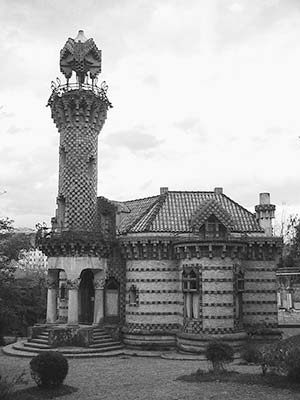
Gaudí’s mentor, Joan Martorell i Montells, built the ponderous Neo-Gothic Palacio de Sobrellano in the 1880s for a local bigwig, Antonio López y López, the marquis of Comillas. (Martorell also designed the matching family mausoleum next door.) The house, a mash-up of an English country house and a Venetian palazzo, has over-the-top touches of Barcelona Modernisme. Guided tours in Spanish are the only way to visit (€5, grounds are free and open daily at 10:00; 45-minute guided visits leave on the hour mid-June-mid-Sept 10:30-19:30; shorter hours off-season, last tour one hour before closing; +34 942 720 339, https://centros.culturadecantabria.com/en).
The marquis also founded a Jesuit seminary in Comillas. He turned again to Martorell and brought in famed Modernisme architect Lluís Domènech i Montaner for interior design. A classic of Gothic-Mudejar eclecticism, the Antigua Seminario Mayor de Comillas operated as a pontifical university until the 1960s. It now sits largely empty, but with a commanding position overlooking the Bay of Biscay, it’s worth the €2 fee to drive up even if you aren’t going inside (€5, guided visits in Spanish only, best to arrange in advance online, daily 10:30-14:30 & 15:30-19:30, +34 942 598 425, https://centros.culturadecantabria.com/en).
The beachside road below the seminary is worth a stroll, especially to get a glimpse of a guardian angel. Domènech i Montaner converted the town’s old church ruins into an interesting walled cemetery and added the marble angel, sculpted by Josep Llimona, that watches over the town. The cemetery also includes the spectacular tomb of the Piélago family, with an extravagant Llimona angel riding atop a giant wave.
On the opposite hill, look for an Art Nouveau statue, donated by the town, portraying the marquis of Comillas. He proudly stands atop a column, carried by one of his ships.
The town center, a two-minute walk inland, is just as pleasant—with an odd jumble of squares surrounding the main parish church. A final bit of Modernisme is the Domènech i Montaner fountain (near the TI), which commemorates Comillas as the first town in Spain to have electricity.
Sleeping in Comillas: South of the big church in the town center—near the long, skinny, restaurant-lined Plaza de Primo de Rivera (also known as “El Corro”)—try the pleasant $$ Hotel Marina de Campíos (www.marinadecampios.com) or the simple guesthouse $ Pasaje San Jorge (www.pasajesanjorge.com).
▲PICOS DE EUROPA
The Picos de Europa—comprising one of Spain’s most popular national parks—are a relatively small stretch of cut-glass mountain peaks (the steepest in Spain, some taller than 8,500 feet) just 15 miles inland from the ocean. These dramatic mountains are home to goats, brown bears, eagles, vultures, wallcreepers (rare birds), and happy hikers. Outdoorsy types could spend days exploring this dramatic patch of Spain, which is packed with visitors in the summer.
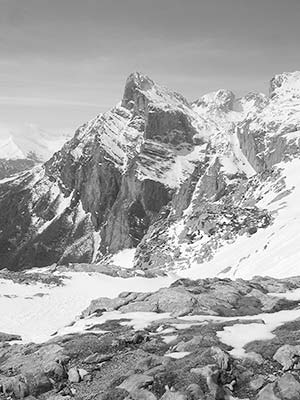
Covering an area of about 25 miles by 25 miles, the Picos de Europa are located where three of Spain’s regions converge: Cantabria, Asturias, and León. (Frustratingly, each region’s tourist office pretends that the parts of the park in the other regions don’t exist—so it’s challenging to get information, say, about Asturias’ Cares Gorge trail when you’re in Potes, Cantabria.) In addition to three regions, the park contains three different limestone massifs—large masses of rock—separated by rivers.
I’ll focus on the Cantabrian part of the Picos, which contains the region’s most accessible and enjoyable bits: the scenic drive through La Hermida Gorge (Desfilidero de la Hermida), the charming mountain town of Potes, and the ride on the Fuente Dé cable car up to sky-high mountaintop views. This part of the Picos is doable as a long day trip from Santillana del Mar or Comillas (but is easier if you stay in Potes). The next-best activity is to hike the spectacular Cares Gorge, which is deeper in the park and requires another full day.
Getting Around the Picos de Europa
The Picos de Europa are best with a car—and skippable without one because bus connections are sparse, time-consuming, and frustrating.
The A-8 expressway squeezes between the Picos and the north coast of Spain; roads branch into and around the Picos, but beware: Many of them traverse high-mountain passes—often on narrow roads—and can take longer to drive through than you expect. Puerto means “pass” (slow going) and desfiladero means “gorge” (twisty).
Assuming you’re most interested in Potes and Fuente Dé, you’ll focus on the eastern part of the park, approaching from the A-8 expressway or the smaller CA-131. You’ll go through Unquera and catch N-621 into the park (follow signs for Potes). Wind your way through La Hermida Gorge (Desfiladero de la Hermida) and stop for a photo en route to Potes (about one hour, depending on traffic). The road crisscrosses between both banks of the Río Deva for spectacular scenery. Count on 30 more minutes to arrive at Fuente Dé.
The Cares Gorge and its popular day hike can be approached from the south (at the village of Caín de Valdeón, deep in the mountains beyond Potes) or the north (at Poncebos, with easier access but more crowded).
Park Information: If you plan to hike in the Picos, it’s worth a stop at the park’s big visitor center in Sotama, about 2.5 miles beyond Potes (daily 9:00-20:00, shorter hours off-season, +34 942 738 109). The park’s website is the one place that brings together information on all three sections of the Picos (https://parquenacionalpicoseuropa.es).
Visiting the Picos de Europa
I’ve arranged these sights as you’ll come to them from the coast, starting from the town of Unquera, on N-621.
La Hermida Gorge (Desfilidero de la Hermida)
This steep gorge makes for a spectacular drive alongside the Deva River. Flanked by rock walls clothed in greenery, at times the gorge is so narrow there’s barely room for the road. But this 13-mile stretch is the only access to the valley from the Bay of Biscay.
The gorge ends at the town of Lebeña, where it’s worth making a quick detour to see the Church of Santa Maria de Lebeña, a tiny pre-Romanesque church (c. 925) laid out in a simple Greek cross plan, with Visigothic arches and Celtic symbols carved in its altar stone. This remote church, and others like it throughout the Picos, is the legacy of the time when most of Spain was in Muslim control. Here in the far north, protected by the mountains, for a few centuries Christian kingdoms hid out and built Romanesque churches. Once the Reconquista pushed the Muslims out, those provincial kingdoms moved southward too, leaving their churches behind.
Potes
This quaint mountain village at the intersection of four valleys is the hub of Cantabria’s Picos de Europa tourist facilities. It’s got an impressive old convent and a picturesque stone bridge spanning the Río Deva. Free parking can be found all around the church. Check in at the TI with any travel questions (in high season, July-Sept, daily 9:30-14:00 & 16:00-19:30, shorter hours off-season, Plaza la Serna, +34 942 730 787, www.potes.es).
If your time is short and you won’t be riding the cable car at Fuente Dé, a five-minute drive and a ten-minute hike to the Monasterio de Santo Toribio de Liébana (just south of Potes) will get you both a piece of the Camino and superlative mountain views. The monastery, which claims to have a sliver of Christ’s crucifixion cross in its Romanesque/Gothic church, is on the route of the lesser-known Camino Lebaniego, and the surrounding countryside is filled with remote hermitages where monks could retreat for deep contemplation.
To reach one such spot, find the Ruta de las Ermitas trail behind the Oficina del Peregrino (upper parking area). Following signs to Sta Catalina, it’s a gentle 10-minute climb to the ancient Santa Catalina hermitage and its sweeping Picos views.
Sleeping in Potes: Overlooking the river, $ Casa Cayo has 17 cozy rooms and a fine restaurant (closed Christmas-mid-March, Calle Cántabra 6, +34 942 730 119, www.casacayo.com, informacion@casacayo.com).
▲▲Fuente Dé Cable Car (Teleférico Fuente Dé)
Perhaps the single most thrilling activity in the Picos de Europa is to take the cable car at Fuente Dé. The longest single-span cable car in Europe zips you up 2,600 feet in just four ear-popping minutes.
Once at the top (altitude 6,000 feet), you’re rewarded with a breathtaking panorama of the Picos de Europa. The huge, pointy, Matterhorn-like peak on your right is Peña Remoña (7,350 feet). The cable-car station on top has a viewpoint balcony, a cafeteria (commanding views, miserable food), a gift shop, and WCs. Hiking options abound up top, but information is limited; consult with the park office at the cable-car base before you ascend.
Cost and Hours: €20 round-trip; €11 one way; purchase at ticket office or online (see next), runs at least every 30 minutes (more frequently with demand); daily 8:00-18:30, mid-Sept-Dec and Feb-June 10:00-16:30—but may run later on June weekends, closed Jan. Every 100 hours, the cable car must close briefly for maintenance, so it’s a good idea to check ahead before making the drive.
Advance Tickets Recommended: In summer you may have to wait in long lines both to ascend and to descend, since the cable car carries only 20 people. To reserve a spot to go up, buy a timed ticket online at least 24 hours in advance—and weeks ahead if you want a morning spot in high season (https://entradas.telefericofuentede.com).
Information: The Picos de Europa National Park runs a helpful information kiosk in the parking lot during peak season (July-Aug), with handouts and advice on hikes (including the one listed next).
Hiking Back Down: Once you’re up there, those with enough time and strong knees should consider hiking back down. From the cable-car station at the top, follow the yellow-and-white signs to Espinama, always bearing to the right. You’ll hike gradually uphill (gain about 300 feet), then down (3,500 feet) the back side of the mountain, with totally different views than the cable-car ride up: green, rolling hills instead of sharp, white peaks. Once in Espinama, you’ll continue down along the main road back to the parking lot at the base of the cable car (signs to Fuente Dé). Figure about four hours total (nine miles) at a brisk pace from the top back to the bottom. Note that the trails are covered by snow into April and sometimes even May; ask at the park station in Sotama, near Potes, about conditions before you hike (see “Park Information,” earlier).
▲Cares Trail (Ruta del Cares)
This impressive hike through the Cares Gorge—surrounded on both sides by sheer cliff walls, with a long-distance drop running parallel to (and sometimes under) the trail—is ideal for both hardy hikers and avid walkers. The trail was built in the 1940s to maintain the hydroelectric canal that runs through the mountains, but today it has become a very popular summer hiking destination.
The trail follows the Río Cares seven miles between the tiny hamlets of Caín de Valdeón (in the south) and Poncebos (in the north). Along the way, you’ll cross gorge-straddling bridges, navigate trails burrowed into the rock face, and encounter sections without guard rails—but it’s a stunning hike and the trail is well maintained. With the path winding hundreds of feet above the river, the views are spectacular. If you’re lucky, you’ll run into some of the gorge’s resident chamois goats. The round-trip hike requires a good six to eight hours (about 13 miles round-trip, with some ups and downs). It’s possible to hike one-way and hitch a ride back to your starting point in a 4x4 vehicle (€38/person, 3.5-4 hours—you can walk back in the same amount of time, reserve in advance, +34 659 488 823, www.rutas4x4enpicos.es).
You can start the hike from either town, but the Caín side has the advantage of little elevation gain and easy parking at the trailhead. Plan ahead with the right footwear, water, and snacks, and ideally overnight near the trailhead ($ Hostal la Ruta in Caín is well situated, www.hostallarutacain.com). Alerts on trail conditions throughout the national park are posted at Parquenacionalpicoseuropa.es.
Getting There: To reach Caín from Potes, you’ll drive 40 miles on twisty roads (N-621) over the stunning Puerto de San Glorio pass (5,250 feet, watched over by a sweet bronze deer), into a green, moss-covered gorge. Just past the village of Portilla de la Reina, turn right (following signs for Santa Marina de Valdeón and Parque Nacional Picos de Europa). As you get closer to Caín, the road narrows in places to a single track—but it’s well maintained.