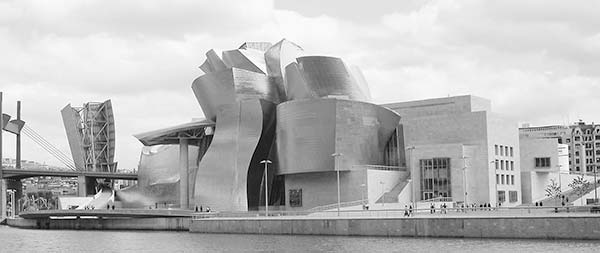
BASQUE COUNTRY
Euskal Herria
Map: Hotels & Restaurants in Bilbao’s Old Town
St-Jean-de-Luz / Donibane Lohizune
Villages in the French Basque Country
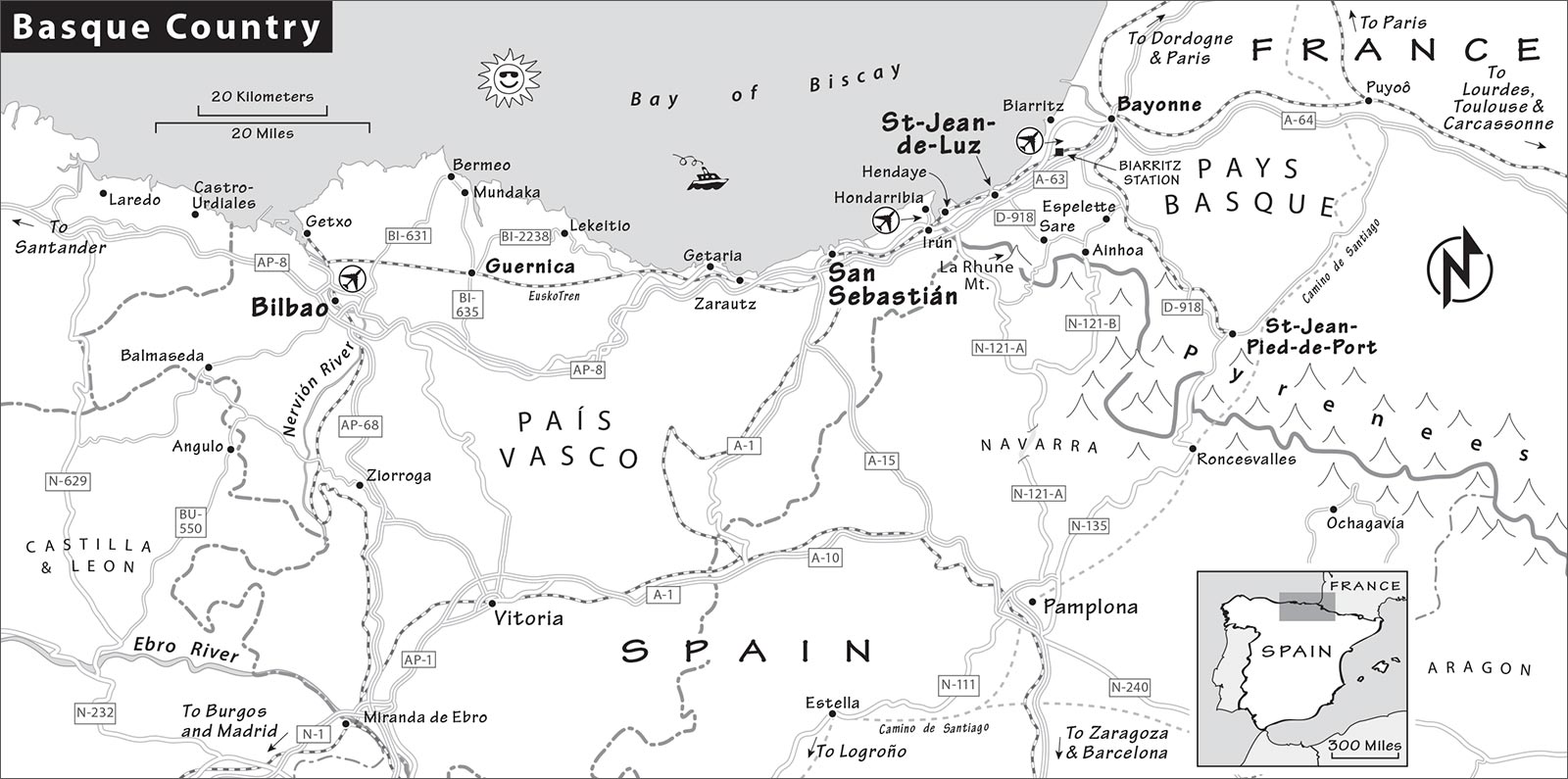
Straddling two nations on the Atlantic Coast—stretching about 100 miles from Bilbao, Spain, north to Bayonne, France—lies the ancient, free-spirited land of the Basques. The Basque Country is famous for its beaches, culinary scene, and scintillating modern architecture...and for its feisty, industrious locals. It’s also simply beautiful: Bold stone houses and bright white chalet-style homes with deep-red and green shutters scatter across lush, rolling hills; the Pyrenees Mountains soar high above the Atlantic; and surfers and sardines share the waves.
Insulated from mainstream Europe for much of their history, the plucky Basques have wanted to be left alone for more than 7,000 years. An easily crossed border separates the French Pays Basque from the Spanish País Vasco, allowing you to sample both sides from a single base (in Spain, I prefer fun-loving San Sebastián; in France, I hang my beret in cozy St-Jean-de-Luz).
Much unites the Spanish and French Basque regions: They share a cuisine, Union Jack-style flag (green, red, and white), and common language (Euskara), spoken by about a half-million people. (Virtually everyone also speaks Spanish and/or French.) And both have been integrated by their respective nations, sometimes forcibly. The French Revolution quelled French Basque ideas of independence; 130 years later, Spain’s fascist dictator, Generalísimo Francisco Franco, attempted to tame his own separatist-minded Basques.
But over the past few generations, things have started looking up. The long-suppressed Euskara language is enjoying a resurgence. And, as the European Union celebrates ethnic regions rather than nations, the Spanish and French Basques are feeling more united. This heavily industrialized region is experiencing a striking 21st-century renaissance. In Spain, the dazzling architecture of the Guggenheim Bilbao modern-art museum and the glittering resort of San Sebastián are drawing enthusiastic crowds. And, in France, long-ignored cities such as Bayonne and the surfing mecca of Biarritz are being revitalized. At the same time, traditional small towns—like Spain’s Lekeitio and France’s St-Jean-de-Luz and nearby mountain villages—are also thriving, making the entire region colorful, fun, welcoming...and unmistakably Basque.
PLANNING YOUR TIME
One day is enough for a quick sample of the Basque Country, but two or three days lets you breathe deep and hold it in. Where you go depends on your interests: Spain or France? Cities (such as Bilbao and Bayonne) or resorts (such as San Sebastián and St-Jean-de-Luz)?
If you want to slow down and focus on Spain, spend one day relaxing in San Sebastián and the second side-tripping to Bilbao (and Guernica, if you have a car).
Better yet, take this easy opportunity to dip into France. Sleep in one country, then side-trip into the other, devoting one day to Spain (either San Sebastián or Bilbao), and a second day to France (St-Jean-de-Luz and Bayonne).
Wherever you go, your Basque sightseeing should be a fun blend of urban, rural, cultural, and culinary activities.
GETTING AROUND THE BASQUE COUNTRY
The tourist’s Basque Country—from Bilbao to Bayonne—stays close to the coastline. Everything is connected by good roads and public transportation. If traveling between Spain and France, carry your passport, as police might ask for identification at border crossings.
By Bus and Train: From San Sebastián, the bus is the best way to reach Bilbao (and from there, bus or train to Guernica). To go between San Sebastián and France, you have a choice of train or bus. Trains offer more frequent departure times but require a transfer in Hendaye; buses can sometimes be faster and more convenient (check schedules and compare). Once in France, the three main towns—St-Jean-de-Luz, Bayonne, and Biarritz—are connected by bus and by train (and Bayonne and Biarritz by the electric Tram’bus). Even if you rent a car, I’d do these three towns by public transit due to the insane traffic during high season. Specific connections are explained in each section.
Note that a few out-of-the-way areas—Spain’s Bay of Biscay and France’s Basque villages of the interior—are impractical by public transportation...but worth the trouble by car.
By Car: San Sebastián, Bilbao, St-Jean-de-Luz, and Bayonne are connected by a convenient expressway, called AP-8 in Spain and A-63 in France (rough timings: Bilbao to San Sebastián, 1.5 hours; San Sebastián to St-Jean-de-Luz, 45 minutes; St-Jean-de-Luz to Bayonne, 30 minutes).
Language on Road Signs: At the start of each section, I list place names using the Spanish or French spelling first and the Euskara spelling second; throughout the rest of the section, I default to the spelling that prevails locally. While most people refer to towns by their Spanish or French names, many road signs list places in Euskara. (In Spain, signs are usually posted in both Euskara and Spanish, either on the same sign or with dual signage on opposite sides of the street. In less separatist-minded France, signs are often only in French.) The Spanish or French version is sometimes scratched out by locals, so you might have to navigate by Euskara names.
Also note that in terms of linguistic priority (e.g., museum information), Euskara comes first, Spanish and French tie for second, and English is a distant fourth...and it often doesn’t make the cut.
BASQUE COUNTRY CUISINE SCENE
Mixing influences from the mountains, sea, Spain, and France, Basque food is reason enough to visit the region. The local cuisine—dominated by seafood, tomatoes, and red peppers—offers some spicy dishes, unusual in most of Europe. And though you’ll find similar specialties throughout the Basque lands, Spain is still Spain and France is still France. Here are some dishes you’re most likely to find in each area.
Spanish Basque Cuisine: Hopping from bar to bar sampling pintxos—the local term for tapas—is a highlight of any trip (for details, see the “Do the Txikiteo” sidebar, later). You’ll want to try the famous pil-pil, made from emulsifying the skin of bacalao (dried, salted cod) into a mayonnaise-like sauce with chili and garlic. Another tasty dish is kokotxas, usually made from hake (merluza) fish cheeks, prepared like pil-pil, and cooked slowly over low heat so the natural gelatin is released, turning it into a wonderful sauce—¡qué bueno! Look also for white asparagus from Navarra. Local brews include sidra (hard apple cider) and txakolí (chah-koh-LEE, a light, sparkling white wine—often theatrically poured from high above the glass for aeration). Wine-wise, I prefer the reds and rosés from Navarra. Finish your dinner with cuajada, a yogurt-like, creamy milk dessert that’s sometimes served with honey and nuts. Another specialty, found throughout Spain, is membrillo, a sweet and muy dense quince jelly. Try it with cheese for a light dessert, or look for it at breakfast.
French Basque Cuisine: The red peppers (called piments d’Espelette) hanging from homes in small villages give foods a distinctive flavor and often end up in piperade, a dish that combines peppers, tomatoes, garlic, ham, and eggs. Peppers are also dried and used as condiments. Look for them with the terrific Basque dish axoa (a veal or lamb stew on mashed potatoes). Look also for anything “Basque-style” (à la basquaise)—cooked with tomato, eggplant, red pepper, and garlic. Don’t leave without trying ttoro (tchoo-roh), a seafood stew that is the Basque Country’s answer to bouillabaisse and cioppino. Marmitako is a hearty tuna stew. Local cheeses come from Pyrenean sheep’s milk (pur brebis), and the local ham (jambon de Bayonne) is famous throughout France. After dinner try a shot of izarra (herbal-flavored brandy). To satisfy your sweet tooth, look for gâteau basque, a local tart filled with pastry cream or cherries from Bayonne. Hard apple cider is a tasty and local beverage. The regional wine Irouléguy comes in red, white, and rosé, and is the only wine produced in the French part of Basque Country (locals like to say that it’s made from the smallest vineyard in France but the biggest in the Northern Basque Country).
To call the Basques “mysterious” is an understatement. Before most European nations had ever set sail, Basque whalers competed with the Vikings for control of the sea. During the Industrial Revolution and lean Franco years, Basque steel kept the Spanish economy alive. In the last few decades, the separatist group ETA gave the Basque people an unwarranted reputation for violence. And through it all, the Basques have spoken a unique language that to outsiders sounds like gibberish or a secret code.
So just who are the Basques? Even for Basques, that’s a difficult question. According to traditional stereotypes, Basques are thought of as having long noses, heavy eyebrows, floppy ears, stout bodies, and a penchant for wearing berets. But widespread Spanish and French immigration has made it difficult to know who actually has Basque ethnic roots. (In fact, some of the Basques’ greatest patriots have had no Basque blood.) And so today, anyone who speaks the Basque language, Euskara, is considered a “Basque”—as are the many people who grew up under Franco and never had the chance to learn the language.
Euskara, related to no other surviving tongue, has been used since Neolithic times—making it, very likely, the oldest European language that’s still spoken. With its seemingly impossible-to-pronounce words filled with k’s, tx’s, and z’s (restrooms are komunak: gizonak for men and emakumeak for women), Euskara makes speaking Spanish suddenly seem easy. Try greeting locals with kaixo and saying goodbye with agur. (Some tips: tx is pronounced “ch” and tz is pronounced “ts.” Other key words: kalea is “street,” and ostatua is a cheap hotel.) Kept alive as a symbol of Basque cultural identity, Euskara typically is learned proudly as a second or third language. Many locals can switch effortlessly from Euskara to Spanish or French.
The Basque economy has historically been shaped by three factors: the sea, agriculture, and iron deposits.
Basque sailors were some of the first and finest in Europe, as they built ever-better boats to venture farther and farther into the Atlantic in search of whales and cod. By the mid-15th century, Basque sailors were venturing a thousand miles from home into the far northern Atlantic Ocean. Despite lack of physical evidence, many historians surmise that the Basques must have sailed to Newfoundland before Christopher Columbus landed in the Caribbean.
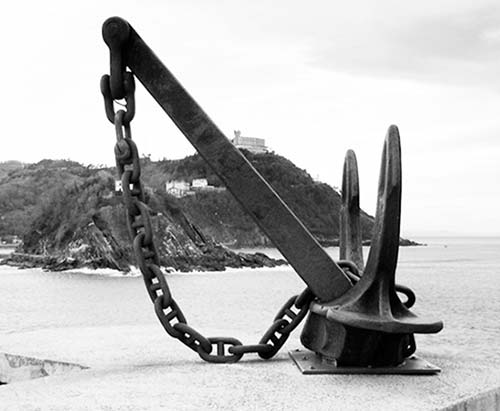
When the “Spanish” era of exploration began, Basques continued to play a key role, as sailors and shipbuilders. Columbus’ Santa María was likely Basque built, and his crew included many Basques. History books teach that Ferdinand Magellan was the first to circumnavigate the globe, with the footnote that he was killed partway around. Who took over the helm for the rest of the journey, completing the circle? It was his Basque captain, Juan Sebastián de Elcano. And a pair of well-traveled Catholic priests, known for their far-reaching missionary trips that led to founding the Jesuit order, were also Basques: St. Ignatius of Loyola and St. Francis Xavier.
Later, the Industrial Age swept Europe, gaining a foothold in Iberia when the Basques began using their rich iron deposits to make steel. Pioneering Basque industrialists set the tempo as they dragged Spain into the modern world. Cities such as Bilbao were heavily industrialized, sparking an influx of workers from around Spain (which gradually diluted Basque blood in the Basque Country).
The independence-minded Basques are notorious for their stubbornness. In truth, as a culturally and linguistically unique island surrounded by bigger and stronger nations, the Basques have learned to compromise. Historically Basques have remained on good terms with outsiders, so long as their traditional laws, the Fueros, were respected. Though outdated, the Fueros continue to symbolize a self-governance that the Basques hold dear. It is only when foreign law has been placed above the Fueros—as many of today’s Basques feel Spanish law is—that the people have become agitated.
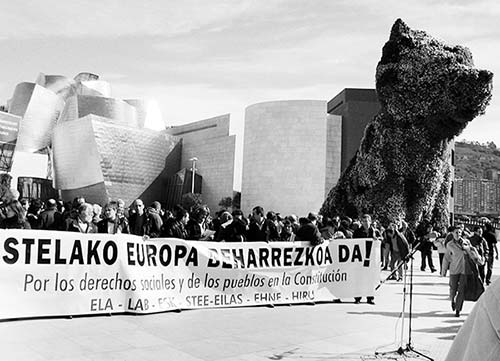
For many years, much of the news of the Basques—especially in Spain—was made by the terrorist organization ETA, whose goal had been to establish an independent Basque state. (ETA stands for the Euskara phrase “Euskadi Ta Askatasuna,” or “Basque Country and Freedom.”) ETA is thought to have been responsible for more than 800 deaths since 1968. The group gradually disarmed and finally announced its dissolution in 2018, with apologies to victims and their families.
This is only a first glimpse into the important, quirky, and fascinating Basque people. To better understand the Basques, there’s no better book than Mark Kurlansky’s The Basque History of the World—essential pretrip reading for historians. And various museums in this region also illuminate Basque culture and history, including the Museum of San Telmo in San Sebastián, the Assembly House and Basque Country Museum in Guernica, and the Museum of Basque Culture in Bayonne (all described in this chapter).
Spanish Basque Country
Four of the seven Basque territories lie within Spain, where they’re known as El País Vasco. Many consider Spanish Basque culture to be feistier and more colorful than the relatively assimilated French Basques—you’ll hear more Euskara spoken here than in France.
For nearly 40 years, beginning in 1939, the figure of Generalísimo Franco loomed large over the Spanish Basques. Franco depended on Basque industry to keep the floundering Spanish economy afloat. But even as he exploited the Basques economically, he so effectively blunted their culture that the language was primarily Spanish by default. Franco kicked off his regime by offering up the historic Basque town of Guernica as target practice to Hitler’s air force. The notorious result—the wholesale slaughter of innocent civilians—was immortalized by Pablo Picasso’s mural Guernica.
But Franco is long gone and today’s Basques are looking to the future. The iron deposits have been depleted, prompting the Basques to reimagine their rusting cities for the 21st century. True to form, they’re rising to the challenge. Perhaps the best example is Bilbao, whose iconic Guggenheim Museum—built on the former site of an industrial wasteland—is the centerpiece of a bold new skyline.
San Sebastián is the heart of the tourist’s País Vasco, with its sparkling, picturesque beach framed by looming green mountains and a charming old town with gourmet pintxos (tapas) spilling out of every bar. On-the-rise Bilbao is worth a look for its landmark Guggenheim and its atmospheric old town. For small-town fun, drop by the fishing village of Lekeitio (near Bilbao). And for history, Guernica has some intriguing museums.
This chapter focuses on Basque destinations on or near the ocean. Some inland Basque towns and cities—most notably Pamplona—are covered in the Camino de Santiago chapter.
San Sebastián / Donostia
Shimmering above the breathtaking Concha Bay, elegant and prosperous San Sebastián (Donostia in Euskara, which locals lovingly shorten to Donosti) has a favored location, with golden beaches capped by twin peaks at either end and a cute little island offshore. A delightful beachfront promenade runs the length of the bay, with a charismatic old town at one end and a smart shopping district in the center. It has 186,000 residents and almost that many tourists in high season (July-Sept). With a romantic setting, a soaring statue of Christ gazing over the city, and a late-night lively old town, San Sebastián has a mini Rio de Janeiro aura. Though the actual “sightseeing” isn’t much, the scenic city itself provides a pleasant introduction to Spain’s Basque Country. As a culinary capital of Spain—with many local restaurants getting international attention—competition is tight to dish up some of the top tapas anywhere.
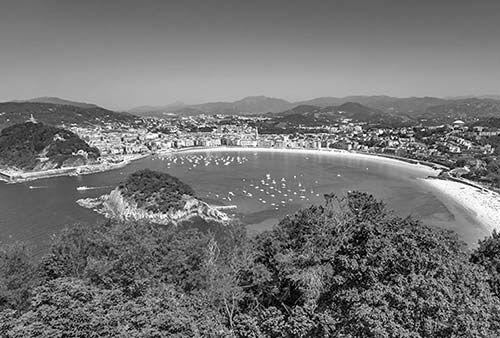
In 1845, Queen Isabel II’s doctor recommended she treat her skin problems by bathing here in the sea. (For modesty’s sake, she would go inside a giant cabana that could be wheeled into the surf—allowing her to swim far from prying eyes, never having to set foot on the beach.) Her visit mobilized Spain’s aristocracy, and soon the city was on the map as a seaside resort. By the turn of the 20th century, San Sebastián was the toast of the belle époque, and a leading resort for Europe’s beautiful people. Before World War I, Queen María Cristina summered here and held court in her Miramar Palace overlooking the crescent beach (the turreted, red-brick building partway around the bay). Hotels, casinos, and theaters flourished. Even Franco enjoyed 35 summers in a place he was sure to call San Sebastián, not Donostia.
PLANNING YOUR TIME
San Sebastián’s sights can be exhausted in a few hours, but it’s a great place to be on vacation for a full, lazy day (or longer). Stroll the two-mile-long promenade with the locals and scout the place you’ll grab to work on a tan. The promenade leads to a funicular that lifts you to the Monte Igueldo viewpoint, unless you’re up for hiking to the top. After exploring the old town and port, walk up to the hill of Monte Urgull. If you have more time, enjoy the delightful aquarium or the free history museum inside Monte Urgull’s old castle. Or check out the Museum of San Telmo, the largest of its kind on Basque culture, which tracks the evolution of this unique society with state-of-the-art displays. A key ingredient of any visit to San Sebastián is enjoying tapas (pintxos) in the old-town bars.
Orientation to San Sebastián
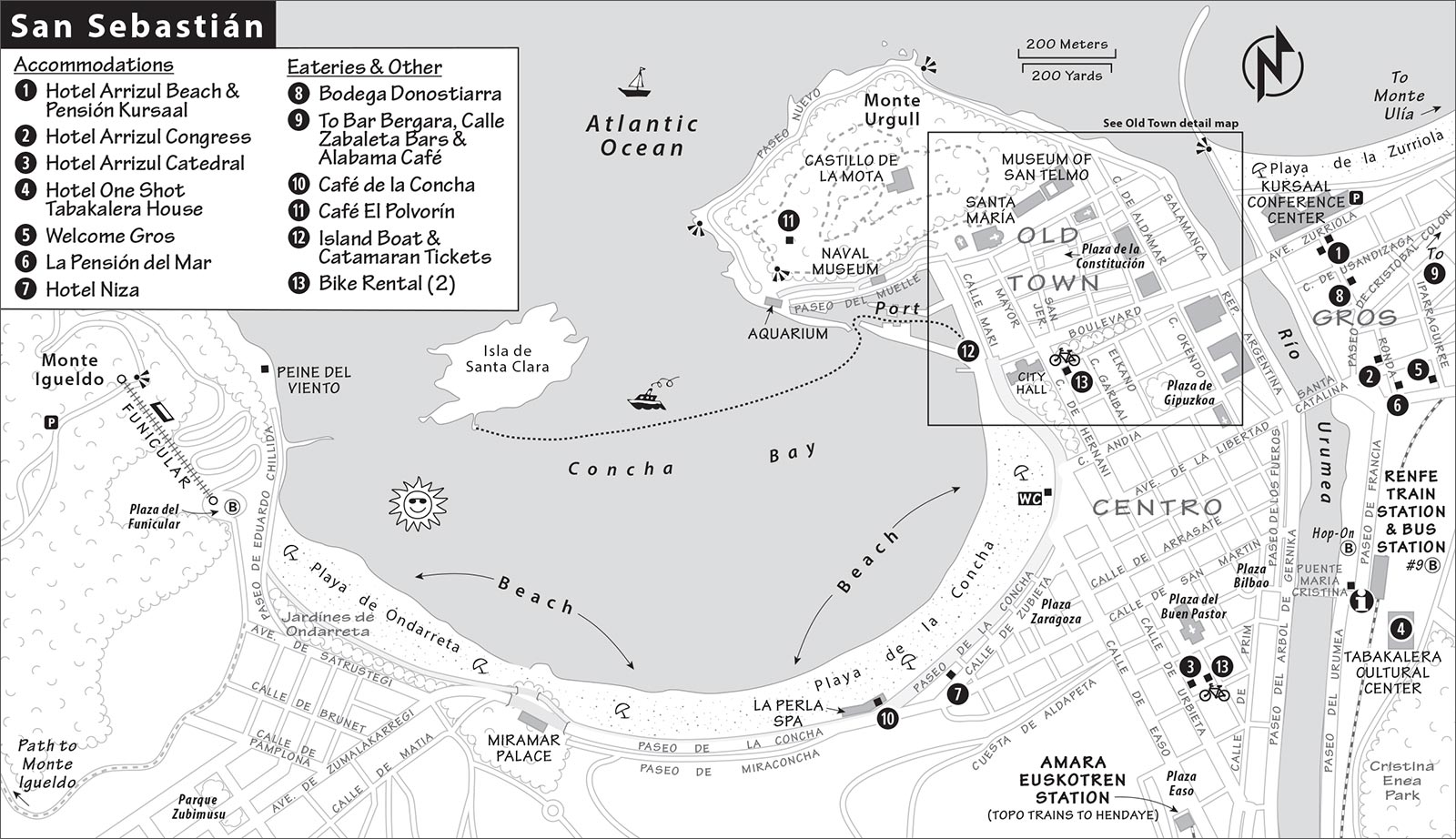
The San Sebastián that we’re interested in surrounds Concha Bay (Bahía de la Concha). It can be divided into three areas: Playa de la Concha (best beaches), Centro (the shopping district), and the old town (the skinny, grid-planned streets north of Centro called Parte Vieja). Centro, just east of Playa de la Concha, has beautiful turn-of-the-20th-century architecture, but no real sights. A busy drag called the Boulevard stands where the city wall once ran, and separates Centro from the old town.
It’s all bookended by small mountains: Monte Urgull on the east end of the bay, and Monte Igueldo to the west. The river (Río Urumea) divides central San Sebastián from the district called Gros, with a lively night scene and surfing beach.
TOURIST INFORMATION
The main TI in San Sebastián is located right on the Boulevard, though it may have moved a few blocks away to City Hall by the time you read this (Mon-Sat 9:00-20:00, off-season until 18:00; Sun 10:00-19:00, off-season until 14:00, Boulevard 8, +34 943 481 166, www.sansebastianturismo.eus). You can pick up a free city map or get it on your phone by scanning a QR code outside the building. If you have a car, ask for the general road map (free), which provides a useful driving map and a guide to essential experiences in the region. The TI also offers a handy, inexpensive brochure with self-guided walking tours—the Old Town/Monte Urgull walk is best—as well as guided walking tours (see “Tours in San Sebastián,” later). Their website is an excellent source of information for the area.
A seasonal TI by the Renfe train station is usually open in summer (22 Paseo de Francia; check website for schedule). Regional info about the surrounding province of Gipuzkoa (Guipúzcoa, in Spanish) can be found online at www.gipuzkoaturismoa.eus.
Sightseeing Cards: The San Sebastián Card gives you small discounts for some restaurants, museums, and shops; half-price on the TI’s guided tour; and public transit (6 rides-€9, 12 rides-€16, shareable with one other person). It’s not worth the cost unless you expect to ride public transit a lot—and the city is small enough that you probably won’t. If you’re exploring the larger region, the TI also sells the Basque Card, but for most travelers it’s also not worth it.
ARRIVAL IN SAN SEBASTIÁN
By Train: The town has two train stations (neither has baggage storage, but you can leave bags nearby—see “Helpful Hints,” later).
If you’re coming on a regional train from Hendaye/Hendaia on the French border, get off at the Amara EuskoTren station (five stops before the end of the line, which is called Lasarte-Oria). It’s a level 15-minute walk to the center. To speed things up, exit the station to the right; catch bus #21, #26, or #28 along Calle Easo; and take it to the Boulevard stop at the bottom of the old town.
If you’re arriving by train from elsewhere in Spain (or from France after transferring in Irún), you’ll get off at the main Renfe station. It’s just across the river from the Centro shopping district. To get to the old town, catch bus #9 from the city side of the station to the Boulevard stop (€1.85, pay driver) or catch a taxi (they wait out front, about €7 to downtown). Alternatively, just walk (about 10-15 minutes) following the Urumea River—the modern, blocky Kursaal Conference Center across the river serves as an easy landmark.
By Bus: A few buses—such as those from the airport—can let you off at pretty Plaza de Gipuzkoa (first stop after crossing the river, in the Centro shopping area, one block from the Boulevard, TI, and old town). But most buses—including those from Bilbao—take you instead to San Sebastián’s underground bus station, next to the Renfe train station. To get to the old town from here, cross the María Cristina Bridge and follow the walking directions above.
By Plane: San Sebastián Airport is beautifully situated along the harbor in the nearby town of Hondarribia, 12 miles east of the city, just across the bay from France (code: EAS, www.aena.es). An easy regional bus (#E21) connects the airport to San Sebastián’s Plaza de Gipuzkoa (direction: Donostia), just a block south of the Boulevard and TI (€2.75, pay driver, cash only, check schedule in advance and be prepared to wait, 35 minutes, https://ekialdebus.eus). Other buses connect the airport to San Sebastián’s Plaza Gipuzkoa, but #E21 is much faster. A taxi into town costs about €38.
By Car: Take the Amara freeway exit, follow Centro Ciudad signs into the city center, and park in a pay lot (many are well signed—the Kursaal underground lot is the most central). If you’re picking up or returning a rental car, you’ll find Avis at the Renfe train station (+34 943 461 556) and Sixt at the Kursaal Conference Center (Avenida de Zurriola 1, +34 871 180 192). Take a taxi to reach the less centrally located Hertz (Centro Comercial Garbera, Travesía de Garbera 1, +34 943 392 223) and Europcar (Plaza de Irún 6, +34 664 091 328).
HELPFUL HINTS
Bookstore: As an advocate for Basque culture, Elkar has a great collection of Basque literature plus a wide selection of guidebooks, maps, and books in English (Mon-Sun 10:00-14:00 & 16:30-20:00, Calle Fermín Calbetón 21, +34 943 420 080).
Baggage Storage: It’s €6/12 hours at the bus station (long hours daily) or at NaviNet, a mobile phone store (daily 10:00-21:00, Calle Narrica 12).
Laundry: In the old town, try 5 à Sec, opposite the northern corner of the Bretxa Market (drop-off service; open Mon-Fri 9:30-14:30 & 17:00-20:00, Sat until 13:30, closed Sun; Calle Aldamar 24, +34 943 432 044). Self-service Laundry Wash & Dry is on a side street half a block from the Bretxa Market (daily 9:00-22:00, San Lorenzo 6, +34 637 791 433).
Bike Rental: Find Sanse Bikes near City Hall (Boulevard 25, +34 943 045 229, www.sansebikes.es). Another option is La Bicicleta Donostia (Reyes Catolicos Kalea 14, in the Centro shopping district, +34 943 442 233, www.labicicletadonostia.com).
Marijuana: While Spain is famously liberal about marijuana laws, the Basque Country is even more so. Walking around San Sebastián, you’ll see “grow shops” sporting the famous green leaf (shopkeepers are helpful if you have questions). The sale of marijuana is still illegal, but marijuana consumption is decriminalized, and people are allowed to grow enough for their personal use at home. With the town’s mesmerizing aquarium and delightfully lit bars filled with enticing munchies, it just makes sense.
GETTING AROUND SAN SEBASTIÁN
By Bus: Along the Boulevard at the bottom edge of the old town, you’ll find a line of public buses ready to take you anywhere in town; give any driver your destination and they will tell you the number of the bus to catch (€1.85, €2.50 after midnight, pay driver, some buses are cash only).
Some handy bus routes: #5, #16, and #25 begin near the Boulevard stop, go along Playa de la Concha and through residential areas; #16 eventually arrives at the base of the Monte Igueldo funicular. Bus info: Dbus.eus.
By Taxi: Taxis start at about €7, which covers most rides in the center. You can’t hail a taxi on the street—you must call one (+34 943 404 040 or +34 943 464 646) or find a taxi stand (most convenient along the Boulevard).
Tours in San Sebastián
Walking Tours
The TI runs an English-language walking tour called Essential San Sebastián (€15, 2 hours, covers both the old town and the city center). Schedules vary—reserve at the TI or at www.sansebastianturismo.eus.
Local Guides
Based in San Sebastián, Agustin Ciriza leads walking tours of his hometown and guided tours through the Spanish and French Basque Country, with destinations including Bilbao, Hondarribia, Biarritz, and the Biscay Coast. He also offers guided Camino walks, mountain treks, and Rioja region wine tours, as well as txakolí tastings (€180/group for city tours, from €25/person for hiking options, +34 686 117 395, https://agustinciriza.com).
Gabriella Ranelli, an American who’s lived in San Sebastián for decades, specializes in culinary tours. She can take you on a sightseeing spin around the old town, along with a walk through the market and best pintxo bars (€175/person, 2-person minimum, less for 4 or more people), or on an excursion to nearby towns and wine regions (from €750/day, transportation included for up to 4 people, +34 943 422 163, www.tenedortours.com). Gabriella also organizes cooking classes—where you shop at the market, then join a local chef to cook up some tasty pintxos of your own (€275/person, 2-person minimum, less for 4 or more people)—as well as wine tastings (starting at €195/person).
Itsaso Petrikorena leads food and cultural tours of the city and countryside villages in both the French and Spanish regions of the Basque Country. He also arranges visits to wineries and cider houses (+34 647 973 231, betitsaso@yahoo.es).
Gastronomic Tours
Mimo Bite the Experience offers gourmet cooking class (from €110/person, including ingredients and wine) and pintxo tours that have you hopping from bar to bar (€140, includes food and wine, Calle Okendo 1 bajo, +34 943 062 018, https://mimo.eus).
Tours on Wheels
Most travelers won’t find it necessary in this walkable city, but the tourist train gives you a good overview of San Sebastián (€5, confirm schedule online or at the TI, 40-minute round-trip, +34 943 422 973, http://sansebastian.city-tour.com). The hop-on, hop-off bus is run by the same company. Buy an all-day €12 ticket on the bus, at the TI, or online (one hour, handy stop in front of Renfe train station for day-trippers).
Sights in San Sebastián
▲▲Museum of San Telmo (San Telmo Museoa)
▲Bretxa Public Market (Mercado de la Bretxa)
▲▲Aquarium
▲▲La Concha Beach and Promenade
▲Kursaal Conference Center and Kubo-Kutxa Gallery
Tabakalera International Culture Center
IN THE OLD TOWN
Huddled in the shadow of its once-protective Monte Urgull, the old town (Parte Vieja, worth ▲▲) is where San Sebastián was born about 1,000 years ago. Because the town burned down in 1813 (as Spain, Portugal, and England fought the French to get Napoleon’s brother off the Spanish throne), the architecture you see is generally Neoclassical and uniform. Still, the grid plan of streets hides heavy Baroque and Gothic churches, surprise plazas, and fun little shops, including venerable pastry stores, rugged produce markets, Basque-independence souvenir shops, and seafood-to-go delis. The highlight of the old town is its array of incredibly lively tapas bars—though here these snacks are called pintxos (PEEN-chohs; see “Eating in San Sebastián,” later). To see the fishing industry in action, wander out to the port (described later).
Throughout the old town, flagpoles mark “private eating clubs” (you might occasionally see a club’s name displayed, but most are otherwise unmarked). The clubs used to be exclusively male; women are now allowed as invited guests, but the kitchen remains primarily the men’s domain. Basque society is matrilineal and very female-oriented. A husband brings home his paycheck and hands it directly to his wife, who controls the house’s purse strings (and everything else). Basque men felt they needed a place where they could congregate and play “king of the castle,” so they formed these clubs where members could reserve a table and cook for their friends.
▲Plaza de la Constitución
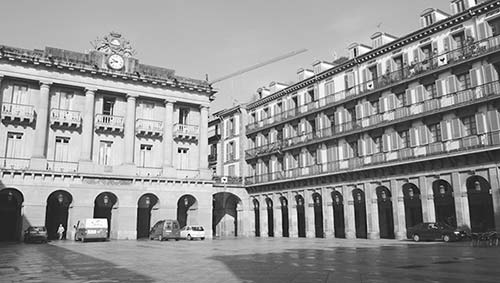
The old town’s main square is where bullfights used to be held. Notice the seat numbering on the balconies: Even if you owned an apartment here, the city retained rights to the balconies, which it could sell as box seats. (Residents could peek over the paying customers’ shoulders.) Above the clock, notice the seal of San Sebastián: a merchant ship with sails billowing in the wind. The city was granted trading rights by the crown—a reminder of the Basque Country’s importance in Spanish seafaring. Inviting café tables crowd the square from all corners.
▲▲Museum of San Telmo (San Telmo Museoa)
This fascinating museum innovatively wrapped a modern facade around a 16th-century Dominican convent and its peaceful cloister. It’s now the largest museum of Basque culture in the country and is well worth a visit. Exhibits of archaeological and ethnographic artifacts demonstrate the traditional folkways of Basque life and vividly tell the history of the region. Its art collection features a few old-school gems (El Greco, Rubens, Tintoretto), while 19th- and 20th-century paintings by Basque artists offer an interesting glimpse into the spirit, faces, and natural beauty of these fiercely independent people. QR codes posted near the exhibits provide English explanations.
Cost and Hours: €6, includes free downloadable multimedia guide, free to enter on Tue; open Tue-Sun 10:00-20:00, closed Mon; Plaza Zuloaga 1, +34 943 481 580, www.santelmomuseoa.eus.
Visiting the Museum: The museum’s layout takes you through the temporary exhibitions first—often focusing on Basque art movements. Or you can enter directly into Section 1, within the church of the original convent. It houses 11 exceptional varnish-on-metal paintings by Spanish artist José María Sert; the light reflecting off this artwork bathes the church in a hauntingly warm glow. Commissioned in 1929, when the convent was originally converted into a museum, these “Sert Canvases” are passionate depictions of epic Basque moments and traditions.
Breeze through Section 2, which features steles, or funerary markers, and tuck into Section 3, which skillfully traces historical milestones that led to the formation of the Basque Country from the Romans to the Enlightenment. You’ll see traditional Basque tools made of iron, artifacts from whaling expeditions, and a fine ship model illustrating the far reaches of seafaring Basque explorers.
Continue upstairs to Section 4 to cover the basics of Basque social history and gain a bird’s-eye view of the Sert Canvases. You’ll also learn how the Basque people transitioned from a rural lifestyle to urban modernity in the 19th and 20th centuries. Enjoy a look at Basque-manufactured products and a fascinating video about everyday life under Franco’s rule.
Paintings from the 15th to the 19th centuries are displayed in Section 5 on the top-most floor, giving you a chronological look at respectable works from several well-known (and many lesser-known) artists, including El Greco and Tintoretto.
▲Bretxa Public Market (Mercado de la Bretxa)
Wandering through the public market is a fun way to get in touch with San Sebastián and Basque culture. Although the sandstone market building facing the Boulevard and the large, former Pescadería building have both been converted into a modern shopping complex, the farmers’ produce market thrives here (lined up outside along the side of the mall for now; renovations may change that), as does the fish and meat market (underground).
Hours: Mon-Sat 8:00-21:00, closed Sun, Bretxa Plaza, https://cclabretxa.com.
Visiting the Market: To get to the modern fish and meat market, walk past the produce vendors (look under the eaves of the building to see what the farmers are selling), and find a big glass cube in the square, where an escalator takes you down into the market.
At the bottom of the escalator, take a left and stroll to the back of the market to explore the fresh-fish stands—often with the catch of the day set up in cute little scenes. Few fish stands are open on Monday because boats don’t go out on Sunday; even fishermen need a day off. Take a left, go to the end of the stalls, and look for the fish stand called Bacalaos Uranzu. In the display, you’ll see different cuts of bacalao (cod). Entire books have been written about the importance of cod to the evolution of seafaring in Europe. The fish could be preserved in salt to feed sailors on ever-longer trips into the North Atlantic, allowing them to venture beyond the continental shelf (into deeper waters where they couldn’t catch fresh fish). Cod was also popular among Catholic landlubbers on Fridays. Today cod remains a Basque staple. People still buy the salted version, which must be soaked for 48 hours (and the water changed three times) to become edible. If you’re in a rush, you can buy desalted cod...but at a cost in flavor. There’s a free WC in the market—just ask “¿Dónde está el servicio, por favor?”
When you’re done exploring, take the escalator up, turn left, and cross the street to the Aitor Lasa cheese shop at Aldamar 12 (closed Sun, +34 943 430 354). Pass the fragrant piles of mushrooms at the entrance and head back to the display case, showing off the Basque specialty of idiazábal—raw sheep’s milk cheese. Notice the wide variety, which depends on the specific region it came from, whether it’s smoked or cured, and for how long it’s been cured (curación). If you’re planning a picnic, this is a very local (and expensive) ingredient. To try the cheese that won first prize a few years back in the Ordizia International Cheese Competition, ask for “El queso con el premio de Ordizia, por favor.” The owners are evangelical about the magic of combining the local cheese with walnuts and dulce de manzana homemade apple jam.
AT THE PORT
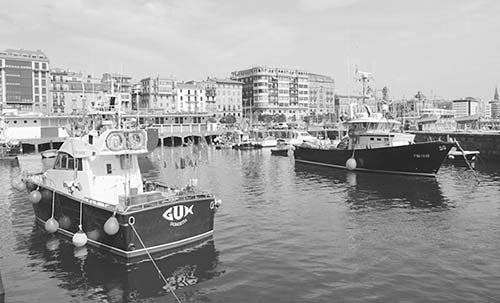
At the west end of the old town, protected by Monte Urgull, is the port. Take the passage through the wall at the appropriately named Calle Puerto, and jog right along the level, portside promenade, Paseo del Muelle. You’ll pass fishing boats unloading the catch of the day (with hungry locals looking on), salty sailors’ pubs, and fishermen mending nets. Also along this strip are the skippable Naval Museum and the entertaining aquarium. Trails to the top of Monte Urgull are just above this scene, near Santa María Church (or climb the stairs next to the aquarium).
Cruises
Small boats cruise from the old town’s port to the island in the bay (Isla de Santa Clara), where you can hike the trails and have lunch at the lone café or pack a picnic before setting sail. Motoras de la Isla offers two options: the direct red (roja) route to the island (€4 round-trip, small ferry departs June-Sept only, every half-hour 10:00-20:00) and the blue (azul) route, which cruises the bay for 30 minutes in a glass-bottom boat before dropping passengers off (€7 round-trip, hourly 12:00-19:30, +34 943 000 450, www.motorasdelaisla.com). The Ciudad San Sebastián catamaran gives 40-minute tours of the bay from Monte Urgull to Zurriola Beach (€12, generally hourly in summer 12:00-20:00, fewer in spring and fall, none in winter; +34 943 287 932, www.ciudadsansebastian.com).
Naval Museum (Museo Naval)
This small museum is mostly interesting for its 18th-century building—one of the few that survived the 1813 siege of the city and where port activities were monitored. Its two floors house temporary exhibits related to the city’s connection to the sea.
Cost and Hours: Free, Tue-Sat 10:00-14:00 & 16:00-19:00, Sun 11:00-14:00, closed Mon, borrow English description at entry, Paseo del Muelle 24, +34 943 430 051, www.itsasmuseoa.eus.
▲▲Aquarium
San Sebastián’s aquarium is surprisingly good. Upstairs are displays on whaling, shipbuilding, legal versus illegal pirating, fishing, and local oceanography (with thorough English descriptions). Downstairs, a mesmerizing 45-foot-long tunnel is filled with more than 30 local species of sea life, flopping and flying over you in a tank holding nearly 400,000 gallons of water. Several smaller tanks are homes to octopus, slowly tumbling jellyfish, and tropical species—local kids see them and holler, “Nemo!”
Cost and Hours: €14, €7 for kids ages 4-12; daily 10:00-19:00, July-Aug until 20:00, last entry one hour before closing; stuffy-yet-helpful audioguide-€3, at the end of Paseo del Muelle, +34 943 440 099, www.aquariumss.com.
▲Monte Urgull
Green and leafy, this city park watches over the old town. The once-mighty castle (Castillo de la Mota) atop the hill deterred most attackers, allowing the city to prosper in the Middle Ages.
The Casa de la Historia museum within the castle covers San Sebastián history; it has mildly interesting displays on the ground floor and access to the statue of Christ’s view over the city. There are also some videos available in English—created for the 200th anniversary of the city’s devastating fire of 1813, each features San Sebastián youth sharing their city’s important historical moments (generally open daily until 20:00 during peak season, confirm at TI, +34 943 428 417).
Signs scattered throughout the park point you toward the fortress. Seek out the crumbling memorial to British soldiers (near the statue of Christ) who gave their lives to defend the city from Napoleon. The best views from the hill are not from the statue, but from the Battery of Santiago ramparts (to Christ’s far right), just above the port’s aquarium. Picnickers can enjoy their lunch along the walls and on benches peppering the grassy battery park. Hidden above the westernmost point of the battery, the free-spirited Café El Polvorín serves simple snacks, good sangria, and picturesque vistas.
There are several ways to access Monte Urgull. You can start over the port (along the white railing)—called the paseo de los curas, or “priest’s path,” where the clergy could stroll unburdened by the rabble in the streets below (access from just behind the aquarium). A scenic walkway also allows you to stroll the mountain’s entire perimeter near sea level. This route is continuous from Hotel Parma to the aquarium and offers an enjoyable after-dinner wander.
THE BEACH AND BEYOND
▲▲La Concha Beach and Promenade
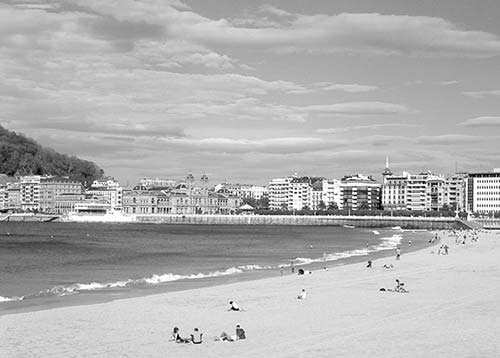
The shell-shaped Playa de la Concha, the pride of San Sebastián, has one of Europe’s loveliest stretches of sand. Lined with a two-mile-long promenade, it allows even backpackers to feel aristocratic. Although it’s pretty empty off-season, sunbathers pack its shores in summer. But year-round it’s surprisingly devoid of eateries and money-grubbing businesses. There are free showers, and cabinas provide lockers, showers, and shade for a fee. For a century, the lovingly painted wrought-iron balustrade that stretches the length of the promenade has been a symbol of the city; it shows up on everything from jewelry to headboards. It’s shaded by tamarisk trees, with branches carefully pruned into knotty bulbs each winter that burst into leafy shade-giving canopies in the summer—another symbol of the city. The Miramar Palace and Park divides the crescent beach in the middle at Pico de Loro (Parrot’s Beak). This is where Queen María Cristina held court when she summered here in the early 1900s. Today the palace is home to summer classes for the Basque Studies University, as well as a music school. The gardens are open to the public.
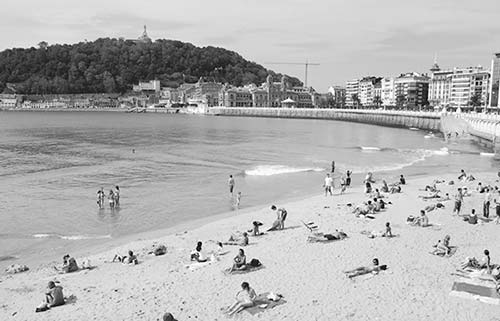
Overlooking the beach, $$ Café de la Concha serves reasonably priced, mediocre food, but you can’t beat the location of its terrace for a drink or light snack (long hours daily, on the beach at the center of the crescent, Paseo de la Concha, +34 943 473 600).
La Perla Spa
The spa overlooking the beach attracts a less royal crowd today and appeals mostly to visitors interested in sampling “the curative properties of the sea.” You can enjoy its Talasso Fitness Circuit, featuring a hydrotherapy pool, a relaxation pool, a panoramic hot tub, cold-water pools, a seawater steam sauna, a dry sauna, and a relaxation area.
Cost and Hours: 2-hour fitness circuit—€33, Mon-Sat 8:30-21:30, Sun until 20:30, €3 caps and €1.50 rental towels, bring a swimsuit or buy one there, on the beach at the center of the crescent, Paseo de la Concha, +34 943 458 856, www.la-perla.net.
Monte Igueldo
For commanding city views (if you ignore the tacky amusements on top), ride the funicular or hike up Monte Igueldo, a mirror image of Monte Urgull. The views over San Sebastián, along the coast, and into the distant green mountains are sensational day or night. The entrance to the funicular is on the road behind the tennis club on the far western end of Playa de Ondarreta, which extends from Playa de la Concha to the west.
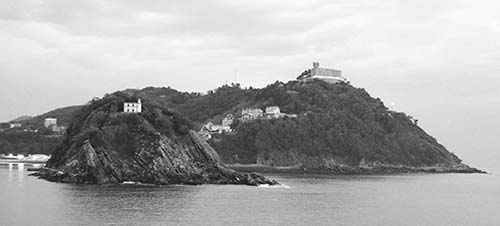
Cost and Hours: Funicular—€4.25 round-trip, runs every 15 minutes; changeable hours but roughly daily 10:00-21:00; Oct-March Mon-Fri 11:00-18:00, Sat-Sun until 20:00. If you drive to the top, you’ll pay €2.50 to enter.
Getting There: Bus #16 takes you from Plaza de Gipuzkoa in the old town to the base of the funicular in about 10 minutes. If you’d rather do the half-hour hike to the top, start at the #16 bus stop before the funicular and follow the yellow arrows uphill along a road and then on a smaller path. It can be muddy after a rainy day, but it’s well worth the walk through the lush forest. Near the top, take a right at the asphalt road to reach the viewpoint.
Peine del Viento Sculptures
Besides the gorgeous view from the top of Monte Igueldo, another classic San Sebastián scene is at this group of three statues by native son Eduardo Chillida (1924-2002) hidden at the far end of the beach just past the tennis club. Curly steel prongs “comb the wind” (as the sculptures’ name means) among crashing waves. Chillida lived and died on Monte Igueldo, so these sculptures are now considered a memorial to one of Spain’s most internationally recognized modern sculptors.
IN GROS
Gros and Zurriola Beach
The district of Gros, just east across the river from the old town, offers a distinctly Californian vibe. Literally a dump not long ago (gross indeed), today it has a surfing scene on Zurriola Beach (popular with students and German tourists) and a futuristic conference center (described next).
▲Kursaal Conference Center and Kubo-Kutxa Gallery
These two Lego-like boxes mark the spot of what was once a grand casino, torn down by Franco to discourage gambling. Many locals wanted to rebuild it as it once was, in a similar style to the turn-of-the-20th-century buildings in Centro, but—in an effort to keep up with the postmodern trends in Bilbao—city leaders opted instead for Rafael Moneo’s striking contemporary design. The complex is supposed to resemble the angular rocks that make up the town’s breakwater. The Kursaal houses a theater, conference facilities, some gift shops and travel agencies, and a restaurant; it also hosts many events for the San Sebastián Film Festival. The Kubo-Kutxa Gallery, located in a small cube farthest from the river, offers temporary exhibits by international artists and promotes contemporary Basque artists. Each exhibit is complemented by a 10-minute video that plays continuously in the gallery theater (free, Tue-Sun 12:00-14:00 & 16:00-20:00, closed Mon, no-midday break on summer weekends, +34 943 251 939, www.sala-kubo-aretoa.eus).
Tabakalera International Culture Center
An old tobacco factory next to the Renfe train station has been converted into an international center for contemporary culture oozing with a young, artistic vibe. The center hosts the Basque Language Institute, various contemporary art exhibitions from both local and international artists, and screenings during the San Sebastián Film Festival. There are shops and a café on the bottom floor, and the roof terrace on the top floor has knockout views of the river and city skyline. To get there, take bus #9 to the Frantziskotarrak stop (free, Tue-Sun 10:00-21:00, closed Mon, Andre Zigarrogileak Plaza 1, +34 943 118 855, www.tabakalera.eus).
ON THE OUTSKIRTS
Coastal Hike to Pasaia
This strenuous six-mile walk begins at the far end of Gros, where San Frantzisko Kalea dead-ends at a church. You’ll see the stairs to the GR121 trail (follow the red and white stripes) just behind the gas station next door. Begin your ascent (this is the hardest part) and enjoy this three-hour, mostly shaded trek to the town of Pasaia, with peek-a-boo coastal views. You may get a chance to interact with pilgrims walking the Camino de Santiago del Norte, though they’ll be heading in the opposite direction (good walking shoes essential, ask TI for details; from Pasaia’s port area, take bus #E09 from any stop along Esnabide Kalea to return to San Sebastián/Donostia).
Sleeping in San Sebastián
Rates in San Sebastián are some of the highest in Spain. They can skyrocket in summer and during the town’s film festival in September. During peak season, hotels often require a minimum stay of two to three nights. Since breakfast is often not included, I’ve recommended some good options elsewhere in town (see “Eating in San Sebastián,” later).
IN OR NEAR THE OLD TOWN
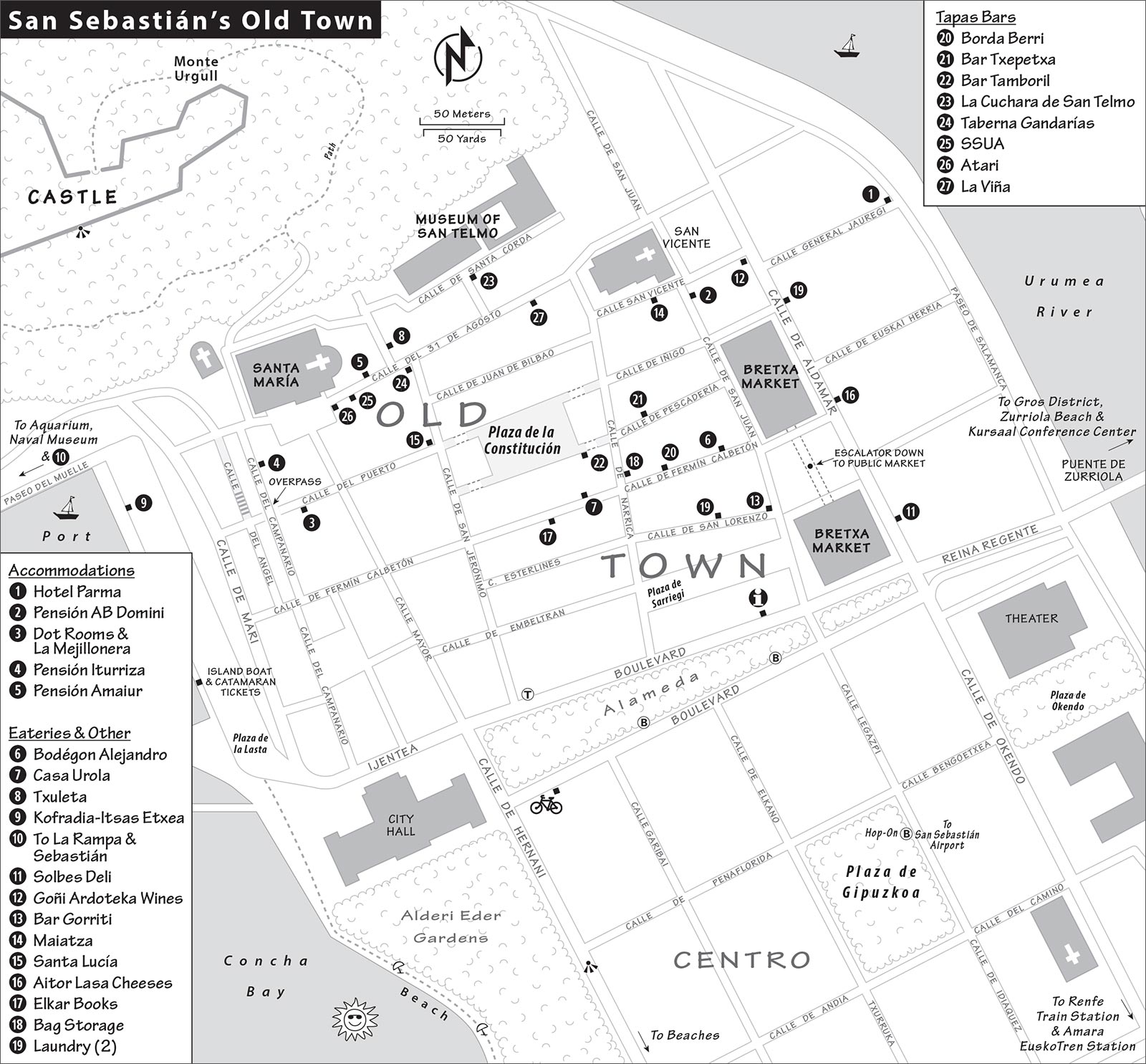
This area, where all the pintxo action happens, can be noisy late into the evening. For locations, see the “San Sebastián’s Old Town” map, earlier.
$$$$ Hotel Parma is a stately business-class place with 26 fine rooms and family-run attention to detail and service. It stands on the edge of the old town, away from the bar-scene noise, and overlooks the river and a surfing beach (RS%, breakfast extra, air-con, modern lounge, pay parking nearby, Paseo de Salamanca 10, +34 943 428 893, www.hotelparma.com, hotelparma@hotelparma.com; Iñaki, Pino, Eider, and Francisco).
$$$ Pensión AB Domini neighbors Bretxa Market and San Telmo Museum. Located on the second floor of an otherwise tired building, it delightfully mixes traditional, bare-stone walls with contemporary decor. Three of its six rooms have views toward the museum—unique in the narrow-laned old town (no breakfast, some rooms with shared bath, discounted parking, San Juan 8, +34 943 420 431, www.abpensiones.es, reservas@abpensiones.es).
$$ Dot Rooms, run with care deep in the old town, elegantly mixes wood, brick, and color in nine stylish rooms (fans, elevator, Calle del Puerto 15, +34 943 423 773, www.sansebastiandotrooms.com, info@sansebastiandotrooms.com).
$$ Pensión Iturriza is no Old World pensión—its six small, minimalist rooms have modern fixtures and were designed with feng shui in mind. This is a restful and quiet place and a great value in the old town. A more spacious penthouse apartment is also available (no breakfast, air-con, elevator, Calle Campanario 10, +34 943 562 959, www.pensioniturriza.com, info@pensioniturriza.com, helpful Ibon).
$$ Pensión Amaiur, in the oldest building in the old town, has tilting wooden stairs that lead to a flowery interior with long, narrow halls and five great-value rooms. Some rooms face a frontón (pelota court), while a couple have private balconies facing the street. There’s a common room to prepare meals—a great spot to hang out and share travel tips. Bring earplugs to block out noise from the tapas-going crowd, or ask for an interior room (no breakfast, cheaper rooms with shared bath, fans, Calle 31 de Agosto 44, +34 943 429 654, www.pensionamaiur.com, info@pensionamaiur.com).
ACROSS THE RIVER, IN GROS
The pleasant Gros district—San Sebastián’s “uptown”—is marked by the super-modern, blocky Kursaal Conference Center, which blocks any beach views from my recommended hotels. The nearby Zurriola Beach is popular with surfers and has a thriving pintxo scene and good restaurants. Most of these hotels are less than a five-minute walk from the old town. For locations, see the “San Sebastián” map, earlier.
$$$$ Hotel Arrizul Beach is bright and fresh, with fashionable, minimalist decor in each of its 12 rooms (air-con, elevator, pricey nearby parking, Peña y Goñi 1, +34 943 322 804, www.hotelarrizulbeach.com, info@hotelarrizulbeach.com). Just up the street, closer to the train and bus stations, $$$$ Hotel Arrizul Congress has 46 rooms in a similar style and is run by the same friendly staff (family rooms, air-con, elevator, fitness room, Ronda 3, +34 943 327 026, www.hotelarrizulcongress.com, info@hotelarrizulcongress.com).
$$$$ Hotel Arrizul Catedral offers a more modern twist in its 38 rooms. It’s in the Centro shopping district and a 15-minute walk from the old town (Calle Urbieta 51, +34 943 265 522, www.hotelarrizulcatedral.com, info@hotelarrizulcathedral.com).
$$$$ Hotel One Shot Tabakalera House is an artsy hotel in the same building as the Tabakalera Culture Center, the city’s old tobacco factory. It is conveniently located next to the Renfe train station and is a 20-minute walk from the old town. The 43 rooms are hip and contemporary with a colorful design (air-con, breakfast, discounted parking, fitness room, Mandasko Dukearen 52, +34 943 930 028, www.hoteloneshottabakalerahouse.com, tabakalerahouse@oneshothotels.com).
$$$ Welcome Gros is five blocks from the beach and has 15 rooms with minimal but stylish decor (no breakfast, air-con, elevator, no reception after 15:00—guests enter with access code, Iparraguirre 3, +34 943 326 954, www.welcomegros.com, info@welcomegros.com).
$$$ Pensión Kursaal has 21 basic, contemporary, and crisp rooms in a historic building just across from the beach (no breakfast, elevator, discounted parking, Peña y Goñi 2, +34 943 292 666, www.pensionkursaal.com, info@pensionkursaal.com).
$$$ La Pensión del Mar has three bright rooms on a quiet street a 10-minute walk from the old town (elevator, discounted parking, lower rates for two rooms with shared bathroom, Tomas Gros 3, +34 943 359 970, www.lapensiondelmar.es, info@lapensiondelmar.es).
ON THE BEACH
$$$$ Hotel Niza, set in the middle of Playa de la Concha, is often booked well in advance. Half of its 40 rooms (some with balconies) overlook the bay. From its chandeliered and plush lounge, a classic 1911 elevator takes you to comfortable pastel rooms with wedding-cake molding (only streetside rooms have air-con, fans on request, pay parking—must reserve in advance, Zubieta 56—see the “San Sebastián” map, +34 943 426 663, www.hotelniza.com, reservas@hotelniza.com). The breakfast room has a sea view and doubles as a bar with light snacks throughout the day (Bar Biarritz, long hours daily).
Eating in San Sebastián
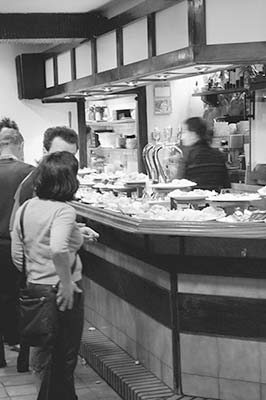
Basque food is regarded as some of the best in Spain, and San Sebastián is the culinary capital of the Basque Country. (For tips on Basque cuisine, see the ”Basque Country Cuisine Scene” section at the beginning of this chapter.) San Sebastián is proud of its many Michelin-rated fine-dining establishments, but they require a big commitment of time and money. Most casual visitors will prefer to hop from pub to pub through the old town, following the crowds between Basque-font signs. I’ve listed a couple of solid traditional restaurants, but for the best value and memories, I’d order top-end dishes with top-end wine in top-end bars. Some places close for siesta in the late afternoon and early evening.
IN THE OLD TOWN
For locations of old town eateries, see the “San Sebastián’s Old Town” map, earlier.
Pintxo Bar-Hopping
San Sebastián’s old town provides the ideal backdrop for tapas-hopping; just wander the streets and sidle up to the bar in the liveliest spot. Calle Fermín Calbetón has the best concentration of bars; the streets San Jerónimo and 31 de Agosto are also good. I’ve listed these top-notch places in order as you progress deeper into the old town. Note that there are plenty of other options along the way. Before you begin, study the “Do the Txikiteo” sidebar, later. Unless otherwise noted, these places are open from around noon to 15:00, close for the afternoon, then reopen in the evening. Many establishments can be intimidating when crowded. Go early so your servers have time to offer some suggestions.
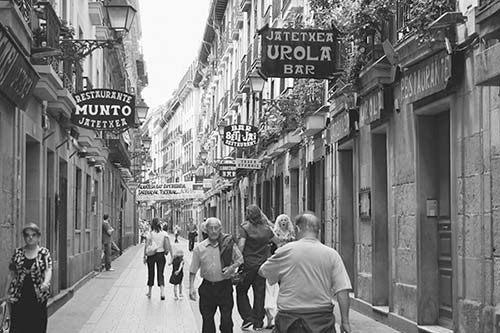
$$ Borda Berri (loosely, “New Mountain Hut”) features a more low-key ambience and top-quality pintxos. There are only a few items at the bar; check out the chalkboard menu for today’s options, order, and the two chefs/owners will cook it fresh. The specialties here are melt-in-your-mouth beef cheeks (carrillera de ternera) in a red-wine sauce, risotto with wild mushrooms, and foie gras (grilled goose liver) with apple jelly, which is even better paired with a glass of their best red wine (closed Mon, Calle Fermín Calbetón 12, +34 943 430 342).
$$ Bar Txepetxa is the award-winning place for anchovies. A plastic circle displaying a variety of antxoas tapas makes choosing your anchovy treat easy. These fish are fresh—not cured and salted like those most Americans hate (Sun lunch only, Tue dinner only, closed Mon, Calle Pescadería 5, +34 943 422 227).
$$ Bar Tamboril is a traditional spot favored for its seafood, mushrooms (txampis tamboril), and anchovy tempura along with its good prices. Their list of hot pintxos (grab the little English menu on the bar) makes you want to break the one-tapa-per-stop rule. Sit inside or enjoy prime seating right on the main square (closed Mon-Tue, Calle Pescadería 2, +34 943 423 507).
$$$ La Cuchara de San Telmo, whose cooks are taught by big-name Basque chef Alex Mondiel, is a cramped place that devotes as much space to its thriving kitchen as its bar. It has nothing precooked and set on the bar—order your mini gourmet plates with a spirit of adventure from the constantly changing blackboard. Their foie gras with apple jelly is rightfully famous (some gluten-free options, closed Mon, outdoor tables reserved for those who order half or full portions, tucked away on a lonely alley called Santa Corda behind Museum of San Telmo at Calle 31 de Agosto 28, +34 943 420 840).
$$ Taberna Gandarías is a lively place for savory traditional pintxos. The chalkboard menu comes in several languages and so do the tourists spilling into the street. Consider a media ración (half-order) of the perfectly done ibérico ham. They serve food more hours than most (daily, Calle 31 de Agosto 23, +34 943 426 362).
$$$ SSUA is cool and upscale compared to the others, with an edgier vibe. You’ll find an ambitious menu with both pintxos and creative dishes based on local recipes. Try their foie mi-cuit or grilled hake for a unique tastebud experience (closed Wed, Calle 31 de Agosto 31, +34 686 015 479). Inviting small tables in the back make this a sit-down dining opportunity.
$$ Atari offers a handful of comfortable tables and large windows. In warm weather, sit at outdoor tables across from Santa María Church. They have pintxos and raciones: The panceta a baja temperatura (roasted pork belly) and carrillera guisada (beef cheeks) are just a couple of the delights on the menu (daily, closed Tue in winter, Calle Mayor 18, can also enter on corner of Calle 31 de Agosto, +34 943 440 792).
$$ La Mejillonera is famous among students for its big, cheap beers, patatas bravas, and mussels (“tigres” are the spicy favorite). A long, skinny, stainless-steel stand-up bar and lots of photos make ordering easy—this is my only recommended bar where you pay when served. Throw your mussel shells on the floor like the boisterous locals (Calle del Puerto 15, +34 943 428 465).
$$ La Viña is a reliable option for a mix of traditional and modern pintxos. Rub elbows with locals and top off your meal with an airy and decadent slice of award-winning cheesecake that’s big enough to share (closed Mon, Calle 31 de Agosto 3, +34 943 427 495).
Restaurants in the Old Town
$$$$ Bodégon Alejandro is a good spot for modern Basque cuisine in a sleek-yet-cozy cellar setting. Seasonal menus focus on seafood and wild game (€58 tasting menu available, daily, closed Mon-Tue in winter, in old town on Calle Fermín Calbetón 4, +34 943 427 158, www.bodegonalejandro.com).
$$$ Casa Urola is a must for San Sebastián gastronomy enthusiasts. Chef Pablo’s updated versions of traditional Basque dishes even persuade other local chefs to eat here after finishing their shifts. Much of the exquisite menu changes seasonally. The peaceful upstairs dining room has a contemporary elegance (reservations recommended). Without reservations, go downstairs—there are few tables, so most diners eat standing at the bar or outside (media ración—half-portion—available for several dishes, extensive wine list; closed Tue-Wed, bar open until late; Calle Fermín Calbetón 20, +34 943 441 371, www.casaurolajatetxea.es).
$$$ Txuleta is tucked away on a small plaza near Santa María Church. While the service is hit or miss, this restaurant excels at grilled meats and seasonal pintxos that are worth the hefty price. Be adventurous and try the kokotxas (hake cheeks). The glass-enclosed terrace provides lots of seating (closed Mon evening and Tue, Plaza de la Trinidad 2, +34 943 441 007, www.txuletarestaurante.com).
Seafood Along the Port: For seafood with a salty sailor’s view, check out $$ Kofradia-Itsas Etxea, the “House of the Basque Fishermen.” This seafood-only restaurant has a bar area serving pintxos and a gourmet dining room serving pescado del día (the daily catch) prepared in the local style (reservations needed for dining, closed Mon-Tue, https://kofradia.eus).
Farther along the harbor on the way to the aquarium are a half-dozen hardworking, local-feeling restaurants. $$$$ La Rampa is an upscale eatery, specializing in crab (txangurro) and lobster dishes and seafood a la parrilla (some outdoor seating, closed Wed, Paseo del Muelle 26, +34 943 421 652, www.restaurantelarampa.com). Also along here, locals like more traditional $$$ Sebastián (closed Tue).
RESTAURANTS AND PINTXO BARS IN GROS
For locations, see the “San Sebastián” map, earlier.
$$$ Bodega Donostiarra has been a San Sebastián institution since 1928. Locals flock here for sit-down meals with freshly made Spanish tortillas, meats of the grilled and cured varieties, and seafood. For a quick bite, head to their original zinc bar for pintxos or a sandwich completo with tuna, onions, and anchovies (closed Sun, Calle Peña y Goñi 13, +34 943 011 380).
$$ Bar Bergara serves refined pintxos in a casually cool setting. Originally run by chef-savante Patxi Bergara, his nephews Monty and Esteban now continue the ethic of serving award-winning pintxos that are “eye-catching, original, and petite enough to eat in two bites.” Cold snacks are artfully displayed on the bar, while pintxos calientes are made when ordered. Ask for an English menu (closed Wed, to-go sandwiches available, General Artetxe 8, +34 943 275 026).
Thursday-night Party Scene: Every Thursday in Gros, university students and those who want to save some euros brave the masses for pintxo-pote (PEEN-cho POH-teh). Because of the increased popularity of gastronomy in San Sebastián, locals who eat out regularly want a good deal for food and drinks. Bars, particularly along Calle Zabaleta (between Gran Vía and Avenida Navarra) and parallel streets, offer a drink (usually beer or wine) and a basic pintxo for €2-3. It’s basically a happy-hour scene that spills out onto the streets. Just follow the crowds and remember that this isn’t just sustenance, it’s a social event (19:00-23:00).
PICNICS AND TAKEOUT
A picnic on the beach or atop Monte Urgull is a tempting option. You can assemble a bang-up spread at the Bretxa Public Market at Plaza de Sarriegi (described earlier).
Solbes, just across the street from the market, has a reputation as the gourmet deli store in the old town. There’s a remarkable wine selection in the back cellar, plus high-quality cured meats and cheeses out front. Be sure to price fruits and veggies on the scale yourself to avoid confusion at checkout (daily, Sun until 14:30, Calle Aldamar 4—see the “San Sebastián’s Old Town” map, +34 943 427 818).
For quality Spanish wines, head to Goñi Ardoteka. The three owners (and brothers) Asier, Nerea, and Amaya are true wine lovers and are happy to give their recommendations (closed Sun, Calle Aldamar 3—see the “San Sebastián’s Old Town” map, +34 943 211 597).
BREAKFAST
If your hotel doesn’t provide breakfast—or even if it does—consider one of these local places. For locations, see the “San Sebastián’s Old Town” map, earlier. If you’re staying in Gros, consider Alabama Café.
$$ Bar Gorriti, delightfully local, is packed with market workers and shoppers starting their day. You’ll stand at the bar and choose a hot-off-the-grill francesca jamón omelet (fluffy, tiny omelet sandwich topped with a slice of ham) and other goodies. This and a good cup of coffee make for a very Basque breakfast. By the time you get there for breakfast, many market workers will be taking their midmorning break (closed Sun, facing the side of the big white market building at San Juan 3, +34 943 428 353).
$$ Maiatza is a favorite among locals and those looking for a break from the pintxo scene. This health-conscious eatery dishes up breakfast and hard-to-find vegan and vegetarian options (daily until 19:00, Calle San Vicente 7, +34 943 421 808).
$$ Santa Lucía, a 1950s-style diner, is ideal for a cheap old-town breakfast or churros break (churros are like deep-fried doughnut sticks that can be dipped in pudding-like hot chocolate). Photos of two dozen different breakfasts decorate the walls, and plates of fresh churros keep patrons happy (long hours daily, Calle del Puerto 6, +34 943 425 019).
In Gros: The artsy $ Alabama Café is a solid breakfast option with a colorful mix of healthy and less-healthy alternatives. Set breakfast combos include coffee or tea, a glass of fresh orange juice, and toast with various toppings. There are a few tables downstairs and plenty more upstairs (closed Mon, Calle San Francisco 45—see the “San Sebastián” map, +34 943 104 694).
San Sebastián Connections
BY TRAIN
San Sebastián has two train stations: Renfe and Amara EuskoTren (described under “Arrival in San Sebastián” on here). The station you use depends on your destination.
Renfe Station: This station handles long-distance destinations within Spain (most of which require reservations). Due to construction on the AVE line, train departures might be reduced or replaced with buses; check online at Renfe.com [URL inactive]. Connections include Irún (4/day, 30 minutes), Madrid (6/day, 5-8 hours), Burgos (6/day, 3 hours), León (1/day direct, 5 hours, more with transfer), Pamplona (2/day, 2 hours), Salamanca (6/day, some direct, 7 hours), Barcelona (2/day, 6 hours), Santiago de Compostela (2/day direct, 10.5 hours).
Amara EuskoTren Station: If you’re going into France, take the regional Topo train (which leaves from Amara EuskoTren station) over the French border into Hendaye (usually 2/hour, 35 minutes). From Hendaye, you can connect to France’s SNCF network (www.sncf.com), with connections to Paris (4/day direct, 5 hours, more with transfer in Dax or Bordeaux). Unfortunately, the Amara EuskoTren station doesn’t have information on Paris-bound trains from Hendaye. EuskoTren tickets to Hendaye must be used within two hours of purchase.
Also leaving from San Sebastián’s Amara EuskoTren station are slow regional trains to destinations in Spain’s Basque region, including Bilbao (hourly, 2.5 hours—the bus is faster). Although the train ride from San Sebastián to Bilbao takes twice as long as the bus, it passes through more interesting countryside. The Basque Country shows off its trademark green and gray: lush green vegetation and gray clouds. It’s an odd mix of heavy industrial factories, homegrown veggie gardens, streams, and every kind of livestock you can imagine. EuskoTren info: +34 902 543 210, EuskoTren.eus.
BY BUS
The underground bus station is conveniently located next to the Renfe train station (across the river, just east of the Centro district).
Different companies offer services to different destinations, with some overlap. Pesa Lurralde serves most of the region, from Bayonne to Bilbao (www.pesa.net). Alsa serves a few Basque Country destinations, Madrid, Burgos, and León (www.alsa.es). MonBus serves Barcelona (www.monbus.es). Flixbus serves Bilbao and other European cities (https://www.flixbus.com).
From San Sebastián, buses go to Bilbao (2/hour, hourly on weekends, 1.5 hours, Pesa; morning buses fill with tourists, commuters, and students—buy your ticket the day before; once in Bilbao, buses leave you at the Intermodal station with easy tram connections to the Guggenheim modern-art museum), Bilbao Airport (hourly, 1.5 hours, Pesa), Pamplona (6/day, 1 hour, Alsa), León (2/day, 6-7 hours, Alsa), Madrid (8/day, 6 hours direct, otherwise 7 hours; a few departures direct to Madrid’s Barajas Airport, 5.5 hours; Alsa), Burgos (7/day, 3.5 hours, Alsa), Barcelona (1/day plus 1/night, 7 hours, MonBus).
Buses to French Basque Country: French company BlaBlaBus runs buses to St-Jean-de-Luz, which then continue on to Biarritz and Bayonne (4/day, fewer on Sun, depart from outside the Renfe train station—not underground, www.blablacar.fr/bus), as do Spanish companies Pesa (2/day) and Alsa (5/day). General travel times from San Sebastián are 45 minutes to St-Jean-de-Luz, 1.25 hours to Biarritz, and 1.5 hours to Bayonne.
Bay of Biscay
Between the Spanish Basque cities of San Sebastián and Bilbao is a beautiful countryside of rolling green hills and a scenic, jagged coastline that looks almost Celtic. Aside from a scenic joyride, this area merits a visit for the cute fishing and resort town of Lekeitio.
FROM SAN SEBASTIÁN TO BILBAO
San Sebastián and Bilbao are connected in about 75 minutes by the AP-8 toll road. While speedy and scenic, this route is nothing compared with some of the free, but slower, back roads with lots of twists and turns that connect the two towns.
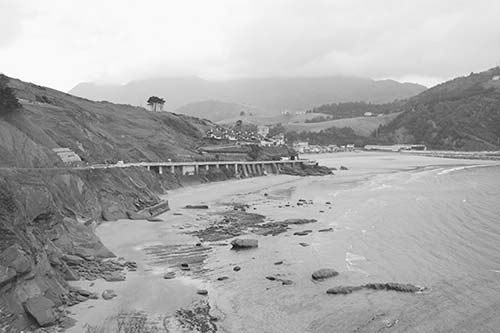
If side-tripping from San Sebastián to Bilbao, you can drive directly there on AP-8 in the morning. But going home to San Sebastián, consider this more scenic route: Take AP-8 until the turnoff for Guernica (look for Amorebieta/Gernika-Lumo sign), then head up into the hills on BI-635. After visiting Guernica, follow signs along the very twisty BI-2238 road to Lekeitio (about 40 minutes). Leave Lekeitio on the road just above the beach; after crossing the bridge, take the left fork and follow BI-3438 to Markina/Ondarroa (with a striking modern bridge and nice views back into the steep town; follow portua signs for free 30-minute parking at the port). Continue to Mutriku and Deba as you hug the coastline east toward San Sebastián. There’s a good photo-op pullout as you climb along the coast just after Deba. Soon after, you’ll have two opportunities to get on the AP-8 (blue signs) for a quicker approach to San Sebastián; but if you’ve enjoyed the scenery so far, stick with the coastal road (white signs, N-634) through Zumaia and Getaria, rejoining the expressway at the high-class resort town of Zarautz.
Lequeitio/Lekeitio
More commonly known by its Euskara name, Lekeitio (leh-KAY-tee-oh)—rather than the Spanish version, Lequeitio—this small fishing port has an idyllic harbor and a fine beach. It’s just over an hour by bus from Bilbao and an easy stop for drivers, and it’s protected from the Bay of Biscay by a sand spit that leads to the lush and rugged little San Nicolás Island. Hake boats fly their Basque flags, and proud Basque locals black out the Spanish translations on street signs.
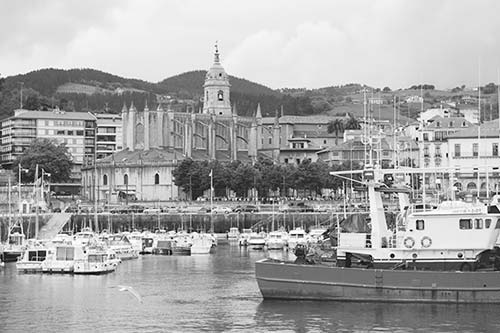
Lekeitio is a teeming resort during July and August (when its population of 7,000 triples as big-city Basque folks move into their vacation condos). Isolated from the modern rat race by its location down a long, windy little road, it’s a backwater fishing village the rest of the year.
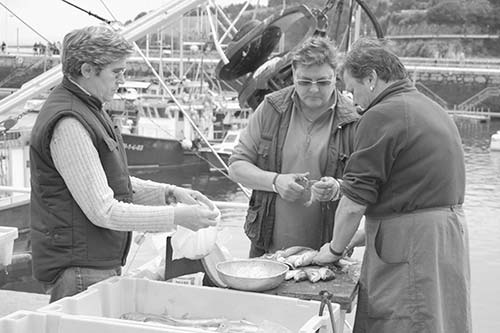
Sights here are humble, though the 15th-century St. Mary’s Parish Church is a good example of Basque Gothic, with an impressive altarpiece. The town’s back lanes are reminiscent of the old days when fishing was the only industry. Fisherwomen sell their husbands’ catches each morning along the port. The golden crescent beach is as inviting as the sandbar, which—at low tide—challenges you to join the seagulls out on San Nicolás Island.
The best beach in the area for surfers and sun lovers is Playas Laga (follow signs off the road from Bilbao to Lekeitio). Relatively uncrowded, it’s popular with body-boarders.
Getting There: Bizkaibus #A3523 connects Lekeitio with Bilbao (8/day, 1.5 hours; same bus stops at Guernica, 40 minutes, https://web.bizkaia.eus/es/web/bizkaibus). Lurraldebus connects Lekeitio and San Sebastián (5/day, 1.5 hours, www.lurraldebus.eus). But this destination is most logical for those with a car. Drivers can park most easily in the lot near the bus station. Exit the station left, walk along the road, then take the first right (down the steep, cobbled street) to reach the harbor. There is no baggage storage in town.
Tourist Information: The TI faces the fish market next to the harbor (daily 10:00-15:00 & 16:00-19:00, shorter hours Sept-June, closed Mon Nov-March, +34 946 844 017, https://lekeitio.org).
Eating in Lekeitio: Although it’s sleepy off-season, the harbor promenade is made-to-order in summer for a slow meal or a tapas crawl.
Guernica / Gernika
The workaday market town of Guernica (GEHR-nee-kah) is near and dear to Basques and pacifists alike. This is the site of the Gernikako Arbola—the oak tree of Gernika, which marked the assembly point where the regional Basque leaders, the Lords of Bizkaia, met through the ages to assert their people’s freedom. Long the symbolic heart of Basque separatism, it was also a natural target for Franco (and Hitler) in the Spanish Civil War—resulting in an infamous bombing raid that left the town in ruins (see “The Bombing of Guernica” sidebar), as immortalized by Picasso in his epic work, Guernica.
Today’s Guernica, rebuilt after being bombed flat in 1937 and nothing special at first glance, holds some of the Basque Country’s more compelling museums. And Basque bigwigs have maintained the town as a meeting point—they still elect their figurehead leader on that same ancient site under the oak tree.
Orientation to Guernica
Guernica is small (about 17,000 inhabitants) and compact, focused on its large market hall (Monday market 9:00-14:00).
Tourist Information: The TI is in the town center (Mon-Sat 10:00-19:00, Sun until 14:00, shorter hours in winter, Artekalea 8, +34 946 255 892, http://turismo.gernika-lumo.net [URL inactive]). If you’ll be visiting both the Peace Museum and the Basque Country Museum (Euskal Herria), buy the €6 combo-ticket here. Called a “Unified Ticket,” it’s a great deal but you can only get it at the TI.
Arrival in Guernica: Drivers will find a handy parking lot near the train tracks at the end of town. Buses drop off passengers along the main road skirting the town center. The train station also sits on the main road. No matter how you enter, the TI is well marked (look for yellow i signs)—head there first to get your bearings and pick up a handy town map.
Sights in Guernica
I’ve listed Guernica’s sights in the order of a handy sightseeing loop from the TI.
• Exit the TI to the left, cross the street, and walk up the left side of the square, where you’ll find the...
▲Gernika Peace Museum
Because of the brutality of the Guernica bombing, and the powerful Picasso painting that documented the atrocities of war, the name “Guernica” has become synonymous with pacifism. This thoughtfully presented exhibit has taken a great tragedy of 20th-century history and turned it into a compelling cry for peace in our time.
Cost and Hours: €6, free Sat 16:00-19:00; open Tue-Sat 10:00-19:00, Sun-Mon until 14:30, closed Mon off-season; Foru Plaza 1, +34 946 270 213, www.museodelapaz.org.
Visiting the Museum: Borrow the English translations at the entry, request an English version of the audio presentation upstairs, and head up through the two-floor exhibit. The first floor begins by considering different ways of defining “peace.” You’ll then enter an apartment and hear a local woman, Begoña, describe her typical Guernica life in the 1930s...until the bombs dropped (a mirror effect shows you the devastating aftermath). You’ll exit through the rubble into an exhibit about the town’s history, with a special emphasis on the bombing. Finally, a 10-minute movie shows grainy footage of the destruction and ends with a collage of peaceful reconciliations in recent history—in Ireland, South Africa, Guatemala, Australia, and Berlin. On the second floor, Picasso’s famous painting is superimposed on three transparent panels to highlight different themes. The exhibit concludes with a survey of the recent history of conflicts in the Basque Country.
• Exit left up the stairs and continue uphill to the big church. At the road above the church, you can turn right and walk one block to find a tile replica of Picasso’s Guernica (left-hand side of the street). Or you can head left to find the next two attractions.
▲Basque Country Museum (Euskal Herria Museoa)
This well-presented exhibit offers a good overview of Basque culture and history. Start on the ground floor to learn about the history of this 1733 palacio (mansion house) that was spared from the bombing in 1937, as well as the history of the Basque land and early settlements. Follow the suggested route and climb chronologically up through Basque history, finding an exhibit about traditional Basque architecture, lots of antique maps, and a region-by-region rundown of the Basque Country’s seven territories. One interesting map shows Basque emigration over the centuries—including to the US. The top floor is the most engaging, highlighting Basque culture: sports, dances, cuisine, myths and legends, music, and language. For a breath of fresh air, step out back into the Peoples of Europe Park and enjoy a peaceful respite.
Cost and Hours: €3.50, free on Sat, open Tue-Sat 10:00-14:00 & 16:00-19:00, Sun 10:30-14:30, closed Mon except July-Aug 10:30-14:00; Allende Salazar 5, +34 946 255 451, https://bizkaikoa.bizkaia.eus.
▲▲Gernika Assembly House and Oak Tree
In the Middle Ages, the meeting point for the Basque general assembly was under the old oak tree on the gentle hillside above Guernica. The tradition continues today, as the tree stands at the center of a modest but interesting complex celebrating Basque culture and self-government.
Cost and Hours: Free 45-minute visit, must reserve a timed-entry slot online in advance; daily 10:00-14:00 & 16:00-19:00, off-season until 18:00; on Allende Salazar, +34 946 251 138, www.jjggbizkaia.eus—click “EN” for English, then “reserve appointment.”
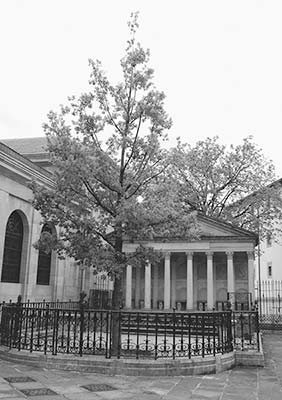
Visiting the Assembly House: As you enter the grounds past the guard hut, on the right you’ll see an old tree trunk in the small colonnade dating from the 1700s. Basque traditions have lived much, much longer than a single tree’s life span. When one dies, it’s replaced with a new one. This is the oldest surviving trunk.
The exhibit has four parts: a stained-glass window room, the oak-tree courtyard, the assembly chamber, and a basement theater (request the 10-minute video in English that extols the virtues and beauties of the Basque Country).
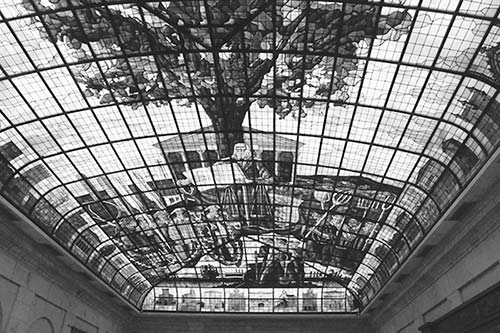
Inside the main building, pick up a copy of the English brochure that describes in detail the importance of this site. First find the impressive stained-glass window room. The computer video here gives a good six-minute overview of the exhibit. The gorgeous stained-glass ceiling is rife with Basque symbolism. The elderly leader stands under the oak holding a book with the “Old Law” (Lege Zarra), which are the laws by which the Basques lived for centuries. Below him are groups representing the three traditional career groups of this industrious people: sailors and fishermen, miners and steelworkers, and farmers. Behind them all is a classic Basque landscape: On the left is the sea, and on the right are rolling green hills dotted with red-and-white homes. Small, square panels around the large window represent all the important towns in the region, with Guernica’s oak tree easy to pinpoint. Step into the wood-paneled library off the main room, and peek into the head honcho’s office in the corner.
Out back, a Greek-style tribune surrounds the fateful oak tree, a descendant of the nearly century-old ancestor, and possibly of all the trees here since ancient times. This little fella is the fifth tree to stand here—it started growing in 2000 and was planted here in 2015. The previous tree struggled to survive after standing here for just 10 years.
Basque leaders have met in solidarity at this location for centuries. In the Middle Ages, after Basque lands became part of Castile, Castilian kings came here to pledge respect to the old Basque laws. When Basque independence came under fire in the 19th century, patriots rallied by singing a song about this tree (“Ancient and holy symbol / Let thy fruit fall worldwide / While we gaze in adoration / Upon thee, our blessed tree”). After the 1937 bombing, in which this tree’s predecessor was miraculously unscathed, hundreds of survivors sought refuge under its branches. Today, although official representatives in the Spanish government are elected at the polls, the Basques choose their figurehead leader, the Lehendakari (“First One”), in this same spot.
Step back inside to enter the assembly chamber—like a mini parliament for the region of Bizkaia (“Vizcaya” in Spanish, “Biscay” in English; one of the seven Basque territories). Notice the holy water and the altar—a sign that there was no separation of church and state in Basque politics. The large paintings above the doors show the swearing of allegiance to the Old Law. Portraits of 26 former Lords of Bizkaia maintain a watchful eye over the current assembly’s decisions.
• Exiting the grounds of the Assembly House, walk back to the front of the Basque Country Museum, and take the public school staircase on your right down to Pasealekua Square. At the bottom of the stairs, pop into a café (on your left) known to locals as the...
Bar de los Jubilados (Old Bomb Shelter)
This unmarked café, part of the retirement community center housed in the same building, is a good place for a quick coffee and snack—but its main claim to fame is that it was a bomb shelter during the 1937 bombing. Ask the bartender, “¿Dónde está el túnel, por favor?” You’ll be directed toward the women’s restroom (gentlemen, don’t worry, you can go, too). Walk down the hall, turn right into the women’s restroom, and go past the stalls into a small, cold, two-part room. While it’s not much to look at these days, imagine dozens of panicked people scrambling to take shelter here, hoping and praying that they would live through the devastating aerial attack (daily, Pasealekua Square).
Guernica Connections
Guernica is well connected to Bilbao (2 EuskoTren trains/hour, 50 minutes, arrive at Bilbao’s Matiko station; also 4 buses/hour, 40 minutes) and to Lekeitio (bus, 8/day, 40 minutes). Connections are sparser on weekends. You can get to San Sebastián on the scenic “Topo” EuskoTren train (transfer in Lemoa, about 2 hours).
Bilbao / Bilbo
Bilbao (bil-BOW, rhymes with “cow”) has seen a transformation like no other Spanish city. Entire sectors of the industrial city’s long-depressed port have been cleared away to allow construction of a new convention center, shops, apartment buildings, and the stunning Guggenheim Museum.
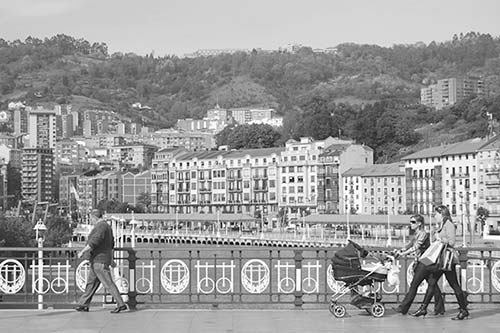
Today’s Bilbao mingles beautiful old buildings with eyesore high-rise apartment blocks, super-modern additions to the skyline (such as the Guggenheim and its neighbor, the 40-story Iberdrola Tower), and—scattered in the lush hillsides all around the horizon—typical whitewashed Basque homes with red roofs. Bilbao enjoys a vitality and Old World charm befitting its status as a regional capital of culture and industry.
PLANNING YOUR TIME
For most visitors, the Guggenheim is the main draw (and many could spend the entire day there). But with a little more time, it’s also worth hopping on a tram to explore the atmospheric old town or walk along the Nervión River promenade. With even more time, ride the Mount Artxanda funicular for a breathtaking overview of the entire area. Don’t bother coming to Bilbao on Monday, when virtually all its museums—including the almighty Guggenheim—are closed (except July-Aug).
Orientation to Bilbao
When you’re in the center, Bilbao feels smaller than its population of 350,000. The city, nestled amidst green hillsides, hugs the Nervión River as it curves through town. The Guggenheim is more or less centrally located near the top of that curve; the bus station is to the west; the old town (Casco Viejo) and train stations are to the east; and a super-convenient and fun-to-ride green tram called the EuskoTren Tranbia ties it all together.
TOURIST INFORMATION
Bilbao’s main TI is housed in a former bank next to the Abando train station at Plaza Circular (daily 9:00-19:30, +34 944 795 760, www.bilbaoturismo.net). If you’re interested in something beyond the Guggenheim, ask about their city and themed walking tours in English (described later, under “Tours in Bilbao”). The TI also has a ticket machine for buying EuskoTren tram tickets and the Barik public transport card (see “Arrival in Bilbao,” below).
Another handy TI is near the main entrance of the Guggenheim (Mon-Sat 10:00-19:00, Sun until 15:00, Alameda Mazarredo 66). The Basque Country regional TI office at the airport can help you with information about Bilbao and the entire region (daily 9:00-21:00, +34 944 031 444, https://turismo.euskadi.eus).
ARRIVAL IN BILBAO
Most travelers—whether arriving by train, bus, or car—will want to go straight to the Guggenheim. Thanks to a perfectly planned tram system (EuskoTren Tranbia), this couldn’t be easier. Simply buy a €1.50 single-ride ticket at a user-friendly green machine. If you’re planning multiple tram rides or traveling with a small group, consider the Barik public transport card, which cuts the cost of a single ride in half (nonrefundable €3 for the card itself, €5 minimum to reload; sold at the airport, Metro stations, the TI on Plaza Circular, kiosks, and the train station). Barik can be used for up to 10 people riding together on the Metro, buses (including the airport bus), and tram. Activate your card at the machine just before boarding; you can’t do it once on board. Single-ride tickets are validated at time of purchase and must be used the same day.
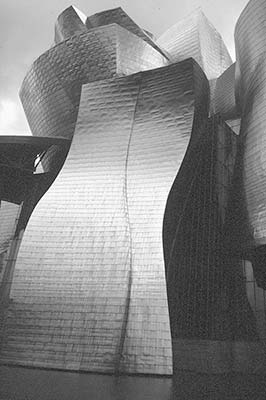
Hop on a green-and-gray tram, enjoy the Muzak, and head for the Guggenheim stop (there’s only one line, trams come every 10 minutes). If you get lost, ask: “¿Dónde está el Guggenheim?” (DOHN-deh eh-STAH el “Guggenheim”). Don’t confuse the green tram with the slow, scenic, blue train to San Sebastián. And while Bilbao has a slick Metro system, most tourists won’t need it to get around. Tram info: +34 944 333 333, EuskoTren.eus.
By Train: Bilbao’s Abando station (serving most of Spain, including Renfe trains) is on the river in central Bilbao. The train station is on top of a small shopping complex (car rental offices upstairs at track level). Unfortunately, the tram stop nearest the train station has no ticket machine and neither does the train station—to board here you’ll need to buy a Barik card or a single-ride ticket at the TI on Plaza Circular next to the station.
To reach the tram, descend into the stores. Leave from the exit marked Hurtado de Amézaga and go right to find the TI and the Abando tram stop. (If the TI is closed, follow the tram tracks across the bridge and around the Arriaga Theater to the next tram stop, Arriaga, where single-ride tickets are sold.) Activate your Barik card at the machines at the tram stop before boarding (direction: La Casilla) to reach the Guggenheim.
By Bus: Buses stop at the Intermodal station (www.bilbaointermodal.eus) on the western edge of downtown, about a mile southwest of the Guggenheim. This underground station houses a ticket office, WCs, lockers, and a cafeteria. The tram (stop: San Mamés) is on the road by the station—look for the steel CTB sign and follow the EuskoTren signs (not the escalator that leads to the Metro). Buy and validate a ticket at the machine and hop on the tram (direction: Bolueta) to the Guggenheim or old town.
By Plane: Bilbao’s compact, modern, user-friendly airport (code: BIO, www.aena.es/en/bilbao-airport [URL inactive]) is about six miles north of downtown. Everything branches off the light-and-air-filled main hall, designed by prominent architect Santiago Calatrava. The handy, green Bizkaibus (#3247) takes you directly to the city center—look for a sign outside the far-right exit of the terminal (€3, buy ticket or Barik card at the tiny ticket kiosk before boarding, daily 6:00-24:00, 2-3/hour, 20-minute trip, makes four stops downtown—the first one at Recalde is closest to the Guggenheim—before ending at the Intermodal bus station). A 15-minute taxi ride into town costs about €25. To get to San Sebastián, you can take a direct bus from Bilbao Airport (€17, buy at ticket machine or on Lurraldebus’s LurTicket app before boarding, runs hourly, 1.5 hours, drops off at the underground bus station, www.pesa.net). A taxi directly to San Sebastián will run you €150.
By Car: A big underground parking garage is near the museum; if you have a car, park it here and use the tram. From the freeway, take the exit marked Centro (with bull’s-eye symbol), follow signs to Guggenheim (you’ll see the museum), and look for the big P that marks the garage.
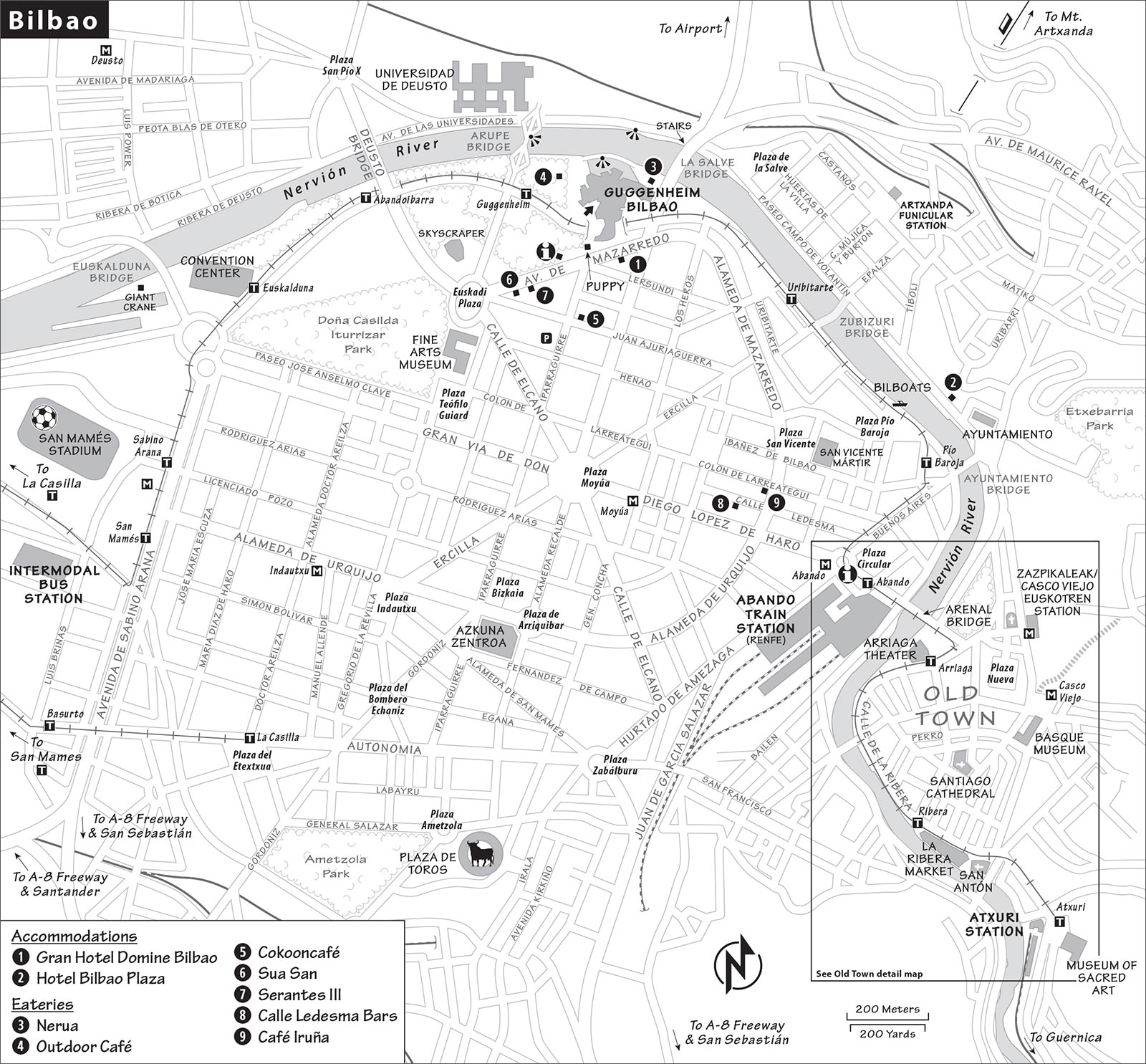
HELPFUL HINTS
Sightseeing Cards: The Bilbao Bizkaia Card is sold at TIs and online (www.bilbaobizkaiacard.com). It covers transportation, including the Artxanda funicular, and two TI walking tours, and allows you to skip the line when buying tickets at the Guggenheim and the Fine Arts Museum (€10/24 hours, €15/48 hours, €20/72 hours).
Baggage Storage: The Intermodal bus station on the west side of the city has lockers (Gurtubay 1, +34 944 395 077). If arriving by train, the Tourné Bilbao bike-rental shop is more convenient (see “Bike Tour,” later).
Laundry: The self-service Lavandería Autoservicio Adei is handy for visitors staying in the old town. You don’t even have to buy detergent—it’s already dispensed in the machines (daily 8:00-22:00, last load at 21:00, Ribera 9, +34 665 710 082).
Tours in Bilbao
Walking Tours
Bilbao Walking Tours offers 1.5-hour tours on Saturdays and Sundays (more often in summer), including an old-town tour at 10:00 and a modern-city tour at 12:00 showing the city’s history since the 19th century (both start at the Plaza Circular TI). Tours are in Basque, Spanish, and English, and it’s best to reserve in advance. The walks are timed so that you can do both in a single day (€4.50, free with Bilbao Bizkaia Card, +34 944 795 760, www.bilbaoturismo.net).
Tram Tour
Riding the EuskoTren round-trip between the Atxuri and Euskalduna stops is a great way to see the city’s oldest and newest neighborhoods, especially on rainy days. For more on the tram, see “Arrival in Bilbao,” earlier.
Boat Tour
For a different view of the city, try the Bilboats one-hour tour along the river, offering plenty of architectural photo ops. The tour begins near Ayuntamiento Bridge (€14, daily in spring and summer at 13:00, 15:45, 17:00, and 18:15, fewer departures off-season; reserve ahead, canceled if fewer than 10 people buy tickets; tram stop: Pío Baroja; Plaza de Pío Baroja, +34 946 424 157, www.bilboats.com). For hard-core sailors, a two-hour version goes all the way to the Bay of Biscay, passing under the unique suspension bridge in Portugalete (€20, daily July-Aug at 10:30, weekends only rest of year).
Bike Tour
Although Bilbao is not the most bike-friendly city, bike lanes close to both sides of the Nervión River offer a pleasant ride. At Tourné Bilbao, you can rent bikes or join their daily city tour at 10:30 (€35/3 hours, Villarías Kalea 1, near train station and TI, +34 944 249 465, www.tournebilbao.com).
Local Guide
Knowledgeable Bilbao native and licensed guide Iratxe Muñoz offers tours of the city, including the Guggenheim, as well as coastal towns and inland areas of the Basque Country (€240/half-day, €340/day, +34 607 778 072, iratxeguia@gmail.com).
Sights in Bilbao
▲▲▲Guggenheim Bilbao
Although the collection of art in this museum is no better than those in Europe’s other great modern-art museums, the building itself—designed by Frank Gehry and opened in 1997—is a masterpiece and reason enough for many travelers to happily splice Bilbao into their itineraries. Even if you’re not turned on by contemporary art, the Guggenheim’s 20 galleries, on three floors, are full of surprises, and it’s well worth the entry fee just to appreciate the museum’s structural design.
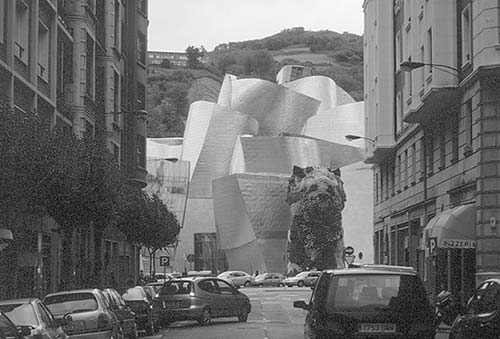
Cost and Hours: €16 online in advance, €18 onsite; Tue-Sun 10:00-19:00, until 20:00 in high season, closed Mon except July-Aug, same-day reentry allowed—ask for a bracelet before you leave; café; tram stop: Guggenheim, Avenida Abandoibarra 2, +34 944 359 080, www.guggenheim-bilbao.eus.
Tours: Free and excellent downloadable audioguide (bring headphones). The museum sometimes offers a 30-minute guided tour in English describing the art on exhibit (check schedule online). If available, show up at least 30 minutes early to put your name on the list at the information desk. Private 60-minute guided tours in English are available by reservation (€85 in addition to admission fee, book online).
Background: Frank Gehry’s groundbreaking triumph offers a fascinating look at 21st-century architecture. Using cutting-edge technologies, unusual materials, and daring forms, he created a piece of sculpture that smoothly integrates with its environment and serves as the perfect stage for some of today’s best art. Clad in limestone and titanium, the building connects the city with its river. Gehry meshed many visions. To him, the building’s multiple forms jostle like a loose crate of bottles. The building is inspired by a silvery fish...and also evokes wind-filled sails heading out to sea. Gehry keeps returning to his fish motif, reminding visitors that, as a boy, he was inspired by carp...even taking them into the bathtub with him.
Visiting the Museum: The audioguide will lead you room by room through the collection, but this information will get you started.
Guarding the main entrance is artist Jeff Koons’ 42-foot-tall West Highland Terrier. Its 60,000 plants and flowers, which blossom in concert, grow through steel mesh. A joyful structure, it brings viewers back to their childhoods—perhaps evoking humankind’s relationship to God—or maybe it’s just another notorious Koons hoax. One thing is clear: It answers to “Puppy.” Although the sculpture was originally intended to be temporary, the people of Bilbao fell in love with Puppy—so they bought it.
Descend to the main entrance, where you can show or buy your ticket. Pick up a map and enter a room adjacent to the information desk to watch a short video that helps you better appreciate this architectural icon.
Enter the atrium and scan the QR code to access your audioguide. The atrium acts as the heart of the building, pumping visitors from various rooms on three levels out and back, always returning to this central area before moving on to the next. The architect invites you to caress the sensual curves of the walls. There are virtually no straight lines (except the floor). Notice the sheets of glass that make up the staircase and elevator shafts—overlapping each other like a fish’s scales. Each glass and limestone panel is unique, designed by a computer and shaped by a robot...as will likely be standard in constructing the great buildings of the future.
From the atrium, step out onto the riverside terrace. The “water garden” lets the river symbolically lap at the base of the building. This pool is home to several unusual sculptures: Yves Klein’s five-part “fire fountain” (notice the squares in the pool to the right, appears every 4 minutes for one hour every evening), Fujiko Nakaya’s “fog sculpture” that billows up from below (on the hour for 8 seconds during open hours), and the Tall Tree and the Eye by British artist Anish Kapoor. Composed of 73 reflective spheres arranged vertically, the sculpture endlessly reflects the Guggenheim, the river, and the beholder.
Still out on the terrace, notice the museum’s commitment to public spaces: On the right, a grand staircase leads under a big green bridge to a tower; the effect wraps the bridge into the museum’s grand scheme. The 30-foot-tall spider, called Maman (“Mommy”), is French American artist Louise Bourgeois’ depiction of her mother: She spins a beautiful and delicate web of life...which is used to entrap her victims. (It makes a little more sense if you understand that the artist’s mother was a weaver. Or maybe not.)
Step back inside. Gehry designed the vast ground floor mainly to house often-huge modern-art installations. Computer-controlled lighting adjusts for different exhibits. Surfaces are clean and bare, so you can focus on the art. While most of the collection comes and goes, Richard Serra’s huge Matter of Time sculpture in the largest gallery (#104) is permanent. Who would want to move those massive metal coils? The intent is to have visitors walk among these metal walls—the “art” is experiencing this journey.
Because this museum is part of the Guggenheim “family” of museums, the collection perpetually rotates among the sister Guggenheim galleries in New York and Venice. The best approach to your visit is simply to immerse yourself in a modern-art happening, rather than to count on seeing a particular piece or a specific artist’s works.
You can’t fully enjoy the museum’s architecture without taking a circular stroll up and down each side of the river along the handsome promenade and over the two modern pedestrian bridges. The building’s skin—shiny and metallic, with a scale-like texture—is made of thin titanium, carefully created to give just the desired color and reflective quality. The external appearance tells you what’s inside: The blocky limestone parts contain square-shaped galleries, and the titanium sections hold nonlinear spaces.
As you look out over the rest of the city, think of this: Gehry designed his building to reflect what he saw here in Bilbao. Now other architects are, in turn, creating new buildings that complement his. It’s an appealing synergy for this old city.
Leaving the Museum: To get to the old town from the Guggenheim, you can take the tram that leaves from the river level beside the museum, just past the kid-pleasing fountain (ride it in direction: Bolueta). Hop off at the Arriaga stop, near the dripping-Baroque riverfront theater of the same name. From here, cross the street to enter the heart of the old town.
Or, for a pleasant 20-minute walk, exit the museum and go behind it to the river. Head toward the spider Maman, passing under her and the tall bridge La Salve, which is incorporated into the museum. Continue along the river, passing the white, harp-shaped Santiago Calatrava bridge (Zubizuri), a second bridge (Ayuntamiento), and finally crossing at the third bridge (Arenal) to arrive at the old town.
NEAR THE GUGGENHEIM
Fine Arts Museum (Museo de Bellas Artes)
Often overshadowed by the Guggenheim, the Fine Arts Museum contains a thoughtfully laid out collection arranged chronologically from the 12th century to the present. Find minor works by many Spanish artists, such as Goya, El Greco, Picasso, Murillo, Zurbarán, Sorolla, Chillida, Tàpies, and Barceló—along with a handful of local Basque painters. International artists in the collection include Gauguin, Klee, Bacon, Cassatt, and more. The museum is at the edge of the lovely Doña Casilda Iturrizar Park, perfect for a stroll after your visit. A major renovation may limit what’s on view (and entry may be free); check online before you visit.
Cost and Hours: €10, Wed-Mon 10:00-20:00 except Sun until 15:00, closed Tue, a short walk from the Guggenheim at Museo Plaza 2, +34 944 396 060, www.bilbaomuseoa.eus.
Azkuna Zentroa (Alhóndiga Bilbao)
Bilbao’s culture and leisure center, designed by French architect Philippe Starck, is worth a quick visit or a lazy afternoon. Not one of the 43 interior columns is alike—the designs are meant to represent the entirety of materials and styles from antiquity to today. The center houses a cinema, auditorium, exhibition spaces, and restaurant—so it functions as a community gathering space. Most impressive is its glass-bottomed rooftop pool—from the atrium below, visitors can gaze up at the backstrokers in the water above.
Cost and Hours: Free entry to the center itself, €11 day pass gives you access to the pool and sundeck, daily 9:00-21:00, 10-minute walk from the Guggenheim at Plaza Arriquibar 4, +34 944 014 014, www.azkunazentroa.eus.
Artxanda Funicular Station
Opened in 1915, this funicular still provides bilbainos with a green escape from their somewhat grimy city. The three-minute ride offers sweeping views of the city on the way to the top of Mount Artxanda, where there’s a park, restaurants, and a sports complex. Bring a picnic on a sunny afternoon and take a moment to ponder the giant thumbprint sculpture dedicated to Basque soldiers who fought against Franco during the civil war.
Cost and Hours: €4.30 round-trip, covered by Bilbao Bizkaia Card; departs every 15 minutes, daily 7:15-22:00, until 23:00 Fri-Sat in summer; cross the Zubizuri Bridge and walk two blocks along Calle Mújica y Burton to the cable-car station, Plaza del Funicular, +34 944 454 966, https://funicularartxanda.bilbao.eus.
IN THE OLD TOWN
Bilbao’s old town (Casco Viejo), with tall, narrow lanes lined with thriving shops and tapas bars, is worth a stroll. Because the weather is wetter here than in many other parts of Spain (hence the green hillsides), the little balconies that climb the outside walls of buildings are glassed in, creating cozy breakfast nooks. Various museums (including those dedicated to diocesan art and the Holy Week processions) are in or near the old town, but on a quick visit only the Basque Museum is worth considering.
Santiago Cathedral
Whether you want to or not, you’ll eventually wind up at old Bilbao’s centerpiece, the Santiago Cathedral. This 14th-century Gothic church has a tranquil interior that has been scrubbed clean inside and out.
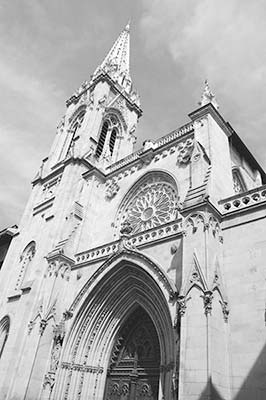
Cost and Hours: €6 combo-ticket includes audioguide and entry to the San Anton Church next to La Ribera Market, daily 10:00-20:00, July-Aug until 21:00, Plaza Santiago 1, +34 944 153 627, www.catedralbilbao.com.
Basque Museum (Euskal Museoa)
This museum, in a 16th-century convent, may be closed for renovation. If it has reopened, you’ll find lovingly assembled artifacts of Basque heritage. English pamphlets scattered throughout offer helpful summaries of the displays.
Cost and Hours: €3, Mon and Wed-Fri 10:00-19:00, Sat 10:00-13:30 & 16:00-19:00, Sun 10:00-14:00, closed Tue, Miguel de Unamuno Plaza 4, +34 944 155 423, www.euskalmuseoa.eus.
Visiting the Museum: The main sight in the ground-floor cloister is the Iron Age El Mikeldi, a stone animal figure. The first floor centers on the maritime activities of the seafaring Basques, as well as the pastoral lifestyle of the region’s shepherds. The second floor has exhibits covering porcelain, timeworn tools, and ironworks that helped spur the economic prominence of the Basque region.
On the top floor are fragments from two oak trees from Guernica—cherished relics of Basque nationalism (see the Guernica section, earlier). The Arbol Viejo and the Arbol Nuevo each stood for 150 years in front of the Gernika Assembly House until their “clinical death.” This floor also has exhibits on the social, political, and economic impact of Bilbao over three centuries.
La Ribera Market
There’s been a market here since Bilbao was founded in 1300. As part of an urban renewal plan, the 1929 La Ribera city market reopened in 2011 to an enthusiastic public. Stroll the stalls for the freshest fish (look for the busiest sellers), shop for produce, and admire a series of Art Deco stained-glass panels on the top floor. The city’s coat-of-arms, with two wolves, can be found in the largest panels. Consider checking out the stylish cervecería and the few pintxo bars in the Gastro Plaza (Mon-Sat 8:00-14:30, also Tue-Fri 17:00-20:00, closed Sun; bars open long hours daily; public WC, +34 944 231 019).
Sleeping in Bilbao
Bilbao merits an overnight stay. Even those who are interested only in the Guggenheim find that there’s much more to see in this historic yet quickly changing city.
NEAR THE GUGGENHEIM MUSEUM
For locations, see the “Bilbao” map on here.
$$$$ Gran Hotel Domine Bilbao is the place for well-heeled modern-art fans looking for a splurge close to the museum. It’s right across the street from the main entrance to the Guggenheim and Jeff Koons’ Puppy. The hotel is gathered around an atrium with a giant “stone tree” and other artsy flourishes, and its decor (by a prominent Spanish designer) was clearly inspired by Gehry’s masterpiece. The 145 plush rooms are distinctly black, white, steel, and very postmodern (air-con, elevator, gym with wet and dry saunas, pay parking, Alameda Mazarredo 61, +34 944 253 305, www.hoteldominebilbao.com, info@hoteldominebilbao.com). Breakfast on the hotel’s great museum-view terrace is a treat open even to nonguests (daily until 11:00), as is the rooftop bar (daily from 16:00). If arriving by tram, take the main museum steps up by the fountains to reach the hotel.
$$ Hotel Bilbao Plaza has 53 bright and modern rooms, pleasant public spaces, and a friendly staff. With a great location on the river, it’s a 15-minute walk to the Guggenheim and a five-minute walk to modern Bilbao or the edge of the old town—so it’s away from the bar noise at night (air-con, elevator, pay parking, Paseo Campo Volantín 1, at the Ayuntamiento Bridge, +34 946 856 700, www.hotelbilbaoplaza.com, info@hotelbilbaoplaza.com).
IN AND NEAR THE OLD TOWN
To reach the old town, take the tram to the Arriaga stop.
$$ Basque Boutique offers eight classy rooms with petite balconies facing a pedestrian street. All rooms are designed with Basque themes, such as the “El Caserío” room with traditional Basque furniture and the “Gernika” room inspired by the painting by Pablo Picasso. The shared space has free coffee and tea, and you can try on traditional Basque clothing to take a fun photo (family rooms, air-con, no breakfast or elevator, Calle de la Torre 2, second floor, +34 944 790 788, www.basqueboutique.es, info@basqueboutique.es).
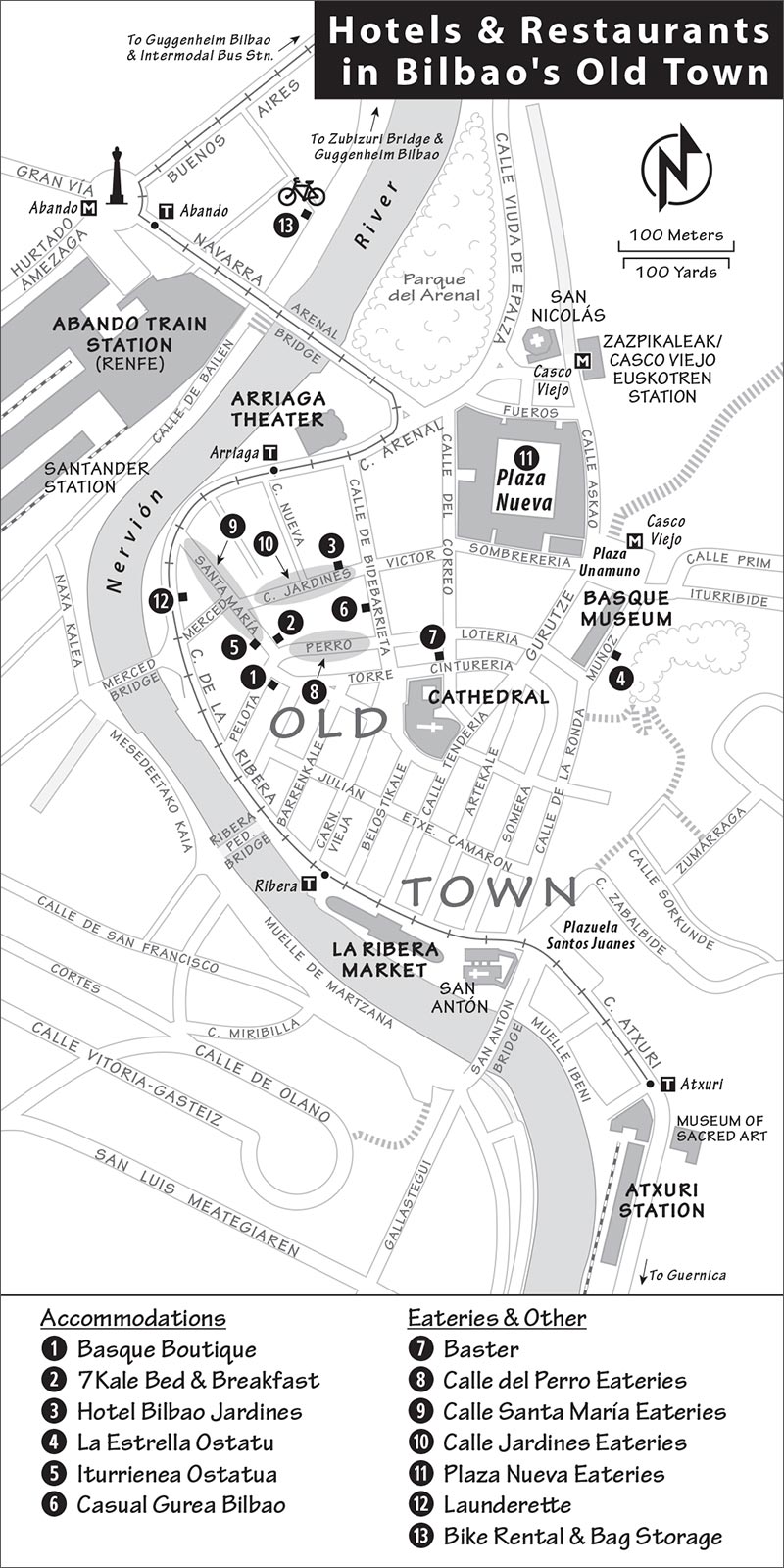
$$ 7Kale Bed & Breakfast, with 22 bright and fresh rooms, is well run with attention to detail. Balcony rooms are lovely and double-pane windows keep things quiet, especially on the fourth floor (air-con, elevator, Calle Santa María 13, first and fourth floor, +34 946 402 011, www.7kalebnb.com, 7kale@7kalebnb.com).
$$ Hotel Bilbao Jardines is a slumbermill buried in the old town with 32 modern but basic rooms and squeaky floors (air-con, elevator, free loaner bicycles, Calle Jardines 9, +34 944 794 210, www.hotelbilbaojardines.com [URL inactive], info@hotelbilbaojardines.com; Félix).
$$ La Estrella Ostatu has 26 simple but neat rooms up a twisty staircase near the Basque Museum. It’s on a busy pedestrian street with several bars—bring earplugs (no breakfast, fans, María Muñoz 6, +34 944 164 066, www.la-estrella-ostatu.com [URL inactive], laestrellabilbao@yahoo.es, no English spoken).
$ Iturrienea Ostatua is a polished, quaint version of a traditional pensión with nine rooms, a breakfast room, rustic decor, and mini fridges. Double-pane windows help with the noise, but if you are sensitive, bring earplugs or ask for an interior room (no reception after 14:30—guests enter with access code, air-con, elevator, Calle Santa María 14, first floor, +34 944 161 500, www.iturrieneaostatua.com, iturrienea@outlook.es).
$ Casual Gurea Bilbao has 26 simple, well-priced rooms. Double-pane windows keep the rooms quiet despite being on a busy street. A common area has coffee and vending machines (no breakfast, fans, elevator, Calle Bidebarrieta 14, third floor, +34 944 163 299, www.casualgurea.com, reservas@casualhoteles.com).
Eating in Bilbao
Bilbao has a thriving restaurant and tapas-bar scene. And with several Michelin-star restaurants, Bilbao seems poised to give San Sebastián a run for its money as culinary capital of the Basque Country. For pointers on Basque food, see the “Basque Country Cuisine Scene” section at the beginning of this chapter. While each neighborhood has a clustering of bars and restaurants, the best spots are in the old town, and in the new town area between the Guggenheim and old town. The area around the Guggenheim also has several good options.
NEAR THE GUGGENHEIM MUSEUM
The easiest choice is the $$$ bar in the museum itself, which features pintxos, salads, and sandwiches (upper level, separate entry above museum entrance; Tue-Sun 11:00-19:00, longer hours in summer, also open Mon July-Aug). Adjacent to the bar is the museum’s more chic $$$ Bistro, with an express lunch menu (Tue-Sun 13:00-15:30, fixed-price menu Fri-Sat 20:00-22:00, closed Mon except for summer, reservations smart, +34 944 239 333, www.bistroguggenheimbilbao.com). The finest dining experience is at the one-Michelin-star restaurant $$$$ Nerua, with waiters almost as fancy as the food (riverfront access upstairs outside museum, Tue-Sun 13:00-15:00, evening service Thu-Sat 20:30-22:00, closed Mon, +34 944 000 430, www.neruaguggenheimbilbao.com).
The circular structure outside the museum by the playgrounds and fountains is a pleasant outdoor café serving sandwiches. If the tables are full, you can take your food to one of the stone benches nearby. In the evenings, they sometimes have live music.
The streets in front of the museum have a handful of $$ eateries. Cokooncafé serves a mouthwatering brunch and good coffee (Tue-Sun until 15:00, closed Mon, Calle Iparraguirre 5). Sua San is a modern café with pintxos, salads, and sandwiches in addition to their daily menu. Takeout is available for a picnic in front of the Guggenheim (long hours daily, Sun until 16:30, Alameda Mazarredo 79, +34 944 987 751). At Serantes III, the food is heartier, more local, and homemade (long hours daily, Alameda Mazarredo 75, +34 944 248 004). For locations, see the “Bilbao” map on here.
IN THE OLD TOWN
You’ll find plenty of options on the lanes near the cathedral or on Plaza Nueva. Most restaurants around the old town advertise a fixed-price lunch for around €13; some close for siesta between 16:00 and 20:00. For locations, see the “Hotels & Restaurants in Bilbao’s Old Town” map.
Calle Correo: The hip little bar $$ Baster is just behind the cathedral. Sit in the small interior or on the delightful Parisian-inspired terrace for late breakfast, pintxos, their well-known patatas bravas, or a vermut preparado (long hours Tue-Sat, Sun until 16:00, closed Mon, Calle Correo 22, +34 944 071 228).
Calle del Perro: This street is tops for tasty pintxos. $$ Xukela Bar is my favorite, with its inviting atmosphere, good wines, and an addictive array of tapas spread along its bar. The adventurous might try their specialty—cresta de gallo, a.k.a. fried rooster comb (Calle del Perro 2, +34 944 159 772). Calle del Perro is also good for sit-down restaurants. Browse the menus and interiors and choose your favorite. Well-regarded options include three $$ places virtually next door to each other: Egiluz (meals served in small restaurant up steep spiral staircase in the back), Río-Oja (focus on shareable traditional dishes called cazuelitas), and Rotterdam (also has cazuelitas displayed on the bar; try the chipirones en su tinta—squids in their own ink). Across from Río-Oja, $$ Restaurante Mandoya is a charming sit-down place with a friendly staff and appealing interior. They specialize in both fish and meat, serving up hearty lunch portions. It gets busy, so come early or make a reservation (Tue-Thu lunch only, Fri-Sat lunch and dinner, closed Mon, Calle del Perro 3, +34 944 157 984, www.restaurantemandoya.com).
Calle Santa María: This street caters to a younger crowd, with softer lighting and a livelier atmosphere, and has several bars and restaurants worth considering: $$$ Kasko is a good sit-down option, with a pianist some evenings and an interesting fixed-price lunch and dinner (daily, Calle Santa María 16, +34 944 160 311). $$ Con B de Bilbao serves beautiful and hearty pintxos or montaditos in a trendy, eclectic setting (closed Sun-Mon for dinner, Calle Santa María 9, +34 944 158 776). Busy $$ Amarena is probably the best choice if you want a nice restaurant meal (daily, on the corner at Calle Santa María 18, +34 944 169 421).
Calle Jardines: Standouts here include the popular $$ Berton and its sister bar/dining room $$ Berton Sasibil, across the lane (at #11 and #8, closed Mon, +34 944 167 035). $ Charamel Gozotegia has coffee, tea, and pastry to follow your pintxo lunch. Ask for the traditional pastel vasco (Basque cake) or their specialty milhoja artesana, all homemade by a group of young, creative bakers (daily until 20:30, Calle Jardines 2, +34 944 165 984). Tahona Jardines Pandería, down the street (#10), serves similar items to loyal customers willing to wait in line (daily until 20:00).
Plaza Nueva and Calle del Arenal: The old town’s living room, encircled by buildings on Plaza Nueva, is full of outdoor café tables, lively pintxo bars, kids playing ball, and a stamp, coin, and used-book market on Sunday morning. It’s a great local scene to take in. For good pintxos, check out the award-winning $$ Gure Toki and its neighbor bar $$ Sorginzulo, both with outdoor seating.
IN THE NEW TOWN
You’ll see cafés, restaurants, and pintxo bars scattered along the way from the Guggenheim to the old town in the neighborhood parallel to the Nervión River. The most concentrated and accessible area is on and near the pedestrian street Calle Ledesma, which runs parallel to Gran Vía de Don Diego López de Haro. On a busy night, you won’t be able to tell where people ordered their drinks as they flow up and down the street. Most of the places on this strip have similar pintxos and drinks. Around the corner, on the large inviting square called Jardines de Albia, is $$ Café Iruña, a café-bar-restaurant with Andalusian decor serving breakfast as well as pintxos and full meals (fixed-price weekday meal, long hours daily, +34 944 237 021). For locations, see the “Bilbao” map, earlier.
Bilbao Connections
From Bilbao by Bus to: San Sebastián (2/hour, hourly on weekends, 1.5 hours, Pesa), Guernica (4/hour, fewer on weekends, 40 minutes, Bizkaibus), Lekeitio (hourly, 1.5 hours, Bizkaibus), Pamplona (6/day, 2 hours), Burgos (6/day, fewer on weekends, 2-3 hours, Alsa), Santander (hourly, 1.5 hours, Alsa, transfer there to bus to Santillana del Mar or Comillas). These buses depart from Bilbao’s Intermodal station (tram stop: San Mamés, www.bilbaointermodal.eus).
By Renfe Train to: Madrid (2/day direct, more with transfer, 5-7 hours), Barcelona (1/day, 7 hours), Burgos (3/day direct, more with transfer, 3 hours), Salamanca (1/day, 5.5 hours), León (1/day, 5 hours). Remember, these trains leave from the Abando station, across the river from the old town (tram stop: Abando).
By EuskoTren to: San Sebastián (hourly, long and scenic 2.5-hour trip to San Sebastián’s Amara EuskoTren station, departs from Bilbao´s Zazpikaleak/Casco Viejo station), Guernica (2/hour, 50 minutes, leaves from Matiko station). EuskoTren info: EuskoTren.eus.
French Basque Country
Compared with the Spanish lands across the border, the French Basque Country (Le Pays Basque) seems French first and Basque second. You’ll see less Euskara writing than in Spain, but these destinations have their own special spice, mingling Basque and French influences with beautiful rolling countryside and gorgeous beaches.
Just 45 minutes apart by car, San Sebastián and St-Jean-de-Luz bridge the Spanish and French Basque regions. Between them you’ll find the functional towns of Irún (Spain) and Hendaye (France).
My favorite home base here is the central, comfy, and manageable resort village of St-Jean-de-Luz. It’s a stone’s throw to Bayonne (with its “bigger-city” bustle and good Basque museum) and the snazzy beach town of Biarritz. A drive inland rewards you with a panoply of adorable French Basque villages. And St-Jean-de-Luz is a relaxing place to “come home” to, with its mellow ambience, fine strolling atmosphere, and good restaurants.
St-Jean-de-Luz / Donibane Lohizune
St-Jean-de-Luz (san zhahn-duh-lewz) sits cradled between its small port and gentle bay. The days when whaling, cod fishing, and pirating made it wealthy are long gone, but don’t expect a cute Basque backwater. Tourism has become the economic mainstay, and it shows. Pastry shops serve Basque specialties, and store windows proudly display berets (a Basque symbol). Ice-cream lickers stroll traffic-free streets, while soft, sandy beaches tempt travelers to toss their itineraries into the bay. The knobby little mountain La Rhune towers above the festive scene. Locals joke that if it’s clear enough to see La Rhune’s peak, it’s going to rain, but if you can’t see it, it’s raining already.
The town has little of sightseeing importance, but it’s a good base for exploring the Basque Country and a convenient beach and port town that provides the most enjoyable dose of Basque culture in France. The town fills with French tourists in July and August—especially the first two weeks of August, when it’s practically impossible to find a room without a reservation made long in advance...or even to walk down the main street.
Orientation to St-Jean-de-Luz
St-Jean-de-Luz’s old city lies between the train tracks, the Nivelle River, and the Atlantic. The main traffic-free street, Rue Gambetta, channels walkers through the center, halfway between the train tracks and the ocean.
The only sight worth entering in St-Jean-de-Luz is the church where Louis XIV and Marie-Thérèse tied the royal knot. St-Jean-de-Luz is best appreciated along its pedestrian streets, lively squares, and golden, sandy beaches. With nice views and walking trails, the park at the far eastern end of the beachfront promenade at Pointe Ste. Barbe makes a good walking destination.
The small, untouristed town of Ciboure, across the river from St-Jean-de-Luz, holds little of interest (although fans of Maurice Ravel can hunt down his birthplace at Quai Maurice Ravel 27).
TOURIST INFORMATION
The helpful TI is next to the big market hall, along the busy Boulevard Victor Hugo (July-Aug Mon-Sat 9:00-13:00 & 14:00-18:00, Sun 10:00-13:00; shorter hours rest of the year, closed Sun Jan-March; 20 Boulevard Victor Hugo, +33 5 59 26 03 16, town info: www.saint-jean-de-luz.com, regional info: www.en-pays-basque.fr).
ARRIVAL IN ST-JEAN-DE-LUZ
By Train or Bus: From the train station, the pedestrian underpass leads to the bus station. From there, it’s easy to get to the TI and the center of the old town (just a few blocks away).
By Car: Follow signs for Centre-Ville, then Gare and Office de Tourisme. The old town is not car-friendly, with one-way lanes that cut back and forth across pedestrian streets. It’s best to park your car in the free parking lot next to the train tracks.
By Plane: The nearest airport is Biarritz-Anglet-Bayonne Airport, 10 miles to the northeast near Biarritz. The tiny airport is easy to navigate, with a useful TI desk (code: BIQ, www.biarritz.aeroport.fr). To reach St-Jean-de-Luz, you can take bus #3 (€1.20, hourly on weekdays, half as many on weekends, 45 minutes, get off at the Halte Routière stop near the train station, www.txiktxak.fr) or a 20-minute taxi ride (about €40-50).
HELPFUL HINTS
Market Days: The Les Halles covered market is open daily from 7:00 to 13:00 and offers everything from fresh fish and produce to regional specialty dried goods. On Tuesday and Friday mornings (and summer Saturdays) until about 13:00, there’s also a street market. Farmers’ stands spill through the streets from the market on Boulevard Victor Hugo, giving everyone a rustic whiff of “life is good.”
Pharmacies: Several can be found on Rue Gambetta. Look for the green cross.
Laundry: Laverie Automatique du Port is at 4 Boulevard Thiers (self-service daily 7:00-21:00, change machine; full-service available Wed-Fri 9:30-12:00 & 14:30-18:00, Sat 9:30-12:00, mornings only in winter; +33 5 59 85 17 69).
Car Rental: The handiest spot is Avis, at the train station (Mon-Sat 9:00-13:00 & 14:00-17:00, closed Sun, +33 5 59 26 76 66).
Tours in St-Jean-de-Luz
Tourist Train
A little tourist train does a 30-minute trip around town (€7, departs every 45 minutes from the port, runs daily July-Aug 10:30-19:30, April-June & Sept-Oct 11:00-12:30 & 14:30-18:00, no train Nov-March). It’s only worth the money if you need to rest your feet.
Bus Excursions
Le Basque Bondissant runs day-trip excursions, including a Wednesday-only jaunt to the Guggenheim Bilbao (€40 round-trip, includes museum admission, departs 9:00 from green bus terminal across the street from train station, returns 19:15). You can get information on other tours and buy tickets at the TI or online (+33 5 59 26 25 87, www.basque-bondissant.com).
Boat Trips
Le Passeur, at the port, offers bay crossings to Socoa and Ciboure, with hourly departures (€3.50 each way, runs mid-April-Oct, extra sailings in summer). They also have one-hour guided tours of the bay that include a drink at the end (€25, April-Oct; reservations suggested, Quai Maréchal Leclerc, +33 6 11 69 56 93, www.buruxkan.eus). Nivelle V offers mini Atlantic cruises and excursions, including fishing trips (€38, 3.5 hours), a Basque Coast to Spain tour (€20, 2 hours), and a Sea Cliff tour (€12, 45 minutes). Get tickets at their portside kiosk (runs April-mid-Oct, reservations required July-Aug, Quai Maréchal Leclerc, +33 6 09 73 61 81, www.croisiere-saintjeandeluz.com).
St-Jean-de-Luz Walk
To get a feel for the town, take this hour-long self-guided stroll. You’ll start at the port and make your way to the historic church.
Port: Begin at the little working port (at Place des Corsaires, just beyond the parking lot). Pleasure craft are in the next port over, in Ciboure. Whereas fishing boats used to catch lots of whales and anchovies, now they take in sardines and tuna—and take tourists out on joyrides. Anchovies were once a big part of the fishing business, but were overfished nearly into extinction and have been protected by the EU for the last few years, leading to a gradual rebound.
St-Jean-de-Luz feels cute and nonthreatening now, but in the 17th century it was home to the Basque Corsairs. With the French government’s blessing, these pirates who worked the sea—and enriched the town—moored here.
• After you walk the length of the port, on your right is the tree-lined...
Place Louis XIV: The town’s main square, named for the king who was married here, is a hub of action that serves as the town’s communal living room. During the summer, the bandstand features traditional Basque folk music and dancing at 21:00 (almost nightly July-Aug, otherwise Sun, schedule usually posted on bandstand). Facing the square is the City Hall (Herriko Etchea) and the House of Louis XIV (he lived here for 40 festive days in 1660). A visit to this house is worthwhile only if you like period furniture, though it’s only open for part of the year; the rest of the time the privately owned mansion is occupied by the same family that’s had it for over three centuries (€7, free July-Aug, July-Aug Wed-Mon 10:30-12:30 & 14:30-18:30, April-June & Sept-Oct generally 11:30-15:00 & 16:00-17:00, closed Tue and Nov-mid-April, visits by 40-minute guided tour only, in French with English handouts, +33 5 59 26 27 58, www.maison-louis-xiv.fr).
The king’s visit is memorialized by a small black equestrian statue at the entrance of the City Hall (a miniature of the huge statue that marks the center of the Versailles courtyard). The plane trees, with truncated branches looking like fists, are cut back in the winter so that in the summer they’ll come back with thick, shady foliage.
• Opposite the port on the far side of the square is...
Rue de la République: This historic lane leads from Place Louis XIV to the beach. Once the home of fishermen, today it’s lined with mostly edible temptations. Facing the square, Maison Adam (at #4) still uses the family recipe to bake the chewy, almond-rich macarons Louis XIV enjoyed during his visit to wed Princess Marie-Thérèse in 1660. Give one a try, or grab a tasty gâteau basque—a baked tart with a cream or cherry filling. Their gourmet shop next door (at #6) has more of the same.
Don’t eat your fill of dessert just yet, though, because farther down Rue de la République you’ll find Pierre Oteiza, stacked with rustic Basque cheeses and meats from mountain villages (with a few samples generally out for the tasting, and handy paper cones of salami or cheese slices—perfect for munching during this walk).
You’ll likely eat on this lane tonight. The recommended Le Kaiku, the town’s top restaurant, fills the oldest building in St-Jean-de-Luz (with its characteristic stone lookout tower), dating from the 1500s. This was the only building on the street to survive a vicious 1558 Spanish attack. Two cannons flank the upper end of the street, which may be from Basque pirate ships. Notice the photo of fisherwomen with baskets on their heads, who would literally run to Bayonne to sell their fresh fish.
• Continue to the...
Beach: A high embankment protects the town from storm waters, but generally the Grande Plage—which is lovingly groomed daily—is the peaceful haunt of sun-seekers, soccer players, and happy children. Walk along the elevated promenade (to the right). Various tableaux tell history in French. Storms (including a particularly disastrous one in 1749) routinely knocked down buildings. Repeated flooding around 1800 drove the population down by two-thirds. Finally, in 1854, Napoleon III—who had visited here and appreciated the town—began building the three breakwaters you see today. Decades were spent piling 8,000 fifty-ton blocks, and by 1895 the town was protected. (But high tide and rough seas often break over the two bookend breakwaters, spraying water high into the sky.) To develop their tourist trade, they built a casino and a fine hotel, and even organized a special getaway train from Paris. During those days there were as many visitors as residents (3,000).
• Stroll through the seaside shopping mall fronting the late-Art Deco-style La Pergola, which houses a casino, lots of shopping, expensive restaurants, and the Hélianthal spa (entrance around back). Anyone in a white robe strolling the beach is from the spa. Beyond La Pergola is the pink, Neo-Romantic Grand Hôtel (c. 1900), with an inviting terrace for an expensive coffee break. From here circle back into town along Boulevard Thiers until you reach the bustling...
Rue Gambetta: Turn right down the pedestrianized street and circle back to your starting point, following the town’s lively shopping strip. You’ll notice many stores selling the renowned linge Basque—cotton linens such as tablecloths, napkins, and dishcloths, in the characteristic Basque red, white, and green. There are as many candy shops as there are tourists. Keep an eye open for a local branch of the British auction house Christie’s, which specializes in high-end real estate. Video screens in the window advertise luxe vacation homes (and the occasional castle).
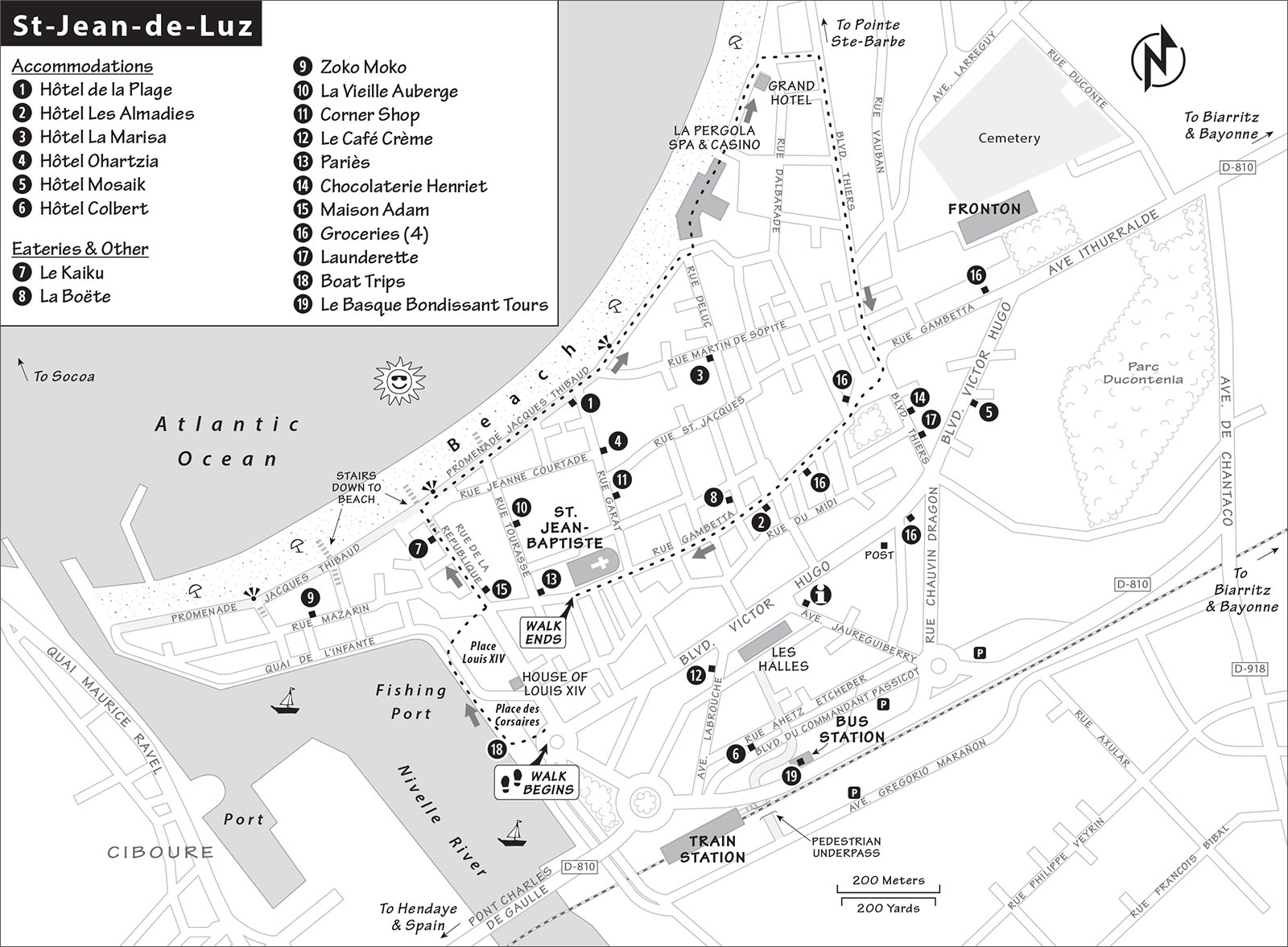
• Just before Place Louis XIV, you’ll see the town’s main church.
Eglise St. Jean-Baptiste: The marriage of Louis XIV and Marie-Thérèse put St-Jean-de-Luz on the map, and this church is where it all took place. The ultimate in political marriages, the knot tied between Louis XIV and Marie-Thérèse in 1660 also cinched a reconciliation deal between Europe’s two most powerful countries. The king of Spain, Philip IV—who lived in El Escorial palace—gave his daughter in marriage to the king of France, who lived in Versailles. This marriage united Europe’s two largest palaces, which helped end a hundred years of hostility and forged an alliance that enabled both to focus attention on other matters (like England). Little St-Jean-de-Luz was selected for its 15 minutes of fame because it was roughly halfway between Madrid and Paris, and virtually on the France-Spain border. The wedding cleared out both Versailles and El Escorial palaces, as anyone who was anyone attended this glamorous event.
In keeping with the Basque people’s seafaring, shipbuilding, and metalworking heritage, Basque sports are often feats of strength: Who can lift the heaviest stone? Who can row the fastest and farthest?
But the most important Basque sport of all is pelota—similar to what you might know as jai alai. Players in white pants and red scarves or shirts use a long, hook-shaped wicker basket (called a txistera in Euskara) to whip a ball (smaller and far bouncier than a baseball) back and forth off walls at more than 150 miles per hour. This men’s-only game can be played with a wall at one or both ends of the court. Most matches are not professional, but betting on them is common. It can also be played without a racket—this handball version is used as a starter game for kids. Children use a bouncy rubber ball, while adults use a ball with a wooden center that’s rather rough on the hands and needs a lot of strength to keep moving.
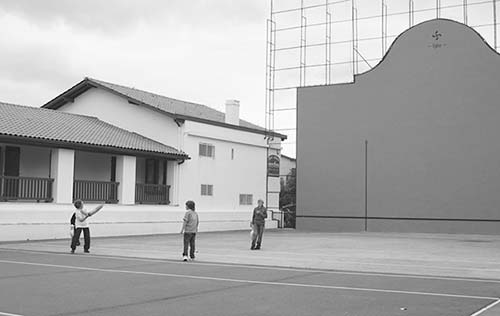
It seems that every small Basque town has two things: a church and a pelota court (called a frontón). While some frontones are simple and in poor repair, others are freshly painted as a gleaming sign of local pride.
The TI in St-Jean-de-Luz sells tickets and has a schedule of matches throughout the area; you’re more likely to find a match in summer (almost daily at 21:00 July-mid-Sept, afternoon matches sometimes on Sat-Sun). Matches are held throughout the year (except for winter) in the villages (ask for details at TI). The professional cesta punta matches on Tuesdays and Fridays often come with Basque folkloric halftime shows.
The church, centered on the pedestrian street Rue Gambetta, seems modest enough from the exterior...but step inside (free, daily 8:30- 19:00). The local expertise was in shipbuilding, so the ceiling resembles the hull of a ship turned upside-down. The dark wood balconies running along the nave segregated the men from the women and children (men went upstairs until the 1960s, as they still do in nearby villages) and were typical of Basque churches. The number of levels depended on the importance of the church, and this church, with three levels, is the largest Basque church in France.
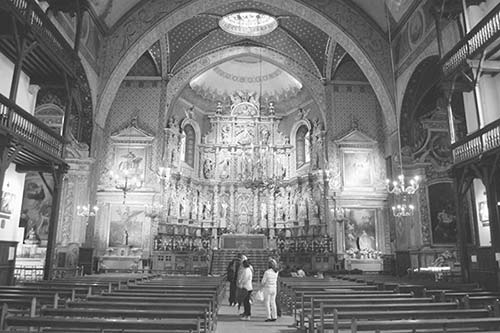
The three-foot-long paddle-wheel ship hanging in the center was a gift from Napoleon III’s wife, Eugènie. It’s a model of an ill-fated ship that had almost sunk just offshore when she was on it. The box seats across from the pulpit were reserved for leading citizens who were expected to be seen in church and set a good example. Today the mayor and city council members sit here on festival Sundays.
The 1670 Baroque altar feels Franco-Spanish and features 20 French saints, with the city’s patron saint—St. John the Baptist—placed prominently in the center. Locals in this proud and rich town call it the finest altar in the Basque Country. To see it better, use a coin to switch on the automatic light (box next to the scene of the Crucifixion in the nave, on the right). The place has great acoustics, and the 17th-century organ is still used for concerts (a handful of concerts a year, get schedule at TI).
Leaving the church, turn left to find the bricked-up doorway—the church’s original entrance. According to a quaint but untrue legend, it was sealed after the royal marriage (shown on the wall to the right in a photo of a painting) to symbolize a permanent closing of the door on troubles between France and Spain.
Sleeping in St-Jean-de-Luz
Hotels are more expensive here and breakfast costs extra. Those wanting to eat and sleep for less will do slightly better just over the border, in San Sebastián.
$$$$ Hôtel de la Plage*** has the best location, right on the ocean. Its 29 rooms—23 with ocean view and hardwood floors—have pleasant, fresh decor. The contemporary sea-view breakfast room sits next to a comfortable lounge (family rooms, air-con, elevator, pay parking, 33 Rue Garat, +33 5 59 51 03 44, www.hoteldelaplage.com, reservation@hoteldelaplage.com, run by friendly Pierre, Mehdi, and Gerome).
$$$ Hôtel Les Almadies,*** on the main pedestrian street, is a bright boutique hotel with seven flawless rooms (4 with a balcony), comfy public spaces with clever modern touches, a pleasant breakfast room and lounge, an inviting sun deck, and a caring owner (good fans, pay parking—reserve in advance, 58 Rue Gambetta, +33 5 59 85 34 48, www.hotel-les-almadies.com, hotel.lesalmadies@orange.fr, Jen and Matthieu).
$$$ Hôtel La Marisa*** is located on a quiet street just a few steps away from the beach. Its 16 rooms are filled with hardwood furniture and have maritime touches and a lavish feel. Enjoy its charming flower patio and small library (elevator, pay parking, some rooms have air-con, 16 Rue Martin de Sopite, +33 5 59 26 95 46, www.hotel-lamarisa.com, info@hotel-lamarisa.com, Frédéric and Oliver).
$$ Hôtel Ohartzia** (“Souvenir”), one block off the beach, is comfortable, clean, and peaceful, with the most charming facade I’ve seen. It comes with 14 updated and well-cared-for rooms, generous and homey public spaces, plus a delightful garden. Upper rooms with a balcony have town and mountain views. Several rooms are 21st-century modern with vivid colors, and two have small interior terraces (elevator, 28 Rue Garat, +33 5 59 26 00 06, www.hotel-ohartzia.com, hotel.ohartzia@wanadoo.fr). Their front desk is technically open only 8:00-21:00, but owners Madame and Monsieur Audibert (who speak little English) live in the building; their son Benoît speaks English well.
$$ Hôtel Mosaik,*** on a major street a couple of blocks above the old town’s charm, is simple, bright, and très sympa (very nice), with 22 tidy rooms and an accommodating staff (family rooms, 4 apartments, air-con, limited pay parking, closed mid-Nov-mid-Feb, 56 Boulevard Victor Hugo, +33 5 59 26 11 90, https://mosaikhotel.com, mosaikhotel@orange.fr). To get a room over the quieter courtyard, ask for côté cour (koh-tay koor).
$ Hôtel Colbert*** has 34 modern, tastefully appointed rooms across the street from the train station (family rooms, air-con, elevator, pay parking or park for free at lot next to train station, 3 Boulevard du Commandant Passicot, +33 5 59 26 31 99, www.hotelcolbertsaintjeandeluz.com, contact@hotelcolbertsaintjeandeluz.com).
Eating in St-Jean-de-Luz
St-Jean-de-Luz restaurants are known for offering good-value, high-quality cuisine. You can find a wide variety of eateries in the old center. For forgettable food with unforgettable views, choose from several places overlooking the beach. Most places serve from 12:15 to 14:00, and from 19:15 on. Remember, in France, menu means a fixed-price, multicourse meal (generally not including wine or other drinks).
The traffic-free Rue de la République, which runs from Place Louis XIV to the ocean promenade, is lined with hardworking restaurants (one of which is recommended next). Places are empty at 19:30, but packed at 20:30. Making a reservation, especially on weekends or in summer, is wise. Or consider a fun night of bar-hopping for dinner in San Sebastián instead (an hour away in Spain).
$$$$ Le Kaiku is the gastronomic experience in St-Jean-de-Luz. They serve modern, creatively presented cuisine, and specialize in wild seafood (rather than farmed). This dressy place, which owns a Michelin star, is the most romantic in town but manages not to be stuffy (weekday fixed-price meals, closed Sun-Mon except July-Aug, 17 Rue de la République, +33 5 59 26 13 20, www.kaiku.fr, Nicolas). For the best experience, talk with your server about what you like best and your price limits (about €85 will get you a three-course meal à la carte without wine).
$$$ La Boëte does seafood and fish only—and does it well. Popular with locals, it’s a bustling spot just off Rue Gambetta with a small, inviting terrace (closed Sun-Mon, 3 Rue Jean Bague, +33 5 59 22 54 76).
$$$$ Zoko Moko offers Mediterranean nouvelle cuisine, with artistic creations on big plates. Get an amuse-bouche (an appetizer chosen by the chef) and a mignardise (a fun bite-sized dessert) with each main plate ordered. The lunchtime menu du marché changes weekly, depending on what’s fresh in the market (€25 lunch menu and €50 four-course menu; closed Sun-Mon; 6 Rue Mazarin, +33 5 59 08 01 23, www.zoko-moko.com [URL inactive], owner Charles).
$$$ La Vieille Auberge serves up hearty, homemade, traditional Basque dishes. Their Basque egg casserole together with braised pig cheeks in wine was a highlight of my day. Choose from the reasonably priced €29.90 menu, or splurge on à la carte selections. The friendly staff makes it a convivial experience (closed Mon-Tue, reservations not accepted, 22 Rue Tourasse, +33 5 59 26 19 61).
Fast and Cheap: Peruse the takeaway crêpe stands on Rue Gambetta. For a more elaborate crêpe, sit-down salad, or cheese-and-meat platter, try $ Corner Shop (daily, shorter hours in winter, 22 Rue Garat, +33 5 59 43 51 69).
Breakfast: For a French-style breakfast together with a handful of locals, head to the market house and find $ Le Café Crème, across from the market’s main entrance (reasonable coffee, croissant, and fresh orange juice; daily, 15 Avenue Labrouche, +33 5 59 26 10 75).
Sweets: A local favorite for traditional sweets, Pariès has fine chocolates, tartes, macarons, fudge (kanougas), and touron (like marzipan, but firmer), which comes in a multitude of flavors—brought by Jews who stopped here just over the border in 1492 after being expelled from Spain. Their delectable gâteau basque is worth a try (daily, 9 Rue Gambetta, +33 5 59 26 01 46).
Chocolaterie Henriet has been a regional favorite since 1946. Walk into this quaintly elegant confectionary world and take your pick. Chocolates are priced per gram. My favorite is the Rochers de Biarritz—chocolate-covered roasted almonds with just a hint of orange (Mon-Sat until 19:00, Sun until 13:00, 10 Boulevard Thiers—just off Rue Gambetta, +33 5 59 22 08 42).
Supermarkets: Get groceries at L’epicerie Gambetta, at the east end of Rue Gambetta near Boulevard Thiers, or Petit Casino, at Victor Hugo #46, a block from the post office (closed midday and Sun). Another option with longer hours, Monop’, is at 74 Rue Gambetta (daily 8:30-late, Oct-April closed Sun). The bigger Carrefour City is at the intersection of Rue Gambetta and Boulevard Victor Hugo, near the recommended Hôtel Mosaik (long hours daily, Sun until 13:00).
St-Jean-de-Luz Connections
The train station in town is called St-Jean-de-Luz-Ciboure. Buses leave from the green building across the street; use the pedestrian underpass to get there. Bus and rail service is reduced on Sundays and off-season.
From St-Jean-de-Luz by Train to: Biarritz (nearly hourly, 10 minutes), Bayonne (2/hour, 30 minutes), St-Jean-Pied-de-Port (5/day, 2.5 hours with transfer in Bayonne), Paris (5/day direct via high-speed TGV, 4.5 hours; more with transfer in Bordeaux, 6 hours), Bordeaux (6/day direct, 2.5 hours), Sarlat (3/day, 5-6 hours, transfer in Bordeaux), Carcassonne (5/day, 5-7 hours, transfer in Bordeaux or Toulouse).
By Train to San Sebastián: First, take the 10-minute train to the French border town of Hendaye (about 10/day). Or get to Hendaye by Car Express bus #3 (about hourly, 55 minutes, described next); check the schedule to see which leaves first.
Leave the Hendaye SNCF train station to the right and look for the small building on the same side of the street, where you’ll catch the commuter EuskoTren into San Sebastián (usually 2/hour, runs about 7:00-22:30, 35 minutes).
By Bus: Txik Txak buses leave from the bus station directly across from the train station. (downloadable schedules at www.txiktxak.fr). Bus #3 connects St-Jean-de-Luz to Biarritz’s train station and Bayonne (2/hour, 55 minutes). It also goes the opposite direction to Hendaye about hourly. Another Txik Txak bus (#45) connects St-Jean-de-Luz to Sare (Mon-Fri almost hourly, fewer Sat-Sun, 40 minutes). BlaBlaCar runs buses to San Sebastián (Mon-Sat 5/day, www.blablacar.fr/bus). Buses stop on the street in front of the green kiosk next to the bus station and take about 50 minutes.
By Excursion: If you’re without a car, consider using Le Basque Bondissant’s day-trip excursions to visit otherwise difficult-to-reach destinations, such as the Guggenheim Bilbao (see “Tours in St-Jean-de-Luz,” earlier).
By Taxi to San Sebastián: This will cost you about €75 for up to four people, but it’s convenient (+33 5 59 26 10 11 or mobile +33 6 25 76 97 69).
ROUTE TIPS FOR DRIVERS
A one-day side trip to both Bayonne and Biarritz is easy from St-Jean-de-Luz. These three towns form a sort of triangle (depending on traffic, each one is less than a 30-minute drive from the other). Hop on the autoroute to Bayonne, sightsee there, then take D-810 into Biarritz. Leaving Biarritz, continue along the coastal D-810. In Bidart, watch (on the right) for the town’s proud frontón (pelota court) and stop for a photo of the quaint Town Hall. Consider peeling off to go into the village center of Guéthary, with another frontón and a massive Town Hall. If you’re up for a walk on the beach, cross the little bridge in Guéthary, park by the train station, and hike down to the walkway along the surfing beach (lined with cafés and eateries). When you’re ready to move on, you’re a very short drive from St-Jean-de-Luz.
Bayonne / Baiona
To feel the urban pulse of French Basque Country, visit Bayonne—modestly but honestly nicknamed “your anchor in the Basque Country” by its tourist board. With frequent, fast train and bus connections with St-Jean-de-Luz, Bayonne makes an easy half-day side trip.
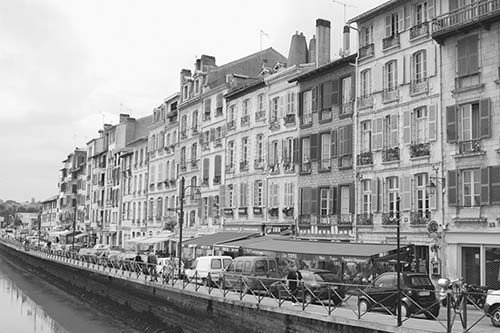
Come here to browse through Bayonne’s atmospheric and well-worn-yet-lively old town and to admire its impressive Museum of Basque Culture. Known for establishing Europe’s first whaling industry and for inventing the bayonet, Bayonne is more famous today for its ham (jambon de Bayonne) and chocolate.
Get lost in Bayonne’s old town. In pretty Grand Bayonne, tall, slender buildings, decorated in Basque fashion with green-and-red shutters, climb above cobbled streets. Be sure to stroll the streets around the cathedral and along the banks of the smaller Nive River, where you’ll find the market (Les Halles).
Orientation to Bayonne
Bayonne’s two rivers, the grand Adour and the petite Nive, divide the city into three parts: St-Esprit, with the train station, and the more interesting Grand Bayonne and Petit Bayonne, which together make up the old town.
TOURIST INFORMATION
The modern TI sits alongside a lengthy parking lot one block off the mighty Adour River, on the northeastern edge of Grand Bayonne. They have very little in English other than a map and a town brochure, but there’s always someone on staff who speaks English (July-Aug Mon-Sat 9:00-19:00, Sun 10:00-13:00; shorter hours and closed Sun off-season; Place des Basques, +33 5 59 46 09 00, www.visitbayonne.com).
ARRIVAL IN BAYONNE
By Train: The TI and Grand Bayonne are a 15-minute walk from the train station. Walk straight out of the station, cross the parking lot and traffic circle, and then cross the imposing bridge (Pont St. Esprit). Once past the big Adour River, continue across a smaller bridge (Pont Mayou), which spans the smaller Nive River. Stop on Pont Mayou to orient yourself: You just left Petit Bayonne (left side of Nive River); ahead of you is Grand Bayonne (spires of cathedral straight ahead, TI a few blocks to the right). The Museum of Basque Culture is in Petit Bayonne, facing the next bridge up the Nive River.
By Car or Bus: The handiest parking is also where buses (and the electric Tram’bus connecting Bayonne and Biarritz) arrive in Bayonne: next to the TI at the modern parking lot on the edge of Grand Bayonne. To reach the town center from here, walk past the war memorial and through the break in the ramparts. Follow the walkway until you reach a fancy gate that leads through a tunnel. After the tunnel, turn right at the next street; the cathedral should immediately come into view. Continue behind the cathedral and walk down, down, down any of the atmospheric streets to find Les Halles (the market) and the Nive River.
To reach this parking lot, drivers take the Bayonne Sud exit from the autoroute, then follow green Bayonne Centre signs, then white Centre-Ville signs (with an i for tourist information). You’ll see the lot on your right. Payment machines accept coins and cards. In high season, when this lot can be full, use one of the lots just outside the center (follow signs to Glain—€1/day—or Porte d’Espagne as you arrive in town), then catch the little orange navette (shuttle bus) to get into the center (free, find route maps posted at stops in town, every 8 minutes, Mon-Sat 7:30-19:30, none on Sun).
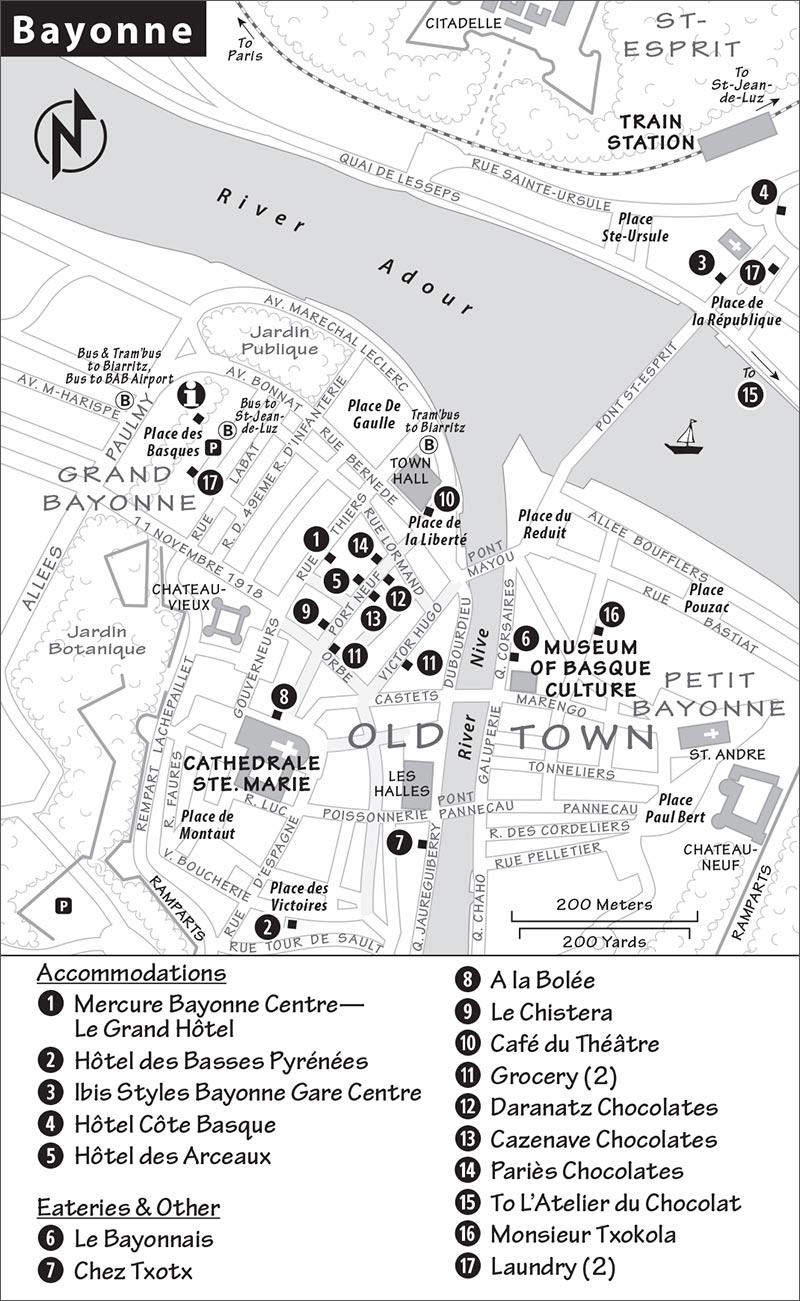
HELPFUL HINTS
Laundry: Across from the TI, Laverie Adour has self-service machines (daily 7:00-20:00, 8 Place des Basques, +33 6 08 46 02 51). Le Spot du Linge, a combined laundry and café, is a few blocks from the train station (self-service and drop-off, daily 9:30-20:30, 22 Place de la Republique, +33 5 59 59 25 89).
Sights in Bayonne
▲Museum of Basque Culture (Musée Basque)
This museum (in Petit Bayonne, facing the Nive River at Pont Marengo) explains French Basque culture from cradle to grave—in French, Euskara, and Spanish. Ask to borrow the pamphlets with museum descriptions in English. Artifacts and videos take you into traditional Basque villages and sit you in the front row of time-honored festivals, letting you envision this otherwise hard-to-experience culture.
Cost and Hours: €8, free first Sun of month and Thu 18:00-20:00; open Tue-Wed and Fri-Sun 10:00-18:00, Thu 13:00-20:00, closed Mon, last entry one hour before closing; download Musée Basque app in advance, 37 Quai des Corsaires, +33 5 59 59 08 98, www.musee-basque.com.
Visiting the Museum: On the ground floor, you’ll begin with a display of carts and tools used in rural life, then continue past some 16th-century gravestones. Look for the laiak—distinctive forked hoes used to work the ground. At the end of this section you’ll watch a grainy film on Basque rural lifestyles.
The next floor up begins by explaining that the house (etxea) is the building block of Basque society. More than just a building, it’s a social institution—Basques are named for their houses, not vice versa. You’ll see models and paintings of Basque houses, then domestic items, a giant door, kitchen equipment, and furniture (including a combination bench-table, next to the fireplace). After viewing an exhibit on Basque clothing, you’ll move into the nautical life, with models, paintings, and actual boats. The little door leads to a large model of the port of Bayonne in 1805, back when it was a strategic walled city.
Upstairs you’ll learn that the religious life of the Basques was strongly influenced by the Camino de Santiago pilgrim trail, which passes through their territory. One somber space explains Basque funeral traditions. The section on social life includes a video of Basque dances (typically accompanied by flute and drums). These are improvised, but according to a clearly outlined structure—not unlike a square dance.
The prominence given to the sport of pelota (see sidebar, earlier) indicates its importance to the Basque people. One dimly lit room shows off several types of txistera baskets, gloves, and balls used for the game; videos show you how these items are made. The museum wraps up with a brief lesson on the large Jewish population here (which had fled from a hostile Spain).
Cathédrale Ste. Marie
Bankrolled by the whaling community, this cathedral sits dead-center in Grand Bayonne and is worth a peek. Centuries of construction and two major fires left nothing of the original Romanesque structure, and locals obtained stones from two different quarries (compare the colors in the facade). Find the unique keystones—reminders of British rule here in Aquitaine—on the ceiling along the nave, then circle behind the church to find the peaceful and polished 13th-century cloister. Restoration of this church will take several years, so expect some scaffolding and a few closed chapels.
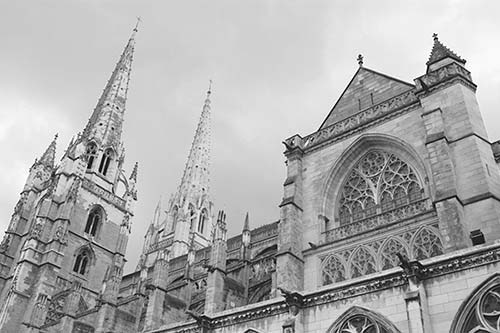
Cost and Hours: Free, Mon-Sat 7:00-19:00, Sun 8:00-20:00; cloister usually accessible one hour after church opens.
Sweets Shops
With no more whales to catch, Bayonne turned to producing mouthwatering chocolates and marzipan; look for shops on the arcaded Rue du Port Neuf (running between the cathedral and the Adour River). Daranatz is Bayonne’s best chocolate shop, with bars of chocolate blended with all kinds of flavors—one with a general mix of spices (lots of cardamom), one with just cinnamon, and another with piments d’Espelette (15 Arceaux Port Neuf, +33 5 59 59 03 55). Cazenave, founded in 1854, is a fancy chocolaterie with a small café in the back. Try their foamy hot chocolate with fresh whipped cream on the side, served with buttered toast for €10. You can also share one order of toast and two chocolates (Tue-Sat 9:00-12:00 & 14:00-19:00, closed Sun-Mon, 19 Rue Port Neuf, +33 5 59 59 03 16). Pariès, well known throughout France, got its start in Bayonne. Their bonbons rank among the best, but for something different try the cherry-jam-filled gâteau Basque (Mon-Sat 9:00-19:00, Sun until 13:00, 14 Rue Port Neuf, +33 5 59 59 06 29).
Chocolate Workshops
L’Atelier du Chocolat is a chocolate factory and boutique in an industrial part of town, accessible by bus. You’ll see a detailed exhibit on the history and making of chocolate, some workers making luscious goodies (until 17:00), and a video in English on request. The generous chocolate tasting at the end is worth the ticket price for chocoholics.
Cost and Hours: €6.80, Mon-Sat 9:30-11:30 & 14:00-16:00, chocolate makers don’t work Sat, closed Sun, reservations recommended, 7 Allée de Gibéléou, +33 5 59 55 70 23, www.atelierduchocolat.fr. They also have a shop on Rue Port Neuf, along with the chocolateries mentioned earlier.
Getting There: Take city bus #4 from the TI or the Mairie stop across from the Town Hall (buy €1.20 ticket at the stop or on board), and get off at the Stade D. Deschamps stop. Backtrack and walk left onto Rue Gleizé, then head right on Allée de Gibéléou until you come to the workshop.
In-Town Option: To save time but still see a chocolate workshop, head to the much smaller Monsieur Txokola just a block behind the Basque Museum (Tue-Sat 10:00-18:00, closed Sun-Mon, staff may be able to provide English explanations, 11 Rue Jacques Laffitte, +33 5 55 15 66 94, www.monsieurtxokola.fr).
Ramparts
The ramparts around Grand Bayonne are open for walking and great for picnicking (access from park at far end of TI parking lot). However, the ramparts do not allow access to either of Bayonne’s castles—both are closed to the public.
Sleeping in Bayonne
$$$ Mercure Bayonne Centre—Le Grand Hôtel,**** with 54 rooms, is the best of the limited options in Bayonne—it’s well located in Grand Bayonne, with all the comforts and a pleasant staff. While renovating their old building, the owners took care to maintain the original, classic decor (RS%—free breakfast for readers with this book, elevator, pay parking, 21 Rue Thiers, +33 5 59 59 62 00, www.legrandhotelbayonne.com, contact@longitudehotels.com).
$$ Hôtel des Basses Pyrénées**** took an aging, turn-of-the-century hotel and added plush, modern comforts. Their 26 rooms, including three suites in a medieval tower, are suitably chic. Located on an open square, its adjoining restaurant also has a good reputation with locals (elevator, reserved pay parking, 13 Rue Tour de Sault, +33 5 59 25 70 88, www.hotel-bassespyrenees-bayonne.com, contact@hoteldesbassespyrenees.com).
$$ Ibis Styles Bayonne Gare Centre*** sits next to the Pont Saint Esprit, near the train station. Some of its 45 white, bright rooms overlook the river (includes breakfast, elevator, pay parking at train station lot, 1 Place de la République, +33 5 59 55 08 08, www.ibis.com, h8716@accor.com).
$ Hôtel Côte Basque** is conveniently located by the train station in the Saint Esprit neighborhood, just across the river from the old town. It’s on a busy street, so its 40 small-but-comfortable rooms have double-paned windows to cut the noise (family rooms, elevator, pay parking, 2 Rue Maubec, +33 5 59 55 10 21, www.hotel-cotebasque.fr, contact@hotel-cotebasque.fr).
$ Hôtel des Arceaux,** run by friendly Frédéric, is a B&B-style establishment with 13 rooms on a small pedestrian street in Grand Bayonne. It’s just across the street from recommended chocolate shops (family room, 26 Rue Port Neuf, +33 5 59 59 15 53, www.hotelarceaux.fr, hotel.arceaux@wanadoo.fr).
Eating in Bayonne
The Grand Bayonne riverside has several tapas restaurants, a couple of easy bistrots, and a pizza place. The Petit Bayonne riverside has some bistrots and a few more proper sit-down restaurants. The pedestrian streets surrounding the cathedral in Grand Bayonne offer casual dining spots serving crêpes, tartines, quiches, and salads. Most places have outdoor tables in nice weather.
$$$ Le Bayonnais, next door to the Museum of Basque Culture, serves traditional Basque specialties à la carte. Sit in the blue-tiled interior or out along the river (weekday lunch specials and dinner menu, closed Sun-Mon, 38 Quai des Corsaires, +33 5 59 25 61 19).
$$ Chez Txotx (pronounced “choch”) has a Spanish-bodega ambience under a small chorus line of hams. You can also sit outside, along the river, just past the market hall (daily, 49 Quai Amiral Jauréguiberry, +33 5 24 33 86 24).
$$ A la Bolée serves up inexpensive sweet and savory crêpes in a cozy atmosphere along the side of the cathedral (closed Mon-Thu for dinner and all day Sun, 10 Place Pasteur, +33 5 59 59 18 75).
$$$ Le Chistera proudly serves traditional Basque dishes made with market-fresh ingredients. Try the poulet with Basque sauce or one of their soups, and polish off your meal with homemade gâteau basque (good-value lunch menu, closed Tue-Wed for dinner and all day Mon, 42 Rue Port Neuf, +33 5 59 59 25 93).
$$ Café du Théâtre has pleasant outdoor tables on a square by the river. Try it for a simple early breakfast or a delightful lunch with locals and office workers (long hours daily, 8 Place de la Liberté, +33 5 59 59 60 00).
Picnic Supplies: If the weather’s good, consider gathering a picnic from the shops along the pedestrian streets, at Les Halles market (daily, 7:00-13:30), in the Spar Supermarché (Mon-Sat 7:30-21:45, Sun 8:30-20:00, 27 Rue Victor Hugo), or at the Monoprix (Mon-Sat 8:00-23:00, Sun 9:00-19:30, 8 Rue Orbe). Don’t forget the chocolate, then head for the park around the ramparts below the Jardin Botanique (benches galore).
Bayonne Connections
Txik Txak operates regular buses, express buses, and an electric Tram’bus throughout the area. Most lines run two to three times an hour from about 7:00 to 23:00 (less frequent Sat-Sun, most tickets-€1.20, buy onboard with credit card; day pass-€3.50). A handy public transport map can be picked up at the TI or downloaded from TxikTxak.fr.
From Bayonne by Bus to: BAB (Biarritz-Anglet-Bayonne) Airport (2-3/hour, 15 minutes, Car Express bus #3 or #4), Biarritz (Tram’bus, 4/hour, fewer on Sun, 30 minutes, line T1 from just behind the TI near Place des Basques or from the Mairie stop at the Town Hall), St-Jean-de-Luz (2/hour, 55 minutes, Car Express bus #3 from in front of the TI), Espelette (bus #14, 1/hour, 50 minutes), Ainhoa (bus #3 to St-Jean-de-Luz, then bus #47; 1/hour, 45 minutes).
From Bayonne by Bus to San Sebastián: BlaBlaCar departs from 22 Quai de Lesseps on the opposite side of the river from the TI (5/day, fewer on Sun, 2.5 hours, www.blablacar.fr/bus). You can also take Car Express bus #3 to Hendaye and ride the EuskoTren from there (www.euskotren.eus).
By Train to: St-Jean-Pied-de-Port (4/day, 1.5 hours).
By Taxi to: Biarritz (20 minutes, about €30), St-Jean-de-Luz (30 minutes, about €50—or more if traffic is heavy, +33 5 59 59 48 48).
Biarritz
A glitzy resort town steeped in the belle époque, Biarritz (bee-ah-ritz) is where the French Basques put on the ritz. In the 19th century, this simple whaling harbor became, almost overnight, a high-class aristocrat magnet dubbed the “beach of kings.” Although St-Jean-de-Luz and Bayonne are more fully French and more fully Basque, the made-for-international-tourists, jet-set scene of Biarritz is not without its charms. Perched over a popular surfing beach, anchored by grand hotels and casinos, hemmed in by jagged and picturesque rocky islets at either end, and watched over by a lighthouse on a distant promontory, Biarritz is a striking beach resort. However, for sightseers with limited time, it’s likely more trouble than it’s worth.
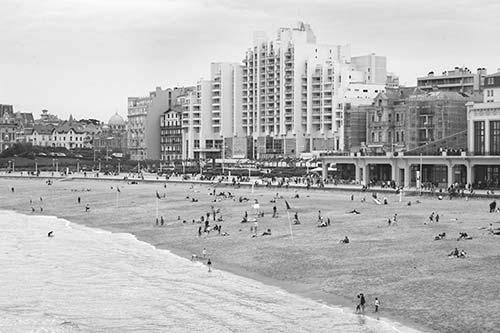
Orientation to Biarritz
Biarritz feels much bigger than its population of 30,000. The town sprawls, but virtually everything we’re interested in lines up along the waterfront: the beach, the promenade, the hotel and shopping zone, and the TI.
Tourist Information: The TI is in a little pink castle two blocks up from the beach (July-Aug daily 9:00-19:00; shorter hours rest of the year; Square d’Ixelles, +33 5 59 22 37 10, www.tourisme.biarritz.fr). It’s just above the casino, hiding behind the City Hall—look for hôtel de ville signs.
Arrival in Biarritz: If coming by car, follow signs for Centre-Ville, then carefully track signs for specific parking garages. The most central garages are called Grande Plage, Casino, Bellevue, and St. Eugénie (closest to the water). Signs in front of each tell you whether it’s full (complet); if it is, move on to the next one.
Biarritz’s train station is about two miles from town—you can connect to the city center (Mairie) on bus #5 (3-4/hour). Buses from Bayonne (the electric Tram’bus) stop at “Biarritz Mairie” near the TI. Bus #3 from Hendaye and St-Jean-de-Luz stops at the Biarritz train station. From there, take bus #5 into town. There is no baggage storage at the train station in Biarritz.
Sights in Biarritz
There’s little of sightseeing value in Biarritz. The TI can fill you in on the town’s four museums (Marine Museum—described below; Chocolate Planet and Museum—intriguing, but a long walk from the center; Oriental Art Museum—large, diverse collection of art from across Asia; and Biarritz Historical Museum—really?).
Your time is best spent strolling along the various levels that climb up from the sea. (Resist the urge to check out the pebble beach for now.) From the TI, you can do a loop: First head west on the lively pedestrian streets that occupy the plateau above the water, which are lined with restaurants, cafés, and high-class, resorty window-shopping. (Place Georges Clemenceau is the grassy “main square” of this area.) Biarritz is picnic-friendly, with beaucoup benches facing the waves. Consider stocking up before continuing this walk.
Work your way past the Église Sainte Eugénie out to the point with the Marine Museum (Musée de la Mer). The most convenient of Biarritz’s attractions, this pricey Art Deco museum/aquarium wins the “best rainy-day option” award, with a tank of seals and a chance to get face-to-teeth with live sharks (€16.50, generally daily 9:30-19:00, closes later in summer and earlier in winter, last entry one hour before closing, +33 5 59 22 75 40, www.aquariumbiarritz.com).
Whether or not you’re visiting the museum, it’s worth hiking down to the entrance, then wandering out on the walkways that connect the big offshore rocks. These lead to the so-called Virgin of the Rock (Rocher de la Vierge), topped by a statue of Mary.
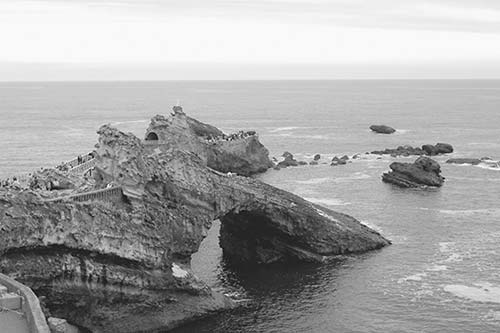
From here stick along the water as you head back toward the TI. After a bit of up and down over the rocks, don’t miss the trail down to Fisherman’s Wharf (Port des Pêcheurs), a little pocket of salty authenticity that clings like barnacles to the cliff below the hotels. The remnants of an aborted construction project from the town’s glory days, this little fishing settlement of humble houses and rugged jetties seems to faintly echo the Basque culture that thrived here before the glitz hit. Many of the houses have been taken over by the tourist trade (gift shops and restaurants).
Continuing along the water (and briefly back up to street level), make your way back to the town’s centerpiece, the big beach (Grande Plage). Dominating this inviting stretch of sand is the Art Deco casino, and the TI is just above that. If you haven’t yet taken the time to splash, wade, or stroll on the beach...now’s your chance.
Eating in Biarritz
If you arrive early, head for Les Halles, a covered market great for picking up items for a picnic. Enjoy its bustling market vibe (daily 7:30-14:00, mid-July-Aug also open 18:00-21:00, 11 Rue des Halles). Many eateries surround the market, including $$ Le Café du Commerce, a good place for breakfast. A Carrefour City grocery store is also next to the market.
For a meal by the sea, $$ Casa Juan Pedro serves up fresh seafood and meat dishes at the Fisherman’s Wharf for lunch and dinner (closed Wed, can get busy in high season, 48 Allée Port des Pêcheurs, +33 5 59 24 00 86).
Biarritz Connections
From Biarritz by Bus to: Bayonne (4/hour on Txik Txak Tram’bus T1, fewer on Sun, 30 minutes). See details under “Bayonne Connections,” earlier.
By Train to: St-Jean-de-Luz (nearly hourly, 20 minutes; from the center, take Car Express bus #5 to Biarritz train station, 3-4/hour; www.sncf.fr).
Villages in the French Basque Country
Traditional villages among the green hills, with buildings colored like the Basque flag, offer the best glimpse of Basque culture. Cheese, hard cider, and pelota players are the primary products of these villages, which attract few foreigners but many French summer visitors. Most of these villages have welcomed pilgrims bound for Santiago de Compostela since the Middle Ages. Today’s hikers trek between local villages or head into the Pyrenees. The most appealing villages lie in the foothills of the Pyrenees, spared from beach-scene development.
Use St-Jean-de-Luz as your base to visit the Basque sights described next. For information on another French Basque village a bit farther away—St-Jean-Pied-de-Port (Donibane Garazi), the starting point of the Camino de Santiago pilgrim trail—see the next chapter. You can reach some of these places by public transportation, but the hassle outweighs the rewards.
Do a circuit of these towns in the order they’re listed here (and, with time, add St-Jean-Pied-de-Port at the end). Assuming you’re driving, I’ve included route instructions as well.
• Only 15 minutes from St-Jean-de-Luz, follow signs for Ascain, then Sare. On the twisty-turny road toward Sare, you’ll pass the station for the train up to...
La Rhune/Larrun
Between the villages of Ascain and Sare, near the border with Spain, a small cogwheel train takes tourists to the top of La Rhune, the region’s highest peak (2,969 feet). You’ll putt-putt up the hillside for 35 minutes in a wooden, open-air train car to reach panoramic views of land and sea (€22 round-trip, July-Aug daily 8:00-17:00, June and Sept-Oct 9:00-15:40, departures weather-dependent—the trip is worthless if it’s not clear, goes every 40 minutes, buy ticket ahead in summer, +33 5 59 54 20 26, www.rhune.com). For those traveling without a car, buses run from St-Jean-de-Luz (take #45 from the bus station and get off at Col de Saint-Ignace; 8/day Mon-Sat, 3/day Sun, 25 minutes, www.txiktxak.fr).
• Continue along the same road and look for pull-offs with room for a couple of cars, typically placed at the most scenic spots. Stop to smell the grass before the next stop...
Sare/Sara
Sare, which sits at the base of the towering mountain La Rhune, is among the most picturesque villages—and the most touristed. It’s easily reached from St-Jean-de-Luz by bus or car. The small TI is on the main square; pick up a map for suggested walking routes in town (Mon-Fri 9:00-12:30 & 14:00-17:30, closed Sat-Sun, +33 5 59 54 20 14, www.en-pays-basque.fr). Nearby is a cluster of hotels and the town church (which has an impressive interior, with arches over the gold-slathered altar and Basque-style balconies lining the nave). Reforms in the 18th century prohibited burials at or near Catholic churches, but Basque-style tombstones still surround the main church. At the far end of the square is the town’s humble frontón (pelota court).
• Leaving Sare, first follow signs for toutes directions, then St-Pée, and watch for the turnoff to...
Ainhoa/Ainhoa
Ainhoa is a colorful, tidy, picturesque one-street town that sees fewer tourists (which is a good thing). Its chunks of old walls and gates mingle with red-and-white half-timbered buildings. The 14th-century church—with a beautiful golden retable (screen behind the altar)—and the frontón share center stage. Parking is plentiful; resist the urge to turn off at the frontón—it’s better to continue on for parking near the TI. At the TI, pick up a town map and ask to see the free 25-minute movie about Ainhoa (Mon-Sat 9:00-12:30 & 14:00-18:00, Sun 9:30-12:30; shorter hours off-season, +33 5 59 29 93 99, www.en-pays-basque.fr).
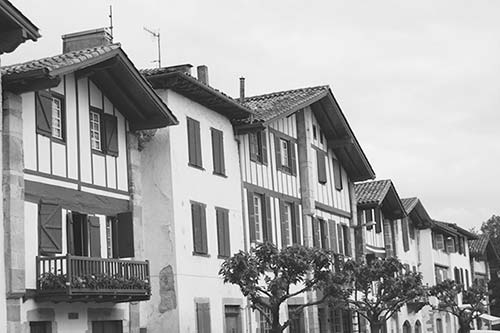
Ainhoa is also a popular starting point for hikes into the hills. For a spectacular village-and-valleys view, drive five minutes (or walk 60 sweaty minutes) up the steep dirt road to the Chapelle de Notre-Dame d’Aranazau (“d’Aubepine” in French). Start in the central parking lot directly across the main street from the church, then head straight uphill into the clouds. Follow signs for oratoire, then count the giant white crosses leading the way to the top. The chapel is occasionally closed, and cloudy days don’t offer spectacular views, but the ethereal experience is worth the steep detour for drivers.
• As you leave Ainhoa, you’ll have to backtrack the way you came in to find the road to...
Espelette/Ezpeleta
Espelette won’t let you forget that it’s the capital of the region’s AOC red peppers (piments d’Espelette), with strands of them dangling like good-luck charms from many houses and storefronts. Start by visiting the Red Pepper Interpretive Center (Centre d’Interprétation du Piment), and watch the worthwhile 15-minute video explaining the history and the planting process (Mon-Fri 10:00-13:00 & 14:00-17:00, closed Sat-Sun, 25 Merkatu Plaza, +33 5 59 93 88 86, www.pimentdespelette.com).
Afterward, head to the well-restored château and medieval tower of former local barons, which now houses the Town Hall, exhibition space, and the TI (Mon-Sat 9:00-12:30 & 14:00-18:00, Sun 10:00-13:00, shorter hours off-season, +33 5 59 93 95 02, www.en-pays-basque.fr). From here, stroll through the charming, cobbled center, or wander downhill toward the pink frontón, following the église signs past houses constructed in the 1700s and a captivating stream, to find the town church. Climb up into the church balconies for some fancy views.
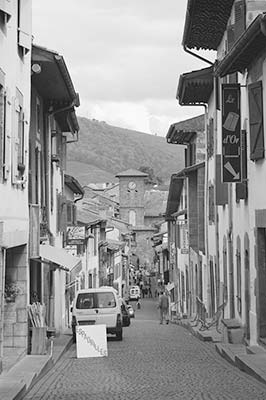
Sleeping and Eating: For a good regional meal, consider the $$ Hôtel Euzkadi** restaurant, with a muy Spanish ambience (Wed-Sun, also open Tue in summer, some off-season closures and closed Mon year-round, 285 Karrika Nagusia, +33 5 59 93 91 88). The $ hotel has 27 rooms with modern touches and a swimming pool (air-con, elevator, www.hotel-restaurant-euzkadi.com).
• From Espelette, if you have time, you can follow signs to Cambo les Bains, then St-Jean-Pied-de-Port (40 minutes, covered in the next chapter).