SPAIN
Welcome to Rick Steves’ Europe
Map: PLACES COVERED IN THIS BOOK
Whirlwind Three-Week Trip of Spain
Rick’s Free Audio Tours and Video Clips
For the traveler, Spain means many things: bullfights, massive cathedrals, world-class art, Muslim palaces, whitewashed villages, delicious paella, sunny beaches, and lively nightlife. You’ll find all of this, but the country’s charm really lies in its people and their colorful lifestyle. From the stirring communal sardana dance in Barcelona to the sizzling rat-a-tat-tat of flamenco in Sevilla, this country creates its own beat amid the heat.
Spain’s spread-out geography makes it seem more like a collection of distinct regions than a centralized nation. In the central plain sits the lively urban island of Madrid. Just south is holy Toledo, a medieval showpiece and melting-pot city with Christian, Muslim, and Jewish roots. Farther south is Andalucía, home to sleepy, whitewashed hill towns and three great cities: Granada (topped with a magnificent Moorish palace), Córdoba (with a massive medieval mosque), and Sevilla (where Holy Week is celebrated as if God were watching). Spain’s south coast offers a palm-tree jungle of beach resorts along the Costa del Sol, a taste of British fish-and-chips in Gibraltar, and a launch pad to Morocco from Tarifa.
To Spain’s far north is San Sebastián and the Basque Country, with sparkling beaches, cutting-edge architecture, and tasty pintxos (the local take on tapas). In nearby Pamplona, bulls and tourists run for their lives. Gregarious pilgrims hike across northern Spain on their long journey to the cathedral town of Santiago de Compostela. To the east, along the Mediterranean coast, Spain has an almost Italian vibe. Trendy Barcelona, where Antoni Gaudí’s architecture makes waves, keeps one eye cocked toward trends sailing in from the rest of Europe.
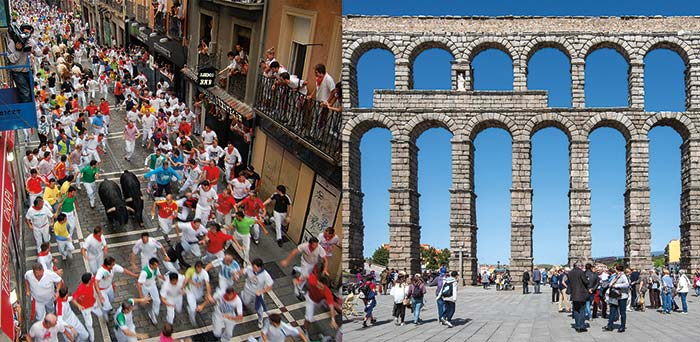
Running with the bulls in Pamplona; Segovia’s towering aqueduct
Thanks to the Pyrenees Mountains, Spain is physically isolated from the rest of the Continent: It is in Europe, but not of Europe. For more than 700 years (711-1492), Spain’s dominant culture was Muslim, not Christian. And after a brief golden age in the 16th century (financed by New World gold), Spain retreated into three centuries of isolation.
Spain’s seclusion contributed to the creation of its distinctive customs—bullfights, flamenco dancing, elaborate Holy Week processions, and a national obsession with ham. Even as other countries opened up to one another in the 20th century, the fascist dictator Francisco Franco virtually sealed off Spain from the rest of Europe’s democracies. But since Franco’s death in 1975, Spaniards have swung almost to the opposite extreme, becoming wide open to new ideas, technologies, and visitors. Tourism is huge here. With 47 million inhabitants, Spain entertains 82 million visitors annually.
Spanish is spoken everywhere. But Catalans (around Barcelona) also speak their own Romance language. The Galicians speak Galego. And in the far north the Basques keep alive the ancient tongue of Euskara. People think of themselves first and foremost as Basques, Catalans, Andalusians, Galicians, and so on...and only second as Spaniards. Each region hosts distinctive local festivals, from parading Virgin Mary statues through the streets to running in front of a pack of furious bulls.
Fresh off a plane and headed to my first stop in Spain, I popped into a rustic truck stop for lunch. My traveling spirit did a little leap and I thought, “Yes, España!” My passport had been stamped, but I didn’t really arrive until my teeth broke through the crisp crust of my fresh baguette…and hit jamón.
That ham, dry-cured and aged from happy, acorn-fed pigs, is an example of the rustic intensity of the Spanish culture. Cured ham hocks with pointed toes are found in every La Mancha bar. In Spain, jamón is more than a food; it’s a way of life. Spaniards thinly slice ham hocks with the same reverence that Americans bring to roast turkey on Thanks-giving. Spain’s dry central plain isn’t that good for grazing, but it’s perfect for raising black Iberian pigs.
To complement all that ham, 700 years of (porkless) Muslim rule left its mark on Spanish cuisine. The Moors, who were great horticulturists, introduced new herbs and spices. The Moorish legacy is well represented by paella, one of Spain’s best-known dishes, combining the traditional Middle Eastern flavor of saffron with rice and seafood, sausage, and chicken.
Every region of Spain has specialties worth savoring. In Catalunya, in the northeast, there’s fideuà, a flavor-infused noodle topped with seafood, and arròs negre, rice cooked in black squid ink. Along the North Atlantic coast, in Asturias, seafood is combined with hearty mountain grub, including giant white faba beans and the powerful Cabrales blue cheese.
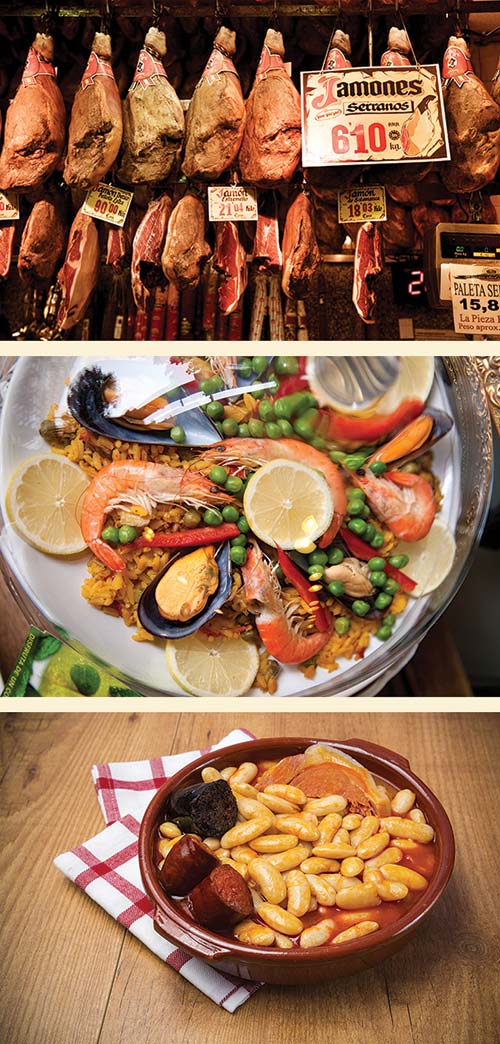
Savor Spain’s many flavors, from cured ham and fresh seafood to hearty beans.
Green, rainy Galicia in the northwest is known for octopus, chopped up and served dusted with paprika. The region’s pimientos de Padrón, a variety of green pepper, are tasty and tricky, offering a kind of tastebud roulette—about one in ten is spicy hot. For a snack, try percebes, salty barnacles harvested from the rocky shore.
The cuisine of Andalucía, in the south, makes ample use of onions, tomatoes, and peppers. These combine deliciously in sofrito, an aromatic base for many dishes. The most famous Andalusian dish is gazpacho, the zesty chilled tomato and cucumber soup. Other specialties are pisto (a ratatouille-like vegetable stew) and salmorejo (chilled tomato soup, garnished with ham and egg).
San Sebastián, in Basque country, is arguably the culinary capital of Spain. Its inviting tapas bars display a stunning array of help-yourself goodies (they’re called pintxos here). Top dishes include spider crab, tasty anchovies, and grilled octopus. Just grab what you like from the platters at the bar; when it’s time to settle up, the server will count the toothpicks on your plate.
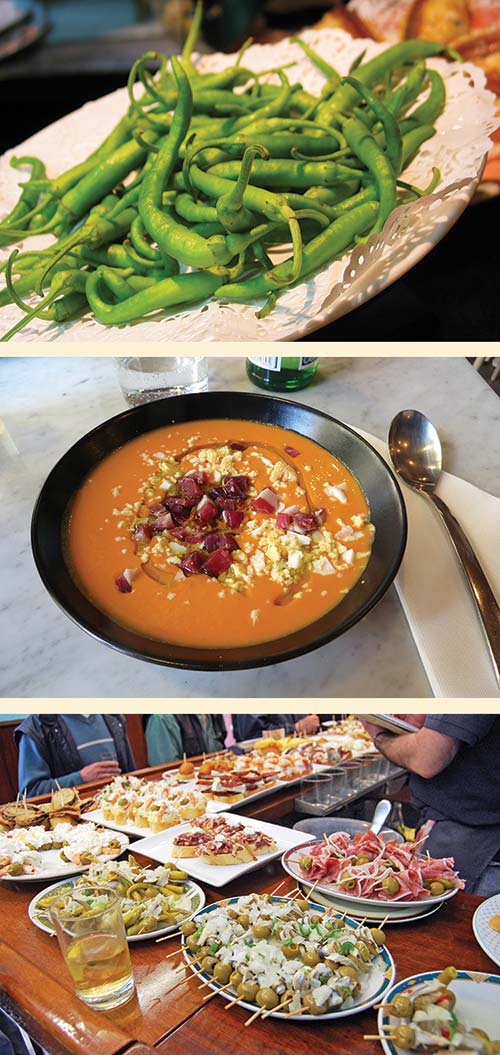
Spice it up with peppers, refreshing chilled soup, and tempting tapas.
Many visitors find the Spanish eating schedule frustrating. Lunch, the largest meal of the day, is eaten between about 14:00 and 16:00. Because most Spaniards work late, a light supper at 21:00 or 22:00 is typical. Generally, no self-respecting restaurant serves lunch and dinner at American hours. But to eat well any time, and within even the tightest budget, duck into a tapas bar and build a light meal out of tasty snacks.
For a country its size, Spain has produced an astonishing number of talented artists with distinctive styles, from El Greco’s mystical religiosity to the sober realism of Diego Velázquez. In the 20th century, Pablo Picasso shattered the two-dimensional picture plane, then pasted it back together to invent Cubism. Salvador Dalí created surreal juxtapositions, while Joan Miró picked up the Surrealist baton and ran with it. In music, Spain continues its long tradition of great guitarists—classical, flamenco, and Gipsy Kings-style “new flamenco.”
Even as the country plunges forward, some things stay the same. Daily lives focus on friends and family, as they always have. Many people (especially in rural areas) still follow the siesta schedule: Spaniards tend to have a small, quick breakfast, grab a late-morning sandwich to tide them over, then gather with friends and family for a big midday meal. From around 1:00 to 4:00 p.m., especially in the south, many businesses close as people go home to eat lunch, socialize, and maybe take a quick nap. The siesta is not so much a time to sleep as it is an opportunity for everyone to shut down their harried public lives.
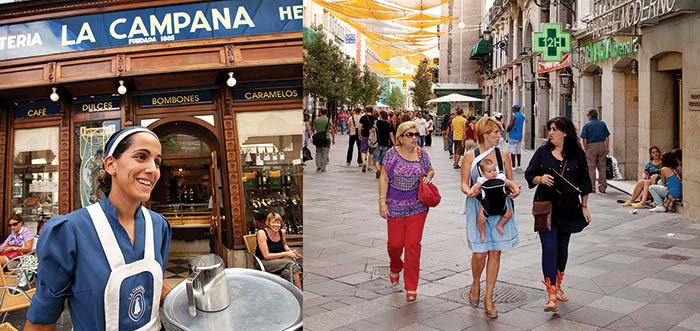
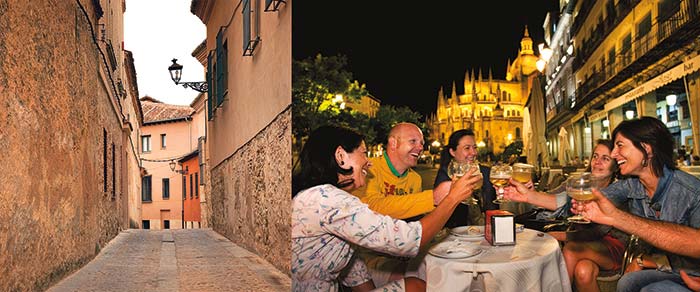
Enjoy Spain’s street life, from sidewalk cafés to the daily paseo.
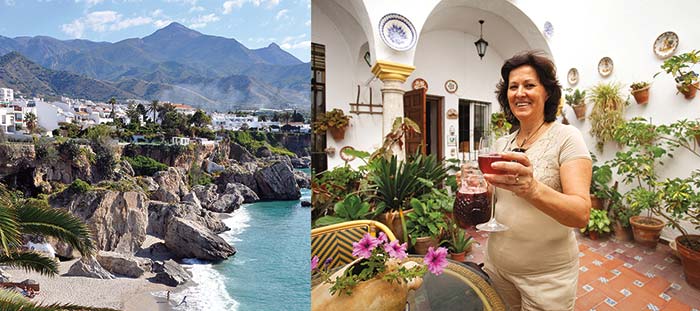
In the cool of the evening, Spain comes back to life. Whole families pour out of their apartments to stroll through the streets and greet their neighbors—a custom called the paseo. Even the biggest city feels like a rural village. People stop at bars for a drink and tapas or to watch a big soccer match on TV. Around 10:00 p.m. in the heat of summer, it’s finally time for a light dinner. Afterward, even families with young children might continue their paseo or attend a concert.
Spaniards are notorious night owls. Many clubs and restaurants don’t even open until after midnight. Dance clubs routinely stay open until the sun rises, and young people stumble out bleary-eyed and head for work. The antidote for late nights? The next day’s siesta.
Travelers love Spain. You can see some European countries by just passing through, but Spain is a destination. Learn its history and accept it on its terms. Gain (or just fake) an appreciation for cured ham, dry sherry, and bull’s tail stew, and the Spaniards will love you for it. If you go, go all the way. Immerse yourself in Spain.
Spain’s Top Destinations
¡Bienvenido! There’s so much to see in Spain and so little time. This overview categorizes the country’s top destinations into must-see places (to help first-time travelers plan their trip) and worth-it places (for those with extra time or special interests). I’ve also suggested a minimum number of days to allow per destination.
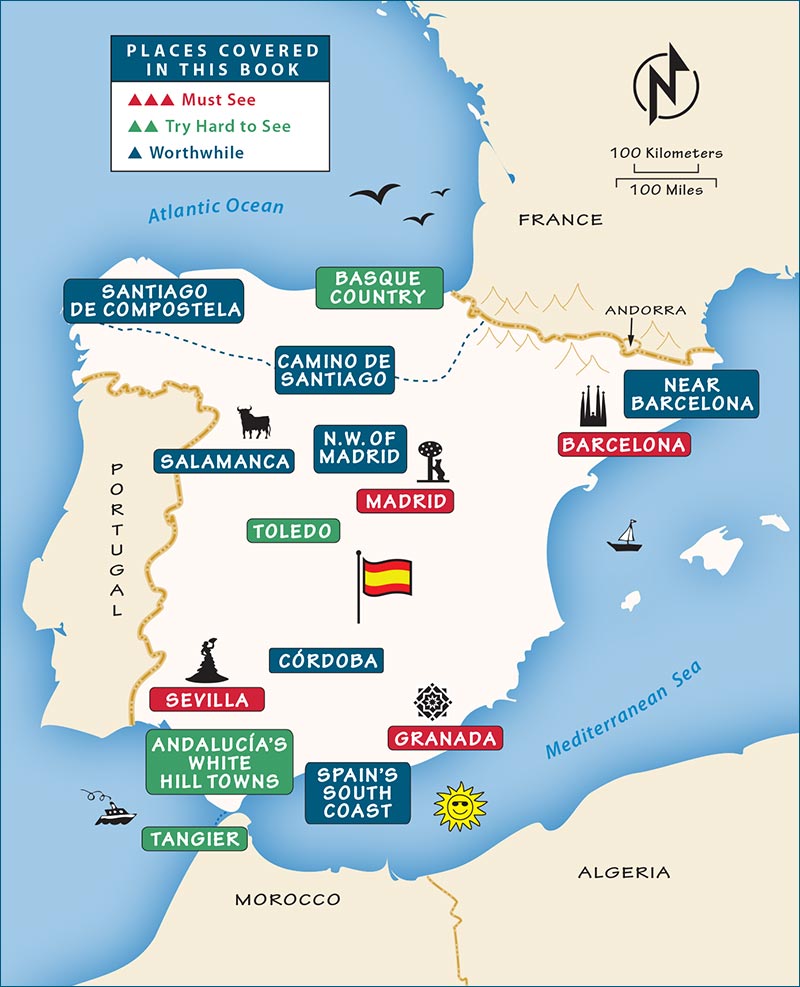
MUST-SEE DESTINATIONS
Spain’s four major cities—Barcelona, Madrid, Granada, and Sevilla—give you an excellent and diverse sampler of urban Spain. All are linked by train.
▲▲▲Barcelona (allow 2-3 days)
This trendy seaside city has an atmospheric old town, an elegant new town, strollable boulevards, and a Modernista skyline. Barcelona is the heart of Catalan culture, and hometown talents Gaudí, Picasso, and Miró all left their mark on this arty city. Barcelona’s inviting beaches are linked by a promenade and dotted with beach bars, delightful at sunset.
▲▲▲Madrid (2 days)
Madrid is the country’s dynamic capital. It’s Spain on a grand scale, with a huge central square (Puerta del Sol), the Royal Palace (2,000 rooms), and top-notch art treasures, from Picasso’s powerful Guernica to the Prado’s many masterpieces. This livable city has an unsurpassed tapas scene, fun paseo, street markets, and flamenco shows.
▲▲▲Granada (1-2 days)
Granada pairs evocative history with good living. Its Moorish legacy shines brightest at the magnificent Alhambra palace, and the old town’s Royal Chapel is the final resting place of Ferdinand and Isabel. The fun-to-explore city also has distinctive neighborhoods, from the bustling Alcaicería shopping lanes to the hilly Albayzín, with funky tea shops and sublime views of the Alhambra against the mountains.
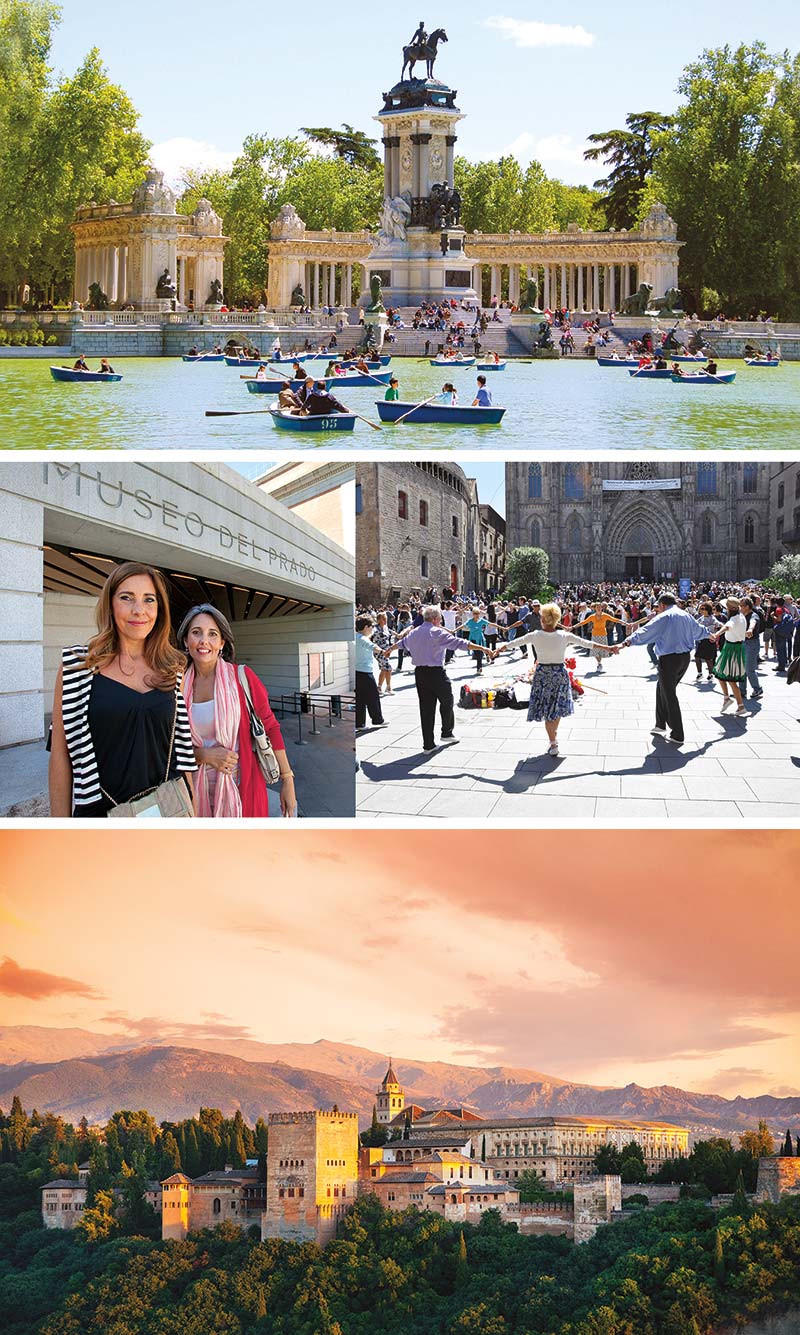
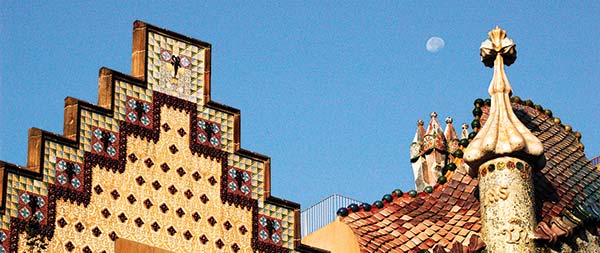
Barcelona’s Block of Discord (opposite); Madrid’s Retiro Park; dancing in Barcelona; Granada’s Alhambra at sunset; visiting Madrid’s Prado Museum
▲▲▲Sevilla (1-2 days)
This soulful city boasts a number of Spain’s bests: flamenco, Holy Week fervor, bullfighting, and the late-night paseo. Sights include the tangled Barrio Santa Cruz neighborhood, a massive Gothic cathedral (with Columbus’ tomb), and the Moorish Alcázar palace and gardens. And there’s the nonstop city itself—a festival of color, music, and street life.
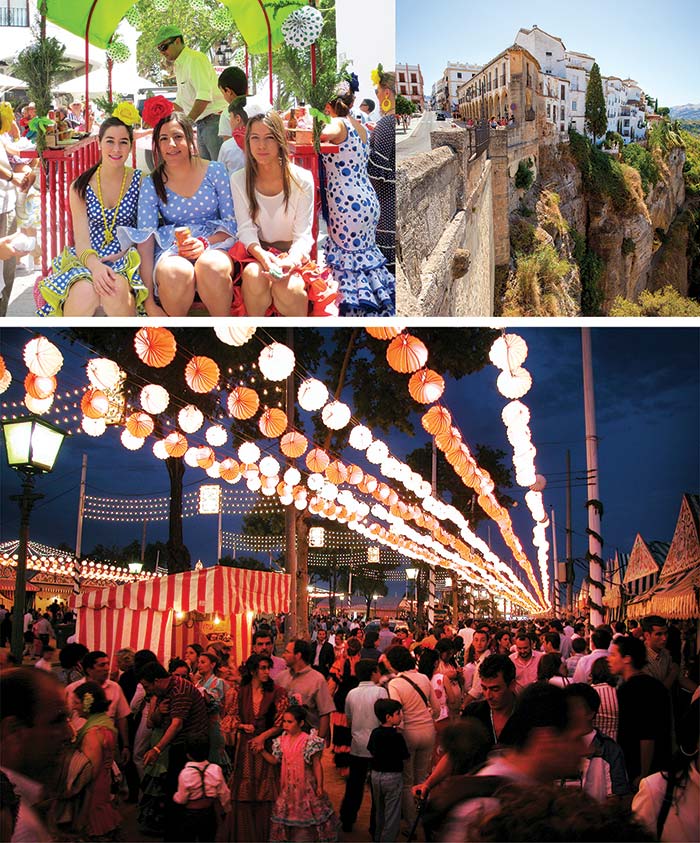
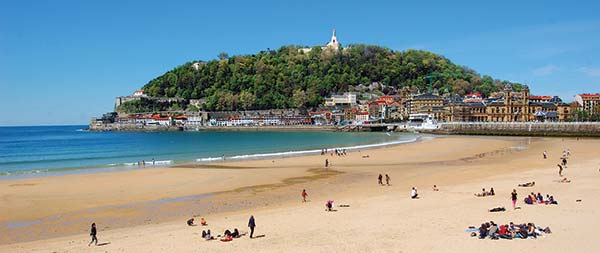
Spaniards turn out for festive events; Ronda clings to its cliff top; Sevilla comes alive at April Fair; San Sebastián’s beach entices sunbathers (opposite).
WORTH-IT DESTINATIONS
You can weave any of these destinations—rated ▲ or ▲▲—into your itinerary. Choose from a mix of small towns, pilgrim destinations, countryside stops, beach resorts, and historic cities, or go for a taste of Gibraltar or Tangier. It’s easy to add some destinations based on proximity (if you’re going to Madrid, Toledo is next door), but some out-of-the-way places can merit the journey, depending on your time and interests.
▲Near Barcelona (1 day)
Day-tripping from Barcelona, pilgrims and photographers head to the rugged mountain retreat of Montserrat, while fans of Salvador Dalí visit Figueres for its Dalí Theater-Museum and Cadaqués for the artist’s house.
▲▲Basque Country (1-2 days)
The vibrant Basque region, which overlaps southwest France, is anchored on the Spanish side by the beach resort town of San Sebastián and neighboring Bilbao, with its striking Guggenheim modern art museum.
▲Camino de Santiago (4 days for drivers)
This centuries-old pilgrimage route traverses the top of Spain from France to Santiago de Compostela, with stops at charming villages and interesting cities (including Pamplona, famous for the Running of the Bulls).
▲Santiago de Compostela (1-2 days)
Tucked into the far northwest corner of Spain, this moss-covered city is the end of the trail for pilgrims walking the Camino de Santiago (the “Way of St. James”). Greet pilgrims as they arrive at the town’s vast cathedral, home to the relics of St. James.
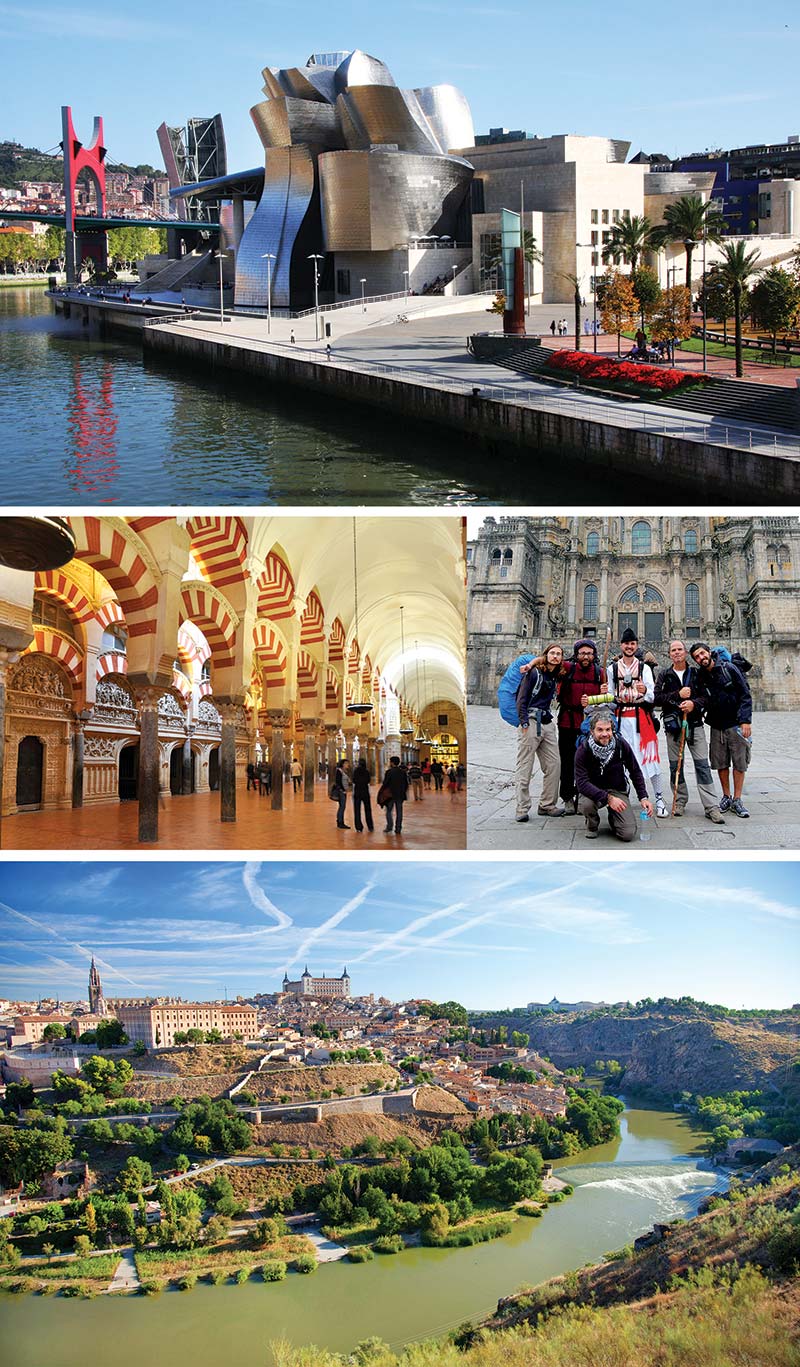
Bilbao’s stunning Guggenheim museum; trekkers at Santiago’s cathedral; sublime Toledo; Córdoba’s vast Mezquita
▲Salamanca (1 day)
Humming with a youthful vibe, this university town has the country’s finest main square, where you can pull up front-row seats at a sidewalk café and enjoy a drink and tapas. Here and about town, bands of student musicians break into song, hoping for a few coins.
▲Northwest of Madrid (1-3 days)
Several destinations make fine day trips (or a loop trip) from Madrid: El Escorial has an imposing royal palace, and nearby is the Valley of the Fallen (a.k.a. Valley of Cuelgamuros), a monument to victims of the Spanish Civil War. The pleasant town of Segovia (also good for an overnight stop) is crossed by a towering Roman aqueduct. Little Ávila, the birthplace of St. Teresa, nestles within its well-preserved medieval wall.
▲▲Toledo (1-2 days)
Hill-capping Toledo has a wonderfully rich history (Roman, Jewish, Moorish, and Christian), an outstanding cathedral, and works by hometown artist El Greco. An overnight visit is best to savor the town’s evening tranquility, though Toledo also works well as a day trip from Madrid.
▲Córdoba (1 day)
This bustling city is home to Spain’s top surviving Moorish mosque, the huge and marvelous Mezquita. Nearby are the quaint side lanes of the city’s Jewish quarter, alive with history. Córdoba is an easy stop on the AVE train line between Madrid and Sevilla, or a quick day trip from Sevilla.
▲▲Andalucía’s White Hill Towns (1-2 days)
Andalucía is the classic heartland of southern Spain, known for its windswept hills and scenically perched towns, including tiny Arcos de la Frontera and livelier Ronda, with its massive, gorge-straddling bridge. (If you want to visit more hill towns than these, you’ll find it easier by car.)
▲Spain’s South Coast (2-3 days)
Spain’s beach-resort zone offers several vivid stops: the appealing village of Nerja (enjoy paella on the beach); the whitewashed hill town of Frigiliana; the intriguing Rock of Gibraltar (with English pubs in town and a colony of monkeys on the Rock); and the laid-back town of Tarifa, with daily ferries to Tangier, Morocco. A swing along the coast can include all these destinations (or choose your favorite).
▲▲Tangier, Morocco (1-2 days)
Tangier, Morocco’s revitalized gateway, offers a fascinating look at North Africa and the Muslim culture, with its friendly, curious people. The bustling medina (old town) is a winding maze of shops and tea houses. A quick ferry ride from Spain, Tangier makes an unforgettable day trip (or you can stay the night).
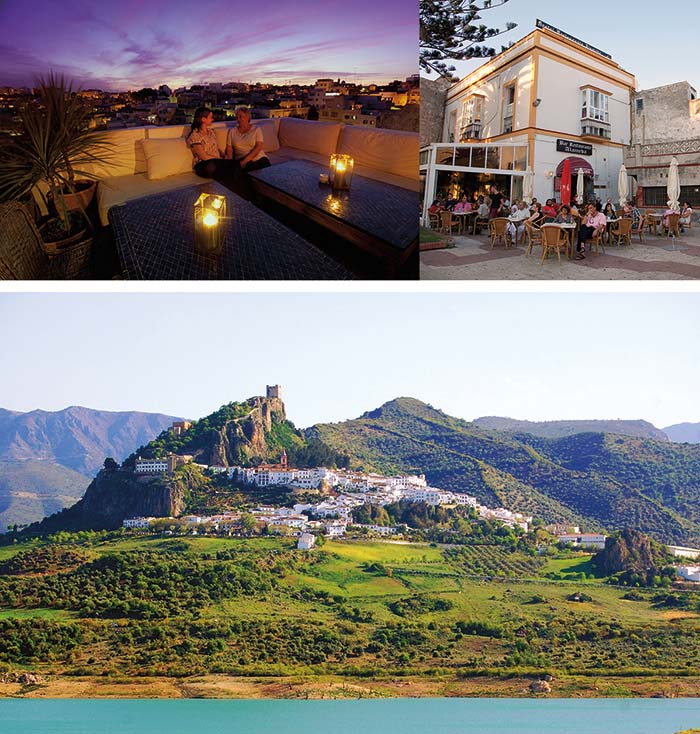
Tangier at dusk; a sidewalk café in Tarifa; a timeless Andalusian hill town
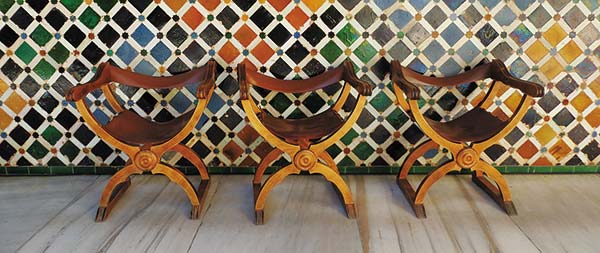
Planning Your Trip
To plan your trip, you’ll need to design your itinerary—choosing where and when to go, how you’ll travel, and how many days to spend at each destination. For general advice on sightseeing, accommodations, restaurants, and more, see the Practicalities chapter.
DESIGNING AN ITINERARY
As you read this book and learn your options...
Choose your top destinations.
My recommended itinerary (see the sidebar on the next page) gives you an idea of how much you can reasonably see in 21 days, but you can adapt it to fit your own interests and time frame. Trendsetters linger in Barcelona, and art lovers are drawn to Madrid. If you like flamenco, Sevilla will shake your castanets. Historians travel back in time to Granada’s sprawling Alhambra or to Toledo, with its concentrated mix of art and history within small-town walls. Pilgrims pay homage at Santiago de Compostela and Montserrat, while sun worshippers bask at coastal Nerja and San Sebastián (a city fun for foodies, too). If you’re fond of quiet hill towns, get a good dose (or doze?) in Andalucía. For an exotic excursion, it’s Tangier. Photographers want to go everywhere.
Decide when to go.
Spring and fall offer the best combination of good weather, lighter crowds, long days, and plenty of tourist and cultural activities.
| Day | Plan | Sleep |
| 1 | Arrive in Barcelona | Barcelona |
| 2 | Barcelona | Barcelona |
| 3 | Barcelona | Barcelona |
| 4 | More Barcelona, or day-trip to Dalí sights or Montserrat | Barcelona |
| 5 | Fly to Granada (1.5 hours) | Granada |
| 6 | Granada | Granada |
| 7 | More Granada; afternoon bus to Nerja (2.5 hours) | Nerja |
| 8 | Nerja beach day, or side-trip to Frigiliana | Nerja |
| 9 | Bus to Ronda (2-3 hours) | Ronda |
| 10 | Ronda | Ronda |
| 11 | Bus to Sevilla (3 hours) | Sevilla |
| 12 | Sevilla | Sevilla |
| 13 | More Sevilla, or day-trip to Córdoba, Arcos, or Jerez | Sevilla |
| 14 | Train to Toledo (4 hours) | Toledo |
| 15 | Toledo | Toledo |
| 16 | Travel to Madrid (30 minutes by train) | Madrid |
| 17 | Madrid | Madrid |
| 18 | Your choice of day trip: Segovia, El Escorial, or Salamanca | Madrid |
| 19 | Long train or bus (5 hours) to San Sebastián | San Sebastián |
| 20 | San Sebastián | San Sebastián |
| 21 | Day-trip to St-Jean-de-Luz or Bilbao; sleep in Bilbao if departure flight options are better from there | San Sebastián or Bilbao |
| 22 | Fly home |
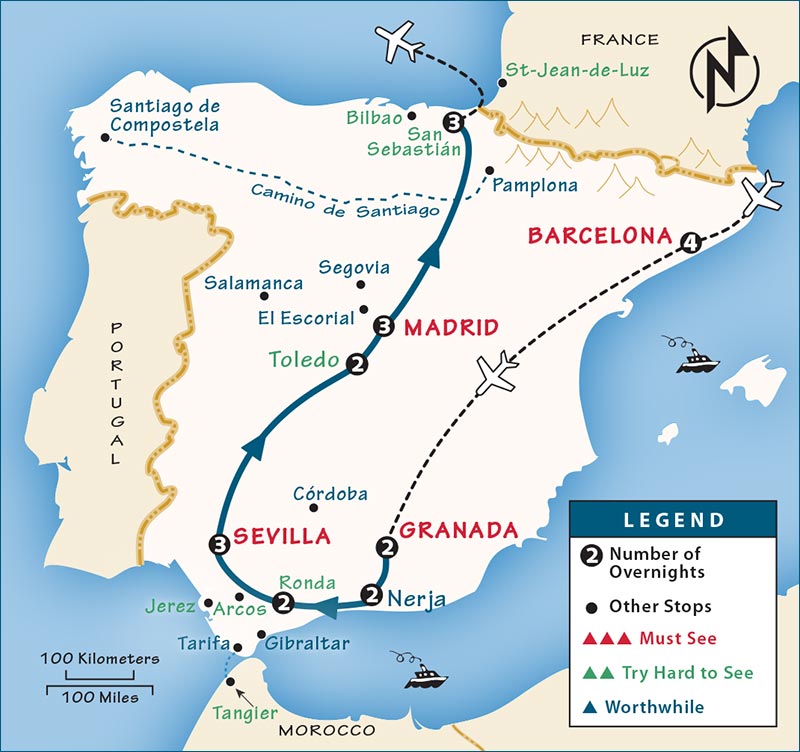
With More Time: Tempting add-ons to this plan are a day (or more) for Tangier, Morocco (between days 8 and 9); spending a night or two in the Castilian cities of Salamanca or Segovia; and continuing from the Basque Country along the historic Camino de Santiago, across northern Spain, to Santiago de Compostela.
With a Car: Long distances between cities are best connected by train, but renting a car makes particular sense in the South Coast/White Hill Towns area (pick up the car in Granada on day 7, drop it in Sevilla on day 11) and for touring the Basque Country (and possibly extending all the way west along the Camino de Santiago).
July and August are the most crowded and expensive in the coastal areas, and less crowded but uncomfortably hot and dusty in the interior. Air-conditioning is essential.
Off-season, roughly November through March, expect shorter hours and fewer activities in smaller towns. Confirm your sightseeing plans locally.
Though Spain can be brutally hot in the summer, winters can be bitterly cold, and spring and fall can be crisp. For weather specifics, see the climate chart in the appendix.
Connect the dots.
Link your destinations into a logical route. Determine which cities you’ll fly into and out of. Begin your search for transatlantic flights on Google Flights.
Decide if you’ll travel by car or public transportation, or a combination. A car is particularly helpful for exploring Andalucía’s hill towns or the Camino de Santiago, but it’s useless in big cities (park it). If relying on public transit, you’ll probably use a mix of trains and buses. Trains are faster, but buses can reach a few places that trains can’t.
To determine approximate travel times between destinations, study the driving map in the Practicalities chapter or check Google Maps; visit Bahn.de or Renfe.com [URL inactive] for train schedules. Spain’s long distances make it worth considering a short flight for part of your trip; check Skyscanner.com for intra-European flights (but keep in mind air travel’s larger carbon footprint).
Write out a day-by-day itinerary.
Figure out how many destinations you can comfortably fit in your time frame. Don’t overdo it—few travelers wish they’d hurried more. Allow enough days per stop (see estimates in “Spain’s Top Destinations,” earlier). Minimize one-night stands. It can be worth taking a late-afternoon drive or train ride to settle into a town for two consecutive nights—and gain a full uninterrupted day for sightseeing. Staying in a home base (like Madrid) and making day trips can save time over changing locations and hotels.
Take sight closures into account. Avoid visiting a town on the one day a week its must-see sights are closed. Check if any holidays or festivals fall during your trip—these attract crowds and close sights (for the latest, visit Spain’s tourist website, www.spain.info). Note major sights where advance tickets are required (or recommended) or a free Rick Steves audio tour is available.
Give yourself some slack. Every trip, and every traveler, needs downtime for doing laundry, picnic shopping, people-watching, and so on. Pace yourself. Assume you will return.
Run a reality check on your dream trip. You’ll have major transportation costs in addition to daily expenses.
Flight: A round-trip flight from the US to Barcelona or Madrid costs about $900-1,500, depending on where you fly from and when.
Public Transportation: For a three-week trip, allow $700 for buses and second-class trains ($1,000 for first class). Whether you get a rail pass in advance or buy train tickets as you go, you’ll pay about the same—unless you take advantage of online discounts for advance purchases. In some cases, a short flight can be cheaper than taking the train.
Car Rental: Allow $350-500 per week (booked well in advance), not including tolls, gas, parking, and insurance.
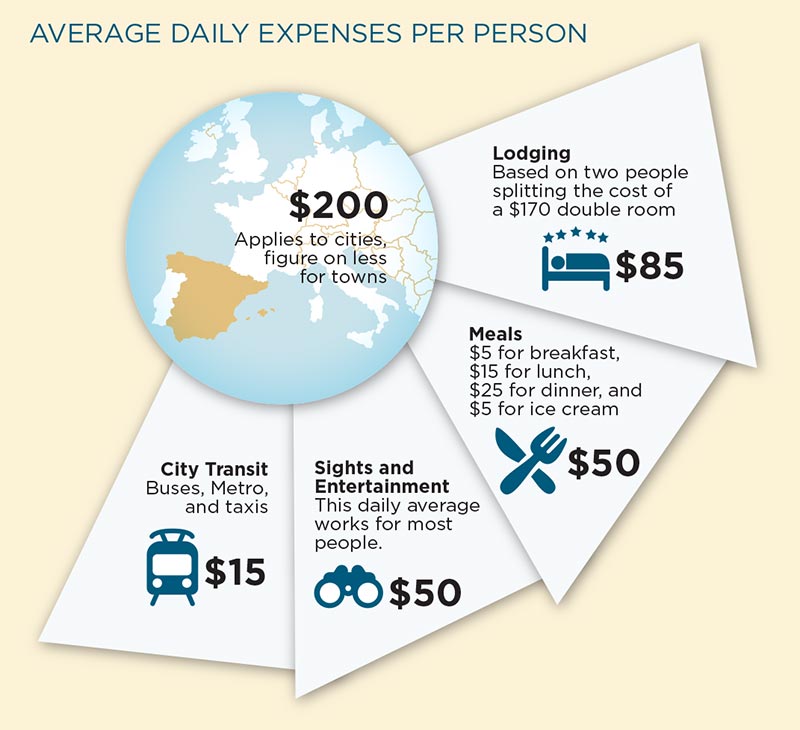
To cut your daily expenses, take advantage of the deals you’ll find throughout Spain and mentioned in this book.
City transit passes (for multiple rides or all-day usage) decrease your cost per ride.
Avid sightseers buy combo-tickets or passes that cover multiple museums. If a town doesn’t offer deals, visit only the sights you most want to see, and seek out free sights and experiences (people-watching counts).
Some businesses—especially hotels and walking-tour companies—offer discounts to my readers (look for the RS% symbol in the listings in this book).
Reserve your rooms directly with the hotel. Some hotels offer a discount if you pay in cash and/or stay three or more nights (check online or ask). Rooms can cost less between roughly November through March. And even seniors can sleep cheaply in hostels (most have private rooms) for about $30 per person. Or check Airbnb-type sites for deals.
It’s no hardship to eat inexpensively in Spain. You can get tasty, affordable meals at tapas bars, sandwich shops, and some local chains, too. Cultivate the art of picnicking in atmospheric settings.
When you splurge, choose an experience you’ll always remember, such as a fun food tour or a dazzling flamenco show. Minimize souvenir shopping; focus instead on collecting wonderful stories and memories.
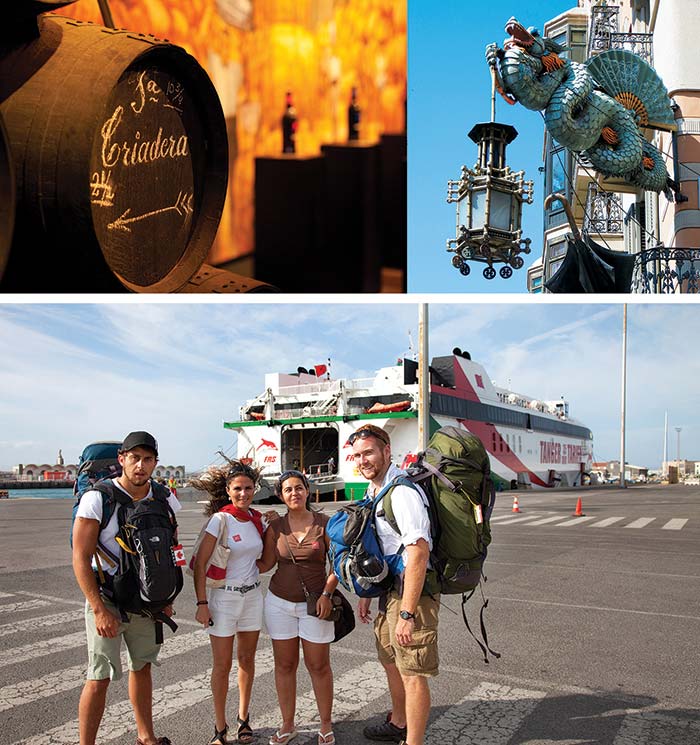
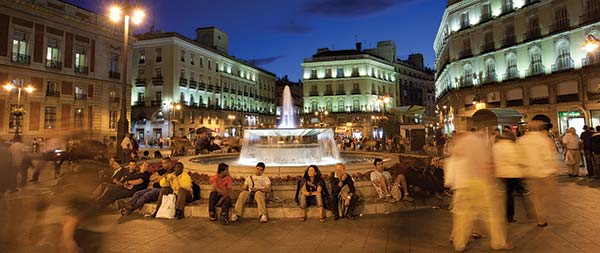
Sherry bodega tour in Jerez; artistic lamppost in Barcelona; catching the ferry to Morocco; lively Puerta del Sol in Madrid (opposite)
BEFORE YOU GO
You’ll have a smoother trip if you tackle a few things ahead of time. For more details on these topics, see the Practicalities chapter and RickSteves.com, which has helpful travel-tip articles and videos.
Make sure your travel documents are valid. If your passport is due to expire within six months of your ticketed date of return, you need to renew it. Allow 12 weeks or more to renew or get a passport. Be aware of any entry requirements; you may need to register with the European Travel Information and Authorization System (ETIAS) before you travel (quick and easy process; check https://travel-europe.europa.eu/etias_en). Get passport and country-specific travel info at Travel.State.gov.
Arrange your transportation. Book your international flights. Overall, Google Flights is the best place to start searching for flights. Figure out your transportation options: It’s worth thinking about buying train tickets online in advance, getting a rail pass, renting a car, or booking cheap European flights. (You can wing it once you’re there, but it may cost more.) Drivers: Consider bringing an International Driving Permit (sold at AAA offices in the US, www.aaa.com) along with your license.
Book rooms well in advance, especially if your trip falls during peak season or any major holidays or festivals.
Reserve ahead for key sights. It’s crucial to reserve ahead far in advance for Granada’s Alhambra to be assured of seeing its often sold-out Palacios Nazaríes. To beat the lines, reserve for Madrid’s Prado Museum and Sevilla’s two big sights: the cathedral and Alcázar. In Barcelona, reservations are essential for the Picasso Museum, Sagrada Família church, Casa Batlló, La Pedrera (Casa Milà), and Park Güell. Reservations are required for the Salvador Dalí House near Cadaqués, and smart for the Dalí Theater-Museum in Figueres and Cantabria’s Altamira Cave in July and August.
Consider travel insurance. Compare the cost of insurance to the cost of your potential loss. Understand what protections your credit card might offer and whether your existing insurance (health, homeowners, or renters) covers you and your possessions overseas.
Manage your money. Tap-to-pay, contactless cards are widely accepted and simple to use. You may need your credit card’s PIN for some purchases—request it if you don’t have one. Alert your bank that you’ll be using your debit and credit cards in Europe. You don’t need to bring euros for your trip; you can withdraw euros from ATMs in Europe.
Use your smartphone smartly. Sign up for an international service plan, or rely on Wi-Fi instead. Download any apps you’ll want on the road, such as maps, translators, and Rick Steves Audio Europe (see sidebar).
Pack light. You’ll walk with your luggage more than you think. I travel for weeks with a single carry-on bag and a day pack. Use the packing checklist in the appendix as a guide.
Rick Steves Audio Europe, a free app, makes it easy to download my audio tours and listen to them offline as you travel. For this book (look for the  ), free audio tours cover sights and neighborhoods in Barcelona, Sevilla, and Madrid. The app also offers my public radio show interviews with travel experts from around the globe. Scan the QR code to find it in your app store, or visit RickSteves.com/AudioEurope.


Rick Steves Classroom Europe, a powerful tool for teachers, is also useful for travelers. This video library contains about 600 short clips excerpted from my public television series. Enjoy these videos as you sort through options for your trip and to better understand what you’ll see in Europe. Check it out at Classroom.RickSteves.com.

Travel Smart
If you have a positive attitude, equip yourself with good information (this book), and expect to travel smart, you will.
Read—and reread—this book. To have an “A” trip, be an “A” student. Note opening hours of sights, closed days, crowd-beating tips, and whether reservations are required or advisable. Check the latest at RickSteves.com/update.
Be your own tour guide. As you travel, get up-to-date info on sights, reserve tickets and tours, reconfirm hotels and travel arrangements, and check transit connections. Visit local tourist information offices. Upon arrival in a new town, lay the groundwork for a smooth departure; confirm the train, bus, or road you’ll take when you leave.
Outsmart thieves. Pickpockets abound in crowded places where tourists congregate. Treat commotions as smokescreens for theft. Keep your passport and backup cash and card secure in a money belt tucked under your clothes; carry only a day’s spending money and a card in your front pocket or wallet. Don’t set valuable items down on counters or café tabletops, where they can be quickly stolen or easily forgotten.
Minimize potential loss. Keep expensive gear to a minimum. Bring copies or take photos of important documents (passport and cards) to aid in replacement if they’re lost or stolen. Back up photos and devices to the cloud as you travel.
Beat the summer heat. If you wilt easily, choose a hotel with air-conditioning, start your day early, take a midday siesta, and resume your sightseeing later. Churches offer a cool haven (though dress modestly—no bare shoulders or shorts). Take frequent ice cream breaks. Join the paseo, when locals stroll in the cool of the evening.
Guard your time and energy. Taking a taxi can be a good value if it saves you a long wait for a cheap bus or an exhausting walk across town. To avoid long lines, follow my crowd-beating tips, such as buying tickets in advance, or sightseeing early or late.
Be flexible. Even if you have a well-planned itinerary, expect changes, closures, sore feet, sweltering weather, and so on. Your Plan B could turn out to be even better.
Attempt the language. Many Spaniards—especially those in the tourist trade and in big cities—speak English. Still, many people don’t, particularly in lesser-touristed areas. But if you learn some Spanish, even just a few pleasantries, you’ll get more smiles and make more friends. Apps such as Google Translate work for on-the-go translation help, but you can get a head start by practicing the survival phrases near the end of this book.
Connect with the culture. Interacting with locals carbonates your experience. Enjoy the friendliness of the Spanish people. Ask questions; most locals are happy to point you in their idea of the right direction. Set up your own quest for the best paella, paseo, or tapas bar. When an opportunity pops up, make it a habit to say “yes.”
Spain...here you come!