APPENDIX
Holidays and Festivals
This list includes selected festivals in major cities, plus national holidays observed throughout Spain. Many sights and banks close on national holidays—keep this in mind when planning your itinerary. Before planning a trip around a festival, verify the dates with the festival website, the national tourist office (www.spain.info), or my “Upcoming Holidays and Festivals in Spain” web page at RickSteves.com/europe/spain/festivals.
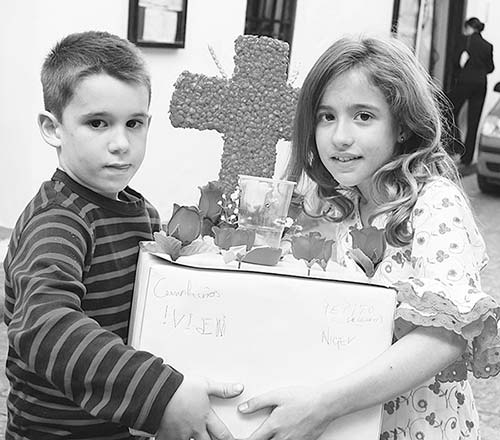
Be prepared for big crowds during these holiday periods: Holy Week (Semana Santa) and Easter weekend, especially in Sevilla; April Fair in Sevilla; the San Isidro festival in Madrid; Labor Day (May 1); Dos de Mayo, Madrid; Ascension Day; Pentecost weekend; Assumption weekend; Spanish National Day; Constitution Day, followed closely by the Feast of the Immaculate Conception—both the previous and following weekends may be busy; and Christmas and New Year’s. Watch out for puente (bridge) holidays—local holidays that fall on days other than Monday or Friday; the Spanish often extend their time off to bridge the weekend and the holiday, and restaurants and shops may also close.
Books and Films
To learn more about Spain’s past and present, check out a few of these books or films.
Nonfiction
Barcelona (Robert Hughes, 1992). This is an opinionated journey through the city’s tumultuous history, with a focus on art and architecture.
Barcelona: The Great Enchantress (2004) is a condensed version of Hughes’ love song to his favorite city.
Barcelona: A Thousand Years of the City’s Past (Felipe Fernandez-Armesto, 1992). A historical and artistic perspective on Barcelona, this book also details the tensions between the city and the rest of Spain.
The Basque History of the World (Mark Kurlansky, 2001). This is an essential history for understanding the Basque region and its people.
The Battle for Spain (Antony Beevor, 2006). A prize-winning account of the disintegration of Spain in the 1930s, Beevor’s work is the best overall history of the bloody civil war.
Discovering Spain: An Uncommon Guide (Penelope Casas, 1992). Casas, a well-known Spanish cookbook author, insightfully blends history, culture, and food in this personal guide.
Driving Over Lemons (Chris Stewart, 2001). In this real-life account, the one-time drummer of Genesis and his family relocate to Spain and adjust to new cultures and traditions.
Following the Milky Way (Elyn Aviva, 1989). In 1982, Aviva explored the nature of pilgrimage along the famous Camino de Santiago trail in northern Spain—before its newfound popularity.
Ghosts of Spain: Travels Through Spain and Its Silent Past (Giles Tremlett, 2007). Spain comes to grips with its past under Franco in this evocative account—part social history and part travelogue.
Hell and Good Company: The Spanish Civil War and The World It Made (Richard Rhodes, 2015). Reporters, writers, artists, and doctors who witnessed the Spanish Civil War tell their extraordinary stories.
Homage to Barcelona (Colm Toibin, 1990). This rich history of Barcelona includes anecdotes from the author’s time in the city.
Homage to Catalonia (George Orwell, 1938). Orwell writes a gripping account of his experiences in the Spanish Civil War fighting Franco’s fascists.
Hotel Florida: Truth, Love, and Death in the Spanish Civil War (Amanda Vaill, 2014). In this popular history, Vaill reconstructs events of the Spanish Civil War through the letters, diaries, and photographs of the war correspondents who covered it.
Into the Arena: The World of the Spanish Bullfight (Alexander Fiske-Harrison, 2011). The author examines the controversial sport from the perspective of the bullfighter, trainer, and fan—and even gets in the ring himself.
The New Spaniards (John Hooper, 2006). Hooper surveys all aspects of modern Spain, including its transition from dictatorship to democracy, its cultural traditions, and its changing society.
The Ornament of the World (María Rosa Menocal, 2002). Menocal gives a vivid depiction of how Muslims, Jews, and Christians created a culture of tolerance in medieval Spain.
Sister Queens: The Noble, Tragic Lives of Katherine of Aragon and Juana, Queen of Castile (Julia Fox, 2011). This dual biography of the daughters of Ferdinand and Isabel tells how they each lost positions of power—one to madness and the other to England’s Henry VIII.
South from Granada (Gerald Brenan, 1957). The eccentricities of village life in the mountains of Andalucía are lovingly detailed in this British expat’s tribute.
Spain in Our Hearts: Americans in the Spanish Civil War, 1936-1939 (Adam Hochschild, 2016). This moving narrative follows the idealistic Americans who fought in and wrote about the Spanish Civil War.
Travelers’ Tales: Spain (Lucy McCauley, 1995). Taken together, this collection of essays from numerous authors builds an appealing overview of Spain and its people.
Fiction
The Blind Man of Seville (Robert Wilson, 2003). Wilson’s popular police thrillers, including this one, are set in Spain and Portugal.
The Carpenter’s Pencil (Manuel Rivas, 2001). The psychological cost of Spain’s Civil War is at the heart of this unsentimental tale of a revolutionary haunted by his past.
Don Quixote (Miguel de Cervantes, 1605). This classic tale of a deluded nobleman trying to revive chivalry in early-16th-century Spain is one of the world’s greatest novels.
For Whom the Bell Tolls (Ernest Hemingway, 1940). After reporting on the Spanish Civil War from Madrid, Hemingway wrote his iconic novel about an American volunteer fighting Franco’s fascist forces.
The Heretic (Lewis Weinstein, 2000). Sevilla is the backdrop for this tale exploring the brutality and intolerance of the Spanish Inquisition.
The Last Jew (Noah Gordon, 2000). This sweeping saga recounts one man’s survival in Inquisition-era Spain.
The Queen’s Vow (C. W. Gortner, 2012). The life and times of Queen Isabel are vividly re-created in this historical novel.
The Shadow of the Wind (Carlos Ruiz Zafón, 2005). This best-selling thriller is set in 1950s Barcelona; sequels include The Angel’s Game and The Prisoner of Heaven.
Stories from Spain (Genevieve Barlow and William Stivers, 1999). Readers follow nearly 1,000 years of Spanish history in brief short stories printed in Spanish and English.
The Sun Also Rises (Ernest Hemingway, 1926). A bullfight enthusiast, Hemingway chronicles the running of the bulls in Pamplona in this novel about the “Lost Generation.” He also wrote about the spectacle in Death in the Afternoon (1932) and The Dangerous Summer (1960).
Tales of the Alhambra (Washington Irving, 1832). In this timeless classic, Irving weaves fact and mythical tales into his descriptions of the Alhambra.
Three Tragedies (Federico García Lorca, 1933-1936). Written in the last years of the poet’s life, these plays about repression, ritual, desire, and tradition are a fine introduction to Lorca’s genius.
Films
L’Auberge Espagnole (2002). This comedy-drama chronicles the loves and lives of European students sharing an apartment in Barcelona.
Barcelona (1994). Two Americans try to navigate the Spanish singles scene and the ensuing culture clash.
Blancanieves (2012). An homage to silent films, this melodramatic black-and-white film recasts Snow White as a female bullfighter trying to overcome her evil stepmother in the 1920s.
Carlos Saura’s Flamenco Trilogy. The first film, Blood Wedding (1981), adapts Federico García Lorca’s play about a wedding imposed on a bride in love with another man. Carmen (1983) follows a Spanish cast rehearsing the well-known French opera. El Amor Brujo (1986) is a ghostly love story.
Carol’s Journey (2002). A Spanish-American girl travels to Spain for the first time in the turbulent spring of 1938.
Un Chien Andalou (The Andalusian Dog, 1928). Dalí collaborated with Luis Buñuel on this classic Surrealist short film.
El Cid (1961). Sophia Loren and Charlton Heston star in this epic about an 11th-century hero’s effort to unite Spain.
Goya’s Ghosts (2006). Focusing on the last phases of the Spanish Inquisition, this film by Milos Forman is part satire and part soap opera.
Juana la Loca (Mad Love, 2001). This historical drama set in the early 16th century combines sex and politics in the time of Queen Juana the Mad.
Man of La Mancha (1972). Peter O’Toole and Sophia Loren star in this musical version of Don Quixote.
Manuale d’Amore (2005). The four episodes of this film follow the love stories of four couples, with Barcelona and Rome as backdrops.
The Mystery of Picasso (1956). Picasso is filmed painting from behind a transparent canvas, allowing a unique look at his creative process.
Ocho Apellidos Vascos (Spanish Affair, 2014). Two of Spain’s most different cultures collide as a dumped bride-to-be from the Basque Country goes ahead with her bachelorette party...in Sevilla. Eventually the south vs. north conflict is amorously resolved.
Open Your Eyes (1997). Set in Madrid, Alejandro Amenábar’s film was the inspiration for the Tom Cruise thriller Vanilla Sky, in which a car accident sets off an intricate series of events.
Pan’s Labyrinth (2006). Exploring the dark times of fascist Spain in World War II, this film is a rich excursion in magic realism.
Vicky Cristina Barcelona (2008). In this Woody Allen film, a macho Spanish artist (Javier Bardem) tries to seduce two American women when his stormy ex-wife (Penélope Cruz) suddenly reenters his life.
The Way (2010). An American doctor walks the Camino de Santiago to honor his son, who was killed during a storm in the Pyrenees as he began his pilgrimage.
Women on the Verge of a Nervous Breakdown (1988). This film, about a woman’s downward spiral after a breakup, is one of several piquant Pedro Almodóvar movies about relationships in the post-Franco era. Others include All About My Mother (1999), Talk to Her (2002), Volver (2006), and Broken Embraces (2009).
Books for Kids
Building with Nature: The Life of Antoni Gaudí (Rachel Rodriguez and Julie Paschkis, 2009). Beautiful, folksy illustrations enliven the biography of Barcelona’s most famous architect.
Carmelita de Andalucía (Charlotte Brokaw Powers, 2001). In this charming story, a young girl wants her very own red flamenco shoes.
Diego Velaázquez (Mike Venezia, 2004). Full-color images of Velázquez’s art combine with humorous cartoons to engage young readers.
Katie and the Spanish Princess (James Mayhew, 2006). Katie goes to an art museum to find inspiration for her perfect princess dress.
Kids’ Travel Guide—Spain (Flying Kids, 2019). In this activity travel guide, kids explore Spain with a mix of interactive quizzes, tips, and coloring pages alongside their personal tour guide, Leonardo.
Lola’s Fandango (Anna Witte and Micha Archer, 2011). A girl discovers her talent when her father gives her secret lessons in this traditional Spanish dance.
Medio Pollito: A Spanish Tale (Eric A. Kimmel and Valeria Docampo, 2010). This traditional Spanish folktale relates the adventures of a unique chicken who ventures to the big city.
Molly and the Magic Suitcase: Molly Goes to Barcelona (Chris Oler and Amy Houston Oler, 2013). With the help of a magic suitcase, Molly and her brother trek to Barcelona in search of adventure.
Picasso and Minou (P. I. Maltbie and Pau Estrada, 2005). This beautifully illustrated book shares the story of Picasso and his work through the eyes of his cat, Minou.
The Prince of Mist (Carlos Ruiz Zafón, 1993). For more mature young readers, this mystery tells of a family’s move to a haunted house in coastal Spain.
Princess Prissypants Goes to Spain (Ashley Putnam Evans and Martha-Elizabeth Furguson, 2009). A princess learns to appreciate foreign customs and language.
Shadow of a Bull (Maia Wojciechowska, 1965). A Spanish boy longs to become a doctor—despite family expectations that he be a bullfighter like his father.
Soccer World Spain: Explore the World Through Soccer (Ethan Zohn and David Rosenberg, 2011). A look at Spain through its most famous sport.
The Story of Ferdinand (Munro Leaf and Robert Lawson, 1936). Ferdinand the bull would rather sit and smell the flowers than fight like the other bulls.
Conversions and Climate
Numbers and Stumblers
• Europeans write a few of their numbers differently than we do. 1 =  , 4 =
, 4 =  , 7 =
, 7 =  .
.
• In Europe, dates appear as day/month, so Christmas is 25/12.
• Commas are decimal points and decimals are commas. A dollar and a half is $1,50, one thousand is 1.000, and there are 5.280 feet in a mile.
• When counting with fingers, start with your thumb. If you hold up your first finger to request one item, you’ll probably get two.
• What Americans call the second floor of a building is the first floor in Europe.
• On escalators and moving sidewalks, Europeans keep the left “lane” open for passing. Keep to the right.
Metric Conversions
A kilogram equals 1,000 grams (about 2.2 pounds). One hundred grams (a common unit at markets) is about a quarter-pound. One liter is about a quart, or almost four to a gallon.
A kilometer is six-tenths of a mile. To convert kilometers to miles, cut the kilometers in half and add back 10 percent of the original (120 km: 60 + 12 = 72 miles). One meter is 39 inches—just over a yard.
| 1 foot = 0.3 meter | 1 square yard = 0.8 square meter |
| 1 yard = 0.9 meter | 1 square mile = 2.6 square kilometers |
| 1 mile = 1.6 kilometers | 1 ounce = 28 grams |
| 1 centimeter = 0.4 inch | 1 quart = 0.95 liter |
| 1 meter = 39.4 inches | 1 kilogram = 2.2 pounds |
| 1 kilometer = 0.62 mile | 32°F = 0°C |
Clothing Sizes
When shopping for clothing, use these US-to-European comparisons as general guidelines (but note that no conversion is perfect).
Women: For pants and dresses, add 32 in Spain (US 10 = Spanish 42). For blouses and sweaters, add 8 for most of Europe (US 32 = European 40). For shoes, add 30-31 (US 7 = European 37/38).
Men: For shirts, multiply by 2 and add about 8 (US 15 = European 38). For jackets and suits, add 10. For shoes, add 32-34.
Children: Clothing is sized by height—in centimeters (2.5 cm = 1 inch), so a US size 8 roughly equates to 132-140. For shoes up to size 13, add 16-18, and for sizes 1 and up, add 30-32.
Spain’s Climate
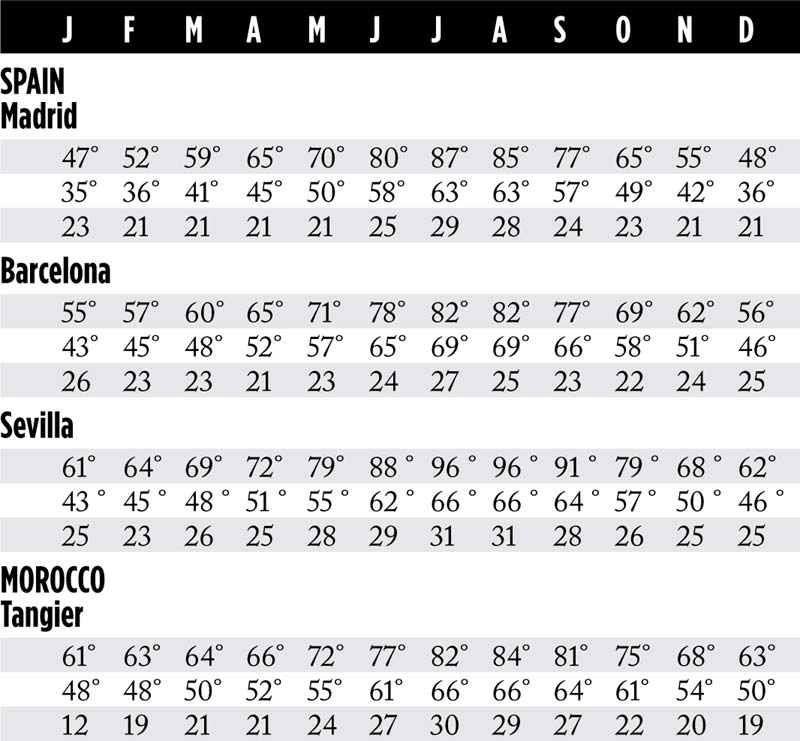
First line, average daily high; second line, average daily low; third line, average days without rain. For more detailed weather statistics for destinations in this book (as well as the rest of the world), check Wunderground.com.
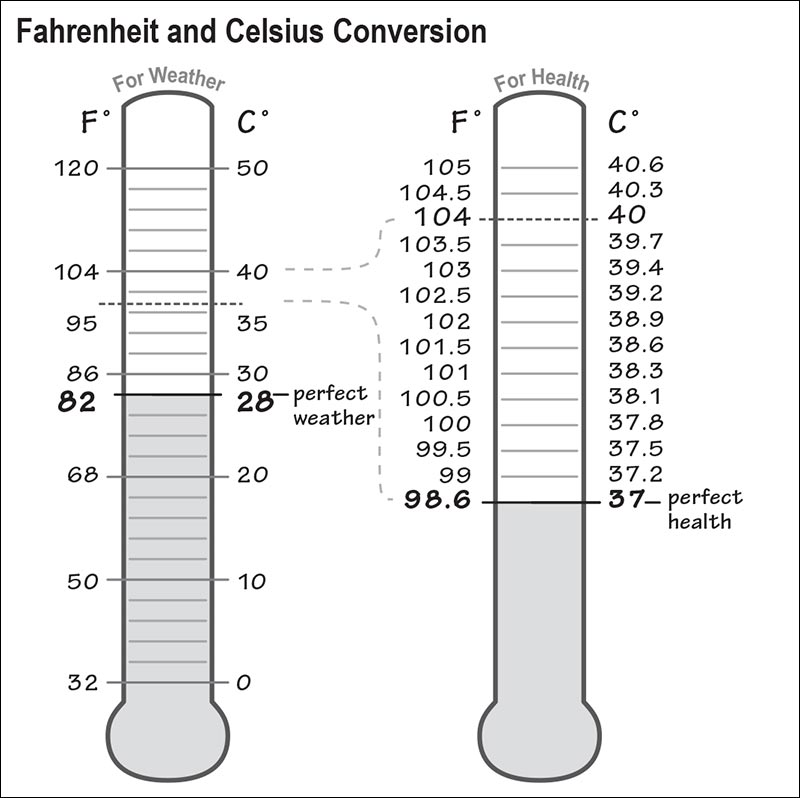
Europe takes its temperature using the Celsius scale, while we opt for Fahrenheit. For a rough conversion from Celsius to Fahrenheit, double the number and add 30. For weather, remember that 28°C is 82°F—perfect. For health, 37°C is just right. At a launderette, 30°C is cold, 40°C is warm (usually the default setting), 60°C is hot, and 95°C is boiling. Your air-conditioner should be set at about 20°C.
Whether you’re traveling for five days or five weeks, you won’t need more than this. Pack light to enjoy the sweet freedom of true mobility.
 5 shirts: long- & short-sleeve
2 pairs pants (or skirts/capris)
1 pair shorts
5 pairs underwear & socks
1 pair walking shoes
Sweater or warm layer
Rainproof jacket with hood
Tie, scarf, belt, and/or hat
Swimsuit
Sleepwear/loungewear
Debit card(s)
Credit card(s)
Hard cash (US $100-200)
Money belt
Passport
Other required ID: Vaccine card, entry visa, etc.
Driver’s license, student ID, hostel card, etc.
Tickets & confirmations: flights, hotels, trains, rail pass, car rental, sight entries
Photocopies of important documents
Insurance details
Guidebooks & maps
Mobile phone
Camera & related gear
Tablet/ebook reader/laptop
Headphones/earbuds
Chargers & batteries
Phone car charger & mount (or GPS device)
Plug adapters
Basics: soap, shampoo, toothbrush, toothpaste, floss, deodorant, sunscreen, brush/comb, etc.
Medicines & vitamins
First-aid kit
Glasses/contacts/sunglasses
Face masks & hand sanitizer
Sewing kit
Packet of tissues (for WC)
Earplugs
Day pack
Sealable plastic baggies
Laundry supplies: soap, laundry bag, clothesline spot remover
Small umbrella
Travel alarm/watch
Notepad & pen
Journal
Second pair of shoes (flip-flops, sandals, tennis shoes, boots)
Travel hairdryer
Picnic supplies
Disinfecting wipes
Water bottle
Fold-up tote bag
Small flashlight
Mini binoculars
Small towel or washcloth
Inflatable pillow/neck rest
Tiny lock
Address list (to mail postcards)
Extra passport photos
Spanish Survival Phrases
| Good morning. | Buenos días. bweh-nohs dee-ahs |
| Good afternoon. | Buenas tardes. bweh-nahs tar-dehs |
| Do you speak English? | ¿Habla usted inglés? ah-blah oo-stehd een-glays |
| Yes. / No. | Sí. / No. see / noh |
| I (don’t) understand. | (No) comprendo. (noh) kohm-prehn-doh |
| Please. / Thank you. | Por favor. / Gracias. por fah-bor / grah-thee-ahs |
| I’m sorry. | Lo siento. loh see-ehn-toh |
| Excuse me. | Perdone. pehr-doh-nay |
| No problem. | No hay problema. noh ī proh-bleh-mah |
| Good. / OK. | Bueno. / Vale. bweh-noh / bah-lay |
| Goodbye. | Adiós. ah-dee-ohs |
| one / two / three | uno / dos / tres oo-noh / dohs / trehs |
| four / five / six | cuatro / cinco / seis kwah-troh / theen-koh / says |
| seven / eight | siete / ocho see-eh-tay / oh-choh |
| nine / ten | nueve / diez nweh-bay / dee-ehth |
| How much is it? | ¿Cuánto cuesta? kwahn-toh kweh-stah |
| Write it? | ¿Me lo escribe? may loh eh-skree-bay |
| Is it free? | ¿Es gratis? ehs grah-tees |
| Is it included? | ¿Está incluido? eh-stah een-kloo-ee-doh |
| Where can I buy / find...? | ¿Dónde puedo comprar / encontrar...? dohn-day pweh-doh kohm-prar / ehn-kohn-trar |
| I’d like / We’d like... | Me gustaría / Nos gustaría… may goo-stah-ree-ah / nohs goo-stah-ree-ah |
| ...a room. | ...una habitación. oo-nah ah-bee-tah-thee-ohn |
| ...a ticket to ____. | ...un billete para ____. oon bee-yeh-tay pah-rah ____ |
| Is it possible? | ¿Es posible? ehs poh-see-blay |
| Where is...? | ¿Dónde está...? dohn-day eh-stah |
| ...the train station | ...la estación de trenes lah eh-stah-thee-ohn day treh-nehs |
| ...the bus station | ...la estación de autobuses lah eh-stah-thee-ohn day ow-toh-boo-sehs |
| ...the tourist information office | ...la oficina de turismo lah oh-fee-thee-nah day too-rees-moh |
| Where are the toilets? | ¿Dónde están los servicios? dohn-day eh-stahn lohs sehr-bee-thee-ohs |
| men | hombres, caballeros ohm-brehs, kah-bah-yeh-rohs |
| women | mujeres, damas moo-heh-rehs, dah-mahs |
| left / right | izquierda / derecha eeth-kee-ehr-dah / deh-reh-chah |
| straight | derecho deh-reh-choh |
| When do you open / close? | ¿A qué hora abren / cierran? ah kay oh-rah ah-brehn / thee-ehr-ahn |
| At what time? | ¿A qué hora? ah kay oh-rah |
| Just a moment. | Un momento. oon moh-mehn-toh |
| now / soon / later | ahora / pronto / más tarde ah-oh-rah / prohn-toh / mahs tar-day |
| today / tomorrow | hoy / mañana oy / mahn-yah-nah |
In a Spanish Restaurant
| I’d like / We’d like... | Me gustaría / Nos gustaría… may goo-stah-ree-ah / nohs goo-stah-ree-ah |
| ...to reserve... | ...reservar… reh-sehr-bar |
| ...a table for one / two. | ...una mesa para uno / dos. oo-nah meh-sah pah-rah oo-noh / dohs |
| Non-smoking. | No fumador. noh foo-mah-dor |
| Is this table free? | ¿Está esta mesa libre? eh-stah eh-stah meh-sah lee-bray |
| The menu (in English), please. | La carta (en inglés), por favor. lah kar-tah (ehn een-glays) por fah-bor |
| service (not) included | servicio (no) incluido sehr-bee-thee-oh (noh) een-kloo-ee-doh |
| cover charge | precio de entrada preh-thee-oh day ehn-trah-dah |
| to go | para llevar pah-rah yeh-bar |
| with / without | con / sin kohn / seen |
| and / or | y / o ee / oh |
| breakfast / lunch / dinner | desayuno / almuerzo / cena deh-sah-yoo-noh / ahl-mwehr-zoh / seh-nah |
| menu (of the day) | menú (del día) meh-noo (dehl dee-ah) |
| specialty of the house | especialidad de la casa eh-speh-thee-ah-lee-dahd day lah kah-sah |
| tourist menu | menú turístico meh-noo too-ree-stee-koh |
| combination plate | plato combinado plah-toh kohm-bee-nah-doh |
| appetizers | tapas tah-pahs |
| bread | pan pahn |
| cheese | queso keh-soh |
| sandwich / soup | bocadillo / sopa boh-kah-dee-yoh / soh-pah |
| salad | ensalada ehn-sah-lah-dah |
| meat / poultry | carne / aves kar-nay / ah-behs |
| fish / seafood | pescado / marisco peh-skah-doh / mah-ree-skoh |
| fruit / vegetables | fruta / verduras froo-tah / behr-doo-rahs |
| dessert | postre poh-stray |
| tap water | agua del grifo ah-gwah dehl gree-foh |
| mineral water | agua mineral ah-gwah mee-neh-rahl |
| (orange) juice | zumo (de naranja) thoo-moh (day nah-rahn-hah) |
| coffee / tea / milk | café / té / leche kah-fay / tay / leh-chay |
| wine / beer | vino / cerveza bee-noh / thehr-beh-thah |
| red / white | tinto / blanco teen-toh / blahn-koh |
| glass / bottle | vaso / botella bah-soh / boh-teh-yah |
| Cheers! | ¡Salud! sah-lood |
| More. / Another. | Más. / Otro. mahs / oh-troh |
| The same. | El mismo. ehl mees-moh |
| The bill, please. | La cuenta, por favor. lah kwehn-tah por fah-bor |
| tip | propina proh-pee-nah |
| Delicious! | ¡Delicioso! deh-lee-thee-oh-soh |
For hundreds more pages of survival phrases for your trip to Spain, check out Rick Steves Spanish Phrase Book.