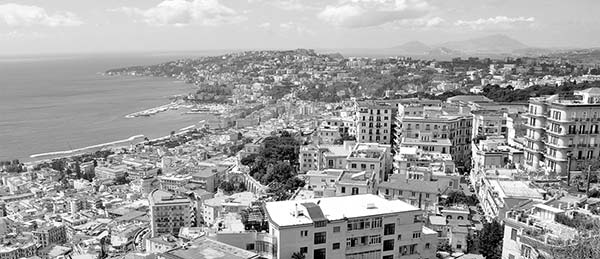
NAPLES
Napoli
Map: Naples Archaeological Museum
Map: Naples Hotels & Restaurants
If you like Italy as far south as Rome, go farther south—it gets better. If Italy is getting on your nerves, stop at Rome. Italy intensifies as you plunge deeper. Naples is Italy in the extreme—its best (birthplace of pizza) and its worst (home of the Camorra, Naples’ “family” of organized crime).
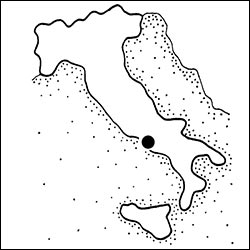
Before Italy unified in the late 1800s, Naples was the country’s richest city. But Naples’ fortunes nosedived when the capital of modern Italy was established in Rome. Things got so bad that many of its residents emigrated. The Italy America knows—pizza, spaghetti, and “O Sole Mio”/”Santa Lucia”—came from 19th-century Naples, as brought to the US by all those immigrants.
Today, Naples impresses visitors with one of Europe’s top archaeological museums (showcasing the artistic treasures of Pompeii), fascinating churches that convey the city’s unique personality and powerful devotion, an underground warren of Greek and Roman ruins, fine works of art (including pieces by Caravaggio, who lived here for a time), and evocative Nativity scenes (called presepi). Of course, Neapolitans make great pizza and tasty pastries (try the crispy, ricotta-stuffed sfogliatella). But more than anything, Naples has a brash and vibrant street life—“Italy in your face” in ways both good and bad. Walking through its colorful old town is one of my favorite experiences anywhere in Europe. For a grand overlook, head to the hilltop viewpoint (San Martino) for sweeping views of the city and its bay.
Naples is southern Italy’s leading city, the third-largest city in Italy, and Europe’s most densely populated city, with more than one million people and few open spaces or parks. While in many ways it feels like an urban jungle, Naples surprises the observant traveler with its impressive knack for living, eating, and raising children with good humor and decency. Overcome your fear of being run down or ripped off long enough to talk with people. Enjoy a few smiles and jokes with the man running the neighborhood tripe shop, or the woman taking her daycare class on a walk through the traffic.
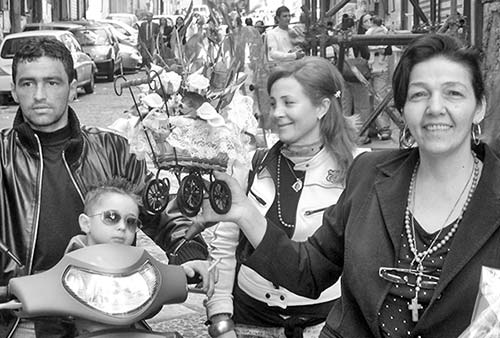
The pulse of Italy throbs in Naples. Like Cairo or Mumbai, it’s shocking and captivating at the same time, the closest thing to “reality travel” that you’ll find in Western Europe. But this tangled mess still somehow manages to breathe, laugh, and sing—with a joyful Italian accent. Thanks to its reputation as a dangerous place, Naples doesn’t get nearly as many tourists as it deserves. While the city has its problems, it has improved a lot in recent years. And even though it remains a bit edgy, I feel comfortable here. Naples richly rewards those who venture in.
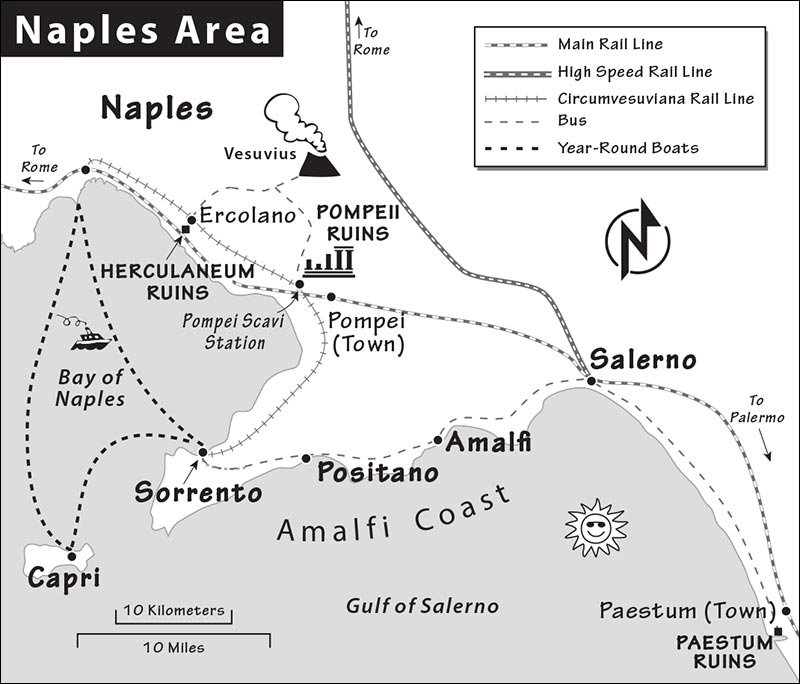
Naples is also the springboard to an array of nearby sightseeing treats (covered in the next three chapters and easy to reach by train, bus, or boat): Just beyond Naples are the remarkable ruins of Herculaneum and Pompeii, and the brooding volcano that did them both in, Mount Vesuvius. A few more miles down the road is the pleasant resort town of Sorrento and the offshore escape isle of Capri. Next comes the dramatic scenery of the Amalfi Coast. Plunging even farther south, you’ll reach the Greek temples of Paestum.
PLANNING YOUR TIME
Naples is an ideal day trip either from Rome or from the comfortable home base of Sorrento, each just over an hour away. Or you can stow your bag at the station and see Naples in a few hours while you change trains here on the way between Rome and Sorrento. For some, a little Naples goes a long way. If you’re not comfortable in chaotic and congested cities, think twice before spending the night here. But those who are intrigued by the city’s sights and street life enjoy overnighting in Naples.
On a quick visit, start with the Archaeological Museum (closed Tue), follow my self-guided Naples Walk, and celebrate your survival with pizza. With more time, dip into more churches, go underground to see Greek and Roman ruins, trek to Capodimonte to see art treasures, or ascend San Martino for the view. Spend an early evening strolling Naples’ romantic Lungomare harborside promenade.
For a blitz tour from Rome, you could have breakfast on an early Rome-Naples express train (usually daily 7:35-8:45), zip to Pompeii by bus or train, return to Naples and hit the Archaeological Museum, and be back in Rome before you turn into a zucchini. That’s exhausting, but more memorable than a fourth day in Rome.
Yes, Naples is huge. But if you stick to my suggestions and grab a cab when you’re lost or tired, it’s fun. Treat yourself well in Naples; the city is cheap by Italian standards. Splurging on a sane and comfortable hotel is a worthwhile investment.
On summer afternoons, Naples’ street life slows and many churches, museums, and shops close as the temperature soars. The city comes back to life in the early evening.
Orientation to Naples
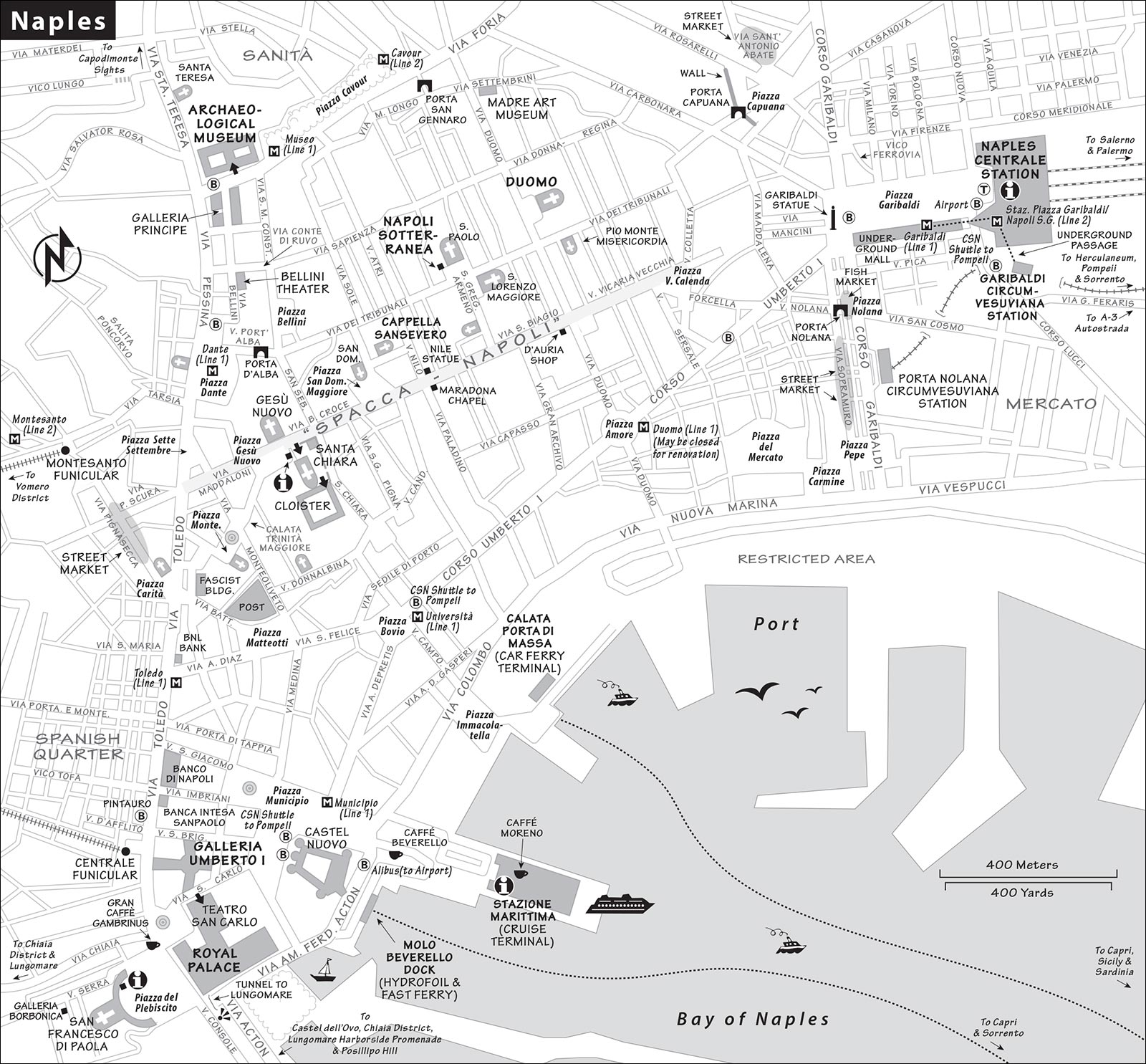
Naples is set deep inside the large, curving Bay of Naples, with Mount Vesuvius looming just five miles away. Although Naples is a sprawling city, its fairly compact core contains the most interesting sights. The tourist’s Naples is a triangle, with its points at the Centrale train station in the east, the Archaeological Museum to the west, and Piazza del Plebiscito (with the Royal Palace) and the port to the south. Steep hills rise above this historic core, including San Martino, capped with a mighty fortress.
TOURIST INFORMATION
Central Naples has various small TIs, none of them particularly helpful—just grab a map and browse the brochures. The main branch, open all year, is in the city center on Spaccanapoli, across from the Church of Gesù Nuovo (Mon-Sat 9:00-18:00, likely closed Sun, +39 081 551 2701). Seasonally, you may also find TI branches at the Centrale train station, at the cruise port, and at the airport—look around when you arrive. For information online, the best overall website is www.inaples.it [URL inactive].
ARRIVAL IN NAPLES
No matter how you arrive, expect some chaos. Instead of getting frustrated, consider it part of the charm of Naples—as most locals do. If you’re connecting to another destination from Naples, see the “Getting Around the Region” sidebar on here.
By Train
Naples has several train stations, but all trains coming into town stop at either Napoli Centrale station or Garibaldi station—which are essentially the same place, with Centrale on top of Garibaldi. Stretching in front of this station complex is the vast Piazza Garibaldi, with an underground shopping mall and Metro entrance.
Centrale station, on the ground floor, is the slick, modern main station, with intercity connections across Italy. Baggage check (deposito bagagli, run by Kipoint) is near track 2; pay WCs are down the stairs across from track 13. A nice Food Hall Napoli is located near tracks 2-8; other shops and eateries are mainly concentrated on the underground level. In high season, a TI may be set up somewhere in the station; the inStazione desk is a private agency but can be helpful in a pinch. Out the front door to the left, you’ll find a big bookstore (La Feltrinelli) and a good supermarket (Sapori & Dintorni).
Garibaldi station, on the lower level, is used exclusively by the narrow-gauge Circumvesuviana commuter train and the Campania Express (options you can use to connect to Sorrento or Pompeii; to get here from Centrale, follow signs to Circumvesuviana and Linee Vesuviane). Note that this is not the terminus for the Circumvesuviana; that’s one stop farther downtown, at the station called Porta Nolana.
To add to the confusion, “Stazione Piazza Garibaldi,” or “Napoli S.G.” for short, is a stop on Trenitalia’s Metropolitana (part of Naples’ Metro line 2—see next); these tracks are downstairs near the middle of Centrale station (follow signs for M Linea 2). In addition to stops in Naples, some of these trains go all the way out to Pompei (the modern town) and Salerno.
Getting Downtown: Arriving at either station, the best bet for reaching most sights and hotels is either the Metro or a taxi. Metro lines 1 and 2 are both downstairs—in separate areas—and signposted throughout the Centrale and Garibaldi stations. Line 1 (direction: Piscinola) is handy for city-center stops, including the cruise port (Municipio), the main shopping drag (Toledo and Dante), and the Archaeological Museum (Museo). Line 2 is slightly quicker for reaching the Archaeological Museum (direction: Campi Flegrei/Pozzuoli/Formina, go one stop to Piazza Cavour, then walk 5 minutes). For tips on navigating the Metro, see “Getting Around Naples,” later.
Long rows of white taxis line up out front. Ask the driver to charge you the fixed rate (tariffa predeterminata), which varies from €9 for the old center to €15 for the most distant hotel I list.
By Plane or Cruise Ship
For information on Naples’ airport, cruise ship terminal, and ferry docks, see the end of this chapter.
HELPFUL HINTS
Theft Alert: While most travelers visit Naples safely, err on the side of caution. Be aware that thieves and con artists hang out close to where travelers tumble into Naples: the train station and the port. Although the train station itself has been nicely spruced up, its glow doesn’t extend far. Remember that poor and chaotic does not necessarily mean dangerous. Don’t let your first impression of the station area get in your way of enjoying Naples—the city changes drastically as you move farther away. Touristy Spaccanapoli, Capodimonte, and the posh Via Toledo shopping boulevard are more upscale—though even in its nicest areas, Naples can strike many visitors as a bit scruffy.
Stick to busy streets and beware the odd gang of hoodlums. A third of the city is unemployed, and past local governments have set an example of corruption that the Mafia would be proud of. As in most big cities, consider any jostle or commotion a possible thief-team smokescreen. Keep a low profile, carry only the bare minimum, and leave heavy bags at your hotel or at the left-luggage office in Centrale station.
Walk with confidence, as if you know where you’re going and what you’re doing. Use the sidewalk (even if the locals don’t) and carry your belongings on the side away from the street—thieves on scooters have been known to snatch bags as they swoop by. Keep valuables buttoned up (or secure them at your hotel).
Perhaps your biggest risk of theft is while catching or riding the Circumvesuviana commuter train. While I ride the Circumvesuviana comfortably and safely, each year I hear of travelers who get ripped off on this ride. You won’t be mugged—but you may be conned or pickpocketed. At the train station, carry your own bags—there are no official porters. If you’re connecting from a long-distance express, you’ll be going from a relatively secure compartment into an often-crowded and dingy train. Be ready for this very common trick: A team of thieves blocks the door at a stop, pretending it’s stuck. While everyone rushes to try to open it, an accomplice picks their pockets. Wear your money belt, and avoid the Circumvesuviana train late at night when it’s plagued by intimidating ruffians. For peace of mind, sit in the front car, where there is a driver who may be able to monitor activity.
Traffic Safety: In Naples, red lights are timed short, and pedestrians need to be wary, particularly of motor scooters that zip among the cars. Even on “pedestrian” streets, stay alert to avoid being sideswiped by scooters (or even cars) that nudge their way through the crowds. Smart tourists jaywalk in the shadow of bold locals, who generally ignore crosswalks. Wait for a break in traffic, cross with confidence, and make eye contact with approaching drivers and motor scooters. The traffic will slow to let you pass.
Free Entry Days: State museums in Italy, including the Archaeological Museum and Capodimonte Museum, are free to enter once or twice a month, usually on a Sunday. Check in advance and if possible, avoid going on a free day, which can attract huge crowds.
Bookstore: La Feltrinelli, conveniently located at Centrale station, carries a small selection of English-language books (daily 8:00-20:00, near track 24, also accessible from outside the station).
Laundry: Lav@Sciuga, a block from the Università Metro stop, is convenient but has just a few washing machines (Mon-Fri 9:00-17:00, Sat until 13:00, closed Sun, Via Sedile di Porto 54, mobile +39 327 754 6639).
GETTING AROUND NAPLES
Sightsee Naples with help from its subway (Metro), funiculars, and taxis. (There are also public buses, but these generally aren’t useful for travelers.) For general transit information, maps, and fares, visit www.unicocampania.it. For schedules, your only option is the Italian-only site www.anm.it. Google Maps works as well as anything for journey planning.
Tickets and Passes: Most of Naples’ public transportation system—Metro, funiculars, and buses—use the same ticket, which must be stamped as you enter (in yellow or blue machines). Tickets are sold at tobacco stores, some newsstands, clunky machines at Metro stations (these accept coins, small bills, or credit cards, but can be tricky to operate), and occasionally at station windows. Basically, anywhere you see a queue near the station, people are buying tickets.
A €1.10 single ticket (corsa singola) covers any ride on bus, funicular, or Metro line 1, with no transfers; for Metro line 2 you need the €1.30 version. (This ticket is a long, printed receipt with a QR code that needs to be punched at the machine—fold your ticket in half and insert.) A giornaliero day pass costs €3.50 (or €4.50 including Metro line 2), and pays for itself quickly, but can be hard to find; many tobacco stores don’t sell them. A weekly ticket (Mon-Sun) costs €12.50, or €16 including Metro line 2. Several versions of the Campania ArteCard (see sidebar on here) include free public transport in Naples.
By Metro (Metropolitana): Naples’ subway has three main lines (linea). Station entrances and signs to the Metro are marked by a red square with a white M.
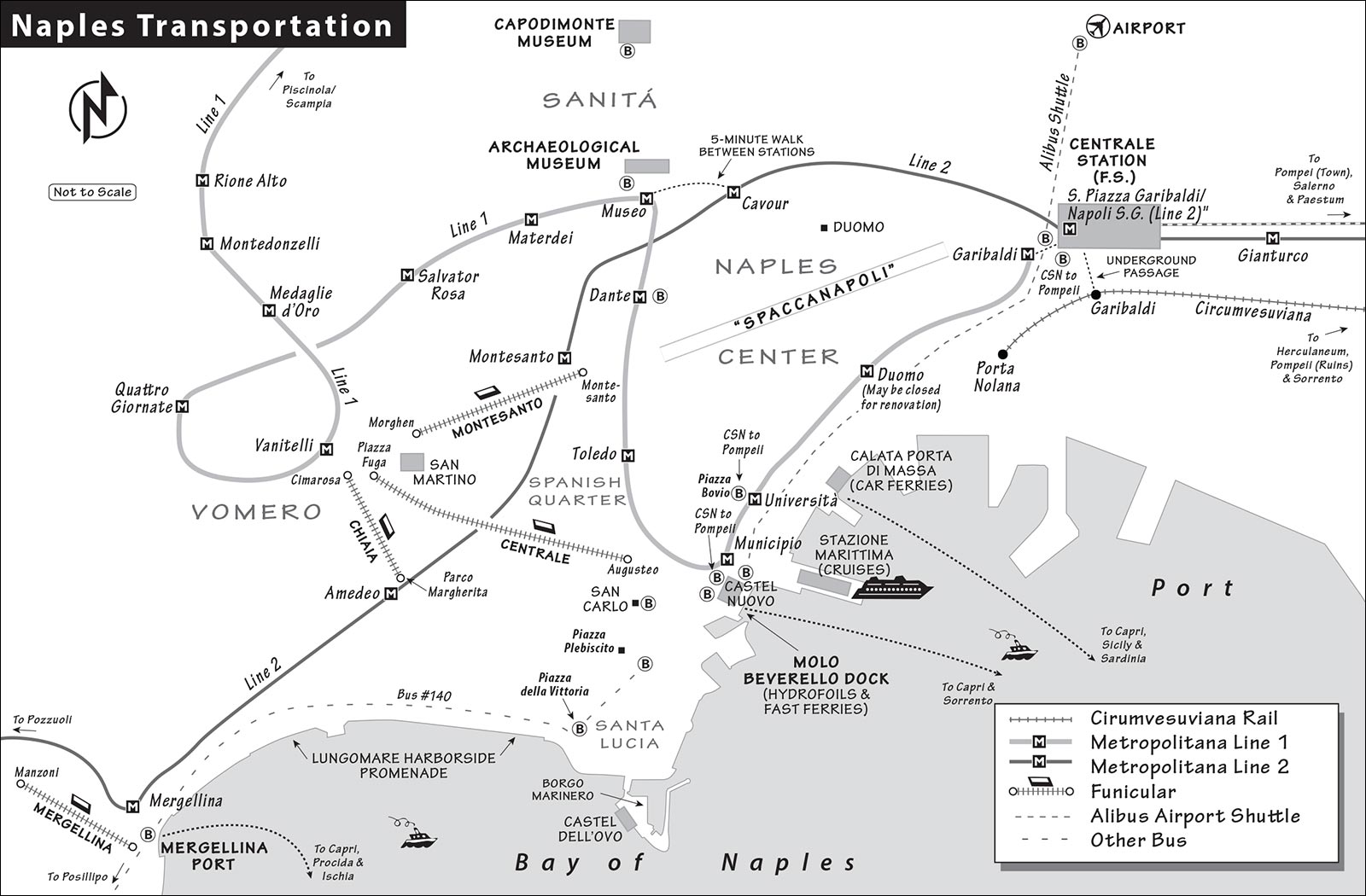
Line 1 is very useful for tourists. Starting from Centrale train station (stop name: Garibaldi), it heads to Università (the university), Municipio (at Piazza Municipio, just above the harbor and cruise terminal), Toledo (south end of Via Toledo, near Piazza del Plebiscito), Dante (Piazza Dante), and Museo (Archaeological Museum). Four stops beyond Museo is the Vanvitelli stop, near the hilltop San Martino sights; the end of the line is Piscinola. Many of line 1’s stations are huge and elaborate, designed by prominent artists and architects; Naples is proud of them, and locals are excited to tell you about their favorite.
Line 2 (part of Trenitalia, the Italian national rail system) is most useful for getting quickly from the Centrale train station to Piazza Cavour (a 5-minute walk from the Archaeological Museum) or Montesanto (the top of the Spanish Quarter and Spaccanapoli street, and base of one funicular up to San Martino). Note that the train station stop on this line is called “Napoli S.G.” (for Stazione Piazza Garibaldi). Some trains on this line run all the way out into the suburbs (including to modern Pompei and Salerno).
By Funicular: Central Naples’ three funiculars (funicolare) carry commuters and sightseers into the hilly San Martino neighborhood just west of downtown. All three converge near Piazza Fuga, a short walk from the hilltop fortress and monastery/museum. The Centrale line runs from the Spanish Quarter, just near Piazza del Plebiscito and the Toledo Metro stop; the Montesanto line from the Montesanto Metro stop and Via Pignasecca market zone; and the Chiaia line from near the Piazza Amadeo Metro stop.
By Taxi: A taxi lets you experience Naples traffic without actually driving in it—an experience worth at least ▲ (or more, when it’s really chaotic). A short ride in town should cost €10-15. Always ask for the tariffa predeterminata (fixed rate), which should be prominently posted inside any legitimate taxi. Your hotel can call you a cab and make sure you know the appropriate rate. For metered rides, there are some legitimate extra charges (baggage fees, €2.50 supplement after 22:00 or all day Sun and holidays) but the destinations I recommend in this chapter are covered by the tariffa predeterminata. Radio Taxi 8888 is one reputable company (+39 081 8888).
Tours in Naples
 To sightsee on your own, download my free Rick Steves audio tours of the Naples Archaeological Museum and my Naples Walk.
Local Guides
Pina Esposito has a Ph.D. in ancient archaeology and art and does fine private walking and driving tours of Naples and the region (Pompeii, Herculaneum, Capri, the Amalfi Coast, etc.), including Naples’ Archaeological Museum (€60/hour, 2-hour minimum, RS%—10 percent off with this book, up to 20 percent off for full-day tours, mobile +39 338 763 4224, annamariaesposito1@virgilio.it).
The team at Mondo Guide offers private tours of the Archaeological Museum (€120/2 hours) and city (€240/4 hours) and can provide guides or drivers throughout the region. They can also arrange kayaking trips, boat trips, and whatever else you need (+39 081 751 3290, www.mondoguide.it, info@mondoguide.com).
Walking Tours
Mondo Guide offers my readers special shared tours of Naples and of Pompeii, as well as other trips. For details, see the sidebar.
Hop-On, Hop-Off Bus Tours
CitySightseeing Napoli tour buses make two different hop-on, hop-off loops through the city. Only the red line, which loops around the historical center and stops at the Archaeological Museum, is particularly helpful. It will also give you a sense of greater Naples that this chapter largely ignores (€23, ticket valid 24 hours, 2/hour, buy from driver or from kiosk at Piazza Municipio in front of Castel Nuovo near the port, scant recorded narration, +39 081 551 7279, www.napoli.city-sightseeing.it [URL inactive]). The blue line takes you out along the seafront pedestrian promenade to Posillipo Hill—a more upscale part of the city that Neapolitans love.
Cruise-Ship Excursions
Convenient for cruise-ship passengers, the Can’t Be Missed tour company takes you from the port of Naples on an all-day coach trip for up to 20 passengers along the Amalfi Coast that includes a stop in Sorrento and a guided tour of Pompeii (€89, meet at 8:00 in front of port, bus leaves at 8:30, returns at 15:45, Pompeii ticket extra, mobile +1 607 542 7981, www.cantbemissedtours.com, RS%—10 percent off when you use promo code “RICKSTEVES” on their website).
Archaeological Museum Tour
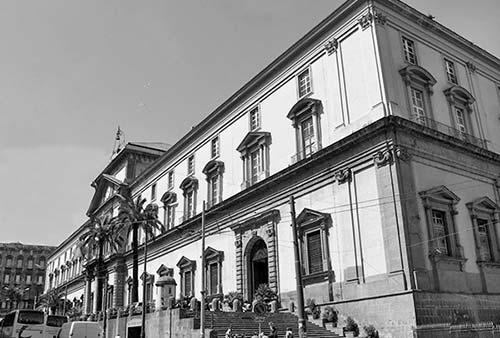
Naples’ Archaeological Museum (Museo Archeologico), worth ▲▲▲, is one of the world’s great museums of ancient art. It boasts supersized statues as well as art and decorations from Pompeii and Herculaneum, the two ancient burgs that were buried in ash by the eruption of Mount Vesuvius in AD 79. For lovers of antiquity, this museum alone makes Naples a worthwhile stop. When Pompeii was excavated in the late 1700s, Naples’ Bourbon king bellowed, “Bring me the best of what you find!” The finest art and artifacts ended up here, leaving the ancient sites themselves barren (though still impressive). It’s here at the Archaeological Museum that you can get up close and personal with the ancient world.
ORIENTATION
Cost and Hours: €15, sometimes more for temporary exhibits; Wed-Mon 9:00-19:30, closed Tue. Avoid lines by purchasing your ticket online. Early and temporary closures are noted on a board near the ticket office: The Secret Room tends to have shorter hours (sometimes closing in the early afternoon), and additional rooms can be closed in July and August.
Information: +39 081 442 2149, www.museoarcheologiconapoli.it.
Getting There: From Centrale station, you can reach the museum by Metro or taxi. Metro line 2 is quickest: At the station, buy a single transit ticket at a newsstand or tobacco shop—specify you want line 2 since the price and ticket are different from line 1. Follow signs downstairs to Metro Linea 2, then fold and punch your ticket in the small blue boxes near the escalator going down to the tracks. Take a train in the direction of Pozzuoli, Campi Flegrei, or Formina (attendants may ask and confirm which direction you’re going). Ride one stop to Piazza Cavour. Exit and walk five minutes uphill through the park. Look for a grand old red building up a flight of stairs at the top of the block.
You can also take the Metro’s slightly cheaper line 1 five stops from Centrale station to Museo—it’s only a little slower, and drops you closer to the museum.
Figure about €13 for a taxi from the train station to the museum.
Visitor Information: The shop (behind the ticket desk) sells a worthwhile National Archaeological Museum of Naples guidebook for €13.
Tours: The self-guided tour in this chapter covers all the basics. For more detail, the decent audioguide (€5, leave ID at ticket desk) focuses largely on the provenance of the artifacts and how they ended up here. For a guided tour, book Pina Esposito (see “Tours in Naples,” earlier).
Download my free Archaeological Museum audio tour.
Baggage Check: Bag check is obligatory and free.
Eating: The museum’s $ Mann Caffè has both a counter and table service, and a full menu. There are also a few good places to grab a meal within a 10-minute walk; see here.
 SELF-GUIDED TOUR
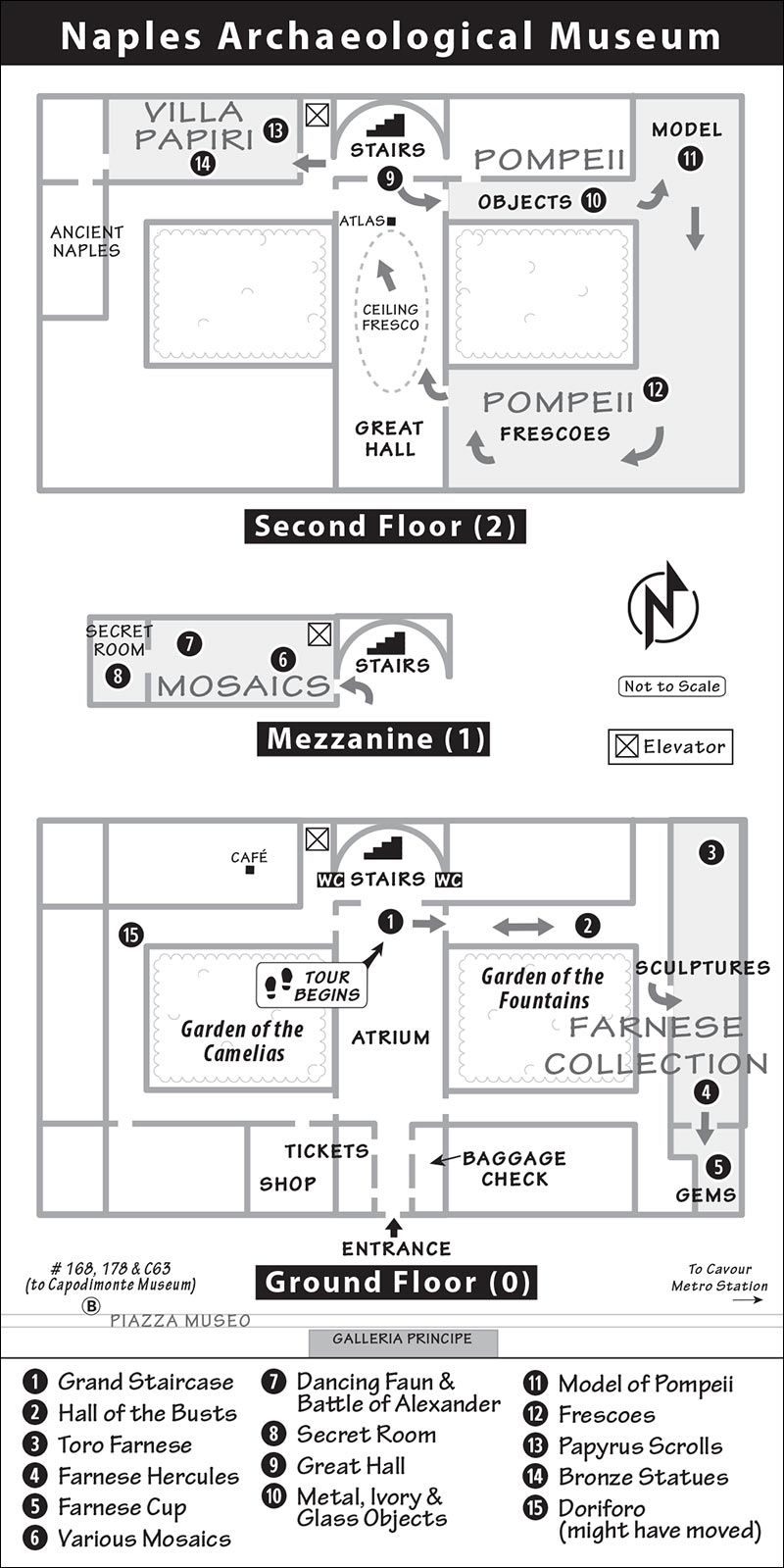
Entering the museum, cross the atrium, and stand at the base of the grand staircase. To your right, on the ground floor, are the larger-than-life statues of the Farnese Collection, starring the Toro Farnese and the Farnese Hercules. Up the stairs on the mezzanine level are mosaics and frescoes from Pompeii, including the Secret Room of erotic art. On the top floor are more artifacts from Pompeii, a scale model of the doomed city, and bronze statues from Herculaneum. WCs are behind the staircase.
• From the base of the 1 grand staircase, turn right through the door marked Collezione Farnese and head for the far end, walking through a rich collection of ancient portrait 2 busts.
Pause at the busts of Caracalla (a third of the way down, on the left), and marvel at how he evolved from idealistic youth to cruel tyrant (and nemesis of Russell Crowe in the movie Gladiator). Admire the Seated Agrippina (two-thirds of the way down) with her typical hairstyle, realistic face, and pensive look. Nearby, look in Vespasian’s right ear and see how the huge head was hollowed out in medieval times. Now, continue to the end and jog right, then left, entering Room 13.
Ground Floor: The Farnese Collection
The Farnese Collection statues are not from Pompeii, but from Rome. Today they’re displayed in this grand hall of huge, bright, and wonderfully restored statues excavated from Rome’s Baths of Caracalla. Peruse the larger-than-life statues filling the hall. They were dug up in the 1540s at the behest of Alessandro Farnese (by then Pope Paul III) while he was building the family palace on the Campo de’ Fiori in Rome. His main purpose in excavating the baths was to scavenge quality building stone. The sculptures were a nice extra and helped the palace come in under budget on decorations. In the 1700s, the collection ended up in the hands of Charles, the Bourbon king of Naples (whose mother was a Farnese). His son, the next king, had it brought to Naples.
• Quick—look down to the left end of the hall. There’s a woman being tied to a snorting bull.
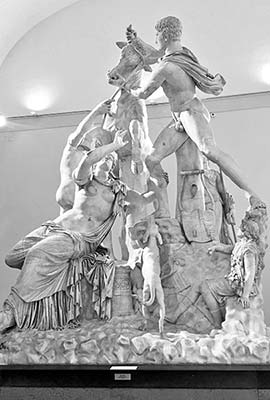
The tangled 3 Toro Farnese tells a thrilling Greek myth. At 13 feet, it’s the tallest ancient marble group ever found, and the largest intact statue from antiquity. A third-century AD copy of a lost bronze Hellenistic original, it was carved out of one piece of marble. Michelangelo and others “restored” it at the pope’s request—meaning that they integrated surviving bits into a new work. Some pieces were actually carved by Michelangelo: the head of the woman in back, the torso of the aunt under the bull, and the dog. (Imagine how the statue would stand out if it were thoughtfully lit and not surrounded by white walls.)
Here’s the tragic story behind the statue: Once upon an ancient Greek time, King Lycus was bewitched by Dirce. He abandoned his pregnant wife, Antiope (standing regally in the background). The single mom gave birth to twin boys. When they grew up, they killed their deadbeat dad and tied Dirce to the horns of a bull to be bashed against a mountain. Captured in marble, the action is thrilling: cape flailing, dog snarling, hooves in the air. You can almost hear the bull snorting. And in the back, Antiope oversees this harsh ancient justice with satisfaction.
At the opposite end of the hall stands the 4 Farnese Hercules. The great Greek hero is exhausted. He leans wearily on his club (draped with his lion skin) and bows his head. He’s just finished the daunting Eleventh Labor, having traveled the world, fought men and gods, freed Prometheus from his rock, and carried Atlas’ weight of the world on his shoulders. Now he’s returned with the prize: the golden apples of the gods, which he cups behind his back. But, after all that, he’s just been told he has to return the apples and do one final labor: descend into hell itself. Oh, man.
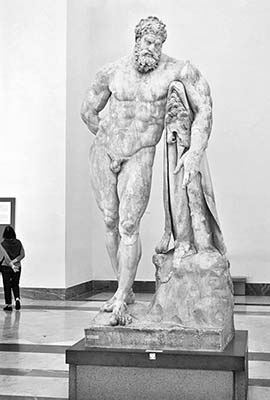
The 10-foot colossus is a third-century AD Roman marble copy (signed by “Glykon”) of a fourth-century BC Greek bronze original (probably by Lysippos). The statue was enormously famous in its day. Dozens of copies—some marble, some bronze—have been found in Roman villas and baths. This version was unearthed in Rome’s Baths of Caracalla in 1546, along with the Toro Farnese.
The Farnese Hercules was equally famous in the 16th-18th centuries. Tourists flocked to Rome to admire it, art students studied it from afar in prints, Louis XIV made a copy for Versailles, and petty nobles everywhere put small-scale knock-offs in their gardens. This curly-haired version of Hercules became the modern world’s image of the Greek hero.
• Behind Hercules is a doorway into the impressive Farnese gem collection (Gemme Farnese, Rooms 9 and 10). You’ll see cameos and the ancient cereal bowl-shaped 5 Farnese Cup, which features a portrait thought to be of Cleopatra. When you’re ready to move on, backtrack to the main entry hall with its grand staircase—perhaps stopping briefly to admire the magnificent sarcophagi in adjacent rooms—then head up to the mezzanine level (turn left at the lion and go under the Mosaici sign), and enter Room 57.
Mezzanine: Pompeiian Mosaics and the Secret Room
These 6 mosaics—mostly of animals, battle scenes, and geometric designs—were excavated from the walls and floors of Pompeii’s ritzy villas. The Chained Dog once graced a home’s entryway. The colorful mosaic columns (to your right in adjoining Room 58) shaded a courtyard, part of an ensemble of wall mosaics and bubbling fountains. In Room 59, admire the realism of the tambourine-playing musicians, the drinking doves, and the skull—a reminder of impending death.
Continue a few steps into Room 60, with objects taken from one of Pompeii’s greatest villas, the House of the Faun. The 20-inch-high statue was the house’s delightful centerpiece, the 7 Dancing Faun. This rare surviving Greek bronze statue (from the fourth century BC) is surrounded by some of the best mosaics of that age. (Find the wild-eyed little cat, who’s caught a bird.)
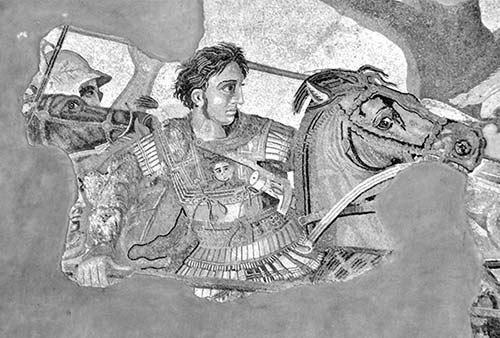
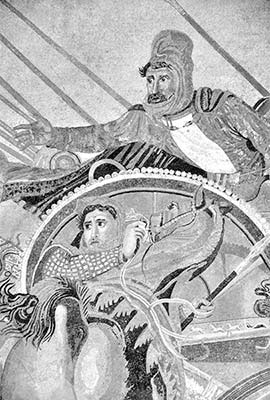
A museum highlight, just beyond the statue, is the grand Battle of Alexander, a second-century-BC copy of the now-lost original Greek fresco, done a century earlier. It decorated a floor in the House of the Faun and was found intact. (The damage you see occurred as this treasure was moved from Pompeii to the king’s collection here.) Alexander (left side of the scene, with curly hair and sideburns) is about to defeat the Persians under Darius (central figure, in chariot with turban and beard). This pivotal victory allowed Alexander to quickly overrun much of Asia (331 BC). Alexander is the only one without a helmet...a confident master of the battlefield while everyone else is fighting for their lives, eyes bulging with fear. Notice how the horses, already in retreat, add to the scene’s propaganda value. Notice also the shading and perspective, which Renaissance artists would later work so hard to accomplish. (A modern reproduction of the mosaic is now back in Pompeii, at the House of the Faun.)
Farther on, the 8 Secret Room (Gabinetto Segreto, Room 65) contains a sizable assortment of erotic frescoes, well-hung pottery, and perky statues that once decorated bedrooms, meeting rooms, brothels, and even shops at Pompeii and Herculaneum. These bawdy statues and frescoes—many of them once displayed in Pompeii’s grandest houses—were entertainment for guests. (By the time they made it to this museum, in 1819, the frescoes could be viewed only with permission from the king—see the letters in the glass case just outside the door.) The Roman nobles commissioned the wildest scenes imaginable. Think of them as ancient dirty jokes. If you’re easily offended, or find scatological humor juvenile, skip this room.
At the entrance, you’re enthusiastically greeted by big stone penises that once projected over Pompeii’s doorways. A massive phallus was not necessarily a sexual symbol, but a magical amulet used against the “evil eye.” It symbolized fertility, happiness, good luck, riches, straight A’s, and general wellbeing.
Circulating counterclockwise through this section, look for the following: the fresco—high up—of a faun playfully pulling the sheet off a woman (#12), only to be surprised to find both sets of genitalia. A few steps farther, see horny “pygmies” from Africa in action (#27). There’s a toga with an embarrassing bulge (#34). A particularly high-quality statue depicts a goat and a satyr engaging in a sex act (#36). And, watching over it all with remarkable aplomb, is Venus, the patron goddess of Pompeii (#39).
The back room is furnished and decorated the way an ancient brothel might have been. The 10 frescoes on the wall functioned as both a menu of services offered and as a kind of Kama Sutra of sex positions. The glass cases contain more phallic art, including dangling mobiles used as party favors at rowdy banquets.
• So, now that your travel buddy is finally showing a little interest in art...finish up your visit by climbing the stairs to the top floor.
At the top of the stairs, pause and get oriented to our final sights. Directly ahead is a doorway (marked Salone Meridiana) that leads into a big, empty hall. To the left of this grand hall is a series of rooms with more artifacts from Pompeii. To the right are rooms of statues from Herculaneum. Keep this general layout in mind, because occasionally doorways and routes are altered, and you may have to improvise a bit to find your way.
Top Floor: Frescoes, Statues, Artifacts, and a Model of Pompeii
First, step into the Salone Meridiana. This was the 9 great hall of the university (17th and 18th centuries) until the building became the royal museum in 1777. Walk to the center. The sundial in the floor (angling off to the right, from 1791) still works. Look up to the far-right corner of the hall and find the tiny pinhole. At noon (13:00 in summer), a ray of sun enters the hall and strikes the sundial, showing the time of the year...if you know your zodiac.
Now, back where you entered, go into the series of rooms to the left of the grand hall, with 10 Metal, Ivory, and Glass Objects found in Pompeii. You enter through a doorway marked Vetri e Avori, which leads into Room 89. Browse your way to the far end, with the stunning Blue Vase (Room 85), decorated with cameo Bacchuses harvesting grapes. Turn left, then right, to find the huge, room-filling 11 model of Pompeii, a 1:100 scale model of the ruins (Room 96). Face the model from the side labeled plastico di Pompei. This is how tourists enter today, up the street, and spilling into the large rectangular forum with the Temple of Jupiter at one end. Farther up in the model are the city’s two amphitheater-shaped theaters. This was all that had been excavated when the model was made in 1879. Another model (displayed on the wall) shows the site in 2004, after more excavations, when they’d dug up as far as the huge oval-shaped arena. Video screens capture images from the 1879 model and reconstruct buildings in 3-D as they would have appeared before the eruption.
Continue on (through Rooms 83-80—turn right, then left) and enter Room 75 (marked Affreschi) to see the museum’s impressive collection of (nonerotic) 12 frescoes taken from the walls of Pompeii villas. Pompeiians loved to decorate their homes with scenes from mythology (Hercules’ labors, Venus and Mars in love), landscapes, everyday market scenes, and faux architecture. To the left (in Room 78), find the famous dual portrait of baker Terentius Neo and his wife—possibly two of the 2,000 victims when Vesuvius erupted.
• Browse through more frescoes and objects from Pompeii in this labyrinth of rooms until, eventually, you end up back near the great hall. From here, facing the hall entrance, turn left and find the entrance to the wing labeled La Villa dei Papiri.
These artifacts came from the Herculaneum holiday home of Julius Caesar’s father-in-law. 13 In Room 114, find the glass cases holding two blackened examples of the 2,000 papyrus scrolls that gave the villa its name. The half-burned scrolls were unrolled and (with luck) read after excavation in the 1750s. Apparently Caesar’s father-in-law was an educated man who appreciated everything from Greek philosophy to Latin history.
Continuing into Room 116, enjoy some of the villa’s 14 bronze statues. Look into the lifelike blue eyes of the intense Corridore (runners), bent on doing their best. The Five Dancers, with their inlaid-ivory eyes and graceful poses, decorated a portico. The next room (117) has more fine works: Resting Hermes (with his tired little heel wings) is taking a break. Nearby, the Drunken Faun (singing and snapping his fingers to the beat, a wineskin at his side) is clearly living for today. This statue epitomizes the carpe diem lifestyle of the Epicurean philosophy followed by Caesar’s father-in-law and so many other Romans living in Herculaneum and Pompeii on that fateful morning of August 24, AD 79, when Vesuvius changed everything.
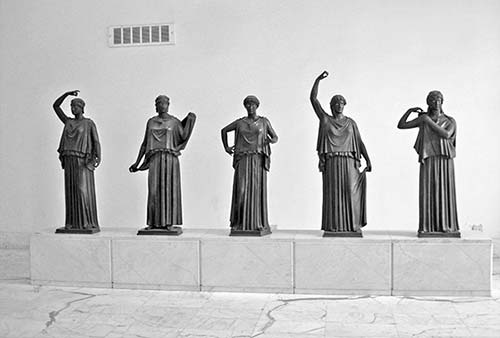
• Ka-pow. The artistic explosion you’ve just experienced in this mighty museum is now over. To exit, return to the ground floor. You may be able to leave the way you came in. Or you may be routed to another exit, past the café and around the museum courtyard to the gift shop. Either way, for extra credit, look for one more sight on your way out. (He tends to get moved around; if you can’t find him ask a guard, “Dov’è il Doriforo?”)
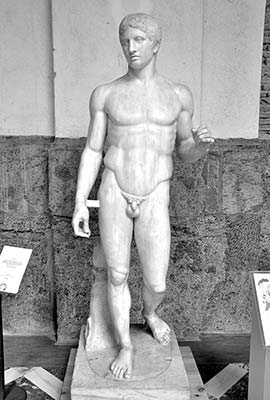
15 Doriforo
This seven-foot-tall “spear-carrier” (the literal translation of doriforo) just stands there, as if holding a spear. What’s the big deal about this statue, which looks like so many others? It’s a marble replica made by the Romans of one of the most-copied statues of antiquity, a fifth-century-BC bronze Greek original by Polyclitus. This copy once stood in a Pompeii gym, where it inspired ancient athletes by showing the ideal proportions of Greek beauty. So full of motion, and so realistic in its contrapposto pose (weight on one foot), the Doriforo would later inspire Donatello and Michelangelo, helping to trigger the Renaissance. And so the glories of ancient Pompeii, once buried and forgotten, live on today.
Naples Walk
Naples, a living medieval city, is its own best sight. Couples artfully make love on Vespas surrounded by more smiles per cobblestone than anywhere else in Italy. Sure, Naples has its important sights. But to capture its essence, take this walk through the core of the city.
A SLICE OF NEAPOLITAN LIFE
This self-guided walk, worth ▲▲▲, takes you from the Archaeological Museum through the heart of town. Allow at least two hours for the full two-part walk, plus time for pizza and sightseeing stops. If your time is short, from Piazza Carità—near the middle of the walk—you can head down Via Toledo to the Toledo Metro stop to zip back to the train station.
You can also download my free Naples City Walk audio tour.
Part 1: Archaeological Museum to Piazza Carità
Start at the Archaeological Museum, at the top of Piazza Cavour (Metro: Cavour or Museo; for directions on getting here, see here). From here, we’ll ramble down a fine boulevard before cutting into the medieval heart of the city.
1 Archaeological Museum: The palatial building, built in the mid-1700s, captures the glory of Naples at its peak, and is a great introduction to the Naples we’ll see. Back then, the city was rich from sea trade and home to erudite nobles from abroad. They built a magnificent capital of buildings like this one. On this walk we’ll see that grand city they built...and its remnants following centuries of decline.
• From the door of the Archaeological Museum, cross the street, veer right, and enter the arched doorway of the beige-colored Galleria Principe di Napoli mall. (If the entrance is blocked, simply loop around the block to another entrance or pick up our walk behind the Galleria.)
2 Galleria Principe di Napoli: There’s no better example of Naples’ grandeur—and decline—than this elegant 19th-century shopping mall. You’ll enjoy a soaring skylight, carved woodwork, ironwork lanterns, playful cupids, an elegant atmosphere...and empty shops. Built with great expectations, the galleria was named for the first male child of the royal Savoy family, the Prince of Naples. Malls like these were popular in Paris and London. In the US, we call this decorative style Art Nouveau; in Italy it’s “Liberty Style,” named for a British department store that was in vogue at a time when Naples was nicknamed the “Paris of the South.” (Parisian artist Edgar Degas even left Paris to adopt Naples—which he considered more cosmopolitan and sophisticated—as his hometown.) Despite its grandeur, the mall never took off. Ambitious renovations in recent years have failed to attract much business, leaving the mall in a state of disrepair. Falling debris occasionally closes the entire structure.
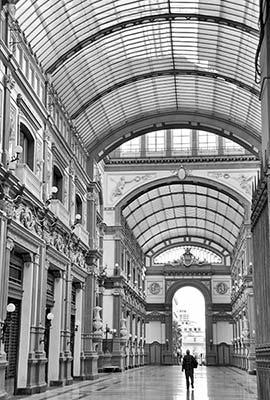
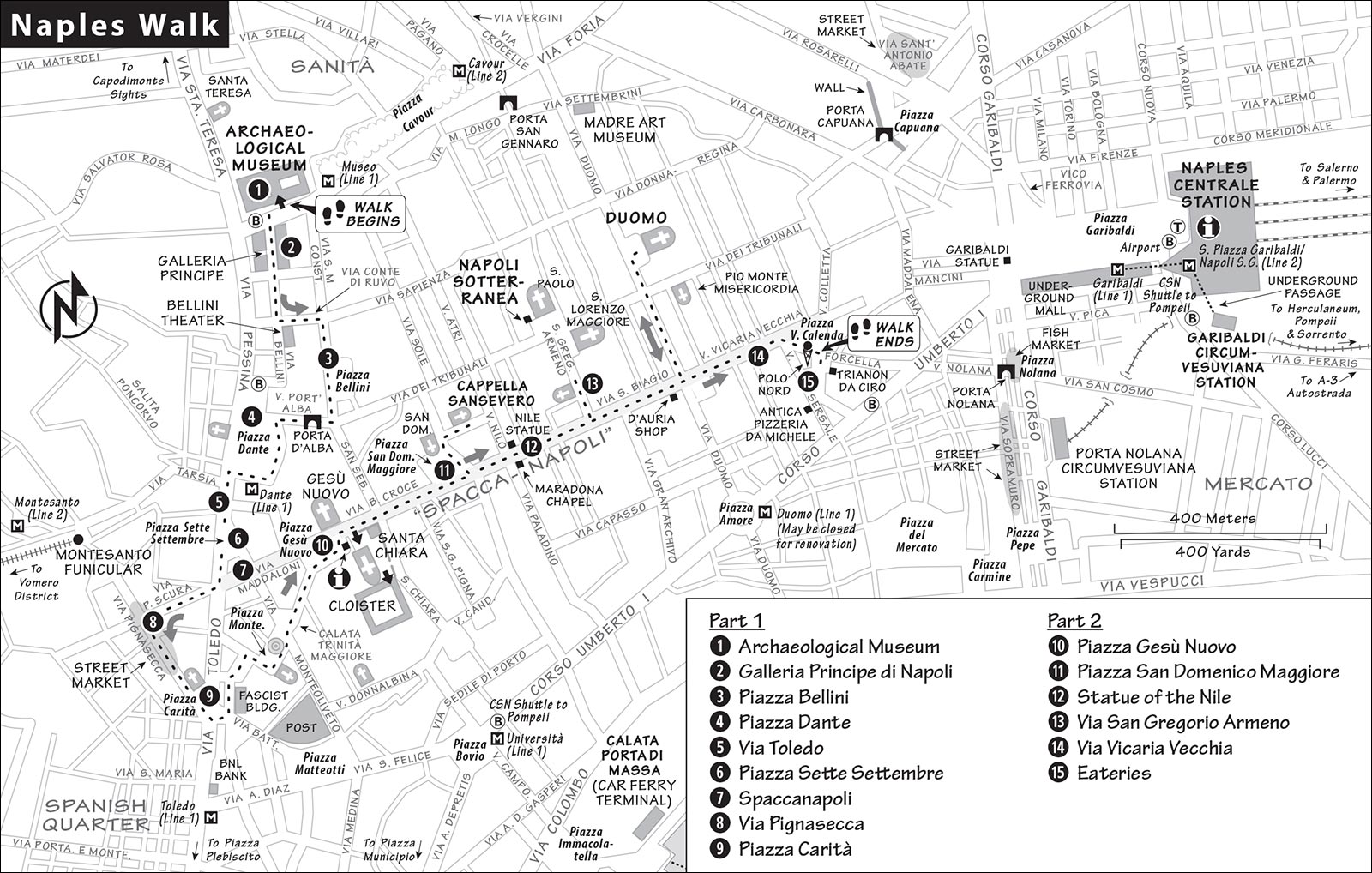
• Leaving the gallery through the opposite end, walk one block downhill on a pedestrian street. You’ll pass alongside the palatial golden facade of the Academy of Fine Arts, fronted by tropical plants and (usually) busy with students at its outdoor cafés. At Via Conte di Ruvo, turn left, passing the fine Bellini Theater (also in Liberty Style). All along our walk, be sure to enjoy the architecture of the late 19th century, when Naples was the last stop on Romantic Age travelers’ Grand Tour of Europe. After one block, turn right on Via Santa Maria di Costantinopoli. Walking between two grand churches, continue directly downhill to a small park with a statue in the center called...
3 Piazza Bellini: Suddenly you’re in neighborhood Napoli. The statue honors the opera composer Vincenzo Bellini, whose career was launched in Naples in the early 1800s, when opera itself was being born. Just past the statue, peer down into the sunken area to see Naples’ ancient origins as a fifth-century-BC Greek colony called Neapolis—literally, “the new city.” These tuff blocks without mortar were part of a tower in the city wall. (And you’re standing on land that, back then, was outside of the town.) You can see how the street level has risen from the rubble of centuries.
Now look around at the city of today. Survey the many balconies—and the people who use them as a “backyard” in this densely packed city. The apartment blocks were originally the palaces of noble families, as indicated by the stately family crests above grand doorways. For 2,500 years, laundry has blown in the breeze right here.
• Walk 30 yards downhill on the right side. Stop at the horseshoe-shaped Port’Alba gate (just beyond the bottom of the square, on the right). Spin slowly 360 degrees and take in the scene. The proud tile across the street (upstairs, between the two balconies) shows Piazza Bellini circa 1890. Don’t ignore the graffiti; try to figure out the issues that artists are calling attention to.
Pass through the gate, down Via Port’Alba, and stroll through this pleasant passage lined with book stalls. You emerge into a big square called...
4 Piazza Dante: This square is marked by a statue of Dante, the medieval poet. Fittingly, half the square is devoted to bookstores. Old Dante looks out over an urban area that was once grand, then chaotic, and is now slowly becoming grand again.
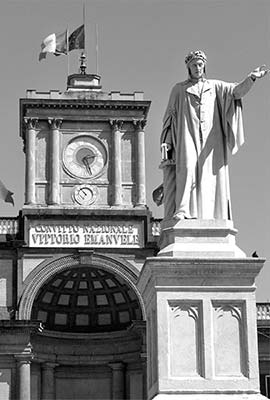
Along one side is a grandiose, orange-and-gray pseudo-facade of columns and statues designed by Luigi Vanvitelli, an architect who made his mark on the city in the late 1700s. Vanvitelli remade an existing Jesuit monastery into this new school, representing the power of the Bourbon monarchy when Naples was at its peak. Originally, a statue of the king stood in the square. But in 1799, the Bourbon monarchy was toppled when Napoleon invaded. The king’s statue was removed and replaced with the generic figure of Dante. And note the name that was later added to the big facade—Victor Emmanuel (Vittorio Emanuele). These suggest the next phase of Naples’ history—its decline—which we’ll see in just a bit.
The Neapolitan people are survivors. A long history of corrupt and greedy colonial overlords (German, Norman, French, Austrian, Spanish, Napoleon, etc.) has taught Neapolitans to deal creatively with authority. Many credit this aspect of Naples’ past for the strength of organized crime here.
• Before moving on, note the red “M” that Dante seems to be gesturing to. This marks the Dante Metro station, the best of Napoli’s art-splashed Metro stations. (To take a look, go down three flights of escalators and then back up; you’ll need a ticket, unless you can sweet-talk a guard.) Then, exit Piazza Dante at the far (bottom) end, walking downhill on...
5 Via Toledo: The long, straight street heading downhill from Piazza Dante is Naples’ principal shopping drag. It originated as a military road built by the Spanish viceroys (hence the name) who made Naples great in the 16th century. Back then, Via Toledo skirted the old town wall to connect the Spanish military headquarters (now the museum where you started this walk) with the Royal Palace (down by the bay). As you stroll, peek into the many lovely atriums, which provide a break from the big street.
After a couple hundred yards, you’ll reach the triangular 6 Piazza Sette Settembre. This public space recalls the event that precipitated Naples’ swift decline. On September 7, 1860, from the white marble balcony of the Neoclassical building overlooking the square, the famous revolutionary Giuseppe Garibaldi celebrated his conquest of Naples. He declared Italy united and Victor Emmanuel II its first king. And a decade later, that declaration became reality when Rome also fell to unification forces. It was the start of a glorious new era for Italy, Rome, and the Italian people. But not for Naples.
Naples’ treasury was confiscated to subsidize the industrial expansion of the north, and its bureaucrats were transferred to the new capital in Rome. Within a few decades, Naples went from being a thriving cultural and political capital to a provincial town, with its economy in shambles and its dialect considered backward.
• Continue straight on Via Toledo. A block past Piazza Sette Settembre you’ll come to Via Maddaloni, which marks the start of the long, straight, narrow street nicknamed...
7 Spaccanapoli: Via Maddaloni is the modern name for the beginning of this thin street that, since ancient times, has bisected the city. The name Spaccanapoli translates as “split Naples.” Look left down the street (toward the train station), and right (toward San Martino hill), and you get a sense of how Spaccanapoli divides this urban jungle of buildings.
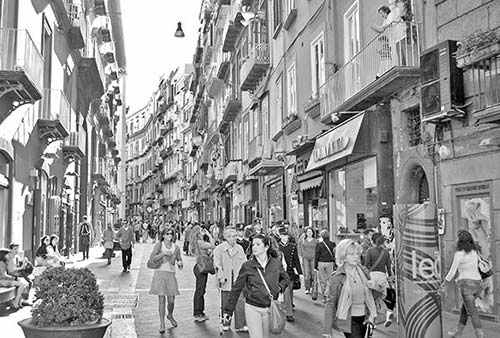
• At this point in our walk, take a moment to plan your next move. From here, our walk loops to the right, through the edge of the intense residential Spanish Quarter neighborhood to Piazza Carità before cutting over to the Spaccanapoli district. (If you were to side-trip to the Royal Palace and Piazza del Plebiscito-area sights—described later in “Sights in Naples”—you’d do that from here...but that makes this walk very long.)
At the Spaccanapoli intersection, go right (toward the church facade on the hill), heading up Via Pasquale Scura. After about 100 yards, you hit a busy intersection where the street begins to climb steeply uphill. Stop. You’re on one of Naples’ most colorful open-air market streets...
8 Via Pignasecca: Take in the colorful scene at the intersection. Then, turn left down Via Pignasecca and stroll this colorful market strip. You’ll pass fish stalls, tripe vendors, butchers, produce stands, cheap clothes stores, street-food vendors, and much more. There’s more activity during the morning, but afternoon offers better light for photography.
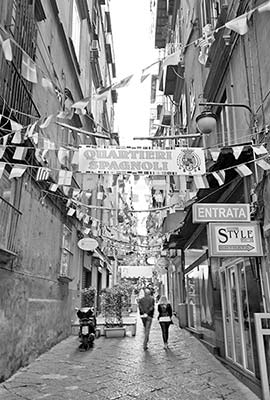
This is a taste of Naples’ famous Spanish Quarter (its center is farther down Via Toledo but this area provides a good sampling).
The Spanish Quarter is a classic world of basso (low) living. The streets—which were laid out in the 16th century for the Spanish military barracks outside the city walls—are unbelievably narrow (and cool in summer), and the buildings rise five stories high. In such tight quarters, life—flirting, fighting, playing, and loving—happens in the road. This is the cliché of life in Naples, as shown in so many movies. The Spanish Quarter is Naples at its most characteristic. The shopkeepers are friendly, and the mopeds are bold (watch out). Concerned locals will tug on their lower eyelids, warning you to be wary. Hungry? Pop into a grocery shop and ask the clerk to make you his best prosciutto-and-mozzarella sandwich (it should cost you about €4).
• Turn left and follow Via Pignasecca as it leads back to Via Toledo at the square called...
9 Piazza Carità: This square, built for an official visit by Hitler to Mussolini in 1938, is full of stern, straight, obedient lines. The big building belonged to an insurance company. (For the best example of fascist architecture in town, take a slight detour from here: With your back to Via Toledo, leave Piazza Carità downhill on the right-hand corner and walk a block to the Poste e Telegrafi building. There you’ll see several government buildings with stirring reliefs singing the praises of lobotomized workers and a totalitarian society.)
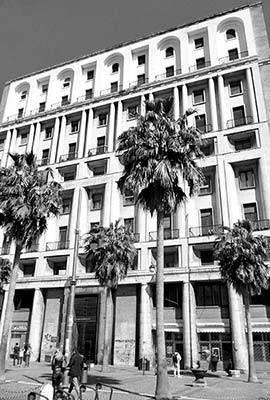
In Naples—long a poor and rough city—rather than being heroic, people learn from the cradle the art of survival. The modern memorial statue in the center of this square celebrates Salvo d’Acquisto, a rare hometown hero. In 1943, he was executed after falsely confessing to sabotage...saving 22 fellow Italian soldiers from a Nazi revenge massacre.
• We’re at the midpoint of this walk. Need a WC? Pop into the Burger King. Running out of time and energy? If you end the walk here, you’ll find many cafés and wine bars nearby, and it’s a short stroll down Via Toledo to the Toledo Metro station.
To continue, face the fascist-style building and take the street on its left side. You’ll angle through a downhill square called Piazza Monteoliveto. At the bottom of the square, cross the busy street, then angle up Calata Trinità Maggiore to the fancy column in the piazza at the top of the hill.
Part 2: Piazza Gesù Nuovo to Centrale Station
• You’re back on the straight-as-a-Greek-arrow Spaccanapoli, formerly the main thoroughfare of the Greek city of Neapolis. (Spaccanapoli changes names several times: Via Maddaloni, Via B. Croce, Via S. Biagio dei Librai, and Via Vicaria Vecchia.) Linger for a moment on...
10 Piazza Gesù Nuovo: This square is marked by a towering 18th-century Baroque monument to the Counter-Reformation. Although the Jesuit order was powerful in Naples because of its Spanish heritage, locals never attacked Protestants here with the full fury of the Spanish Inquisition.
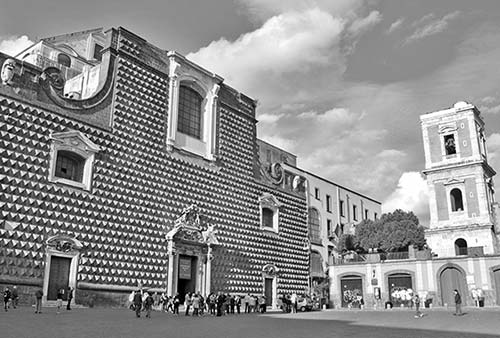
If you’d like, you can visit two bulky old churches, starting with the dark, fortress-like, 17th-century Church of Gesù Nuovo, followed by the simpler Church of Santa Chiara (in the courtyard across the street; both described under “Sights in Naples”). There’s also a TI on this square.
• Continue along the main drag for another 200 yards. Since this is a university district, you may see students and bookstores. As this neighborhood is also famously superstitious, look for incense-burning women with carts full of good-luck charms for sale.
Passing Palazzo Venezia—the embassy of Venice to Naples when both were independent powers—you’ll emerge into the next square...
11 Piazza San Domenico Maggiore: This square is marked by another ornate 17th-century monument built to thank God for ending the plague. From this square, you can detour left along the right side of the castle-like church, then follow yellow signs, taking the first right and walking one short block to the remarkable Baroque Cappella Sansevero (described under “Sights in Naples”).
• After touring the chapel, return to Via B. Croce (a.k.a. Spaccanapoli), turn left, and continue your cultural scavenger hunt. At the intersection of Via Nilo, find the...
12 Statue of the Nile (on the left): A reminder of the multiethnic makeup of Greek Neapolis, this statue is in what was the Egyptian quarter. Locals like to call this statue The Body of Naples, with the overflowing cornucopia symbolizing the abundance of their fine city. (I once asked a Neapolitan man to describe the local women, who are famous for their beauty, in one word. He replied, simply, “Abundant.”) This intersection is considered the center of old Naples.
• Directly opposite the statue, inside of Bar Nilo, is the...
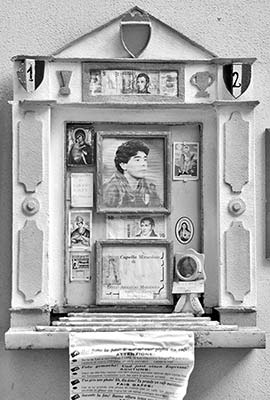
“Chapel of Maradona”: The small “chapel” on the right wall is dedicated to Diego Maradona, an Argentinian soccer star who played for Naples in the 1980s—pushing the team to its greatest success. Locals consider soccer almost a religion, and this guy was practically a deity. You can even see a “hair of Diego” and a teardrop from the city when he went to another team for more money. Unfortunately, his reputation was later sullied by problems he’d had with organized crime, drugs, and police. However, when he passed away in 2020 (at age 60), Naples was overwhelmed with grief. New street-art murals of Maradona popped up all over the city—in many cases, alongside a portrait of a bishop. This is San Gennaro, the city’s third-century patron saint—and his juxtaposition with Maradona indicates where the soccer star still ranks in the hearts of Neapolitans.
Meanwhile, the coffee bar has posted a quadrilingual sign (though, strangely, not in English) threatening that those who take a picture without buying a cup of coffee may find their camera damaged...Capisce?
• Continue another 100 yards. You may pass gold and silver shops. Some say stolen jewelry ends up here, is melted down immediately, and gets resold in some other form as soon as it cools. Look for compro oro (“I buy gold”) signs—a sign of Naples’ economic woes. (Locals used to blame the 2008 economic crisis; now they blame Covid.) Continue to a tiny square at the intersection with...
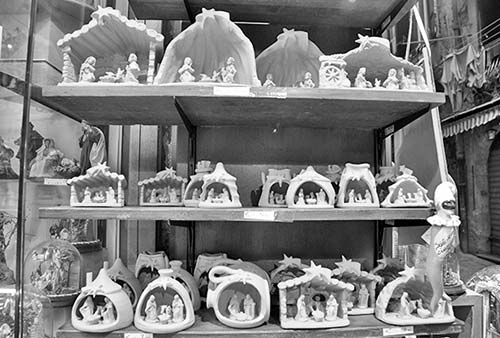
13 Via San Gregorio Armeno: Stroll up this tiny lane toward the fanciful tower that arches over the street. The street is lined with stalls selling lots of souvenir kitsch, as well as some of Naples’ most distinctive local crafts. Among the many figurines on sale, find items relating to presepi (Nativity scenes). Just as many Americans keep an eye out year-round for Christmas-tree ornaments, Italians regularly add pieces to the family presepe, the centerpiece of their holiday decorations. You’ll see elaborate manger scenes made of bark and moss, with niches to hold baby Jesus or mother Mary. You’ll also see lots of jokey figurines caricaturing local politicians, soccer stars, and other celebrities. (Some of the highest-quality presepi pieces are sold at the D’Auria shop, a little farther down Spaccanapoli, on the right at #87. Expressive figures are made from terra-cotta, wood, and cloth, often fetching over €250. They even sell the classy campane version, under a glass bell.)
Another popular Naples souvenir sold here—and all over—is the corno, a skinny, twisted, red horn that resembles a chili pepper. The corno comes with a double symbolism for fertility: It’s a horn of plenty, and it’s also a phallic symbol turned upside-down. Neapolitans explain that fertility isn’t sexual; it provides the greatest gift a person can give—life—and it ensures that one’s soul will live on through the next generation. In today’s Naples, just as in yesterday’s Pompeii (where bulging erections greeted visitors at the entrance to a home), fertility is equated with good luck.
(By the way, a bit farther up Via San Gregorio Armeno, you’ll find the underground Napoli Sotterranea archaeological site, along Via dei Tribunali, which also has some of the city’s best pizzerias—both are described later.)
• Continue down Spaccanapoli another 100 yards until you hit busy Via Duomo. Consider detouring five minutes north (left) up Via Duomo to visit Naples’ Duomo; just around the corner from that is the Pio Monte della Misericordia Church, with a fine Caravaggio painting (both described later). But for now, continue straight, crossing Via Duomo. Here, Spaccanapoli is named...
14 Via Vicaria Vecchia: Here along Via Vicaria Vecchia, the main “sight” is the vibrant street life. It’s grittier and less touristy, but just as atmospheric as what we’ve been seeing. The street and side-street scenes intensify. The area is said to be a center of the Camorra (the Naples-based version of the Sicilian Mafia), but as a tourist, you won’t notice. Paint a picture with these thoughts: Naples has the most intact street plan of any surviving ancient Greek or Roman city. Imagine this city during those times (and retain these images as you visit Pompeii), with streetside shop fronts that close up after dark, and private homes on upper floors. What you see today is just one more page in a 2,000-year-old story of a city: all kinds of meetings, beatings, and cheatings; kisses, near misses, and little-boy pisses.
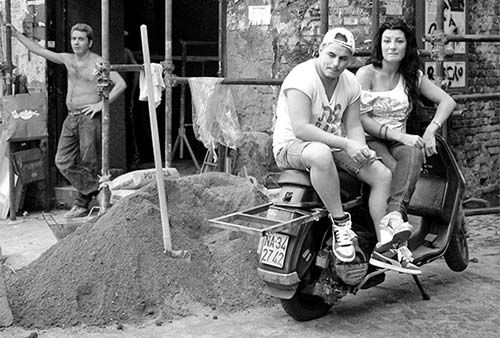
You name it, it occurs right on the streets today, as it has since ancient times. People ooze from crusty corners. Black-and-white death announcements add to the clutter on the walls. Widows sell cigarettes from buckets. For a peek behind the scenes in the shade of wet laundry, venture down a few side streets. Buy two carrots as a gift for the woman on the fifth floor, if she’ll lower her bucket to pick them up. The neighborhood action seems best at about 18:00.
At the tiny fenced-in triangle of greenery, hang out for a few minutes to just observe the crazy motorbike action and teen scene.
• From here, veer right onto Via Forcella. You emerge into Piazza Vincenzo Calenda, where there’s a round fence protecting another chunk of that ancient Greek wall of Neapolis. Hungry? Turn right here, on Via Pietro Colletta, and close out the walk with three typical Neapolitan...
15 Eateries: Step into the North Pole at the recommended Polo Nord Gelateria (on the right, at #41). The oldest gelateria in Naples has had four generations of family working here since 1931. Before you order, sample a few flavors, including their bacio, or “kiss,” flavor (named after the national chocolate-and-praline candy)—all are made fresh daily.
Two of Napoli’s most competitive pizzerias are nearby. Trianon da Ciro (across the street from Polo Nord) has been serving them up hot and fast for almost a century. A half-block farther, on the right, is the place where some say pizza was born—at Antica Pizzeria da Michele. (For more on both, see “Eating in Naples,” later.)
Return to Centrale Station: It’s easy to return to Centrale station. Continue downhill on Via Pietro Colletta until you hit the grand boulevard, Corso Umberto I. Turn left and walk 15 minutes to the train station. Or cross the street and hop on any bus; they all go to the station.
Sights in Naples
▲Napoli Sotterranea (“Underground Naples”)
▲Cemetery of the Fountains (Cimitero delle Fontanelle)
▲▲Capodimonte Museum (Museo di Capodimonte)
Porta Nolana Open-Air Fish Market
▲▲Harborside Promenade: The Lungomare Passeggiata
▲▲San Martino Carthusian Monastery and Museum (Certosa e Museo di San Martino)
Naples’ best sights are the Archaeological Museum and my self-guided Naples Walk, both covered earlier. For extra credit, consider these sights.
ON OR NEAR SPACCANAPOLI
These sights are linked—in this order—on the second half of my Naples Walk.
▲Church of Gesù Nuovo
This church’s unique pyramid-grill facade survives from a fortified 15th-century noble palace. Step inside for a brilliant Neapolitan Baroque interior. The second chapel on the right features a much-adored statue of St. Giuseppe Moscati (1880-1927), a Christian doctor famous for helping the poor. In 1987, Moscati became the first modern doctor to be canonized. Sit and watch a steady stream of Neapolitans taking turns to pay their respects.
Continue to the third chapel (past Moscati’s vertical tombstone) and enter the Sale Moscati. Look high on the walls of this long room to see hundreds of ex-votos—tiny red-and-silver plaques of thanksgiving for prayers answered with the help of St. Moscati (each has a symbol of the ailment cured). Naples’ practice of using ex-votos, while incorporated into its Catholic rituals, goes back to its pagan Greek roots. Rooms from Moscati’s nearby apartment are on display, and a glass case shows possessions and photos of the great doctor.
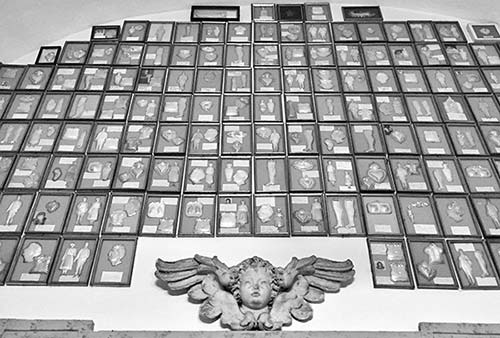
Just before leaving the Sale Moscati, notice the big bomb casing that hangs high in the left corner. It fell through the church’s dome in 1943, but caused almost no damage...yet another miracle.
Cost and Hours: Free, daily 6:45-13:00 & 16:00-19:30, Piazza del Gesù Nuovo, www.gesunuovo.it [URL inactive].
Church of Santa Chiara
Dating from the 14th century, this church is from a period of French royal rule under the Angevin dynasty. Consider the stark contrast between this church (Gothic) and the Gesù Nuovo (Baroque), across the street. Inside, look for the faded Trinity on the back wall (on the right as you face the door, under the stone canopy), which shows a dove representing the Holy Spirit between the heads of God the Father and Christ (c. 1414). This is an example of the fine frescoes that once covered the walls. Most were stuccoed over during Baroque times or destroyed in 1943 by Allied bombs. Continuing down the main aisle, you’ll step over a huge inlaid-marble Angevin coat of arms on the floor. The altar is adorned with four finely carved Gothic tombs of Angevin kings. A chapel stacked with Bourbon royalty is just to the right.
Cost and Hours: Free, daily 7:30-13:00 & 16:30-20:00, Piazza del Gesù Nuovo, www.monasterodisantachiara.it. Its tranquil cloistered courtyard, around back, is not worth its €6 entry fee.
▲▲Cappella Sansevero
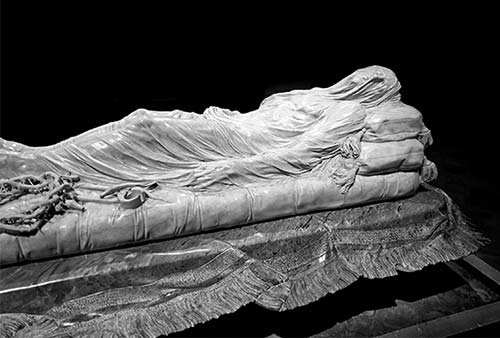
This small chapel is a Baroque explosion mourning the body of Christ, who lies on a soft pillow under an incredibly realistic veil. It’s also the personal chapel of Raimondo de Sangro, an eccentric Freemason, containing his tomb and the tombs of his family. Like other 18th-century Enlightenment figures, Raimondo was a wealthy man of letters, scientist and inventor, and patron of the arts—and he was also a grand master of the Freemasons of the Kingdom of Naples. His chapel—filled with Masonic symbolism—is a complex ensemble, with statues representing virtues such as self-control, religious zeal, and the Masonic philosophy of freedom through enlightenment.
Cost and Hours: €8, buy tickets at office at the corner—or reserve ahead online (€2 fee), open Wed-Mon 9:30-19:00, closed Tue, Via de Sanctis 19, +39 081 551 8470, www.museosansevero.it.
Crowd-Beating Tips: This popular sight often has a very long line and can sell out. To be on the safe side, it’s best (and worth the extra fee) to prebook a timed entry. If you’re just showing up, the least crowded time to visit is after 16:00—the later the better.
Visiting the Chapel: Pick up the free floor plan, which identifies each of the statues lining the nave. Once inside, study the incredible Veiled Christ in the center. Carved out of marble, it’s like no other statue I’ve seen (by Giuseppe “Howdeedoodat” Sammartino, 1753). The Christian message (Jesus died for our salvation) is accompanied by a Masonic message (the veil represents how the body and ego are obstacles to real spiritual freedom). As you walk from Christ’s feet to his head, notice how the expression on Jesus’ face goes from suffering to peace.
Raimondo’s mom and dad are buried on either side of the main altar. To the right of the altar, marking his father’s tomb, a statue representing Despair or Disillusion struggles with a marble rope net (carved out of a single piece of stone), symbolic of a troubled mind. The flames on the head of the winged boy represent human intellect—more Masonic symbolism, showing how knowledge frees the human mind. To the left of the main altar is a statue of Modesty, marking the tomb of Raimondo’s mother (who died after his birth, and was only 20). The veiled woman fingers a broken tablet, symbolizing an interrupted life.
Raimondo de Sangro himself lies buried in a side altar (on the right). Among his inventions was the deep-green pigment used on the ceiling fresco. The inlaid M. C. Escher-esque maze on the floor around de Sangro’s tomb is another Masonic reminder of how the quest for knowledge gets you out of the maze of life. This tilework once covered the floor of the entire chapel.
Your Sansevero finale is downstairs: two mysterious...skeletons. Perhaps another of the mad inventor’s fancies: Inject a corpse with a fluid to fossilize the veins so that they’ll survive the body’s decomposition. While that’s the legend, investigations have shown that the veins were artificial, and the models were created to illustrate how the circulatory system works.
▲Napoli Sotterranea (“Underground Naples”)
This archaeological site, a manmade underground maze of passageways and ruins from Greek and Roman times, can only be toured with a guide. You’ll descend 121 steps under the modern city to explore two underground areas. One is the old Greek tuff quarry used to build the city of Neapolis, which was later converted into an immense cistern by the Romans. The other is an excavated portion of the Greco-Roman theater that once seated 6,000 people. The space has been encroached upon by modern development—some current residents’ windows literally look down into the theater ruins. The tour involves a lot of stairs, as well as a long, narrow 20-inch-wide walkway—lit only by candlelight—that uses an ancient water channel (a heavyset person could not comfortably fit through this, and claustrophobes will be miserable). Although there’s not much to see, the experience is fascinating and includes a little history from World War II—when the quarry/cistern was turned into a shelter to protect locals from American bombs.
Cost and Hours: €10, includes 1.5-hour tour, tours in English offered daily every two hours from 10:00 to 18:00. If the ticket-buying line is long, talk to an attendant: They might be able to move you into the next English-language tour. Bring a light sweater. +39 081 296 944, www.napolisotterranea.org.
Getting There: The site is at Piazza San Gaetano 68, along the lively Via dei Tribunali pizza zone, and just a couple of blocks uphill from Spaccanapoli’s statue of the Nile. The entrance is immediately to the left of the Church of San Paolo Maggiore (look for the Sotterranea signs).
▲Duomo
Naples’ historic cathedral, built by imported French Anjou kings in the 14th century, boasts a breathtaking Neo-Gothic facade. Step into the vast interior to see the mix of styles along the side chapels—from pointy Gothic arches to rounded Renaissance ones to gilded Baroque decor.
Cost and Hours: Free, Mon-Sat 8:30-13:30 & 14:30-20:00, Sun 8:30-13:30 & 16:30-19:30, Via Duomo.
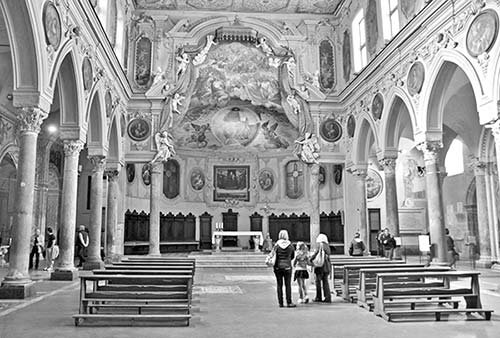
Visiting the Church: The cathedral honors St. Gennaro, Naples’ patron saint. The main altar at the front is ringed by carved wooden seats, filled three times a year by clergy to witness the Miracle of the Blood. Thousands of Neapolitans cram into this church for a peek at two tiny vials with the dried blood of St. Gennaro. As the clergy roots—or even jeers—for the miracle to occur, the blood temporarily liquefies. Neapolitans take this ritual with deadly seriousness, and believe that if the blood remains solid, it’s terrible luck for the city. Sure enough, on the rare occasion that the miracle fails, locals can point to a terrible event soon after—such as an earthquake, an eruption of Mount Vesuvius, or an especially disappointing soccer loss.
The stairs beneath the altar take you to a crypt with the relics of St. Gennaro and a statue of the bishop who rescued the relics from a rival town and returned them to Naples. These relics are said to have stopped the lava from a 1631 Vesuvius eruption from destroying the city.
The cathedral has two large side chapels (flanking the nave, about halfway to the transept)—each practically a church in its own right. While interesting, they charge separate admissions and have shorter hours than the larger cathedral, and are skippable for most visitors. You can see most of the one on the left—the Chapel of Santa Restituta—for free. It stands on the site of the original, early Christian church that predated the cathedral. You’ll find some 14th-century golden mosaics up at the front-left chapel-within-the-chapel. (I’d skip paying admission for the sixth-century baptismal font under mosaics.)
Pio Monte della Misericordia
This small church (near the Duomo, and run by a charitable foundation) displays one of the best works by Caravaggio, The Seven Works of Mercy. Upstairs is a ho-hum art gallery. The price is steep, but it may be worth it for Caravaggio fans.
Cost and Hours: €8 (ticket booth across the street), Mon-Sat 10:00-18:00, Sun 9:00-14:30, Via dei Tribunali 253, +39 081 446 944, www.piomontedellamisericordia.it.
Visiting the Church: Caravaggio’s The Seven Works of Mercy hangs over the main altar in a darkened gray chapel. The painting is well-lit, allowing Caravaggio’s characteristically dark canvas to really pop. In one crowded canvas, the great early-Baroque artist illustrates seven virtues: burying the dead (the man carrying a corpse by the ankles); visiting the imprisoned and feeding the hungry (Pero breastfeeding her starving father—a scene from a famous Roman story); sheltering the homeless (a pilgrim on the Camino de Santiago, with his floppy hat, negotiates with an innkeeper); caring for the sick and clothing the naked (St. Martin offers part of his cloak to the injured man in the foreground); and giving drink to the thirsty (Samson chugs from a jawbone in the background)—all of them set in a dark Neapolitan alley and watched over by Mary, Jesus, and a pair of angels.
Caravaggio painted this work in Naples in 1607 while in exile from Rome, where he had been sentenced to death for killing a man in a duel. Three years later Caravaggio died from an unknown illness on his way back to Rome to receive a pardon from the Pope.
MADRE
MADRE, a museum of contemporary art, displays works by Jeff Koons, Anish Kapoor, Francesco Clemente, and other big names in the art world. Aficionados of modern art consider it one of the better collections in the country. Some descriptions are in English—you’ll need them.
Cost and Hours: €8; Wed-Mon 10:00-19:30—Sun until 20:00, closed Tue, last entry one hour before closing; Via Settembrini 79, +39 081 1973 7254, www.madrenapoli.it.
NEAR THE PORT
This cluster of important sights can be found between the big ceremonial square, Piazza del Plebiscito, and the cruise ship terminal. If touring the entire neighborhood, I’d see it in the order described here. For locations, see the map on here.
Getting There from Spaccanapoli: Walking down toward this area on Via Toledo (from the midpoint of my self-guided walk), you’ll pass two more big, boxy, fascist-style banks: first, the chalky-white BNL bank, and then, past the Toledo Metro stop, the even more imposing Banco di Napoli at Via Toledo 178. A bit farther down is the Banca Intesa Sanpaolo (filling an older palace rather than a fascist-style building); it hosts Caravaggio’s blood-spurting The Martyrdom of Saint Ursula in a small art gallery (see signs for entry details). Also along here, on a parklike little piazza on your right, is the easy-to-miss Centrale funicular up to the San Martino mountaintop. As you near Piazza del Plebiscito, you’ll go through a congested area with popular bars and pizza windows. Push on until you reach the gigantic, semicircular square facing the orange-ish palace. To trace this route, see the map on here.
▲Piazza del Plebiscito
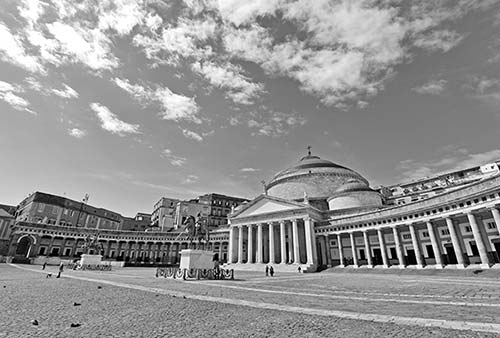
This square celebrates the 1860 vote (plebiscito, plebiscite) in which Naples became a part of a unified Italy. Dominating the top of the square is the Church of San Francesco di Paola, with its Pantheon-inspired dome and broad, arcing colonnades. If it’s open, step inside to ogle the vast interior—a Neoclassical re-creation of one of ancient Rome’s finest buildings.
• Opposite is the...
Royal Palace (Palazzo Reale)
Having housed Spanish, French, and even Italian royalty, this building displays statues of all those who stayed here. From the square in front of the palace, look for eight kings in the niches, each from a different dynasty (left to right): Norman, German, French, Spanish, Spanish, Spanish, French (Napoleon’s brother-in-law), and, finally, Italian—Victor Emmanuel II, King of Savoy. The statues were done at the request of V. E. II’s son, so his dad is the most dashing of the group. As far as palaces go, the interior is relatively unimpressive.
Cost and Hours: €10, skip the painfully dry €5 audioguide (each room has excellent panel descriptions in English; Thu-Tue 9:00-20:00, closed Wed, last entry one hour before closing; +39 848 082 408, www.coopculture.it).
Visiting the Palace: The palace’s grand Neoclassical staircase leads up to a floor with 30 plush rooms. You’ll follow a one-way route featuring the palace theater, paintings by “the Caravaggio Imitators,” Neapolitan tapestries, fine inlaid-stone tabletops, chandeliers, gilded woodwork, and more. The rooms do feel quite grand, even if they lack the personality and sense of importance of Europe’s better palaces. As a less-visited sight, wandering through the rooms at leisure makes you feel like royalty yourself. Don’t miss the huge, tapestry-laden Hercules Hall or the chance to dance on the wooden floor of the wide-open ballroom. Ask a guard (nicely) to open the terrace garden balcony door to enjoy sweeping views of the Bay of Naples. On the way out, step into the royal chapel, with an altar made entirely of precious stones and a fantastic Nativity scene—a commotion of 18th-century ceramic figurines.
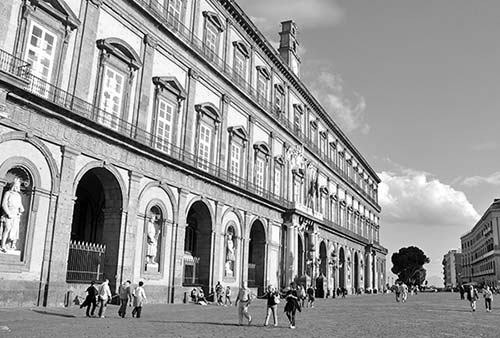
Hanging Gardens: This beautiful garden terrace, overlooking the Bay of Naples, costs extra and can be seen only a few times a day (with an attendant). If your visit happens to coincide with one of these times—and the weather’s fine—it’s worth adding on.
• Continue 50 yards past the Royal Palace (toward the trees) to enjoy a...
Fine Harbor View
While boats busily serve Capri and Sorrento, Mount Vesuvius smolders ominously in the distance. Look back to see the vast “Bourbon red” palace—its color inspired by Pompeii. The hilltop above Piazza del Plebiscito is San Martino, with its Carthusian monastery-turned-museum and the fortress called Castel Sant’Elmo (the Centrale funicular to the top is just across the square and up Via Toledo). The promenade you’re on continues to Naples’ romantic harborfront—the fishermen’s quarter (Borgo Marinaro)—a fortified island connected to the mainland by a stout causeway, with its fanciful, ancient Castel dell’Ovo (Egg Castle) and trendy harborside restaurants. From there, the Lungomare harborside promenade—described later—continues past the Santa Lucia district, stretching out along the Bay of Naples. This long promenade, running along Via Francesco Caracciolo to the Mergellina district and beyond, is a delightful people-watching scene on balmy nights.
• Head back through the piazza and pop into (on the left)...
Gran Caffè Gambrinus
This coffeehouse, facing the piazza, takes you back to the elegance of 1860. It’s a classic place to sample a crispy sfogliatella pastry, or perhaps the mushroom-shaped, rum-soaked bread-like cakes called babà, which come in a huge variety. Stand at the bar (banco), pay double to sit (tavola), or just wander around as you imagine the café buzzing with the ritzy intellectuals, journalists, and artsy bohemian types who munched on babà here during Naples’ 19th-century heyday (daily 7:00-24:00, Piazza del Plebiscito 1, +39 081 417 582).
• A block away, tucked behind the palace, you can peek inside the Neoclassical...
Teatro di San Carlo
Built in 1737, 41 years before Milan’s La Scala, this is Europe’s oldest opera house and Italy’s second-most-respected (after La Scala). The original theater burned down in 1816, and was rebuilt within the year. Guided 35-minute visits in English basically just show you the fine auditorium with its 184 boxes—each with a big mirror to reflect the candlelight (€9; tours in English usually run daily at 11:30 and 15:30, additional departures in Italian; schedule can change so check online or call to confirm; theater box office +39 081 797 2331, tour info +39 081 7972 412, www.teatrosancarlo.it).
• Beyond Teatro di San Carlo and the Royal Palace is the huge, harborfront...
Castel Nuovo
This imposing castle now houses government bureaucrats and the Civic Museum. It feels like a mostly empty shell, with a couple of dusty halls of Neapolitan art, but the views over the bay from the upper terraces are impressive (€6, Mon-Sat 9:00-18:00, closed Sun, last entry one hour before closing, +39 081 795 7722). The castle also hosts frequent special events and exhibits.
• Head back to Teatro di San Carlo, cross the street, and go through the tall yellow arch into...
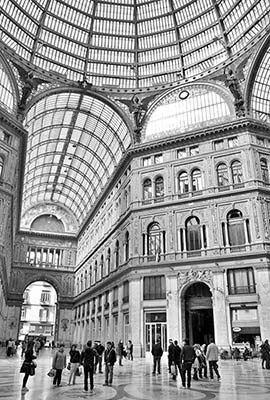
▲Galleria Umberto I
This Victorian iron-and-glass shopping mall opened in 1890 to reinvigorate the district after a devastating cholera epidemic occurred here. Gawk up, then walk left to bring you back out on Via Toledo.
• Just up the street and behind Piazza del Plebiscito is an interesting subterranean experience.
▲Galleria Borbonica
Beneath Naples’ Royal Palace was a vast underground network of caves, aqueducts, and cisterns that originated as a quarry in the 15th century. In the mid-1800s, when popular revolutions were threatening royalty across Europe, the understandably nervous king of Naples, Ferdinand II, had this underground world expanded to create an escape tunnel from the palace to his military barracks nearby. In World War II, it was used as an air-raid shelter; after the war, the police used it to store impounded cars and motorcycles. Today, enthusiastic guides take the curious on a fascinating 70-minute, 500-yard-long guided walk through this many-layered world littered with disintegrating 60-year-old vehicles upon which Naples sits.
Cost and Hours: €10 English-language tours leave Fri-Sun at 10:00, 12:00, 15:00, and 17:00; +39 081 764 5808, www.galleriaborbonica.com. The most convenient entry is just behind Piazza del Plebiscito—up Via Gennaro Serra and down Vico del Grottone to #4 (to avoid that entrance’s 90 steep steps, enter at Via Morelli 61).
NORTH OF SPACCANAPOLI
▲▲Sanità District
While the characteristic Spaccanapoli and Spanish Quarter are being tamed, today’s clear winner for wild-and-crazy Neapolitan life in the streets is the gritty Sanità District, north of the Archaeological Museum.
A big part of the attraction of Naples is its basso living (life in the streets). Many locals with enough money to move to the sanity of the suburbs choose instead to keep living where the action is—in a cauldron of flapping laundry, police sirens, broken cobblestone lanes, singing merchants, sidewalks clogged with makeshift markets, and walls crusted with ancient posters and graffiti.
One of Naples’ most historic and colorful zones, Sanità is sometimes called “the living presepe” for the way people live stacked on top of each other in rustic conditions, as if in an elaborate manger scene. (Because organized crime is still strong in this quarter, development is slow.) Literally “the healthy place” (named for the freshness of the air, originally so high above the dense city), this is the place for a photo safari.
While the reason to visit Sanità is simply to swim through its amazing river of life, there are two remarkable burial sites in the district: the Catacombs of San Gaudioso (at the Basilica Santa Maria della Sanità) and the Cemetery of the Fountains.
Visiting the Sanità District: Check to be sure your valuables are zipped or buttoned safely away. From near the Porta San Gennaro gate (just west of Via Duomo, two blocks east of Metro: Cavour, six blocks east of Archaeological Museum), leave Via Foria and head up Via Crocelle. Venture a block up Via Crocelle and then three blocks up Via dei Vergini through a thriving daily market scene. Pop into the courtyard of the Palazzo dello Spagnuolo (#19 on the left) to peek at an extravagant 18th-century staircase.
Then dog-leg left on Via Arena della Sanità and continue uphill (past another massive staircase in the courtyard at #6) to Piazza Sanità, at the base of Capodimonte, where you’ll stand before the Basilica Santa Maria della Sanità, which sits atop the Catacombs of San Gaudioso. Because this area was just outside the old city walls, the dead were buried here (entrance inside the church, €9 ticket also includes Catacombs of San Gennaro—described later, hourly English tours run daily 10:00-13:00, www.catacombedinapoli.it).
From here you have three options: Browse back down the way you just came; continue 10 minutes up Via Sanità and Via Fontanelle to the Cemetery of the Fountains (described next); or ride a free elevator (just past the church, under the high viaduct) up to the modern world and Capodimonte (described later).
▲Cemetery of the Fountains (Cimitero delle Fontanelle)
A thousand years ago, cut into the hills at the high end of Napoli was a quarry. Then, in the 16th century, churches with crowded cemeteries began moving the bones of their long dead here to make room for the newly dead. Later these caves housed the bones of plague victims and the city’s paupers. In the 19th century, many churches again emptied their cemeteries and added even more skulls to this vast ossuary. Then a cult of people appeared whose members adopted the skulls. They named the skulls, put them in little houses, brought them flowers, and asked them to intervene with God for favors from the next life. Today, the quirky caves—stacked with human bones and dotted with chapels—are open to the public.
Cost and Hours: Free to enter but tips accepted, daily 10:00-17:00, Via Fontanelle 77, +39 081 795 6160.
Getting There: It’s located in a sketchy-feeling neighborhood at the top end of Sanità. You can get here by hopping in a taxi; riding the Metro to the Materdei stop and following the brown signs for 10 minutes; or hiking 10 minutes from the Basilica Santa Maria della Sanità up Via Sanità and Via Fontanelle (described earlier).
ON CAPODIMONTE
Capodimonte, about a mile due north from the Archaeological Museum, is one of Naples’ three hills. It’s home to an excellent art museum (and its surrounding park) and, not far away, tourable catacombs.
Getting There: Reaching Capodimonte is easiest by taxi (figure €15 from the city center). Various public buses run from near Piazza Dante and the National Archaeological Museum up to Capodimonte, including #168, #178, and #C63—these stop near the catacombs (hop off when you get to the huge, domed church) before continuing up to the museum and park.
▲Capodimonte Museum (Museo di Capodimonte)
This hilltop is home to Naples’ top art museum. Its pleasant collection has lesser-known (but still masterful) works by Michelangelo, Raphael, Titian, Caravaggio, and other huge names. It fills the Bourbons’ cavernous summer palace, set in the midst of a sprawling hilltop park overlooking Naples, and part of the museum showcases the palace’s history and furnishings. Most visitors to Naples understandably prefer to focus on the city’s vibrant street life, characteristic churches, and ancient artifacts. But for art lovers and royalty buffs, Capodimonte rates ▲▲.
Cost and Hours: €12, Thu-Tue 8:30-19:30, closed Wed, last entry one hour before closing, avoid lines by purchasing your ticket online (additional fee possible), fine audioguide-€5, café, Via Miano 2, +39 081 749 9111, http://capodimonte.cultura.gov.it [URL inactive]. Some rooms may close earlier, items can be out on loan, and special exhibits are frequent; for the latest, check the website.
Nearby: While people visiting the Capodimonte Museum are understandably focused on its paintings, don’t overlook the expansive Capodimonte Park surrounding it. Once a hunting ground for royalty, the park is now a pleasure garden—beloved by Neapolitans—with elegant paths and lovely gardens sprouting trees and exotic plants from around the world. If you’ve planned ahead, this is a lovely spot for a picnic.
Visiting the Museum: The gigantic collection sprawls through the massive building, and the curator enjoys rearranging things, loaning and borrowing works, and so on—so it’s hard to get a handle on exactly what’s on view, and where. Room numbers—sometimes marked above doors—can be difficult to read and are often missing entirely, so they’re of limited usefulness for navigating the collection. Still, here’s an outline that should point you in the general direction of some interesting pieces.
• After buying your ticket, pick up the free map and head up several flights of stairs (or ride the elevator) to the “first” floor. You’ll step into a room marked...
Tiziano (Room 2): The museum has a fine selection of works by Titian (1488-1576). At the far end, look for Portrait of Pope Paul III. It depicts Alessandro Farnese, the local bigwig whose family married into Bourbon royalty; later, as Pope Paul III, he was responsible for bringing great art to Naples. (Nearby, you’ll see another—much younger—Titian portrait of Farnese, before he was pope.) Also in this room, look for one of many versions of Titian’s Danaë, where—as told in the Greek myth—the sensuous central character looks up at a cloud containing the essence of Zeus (a shower of coins), about to impregnate her. Enjoy the cupid’s surprised look at the action as the courtesan awaits her union. Finally, find Titian’s poignant portrait of a penitent Mary Magdalene, with finely detailed tears running down her cheeks (1565).
• Proceeding into the next room, turn left into the darkened...
Room 4: The lights pop on as you enter, so you can see large charcoal drawings by Raphael (Moses shields his eyes from the burning bush, 1514) and Michelangelo (a group of soldiers, 1546; and Venus and Love, 1534).
• Exiting this room back the way you came, look left down a very long hall of fancy weapons (marked Armeria Borbonica), but continue straight ahead, then turn left into a room labeled...
Masaccio: Here you’ll find works by this Renaissance pioneer. If it’s not out on loan, you should see a section of his altarpiece (1426) showing a primitive attempt at 3-D: Masaccio has left out Jesus’ neck to create the illusion that he’s looking down on us.
In the next few rooms, look for some more interesting pieces: Mantegna’s medallion-like Portrait of Ludovico Gonzaga, c. 1461, a very small but finely executed profile portrait; and Giovanni Bellini’s Circumcision of Christ. (Bellini was Titian’s master.)
• Next you’ll proceed into a section marked...
Collezione Farnese: The core of the museum’s collection sprawls through several rooms. As you explore this zone, keep an eye out for these highlights, which may appear in roughly this order:
You’ll spot several works by Raphael, including a portrait of the man who will become Pope Paul III, back when he was “just” Alessandro Farnese. You may spot some pieces by El Greco, too.
Parmigianino’s Antea (1531-1535)—one of the collection’s highlights—addresses us with an unblinking, dilated gaze. She wears a mink stole (astonishingly lifelike, with disgusting little teeth), gold chain, and hair brooch—items commonly presented by a lover. By wearing the gifts, Antea signals her acceptance of her suitor’s advances.
The Misanthrope (1568) is a remarkable work by Pieter Bruegel the Elder. The painting suggests the pointlessness of giving up on life and becoming a hermit; cut off from the world and lost in thought, the title figure doesn’t even notice that he’s about to step on a trail of thorns. Behind him, a wild-eyed young man is stealing the misanthrope’s money pouch (Hey! I saw that guy on the Circumvesuviana!).
Annibale Carracci’s Hercules at the Crossroads (1596) presents the hero with a choice: virtue (on the left, nature and letters, but a steep uphill climb) or vice (on the right, scantily clad women, music, theater masks, and an easy, flat path). While his foot points one way, he looks the other...his mind not yet made up.
• At the end of the Collezione Farnese, turn left to enter the...
Royal Apartments: It’s easy to forget that this museum is set in a royal palace. Originally a simple hunting lodge, in the 18th century the king decided it could be a grand palace. Several dynasties enjoyed its regal ballrooms and imposing reception rooms while amassing their impressive collections of art. From here on out, you’ll pass through some of the opulent apartments of this building, decorated with stunning period details and furniture.
The grand hall in the corner (Room 31) comes with a massive bronze chandelier hanging over an ancient Roman inlaid-marble floor, which originally decorated the palace of Roman Emperor Tiberius on Capri (installed here in 1877).
The following rooms tell stories of three Bourbon kings with portraits and objects from their reign. At the opposite corner of this wing, imagine attending a regal ball in the grand Salone delle Feste (Room 42).
Branching off from here (Rooms 38-40), look for the Collezione delle Ciccio, which is filled with royal porcelain—considered white gold—from all corners of Europe: Naples, Vienna, Paris (Sèvres), and Meissen (Germany).
From here, depending on which areas are open, you may circle through even more apartments (perhaps seeing several rooms decorated in the Napoleon-pleasing Neoclassical style—a reminder that Napoleon’s older brother once ruled the Kingdom of Napoli). Or you may be routed back to the Collezione Farnese.
• Either way, when done at this level, head back to where you entered and climb up four flights of stairs (or take the elevator) to the...
Second Floor: Here you’ll find art from private collections and paintings mostly from local churches. First you’ll see a cycle of Flemish tapestries (depicting the Battle of Pavia). Then, as you pass through a few halls of Gothic altarpieces, watch out for a few highlights:
Near the end of the altarpiece corridor, in Room 65, on the right is a fine altarpiece from Nottingham, England. Carved out of alabaster in the 15th century, it shows expressive scenes from the Passion of Christ.
At the far end of this corridor (just past Nottingham) is a darkened room (Room 66) with Simone Martini’s lavish and delicate portrait from 1317 of San Ludovico di Tolosa crowning Roberto king of Naples.
Now proceed down a long line of adjoining rooms. In Room 67, find Colantonio’s painting San Girolamo nello Studio (c. 1445), in which the astonishing level of detail—from the words on the page of the open book, to the balled-up pages tucked away at the bottom of the frame—drives home the message: Only through complete devotion and meticulous dedication can you hope to accomplish great things...like pulling a thorn out of a lion’s paw.
Finally, near the end of this wing, watch for another of the museum’s top pieces, Caravaggio’s The Flagellation. Typical of his chiaroscuro (light/dark) style, Caravaggio uses a ribbon of light to show us only what he wants us to see: a broken Christ about to be whipped, and the manic fury of the man (on his left) who will do the whipping. This scene could be set in a Naples alley. Compare this with most of the paintings we’ve seen so far—of popes, saints, and aristocrats. Caravaggio was given refuge in Naples while fleeing a murder trial in Rome. (They put him to work painting. Of the eight canvases he painted during this period, three remain in Naples.) Caravaggio was revolutionary in showing real life rather than idealized scenes—helping common people to better relate to these stories.
The Rest of the Museum: There’s so much more to see, including many temporary exhibits. Elsewhere on the second floor, you’ll find both Baroque and contemporary works. As in all great collections, more works of art are in storage than can be displayed at any given moment—and the curator enjoys surprising visitors by pulling items out from time to time, hoping to encourage dialogue about lesser-known artists, and get you thinking about what might be hiding in other museum storerooms.
▲▲Catacombs of San Gennaro
Behind the towering modern church of Madre del Buon Consiglio (Mother of Good Counsel) are tucked the most impressive ancient catacombs south of Rome. It started as a pagan tomb of little consequence, but then St. Agrippino, the local bishop, was buried here in the third century. Later, in the fifth century, the bones of St. Gennaro (patron of Naples) were moved here. Suddenly a site of special reverence—complete with miracles—it became a place where Neapolitans wanted to be buried as well. Today, the catacombs are run by a nonprofit organization of earnest young people who conduct walking tours. These half-mile walks survey more than a thousand burial niches on two levels that date from the second to sixth centuries (many with frescoes surviving...barely).
Cost and Hours: €9 ticket includes Catacombs of San Gaudioso—described earlier, at busy times it’s wise to prebook online, included English-language tours depart on the hour daily 10:00-17:00, Via di Capodimonte 13, +39 081 744 3714, www.catacombedinapoli.it.
SOUTH OF SPACCANAPOLI
Porta Nolana Open-Air Fish Market
Naples’ fish market squirts and stinks as it has for centuries under the darkened Porta Nolana (gate in the city wall), four long blocks down from Centrale station. Of the town’s many boisterous outdoor markets, this will net you the most photos and memories. From Piazza Nolana, wander under the medieval gate and take your first left down Via Sopramuro, enjoying this wild and entirely edible cultural scavenger hunt (Tue-Sun 8:00-14:00, closed Mon). Stalls display the best catch of the day as water jets caress mounds of mussels and clams.
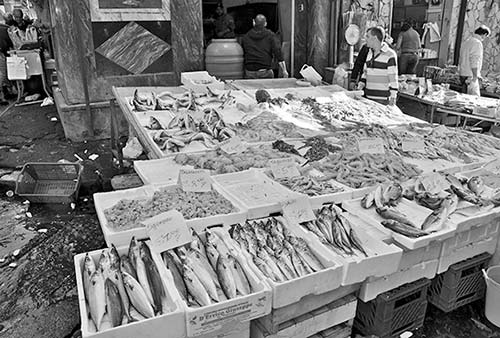
Two other markets with more clothing and fewer fish are at Piazza Capuana (several blocks northwest of Centrale station and tumbling down Via Sant’Antonio Abate, Mon-Sat 8:00-18:00, Sun 9:00-13:00) and a similar cobbled shopping zone along Via Pignasecca (just off Via Toledo, west of Piazza Carità, described on here).
▲▲Harborside Promenade: The Lungomare Passeggiata
Each evening, relaxed and romantic Neapolitans in the mood for a scenic harborside stroll do their vasche (laps) along the inviting Lungomare harborside promenade and beyond. To join in this elegant people-watching scene (best after 19:00), stroll down to the waterfront from Piazza del Plebiscito and then along Via Nazario Sauro to the beginning of a delightful series of harborside promenades that stretch romantically all the way out of the city. Along the way, you’ll enjoy views of Mount Vesuvius and the Bay of Naples. The entire route is crowded on weekends and lively any good-weather evening of the week with families, amorous couples, and friends hanging out. Here’s a brief rundown of its three sections:
Santa Lucia and Borgo Marinaro: Via Nazario Sauro passes the Santa Lucia district, so called because this is where the song “Santa Lucia” was first performed. (The song is probably so famous in America because immigrants from Naples sang it to remember the old country.) At the fortified causeway, make a short detour out to Borgo Marinaro (“Fisherman’s Quarter”), and poke around this fabled island neighborhood. With its striking Castel dell’Ovo and a trendy restaurant scene, you can dine here amid yachts with a view of Vesuvius. From here, follow Via Partenope to Piazza Vittoria.
Piazza Vittoria and Via Francesco Caracciolo: From Piazza Vittoria the strolling action stretches along the Lungomare on Via Francesco Caracciolo all the way to the Mergellina district. The convenient bus #140 starts at Piazza Vittoria, making stops all along the promenade to Posillipo (at the end of the nice strolling stretch). Walk as far as you like away from the city center and, when you’re ready to return, just hop on the bus or grab a cab. (From Piazza Vittoria you can shortcut scenically directly back to Piazza del Plebiscito by heading inland through Piazza dei Martiri and down Via Chiaia.)
Mergellina and Via Posillipo: The promenade continues past yacht harbors and rocks popular for swimming and sunbathing, under lavish Liberty Style villas, to tiny coves and inviting fish restaurants. Perched on the hillside at Posillipo (the end of the nice stretch) awaits the delightful $$$ Ristorante Reginella, with majestic views (closed Tue, Via Posillipo 45a, +39 081 240 3220)...and the bus #140 stop for your quick return.
Posillipo Hill
More a very long, tree-covered, villa-slathered peninsula than a “hill,” this promontory helps define the southern boundary of the Bay of Naples. Only conquered by road-building engineers in the early 19th century, Posillipo’s hallmark are its many waterfront villas. While these come in a dizzying array of architectural styles, most Posillipo villas have certain features in common: huge cellars (for protection against both sea storms and invaders); decorative fringes on top (often castle-like crenellations); and watchtowers. These are best seen from the water—giving a look at the spacious, green, and colorful Naples in contrast to the congested, tight lanes of the historical center. Italians, who romanticize Posillipo, recognize many of these villas from their favorite movies and TV shows. Out at the tip of Posillipo is a fine, sprawling park called Parco Virgiliano, which locals call “Lovers’ Park” for its restful trails and gorgeous views over the Bay of Naples, with Vesuvius looming on the horizon.
ON SAN MARTINO
The ultimate view overlooking Naples, its bay, and the volcano is from San Martino hill, just above (and west of) the city center. Up top you’ll find a mighty fortress, Castel Sant’Elmo (which charges for entry but offers the best views from its ramparts) and the adjacent Baroque San Martino monastery-turned-museum. The surrounding neighborhood (especially Piazza Fuga) has a classy “uptown” vibe compared to the gritty city-center streets below. Cheapskates can enjoy the views for free from the benches on the square in front of the monastery.
Getting There: From Via Toledo, the Spanish Quarter gradually climbs up San Martino’s lower slopes, before steep paths take you up the rest of the way. But the easiest way to ascend San Martino is by funicular. Three different funicular lines with departures every 10 minutes lead from lower Naples to the hilltop: the Centrale line from near the bottom of Via Toledo; the Montesanto line from the Metro stop of the same name (near the top end of Via Toledo); and the Chiaia line from farther out, near Piazza Amadeo. All three are covered by any regular local transit ticket. Ride any of these three up to the end of the line. All lines converge within a few blocks at the top of the hill—Centrale and Chiaia wind up at opposite ends of the charming Piazza Fuga, while Montesanto terminates a bit closer to the fortress and museum.
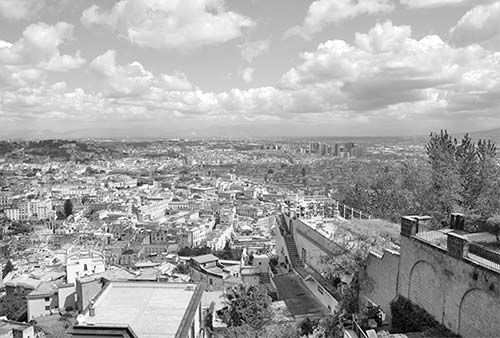
Leaving any of the funiculars, head uphill, carefully seeking out the brown signs for Castel S. Elmo and Museo di San Martino (a few strategically placed escalators make the climb easier). Regardless of where you come up, you’ll pass the Montesanto funicular station—angle left (as you face the station) past the municipal police station, and then continue following the signs. You’ll reach the castle with its bronze plaque first, and then the monastery/museum (both about a 10-minute walk from Piazza Fuga).
Another convenient—if less scenic—approach is via the Metro’s line 1 to the Vanvitelli stop, which is near the upper funicular terminals.
Castel Sant’Elmo
While little more than an empty husk with a decent modern art museum, this 16th-century, Spanish-built, star-shaped fortress boasts commanding views over the city and the entire Bay of Naples. Buy your ticket at the booth, then ride the elevator near the entrance to the upper courtyard and climb up to the ramparts for a slow circle to enjoy the 360-degree views. In the middle of the yard is the likeable little Museo del Novecento, a gallery of works by 20th-century Neapolitan artists (covered by same ticket); the castle also hosts temporary exhibits.
Cost and Hours: €5, half-price after 16:15; open daily 8:30-19:30, last entry one hour before closing; museum closes at 17:00 and is closed Tue; Via Tito Angelini 22, +39 081 229 4401, www.polomusealecampania.beniculturali.it [URL inactive].
▲▲San Martino Carthusian Monastery and Museum (Certosa e Museo di San Martino)
The monastery, founded in 1325 and dissolved in the early 1800s, is now a sprawling museum with several parts. The square out front has city views nearly as good as the ones you’ll pay to see from inside, and a few cafés angling for your business.
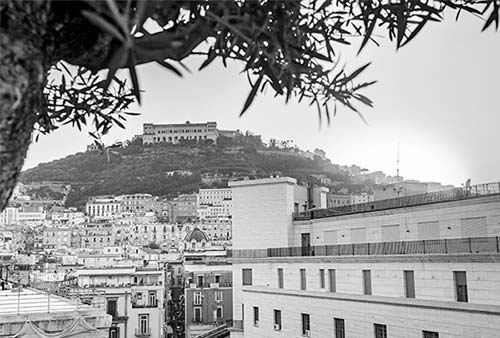
Cost and Hours: €6, Thu-Tue 8:30-17:00, may be open later in summer, closed Wed, last entry one hour before closing, some rooms (such as the Naval Museum) open at 9:30—don’t arrive too early, audioguide-€5, Largo San Martino 5, +39 081 229 4502.
Visiting the Monastery and Museum: After purchasing your ticket, step into the church across the courtyard. First built in the mid-1300s, this church (as well as the entire complex) received a makeover by master Baroque architect Cosimo Fanzago—responsible for most of the big Baroque you’ve already seen in the city center. To protect the inlaid marble floor, you’re not allowed into the nave; instead you can enjoy this Baroque explosion with beautifully decorated chapels from its main entryway. (The space behind the altar is accessible later in your visit.)
A variety of museum exhibits, art, and sculpture are housed in the rest of the complex. The Naval Museum has nautical paintings, model boats, and giant ceremonial gondolas that were used by various royalty. In a series of rooms opposite the Naval Museum is an excellent collection of presepi (Nativity scenes), both life-size and miniature, including a spectacular one by Michele Cucinello—the best I’ve seen in this presepi-crazy city. Beyond the presepi is the larger garden cloister, where monks would eventually rest in peace (look for the carved skulls).
Follow chiesa signs to access the back of the church and the the sacristy. Cherub-covered ceilings painted by Naples favorite Luca Giordano and intricate, inlaid wood cabinets compete for your attention. Return to the cloister and find the terra-cotta-tiled floor to enter a painting gallery (with lots of antique maps and artifacts of old Naples). Finally, step into the massive Prior’s Quarters with its private corner terrace and privileged views of the bay. Another view terrace is just outside, but the prior had the power view.
Sleeping in Naples
As an alternative to intense Naples, most travelers prefer to sleep in mellow Sorrento, just over an hour away (see the Sorrento chapter). But, if needed, here are a few good options. High season in Naples is spring and late fall. Prices are soft during the hot, slow summer months (July-Sept) and plunge during the pleasantly cool winters.
ON AND AROUND VIA TOLEDO
To see the city’s best face, stay in the area that stretches between the Archaeological Museum and the port.
$$$$ Decumani Hotel de Charme is a classy oasis tucked away on a residential lane in the very heart of the city, just off Spaccanapoli. While the street is Naples-dingy, the hotel is an inviting retreat, filling an elegant 17th-century palace with 39 rooms and a stunning breakfast room (air-con, elevator, Via San Giovanni Maggiore Pignatelli 15, Metro: Università; if coming from Spaccanapoli, this lane is one street toward the train station from Via Santa Chiara, +39 081 551 8188, www.decumani.com, info@decumani.com).
$$$ Hotel Piazza Bellini is an artistically decorated hotel with 48 minimalist but solid and comfortable rooms surrounding a peaceful, inviting courtyard. Two blocks below the Archaeological Museum, just off the lively Piazza Bellini, and close to the great pizzerias and restaurants on Via dei Tribunali, it offers modern sanity in a strategic city-center location (air-con, elevator, Via Santa Maria di Constantinopoli 101, Metro: Dante, +39 081 451 732, www.hotelpiazzabellini.com, info@hotelpiazzabellini.com).
$$$ Art Resort Galleria Umberto has 25 rooms in two buildings inside the Umberto I shopping gallery at the bottom of Via Toledo, just off Piazza del Plebiscito. This genteel-feeling place gilds the lily, with an aristocratic setting and decor but older bathrooms. Consider paying about €30 extra for a room overlooking the gallery (air-con, elevator, Galleria Umberto 83, fourth floor—ask at booth for coin to operate elevator if needed, Metro: Toledo, +39 081 497 6224, www.artresortgalleriaumberto.com, booking@hotelgalleriaumberto.com).
$$$ Hotel Il Convento is a good choice for those who want to sleep in the tight tangle of lanes called the Spanish Quarter—quintessential Naples. You’re only a couple of short blocks off the main Via Toledo drag, and heavy-duty windows help block out some (if not all) of the scooter noise and church bells. A rare haven of calm in this characteristic corner of town, it has 14 small but comfortable rooms—all with teensy balconies—as well as top-floor rooms with a private garden terrace (family rooms, air-con, elevator; Via Speranzella 137A, Metro: Toledo—from just below Banco di Napoli entrance, walk two blocks up Vico Tre Re a Toledo; +39 081 403 977, www.hotelilconvento.com, info@hotelilconvento.com).
$$ Chiaja Hotel de Charme, with the same owner as the Decumani (listed earlier), rents 33 rooms on the Via Chiaia pedestrian shopping drag near Piazza del Plebiscito. The building has a fascinating history: Part of it was the residence of a marquis, and the rest was one of Naples’ most famous brothels (some view rooms, air-con, elevator, Via Chiaia 216, first floor, Metro: Toledo, +39 081 415 555, www.hotelchiaia.it, info@hotelchiaia.it).
AT THE TRAIN STATION
These hotels are less convenient for sightseeing and dining, and the neighborhood gets dodgy as you move away from the station. But they’re handy for train travelers, practical for a quick stay, and less expensive.
$$ Hotel Stelle has 38 sterile, identical, newly remodeled rooms with modern furnishings. It feels sane compared to its hectic surroundings, and a back entrance leads directly into the train station (air-con, elevator, Corso Meridionale 60, exit station near track 5, +39 081 1889 3090, www.stellehotel.com, info@stellehotel.com).
$$ Ibis Styles Napoli Garibaldi, with 88 rooms, offers chain predictability and a bright, youthful color scheme a five-minute walk from the station (air-con, elevator, pay parking; Via Giuseppe Ricciardi 33, exit station onto Piazza Garibaldi, then take second left onto Via G. Ricciardi; +39 081 690 8111, www.ibis.com, h3243@accor.com).
$ Grand Hotel Europa, across the seedy street right next to the station, has 89 decent rooms and hallways whimsically decorated with not-quite-right reproductions of famous paintings. The hotel is a decent value, and its 1970s-era vibe (including the Kool-Aid and canned fruit at breakfast) makes for fun memories (RS%, family rooms, air-con, elevator, restaurant, Corso Meridionale 14, across street from station’s north exit near track 5, +39 081 267 511, www.grandhoteleuropa.com, info@grandhoteleuropa.com).
Eating in Naples
Yes, Naples is (justifiably) famous for pizza. But the Campania region has other delicious tastes, as well. The abundant sunshine and volcanic soil produce excellent fruits and vegetables; the famous San Marzano tomatoes come from just outside Naples; and Italy’s best mozzarella (di bufala, from water buffalo milk) also originates in Campania. Pastas with bright, flavorful tomato and other sauces are a highlight here. And don’t miss the classic dessert, the delicate, super-crunchy, ricotta-filled sfogliatella.
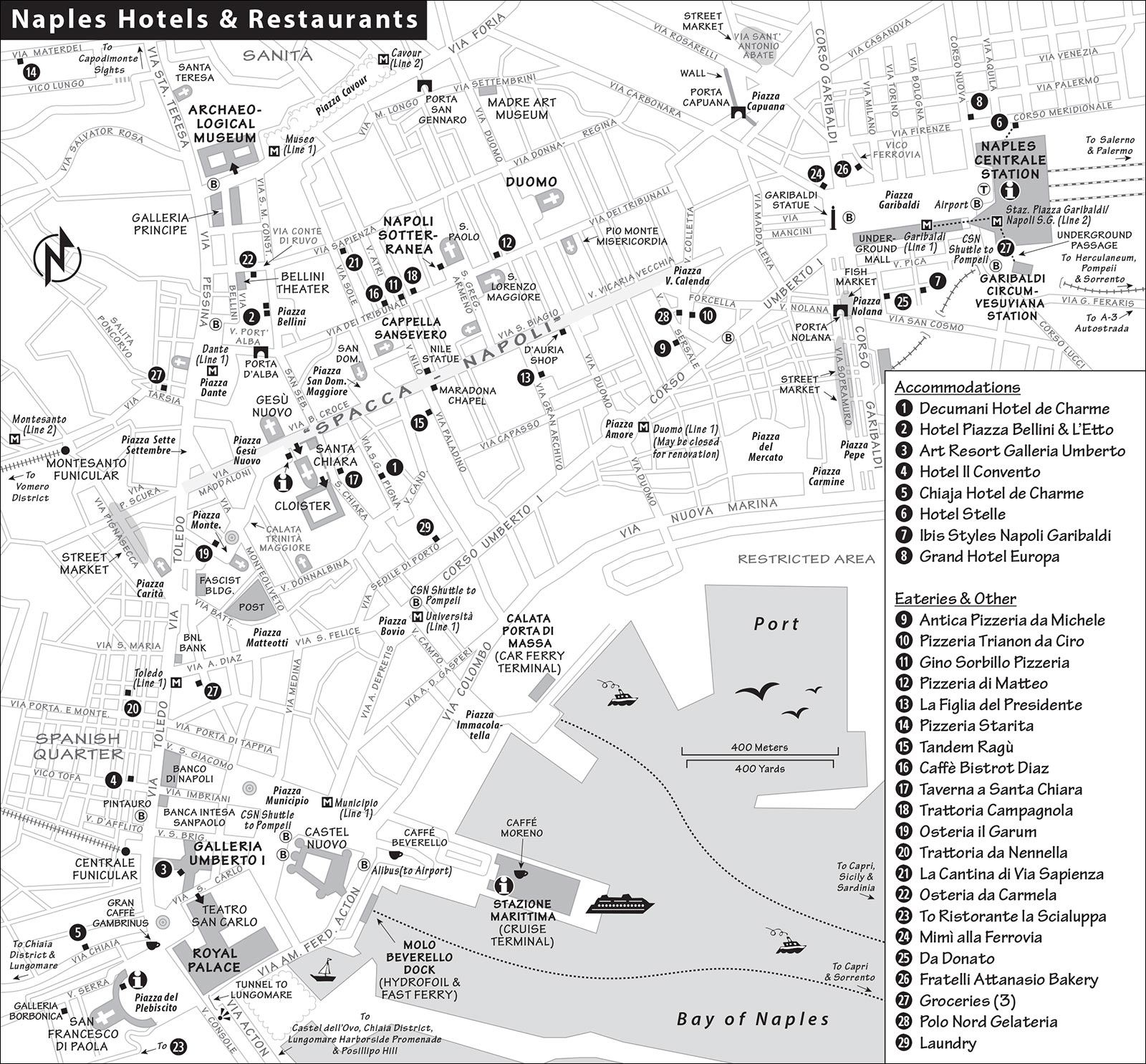
FANTASTIC, FAMOUS PIZZA
Naples is the birthplace of pizza. Its pizzerias bake just the right combination of fresh dough (soft and chewy, as opposed to Roman-style, which is thin and crispy), mozzarella, and tomatoes in traditional wood-burning ovens. You can head for the famous, venerable places, but these can have long lines stretching out the door, and half-hour waits for a table. If you want to skip the hassle, just ask your hotel for directions to the neighborhood pizzeria. An average one-person pie (usually the only size available) costs €6-9; most places offer both takeout and eat-in, and pizza is often the only thing on the menu.
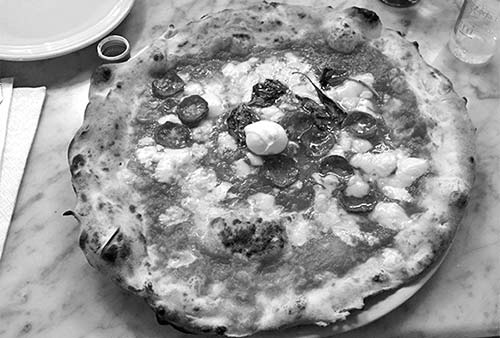
Near the Station
These two pizzerias—the most famous—are both a few long blocks from the train station, and near the end of my self-guided Naples Walk.
$ Antica Pizzeria da Michele is for pizza purists. Filled with locals (and tourists), it serves just two varieties: margherita (tomato sauce and mozzarella) and marinara (tomato sauce, oregano, and garlic, no cheese). Come early to sit and watch the pizza artists in action. A pizza with beer costs around €8. As this place is often jammed with a long line, arrive early or late to get a seat. If there’s a mob, head inside to get a number. If it’s just too crowded to wait, try the less-exceptional Pizzeria Trianon (described next), which often has room (Mon-Sat 10:30-24:00, closed Sun; look for the vertical red Antica Pizzeria sign at the intersection of Via Pietro Colletta and Via Cesare Sersale at #1; +39 081 553 9204).
$ Pizzeria Trianon da Ciro, across the street and left a few doors, has been da Michele’s archrival since 1923—and these days, it survives mainly on their overflow. It offers more choices, higher prices, air-conditioning, and a cozier atmosphere; for less chaos, head upstairs (daily 11:00-15:30 & 19:00-23:00, Via Pietro Colletta 42, +39 081 553 9426).
On and near Via dei Tribunali
This street, which runs a couple of blocks north of Spaccanapoli, is legendary for its pizzerias and fun eateries. It’s packed with hungry strollers and long lines marking the most popular places.
$ Gino Sorbillo is on all the “best pizza in Naples” lists...as you’ll learn the hard way if you show up at peak mealtimes, when huge mobs crowd outside the front door waiting for a table. While many locals believe it doesn’t warrant the hype, don’t tell the happy travelers eating here (Mon-Sat 12:00-15:30 & 19:00-24:00, closed Sun, Via dei Tribunali 32, +39 081 446 643). Relatives run similarly named places on the same street at #35 (a good option for its specialty: fried pizza) and #37.
$ Pizzeria di Matteo is popular for its fried takeout treats. People waiting out front line up at the little window to snack on deep-fried goodies—arancini (with rice, gooey cheese, peas, and sausage), melanzane (eggplant), frittatine (balls of mac and cheese plus sausage), and crocché (croquettes)—for €1-2 apiece (sometimes closed Sun, Via dei Tribunali 94, +39 081 455 262).
Nearby: $ La Figlia del Presidente is a short walk south from the two legendary joints listed above, and is quickly establishing its own loyal clientele. Push your way through the locals gathered around the door and get a number, then patiently wait for a slice of heaven. Or you can dine in the big, plain, high-ceilinged cellar (Tue-Sat 12:00-15:30 & 19:00-23:30, Mon 12:00-15:30, closed Sun, Via Grande Archivio 24, +39 081 286 738).
Near the Archaeological Museum
If you’ve had enough of crowds at the museum, head a few blocks north for world-class pizza without the throngs of people.
$ Pizzeria Starita has been in business for over 100 years, first as a cantina (featured in a Sophia Loren flick) then offering pizza since the 1950s. The fourth generation currently runs this bustling, friendly eatery just off the normal tourist circuit. Neapolitans think less is more with regard to pizza, but Starita offers both modern and traditional toppings (Tue-Sun 12:00-15:30 & 19:00 until late, closed Mon, no reservations—just show up and add your name to the wait list, from the museum walk 10 minutes up Via Santa Teresa degli Scalzi to the intersection with Via Materdei—the pizzeria is a few steps down on the left at #27, Metro: Museo, +39 081 557 3682).
OTHER RESTAURANTS
If you want a full meal rather than a pizza, consider these options.
Between Spaccanapoli and Via Toledo
$$ Tandem Ragù Restaurant, tiny with a few charming tables inside and out, features a fun menu specializing in Neapolitan ragù (beef, pork, or vegetarian options). The scarpetta (little shoe) dishes are simply various ragùs with baskets of bread for dunking (Tue-Sun 12:00-23:00, closed Mon, Via Giovanni Paladino 51, 50 yards off Spaccanapoli, below the statue of the Nile, +39 081 1900 2468).
$$ Caffè Bistrot Diaz, close to the famous pizzerias on atmospheric Via dei Tribunali, has a short menu of Neapolitan classics that are executed very well. Locals say it’s so tasty because mamma is cooking in the kitchen. The indoor seating is modern and nondescript; outdoor tables squeeze into a tight piazza in front of a church (Mon-Sat 7:00-22:00, closed Sun, Via dei Tribunali 25, +39 081 292 383).
$$ Taverna a Santa Chiara is your classic little eatery buried deep in the old center of Naples. It’s convivial, warmly run, and simple. Just 100 yards from the tourist commotion of Spaccanapoli, it provides a fun and easygoing break (daily 12:00-16:00 & 19:00-24:00, closed Sun at dinner, Via Santa Chiara 6, +39 081 048 4908).
$$ Trattoria Campagnola is a classic family place with a daily home cooking-style chalkboard menu on the back wall, mamma busy cooking in the back, and wine on tap. Here you can venture away from pastas, be experimental with a series of local dishes, and not go wrong (daily 12:30-16:00 & 19:30-23:00, opposite the famous pizzerias at Via Tribunali 47, +39 081 459 034 but no reservations).
$$ Osteria il Garum is great if you’d like to eat on a classic Neapolitan square. It’s named for the ancient fish sauce that was widely used in Roman cooking. These days, mild-mannered Luigi and his staff inject their pricey local cuisine with centuries of tradition, served in a cozy split-level cellar or outside on a covered terrace facing a neighborhood church. It’s just between Via Toledo and Spaccanapoli, a short walk from the Church of Gesù Nuovo (Wed-Mon 12:00-15:30 & 19:00-23:30, closed Tue, Piazza Monteoliveto 2A, +39 081 542 3228).
$$ Trattoria da Nennella is fun-loving chaos buried in the Spanish Quarter, with red-shirted waiters barking orders, a small festival anytime someone puts a tip in the bucket, and the fruit course served in plastic bidets. There’s one price—€15 per person—and you choose three courses plus a fruit. House wine and water is served in tiny plastic cups, the crowd is ready for fun, and the food’s good. You can sit indoors or on a cobbled terrace under a trellis. No reservations are taken, so put your name on the list when you arrive—the line moves pretty fast (Mon-Sat 12:00-15:00 & 19:00-23:00, closed Sun, leave Via Toledo a block down from the BNL bank and walk up Vico del Teatro Nuovo three short blocks to the corner, Vico Lungo del Teatro Nuovo 103, +39 081 414 338).
$ La Cantina di Via Sapienza is a lunch-only hole-in-the-wall, serving up traditional Neapolitan fare in an interior that feels like a neighborhood joint (but has also been discovered by tourists). It’s a block north of the congested, pizzeria-packed Via dei Tribunali, and a good alternative if those places are just too crowded and your heart isn’t set on pizza (Mon-Sat for lunch only, closed Sun, Via Sapienza 40, +39 081 459 078).
Near the Archaeological Museum
$$ Osteria da Carmela serves up traditional Neapolitan classics only mama could make—like ragù, polpetti, and tasty fried fish—with a dash of Old World charm, as well as a sprinkle of modern class. Affordable house wine and fine cheeses complete the meal. Tables are limited, so reservations are smart (Mon-Sat 12:00-15:30 & 19:00-24:00, closed Sun, Via Conte di Ruvo 11, +39 081 549 9738, www.osteriadacarmela.it).
$$ L’Etto is not the place to go for traditional Neapolitan cooking. This stylish restaurant, with a whisper of pretense in its white-minimalist interior and outside at its long row of sidewalk tables, focuses on a wide variety of creatively assembled, nutritious bowls, plus some trendy cocktails (daily 12:30-15:30 & 19:30-22:30, longer hours on weekends, facing Piazza Bellini at Via S. Maria di Costantinopoli 102, +39 081 1932 0967).
A Romantic Splurge on the Harbor
$$$$ Ristorante la Scialuppa (“The Rowboat”) is a great bet for a fine local meal on the harbor. Located in the romantic Santa Lucia district, you’ll walk across the causeway to the Castel dell‘Ovo in the fisherman’s quarter (the castle on the island) just off Via Partenope. They boast fine indoor and outdoor seating facing the marina, attentive waitstaff, a wonderful assortment of antipasti, great seafood, and predictably high prices. Reservations are smart (Tue-Sun 12:30-15:00 & 19:30-23:30, closed Mon, Piazzetta Marinari 5, +39 081 764 5333, www.ristorantelascialuppa.net [URL inactive]).
Near the Station
$$ Mimì alla Ferrovia is a classic neighborhood trattoria; stepping inside, surrounded by well-dressed, in-the-know-locals, you know you’re in for a good meal. The menu consists of well-executed Neapolitan classics. It’s run by a father-and-son team, who combine a passion for tradition with a willingness to innovate. Their ricotta is heavenly (Mon-Sat 12:00-15:30 & 19:00-23:00, closed Sun, Via Alfonso d’Aragona 19, +39 081 553 8525).
$$ Da Donato, a traditional, family-run trattoria on a glum street near the station, serves delicious food in an unpretentious atmosphere. The best approach is for two people to share the astonishing antipasti sampler—degustazione “fantasia” della Casa Terra e Mare. You’ll get more than a dozen small portions, each more delicious than the last. A version without seafood is cheaper (Tue-Sun 12:30-14:30 & 19:30-22:00, closed Mon, two blocks from Piazza Garibaldi—turn down Via Silvio Spaventa to #39, +39 081 287 828).
For specifics, check the “Connections” sections of each chapter. Confirm times and prices locally.
By Bus: CitySightseeing’s fleet of bright red buses with audio commentary offer easy trips from Naples to the ruins at Pompeii (see here), along the popular Amalfi Coast (see here), and even up to the town of Ravello (see here). Crowded SITA buses also traverse the Amalfi Coast; see here.
By Train: The dingy, crowded Circumvesuviana commuter train—popular with locals, tourists, and pickpockets—links Naples, Herculaneum, the Pompeii ruins, and Sorrento. The most important Circumvesuviana station in Naples (called “Garibaldi”) is underneath Naples’ Centrale station; follow the signs downstairs to Stazione Garibaldi and then Circumvesuviana and/or Linee Vesuviane signs to the Circumvesuviana ticket windows and turnstiles (stand in line or get your ticket at a newsstand). Buy your ticket, confirm the time and track, insert your ticket at the turnstiles, and head down another level to the platforms.
The Circumvesuviana is covered by the Campania ArteCard (see here), but not by rail passes. For Pompeii or Herculaneum, take any Circumvesuviana train marked Sorrento—they all stop at both (usually depart from platform 3). Sorrento-bound trains depart twice hourly and take about 15 minutes to reach Ercolano Scavi (for the Herculaneum ruins, €2.20 one-way), 35 minutes to reach Pompei Scavi-Villa dei Misteri (for the Pompeii ruins, €2.90 one-way), and 60 minutes to reach Sorrento, the end of the line (€3.90 one-way). Express trains to Sorrento marked DD (6/day) reach Sorrento 15 minutes sooner (and stop at Herculaneum and Pompeii). For schedules, see the Italian-only website www.eavsrl.it [URL inactive].
On the platform, double-check with a local that the train goes to Sorrento (avoid lines that branch out to other destinations). When returning to Naples on the Circumvesuviana, validate your ticket before boarding and get off at the next-to-the-last station, Garibaldi (Centrale station is just up the escalator).
Pricier Campania Express trains, operated by Circumvesuviana, use the same tracks and stops. They run only four times a day, but are less crowded and have air-conditioning (€15 one-way in high season to any destination: Herculaneum, 10 minutes; Pompeii, 30 minutes; Sorrento, 1 hour; mid-March-Oct only, not covered by Campania ArteCard, buy tickets at http://ots.eavsrl.it [URL inactive] or at the station).
Trenitalia (Italy’s national railway) runs Metropolitana trains—part of Naples’ Metro line 2—to Pompei town, from which it’s a short shuttle bus ride or long walk to the ruins (trains run 1-2/hour, 45 minutes, covered by Campania ArteCard; see details on here). Metropolitana trains stop downstairs in Naples’ Centrale station (near the center of the station—look for Metro linea 2) and conveniently also link to the Naples Archaeological Museum (Piazza Cavour stop). After Pompei town, these continue to Salerno (for boats and buses to Amalfi), though there are faster options. Note that the Metropolitana is not convenient for reaching Herculaneum or Sorrento.
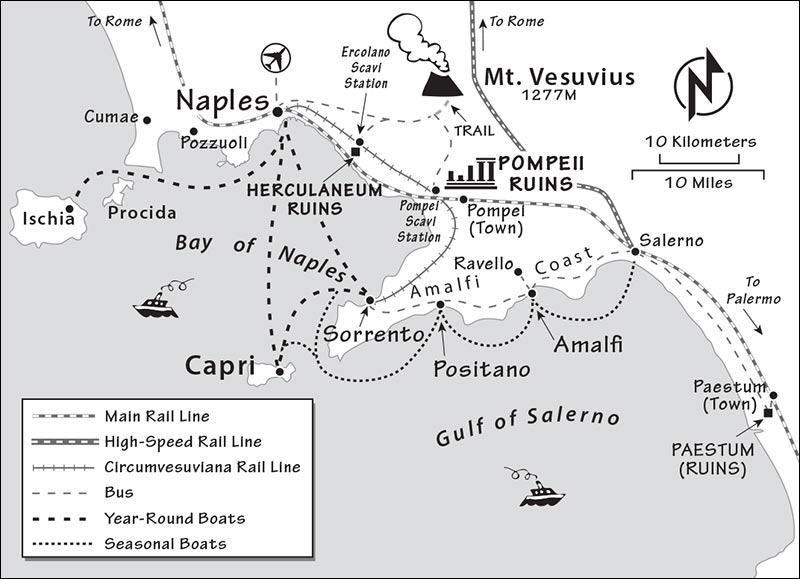
By Taxi: The 30-mile taxi ride from Naples directly to your Sorrento hotel costs about €110 (ask the driver for the nonmetered tariffa predeterminata). A cab on Capri runs about €70/hour. Taxis on the Amalfi Coast are generally expensive, and often overcharge, but can be convenient, especially with a larger group. See “Getting Around the Amalfi Coast—By Taxi” on here.
By Boat: Major companies include Caremar (www.caremar.it), SNAV (www.snav.it [URL inactive]), Gescab (a.k.a. NLG Jet, www.gescab.it), Navigazione Libera del Golfo (www.navlib.it), Alilauro (www.alilauro.it), Travelmar (www.travelmar.it), and Alicost (www.alicost.it). Each company has different destinations and prices; some compete for the same trips. Some lines (like Sorrento-Capri) run all year; others (on the Amalfi Coast, for example) only in summer. Trips can be cancelled in bad weather. Faster watercraft cost a little more than slow car ferries. A hydrofoil, sometimes called a “jet boat,” skims between Naples and Sorrento—it’s swifter, safer from pickpockets, more scenic, and more expensive than the Circumvesuviana train.
For schedules, check online (www.capritourism.com; click “Shipping Timetable”), or ask at any TI or at Naples’ Molo Beverello boat dock. (The handy departure board on the rooftop of the Molo Beverello terminal shows all the upcoming departures.) Most boats charge €2 or so for luggage. When you arrive, note the return times—the last boat usually leaves before 19:00. The preset price for a taxi between Naples’ Centrale train station and its port (Molo Beverello) is €11, or you can take Metro line 1 to the Municipio stop and walk to the port.
By Shared Trips: Mondo Guide is sometimes able to play “matchmaker” between travelers looking for an efficient, direct car connection instead of a complicated train or bus connection. By splitting the cost with others headed the same way, this can become reasonable. For details, see www.sharedtrips.com.
PASTRY
To get the full overview of Neapolitan pastries at good prices, visit the bakery outlet of Fratelli Attanasio on a small alley near the train station—with your back to the station building, it’s off the far-right corner of the big square. Come early for the best selection (Tue-Sun 6:30-19:30, closed Mon, Vico Ferrovia 1, +39 081 285 675).
PICNICS
A good supermarket for picnic supplies is Sapori & Dintorni, in the train-station complex (Mon-Sat 8:00-20:30, Sun 8:00-15:00, enter from outside, to the right of bookstore). By Piazza Dante is a small Superò that’s convenient to hotels near this stretch of Via Toledo (Mon-Sat 8:30-20:30, Sun 8:30-14:00, at corner of Via Tarsia and Vico San Domenico Soriano). By the Toledo Metro stop a small Conad is handy to hotels near Galleria Umberto I and the Spanish Quarter (daily 8:00-21:00, Via Roberto Bracco 4).
Naples Connections
BY TRAIN
See the “Getting Around the Region” sidebar for information on getting to Herculaneum, the ruins at Pompeii, Pompei Town, and Sorrento by train.
By Train to: Rome (Trenitalia: 1-5/hour, 70 minutes on Frecciarossa, 2 hours on Intercity, 2.5 hours and much cheaper on regional trains; Italo: hourly, 70 minutes), Civitavecchia (at least hourly, 3 hours, most change in Rome), Florence (Trenitalia: at least hourly, 3 hours, most change in Pisa or Rome; Italo: hourly, 3 hours), Salerno (Trenitalia: at least hourly, 35-45 minutes, change in Salerno for bus or boat to Amalfi; regionale trains are cheaper but Intercity and Freccia express trains have a first class section for a little extra; avoid slower Metropolitana trains that leave from the same platforms as Metro’s line 2; Italo: 4/day, 45 minutes), Paestum (12/day, 1.25 hours, direction: Sapri or Reggio), Brindisi (4/day, 5-6 hours, change in Caserta; from Brindisi, ferries sail to Greece), Milan (Trenitalia: 2/hour, 5 hours; Italo: 1-2/hour), Venice (Trenitalia: almost hourly, 5.5 hours, some change in Bologna or Rome; Italo: 3/day, 5.5 hours, reservations required), Palermo (2/day direct, 9.5 hours, also an overnight train). Any train listed on the schedule as leaving Napoli PG or Napoli-Garibaldi departs not from Napoli Centrale, but from the adjacent Garibaldi station.
BY BOAT
Ferries and cruise ships dock next to each other in the shadow of the old fortress (Castel Nuovo), a short walk from the old town sightseeing action. Naples has great ferry connections to Sorrento, Capri, and other nearby destinations. Cruise ships use the giant Stazione Marittima cruise terminal, hydrofoils and faster ferries use the Molo Beverello dock (to the west of the terminal), and slower car ferries leave from Calata Porta di Massa, east of the terminal. The entire port area is currently a big construction zone, and has been torn up for years; hopefully it will be tidied up in time for your visit.
Whether arriving by ferry or cruise ship, you can get to the city center by taxi, Metro, or on foot; the Alibus shuttle bus runs to the airport (see “By Plane,” next).
A taxi stand is in front of the port area. Expect to pay €12-15 to connect the port to the train station or the Archaeological Museum.
Straight ahead across the road from the cruise terminal (on the right side of the big fortress) is Piazza Municipio, with the handy Municipio Metro stop. From here, line 1 zips you right to the Archaeological Museum (Museo stop) or, in the opposite direction, to the train station (Garibaldi stop). A €1.10 single ticket (corsa singola) covers rides on line 1. You can buy tickets at any tobacco shop or some cafés: Caffè Moreno is between the two buildings of the cruise terminal, and Caffè Beverello is along the busy street on the waterfront. Remember to validate your ticket as you enter the Metro station.
On foot, it’s a seven-minute walk—past the gigantic Castel Nuovo, then to the left—to Piazza del Plebiscito and the old city center.
From Naples by Boat to: Sorrento (6/day, more in summer, departs roughly every 2 hours starting at 9:00, few or no boats on winter weekends, leaves from Molo Beverello, 40 minutes), Capri (roughly hourly, more in summer, hydrofoil: 45 minutes from Molo Beverello; ferries: 60-90 minutes from Calata Porta di Massa). Sometimes seasonal boats go to Positano and Amalfi, on the Amalfi Coast—ask. For a map showing boat connections, see here. For timetables, visit www.capritourism.com and click “Shipping Timetable.”
BY PLANE
Naples International Airport (Aeroporto Internazionale di Napoli, a.k.a. Capodichino, code: NAP) is close to town (+39 081 789 6767, www.aeroportodinapoli.it). In summer, you may find a TI here. Alibus shuttle buses zip you in 10 minutes from the airport to Naples’ Centrale train station, and then head to the port/Piazza Municipio for boats to Capri and Sorrento (buses run daily 6:00-23:00, 4/hour, 20-30 minutes to the port, €5 on board). The shuttle bus departs from a stop located straight out the airport exit, past the rental car lots. If you take a taxi to or from the airport, ask the driver for the fixed price (€18 to the train station, €21 to the port, €25 to the Chiaia district near the waterfront).
To reach Sorrento from Naples Airport, take the direct Curreri bus (see here). A taxi to Sorrento costs about €110.