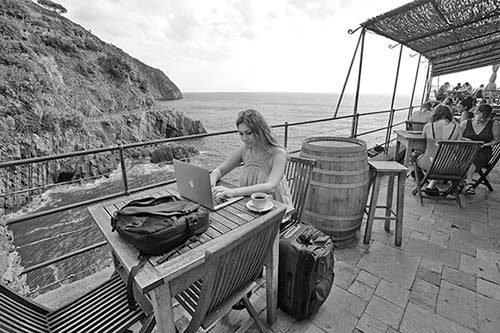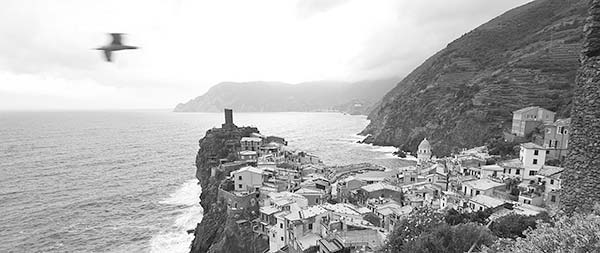
THE CINQUE TERRE
Monterosso al Mare • Vernazza • Corniglia • Manarola • Riomaggiore
Orientation to the Cinque Terre
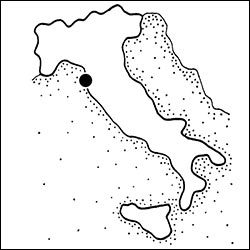
Tucked between Genoa and Pisa, in a mountainous and seductive corner of the Italian Riviera, lies the Cinque Terre (CHINK-weh TAY-reh)—five villages carving a good life out of difficult terrain. With a traffic-free charm—a happy result of natural isolation—the Cinque Terre offers a rugged alternative to the beachy Riviera resorts nearby.
Each village fills a ravine with a lazy hive of human activity. Calloused locals and sunburned travelers enjoy the area’s unique mix of Italian culture and nature. There isn’t a Fiat or museum in sight—just sun, sea, sand (well, pebbles), and wine. Choose a home base according to just how cut off you’d like to be from the outer world: resorty Monterosso, cover-girl Vernazza, hilltop Corniglia, photogenic Manarola, or amiable Riomaggiore.
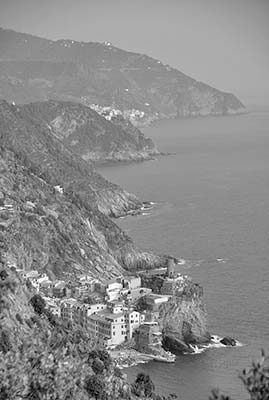
This breathtakingly scenic six-mile stretch of coast was first described in medieval times as the “five lands” (cinque terre). Tiny communities grew up in the shadows of castles, which doubled as lookouts for pirate raids. As the threat of pirates faded, the villages prospered, catching fish and cultivating grapes. Until the advent of tourism, the towns remained isolated. Even today, each village comes with its own traditions, a distinct dialect, and a proud heritage. Other Italians think of locals here as “mountain people by the sea.”
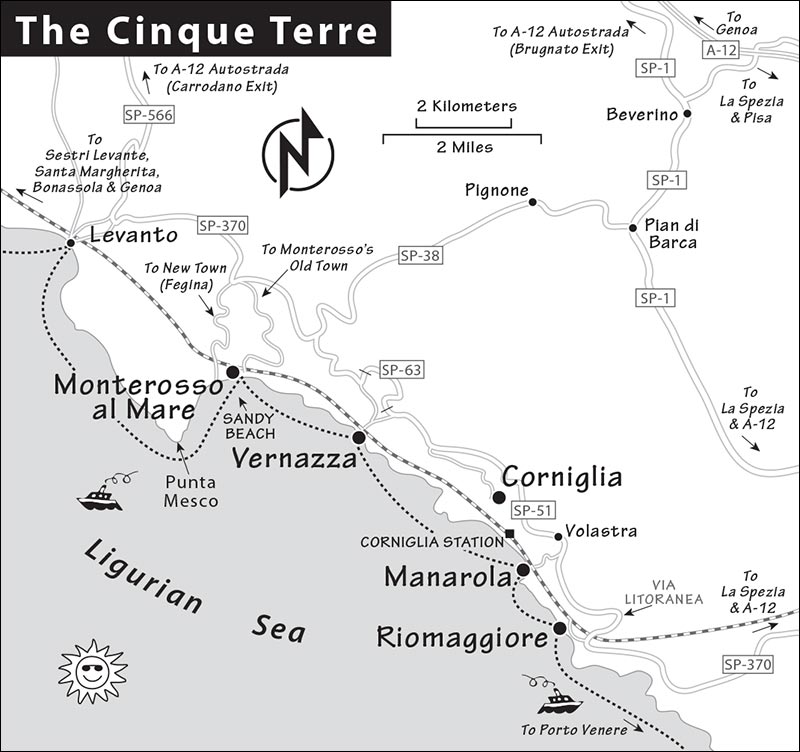
The Cinque Terre is now a national park (founded in 1999), where all can enjoy the villages, hiking, swimming, boat rides, and evening romance of one of God’s great gifts to tourism. While the region is well discovered and can get jam-packed, I’ve never seen happier, more relaxed tourists.
In this chapter, I cover general tips for your visit to the Cinque Terre, then describe the five towns in order from north to south—from Monterosso to Riomaggiore.
PLANNING YOUR TIME
The ideal stay in the Cinque Terre is two or three full days; at the least, give yourself two nights and an uninterrupted day.
The villages are connected by trains, boats, and trails. There’s no checklist of sights or experiences—just a hike, the towns themselves, and your fondest vacation desires. Read this chapter in advance to piece together your best visit, mixing hiking, swimming, trains, and boat rides.
Cinque Terre in Two Days: You could spend one day hiking between towns (taking a boat or train part of the way, or as the return trip). Spend a second day visiting any towns you’ve yet to see, comparing main streets, beaches, and focaccia.
Here’s a sample day: If you’re based in Monterosso, take a morning train to Corniglia, hike to Vernazza for lunch (where you could explore the town, hike to the grand view cemetery, or cool off at the beach), then catch the boat back to Monterosso to stroll the beach promenade. And that’s only one day out of dozens of memorable Cinque Terre combinations you can dream up.
On any evening, linger over dinner, enjoy live music at a low-key club (or opera singers in Vernazza), try a wine tasting, or follow one of my self-guided town walks. At sunset, take a glass of your favorite beverage out to the breakwater to watch the sun slip into the Mediterranean.
With More Time: Frequent trains make day trips along the coast easy (though seeing Portofino is more relaxed if you overnight in Santa Margherita Ligure). A day trip to Levanto is a snap (by train, boat, or a hike from Monterosso) and a side excursion from Levanto to Bonassola and Framura is fun. For double the beaches, visit Sestri Levante. South of the Cinque Terre, reach lovely Porto Venere by boat, or by train and bus via La Spezia.
Day-Tripping to the Cinque Terre: Speed demons could store their baggage, take a hike in the morning, have a waterfront lunch, laze on a beach in the afternoon, and leave by evening to somewhere back in the real world. But be warned: The Cinque Terre is inundated with cruise-ship groups doing the same thing. The best way to enjoy the Cinque Terre is to be here before and after the daily day-trip deluge. (Ironically, some travelers decide against an overnight because they’ve heard the Cinque Terre is crowded—then day-trip in, only experiencing it with those terrible crowds.) The charm of the region survives—early and late.
When to Go: May, June, September, and early October are ideal times (though May is a popular time for tour groups), with more pleasant hiking weather and lower prices than the local vacation months of July and August. If you do come in July or August, book further ahead, and get up early to enjoy the trails before the heat of the day—perhaps even before breakfast. April weekends can be very busy: Easter and the public holidays of Liberation Day (April 25) and Labor Day (May 1) bring crowds of Italians, prices shoot up, and restaurants fill. Weekdays are quieter at any time of year.
Flexible and open-minded travelers can enjoy a trip in March or late October, perhaps even late February or early November, but should plan for chilly weather, fewer or no boats, and shuttered shops, restaurants, and hotels (many close from November to mid-March). The midwinter months are really dead.
Orientation to the Cinque Terre
TOURIST AND PARK INFORMATION
Each town’s train station has a Cinque Terre national park information office, which doubles as an all-purpose town TI and gift shop. They can answer questions about trails (including conditions and closures), shuttle bus schedules, and so on. You can also call the park’s main phone number (+39 0187 762 600) or visit their useful website, ParcoNazionale5terre.it.
A blog worth a look is CinqueTerreInsider.com, written by resident American expat Amy Inman; it’s filled with practicalities for visitors to this always-in-flux region.
ARRIVAL IN THE CINQUE TERRE
By Train: The five towns of the Cinque Terre are on a milk-run line, with trains coming through about twice an hour on their way between La Spezia and points north. Fast long-distance trains usually speed right through the Cinque Terre without stopping, although a few serve Monterosso and let you get there directly from Milan or Pisa. Otherwise, expect to connect to a local train at La Spezia’s Centrale station (if coming from the south) or at Genoa, Sestri Levante, or Levanto (from the north).
For details on riding the train between Cinque Terre towns, see “Getting Around the Cinque Terre,” later; for information on arrival in each town, see each “Arrival” section. For outbound trains, see “Monterosso Connections” on here and “La Spezia Connections” on here.
By Car (Not Recommended): Don’t bring a car to the Cinque Terre; you won’t need it. Given the narrow roads and parking headaches, the only Cinque Terre town I’d drive to is Monterosso (and then only if my hotel had parking). Each town has a remote and often congested little parking lot (a shuttle-bus ride up the hill), but for your own good, park your car in a larger town nearby and take the train in: It’s safer, cheaper, faster, and smarter. Parking is easy in Levanto or La Spezia (La Spezia has a fine modern underground garage at the station; see the next chapter). A rare exception is if you’re lodging in the hills above one of the Cinque Terre towns, in which case driving might be less hassle than lugging bags up from a train station (ask your hotelier for advice).
HELPFUL HINTS
Pickpocket Alert: At peak times, the Cinque Terre can be notoriously crowded, and pickpockets (often teens in groups of three or four, frequently dressed as tourists), aggressively and expertly work the most congested areas. Be on guard, especially in train stations, on platforms, and while you’re on trains, particularly when getting on or off with a crush of people. Wear a money belt, and keep your things zipped up and buttoned down.
Money: You’ll find ATMs and banks throughout the region. Use ATMs attached to actual banks. Shops earn a commission by hosting rip-off ATMs on their premises.
Markets: Market days perk up the Cinque Terre and nearby towns from around 8:00 to 13:00 on Tuesday in Vernazza, Wednesday in Levanto, Thursday in Monterosso, Friday in Santa Margherita Ligure, and Saturday in Sestri Levante.
Booking Services: Arbaspàa, based in Manarola, sets up wine tastings, cooking classes, fishing trips, and more (www.arbaspaa.com; see here). Cinque Terre Riviera, based in Vernazza, books rooms and apartments throughout the region, Vernazza opera tickets, cooking classes, and more (www.cinqueterreriviera.com; see here). BeautifuLiguria, run by Anna Merulla, offers various excursions (www.beautifuliguria.com).
Local Guides: Two knowledgeable guides, both a delight to be with, are Andrea Bordigoni (€130/half-day, €230/day, +39 393 133 9409, bordigo@inwind.it) and Marco Brizzi (€125/half-day, €210/day, +39 328 694 2847, marco_brizzi@yahoo.it).
Nightlife: There’s not much in this sleepy region, though Monterosso and Riomaggiore have lively late-night bars. For a little high culture, consider Wednesday or Friday evening opera music in Vernazza (see the Vernazza section).
Rainy Day Activities: Explore the towns, taking trains to connect them; splurge for a tasty meal; or nurse a coffee or drink at a harborfront café while watching the roiling waves.
Baggage Storage and Delivery: You can pay to store bags at or near the train stations in Monterosso and Riomaggiore. Near the Cinque Terre, you can store bags in Santa Margherita Ligure and in La Spezia. See specifics per destination.
To transfer luggage from the station to your accommodations, call ahead and arrange with Roberto Pecunia; he’s based in Riomaggiore but works in any of the towns (+39 370 375 7972, www.robytransport5terre.com).
Taxi: These traffic-free towns are set up for train access, but there are a few cases, like group airport transfers, where a taxi makes sense. Cinqueterre Taxi, based in Levanto, covers all five towns (Matteo +39 334 776 1946, Christian +39 347 652 0837, www.cinqueterretaxi.com). The pricey 5 Terre Transfer is in Riomaggiore (Luciana +39 339 130 1183, Marzio +39 340 356 5268, www.5terretransfer.com [URL inactive]).
GETTING AROUND THE CINQUE TERRE
Trains are the cheapest, fastest, and most frequent way to connect towns within the Cinque Terre. But don’t get stuck in a train rut: In calm weather, boats connect the towns nearly as frequently—and more scenically.
By Train
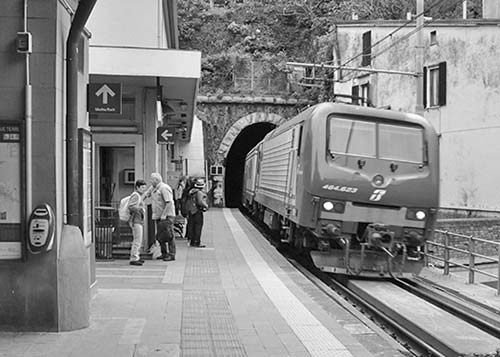
By train, the five towns are just a few minutes apart.
Tickets: A train ride between any two Cinque Terre towns costs €5—steep for such a short trip, as the price includes a park fee (from November to March there’s no fee and tickets cost €2.10.) You must buy a new individual ticket for every train ride. You can buy tickets online or with the Trenitalia app (www.trenitalia.com), at ticket machines (at each station), at Cinque Terre park desks, or at staffed ticket windows in Monterosso, Levanto, and La Spezia. Don’t wait to buy a ticket at the last minute: Ticket machines can be broken, and there can be very long lines at the window.
The Cinque Terre Treno Card (€18.20/day, described later, under “Hiking the Cinque Terre”) can be worthwhile even if you don’t hike, as it allows you to catch trains at the last minute without ticket concerns. It pays for itself if you take four rides in one day, but its value comes more from convenience than economy (https://card.parconazionale5terre.it).
Trains are covered by the Eurail Pass, but unless you have days to waste, it doesn’t make sense to use up a valuable travel day here.
Using Tickets and Cards: Your ticket (or park card) must be validated before you board. These days, many train tickets are prevalidated and you don’t need to do anything. This includes tickets bought online or with the Trenitalia app, and tickets that list a specific train time. Other tickets and passes are “open,” and you must validate them by stamping them in one of the green-and-white machines located on train platforms and in station passages. If you’re not sure what to do, ask when you buy your ticket or card. Conductors here are notorious for levying stiff fines on tourists riding with an unstamped ticket.
Every coastal town has a beach—or, at least, a rocky place to swim. Monterosso has the Cinque Terre’s biggest and sandiest beach, with umbrellas and beach-use fees (but any stretch of beach without umbrellas is free). Vernazza’s main beach and new beach are tiny—better for sunning than swimming (some people swim in the deep water off the breakwater). Manarola and Riomaggiore have the worst beaches (no sand), but Manarola offers the best deep-water swimming. Levanto, just a few minutes’ train ride past Monterosso, has big and broad beaches, with even better ones an easy bike ride away, in Bonassola and Framura. And Sestri Levante, farther north, has two beautiful beaches.
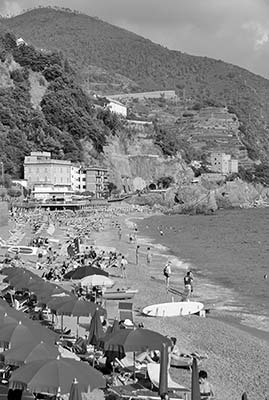
Pack your swim gear. Several beaches have showers. Don’t tote your white hotel towels; most hotels will provide beach towels (sometimes for a fee). Underwater sightseeing is full of fish. Sea urchins line the rocks, and sometimes jellyfish wash up on the pebbles (water shoes and goggles sold in local shops). If no one is swimming, it’s likely because of stinging jellyfish. Ask, “Medusa?”
You can rent kayaks or boats in Monterosso and Riomaggiore. While experienced boaters have a blast here, if you’re not comfortable navigating a tippy kayak, this is not a good place to learn.
Station Helpers: Red-vested track-side staff can answer your train-related questions. But be aware they are also there to keep crowds at bay as trains approach...and to nail travelers without tickets (they get a cut of the fines they levy).
Schedules: In peak season, trains connecting the five towns generally run two to three times hourly in each direction, but the frequency declines after about 20:00.
Since the train is the Cinque Terre’s lifeline, shops, hotels, and restaurants often post the current schedule, and many hand out paper copies. Study the key to know which departures are only for weekdays, Sundays, and so on. Make a note of the departure time of the train you want to take and ideally its train number and final destination, as that’s how the station monitors identify departing trains.
Printed schedules also tell you which towns any given train will stop in. Some trains skip lesser stations (particularly Vernazza, Corniglia, and Manarola).
At the Station: As you enter, look for monitors that display a list of upcoming departures, listed by time, train number, and final destination (they do not show intermediate stops). They also show if a train is late—in ritardo—and by how many minutes; SOPP means “cancelled.” Note your platform number (binario). On the platform, digital displays reconfirm the train’s final destination and usually show a list of intermediate stops. Confirm that the train will stop where you want on this display, or check the yellow “Partenze” posters.
Northbound trains (using the tracks closest to the water) are going to Levanto, Sestri Levante, or Genova; southbound trains (using tracks on the mountain side) are headed for La Spezia.
Getting Off: Know your stop. As the train leaves the town previous to your destination, go to the door and get ready to slip out before the mobs flood in at your stop. If it’s crowded, you may need to be assertive. Say “permesso” (per-MEH-soh) and push on through. Note that stations are small and trains are long—you might have to get off deep in a tunnel, especially in Vernazza and Riomaggiore. If this happens, just head toward daylight. Also, train doors don’t open automatically—you may have to open the door yourself (push the green button, twist the black handle, or lift up the red one).
By Boat
From late March through October, a daily boat service connects Monterosso, Vernazza, Manarola, Riomaggiore, Porto Venere, and beyond. Though they can be very crowded, these boats provide a scenic way to get from town to town (operated by Consorzio 5 Terre Golfo dei Poeti, +39 0187 732 987, www.navigazionegolfodeipoeti.it).
Because the boats nose in and tourists disembark over little more than a plank, even just a small chop can cancel some or all of the stops.
Tickets: The ticket price depends on the length of the boat ride (€7 for a short hop; up to €20 for a five-town, one-way ride with stops). An all-day Cinque Terre pass costs €30; if you add Porto Venere, it’s €37, plus an optional €5 extra for a 40-minute scenic ride around three small islands near Porto Venere (2/day). Buy tickets at the little stands at each town’s harbor.
Italy’s slice of traffic-free Riviera has been discovered, frustrating both locals and conscientious visitors. The most dramatic influx is created by groups—whether day-tripping tours or mobs of cruise-ship sightseers. Avoid the worst of the logjams by following these tips:
Time your visit. July, August, and spring holiday weekends (Easter, Liberation Day on April 25, and Labor Day on May 1) are the busiest times of the year. Weekends are more crowded than weekdays. Late spring (aside from holidays) and early fall generally have fewer crowds and cooler temperatures for hiking (although it can be too cold to swim).
Make the most of early and late hours. Take advantage of the cool, relaxed, and quiet mornings and evenings. Starting a hike at 8:00 or at 16:00 or 17:00 is a joy; dining after 18:00 is a delight. Cruisers and day-trippers start pouring into the Cinque Terre around 10:00 and typically head out by 17:00. Those midday hours are your time to hit the beach, or find a hike away from the main trails. At midday, the main coastal trail is a hot human traffic jam. Beyond the busy coastal trail, there are plenty of hikes where you’ll scarcely see another tourist.
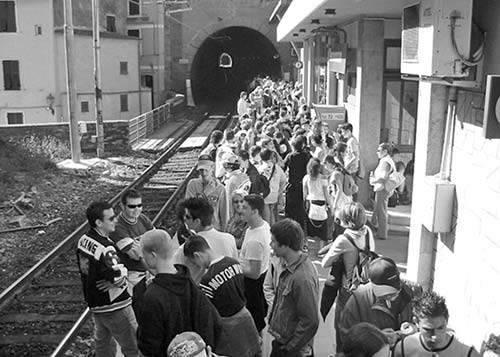
Sleep in the Cinque Terre—not nearby. Levanto and La Spezia are close and well-connected by train, making them popular home bases. But it’s easier to enjoy the Cinque Terre early and late—when it’s quiet and cool—if you’re sleeping here.
Be careful on crowded train platforms. At peak times, be cautious, stay well behind the yellow line, and be alert for pickpockets. Spread out to less crowded areas to wait.
Hire your own boat. If the regularly scheduled boats are jammed, consider hiring your own boat to zip you to the next town. Captains hang out at each town’s harbor, offering one-way transfers to other towns, hour-long cruises, and more.
Schedules: Boat schedules are posted online and at docks, harbor bars, Cinque Terre park offices, and hotels. Boats depart Monterosso about hourly (9:30-17:00), stopping at the Cinque Terre towns (except Corniglia, the hill town) and ending up about 90 minutes later in Porto Venere. In the other direction, boats depart Porto Venere toward Monterosso about hourly (8:30-17:00). In high season, a few boats per day extend the route from Monterosso north to Levanto, and from Porto Venere east to La Spezia.
Private Boats: To escape the crowds—or for a scenic splurge—hire a captain to ferry you between towns. For example, at the harbor in Vernazza, you can pay around €50 to hop to any other Cinque Terre town. Split the cost among a few fellow travelers, and you have an affordable water taxi. For a memorable and relaxing time on the water, groups can hire a captain for a coastal tour, swimming excursion to a hidden cove, or a fishing trip. Or take a sunset aperitivo cruise (per-person charge). See the specific listing in each town.
By Shuttle Bus
ATC shuttle buses (which locals call pulmino) connect each Cinque Terre town with its closest parking lot and various points in the hills (but they don’t connect the five towns to each other). The one you’re most likely to use runs between Corniglia’s train station and its hilltop town center. Rides cost €1.50 (€2.50 from driver), and are covered by the Cinque Terre park card (described in next section). Buy tickets and get bus schedules at park info offices or TIs, or check times posted at bus stops (also online at www.atcesercizio.it). As you board, it’s smart to tell the driver where you want to go. Departures often coordinate with train arrival times.
Some shuttles go beyond the parking lots and high into the hills—often terminating at the town’s sanctuary church. To soak in the scenery, you can ride up and hike down. This works particularly well from Manarola and Vernazza. Or you can ride both ways (50 minutes round-trip, covered by one ticket).
Hiking the Cinque Terre
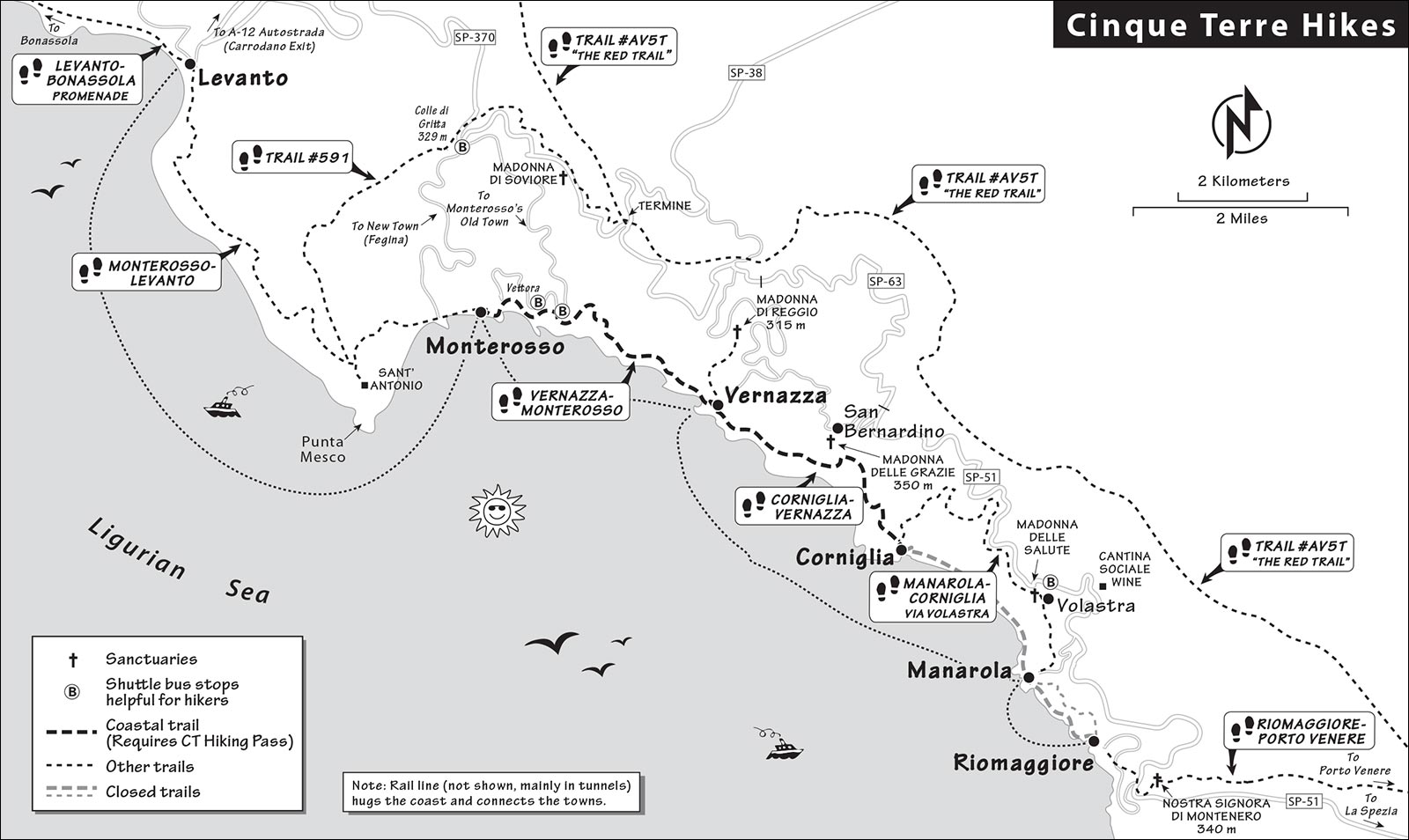
The five Cinque Terre towns are connected directly by a main coastal trail, and indirectly by a web of trails higher up. Unfortunately, the two southern sections of the main coastal trail have been closed for the last few years due to falling rocks (Corniglia to Manarola, and Manarola to Riomaggiore). The two longer, northern sections remain open (Monterosso to Vernazza, and Vernazza to Corniglia).
With so many day-trippers blitzing in with the same hiking agenda, go early or late if you want to enjoy either of the open coastal sections. At any time of day, consider the paths that run higher up and farther inland. They are less crowded, free to use, and just as scenic. The single best high-country hike is from Manarola to Corniglia via Volastra, and you can take a shuttle bus to avoid its steepest climb (described below).
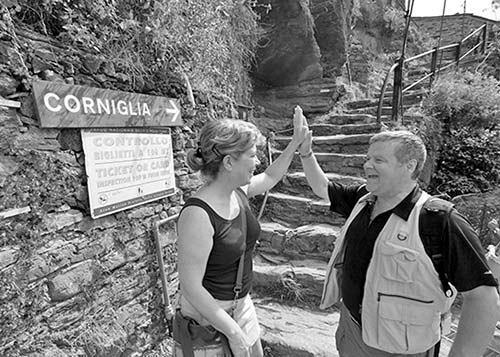
Cinque Terre Park Cards: Visitors hiking on the main coastal trail must buy a park card. Cards are not needed to hike on higher trails. Cards can be purchased online, or at train stations, TIs, and trailheads (http://card.parconazionale5terre.it). Some area hotels sell discounted park cards to guests—ask.
Hikes can be done in either direction. Get local advice before you set out. I’ve omitted trails closed as of this printing.
▲▲▲Vernazza-Monterosso Challenging but dramatic 2-hour hike, including long stretches of steep steps above Monterosso.
▲▲▲Corniglia-Vernazza Most scenic and rewarding segment (1.5 hours) of the main coastal trail, with fine views, significant elevation changes, and moderately challenging stretches on uneven stone steps.
▲▲Manarola-Corniglia via Volastra Demanding but gorgeous 2.5-hour hike through vineyards high over the coast; made much easier and shorter if you take the shuttle bus from Manarola to Volastra. Park card not required for hike, though it covers the cheap bus ride.
▲▲Madonna di Reggio Sanctuary Hike Easy 30-minute downhill hike from the sanctuary above Vernazza, best reached by shuttle bus.
High Route between Porto Venere and Levanto Remote, cliff-capping 22-mile trail (AV5T) high above the main coastal trail and sanctuary trails, best for well-equipped, hardy hikers.
▲Monterosso-Levanto A 3.5-hour hike over Punta Mesco; a notch more challenging and longer than other coastal trail segments.
▲Levanto-Bonassola Promenade Level 30-minute walk that cuts through mountains (largely through tunnels) to connect Levanto to the beach town of Bonassola; fine by foot but better by bike.
▲Riomaggiore-Porto Venere Very demanding, 6-hour trek high into the hills, ending at picturesque Porto Venere.
The Cinque Terre Trekking Card costs €7.50 for one day of hiking or €14.50 for two days (covers trails, free use of WCs, park Wi-Fi, and ATC shuttle buses, but not trains).
The Cinque Terre Treno Card covers what the Trekking Card does, but also includes local trains connecting all Cinque Terre towns, plus Levanto and La Spezia (€18.20/1 day, €33/2 days, €47/3 days, less off-season, validate card at train station by punching it in the machine, expires at midnight).
Navigation: Park offices hand out a map showing each trail and its number (“SVA” indicates the main coastal trail). Maps aren’t essential for the basic coastal path. But for the more challenging routes higher up, you’ll want either the park map or one of the commercial maps on sale at park offices for about €5. Trails are usually marked with red and white paint, and often with arrows, trail numbers, and destination names. The word for “path” is sentiero.
Hiking Conditions: While the main coastal trail can get strenuous, it’s doable for any fit hiker...and the scenery is worth the sweat. But the trails are narrow and rocky, and come with lots of steep, challenging steps. Don’t overestimate your abilities. I get many emails from readers who say the trails were tougher than they’d expected. The rocks and metal grates can be slippery in the rain. Flip-flops are not allowed. Pace yourself. For less ambitious walkers, there are great short walks around each town (see below).
Preparation and Safety: Before embarking on the more difficult hikes, get advice from one of the national park offices (located at each train station), or from Cinque Terre Trekking in Manarola (see here). The park maintains a map online that shows if trails are open and color-codes them by difficulty—closed (chiuso) trails are in black (www.pn5t.it/mappe, then select “Mappa”). Sturdy footwear, a phone for emergencies, plenty of water and snacks, sunscreen (and/or a hat), and a good map are essential.
When to Go: The coastal trail can be extremely crowded and very hot at midday. For the best light, coolest temperatures, and fewer crowds, start your hike early (by 8:00) or late (around 16:00 or 17:00). Before setting out for an evening hike, find out when the sun will set, and leave plenty of time to arrive at your destination before dark; there’s no lighting on the trails.
Shuttle Buses: ATC shuttle buses can make the going easier, connecting coastal villages to trailheads higher up. Locals know all the options—and shuttle bus schedules—so ask around. But be aware that shuttles heading into the high country run only in summer, and just once or twice a day. If frustrated with bus schedules, try the local taxis.
Guided Hikes and Excursions: Your park card includes guided hikes and other local excursions (such as town walking tours), which take place almost daily in the summer months. These are announced on the park website (www.parconazionale5terre.it, under “Agenda” or “Initiatives and Events”).
TOP THREE HIKES
These three hikes each give the quintessential Cinque Terre hiking experience. The first two are part of the main coastal trail (and require the national park card); the third takes you much higher (and is free).
Main Coastal Trail
▲▲▲Vernazza-Monterosso (2 hours, 2 miles)
The scenic up-and-down-a-lot trek from Vernazza to Monterosso is both challenging and rewarding. The trail is narrow, steep, and crumbly in spots, with a lot of steps but easy to follow. The views just out of Vernazza, looking back at the town, are spectacular. From there you’ll gradually ascend to 550 feet, passing some scenic waterfalls populated by croaking frogs. As you approach Monterosso, you’ll descend steeply through vineyards—on very deep, knee-testing stairs—and eventually follow a rivulet to the sea. The last stretch is along a pleasant, paved pathway clinging to the cliff. You’ll pop out right at Monterosso’s refreshing old-town beach.
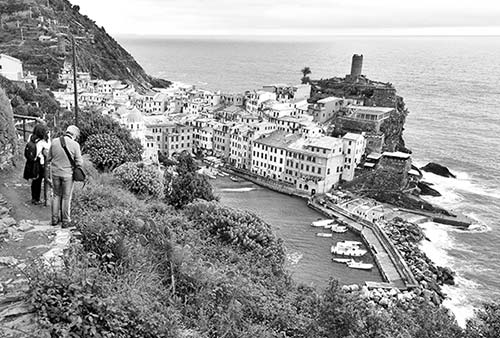
▲▲▲Corniglia-Vernazza (1.5 hours, 2 miles)
The hike from Corniglia to Vernazza—the wildest and greenest section of the coast—is very rewarding but very hilly. From the Corniglia train station, zigzag up to the town (via the steep stairs, the longer road, or the shuttle bus). From Corniglia, you’ll reach the trailhead on the main road, past Villa Cecio. You’ll hike through vineyards toward Vernazza. After about 10 minutes, you’ll see a faded sign for Guvano beach, far beneath you (formerly a nude beach—now closed). The scenic trail continues through lots of fragrant and flowery vegetation into Vernazza. If you need a break before reaching Vernazza, stop at Bar la Torre, with a strip of amazingly scenic and delightfully shady tables perched high above the town.
Above the Main Coastal Trail
▲▲Manarola-Corniglia via Volastra (2.5 hours, 4 miles)
This challenging hike from Manarola leads up to the village of Volastra, then north through high-altitude vineyard terraces, and steeply down through a forest to Corniglia. You can shave the two steepest miles off this route by taking the ATC shuttle bus from Manarola up to Volastra (about hourly, 15-minute trip).
If you’d rather hike up to Volastra, you have two options: The more established trail #506 cuts up through the valley. For a more scenic but rougher alternate, take steeper trail #502, which follows the ridge at the top of Manarola’s vineyards, with wonderful sea views. One way to access trail #502 is to begin with the vineyard hike on my self-guided walk for Manarola (here); partway along this walk, where you reach the wooden religious scenes scampering up the hillside, take a sharp right and walk uphill, following signs for Panoramico Volastra (Corniglia).
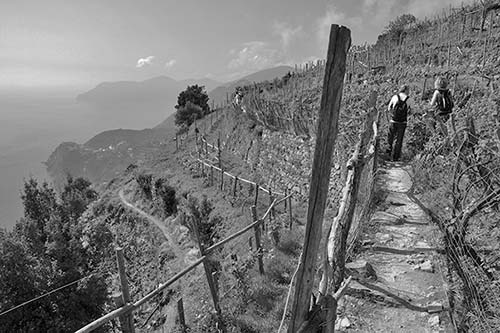
Tiny Volastra, perched between Manarola and Corniglia, hosts lots of Germans and Italians in the summer. Its church (Madonna delle Salute) is the sanctuary church for Manarola (as well as the shuttle bus stop). A 20-minute detour from Volastra, in the neighboring hamlet of Groppo, is Cantina Sociale, a cooperative winery open to the public (wine tastings, www.cantinacinqueterre.com).
When you’re ready to head on to Corniglia, make your way to the Volastra church and look for Corniglia signs. From the front door of the church, directly across the piazza, find the trailhead (marked by an iron cross) for trail #586 to Case Pianca.
Here begins one of the region’s finest paths, tightroping along the walled edges of vineyard terraces, with spectacular bird’s-eye views over the entire Cinque Terre. You’ll cut up and down the terraces a bit—just keep following the red-and-white markings and arrows. After passing a little village (and following signs through someone’s seaview backyard), the trail enters a forest and begins its sharp, rocky descent into Corniglia. (To skip the descent, backtrack to Volastra and return by shuttle bus to Manarola.) High above Corniglia, you’ll reach a fork, where you turn left to proceed downhill on trail #587 to Corniglia.
OTHER CINQUE TERRE WALKS AND HIKES
Beyond the three I’ve highlighted above, there are dozens of satisfying walks in the Cinque Terre at all levels of difficulty. None of the walks described below requires a park card.
Walks in the Villages
For each Cinque Terre town, I include a self-guided walk to help you explore the town (anytime, day or night). My Manarola walk brings you up above town on an easy, rewarding stroll through vineyards with stunning views. In Monterosso, I describe the short huff up to the town’s hilltop convent and cemetery. Vernazza’s evocative cemetery is also a fairly quick climb from town.
Sanctuary Trails and Other Inland Walks
Each of the five towns has its own chapel or church dedicated to the Virgin Mary, hovering in the hills a mile or two above town and accessible by a long, steep hike (quiet and uncrowded). These sanctuaries were a place of refuge for each village in the age of pirate attacks.
Villagers feel deeply connected to these spiritual retreats, where they remember lost relatives and feel part of a timeless community. In two cases (at Volastra and San Bernardino) the sanctuary church is also the focal point of a small hamlet. In most towns, the shuttle bus can take you from the town center to the sanctuary—you could ride up and hike down (described with each town’s coverage next). You can also hike crosswise from one sanctuary to the next (these routes are shown on the park trail map).
Although the flat coastal path between Manarola and Riomaggiore (the Via dell’Amore) remains closed, a steep, challenging route over the bluffs between the two towns is open (trail #531, taking about an hour).
High Route Between Porto Venere and Levanto
Far above the coastal trails, and higher than the sanctuaries, is the 22-mile AV5T trail (alta via 5 Terre, also labeled “the red trail”), offering sky-high views over the Cinque Terre seafront. It’s cool, uncrowded, and at the top of the world. The park rates the trail itself as of medium difficulty, but getting up to it (at 2,000 feet) is a demanding climb. This trail continues all the way down to Porto Venere in the south and far beyond the Cinque Terre to the north.
EXTENDING THE COASTAL TRAIL
The coastal trail (SVA) continues north of Monterosso and south of Riomaggiore. These stretches are just as scenic and do not require a park card.
To the North
▲Monterosso-Levanto (3.5 hours, 4 miles)
This strenuous, rugged, and wild hike on the coastal trail (SVA) will take you all the way to Levanto. Wear good shoes and bring lots of water.
Starting from Monterosso, look for signs for the coastal trail at the west end of the new town, and head steeply up. You’ll hike up and over Punta Mesco, the bluff that separates the two towns. The first stretch, out of Monterosso, is almost entirely big steps; the rest is mostly a gradual up-and-down.
For a short scenic detour, look for trail #591 not far out of Monterosso. This brief jog leads to the ruined chapel of Sant’Antonio.
To begin the hike in Levanto, see here.
Alternate Route: You can enjoy a higher hike by skipping the steepest stretch and riding one of Monterosso’s shuttle buses to Colle di Gritta (and Hotel Monterosso Alto). From there, follow trail #591 along the ridge and down to Colle di Bagari, where several trails intersect. You can follow trail #571c from here or go a little lower to #571—both head down to trail SVA and Levanto. Or, to make your hike a loop that returns directly to Monterosso, continue from Colle di Bagari along trail #591 to trail SVA, and drop steeply into Monterosso.
▲Levanto-Bonassola (30 minutes)
For an easy excursion, take the train to Levanto, then stroll (or better yet, bike) the level, rails-to-trails promenade to the beach town of Bonassola. With a bike, you can continue further on, to Framura (see the next chapter).
There are two Cinque Terres: when the cruise groups are inundating it and when they are not. Huge ships stop in La Spezia, Genoa, or even Livorno, and offer guided excursions to the five towns, dumping literally thousands of travelers on the Cinque Terre, which doesn’t have the infrastructure for huge crowds.
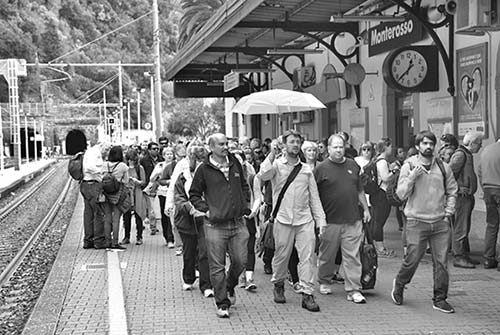
When the cruise ships are in, Cinque Terre trains and platforms are dangerously overcrowded, the trails become almost impassable, and the towns’ tiny main lanes are clogged. Sure, cruise travelers can cross the Cinque Terre off their bucket list. But nobody arriving with a cruise ship horde can experience much of the Cinque Terre. And locals do not like cruise groups.
Please, visit on your own. Don’t try to experience the villages and fragile trails of the Cinque Terre as part of a cruise ship mob. (If you’re visiting Italy by cruise, do a cruise excursion to Pisa and Lucca instead—they can handle the crowds. Or for a seaside experience, consider Porto Venere, or ride the train up to Sestri Levante or Santa Margherita Ligure—all covered in the next chapter.) I love cruising. And I love the Cinque Terre. But in my opinion, they just don’t mix.
To the South
▲Riomaggiore-Porto Venere (6 hours, 8 miles)
For this challenging trek (which has some scary spots if you don’t like heights), you’ll hike south from Riomaggiore on trail SVA—or on the steep shortcut trail #593—up to the town sanctuary (Madonna di Montenero). Then you’ll continue up to Colle del Telegrafo, where you join the high AV5T trail that leads all the way down to Porto Venere. Partway along, the town of Campiglia has a little bar/restaurant (and buses to La Spezia).
Sleeping in the Cinque Terre
Part of the pleasure of planning a trip to the Cinque Terre is settling on which town to stay in.
Vernazza, the salty essence of the Cinque Terre, is my top choice for a home base. Its summer opera series has beefed up its nightlife. But if you think too many people have my book, you’ll get fewer crowds and better value for your money in other towns.
Monterosso is a good choice for sun-worshipping beach lovers, those who prefer the ease of a real hotel, and those interested in youthful nightlife.
Manarola, charming and not overrun, draws serious hikers and sophisticated Europeans. The town has a good range of professional-feeling small accommodations (and a youth hostel), but fewer dining and evening options.
Riomaggiore, the second-largest Cinque Terre town, has the cheapest beds and rivals Monterosso for nightlife.
Corniglia, on a hilltop (no harbor), attracts hermits, anarchists, wine lovers, and mountain goats. It also has a hostel.
Many accommodations in the Cinque Terre (especially in Vernazza) are private rooms for rent (affittacamere). The typical offer is a nicely done-up bedroom with private bath or a comfortable apartment with a small kitchen. You get a key and come and go as you like, rarely seeing your landlord, who lives elsewhere and may manage five or ten such rooms. Expect thin walls (pack earplugs). Plan on paying cash. If you must cancel an affittacamere reservation, do it as early as possible—since people renting rooms usually don’t take deposits, they lose money if you don’t show up.
Breakfast: Breakfast is not included at most affittacamere and other simple accommodations. Locals don’t make much of breakfast anyway: The basic, very Italian approach is to drop by a neighborhood bar for a cappuccino and a cornetto (croissant) or a piece of focaccia. Some pricier places include breakfast, but this often consists of a few paltry items (packaged croissants, yogurt, instant coffee) in a minifridge in your room.
Air-Conditioning: While air-conditioning is essential in the summer elsewhere in Italy, in the breezy Cinque Terre you can generally manage fine without it.
Eating in the Cinque Terre
Hanging out at a seaview restaurant while sampling local treats could become one of your favorite Cinque Terre memories.
Fresh anchovies (acciughe; ah-CHOO-gay)—ideally served the day they’re caught—are a staple protein here. If you’ve always hated preserved anchovies (the slimy, salty kind), try them fresh here. These little fish (typically 3 to 5 inches long) are prepared in a dizzying variety of ways: marinated, salted, drenched in lemon juice, butterflied and deep-fried (sometimes with a tasty garlic/vinegar sauce called giada), and so on. A favorite way to prepare fresh anchovies is baked in a casserole, layered whole with potatoes, tomatoes, white wine, oil, and herbs. To try this, look on menus for tegame alla vernazzana (tegame means “skillet”).
Seafood is plentiful. You’ll often see muscoli ripieni (stuffed mussels) on menus. And, while antipasto means cheese and salami in Tuscany, here you’ll get antipasti frutti di mare (or simply antipasti misti): a plate of mixed “fruits of the sea.” Many restaurants are proud of their frutti di mare—it’s how they show off—and it’s a fine way to start a meal. For two diners, splitting one of these and a pasta dish can be plenty.
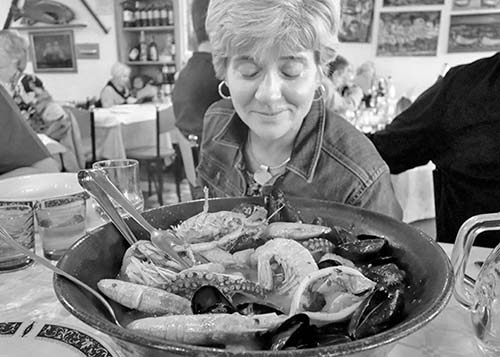
This region is the birthplace of pesto. Basil, which loves the temperate Ligurian climate, is ground with cheese (half parmigiano and half pecorino), garlic, olive oil, and pine nuts, and then poured over pasta. You’ll see it on gnocchi or on pasta designed specifically for pesto to cling to: trenette (ruffled on one side) or trofie (short, dense twists). Many also like pesto lasagna, made with white sauce.
Pansotti are ravioli with ricotta and a mixture of greens, often served with a walnut sauce (salsa di noci)...delightful and filling.
Focaccia—pillowy, flat, salty, olive-oily bread—also originates here in Liguria. The baker roughs up the dough with finger holes, sprinkles it with salt water, then bakes it. Focaccia comes plain or with onions, sage, or olives, and is a local favorite for a snack on the beach. Bakeries sell it in rounds or slices by weight (a portion is about 100 grams, or un etto).
Farinata, a humble flatbread snack sold at pizza and focaccia places, is made from chickpea flour, water, oil, and pepper and baked on a copper tray in a wood-burning stove. It’s dense, filling, and less flavorful than focaccia.
The region also loves its locally grown lemons. Lemon liqueur here is called limoncino—it’s the same as what’s called limoncello in southern Italy.
Vino delle Cinque Terre, while not one of Italy’s top wines, flows cheap and easy throughout the region. It’s white—crisp, refreshing, and great with seafood. It’s defined as a blend, predominantly using the bosco grape, grown only here. Local wine has become more sophisticated and appreciated, and plenty of wine bars offer tasting experiences.
A sweet but potent dessert wine, the local sciacchetrà (shah-keh-TRAH) is worth a try (18 percent alcohol, often served with dunkable cookies). Like the German Eiswein, it’s sweet because it’s made from near-raisins; 10 kilos of grapes make only 1.5 liters of sciacchetrà. The word means roughly “crush and pull”—crush lots of grapes, pull out the best wine.
Monterosso al Mare
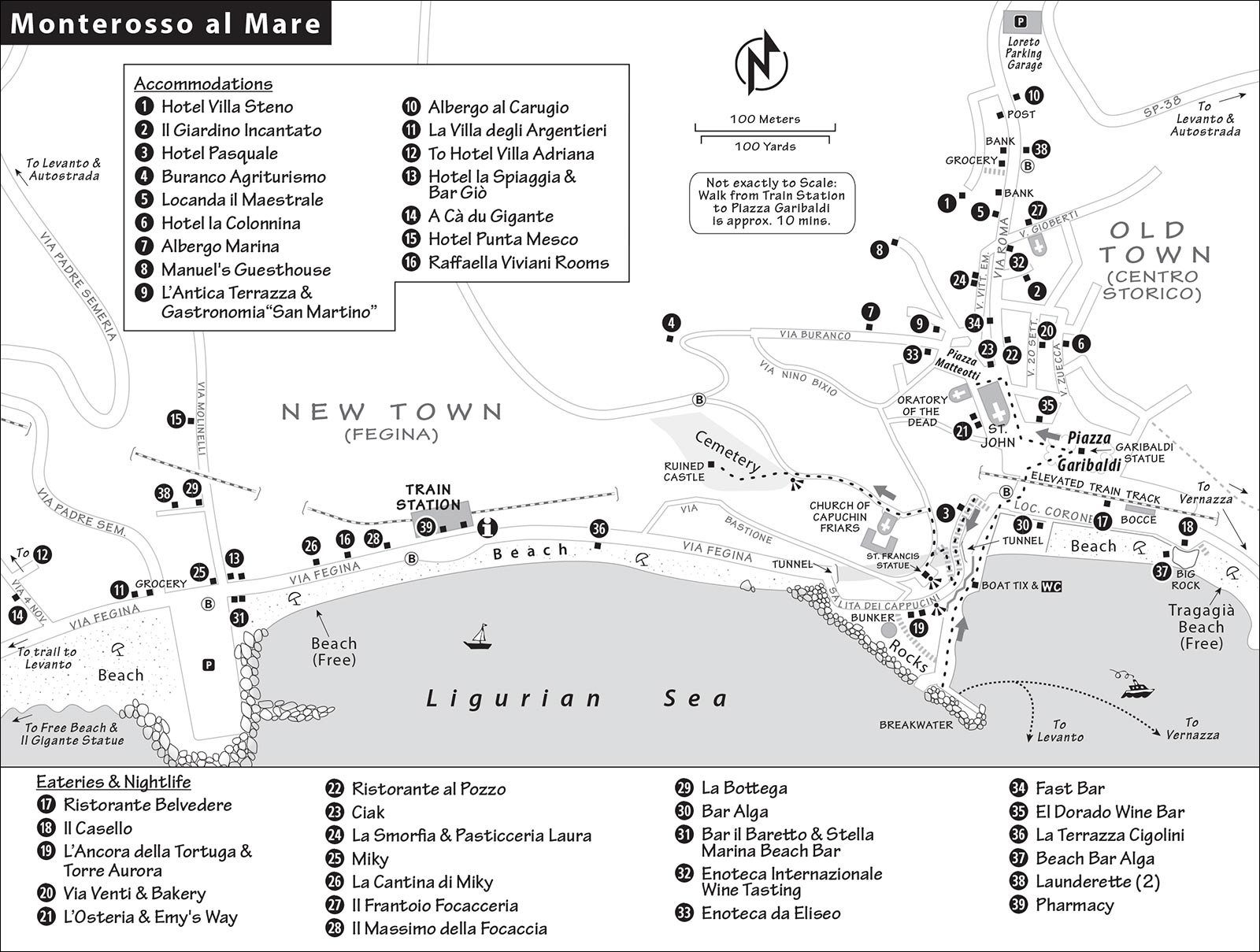
Monterosso al Mare—the only Cinque Terre town with some flat land—has two parts: A new town (called Fegina) with a parking lot, train station, and TI; and an old town (centro storico) which cradles Old World charm in its small, crooked lanes. In the old town, you’ll find hole-in-the-wall shops, rustic pastel townscapes, and a new generation of creative small business owners eager to keep their visitors happy. A handy pedestrian tunnel connects the old with the new.
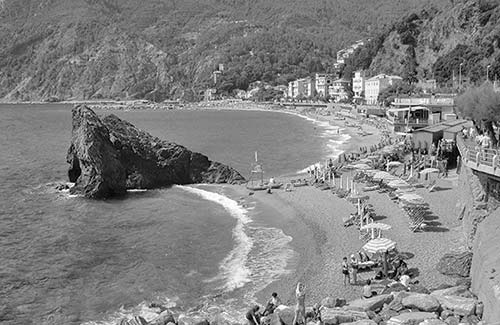
This is a resort town with a few cars and lots of hotels, rentable beach umbrellas, and crowds. Strolling the waterfront promenade, you can pick out each of the Cinque Terre towns decorating the coast. After dark, they sparkle. Monterosso is the most enjoyable of the five for backpackers or the young-at-heart wanting to connect with others looking for a little nightlife.
Orientation to Monterosso
TOURIST INFORMATION
The TI, called Proloco Monterosso, is on the street below the train station (daily 9:00-19:00, mostly closed Nov-March, baggage storage, exit station and go left a few doors to Via Fegina 38, +39 0187 817 506, www.prolocomonterosso.it).
ARRIVAL IN MONTEROSSO
By Train: The station is in the new town. Upstairs within the station you’ll find a Cinque Terre park office (daily 8:30-19:00, shorter hours off-season) and train ticket windows (daily 6:00-20:00).
The bar along platform 1 (serving salads, sandwiches, and drinks) overlooks both the tracks and the beach, and is a handy place with a cool breeze to hang out while waiting for a train to pull in. As many trains run late, this can turn a frustration into a blessing.
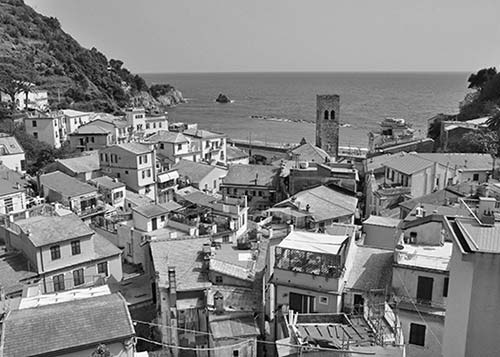
To reach most of my recommended new town hotels, turn right from the station. To get to the old town, turn left from the station, follow the seafront promenade, then duck through the tunnel just before the point—it’s a scenic, flat 10-minute stroll.
Taxis usually wait outside the train station, but if not, you can call one (€10 from station to old town, +39 335 616 5842, +39 335 616 5845, or +39 335 628 0933). ATC shuttle buses also go to the old town and are cheaper, but only run about once an hour and don’t take luggage.
By Car: Monterosso is 30 minutes off the freeway (exit: Carrodano-Levanto). About three miles above Monterosso, there’s an intersection where you must choose either Monterosso Centro Storico (old part of town) or Monterosso Fegina (new town and beachfront parking). Know where you want to go, because you can’t drive directly between the new town and old center (the tunnel is closed to most cars). Most drivers should choose the Fegina fork, but get directions from your hotelier.
Parking is easy (except July-Aug and weekends in June) in the new town in the huge beachfront guarded lot (€25/24 hours). In the old town, you’ll find the Loreto parking garage on Via Roma, from which it’s a 10-minute downhill walk to the main square (€2.50/hour, €25/24 hours).
HELPFUL HINTS
Market: Every Thursday morning (8:00-13:00), trucks pull into the old town and fill the public area by the beach with stalls selling produce and more.
Baggage Storage: The TI will store bags (€5-8/day—but confirm closing time).
Pharmacy: You’ll find one at Via Fegina 42, next to the train station (Mon-Fri, closed Sat-Sun, +39 0187 818 391).
Laundry: For full-service, same-day laundry in the new town, try Wash and Dry Lavarapido. They’ll pick up at your hotel, or you can drop it at their shop. The owners speak little English, so ask your hotelier to arrange the details (daily 8:00-19:00, Via Molinelli 17, +39 339 484 0940, Lucia and Ivano). In the old town, head uphill to Luètu Lavanderia, by the post office (daily 8:00-18:00, Via Roma 86, +39 0187 765 354).
Massage: Physiotherapist Giorgio Moggia gives good massages at your hotel or his in-home studio (€70/hour, +39 339 314 6127, giomogg@tin.it).
Monterosso Walks
These self-guided walks will introduce you to Monterosso. The first one, focusing on the mostly level town center, takes about 30 minutes. For the second one, you’ll summit the adjacent hill—allow an hour or so.
MONTEROSSO HARBOR AND TOWN WALK
• Let’s begin with an easy sweep of the sights: Hike out from the dock in the old town and stand atop the concrete breakwater. (If you’re arriving by boat, you’ll disembark here.)
Breakwater
From this point you can survey Monterosso’s old town (straight ahead) and new town (stretching to the left, with train station and parking lot). Notice the bluff that separates old and new, and imagine how much harder your commute would be if the narrow road tethering these two towns were somehow cut off. It happened in the spring of 2013, when the wall below the hill-topping Capuchin church gave way in a landslide. For a time, the only way to connect the two halves of town by car was to drive six miles around; on foot, you had to hike up and over this hill. (The little fort halfway up the hill, which dates from 1550, is now a fancy restaurant, with a private home upstairs.)
Looking to the right, you can see all cinque of the terre from one spot: Vernazza, Corniglia (above the shore), Manarola, and a few buildings of Riomaggiore beyond that.
These days, the harbor hosts more paddleboats than fishing boats. Erosion is a major problem. The partial breakwater—the row of giant rocks in the middle of the harbor—is designed to save the beach from washing away. While old-timers remember a vast beach, their grandchildren truck in sand each spring to give tourists something to bask on. (The Nazis liked the Cinque Terre, too—find two of their bomb-hardened bunkers embedded in the bluff. During World War II, nearby La Spezia was an important Axis naval base, and Monterosso was bombed while the Germans were here.)
The fancy four-star Hotel Porto Roca (the pink building high on the hill, on the far right of the harbor) marks the trail to Vernazza. High above, you see an example of the costly roads built in the 1980s to connect the Cinque Terre towns with the freeway over the hills.
The two prominent capes (Punta di Montenero to the right, and Punta Mesco to the left) define the Cinque Terre region. The closer Punta Mesco is part of a protected marine sanctuary and home to a rare sea grass that provides an ideal home for fish eggs. Buoys keep fishing boats away. The cape was once a quarry, providing employment to locals who chipped out the stones used to build the local towns (the greenish stones making up part of the breakwater are from there).
On the far end of the new town, marking the best free beach around, you can just see the statue named Il Gigante (hard to spot because it blends in with the gray rock). It’s 45 feet tall and once held a trident. While it looks as if it were hewn from the rocky cliff, it’s actually made of reinforced concrete and dates from the beginning of the 20th century, when it supported a dance terrace for a fin de siècle villa. A violent storm left the giant holding nothing but memories of Monterosso’s glamorous age.
• From the breakwater, walk toward the old town (noticing the big drainage tunnels opening onto the beach—critical to avoid flooding during big rainstorms) and under the train tracks. Then venture right into the square and find the statue of a dandy holding what looks like a box cutter (behind the big playground).
Piazza Garibaldi
The statue honors Giuseppe Garibaldi, the dashing firebrand revolutionary who, in the 1860s, helped unite the people of Italy into a modern nation. Facing Garibaldi, with your back to the sea, you’ll see (on your right) the orange City Hall (with the European Union flag beside the Italian one).
Just under the bell tower (with your back to the sea, it’s on your left), a set of covered arcades facing the sea is where the old-timers hang out (they see all and know all). The crenellated bell tower marks the church. This was originally the tower of a fortified gate that protected the town back in the days when they hid out of view of marauding pirates.
• Go to church.
Church of St. John the Baptist (Chiesa di San Giovanni Battista)
First, walk along the side the church. Near the second side door, find the high-water mark (altezza massima) from an October 1966 flood—which also famously devastated Florence. Nearby, a second (higher) plaque commemorates the 2011 flood.
Now hook left, around the church—and appreciate its striped main facade. Alternating white marble from Carrara and green marble from Punta Mesco, the stripes get narrower the higher they go, creating the illusion that the church is taller than it really is. The church is typical of the region’s Gothic style. Note the lacy, stone rose window above the entrance—considered one of the finest in northern Italy. It’s as delicate as crochet work, with 18 slender columns (creating the petals of the rose).
Step inside for more Ligurian Gothic: original marble columns and capitals with pointed arches to match. The octagonal baptismal font (in the back of the church) was carved from Carrara marble in 1359. Imagine the job getting that from the quarries, about 40 miles away. The fine Baroque altar was crafted with various marbles from around Italy in the 1700s. The church itself dates from 1307—the proud inscription on the left-middle column reads “MilloCCCVII.”
• Leaving the church, turn left and go to church again.
Oratory of the Dead (Oratorio dei Neri)
During the Counter-Reformation, the Catholic Church offset the rising influence of Protestantism by creating brotherhoods of good works. These religious Rotary clubs were called “confraternities.” Monterosso had two, nicknamed White and Black. This building is the oratory of the Black group, whose mission—as the macabre decor filling the interior indicates—was to arrange for funerals and take care of widows, orphans, the shipwrecked, and the souls of those who ignore the request for a €1 donation. It dates from the 16th century, and membership has passed from father to son for generations. Notice the fine, carved pews (c. 1700, with toothy smiling skulls reminding us that mortality is nothing to fear) and the haunted-house chandeliers. Look up at the ceiling to find the symbol of the confraternity: a skull-and-crossbones and an hourglass...death awaits us all.
On October 25, 2011, after a dry summer, a heavy rainstorm hit the Cinque Terre. Within four hours, 22 inches of rain fell. Flash floods rushed down the hillsides, picking up mud, rocks, trees, furniture, and even cars and buses in their raging, destructive path through the streets down to the sea. Part of Monterosso’s old town and Vernazza’s main drag were buried under a dozen feet of mud. Four villagers from Vernazza lost their lives. One body washed up in distant France.
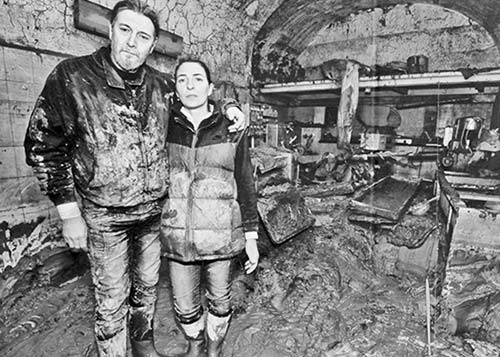
Today, the Cinque Terre is back to normal. Most visitors wouldn’t even notice that in the affected areas of Monterosso and Vernazza, everything is new: stoves, tables, chairs, and plates. Strolling through these towns today, you’ll hear the peaceful sound of streams under most of the main streets. As you do, appreciate the resilience of the human spirit (and the importance of good drainage).
• On that cheery note, if you’re in a lazy mood, you can end your walking tour here to enjoy strolling, shopping, gelato-licking, a day at the beach...or all of the above. But if you’re up for a hike, face out to sea, look to the right, and imagine the view from the top of that hill. Now...go see it.
CAPUCHIN CHURCH AND CLIMB
The hill that separates the old town from the new rewards anyone who climbs up with a peaceful church, a cemetery in the clouds, and a panoramic view.
• From the old town’s beachfront, find the brick steps squeezed between Hotel Pasquale and its restaurant, and start climbing. The lane is signed Salita dei Cappuccini, but in the local dialect it’s called Zii di Frati, or...
Switchbacks of the Friars
Follow the yellow brick road (OK, it’s not yellow...but I couldn’t help singing as I skipped skyward). Several switchbacks up, above the seaside castle, detour left to the statue of St. Francis and a wolf taking in a grand view. Enjoy an opportunity to see all five of the Cinque Terre towns. Then backtrack 20 yards to the switchback and continue uphill. (Continuing straight on from St. Francis would drop you down into the new town.)
• When you reach a gate marked Convento e Chiesa Cappuccini, you have arrived at the...
Church of the Capuchin Friars
Walk through the gate and up the stairs into the church courtyard. The former monastery is now manned by a single caretaker friar. (If you meet Father Renato, take a moment to speak with him—he’s a joyful soul who loves to connect.) Before stepping inside, notice the church’s striped Romanesque facade. It’s all fake. Tap it—no marble, just cheap 18th-century stucco. Go inside and sit in the rear pew. The high altarpiece painting of St. Francis can be rolled up on special days to reveal a statue of Mary standing behind it.
The fine painting of the Crucifixion (on the left) recalls how, when Jesus died, the earth went dark. Notice the eclipsed sun in the painting, just to the right of the cross.
• Leave and turn left through another gate to hike 100 yards uphill to the cemetery filling the ruined castle at the top of the hill. Reaching the cemetery’s gate, look back and enjoy the view over the town.
Cemetery in the Ruined Castle
In the Dark Ages, the village huddled behind this castle. As the threat of pirates passed, it slowly expanded to the waterfront. Notice the town view from here—no sea. You’re looking at the oldest part of Monterosso, tucked behind the hill, out of view of 13th-century pirates.
Respectfully explore the cemetery. Ponder the black-and-white photos of grandparents past. Read the headstones: Q.R.P. is Qui Riposa in Pace (i.e., R.I.P.). Rich families had their own little tomb buildings. The fresh flowers show how much people treasure this place.
Climb to the very summit—the castle’s keep, or place of last refuge. Priests are buried in a line of graves closest to the sea, but facing inland, looking toward the town’s holy sanctuary high on the hillside (above the road, with its triangular steeple just peeking above the trees). Each Cinque Terre town has a lofty sanctuary, dedicated to Mary and dear to the village hearts.
• Your tour is over—any trail leads you back into town.
Experiences in Monterosso
Hikes from Monterosso
For a relatively easy in-town hike, take a rewarding climb up to the hilltop cemetery between the old and the new towns (described above).
The most popular hike from Monterosso is to Vernazza on the main coastal trail; you’ll need a park card (sold at the trailhead or at park offices). The hike to Levanto is free, either over the Punta Mesco bluff on the main SVA trail, or on another route where you first take the bus up to Colle di Gritta—which makes most of the rest of the hike downhill.
Another option is path #509 between Monterosso and its Madonna di Soviore sanctuary (you could take the shuttle bus up and walk down). From Soviore, you could hike to Vernazza’s Madonna di Reggio sanctuary, following a mostly level trail (#591) to Termine, then down to Madonna di Reggio (on #582), and then, if you wish, steeply downhill into Vernazza (on #508). Allow 2.5 hours to Vernazza on this route if you start with the shuttle bus to Soviore. (For more on these hikes, see “Hiking the Cinque Terre,” earlier.)
Beaches
Monterosso’s new town has easily the Cinque Terre’s best—and most crowded—beach (immediately in front of the train station). Most of the beach is technically private, where (at Stella Marina) you’ll pay €35 to rent two chairs and an umbrella for the day (prices get soft in the afternoon). Light lunches are served by beach cafés to sunbathers at their lounge chairs. Various outfits along here rent kayaks and stand-up paddleboards (look for signs at the west end of the beach—near the parking lot—or ask around). If there are no umbrellas on a stretch of beach, it’s public (free), so you can spread out a towel anywhere. There’s a free beach at the far west end, near the Gigante statue; others are marked on the “Monterosso al Mare” map, earlier.
The old town also has its own predominantly private beach; rent umbrellas, chairs, kayaks, and paddleboats from Beach Bar Alga (run by Stefano, €35 for two including showers, changing room, WC, two lounge chairs, and an umbrella), which is also a scenic spot for a drink. Tucked just beyond the private beach—under the Il Casello restaurant at the east end of town—is the free public beach called Tragagià, which is gravelly and generally less crowded (showers). The bocce ball court (next to Il Casello) is busy with older men enjoying their favorite pastime.
Wine Tasting
Buranco Agriturismo is one of the largest producers of wines in the Cinque Terre, and in the afternoon (from 15:00-18:00) they welcome visitors to tastings on their expansive terrace overlooking the vineyards. You’ll try some of their wines, plus grappa (firewater) and limoncino, while snacking on bruschetta, olives, and the like (about €40/person). Another option is “wine trekking,” where you get a picnic basket and audioguide and set off on a walk around the grounds (€50/couple, call or email to arrange). At mealtimes, you can taste their wines over lunch or dinner—see “Eating in Monterosso,” later (follow Via Buranco uphill to path, 10 minutes above town, also rents rooms, +39 349 434 8046, www.burancocinqueterre.it, info@buranco.it, Mary).
Enoteca Internazionale is a good place in town to sample local wines. Mario, Susanna, and Valentina are very knowledgeable and serve a selection of five wines for €20 (his bruschetta makes a fine light meal as you’re sipping, open daily until late, Via Roma 62, +39 0187 817 278, www.enotecainternazionale.com).
Boat Rides
In addition to the regularly scheduled big boats (see here), you can hire your own captain for transfers to other towns or for a lazy sightseeing cruise (if the water’s calm).
Stefano has a six-person boat, the Matilde (about €100/hour, two hours is enough for a quick spin and a swimming stop; 5-hour trips to Porto Venere and offshore islands possible; +39 333 821 2007, www.matildenavigazione.com, info@matildenavigazione.com).
Fish & Chill offers five-hour daytime excursions on a cushy boat that carries nine (departs about 10:30, €150/person). Expect snorkeling, village visits, and a buffet lunch onboard. They also do sunset tours and private groups (+39 340 834 7834, www.cinqueterreboat.com, 5terretourfishandchill@gmail.com, Diego and Silvia).
Sea Breeze Boat Tours arranges day and aperitivo sunset tours and will shuttle you to any of the coastal towns. They also run tours from Levanto (€85-140/person, +39 328 824 6889 or +39 338 809 9278, www.seabreezeboattours.com, info@seabreezeboattours.com, Matteo and Federica).
Nightlife in Monterosso
Although I’ve listed these establishments for their nightlife, they work any time of day for a drink and spot to relax.
Enoteca da Eliseo, my favorite wine bar in town, comes with operatic ambience. Eliseo and his wife, Mary, love music and wine. Taste by the glass (bicchiere), or select a fine bottle from their shop shelf, then enjoy the wine, a few included nibbles, and views of the village action from their cozy tables. Eliseo stocks more than a hundred varieties of grappa (Wed-Mon 10:00-23:00, closed Tue, Piazza Matteotti 3, a block inland behind church, +39 0187 817 308).
Fast Bar is super basic, but it’s the best bar in town for young travelers and night owls. Customers mix travel tales with big, cold beers, and the crowd (and the rock ’n’ roll) gets noisier as the night rolls on. Come here to watch sports on TV all day (cheap panini, pizza, salads, and other light meals usually served until midnight, open 7:00-late, in the old town at Via Roma 13, +39 0187 819 278; Alex, Francesco, and Stefano).
La Cantina di Miky, in the new town just beyond the train station, is a trendy bar-restaurant with an extensive cocktail and grappa menu. The seating is in three zones: overlooking the beach, in the garden, or in the cellar. Try the fun “five villages” wine tasting. This is the best place in town for top-end Italian microbrews (Thu-Tue until late, closed Wed, Via Fegina 90, +39 0187 802 525). It’s also recommended for dining (see listing under “Eating in Monterosso,” later).
El Dorado Wine Bar is the local old-town nighttime hangout. Set on a small piazza, it offers music, drinks, pizza, and people-watching late into the night (Piazza Garibaldi 22, daily 10:00-2:00 in the morning, +39 331 475 9611).
Beach Bars: On a balmy evening, enjoy a memorable drink with a view of swimmers, sunbathers, and the languid Ligurian Sea. In the new town, try La Terrazza Cigolini, overlooking the beach by the big rock. In the old town, Beach Bar Alga has an island ambience (all outside, daily until 20:00, Stefano).
Sleeping in Monterosso
Monterosso, the most beach-resorty of the five Cinque Terre towns, offers maximum comfort and ease. Rooms in Monterosso are a better value than similar rooms in crowded Vernazza, and the proprietors tend to be more genuine and welcoming.
IN THE OLD TOWN
$$$$ Hotel Villa Steno is lovingly managed and features great view balconies, panoramic gardens and a roof terrace with sun beds, air-conditioning, and the friendly help of Matteo and his wife, Carla. Of their 16 rooms, 14 have view balconies (RS%, family rooms, hearty buffet breakfast, elevator, laundry service, ask about pay parking when you reserve, hike up to their panoramic terrace, cooking classes, Via Roma 109, +39 0187 817 028 or +39 0187 818 336, www.villasteno.com, steno@pasini.com). It’s a 15-minute climb (or €10 taxi ride) from the train station to the top of the old town. My readers get a free Cinque Terre info packet and a glass of local wine when they check in—ask for it.
$$$$ Il Giardino Incantato (“The Enchanted Garden”) is a charming, comfortable four-room B&B with impressive attention to detail in a tastefully renovated 16th-century Ligurian home in the heart of the old town. It’s run by kind and eager-to-please Fausto and Mariapia and their gregarious staff. Sip their homemade limoncino at aperitivo time, and have breakfast under lemon trees in their delightful hidden garden, illuminated with candles in the evening (air-con, free minibar and tea-and-coffee service, laundry service, Via Mazzini 18, +39 0187 818 315, mobile +39 333 264 9252, www.ilgiardinoincantato.net, giardino_incantato@libero.it).
$$$$ Hotel Pasquale is modern and comfortable with 15 seaview rooms (nine with balconies), run by the same family as Hotel Villa Steno (listed earlier). Located right on the harbor, it’s just a few steps from the beach, boat dock, and tunnel to the new town. While there is some train noise, the soundtrack is mostly a lullaby of waves. Marco’s photographs decorate the breakfast room (RS%, family room, air-con, elevator, laundry service, cooking demonstrations, closed Nov-Feb, Via Fegina 4, +39 0187 817 550 or +39 0187 817 477, www.hotelpasquale.it, pasquale@pasini.com, welcoming Felicita and Marco). Felicita also rents several well-equipped apartments in the center of the old town.
$$$$ Buranco Agriturismo, a 10-minute hike above the old town, has wonderful gardens and views over a hidden valley draped with vineyards and lemon groves. Along with their recommended restaurant and wine and olive-oil production, they offer three rooms and three apartments, with breakfast served on a covered terrace. It’s a rare opportunity to stay in a farmhouse but still be able to get to town on foot (air-con, free parking, +39 349 434 8046, www.burancocinqueterre.it, info@buranco.it, informally run by Loredana, Mary, and Irene).
$$$ Locanda il Maestrale rents six stylish rooms in a sophisticated and peaceful little inn. Although renovated with all the modern comforts and thoughtful details, it retains centuries-old character under frescoed ceilings. Its peaceful sun terrace overlooking the old town and Via Roma action is a delight. Guests enjoy complimentary drinks and snacks each afternoon (air-con, Via Roma 37, +39 0187 817 013, mobile +39 338 4530 531, www.locandamaestrale.net, maestrale@monterossonet.com, Stefania and Giovanni).
$$$ Hotel la Colonnina has 22 big rooms, all but one with a private terrace. The generous and meticulously cared-for public spaces include a cozy garden and an inviting shared seaview terrace with sun beds. It’s buried in the town’s fragrant and sleepy back streets (family rooms, air-con, fridges, elevator, a block inland from main square at Via Zuecca 6, +39 0187 817 439, www.lacolonninacinqueterre.it, info@lacolonninacinqueterre.it, Cristina).
$$$ Albergo Marina, run by enthusiastic husband-and-wife team Marina and Eraldo, has 23 pleasant rooms and a garden with lemon trees. They serve a good breakfast, provide lots of little extras, and offer a fine value (RS%, family rooms, elevator, air-con, fridges, kayak and snorkel equipment, Via Buranco 40, +39 0187 817 613, www.hotelmarina5terre.com, marina@hotelmarina5terre.com).
$$$ Manuel’s Guesthouse, perched high above the town among terraces, is a garden getaway run by Lorenzo and his father, Giovanni. They have six big, artfully decorated rooms and a grand view. After climbing the killer stairs from the town center, their killer terrace is hard to leave—especially after a few drinks (cash only, air-con, up about 100 steps behind church—you can ask Lorenzo to carry your bags up the hill, Via San Martino 39, +39 333 439 0809, www.manuelsguesthouse.com, manuelsguesthouse@libero.it).
$$ L’Antica Terrazza rents four tight, classy rooms right in town. With a pretty terrace overlooking the pedestrian street, Raffaella and Jon offer a good deal (RS%, one single has private bath down the hall, air-con, Vicolo San Martino 1, +39 347 132 6213, www.anticaterrazza.com [URL inactive], post@anticaterrazza.com).
$$ Albergo al Carugio has nine practical rooms in a big apartment-style building with a small patio at the top of the old town. It’s quiet, comfy, and a fine budget value; one room has a private terrace (RS%, no breakfast, air-con, fridges, Via Roma 100, +39 0187 817 453, mobile +39 328 847 6276, www.alcarugio.it, info@alcarugio.it, conscientiously run by kindly Andrea).
IN THE NEW TOWN
$$$$ La Villa degli Argentieri offers 11 spacious rooms, six with balconies, from a choice position at the quiet end of the new town’s beachfront street. From the front rooms you’ll get a peek-a-boo look (through trees) at the water, but the inviting rooftop breakfast terrace has panoramic views (air-con, elevator, Via Fegina 120, +39 0187 916 295, www.villaargentieri.it, info@villaargentieri.it).
$$$$ Hotel Villa Adriana is big, contemporary, and bright, set on a church-owned estate with a peaceful garden, a pool, free parking (reserve ahead), and a no-stress style. They rent 55 sterile rooms—most with terraces, a few with sea views (family rooms, air-con, elevator, free loaner bikes, affordable dinners, Via IV Novembre 23, +39 0187 818 109, www.villaadriana.info, info@villaadriana.info).
$$$$ Hotel la Spiaggia, facing the beach, is a venerable place with 19 rooms (half with sea views) and a quiet garden retreat (air-con, elevator, free parking—reserve in advance, Via Lungomare 96, +39 0187 817 567, www.laspiaggiahotel.it, laspiaggiahotel@gmail.com, Maria). They also rent four pricey, ultra-mod rooms in a small building on the seafront promenade.
$$$$ A Cà du Gigante, despite its name, is a tiny yet chic refuge with nine rooms, most on the ground floor. About 100 yards from the beach (and surrounded by blocky apartments), the interior is tastefully done with upscale comfort in mind (air-con, limited pay parking—reserve ahead, Via IV Novembre 11, +39 0187 817 401, www.ilgigantecinqueterre.it, gigante@ilgigantecinqueterre.it, Claudia).
$$$ Hotel Punta Mesco is a tidy, well-run little haven renting 17 quiet, casual rooms at a good price. While none have views, 10 rooms have small terraces backed up to the building next door (family room, air-con, parking, Via Molinelli 35, +39 0187 817 495, www.hotelpuntamesco.it, info@hotelpuntamesco.it, Roberto, Diego, and Manuel).
$$ Raffaella Viviani rents five basic, dated, but affordable rooms up a single flight of stairs from the beachfront road. Three rooms face the sea (two with small balconies); two have terraces overlooking a little garden (big family rooms, cash only, no breakfast, air-con, Via Fegina 84, +39 329 336 9577, www.affittacamerevivianiraffaella.it, lella-v71@hotmail.it).
Eating in Monterosso
WITH A SEA VIEW
$$ Ristorante Belvedere, big and sprawling, serves good-value meals indoors or outdoors on the harborfront. Their huge €52 anfora belvedere—mixed seafood stew dumped dramatically at the table from a pottery amphora into your bowl—can easily be split among up to four diners. Another fishy treat, their €20 misto mare plate, nearly makes an entire meal for two. Mussel fans will enjoy the tagliolini della casa. It’s energetically run by Federico and Roberto (Wed-Mon 12:00-14:30 & 18:00-22:00, closed Tue, on the harbor in the old town, +39 0187 817 033).
$$ Il Casello offers outdoor terrace seating only, on a little bluff overlooking the old town beach when the weather’s nice. It’s a pleasant spot for pasta, seafood, or a drink (daily 12:00-22:00, +39 333 492 7629, Bacco and Gianfranco).
$$$ L’Ancora della Tortuga is a top option in Monterosso for seaview elegance, with gorgeous outdoor seating high on a bluff and a white-tablecloth-and-candles interior fit for an admiral. Drop by to choose and reserve a table for later. Consider their €40 tasting menu (Tue-Sun 12:30-15:30 & 18:30-21:30, closed Mon and when stormy; at the tip of the point between the old and new towns—just outside the tunnel; +39 0187 800 065, mobile +39 333 240 7956, Silvia and Giamba).
$$$$ Torre Aurora is a top-end, fancy restaurant with no indoor seating. You’ll dine outside (wrapped in a blanket if it’s cold) around the medieval tower with commanding views of approaching pirates while enjoying simple yet creative dishes. Reservations are smart (daily from 12:30 in good weather, +39 366 145 3702, www.torreauroracinqueterre.com, Elia). They serve cocktails outside of mealtime.
IN THE OLD TOWN
$$$$ Via Venti is a quiet little trattoria, hidden on a traffic-free street deep in the heart of the old town, where chef Ilaria and her husband Michele create and serve imaginative seafood dishes. Eat indoors or out; you’ll be tempted by their delicate and savory gnocchi with crab, tender ravioli stuffed with fresh fish, and pear-and-pecorino pasta (Fri-Wed 12:00-14:30 & 18:30-22:30, closed Thu, Via XX Settembre 32, +39 0187 818 347).
$$$ Buranco Agriturismo, just 10 minutes’ walk uphill from the old town, feels like another world. You’ll eat on a heated, roofed-over terrace, overlooking their beautiful grounds and forested hillsides. Chef Giovanni is proud of his shrimp risotto, spaghetti with anchovies, and sophisticated fish and meat courses; they serve their own wines (air-con, free parking, reservations wise, also has rooms, +39 349 434 8046, www.burancocinqueterre.it, Mary).
$ Gastronomia “San Martino,” warmly run by hard-working Moreno and Sabrina, is a tiny, humble combination of takeaway and sit-down café with surprisingly affordable, quality dishes. Belly up to the glass case and see what’s cooking today, then eat at one of the few tables—inside or out on a pleasant street—or find a driftwood log for a feast-to-go. You’re welcome to create your own €15 mixed plate by pointing to whatever appeals (Tue-Sun 12:00-15:00 & 18:00-21:30, closed Mon, next to recommended L’Antica Terrazza hotel at Vicolo San Martino 3, +39 346 109 7338).
$$ L’Osteria is a delightful little family-run place serving “cuisine with passion” at wonderful prices. Alessandro thoughtfully explains your options and Elisa is understandably proud of her cakes. Their Possa wine, from vineyards close to the sea, is the oyster of local wines, or maybe it’s just the Ligurian music the family is sure to play (Tue-Sun lunch served 12:00-14:30, evening seatings at 19:00 and 21:00, closed Mon, Via Vittorio Emanuele 5, +39 0187 819 224). It’s a cozy scene inside with a few tables outside in the shadow of the church.
$$$ Ristorante al Pozzo is a favorite among locals. It’s family-run, with good old-fashioned quality, as Gino (with his long white beard) cooks, and his engaging English-speaking son, Manuel, serves. They have one of the best wine lists in town, serve only homemade pasta, and are known for their raw fish and wonderful seafood antipasti misti, which you can check out in a case near the entrance (Fri-Wed 12:00-15:00 & 18:30-22:30, closed Thu, Via Roma 24, +39 0187 817 575).
$$$ Ciak, high-energy and tightly packed—inside and out—is a local institution with reliably good food and (sometimes) a bit of an attitude. Stroll a couple of paces past the outdoor tables up Via Roma to see what Signore Ciak (who wears his Popeye cap in the kitchen) has on the stove (Thu-Tue 12:00-15:00 & 18:00-22:30, closed Wed, Piazza Don Minzoni 6, +39 0187 817 014, www.ristoranteciak.net [URL inactive]).
$ La Smorfia—a local favorite—cooks up good pizza in a sloppy setting that somehow seems to say, “Great pizza enjoyed here.” Their large pizzas can feed three (Wed-Mon 11:00-24:00, closed Tue, Via Vittorio Emanuele 73, +39 0187 818 395).
IN THE NEW TOWN
$$$$ Miky is packed with a well-dressed clientele who know their seafood. For elegantly presented, top-quality food that celebrates local ingredients and traditions, it’s worth the steep prices. It’s a proud family operation—Miky (dad), Simonetta (mom), charming Sara (daughter, who greets guests)—and the attentive waitstaff all work hard. Their “pizza pasta” is served in a bowl topped with a thin pizza crust dome to contain the flavor, then flambéed at your table. Many of the wines on their fine list are available by the glass if you ask. Their mixed dessert sampler plate, dolce misto, serves two and is a fitting capper (Wed-Mon 12:00-15:00 & 19:00-23:00, closed Tue, reservations wise, in the new town 100 yards from train station at Via Fegina 104, +39 0187 817 608, www.ristorantemiky.it).
$$$ La Cantina di Miky, a few doors down from the station, serves artfully crafted Ligurian specialties that follow in Miky’s family tradition of quality. Run by son Manuel—and Christine from New Jersey—it’s more youthful and informal (but reservations are still wise—sit downstairs, in the garden, or on the promenade overlooking the sea). The €23 anchovy tasting plate is an education in the many ways to prepare this local specialty (creative desserts, large selection of Italian microbrews, Thu-Tue 12:00-15:00 & 19:00-22:00, closed Wed, Via Fegina 90, +39 0187 802 525). This place doubles as a cocktail bar in the evenings.
LIGHT MEALS, TAKEOUT FOOD, AND BREAKFAST
In the Old Town: Lots of shops sell pizza and focaccia to eat in or take out for an easy picnic on the beach or trail. At $ Il Frantoio Focacceria, Simone makes tasty pizza and focaccia (Fri-Wed 9:00-14:00 & 16:30-20:00, closed Thu, just off Via Roma at Via Gioberti 1). $ Emy’s Way offers pasta, thick-crust pizza, and deep-fried seafood in to-go cones (daily 12:00-22:00, along the skinny street next to the church, +39 331 788 1088, Emiliano).
In the New Town: For a quick bite right under the train station (or to take over to the beach), try $ Il Massimo della Focaccia for its quiche-like tortes, sandwiches, focaccia pizzas, and desserts. There are benches just in front—a good bet for a light meal with a sea view (Thu-Tue 9:00-19:00, closed Wed, Via Fegina 50). La Bottega is Monterosso’s largest grocery store, a smart minimart with fresh produce, antipasti, deli items, and other picnic fare. They’ll make you a sandwich: Select a bread and filling, and pay by weight (Mon-Sat 8:00-13:00 & 16:30-19:00, closed Sun, Via Molinelli 9).
Breakfast: Although most hotels include breakfast in the room rate, a handful leave you to your own devices. In the old town, for breakfast on the beach, try Bar Alga (from 8:00 when the weather’s nice). For the freshest bakery items, follow your nose to Pasticceria Laura, serving coffee and pastries every morning from 7:00 (Via Vittorio Emanuele 59). There’s a bakery at Via XX Settembre 26, next to the recommended Via Venti restaurant.
In the new town, these places (on Via Fegina, near Hotel la Spiaggia) serve something akin to breakfast starting at 8:00: Bar Giò (bacon and eggs), Bar il Baretto (bacon and eggs), and Stella Marina Beach Bar (croissants and yogurt—served down on the beach). Your best bet here might be a picnic breakfast from the tiny, nearby alimentari/supermarket at Via Fegina 116. They open at 8:00, and have a good selection of cheeses, breads, pastries, and fruit.
Monterosso Connections
Of the five Cinque Terre towns, Monterosso has the most direct train connections with towns outside the Cinque Terre.
From Monterosso by Train to: Levanto (3-4/hour, 5 minutes), Sestri Levante (at least hourly, 30-40 minutes, most trains to Genoa stop here), Santa Margherita Ligure (at least hourly, 50-60 minutes, often with a change in Sestri Levante), Genoa (at least hourly, 1.5 hours, often with 1 change; change trains here for destinations in France), Milan (5-6/day direct, 3 hours, more with changes), Venice (at least hourly, 6 hours, 1-3 changes, simplest to change in Milan), La Spezia (2-3/hour, 15-30 minutes), Pisa (at least hourly, 1-1.5 hours, most change in La Spezia), Rome (every 1-2 hours, 4.5 hours, change in La Spezia).
Vernazza
With the closest thing to a natural harbor—overseen by a ruined castle, a stout stone church, and a pastel canyon of fisherfolk homes—Vernazza is the jewel of the Cinque Terre. Only the regular noisy slurping up of the train by the mountain reminds you of the modern world.
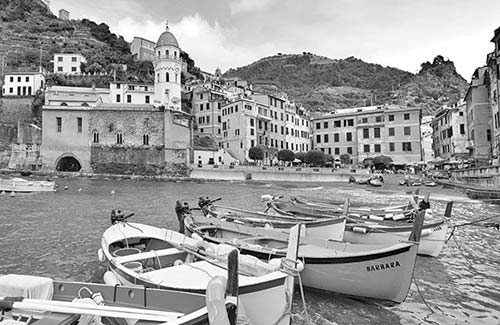
The action is at the harbor, where you’ll find outdoor eateries ringing a humble piazza, a restaurant hanging on the edge of the castle, and a breakwater with a promenade, corralled by a natural amphitheater of terraced hills.
Proud of their Vernazzan heritage, the town’s 500 residents like to brag: “Vernazza is locally owned. Portofino has sold out.” Fearing change, keep-Vernazza-small proponents stopped the construction of a major road into the town and region. Families are tight and go back centuries; you’ll notice certain surnames (such as Basso and Moggia) everywhere. In the winter, the population shrinks, as many people return to more-comfortable big-city apartments to spend the money they earned during the tourist season.
During the day in season the tiny harborfront and one main street are clogged with gawking group excursions. But early and late, Vernazza is the cool and content domain of locals...and travelers who are lucky enough to call the town home for a couple of nights.
Join (or sit on a bench and watch) the locals devoting their leisure time to taking part in the passeggiata—strolling lazily together up and down the main street, doing vasche (laps). Explore the characteristic alleys called caruggi. Learn—and live—the phrase “la vita pigra di Vernazza” (the lazy life of Vernazza).
Orientation to Vernazza
TOURIST INFORMATION
There’s a park office at the train station (daily 8:30-19:30, shorter hours off-season). WCs are just down the platform.
ARRIVAL IN VERNAZZA
By Train: Vernazza’s station is only about three train cars long, but the trains themselves are much longer, so most cars come to a stop in a long, dimly lit tunnel. Get out anyway, and walk through the tunnel—heading for the light—to reach the station. From there the main street flows through town right down to the harbor. If you’re sleeping here, many locals who rent rooms will meet you at the station and walk you to your place (call ahead to tell them which train you’re on).
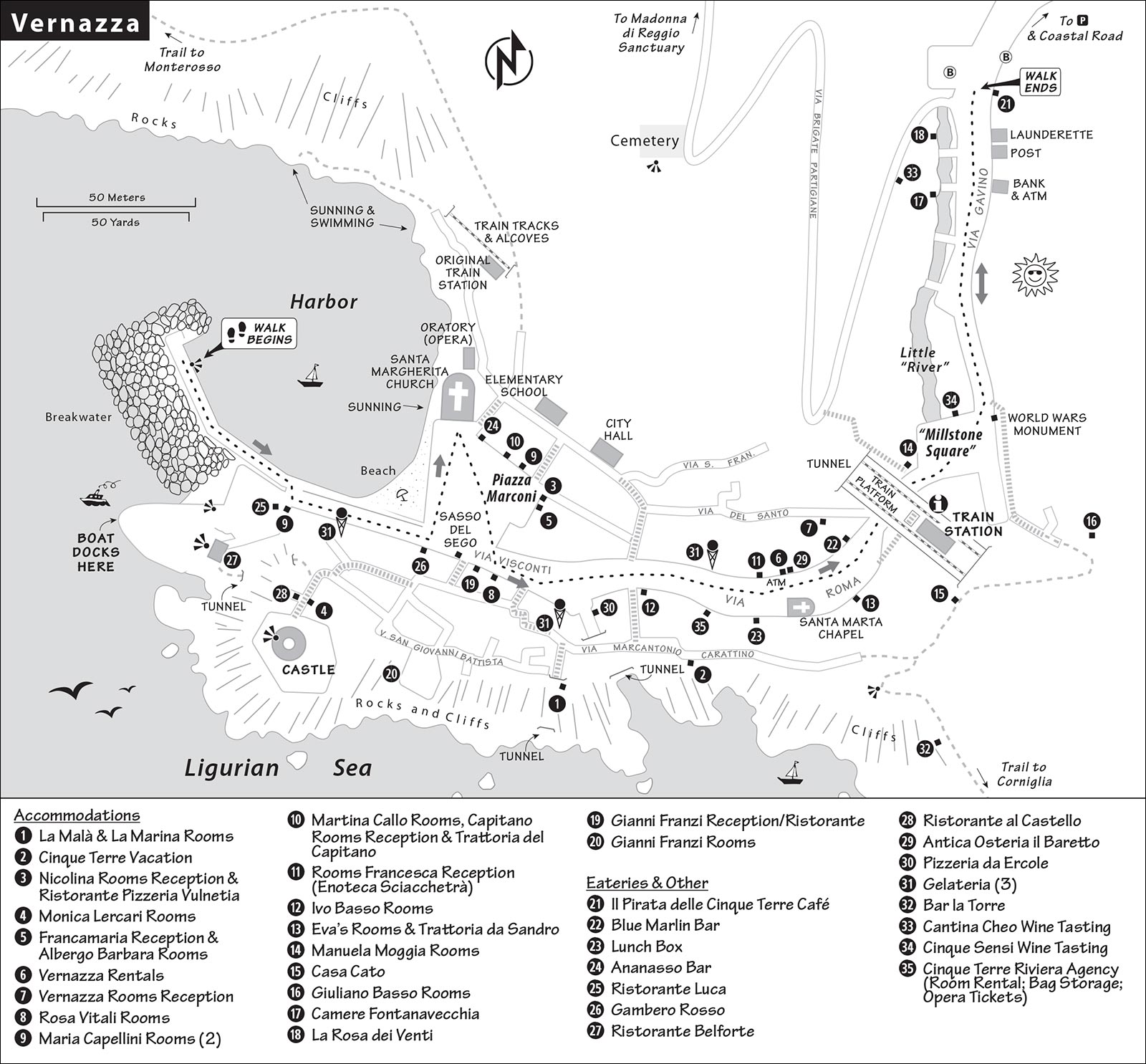
By Car: Don’t drive in Vernazza; the roads to town are in bad shape, and parking is mostly residents-only. If you’re coming from the north, park in Levanto. If arriving from the south, park in La Spezia. From either town, hop on the train. (If you must drive here, leave your car at Parking Vernassoa, about a half-mile uphill from the top end of town; €15/day, free shuttle.)
HELPFUL HINTS
Market: Vernazza’s skimpy business community is augmented Tuesday mornings (8:00-13:00), when a meager gang of cars and trucks pulls into town for a tailgate market.
Baggage Storage: You can store your bags at the Cinque Terre Riviera agency on Via Roma (€5/bag, daily 9:30-18:30—see listing below).
Pharmacy: There’s a little farmacia on the main drag, a few blocks up from the water (Via Roma 2, +39 0187 812 396).
Laundry: A small self-serve launderette is at the top of town next to the post office (Via Gavino 32, daily 8:00-20:00).
Booking Agency: Cinque Terre Riviera, run by Miriana, books vacation rentals in the Cinque Terre towns and La Spezia. They also store bags, sell tickets for Vernazza’s summer opera, and can arrange transportation, cooking classes, and weddings (Via Roma 24, +39 351 785 8879, www.cinqueterreriviera.com, info@cinqueterreriviera.com).
Massage: Kate Allen offers a relaxing fusion of aromatic/Swedish/holistic massage and reflexology in her studio in the center across from the pharmacy (+39 0187 812 537, +39 333 568 4653, www.vernazzamassage5terre.com, katarinaallen@hotmail.com).
Vernazza Walk
This self-guided walk gives you a quick overview of the town and starts out on its breakwater.
• From the train station, just walk downhill and all the way out onto the breakwater. (Ropes are put up to protect gawky tourists from dangerous waves.) Find a comfortable and safe place to sit and get to know Vernazza.
The Town
The earliest references call the town “Fortress Vernazza.” Its towers, fortified walls, and hillside terracing date mostly from the 12th through 15th century. Vernazza allied itself with the Republic of Genoa, a maritime power of the day. In the 12th century, the big yellow central building facing the harbor was a site where Genoese warships were built.
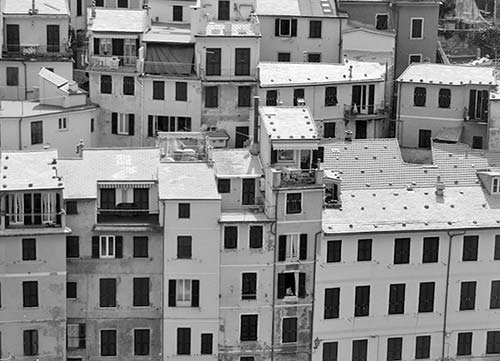
In the Middle Ages, there was no beach or square. The water went right up to the buildings, where boats would tie up, Venetian-style. Imagine what Vernazza looked like in those days, when it was the biggest and richest of the Cinque Terre towns. The harborside buildings had a water gate (facing today’s square) and a front door on the higher inland side. There was no pastel plaster—just fine stonework (traces of which survive above Trattoria del Capitano). The town, hiding behind its little bluff, was camouflaged by its gray stonework—certainly not gaily painted, lest it attract the eyes of marauding pirates. But apart from the added paint and plaster, the general shape and size of the town has changed little in five centuries. Survey the windows and notice inhabitants quietly gazing back. (At least they did before Airbnb changed the economic environment of touristy towns like Vernazza, driving prices up and locals away from the most charming spots.)
Vernazza has two halves. Sciuiu (Vernazzan dialect for “flowery”) is the sunny side on the left (with your back to the sea), and luvegu (dank) is the shady side on the right. Houses below the castle were connected by an interior arcade—ideal for fleeing attacks.
The “Ligurian pastel” colors of the buildings are regulated by the regional government’s commissioner of good taste. The square before you is known for some of the area’s finest restaurants.
While the town has 1,500 residents in summer, only 500 stay here through the winter. Vernazza has accommodations for about that many tourists.
Above Town
The small, round tower above the red building is another part of the city fortifications, recalling the town’s importance in the Middle Ages. Back then, Genoa’s enemies (rival maritime republics, especially Pisa) were Vernazza’s enemies too. That tower recalls a time when the town was fortified by a stone wall.
Vineyards fill the mountainside beyond the town. Notice the many terraces. For six centuries, the economy was based on wine and olive oil. Then came the 1980s—and the tourists. Locals turned to tourism to make a living, and stopped tending the land and vineyards.
Although many locals still maintain their small plots and proudly serve their family wines, the patchwork of vineyards is atomized and complex because of inheritance traditions. Historically, families divided their land among their children. Parents wanted each child to receive good land, though some lots were “kissed by the sun” while others were shady. Lots were split into increasingly tiny, unviable pieces, and many were eventually abandoned. The vineyards once stretched as high as you can see, but since fewer people sweat in the fields these days, the most distant terraces have gone wild again.
Church, School, and City Hall
Vernazza’s Ligurian Gothic church, built with black stones quarried from Punta Mesco (the distant point between Monterosso and Levanto), dates from 1318. Note the gray stone (on the left) that marks the church’s 16th-century expansion. The gray and red house above the spire is the elementary school (about 25 children attend). Older students go to the “big city,” La Spezia. The red building on the hill to the right of the schoolhouse, a former monastery, is now the City Hall. Vernazza and neighboring Corniglia function as one community. Through most of the 1990s, the local government was Communist. In 1999, residents elected a coalition of many parties working to rise above ideologies and simply make Vernazza a better place. That practical notion of government continues here today.
Finally, on the top of the hill, with the best view of all, is the town cemetery. It’s only fair that hardworking Vernazzans—who spend their lives climbing up and down and up and down and up and down the hillsides that hem in their little town—are rewarded with a world-class view from their eternal resting place.
• Look high on your right to the castle.
Castle (Castello Doria)
The castle, which is now just stones and a grassy park with super views, still guards the town (€2, daily 10:00-20:00, Nov-March weekends only; from the harbor, take the stairs by Trattoria Gianni and follow Ristorante al Castello signs—the tower is a few steps beyond). This was the town’s watchtower back in pirate days.
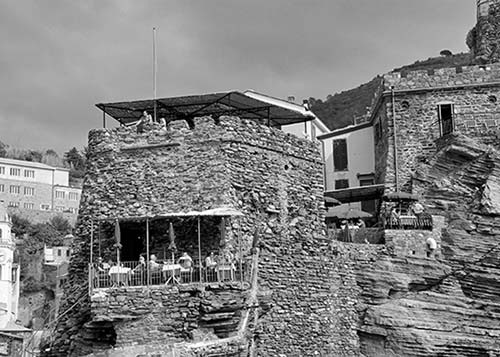
The squat tower below the castle, overlooking the water, Ristorante Belforte, is a great spot for a glass of wine or a meal. From the breakwater, you could follow the rope to the restaurant and pop inside, past an actual submarine door. A photo of a major storm showing the entire tower under a wave (not uncommon in the winter) hangs near the bar.
Harbor
In a moderate storm, you’d get soaked where you’re sitting, as waves routinely crash over the molo (breakwater, built in 1972). Waves can rearrange the huge rocks—depositing them from the breakwater onto the piazza and its benches. Freak waves have even washed away tourists squinting excitedly into their cameras. (I’ve seen it happen.) In 2007, an American woman was swept away and killed by a rogue wave.
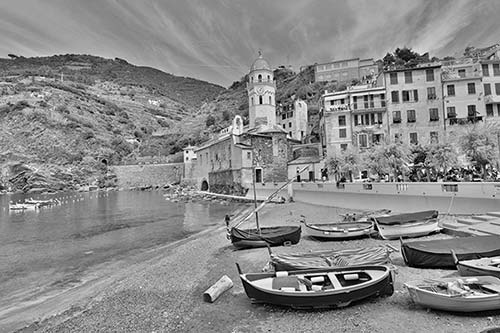
The old train line (across the harbor) was constructed in 1874 to tie together a newly united Italy, linking Turin and Genoa with Rome. (The line now in use, hidden in a tunnel at this point, was built in the 1920s.) The yellow building alongside the tracks was Vernazza’s first train station. Along the wall behind the tracks, you can see the four bricked-up alcoves where people once waited for trains. The wonderful concrete sunbathing strip (and place for late-night privacy) laid below the tracks along the rocks makes for a fun little stroll. (Buoys along the shoreline establish a boat-free swimming zone.)
Vernazza’s fishing fleet is down to just a few boats with net spools, but Vernazzans are still more likely to own a boat than a car. Boats are moored on buoys, except in winter or when the red storm flag indicates rough seas (see the pole at the start of the breakwater). When the red flag flies, boat owners are permitted to pull them up onto the square—which is usually reserved for restaurant tables. In the 1970s, tiny Vernazza had one of Italy’s top water polo teams, and the harbor was their “pool.” Later, when the league required a real pool, Vernazza dropped out.
• Stroll from the breakwater to the harbor square. Look for a small historic stone just before the narrow stairway on the right.
Harbor Square (Piazza Marconi)
Vernazza, with the Cinque Terre’s only natural harbor, was once the sole place boats could pick up the fine local wine. The two-foot-high square stone at the foot of the stairs is marked Sasso del Sego (stone of tallow). Workers crushed animal flesh and fat in its basin to make tallow, which drained out from the tiny hole below. The tallow was then used to waterproof boats or wine barrels.
Stonework is the soul of the region. Take some time to appreciate the medieval stonework and chestnut timbers of the restaurant interiors facing the harbor. From here steps lead to your right up to the castle.
Towns along this coast were designed as what’s called a “Ligurian Palazzata”—an interlinked series of buildings intended to provide protection from seaborne attacks. Vernazza’s harborfront retains its thousand-year-old “stockade” of buildings, connected with tiny and easy-to-defend staircases leading from the vulnerable harbor higher into the community.
• Cross to the church side of the harbor, and peek into the tiny street leading away from the water with its commotion of arches. Vernazza’s most characteristic side streets (caruggi) lead up from here. Another narrow set of stairs marks the beginning of the trail that leads up, up, up to the quintessential view of Vernazza—and, eventually, on to Monterosso (my favorite two-hour hike in the region).
Vernazza’s Church
Vernazza’s harborfront church sits on the tiny piazza, decorated with a river-rock mosaic. This popular hangout spot is where the town’s older ladies soak up the last bit of sun, and kids enjoy a level patch for playing ball. The church, nestled awkwardly into the rocks, is unusual for its east-facing (rather than the standard west-facing) entryway. With relative peace and prosperity in the 16th century, the townspeople doubled the size of their church, extending it west over what was the little piazza that faced it.
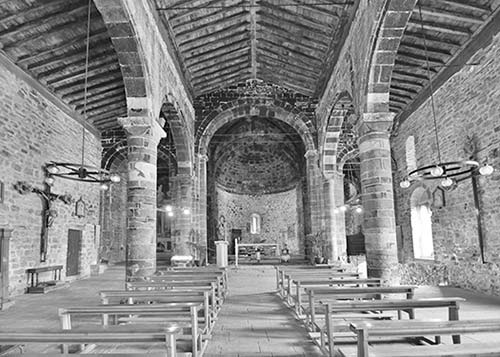
Enter under a statue of St. Margaret, patron saint of Vernazza, and climb the steps into the nave. The space was originally dark (with just the upper slit windows) before the bigger gothic windows were added with the 16th-century expansion. The lighter pillars in the back mark the extension. Three historic portable crosses hanging on the walls are carried through town during religious processions. These are replicas of crosses that (locals like to believe) Vernazzan ships once carried on crusades to the Holy Land.
• Now walk back across the harbor square and head left into town. On the main drag, continue uphill to...
Vernazza’s “Main Street”
You’re now strolling through Vernazza’s “commercial center”: souvenir shops, wine shops, the Blue Marlin Bar (a good nightspot), and so on. You’ll walk by a gelateria, bakery, pharmacy, grocery, and another gelateria. There are plenty of fun and cheap food-to-go options here. The small stone chapel with iron grillwork over the window (on the right) is the tiny Chapel of Santa Marta, where Mass is celebrated on special Sundays. While it’s easy to get distracted by all the tourists, try to see through them to notice locals going about their business.
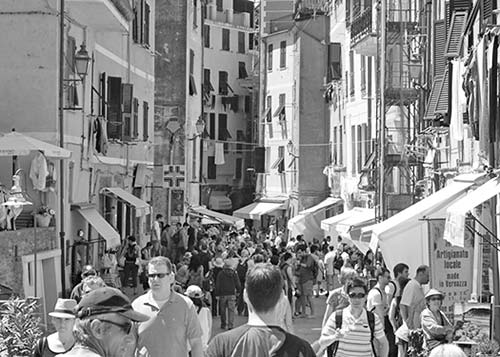
• Pause just before the train tracks.
Vernazza is built around this one street, which is basically a lid over the stream in its ravine. During torrential rainstorms, the surrounding hills act like a funnel, directing flash-flood waters and mudslides right through the middle of town. That’s precisely what happened in the devastating flood of October 25, 2011. Four townspeople lost their lives. Imagine this street, from here to the harbor, buried under 13 feet of mud. Every shop, restaurant, and hotel on the main drag had to be rewired, replumbed, and re-equipped.
The second set of train tracks (nearer the harbor) has been renovated to lessen disruptive noise. At the base of the stairs a handy monitor displays up-to-the-minute schedules for arriving and departing trains (including any running late—ritardo). The walls under the tracks serve as a sort of community information center. Just above the tracks (to the right), the town provides limited space for political advertising (but only during the weeks leading up to an election).
• Hike a few steps under and above the tracks to the little square.
“Millstone Square”
The millstones set on the square are a reminder that Vernazza’s water mill was once powered by the town stream (which runs underground here; you’ve been walking over it since leaving the harbor area). You can still see the tiny “river” if you follow this road up a few steps. Until the 1950s, the river ran openly through the center of town. Old-timers recall the days before the breakwater, when the river cascaded down, charming bridges spanned the ravine, and the surf sent waves rolling up Vernazza’s main drag.
Corralling this stream under the modern street, and forcing it to take a hard turn here, contributed to the damage caused by the 2011 flood. As a result, Swiss engineers redesigned the drainage system, so any future floods will be less destructive. Nets installed above the town now protect it from landslides.
On the wall ahead, at the bend in the road, notice the World Wars Monument—dedicated to those killed in World Wars I and II. Not a family in Vernazza was spared. Listed on the left are soldiers who died (morti in combattimento) in World War I; on the right is the WWII section. Some were deported to Germania; others—labeled Part (for partigiani, or partisans)—were killed while fighting against Mussolini.
The path to Corniglia begins from here (behind and above the monument). Even if you don’t plan to hike its entire length, you don’t have to go far to find fine views over Vernazza’s stony peninsula.
• To see a more workaday part of Vernazza, head a couple of minutes uphill from here to the...
Top of Town
First you’ll pass the ambulance barn (on the left, at #7, with big brown garage doors and a croce verde Vernazza sign), where a group of volunteers is always on call for a dash to the hospital, 40 minutes away in La Spezia. Farther up, you’ll come to a functional strip of modern apartment blocks facing the river. In this practical zone—the only place in town that allows cars—are a bank, the post office, a launderette, and the popular bar/café called Il Pirata delle Cinque Terre. A parking lot fills the square called Fontana Vecchia, named for an “old fountain” that’s so old, it’s long gone. Shuttle buses run from here to hamlets and sanctuaries in the hills above. (Check the schedule post if you want to enjoy the scenic shuttle bus up to the sanctuary and hike back into town—described below.)
Looming over this neighborhood is a terraced hill capped by the town cemetery (a 20-minute steep hike from here) and, a 30-minute climb beyond that, the town’s Madonna di Reggio sanctuary.
Experiences in Vernazza
Hikes from Vernazza
For a rundown of ambitious hikes from Vernazza—including the main coastal trail to Corniglia and to Monterosso—see here. The following shorter alternatives closer to town offer classic photo ops. They are steeply, but briefly, uphill (about 10 minutes to the best views and park ticket checkpoints).
For the best light in the morning, follow the trail toward Corniglia; you’ll twist up through vineyards to earn great views down over the stony back side of Vernazza’s peninsula, with its round castle tower poking up and a Monterosso backdrop. The best views are from just before the national park ticket checkpoint. If you need a rewarding rest up here, Bar la Torre offers drinks with a grand view.
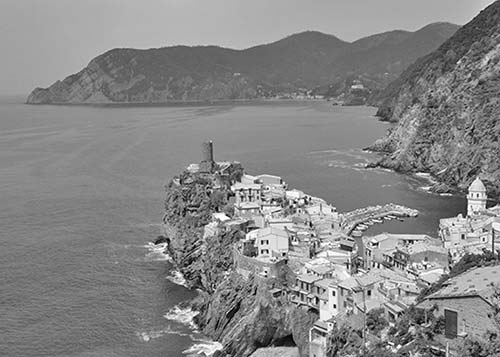
The trail toward Monterosso has the best light in the evening. From the harbor, you’ll hike up through the steep and narrow alleys before popping out on the trail above town. Follow this around the bluff, enjoying better and better views of Vernazza’s tidy pastel harbor. The views are fine before the ticket booth, but even better after—if you don’t want to buy a Cinque Terre park card, you can hike up here in the evening, after the park officially closes (typically around 19:00).
Hike to the Cemetery: To hike up to Vernazza’s sweet little cemetery, find the steep lane from the ravine at the top of town. From here, it’s a 20-minute hike to the top. You’ll find a peaceful world of lovingly tended family graves with stunning views over the Cinque Terre. Imagine the entire village sadly trudging up here during funerals. The cemetery is peaceful and evocative at sunset, when the fading light touches each crypt.
▲▲Madonna di Reggio Shuttle Bus Joyride and/or Hike
For a cheap and scenic joyride (50 minutes, €1.50), and a chance to chat about the region with the friendly drivers, ride the ATC shuttle bus, which loops about four times a day from the top of Vernazza to sanctuaries and hamlets high in the hills and back again (for times, check schedule posted at the bus stop, ask at the TI, or check online at www.atcesercizio.it). Look for the bus serving Madonna di Reggio and Fornacchi. Stay on for the full loop back to Vernazza, or get off at Madonna di Reggio and return downhill on foot.
Joyride: The bus ride is absolutely stunning, though it can be crowded. As you ride, you’ll see tiny hamlets and hillside terraces that go back a thousand years. You’ll switchback past chestnut trees, which historically provided wood for fuel and lumber, and chestnuts, which were ground to make a kind of flour in a land with no grain.
Hiking Down from Madonna di Reggio: For a delightful and easy (if steep) half-hour hike into Vernazza, ask the driver to let you out at the stop for Vernazza’s sanctuary, Madonna di Reggio.
First, walk two minutes below the bus stop to the sanctuary, which dates from 1248 and has a Romanesque facade. Inside the church, interesting votives (little ships and paintings of ships in angry seas given as tokens of thanks) fill the rear corner—gifts from sailors who survived storms and soldiers who survived wars. A volunteer staffs the church selling coffee, water, and snacks.
From here signs direct you to trail #508—the historic original trail down to Vernazza. You’ll be walking on thousand-year-old cobbles through abandoned olive groves and past the Stations of the Cross, which have inspired generations of processions trudging up from Vernazza. You may see a parked trenino, one of about 40 monorail mini-trains in the area that help farmers get their grapes from distant fields to their trucks.
You’ll descend through the cemetery, then either take the stairs down to the train station, or continue to the left down the lane to the square called Fontana Vecchia, where you caught the shuttle bus.
Beaches
The harbor’s sandy cove has sunning rocks and showers by the breakwater. The sunbathing lane directly under the church has a shower. A ladder on the seaside of the breakwater aids deep-water swimmers.
Boat Rides
In addition to the regularly scheduled big boats that depart from Vernazza’s harbor (see here), hiring your own boat can be handy for intertown transport. It’s also a great way to escape the crowds and get a different angle on Cinque Terre splendor. From Vernazza, figure around €50 one-way to sail to the other towns (for up to six passengers in an outboard). Or hire a boat for a one-hour sightseeing cruise of the entire Cinque Terre (about €150); one popular stop is the tiny acqua pendente (waterfall) cove between Vernazza and Monterosso, which locals call their laguna blu.
Some boat captains offer evening aperitivo cruises on a per-person basis. At Vernazza’s breakwater you’ll find Nord Est, run by Vincenzo (with help from Cesare), the best-established option (+39 338 700 0436, www.nordest-vernazza.it). Vernazza Water Taxi, run by Pietro, is another choice (+39 338 911 3869, www.vernazzawatertaxi.it).
Wine Tasting
Cantina Cheo, above the train station near the top of town, invites you in for afternoon tastings of its own wines—grown on the nearby hillside (€5, more for private tours, April-mid-Oct daily 14:30-18:30, closed off-season, Via Brigate Partigiane 1, +39 333 959 4758, www.cheo.it). Cinque Sensi, behind the train station, offers an assortment of wines with snacks (€15-25, Via Roma 71, daily 12:00-24:00, +39 338 766 7423).
Nightlife in Vernazza
A Little Taste of Opera
In summer, a pair of talented opera singers comes to Vernazza once or twice a week to perform with piano accompaniment in the town’s small oratory, a medieval building with fine acoustics (just up the steps from the church). Performances begin at 19:00 and last just over an hour—strategically timed to squeeze between a late-afternoon aperitivo on the harbor and a 20:30 dinner reservation (€25, June-mid-Oct Wed and Fri, April-May Fri only, book tickets at Cinque Terre Riviera office on the main street—see “Helpful Hints,” earlier).
The Bar Scene
Vernazza’s nightlife centers on the bars on its waterfront piazza and generally shuts down pretty early (nightspots are required to close by midnight). The Blue Marlin Bar dominates the scene with a mix of locals and tourists, good drinks, and an open piano. If you play piano, you’re welcome to join in. Ananasso Bar offers early-evening happy-hour fun and cocktails (aperitivi) that both locals and visitors enjoy. Its harborfront tables get the last sunshine of the day. For more on these bars, see their listings under “Eating in Vernazza,” later.
Sleeping in Vernazza
Vernazza lacks any real hotels, and almost all of my listings are affittacamere (private rooms for rent). I favor hosts who rent multiple rooms and have a proven track record of good communication (they speak just enough English, have email, and are reliable). Airbnb is really big in Vernazza.
Most places accept only cash, promise free Wi-Fi (often spotty), and don’t include breakfast unless noted. Some have killer views, and some come with lots of stairs. Expect noise at night: Trains tearing through, church bells (7:00-22:00), crashing waves, delivery vans in the upper town. Come to think of it, just pack earplugs.
Some places have all their beds in one building; others have rooms scattered all over town. Some have an informal reception desk (often at a restaurant or other business) where you can check in. Others have no reception at all. The Vernazza map in this book shows only the places that have a fixed address or reception office; if I mention “reception,” you’ll check in there.
If you overnight here, communicate your arrival time to your host and get clear instructions on where to meet and pick up the keys. They’ll usually offer to meet you at the train station if they know when you’re coming.
ROOMS FOR RENT (AFFITTACAMERE)
The Cinque Terre Riviera agency, based in Vernazza, rents rooms here and throughout the region (see here).
Scattered Through the Town Center
More Expensive, with More Amenities
$$$$ La Malà is the town’s jet-setter pad. Four crisp, pristine white rooms boast fancy hotel-type extras and a shared seaview terrace. It’s a climb—way up to the top of town—but they’ll carry your bags to and from the station. Book early; this place fills up quickly (includes breakfast at a bar, family rooms, air-con, +39 334 287 5718, www.lamala.it, info@lamala.it, charming Giamba and his mama, Armanda). They also rent two rooms at the simpler $ “Armanda’s Room” nearby—a great value, since you get Giamba’s attention to detail and amenities without paying for a big view (includes simple breakfast, air-con, www.armanda.it).
$$$$ Cinque Terre Vacation rents two luxury apartments (one- and two-bedroom, sleeping up to 6) that overlook the sea and town from private, spacious terraces. The light-filled, airy units come with sea breezes and a crashing-waves soundtrack. The apartments can be connected for even larger groups (air-con, fully equipped kitchens, 2-night minimum, climb steps up to Via Carattino 12 or Via Mazzini 17, +39 345 363 6118, www.cinqueterrevacation.com, ruth@cinqueterrevacation.com, run by helpful American-Italian Ruth and her family).
$$$ Nicolina Rooms consists of five rooms and two apartments in three different buildings. Two cheaper rooms are in the center over the pharmacy, up a few steep steps; another, pricier studio with a terrace is on a twisty lane above the harbor; and four more rooms are in a building beyond the church, with great views and church bells (all include breakfast, Piazza Marconi 29—check in at Pizzeria Vulnetia, +39 0187 821 193, +39 333 842 6879, www.camerenicolina.it, info@camerenicolina.it).
$$$ La Marina Rooms is run by hardworking Cristian, who speaks English and happily carries bags to and from the station. He rents a single, two doubles, and two apartments, all well-tended, airy, and renovated, most high above the main street, and most with sea views and air-con (+39 338 476 7472, www.lamarinarooms.com, mapcri@yahoo.it).
$$$ Monica Lercari rents several rooms with modern comforts, including one (more expensive) perched at the top of town with a seaview terrace (air-con, +39 0187 812 296, mobile +39 320 025 4515, monimarimax@gmail.com). Monica and her husband, Massimo, run the recommended Ristorante al Castello.
Simpler, Good-Value Places
$$ Francamaria and her husband Andrea rent 10 sharp, comfortable, and creatively renovated rooms near the harbor square, with relatively few stairs (family rooms, air-con, reception desk on the ground floor at Piazza Marconi 30, +39 328 711 9728, www.francamaria.com, francamariareservation@gmail.com). They also rent a room in Manarola.
$$ Vernazza Rentals offers several rooms, including a spacious and classy room on the harbor square, and a molto chic split-level apartment on a quiet side street (reception at Via Roma 27, +39 339 834 2486, mobile +39 338 117 6814, www.vernazzarentals.com, info@vernazzarentals.com).
$$ Vernazza Rooms, run by Massimo, rents 14 rooms: Four are above the Blue Marlin Bar looking down on the main street, and seven are a steep climb higher up, just under the City Hall (big family apartments, a few with air-con and others with fans, fridges in all rooms, arrange check-in time in advance and meet your host at Via del Santo 9, +39 351 918 3164, www.vernazzarooms.com, info@vernazzarooms.com).
$$ Lovely Rosa Vitali rents a four-person apartment with a kitchen; it’s across from the pharmacy overlooking the main street—and beyond the worst of the train noise (ring bell at Via Visconti 10—just before the tobacco shop near Piazza Marconi, +39 340 267 5009, www.rosacamere.it, rosa.vitali@libero.it).
$$ Maria Capellini rents two simple, clean rooms that face each other across the harbor. One is at ground level just steps from the beach, with a view; the other looks over a skinny street (fridge, fans, +39 347 441 3695, www.mariacapellini.com, mariacapellini@hotmail.it, kindly Maria and Giacomo, and son Gianni).
$$ Martina Callo’s four old-fashioned, spartan rooms overlook the harbor square; they’re up plenty of steps near the silent-at-night church tower. Two rooms have a sea view and cost more (family room, air-con in most rooms, ring bell at Piazza Marconi 26, +39 0187 812 365, mobile +39 329 435 5344, www.roomartina.it, roomartina@roomartina.it, Martina and her father, Giuseppe).
$$ Albergo Barbara rents eight tidy, Ikea-chic top-floor rooms overlooking the square with an attic communal lounge. Most have small windows and small views; view rooms are more expensive. It’s a good value in a nice location, run by Alessio and Alberto (cheaper rooms with shared bathroom, lots of stairs, reserve online with credit card but pay cash, Piazza Marconi 30, +39 0187 812 398, www.albergobarbara.it, info@albergobarbara.it).
$ Rooms Francesca offers one tidy room with sea views and air-con, and a two-bedroom apartment with fans. Both hide out in the steep streets just below City Hall (check in at Enoteca Sciacchetrà at Via Roma 19, +39 0187 821 112, mobile +39 339 191 2962, www.5terre-vernazza.it, moggia.franco@libero.it; Francesca and Franco).
$ Ivo Basso rents two tight but well-appointed rooms several flights of stairs above the main street (air-con, Via Roma 6, +39 333 477 5521, www.ivocamere.com, post@ivocamere.com).
More Options
If my recommendations above are full, try these:
$$ Capitano Rooms (3 rooms and 1 apartment several flights of stairs above main drag, fans; ask for Julia, Paolo, Edoardo, or Barbara at Trattoria del Capitano restaurant on main square at Piazza Marconi 21, +39 0187 812 201, www.tavernavernazza.com, info@tavernavernazza.com); $$ Eva’s Rooms (a single and a double on the main street, air-con, train noise, 2-night minimum, +39 334 798 6500 or +39 331 153 2035, www.evasrooms.it [URL inactive], evasrooms@yahoo.it, Rebecca and Maurizia); $$$ Manuela Moggia (3 apartments and 2 rooms, behind train station at Via Gavino 22 and on main square, +39 0187 812 397, mobile +39 333 413 6374, www.manuela-vernazza.com [URL inactive], info@manuela-vernazza.com).
In the Inland Part of Town
Above the Train Station: $$$$ Casa Cato offers five modern, tight but well-outfitted rooms, three with private balconies and two with a shared balcony, all overlooking the sea and town (RS%, air-con, fridge, expect some train noise, +39 334 123 8579, www.casacatocinqueterre.com, info@casacatocinqueterre.com, Lisa). They also rent an apartment in the center of town.
$$ Giuliano Basso’s four carefully crafted, well-appointed rooms form a cozy little compound with a common lounge and view terrace, straddling a ravine among orange trees. Giuliano—the town’s last stone-layer—proudly built the place himself. To reach this quiet retreat on the green hillside just above town and the train station, you’ll climb partway up the Corniglia footpath (2 rooms have air-con, more train noise than others; follow the main road up above the station, take the ramp up toward Corniglia just before Pensione Sorriso, follow the path, and watch for a sharp left turn—or ask Giuliano to meet you at the station; +39 333 341 4792, www.cameregiuliano.com, giuliano@cdh.it).
In the Ravine at the Top of Town: These practical options are a five-minute, gently uphill stroll behind the train station. While this functional zone is less atmospheric, it is easy to access (with fewer steep stairs). There’s no train or church-bell noise—the constant soundtrack is Vernazza’s gurgling river—but there can be traffic noise.
$$ Camere Fontanavecchia, run by Annamaria, is the best choice here, with eight bright and cheery rooms (three with terraces) overlooking the ravine and its rushing river (Via Gavino 15, +39 333 454 9371, www.cinqueterrecamere.com, m.annamaria@libero.it). She also rents an apartment.
$ La Rosa dei Venti (“The Compass Rose”), run by Giuliana Basso, houses three airy, good-value rooms in her childhood home, on the third floor of an apartment building (call to arrange meeting time, air-con, Via Gavino 19, mobile +39 333 762 4679, www.larosadeiventi-vernazza.it, info@larosadeiventi-vernazza.it).
GUESTHOUSE (PENSIONE)
$$$ Gianni Franzi, who owns a busy restaurant on the harbor square, runs the closest thing to a hotel in Vernazza. His 24 small rooms are in three buildings a hundred tight, winding stairs above the harbor square. Some rooms are funky and decorated à la shipwreck, with tiny balconies and grand sea views. The comfy, newer rooms lack views. All guests have access to a super-scenic cliff-hanging garden and panoramic terrace (where breakfast is served in season). Pick up your keys at the restaurant, but on Wednesday, when the restaurant is closed, call ahead to make other arrangements (RS%, closed Jan-Feb, Piazza Marconi 1, +39 0187 812 228, mobile +39 393 9008 155, www.giannifranzi.it, info@giannifranzi.it, Emanuele and Simona).
Eating in Vernazza
BREAKFAST
B&Bs in Vernazza provide B but no B. That’s kind of a blessing, as Vernazza has plenty of options, from full bacon and eggs (Blue Marlin and Capitano), to fresh pastries from a Sicilian bakery (Il Pirata), to coffee and a sweet roll on the harborfront (Ananasso), to any number of bakeries selling sweet and savory options to go. Here are your main options from the top of town to the harbor (in that order). Most of these places are also recommended in my lunch and dinner listings.
$ Il Pirata delle Cinque Terre, located in the workaday zone at the parking lot at the top of town, is playful, efficient, comfortable, and serves tasty breakfast bruschetta, frittatas, and an array of fresh pastries. The fun service of the dynamic duo Gianluca and Massimo (hardworking Sicilian twins, a.k.a. the Cannoli brothers) makes up for the lack of a view. They pride themselves on not serving bacon and eggs, since “this is Italy.” While the atmosphere feels more like suburban Milan, it has charisma (Fri-Wed 7:00-24:00, closed Thu, also serves lunch and dinner—see later, Via Gavino 36, +39 0187 812 047).
$$ Blue Marlin Bar (midtown, just below the train station) serves a good array of clearly priced à la carte breakfast items (Italian breakfast from 7:00, eggs and bacon 8:30-11:30). If you’re awaiting a train and the platform isn’t crowded, it’s pleasant to have a seat at Blue Marlin’s outdoor seating with a drink in view of the tracks (Thu-Tue 7:00-23:00, closed Wed).
$ Lunch Box is the hardworking new kid on the block, with lots of hot options and a fun little perch for a couple of tables overlooking the main drag (daily 7:00-22:00, also serves lunch and dinner—see later, Via Roma 34, +39 338 908 2841, Stefano).
$$ Trattoria del Capitano offers outdoor seating on the harbor, as well as cozy spots inside the restaurant and a full menu (Wed-Mon 8:00-22:00, closed Tue, on Piazza Marconi, +39 0187 812 201, hardworking Paolo and Barbara speak English).
$$ Ananasso Bar has a youthful energy, a great location right on the harbor, and a skimpy Italian breakfast menu (toasted panini, pastries, Muesli with yogurt, and cappuccino). You can eat a bit cheaper at the bar (you’re welcome to picnic on the nearby bench or seawall rocks with a Mediterranean view) or enjoy the best-situated tables in town (Fri-Wed 8:00-late, closed Thu, on Piazza Marconi).
Picnic Breakfast: Drop by one of Vernazza’s many little bakeries, focaccia shops, or grocery stores to assemble a breakfast to eat on the breakwater. Top it off with a coffee in a nearby bar.
LUNCH AND DINNER
Vernazza’s restaurants work hard to win your business. Wander around at about 20:00 and compare the ambience. If you dine in Vernazza but are staying in another town, check train schedules before sitting down to eat, as evening trains run less frequently, with gaps in the schedule. To get an outdoor table on summer weekends, reserve ahead. Harborside restaurants and bars are easygoing. You’re welcome to grab a cup of coffee or glass of wine and disappear somewhere on the breakwater, returning your glass when you’re done.
Harborside
$$$ Gianni Franzi is an old standby for well-prepared seafood and pastas. Emanuele, Lorenzo, and their crew provide steady, reliable, and friendly service. The outdoor seating is partially tucked under an arcade, while the indoor setting is big, open, and classy. The cucina tipica Vernazza page of their menu showcases local specialties (Thu-Tue 12:00-15:00 & 19:00-22:00, closed Wed, +39 0187 812 228).
$$ Trattoria del Capitano feels unpretentious and serves a short menu of straightforward local dishes, including spaghetti allo scoglio—pasta entangled with various types of seafood (for hours and location, see “Breakfast,” earlier).
$$$ Ristorante Pizzeria Vulnetia has a nautical, jovial atmosphere and is proud of its locally sourced ingredients. Unlike the others, it also dishes up thin-crust pizzas—making this a good choice for a group with differing tastes, those on a budget, and families (Tue-Sun 12:00-22:00, closed Mon, Piazza Marconi 29, +39 0187 821 193, Tullio and Federica).
$$$ Ristorante Luca serves seafood dishes at a roofed-over circle of tables right on the breakwater—a memorable spot (Sat-Thu 11:30-22:00, closed Fri, +39 0187 812 113, Luca and Andrea).
$$$$ Gambero Rosso rounds out the options on the harbor. Long the top restaurant in town, today it’s lost its edge (it was sold to a big-city restaurateur who runs it from afar). Still, it’s reliably good, and has a fine interior and great outdoor tables (Fri-Wed 12:00-15:00 & 19:00-22:00, closed Thu and Dec-Feb, Piazza Marconi 7, +39 0187 812 265).
Above the Harbor, by the Castle
$$$$ Ristorante Belforte is a cut above the rest, serving a fine blend of traditional and creative cuisine, fishy spaghetti alla Bruno, trofie al pesto (hand-rolled noodles with pesto), and classic antipasto misto di pesce—an assortment of fish on five small plates (€25/person; 2-person minimum). Enter from the breakwater; a rope leads up stairs to a web of tables embedded in four levels of the old castle. While their indoor seating is great, for the ultimate seaside perch, reserve a table on the terrazza con vista (view terrace) or request the “lovers’ table” on its own little terrace. Most of Belforte’s seating is outdoors—if the weather’s bad, the interior can get crowded. Late in the evening, Andrea cranks up the fun (Wed-Mon 12:00-15:00 & 19:00-22:00, closed Tue and Nov-March, +39 0187 812 222, Michela).
$$$ Ristorante al Castello is a homey seafood restaurant on a covered terrace just below the castle, with commanding views out to sea (to reward your climb). It’s run by gracious, English-speaking Monica and her husband Massimo, who are proud of their €30 mixed grilled-fish plate (which two or even three can split) and their trofie al pesto. Reserve one of the dozen romantic cliffside seaview tables for two—some of the tables snake around the castle, where you’ll feel like you’re eating all alone with the Mediterranean. Monica offers a free sciacchetrà or limoncello with biscotti with this book by request (Thu-Tue 12:00-15:00 & 19:00-22:00, closed Wed and Nov-April, +39 0187 812 296).
Near the Train Station
These places have no harbor ambience but are pleasing and slightly cheaper.
$$ Trattoria da Sandro, on the main drag, mixes quality Genovese and Ligurian cuisine with friendly service and can be a peaceful alternative to the harborside scene. The family proudly maintains its cultural traditions and dishes up award-winning stuffed mussels (Wed-Mon 12:00-15:30 & 18:30-22:00, closed Tue, Via Roma 62, +39 0187 812 223, Argentina and Alessandro).
$$ Antica Osteria il Baretto is another solid bet for homey, reasonably priced traditional cuisine, run by Simone and Jenny. As it’s off the harbor and less glitzy than the others, it’s favored by locals who prefer less noisy English while they eat great homemade fare. Sitting deep in their interior can be a tranquil escape (Tue-Sun 12:00-22:00, closed Mon, indoor and outdoor seating in summer, Via Roma 31, +39 0187 812 381).
Other Eating Options
$$ Blue Marlin Bar, on the main street, busts out of the Vernazzan cuisine rut with a short, creative menu of more casual dishes (pizzas, salads). It’s a good choice if you want to grab something basic rather than dine (for more details and hours, see “Breakfast,” earlier).
$$ Il Pirata delle Cinque Terre, a huge hit for breakfast, also attracts travelers for lunch and dinner. While you’re eating facing a parking lot, the food, service, and energy are great. And many are charmed by the Cannoli twins, who entertain while they serve. The menu (pastas and salads) is aimed squarely at American tourists’ taste buds (lunch from 12:00, reserve ahead for dinner from 18:00, good cannoli and Sicilian slushies, at the top of town; for more details and contact info, see “Breakfast,” earlier). The self-serve laundry is next door for those who like to multitask.
$ Lunch Box serves panini, salads, and fresh fruit juices from a clever and flexible menu. Assemble your own salad (or juice) from a long list of ingredients (for hours and location, see “Breakfast,” earlier).
$ Pizzeria da Ercole dishes out pies cheap and fast on simple tables right in the busy center of town (or to take away). More tables are in a humble little secret terrace hiding in the back, where tour guides go to escape their groups (daily, Via Visconti 34, +39 338 771 3844).
Pizzerias, Sandwiches, and Groceries: Vernazza’s main-street eateries offer a fine range of quick meals. Several bakeries and creative little takeaway joints sell sandwiches and pizza by the slice. Pino’s grocery store at Via Visconti 19 makes inexpensive sandwiches to order (daily 8:00-13:00 & 17:00-19:30 except closed Sun evening). There’s a Coop grocery at Via Roma 39 (next to the Blue Marlin Bar).
Gelato: The town has plenty of good gelato shops. On the harbor, the aptly named Gelateria Il Porticciolo (“Marina”) uses fresh ingredients to create intense flavors (try their cannella—cinnamon, or nocciola—hazelnut). Gelateria Vernazza, near the top of the main street, takes its gelato seriously, occasionally flirting with creative ingredients (soy) and flavors (riso—rice, and ricotta and fig). Gelateria Amore Mio (midtown) used to be Gelateria Stalin, founded in 1968 by a pastry chef with that unfortunate name; now it’s run by his niece Sonia and nephew Francesco, with great people-watching tables.
Corniglia
If you think of the Cinque Terre as the Beatles, Corniglia is Ringo. This tiny, sleepy town is the only one of the five not directly on the water. According to legend, the town was originally settled by a Roman farmer who named it for his mother, Cornelia (which is how Corniglia is pronounced). Locals claim that its ancient residents produced a wine so widely exported that vases have been found at Pompeii stamped with the town name. Wine remains Corniglia’s lifeblood today. Sample some when you’re in town.
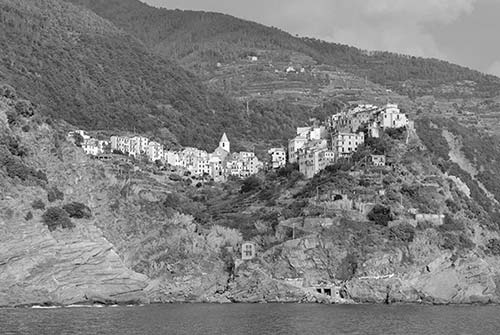
Less visited than the other Cinque Terre towns, Corniglia has fewer tourists, cooler temperatures, a laid-back main square, a few restaurants, a windy overlook on its promontory, and plenty of private rooms for rent. You don’t go to Corniglia for the beach: Its once fine beach below the station has washed away. From the town center, signs for al mare or Marina point to where a stepped path leads steeply down to sunning rocks.
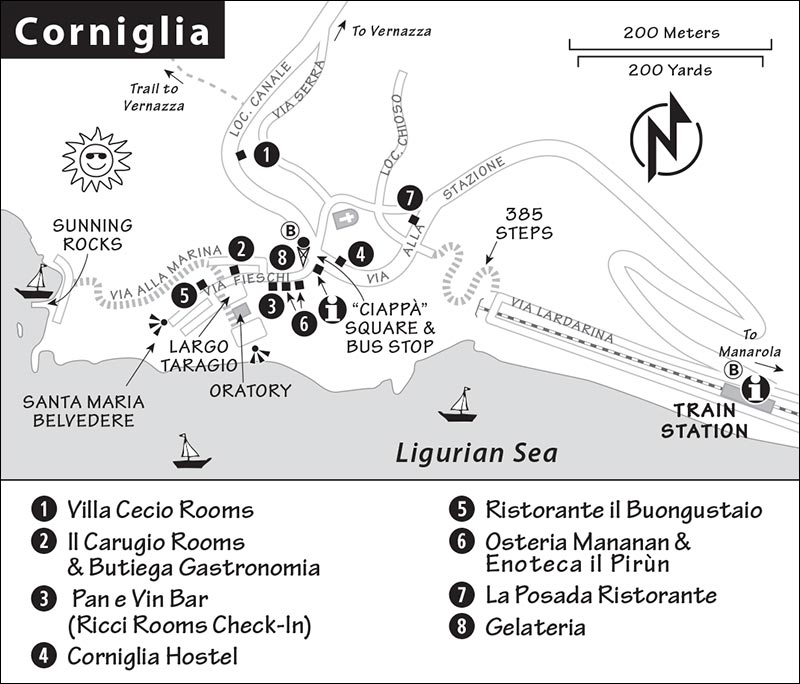
Orientation to Corniglia
Hill-capping Corniglia is connected with its train station far below by a long set of stairs, and much easier, by a hardworking little shuttle bus. Its reliable schedule is posted both at the station and in the town. Because of the steep distance between the town and its station, and the lack of a boat dock, Corniglia is inconvenient as a home base for town-hopping.
Tourist Information: A park information office is down at the train station (daily 8:30-18:30, shorter hours off-season). At busy times, there may also be a kiosk up in town on Ciappà square.
Hiking: From Corniglia, you can hike on the coastal trail to Vernazza. Also consider the challenging but rewarding “high road” to Manarola via Volastra. For details, see “Hiking the Cinque Terre” on here.
ARRIVAL IN CORNIGLIA
By Train: From the station far below town, a footpath zigzags up 385 steps (and nearly that many switchbacks) to the town in about 20 minutes. If you’d rather not walk, hop on the tiny ATC shuttle that connects the station with Corniglia’s Ciappà square, the starting point of my short self-guided walk (€1.50, buy tickets at park office—or €2.50 from driver, covered by park passes; departs about every 15 minutes from 8:00-20:00, get in line promptly as buses fill quickly).
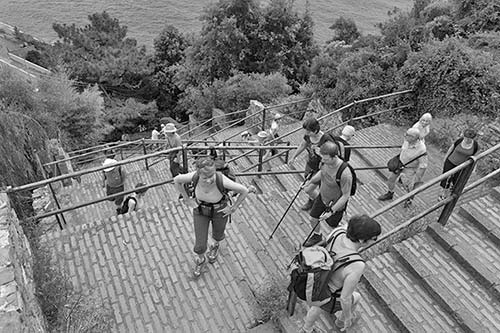
If leaving Corniglia by train, either walk down or review the shuttle schedule to plan your return to the station.
By Car: Only residents can park on the main road between the recommended Villa Cecio and the point where the steep switchback staircase meets the road. Beyond that area, anyone can park for a fee. All parking areas are within an easy and fairly level walk from the town center.
Corniglia Walk
We’ll explore this tiny town—population 240—and end at a scenic viewpoint. This self-guided walk might take 30 minutes or more...but only if you let yourself browse, sample the wine, or lick a gelato cone.
• Begin at the upper shuttle bus stop, on...
Ciappà Square
The gateway to this community is Ciappà square, with the bus stop, an ATM, old wine press, and sometimes a TI kiosk in summer. The Cinque Terre’s designation as a national park sparked a revitalization of the town.
• Look for the arrow pointing to the centro. Stroll along Via Fieschi, the spine of Corniglia. In the fall, the smell of grapes (on their way to becoming wine) wafts from busy cellars. Along this main street, you’ll see...
Corniglia’s Enticing Shops
As you enter Via Fieschi, a trio of neighboring gelato shops jockeys for your business. My favorite is the last one you come to (at #74, on the right), Alberto’s Gelateria (open late). Before ordering, get a free taste of Alberto’s miele di Corniglia, made from local honey; he and Cristina are also proud of their basil flavor. Their lemon slush (granita) takes pucker to new heights.
Farther along, located in a cool cantina on the left, Enoteca il Pirùn is named for a type of oddly shaped old-fashioned wine pitcher designed to aerate the wine and give the alcohol more kick as you squirt it into your mouth (Via Fieschi 115). Try some local wines (small tastes generally free, €3/glass). If you order wine to drink from the pirùn, Mario will give you a bib. While this is a practicality (rookies tend to dribble), it also makes a nice souvenir.
Farther along, Butiega Gastronomia (#142) is an old-fashioned grocery store/deli where Simone sells organic local specialties (daily 8:00-20:00). For picnickers, they offer made-to-order ham-and-cheese sandwiches and a fun antipasti misti (priced by weight). He also prepares pesto and other specialties daily in the shop’s tiny kitchen. You’ll find good places to picnic farther along on this walk.
• Following Via Fieschi, you’ll end up at the mellow...
Main Square (Largo Taragio)
On the main square, tables from two bars and a trattoria spill around a WWI memorial and the town’s old well. It once piped in natural spring water from the hillside to locals living without plumbing. What looks like a church is the Oratory of Santa Caterina. (An oratory is a kind of spiritual clubhouse for a service group doing social work in the name of the Catholic Church.) Up the stairs and behind the oratory, you’ll find a terrace that children have made into a soccer field. The stone benches and viewpoint make this a peaceful place for a picnic (less crowded than the end-of-town viewpoint, described next).
Opposite the oratory, notice how steps lead steeply down Via alla Marina, taking you in 5 minutes to sunning rocks and a small deck (with a shower and treacherous entry into the water).
• From the square, continue up Via Fieschi to the...
End-of-Town Viewpoint
The Santa Maria Belvedere, named for a church that once stood here, marks the scenic end of Corniglia. This is a super picnic spot. From here, look high to the west (right), where the village and sanctuary of San Bernardino straddle a ridge (accessible by shuttle bus or a long uphill hike from Vernazza). Way down below are the local swimming hole and huge sunning rocks.
Sleeping in Corniglia
Because Corniglia has no harbor, its mostly humble accommodations are almost never full.
$$ Villa Cecio (pronounced “chay-choh”), sits atop the old-time Ristorante Cecio (with great views). They offer eight freshly decorated, well-priced, sizeable rooms on the quiet outskirts of town. Most rooms have postcard views, and three have terraces—worth requesting when you book. All rooms share a big rooftop view terrace (breakfast extra, four rooms have air-con, on main road toward Vernazza at Via Serra 58—keep going 200 yards beyond Ciappà square and you’ll find it on the right, +39 0187 812 043, mobile +39 351 566 3661, www.cecio5terre.com, cecio5terre@gmail.com, Cristina and Valentina). They also rent eight more rooms in an annex on the square where the bus stops.
$$ Il Carugio has six modern, fresh, sunny rooms, and a communal rooftop terrace with a commanding view of the coast. Five of the rooms have a kitchen (2-night minimum, family rooms, air-con, no breakfast, free parking, free self-serve laundry, +39 0187 812 293, mobile +39 339 228 3803 or +39 338 112 6504, www.ilcarugiodicorniglia.com, info@ilcarugiodicorniglia.com, Lidia and Giulia). They also have four more rooms, with breakfast included, in another building.
$ Cristiana Ricci rents three small, clean, and peaceful rooms—one with a terrace and sweeping view—just inland from the bus stop (family rooms, check in and breakfast at Pan e Vin bar at Via Fieschi 123, +39 338 937 6547, www.corniglia-room.com, cri_affittacamere@virgilio.it). She also rents three big, modern apartments.
¢ Corniglia Hostel, the town’s former schoolhouse, rents 24 beds in a yellow municipal building up some steps from the square where the bus stops (find the entrance at the back of the building). Despite its institutional atmosphere, the hostel’s prices, central location, and bright, clean rooms ensure its popularity. Its hotelesque double rooms are open to anyone (breakfast extra, office open 15:00-20:00, free lockers when office closed, air-con, self-serve laundry, Via alla Stazione 3, +39 0187 812 559, www.ostellocorniglia.com, ostellocorniglia@gmail.com, Alessandro).
Eating in Corniglia
A typical array of pizzerias, focaccerie, and alimentari (grocery stores) line the narrow main drag. I’ve highlighted a few places for a quick bite on my self-guided walk, earlier.
For a full, sit-down meal, consider one of these restaurants.
$$$ Ristorante il Buongustaio is a good bet for dinner on the square. Daniela and the Guelfi family pride themselves in serving cucina casalinga (home cooking) and good seafood pasta and risotto (nice tables on the main square as well as in a big indoor dining room, daily 12:00-21:15, Via Fieschi 164, +39 0187 821 424).
$$ Osteria Mananan—between the Ciappà bus stop and the main square at Via Fieschi 117—has earned a good reputation with tasty dishes and a small, stony, elegant interior (Wed-Mon 12:30-14:30 & 19:00-22:30, closed Tue, no outdoor seating, +39 0187 821 166, Agostino).
$$ Enoteca il Pirùn, on Via Fieschi, has a small restaurant above the wine bar, where Mario serves typical local dishes (Fri-Wed 12:00-16:00 & 19:00-23:30, closed Thu, +39 0187 812 315).
$$ La Posada Ristorante serves seafood in a tree-shaded garden overlooking the sea and in a modern interior. It’s at the top of the stairs that lead down to the station, just outside the old center (daily 12:00-16:00 & 19:00-23:00, +39 333 454 2113).
Manarola
Mellow Manarola fills a ravine, bookended by its wild little harbor to the west and a diminutive hilltop church square inland to the east. Manarola is exceptional for being unexceptional: While Vernazza is prettier, Monterosso glitzier, Riomaggiore bigger, and Corniglia more rustic, Manarola hits a fine balance, giving it the “just right” combination of Cinque Terre qualities. Perhaps that’s why it’s a favorite among savvy Europeans seeking a relatively untrampled home base. The touristy zone squeezed between the cement-encased train tracks and the harbor can be stressfully congested, but head just a few steps uphill and you can breathe again.
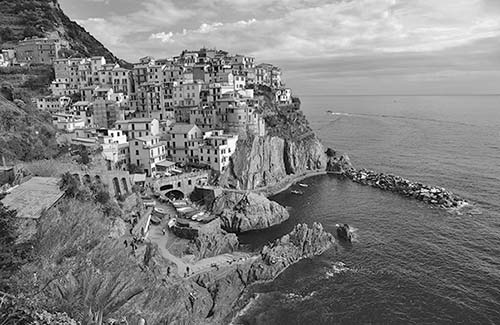
Manarola, whose hillsides are blanketed with vineyards, also provides the easiest access to the Cinque Terre’s remarkable dry-stone terraces. The trail ringing the town’s cemetery, on the peninsula north of the main harbor, affords some of the most strikingly beautiful town views anywhere in the region. Follow my gentle self-guided stroll from the harbor up through town, then through vineyards, to this stunning Mediterranean viewpoint.
Orientation to Manarola
TOURIST INFORMATION
The TI/national park information office is in the train station (daily 8:30-19:30, shorter hours off-season).
ARRIVAL IN MANAROLA
By Train: From the station, to reach the town, you’ll walk through a 200-yard-long tunnel that’s lined with interesting photos. (During WWII air raids, these tunnels provided refuge and a safe place for rattled villagers to sleep.) To reach the busy harbor—with touristy restaurants, boat dock, and the start of my self-guided walk, head left (downhill) when you come out of the tunnel.
The ATC shuttle bus runs from near the old waterwheel (halfway up Manarola’s main street), stopping first at the parking lots above town, and then going all the way up to Volastra (about 2/hour except for afternoon breaks).
By Car: If you’re overnighting here, ask your hotelier for parking advice. Park your car in one of the two pay lots just before town, then walk down the road to the church; from there, it’s an easy downhill walk to the main piazza, train-station tunnel, and harbor (the start of my self-guided walk), or you can wait for the shuttle bus.
Manarola Walk
From the harbor, this 45-minute self-guided walk shows you the town and surrounding vineyards and ends at a fantastic viewpoint.
• Start down at the waterfront. Belly up to the wooden banister overlooking the rocky harbor, between the two restaurants.
Harbor
Manarola is tiny and picturesque, a tumble of buildings bunny-hopping down its ravine to the fun-loving waterfront. The breakwater—which attempts to make this jagged harbor a bit less dangerous—was built (with reject marble from Carrara) just over a decade ago. Notice how the I-beam crane launches boats (which must be pulled ashore when bad weather is expected, to avoid being smashed or swept away).
Facing the water, look up to the right, at the hillside Punta Bonfiglio cemetery and park. The trail running around the base of the point—where this walk ends—offers magnificent views back on this part of town. If you see a crowd, it’s Instagram devotees who travel here from around the world (mostly Asia) to take and post their selfies.
The town’s swimming hole is just below you. Manarola has no sand but offers the best deep-water swimming in the area. The first “beach” has a shower, ladder, and wonderful rocks. The second has tougher access and no shower but feels more remote and pristine (follow the paved path toward Corniglia, just around the point).
• Go inland up the town’s main drag. You’ll climb a concrete ramp lined by classic photos and quotes from Manarola’s history. The ramp leads to Manarola’s “new” square, which covers the train tracks, and is called...
Piazza Capellini
Built in 2004, this square is an all-around great idea, giving the town a safe, fun zone for kids. Locals living near the tracks also enjoy a little less train noise. The mosaic in the middle of the square depicts the varieties of local fish in colorful enamel.
• Go down the stairs at the upper end of the square. On your right, notice the tunnel that leads to Manarola’s train station (and the closed Via dell’Amore trailhead). Head up...
Via Discovolo
Manarola’s main street twists up through town, lined by modest shops and filled with pooped hikers. About 100 yards up, just before the road bends sharply right, watch (on the right) for a waterwheel. One possible origin of the town’s name is that it’s local dialect for “big wheel.” A waterwheel like this once powered local industry. As you continue up (all the way to the church), you’ll still hear the rushing waters of Manarola’s stream. Like those in Riomaggiore, Monterosso, and Vernazza, Manarola’s rivulet was covered over after World War II. Before that time, romantic bridges arched over its ravine. You can peek below the concrete street in several places to see the stream surging below your feet.
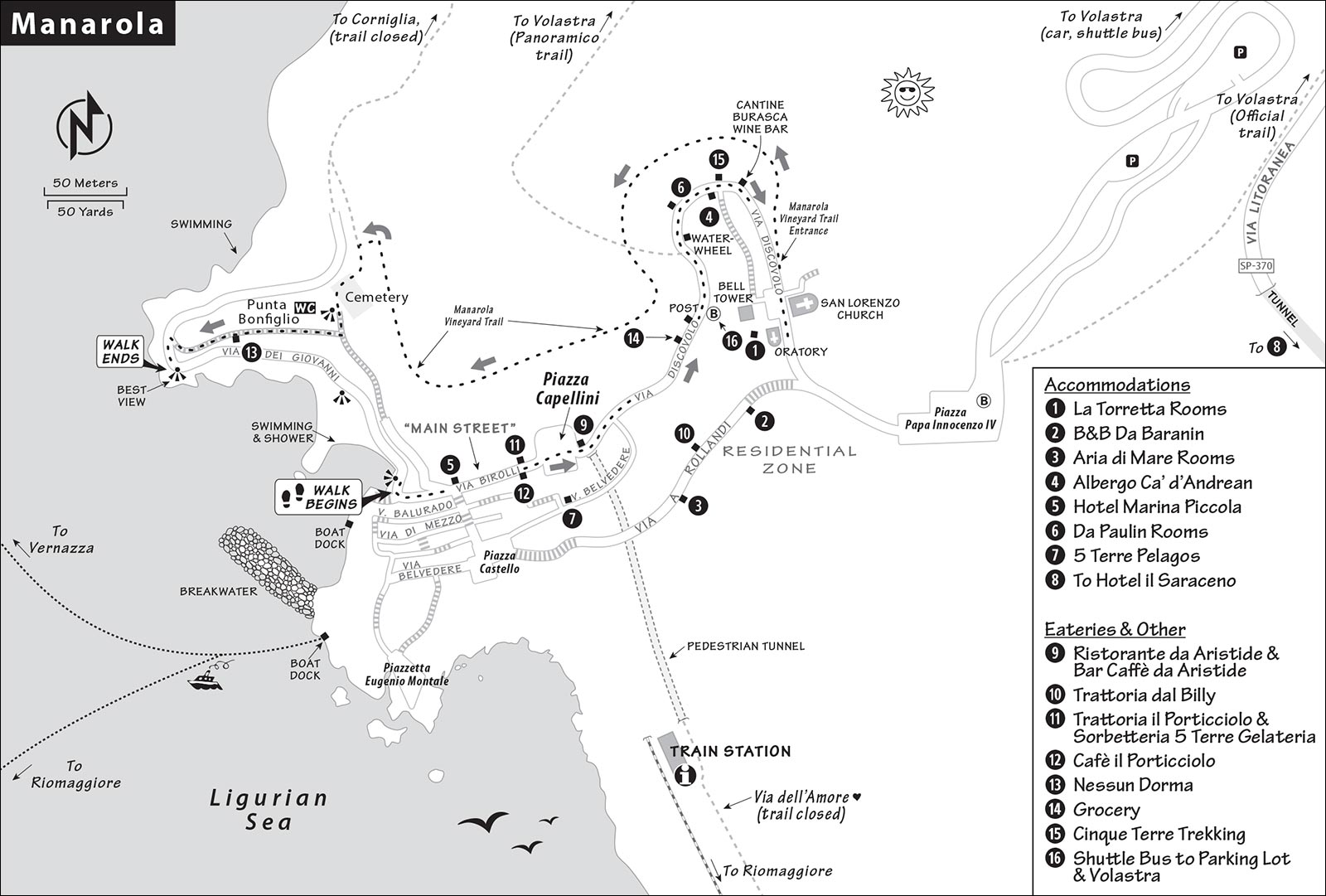
Across the street from the waterwheel and a bit farther up, notice the Cinque Terre Trekking shop on your left, which outfits hikers with both information and gear (for details, see “Hikes from Manarola,” later).
Around the corner is the Cantine Burasca wine bar. With fine outdoor-only seating, it’s a good place for a little wine tasting (closed in bad weather, Via Discovolo 86, +39 339 807 1261).
• Keep climbing until you come to the square at the...
Top of Manarola
The square is faced by a church, an oratory—now a religious and community meeting place—and a bell tower (with a WWI memorial etched in it), which served as a watchtower when pirates raided the town (the cupola was added once the attacks ceased). To the right of the oratory, a stepped lane leads to the town’s sizable, less-touristy residential zone.
Check out the church. The Parish Church of St. Lawrence (San Lorenzo) dates from “MCCCXXXVIII” (1338). Step inside to see two altarpiece paintings from the unnamed Master of the Cinque Terre, the only painter of any note from this region (left wall and above main altar). While the style is Gothic, the work dates from the time of Michelangelo, long after Florence had entered the Renaissance. Note the humble painted stone ceiling, which replaced the wooden original in the 1800s. It features Lawrence, patron saint of the Cinque Terre, with his grill, the symbol of his martyrdom (he was roasted on it).
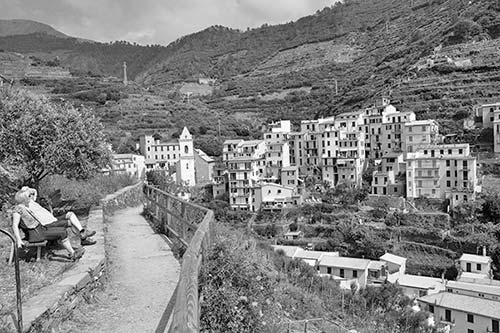
• With the bell tower on your left, head about 20 yards back down the main street below the church and find a wooden railing on the right, just before the Cantine Burasca wine bar, signposted as trail #502C. It marks the start of a delightful stroll around the high side of town and back to the seafront. This is the beginning of the...
Manarola Vineyard Trail
Don’t miss this fun, short walk. Simply follow the wooden railing, enjoying lemon groves and great views. Along the path, which is largely flat, you’ll get a close-up look at the region’s famous dry-stone walls and finely crafted vineyards (with dried-heather thatches to protect the grapes from southwest winds). Smell the rosemary. Study the structure of the town, and pick out the scant remains of an old fort. Notice the S-shape of the main road—once a riverbed—that flows through town. The town’s roofs are traditionally made of locally quarried slate and held down by rocks during windstorms.
Halfway along the lip of the ravine, a path marked Panoramico Volastra (Corniglia) leads steeply up into the vineyards (a challenging route that leads to the tiny hamlet of Volastra and then to Corniglia—described on here).
Stay on the level path, passing a variety of simple wooden religious scenes, the work of local resident Mario Andreoli. Before his father died, Mario promised him he’d replace the old cross on the family’s vineyard. Mario has been adding figures ever since. On religious holidays, everything’s lit up: the Nativity, the Last Supper, the Crucifixion, the Resurrection, and more. Some of the scenes are left up year-round. (You can see more of his figures across the ravine, gathered together in a little open patch between buildings.) High above, notice ancient terraces that line the terrain like a topographic map.
• Continue on the trail as it winds down to the cemetery (sometimes closed, but at least stop by the gate for a peek inside).
Cemetery
Ever since Napoleon—who was king of Italy in the early 1800s—decreed that cemeteries were health risks, Cinque Terre’s burial spots have been located outside the towns. The result: The dearly departed generally get first-class sea views. Each cemetery—with evocative photos and finely carved Carrara marble memorial reliefs—is worth a look. Manarola’s is a little lower down and easier to walk to than the others.
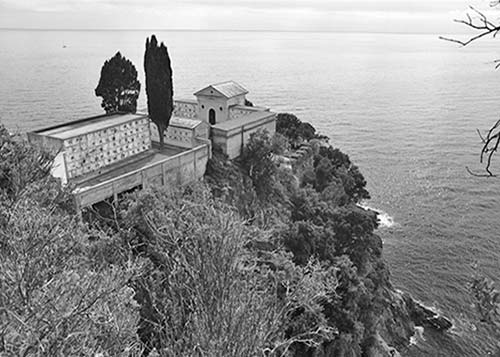
In cemeteries like these, the real estate is similar to that for the living: The wealthy get their own piece of land (a grave), regular people get the equivalent of a condo (with their remains parked in a niche called a loculus), and the poor and forgotten end up tossed in a communal ossuary. Because of the tight space, spots are rented and a person’s remains are allowed to stay only as long as their loved ones care enough to pay the rent. (No rent means you end up in the ossuary, making room for the newly dead with family willing to pay.) Traditionally, locals make weekly visits to loved ones here, often bringing flowers. The rolling stepladder makes access to top-floor loculi easy.
• From the cemetery follow the steep and narrow stairs (through the green gate immediately below the cemetery) and walk out onto the bluff.
Punta Bonfiglio
This point offers some of the most commanding views of the entire region. To find the best vantage point, walk out toward the water through a park (playground, drinking water, WC, and picnic benches). An inviting and recommended bar, Nessun Dorma, fills a long narrow terrace with people enjoying the vista.
Your Manarola finale is the bench at the tip of the point. (It’s often congested with travelers taking photos from this point for their Instagram bucket lists.) Pause and take in the view.
• From here steps go down and the path winds scenically back to the harbor, where we started.
Experiences in Manarola
Hikes from Manarola
The coastal trail from Manarola—leading to Corniglia in one direction and to Riomaggiore in the other (the famous Via dell’Amore)—has been closed for years due to landslides. But you can still enjoy hiking from here. One of my favorite easy hikes is the vineyards trail outlined just above in my “Manarola Walk.”
For a longer hike, consider taking the high route to Corniglia via Volastra (much easier if you ride the shuttle bus up to Volastra). For details, see “Hiking the Cinque Terre” on here.
Hiking Gear and Tips: A wonderful resource for hikers, Cinque Terre Trekking is near the top of the main street (halfway up to the church). Christine (from Minnesota) and Nicola are generous with hiking advice, and fill their shop with all the gear you may need: boots, clothes, walking sticks, maps, and more. If you’re serious about hiking, stop in here to confirm your plans and to gear up (daily 11:00-13:00 & 14:00-19:00, shorter hours off-season, Via Discovolo 108, +39 0187 920 834, www.cinqueterretrekking.com, info@cinqueterretrekking.com).
Pesto Making
Entrepreneurial Simone at the Nessun Dorma cantina (perched next to the cemetery at the most scenic edge of Manarola) leads a pesto-making workshop for up to 30 people at 10:30, followed by lunch at noon. The setting is unforgettable, making pesto in the place of its origin is exciting, and you get to eat what you make plus a tagliere plate of cold cuts (€60/person, includes wine, no class on Tue, reserve ahead at www.nessundormacinqueterre.com or call +39 340 888 4133, class cancelled in bad weather).
Tours
Arbaspàa arranges vineyard wine tastings, cooking classes (6-person minimum), fishing trips, paragliding, rock climbing, and more (see website for options and book in advance, www.arbaspaa.com; or visit office at Via Discovolo 204, daily 9:00-19:00, +39 0187 760 083).
Boat Rides
To get to the dock and the boats that connect Manarola with the other Cinque Terre towns, find the steps to the left of the harbor view—they lead down to the ticket kiosk. Continue around the left side of the cliff (as you’re facing the water) to catch the boats.
Sleeping in Manarola
Manarola has some of the most appealing, well-run accommodations in the region (rivaling Monterosso’s). Like the others, it also has plenty of private rooms (Airbnb has consumed the market). If you need breakfast, the recommended Bar Caffè da Aristide is your best choice. Otherwise grab a coffee and croissant along the main drag.
IN THE RESIDENTIAL ZONE ABOVE THE CHURCH
This area is a 10-minute steeply uphill hike from the train station—just huff up the main drag to the church. All are within a five-minute walk from there.
$$$$ La Torretta offers 16 trendy, upscale rooms (most with private deck) that cater to an elite clientele. Probably the most elegant retreat in the region, this peaceful refuge has all the comforts for those happy to pay, including a communal hot tub with a view. Guests enjoy a complimentary snack and glass of prosecco on arrival, an ample breakfast buffet, and stocked minibars. Each chic room is distinct (top-end family suite, book several months in advance, closed Dec-March; on Piazza della Chiesa beside the bell tower at Vico Volto 20, +39 0187 920 327, www.torrettas.com, torretta@cdh.it, Gabriele).
$$$ B&B Da Baranin, with eight good rooms and one apartment, is a bit too pricey but has sleek modern style and a nice breakfast terrace (family rooms, air-con, Via Aldo Rollandi 29, +39 0187 920 595, www.baranin.com, info@baranin.com).
$$ Aria di Mare Rooms rents four sunny, tidy, well-equipped rooms and two apartments a few steps beyond Trattoria dal Billy at the very top of town. While it’s a steep hike up (high above the tourists), this is an excellent value. Three rooms and the two apartments have spacious terraces, and all can enjoy the knockout views from lounge chairs in the front yard (RS% with 4-night stay, no breakfast but tea/coffee service in room, air-con, up the stairs at Via Aldo Rollandi 149, +39 349 058 4155, www.ariadimare.info, info@ariadimare.info, Maurizio; ask at Billy’s if no one’s home).
ON OR NEAR THE MAIN STREET
These options line up along (or near) the main street, between the harbor and the church. While in a less atmospheric area than those near the church, they’re closer to the station—and therefore a bit handier for those packing heavy.
$$$ Albergo Ca’ d’Andrean is quiet, comfortable, and chic. It has 10 big, sunny, tranquil rooms, with lots of tile. Public spaces artfully display family artifacts, and the cool garden oasis comes complete with lemon trees. If you don’t mind stairs, consider one of their pricier top-floor rooms, with great terrace views (breakfast extra, air-con, up the hill at Via Discovolo 101, +39 0187 920 040, www.cadandrean.it, info@cadandrean.it, Simone, Ariana, and Nicola).
$$$ Hotel Marina Piccola offers 12 simple, stylish rooms near the bustle of the square on the water (some with sea views). Though low on character, it’s well run and handy to the harbor area (breakfast extra, air-con, Via Birolli 120, +39 0187 920 770, www.hotelmarinapiccola.com, info@hotelmarinapiccola.com, Jessica and Micaela).
$$ Da Paulin, run by charming Donatella (who makes a mean limoncello) and Eraldo (the town’s retired policeman), has three surprisingly modern, fresh, well-equipped, hotelesque rooms with a large and inviting common living room. They also rent three apartments (with fans). This fine value is at the bend in the main street, a five-minute hike above the train tracks (breakfast extra, air-con, Via Discovolo 126, +39 334 389 4764, www.dapaulin.it, prenotazioni@dapaulin.it).
$$ 5 Terre Pelagos has eight pastel, shabby-chic rooms in two buildings. Four are at Via Belvedere 58, an awkward building down a side lane. Built into the side of the mountain, the common room has a caveman ambience, but some rooms come with view terraces. The other rooms are more steeply uphill near the church, at Via dei Mulini 26—confirm which building you are in when you book (air-con, +39 335 122 6490, www.5terrepelagos.com, info@5terrepelagos.com, Edoardo).
HIGH ABOVE MANAROLA, IN VOLASTRA
$$ Hotel il Saraceno, with seven spacious, utilitarian rooms, is a deal for drivers. Located above Manarola in the tiny town of Volastra (chock-full of vacationing Germans and Italians in summer), it’s serene, clean, and right by the shuttle bus to Manarola (includes breakfast, free parking, air-con, +39 0187 760 081, www.thesaraceno.com, hotel@thesaraceno.com, friendly Antonella).
Eating in Manarola
Touristy restaurants are concentrated between Piazza Capellini and the harbor. For finer dining, consider one of the following choices.
$$ Ristorante da Aristide, right on Piazza Capellini, is run by three generations of hardworking women and offers a trendy atmosphere and a pleasant outdoor setting, with a view of budding soccer stars rather than harborfront glitz. Consider the €45 three-course meal with wine (Fri-Wed 12:00-15:00 & 19:00-22:00, closed Thu, Via Discovolo 290—you run right into it from the train tunnel, +39 0187 920 000).
$$ Bar Caffè da Aristide, next door along the street, is a busy and modern little place with reasonable prices. They have indoor and streetside seating, a lighter menu of pasta and salads (see daily specials on blackboard), and breakfast (Fri-Wed 8:00-11:30 & 12:00-18:00, closed Thu, same address and phone number; charming Elena, Mamma Monica, and Nonna Grazia).
$$$ Trattoria dal Billy, the most memorable restaurant in town, is in the residential zone high above the touristy action. It’s worth the climb for Edoardo and chef Enrico’s homemade black pasta with seafood and squid ink, green pasta with artichokes, and homemade desserts. Their antipasto misto di mare comes with a dazzling array of seafood treats—each one perfectly executed. Billy’s outdoor terraces offer commanding views over Manarola, while across the street an elegant, glassy dining room is carved into the rock. Either setting is perfect for a romantic candlelight meal. Reservations are a must (Fri-Wed 12:00-15:00 & 18:00-22:00, closed Thu, Via Aldo Rollandi 122, +39 0187 920 628, www.trattoriabilly.com).
The Scorza family works hard at $$ Trattoria il Porticciolo (Thu-Tue 12:00-15:00 & 19:00-21:30, closed Wed, Via Birolli 92, +39 0187 920 083) and at their contemporary cafè, cheap and fast, across the way.
DRINKS AND LIGHT MEALS WITH A VIEW
$$ Nessun Dorma is dramatically perched under the cemetery and above the harbor, facing the classic view of Manarola. Simone and his staff serve no pizza or pasta, but keep the masses happy with bruschetta, cold cuts, salads, and tempting cocktails. This place has become inundated with Instagram influencers and scenesters, so there can be long lines waiting for a table (no reservations). It’s named for a Puccini aria made famous by Pavarotti, whose face graces the menu (Wed-Mon 12:00-21:00, closed Tue, Localita Punta Bonfiglio, +39 340 888 4133, www.nessundormacinqueterre.com). Simone runs a morning pesto-making class that culminates in a scenic lunch just before opening time—perhaps the most peaceful (and educational) way to enjoy this beautiful spot (described earlier, under “Experiences in Manarola”).
QUICK BITES AND TAKEOUT
Via Discovolo, the main street climbing up through town from Piazza Capellini to the church, has several shops selling focaccia, pizza by the slice, and fried goodies that are fine for a quick lunch. Buy picnic supplies at the Coop grocery at #224 (daily 7:30-13:00 & 17:00-20:00). Bar Caffè da Aristide is the busiest for breakfast. And the most enticing gelateria in town is Sorbetteria 5 Terre Gelateria (below the piazza, toward the harbor).
Riomaggiore
The second-largest of the five towns, Riomaggiore is more real and laid-back than its neighbors. The main drag, while traffic-free, feels more urban than “village.” Despite Riomaggiore’s workaday soul, the views back on its harbor from the breakwater—especially at sunset—are some of the region’s prettiest. Surrounding the harbor is a fascinating tangle of pastel homes leaning on each other like drunken sailors.
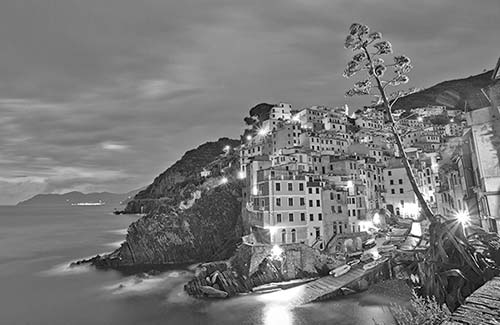
Orientation to Riomaggiore
TOURIST INFORMATION
The national park office and InfoPoint is in the striped building adjacent to the station (daily 8:30-19:30, shorter hours off-season).
ARRIVAL IN RIOMAGGIORE
By Train: Riomaggiore’s train station is in the next ravine over from the village, separated from the town center by a bluff. To get to the center quickly, take the pedestrian tunnel that parallels the rail tunnel. You’ll exit at the bottom of Via Colombo; most recommended accommodations are a short hike up this steep main drag. If you’re staying near the top of town, you can catch the sporadic shuttle bus at the bottom of Via Colombo and ride it partway up.
If you’re not in a hurry or carrying luggage, take the scenic route around the bluff into town, which gives you a better feel for life here—see my “Riomaggiore Walk,” later.
By Car: Day-trippers park at the two-story pay-and-display lot above town (€5/hour, €35/day). If you’re staying overnight, your hotel may have parking.
HELPFUL HINTS
Baggage Storage: You can check your bag at the casually run deposito bagagli office—it’s behind the café/bar that’s straight ahead as you exit the station (daily 9:00-12:30 & 14:00-19:00—confirm times, closed in winter).
Services: There are three public pay WCs in town: at the station and at the top and bottom of Via Colombo.
Laundry: A self-service launderette is on the main street (daily in summer 8:00-23:00, shorter hours off-season, Via Colombo 107).
Riomaggiore Walk
Here’s an easy self-guided walk that loops up and over, taking the long and scenic way from the station into town. You’ll enjoy some fine views and get to know the town before strolling down the main street to the harbor.
• Start at the train station. (If you arrive by boat, cross beneath the tracks and take a left, then hike through the tunnel along the tracks to reach the station.)
Climb to the Top of Town
With your back to the sea and station, look left and notice the stairs climbing up just past the station building. These lead to the easy (but closed) trail to Manarola, the Via dell’Amore.
Now hike up Via Telemaco Signorini (next to Bar Stazione). Listen to the paved-over creek under your feet. Where the road hairpins right, see the waterfall (and turtles in the cage). Farther along is a close-up look at dry-stone rockery work. You’ll cross over the train tracks, passing the top of a concrete elevator tower. Just beyond the elevator, you’ll arrive at a fine viewpoint, with spectacular sea views and a few benches.
• When you’re ready to move on, hook left around the bluff; rounding the bend, ignore the steps marked marina seacoast (which lead to the harbor). Look on your left for the stairway marked Salita Castello, across from house #179. If you’re up for a steep side trip, climb a few flights of stairs to the...
Riomaggiore Castle
The castle, a hulk at the top of the hill, is usually shut up tight, but it’s sometimes used for cultural events. You’ll find great sea views from benches in front, and the tiny church of San Rocco (built for plague victims, and therefore outside of the town walls).
• Descend the way you came up.
Town Views and Church of San Giovanni Battista (St. John the Baptist)
Continuing along the smooth and level lane, you’ll go by the City Hall (with flags) and several decaying murals by Silvio Benedetto. These glorify the region’s nameless workers—grape pickers, fishermen, and everyone who built the nearly 300 million cubic feet of mortarless, dry-stone walls that run throughout the Cinque Terre. These walls give the region its characteristic terracing for vineyards and olive groves. Unfortunately, the murals are not aging well.
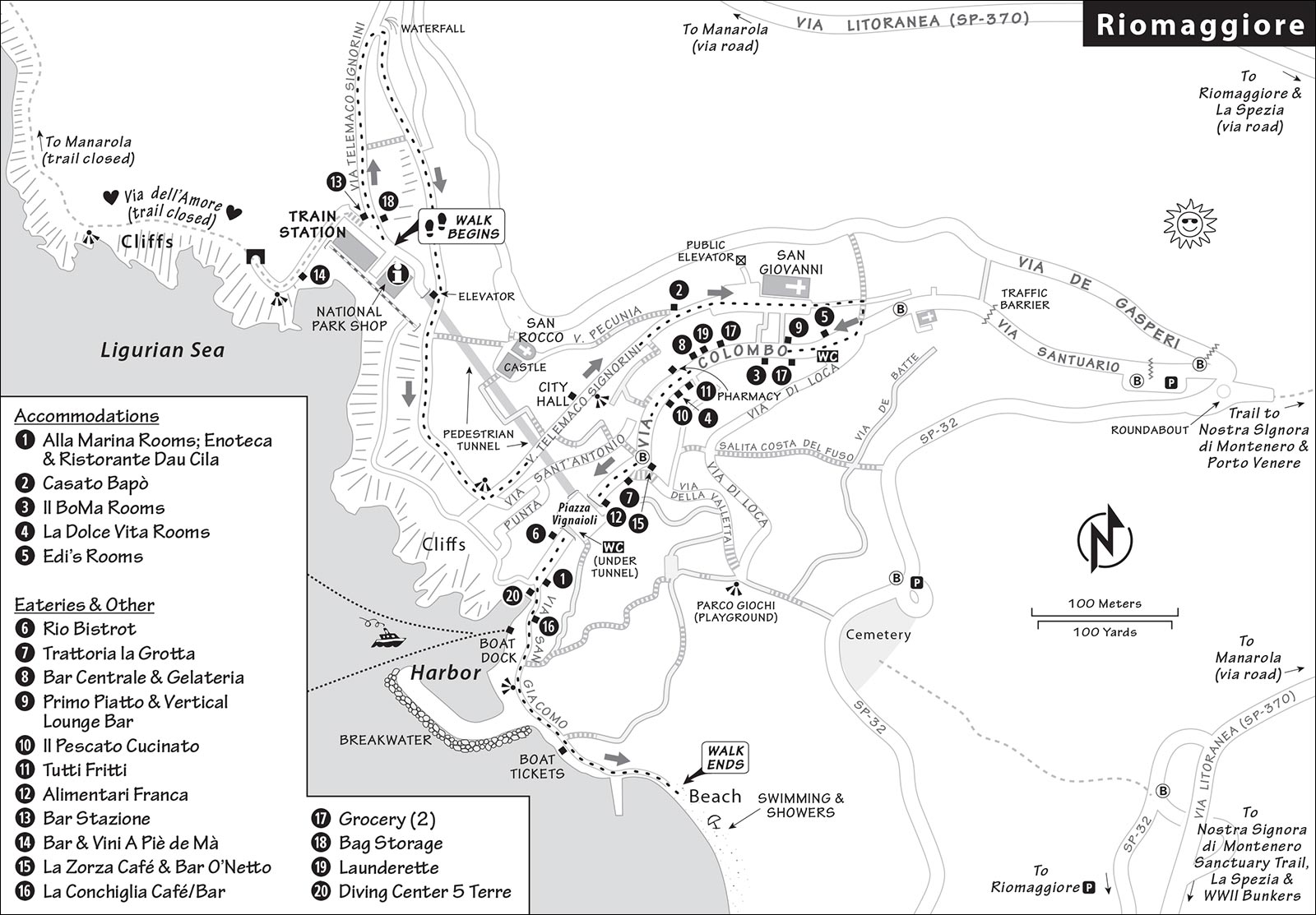
You’ll next reach a piazza and the gray stone San Giovanni church. Pause here at the big terrace to enjoy the views over town, perhaps with lots of local kids (schools are close by). The town is named after its large (maggiore) river (rio), now covered by the main street, as in the other Cinque Terre towns. The river carved the canyon now filled by the town’s pastel high-rises. The romantic arched bridges that once connected the two sides have been replaced by a practical modern road. Other than that, the town is beautifully preserved.
The church, while rebuilt in 1870, was first established in 1340. It’s dedicated to St. John the Baptist, the patron saint of Genoa, the maritime republic that once dominated the region.
• Continue straight past the church and along the narrow lane leading down to the town’s main street, and hang a right on...
Via Colombo
This street has the town’s shops and services. Heading downhill, the big covered terrace on the right belongs to the recommended Bar Centrale, a popular hangout for international visitors day or night.
As you round the bend to the left, notice the old-timey pharmacy just above (on the right, with a good bakery underneath). On your left, at #199, peek into the Il Pescato Cucinato shop, where Laura fries up her husband Edoardo’s fresh catch; grab a paper cone of deep-fried seafood as a snack. Where the road bends sharply right, notice the bench on your left (just before La Zorza Café)—the hangout for the town’s old-timers, who keep a running commentary on the steady flow of people. Straight ahead, you can already see where this street will dead-end. The last shop on the left, Alimentari Franca (at #251), is a well-stocked grocery where you can gather the makings for a perfect picnic out on the harbor.
Where Via Colombo dead-ends, look right to see the tunnel leading back to the station. Look left to see two sets of stairs. Climb the “up” stairs to a parklike square (Piazza Vignaioli) built over the train tracks, which provides the children of the town a bit of level land on which to kick their soccer balls and to learn to ride a bike. The murals above, marking the town’s middle school, celebrate the great-grandparents of these very children—the salt-of-the-earth locals who earned a humble living before the age of tourism. Riomaggiorians are proud that they are the only Cinque Terre town with their own middle school (scuola media)—in the other towns, kids start commuting to school much earlier.
• Now take the “down” stairs to the...
Harbor
In this most picturesque corner of Riomaggiore, a tight cluster of buildings huddles nervously around a tiny square and harbor. Because Riomaggiore lacks the naturally protected harbor of Vernazza, when bad weather is expected, fishermen pull their boats up to the safety of the little square. This is quite an operation, so it’s a team effort—the signal goes out, and anyone with a boat of their own helps move the whole fleet. Sometimes the fishermen are busy beaching their boats even on a bright, sunny day—an indication that they know something you don’t.
A couple of recommended restaurants—with high prices and memorable seating—look down over the action. Head past them and up the walkway along the left side of the harbor, and enjoy the views back at the town’s colorful pastel buildings, with the craggy coastline of the Cinque Terre just beyond. The best views are from up top, at the edge of the bluff. Below you, the breakwater (made of reject marble blocks from the famous nearby quarries of Carrara) curves out to sea, providing a bit of protection for the harbor. These rocks are popular with sunbathers by day and romantics and photographers at sunset.
For a peek at Riomaggiore’s beach, continue around the bluff on this trail toward Punta di Montenero, the cape that defines the southern end of the Cinque Terre. As you walk, you’ll pass the rugged boat landing and eventually run into Riomaggiore’s uncomfortably rocky but still inviting beach (spiaggia). Ponder how Europeans manage to look relaxed when lounging on football-sized “pebbles.”
Experiences in Riomaggiore
Hikes from Riomaggiore
For an easy walk along the lip of the one-time river ravine, take Via di Loca, which veers off Via Colombo at the top of town (directly across from the stairs at the upper end of Via Colombo). This leads in just a few minutes to the town playground (parco giochi), benches, neighborhood pea patches, and pleasant views over town (especially at sunset). There’s also a steep staircase from here up to the town cemetery; from there, an even steeper trail runs all the way up to the town’s 14th-century Nostra Signora di Montenero sanctuary, high above the town.
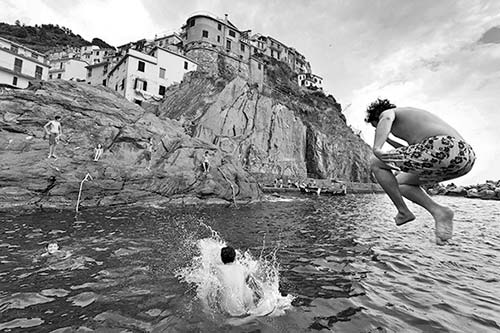
For an easier climb to the sanctuary, opt for the scenic one-hour trail that rises from the top of town. Take the main road inland until you see signs at the roundabout at the end of Via Santuario; or ride the shuttle bus 12 minutes from the town center to the sanctuary trail, then walk uphill another 20 minutes (great picnic spot up top).
Beach
Riomaggiore’s rugged and tiny “beach” is rocky, but it’s clean and peaceful. It’s just around the bluff from the harbor, past the boat landing—to find it, see the end of my self-guided walk, above. There’s a shower here in the summer, and another closer to town by the boat landing—where many enjoy sunning on and jumping from the rocks.
Kayaks and Water Sports
Diving Center 5 Terre rents kayaks as well as snorkeling and scuba equipment; they also lead guided dives of the protected marine waters nearby (open only in good weather, underground office in the passage leading to the harbor—down the stairs and under the tracks, Via San Giacomo, +39 0187 920 011, www.5terrediving.it).
Nightlife in Riomaggiore
With a youthful spirit and lively evening bustle, Riomaggiore has an enjoyable night scene. Stroll the main drag, scope out these listings (serving €6-8 cocktails), and find the one that appeals. Several of these places have full menus if you want to eat.
Bar Centrale, run by sociable Ivo, Alberto, and the gang, offers “nightlife” any time of day—it’s a magnet for tourists. Ivo, who lived in the Bay Area, fills his bar with San Franciscan rock and a fun-loving vibe; it feels a little like the village’s living room (great mojitos, daily 7:30-late, Via Colombo 144).
Bar & Vini A Piè de Mà, above the train station at the now closed Via dell’Amore trailhead, has piles of charm, frequent music, and stays open until 23:00 from June through September.
More Bars and Cafés: Near the bottom of Via Colombo, facing each other, are the noisy La Zorza Café (appealing to international tourists with thumping music and freestyle bartender) and the classier Bar O’Netto (geared more for young locals, with a mellower vibe and nice outdoor seating). Higher up on Via Colombo (at #76), Vertical Lounge Bar has a lively and loose ambience, light food (a good aperitivo buffet at happy-hour time), and a fine people-watching perch near the top of the promenade zone. And at sunset, you can’t beat La Conchiglia—the simple café/bar (closed Wed) on the bluff overlooking the harbor—a perfect location for watching the sun disappear into the Ligurian Sea and the lights of Monterosso twinkling on the horizon.
Sleeping in Riomaggiore
Riomaggiore has few hotels worth your time; I recommend staying in one of the town’s many private rooms for rent. Breakfast is normally on your own.
$$$ Alla Marina is Riomaggiore’s best value, renting a half-dozen rooms and apartments—most with sea views—at the top of one of the tall, skinny buildings that rise up from the harbor. The furnishings are a combination of modern and nautical, and friendly brothers Sandro and Andrea take pride in running a tight ship (RS%, breakfast extra, pay parking, office open 9:00-18:00, Via San Giacomo 61—ask about the easier back-door entrance, +39 328 013 4077, www.allamarina.com, info@allamarina.com). They also rent several other rooms in Riomaggiore and Manarola.
$$$ Casato Bapò has three airy, spacious rooms with unobstructed views at the top of town near the Church of San Giovanni. They’re on the fourth floor, but accessible via the public elevator nearby (Via Pecunia 116, +39 340 705 6723, www.casatobapo.com, casatobapo@gmail.com, Sabrina).
$$ Il BoMa—named for the owners, American Maddy and her Italian husband, Bombetta, has three old-fashioned rooms along the main drag (one cheaper room with private bath down the hall, air-con, up three flights at Via Colombo 99, +39 0187 920 395, mobile +39 320 074 8826, www.ilboma5terre.com, info@ilboma5terre.com). They also rent two nearby apartments.
$$ La Dolce Vita offers six modern, good-value rooms on the main drag, plus two apartments elsewhere in town (some with air-con, open daily 9:30-19:30—if they’re closed, they’re full; Via Colombo 167, +39 331 903 6704, agonatal@libero.it, helpful Giacomo and Simone).
$$ Edi manages three rooms and an apartment. You pay extra for views (most rooms with air-con, reception at Via Colombo 12, +39 320 111 7074, www.appartamenticinqueterre.net, edi-vesigna@iol.it).
$ Amy Inman (an American expat who runs the Cinque Terre Insider blog) and her Italian husband, Francesco, offer an apartment and three private rooms (RS%, cash only, air-con, +39 329 572 0138—WhatsApp messages welcomed, www.riomaggioreservations.wordpress.com, info@riomaggiorereservations.com).
Eating in Riomaggiore
ON THE HARBOR
Harborfront dining comes with slightly higher prices, a dressy ambience, and glorious views.
$$$$ Enoteca & Ristorante Dau Cila (pronounced “dow CHEE-lah”) is decked out like a black-and-white movie set in an old boat shed with extra tables outside on a rustic deck over dinghies. Try their €25 seafood antipasto plate and listen to the waves lapping at the harbor below (daily 12:30-15:00 & 19:30-22:30, Via San Giacomo 65, +39 0187 760 032, Luca).
$$$$ Rio Bistrot, small and intimate at the top of the harbor, jazzes up its Ligurian cuisine with international influences. You can order à la carte from the short but well-designed menu, or try their €40-60 tasting menus (daily 12:30-16:00 & 19:00-22:00, Via San Giacomo 46, +39 0187 920 616, Manuel).
ON THE MAIN STREET, VIA COLOMBO
$$$ Trattoria la Grotta, right in the town center (with no view), has a passion for anchovies and mussels. You’ll enjoy reliably good food surrounded by historical photos and wonderful stonework in a dramatic, dressy, cave-like setting (reservations smart, Thu-Tue 12:00-14:30 & 18:00-22:30, closed Wed, Via Colombo 247, +39 0187 920 187, mobile +39 346 260 8709, www.lagrottariomaggiore.it).
$$ Bar Centrale is a casual, family-friendly place for hamburgers, salads, and pesto. They also have a gelateria on site (long hours daily, see listing earlier, under “Nightlife in Riomaggiore”).
Light Meals: Various handy carryout eateries along the main drag offer good lunches or snacks. $ Primo Piatto, at the top of town, offers takeaway handmade pastas and sauces, cooked to order on the spot. It’s cheap and delicious (Wed-Mon 10:30-19:30 or later, closed Tue, Via Colombo 72, Roberta). For deep-fried seafood in a paper cone, $ Il Pescato Cucinato is where Edoardo fishes and his wife, Laura, fries (chalkboard out front explains what’s fresh, daily 11:30-20:30, near the bottom of Via Colombo at #199). A few doors away, $ Tutti Fritti serves only freshly fried nibbles, including fish (daily 10:00-21:00, Via Colombo 161, Andrea and Isabella).
Picnics: Groceries and delis lining Via Colombo sell food to-go for a picnic at the harbor or beach. Co-op grocery stores have the best prices (at #122 and #205, closed Sun). For a more appetizing selection and good service, head to Alimentari Franca, on the main street by the train-station tunnel (daily 8:00-20:00, shorter hours off-season, Via Colombo 251).
Breakfast: Most of my recommended accommodations don’t serve breakfast—and those that do often simply leave a coffee kettle and some basic continental breakfast fixings in your room. For eggs or a good croissant-and-espresso fix, drop by Bar Centrale (described earlier); or Bar Stazione, at the train station.
NEAR THE TRAIN STATION
$$ Bar & Vini A Piè de Mà, at the trailhead on the Manarola end of town, is good for a scenic light bite or quiet drink at night. The bar, with great outdoor seating, is self-service: Head into the bar to place your order, then bring it out to your preferred perch (Wed-Mon 11:00-21:00, June-Sept until 23:00, closed Tue and off-season). Enjoy a meal on its dramatically situated terrace for an indelible Cinque Terre memory.