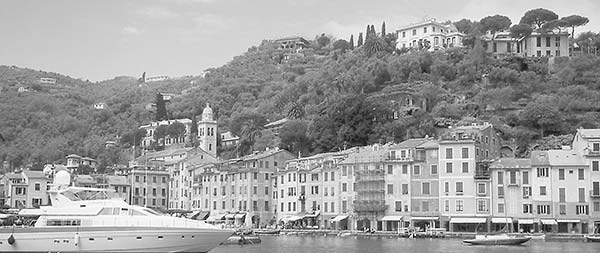
RIVIERA TOWNS
Levanto • Sestri Levante • Santa Margherita Ligure • Portofino • Porto Venere • La Spezia
Orientation to Santa Margherita Ligure
Sights in Santa Margherita Ligure
Sleeping in Santa Margherita Ligure
Eating in Santa Margherita Ligure
Santa Margherita Ligure Connections
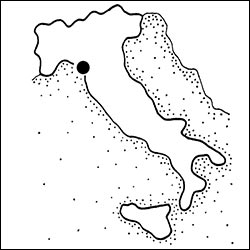
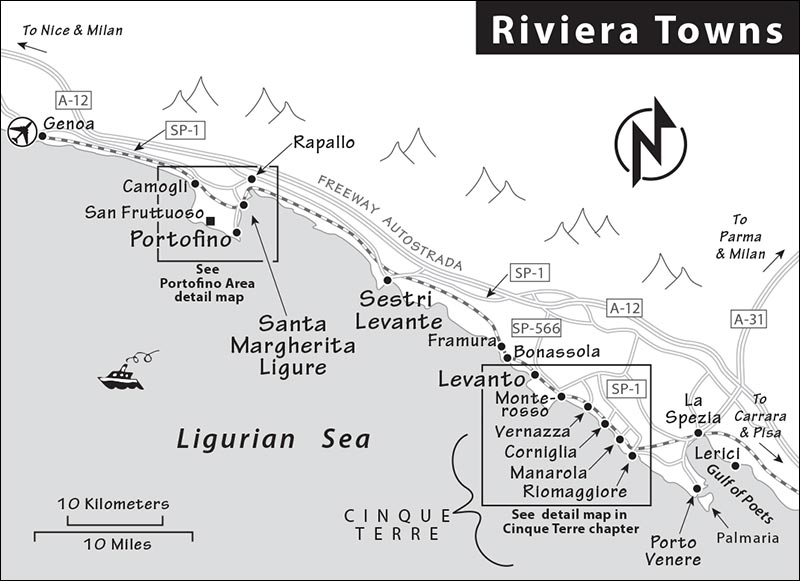
The Cinque Terre is tops, but there’s much more to the Italian Riviera. To the north of the Cinque Terre is a trio of beach towns: Levanto, the northern gateway to the Cinque Terre; Sestri Levante, stunningly situated on a narrow peninsula flanked by two beaches; and Santa Margherita Ligure, a thriving city with an active waterfront and easy connections to yacht-happy Portofino. At the south end of the Cinque Terre is the pretty resort of Porto Venere and the region’s workaday transit hub, La Spezia.
The best of these towns—the high-end yin to the Cinque Terre’s ramshackle yang—can be user-friendly home bases for day trips along the Riviera coast. But they are also worth visiting in their own right. After exploring the villages and trails of the Cinque Terre, these Riviera towns feel like a return to civilization.
Riviera hotels aren’t necessarily cheaper than the Cinque Terre, but they are more likely to have space. High season here is roughly May through September, peaking in July and August. Some hotels close in winter.
Home Bases: Levanto, Sestri Levante, and Santa Margherita Ligure are practical home bases for those who want modern hotels with predictable resort amenities, and for drivers wanting to park at their hotel and side-trip to the Cinque Terre by train.
Levanto—just minutes north of Monterosso by train—is the handiest. Sestri Levante is a bit farther away with a little less train service. Santa Margherita Ligure is the most distant and often requires a transfer to the Cinque Terre, but the town compensates by being the most appealing—and it gives you easy access to posh Portofino. Porto Venere is better as a day trip, and La Spezia is more functional than appealing, although either can serve in a pinch.
Keep in mind that you’ll be competing with other day-trippers for space on prime midday trains to and from the Cinque Terre. Turn this problem into an advantage: Enjoy your home-base town during the day, then head into the Cinque Terre in the late afternoon for untrampled charm, a romantic dinner, and a late train back.
North of the Cinque Terre
When most people imagine the “Italian Riviera,” they’re thinking of the shimmering resort towns north of the Cinque Terre. Stately Old World hotels loom over crowded pebble beaches with rentable umbrellas. Fastidiously landscaped parks and promenades are jammed with more Italian visitors than American tourists. These towns are perfect for day-tripping—or even an overnight.
Levanto
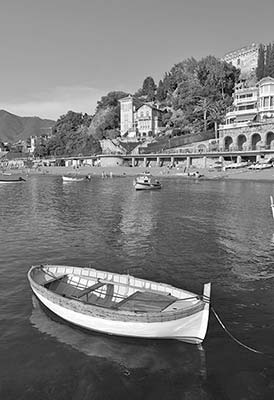
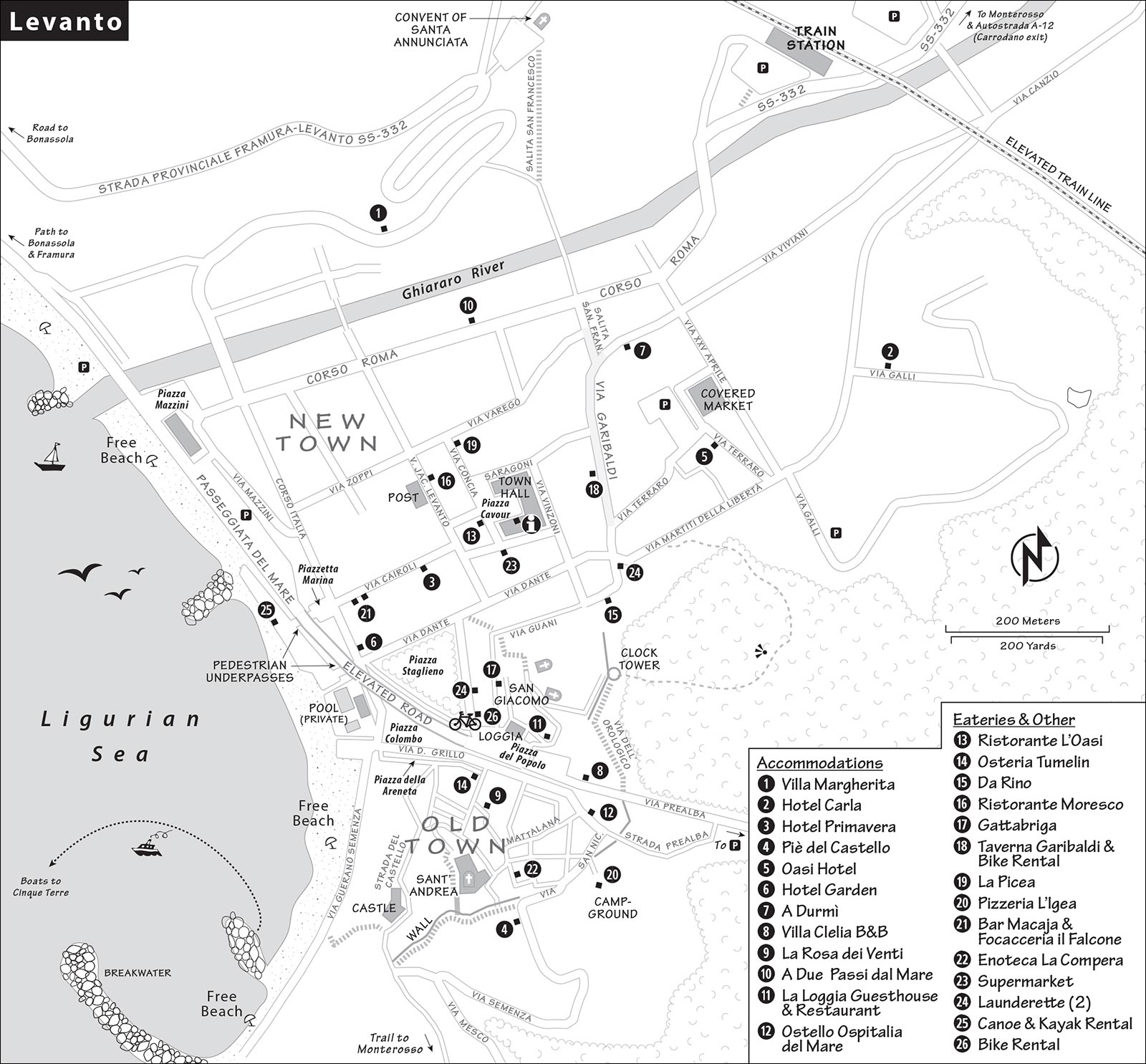
Graced with a long, sandy beach, Levanto (LEH-vahn-toh) is packed in summer and popular with families, surfers, and beach bums. The rest of the year, it’s just a small, sleepy town with kids playing in the square and locals whizzing around on bicycles. Although not as charming as the Cinque Terre, Levanto is just a short train ride away and enjoys fewer crowds and more varied hotel and dining options, including budget-friendly family rooms and affordable apartments with kitchenettes. From Levanto, you can bike or stroll on a delightful, level path to the uncrowded beach villages of Bonassola and Framura, or spend a half-day on the no-wimps-allowed hike to Monterosso.
Orientation to Levanto
Levanto (pop. 5,200) faces the sea along a broad, curving beach. Much of the “new” town, closer to the train station, is actually old and full of character, with quaint pedestrian shopping streets like Via Garibaldi and handsome 19th-century villas close to the waterfront. The sleepy, twisty old town—bisected by a modern street—is tucked up against the adjacent hill.
Tourist Information: A Cinque Terre National Park info center is at the train station. The helpful TI is in the new town, at Piazza Cavour 1 (daily 9:00-13:00 & 15:00-18:00 except closed Sun afternoon, shorter hours off-season, +39 0187 808 125, www.visitlevanto.it).
ARRIVAL IN LEVANTO
By Train: From the train station (no baggage storage), head through the parking lot and down the stairs, turn right, and cross the bridge onto Corso Roma. The beach is straight ahead, and the town center, with most of my recommended hotels, restaurants, and the TI, is to your left. You can walk from the station to most of my listings in about 10 minutes.
By Car: If your hotel doesn’t offer parking—or if you’re not sleeping here—the lots surrounding the train station are affordable (€24/day) and handy for hopping a train to the Cinque Terre towns. If you’re heading for the beach, the parking lot there is handy but more expensive.
HELPFUL HINTS
Markets: Levanto’s modern covered mercato, which sells produce and fish, is on Via XXV Aprile, between the train station and the beach (daily 7:30-13:00). On Wednesday morning, an open-air market with clothes, shoes, and housewares sets up along the beach.
Laundry: A self-service launderette stuffed with snack-and-drink vending machines is at Piazza Staglieno 38, facing an inviting park (daily 24 hours, +39 338 701 6341). A larger self-service place is at Via Garibaldi 32 (daily 8:00-22:00, same phone).
Sports Rentals: Right on the beach, Rosa dei Venti rents kayaks, canoes, surfboards, and windsurfing equipment (+39 329 451 1981, https://rosadeiventiboattours.com, Marco).
Bike Rental: Relatively flat Levanto, with light traffic, is a great bike town—and the ride to nearby Bonassola and Framura is easy and delightful. Regular bikes cost €10/day at both Cicli Raso (daily 9:30-12:30 & 15:00-19:00, closed Sun Nov-April, Via Garibaldi 63, +39 0187 802 511, www.cicliraso.com) and the Sensafreni Bike Shop, convenient to the beach boardwalk (daily 9:00-13:00 & 16:00-20:00, Piazza del Popolo 1, +39 0187 807 128).
Electric Bike Tours: Get a helpful boost on the hills with Ebikein, which offers a variety of guided tours on electric bikes. Options include a three-hour Levanto-Monterosso sunset tour (€59) and a four-hour trek to sanctuaries above the Cinque Terre towns (€65; +39 334 190 0496, https://ebikein-cinqueterre.it).
Boat Tours: Its base is in Monterosso, but Sea Breeze will pick you up in Levanto for full-day or aperitivo sunset tours. See here.
Sights in Levanto
Beach
Levanto’s beach hides below a parking lot and promenade that’s elevated above the sand—look for underpasses or stairs along its length. There are pretty boardwalks up on the elevated promenade and down along the beachfront. As you face the harbor, the boat dock is to your far left, and the diving center is to your far right.
In summer, three parts of the beach are free: both sides of the boat dock, and near Piazza Mazzini. The rest of the beach is broken up into private sections that you pay to enter. Pay beaches come with comfy lounge chairs, bar service, showers, and someone keeping an eye on your things while you swim. Shop around to find the best price (about €25/chair, less in the afternoon). You can always stroll along the beach, even through the private sections—just don’t sit down. Off-season, roughly October through May, the entire beach is free, and you can lay your towel anywhere you like. Ask your hotel for towels; most have beach towels to loan or rent.
The city’s seaside pool is privately run and is for serious lap swimmers only. Check with your hotel; they may have entry passes.
Old Town
The old town spills down from the Church of Sant’Andrea (c. 1212), with Piazza del Popolo at its heart. Until a few decades ago, the town’s open-air market was held at the 13th-century loggia (covered set of archways) in the square. The modern, elevated street is the old rail line (built in the 1870s and replaced by the current, higher route in 1970).
Explore the back streets (including Via Guani), the oratory of San Giacomo, and the old clock tower. Levanto was once an important harbor of the Republic of Genoa (the second biggest harbor after Genoa itself); from here, shipments of olive oil, wine, and the coveted red marble called rosso levanto set sail. You can still discover traces of ancient warehouses and the dockland area around Piazza del Popolo.
▲Hike to Monterosso
This 3.5-hour hike from Levanto to Monterosso is strenuous at the beginning and end but easier in the middle (for details, see here). To begin in Levanto, start on Piazza del Popolo, and head uphill to the striped Church of Sant’Andrea. From the church courtyard, follow the sign to the castello (a private residence), go under the stone arch, and continue uphill. From here, take trail SVA (following signs toward Punta Mesco, the rugged tip of the peninsula), then drop steeply down into Monterosso. (If you have knee issues, consider starting in Monterosso instead.)
▲Hike or Bike to Bonassola (and Framura)
Tucked along the main train line on a cove north of Levanto, the small beach resort of Bonassola (boh-nah-SOH-lah, pop. 950) is a peaceful little eddy. As far as Riviera beach resorts go, this is a jewel. With a low-key vibe, a tidy grid street plan that feels almost French, and a picturesque dark-sand beach hemmed in by jagged bluffs, Bonassola is a fine alternative to the region’s other beaches. And the next best thing to a beach day in Bonassola is getting there: A level, easy, rails-to-trails path cuts through the mountain from Levanto—enjoyable by foot, but even better by bike.
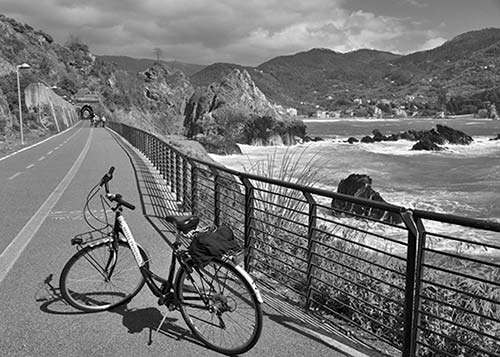
Levanto to Bonassola: Local trains run between Levanto and Bonassola (hourly, 3 minutes, confirm your train will stop in Bonassola). But I’d rather take the promenade. At the northern end of Levanto’s beachfront road/parking lot, you’ll find a level, roughly 1.5-mile path neatly divided into bike and pedestrian lanes. Most of the route is through well-lit former train tunnels, with brief breaks overlooking the sea (and hikes down to secluded beaches). The walk takes about 30 minutes, with long stretches through cool tunnels; by bike, it’s less than 10 minutes. The promenade runs along the original rail line that linked Italy in the 1870s. Think of the effort of building it, and how much it meant for the newly unified country. The last trains chugged along the historic tracks in 1970, when the current rail line opened.
Visiting Bonassola: The town itself—with manicured promenades and piazzas—is worth exploring. $$ Caffè delle Rose, facing the town’s elevated road (at Via Fratelli Rezzano 22), has good gelato, food, and drinks. Several foccacerie and other eateries cluster at the far end of town.
The beach is separated from the town center by the elevated road (shared by bicyclists, walkers, and a parking lot). The inviting beach has mostly private sections, with a few free public areas.
For a scenic walk/hike, head to the far (north) end of the beach, where a promenade snakes along the base of the cliff (with rocky perches for sunbathing and swimming). For higher views, find the stairs near the flagpole, and follow the steps up on the right side of the yellow church. Popping out at the top, turn left along the scenic, private road as it curls around the top of the bay, with great views back on the town and beach; the path ends at the blocky little Madonnina della Punta chapel.
Bonassola to Framura (best for bicyclists): From Bonassola, the promenade continues another 1.5 miles to the town of Framura—a settlement made up of five medieval hamlets that rise from the seafront to the hilltop (pop. 750). Because this part of the route is almost entirely through tunnels, it’s boring for walkers—but quick for bikers. The trail ends overlooking Framura’s rocky little harbor and near its train station.
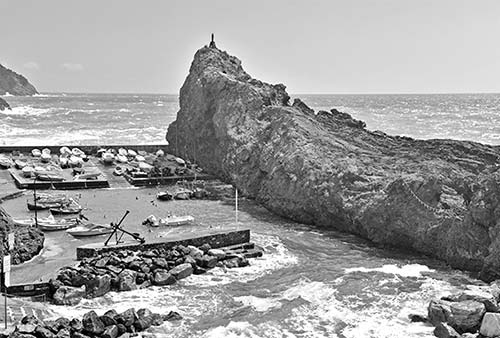
Visiting Framura: Park and lock your bike at the trailhead, take the stairs (or elevator) down to the small-boat harbor, cross under the train tracks through the boat-shed archway, walk through the big tunnel, and you’ll emerge near the station. The welcoming TI at the Framura station has maps and advice (+39 0187 160 0577, www.framuraturismo.it).
At the station, the tunnel to platforms 2 and 3 also leads to the start of the scenic Via del Mare path, with a basic café at the trailhead. This easy promenade takes you north along a cliff face in 10 minutes to two small, pristine gravel beaches that are free and uncrowded.
Hikers can walk the panoramic but steep trail that connects Framura’s five hamlets, which are sprinkled with medieval watchtowers, churches, and washhouses. To avoid the uphill climb, ride the summer shuttle to any of the five towns and walk down (shuttles run hourly, timed to the arrival of trains from the Cinque Terre).
Sleeping in Levanto
$$$ Villa Margherita, in a 1906 Art Nouveau building, is across the river and a bit uphill (about a 10-minute walk from the town center or train station), but the shaded view gardens, 12 characteristic colorfully tiled rooms, and tranquility are worth the walk (family rooms, deluxe apartment, air-con, elevator one flight up from street level, free parking, Via Trento e Trieste 31, +39 0187 807 212, mobile +39 328 842 6934, www.villamargherita.net, info@villamargherita.net, Paola).
$$$ Hotel Carla faces a school in a quiet residential zone, about 10 minutes from the beach and the station. Its 30 rooms come with surprising contemporary style—most have balconies, and all are decorated in soothing, neutral colors (RS%, family rooms, air-con, elevator, free loaner bikes, Via Galli 3, +39 0187 808 275, mobile +39 351 52 3388, www.carlahotel.com, info@carlahotel.com, Laura).
$$$ Hotel Primavera is homey and family-run, with 17 colorful rooms—10 with balconies (but no views)—just a block from the beach (family rooms, request a quiet room off the street, includes hearty breakfast buffet, air-con, pay private parking, Via Cairoli 5, +39 0187 808 023, www.primaverahotel.com, info@primaverahotel.com; friendly Carlo, cheerful Daniela, and daughters Giuditta and Gloria).
$$$ Piè del Castello is just above the campground, right on the Levanto-Monterosso trail. Andrea and his wife Tiziana rent three double rooms, each with a patio and access to a sprawling garden with views of the ancient city wall and the Church of Sant’Andrea. Hikers will appreciate the location and Andrea’s knowledge of area trails (includes breakfast, air-con, fridge, ping-pong table, free parking, Via Guido Semenza 2, +39 366 1467 7886, www.piedelcastello.com, info@piedelcastello.com).
$$$ Oasi Hotel, well-run by Silvia, has 14 rooms in a cozy small hotel behind the market hall. Some rooms have balconies, others have direct access to the garden, and a few have neither but are larger—request your choice when you reserve (RS%, air-con, elevator, pay parking, Via Terraro, +39 0187 807 356, www.oasihotel.eu, info@oasihotel.eu).
$$ Hotel Garden offers 17 functional, businesslike, modern rooms (all with balconies but no views) on the first floor of an apartment building. Its value is its proximity to the beach—just across the street (a more expensive fifth-floor room has sea views and a terrace, closed Nov-mid-March, air-con, elevator, free off-site parking, loaner bikes, Corso Italia 6, +39 0187 808 173, www.nuovogarden.com, info@nuovogarden.com, Davide and Damiano).
$$ A Durmì is a happy little guesthouse owned by lovely Graziella, Gianni, and their two daughters, Elisa and Chiara. Their sunny patios, green leafy gardens, six immaculate beach bungalow-type rooms, and five sunlit apartments make this a welcoming place to stay (breakfast extra, family rooms, air-con, bar, pay parking, Via D. Viviani 12, +39 0187 800 823, mobile +39 342 805 3135, www.adurmi.it, info@adurmi.it).
$$ Villa Clelia B&B offers six basic rooms (named for the winds—scirocco, maestrale, and so on) with minifridges and terraces. The rooms surround a garden courtyard just a short walk up from the sea (in-room breakfast, air-con, pay parking, free loaner bikes; with the old town’s loggia on your left, it’s straight ahead at Piazza da Passano 1; +39 329 379 4859, www.villaclelia.it, info@villaclelia.it). They also rent apartments in the center that economically sleep up to five.
$ La Rosa dei Venti is an affittacamere just a couple of blocks from the beach, in the old town. Enthusiastic Rosanna and her son Marco rent six old-fashioned rooms with dark hardwood floors, comfy rugs, and glittery seashore decor (air-con, parking, from Piazza del Popolo take the lane next to Osteria Tumelin to Via della Compera, +39 0187 808 165, Marco’s mobile +39 328 742 8268, www.larosadeiventilevanto.com, info@larosadeiventilevanto.com).
$ A Due Passi dal Mare is along the town’s main road, a five-minute walk from the beach or the train station. Friendly Francesca and husband Maurizio rent four crisp, quiet, ground-floor rooms in a large villa built by her grandfather in the 1920s, with access to a small back garden (free on-site parking, closed Jan-Feb, Corso Roma 37, +39 0187 809 177, mobile +39 338 960 1537, www.a2passidalmare.com, info@a2passidalmare.com).
$ La Loggia has eight cozy, older, and cheap rooms, perched above the old loggia on Piazza del Popolo (request balcony, quieter rooms in back, two basic side-by-side apartments great for families of 4-8, lots of stairs, air-con, free parking, reception open 9:00-23:00, Piazza del Popolo 7, +39 0187 808 107, mobile +39 335 641 7701, www.loggialevanto.com, laloggialaloggia@gmail.com, Alessandro). They also have a recommended restaurant.
Hostel: A budget gem run by the city tourist association, ¢ Ostello Ospitalia del Mare has 70 basic beds, airy rooms, an elevator, and a terrace in a well-renovated medieval palazzo a few steps from the old town (all ages, dorms with private bath, private rooms, breakfast available, self-service laundry, no curfew or lockout; may close Nov-March, Via San Nicolò 1, +39 0187 802 562, www.ospitalialevanto.com, info@ospitalialevanto.com).
Eating in Levanto
$$$$ Ristorante L’Oasi—spacious, bright, and with a garden feel right on the main square—is family run, with Claudio in the kitchen and Lella supervising the dining room. This is a polished setting for enjoying seafood, including fresh tuna tartare, marinated anchovies, and grilled swordfish. If you really want to treat yourself, order a whole fish baked under salt (daily 12:30-14:30 & 19:30-22:30, closed Wed Sept-June, Piazza Cavour, +39 0187 800 856).
$$$ Osteria Tumelin has a dressy ambience in its elegant dining room, a casual covered terrace out front, and a wide selection of fresh seafood. Reservations are smart on weekends or to dine outside. Check out the aquarium containing giant lobster and moray eels in the corner dining room (daily 12:00-14:30 & 19:00-22:30, closed Thu, Via D. Grillo 32, across the square from the loggia, +39 0187 808 379, www.tumelin.it).
$$$ Da Rino, a small trattoria on a quiet pedestrian lane, dishes up seafood, meat, and homemade Ligurian specialties. Consider the grilled totani (squid), pansotti con salsa di noci (ravioli with walnut sauce), and trofie al pesto (pasta with pesto sauce). Dine indoors or at one of the outdoor tables (Wed-Mon 18:30-22:00, closed Tue, Via Garibaldi 10, +39 0187 813 475).
$$ Ristorante la Loggia, a Levanto standby, has been dishing up classic Ligurian cuisine for more than 50 years. Choose between the homey, wood-paneled dining room with nooks and crannies or the little terrace overlooking the square (daily 12:30-14:00 & 19:00-22:00, closed Wed and Nov-Feb, Piazza del Popolo 7, +39 0187 808 107). They also rent rooms (see previous section).
$$ Ristorante Moresco serves large portions of pasta and seafood at reasonable prices in a vaulted, candlelit room decorated with Moorish-style frescoes (Tue-Sun 12:00-14:00 & 19:00-21:00, closed Mon, reservations appreciated, Via Jacopo 24, +39 0187 807 253, Roberto and Francesca).
$$ Gattabriga hides out on a back lane behind Piazza del Popolo with a contemporary look; an updated and well-priced menu of pastas, seafood, and meats; and friendly service (Tue-Sun 19:00-21:30, closed Mon, Via Guani 47, +39 366 527 3582).
$$ Taverna Garibaldi, a comfy good-value place on the town’s most characteristic street, serves focaccia with various toppings, made-to-order farinata (savory chickpea crêpes), salads, and more than 30 types of pizza (Fri-Wed 19:00-22:00, closed Thu, Via Garibaldi 57, +39 0187 808 098).
$$ La Picea offers creative wood-fired pizzas (check out the oven) and a large selection of beers—eat in or take out (Tue-Sun 12:00-14:30 & 18:30-23:00, closed Mon, just off Piazza Cavour at Via della Concia 18, +39 0187 802 063, mobile +39 392 958 3294).
$$ Pizzeria L’Igea, usually packed with locals, is tucked just inside the Campeggio Acquadolce campground, 50 yards past the hostel. It’s a favorite among locals who know you don’t have to be a camper to enjoy freshly made, budget-conscious pizza and pasta in their bright dining hall. Their specialty is gattafin—deep-fried herb-stuffed ravioli. Come early or be prepared to wait, even for takeout (daily 12:00-14:30 & 18:45-22:30, Via Guido Semenza 5, +39 0187 807 293).
$-$$ Bar Macaja, decorated in shabby chic beach style, is a tiny place with a big happy vibe. Stop in for a continental breakfast, espresso or a drink, panini, and local seafood—including anchovies prepared six ways (daily 7:00-23:00, just up from the beach at Via Cairoli 25, +39 349 844 8424).
$ Enoteca La Compera is a wine bar where you can try two wines and an aperitivo for €12. It offers a quiet respite on a hidden courtyard below the church in the old town (Thu-Tue 17:00-23:00, closed Wed, follow the red-brick road—under the stone arch—to Piazza della Compera 3, +39 334 712 8517).
Picnics and Bites on the Go: Focaccerie, rosticcerie, and delis with takeout pasta abound on Via Dante Alighieri. $ Focacceria il Falcone has a great selection of focaccia with different toppings, plus big salads (daily 9:30-22:00, shorter hours off-season, Via Cairoli 19, +39 0187 807 370). For more picnic options, try the mercato (see “Helpful Hints,” earlier) or visit Crai, a good supermarket just off Piazza Cavour (daily 8:00-20:00 except Sun closed 13:00-15:00, Vicolo San Rocco 5). For a shaded setting, lay out your spread on a bench in the grassy park at triangular Piazza Staglieno. Another fine picnic spot is Piazza Cristoforo Colombo, located east of the swimming pool, with benches and sea views.
Levanto Connections
Trains run frequently from Levanto to the Cinque Terre towns (5 minutes to Monterosso). A slower, more scenic, infrequent option is the boat, which stops at every Cinque Terre town (except Corniglia) before heading to Porto Venere (3/day in high season, price depends on distance traveled—or get a €37 all-day hop-on, hop-off ticket; only one return boat daily stops at Levanto, at about 18:50; get latest boat schedule and price sheet at TI or boat dock or check website, +39 0187 732 987, www.navigazionegolfodeipoeti.it).
Sestri Levante
Sestri Levante (SEH-stree leh-VAHN-teh) is squeezed as skinny as a hot dog between its two beaches. The pedestrian-friendly Via XXV Aprile, which runs down the middle of the peninsula, is lined with shops that sell takeout pizza, pastries, and beach paraphernalia.
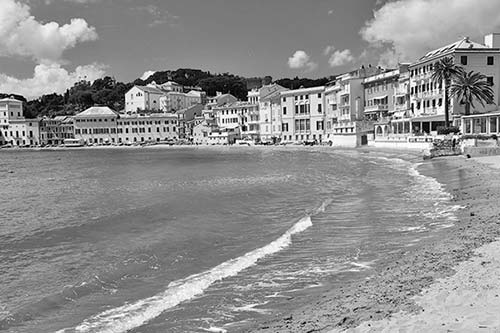
Hans Christian Andersen enjoyed his visit here in the mid-1800s, writing, “What a fabulous evening I spent in Sestri Levante!” One of the bays—Baia delle Favole—is named in his honor (favole means “fairy tale”). The small mermaid curled on the edge of the fountain behind the TI is another nod to the beloved Danish storyteller.
Orientation to Sestri Levante
Sestri Levante (pop. 18,000) is dominated by its big, dull modern town in front of the train station. But don’t be discouraged—the old-town peninsula, a 10-minute walk away, has charm to spare.
Tourist Information: It’s at Corso Colombo 50, on the ground floor of Palazzo Fascie, the town’s cultural center (daily 9:00-13:00 & 14:00-17:00, shorter hours off-season, +39 0185 478 530, www.sestri-levante.net). They can tell you about the summer bike-sharing program (€8/5 hours) and direct you to the trail (south of town) for a 1.5-hour hike (each way) to the scenic Punta Manara promontory.
Arrival in Sestri Levante: To reach the enjoyable pedestrian zone, the old-town peninsula, and beaches, follow the “Stroll the Town” advice below.
Baggage Storage: The tobacco store in the train station stores bags.
Market Day: It’s on Saturday at Piazza Aldo Moro (8:00-13:00).
Laundry: A self-service launderette is in the urban zone southeast of the train station (daily 8:30-20:30, Via Costantino Raffo 8, +39 389 101 1454).
Sights in Sestri Levante
Stroll the Town
For a get-acquainted walk, head straight out from the train station and across the piazza to go down the arcaded Viale Roma until it dead ends at the leafy city park. Go left two blocks to the roundabout, and then take the second exit onto Corso Colombo (just past the Bermuda Bar). This main drag will take you to the TI before turning into the pedestrianized Via XXV Aprile. This street, running the length of the peninsula, is lively with shops, eateries, and delightful pastel facades. When you reach Piazza Matteotti, dominated by a large white Renaissance-era church, you’re at the narrow waist of the isthmus, with beaches to the right (pay) and left (free). If you continue up the lane to the left of the church, you’ll pass a scenic amphitheater, then the evocative arches of a ruined chapel (bombed during World War II and left as a memorial). A few minutes farther on, past a stony Romanesque church, the road winds to the right to Grand Hotel dei Castelli. The rocky, forested bluff at the end of the town’s peninsula is the huge private backyard of this fancy hotel.
Beaches
These are named after the bays (baie) that they border. The less scenic, bigger beach, Baia delle Favole, is divided up much of the year (May-Sept) into sections that you must pay to enter. Fees, up to €30 per day in August, generally include chairs, umbrellas, and fewer crowds. There are several small free sections: at the ends and in the middle (look for libere signs, and ask “Gratis?” to make sure that it’s free). For less expensive sections of beach (where you can rent a chair for about €8-10), ask for spiaggia libera attrezzata (spee-AH-jah LEE-behr-ah ah-treh-ZAHT-tah). The usual beach-town activities are clustered along this baia: boat rentals, sailing lessons, and bocce courts.
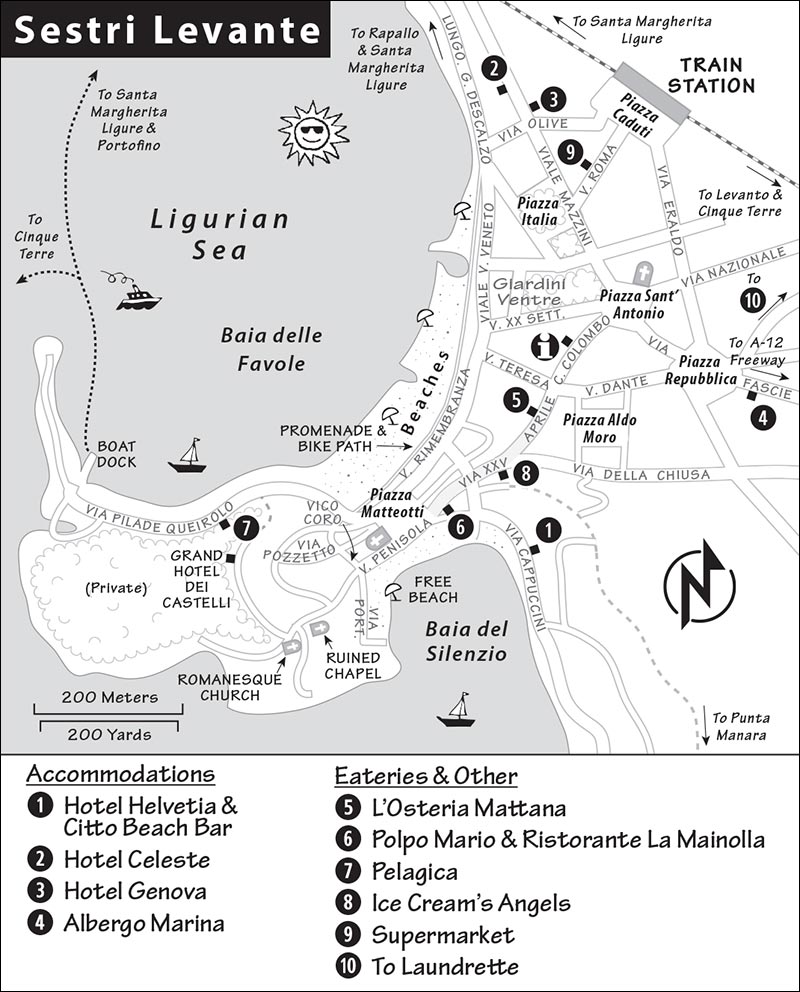
The town’s other beach, Baia del Silenzio, is picturesque, narrow, virtually all free, and jam-packed, providing a good chance to see Italian families at play. There isn’t much more to do here than unroll a beach towel and join in. Because of the bay’s small size and the currents, the water gets warmer here than at Baia delle Favole. At the far end of Baia del Silenzio (under recommended Hotel Helvetia) is the $$ Citto Beach Bar, which offers front-row seats with bay views (summer until very late, spring and fall until sunset, sandwiches and salads at lunchtime only, Gilberto).
Sleeping in Sestri Levante
Hotels Genova and Celeste are the closest to the station. Either is an easy roll with wheeled luggage.
$$$$ Hotel Helvetia, overlooking Baia del Silenzio, feels posh and romantic, with 21 plush rooms, a large sun terrace with a heated, cliff-hanging swimming pool, and a peaceful garden atmosphere. With doubles renting for €400-plus in peak season, it’s a big but enticing splurge (family rooms, air-con, elevator, valet parking, closed Nov-March, Via Cappuccini 43, +39 0185 41175, www.hotelhelvetia.it, helvetia@hotelhelvetia.it, Alex).
$$$ Hotel Celeste, a dream for beach lovers, rests along the waterfront. Its 39 rooms are modern, crisp, and pricey, but you’re paying for the sea breeze (family rooms, air-con, elevator, attached beachside bar/breakfast terrace, Lungomare Descalzo 14, +39 0185 485 005, www.hotelceleste.com, info@hotelceleste.com, Franco).
$$ Hotel Genova, well-run by the Bertoni family, is a shipshape hotel with 19 shiny-clean, modern, and cheery rooms (three with sea views), a sunny lounge, rooftop sundeck, and a good location just two blocks from Baia delle Favole (ask for quieter room in back, family rooms, air-con, elevator, pay parking, Viale Mazzini 126, +39 0185 41057, www.hotelgenovasestrilevante.com, info@hotelgenovasestrilevante.com, Stefano). They also book apartments in a nearby palazzo (www.appartamentisestrilevante.com).
$$ Albergo Marina’s friendly Magda and her brother Santo rent 23 peaceful, clean, good-value rooms painted in sea-foam green. Though the hotel is located on a busy boulevard in the more urban part of town, rooms face a quiet back courtyard and it’s a short walk to the beach and train station (family rooms, air-con, elevator, free self-service laundry, pool table, closed Nov-Easter, Via Fascie 100, +39 0185 487 332, www.marinahotel.it, marinahotel@marinahotel.it).
Eating in Sestri Levante
Via XXV Aprile abounds with pastry shops, bakeries selling takeout pizza by the slice, and other edibles. For picnics, stop by a supermarket on your way from the train station; you’ll pass a Carrefour Express at Viale Roma 25 (open daily). For a sit-down meal, try one of the places below.
$$ L’Osteria Mattana has long, shared tables in two white-tiled dining rooms (one in front and the other past the wood oven and brazier). Daily specials—most featuring seafood—are listed on chalkboard menus (lunch Sat-Sun only 12:30-14:30, dinner daily 19:30-22:30, closed Mon, Via XXV Aprile 34, +39 0185 457 633, Marco).
$$$ Polpo Mario has its own boat that brings in fresh fish each day. This is the place to try polpo (octopus), either spicy (alla diavola) or as ragù di polpo tossed with spaghetti. For an appetizer, the acciughe al limone—fresh anchovies cured in lemon—might just change your mind about this humble fish (Tue-Sun 12:00-15:00 & 19:00-23:00, closed Mon, reservations smart, Via XXV Aprile 163, +39 0185 480 203, www.polpomario.com).
$$$ Pelagica, a contemporary restaurant with a choice spot overlooking the Baia delle Favole, focuses on seafood, from anchovies to fried squid to traditional fish soup. Their rooftop terrace doubles as a cocktail lounge in the evening (kitchen daily 12:00-14:15 & 19:00-22:15, closed Wed, Via Pilade Queirolo 7, +39 393 882 0255).
$$ Ristorante La Mainolla offers pizzas, big salads, focaccia sandwiches, and reasonably priced pastas near Piazza Matteotti (daily 12:00-16:00 & 19:00-22:00, Via XXV Aprile 187, +39 0185 42792).
Gelato: Tourists flock to Ice Cream’s Angels, flamboyantly set at the intersection of Via XXV Aprile and Via della Chiusa. Riccardo and Elena artfully load up your cone and top it with a dollop of Nutella chocolate-hazelnut cream (daily until late in summer).
Sestri Levante Connections
From Sestri Levante by Train to: Levanto (at least hourly, 15-30 minutes), Monterosso (at least hourly, 30-40 minutes), other Cinque Terre towns (nearly hourly direct, more with a change in Levanto or Monterosso), Santa Margherita Ligure (2/hour, 20-25 minutes).
Boats depart to the Cinque Terre, Porto Venere, Santa Margherita Ligure, Portofino, and San Fruttuoso from the dock (molo) on the peninsula (Easter-Oct, +39 0185 284 670, www.traghettiportofino.it).
Santa Margherita Ligure
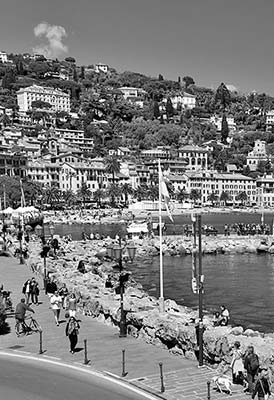
If you need the Riviera of movie stars, park your yacht at Portofino. Or you can settle down with more elbow room in nearby and more personable Santa Margherita Ligure (SAHN-tah mar-geh-REE-tah lee-GOO-reh), one hour by train from the Cinque Terre. While Portofino’s velour allure is tarnished by a nonstop traffic jam in peak season, Santa Margherita Ligure tumbles easily downhill from its train station. The town has a fun Old World resort character and a breezy harborfront with a beach promenade. With its nice big-city vitality, it feels bustling and lived-in, even off-season.
Orientation to Santa Margherita Ligure
On a quick day trip to Santa Margherita Ligure, walk the beach promenade and see the old town center before catching the bus or boat to Portofino to discover what all the fuss is about. With more time, Santa Margherita Ligure (pop. 10,200) makes a fine overnight stop or a home base for visiting Portofino or the Cinque Terre.
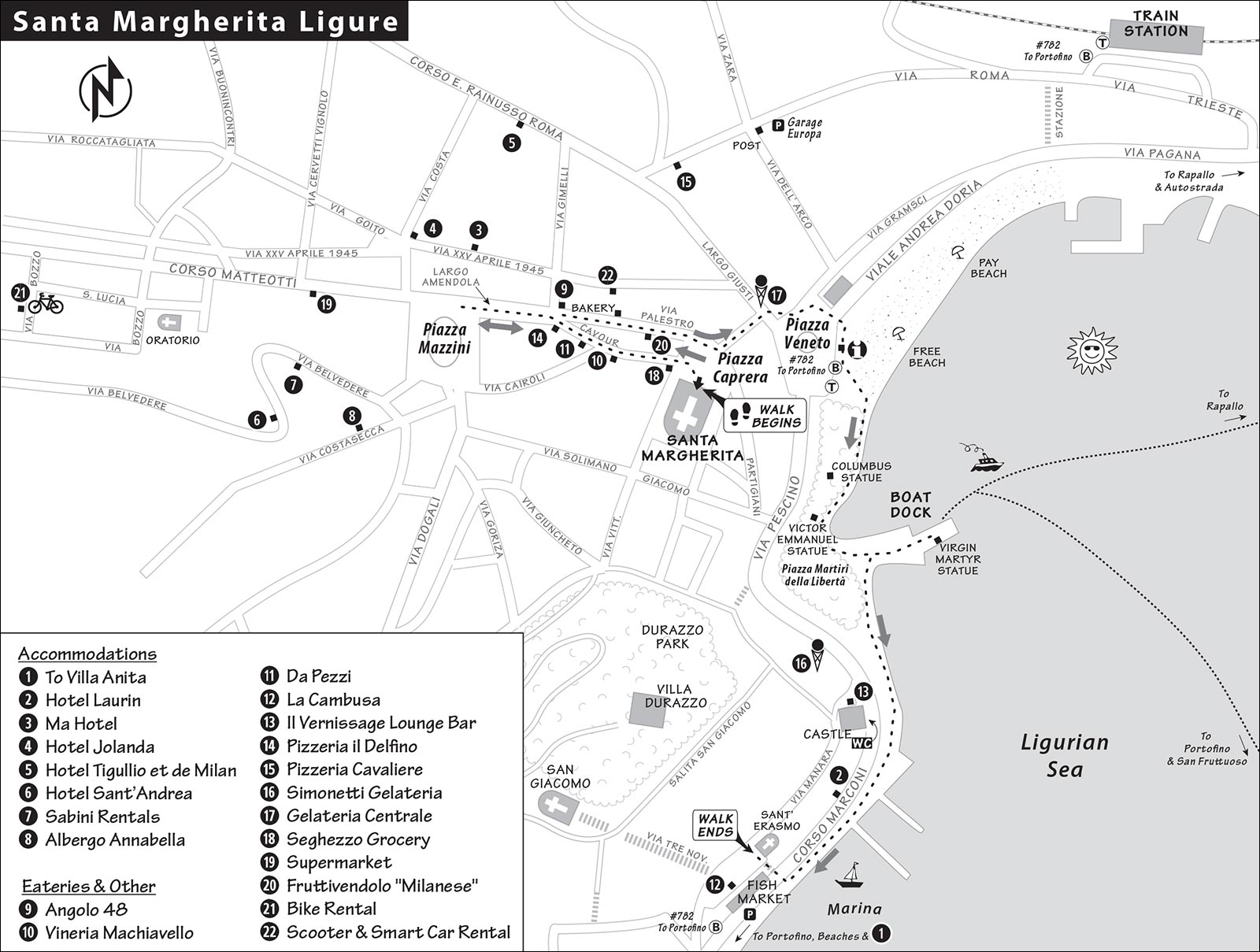
Tourist Information: The TI is as central as can be, in a green harborside kiosk at the city traffic hub, Piazza Vittorio Veneto (daily 9:30-13:00 & 15:00-17:00, shorter hours off-season, +39 0185 28 74 85, www.livesanta.it). They sell tickets for bus #782 to Portofino, which stops at the curb in front.
ARRIVAL IN SANTA MARGHERITA LIGURE
By Train: The bar/café (at the end of track 1) stores bags (small fee) and sells bus, train, and sightseeing-boat tickets. Bus #782 to Portofino leaves from in front of the station.
To get from the station to the city center, take the stairs marked Mare (sea) down to the harbor; or turn right and head more gently down Via Roma, which leads to the town center, the TI, the start of my town walk, and recommended hotels (about 10 minutes away on foot).
By Car: Ask your hotelier about parking; some have free spots. Otherwise, try a private pay lot such as the Garage Europa autopark next to the post office (Via Roma 38). An hourly pay-and-display lot is by the harbor, in front of the fish market. Parking is generally free where there are white lines (though there may be a time limit); blue lines mean you pay.
HELPFUL HINTS
Market: A market sets up on Fridays on Corso Matteotti (8:00-13:00).
Laundry: There’s none in town.
Bike Rental: City and ebikes are available to rent by the day from Ciclomania, which puts together guided day trips to nearby destinations, too (Mon-Sat 8:30-12:30 & 15:30-19:00, closed Sun, Via Luigi Bozzo 22, +39 0185 283 530, www.ciclomania-liguria.it, Mimmo).
Scooter Rental: Head to GM Rent, which also has little Smart cars in its fleet (daily 9:00-13:00 & 15:00-19:00, Via XXV Aprile 11, +39 329 406 6274, www.gmrent.it, Francesco).
Taxi: Taxis wait outside the train station and TI and charge €15 for a ride anywhere in town, €25 to Paraggi beach, and €35 to Portofino (+39 0185 286 508).
Driver: Helpful taxi driver Alessandro, who has both cars and minivans, offers airport transfers to Genoa, Milan, Florence, and Nice. He is also available for local excursions, including day trips to the Cinque Terre (+39 338 860 2349, www.alessandrotaxi.com, alessandrotaxi@yahoo.it).
Santa Margherita Ligure Walk
Get your bearings with this self-guided walk, starting on Piazza Caprera, the square facing the exuberant Baroque facade of the Basilica of Santa Margherita.
Basilica of Santa Margherita
The town’s main church is textbook Italian Baroque (free, daily 7:30-12:00 & 15:00-18:30). Its 18th-century facade hides a 17th-century interior slathered with art and dripping with chandeliers. The altar is typical of 17th-century Ligurian altars—shaped like a boat, with lots of shelf space for candles, flowers, and relics. Its centerpiece is a much-venerated statue of Our Lady of the Rose that’s adorned this altar since 1756.
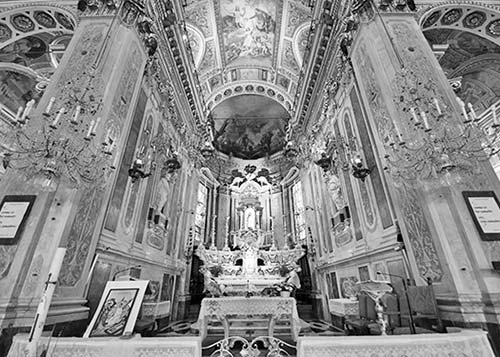
Baroque is theater...and this altar is stagecraft. After the Vatican II decrees of the 1960s, priests began to face their flocks instead of the old altars. For this reason, all over the Catholic world, modern tables serving as post-Vatican II altars stand in front of earlier altars, like the one here, that are no longer the center of attention during Mass.
Wander the church and its chapels, noticing the inlaid-marble floors and sparkling glass chandeliers. As you marvel at the richness, remember that the region’s aristocrats amassed wealth from trade from the 11th to the 15th century. When Constantinople fell to the Turks in 1453, free trade in the Mediterranean stopped, and Genovese traders became bankers—making even more money. A popular saying of the day was, “Silver is born in America, lives in Spain, and dies in Genoa.” Bankers here served Spain’s 17th-century royalty and aristocracy, and their accrued wealth paid for the art you see here.
Piazza Caprera
Each day this square hosts a few farmers selling their produce. On the corner of Via Cavour, just next to the basilica, don’t miss Seghezzo, a venerable luxury grocery store that’s a feast for the eyes. If you don’t go in, at least admire the window displays.
• Now side-trip up the town’s main corridor of retail commerce, Via Palestro and Via Cavour. You’ll go two blocks up to Piazza Mazzini and back.
Main Shopping Streets
Via Cavour and Via Palestro are parallel streets divided by very tall, narrow buildings. As you head up Via Cavour (on the left, by Seghezzo grocery) check out the shops on the right: The buildings that separate Via Cavour from Via Palestro are so skinny you see right through to the other side. The mix of fine boutiques, wine bars, jewelers, and casual restaurants hints at the elite—but not flashy—ambience of the town.
Study the building facades as you walk. It’s not unusual to see painted garlands gently hanging below a roofline or colorful ribbons over doorways and arches. Like a blank canvas, the houses are bedecked and embroidered in attractive styles. No two look just alike.
In two blocks, you’ll emerge onto a square, Piazza Mazzini, with enough elbow room to study the pastel house fronts. These facades were painted and decorated in the characteristic Ligurian trompe-l’oeil style from the turn of the last century. Every building presents some sort of illusion—the decorators went so far as to add painted-on upper windows, shutters, and window frames. Ligurians were practical: It was much less expensive to hire a painter than a sculptor to add decorative detail to these houses.
Now do a U-turn onto Via Palestro to return to where we started (staying straight past the recommended Angolo 48 restaurant on the corner). At #34 (on the left), you’ll pass a traditional panificio (bakery) where you can say, “Vorrei un etto di focaccia” to treat yourself to about a quarter-pound of the region’s famed bread. Just beyond, on the right at #13, Fruttivendolo “Milanese” is just one of the many greengrocers in town selling an array of tempting produce and glass-jarred delicacies.
• Back on Piazza Caprera, turn left and walk away from the church one block to busy Largo Antonio Giusti. Next to the cinema (across the street), a penguin marks the recommended Gelateria Centrale. Head right to Piazza Vittorio Veneto, with its busy roundabout and little park on the harbor. In the park facing the roundabout you’ll find the TI (which sells bus tickets) and a bus stop for Portofino. Use the crosswalks to negotiate the busy intersection and reach the promenade.
Beachfront Promenade
Take a look to the left, along Viale Andrea Doria. The sidewalk is wider than the street, reflecting how visitors have promenaded here, under pastel facades, for more than a century. Now turn right and walk into the waterfront park.
At the midpoint of the park is a Christopher Columbus statue. He was born “Cristoforo Colombo” in 1451 in Genoa, near here, and first sailed on Genovese boats along this Ligurian coast. Next comes a statue of King Victor Emmanuel II, always ready to brandish his sword and create Italy.
• Head out on the little pier with the white statue facing out to sea.
View from the Pier
From here, standing with the “Santa Margherita Virgin Martyr” statue, you can take in all of Santa Margherita Ligure—from the villas dotting the hills, to the castle built in the 16th century to defend against pirates, to the exclusive hotels. Tourist boats to Portofino, the Cinque Terre, and beyond depart from this pier.
• Continue along the waterfront on Corso Marconi.
Harbor and Fish Market
On the right, notice the trendy, recommended Il Vernissage Lounge Bar with tables up at the base of the castle (with WCs down below). Continuing around the corner from the castle (closed to visitors), walk along the harbor. The region’s largest fishing fleet—20 boats—ties up here. The fishing industry survives, drag-netting octopus, shrimp, and miscellaneous “blue fish.” (Anchovies are no longer fished from here but from nearby Sestri Levante.) The fish market (Mercato del Pesca, across the street, inside the rust-colored building with arches and columns) wiggles weekdays from about 16:00 until 20:00 or so—depending on who’s catching what and when. It’s a cool scene as fishermen take bins of freshly caught fish directly to waiting customers.
• Climb the narrow brick stairs just to the right of the fish market to a delightful little square. Find the characteristic, black-and-white pebble mosaic and relax on the benches to enjoy harbor views. Facing the square is the little...
Oratory of Sant’Erasmo
This pastel-hued building is named for St. Erasmus, the protector of sailors, as indicated by the stone-mosaic medallion of a ship decorating the little plaza in front. This building is an “oratory,” where a brotherhood of faithful men who did anonymous good deeds congregated and worshipped. While rarely open, do check. The interior is decorated with ships and paintings of storms that local seafarers survived—thanks to St. Erasmus. The huge crosses standing in the nave are carried through town on special religious holidays.
• Your walk is over. For a little extra exercise to see a pleasant park, climb the long stairs from here up to the Church of San Giacomo (with an interior similar to the Basilica of Santa Margherita) and Durazzo Park.
Sights in Santa Margherita Ligure
In addition to the sights listed here, consider a side-trip to one of Italy’s most beautiful and famous little Mediterranean resorts, Portofino (see here). It’s just a couple miles down the coast and easy to visit from Santa Margherita Ligure.
Durazzo Park (Parco di Villa Durazzo)
This park is a delight, with a breezy café (seasonal), a carefully coiffed Italian garden, and an intentionally wild “English garden” below (free, daily 9:00-19:00, July-Aug until 20:00, closes earlier off-season, WC near café). The Italian garden is famous for its varied collection of palm trees and an extensive collection of camellias. It’s OK to feed the large turtles in the central pond (they like bits of fish or meat).
The park is dominated by Villa Durazzo. It’s not worth touring for most, but take the time to admire its remarkable pebble courtyard, carpeted in a fleur-de-lis pattern of white and gray stone—a Ligurian specialty (€5.50 to enter and view its Murano glass chandeliers and stucco and majolica decor, open daily 9:30-13:00 & 14:00-18:00, concerts held here in summer, www.villadurazzo.it).
Beaches (Spiagge)
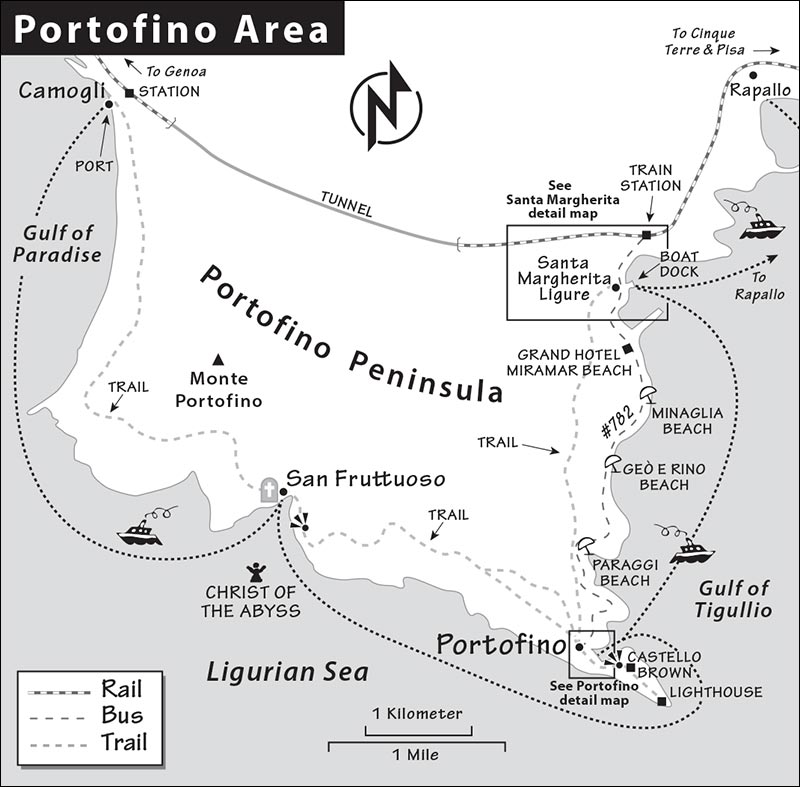
The handiest free beaches are just below the train station toward the boat dock. But the best beaches are on the road to Portofino. These beaches are a 20-minute walk from downtown, or you can take bus #782 from the train station or from in front of the TI at Piazza Veneto. For locations, see the map on here.
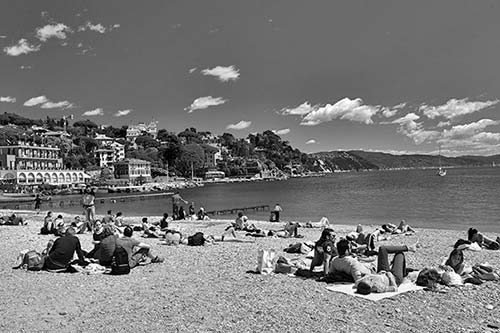
The beach on the south side of Grand Hotel Miramare offers a relaxing experience and is good for kids. Also nice is Minaglia, with rentable sunbeds and kayaks. My favorite, Giò e Rino (just before the Covo di Nord Est night club), has sunbeds for rent and a fun, youthful crowd.
Paraggi, a small, sandy beach halfway to Portofino (and an easy stop on the bus #782 route), is better than any of the close-in Santa Margherita Ligure beaches, but it’s pricey (as much as €60/day in July and Aug)—and it can be packed with sun worshippers from Portofino (where there’s no beach—only rocks). There’s more than one bagni establishment here, so choose the one that most appeals. Off-season, the entire beach is all yours and free of charge. A narrow patch of sand smack-dab in the middle of Paraggi beach is free year-round.
Fishing
To combine the art of fishing with the beauty of the Portofino promontory from the water, arrange a trip with Luca. His boat is equipped for tonnara di Camogli: the region’s old tuna-fishing trap system (€110/2 people or €180/4 people for 4 hours, 4 people max; trip includes light snacks, snorkel masks, and stops for snorkeling and swimming; morning, afternoon, and night trips can be arranged, +39 340 242 6483, www.portofinofishing.com, portofinofishing@gmail.com).
Sleeping in Santa Margherita Ligure
Except for Villa Anita, all the hotels listed here are within a 10-minute walk of the train station.
$$$$ Villa Anita is an elegant-yet-homey family hotel run by Daniela and her son, Sandro. They rent 12 tidy rooms—nearly all with terraces—overlooking a peaceful residential neighborhood a five-minute uphill walk from the seaside boulevard (air-con, family rooms, playground, small gym, small heated pool and sauna, loaner bikes, scooter and boat rentals, pay parking, closed in winter, Viale Minerva 25, +39 0185 286 543, www.hotelvillaanita.com, info@hotelvillaanita.com).
$$$$ Hotel Laurin, nestled up against castle ruins, offers 44 slick, modern, and pricey rooms looking onto the sea. All double rooms face the harbor and have terraces; on the rooftop sundeck, there’s a small pool (RS%, air-con, elevator, gym, limited pay parking—request when you reserve, just past the castle at Corso Marconi 3, +39 0185 289 971, www.laurinhotel.it, info@laurinhotel.it, Tiziana).
$$$ Ma Hotel is a crystal-chandelier-classy boutique hotel with a fresh, modern flair. Although it sits along a busy street, its 11 stylish and spacious rooms are at the back of the building (air-con, patio, free minibar, Via XXV Aprile 18, +39 0185 280 224, www.mahotel.it, info@mahotel.it, Matteo).
$$$ Pastine Hotels is a small chain of three well-run hotels that combine solid service, sumptuous public spaces, and pleasant rooms. The two main branches are around the corner from each other, an easy walk from the station: Hotel Jolanda has a lavish lobby and regal colors, and its 49 pleasant rooms have soothing decor (RS%, air-con, elevator, free use of small weight room and hot tub, pay dry sauna, valet parking, Via Luisito Costa 6, +39 0185 287 512, www.hoteljolanda.it, info@hoteljolanda.it); Hotel Tigullio et de Milan is smaller and tidier, with 36 updated rooms. The superior rooms are especially nice, but even most standard doubles come with a terrace—specify when you book. The rooftop sun terrace offers sunbeds, a bar, and hot tub in the summer (RS%, air-con, elevator, valet parking, Via Rainusso 3, +39 0185 287 455, www.hoteltigullio.eu, info@hoteltigullio.eu). The newest branch, the boutique-like Hotel Sant’Andrea, has 11 rooms just above Piazza Mazzini, with a patio and whirlpool for guests (RS%, air-con, valet parking, Via Belvedere 10, +39 0185 293 487, www.hotelsantandrea.net, info@hotelsantandrea.net).
$$ Sabini Rentals, in a bland but central residential zone, offers three straightforward rooms and one apartment with a tiny corner kitchen (RS%, family rooms, 2-night minimum, cash only, breakfast on request, laundry service, Via Belvedere 31, +39 338 902 7582, www.sabinirentals.com, info@sabinirentals.com, Cristina and Giancarlo).
$ Albergo Annabella has 11 well-kept rooms, six of which are old-style budget throwbacks with sinks in the room and shared bath (no breakfast, air-con, Via Costasecca 10, +39 0185 286 531, www.albergoannabella.it, info@albergoannabella.it, Annabella speaks just enough English).
Eating in Santa Margherita Ligure
In the City Center
$$$ Angolo 48, run by savvy Elisa and Valentina, serves well-presented and reasonably priced Genovese and Ligurian dishes. This cozy locale is popular: Either arrive right when they open or make a reservation. There’s great seating both on the square and inside. Try their handmade pansotti in walnut sauce (lunch Sat-Sun only 12:00-13:45, dinner Tue-Sun 18:30-22:00, closed Mon, Via Palestro 48, +39 0185 286 650).
$$ Vineria Machiavello feels more urban Tuscan than seaside Ligurian. This well-stocked enoteca (wine shop) offers tastings and full bottles, but also serves a short menu of well-priced dishes at a few humble tables tucked between the wine racks (Wed-Mon 10:00-14:00 & 17:30-24:00, closed Tue, in the heart of the pedestrian zone at Via Cavour 17, +39 0185 286 122).
$ Da Pezzi, with a cheap cafeteria-style atmosphere, is packed with locals at midday and at night. They’re standing at the bar munching farinata (crêpes made from chickpeas, available Oct-May 18:00-20:00) or enjoying pesto and fresh fish in the dining room. Consider the deli counter with its Genovese picnic ingredients (Sun-Fri 10:00-14:00 & 18:00-21:00, table service after 12:00 and 18:15, closed Sat, Via Cavour 21, +39 0185 285 303, Giancarlo and Giobatta).
On the Waterfront
All along the harbor side of Via Tommaso Bottaro, south of the marina, you’ll find restaurants, pizzerias, and bars serving food with a nautical view.
$$$ La Cambusa, perched above the fish market, is popular for its seafood. While the food is forgettable, the view from its harborside terrace is not. In cooler weather, the terrace is covered and heated. Diners receive a free glass of sciacchetrà (dessert wine) and biscotti with this book (daily 12:00-15:00 & 19:00-23:00 except closed Thu Oct-June, Via Tommaso Bottaro 1, +39 0185 287 410).
At $$ Il Vernissage Lounge Bar, you can nurse your drink with a million-dollar view. There are 20 wines by the glass, plus cocktails and spritzes, which come with a nice plate of finger food (daily 18:00-late, Sun from 11:00, Salita al Castello 8, +39 349 220 5846, Sandro).
Budget Options
$$ Pizzeria il Delfino serves thin, big, wood-fired pizzas in a rustic, fun local scene, with a few quiet tables outside and tight inside seating under nautical bric-a-brac (cash only, daily 12:00-15:00 & 18:00-23:00 except closed Tue lunch, Via Cavour 29, +39 0185 286 488). For cheaper takeout pizza and kebabs, head for Pizzeria Cavaliere, on the way to the station (open daily, Via Roma 16).
Gelato: Along the waterfront, try Simonetti—especially their chocolate-truffle tartufato (under the castle at Piazza Martiri della Libertà 48). Gelateria Centrale, just off Piazza Veneto near the cinema, serves up pinguino (penguin) cones, your choice of gelato dipped in chocolate (Largo Antonio Giusti 14).
Groceries: Classy Seghezzo is a gorgeous luxury grocery, deli, and wine shop. It’s great for a meal to go—ask them to riscaldare (heat up) their white lasagne al pesto or dish up their special carpaccio di polpo—thinly sliced octopus (Thu-Tue 7:30-13:00 & 15:30-20:00, closed Wed off-season, near the church on Via Cavour, +39 0185 287 172, www.seghezzo.com). Cheaper and less romantic, the Co-op grocery is a fine place to stock up (daily 8:00-13:30 & 15:30-19:30 except Sun from 8:30, Corso Giacomo Matteotti 9).
Santa Margherita Ligure Connections
To reach the Cinque Terre towns (beyond Monterosso), you’ll usually have to change in Sestri Levante, Levanto, or Monterosso.
From Santa Margherita Ligure by Train to: Sestri Levante (2/hour, 20-25 minutes), Monterosso (at least hourly, 50-60 minutes, often with a change in Sestri Levante), La Spezia (nearly hourly direct, 55-65 minutes), Pisa (5/day direct, 2 hours, more with transfer), Florence (4 hours, transfer in La Spezia or Pisa), Milan (9/day direct, 2 hours, more with transfer in Genoa), Ventimiglia/French border (almost hourly, 3.5 hours, change in Genoa), Venice (5-7 hours, 1-2 changes).
By Boat to the Cinque Terre: Tour boats make various trips to Vernazza, Porto Venere, and other ports nearly every day. Pick up a schedule of departures and excursion options from the TI, visit the ticket shack on the dock, call +39 0185 284 670, or check www.traghettiportofino.it.
Portofino
Santa Margherita Ligure, with its aristocratic architecture, hints at old wealth. But nearby Portofino (por-toh-FEE-noh; pop. 500)—with its sleek jewelry shops, art galleries, and haute couture boutiques filling a humble village shell—has the sheen of new money. It’s the kind of place where the sailing masts are taller than the houses and church steeples. But the picture-perfect harbor, classic Italian architecture, and wooded peninsula turn posh Portofino into an appealing destination. Just a couple of miles down the coast, it’s a fun, easy day trip from Santa Margherita Ligure.
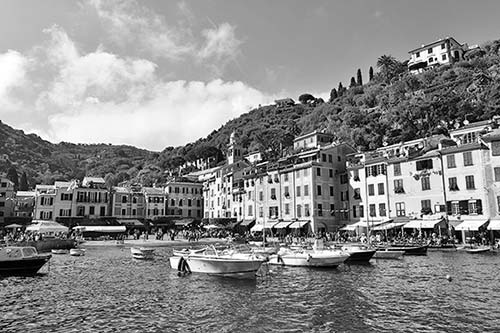
Planning Your Time: In summer, my favorite Portofino plan is to visit in the late afternoon. Leave Santa Margherita Ligure by bus at about 16:30, get off at Paraggi beach, and hike 30 minutes over the bluff into Portofino. Explore the town, splurge for a drink on the harborfront, or get a takeout fruity sundae (paciugo; pah-CHOO-goh) and sit by the water. Then return by bus to Santa Margherita Ligure for dinner (confirm late departures). If you plan to do longer hikes around Portofino, come earlier in the day.
Tourist Information: The Portofino TI is tucked under an arch between the harbor and the bus stop (Wed-Mon 10:00-13:00 & 14:00-18:00, closed Tue, Via Roma 35, +39 0185 215 037, www.comune.portofino.genova.it).
GETTING TO PORTOFINO
You can reach Portofino from Santa Margherita Ligure by bus or boat, or on foot. For a fun combination, go one way by bus and on foot from Paraggi, and the other way by boat. (I wouldn’t suggest biking it, because of the blind corners.)
By Bus: Catch bus #782 from Santa Margherita Ligure’s train station, TI, or bus stops along the harbor (€3 one-way or €5 round-trip, €1 more if bought from driver, 4/hour, 20 minutes, www.amt.genova.it [URL inactive]). Buy tickets at the train station bar, the green ticket machine outside the TI, or any newsstand, tobacco shop, or shop that displays a Biglietti Bus sign. If you’re at the TI, grab a bus schedule to plan your return (last bus around 24:00 in summer).
By Taxi: A taxi ride from Santa Margherita Ligure costs around €35 to Portofino or €25 to Paraggi beach (more at night). Taxi stands in Santa Margherita Ligure are at the train station and at the curb in front of the TI.
By Boat: The boat makes the 15-minute trip with more class and scenery—and without the traffic jams. The dock in Santa Margherita Ligure juts out from the waterfront park at Piazza Martiri della Libertà, near the TI (€8 one-way, €14 round-trip; hourly departures May-Sept daily 10:15-16:15, fewer in April and Oct, no boats off-season; purchase tickets at the dock, +39 0185 284 670, www.traghettiportofino.it).
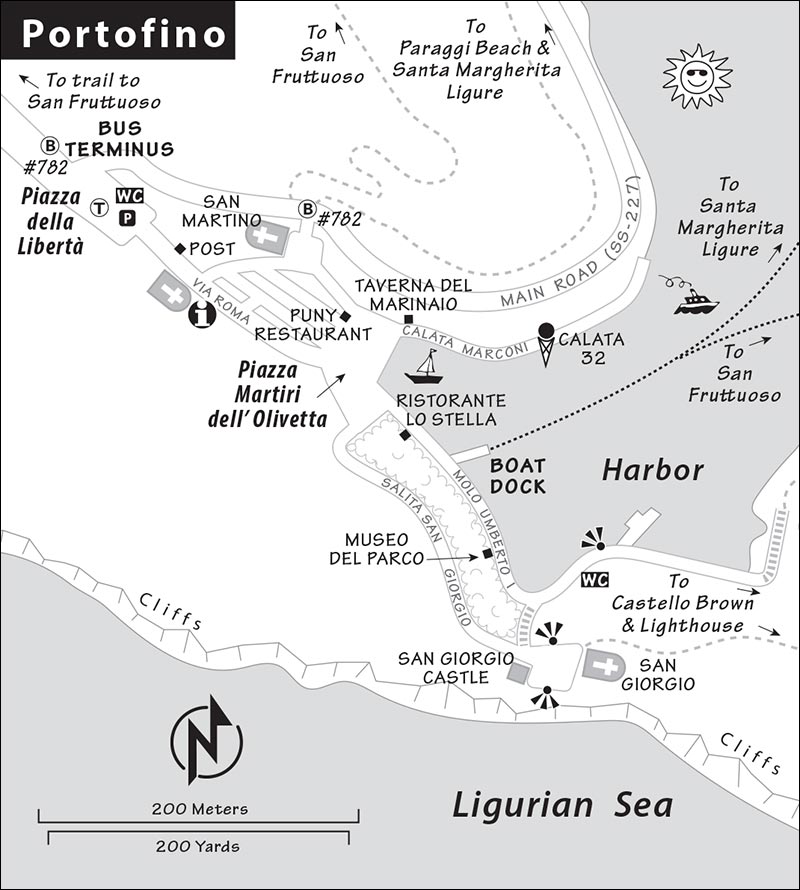
If you arrive in Portofino by boat but will be busing back, follow the narrow lanes up from the harbor to the bus stop in Piazza della Libertà (ticket machine and tobacco store there sell tickets).
On Foot: To hike from Santa Margherita Ligure to Portofino, you have two options: You can follow the sidewalk along (and sometimes hanging over) the sea (1 hour, 2.5 miles)—although traffic can be noisy, and in places, the footpath disappears. Or, if you’re hardy and ambitious, you can take a quieter two-hour hike by leaving Santa Margherita Ligure at Via Maragliano, then following the Ligurian-symbol trail markers (keep a close eye out for red-and-white stripes). This hike takes you high into the hills. Keep left after Cappelletta delle Gave. Several blocks past a castle, you’ll drop down into Paraggi beach, where you’ll take the Portofino trail (described next) the rest of the way.
Bus-and-Hike Option: For a short—but rewarding—30-minute hike into Portofino, ride bus #782 from Santa Margherita Ligure to Paraggi beach (tell the driver you want to get off there—you can’t miss the inlet bay with a sandy beach). At the Portofino end of the beach, look for the Parco di Portofino sign to find the steps that begin the hilly, paved trail marked Pedonale per Portofino high above the road. There’s a fair amount of up and down, but it’s all well-paved and scenic. After Paraggi, you’ll curl around another bay—with the famously top-end Hotel Splendido hovering on the hill above—before snaking your way to Portofino (you’ll pop out at a yellow-and-gray church labeled Divo Martino).
Off-season, you can easily reverse the bus-and-hike option—by hiking from Portofino to Paraggi (taking the Pedonale per Paraggi trail near the Divo Martino church), then busing from the beach to Santa Margherita Ligure—but this works only when crowds are light; on busy days, return buses fill up in Portofino and won’t stop in Paraggi.
Sights in Portofino
▲▲Self-Guided Visual Tour from the Harbor
Stand or sit on the angled boat launch where Piazza Martiri dell’Olivetta meets the harbor (or nurse an overpriced cocktail at the nearby café tables) and get oriented to Portofino. It’s one of the Mediterranean’s most beautiful and famous little resorts.
Scanning the narrow pastel houses around the harbor, notice the painted-on details. You may also see laundry hanging out to dry—a surprising reminder that, while Ferragamo and Prada may reside on street level, actual villagers still live upstairs.
Now look out to the well-protected natural harbor—which has held substantial strategic value ever since the Romans first founded a town here. Since then, it has been appreciated by everyone from Napoleon to the Nazis.
A new flock of fans arrived in the 1950s, when National Geographic ran a beautiful article on the idyllic port. Locals claim that’s when the Hollywood elite took note. Liz Taylor and Richard Burton came here annually (as did Liz Taylor and Eddie Fisher). During one famous party, Rex Harrison dropped his Oscar into the bay (it was recovered). Ava Gardner came down from her villa each evening for a drink—sporting her famous fur coat. Greta Garbo loved to swim naked in the harbor, not knowing (or caring) that half the town was watching. Truman Capote also called Portofino home. But VIPs were also here a century earlier. Friedrich Nietzsche famously wrote about philosophizing with the mythical prophet Zarathustra on the path between Portofino and Santa Margherita Ligure.
Today, the celebrity cachet lives on. When you tell locals you’re going to Portofino, they say, “Maybe you’ll see George and Amal Clooney!” Count the yachts and the tall-masted sailboats and imagine who might be on them.
Now scan the panorama on the hillside in front of you. On the left is Castello Brown, an actual medieval castle built by the Genovese in the 16th century to protect this strategic harbor. It later became a private mansion, and today it is primarily an event space featuring lush gardens and sweeping viewpoints (€5; daily July-Aug 10:00-20:00, March-June until 19:00, shorter hours in fall and winter, +39 375 791 8926, www.castellobrown.com).
Panning right, you’ll see the Church and Castle of San Giorgio, with its popular two-way viewpoint terrace, looking down over the port and out over the ocean. This is an easy option for a picnic with grand views. Boats back to Portofino, or on to the San Fruttuoso Abbey, depart from the harbor below this church. The Museo del Parco (described next) is also along this embankment.
Now look back toward town. A tidy grid of narrow cobbled streets angles gently uphill to the modern part of town, around Piazza della Libertà (with bus stop and taxi stand). These streets—where budget takeaway eateries and grocery stores are mixed in with swanky shops—are a good place to hunt for picnic fare. Up on the right is the striped church of San Martino, marking the well-manicured, enjoyable 30-minute trail to Paraggi beach.
Museo del Parco
For an artsy break, walk around the harbor to the right, where you can stroll around a park littered with 148 contemporary sculptures by mostly Italian artists, including a few top names (€5, open Wed-Mon 10:00-13:30 & 15:00-20:00 in summer; closed Tue, off-season, and in bad weather).
Hikes
The TIs in Portofino and Santa Margherita Ligure can outline your options. For even more detail, look at ParcoPortofino.com, a helpful website with sample itineraries. Here are several options easily doable from Portofino itself.
Lighthouse Hike: A paved stone path winds up and down to the lighthouse (faro) at the scenic point beyond the Church and Castle of San Giorgio. Start your climb on little Salita San Giorgio—it’s tucked between the Delfino and Tripoli restaurants on the harborfront. Spend a few minutes enjoying the views on the church terrace (and if it’s open, duck into the flower-bedecked cemetery behind the church). Rejoin the path signed al Faro to continue up. Walls and hedges block views at some points, but in the end, you’ll be rewarded with the open sea—and a lounge/bar (open May-Sept, 25-minute walk). Consider popping into the medieval Castello Brown on the way up or down.
Paraggi Beach Hike: You can stroll the hilly pedestrian promenade through the trees from Portofino to Paraggi beach—if you’re lucky, you might see a wild boar en route (30 minutes, path starts to the right of striped Divo Martino church just above the harborfront piazza, and ends at ritzy Paraggi beach, where bus #782 stops on its way back to Santa Margherita Ligure—though in peak season, the bus may be full and won’t stop). For more details see “Bike-and-Hike Option” under “Getting to Portofino,” earlier.
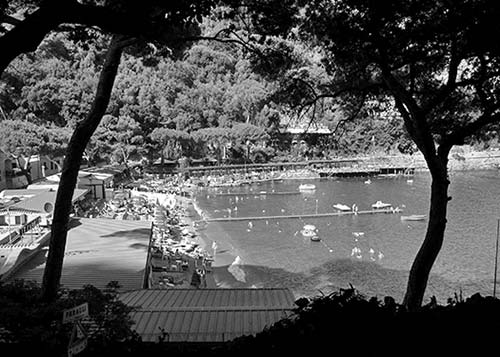
San Fruttuoso Hike: Another option is to hike out to San Fruttuoso, with its abbey and underwater Christ statue—see next.
NEAR PORTOFINO
San Fruttuoso
Farther out on the peninsula, this tiny settlement around a sheltered cove is accessible only by foot or boat. It’s a lazy place to relax on a nice day: You’ll find a small pebbly beach (half private, half free), a handful of restaurants, hiking trails, and a couple of offbeat sights. Aside from a caretaker, no one actually lives here.
A Benedictine abbey at the water’s edge was established at San Fruttuoso in the 10th century and abandoned in the 15th century. The well-preserved building has been turned into a museum. Medievalists and archeologists will enjoy its exhibits, which are well-described in English. You’ll see the tiny cloister, tombs of the Doria family (longtime patrons of the abbey), and a simple church (€8; June-mid-Sept 10:00-17:45, shorter hours off-season and closed Mon in winter; +39 0185 772 703, www.abbaziadisanfruttuoso.it).
Aside from the abbey, many are drawn here to see the statue of Christ of the Abyss (Cristo degli Abissi)—60 feet underwater, offshore from the abbey, in a specially protected marine area. The statue was placed there in 1954 for the divine protection of the region’s divers. In summer, for a few euros, boats on the beach can take you out to a spot above the statue, where you can look down to just barely see the arms of Jesus-outstretched, reaching upward. Some people bring goggles and dive in for a better view. A copy of the statue is in the abbey church (no entry fee required).
The private section of the beach has sunbeds (€17/day), showers, and towel and kayak rentals. It can fill up in summer (reserve at +39 328 450 5521 or email bagnisanfruttuoso@gmail.it; www.bagnisanfruttuoso.it).
Getting There by Boat: The same boats that link Santa Margherita Ligure and Portofino continue on another 30 minutes to San Fruttuoso (€12.50 one-way, €19 round-trip from Santa Margherita Ligure, allows stop at Portofino). A different company’s boats link San Fruttuoso to Camogli, north of the peninsula (€10, +39 0185 772 091, schedule at www.golfoparadiso.it). From Camogli, it’s easy to take the train back to Santa Margherita Ligure.
Getting There by Foot: The three-mile trail from Portofino to San Fruttuoso is steep at the beginning and end, rising about 1,000 feet (allow up to 2.5 hours—pick up the trailhead at the inland-most point of Portofino town, past Piazza della Libertà and the carabinieri station).
Portofino Peninsula Grand Tour
For a one-day grand tour of the Portofino peninsula, enthusiastic walkers can follow this plan: Take an early boat or bus from Santa Margherita Ligure to Portofino, have a quick look at the town, and then hike 2.5 hours to San Fruttuoso. Reserve a spot in advance at the private beach (bring your swimsuit). You’ll have the rest of the afternoon to enjoy the beach, visit the abbey, eat, and perhaps see the Cristo. To finish your tour, take the 30-minute ferry to Camogli (last boat at 18:00 in June, 19:00 in July/Aug, www.golfoparadiso.it) where you can catch a train for the short ride back to Santa Margherita Ligure (2/hour, 5 minutes, station is 10 minutes on foot from the ferry port). Confirm these times locally before starting out.
EATING IN PORTOFINO
Bring a picnic if you want to eat affordably in this beautiful village. Fancy restaurants ring the harbor, but the quality often doesn’t match the high prices. I’d rather dine in Santa Margherita Ligure. There are a few glitzy cafés and bakeries in the back streets, but you won’t find any bargains.
If you do eat in Portofino, $$$$ Ristorante lo Stella, just a few steps from the boat dock, has well-prepared dishes and portholes in the bathrooms (+39 0185 269 007). $$$$ Taverna del Marinaio, across the harbor, has a prime location to soak up the last of the day’s sun, tables under arcades, and a small, cozy, classy interior (+39 0185 269 103). And $$$$ Puny, at the top of the harborfront square, is a famous splurge (reserve ahead, +39 0185 269 037, https://punyportofino.it). There are several gelaterie, including Calata 32, opposite the boat dock.
South of the Cinque Terre
South of the Cinque Terre is the nothing-special city of La Spezia, a handy transit hub with excellent train connections. And near La Spezia is a gem—the resort town of Porto Venere, worthy of a day trip from the Cinque Terre (by direct boat, or by train and bus via La Spezia).
Porto Venere
The enchanting village of Porto Venere (POR-toh VEH-neh-reh) hides just around the bay from La Spezia. Comparably scenic to the Cinque Terre towns—but with a bit of glitz and a darker history—Porto Venere clings to a rocky, fortress-crowned promontory. A rainbow of tall, skinny pastel facades rises from its inviting harborfront promenade.
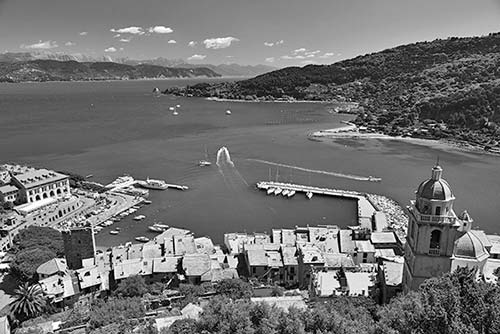
Little Porto Venere is light on sights, but it’s a breeze to reach by boat from the Cinque Terre and fun to explore: The higher you go, the better the views. Rather than the open sea, Porto Venere faces the beautiful Gulf of La Spezia—more romantically known as the Gulf of Poets—where Lord Byron was said to have gone for a hardy swim despite rough seas and local warnings to the contrary. (He survived...at least for a little while longer.) Scanning the bay, you’ll see the outskirts of muscular La Spezia, the often-snow-covered peaks of the Apuan Alps, the resort town of Lerici, and—across a narrow strait—the rugged island of Palmaria.
GETTING TO PORTO VENERE
By Boat: Porto Venere is an easy day trip from the Cinque Terre towns by boat (late April-mid-Oct, 1.5 hours from Monterosso, €20 one-way, €37 day pass allows hopping on and off, +39 0187 732 987, see schedule at www.navigazionegolfodeipoeti.it).
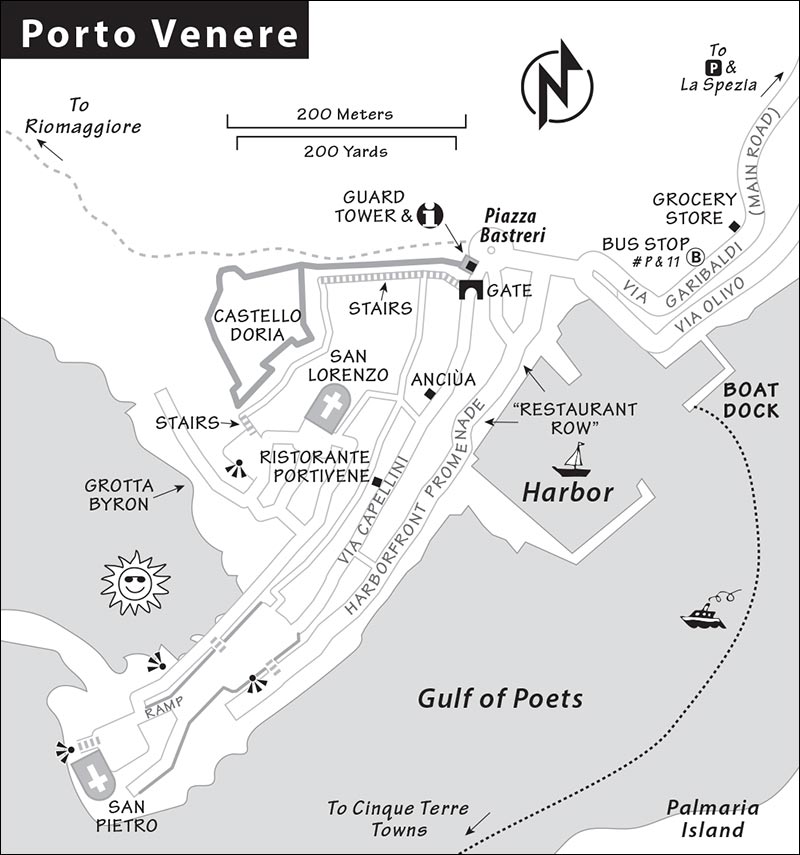
By Train and Bus: The budget route to Porto Venere is by train to La Spezia and then by city bus #P or #11 to Porto Venere. The bus stop closest to the La Spezia Centrale train station is about a 15-minute walk away, on Via Nicolo Fieschi, the extension of Viale Garibaldi (see the “La Spezia” map in the next section for location—stops are marked “Fermata ATC”; 2/hour, 30 minutes, €2.50 each way; buy ticket at tobacco shop or newsstand in train station; www.atcesercizio.it). You could take the boat one way and the bus back (or vice versa), giving you a chance to explore La Spezia as well.
By Car: For drivers, parking is challenging. In peak season, shuttle buses connect the parking lot just outside Porto Venere to the harborside square. Otherwise, test your luck with the pay spots on the seaside.
VISITING PORTO VENERE
Tourist Information: The TI (Pro Loco Porto Venere) fills an old guard tower at the top of the main square (daily 10:00-12:00, also Thu-Sun 15:00-17:00, shorter hours off-season, Piazza Bastreri 7, +39 0187 790 691, www.portovenere.com).
The town is essentially two streets deep: the harborfront promenade and the main street (Via Capellini), a block uphill. A complete loop around Porto Venere includes both of these streets and a moderately steep hike up to the town’s two main churches and fortress for the views. You can see everything in just a few hours; add more time for lunch or lingering.
Along the harborfront, seafood restaurants enjoy a Technicolor backdrop and boat captains try to talk you into a 40-minute excursion around Palmaria and two other nearby islands. But all the action is on Via Capellini (just through the big arch from the TI—or hike up any of the narrow stepped lanes from the harbor). Skinny and shaded, Via Capellini has a mix of restaurants, focaccia-and-pizza takeaway stands, local shops, and boutiques selling gourmet gifty edibles and gaudy beachwear.
At the west end of the promenade and Via Capellini, the town and its fortifications come to a point at the late-13th-century Church of San Pietro, with Gothic features and a black-and-white-striped interior typical of this region. Climb the stairs to the roof terrace for fine views in both directions (including the “Grotta Byron” sea cave).
More viewpoints line the walk from here up the stairs to the town’s other big church, San Lorenzo. With a dark and brooding Romanesque interior, this church—like much of Porto Venere—was built by the Genovese to establish a strategic foothold at the entrance to the bay in the 12th century.
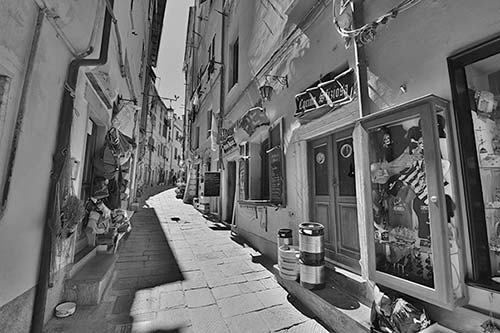
From in front of the church, more steps lead up to the town’s fortress, Castello Doria. A hulking shell, it’s not worth the money to go inside, but a hike up to the terrace out front is rewarded with striking panoramas.
From the castle, head back into town; to make this walk a loop, bear left to follow the very steeply stepped lane that runs just inside the crenellated wall back down to the TI.
Hardy hikers enjoy the five-hour (or more) hike to Riomaggiore, the nearest Cinque Terre town. Get details on this and other hikes at the TI; for more on hiking the Cinque Terre, see here.
EATING IN PORTO VENERE
On the harbor, take your pick of views and menus (seafood/pizza) for a meal along “Restaurant Row” in a memorable setting next to colorful bobbing boats.
For better values and more variety, stroll one block inland to Via Capellini. For a sit-down meal along here, try $$ Ristorante Portivene, serving local dishes with modern flair at reasonable prices (reservations smart, closed Mon, at #94, +39 0187 792 722). Better yet, browse the fun selection of takeaway shops (selling pizza slices, bruschetta, focaccia, and top-notch deli items) to put together a picnic to enjoy by the port. $ Anciùa (at #40) assembles panini to order with interesting ingredients; they also have fresh fried anchovies and other Ligurian street food.
La Spezia
While it’s the next train stop south of the fanciful Cinque Terre, the working city of La Spezia (lah SPEH-tsee-ah; pop. 93,000) feels like “reality Italy.” Useful as a transit point, La Spezia is slim on sights and has no beaches, but its pleasant center is filled with Liberty-style buildings (Italian Art Nouveau). You’ll change trains here if traveling between the Cinque Terre and points farther south in Italy, and you’ll see at least a bit of La Spezia if you use the bus to daytrip to Porto Venere—or if you arrive on one of the big cruise ships that funnel groups into the Cinque Terre. Italians know La Spezia as their country’s main naval base, and residents of the Cinque Terre come here to shop or visit the dentist.
ORIENTATION TO LA SPEZIA
Arrival in La Spezia: Get off at the La Spezia Centrale train station—not the suburban La Spezia Migliarina station, where some trains terminate. Along track 1 is a Cinque Terre National Park information desk, which sells park tickets (see here) and acts as a TI (daily 8:00-19:00, shorter hours off-season, www.parconazionale5terre.it). You’ll also find an office selling tickets for the Cinque Terre boats, a tobacco store, and a newsstand (handy if you need a ticket for the bus to Porto Venere). The city TI is a 10-minute walk away.
For drivers who want to leave a car in La Spezia then head to the Cinque Terre by train, the easiest parking is under the train station, at the modern Park Centro Stazione (enter from Via Fiume or Via Paleocapa, €30/day, www.mobpark.eu). There are cheaper lots a bus ride away.
Baggage Storage: It’s expensive, but day-trippers can store bags about 350 yards from the station—a three-minute walk—at the Stow and Go deposito bagagli at Via XX Settembre 209 (open 24/7, self-serve lockers in 3 sizes, €18/day). The World Services shop at Via Fiume 115 offers cheaper storage close to the station, but with more limited hours.
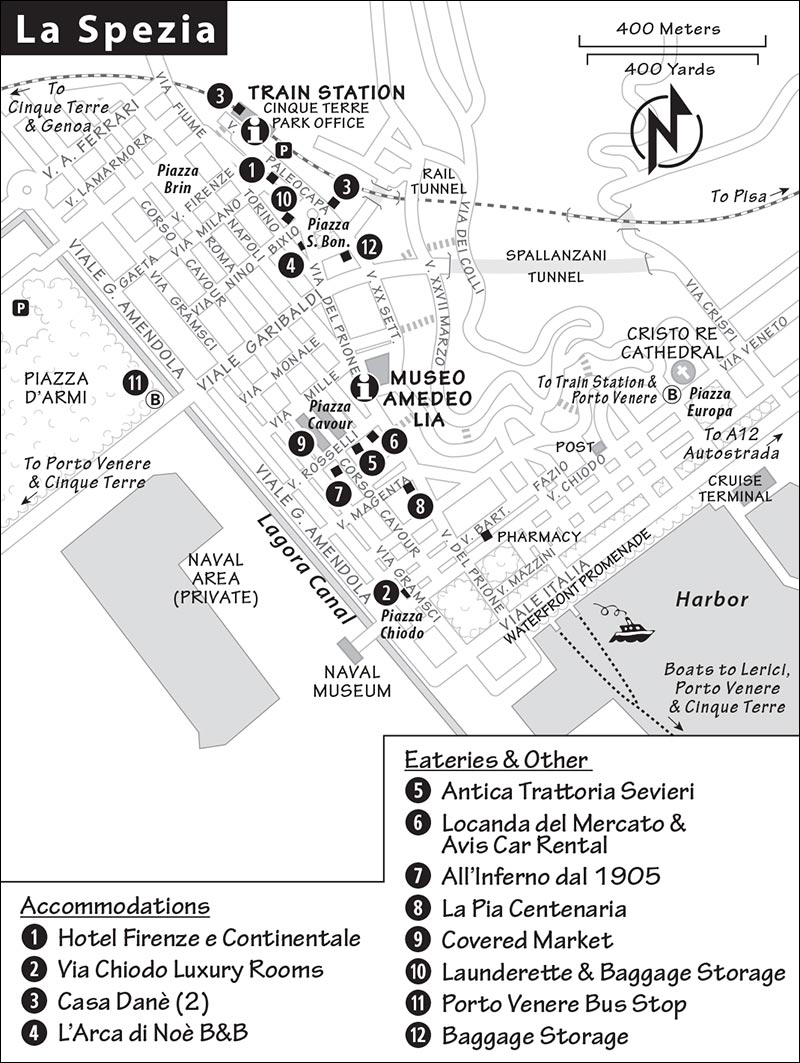
Laundry: The handy Mezzora self-service launderette is just steps from the train station, down the street from Stow and Go (daily 8:30-20:30, Sun from 9:00, Via Fiume 95).
Car Rental: You won’t need a car in the Cinque Terre region, but you may want one before or after your visit. La Spezia is the most convenient place to pick up or drop off a car near the Cinque Terre. Avis is closest to the train station (10 minutes on foot, closed Sat-Sun, Via Fratelli Rosselli 76, +39 0187 770 270). Hertz and Europcar are located in Viale San Bartolomeo, a short taxi ride away.
VISITING LA SPEZIA
The city center is a 10-minute walk downhill from the station, and the waterfront is another 10 minutes beyond that. Leave the station, turn left, and walk a long downhill block (on Via Pietro Paleocapa) to the big roundabout (Piazza Saint Bon). A nice pedestrian street starts on the other side of the roundabout, first called Via Fiume and, lower down, Via del Prione. You can continue on this street all the way to the harborfront gardens.
On your way you’ll pass the TI at Via del Prione 228 (daily 9:00-12:30 and 15:00-19:00, shorter hours off-season, +39 0187 026 152, http://www.myspezia.it/). The side streets leading off to the right are worth exploring, such as Via Fratelli Rosselli, which leads to recommended restaurants and La Spezia’s atmospheric covered market. Next to the TI is the nearly deserted Museo Amedeo Lia, a grab bag of Italian art and archeology up to the 18th century, including some minor works by Venetian masters (€8, Tue-Sun 10:00-18:00, closed Mon, +39 0187-731-100, http://museolia.spezianet.it).
NEAR LA SPEZIA: CARRARA
Carrara, a 35-minute drive from La Spezia, is an easy stop for drivers connecting La Spezia and points south. It’s home to the world’s most famous marble quarries, where Michelangelo chose the marble for his masterpieces. Carrara’s Marble Museum (Museo Civico del Marmo) traces the story of marble-cutting here from pre-Roman times until today (closed Mon, Viale XX Settembre 85, +39 0585 845 746).
SLEEPING IN LA SPEZIA
Stay in the Cinque Terre if you can. La Spezia is a functional home base if there’s no room elsewhere or if you’ve got a car to park.
$$ Hotel Firenze e Continentale, 100 yards from the train station, is a big, good-value, nicely modernized hotel with 70 rooms and lofty common spaces (RS%—request by email, air-con, elevator, pay parking—reserve ahead, Via Pietro Paleocapa 7, +39 0187 713 210, www.hotelfirenzecontinentale.it, info@hotelfirenzecontinentale.it).
$$ Via Chiodo Luxury Rooms, with nine elegant, bright white rooms on the second floor of a large downtown building, is a soothing retreat near the harbor and close to the public gardens—though if you’re coming from the train station, you’ll probably want a taxi (air-con, elevator, no parking, Via Chiodo 13, +39 0187 22 607, see “Via Chiodo Luxury Rooms” at www.costaestate.it, info@costaestate.it).
$$ Casa Danè offers 10 chic rooms with comfy linens and orange trees outside the door, plus 20 more rooms inside the train station, in former train conductor barracks. Some rooms overlook the tracks but good windows reduce the noise (RS%—use code “RICK2023,” family rooms, air-con, Via Paleocapa 4, +39 338 535 3103, www.casadane.it, reception@casadane.it, Paolo).
$ L’Arca di Noè B&B, at the top of the pedestrian zone a five-minute walk from the station, has three bright, artsy, affordable rooms, all with private bath (air-con, homey communal kitchen, Via Fiume 39, mobile +39 320 485 2434, montialex74@gmail.com, Alessandra).
EATING IN LA SPEZIA
These eateries are on and around the pedestrian zone, within a 10-minute walk of the train station.
$$$ Antica Trattoria Sevieri is an elegant place across from the covered market, featuring fresh fish and superb seafood pastas and risotto. Alessandro, the chef/owner, will help you pick from the catch of the day and choose the cooking method (vegetarian and meat dishes too, Mon-Sat 12:00-15:00 & 19:00-24:00, closed Sun, Via della Canonica 13, +39 0187 751 1776).
$$ Locanda del Mercato has white tablecloths, formal service, and Ligurian specialties that you can savor inside or out (Wed-Mon 11:30-15:30 & 18:30-23:30, closed Tue, Via Fratelli Rosselli 88, +39 0187 732 651).
$ All’Inferno dal 1905, a small, busy, less-expensive restaurant with a laid-back atmosphere, serves traditional chickpea soup (mesciua), linguine with mussels, and homemade pesto. Look for the red door in the narrow cross-street of Piazza Cavour (Mon-Sat 12:15-14:30 & 19:30-22:30, closed Sun, +39 0187 29458, Via L. Costa 3).
$ La Pia Centenaria draws local crowds to its takeaway counter for its specialty—farinata (€2-5 chickpea pancakes, eaten plain or with savory toppings). They also sell focaccia and pizza by the slice and have a separate, simple, sit-down section with table service (Mon-Sat 11:00-15:00 & 17:00-22:00, closed Sun, Via Magenta 12, +39 0187 739 999, www.lapia.it).
LA SPEZIA CONNECTIONS
Trains leave at least twice hourly for the Cinque Terre towns (direction: Levanto or Sestri Levante). A few express trains (headed to Genoa or Milan) stop only at Monterosso. Other connections from La Spezia include Pisa (at least hourly, 50-80 minutes), Florence (5/day direct, 2.5 hours, or nearly hourly with change in Pisa), Rome (8/day direct, 3-4 hours, more with change in Pisa), Milan (about every 2 hours direct, 3.5 hours), and Venice (6 hours, change in Milan or Florence).
It’s also possible to go by boat to the Cinque Terre, Porto Venere, and outer islands from the La Spezia dock (www.navigazionegolfodeipoeti.it). The boat office in the train station sells tickets.