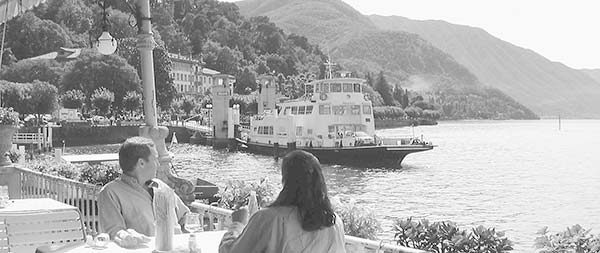
THE LAKES
Lake Como • Varenna • Bellagio • Lake Maggiore
Sights and Activities in Varenna
Sights and Activities in Bellagio
Map: Stresa & the Borromeo Islands
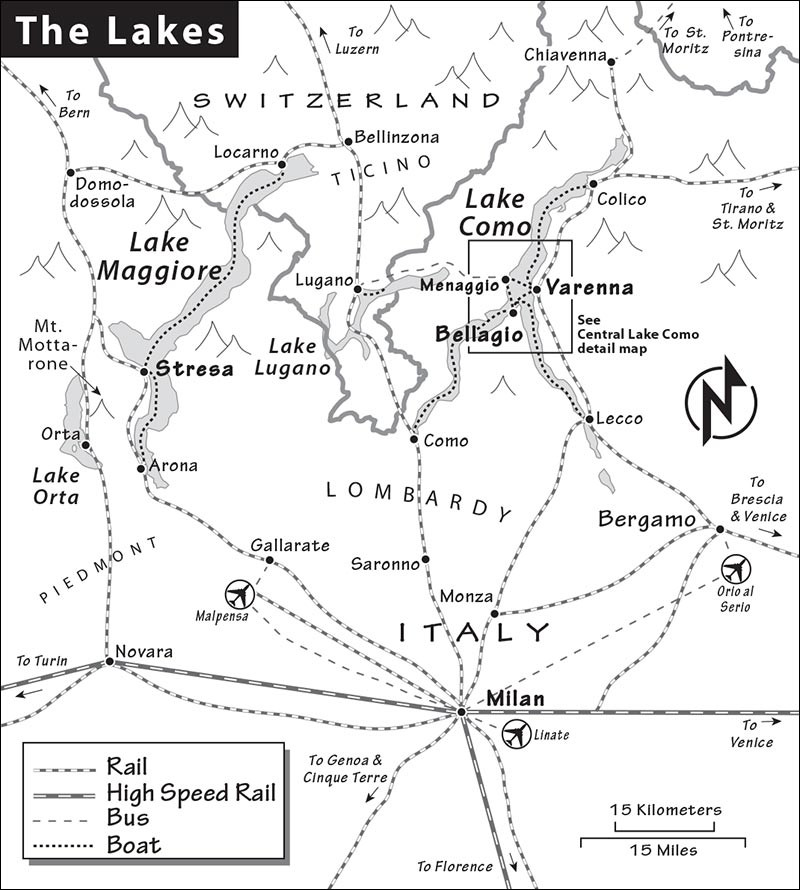
Commune with nature where Italy is joined to the Alps, in the lovely Italian lakes district. In this land of lakes, the million-euro question is: Which one? For the best mix of accessibility, scenery, and offbeatness, Lake Como is my choice—and I stay in the village of Varenna. The town of Bellagio on the same lake is a good second choice. And Lake Maggiore is a suitable backup. Enjoying either place, you’ll get a complete dose of Italian-lakes wonder and aristocratic old-days romance.
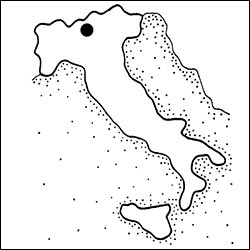
You could spend a busy day side-tripping from Milan (about one hour away by train) to either lake, do some island- and villa-hopping, and be home in time for dinner. But the lakes are an ideal place to slow down and take a break from your busy vacation. Settle in here, and bustling Milan doesn’t even exist. Now it’s your turn to be chiuso per restauro (closed for restoration). If relaxation’s not on your agenda, the lakes shouldn’t be either.
Lake Como
Lake Como (Lago di Como)—lined with elegant 19th-century villas, crowned by snowcapped mountains, and busy with boats carrying cars and passengers—is a good place to take a break from the intensity and turnstile culture of central Italy. It seems like half the travelers you’ll meet have tossed their itineraries into the lake and are actually relaxing.
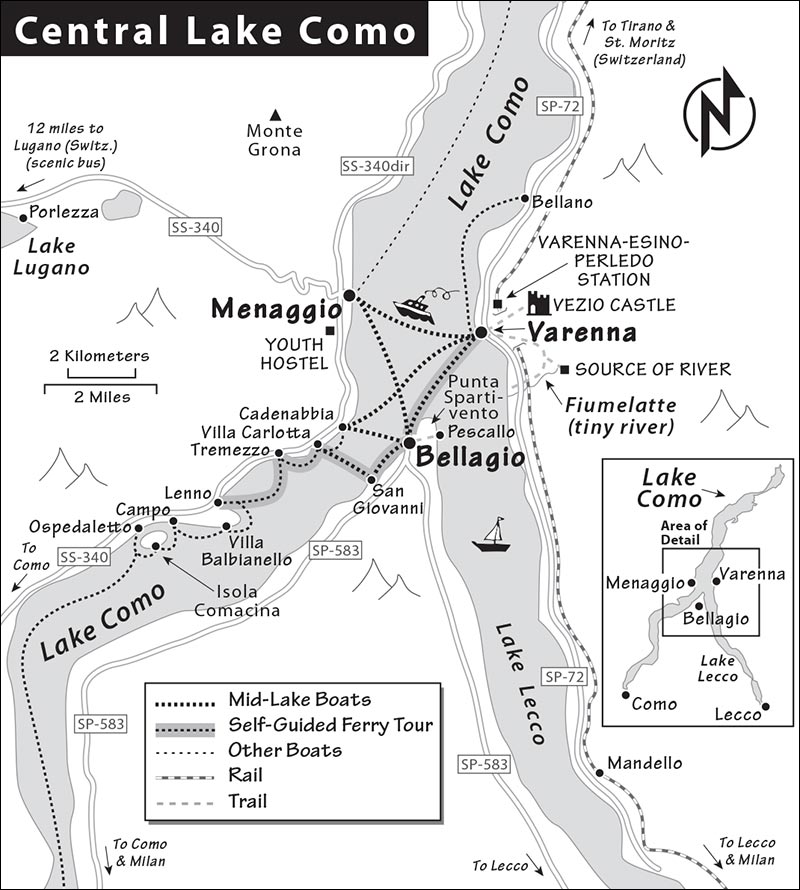
Lake Como is Milan’s quick getaway, and the sleepy mid-lake village of Varenna is the handiest base of operations. With good connections to other mid-lake towns (and Milan), Varenna is my favorite home base for exploring the lake. While Varenna has a village vibe, beautiful Bellagio has earned its ritzy allure and feels a bit more like a resort. Menaggio has a fine town square and a youth hostel for budget travelers.
The hazy, lazy lake’s only serious industry is tourism. In fact, every day lots of lakeside residents commute to work in Lugano, just across the border in Switzerland, for a good paycheck. The lake’s isolation and flat economy have left it pretty much the way the 19th-century Romantic poets described it: heaven on earth.
PLANNING YOUR TIME
Even though there are no essential activities, plan for at least two nights so you’ll have an uninterrupted day to see how slow you can get your pulse. Spend some time exploring your home base town, take my self-guided ferry tour to view the scenery (with visits to the lake’s two main villas), and hop off the boat to poke around towns you’re not staying in. With additional time, visit more lakeside villas or go for a hike.
Lake Como is also workable as a day trip from Milan. Take a morning train to Varenna, ride the boat to Lenno (and tour Villa Balbianello), then take a boat to Villa Carlotta to tour the gardens. From there, head either to Bellagio or back to Varenna to linger and explore (or, with more time and energy, see a little of both) before taking the train back to Milan from Varenna. Start early to pack everything in; otherwise, you’ll have to be more selective (with time to see just one of the villas).
GETTING TO LAKE COMO
From any destination covered in this book, you’ll reach Lake Como via Milan. The quickest, easiest, and cheapest way to get from Milan to any mid-lake town is to take the train to Varenna. From Varenna you can hop on a boat to Bellagio or Menaggio. Alternatively, you can go by train from Milan to the town of Como, switching there to a boat or bus.
By Train via Varenna: Trains leave Milano Centrale station for Varenna at :20 past most hours (1 hour direct). Leaving Milan, sit on the left for maximum lake-view beauty. Get off at Varenna-Esino-Perledo. (Train schedules list just Varenna or Varenna-Esino, but Varenna-Esino-Perledo is what you’ll see at the platform.) Trains stop only briefly—be ready to hop out. The platform you’ll step onto (with double yellow lines) is very narrow here.
By Train and Boat via Como: For a less convenient, slower, but more scenic trip, you can get to Varenna or Bellagio from Milan via the town of Como. Trains take you from Milano Centrale station to Como’s main station, Como S. Giovanni (1-2/hour, 40 minutes). From the station in Como, it’s a 10-minute walk to the dock, where you catch either the speedy hydrofoil or the leisurely battello (slow boat—great for enjoying the scenery) for the ride up the lake to Varenna, Bellagio, or Menaggio. Boats leave Como about every 2 hours (battello: €11.60, 2.5 hours, last departure about 15:20; hydrofoil: €16.20, 1 hour, last departure about 19:00, fewer on Sun, www.navigazionelaghi.it). There are also buses from Como to Bellagio and Menaggio (see here and here).
By Plane from Milan’s Airports: Head first to Milan’s Centrale train station, using the Malpensa Express train from Malpensa Airport, an airport express bus from Linate Airport, or any of the buses from Bergamo’s Orio al Serio Airport (see “Milan Connections” at the end of the next chapter). Then transfer to a Varenna-bound train (see earlier).
By Taxi: Taxis between Varenna and Milan or its airports can be worth it for the convenience. Marco Barili (and his wife Nelly) don’t charge extra for baggage or early/late departures (€170 for up to 4 people, €220 for 5-8 people in a minivan, +39 0341 815 061, +39 348 550 0787, taxi.varenna@tiscali.it).
By Car: Some of the expressways between Milan and the lakes have shifted to an automated toll system that takes a photo of each license plate and sends a bill to the owner. When picking up a rental car, check how this will be handled so that you don’t get hit with late-payment fees (more info at http://apl.pedemontana.com).
GETTING AROUND LAKE COMO
By Boat: Boats go about every 30-45 minutes between Varenna, Bellagio, and Menaggio (€4.60/hop, cash only, 15-minute ride, daily approximately 7:00-22:30). Because these mid-lake trips are frequent and the schedule is hard to read, I just show up, buy a ticket for the next boat, and wait. Always ask which slip (pontile) your boat will leave from—it’s not posted, and each port has two docks, for car ferries and for passenger-only boats (boat info: +39 031 579 211, www.navigazionelaghi.it). On sunny days, long lines can form at ticket booths; don’t dillydally, and consider buying your tickets in advance at a quieter time. The one-day €15 mid-lake pass makes sense if you take four or more rides—unlikely (pass does not cover fast hydrofoils, which cost a bit more).
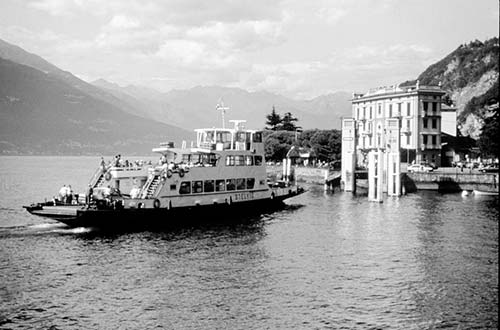
If you’re making more complex plans, pick up a free boat schedule and ask for help to decipher it. It’s a good idea to ask your hotelier to review your possible connections before you set out so you can pace your day smartly. You’ll find the schedule at hotels and boat docks. Confusingly, you have to check several different timetables (for car ferries and passenger-only boats) to know all the departures; for key terms, see the sidebar.
By Car: With scarce parking, traffic jams, and expensive car ferries, Lake Como is no place to drive. While it’s possible to drive around the lake, it’s not a scenic loop: The road is narrow, congested, and lined with privacy-seeking walls, hedges, and tall fences. If you do have a car, park it in Varenna’s big underground garage, and use the boat to get around. Parking in Bellagio is more difficult than in Varenna.
While you can rent cars in Bellagio, for most travelers, it’s best to take the train to Milan and pick up a car there, either at the central train station or at one of Milan’s three airports.
Varenna
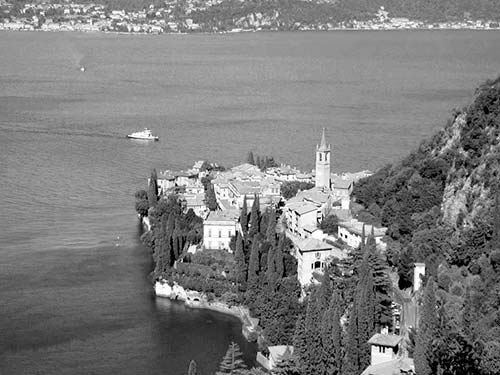
This well-manicured village of 800 people offers the best of all lake worlds. Easily accessible by train, on the less-driven side of the lake, Varenna has a romantic promenade, a tiny harbor, steep and narrow stepped lanes, and some scenic sights (a ruined castle and two villas). It’s just the right place to savor a lakeside cappuccino or aperitivo. There’s wonderfully little to do here, and it’s very quiet at night...unless you’re here during one of the hundred-or-so annual American wedding parties. The passerella (lakeside promenade, well lit and inviting after dark) is adorned with caryatid lovers pressing silently against each other in the shadows. Varenna is a popular destination with my readers and European vacationers—book well in advance for high season (May-Oct). From November to mid-March, Varenna practically shuts down: Hotels close for the winter, and restaurants and shops reduce their hours.
Orientation to Varenna
TOURIST INFORMATION
The TI is near the main square (Wed-Mon 10:00-13:00 & 14:00-17:00, closed Tue, weekends only off-season, just past the bank at Via IV Novembre 7, +39 0341 830 367, www.varennaturismo.com). The Tivano travel agency, located in the train station, also operates as a TI (see “Helpful Hints”). At either (or your hotel), pick up a town map and lake info.
ARRIVAL IN VARENNA
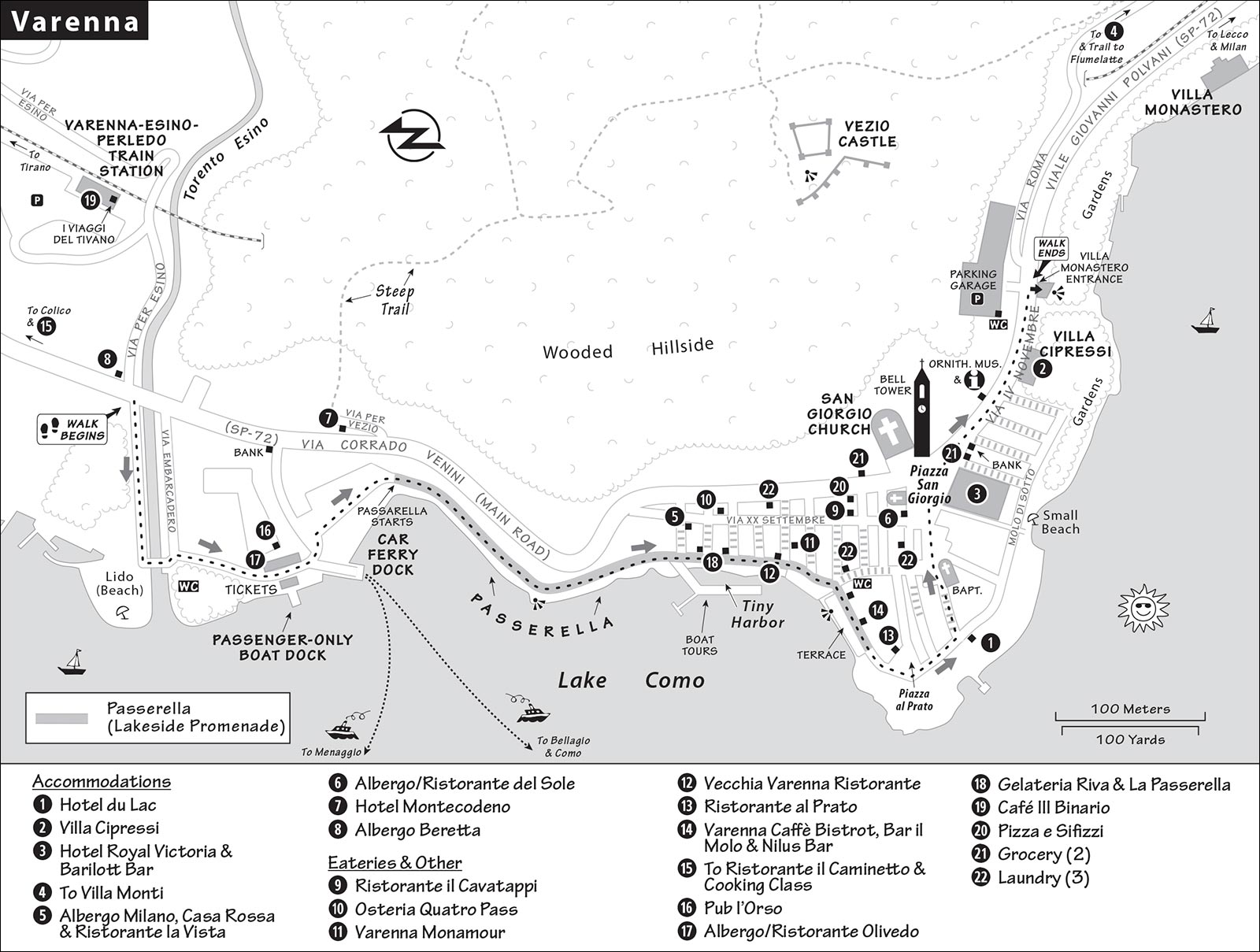
Varenna is small, and pretty much everything is within a 15-minute walk.
By Train: From Varenna’s train station, follow the blue-painted pedestrian lane down to the main road. If you’re heading for the ferry to Bellagio, go straight to the water and turn left; otherwise, turn left along Via Corrado Venini, the main road, and keep rolling uphill into town (a 15-minute walk from the station). If you have a bag with wheels, use the high road rather than the lakeside promenade, which ends in stairs and cobbles.
A taxi from the station costs about €10. Reliable Marco Barili (or his wife Nelly) can meet you at the train station if you know your exact arrival time. Look for a flashing sign with your name (+39 0341 815 061, +39 348 550 0787, taxi.varenna@tiscali.it).
By Boat: The boat docks are close to the train station and a 10-minute stroll north of Varenna’s main square and old town.
By Car: Don’t even try to park on the streets of Varenna; the few spots are mostly reserved for residents. The easiest parking option is the multilevel garage at the south end of town, across from the entrance to Villa Monastero (€2/hour, 6:00-22:00, otherwise €1/hour, €20/24 hours).
Parking at Varenna’s train station is free overnight, but you’ll pay from 8:00 to 23:00 most of the year (€1.70/hour, €15/day, use coins or credit card at machine in center of lot and put ticket on dashboard).
HELPFUL HINTS
Travel Agency: Varenna’s travel agency, I Viaggi del Tivano, is conveniently located in the train station and acts as an informal TI (daily 9:30-13:00 & 14:00-18:30; good place to pick up boat schedules, +39 0341 814 009, www.tivanotours.com, helpful Cristina, Martina, and Beatrice). They also offer baggage storage (€5/day).
Laundry: Lavanderia Pensa Barbara can wash and dry your laundry in 24 hours with morning drop-off (priced by weight, no self-service, Mon-Fri 9:00-12:00 & 15:00-19:00, Sat 9:00-12:00, closed Sun, Via Venini 31, +39 340 466 2977). A self-service machine is tucked in the back of the little “Il Bottaio” shopping gallery facing the old harbor (you’ll pay for laundry plus a €1 entry voucher every time you go in/out, voucher covers WC or can be used toward food or drinks at nearby Bar il Molo, daily 8:00-24:00). Another self-service option is just off the main square, between the recommended Albergo del Sole and the post office (“change” machine dispenses only tokens, Bar Il Molo can break bills for you, daily 24 hours, Contrada del Prato 10).
Nightlife? None. Here your time is better spent taking a lakeside stroll and watching the moonlight dance on the water.
Varenna Walk
Since you came here to relax, this short self-guided walk gives you just the town basics.
• Begin by standing in the little piazza next to the...
Bridge Just Below Train Station: This main bridge spans the tiny Esino River, which divides two communities: Perledo (which sprawls up the hill—notice the church spire high above) and the old fishing town of Varenna (huddled around its harbor). The train station, called Varenna-Esino-Perledo, gives due respect to both, as well as to the village of Esino, eight miles higher in the hills.
Go down the tree-lined promenade on the right (north) side of the river. You’ll run into the entrance to the town’s public beach—the lido (small fee to enter)—and then cross the cute pedestrian bridge to the small square, which hosts a little market on Wednesday mornings.
The yellow inn facing the boat docks, Hotel Olivedo, has greeted ferry travelers since the late 19th century and is named for the olive groves you can see growing halfway up the hill. Locals claim this is the farthest north that olives grow in Europe.
• Across from Hotel Olivedo is Varenna’s...
Ferry Landing: When the train came to Varenna in 1892, this dock became the main link to Milan and the world for the other “mid-lake” communities of Bellagio and Menaggio. From this viewpoint, you can almost see how Lake Como is shaped like a man. The head is the north end (to the right, up by the Swiss Alps). Varenna is the left hip (to the east). Menaggio, across the lake, is the right hip (to the west). And Bellagio (hiding behind the smaller wooded hill to your left) is the crotch—or, more poetically, Punta Spartivento (“Point That Divides the Wind”). In a more colorful description, a traditional poem says, “Lake Como is a man, with Colico the head, Lecco and Como the feet, and Bellagio the testicles.” (In the regional dialect, this rhymes—ask a native to say it for you.)
Across the lake, the farthest high ridges mark the border of Switzerland. This region’s longtime poverty shaped the local character. Many still remember that the Varenna side of the lake was the poorest, because those on the Menaggio side controlled the lucrative cigarette-smuggling business over the Swiss border. Today, the entire region is thriving—thanks to tourism (and the many Italians who commute across the border to jobs in Switzerland).
• Walk past the ferry dock and a small playground. Just beyond is Varenna’s shoreline walk, called the...
Passerella: A generation ago, Varenna built this elegant lakeside promenade, which connects the ferry docks with the old town center. Strolling this lane, you’ll come to a tiny, two-dinghy, concrete breakwater of a villa. Lake Como is lined with swanky 19th-century villas; their front doors face the lake to welcome visitors arriving by boat. At this point, the modern passerella cuts between this villa’s water gate and its private harbor. Just around the bend, enjoy a good Varenna town view. These buildings are stringently protected by preservation laws; you can’t even change the color of your villa’s paint.
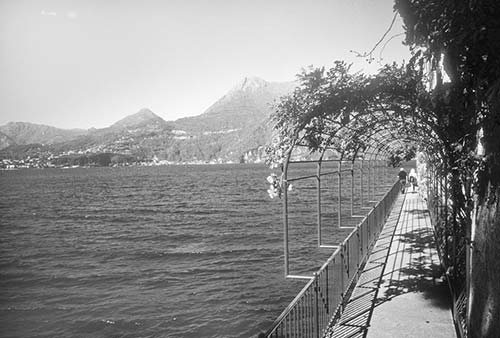
Just over the hump (which allows boats into a covered moorage), look back and up at another typical old villa—with a private passerella, a lovely veil of wisteria, and a prime lake-view terrace. Many of these villas are owned by the region’s “impoverished nobility.” Raised with no need to work, eventually they found themselves unable to pay for the upkeep of their sprawling houses. Some of these villas have now been bought by the region’s nouveau riche.
• At the community harbor, walk to the end of the pier for a town overview, then continue under the old-time arcades—with chestnut beams and a fishing heritage going back to the 1600s—toward the multihued homes facing the harbor.
Varenna Harborfront: There are no streets in the old town—just the characteristic stepped lanes called contrade. Varenna was originally a fishing community. Even today, old-timers enjoy Lake Como’s counterpart to Norwegian lutefisk: missoltino, air-dried and salted lake “sardines.”
Imagine this harbor 200 years ago: The Il Bottaio gallery is named for the coopers who once worked here fitting chestnut and oak staves into barrels. Stoneworkers were busy carving the black marble that was quarried just above town. Fishermen dragged boats onto the sloping beach and unloaded their goods onto carts for horses to carry up Contrada dei Cavalli (named for those horses, with gentler, more horse-friendly steps than other lanes) to the market square above. The little stone harbor dates from about 1600. Today, the fishing boats are just for recreation.
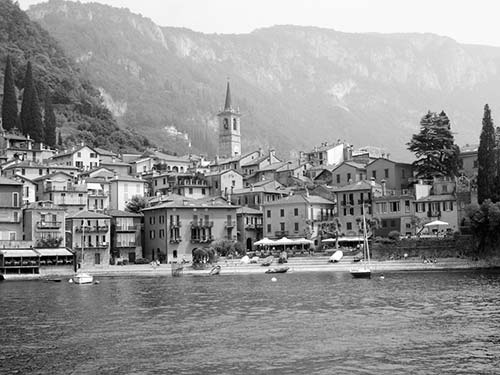
At the south end of the harbor, belly up to the banister of Bar il Molo’s upper terrace for a colorful town view. Another traditional ditty goes, “If you love Lake Como, you know Bellagio is the pearl...but Varenna is the diamond.”
• Continue straight, leaving the harbor. A lane curves around Hotel du Lac, where you can check out its fine lakeside terrace (it welcomes even nonguests for drinks—try the afternoon happy hour—and has an amazing view). Then climb the stairs opposite the hotel on the lane called Contrada Oscura to...
Piazza San Giorgio: Varenna’s town square, historically the market square, faces what for centuries has been the lakeside highway. In earlier eras it was busy with traders and pilgrims.
The sycamore, or plane, trees, groomed to provide shade, are planted to make a V for Varenna. The street plan survives from Roman times, when gutters flowed down to the lake. The little church on the lake side of the square is the baptistery. Dating from the ninth century, it’s one of the oldest churches on the lake (but rarely open).
The Hotel Royal Victoria, also on the main square, recalls the 1839 visit of Queen Victoria, who registered herself as the Countess of Clare in an attempt to remain anonymous.
Church of San Giorgio (Chiesa di San Giorgio): Varenna is an understandably popular spot for weddings—rice often litters the church’s front pavement. The main church was built in the 1200s. Imagine being a 13th-century wayfarer and coming upon the fresco of St. Christopher, patron saint of travelers, on the church’s facade. With a backpack at his feet, just like you, he welcomes all to step inside.
You’ll find a Romanesque interior with a few humble, centuries-old bits of carving and frescoes. The black floor and chapels are made from local marble. On the right, a beautifully carved walnut confessional is ornamented with symbols reminding worshippers that in death, all are equal. And the fresco on the back wall, dating from the same century as Dante’s Inferno (the 14th), makes the horrors of hell all too clear.
• Leaving the church, turn left to find the TI and, in the same building, the Ornithology and Natural Science Museum, with a small collection of stuffed birds and other wildlife (small fee).
Lake and Garden View from Villa Monastero: Finish your walk a hundred yards farther down the street (past the Villa Cipressi). Across from the big parking garage, step through the door of the Villa Monastero and up to the balcony overlooking the garden and the lake: Here you can savor an ultimate Lake Como view.
Lake Como is lined with aristocratic 19th-century villas. In the Romantic Age, a villa came with a charming lakeside kiosk and an extravagant garden. People loved exotic trees, and here—at the latitude of Boston—they could grow palms and oranges. A promenade through this mix of gardens and architecture was enjoyed as an art form.
Your tour is over, and now you have options. You can pay to explore the Villa Monastero gardens, or catch the steep trail nearby up to Vezio Castle (both described next). Or you can return to the square and head downhill to enjoy the Varenna waterfront. Either of the lanes flanking the Hotel Royal Victoria go down to the humble beach, and farther along, lanes go to the café-lined harborfront.
Sights and Activities in Varenna
▲Hike to Vezio Castle (Castello di Vezio)
A steep and stony trail leads to Varenna’s ruined hilltop castle, located in the peaceful, traffic-free, one-chapel hamlet of Vezio. It was built on the remains of an ancient Roman fort that was part of a defense system spanning the entire lake. In the sixth century, after the fall of Rome, the barbarian Longobards settled here and needed a fortress on this strategic spot. Today, the castle itself is barren—a courtyard protecting an empty tower, where you can cross a drawbridge and climb 60 steps to earn 360 degrees of Lake Como panoramas.
Cost and Hours: €5, Mon-Fri 10:00-18:00, Sat-Sun until 19:00, June-Aug stays open one hour later, March and Oct closes one hour earlier, closed Nov-Feb and in bad weather, +39 333 448 5975, www.castellodivezio.it.
Visiting the Castle: To get to the castle, hike up Via per Vezio, the small road near Hotel Montecodeno (figure on a 30-minute steep climb one-way). Arriving in Vezio, follow castello signs. Beyond the church square you’ll reach the castle and its bar (with drinks, light food, and WCs), which serves as the ticket desk.
Once inside the grounds, the views are the main attraction: Follow the little loop trail on the lake side of the castle for vistas down on Varenna’s rooftops and the adjacent lakefront community of Pino.
Falconry Shows: The castle hosts low-key falconry shows (free, about an hour), usually around 14:00—but days and times vary, so check the website or call in the morning for times.
Hiking Back Down: Leaving the castle grounds you’ll see a sign indicating two ways back to Varenna. You can hike back the way you came or make a loop by continuing down to the east end of Varenna, on a steeper, narrower, less-manicured trail. To do that, from the castle gate turn right and follow signs for Varenna Scabium and Sentiero del Viandante. You’ll wander past some backyards and scenic tennis courts, then gradually descend, popping out at the parking garage for the Hotel Eremo Gaudio. From here, head down to the right to walk back into Varenna, passing the entrances for both Villa Cipressi and Villa Monastero on your way to the main square.
Villa Gardens
Two separate manicured lakeside gardens sit next door to each other just a short distance from Varenna’s main square. While the villas and gardens elsewhere on the lake are more magnificent (see “More Sights on Lake Como,” later), these are a good option if you’re staying around Varenna.
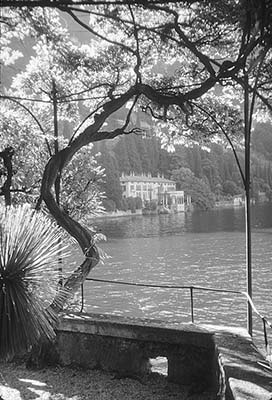
Villa Cipressi: The small but lush terraces of Villa Cipressi stretch to the nearby Hotel Royal Victoria. The gardens were principally built between 1400 and 1800, and have been carefully restored and embellished. The lakeside climate is amenable to species not otherwise common in northern Italy. Look for agaves, myrtles, and a rare California cypress (€8, €15 combo-ticket includes Villa Monastero gardens but not museum, QR codes on trees and shrubs link to descriptions on website, daily 10:00-sunset, closed Nov-Feb, can close for private events—check website, www.hotelvillacipressi.it).
Villa Monastero: Just beyond Villa Cipressi are the more interesting grounds of Villa Monastero, which also admits visitors into the former residence of the De Marchi family. Now a museum filled with overly ornate furnishings from the late 1800s, it offers the handiest look inside one of the old villas that line the lakeshore. The gardens feature cypress and oak trees, several varieties of palms, a collection of English roses, a citrus garden, and a wisteria garden that is delightful when in bloom (gardens-€8, gardens and museum-€10; €15 combo-ticket covers gardens here and at Villa Cipressi but not museum; gardens open April-Sept daily 9:30-19:30, March and Oct 10:00-17:00, mostly closed Nov-Feb; museum open same times but shorter hours off-season; garden bar serves snacks, +39 0341 295 450, www.villamonastero.eu).
Swimming
There are three spots to swim in Varenna: the free little beach behind the Hotel Royal Victoria off Piazza San Giorgio, the central lakefront area by Nilus Bar, and the lido (best-equipped for swimmers). Just north of the ferry dock, it’s a wide concrete slab with sand and a swimming area off an old boat ramp. It has showers, bathrooms, a restaurant, a bar, and lounge chairs and umbrellas for rent (small entry fee, +39 0341 815 3700). Swimming by the ferry dock is strictly forbidden for safety reasons.
Boat Tours (or Rent Your Own)
You can explore the lake either by taking a boat tour with a captain who narrates the views as you skirt elegant villas and the homes of famous neighbors (1-3 hours, 6-10 people on a fast boat) or by renting your own boat (with a 40-hp engine, no license required). It’s not realistic to stop anywhere, so you’ll just putter around the mid-lake region trying to stay out of the ferry’s path.
Taxi Boat Varenna organizes hour-long central-lake tours (€40/person), plus a 2.5-hour version that adds a stop at Villa Balbianello (€70/person, price includes villa entry and one-hour tour). They also offer hour-long romantic private tours (€220 for up to 6 people) and a three-hour tour. Book directly on the website (mid-March-mid-Nov only, +39 349 229 0953, www.taxiboatvarenna.com). A similar company works out of Bellagio.
Lake Como Boat, for those who want to be their own skipper, rents motorboats (from €80/hour, up to 6 people) and zero-horsepower kayaks (€10/hour). You’ll find them at the harbor in front of the Bar il Molo (+39 342 997 1937, https://lakecomoboat.eu).
Varenna Rent a Boat is a more serious boat-rental shop with a fleet just beyond the ferry dock. Roberto’s a mechanic, so you know things are in good shape, and his boats come with GPS systems, so he always knows where you are (from €80/hour, +39 338 140 7424, www.varennarentaboat.com).
Full-Day Boat and Villas Tour: Lake Como For You, run by Laura and her creative team, has a selection of guided activities. For a well-organized and very experiential day, consider their “Central Lake Boat, Food, and Villas Tour” (runs most mornings at 10:30 from Varenna). You’ll load into a van to visit an old mill for an olive oil tasting, take a guided walk through Varenna with an included lunch, hop in a boat for an hour-long tour of the lake, see Villa Balbianello with a local guide, and finish in Bellagio with a walk through the botanical gardens at Villa Melzi. This leaves you in Bellagio at about 17:00, free for the evening and a convenient ferry ride away from your Varenna starting point (€255, RS%—use code “ricksteves,” +39 349 560 0603, www.lakecomoforyou.com).
Hiking
Wayfarers’ Path: The best three-hour hike from Varenna is along the Wayfarers’ Path that links Bellano and Varenna. Take the train (or boat) to Bellano and hike steeply up and then along the hill and back into Varenna on the well-marked trail. (Get details from your hotel or the TI.)
Fiumelatte: The town of Fiumelatte, about a half-mile south of Varenna, was named for its “milky river.” Promoted as the shortest river in Italy (at 800 feet), it runs—like the area’s tourist industry—only from April through September (though even then it may be dry, depending on the weather). The Sorgente del Fiumelatte brochure, available at Varenna’s TI, lays out a walk from Varenna to the Fiumelatte, then to a castle, and back. It’s a 30-minute hike to the source (sorgente) of the river (at Varenna’s monastery—take the high road, drop into the tranquil and evocative cemetery, and climb steps to the wooded trail leading to the peaceful and refreshing cave from which the river spouts).
Cooking Class
Charming chef Moreno of the recommended Ristorante il Caminetto picks you up in Varenna, zips you 10 minutes up the mountain to his restaurant, and then shows you some basics of Italian cooking. Gathered around a big table with a dozen or so other English-speaking travelers, you’ll learn how to make fresh pasta and regional specialties. Demonstrations cover three recipes and last about five hours, including time to mangiare (€77 includes transfers from and back to Varenna, lesson, recipes, and lunch complete with wine, cookies, and coffee; Mon, Tue, Thu, and Fri; 10:00 pickup from Varenna ferry landing or parking garage, return by 16:00; reservations required—best by email, +39 0341 815 225, www.ilcaminettoonline.com, info@ilcaminettoonline.com).
Sleeping in Varenna
Reservations are tight in August, snug May through October, and wide open most of the rest of the year. Many places close in winter.
$$$$ Hotel du Lac, filling a refined and modernized 19th-century villa, is classy and dignified. From its exclusive private perch on the point, it offers a quiet lakefront breakfast terrace; genteel public spaces; a friendly, professional staff; and 16 delightful rooms—all but three with lake views (air-con, some rooms with elevator access, pay parking, Via del Prestino 11, +39 0341 830 238, www.albergodulac.com, info@albergodulac.com, Valeria).
$$$$ Villa Cipressi is a sprawling, centuries-old lakeside mansion with 31 rooms (some in a courtyard annex) that have a sophisticated simplicity. The villa sits in a huge, quiet, terraced garden that nonguests pay to see. Its elegant but understated public spaces are often busy with wedding parties. Guests can use their free shuttle service to and from the train station or ferry dock between 9:00 and 16:00 (RS%, some view rooms, family rooms, streetside rooms can be noisy, air-con, elevator in main building, pay parking, Via IV Novembre 22, +39 0341 830 113, www.hotelvillacipressi.it, info@hotelvillacipressi.it).
$$$$ Hotel Royal Victoria, a central splurge facing the main square, has a classic, grand-hotel lobby, an inviting terrace with a swimming pool just above the lake, two restaurants, and 43 richly furnished rooms with modern amenities (RS%, some view rooms, air-con, elevator, pay parking, Piazza San Giorgio 2, +39 0341 815 111, www.royalvictoria.com, info@royalvictoria.com).
$$$$ Villa Monti has six apartments (most with lake views, two with balconies) perched along Via Roma. Each is styled with a modern coziness, sleek kitchenette, and beautiful artwork. The pool is petite but has impeccable views and lots of deck chairs along a terraced garden (family rooms, air-con, no breakfast, check-in 14:00-18:00 or by appointment, Via Roma 9, tel. 0341 831 138, www.visitvarenna.com, villamonti@visitvarenna.com).
$$$$ Albergo Milano, right in the old town, is graciously run by Egidio and his Swiss wife, Bettina. Fusing the best of Italy with the best of Switzerland, this well-run, romantic hotel has eight comfortable rooms with extravagant views, balconies, and big terraces (air-con and/or ceiling fans, no elevator; from the station, take main road to town and turn right at steep alley where sidewalk and guardrail break; Via XX Settembre 35, +39 0341 830 298, www.varenna.net, reservations@varenna.net). This place whispers luna di miele—honeymoon (see website for honeymoon deal). Nearby is $$$ Casa Rossa, an annex with five comfortable rooms (breakfast served at main hotel); they also have apartments that work well for families in Villa Gina, near the train station. Their recommended Ristorante la Vista is worth considering for dinner.
$$$ Albergo del Sole rents eight simple, comfortable rooms (with partial-lake or piazza views) above a restaurant right on the town square, which can be lively at night. It’s run by fun-loving Francesco and Gaetano (family rooms, air-con, hardwood floors, shiny bathrooms, elevator, Piazza San Giorgio 17, +39 0341 157 0408, www.solevarenna.altervista.org, albergo.sole@virgilio.it).
$$ Hotel Montecodeno, with 11 decent rooms and no views, is a functional concrete box along the main road, next to the northern trailhead to Vezio Castle. It’s a five-minute walk from the train station and ferries (RS%, air-con, no elevator, attached restaurant, Via Venini 146, +39 0341 830 123, +39 331 640 0473, www.hotelmontecodeno.com [URL inactive], info@hotelmontecodeno.com).
$$ Albergo Beretta, on the main road a block below the station, has 10 small, basic rooms, several with balconies (and street noise). Second-floor rooms are quietest. Above a coffee shop that doubles as the reception, it feels dated and lacks lakeside glamour but is a decent budget option (elevator, pay parking nearby, Via per Esino 1, +39 0341 830 132, www.albergo-beretta.hoteldirect.it [URL inactive], hotelberetta@iol.it, Barbara).
Eating in Varenna
Lavarello, a lake whitefish, is popular on menus. For something more adventurous, consider missoltino, which are salted little fish often served with pasta or local-style polenta (buckwheat is mixed in with the corn). Pizzocchere is a regional pasta dish made with buckwheat noodles, boiled potatoes, greens, and lots of melty cheese—a carb lover’s dream. As with Varenna’s hotels, many of these restaurants close off-season.
FINE DINING
$$$ Ristorante la Vista, at Albergo Milano, feels like a private hotel restaurant but also welcomes nonguests. On a balmy evening, its terrace overlooking the town and the lake is hard to beat. Egidio (or Egi—pronounced “edgy”) and his staff give traditional cuisine a creative twist, and his selection is great for foodies with discerning tastes. While you can order à la carte, I’d go with his €45 three-course fixed-price dinner (Mon and Wed-Sun 19:00-22:00, closed Tue; serves lunch on summer weekends; reservations required, Via XX Settembre 35, +39 0341 830 298, www.varenna.net).
$$ Ristorante il Cavatappi serves honest, unpretentious dishes grounded in classic Italian cuisine. It’s a classy little place on a quiet lane, with only seven tables, so the cook-and-waiter team can connect personally with diners. It’s both elegant and intimate with tight and convivial seating under a single vault and three tables outside on the stony lane. The chef is vegetarian, so there’s always a good veggie course (lunch Thu-Sun 12:00-14:00, dinner Thu-Tue 18:30-21:00, closed Wed and Dec-Feb, reserve for dinner, Via XX Settembre 10, +39 0341 815 349, www.cavatappivarenna.it).
$$$ Osteria Quatro Pass is a welcoming bistro known for its homemade pasta, lake fish, and meat. It offers 20 candlelit tables under picturesque vaults, plus sidewalk seating. Its fun energy lets you know that it’s a popular spot (daily 12:00-14:00 & 18:30-22:00, closed Mon-Wed in winter, Via XX Settembre 20, +39 0341 815 091, Chiara serves while her husband Giuseppe cooks).
$$ Varenna Monamour’s split-level interior, done up with stone and beams, feels sleek but casual. Its menu has a nouvelle-cuisine flair, and the restaurant prides itself on specializing not in lake fish but in seafood (Wed-Mon 12:00-14:30 & 18:00-22:00, closed Tue and mid-Nov-Feb, Contrada Scoscesa 7, +39 0341 814 016, www.varennamonamour.it).
$$ Vecchia Varenna Ristorante, the only classy restaurant right on the water, is under the old stone arcade in the center of town. Its creative menu offers a fine value, and the food seems to taste even better if you sit on the terrace. Chef Luca takes no reservations (Tue-Sun 12:30-14:00 & 19:30-21:30, closed Mon, Contrada Scoscesa 14, +39 0341 830 793).
$$$ Ristorante al Prato, tucked onto a quiet square a block off the harbor, does regional specialties and international dishes with local ingredients and influences. Chef Giulio’s joy of cooking shows through in the meals, and good-natured owner Giovanni enjoys interacting with the guests (daily 12:00-14:00 & 19:00-21:00, Piazza del Prato 6, +39 348 712 4389).
FAST FOOD WITH A LAKE VIEW
Beautifully situated along the waterfront in Varenna’s old section are three simple eateries: Varenna Caffè Bistrot, Bar il Molo, and Nilus Bar. All are crowd-pleasers for their great lakefront seating and ideal for lingering over affordable food in a stunning setting. Each serves salads, sandwiches, pizzas, and pastas for around €10 and cocktails between meals. All are open daily; Il Molo and Varenna Caffè Bistrot are also open at 9:00 for breakfast. While Il Molo and Nilus have nicer terraces, the food at Varenna Caffè Bistrot is a bit more serious.
EATING SIMPLY WITHOUT A LAKE VIEW
$$ Ristorante del Sole is an old-school place facing the town square that feels like it was here before tourism. It serves respectable, well-priced meals and Neapolitan-style pizzas. This family-friendly restaurant provides a fun atmosphere, a cozy, walled-in garden in back, and tables on the square. Try their hearty pizzocchere—buckwheat pasta with melted cheese, potatoes, and greens (daily 12:00-22:00, takes afternoon break off-season, Piazza San Giorgio 17, +39 0341 815 218, www.solevarenna.altervista.org; Francesco and Gaetano).
$ Barilott is a bar/tobacco shop that’s also a lively place for breakfast, a panino, or a glass of wine (daily 7:00-20:00, next to Hotel Royal Victoria at Via IV Novembre 6, +39 0341 815 045, Claudia and Fabrizio).
High Above Town: $$$ Ristorante il Caminetto is a homey, backwoods mountain trattoria in Gittana, a tiny town in the hills above Varenna. Getting there entails a curvy 10-minute drive (they’ll pick you up for free at 19:00 or 19:30 at the ferry dock or the parking garage and bring you home after dinner). Moreno and Rossella take pride in their specialties, including grilled meats and risotto with porcini mushrooms and apples. They serve 22 diners a night and that’s it. Plan on the €32 three-course fixed-price meal and spending the evening—you won’t regret it (open Thu-Tue 19:30-21:30, Sat-Sun also 12:30-14:30, closed Wed, reservations mandatory to confirm pickup from Varenna—best by email, Viale Progresso 4, +39 0341 815 225, www.ilcaminettoonline.com, info@ilcaminettoonline.com).
OTHER EATERIES
By the Ferry Dock: $$ Pub l’Orso, filling a renovated former joiner’s workshop, is a fun bar that serves cheap salads and sandwiches (at the ferry dock, behind Hotel Olivedo). $$$ Hotel Olivedo, a fine old hotel facing the ferry dock, serves diners in a classic Grand Tour hall.
At the Train Station: $ Café III Binario is both charming and classy, offering fresh salads, homemade pizza, sandwiches, pasta, pastries, and €8-10 set breakfasts. Enjoy your food on their terrace or take it to go (daily 6:00-21:00).
Takeaway Pizza: $ Pizza e Sfizzi, just off the main square, dishes up straightforward pizzas, and burgers too (Via Venini 7).
Gelato: Side-by-side places by the ferry dock compete with good gelato and pillows on the adjacent stone steps. At Gelateria Riva, Duilio prepares his gelato fresh every day. Try his nocciola (hazelnut) before making your choice (daily 11:00-19:00, later in summer). A few doors down, Giulia at La Passerella makes tasty gelato and refreshing fruit sorbets. Also on the menu is an enticing array of pastries and sweets (daily 10:00-20:00, later in summer).
Scenic Aperitivo: The Hotel du Lac has the most beautiful lakeside setting in town. Anyone is welcome to enjoy its garden or terrace, which literally hangs over the lake, for a happy hour aperitivo (daily 15:00-19:00). A €10 spritz or glass of wine comes with a plate of meat and cheese. They also have wine tasting on the menu.
Picnics: A few mom-and-pop stores around the main square have all you need for a tasty balcony or breakwater picnic. The salumeria sells meat and cheese, and makes sandwiches; try their homemade salami (Tue-Sat 8:30-12:30 & 16:00-19:00, Sun-Mon 8:30-12:30 only, longer in summer, Via IV Novembre 2). The grocery store just north of the main square, by the pharmacy, stocks fresh fruits, veggies, and a few essentials (Tue-Sat 8:30-19:00, Sun-Mon until 12:30, shorter hours off-season, Via Venini 6). There’s also a bakery at Via IV Novembre 4.
Breakfast in Varenna: For a leisurely start to your day on the lakefront, Varenna Caffè Bistrot and Bar il Molo each have a breakfast menu. (They get up and running at about 9:00.) Hotel Royal Victoria offers a buffet breakfast with eye-popping views to nonguests for about €20 (check with reception that morning for availability). If you’re catching an early train, Café III Binario offers a good breakfast right at the station. To feel as though you’re staying in a boutique guesthouse (with an amazing view terrace overlooking the lake), break your fast at Albergo Milano, which offers visitors the same fine breakfast it serves its guests (€15, you must reserve the night before).
Varenna Connections
BY TRAIN
Confirm train times at the station or at Trenitalia.com. Tickets for most destinations are easily purchased with the Trenitalia app. At the station, you can buy tickets for regional destinations (as far as Milan) from a machine. For Milan, it will ask you to choose between two routes—you can select the default. Stamp your ticket in the yellow machine at the station before boarding.
The I Viaggi del Tivano travel agency at the station can offer a helping hand and also sells tickets for anything more distant (see “Helpful Hints,” above). Don’t cut it too close, in case there’s a line.
Varenna to Milan: Trains from Varenna to Milano Centrale take about an hour and leave at :35 past most hours.
Varenna to Stresa (on Lake Maggiore): You’ll have to take the train back to Milano Centrale, then connect from there to Stresa (3-4 hours).
Varenna to Lugano (Switzerland): Catch the ferry to Menaggio and then the #C12 bus (about hourly, 1 hour, €7, www.asfautolinee.it [URL inactive]). From the Menaggio ferry dock, the nearest #C12 bus stop is 5 minutes away at Via Como 9—or walk 10 minutes north to Piazza Roma, where the bus originates (buy tickets at newsstands, bus terminal, or with a small surcharge from drivers).
Varenna to St. Moritz (Switzerland): Take the train from Varenna to Tirano (1.5 hours), where you’ll change to the train over the scenic Bernina Pass to St. Moritz (another 2.5 hours, 5 connections/day). A slightly quicker, but less dramatic route is to take the train to Chiavenna (changing in Colico), then transfer to a bus over the Maloja Pass to St. Moritz (5-6/day, 3.5 hours total). For times, see www.sbb.ch; for tickets, stop by the I Viaggi del Tivano travel agency (see “Helpful Hints,” earlier). With an early start, you can make St. Moritz a day trip, going out via Tirano and back via Chiavenna. For more about St. Moritz and the Bernina Pass, consider my guidebook Rick Steves Switzerland.
Bellagio
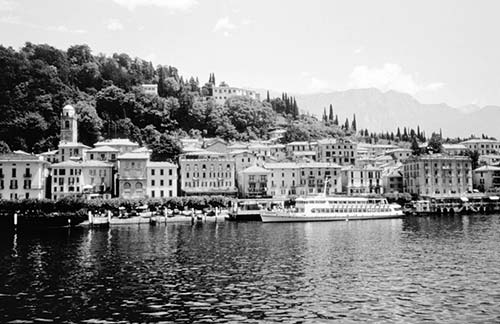
The self-proclaimed “Pearl of the Lake” is a classy combination of tidiness and Old World elegance. If you don’t mind that “tramp in a palace” feeling, it’s a fine place to shop for ties and umbrellas while surrounding yourself with the more adventurous posh travelers. Heavy curtains between the harborfront arcades create welcome shade and keep visitors and their poodles from sweating. Thriving yet still cute, Bellagio is a much more substantial town than Varenna.
Orientation to Bellagio
TOURIST INFORMATION
The TI is at the top of town, on the square by the church (daily 9:30-17:00, shorter hours Nov-March, Piazza della Chiesa 14, +39 031 951 555, www.bellagiolakecomo.com). The TI has free brochures for several walking tours, varying from one to three hours. They also hand out a map that shows hikes with a range of difficulty and duration.
ARRIVAL IN BELLAGIO
By Boat: Frequent ferries sail to Bellagio from Varenna, Como, and other points along the lake. Bellagio has two docks a couple hundred yards apart. One serves passenger-only boats (along the Como-Colico route); the other is for car ferries from Varenna, Menaggio, and Cadenabbia. When you depart, be sure you’re at the right dock—ask when you buy your ticket. For details on boat schedules, see “Getting Around Lake Como” near the beginning of this chapter.
By Car: You can drive to Bellagio via Como or Lecco, or bring your wheels over on one of the ferries, but having a car here makes little sense. The center of town is a no-traffic ”ZTL” zone from 10:00 to 18:30, and parking on the perimeter is difficult. Look for pay-to-park spaces marked with blue lines (use pay-and-display machines—€1.50/hour 8:00-23:00, free overnight). There’s a large lot on Via Valassina, near the town cemetery, a 10-minute walk above the car ferry dock.
By Bus: Hourly buses from Como use a stop near the car ferry dock (drivers sell tickets).
HELPFUL HINTS
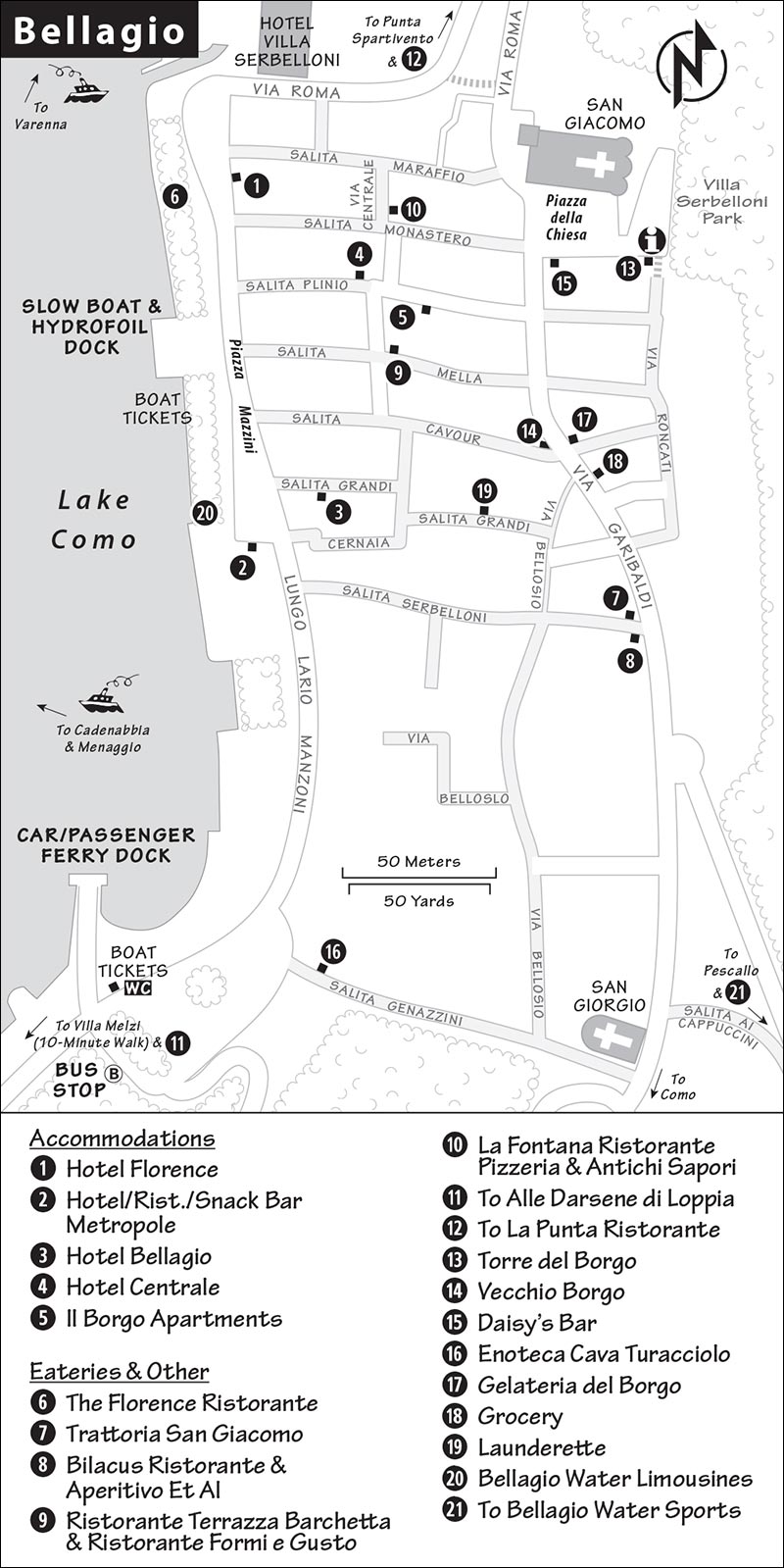
Laundry: La Lavandera is handy (open 24 hours, Salita Carlo Grandi 21, +39 031 952 092). You can pass the time at the fun Angelo DiVino wine bar across the way.
Music Festival: The Bellagio and Lake Como Festival, with orchestral, chamber music, and jazz performances around the Lake Como area, takes place every summer (www.bellagiofestival.com).
Sights and Activities in Bellagio
Strolling
Bellagio was built below a medieval fortress that capped its hill (today’s Villa Serbelloni Park). The town’s chic image was stoked by the Rockefellers (who purchased Villa Serbelloni in 1927) and by John F. Kennedy (who visited in 1961).
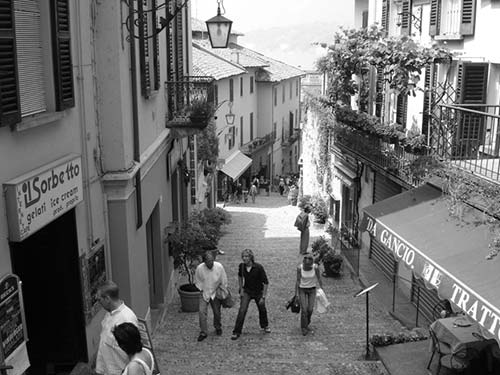
The harborfront is mostly fancy shops and cafés designed for visitors. Café Rossi, with a 1905 interior, faces the ferry dock. While Johnnie Walker and jewelry sell best at lake level, the natives shop up the hill.
Explore the steep-stepped lanes rising from the harborfront. Piazza della Chiesa, near the top of town, has an 11th-century church that’s worth a look. It’s dedicated to Saint James and has a dark, typically Romanesque interior with small windows, a marble pulpit carved with symbols of the four evangelists, and a golden altarpiece under glittering mosaics (pick up the English handout that describes its art).
North of Town: The de facto capital of the mid-lake region, Bellagio is located where the two legs of the lake split off to the south. For an easy break in a park with a great view, wander right on out to the crotch. Meander behind the rich-and-famous Hotel Villa Serbelloni, and walk 10 minutes up a concrete alley to Punta Spartivento (“Point That Divides the Wind”). You’ll pop out to find a Renoir atmosphere complete with an inviting bar-restaurant (see “Eating in Bellagio,” later), a tiny harbor, and a chance to sit on a park bench and gaze north past Menaggio, Varenna, and the end of the lake to the Swiss Alps.
South of Town: For another stroll, head south from the car-ferry dock down the tree-shaded promenade. Ten minutes later, you’ll pass the town’s “beach.” The Lido di Bellagio is actually a terrace with sand and rentable lounge chairs, a youthful cocktail bar, a concrete pool, and a swimming platform in the lake. Just beyond the lido is Villa Melzi Gardens (€8, daily 10:00-19:00, www.giardinidivillamelzi.it). While the villa is not open to the public, the gardens are. Visitors enjoy a long and lovely lakeside promenade with exotic plants, flowers, and trees (all labeled—pick up the botanical guide at the entry) and Neoclassical sculpture that was assembled by the vice president of Napoleon’s Italian Republic in the early 19th century. Although not as elaborate as some of the lake’s finer gardens, it offers a pleasant, tree-shaded lakefront stroll. Gaze across the lake at the Villa Carlotta (straight over, surrounded by greenery—described later, under “More Sights on Lake Como”) and imagine the time when aristocrats tried to outdo each other (and showcase their wealth) by creating unique and immense horticulture collections.
At the far end of the garden you can exit at the tiny harbor of Loppia, where you’ll be tempted by the recommended Alle Darsene di Loppia restaurant. About 15 minutes farther south, you’ll reach San Giovanni, with a pebbly public beach (no showers).
Villa Serbelloni Park
This park (accessible only with guided tour) overlooks the town. The villa itself, owned by the Rockefeller Foundation, is not open to the public. The gardens sprawl over 50 acres, covering nearly all of Bellagio’s promontory.
Cost and Hours: €10, required 90-minute tour Tue-Sun at 11:00 and 15:30; no tours Mon, Nov-mid-March, or when rainy; first two-thirds of walk is uphill, show up at the TI (in the medieval tower on Piazza della Chiesa) 15 minutes before tour time to buy tickets, confirm time with TI, +39 031 951 555, www.bellagiolakecomo.com.
Boating and Water Sports
Bellagio Water Limousines, with a small stand adjacent to the slow boat/hydrofoil dock, is run by Australian Jennine and Italian Luca, who offer tours and private service in their shiny mahogany Venetian water taxi. Consider their one-hour mid-lake tour (€50, most days) or their 2.5-hour mid-lake tour with a stop at Villa del Balbianello (€72, RS%, check blackboard for day’s offerings or call +39 338 524 4914, www.bellagiowaterlimousines.com, bellagiowaterlimousines@gmail.com).
Bellagio Water Sports is where Michele offers 90-minute kayaking tours (€64-70, RS%, most days at 9:00 and 11:30, weather dependent). He’s a 15-minute hike over a hill and down on Pescallo Bay near Hotel la Pergola at Via Sfondrati 1, +39 340 394 9375, www.bellagiowatersports.com, info@bellagiowatersports.com).
Sleeping in Bellagio
This is a “boom or bust” lake resort, with high-season prices straight through from May to September, plus a brief shoulder season (with discounted prices) in April and from October to November. Bellagio closes down almost completely from December to February and is only half-open in March.
$$$$ Hotel Florence has a prime lakefront setting in the center of town. The 160-year-old place, run by the German Ketzlar family, features 30 rooms, hardwood floors, bold earth tones with splashes of bright colors, and a rich touch of Old World elegance (RS%, some rooms with view and balcony, air-con, elevator, Piazza Mazzini 46, +39 031 950 342, www.hotelflorencebellagio.it, info@hotelflorencebellagio.it).
$$$$ Hotel Metropole, dominating Bellagio’s waterfront between the ferry docks, is a grand old place with plush public spaces. Its tranquil rooms have classic flair and all the comforts. All 42 rooms have lake views, either side or full (family rooms, air-con, elevator, enormous roof terrace, Piazza Mazzini 1, +39 031 950 409, www.albergometropole.it, info@albergometropole.it).
$$$ Hotel Bellagio is stylish but unpretentious, with 28 airy rooms and parquet floors (some with balconies, most with views). The rooftop deck has sun chairs, and the basement gym is small but mighty (air-con, elevator, pay parking, Salita Grandi 6, +39 031 952 202, www.hotelbellagio.it, info@hotelbellagio.it).
$$$ Hotel Centrale, managed with pride and care by Giacomo Borelli, warmly welcomes its guests into a true-blue family operation: Signore Borelli’s two sons help out, his mama painted the art, and grandpa crafted much of the Art Deco-era furniture. Look for old family photos near the stairwell. The 17 bright, comfortable rooms lack views, but the public spaces are generous, including the balcony terrace (air-con, elevator, Salita Plinio 7, +39 031 951 940, www.hc-bellagio.com, info@hc-bellagio.com).
$$ Il Borgo Apartments offers seven efficient, spacious units in the old center. Equipped with kitchenettes, these are a great deal for families or small groups. Easygoing Flavio and son David are available for check-in daily 13:00-16:00 or by appointment (RS%, no breakfast, air-con, elevator, Salita Plinio 4, +39 338 193 5559, www.borgoresidence.it, info@borgoresidence.it).
Eating in Bellagio
As with Bellagio’s hotels, many of these restaurants close off-season (generally December through February or March). Two places associated with hotels serve food on the lakefront in the town center (the Florence and Hotel Metropole’s Terrazzo Ristorante). The service won’t make you smile, and the price will dent your wallet. But the setting will be unforgettable. Rather than eat on the lakefront, I’d hang out there with a drink and find a better-value restaurant at a higher altitude.
IN THE OLD TOWN, WITHOUT LAKE VIEWS
$$ Trattoria San Giacomo is a high-energy place with traditional North Italian cuisine, such as riso e filetto di pesce (rice and perch fillet in butter and sage), and seasonal specials. It offers fun seating on a steep, cobbled lane or tight seating inside (Wed-Mon 12:00-14:30 & 19:00-21:30, closed Tue, Salita Serbelloni 45, +39 031 950 329, www.trattoriabellagio.it).
$$ Bilacus Ristorante, across the street, has a brighter, more open dining room, a fine garden terrace, an emphasis on wine (including some top-quality vintages by the glass), and a menu of traditional Italian dishes (Tue-Sun 12:00-14:30 & 19:00-21:30, closed Mon, Salita Serbelloni 32, +39 031 950 480, www.bilacusbellagio.it). Aurelio is happy to give those with this book a complimentary vin santo and biscotti for dessert.
$$$ Ristorante Terrazza Barchetta, set on a terrace with no lake view and bedecked with summery colors, puts a creative twist on regional favorites such as lake fish, but is a little pricey (Wed-Sun 12:00-14:30 & 19:00-22:15, closed Tue, Salita Mella 13, +39 031 951 389, www.ristorantebarchetta.com). Its simpler and less-expensive sister, Ristoro Formi e Gusto, is downstairs (described next).
$$ Ristorante Formi e Gusto serves quality, fairly priced pizza and pasta, with simple indoor and outdoor seating (daily 12:00-22:30, Salita Mella 13, +39 031 951 389).
$$ La Fontana Ristorante Pizzeria, near the top of the old center, serves classic Italian dishes at tight interior tables and on a nice terrace (go up Salita Monastero to Via Centrale 7, +39 031 950 283).
$$ Antichi Sapori, next door, is another good alternative—a favorite for salads, pizza, and pasta with a warm and cozy interior and a fine terrace (daily 11:30-22:00, Via Centrale 5, +39 031 950 431, Julia and Nico).
GOURMET SPLURGE SOUTH OF TOWN
$$$$ Alle Darsene di Loppia, the kind of place you’d expect jet-setters to dress up for, is a romantic gourmet restaurant serving beautifully presented Mediterranean cuisine. Consider their seared scallops and their tasting menu. It’s a 15-minute walk south of town (through the exquisite Villa Melzi Gardens—worth paying for if dining here to avoid the walk along the street). While seating indoors is OK, dining out on a historic little harbor under their pergolato is more memorable (Tue-Sun 12:00-14:30 & 19:00-21:30, closed Mon, on the far side of the Villa Melzi Gardens at Via Melzi D’Eril in Loppia, +39 031 952 069, www.ristorantedarsenediloppia.com [URL inactive]).
OTHER OPTIONS
Dining North of Town: $$ La Punta Ristorante is a good bet for a lakeside meal a 10-minute walk north at the dramatic Punta Spartivento. Set in a peaceful park, this family-run, white-tablecloth place has reasonable prices and very fresh fish (daily 12:00-22:00, +39 031 951 888, www.ristorantelapunta.it).
Breakfast: If your hotel or B&B doesn’t provide breakfast, several cafés clustered near Piazza della Chiesa offer either full breakfast menus or à la carte options at tourist pricing: Pick from Torre del Borgo, Vecchio Borgo, and Daisy’s Bar.
Wine Tasting: $$ Enoteca Cava Turacciolo is a classy-for-a-troll vaulted stone cellar wine bar. This fun-loving place run by Norberto and Rosy is great for a last drink before catching your ferry, or a simple meat-cheese-wine meal. They offer my readers a €19 taste of three regional wines with a sampling of cheeses, meats, and breads (Thu-Tue 11:00-24:00, closed Wed, Salita Genazzini 3, +39 031 950 975, www.cavaturacciolo.it).
$$$ Aperitivo Et Al, slick and jazzy, is a trendier wine bar; it also offers mixed salumi and formaggi plates and light lunches paired with the right wine. Alessandro serves a great selection of wines by the glass (daily 11:00-24:00, Salita Serbelloni 34, +39 031 951 523).
Gelato: It’s easy to find a cone or sundae at places along the waterfront, but residents agree that these aren’t the best gelaterie in town. Instead, climb up a couple of blocks to Gelateria del Borgo near the church (daily 10:00-22:00, Via Garibaldi 46, +39 031 950 755, Stefania and Gianfranco).
Picnics: You’ll find benches at the park, along the waterfront in town, lining the promenade south of town, and a 10-minute walk north in the lovely park at the tip of the peninsula (Punta Spartivento). Butti Macelleria e Salumeria, on the upper street near Gelateria del Borgo, makes sandwiches and sells a few prepared foods (daily 8:00-19:00, closed Mon off-season, Via Garibaldi 42, +39 031 950 333).
More Sights on Lake Como
For the best one-day look at Lake Como, take my self-guided ferry tour to get your bearings, and hop off at the towns and villas of your choice. The two main villas worth considering (described after the tour) are Villa Carlotta—with a sterile, museum-like interior and gorgeous, sprawling gardens—and Villa del Balbianello, a bit harder to reach but with a more striking setting, gardens that are more architectural than botanical, and a fascinating tour of the lived-in interior. If you have time, visit both—they’re complementary. In this section, I also describe two other lake towns—Menaggio and Como—plus how to side-trip to Lugano in Switzerland.
▲▲Self-Guided Ferry Tour
The best simple day out is to take the battello navetta (slow passenger ferry) on the 50-minute run from Varenna-Bellagio-Villa Carlotta-Tremezzo-Lenno (€9.20 without stops, or buy the €15 one-day pass and make it hop-on, hop-off; departs Varenna about hourly starting at 9:20, confirm times locally; for more information, see here). Then come back the same way, hopping off at any sights that interest you: Lenno (to see Villa del Balbianello), Villa Carlotta, and/or Bellagio. This commentary describes what you’ll see along the way, leaving from Varenna, though it’s doable from Bellagio too.
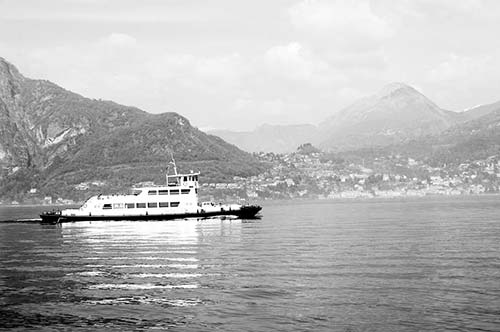
Leaving Varenna: Looking back at Varenna from the lake, you’ll see Vezio Castle rising above the town, with new Varenna on the left (bigger buildings and modern ferry dock) and old Varenna on the right (tighter, more colorful buildings). The big development high on the hillside is an ugly example of cronyism (without the mayor involved, this would never have happened). Under the castle is a grove of olives—reputedly the northernmost ones grown in Italy. Because the lake is protected from the north wind, exotic flowers grow well in the lake’s many fine gardens. To the right of Varenna’s castle are the town cemetery, a lift up to Hotel Eremo Gaudio (a former hermitage), and a spurt of water gushing out of the mountain just above lake level. This is the tiny Fiumelatte, Italy’s shortest river.
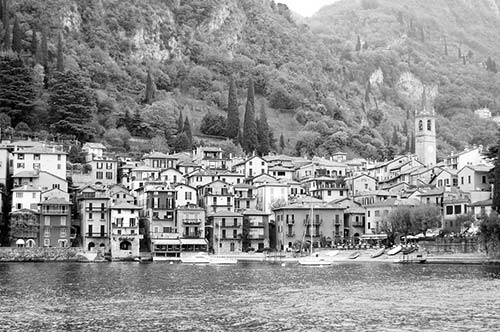
• On your way across to Bellagio, take a look around.
Mid-Lake: The Swiss Alps rise to the north. Directly across the lake from Varenna is Menaggio, and just over the ridge from there is Lugano and the “Swiss Riviera.” The winds alternate between north and south. In preindustrial times, traders harnessed the wind to sail up and down the lake. Notice the V-shaped, fjord-like terrain. Lake Como is glacier-cut. And, at more than 1,200 feet deep, it’s one of Europe’s deepest lakes. You’ll cruise past the Punta Spartivento, the bulbous point that literally “splits the wind” and where the two “legs” of the lake join (Lake Lecco is on the left/east, and Lake Como on the right).
• Before long, you’ll be...
Approaching Bellagio: Survey the park at Punta Spartivento—it’s a pleasant walk from town. Bellagio has three times the number of hotel rooms as Varenna, as you can see upon approach. The town, with its strip of swanky hotels, is bookended by Grand Hotel Villa Serbelloni (five stars) on the left, dominating the lakefront, and the sprawling Grand Hotel Bretagne (four stars) on the right. In the 19th century, aristocratic Russians hung out in the Serbelloni, and well-heeled English chose the Bretagne. These days, the Serbelloni is the second-most luxurious hotel on the lake after Villa d’Este, while Bretagne is mired in a long renovation project.
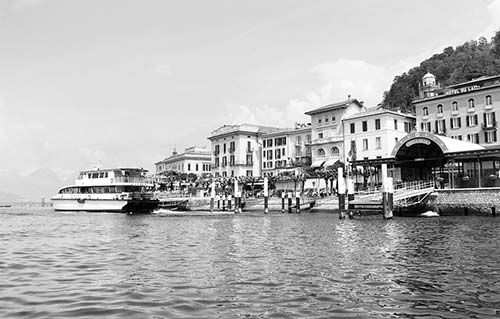
• Leaving Bellagio, you’ll pass Villa Melzi and its gardens, then the tiny harbor at Loppia. About half the boats make a stop at San Giovanni, a small, nondescript lakefront community just down the shore from Bellagio. Whether your boat stops here or not, soon you’ll head across the lake for a stop at...
Villa Carlotta: Because of lake taxes and high maintenance costs, owners of once-elite villas have been forced to turn them into hotels or to open their doors to the paying public. Since 1927, this has been an example of the latter. One of the finest properties on the lake, Villa Carlotta has some good Neoclassical sculpture (including works by Canova) and one of the lake’s lushest gardens (see listing below).
• The shortest hop on this route (you could walk it in less than 10 minutes) takes you along to the town of...
Tremezzo: As you leave the dock at Villa Carlotta, notice the Grand Hotel Tremezzo, with its striking Liberty Style (Art Nouveau) facade and swimming pool floating on the lake. Above the town is a villa built in the 19th-century Romantic Age to resemble a medieval castle (next to the stub of a real one).
After the Tremezzo stop—and just before the Tremezzo church—you’ll see a public park with a fountain and balustrade. When the road separated this land from its villa, its owners gave it to the community. Here the lake is dotted by a string of old villas with elegant landings and gated boathouses. Built in the days before motors, they are now too small for most modern lake boats.
Lenno: This pleasant resort town has a long, arcing bay sheltering lots of little docks, and a generously shaded promenade.
It’s decision time: To see the recommended Villa del Balbianello, hop off here and turn to the next page. Return boats depart hourly; check the schedule before you set off. This is the end of the line for some boats, which turn around here and head back the way you came—on these, if you don’t plan to see the villa, you can just stay put. Other boats continue south to Como, and you’ll need to get off and wait for the next return boat.
▲Villa Carlotta
This is the best of Lake Como’s famed villas for flower gardens—especially in spring, when the many camellias, azaleas, and rhododendrons are in bloom. For gardeners, it’s worth ▲▲▲. I see the lakes as a break from Italy’s art, but if you need a culture fix, Villa Carlotta also offers an elegant Neoclassical interior with a sculpture gallery, including works by Antonio Canova.
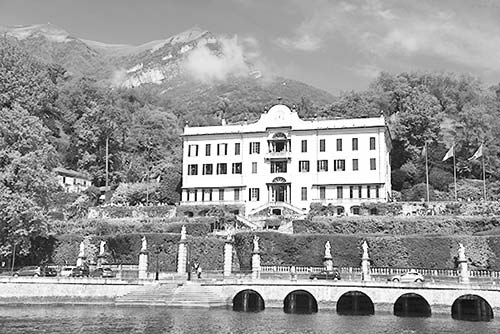
Cost and Hours: €12 includes villa/museum and gardens, daily 9:00-19:00, last ticket sold at 18:00, museum closes at 18:30, closed Nov-mid-March, +39 034 440 405, www.villacarlotta.it.
Getting There: Villa Carlotta, at the southern end of the town of Tremezzo, has its own dock (served by the slow battello passenger boats). It’s also less than a 10-minute walk from the more frequently served Tremezzo and Cadenabbia docks. You can also use bus #C10 to zip along the lakefront; it stops here on its way between Como and Menaggio (1-2/hour, pay driver, www.asfautolinee.it [URL inactive], bus stop to the right as you exit Villa Carlotta).
Visiting the Villa: When buying your ticket, pick up the map that identifies the rooms in the house and the major plant groups in the gardens. Inside, there’s a café and a designated picnic area.
From the entrance, hike up the grand staircase and enter the villa itself. The main floor is filled with Neoclassical sculpture, including Antonio Canova’s Maddalena Penitente and Palamede and works by his students (look for the impressive replica of Canova’s famous Love and Psyche Reclining). There are also pieces by the great Danish sculptor Bertel Thorvaldsen. On the next floor up are generally well-presented special exhibits, and on the top floor are painstakingly appointed period rooms with elegant Empire Style (early 19th-century French) furniture.
Then explore the main attraction, the gardens, which sprawl in both directions from the villa. To the south (toward Tremezzo) is the classical Old Garden. To the north, things get more interesting: pretty camellias, luscious azaleas, a maze of rhododendrons, a bamboo garden, and the gasp-worthy Valley of the Ferns—a lush jungle gorge with a river coursing through it.
▲▲Villa del Balbianello
The dreamiest villa on the lake perches on a romantic promontory near Lenno, overlooking Lake Como and facing Bellagio. Built at the end of the 18th century on the remains of an old Franciscan church, today the villa reflects the exotic vision of its last owner, explorer and mountaineer Guido Monzino, who died in 1988—leaving his villa and everything in it to the state. It’s well worth paying extra to tour the interior to get to know Monzino, who led the first Italian expedition to climb Mount Everest in 1973. But the real masterpiece here is the terraced garden and elegant loggia, where the land fits the architecture and landscaping in a lovely way.
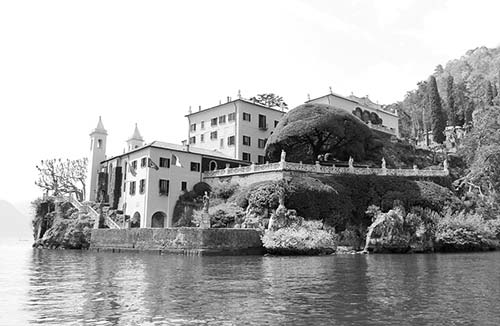
Cost and Hours: Garden only–€11, garden with villa tour–€22, Thu-Sun and Tue 10:00-18:00, closed Mon and Wed and mid-Nov-mid-March, last entry to garden one hour before closing, +39 034 456 110, www.visitfai.it.
Tours: The only way inside the villa is with an English tour. Limited to 15 people per tour, these depart at least hourly (more frequently with demand); the first tour is usually at 11:00 and the last at 16:30.
Getting There: It’s at the end of a hilly point next to the town of Lenno. From the Lenno ferry dock, turn left and stroll around to the far end of the harbor (about 10 minutes). Here, you can either pay for a speedboat shuttle (+39 333 410 3854, www.taxiboat.net) or carry on by foot. If you choose to walk, continue past the boat dock and through the gate marked Villa Balbianello, where two options are clearly signposted in kilometers: a 20-minute, 1-kilometer (half-mile) hike (including some up and down), or a more challenging 45-minute, 2.5-kilometer (about 1 mile) huff over the top.
Visiting the Villa: Your visit includes two parts: the villa and the gardens. If walking from the boat and back (taking the shorter 20-minute path), allow a leisurely three hours total for the walk and garden/villa visit.
Poke around the gardens while waiting for your villa tour to begin. On the Bellagio-facing side, you’ll find a tranquil terrace with sweeping lake views. Along the path, notice the circular stone shed. Originally used for refrigeration (they used ice from the mountains to keep things cool), today this shed houses the tomb of Guido Monzino. On the opposite side of the point, you’ll find a terrace in front of the original Franciscan church (now a gift shop selling overpriced drinks). A WC is nearby, and just down the steps is the dock for the speedboat return to Lenno.
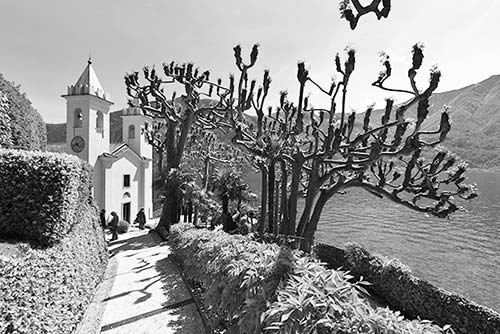
The 50-minute tour of the villa is as fascinating as its larger-than-life former owner. You’ll tour the loggia (with a library and a study), then spend the rest of the time seeing 18 of the main building’s 25 rooms. While finely decorated, these feel cozy, lived-in, and not too extravagant. Each one gives you a bit more insight into Monzino—from his personal living quarters, to his extensive collection of prehistoric artifacts from around the world, to the top-floor museum of his expeditions, with memorabilia from his North Pole and Mount Everest adventures. You’ll see secret passages, learn why his furniture came with handles, and find out what’s hiding behind the faux bookcase.
Menaggio
Menaggio—the third of the “big three” mid-lake towns (along with Varenna and Bellagio)—has a little more urban bulk than its neighbors. Budget travelers stay in the youth hostel here, and day visitors are charmed by Menaggio’s lovely main square and lakefront park. Since many find Lake Como too dirty for swimming, consider spending time in Menaggio’s outdoor public pool (look for the lido). Several good hikes start here, too. (Just a few decades ago, cigarette smugglers used these trails at night to sneak back into Italy from Switzerland with their tax-free booty.) The TI (and its website) has detailed suggestions for walkers and mountain bikers (Piazza Garibaldi 3, +39 034 432 924, www.menaggio.com).
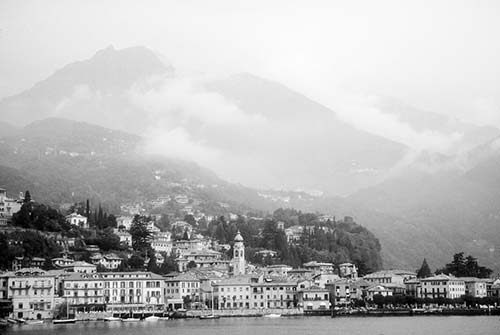
Sleeping in Menaggio: ¢ La Primula Youth Hostel is a classic, old-school hostel, offering sailing lessons, Italian-language courses, cooking classes, kayak and bike rentals, and a great location on the lake, a two-minute walk south of the ferry dock (Via IV Novembre 106, +39 034 432 356, www.lakecomohostel.com, info@lakecomohostel.com).
Menaggio Connections: Both car ferries and passenger-only boats connect Menaggio frequently to Varenna and Bellagio. Bus #C10 also runs along the lakeshore here (1-2/hour, pay driver), linking Menaggio to Villa Carlotta and Villa del Balbianiello, and to Como town in about an hour. Menaggio is also a springboard for visiting Switzerland—remember to bring your passport. Bus #C12 goes to Lugano (€7, nearly hourly, 1 hour, www.asfautolinee.it [URL inactive]). In summer, the yellow Palm Express bus runs once daily to St. Moritz (2.5 hours, reservations required, www.postauto.ch).
Make sure to check which of the several bus stops in Menaggio your bus leaves from. Near the ferry dock, Como- and villa-bound #C10 buses stop at the Hotel Menaggio stop, while the #C12 Lugano bus stops at Via Como 9. You can also catch these buses at their terminus, the bus garage at Piazza Roma. The Palm Express departs from yet another stop at Hotel Bellavista, near Piazza Garibaldi.
Como Town
On the southwest tip of the lake, Como has a good, traffic-free old town, an interesting Gothic/Renaissance cathedral, a cable car up to a mountaintop viewpoint, and a pleasant lakefront with a promenade (TI at Via Giocondo Albertolli 7, +39 031 269 712, www.lakecomo.is). It’s an easy 10-minute walk from the boat dock to the train station (trains to Milan depart about twice per hour, 40 minutes). For details on boats connecting Como to Bellagio and Varenna, see here.
All-Day Lugano Side Trip
From Varenna or Bellagio, you can make a loop that lets you nip into Switzerland to see the elegant lake resort of Lugano, pass through the town of Como, and cruise a good part of Lake Como. Here’s a good day plan (times are approximate—confirm schedules locally): about 9:30—ferry to Menaggio (15 minutes from Varenna); 10:30—bus to Lugano (1 hour, bring your passport); 11:30—explore Lugano; 16:00—train to Como (45 minutes); 17:00/18:00/19:00—fast hydrofoil from Como to Varenna (1 hour). For more information on Lugano, see www.ricksteves.com/lugano.
Lake Maggiore
Lake Maggiore is ringed by mountains, snowcapped in spring and fall, and lined with resort towns such as Stresa. Although Lake Maggiore lacks the cozy charm of Lake Como, it does have a fun sight—three little islands, two with exotic gardens and lovely villas built by the Borromeo family.
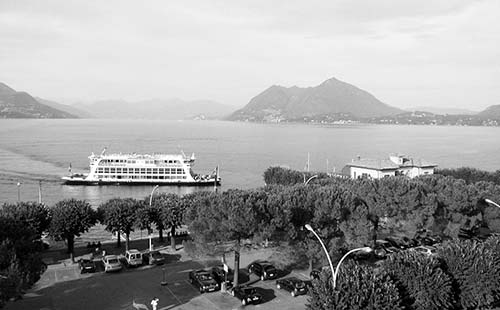
Through many generations since 1630, the Borromeos lovingly turned their islands into magical retreats, with elaborate villas and fragrant gardens. Isola Bella has a palace and terraced garden; Isola Madre has a villa and a more casual English-style garden. The Borromeos, who made their money from trade and banking, enjoyed the arts—from paintings (hung in lavish abundance throughout the palace and villa) to plays (performed in an open-air theater on Isola Bella) and marionette shows (you’ll see the puppets that once performed here).
The third island, Isola Superiore (a.k.a. Isola dei Pescatori), is small, serene, and residential. The town of Stresa, a characterless resort, is the departure point for exploring all three of Lake Maggiore’s garden islands.
Tourists flock here in May and June, when flowers are in bloom, and in September. Concerts held in scenic settings draw music lovers, particularly during the summer Stresa Festival (www.stresafestival.eu). For fewer crowds, visit in April, July, August (when Italians prefer the Mediterranean beaches), or October. In winter, the snow-covered mountains (with resorts a 1.5-hour drive away) attract skiers.
PLANNING YOUR TIME
This region is best visited on a sunny day, when the mountains are clear, the lake is calm, and the heat of the sun brings out the scent of the blossoms. The two top islands for sightseeing are Isola Bella and Isola Madre (if tight on time, focus on Isola Bella). Isola Superiore has no sights but is a peaceful place for lunch. You can stay the night in Stresa, but a day trip is sufficient for most. My suggested plan: Walk from the Stresa train station 10 minutes downhill to the boat dock, and catch a boat to Isola Madre. Work your way back to Isola Superiore for a lazy lunch, and then go on to Isola Bella for the afternoon, before returning to Stresa and back to Milan.
Day Trip from Milan: Catch a one-hour, early regional train from Milan to the town of Stresa. These generally leave Milano Centrale station at 7:25, 8:25, and 9:25. (There is also an express at 8:20; it saves 10 minutes but costs twice as much.)
GETTING TO THE ISLANDS
Boats link the islands to Stresa, running about twice hourly (Stresa to Isola Bella, 10 minutes; Isola Superiore, 15 minutes; Isola Madre, 40 minutes). Important: Buy boat tickets at the ticket window in the gallery of the yellow dock building (with the arches), signposted Navigazione Lago Maggiore. Don’t be fooled by private taxi-boat drivers, dressed in sailor outfits, who may accost you on the promenade or in front of a booth labeled Biglietteria. They’ll try to talk you into paying way too much for private tours on their smaller boats.
For maximum flexibility, buy a “free circulation” ticket, which allows you to get off at multiple stops of your choice (€10.70 includes Bella and Superiore, €13.70 Bella and Madre, €18.40 all three islands, €22.20 for the islands and Villa Taranto). Just going to Isola Bella costs €7.30 round-trip. A visitor tax of €0.50 per island is included in the price you pay, but not in the prices posted at the window.
Boats run daily April through September, starting at 7:00 (8:15 on Sun). The map on here shows most of the route: Stresa, Carciano/Lido (most boats skip this stop), Isola Bella, and Isola Superiore. From Isola Superiore, boats continue to Baveno (another lakeside town), Isola Madre, and then across the lake to Pallanza and Villa Taranto. Off-season, the boats cover a shorter route (boat info: +39 0322 233 200, www.navigazionelaghi.it).
STRESA
The town of Stresa—which means “thin stretch”—was named for the original strip of fishermen’s huts that lined the shore. Today, grand old hotels run along that same shore. Don’t linger in Stresa—it’s just a functional springboard for the islands and gardens.
Arrival in Stresa: Upon arrival in Stresa, jot down your return options (regional trains to Milano Centrale leave every two hours until about 21:00). To get downtown, exit right from the station and take your first left (by the underpass, on Viale Duchessa di Genova). This takes you straight down to the lake; once you’re there, the boat dock is about four blocks to your right along the promenade. At the dock, the helpful TI is in the same arched building as the ticket window (TI daily 10:00-12:30 & 14:30-18:30, Nov-mid-March closed Sat afternoon and all day Sun, Piazza Marconi 16, +39 032 331 308, www.stresaturismo.it). Taxis charge a fixed rate of €11 from the station to the dock.
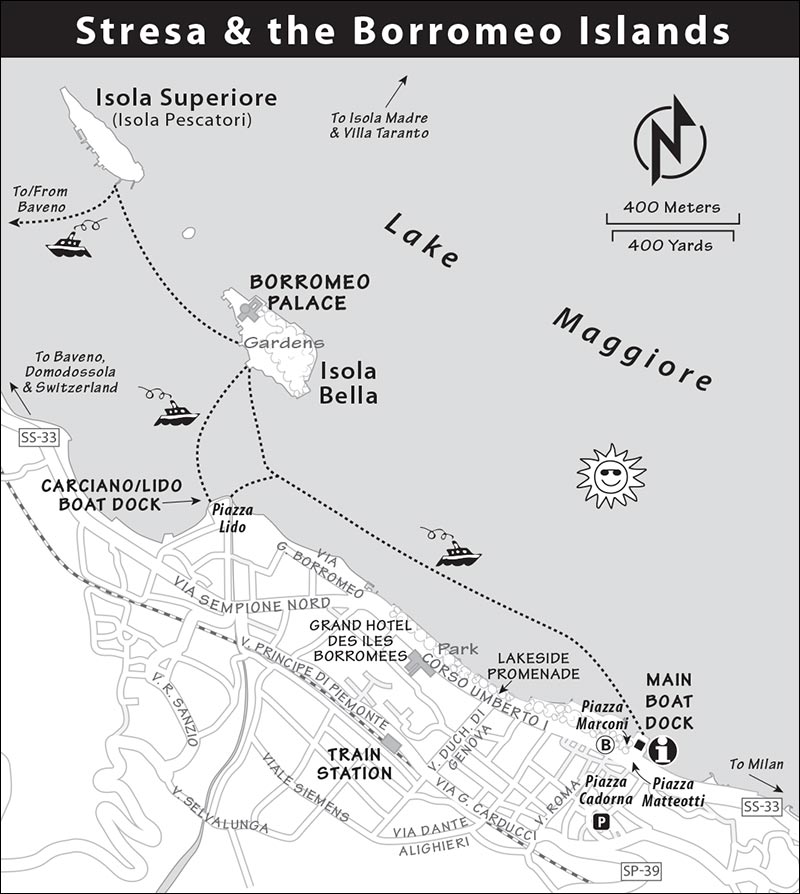
Visiting Stresa: The old town—basically a traffic-free touristy shopping mall—is just a few blocks deep, stretching inland from the main boat dock. Stresa’s stately 19th-century lakeside hotels date back to the days when this town was on the Grand Tour circuit.
In any Romantic Age resort like Stresa, hotels had names designed to appeal to Victorian aristocrats...like Regina Palace (rather than Palazzo), Astoria, Bristol, and Victoria.
The Grand Hotel des Iles Borromées was the first (built in 1862). In 1918, 19-year-old Ernest Hemingway—wounded in Slovenia while driving an ambulance for the Italian Red Cross—was taken to this hotel, which served, like its regal neighbors, as an infirmary during World War I. Hemingway returned to the same hotel in 1948, stayed in the same room (#205, now called the “Hemingway suite”—you can stay there for a couple thousand dollars a night), and signed the guest book as “an old client.” Another “old client” was Winston Churchill, who honeymooned here.
Sleeping in Stresa: I prefer to stay in other towns, but Stresa has a few options: $$$ Hotel Milan Speranza au Lac is a big, group-oriented hotel facing the boat dock (www.milansperanza.it); $$ Hotel Saini Meublè is a small, homey, affordable choice in the old town center (www.hotelsaini.it); and $$ Hotel Moderno is a midsize, midrange option in the old town (www.hms.it).
Eating in Stresa: The main square, Piazza Cadorna, is one big tourist trap, yet it does have a certain charm. (At night, it seems anyone who claims to be a musician can get a gig singing for diners.) For a (slightly) less touristy alternative, seek out one of these options: $$ Osteria degli Amici, tucked away under a vine trellis on a quieter square a couple of blocks beyond Piazza Cadorna (Via Bolongaro 31); $$$ La Botte, off the main street between the port and the square (Via Garibaldi 8); or $$$$ Il Clandestino, a fancier, romantic, modern splurge specializing in fish (Via Rosmini 5).
ISLANDS AND GARDENS
▲▲Isola Bella
This island, nearest Stresa, has a formal garden and a fancy Baroque palace. Looking like a stepped pyramid from the water, the island was named by Charles Borromeo (sponsor of Milan’s Duomo) for his wife, Isabella. The island itself is touristy, with a gauntlet of souvenir stands and a corral of restaurants. A few back streets provide evidence that people actually live here. While the Borromeo family now lives in Milan, they spend a few weeks on Isola Bella each summer (when their blue-and-red family flag flies from the top of the garden). There’s no entry fee to just disembark at the island, but there’s not much to do aside from visiting the palace and garden.
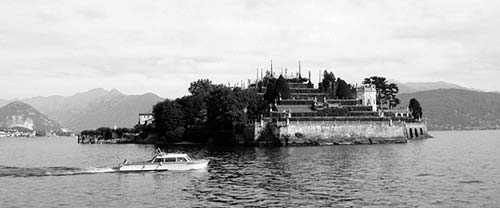
Cost and Hours: Palace and garden-€20, €28 combo-ticket includes Isola Madre, daily 10:00-18:30, Oct until 18:00, mid-March-mid-April open Fri-Sun only, closed Nov-mid-March, last entry one hour before closing, +39 0323 933 478, www.isoleborromee.it.
Tours: A fine €4 audioguide describes the palace, which also has posted English descriptions. A €1.50 booklet explains the gardens.
Eating: Several restaurants cluster between the boat docks and the villa. Picnicking is not allowed in the garden, but you can picnic in the pebbly park at the point of the island, beyond the villa (free and open to the public).
Visiting the Island: There are two docks on this island, one for each direction, with a WC nearby. It’s just a few steps from the boat to the hulking villa (turn left from the dock). Once inside, your visit is a one-way tour, starting with the palace and finishing with the garden. (There’s no way to see the garden without the palace.)
In the lavishly decorated Baroque palace, stairs lead up under stucco crests of Italy’s top families (balls signify the Medici, bees mean the Barberini, and a unicorn symbolizes the Borromeos’ motto: Humility). You’ll loop through the picture gallery, containing 130 beautifully restored 16th-century paintings from the Borromeo family’s private collection, hung wall-to-ceiling in several cramped rooms. Then you’ll get a peek at the canopied bedchambers and ogle the ornate throne room. Continue through the dining room, with a portrait of the first Borromeo, and into a richly stuccoed grand hall, with an 80-foot-high dome and featuring an 18th-century model of the villa, including a grand water entry that never materialized.
Next comes the music room, the site of the 1935 Stresa Conference, in which Mussolini met with British and French diplomats in a united attempt to scare Germany out of starting World War II. Look for a copy of the treaty with Mussolini’s signature on the wall next to the exit. Unfortunately, the “Stresa Front” soon fizzled, when Mussolini attacked Ethiopia and joined forces with Hitler.
Napoleon’s bedroom comes with an engraving that depicts his 1797 visit (Napoleon is on a bench with his wife and sister enjoying festivities in his honor). Continue through several more opulent halls, many of which display souvenirs and gifts that the Borromeo family picked up over the generations.
Downstairs, many of the famous Borromeo marionettes are on display. (A larger collection is on Isola Madre.) The 18th-century, multiroom grotto, decorated from ceiling to floor with shell motifs and black-and-white stones, still serves its original function of providing a cool refuge from Italy’s heat. The dreamy marble statues are by Gaetano Monti, a student of Antonio Canova. Climbing out of the basement, look up at the unique, cantilevered, spiral stairs; they’re from a 16th-century fortress that predates this building.
Pass through the mirrored corridor and follow the route through more rooms until you come to the ornate hall of 16th-century Flemish tapestries. This leads to the finale of this island visit: the beautiful garden, complete with Chinese white peacocks, which give it an exotic splash. (Before continuing to the garden, consider heading up the stairs near the WC to stroll through Elisa’s Greenhouse, named for Napoleon’s sister and home to tropical plants.)
From the palace, head straight up the stairs into the main part of the garden. Baroque—which is exactly what you see here—is all about controlling nature. The centerpiece is a pyramid-shaped outdoor grotto, crowned by the Borromeo family unicorn. Up the stairs and behind this fanciful structure is a vast terrace with views over the lower gardens and Stresa. Back downstairs, follow the signs (hidden in the bushes) to the café and bookshop, which anchor the far points of the island, to see the terraces behind the “pyramid.” Finally, follow exit signs to pop out a side gate at the top of a twisty, stepped lane back through town to the boat docks.
▲Isola Superiore
This sleepy island, also called Isola dei Pescatori, is residential—though only a handful of inhabitants remain—and was never owned by the Borromeo family. It has a few good fish restaurants, ample pizza-by-the-slice takeout joints, picnic benches, views, and, blissfully, nothing much to do—all under arbors of wisteria. Simply stroll the narrow, cobbled lanes, or relax at the long, skinny, pebbly park/beach at the tip of the island. A delight for photographers and painters, the island is never really crowded, except at lunchtime.
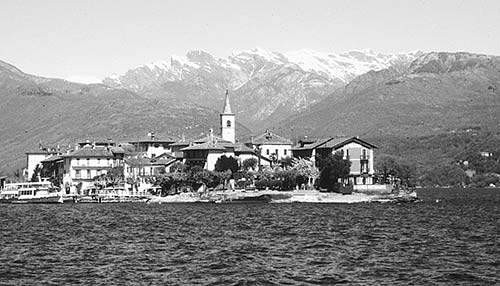
▲Isola Madre
Don’t come to this island unless you intend to tour the sight, because that’s all there is: an interesting furnished villa (with a few sparse English descriptions) and a lovely garden filled with exotic birds and plants. Garden lovers can invest a few euros in a booklet about the plantings.
Cost and Hours: Villa and garden-€17, €28 combo-ticket includes Isola Bella, same hours and contact details as Isola Bella.
Visitor Services: A WC is next to the chapel. You’ll also find a café/bookshop (selling basic sandwiches) just outside the villa. While eating is best on Isola Superiore, Isola Madre has one real restaurant, $$$ La Piratera Ristorante Bar, which owns a big, beautiful terrace over the lake. You’ll run into this immediately after leaving the villa/garden complex (good-value fixed-price tourist meal, daily 8:00-18:00, sit-down meals 12:00-15:30, simple sandwiches and slices of pizza to-go anytime, picnic at the rocky beach a minute’s walk from the restaurant, just to your right as you exit the gardens, +39 0323 31171).
Visiting the Island: Visiting is a one-way affair. From the boat dock, walk up the stairs to the ticket desk for the villa. Then, once through the gate, take the level path to the right to loop around the gardens and end at the villa (ingresso al giardino signs). Or, if you’re in a rush, take the stairs to the left instead to go straight to the villa.
First you’ll circle all the way around the gardens. Eight gardeners (with the help of water continually pumped from the lake) keep this English-style garden paradise lush. It’s a joy, even for those bored by flowers and foliage. You’ll see trees from around the world, and an exotic bird menagerie with golden and silver pheasants and Chinese peacocks. (You’ll see and hear them roaming wild; also look for the bird cages partway up the main staircase to the villa, on the left.)
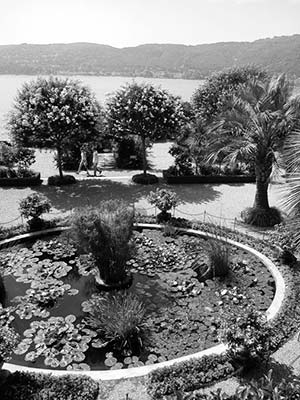
In front of the villa, a once-magnificent Himalayan cypress tree paints your world a streaky green. The 150-year-old tree, knocked down by a tornado in 2006 but successfully saved, is an attraction in its own right, with steel guy-wires now anchoring it firmly in place.
The 16th-century villa is the first of the Borromeo palaces, dating from the Renaissance. A century older than the Isola Bella villa, it’s dark and somber. The clever angled hinges keep the doors from flapping in the lake breeze. The family’s huge collection of dolls, marionettes, and exquisite 17th-century marionette theater sets—painted by a La Scala opera set designer—fills several rooms. A corner room is painted to take you into an 18th-century Venetian Rococo sitting room under a floral greenhouse.
Some of the garden’s best flowers are in view immediately after leaving the villa. Walk down the stairs to the terrace in front of the chapel, with WCs tucked around the left side. Stairs lead directly down to the boat dock from here. Or you can loop past the villa to exit at the far end, just above La Piratera restaurant. From there, you can walk through the shop to reach a terrace path that leads you back to the boat dock.
Villa Taranto Botanical Gardens
Garden lovers will enjoy this large landscaped park, located on the mainland across the lake from Stresa. Although it’s the most sprawling garden in the area, and enjoyable for a stroll in a park, it’s a bit underwhelming. The gardens are a Scotsman’s labor of love. Starting in the 1930s, Neil McEacharn created this garden of delights—bringing in thousands of plants from all over the world—and here he stays, in the small mausoleum. The park’s highlight is a terraced garden with a series of cascading pools. Villa Taranto is directly across the street from the boat dock.
Cost and Hours: €12, daily 9:00-19:00, March until 18:00, Oct until 17:30, closed Nov-Feb, last entry one hour before closing, +39 0323 404 555, www.villataranto.it.
Getting There: By boat, it’s two stops (about 15 minutes) past Isola Madre—50 minutes from Stresa. On the way, you’ll pass a scenic promontory speckled with villas. Note that only about half of the lake boats stop here, which means an hour between return departures—check schedules carefully.