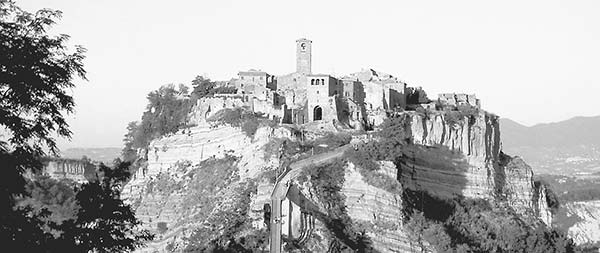
ORVIETO & CIVITA
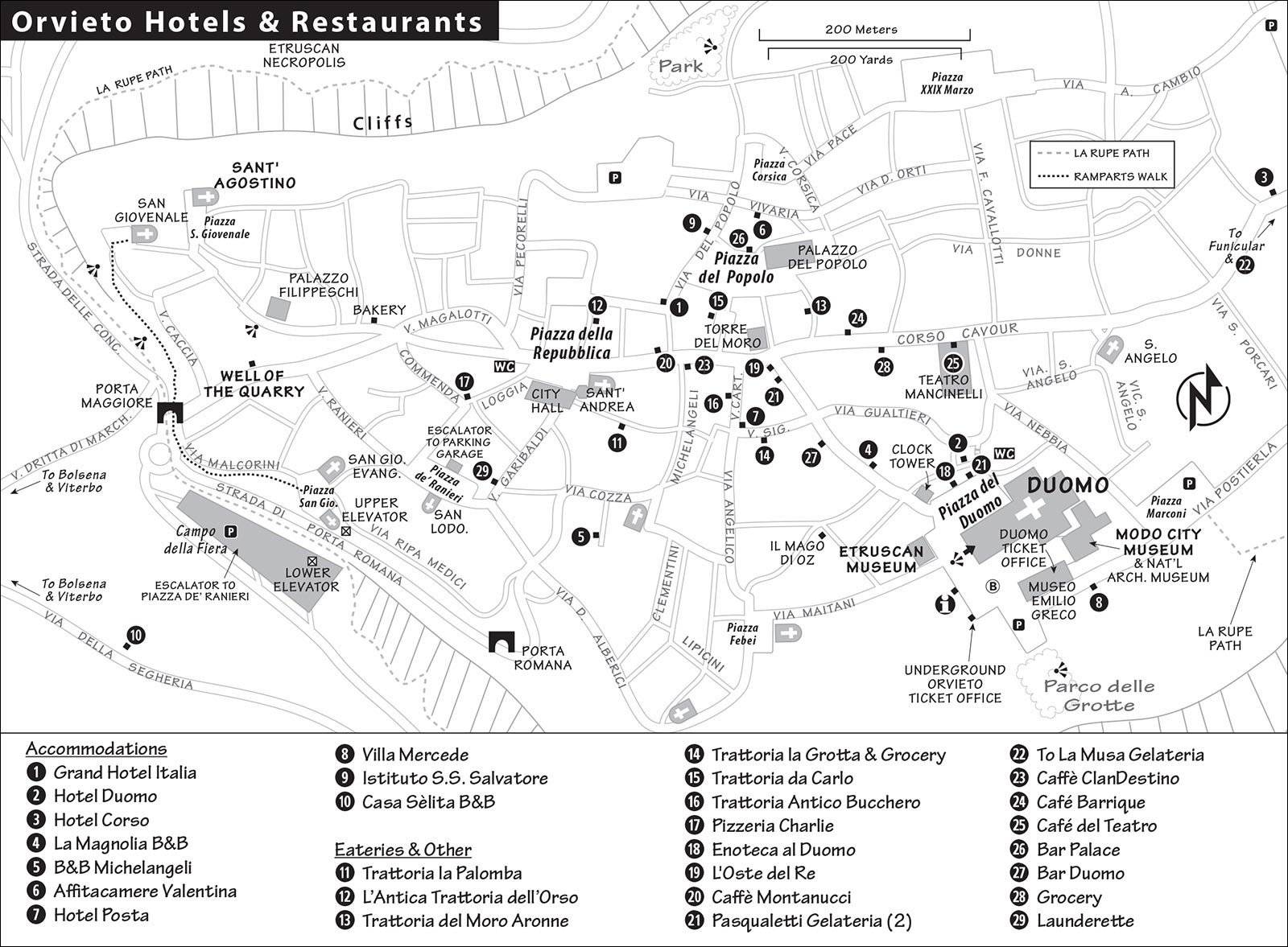
Map: Orvieto Hotels & Restaurants
Sleeping in Civita or Bagnoregio
Eating in Civita or Bagnoregio
While Tuscany is justifiably famous for its many fine hill towns, Umbria, just to the south, has some stellar offerings of its own. Assisi (covered in its own chapter) is a must for nature lovers and Franciscan pilgrims. But if you’re after views, wine, and charming villages, you’ll find Umbria’s best in Orvieto and in Civita di Bagnoregio (which is technically just across the border in Lazio, the same region as Rome).
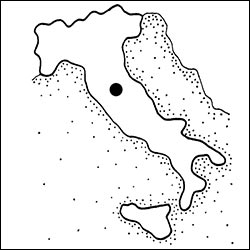
About a 30-minute drive apart, these hill towns—one big, one small—perch high above scenic plains. Pleasant Orvieto is best known for its colorful-inside-and-out cathedral and its fine Orvieto Classico wine. Tiny Civita di Bagnoregio is a “dead city”: It’s effectively one big open-air museum with a smattering of accommodations and eateries, perched precariously on a hill pinnacle that you pay to enter. Taken together, Orvieto and Civita make a perfect duet for experiencing what all the hill-town fuss is about.
PLANNING YOUR TIME
Orvieto and Civita deserve at least an overnight, although even a few hours in each is enough to sample what they have to offer. Both are also great places to slow down and relax. Stay in one and side-trip to the other (Orvieto has more restaurants and other amenities and is easier to reach, while Civita really lets you get away from it all). The two are connected by a 30-minute drive or a longer bus ride. Orvieto is conveniently close to Rome (about an hour away by train or expressway).
Orvieto
Just off the freeway and the main train line, Umbria’s grand hill town entices those zipping between Florence and Rome. The town sits majestically on its tufo throne a thousand feet above the valley floor. The city’s stony streets are a delight to explore. With its brown stone cityscape, atmospheric covered alleys, and well-tended flowerpots, Orvieto is a photographer’s dream. Every side street is a still life. The cathedral provides a great sightseeing experience: detailed scenes carved into its outer columns and a priceless chapel slathered in colorful art by Renaissance big shots Luca Signorelli and Fra Angelico.
Orvieto also provides perhaps the easiest introduction to Umbria—that pastoral region that all too often gets overshadowed by neighboring Tuscany. Orvieto’s many excellent restaurants serve up toothsome pastas, flavorful game, and pungent truffles.
Orvieto has three claims to fame: cathedral, Classico wine, and ceramics. Drinking a shot of the local white wine in a ceramic cup as you gaze up at the cathedral lets you experience Orvieto’s three C’s all at once. (Is the cathedral best in the afternoon, when the facade basks in golden light, or early in the morning, when it rises above the hilltop mist? You decide.) Though loaded with tourists by day, Orvieto is quiet by night, and a visit here comes with a wonderful bonus: close proximity to the unforgettable Civita di Bagnoregio.
Orientation to Orvieto
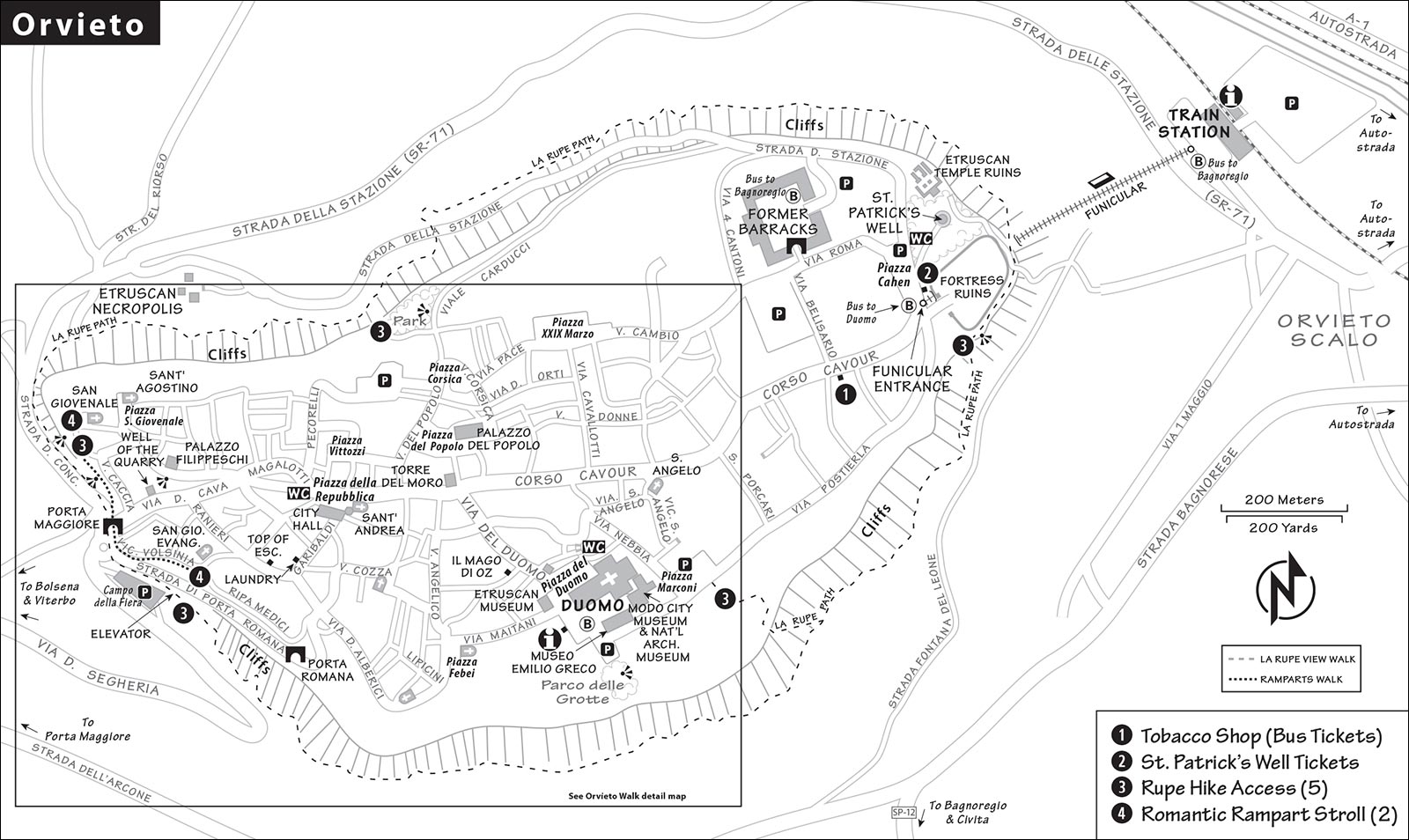
Orvieto has two distinct parts: the old-town hilltop and the dreary modern town below (called Orvieto Scalo). Whether coming by train or car, you first arrive in the nondescript lower part of town. From there you can drive or take the funicular to the medieval upper town, an atmospheric labyrinth of streets and squares where all the sightseeing action is.
TOURIST INFORMATION
The well-organized TI is on the cathedral square at Piazza del Duomo 24 (Mon-Fri 9:00-18:00, Sat-Sun until 19:00, +39 0763 341 772, www.liveorvieto.com). The TI has an excellent city map that highlights the Anello della Rupe hike around the base of the city, plus maps for longer countryside hikes. The ticket office next door sells combo-tickets and books reservations for Orvieto Underground Tours (see “Tours in Orvieto,” later).
Combo-Tickets: Orvieto’s sights are covered by a constantly changing array of combo-tickets.
The full-meal deal is the €25 Carta Unica combo-ticket, which covers virtually every sight recommended here, including the underground tours. This is a good value only if you plan to do everything covered. It’s sold at the ticket office next to the TI on Piazza del Duomo and at most covered sights.
ARRIVAL IN ORVIETO
By Train: The train station is at the foot of the hill the old town sits on. There’s a convenient baggage-check service downstairs near the big parking lot (see “Helpful Hints,” later).
The easiest way to the top of town is by funicular (runs about every 10 minutes Mon-Sat 7:15-20:30, less frequent Sun from 8:00). Exiting the train station, it’s across the square to the left (look for Funicolare sign). Tickets (€1.30) include both the funicular and the connecting bus to Piazza del Duomo.
The funicular brings you up to Piazza Cahen, at the east end of the upper town. As you exit, to your left is a ruined fortress with a garden and a commanding view. Beyond that is a war memorial with more fine views. To your right, down a steep path, is St. Patrick’s Well. Farther to the right is a park with the ruins of an Etruscan temple and another sweeping view.
Just in front of you is the small shuttle bus waiting to take you to Piazza del Duomo (runs roughly every 10-15 minutes, timed to arriving funiculars). The views from the ruined fortress are worth pausing for—just catch the next bus. Or you can walk to the cathedral (head uphill on Corso Cavour; after about 10 minutes, take a left at the clock tower onto Via del Duomo). The bus drops you in Piazza del Duomo, just steps from the TI and within easy walking distance of most of my recommended sights and hotels.
If you arrive outside the funicular’s operating hours, you can reach the upper part of town by taxi (an exorbitant €15) or bus to Piazza della Repubblica (roughly 2/hour until midnight; buy €1.30 ticket at bar inside station).
By Car: Driving inside the upper town of Orvieto is stressful. It’s a maze of narrow lanes, several of which are marked with red “ZTL” circles (if you drive there, you could get an expensive ticket). Consider using one of two parking lots outside the old center. The free option is the big lot below the train station (turn right immediately after the autostrada underpass and follow Tour Bus Parking signs). From the parking lot, walk through the station and ride the funicular up the hill (see “By Train,” earlier).
The other stress-free option is the Campo della Fiera garage, which is tucked behind Orvieto’s hill (as you approach town, follow signs with a P, a little bullseye, and elevator and escalator icons—you’ll curl around the left side of Orvieto’s ridge, then switchback up to the lot). While you’ll pay to use this lot, it’s an easier ascent into town—using either an elevator or the series of escalators, which whisk you up to the west end of the old center.
Those comfortable driving in Italian cities (and careful to avoid ZTL zones) can enter Orvieto’s old center by driving up Via Postierla and Via Roma, then take your pick of short-term, pay-and-display parking areas: blue-lined spots on Piazza Cahen; a parking lot on Via Roma northwest of Piazza Cahen; blue-lined spots on Piazza Marconi, behind the cathedral; and the private, tree-lined lot with an attendant next to the cathedral (a central choice for overnight stays in the center). Plan on paying at least €1.50/hour or €12/day to park in Orvieto.
HELPFUL HINTS
Market Days and Festivals: On Thursday and Saturday mornings, Piazza del Popolo becomes a busy farmers market.
The city’s biggest event is Corpus Domini (June 8 in 2023, May 30 in 2024), a medieval procession and festival celebrating a miraculous relic (described in the Duomo tour later in this chapter). Corpus Domini events include flag tossing, concerts, and a giant chess game with costumed people as pieces.
Baggage Check: Downstairs at the train station, the bright and helpful InfoPoint, run by Valerio, welcomes visitors near the big free parking lot. They offer pay WCs and have a secure bag check—the only one in town (daily 9:00-18:00).
Laundry: The central Lavagettone self-service launderette is handy for travelers, but you must bring your own detergent (daily 7:00-22:00, Via Garibaldi 30, www.lavagettone.it).
Bike Rental: Ask the TI for bike rental options. In the upper town, you may be able to rent bikes at the St. Patrick’s Well ticket office, next to the upper funicular station.
After Dark: In the evening, there’s little going on other than strolling and eating. The big passeggiata scene is down Via del Duomo and Corso Cavour. Bar Duomo, filling a little square along Via del Duomo with outdoor tables, is lively late.
Tours in Orvieto
Local Guide
David Tordi loves sharing his passion for his hometown and organizes custom tours with his colleagues focused on art, history, food, and culture (€250/half-day, €350/day, +39 0763 300 491, www.teseotur.com, info@teseotur.com). Another good choice is Manuela Del Turco (€130/2.5-hour tour, +39 333 221 9879, manueladel@virgilio.it). Francesco Pacelli is a well-regarded archaeologist and teacher (+39 328 191 1316, frapax1978@gmail.com).
Orvieto Underground Tours (Parco delle Grotte)
Beginning from a nondescript ticket office next to the TI, guides weave archaeological history into a good look at about 100 yards of Etruscan and medieval caves. You’ll see the remains of an old olive press, an impressive 130-foot-deep Etruscan well shaft, what’s left of a primitive cement quarry, and an extensive dovecote (pigeon coop) where the birds were reared for roasting (€7; one-hour English tours usually depart daily at 11:15, 12:30, 16:15, and 17:30; book in advance and confirm schedule for English guide, book tour and depart from ticket office facing the cathedral at Piazza Duomo 23, +39 0763 340 688, www.orvietounderground.it).
Taxi Excursions
For excursions to Civita, Alessio Colagè Orvieto Transfer, run by English-speaking Alessio, offers two options from Orvieto for Rick Steves readers: to and from Civita with a one-hour wait (car for up to 3 people-€120, minivan for up to 7-€140, extra hour-€35), or a two-hour visit to Civita and Lake Bolsena (5 hours total, car-€200, minivan-€250, mobile +39 370 318 1469, www.orvietotransfer.it, info@orvietotransfer.it). Taxis hang around the Orvieto train station ready to negotiate a little excursion to Civita.
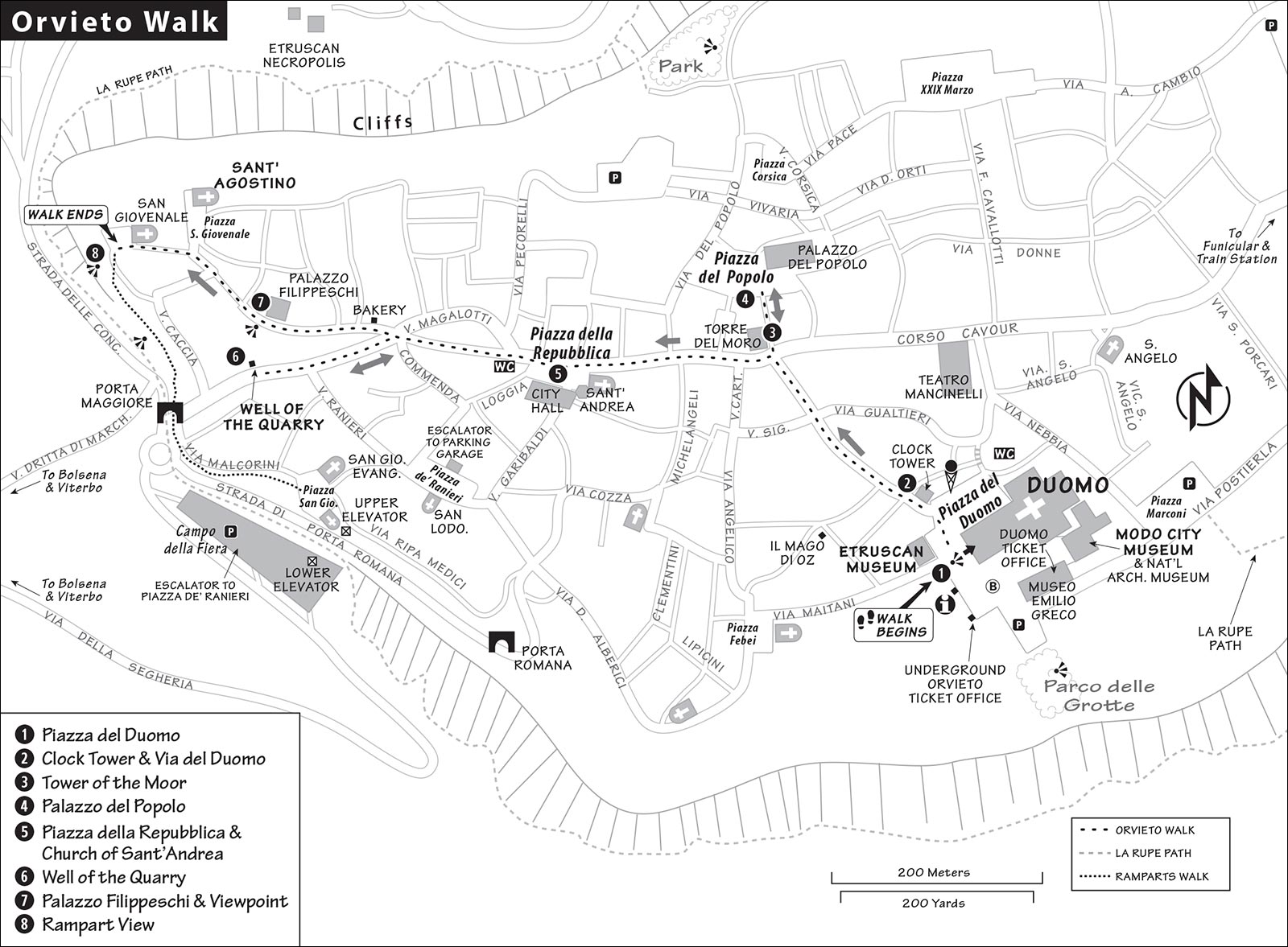
Orvieto Walk
This quickie L-shaped self-guided walk takes you from the Duomo through Orvieto’s historic center to the ramparts above the original Etruscan part of town, with vast Umbrian views. Each evening, this route is the scene of the local passeggiata.
1 Piazza del Duomo: Start at the cathedral and admire its attention-grabbing facade (see the “Duomo” listing under “Sights in Orvieto” for a full explanation). Imagine how, as World War II raged around Orvieto, the fine reliefs gracing the front of the cathedral were encased in protective tufa walls. (Orvieto and its cathedral were spared destruction, perhaps thanks to a “safe cities” designation by a Nazi general who appreciated the town—or one of its women.)
As you face the cathedral, the papal palace (now hosting various museums) is to your right, and the TI and shuttle bus to the funicular are over your right shoulder. A nice gelato shop is around the church to the left.
• Head left a few steps to the...
2 Clock Tower and Via del Duomo: Also known as the Maurizio Tower, this was built in the 14th century and equipped with an early mechanized clock, originally used to keep track of workers’ time while building the cathedral.
The tower marks the start of Via del Duomo, lined with shops selling ceramics. The tradition of fine ceramics in Orvieto goes way back—the clay from the banks of the nearby Tiber is ideal for pottery. During the Renaissance, the town’s pottery was brightly painted and highly prized.
At Via dei Magoni, a detour to the left takes you to a unique toy shop: Stroll up this picturesque lane, following signs for Il Mago di Oz (The Wizard of Oz, Via Pedota 9). This shop is a wondrous toy land created by eccentric Giuseppe Rosella. Have Giuseppe push a few buttons, and you’re far from Kansas.
• Backtrack to Via del Duomo, and follow it to Orvieto’s main intersection, at Corso Cavour. Here you’ll find the tall, stark, 11th-century...
3 Tower of the Moor (Torre del Moro): Eighty such towers, each the pride and security of a powerful noble family, once decorated the town’s skyline. Today only a few survive. This tower marks the center of town, serves as a handy orientation tool, and is decorated with the coats of arms of past governors. An elevator leaves you with 173 steps still to go to earn a commanding view (€3.80, daily March-Oct 10:00-19:00, May-Aug until 20:00, shorter hours off-season).
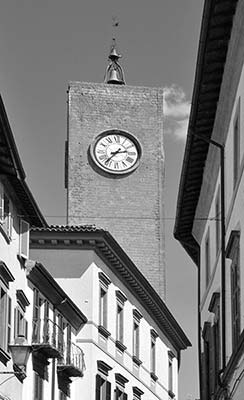
This crossroads divides the town into four quarters (notice the Quartiere signs on the corners). In the past, residents of the four districts competed in a lively equestrian competition, parading all over town during the annual Corpus Domini celebration. Historically, the four streets led from here to four landmarks: Piazza del Popolo with its market and fine palazzo, St. Patrick’s Well, the Duomo, and the City Hall.
• Before heading left down Corso Cavour, side-trip a block farther ahead, behind the tower, for a look at the striking...
4 Palazzo del Popolo: Built of local tufo, this is a textbook example of a fortified medieval public palace: a fortress designed to house the city’s leadership and military (built atop an Etruscan temple), with a market at its base, fancy meeting rooms upstairs, and aristocratic living quarters on the top level. A lively market still bustles here Thursday and Saturday mornings, selling food, clothes, and household goods.
• Return to the tower, and turn right down Corso Cavour. Notice the handwritten sign on the door of the recommended L’Oste del Re osteria (#58), explaining that wild boar, an Umbrian specialty, is considered man’s best friend. Continue past classic storefronts to...
5 Piazza della Repubblica and the Church of Sant’Andrea: The original vision—though it never came to fruition—was for the City Hall to have five arches flanking the central arch (marked by the flags today). The Church of Sant’Andrea (left of City Hall) sits atop the Etruscan forum that was likely the birthplace of Orvieto, centuries before Christ. Inside is an interesting architectural progression: 11th-century Romanesque (with few frescoes surviving), Gothic (the pointy vaults over the altar), and a Renaissance barrel vault in the apse (behind the altar)—all dimly lit by alabaster windows.
This spot is a layer cake of history: Under the Christian church lie the remains of the Etruscan city, destroyed by the Romans. While fascinating, the ruins can only be visited with a guide (see “Tours in Orvieto,” earlier).
• From Piazza della Repubblica, continue straight downhill on Via Filippeschi—passing a public WC on the left—until you reach a fork. Check out the friendly, traditional Galleria del Pane bakery on the right (at Via Malabranca 6; we’ll return to this intersection after a short detour). Walk downhill along Via della Cava about 70 yards to #28, on the right. This is the...
6 Well of the Quarry (Pozzo della Cava): While renovating their trattoria here in the oldest part of town, the Sciarra family discovered a vast underground network of Etruscan-era caves, wells, and tunnels. The excavation started in 1984 and continues to this day. A visit to the well makes for a fun subterranean wander (see more details in “Underground Orvieto,” later in this chapter), keeping in mind that the whole city sits on top of a honeycomb of tunnels like these.
Outside, Via della Cava, meaning “Quarry Street,” was a main source for building material for Orvieto’s predecessor, Etruscan Velzna. The street kept getting lower and lower as more and more stones were cut out of it. Downhill is the site of the town’s original gate.
• Climb back up to the fork with the bakery. If you’re hungry, pick up a piece of pizza or lumachelle (snail-shaped bread with cheese and bacon inside). Let’s continue up Via Malabranca. After about 70 yards, at #22, you’ll reach...
7 Palazzo Filippeschi and Viewpoint: The friendly, noble Filippeschi family sometimes leaves their big green door open so visitors can peek into their classic medieval courtyard, with black travertine columns scavenged from nearby ancient Roman villas. Enjoy a moment of exquisite medieval tranquility. (If the door is closed, just move along.)
Immediately across from the palazzo, belly up to the viewpoint overlooking a commotion of faded red-tile roofs. This tradition goes back to Etruscan times, when such tiles were molded on a seated tile-maker’s thigh—wide to narrow. They nest so that water flows without leaking—handy for both rooftops and plumbing.
• Continue on, downhill now, as the street crests.
Over the next 200 yards notice faded frescoes on stucco walls, arches from previous iterations of buildings (left for structural and nostalgic reasons), built-in letterboxes, and the three local building stones—basalt white, black travertine, and brown tufa.
Soon you’ll reach a square with the Church of Sant’Agostino, which until recently held the Baroque statues that originally lined the nave of the Duomo (they finally gave them back, after 122 years). Just beyond, on the right, is the Church of San Giovenale—the oldest in town, with 11th-century frescoes.
• Finally you’ll pop out at a commanding...
8 Rampart View: You’re at the end of Orvieto. The fertility of the land (with its olives, vines, and fruit orchards) is clear. The manicured little forest of cypress trees straight ahead marks the Orvieto cemetery. In the distance to the right is Mount Cetona, guarding the south end of Tuscany.
Go 50 yards along the rampart to the left for the best view of the natural fortification that made this town the choice of Etruscans before the rise of ancient Rome, of stability-starved peasants after the fall of Rome, and of several popes in the high Middle Ages. From this perch you can understand why the city was never taken by force.
• The walk is over. From here, you can retrace your steps or follow the rampart farther left, down and up, over the original Etruscan town gate and circle back to the center from there.
Sights in Orvieto
▲▲MoDo City Museum (Museo dell’Opera del Duomo)
National Archaeological Museum of Orvieto (Museo Archeologico Nazionale di Orvieto)
▲Etruscan Museum (Museo Claudio Faina e Museo Civico)
▲▲St. Patrick’s Well (Pozzo di San Patrizio)
▲Well of the Quarry (Pozzo della Cava)
Etruscan Necropolis (Necropoli Etrusca di Crocifisso del Tufo)
▲Hike Around the City on the Rupe
▲Shorter Romantic Rampart Stroll
ORVIETO DUOMO
Orvieto’s cathedral (Duomo di Orvieto), worth ▲▲▲, has Italy’s liveliest church facade. This colorful, prickly Gothic facade, divided by four pillars, has been compared to a medieval altarpiece. The interior features some fine art, including Luca Signorelli’s lavishly frescoed Chapel of San Brizio.
The cathedral’s historic importance and wealth is thanks to a miracle that happened nearby in 1263. According to the story, a skeptical priest named Peter of Prague passed through the town of Bolsena (12 miles from Orvieto) while on a pilgrimage to Rome. He had doubts that the bread used in Communion could really be transformed into the body of Christ. But during Mass, as he held the host aloft and blessed it, the bread began to bleed, running down his arms and dripping onto a linen cloth (a “corporal”) on the altar. That miraculously bloodstained cloth is now kept here, in the Chapel of the Corporal (the last stop of our tour).
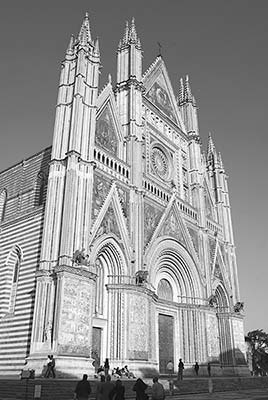
Cost and Hours: €5 combo-ticket covers the Duomo and MoDo City Museum; buy ticket in building to the right as you face the facade; cathedral open April-Sept Mon-Sat 9:30-19:00, Sun 13:00-17:30; closes one hour earlier March and Oct, shorter hours Nov-Feb; may close for religious services, www.opsm.it.
 Self-Guided Tour
• After buying your ticket, return to the front of the church. Begin by viewing the…
Exterior Facade: Study this gleaming mass of mosaics, stained glass, and sculpture (c. 1300, by Lorenzo Maitani and others). Note how it’s literally just a facade, ornamenting an otherwise very plain, mostly Romanesque exterior.
At the base of the cathedral, the four broad marble pillars carved with biblical scenes tell the history of the world in four acts, from left to right. The relief on the far left shows the 1 Creation (see God creating Eve from Adam’s rib, Cain clubbing Abel, the snake tempting Eve, and a dramatic expulsion). Next is the 2 Tree of Jesse (Jesus’ family tree—with Jesus on top, and Mary just below, flanked by Old Testament stories). Look up at the roaring lion of St. Mark and the grand facade filling your view—awe-inspiring as intended. In the third panel, with scenes from the 3 New Testament, look for the unique manger scene, and other events from the life of Christ. On the far right is the 4 Last Judgment; see Christ judging on top, with a commotion of sarcophagi popping open and all hell breaking loose at the bottom.
Each pillar is topped with a bronze symbol of one of the Evangelists (left to right): angel (Matthew), lion (Mark), eagle (John), and ox (Luke). The bronze doors are modern, by the Sicilian sculptor Emilio Greco. (A gallery devoted to Greco’s work is to the immediate right of the church; see “Museums Near the Duomo,” later.)
Stand back and survey the facade, looking for the central theme—it’s clear the church is dedicated to the ascension of Mary. In the mosaic below the rose window, Mary is transported to heaven. In the uppermost mosaic, Mary is crowned.
• Ticket in hand, step inside the cathedral.
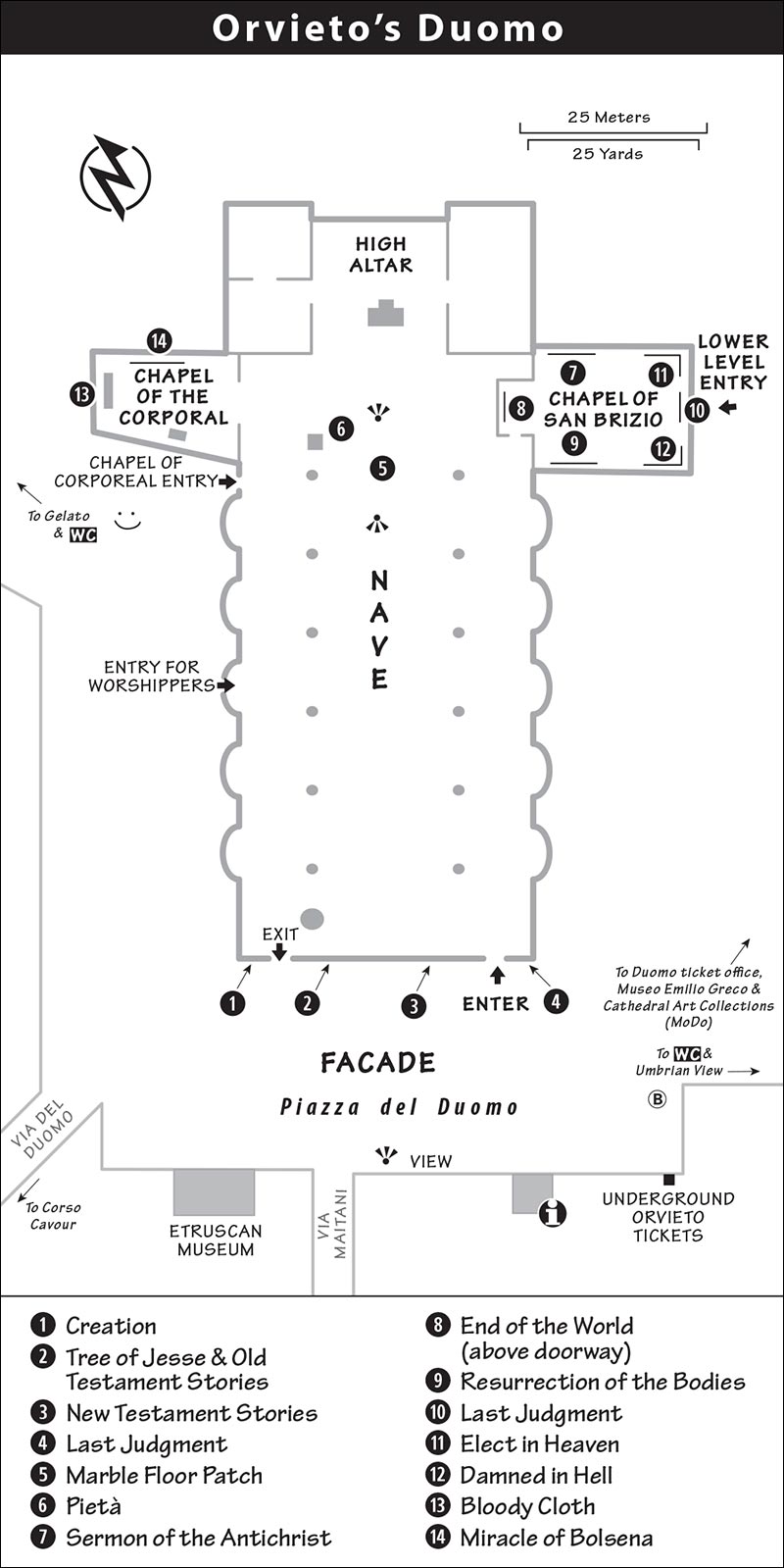
Nave: The nave feels spacious and less cluttered than most Italian churches, even with statues of the apostles positioned at each column. Those statues have only recently returned to the cathedral: In 1897, the people decided they wanted to “un-Baroque” their church, and they moved the apostles out (for 122 years, they sat in the Church of Sant’Agostino across town). Bits of medieval fresco survive in niches once covered by altars and confessionals. From the back of the nave you can appreciate the fine stained glass above the altar—it’s original from the 14th century and some of the oldest in Italy. The stripes of the church are purely decorative, made of locally quarried basalt and black travertine.
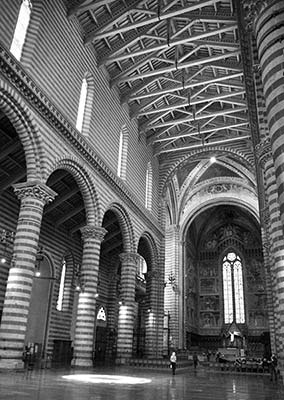
The interior is warmly lit by alabaster windows, highlighting the black-and-white striped stonework. Why such a big and impressive church in such a little town? First of all, it’s not as big as it looks. By lining the nave with striped columns and opening up the side aisles with arcaded chapels, the architect made the space seem longer and bigger than it is. Still, it’s a big and rich cathedral—the seat of a bishop.
• Now walk to the middle front of the church, where (just before the two steps) you’ll see a decorative area in the floor the size of a Turkish carpet.
5 Marble Floor Patch: This patch in the marble floor marks where the altar stood before the Counter-Reformation. It’s a reminder that as the Roman Catholic Church countered the Reformation, it made reforms of its own. For instance, altars were moved back so that the congregation could sit closer to the spectacular frescoes and stained glass. (These decorations were designed to impress commoners by illustrating the glory of heaven—and the Catholic Church needed that propaganda more than ever during the Counter-Reformation.)
Enjoy the richness that surrounds you. This cathedral put Orvieto on the map, and with lots of pilgrims came lots of wealth. The town—perched on its easy-to-defend hilltop—was used off and on for a couple centuries as a papal refuge, whenever the current pope’s enemies forced him to flee Rome. Over the altar, the brilliant stained glass is the painstakingly restored original, from the 14th century. The fine organ, high on the left, has more than 5,000 pipes. Look high up in the right transept at the alabaster rose window. Then turn and face down the nave, the way you came in. Note how the architect’s trick—making the church look bigger from the rear—works in reverse from here. From this angle, the church appears stubbier than it actually is.
Tuff (tufo in Italian) is a light-colored volcanic rock that is common in Italy. A part of Tuscany is even called the “Tuff Area.” The seven hills of Rome are made of tuff, and quarried blocks of this stone can be seen in the Colosseum, Pantheon, and Castel Sant’Angelo. Just outside of Rome, the catacombs were carved from tuff. Sorrento rises above the sea on a tuff outcrop. Orvieto, Civita di Bagnoregio (pictured), and many other hill towns perch on bluffs of tuff.
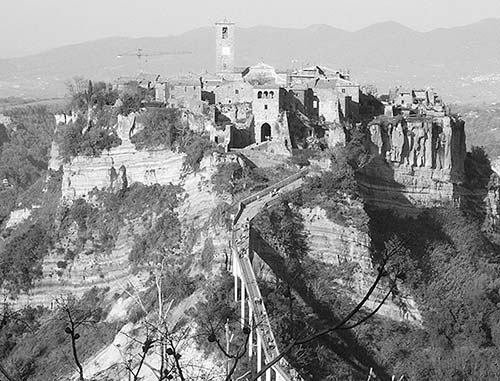
Italy’s early inhabitants, including the Etruscans and Romans, carved caves, tunnels, burial niches, and even roads out of tuff. Blocks of this rock were quarried to make houses and walls. Tuff is soft and easy to carve when it’s first exposed to air, but hardens later, which makes it a good building stone.
Italy’s tuff-producing volcanoes resulted from a lot of tectonic-plate bumping and grinding. This violent geologic history is reflected in Italy’s volcanoes, like Vesuvius and Etna, and earthquakes such as the 2009 quake in the L’Aquila area northeast of Rome.
Tuff is actually just a big hardened pile of old volcanic ash. When volcanoes hold magma that contains a lot of water, they erupt explosively (think heat + water = steam = POW!). The exploded rock material gets blasted out as hot volcanic ash, which settles on the surrounding landscape, piles up, and over time welds together into the rock called tuff.
So when you’re visiting an area in Italy of ancient caves or catacombs built out of this material, you’ll know that at least once (and maybe more) upon a time, it was a site of a lot of volcanic activity.
• A few steps to your left as you face the altar, near the first pillar, is a beautiful, white marble statue.
6 Pietà: The marble pietà (statue of Mary holding Jesus’ just-crucified body) was carved in 1579 by local artist Ippolito Scalza. Clearly inspired by Michelangelo’s Pietà, this exceptional work, with four figures, was sculpted from one piece of marble. Walk around it to notice the texture that Scalza achieved, and how the light plays on the sculpture from every angle.
• Now face the main altar. To the right is Orvieto’s one must-see artistic sight, the...
Chapel of San Brizio: This chapel features Luca Signorelli’s brilliantly lit frescoes of the Day of Judgment and Life after Death (painted 1499-1504). Step into the chapel and you’re surrounded by vivid scenes crammed with figures. Although the frescoes refer to themes of resurrection and salvation, they also reflect the turbulent political and religious atmosphere of late-15th-century Italy.
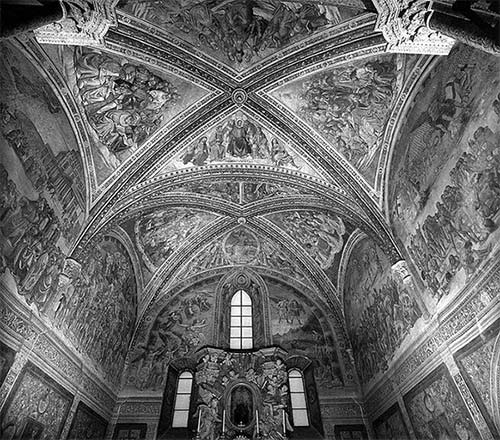
The chapel is decorated in one big and cohesive story. Start with the panel on your left as you enter, and do a quick counterclockwise spin to get oriented to the basic plot: Antichrist (a false prophet), end of the world (above the arch leading to the nave), Resurrection of the Bodies, hell, Judgment Day (Fra Angelico—who worked on the chapel 50 years before Signorelli—painted Jesus above the window), and finally heaven.
Now do a slower turn to take in the full story: In the 7 Sermon of the Antichrist (left wall), a crowd gathers around a man preaching from a pedestal. It’s the Antichrist, who comes posing as Jesus to mislead the faithful. This befuddled Antichrist forgets his lines midspeech, but the Devil is on hand to whisper what to say next. Notice how the arm in front of the Antichrist is attached to both figures, suggesting they are joined as one. His words sow wickedness through the world, including executions (upper right). The worried woman in red and light blue (foreground, left of pedestal) gets money from a man for something she’s not proud of (perhaps receiving funds from a Jewish moneylender—notice the Stars of David on his purse). Many of the faces in the crowd are probably actual portraits.
Most likely, the Antichrist himself is a veiled reference to Savonarola (1452-1498), the charismatic Florentine monk who defied the pope, drove the Medici family from power, and riled the populace with apocalyptic sermons. Many Italians—including the painter Signorelli—viewed Savonarola as a tyrant and heretic, the Antichrist who was ushering in the Last Days.
In the upper left, notice the hardworking angel. He looks as if he’s at batting practice, hitting followers of the Antichrist back to earth as they try to get through the pearly gates. In the bottom left is a self-portrait of the artist, Luca Signorelli (c. 1450-1523), well-dressed in black with long golden hair. Signorelli, from nearby Cortona, was at the peak of his powers, and this chapel was his masterpiece. He looks out proudly as if to say, “I did all this in just a few years, on time and on budget,” confirming his reputation as a speedy, businesslike painter. Next to him (also in black) is the artist Fra Angelico, who started the chapel decoration five decades earlier but completed only a small part of it: the Last Judgment over the window and the angels around it.
Compare the style of painting between these two masters—Angelico’s angels stacked like little wooden dolls next to Signorelli’s intertwined naked bodies. You can clearly see the huge effect the Renaissance had on painting in just a few decades.
Around the arch opposite the windows are signs of the 8 end of the world: eclipse, tsunami, falling stars, earthquakes, violence in the streets, and a laser-wielding gray angel.
On the right wall (opposite the Antichrist) is the 9 Resurrection of the Bodies. Trumpeting angels blow a wake-up call, and the dead climb dreamily out of the earth to be clothed with new bodies, some of the randy skeletons finding time for flirting. On the same wall (below the action, at eye level) is a gripping pietà. Also by Signorelli, this pietà gives insight into the artist’s genius and personality. Look at the emotion in the faces of the two Marys and consider that Signorelli’s son had just died. The small black-and-white Deposition scene (behind Jesus’ leg) seems inspired by ancient Greek scenes of a pre-Christian hero’s death. In the confident spirit of the Renaissance, the artist incorporates a pagan scene to support a Christian story. This 3-D realism in a 2-D sketch shows the work of a talented master.
The altar wall (with the windows) features the 10 Last Judgment. To the left of the altar (and continuing around the corner, filling half the left wall) are the 11 Elect in Heaven. They spend eternity posing like bodybuilders while listening to celestial Muzak. To the right (and continuing around the corner on the right wall) are the 12 Damned in Hell, in the scariest mosh pit ever. Devils torment sinners in graphic detail, while winged demons control the airspace overhead. In the center, a lusty demon turns to tell the frightened woman on his back exactly what he’s got planned. (According to legend, this was Signorelli’s lover, who betrayed him...and ended up here.) Signorelli’s ability to tell a story through human actions and gestures, rather than symbols, inspired his younger contemporary, Michelangelo, who meticulously studied the elder artist’s nudes.
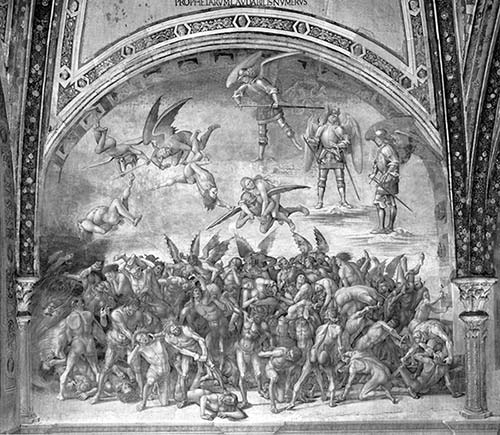
In this chapel, Christian theology sits physically and figuratively upon a foundation of Classical logic. Below everything are Greek and Latin philosophers, plus Dante, struggling to reconcile Classical truth with Church doctrine. You can see the intellectual challenge on their faces as they ponder the puzzle of theology that survives the test of reason.
The figures are immersed in fanciful Grotesque (that is, grotto-esque) decor. Dating from 1499, this is one of the first uses of the frilly, nubile, and even sexy “wallpaper pattern” so popular in the Renaissance. (It was inspired by the decorations found in Nero’s Golden House in Rome, which had been discovered under street level just a few years earlier and was mistaken for an underground grotto.)
During the Renaissance, nakedness symbolized purity. When attitudes changed during the Counter-Reformation, the male figures in Signorelli’s frescoes were given penis-covering sashes. In a 1982 restoration, most—but not all—of the sashes were removed. A little of that prudishness survives to this day, as those in heaven were left with their sashes modestly in place.
• Exit the cathedral and make a sharp right towards its far end, where you’ll find the entrance to the Chapel of the Corporal. Be mindful that this chapel is used for prayer and may be closed during religious services.
Chapel of the Corporal: The 13 bloody cloth from the miracle is displayed in the turquoise frame atop the chapel’s altar. It was brought from Bolsena to Orvieto, where Pope Urban IV happened to be visiting. The amazed pope proclaimed a new holiday, Corpus Domini (Body of Christ), and the Orvieto cathedral was built (begun in 1290) to display the miraculous relic. For centuries, the precious linen was paraded through the streets of Orvieto in an ornate reliquary (now in the MoDo City Museum).
The room was frescoed in the 14th century with scenes attesting to Christ’s presence in the communion wafer and offering a vivid peek at life here at that time. The 14 miracle of Bolsena (set here in 13th-century Orvieto) is depicted on the chapel’s right wall.
• Our tour is finished. You’re surrounded by great sights. Across the square in front of the Duomo are the Etruscan Museum, the TI, and the ticket office for Underground Orvieto tours. Around the side of the church are the Museo Emilio Greco, MoDo City Museum (included in your Duomo ticket), and National Archaeological Museum. Nearby, beyond a small parking lot, a park affords a fine Umbrian view.
MUSEUMS NEAR THE DUOMO
▲▲MoDo City Museum (Museo dell’Opera del Duomo)
This museum encompasses two different sights: The Emilio Greco collection (in Palazzo Soliano, to the right of the cathedral) shows off the work of Emilio Greco, the Sicilian artist who designed the modern doors of Orvieto’s cathedral. And the Cathedral Art Collections (in Palazzi Papali, behind the cathedral) holds the city’s best devotional art. This is the main attraction of the MoDo City Museum and well worth a visit.
Cost and Hours: €5 combo-ticket covers the MoDo City Museum and the Duomo; daily April-Sept 9:30-19:00, March and Oct until 18:00, Nov-Feb until 17:00; Piazza Duomo, +39 0763 343 592, www.opsm.it.
Visiting the MoDo City Museum Branches: You’ll buy your ticket inside Palazzo Soliano. It’s the building marked MUSEO, to the right as you face the cathedral. This building also houses the Museo Emilio Greco. A good plan is to buy a ticket, visit the Greco collection while you’re there, then tour the cathedral interior (described earlier). Afterward, enter the Cathedral Art Collections.
Museo Emilio Greco: This fresh little collection of works by Emilio Greco (1913-1995) displays his sketches and about 30 of his bronze statues, showing his absorption with gently twisting and turning nudes. Greco’s sketchy outlines of women are simply beautiful. The artful installation of his work in this palazzo, with walkways and a spiral staircase up to the ceiling, is designed to let you view his sculptures from different angles.
• To find the Cathedral Art Collections, head around the right side of the cathedral and climb the metal staircase.
Cathedral Art Collections: A complex of medieval palaces called the Palazzi Papali (Papal Palaces) holds some of Orvieto’s finest religious sculptures, paintings, and frescoes. The highlight is just inside the upstairs entrance: a marble Mary and Child who sit beneath a bronze canopy, attended by exquisite angels. This proto-Renaissance ensemble, dating from around 1300, once filled the niche in the center of the cathedral’s facade (where a replica sits today).
Now proceed through several art-filled rooms on this floor. Entering the first large room, look left to see an exquisite Madonna and Child from 1322 by the Sienese great Simone Martini, who worked in Orvieto. Nearby are saintly wooden statues and fine inlaid woodwork from the original choir. Farther along, you’ll find Luca Signorelli’s Mary Magdalene (1504), then a large room of Baroque paintings from the late 1500s that decorated the side chapels with a harsh Counter-Reformation message. (Think about how dramatically church art evolved in the 200 years from Martini’s almost 2-D medieval style, to Signorelli’s Renaissance humanism, to the bombast of Baroque.)
In the hall with the Baroque paintings, step into the smaller side-room. This is the Albèri Library, with delicate black-and-white frescoes done by Signorelli’s workshop while he was in town working on the cathedral’s Chapel of San Brizio. This hall displays items from the cathedral treasury, including the reliquary used to parade a holy bloodstained cloth on Corpus Domini.
Continuing through the main collection, go back past the entry to one more large hall, with statues of St. Michael and the dragon, more altarpieces and statues, and sinopias (preliminary drawings for the frescoes decorating the cathedral’s Chapel of the Corporal, with a roughed-up surface so the wet plaster would stick).
Your MoDo ticket also gives you access to the vast space beneath the cathedral. Access it through the entrance at the cathedral’s right transept. Under the cellar vaults is equipment used for building the cathedral (giant pulley mechanisms and tools) and neatly stacked fragments of sculptures and tiles.
National Archaeological Museum of Orvieto (Museo Archeologico Nazionale di Orvieto)
If you want to also see the National Archaeological Museum, its entrance hides between the Cathedral Art Collections and the Museo Emilio Greco in the ground floor of Palazzi Papali. This small five-room collection beautifully shows off a trove of well-preserved Etruscan bronzes, terra-cotta objects, and ceramics—many from the necropolis at the base of Orvieto, and some with painted colors surviving from 500 BC. To see the treasure of this museum, ask an attendant for the Golini tombs (named after the man who discovered them in 1836). You’ll be escorted to the reconstructed, fourth-century BC tombs, frescoed with scenes from an Etruscan banquet in the afterlife. For background on the Etruscans, see here.
Cost and Hours: €4, €5 combo-ticket with Etruscan Necropolis; Tue-Sun 8:30-19:30, closed Mon; +39 0763 341 039, www.musei.umbria.beniculturali.it [URL inactive].
▲Etruscan Museum (Museo Claudio Faina e Museo Civico)
This 19th-century, Neoclassical nobleman’s palace stands on the main square facing the cathedral. Its elegantly frescoed rooms hold an impressive Etruscan collection. The ground floor features the Museo Civico, with fragments of Etruscan sculpture. On the first floor is the Collezione Conti Faina, with Etruscan jewelry and an extensive array of Roman coins (push the brass buttons to rotate the coins so you can see both sides). The top floor features the best of the Etruscan and proto-Etruscan (from the ninth century BC) vases and bronzes, lots of votives found buried in nearby tombs, and fine views of the Duomo.
Cost and Hours: €6; Wed-Mon April-Sept 9:30-18:00, Oct-March 10:00-17:00, closed Tue year-round; +39 0763 341 511, www.museofaina.it.
Teatro Mancinelli
A short walk from the cathedral, on Corso Cavour, Teatro Mancinelli is a fine 19th-century Italian theater (from 1866) with 500 seats, elegant boxes, and frilly Romantic ceiling paintings—all well described in English. Visitors are sometimes allowed to climb upstairs to the foyer for a chance to peek into a private box. The theater hosts the recommended Café del Teatro—buy a drink and you may be able to wander the theater without paying the €2 entry fee (typically open Mon-Sat 8:00-14:00, closed Sun, Corso Cavour 122).
UNDERGROUND ORVIETO
These sights—showing off the remarkable bounty of history beneath your feet—are scattered around (and outside) the old center. For locations, see the “Orvieto” map at the start of this chapter. Also consider the Underground Orvieto Tours listed under “Tours in Orvieto,” earlier.
▲▲St. Patrick’s Well (Pozzo di San Patrizio)
Modern engineers are impressed by this deep well—175 feet deep and 45 feet wide—designed in the 16th century with a double-helix pattern. The two spiral stairways allow an efficient one-way traffic flow: intriguing now, but critical then. Imagine if donkeys and people, balancing jugs of water, had to go up and down the same stairway. At the bottom is a bridge that people could walk on to scoop up water. Touring the well requires hiking 248 (awkwardly spaced) steps down, then back up. That’s lots of exercise (allow 20-30 minutes round-trip) and not much to see...other than some mesmerizing 16th-century engineering.
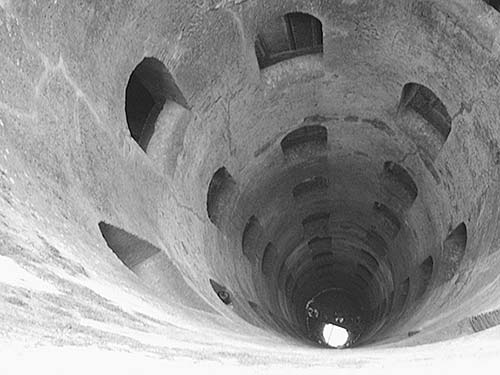
The well was built because a pope got nervous. After Rome was sacked in 1527 by renegade troops of the Holy Roman Empire, the pope fled to Orvieto. He feared that even this little town (with no water source on top) would be besieged. He commissioned a well, which was started in 1527 and finished 10 years later. It was a huge project. (As it turns out, the town was never besieged, but supporters believe that the well was worth the cost and labor because of its deterrence value—attackers would think twice about besieging a town with a reliable water source.) Even today, when a local is faced with a difficult task, people say, “It’s like digging St. Patrick’s Well.”
Cost and Hours: €5, interesting €2 audioguide; daily May-Aug 9:00-20:00, shorter hours off-season; ticket office immediately to your right as you exit the funicular, you’ll walk a few minutes down the path to enter the well; Viale Sangallo, +39 0763 343 768.
▲Well of the Quarry (Pozzo della Cava)
A five-minute walk west of Piazza della Repubblica, this complex of Etruscan-era caves, wells, and tunnels leads down to a fat, cylindrical, beautifully carved 2,500-year-old well. Go ahead, spit (or drop a coin 100 feet down—coins are collected each Christmas for a local charity). Your visit is capped with a review of local pottery-making.
Cost and Hours: €4, €2.50 with St. Patrick’s Well ticket; Tue-Sun 9:00-20:00, closed Mon; Via della Cava 28, +39 0763 342 373, www.pozzodellacava.it.
Etruscan Necropolis (Necropoli Etrusca di Crocifisso del Tufo)
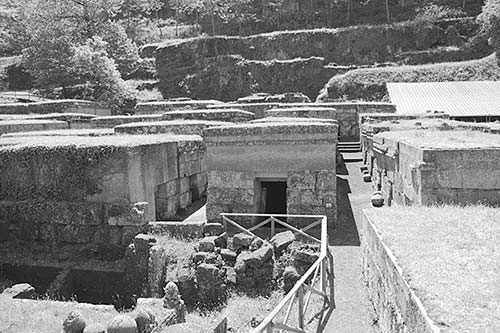
Below town, at the base of the cliff, is a remarkable “city of the dead” that dates back to the sixth to third century BC. The tombs, which are laid out in a kind of street grid, are empty, and there’s precious little to see here other than the basic stony construction. But it is both eerie and fascinating to wander the streets of an Etruscan cemetery.
Cost and Hours: €3, €5 combo-ticket with National Archaeological Museum; Thu-Sat 9:00-15:00, Fri and the first two Sun of each month until 19:00, closed Mon-Wed year-round; +39 0763 343 611, www.musei.umbria.beniculturali.it [URL inactive]. Drivers will find it on the ring road below town; hikers can reach it via the Rupe path (see next).
VIEW WALKS
▲Hike Around the City on the Rupe
Orvieto’s Rupe is a peaceful path that completely circles the town at the base of the cliff upon which it sits. With the help of the TI’s city map, you’ll see there are five access points from the town for this three-mile walk. The path includes a series of sightseeing stops along the way (marked in purple, allow about two hours round-trip).
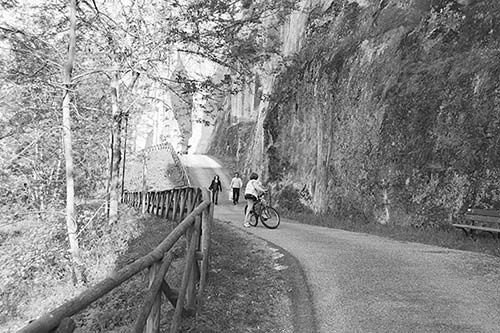
From the access points, you’ll walk or take stairs down, down, down to the trail that hugs the cliff. The easy-to-follow path is wide and partially paved, though it has some steep, gravelly descents—wear good shoes and be prepared for a climb. On one side you have the cliff, with the town high above. On the other side you have Umbrian views stretching into the distance. The path is peaceful, with few other people and only the sound of the wind and birds to accompany you. It makes for a delightful evening walk (not lit after dark).
I’d leave Orvieto at Piazza Marconi and walk left (counterclockwise) three-quarters of the way around the town (there’s a fine view down onto the Etruscan Necropolis midway), then ride the escalator and elevator back up to the town from the big Campo della Fiera parking lot. If you’re ever confused about the path, follow signs for Anello della Rupe.
▲Shorter Romantic Rampart Stroll
Thanks to its dramatic hilltop setting, several fine little walks wind around the edges of Orvieto. My favorite after dark, when it’s lamp-lit and romantic, is along the ramparts at the far west end of town. Start at the Church of San Giovenale (near the end of my self-guided Orvieto Walk). With your back to the church, go a block to the right to the end of town. Then head left along the ramparts, with cypress-dotted Umbria to your right, and follow Vicolo Volsinia to the Church of San Giovanni Evangelista, where you can reenter the old-town center near several recommended restaurants.
NEAR ORVIETO
Wine Tasting
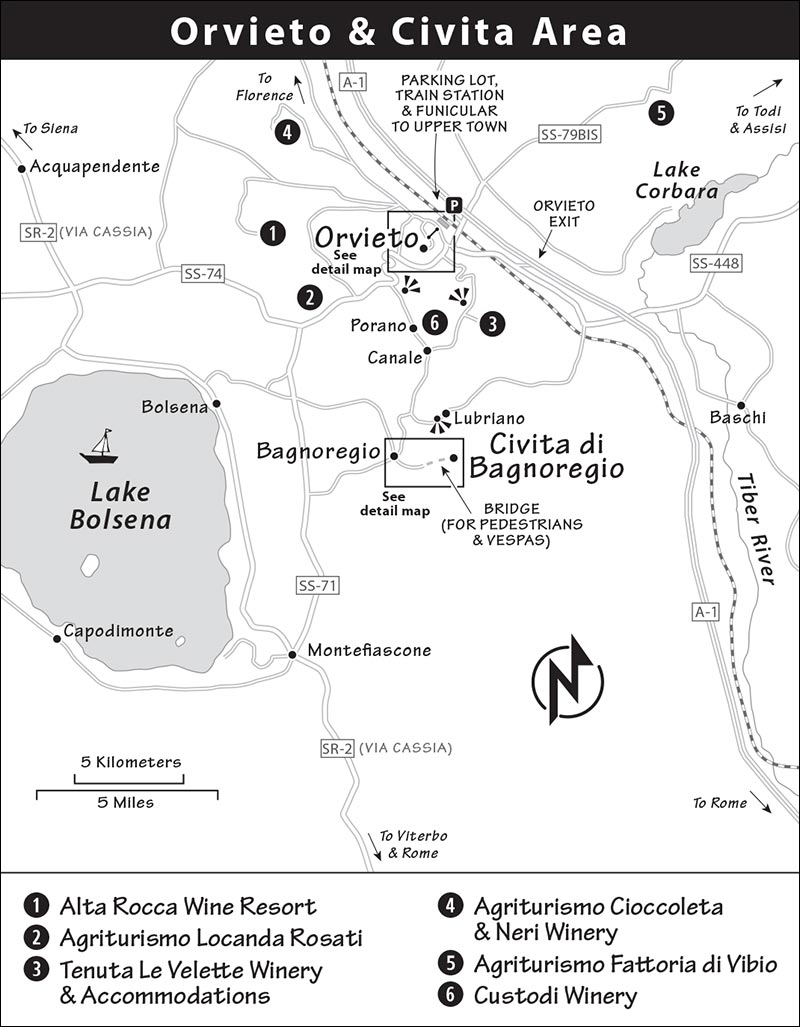
Orvieto Classico wine is justly famous. Two inviting wineries sit just outside Orvieto on the scenic Canale route to Bagnoregio; if you’re side-tripping to Civita, it’s easy to stop at either or both for a tasting (call ahead for a reservation). Two more wineries lie to the north where the soil changes from tufo to clay, which changes the character of the wines. For locations, see the “Orvieto and Civita Area” map near the beginning of this chapter.
Between Orvieto and Bagnoregio: For a tour of a historic winery with Etruscan cellars, make an appointment to visit Tenuta Le Velette, where the Bottai family offers a warm welcome. Their wines are considered to be some of the best in the region. Reserve ahead, especially on weekends (no drop-ins; €8-25 for tour and tasting—price varies depending on wines, number of people, and food requested; Mon-Fri 8:30-12:00 & 14:00-18:00, Sat 8:30-12:30, closed Sun; also has accommodations—see listing later in this chapter, +39 0763 29090, www.tenutalevelette.com, booking@tenutalevelette.com). From their sign (a 5-minute drive past Orvieto at top of switchbacks just before Canale, on road to Bagnoregio), cruise down a long tree-lined drive, then park at the striped gate.
Custodi is another respected family-run winery that produces Orvieto Classico, grappa, and olive oil on a modern 140-acre estate. Helpful Chiara and Laura Custodi speak English. Reserve ahead for a tour of their cantina, an explanation of the winemaking process, and a tasting of four wines (€20/person for wines only, daily 8:30-12:30 & 15:30-18:30 except closed Sun afternoon, Viale Venere S.N.C. Loc. Canale; on the road from Orvieto to Civita, a half-mile after Le Velette, it’s the first building before Canale; +39 0763 29053, mobile +39 338 316 0405, www.cantinacustodi.com).
To the North: In the rolling hills just north of Orvieto, Neri rests amid postcard-pretty estate grounds, with an ancient manor house and grand views of Orvieto and the countryside. Their wines are simple and traditional (tour and tastings from €15, reservations preferred, daily 9:30-17:00; just down the road from recommended Agriturismo Cioccoleta at Località Bardano 28—head north from Orvieto following signs to Sferracavallo and Bardano; +39 0763 316 196, mobile +39 393 331 3844, www.cantineneri.it, visite@neri-vini.it, Enrico).
Sleeping in Orvieto
Orvieto’s high season (with higher hotel prices) is roughly May to early July, September, and October. You’ll save a little money off-season.
IN THE TOWN CENTER
$$$ Grand Hotel Italia is businesslike, with a stay-awhile lobby and terrace. While not as “grand” as it once was, it brings predictable modern amenities to this small town. The 45 overpriced rooms are well located in the heart of Orvieto, a block off the main drag and near the market square (RS%, air-con, elevator, off-site pay parking—reserve ahead, Via di Piazza del Popolo 13, +39 0763 342 065, www.grandhotelitalia.it, hotelita@libero.it).
$$ Hotel Duomo is centrally located and modern, with splashy art in 17 rooms and a friendly welcome. It’s tucked a few steps off the cathedral square, but double-paned windows keep the sound of the church bells well-muffled (RS%, family rooms, air-con, elevator, private pay parking, sunny terrace, a block from the Duomo at Vicolo di Maurizio 7, +39 0763 341 887, www.orvietohotelduomo.com, orvietohotelduomo@gmail.com; Gianni and Maura Massaccesi don’t speak much English, daughter Elisa and son-in-law Diego do). They have another three rooms in a nearby annex (lower prices, breakfast at the main hotel).
$$ Hotel Corso is friendly, with 18 fresh and flowery rooms—a few with balconies and views. Their sunlit little terrace is enjoyable, but the location—halfway between the center of town and the funicular—is less convenient than others (RS%, family rooms, ask for quieter room off street, air-con, elevator, reserved pay parking, Corso Cavour 339, +39 0763 342 020, www.hotelcorso.net, info@hotelcorso.net, Carla).
$ La Magnolia B&B is a great value where friendly Serena offers lots of welcoming touches. Its seven unique rooms—some mini-apartments with kitchens and some with frescoed ceilings and nice terraces—are cheerfully decorated and centrally located. The three units facing the busy street are air-conditioned and have double-paned windows (RS%, family rooms, no elevator, washing machine, Via del Duomo 29, +39 0763 342 808, mobile +39 349 462 0733, www.bblamagnolia.it, info@bblamagnolia.it).
$ B&B Michelangeli offers two comfortable and well-appointed apartments hiding along a residential lane a few blocks from the tourist scene. It’s run by eager-to-please Francesca, who speaks limited English but provides homey touches and free tea, coffee, and breakfast supplies. From the Corso, follow Via Michelangeli, a street full of wood sculptures made by her famous artistic family (fully equipped kitchen, washing machine, private pay parking, Via dei Saracinelli 20–ring bell labeled M. Michelangeli, mobile +39 347 089 0349, www.bbmichelangeli.com).
$ Affittacamere Valentina rents six clean, airy, well-appointed rooms, all with big double beds and antique furniture. It’s in the heart of Orvieto, on a quiet street behind the palace on Piazza del Popolo (RS%, no breakfast, air-con, pay parking, Via Vivaria 7, +39 0763 341 607, mobile +39 328 734 1272, www.affittacamerevalentina.com, camerevalentina@gmail.com). Welcoming Valentina also rents four apartments in the center that work well for families.
$ Hotel Posta is a centrally located, long-ago-elegant palazzo renting 20 quirky, clean, cheap rooms with dark wood floors and vintage furniture. It feels a little institutional, but it’s well run, and the rooms without private bath are among the cheapest in town (breakfast extra, elevator, Via Luca Signorelli 18, +39 0763 341 909, www.hotelpostaorvieto.it, hotelposta@orvietohotels.it, Alessia).
$ Villa Mercede, a good value and excellent location, is owned by a religious institution and offers 26 cheap, simple rooms, each with a big modern bathroom and many with glorious Umbrian views (family rooms, elevator, free parking, a half-block from Duomo at Via Soliana 2, reception upstairs, +39 0763 341 766, www.villamercede.it, info@villamercede.it).
$ Istituto SS. Salvatore rents 17 spotless rooms, shared with a convent, which come with a peaceful terrace garden and the best views in town (family rooms, elevator, pay parking, just off Piazza del Popolo at Via del Popolo 1, +39 0763 342 910, www.istitutosansalvatore.com, istitutosansalvatore@gmail.com).
Just Outside the Town Center: A peaceful country house, $ Casa Sèlita B&B offers easy access to Orvieto (best for drivers, but workable for adventurous train travelers who want an agriturismo-style experience). It’s nestled in an orchard just below the town cliffs; to get to town, you’ll climb an uphill path through their olive orchard (with a view terrace along the way) to reach the Campo della Fiera parking lot, with its handy escalator taking you the rest of the way up into Orvieto. Its three rooms with terraces are airy and fresh, with dark hardwood floors, fluffy down comforters, and modern baths. Enjoy the views from the relaxing garden. Conscientious Sèlita is a gracious host (cash only, air-con, free parking, closed mid-Nov-Easter, Strada di Porta Romana 8, ask for directions—GPS can be tricky, mobile +39 339 225 4000, www.casaselita.com, info@casaselita.com).
NEAR ORVIETO
All of these (except the last one) are within a 20-minute drive of Orvieto, in different directions, and require a car-–see the “Orvieto and Civita Area” map, near the beginning of this chapter.
$$$ Alta Rocca Wine Resort, is a fancy “country resort” and spa, located 15 minutes north of Orvieto. They produce their own olive oil and wine and rent 30 modern and air-conditioned rooms and a few apartments. This place has luna di miele (honeymoon) written all over it and only allows kids 14 and up (2 pools, panoramic view restaurant, wellness center with Jacuzzi and steam room, massages and spa treatments available, winery visit and wine tasting upon request, gym, hiking paths to private lake, +39 0763 344 210 or +39 0763 393 437, www.altaroccawineresort.com, info@altaroccawineresort.com).
$$$ Agriturismo Locanda Rosati, where you’ll be greeted by friendly host Giampiero Rosati, rents 11 tastefully decorated rooms in a pleasant, homey atmosphere. The peaceful, flower-lined grounds are perfect for a retreat (RS%, family rooms, full traditional dinners for €40 on request, air-con, swimming pool, 5 miles from Orvieto on the road to Viterbo, tricky to find—use GPS for directions, +39 0763 217 314, www.locandarosati.it, info@locandarosati.it).
$$ Tenuta Le Velette is a sprawling, historic, family-run estate and winery. The Bottai family rents six fully furnished apartments and villas scattered over their expansive and scenic grounds. Rooms range in size—accommodating from 2 to 14 people—but they all nestle in perfect Umbrian rural peace and tranquility. See the website for details on their various villas (2-night minimum, discount for weekly stay, pool, 10 minutes from Orvieto—drive toward Bagnoregio-Canale and follow Tenuta Le Velette signs, +39 0763 29090, www.tenutalevelette.com, cecilialevelette@libero.it). They also offer wine tastings (see description under “Near Orvieto,” earlier in this chapter).
$$ Agriturismo Cioccoleta (“Little Stone”) has eight rooms with cozy country decor, each named after one of the grapes grown in the agriturismo’s vineyards. It’s run by friendly Angela, who takes great pride in the farmhouse her family restored, and offers sweeping views of Orvieto and the pastoral countryside (RS%, fans, 3 miles north of Orvieto at Località Bardano 34 in Bardano, +39 0763 316 011, mobile +39 349 860 9780, www.cioccoleta.it, info@cioccoleta.it).
Farther Out: Northeast of Orvieto, $$$ Agriturismo Fattoria di Vibio produces olive oil and honey, sells organic products, and offers classes and spa services. In August, its 14 rooms rent at peak prices and have a minimum-stay requirement. The rest of the year, no minimum stay is required, although rates drop dramatically for longer visits. Its two cottages sleep from four to six people and rent only by the week (panoramic pool, expensive restaurant, farthest cottage is 20 miles from Orvieto, www.fattoriadivibio.com, info@fattoriadivibio.com).
Eating in Orvieto
Orvieto is a foodie town with a surprising number of great restaurants hidden just off the main drag. Pigeon dishes are featured on many Orvieto menus: Look for—or avoid—piccione.
TRATTORIAS IN THE CENTER
$$$ Trattoria la Palomba features excellent game and truffle specialties in a wood-paneled dining room. Giampiero, Enrica, and Giovanna have been enthusiastically taking care of their diners since 1965, offering a fine value, high quality, and classy conviviality. Truffles are shaved right at your table—try the umbricelli al tartufo (homemade pasta with truffles) or spaghetti dell’Ascaro (with truffles). Their filetto alla cardinale and mixed-cheese plates are popular. As slow-foodies, they use organic and locally sourced ingredients (reservations smart, Thu-Tue 12:30-14:00 & 19:30-22:00, closed Wed and July, off Piazza della Repubblica at Via Cipriano Manente 16, +39 0763 343 395).
$$$ L’Antica Trattoria dell’Orso offers well-prepared Umbrian cuisine paired with fine wines in a homey, bohemian-chic, peaceful atmosphere. Owner Stefano and chef Hania offer attentive service and a good value (gluten-free options; Mon-Sat 12:00-15:00 & 19:30-22:00, closed Nov, Feb, and Sun year-round; just off Piazza della Repubblica at Via della Misericordia 18, +39 0763 341 642).
$$ Trattoria del Moro Aronne is a long-established family bistro run by Cristian and his mother, Rolanda, who lovingly prepare homemade pasta and market-fresh Umbrian specialties. Consider their nidi—folds of fresh pasta enveloping warm, gooey pecorino cheese sweetened with honey. Three small and separate dining areas make the interior feel intimate. While not particularly atmospheric, this place is known locally as an excellent value (Wed-Mon 12:30-14:30 & 19:30-22:00, closed Tue, Via San Leonardo 7, +39 0763 342 763).
$$ Trattoria la Grotta prides itself on serving only the freshest food and finest wine. The decor is Signorelli-mod, and the ambience is quiet, with courteous service. They’ve been at it for more than 50 years, and promise diners a free coffee, grappa, limoncello, or vin santo with this book (Wed-Mon opens at 12:00 for lunch and at 19:00 for dinner, closed Tue, Via Luca Signorelli 5, +39 0763 341 348).
$$ Trattoria da Carlo, hiding on its own little piazzetta between Via Corso Cavour and Piazza del Popolo, is a cozy spot with a bright, white-tiled interior and inviting tables outside. Animated and opinionated Carlo—a young, likeable loudmouth—holds court, chatting up his diners as much as he cooks, while his mama scuttles about taking orders, busing dishes, and lovingly rolling her eyes at her son’s big personality. Carlo likes big flavors and putting a modern twist on traditional dishes (daily 12:00-15:00 & 19:00-24:00, often closed Sun dinner, Vicolo del Popolo 1, +39 0763 343 916).
$$ Trattoria Antico Bucchero, elegant under a big, white vault, makes for a nice memory with its delicious food—especially game and wild boar (Thu-Tue 12:00-15:00 & 19:00-23:00, closed Wed, also closed Sun in July-Aug; seating indoors and on a peaceful square in summer, air-con, a half-block south of Corso Cavour, between Torre del Moro and Piazza della Repubblica at Via de Cartari 4, +39 0763 341 725; Piero and Silvana, plus sons Fabio and Pericle).
$$ Pizzeria Charlie is a local favorite. Its noisy dining room and stony courtyard are reminiscent of a beer hall, and popular with families and students for casual dinners of wood-fired gourmet pizzas. In a quiet courtyard guarded by a medieval tower, it’s a block southwest of Piazza della Repubblica (Wed-Mon 19:00-23:00, closed Tue, Via Loggia dei Mercanti 14, +39 0763 344 766).
$$$ Enoteca al Duomo is to the left of the Duomo and has pleasant outdoor seating with a cathedral view. They serve wines by the glass and a vast selection of Italian wines by the bottle, and a full menu of local dishes in a contemporary wine-bar atmosphere (daily 10:00-22:00, closed Feb, Piazza del Duomo 13, +39 0763 344 607).
FAST AND CHEAP EATS
$ L’Oste del Re is a simple osteria on Corso Cavour, where Maria Grazia and Claudio offer pasta, bruschetta, enticing meat-and-cheese plates, and hearty, made-to-order sandwiches to eat in a small dining room or take out (Fri-Wed 10:00-15:00 & 19:00-22:00, closed Thu; no evening hours Oct-April; Corso Cavour 58, +39 0763 343 846).
$ Caffè Montanucci, the dominant hangout on the main street—for good reason—lays out an appetizing display of pastas and main courses behind the counter. Choose one (or two—called a bis), find a seat in the modern interior or sunny courtyard, and they’ll bring it out on a tray. You’ll eat among locals on lunch break. They also have good caffè, simple sandwiches, and tasty sweets all day (daily 7:00-24:00, meals for lunch only, Corso Cavour 21, +39 0763 341 261).
Panini and a Picnic: Scattered around town you’ll find many alimentari (grocers) selling cured meats, cheese, and other staples. If you’re feeling gamey, order prosciutto or salami made from cinghiale (cheen-gee-AH-lay; wild boar), a surprisingly mild-tasting local favorite. They’re usually willing to make you a simple sandwich of bread, cold cuts, and/or cheese for a few euros.
Elsewhere along the Corso Cavour, you’ll find places selling fruit, vegetables, and other picnic items. The fortress/garden, to the right as you face the funicular, is a great spot to enjoy your meal.
Groceries: While a small alimentari might have what you need for a picnic, two slightly larger Pam Local markets are tucked away two minutes from the Duomo (both Mon-Sat 8:00-20:00, Sun from 9:00, one at Corso Cavour 100 and the other just past recommended Trattoria la Grotta at Via Luca Signorelli 23).
Gelato: For dessert, gelateria Pasqualetti, next to the cathedral, is a favorite (daily, may close in cold weather, closed Dec-Feb; one location is next to left transept of church, Piazza del Duomo 14; another branch is a few steps off the main drag at Via del Duomo 10). Closer to the funicular, La Musa has a nice variety of creative flavors (daily, Corso Cavour 351).
CAFÉ SCENE ON CORSO CAVOUR AND NEARBY
Orvieto has a charming, traffic-free, pedestrian-friendly vibe. To enjoy it, be sure to spend a little time savoring la dolce far niente—the art of doing nothing—while sitting at a café. There are inviting places all over town, but these are either on or very near Corso Cavour, the main strolling drag, and offer the best people-watching.
Caffè Montanucci is the town’s venerable place for a coffee and pastry, but has no on-street seating (Corso Cavour 21, described earlier for lunch). Caffè ClanDestino is well located, with plenty of streetside seating and endless little bites served with your drink (Corso Cavour 40). Café Barrique is less crowded, less trendy, and quieter, with nice outdoor tables and good free snacks with your drink (Corso Cavour 111).
Café del Teatro, at Teatro Mancinelli (described earlier), can be a fun experience. Drink streetside, at the bar, or in the theater lobby (Corso Cavour 122). If you buy a drink you might be free to wander around the theater without paying the entry fee.
On Piazza del Popolo: A sunny, relaxed perch, Bar Palace faces a big square that’s generally quiet except on market day and on nice evenings, when young locals gather here.
Cafés Facing the Cathedral: Several cafés on Piazza del Duomo invite you to linger over a drink with a view of Orvieto’s amazing cathedral.
Orvieto Connections
From Orvieto by Train to: Rome (every 1-2 hours, 1-1.5 hours), Florence (6/day, 2.5 hours), Siena (12/day, 2.5 hours, change in Chiusi), Assisi (roughly hourly, 2-3 hours, 1-2 transfers), Milan (2/day direct, 5.5 hours; otherwise about hourly with a transfer in Florence, Bologna, or Rome, 4.5-5 hours). The train station’s Buffet della Stazione is surprisingly good if you need a quick focaccia sandwich or pizza picnic for the train ride.
Tip for Drivers: If you’re thinking of driving to Rome, consider stashing your car in Orvieto instead. You can easily park the car, safe and free, in the big lot below the Orvieto train station (for up to a week or more), and zip effortlessly into Rome by train.
Civita di Bagnoregio
Perched on a pinnacle in a grand canyon, the 2,500-year-old, traffic-free village of Civita di Bagnoregio is Italy’s ultimate hill town. Civita’s only connection to the town of Bagnoregio (ban-yoh-REH-joh)—and the world—is a long pedestrian bridge. In the last decade, the old, self-sufficient Civita (chee-VEE-tah) has died—the last of its lifelong residents have passed on, and the only employment here is in serving gawking sightseers. But Civita remains an amazing place to visit. And it remains popular as a backdrop for movies, soap operas, and advertising campaigns.
Civita’s history goes back to Etruscan and ancient Roman times. In the early Middle Ages, Bagnoregio was a suburb of Civita, which had a population of about 4,000. Later, Bagnoregio surpassed Civita in size—especially following a 1695 earthquake, after which many residents fled Civita to live in Bagnoregio, fearing their houses would be shaken off the edge into the valley below. Bagnoregio is dominated by Renaissance-style buildings, while architecturally, Civita remains stuck in the Middle Ages.
Despite being a “dead city,” Civita can be very crowded—especially on the weekends and at lunchtime. The best way to enjoy Civita is early or late in the day, when you have the village to yourself. While Bagnoregio lacks the pinnacle-town romance of Civita, it’s a healthy, vibrant community. In Bagnoregio, get a haircut, sip a coffee on the square, and walk down to the old laundry (ask, “Dov’è la lavanderia vecchia?”).
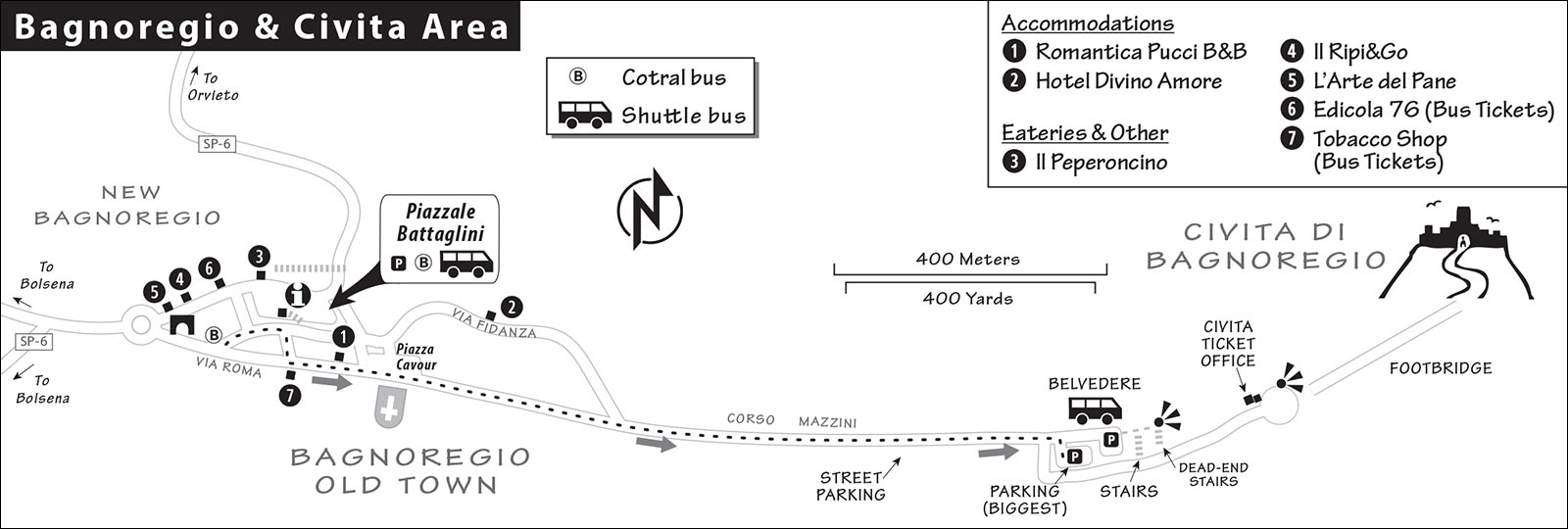
Planning Your Time: In high season—and especially on weekends—little Civita can be uncomfortably jammed; for a better experience, treat it like a major museum and visit either early or late in the day. If side-tripping by bus from Orvieto, it works well to get up early, take the 8:30 bus, and see Civita in the cool morning calm. (The next bus is at 12:50.) If you take the 12:50 bus, you can make the last bus back (around 17:30), but your time in Civita may feel a little rushed. Note that these are weekday times; buses use a different schedule on Saturdays and do not run on Sundays or holidays. See below for details.
GETTING THERE
To reach Civita from Orvieto, you’ll first head for the adjacent town of Bagnoregio. From there, it’s a 30-minute walk or 5-minute drive to the base of Civita’s pedestrian bridge, followed by a steep 10-minute hike up to the town’s main square.
By Bus to Bagnoregio: On weekdays, the blue Cotral bus runs from Orvieto to Bagnoregio about 10 times a day, including some very early departures and a long break mid-morning (45 minutes, no bus on Sun or holidays). Get the detailed schedule at the TI or at www.cotralspa.it [URL inactive] (click “Orari,” then fill in “Bagnoregio” and “Orvieto” in the trip planner—Italian only) or call +39 06 7205 7205 or +39 800 174 471 (press 7 for English).
Tickets are €2.20 one-way if bought in advance at a bar or tobacco shop, or €7 one-way if purchased from driver. In Orvieto’s upper town, buy your ticket from Silvia at the tobacco shop at Corso Cavour 306, a block up from the funicular (daily 7:00-13:00 & 16:00-20:00)—or pay the premium ticket price on board. If you’ll be returning to Orvieto by bus, buy two tickets now (they’re harder to get in Bagnoregio).
Buses depart from a courtyard within the former military barracks, a short walk from the upper funicular station at the east end of Orvieto. It’s tricky to find: With your back to the funicular, walk to the right, bear left (uphill) with the street, then go right under the arch marked Caserma Piave. Angle left through the parking lot to find the blue Cotral bus, under and behind the tall trees. (Note: Lots of buses stop in front of the funicular, but Civita is served by a different bus company, Cotral.)
Buses departing the barracks stop five minutes later at Orvieto’s train station—to catch the bus there, wait to the left of the funicular station (as you’re facing it); schedule and tickets are available in the tobacco shop/bar in the train station.
To locate both bus stops, see the map on here. For information on buses returning to Orvieto, see “Bagnoregio Connections,” later.
Getting from Bagnoregio Bus Stop to Civita: By Cotral bus from Orvieto, you’ll arrive in Bagnoregio near Piazzale Battaglini, at the opposite end of the old center from Civita. To get to Civita’s bridge, it’s a 20- to 30-minute, mostly downhill walk through the middle of Bagnoregio. The walk itself is enjoyable, as it offers a delightful look at a workaday Italian town. With your back to the arch, walk 200 yards towards the big parking lot and TI (InfoPoint, free WCs). Pick up a helpful map and take the stairs behind the TI to the main drag, Via Roma. Then follow the brown signs to Civita.
If you’d rather not walk, you can take a shuttle. It runs to Civita from near the Piazzale Battaglini bus stop—look for white minibuses labeled EPF Tours. The shuttle is especially handy for the uphill return—it drops you right at the Orvieto-bound bus stop (usually 1-2/hour, 5 minutes, generally daily 7:30-18:15 but few buses 14:00-15:00 or on Sun off-season, €1.50 one-way, €2 round-trip, pay driver).
By Taxi or Shared Taxi to Civita: If you can share the cost with other travelers, a 30-minute taxi ride from Orvieto to Civita is a reasonable value (basic rate: €50 one-way, €85 round-trip with an hour wait). Alessio Colagè Orvieto Transfer can take groups by car or minivan (see “Tours of Orvieto,” earlier in this chapter).
By Car to Bagnoregio and Civita: Driving from Orvieto to Civita takes about 30 minutes. Orvieto overlooks the autostrada (and has its own exit). From the Orvieto exit, the shortest way to Civita is to turn left (below Orvieto), and then simply follow the signs to Lubriano and Bagnoregio.
A more winding and scenic route takes a few minutes longer: From the Orvieto exit on the autostrada, go right (toward Orvieto), then at the first big roundabout, follow signs to Bolsena (passing under hill-capping Orvieto on your right). Take the first left (direction: Bagnoregio), winding up past great Orvieto views and the recommended Tenuta Le Velette and Custodi wineries en route to Canale, and through farms and fields of giant shredded wheat to Bagnoregio.
Whichever route you take, for a breathtaking view of Civita, just before Bagnoregio follow signs left to Lubriano, head into that village, turn right as you enter town, and pull into the first little square by the yellow church (on the left). You’ll find an even better view farther into the town, from the tiny square at the next church (San Giovanni Battista). Then return to the Bagnoregio road.
Once in Bagnoregio, you’ll drive right up the main street—which seems pedestrian-only, but isn’t (follow brown Civita signs). As you approach Civita, you’ll begin to see pay-and-display parking lots and blue-painted lines along the side of the road (all charge €2/hour). The closest you can get is the lot at the end of the tree-lined stretch of road, right in front of the belvedere (viewpoint)—but this is often full, in which case the larger lot at Piazzale Battaglini likely has space.
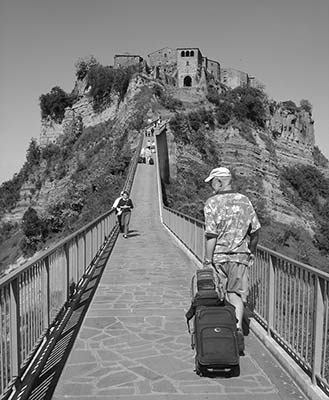
Walking Across the Bridge to Civita: Whether arriving by foot, shuttle bus, or car, first head out to the belvedere at the very end of Bagnoregio for a superb view (through the little garden). From there, backtrack a few steps (the staircase next to the viewpoint is a dead end) and take the stairs down to the road leading to the bridge. You’ll first head downhill, then pay the admission fee and hike up the narrow bridge into town.
Orientation to Civita
Civita charges a €5 admission fee to enter the old town (waived for overnight guests). The revenue helps with its extensive maintenance expenses. Buy your ticket from the brown kiosk, just before the bridge, on the left.
Tourist Information: The helpful InfoPoint at Piazzale Battaglini (in Bagnoregio) can answer all your questions. Ask for a map and confirm the shuttle schedule before setting off for Civita.
HELPFUL HINTS
Market Day: A lively market fills the Piazzale Battaglini parking lot each Monday.
Orvieto Bus Tickets: Because the Orvieto-Bagnoregio bus ticket is much cheaper purchased in advance than from the driver, ideally you’ll buy both tickets in Orvieto. But if you wind up in Bagnoregio needing a ticket, only two places sell them—and both are closed for several hours in the afternoon. Buy one on arrival so you have it when you need it later. One option is the Edicola 76 newsstand across from the gas station near the Bagnoregio bus stop (look for the gray awning at #47; daily 7:30-13:00 & 17:00-20:00 except closed Sun afternoon). The other option in Bagnoregio is La Cornucopia tobacco shop on Via Roma (Mon-Sat 8:00-13:00 & 17:00-20:00, closed Sun afternoon, directly upstairs from the Piazzale Battaglini parking lot and TI at Larga Fidenza 6).
Civita Walk
Civita was once connected to Bagnoregio, before the saddle between the separate towns eroded away. Photographs around town show the old donkey path—the original bridge. It was bombed in World War II and replaced in 1966 with the footbridge that you’re climbing today.
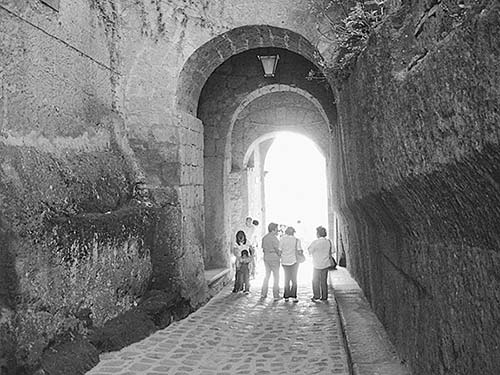
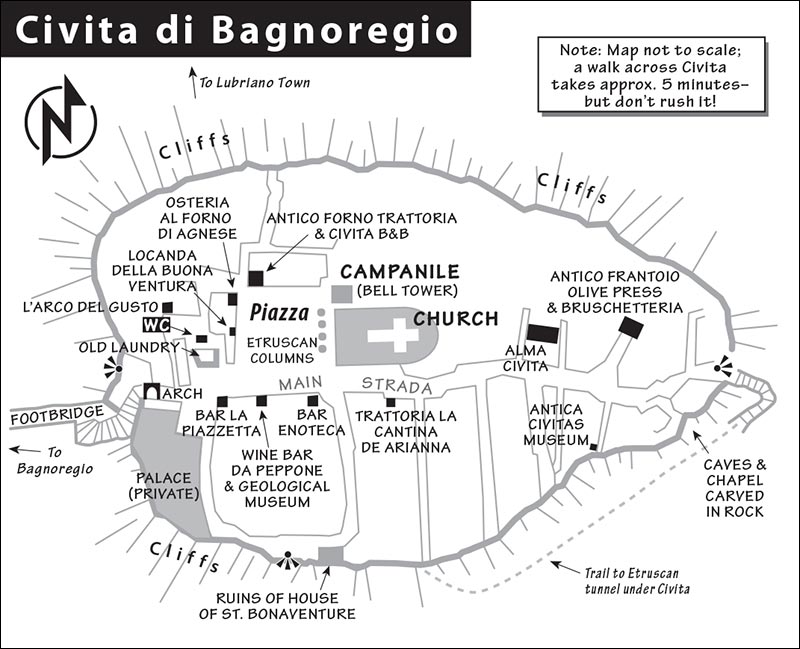
• Entering the town, you’ll pass through Porta Santa Maria, a 12th-century Romanesque arch. This stone passageway was cut by the Etruscans 2,500 years ago, when this town was a stop on an ancient trading route. Inside the archway, you enter a garden of stones. Stand in the little square—the town’s antechamber—facing the Bar La Piazzetta. Over your right shoulder are the remains of a...
Renaissance Palace
The wooden door and windows (above the door) lead only to thin air. They were part of the facade of one of five palaces that once graced Civita. Much of the palace fell into the valley, riding a chunk of the ever-eroding rock pinnacle. Today, the door leads to a remaining section of the palace—complete with Civita’s first hot tub. It was once owned by the “Marchesa,” a countess who married into Italy’s biggest industrialist family.
• A few steps uphill, farther into town (on your left, beyond the Bottega souvenir store), notice the two shed-like buildings.
Old WC and Laundry (Vecchio Lavatoio)
In the nearer building (covered with ivy), you’ll see the town’s old laundry, which dates from just after World War II, when water was finally piped into the town. Until a few years ago, this was a lively village gossip center. Now, locals park their mopeds here. Just behind that is another stone shed, which houses a less-than-pristine WC.
• The main square is just a few steps farther along, but we’ll take the scenic circular route to get there, detouring around to the right. Walk past the ruined palace and belly up to the...
Canyon Viewpoint
Lean over the banister and listen to the sounds of the birds and the bees. Survey old family farms, noticing how evenly they’re spaced. Historically, each one owned just enough land to stay in business. Turn left along the belvedere and walk a few steps to the site of the long-gone home of Civita’s one famous son, St. Bonaventure, known as the “second founder of the Franciscans” (look for the small plaque on the wall).
• From here, a lane leads past delightful old homes and gardens, and then to...
Civita’s Main Square
The town church faces Civita’s main piazza. Grab a stone seat and observe the scene. They say that in a big city you can see a lot, but in a small town like this you can feel a lot. The generous bench built into the long side of the square, now used as restaurant seating, reminds me of how when I first discovered Civita back in the 1970s and 1980s, the town’s old folks would gather here every night. The piazza has been integral to Italian culture since ancient Roman times. While Civita is humble today, imagine the town’s former wealth, when mansions of the leading families faced this square, along with the former City Hall (opposite the church). The town’s history includes a devastating earthquake in 1695. Notice how stone walls were reinforced with thick bases, and how old stones and marble slabs were recycled and built into walls.
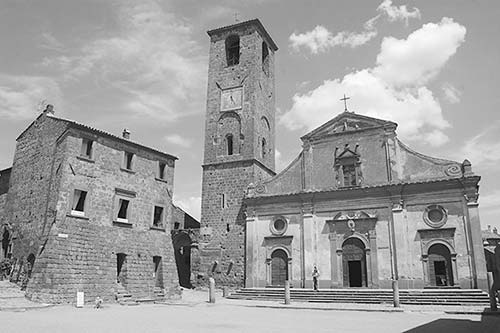
Here in the town square, you’ll find Bar Enoteca (open daily, local wines and microbrews) and two recommended restaurants. The square hosts wild donkey races on the first Sunday of June and the second Sunday of September. At Christmastime, a living Nativity scene is enacted in this square, and if you’re visiting at the end of July or beginning of August, you might catch a play here. The pillars that stand like giants’ bar stools are ancient Etruscan. The church, with its campanile (bell tower), marks the spot where an Etruscan temple, and then a Roman temple, once stood. Across from Bar Enoteca, on the side of the former City Hall, is a small, square stone counter. Old-timers remember when this was a meat shop, and how one day a week the counter was stacked with fish for sale.
The humble Geological Museum tells the story of how erosion is constantly shaping the surrounding “Bad Lands” valley, how landslides have shaped (and continue to threaten) Civita, and how plans are developing to stabilize things (€3; daily April-Oct 10:00-13:30 & 14:00-17:00, shorter hours off-season; +39 328 665 7205, www.museogeologicoedellefrane.it).
• Now step inside...
Civita’s Church
A cathedral until 1699, the church houses records of about 60 bishops that date back to the seventh century (church open daily 10:00-13:00 & 14:00-16:30, often closed Feb). Inside you’ll see Romanesque columns and arches with faint Renaissance frescoes peeking through Baroque-era whitewash. The central altar is built upon the relics of the Roman martyr St. Victoria, who once was the patron saint of the town. St. Marlonbrando served as a bishop here in the ninth century; an altar dedicated to him is on the right. The fine crucifix over this altar, carved out of pear wood in the 15th century, is from the school of Donatello. It’s remarkably expressive and greatly venerated by locals. Jesus’ gaze is almost haunting. Some say his appearance changes based on what angle you view him from: looking alive from the front, in agony from the left, and dead from the right. Regardless, his eyes follow you from side to side. On Good Friday, this crucifix goes out and is the focus of the midnight procession.
On the left side, midway up the nave above an altar, is an intimate fresco known as Madonna of the Earthquake, given this name because—in the great shake of 1695—the whitewash fell off and revealed this tender fresco of Mary and her child. (During the Baroque era, a white-and-bright interior was in vogue, and churches such as these—which were covered with precious and historic frescoes—were simply whitewashed over. Look around to see examples.) On the same wall—just toward the front from the Madonna—find the faded portrait of Santa Apollonia, the patron saint of your teeth; notice the scary-looking pincers.
• From the square, you can follow...
The Main Street
A short walk takes you from the church to the end of the town. Along the way, you’ll pass a couple little eateries (described later, under “Eating in Civita”), olive presses, gardens, a rustic town museum, and valley views. The rock below Civita is honeycombed with ancient tunnels, caverns (housing olive presses), cellars (for keeping wine at a constant temperature all year), and cisterns (for collecting rainwater, since there was no well in town). Many date from Etruscan times.
Wherever you choose to eat (or just grab a bruschetta snack), be sure to take advantage of the opportunity to poke around—every place has a historic cellar. At the trendy Alma Civita, notice the damaged house facing the main street—broken since the 1695 earthquake and scarred to this day. Just beyond, the rustic Antico Frantoio Bruschetteria serves bruschetta in an amazing old space. Whether or not you buy food, venture into their back room to see an interesting collection of old olive presses (if you’re not eating here, a €1 donation is requested). The huge olive press in the entry is about 1,500 years old. Until the 1960s, blindfolded donkeys trudged in the circle here, crushing olives and creating paste that filled the circular filters and was put into a second press. Notice the 2,500-year-old sarcophagus niche. The hole in the floor (with the metal grate) was a garbage hole. In ancient times, residents would toss their jewels down when under attack; excavations uncovered a windfall of treasures.
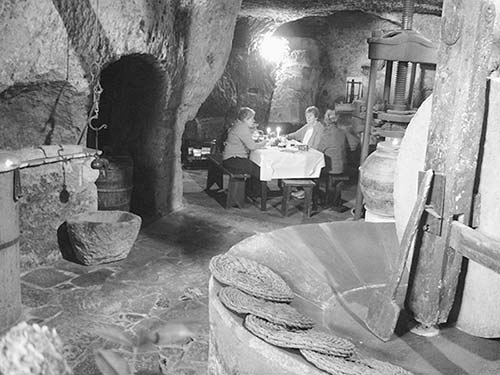
In front is the wellhead of an ancient cistern—designed to collect rainwater from neighboring rooftops—carved out of tufo and covered with clay to be waterproof.
• Across the street and down a tiny lane, find...
Antica Civitas
This is the closest thing the town has to a history museum. The humble collection is the brainchild of Felice, an old farmer who hung black-and-white photos, farm tools, olive presses, and local artifacts in a series of old caves. Climb down to the “warm blood machine” (another donkey-powered grinding wheel) and a viewpoint. You’ll see rooms where a mill worker lived until the 1930s. Felice wants to give visitors a feeling for life in Civita when its traditional economy was strong (€1, generally open 10:00-17:00, some English explanations, +39 320 110 4279).
• Another few steps along the main street take you to...
The End of Civita
Here the road is literally cut out of the stone, with a dramatic view of the Bad Lands opening up. To savor the scene, consider popping into the cute “Garden of Poets” (immediately on the left just outside town; they’ll ask for a donation as you exit, or you can purchase something at the Ambrosi family’s little shop). Then, look back up at the end of town and ponder the precarious future of Civita. There’s a certain stillness here, far from the modern world and high above the valley.
Continue along the path a few steps toward the valley below the town, and you come to some shallow caves used as stables until a few years ago. The third cave, cut deeper into the rock with stairs leading to a barred door, is the Chapel of the Incarcerated (Cappella del Carcere). In Etruscan times, the chapel—with a painted tile depicting the Madonna and child—may have been a tomb, and in medieval times, it was used as a jail (which collapsed in 1695).
Although it’s closed to the public now, an Etruscan tunnel just beyond the Chapel of the Incarcerated cuts completely through the hill. Tall enough for a woman with a jug on her head to pass through, it may have served as a shortcut to the river below. It was widened in the 1930s so that farmers could get between their scattered fields more easily. Later, it served as a refuge for frightened villagers who huddled here during WWII bombing raids.
• Hike back into town, taking some time to explore the peaceful back lanes before returning to the modern world.
Sleeping in Civita or Bagnoregio
Civita has nine B&B rooms up for grabs. Bagnoregio has larger lodgings, and there are plenty of agriturismi nearby; otherwise, there’s always Orvieto. Off-season, when Civita and Bagnoregio are deadly quiet—and cold—I’d side-trip in from Orvieto rather than spend the night here.
IN CIVITA
$$ Alma Civita is a classic old stone house that has been renovated by a sister-and-brother team, Alessandra and Maurizio (hence the name: Al-Ma). These are Civita’s two most comfortable, modern, and warmly run rooms and they also have a recommended restaurant (+39 0761 792 415, mobile +39 347 449 8892, www.almacivita.com, prenotazione@almacivita.com).
$$ Locanda della Buona Ventura rents four overpriced rooms, up narrow stairs, decorated in medieval rustic-chic, and overlooking Civita’s piazza. You’re not likely to see the owner—the Dallaiti shop across the square functions as the reception (tiny bathrooms, skimpy breakfast, +39 0761 792 025, mobile +39 347 627 5628, info@locandabuonaventura.com).
$ Civita B&B, run by gregarious Franco Sala, has three little rooms above Trattoria Antico Forno, each overlooking Civita’s main square. Two are doubles with private bath. The third is a triple (with one double and one kid-size bed), which has its own bathroom across the hall (RS%, family rooms, continental breakfast, Piazza del Duomo Vecchio, +39 076 176 0016, mobile +39 347 611 5426, www.civitadibagnoregio.it, fsala@pelagus.it). Franco also rents a few apartments in Civita, Bagnoregio, and nearby.
IN BAGNOREGIO
$ Romantica Pucci B&B is a haven for city-weary travelers. Its five spacious rooms are indeed romantic, with canopied beds and flowing veils (air-con, free parking, along the main drag at Piazza Cavour 1, +39 0761 792 121, www.hotelromanticapucci.it, info@hotelromanticapucci.it).
$ Hotel Divino Amore has 21 bright, modern rooms, four with perfect views of a miniature Civita. These view rooms, and the 13 with air-conditioning, don’t cost extra—but they book up first (closed Jan-March, a block below the main drag at Via Fidanza 25-27, +39 076 178 0882, mobile +39 329 344 8950, www.hoteldivinoamore.com, info@hoteldivinoamore.com, Silvia).
Eating in Civita or Bagnoregio
IN CIVITA
Opening hours are highly unpredictable in this little town—when it’s quiet, places can close unexpectedly. Take the hours listed here as rough estimates.
$$ Osteria Al Forno di Agnese is a delightful spot where Manuela and her friends serve visitors simple yet delicious meals and a good selection of local wines on a covered patio hidden just off Civita’s main square or in a little dining room in gloomy weather (daily at 11:30 for lunch, peak season also at 19:00 for dinner, +39 0761 792 571, mobile +39 340 1259 721).
$$ Trattoria Antico Forno serves up rustic dishes, homemade pasta, and salads at affordable prices. Try their homemade pasta with truffles (daily 12:30-15:30 & 19:00-22:00—but not always open for dinner, on main square, also rents rooms—see Civita B&B listing earlier, +39 076 176 0016, Franco, daughter Elisabetta, and assistants Nina and Daniela).
$$ Trattoria La Cantina de Arianna is a family affair, with a busy open fire specializing in grilled meat and wonderful bruschetta. It’s run by Arianna, her sister, Antonella, and their parents, Rossana and Antonio. After eating, wander down to their cellar, where you’ll see traditional winemaking gear and provisions for rolling huge kegs up the stairs. Tap on the kegs in the bottom level to see which are full (daily 12:00-16:30, also dinner from 19:30 on summer evenings and Sat year-round, +39 0761 793 270).
$$ Alma Civita feels like a fresh, new take on old Civita, owned by a sister-and-brother team of longtime residents: Alessandra (an architect) and Maurizio (who runs the restaurant). Choose from one of three seating areas: outside on a stony lane, in the modern and trendy-feeling main-floor dining room, or in the equally modern but atmospheric cellar. Even deeper is an old Etruscan tomb that’s now a wine cellar (April-Oct lunch Wed-Mon 12:00-15:15, dinner Fri-Sat only 19:00-21:30, closed Tue; Nov-March Thu-Sun only for lunch plus Sat for dinner; they also rent recommended rooms, +39 0761 792 415).
$ Antico Frantoio Bruschetteria, the last place in town, is a rustic, super-atmospheric spot for a bite to eat. The specialty here: delicious bruschetta toasted over hot coals. Peruse the menu, choose your toppings (chopped tomato is super), and get a glass of wine for a fun, affordable snack or meal (roughly 10:00-18:00, mobile +39 371 353 3753, Fabrizio).
Sandwich Shop: If you just want a quick bite, $ L’Arco del Gusto can make you a sandwich using local products (daily 10:30-16:30, tucked in an archway near the start of town).
IN BAGNOREGIO
The recommended $$ Romantica Pucci B&B offers a small restaurant with tables in its private garden and a cozy interior (closed Mon, see contact details earlier). For good gelato, on your walk to Civita you’ll go right past a branch of Orvieto’s Pasqualetti, on the main drag at Mazzini 32.
Near the Bagnoregio Bus Stop: Several basic eateries are along Via Giacomo Matteotti just below the bus stop in Bagnoregio, including $ Il Peperoncino, selling pizza by the slice (closed Wed, #49); $$ Il Ripi&Go, a sit-down eatery serving traditional food (closed Wed, #35); and—a half-block past Il Ripi&Go—fresh pastries at $ L’Arte del Pane (#5).
Bagnoregio Connections
From Bagnoregio to Orvieto: Cotral buses connect Bagnoregio to Orvieto (about 10/day Mon-Sat only—no buses Sun or holidays, 45 minutes, €2.20 one-way if purchased in advance, €7 one-way from driver). Information: +39 06 7205 7205 or +39 800 174 471 (press 7 for English), www.cotralspa.it [URL inactive] (Italian only). For info on coming from Orvieto, see “Getting There” on here.
From Bagnoregio to Points South: Cotral buses also run to Viterbo, which has good train connections to Rome (about 10/day Mon-Fri, fewer Sat, no buses Sun, 35 minutes).