APPENDIX
Holidays and Festivals
In Italy, holidays seem to strike without warning, and every town has a festival honoring its patron saint.
This list includes selected festivals in major cities, plus national holidays observed throughout Italy. Many sights and banks close on national holidays—keep this in mind when planning your itinerary. Before planning a trip around a festival, verify the dates with the festival website, the national tourist office (www.italia.it), or my “Upcoming Holidays and Festivals in Italy” web page at RickSteves.com/europe/italy/festivals.
In Italy, hotels get booked up on Easter weekend, Liberation Day, Labor Day, All Saints’ Day, and on Fridays and Saturdays year-round. Some hotels require you to book the full three-day weekend around a holiday. During the Feast of the Assumption, a.k.a. Ferragosto, beach destinations are flooded with vacationing Italians. Cities empty out for much of August, and while tourist attractions remain open, shops and restaurants are often closed until September.
For festivals and events in the Cinque Terre, see here.
| Jan 1 | New Year’s Day |
| Jan 6 | Epiphany |
| Late Feb | Carnevale Celebrations/Mardi Gras, Florence (costumed parades, jousting competitions) |
| Feb/March | Carnevale, Venice (Mardi Gras, www.carnevale.venezia.it [URL inactive]) |
| March/April | Easter weekend (Good Friday-Easter Monday): April 7-10, 2023; March 29-April 1, 2024; Scoppio del Carro, Florence (fireworks on Easter Sunday) |
| Mid-April | Vinitaly, Verona (wine festival, www.vinitaly.com) |
| April 25 | Italian Liberation Day; Feast of St. Mark, Venice |
| May 1 | Labor Day |
| May | Ascension Day: May 18, 2023; May 9, 2024 |
| Late May-early June | Vogalonga Regatta, Venice |
| May/June | Feast of Corpus Christi: June 8, 2023; May 30, 2024 |
| June 2 | Anniversary of the Republic |
| June 16-17 | St. Ranieri Day, Pisa |
| June 24 | St. John the Baptist Day, Florence (parades, dances, boat races); Calcio Storico, Florence (Renaissance ball game played on Piazza Santa Croce) |
| June 29 | Sts. Peter and Paul Day, most fervently celebrated in Rome |
| June-Aug | Verona opera season |
| Late June-early Sept | Outdoor cinema season, Florence (contemporary films) |
| July 2 | Palio horse race, Siena |
| July (third weekend) | Feast and Regatta of the Redeemer, Venice |
| July-Aug | Stresa Festival, Lake Maggiore (classical music) |
| Aug 10 | St. Lawrence Day, Rome |
| Aug 15 | Feast of the Assumption (Ferragosto) |
| Aug 16 | Palio horse race, Siena |
| Sept (first weekend) | Historical Regatta, Venice |
| Early Sept | Festa della Rificolona, Florence (children’s procession with lanterns, street performers, parade) |
| Sept 13 | Volto Santo, Lucca (luminaria procession and fair) |
| Sept 19 | St. Januarius Day, Naples |
| Sept-Oct | Chestnut festivals, most towns, mainly north of Rome (festivals, chestnut roasts) |
| Late Sept or early Oct | Musica dei Popoli Festival, Florence (global and folk music and dances) |
| Mid-Oct | Castelrotto Music Festival, Dolomites (Kastelruther Spatzenfest) |
| Nov 1 | All Saints’ Day |
| Nov 21 | Feast of Our Lady of Good Health, Venice |
| Dec | Christmas market, Rome (Piazza Navona); crèches in churches throughout Italy |
| Dec 8 | Feast of the Immaculate Conception |
| Dec 25 | Christmas |
| Dec 26 | St. Stephen’s Day |
Books and Films
To learn more about Italy past and present, check out a few of these books or films.
Nonfiction
Absolute Monarchs (John Julius Norwich, 2011). This warts-and-all illustrated guide to the most significant popes in history is a readable best seller.
Ancient Rome: The Rise and Fall of an Empire (Simon Baker, 2007). Baker chronicles the rise and demise of the great Roman Empire and its powerful leaders.
The Architecture of the Italian Renaissance (Peter Murray, 1969). Heavily illustrated, this classic presents the architectural life of Italy from the 13th through the 16th century.
La Bella Figura: A Field Guide to the Italian Mind (Beppe Severgnini, 2005). Severgnini strips down the idealized vision of Italy to reveal its more authentic self—at its best and its worst.
Brunelleschi’s Dome: How a Renaissance Genius Reinvented Architecture (Ross King, 2000). The remarkable story of how the dome of Florence’s cathedral was designed and built.
Christ Stopped at Eboli: The Story of a Year (Carlo Levi, 1945). Levi recounts the harsh yet beautiful existence he found in exile to a remote region of southern Italy during Mussolini’s reign.
City: A Story of Roman Planning and Construction (David Macaulay, 1974). Macaulay’s illustrated book about the Eternal City will please both kids and adults.
A Concise History of Italy (Christopher Duggan, 1994). Duggan’s history starts with the fall of Rome but zooms in on the political difficulties of unified Italy over the last two centuries.
Delizia!: The Epic History of the Italians and Their Food (John Dickie, 2007). History buffs and foodies alike will enjoy this vibrant exploration of Italy’s famed cuisine.
Desiring Italy (Susan Cahill, 1997). In this anthology, 28 women writers offer a mix of fiction, memoirs, and essays about the complexity and allure of Italy.
Excellent Cadavers: The Mafia and the Death of the First Italian Republic (Alexander Stille, 1995). This true account of Sicilian Mafia assassinations in the 1990s is as much thriller as it is history.
A History of Venice (John Julius Norwich, 1977). English Lord Norwich’s engaging account spans more than a century, from Venice’s fifth-century origins to the arrival of Napoleon.
The House of Medici (Christopher Hibbert, 1974). Florence’s first family of the Renaissance included power-hungry bankers, merchants, popes, art patrons—and two queens of France.
Italian Days (Barbara Grizzuti Harrison, 1989). Harrison’s appealing travel essays about Italy’s varied regions cover everything from architecture to food to history.
Italian Neighbors (Tim Parks, 1992). Parks describes an Englishman’s humorous and sometimes difficult attempt to live as a local in a small Italian town.
Italian Renaissance Art (Laurie Schneider Adams, 2013). In this well-written introduction to this pivotal period, Adams focuses on the most important and innovative artists and their best works.
The Italians (John Hooper, 2015). A veteran English correspondent in Italy probes the fascinating paradoxes of contemporary Italian life.
Italy for the Gourmet Traveler (Fred Plotkin, 1996). Plotkin, who’s been described as an expert on everything Italian, shares his knowledge of Italy’s culinary world in this food/travel guide.
The Lives of the Artists (Giorgio Vasari, 1550). The man who invented the term “Renaissance” offers anecdote-filled biographies of his era’s greatest artists, some of whom he knew personally.
Michelangelo and the Pope’s Ceiling (Ross King, 2003). The story behind the Sistine Chapel includes Michelangelo’s technical difficulties, personality conflicts, and money troubles.
Midnight in Sicily (Peter Robb, 1996). Robb offers a good general history of Sicily, covering its decadent pleasures and its literature, politics, art, and crimes.
The Prince (Niccolò Machiavelli, 1532). The original “how-to” for gaining and maintaining political power, still chillingly relevant after 500 years.
Saints & Sinners (Eamon Duffy, 1997). Everything you always wanted to know about the popes, but were afraid to ask.
The Secrets of Rome: Love and Death in the Eternal City (Corrado Augias, 2005). Augias takes readers back through 27 centuries of Roman history, secrets, and conspiracies.
A Small Place in Italy (Eric Newby, 1994). A young American couple tries to renovate a Tuscan farmhouse in the late 1960s.
The Stones of Florence (Mary McCarthy, 1956). McCarthy applies wit and keen observation to produce a quirky, impressionistic investigation of Florence and its history.
Travelers’ Tales Italy (Anne Calcagno, 2001). Calcagno’s guide is an excellent compilation of travel writing.
Under the Tuscan Sun (Frances Mayes, 1996). Mayes’ best seller describes living la dolce vita in the Tuscan countryside (and is better than the movie of the same name).
The Venetian Empire: A Sea Voyage (Jan Morris, 1990). Morris brings a maritime empire to life in this book that illustrates the city’s place on a larger historical canvas.
Venice Observed (Mary McCarthy, 1963). This snappy and engaging memoir details the Venetian ethos through the eyes of a sharply critical writer.
Fiction
The Agony and the Ecstasy (Irving Stone, 1958). Stone fictionalizes Michelangelo’s struggle to paint the Sistine Chapel (also a 1965 movie starring Charlton Heston).
The Aspern Papers and Other Stories (Henry James, 1894). An American editor travels to Venice in search of letters written to his mistress. Other James works about Italy include Italian Hours and Daisy Miller.
Beautiful Ruins (Jess Walter, 2012). This comedic romance, which follows an Italian innkeeper’s search for lost love over 50 years, is the perfect beach read for the Cinque Terre.
A Bell for Adano (John Hersey, 1944). Hersey’s novel about an American major overseeing a town in WWII Sicily won him the Pulitzer Prize in 1945.
Birth of Venus (Sarah Dunant, 2003). Dunant follows the life of a Florentine girl who develops feelings for the boy hired to paint the walls of the family’s chapel.
The Day of the Owl (Leonardo Sciascia, 1961). This classic murder mystery set in a mid-20th-century Sicilian village is a fascinating window into the Mafia.
Death at La Fenice (Donna Leon, 1992). This chilling Venetian mystery and the others in Leon’s Commissario Brunetti series reveal more about “real” Italy than many memoirs do.
Death in the Mountains: The True Story of a Tuscan Murder (Lisa Clifford, 2008). This fictionalized account of an unsolved murder reveals the hardship of early-20th-century Tuscan farming life.
Death in Venice and Other Tales (Thomas Mann, 1912). The centerpiece of this collection is an eloquent classic that explores obsession, beauty, and death in plague-ridden Venice (also a 1971 film).
The Decameron (Giovanni Boccaccio, 1348). Boccaccio’s collection of 100 hilarious, often bawdy tales is a masterpiece of Italian literature and inspired Chaucer, Keats, and Shakespeare.
Divine Comedy (Dante Alighieri, 1321). Dante’s epic poem—a journey through hell, purgatory, and paradise—is one of the world’s greatest works of literature.
The First Man in Rome (Colleen McCullough, 1990). The author of The Thorn Birds describes the early days of the Roman Republic, in the first of a best-selling series of historical fiction.
Galileo’s Daughter (Dava Sobel, 1999). Sobel’s historical memoir centers on Galileo’s correspondence with his oldest daughter and confidante.
I, Claudius (Robert Graves, 1934). This brilliant history of ancient Rome is told by Claudius, the family’s laughingstock who becomes emperor himself. The sequel is Claudius the God (1935).
I’m Not Scared (Niccolò Ammaniti, 2001). A boy stumbles upon a terrible secret in an abandoned farmhouse in this thriller set in the 1970s Italian South.
Invisible Cities (Italo Calvino, 1972). Marco Polo tells of the fantastical cities he’s seen...or is he just describing the many facets of his beloved Venice?
Italian Journey (Johann Wolfgang von Goethe, 1786). In his 18th-century collection of writings, Goethe describes his travels to Rome, Sicily, and Naples.
The Leopard (Giuseppe Tomasi di Lampedusa, 1957). Sicilian aristocrats see their world slipping away during the turmoil of the Risorgimento (also a 1963 movie starring Burt Lancaster).
The Light in the Piazza (Elizabeth Spencer, 1960). A mother and daughter are intoxicated by the beauty of 1950s Florence (also a 1962 movie and an award-winning Broadway musical).
Lucrezia Borgia (Maria Bellonci, 1939). In this historically based tale of court intrigue, a daughter of Pope Alexander VI navigates passions, plots, and controversy in Renaissance Rome.
The Merchant of Venice (William Shakespeare, 1598). In addition to Merchant, other Shakespearean plays set in Italy include Romeo and Juliet (Verona), Much Ado About Nothing (Sicily), The Two Gentlemen of Verona, and The Taming of the Shrew (Padua).
The Neapolitan Novels (Elena Ferrante, 2012-2015). This popular four-novel series traces two girls’ coming of age in mid-20th-century Naples.
The Passion of Artemisia (Susan Vreeland, 2001). This novel is based on the life of Artemisia Gentileschi, one of the rare female post-Renaissance artists who gained fame in her own time.
Pompeii (Robert Harris, 2003). The engineer responsible for Pompeii’s aqueducts has a bad feeling about Mount Vesuvius in this historical novel.
A Room with a View (E. M. Forster, 1908). A young Englishwoman visiting Florence finds a socially unsuitable replacement for her snobby fiancé (also a 1985 movie starring Helena Bonham Carter).
The Sixteen Pleasures (Robert Hellenga, 1994). Set during the 1966 floods in Florence, a young student discovers an erotic manuscript banned by the pope and lost for centuries.
A Soldier of the Great War (Mark Helprin, 1991). A young Roman lawyer falls in love with an art student, but World War I rips them apart.
That Awful Mess on the Via Merulana (Carlo Emilio Gadda, 1957). This detective story about a murder and a burglary in an apartment building in central Rome shines a harsh light on fascist Italy.
A Thread of Grace (Mary Doria Russell, 2004). This historical novel fictionalizes the story of how more than 43,000 Jews were saved by Italian citizens during World War II.
Film and TV
1900 (1976). Bernardo Bertolucci’s epic tale of early-20th-century Italy follows the relationship between two young men—one rich (Robert De Niro), one poor (Gérard Depardieu).
Ben-Hur (1959). At the height of the Roman Empire, a Jewish prince is enslaved by a friend, and later seeks revenge in a stunning chariot race (the film won a record 11 Oscars).
The Best of Youth (2003). Beginning in the turbulent 1960s, this award-winning miniseries follows the dramatic ups and downs in the lives of two brothers over four decades.
Bicycle Thieves (1948). A poor man looks for his stolen bicycle in busy Rome in this inspirational classic of Italian Neorealism.
Caterina in the Big City (2003). A teenager whose family moves to Rome from a small town is the focus of this bitter comedy about the crisis of contemporary Italian society.
Cinema Paradiso (1988). This Oscar-winning drama about a friendship between a film projectionist and a little boy is a compelling portrayal of post-WWII Sicily and a tribute to movies everywhere.
La Dolce Vita (1960). Director Federico Fellini tells a series of stories that capture the hedonistic days of early 1960s Rome.
Enchanted April (1991). Filmed in Portofino, this languid film follows an all-star British cast as they fall in love, discuss relationships, eat well, and take naps in the sun.
The First Beautiful Thing (2010). A man returns to his hometown in Tuscany to aid his dying mother, a woman determined to live life to the fullest while being a good parent to her children.
Gladiator (2000). An enslaved Roman general (Russell Crowe) fights his way back to freedom in Ridley Scott’s Oscar winner.
The Godfather (1969). Francis Ford Coppola’s famous film and its two sequels portray the multigenerational saga of a Sicilian family at the center of organized crime in New York.
Golden Door (2006). Poor Sicilian immigrants give up everything for a passage to America, but find a less-than-enthusiastic welcome at Ellis Island.
Gomorrah (2008). This mob drama, which reveals details about the Camorra (Neapolitan mafia), is not for the faint of heart.
The Great Beauty (2013). This thoughtful movie, named Best Foreign Film at the 2014 Academy Awards, showcases Rome in all of its decadence and splendor.
The Italian Job (1969). This classic English film features a crew of thieves attempting a high-stakes gold heist in Turin under the nose of the Mafia.
Life Is Beautiful (1997). In this tragicomic winner of three Oscars, a Jewish man from Tuscany finds imaginative ways to protect his son from the truth after they arrive at a Nazi concentration camp.
Marriage Italian Style (1964). A young Neapolitan prostitute (Sophia Loren) begins a lifelong on-again, off-again relationship with a cynical businessman in this Academy Award-nominated comedy.
Mid-August Lunch (2008). A broke Roman bachelor gets more than he bargained for when he agrees to take care of an elderly lady during a summer holiday to pay off a debt.
Il Postino (1994). Poet Pablo Neruda befriends his Italian postman, who uses a newfound love for Italian poetry to woo a local beauty.
Quo Vadis (1951). A Roman general falls in love with a Christian hostage in this epic that includes the burning of Rome, the crucifixion of St. Peter, and the madness of Nero.
Roman Holiday (1953). Audrey Hepburn plays a princess who escapes her royal minders, falls for an American newspaperman (Gregory Peck), and discovers Rome on the back of his scooter.
Rome (2005-2007). This BBC/HBO miniseries focusing on Julius Caesar and Augustus intertwines the perspectives of aristocratic and ordinary Romans during the transition from republic to empire.
Spartacus (1960). In this epic directed by Stanley Kubrick, a gladiator (Kirk Douglas) leads a slave revolt in the last days of the Roman Republic.
A Special Day (1977). On the day of Hitler’s visit to Rome, the wife of a militant fascist (Sophia Loren) has a fateful meeting with a persecuted journalist (Marcello Mastroianni).
Tea with Mussolini (1999). Franco Zeffirelli’s look at pre-war Florence involves proper English ladies, a rich American Jew, and the son of a local businessman—all caught in the rise of fascism.
The Wings of the Dove (1997). Based on the Henry James novel, this romantic drama is a tale of desire that takes full advantage of its Venetian locale.
Conversions and Climate
Numbers and Stumblers
• Europeans write a few of their numbers differently than we do. 1 =  , 4 =
, 4 =  , 7 =
, 7 =  .
.
• In Europe, dates appear as day/month/year, so Christmas 2024 is 25/12/24.
• Commas are decimal points and decimals commas. A dollar and a half is $1,50, one thousand is 1.000, and there are 5.280 feet in a mile.
• When counting with fingers, start with your thumb. If you hold up your first finger to request one item, you’ll probably get two.
• What Americans call the second floor of a building is the first floor in Europe.
• On escalators and moving sidewalks, Europeans keep the left “lane” open for passing. Keep to the right.
Metric Conversions
A kilogram equals 1,000 grams (about 2.2 pounds). One hundred grams (a common unit at markets) is about a quarter-pound. One liter is about a quart, or almost four to a gallon.
A kilometer is six-tenths of a mile. To convert kilometers to miles, cut the kilometers in half and add back 10 percent of the original (120 km: 60 + 12 = 72 miles). One meter is 39 inches—just over a yard.
Roman Numerals
In the US, you’ll see Roman numerals—which originated in ancient Rome—used for copyright dates, clocks, and the Super Bowl. In Italy, you’re likely to observe these numbers chiseled on statues and buildings. If you want to do some numeric detective work, here’s how: In Roman numerals, as in ours, the highest numbers (thousands, hundreds) come first, followed by smaller numbers. Many numbers are made by combining numerals into sets: V = 5, so VIII = 8 (5 plus 3). Roman numerals follow a subtraction principle for multiples of fours (4, 40, 400, etc.) and nines (9, 90, 900, etc.); the number four, for example, is written as IV (1 subtracted from 5), rather than IIII. The number nine is IX (1 subtracted from 10).
Big numbers such as dates can look daunting at first. The easiest way to handle them is to read the numbers in discrete chunks. For example, Michelangelo was born in MCDLXXV: M (1,000) + CD (100 subtracted from 500, or 400) + LXX (50 + 10 + 10, or 70) + V (5) = 1475. It was a very good year.
| M = 1000 | XC = 90 | IX = 9 |
| CM = 900 | L = 50 | V = 5 |
| D = 500 | XL = 40 | IV = 4 |
| CD = 400 | X = 10 | I = duh |
| C = 100 |
Clothing Sizes
When shopping for clothing, use these US-to-European comparisons as general guidelines (but note that no conversion is perfect).
Women: For pants and dresses, add 36 in Italy (US 10 = Italian 46). For blouses and sweaters, add 8 for most of Europe (US 32 = European 40). For shoes, add 30-31 (US 7 = European 37/38).
Men: For shirts, multiply by 2 and add about 8 (US 15 = European 38). For jackets and suits, add 10. For shoes, add 32-34.
Children: Clothing is sized by height—in centimeters (2.5 cm = 1 inch), so a US size 8 roughly equates to 132-140. For shoes up to size 13, add 16-18, and for sizes 1 and up, add 30-32.
Italy’s Climate
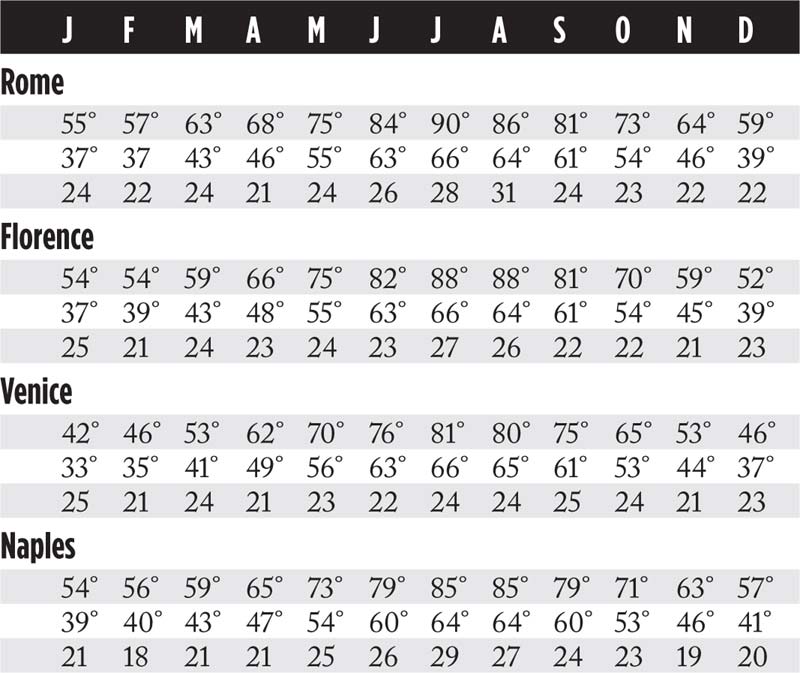
First line, average daily high; second line, average daily low; third line, average days without rain. For more detailed weather statistics for destinations in this book (as well as the rest of the world), check Wunderground.com.
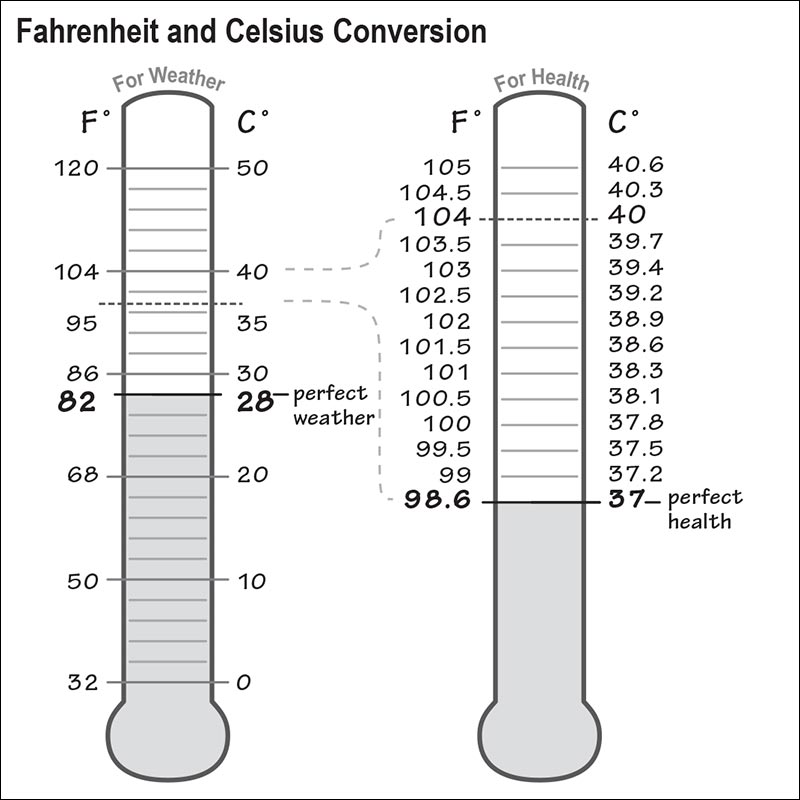
Europe takes its temperature using the Celsius scale, while we opt for Fahrenheit. For a rough conversion from Celsius to Fahrenheit, double the number and add 30. For weather, remember that 28°C is 82°F—perfect. For health, 37°C is just right. At a launderette, 30°C is cold, 40°C is warm (usually the default setting), 60°C is hot, and 95°C is boiling. Your air-conditioner should be set at about 20°C.
Whether you’re traveling for five days or five weeks, you won’t need more than this. Pack light to enjoy the sweet freedom of true mobility.
 5 shirts: long- & short-sleeve
2 pairs pants (or skirts/capris)
1 pair shorts
5 pairs underwear & socks
1 pair walking shoes
Sweater or warm layer
Rainproof jacket with hood
Tie, scarf, belt, and/or hat
Swimsuit
Sleepwear/loungewear
Debit card(s)
Credit card(s)
Hard cash (US $100-200)
Money belt
Passport
Other required ID: Vaccine card/Covid test, entry visa, etc.
Driver’s license, student ID, hostel card, etc.
Tickets & confirmations: flights, hotels, trains, rail pass, car rental, sight entries
Photocopies of important documents
Insurance details
Guidebooks & maps
Mobile phone
Camera & related gear
Tablet/ebook reader/laptop
Headphones/earbuds
Chargers & batteries
Phone car charger & mount (or GPS device)
Plug adapters
Basics: soap, shampoo, toothbrush, toothpaste, floss, deodorant, sunscreen, brush/comb, etc.
Medicines & vitamins
First-aid kit
Glasses/contacts/sunglasses
Face masks & hand sanitizer
Sewing kit
Packet of tissues (for WC)
Earplugs
Daypack
Sealable plastic baggies
Laundry supplies: soap, laundry bag, clothesline, spot remover
Small umbrella
Travel alarm/watch
Notepad & pen
Journal
Second pair of shoes (flip-flops, sandals, tennis shoes, boots)
Travel hairdryer
Picnic supplies
Disinfecting wipes
Water bottle
Fold-up tote bag
Small flashlight
Mini binoculars
Small towel or washcloth
Inflatable pillow/neck rest
Tiny lock
Address list (to mail postcards)
Extra passport photos
Italian Survival Phrases
| Hello. (informal) | Ciao. chow |
| Good day. | Buongiorno. bwohn-jor-noh |
| Do you speak English? | Parla inglese? par-lah een-gleh-zay |
| Yes. / No. | Si. / No. see / noh |
| I (don’t) understand. | (Non) capisco. (nohn) kah-pees-koh |
| Please. | Per favore. pehr fah-voh-ray |
| Thank you. | Grazie. graht-see-ay |
| You’re welcome. | Prego. preh-go |
| I’m sorry. | Mi dispiace. mee dee-spee-ah-chay |
| Excuse me. | Mi scusi. mee skoo-zee |
| No problem. | Non c’è problema. nohn cheh proh-bleh-mah |
| Goodbye. | Arrivederci. ah-ree-veh-dehr-chee |
| one / two / three | uno / due / tre oo-noh / doo-ay / tray |
| four / five / six | quattro / cinque / sei kwah-troh / cheeng-kway / seh-ee |
| seven / eight | sette / otto seh-tay / oh-toh |
| nine / ten | nove / dieci noh-vay / dee-ay-chee |
| How much is it? | Quanto costa? kwahn-toh koh-stah |
| Write it? | Me lo scrive? may loh skree-vay |
| Is it free? | È gratis? eh grah-tees |
| Is it included? | È incluso? eh een-kloo-zoh |
| Where can I buy / find...? | Dove posso comprare / trovare...? doh-vay poh-soh kohm-prah-ray / troh-vah-ray |
| I’d like / We’d like... | Vorrei / Vorremmo… voh-reh-ee / voh-reh-moh |
| ...a room. | ...una camera. oo-nah kah-meh-rah |
| ...a ticket to ___. | ...un biglietto per ___. oon beel-yeh-toh pehr ___ |
| Is it possible? | È possibile? eh poh-see-bee-lay |
| Where is...? | Dov’è...? doh-veh |
| ...the train station | ...la stazione lah staht-see-oh-nay |
| ...tourist information | ...informazioni turisti een-for-maht-see-oh-nee too-ree-stee |
| ...the bathroom | …il bagno eel bahn-yoh |
| men / women | uomini, signori / donne, signore woh-mee-nee, seen-yoh-ree / doh-nay, seen-yoh-ray |
| left / right / straight | sinistra / destra / sempre dritto see-nee-strah / deh-strah / sehm-pray dree-toh |
| What time does this open / close? | A che ora apre / chiude? ah kay oh-rah ah-pray / kee-oo-day |
| At what time? | A che ora? ah kay oh-rah |
| Just a moment. | Un momento. oon moh-mehn-toh |
| now / soon / later | adesso / presto / tardi ah-deh-soh / preh-stoh / tar-dee |
| today / tomorrow | oggi / domani oh-jee / doh-mah-nee |
In an Italian Restaurant
| I’d like / We’d like... | Vorrei / Vorremmo… voh-reh-ee / voh-reh-moh |
| ...to reserve a table for one / two. | ...prenotare un tavolo per uno / due. preh-noh-tah-ray oon tah-voh-loh pehr oo-noh / doo-ay |
| ...the menu (in English). | …il menù (in inglese). eel meh-noo (een een-gleh-zay) |
| Is this seat free? | È libero questo posto? eh lee-beh-roh kweh-stoh poh-stoh |
| service (not) included | servizio (non) compreso sehr-veet-see-oh (nohn) kohm-pray-zoh |
| cover charge | (pane e) coperto (pah-nay ay) koh-pehr-toh |
| to go | da portar via dah por-tar vee-ah |
| with / without | con / senza kohn / sehnt-sah |
| and / or | e / o ay / oh |
| breakfast / lunch / dinner | (prima) colazione / pranzo / cena (pree-mah) koh-laht-zee-oh-nay / prahn-zoh / chay-nah |
| fixed-price meal (of the day) | menù (del giorno) meh-noo (dehl jor-noh) |
| specialty of the house | specialità della casa speh-chah-lee-tah deh-lah kah-zah |
| appetizer | antipasto ahn-tee-pah-stoh |
| first course | primo (piatto) pree-moh (pee-ah-toh) |
| main course | secondo (piatto) seh-kohn-doh (pee-ah-toh) |
| side dishes | contorni kohn-tor-nee |
| cold cuts / bread / cheese | salumi / pane / formaggio sah-loo-mee / pah-nay / for-mah-joh |
| sandwich | panino pah-nee-noh |
| soup / salad | zuppa / insalata tsoo-pah / een-sah-lah-tah |
| meat / chicken | carne / pollo kar-nay / poh-loh |
| fish / seafood | pesce / frutti di mare peh-shay / froo-tee dee mah-ray |
| fruit / vegetables | frutta / verdure froo-tah / vehr-doo-ray |
| dessert | dolce dohl-chay |
| tap water | acqua del rubinetto ah-kwah dehl roo-bee-neh-toh |
| mineral water | acqua minerale ah-kwah mee-neh-rah-lay |
| still / sparkling | naturale / frizzante nah-too-rah-lay / freet-zahn-tay |
| (orange) juice | succo (d’arancia) soo-koh (dah-rahn-chah) |
| coffee / tea / milk | caffè / tè / latte kah-feh / teh / lah-tay |
| wine / beer | vino / birra vee-noh / bee-rah |
| red / white | rosso / bianco roh-soh / bee-ahn-koh |
| glass / bottle | bicchiere / bottiglia bee-kee-eh-ray / boh-teel-yah |
| Cheers! | Salute! / Cin cin! sah-loo-tay / cheen cheen |
| The bill, please. | Il conto, per favore. eel kohn-toh pehr fah-voh-ray |
| Do you accept credit cards? | Accettate carte di credito? ah-cheh-tah-tay kar-tay dee kreh-dee-toh |
| Delicious! | Delizioso! day-leet-see-oh-zoh |
For more user-friendly Italian phrases, check out Rick Steves Italian Phrase Book or Rick Steves French, Italian, & German Phrase Book.