PISA & LUCCA
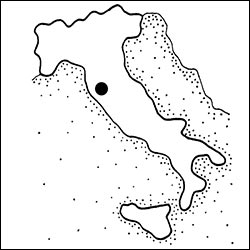
The two Tuscan towns of Pisa and Lucca, near Florence and each other, make for easy day trips. But both cities deserve more than a touristy quickie. If you can, take the time to savor Pisa’s rich architectural heritage and to bask in Lucca’s ambiance.
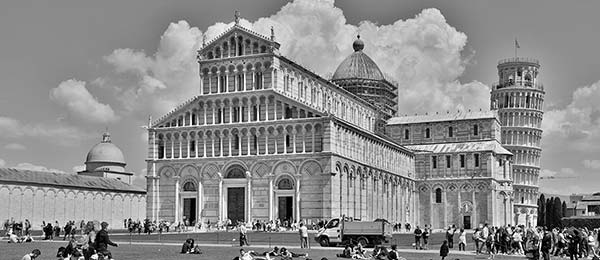
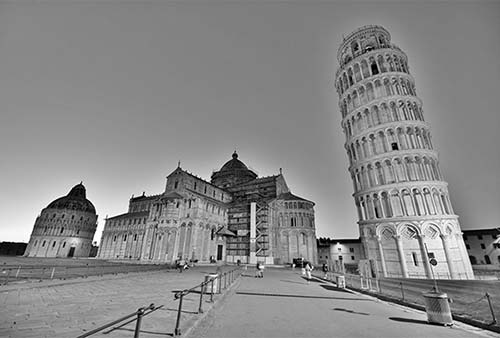
The Leaning Tower of Pisa is one of the most iconic images in the world. It’s touristy but worth a visit. Many travelers are surprised to see that the famous tower is only a small part of a gleaming white architectural complex—featuring a massive cathedral and baptistery—that dominates the grand green square called the Field of Miracles. The rest of the city is virtually tourist-free and merits a wander for its rich history, architecture, and student vibe.
Lucca, contained within its fine Renaissance wall, lacks any blockbuster sights but has a charm that causes many connoisseurs of Italy to claim it as a favorite stop. The town’s garden-topped city wall is perfect for a laid-back bike ride—the single must-do activity in this pleasant getaway.
The two towns are about 25 minutes apart by train and 50 minutes by bus (for side-tripping between Pisa and Lucca, see the “Connections” sections later). Each is about 1.5 hours (or less) by train from Florence and well served by excellent highways.
Using public transportation, you could day-trip from Florence to both cities. But with more time, stay overnight in Lucca. Take the train to Pisa in the morning, do your sightseeing, catch the bus or train to Lucca late in the afternoon, enjoy the evening scene, and stay the night. Sightsee Lucca the next day, then move on to your next destination by train.
Pisa
Famous for its tipsy Tower, Pisa (“PEE-zah”) is much more than its iconic landmark. This thriving midsize city has a wealth of history and architectural treasures, an unexpectedly fun-to-explore arcaded core, and a prestigious university. The Tower and its companion buildings at the Field of Miracles are undoubtedly a must-see. But beyond that tourist-clogged zone, Pisa feels like a real-world antidote to all that Tuscan cutesiness...a humbler version of Florence.
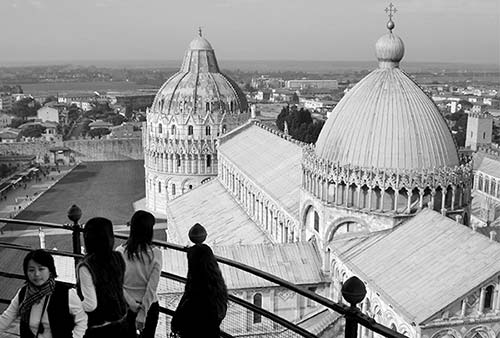
Centuries ago, Pisa was a major power—rivaling Venice and Genoa for control of the seas. City leaders erected an ensemble of Pisan Romanesque landmarks—the Duomo, Baptistery, and Tower—that float regally on the best lawn in Italy. It’s no surprise that Piazza del Duomo is now better known as the Campo dei Miracoli (Field of Miracles), for the grandness of the undertaking.
After its port silted up, Pisa was left high and dry, and eventually entered a period of steady decline...leaving those grand landmarks as reminders of its past glory.
PLANNING YOUR TIME
For most visitors, Pisa is a touristy quickie—seeing the Tower, visiting the square, and wandering through the Duomo. But it’s a shame to skip the rest of the city. Considering Pisa’s historic importance and the ambience created by its rich architectural heritage and vibrant student population, the city deserves at least a half-day visit.
To ascend the Tower, it’s smartest to book a time in advance online at OPAPisa.it. Otherwise, go straight to the ticket office upon arrival to snag an appointment—usually for a couple of hours later, especially in summer. If you’ll be seeing both the town and the Field of Miracles, plan on a six-hour stop. If just blitzing the Field of Miracles, three hours is the minimum.
Orientation to Pisa
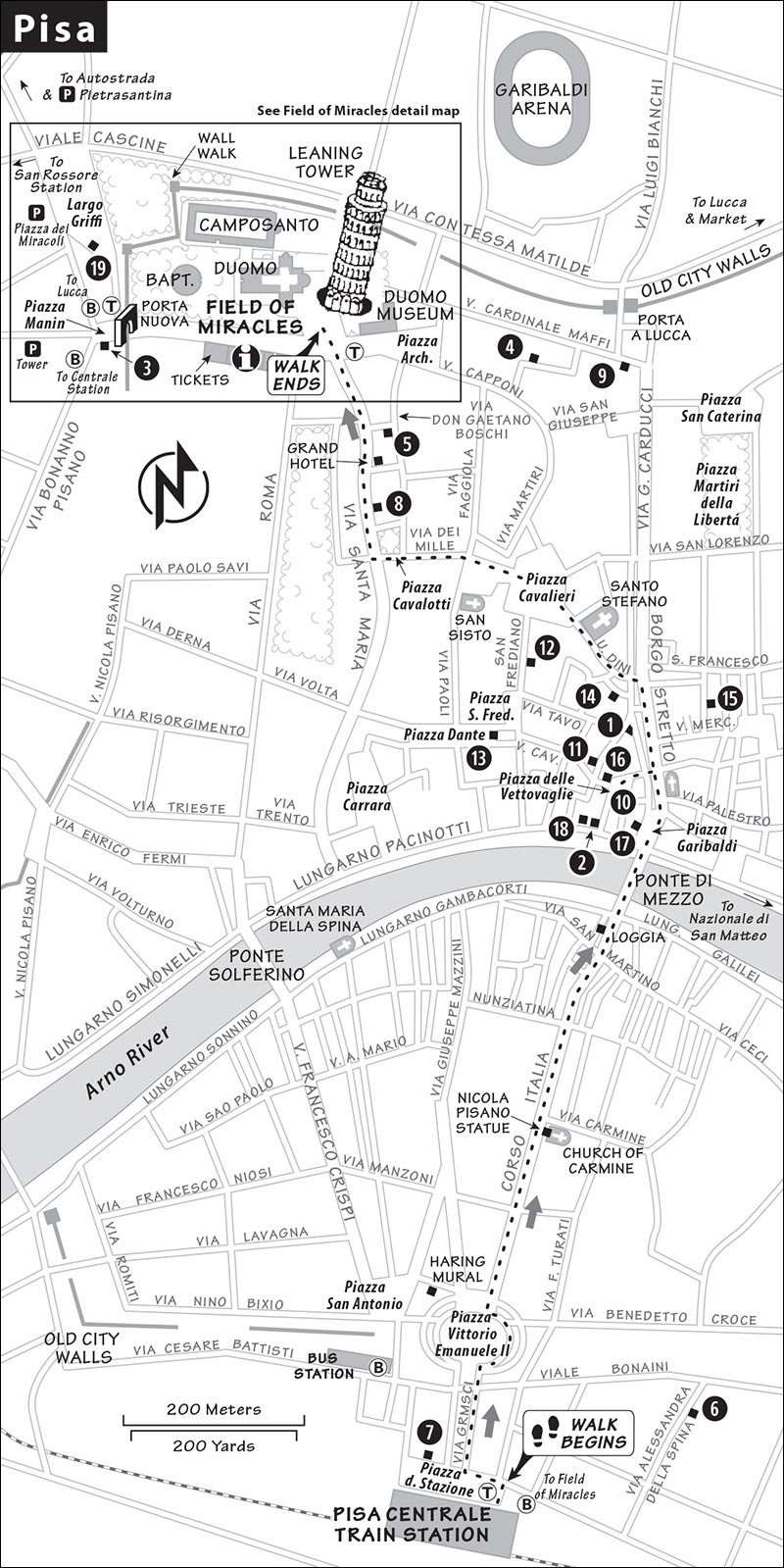
Pisa is manageable, with about 100,000 people. The city is framed on the north by the Field of Miracles (with the Leaning Tower) and on the south by Pisa Centrale train station. The Arno River flows east to west, bisecting the city. The two main streets for tourists and shoppers are Via Santa Maria (running south from the Tower) and Corso Italia/Borgo Stretto (running north from the station). A thousand years ago, the city was a fortified burg on the north side of the river between those two main streets.
TOURIST INFORMATION
The main TI is located on the Field of Miracles, next to the Duomo’s ticket office at the Museum of the Sinopias (daily 10:00-18:00, Nov-Feb until 16:00, Piazza Duomo 7, +39 050 550 100, www.turismo.pisa.it). It sells bus tickets and offers videoguide walking tours of the main sights and the city center (€5-8). For those doing Pisa as a stopover, the TI offers baggage storage (€4). In summer, there may be another TI in the town center, on Piazza XX Settembre (near the loggia, just south of the Arno).
ARRIVAL IN PISA
By Train
Most trains (and visitors) arrive at Pisa Centrale station, about a mile south of the Tower and Field of Miracles. Some trains, particularly those from Lucca or La Spezia, also stop at the smaller Pisa San Rossore station, an easy walk (less than 10 minutes) from the Tower.
Pisa Centrale Station: This station has a baggage-check desk—look for deposito bagagli, at the far-right end of platform 1 (with the tracks at your back).
To get to the Field of Miracles, you can walk (30 minutes direct, one hour if you follow my self-guided walk), take a taxi (€10, +39 050 541 600, taxi stand at station), or go by bus (which can be plagued by pickpockets).
Bus LAM Rossa (also marked L/R) stops in front of the station (to the right when you exit; bus stop at the corner). It runs about every 10 minutes to Piazza Manin, in front of the Field of Miracles (15-minute ride, stop: Torre, buy €1.50 ticket at machine or from any tobacco shop before boarding).
If you need to return to the train station from the Tower, catch bus LAM Rossa across from the BNL bank, on the opposite side of the street from where you got off (buy ticket from machine at bus stop). You’ll find taxi stands 30 yards from the Tower and in front of the BNL bank on Piazza Manin. Or see if your departing train also stops at San Rossore station (see next)—saving you the trip back to Pisa Centrale.
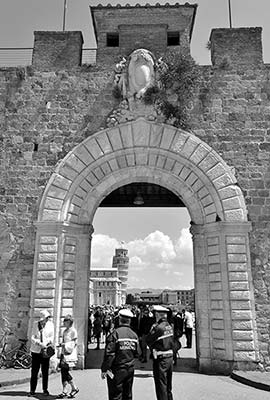
Pisa San Rossore Station: This little suburban train station is just a four-block walk (less than 10 minutes) to the Tower. On arrival, exit the underpass at platform 2L, and follow the exit signs to Torre Pendente. Once out of the station area, turn left and follow brown Torre Pendente signs on Via Andrea Pisano, heading for the Baptistery’s dome.
By Car
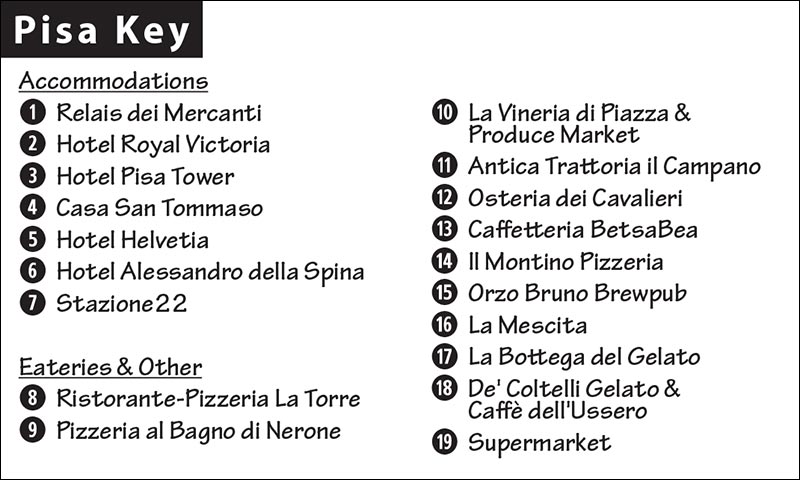
Pisa has several restricted driving areas that are monitored by camera and marked by “ZTL” signs (you could get a ticket by mail). For a quick visit, there are two pay lots just west of the tower (both around €2/hour): Parcheggio di Piazza dei Miracoli lot (enter from Via Giovanni Battista Niccolini) and Tower Parking (enter from Via Andrea Pisano). Or try the free, big Pietrasantina parking lot (which you’ll share with lots of tour buses). To find it, exit the autostrada at Pisa Nord and follow signs to Pisa (on the left), then Bus Parking.
At the center of the lot is a high-roofed bus stop where you can catch the LAM Rossa bus to Piazza Manin at the gate of the Field of Miracles (€1.50 at the parking lot’s cafeteria; bus continues to Pisa Centrale station if you’d like to follow my self-guided walk to the Field of Miracles). Or you can walk to the Tower in about 15 minutes: From the newspaper/souvenir kiosk at the east end of the lot, turn right onto the curving road. Follow the blue signs indicating a pedestrian path and brown signs pointing to the Leaning Tower. You’ll cross train tracks on the left, then continue to the right.
By Plane
For details on Pisa’s Galileo Galilei Airport, see “Pisa Connections,” later.
HELPFUL HINTS
Markets: An open-air produce market attracts picnickers to Piazza delle Vettovaglie, one block north of the Arno River near Ponte di Mezzo, and nearby Piazza Sant’Uomobuono (Mon-Sat 8:00-13:00, closed Sun). A street market—with more practical goods than food—bustles on Wednesday and Saturday mornings between Via del Brennero and Via Paparrelli (8:00-13:00, just outside of wall, about 6 blocks east of the Tower). A small flea market pops up in Via San Martino every Wednesday and Saturday morning.
Supermarket: Just to the northwest of the Field of Miracles entrance, Carrefour Express has everything you need. It sells quick lunch items and has a coffee bar and picnic area, Wi-Fi, and a clean WC free for customers (daily 10:00-18:00, Largo Cocco Griffi).
Local Guides: For tours of Pisa as well as the surrounding countryside, try Dottore Vincenzo Riolo (€150/3 hours, +39 338 211 2939, www.pisatour.it, info@pisatour.it) or Martina Manfredi (€140/3 hours, +39 328 898 2927, www.tuscanyatheart.it, info@tuscanyatheart.it).
Pisa Walk
A leisurely one-hour self-guided stroll from Pisa Centrale train station to the Tower is a great way to get acquainted with the more subtle virtues of this fine city. Because the hordes that descend daily on the Tower rarely bother with the rest of the town, you’ll find most of Pisa to be delightfully untouristy—a student-filled, classy, Old World town with an Arno-scape much like its upstream rival, Florence.
• Exit Pisa Centrale and walk straight ahead (north, under the fascist marble arcade) up Viale Antonio Gramsci to the circular square called...
Piazza Vittorio Emanuele II
The Allies considered Pisa to be strategically important in World War II, and both the train station and its main bridge were targeted for bombing. Forty percent of this district was destroyed. The piazza has been rebuilt, and now this generous public space with grass and benches is actually a lid for an underground parking lot. The circular pink building in the middle of the square, on the right, is La Bottega del Parco, a shop that sells Tuscan products and offers light meals.
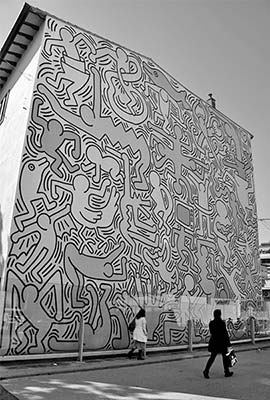
At the top of the square, on the left (by the modern gray tower with the Credito Artigiano bank), find the little piazza with a colorful bar/café that faces a mural, called Tuttomondo (Whole Wide World), painted by American artist Keith Haring. The mural, which decorates the back of a church that was bombed and rebuilt in the 1950s, is worth studying. It’s a celebration of diversity, chaos, and the liveliness of our world, vibrating with energy. Enjoy the symbolism: the cross of people, three races connected like nesting dolls holding a heart. The message of tolerance is as timely today as it was when this mural was completed in 1989. Haring (who died of AIDS in 1990) brought New York City street art into the mainstream.
• Head back to the middle of the big square and take the first left. This is Pisa’s main drag.
Corso Italia
As you leave Piazza Vittorio Emanuele II, look to the right (on the wall of the bar on the corner, under the gallery) and orient yourself with the circa-1960 wall map of Pisa with a steam train. Then follow the pedestrianized Corso Italia straight north for several blocks, toward the river. This is Pisa’s main shopping street for locals, not tourists. Students hang out and stroll here—you’ll see plenty of cheap department stores and youthful fashions.
A few blocks up, in front of the Church of Santa Maria del Carmine (on the right, at #88), meet Nicola Pisano. He and his son, Giovanni (who worked in the 13th century), represented the pinnacle of Gothic art and inspired Michelangelo. Although they were from the south, their work in their adopted town earned them the name “Pisano” (from Pisa).
Continuing on Corso Italia, just before the river, you run into a stately loggia. Like much of the city, this was built under Medici (Florentine) rule—and it resembles the markets you’ll still find in Florence. But remember that before Florence ruled Pisa, this city was an independent and strong maritime republic.
• At the Arno River, cross to the middle of the bridge.
Ponte di Mezzo
This modern bridge, the site of Pisa’s first bridge and therefore its birthplace, marks the center of Pisa. In the Middle Ages, Ponte di Mezzo (like Florence’s Ponte Vecchio) was lined with shops. It’s been destroyed several times by floods...and in 1943 by British and American bombers. Enjoy the view from the center of the bridge of the elegant mansions that line the riverbank, recalling Pisa’s days of trading glory—the cityscape feels a bit like Venice’s Grand Canal.
Looking downstream (to the left), notice the red-brick building on the right bank (the former silk merchants’ quarters) that looks like it’s about to slide into the river. Pisa sits on shifting delta sand, making construction tricky. The entire town leans.
• Cross the bridge to...
Piazza Garibaldi
This square is named for the charismatic leader of the Risorgimento, the unification movement that led to Italian independence in 1861. Knowing Pisa was strongly nationalist (and gave many of its sons to the national struggle), a wounded Garibaldi came here to be nursed back to health. Find his statue and study the left side of the bronze relief at the base of the statue to see him docking in Pisa and receiving a warm and caring welcome.
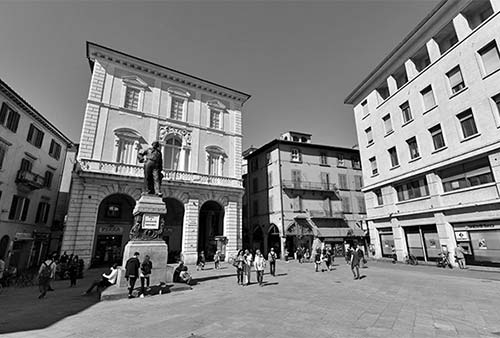
For a gelato break, stop by La Bottega del Gelato, right on this square and most Pisans’ sentimental favorite. Or, head about 100 yards downstream (to the left on Lungarno Pacinotti as you come off the bridge) to De’ Coltelli (at #23), which scoops up organic, artisanal gelato with unusual and vibrant flavors. Just beyond that, in the slouching red building (at #28), step into Caffè dell’Ussero. This venerable café has long been a hangout of both politicians...and the students bent on overthrowing them.
• Back on Piazza Garibaldi, continue north up the elegantly arcaded street called...
Borgo Stretto
Welcome to Pisa’s other main shopping street—this one higher-end. On the right, the Church of St. Michael, with its fine Pisan Romanesque facade, was likely built upon a Roman temple.
From here, look farther up the street and notice how it undulates like a flowing river. In the sixth century BC, Pisa was born when two parallel rivers were connected by canals. This street echoes the flow of one of those canals.
• Just past the church, pause to appreciate the Renaissance arcades (loggias) in every direction. Then detour left onto Via delle Colonne, and walk one block down to...
Piazza delle Vettovaglie
Pisa’s historic market square, Piazza delle Vettovaglie, is lively by day and sketchy by night. Its Renaissance loggia has hosted the fish-and-vegetable market for generations. Stalls are set up in this piazza in the morning and stay open later in the neighboring piazza to the west (Piazza Sant’Uomobuono). You could cobble together a picnic from the sandwich shops and fruit-and-veggie stalls ringing these squares, or enjoy lunch at the recommended La Vineria di Piazza trattoria (under the arcades of Piazza delle Vettovaglie).
• Return to Borgo Stretto and continue north another 100 yards, passing a modern apartment development on the right at Largo Ciro Menotti, an example of 1960s city design that followed WWII bombings. Standing out front is a statue of native son Galileo Galilei, erected in early 2020.
Carry on for a couple more short blocks, and turn left on nondescript Via Ulisse Dini (immediately at the arcade’s end, just before the pharmacy). This leads in a few short blocks to Pisa’s historic core, the square called...
Piazza dei Cavalieri (Knights’ Square)
For Pisans, this square is a place of lost glory. It feels sad, nostalgic...the only piazza I’ve seen in Italy without a bar or café. The square (site of the market, or forum, in ancient Roman times) long hosted the head of a proud and independent Pisan government. A Palazzo Vecchio-like capitol stood here during Pisa’s glory days when the city was a big maritime power in a league with Genoa and Amalfi.
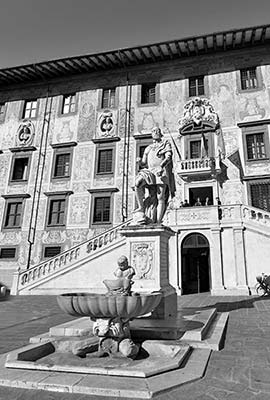
Then came a couple of centuries of Florentine rule. Walk to the statue in front of the curved building. Cosimo I, a Medici who ruled the Grand Duchy of Tuscany (and Pisa), appears noble but reminds Pisans of those dark times. Cosimo asserted Florentine rule by turning this square into a Florentine military base. The Pisan palace became the late-Renaissance Florentine military school you see here today.
From here, take Via Corsica (to the left of the clock tower). The humble, stony, 11th-century Church of San Sisto, ahead on the left, is worth a quick look. This was the standard Romanesque style that predated the more lavish Pisan Romanesque style of the Field of Miracles structures: simple bricks, assorted reused columns—some of them ancient Roman, a delightful assortment of capitals, heavy walls, and tiny windows. Its 11th-century facade was once covered with plaster and colorfully painted. You can see the remains of the Eastern-flavored ceramic bowls across the top that once shined in the sun like gems.
• Follow Via Corsica as it turns into Via dei Mille, then turn right after the little parklike square on Via Santa Maria, which leads north, becoming a touristy can-can of eateries, and finally ends at the Field of Miracles and the Tower. (Consider the Grand Hotel Duomo the border between tolerable touristy restaurants and terrible touristy restaurants nearer the Leaning Tower.)
Sights in Pisa
THE BEST OF THE FIELD OF MIRACLES
Imagine arriving in Pisa as a sailor in the 12th century, when the river came to just outside the walls surrounding this square, the church here was one of the biggest in the world, and this ensemble in gleaming white marble was the most impressive space in Christendom. Calling it the Field of Miracles (Campo dei Miracoli) would not have been hyperbole.
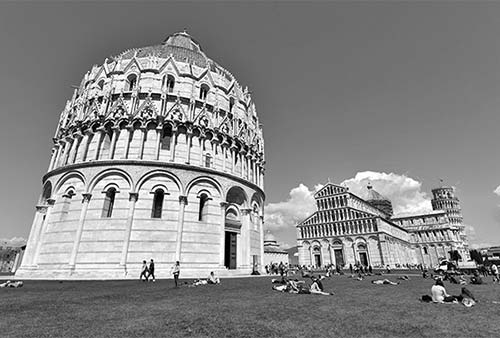
Scattered across a golf-course-green lawn are five grand buildings: the cathedral (or Duomo), its bell tower (the Leaning Tower), the Baptistery, the hospital (today’s Museum of the Sinopias), and the Camposanto Cemetery. Each building has a simple ground floor and rows of delicate columns and arches that form open-air arcades, giving the Campo a pleasant visual unity.
The style is called Pisan Romanesque. Unlike traditional Romanesque, with its heavy fortress-like feel, Pisan Romanesque is light and elegant. At ground level, most of the structures have simple half-columns and arches. On the upper levels, you’ll see a little of everything—tight rows of thin columns; pointed Gothic gables and prickly spires; Byzantine mosaics and horseshoe arches; and geometric designs (such as diamonds) and striped, colored marbles inspired by mosques in Muslim lands.
Architecturally, the Campo is unique and exotic. Traditionally, its buildings marked the main events of every Pisan’s life: christened in the Baptistery, married in the Duomo, called to celebrate by the bells in the tower, healed in the hospital, and buried in the Camposanto Cemetery.
Lining this field of artistic pearls are dozens of people who have simultaneously had the same bright idea: posing for a photo as though they’re propping up the Leaning Tower. Although the smooth green carpet looks like the ideal picnic spot—and many people are doing just that—officially, lounging on this lawn can result in a €25 fine.
▲▲▲Leaning Tower
A 15-foot lean from the vertical makes the Leaning Tower one of Europe’s most recognizable images. You can see it for free—it’s always viewable, and worth ▲▲▲ simply to ogle from the outside—or you can pay to climb nearly 300 stairs to the top.
The off-kilter Tower parallels Pisa’s history. It was started in the late 12th century, when Pisa was at its peak: one of the world’s richest, most powerful, and most sophisticated cities. Pisans had built their huge cathedral to reflect their city’s superpower status, and the cathedral’s bell tower—the Leaning Tower—was the perfect complement. But as Pisa’s power declined, the Tower reclined, and both have required a great deal of effort to prop up. Modern engineering has stabilized the Tower, so you can admire it in all its cockeyed glory.
Cost and Hours: €20 (or €27 for combo-ticket covering all Field of Miracles sights), kids under age 8 not allowed, generally April-Sept daily 9:00-20:00, until 22:00 during busy times, Oct and late March until 19:00, early March until 18:00, Nov-Feb 10:00-17:00, ticket office opens 30 minutes early, reservations smart, www.opapisa.it/en.
Getting In: Entry to the Tower is by a timed ticket good for a 30-minute visit. Every 15 minutes, 50 people can clamber up the 294 tilting steps to the top. Children ages 8-18 must stay with an adult at all times.
Reservations: Online bookings are accepted no earlier than 20 days in advance (they can sell out, so don’t wait). Choose your entry time and buy your ticket at OPAPisa.it.
Pisa’s combo-ticket scheme is designed to get you into its neglected secondary sights: the Baptistery, Camposanto Cemetery, Duomo Museum, and Museum of the Sinopias (fresco patterns). Any of those sights costs €7 individually, but the €10 combo-ticket covers all the Field of Miracle sights (except the Tower climb).
It’s free to enter the Duomo, but you either need a voucher with an appointed time, or you can get in anytime if you have any other ticket (the €7 or €10 version). The Tower by itself costs €20 (€27 includes the Tower plus all the other sights).
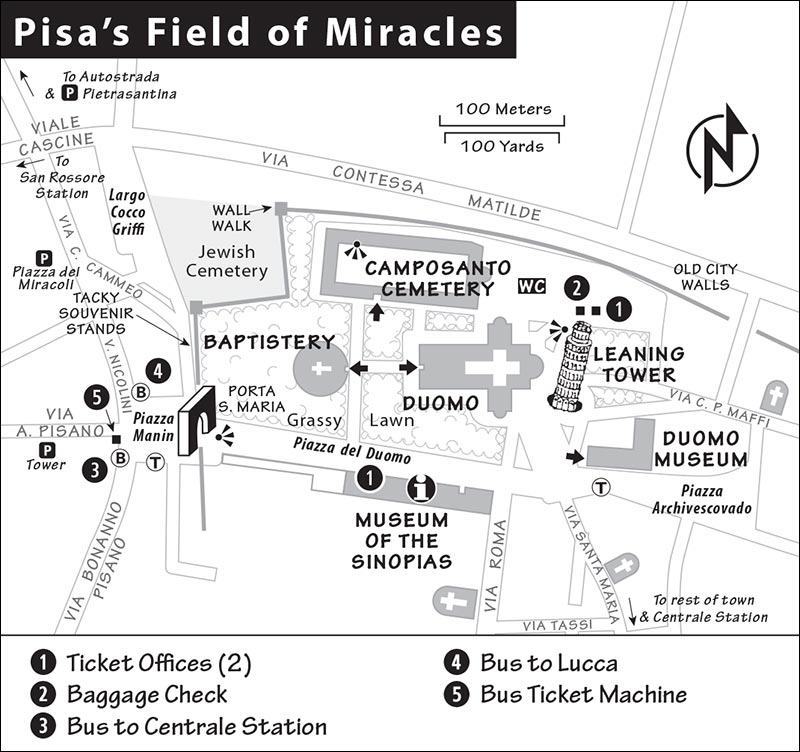
You can get the Duomo voucher and any of these tickets from either ticket office on the Field of Miracles: One is behind the Leaning Tower and the other is at the Museum of the Sinopias (near the TI, less crowded). It’s also possible to buy tickets in advance online at OPAPisa.it (no sooner than 20 days ahead of your visit; Duomo voucher not available online).
And what about entering the Tower? Is it worth that hefty price tag—and a likely wait to enter? It’s a minor thrill to clomp up those twisty stairs, and the view from the top is enjoyable. But Pisa isn’t particularly scenic, and it’s a lot of expense and hassle for a view. Unless climbing the Tower is what you came to do, the real thrill comes from seeing it from the outside.
To reserve in person, go to either ticket office: behind the Tower on the left (in the yellow building) or (less crowded) at the Museum of the Sinopias.
Planning Your Time: In summer, for same-day entry, you’ll likely wait 2-3 hours before going up (see the rest of the monuments and grab lunch while waiting).
With a reservation, arrive at least 15 minutes ahead of your entry time or you may not be allowed in. It’s busiest between 12:00 and 15:00. If you come after 18:00 there’s generally no line at all...on my last visit, I was the only one climbing the Tower at 19:00.
Baggage Check: You can’t take anything up the Tower other than your phone or camera. Day-bag-size lockers are available at the ticket office next to the Tower—show your ticket to check your bag. You may check your bag 15 minutes before your reservation time and must pick it up immediately after your Tower visit.
Caution: The railings are skinny, the steps are slanted, there are no handrails, and rain makes the marble slippery—all in all, it’s more dizzying than you might expect. Anyone with balance issues of any sort should think twice before ascending.
The Tower and Its Story
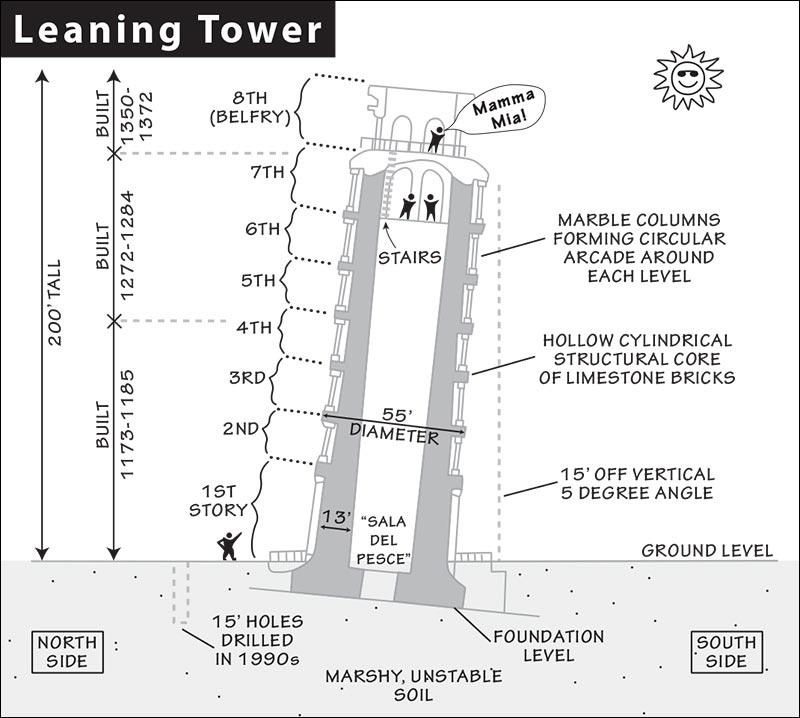
Rising up alongside the cathedral, the Tower is nearly 200 feet tall and 55 feet wide, weighing 14,000 tons and currently leaning at a five-degree angle (15 feet off the vertical axis). It started to lean almost immediately after construction began (it would take two centuries to finish the structure). Count the eight stories—a simple base, six stories of columns (forming arcades), and a belfry on top. The inner structural core is a hollow cylinder built of limestone bricks, faced with white marble. The thin columns of the open-air arcades make the heavy Tower seem light and graceful.
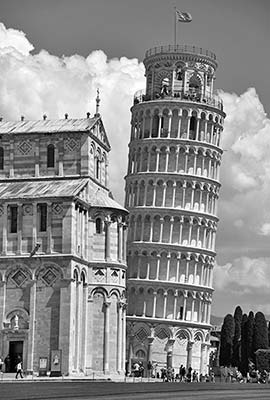
The Building of the Tower: The Tower was built over two centuries by at least three architects. You can see how the successive architects tried to correct the leaning problem—once halfway up (after the fourth story), once at the belfry on the top.
The first stones were laid in 1173, probably under the direction of the architect Bonanno Pisano (who also designed the Duomo’s bronze back door). Five years later, just as the base and the first arcade were finished, someone said, “Is it just me, or does that look crooked?” The heavy Tower—resting on a very shallow 13-foot foundation—was sinking on the south side into the marshy, multilayered, unstable soil. (Actually, all of the Campo’s buildings tilt somewhat.) The builders carried on anyway, until they’d finished four stories (the base, plus three arcade floors). Then, construction suddenly halted—no one knows why—and for a century the Tower sat half-finished and visibly leaning.
Around 1272, the next architect, Giovanni di Simone, tried to correct the problem by angling the next three stories backward, in the opposite direction of the lean. The project then again sat mysteriously idle for nearly another century. Finally, Tommaso Pisano put the belfry on the top (c. 1350-1372), also kinking it to overcome the leaning.
Man Versus Gravity: In an effort to stop the Tower’s slow-motion fall, well-intentioned engineers in 1838 pumped out groundwater around it. But they only further destabilized the Tower, causing its lean rate to increase to a millimeter per year.
As well as gravity, erosion threatens the Tower. Since its construction, 135 of the Tower’s 180 marble columns have had to be replaced. Stone decay, deposits of lime and calcium phosphate, accumulations of dirt and moss, cracking from the stress of the lean—all of these are factors in its decline.
It got so bad that in 1990 the Tower was closed for repairs, and $30 million was spent cleaning it and trying to stabilize it. Engineers dried the soil with pipes containing liquid nitrogen, anchored the Tower to the ground with steel cables, and buried 600 tons of lead on the north side as a counterweight (not visible)—all with little success. The breakthrough came when they drilled 15-foot-long holes in the ground on the north side and sucked out 60 tons of soil, allowing the Tower to sink on the north side and straighten out its lean by about six inches.
All the work to shore up, straighten, and clean the Tower has probably turned the clock back a few centuries.
▲▲Duomo (Cathedral)
The huge Pisan Romanesque cathedral, with its carved pulpit by Giovanni Pisano, is artistically more important than its more famous bell tower. Budget some sightseeing time for the church’s artistic and historic treasures.
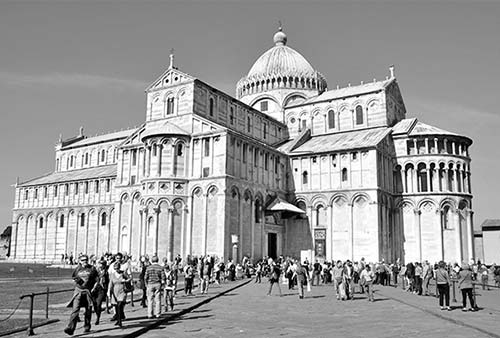
Cost and Hours: Free. If you have a ticket for any Field of Miracles sight, you can walk right in; otherwise, pick up a voucher with an entry time at either ticket office (voucher not available in advance online; see the “Field of Miracles Tickets” sidebar, earlier). Hours vary (check ahead), but the interior always opens at 10:00, after morning Mass; it closes April-Sept at 20:00, Oct at 19:00, Nov-Feb at 17:00 (also 13:00-14:00), March at 18:00.
Dress Code: Shorts are OK as long as they’re not too short, and shoulders should be covered (although it’s not really enforced).
 Self-Guided Tour
The Duomo is the centerpiece of the Field of Miracles’ complex of religious buildings. Begun in 1063, it was financed by a galley-load of booty ransacked that year from the Muslim-held capital of Palermo, Sicily. The architect Buschetto created the frilly Pisan Romanesque style that set the tone for the Baptistery and Tower that followed. In the 1150s, the architect Rainaldo added the impressive main-entrance facade.
Exterior View: The lower half of the church is simple Romanesque, with blind arches. The upper half has four rows of columns that form arcades. Stripes of black-and-white marble, mosaics, stone inlay, and even recycled Roman tombstones complete the decoration.
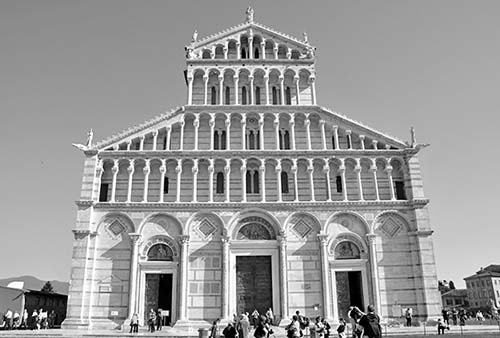
• Enter the church at the west facade, opposite the Baptistery.
Nave: The 320-foot nave was designed to be the longest in Christendom when it was built. It’s modeled on a traditional Roman basilica, with 68 Corinthian columns of granite (most shipped from Elba and Corsica in 1063) dividing the space into five aisles. But the striped marble and arches-on-columns give the nave an exotic, almost mosque-like feel.
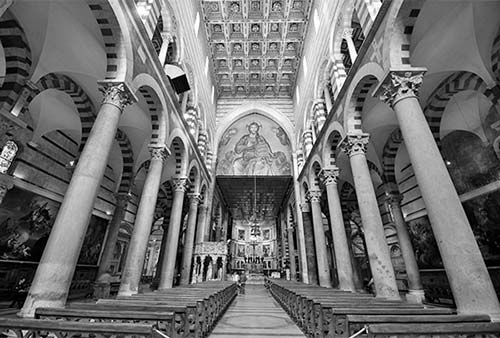
• Walk up the nave, almost to the transept. Hanging from the ceiling of the central nave is...
Galileo’s Lamp: The bronze incense burner is said to be the one (actually, this is a replacement of the original) that caught the teenage Galileo’s attention one day in church. According to legend, someone left a church door open, and a gust of wind set the lamp swinging. Galileo timed the swings and realized that the burner swung back and forth in the same amount of time regardless of how wide the arc. This pendulum motion was a constant that allowed Galileo to measure our ever-changing universe.
• High up in the apse (behind the altar) is the...
Apse Mosaic: The mosaic (c. 1300, partly done by the great artist Cimabue) shows Christ Pantocrator (“All Powerful”) between Mary and St. John the Evangelist. The Pantocrator image of Christ is standard fare among Eastern Orthodox Christians—that is, the “Byzantine” people who were Pisa’s partners in trade.
Dome: Look up into the dome. Because this church is dedicated to Mary—the patron and protector of the city—you’ll see the Assumption of Mary. As the heavens open, and rings of saints and angels spiral upward, a hazy God greets Mary (in red). Beneath the dome is an inlaid-marble, Cosmati-style mosaic floor. The modern (and therefore controversial) marble altar and pulpit were carved by a Florentine artist in 2002.
• Next to Galileo’s Lamp, you’ll find...
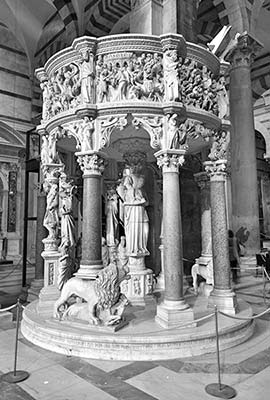
Giovanni Pisano’s Pulpit (1301-1311): The 15-foot-tall, octagonal pulpit by Giovanni Pisano (c. 1240-1319) is the last, biggest, and most complex of the four pulpits created by the Pisano father-and-son team. Four hundred intricately sculpted figures smother the pulpit. The creamy-white Carrara marble has the look and feel of carved French ivories, which the Pisanos loved. At the base, lions roar and crouch over their prey, symbolizing how Christ (the lion) triumphs over Satan (the horse, as in the Four Horsemen of the Apocalypse).
Four of the pulpit’s support “columns” are statues. The central “column” features three graceful ladies representing Faith, Hope, and Charity. Around the top of the pulpit, Christ’s life unfolds in a series of panels. Since the panels are curved and unframed, you “read” Christ’s life in a continuous scroll.
• Find the following two sights in the right (south) transept.
St. Ranieri’s Body: In a glass-lined casket on the altar lies the skeleton of Pisa’s patron saint, encased in silver at his head, with his hair shirt covering his body.
• Look on the wall to the left to find...
Emperor Henry VII’s Tomb: Pause at the tomb of Holy Roman Emperor Henry VII, whose untimely death plunged Pisa into its centuries-long decline. Henry lies sleeping, arms folded, his head turned to the side, resting on a soft pillow. This German king (c. 1275-1313) invaded Italy and was welcomed by Pisans as a nonpartisan leader who could bring peace to Italy’s warring Guelphs and Ghibellines. In 1312, he was crowned emperor by the pope in Rome. He was preparing to polish off the last opposition when he caught a fever and died.
• Exit the church, turn left, and walk around to its back end (facing the Tower), where you’ll find (under a canopy) the...
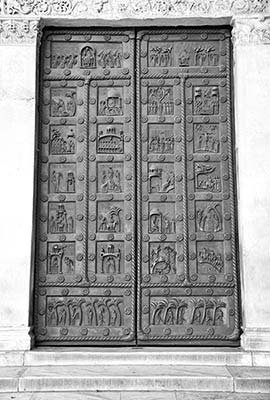
Bronze Doors of St. Ranieri (Porta San Ranieri): Designed by Bonanno Pisano (c. 1186)—who is thought by some historians to have been the Tower’s first architect—the doors have 24 panels that show Christ’s story using the same simple, skinny figures found in Byzantine icons. (The originals are housed in the Duomo Museum.)
THE REST OF THE FIELD OF MIRACLES
The Leaning Tower nearly steals the show from the massive cathedral, which muscles out the other sights. But don’t neglect the rest of the Field of Miracles: the Baptistery, Camposanto Cemetery, Museum of the Sinopias, and Duomo Museum. To do all of these sights takes about two hours. Start with the Baptistery, located in front of the Duomo’s facade, and then head for Camposanto Cemetery, on the north side of the Field of Miracles. With sufficient interest and time, you can visit the Museum of the Sinopias, across the street from the Baptistery entrance. The Duomo Museum, behind the Tower, makes a good segue from a visit to the Duomo.
Cost and Hours: €7 for one sight, €10 for all of the sights. All four sights share the same schedule: daily April-Sept 9:00-20:00, Oct 9:00-19:00, Nov-Feb 10:00-17:00, March 9:00-18:00.
▲Baptistery
Pisa’s Baptistery is Italy’s biggest. It’s interesting for its pulpit and interior ambience, and especially great for its acoustics.
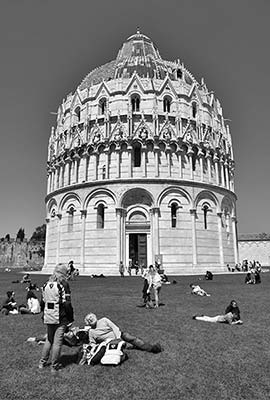
Visiting the Baptistery: The building is 180 feet tall—John the Baptist on top is almost eye-to-eye with the tourists looking out from the nearly 200-foot Leaning Tower. Notice that the Baptistery leans about 1.5 feet to the north, toward the Tower (which leans 15 feet to the south). The building (begun in 1153) is modeled on the circular-domed Church of the Holy Sepulchre in Jerusalem, seen by Pisan Crusaders who occupied Jerusalem in 1099.
From the outside, you see three distinct sections, which reflect the changing tastes of the years spent building it: simple Romanesque blind arches at the base (1153) and ornate Gothic spires and pointed arches in the middle (1250). The roofing looks mismatched, but was intentionally designed with red clay tiles on the seaward side and lead tiles (more prestigious but prone to corrosion) on the sheltered east side. The statues of the midsection are by Nicola Pisano (c. 1220-1278, Giovanni’s father), who sculpted the pulpit inside.
Inside, it’s simple, spacious, and baptized with light. Tall arches atop thin columns once again echo the Campo’s architectural theme of arches above blank spaces. The columns encircle just a few pieces of religious furniture.
In the center sits the beautiful marble octagonal font (1246). A statue of the first Baptist, John the Baptist, stretches out his hand and says, “Welcome to my Baptistery.” The font contains plenty of space for baptizing adults by immersion (the medieval custom), plus four wells for dunking babies.
Baptismal fonts—where sinners symbolically die and are reborn—are traditionally octagons. The shape suggests a cross (symbolizing Christ’s death), and the eight sides represent the eighth day of Christ’s ordeal, when he was resurrected. The font’s sides, carved with inlaid multicolored marble, feature circle-in-a-square patterns, indicating the interlocking of heaven and earth. The circles are studded with interesting faces, both human and animal. Behind the font, the altar features similar inlaid-marble work.
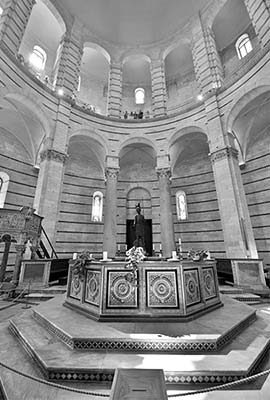
On your left is the pulpit created by Nicola Pisano. It’s the first authenticated (signed) work by the “Giotto of sculpture,” working in what came to be called the Renaissance style. The freestanding sculpture has classical columns, realistic people and animals, and 3-D effects in the carved panels.
The 15-foot-tall, hexagonal pulpit is the earliest (1260) and simplest of the four pulpits by the Pisano father-and-son team. Nicola, born in southern Italy, settled in Pisa, where he found steady work. Ten-year-old Giovanni learned the art of pulpit-making here at the feet of his father.
The speaker’s platform stands on columns that rest on the backs of animals, representing Christianity’s triumph over paganism. The white Carrara-marble panels are framed by dark rose-colored marble, making a pleasant contrast. Make a sound in here and it echoes for a good 10 seconds. A priest standing at the baptismal font could sing three tones within those 10 seconds—“Ave Maria”—and make a chord, singing haunting harmonies with himself. Today, a security guard sings every 30 minutes (on the hour and half-hour), starting when the doors open in the morning.
You can climb 75 steps to the interior gallery (midway up) for an impressive view back down on the baptismal font. Try to be here when the guard sings.
▲Camposanto Cemetery
Until people started getting excited about the Leaning Tower around 1900, the big attraction in Pisa was its dreamy and exquisite cemetery, the Camposanto (built 1278-1465). Highlights are the building’s cloistered interior courtyard, some ancient sarcophagi, and the large 14th-century fresco, The Triumph of Death.
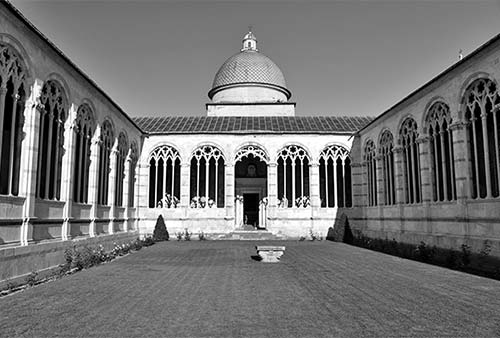
Visiting the Cemetery: The delightful open-air courtyard is surrounded by an arcade with intricately carved tracery in the arches. The courtyard’s grass grows on special dirt shipped here by returning 12th-century Crusaders from Jerusalem’s Mount Calvary, where Christ was crucified. If you couldn’t be buried in the Holy Land, you could be buried in dirt from the Holy Land.
Displayed in the arcade are dozens of ancient Roman sarcophagi. These coffins, which originally held dead Romans, were reused by medieval big shots. In anticipation of death, a wealthy Pisan would shop around, choose a good sarcophagus, and chip his message into it. When he died, his marble box was placed with the others around the exterior of the cathedral. Great sculptors such as Nicola and Giovanni Pisano passed them daily, gaining inspiration.
After decorating these corridors for 600 years, the frescoes of Camposanto Cemetery were badly damaged in World War II. They’ve been under restoration ever since. Along these walls, you’ll see the ones that have been returned to their original position, including the masterpiece Triumph of Death. This 1,000-square-foot fresco (c. 1340, by a 14th-century master) captures late-medieval Europe’s concern with death in a fascinating composition.
In the lower left, a parade of wealthy (finely dressed) and powerful (some with crowns) hedonists are riding gaily through the countryside when they come across a hermit-monk who blocks their path and shows them three corpses in coffins. Confronted with death, they each react differently—a woman puts her hand thoughtfully to her chin, a man holds his nose against the stench, while a horse leans in for a better whiff. Above them, a monk scours the Bible for the meaning of death.
Elsewhere, young people gather in a garden to play music (symbolizing earthly pleasure), oblivious to the death around them.
This is just one of four big frescoes: Next to The Triumph of Death are The Last Judgment, the extremely graphic Hell, and The Pious Life (a handbook for avoiding hell). A posted information plaque near each fresco describes the intense scenes.
Museum of the Sinopias (Museo delle Sinopie)
Housed in a 13th-century hospital, this museum features the original preliminary sketches (sinopias) for the Camposanto’s frescoes. If you loved The Triumph of Death and others in the Camposanto, or if you’re interested in fresco technique, this museum is worthwhile.
Whether or not you pay to go in, you can watch two free videos in the entry: a 15-minute story of the Tower, its tilt, and its fix.
Once inside the turnstile, the stars of this museum are the sinopias: sketches made in red paint directly on the wall, designed to guide the making of the final colored fresco. The master always did the sinopia himself. It was a way for him (and for those who paid for the work) to see exactly how the scene would look in its designated spot. If it wasn’t quite right, the master changed a detail here and there. When satisfied with the design, the master and his team covered the sinopia with a thin layer of plaster and, while it was still wet, quickly filled in the color and details, producing the final frescoes (now on display at the Camposanto). These sinopias—never meant to be seen—were uncovered by the bombing and restoration of the Camposanto and brought here.
Duomo Museum (Museo dell’Opera del Duomo)
Near the Tower is the entrance to the Duomo Museum, which houses many of the original statues and much of the artwork that once adorned the Campo’s buildings (where copies stand today), notably the statues by Nicola and Giovanni Pisano. You’ll circle through a modern space with two manageable floors of well-presented artifacts, all described in English.
Starting on the ground floor, you’ll see the Duomo’s original 12th-century bronze doors of St. Ranieri, designed by Bonanno Pisano, with scenes from the life of Jesus. You’ll continue past weather-worn stone statues (from the Pisanos) and a row of carved human heads in boxes, which used to surround the base of the cathedral. Upstairs you’ll see fine inlaid woodwork that once graced the choir stalls of the sacristy, treasures of the cathedral, and illuminated manuscripts. Be sure to step out to the upper gallery (with a café) for some fresh air and views of the Tower and the Duomo beyond.
Sleeping in Pisa
NORTH OF THE RIVER, NEAR THE TOWER
$$$ Relais dei Mercanti is tucked away in the historic core of the city, on a lively square that throbs on Friday and Saturday. The six rooms are bright, modern, and well appointed, with shiny marble floors and bathrooms (air-con, Piazza Sant’Omobono 16, +39 050 520 2135, www.relaisdeimercanti.it, relaisdeimercanti@gmail.com).
$$ Hotel Royal Victoria is like sleeping in a museum. Overlooking the Arno River, it’s been run by the Piegaja family since 1837. Its 38 creaky, antique-filled rooms with bygone plumbing and chipped plaster may not be for everybody, but the elegant ambience is ideal for romantics. The location—midway between the Tower and Pisa Centrale train station—is the most atmospheric of my listings, though it faces a busy riverfront road (RS%, family rooms, air-con in most rooms, elevator, tight pay parking garage, lush communal terrace, Lungarno Pacinotti 12, +39 050 940 111, www.royalvictoria.it, post@royalvictoria.it).
$$ Hotel Pisa Tower has 12 rooms overlooking the noisy, souvenir-stand square just outside the gate to the Field of Miracles, along a busy street. But the prices are reasonable, and the proximity to the Tower is enticing (breakfast extra, family rooms, air-con, pay parking, Piazza Manin 9, +39 050 550 146, www.hotelpisatower.com, info@hotelpisatower.com).
$ Casa San Tommaso has 22 classic-feeling, homey rooms on a quiet back lane about a five-minute walk from the Tower (air-con, Via San Tommaso 13, +39 050 830 782, www.santommasopisa.com, info@santommasopisa.com, Giuliano).
$ Hotel Helvetia, a friendly, no-frills, clean, and quiet inn just 100 yards from the Tower, rents 29 economical rooms over four floors. Ask them to show you the “biggest cactus in Tuscany” in their garden courtyard...it really is (cheaper rooms with shared bath, family suites, no breakfast, ceiling fans, no elevator, Via Don G. Boschi 31, +39 050 553 084, www.pensionehelvetiapisa.com, helvetiapisatower@gmail.com, Micaele and Sandra).
SOUTH OF THE RIVER, NEAR THE TRAIN STATION
This zone is far less atmospheric than the zone near the Tower—with a lot of concrete, congestion, and loitering.
$$ Hotel Alessandro della Spina, run by Pio and family, has 16 elegant and colorful rooms, each named after a flower (air-con, elevator, pay parking, an eight-minute walk from the train station at Via Alessandro della Spina 5, +39 050 502 777, www.hoteldellaspina.it, info@hoteldellaspina.it, Louisa).
$ Stazione22 is a tidy B&B just across the piazza from the train station, perfect for a quick overnight or if your luggage is heavy. Friendly Alessandra tends her four budget rooms with a youthful warmth (some street noise, family room, breakfast extra at nearby bar, air-con, elevator, Piazza della Stazione 22, +39 327 857 5259, stazione22@gmail.com).
Eating in Pisa
A QUICK LUNCH CLOSE TO THE TOWER
The Via Santa Maria tourist strip is pedestrianized and lined with touristy eateries. From the Tower, walk past Grand Hotel Duomo to avoid the worst of the tourist traps. From there on you can find a decent (if overpriced) sandwich, pizza, or salad at any number of places. Of these, $$ Ristorante-Pizzeria La Torre (Via Santa Maria 86) has a good reputation.
$$ Pizzeria al Bagno di Nerone, a short walk from the Tower, is particularly popular with students. Belly up to the bar and grab a slice to go, or sit in their small dining room for a whole pie. Try the cecina, a crêpe-like chickpea flatbread (Wed-Mon 12:00-14:30 & 17:45-22:30, closed Tue, Largo Carlo Fedeli 26, +39 050 551 085).
REAL MEALS DEEPER IN THE TOWN CENTER
These places are within about a 10-to-15-minute walk from the Tower, near the river. Unless you’re in a huge rush, it’s well worth the extra walk for a better-quality, better-value, more memorable meal in this area.
$$ La Vineria di Piazza is a quintessential little Tuscan trattoria tucked under the arcades of Piazza delle Vettovaglie. The menu changes with the seasons, and their wine selection is high quality. Sit in the elegantly simple interior or out at tables facing the market (lunch daily 12:00-15:00, dinner Wed-Sat 20:00-23:00, Piazza delle Vettovaglie 14, +39 050 520 7846).
$$$ Antica Trattoria il Campano, just off the market square, has a typically Tuscan menu and a candlelit, stay-awhile atmosphere. The ground floor, surrounded by wine bottles, is cozier, while the upstairs—with high wood-beam ceilings—is classier (nightly 19:30-22:45, open Sat-Sun for lunch in high season, Via Cavalca 19, +39 050 580 585, Giovanna).
$$$ Osteria dei Cavalieri, on a quiet back street just off Piazza dei Cavalieri (and a bit closer to the Tower than the other listings here), seems pleasantly oblivious to the tourists and students that abound in nearby streets. The ambience is classic yet relaxed and warm, and the short menu of artfully presented local dishes—some with modern flair—is fun to explore (Mon-Tue and Thu-Sat 12:00-15:30 & 19:30-22:20, Wed 19:30-22:20 only, closed Sun, Via San Frediano 16, +39 050 580 858).
$ Caffetteria BetsaBea is basic and handy for takeaway meals, has good seating on the square, whips up hearty and creative salads—which you design with their interactive menu—and is popular for its aperitivo happy hour (Mon-Sat 8:00-18:30, closed Sun, Piazza San Frediano 6).
$ Il Montino is a rambunctious favorite for tasty, no-frills pizza. Tucked behind a church in a grubby corner deep in the old center, it has a loyal following among students. Enjoy full pies in the nuovo rustico interior or out on the alley (Mon-Sat 11:30-15:00 & 17:30-22:30, closed Sun, Vicolo del Monte 1, +39 050 598 695).
$$ Orzo Bruno—il birrifico artigiano (“the artisan brewpub”)—is a lively, rollicking brew hall filled with Pisans of all ages enjoying rock, jazz, and blues, with seven different microbrews (including a rotating tap) and a simple menu of sandwiches and cold cuts (nightly 19:00-late, a block off Borgo Stretto at Via Case Dipinte 6, +39 050 578 802).
$$ La Mescita, just off the market square, serves up pasta and meat dishes in a jazz-inspired, artsy interior (daily 12:30-14:30 & 19:30-23:00, Via Domenico Cavalca 2, +39 050 314 4680).
Pisa Connections
Pisa has excellent connections by train, bus, or car. The busy airport (popular with discount airlines) is practically downtown.
Side-Tripping to (or from) Lucca: Pisa and Lucca are well connected by train and by bus (both options are around €4), making a half-day side trip from one town to the other particularly easy.
The train takes about half as long as the bus—but getting between the Centrale train station and the Field of Miracles is time-consuming. Here’s a time-saving tip: Check if your train also stops at the Pisa San Rossore station, less than a 10-minute walk from the Field of Miracles. From the tacky souvenir zone just outside the gate, cross the busy street and continue straight ahead along Via Andrea Pisano. After two blocks, you’ll see the gray gateway to the train station on your right.
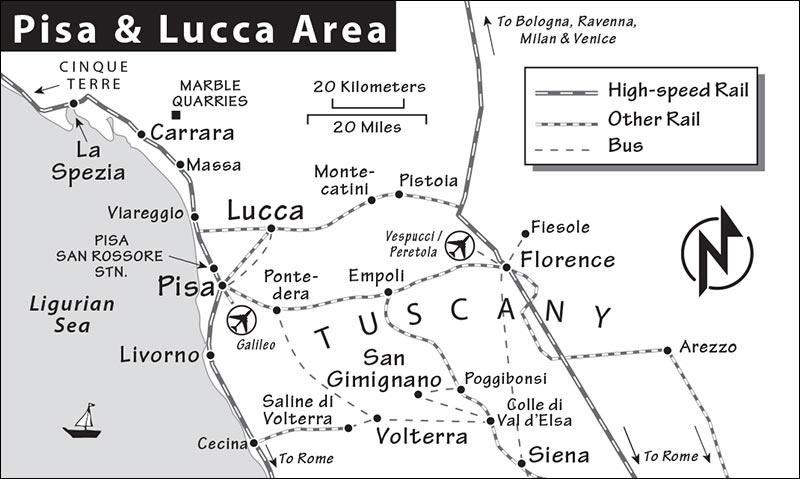
A handy bus connects the Field of Miracles with Lucca’s Piazzale Giuseppe Verdi in about 45-55 minutes (runs about hourly Mon-Sat, fewer on Sun, www.at-bus.it). To find the bus stops, from the Baptistery end of the Field of Miracles, walk straight out the gate to the edge of the souvenir-stand square. Along the busy road, the bus stop to Lucca is on the corner on your right. Buy tickets at the machine that’s kitty-corner across the street (see “Pisa’s Field of Miracles” map on here). You can also catch this bus at Pisa Centrale train station.
From Pisa Centrale Station by Train to: Florence (2/hour, 45-75 minutes), Livorno (2/hour, 20 minutes), Rome (1-2/hour, 3 hours, some change in Florence), La Spezia (at least hourly, 50-80 minutes), Monterosso (hourly, 1-1.5 hours), Siena (2/hour, 1.5 hours, some change at Empoli), Lucca (1-2/hour, 30 minutes, many also stop at Pisa San Rossore station).
By Car: The drive between Pisa and Florence is that rare case where the regular highway (free, more direct, and at least as fast) is a better deal than the autostrada.
By Plane: Pisa’s handy Galileo Galilei Airport—just two miles from the train station—handles both international and domestic flights (code: PSA, +39 050 849 300, www.pisa-airport.com). The Pisa Mover train offers an easy connection to Pisa Centrale train station, where you can catch the LAM Rossa bus—see “Arrival in Pisa,” earlier—to the Leaning Tower (€5, daily 6:00-24:00, 5-minute trip, www.pisa-mover.com). You can taxi into town for about €10.
Pisa’s airport is handy for other towns as well: To reach Lucca, Florence, the Cinque Terre, or other destinations in Italy, take the Pisa Mover to Pisa Centrale train station and connect from there. There may be direct bus connections from Pisa Airport directly to Florence’s Santa Maria Novella train station—check online or ask around.
Lucca
Surrounded by well-preserved ramparts, layered with history, alternately quaint and urbane, Lucca charms its visitors. The city is a paradox. Though it hasn’t been involved in a war since 1430, it is Italy’s most impressive fortress city, encircled by a perfectly intact wall. Most cities tear down their walls to make way for modern traffic, but Lucca’s effectively keeps out both traffic and, it seems, the stress of the modern world. Locals are very protective of their wall, which they enjoy like a community roof garden.
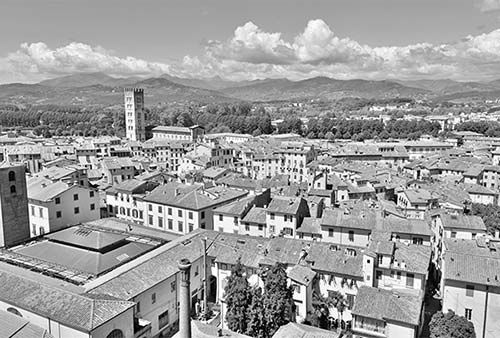
Lucca has no single monumental sight to attract tourists—it’s simply a uniquely human and undamaged, never-bombed city. Romanesque churches and shady piazzas filled with soccer-playing children seem to be around every corner. Even its touristic center—the mostly traffic-free old town—feels more local than touristy (aside from a few cruise excursions from nearby Livorno that pass through each day). Simply put, Lucca has elegance and plenty of reasons to be proud.
PLANNING YOUR TIME
Lucca is easy to enjoy. With a day in town, start with my self-guided Lucca Walk and spend the afternoon biking (or strolling) atop the wall, popping in on whatever other sights interest you, and browsing. Music lovers enjoy the evening Puccini concert. The busy sightseer can consider visiting Pisa’s Field of Miracles (with the Leaning Tower), an easy half-day side trip away by train (to Pisa San Rossore station in under 30 minutes) or bus (from downtown Lucca to the Leaning Tower in under an hour).
Orientation to Lucca
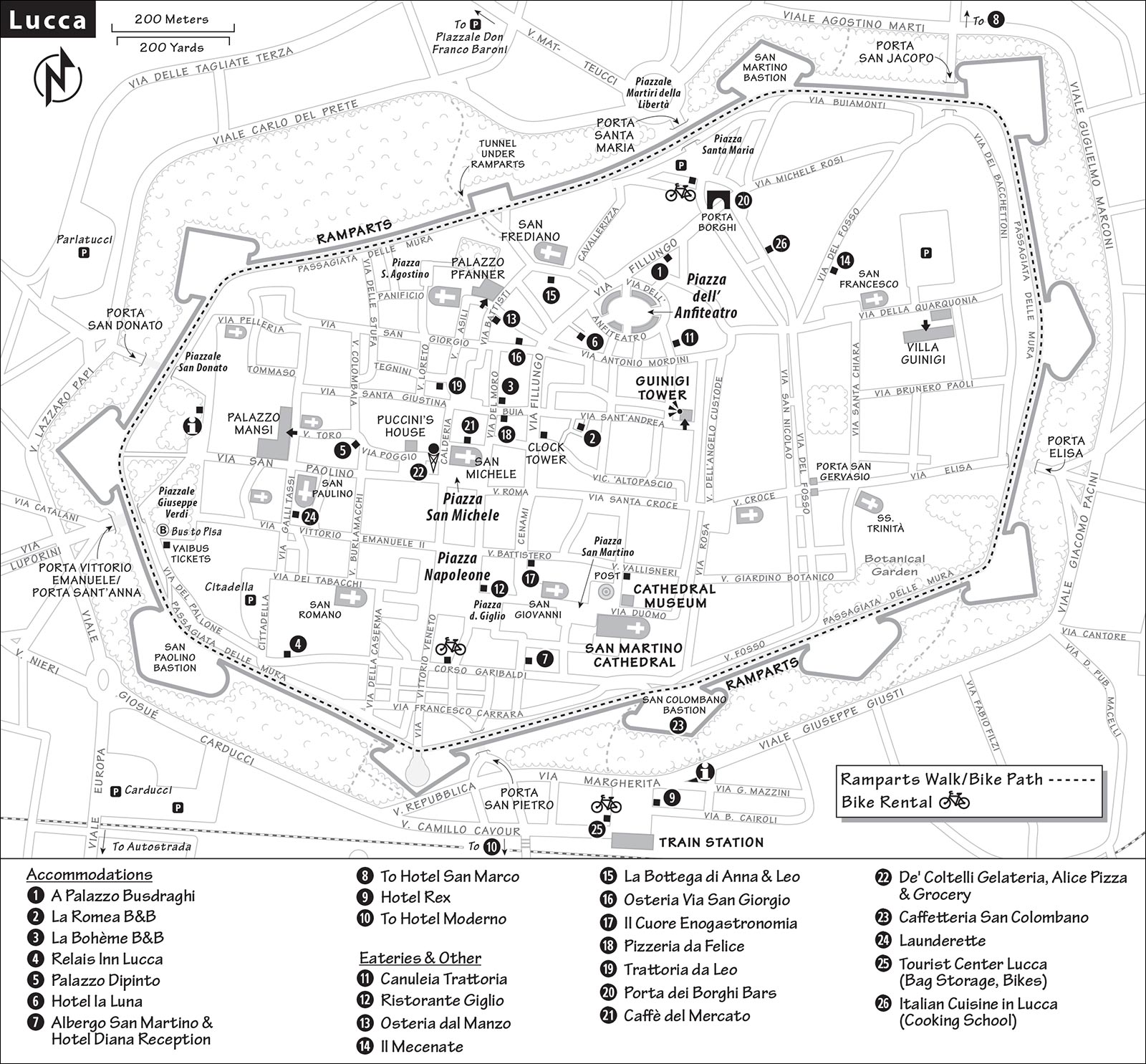
Lucca (population 87,000, with roughly 10,000 living within the town walls) is big enough to be engaging but small enough to be manageable. Everything of interest to a visitor is within the 2.5-mile-long city wall; it takes just 20 minutes to walk from one end of the old town to the other. The train station sits south of the wall (just beyond the cathedral), and the bus to and from Pisa stops just inside the western tip. My self-guided walk traces the main thoroughfares through town; venturing beyond these streets, you realize Lucca is bigger than it first seems, but its back streets are very sleepy. While the core of the town is based on an old Roman grid street plan, the surrounding areas—especially near the circular footprint of the amphitheater—are more confusing. This, combined with tall houses and a lack of consistent signage, makes Lucca easy to get lost in. Pick up the town map at your hotel and use it.
TOURIST INFORMATION
Lucca’s helpful main TI is on Piazzale Giuseppe Verdi (daily 9:30-18:30, Nov-March until 16:30, WC, +39 0583 583 150, www.turismo.lucca.it [URL inactive]). A smaller TI is close to the train station (to the right along the busy road, on Piazza Curtatone; Tue-Sat 9:30-13:30, Tue and Thu also 14:30-17:30, closed Sun-Mon, +39 0583 442 213).
ARRIVAL IN LUCCA
By Train: Lucca’s little station sits just outside its walls, to the south. Bag storage is available at the Tourist Center Lucca shop on the square in front of the station (see “Helpful Hints” for details). To reach the city center from the train station, walk toward the walls and head left, to the entry at Porta San Pietro. Or, if you don’t mind steps, go straight ahead and follow the path through the moat-like park to go up and over the wall. Taxis wait out front; otherwise, try calling +39 0583 1745 or +39 0583 164 6464; a ride from the station to Piazza dell’Anfiteatro costs about €8.
By Bus: Buses from Pisa, Viareggio, and nearby villages arrive just inside the walls, at the western end of town on Piazzale Giuseppe Verdi (near the TI).
By Car: Don’t drive within the walls: Much of the center of Lucca is a limited traffic zone (€90 fine). You’ll know when you’re about to enter it when you see the letters “ZTL” painted on the road.
If you don’t mind paying extra for proximity to the sights, consider Parking Citadella, just inside the walls (but outside the ZTL zone) in the southwestern part of town (€1.50/hour).
For longer stays, it’s cheaper to park outside the city walls. Parking is always free in Piazzale Don Franco Baroni, a 10-minute walk north of the walls. Two pay lots are also nearby: Parking Carducci, southwest of town (this is the first lot you hit after leaving the autostrada) and Parking Parlatucci, to the northwest. Or park outside the gates near the train station or on the boulevard surrounding the city (pay and display). Overnight parking (20:00-8:00) on city streets and in city lots outside the walls is usually free; check with your hotelier to be sure. For more on parking in Lucca, see www.parcheggilucca.it.
HELPFUL HINTS
Markets: Lucca’s atmospheric markets are worth visiting. On the third weekend of the month, one of the largest antique markets in Italy sprawls in the blocks between Piazza Antelminelli and Piazza San Giovanni (8:00-19:00). The last weekend of the month, local artisans sell arts and crafts around town, mainly near the cathedral (8:00-19:00). At the general market, held Wednesdays and Saturdays on Piazza Don Franco Baroni, you’ll find produce and household goods (8:30-13:00).
Shops and Museums Alert: City-run museums are often closed Sunday and/or Monday. Most shops close Sunday and Monday mornings.
Puccini Concerts: San Giovanni Church hosts themed one-hour concerts featuring a pianist and singers performing works by hometown composer Giacomo Puccini (€25 at the door, €20 in advance—buy tickets at the venue, the TI, or possibly your hotel; April-Oct nightly at 19:00, Thu-Sat off-season, www.puccinielasualucca.com).
Festivals: The Lucca Classica festival offers lots of free concerts (four days in early May, www.luccaclassica.it). On September 13 and 14, the city celebrates Volto Santo (“Holy Face”), with a procession of the treasured local crucifix and a fair in Piazza Antelminelli.
Baggage Storage: Train travelers can store bags at Tourist Center Lucca, on the left side of the square at #203 as you exit the train station (€5/day, also rents bikes, daily 9:00-19:00, Nov-March until 18:00). If arriving by bus at the other end of town, ask at the TI if there are any options.
Laundry: The self-service Lavanderia la Perfetta is near the west end of town, between Piazza San Michele and the TI (daily 7:00-22:30, Via Galli Tassi 12).
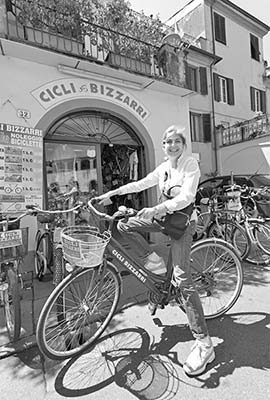
Bike Rental: A one-hour rental (ID required) gives you time for two leisurely loops around the ramparts. Several places with identical prices cluster around Piazza Santa Maria (€4/first hour, then €2/hour, €16/all day, most shops also rent tandem bikes and bike carts, helmets available on request, daily about 9:00-19:00 or until sunset). Try these easygoing shops: Antonio Poli (Piazza Santa Maria 42, +39 0583 493 787, Cristiana) and, right next to it, Cicli Bizzarri (Piazza Santa Maria 32, +39 0583 496 682, Australian Dely). At the south end, at Porta San Pietro, you’ll find Chronò (Corso Garibaldi 93, +39 0583 490 591, www.chronobikes.com). At the train station, Tourist Center Lucca is good.
Taxi: A taxi from Lucca to Pisa’s Leaning Tower costs €45. Drivers are also available for transfers (€80 to Pisa airport) or for half- and full-day unguided tours (up to 8 people, +39 0583 1745 or +39 0583 164 6464, www.luccataxi.it).
Cooking Class: Gianluca Pardini runs a cooking school called Italian Cuisine in Lucca, where you can learn to prepare and then eat a four-course Tuscan meal (€70-100/person depending on group size, 3-hour lesson plus time to dine, includes wine, reserve at least 2 days in advance, Via della Zecca 37, +39 347 678 7447, www.italiancuisine.it, info@italiancuisine.it).
Tours in Lucca
Walking Tours
The TI offers two-hour guided city walks in English and Italian, departing from the office on Piazzale Giuseppe Verdi (€10, plus €3 to enter cathedral at the end, daily April-Oct at 14:00, weekends only in winter, +39 0583 583 150). On summer weekends, they run a slightly different tour in the mornings that includes the cathedral (€15, meet at Piazza San Michele). For either tour, confirm the latest schedule and book at the TI.
The Andante...ma con Brio Music tour celebrates Lucca’s musical heritage with a music-loving local guide, visits to the Teatro del Giglio and the Puccini Museum, and musical clips along the way (€15 includes theater and museum entry, smart to book ahead, mid-April-Oct Sat at 11:00, 2.5 hours, in Italian and English, meet at Teatro del Giglio, turislucca@turislucca.com, +39 0583 342 404).
Tuscany Like a Local offers three-hour, casual, youthful, stream-of-consciousness rambles through town with stops in small bars or delis. These small-group tours are English-only and led by proud locals who love sharing Lucchese culture—past and present (basic food tour—€65, at 10:00; “bike and bites” tour—€85, at 14:00; aperitivo walk—€71, at 17:30; RS%—15 percent discount if you book direct by email, www.tuscanylocaltours.com, info@tuscanylocaltours.com, Chiara and Luca).
Local Guide
Gabriele Calabrese knows and shares his hometown well. He was a big help in creating the Lucca Walk in this chapter, and with his guidance you’ll go even deeper into the city (€130/3 hours, by foot or bike, +39 0583 342 404, mobile +39 347 788 0667, www.turislucca.com, turislucca@turislucca.com).
Lucca Walk
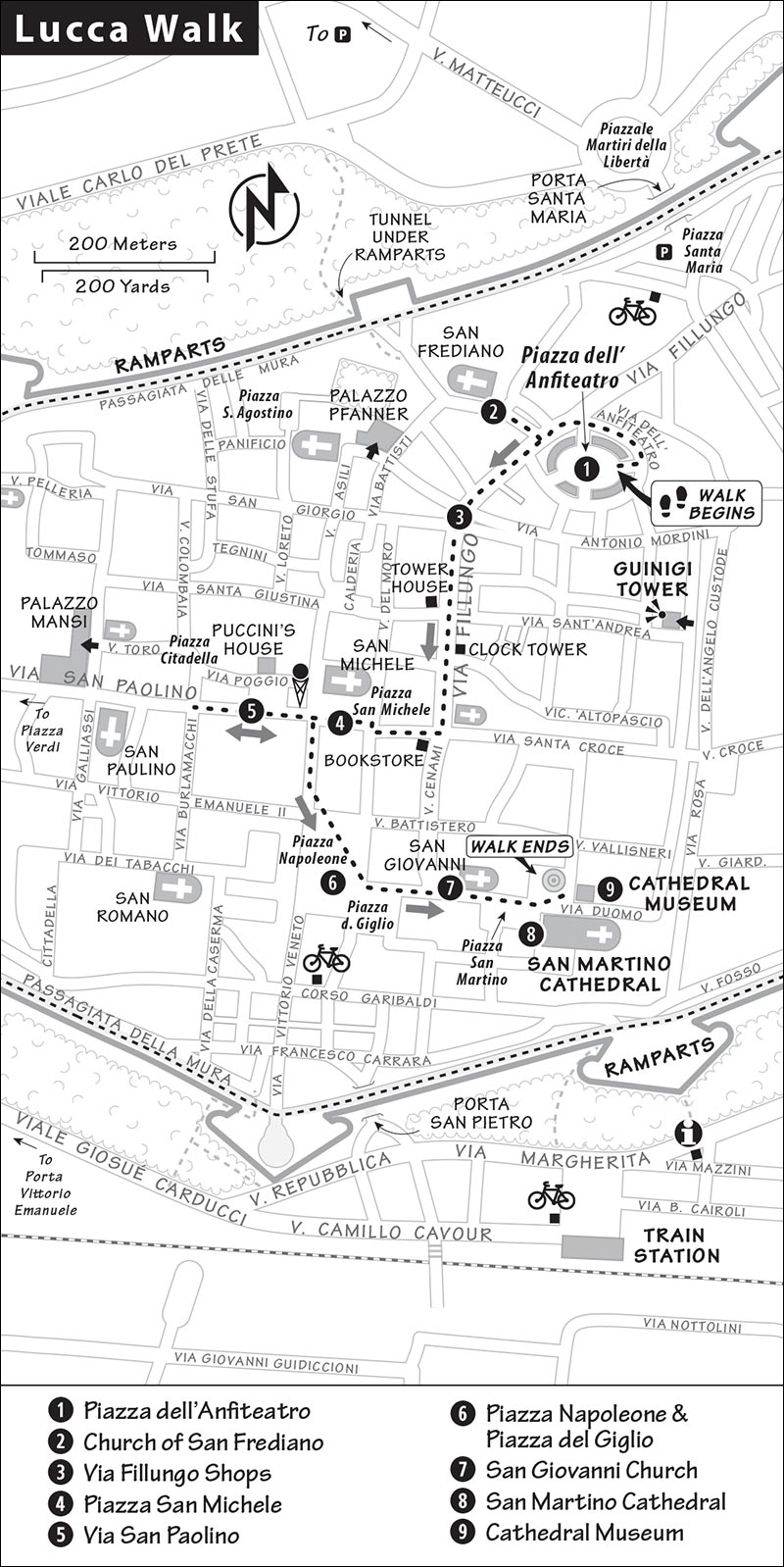
This hour-long self-guided walk (not counting time at the sights) connects Lucca’s main points of interest by way of its most entertaining streets.
• Start right in the heart of things, at Lucca’s main square. For the classic view of the circular square, stand at the east end of the oval at #29.
1 Piazza dell’Anfiteatro
The architectural ghost of a Roman amphitheater can be felt in the delightful Piazza dell’Anfiteatro. With the fall of Rome, the theater (which seated 10,000 and sat just outside the original rectangular city walls) was gradually cannibalized for its stones and inhabited by people living in a mishmash of huts. The huts were cleared away at the end of the 19th century to better show off the town’s illustrious past and make one purely secular square (every other square is dominated by a church) for the town market. The modern street level is nine feet above the original arena floor. Today, the square is a circle of touristy shops, galleries, mediocre restaurants, and inviting al fresco cafés.
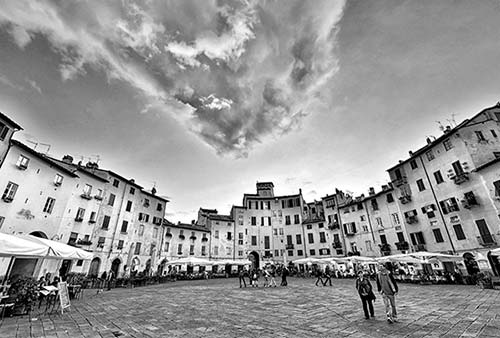
Leave the amphitheater through the arch at #29. Once on the other side, turn back, look up to study the exterior of the Roman amphitheater, and notice how medieval scavengers transformed it.
Now turn left and begin circling counterclockwise along Via Anfiteatro. For the next 100 yards or so, study the stonework and see how medieval buildings filled the ancient arches. As you approach the bigger cross street, at #2 on the left is the tempting Pizzicheria la Grotta salumi shop—worth popping into for a peek at local specialties. Then you reach the busy shopping street, Via Fillungo.
• Turn left and walk a block down Via Fillungo. On the left, at #126, check out Zizzi (with a busy loom, weaving totally Italian scarves). Then go right and cross a little square to the big church with a fine mosaic facade.
2 Church of San Frediano
This impressive church was built in 1112 by the pope to one-up Lucca’s bishop and his spiffy cathedral (which we’ll see later on this walk). Lucca was the first Mediterranean stop on the pilgrim route from northern Europe, and the pope wanted to remind pilgrims that the action, the glory, and the papacy awaited them in Rome. Therefore, he had the church made “Roman-esque.” The pure marble facade frames an early Christian Roman-style mosaic of Christ with his 12 apostles. Inside (€3, daily 9:30-17:00), there’s a notable piece of art in each corner: a 12th-century baptistery showing the story of Moses; St. Zita’s body, put there in 1278; a particularly serene Virgin Mary, depicted at the moment she gets the news that she’ll bring the Messiah into the world; and a painting on wood of the Assumption of the Virgin (c. 1510), with Doubting Thomas receiving Mary’s red belt as she ascends so he’ll doubt no more.
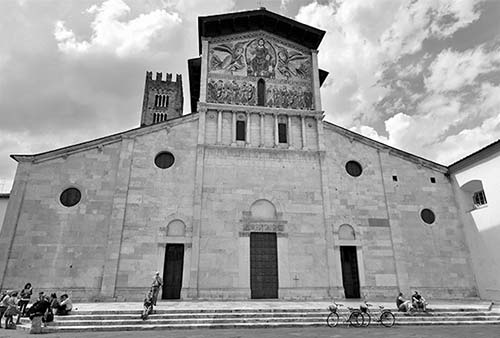
• Leaving the church, head straight back through the little square, and turn right to peruse the many...
3 Via Fillungo Shops
Lucca’s best street to stroll connects the town’s two busiest squares: Piazza dell’Anfiteatro (which we just left) and Piazza San Michele. Along the way, you’ll get a taste of Lucca’s rich past, including several elegant, century-old storefronts.
Head down the street. On the left, you’ll pass Piazza degli Scapellini, with market stalls and another entrance into Piazza dell’Anfiteatro.
As you stroll, notice how many of the original storefront paintings, reliefs, and mosaics survive—even if today’s shopkeeper sells something entirely different. Observe the warm and convivial small-town vibe on the street. Notice also the powerful heritage of shops named for the families that have run them for many generations, the creative new energy brought by small entrepreneurs, and the aggressive inroads big chain stores are making in this tender urban econo-system.
At #92 (left) a shop sells an array of beers from nearby microbreweries. Since 2007, vino-centric Italy has enjoyed a trendy and youthful microbrew industry.
A few blocks farther, at #97 (right), is the classic old Carli Jewelry Store. Signore Carli is the 12th generation of jewelers from his family to work on this spot. (He still has a once-state-of-the-art 17th-century safe in the back.) The Carli storefront has kept its T-shaped arrangement, which lets it close up tight as a canned ham. After hours, all you see from the street is a wooden T in the wall, and during opening hours it unfolds with a fine old-time display. This design dates from when the merchant sold his goods in front, did his work in the back, and lived upstairs.
Judging from its historic sign, “Intimo” (#56, on the left) was once an underwear shop. It now sells truffles and generally offers samples of little treats with truffle oil.
At the corner with Via Buia, #67 is a surviving five-story tower house. At one time, nearly every corner in Lucca sported its own tower. The stubby stones that still stick out once supported wooden staircases (there were no interior connections between floors). So many towers cast shadows over this part of town that this cross street is called “Dark Street” (Via Buia).
Look left down Via Sant’Andrea for a peek at the town’s tallest tower, Guinigi, in the distance—capped by its characteristic mini oak-tree forest. You can pay to climb up for the view (see “More Sights in Lucca,” later).
The shop at #65 (right) sports a beautiful, Liberty-style Profumaria Venus sign. For over a century, its sexy reliefs (dating from the time of Puccini) have stirred Lucchesi menfolk to buy their woman a fragrant gift. Today the storefront is protected as a historic landmark—and, fittingly, a new perfume shop recently took up residence here.
Farther down, at #45, you’ll see two more good examples of tower houses. On the left is the 14th-century Clock Tower (Torre delle Ore, #26), which has a hand-wound Swiss clock that clanged four times an hour from 1754 until it died for good a few years back (€4 to climb the 207 wooden steps for the view and to see the nonfunctioning mechanism; closed Nov-mid-March).
A bit farther along, on the left, is the striking 13th-century facade of a Pisan Romanesque church.
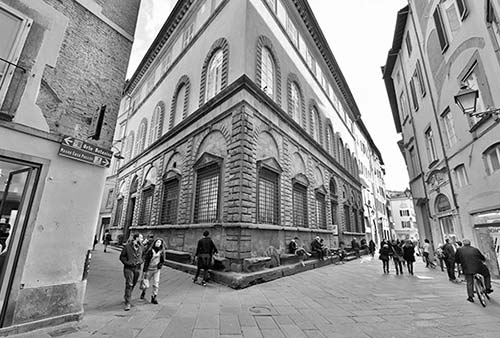
The intersection of Via Fillungo and Via Roma/Via Santa Croce marks the center of town, where the two original Roman roads crossed. The big old palace you’re facing (on the right)—with the heavy grates on the windows and the benches built into its stony facade—is the In Mondadori bookstore. While the interior is worth a peek, the benches out front are even more interesting: They’re the town hangout, where old-timers sit to swap gossip.
• Turn right down Via Roma, studying the people warming those stone benches along the way. You’ll pop out at...
4 Piazza San Michele
This square has been the center of town since Roman times, when it was the forum. It’s dominated by the Church of San Michele. Circle around to the church’s main door. Towering above the fancy Pisan Romanesque facade, the archangel Michael stands ready to flap his wings (which he actually did on special occasions with the help of crude but awe-inspiring-in-its-day mechanical assistance from behind). Perched above many of the columns are the faces of a dozen or so heroes in the Italian independence and unification movement: Victor Emmanuel II (with a crown, above the short red column on the right, second level up), the Count of Cavour (next to Victor, above the column with black zigzags), and—hey, look—there’s Giuseppe Mazzini (on the far left, fourth from the end).
The square is surrounded by an architectural hodgepodge. The circa-1495 loggia (to the right as you face the church) was the first Renaissance building in town. There’s a late-19th-century interior in Buccellato Taddeucci, a 130-year-old pastry shop (#34, behind the church, next to its tower). The left section of the BNL bank (#5, facing the church facade) sports an Art Nouveau facade that celebrates both Amerigo Vespucci and Cristoforo Colombo. This was the original facade of the Bertolli shipping company—famed among Italian Americans as the shipping company their grandparents sailed with to reach America.
If the church is open, pop in. A fine 12th-century wooden crucifix hangs above the high altar, which shows off the body of St. Davino, sporting the scallop shells that identify him as a pilgrim. Nearby is an exquisite painting, The Four Saints, by Filippino Lippi (a student of the Florentine master Sandro Botticelli). You may notice curious little doodles on the pillars, scratched into the marble back in the 12th century.
• From here, continue out of the square (opposite from where you entered) to take a little detour down...
5 Via San Paolino
This bustling street—which eventually goes all the way to Piazzale Guiseppe Verdi (with the TI and bus to Pisa)—is another fine shopping drag. Along here, a wide variety of storefronts cater not just to tourists but also to locals.
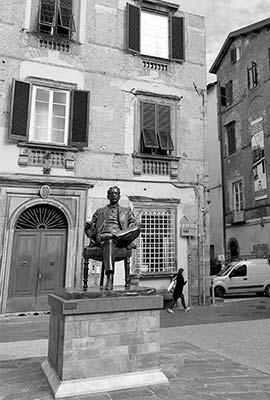
One block down this street, in the little square called Piazza Citadella (on the right), a statue of Giacomo Puccini (1858-1924) sits genteelly on a chair, holding court. The great composer of operas was born in the house down the little alley over his left shoulder (now the well-presented Puccini’s House museum, worth a visit for music lovers—see “More Sights in Lucca,” later).
• Feel free to browse your way as far down this street as you like, but eventually return to Piazza San Michele to continue the walk to Lucca’s cathedral. Facing the church facade, turn right and go down Via Vittorio Veneto (with the loggia on your left) to the vast, café-lined pair of squares...
6 Piazza Napoleone and Piazza del Giglio
The first of these two squares is named for the French despot who was the first outsider to take over Lucca. The dominant building on the right was the seat of government for the independent Republic of Lucca from 1369 to 1799—the year Napoleon came and messed everything up. Caffé Ninci, on the left (with some nice tables for people-watching), has been caffeinating locals since 1925 and serves what’s considered to be the best coffee in town.
Cross diagonally through this square into the smaller Piazza del Giglio, dominated by the Giglio Theater. Like a mini La Scala, this has long been the number-one theater (of seven) in the highly cultured city of Puccini.
• Continue to the left, along the big orange building, up Via del Duomo. After a block, you’ll see...
7 San Giovanni Church
This first cathedral of Lucca is interesting only for its archaeological finds. The entire floor of the 12th-century church has been excavated in recent decades, revealing layers of Roman houses, ancient hot tubs that date back to the time of Christ, early churches, and theological graffiti. Sporadic English translations help you understand what you’re looking at. As you climb under the church’s present-day floor and wander the lanes of Roman Lucca, remember that the entire city sits on similar ruins. Ascend the 190 steps of the church’s campanile (bell tower) for a panoramic view (but not quite as good as the one from the Guinigi Tower).
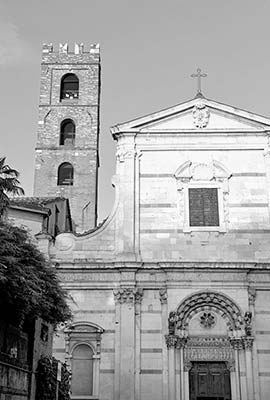
Cost and Hours: €4 includes tower climb, €10 combo-ticket also includes cathedral, its bell tower, and Cathedral Museum; daily 10:00-18:00, shorter hours Nov-Feb. For info on the Puccini concerts held at the church, see “Helpful Hints,” earlier.
• Continuing past San Giovanni, you’ll be face-to-face with...
8 San Martino Cathedral
This cathedral—the main church of the Republic of Lucca and worth ▲—was begun in the 11th century and became an entertaining mix of architectural and artistic styles. It’s also home to the exquisite 15th-century tomb of Ilaria del Carretto, who married into the wealthy Guinigi family.
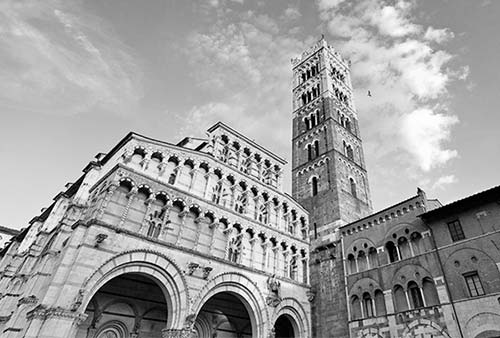
Cost and Hours: €3, tower climb-€3, €10 combo-ticket includes both plus Cathedral Museum and San Giovanni Church; Mon-Sat 10:00-18:00, Sun from 12:00, Nov-Feb until 17:00; Piazza San Martino, www.cattedralelucca.it. There’s a WC under the bell tower.
Visiting the Cathedral: The cathedral’s elaborate Pisan Romanesque facade features Christian teaching scenes, animals, and candy-cane-striped columns. The horseback figure (over the two right arches) is St. Martin, a Roman military officer from Hungary who, by offering his cloak to a beggar, came to more fully understand the beauty of Christian compassion.
The interior—bigger than it seems from outside—features brightly frescoed Gothic arches, Renaissance paintings, and stained glass from the 19th century. On the left side of the nave, a small, elaborate, birdcage-like temple contains the wooden crucifix—much revered by locals—called Volto Santo. It’s said to have been sculpted by Nicodemus in Jerusalem and set afloat in an unmanned boat that landed on the coast of Tuscany, from where wild oxen miraculously carried it to Lucca in 782.
On the right side of the nave, just before the transept, the sacristy houses the enchanting memorial tomb of Ilaria del Carretto by Jacopo della Quercia (1407). This young bride of silk baron Paolo Guinigi is so realistically realized that the statue was nicknamed “Sleeping Beauty.” Her nose is partially worn off because of a long-standing tradition of lonely young ladies rubbing it for luck in finding a boyfriend.
As you head for the church’s exit, stop by the third painting from the end (on the left)—The Last Supper by Jacopo Tintoretto. This is a typical Baroque spectacle, with the drama of the event emphasized as if it’s theater. Notice the actors on the stage and how the mother, giving her child his “first supper” in the foreground, connects with us, inviting us to be present.
• There’s one more sight to consider, but it’s extra credit. As you face the cathedral facade, on the little square to the left is the entrance to the...
9 Cathedral Museum (Museo della Cattedrale)
This beautifully presented museum houses original paintings, sculptures, and vestments from the cathedral and other Lucca churches. Pass through a room with illuminated manuscripts on your way to the ticket desk, then follow the one-way route up and down through the collection. You’ll see church paintings and sculptures, silver ecclesiastical gear, and a big cutaway model of the cathedral (€4, €10 combo-ticket includes cathedral, its bell tower, and San Giovanni Church; daily 10:00-18:00, shorter hours Nov-Feb; audioguide-€5, left of the cathedral on Piazza Antelminelli).
• Our walk is finished. From here, it’s just a short stroll south to the city wall—and a bike-rental office, if you want to take a spin. Otherwise, simply explore the city...lose yourself in Lucca.
More Sights in Lucca
Lucca Ramparts (and Bike Ride)
Lucca’s most remarkable feature, its Renaissance wall, is also its most enjoyable attraction, worth ▲▲—especially when circled on a rental bike. Stretching for 2.5 miles, this is an ideal place to come for an overview of the city by foot or bike.
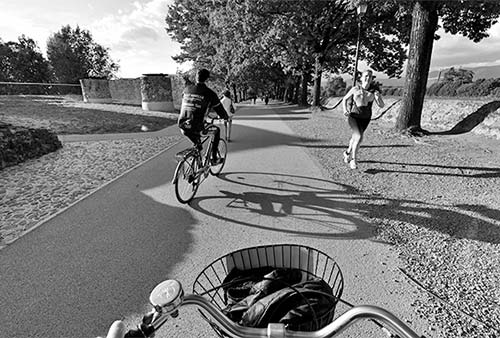
Lucca has had a protective wall for 2,000 years. You can read three walls into today’s map: the first rectangular Roman wall, the later medieval wall (nearly the size of today’s), and the 16th-century Renaissance ramparts that still survive.
With the advent of cannons, thin medieval walls were suddenly vulnerable. A new design—the same one that stands today—was state-of-the-art when it was built (1550-1650). Much of the old medieval wall (look for the old stones) was incorporated into the Renaissance wall (with uniform bricks). The new wall was squat: a 100-foot-wide mound of dirt faced with bricks, engineered to absorb a cannonball pummeling. The townspeople cleared a wide no-man’s-land around the town, exposing any attackers from a distance. Eleven heart-shaped bastions (now inviting picnic areas) were designed to minimize exposure to cannonballs and to maximize defense capabilities. The ramparts were armed with 130 cannons.
The town invested a third of its income for more than a century to construct the wall, and—since it kept away the Florentines and nasty Pisans—it was considered a fine investment. In fact, nobody ever bothered to try to attack the wall. Locals say that the only time it actually defended the city was during an 1812 flood of the Serchio River, when the gates were sandbagged and the ramparts kept out the high water.
If exploring the wall, you can venture into its tunnels and interior at either San Paolino Bastion or San Martino Bastion.
Today, the ramparts seem made to order for a leisurely, wonderfully smooth bike ride (20-30 minutes, bike-rental options listed earlier, under “Helpful Hints”). There are also several handy places to get up on the wall. Note that the best people-watching—and slowest pedaling—is during passeggiata time, just before dinner, when it seems that all of Lucca is doing slow laps around its beloved wall.
Guinigi Tower (Torre Guinigi)
Many Tuscan towns have towers, but none is quite like the Guinigi family’s. Up 227 steps is a small garden with fragrant trees, surrounded by fine views over the city’s rooftops. You’ll head up wide stone stairs, then huff up twisty metal ones through the hollow brick tower.
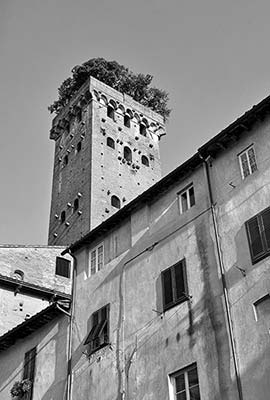
Cost and Hours: €5, erratic hours but typically June-Sept daily 10:00-19:30, until later on weekends, mid-March-May until 18:30, winter until 16:00, Via Sant’Andrea 41.
Puccini’s House
This modern, well-presented museum fills the home where Giacomo Puccini grew up. It’s well worth a visit for opera enthusiasts...but mostly lost on anybody else. Buy your ticket at the shop/office on the square, then buzz to be let in. In period-furnished apartments—including the room where Puccini was born—you’ll see lots of artifacts, including the Steinway piano where he did much of his composing, and original compositions and manuscripts. Don’t miss the small staircase up to the garret (storage room up above the house), where a stage set from La Bohème evokes the composer’s greatest work.
Cost and Hours: €9; daily 9:30-19:30; April until 18:30; Oct Wed-Mon until 18:30, closed Tue; Nov-March shorter hours and closed Tue; Corte San Lorenzo 9, +39 0583 584 028, www.puccinimuseum.it.
Sleeping in Lucca
BOUTIQUE B&BS WITHIN THE WALLS
$$ A Palazzo Busdraghi has eight comfortable, pastel-colored rooms with modern baths (some with whirlpool tubs) in a tastefully converted 13th-century palace tucked inside a courtyard. Sweet Marta (with help from Ingrid and Veronica) hustles to keep guests happy and bakes tasty cakes for breakfast. It’s conveniently located on busy Via Fillungo, so it comes with some traffic rumbles and occasional weekend-revelry noise (family room, air-con, pay parking, Via Fillungo 170, +39 0583 950 856, www.apalazzobusdraghi.it, info@apalazzobusdraghi.it).
$$ La Romea B&B, in an air-conditioned, restored, 14th-century palazzo near Guinigi Tower, feels like a royal splurge. Its five rooms are lavishly decorated in handsome colors and surround a big, plush lounge with stately Venetian-style mosaic-linoleum floors (RS%, family rooms, Vicolo delle Ventaglie 2, +39 0583 464 175, www.laromea.com, info@laromea.com, Gaia and Giulio).
$$ La Bohème B&B has a cozy yet elegant ambience, offering seven large rooms, each named for a Puccini opera. Chandeliers, 1920s-vintage tile floors, and tasteful antiques add to the charm (RS%, family room, air-con, pay parking, one floor up at Via del Moro 2, +39 0583 462 404, www.boheme.it, info@boheme.it, Laura).
$$ Relais Inn Lucca takes up a stately palazzo near Piazza Napoleone. Their nine rooms are chic and modern, and run with youthful enthusiasm by Alessandra (air-con, elevator, pay parking, Corso Garibaldi 19, +39 0583 464 218, www.relaisinnlucca.it, info@relaisinnlucca.it).
SLEEPING MORE FORGETTABLY WITHIN THE WALLS
$$$$ Palazzo Dipinto is your “design hotel with class” option, buried deep in the heart of the old town, just a few steps from Puccini’s House. It has less character (and fewer quirks) than the B&Bs, but the stylish lobby and 22 rooms provide predictable comfort (family rooms, air-con, elevator, pay parking—book ahead, Piazza del Palazzo Dipinto 27, +39 0583 582 873, www.palazzodipinto.com, info@palazzodipinto.com).
$$$ Hotel la Luna has 29 rooms in a great location in the heart of the city. Rooms are split between two adjacent buildings just off the main shopping street. Rooms in the main, historical building are larger and classier, with old wood-beam ceilings (and, in some, original frescoes), while the modern building feels newer and has an elevator but less personality (RS%, family rooms, air-con, pay parking, Via Fillungo at Corte Compagni 12, +39 0583 493 634, www.hotellaluna.it, info@hotellaluna.it).
$$ Albergo San Martino and $ Hotel Diana are two hotels run from the same reception—both friendly and conveniently located for train travelers. The main hotel has 12 art-adorned rooms, a nice lounge, and a cheery curbside breakfast terrace, plus six newer, slightly cheaper rooms in an annex. Hotel Diana is the budget choice, with nine fresh, affordable rooms with a colorful Italian-modern design flair (both hotels: skip breakfast to save a few euros, call ahead—reception not open 24 hours, family rooms, air-con, tight parking—free with this book if you book direct, bikes available, reception at Via della Dogana 9, +39 0583 469 181, www.albergosanmartino.it, info@albergosanmartino.it, Andrea and Fabrizio).
OUTSIDE THE WALLS
$$$ Hotel San Marco, a 10-minute walk outside the Porta Santa Maria or Porta San Jacopo, is a postmodern place with a peaceful garden and pool. Its 42 rooms are sleek, with all the comforts, and its easy location makes it a good choice for drivers (air-con in summer, elevator, bike rental, free parking, taxi from station—€13, Via San Marco 368, +39 0583 495 010, www.hotelsanmarcolucca.it, info@hotelsanmarcolucca.com, proud Francesco).
$$ Hotel Rex rents 25 dated but lovingly maintained rooms in a practical contemporary building on the train station square. While in the modern world, this family-friendly place is just 200 yards away from the old town and offers a good value. Ask for a slightly quieter room at the back (family rooms, children’s play area and toys, air-con, elevator, free parking, a few steps from the train station at Piazza Ricasoli 19, +39 0583 955 443, www.hotelrexlucca.com, info@hotelrexlucca.com, Elisabetta and Valentina).
$ Hotel Moderno is indeed modern, with 12 rooms tastefully decorated. Although it’s in a strange location, backing up to the train tracks, the rooms are quiet, and it offers class unusual for this price range (RS%, family rooms, air-con, Via Vincenzo Civitali 38—turn left out of train station and go over stair-heavy bridge across tracks, +39 0583 570 819, www.albergomodernolucca.com, info@albergomodernolucca.com, Stefano).
Eating in Lucca
FINE AND ROMANTIC DINING
$$ Canuleia Trattoria is run by enthusiastic Matteo (the chef) and Eleonora (head waiter), who make everything fresh in their small kitchen. You can eat tasty Tuscan cuisine in a tight, dressy, and romantic little dining room or outside on the garden courtyard. Reserve for dinner (Tue-Sun 12:30-14:00 & 19:30-22:00, closed Mon, Via Canuleia 14, +39 0583 467 470, www.canuleiatrattoria.it).
$$$$ Ristorante Giglio is a venerable old dining hall where the spirit of Puccini lives on and local families enjoy special occasions under a big chandelier. The short but thoughtful menu features a fusion of traditional Tuscan and creative international gastronomy. Though pricier than most of my listings, this is a big step up in dining experience. Consider their tasting menus (€80/six courses, €100/eight courses) to best appreciate how they’ve earned a Michelin star (reserve ahead, impressive wine list, Wed-Mon 12:15-14:30 & 19:15-22:15, closed Tue, Piazza del Giglio 2, +39 0583 494 058, www.ristorantegiglio.com).
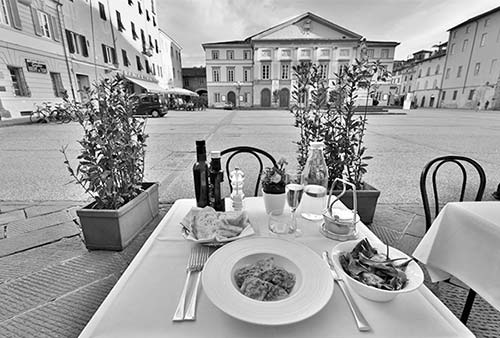
$$$ Osteria dal Manzo feels both classy and inviting. Gentlemanly Antonio warmly welcomes diners with a concise and enticing menu of elegantly simple, seasonal cuisine. There are typically five items for each of three courses—two meat, two fish, and one vegetarian (Mon-Sat 19:30-23:00, Sun 12:30-14:30, Via Cesare Battisti 28, +39 0583 490 649).
$$$ Il Mecenate faces a tranquil, picturesque canal at the eastern edge of the tourist’s Lucca, a five-minute walk beyond the main zone. The traditional dishes are beautifully executed; this is a good place to try meat-filled tordelli pasta, garmugia (vegetable soup), and testaroli, an ancient bread-like pasta tossed with pesto (book ahead and dress up a bit, Wed-Mon 12:00-14:30 & 19:30-22:30, closed Tue, Via del Fosso 94, +39 0583 511 861, www.ristorantemecenate.it).
CHARMING AND RUSTIC DINING
$$ La Bottega di Anna & Leo, run by Claudio and Lidia (and named for their children), is a pastel and lovable little eatery with a simple menu and a passion for quality. They have tight seating inside and a few charming tables facing the side of the Church of San Frediano (erratic hours but typically Tue-Sat 12:00-14:30 & 19:00-22:30, Sun 12:00-14:30, closed Mon, reservations smart, Via San Frediano 16, +39 393 577 9910 or +39 393 530 2512, www.labottegadiannaeleo.it).
$$ Osteria Via San Giorgio, where Daniela cooks and her brother Piero serves, is a cheery family eatery that satisfies both fish and meat lovers. The indoor seating is tight and convivial, the outdoor courtyard is cheery in summer, and the house wine is high quality (Tue-Sun 12:00-16:00 & 18:30-23:00, closed Mon, Via San Giorgio 26, +39 0583 953 233).
$$ Il Cuore Enogastronomia is a cozy blend of restaurant and deli—if you like your meal you can buy more to take home. Browse their cases of prepared dishes and order some to take away, or sit in the dining room for homemade pasta, big salads, pizza, meats, and desserts (Tue-Sat 10:30-22:00, Sun lunch only, closed Mon, closed Jan-Feb, Via del Battistero 4, +39 0583 493 196, enthusiastic Anna takes good care of diners).
$ Pizzeria da Felice is a mom-and-pop hole-in-the-wall takeout pizza joint. Grab an etto of cecina (garbanzo-bean crepes) or a slice of freshly baked pizza and a short glass of wine. From September through April, they’re known for their castagnaccio, a cake made with roasted chestnuts and ricotta (daily 10:00-20:30 except closed Sun Jan-Aug and closed 2 weeks in Aug, Via Buia 12, +39 0583 494 986).
$$ Trattoria da Leo packs in chatty locals for characteristic home cooking in a high-energy, diner-type atmosphere. Sit in the rollicking interior, or out on a tight, atmospheric lane (Mon-Sat 12:00-15:00 & 19:30-22:30, Sun 12:00-15:00, Via Tegrimi 1, +39 0583 492 236).
SNACKS, GELATO, AND HAPPY-HOUR APERITIVO BARS
Aperitivi near Porta dei Borghi: This gate at the end of Via Fillungo (and the little square just beyond it) is a great area for characteristic bars serving free and tasty buffets with any drink during their aperitivo time. These places are popular with young locals and are a perfect spot to relax after cycling the wall (near Piazza Santa Maria bike rentals).
Vinarkia, a characteristic wine bar, is popular for its aperitivo buffet from 18:30 to 20:00 (closed Mon, Via Fillungo 188, +39 0583 152 5357, Alekos).
De Cervesia is a craft beer pub, with three microbrews on rotating taps (and one English-style pull) and dozens by the bottle (Tue-Sun 17:00-22:00, closed Mon, Via Michele Rosi 20—look for big Italian Craft Beer signs, +39 0583 492 620, Matteo).
Ciclo DiVino, across the street, is a wine bar with a bike-shop theme and enticing snacks (Mon-Fri 16:00-22:00, Sat-Sun from 11:00, Via Michele Rosi 7, +39 0583 471 869).
Aperitivi on Piazza San Michele: Caffè del Mercato, on the other side of the old town and catering to an older clientele, has good aperitivo snacks nightly from 18:00 to 20:00 (facing church at Piazza San Michele 17, +39 0583 494 127).
Gelato: Just off Piazza San Michele, De’ Coltelli has some of my favorite gelato in Italy. It’s proudly Sicilian-style (with Arab roots), and many of their flavors rotate with the season. Sample with a spirit of adventure and then have fun ordering: The salted caramel is a standout, and their granita takes the slushy to new heights (Sun-Thu 11:00-20:00, Fri-Sat until 21:00, Via San Paolino 10, Valentina).
Pizza: Two doors away from De’ Coltelli, Alice Pizza offers good pizza by the slice (Tue-Sun 10:00-20:30, closed Mon, Via San Paolino 22, +39 0583 572 712).
Refreshments on the Wall: Caffetteria San Colombano is a handy pit stop for bikers and walkers on the city wall. This place is slick with bite-sized snacks and cappuccinos, perfect for a takeaway meal on top of the wall (overpriced at the table). If you’re not feeling too wobbly already from biking, try a caffè corretto (espresso with your choice of Sambuca, rum, or grappa) or a Biadina, a bittersweet liqueur served with pine nuts. The fancier sit-down restaurant serves pasta and big salads with a view (daily 9:00-late, near top of ramp at San Colombano Bastion, +39 0583 464 641).
Groceries: Pam is a small, central market just off Piazza San Michele (Mon-Sat 8:00-22:00, Sun 9:00-20:00, Via San Paolino 16).
Lucca Connections
Even if you have a car, I’d opt for the much faster and cheaper train or bus to reach the Leaning Tower. For more on day-tripping to Pisa, see here.
From Lucca by Train to: Florence (2/hour, 1.5 hours), Pisa (1-2/hour, 30 minutes; if going directly to Leaning Tower, hop off at Pisa San Rossore station; to reach Pisa Airport, change to the tram at Centrale station), Livorno (about hourly, 1-1.5 hours, transfer at Pisa Centrale), Milan (2/hour except Sun, 4-5 hours, transfer in Florence), Rome (1/hour except Sun, 3-4 hours, change in Florence), Cinque Terre (hourly, about 2 hours, transfer in Viareggio and La Spezia).
From Lucca by Bus: Autolinee Toscane (AT) runs handy, direct routes from Lucca’s Piazzale Giuseppe Verdi, at the west end of the old town (near the main TI). This is handiest to Pisa; the ones noted as going via “S.M. Guidice” (green on schedules) are about 10 minutes faster than the ones marked “Ripafratta” (black)—but both will take you right to the Field of Miracles and Leaning Tower (€3.50, continues to Centrale station, Mon-Sat about hourly, fewer on Sun, 45-55 minutes). Bus #DD runs to Florence (stops at Stazione Leopolda, west of the center; your bus ticket also covers the connecting tram to downtown); this bus can also drop you at Florence Airport (Peretola stop—request from driver; €7.60, Mon-Sat nearly hourly, less on Sun, 1.25 hours to airport, 1.5 hours total to downtown Florence). Before boarding, buy tickets at the bus ticket office on Piazzale Giuseppe Verdi (Mon-Sat 6:00-20:00, Sun 8:00-19:45; schedule info but no tickets at www.at-bus.it).